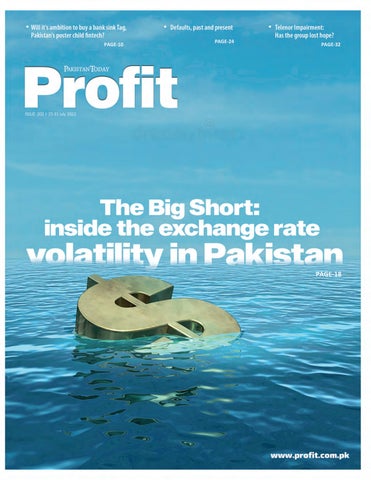
CONTENTS
08
18
08 Stuck in a loop - the week in Pakistan’s business and economics Twitterverse 10 In its ambition to buy a bank, is Pakistan’s fintech poster-child about to shut down?
18
18 The Big Short: inside the exchange rate volatility in Pakistan 24 Pakistan’s history with external debt restructurings
24
32
28 28 Prepare for default Uzair Younus 30 Cash is still king Ammar H Khan 32 Telenor Impairment: Has the group lost hope?
Profit
Publishing Editor: Babar Nizami - Editor: Khurram Husain - Joint Editor: Yousaf Nizami Assistant Editors: Abdullah Niazi I Sabina Qazi - Sub-Editors: Mariam Zermina | Basit Munawar Editor Multimedia: Umar Aziz - Video Editors: Talha Farooqi I Fawad Shakeel Reporters: Ariba Shahid I Taimoor Hassan l Shahab Omer l Ghulam Abbass l Ahmad Ahmadani Shehzad Paracha l Aziz Buneri | Maliha Abidi | Daniyal Ahmad | Ahtasam Ahmad | Asad Kamran Chief of Staff: Maliha Abidi - Regional Heads of Marketing: Mudassir Alam (Khi) | Zufiqar Butt (Lhe) | Malik Israr (Isb) Business, Economic & Financial news by 'Pakistan Today' Contact: profit@pakistantoday.com.pk
Stuck in a loop
this week in Pakistan’s business and economics twitterverse
Everyone is now saying the word Blitzscale. I’d be rich enough to blitzscale if I got a dollar every time someone said the word blitzscale.
The whole country can learn a lot from this simple and kind gesture… kudos to Babar Azam
May startup dreams never sink and may hardworking folk out there see their projects turn into a business.
Avid fans of the Pakistani cinema have had mixed emotions about Ahad Raza Mir’s kiss in the Netflix show. It’s the first time in the recent past a Pakistani actor has found his way onto the big Hollywood screen. It’s unfortunate that the kiss of the Pakistani actor in the series has become the talk of town rather than the acting skills and professionalism needed to get to that level.
10
Just Islamabad things.
With by-elections around the corner, all parties preach the sweet tune of “relief” and “subsidies”, either being too oblivious of the economic toll or downright evil with the national treasury. Either way this trend has to go.
What people fail to understand is the reality of the situation, regardless of party politics, one just needs to take a page out of the history books to understand what the US is capable of given the “right” pretense. We must be logical, diplomatic and realistic in our approach to foreign policy. Public transportation is a chronic issue that has been going from bad to worse since the creation of Pakistan. Policies and infrastructure development hasn’t been particularly keen on encouraging public transportation either, rather the infrastructure is such that it is hard for an individual to move within a city without a personal mode of transportation.
It’s like we’re stuck in a loop. The same news cycle every few weeks. Oh well, if things aren’t mitigated, by the time you read this; you will probably be wondering when you’ll get your tank refilled next. When they called it a global inflationary cycle, they weren’t kidding about it being global.
SOCIAL MEDIA ROUNDUP
10
O
By Taimoor Hassan
n the 1st of March this year, Talal Ahmad Gondal resigned as the CEO of Pakistani fintech startup TAG. The resignation was not a peaceful one. Behind it was a dicey series of events that began with TAG trying to buy a bank, and ended with an explosion of a tampered document, childhood friendships gone wrong, a cloak-and-dagger environment within the startup’s upper management, and the SBP suspending expansion in TAG’s pilot operations. How did Talal Ahmad Gondal, whose initials gave the company the name ‘TAG,’ find himself in this situation? Ask him and he will tell you that his co-founder used a serious oversight on his part to orchestrate a coup against him. Ask Ahsan Khan, Talal’s former childhood friend and the co-founder of TAG who is now up in arms against him, and he will tell you that Talal was directly involved in forging official documents that were then sent to the SBP, and that his actions were singlehandedly running the entire company to the ground. The truth is somewhere in between. Yes, there was a doctored document. It was a letter that said TAG had entered into a partnership with a Hong Kong based investment firm which had promised $45 million to help TAG buy Samba Bank. It has now been discovered that the Hong Kong firm only expressed interest in joining TAG in buying Samba and never mentioned the $45 million, which is where the tampering is supposed to have happened. Talal has admitted that the document was sent by TAG and that it was his oversight since he was the CEO, but maintains that he did not send it. He claims the letter was then used in a conspiracy to try and oust him from his position. Right now, Talal does not have an official title at the company but is practically still running the show as a 55% majority shareholder — who is at the same time under investigation. Well placed sources have said that TAG might get away with the entire fiasco with a slap on the wrist, but at the same time if the SBP decides to take serious action against Talal and TAG, it might prove to be a death knell for the startup. But why on earth was a fintech startup like TAG trying to buy a commercial bank, and why were they desperate enough to try and tamper with a document being sent to the central bank? At the centre of it is how the business of financial technology works, and why every fintech with enough money would be ready to give an arm and a leg to get a banking licence. The entire story has a messy trajectory and a colourful cast of characters. Involved also are the well-connected Lt General (r) Muhammad Afzal, the Executive Chairman of TAG, and a third co-founder by the name of Alexandar Lukianchuk. Throw into the mix an inquiry by the central bank, accusations of syphoning company money being hurled indiscriminately by both sides, and open letters being written to investors and you have a recipe for disaster. In short, it is a train-wreck. It is a dumpster fire. It is a fiery trainwreck rattling around inside an industrial sized dumpster fire. And to understand it, we must go back to the origins of TAG, the fintech startup scene in Pakistan, and why buying a bank is such a game changer.
So you want to buy a bank …
T
AG must really have wanted to buy Samba Bank to risk sending a forged document to the SBP. The reality is, if an EMI like TAG manages to get a banking licence it will give them a major advantage over the
FINANCIAL TECHNOLOGY
This email was sent by a disgruntled employee, Ahsan Kaleem Khan who was fired for a number of reasons. He misrepresented that he is no longer a government servant and could not be employed at TAG Talal Ahmad Gondal, Founder, TAG
competition. And of course, TAG needed that advantage because they had been falling behind their competition. Initially, TAG had made a pretty big splash when it first came onto the scene, with investors like Fatima Gobi Ventures part of its seed rounds and very early pilot approval from the SBP. In fact, when TAG got in-principle approval in November 2020, it was one of the earliest EMIs to get pilot approval from the SBP. To the extent that industry insiders said TAG had managed to get pilot approval a little too quickly — almost fishily so. Rumours began to circulate that Talal had used political connections to get the licence early. You see Talal never quite fit the mould of most Pakistani startup founders. Most founders here are young, American educated, with clipped accents and lofty American ideals. Talal, on the other hand, has a more desi touch to him. While he is also young and foreign educated, with a degree from Erasmus University in Rotterdam, he is the scion of an old political family from Sargodha. Smart and business savvy, Talal was actually doing pretty well from himself in Europe. He spent a lot of his time in Germany and had a wide network of techie friends, and his first business venture was connecting these techies to recruiters all over the world. He was actually doing pretty well for himself.
12
But like most startup founders in Pakistan, he had a desire to come back. Except when he returned in 2018, it wasn’t to join the burgeoning startup revolution in Pakistan, it was to run as a candidate for the Punjab Assembly in the upcoming elections. In fact, Talal came back and was briefly awarded the PTI ticket for PP-76 in Sargodha. With slicked back hair, sporting a sharp black moustache in a shalwar kameez and waistcoat, he was a far-cry from the clean-cut, high-paced, and tech centred men and women of the startup scene. But then, political realities meant Talal’s fledgling career as a politician came to a halt. In Sargodha, Talal had managed to get the ticket through his political connections, but part of it was also that he was fighting for a traditionally PML-N seat, which is why the PTI was willing to try a new candidate like Talal. Very close to the election, the ‘electable’ for that constituency that used to run for the seat switched sides and abandoned the PML-N for the PTI. Talal’s near confirmed ticket for the PP-76 seat went out the window, and he now found himself without a political career for the next few years. The proud Farzand-e-Sargodha had left his work in Europe for a career and politics and found himself out of the loop. But remember, he still had a network of techie friends all over the world. He spent some time in the United States and then went back to
Germany and with their help, the idea for TAG began to take shape in his head. In his mission he also involved Ahsan Kaleem Khan, a close friend from back when they were schoolboys, as well as Ahsan’s brother Tayyab Kaleem Khan, who Talal was friends with as well. Talal began assembling a highly paid team for TAG, along the way they also hired Lt General (r) Muhammad Afzal, who later served as the governing officer for TAG and came with a long list of connections. These connections were very important. While TAG and other fintech players might be doing advanced, tech based work, they are still very much doing it in Pakistan’s regulatory framework. That means you need people with experience and connections to both help navigate the environment and grease the wheels when necessary. Talal already had political clout, and on top of that he also had military connections within his family as well as in his company. That is where the original whispers also arose that TAG used political connections to secure their approvals from the SBP. And that is where the bank comes in. As we’ve mentioned before, while they managed to get their approvals early, TAG was falling behind the other players in the market. In September 2021, Nayapay became the first EMI to be granted a licence by the SBP. On
the 21st of December 2021, TAG’s main rival, Sadapay, also gained pilot approval from the SBP. TAG had also raised upwards of $12 million in September that year, but Talal quickly began to feel that TAG needed an edge over its competitors to wipe them out early in the game. The fintech space in Pakistan has taken off quite remarkably in the past few years, and that has given birth to a number of competing startups like Sadapay, Nayapay, and TAG. Most senior executives have been of the opinion that the Pakistani market is big enough for multiple players because of how largely unbanked the country is. Despite this, the competitiveness between fintech startups has always been high intensity and the players involved, TAG included, haven’t always played nice. TAG felt that if they got a bank in their portfolio, they would be able to use its licence to enhance their product. It is a concept that has existed within Pakistan’s banking industry for a while. HBL, Pakistan’s largest bank, went so far as to say their goal in the near future is to become ‘a technology company with a banking licence.’ TAG thought, as other tech focused startups do, that they already had the technology and just needed approved channels such as a banking licence and the backing of the SBP. Samba Bank has a record of being a clean bank but it is also the smallest bank in Pakistan. While more traditional buyers like Meezan or UBL wanted it to expand their portfolios, an entity like TAG buying it was simply for its licence. A commercial bank backing a fintech company could be hugely beneficial for that fintech company. The EMIs are allowed to not just facilitate money transfers between two parties but also to store money electronically into their user accounts. But regulations prevent EMIs from lending from their deposits which means that they are only building a payments business. To be able to lend from their deposits, EMIs can either get an NBFC licence or partner with a bank to build credit products and then distribute them through EMIs digital presence. To be clear, the EMI TAG could not buy a bank. It’s the group behind the EMI that would have bought a bank and then used its licence for the benefit of the EMI. As an EMI, the cost of borrowing funds from partner banks for lending is also high and the EMI needs to make more than the said cost of funds to turn profits. With a bank on the back, that cost of funds drops substantially because the bank can lend from its own deposits and therefore the cost of funds for the EMI is also very low, which can turn into better profits. Furthermore, there are deposit and
FINANCIAL TECHNOLOGY
We have observed that due to increased competition and to access venture capital funding, some companies enter into malpractices and behaviour that would not be becoming of them. It is one of the areas that we have been reviewing carefully and is a concern for us Reza Baqir, as SBP Governor in Dec 2021
withdrawal limits on EMI wallets. In terms of putting money into a digital wallet run by EMI, the cap is Rs 50,000 in a month, which can be increased to Rs 200,000 provided the wallet holder has completed biometric verification. As far as withdrawals are concerned, the limit is Rs 10,000 per day, no matter what level of authentication has been completed. For commercial banks, once biometric verification of a client is done, there is virtually no limit on deposits or withdrawals. Once the bank is acquired, the EMI can eliminate the hurdle of limits by moving its operations under the banking licence. The other alternative to this arrangement is getting a digital banking licence to perform the functions of a bank. However, despite regulations being in place, the competition for a digital banking licence is very high with big commercial banks like HBL and foreign entities in the running for the same licence which would be issued to only a limited number by the SBP (5 in this year). So chances that an EMI like TAG would be able to get a digital banking licence quickly are slim while a shot at buying a commercial bank looks more doable.. All of this means that if TAG, or for that matter any other fintech startup, managed to acquire a bank they would be able to use that bank’s licence to give their product a huge edge. Buying Samba Bank would have wiped the floor with the competition. The acquisition, however, was going to be an expensive one, and TAG needed to show that they were good for the money. Read more: Should the fintech playbook scare the banks?
How the tampering played out
I
n December 2021, TAG rolled up its sleeves and decided to put up a bid to acquire Saudi Arabia’s largest corporate lender National Commercial Bank’s (NCB) stake in SAMBA Bank. The interested parties would be able to buy the stake in SAMBA Bank at an estimated value of $100
14
million. The problem was TAG did not have enough money on its own to buy the bank, despite their recent seed round. That is when TAG decided they would form a consortium to buy Samba Bank. On the 9th of December 2021, Talal sent an email to the SBP saying that TAG Fintech along with Descon Pvt Limited, and TTB Partners were forming a consortium to do due diligence about acquiring a majority stake in Samba Bank. There are two important things here. The first is that TAG Fintech is the Delaware registered holding company that owns TAG Innovations which is the operating company based in Pakistan. The second is TTB Partners — a Hong Kong Based investment firm was in fact part of their consortium. The letter was signed by Talal from TAG (who signed it as CEO of both TAG Fintech and TAG Innovations), and by Chris Scoular of TTB Partners. To prove to the SBP that they were in fact a serious buyer, on the 23rd of February 2022, just in time to meet the deadline to submit the supporting documents, TAG sent SBP a letter written by Hong Kong-based investment firm TTB Partners, and signed by TTB partner Christopher Scoular. “We are willing to support TAG for the strategic acquisition of the majority shareholding in Samba Bank Limited, Pakistan and have set aside up to $45m USD for investment in TAG for this transaction from the strategic investments fund,” reads the letter. Here’s the catch however — that letter was doctored. TTB had never committed an amount and had only shown commitment in joining the SAMBA acquisition bid. The not-so-little $45 million detail had been added to the letter later. Whether it was out of the last minute pressure to meet the SBP’s requirements or the desire to stay ahead of the others, TAG had forged the letter. At the moment the thought was that the TTB would come around and when it did the whole matter would be buried under paperwork, except the lie was caught out. TTB Partners has not responded to Profit’s request for comments.
Suddenly TAG was in trouble. What seemed in a moment like one small mistake was about to uproot the startup’s entire existence. Falling behind their competitors in the fintech race, TAG had pinned a lot of their hopes on adding a licensed bank to their portfolio — something that would give them a massive edge over other fintech startups. The document was submitted in what was a bit of a desperate attempt to to accelerate the Samba Bank deal. Apparently SBP did not notice the forgery at first, but Talal’s co-founders and board members did. Ahsan Khan confronted Talal over the forged document. On the 1st of March, Ahsan made Talal sign a written affidavit admitting to the massive mess-up which also served as Talal’s resignation. In the attested and signed confessional statement seen by Profit, Talal admitted responsibility for these actions and declared that it was solely his own responsibility. He did not, however, admit to sending the letter himself, he simply admitted that as CEO it was his oversight and he was taking responsibility for his unintentional actions as a leader. That is where a very tumultuous month for TAG began.
Oh you weren’t supposed to do that …
T
his is where it gets really messy — the fallout. Because let’s be real, the move was an incredibly stupid one. Talal has at different points blamed his advisors and partner Ahsan for it and admitted that it was a major oversight on his part but has denied malice. Two of the advisors have denied involvement in whatever happened at TAG, and one even wrote a letter to the State Bank saying that they were never officially appointed by TAG. In fact, both these advisors, in background conversations with Profit, vouch even for each other that they were not involved in this fiasco in any way. What happened within the TAG
TEXTILES
management, however, caused a month of major confusion in the company. On the 1st of March, Talal had already resigned in the affidavit. According to Talal, the understanding between him and Ahsan was that this was a fail safe measure. He claims the affidavit was signed so that in case the SBP found out about the tampering, TAG would be able to say that it was a minor mistake over which their CEO had already resigned. Talal was under the impression that the SBP would not find out and he would be back in the CEO’s chair within a couple weeks without anyone being the wiser. After taking over as interim CEO, Tayyab and his brother Ahsan began to worry about the danger of the SBP finding out and coming out against TAG, all guns blazing. With Talal out of the picture, Ahsan and General Ahsan began discussing prudent measures to get out of the problem. Both of them felt that instead of risking the SBP finding out, they should come clean to the central bank and let them know what Talal had done — sacrificing him in the process. On the 17th of March, Lt General (r) Muhammad Afzal in his capacity as Executive Chairman of TAG wrote a letter to the SBP in which TAG withdrew its request to acquire Samba Bank. In the letter, he explained to the SBP that a tampered document had been shared with the central bank, and upon discovery of this a board inquiry had followed as a result of which their CEO Talal Gondal had resigned. A new CEO had been appointed — Ahsan Khan’s brother Tayyab. Meanwhile, Ahsan Khan would continue to serve as COO.
Talal’s great return
T
o recap, TAG had sent a tampered letter to the SBP, after which an internal decision within major company officials had ended in Talal Gondal resigning. Then, the new management went to the SBP and tattled on Talal. On the one hand, Ahsan seemed to be flanked by the extremely influential Lt General (r) Muhammad Afzal who was the company’s governing officer. At the same time, Ahsan and Talal also had a third co-founder — the German CTO of TAG Alexander Lukianchuk. Alexander sided with Talal, and things at TAG were far from settled. Both sides had a point here. On the one hand, Talal claimed that the resignation was a small matter and that the SBP might never have found out what had happened and that Ahsan went back on their agreement. On the other hand, Ahsan felt that he would be risking the entire company by protecting Talal. After telling the SBP what had happened, Ahsan began to work towards ridding TAG of Talal entirely. Ahsan approached
Talal to try and have him give up his shareholding in the company. In an effort to dilute Talal’s majority ownership, he was asked to give up 10% of his equity in the company and the said shares will be distributed towards company employees under ESOP (employee
stock option plans). This would mean Talal would no longer be able to run the show as the majority shareholder. Up until this point, Talal had not thought there would be any question of him being thrown out of his own company. But he
FINANCIAL TECHNOLOGY
was not ready to go down. Remember, he still owned a 55% share in TAG Fintech, which is the Delaware based holding company that owns TAG Innovations which operates in Pakistan. Sensing his opponents were on the attack, Talal countered. He lobbied heavily through his family connections and eventually regained the support of General Afzal as well. Suddenly, Ahsan’s brief revolution was over. On the 1st of April, exactly a month after Talal had resigned as CEO, Ahsan resigned as COO of TAG. His brother, who never really took over as CEO, was also replaced by General Afzal as the CEO of TAG Innovation. Meanwhile, Talal let Alexander take over as CEO of TAG Fintech in Delaware. While Talal does not have an official title at TAG other than founder and majority shareholder, he seems to be now back in the driving seat while Ahsan has been kicked to the curb alone. In conversations with Profit, Talal has expressed that he was taken out of his role as CEO for something that could have been resolved within the company itself. There is a clear indication that he feels scapegoated over the forged document. There is a certain degree of truth to this, particularly since Ahsan and General Afzal did consolidate control over TAG in the immediate aftermath of Talal’s exit, and Talal had to claw his way back into the company that bears his initials as its name. However, at the end of the day the mistake was Talal’s. And even if they got some gain out of it, going to the SBP was a prudent decision. Remember Samba Bank was still up for sale and the SBP was keeping a close eye on it. If they had discovered the discrepancy on their own, it would have been a landmine for TAG. Instead, Ahsan and General Afzal decided going to the SBP, admitting everything, and then withdrawing from the race to buy Samba Bank would get them some brownie points. Even if Ahsan had not gone to the SBP, the central bank would most likely have sniffed out the forgery. Forgery is a serious offence that the SBP, being a regulator, would never overlook. Especially since the SBP has been keeping a very keen eye on every single move being made by fintech startups. In a statement in December 2021, then central bank governor Reza Baqir had also pointed towards this. “I want to emphasise the market conduct of new tech companies venturing into the payments space in Pakistan, especially with regards to market assessment and practices. We have observed that due to increased competition and to access venture capital funding, some companies enter into malpractices and behaviour that would not be becoming of them,” he said, going on to em-
16
phasise that this area because “it is one of the areas that we have been reviewing carefully and is a concern for us.” On top of this, in his ambition Talal may have forgotten that the SBP would have an extra close on him and his startup, since Talal did not have a clean history with disclosing investments and what he told to investors. In fact, an earlier article by Profit into TAG’s realities was discussed at length in official SBP meetings. Talal had also gotten in a bit of trouble over misrepresentation. According to our sources, Talal claimed that one of the prominent American VCs had joined TAG’s round, and added them to his list of investors. However, it turned out that the VC had never invested in TAG and in fact it was just one partner at the firm that had invested using a special purpose vehicle. It was not the fund that invested itself. So him saying that on his press release was a lie and the VC was very upset with him about it, even though they never went public to rectify this. In fact the State Bank on its own also verified with TTB Partners the authenticity of the document and learned directly as well that it was not what TTB had committed. With all of this going on, it was no surprise that the SBP took exception to the forging attempt and on April 11th stopped TAG from growing it’s EMI pilot operations any further. This, at a time when TAG’s competitors such as Sadapay and Nayapay have gotten their full licences and are scaling their operations. It was obvious that Talal had messed up, and that if no action was taken, it would look bad on the governance at TAG Pakistan which could compromise the chances of getting the EMI licence for TAG. And if the person responsible for the act was not identified and sidelined from the company, it would look bad overall on the entire management and the company itself. So it was either save the company in which millions of dollars had been pumped
and get the long-awaited commercial licence, or save the person allegedly responsible for forging the document. Because if the responsibility is fixed, the board and the management acted prudently and the SBP would then look kindly to the startup for the licence, instead of if it found out that official documents had been forged and submitted to the central bank but nothing had been done about it at the company.
Honey, not in front of the investors …
A
nother recap: After resigning as CEO, Talal Ahmad Gondal began to feel that his childhood friend and partner Ahsan Khan was trying to force him out of the company he owned. Talal retaliated and ousted Ahsan from his position as COO in the company, but not before Ahsan managed to tell the SBP about Talal’s actions. The SBP responded by suspending TAG’s pilot operations as well. While Talal had agreed to stay away from TAG, he went back on his word despite him accepting responsibility for the tampered documents going through. Even though he may not have the title of CEO and Director, Talal still has all the power as majority shareholder. So if you are in Ahsan Khan’s position, what do you do? You go to the investors. This is where the infamous letter comes in. Yes, if you’re keyed into the startup or fintech ecosystem in Pakistan, you will already have received it on Whatsapp by now. On June 16th, Ahsan Khan decided to write a letter to investors to appraise them of TAG’s situation, and give them the bad news that TAG’s pilot operations had been suspended by the SBP. And that the central character who was single handedly running his own company to the ground was Talal Ahmed Gondal. In the letter, Ahsan spilled the beans to all of TAG’s investors. He explained how
TEXTILES
Talal had allegedly submitted a forged document to the SBP affirming that TAG had the backing of TTB Partners which had committed $45 million to acquire Samba. He also told them that Talal had agreed to step down, but had backtracked on the agreement. Talal’s change of heart became a major sticking point in an already messy situation for TAG. Not only does he want to maintain his control over TAG, along with Alexander he wants to take Ahsan to task for asking him to resign in the first place. According to the letter written to investors and available to us, Ahsan alleges that both Talal and Alexander together conspired against him in an attempt to oust him as stockholder in TAG Fintech, and illegally acted to cancel his shareholding, which according to Talal is only 12%, on fabricated grounds. The grounds on which Talal and Alexander are acting against Ahsan is that Ahsan misappropriated funds from the company, a charge that Ahsan denies stating that only Talal was the sole operator of TAG Fintech bank accounts and for TAG Innovation, he had the authorisation to authorise payments as per operational requirements of the company such as disbursement of salaries. On the other hand, Ahsan alleges in the letter that it was actually Talal who misappropriated investor funds in the company and transferred them into his own account. According to the letter, On March 1, on the day Talal resigned, and on March 2, by virtue of him being the sole operator of bank accounts, Talal withdrew investor money illegally in excess of $599,000 from the bank account of TAG Fintech and transferred the same to his personal account. “It is an alarming state of affairs indeed that, to date, Talal Ahmed Gondal took out $1,000,000+ in the aggregate,” Ahsan wrote in the letter to investors. Similarly, an amount of $150,000 was withdrawn by Talal from operating company TAG Innovation Private Limited “without a bonafide purpose or reason.” In response, Talal also went directly to the investors just as Ahsan had. In his detailed email, Talal says that all the allegations and the supporting documents provided by Ahsan are mostly fake documents — ironic considering the biggest issue in all of this was a fake document. Talal also alleged that besides misappropriating company funds, Ahsan misrepresented that he was no longer a government employee, which explained his lack of commitment to TAG, and was one of the reasons that he was fired from TAG. “He was given an opportunity to return the funds and when he did not on time, upon advice of our counsel, Ahsan’s shareholding was suspended and cancelled,” Talal wrote to
investors in response to Ahsan’s letter. “This email was sent by a disgruntled employee, Ahsan Kaleem Khan who was fired for a number of reasons. He misrepresented that he is no longer a government servant and could not be employed at TAG. He is back at his public sector job. This surfaced in the audit. This also explained his lack of commitment to TAG. He also made unauthorised withdrawals from the company accounts.”
What next …
A
s things stand, TAG is still operational. According to officials from TAG, the SBP has already conducted an audit which has come out clear and that they are on track to get their EMI licence. While it has not caused any immediate lasting damage to the financials of TAG, the entire incident will leave a bad impression on investors. According to Talal, well, besides one rogue employee, all is well. That the company is burning only $350,000-400,000 per month and they have enough money to last for more than a year. That the company is making advancements on the product and technology side and it is only the SBP approval that they are awaiting. Talal Gondal still controls the majority shares in TAG Innovate Pakistan’s holding company TAG Fintech, and even though he is not the CEO he can still exercise the most degree of control on the company as the majority shareholder. Ahsan has allegedly made overtures towards acquiring Talal’s
shares but have been rebuffed. At the same time, Ahsan has resigned from his position as COO and instead now Talal is attempting to take away his shareholding in the company. With letters and emails going back and forth directly to investors, things might not be a complete disaster at TAG but the situation is less than ideal and conducive to focusing on the product. While the big dogs at TAG fight it out, the company and its financials will suffer. As of now, it is only Talal Gondal that is under serious scrutiny by the SBP and it is him that the show cause notice of the SBP was directed towards. However, he is still steering the ship even if he is no longer officially the captain because, well, he owns the ship. It is unlikely, however, that in the middle of all of this TAG’s operations will not be affected. While sources close to TAG claim that things have settled down now, and SBP after imposing a fine, will grant TAG the full licence within the next few weeks, this entire episode will leave a bitter aftertaste not just for the SBP, but also for TAG’s investors who have gotten a front seat to the row between Talal and Ahsan. What this will mean in the long run is anybody’s guess. The final verdict on the extent of damage to TAG from this is going to be given by the SBP, which as of this point in time, is still in the process of deciding on TAG’s future and that of Talal. The SBP has not disclosed details about TAG in request for comments by Profit. n Additional reporting by Abdullah Niazi, Ariba Shahid and Babar Nizami
FINANCIAL TECHNOLOGY
18
Khurram Husain and Ariba Shahid
M
onday, July 18, was going to be a difficult day by any reckoning given the headlines of the night before. Imran Khan’s blitz through Punjab in preparation for by-elections had produced spectacular results on Sunday, with an unofficial count showing him carrying 15 of the 20 seats under contest, enough to allow him to form the government in Punjab. These were no ordinary by-elections. Their outcome held the destiny of the federal government in Islamabad in balance. As the results rolled in, the clouds over the government of Shehbaz Sharif thickened and frenzied media commentary speculated on whether the central government can survive now that the country’s bellwether province had fallen to the opposition. Meanwhile, a dollar shortage was intensifying in the
COVER STORY
country’s financial system. The curtain rose on the interbank market on Monday morning with these uncertainties at play, and the result was 48 hours of mayhem. What happened in the interbank on Monday and Tuesday of last week (July 18 and 19) was born of this uncertainty, coupled with a series of developments that had no link to the political scenario. The interbank market is fed with dollar supplies from two main directions: remittances and exports. As these proceeds pour in, they are drained back out as the banks move to settle payments for import Letters of Credit (LCs) and private sector debt obligations. Government debt obligations are paid out of the reserves held by the State Bank of Pakistan (SBP) and do not impact the interbank market directly. But the days after the Eid holidays see thin remittance inflows as a norm, and it had been barely five days since these holidays had ended. Moreover, exporters usually have 120 days to bring their export proceeds back, and even after that, they have another three days to “keep the funds onshore before surrendering them to the interbank market” as per a knowledgeable source. This gives importers some leeway to see which way the winds may be blowing before deciding to surrender their funds.
Market in windfall after LCs
W
hat happened on Monday was that inflows slowed down – remittances because of the Eid holidays having just passed, and export proceeds because of exporters eyeing the political scene – while a number of large payments materialised suddenly and together in a stroke of bad luck. “Under such conditions, the State Bank tells us to open a short position, pay on our account and pay for the position, then over the next five to 10 days we cover the position,” says another senior executive from a large bank. “For four or five months, the SBP has been asking us to run a short position to cover our payments, and we cover it from exports and remittances.” The payments related to imports of oil cargoes that had landed in May and June but their LCs needed to be retired in July. “For the month of July, we have $1.7 billion worth of oil-related payments to make, minus LNG,” says a senior executive from the oil and gas sector who had the full picture from the sector’s payments before him. “These are hard figures, not estimates,” he added. He could not say how much of this $1.7 billion has already been cleared and how much remains in the pipeline. On Tuesday night, in one of his many televised appearances during the week in which he sought to calm the markets down by telling them that underlying fundamentals do not justify panic, Finance
20
Minister Miftah Ismail said $700 million worth of oil imports have been seen in July. But he was sharing data from the Pakistan Bureau of Statistics, which measures the value of cargoes landing at the port, not State Bank data, which measures the payments made for imports via the banking system.
Things get intense in the interbank: The SBP steps in
T
he interbank market reacted to the combined impact of a constriction in inflows and the sudden materialisation of a set of lumped payments in the opening days of the week. On Monday, the gyrations began early as trading opened, but according to one source from the banking system with visibility of hourly trades in the interbank market, the SBP finally intervened to dampen down the volatility, but not until 1 pm. The rupee plummeted against the dollar by PKR 5 on that day, triggering alarm bells. “They entered through select banks to pour liquidity into the market as the demand for dollars was spiking while bids from other banks were in short supply,” the banking source tells Profit. This intervention helped stave off a rout, but only temporarily. The next day – Tuesday, July 19 – the opening rate for the dollar plummeted to PKR 221 as the market opened, and had dropped to PKR 225 by market close, according to data from the Pakistan forex association. Taken together, the rupee had plunged PKR 15 in two days and fears intensified in the country of an impending rout. “Last week, there was heavy payment pressure,” says a high-level source in the banking system with wide visibility on the interbank market. “Normal payment pressure is known a few days in advance and can be managed, but this was not normal.” In addition to payment pressure, exporter inflows were also hanging back. What was happening, in reality, was a few large banks were scouring the market to retire the large oil-related LCs that were due in those days. Banks use dollar liquidity from two sources when meeting payment obligations on behalf of their clients. The first route is to use what they call Nostro liquidity – funds they have in their possession from the inflows into their accounts from remittances or exports, or in some cases funds they can access from their counterparty banks abroad. The second is to borrow from each other. When banks borrow they can either do it in the ready market or borrow via swap instruments where they furnish Pakistani rupees in exchange for dollars at a pre-agreed exchange rate. This is done with an agreement that they
will reverse this position down the road, either one week, one month, two months, three months or more. On Monday and Tuesday, the banks turned to these swap instruments heavily to arrange the liquidity required for the large payment obligations that fell due so close to each other. When they did so, the premium that is usually charged in these swap transactions began to fall. Under normal conditions, this premium should roughly track the Karachi Interbank Offered Rate (KIBOR) within a difference of about 100 to 200 basis points, since dollars are being borrowed against rupees, and the KIBOR tells you what the banks can earn on those rupees if they were to be lent out directly. But when large numbers of banks enter the swap market to fund their Nostro account by seeking dollars from each other, the premium drops as they outbid each other for the small supply of dollars, agreeing to enjoy a smaller premium for themselves from this transaction simply to meet their payment obligation. And that is what happened in the market from Monday onwards. Forward premiums for these swaps were under pressure for many days already. With the KIBOR at or above 15%, the forward premium on the dollar (for one-week trades) was already showing pressure, oscillating between 6 and 11% in the opening days of July. But on Monday (July 18) it dropped to below 5% and then plunged below 1% for the remaining days of the week. This is not the worst we have ever seen. In the middle of June, these premiums had dropped steeply into negative territory as many banks had depleted their Nostro accounts and were forced to rely on liquidity from the swap market to meet their payment obligations. In doing so, they showed a willingness to complete their payment obligations at a loss rather than default. This time, the premiums remained positive, but the enormous gap between the swap market and KIBOR shows the interbank market was under severe stress to meet its payments. The SBP is being careful about intervening in this situation, partly because the impending resurrection of the IMF programme prohibits it from doing so, and partly also due to its own liquidity shortage, forcing it to husband its reserves. “Disorderly conditions merit intervention,” says a SBP source who did not wish to be named given the sensitivities. “If the market starts to freeze, we intervene, for example, if bids are either not attracting offers or offers that are so wide that even a small trade causes an exchange rate movement.” Last week’s growing pressures on the interbank market seem to have tested this standard to determine when an intervention is merited. The direct intervention did not come,
but the SBP did use its power of “moral suasion” to encourage some banks to offload liquidity into the market to mitigate the volatility. To some extent it worked. From Wednesday onwards the interbank rate continued to slide, but the extreme volatility had disappeared. Losing a rupee or two every day, the rupee ended the week at just below PKR 230 to the dollar. Along the way, however, a few oil-related import LCs were closed at PKR 241 or above. News ran about this throughout the week, with some journalists tweeting that four oil companies – two refineries and two oil marketing companies (OMCs) – were charged PKR 241 to close an LC that they had opened in May and June. Profit has been able to confirm three oil companies (two refineries and one OMC) with no confirmation on the fourth. In addition, some private debt payments from the power producers also had to be settled on the same days, with ticket sizes said to be between $30-40 million. One of the oil LCs was $70 million, and the size of the other is estimated by oil sector executives at around $60 million. No estimate could be obtained for the amount of the third oil LC. Those with visibility on these transactions are extremely reluctant to discuss them, even off the record. In the meantime, calls rose that some banks are engaged in “speculation”. It is next to impossible to determine where normal trading behavior under conditions of extreme stress crosses the boundary to become “speculation” though. “What you’re seeing is a slow collapse over the past few weeks,” says another senior source in the banking system. “It is culminating in the market becoming almost dysfunctional.” When asked about details on the lumped payments falling due in the early days of the week, he replies calmly: “Lumpy payments are made every other day, what’s so unusual about that? What can you say about a market that is jolted by a $70 million payment?” His point is simple: As banks scramble to arrange the dollars needed to settle basic trade-related payments for imports that have already arrived, they will inevitably land up in the swap market to borrow in order to stave off a default on their LCs. As the scramble intensifies, the banks will reduce their expectations of a premium from these transactions, and instead demand a premium from the customer to be able to close the LC. This is why forward premiums are falling, while clients with large ticket sizes were asked to pay PKR 238 and above to close their LCs, even though the interbank was operating at PKR 225 on that particular day. As part of the effort to stave off a default, a wide slew of payments has been thrown into a lengthy process of “administrative approvals” by the SBP. “Contract payments are not
being processed, royalty payments, dividends, service payments,” says a second senior source in the banking system. “A huge backlog of these payments is building up,” he adds, estimating the size of this backlog to be “in excess of $2 billion”.
Go ‘short’ or go home
T
oday Pakistani banks’ dependence on ‘short’ trades to meet their foreign exchange (FX) needs has hit an alltime high. One senior source who deals in FX trades says the dependence on shorts is the highest in a very long time, thus further pushing up the dollar against the rupee. These days, if a bank executes an LC payment for the import of fuel, it has been asked by the SBP to maintain a short-term Net Open Position (NOP) and cover it over the next five to seven days from inflows via remittances or exports. Banks lose out if the exchange rate goes against them. While banks generally do earn on FX transactions, they can afford to lose money temporarily through shorts. Smaller banks, however, have limited FX inflows so they can afford only small net open positions. Sometimes they are unable to cover their FX outflows from their inflows. They try to cover up the difference by buying from the interbank, which has limited liquidity.” Essentially, what this means is that banks are undertaking a balancing act in terms of inflows and outflows while maximizing their exposure to short trades. This leaves the system in a fragile position. Profit asked a source in the treasury departments at one of the biggest banks whether freezing withdrawals from foreign currency accounts could be a possibility. “Freezing is a remote possibility,” he replied, before hastening to add that, “almost anything is on the table at the moment, that is not the central forecast right now, but anything is possible.” Yet another treasury executive also pointed to underlying vulnerabilities as the most important factor in the volatility. “Bottom line is very clear,” he said. “Pakistani bonds are showing clear signs of default risk being priced in, humongous current account deficit facing us right now, no credible financing lined up to meet these requirements.”
Banks unconvinced with the financing plan
T
he treasury executive was referring to the financing plan announced by the finance minister on Saturday. “Why do you think he took to the airwaves on that day to announce how he intends to fill the $4 billion financing gap facing the countries’
external accounts this fiscal year,” asked a third senior bank executive. “He was trying to assuage the pressures building up within the system”. Bankers tell Profit they are not convinced with the financing plan announced by the minister, which is central to obtaining approval from the IMF board later in August. In that plan, the minister said he intends to fetch $1.2 billion via an oil facility, another $1.5 to $2 billion from stock investment in a government-to-government arrangement of some sort, LNG on a deferred payment basis, and so on. The State Bank is aware of these concerns and moved later in the week to try and assuage them. In remarks emailed to Bloomberg and reproduced in their report on Friday, for example, Acting Governor Murtaza Syed said “concerns about Pakistan are being unfairly overblown. The recently secured staff-level agreement on the next IMF review is a very important anchor that puts a lot of daylight between Pakistan and more vulnerable countries.” Then on Saturday he gave much the same language to Reuters. “Our external financing needs over the next 12 months are fully met, underpinned by our on-going IMF programme.” Later on Saturday, when approached directly by Profit with an even more pointed question, he said “The staff level agreement with the IMF would not have been reached had there been lingering questions about the credibility of the financing plan for the $4 billion gap.” But on last Monday, the market seemed to be reacting as much to the credibility – or lack thereof – of this plan as to the results of the by-elections in Punjab that took place the day after the minister’s announcement. On Tuesday night, the finance minister again took to the airwaves, this time on anchor Shahzeb Khanzada’s show, to try and assuage the markets and underline his financing plan one more time. “There have been $2.6 billion imports so far this month in July,” he said, adding that, out of this, $700 million were oil imports. He went on to say that the monthly current account deficit for July will be less than $1 billion, because of the reduced imports so far. His point was that there is no real reason for the market to be seeing this kind of stress in making payments.
Foreign banks are unconvinced too
R
efineries and OMCs have been complaining about issues with LCs for much longer, although their troubles owe more to the demands of foreign banks than the SBP here. “As Pakistan’s credit rating has declined, foreign banks have become ever more careful of dealing with Pakistani banks,” says an oil sector executive. He was referring to the downgrade of Pakistan’s credit
COVER STORY
rating outlook by Moody’s in June. But on Tuesday Fitch followed suit and also downgraded Pakistan’s rating outlook to negative. Another source at a refinery explains, “International banks do not trust our LCs anymore. They need us to bring in a guarantor. In the past, the rates the guarantors charged were between 0.25-0.5%. A month ago it was between 1-1.5%. They have now climbed up to 4-5%. This shows you how significantly worse foreign banks think our position is. This is only adding to the cost of our imports.”
Fuel imports adding to the frenzy
H
owever, these days OMCs and refineries are feeling the pinch from the depreciating currency. “Many of them booked their cargoes when the rupee was below 210 to a dollar,” says the executive. “Now they have to close their position to make the payment and they were being quoted rates around PKR 225 to a dollar instead, the exchange rate risk is too large for them to absorb.” Sales of petrol and diesel have fallen sharply in June and July. Demand for diesel dropped 20% in June, the same executive says, citing industry figures. “In July it has slumped by almost 50% so far!” Petrol sales show similar declines, which he attributes to the larger slowdown in the economy as well as the price hikes that have caused people to consume the product more sparingly. “Motor gasoline sales were down 20% in June as well,” he says, “and July saw a drop of 30-35%.” May and June are months of high consumption because these are the months when the wheat harvest comes in. To prepare for this, oil companies order higher quantities of petrol and diesel. “Today we are sitting on the largest inventories of petrol and diesel ever,” the executive tells Profit, referring to industry-wide figures. “Petrol stocks are sufficient to cover 32 days of consumption while diesel stocks are enough for almost 60 days,” he says. Stocks imported in May and June have their payments due in the month of July, and the executive says a total of $1.7 billion has to be paid this month just for the import of oil products in the preceding two months. He could not say how much of the amount has already been paid considering we are now well past the midway mark in the month, but he emphasised that the coming months are likely to see a smaller oil import bill due to the high inventories the industry is sitting on, coupled with the falling demand. These payments are part of the reason the SBP has imposed an unofficial regime of rationing dollars to be able to cope with the shortages gripping the interbank market.
22
Other sectors feeling the burn
A
s uncertainty swept the market, a chorus of voices from importers, other than fuel importers, came forward to share stories of consignments stranded at the port while their banks awaited permission from the SBP to clear payment. Profit spoke to a number of businesses in this situation. A palm oil trader told Profit he has been facing issues with LCs since the first week of May. “The SBP is only allowing $100,00 per day. We’re having issues with the opening of new LCs and the retirement of old ones. Our bank needs approval for every LC even though we have limit approvals.” But since then, far from lifting or easing the bans, the SBP has increased the number of items that are subject to the “prior permission” requirement before their payment on an imported consignment can be processed. On July 5, the SBP issued a circular requiring importers of all goods whose HS codes begin with 84 and 85 to also obtain prior permission “before initiating transactions”. Muhammad Nadeem of Kehkashan Enterprises, based out of Lahore in the business of importing embroidery machines, has two consignments stuck at the port with two more on the way. “Since July 5, my bank has created a portal from where I have to apply to make the payment,” he tells Profit. “We have worked with the same supplier for almost 20 years now so our work is largely on the basis of trust,” he says. He does not use LCs for payments, like many others in his industry, preferring instead instruments bankers refer to as “contract payments”. He has been waiting since the Eid holidays ended. “It is now eight days since my consignment landed and demurrage charges have begun to be applied, and I still don’t have even the password with which to access the portal,” he says. “All required documents have been submitted by my suppliers’ bank, but Meezan Bank here is telling me that it could be up to a month or even two before my permission is received to make the payment.” Each machine he imports costs around $19,000. At the moment he has 14 machines at the port awaiting payment. “We have halted the lading of other cargoes until the problem passes,” he says. Profit spoke to many others in the same boat. Mohammad Zeeshan of Ramzan Enterprises, also Lahore-based, is one of them. He was just getting off a call from one supplier who was pressuring him to lift a new consignment that he had ordered earlier and he was trying to explain that it was not a good idea to issue a Bill of Lading for that order since payments were
being delayed here. “I have 20 containers stuck at the port,” he says. “The Financial Instrument was given by the bank against 100% cash margin before July 5,” he says, adding that he had been experiencing problems in processing payments as far back as the middle of June, but after the circular of July 5, his payments have halted. Another small- and medium-sized enterprise businessman, who did not want to be named, says he had to let go of his entire staff. “We have no raw material and are producing nothing. I can’t afford to keep my staff idle. I had to make a tough choice.” Yet another businessman stated that he had to pay demurrage charges for delays in clearance at the port as the SBP held back LCs. “It’s better to sit this out and wait for things to get better than to bleed company resources on demurrage and minimal production in wake of input shortages.” On Tuesday, the Federation of Pakistan Chambers of Commerce and Industry voiced alarm at the volatility in the exchange rate, saying “imports of essential commodities and industrial raw materials are also under threat” if the spiral continues.
What now?
F
or now, most experts believe Pakistan will have to continue this method of restricting outflows, pushing banks to go short as much as they can, and dealing with the uncertainty of a volatile foreign exchange market – that is, until the country gets significant foreign currency inflows through the IMF tranche or support from friendly countries. To some extent it is working. Figures shared by the finance minister show a sharply falling current account deficit in the month of July, $500 million till the 18th. With record high inventories of petrol and diesel, coupled with furnace oil stocks accumulated at the refineries, shutdowns in the fuel supply chain could still be a long way off, and the import bill for energy is also likely to be much lower in the weeks ahead. The more immediate danger of default seems to be held in abeyance at the moment, but the underlying weaknesses of the foreign exchange market will remain in place. If inflows pick up momentum, and outflows remain constricted, the market may well see a period of some stability at the level where it opens on Monday morning. Banking sources confirmed to Profit that week ahead has no lumpy payments and inflows may well show a recovery. But for the period of troubles to pass convincingly, the IMF programme has to be approved by the board, and the associated inflows conditional on that passage have to come into play. The period of difficulties may not aggravate in the near future. But it is also not likely to pass any time soon. n
COVER STORY
Defaults, past and present Situating current challenges
P
By Raza Agha
akistan faces severe external financing challenges with rampant domestic political instability and higher rates in developed markets hitting capital inflows on the one side, while on the other rising commodity prices pump-up the import bill to unsustainable levels at a time when the country’s largest export markets in advanced economies are facing recession. As a result, SBP reserves have declined rapidly while Pakistan’s dollar needs - projected at $120bn or so over FY23 to FY26 by the IMF - have never been higher. Although the government has been trying to arrange external financing via the IMF and “friendly countries”, the intervening period has led to severe foreign exchange shortages in the market with the rupee falling to unprecedented levels in the interbank and the kerb premium rising sharply. Sadly, these challenges are not new to Pakistan. Throughout Pakistan’s 75 year history, repeated failures to mobilise domestic resources has created a growing need to borrow externally. And while Pakistan retained geopolitical significance - either due to the
24
Cold War, the Soviet invasion of Afghanistan or in the post 9/11 world - the money kept rolling in. This relatively easy access to foreign capital allowed Pakistani policymakers to defer difficult but needed reform efforts. This luck has continued in recent years too. Post the 2007/08 global financial crisis, developed country central banks engaged in quantitative easing via a rapid expansion of their balance sheets, flushing the global financial system with liquidity. Facing negative rates in advanced economies, this abundant liquidity led to a surge in capital flows to emerging markets, including Pakistan, in a ‘search for yield’. 2022 marks the end of this policy experiment as central banks in advanced economies end quantitative easing and raise policy rates, rapidly given the impact of the Russia-Ukraine conflict on commodity prices. However, stop-go reform efforts and political instability means Pakistan is ill-prepared. This, unfortunately, is not new. Pakistan has had a long history with its creditors, wherein debt restructurings have been a regular feature in nearly every decade in the last 50 years. Other than Pakistan’s inability to maintain foreign exchange reserves or increase domestic revenue collection, previous debt
restructurings have followed periods of severe political instability (for eg, the late 1960s, and the late 1970s/early 80s), and/or exogenous unanticipated shocks (nuclear tests in 1998; Covid 19 in 2020). As we highlight below, current pressures are the result of similar endogenous and exogenous shocks that led to Pakistan to external liquidity challenges in the past: a poor reform effort under the previous administration’s 3.5 year stint in office, high levels of on-going political instability, changing geopolitical dynamics with the US’s exit from Afghanistan, high commodity prices and capital outflows from emerging markets due to monetary policy normalisation in advanced economies.
The first borrowings
P
akistan first experienced difficulties with its external repayments long before the cessation of East Pakistan, which was generally viewed as the prelude to the first rescheduling in 1971. Consortium (OECD) countries were informed of payment difficulties in May 1968, 18 years after foreign assistance first started flowing to the country in 1950. Citing dwindling foreign
exchange revenues from East Pakistan (primarily from loss of revenue from jute exports, the largest foreign exchange earner in both the eastern and western halves of the country) and decreasing concessional loans and grants, Pakistan declared a moratorium on payments in May 1971. The root cause was the Ayub era. Often championed as a time of great growth and the ‘golden years’ for Pakistan’s economy, much of it was based on external borrowing to fund investments given low domestic savings. Ayub’s economic management mixed heavy borrowing from external creditors with Soviet style five-year-plans which rapidly industrialised the country. But even as Pakistan celebrated its ‘Great Decade’ of development from 19581968, the chinks in this strategy’s armour were turning into gaping holes. But it isn’t as if Pakistan only began to borrow money in the Ayub era. No. At independence, Pakistan’s only external debt was to India –of Rs2.0bn representing its 17.5% share of the pre-partition liabilities of India. An initial debt servicing moratorium meant servicing only began from August 15, 1952. However, with the new nation facing severe resource constraints in dealing with millions of streaming refugees, in October 1947, Pakistan requested $2bn from the US which was declined. However, a $770k in-kind grant (from surplus goods) was made in 1948, while Pakistan did get grant based assistance over 1947-49 from Canada, Australia and New Zealand. Fast forward six years, with geopolitical choices made and the 1954 US-Pak defence pact signed, annual military and economic assistance started to flow reflecting the US throwing money at countries as it built alliances during the Cold War. Supplementing these inflows, the 1st World Bank loan was approved on March 27, 1952, worth $27.2mn, disbursed in USDs & French Francs, for railways. The period also marked the beginning of Pakistan’s relationship with the IMF, with the first stand-by agreement penned in 1958, when Ayub Khan first came into power. That arrangement though was never drawn. Thus, the reliance on external aid began in the 1950s - and this was cheap money, with large grant elements, long repayment periods at low borrowing costs. This though changed in the 1960s. Now used to foreign aid, Pakistan continued to borrow except now the money was not coming in as grants. From 1960-65, while foreign assistance rose, concessional assistance fell to 21% of the total assistance coming in. From 1965-1970, this figure fell was as low as 9%. Meanwhile, the percentage of ‘hard loans’ (i.e. non concessional financing) rose from 23% in the 1950s to 32% from 196165, and 39% over 1966-70. This meant that by the mid to late 1960s,
while Pakistan had managed to industrialise quickly, its creditors were calling. The grace period for non-concessional debts was ending, and Pakistan would suddenly have to spend more on paying back its debts — i.e. debt servicing. Highlighting this, in 1969, debt repayments had risen to 25% of exports from less than 10% from 1960-65. Unsurprisingly, these challenges led Pakistan to the IMF again, in both 1965 and 1968, and on both occasions Pakistan did draw the loans, becoming a debtor to the IMF for the first time. Both programs delivered little - by 1971-72, the debt servicing to exports ratio was even higher at 34.5%. Clearly, Pakistan was floundering. Suddenly, a major chunk of a limited budget already strained by extravagant military spending was going to go towards repaying debts. Add to this, the Bangladesh war of independence and it was clear a debt restructuring was needed.
The first payment difficulties: 1960s
T
he first time Pakistan made it officially known that they were experiencing issues paying back their debts and needed restructuring was in 1968. Negotiations carried on, but the request for debt relief was rejected because of political reasons - creditors’ faith in macroeconomic management during periods of political instability understandably declines. Indeed, back in 1970, General Yahya Khan had rejected the elections and was not allowing the Awami League to form the federal government even though they had the numbers. This refusal to transfer power to elected officials meant debt relief was rejected and, instead, reforms were suggested. Meanwhile, as the situation got worse in then-East Pakistan, the economy’s engine light began blaring. Private investment declined due to the upheaval, while public investment was constrained by high defence spending. At the same time, a wheat shortage meant imports rose over 1970-71. When the war fully broke out on two fronts, there was a marked (and understandable) decline in aid flows, while capital went out of the country and the import bill spiked because of higher military needs. Foreign exchange reserves hence fell to $160 million in January 1971, and Pakistan began running arrears to commercial creditors. Attempts to help the external sector pressures led to a 57% devaluation in 1972. This proved to be a major hit on public finances, which were already strained due to high defence expenditures. By the time Bhutto came to power in 1973, a drought was weighing down agriculture production while labour unrest and power shortages were hitting industrial
production. As it turned out, the unbridled growth of the 1960s, driven by external aid, led to problems catalysed by the civil war and continued political unrest. That is when it became necessary for Pakistan to restructure its external debt.
The tumultuous 1970s
T
he three years following the Bangladesh War of Independence were difficult. Given external sector difficulties, a payments moratorium was allowed on the 1st of May 1971 — which meant Pakistan’s creditors allowed the country to suspend debt repayments for an initial period of six months. This moratorium was extended up until January 1972, and again by another three months in anticipation of a debt rescheduling agreement. Following negotiations, a short-term arrangement was agreed in May 1972, applicable retroactively from May 1971 for two years and two months to June 1973. However, with Pakistan losing its eastern wing, there was disagreement over who would pay back how much of the outstanding external debt. This short-term agreement thus gave Pakistan and Bangladesh time to determine the debt split, but until such a time that an agreement was reached, Pakistan would continue to service all debt. However, an agreement remained elusive. In March 1973, the Pakistan government said it would stop paying for Bengali external debt after June 1973. To help avert default, Western creditor countries said in June 1973 that Pakistan would not have to service debt related to projects visibly located in Bangladesh post June 1974. In addition, creditors also decided, and a second short term agreement was put in place in 1973, extending the previous agreement to June 1974. Together, both agreements rescheduled 56% of payments due over June 197l - June 1974 to 1973-77. In the meantime, discussions on providing long term (LT) debt relief to help Pakistan out of its problems continued. Following a World Bank study on LT debt relief, another agreement was signed on June 28, 1974, extending debt relief by creditor countries to December 1978. This had been a relatively good debt restructuring deal, partially because of exogenous factors and natural calamities: the oil price shock that had started in mid 1973 and lasted well into the 80s, there were cotton crop failures because of pest attacks and floods in 1974, 1975, such that from 1976-77 Pakistan was importing expensive fuel in great volumes while deprived of one of its largest exports. With exports hit and imports higher, the trade deficit rose from $337mn in 1971 to $1.2bn by 1976-77. Hence, as the relief provided by ST agreements ended, the resumption of normal payments and previous rescheduled dues
DEBT SERVICING
would have been impossible.
Changing fortunes in the 1980s
T
he debt restructuring after the 1971 war had effectively deferred Pakistan’s payments to December 1978. From 1978-1980, as the previous debt rescheduling agreements came to an end, Pakistan was once again in a situation similar to 1968 - little had been done to strengthen the economy. Instead of focusing on improving the mobilisation of domestic resources, political crises had continued to plague the country. The Bhutto administration had spent its time crushing dissent, making concessions to the religious right, belittling political opponents, and breaking Pakistan’s close alliance with the United States. Things got significantly worse with the ouster of Zulfiqar Ali Bhutto in June 1977 by a military coup led by General Zia ul Haq. By 1979, with President Zia newly in power, debt servicing payments once rose sharply as the clock on post-1971 debt restructuring agreements ran out. At the same time, official development assistance declined by 45% over FY76-80, reflecting the domestic political situation. Further, the changing nature of the provided towards project aid constrained its use for general balance of payment support. Pakistan hence proposed rescheduling 60% of payments due between July 1978 to June 1983. The request was rejected at creditor meetings in June 1978. Instead, the World Bank suggested bilateral arrangements for debt relief. Despite securing such agreement with some creditor countries, this turned out to be a temporary breather. Continuing balance of payments difficulties, in particular due to a widening trade deficit, meant that from January 1980 to January 1981, Pakistan was once again in talks with the Paris Club of bilateral creditors. Pakistan’s external debt ratio was at 40% of the Gross National Product at this point, one of the highest in the world. Servicing this debt was eating into aid inflows and reducing net transfers. In simple words, Pakistan was using fresh borrowing to pay off its previous borrowing with little attention to FX generation capacity — resulting in a continuous debt loop. Without debt relief, external-debt-servicing would consume 28% of exports in 1981 while low foreign exchange reserves of $450mn meant the country had no ability to weather external shocks. Hence, Pakistan continued pushing for deeper debt relief, in particular at creditor meetings in June 1978, 1979 and again in 1980. By the June 1980 meeting, Pakistan’s geo-
26
political significance had increased dramatically following the Soviet invasion of Afghanistan. Pakistan was not only a very important ally to the United States, it was also letting in hundreds of thousands of Afghan refugees. Creditors hence agreed in principle to give debt relief. This was, however, made conditional on reforms under an IMF programme that would enable higher domestic savings, improve resource allocation and improve spending efficiency. A debt rescheduling agreement was thus signed in January 1981. As the above highlights, Pakistan was in near constant communication with its creditors for debt restructuring from the late 1960s through the early 1980s. As volatile domestic politics hit aid inflows, Pakistan’s reliance on external borrowing became apparent, while the pressure of the 1971 war and natural disasters added to a desperate need for debt relief. However, Pakistan never got this deep relief which meant constant payment difficulties into the 1980s. That changed with the Soviet invasion of Afghanistan.
elections. With the new, first-time incumbents dilly-dallying over how to address dwindling FX reserves for nearly a year, an IMF program was finally signed in mid 2019. As fate would have it, reforms efforts and sustained fiscal adjustment would again take a backseat as Covid 19 blazed across the world. Despite a marked improvement in the balance of payments under theIMF program, Pakistan was amongst the first to sign-up for the G20 backed Debt Service Suspension Initiative (DSSI) devised to help low income countries cope with Covid 19. That meant Pakistan did not have to service dues to bilateral creditors between May 2020 to end 2021. The latter coupled with the post CV19 collapse in commodity prices helped Pakistan build strong FX buffers, but underlying fragilities have again been exposed as domestic political uncertainties have mounted at a time when Pakistan, like other emerging markets, faces a negative external shock - rising global interest rates.
The lost 1990s
A
P
akistan’s increased geopolitical significance meant relatively easier balance of payments financing throughout the 1980s. As the Soviets exited Afghanistan and domestic politics turned to a tug-of-war after General Zia’s death, aid flows turned, and Pakistan was on a constant search for new forms of external borrowing with debt ratios rising sharply. Indeed, the mid 1990s saw Pakistan issue its first Eurobond, for example. This formed the backdrop to the next debt restructuring. Following nuclear tests in May 1998, which led to international sanctions and a freeze of foreign currency accounts, Pakistan was again facing external payment difficulties. As if these challenges were not enough, domestic politics turned - a military coup in October 1999 ousted the elected prime minister. By then, Pakistan had already been in discussions with bilateral and commercial creditors. However, post the 9/11 attacks, Pakistan turned from a pariah nation to a major ally to the United States. That aided 3 debt restructurings agreements - the first two rescheduling arrears and payments, while a third provided a debt stock reduction in November 2001.
Enter the 2000s
S
ince 2001, although Pakistan has been able to maintain a clean repayment record, the country’s gross external needs continued to rise sharply. Meanwhile, poor macroeconomic management, expansionary fiscal policy and continued political instability post Panama leaks kept FX reserves under pressure in the lead-up to the 2018
What now?
s things stand, Pakistan compares poorly with rating & regional peers on most debt metrics – whether stock measures, liquidity ratios, import cover of FX reserves or the burden of debt servicing. Current debt levels and low FX reserves means Pakistan walks a thin line with little space to deal with any exogenous or endogenous shocks. So what now? Reducing debt levels and increasing external liquidity is not rocket science but the options are limited: (a) increase GDP, preferably via growth (and not inflation), which along with better documentation, enhances domestic resource mobilisation. And/or, (b) pay down the debt, by generating primary surpluses, again via both revenue and spending measures, privatisation and by enhancing FX generation capacity. However, both (a) and (b) require sustained political commitment to difficult reform measures that unhinge deep-rooted vested interest groups. While this has been missing in Pakistan even in the best of times, the powers-that-be should recognise that beyond these measures, the only alternative is a debt restructuring. And this time, not only are creditors more demanding, markets are also unforgiving. n The author is a macroeconomist and sovereign debt strategist with 20 years of experience in investment banks, multilateral agencies, asset management and the central bank of Pakistan The above views are the personal opinions and assessments of the author. They should not be construed as investment advice. He can be reached on razaxagha1@ gmail.com
DEBT SERVICING
OPINION
Uzair Younus
Prepare for default
After having become used to and made complacent by friendly benefactors, Pakistan’s ruling classes are finding out that the world is more preoccupied with other issues. In addition, friendly countries like Saudi Arabia are wondering what they get in return from Pakistan’s elites for bailing them out time and time again. After all, decades of largesse transrises evolve at an exponential pace. Much like a lated into a humiliating public rejection of the Saudi request to support herd of animals spooked by the scent of a nearthem in their war in Yemen – it was the way in which this request was by predator, once markets smell a crisis, panic denied, less so the denial itself, that angered the House of Saud. begins to set in. The whiplash of the pandemic has One would think that at a time when Pakistan is seeking smacked Pakistan’s economy in the face, unleashing enhanced financial support from Saudi Arabia that its policymakers inflation and immense suffering on millions of ordiwould be measured in how they deal with Tehran. But the last few nary citizens. The ruling classes are meanwhile engaged in shenanweeks have seen increasing engagement with the Iranian regime, igans to determine who gets to rule over the domain. These elites whose increasing belligerence is a source of anxiety for Saudi Arabia must realize that by the time they are done, there may not be much and the United Arab Emirates. Surely such antics are not going to left to rule over. Pakistan is staring at a sovereign default, which is make their absolute monarchs excited about immediately aiding the an increasingly likely scenario. Islamic Republic of Pakistan. Early last week, a shockwave ripped through Pakistan’s On the Chinese side, things have not progressed either, meaning economy as the rupee slid to around 225 to the dollar. Reports and that beyond the rollover provided a few days ago, there is not much conversations indicated that by the time markets closed, the rate else in the pipeline. Mounting security concerns are being reported in being quoted for transfers was around 240 rupees. Over the entirety the public domain; there is about $1.5 billion in payables to Chinese of the week signals from market participants indicated the followpower sector investors; and private sector participants allege that Paing: there was a shortage of dollars in the open market, banks were kistan has been unable to provide the facilities necessary to operationnot opening any new letters of credit except for essential goods and alize business investments in special economic zones. raw materials, and concerns about making payments for energy Add to this the tightening financial conditions in the global marimported over the last few weeks were growing. kets and you have a recipe for disaster. The international bond market In short, liquidity has dried up and there is yet no indication is pricing in default, and bond markets are usually very accurate in that a major new injection of dollars is coming. We have for weeks pricing in sovereign risk. been hearing that bilateral flows from friendly countries are around Does this mean that Pakistan is staring into the abyss and lookthe corner, but these have not yet materialized while this article is ing at imminent default? This is still an unlikely scenario if you view being written. Even these injections, while will be in the form of things from a rational and logical perspective. But add a bit of chaos bilateral deposits and credit facilities, will only avert the immediate into your analysis and default does not look like a far-fetched idea. crisis of confidence. Paired with the expected flow of dollars from Start with politics – there is no signal that the ongoing political the IMF, which stands at almost $1.2 billion, these flows may bring saga is ending anytime soon. After intervening with the system for years, Pakistan’s economy from the brink, but only for a short time. the interventionists have wiped their hands clean of the problem – at Economics and finance are rarely only about economics and least this is what we are being told. This has led to all sorts of political finance, especially when it comes to Pakistan’s political economy. volatility in the system at a time when markets need certainty and clarity. This volatility has spooked domestic elites, who are bracing for the worst, which in and of itself is a self-fulfilling prophecy. As these elites prepare for the worst and actively find ways to secure their wealth by dollarizing, the markets tighten that much more, which in turn fuels the next round of dollarization. Foreign creditors have noThe writer is Director of ticed this, which is why they have held back for the time being. the Pakistan Initiative Financial actors, domestic and foreign, are waiting for the political chaos to settle down, which is at the Atlantic Council, a not happening. In this timeline, every single day matters, as chaos today exponentially increases chaos toWashington D.C.-based morrow. There is no end in sight for this uncertainty at this point given that there is no political incentive think tank, and host of the to end the cycle. podcast Pakistonomy. He Which brings us to the worst-case scenario: default. Many will insist that this is an extremely tweets @uzairyounus. unlikely scenario. A few days ago, I would have agreed. I am not so sure anymore. n
C
28
COMMENT
OPINION
Ammar H. Khan
Cash is still king
this is that individuals, and businesses alike avoid banks as much as possible, and prefer to do transactions in cash.
C
urrency in Circulation currently hovers around PKR 7.64 trillion, coming down from a peak of Rs 8 trillion in May 2022, following an increase in interest rates and an accelerated slowdown in the economy. However, over an eight year period, currency in circulation has increased by 3.4x since 2014, and by almost 1.7x during the last four years. As a percentage of GDP, currency in circulation increased from 10 percent in 2016 to more than 18 percent in 2022. The currency in circulation grew at a much faster pace than the GDP, which signifies that increasing quantum of currency is floating in the system, and remains out of formal financial institutions, or asset classes. The rapid increase in currency in circulation is a mix of expansionary monetary policy during the last two years post pandemic, as well as the difficulty associated in being part of the formal financial system. It is increasingly difficult for an individual, and corporate alike to open a bank account and conduct transactions through the formal banking system. Even though the central bank has attempted to make account opening easier, the banks simply haven’t been able to execute the same. Similarly, for corporates, the account opening process is an extended one necessitating availability of two dozen documents, and an extended time period, before the account can be opened. As banking has gotten difficult for both individuals and corporates alike, the incentive to conduct transactions in cash rather than through the financial system remains a priority. It is essential to understand that the transaction cost of executing a transaction via cash is zero. However, if the same transaction is conducted through a formal financial system there are varying levels of fee that are imposed, which increases the overall cost of the transaction. In a scenario, where the cost of transaction via cash is zero, a payments system needs to be extremely efficient and user-friendly to beat the zero-cost nature of cash. As market development often does not seem to be a mandate for many financial institutions, they resort to killing the golden goose by levying various fee and charges to buffer up their non-fund income. The consequence of
The writer is an independent macroeconomist and energy analyst.
30
Another reason for the rapid increase in currency in circulation, and eventually the informal economy that it fuels is evasion of taxes. To avoid declaration of wealth, and to evade taxes on income, currency in circulation is often parked in real estate, and other asset classes which do not necessitate participation in the formal financial sector. A lot of currency is simply parked in real estate, whether that is fully constructed, being constructed, or simply a parcel of land. Allocation of capital to these segments which are barely taxed and also do not generate any significant export oriented economic activity disturbs the structure of the economy. As the currency stays out of the system, the overall formal economy remains capital starved resulting in higher interest rates as the demand for funds remains higher than the supply. The government which is the largest borrower in the country continues to pay double digit interest rates given the scarcity of capital in the formal economy. Furthermore, as currency in circulation keeps on increasing, as can be seen with almost quadrupling of the same in eight years, it also fuels inflation as more money is available chasing finite supply of goods. Excess availability of currency also inadvertently affects the perennially precarious balance of payments position, with demand for greater imported goods, eventually draining precious foreign currency from the economy. A structural reform of the economy would prioritize reduction of currency in circulation, and that can be done through incentivizing digitization of transactions across the individual, and business level. Effectively leveraging Raast can play a pivotal role in doing the same. Similarly, as digitization takes root it will also enhance documentation in the economy, making it easier to estimate and tax income. It is also essential that tax is levied in a manner such that it doesn’t discourage businesses from adopting digital payment methods, and that the net cost of the same is lower than the cost that the business is incurring currently. Successive administrations have tried doing the same, and have largely failed. However, digitization of payments and an eventual drop in currency in circulation has been demonstrated in many similar jurisdictions. The technology is there, and so is a desperate need to fix one particular facet of the economy – a steadfast will and enabling environment are the critical factors which continue to be missing. n
COMMENT
Telenor Impairment:
Has the group lost hope? Following this impairment, the recoverable amount of assets in Pakistan is estimated to be around $600 million down from $850 million By Ahtasam Ahmad
C
ellular Mobile Operators (CMO) in Pakistan are desperately searching for a business model that can help them breakout from the vicious cycle of low average revenues and subsequent thin profit margins. Telenor, being one of the leading CMOs in the country is trapped in this cycle, sparking rumours of its exit from the Pakistan market, every few months. To make matters worse, the latest financial results declared by the company are also unlikely to alleviate the situation any time soon. On Tuesday last week, the shares of Telenor ASA, parent company of Telenor Pakistan, dropped as the company posted a loss for the second quarter of 2022 due to value impairment of Pakistan operations. As per Bloomberg, “Shares in Telenor ASA dropped after Norway’s biggest telecommunications company posted a 2.5 billion-krone ($250
million) impairment on its Pakistan operations due to a jump in funding costs and an adverse court ruling.” “There has been a significant increase in interest rates, country risk premium and market premiums, impacting the weighted average cost of capital,” the company said in its second-quarter report on Tuesday. “This, together with a hike in energy prices and increased global inflation, has made the outlook for Telenor Pakistan challenging,” the report further added. Telenor had challenged Pakistan Telecommunication Authority’s (PTA) pricing for the renewal of its spectrum licence in 2019 and the matter was pending adjudication with the Supreme Court of Pakistan. However, on May 25 this year, the Supreme Court decided on the case and ruled against Telenor. “Telenor Pakistan’s 900 MHz and 1800 MHz spectrum licence expired on 25 May 2019, and the renewal fee was set to NOK 4.0 billion (USD 449 million) by the Pakistan Telecommunication Authority (PTA) for an
Source: EY
32
extension period of 15 years. Telenor Pakistan disagrees with the terms and conditions for renewal, primarily on the price. Telenor Pakistan believes that the renewal price should have been NOK 2.5 billion (USD 291 million), which is the same as for prior renewals for other operators. Accordingly, Telenor Pakistan challenged the terms and conditions for renewal of said licence,” read the Telenor Annual report 2021. Yet, the ruling was not the only factor that affected the change in valuation of Pakistan operations. The company also accounted for the country’s adverse economic condition in its decision to impair the value of Pakistan operations.
What is impairment and how is it calculated?
I
mpairment is an accounting concept that applies when an entity considers that the balance sheet value of its assets is more than the amount which is recoverable from using or selling them. To further streamline the process of calculating impairment, there is a concept of cash generating units (CGU). These are groups of assets that can independently generate cash flows like subsidiaries and business divisions. In the case of Telenor, the recoverable amount of Pakistan CGU is calculated by taking into account the expected future cash flows that the assets can generate (Value in Use), discounted at a specific rate to account for the time value of money. (Money loses value over time) The key assumptions used by the com-
As we have said before, we are also looking at strategic alternatives in Pakistan. The deteriorating macroeconomic situation is concerning. That’s also why we are taking a writedown in Pakistan this quarter. And based on this, we will do a strategic review of alternatives when it comes to our future operation in Pakistan Sigve Brekke, President and Chief Executive Officer Telenor ASA
pany to calculate the recoverable amount of its operations include; growth rates, Average Revenue Per User (ARPU), earning margins, capital expenses and discount rates. The primary contributor to the downward movement in the valuation of Telenor Pakistan, apart from the result of licence fee litigation, was high cost of capital which is the benchmark rate used to ascertain how much value the cash flows generated in the
future would have if compared to the present day. (E.g. A few year’s back a 250ml juice box was priced at PKR 15, today the same thing sells for PKR 25. Therefore, the PKR 15 today are worth less than what they used to be a few years ago.) Multinational Telcos operating in Pakistan evaluate the results of their local operations against Weighted Average Cost of Capital (WACC). This is the recurring
cost incurred by the company on the capital raised for investment in a particular project/ jurisdiction. As per Telenor’s annual report, “Discount rates are based on Weighted Average Cost of Capital (WACC) derived from the Capital Asset Pricing Model (CAPM) methodology. The cost is derived from its weighted average cost of capital. In economies where the group considers risk-free yields to be unreliable, the WACC rates used in discounting the future cash flows are based on a US 30-year risk-free interest rate, adjusted with a country risk premium and the inflation differential between the US and the relevant country.” “The discount rates consider the debt premium, market risk premium, gearing, corporate tax rate, inflation, and asset beta. For cash-generating units in economies with unstable inflation rates, rolling discount rates are applied,” added the report. Driving up the WACC for Pakistan was high inflation, an increased country risk premium due to the ongoing political and economic uncertainty and the jitters of demand contraction being felt in the capital markets.
Analysis
T Source: Extract from a Telco’s 2020 calculation of WACC
he financial results from Pakistan operations during the second quarter of this year were negative. The Earnings Before Interest Tax Depreciation and Amortization (EBITDA) experienced a decline of 15% as operating costs increased by 30% due to the devaluation of currency and high energy costs. (Read more about it in Profit’s article: Telcos Energy Concerns: Unnecessary Whining or a Genuine Problem?) The triggering event assessment for impairment of non-goodwill countries such as Pakistan is performed at the level of individual assets, like network or licence. In order for a triggering event to occur at the level of an individual asset, usually a material physical damage would need to have taken place, for
Telenor Pakistan has for some time been subject to impairment testing. And in the Annual Report, we highlighted this sensitivity. Since then, we have seen a deteriorating macroeconomic environment with increasing interest rate, a weakening of the Pakistani rupee and an increased country risk premium Tone Hegland Bachke, Executive Vice President and Chief Financial Officer of Telenor ASA
instance, flooding, destroying towers, or adverse legal conditions would need to affect the asset an example of which is the revocation of the licence. Telcos with foreign holding, as part of their valuation cycle in each year, use their updated business plans to revise the actual valuations for non-goodwill countries, with past impairments on tangible and intangible assets, like Pakistan. As part of the cycle, the updated valuations of those countries are also included in the overall reconciliation to the market capitalisation of the holding company ensuring that the new value fits the overall market valuation perspective of the foreign holding company. Any possible value increases would be recorded as impairment reversal, adjusted for foregone amortisation and depreciation charges since the original impairment was recorded. Any value deteriorations would require additional impairment. “Telenor Pakistan has for some time been subject to impairment testing. And in the Annual Report, we highlighted this sensitivity. Since then, we have seen a deteriorating macroeconomic environment with increasing interest rate, a weakening of the Pakistani rupee and an increased country risk premium. Compared with the assessment we did at year-end, these factors alone impact the
valuation negatively by approximately NOK2 billion ($200 million),” stated Tone Hegland Bachke, Executive Vice President and Chief Financial Officer of Telenor, in an earnings conference call last week. “In addition, we have received information about an adverse ruling in the spectrum renewal case. Based on the updated assessment at the end of June, we arrive at an impairment of NOK 2.5 billion ($250 million). Following this impairment, the recoverable amount of the assets in Pakistan is estimated to be around NOK 6 billion ($600 million). We have to acknowledge that this business continues to remain sensitive to the business and macroeconomic environment.” Bachke added. Given that the losses of Telenor’s Pakistan operations are being felt at the group level, the company might have to re-think its strategy in Pakistan to fuel revenue and profitability growth. “As we have said before, we are also looking at strategic alternatives in Pakistan. The deteriorating macroeconomic situation is concerning. That’s also why we are taking a write-down in Pakistan this quarter. And based on this, we will do a strategic review of alternatives when it comes to our future operation in Pakistan,” stated Sigve Brekke, President and Chief Executive Officer Telenor ASA, in the Second Quarter Presentation.
Stocks dipped for Telenor ASA on July 19 (After announcement of financial results)
Source: Yahoo Finance
34
“We will definitely look at what is creating shareholder value when we do the review, but I don’t want to comment on the content of that review. Of course, it is looking at operations, can we run that more efficiently than we already do, but we’re also looking at any other types of alternatives for us to secure our value in Pakistan,” the CEO further added.
What’s Next?
T
he CEO’s statement might spark some exit rumours but it has a broader connotation. Strategic re-thinking doesn’t necessarily imply an exit from the market but it can also mean a re-alignment of operations, internal restructuring, spin-off or mergers and acquisitions. There are many examples in the local telecom industry of such reshuffling. Jazz transferred its towersites to a new company, Deodar, and is looking for a buyer. This was a strategic choice made by the company to free up capital and improve cost efficiencies as a specialised tower operating company would bring in more synergies. PTCL sold some of its stake to E& (Formerly known as Etisalat) alongside the management right to benefit from the operational experience of the global telecom giant. While Jazz, acquired Warid to expand its operations and benefit from cost efficiencies derived by scale. Telenor’s global operations have also initiated a merger transaction for its local operation in Thailand. However, the financial outlook for Telenor Pakistan is not likely to change anytime soon given that global commodity prices are on the rise while the central banks are also pushing interest rates upwards as a contractionary measure. On top of it, a liquidity crisis is looming over the country as it awaits the much-needed IMF loan tranche. The result of the recent by-elections have further added to the political uncertainty contributing to country risk for multinational operators. n