CONTENTS
09
14
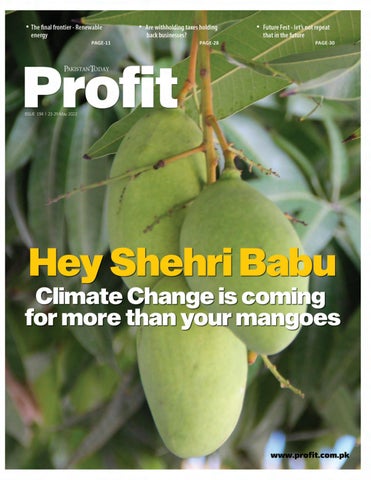
11 The final frontier - Renewable energy 14 Hey Shehri Babu - Climate Change is coming for more than your mangoes
16
22 All roads lead to London M A Niazi 25 Losing the forest for the cheese Ammar H Khan 26 Welcome to Banistan Ariba Shahid
20
29
28 28 Are withholding taxes holding back businesses? 29 Taxing crypto-currency
Profit
30 Future Fest - let’s not repeat that in the future
Publishing Editor: Babar Nizami l Editor: Khurram Husain lJoint Editor: Yousaf Nizami l Assistant Editor: Abdullah Niazi Reporters: Ariba Shahid l Babar Khan Javed l Taimoor Hassan l Meiryum Ali l Shahab Omer Chief of Staff & Product Manager: Muhammad Faran Bukhari Regional Heads of Marketing: Muddasir Alam (Khi) l Zulfiqar Butt (Lhr) l Malik Israr (Isl) Layout: Ahmad Salahuddin l Photographers: Zubair Mehfooz & Imran Gillani l Business, Economic & Financial news by 'Pakistan Today' Contact: profit@pakistantoday.com.pk
Readers Say PMLN is sensing a trap as catastrophic economic failure of hybrid approach has morphed into a “neutral” face saving approach yet it is benefiting IK at the ballot box and has absolved him of poor governance and incompetence. Mounting pressure can soon change “neutral” to reverse gear as unpopular decisions are taken and backlash begins. Apropos: In seeking to come into power, did Shehbaz Sharif make a mistake? Post modernist, Website Imran Khan was not perfect, changing something that is not perfect to something that is inadequate and not expecting disastrous consequences is madness. Get Russian Oil at a 30% discount now. I can see the army coming in now. Put Shaukat Tarin back in. Apropos: In seeking to come into power, did Shehbaz Sharif make a mistake? Malik, Website Meanwhile the government has to continue shelling out massive amounts under the head of Price Differential Claims, with the latest bill coming in at Rs75 billion for the next fortnight. IMF talks are scheduled to start on Wednesday, but if the price caps on power and fuel prices that were imposed by former Prime Minister Imran Khan in his last weeks in power are not removed, it is a near certainty that the talks will yield few results. Apropos: In seeking to come into power, did Shehbaz Sharif make a mistake? Zee Raja, Website Imran Khan and his team has created a political and economical mess. Apropos: In seeking to come into power, did Shehbaz Sharif make a mistake? Khurram Shabbir, Website It is the entire PDM. All of them are clueless and responsible for the debacle. Let’s not try to pin it on one person. Apropos: In seeking to come into power, did Shehbaz Sharif make a mistake? @abbymahmud, Twitter
facebook.com/Profitpk twitter.com/Profitpk linkedin.com/showcase/13251020 profit.com.pk profit@pakistantoday.com.pk
HOW TO CONTACT
7
The author has missed out mentioning pharmaceutical companies, which should never be included in the list of imported luxury goods. The SBP should reconsider its decision and make efforts to exclude all items related to the pharmaceutical industry. Apropos: Will Cash Margins curtail imports at the cost of digitisation? Amna Akhund, Website No mention of the fact that they are Sharia compliant? Seems like a big omission. Apropos:As Tajikistan’s Alif Bank plans entry into the Pakistani market, uncertainty for Digital Banks looms Jumpman, Website
It doesn't matter who has created a political and economic mess. What matters is that the government that is in power has to continue to try and improve the situation. Apropos: In seeking to come into power, did Shehbaz Sharif make a mistake? Sayana Khan, Website According to the central bank, 80% of the IBFT transactions are below Rs25,000. This has hit them hard. Both EasyPaisa and JazzCash are now rethinking their model of branchless banking, now that less money can be made on financial inclusion. Apropos: VRG is seeking Rs1bn to capture the unbanked. What makes it tick? Zee Raja, Website Summit bank is a titanic. All that is left to see now is whether Mr Salman will manage to make it swim and be profitable or whether he will hit an iceberg. Apropos: Is the broadcaster about to don the banker hat? @infinitty_8, Twitter I gather I shouldn’t lose hope that over 2000 shares I have of this dead bank since 2007 will finally bear fruit? Apropos: Is the broadcaster about to don the banker hat? @akbarzaheer, Twitter Major flaw in your argument is the assumption that these self-centered politicians care about the ordinary people or for that matter about Pakistan- they have plenty of opportunities to demonstrate that in the last 30yrs. Apropos: What options does Shehbaz have? Anonymous, Website A very simple, straightforward yet practical strategy recommended by @UzairYounus here. Will someone among the decision makers pay attention? Apropos: What options does Shehbaz have? @AhmedUFarooq, Twitter “….the pain can be managed by redirecting the state’s largesse, which directs almost $17 billion a year to the country’s elite, to ordinary citizens….” . @UzairYounus on how Pak can escape the current pol econ morass. Apropos: What options does Shehbaz have? @KamranBokhari, Twitter I don't think you are currently aware of the ground realities and the hatred that is in the hearts of the people for the new setup. I don't think cash transfers will have any impact on electoral chances as it didn't do anything for the PPP when it came up with BISP. Apropos: What options does Shehbaz have? @salmanyousaf20, Twitter
COMMENTS
IN BRIEF The government is considering changing the powers of the National Accountability Bureau (NAB) on taking action against politicians and bureaucracy. In order to achieve this 31 amendments in the NAB ordinance are likely to be introduced in the near future.
Power tariff is likely to go up as Central Power Purchasing Agency (CPPA) has sought Rs4.5 per unit hike and National Electric Power Regulatory Authority (NEPRA) is scheduled to hear the matter at the end of the month.
Foreign exchange reserves of the State Bank of Pakistan (SBP) further declined by $145 million to $10.16 billion during the week ended on May 13, announced the central bank. The total reserves of the country also slipped to $16.16bn while the holdings of the commercial banks were $5.997bn during the week.
Sri Lanka is sliding into a default as the grace period on two unpaid foreign bonds ends on Wednesday, the latest blow to a country rattled by economic pain and social unrest. The island nation could be formally declared in default if it fails to make an interest payment to bondholders before the deadline. The National Assembly on Friday passed the Fiscal Responsibility and Debt Limitation (FRDL) (Amendment) Bill, 2022, with a majority vote after reaching an understanding with a small group of opposition members.
Pakistan is going to face at least 50 per cent drop in mango production this year due to weather hazards, shortage of electricity and diesel, increase in cost of packaging processing and high freight charges, exporters as well mango growers have to face a crisis during the current mango season.
The US dollar, which had closed at a historic high of Rs200 on Thursday, extended its gains against the rupee for the 11th consecutive session on Friday as it gained 25 paisa by close.
8
Cat food and import bills
this week in Pakistan’s business and economics twitterverse
T
he nation’s pet owners were up in arms this past week as it appeared that the government was banning pet food along with a number of other ‘luxury imports’ to try and decrease the import bill and save precious dollars. The intellectual integrity of this plan aside, we’re sure cats and dogs everywhere will have been happy to hear that they won’t have to slum it. Of course, less important issues were also on the social media agenda this week, such as the economy faltering and a deepingin political crisis in the country. We bring you all this and more in this week’s social media roundup.
Viva buy local
SOCIAL MEDIA ROUNDUP
Welcome to banistan. They’ll take away everything you love.
9
Imagine causing a problem and then nagging someone else to fix it.
This is the stuff nightmares are made of
Thank God they didn’t ban animal feed. Otherwise we’d have a shortage coming up. Oh wait did we score an own goal
Why do we make even the most mundane exercises controversial?
10
The time for action was yesterday
SOCIAL MEDIA ROUNDUP
The final frontier
Renewable energy
At the very least, solar energy should provide a solution to the domestic sector energy crisis By Asad Ullah Kamran
A
s load shedding continues to pick up tempo, the overall political and economic uncertainty isn’t helping. Fuel prices have soared worldwide and continue to remain skittish, adding to the budget deficit when combined with soaring inflation it’s a recipe for disaster. Despite consistent statements by the current government, the energy outlook of the country remains in shambles and critical economic decisions remain pending. To be fair, the issues had been brewing before the vote of no confidence took place and the government shifted hands. The absence of electricity in cities
ENERGY
throughout Pakistan during the ongoing heat wave has sparked an outcry from people. Although the energy situation isn’t getting better and protests against these outages continue, the current government seems to be leaning more and more towards renewables. And since the renewable energy solution providers are ready to pounce on this opportunity, clear and supportive government policies are necessary to spur this growth. The energy mix on average has only about 2.6% coming from renewables excluding hydel, taking into consideration the data from September last year to March of the current year. This is considered to be ap-
palling and both private and public sector entities are driving ahead to change this. The Pakistan Energy Reform Summit was a testament to the willingness of government and private entities to refocus efforts on renewables.
State of the sector
T
he current state of affairs in both the economic and political domains has been dismal and disappointing on all fronts and has contributed to worsening the already trembling economy. Long power outages throughout Pakistan have become somewhat of a new norm going back to before the vote of no confidence. Although as per NEPRA the energy supply is adequate enough to deal with the demand, and in some scenarios more than the demand. However despite this stance power outages have not subsided.
11
Currently, Pakistan’s oil import bill stands at $20bn, which could only be reduced by promoting green energy. The country has a huge potential of alternative energy resources in Sindh and Balochistan areas as well as Bahawalpur Shehbaz Sharif, Prime Minister
Immediately after taking office Shahbaz Sharif took notice of the ongoing turmoil in the energy sector. He is reported to have remarked that load shedding during the summer season cannot be allowed to put people in trouble, and had instructed the authorities responsible to take prompt action to rectify the problems. The prime minister also demanded a long-term strategy to stop electricity distribution corporations from losing money. In the latest turn of events local government members of the Pakistan Tehreek-e-Insaf (PTI) from Haripur took to the streets to protest the unexpected and lengthy load-shedding. They gathered outside the Haripur deputy commissioners’ office and yelled slogans against the administration of the Water and Power Development Authority (WAPDA). Similarly in Karachi, K-Electric had been facing public outcry on account of massive load shedding. The company however denied the claims that Karachi was experiencing 14-hour load shedding, saying that the city was experiencing power outages as planned. Imran Rana the spokesperson for K-Electric also tweeted in this regard stating that “No load-shedding is taking place in areas with less than 20% line losses,” and that “power cuts are not being conducted on about 400 industrial feeders” as per the allegations.
Renewable Energy
N
ow although load shedding in the recent months has been intense and has caused mass outrage from the public, it is not the first time that this has happened and probably not the last. The energy sector of Pakistan is an extremely fragile and volatile environment that’s further exploited for political gains at the cost to private and state owned enterprises. Given the dismal situation in terms of availability of energy, private consumers have started leaning more towards renewables, particularly solar energy to meet their domestic needs. Furthermore by installing net metering and selling the excess units to the local DISCO citizens are able to cut down on their electricity bills and at the same time add to the somewhat constrained supply. At the recent Pakistan Energy Reform Summit 2022 issues in the energy sector that directly affect the overall economic health of the country was a key topic. And as per the government officials that addressed the private sector entities the importance of and increased reliance on renewables was pointed out. The new Minister of Energy at the energy reform summit also stated that, “interestingly the new magic bullet is solar, as we are told that solar rates are coming down. Therefore, the way forward is hydel plus solar, and whatever wind generation we can come up with”.
He also highlighted the fact that hydel power is still the “mainstay” of the nation’s energy and that, despite its problems, it is still the most viable form of energy in the long term. Chairman NEPRA also shared a similar perspective in regards to renewable energy. He also highlighted the point that hydroelectric power should be included in the category of renewables with wind and solar power. And he is not wrong, the United States Geological Survey also categorises hydroelectricity as renewable energy. If we were to include electricity coming from hydel sources into the renewable category with solar and wind, we would end up at an average of 24.5% using the data from September till March. However there is an inherent risk when it comes to Hydroelectricity as it is highly dependent upon water levels. In order to stimulate the use of alternative energy, Prime Minister Shehbaz Sharif has ordered the repeal of the previous PTI government’s 17 percent general sales tax on solar panels. It’s a positive step in the right direction toward lessening the country’s dependency on fossil fuel resources. The interesting thing to note is that in the same period under consideration during the month of January 2022 hydel sources only constituted 5.83% of the total energy mix. Therefore making any new capital intensive ventures somewhat unsustainable, at the same time the deteriorating climate situation de-
Interestingly the new magic bullet is solar, as we are told that solar rates are coming down. Therefore, the way forward is hydel plus solar, and whatever wind generation we can come up with Khurram Dastagir, minister for energy
12
In today’s energy market, when fossil fuel costs are rising, solar is really crucial to Pakistan’s demand. China has the most experience in solar, and they will come to Pakistan and help the country acquire more sustainable energy Shahid Khaqan Abassi, former Prime Minister
mands that we as a country have to reduce our fossil fuel consumption one way or the other.
China
I
f you’re unaware, between 2008 and 2013, China’s budding solar-electric panel sector slashed global costs by up to 80%, this practically marked the moment that China would dominate the clean energy sphere. China has risen from small rural-focused solar programmes in the 1990s to become the world’s leader in what might soon be the world’s biggest renewable energy source. Although low-cost capital and labour are advantages that are generally lauded for China’s competitive advantage, they do not convey the complete story. A better explanation for China’s solar success is that the energy industry prioritises low costs, and China excels at cost-cutting and scaling — not just because of cheap resources, but also because of a remarkable ability to innovate manufacturing processes to lower costs and scale quickly, known as process innovation. China is leading the world in innovation and cost effective solutions on renewable energy and is ready to make most of the growing Pakistani market. The consumers in Pakistan are getting smart, although solar or wind energy solutions for domestic users are not cheap, they are however more reliable in keeping the lights on.
The keynote speaker Shahid Khaqan Abbasi also lauded the Chinese for their interest in investing in renewable energy in Pakistan. He additionally stated that China plays a significant role in Pakistan’s energy output and that the Pakistani government expects China to increase its investment, particularly in the country’s renewable energy industry. There is also consideration of Chinese firms bringing solar photovoltaic technology to Pakistan and setting up plants in Pakistan however that is cognisant of adequate demand. Shahid Khaqan Abbasi also believes that in today’s energy market, when fossil fuel costs are rising, “solar is really crucial to Pakistan’s demand today,” and that “I am expecting China has the most experience in solar, and they will come to Pakistan and help the country acquire more sustainable energy.” The factor that is making this option more lucrative and attractive is the crippled energy sector of Pakistan. By encouraging individual consumers that have the financial means to purchase these solutions through incentives and tax rebates as well as educating them on what a solar energy solution would mean for them. Apart from this the government needs to take serious steps in curbing reliance on fossil fuels that are at this very moment burning a hole in the government’s pocket. Additionally to encourage investment in the sector the
government should take the responsibility of providing adequate assurances and facilities to the renewable energy players in the country. Looking at the past few days the sales of local solar solution providers have gone up especially in the ongoing heat wave and energy outages.
Conclusion
I
n light of all the facts stated above, the government has a unique opportunity to make long term and sustainable decisions in regards to the energy sector of Pakistan. It would be prudent to understand that it is a process to move from fossil fuels to renewable energy and this takes time, at the same time one cannot simply ignore the effects of climate change domestically and worldwide. A clear and consistent effort involving all stakeholders must be made in order to address the grave situation we’re facing in Pakistan. The current state of affairs do inspire confidence in the economy in this regard, with extreme political turmoil and discord between the major parties is pitiful. Important and potentially difficult decisions have to be made despite the fact that might be political suicide for that particular party or individual, regardless that individual would be lauded as the savior especially in the dire straits we find ourselves in. n
ENERGY
14
Hey Shehri Babu Climate Change is coming for more than your mangoes This year’s mango saga should stand as a warning - climate change is real and it is urgent
By Abdullah Niazi
L
et us begin by clearing the air. So far as we know, mango production in Pakistan has not declined by 60%. That does not change the fact that our prized mangoes are definitely under threat. The final tally of mango yield for this year is yet to be finalised, but what is slowly becoming clear is that estimates made by provincial agriculture departments are significantly off from the on-ground situation. Farmers, exporters, and researchers have all been trying to ring the alarm bells to warn people about the dire straits that this year’s mango production faces and we can say with some certainty that there will be less of the beloved golden fruit this year. Here is what we know. Mangoes in this current season have faced a cacophony of disasters. To start off, this has been the hottest summer in more than half a century, with average temperatures in mid-March (a vital time for mango trees) soaring between 37-42 degrees, compared to the usual 34 degree temperature that this month sees in Punjab’s mango belt. This has made the mangoes more susceptible to disease, premature ripening, and being of a lower quality. In addition to this, high prices of fuel and an energy shortage have meant farmers have been unable to run their tubewells and provide irrigation to mango trees which require a constant supply of water. And this, we are afraid, might only be the beginning. What we have here is a double-whammy. Pakistan has already been facing a looming food crisis because of a broken supply chain, shrinking acreage, poor application of fertiliser, water scarcity, limited certified seeds, and a general lack of modernising our agricultural sector. Back in February this year, experts feared that because of all of these reasons we would face an increased food import bill because of a drop of as much as 15% in domestic wheat production. Mangoes are now facing the same issues - a scarcity of water, decrease in fruit quality due to outdated farming practices, and soaring fuel and packaging costs that dissuade farmers from investing in growing the fruit. On top of all of these issues we now also face agricultural challenges posed by climate change. According to growers, the month of March was unusually hot this year, and because the crucial spring period simply skipped directly to the sweltering summer, the pollination process was disrupted and fruit drop began to increase. In turn, other crops will be affected. This means if Pakistan is to have any chance of fighting its food security issues, we will need to tackle this problem on two fronts - by addressing our backwardness
16
in agricultural science as well as the climate crisis. Some feel it is already too late, but doing nothing is simply not an option. Profit looks first at what happened to the mango harvest this year, how the news spread, what issues mango growers face, how climate change is making it worse, and finally how we need to fight both climate change and regressive agricultural policies in tandem.
How it played out
T
here is a fair bit of confusion on what exactly has happened this year. In short, Pakistan’s mango production process was already alive on a whim and a prayer, when political and economic instability resulted in an unreliable water and electricity supply, expensive labour, and . On top of that there was also a record breaking heatwave. But how did news of the mango’s woes travel? For starters, people in big cities like Lahore, Karachi, and Islamabad noticed that mangoes were late to the markets. Usually, the greener, smaller, variety of mangoes hit the markets around mid to late April and by the second week of May the premium varieties of mangoes start making appearances. From this point up until the end of July is peak mango season, with the fruit still being in circulation until sometime in September before finally tapering off for the next harvest. This year, mangoes have been harder to find, more expensive, and of a lower quality. “This time, mangoes started coming from Sindh to Punjab in early May, while last year, the same mangoes came in late May,” says Akhtar Hussain, a trader at a fruit market in Badami Bagh in Lahore. While the fruits came earlier this year, it was only because they had dropped from the trees earlier and most of them were not fully ripe and had to be stored in warehouses and ‘cooked.’ “This year we have sold a 10 kg box of Sindhri mangoes from Rs 1800 to Rs 2200 and in the retail market it has been sold from Rs 250 to Rs 400 per kg. In the wholesale market, the price of a 10kg box is expected to be from Rs 800 to Rs 1000. Last year the same mangoes were going for Rs 350 to Rs 500.” This was the first sign in the cities that mango production had possibly decreased. On the 16th of May this year, a report was published in The Express Tribune which quoted the Director of the Mango Research Institute (MRI), Abdul Ghaffar Garewal, in Multan saying that due to the unprecedented heat wave this year mango production would fall by nearly 60%. The news spread fast on social media. Within a day of this, screenshots of a Punjab government report surfaced on Twitter which claimed that mango production in Punjab had actually increased by 8.9%.
In the public eye, it immediately seemed that the report of mango production falling by 60% was fake news - a feeling further propagated because the statistic was being shared by a number of shady looking ‘news’ sites that flash infographics for cheap clicks. However, even the statistics being provided by the Punjab government are not an accurate measure. For starters, it is not an actual measurement of the amount of mangoes harvested this year - it is an estimation based on acreage and how much yield is expected per hectare. The second issue is that it does not include numbers for Sindh - which is downstream of the Indus where water scarcity is a much larger issue. And perhaps most importantly, it does not factor in the mangoes that were dropped before they were ripe. On the 18th of May, the noise from the mango industry grew louder and louder. After the initial assessment of a 60% fall made by the Mango Research Institute, the All Pakistan Fruit and Vegetable Exporters Association (PFVA) announced that due to climatic effects and high temperature, mango production had been severely affected during this mango season, and was facing a dip of 50%. The average production of mango in Pakistan is 1.8 million tons and with 50% reduction, it is likely to be limited to 0.9 million tonnes. Because of this, the PFVA announced that they were cutting their export target by 25,000 tonnes to 125,000 tonnes for the current season, which is expected to fetch around $106 million. Now, this too cannot be taken as an accurate indicator, since exporters also cut their target because of crises like shortage of electricity and diesel, an increase in cost of packaging processing and high freight charges to meet the export target. However, the association maintained that mango production had halved this year which is why they are having to slash targets.
More mango trees does not equal more mangoes
O
nce again - we must reiterate that the figures of mango production going down by 50% or 60% are not accurate, surveyed, and final data. They are impressions and estimations given by different stakeholders, all of whom are blaming the ongoing heatwave. On the ground sources have told Profit that while a final number cannot be put on the loss of mangoes this season, farmers are facing serious issues - but they are all issues that have persisted since before this current heatwave. The new climate catastrophe has simply added to their woes. For starters, much like other crops in Pakistan, mango production has long not
Each season, sudden weather changes mar the output of the growers, making it increasingly an unviable business. Even if you discount all kinds of seasonal variability, nothing explains changes on this scale year after year Sheikh Insiram Ali, the president of Mango Growers’ Association of India
achieved its potential. According to a report on Mango Clusters by the Planning Commission back in February 2020, reported that during the 2000s, the mango production in Pakistan has been increasing at a reasonable rate of 4.1% per annum, comparable to the rate at international level. But all of the increase has been coming from the expansion in its area, while per ha yield has been declining during the period, and the deceleration has accelerated during 2011-16. “The decrease in per ha yield along with the poor value chain infrastructure development resulted in a gradual decline in its competitive position in the world market. That is why Pakistan could not benefit from the high growth in the international mango market, both in terms of quantity and value of export,”
reads the report. These were already existing issues in Pakistan’s mango industry infrastructure. On top of this political instability and an economic crisis meant that fuel prices have been high and electricity largely unavailable. Mango trees require constant watering, and in the absence of working tubewells and cheap fuel to power generators the crisis deepened. After this, the final nail in the coffin were the scorching temperatures that arrived early and have continued to rise - and had a visceral impact on the fruit.
The climate factor
T
his is no joke - and we are very much living through it. According to the International Food Policy Research Institution (IFPRI), agri-
culture is extremely vulnerable to climate change. Higher temperatures eventually reduce yields of desirable crops while encouraging weed and pest proliferation. Changes in precipitation patterns increase the likelihood of short-run crop failures and long-run production declines. This is a major part of what has happened to Pakistan’s mangoes this year. “We simply didn’t have a spring season this year. And that is the most crucial time of the growing season for mangoes,” says Chaudhry Siddique Ahmed - a mango farmer from Rahim Yar Khan with three orchards. A single mango tree usually is a year’s long investment. It takes 4-6 years for a newly planted tree to bear fruit, and between December to April is when the mango tree flowers and blooms. In the colder months the process is
slow, but when the middling temperatures of spring arrive in March the tree takes to fruition. Because of the high temperatures this year, the mangoes were severely affected. “The weather suddenly warmed up in March and the heat intensified in April. Although the best temperature was available for flowering mangoes in February, and after flowering, when it was time for pollination, the night weather was still very ideal. We had temperatures ranging from 11 degrees Celsius to 20 degrees Celsius at night, which was perfect for any variety of mango. On the other hand, the temperature continued to rise during the day and reached 42 degrees Celsius,” says Chauhdry Siffique Ahmed. “As a result, the pollination process was disrupted and fruit drop began to increase in the areas where the pollination process was completed and fruit setting was started. If the daytime temperature ranged from 26 degrees Celsius to a maximum of 35 degrees Celsius, the pollination process would have been better.” “The most affected are white Chonsa, Sindhri, Chenab Gold and Anwar Ratol. Similarly, in mango growing areas of Rahim Yar Khan, Muzaffargarh, Multan, Khanewal and Bahawalpur of Punjab, the crop of white Chonsa is high. If we talk about white Chaunsa, its production is reduced by about 40 percent but on the other hand, the good thing is that due to the small number of fruits on the trees, the size and quality of mangoes will be very good. Similarly, if the crop is low, we can get a good rate.” Mango crops being affected by climate change is not a new phenomenon, and it has been observed and recorded in India as well the world’s largest producer and exporter of mangoes. Back in April, India Times reported that local weather change has already affected the flowering sample and yield of mangoes. “Normally, mango flowering begins between December and March. However higher-than-normal temperatures this 12 months when the bushes had been on the flowering stage have broken crops. Unseasonal rains additionally introduced germs, flies, and microorganisms,” reads the report. According to the report, Uttar Pradesh’s “mango belt” often accounts for practically 4-5 million tonnes of mangoes per 12 months, however this 12 months there might solely be 1.5 million tonnes. The yield has fallen sharply on account of the delay in flowering caused by the change in local climate. Mango growers in Malihabad cited poor flowering, illnesses, and erratic water supply as just a few causes for the anticipated low produce and stated the crop can also be more likely to be delayed by around 20 days - very similar to what has happened in Sindh and is now happening in
18
The problem with Pakistani mangoes
G
lobal production of mangoes is over 48 million tonnes showing an increased production with an average growth of 4.4% per annum as compared to 25 million tonnes. In Pakistan, total area under mango cultivation is around 169 thousand ha with the production of 1.7 million tonnes being the second major fruit crop of the country. Pakistan is 6 th largest mango producer in the world. The total global export is about 1.7 million tonnes with an estimated value of US$2.1 billion. USA is the leading importer with 28% share in the global market followed by EU countries with 22% share. Pakistan’s export to these high-end markets is insignificant. Pakistan’s mango industry is mainly located in two provinces-Punjab and Sindh, each covering 63% and 37% of the total mango area in the country. Based on the district-level data on mango area and its varieties grown in each province, two mango clusters are identified for the detail analysis in this study: i) Punjab Chaunsa Cluster mainly grows Chaunsa mango variety, consists of Multan, Rahim Yar Khan, Bahawalpur, Muzaffargarh and Khanewal with Multan as its centre point; and ii) Sindh Sindhri Cluster mainly growing Sindhri variety, comprises of Hyderabad, Tando Allahyar, Mirpur Khas, Naushehro Feroze and Sanghar with MirpurKhas as its centre point. The characterization of these clusters with the help of stakeholders helped to highlight the main production, marketing, trade, and processing features and identify the potential and constraints in each. Mango growing faces several constraints at the institutional level which include weak mango research and extensions system, poor access to finance, lack of information about the market, lack of supply of modern inputs, poor coordination among stakeholders; production level constraints which include old, bushy-type and tall mango plants with low yield potential, lack of supply of high-yielding and true to type planting material, weak farmers’ capacity to understand modern management practices; poor post-harvest handling and marketing which include poor post-harvest management practices like storing, packaging, transportation, etc. poor domestic marketing infrastructure, non-compliance of international quality standards, limited diversity in international market; and value chain and processing level constraint which include weak value chain infrastructure like lack of collection centres, cold storage, hot water treatment plants, etc. and limited processing facilities. These constraints reduce per ha yield, increase post-harvest losses, reduce export production ratio, and deteriorate quality of the produce for the national and international markets.
the Punjab. In a different set of circumstances, reporting for The Third Pole Sopan Joshi in 2016 described how erratic rainfall and unexpected humidity, a fallout of increasingly unpredictable weather due to climate change, is hurting the cultivation and harvest of India’s favourite fruit. The research report describes how “these are the effects of climate change that scientists have projected all along: Greater variability of temperature and rainfall, disruption of familiar weather patterns, and greater unpredictability.” “Each season, sudden weather changes mar the output of the growers, making it increasingly an unviable business. Even if you discount all kinds of seasonal variability, nothing explains changes on this scale year after year,” says Sheikh Insiram Ali, the president of Mango Growers’ Association of India. “So many growers now want to get out of mangoes because of increasing risk and
uncertainty. It is difficult to recover investments, forget about making profits.”
What we can do about our agricultural woes
W
e began this article with the recognition that we are in a double-whammy - on one hand climate change is very real and has an immediate impact, and will continue to affect crops other than mangoes. And this is all in a country that despite being an agrarian economy has very weak agricultural infrastructure. As an agrarian economy, Pakistan has long relied on the fact that it is capable of producing enough food to fulfil the caloric requirements of its own population, and then have enough leftover to be an exporter. In re-
“A weak supply chain infrastructure, changes in demographics, currency devaluation and transition towards the market economy are some factors contributing to food inflation in Pakistan. Look at Punjab. It once provided food to the entire world; it was a famous breadbasket. Now we are a country that is importing food. And we are importing the same things we could grow ourselves” Dr Akbar Zaidi, executive director at IBA ality, Pakistan has been a country with a serious food deficit problem for the last three to four decades. Despite the natural advantages that the country has in the shape of fertile land, access to fresh water, and a rich history of farming practices it has suffered in this regard mostly because of a lack of political will to improve and adapt agricultural practices with the times. Pakistan remains behind on value addition and storage, which means we waste a lot of produce and end up having to import food we could simply grow at home and actually even export. To get anywhere at all. farmers must be encouraged and incentivized to use modern farming methods, provided with better seeds that are resistant to disease, and be focused towards less on cash crops and more on farming for subsistence since the demand for money and services is high. One solution to this could possibly be choosing to focus on one
product and become the go to producers and exporters of that product in the world. That way, even if we had to import food, we would be exporting enough of that one product to offset our exports and not be going down the path of financial ruin. If, for example, we choose mangoes or wheat we can choose to build both storage and processing facilities and then export these products in large quantities. This is simply an example of one possible solution. The problem with our agricultural woes is not a lack of solutions, but rather a lack of will. Take for example the 15% fall in domestic wheat production mentioned at the beginning of the story. In a Dawn report on the issue, a senior Agricultural Department official was quoted as saying “Targets cannot be achieved just through wishful thinking. “No worthwhile measures were taken to ensure availability of fertiliser though the shortage of compost had begun
to develop well before the sowing season.” This means the first step to getting anywhere would be finding political will and the strength to implement it.
What we can do about climate change
T
his is a loaded question. The answer is a lot. However, perhaps the most important thing that can be done right now is for the international community to take responsibility for their actions. At the COP-26 concluded at the end of last year, unlike other countries in the region like India and Nepal, Pakistan has not committed to a carbon neutrality policy and has also maintained that while it will not introduce new imported coal projects, it will also not consider ending coal power as of yet. As the Pakistani delegation pointed out, it also needed to look after its own economy. What Pakistan and other countries in the global south need to push for more than anything are climactic reparations. According to the Centre for Global Development, developed countries are responsible for 79% of historical carbon emissions. Yet studies have shown that residents in least developed countries have ten times more chances of being affected by these climate disasters than those in wealthy countries. Further, critical views have it that it would take over 100 years for lower income countries to attain the resiliency of developed countries. Unfortunately, the Global South is surrounded by a myriad of socio-economic and environmental factors limiting their fight against the climate crisis. This means developing and third-world countries face an existential threat not because of their own actions, but because of the actions of first world countries throughout the 20th and 21st centuries. None of this takes away from the fact that Pakistan, like other countries, has a major emissions issue, however, there is a difference between allocating emissions and allocating responsibility for those emissions. The developed world has a massive emissions debt that it must pay to the developing world for the damage it has caused them. At the earlier mentioned COP-26, one of the leading issues was the $100 billion that was promised to the developing world back in 2009 during COP-15 for climate financing. Developed countries must make good on their promise to provide $100bn per year, through to 2025, to support climate action in developing nations. This decade-long pledge must finally be honoured – both to deliver the intended effect on the ground, and also as a fundamental issue of trust. The amount is equivalent to just 0.1 percent of the combined
20
annual gross domestic product (GDP) of advanced economies, or about 5 percent of the $2 trillion the world spends each year on military. Promises should be kept. There is a lot Pakistan can do domestically to improve this situation. Better auto policies, more public transport, less reliance on fossil fuels and other dirty power sources such as coal can make seismic changes. However, the most important factor is and will remain fighting this battle globally for reparations and funding. Despite all of the other issues, this very much should have been
on the agenda of Foreign Minister Bilawal Bhutto Zardari during his visit to the United States. Right now Pakistan is facing the brunt of the climate catastrophe. Along with it, as has been displayed in the case of the mango crop this year, we also have a food security issue on hand. Both of them will aggravate each other, which is why it is more important than ever to address them in sync. There really are no other options available. n Additional reporting by Shahab Omar
OPINION
M A Niazi
printing more money? The absolutist position of ‘no retreat’ has been diluted, and now a middle way is being spoken of, of removing part of the subsidy, which is a tacit admission that it is unaffordable in its entirety. The problem is that while the oil price hike is an act of God is there ever was one, there is no predicting when the Russo-Ukrainian War, which caused the current spike, might come No decisions seem to have been taken to an end. Instead of the swift victory sought by Russia, the war shows every sign of settling into the protracted and indecisive t was an elaborate ritual, meant to bring some closure, but grind that had been predicted before the conflict even started. it didn’t, because no conclusions were reached. The meeting This uncertainty is perhaps the main reason the Shehbaz of Prime Minister Shehbaz Sharif and PML(N) supremo coalition has come under fire, first from the ousted PTI, but now Nawaz Sharif, along with leading Cabinet members, was increasingly from its supporters, for not delivering. Perhaps it is perhaps not the inevitable and necessary, but clear decipaying the price of exaggerating its competence. The government sions it did not lead to. cannot work miracles. But that is precisely what it promised. Most of all, there was no real decision on what was There is the argument that Imran would also have been as hapless going to happen to the petrol subsidy. Removing it would had he been allowed to remain in office, but that does not really not just be a shattering blow because of the heightened inflation wash, because the present government’s inability to meet the that would be caused by it, not just in terms of moving persons, but crisis means that there was no point in removing incompetent moving goods and electricity tariffs. No one seems to have considered failure if all that would replace it was another failure, no matter what would have happened if the government had not inherited it. It how competent. is highly unlikely that the government would have imposed it after its This might be unfair to the present government, first takeover. because it may not have known how big was the problem the Not removing it means that the negotiations with the IMF are PTI was leaving behind, and it would have been subject to the dead in the water before they start. That apart, with all the conseoccupational disease of politicians, optimism (just ask Imran if he quences that carries with it, continuing the subsidy can bring the would be able to handle Pakistan’s problems if brought back to entire country to a grinding halt. The prospect exists of the governpower; he would never say no). However, there is little evidence ment running out of money, of its being unable to pay salaries. With that the government, when in opposition, had a radical plan. the new autonomy given to the State Bank of Pakistan, it is not that After taking office, the government has not taken any steps to easy to simply print more money to meet the deficit. Even if that were reduce inflation or any of the deficits it faces, which would give possible, what would be the political effects of the inflation caused by the impression that when in opposition, it had formulated a plan to handle the situation. Any plan unveiled now would be ascribed to Mian Nawaz, and also Ishaq Dar. That would only emphasize the problem of having a sort of shadow governThe writer is a veteran ment in London. Mian Nawaz does not seem to have a shadow Interior Minister, unless it is Abid journalist and joint editor Sher Ali, and he does seem to lack even a hint of a Foreign Minister, that department seemingly at Pakistan Today definitively handed over to the PPP. However, these days, it seems, Finance is making the running, and may play a decisive role in the other two questions that were put to Mian Nawaz: the fate of Imran Khan, and the timing of fresh elections. While Imran’s fate is not linked to the economy except insofar as he is disturbing the economic environment, the timing of elections has to do with the economy. Imran’s fate has to do with how far he sails close to the wind in his attacks on the military collectively, and the COAS individually. His claims that his references to Mir Sadiq are actually to the Sharif brothers are uncon-
All roads lead to London
I 22
vincing, to say the least. If he is seen as trying to cause disaffection within the ranks of the military, then problems will arise. Ever since the time of the Rawalpindi Conspiracy in 1951, there have been attempts to have what in Spain was known as a grito: a coup attempt not involving the chief, at a level even of lieutenant-colonel. No grito has even taken place, because the authorities have always found from some conspirator getting cold feet. However, there is a tremendous strain placed on the Army’s discipline because of support for the PTI. The PTI was somehow identified as the Army’s own party, and not just as a party to be supported as a matter of individual choice. This cannot be ignored by the military leadership. It is no longer a question of the military’s political role, but of preventing a vital national institution losing its cohesion. Some commentators across the border have noted with ill-concealed glee that the PTI has got crowds chanting slogans against the military. This is a problem that tilts the balance against Imran. There are too many signals emanating
to ignore that there are plans from Imran to be picked up. However, whether it will be because of his tirades against the establishment, or because of corruption cases, depends on the competence of the investigators. Whatever the charge, it will be because of the Army, not any other institution. An arrest might also serve to put paid to any call for a log march on Islamabad, to be followed by a sit-in. The PTI’s own announcement of a plan to mobilize if he is arrested indicates an expectation that this may happen, and may also be a warning of the consequences of doing so. However, the consequences of an election in which the PTI is deprived of its most effective campaigner must tempt the government to delay until it has announced elections. The PML(N) has also got its own legal troubles, preventing its most effective campaigner from campaigning. The speed with which Mian Nawaz can get rid of the restrictions on his movement will determine when the government goes for polls. The situation is now the most favourable for him to handle the various difficulties he faces. However, there has
been no indication of a timeframe other than a mention of the constitutional limit, which prescribes that the elections be held 90 days after its five-year term expires on 17 August 2023, which means the new House should meet by 29 November 2023, 14 days after the polling, due by 15 November. This would allow Mian Nawaz about a year and a quarter to come back and wind up his legal cases, to the extent that he can campaign with freedom. Of course, he has less time, for he would want to be free for the election, not for the meeting of Parliament. Of course, electoral reforms are also sought after, though the requisite legislation has not been moved, let alone passed. One issue that everyone seems to be ducking is that both Mian Nawaz and Imran are not young men. Mian Nawaz is 75, while Imran turns 70 next March. Therefore, neither can afford to wait, and are both in a hurry. This will lead both of them to the sort of hurry that will make mistakes. And neither can afford to wait for the other, as Bilawal Bhutto Zardari can. n
ANALYSIS
OPINION
Ammar H. Khan
However, these may never be saved. It may actually lead to an explosion in growth of the grey market, as more units are brought in the country in personal baggage, or through other means. A cottage industry for the same already exists, so much so that vendors are even willing to accept cryptocurrency as a form of payment. The flow of goods and payments cannot be stopped. A government can always impose tax and create an taying true to the tradition of groundhog day, the first enabling environment, but outright bans are rarely successful. material step that the incumbent government took to stall a Another alternative would be import of more assembly depreciating PKR was an arbitrary ban on import of goods kits of mobile phones, which can be assembled locally, that will considered ‘non-essential, or luxury. It is estimated that the also require FX outflow – but will distort the market completearbitrary ban would save US$ 100 million of foreign exchange ly as in absence of competition local assemblers would have reserves on a monthly basis. However, there is little to no the bargaining power to set prices resulting in destruction of mention of how the value chains of many of the imported commodities consumer surplus, and a declining choice set. If the same kind would be disrupted, and neither is there any plan on how a deficit that of policy options are perpetuated for a few more years, we may would emerge due to reduction in collection of import duties and taxes see creation of a perpetually infant industry akin to the likes of collected would be bridged. The previous government took similar the automobile industry, which has had protection for decades, actions during their first few weeks in office, and the current adminisresulting in tremendous welfare loss for consumers. tration isn’t much different either. Another US$ 250 million of foreign exchange is expected The most significant import that is being banned is that of to be saved annually from an assortment of consumer goods & completely built units of automobiles, and justifiably so. The market is edibles, ranging from dry fruits, jams, jellies, footwear, to pet flooded with automobiles, which act more like an inflation hedge, rather food, and musical instruments. All of this makes up less than 1 than a depreciating asset. In addition to fixed income, and equities, aupercent of total imports. A lot of edibles available in the market tomobiles have emerged as an asset class now, with its prices acting as were already being smuggled into the country. As the new a proxy to an appreciating US$ against PKR. Any more import of such rules are put into place, the smuggling is only going to increase cars would have been tantamount to creating more liquidity for an asset more, either through transit trade, or through mules carrying class, rather than serving any genuine economic need. Nevertheless, the frequent flyer cards. The expansion of the grey market would local automobile manufacturers would continue to closely track US$ by result in decline in tax collected, and further expand the size of increasing prices without a lag, or delay. The foreign exchange savings the informal market, while making it difficult for entities in the accrued from this segment are certainly welcome. formal sphere to operate. Another major item in the list is import of completely built units A simple test for the same is to checking out the closest of mobile phones, which is expected to save roughly US$ 1.2 billion. supermarket in your neighborhood. A non-tariff barrier was enacted a few years back which made it mandatory to have labeling of edibles in Urdu. In-effect, edibles which do not have labeling done in Urdu cannot be imported in the country formally, and hence are smuggled. Just scanning your supermarket to see whether any imported edibles have The writer is an labeling in Urdu or not can give one an idea of the prevalence of smuggling that exists, and that will continue independent to grow in future. macroeconomist and A gradual phase-out of fuel subsidies would have sent the right signal, and would have contributed conenergy analyst. siderably more in reducing foreign exchange outflow through rectification of a distortionary pricing structure that exists. Policy actions which create a grey market or erode consumer surplus may provide a band-aid in the short term but do tremendous harm in the mid-to-long term. A policy decision should be supportive of a formal economy, rather than encouraging a grey market drivien informal economy.
Losing the forest for the cheese
S
COMMENT
25
OPINION
Ariba Shahid
ernment assumes this will help increase exports, it is important to note how dangerous bans really are. For starters, they create grey economies and the need for smuggling. We’ve already seen an influx of iranian cooking oil and dairy products smuggled into the country in addition to the petrol smuggled in from time to time. The government is effectively creating a grey economy. These bans also help push up prices of domestic goods and elcome to Banistan, a country where Youdon’t necessarily result in local efficiency. The more protected Tube, tiktok, imports and FX accounts are your local industries are the more they take you for granted. blocked on a whim. Please enjoy your stay What’s more important is that this pattern of banning things is here, we don’t know how long until that’s not new. In the past Pakistan banned the import of cheese. Till banned too. date there are no large scale cheese substitutes. A fundamental right in today’s However, this is also a reminder of the past when the modern world is the right to choose. The right to choose who governs simplest solution is to hurt consumer and investor sentiment. Deyou, where you live, what you study, what you eat, etc. However, spite their best efforts, the PMLN ghost of freezing FX accounts in today’s world we’re spoilt for choice. That isn’t necessarily a bad may never die down. thing. Despite that, the government is stifling our thoughts and makPrime Minister Shahbaz Sharif belongs to the Pakistan ing choices for us. Muslim League Nawaz (PMLN). His brother Nawaz Sharif has Between March to June, Pakistan is expected to spend a whopserved as Prime Minister thrice before. However, while he is ping $2 billion on subsidies that have yet to be withdrawn. Instead of remembered as a Prime Minister that conducted nuclear tests in choosing to do the right thing and rollback subsidies, the government Pakistan despite mounting international pressure, the financial is up with another gimmick - public austerity by banning luxury community remembers him for the repercussions of that testing. goods from being imported. This, however, is not the smartest move The Chagai-I, five underground nuclear tests at Ras Koh in the book. Hills in 1998, were celebrated throughout the country on the For context, our choices are being taken away in vain. It won’t streets. However, internationally, Pakistan had to face reperhelp. The monthly impact of the ban on the import of 38 non-essencussions and condemnation. The United States, Japan, Austratial luxury items under an emergency economic plan announced on lia, Sweden, Canada, and more importantly the International Thursday will merely be $247 million. Monetary Fund (IMF) imposed economic sanctions on Pakistan. Mariyum Aurangzeb, information minister, however claims The As a result, all new US economic assistance to Pakistan was ban will have an impact of $6 billion [Rs1.2 trillion]. While the govsuspended. In order to deal with the uncertainty and to curtail the FX outflow, the president at the time, Rafiq Tarrar imposed a state of emergency. The government ordered banks to remain closed across the country, the Karachi Stock The writer is a business Exchange (now Pakistan Stock Exchange) was shut, and all foreign currency accounts worth $7 journalist at Profit. She can billion were frozen. The finance minister at that time, Sartaj Aziz called the measures necessary to be reached at ariba.shahid@ stop the flight of foreign money which could lead the country to bankruptcy. pakistantoday.com.pk or at It is, however, unlikely for Pakistan to face such embargoes and sanctions over its actions, twitter.com/AribaShahid thus low chances of warranting such a move. However, with reserves dwindling, no support coming through, and the government being adamant on closing the fuel subsidy over losing political clout - one never knows. This suffocating ban on imports will solve nothing. This will only buy time until someone becomes strong enough to take the tough step and increase fuel prices. How many things will you ban until you make the right move?
Welcome to Banistan
W
26
COMMENT
Are withholding taxes holding back businesses?
P
By Ahtasam Ahmad
akistan’s Federal Tax System is a huge puzzle that seems to get more complicated as the time passes. In the last 2 years, 5 different individuals have served in the role of Chairman of the Federal Board of Revenue (FBR) as the institution struggles to catch up with the consistently rising revenue collection targets set by the IMF.
A brief introduction of Pakistan’s withholding regime
P
akistan’s tax system is by design dependent on indirect taxes as the direct tax filing ratio is just around 1% of the total population. To facilitate the process of collecting direct as well as indirect taxes, the Federal Board of Revenue (FBR) implements its withholding tax regime in which taxes are deducted at the source of transaction rather than at filing of the returns. The withholding tax laws of Pakistan state that Companies and other prescribed persons, known as withholding agents are required to deduct taxes, on behalf of FBR, while paying to their suppliers, vendors, service providers and employees. The tax regulator has devised this mechanism to ensure that tax revenue is collected even if the majority of individuals required to file tax returns are not filing. However, this system is a matter of contention between the Industry and the Regulator. A wide base of withholding tax regime is a recurring feature in the developing world as conventional tax collection is low due to majority of taxable activity originating from undocumented sectors primarily agriculture, small and informal. Therefore, to meet the revenue targets, tax is collected through withholding tax agents in order to encourage the population to get themselves documented.
Why are businesses so averse?
T
he industry in general is not content with the system devised for withholding tax deductions and the majority see it as a deterrent to the ease of doing business. One of the reasons for this is the complication of the system. The rules for withholding tax are complicated and
28
the fact that the majority of our population has very low financial literacy doesn’t help. Furthermore, it should be noted that sometimes, the FBR laws just don’t make sense from a business perspective. A reputed tax practitioner from Islamabad, told Profit that once they were confronted by a client on why FBR requires them to deduct withholding sales tax on a made-up amount when the actual receipt is less than that. The practitioner couldn’t justify the business sense behind it, because there wasn’t any. (E.g If a withholding agent purchases good worth Rs. 100 from someone whose tax should be withheld, in that case the person would gross up the invoice amount of Rs.100 to Rs. 117 (17% Sales Tax) and then charge the applicable withholding tax rate of 5% on the grossed-up amount of Rs. 117.) Furthermore, the business community just cannot trust the FBR. The board of revenue has a history of going after businesses in a draconian manner to meet their targets (Last year FBR sealed the headquarters of Jazz, Pakistan’s biggest telecommunication company, in an attempt to recover outstanding taxes). The distrust coupled with the intricate tax systems lays the ground for a cat and mouse game between the taxpayer and the regulator, each trying to get one up but ends up exhausting valuable resources that could have been put to much more productive use.
Methods of tax evasion
T
his situation ultimately propels the taxpayer to find ways to hoodwink the board of revenue and evade taxes payable. So what are the general practices to evade the withholding? Actually, there are many, some include transacting below prescribed thresholds in order to go under the radar and others are more blatant practices that have become a norm. Some common examples include breaking down transactions into smaller ones so that they fall within limits for cash-based transactions, thus withholding deductions are not required. Furthermore, the businesses especially those in the construction sector use ghost employees as a way to break up the salary and wages expense into cash permissible limits of Rs.25,000. Some business owners have multiple registered companies, some that qualify as withholding agents while others that don’t. This way they are able to divide up transactions and
get a discount from suppliers and vendors as a reward for not withholding their taxes. Furthermore, it is a practice to disguise employees for service providers as there is a flat rate of withholding tax for contractual agreements compared to higher end of salary taxation.
Consequences
A
s a result of these activities the revenue collection has become difficult and the burden of tax targets is borne by those taxpayers who diligently try to adhere to the tax framework. This is something that can not last long as the taxpayer community will sooner or later confront FBR about the detrimental effects of the excessive tax burden on their business.
Solution
T
he solution to this is not simple but is necessary. What the board needs to do is streamline the process of revenue collection and make it easy for taxpayers to understand the withholding tax regime. Furthermore, digitization is something that can resolve a lot of tax evasion issues. However, it is necessary to understand that Pakistan still has a long way to go given that the majority of our SME sector businesses lag behind in the effective use of technology (A recent example is the resistance faced for Tier-1 retailer integration). Moreover, there needs to be trust building between the regulator and Industry as the latter always views the board’s reforms with suspicion. One of the most important and inevitable changes that FBR needs to implement is in its resource building department. The Board’s staff is not adequate to deal with complex matters of taxation as they neither have the technical expertise in the field nor do they have any professional experience. Hiring BA’s and equivalent instead of individuals that understand finance isn’t working for the department. Furthermore, there needs to be a transfer of resources from the private sector. Professionals practicing tax and individuals holding professional qualifications like Chartered Accountancy need to be made a part of the mix and for that the board must reconsider its payscale. At the end of the day, whatever the goal might be for the regulator, its tax regime should be based on rational grounds and possess the characteristics of being equitable, certain, convenient and economical. n
ANALYSIS
Taxing crypto-currency
Is it possible to devise an effective tax regime for the emerging asset class? By Ahtasam Ahmad
T
he hype around digital assets, especially crypto currency is on the rise as people are embracing the new asset class with an unprecedented enthusiasm. The speculative nature of the said assets is still not deterring investors from pouring in the money. A proof of it is the fact that last year in November, the crypto market capitalization reached $3 trillion as reported by Bloomberg. The article further states, “The little more than a decade old market for digital assets has already roughly quadrupled from its 2020 year-end value, as investors have gotten more comfortable with established tokens such as Bitcoin and networks like Ethereum and Solana continue to upgrade and attract new functionality.” However, given that it has emerged as a parallel asset class, legislators around the globe have started debating on devising a tax system to bring the gains from blockchain based financial products into the tax net and prevent it from becoming a tax haven. Pakistan, on the other hand, still hasn’t officially recognised crypto as an asset class, partially due to fears of it being used for illicit activities leading to repercussions, FATF sanctions being one of them. Yet, like other countries, an opportunity lies for Pakistan to generate much needed additional revenue from an investment source that is particularly popular amongst its population. Pakistan was third in the Global Crypto Adoption Index in 2020-21, after India and Vietnam. While as per the Federation of Pakistan Chamber of Commerce and Industry (FPCCI) around $20 billion of cryptocurrency value was traded by Pakistanis. In a conference, recently held in Islamabad, Rain Financial Inc, a global company operating in the crypto space,claimed that legalizing and taxing crypto based assets would generate around Rs.20 Billion in revenues for the national exchequer. However, as the asset class is new, devising a tax regime for it would not be a child’s play with segregating different subclasses of crypto assets and the approach towards taxation being major challenges.
TAXATION
A question of approach
T
he most notable blockchain based asset, cryptocurrency has multiple uses ranging from a speculative monetary instrument used to earn gains to a digital currency that is fast evolving into a standard medium of exchange. However, the variety of uses means that it is difficult to ascertain which approach to adopt, an Income based or a Capital gain based, for taxing the aforementioned. Muhammad Amayed Tola, a Karachi based Tax expert, commenting on the issue stated, “The approach towards crypto taxation needs to be flexible according to the taxable event. If the transaction is an investment in nature, then a capital gain approach makes sense. However, if for example a company chooses to pay its employees in crypto, then for taxing these employees an income based approach would work better.” Further, the Blockchain technology used in developing crypto currency has also been deployed to create digital assets like security tokens. Basically, these tokens represent a fractional value of a larger asset e.g. a Property. Recently, The Security and Exchange Commission of Pakistan has also issued a concept note on fractionalisation of assets which might suggest that the regulator is interested in developing this asset class. The fact that security tokens derive its value from an underlying physical asset makes it a bit different from completely digital, cryptocurrency. However, as per experts, these can be taxed as they fall under the definition of a derivative as per Pakistani taxation law which states, “Derivative products means a financial product which derives its value from an underlying security or other asset.” Further, in cases where crypto is being used as a medium of payment with non-speculative objectives, a treatment similar to what is in place for foreign exchange gain or loss incurred by the businesses can be used. However, a completely different case would be that of crypto mining operations. Many of which are already based out of Pakistan. The question that arises here is whether
“The approach towards crypto taxation needs to be flexible according to the taxable event” Amayed Tola, Tax expert they constitute a business activity or not. “Every jurisdiction has its own definition of what constitutes business, In the case of Crypto mining the definition of business might need to be established separating habitual miners from those who are operating at a commercial scale. This can be achieved through setting a threshold for ‘Habitual Miners’ above which the mining operations will fall in the ambit of business operations and would be taxed accordingly”, Amayed explained to Profit. Another challenge that legislators will face would be agreeing on the rate of taxation. As in the case of our neighbor, India, which has gone along with a flat rate of 30% on all crypto assets, that as per experts promotes an unhealthy competition within different asset classes given the parity of taxation between them. Further, India has also proposed a one percent tax on every such transaction which as per those involved in the sector will hamper the liquidity of the crypto markets. The effects of an extremely high tax regime, as per the article, ‘ How are Indian crypto industry & investors coping with the new tax regime’ , published in Business Standard, would be a drain of resources from India to more favorable jurisdictions like Dubai and Singapore. The regulators in Pakistan would also need to evaluate what they aim to do with the crypto ecosystem as the world is in consensus that it will be part of the future in one way or another. Further, the economic opportunity here is immense. Across the border, Indian crypto exchanges like CoinDCX and CoinSwitch have turned into a unicorn in no time. Therefore, rather than trailing back, this may be the time for the Pakistani regulators to develop a framework to enable a blockchain ecosystem that will help mobilize resources both human and financial. n
29
Future Fest let’s not repeat that in the future
Marred by political uncertainty and a crushing heatwave, a lot can be learned from the event By Taimoor Hassan
Y
ou know an event went down like a lead balloon when the attendees of the event are scrambling in scorching heat to find water to hydrate themselves. Even the president of Pakistan’s entourage, said one attendee at the recent Future Fest, came searching for water at their stall, for the president. This precisely sums up what turned up at what was the largest tech conference/expo in Pakistan. The event organised on May 11-13 in Islamabad’s Fatima Jinnah Park in F-9 had been a subject of Tech Twitter last week. The event featured a VIP dinner, an address from the president and high-ranking government officials, panel discussions, food and technology festival and performances by leading artists. The event, supposed to be the biggest of its kind, was initially scheduled to be organised
30
in the month of March and had in its speaker lineup the then prime minister of Pakistan, Imran Khan. The event schedule in March was disrupted after the future of the PTI government became uncertain and political agitation in Islamabad where the event was going to be held made the Future Fest rethink the dates for the event. The event was rescheduled for May 11-13. The speaker lineup was also disrupted. Besides PTI government officials, which included prime minister Imran Khan and IT minister not attending the event anymore, the new dates of Future Fest coincided with the Organization of Pakistani Entrepreneurs (OPEN) Silicon Valley’s Invest in Pakistan conference in the US, and a number of investors chose to attend the OPEN event in the US instead of Future Fest. The initial Future Fest speaker lineup included the VC firm i2i founders Misbah Naqvi and Kalsoom Lakhani, who chose to
attend OPEN’s Invest in Pakistan conference. Aatif Awan, founder of Indus Valley Capital, who was one of the speakers, could not attend Future Fest in Pakistan, Ali Mukhtar could not attend, and international VC firm Antler partner Teddy Himler could not attend either. At the venue, Fatima Jinnah Park in F9, Future Fest was expecting to host 30,000 participants not only from the startup ecosystem but also the general public who would attend microfests like freelance fest, food and entertainment fests. To accommodate such a large gathering, it had to be a space like the Fatima Jinnah Park where seven marquees were set up to give space to exhibitors, hold conferences and panel discussions. The turn of events was not favourable to Future Fest. It was a three-day event in May which means the threat of severe heat waves should have been accounted for and planned for. The worst actually happened and it was unfortunate for the Future Fest team that the heatwave was followed on by stormy weather
which disrupted the open air setting at the venue. The consequence was that the attendees at the event, who were either speakers, sponsors or attendees who had purchased tickets to attend the event, were melting with heat and running around like headless chickens in search of water which was not available. The air conditioning at the event surprisingly failed too and there was no backup that could substantially tackle the heat problem at the venue. It could not all be blamed on weather extremities, though. At the outset of the event, attendees were surprised when they simply walked in at the venue and no one checked if they had tickets that they had purchased for hefty amounts. Since there was no checking on spot if those entering the venue had tickets, people who had no tickets were able to enter too without any checks. Consequently, there were paparr walas and ghubaray walas too at the event. The crowd subsequently was unusual for an event that was titled Future Fest. The strong heat, failure of air conditioning and strong winds blowing away chairs and equipment was not an ideal place to be for the tech crowd, some of whom had flown in from other cities, had purchased tickets for themselves as well as guests that they brought with them. Some of the attendees had flown in from outside of Pakistan to attend the event to see the success of Pakistan’s tech ecosystem, but only witnessed disappointment. In fact, ‘disappointing’ would have been a small word for them to explain how the event was. Some of the guests went back to their residences soon after coming to the event,
people apologised for not appearing on the panels. The management of Future Fest owns their mistake. They say that they made a mistake in choosing a vendor who was flown in from Karachi to organise the event in Islamabad. The vendor in question would have cost the organisers less than other vendors in Islamabad, which might have compromised the event. For crisis management, vendors in Islamabad were engaged for crisis management. Nonetheless, the organisers have issued an apology and have initiated refunds for disgruntled guests. If only they had chosen a better vendor and had chosen to pay more, the guests would not have had to endure the painful experience. The organisers would also now not have to initiate refunds to sponsors if they had chosen to spend more on a better vendor for their event. Some of the legitimate problems that the management faced, which compounded management issues for the organisers. Independent sources have testified that the organisers faced harassment from government officials. The trucks were stopped by government officials which the management of the event says was in a bid to extract bribes and force the organisers to let acquaintances of the government officials attend the event free of cost. The event management was intimidated with threats to stop the concert, received calls that their approvals were going to get cancelled if they did not pay up or let their people in. It was only after the CDA chairman and chief commissioner were engaged to take notice of the situation repeatedly that the organisers could deal with their actual guests instead of
government officials. The management of the event says that this compounded their problems and the mismanagement of the event. Future Fest organisers acknowledge that they have learned from this experience, and learned it the hard way. Though they still claim it to be a successful event. Publicly issued press releases claim that the event had over 50,000 attendees. The maths behind this number is unfathomable, however, because testimonials suggest that no one was checking tickets. The management of the event tells Profit that their ticketing was compromised while dealing with the heat situation and they were only able to sell tickets worth Rs10 million (physical and online). The target was to sell tickets worth Rs30 million. So if Rs10 million number is accounted, at the bare minimum ticket price of Rs1,000 advertised on Future Fest website, that’s 10,000 people that attended the event on tickets. These are extremely conservative estimates, however. The discounted tickets for Future Fest listed on the website were from Rs1,000 to Rs4,000, and passes for two categories for a hefty Rs35,000 and Rs300,000. Its a success, though, if everyone and their uncle managed to get into the event free of cost because no one was there to hold back unwanted entrants. Future Fest hopes that they could rectify their mistakes in the upcoming events. In fact, instead of being discouraged, they were reassured that they would learn from their mistakes and make the next event successful to erase the harsh memory of Future Fest 2022. n
TECH
Nawaz Sharif, Ishaq Dar to remain in London after govt bans non-essential luxury items in Pakistan
Pakistan Muslim League-Nawaz (PML-N) Supremo Nawaz Sharif and senior party leader Ishaq Dar will remain in the United Kingdom following the government’s decision to ban the import of all non-essential luxury items under an “emergency plan”. Information Minister Marriyum Aurangzeb announced the government’s plan while addressing a press conference in Islamabad where she confirmed that the two most high-profile luxury items of the PML-N will not be brought to Pakistan. “These items are those which are not of use of the
SATIRE
general party, especially at present and in the immediate future,” she said as she identified the two PML-N leaders as two such items. Prime Minister Shehbaz Sharif has also confirmed the plan saying that the party and the government cannot afford such luxury items. “We will practice austerity, within the party, which must be led by stronger people so that the less luxurious items within the party do not have to bear this burden inflicted on them,” the PM tweeted immediately after the information minister announced the news.
33
Previous govt artificially kept dollar below actual price, says PM
DOLLARPURA: The Prime Minister has blamed the previous government’s policies for the dollar reaching an all-time high against the local currency. In a statement issued after the American dollar once again reached a historic high, the prime minister said that it is due to the policy of his predecessors and their corrupt practices that the local economy, and in turn the currency, is suffering. “It is the corruption of the previous prime minister and his party that is responsible for the financial mess that you see today, and this is why the current government is probing the corruption and other misappropriation of the previous
34
premier and his family members using the entire state machinery,” the incumbent prime minister told the media. “It is the corruption of the previous prime minister and his party that is responsible for the financial mess that you see today, and this is why the current government is probing the corruption and other misappropriation of the previous premier and his family members using the entire state machinery,” the incumbent prime minister told the media. “To stop the dollar rising and to stop the constant borrowing, you need to keep electing this government over and over again till the end of time,” the PM urged the nation.
SATIRE