CONTENTS
11
20
11 Fake news and power outages this week in Pakistan’s business and economics twitterverse 16 15% policy rate - knocking on the door
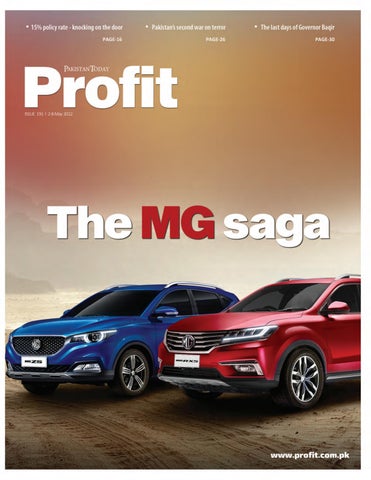
20 20 The MG saga 26 Pakistan’s second war on terror Uzair Younas 27 Startups should be looking at debt, not just VC funding Ozair Ali
30
16
30 The last days of Governor Baqir Ariba Shahid 32 Import tariffs as implicit (and powerful) export taxes Gonzalo J. Varela
Profit
33 The start-up culture is causing Pakistanis (& Wapistanis) to dream Osama Riaz
Publishing Editor: Babar Nizami l Editor: Khurram Husain lJoint Editor: Yousaf Nizami l Assistant Editor: Abdullah Niazi Reporters: Ariba Shahid l Babar Khan Javed l Taimoor Hassan l Meiryum Ali l Shahab Omer Chief of Staff & Product Manager: Muhammad Faran Bukhari Regional Heads of Marketing: Muddasir Alam (Khi) l Zulfiqar Butt (Lhr) l Malik Israr (Isl) Layout: Ahmad Salahuddin l Photographers: Zubair Mehfooz & Imran Gillani l Business, Economic & Financial news by 'Pakistan Today' Contact: profit@pakistantoday.com.pk
Editorial Blowout approaching The market is far ahead of the authorities today. It is demanding a return of almost 15 percent on money it loans to the government for any period beyond six months. At least that is what the results of the last Treasury Bill auction seem to reveal. Meanwhile the State Bank has kept the policy rate at 12.25 percent since April 7. It is quite obvious to everyone by now that the central bank and the country’s financial sector are not seeing reality in the same way. This disconnect was inevitable. All through 2021 the State Bank was glad to play its part in furthering the Prime Minister’s agenda of pushing growth, at all costs. The year 2021 began with the government standing on the doorstep of the IMF while at the same time crowing about its growth rate to the people at home. This was the first sharp disconnect between word and deed. Countries with growing economies that need IMF support to keep the growth rates going should not brag about the sustainability of their policies. That gap – between word and deed – is now apparent in the gap between the policy rate and the rates being demanded by the country’s lenders. Our own history teaches us that whenever this happens, it is the government that has to bow and accept the verdict of the market rather than the other way round. That is what is happening now. The pressures building up in the financial markets are difficult to spin away, except for the most determined souls perhaps. The exchange rate and the interest rate are both coming under growing pressure and it is easy enough to now foresee another hike in interest rates. Quite possibly this might require another “emergency monetary policy committee meeting”, as has happened twice already within the last five months. A third such occurrence – no matter how necessary it is – will be a terrible blow to the credibility of the State Bank itself. Everybody knew that these pressures were building up in the economy all through calendar year 2021. The current account deficit had appeared earlier in the year and grew throughout. The exchange rate started to take a battering from May 2021 all over again, and by August news had broken that serious interventions were being undertaken in the interbank market to shore up the value of the rupee. And inflation rose throughout the yet. Today the markets are calling out the spin the former government put on the vulnerabilities its own growth process had spawned. Today the markets are saying that inflation will continue to rise, and so will the government’s borrowing requirement as the fiscal deficit continues to surge. And the market is now demanding its pound of flesh in return for continuing to finance
the fiscal deficit in a high inflation environment. But there is another thing that everybody knew, even if they were circumspect about saying it out loud. The economic growth that the previous government pushed using fiscal and monetary levers was always unsustainable, with or without the recently announced caps on fuel and power prices. Sooner or later the bill was going to come due. The government’s misfortune is that they came into power precisely at the time when this bill began to mature. To arrest the decline of the foreign exchange reserves it is now necessary to halt the economic growth the previous government brought about, via massive state sponsored stimulus. This was always the big decision hanging over Pakistan’s economic management: when to unwind the stimulus the previous government announced in the wake of the Covid lockdowns. For almost 18 months the State Bank ran negative real interest rates, which contributed the lion’s share of the monetary stimulus if proudly presented as its signature achievement. On its website, and in the pronouncements of its Governor, the State Bank said that the size of this stimulus was almost 5 percent of GDP. Fair enough. But there was a right time to start unwinding this stimulus. It could not, quite obviously, continue forever. According to one view that right time was in March 2021, almost exactly a year ago. But the Governor thought better of it. First he signed an IMF program that envisioned an unwinding of this stimulus, but when the finance minister Hafeez Shaikh was unceremoniously fired, the Governor decided to do everything in his power to stay on the right side of the Prime Minister. The result is where we stand today. The government has to pay near historic high interest rates on all debt it will be contracting from here on, and the exchange rate may well have to see another large devaluation. These steps will be necessary to avert a full scale collapse. They will also be necessary to resume the Fund program. So the government has decided on the oldest, and more reliable, of the tricks it has used so far. It has decided to make a personal visit to the Saudi Arabian capital and ask the Crown Prine for a bailout. If he succeeds it can potentially take the edge off the adjustment that is inevitable coming our way. But if he fails, it will be quite critical to figure out the way forward. Pakistan is no oscillating between many dangerous extremes. Getting them to work together will be Shehbaz Sharir’s biggest opportunity. Or it might be the opposite.
9
IN BRIEF FBR gets a new chairman The federal government has appointed Muhammad Asim Ahmad as the new chairman of the Federal Board of Revenue. Asim has replaced Dr. Ashfaq Ahmed as new FBR chief. Asim is a Grade 21 officer employed at the FBR’s Inland Revenue Service (IRS).
Budget deficit surges to Rs2,565bn in nine months Pakistan’s budget deficit for the first nine months of the current fiscal year 2021-22 has surged to Rs2,565 billion (4 per cent) of GDP. The Ministry of Finance issued the fiscal operation from July to March of the current fiscal year 2021-22 which indicates that total revenue clocked in at Rs5,874 billion.
Federal Shariat Court declares interestbased banking system against Sharia The Federal Shariat Court (FSC) has announced a verdict in a long-pending case on Riba (interest), declaring the prevailing interest-based banking system as against the Sharia and directed the government to facilitate all loans under an interest-free system.
OCAC confirms ample availability of fuel supplies in the country Oil Companies Advisory Council (OCAC) has reported that ample stocks of Motor Spirit (MS) & High Speed Diesel (HSD) are available in the country owing to the support of refineries in providing locally produced fuel products, and to OMCs for planning imports and meeting volume commitments timely despite the limited product availability in the international market due to geopolitical tension.
Skardu airport to handle first international flight next month Skardu airport is going to handle a chartered international flight next month. An international chartered flight is scheduled to operate to Skardu from Munich Germany on May 13, 2022 and will depart from Skardu airport on May 16, 2022 to Bishkek Kyrgyzstan.
Pakistan earns $360mn from travel services’ export in 8 months Pakistan earned $360.034 million by providing different travel services in various countries during the first eight months of the current financial year 2021-22. This is a growth of 10.05 per cent as compared to the $327.152 million earned in same services during corresponding period last year.
Sugar mills yet to clear Rs21bn dues of cane growers Despite the cane crushing season ending last month, sugar mills in Punjab have not cleared dues of growers that have piled up to Rs21 billion by 37 out of 39 sugar mills. Sugar mills are bound to make payments to growers within two weeks of ending of the crashing season and the non-payment of dues may negatively affect the farmers’ Kharif cropping season.
8
Fake news and power outages
this week in Pakistan’s business and economics twitterverse
By Asad Ullah Kamran
T
he nation is fast headed towards Eid, and that means there is nothing else being done at breakneck speed. As we go towards the peak of the bi-yearly “ab toh Eid ke baad ho ga” season, load shedding and continued political turmoil is front and center. Asad Ullah Kamran brings you all this and more in this week’s social media roundup.
A big oopsie on the part of Insafians led by Muzammil Aslam Look at the bright side of things, at least they’ll know what to do since they’ve been here before
10
That’s nice the valiant efforts of keyboard warriors being recognised for their contribution. Lest we forget the military casualties and sacrifices
Everyone can figure out this one on their own
Why isn’t this surprising anyone? It’s obvious isn’t it, work is for chumps essentially. Not you though, keep grinding.
Nobody in Pakistan would be surprised if the independence of the country was earmarked as a conspiracy designed by the west at this point.
After doling out Eidhi to family and friends, keep a little something in your wallets for the government too after Eid.
Keeps getting better and better
SOCIAL MEDIA ROUNDUP
Corporate Update Pakistan’s Projected Growth Rate to Go Down as Per IMF
Pak Suzuki Reports losses for the first quarter of 2022
The International Monetary Fund has projected a decrease in GDP growth rate of the country from 5.6% in 2021 to 4% in 2022. The projections were based on the recessionary period the country is set to experience in which the foreign reserves and import cover are likely to go down while the inflation rate and external debt will continue to soar.
The automobile manufacturer racked in a loss of Rs 460 million after booking a profit of Rs 778 million for the corresponding period last year. The negative trend in earnings came as a surprise given that the company was able to increase revenue by 32% year on year. As per the results, the onus of the losses is on increased finance cost due to hike in policy rate as well as rising cost of imported car components on the back of rupee devaluation.
Jazz’s Invests PKR 14.9 Bn During Q1 22 Jazz invested PKR 14.9 billion under its ‘4G for all’ ambition during the first quarter of 2022, taking its overall investment in Pakistan to US$10.2 billion. A majority of its capital expenditure during this quarter was on the addition of approximately 500 new 4G sites, reaching a population coverage of its 4G service to 55.7%
Systems Limited to Expand Business Footprint At a meeting of the Board of Directors of Systems Limited held on 27th April, board members considered prospective opportunities to expand and develop the company’s digital technology business, for which the board authorized the Company to consider and finalize terms in relation to potential direct and indirect acquisitions, involving 100% acquisition of entities providing IT services locally and internationally, including software development, software maintenance and system integration.
14
Chief Secretary Balochistan appointed Director OGDCL
Chief Secretary Balochistan, Abdul Aziz Uqaili, was inducted into the board of directors of Oil and Gas Development Company Limited (OGDCL) replacing former Chief Secretary of Balochistan, Mathar Riaz Rana.
Federal Shariat Court Orders elimination of Interest Based System
The court has ruled that the government should get rid of the current Riba based system within the next five years and move towards a shariah based system. Experts and Officials have welcomed this decision citing the exemplary growth of Islamic Banking and considering it as a benchmark for the said transformation.
IGI Investments to Increase Shareholding in Sanofi Pakistan
IGI investments through a consortium led by Packages Limited finalized the purchase price of Rs 940 per share to acquire 52.87% stake of Sanofi Pakistan Limited from the pharma comapny’s Netherland based Parent. IGI investments already holds 19.1% of Sanofi Pakistan’s share while the consortium deal will increase its shareholding by 5.87%.
Maple Leaf to Buy-Back 25 Million Shares
The Maple Leaf Cement Company called a meeting of its shareholders to consider a proposal of buying back 25 million shares of the company. The period for said transaction would be 90 days commencing from the date of 26 May and ending on15 August. The proposed transaction price is to be the prevailing share price of the company during the aforementioned period.
Cynergyico Pk Limited to Merge with Cynergyico Isomerate Pk (Pvt.) Ltd.
Engro Fertilizers Appoints Ahsan Zafar as Chief Executive. The Board of Engro Fertilizers appointed Ahsan Zafar as Chief Executive Officer on 28 April. Before his latest appointment, Zafar served as the CEO of Engro Energy Limited. The tenure of the newly appointed CEO will begin from July 1, 2022.
Cordoba Logistics to Setup a Leasing Company The board of directors of Cordoba Leasing and Ventures Limited, on 28th April, resolved to set up a Non-Banking Finance Company as a subsidiary to carry out leasing operations. The board directed the company to evaluate the options of acquiring an existing company or incorporating a new one for the aforementioned operations.
Air Marshal Arshad Malik steps down as PIA CEO The Airforce veteran passed the baton to AWM Amir Hayat after completing his tenure of three years of leading the national carrier company.
15
In a meeting of its Board of Director, Cynergyico Pk Limited was authorised to explore the feasibility of a potential merger with Cynergyico Isomerate Pk (Pvt.) Ltd, a wholly owned subsidiary of the company.
Mari Petroleum Awarded Exploration License Mari Petroleum was awarded five new exploration blocks by the directorate general of petroleum concessions. Two of the said blocks are awarded as an operator while the other three are joint ventures with Pakistan Petroleum Limited and United Energy Pakistan Limited.
15% policy rate
knocking on the door By Ariba Shahid
T
he Karachi Interbank offered rate, simply known as KIBOR, hit a 13 year high of 14.1% on Tuesday. While it might seem so, the KIBOR is not trying to mimic petrol prices by being at a high, instead this is telling of a larger pattern that has been present in the money markets over a period of time. The markets are pricing in for a policy rate hike. At this point, you’re probably rolling your eyes because we’ve been saying that for the past few months. However, while it has been true for the past few months, yet things aren’t really changing.
The buildup
D
uring COVID 19, in order to support the economy, the SBP decided to increase money supply by bringing down interest rates. This was to provide liquidity to businesses and the markets in order to keep them afloat during uncertain times. Although the move was inflationary, it was probably important at that time. Besides, Central Banks hadn’t really prepared for a virus that changes life as we know it. However, once things started resuming back to normal, the SBP could no longer keep the policy rate at 7%. This is because the IMF also requires the SBP to maintain positive real interest rates. The tightening cycle thus began in 2021. The SBP planned on gradually moving
16
towards higher interest rates which can be seen by the fact that it hiked by 25bps in 2021. The next few hikes were sudden and drastic. The SBP had not only hiked the policy rate by 150 bps in November, but had also increased the Cash Reserve Requirement (CRR) for banks to mop up excess liquidity and bring down money supply driven inflation, i.e. demand pull inflation where too much money is chasing too few goods. At that time, the SBP was catching up with the markets. The severity of this can be gauged by the fact that the SBP called the monetary policy committee meeting earlier than scheduled. Baqir had, at the time, told Profit, “Central banks don’t have crystal balls and sometimes developments do take place, which may be a little bit more than not anticipated in those circumstances.” He also said that the end goal is “mildly positive real interest rates”, which has been expressed in forward guidance issued by the SBP multiple times. The markets, however, expected the tightening cycle to speed up, especially with the trajectory at which inflation was rising. In April 2021, the SBP held an emergency MPC meeting and
hiked policy rates by a massive 250 bps. This meeting was around 9 before the planned MPC. The reason was simple, the SBP had to catch up with the markets. However, the SBP canceled the scheduled MPC meeting. In the past, the SBP has kept the policy rate unchanged without releasing a statement, they could have done the same without canceling the meeting, and however, it is assumed that this was done so that markets do not assume the tightening is going to slow down.
Koonda time
T
he banks had started to show the SBP and the government that they’re anticipating rate hikes by bidding at high yields. The finance minister of the time, Shaukat Tarin warned them against
such antics. Essentially, he told banks to not be greedy and drive up the yields. That is the equivalent of expecting a great white shark to go vegan, absurd. He had also told banks to stay in lane otherwise they’d be punished, or in his words Koonda. However, despite that, the markets continue to have the upper hand and are still continuing to drive up yields, pushing for another rate hike. However, instead of Koonda, it seemed like the SBP was bowing over backwards to banks. This can be seen by the longest OMO injection of 63 days being made. The injection basically meant that the banks had won. While the SBP can indirectly lend to the government through OMOs, it is a scary thought that the SBP had to walk the talk and put money where its mouth is to make the market believe them about the forward guidance provided. Essentially, this means, there was no koonda for banks. To understand the bidding patterns, Profit analyzed the last 20 auctions.
What are t bills and how do auctions work?
I
f you’re already aware of these terms, feel free to skip this section. T-Bills are debt issued by the government with tenure of one year or less. Pakistan issues T Bills of 3 month, 6 month, and 12 months. They are coupon bearing instruments and issued in scriptless form. This means that there is no physical form. Primary dealers are banks or other financial institutions (in Pakistan, they are only banks) that are appointed by the SBP to participate in the government securities auctions. As a general principle, the longer the duration for the bond to mature, the higher the yield one
would receive due to the risk associated with time. Debt raised through T bill auctions makes up floating debt. Floating debt is short term borrowing. Investors get the full amount on maturity while these are often sold at a discount to their face value, and are zero coupon securities. The difference between the selling price, discount value, and the price at maturity is the interest earned on a treasury bill. They are sold through primary dealers in auctions on a fortnightly basis. This is not to be confused with floating rate debt, which just means that the interest rate on that debt is not fixed. Primary dealers decide the amount they want to invest in T bills and what tenor. They put in a bid along with the expected interest they want to earn on it. The SBP then goes through the bids and decides the cut off yield. This is the yield at which or below which the bids are accepted. For instance if the cut off yield is decided to be 13.25%, all the bids that are 13.25% or below are accepted. The ones that are higher are rejected. Sometimes the government can decide that the yields are too high, or that they do not necessarily need to borrow at this point in time and so they reject bids too.
Analysis
P
rofit was not able to get access to all the bid reports as the SBP does not keep an archive. However, an analysis of the spread between the minimum and maximum bid here is very important, especially considering the times when the cut off yields are significantly higher than the policy rate.
In the recent auction on 27 April, the cut off yields for 6 month t bills stood at 160 bps higher than the policy rate. The highest weighted average yield per bid, however stood at 14.2524%, which is significantly higher than the policy rate of 12.25%. The spread had been rising between the minimum and maximum weighted average yield bids in October, until they had gone too high in November, prompting the SBP to hike the policy rate. They then tamed down when the OMO injections were made with the spread shrinking. However, following the maturity of the long term OMOs, the banks now see the policy rate rising again. They now longer see the SBP locked into lower interest rates through OMOs, and they are also pricing in inflation. With the new government expected to rollback fuel subsidies, raise prices on fuel, and begin austerity measures in light of the IMF program, the markets are pricing in for inflation to rise. With the SBPs goal of mildly positive real interest rates, it only makes sense for the policy rate to rise. However, it is also important to note that the IMF also requires the SBP to be prudent with its monetary policy and cut back on the expansionary policy that was extended.
How high can we go?
W
ith the highest weighted average bid in this week’s auction coming in at 14.2524% and the cut off yield being determined at 14.1936%, the markets are easily expecting the policy rate to rise to at least 15%. In the past 26 years, the highest the policy rate has gone in Pakistan is 19.5% in 1996. The lowest is 5.75% in May 2016. It is important to note that the policy rate in Pakistan has usually been on the higher side in line with most developing economies, usually in the double digit range. The question now is, how long will the SBP be strung along and when will it start leading the markets rather than making knee jerk reactions every time the markets get ahead of it n
MARKETS
20
COVER STORY
By Ahtasam Ahmad & Shahzad Pracha
I
t was back in February 2021, more than a year ago, that Javed Afridi’s Morrison Garages (MG) Motors found themselves in the headlines in an under-invoicing scam. Now, the Public Accounts Committee (PAC) has ordered a reopening of the tax evasion case against the company. Under question are Rs 8 billion worth of custom duty which MG has allegedly evaded through the practice of under-invoicing. While it is a common occurrence in Pakistan’s imports sector, it is rare in major industries that have regulations like automobiles. The accusation against MG is that they failed to reveal a joint venture agreement between them and a company in China that provides them with their vehicles - even though under the law they are supposed to. Sources have told Profit that MG had used government contacts, corrupt officials in the customs department as well as members of former Prime Minister Imran Khan’s staff to get the matter hushed up. However now, after the arrival of the Sharif administration, the inquiry is being opened up again. Profit spoke with MG’s chief in Pakistan, Javed Afridi, over the allegations. Afridi told Profit that the company was being misrepresented and that no under invoicing had taken place. As of now, under the instruction of PAC, the FBR has formed a four member investigation committee to conduct a probe. The committee will take a detailed look at the comparable prices of Completely Built Units and Completely Knocked Down units of MG cars and determine the fair value that should have been established by the custom authorities. Further, the committee is also directed to investigate the role of FBR’s field operations in the matter. Using interviews with Javed Afridi, confidential sources, and an internal document of the investigative agency made available to us, Profit looks at what happened with MG, and where the investigation is headed.
Under invoicing and MG
M
ost developed countries set high tariffs on imports. Pakistan is no exception. While this provides valuable tax revenue for the government and protects local industries, because of weak enforcement of controls, it also gives rise to two practices - smuggling and under invoicing. Under invoicing is the practice of declaring a lower value of the product being im-
22
ported so that the custom duty on it is charged as such. For example, a product worth Rs 100 might have a custom duty of 200% - meaning the final cost to procure that product will be Rs 300. Meanwhile, a product worth Rs 80 might have a custom duty of 150%. The phenomenon of under invoicing is not new in Pakistani imports. Traders regularly indulge in concealing the actual value of the imported goods and declaring it at a much lower level to the customs authorities. Thereafter, the custom duty is assigned to these goods on the declared or custom assessed value. Thus, under invoicing leads to the importer evading massive amounts of duties rendering the products more competitive in the market. This doesn’t only lead to the menace of tax evasion but also defeats the purpose of high import duty on certain items to discourage consumption and subsequently reduce the import bill. The MG motors under invoicing case first came to light last year around February. As per reports, the vehicles imported were declared at a value which was considerably below the original purchase price of the vehicles. Cars are imported in two forms - Completely Built Units (CBUs) or Completely Knocked Down Units (CKD). As the names suggest, the CBUs are entirely assembled cars while CKD units are IKEA versions that are then assembled locally. CBUs are naturally
ordered at a rate of $16,000 were because only a few units were being imported back then as samples. The CBUs were imported at $11,000 because there were 1000 of them. “These CKD kits were imported only as Pre-Production Vehicles (PPV) kits to assemble high quality sample vehicles which is proved from their import documents. Freight of these kits as mentioned on import documents is 1400 US$ greater than the freight of CBU vehicles. CKD kits have been imported with high quality packaging, costing up to US$ 900, to preserve them for longer periods for subsequent use. Steep rise in prices of micro chips, used in these kits, in the international market added up to US$ 800 in costs of these kits. Hence, these facts amply demonstrate the price difference between CKD kits and CBU vehicles.” This is a reasonable enough explanation. However, comparable makes of MG in other jurisdictions were being declared at a base price of around $20,000 as per custom department’s internal investigation conducted last year. Further, the declared value of MG HS, the model in question, was substantially lower than comparable SUVs in the country. Hyundai Tucson’s declared value was between $18,000 to $16,000. While the declared value of the KIA Sportage vehicle was also around similar lines.
Source: Report of Directorate of Post Clearance Audit
more expensive, except in MG’s case, they weren’t. And that was where the story began. 0 As per sources, around 1000 vehicles were cleared on verbal directives of the Member operations at a declared value of $ 11,000 per CBU. However, the CKD kits for the same vehicle were declared at a price of $16,000 at the Lahore dry port which technically meant that unassembled parts of a car were being said to be more expensive than the assembled unit of the car itself. Now, immediately alarm bells started to ring and people thought the $11,000 price tag on the CBUs was too low - which could mean under invoicing. However, MG had a response to this. “Comparison of CKD kits with CBU vehicles is based on misplaced assumptions, without knowing facts. There are only 24 kits in total which are being relied upon for such an irrelevant comparison whereas the total numbers of CBU vehicles are more than 10000,” Javed Afridi tells Profit. According to him, the CKDs
During our investigation, we came across a twitter thread that explained how MG prices were significantly lower than its competitors and a possible reason for it was concealment of original prices at the customs to avoid duty. The thread compares the pricing Honda Vezel 2021 and MG HS 2021. As per the comparison, “Vezel, being hybrid, gets 50% rebate on taxes so Vezel duty is 2.2 million and MG Hs is non hybrid so it’s duty is 4.4 million. After adding the price of the car + custom duty + freight charges Honda Vezel costs 6.5 million and sells around 7.5 million and for MG HS no idea about cost because MG Pakistan doesn’t share anything nor does FBR but it sells for 5.7 million.” As per the calculation above, Vezel declared value for duties and taxes is 4.3 million and MG declared value for duties and taxes is only 1.3 million.
The investigation
T
he Directorate of Post Clearance Audit (PCA) also investigated the matter once news broke about malpractice in the clearance process. The report of the Director Post Clearance Audit clearly pointed out the heavy under -invoicing in this case. Yet the findings of that report were ignored by the customs officials. “The Directorate of Post Clearance Audit employed methods of valuation which are prohibited,” Afridi said in his response given to Profit. “That is why the Adjudication Collector vacated the contravention report as the same was based on the prohibited methods.” The Committee of Collectors applied their own mind and determined values as per law which resulted in recovery of additional duties and taxes up to 1.1 billion whereas no additional duties and taxes have been recovered in import of similar SUVs” he added. The Committee of Collectors consisted of 3 Collectors of Customs appraisement Karachi who submitted a report to the Board determining the value of vehicles at US$12,400. However, as per officials in the Customs department, who spoke to Profit on the condition of anonymity, the officers responsible for the appraisal were themselves involved in the under assessment matter. Further, an internal document of customs obtained by Profit also pointed to under invoicing by MG motors. The document reads, “Mis-declaration and under-valuation by M/S JW SEZ (Pvt) Ltd. Involving duty and taxes Rs. 823.7 million against import of 687 SUV MG HS/MG ZS and MG ZS EV vehicles in CBU condition under HS code 8703.2260. Reportedly, more than four thousand vehicles have been imported by way of mis-declaration
of value.” However, Javed Afridi denied such allegations stating, “the clearance collectorates made due diligence and determined values as per law at their level and recovered Rs. 1.1 billion additional duties and taxes. Initially, 774 vehicles were cleared at Karachi which were allowed clearance by the respective collectorate themselves. There is no evidence at all of any influence by any quarters.” Profit got hold of the investigation report by the PCA. As per the report, JW SEZ (Pvt.) ltd, the company that imports MG cars in Pakistan was in a Joint Venture Agreement with SAIC international Co., the Chinese company that sold the MG vehicles. The report states, “The declared customs transaction value by M/s JW SEZ (Pvt.) limited cannot be accepted as actual transaction value in terms of Section 25 (1) (d) and 25 (3) of the customs
act 1969, as being the buyer M/s JW SEZ (Pvt.) limited, Lahore and seller, M/s SAIC International Co. are related parties. Hence the declared custom values are found to be influenced.” As per the official Business Plan of the JW SEZ (importer of MG vehicles), submitted with the Engineering Development Board, the joint venture agreement gave 49% holding to JW SEZ, the importing company and 51% to the seller SAIC Motor International Co. Ltd. The Customs document further pointed out that the Chinese supplier (Related Party) sold the vehicles to the Pakistani importer at a price that was well below the amount mentioned on the official website of the Chinese manufacturer. Further, JW SEZ (importer) did not disclose the underlying JV that governed the transactions between the company and the supplier rendering the normal methods of valuation of goods under section 25(1) and 25(3) of the custom act 1969 inapplicable. Further, as per the report, import data for MG cars was not available other than that procured by JW SEZ which is the sole importer of the said vehicles in the country. Therefore, the PCA used the MSRPs available on official MG China website to ascertain the value of the vehicles. The price determination was carried out under the Fall Back Method mentioned in the Customs act 1969. As per the World Trade Organisation, “When the customs value cannot be determined under any of the other official methods, it may be determined using reasonable means consistent with the principles and general provisions of the Agreement and of Article VII of GATT, and on the basis of data available in the country of importation. To the greatest extent possible, this method should be based
COVER STORY
on previously determined values and methods with a reasonable degree of flexibility in their application.” Therefore, in absence of reliable data to ascertain the value of the vehicles, the PCA employed the Fall Back Method permitted under the Section 25 of Customs Act 1969. Further, the estimation of charges, freight and taxes on the vehicle were made in accordance with long established practices of the clearance collectorate, the report says. The following table shows the value determined by the authorities of the MG HS vehicle. After establishing the price for the MG vehicles, PCA assessed that total loss to the national exchequer was 823,700,261 on the import of 747 vehicles under nine goods declarations that were investigated (It is to be noted that the PCA only investigated declarations upto february 2021 and as of now more than 10,000 MG vehicles have been imported). Subsequently, the PCA issued a show cause order to the importers of MG vehicles in Pakistan. However, the order of the Directorate of Post Clearance Audit was vacated by the Collector of Customs (Adjudication) on the basis of defective valuation as the prices obtained from the official site of the Chinese manufacturer required further authentication from the aforementioned. The PCA challenged this decision and went into appeal before the
24
Customs Appellate Tribunal. Further, as per Profit’s sources in the customs department, those officials of the customs department that refused to engage in the activity of under invoicing, were penalized through transfers. Speaking to Profit, former chairman FBR, Dr. Muhammad Ashfaq Ahmed, stated, “They all are upright and conscientious officers and don’t compromise if there’s anything illegal.” The recent committee formed at the direction of the Public Accounts Committee is also instructed to probe the adjudication process assessing the legality of the orders passed by the collector of customs (Adjudication). However, Javed Afridi maintains that the hype created around the MG under
invoicing case is nothing except an effort to malign his company and efforts to bring in investments to the country. While talking to Profit, he claimed, “News about alleged MG Import Scam is total disinformation with ulterior motives to tarnish the image of officers who have unblemished careers and to negatively target Chinese investments in Pakistan. Fact is that there is no under-invoicing in import of MG vehicles. Actually, all the SUVs like Toyota Rush, Prince Glory, Proton, Changan have been imported and cleared at declared values whereas only the value of MG vehicles is enhanced and extra duties and taxes up to 1.1 billion have been recovered from importers of MG vehicles.” n
COVER STORY
OPINION
Uzair Younus
Pakistan’s second war on terror
which targeted TTP safe havens. Complicating this challenge is the growing capability of Baloch terror groups, which have also started to increase the tempo of their attacks. An example are the deadly army post attacks in Balochistan in early February, following which the security forces claimed that they had killed 20 militants in Panjgur and Noshki. These groups have allegedly found akistan’s second war on terror is becoming more safe havens across the border in Iran, with the interior ministry confirmviolent and more complex over the last few months. ing that “anti-Pakistan terror outfits are regrouping in Balochistan via With security personnel facing attacks on an almost Sistan.” The suicide bombing in Karachi shows that their capabilities daily basis, the situation in the peripheral regions near are only growing, meaning that Pakistan now must deal with growing the Afghan and Iranian borders has become tenuous. violence in both Khyber-Pakhtunkhwa and Balochistan. As last week’s suicide bombing in Karachi by a female To deal with this growing violence, the country needs institutional bomber shows, terror groups are once again capable of carrying and political consensus. This consensus was last forged following the out attacks in urban centers. While a protracted game of thrones horrific APS tragedy. Following the ouster of Imran Khan, political templays out in Islamabad and its adjoining areas, not enough attention peratures are unlikely to come down, especially with elections around the is being paid to this ongoing war that is going to be much more corner. This is further complicated by the fact that the military establishchallenging to win for the Islamic Republic of Pakistan. ment is facing its own set of challenges due to the political crisis. Finally, There are three key reasons for why the second war on terror the army chief is on his way out, meaning that his own capabilities to is much more complex than the first: growing capabilities of both corral political leadership together are severely constrained. the radical Islamist and Baloch terror groups, a worsening political Winning against insurgencies is economically costly as well. Paying economy, and the withdrawal of U.S. troops in Afghanistan. for the increased tempo of military operations, aerial strikes, and investReports have consistently flagged that radical Islamist ment in new gear and technology all requires hard cash, especially foreign groups, in particular the Tehreek-e-Taliban Pakistan (TTP) and the currency. Money is also needed to win hearts and minds, both by doling Islamic State (ISIS-K), have significantly rebuilt their capabilities out cash and investing in developmental projects. Pakistan currently is in the last few months. This is evident in the growing tempo of confronting an economic crisis and is trying to negotiate the resumption terror attacks targeting Pakistani security forces and law enforceof the IMF program, meaning that the state’s capacity to fund major milment personnel. The worsening situation in Afghanistan means itary operations and development is extremely limited. Controlling the that these groups have safe havens from where they can plan and ballooning current account deficit is a priority, with reserves standing at execute sophisticated attacks targeting people within and outside less than two months of import cover. This financial crunch may further Afghanistan. An example is an alleged ISIS-K rocket attack on Uzworsen due to higher commodity prices in the international market. All bekistan, where 10 rockets were claimed to have been fired by the of which means that there is unlikely to be any spare cash available to group. While Uzbek authorities said that this was untrue, ISIS-K’s fund things that can win hearts and minds while defeating militants. growing capacity in northern Afghanistan has started to concern During the first war on terror, Pakistan had some level of inflows both the Taliban and other regional powers. Pakistan has faced and support coming from the U.S., whose military forces were stationed the brunt of this growing violence at the hands of the TTP and across the border in Afghanistan. Given that the Washington had long has upped the ante by carrying out airstrikes in Khost and Kunar encouraged Islamabad and Rawalpindi to deal with terror groups on its soil, Pakistan was able to get some level of financial and military assistance from Uncle Sam to pay for these operations. It could also count on U.S. forces to mop up terrorists escaping into Afghanistan. The U.S. is now solely occupied with the Ukraine and the Biden administration has no major interest in coming to Pakistan’s rescue. This lack of interest from Washington means that unlike the first war on terror, when The writer is Director of Pakistan could count on the U.S., it must now fight this war on its own, without major military and the Pakistan Initiative financial support. at the Atlantic Council, a Terror groups targeting Pakistan recognize the constraints faced by their enemy, which is why they Washington D.C.-based are becoming increasingly brazen and aggressive with their attacks. Given the current environment in think tank, and host of the Pakistan – you will find hardly a primetime show dedicated to the second war on terror – it is unlikely podcast Pakistonomy. He that the country will step up its game any time soon. There will be more condemnation over attacks, tweets @uzairyounus. some more visits to the frontlines, and press releases about martyrs. But beyond that, Pakistan seems neither capable nor serious about winning its second war on terror. n
P
26
COMMENT
OPINION
Ozair Ali
Startups should be looking at debt, not just VC funding
But tech companies are financed through equity, and raising equity is an expensive way to finance lending. That’s because most venture capital investors expect explosive growth and returns – not the sort that can be achieved by lending at any reasonable rate. So, as startups scale and expand into financing products, they’ll need to access debt to keep making loans themselves. What kinds of debt for startups exist? These are the categories:
But what are the options?
Asset-based lending
T
hree years ago, I met another venture investor in Jakarta to talk about startups in emerging markets. We spoke about various sectors and business models. “But when these companies talk about monetization, they’re all lending companies,” he remarked. He was right. The roadmap and monetization slides in a lot of startup decks, even if they aren’t strictly lending fintechs, talked about some form of lending. It seems that startups are arriving at the same conclusion that GM and other American car manufacturers famously did in the 1930s: there’s more money to be made in financing cars than in selling them outright. Got data on inventory levels and flows for your customers? Let’s bundle inventory financing. Transporters with working capital challenges to finance fuel costs? Try working capital financing. Bundling lending products to facilitate consumer spend is common in most industries, and tech is no exception. After all, no business would turn down an opportunity to get a larger portion of the customer’s wallet and create loyalty.
The writer is Former: Emerging markets VC with Alter Global. Now: Entrepreneur PS: I also write short speculative fiction
COMMENT
L
ending against receivables is one of the most straightforward ways to finance a company with a financial product. The lender assesses the quality of the receivable, i.e., the likelihood of timely repayment, and advances a facility that the borrower draws on as needed. Typically known as a revolver, these facilities provide the borrower with flexibility but may be more expensive than a standard term loan on an annualized basis. For fintechs or other startups with lending products, the core receivable is the collection of loans they’ve made to customers that will be paid back. A “loan tape” shows all the data on loans they’ve made and tracks repayments. If the company goes bankrupt, the lenders are entitled to recover the borrowed amount by staking their claims to the collateralized loans.
Corporate debt
M
ore mature companies can often access a broader variety of debt instruments, including term loans, convertible notes and classic venture debt. These instruments are sometimes cheaper than asset-based revolvers, and lenders typically focus on the company’s capacity to repay the loan with cash flow, as opposed to assessing balance sheet assets. In debt-speak, this reflects a shift from underwriting a specific asset to underwriting the entire business. In some instances, venture debt facilities also contain warrants – the right of the lender to convert their debt into equity – which can become very valuable if the value of the company appreciates significantly. Therefore, venture debt providers, unlike other debt providers, often focus on the company’s total enterprise value and growth potential. In fact, plenty of venture debt providers count on warrants to deliver fund returns, particularly when lending to very early-stage startups. Young startups sometimes raise financing through convertible notes, which are really equity instruments masquerading as debt. So while convertible notes and venture debt are available to early-stage startups, investors know fully well that they’re trying to get a piece of the company’s future equity value.
27
Revenue-based financing
A
new class of digital lenders advances loans against future revenue for ventures in the digital economy. Lenders in this category includes Clear.co, Pipe, CapChase, and Uncapped, among others, and also capital provided by Shopify, Square and Stripe. This product is not new — merchant cash advance has been a lending staple for centuries. What’s changed now is that the lender can plug directly into the borrower’s accounting and financial data, enabling a quick assessment of creditworthiness and fast loan execution. The downside to such financing is the cost to the borrower. Annualized rates on merchant cash advance exceed 50 percent in certain circumstances.
Debt for startups in emerging markets
W
hile venture capital activity in emerging markets has boomed, debt capital, particularly non-corporate debt, remains relatively scarce. Take Pakistan.
28
Although venture capital has exploded in the last three years, debt for startups barely exists. Given that even non-fintech startups want to provide financial products, the demand for debt capital will balloon over the next five years. For now, it’s an unmet need.
Will debt disrupt venture capital?
T
o be fair, debt for startups has only recently started getting mainstream attention, even in developed markets. Venture debt expanded to USD 33 billion last year in the US. That’s still only one-tenth of the USD 330 billion of equity that venture capitalists deployed in the US last year (keep that 10x ratio in mind for later). Simultaneously, the meteoric rises of revenue-based financing startups (Pipe, Clear. co, etc.) have led many to predict an increase in debt financing for startups in this century. Here’s a great summary of debt options available created by a16z, and another that eloquently argues for the incoming debt wave. The summary: startups with decent product-market fit, a repeatable sales process, and a growing cohort of users can benefit more from
debt financing than classic venture capital (equity). Cash flows from startups with predictable, recurring revenue look remarkably like cash flows from mortgages: largely predictable and consistent. The analogy has its limits, but there’s no reason why tech companies with recurring revenue can’t also access debt.
Who’s building this in emerging markets?
A
ssuming the 10x multiple from earlier, the USD 300 million in equity funding for Pakistani startups should translate into demand for USD 30 million in venture debt, which is a subset of the entire debt market for startups. That’s not much, but I expect the demand for debt to be greater given the lack of availability of debt products of any kind in the market. As the startup ecosystem flourishes, debt providers will need to step up. But Pakistan is a small part of the emerging market venture ecosystem. The total demand for debt for startups in emerging markets is easily a few billion dollars per year. And it will only accelerate in the next five years. So, who’s building this? n
COMMENT
OPINION
Ariba Shahid
The last days of Governor Baqir
“H
is term is about to end and we will not retain him,” said Khawaja Muhammad Asif while speaking about Dr Reza Baqir’s term as governor State Bank of Pakistan, expected to end in early May. This was said while Dr Baqir was already in Washington in talks with the International Monetary Fund (IMF) waiting to be joined by Miftah Ismail, newly appointed Finance Minister. The talk and negotiations with the IMF focuses on proposals for the next budget. If successful, Pakistan will receive a $1 billion installment from the IMF. While it was a known fact that Baqir’s term was coming to an end, had the Imran Khan government not been ousted, there were strong chances for him to be given an extension or in other words for him to continue as governor for another term. However, with a new government coming in, there were rumors afloat on Shehbaz Sharif not being keen on keeping him as governor SBP even though Miftah Ismail thought he should continue. There has been no public statement by the both of them on this.
Bad timing
T
he delegation from Pakistan could have faced a hurdle in the form of the IMF saying it would continue negotiations once a new governor comes in. Moreover, Asif’s statement further undermines Pakistan’s negotiating power by going
The writer is a business journalist at Profit. She can be reached at ariba.shahid@ pakistantoday.com.pk or at twitter.com/AribaShahid
30
live on television and saying that the law giving autonomy to the SBP will definetly be reversed. Need you be reminded that the IMF has heavily stressed on an autonomous central bank, making it imperative for its program. The timing becomes even worse considering the mass subsidies given out by the previous administration despite agreeing to austerity measures in compliance with the IMF program. While one can debate on whether or not the governor should stay, the length of the tenure, etc; one cannot ignore the carelessness of Asif’s statement. The statement basically makes Pakistan’s position weak in front of the IMF yet again. Previously, the IMF issued a statement saying “Once a new government is formed, we will enquire about intentions vis-a-vis programme engagement.” This essentially takes away all negotiation power away from Baqir and the Pakistan delegation. It also does not send out the right message.
What does this really mean?
I
n the past when the Central Bank wasn’t legally autonomous, it mattered who led the central bank, especially if you were in government. Let’s flash back to 2017, when Tariq Bajwa was appointed as governor. The move was questioned considering the timing. The rupee had plunged 3.1% against the dollar earlier that week, which did not sit well with Ishaq Dar, the finance minister of the time, who believed in a heavily managed exchange rate. While Tariq Bajwa was appointed as a replacement for acting governor Riaz Riazuddin, it is important to note that the reason for the immediate change was because the finance ministry felt the need to be able to call shots at the SBP. The SBP, like any other central bank, however needs to be autonomous for the greater good of the nation’s economic policies. This prevents it from being clouded by political interference,
pressure, and populist moves.
The signal
T
he decision to not continue with Baqir proves to be a strong signal. It shows that the government will try to move towards a fixed exchange rate, as opposed to the current scenario where the SBP intervenes when it deems absolutely necessary. Baqir has been a strong proponent of a market determined exchange rate and has often been found thanking the government for being on board with the decision to let the rupee depreciate. He is also often found saying that if the rupee could withstand a major shock like covid, it can withstand other economic challenges as and when they come.
Considering the fact that he has been vocal, (arguably more vocal and media present than his predecessors, but more on that later), it is unlikely he would change his stance with a change in government. Keeping that in mind, the best option for the new government is to have a governor that is seen to be more compliant to their form of economics, commonly known as Daronomics. While Asif’s statement may be seen as Baqir’s farewell, he may still be in the running to continue as governor if the IMF negotiations go better than planned. In Baqir’s case, if asked to continue and fall down the Daronomics rabit hole, it would be a stain on his career and performance as a central banker, especially considering his commendable performance so far. The signaling also proves to show some issues within the political structure of PMLN and their form of governance. Asif, being the Defence Minister speaking about decisions related to the SBP and governor on TV also suggests that despite Miftah Ismail being at the forefront of the ministry, he may also have to bow to old party politics. Dar and Asif being elected members take more power in the party than Ismail, and also belong to the same clan as the leaders – Punjabi. Ismail, a Karachi based businessman, who happens to be from the Memon community, despite being equipped and competent for the job, has the challenge of breaking the glass ceiling.
Governors and tenures
B
aqir is the 20th appointed governor of the SBP. The longest serving governor was Aftab Ghulam Nabi Kazi who served the SBP for 7 years and 359 days while Zia ul Haq was president. The shortest stint as governor is by Shahkrullah Durrani, father of first lady Tehmina Durrani. He served as governor for 174 days in 1971. Earlier in 2014, the SBP carried out research on the impact of short tenures of central bank governors, titled “Monetary Policy Framework in SAARC Region”. Research suggested that inflation persists in developing countries as a result. The study also unveils that short lived governorship reflects adversely on the regulator’s independence vis-à-vis the governments that are prone to take politically motivated decisions. “A negative correlation exists between inflation and governor‘s average term in office, particularly for developing countries,” observe SBP researchers citing a study conducted under the head of Cukierman and Webb in 1995. It is important to note that the Cuikerman and Webb study, which has been updated over time, reports correlation and this does not
imply causation. The study finds Pakistan, along with Bhutan in the SAARC region, as a country having the “shortest” three-year tenure for a central bank’s governor. This period, the study adds, also is “shorter” than Pakistan’s five-year election cycle. The President of Pakistan appoints the SBP governor for a three-year term, subject to a 65-year age limit.
Should it be time for the governor to pack up and leave?
A
term of three years is far too less for any central banker. It takes time to understand issues from a regulatory perspective, to plan projects, initiatives and changes. It takes even more time to implement. Three years is not enough to implement projects left behind by previous governors and also see through the completion of new ones. Nor is three years enough to provide sta-
bility in terms of macroeconomic handling of the economy. This is especially important for a country as politically volatile as Pakistan. If asked whether Baqir should be given an extension, my opinion is he should consider he should, especially to continue with the momentum of change that is witnessed at the SBP. Seldom does someone young and energetic get to a position of calling the shots. A change of air in the SBP, where the governor is more human and communicative, has resulted in the SBP being more receptive to feedback and more granular with its solutions. That is a rare find and the need of the hour for a country like Pakistan plagued with uncertainty, inconsistent policies, low financial inclusion, and widespread undocumented transactions. Lastly, while Baqir has accumulated a number of fans, large enough for him to get support to come in as a technocrat, it is important to note that the institution and its policies are bigger than the person. The SBP is more than a governor and consistent policy is what the nation needs, even if it’s by a new face. n
COMMENT
ANALYSIS
Gonzalo J. Varela
Import tariffs as implicit (and powerful) export taxes
I
f you thought import duties were taxes on imports, you’re only half right. They are also, implicitly, and powerfully, taxes on exports. In 1936, the American-British Economist, Abba Lerner developed the idea that an ad-valorem import duty is equivalent in its effects as an export tax. This unintuitive idea, known as the ‘Lerner symmetry theorem’, means that when a government introduces an import duty in a sector to protect it from foreign competition, say, to substitute imports, it is artificially increasing the profitability of domestic firms that choose to sell in that sector, relative to those that choose to sell in (unprotected) export markets. Thus, import tariffs introduce an anti-export bias. Intended to substitute imports, they end up substituting exports instead. The anti-export bias of import duties is accentuated when these duties are structured in a cascading manner. Cascading means that duties on raw materials and intermediates required to produce a final good are lower than those on the final good itself. Say, import duties on pedals, wheels, saddles, brakes, or frames are lower than those applied on a completely built bicycle. And cascading is marked in Pakistan – actually, Pakistan shows the second highest import duty cascading in the world (Figure 1 ).
to sell at a higher price, import competition would price them out of the market. And if they were productive enough to sell at a lower price, they would export all they could produce and secure a US$100 price in international markets. Imagine also that in Pakistan, out of the US$100 value of the bike, US$67 are input costs and US$33 are value added (as suggested by the latest Census of Manufacturing Industries, CMI, 2015/16 that reports value added in output to be approximately 33 percent). In addition, and again following data from the CMI, of the US$33 of value added, US$8 correspond to wage costs, and US$25 to operating margins (markups, or profits)). If now the Government of Pakistan introduces an import duty of 10 percent on bikes, say because it wants to promote import substitution (but introduces no duty on the inputs required to produce bikes, that is, in cascading), then imported bikes will sell in Pakistan for US$110. Pakistani producers of bikes can choose to sell bikes domestically or export them. If they sell domestically, because the import duty reduced the competition they faced from imports, now they can sell bikes at a price up to US$110 without begin priced out of the market by foreign competition. That means their profits would increase from US$25 to US$35 (or by 40 percent). If the domestic firms decided instead to export the bikes, with the international price at US$100, their profits from exporting would remain at US$25. The cascading import tariff (of just 10%!) has increased the profitability of selling domestically relative to exporting by 40 percent! The import duty has had a magnified and powerful effect on the incentives to export. And this is not just a made-up example. Systematic evidence for publicly listed firms in Pakistan shows that, on average, a one percent increase in tariffs in final goods increases the profits of firms producing that final good by 4 percent (Figure 3). It is then no surprise that firms in sectors that face increased protection tend to export less as a share of total sales, as shown in Figure 2.
A concrete example can help visualize the effects. Imagine that in Pakistan, the sector producing bikes faces no import duties. Bikes are sold internationally at US$100, and, assuming for simplicity that transport costs are negligible, bikes would also be sold at the equivalent PKR price in Pakistan. If domestic bike producers were
The intended objective of the import tariff cascading is to promote industrialization (and in times of current account deficits, substitute imports). The unintended consequence is that it discourages exports (does not help with the current account deficit), and importantly discourages productivity growth in the long run. This is because cascading allows domestic firms to import inputs cheap but gives them protection on the final product through a high import tariff, so that they do not have to compete on a level-playing field basis with international firms. When cascading is prolonged over time, not only exporting is discouraged, but so is investment in innovation and productivity upgrading.
32
COMMENT
Analysis
Osama Riaz
The start-up culture is causing Pakistanis (& Wapistanis) to dream
R
ising inflation, declining foreign reserves, energy shortages, political instability – These headlines make a grim reading for any investor. But in all the negativity that is engulfing Pakistan currently, there is one silver lining: Booming start-up ecosystem. Pakistan is, after all, one of the few untapped frontier markets. Pakistan is at a unique crossroad. Being the fifth-largest population in the world, more than 60% of its population is under the age of 30 years. More than 50% of the population has access to broadband/3G/4G services and there are more than +190m cellular subscribers. The country has strong growth prospects, driven by the large, tech-savvy young population and a growing consumer middle class. In 2021, Pakistani start-ups attracted $365 million in funding. During Q1’22, they have managed to attract +$170 million in funding – at a time when commodity pressures and regional conflicts across different regions led many to believe that a market correction is due, with many fearing drying of follow-on funding. With more funding rounds in the pipeline, we could very easily see the $365 million mark being exceeded by Q3’22. Majority of Pakistani start-up fundraising is concentrated within B2B or B2C e-commerce, fintech, and logistics. This is
The writer works as an Investment Associate at Sarmayacar – an early-stage venture capital fund partnering with tech & tech-enabled start-ups. To learn more about the Pakistan start up ecosystem, he can be reached at osama@sarmayacar.com
COMMENT
The value creation element has also been aided by the desire of top-tier talent to work for budding start-ups rather than established MNCs. This has led to an increase in talent wars, as organizations fight to attract and retain the best talent. Programs like Venture for Pakistan are successfully mentoring and training a pipeline of talent to join these start-ups. Many of these people eventually venture off to begin their own start-up.
a trend that can be observed in a lot of emerging markets as the ecosystem starts to grow. With increased digital adoption and a growing consumer class, these verticals have demonstrated a high growth rate, often in correlation with each other. Investors also feel more comfortable in taking exposures in tried and tested models in comparable countries. This is because they understand the business model better after seeing it successful work in other markets. The success of Khatabook or Udhaar in India or Tani Hub in Indonesia makes it easier for investors to take exposures in Credit Book or DigiKhata or Jiye Tech in Pakistan. Founders still have their work cut out as they localize their business models for market adoption. While tried and tested model remain a preference, other verticals are also picking up pace, as reflected by the funding rounds of Metric (Accounting), DaftarKhawn (Real Estate) and Oladoc (Health tech). What is also encouraging to note is the high level of interest that Pakistani start-ups can generate from foreign venture capital funds. There has been a substantial rise in foreign VCs leading later stage funding rounds, which reflects the acceptability of Pakistan promise by both foreign & institutional investors and strategic players. Prosus Ventures led Bykea’s $13 million Series B round. Speed Invest led Abhi Finance $17 million Series A round. Tiger Global led Credit Book’s $11 million Pre-Series A round and Dragoneer co-led Bazaar’s $70 million Series B round. Jugnu raised $22.5 million Series A round led by Sary in a strategic partnership between both companies. All of these deals happened to be the first exposure these funds or
33
strategic players had undertaken in Pakistan VC space. The acceptability of the ‘Pakistan Story’ and the reinforcement of confidence in the start-up ecosystem has led to many strategic players make early bets in the ecosystem. Zaraye raised $2.1 million in pre-seed from Tiger Global while Kleiner Perkins is backing Tania Aidrus in her attempt to set up a neo-bank in Pakistan. This is happening at a time when foreign investors are reducing their exposure to Pakistan Stock Exchange (PSX), more than $340 million worth of equities been sold off by foreign investors over the last nine months. While the market capitalization of the PSX (+$42 billion) has largely remained stagnant over the last few years, market capitalization of start-ups in Pakistan has grown rapidly and is estimated to be between $3 billion to $3.5 billion, representing an estimated 8% of public market cap. One of the primary factors driving the wave of tech enabled start-ups is the rise in internet penetration across Pakistan. When Dawaai, an online medical store, started in early 2014, there were only 3 to 5 million broadband users in the country. Now, the number is well over 100 million. Internet penetration & the acceptability of digital solutions have influenced consumer preferences and therefore have increased the addressable markets for these player manifolds. Another factor driving this growth is the ‘Wapistani, effect – a term coined to describe the increasing number of the Pakistani diaspora community coming back to Pakistan. These Wapistanis – having experience of working in mature ecosystems and been part of successful start-ups –bring with them the experience, expertise and value creation required to mature a nascent ecosystem. The value creation element has also been aided by the desire of top-tier talent to work
Source: https://techshaw.com/pakistan-startup-funding-q1-2022/ for budding start-ups rather than established MNCs. This has led to an increase in talent wars, as organizations fight to attract and retain the best talent. Programs like Venture for Pakistan are successfully mentoring and training a pipeline of talent to join these start-ups. Many of these people eventually venture off to begin their own start-up. The local ecosystem is all too familiar with the Careem mafia. Pakistan’s regulatory environment continues to enable the growth of the ecosystem due to its business-friendly policies. The introduction of Electronic Money Institutions (EMI) regulations, Digital Banking Policy (2022), National eCommerce Policy, Digital Pakistan Policy, GEM listing board at the Pakistan Stock exchange are some of the initiatives that have driven confidence of the ecosystem participants. As the SBP, SECP, STZA and other regulatory bodies move forward, we can expect the regulatory environment to mature even more. As more and more later stage funding
rounds take place, one cannot rule out a possibility of a big-name start-up failing to fulfil its potential and shutting down its operations. While this may reflect negativity on the ecosystem perception and on investor returns, it would be beneficial for the ecosystem. Startup founders would use the failure as a learning to understand what went wrong and how to avoid trading down that path in the future. With more than 50% of the economy undocumented, lack of tech adoption by established businesses, cash-dominated transactions, low financial inclusion (21%) and changing consumer preferences – the opportunity to disrupt different verticals in Pakistan is huge and Pakistani start-up founders are doing justice to it. The start-up ecosystem has given hope to a country that is continually marred by constant shocks – be it political, social, or economic. With start-ups, human capital in the country sees an opportunity to live their own “Pakistan Dream”. After all, this is the dream that started the Wapistani effect. n
Source: PTA
34
COMMENT