CONTENTS
11
14
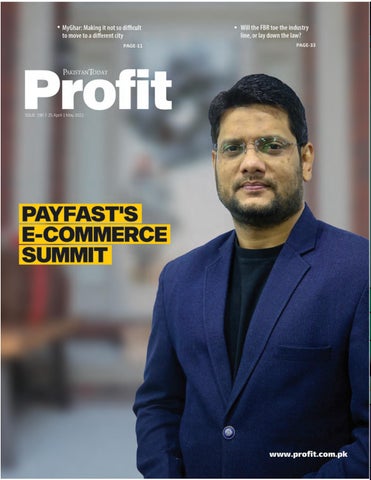
11 MyGhar: Making it not so difficult to move to a different city 14 Banking the Taliban 20 How does PayFast aim to dominate the eCommerce payments landscape in Pakistan?
23 23 Navigating the crisis Uzair Younus 25 Good corporate governance should demand better CEO accountability Asif Saad 29 Load-shedding - same old same old
20
29
33 33 Will the FBR toe the industry line, or lay down the law? 36 Energy outlook - The old nemesis rears its ugly head
Profit
27 What happened to the RDAs after Imran Khan’s government was toppled?
Publishing Editor: Babar Nizami l Editor: Khurram Husain lJoint Editor: Yousaf Nizami l Assistant Editor: Abdullah Niazi Reporters: Ariba Shahid l Babar Khan Javed l Taimoor Hassan l Meiryum Ali l Shahab Omer Chief of Staff & Product Manager: Muhammad Faran Bukhari Regional Heads of Marketing: Muddasir Alam (Khi) l Zulfiqar Butt (Lhr) l Malik Israr (Isl) Layout: Ahmad Salahuddin l Photographers: Zubair Mehfooz & Imran Gillani l Business, Economic & Financial news by 'Pakistan Today' Contact: profit@pakistantoday.com.pk
Editorial Tipping point The country is standing at a critical tipping point and it’s most important decision making centre is in complete disarray. The economy is still drifting towards crisis, although it is still possible to avert this outcome. The politics are hostage to powerful post truth narrative being blared by an energized opposition that is attracting large crowds to its rallies. The country’s largest province – Punjab – is mired in a deep constitutional crisis with no early end in sight. And pressures to take painful decisions are mounting, while the political leadership is facing strong headwinds against administering painful decisions to the populace. In the midst of this whirlwind it is a good idea for those in power to avoid making irresponsible announcements that serve no discernible purpose. For example, on a day when State Bank Governor Reza Baqir was in Washington DC and preparing for his meeting with the IMF alongside Finance Minister Miftah Ismael, the Defence Minister Khwaja Asif took to the airwaves in Pakistan and announced that the Governor “will retire once his term ends.” Not only that, he went on to suggest that his government is likely to roll back the amendments to the State Bank Act that were passed in January. Perhaps the minister did not fully understand the impact of his words or the importance of what he was saying. Governor Baqir is due to retire in the first week of May and the one question every foreign creditor of Pakistan asks is whether or not his term will be renewed, and if not, then who is likely to replace him. The matter does not concern only foreign creditors. The financial markets at home are also watching carefully to see what the new government’s intentions are regarding the State Bank, its Governor as well as the amendments passed in January to strengthen its autonomy. It is therefore a bit baffling to wonder why the defense minister had to make such a categorical remark at a time like this. His government is in urgent talks with the IMF for resumption of the fund program, and Governor Baqir will be one of the signatories should it succeed in the short term. The exchange rate is coming under growing pressure once again, after a brief period of respite following the emergency interest rate hike of April 7 and foreign exchange reserves remain under immense pressure with the current account deficit for the month of March coming in at a billion dollars. It would be better to keep quiet about matters connected with the State Bank at a time like this, and only speak once a clear way forward has been found. Otherwise one is rocking the boat at a time when it is already in choppy waters. For his part Imran Khan is doing everything to seed a false narrative in his followers about the state of the economy he left behind.
In his Saturday press conference he claimed that the economy was in a healthy state when he left, citing export numbers, remittances and industrial growth. These are not the indicators to assess the health of the external sector. March data shows the current account deficit back above $1 billion, a near 180 percent increase from the same month last year, and well on its way to touch the $18 billion figure the PTI touted as the albatross around its neck when it came into power. The foreign exchange reserves had dropped to below 2 months of import cover and could reach crisis levels before the end of the fiscal year if the trend is not arrested quickly. Exports have indeed shown an uptick, rising by 27 percent in the nine months of the fiscal year, but the more worrying figure is the overall trade deficit that rose by 56 percent in the same period, nearly double the growth of exports. Moreover the levels of external indebtedness today have reached historic highs. External debt servicing costs in FY20 crossed $14 billion, the highest they have ever been in absolute terms, and very high as a percentage of net current receipts (exports plus remittances). In FY21 they came down slightly to just above $13 billion. From here till end of next fiscal year, however, total external financing requirements are slated to touch $46 billion, up from a projected $35 billion as per the IMF staff report in February 2002. Granted the $46bn figure is for five quarters running from April 2022 till June 2023, the rise in the projected financing requirements is still very large and chances are by this summer the figure would have risen further still. Pakistan is at a tipping point and cannot afford to be embroiled in a messy political battle of wills at this time. Given the pace at which the external sector is deteriorating, the country must get back onto an IMF program as soon as possible, and the new government has to swallow the bitter pill of slowing down the economy rapidly to control the bleeding. There is no other way at the moment unless an external power is willing to lend a helping hand with a funding line worth at least $5 billion (or thereabouts) to underwrite the country’s deficits for the next few months. This looks unlikely at the moment, especially while the fate of the IMF program is indeterminate. Members of the ruling alliance should refrain from issuing categorical statements about critical economic policy decisions at such a delicate time. And the opposition should cease its campaign of deceiving the people about the reasons for its ouster, as well as the real health of the economy.
9
Retailo acquires UAE’s DXBUY
S
audi Arabia-based B2B startup Retailo, which has operations in the Kingdom as well as Pakistan, has now entered the UAE market after acquisition of DXBUY in the UAE. DXBUY is also a B2B platform serving as a marketplace for restaurants and cafes. The acquisition is part of Retailo’s growth and expansion plans for the MENAP region. Onboarding DXBUY will help Retailo make inroads into the hotel, restaurant, and café (HORECA) business, enabling the company to scale it across the region. The HORECA industry is expected to be $60 billion in less than five years in MENAP. HORECA use informal, broken, and chaotic supply chains for inventory purchase. They work with multiple suppliers following a strict delivery cycle which restricts their flexibility. Since the orders in a café or restaurant are often seasonal and unpredictable, and top-quality fresh ingredients are crucial, a fixed delivery schedule causes many issues including wastage. Using Retailo app will ensure a single-window operation that will provide restaurants and cafes a large number of quality ingredients to choose from, price discovery for smart purchases, faster delivery cycle to avoid wastage, tech enabled inventory management, and many other features and services. Since deliveries can take place every day and at the restaurant owner’s convenience, ordering perishables will no longer be an issue thus ensuring end customer satisfaction and increased business value.
Fintech SadaPay announces $10.7mn raise ahead of commercial launch
A
fter over 2 years of bearing through the painful regulatory compliance, Pakistan’s fintech company SadaPay received its full license for Electronic Money Institution (EMI) and announced raising $10.7 million in its extended seed round to deliver financial services. With the go-ahead from the State Bank of Pakistan (SBP), SadaPay will go on with their public rollout, onboarding users in order of their waitlist position. SadaPay claims to have a waitlist of 500,000 people. Founded in 2019 by American entrepreneur Brandon Timinsky, SadaPay aims to reduce the complexities of banking which can be intimidating to the average Pakistani. SadaPay is on a mission to make money so simple that any other way would become unthinkable. With the new funding, SadaPay says it expects to more than double its employee headcount to over 250 people by the end of the year and expand its offering with additional products for freelancers and small business owners. Only one other competitor of SadaPay, a startup called NayaPay, has received approval for commercial launch from the SBP. Another EMI, TAG, is still to be approved.
Islamabad-based MedIQ raises $1.8mn in pre-seed funding to power healthtech for businesses
A
solo female founded healthtech startup in Pakistan, MedIQ, is taking on the challenge of digitising the healthcare sector and has raised $1.8 million in pre-seed funding. The healthtech startup’s round was co-led by US-based NRD Capital and Karachi-based Cordoba Ventures, and joined by US-based early-stage investor Seraph Group, TAJDEED, a syndicate of physicians from APPNA (All Pakistani Physicians of North American descent Association), House of Habib, and leading health tech angel investors from Silicon Valley. Founded in the mid of 2020 by Dr Saira Siddiqui, MedIQ started off with a focus on enabling businesses to provide healthcare services, becoming their virtual healthcare arm in the process. MedIQ platform operates as a marketplace for healthcare. Customers can search and connect with doctors of their choice on the platform and they can order medicines from a list of leading pharmacies listed on the platform, which are fulfilled using third-party logistics providers. The patients can also order tests from a list of laboratories. MedIQ seeks to expend funds to grow its techstack, regional expansion and customer acquisition.
US-based Tofino Capital to invest in Pakistan’s startups from $10mn fund
T
o join the funding rush in the world’s last big market, Washington-based Tofino Capital has announced its plans to invest in Pakistan’s startups from a $10 million fund. Tofino Capital invests in early stage companies in Africa, Latin America, Asia and the Middle East. While the fund is not solely Pakistan focused, the founders consider Pakistan as a strong market to invest in. With a large population of over 220 million people but growth rates of digital uptake higher than many other countries in the region, Pakistan has not been taken seriously by global VC investors, until things changed last year. Keeping up with its thesis of investing in large markets that have a dearth of venture capital money, Tofino Capital seeks to invest in pre-seed and seed stage startups with cheque sizes ranging from $50,000 to $500,000. According to Eliot Pence, founder and general partner of Tofino Capital, the fund aims to invest in fintech, fintech-enabled and logistics companies, and in startups which are digitising informal markets.
12
STARTUP DESPATCHES
S
By Ariba Shahid
tarting a new job in a new city is a daunting task. Not only do you have to worry about being the new character jumping into a show in its 5th season at work, but you also have the task of settling into a new city. Finding a home in a different city proves to be the first major road block, especially if you’re single or moving into the city alone. This challenge is for both men and women. Karachi, being the financial hub of the country and home to most major corporations is not too kind to new folk either. If you decide to move to Karachi for work, finding accommodation will be a challenge. The rent is absurd and the city is too big. Most bachelors and bachelorettes that move to Karachi find it hard to rent a place of their own. In most cases, landlords do not want to give an apartment for women because it’s a hassle to evict them. Apartments and neighborhoods don’t allow landlords to rent out their property to stags either in order to keep the “environment” of the neighborhood better. The only option in such a case is to take up living in a shady apartment. That isn’t
HOUSING
always the best or safest option.
Need - prompted inspiration
T
he idea for MyGhar began when Karachi based Atif bin Arif moved to Islamabad for an entrepreneurial venture. “I was on the hunt for an affordable and respectable residence on a temporary basis in the city center but there was no option available in the market,” says Arif. Arif says he hopped between brokers, shoddy hostels, paying guests, landlords, property visits and ridiculous payment terms & conditions for a span of 7 weeks before actually finding a room that suited his needs. “It was this moment of agony that became the inflection point, and MyGhar was born,” he said. Speaking on the difficulty to find accommodation as someone that is single, Arif challenges, “I dare you to go and knock on 10 doors and ask if they rent out to bachelors or single women; I assure you all 10 will say no, if not 9.5. But hey, that’s where MyGhar brings in that sense of belonging and ownership!” Flash forward to 2020, during peak pandemic months, MyGhar started off in Karachi
with three beds. The demand for the product was organic considering this was an uncatered market. “After launch, we were fully booked in 5 days and had 7 people on waitlist which soon became a testament of the affordable housing crisis in Pakistan, that too especially for bachelors and single women who account for 70% of population, yet there is no dedicated housing solution for them.” MyGhar currently operates approximately 100 housing units with 300 beds spread across 15 locations. The business claims to maintain an average occupancy of more than 90%. Renting options begin at Rs 14,000 per month depending on the location and the infrastructure provided.
What exactly is MyGhar?
T
he rent you pay includes all the utilities, appliance equipped kitchens in case you want to cook, weekly housekeeping, common living spaces, gym, and workspaces, and wifi. In case you choose to share a room with a roommate, they try to match you with someone you’d be comfortable living with. There is, however, a selection process you have to go through to be
11
able to get a place at MyGhar. To streamline the whole experience, MyGhar has also set up an app for residents where they can register complaints, check out on site events, see their invoice, and go through other properties.
Corporate partnerships
U
sually when a corporation hires you to join their team in a different city, they pay for your hotel stay for the first few days until you manage to find something of your own. Hotels are expensive, especially if you want to avoid the shady kind. They are also fun for the first few days but become tiring and do not really make one feel at home. “Corporations have a few challenges at hand given the dynamic shift in the work environment. The primary concern is hiring and retaining quality human resources. For this, they are now willing to go far and wide to get the best resource. However, when they have to relocate, they hardly ever find respectable and affordable residence resulting in loss of talent,” says Arif. Seeing that as a value proposition, MyGhar has been reaching out to corporations. Arif explains,“Companies can save upto 50% of their accommodation expense for their short or long term stays compared to conventional hotels. Moreover, we also offer tailor-made corporate housing solutions to re-
12
ally go the extra mile for all their stakeholders depending on needs. ”Corporate partnerships and collaborations are at the core of everything we do. When an individual relocates to a new city, he/ she doesn’t only need housing; There is a basic need of food, transportation, community, entertainment and much more which has become the epicenter of the MyGhar offerings.” Arif adds that in order to make MyGhar a complete residential solution, residents get discounts on groceries, are introduced to health and wellness workshops. “Capital financing is one aspect of the business, but changing the way people look at Real Estate as an asset class is what we are out to do,” says Arif. He claims that the business is cash positive and breaking even as stealth startup. The important thing for the business at this point is not raising a round, but instead growing through partnerships. In order to grow without investing capital, MyGhar also gives options to property owners to flip their property through the MyGhar team and rent it out to individuals through them.
What’s next for MyGhar?
F
or now MyGhar is going to expand in cities where there is work related migration. Arif explains, “We aren’t a luxury item, we are fulfilling a basic
need of affordable housing in the market. We see ourselves in the first tier cities like Karachi, Lahore & Islamabad where there is migration.” However, while there are no immediate plans of moving into second tier cities, MyGhar is not writing it off completely. “I don’t see it being a far cry of entering second tier cities and regional countries; as you know the post-covid world has created blurry lines between live, work & play and we are addressing just that”
The bigger problem
T
he bigger problem is a societal problem, where even though you own an asset class as powerful as property, you cannot choose to rent it out to who you deem fit because of societal pressure. Single men and women are looked down upon and are treated like second class citizens when it comes to finding a decent living space. In such cases you’re encouraging people to stay where they are and not move for better employment and opportunities. You’re also depriving yourself of the right talent. ________________ Interesting fact, Atif also runs Super Savari Express, a traditional Pakistani minibus that takes people on tour around Karachi. Shows the old city area, food tours, sehri tours, etc. Most new people that come into the city do this tour.
HOUSING
14
COVER STORY
By Ghulam Abbas
O
n the 2nd of March this year, a meeting of the high-powered Afghanistan Interministerial Coordination Committee (AICC) faced a strange item on its agenda - a large bank had frozen the accounts of the Afghan Embassy in Pakistan and was not allowing them to make cash transactions. Not only was this bank not allowing the embassy to operate their accounts, other banks were refusing to take the embassy on as a new client. Since then, even though the meeting of the AICC had requested an update on the issue from the foreign ministry and the central bank, the accounts remain frozen and the embassy has been operating their day-to-day expenses through an arrangement with Pakistan’s foreign ministry. The reason for all of this? The Taliban. Generally, all embassies maintain two kinds of bank accounts in the countries where they are based. One is a dollar account and the other is an expenses account in the local currency of the country where the mission is based. In fact, embassy bank accounts are among the properties of states most widely present in foreign states. Ever since the Taliban took control of Kabul in August 2021, Afghan embassies all over the world have been mired in complicated legal and financial restrictions. Their dollar accounts are frozen and banks cannot figure out how to operate their local currency accounts since all authorized signatories to those accounts left with the fall of the Ghani government. In Pakistan, things are a bit more complicated than many other countries.. While the federal government has not recognised the Taliban government in Kabul, they did allow ‘diplomats’ from the Taliban to take control of the embassy. Pakistani banks responded coldly and for good reason. Rupee accounts formerly held by the embassy were frozen because of legal complications - missing signatures and no official recognition of the new diplomatic staff from the government. The dollar accounts were frozen because of international sanctions, and continue to be frozen even though there has been a global softening in sanctions against the Taliban regime. Jilted as they have been by fines in the recent past (National Bank and HBL come to mind), it seems the banks are very unwilling to take any risk associated with banking for the Taliban’s diplomatic mission. Profit reached out to the bank that was named as well as the Ministry of Foreign Affairs and the State Bank to find out more about what was going on, but all of them refused to provide any comment. The bank simply said
16
it cannot discuss client specific information with unconnected parties. The foreign ministry failed to revert and the State Bank simply declined an on record comment. But background conversations with sources at both, the ministry and the central bank, suggest a more complicated story.
The dollar accounts
O
n the 15th of August, the Taliban took over Kabul and immediately started lobbying for international recognition. Unlike the first time the Taliban came to power, Pakistan was more tactful in their recognition of the regime. While Pakistan has yet to recognise and establish a diplomatic relationship with the Taliban, in November they very quietly allowed the Taliban-appointed “diplomats” to take charge of the Afghan embassy and consulates in the country. When the missions arrived in Pakistan, they expected to not have access to their dollar accounts in Pakistan. “The dollar accounts maintained by all embassies of Afghanistan were frozen worldwide following the collapse of the Ghani government,” says one source who has familiarity with the developments. “This was part of the freeze of Afghan assets in the United States.” The freeze on Afghanistan’s dollar assets was a wide-ranging one. In fact, only two weeks before the Taliban arrived to take over the embassies in Pakistan, Deputy United States Treasury Secretary Wally Adeyemo said he sees no situation where the Taliban would be allowed access to the more than $9 billion Afghan central bank reserves, which are largely held in the United States. The Taliban arrived in Pakistan very much expecting the freeze. What they did need immediately, however, were the local currency accounts of the Afghan embassies. An embassy is in fact a sovereign part of the country that they belong to. That is also why these embassies are free from the police control and laws of the country in which they are housed - a basic tenet of diplomatic immunity. This also means that to run the expenses of the embassy, they need accounts in local private banks - to be able to buy everything from office supplies to salaries. When the missions first arrived on the 30th of October 2021, they discovered that other than their dollar accounts, they were also shut out of the embassy’s rupee accounts. This was strange since, according to the earlier quoted source, local currency accounts are not part of the global freeze. To clarify, it is not the Pakistan government blocking or freezing the bank accounts of the Afghanistan embassies in Pakistan. It is the banks themselves, worried about getting fined, that have frozen the accounts.
A central bank source, also with familiarity of the matter, told Profit that rupee accounts were not “frozen” but with the collapse of the Ghani government and the departure of their representatives in the embassy, the authorized signatories who could operate these accounts also left. When the Taliban staff arrived at the embassy in Islamabad they found they could not operate the embassy bank accounts until they could get the authorized signatories changed. But legal hurdles have marred the process of getting the Taliban representatives from becoming the authorized signatories of their embassy accounts. “The process of changing authorised signatories is a bit complex in official accounts of this sort” says the State Bank source. “It requires the Foreign Office to certify the arrival of new embassy staffers, after receiving this formally from the authorities of the country in question.” One problem in this case is the lack of formal diplomatic recognition of the Taliban regime, making the legal status of any communication sent by them to the Foreign Office difficult to establish. This problem of the authorised signatories persisted through the months till early March, prompting the government of the time to use the AICC as a platform to find a resolution.“The matter was not resolved formally” says the diplomat source. “But the amount in these accounts was very meagre. The main thing was the dollar accounts, and despite the passage of GL20 that issue remains unresolved.”
The GL20
G
L20 (general licence 20) is a reference to the United States Treasury Department announcement on February 25, 2022 which loosened some of the restrictions that the sanctions had imposed on Afghanistan after the Taliban takeover. “[A]ll transactions involving Afghanistan or governing institutions in Afghanistan” that announcement said, “are authorised.” It then cited the exemptions to this authorization, saying financial transfers to the Taliban, the Haqqani Network, entities in which these two groups own more than 50 percent interest, “ “Or any blocked individual who is in a leadership role of a governing institution in Afghanistan, other than for the purpose of effecting the payment of taxes, fees, or import duties, or the purchase or receipt of permits, licences, or public utility services, provided that such payments do not relate to luxury items or services,” it goes on to read. Other restrictions were also spelled out. Diplomatic sources told Profit that technically banks are no longer obligated to keep dollar accounts of Afghan embassies frozen any longer. They are also free now to allow finan-
cial transactions inside Afghanistan, provided they avoid crossing the lines set in GL20. “It is of their own accord that the banks are shying away from engaging in these transactions now” he said. “Their fears are genuine. After all, dollar transactions are all routed through New York and come under the regulatory jurisdiction of American authorities.” He says the meeting was informed that when banks were asked to facilitate dollar transactions within Afghanistan, their response was “if we are fined in the United States for doing this, will the government of Pakistan agree to pay the fine?” At that point the government members back away. Meanwhile the Afghan embassy seems to have found workarounds for itself, since sources at the embassy confirm to Profit that staff salaries are now being paid. Earlier these had been blocked too. “I don’t know how they’re operating it now” says the diplomat, but he also confirms that the embassy is now operating on workarounds of some sort.
Banks and embassies
T
his is not the first time something like this is happening. Embassies have issues with bank accounts for a wide array of reasons all the way from sanctions and war to banks simply refusing as a business decision. \mbassies can face complicated situations in those countries that are under western sanctions. In Iran, for example, the financial system is totally unplugged from the global financial system, meaning embassies cannot operate bank accounts or send and receive funds from abroad. Yet they have
The AICC The Prime Minister, the Chief of Army Staff, the foreign minister, the finance minister, and the National Security Advisor - these are some of the most powerful people in Pakistan and they all sit on the Afghanistan Interministerial Coordination Committee (AICC). As reported in an article for Arab News by senior journalist Nasim Zehra, the birth of this cell followed Pakistan’s Special Envoy’s eighteen months of rigorous and wide-ranging multi-sectoral engagement, ranging from physical presence at Torkham and Chaman borders, meetings with the Ghani government and the Taliban, the Panjshiri, the Uzbek Opposition, to engaging officials from the Commerce, Interior, Customs, NCOC, the IGFC and backed completely by the Prime Minister and his team including the Inter-Services Intelligence. For months the committee worked secretly, operating out of the old FATA house on Constitution Avenue as the Taliban advance in Afghanistan raged. In this time it coordinated the first ministerial visit of the Taliban government to Pakistan and also the moving of Taliban diplomats into the Afghan embassy and consulates in Pakistan. The committee had its first official meeting in November chaired by then Prime Minister Imran Khan - with representatives from all ministries and major stakeholders, it is the boiling pot for decisions regarding Afghanistan - political, economic, defence, diplomatic, and humanitarian all included. expenses to meet like rent, salaries, fuel, utility bills and supplies. A diplomatic source with knowledge of embassy operations in Iran tells Profit that all embassies there use cash dollars to meet their requirements. The embassy’s own account is usually maintained in Dubai, and a courier flies out periodically to return with a suitcase full of cash with which their expenses are met. All payments are done in cash. At times banks also make these decisions to avoid fines and meet regulations. Between 2012-13, a number of American banks including HSBC decided to exit or scale back their dealings with foreign embassies and missions in the U.S. because of the burden of complying
with money-laundering regulations. Similarly, the accounts of Russia’s embassies in different countries have been blocked in the wake of Putin’s war on Ukraine. Just last week in fact, it warned it may start blocking bank accounts of embassies of countries that block accounts of Russian missions. “The accounts of our embassies are blocked in different countries. Accordingly, if our embassies do not have the opportunity to open accounts and pay their expenses, including communal services, then, accordingly, appropriate measures will be taken here,” Deputy Foreign Minister Yevgeny Ivanov told the Russian lower chamber of parliament, State Duma, in Moscow. n
COVER STORY
How does
PayFast
aim to dominate the eCommerce payments landscape in Pakistan?
20
T
By Profit
here is an ambitious fintech startup in town and it is called PayFast! PayFast, a group company of Premier Systems Limited, is poised to become a homegrown fintech company paving its way not only in Pakistan, but across the globe. Its plans are calculated and precise, its efforts supplemented by an enabling ecosystem and its spirits heightened after the endorsement from the State Bank of Pakistan (SBP) to operate as a licensed entity. PayFast, also known as Avanza Premier Payment Systems (APPS), was conceived by Mahmood Kapurwala (Late), the CEO of Avanza Solutions. Having envisioned that there was a lack of indigenous payment gateways in Pakistan, a country that was inevitably going to see a surge in digitisation of payments, Kapurwala approached Mr. Arshad Raza– CEO and Director of Premier Systems Limited, another privately held technology company that has a presence in the banking and telecommunications sector. Premier, being the largest ICT provider in the country and looking to diversify their portfolio, understood the need to establish a robust digital payments solution that has its roots in Pakistan and a presence globally. PayFast was created in 2018. Shortly thereafter, Adnan Ali joined as founding CEO. With the company hopeful to appoint seasoned bankers with experience in fintech and digital payments and whose vision aligned with their goals, Mr. Ali created a team mixed with industry veterans and ambitious young professionals. Through their joint commitment, the company successfully received commercial approval from the State Bank to launch an eCommerce payment gateway in May of 2021. It was immensely unfortunate that only a month after they received commercial approval from the central bank, Kapurwala passed away. Nonetheless, the past year has seen the company not only succeed, but thrive. Even without one of the founding fathers of the company and one of the partners exiting at the very onset, with Premier looking to wholly acquire PayFast from Avanza, it remains resolute about becoming a top-notch fintech company of Pakistani origin.
The need for PayFast
T
he purpose of existence of any fintech company is to digitise traditional banking functions through innovation and to minimize the domination of cash usage, which accounts for 90-95% of the ecommerce transactions in the country. This would likely help improve the financial inclusion ratio in Pakistan, especially amongst marginalized communities, which is a core goal
for PayFast. The working hypothesis is that a cash economy underpins many of Pakistan’s setbacks. Pakistan’s macroeconomic problems have been a subject of news headlines and expert analysis not because it is doing great. If the government gets stuck every now and then with budget deficits, it is because a cash-based economy encourages tax evasion which consequently results in declining revenues for the government. “We are in a debt trap where we go to the IMF again and again which then commands our economy according to their rules,” says Adnan Ali, CEO and director of PayFast. So if the massive economy is digitised, tracking tax evasion and collecting revenue would be easy for the government which would then be able to spend more on measures that would alleviate people from poverty and improve financial inclusion rather than worrying only about repayment of debts. The fintech companies see themselves at the core of solving the problem of digitisation of cash and would likely go down as protagonists in the country's economic history. PayFast facilitates online payments for businesses of all sizes through its robust digital payment gateway solutions, which include PayFast Checkout for e-commerce merchants; PayFast Billing for billing institutions; and Payment Links for SMEs and freelancers without a website. The idea is that there is no business too big or too small to go digital. The company firmly believes that revolutionizing how payments are made by introducing simple and safe online payment methods would drive overall growth for the economy as well as facilitate an increase in financial inclusion for the masses. “Globally the role of digitisation of economies has been played majorly by fintech companies. At the back of the digital economy, you will find fintech companies in many countries. In Egypt, for example, you have Paymob. You will find PayPal in the US and RazorPay in India,” says Mr. Ali. They have support, too, from a prudent central bank in Pakistan which has been very progressive about bringing new technologies to the fore to enable digitisation of the financial system in the country. The State Bank has passed numerous regulations to allow innovative fintech companies to operate in Pakistan, all starting with PSO/PSP regulations announced by the central bank in 2014. It is these PSO/PSP regulations that power payment gateways like PayFast. SBP’s rules for Payment System Operators (PSO) and Payment Systems Providers (PSP) define PSO/ PSPs as financial technology companies that are “engaged in operating and/or providing payment systems related services like electronic payment gateway, payment scheme, clearing
house, ATM Switch, POS gateway, eCommerce Gateway etc. acting as an intermediary for multilateral routing, switching and processing of payment transactions.” PayFast has successfully licensed itself as an eCommerce payment gateway, regulated by the SBP. Until at least 2019, however, digital payments did not see a spur in Pakistan largely because the digitisation was being driven solely by the traditional banking sector. The pace of adoption of digital payments in the country had not seen widespread growth, as such innovations were mainly bank-led, which proved to be restrictive in terms of cost and service offering due to widespread inefficiencies. Until 2020, there were only two commercially operational PSO/PSP entities in Pakistan, both backed by commercial banks. Fortunately, the interest to set up PSO/PSPs swelled post2020 because of two major developments. Firstly, the central bank had already conceived the idea of an indigenous instant payment gateway - RAAST - that would bring ease to end-to-end digital payments. Secondly, the rise of venture capital funding has grown tremendously in the country. “If you look at the PSO/PSP list earlier, many global companies had applied. Fundraising was not easy earlier. We also did fundraising,” says Adnan. “Now in Pakistan, like global markets, after Covid, there was a huge impetus which increased the fundraising activity. When the interest rate fell in global economies, Pakistan emerged very quickly as a cheaper market where startup valuation was very low. The SBP introduced RAAST as well, EMI, and a progressive governor like Reza Baqir made the fintech space exciting. Syed Sohail Jawad of the SBP was also a large proponent of these advancements.” These factors contributed to the rise of interest in fintech companies. Enabling regulations, an abundance of venture capital and a global pandemic set the stage for PayFast to be more than well positioned to take a risk in the Pakistani market. Accordingly, it decided to take this initial risk in the eCommerce sector. Despite barriers to entry being lowered and PayFast facing competition from peer fintech companies with the same aspirations, they remain confident in their abilities, letting the evidence speak for themselves.
The PayFast playbook
A
t the centre of PayFast’s ambitions is to become the story of a local company that went on to achieve the vaunted verb status in digital payments by making online payments the norm in its home country, na dbefore representing Pakistan worldwide. At the moment, the plans are local but ambitions are regional (think MENA).
NATIVE CONTENT
PayFast likes to call itself a purpose-built company which came into existence knowing the scope of PSO/PSPs and which was built specifically to fulfill that purpose. The market it operates in is heavily cash-dominated. About 90 per cent of eCommerce transactions in Pakistan are done in cash. The hazards of majority of the payments in cash are well recognised by eCommerce merchants: long cash recovery cycles restrain working capital while settlement is costly and time consuming. These issues constrain the growth of merchants and take time, money, and resources to oversee and address– especially when they are handled solely by large banking corporations. Alternatively, having a dedicated fintech whose sole purpose is to provide ease and efficiency of its core service, a payment gateway, is sure to boost efficiency and promote revenue maximization by providing businesses with a range of convenient and reliable payment options for their customers to pay them with. The indicators of customer interest towards digital modes of payment for eCommerce also show an encouraging trend. According to data obtained from the State Bank of Pakistan, e-commerce transactions are increasing rapidly. In terms of volume, eCommerce transactions conducted through eBanking channels in 2021 were 21.9 million as compared to 10.2 million in 2020. In terms of value, these transactions were worth Rs60.6 billion in 2021 as compared to Rs34.9 billion in 2020. There is also a rise in the number of eCommerce merchants. Till June end 2021, there were 3,003 registered eCommerce merchants, according to the data from the central bank. That is an increase of 75% from the previous year when the central bank reported the number of registered eCommerce merchants at 1,707. Since 2017, the earliest for which numbers are available, registered eCommerce merchants increased from 571 to 3,003 till June 2021, averaging 54% growth since 2017. On a quarterly basis, too, the first quarter of 2022 witnessed 86% growth (by volume) in ecommerce transactions as compared to the corresponding quarter of the year before that. PayFast’s growth aligns with these positive trends. According to Mr. Ali, they have witnessed hockey-stick growth.. Since its commercial launch, the company has experienced 5x growth on a month-to-month basis, onboarding notable startup fintechs like Chikoo, bSecure and Dukan to help advance their mission. Part of the reason for this growth is because of the PayFast ethos of working closely with merchants and designing solutions to help them accept payments with ease. They have partnered with some of the biggest names of the business to diversify their suite of digital payment services. These include Bank Alfalah for card based transactions, 1Link for billing solutions and Union Pay international for mo-
22
About 90 per cent of eCommerce transactions in Pakistan are done in cash. The hazards of majority of the payments in cash are well recognised by eCommerce merchants: long cash recovery cycles restrain working capital while settlement is costly and time consuming. These issues constrain the growth of merchants and take time, money, and resources to oversee and address– especially when they are handled solely by large banking corporations bile payments. “We have accumulated various payment acceptance options, ranging from debit and credit cards like Visa and Mastercard to popular mobile wallets to account-based payments with our banking partners,” says Adnan. “Proliferation of cards is lackluster. So we recently introduced an alternative method of account based payments. That is something innovative. Once you shop from our partners like Telemart, Chikoo or bSecure, you can put in your bank account number to make a payment. You will get an OTP number on your phone and once you enter that, you’re through. Simple.” explains Adnan. “We tell the merchants that your payments and backend operations are our problem,. You only focus on your business.” So according to the PayFast playbook, if cash is to be disrupted, the alternative to cash needs to be comprehensive and as easy to use. In keeping up with this core narrative, PayFast is doing its best. To promote diversified payment options acceptance, it works with the top three international payment schemes - Visa, Mastercard and UnionPay - covering the entirety of the population with a payment card for acceptance of payments on merchants it works with. It also enables t the domestic PayPak payment scheme which further broadens its payments offerings, and partners with several renowned banks for account based payments. PayFast is integrated with the most popular plugins, has a seamless online sign-up process that takes a matter of minutes to complete, and even has a dedicated 24-7 customer service team available for its clients. “Our merchant acceptability has increased very quickly. Our integrations are easy and we have plugins for almost every shopping cart. The idea is to create the most holistic solution for merchants when it comes to payments so that we can live up to our becoming their partners in growth,” says Adnan. PayFast is still a nascent entity having started commercial operations just about a year back. The company claims that it has been growing at an encouraging pace, having on-
boarded 100 merchants last month and aiming to multiply that number this month, it foresees itself as among the top fintech companies for large corporations, SMEs, and freelancers in Pakistan.
A growing space for all
W
ould the going get easy for PayFast? There are a number of notable companies attempting to receive SBP approval for an eCommerce payment gateway. Stripebacked SafePay, ZingDigicom and MobiDirect are the companies which are aspiring to become licensed PSO/PSP entities. Some of these companies have been at an in-principle approval stage since 2017 and might have lost interest by now but enabling regulations, market opportunity and access to venture capital money means more companies would be jumping into the fray. Egypt-based Paymob, for instance, is a very well funded fintech company which has recently launched in Pakistan. Backed by venture funding, it plans to onboard merchants for ease of payments acceptance. While acknowledging that this does squeeze the market for everyone, Mr. Ali showed optimism that since its war on cash, everyone’s share will expand as cash turns digital. “Think of it this way: the total eCommerce industry is $4-5 billion out of which cash payments are 80-90%, while prepayment is 20%. All of us will have to work to convert the 80% cash pie into the digital economy. If that is expanded, the pie increases for everyone. Rather than all of us are fighting for the initial 10-20% that is already digital, all of us need to convert the cash first and that will benefit everyone– plus, we’re not one to shy away from competition,” says Adnan. While its not sure what’s in store for PayFast, their commitment to digitize Pakistan’s payment landscape and improve financial inclusion is admirable.
NATIVE CONTENT
OPINION
Uzair Younus
navigate the crisis, oil prices peaked at $75 a barrel, declining to about $40 a barrel by December 2018, and then remained range-bound around $60 a barrel prior to the onset of the pandemic. Today, oil is north of $100 a barrel and the market is not easing up, despite the fact that lockdowns in China have led to concerns about economic growth. The akistan is staring at yet another economic crisis. A Bloomberg Commodity Index, which was hovering around 80 prior to coalition government is facing economic choices that the onset of the pandemic, has skyrocketed to over 120, and prices of all will significantly erode its political capital and must sorts of commodities, much of which Pakistan imports, are at elevated navigate an economic crisis that is a lot more complex levels. than the one inherited by the PTI in 2018. This is the Finally, the era of reach for yield, where dollars flowed to emergcase for a whole host of reasons, but three external ing and frontier markets for higher returns, is coming to an end. After factors are worth paying closer attention to: the ongoing war in peaking at about 3.2 percent in October 2018, the 10-year US treasury Ukraine, high commodity prices, and tightening global financial quickly declined to under 2 percent prior to the onset of the pandemic; conditions. All three factors will make things significantly more it hovered around 0.5 percent during 2020 and remained below 1 percent challenging for Pakistan, meaning that policies must be biased through 2021. Today, the 10-year is on a steep upwards climb, crossing towards worst-case scenarios in the coming days. 2.5 percent over the last few days. This is reversing the flow of capital The ongoing war in the European continent is a seismic away from emerging and frontier markets back into developed markets, event in geopolitics. It will have a far greater impact on the interraising financial contagion risks across much of the Global South. national order than 9/11, which led to the invasion of Afghanistan These three factors will make it that much more challenging for and Iraq, and the beginning of the forever wars around the world. Pakistan to navigate the crisis the country finds itself in today. After While these wars were in far off lands as far as the West was conexperiencing almost 40 percent inflation in the last three and a half cerned, the ongoing conflict between Russia and Ukraine is closer years, Pakistan’s ordinary citizens are facing even higher inflation in to home. As a result, the European economy is facing uncertainty, the coming weeks as the government adjusts fuel and electricity prices. with an increasing number of economists and market watchers Should Europe go into a recession, inflows of dollars through exports warning of stagflation in Europe. What this means is that consumand remittances from the continent may decline as well, creating further er demand in the European continent is expected to weaken in the risks for the external sector. A tighter global financial environment will coming months, leading to a reduction in the demand for consummake it that much harder – and more expensive – for Pakistan to borrow er goods. As a result, it is likely that global exports to the Europeand fund its balance of payments needs. All this will occur at a time an Union decline, and if this happens, then Pakistan’s exports to when Imran Khan is agitating on the streets and political parties are Europe are also going to face pressures. gearing up for elections. The conflict, coupled with the ongoing reverberations of the To navigate this crisis, it is important for the new government to coronavirus pandemic, means that global commodity prices are at make timely and difficult choices, even if these erode the government’s elevated levels. In October 2018, when the PTI was beginning to political capital. Fuel and electricity prices must be adjusted upwards, monetary and fiscal policy needs to be tightened, and immediate expansion of the IMF program must be negotiated. At the same time, bilateral flows from strategic partners, especially Saudi Arabia and China, must be secured to stabilize the external sector. To ease the economic pain for the most marginal citizens, the BISP cash transfer program must be expanded, and a higher level of subsidies must be provided for The writer is Director of public transport, as this will increase uptake of more efficient modes of transport. the Pakistan Initiative In parallel, the government must prepare for what comes next after the crisis. For far too long, at the Atlantic Council, a successive governments have kicked the can down the road, refusing to make tough decisions that Washington D.C.-based reform the kleptocratic economy of Pakistan. An immediate focus must be placed on attracting more think tank, and host of the foreign direct investment. These flows are critical to not only fund current account deficits, but because podcast Pakistonomy. He they can promote increased productivity and global integration. There is no easy way out of this crisis tweets @uzairyounus. and as much as the government may want to provide relief to improve its electoral chances, the fact of the matter is that there is no easy way out.
Navigating the crisis
P
COMMENT
23
OPINION
Asif Saad
Good corporate governance should demand better CEO accountability In most Pakistani organizations, performance management gets worse the higher one climbs the greasy pole. Boards and shareholders should learn about and be thorough in evaluating top management
Medium and large-scale family firms are therefore advised to develop children and family members as becoming good owners instead of managers within an operating entity, unless it is for an emergency period and hence time bound
(thankfully, in a well-managed organization) and being rigorously assessed; first, as a junior manager and then as I progressed to a functional head position. However, there was a rather drastic fall in the quality of performance evaluations once I had passed that level. Initially, ne of the first things I realized after becoming a CEO, I felt that I was the beneficiary of this experience and I did not was that I had been elevated to a level where performind the outcome even though it seemed to leave things incommance reviews become somewhat superficial. I was explete. pected to deliver certain financial outcomes and as long But after a while, I realized that this shallow process does as I did not steer too far away from these and maintained more damage than good. a general sense of order, it would be acceptable and I Organizations are hierarchical and the top-down nature would end up with a decent increment and a bonus every year. of things will make senior management overlook aspects which There was an uncomfortable feeling when the board sat down to rethey are not be held accountable for. They would also tend to be view my performance. It was like everyone had to get it over with as soon lax on evaluating their own direct reports and so on down the as possible and I remember it was always a short and pleasant conversaline. tion! This may be due to our culture – we are generally averse to having This may mean that certain important areas may never be difficult discussions (I will come back to this point in a bit). focused upon for the entire organization. This was far different from my days of climbing the corporate ladder To take a simple example, one of the key responsibilities for a CEO is to build a high-quality management team, but if she is never held responsible for this, I can guarantee that the organization will not be able to build a good team. In addition, I also felt that I suffered personally in that my own development as a leader was The writer is a strategy curtailed. If there is no performance review, how will I understand and improve on my weak areas? Just consultant who has because I am a CEO should not mean I should not continue to learn and develop! previously worked at various While many corporate governance and certification training programs exist in the country, I am C-level positions for national not sure if any of these pay particular attention to this most crucial aspect in determining success or failand multinational ure of organizations. The issue is even more critical for minority shareholders and corporate governance corporations requirements. While the SECP code of governance requires listed companies to share information on the compensation packages of senior managers – it does not ask for minority shareholders to be made aware
O
COMMENT
25
of their performance levels. Having been in a few board rooms on either side of the equation, I have seen firsthand the weak process or even a complete lack of process for top management evaluations. Most of the times leadership teams are not assessed against clearly defined objectives – in fact, in many cases they don’t even have annual or long-term objectives. Many organizations claim to have robust performance management systems. Human Resource functions provide the processes and design performance scales to make sure that people throughout the organization are assessed objectively. But, as it transpired in my own case, this works well only up till a level, since no one within the organization dares to ask about the performance of CEOs or C-suite leaders, who are considered untouchables. These ‘leaders’ may then become dinosaurs whose interests are vested in status quo and in keeping their positions secure. They operate from a position of fear of losing their status and are reluctant to take risks which is very much a part of being a leader. Family firms have a bigger problem when they have one of the family members as CEO or in the leadership team. How does one make
26
In addition, I also felt that I suffered personally in that my own development as a leader was curtailed. If there is no performance review, how will I understand and improve on my weak areas? Just because I am a CEO should not mean I should not continue to learn and develop! themselves or their own children accountable and run a performance evaluation process? This is an extremely difficult exercise and one which may be fruitless to pursue. Medium and large-scale family firms are therefore advised to develop children and family members as becoming good owners instead of managers within an operating entity, unless it is for an emergency period and hence time bound. I have been pushing companies where I have worked, or boards of which I have been part of, to develop goals and accountabilities for leadership teams and apply a thorough evaluation process via the board human resource committee or independent directors. Not only will this make the organization more profes-
sional and transparent, it will also build trust of investors - if you are ever seeking outside funding from private or public sector. I understand the discomfort of boards to hold top management teams accountable and to be able to have somewhat unpleasant conversations. It is perhaps also something cultural with us – we do not like to challenge people in positions of authority. But it is a process which can be learned and developed and ought to be a key driver of business performance. Forward looking organizations can also ensure, through this process, that leaders do not hold on to their positions as ‘lesser evils’ and ‘safe bets’ instead of their ability to build strong cultures and teams and delivering great long-term results in all aspects. n
COMMENT
Load-shedding same old same old
Load-shedding has become a perpetual and expected part of the lives of generations in Pakistan By Ahmad Ahmadani & Asad Ullah Kamran
G
oing back the last few months, the entire country has been subjected to unannounced electricity load shedding for hours on end. What has followed has been the usual flurry of words, promises, and other nothingness. The National Electric Power Regulatory Authority (NEPRA) has ‘taken notice’ and warned that any power distribution company (DISCO) found to be involved in unscheduled power outages will face severe consequences. In a statement issued by NEPRA, it
POWER
expressed grave concern about the country’s sudden onset of hours-long unannounced power cuts, saying that it had taken serious notice of unscheduled power outages across the country and asked electricity consumers to file detailed complaints with the concerned regional offices against the DISCO for carrying out unannounced power load-shedding. This did not, however, stop Rawalpindi and Islamabad residents from facing 8 to 10 hours of power outages due to “scheduled maintenance work”. The repair work began in September 2021 and planned to be completed in March 2022. It’s April now and only recently was it revealed to the public that there is no electrical capacity constraint
in the country, but that power producing units have been shut down owing to fuel shortages and technical difficulties. According to reports, 18 power plants with a total capacity of 3605 megawatts are now not producing energy owing to technical issues, while nine power plants with a total capacity of 3535 megawatts are shut down due to fuel shortages.. Whereas the former Minister of Energy Hammad Azhar had been reported as saying that “No unscheduled load-shedding… Revenue-based load-shedding only.” It would not be prudent to cry hell over spilt milk at this point, as the situation develops further, it’s clear that load shedding is here to stay for the upcoming summer, so it might be time to get
29
There will be no unscheduled load-shedding. The only power outages will take place on a revenue-based system Hammad Azhar, former minister for power
your “pankhis” out of storage. If you were to look at the energy situation of Pakistan as a whole, it will leave you with nothing short of absolute fury, frustration and hopelessness. Every year citizens have to face power outages and at this point all of us have become so used to the status quo that it doesn’t even affect us. All governments that have come to power over the last decade plus have vowed to end the scourge of load shedding and bring the entire country into the “light”.
Another summer without electricity ?
A
s the situation develops in the political landscape, the energy portfolio is yet to be handed to someone in the new government at the filing of this report. Speculation on who will be
30
given the responsibility of getting a handle on this ailing ministry is rife, one thing is clear whoever it is has an uphill battle. Most Pakistanis will not remember a time when there was no load-shedding. It has essentially become a part of our lives that at times one isn’t even surprised at the absence of electricity. As the summer months begin and electricity demand begins to rise, the expectations of load shedding in the upcoming year are very high. Although the situation might be grave, it would be wholly unfair to pin the blame on the previous government or the previous energy minister. A litany of issues is contributing to the widening gap between the demand and supply of electricity. Sources in the power division have also told Profit that the total current power generation is approximately 14,400MW while the demand stands at 21,500MW resulting in a shortfall of 7,100MW. To make matters worse, a staggering 2000MW of electricity is also wasted due to technical inefficiencies of the power distribution companies (DISCOs). This superfluous production costs approximately Rs 3 billion per day to the country’s economy. Hydel energy is acclaimed for being cheap and sustainable in the long run however, it raises its own challenges as water levels directly affect electricity production. At present electricity being generated from hydel sources has also shrunk to 900MW. Tarbela dam which is the largest dam in Pakistan has a total installed capacity of 3478MW, whereas currently it’s only contributing 600MW of electricity to the national grid. At the same time the water levels at Mangla dam are at an alarmingly low level as well which is further aggravating the energy crisis. Fossil fuel powered plants are also struggling, particularly due to the mounting circular debt that has gained new wind with skyrocketing commodity prices. The sources said that though the total installed capacity of state-owned thermal power plants is more than 4,000MW, however, many thermal power plants have suspended the power generation operation due to technical faults and fuel shortages. “A large number of the power plants of the private sector have suspended power production only due to non-availability of furnace oil, coal, Regasified Liquefied Natural Gas (RLNG),” said sources. Even though the total installed capacity of Independent Power Producers (IPPs) is 11,500MW the current production levels are well below the mark adding to the issue straining the supply side. To make matters worse according to sources, the current RLNG allocation is just 550 million cubic feet per day (mmcfd), com-
pared to a power sector need of 690 mmcfd for April 2022, leading to a greater reliance on RFO-based production. This can directly translate into higher cost for the electricity produced, potentially adding to the mounting circular debt if the government bears the burden of the higher cost or inflation if the cost is passed on to consumers. Keeping in mind the recent default of LNG cargoes from ENI and Gunvor the energy situation can only be expected to get worse. The government has however agreed to take six LNG cargoes at bid prices ranging from $24.15 to $32.6 per million British Thermal Units (mmBtu) for delivery between May 1 and June 22 to satisfy peak winter energy demand. The cost however is very high and consequently the consumers would have to bear the burden. Sources also disclosed that, the current RFO stock at various GENCOs and Independent Power Producers (IPPs) power plants is extremely low. The RFO stock position at Muzaffargarh, Saba, Pakgen, and Lalpir power plants may be described as crucial. While the RFO stock position at Jamshoro, KAPCO, Nishat Chunian, Liberty Tech, and Hubco Narowal power plants are also at perilously low levels.
Circular debt
A
s of now this figure is estimated to be around Rs 2.5 trillion. The term “circular debt” refers to the debt owed by multiple government entities for electricity use costs. The National Transmission and Distribution Company (NTDC) is the central authority responsible for providing electricity to all government organisations as well as the private Karachi Electricity Supply Corporation, however these entities generally do not pay for the power they consume on a regular or timely basis. This triggers a domino affecting all of the stakeholders directly or indirectly. The NTDC, in turn, must pay numerous independent power producers (IPPs) from whom it purchases electricity; but, it is unable to do so since it has not received its funds. In response, the IPPs must pay the oil firms to obtain gasoline that they cannot afford. As a result, the IPPs’ electricity output diminishes owing to a near-circle of debt. To simplify it the power producers sell electricity to distributors who are unable to collect full payment from power consumers. The distributors are consequently unable to pay the producers completely, consequently the producers are unable to pay the fuel suppliers in full. External suppliers resultantly stop providing fuel, leading to a reduced power output and extensive load shedding. The circular debt, which is being
blamed for the continuous power outages, is inextricably tied to the government’s financial problems. Despite constantly boosting energy rates, the government has been borrowing from banks to make partial payments to power companies in order to postpone additional increases. This is a bad strategy, rather than hiking tariffs, the government should work to eradicate corruption. As things stand right now the situation is spiralling out of control, it would be easy to solely pin the blame on the previous government, that however would be unfair. However one must note that the decisions of the previous government didn’t help resolve the long standing issues of the sector either. PSO in a report recently sent to the government, has said that its total receivables stood at Rs 523.82 billion as of 21st April, 2022. The breakdown of the receivables revealed that Rs167.133 billion is owed by the energy sector entities (GENCOs/Central Power Purchasing Agency, HUBCO and KAPCO). Sui Northern Gas Pipelines Limited & Sui Southern Gas Company Limited- also owe a whopping Rs 286.83 billion on account for imported LNG. Furthermore, receivables from Pakistan International Airlines (PIA), price differential claims (PDC) accrued from 1996 to date along with exchange rate differential on loans amount to an additional Rs 69.86 billion. These receivables in turn have an adverse effect on the ability of PSO to ensure the safety of the fossil fuel supply chain, this in turn would have huge negative repercussions for the economy. This issue becomes particularly grave when the company is responsible for importing the lion’s share of the country’s fuel needs. If relief isn’t provided to the company the country might be facing a very unprecedented situation affecting the whole economy. It is also vital to note that the refineries are also buckling from liquidity issues as well, PSO has accrued payables amounting to Rs 258.9 billion owing to refineries. This further burdens the already frail economic situation as a fuel shortage might be on the cards as well.
Why do we have Load Shedding?
D
ISCOs are responsible for ensuring that consumers in their respective jurisdictions have access to available power at all times. Despite having sufficient generation capacity, the country was unable to eliminate the curse of load-shedding. During FY 2020-21 according to the “State of Industry” report published by NEPRA, the System Operator’s Daily Log Reports suggested daily load-shedding of
roughly 2,500 MW to 3,000 MW. As mentioned despite the fact that the generation capacity is present, why do we have to bear with load shedding? DISCOs use load shedding primarily due to accumulating transmission and distribution losses owing to network defects, theft, and low recovery in terms of bills. These issues apparently might seem harmless, however being left unchecked have morphed into problems that pose a very grave security and economic concern for the whole country. Poor governance has compounded such losses, since DISCOs have failed to enhance their infrastructure and service quality over time. It is the DISCOs’ primary obligation to prosecute the people who are involved in power theft. DISCOs also have the authority to disconnect the electrical metres of customers who have fallen behind on their bills. As mentioned earlier, due to poor administration and decision making DISCOs have alternatively discovered an easier way, load shedding rather than enhancing their recovery position and apprehending the thieves. This indiscriminate load-shedding effectively punishes law-abiding and well-paying customers in the region for the faults of others. Due to the necessity to pay a capacity charge against the available unutilized capacity, load-shedding by DISCOs results in a drop in the sale of electricity from available sources, leaving idle capacity, resulting in a higher per unit cost for consumers. DISCOs’ unreasonable load-shedding has a harmful influence not only on consumers’ finances and social lives, but also on the books of the DISCOs in terms of sales, and consequently the bottom line suffers as a result. The most concerning effect of DISCO’s poor performance is the growing propensity among users to use uninterruptible power supplies (UPS) and/or inefficient generators. Both of these setups are inefficient in terms of capital and energy utilisation. Aside from the financial consequences, load-shedding concerns are causing social problems and even causing people to relocate from one area to another. Despite the fact that DISCOs have been incorporated as corporations with their own Board of Directors, they nevertheless appear to be wary of making autonomous financial and commercial choices. NEPRA has long emphasised that DISCOs’ centralised control is one of the primary reasons for their incapacity to expand as commercially viable companies capable of making sound financial and commercial judgments. DISCO’s independence is necessary in order for them to think commercially and focus on efficiency rather than relying on the
government for existence despite continuing losses.
Perpetual trouble
G
overnments historically have made no real attempt to minimise the circular debt and consequently resolve the energy sector issues by making the system more efficient and transparent. At the level of electricity distribution firms, attempts were made but failed since, with the exception of a few, the whole distribution chain is complicit in abetting theft against certain rent. For a while after entering office, the PML-N in its last stint in power addressed the issue seriously. The technique it employed looked to pay off, as theft was successfully reduced and the amount of circular debt in the electricity system decreased from Rs 30 billion per month to Rs 12 billion each month. Although the previous government was able to garner some success in the initial phases, it hasn’t been successful in reducing theft in the long run. The anti-corruption campaign could not be continued since the odds were stacked against the government. Some of the merit-obsessed officers were transferred, and on requests from powerful individuals favourable officers were placed in the broken system again. Every political party without any exception has failed miserably at delivering on their promises. The fact of the matter is that the elite class; bureaucrats, politicians and generally people above a certain socio-economic class don’t really have to deal with load shedding at their own homes. The privilege of having electricity most of the time, either through generators or uninterruptible power source (UPS), which essentially restrict us from understanding the hardships that come with load shedding. Even though the sitting and prior governments are to be blamed to a certain extent, the issues plaguing the power sector cannot be over simplified. Load shedding can’t just be explained by the fact that the production of electricity is lower than the demand of electricity, several other factors have to be taken into account as well. Presently as the government stands in limbo, the chronic corruption, mounting circular debt and technical inefficiencies within the system continue to flourish, the rich get richer and the less fortunate keep suffering. For the foreseeable future there is not a single plan or strategy in place to set things straight in the power sector, bottom line being we’re no closer to fixing it than we were back in the 2000’s when load shedding became common words in Pakistan. n
POWER
Will the FBR toe the industry line, or lay down the law? Businesses want a friendly tax regime. But what are their specific demands? By Ahtasam Ahmad
T
he upcoming budget poses a daunting task for the administrators of the economy to establish a right balance between addressing the needs of all the stakeholders yet operating within the economic limitations that are inherent to our country and have only been highlighted in the past few months. A key component of this much anticipated budget is the tax regime that is likely to be fine-tuned to minimise the budgetary deficit as the government tries to catch up with the ever increasing national expenditure. Therefore, the Pakistan Business Council (PBC) and Overseas Investors Chamber of Commerce and Industry (OICCI) have recently presented their budget proposals to highlight the amendments in tax regime that are deemed necessary by the business community to promote foreign direct investment and ease of doing business.
Who is proposing changes to the tax system?
L
et’s get one thing straight. The PBC and the OICCI are overarching bodies that have members from a wide range of industries. The purpose of these
TAXATION
organisations, and really of all such councils, chambers, and associations is to push the agenda of their members with federal and provincial governments. Take for example, the All Pakistan Textile Mills Association (APTMA) will lobby with the government to get more favourable operational conditions for textile mills. While textile mills may be in competition with each other, because of the nature of the business there are certain conditions in which the business of textile mills thrives - and these are conditions only the government can provide. That is why it is easier for the mills to band together under the umbrella of an association (in our example APTMA) and present their demands as a united front. The PBC and OICCI are similar. The PBC is the council with the most wide-ranging interests, since it is not an association of industry players but rather an association of many different industries - with members ranging from food and beverages all the way to auto manufacturers. While it is a research backed organisation, it advocates for pro-business policies which generally means lower tax rates on corporations and products as well as gentler tax collection techniques. The OICCI is what it sounds like overseas investors putting money in Pakistan. From them you can also expect demands for a more lenient tax code, with particular focus on lower property tax - both for buying and
selling since that is one of the main places where overseas Pakistanis park their money. However, the organisation also has interests in the major avenues of investment in Pakistan - the stalwart industries like tobacco, and pharmaceuticals.
What are the changes?
T
he PBC and OICCI both highlighted the need to review the minimum tax regime. The minimum tax is an alternate tax paid on turnover when an entity doesn’t incur a tax liability under the normal tax regime due to losses, exemptions, tax credits or other reasons. At present the general rate is 1.25% of the turnover with a few exceptions. However, the business advocacy forums have proposed to bring down the rate to around 0.5% to 0.25% and for entities operating in high turnover, low margin sectors like trading and distribution the rate is advised to be levied on the gross margins. Further, the PBC proposal added, “In order to promote industrialization, Minimum tax should be abolished for all Listed companies as these companies are subject to stringent regulations and audits.” The proposals form PBC and OICCI also recommended amendments to eliminate the double taxation of intercorporate dividends, the payouts received by a company by the
33
virtue of its shareholding in another company. The recommended change was to declare the intercorporate dividend as a non taxable event, a practice that is followed globally and was implemented in Pakistan until last year. In a letter to the Finance Minister Shaukat Tarin, last year, the PBC presented its case for reinstating relief from taxation on intercorporate dividends. The letter stated, “The benchmarking revealed that, unlike Pakistan, most of the jurisdictions did not impose a minimum shareholding to qualify for relief from multiple taxation. Hence, the inter-corporate dividend regime that was in place from 2008 to 2016, and was reinstated in 2019 for a couple of years, was already less liberal than the global practice.” Further, The OICCI proposal stated to amend the section 59B of the income tax ordinance that deals with the matter by adding the clause , “Distribution of dividends within companies eligible for group relief under this section shall not be deemed a taxable event.” The proposal from OICCI further went on to call for the removal of the disallowance imposed on income tax expenditure on sales to persons unregistered under sales tax. The proposal stated, “Through Finance Act 2020, a new clause inserted in Section 21 of the ordinance disallowed deductions of expenses in proportion to the sales made to sales tax unregistered persons. The aforementioned measure taken by the Government is onerous, penalises tax compliant sector with no revenue benefit to the Government.” Another instance of penalising those who form a part of the tax system is the clause governing transactions under dealership arrangement. Section 108B of the Income Tax Ordinance, 2001 lays down the tax treatments for the aforesaid transactions. As per the section, if an entity provides specified goods (mostly fast moving retail items) to an unregistered dealer, it will be penalised by increasing its taxable income by 75% of the dealer’s margin. Therefore, the incidence of tax is being passed onto the manufacturer which is already paying its fair share of taxes. The PBC proposal recommended abolishing section 108B and instead adding the specified items to section 236G which allows an advance tax deduction by the seller from the dealer. This will result in the incidence of tax being passed onto the non-compliant party. The OICCI also recommended simplifying the process of issuing exemptions certificates to entities. The exemption certificates are issued to those individuals and entities that are not generating taxable income due to various reasons including tax exemptions. Therefore, an exemption certificate helps these entities to not be taxed inadvertently for example
34
through deduction of advance tax by their vendors. The proposal suggested, “In respect of filers and compliant taxpayers 15 days limit for auto-issuance of exemption certificate as presently in case of Section 153 of the Ordinance, should be extended to other sections.” Further, the PBC proposal advocated for an exemption of capital gain tax on shares of private and public companies whose holding period is more than 4 years. The rationale for the proposed change was to encourage investment in revenue generating assets. The proposal stated that the capital gains on land is exempt if the holding period is more than 4 years. “In order to divert investment from non-revenue generating asset [land] to revenue / employment / export generating assets [industries], disposal of shares of public / private / unlisted company by sponsors / owners be allowed tax exemption on capital gain subject to the condition that the holding period should be more than 4 years in line with exemption on disposal of land.” it further added.
Sector specific recommendations
T
he proposal from OICCI also addressed the issues faced by certain sectors due to the inflexibility in the tax regime. The proposed changes included the Fertiliser sector, Pharmaceutical sector, Telecommunication and Tobacco industry,. The fertiliser industry seeked the removal of minimum tax at import stage as it added to the cost of manufacturing the incidence of which partially fell on the consumer. The proposal stated, “Clause b of Section 148(7) of ITO 2001 as deleted by the Finance Act, 2017 should be restated, which allowed the manufacturer of fertiliser to adjust tax deducted at import stage for fertiliser so as not to make it a Final Tax.” The Pharmaceutical sector also demanded a removal of 17 percent GST at the import
stage as it resulted in the tax refunds being stuck with the FBR. The sector imported more than 90 percent of its raw material as per PACRA review 2021, coupled with price regulations by DRAP that restricted passing on the incidence of increased cost of manufacturing to the final consumer, the sector was left in a difficult place. Further, as of february 2022, FBR owed more than Rs2 billion in refunds to the manufacturers in the sector. The proposal suggested three measures to overcome this problem; Pharma API imports should be ‘zero rated’, to avoid generation of massive sales tax refunds, sales tax refund adjustment to be allowed against income tax liability and simplification of the documentation requirement for verification of Input sales tax payment by limiting it to goods declaration, invoice and bank statement as adequate supports. The bone of contention for the telecom sector has for long been the taxes that as per the industry fall in the ambit of being regressive and not investor friendly. One such move, the increase in withholding tax rate at the beginning of this year, has drawn a lot of flack from the industry as the government tracked back on its promise. The OICCI proposal recommends, “Rationalisation of Withholding Tax on Telecom Services Rate of withholding tax on subscribers should be abolished completely as majority of the subscriber’s base falls below the taxable limit or the withholding tax reduction made through Finance Act, 2021 should be reinstated i.e. 8% effective Fiscal Year 2023.” The proposal further recommended that tax evasion in the tobacco sector was an avenue that needed to be addressed and presented an opportunity to generate revenue for the tax regulator. As per the proposal, “Fiscal and tax administration measures are needed to address the widening price differential between legitimate and illicit brands that is being exploited by local illicit cigarette manufacturers. More than 200 local illicit brands currently sell below the Minimum Price per pack (PKR 62.76) as set by the Government of Pakistan.” n
TAXATION
Energy outlook
The old nemesis rears its ugly head
By Asad Ullah Kamran
T
here is absolutely no question about the fact that the overall energy picture of Pakistan has been in dire straits for a while now. The new government has inherited a litany of issues, it would be unfair to blame PTI for the entirety of the issues, however it would be fair to say that the former government didn’t help relieve these problems either. As the new government led by Shehbaz Sharif picks up pace, how the government plans to tackle the energy question is on everyone’s mind. Many economists were irritated by the ex-government's electricity and fuel relief programme. Many people were sceptical of the government's claim that it had created enough budgetary headroom to last four months till July, when the next budget was expected to come out. What happens to the relief package now that the PTI is no longer in office is the next big issue. The answer will also be determined by how long the coalition intends to run the government. If the goal is to merely implement electoral and accountability reforms, there may
36
be few, if any, changes. The relief packages, although claimed by the PTI to help the masses, was in fact a way to get two birds with one stone. On the idealistic side of the spectrum people considered it a noble effort to alleviate the pressure of inflation, on the other hand it was populist political move to garner support, as at the time the opposition was picking up steam against the PTI. These policies however hold very little water when analysed through the impartial lens of economics, long story short the relief package has been burgeoning the exchequer at the expense of the taxpayers. Knowing full well that the global economic outlook demanded caution and clarity, given the fact that oil and gas prices have been skyrocketing since the Ukraine-Russia conflict started. Fitch Ratings, one of the world's largest rating organisations located in the United States, has encouraged Pakistan to resolve policy uncertainty rapidly in order to manage the country's near-term balance of payments and fiscal issues, citing fuel subsidies as a significant difficulty to the resumption of the IMF programme. To add on top of that the omc’s had also been put in quite a fragile liquidity situa-
tion with the reduction in petroleum prices although that issue seems to have been averted. Although the government has since reimbursed the omc’s on account of price differential claims drawn from the difference between international prices and the local regulated prices. The fixed pricing of petroleum products and reduction in per unit cost of electricity has contributed to the fiscal deficit and continues to make a significant dent on the country's coffers. Addressing this requires a delicate touch to say the least, as lifting the prices in one fell swoop would add to the inflation, spark national outrage and result in Shahbaz’s government receiving a lot of flak from PTI and the media given the current political turmoil in the country. The energy situation of Pakistan also demands significant attention from the new government, although PML(N) has previously attempted to address the energy woes of the country, let's hope this time around it has better success. Shehbaz Sharif has also been informed about the issue of load shedding, and resolving the present energy crisis is being prioritised. Fixing this would not only help him gain political capital, but it would also help him get
support from the estranged public During the briefing, it was revealed that 27 power plants with a total generation capacity of over 7,000 megawatts are out of service owing to technical issues or fuel shortages. This could not have come at a worse time, as the summer progresses the demand and supply gap is only expected to widen, leading to further power disruptions. The issue continues to deteriorate as the electricity output from Hydel has also fallen off the mark. Looking at the latest figures of production from 14th April, the total energy output stands at 17,437 MW out of total installed capacity of 37,261 MW. Ideally Hydel would contribute 9,874 MW of electricity to the national grid, as of now it is operating at less than half the installed capacity at 3,100 MW, this is however expected to rise as the summer progresses. Similar constraints in procurement of expensive fossil fuels is compounding the desperate energy situation. If the Shehbaz government chooses to stay in power up until the election, apparently it has an intricate plan to address the energy issues plaguing the country. Based on PML(N)’s evaluation, Pakistan just needs to sell 220230 billion power units each year to reduce the average cost. There will be more income collected, as well as a reduction in the flow of circular debt. All of this will be accomplished by increasing industrial usage, which accounts for less than a fourth of overall power demand. The strategy however, isn't as fool proof as it seems. For starters even in a hypothetical high-growth scenario, Pakistan simply does not require 220 billion units of electricity annually. Apart from that the system is incapable of producing, transmitting, or distributing 220 billion units each year. These are fictitious figures that will never yield a practical reduction in terms of tariff reductions. The PML-N government has expressed interest in the privatisation of distribution companies (DISCOS). There was to be no distinction made between the good, the bad and the ugly. That is certainly doable, if not probable, K-Electric is a good example of how the efficiency of the private sector can turn ailing government institutions around. The PML(N) government would have to work extremely hard to be able to make a positive impact on the overall economy. Although as things seem petty politics and damaged egos are a huge challenge to be overcome in both the political, civil and military spheres. Understandably the PTI government is frustrated and angry and is in no mood to cooperate or make any positive contribution to the welfare of the people. What is surprising to me and many other commentators is the fact that even though
the political elite be it Imran Khan, Nawaz Sharif, Shehbaz Sharif or Asif Ali Zardari have time and time again prioritised their political careers and personal wellbeing over that of the people they were elected to help. Even though
this might trigger or offend Insafians and workers from other political parties alike, unfortunately all political leaders are more or less the same in terms of their approach towards Pakistan, politics come before the people. n
What happened to the RDAs after Imran Khan’s government was toppled? The news of large withdrawals was not strictly false, but it was not prompted by Mr Khan being voted out of power By Ariba Shahid
T
he State Bank of Pakistan (SBP) came out and refuted news about large withdrawals from Roshan Digital Accounts (RDA) following Imran Khan being voted out of the National Assembly. "The SBP rebuts fake news on social media about large withdrawals from Roshan Digital Account (RDA) and slowdown in inflows. So far in April, inflows are very strong at around $86 million and there are no abnormal outflows. Total inflows have now surpassed $4 billion,” it tweeted on Monday. There were plenty of posts on social media regarding withdrawal of funds from RDA or withholding remittances as a form of protest against the no confidence vote against Prime Minister Imran Khan. However, prior to the whole vote of no confidence saga, the SBP had been vigilant about the declining pace of accounts and inflows.
Do more: RDA
A
s per data released by the central bank, there are 388,494 RDA accounts across 175 countries with deposits of around $3,992 million. $2,649 million has been invested in Naya Pakistan Certificates. Customers can choose between having either a foreign currency account or a PKR account. The pace of account opening has slowed down and has now reached sustainable levels. However, the SBP is out encouraging banks to do more in order to open more accounts. As per documents leaked,
a meeting between the SBP and banks was held on 19 January 2022. The meeting was chaired by Deputy Governor Policy SBP. During the meeting the DG expressed concerns over the slow pace of the number of accounts and funds deposited since October 2021. The SBP asked banks to do more, especially CEOs. The SBP also pointed out that the marketing activities by banks had decreased which has a correlation with the low account opening. The bank CEOs were simply asked to do more. Profit asked if it was fair for the SBP to ask banks to put more time and effort into RDA, which is a product offering. SBP responded saying, “By integrating this new clientele with the banking system in Pakistan, it is also a highly viable business proposition for banks. This is clearly demonstrated by the progress made by banks in attracting significant deposits in a short period of time. Banks have positioned themselves by making special arrangements to serve the RDA clientele focusing on offering best possible service; and, for this they make decisions to deploy resources. The State Bank as a regulator is only facilitating the banks for RDA by addressing issues which fall under its mandate and coordination in activities where the banks can benefit by acting collectively, such as creating awareness.”
We want more leverage!
W
hat is weird is that the SBP expressed concern regarding declining movement in leveraged investment post
ENERGY
November 2021. In the SBP’s words, it said, “Leverage offering has dissipated.” What this means is the SBP encouraged banks to explore and negotiate with other financial institutions if they were unable to enhance current leverage limits themselves. This means that the bank’s segment overseas should borrow in the interbank market from other banks, especially in low interest rate economies, and use it to bring in long term deposits in Naya Pakistan Certificates. This arbitrage can also be seen as a way to drive disguised hot money. Profit asked the SBP about this instruction to banks. The SBP responded saying, “As a matter of principle, we do not respond to questions based on purportedly leaked information.” That is a valid response. However, it is important to note that the SBP did not deny the document. The SBP further says, “As a general matter, it may be noted that investments through borrowing are a common practice in financial markets, based on the risk profile of a customer. In the case of RDA, any such leverage does not originate in Pakistan but is provided by banks operating abroad.”
Will inflows slow down now?
W
hile it is true that some citizens may have shown interest in NPCs or researched about them because of PM Imran Khan, they probably invested because they it was a good value proposition at the time.
38
Some people are withdrawing funds after their certificates reach maturity and choosing not to reinvest. The reasons are plain and simple, the return annualized on a 5 year certificate is 7% for USD and 11% for PKR. In a high interest rate environment where the policy rate is 12.25% in Pakistan and heading higher up, one one looks for a means to maximize returns. In addition, while love for Imran Khan may not be a strong enough pull to get outflows from RDA, PMLNs history of freezing
foreign exchange accounts might be a deterrent for new investors. Prime Minister Shahbaz Sharif belongs to the Pakistan Muslim League Nawaz (PMLN). His brother Nawaz Sharif has served as Prime Minister thrice before. However, while he is remembered as a Prime Minister that conducted nuclear tests in Pakistan despite mounting international pressure, the financial community remembers him for the repercussions of that testing. The Chagai-I, five underground nuclear tests at Ras Koh Hills in 1998, were celebrated throughout the country on the streets. However, internationally, Pakistan had to face repercussions and condemnation. The United States, Japan, Australia, Sweden, Canada, and more importantly the International Monetary Fund (IMF) imposed economic sanctions on Pakistan. As a result, all new US economic assistance to Pakistan was suspended. In order to deal with the uncertainty and to curtail the FX outflow, the president at the time, Rafiq Tarrar imposed a state of emergency. The government ordered banks to remain closed across the country, the Karachi Stock Exchange (now Pakistan Stock Exchange) was shut, and all foreign currency accounts worth $7 billion were frozen. The finance minister at that time, Sartaj Aziz called the measures necessary to stop the flight of foreign money which could lead the country to bankruptcy. It is, however, unlikely for Pakistan to face such embargoes and sanctions over its actions, thus low chances of warranting such a move. And while Nawaz and Shahbaz are two different beings, the fear may stir up again. n
BANKING