CONTENTS
11
16
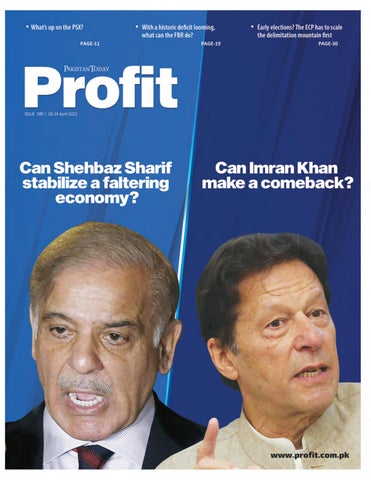
11 What’s up on the PSX? 12 Can Shehbaz Sharif stabilize a faltering economy? Can Imran Khan make a comeback?
25 17 The case against a six-day work week Ammar H Khan 19 With a historic deficit looming, what can the FBR do? 24 Fact check: Pakistan’s total reserves stand at $17bn not $22bn
19
32
32 27 Economic takeaways from the new PM’s speech in parliament 30 Early elections? The ECP has to scale the delimitation mountain first
Profit
33 The challenges facing Pakistan’s trade interests
Publishing Editor: Babar Nizami l Editor: Khurram Husain lJoint Editor: Yousaf Nizami l Assistant Editor: Abdullah Niazi Reporters: Ariba Shahid l Babar Khan Javed l Taimoor Hassan l Meiryum Ali l Shahab Omer Chief of Staff & Product Manager: Muhammad Faran Bukhari Regional Heads of Marketing: Muddasir Alam (Khi) l Zulfiqar Butt (Lhr) l Malik Israr (Isl) Layout: Ahmad Salahuddin l Photographers: Zubair Mehfooz & Imran Gillani l Business, Economic & Financial news by 'Pakistan Today' Contact: profit@pakistantoday.com.pk
Readers Say
facebook.com/Profitpk twitter.com/Profitpk linkedin.com/showcase/13251020 profit.com.pk profit@pakistantoday.com.pk
HOW TO CONTACT
7
Nice article. Some points you missed, on the international front. 1. Rate hikes by FED reserve and other first world central banks. Also FED is planning to reduce its balance sheet. Even though it is not expected to have an impact this year but cause deflationary pressure in financial markets and commodities early next year. 2. LME nickel contract is broken. Other commodities like Zinc and in long term copper contracts are also at risk. Impact of such a scenario on global commodities and Pakistan. 3. Green energy policy of west and reduction of investment in new crude oil exploration projects. Its impact. 4. Gas prices in Europe and its impact on LNG prices. If europe sanctions Russian gas/crude oil? 5. Sun flower oil share of Russia and Ukraine. Its impact on vegetable oil prices. I guess both produce 80% of global sunflower oil. 6. Chinese crop failure this year. 7. Water shortage issue in our country. Impact on next crop. Even though most of above points have medium term impact while your article is covering next quarter only. Apropos:An inflationary summer Abdullah, website
omy has much improved foundations as exports are steadily rising.This is the only way to go and that is to keep improving our Exports and doing import substitute! Apropos: Fact check: Pakistan’s total reserves stand at $17bn not $22bn Saqib, Website
The most recent placements, six since April 2021, have totalled $5bn including bonds from the government-owned Water and Power Development Authority. This is the most frequent and largest amount raised via Eurobonds over any 12 month period by Pakistan. And this has had an impact on the bonds post issuance performance. Apropos: Bond spreads rise with political risk Zee, Website
As a pure imaginary, Naya Pakistan promised to be an era of institutional change and economic prosperity. From a political economy point of view, Naya Pakistan had one unique advantage that not many governments in Pakistan enjoyed: it was premised on a cooperative new political coalition; a “hybrid” power-sharing arrangement between the civilian government and the establishment, a new ‘political settlement’ that promised sustained institutional transformation and rapid economic development. Apropos: Between claims and reality: the economy of Naya Pakistan Malaika, Website
Total Liquid Foreign Reserves were $22 billion plus in Month ending March! As you can see, reserves were $22 billion as of last month. There were some payments for fuel import and at least $2.5 billion of debt financing in early April 2022, which has brought it down to $17.5 billion. Which means cherry blossom will enjoy this month as of no payment for fuel import and debt financing. Note: This dip doesn’t mean much as it was also witnessed in March 2021 (FX dropped by $4 billion last year), but then it recovered again and even touched $27 billion in August 2021. Just the normal ebb and flow. If Imran Khan stayed till August 2022, the figure would touch $30 billion. As i am a part of an organisation which is second largest exporters of Pakistan. Apropos: Fact check: Pakistan’s total reserves stand at $17bn not $22bn Dilawar Merchent, Website The big difference between the current account deficit in 2018 and 2022 is that now our Econ-
We in Pakistan have been fooled by this new government. Inflation will go through the roof now. Apropos: OGRA proposes price hike in petroleum products from April 16 Malik, Website As a pmln supporter. U even have no sense how to speak in comment section don’t choose the words that are disgusting to read if u are pmln supporter that’s ok because everyone have their own choices so whenever u talk again about any thing about PTI don’t forget that every one have self respect ……..the other thing is that other parties are failed to provide that IMRAN KHAN stole money and have offshore companies in abroad Apropos: Fact check: Pakistan’s total reserves stand at $17bn not $22bn Farhat Nazir, Website
While the govt inherited a difficult economy, however Covid pandemic actually provided the country a breathing space with partial debt restructuring. However the mismanagement of the economy and the governance, especially in Punjab has left a bitter taste for the PTI voters. Moreover the sensational announcements by the PM such as ‘oil discovery at Kekra (if anyone still remembers)’, providing subsidized poultry to families to resolve their economic issues, constantly lecturing people on other country that he is a encyclopedia of knowledge about their own country and so on a so forth. His stubbornness not to remove Usman Buzdar coupled with long amnesty schemes made the economic situation worse. Apropos: Between claims and reality: the economy of Naya Pakistan Faisal Malik, Website
COMMENTS
IN BRIEF Increase in petroleum prices rejected by Shehbaz for now
Shehbaz Sharif, Prime Minister of Pakistan, has rejected the Oil and Gas Regulatory Authority’s (Ogra) plan for an unprecedented increase in petroleum product prices. This increase would be the result of the previous government’s subsidies being removed.
Gas crisis continues to persist
Despite the fact that the peak crisis season (winter season) has passed, industries and families have been experiencing gas disruptions for more than five months. This is due to Pakistan’s long-term supplier pulling out of shipments in the next two months, as well as the difficulty to buy on the spot market.
Philanthropist Bilquis Edhi passed away in Karachi
Bilquis Bano Edhi, the late Abdul Sattar Edhi’s right-hand woman and other half, died here at Karachi’s Aga Khan Hospital. She was known for her compassion and selfless work, having raised thousands of orphans across Pakistan, receiving the Mother Teresa Memorial Award for Social Justice and Hilal-i-Imtiaz, and caring for hundreds of cradles for babies abandoned primarily due to poverty.
Revival of IMF program in the works
Pakistan approached the International Monetary Fund (IMF) for the revival and completion of its Extended Fund Facility (EFF) as well as the disbursement of outstanding $3 billion funds to counter rapidly depleting foreign exchange reserves and widening fiscal and current account deficits as part of new contacts with international lenders. Russia issues warning to the US
Russia has lodged a formal complaint with the US over its military aid to Ukraine, warning of “unprecedented repercussions” if sophisticated weapon supplies go, according to US media.
Military’s help was not sought by PM Imran Khan according to Mazari
Mazari, a former senior member of his cabinet, has stated definitely that now-deposed Prime Minister Imran Khan did not seek assistance from the military to break the “political gridlock” created by the National Assembly deputy speaker’s verdict against the united opposition’s noconfidence motion.
PTI lawmakers become violent in Punjab Assembly
As the speaker came in the house to preside over the PA session to elect the chief minister, members of the Pakistan Tehreek-e-Insaf (PTI) assaulted Punjab Assembly acting speaker Dost Muhammad Mazari.
8
Corporate Update Egypt’s Paymob to Start Operations in Pakistan
Zaraye raises $2.1 billion in pre-seed round
Egypt’s digital payments provider, Paymob plans t o start operations in Pakistan soon, taking advantage of the boom in startups taking place in the country. The Cairo-based company, which allows online businesses and offline merchants to accept and send payments, plans to have 100,000 merchants in its first two years in Pakistan. The payment gateway currently operates in Egypt, Jordan, and Kenya and aims to enter Saudi Arabia later this year.
Zaraye, a Pakistani B2B tech-enabled supplies sourcing platform manages to raise US$2.1 million from the US based investment company, Tiger Global, and the London based venture capital company, Zayn Capital, for its pre-seed round. The platform essentially aids buyers of raw materials in the procurement of raw material by connecting them with a multitude of suppliers. The platform works on a quotations based system and provides streamless service to manufacturers of consumer goods and raw materials by providing them with a real-time and hassle-free tech-enabled service to streamline the process of procurement.
Federal government bans sugar exports to control sugar prices The government has decided to place a ban on sugar exports despite surplus quantity in order to curtail price hikes and maintain price stability. In a statement issued by the Ministry of Industry and production, the government had elucidated that the price of sugar had remained unchanged.
Jazz license renewed by PTA for $486 million One of the leading telecommunication companies in Pakistan, Pakistan Mobile Communications Limited, formerly known as Jazz, has recently signed an agreement with Pakistan Telecommunication Authority for the renewal of its spectrum in the country. The company has invested an approximate sum of Rs888 million to get this spectrum renewed for another 15 years. Under the agreement, Jazz Pakistan has deposited 50 percent of the amount upfront, while the remaining payment would be made in five equal annual instalments amounting to ten percent of the total cost along with applicable markup of LIBOR+3pc.
Keeptruckin rebrands as MOTIVE to broaden its spectrum KeepTruckin, a fleet management company based in San Francisco, California, has rebranded itself as Motive as the tech company expands into agriculture, manufacturing, construction, field services and other sectors beyond trucking.
Swvl, the first mass-transit company to get listed on Nasdaq A cairo-based mass transit ride-hailing company - Swvl - currently headquartered in Dubai, started trading on Nasdaq on March 31, 2022. The company has been valued at $1.5 billion. Prior to listing, the company had announced a merger with Queen’s Gambit Growth Capital, which is a blank check special purpose vehicle solely owned and operated by women.
Foodpanda to train home chefs in collaboration with Punjab Food Authority With the objective of improving food packaging and uplifting hygiene standards during food preparation, foodpanda partnered with Punjab Food Authority (PFA) with the purpose of training Home chefs vis-a-vis enhanced safety protocols and government SOPs.
Game Rev 2022 successfully concludes with a monumental day for the gaming industry Pakistan’s biggest Industry-led gaming event, Game Rev 2022, a brainchild of GameTrain, comes to a successful conclusion after a phenomenal event at Beaconhouse National University attended by more than 3000 participants. With industry leaders and senior professionals from 80+ companies, the event covered the gaming industry in full with workshops pertaining to Game design, Block chain development and Work culture in gaming studios. GameTrain is an IT accelerator which aims to revolutionise the Gaming sector and the IT industry by bringing together industry leaders, academics, students, developers and esports players to highlight Gaming as a career and a way of life.
9
What’s up on the PSX? The stock market performance
T
By Saad Tanvir
he outgoing week witnessed a return of the bulls to the local bourse mainly due to clarity on the political front with the successful passage of No Confidence Motion against the PM which resulted in the election of Shehbaz Sharif as the country’s new Premier. However, the noise has not yet settled and is expected to remain high as the ousted govt. of Pakistan Tehreek-e-Insaf (PTI) vows to hold nationwide protests until new elections are called. Moreover, questions on the economic front have resurfaced as members of the new cabinet are being finalised. The expected incoming Finance Minister, Mr. Miftah Ismail, has reiterated that the IMF is a top priority of the newly formed govt, and talks regarding the 7th Extended Funded Facility review will begin shortly. Successful completion of the review will result in proceeds of USD 1.0Bn which are urgently needed given forex reserves have declined considerably ever since the turn of the year and are expected to continue the trend in the wake of high external debt servicing and hefty import bill. Despite these challenges, the PKR underwent robust recovery against the greenback and appreciated by 1.7% during the week to close at PKR 181.6/USD. On the other hand, the index moved between highs and lows of 46,786 and 44,445 points, to settle at 46,602 points (↑4.9% WoW) while volumes surged to 188.4Mn (↑177.9% WoW) and traded value rose to USD 44.7Mn (↑114% WoW). FX reserves have declined to $17 Billion, where reserves with SBP stand at $10.9 Billion mainly on account of high external debt servicing and rising import bill. Moreover, rumours regarding delays in Chinese corporate debt rollover of USD 2.3Bn have caused uncertainty in the financial markets as the country has less than 2 months of import cover left. Rising oil prices are putting a major dent on fiscal space given the fact that fuel prices in the country have been fixed at PKR 150 per litre whereas OGRA has recommended an increase of Rs120 per litre for petroleum products. This will be a major test for the new government given that inflation is already in double digits and is expected to remain elevated in the near term as the international commodity super cycle persists. Similarly, widening trade deficit ( 8MFY22: USD 29.9Bn, ↑72.5% YoY) and external funding gap will require immediate attention.
Ghani Chemicals merges with G3 technologies The newly constructed and revitalised G3 technologies, formerly Service Fabrics, has announced that it has acquired 20 million shares of Ghani Chemicals Industries Limited in an effort by the parent company to essentially merge the two. In a borus filing made by the holding company, Ghani Global Holdings Limited, it announced on Friday that 20 million shares of Ghani Chemicals are to be divested and invested into G3 technologies.
Finnish Development & Impact investor invests in TPL Insurance
TPL Insurance Limited notified in filing on Friday that a Private Limited Company incorporated in Finland, the Finnish Fund for Industrial Cooperation Limited (Finnfund), has signed a share purchase agreement with TPL insurance Limited pertaining to which it shall acquire 20.6 million shares equivalent to 14.97%. The Finnfund would enable TPL insurance to diversify its insurance services in diversified market segments such as the agriculture sector.
STOCK MARKET UPDATES
Renacon Pharma signs substantial construction contracts for expansion of manufacturing facility
A subsidiary of Treet Corporation Limited, Renacon Pharma (pvt.) Limited (RPL), reported on Friday that due to surplus demand, has decided to sign construction contracts to build a new facility and expand current production capacity by 10x.
Mari Petroleum decides to divest from Natural Resources Limited
Through an announcement on the PSX, Mari Petroleum Company Limited reported on Thursday that its management has acquired board approval for the complete divestiture of its holdings of 20.9 million shares in the mining giant, National Resources (Pvt.) Limited.
Supernet completes book-building with a whopping oversubscription of 1.4 times
Book-building for the first IT company to list on the Pakistan Stock Exchange’s GEM board commenced on Tuesday and concluded on Wednesday resulting in a considerable bid size of Rs659 million against an offer of Rs475 million worth of shares. In an announcement by Telecard Limited, the parent company, it outlined the Rs200 are to be received by Telecard Limited while against its Offer for Sale, while the remaining Rs275 million are to be syphoned to Supernet directly.
Shahzad Textile instals an aggregate of 67 knitting machines to enhance manufacturing unit
Shahzad Textile Mills Limited, the textile giant has announced the extension of its Socks & Hosiery manufacturing plant with the installation of 7 local and 60 Italian socks knitting machines as the company intends to ramp up its exports to the EU and US regions.
Landmark Spinning Industries instigates reverse merger with Liven Pharmaceuticals
Landmark Spinning Industries Limited, a financial distressed company, non-operational and going concern textile company has made its decision on the reverse merger talks with Liven Pharmaceuticals (Pvt.) Limited (LPL) and is now to be transformed to a listed pharmaceutical corporation rather than a textile company. In a notification filed on Wednesday, Landmark Spinning Industries announced that Liven Pharmaceuticals shall be merged into Landmark Spinning Industries against approximately 66 million shares issued directly to the shareholders of Liven Pharmaceuticals. ~1667 shares of Landmark Spinning Industries are to be handed out against one share of LPL. After the merger, the name of the company shall be changed to Liven Pharma Limited (LPL) from Landmark Spinning Mills Limited and the principal line of business is to be altered from textile to pharmaceuticals.
NetSol Technologies decides to buy-back 2 million shares at spot rate
NetSol Technologies, the IT giant of Pakistan announced on Monday that it made a decision to repurchase 2 million shares at the ruling market/spot price with the face value of Rs10 each. The announcement said that the buy-back would improve the company’s Earning Per Share (EPS), future dividends and share break-up value.
11
12
COVER STORY
By Khurram Husain
T
he numbers are coming in and they don’t look pretty. Last Thursday the new government of Prime Minister Shehbaz Sharif was informed where the prices of essential fuels – petrol, diesel, kerosene – will rise to if the price caps announced by the former Prime Minister were to be removed in one go (see table). The next day the official twitter account of PML(N) that deals with economic matters announced that the fuel price caps are here to stay for the time being.
Minutes later finance minister designate, Miftah Ismael, tweeted that he has just had a meeting with the World Bank Country Director and the IMF’s Resident Representative in Islamabad, describing the meeting as a “courtesy call” that they made on him. The moment revealed the sharp trade-
offs the new government is facing. The next day Miftah shared a few numbers via his twitter handle, saying the cost of the fuel subsidies “is more than the cost of running the entire civilian federal government plus the entire BISP/Ehsaas programme.” No wonder the meeting with the IMF and World Bank chiefs took place on the same
14
day as the decision to retain these subsidies (for the time being) was made. The first order of priority for the new government is to revive the IMF program and arrest the decline of the foreign exchange reserves. This cannot happen with the subsidies in place. Earlier in the week the State Bank showed some numbers of its own to Pakistan’s foreign creditors in the bond markets. In an investor presentation they showed the current account deficit projected to reach $17 billion by end of FY22, up from their earlier projection of $13 billion presented back in February. For next year they showed gross external requirements reaching $46 billion in the next five quarters (April 2022 till June 2023). The last staff report released by the IMF in February 2022 showed next year’s gross external financing requirements at $35 billion. Even allowing for the fact that the $46bn figure refers to five quarters instead of four, it is hard to miss the massive increase in the country’s requirements for external financing to meet its debt obligations in the months ahead. Of And even the $46bn projection is built on optimistic assumptions. For example, it assumes that the CAD will be $10bn in FY23, and the bulk of the available financing the State Bank showed with which it intends to meet this requirement will come from multilateral financing as well as oil facilities coupled with rollovers from bilateral creditors. None of this is happening without an active Fund program in place. So revival of the fund program is a critical objective and its prerequisites are weighing heavily upon a government composed of an unwieldy coalition facing formidable opposition
from Imran Khan whose people are threatening full fledged “civil unrest” in the days ahead. In this context, hiking the price of petrol by Rs21 and the price of diesel by Rs51 (especially at the start of wheat harvesting season when the demand for diesel spikes, and hikes in its price will inevitably lead to higher flour prices) is suicidal.
The fuel price hikes will impart a powerful inflationary pulse into the economy and cascade through the price level across the board. With rising CPI will come pressure to raise interest rates, which in turn will slow the economy, causing whiplash across the business community and turning the clock back to the months that followed the July 2019 accession to the Fund program that the country is struggling to complete today. And the fallout will fall squarely on the current government. Can Shehbaz Sharif walk this road? Short answer is he has no choice. He can delay the decision, but delay has its own cost. He can stagger out the inevitable, do it over a period of time. Or he can seek help from “friendly governments” like in the past. This would mean approaching Saudi Arabia, China and the UAE for a temporary shot in the arm while he prepares to walk down this road. None of these options are easy.
Can Imran Khan mount a comeback?
I
t is difficult to discern what exactly Khan’s strategy is through all this. He is clearly not interested in playing it out within the confines of the parliamentary system. The resignations he has ordered his party MNAs to submit show he is looking for an exit from the system to be able to attack it from the outside. The purpose of these attacks will be to paralyse the government and jam all decision making with the ultimate aim of forcing them to hold early elections. But how to graduate out of rallies and speeches towards paralyzing attacks? Next level up from rallies and speeches is the politics of agitation. But the problem with agitation is it requires the political party to be linked up with organized interests in society. Crowds that attend weekend rallies are not enough. Agitation would mean Khan issuing a strike call today which is observed around the country the next day. We are far from that right now. For agitation to work, he will need to establish contact with the myriad organized interest in society like the trader associations or the bar associations or port workers unions or transporter associations. It will work if he can cripple the conduct of day to day like – urban mass transit grinds to a halt, shops are shuttered, lawyers boycott the courts and stall litigation, port workers strike and cargo piles up on the ports while ships wait in outer anchorage and business is hit badly. This is what it took the last time we saw agitation politics in our country in the PNA movement of 1977. So what organized interests in society can Khan link up with? The traders are very reluctant to shutter shops, especially on
ideological appeals. The bars associations are almost universally opposed to him after the Justice Qazi Faez Isa case and the unconstitutional steps he took to prevent the vote of no confidence from being held. The labour unions are not what they used be back in the 1970s. The Peshawar jalsa may have provided a clue. In that rally he escalated escalated his attacks on the government to go beyond accusing them of being thieves and traitors. He accused them of blasphemy as well. One cunning trick he used in Peshawar was to name Geert Wilders specifically during his speech, the Dutch lawmaker famous for his Islamophobia. This prompted a response from Wilders via his twitter account in which he referred to Khan as a “hate monger” and took the opportunity to make another blasphemous remark. The next day Saad Rizvi, the young head of the Tehreek Labbaik Pakistan (TLP) issued a fatwa during his Friday sermon calling for the death of Wilders. TLP followers unleashed a barrage of threatening tweets against Wilders, tagging him with pictures of knives and guns along with words like “we are coming to get you”. Wilders was only too happy to retweet all this to his own followers. This exchange continued for days. As of writing this the Karachi jalsa has not begun so it is not known whether Khan intends to escalate this further by stoking these kinds of exchanges between Pakistani social media users and European lawmakers. But it is possible part of his strategy includes escalating this to a point where he can advance a demand that the new government of Shehbaz Sharif should condemn these lawmakers and possibly demand the eviction of European diplomats from Pakistan, failing which he can argue he will lead a long march to lay siege to Islamabad, aided perhaps by the TLP, to force the government to take action against blasphemers abroad and their diplomatic missions here. As such, he would take a page out of the TLP’s book last year. It is too early to say, at the time of writing, whether this is what Khan intends, but it
The wild card: Imran Khan’s popularity By far the biggest wild card at play in all this is Khan’s personal popularity. He is drawing far larger crowds than any of his predecessors did following their disqualification, and his rallies are charged and the crowds are organically driven. These are not rent-a-crowd rallies. But how far does personal popularity drive electoral outcomes? And how new is it? “Over time all the polls I have seen in public and non public domains show that Khan has been the most popular leader for the past four years at least” says Azeema Cheema, Director Verso Consulting a former elections analyst who has lot of experience working with political opinion polls. “In 2012 he was genuinely the most popular leader in the country as well” she says, “but after that his popularity declined when he started bringing traditional electable politicians into the party. In the post 2013 election he was competing for popularity with Nawaz Sharif, Shehbaz Sharif and Raheel Sharif as well, who was a very popular army chief. The thing to note is some of these figures are very polarizing. Nawaz and Imran were both very polarizing, but not Shehbaz. Since 2018 Khan has managed to retain his position as the most popular leader in the country.” The PTI is also armed with a formidable social media machine. Early morning on April 15 their official account tweeted some metrics for a hashtag that has been trending for many days now showing 30 million tweets and more than 80 million engagements. “The people of Pakistan have completely rejected the imported government!” they said. But social media engagements and personal popularity don’t necessarily mean electoral strength. Consider, for example, that there are 3.4 million twitter users in Pakistan whereas 55 million voters participated in the 2018 general election. Electoral communication is a far more complex task than televised speeches and social media trends. Translating personal popularity into electoral outcomes involves being able to communicate with local influencers in the constituencies – the so-called dharra and biraderi networks and their leadership. Social media influencers can help drive engagements and reach, but they cannot deliver votes where it counts. So Khan’s challenge is to grow his own popularity and brand, but eventually he will have to swivel out of televised speeches and social media projection and learn to communicate with voters on the ground. Being outside the system always makes this harder, because one language voters understand clearly is tangible service delivery. Without that lever, translating his personal popularity into votes for his party will be Khan’s big challenge. will become clear within days. If in the Karachi jalsa there is further escalation of the blasphemy rhetoric and more mention of European lawmakers by name, it will be a clear indication that Khan is trying to incite the TLP and link up with them. If Khan is unable to graduate from rallies and speeches to active agitation, his chances of making a comeback diminish with time. At the moment he has 94 elected members in the assembly who have submitted their resignations (the rest are reserves seats and are merely extras in the drama of politics) and 32 who have so far not resigned. If these resignations go through it will be a blow to the assemblies, but it will not necessarily force their dissolution. We will have the largest number of bye-elections we
have ever seen, but nothing more. To top it off, the costs of these rallies is now beginning to weigh on him, prompting an appeal for donations from overseas Pakistanis to be able to carry on his campaign. Next up the PTI will probably have to boycott the bye-elections, forcing his MNAs to decide if they want to remain with Khan or seek a ticket from another party to seek their reentry into the system. Many of these “electables” pay a steep price for remaining outside power for very long because contenders within their own constituencies are only too glad to step in and fill the void they have left by opting out. By opting out of the system altogether Khan has taken on a much bigger challenge to bring about his own comeback. He has to either escalate to agitation politics, or sustain the momentum of rallies and speeches for many months. Either way, the choices facing him are no less stark than the ones his opponent – Shehbaz Sharif – is facing. n
COVER STORY
OPINION
Ammar H. Khan
The case against a six-day work week
which if not available would lead to more load shedding for rest of the country. An unintended consequence of the same would be greater utilization of diesel for firing up generators, and that also means importing the same at peak of a commodity super cycle, resulting in a double whammy effect – as we will not only be using more power, but will also be importing more expensive fter a week-long constitutional crisis, a new government and dirtier fuel to use as a back-up source of power. is finally in place. One of the first decisions taken was Unless adding an additional working day improves a rushed one, devoid of any thought or consideration productivity of the workforce (very little evidence exists for of unintended consequences. It was announced that the same), the incremental benefit would be far lower than all government offices would be working six days a the explicit economics costs associated with the same. As the week, which had a ripple effect, eventually leading to banking systems move towards digital payments, the volume for the central bank announcing the same. As the world experiments with which is increasing at a rapid pace, there exists little to no reafour-day work weeks, we are taking a step back and moving towards a son to operate on a sixth day, when rest of the world’s financial six-day work week. system can operate well with five days. The decision to revert to a five-day work week was taken someOn the transportation front, it is expected that due to an time in 2013 as the country was in the throes of a major power crisis, additional working day, consumption of fuel for transportation with power breakdowns stretching hours at a time being fairly common. will also increase. It is estimated that due to additional four The decision was largely taken to reduce demand, such that the length days of work in a month would push up demand for petrol by of power breakdowns can be managed. The policy action certainly roughly 10 percent – this effectively means, that our import bill resulted in improvement in availability of electricity, with broad-based for petroleum products would increase by the same amount, load shedding eventually being phased out as more capacity came resulting in a higher current account deficit. For the first eight online. Fast forward ten years, a similar story is in play. The commodity months of the current fiscal year, Pakistan imported roughly super cycle and a global geopolitical crisis has led to a spike in energy US$ 9 billion worth of petroleum products – resulting in an prices as the world scampers for additional resources, with power annualized bill of roughly US$ 13.5 billion, assuming prices cuts and rationing even happening in more developed economies. An don’t increase significantly. For the remaining months of the emerging economy like Pakistan which is perpetually in a balance of fiscal year, we would be paying an additional US$ 350 million to payments crisis does not have the resources, nor the capacity to buy enwork an extra day, productivity benefits of which are sketchy at ergy resources at spot prices, resulting in significant quantum of power best. On an annualized basis, we would be importing addicapacity being offline due to non-availability of fuel. tional petroleum products of roughly US$ 1.35 billion – which Power breakdowns across the country have already begun, and as would add to an overall stressed current account deficit. the temperature increases, and correspondingly demand for electricity In a scenario where petrol for automobiles is already increases, power breakdowns are only going to get more severe. Adding heavily subsidized, with the national exchequer running losses an additional work day would mean greater incremental demand which of more than three billion rupees on a daily basis, the increased would put further strain on the system necessitating greater fuel usage, demand for petrol would increase the quantum of losses, while resulting in a higher deficit. The state needs to be doing more to reduce demand, whether that is through increase in prices and elimination of subsidies, or through demand management policy actions, which can range from enabling remote work for whomever possible, to reducing number of business hours in a day to rationalize demand. The writer is an Countries across the world are coming up with novel policy actions to rationalize demand while keeping independent productivity unchanged (or even increasing) – meanwhile our policy actions have an adverse effect on the ecomacroeconomist and nomic front, as well as on productivity. In-effect, increasing the number of working days would actually reenergy analyst. duce the real wages, in a scenario where real wages actually need to increase to combat double digit inflation. Inability to consider unintended consequences of policy actions has been a failure of successive governments. Making the same mistakes like clockwork seems to be a hallmark of the way we operate, wherein personality whims dictate economic policies. One hopes that better sense prevails and a more conscious decision is taken rather than a whimsical one. n
A
COMMENT
17
With a historic deficit looming,
what can the FBR do?
The economic slowdown might send FBR searching for new avenues of tax collection. Does it mean bad news for existing taxpayers? By Ahtasam Ahmad & Shehzad Pracha
P
rime Minister Shehbaz Sharif is staring down the throat of a tiger. His newly cobbled together coalition government might be swallowed up by any one of the many crises that it has inherited. Not only is the country facing massive inflation and an energy crisis unlike any other witnessed in recent times, the new government will also need nerves of steel when they present the budget for the next fiscal year in only a couple
TAXATION
of months. In the budget, Pakistan is facing a historic deficit. The balance of payments is completely out of whack, the import bill is soaring because of global fuel prices, and some tough calls need to be made. In the wake of all of these rising expenditures, the Federal Board of Revenue (FBR) is under scrutiny. Can they beef up tax collection by netting some big fish? In the last few weeks, the board has initiated recovery of tax liability against multiple companies including those in the Telecom, Fertilizer and Cement sector. On the receiving end of the FBR’s attempt to meet collection targets
were companies like Zong, Telenor, Jazz and operators in the cement & fertilizer sector as well as the National Highway Authority. The income tax disputes in these cases are based on multiple underlying factors ranging from disallowance of various expenses to differences in interpretation of certain sections of the law. It is not a coincidence that the tax regulator is on a recovery spree at this particular time. The expected economic slowdown leading to curbing imports as well as the tax relief provided on multiple commodities, most notably petroleum products, has made the collection of targeted 6.1 trillion rupees in taxes
19
The recent surge in recovery is something that is in line with what we see in the past years. As the fiscal tightening curbs imports, FBR will be under pressure to meet its targets and that would result in more notices for the businesses in the coming months Ashfaq Tola, the President of Institute of Chartered Accountants of Pakistan
an uphill task. During the same period, the FBR released its provisional figures of tax collection for the month of March 2022. The collection target for the said month was not achieved, a recurring occurrence, as the regulator failed to achieve the target in three out of the last four months. Further, this was the first time that the board released collection figures that were in excess of the amounts actually received in the banking system. The provisional figures were anchored on the expected recoveries from actions initiated against companies.
The structural flaw
T
he structural flaws of Pakistan’s tax system are well documented. The reliance on a narrow tax base and exploitation of existing taxpayers on top of a complex tax system all adds up to the difficulty in increasing the tax revenues leading to a low GDP to Tax ratio of around 9%. As per the study, Tax Structure in Pakistan: Fragmented, Exploitative and Anti-growth, by Pakistan Institute of Development Economics, “Ad-hoc tax revenue enhancing measures through SROs and mini-budgets have developed a complex tax system that confounds principles of rational tax policy. FBR sets an ambitious target and to chase that number arbitrary measures are taken which create uncertainty that eventually kills transactions. These unrealistic targets cannot be achieved without enhancing the taxable capacity of the country; instead these are stifling economic activity.” The study further added, “The current tax structure in Pakistan is regressive in nature and is in contrast to the fairness principle of tax policy. Frequent changes in policy and rates make the environment is very uncertain, especially for potential investors.” Syed Asad Ali Shah, A Senior Chartered Accountant and Former Managing Partner of Deloitte Pakistan, while talking to Profit stated, “The FBR has failed to take effective measures in broadening the tax base and instead has relied on exploitation of those in the existing tax net.”
20
The nature of tax disputes
I
n the telecom sector, the recent cases of recovery include that of Telenor and Zong. The latter was at the receiving end of a tax recovery of Rs4.1 billion due to a difference in estimation of advance tax for the first quarter of the tax year 2022. The recovery against Telenor amounted to Rs3.5 billion for a case that dates back to 2015. Jazz, anticipating future attempts by FBR for seizure of accounts, resolved its major tax cases out of court through an Alternate Dispute Resolution Committee in November 2021. However, its accounts were still seized for a recovery of Rs5.7 billion in march 2022 against failure to meet an advance tax demand. It is pertinent to note that in all these cases, the companies were able to get a stay order from the high court. The fertilizer sector was also sent notices of recovery recently. The matter of contention in this industry was sales to unregistered persons while the industry claimed that it had an exemption as per previous FBR instructions. Fertilizer Manufacturers of Pakistan Advisory Council (FMPAC) Executive Director explained that Post promulgation of the Tax Laws (Second Amendment) Ordinance 2019, input GST was disallowed on sales made to unregistered persons exceeding Rs10 million in a month / Rs100 million in a financial year, adding significant exposure for the fertilizer industry. After due deliberation, FBR issued a notification (SRO 1337) in December 2020, whereby exemption would be granted subject to the provision of dealers’ information, including bank account etc. to FBR. The common pattern amongst all the cases mentioned above and other happening in the recent time is recovery through seizure of bank accounts. Last year, in October, FBR revoked the clause in the Section 140 of the Income Tax Ordinance (ITO) 2001 which compelled the regulator to give a 24 hour notice to taxpayers before seizing their accounts. Shabbar Zaidi, the former chairman of
FBR and the one who brought in the law of a 24 hour notice before recovery, while talking to a private publication stated, “I am personally sorry to hear the withdrawal of the first instruction issued when I joined as chairman FBR.” He further added, ““[There should be] no freezing of bank accounts without intimation and approval from chairman FBR. Due to this there was a major relief to taxpayers.” However, FBR officials were of the point of view that if the prior channel of approval (implemented by Zaidi) was followed, there were chances of information getting leaked and the taxpayers withdrawing the money from their respective accounts. “The recent events of bank accounts seizure are an example of the FBR trying to meet the ambitious revenue targets. However, going after the complaint taxpayers, especially the Telcos are uncalled for”, Syed Asad Ali Shah commented on the situation.
Tax litigation
T
he cases of income tax recovery that have unwinded in the past few months have mostly been in litigation at multiple forums. As per data revealed to the Islamabad High Court (IHC) in February, more than 90,000 tax cases were pending at different litigation forums amounting up to Rs3.5 trillion. However, 80 percent of these cases were pending with FBR’s internal litigation forums. The litigation process at the commissioner level is also influenced by the FBR as per reports, in September last year commissioner appeals in jurisdictions were asked to report to their respective heads of regional and large tax offices, an order that imposes a conflict of interest situation for commissioner appeals who is responsible for smooth and fair trial of tax litigations. Senator Talha Mehmood, while chairing a meeting of the standing committee of finance in October last year, confronted FBR representatives over influencing the commissioners appeals to decide cases against taxpayers. Further as per Profit’s sources, influ-
encing decision makers at different internal litigation forums of FBR is a common practice and is specially employed when the tax recovery wing of the regulator seeks to expedite the recovery process. However, most of such cases don’t hold in court of laws and immediate stays are granted. Syed Asad Ali Shah, A Senior Chartered Accountant and Former Managing Partner of Deloitte Pakistan, commenting on the recent developments stated, “In all likelihood, FBR will expedite the cases under litigation specially in their own tribunals. However, demands at times are frivolous and cannot be held in a court of law. The bank seizure process is also likely to speed up as the pressure mounts on the regulator.”
Difficult times ahead
A
s per the recent figures released by FBR, it collected around Rs575 billion in March 2022, against a target of Rs604 billion. Further, it missed its target in three out of the last four months. The disaggregated figures show that around 52% of tax revenues were collected from imports. This has been possible as the local demand surged amid expansionary policies by the government. Therefore, for the first three quarters, FBR was not only able to achieve its revenue targets but also exceed them. However, as the fiscal tightening occurs and rupee depreciates, the main source of revenue, imports, is likely to be reduced putting pressure on the board to find alternate means of revenue collection. Additionally, the tax exemptions on multiple items specially petro-
“In all likelihood, FBR will expedite the cases under litigation specially in their own tribunals. However, demands at times are frivolous and cannot be held in a court of law. The bank seizure process is also likely to speed up as the pressure mounts on the regulator” Syed Asad Ali Shah, former managing partner of Deloitte Pakistan leum products has cost the tax regulator heavily. As per FBR’s own figures, for the month of March, the tax exemption on Petroleum products has cost them around Rs45 billion in revenue while exemptions on Fertilizers, Pesticides, Tractors, Vehicles, and Oil & Ghee amounted to Rs18 billion forgone in potential revenue. While zero ratings on Pharmaceutical Products translates into Rs10 billion of tax revenue not collected. Further, a fall in commodity sales like cement is also likely to put pressure on FBR in the coming months. Therefore, it is likely that the board will go after those in the existing tax net to meet its ambitious tax targets. However, frequent notices and bank account seizures all add up to the lack of ease of doing business argument in Pakistan. Ashfaq Tola, the President of Institute of Chartered Accountants of Pakistan and a Senior Tax practitioner commented, “The recent surge in recovery is something that is in line with what we see in the past years. As the fiscal tightening curbs imports, FBR will be under pressure to meet its targets and that
would result in more notices for the businesses in the coming months.” As per Overseas Investors Chamber of Commerce and Industry’s Taxation Proposal 2022-23, “A compliant sector provides FBR with information of registered/unregistered businesses, which FBR should use as a tool for broadening tax net. However, FBR unfairly penalizes these commercial organizations by disallowing their legitimate expenses and input Sales tax through measures covered in Income Tax Ordinance and Sales Tax Act.” “Revenue Targets for field formations should be in line with the business growth trends. Unrealistic targets lead to harassment of compliant taxpayers”, The proposal further added. The incumbent government led by PML-N is widely perceived as a business friendly one and therefore, it would be expected to reform the FBR to end taxpayer difficulties. However, there is not much that can be done by this government as they are bound by the commitments to IMF and as per experts, the existing policies of FBR will be carried in the upcoming budget. n
TAXATION
Fact check:
Pakistan’s total reserves stand at $17bn not $22bn
By Ariba Shahid
A
number of viral tweets have been going around claiming that at the time of Prime Minister Imran Khan’s departure from the PM Office, the reserves stood at $22 billion. However, total reserves with the State Bank of Pakistan (SBP) and banks, stand at $17bn. Farrukh Habib, ex Minister of State for Information and Broadcasting and Central Secretary Information for Pakistan Tehreek -eInsaaf shared an image by Startup Pakistan. He captioned it saying, “The first Prime Minister in the history of the country who left $22 billion in the national treasury. Excellent example of excellent performance.” The tweet and post are wrong as per data available from the SBP the total liquid foreign reserves held by the country stood at $17,476.9 million as of April 1, 2022, the lowest level since June 2020. Total Liquid FX Reserves include net reserves held by banks and net reserves held by SBP. To explain this in simple terms, the net reserves held by the SBP is like money that is in the government’s wallet. Net reserves with banks, is like money that is in the wallets of banks, this is not money owned by the government. Moreover, sometimes your friends give you money in order to make your wallet look thick
24
and institutions feel more comfortable dealing with you because they think you have money. This money, however, is just for show and cannot be used. An example of this is amounts received from Saudi Arabia, UAE, and China. During the week ended in April 1, 2022, SBP reserves decreased by $728 million to $11,319.2 million, largely due to debt repayment and government payment pertaining to settlement of an arbitration award related to a mining project. Total reserves are down by $1,078 million. A breakdown of this shows that SBP reserves stand at $11.3 billion, and are down by $728
million. Bank reserves are down by $350 million, clocking in at $6.2 billion. The total liquid FX reserves have declined $1.078 billion over last week which is equivalent to a 5.8% decline week on week. The import cover has declined from 1.82 months to 1.71 months based on average imports of the last 12 months.
Why the confusion?
T
he $22bn figure being quoted on the internet is based on the month end level data released by the SBP for the month of February, the last available month for the data. However, the SBP also releases week-end levels of the reserves. The data is available for the week ended 4 March, 11 March, 18 March, 25 March, and 1 April, 2022. Moreover, it is also important to note that not all that is in the reserves can be used by the government. For instance, out of the $17.477 bn reserves the country had on April 1, 2022; $6.157 are reserves with the bank, and the remaining are with the SBP. The reserves include $1.4bn raised through Naya Pakistan Certificates, Treasury bills, and Pakistan Investment Bond Holdings. These are encumbered reserves. An encumbrance is a restriction placed on the use of funds. The concept is most commonly used in governmental accounting, where encumbrances are used to ensure that there will be suffi-
cient cash available to pay for specific obligations such as loan interest or certificate face value upon redemption/ repatriation. Furthermore, the reserves also include $3 billion received from Saudi Arabia, $2bn from UAE, $0.5bn from Qatar, etc to support the balance of payments position. In addition to these, the reserves also include older deposits from friendly countries dating back to the 90s. These cannot be used.
Why have the reserves suddenly taken a slump?
On March 25, the foreign currency reserves held by the SBP were recorded at $12,047.3 million, down $2,915 million compared with $14,962.4 million on March 18. The decline is due to the repayments of external debt, primarily the repayment of a major syndicated loan facility from China. However, as per a notification by the Finance Division, two facilities worth $4.3 billion matured in the month of March, of which SAFE deposits worth $2 billion have been rolled over. Moreover, the rollover of the syndicate facility of approximately $2.3 billion is being processed. The notification stated, “These facilities are being used for balance of payments and budgetary support.” Pakistan owed $16 billion to non-Paris Club countries on December 31, 2021 out of which China’s bilateral debt stood at $14.815 billion. China’s Safe Deposits stood at $4 billion till December 31, 2021. In totality, China has granted rollover of approximately $4.5 billion in loans to help Islamabad manage its external sector vulnerabilities. What this means is that the $2.3 billion that has just left the reserves will be back shortly. It has approximately been two weeks since the announcement, however, the rollover has not happened yet. Beijing committed to the IMF in 2019 to rollover its debt until the Fund programme expires. While there has been no official comment on this, Beijing may have decided to deter the roll back contingent on IMF program resumption. However, the reserves have been on a declining trend as of late. This is due to the ballooning current account deficit.
Does the absolute value of reserves matter?
(Author’s note: Feel free to skip this if you already know what import cover and reserves are.) oreign exchange reserves are assets held on reserve by a SBP in foreign currencies. These reserves are used to back liabilities and influence monetary policy. They include any foreign money held by the SBP. These may include foreign currencies, bonds,
F
treasury bills, and other government securities. Economists suggest that it’s best to hold foreign exchange reserves in a currency that is not directly connected to the country’s own currency. Most of these reserves are held in the U.S. dollar since it is the most traded currency in the world. A general measure to know whether the reserves are adequate enough or not, is to look at the import cover. Countries should hold reserves covering 100 percent of short-term debt or the equivalent of 3 months worth of imports. Import cover is the number of months of imports that could be covered for by a country’s international reserves. Import cover is an important indicator of the stability of a currency. Some crises result from withdrawal of foreign capital, while others involve the loss of export income, or capital flight by domestic residents. These risks should also be taken into account when ascertaining the level of reserves. For countries where there are drains in the balance of payments because of terms of trade shocks, volatile aid, foreign direct investment and remittance inflows and outflows, the import cover remains a useful tool. As per a study by the IMF, 3 months of imports remains broadly appropriate for countries with flexible exchange rates, given the estimated benefits provided by reserves in reducing both the probability and impact of shocks. The analysis also suggests that countries with good institutions and policies need lower levels of reserves. n
Economic takeaways from the new PM’s speech in parliament By Abdullah Niazi
A
fter weeks of political turmoil in the country that led to a constitutional crisis and culminated in the removal of Imran Khan from the office of Prime Minister, Mian Muhammad Shehbaz Sharif has taken his place at the head of the most elaborate coalition government in the history of Pakistan. As the dust settles and he prepares for his first day in the Prime Minister house from tomorrow, Mr. Sharif’s first speech in parliament as the leader of the house was dominated by themes of fixing the country’s ailing economy. The Prime Minister’s speech was heavy on rhetoric of reconciliation, unity among the coalition government, and better economic and diplomatic ties with Pakistan’s allies. Laced
with this rhetoric was criticism of the previous government, and some indications as to possible economic policy shifts that might come with the new government. Profit looks at the key economic takeaways from the newly incumbent Prime Minister’s speech in the National Assembly.
Dollar prices, deficits, and IMF talks
O
ne of the first points raised by Shehbaz Sharif in his speech was the stabilization of the dollar in the wake of the no-confidence vote against Imran Khan. The dollar has gone down to Rs 182 after it hit a high of Rs190 last week due to the cloud of political instability that was looming over the country. There will be a close eye on the rupee-dollar parity. The rupee’s historic weak-
ness over the past year in particular had caused great grief to the PTI’s financial minds since it meant imports were becoming more expensive. And since Pakistan’s largest import (40% nearly) is fuel, which is an inelastic import and cannot be substituted, the trade deficit continued to rise. Because of the increasing price of the dollar, paying off Pakistan’s debts also becomes more difficult, which in turn contributes to the budget deficit. It is important to note here that Mr. Sharif did not at any point make promises about the further decline of the dollar. In the days to come, keeping hold of this coalition will not be easy, and with the PTI officially playing the role of agitator, moments of stability will be far and few in between. However, while talks with the IMF have been on a halt, the fund is on the record saying it will talk to the new government – which means if the
27
programme is completed and reserves rise, the State Bank may be able to stabilize the rupee-dollar parity to try and control the economy getting out of hand in the short-term.
Inflation, purchasing power, and unemployment
T
he new Prime Minister was impassioned in his diatribe against inflation, railing against the previous government for what he claimed was a bungling of the economy. “If we are to save this sinking ship and look after the working classes there is only one solution – unity, unity, and unity,” he said in his speech. On this front, in addition to general discourse about turning Pakistan into a “paradise for industry” and uplifting workers, Mr. Sharif announced a minimum wage to be increased to Rs25,000 from April 1, the availability of wheat at a reduced price under a Ramazan package. He also introduced the reintroduction of the Benazir Card as a poverty alleviation measure. However, the challenges are very real and very difficult. Inflation measured by CPI has been at an all time high over the past couple of months, driven by a record rise in energy prices and food rates undermining earlier gains. And this is not a problem that is going to go away anytime soon, not even with a change of power at hand. The global economy is facing three challenges including financial sanctions, commodity prices and supply-chain disruptions Food inflation is still on the higher side in the last nine months; in urban areas, it shot up by 14.5pc year-on-year in March and 1.8pc month-on-month, whereas the respective growth in prices in rural areas was 15.5pc and 2.3pc.The PBS data show that food inflation is still on the higher side in the last nine months; in urban areas, it shot up to 14.5pc year-onyear in March and 1.8pc month-on-month, whereas the respective growth in prices in rural areas was 15.5pc and 2.3pc.
Fuel prices, LNG, and electricity prices
Petrol: The rising prices of petrol have been a major sticking point and issue of discontent among the Pakistani masses. One of the last economic measures taken by former Prime Minister Imran Khan was the subsidy on food and fuel that set the price of petrol at around Rs 150/per liter. One of the immediate concerns about this subsidy was that it was across the board and not targeted, which meant that with international prices surging the actual price should be somewhere over the Rs200 per liter mark. However, the new coalition government
28
is lucky in the sense that international oil prices have gone down the very day that they have come into power. As CNN reported, crude futures are tumbling yet again, sinking nearly 3%. After nearing $140 a barrel in early March and topping $120 as recently as two weeks ago, Brent futures have fallen in nearly a straight line and now sit just a hair above $100. Despite what might seem like respite on a global scale, prices in Pakistan are most likely set to increase. The subsidy on petrol right now is expensive and not sustainable. Removing it will mean petrol prices go up, especially since the government will want to add tax to it as well given the historic budget deficit that they will face in July when the new financial year begins. The government will be on a quest to gather as many taxes as possible and reduce spending – which can only be done by getting rid of the subsidy and taxing petrol. Their best bet in this situation would be a massive restructuring of the subsidy to turn it into a targeted subsidy. The problem will continue to dog the new government, and as a report by BR Research has pointed out, recent figures for petroleum product sales by the oil marketing companies – released by the OCAC – show that demand for petroleum products remains strong. This means that imports are on the rise, the import bill is swelling, and foreign exchange reserves are going down. Electricity: Another major area of criticism levied by Mr Sharif against his predecessor were the increasing prices of electricity. Mr Sharif said that in his party’s previous stint in office between 2013-18, they had focused on cheap sources of electricity including LNG while the incumbent government imported expensive furnace oil. While this was because of an international LNG shortage, what must be said is that the PTI government badly bun-
gled the LNG supply chain, failing to get LNG contracts on time or even beginning work on a third LNG terminal in the country. At the same time, he fuel stock situation for power generation is likely to aggravate in the country as the PTI ousted government did not release Rs25 billion to the Pakistan State Oil, required to open LCs for importing diesel and furnace oil in the wake of failure of Pakistan LNG Limited to ensure the import of LNG for power sector – as reported by The News.
Conclusion – why the politics will matter
P
akistan was already going through dire straits. As the new Prime Minister has pointed out repeatedly in his speech, this is a sinking ship. The last throes of a sinking ship are rarely the right time for the crew of said vessel to make a change in captain. This means that the new government will have to toil and trouble to try and stabilize the nation’s economy. Shehbaz Sharif finds himself in a position where there is no political room to make unpopular decisions and no economic room to make popular decisions. At such a time, the slightest political turmoil could make this cobbled together government collapse in on itself – especially with Imran Khan gone rogue. A likely outcome of this will be the country going to elections early, but before that the question will be whether or not the government will be able to take some hard decisions and finish talks with the IMF. The country is balanced precariously on a ledge. The rocks are slipping under our feet and the commotion from the political unrest is nowhere close to being solved. It will take a lot to cool things down, let alone go towards a solution. n
Early elections?
The ECP has to scale the delimitation mountain first As elections loom, the ECP races against the clock to complete delimitation in four months. By Zunairah Qureshi
T
he political showdown that gripped the country last week had all institutions on edge. One such institution is the Election Commission of Pakistan (ECP) which has been pushed into a flurry of action in recent times. While moving out, the former government demanded early general elections to be conducted within a deadline of ninety days. The Supreme Court too called upon ECP to inquire about the possibility of early elections. ECP responded by pointing out that, ‘Since the merging of Ex-FATA into Khyber Pakhtunkhwa, its (FATA’s) 12 seats have been reduced to 6 seats. Following their inclusion within the province of Khyber Pakhtunkhwa, the National Assembly’s constituencies went down from 272 to 266. In this situation, it is essential to initiate a new delimitation process.’ In simple terms, since the Federally Administered Tribal Areas (FATA) were combined with the province of KP in 2018, the number of NA seats allocated to FATA were naturally reduced. In lieu of this, delimitation – the process by which the map of Pakistan is broken down into individual constituencies – has to be done afresh. With some factions still hoping for early elections and the general elections formally due
30
in a year’s time, a lot rests on the ECP’s ability to conduct a timely and fair delimitation process. It has already been set back as it sat waiting for results of the digital census that were promised to be released in December 2022. However, since the census is likely to be delayed, the ECP has decided to base delimitation on the previous, 2017 census data. But wouldn’t this affect the validity and quality of the delimitation exercise? To understand this, let’s first try to figure out how exactly is delimitation done.
What is delimitation and how is it done?
T
he goal of delimitation, or halqa-bandi, is to divide up the country into equal parts by number of people. So, each of these parts is an area, that is called a ‘constituency’, which will have, on average, an equal number of people residing within it. By rule, the delimitation process takes each district as a territorial unit and the demarcation of constituencies is begun from the northern end of each district. After the ECP releases provisional delimitation maps, the public has a chance to make objections and propose revisions before the delimitation is finalised. The number of people per constituency should be on average equal for all 272 con-
stituencies, with allowance for 10% variance. Meaning that every district can have 10% more or less population than the average number. During the last delimitation process, which was done right before the 2018 general elections, the average population per constituency was calculated at 779,886 based on the 2017 census data. Each constituency is represented by a seat in the National Assembly (NA). The equal number of people per constituency means that, each seat in the assembly holds the same weightage of representation. So each member of the NA that is directly elected has had the chance to be chosen by, on average, the same number of people, so that every citizen’s vote has equal power. Reading this, you may wonder: how will the proposed overseas voters figure into this. But that and the fate of electronic voting machines is yet to be decided and the ECP itself cannot predict the future. Delimitation is done separately for general and provincial elections. For the purpose of this story, we’ll focus on general elections – the round of elections that determines who sits in the country’s National Assembly. There are a total of 272 seats in the NA for which members are directly elected through elections held in each constituency. So, the codes NA-256, NA-34, that is different for your voting station versus your friend’s, who is residing in another district or city, is
actually the number of the National Assembly seat that will represent your constituency. In this way, you get to directly vote for who sits in one out of 272 seats in the NA. The total number of seats in the assembly is actually 342 when the 70 reserved seats for women and minorities are added. However, as discussed earlier, due to merger of FATA into KP, the seats for directly elected members has reduced to 266. Hence, the need for a new delimitation.
likely to be losing potential seats in the next elections owing to the amendment will be PTI. In 2019, the PTI government proposed a 26th Constitutional Amendment to reverse the 25th amendment and reinstate the 12 separate seats for FATA. This was unanimously passed by the National Assembly but never made it to the Senate body where it could be officially approved.
Do lesser seats make a difference?
C
What’s more important to consider is which party could be losing the 6 reduced seats. In the last general elections, PTI won the majority in FATA, securing 6 out of 12 seats, where the rest of the 6 seats were distributed between independent candidates, Muttahida Majlis-e-Amal (MMA), and Pakistan People’s Party. This would suggest that the party most
December 2022. According to the ECP, ‘On 6th May 2021 as the census was notified, the commission had released its delimitation schedule and had begun work. But then, the government ordered that there will be a new digital census and hence, the delimitation process was halted.’ Their most recent statement declares
I
n 2018, the 25th Constitutional Amendment was passed, which ordered that the previously 12 assigned seats for FATA shall be reduced to 6 and added to KP’s previously 39 seats. The province of KP then, shall have 45 seats and the total seats in the National Assembly will be 336, down from 342. Therefore, there will be 6 less constituencies and the previous delimitation has to be revised to account for this change. This would also mean that in the next elections, the number of seats required to have a majority in the assembly is reduced from 172 to 169. A difference of three seats – meaning that, as per results of the 2018 general elections, the PTI party with 177 votes would have had a marginally higher majority.
The digital census that could have been
ensus data is directly determinant of the constituencies’ demarcation and population composition. As per the Elections Act 2017, delimitation has to be done within four months of every national census in order to ensure that the constituencies’ composition is updated and fairly representative of the current population.’ The previous delimitation was based on the provisional 2017 census data. At the time, the results of the 2017 census were not finalised. However, since it was not possible to delay the elections, a constitutional amendment was made which allowed ECP to use provisional data for the delimitation exercise. The 2017 census was finally notified in May 2021. However, the first-ever digital census which is to be Pakistan’s 7th National Housing and Population Census was also scheduled for this year - to be completed by
that, ‘Owing to the current situation in the country, the Election Commission has decided to go forward with the delimitation process based on the notified 2017 census data without waiting for the digital census, about which nothing has been decided as of yet.’ The issue here is that, in the five years between 2017 and 2022, the population has undoubtedly changed. Moreover, critics of the 2017 census had objections about its validity which the digital census was supposed to eliminate. Foremost amongst these objections was the MQM party’s claim that Karachi’s population had been purposefully understated at 16,051,521, when it was safely above 20 million. The digital census was to be the first of its kind in Pakistan which was going to be conducted on digital tablets. Pakistan Bureau of Statistics (PBS) representative told Profit, ‘We have gradually transitioned every survey into digital format. The census will employ digital mapping so overlapping of units won’t be an issue. It seeks to improve upon the previous mechanism.’ The digital census had a well devised roadmap that was developed by the Ministry of Planning and Development. According to which, preparations for the digital census were to be completed around March 2022 and a pilot study was to be conducted in May. The census was to be conducted from August 2022 and completed in December. However, the census is already facing issues as earlier this month, the government-run National Radio and Telecommunication Corporation (NRTC) announced its inability to provide required equipment for the digital census in time. Moreover, the change in government and recent political upheaval will also delay things. This is the reason that the new delimitation process, which has been urgently scheduled for completion in the next four months, is going to be based on the results of the 2017 census. However, it is already encountering hurdles as the new ECP head is yet to be appointed and PTI leaders have vowed to challenge the delimitation schedule, calling it unconstitutional since delimitations are formally mandated only after a new census is conducted. n
PUBLIC MANAGEMENT
The challenges facing Pakistan’s trade interests The recent political fiascos may have grave economic repercussions for Pakistan’s international trade
P TRADE
akistan’s economy has had quite a grim first quarter this year. The country has witnessed a tremendous increase in political turmoil alongside an ongoing international crisis. With the
ongoing blame game surrounding the international geopolitical framework between Pakistan and the United States, it is important for us to comprehend Pakistan’s current economic trade between the eastern and the western blocks to grasp a better understand-
ing of Pakistan’s Geo-Economic standing. In the March 2021 Islamabad Security Dialogue, Pakistan announced a paradigm shift from Geo-Politics to Geo-Economics, where the foundation of foreign relations would be derived from the economic fortune emanated from the strategic alliances rather than political interests. The recent political dynamics of Pakistan have put the country into an enigma, going against the goal of foreign and domestic policies based on geoeconomics, expunging our relationship with six of our top ten trade partners. The historical love-hate relationship between the United States of America and Pakistan, whether we like it or not, has proved fruitful to the Pakistani economy, with the United States being our principal trade partner. Out of the top ten export partners of Pakistan, six are western nations, all are part of NATO, while four are Pakistan’s eastern trading partners, namely China, Bangladesh, Afghanistan, and United Arab Emirates (UAE). Deep diving into Pakistan’s economic
33
relations with the United States, the current account balance stands at a $1.8 billion surplus in CY2021 where Pakistani exports to the US were documented to be roughly $5.3 billion while imports stood at an estimated $3.6 billion. Major chunk of this massive export is the Pakistani textile industry clocking in more than $4 billion worth of exports. On the other hand, Pakistan only imported approximately $316 million worth of Machinery, nuclear reactors, and boilers while the remaining imports mainly consist of Cotton, Mineral fuels, and Pharmaceutical products. Apart from the United States: Netherlands, Belgium, Italy, Spain, Germany, and the United Kingdom, are crucial trade partners positively impacting Pakistan’s current account. A total of US$13.8 billion in exports were recorded in 2021 with the above mentioned economies, yielding a cumulative trade surplus of US$6 billion. On the contrary, the all-weather, iron brotherhood between Pakistan and China has not proved to be a profitable endeavor for Pakistan’s trade. While China may be the second largest importer of Pakistani goods & services, it remains on the bottom of the list in terms of net trade. The Trade Deficit with China has grown to a staggering US$17.6 billion, with an year on year increase of 66% from US$10.6 billion in 2020. Imports from China have mushroomed to a massive US$20.6 billion, augmenting from US$12.1 billion in 2020, mainly comprising Electronic equipment imports at US$4.9 billion, Arms & Nuclear Machinery at US$3.3 billion, and Pharmaceutical products at US$1.9 billion. Exports, on the other hand, have also expanded from US$1.8 billion in 2020 to US$3.1 billion in 2021. However, there exists an enormous US$20 billion trade deficit
34
with China that seems frightening at the very least. Thus, this can be deduced that China has enjoyed economic trade with Pakistan more than Pakistan has with China. Approximately one fourth of the total imports of Pakistan is done with china and the future seems daunting. Majority of the eastern trade partners of Pakistan are importing less and exporting more to Pakistan deeming the relationship to be ineffective for the country’s current account, considering that the top six spots for greatest trade deficits are occupied by China, Indonesia, United Arab Emirates, Saudi Arabia, Qatar, and Kuwait yielding a cumulative trade deficit of US$35 billion in 2021 for Pakistan. Expanding upon this, Pakistan has had meager trade with Russia since its independence. Due to Pakistan’s relations with the United States, it did not have much of a chance to develop a sustainable relationship with Russia, both during and after the cold war. Although there is an immense potential for oil and gas imports from Russia, Pakistan has never been able to explore this potential due to numerous domestic and geopolitical factors. Only twice throughout history has any prime minister of Pakistan officially visited the Russian federation with the purpose of enhancing trade relations. Although numerous attempts have been made, it has never been able to get a breakthrough in terms of trade. Pakistan has, however, since the past three years been importing wheat from Russia to the tune of US$300 million in 2020 and US$150 million in 2021. This has been primarily due to certain supply chain impediments in the local wheat production and surplus of demand. The focal point, however, is the fact that Pakistan needs exports and it has not yet been able to devise an export market for Russia, where the gains from any sort of trade deal are titled towards Russia. Despite numerous attempts to develop an ongoing relationship, the current trade deficit of this partnership stands at US$360 million, where Pakistan’s exports are minimal if not less - at US$175 million. In light of this, the dire need of the hour for Pakistan is to maintain a neutral stance between the ongoing crisis keeping in consideration the underlying economic trade ties with both the western and the eastern nations. Maintaining a sustainable economic relationship with those major export markets of Pakistan and developing a tenable & fruitful alliance with others is of the essence. Any dent on the diplomatic cords with the major export hubs may have severe economic repercussions for Pakistan’s Balance of Payments (BoP) and subsequently its economy. n
TRADE