CONTENTS
10
18
10 The cost of cheap petrol - this week in Pakistan’s economics and business twitterverse 16 What’s next in the Reko Diq saga?
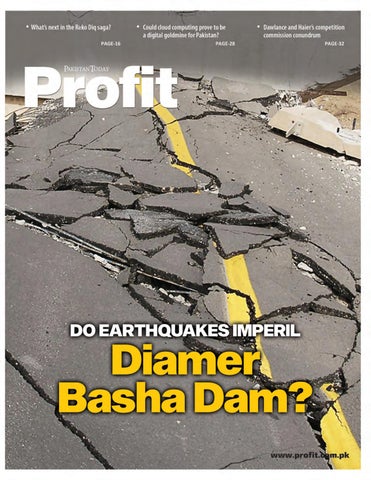
18 18 Do earthquakes imperil the Diamer Basha Dam? 24 The vulnerability of the dairy supply chain Ammar H Khan 26 Recovering exports Uzair Younas
16
28
28 28 Could cloud computing prove to be a digital goldmine for Pakistan? 32 Dawlance and Haier’s competition commission conundrum
Profit
34 Govt looks to food in continued relief plan
Publishing Editor: Babar Nizami l Editor: Khurram Husain lJoint Editor: Yousaf Nizami l Assistant Editor: Abdullah Niazi Reporters: Ariba Shahid l Babar Khan Javed l Taimoor Hassan l Meiryum Ali l Shahab Omer Chief of Staff & Product Manager: Muhammad Faran Bukhari Regional Heads of Marketing: Muddasir Alam (Khi) l Zulfiqar Butt (Lhr) l Malik Israr (Isl) Layout: Ahmad Salahuddin l Photographers: Zubair Mehfooz & Imran Gillani l Business, Economic & Financial news by 'Pakistan Today' Contact: profit@pakistantoday.com.pk
Editorial Dragging it out The prolonged uncertainty that has engulfed the country since the opposition’s move to table a no-confidence resolution against the Prime Minister needs to end. For the moment, however, it seems matters are going in the opposite direction. On Friday the Speaker adjourned the proceedings of the house before the opposition could table the resolution, citing parliamentary tradition following the death of a member. The session has already been delayed by at least three days, with the government citing the OIC conference as the reason. Now there are indications that even on Monday, when the house meets again, grounds for another delay in tabling the resolution could be found if the government decides to bring a constitutional amendment for the creation of a South Punjab province. It is puzzling to see these delaying tactics since eventually the resolution has to be tabled. What good is it doing to buy a day or two through these tactics? Meanwhile the talks for the Seventh Review of the ongoing IMF program have hit clearly hit an impasse. These talks were supposed to have been completed weeks ago, yet all we are hearing is one announcement after another that both parties remain engaged. As a result Pakistan now set to miss the next board meeting of the Fund at which the review was to be finalized. Now it is looking like the seventh and eighth reviews will have to clubbed together somewhere around June, but even that date is hostage to the political timeline before us. The IMF is reportedly unhappy with the recent announcement of an amnesty scheme and skeptical of the plans the government has presented to finance the sweeping
petrol and diesel subsidies. Ownership concerns have dogged the IMF program ever since it was suspended in March 2020 with the onset of the pandemic. The sixth review saw a difficult completion, with prolonged postponements, and now the same story is repeating itself with the seventh review. With the political and economic timelines so heavily entangled with each other, a resolution is nowhere in sight. This is why it is imperative that the vote of no confidence should not be allowed to fester. The government does itself no favours by prolonging the wait and employing delaying tactics. The vote itself is inevitable, and no matter how much noise is made around it outside parliament, within the house it is the numbers that will decide the outcome, nothing else. If time is needed to get the numbers on its side, the government should make this clear. But it is hard to see how they are using the time gained from these delaying tactics to buttress their strength in the house. The Prime Minister himself seems more busy addressing public rallies and running with a narrative that sounds increasingly like he is preparing to play his role in the opposition in the near future. The uncertainty needs to lift because Pakistan’s foreign exchange reserves are plummeting rapidly since August. The economy needs to find its rails very soon as we will be back to square one, facing a potential balance of payments crisis like in 2018. For the sake of the country that he is the Prime Minister of, Imran Khan should do the needful and face the no confidence vote earlier rather than later.
7
Readers Say Economic, social and political empowerment of women is necessary to achieve at least two following objectives: 1. To bring economic prosperity in the country like they did in Bangladesh by employing more women in the workforce. 2. To reduce population growth by entrusting women to make decisions on family matters. 3. To lessen religious radicalisation and extremism. Apropos:The ‘bold’ economic demands of the Aurat March Mumtaz Hassan, Website
Amreli Steels story
Amidst all the changes happening within the sector, the question arises whether microfinance banks are commercially viable for the investors or are there other strategic motives for operating in the market? Apropos: Pakistan’s microfinance industry: A change brewing within? Zee, Website
Quick Commerce (q-commerce) is “hot”. Having worked in the field as part of Munchies for quite a while now, I like to think I know a thing or two about it. While there is such a thing as being too close to comment, the purpose of this piece is to present my observations with as little bias as I possibly can. While I realise some of this might be attributed to “sour grapes” – I will let the reader be the judge of that. Apropos: What’s going wrong in q-commerce and what we can do about it Zee, Website
This is a very lopsided analysis. You have given all the space to Losers and made only a passing reference to the best microfinance banks in the country. I think a detailed analysis of the most profitable banks, Khushhali, HBL microfinance, and U bank, would have been more instructive. As presented, it appears more like sponsored content. Apropos:Pakistan’s microfinance industry: A change brewing within? Imran Shah, Website Taimoor, it's a very good startup, Pakistan is growing up, and will have more Insha Allah in Future. Apropos:What’s ahead for Pakistan’s startups? Abid Ali, Website
facebook.com/Profitpk twitter.com/Profitpk linkedin.com/showcase/13251020 profit.com.pk profit@pakistantoday.com.pk
HOW TO CONTACT
8
In the technology startup space, the focus is mainly to target middle income tech savvy young customers. However, compared to India or Bangladesh, Pakistan is experiencing a shrinking middle income segment due to economic hardships. This is creating problems to the existing startups to either retain customers or increase per user revenues. For eg in-case of Careem increasing costs and reducing incomes have resulted in sharp decrease in customer base. For salaried class individuals taking a ride via Careem has been very expensive. This will be the case with other startups as well, especially in the B2C space. Apropos: What’s ahead for Pakistan’s startups? Faisal Mali Website I sense a fall coming round the corner. Apropos:Growing stronger – the Amreli Steels story Imran CON, Website i think amreli steels are best these are incredible keep it up lovely Apropos: Growing stronger – the
Zee Raja, Website
It would be nice to keep updating this timeline Apropos:No-confidence – how we got here, what are the technicalities, and what will happen next Asad Abdulla, Website Very informative. Best Regards Apropos: What made the startups click in Pakistan? Dr. Syed Atif Ejaz, Website
I got scammed and lost over 150000 of the 1st year premium of 250000. The agent never told me, I will loose around 100k irretrievably in first year. I filed complaint in Insurance Ombudsman but it was returned requiring too much paper work and legal procedures which isn’t fair Apropos: Beware of Bancassurance Hassan Mehmood, Website Banks make terms and conditions clear regarding Banca. Its a nightmare only for those who quit within a few years of policy. For anyone saving for 10 or more years, this opportunity is a good one. Apropos: Beware of Bancassurance Nimra, Website For the last 2 decades we’ve had democrats rule the roost. Prime Minister Khan only steered the country toward total destruction during his 4 year rule. Opposition watched silently. Apropos: The no-confidence vote inspires little confidence Nimra, Website I don’t understand what has benigned this nation. Who have put veils of ignorance over their eyes and intellect? The people of this nation don’t even realise what the game is, and who are the real participants, and the ones who do know are either too reluctant to act or speak or don’t have any interest in the betterment of the nation(why? Well, because it’s not in their interest.). Left are the people like you. And I respect you. Apropos:The no-confidence vote inspires little confidence Ali, Website
COMMENTS
IN BRIEF Honda increases car prices Honda Atlas Cars Pakistan (HACPL) has hiked prices throughout its entire product line, citing “unavoidable” conditions that “force it to pass on some of the burden to the market.” The increase is as high as Rs400,000 (nearly 15 percent).
ECC approves premium increase for Diesel imports The government permitted a three-month rise in the premium paid to Pakistani importers by spot dealers to ensure the supply of diesel throughout the harvesting season despite a turbulent overseas market.
Rupee at 181.78, new low In the interbank market, the rupee fell to Rs181.78 versus the US dollar. The local currency hit an all-time low as demand for the dollar outstripped supply in the aftermath of a widening current account deficit, soaring imports, and rising global commodities prices.
COLABS raises $3m in seed round COLABS, a Lahore-based firm that provides workspaces and a software platform for small and medium businesses, entrepreneurs, and freelancers to create and expand their businesses, has secured $3 million in a seed round.
SBP reserves dip below $15 billion on debt repayments The State Bank of Pakistan’s (SBP) foreign exchange reserves fell below $15 billion for the first time in over a year due to a large outflow of $869 million week on week, primarily due to debt repayments.
Jugnu raised $22.5 million in Series A funding
Systems Ltd reported that Jugnu, its associated company, a businessto-business e-commerce platform, has secured $22.5 million in Series A funding, the first round of funding for a new firm following seed money.
New sanctions on Russia
The US and its allies dialled up the pressure on Russia for its invasion of Ukraine , imposing new sanctions on dozens of Russian defence businesses, hundreds of members of parliament, and the country’s largest bank’s CEO.
9
The cost of cheap petrol this week in Pakistan’s business and economics twitterverse
T
here were a lot of rounds being raised in Pakistan’s startup scene in the week past, with both Jugnu and Colabs announcing their raising of millions of dollars, which kept us busy this week. However, that did not stop koondas, petrol prices, and the SBP to stay in the conversation. Ariba Shahid brings you all this and more in this week’s social media roundup.
It’s been a while since we first heard of koonda. Still waiting, boss.
Remember when people said daal is for poor people and its cheap. Turns out, we import most of it and it’s expensive worldwide.
10
If you’re an investor or obsessed with your portfolio, this is what you’re up to. Sadly no cool life.
Accessibility is a joke if your ramps look like this. Corporate Pakistan, specifically banks are not the most inclusive places for everyone
Business opportunity waits for no one. Cease it.
If the central bank of Jamaica can come up with a song on inflation and monetary policy, the sbp can come up with a song for overseas Pakistanis, the real Pakistanis.
SOCIAL MEDIA ROUNDUP
Corporate Update Oil Prices and the Missile strike at Saudi Aramco In the Aftermath of the Missile strike at the Saudi Aramco oil facility in Jeddah, Saudi Arabia, Brent crude and West Texas Intermediate (WTI) crude both witnessed a 0.5-1 percentage jump in their prices after both had dropped more than $3 earlier in the session. Brent crude rose by $1.2 or 0.7% to $119.92 a barrel on Friday (standing at around $120.65 on Saturday) while the US WTI crude was up by $1.04 , or 0.9%, to $113.34.
Jugnu Raises $22.5 million in series A funding round After the $3.2 million funding round in with Systems Limited in June, 2021, Jugnu has managed to acquire $22.5 million in its series A funding vis-a-vis’ its strategic alliance with a Middle Eastern and North African (MENA) based online B2B e-commerce leader Sary. As part of the necessary disclosure requirements, Systems Limited announced on friday - March 25th - that it’s subsidiary’s subsidiary (Jugnu) has managed to raise $22.5 million. System Limited has a 20% shareholding in Retailistan (branded by the name Salesflo), which in turn has a major shareholding in Jugnu (more than 50%).
TPL REIT Management Company gets its first funding round for PKR 18.35 billion TPL REIT Management Company (RMC), a subsidiary of TPL Properties Limited (TPLP) announced on Thursday that it had secured a sum of PKR 18.35 billion for its first TPL REIT Fund - its initial fund size.
Sui Southern Gas gets approval for its loan swap from HBL to Faysal Bank of PKR 21 billion Sui Southern Gas Company Limited (SSGCL) gets approval from the Economic Coordination Committee (ECO) to swap the remaining debt from a loan originally acquired from Habib Bank Limited (HBL) of PKR 39.8 billion for the construction of the LNG-II pipeline project, with a consortium led by Faysal Bank Limited (FBL) at a considerably lower mark-up rate, and now seeks reissuance of the Sovereign Guarantee from the finance ministry in favor of latter in order for the funds to be disbursed. In a disclosure filed with the PSX on Monday, SSGCL claimed that the swap arrangement will save the company an aggregate of PKR 730 million in interest charges over a span of four and a half years. The swap is expected to trim down the cost of debt from ‘6-month KIBOR +110 bps’ to ‘6-month KIBOR + 10 bps’
Millat Tractors restarts its operations after an tax clash with the FBR Monday - March 21, 2022, Millat Tractors announced it is resuming operations that had shut down three weeks earlier due to a protracted dispute with the FBR. That dispute is now headed towards a resolution according to some sources but the company made no mention of it in their filing with the stock exchange.
The Reko Diq project gets reconstituted Oil and Gas Development Authority (OGDC) and Pakistan Petroleum Limited (PPL) on Monday informed their shareholders that both companies would now have to pay a sum of $187.5 million each as their share of the equity in the Reko Dik project following the settlement the government reached with Barrick Gold a few days earlier.
13
First unit of the 900 MW Combined Cycle Power Plant successfully connected to the national grib On Monday, K-Electric (KEL) announced that it has successfully synchronized the first unit of the Bin Qasim Power Station 3 (BQPS-III) is a 900 Megawatts (MW) combined-cycle power plant. The plant will pump 450 MW into the national grid. The plant is dual-fired with regasified liquid natural gas (RLNG) as its primary fuel, located in Malir district of Port Qasim, Karachi. K-Electric invested an estimated sum of $650m for the power plant development. It has been designed for a life of 30 years and will address the supply-demand gap, which was created by the decommissioning of two BQPS-I existing heavy furnace oil (HFO) units.
A renowned Industrialist, Mr. Raza Kulli Khan passes away at 85 Raza Kuli Khan Khattak, a businessperson who has been the head of several renowned and diverse companies holding the position of Chairman at various listed corporations including Universal Insurance Company Limited Pakistan, Ghandhara Nissan Limited, Bibojee Group of Companies, Habibullah Group, Ghandhara Industries Limited, Ghandhara DF (Pvt) Limited and having served as the Chief Executive Officer & Executive Director at Babri Cotton Mills Limited 19th March, 2022, whereby the news was filed by a plethora of companies on the PSX on Monday – March 21, 2022.
Lucky Electric Power Company Inaugurates a 660 MegaWatt Coal Fired Power Plant On March 21, 2022 Lucky Cement announced the commencement of commercial operations of its 660 MW supercritical coal-based power plant in Deh Ghangiaro, Bin Qasim, Karachi. The plant’s estimated cost is USD 885 million financed from local and foreign financial institutions with 75% debt financing and 25% equity.
Flying Cement granted Limestone mining lease for 714 hectares of land in Pubjab On Tuesday - March 22, 2022, Flying Cement Company Limited announced that it had been granted a long term mining lease by the Directorate General of Mines & Minerals (Punjab) for Limestone over an additional area of 1,765 acres of land situated near to factory site, Dhok Meharwal in District Khushab, Punjab. The filing stated “The Company would be able to implement its business growth plan by further expanding its operation in near future which will result in better profitability and add significant value to the shareholders’ equity“
Nimir Industrial Chemicals completes its expansion project for its Soap Noodle Plant Nimir Industrial Chemicals Limited (NICL), a subsidiary of Nimir Group of Companies, announced on Wednesday that it has successfully inaugurated the expansion of its Soap Noodle Plant taking its production from 105,000 Metric tons to 120,000 Metric tons per year. The board had approved the expansion project on February 4, 2021, alongside the BMR and technology upgradation for the fatty acid plants, for which - The total cost was quoted at PKR 600 million. Besides the expansion project, the company also managed to get a PKR 1 billion chlorinated paraffin wax plant approved, which will include a chlorine liquefaction plant and is currently under process.
14
What’s next in the Reko Diq saga? While the government may have struck a deal, there is a long road ahead
By Asadullah Kamran
T
he new deal between the Federal and provincial governments and Barrick Gold is being framed as a potential game changer for the economy. The Federal Government, the Balochistan Government, GHPL (Government Holdings Pakistan Limited), and Barrick Gold Corporation have signed a non-binding framework agreement with Oil & Gas Development Company Limited (OGDCL) and Pakistan Petroleum Limited (PPL) to facilitate the implementation of a joint mining project at Reko Diq mine. The Federal and provincial governments of Balochistan, as well as Barrick Gold Corporation, have struck a deal worth $10 billion. According to the deal, Barrick Gold will own 50% of the project, with the remaining 50% shared equally between the Federal and Balochistan governments. The Federal Government’s interest will be split among three state-owned companies: OGDC, PPL, and GHPL, each of which will control 8.33 percent of the project. In addition, free equity will account for 10% of the total 25% interest of the Balochistan Government in the mine. Apart from this, the $900 million penalty to settle the current dispute would be shared between the GoP (62.5 percent) and the Balochistan Mineral Exploration Company (BMEC), with state-owned firms making equal contributions on behalf of the government amounting to $187.5 million each. The accord must, however, be approved by the Supreme Court and Parliament.
What it means for Pakistan
F
rom 2026 to 2027, the project could add an estimated $3-4 billion to the country’s overall exports, promoting export diversification and helping to stabilise the Pak Rupee against external pressures according to a report published by Arif
16
Habib Limited. Apart from the overall exports from the mine, a huge investment such as this one provides an excellent opportunity for local businesses to gain from. During the EPC [Engineering, Procurement & Construction] phase, along with the civil works of the project, construction and related demand will increase, and a housing colony will have to be built to serve the workers once the project is operational. As a result, the cement industry, steel sector players, automotive sector, and other linked businesses may benefit. Another critical aspect of the project no one should lose sight of is the fact that the local population and the province of Balochistan must be prioritised in economic and social uplift.The increase in jobs, income, and community financing that mining firms provide to local towns and regions is one of the most significant and positive effects of mining. These are more widespread outside of metropolitan areas, where locals are looking for opportunities, which mining may provide. Given the fact that Chaghai is one of the most impoverished districts of Pakistan a project such as this would provide much needed relief to the local community. It must be highlighted that this is not the first project worth billions in Chaghai and the community weren’t the primary benefactors of that project [Saindak].
The numbers
U
sing the figures provided by Arif Habib Limited report “Revival of Reko Diq Project”, the scope and earnings this project would generate are massive to say the least and rightfully subtitled “The Home Run”. The project is divided into two phases, with a total projected capex cost of $7 billion, with the first phase requiring $4 billion and the second phase requiring $3 billion. In addition, the project’s total entry amount is $2.2 billion, bringing the entire project size to $9-10 billion. Annual copper output is predicted to
be between 650 and 700 million pounds per annum for the first ten years, increasing to 800 to 850 million pounds per annum when phase 2 is completed. Furthermore, gold production is estimated to be 300,000 to 350,000 ounces on yearly basis for the first ten years (first phase) before increasing to 450,000 to 500,000 oz. following the planned expansion. To estimate the overall value of the project we’ll assume constant pricing for both gold and copper, taking the average price of the commodities over the period of the last ten years. If we were to only look at the first phase of the project, keeping in mind the numbers above, it would generate an estimated $ 14 billion for the government in only the first 10 years of its operation. The significant portion of the revenue would be dominated by the sale of Copper and would account for 83.25% or $11.67 billion of the revenue in the first phase, whereas Gold would account for the remaining 16.75% or $2.35 billion. Likewise with the expansion envisioned for the second phase the output of the mine would increase, and with it the revenues generated would also rise. An accumulative revenue amount of $62 billion is expected to be generated over the course of the second phase that has a stipulated time period of 35 years. In terms of the revenue mix, Copper again would account for the bulk of the revenue in this case 80.6% or $49.9 billion. Whereas the mining of Gold would amount to 19.4% or $12 billion of the total revenue expected to be generated in the second phase. To sum it all up the Government of Pakistan would be able to generate an average of $1.4 billion annually over the course of the first phase and an additional $1.7 billion over the next 35 years during the second phase of the project. This would amount to a whopping $76 billion over the next 45-50 years. To put that into some perspective, that is equivalent to 623 million barrels of oil standing at today’s[March 24] oil price (122$/barrel). Although these estimates and calcula-
tions provide a simplistic understanding of the monetary returns expected to be generated by Reko Diq, these are still estimates nonetheless. The considerations taken to keep the number crunching consistent do not account for the variable price of copper and gold in the international market as well as other direct and indirect factors.
The logistics
T
his isn’t the only issue the project would have to counter. Another critical aspect to consider is the remoteness of the project site, and consequently the logistics required to make this a feasible project have to be further developed. Taking the example of the Saindak silver mine located in Chaghai, the silver ore extracted from the mine has to be transported 1,127 km from the site to the port in Karachi by trucks. That is absolutely ridiculous, as the costs associated with using trucks would have an adverse effect on the bottom line and overall feasibility of the project. If a similar plan is on the table for Reko Diq, the margins of Barrick and the Government would significantly diminish for several reasons. The time and cost of fuel associated with traversing such a long distance are huge, additionally the conditions of the road infrastructure further compound costs and increase potential losses from accidents. Alternatively there are two other options of transporting the extracted materials to the port, each with its unique pros and cons. One approach would be to adopt the traditional method of using trains, this would greatly reduce the costs taking advantage of economies of scale. This would bring Pakistan Railways into the picture, and we all know the “expertise” and “capabilities” of the state entity. On the other hand a slurry pipeline would have to be built to the port of Gwadar, which would require a huge amount of time, effort and money to build and operate. The pipeline would essentially pump the “slurry”, a mixture of water and the ore over long distances in a relatively short and more cost effective way. However the costs of capital, building, operating and maintaining such a huge pipeline would have to cover anywhere between 8001000 kilometres from Reko Diq to the Gwadar port.
The water issue
W
ater was highlighted as the project’s “most critical” issue in the Risk Assessment Report pertaining to Reko Diq published by Behre Dolbear in October 2007, and Pakistan underlined it during the ICSID hearings whilst examining the feasibility of
ensuring water supply. Water is most commonly used in mining to process ore and to water mine roads to reduce dust. Aquifers, surface water, collected precipitation, and even water from the mine itself, provided the mine is actively dewatered, are all possible sources of water for mining. Naturally due to the remoteness of the site location, developing infrastructure and building a sustainable water source for the next 45 years for the mining operations is a monumental challenge. Although based on the feasibility studies previously done by Tethyan Copper Company, a thorough plan had been made to extract groundwater along with maintaining the option of pumping seawater from the cost to appropriately satisfy the water requirements over the life of the mine. The question of whether or not that plan is used or not is still to be answered. In order to maximise the value of the produce, the government has also hinted at the possibility of establishing a smelter. Although this is an extremely ambitious approach, the practicality and capabilities of the state should be factored in. Whether or not the smelting plant would affect the existing plan of utilising groundwater is another question. To extract metal from its ore, a smelter uses heating and melting. In the global market, the refined product would naturally have a greater value. A smelter, on the other hand, necessitates large capital investments in the billions of dollars, not to mention the fact that it would take another 2-5 years to construct and is a water-intensive operation. Reko Diq lies in a relatively dry region of the nation which adds to the costs. As if this wasn’t enough, the groundwater on site is believed to be saltish and unsuitable for drinking or for the smelting process since it requires fresh water. To counteract that a desalination plant would have to be established which again would require a high upfront capital investment. The cost is determined by a number of factors, including the source water, location, treatment procedure, and plant size. Because
brackish water is often cleaner and contains less total dissolved salts, installing a brackish water desalination plant is usually less expensive than building a saltwater desalination plant. Desalinated brackish water can cost somewhere between $1.25 and $2.60 per 1,000 gallons, whereas desalinated saltwater can cost anywhere between $3.60 and $5.80 per 1,000 gallons.
Conclusion
K
eeping in mind the current political turmoil in the country, consistency in terms of policy and going through with the agreement is still a questionable predicament. Apart from that the government would need to muster up an approximately significant amount of money to first initiate the project. Historically as Pakistanis all of us have been witness to unsuppressed corruption, inefficiencies as well as plain and simple stupidity on part of the decision makers and various government entities. The country has a chequered past of poorly executed projects and pitiful government oversight next to little or no support to investors. To compound all this, bureaucrats and politicians in positions of power never fail to get their kickbacks from projects like these. If we were to look at the recent past, the government’s ambitious attempt to develop two new LNG terminals with private partners was essentially left dead in the water. Long story short the private companies were left out to dry by various government entities and organisations that failed to cooperate with these private partners. Hypothetically even if they did cooperate, the decision makers at the top hadn’t even drawn up plans to develop new infrastructure to carry that LNG. Although as of now the Reko Diq case is in the limelight for the whole nation, it won’t always be like this and when the dust settles the vultures circling above will come down to claim their shares. The plight of the Pakistani people can solely be pinned on these political and bureaucratic elite. n
NATURAL RESOURCES
18
COVER STORY
By Abdullah Niazi and Ghulam Abbas
O
n the 16th of March, a 4.6 magnitude earthquake hit Skardu. This earthquake was neither the worst that the region has seen, nor the worst that seismic experts predict that the area will see given its position on the Himalayan Tectonic Interface belt. While the earthquake was not devastating in the way that the 7.6 magnitude earthquake in Kashmir in 2005 was, which resulted in the deaths of nearly 90,000 people, it has exposed and put up for scrutiny a ticking infrastructural timebomb that exists in the region. For weeks after the earthquake, the Gilgit-Skardu road remained blocked due to continuous landsliding. Because the Janglot-Skardu highway is the only connecting tributary to the region fit for commercial use, its blockage resulted in stranded travellers, a shortage in fuel that resulted in soaring prices, and a commodities crisis in Skardu. Skardu remained closed for a week, reopening to limited passenger traffic Friday night (March 25). The earthquake affected 6,000 households, damaged 36 irrigation channels; eight link roads and 12 water supply channels besides disrupting cellular connectivity. And this is only the tip of the iceberg. For well over a decade now, particularly since after the Kashmir earthquake of 2005, there has been growing concern about the hazards seismic activity presents to structures, especially infrastructure, in the region. And it isn’t just roads that we’re talking about. In the five years since 2017, the US Geological Survey (USGS) has recorded 526 seismic events in the region that registered at 4.0 or above on the Richter scale. That’s more than 100 events every year! The Diamer-Bhasha dam has long been portrayed as a saviour project for Pakistan’s water and energy woes. The belief that the dam will solve the country’s electricity shortfall has turned into a political point, and vain efforts like the Diamer-Bhasha dam fund fueling the wild fantasies of what such a project would do. But as has been pointed out before in a special report by seismological experts in Dawn, “the primary planning and design issues for the Diamer Basha Dam project are structural safety and sustainability.” “Why is Pakistan off to make the world’s tallest Roller Compacted Concrete (RCC) dam – an unmoving, inflexible, rigid structure of mammoth proportions – in one of the region’s most active earthquake
20
EARTHQUAKES A tectonic plate (also called lithospheric plate) is a massive, irregularly shaped slab of solid rock, generally composed of both continental and oceanic lithosphere. The earth is composed of many layers. The system of ideas behind plate tectonics theory suggests that Earth’s outer shell (lithosphere) is divided into several plates that glide over the Earth’s rocky inner layer above the soft core (mantle). Earthquakes arise because of the boundaries between these plates. Essentially, as the plates move underneath the surface of the earth, they often collide with each other subducting, spreading, slipping, or colliding in the process. As the plates grind together, they get stuck and pressure builds up. Finally, the pressure between the plates is so great that they break loose. Depending on how much pressure has built up, the ground may tremble slightly or shake forcefully. In prehistoric times, it was the massive collision of these plates that resulted in the emergence of mountain ranges like the Himalayas. Experts who have been studying the Himalayan Tectonic Interface belt for decades are predicting future earthquakes of magnitudes up to M=8.7 in the region, resulting in estimates of over a million casualties. Earthquakes involve two kinds of ground shaking that have to be taken into consideration when designing structures in hazardous zones. There is vertical acceleration, the speed with which the ground is expected to rise and fall in a possible earthquake, and horizontal acceleration, which is the speed with which the ground is expected to shake from side to side in an earthquake. zones?” asked Suleman Najib Khan, a consultant engineer with the Water Resources Council, in an article published in The News in May of 2020. In the same article he says the dam was originally supposed to be a flexible structure, “one that could withstand the enormous seismic activity of the unpredictable Karakorums” back in 1984 when it was first proposed. But in 2004, when the regime of General Pervez Musharraf changed its design to a rigid RCC structure, “ with its height hazardously raised by almost 300 ft.” This decision left the original proposers of the dam perplexed. “[N]o RCC dam has ever been built of even comparable height in such unforgiving conditions” Khan wrote. “In the event that the dam bursts at its proposed height of 908 ft during a routine seismic movement, eight million acre feet of water, with the destructive power of a hydrogen bomb, will wipe out everything on the Indus all the way down to Sukkur.” He quotes from a letter written by General Ghulam Safdar Butt, the original proposer of the dam in 1984, to General Musharraf urging a rethink of the decision. “I shudder at the thought of earthquake effects on Bhasha. Dam-burst would wipe out Tarbela and all barrages on Indus; which would take us back to the stone-age” that letter said. In the wake of the recent earthquake and the infrastructural havoc that it has wrought, Profit looks at what happened in Skardu, what changes are needed to address the constantly looming issue, and how the Diamer-Bhasha dam fits into the equation.
What happened last week?
W
hat happened is not particularly out of the ordinary. The last earthquake to hit the region was only a few months ago, hitting Skardu in December 2021 with a magnitude of 5.3 on the Richter scale. Back then, a report of the Geological Survey of Pakistan had warned that more such earthquakes were on their way. According to the report, the fault lines in the area of Nanga Parbat-Haramosh had been gaining strain due to tectonic shifts, and that “the entire zone should be considered an active seismological fault zone with the potential for future earthquakes.” This is the first thing with earthquakes - while they can be disastrous, terrifying, and deadly measures can be taken to mitigate the disaster. The earthquake that took place just last week had clearly been on the radar of agencies, yet despite the report making detailed suggestions as to what should be done with the Jaglot-Skardu highway to avoid trouble, not much was done in this regard. The earthquake was a small one right now. However, following the week-long closure of the only connecting road between Baltistan region with the rest of the country, over 300 tourists remained stranded in the area, facing added difficulties in movement because of the fuel shortages. The frequent earthquake and aftershocks has made this road uncertain and risky to travel on despite the fact that Frontier Works Organization (FWO) has recently completed the widening
Earthquake activity (Gray/Yellow/White dots) from March 2017 to March 2022 (5 years) in the general region of the Diamer Basha Dam project site of the road (167 km) at a cost of over Rs 34 billion. As the earlier mentioned piece in Dawn points out, while Pakistan managed to update its building code following the Kashmir earthquake, the main challenge is to effectively enforce these guidelines and codes, which can generally be done easily for new buildings and structures. The Jaglot-Skardu road has only recently been inaugurated, and is the victim of the quality of work done by contractors, which is often an even greater concern.
Why is the threat rising?
T
he recent chaos shows that the potential for disaster just on infrastructural issues is dangerously high. The main issues at hand are shoddily built buildings and a large population. In olden times, earthquakes were terrifying but not particularly deadly. They mostly hit mountainous areas with very small and scattered populations, leading to a lot of fear but very few deaths. However, as more people have moved into these regions as they have developed, and as their population grows naturally, with every earthquake the risk for the loss of human life and capital also grows. While some of the population in the high-risk areas needs to be straight-up relocated, in other areas there must be a concen-
trated effort to build infrastructure that can withstand such natural calamity. The existence of old buildings and infrastructure directly on fault lines not built to withstand earthquakes of the magnitude that hit this region. According to leading seismologists, the identification, evaluation and upgrading of seismically deficient existing structures will be a long-term process, requiring not only significant investment, but first requiring an increase in public awareness about the danger of occupying deficient structures which may not have been designed to safely resist earthquakes, or which were designed with methods that are outdated today. Then there is also the increased risk caused by rapid urbanisation on top of this. According to a study published in the International Journal of Disaster Risk Sciences, that more than two thirds of population growth (or 70% of total population in 2015) and nearly three quarters of earthquake-related deaths (or 307,918 deaths) in global earthquake-prone areas occurred in developing countries with an urbanisation ratio (percentage of urban population to total population) between 20 and 60%. Holding other factors constant, population size was significantly and positively associated with earthquake fatalities, while the area of urban land was negatively related. The results suggest that fatalities increase for areas where the urbanisation ratio is low,
but after a ratio between 40 and 50% occurs, earthquake fatalities decline. This finding suggests that the resistance of building and infrastructure is greater in countries with higher urbanisation ratios and highlights the need for further investigation.To put that into context, Pakistan has an urbanisation ratio of over 37% - which puts it in the dangerous spot of having a large enough population for earthquakes to be incredibly deadly but does not have enough urbanisation that has resulted in the country becoming infrastructurally developed. The issue has been identified for a while. In an article in 1999 for ‘nature’ magazine, Roger Billham from the Department of Earth Sciences, University of Oxford argued that the reconstruction costs following an urban earthquake have risen to levels that represent an economic burden not only on local economies, but also on the global economy, making the incorporation of earthquake resistance economically attractive. “The absence of earthquake resistant construction in future cities would be indefensible. But the issue may remain a low priority in many developing nations,” he wrote. On top of this, the construction of major public works and infrastructure projects, such as power plants and large storage schemes for hydropower generation, flood control, water supply and irrigation. It is important that these essential projects do not lead to an undue increase in seismic risk.
COVER STORY
The Diamer-Bhasha dam equation
T
his is where the Diamer-bhasha dam comes into the picture. Much has been made of the dam and its promise. However, the ambitious nature of the plans for the dam means that the risks of it being damaged by seismological activity also mean the fallout will be worse. “The recent earthquakes in the Diamer-Bhasha region serve to remind us of the high seismic hazard that exists at the site of this unprecedented dam complex,” says Saif Hussain, a Pakistani-American structural/earthquake engineer who is one of the authors of the Dawn article quoted earlier. “Projects like this result in very high seismic risk exposure which must be accounted for in its design and construction, and subjected to independent third party peer review.” In his report, Hussain points out that “a particularly important category of projects exposed to high seismic hazard are the large dams, as these must be built where water is available and can be stored economically. In the case of other types of projects, such as thermal or even nuclear power plants, sites can be selected where the local conditions are much more favourable than at dam sites.” And the Diamer-Bhasha Dam would be no small feat. It is slated to be one of the tallest dams in the world, made completely of Roller Compacted Concrete with one of the highest gravity potentials in the world. There are many technical aspects as to this project. For starters, just the act of transporting materials to the area where the dam is to be built will be a Herculean undertaking unto itself. With earthquakes and landslides and unreliable roads, it may take forever to get the necessary materials up there. Add to that flood discharge during the monsoon season and the difficult geological and topographic site conditions and you have one difficult nut to crack. On top of all of this, it is imperative that any such project be undertaken with the utmost attention paid to making it earthquake resistant. Because of the scale of the project, any damage caused by an earthquake would be economically disastrous - and that would be the worst case scenario. A dam would mean a sub-urban population would spring around it, which would then be very much at risk because of seismological activity. Building the dam demands the utilisation of top-quality construction materials, especially concrete, and high-quality construction works. It also requires complete attention from the government, which cannot risk putting this in the hands of inexperienced contractors - even if they do not cut corners, they will be at a higher risk of making human errors. In addition to this, the authorities will also find themselves
22
“obligated to ensure the highest level of care, competence and diligence during the feasibility, planning and design phases of such a project.”
What has been done as of now?
S
ome progress has been made on the project, and in the past, WAPDA has answered questions regarding the risk mitigation measures they are taking. WAPDA has arrived at fixed values by measuring the level of shaking that was observed at the dam site during the October 2005 earthquake in Kashmir. This is the first misstep, particularly because the 2005 earthquake occurred hundreds of miles away from the dam site. The risk mitigation measures must not be taken for earthquakes taking place hundreds of miles away, but must be designed for the possibility of an earthquake closer to the actual site of the dam. Especially since there is actually very little that we know about the area and the fault lines therein. The report of the Geological Survey of Pakistan quoted in the beginning mentions that “The exact nature of the movement along the fault is still unknown due to lack of sufficient GNSS (Global Navigation Satellite Systems) and earthquake focal mechanism data.” In its recommendations, the report says that the authorities are “bonded” in carrying out their research and making detailed recommendations because of the lack of data - they do not even know the exact number of faults because there are not enough GNSSs in the area. The report demands that there be “a dense network of GNSS stations that can delineate the neo-tectonics and structure of the area.” Clearly there is an incredible lack of data and understanding of the tectonic mapping of this area. The good thing about modern science is that we can accurately predict and hence plan for the chaos that events like earthquakes bring. The unfortunate part for us is that the data we have on this is incomplete and all of these estimates are generally taking half-hearted
stabs at figuring out what the ranges for these mitigation values should be. This lack of data and understanding also shows in the ranges that WAPDA ended up specifying (which they derived using data from the 2005 earthquake). WAPDA claims that they installed two strong motion accelerographs at the dam site since 2002, and after August 2007, they have 10 additional micro seismic stations within a 50km-diameter of the dam site to also measure the small, almost imperceptible earthquakes that occur in that region with some regularity. According to their comments from 2018, the range they have factored is 0.146g as the operating basis for an earthquake, and 0.247g as the maximum design earthquake that the structure will be designed to withstand. In horizontal shaking, the operating earthquake assumption used in the structure’s design is 0.22g and the maximum design earthquake parameter is 0.37g. The range Wapda is using is taken from the Pakistan Building Code of 2007. The problem is that this range was designed for small houses, not large infrastructure projects. In fact, the housing code specifically says that its tolerance ranges are not applicable to dams as well as a host of other structures that are larger than small houses, including power stations and transmission lines, military installations, tunnels and pipelines and more. In fact, the code specifically says that its provisions are for “buildings and building-like structures” only. Over here, we have a clear case of science warning us of the dangers that certain actions will cause, and providing us with very clear and specific instructions as to what is to be done about it. Again, this is not to say that the dam cannot be built or will definitely be a disaster. However, the population increasing in the region means the risk from earthquakes is much higher. The Jaglot-Skardu road could not withstand the recent earthquake. How sure are we that the mega dam being built in that region will fare any better? n
COVER TEXTILES STORY
OPINION
Ammar H. Khan
The vulnerability of the dairy supply chain
its viral outbreak has been documented in many jurisdictions. Availability and timely vaccination of biological assets can ensure that such an outbreak can be avoided. However, a lack of focus on vaccination, and unavailability of disease-free zones keeps the country’s livestock exposed to disease outbreaks. Despite being one of the largest dairy producing countries in the world, we barely have any exports of our product, largely due to any focus on value addition, and inability to ensure disease free livestock. Similarly, export of meat is also largely restricted to the GCC region, as our produce does not meet disease free, and vaccination requirements of other major meat buyers in the world. A lack of focus on ensuring availability of disease-free animals restricts the ability to export in the global market, while continuing to serve the local ver the last two weeks, the price of fresh milk in market at prices which are often higher than global. Karachi has reduced by half as demand for the same Milk is a perishable commodity, in absence of any appropricollapsed due to emergence of Lumpy Skin Disease ate storage facilities, and a fairly small value-added dairy sector, (LSD) in cows, as consumers reduced, or eliminated demand destruction eventually leads to wastage of milk, which consumption of milk due to a risk that the disease has a double whammy impact, as producers are able to sell less, may be somehow transferred to humans through milk. and that too at lower prices. The recent crisis has exposed the vulAlthough there is no evidence that any transmission can take place, nerability of the dairy and meat value chain to disease. In absence while the detection rate is also less than one percent – just the scare was of any corrective action, or a national level policy for development enough to discourage consumption, resulting in a sharp reduction in of disease-free zones, and a national vaccine rollout, such events price of milk across the city. Similarly, there has also been a significant may continue to happen on regular basis, resulting in economic drop in demand for beef, as retail and wholesale customers alike shied losses for the producers, while enhancing healthcare costs for away from consumption of beef, substituting it with other proteins. consumers. The fresh milk segment is largely informal in nature, devoid of any Given our natural endowments, Pakistan should have a base-level quality control, or biological asset monitoring. Absence of competitive advantage in everything agricultural, from produce, any quality controls leads to a scenario where quality of milk availto livestock – however, inability to maintain quality, and enable at retail level is arbitrary at best, often having adverse healthcare hance yields has restricted ability to tap the global market, which consequences. A formal market for milk has certainly developed, but requires products to meet base-level phytosanitary requirements, excessive taxation has kept its growth and potential multiplier benefits before any product can be sold. Avoiding such a crisis in furestricted. ture would require a more serious focus on vaccination, quality LSD isn’t anything new, it has been around for decades now, and controls, and emergence of disease-free zones. It will also require a rollout of track and trace solutions through which product can be traced back to the biological asset, in case there are any quality concerns. Building such an infrastructure from ground up would certainly be a challenging proposition, but that would bring our market up to standards of the global export The writer is an market. In a scenario where we are constantly struggling with generating additional dollar of exports, dairy independent and meat exports is a largely untapped area, which has a considerably higher financial and development macroeconomist and multiplier relative to other areas. energy analyst. Although national action plans come dime a dozen, but concerted effort in this area would not only safeguard the producers, but also generate precious foreign exchange reserves for the country. We can either work on fixing the vulnerabilities of the supply chain, which range from unavailability of vaccines, to lack of trackability, and enhancing exports – or we can maintain the status quo and wait for yet another disease outbreak, while forgoing potential export revenue that can be generated.
Despite being one of the largest dairy producing countries in the world, we barely have any exports of our product
O
24
COMMENT
OPINION
Uzair Younus Recovering exports
whopping 57 percent in June 2020 compared to January 2020; India’s monthly exports declined by 34 percent while Pakistan experienced a 31 percent contraction during the same period. Other economic shortcomings, This goes to show that the near-term fallout of the pandemic and lockdowns in Pakistan was significantly lower than Bangladesh and India however, have cast a shadow and is evidence that the Imran Khan government, through its public health over the Khan government’s and economic policies, was able to prevent the worst-case outcomes. By May 2020, all three countries were rolling out stimulus packages pandemic response and making concerted efforts to get the economy back on track. Exports began to recover as well, bolstered both by monetary and fiscal support as akistan’s exports have long been a weakness, with succeswell as by recovering demand in key markets, especially Europe and the sive governments over the decades talking about the need United States. for export promotion. Talk, however, has rarely translated Pakistan was the first to recover to pre-pandemic monthly export into action: the Vision 2025 that was unveiled by the levels, with the three-month moving average rising above January 2020 by PML-N government a few years ago wanted to grow the November 2020. India recovered fully by January 2021, while Bangladesh country’s exports to $150 billion by 2025. But policies implemented had to wait until September 2021 for export demand to sustainably exceed by the PML-N, key among them the disastrous decision to maintain January 2020 levels. This data again shows that the rollout of the stimulus, an overvalued exchange rate, meant that exports remained rangecoupled with a robust public health strategy of the Khan government, was bound between $20-25 billion during the previous government. able to bring about a recovery that was much sharper than the other two Recent data shows that things are turning around, a good sign in an countries in the subcontinent. otherwise bleak economic outlook. As the global economy has recovered, all three countries have been The coronavirus pandemic, a once in a century event, inflicted able to sustain growth in their export earnings. By January 2022, the threeunprecedented economic and emotional trauma around the world. month moving average for monthly exports in Pakistan was 33 percent Pakistani households and businesses were not immune to this either, higher than January 2020; India’s was second with 31 percent, while Banglawith the country experiencing negative economic growth for the desh came in last with a 27 percent increase during the same period. first time in decades. An even bigger crisis unfolded in India, where This two-year data provides sufficient evidence that Pakistan’s public a national lockdown announced on short notice stranded millions of health and economic response to the pandemic, executed during a time of migrant workers and failed to curb the spread of the pandemic across extreme uncertainty and political polarization, was able to bring about a rothe country. Bangladesh suffered tremendously as well, where the bust economic recovery. Compared to the two other peer economies in the cancellation of export orders from the garment industry and lockregion, Pakistan suffered the least in terms of export declines, and subsedowns left millions of workers without a paycheck. quently experienced the highest increase compared to pre-pandemic levels. Two years later, we now have enough data to assess the impact of not only the onset of the pandemic, but also the way in which govOther economic shortcomings, however, have cast a shadow over the ernment support, especially through monetary and fiscal stimulus, Khan government’s pandemic response: food prices in Pakistan have incontributed to the recovery. creased by almost 23 percent from January 2020 to March 2022, compared Bangladesh suffered the most at the onset of the pandemic, to just 7 percent in India during the same period. Why this has happened with the three-month moving average of exports declining by a despite a robust public health and economic response is a longer discussion for another day, but it is important to recognize that rising food prices have had a significant negative impact on millions of households across the country. The writer is Director With global energy prices rising sharply in the last few weeks, Pakistan is once again facing tremendous external of the Pakistan sector challenges. The impact of these rising prices has been exacerbated by populist policies the government has purInitiative at the sued to guard its political flanks. However, it is important to recognize and appreciate the government’s policies during Atlantic Council, a and after the pandemic, which have increased Pakistan’s export earnings and mitigated in part the impact of rising Washington D.C.energy prices in global markets. based think tank, and A lot has been written about the failures and shortcomings of the Khan government in recent weeks and months, host of the podcast and much of the criticism is fair and necessary. Export growth still has a long way to go and policies to expand PakiPakistonomy. He stan’s export base must continue. At the same time, however, it is important to applaud Khan and his team’s role in tweets @uzairyounus. ensuring that Pakistan outperforms its regional peers in terms of growing exports.
P
26
COMMENT
By Ahtasam Ahmad
T
he advent of pandemic has fast tracked the IT industry’s growth and the Cloud computing segment is no exception. The market is seeing increasing interest from local as well as foreign players yet is no way near its full potential. The government might have taken its sweet time to recognise the importance of the IT sector as a whole and Cloud computing in particular but the recently issued “Pakistan Cloud First Policy” can be seen as an acknowledgment of the urgency to act. However, to reap all the benefits offered by cloud technology, infrastructure needs to be developed at home and dependency on foreign service providers should be reduced.
Market landscape
T
he IT and ITeS sector has been labelled as the backbone of Pakistan’s future growth. The industry brought in more than $2 Billion of revenues in the last fiscal year. While as per MoiTT, Pakistani freelancers alone generated $216.788 million by exporting their services in the first
28
half of fiscal year 2021-22 from July to December 2021, an increase of 16.74 percent from the same period last year. An important component of the overall IT ecosystem is Cloud computing, as Pakistan moves towards digitising its economy, the role of cloud technology is further elevated. Currently, Pakistan’s IT industry has around 17,600 companies as stated by the MD Pakistan Software Export Board (PSEB), Osman Nasir in Pakistan cloud summit 2022. However, as per experts the current infrastructure for management of data in the country is fragmented and outdated in most cases as in-house IT departments don’t have the adequate competencies to keep up with the technological advancements. Further, this leads to lack of flexibility in data management, a major reason why many websites crash when subjected to high user traffic. Further highlighting a need to rapidly develop the cloud ecosystem is the fact that Pakistan failed to make into Association of Cloud Computing Asia’s cloud readiness index while countries like India, Indonesia and Vietnam all were present in the rankings. Currently, our country has a handful of Cloud Service Providers operating certified data centres. Namely; Cybernet’s RapidCompute, Multinet and PTCL. While recently Jazz
“There is also a need for compliance and audit standards to ensure data security - something in line with what SBP already implements for the IT systems of the financial sector” Ovais Khan, head of delivery, MENAP at Systems Limited has also established its own data centre and Huawei is gearing up to enter the market.
Market potential
T
he gap between potential demand for services of local CSPs and the supply of these services is huge. However, before exploring that aspect of the market, there is another opportunity which can put Pakistan at the centre of regional digital connectivity.
Osman Nasir, MD PSEB, during the Pakistan cloud summit 2022 discussed the “Cloud Blackout” in Eurasia region and the opportunity Pakistan has to be the connectivity hub for the said region. As evident in the graphic below, there is an absence of cloud infrastructure in the central Eurasia region and thus, there is a connectivity gap that lies between the South and the North. “The opportunity is for Pakistan to avail as we have a proof of concept and infrastructure in the form of PEACE fibre cable network that gives us a strategic position on the regional global connectivity” Osman further added. Coming back to the local market, Cloud
provides an opportunity for enterprises to save and scale by focusing on their core competencies and outsourcing the hassle of managing data to a third party. “Around 70% of the IT budget for big organisations is spent on just maintaining the infrastructure while around 30% is left for innovation. Once they shift to cloud, the tables are turned and you have a higher amount spared to invest into scaling businesses and on top of it there are value add enterprise services that CSPs can provide to further assist businesses”, Ovais Khan Head of Delivery, MENAP at Systems Limited stated while talking to Profit.
While sharing a use case for cloud in the financial services sector, Ovais added, “In the lending side of things, we are trying to automate the whole process of assessing customer creditworthiness and KYC which is a major delay factor in timely disbursement of loans. An enabled cloud system in this situation will serve as a central point for not just acquiring the data but also running analytics and other procedures.” Further, the deployment of Cloud in the public sector has a huge potential and a two sided benefit; It can fast track the E-governance framework envisioned by the government in the Digital Pakistan Policy
TECHNOLOGY
2018 as well as attract investments from CSPs given that the demand generated by the public sector will be huge. As per UNDP’s Public Procurement Capacity Development Guide, “Globally, public procurement is estimated at about 15% of the world’s GDP, but in some developing countries, it may account for as much as 70%.” The SME crowd is also a market for cloud technology that has a lot of potential given that the business case is very strong for them. Especially, export oriented service businesses like those operating in the IT sector are increasingly adopting the technology as cost efficiency is critical for them in a market where they compete on pricing to the final consumer. Yet, one of the strongest arguments of building a crowd infrastructure within the country comes from a data security point of view. In the recent past, cyber attacks directed on public as well as private organisations has resulted in loss of sensitive data. Further, the government has its concerns over data of Pakistani companies being stored in other territories. As per SECP’s draft Cloud Adoption Guidelines for Incorporated Companies /Business Entities, issued in August 2021, “All business entities, while selecting Cloud Service Providers, must ensure that selected service provider does not offer the services through their data centres located in any hostile country i.e. (India, Israel, etc.).”
30
“The opportunity is for Pakistan to avail as we have a proof of concept and infrastructure in the form of PEACE fibre cable network that gives us a strategic position on the regional global connectivity” Osman Nasir, MD PSEB Ali Naseer, Chief Business Officer Jazz, in an article for a private publication, discussed that a local cloud infrastructure provides a standardised security framework which is much more secure than what other less “Tech-Savvy” entities can develop inhouse. Ali went on to highlight the fact that a major consumer base is currently using the services of foreign CSPs like Amazon and Microsoft which results in an outflow of the revenue generated while also leads to a missed opportunity for the government in terms of taxation.
Developing a suitable ecosystem
P
olicy framework can be seen as the first step towards developing the Cloud ecosystem and the introduction of the Pakistan Cloud First Policy is a step in the right direction. However, the implementation of it is the real challenge. The MoiTT itself acknowledges the fact that it has an uphill task on its hands given that bringing all the public sector entities under a single umbrella would be difficult while the autonomy of decision making at provincial end makes it even more complicated. “In order to fast track the development and adoption of Cloud infrastructure in Pakistan, the regulatory focus should be on development of a cloud enabled workforce to support the deployment phase. There is also a need for compliance and audit standards to ensure data security - something in line with what SBP already implements for the IT systems of the financial sector.” commented Ovais Khan Head of Delivery, MENAP at Systems Limited. The technology parks spread across the country can serve as the nodes for cloud delivery. However, to bring in the initial capital, the government needs to incentivize the investors by the means of a reduced or zero import duty, exemption from income tax for a given number of years for which the process has already started with recent IT reforms approved by the PM and an uninterrupted supply of energy to data centres at an Industrial rate. At the Pakistan Cloud Summit 2022, Osman Nasir, MD PSEB, quite appropriately summed up the need for developing a cloud infrastructure by drawing a parallel to the energy crisis, he stated, “We did not invest in the power sector in time and experienced power outages. Now if we don’t invest in computer power we are on our path to computer power outages.” n
TECHNOLOGY
The two companies face fines worth Rs 100 million and Rs 1 billion for enforcing resale price maintenance arrangements By Zunairah Qureshi You probably don’t give a lot of thought to your refrigerator. In fact, as important a home appliance as it is, you probably really only think about it either when it needs repairing or when you need to buy a new one. Of course, to the people in the refrigerator business, these cold cabinets are their bread and butter - which means they’re worth fighting for. That is why, earlier this month, the Competition Commission of Pakistan (CCP) fined home appliance giants Dawlance and Haeir with fines of Rs 100 million and Rs 1 billion respectively for fixing resale prices of certain products. In 2017, during a market survey of electronic appliance dealers by the commission, circulars issued by Dawlance (also referred to as DEL) and Haeir mandating price controls were procured. This led to an investigation of the companies’ alleged price-fixing practices. On 14th March, 2022 the CCP passed an order against the companies, announcing aforementioned penalties for entering into resale price maintenance (RPM) arrangements which are considered ‘anti-competitive practice’. So, how did two notable and renowned home appliance brands conduct anti-competitive activities and why did they even have to?It appears that they were doing nothing out of the ordinary – well at least partially. Some of their practices like providing dealers with price listings and fining resellers for setting prices below a minimum fixed price are
32
shared by all companies in the market. This is in spite of Section 4(2)(a) of the Competition Act, 2010, under which imposing minimum/maximum price restrictions are considered anti-competitive and void. However, Dawlance and Haeir went a step further by placing restrictions on product discounts, bundle deals, as well as reward or giveaway schemes and were also involved in price-fixing of home-installation labour charges. And while doing all this, they got caught.
But what is so anticompetitive about price-fixing anyway?
A
hawker’s market has a number of vendors displaying piled-high mountains of shiny red tomatoes. They would all be selling tomatoes for the same price. Because obviously, if any one vendor decides to increase the price of tomatoes, no one would buy from him. On the other hand, if any one vendor were to reduce the price, everyone will choose to buy tomatoes from him, thus prompting other vendors to also lower their price. This will readjust the price of tomatoes to once again, a value that is the same across the entire market. This is called a market price in a competitive market. A competitive market is one where any seller can enter with ease and have a fair and equal chance of trading its goods, which in this case would be a new tomato vendor.
The home appliance market is of course different from a hawker’s market in many ways. But in principle, if any company attempts to fix prices against the market trend, this will disrupt the market’s competitiveness. Dawlance and Haier were penalised for resale price maintenance, which is the fixing of selling prices for authorised dealers and resellers. They were specifically accused of attempting to fix prices of split air conditioning units and refrigerators. The CCP report explains ‘through its Price Control Policy (they) had imposed a restrictive trading condition barring its dealers from selling refrigerators and split ACs below a certain price. Dawlance was accused of enforcing RPM by restricting ‘bad mouthing or comparing DEL products with other brands and selling refrigerators and split ACs at fixed price even with package deals.’ These conditions were part of the clauses that were mentioned within its price control policy circulars. Moreover, dealers were not allowed to include in any gift items with customer purchases other than the ones authorised by the company. Repercussions for dealers who failed to adhere to these clauses include fines or suspension of dealerships. Haeir was found participating in similar practices as they restricted dealers from giving quotations below the fixed price or even quoting the fixed price and asking the customer to check the potential market. According to the CCP such practices infringe upon the customer’s right to bargain which
inhibits market competition.
To an extent, RPM is a common practice
P
rofit approached home appliance resellers to understand how exactly are selling prices for products determined. The manager at one such reseller store told us, ‘Our head office sets the price according to the competitive market pricing but keeping in mind the companies’ pricing lists.’ He pointed towards the supermarket in front of his store, ‘They are our direct competitor. If our product prices are higher than theirs. Customers will just buy from them.’ Essentially, as per the law in the Competition Act, 2010, the resellers should be the ones who figure out and determine the suitable selling price according to the market price for products. However, it appeared that the reseller was not aware of any such law and believed it was only normal practice that companies provide them with a floor price for their products. He did however exclaim that, ‘They cannot question me on whether I choose to place products in a bundle deal or not and they also can’t restrict discount offers. However, if I were to sell a single unit, let’s say this blender here, for a price that is less than the company’s assigned price, then we can be fined for that.’ It’s important to note that here we are talking about a home appliance reseller store located in a mall that was part of a network of stores with a central coordinating head office. In the case of other dealers that are located in bazaars and lack a fixed-price system of their own, customers are more likely to negotiate prices. It is more challenging for such dealers to sell products at fixed company prices while at the same time, they are also more likely to be intimidated and coerced by company ‘policies’.
The cases
T
he entire investigation that included a search and inspection of each company’s headquarters and the hearing process spanned a period of around four years before the CCP passed an order against Dawlance and Haier. During the hearings, the bench consisted of CCP Chairperson, Ms. Rahat Kaunain Hassan and member, Mr. Mujtaba Ahmad Lodhi. Dawlance and Haeir faced an enquiry into alleged RPM practices that were proclaimed to be a ‘hardcore restriction and serious violation of competition law.’ Within its summary report of this particular case, CCP explains that RPM agreements are ‘by object’ anti-competitive in nature and a violation of Section 4(2)(a) of the Competition Act. It allows the exceptions in certain cases whereby any party wishing to implement RPM
“Haier Pakistan conducts its operations in strict compliance with international best practices and local laws. We firmly believe that the case against Haier must be evaluated on an economic plane while appreciating the on-ground realities with an unbiased approach in the best interest of consumers and economic conditions and the laws applicable to Pakistan” Javed Afridi, CEO of Haier Pakistan must notify such agreements/arrangements and first seek clearance from the Commission that rests upon its potentiality for efficiency in the market. It clearly states that ‘forms of RPM include imposing minimum and maximum pricing restrictions and discount restrictions.’ Moreover, that parties cannot, directly or indirectly, impose any sanction, monitor compliance and/or coerce other parties. Both parties while admitting to RPM practices provided justifications such as having to fix prices to avoid ‘free-riders’ whereby dealers may employ under-qualified staff to cut costs. According to the companies, fixing higher prices would allow dealers to invest in quality staff that could knowledgeably guide the customers. They also implored the fact that RPM is an industry-wide practice. Moreover, Dawlance argued that RPM was only implemented upon select products that required a certain level of technological innovation. Meanwhile Haeir believed RPM was intended to actually help new entrants come into the market as well as prevent downstream price competition thereby encouraging quality production and services. Among the many contestations made by each party, CCP refuted each of them. For one, it cited that even if RPM is a common practice, it does not exempt the companies from being held accountable. Moreover, it was clarified that among other consequences that can make the market anti-competitive RPM practices could lead to price hikes and preferred over-selling of the companies’ products by dealers in order to protect margins. Ultimately, on 14th March 2022, the order was passed against Dawlance and Haeir.
What’s next
T
he fines were set after consideration of a number of prominent international and national cases against RPM practices as well as the response of each company during the hearing. The CCP report states that on the con-
dition that any company that is party to RPM practices comes forward of its own accord, they can be granted leniency in legal action. This is part of the reason Dawlance was fined with a considerably smaller amount than Haier. The CCP reported that while Dawlance remained compliant and cooperative throughout the process, Haeir was putting up a more aggressive contest by delaying scheduled hearings and submission of additional information. Dawlance was fined Rs 100 million after taking into consideration the development that it had discontinued RPM practices in 2017 after it had been acquired by the Turkish multinational, Arcelik in 2016. It was also shown leniency for cooperative behaviour and agreeing to refund its dealers within the specified time. The fine imposed does not exceed 1% of its annual turnover for the years 2020 – 2021. We reached out to Dawlance for a comment but they were unable to respond. Haeir was also shown some leniency since the violation was a case of first instance and it was fined Rs 1 billion, which does not exceed 3% of its annual turnover for the years 2020 – 2021 Profit asked CEO, Haier Pakistan, Javed Afridi if he believed the charges against Haeir were justified and whether the company plans to pay the fine or file an appeal. “Haier Pakistan conducts its operations in strict compliance with international best practices and local laws. We firmly believe that the case against Haier must be evaluated on an economic plane while appreciating the on-ground realities with an unbiased approach in the best interest of consumers and economic conditions and the laws applicable to Pakistan,” he responded. While he did not say it in so many words, the next move for Haier is clearly to file Based on the response given it can be safely assumed that Haier plans to file an appeal. While the CCP hoped that the case would prove an example and discourage RPM practices across the industry. However, it remains questionable how it plans to combat such widespread practices that people in the industry do not even recognise as illegal. n
HOME APPLIANCES
Govt looks to food in continued relief plan
Edible oil is set to get 10% tax relief in light of import bill By Ariba Shahid
O
nly a few weeks after bringing down fuel prices by Rs 10 as part of an economic relief package, the federal government is now also trying to bring down the prices of edible oil by reducing taxation on it. The federal government has approved tax relief of 10 per cent on import of edible oil for April and May 2022, this was decided in a meeting held under Federal Minister for Finance and Revenue Shaukat Tarin on Friday. The finance minister was apprised that monthly average retail prices of RBD palm oil are highly volatile and have increased almost twice compared with last year. In order to deal with the expected shortfall in the month of Ramzan due to a hike in prices, the finance minister approved tax relief of 10 per cent on import of edible oil for April and May 2022. Edible oil consumption in Pakistan has increased significantly over the last few decades: from 0.7 to 4.7 million tonnes between 1981 and 2020.People no longer rely solely on ghee or butter for their cooking needs. As the nation develops, the introduction of cooking oil and it becoming mainstream has helped push remands. Other main demand drivers are rising population, dietary preferences and increase in per capita income.
Why is this important?
P
akistan’s reliance on imports for edible oil and oilseed meals to meet domestic demand consumption has been increasing over the past two decades: 86 percent of domestic edible oil consumption in 2020 came from imports up from 77 percent in 2000. As per the State Bank of Pakistan, Pakistan’s palm and soybean-related imports stood at US$ 4 billion in FY21, rising by 47 percent year-on-year, compared to compound average growth of 12.3 percent in the last 20 years. The SBP explains that the increase in edible oil imports is based on the increase in international commodity prices and also a rise in the quantity of oil imported. As per the SBP,
34
imports of palm and soybean have been growing noticeably over the last twenty years, rising to 7.1 percent of total imports in FY21 from 3.2 percent in FY01. It is important to note that palm and soybean products stand amongst the top 10 commodities imported by Pakistan, thus significant. The rise in demand can be attributed to increasing population, growing income levels, and the gradual modernization of the livestock industry, particularly poultry. However, despite this growing demand, local oilseed production has not been able to grow at the same pace. As per the SBP, the local production of edible oil has registered a negative average annual growth of 1.2 percent, while the demand per capita has increased by 2.3 percent. Unlike other agricultural products, the National Commission on Agriculture, 1988, noted that cultivation of oilseed crops in the country had stagnated in the first four decades since 1947. This means Pakistan has no other option but to import.
Do we really need to import edible oil?
A
s per the SBP, there has been little development in terms of local production of palm and soybean in Pakistan. “Various five year plans since 1955 have highlighted and proposed the need to focus on soybean and other oilseeds. However, lack of consistent policy has prevented oilseed crops, particularly soybean, from taking off,” says the report. The very fact that local production has not been taken seriously over Pakistan’s history can be noted by the fact that t initial surveys and pilots on palm began in the mid90s, palm started featuring in policy documents only after 2005. What makes this alarming is the fact
that Pakistan’s per capita edible oil consumption is already higher compared to economies with similar income levels. A prime reason identified for this over reliance on imported edible fuels is the lack of a consistently implemented oilseed policy. With no support price, efficient crop marketing, and value chain, farmers are not incentivized to grow these oil seeds. In addition, the lack of availability of optimal imports makes the yield potential of cultivation low. As a result, farmers find themselves worse off. While Pakistan can rely on sunflower and rapeseed or canola for the short to medium term considering they are already produced locally; the import bill in the form of edible oils will keep rising unless policy making is more consistent.
Is import substitutions possible?
A
s per the SBP, given Pakistan’s rising demand outlook over next 20 years, investments to increase production of sunflower, canola and cottonseed oil should not be expected to contribute significantly to the country’s needs in the long-term. The SBP states that over the long-term, there is an urgent need to invest in research, development, promotion, production and procurement mechanisms for oil palm plantation and soybean crops. n
FOOD