CONTENTS
10
16
10 The best of times and the worst of times - this week in Pakistan’s business and economics twitterverse 13 How does KarMuqabla plan to create the pull in online education?
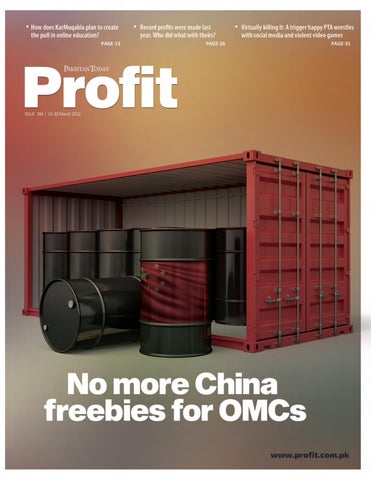
16 16 No more China freebies for OMCs 21 Pizza and perfect competition in Pakistan Ammar H Khan 23 Efficiency and the rise of the BJP in India Uzair Younis
13
31
26 26 Record profits were made last year. Who did what with theirs? 31 Virtually killing it: A trigger happy PTA wrestles with social media and violent video games
Profit
Publishing Editor: Babar Nizami l Editor: Khurram Husain lJoint Editor: Yousaf Nizami l Assistant Editor: Abdullah Niazi Reporters: Ariba Shahid l Babar Khan Javed l Taimoor Hassan l Meiryum Ali l Shahab Omer Chief of Staff & Product Manager: Muhammad Faran Bukhari Regional Heads of Marketing: Muddasir Alam (Khi) l Zulfiqar Butt (Lhr) l Malik Israr (Isl) Layout: Ahmad Salahuddin l Photographers: Zubair Mehfooz & Imran Gillani l Business, Economic & Financial news by 'Pakistan Today' Contact: profit@pakistantoday.com.pk
Editorial Towards crisis The country is now veering dangerously towards a combined political and economic crisis. The IMF talks have hit an impasse over the untargeted subsidies on power and fuel announced by the Prime Minister only four days before the 7th review of the ongoing facility was to begin. A pall of uncertainty has now settled over the entire program.The talks for the 7th review were scheduled to end on Friday, March 11. But that date came and went without an announcement, and next day reports emerged that the talks have hit an impasse and both sides have agreed to keep talking on Monday. And the same reports said that both sides were far from agreeing on a resolution, with the Fund refusing to continue with the subsidies and the amnesty scheme and the government refusing to withdraw these. If the talks drag on inconclusively this will become the second time the government has given commitments only to backtrack on them within weeks. The 6th review had ended almost exactly one year ago, with the government committing to withdraw the Covid stimulus and pass key legislation, only to withdraw from the commitments as soon as the funds were released by the IMF. Those talks then dragged on for more than 10 months, with the government announcing a new date for the resumption of the program every few weeks, until February when accession was finally obtained. But the commitments the government had entered into specifically said no more amnesty schemes, no more untargeted subsidies, limiting recourse to State Bank intervention for exchange rate support and aiming for a small primary balance surplus by the end of the fiscal year. Today almost all these commitments, given only weeks ago, are in doubt and the fund seems to be near the end of its patience. Another inconclusive round of talks that drags on for an extended period of time will not be taken well by the market, or by the country’s creditors. And the impact of this will inevitably land on the exchange rate, potentially fueling another round of exchange rate depreciation which in turn will fuel another round of inflation. The inflationary fire the government is trying to put out with untargeted subsidies was ignited by its zeal to kickstart growth using massive fiscal and monetary stimulus right after the Covid lockdowns were lifted. The fire was aggravat-
ed by a global price surge that followed. Today they are trying to stamp out this inflationary fire with tools that will only aggravate the problem rather than mitigate. This is a self-defeating cycle that not only goes against the commitments given by the government to the fund, but also undermines the very macroeconomic stability that it touted as its signature success in the second year of its rule. If continued, this cycle eventually carries the country towards a balance of payments crisis amidst spiraling inflation, a deadly cocktail that will require an even more tough adjustment to bring under control. What is worrying, and what gives the moment the feel of an impending crisis, is the paralysis that has set in on the political scene at the same time. An embattled and embittered Imran Khan is now increasingly bearing the look of a weak and desperate man, flailing with all his might to hold on to power. He is lashing out at his political foes in language and political moves that smack of desperation. Meanwhile he is running with a very dangerous line in telling the country that his political difficulties have been engineered by western governments to “perpetuate the country’s slavery”. These words are particularly damaging given the deep trade and economic ties Pakistan has with the countries of the western world, but coming after a period when those capitals are already deeply unhappy with Pakistan response to the Russian invasion of Ukraine, they are making a bad situation worse. In the days to come, as the opposition’s challenge in the form of the no-confidence motion draws near, his frenzied state of mind is likely to aggravate and the pressure on him to do whatever he can to hold on to his supporters will grow. In short he is in no mood or state of mind to hear anything about difficult decisions to stabilize a wavering economy, let alone take the decisions necessary to arrest the slide towards crisis. These twin developments – economic deterioration and political paralysis – can now drive the country towards a serious crisis. To avert this outcome, it would be better for the government to hasten the summoning of the assembly so that the no-confidence can be decided quicker rather than dragging the situation out. Protracted wrangling around the issue will only raise the political temperature and pave the way for the economy to deteriorate further.
7
Readers Say I don’t see the government's point of view in this? Were they contacted? An ex CEO would not know the basic function of Foodpanda – I find that hard to believe, his question may have been rhetorical! Please think of yourself as a serious publication and not write these hit pieces. Or write in bold that it is clearly an ‘opinion’ piece from the author and keep it in the opinions section not as a featured article on the main page. Apropos: Startups are brave to operate in Pakistan – because the govt really doesn’t get them Yasir Ahmed, Website Exactly 7-minutes into the discussion, the minister asks the CEO to pause and says: “Gentlemen, let’s take a step back. Can you explain what foodpanda is?” After the meeting was over, the foodpanda CEO wryly said: “The minister talked to us for 45-minutes without knowing what foodpanda was.” Good posts, keep it up. Apropos: Startups are brave to operate in Pakistan – because the govt really doesn’t get them Zee Raja, Website Seems to be a targeted campaign against startups. It is not public money or the general public's money that is being invested. So one has to ask "Aap ko takleef kia hai." First they tried to scare away the VCs. And now they are trying to send warnings to the Govt. Apropos: Startups are brave to operate in Pakistan – because the govt really doesn’t get them @motasim, Twitter I can’t tell from your profile what experience you have in running a startup in Pakistan, but as someone who has, whatever the current administration has announced, it hasn’t made a difference in addressing the difficulties in running a startup or business. The main difficulties being FBR and SECP compliance. The amount of red tape needed for a small company to operate is ridiculous, and it’s only gotten worse. (We get emails every month from the FBR that require many hours to resolve.) So no, this isn’t sensationalist journalism. Apropos: Startups are brave to operate in Pakistan – because the govt really doesn’t get them @jeremyhiggs, Twitter
facebook.com/Profitpk twitter.com/Profitpk linkedin.com/showcase/13251020 profit.com.pk profit@pakistantoday.com.pk
HOW TO CONTACT
8
The process for company incorporation has been simplified and is completely online i.e. end to end digitized. The SECP has also taken a number of significant measures to promote start-ups & business innovation & entrepreneurship, including instrumental amendments in the Companies Act, 2017 ranging from definition of start-ups; explicit permission for is-
suance of shares other than right for a consideration other than cash, by receiving immovable property, intangible assets and services and under Employees Stock Option Scheme by private companies and start-ups; exemption from filing of unaudited financial statements for private companies having insignificant paid-up capital and abolishment of company seal etc. Moreover, SECP has also launched the concept of regulatory sandbox for experimentation and product development by technology driven startups. Apropos: Startups are brave to operate in Pakistan – because the govt really doesn’t get them @SECPakistan, Twitter Writer is right to advocate targeted subsidy over blanket subsidy. In a poor country like Pakistan, where some have consumption and standard of living far superior than even the USA, Europe or Canada while most are living comparable to poor countries of Africa, blanket subsidy is unfair and the worst kind of subsidy. In Pakistan's case, targeted subsidies and help for the poor is the best solution. But Pakistanis are a confused bunch of animals. If the Govt taxes people that mostly affect the rich, many in the media start crying and politicians (one of the richest bunch of Pakistanis, by hook or by crook means) do propaganda that such tax would affect all equally. Apropos: The opportunity cost of energy subsidies Dr S Naim, Website You should do an investigation into his “MBA” from the Said Business School in Oxford University, and that he is currently “pursuing” his PHD from there. The guy’s lies never end. Apropos: How many MG cars is Chelsea Football club worth? Jamal Marwat, Website Yes this is really a good act & need of the hour. If they will entertain these young people, they will drive enough revenue to the motherland. This will provide stability, prosperity & economic growth for our people. I request everyone reading this to promote our local people. Atleast give them a try. For example if you buy something which is imported, try to search for a local service provider and give them a chance. Another example is that if you order something from any courier service & use a intl platform to track it, then give a chance to other local tracking services. For the sake of our motherland & its people. This way just put your input for the development of the country & people. Apropos: Pakistan’s IT companies, freelancers get complete tax waiver Filza Khawaja, Website
COMMENTS
IN BRIEF Fund program in jeopardy
Talks on the 7th review of the ongoing fund program could not reach an agreement as the last date passed on Friday, March 11. Reports said the talks snagged on the untargeted subsidies on power and fuel the government announced on the eve of the talks, as well as the amnesty scheme. All these violated commitments given by the government to the fund in the last review. Both parties agreed to keep talking on Monday.
$3.632 billion:
According to State Bank of Pakistan the total inflows under Roshan Digital Account (RDA) have reached $3.632 billion at the end of February 2022, 18 months since the programme was launched, according to a media report. An inflow of $250 million was recorded in February alone, compared to an inflow of $222 million in December, a month-on-month increase of over 12%.
Moody’s has said that Islamic finance sector, an integral part of Pakistan’s National Financial Inclusion Strategy (NFIS), will continue growing in 2022. The report says the government of Pakistan and the State Bank of Pakistan (SBP) target an Islamic banking market share of 25 per cent by 2023 from 17 per cent in 2020.
Upcoming federal cabinet’s economic coordination committee (ECC) may grant its approval to implement a mechanism of fortnightly reimbursement of Price Differential Claims (PDCs) of the oil marketing Companies (OMCs) and refineries in order to avert shortage of petroleum products.
State Bank of Pakistan (SBP) Governor Reza Baqir during a panel discussion at the 13th Karachi Literature Festival on Sunday said that for Pakistan the use of cryptocurrencies has a much higher risk than benefit. Another fuel crisis might be on the cards in the wake of the Hascol scam case, as the State Bank of Pakistan (SBP) finds itself scrambling to get the banks to increase the credit limits of oil marketing companies (OMCs).
Rs747.5 million:
The ECC of the cabinet Friday approved a supplementary grant of Rs747.539 million for the provision of gas to localities and villages in 5km radius of gas producing fields.
NEPRA has jacked up the power tariff by Rs5.94 per unit on account of Fuel Charges Adjustment (FCA) for the month of January 2022 and issued a notification to this effect both for consumer and commercial clients.
9
The best of times and the worst of times this week in Pakistan’s business and economics twitterverse
W
e’ve had a long boring week on the economy front, with news of the FDI and discussions on stocks, bonds, and war. And while the economy did take a back seat to the political heat up in Islamabad, we try to bring you the best of what has been happening in the past week in the twitterverse, including some very ambitious (and a little bit basic) advice on the good times and the bad from our editorial staff.
Nothing new here
Just doesn’t make sense
It happened. We knew it would. Everyone knew it was bound to happen. The government hired a spokesperson. The people of twitter made a parody account for that spokesperson. A government representative thought the parody was real. We’re living in a circus.
Back to the olden days
Stocks and bonds? Nah. Barrel of oil and wheat. That is the only true form of investment. Most of the FDI coming into Pakistan is market seeking. The work around could be to bring down the import duties.
10
Activists assemble
A bull market is fun, especially considering how great it has been for Pakistani startups. It’s so bullish and the fear of missing out is so high that investors are thankful for opportunities. One would think the startup would be thankful for investment, but no, they’re spoilt for choice. The question is whether the trend can continue. {Note from the editorial staff: In 1963, the UK Prime Minister Harold McMillan told his countrymen, “you’ve never had it so good.” Only a decade before the UK had been reeling from the aftermath of decolonization and the second world war. By the next decade, the same country would be in the midst of its ‘winter of discontent.’ It is the nature of history for good times to be followed by the bad. In the same way, this time of hype and pomp for the startups will eb to make way for tougher times. What is most important is to always remember what is to come. In the good days, be humble and remember that it will not last. In the bad, take solace in better days to come. The phenomenon has been recorded widely in works of literature from Tolstoy to the Bible. It is perhaps most beautifully put in Cervates’ seminal work, Don Quixote, in which the Knight-of-thesorry-face after losing all of his teeth and his money in a mission of folly tells his loyal squire Sancho Panza, “For neither good nor evil can last forever. And so it follows that as evil has reigned for so long, good must now be close at hand.” The beauty of this, dear reader, is that it can be taken both as cautious advice and as comfort.
A humble man
As business journalists we often have to interview folks. The first thing we do when entering someone’s office is to judge their personality based on it. However, we have to give props to Mr Afridi for wearing the same clothes as his portrait. Some people don’t even re-wear the same outfit after posting on instagram.
Pretty accurate
Downwards sticky
This is a nice perspective to look at, but prices are downwards sticky. What that means is despite fuel prices coming down, the prices of other goods and services might not.
The stock market isn’t always an accurate barometer of the economy but yeah, your economy is in shambles when you’re at war and facing sanctions. You don’t need to look at the Stock market to tell you that. Also, why would this guy drink carbonated water when normal water exists?
SOCIAL MEDIA ROUNDUP
How does
KarMuqabla
plan to create the ‘pull’ in online education?
As the race heats up in the edtech space, what are the plans of this new entrant? By Taimoor Hassan
E
ducation technology (or edtech) has not been able to create the buzz that would draw attention like startups in other sectors but edtech startups are present and they are trying to digitalise education. Now, there is another edtech startup in town and it is called KarMuqabla. Keeping up with its name, KarMuqabla wants to infuse the spirit and confidence in students to compete because that is what you will do for almost the entirety of your life. And since it starts with education, you might as well get comfortable with it and get on top of their game very early on. Competition requires skills and that is what KarMuqabla is endeavoring to equip Pakistani students with. KarMuqabla is out there with a fundamental philosophy that the traditional education institutes ‘push’ knowledge to students. A teacher teaching a class of 40 students can use interactive ways to teach but the philosophy behind that has been that the knowledge
EDUCATION
must be pushed to students who are young in age and would be required to consume that knowledge regardless of liking or disliking the subject matter pushed to them. That has been the case for a log time until the advent of technology that made it possible for third party players like edtech companies to create mechanisms whereby students are pulled towards new kinds of knowledge. “Students have fundamentally disengaged with education. There is a crisis of engagement. That is the crisis that we identified: the rest is all logistics,” says Aamer Ahmed, founder of KarMuqabla. “The pace of the crisis has something to do with the pace at which technology has been picking up in the last two decades.” “The younger generation, being very good with technology and very quick to learn how to use tech have caught up with technology in a manner that institutionally catching up to tech has remained comparatively slow. The schools were behind to catch up to technology while the students had already caught up to it. I will give you a manifestation of that.”
Creating the ‘pull’ in online education
W
hat was happening in the world, and we discovered that gaming is an industry which is now looking for education as the most rewarding area around. Games engage people. You would not have seen parents or teachers telling students ‘Go Play Games’. They still do it. They play it all the time. It is the gameplay which worries parents all the time. “If gaming has become so unavoidable in today’s day and age, why not change the game and augment it into the educational landscape. It is going to readily address the challenge of student engagement with their education and you are also doing it in a space in which there is a lot of room to choose the time and space. It can become a potential 24/7 activity, without the prompt of the teacher or the student.” That was the approach KarMuqabla took and created a platform which is fundamentally focused on using the agency of gaming to en-
13
gage or reengage students with education. The pace of investment into technology has increased post-Covid rapidly. And the concept of gaming in education has also picked up. This is something which is easier said than done in Pakistan because we do not have a well developed technology ecosystem at present overall and specifically in the education sector. Pakistan’s internet and device penetration is low and different curriculums make it difficult to impart education uniformly, unnecessarily complicating the process. The bigger and the fundamental divide between the public and the private sector education is that if someone is able to send a child to a private sector school, the child is privileged already and whoever can not send his children to private schools, such children are born with a fundamental disadvantage. There is a growing disparity in the quality of education imparted to the privileged and the underprivileged on the basis of who is able to afford it and who is not. “The challenge is not how many video lectures can you make available online, or how user friendly is your platform, or how many questions you put there through which students can give a hint how much they have learned,” says Aamer. “The problem is navigating this deeply fractured landscape. We are now focused on a platform which engages and it engages across the board. It’s not like we create a platform for ourselves which is readily available for privileged classes and for the less privileged, they would be struggling whether it is the pricing or connectivity or hardware requirements or whatever reasons.” So what has KarMuqabla done? KarMuqabla positions itself as an affordable engagement and reinforcement platform, which means that for a student, it augments learning through interactive games so that students get more engaged in the learning process. It can be done in the schools or out of schools and the access to this platform would not be limited to who can afford it, rather who wants to afford it. At schools, it gives teachers increased ability to be effective teachers but does not plan to replace them. “Nothing can replace schooling because schooling is not just about education, it is about life skills. Technology can not teach you this but schools can. But schools are so busy imparting their traditional education to measure student progress that they do not have the time to focus on life skills,” explains Aamer. “Teachers can only focus on life skills when they have fundamental insights available to bring improvements in students,” he adds. The human limitations of a teacher teaching a group of 30 or 40 students to understand each student’s psychology and getting to know about each student’s strengths and weaknesses is not possible for the teacher. This can affect the efficacy of learning at schools. This is also
14
where Kar Muqabla claims to come in. Besides being a pull-learning platform, teachers can use the platform to gain valuable insights on learning patterns of individual students through the educational games that it becomes easy for teachers to know individual strengths and weaknesses based on these insights and work on them with students. But KarMuqabla is in the very early stages of its existence and has its services available on a website only. Most of it can be attributed to the fact that KarMuqabla is intentionally slow in its roll out because tech in education is very new and since education learning does not produce immediate results, progression for an edtech company would naturally be slow to figure out what is exactly needed. Pre-recorded lectures on the website deliver concepts to students which are reinforced by the games that students engage with afterwards. “Once the learning objectives have been delivered to the student, the student can self assess by playing our games, without feeling if the student is testing himself or not. It is just the kind of relaxing fun sort of activity through which students can self assess how much they know and how much they do not,” says Aamer. “Based on this game play, we can provide teachers and parents detailed insights. We call them insights because we don’t want to start a parallel assessment system here.” KarMuqabla says that they will soon launch their learning app as well which will complete their arc of providing services on computer and mobile phones. And its
Business model
K
arMuqabla currently operates on a subscription-based model where students individually and schools can subscribe to the content and games on the KM platform against a per month, per subject fee. Aamer said that restrictions when it comes to monetisation of the platform created another challenge in making it affordable for all. The two traditional modes of monetisation, advertisement and data trading, are not put there by KarMuqabla because of the ethical questions surrounding exposing young students to advertisement and data trading. The subscription model has its own set of challenges because Pakistan might not be a subscription ready market; the concept of fixed monthly charges for an internet based service is still a new concept and was popularised recently by entertainment platforms like Netflix, and now Spotify. The model is still to pick up, it is eventually going to happen and that is what KarMuqabla is also banking on. “We came into the market pre-Covid and that puts us in a position to say that the market is getting favourable.
The trend of paying for educational content has increased,” Aamer says. “Pre-Covid, schools would love our product but they would always ask us that all kinds of content is available free of cost on the internet. Post Covid, we saw that schools have already understood that the content available to them free of cost is either not age appropriate or culture appropriate for kids,” explains Aamer. “Connectivity is available to them and combined with the relevant content, it is never free. And we have seen our subscriptions go up post Covid” Aamer did not disclose how much monthly subscription charges are for their platform and only said that the platform was affordable. “No matter how popular it becomes, we will never set a price that again pushes us into this category where we are able to deal with the affluent segment of the society but not the non affluent segment.” The majority of the business right now comes from the schools (B2B) segment in which KarMuqabla signs up schools to use the platform for in-class teaching. KarMuqabla claims to have as many as 75 schools including some branches of the Lahore Grammar School and Karachi’s Habib Public School on board using its platform. As KarMuqabla mobile app is rolled out, Aamer hopes that individual users (B2C) segment would outstrip the other, forming the bigger chunk of the business. KarMuqabla is on a path to digitalise education and is cautious in its approach. It’s taking it slow and its steps are measured. It is also an expensive path because the gamification of learning it is relying on to create the pull in learning is expensive which in turn will make the platform expensive. Though Aamer stresses that the platform will always remain affordable to the Pakistani market, to fund its operations right now, it is not relying on the VC funding model of financing. Again because of its cautious approach to the ecosystem, Aamer is not really hopeful that a VC kind of model will grow an edtech rapidly in Pakistan because it is plainly not a developed ecosystem yet. These are early days and everyone is figuring out what is exactly required for this market. Without realising what is needed, getting VC funding would be like jumping into a blackhole and thinking of a parachute. “We are looking at raising money but we want to make sure of the actual utility of that money,” Aamer says. “I personally don’t believe in the idea of raising a lot of money and building an unrealistic consumer bubble around, and realising when the day of reckoning comes and gains are to be consolidated that in actuality, there is a very tiny share of the market that was captured. We want to be very clear about what this market is like, where we are in this market and then decide how much money we need and what exactly that is going to do for us.” n
EDUCATION
16
ENERGY
By Ariba Shahid
T
he Federal Board of Revenue (FBR) is asking the government to impose an import duty of 10% on fuel imports from China. The story behind why Pakistan imports oil from China and why it is not taxed the same as oil imported from other countries is a long and interesting one. Especially since China itself is a net importer of fuel. The fuel imports from China are actually a relatively new phenomenon. Following the China Pakistan Free Trade Agreement II, Pakistani OMCs started importing more and more fuel from China. It made sense because they did not have to pay 10% import duties on fuel imported from there. Approximately 2.416 billion liters of motor gasoline/ petrol was imported from China between January 1, 2020 and January 1, 2022 – exactly two years. The CPFTA II, however, is valid until December 31, 2024. The recent move to put an import duty on Chinese fuel, however, has come after fallout from these imports became apparent in January 2022.
What is the government doing now?
A
s was explained in a recent story by Profit, OMCs were able to drive up their profits through the duty waiver. Soon after the story was published, the Petroleum Division had directed all the OMCs to provide evidence based data on their imports from China. “It has been observed that a number of OMCs have imported motor spirit [petrol] from China under the CPFTA,” said the Ministry in a letter to Oil Companies Advisory Council (OCAC). The OMCs were supposed to provide complete details of their petrol imports for the last two years within 10 days of the letter. Details included the name of the cargo, port of origin where the product was loaded, quan-
tities in liters, offloading port along with the data of decanting and the customs duty paid. However, it is weird that the government asked for all this data, especially when the government collects such data at ports, OGRA, and FBR. All they needed to do was collaborate and consolidate.
What does this cost the country?
The prices of fuel in the country are decided based on the average price available through Platts plus PSO’s premium. The weighted average cost of supply is calculated by OGRA, the oil sector regulator every fortnight the cost build up for the marketing companies is then applied to this average to include margins for OMCs and inland freight equalization, commissions for the dealers, petroleum development levy and so on. The retail price is set by the regulator in this way. OMCs can make their money from the margin allowed to them in the cost build up, or by hunting down sources of supply cheaper than the weighted average cost calculated by the regulator using data from PSO and Platts. S&P Global Platts is the leading independent provider of information and benchmark prices for the commodities and energy markets. Platts is a price benchmark service for the oil industry. PSO premium is easy to obtain considering PSO, being the State owned OMC, procures its fuels through competitive tenders. PSO goes through the process of posting tenders for suppliers, accepts bids, and chooses the bids for Pakistan’s supply of petrol What this means is that even if OMCs are able to import cheaper fuel from China, the benefit of such a gain is not passed onto consumers because the pricing formula is not cost plus based and looked at holistically for the industry as opposed to on an OMC to OMC basis. The price at which an OMC other than PSO procures fuel at, doesn’t have anything to do with the fuel prices you get. Moreover, as a result of the CPFTA II,
the local refineries found themselves running at lower capacity for a few months due to OMCs buying finished product directly from China instead of buying locally refined fuel. This also meant greater pressure on the currency through a higher import bill as finished product is worth more than crude oil. The import of refined products increased by 83 percent in the first five months of the current fiscal year which signifies the extent. This created a multiplier effect considering the rising import bill, the depreciating rupee, and the implications on inflation. In addition to all this, the implication of transfer pricing also exists. According to circumstantial evidence, it seems like some OMCs are transfer pricing. Practices like transfer pricing and over invoicing are common around the world but they are notoriously difficult to catch, even for governments and regulators with their access to detail and granular information from companies and ports. OMC sources tell Profit that they are finding it harder to repatriate dividends and royalties as administrative hurdles mount in an effort to contain erosion of foreign exchange reserves. One source alleges that the 10% the OMCs are saving through importing fuel from China is transfer priced among the buyer and the trading company. Repatriating money, i.e. sending money out of the country remains difficult, however, through transfer pricing, the money doesn’t enter the country to begin with. Sometimes the landed value of fuel imported from China is higher than fuels bought from ports nearer to Pakistan, which is why PSO finds it hard to use this source because they have to follow PPRA rules and give their bids to the lowest bidder. But a private OMC can buy from China, pay the higher landed cost, and recover its money from the duty exemption under the CPFTA II. How much they save will vary from one cargo to the next. But if there is a cargo in which the saving is large, the temptation to keep part of that saving abroad where it will not be taxable by Pakistani authorities, opens up before the importer. As per data analyzed by Profit, the prices of fuel imported from China oscilated. Sometimes the landed cost was lower than other countries, whereas, sometimes it was higher. When the OMC buys expensive fuel from China, they allegedly transfer pricing. However, when they are buying cheaper fuel, they are making local gains as the local operations too need to be profitable as they are answerable to shareholders.
“A recent example is windfall profits being earned by almost all OMCs other than PSO through huge custom duty waiver on Chinese FTA MOGAS cargoes since last one and a half year wherein only PSO was singled out and not provided a level playing field. Till date no action The beneficiaries hile a number of OMCs has been taken on this matter also” Asad R Faiz, General Manager Supply at PSO
18
W
imported from China, Shell stands out. More than 80 percent of the petrol im-
“It has been observed that a number of OMCs have imported motor spirit [petrol] from China under the CPFTA,” Energy ministry in a letter to Oil Companies Advisory Council (OCAC) ported by Shell in 2021 came from China, by both volume and value, according to data from Karachi’s two ports obtained by Profit. Data of petrol imports at Karachi’s two ports available with Profit shows other companies such as Be Energy, Gas and Oil Ltd, Attock Petroleum and Hascol also imported substantial quantities of petrol from China in the same year, although the total amounts, or even the proportion of Chinese imports in their total imports, were nowhere near what they were for Shell. Shell imported 1.165 billion litres of petrol, Gas & Oil Pakistan imported 474 m litres of petrol, whereas Total Parco imported 288m litres in two years. No duties were paid on these imports. The beneficiaries of the FTA, however, should have been the consumers. The key purpose of the free trade agreement between the two friendly countries signed on April 28, 2019 was promotion of fair trade competition.
Who is to blame?
“A
recent example is windfall profits being earned by almost all OMCs other than PSO through huge custom duty waiver on Chinese FTA MOGAS cargoes since last one and a half year wherein only PSO was singled out and not provided a level playing field. Till date no action has been taken on this matter also,” said a letter written by Asad R Faiz, General Manager Supply at PSO to the Director General Oil at the Ministry of Energy on March 10, 2022. Moreover, it must be taken into question how OGRA was unaware of the implications of the CPFTA on the petroleum sector in the country. As a regulator, OGRA should not have needed to be awoken by an article. In addition, it is also important to note that the FBR is looking to impose a 10% import duty on fuel from China just like it is imposed on fuel imports from the rest of the world. However, some experts believe that OMCs should be required to pay import duties on cargoes they imported through the CPFTA.
This is because the import of fuel has less than 40% value addition and does not qualify under the CPFTA. According to the Rules of Origin, agreed under the bilateral FTA, the trade conversion for product not wholly produced should have at least 40% of its content originating from the same party, according to a special formula specified in the rules. While the government earned Rs 36 billion in custom duties over the past seven months, which is 209% higher than last year, it is important to note that this is due to the import duty doubling from 5% to 10% in the budget. As per a report by Tribune, “The govern-
ment has already taken a hit of Rs40 billon on its revenues during the current fiscal year due to the duty-free import from China. On the current import value, the monthly losses due to the misuse of FTA have increased to Rs22 billion, said a senior FBR officer.” The government can ask OMCs to pay the Rs 40 billion and use it on the fuel subsidy it is providing as Prime Minister Imran Khan has paused the proposed increase in petroleum product prices with effect from March till June this year. The question, however is, will the government be able to take a stand against the strong lobby of the OMCs or continue to play a blind eye? n
ENERGY
OPINION
Ammar H. Khan
Pizza and perfect competition in Pakistan
cheese, and that's what a pizza is all about. The last few years has seen tremendous growth in places serving pizza at a wide range of price points. Homegrown pizza chains continue to encroach on the share of multinationals. Low barriers to entry and evolving taste buds have ensured that there is a pizza available across all price points. It is entirely possible to buy a large pie from PKR 200 to more than PKR 4000 per pie, depending on the quality of ingredients that one prefers. Each market segment has a large number of buyers and sellers, who are also price conscious. Considering low barriers to entry and ease of access to the necessary ingredients, competitive forces keep prices under check with most market participants often offering discounts to increase volumes and perfect competition in economics is defined as a sitgain market share. uation where there are numerous buyers and sellers, Earlier in the last decade, cheese for pizza was mostly imsuch that the market price of a product is beyond ported, but with higher duties and depreciation of the PKR, it control of individual buyers and sellers. A novel created incentive for investment in production of quality cheese concept, but there aren't many products which have locally, eventually resulting in import substitution. In the perfect competition. There are always structural premium category, supply chain has a considerable quantum of inefficiencies, or a lopsided market structure where sellers control imports, but as price decreases, indigenization of supply chain price through an informational advantage, government protection, or also increases. simply high barriers to entry among other factors. The market for pizzas in Pakistan pretty much checks all Pizza is one such product, a market for which in Pakistan has requirements for perfect competition, there is a large number maybe attained almost perfect competition. Popularized in the counof buyers and sellers, barriers to entry are low, the customer is try during the wave of globalization in the 90s with the opening up of price conscious, and growth is driven by innovation rather than Pizza Hut. A fairly new product, considered a delicacy at that time for through rents. This is in direct contrast to the market structure many. Fast forward thirty years, and Pakistan now has thousands of of many other commodities, and staples, where through price restaurants (or pizzerias?) serving one iteration or the other of a pizza. fixing, whether a ceiling, or a floor, economic incentives have Everyone's expectation of a pizza is different, the purists prefer been distorted resulting in welfare loss for the consumer, and the Neapolitana style, the tourists may like the New York style, the disproportionate gains for the rent seekers. local taste buds may prefer the chicken Tikka variant, while someone It is understandable that such a level of competition from Scandinavia might prefer reindeer meat as a topping. Every jucannot be achieved for industrial products, or high-value goods, risdiction has a unique preference which adds a schumpeterian layer but if industries are oriented to cater to an export market, then on what is a pizza. At the simplest level, it's just dough, sauce and their market is global in nature, and competition is also global. Moving along the technology curve and enhancing product attributes to remain competitive globally is hallmark of a successful macroeconomic growth strategy. The case of North East Asian countries is a classic example, The writer is an where competition was encouraged on a global level, whether that be through acquisition of knowledge independent or technology, or through market development over the years. A competitive approach towards growth macroeconomist and in a global context is what differentiates the success of North East Asian economies vis-à-vis others. energy analyst. The competitive market for pizza is an analogy which can be used for many other industries whether on a local, or global context. It is competition that creates incentive for expanding the production frontier to catalyze growth and its dividends. A market structured to benefit only a selected rentier class which results in consumer loss rarely enables sustainable growth over the mid-to-long term. n
The pizza market in Pakistan has maybe attained almost perfect competition
A
COMMENT
21
OPINION
Uzair Younus Efficiency and the rise of the BJP in India
“Hindutva gives you the speed if you are going in a particular direction,” it is welfare that is “the wheel that makes it all run.” This focus on efficient service delivery, supported by a hyper-focused grassroots mobilization strategy, has played a fundamental role in the BJP’s dominance in Indian politics. While the BJP is not inclusive when it comes to non-Hindu religious minorities, Muslims in particular, its political setup The core has been efficient service is inclusive when it comes to forming a broad coalition that cuts across castes. For example, the BJP has made a concerted effort to represent Other delivery supported by a hyper-focused Backward Castes and Scheduled Castes in the party. This strategy has grassroots mobilization. ensured that the BJP’s total target vote share continues to grow, and as early data from Uttar Pradesh indicates, the party has made further inroads in the ndia’s Bharatiya Janata Party (BJP) is a dominant force in Indian Dalit community as well. politics. Armed with the narrative of Hindutva and led by NarThis inclusion of previously ignored castes within the BJP umbrella endra Modi, who is arguably one of modern India’s most popular has been paired with a focus on direct bank transfers. This was made possileaders, the party has transformed India’s political economy in ble by the BJP government’s focus on opening zero-balance bank accounts the last few years. Many in Pakistan, however, view the BJP from for citizens. With citizens having Aadhaar digital identity cards linked to a very narrow perspective, primarily focusing on Hindutva and a core their bank accounts, transfer of money to deserving households became anti-Muslim agenda that goes back decades. But while the desire to much more efficient. This plugged leakages and corruption in the welfare culturally reshape India is a key plank of the party, it is important to system, ensuring that deserving households began receiving the full amount recognize that the BJP’s dominance in India, particularly in the Hindi of benefit payments they were entitled to. heartland, has more to do with its grassroots organization and ability As Mehta shows in his book, Modi’s focus on providing “pakka to provide welfare and service delivery to broad segments of society. ghar” to citizens has been immensely popular and empowering for citizens. The BJP’s victory in the recently held elections in Uttar Pradesh, Launched in November 2016, the program had provided funding for over India’s most populous state, is the latest bit of evidence showcasing 17.5 million homes for the poor by November 2020, and “12 million of these the BJP’s dominance in Indian politics. The party has emerged victoriapproved houses had already been constructed.” This was made possible by ous despite a devastating pandemic, where a brutal lockdown imposed a direct bank transfer of INR 120,000 paired with ninety days of unskilled by the Modi government caused unimaginable economic, emotional, labor under a separate scheme. Other schemes focused on toilet construction, and societal trauma. The economy ground to a halt and millions lost gas cylinders, and fertilizer subsidies have been made more efficient as well, their livelihoods; the pandemic devastated the Hindi heartland, where benefiting millions of households who previously struggled to get the welfare crematoriums ran out of capacity. Despite this, the BJP remained poppayments that were their right. Welfare delivery in South Asian societies has ular, winning over 250 of the 403 seats in Uttar Pradesh elections. been plagued with corruption and cronyism for decades, where powerful buA recently published book titled The New BJP: Modi and the reaucrats and politicians colluded to extract welfare payments for personal Making of the World's Largest Political Party does a wonderful job exgains. The rollout of direct bank transfers under Modi short-circuited this plaining why the BJP is so dominant. Nalin Mehta, author of the book, system, but it was still possible for powerful individuals at the local level to has based his analysis on interactions with local leaders, journalists, hold up applications. To deal with this issue, the BJP leveraged its grassroots and community members who have first-hand witnessed the rise of presence to directly engage with and empower citizens down to the village the BJP under Modi. In the book, a senior BJP leader in Uttar Pradesh level. In Uttar Pradesh, for example, the grassroots workers in coordination argues that “Hindutva is like the elephant’s teeth” and that while with the chief minister began informing citizens about what government schemes they were eligible for and asked whether deserving citizens had received these benefits. This meant that the local party supported citizens who were stuck in red tape, creating a relationship with communities that helped mobilize voters during elections season. The writer is Director It is for this reason that Modi and the BJP survived both the demonetization fiasco, which sucked liquidity out of of the Pakistan India’s cash-based economy, and the pandemic lockdown failures. While these policy failures devastated households, the Initiative at the ability of the party to efficiently deliver welfare to households, especially those belonging to lower castes, has created a Atlantic Council, a loyal base of supporters who can see and feel the difference in their lives through the welfare and service delivery of the BJP Washington D.C.government. This is not to say that Hindutva as an ideology does not play a role in mobilizing the BJP’s base. The hateful based think tank, and and divisive rhetoric leveraged by the BJP is creating long-term fissures in Indian society and represent a growing radical host of the podcast threat. However, it is important to recognize that effective governance, service delivery, and welfare payments are core Pakistonomy. He features of the BJP’s playbook. The combination of Hindutva and effective service delivery has made the BJP a dominant tweets @uzairyounus. force in Indian politics and the role of the latter should not be underestimated. n
I
COMMENT
23
Record profits were made last year.
Who did what with theirs?
Listed corporations reported huge profits. What did they use the money for?
P
By Saad Tanvir
rivate companies made a killing on the stock exchange this year, recording profits of Rs 940 billion, which have nearly doubled since 2018 when profits were recorded at Rs 587 billion. As businesses opened up post the initial shock of the Covid-19 pandemic, all major industries including textile, cement, automobiles, technology, sugar, and power recorded increases in their profitability as well as their market capitalization. The news prompted Prime Minister Imran Khan to urge the top 100 companies in the country to increase their low-paid workers salaries on account of such historic profits last month.
26
But with such major profits being recorded, the question becomes just what did these industries and major companies do with their earnings. Did they invest the money, and if so where? Or did they use it to repay debts, or perhaps increase salaries as suggested by the prime minister? Or were they possibly generous enough to give dividends to their shareholders? Profit takes a look at corporate profitability and spending in the last year.
The dynamic rebound of the KSE-100
F
irst thing’s first, before moving forward, we need to comprehend the uptick and analyze some data in order to optimize ourselves. The data calibrates the performance by the top 100 companies
listed on the Pakistan stock exchange and is crucial to understand which company made how much. As per a research report posted by Arif Habib Limited last week with the name “KSE100 Index Profitability - CY21: Highest Ever Annual Profitability”, The KSE-100 posted an increase of +841 points) in Calendar year 21 whereby the leading contributors to the index included Technology companies followed by Commercial Banks, Fertilizer Companies, Power Companies , Automobile assemblers, and Chemical Companies. Furthermore, a research report published by Topline Securities titled ‘Pakistan equity - strategy’ mentioned that Profits of KSE100 companies expanded by a massive 47% with dividend growth reaching 44%. Apart from the rebound from 2020, companies
also displayed an increase of 57% of profits from those of 2019. They highlighted that this had been significantly higher than the last 5 years growth of 9% and the last 10 years growth of 10%. This upturn was primarily fueled by the Engineering & Procurement (E&P) and the Banking sectors which together contributed to more than 50% of the growth. The report underlined that companies had handed out Rs 410 billion worth of cash dividends to their shareholders with the banking sector taking the lead, while the E&P & fertilizer industry not too far behind. In addition to this, as per the Securities and Exchange Commission of Pakistan (SECP) - companies enjoyed a 62% jump in their profitability year on year in the fiscal year 2021. Not only did the KSE100 index recover from the pre-covid era but managed to surpass expectations with a year-on-year profit of Rs 929 billion as compared to Rs 572 billion for 2020 and approximately Rs 629 billion for 2019. This massive growth in profitability is subject to multiple policy measures adopted by the State Bank of Pakistan including the reduction of the policy by 625 Bps at the onset of COVID-19 and the induction of Temporary Economic Refinance Facility (TERF) alongside various loan restructuring schemes. Rewinding back to last year, a similar report posted by Arif Habib Limited in September highlighted the performance of the KSE-100 for the last fiscal year ending june. The report mentioned the jump in the KSE100 index of 37.6% (+12,934 points) for FY21 (highest after FY 2014 ) whereby the leading contributors to the index included Technology companies (+2,489 points) followed by Cement Companies (+2,064 points), Banks (+2,059 points), Fertilizer Companies (+842 points), Textile Composites (+768 points), Power Generation and distribution companies (+670 points), Auto Assemblers (+667 points), Food producing companies (+598 points), Oil & Gas Marketing Companies (+377 points), Engineering & Procurement companies (+361 points) and Chemical companies (+360 points). Moreover, the companies listed on the PSX provided dividends to a magnitude of Rs 498 billion in FY21, displaying a substantial rise from Rs 271 billion in 2020. Hereby, Commercial Banks contributed Rs 140.309 billion, Oil and Gas Exploration Companies Rs 71.127 billion, Fertilizer Rs 60.155 billion, Power Generation and Distribution Companies Rs 33.306 billion, automobile companies Rs 26.259 billion. On the other hand, from the KSE-100 index, Commercial Banks posted dividends of Rs 110.6 billion, Oil & Gas Exploration Companies posted Rs 72.2 Billion, Fertilizer companies posted Rs 34.5 billion (excluding Fatima Fertilizer), Power Generation & Distribution companies posted
Rs 24.37 billion (excluding Saif power), and Automobile posted Rs 17.68 Billion. During FY2021, Pakistan also experienced the highest equity fundraising and the greatest number of equity transactions since FY 2007 whereby, prominent IPOs including The Organic Meat Company (TOMC), Agha Steel Industries Limited (ASIL), and Service Global Footwear Limited took place. This was aided by a debt IPO by Bank Alfalah Limited via Term Finance Certificate (TFC) of up to 11 billion. Commercial banks come in at the first spot. These banks make up roughly 24% of the KSE-100 recorded an increase of 13% YoY in their profitability in December 2021 from Rs229 billion in FY2020 to Rs260 billion in CY21 mainly on account of policy rate adjustments and increased economic activity during the first half of CY21 leading to lower provisions and higher lending. Commercial Banks enjoyed record topline growth due to market movements in the form of changes in monetary policy by the State Bank enhancing their earnings by taking long/short positions beforehand, high fluctuations in Foreign Exchange (FX) rates enabling them to earn big by active market making, and better & improved deposit mix. Leading the growth curve were Bank of Punjab (BOP) and United Bank Limited (UBL) clocking a growth of 79% and 48% respectively, whereas the title for the greatest profits again goes to HBL with a net profit of Rs 34.2 billion. Oil & Gas Exploration Companies or Exploration & Procurement (E&P) Companies are up next.Those E&P companies included in the KSE100 index experienced a decline in their profitability during the fiscal year 2021 of about 4.6% from FY21. However, by December end, the sector improvised and clocked in a profit of Rs 225 billion for the calendar year 2021 (CY21), posting a growth of 19.6% from CY20. Exploration companies under this index include two private sector companies i.e Mari Petroleum Limited and Pakistan Oilfields Limited and two public sector companies i.e Oil & Gas Development Company and Pakistan Petroleum Limited. The fertilizer sector witnessed a profitability growth of 17% to Rs 77.3 billion in CY21. Major contenders for the sector involve Engro Fertilizer (EFERT) and Fauji Fertilizer Company (FFC) clocking an increase in profits of Rs 4.25 billion and Rs 4.2 billion displaying an increase of 25% and 192% respectively - posting earnings of 15.78 and 4.96, while the greatest growth in profitability was displayed by Fauji Fertilizer Bin Qasim Limited (FFBL) with an earnings growth of 192%. Global Urea shortage primarily caused by the electricity rationing in China and disturbed climatic conditions in the US, creating space for the Paki-
stani local urea industry to meet the demand and supply gap where Urea offtake remained on a high at 5.6 million metric tons. Additionally, recovery of the agriculture sector with increased wheat and sugar production kept the demand for urea on a high. Global DAP and Urea prices also witnessed an increase of 280% and 124% respectively, encouraging local prices to remain high and benefiting the fertilizer industry with high margins. Technology and communications had the fifth major increment in earnings witnessed by the sector in Pakistan. The sector gained prominence and became one of the major contributors in KSE100 during FY2021. Technology sector experienced a 416% increase YoY from Rs 6.9 billion in FY 2020 to 35.7 billion in FY 2021. This surge in profit was essentially led by TRG Pakistan Limited which clocked in a profit of Rs 25.8 billion predominantly subject to IT disruption in Pakistan, pertaining to outsourcing of IT services from developed nations to Pakistan and increased share in profits from its associates. Alongside this, Systems Limited and Pakistan telecommunication network both recorded a 56% and 36% growth in their respective profits as well. The cement sector where the aggregate profits posted by the 7 KSE-100 cement companies amounted to Rs 34 billion compared to a loss of Rs 6.23 billion from FY 2020. This portrays a growth in profitability of approximately 645%. Prominent companies in the growth of the cement sector include Lucky Cement Limited and Maple Leaf Factory Limited portraying a growth of 321% and 229% in their profits. This exponential growth was primarily seen due to record high dispatches amounting to 57 million tons supported by a five-year low average coal price of $70/ton. In addition to this, domestic demand also rebounded by 25-30% due to increased construction projects and real estate development, shooting up the sector margins to a three-year high of 23%. The textile sector clocked in a profit growth of 310% in FY2021 from the KSE-100. The strongest growth contenders being Nishat (Chunian) Limited, Azgard Nine Limited and Gul Ahmed Textile Mills Limited reporting an increase of 2010%, 2041% and 1171% in earnings respectively. Textile exports reached an all-time high of $15.4 billion, specifically to the US where the exports increased by approximately 43% Year-on-Year. A major upturn in textile was due to re-routing of export orders from regional contenders i.e Vietnam, India, Bangladesh, towards Pakistan and sourcing of textile exports from China leading to greater number of orders for value-added garments made in Pakistan. In addition to this, incentivization by the government and the State Bank with greater financing facilities, lower taxes
CORPORATIONS
& levies, more accessible and cheaper energy, LTFF & ETF schemes, and uninterrupted supply of gas to textile manufacturing companies for sizing and desizing were all part reason to this massive upturn. Oil Marketing Companies (OMCs) witnessed a staggering growth in earnings whereby, Attock Petroleum Limited (APL) and Pakistan State Oil (PSO) posted an aggregate profit of Rs 34 billion in FY2021 as compared to a loss of Rs 5.4 billion in FY2020. This was primarily subject to a sharp increment in volumetric sales with high demand for High-Speed Diesel (HSD) from agriculture & transportation sectors, given the surge in economic activity, growth in sales of Automobile, and increased reliance on furnace oil-based power plants.
Where have the companies historically invested their profits?
D
ifferent companies operating in different sectors have channelized their profits into a diverse range of areas. Some have historically declared dividends for their shareholders, while others have retained the majority of their profits for a variety of internal objectives. This essentially depends on the nature of business, the business environment, cyclical trends, profitability, Business objectives and the life cycle in which a business may be operating in. Naturally businesses pay dividends as returns to their shareholders to maintain stability in their share prices. Businesses whose inputs are rather concrete and that have predictable outputs generally declare dividends. In addition to this, organizations bound by certain regulations such as Islamic banks, often announce dividends. On the other hand, companies whose inputs fluctuate and whose outputs are uncertain, based on various macro and microeconomic factors, often decide to retain a high proportion of their profits. Historically, companies operating in the Banking, Power, Oil & Gas Exploration (OGE), Food, and automobile sectors, having stable business models have declared majority of their profits as dividends to their shareholders, retaining a small proportion for their working capital needs or capital expenditure. On the contrary, Cement, Steel, Textile, Pharmaceutical and Information technology sectors post a lower proportion of their earnings as dividends due to cyclical instabilities and market fluctuations. If we look at some sectors in isolation, for instance the Power sector, it can be observed that due to predetermined agreements
28
between the Independent Power Producers (IPPs) and the government, relatively stable energy demand and predictable revenues have generated high dividends. Additionally, if we take a look at the Oil & Gas exploration sector, stable oil & gas prices (other exceptional circumstances) alongside a high demand for fossil fuels make it easier for companies to anticipate future income and their inputs. Alternatively, if we look at the textile sector, often textile companies have a history of retaining more of their earnings as opposed to declaring dividends. This is, in essence, due to high capital expenditure, fluctuating demand for textile composite, cyclical changes in profitability and oscillating input prices and quantities. Additionally, companies in the Cement sector often keep high retention of their earnings pertaining to continuous need for capacity enhancement, working capital requirements for operating expenditure and a highly volatile market making it difficult to forecast future cash flows.
Siphoning the profits made in FY2021
V
arious companies have various strategies to channelize their retained profits. Some disperse the excess cash flow towards managing their short-term capital requirements, some invest in long-term assets or long-term expansionary projects, some channelize these towards their shareholders in the form of dividends or even their employees in the form of pay raises, while others use the profits for debt repayments. This can primarily be classified based on the company’s objectives, business model, life-cycle stage, capital requirements, and its management’s efficiency. Let’s first look towards major compa-
nies which have declared a major proportion of their earnings as dividends. From the Auto-Mobile sector, Indus Motors Limited (IMC) is one of the most reputable names that comes to our minds. IMC has a significant market share of roughly 25% in the auto-mobile market in Pakistan. The company made a profit of Rs 12.8 billion in FY 2021 and declared 63.42% of its profits as dividends. Indus motors retained 36.52% primarily to invest in its plan to induce HEVs in the Pakistan market and initiate its production locally. The company is looking to achieve first movers’ advantage with the assembly line of hybrid vehicles in the country. One company in the automobile sector, which surprisingly paid more dividends than its net profits is Millat Tractors Limited (MTL), which is an Automobile company based in Pakistan and is indulged in the assembly of tractors, engines, and Industrial & agricultural products. The company earned profits of approximately Rs 5.78 billion in FY2021 and declared a dividend of 103% of its earnings to reassure investor trust in the company by covering up for its inability to pay dividends in the previous fiscal year, due to extensive losses. Next, we look at the power sector. There are a total of 4 companies in the KSE-100 index in the business of power generation and distribution: K-electric Limited (KEL), Hub Power Company Limited (HUBC), Kot Addu Power company Limited (KAPCO), and Saif Power Limited (SPWL). Out of these four, three have declared a major portion of their earnings as dividends while K-electric has retained 100% of its profits for capital expenditure on expansion of its transmission and grid infrastructure. On the other hand, HUBC has retained approximately 56% of its earnings to repay a portion of its debt amounting to Rs 7.4 billion. On the contrary, it can be observed that
from the cement sector, three of the leading companies incur minimal dividend pay-outs due to their capital expenditure requirements including Lucky Cement Limited (LUCK), DG Khan Cement Limited (DGKC), and Kohat Cement Limited (KOHC). Both Lucky Cement and Kohat Cement maintained a 100% retention ratio explaining the fact that both have channelized their profits towards capital expenditure. Lucky has invested approx. Rs 13.3 billion in investing activities out of a profit of Rs 14 billion and Kohat cement has invested approximately Rs 3.95 billion in its capital expenditure from an operating Cash Flow of Rs 5 billion. DG Khan cement has maintained a payout of only 11.78% further illustrating the Cement Sectors high capital requirement for capacity expansion, utility maximization and growth-oriented projects. The banking industry has historically exercised a diverse range of options for channelizing their profits including declaration of dividends, retention of profits for investment in alternative delivery channels such as credit cards, mobile application, digital banking etc., funneling of funds into creation & expansion of credit facilities for the agricultural livestock space creating solution to farmers in the form of kisan cards, dairy development programs and related initiatives. Islamic banks such as Meezan Bank cannot retain high amounts due to their shariah compliant structure. Thus forth, distribute a proportion of their profits to their shareholders or employees in the form of dividends or bonuses. On the other hand, profit distribution also depends on the bank’s lifecycle stage, liquidity standing, parent profile, and future objectives. Faysal Bank (FABL), has maintained a retention of 72% of its earnings to incur capital expenditure to expand its branch network, improve its IT platforms, improvise security mechanism to safeguard existing infrastructure/relationships from growing threats of cyber security along with routine upgrades and replacements to ensure smooth operations. Banks which have a strong financial backing and stable financial returns capitalizing on predetermined inputs have managed to pay-out more than 50% of their profits as dividends to its shareholders including Standard Chartered Bank Pakistan Limited (SCBPL) which has declared dividend to the tune of 85%, Bank Alfalah limited (BAFL), United Bank Limited (UBL), MCB Bank Limited (MCB) and Allied Bank Limited (ABL) earning profits of Rs 13.72 billion, Rs 14.21 billion, Rs 30.88 billion, Rs 30.8 billion and Rs 17.31 billion in the CY21. The Technology and communication industry has witness massive growth in profitability of 416.5% with TRG Pakistan leading the table on account of sale of Etelequote, a related company operating in the business of the provision of financial services in the
US, to Primerica, yielding TRG Pakistan an amount of Rs 21.5 billion as its share of profits. Technology companies have historically spent a greater chunk of their profits on Research & Development, innovation, and expansion of human resources. TRG has primarily paid a total dividend of 9.28% of its earnings amounting to ~ Rs 2.4 billion or Rs 4.4 per share in accordance with the dividend policy of many technology companies. With the retention of profits and inflow of further funding from the parent company, the company has accelerated its investment in technology, business development activities and new geographies. Pakistan Telecommunication Limited (PTC) also showcases a similar trajectory with profits of Rs 6.87 billion (EPS - Rs 1.35) posting an earnings growth of 14%, but a retention rate of 100%, essentially no dividends for its shareholders in 2021. The Textile sector also gained much attention during FY2021 with a vast increase in the number of export orders and an exponential increase in local demand for textiles. Gul Ahmed Textile Mills Limited (GATL), Interloop Limited (ILP), Nishat (chunian) limited (NCL) and Azgard Nine Limtied (ANL) having reported the highest growth in profitability, clocked in a dividend per share of only Rs1 (10% of earnings), Rs2.5 (36% of earnings), Rs5 (21% of earnings) while Azgard retained all its profits for working capital requirements and accumulated losses following up from previous year. Textile composites essentially require a large proportion of capital for operating expenditure primarily due to increasing raw material prices i.e yarn, instability of government policies towards the textile sector including the provision of gas and power to the export sector & its pricing, and policies for payment of sales tax refunds to textile manufacturing companies. Moreover, in the case of Gul Ahmed, the company
apportioned partial profits towards working capital expenditure amounting to approx. Rs 9.09 billion due to more export orders, rising raw material prices, and falling margins, alongside a capital expenditure of Rs 9.94 billion on Machinery and civil works financing the surplus funds requirement with debt financing for capital expenditure and different lines of credit for working capital. Lastly, the Steel (Engineering) sector pertaining to mainly two companies in the KSE-100, has also recorded phenomenal growth in profits. International Steel Limited (ISL) and International Industries Limtied (IIL) have proclaimed 1409% and 433% growth in earnings respectively. The steel sector has witnessed a growth of approximately 5000% in FY2021 compared to FY2020 and 131% compared FY2019. The massive recovery is predominantly subject to record high global steel & iron ore prices, and diversion of steel consumers from China to other parts of the world due to withdrawal of rebates from the Chinese government to steel manufacturers in China and production cuts pertaining to environmental issues in China. The Pakistani economy also saw a tremendous increase in demand primarily on account of increase in economic activity in construction, automobile, general fabrication, and appliances industries. International Steels Limited has performed substantially well with volumetric growth in sales of Rs 22 billion (increase of 45%) and has reported profits of Rs 7.46 billion as compared to losses of Rs 495 million in FY2020. The company has declared dividends in aggregate of Rs 10 per share (Rs 3 interim & Rs 7 final), leading to a pay-out of 58% of its earnings. The company has invested a major portion of its retained profits towards working capital expenditure to counter the increasing raw material prices and the liquidity risk pertaining to trade debts in the steel industry. n
CORPORATIONS
Virtually killing it:
A trigger happy PTA wrestles with social media and violent video games The culture of ‘banning’ anything to do with entertainment is not good for Pakistan’s nascent gaming industry GAMING
I
By Zunairah Qureshi
t was past midnight when Ali Zain retrieved his mother’s gun and grabbed a pillow before tiptoeing to the room his mother and two sisters were asleep in. He nestled the gun into the pillow to muffle the impending sounds and aimed. He shot his mother first. Then his two sisters and his elder brother last. When the police asked Zain why he did it, he said that he thought when he’d kill them, they would come back to life just like in a game he was very fond of playing - PlayerUnknowns Battleground - popularly known as PUBG. According to law enforcement, Ali Zain was addicted to the game, and the night of the crime forensics showed that he had been playing the game for more than nine hours. In the wake of the grisly quadruple homicide, the
Punjab Police wrote a letter to the provincial bureaucracy asking that the online video game be banned because of the negative effect it has been having on the mental health and faculties of the impressionable young children, and teenagers. Pakistan currently has a gaming industry which is bringing in revenues of up to $25 million each year. A big part of the industry growing locally is mobile-based games like PUBG, which are easily accessible by millions of people across the country with access to cheap smartphones and mobile data connections. No amount of money and economic potential, of course, is worth a product that is potentially life threatening. This is not even the first time that the game has been under fire and has come under threat of ban. But is PUBG really causing teenagers to become violent, or is the police and Pakistani society at large grasping at straws to try and find an easy explanation for crimes of
31
this nature? The theory that violent games lead to violent tendencies has been under discussion globally for decades, with the American Association for Psychology stating that “high levels of violent video game exposure have been linked to delinquency, fighting at school and during free play periods, and violent criminal behaviour.” However, is banning the answer? Not only is this not the first time demands to ban PUBG have been raised, it is also far from the first time that implementing a ban on social media or interactive platforms have been suggested or implemented in Pakistan to try and control a perceived ‘moral’ or ‘mental’ rot. Pakistan has a fraught relationship with entertainment, and any new medium of ‘fun’ or entertainment is seen with suspicion. Youtube was banned in 2012 for a fouryear period and popular short-form video-based app TikTok has been banned up to four times between 2020 and 2021 despite being the most downloaded app in Pakistan for the past three years with both bans taking place for ‘moral’ reasons. Lesser known social platforms and services in Pakistan that do not capture the media’s attention like the microblogging site, Tumblr, have also quietly been banned by authorities. The first bans over YouTube and Facebook were imposed in protest against ‘anti-Islam’ campaigns and posts hosted on the platforms. Since then, with the exponential increase in social media services and applications, there’s been a pronounced emphasis on the search for and removal of ‘objectionable’ content that can include any media deemed immoral or insensitive to cultural or religious sentiments. Social media and applications aren’t the only products that face restrictions. In Pakistan, calls for bans can appear to be sporadic, from Pakistan Entertainment and Media Regulation Authority (PEMRA) halting films based on true crime events (we are talking about KK Film’s Javed Iqbal biopic) to religious leaders calling for a ban on Aurat March. What kind of an effect might putting a ban on a game like PUBG have? Not only would it have an impact on Pakistan’s gaming industry, it would continue a precedent that can in the long term have serious repercussions. Profit speaks to gamers, experts, law enforcement, and mental health practitioners to try and get an understanding of what games like PUBG do, and whether banning them is the answer.
Why do we care about PUBG? Let’s take a look at it in numbers
P
UBG is big, and it’s particularly big in Pakistan because it is easily playable on most smartphones. Developed by the South-Korean company, Krafton, and released in 2017, the game has become a major
32
success since the launch of its mobile adapted version, PUBG mobile. Revenue generated in 2021 by PUBG mobile amounted to $ 1.18 billion, which is in addition to the $ 253.7 million generated from PUBG on other platforms. For the month of January 2022, PUBG mobile emerged as the highest grossing mobile game. The enormous difference between revenue generated by the game’s mobile version and through other platforms is important. According to data analytics site, App Annie, PUBG has not only remained the highest-grossing out of all mobile games but is also the most revenue generating among all applications on the Google Play and iOS stores in Pakistan. It is also the most downloaded mobile game and has the most active users in Pakistan. Although official numbers have not been released by PUBG, some reports suggest it has up to 15 million players in Pakistan. Bringing a game that is as high-quality and efficiently adapted for use on mobile as PUBG is a feat in itself. The rapidly growing mobile gaming industry which is valued at $85 billion in 2021 has surpassed the PC and console gaming industry. This shows the popularity of mobile games which make the experience accessible to a larger user base. PUBG mobile is a free-to-play game and hence, ideal for the young population of a low-income country like Pakistan, where only a few can afford consoles but many already possess mobile phones. The game follows the first-person shooter format where players are tasked with shooting targets in a set arena. However, unlike the classically popular Counter Strike and Call of Duty titles, PUBG is more than a first-person shooter, it is a battle royale game, and it is among the first of its kind. The battle royale genre can be described as online multiplayer games where players survive in a battle arena until they are the last one remaining from hundreds of players. The ‘battle arena’ is characteristically a large open-world map that can appear to be virtually endless. “Overall, because of gaming, I have global friends. I have befriended players from India, Israel, and China. PUBG’s Discord (an instant messaging app widely used among the gaming community) is a good community system where you can make friends from around the globe,” says professional player, Rehan, who streams PUBG on his YouTube channel, ‘Rehani.’ Rehan also told Profit that YouTubers who upload PUBG related content or simply stream the game with above 200,000 subscribers are offered partnership deals by PUBG, which can equal to $ 5000 or higher in monthly income for these young players. This is additional to what they are able to make through returns from YouTube monetisation. Moreover, PUBG also contributes to Pakistan’s
growing esports industry, which offers players the platform to earn through winnings in video game matches.
The flipside - criminal behaviour [trigger warning for murder and suicide]
P
olice investigation into the case of the 18-year-old Ali Zain showed that he had been playing PUBG and repeatedly losing at it before he committed the deed. Imran Kishwar, the Lahore police investigator on the case told Profit, ‘Forensic evidence revealed that on the day of the murder, the boy had been playing PUBG for nine hours. He committed murder under influence of the game.’ Earlier, in April 2021, a young man opened fire over his household members after an argument. He shot dead his sister, brother, sister-in-law, a friend, and injured his mother. The man was reportedly a drug addict but according to police investigation, it was his PUBG addiction that influenced the violent behaviour. The first time the game was associated with violent crime was in June 2020, when three separate cases of suicide were reported in Lahore. Victims of each of these were boys between the ages of 18 to 20 and as determined by police investigation, each of them was a PUBG ‘addict’. Each of these cases were filed with the cause of suicide being documented as PUBG addiction. “In all of these cases, their game playing history was taken into account and each of their families confirmed their addiction,” CCPO Lahore, Zulfiar Hameed, tells Profit. “We wrote a letter to the Inspector General of Police (IGP) because we found the game as the reason behind these deaths.” The letter was forwarded to the Federal Investigation Agency (FIA) and PTA, which was already receiving complaints regarding the game by parents and other concerned bodies. A petition was filed in the Lahore High Court (LHC) calling for a ban. Around the same time, the Khyber Pakhtunkhwa Assembly passed a unanimous resolution urging the Federal Government to put a complete ban on PUBG along with other ‘immoral’ content as it is ‘impacting the youth negatively, making them socially inactive, resulting in wastage of time and are destroying their future.’
A history of bans
A
ccusations against the game are not new, and it has already been through a cycle of bans and unbans. Back in June 2020, when the first PUBG
linked suicides were reported and negative sentiments regarding the game were at an alltime high, the PTA banned the game. Players of the game filed an appeal, and after much back and forth, it was ultimately ordered that the ban should remain in place. However, this was not to last long as soon after the IHC ordered for the ban to be lifted. Not much is known about why the ban was suddenly repealed after it was officially approved. Former CCPO Lahore, Zulfiqar Hameed was not sure but said that, ‘PUBG must have made a counter-case,’ and SSP Laiquat Ali Malik said that he didn’t want to go into the reasons of why the ban was lifted. According to the PTA, the ban was lifted under some conditions that PUBG had fulfilled through certain modifications in the game. These conditions included an age-limit for the game, a daily time-limit that would restrict the game after a set number of hours, and the understanding that the game should not promote any kind of violent behaviour. PUBG did impose an age-limit for the game but this only goes as far as asking the user ‘Are you below the age of 18?’ through a pop-up message. Any child can simply select the ‘no’ option or later change their age within the settings to forgo this. In case, the child does select ‘yes’, they are given regular updates after each hour stating the time they have played. After six hours of gameplay the game is locked until the next. As for violence, there was no apparent difference in how the game was played. Since coming under fire for promoting violence and also being banned for ‘wastage of time’ and ‘negatively influencing the youth’ in a number of countries like Jordan, Iraq, and Nepal, PUBG has previously made certain changes. For instance, it made available the option to change the colour of in-game blood animation that comes as blurred splotches from red to either green or yellow in an attempt to reduce intensity of graphic violence.
The psychological equation
W
hile PTA claimed that before taking a decision, they had consulted the expert opinion of a psychologist on behavioural changes in children, some reports state that in the counter-appeal that PUBG representatives submitted to IHC after the hearing, Justice Amir Farooq reprimanded PTA for not having consulted a psychiatrist before announcing its decision. Similarly, it was also difficult to determine whether the police had consulted psychologists or psychiatrists during their investigations. We asked former Lahore CCPO if there was
any kind of psychiatrist test conducted during the investigation, to which he responded, ‘In a suicide case, when there is no victim, who are we supposed to conduct a psychiatric test on?’. With the most recent case too, investigator Imran Kishwar told us that there had been no court order given for the accused to be placed under psychiatric observation. The authorities’ awareness of mental health and equipment to address such issues may appear to be dubious. This is why we turned to a psychologist ourselves in order to better understand if and how a game can become the cause of murder. Clinical supervisor, psychologist and addiction therapist, Sadaf Noureen, explained to Profit that, ‘Gaming addiction is exactly like any other addiction, such as a drug addiction. It can directly alter brain physiology and affect the development of the prefrontal cortex – the part of the brain which maintains attention, equilibrium of bodies and regulates emotions.’ She added that, ‘If this part of the brain does not properly develop through childhood adolescence, a game addict will behave just like a kid who is unable to regulate emotions when a beloved object – a toy, or sweets, and this case, a game – is taken away from them. They are likely to throw temper tantrums.’ Sadaf talked about the design of the game itself. PUBG is made on a model that gives rewards to players when they accomplish tasks. This is a common design element within games where certain sounds or visual effects like confetti rain or a glimmering sticker can indicate achievement and it is meant to keep the player hooked. For instance, in PUBG, every time a player shoots dead another player, the screen blares the text that ‘you killed playerxxx’. This simple text and accompanying sound can act as a positive reinforcement for players which will keep them playing because, much like any other addiction, they want the instant gratification of achieving something in this virtual world over and over. In the case that access to this instant gratification is cut off, like any other addict, the players become frustrated and build up aggression. This can result in violent behaviour which is already normalised by violence in games. Moreover, specially with regards to the suicide cases, the incidents took place during the Covid-19 lockdown when schools and colleges were closed. It is during this time that PUBG saw massive success as players resorted to gaming in the absence of other social or physical activities. Studies have found that the pandemic also resulted in mental health depletion through isolation. There are other things within the game that induce compulsive behaviour. Sadaf pointed out that PUBG players may have ‘fixed matches’ and that they weren’t above bunking
classes to take part in these matches or other timed events. During a match of PUBG, there is no pause option either since the game is live with real players. This can create problems when players can’t address real life duties owing to their game. We asked Sadaf if Ali Zain’s statement that he believed his family members would come back to life once he shot them makes sense. Incredulous yet with firm conviction, she said. ‘Of course, this is very much possible. The boy might have experienced a distortion of reality. If he spent nine hours within the world of the game, his brain must have adjusted to the virtual environment and even after he stopped playing, it’s not easy for the brain to immediately readjust. In such a case people are unable to differentiate reality from what is not real.’
So is banning the ultimate solution?
S
adaf did not believe so. ‘Did the ban on PUBG last? Besides, addicts will find their fix in other ways,’ she said. ‘The problem is that we don’t have mental health awareness. Parents don’t even realise when their child is developing an addiction problem so that they could get them help. Our authorities don’t have the appropriate facilities either. I know since I have worked with the police.’ We can blame games like PUBG because they do operate on and profit from a model that encourages users to play the game more and more and hence, anyone’s addiction is ultimately of benefit to them. However, there is only so much a game can do to safeguard its players. After all, PUBG is one game and in the world of gaming, it isn’t even as violent. Consider the most recent murder case. Ali Zain, an 18-year-old boy had access to a gun in his house, which he knew how to use well enough to shoot dead four people in a row and with the strategic choice of using a pillow to muffle his crime. However, PUBG doesn’t demonstrate how to use a gun or how to carry out murder without making a sound. So, while violent and addictive games like PUBG should be blamed for their part and held accountable, writing them as the only cause for such crimes may mean we are missing out on other causes. This could include other mental health issues that need resolving or environmental aggressors. Ultimately, PUBG is a game with millions of players, the vast majority of which are not exhibiting extremely violent behaviour. According to the psychologist, those who for ‘3 to 4 hours for leisure or as a break are not likely to be adversely affected.’ The cases, though few, were serious enough to draw a reaction but banning is not
GAMING
the only and perhaps not even the most effective solution. PUBG player Rehan said that, ‘During the ban most people resorted to using VPNs.’ There are alternatives to banning. In China, PUBG was mandated to repackage itself as the ‘Game of Peace’ within which instead of competing to survive in a battle arena, players are actually training as recruits for the Chinese military ops. In this danger-proofed and mellow version of the game, players don’t even die when shot, instead they wave goodbye and disappear since the premise is a mock trial and not a survival shoot-out.
The good, the bad, and the ugly
I
t is important to remember that a game like PUBG has become a major player in the market and it continues to grow. PUBG’s most recent Pakistani commercial targets an older audience, where it shows a dadi-figure enjoying the game. This is a tactic to further expand the player base but perhaps also, at the same time, an attempt to undo the negative impression older people have of the game. In the recent Pakistan Super League (PSL) tournament, PUBG partnered with the Lahore Qalandars team as a sponsor. Similarly, TikTok was also an official PSL sponsor, clearly demonstrating that these companies are trying hard to stay here. Severing access to products like games and social media that have become so globally relevant can actually have regressive effects for the Pakistani tech industry. Banning unacceptable content is one thing but banning entire services with millions of users because of a smaller fraction of objectionable elements hardly seems rational. To get a better understanding let’s take a look at the scope and impact of some social media platforms in Pakistan. Facebook, the largest platform by number of users in Pakistan had 52 million plus users in August 2021, which was a 20% increase from the previous year. YouTube as the largest video consumption website has more than 35 million users. TikTok, despite being banned four times between 2020 to 2021 has remained the second most downloaded app since 2019, only second to Whatsapp in number of downloads. By late 2021, it had been downloaded around 40 million times in Pakistan. This is to show that these services are popular and widespread. They are continually growing and have connected Pakistani users to a large global network. While it may have been easier to ban social media platforms in their earlier stages, it becomes harder to do so as they grow. Pakistan is one of the largest markets for TikTok in terms of downloads. It’s no wonder
34
The game follows the first-person shooter format where players are tasked with shooting targets in a set arena. However, unlike the classically popular Counter Strike and Call of Duty titles, PUBG is more than a first-person shooter, it is a battle royale game, and it is among the first of its kind. The battle royale genre can be described as online multiplayer games where players survive in a battle arena until they are the last one remaining from hundreds of players. The ‘battle arena’ is characteristically a large open-world map that can appear to be virtually endless. In PUBG, this is typically an unpopulated stretch of grassland with small encampments and warehouses storing inventory items for players dotted across the game’s landscape. Each battle starts off with hundred players being dropped off onto this map with no arms or ammunition. Players then run across the map looking for weapons and other items that can help them survive until the end of the game. The game can be played solo or in teams, where the last team remaining wins. Among the many attractive features of the game is its voice chat option which allows players to collaborate and strategies when playing as teams. Since the game is online, players pour in from all across the globe. This has led to the development of a worldwide community. that TikTok and backlash from users forces the ban to be lifted each time. In it’s latest Community Guidelines Enforcement Report, TikTok has reported removing more than 6 million videos, which is the fourth highest amount for content removed in any country. Similarly, both Facebook and Twitter include Pakistan in its list of top countries that request removal of content. For the period of January to June in 2021, Facebook received 1345 content removal requests by the Paksitani government, out of which it complied with 26 per cent. In addition to this, Facebook restricted 3259 items that were flagged by the PTA for violating laws and included content that was reported for blasphemy - the largest category -, sectarian enmity, obscenity, anti-judiciary content, and others. The report showed that both content removal requests by the government and content restriction saw a decline from 2019, when it was highest. This is proof of improving regulatory systems and social media platforms adjusting to the local authority’s demands. PTA has also on separate occasions demanded social media sites to allow access to user data among other conditions. Although there hasn’t been any law passed for this purpose, Twitter reports having granted access to certain user’s data requested by the government. It’s clear that social media services and
applications have to come to terms with country-specific regulations in order to survive. This isn’t unique to Pakistan either. Social media sites like Facebook, YouTube, and even Google face legal challenges by governments around the globe over data management and privacy. The USA, China, European Union and even India require social media companies to abide by user data regulations. However, banning sites just because some of its content doesn’t align with cultural norms has turned into a rigorous practice in Pakistan. Banning networking services that have become vital to Pakistani users for flourishing in the technological era is not a solution. Apart from promoting connectivity, social media has evolved to provide users with numerous benefits such as monetary returns for content. So, for instance, banning TikTok means actively restricting the income earned by its largely young base of content makers. It’s important to recognise that just as on the world wide web, while there is objectionable content present on social media, not all of it is bad. In fact, a lot of it is informational and instructive. Social media sites have made vast educational and economic opportunities accessible to a wider section of the population. So, it would make sense that before placing a ban, the losses it would incur for our own community is considered.
GAMING