CONTENTS
12
20
12 Banking woes, new ways to look at stats and Rasputin in Russia 15 DeliveryHero is looking for a new foodpanda Pakistan CEO. But what happened to the old one?
20
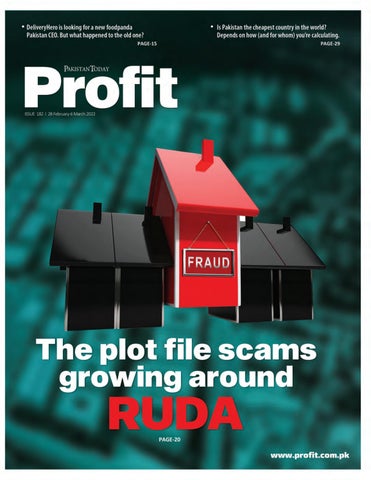
20 The ‘real estate’ scams that have bled into the bones of the Ravi Urban Riverfront Project 26 Plotistan: The mystery of low savings rate Ammar Habib 28 Exports, exports, and more exports - attracting the right kind of FDI Uzair Younas
35
29
29
29 Is Pakistan the cheapest country in the world? Depends on how (and for who) you’re calculating. 32 Do branch banking networks really matter for Pakistan?
Profit
35 Why the IMF wants two private banks to recapitalize
Publishing Editor: Babar Nizami l Editor: Khurram Husain lJoint Editor: Yousaf Nizami l Assistant Editor: Abdullah Niazi Reporters: Ariba Shahid l Babar Khan Javed l Taimoor Hassan l Meiryum Ali l Shahab Omer Chief of Staff & Product Manager: Muhammad Faran Bukhari Regional Heads of Marketing: Muddasir Alam (Khi) l Zulfiqar Butt (Lhr) l Malik Israr (Isl) Layout: Ahmad Salahuddin l Photographers: Zubair Mehfooz & Imran Gillani l Business, Economic & Financial news by 'Pakistan Today' Contact: profit@pakistantoday.com.pk
Editorial Putin’s lunch
There is no denying that Prime Minister Imran Khan faced a difficult decision this week when President Vladimir Putin ordered his forces to invade Ukraine on the very day Khan was scheduled to land in Moscow for a long scheduled visit. The summit meeting was long sought by Pakistan that has been trying to build a relationship with Russia for a number of decades now. Everything about this visit was agreed and finalized in January of this year, with the first approach to have this summit having been made in as far back as 2019. Cancelling a visit like this at the last minute would have been a very difficult decision. It is good that Pakistan’s statement, released after the summit meeting between President Putin and Prime Minister Khan, carried an expression of regret from about the invasion. “Pakistan believes that disputes should be resolved through dialogue and diplomacy” the statement said, words that perhaps came a little too late considering Putin had already spurned dialogue and diplomacy in favour of military action to press his claim on Ukraine. The deed is now done, and the image of the Prime Minister of Pakistan sitting next to Putin on the very day the latter was being condemned and sanctioned by European countries and the United States for armed aggression against a neighbouring sovereign power will endure. It is critical to bear in mind the stakes involved in this gambit. Pakistan’s relations with Russia are minimal, at the moment, even though there is now talk of building further ties particularly in the area of energy cooperation, with special focus on the Pak Stream Gas Pipeline. But in terms of trade and investment it is hard to see how Russia could see any strategic benefit for itself in ramping these up, other than a purely commercial interest. Exports to Russia were $71 million in the July to December period of this fiscal year, while imports were $104 million. By contrast, exports to the United States and the United Kingdom were $3.3 billion and $1.15 billion respectively. In 2020, almost 28 percent of Pakistan’s exports went to the European Union. The western world hosts the largest and wealthiest Pakistani diaspora, and between the three countries just mentioned, Pakistan received $5.4 billion in remittances out of a total of $15.8bn. Remittances from Russia were so small in the same period that they are clumped into the “other” category which totals $631 million. The picture is no different when it comes to investment flows. Pakistan is a net importer of capital from the western world – via trade surpluses and remittances – and a net exporter of capital to countries like China, Saudi Arabia and to a much lesser extent, Russia. More importantly, Pakistan floats its bonds on western financial markets and is a frequent user of resources offered by financial institutions like the IMF and the World that are operated by western capitals. The point here is not to count up the dollars before scheduling foreign trips by the Prime Minister. The point is to note that there are substantial relationships at stake in this gambit to build deeper ties with Russia at a time like this, and to understand that relationships between states are usually built atop actual material
ties that bind them together. These could be trade and investment flows, diasporic connections and people to people ties, or shared security concerns. As such it is worth asking what we are putting at stake in return for what benefit, and what are the ties between Pakistan and Russia we are seeking to build on. The statement released by the Pakistani government talked of the Pak Stream Gas Pipeline as the only concrete matter, and even there it could only say that the Pakistani side “reaffirmed the importance” of this project without any kind of a breakthrough in what has been a stalled project since its inception in 2015. Other than this it simply said the two heads “also discussed cooperation on prospective energy-related projects.” In off record comments, our foreign policy wizards have pointed to regional connectivity in Central Asia as a possible goal of deepening ties with Russia. For now the dream of overland regional connectivity is little more than a mirage for Pakistan. But even if we are to take it seriously, what is the possible timeline on this? And how have recent developments impacted it? When looking at the foreign policy benefits for Pakistan in seeking a deepening of ties with Russia, it would be a mistake to look past the growing animosity between Moscow and the western capitals. Our foreign policy elders must ask themselves whether this is the right time to be imagining a new future with Russia because nobody really knows where Mr Putin is going. What does he have in store for Ukraine? Is it a sustained military occupation or installing a puppet regime then working to prop it up over the years? And how will this choice drive his future relationship with western capitals? Will he stop at Ukraine? Where will the sanctions being rolled out by the western world eventually end? Is the whole situation moving towards an armed conflict between the great powers one more time, as happens in Europe at least once every century throughout the modern period? Given these uncertainties it is unwise for Pakistan to try and stand astride the massive divisions opening up before us and argue that none of this is our business. Aside from the economic ties, it is worth recalling that in the last three stand-offs between India and Pakistan – 2002, 2008 and 2020 – it was Pakistani calls for help from the western world to deescalate the situation that ultimately defused matters. What if in the next stand-off Pakistan is also told “this has nothing to do with us”? Far too much is at stake as the situation develops. This is the wrong time for Pakistan to be placing gigantic bets that it cannot afford, especially if the only real benefits to be had are ceremonial and optic only. The visit is done and there is no changing that. But the foreign policy direction of Pakistan will continue to be driven by its economic dysfunctions and regional security concerns, both areas that Mr Putin is unlikely have much interest in getting involved with. The lunch that Prime Minister Khan enjoyed with President Putin might have gone down the gullet well, but it could prove difficult to digest in the years to come.
9
Readers Say This is great information about the Pakistan Super League that isn’t easily available. It is very good to see it portrayed together and easily available. Thanks for the effort. Apropos: Is the PSL good business? For the PCB, yes. For the teams, not so much Anonymous, Website At the end of the day, what this means is that the PSL is a money tree for the PCB but a fruitless tree for the franchise owners. Apropos: Is the PSL good business? For the PCB, yes. For the teams, not so much Aabid Hamid, Website The PSL is a very inspiring story. Apropos: Is the PSL good business? For the PCB, yes. For the teams, not so much Tufail Sherazi, Website The entire arch of the PSL and how it developed is a great inspiration. Apropos: Is the PSL good business? For the PCB, yes. For the teams, not so much Aamir, Website Thanks for sharing this. It is some very good work and some of the best I’ve read. Keep posting such amazing articles. I think the PSL is a great idea and at the end of it everyone will end up making money. Apropos: Is the PSL good business? For the PCB, yes. For the teams, not so much Zee Raja, Website Great article! While it demystifies the PSL business model, at the same time it questions if the Franchisees are really in it for the money or more for the fame & influence it brings in plus..the bragging rights of course. Apropos: Is the PSL good business? For the PCB, yes. For the teams, not so much @imraazh, Twitter PSL is not making a profit for the franchise owners but lets go ahead and have a football ($2m fee per team) and hockey franchise league. Apropos: Is the PSL good business? For the PCB, yes. For the teams, not so much @koi1, Twitter
facebook.com/Profitpk twitter.com/Profitpk linkedin.com/showcase/13251020 profit.com.pk profit@pakistantoday.com.pk
HOW TO CONTACT
10
The franchise business is a long haul. No franchise owner will make profits from season one. Even in the IPL, many franchise owners lost millions of dollars every year till 2016. All IPL franchises started to make profits after Star Sports $2.5B deal in 2017. Now, in PSL 7, five franchises will make profits. Quetta, Peshawar, and Islamabad will make profits of around Rs 50 crores each. Lahore will make a profit but it will be less than this because of
high franchise fees. Karachi will also eventually make a profit due to the fact that they now also own A Sports, which has broadcasting rights. Multan Sultans will still not make profit due to their highest franchise fee. Apropos: Is the PSL good business? For the PCB, yes. For the teams, not so much Abdullah Siddiqui, Facebook Teams become brands in the longer run and then they start earning by attracting big sponsors with big amounts and when the league becomes popular and profitable they start earning too and their brand value increases. For example, the Karachi Kings, Islamabad United, and Lahore Qalandars are all popular brands today. If the owner wants to sell they will ask for huge amounts like Chennai Super Kings alone worth 600 crore indian rupees its brand value. Apropos: Is the PSL good business? For the PCB, yes. For the teams, not so much Ch Haseeb Raza, Facebook No businessman would ever spend such huge sums just for the love of the game. You surely are missing something here. Apropos: Is the PSL good business? For the PCB, yes. For the teams, not so much Abdul Wahab, Facebook The PSL will start giving massive profits if crowds are allowed in the stadium just like it was in this series. Gate money is one of the major sources of revenue and after a few more editions PSL brand value is going to skyrocket. Apropos: Is the PSL good business? For the PCB, yes. For the teams, not so much Safi Ullah, Facebook Add billions to the exchequer in more fuel expenses for millions in Karachi and Lahore for a month. Also the productivity and time lost due for individuals and businesses is hard to calculate, but will be much higher. Apropos: Is the PSL good business? For the PCB, yes. For the teams, not so much Junaid Tahir, Facebook The PSL is also perhaps one of the worst business decisions some of the franchise owners have made. Over the course of the past 6 years, the PCB has made a neat profit from every edition of the tournament in addition to collecting hefty “franchise fees” from all of the team owners. In comparison, only one or two teams have managed to break even, with the others facing consistent losses. Apropos: Is the PSL good business? For the PCB, yes. For the teams, not so much Zahra Raja, Website
COMMENTS
IN BRIEF
$55 million:
The NBP was fined over $55mn for anti money laundering violations, compliance failures in the US. The bank was fined $20.4mn by US Federal Reserve Board and an additional $35mn by New York State Department of Financial Services.
Despite tall claims of documenting and monitoring imports and exports at Pak-Afghan border, the smuggling of steel from the neighboring country continues unabated. The local steel industry, through a letter sent to the FBR on February 18, 2022 has informed that smuggled steel bars of nonPakistani origin are openly available in Wana, Mir Ali, Miran Shah, Bannu, DI Khan and Karak.
The Senate has passed a bill to adopt the Weighted Average Cost of Gas (WACOG) to price the gas. Although it is being hailed as a remarkable achievement, for the consumers the bottom line is increased gas prices. After a massive hike in the prices of petroleum products, electricity prices are likely to be jacked up by Rs6.1 per unit on account of monthly Fuel Price Adjustment (FPA) for the month of January 2022.
$2.6 billion:
The Current Account Deficit (CAD) clocked in at $2,556 million for the month of Jan ’22 compared to deficit of $219 million during Jan’21 as per data released by the State Bank of Pakistan.
The State Bank of Pakistan (SBP) has granted conditional approval to MCB Bank to conduct due diligence for a potential transaction for the purchase of 55 per cent shares of Telenor Microfinance Bank Limited. The development was shared in a notification to the Pakistan Stock Exchange (PSX). The import of mobile phones into the country has witnessed an increase of 11.86 per cent during the seven months of the fiscal year (2021-22) as compared to the corresponding period of last year. PBS data shows the country imported mobile phones, worth $1,270.415 million during this period.
11
Banking woes, new ways to look at stats and Rasputin in Russia this week in Pakistan’s business and economics twitterverse
T
he banking sector isn’t isn’t easiest to regulate especially with all those rules and some making up their own. However the SBP knows how to be creative and come up with new ways to look at stats. We talk about the Prime Minister’s trip to Russia and Activist investors in this week’s social media round up.
Blame game
Just doesn’t make sense
Some things just don’t make sense like how to describe the taste of water, or the index bloomberg just came up with. We may have terrible standards of living, lack of access to clean water and sanitation, and may have issues with security too. Despite that, we’ve done pretty well with COVID. In fact, the vaccination campaign has been brilliant, and Pakistan has managed to deal with cases in a way that puts developed countries to shame.
12
The government blame game is always fun to watch. It’s even funnier when the current government blames the politicians of the past for the issues of today while the politicians of the past blame issues of the past on the politicians of today. Funny times we live in.
Activists assemble
Kind of in a surplus
Activist investors are the need of the hour, especially in a developing market. Doesn’t matter what scrip this is about. But the fact remains, investors that are informed about their rights and stand for them are the ones that can help improve corporate governance across the board and will encourage other corporations to follow suit.
Breaking the rules
Sometimes the ways banks act are against the rules given out by the State Bank of Pakistan. This is just one example. However, it is nice to see that the SBP is not only responding to banking customers but is also setting the record straight. Would be great to see banks following.
Aye ya ey ya- Hrithik Roshan
The State bank of Pakistan wants people to look at the positive picture. What a way to spin the CAD. However, Sajid Amin Javed, an economist rightly says, ““Excluding these....” is not a good counterfactual as it was never possible to exclude (otherwise would have been done).
In case you didn’t get it, this is about the Prime Minister’s trip to Russia. No news of any major investment or deals. Either way, it’s not like we had much to offer to them either.
SOCIAL MEDIA ROUNDUP
By Taimoor Hassan and Abdullah Niazi I can see his pride Peep through each part of him. Henry VIII 1.1.68-9, Abergavenny to Buckingham My pride fell with my fortunes. As you like It 1.2.242, Rosalind to Orlando At the start of this year, the rumour mill in Pakistan’s tech-startup scene was rife with one thing and one thing alone - foodpanda
TECHNOLOGY
CEO Nauman Sikandar Mirza was on his way out. On January 28th, Profit reached out to Mirza asking him whether there was any truth to the rumours. “Hearing it from you. I’m only getting started,” he responded in a message on Whatsapp. In less than two weeks, on the 9th of February, he announced he was leaving the company in a post on LinkedIn. In the 11 days between when Profit reached out to Mirza and he announced his resignation, foodpanda’s parent company, Delivery Hero, was actively conducting searches
outside foodpanda but within Pakistan’s tech ecosystem to find a new CEO for foodpanda Pakistan. And they weren’t really trying to hide that they were on the hunt. Despite this, many were caught by surprise at Mirza’s departure from the company. After all, if there is one tech company/startup in Pakistan that has absolutely and always dominated its space, it is foodpanda. Helming this gargantuan effort throughout has been Nauman Sikander Mirza, who in the past seven years has stood as both witness and architect to foodpanda’s acquisition of EatOye, the entry
15
of DeliveryHero into the Pakistani market, the massive growth that foodpanda saw after the onset of the pandemic, and the expansion into groceries that came with PandaMart. For now, Muntaqa Paracha has taken command as acting Managing Director, and is also in contention to become permanent MD for Pakistan along with foodpanda’s director of new verticals, Ibad Ahmed. While both candidates have stellar profiles with years of experience, sources have also confirmed to Profit that DeliveryHero is still actively reaching out to top executives at tech startups in Pakistan for the soon to be vacant role at foodpanda Pakistan. The hunt is on for a new CEO for Pakistan’s largest food delivery startup and possibly largest grocery delivery company as well. However, it is worth looking at how the company got here in the first place, what legacy the erstwhile CEO Nauman Sikandar Mirza has left behind, and whether his abrupt departure was a voluntary or unceremonious one.
Nauman’s Legacy
L
et’s take a step back to 2011. Yousaf Raza Gillani was Prime Minister, the PTI had no seats in parliament, the PML-Q was the second-largest opposition party in the national assembly, 3G and 4G internet was still three years away from being launched in Pakistan, and the first branches of international fast food brands Dominos and Hardees were just two years old in Lahore. Back then, in what today seems like a completely different world, Nauman Skiander Mirza created a blog called ‘The Food Connection’ with his partner Rai Omair. The concept was similar to what you see these days with
16
groups like ‘Foodies R Us.’ The Food Connection positioned itself as a guide for foodies, and posted blogs on food, provided reviews on new restaurants along with photography and quickly became highly visited and an important voice in the restaurant business. In the same year, foodpanda also entered Pakistan for the first time. This is where something interesting happened. Mirza’s blog had started as a food review venture. But because foodpanda had just arrived on the scene, and back then it was acting as an ‘aggregator.’ Essentially, this meant that most restaurants did not have apps to order food from. By signing up for foodpanda, they were essentially signing up for an app not a delivery service. People would download the foodpanda app, which would display a large number of restaurants, they would place their order, after which foodpanda would forward it to the restaurant which would then send their own riders to deliver the food. The long-term plan was always to also develop a fleet of riders and not just offer the tech, especially for food places that did not have their own delivery services. However, in the beginning, the aggregator model worked because places like McDonalds and Dominos based a huge part of their business on their vast delivery service network. This, however, gave ideas to Mirza as well. If foodpanda could make the business model work as an aggregator, then why not ‘The Food Connection.’ The blog quickly went from being a review page to signing up restaurants for food delivery. In 2014, they rebranded themselves as ‘EatOye’ and started helping diners find restaurants, order food or reserve tables for free and pay better prices at restaurants.
This was the beginning of tech and food delivery. Restaurants would be able to increase the capacities at the restaurant through online reservations and diners would be able to find availability of best restaurants on EatOye which would also offer discounts. The natural progression of competition led to foodpanda, being bigger in size due to its global presence, acquired foodpanda in 2015. According to a source, EatOye was acquired by foodpanda for $2.5 million, which is also when Mirza came in and took charge. In December 2016, foodpanda was acquired by the German multinational, multi billion dollar food delivery company Delivery Hero. The acquisition by Delivery Hero set the stage for a mammoth amount of money pumped into an underrated market: Pakistan. Sources tell us that Pakistan initially was not considered to be a good market where Delivery Hero would invest a lot of money. Nauman was crucial to bringing large sums of money from Delivery Hero into Pakistan and the bet seemed to have paid off. According to August 2021 numbers of foodpanda countries available with Profit, foodpanda Pakistan delivered 5 million food orders, more than orders delivered in Singapore, Cambodia, Myanmar, Japan, Bangladesh, Hong Kong, Germany and Romania. The only countries above Pakistan are Taiwan, where foodpanda delivered 19.19 million orders in a month, Malaysia, where foodpanda delivered 16.6 million orders, the Philippines with 13.3 million orders and Thailand with 11.7 million orders. Sources tell us that in 2019, Delivery Hero pumped in roughly 15-20 million euros into Pakistan, 25-30 million in 2020 and a sim-
ilar amount in 2021. The growth in Pakistan has also been phenomenal as a result. “It was in the top three growing markets in the region, thanks to Nauman,” the source said.
The growth model
E
ven at this point the aggregator model was doing wonders for foodpanda. Starting off as a marketplace model, foodpanda was a directory for restaurants to connect with eaters and order and it will get delivered by the same vendor. The delivery was not their responsibility. As eCommerce evolved, it became obvious that unless you have control over the supply chain, you will have problems to become operationally positive and to give that convenience and service level that is demanded by the customer. For example, if you look at Domino’s, they have a great delivery infrastructure. Other restaurants do not have the same. So in the early days after Delivery Hero’s acquisition of foodpanda, the problem they were out to figure was why online deliveries were not taking up. The orders would come in on the aggregator platform but deliveries would be less compared to the number of orders placed, decreasing the overall ratio of successful orders. foodpanda figured out that it needs to have a logistics infrastructure of its own and that it should have its own delivery. foodpanda in countries like Taiwan and Malaysia, when it was able to build logistics there, it was able to scale very quickly in these countries. A source told me that deliberations at Delivery Hero were that if Pakistan was to be kept as a foodpanda portfolio country, it had to have a successful logistics infrastructure in the
country. And if efficient logistics in Pakistan could not be built, Delivery Hero would sell off foodpanda in Pakistan. These deliberations had taken off in early 2019 when Careem had also entered the food delivery business. Careem had the logistics but did not have a vendor base, whereas foodpanda had the vendor base but no logistics. Logistics were at the centre of everything because as mentioned earlier, a high number of orders were coming on the platform but the restaurant’s own delivery infrastructure was constraining the growth of overall order delivery. Logistics was the biggest bottleneck. Delivery Hero worked a lot on it and they started building logistics capabilities and tech around logistics. The idea was to deliver food orders to customers and deliver them efficiently. Chasing efficiency, Delivery Hero built a zonal model under which zones were demarcated and based on the customer density in these zones, logistics density of foodpanda riders was going to be determined. Delivery Hero was the one who pioneered this strategy and defined a code that the delivery time was inversely proportional to number of orders. The massive fleet of around 50,000 riders that was raised as a consequence is why foodpanda is now able to deliver 200,000 daily orders presently, making it an immovable giant in its space. While foodpanda’s focus on expanding logistics is an example of the company’s broader strategy to stay at the top, it highlights an important aspect of how foodpanda operates not just in Pakistan but everywhere else: that Delivery Hero runs it top down. So if foodpanda in Pakistan had to build logistics, it was decided by Delivery Hero Berlin and the strategy around it too. The team in Pakistan
would mould that strategy and apply interventions according to local markets.
Company dynamics
D
elivery Hero also fosters a culture of openness and if any employee of the company in Pakistan wants to learn how something was done in any other country, for instance in Taiwan, she/he can ping a director in Taiwan and ask how they did it in their country and learn about their findings. Delivery Hero’s internal ecosystem is so strong that anyone can reach out to someone even at Delivery Hero’s headquarters in Berlin and they would respond kindly. Both Delivery Hero’s control over strategy and a policy of openness can render the CEO a little toothless. Top position holders in the company can potentially get close to regional management or the management in Berlin and impress upon them their competitiveness to do things even better than the CEO. Nauman has been dubbed by multiple sources as someone who is very popular in the company, but his leadership style has also been described as ‘autocratic.’ “He was well-liked, particularly by the lower-management staff. However, he did not like sharing power and did not hesitate to put down anyone if he saw them getting close to the management outside of foodpanda Pakistan.” In this way, the policy of openness started causing problems for the team in Pakistan. As CEO of foodpanda, Nauman had always been used to being the whizz kid that made things work and became CEO after starting off with a blog. However, DeliveryHero had a structure where talented young management could impress the management in Berlin or re-
TECHNOLOGY
gional HQ and even pitch contradictory strategies to them from what the CEO in Pakistan was suggesting. This meant that the position of the CEO was not an easy one. And foodpanda did have smart, talented, well-educated people teeming with ideas. Sources within the company report Nauman to be very open to ideas and is a good listener. However there was a catch to this employees restricting their communication to Nauman and not reaching out to outside management and not being applauded by them. Sources that have worked with him and not interacted with the management outside consider Nauman a very good manager. Sources that have worked with Nauman and have interacted with outside management consider him autocratic who simply loses it when appreciation from outside of an employee makes him feel vulnerable. For this reason, sources say that some very talented people who have worked in foodpanda during its high growth period under Nauman, do not work at foodpanda anymore. Of course, some part of this can be attributed to the fact that many disgruntled employees will describe the CEO as autocratic, particularly when they clearly have had differing opinions to said CEO. The word autocratic is thrown around very easily sometimes, and in the case of Nauman Sikander, while there is a lot of testimony towards this a lot of employees speak of him in very glowing terms as well. Much of this is speculation and internal politics. However, what did happen for sure is that the CEO left and left quite abruptly - despite having given the company some stellar years.
Foodpanda’s growth
O
n the performance side, foodpanda has seen amazing growth under Nauman. From the numbers obtained by Profit, foodpanda delivered roughly 23,000 orders per day on average in 2019, 120,000 in 2020 and 162,000 for 2021. Numbers for 2020 and 2021 are inclusive of food and grocery orders under pandamart. This growth, however, has come at the expense of a massive cash burn of approximately 15-20 million Euros for 2019, 25-30 million Euros in 2020 and 25-30 million Euros in 2021. Sources tell us that foodpanda is under pressure to achieve profitability but that could be a difficult undertaking in the Pakistani market. Pakistan’s market conditions are tough is why Cheetay, a competitor to foodpanda, has also shut down the food delivery business and operates as an aggregator for restaurants only now. The market is treacherous: restaurants already abhor foodpanda’s commission structure which means revenue would be limited; restaurants are revolting by creating their own websites, offering better discounts than foodpanda and offering free deliveries against
18
foodpanda’s delivery fees, limiting revenue for foodpanda. While customer acquisition costs and marketing costs are very high. From a company source, Profit has learned that foodpanda’s marketing budget alone for one month is roughly Rs600 million, which translates into Rs7.2 billion or roughly 36 million euros. High costs are the reason foodpanda had an estimated cash burn of 15-20 million euros in 2019, 25-30 million euros in 2020 and about the same in 2021. On the other hand, Delivery Hero has been eyeing positive earnings for 2022 which means all markets are under pressure to increase their earnings and foodpanda Pakistan is no exception. In fact foodpanda made an attempt to increase commissions in September 2020 and faced resistance from restaurants. It could be that the higher management was not satisfied with Nauman’s performance on controlling cash burn and increasing profitability within stipulated time. Nauman has not responded to our queries yet on reasons for his departure from the company and foodpanda’s profitability. In an email to a top boss for foodpanda APAC region, Profit tried to ascertain if Nauman had resigned of his own accord or if he was removed from his position. Nauman’s departure is abrupt and has surprised many. Moreover, Delivery Hero has also been on a restructuring spree. It has shut down foodpanda in Germany and Japan, and according to sources, it is considering replacing CEOs in Singapore as well as in Bangladesh. Without specifying if it was a resignation, removal or a resignation because of imminent removal, the response was received from foodpanda Pakistan and was as below: “After an incredible 10+ years in the food delivery business, including 7+ years with foodpanda Pakistan, Nauman Sikandar Mirza CEO and MD foodpanda Pakistan, decided to move on and start a new chapter in his life,” the email read.“Nauman has made an extraordinary contribution to foodpanda – he has been instrumental in growing the market to its current size and leading us to where we are today. We are extremely grateful to Nauman for his leadership and very proud of everything foodpanda Pakistan has achieved over the last several years. We wish him every success in his next adventure and chapter of his career.”
Who are the top contenders for foodpanda Pakistan CEO?
D
escribed as “super competent” by one of our sources in foodpanda Pakistan, Muntaqa Peracha is going to be assuming the responsibilities of
Nauman in the interim until a permanent CEO is announced. Company sources also believe that Peracha has all the potential to be retained as the permanent CEO after Nauman. A graduate of Georgia Tech University, Peracha has been with the company since the beginning of 2020 and has earlier worked at Pakistan’s TPL Corp as group chief commercial officer, country manager for American data and analytics firm Dun & Bradstreet, IBM, NCR and Verizon. Currently serving as director commercial at foodpanda, Peracha is responsible for foodpanda’s quick commerce business under pandamart which has grown to over 50 dark stores at present. Sources also speculate that Ibad Ahmed, who serves as director of new verticals at foodpanda, is also a possible nominee for the position of the CEO. Ibad has studied at top universities in the world, Harvard, Stanford, IMD Business School and finally INSEAD, and has worked at Engro Corp, Shell, E.On, Petromin Corporation among other organisations in the energy sector. He has been with foodpanda since July 2020. Outside of foodpanda, Delivery Hero has reached out to at least two CEOs of tech companies in Pakistan. Both of these CEOs belong to companies which either have logistics as the core of their business or logistics is a significant part of their business, which also affirms how much logistics is the focus of foodpanda in Pakistan. When would the new CEO be appointed? “We are in the process of evaluating candidates for this position and will introduce a new leader in due course,” foodpanda said in an email. Sources were candid enough to admit that despite his management style, no one understands food delivery better than Nauman Mirza and that if he could not do it, the new CEO is also likely to have a tough time making the company profitable anytime soon. Without specifying when foodpanda would be profitable, foodpanda said in the region (APAC), the company expects to breakeven in the region (not Pakistan) by the end of 2022. The new CEO will be expected to prioritise focus on implementing strategic priorities across different functions and growth across the market. “At the same time, sustaining our solid momentum and maintaining close alignment with Delivery Hero’s global strategy and core objectives,” foodpanda replied in response to a question about the expectations from the incoming CEO. In the email, foodpanda also said that Pakistan continued to be a very important market for Delivery Hero and foodpanda. “We are working with the regional and local leadership team to continue our strong growth trajectory and footprint in the market.” n
TECHNOLOGY
20
REAL ESTATE
By Shahab Omar
T
here is something peculiar about the river Ravi. Most residents of Lahore even do not realise just how closely tied the river is to the City’s history and essence. The mighty river once flowed along the walls of the Lahore fort, but has over the centuries and decades been diverted away from the main city and has found a course away from the outskirts of Lahore. But as Lahore has expanded, the fate of the Ravi has been fraught since partition. With the water supply often stopped and opened by the Indian authorities across the border, the Ravi has become a hollow shell of its former self these days. And because it is dry for a large part of the year and regularly changes course, a lot of people own agricultural land “underneath” the river so to speak. While this has been a peculiarity, one thing no one could have guessed was that this would result in people being defrauded in the name of housing societies. As part of the Ravi Project, when the government was acquiring land, many of the people whose land was under the river were offered files for 7 Marla plots of land in exchange for selling their land. These limited files are now being used to propagate a scam that is trying to get people to invest in files that do not exist. The biggest problem here is that the Ravi Urban Development Authority (RUDA), has time and again repeated warnings that no files or housing societies are currently supposed to be selling land in the project, despite which the land continues to be sold.
What is the Ravi Urban Project?
E
xpansive, ambitious, and controversial, the Ravi Project had been envisioned as a strange sort of solution to Lahore’s growing population woes. The project runs along the river Ravi, as the name suggests, includes the construction of a 41,308-hectare (102,074-acre) planned city and the rehabilitation of the Ravi River into a perennial freshwater body. When (more importantly if) it is finished it will be the largest riverfront of the world. The idea for the project has been around since 1947, when the Deputy Commissioner of Lahore suggested it. Back then, however, there was still a lot that the outskirts of Lahore clearly had to offer. The City has since expanded and taken in the surrounding towns and swallowed them. Today, with an aversion to vertical living, Lahore continues to be stretched thin. The Ravi Project is ambitious because it simply seeks to establish a whole
22
new City on the banks of the Ravi river, which would be rehabilitated and redirected. There has been a lot of controversy surrounding the project. Almost immediately, what had once been dubbed “Pakistan’s answer to Dubai” was accused of rampant land grabs by prime minister Imran Khan’s government, which has championed the project. Hundreds of thousands of farmers who could never afford to live in the modern urban utopia are now at risk of eviction. “As well as the human cost of the development, being built on a 40,000-hectare (100,000-acre) site adjacent to Pakistan’s megacity of Lahore, many fear it will wreak environmental devastation to the Ravi river, currently undergoing ecological restoration, and surrounding forests,” reads a report in The Guardian. RUDA had been formed to try and control this and oversee the project. In the process, the development authority was clothed in immense power. RUDA was bestowed with complete legal immunity so that no lawsuit or legal challenge could be filed against the project or anyone working on it. The government has also applied Section 4, which means it can legally acquire any land for public purposes, even though Ravi Riverfront will be a commercial enterprise. Despite all of these powers, it seems that RUDA has failed to stop fraud from seeping into the bones of the project even before it had gotten underway. Currently halted by an order of the court and pending discussion in the Supreme Court, files are still being sold and people swindled out of their money with RUDA seemingly powerless to stop them.
How it happens
I
t all starts with a youtube video. Some real estate agents claim that they have ‘files’ available for housing societies in the Ravi Urban Development Project right on the outskirts of Lahore. However there is a catch. Even though the project is in its very initial stages, files are already ‘short’ and will be sold on a first come first serve basis. Intrigued, people call up the real estate agent on the number provided in the youtube video only to be told that all of the files have been sold out. But just as the disheartened customer is about to hang up and move ahead, the agent on the phone asks them how much money they are looking to invest. Once they have been told, the agent writes it down and says they will “see what can be done.” In the video linked above, for example, a real estate agent by the name Mujahid Yasin begins with his phone number and the promise of a ‘low budget investment with room for growth.’ His method of convincing people is very interesting and appealing in which He claims that he has files of plots of seven
Marla and 15 Marla whose prices are going to increase in the coming days and are ready for sale. He demands RS 2.5 million for a seven Marla plot file and RS 4.5 million for a 15 Marla plot file. Hassan gives people the impression that the demand for these files is very high and only those who pay first will get it. These files are very special, he tells them, since it is a government project it is a very ‘safe’ investment . {When people naturally have questions (and they do because of how murky real estate is in Pakistan), he assuages their fears and tells them that the project is backed by RUDA, the land is completely owned by the government so there is no chance for fraud, and that there is very little time. With thousands of views on his youtube videos, a large number of people call him up. Some of them are not convinced. Others fall to the pressure of the urgency he stresses and end up wiring him either some ‘token’ money or even larger amounts. And Yaseen is not the only way. While he has made his way to youtube and uses that as a medium, a lot of property dealers and real estate agents use cold-calls and other marketing techniques such as getting banners and flexes made to attract people towards the project. The problem in all of this? The Ravi Urban Development Authority (RUDA) has repeatedly warned that no business of any kind should be done with these agents. What is the real story? It is a typical case of how real estate works in Pakistan. A prime piece of land is made available, people are interested in investing, demand is artificially inflated, and developers and agents end up selling more land than is actually available. All of this eventually results in people being trapped in messy legal disputes for years, with nothing to show for their investments except an unofficial ‘file.’ But where did all of these files come from, who is responsible for the fraud, and will anything be done about it?
The problem with land acquisition
I
n May 2021, Prime Minister Imran Khan was briefed on progress on the Sapphire-Bay project under the Ravi City. Sapphire Bay is the name of the first phase of the Ravi Project for which development rights were granted to Arif Habib Javedan consortium.Eventually, of course the project is meant to get to a stage where things are being bought and sold. However, that stage is at least a little ways down the road. That has not stopped real estate agents from trying to convince people that they need to get in on the project early. The thing to understand is that there is no file of this project in the market and RUDA has not yet confirmed the process of selling files in
this area so who is going to sponsor this fraud? Essentially, the reason this fraud was possible was a peculiarity of the Ravi River. The Ravi is currently dry. Once, the river used to run along the Lahore fort but over the decades has shifted course. Because of this, a lot of people have land that is directly underneath where the Ravi now flows. The land was not marketable, but the government had to buy it anyway to rehabilitate the river itself. As a result, they offered that the owners of this land be given files for the project in the area in addition to the DC rate price of the land. Credible sources of RUDA have claimed that this fraud was in fact a scheme of RUDA’s land providers and some corrupt elements of the authority and a very interesting plan has been prepared for this. “Land was being acquired for the project before the Lahore High Court declared this project illegal. An advertisement was issued by the authority for the registration of land providers and later five land providers were registered for the four zones of the project. The task of these providers was to purchase land from their respective zones and then hand it over to RUDA. Acquiring land is obviously not an easy task and these providers were masters of their job but at the same time they were skilled in making huge profits in all these transactions and bribing the officers,” they said. Sources revealed that during the land acquisition, both the sellers and the acquirers were actually making profits. “The people who
had lands in the river were not marketable and the owners of these lands were willing to sell their land for RS 500,000 to 700,000 per acre. However, lands were also bought at DC rates and market rates and so the land providers began to acquire the land and hand it over to the authority. The idea of fraud came to the land provider when they saw that the landowner would get a plot file in the project area in addition to the land amount,” they said. Sources added that for example, if someone’s land was inside the river, the authority announced that he or she would be given a plot of seven Marla in addition to the amount of land and if one’s land was outside the river, it was announced to give him a plot of fifteen Marla. “Now it remains to be seen whether these plot files reach the landowners from whom the land was purchased by the land provider. In many cases this did not happen because the land provider bought the land from the owner by paying money on the spot and the provider will never give him the plot file,” said one source. “Instead, the land providers sell it to the authority and in addition to the amount of land he will get the plot file and will sell it himself. Now these are the files of the plots which are being mentioned by the real estate agents in the market. These files are being marketed by the land providers themselves in collaboration with various property dealers. In fact, they will not sell these files yet because many land providers have not yet received the
files from the authority.” The purpose of marketing these files is to increase their value in the market. Obviously, if the land provider bought an acre of land for RS 2 million and sold it to the authority for RS 3 million, he would have earned a profit of RS 1 million. And in addition to this amount, on acquiring land per acre, the plot file he will get will be his further profit. The plot will obviously be given to him by the authority in the developed area and at present the authority is offering a one-kanal residential house for 20 million rupees. The amount of development charges, taxes and fees has not been included in this amount yet. This means that the land provider will be able to easily sell the seven Marla files up to RS 10 million in the next few years and the rate of commercial plots will be much higher than that. From here, you can imagine how big a profit game is being played. For now, agents of land providers will collect money from people just by taking the name of these files and later they will disappear. “When people will ask these property dealers for a plot file, they will say that all the files have been sold and you can register your name with us and submit some token money. In this way, they will collect token money from the people and escape. Another possible way is to start getting more and more offers for plot files and the buyer with the highest bid will be sold whenever the file comes on the market. This exercise will increase the price of the plot in the market. The authority needs to
REAL ESTATE
take stern action on this as a few days ago the authority has also received some complaints in this regard,” they added.
The kinks in the system
T
he sources also claimed that the purchase of land from the land providers would directly benefit the land provider and he would also give a fair share of this benefit to a few officials of the authority and in this regard, some officers have also started under table deals with land providers. According to sources, the second factor of fraud in this area is the illegal housing societies which are still selling their plots in droves. “These illegal housing societies are selling plots to the people saying that our plots belong to government housing societies so they are very transparent. In fact, the Ravi Urban project is not a housing society project but a project to build a new city. There are more than ten such societies including Noor Garden, Tauheed City, Dream Homes, University Town, Education City, Negehban Homes and Usman Park. Plots are still being bought and sold by local property dealers here. Once the authority also tried to take legal action against these societies, but to date no progress has been made,” says a source within RUDA. However, on the other hand, when Mohammad Farooq, a land provider of RUDA, was contacted, he told Profit that in fact some files had come in the market for sale of Ravi Urban project but the purpose was to check its value in the market and they were not sold. “Actually, when RUDA started acquiring land, many people whose lands were in the river were illegally occupied by the locals. However, instead of retrieving the possession, the landowners handed over their land deeds to RUDA, got the land prices and also got the
24
file of seven Marla plots. Similarly, those who had lands outside the river had got the file of 15 Marla plots in return. These files were definitely on the market but people did not sell because RUDA had announced Chahar Bagh (Housing Society Project) and people thought that after this project their file prices might go up and of course it went up. It will happen because this project has now been launched in the market. I can say with surety that these files were not sold because, firstly, these files were very few and secondly, the mechanism of transfer of files has not been developed by RUDA yet because the ownership of the file has to be transferred by RUDA and if the system has not been created yet then why would anyone buy a file which cannot be transferred to his name. Due to lack of mechanism, RUDA even had written on stamp paper to the people from whom the authority had bought lands that they would get the required files in exchange for their lands. At present, anyone in the market claiming to be selling RUDA’s plot files is lying and trying to commit fraud,” he informed. According to Farooq, the provider who does not have enough funds to buy the land is also trying to collect money from the people in the name of the files he has received or is about to receive. “Different land providers are also trying to work in the style of property tycoons as they want to book files for the people and collect money from them and buy more land with this money. Obviously, they will get the files in exchange for their land. The people of Lahore State had even advertised the availability of files in my zone. When the officials of RUDA asked me if I was really selling the files of my zone, I was also surprised because I have not yet handed over the land to RUDA so how can I have the files available. However, when I contacted Lahore State and inquired about the matter, they claimed that someone had told
them from the Authority’s office that these files were coming in the market and they could book it. What is interesting is that the zone is mine and the Lahore State people are claiming to sell the files that even have no registration in this project,” he added. However, RUDA’s director marketing Ahmed Salman informed Profit that no property dealer has been registered by the authority so far and no one can buy or sell land in the project without registration. “We have definitely registered the land providers who are acquiring land for the project. Those who have to do property business in this project will also have to be registered with the authority as the scope of our project is also to keep it transparent. We have so far launched the first residential complex ‘Chahar Bagh’ and the purpose of launching this project was to show investors and people what our model project is. All bookings and payments for this project will also be in the authority’s office. Anyone else who claims to have plot files in our project area for sale is committing fraud and lying,” he concluded.
Conclusion
F
or now, the project has been halted by order of the court. However, that only seems to have emboldened the real estate dealers who have now started to swear that there are only a few days left before the Supreme Court overturns the decision, which is something one dealer told a Profit reporter posing as a customer. These kinds of scams are nothing but a regular feature in the real estate business in Pakistan. If RUDA somehow manages to take action now, only then will this project be able to shake the leeches off - otherwise even if the project goes forward, it may always be plagued by fraud. n
REAL TEXTILES ESTATE
OPINION
Ammar H. Khan
Plotistan: The mystery of low savings rate Economic agents are not rational, and neither are government policies often driving the interplay of savings and investments
T
here is a lot of noise regarding the savings rate, and how a transition towards the formal economy would enhance the savings rate. This is indeed a novel idea, and recent digitization measures would certainly boost savings rate as an increasing number of transactions flow through the system, while the size of the informal economy contracts. Over the last ten years, Pakistan has had a savings rate of 14.5 percent, stooping to a low of 12.5 percent only a few years back. Savings rate in Pakistan has gradually dropped in this century, after hitting a peak of 23 percent in 2004. A traditional national income identity, where cumulative GDP for a country is a function of consumption, investment, government expenditure, and net exports (negative if imports are higher), suggests that as savings in an economy increases, overall investment also increases. The underlying assumption is that rational agents in an economy would save for a certain rate of return, which they would get by investing in the economy. As the overall stock of savings increases,
The writer is an independent macroeconomist and energy analyst.
26
A marginal, and negligible taxation regime, massive distortion in reported value and transaction value of real estate, and amnesty schemes to further accelerate scarce capital to move towards real estate rather than actual productive enterprise has ensured that plots remain a safe haven for preservation of grey capital
the overall investment also increases. The overall increase in investment enhances the overall national income, with a spillover effect on increasing consumption (higher employment, and higher disposable income), as well as higher exports – if investments are routed towards export-oriented activities. However, the real world is slightly different. Economic agents are not rational, and neither are government policies often driving the interplay of savings and investments. National accounts often consider what can be measured, or what is formal, and disregard the informal, or the shadow economy. Savings that either result in an increase in bank deposits, stock of national savings, or flow into the capital markets, among other avenues can be counted as savings in national accounts, eventually being routed as investments – with banks lending into the real economy (or back to the government), while various businesses raise capital in the primary and secondary markets, and so on. However, if the same capital is simply redeployed in a multitude of real estate schemes, which are not developed and simply operate secondary market of ‘plot files’, then that truly is savings – but isn’t really an investment that would be recognized in national accounts. The last ten years have resulted in emergence of plotistan. An economy which encourages investment in plots (whether legal, or illegal) for accumulation of wealth, rather than allocating that capital towards more productive areas of the economy. The capital markets have barely seen a sliver of fresh retail capital flowing into it, depressing valuations, and discouraging businesses from fresh listings given unattractive valuations. Meanwhile, the value of plots in cities across the country have grown multifold. A marginal, and negligible taxation regime, massive distortion in reported value and transaction value
of real estate, and amnesty schemes to further accelerate scarce capital to move towards real estate rather than actual productive enterprise has ensured that plots remain a safe haven for preservation of grey capital. A largely cash based market also ensures that fire sales are far and few in between, as investors (or plotists) as they like to call themselves are fine with staying underwater as that still remains a more tax efficient structure than investing in the formal economy. A drop in savings rate during the last ten years has been accompanied by an increase in cash in circulation as a % of GDP, signifying how an increasing number of economic activity is being conducted in cash, rather than through formal financial institutions. Over the last decade there has also been a rapid rise in development of secondary market of documentation files, which are underpinned by some plot which rarely anyone has ever seen, or which may not even exist. The files keep exchanging hands, and so does cash, well outside the ambit of the securities regulator. At least the files have some hope, or some tangible asset underlying it – secondary
markets have also emerged for application forms, which allows the holder of that form the opportunity to buy a file and so on. An application form essentially is a derivative, a synthetic instrument underlying the documentation file, which provides legal ownership (or not) of a plot. In such a thriving market, which is tax-free, and devoid of any regulatory burden, there is little incentive for a rational agent to work in a regulated, and taxable environment of capital markets. If plots are not what fancy you, there is always an option to buy gold, which has barely been imported officially in the last twenty years. There is no estimate of how much stock of gold actually exists in the country, and neither does anyone know how much of it is smuggled into the country every year. Finally, if you don’t like gold, you can always buy foreign currency – a draconian regime where it has been made difficult for citizens to legally buy foreign currency and deposit in their respective accounts, a grey market has erupted, wherein for a premium of only 3 to 4 percent, it is now possible to buy as much foreign currency you want, and store it under the mattress.
Draconian measures are often a signal of things not being well under the sun – which further accelerates such movement of capital. In a nutshell, savings isn’t an issue. Households do save, but they save in avenues which are untaxed and easily accessible via cash. Disproportionate taxes and high barriers to entry for capital markets does not make access to capital markets easier either. You can walk over to your friendly real estate agent and figure out a way to buy property worth a few hundred million rupees in cash – try doing that in capital markets, the documentation requirements would ensure that you run back to your real estate agent to take more capital from you. Policies need to be formulated to redirect savings towards the formal economy, whether that is through a favorable taxation regime, or through introducing disincentives, or more regulation for plotistan. If nothing changes, the country will continue to operate with anemic savings rate, and shall always remain starved of growth capital required for sustainable industrial, or capital driven growth.
COMMENT
OPINION
Uzair Younus Exports, exports, and more exports - attracting the right kind of FDI
Emerging economies around the world have recognized that FDI flows in export-oriented sectors enhance integration with global supply chains, bring modern managerial and technical capabilities, and improve overall productivity and wages in the broader economy. It is for this reason that rising FDI inflows are a key policy priority for many economies, including India, which has started the process of rolling out production-linked incentives in key export-oriented There needs to be more discussed about sectors including electronics and toy manufacturing. Pakistan’s FDI inflows have been a major concern over the last why Pakistan is not attracting export few years, with annual FDI inflows declining by 11.6 percent from oriented FDI $3.25 billion in 2017 to $2.91 billion in 2021. Meanwhile, FDI inflows in India increased by 44.6 percent from $36.3 billion in 2017 to $52.5 alk to any economic analyst and you will hear that a billion in 2021. In addition, a significant proportion of FDI flows major long-term issue facing Pakistan’s economy is exin Pakistan are directed is market-seeking not export-promoting, ternal sector instability. This instability, the argument meaning that this investment does not increase the country’s ability goes, is caused by rising economic growth which leads to earn foreign exchange. to greater imports, leading to a widening of the current One could argue that Pakistan has had to deal with various account deficit, which leads to a drawdown in foreign exchange issues in the last few years, key among them a devastating war on terreserves, increasing levels of external debt, and weakening of the ror and major power shortages, meaning that foreign investors have rupee. As these imbalances grow, policymakers are forced to decelnot looked at Pakistan in the same way as they perhaps would look erate the economy and implement an IMF-mandated program to at an India. This argument has merit, but things have significantly stabilize the economy. improved on both the terrorism and power sector fronts over the last To break this so-called boom-bust cycle, the argument goes, few years. What has not improved is the overall business environPakistan must manage its current account deficits and reform its ment, especially as it relates to fundamental economic reforms that economy to grow exports, such that the country has enough inflow create excitement around Pakistan’s economy. of dollars to pay for its imports. There is no denying that Pakistan As argued last week, there is significant export potential that needs to grow its exports, but a key point that many miss is that Pakistan is failing to tap into at this point in time. Realizing this poa current account deficit can be sustainably plugged not just by tential requires the country’s policy framework to create an enabling exports, remittances, and debt, but by the inflow of foreign direct environment for foreign investors. This framework should improve investment (FDI) into the economy. ease of doing business, provide targeted benefits to foreign investors Look at the geoeconomics pivot debate among various in key export-oriented sectors including labor intensive sectors segments of society and you will notice that the focus is trade and such as seafood and agriculture, and provide turnkey solutions to connectivity. This is all well and good, barring the fact that this minimize red tape across the economy. Given the fact that much of conversation is entirely focused on regions with limited export these issues will require reforms from provincial governments, the potential, as argued in my previous column. Another key flaw in the federal government must create an effective mechanism through debate is the fact that little to no conversation is exploring the reawhich it collaborates with provincial stakeholders. Finally, none of sons why Pakistan is not attracting rising flows of FDI, especially these policies will succeed if the country is unable to provide reliable in export-oriented sectors across the economy. access to key inputs at competitive rates, especially electricity and water. It is therefore vital that Pakistan aggressively pursue energy market reforms. The geoeconomics pivot is a major shift in Pakistan’s outlook. Succeeding at this pivot will require a The writer is Director of lot of effort and time. However, incremental steps that attract foreign investors in export-oriented sectors the Pakistan Initiative can birth a virtuous cycle that accelerates momentum for this pivot. To catalyze such a cycle, policymakers at the Atlantic Council, a must focus on one or two high-potential sectors at a time and seek FDI from major global companies. SucWashington D.C.-based cessful models can then be replicated for other sectors and a positive experience for an initial set of investors think tank, and host of will incentivize and attract others to invest in the economy. the podcast Pakistonomy. None of this will succeed without consensus and continued focus across governments and political He tweets @uzairyounus. parties. This lack of consensus has historically undermined Pakistan’s economic potential and it is time that policymakers come together to agree upon a core set of non-negotiable priorities. Only then can the geoeconomics pivot, supported by export oriented FDI, succeed.
T
28
COMMENT
Is Pakistan really the cheapest country in the world?
Depends on how (and for whom) you’re calculating
Different sectors use different cost of living rankings to fulfill their objectives. How exactly are these rankings measured and what are their uses? Let’s find out!
I
By Saad Tanvir
s Pakistan the cheapest country in the world? Finance minister Shaukat Tarin indicated that he thought it was when he tweeted a ranking published by Numbeo.com underlining Pakistan as the cheapest country in the world as of mid-year 2021. The ranking consisted of a total number of 139 countries, from most expensive to least based on a diverse range of indices, from which Pakistan was highlighted as the last. This is not the first time Pakistan has ranked at the bottom of the list - in fact, it has been there since 2018 according to the very same website. Pakistani government officials have broadcasted this piece of information a number of times in the last couple of years and from different databases around the world which employ user-generated information to measure the cost of living globally. And considering that this is a very particular sticking point, it is worth looking at just how these indices are calculated and the prices that they are based on. For starters, most of these indices are not meant to be calculated as economic indicators. In fact, the purpose of these calculations is corporate meaning the objective of the rankings is to help large multinational entities decide remuneration packages for their employees rather than portray the image of a country’s cost of living or the general price level. There is no public sector use for these rankings. Most of the indices used to create such rankings are more focused towards cor-
INFLATION
porate use rather than the public sector. These rankings look at prices and the ‘cost of living’ from a very middle and upper-middle class perspective, and do not depict an accurate image of the fiscal lives of the working class population. Rankings such as those published by Numbeo are primarily used by Multinational Corporations (MNCs) in order to determine their employee compensations in different countries based on the prevailing Cost of Living for the skilled workforce. Such indices incorporate high valued goods & services for corporate employees rather than the poor or working class including the cost of a Cinema Ticket, an H&M dress, a Levice jeans, tennis court charges per hour, a Mcdonalds meal, a bottle of beer, or in the case of Pakistan - a bottle of non-alcoholic beer bought from a local grocery store i.e a bottle of 330ml local beer costing on average Rs 400.
contributors around the globe. The website is used by various organizations for varying objectives, but the real ask is - is it reliable? There have been numerous criticisms against Numbeo in the past that have left a dent on its credibility & reliability. One such criticism is portrayed by the incidence of a swede named Linus Trulsson, who managed to expose the danger in using online figures from Numbeo as a source without first verifying them, by manipulating the crowdsourced database to rank the city of Lund as the most dangerous in the world just to prove the ‘dubious’ information provided by Numbeo “Numbeo should hardly be considered stats, it’s more like reviews. Anyone, anywhere in the world can change the data, as many times as they want. Completely anonymously. I managed to make Lund the world’s ‘most dangerous city’ in less than a day” - Trulsson
What is Numbeo?
What is the Numbeo ranking based on?
N
umbeo is a crowd-sourced global database where people can input data from anywhere around the world and the website uses that data to form a range of indices for comparison. Numbeo was founded in 2009 by an individual in Serbia named Mladen Adamovic. The core objective of the database is to enable users to share and compare information about the world living conditions including cost of living, housing indicators, health care, traffic, crime, and pollution among different countries and cities. Numbeo is designed to allow anyone to contribute and modify content. Currently, Numbeo has a total of 7,548,065 entries from 10,536 cities by 631,050
N
umbeo rankings are published periodically promising user-generated data to measure the cost of living for a diverse range of countries around the world. The rankings are based on six different indices amalgamated to place numerical ranks on 139 different economies. The data broadcasted by Mr. Shaukat Tarin on Sunday - February 20, 2022 was based on Mid-Year 2021 data, identical to that tweeted by Mr. Farrukh Habib in august. The bottom five cheapest countries included Algeria (135), Columbia(136), India(137), Afghanistan(138),
29
and Pakistan(139) while the top five countries displayed Bermuda(1), Switzerland(2), Norway(3), Iceland(4), Barbados(5). The rankings are by and large based on - Cost of Living Index, Rent Index, Cost of Living Plus Rent Index, Groceries Index, Restaurant Price Index, and Local Purchasing Power Index. The index bases its rankings on a list of approximately 49 items focused more towards the upper middle or upper class including items such as - a pair of jeans from levis or similar, a summer Dress in a Chain Store (Zara, H&M), a domestic or imported beer (alcoholic or non-alcoholic), a pack of Cigarettes (Marlboro), a meal at Mcdonalds, Tennis court rent (per hour), a Cinema ticket for an international release, Vehicles such as Toyota Corolla 1.6L or Volkswagen Golf 1.4, Internet (60 Mbps or More), and a 333 ML bottle of Coke or Pepsi to name a few.
Some instances when such data was highlights
B
oasting about Pakistan’s low cost of living is nothing new. A number of officials have previously posted such rankings from various databases including Mr. Shahbaz Gill - the Special Assistant to the Prime Minister on Political Communications who tweeted on August first, last year about a ranking published by a website named ‘worldpopulationreview.com’ accentuating Pakistan as the cheapest country in the world. “According to the World Population View Study, Pakistan is the cheapest country in the world in terms of living expenses…. Pakistan has the lowest inflation” he stated in the tweet, displaying that Pakistan has made an extraordinary achievement. Was it though? The ranking published by ‘Worldpopulationreview.com’ was predominantly identical to that of Numbeo, as the website sources its data from Numbeo itself. Four out of 6 of the indices used to measure the cost of living index and essentially, the cost of living ranking were extracted from Numbeo including: Cost of Living Index, Rent Index, Cost of Living Plus Rent
Index, and Groceries Index. The indices not incorporated however, were - Restaurant Price n Levis jeans Index and Local Purn Summer dress from Zara chasing Power Index. n A domestic or imported beer (alcoholic or non-alcoholic) Something simin A pack of Marlboro cigarettes lar was tweeted by Mr. n A meal at Mcdonalds Farrukh Habib - the n Cost of renting a tennis court (per hour) Minister of State for Inn A cinema ticket for an international release formation & Broadcastn Vehicles such as a Toyota Corolla 1.6L or Volkswagen Golf 1.4 ing on the same date n Internet (60 Mbps or More) highlighting Pakistan n A 333 ML bottle of Coke or Pepsi on the bottom of the table on the world cost of living index published covered by profit in the article - “Pakistan ranks by the same website. However, this time in a ‘cheapest country to live in’”. The metric used series of tweets, Mr. Habib pointed to World included rent index, local purchasing power inpopulation review’s index and Numbeo’s index dex, consumer price index, groceries index. The both. Essentially, the same data with only a website provides information for determining few tweaks. The tweek stated that the cost competitive interest rates for different counof living in Pakistan, according to the World tries around the globe, and offers publications Population Review index was 18.58 with 225.19 on publications on financial products such as million population, followed by Afghanistan personal finance with the goal of “Inspiring and and India, where the cost of living was 24.51 empowering our audience to live richer: richer and 25.14 with population of 39.835 million in your bank account, richer in your personal and 1.39 billion, respectively. Alongside this, he goal fulfillment, richer in how you explore the also said that the cost of living in Uzbekistan world and richer in your career” was 30.25, in Nepal 30.69, in Nigeria 31.75, in In august 2021, the Index revealed Vietnam 38.72, in Malaysia 39.46, and in Brazil Pakistan to be the most affordable or the least 42.64. He said the most expensive countries costly country in the world based on daily to live in were Cayman Islands and Bermuda, commodities including groceries, living cost, where the cost of living was 141.64 and 138.22, and CPI. The story was tweeted by Qasim Suri, respectively. Farrukh said the metrics used by the deputy speaker of our National Assembly the international organization to determine the highlighting pakistan and the other countries cost of living included rent index, purchasing found on the bottom of the list. power, consumer price and grocery indices. Additionally in a press conference, What is to be noticed is that the Numbeo Prime minister Imran Khan also reiterated the ranking highlighted in the above tweet was claim and indicated Pakistan’s affordability in exactly the same as the one highlighted by Mr. comparison to other global economies. He said Tarin on sunday. The tweet in its source said “Pakistan is still one of the cheapest coun“You are looking at the Cost of Living Index by tries compared to the world” at the inaugural country 2021- Mid Year. These indices are hisceremony of the 14th International Chambers torical and they are published periodically. It’s Summit 2022 arranged by the Rawalpindi a snapshot of the current indices at a specific Chamber of Commerce and Industry (RCCI) point in time”. The same one has been recently in Islamabad. Although he did not put much highlighted. emphasis on the source, some professionals are On the other hand, A similar ranking was of the view that he was pointing towards the published around the same date by GoBankinsame ranking published by Numbeo earlier. gRatesCompany. This ranking was thoroughly
Items used to calculate the ranking
What are they used for?
R
ankings provided by these user generated databases include information with regards to quality or habitual items used by the Elite or upper-middle class in an economy. They predominantly exclude essentials from the indices used to measure these rankings to give a brief idea of the overarching cost of living incurred by the white-collar employees who earn an above-average income.
30
The rankings are essentially used by Multinationals in order to determine their compensation packages for employees in different countries based on their monthly or yearly expenses. Such rankings are generally used by the human resource departments in MNCs to compare their human resource cost globally and get better estimates for their management or employee remunerations.
Do the figures for inflation justify the rankings?
O
n the other hand, inflation is determined by indices such as the Consumer Price Index (CPI), the Wholesale Price Indicator (WPI) and the Sensitive Price Indicator (SPI). The CPI measures changes in the cost of buying a representative fixed basket of goods & services and acts as an indicator of the inflation rate in the country. In the calculation of the CPI a base year is taken as a benchmark and marked with a numerical value - 100. The inflation rate is then calculated based on the movement in the CPI from hundred to a number above or below this benchmark depending on the increase or decrease in the general price level in the economy. With the passage of time, base years tend to alter as the previous benchmark becomes obsolete. At present, the base year used for CPI calculation is the Fiscal Year 2015-2016. Different weights are then assigned to the Basket of goods & services based on their importance in the economy. The Basket of goods & services used for the CPI calculation primarily include Food & Non-Alcoholic Beverages (34.84%), Housing, Water, Electricity, Gas and Other Fuels (29.41%), and transportation (7.2%). The basket contains a list of 487 items representing the taste, habits and customs of the people, some examples which include Moong pulse, Mash pulse, Gram pulse etc. As per the Pakistan Bureau of Statistics (PBS) The National Consumer Price Index (NCPI) has increased exponentially from 144.82 to 158.16 in the half year ended December 2021, currently standing at 158.78 (January
2022). The CPI has clocked in an increase of ~9.2% for the 6 months. Additionally, the Sensitive Price Indicator (SPI) is computed on a weekly basis to assess the price movement of essential commodities at short intervals to assess the prices of necessities in the county. The calculation of SPI with a base year of FY 2015-2016 incorporating a basket of goods & services. The SPI is more focused on the daily or weekly price changes of essential items such as Poultry, vegetables, Cigarettes K-2 (cheapest), Match box, fuel, Tea, Milk etc. The prices for SPI are collected on a weekly basis directly from the shops and reported to regional offices accordingly. The Combine Sensitive Price Index (CSPI) stood at 148.21 in june, 2021 displaying a drastic increase to 167.41 by the end of december 2021, portraying a significant increase in the prices of essential commodities in Pakistan of 12%. The Wholesale Price Index (WPI) is designed to measure the directional movement of prices for a set of selected items in the primary and wholesale markets. The items covered in this index are those wholesale items which are offered by the producers or manufacturers. Prices are generally determined based on their lots and not single item i.e ex-madi or ex-factory prices. A total of 463 items are used for the calculation of WPI on a by-monthly basis. Items have been divided into 5 groups along
with their respective weights including - Agriculture Forestry & Fishery Products (25.77%); Ores & Minerals, Electricity, Gas & Water (31.11%); Food Products, Beverages & Tobacco, Textile, Apparel and Leather Product (12.04%); Other Transportable Goods except Metal Products , Machinery & equipment (22.37%); and Metal Products, Machinery & Equipment (8.71%). WPI has increased by a considerable percentage in the period starting June 2021 to December end. It has experienced a growth of ~15% from 164.12 in June to 189.09 by December end, standing at 190.31 by january. As per the national statistics - Pakistan has posted an inflation of 12.96% in january 2022, from a CPI of 140.56 in january 2021 to 158.78 in january 2022. All three crucial indices display an inflation of more than 10% whereby the SPI and WPI have both grown by a massive 19.51% and 23.96% respectively YoY. The facts mentioned above give a fair view of the price level currently prevailing in Pakistan and how it has changed over the past year. It gives a brief overview of the changing paradigm of the Pakistani economy and provides an on ground overview of the situation prevailing in the country. Are these rankings posted by Numbeo or any other user-generated database justified by the Price indices clocked by Pakistan in the past year? You’re to tell. n
INFLATION
Do
branch banking networks really matter for Pakistan? Even with digital banking on the rise, some banks are focusing on classic brick and mortar branches 32
T
By Ariba Shahid
here was a time until embarrassingly recently when it mattered what ‘branch’ you had opened your bank account in. There were certain services only that branch could provide and in exchange they asked for and collected an infinite number of copies of your identity card. However, as of the past few years, it is possible to open an account in any bank, not know which ‘branch’ the account is being opened in, never visit said branch and still maintain the account. This is largely a result of the digitization of banking. This, however, does make one wonder, why branches even exist in the first place, especially in a digital first world. Well, for starters, there isn’t much reason for them to exist. Or even if there is a reason for them to exist, it makes no sense for there to be as many branches as there currently are. Branchless banking is defined as the delivery of financial services outside conventional bank branches. These are often based on IT and communication platforms such as point of sale terminals, specialized machines, and mobile phones. For some global banks, branch closures have managed to outplace branch openings over the past several years. In global context, the number of bank branches in the UK roughly halved from 1986 to 2014 and have continued on a downward
trend. However, in Pakistan, in what may seem a counter-intuitive move some banks are increasing their brick and mortar branches because of the unique banking dynamics that exist in the country.
Standard Chartered: swimming against the current
S
ome banks are increasing their brick and mortar presence in Pakistan. This is primarily due to the local dynamics and the growth stage at which banking customers and banks themselves are at. Despite that, there is one bank that is actively closing down branches in Pakistan – Standard Chartered. We’re using SCB as an example here because no other major bank in Pakistan has gone through such a branch cutting operation like SCB. In 1863, Standard Chartered Bank opened up its first branch in Karachi. Technically, it wasn’t really a SCB branch, instead it was a Chartered Bank of India, Australia, and China Branch which later turned into Standard Chartered upon merger with the Standard Bank of British South Africa. Effectively, this makes SCB the oldest financial institution in Pakistan (or the subcontinent). In 2006, SCB bought Union Bank for $511 million which resulted in SCB acquiring 65 Union Bank branches in addition to the network of 43 branches it already had in Pakistan. By 2008, the bank had 174 branches. In 2009, the bank started scaling in light of high costs, dismal performance, and ofcourse the global financial crisis. They closed down 12 branches in 2009 and kept closing down branches. As of 2017, there were 97 branches across Pakistan. You’ll find it interesting that as per SCB’s 2020 financials, the bank only has 53 branches across 11 major cities in Pakistan. It however, has 150 touch points in the form of branches, 164 ATM machines, 25 Cash Deposit Machines, and 8 cheque deposit kiosks. Out of the 53 branches, 3 are Islamic branches. In 2019, SCB had 61 branches with 4 Islamic branches. Standard Chartered, however, is able to do so in light of its customer base. A nice way to gauge this is the fact that the minimum requirement for average balance in a rupee current account at SCB is Rs 100,000. This is five-times the minimum wage in the country. This is enough to show that the vast majority of customers (other than those that use the bank for salary purposes), belong to middle to upper income groups. These customers are likely to be more tech savvy. Moreover, they are also likely to still have convenient access to their bank as the bank still has branches in popular areas. It is important to note that branch closures do not
Branches with good deposits and growing customer bases are unlikely to be closed. This scale back of bank branches results in more efficient uses of bank operational expenses. However, despite opening up new branches, some unsuccessful branches are closed down too automatically result in no bank access. Instead, a global practice is now to set up branches in saturated, upper and middle income markets, primarily in urban centers and markets. As a result, the branch access remains high.
Why are Pakistani banks still increasing the number of branches?
A
number of private banks in Pakistan are increasing their footprint through not only increasing the number of branches across the country, but are also using data analytics to understand which branches are more cost efficient. Branches with good deposits and growing customer bases are unlikely to be closed. This scale back of bank branches results in more efficient uses of bank operational expenses. However, despite opening up new branches, some unsuccessful branches are closed down too. It is also interesting to note that loyalty to banks and branches is a factor people often ignore. A 2017 Bankrate and MONEY survey found that the average U.S. adult has used the same bank account for 16 years — or longer than many people stay at their jobs. While such a stat is not available for Pakistan, the rigorous KYC regulations probably also translate in fewer bank to bank migrations amongst customers. In some cases, customers prefer personal banking and human interaction. While this was more prevalent in the past, knowing your branch manager on a personal or first name basis was something people enjoyed. Having a real life relationship with your local bank made the bank seem less intimidating and often resulted in better deals and concessions – basically priority service. Therefore a bank may lose out on some customers by shifting from the brink and mortar strategy. Moreover, physical branches still offer services you can’t get online, such as notarize documents and hold safe deposit boxes. They’re also important for when you need a cashier’s cheque immediately. In Standard Chartered’s case it makes it easy for the bank to scale back. However, other
conventional and Islamic banks are increasing their footprint across the country. Commercial banks are not only opening up new branches for their conventional offerings, but are also opening up dedicated Islamic banking branches as they increase the presence of their Islamic banking window. This results in more branches popping up around you. As per Merchant Machine and Intermarket Services, Pakistan is among the most unbanked nations globally in 2021 with approximately 71% of its population unbanked. Moreover, there are approximately 9 branches of commercial banks to meet the needs of 100,000 adults. This statistic, however, can be interpreted differently based on the scale of branchless banking in various countries. In addition to this, it is important to take cultural and regional dynamics into consideration. With a low literacy rate and mistrust towards cyber security, exclusively being digital or online is not an option, especially in light of the unbanked population in Pakistan.
What about the future?
L
et’s jump back to the 71% unbanked figure. With the new asaan accounts, digital banks, and mobile wallet options out there- one has to wonder whether the growth in bank branches is sustainable in Pakistan’s case. If these 71% are serviced through the new digital alternatives, the need for new bank branches may not exist. In fact, once Pakistan reaches a certain level of financial inclusion, it may also see massive scale back in branches like the rest of the developing world. However, while it seems simple to expect the country to follow in the footsteps of the western world, the real answer to this question depends on whether brick and mortar branches will be able to justify their existence through customer acquisition, retention, and services provided. For now, branch networks may matter. However, considering the size of the young population in Pakistan, one can expect that in the coming few years the operations of a bank will be gauged by how many times a customer has to go to a branch in a year. The lower the number, the better. n
BANKING
Why the IMF wants two private banks to recapitalize In the recent staff report published by the IMF, two private sector banks were specifically highlighted. Why? And how do they plan on dealing with this? By Saad Tanvir
O
n the 2nd of February this year, one of the more interesting features of the International Monetary Fund’s staff report was when it pointed out two publicly listed banks in Pakistan that had been non-compliant with some of the State Bank of Pakistan’s requirements for a few years.
BANKING
While the banks themselves have over time not been named, the IMF has time and again pressed that the issue for the two banks under question is that they are undercapitalized based on their Minimum Capital Requirement (MCR) and Capital Adequacy Ratio (CAR). Because of this, they need to undergo an immediate first stage of recapitalization. The two banks in Pakistan that urgently need recapitalization are Summit and SilkBank.
This latest staff report has emphasized that these two needed to at least go through the first stage of recapitalization before the end of May, 2022 as they continue to be ‘undercapitalized.’ The IMF urged the State Bank of Pakistan to take charge and expedite this recapitalization process to enhance the financial sector’s resilience and sustain its credibility. Alongside this, the report underpinned the importance of strict monitoring and accurate measuring of Non-Performing
35
Loans (NPLs) & potential losses to safeguard financial sector stability. But what is recapitalization and MCR and CAR requirements? And more importantly, what do they mean for the banks and what is their side of the story?
and the cycle goes on. In order to fix this and restore the bank’s loaning power – fresh capital is required to be pumped-in by either the shareholder or a new investor. This injection of capital in the banking system is called recapitalization.
What is recapitalization and why do banks need it?
What is CAR and MCR?
R
ecapitalization is defined as restructuring a company’s capital by altering its debt & equity mix with the addition of either of the two in its capital. Among other reasons, a company uses recapitalization strategy to fulfill its financial obligations or avoid bankruptcy. It may use recapitalization to enhance its equity in proportion to its debt or vice versa. There are various ways to accomplish this including issuing share capital to buy-back its debt securities, issuing debt certificates to pay dividends to equity holders, injecting fresh equity to increase the company’s equity percentage etc. Banks that have burgeoning losses or mushrooming non-performing loans (NPLs) or both develop are usually the ones in dire need of recapitalization or capital restructuring for greater stability and better optimization, in simpler words – to keep themselves afloat and maintain their solvency. A Non-performing loan (NPLs) is a debt for which its respective borrower has failed to make due payments of its principal or interest within the prescribed time limit beyond its due date. This prescribed time limit differs from country to country and situation to situation. The IMF has, however, defined NPLs as those debts whose debtors have failed to pay the interest and/or the principal portion of their installments within at least 90 days after they are due, or even loans that are less than 90 days past due as nonperforming if there’s high uncertainty surrounding future payments. When a loan is considered as non-performing there are several measures that a bank can take to recover the debt including selling off collateral, restructuring of loan, trying for one-time settlements etc. However, all these take time, and until then banks must maintain certain provisions against these loans to depict its net worth. When a bank has high NPLs, it must maintain a high provision for bad and doubtful debts which impacts its Profits (or losses) and depletes its capital. Alongside this, NPLs also deteriorate the bank’s liquidity and its cash reserves. Thus, the higher the NPLs – the lower the bank’s loaning power (ability to create loans), and the lesser the loans, the lower the earnings. So it’s a continuous process
36
C
apital Adequacy Ratio (CAR), also known as capital to risk-weighted assets ratio measures a bank’s Capital against its risk-weighted assets. This ratio primarily illustrates how much capital a bank has in reserve to handle certain amounts of losses from its NPLs. The ratio is used to measure the risk involved in the bank’s business activity and its probability of becoming insolvent. In other words, CAR tells you how much reserve a bank must hold to withstand losses from its advances in case its clients default on their debt and the loans become non-performing. It is crucial to measure a bank’s minimum capital adequacy to ensure if it has enough cushion to absorb a reasonable amount of losses before it becomes insolvent and consequently loses its depositors’ funds. On the other hand, the Minimum Capital Requirement (MCR), also known as minimum paid up capital is the minimum amount a bank must hold in order to operate and ensure that there is sufficient capital to buffer itself against large losses to avoid depletion of deposits and further disruption in the financial system. As per the State Bank as “absolute amount of paid-up capital / assigned capital (net of losses) required to be maintained by each bank, DFI (development finance institution), and MFB (Micro finance Bank) as determined by SBP from time to time” In easier terms, it is the amount of capital a bank must maintain in order to keep itself afloat. According to the State Bank’s regulations, banks must maintain a Capital Adequacy Ratio in a way that their capital and unencumbered general reserves are, at minimum, 11.5% of their risk weighted assets and are required to maintain a minimum paid up capital level of Rs10 billion.
Why were they highlighted?
T
he IMF in its staff report, gave special emphasis to two particular banks to at least complete the first stage of recapitalization before the end of May for better stabilization and optimization of the financial sector. We can observe that the fund laid emphasis on the
banks’ non-compliance with the State Bank’s requirements and urged them to do so. The report specifically pointed out to the banks’ Minimum Capital Requirements (MCR) and Capital Adequacy Ratio (CAR). “The first-stage recapitalization requires the completion of capital injections, with documentation submitted to, and accepted by, the SBP to fill 50 percent of the capital shortfall calculated as of September 30, 2021, which will result in the banks achieving positive capital,” reads a part of the IMF’s staff report. The deadline given to complete the first stage and inject half the equity is until Mayend this year, which may prove detrimental for at least one, if not both of the banks. As per an analysis of the banking industry, the two banks under pressure for recapitalization are Summit Bank Limited and Silkbank Limited where both banks fail to meet the criteria for minimum paid-up capital or capital adequacy set by the State Bank of Pakistan. This is the second time the IMF has underpinned the two banks for the purpose of recapitalization and has urged the State Bank to monitor them closely. As per Summit Bank’s latest financial reports, the bank has been going through a major crisis and is currently standing at a paid-up capital of a soaring -17.3 billion PKR and a whooping CAR of -53.66%. Summit Bank has been in some major heat since the past 5 years, with negative Profits, burgeoning NPLs, continuously declining CAR, negative equity, and lower liquidity. As per the Auditors Report published for FY 2020, the Bank’s paid-up capital (net of losses), CAR and Leverage Ratio (LR) did not meet the requirements provided by State Bank of Pakistan (SBP) and were far from the required standards. The bank took a major hit from its 2018 predicament in relation to its highly publicized money laundering scandal, and failed to release its financial reports for two consecutive yeaRs As a result of this, the bank was placed under the PSX defaulters counter and only moved them back up once they managed to make the necessary disclosures including the financial statements for 2019, 2020 and 2021 which they did only recently. For a deep dive into Summit Bank’s crisis, you can refer to Profit’s article “After three years in the wilderness, can Summit Bank be resurrected?” The second bank that is currently facing difficulties in meeting the SBPs requirements and is considered to be undercapitalized by the IMF is Silkbank Limited. Unlike Summit, Silkbank has not experienced declining deposits, in fact its deposits have clocked Rs 154 billion as of the 30th of September 2021 (as per latest financial reports published by the bank) from Rs 81 billion in 2015 - bagging a 5 year Compounded Annual Growth Rate
(CAGR) of approximately 16.7%, (from 2014 to 2019), and greater than the industry average of 11.5%, despite maintaining a meager 1% market share. However, Silkbank’s NPLs have made a drastic increase in the past two years from an infection rate of 6.45% in 2018 to 32% in 2020. The bank was considered non-compliant with the SBPs regulations due to a shortfall of Rs 120 million in its MCR with Rs 9.88 billion in paid-up capital and a convincing 4.16% CAR against the SBP’s requirement of 11.5%. As per the 9 months reports, Silkbank did report a profit of Rs 151 million in the first 3 quarters of 2020 as compared to a massive loss of Rs 2.3 billion in the same period previous year. The bank has sought consecutive extensions from the State Bank with regards to publishing its latest financial reports. Profit has been unable to get the current disclosures on the bank’s CAR & MCR, alongside other details.
How do they plan on recapitalizing?
B
oth Banks have time until the end of May to recapitalize themselves and recalibrate their capital structure. The IMF is stressing to accomplish at least the first stage which is 50% of the shortfall in their respective MCRs When Profit asked an official from Summit bank about their plan to inject capital to reach the bare minimum required by the SBP, they pointed the deal agreed between the Summit bank and Mr. Nasir Abdullah Lootah last October towards the injection of Rs 15 billion in return for 51% shareholding in the bank by issue of fresh equity. Market sources informed Profit that a tender offer has been made and the influx of funds is currently in process. “The deal has been made and the injection will take a maximum of 60 days for the inflow of funds, subject to the necessary documentation by the SECP,” said a source. Lootah – the Ex-Chairman of Summit Bank’s board of directors and Ex-President has a long history of his relationship with the bank, being one of the prime suspects identified by the FIA in the money laundering case against Summit and the NAB getting involved back in 2018, has closed a deal to acquire Summit Bank majority shares to keep the bank afloat. In-depth analysis of the deal is mentioned in the article uploaded by Profit last month on Summit Bank’s history and survival. Officials pointed out that the influx of Lootah’s Rs 15 billion shall be enough to bring the bank into compliance with the SBP until the end of May. At the moment, Summit Bank’s MCR is Rs 27 billion short of the SBP’s minimum capital requirement. As a long-term policy Summit has drafted a revival plan to make its swift entry into the Islamic banking
industry and later completely transform itself into an Islamic Bank. The Bank has plans to give itself a new corporate identity with intentions to change its name and slowly melt the name Summit from the Pakistani banking industry. When Profit sought to inquire if Summit has any contingency plan to meet the requirements in case the deal fails to go through (which the source said was highly unlikely), or if the deal would prove to be insufficient, the source hinted towards the 32 story Summit Tower completed a few years ago. “If need be, the bank would consider the fair market value of the building and its disposal in order to inject the necessary capital,” said a source. On the contrary, the task at hand for Silkbank is to handle its CAR rather than its MCR. As per the latest financial reports, Silkbank only has a minor deficiency of Rs 120 million in its MCR, which the bank aims to achieve via equity injection by way of rights issue, for which it has gotten an in-principle approval from its board of directoRs The Bank has yet not published its financial reports of FY2020 and FY2021 pertinent to its failure to meet the SBPs requirement for MCR & the minimum CAR, and Silkbank is currently under process of crafting a suitable strategy for the bank’s future outlook and its solvency problem. Silkbank has a CAR of 4.16% against the SBP’s minimum requirement of 11.5% subject to its burgeoning NPLs in recent yeaRs The catch here is that the consumer banking portfolio of Silkbank comprises Rs 18.5 billion worth of Ending Net Receivables (ENR) with a market share of ~38%, being a major player in the consumer banking segment. In addition to this, a substantial chunk of Silkbank’s revenue comes from its Consumer/SME banking segment, where the consumer portfolio clocked in a net interest or mark-up income of Rs 7 billion in FY2019 (but was overshadowed by a loss of Rs 5.4 billion by the wholesale banking segment) and Rs 4.1 billion (thrice its total figure, again due to losses by the wholesale banking division) in the nine months ended september 2020. It seems perhaps that the Consumer financing segment is the core strength of Silkbank. Rightly so, the bank has placed special focus towards consumer financing and SME since its rebranding in June, 2009. Consumer lending portfolio, being a crucial arm in Silkbank’s Profitability, has also been identified with the lowest default rate with the lowest percentage of NPLs. At present, MCR may not be a cause of concern, but the CAR needs special focus. In 2019, Silkbank devised a strategy to overcome this issue with increased consumer lending, alleviate its exposure to real estate investments, and shut-down loss making
branches to mitigate default rates & NPLs, and enhance its CAR. The bank has also been granted a relaxation by the SBP for reclassifying its provisions held against consumer financing from tier-II into tier-I capital (common equity) making a significant impact on its CAR calculations, taking the original CAR of 0.79% to 4.16% as of september 2020. There have been many instances when numerous banks have sought to acquire its Consumer banking and SME segment, if not the complete bank. However, they never managed to reach a deal. For a deep dive into the bank’s history, it’s consumer financing segment, and the competition for its acquisition you can check out “HBL vs Bank Alfalah: the race to buy Silkbank’s consumer lending business” by Meiryum Ali. One news circulating in the banking industry is the acquisition of Silkbank by Aleem Khan - ex senior minister of Punjab, the minister of food, and the owner of Samaa TV & Vision group had offered to purchase Sinthous capital’s 26% shareholding in the bank comprising of a consortium of Mr. Shaukat Tarin, Mr. Sadeq Sayeed and Mr. Azmat Tarin back in August 2021, and as per some sources, the deal had been finalized a long time ago but is currently pending approval by the SBP subject to the background clearance of Aleem. Profit tried to contact officials from the State Bank as well as from Silkbank, however, they refused to disclose any information in relation to this transaction, in particular - with regards to the transfer of shares between Shaukat Tarin and Aleem khan. Sources close to the bank hinted that after the acquisition of the stake, Aleem Khan is going for the majority. The bank in its financial reports suggested that it shall raise fresh capital by virtue of rights issue in order to restabilize its CAR and recapitalize. This may be done via injection of funds by Aleem Khan post-acquisition against a majority stake in the company. What’s more important is that Silkbank needs to fix its capital structure now, that is - in approximately 3 months. Although the SBP may be looking to co-operate in terms of different extensions and approvals, when it comes to the IMF - they have to think of something immediately. The Aleem Khan and Shaukat Tarin deal has been lingering on with the State bank for quite some time and the reason is unknown. As per one source close to the deal - complications may be subject to Aleem Khan being a Politically Exposed Person (PEP), political involvement in the deal, or the State bank’s own inefficiencies. Regardless of whatever the case may be, Silkbank needs rehabilitation now! And the IMF won’t wait, so the State bank needs to be swift in its decisions and work its way to keep Silkbank afloat. n
BANKING
Is it Koonda time yet?
Until we have the 63-day OMO injection, there is no Koonda
T
o cut the story short, until we have the 63-day Open Market Operations (OMOs) injections, there is no Koonda. Essentially, Koonda is when the banks have to give in to the government and loan out money to it on cheap rates or hold onto money in a high inflationary environment. Despite that, it seems like banks are still strong arming the government and the State Bank of Pakistan (SBP). This can be shown by the fact that four 63-day OMOs were conducted. Two of them are yet to mature.
63-day OMOs = Party for banks
E
arlier this month, two of the 63-day OMO injections matured. In case you forgot, On December 17, the SBP introduced a 63 day OMO injection in addition to the usual 7 day injection. Through this injection, the SBP accepted quotes Rs1,086 billion at 9.82% in 7 days tenor, and Rs689 billion at 9.9% in 63 days. On December 24, 2020 it conducted an injection of the usual 7 day tenor and the 63 day tenor, for the second time with a maturity date of February 25, 2022. The third 63-day OMO came in on 31 December with a maturity date of 4th March injecting Rs 274 billion. The Fourth and so far the last 63-day OMO injection was done on 7th January 2022 injecting Rs 424 billion into the market which will mature on 11 March 2022. As per data available from 2008, this is the largest maturity cycle for an OMO. The previous high was 17 days in August 2011. This is relatively a fraction of 63 days which was injected on 17 December 2021, and again on 24 December 2021. Essentially, Open Market Operations are a tool used by a Central Bank (or monetary authority) to inject or mop-up funds, based on the liquidity requirements, from the banking system via the purchase or sale of eligible securities. The fact that the SBP had to go through with not one by four 63-day OMO injections is what is alarming to say the least. The SBP, despite giving forward guidance, had trouble getting the primary market participants to believe its word. The SBP then went on a media roadshow trying to calm
38
down the markets. In fact, the Governor SBP even went onto Aaj Shahzeb Khanzada Kay Saath to categorically say that Pakistan is not headed towards a situation where the interest rates in the country could surge to 13.5%. Despite all that, the SBP had to undertake a 63day OMO to calm the markets and essentially walk the talk to prove their money is where their mouth is, literally. While there are many ways to interpret this, one is that SBP wants to indirectly lend to the government at cheap rates thus further giving the market the upper hand as it was to bring down yields that banks had pushed up. Moreover, it is also a strong signaling tool to show that the policy rates won’t change without making it an absolute rule.
What does the SBP have to say about it?
O
n January 24, the SBP kept the policy rate status quo at 9.75%. In the MPC press conference, Profit asked Baqir about the 63-day OMO and whether it shows that the forward guidance didn’t work and if there were more 63-day injections in the future. He responded saying that the question was a good one. He adds, “It illustrates the power the SBP has in light of the State Bank Act. The SBP can operate in the government’s secondary market and conduct operations even after the Act.” “The reason for the OMO was that the primary market had dislocations. The Spread for 90-day tbill, 180 day, and 12 month, was high when compared to the policy rate. To address that dislocation, we conducted the OMO. The maturity dates were set such that they would mature by the next MPC meeting. It was done to inject liquidity in that segment.” He added that the SBP can carry out injections, “even when the SBP cannot loan out money to the government in the primary market, the SBP can inject liquidity, to bring stability in the treasury market.”
So what happens now?
W
ith two 63-day OMO injections maturing and being rolled over into 7 day, there are some dislocations form-
ing in the market once again. The latest T-bill auction conducted on February 23rd, shows that the 3 month cut off yields are up 19 bps to 10.49%, 6 month are up by 23 bps to 10.89%, and 12 month are up by 12 bps to 11%. That isn’t as scary as the fact that the government did not manage to raise much of what it set out to. The target of the auction was Rs 800bn. It received bids of Rs 732 billion but only managed to raise Rs 367 billion. This shows that not only was the raised amount significantly lower than what the government set out to raise, but also shows that participants’ bids didn’t even equal to that amount. This is not a case of low liquidity, it is a case of wanting higher yields. That is why the government was able to raise less than what it set out. In order to raise more, the yields would have to go up higher.
Another 63-day OMO?
“Y
ields have recently gone up. But it’s more linked to what is happening on the CAD and commodity front,” says Fahad Rauf, Head of Research at Ismail Iqbal Securities. “It is unlikely that the SBP would carry out another 63-day OMO. BP only wanted to calm down the market for Jan. But pretty much everything is going against our bets (biggest being commodity prices would fall). So don’t think SBP would be doing longer OMOs now,” explains Rauf. However, it is important to note that in March the government is faced with a big auction target of Rs 1.8tr cumulative in two March auctions. This however takes power from the government and SBP and hands it over to the banks all over again. “We have seen that when targets are big, the market tends to exploit it. In the last auction the government raised lower than the target, which further creates pressure for next auctions.” Well, if all hell breaks loose once again, instead of reprimanding banks on television and making them fear koonda, the SBP can bring in their superman to save the day – the OMOs. n
TREASURIES