CONTENTS
09
18
09 Work goals and PTA under the microscope - this week in Pakistan’s business and economics twitterverse 14 KE wins at S&P Global Platts Global Energy Award
18 18 After three years in the wilderness, can Summit Bank be resurrected? 23 The GDP finally rebased 25 Shrinkflation and its discontents Ammar H Khan
29
23
26 26 Is the National Security Policy merely words on paper? Uzair Younas 27 Leadership in business Talib Rizvi
Profit
29 Will the fixed broadband revolution please rise?
Publishing Editor: Babar Nizami l Editor: Khurram Husain lJoint Editor: Yousaf Nizami l Assistant Editor: Abdullah Niazi Reporters: Ariba Shahid l Babar Khan Javed l Taimoor Hassan l Meiryum Ali l Shahab Omer Chief of Staff & Product Manager: Muhammad Faran Bukhari Regional Heads of Marketing: Muddasir Alam (Khi) l Zulfiqar Butt (Lhr) l Malik Israr (Isl) Layout: Ahmad Salahuddin l Photographers: Zubair Mehfooz & Imran Gillani l Business, Economic & Financial news by 'Pakistan Today' Contact: profit@pakistantoday.com.pk
Readers Say Very informative article. Didn’t know anything about this scandal. Keep us updated, please. Apropos: The extraordinary TRG EGM saga Abdullah, Website A little incomplete at the ending, otherwise a very compelling article. Very informative but no new information really. It is all the same old same old. Apropos: The extraordinary TRG EGM saga Mustafa, Website Throughout the AGM the writer was sitting with a group of newly elected directors , wondering if the company share price movement and the timing of articles on TRG by this writer has any correlation? Apropos: The extraordinary TRG EGM saga Anonymous, Website I think the best option is to leave the money with TRGI. Apropos: The extraordinary TRG EGM saga @rubygamecenter, Twitter Nothing is farther from the truth than this article. There was only one director who was not elected as per expectations. All others were elected exactly as planned. Apropos: The extraordinary TRG EGM saga @NajamAli2020, Twitter Would respectfully disagree on the results being expected and planned. Apropos: The extraordinary TRG EGM saga @serialinvestor, Twitter Could've told me the result beforehand. Would've saved me the effort of attending the meeting. Oh well… Apropos: The extraordinary TRG EGM saga @AribaShahid, Twitter
facebook.com/Profitpk twitter.com/Profitpk linkedin.com/showcase/13251020 profit.com.pk profit@pakistantoday.com.pk
HOW TO CONTACT
7
I agree with most of the article except - "as any wastage or loss is effectively borne by the consumer through either a higher price" Currently, price difference b/w DOM RLNG and NG is being borne by Gas companies. Of course it's an unpopular decision. WACOG can only be implemented through bills, which have been passed from NA. It'll be presented in the senate soon. Apropos: The paradox of gas prices @ITMinister, Twitter Yup, and gas companies have negative equity and are being funded by the State, which is either through taxpayer funds, or through more borrowing resulting in more fiscal deficits.... Apropos: The paradox of gas prices @rogueonomist, Twitter
Lol anything market-based will be booed by our dear countrymen who are used to subsidies and rent seeking behavior. Apropos: The paradox of gas prices @mwaqassh, Twitter If we can't implement WACOG with a market oriented pricing mechanism then there will be another circular debt crisis soon at the expense of subsidies given to the blackmailing textile sector. Apropos: The paradox of gas prices @huzaifa_mahenti, Twitter While awareness and knowledge of new technology is a must for the youth, the only ting driving the prices of crypto currencies is greed. Instead of mining these currencies, the only thing is to invest in these currencies and then wait for the prices to go up. Where is the actual value in these currencies? Other than trading, what is the actual value of these currencies or who is using them as a medium of exchange? Apropos: Do not ban crypto Faisal, Website You sir, are clearly way behind the curve. First learn more about decentralized finance, NFTs, DAOs and crypto crowdfunding for new startups. Apropos: Do not ban crypto Hamza, Website A ban on crypto “would be a crime against innovative citizens who have educated themselves about the future of the internet and made a bet on it to earn a living and generate wealth for themselves and their families.” By @UzairYounus. Apropos: Do not ban crypto @2paisay, Twitter The RE/Construction sector people successfully sold the idea of generating jobs to the PM & got amnesty/incentives. If a sizable lot of youth is eking out a living from cryptos, it needs projection as a job generating sector for which the government can take credit by regulating it. Apropos: Do not ban crypto @ijaz_66, Twitter Great article by @UzairYounus on how Pakistan is going down the path of squandering a massive opportunity - courtesy @StateBank_Pak . How can this be part of the #tabdeeli agenda, @ImranKhanPTI ? Apropos: Do not ban crypto @salahkhawaja, Twitter What is provided as an alternative? Nothing! The stock trade in Pakistan is difficult to understand for a simple person. Even for those who were doing crypto investments. Apropos: Do not ban crypto @abatahir, Twitter
COMMENTS
IN BRIEF Chinese For eign Ministry Spokesperson Zhao Lijian brushed away media reports that suggest the Chinese contractor has demobilised from the Dasu dam project site. He also said that CPEC was moving forward against a headwind posed by the pandemic.
“Pakistan’s journey for digital financial services started in the early 2000s, and since then, a number of enabling regulatory initiatives were launched, RAAST being the latest one. Digital banks are going to be very important for financial inclusion.” Dr Reza Baqir, governor SBP
The central bank’s foreign exchange reserves fell by $562 million, within a week, due to external debt financing and other payments. The SBP’s foreign exchange reserves stand at $17.03 billion. The fall in the foreign reserves is primarily due to an increase in international debt servicing during the last three years. The country’s oil refineries have warned the government of a looming shutdown of their operations in a couple of weeks due to high and yet rising stocks of furnace oil. Informed sources said the refineries have reported to the government that the oil industry was currently holding about 400,000 tonnes of furnace oil. Telecommunication companies have denied allegations that sensitive information belonging to telecom subscribers has been leaked and is available on the internet. The denial comes after news had been circulating for the past few days, regarding an alleged breach of Telenor’s and Jazz’s database.
Finance Minister Shaukat Tarin on Wednesday tested positive for coronavirus. Following the announcement, a scheduled meeting of the Economic Coordination Committee (ECC) was postponed.
Representatives of the Pakistan Solar Association are protesting a 17 per cent sales tax levied on the import of solar panels and demanded immediate withdrawal of the tax. The added burden from the GST on the consumer and other taxes on importers will make solar energy significantly more expensive.
8
Work goals and PTA under the microscope this week in Pakistan’s business and economics twitterverse
T
he PTA has now not only banned TikTok, but has also nearly doubled the tax on iPhones, meaning it has destroyed the prospective careers of countless content producers. Will the curse of these young ones hit the national regulator anytime soon? We hope so, as we read these tweets from our android phones thanks to the new tax. Ariba Shahid brings you all this and more in this week’s social media roundup.
The very fact that takka is used as an insult is one of the reasons why we lost East Pakistan. Using it in a derogatory form is not endorsed in this magazine.
I remember when I watched Phir Hera Pheri for the first time, I laughed for a good two minutes when Akshay said he has studied a very difficult degree – ITUS, Iski topi uske sar. This tweet reminds me of that. They used to call BBAs and MBAs jack of all trades. Mal Baichna ana chahiye sounds more apt especially when MBA grads go on to sell surf and soap at high end parchun ki dukan mein (looking at the FMCGs).
PTA out there defending themselves after all of tiktok comes out against them for raising the taxes on mobiles. Defecting the blame onto the real culprits, the FBR, is the right move. This is like PTA saying “yo, go hate on them please. I have nothing to do with this.”
SOCIAL MEDIA ROUNDUP
Competition is heating up. That means someone is bound to eat into your market share.
9
We are structurally uncomfortable with innovation. That’s it. That’s the tweet.
This is the equivalent of the SBP conducting an OMO and then the banks lending back to the government. It is literally just this.
Technical analysis is like astrology. To me it’s all mumbo jumbo. Hit or a miss, God knows.
Oh wow, you don’t say. We didn’t know.
Maybe we’ll get clean smog-free air this way.
These are work goals. This also goes to show that everyone feels most productive at home and in a homely environment. Maybe this will also make our bosses realize that we write better at home? Banks just give me PTSD. Haven’t stepped into one in years and don’t plan on doing it either. Why would anyone want to torture themselves.
10
SOCIAL MEDIA ROUNDUP
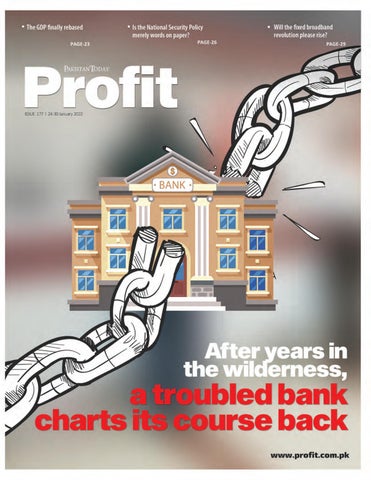
After three years in the wilderness,
can Summit Bank be resurrected? After being frozen in time for three years, the bank is making quick moves to get back in the race
18
F
By Yousaf Nizami
or the past three years, it has almost been as if Summit Bank was pretending it did not exist. In that time multiple finance ministers came and went, the coronavirus pandemic began, peaked, ebbed after vaccines were rolled out, and peaked a few more times for good measure. But in all that time Summit Bank remained stuck in time. In 2018, following a highly publicised and politically entangled money laundering scandal, the bank failed to release its financials prompting raised eyebrows. In 2019, the bank once again failed to release its financials and as a result of this non-compliance shifted to the defaulters segment of the Pakistan Stock Exchange (PSX). Following the demotion at the stock exchange, the bank made a feeble attempt to correct course by releasing their 2018 financials in 2020, but for a third consecutive year failed to call an Annual General Meeting (AGM). And a full-blown money laundering investigation initiated by the FIA and NAB following a scandal involving political bigwigs such as Asif Ali Zardari and his sister Faryal Talpur was not the extent of their troubles. The bank was also facing constantly rising pressure from the State Bank of Pakistan (SBP) over its inability to fulfil regulatory requirements due to a deteriorating financial condition. In response, it very much appeared that Summit Bank had wilfully buried their head in the sand and were trying to ride the tide of the scandal out. That is, until now. Over the past three months the bank has publicly released their financial statements for 2019, 2020, and 2021 (up until 2021). Following all of these mandatory disclosures, the PSX has also moved them up from the defaulters segment to its “normal counter” - meaning the bank’s stocks are up for trading once again. That will not be the end of it, as Summit Bank looks to recover and get
back into the race after three years in the wilderness. Profit spoke to Summit Bank CFO Salman Zafar Siddiqui, and the bank’s Head of Marketing, Corporate Communications & Service Quality Naiyar Saifi to get an understanding of what happened at Summit, how it got to the point that it did, and what measures it is now taking to climb out of the financial, legal and regulatory quicksand it has been stuck in for so long.
Bad results
S
ummit is not a very profitable bank. In fact, it has posted a net profit after taxation only twice, in 2014 and 2015, in the past 10 years, that too a small one, Rs217 and Rs230 million respectively. On the other hand, its losses in the other eight years under consideration have been in the billions; a net loss of Rs 9.45 billion in 2019 is no small number. While the bank’s losses must be a source of legitimate concern for its shareholders, it is Summit’s net asset and capital adequacy position that was the source of its run-in with the central bank. “We had some problems with the regulator which is why financial statements were withheld. CAR was a major concern,” Siddiqui tells Profit. The year 2018 was the beginning of three very tough years for Summit. SBP started having legitimate concerns about the bank’s solvency and depositors’ security. Deposits fell by 42%, net assets dropped by 73% and Capital Adequacy Ratio went negative to -8.02%. The following year, the bank had negative equity of Rs 5.59 billion which meant it was no longer solvent while CAR fell further to -25.03%. As per its latest financials, up until September 2021, negative equity has ballooned to Rs 13 billion while CAR is a whopping -53.66%. This wasn’t the least of Summit’s financial woes; non-performing loans skyrocketed as the number more than doubled, from Rs 17 billion in 2017 to Rs 36 billion in 2018. The bank’s NPL ratio stood at 64.54% while the industry ratio was 8%.
Fake accounts case The fake accounts case involves alleged money laundering worth billions of rupees through 32 bank accounts, which were opened in five banks. Of those accounts, 15 were opened in Summit Bank. The FIA’s investigation report revealed a pattern of flouting the law against money laundering on the part of Summit Bank employees, who appeared to be operating under direct orders from the founding CEO Husain Lawai. Lawai and Zardari are old friends, and Lawai spent a considerable portion of the 1990s and 2000s in exile, fighting charges of money laundering on behalf of Zardari. He was exonerated of those charges in the UAE in 2002 and the charges against him in Pakistan were dropped in 2008. The FIA alleged not only that Summit Bank failed to catch the money laundering going on through its accounts, but actively facilitated it through a procedure put in place by the bank’s CEO himself and one in which a large part of the bank’s staff was also involved. The FIA also alleged that bank’s majority shareholder, Abdulla Hussain Lootah, a member of one of the oldest and wealthiest families in Dubai, may have been a beneficiary of the money laundering himself. As if this was not enough, the National Accountability Bureau went ahead and arrested Husain Lawai. For his part, Lawai maintained his innocence throughout.
BANKING
“We took a big hit that year. It was a very difficult time for the bank. Our assets were depleted and there were a lot of defaults,” says the CFO. Short on capital, the bank was forced to liquidate much of its government securities/ fixed income portfolio that includes Pakistan Investment Bonds (PIB), T-Bills and Ijarah Sukuks, to build its assets back up. Its collective carrying value of government securities in 2017 was Rs 89.8bn which came down to Rs 16.3 billion the following year, an 81.8% drop. The bank could not sell any more due to SBP’s Statutory Liquidity Requirements (SLR) that requires banks to maintain a minimum level of eligible securities on its books. These numbers only became available in 2020 when the 2018 financials were published, representative of a bank on the brink of collapse. More importantly, the numbers showed a bank shrouded in secrecy and wanting to keep things secret. The question was, why would they do that when the results were not different from what anyone expected?
20
Fresh capital injection
S
ummit’s change of category at the PSX had no effect on the financial condition of the bank, in fact, according to Siddiqui, the bank was not even aware that PSX had moved it to the normal counter. It therefore, on the face of it, should make no difference to how the SBP looks at Summit either; it is still a sick bank that isn’t solvent. According to Siddiqui, the intent shown by Summit’s majority shareholder Abdullah Hussein Lootah to secure a controlling interest in the bank through a fresh equity injection amounting to Rs 15 billion, has satisfied the SBP. “SBP has formally approved the Lootah transaction. We have done everything from our end and are just waiting for a tender offer from the investor. After that, it is just a procedural matter which shouldn’t take more than 60 days”, Siddiqui added. Lootah had sent an offer letter in October of 2021. In the letter he had asked for 51% voting shares, and new ordinary shares through fresh
equity injection. The board agreed to handing over 5,976,000,000 ordinary shares without right to Lootah, and also increased the authorised capital from Rs28 billion to Rs90 billion. At the time of filing this story, that tender offer necessary to take the transaction forward had not come in. According to Summit’s head of marketing Mr Naiyar Saifi it is “expected any day”. If the name Lootah sounds familiar, that is because he was named as one of the main suspects by the FIA in the money laundering case against Summit. NAB was pursuing the case as well and it was only after he became approver against Asif Ali Zardari - the main accused in the case along with his sister Faryal Talpour that his arrest warrants were cancelled. Lootah putting money back into Summit to ‘revamp’ it after serious financial troubles brought on in some part due to the money laundering scandal is quite ironical, because the FIA, during the course of its investigation revealed that a sum of Rs2.49 billion had actually been paid out to Lootah by the bank, details of which
are at best murky.
Subjective regulation
O
ne thing that becomes clear is that one way or the other Summit Bank continues to linger on. This begs the question of where the SBP draws the line when it comes to similar operations that on paper do not seem viable anymore and are at risk of failing? For any commercial bank operating in Pakistan, perhaps its biggest asset is the commercial banking licence that it holds. This is simply because it acts as the primary barrier to entry for new players in the industry as the State Bank of Pakistan no longer hands new ones out and doesn’t allow just anyone to secure an existing one by buying a bank. It is therefore a privilege that not only has to be earned but maintained by working within the stipulated regulatory framework as laid down by the central bank. That these regulations are fluid in nature forces banks to update their systems and adapt. However, this regulation can sometimes be quite subjective. What happened at KASB can perhaps lend
some context here. KASB was sold for Rs 1000 as a token price to Bank Islami that also took over its liability of Rs53 billion in deposits. The former ownership and management of KASB maintains that this transaction was conceived and forcefully executed by the SBP in an unjustified manner without giving them a fair chance at restructuring the bank, shooting down proposals the bank had repeatedly shared with the central bank. That forced sale became the subject of some controversy. In April 2018 the Public Accounts Committee of the National Assembly asked the Supreme Court to take suo moto notice of the merger and termed it a “scandal”. Then in December 2020 the National Accountability Bureau opened an investigation into the decision, with talk of arrest warrants being issued for Ishaq Dar and Ashraf Mahmood Wathra, then SBP Governor along with a number of other State Bank officials. The State Bank shot back at this move, saying the move will demotivate SBP employees and defended its decision saying “the bank and its sponsors were found engaged in
fraudulent practices and siphoning off more than Rs3bn from the bank” and argued that KASB was “the only bank which had a negative CAR.” “All the actions taken were permissible under the law and were duly approved by the Ministry of Finance and SBP’s Board of Directors” its statement concluded. It was at least partially due to this investigation that present Governor of the SBP has pushed for putting the State Bank beyond the reach of NAB under the SBP autonomy bill making its way through the Senate. KASB management alleges that it was targetted by the SBP for unfair reasons, and go on to allege malfeasance as one of the motives, especially on the part of former Governor Wathra and finance minister Dar. In comparison, Summit has been more or less in the same regulatory soup as KASB for some years but has been treated very differently. It was allowed to not print its financials for three years while its restructuring and recapitalisation plans were accepted. It would seem therefore that a business plan in tandem with an offer of investment
BANKING
should be enough to satisfy the SBP. Apparently not. A senior former central banker explained that there are a lot of considerations in such situations other than just the bank’s balance sheet and capacity to recapitalise. “When push comes to shove, political connections, ones that Summit is known to have plenty of, go a long way”, they added. “The money Lootah has promised is yet to come in and his tender offer remains pending so it’s all up in the air at this point. What is surprising is the leeway SBP is giving to Summit merely on the basis of a transaction involving a controversial investor that may or may not be executed”, commented a senior banker on condition of anonymity.
The Islamic shift, new management and rebranding
E
22
ven if the fresh equity is injected into the bank, it does little to address the CAR and solvency problem. This much was admitted by Siddiqui.
“However, the investment is just one part of a larger strategic plan to completely overhaul the bank”, Siddiqui added. Summit plans to convert into a fully Islamic bank over the next few years. But this is easier said than done. “One of the conditions for the investment by Mr Lootah is the commitment towards transforming Summit into a purely Islamic banking concern. This will of course take time because the asset conversion process is very complex and will take some time to complete”, commented Siddiqui on the new direction the bank is taking. “In addition to being lower cost, this strategy also aligns with SBP’s goal of having more Islamic banks in the country”, he added. Summit has more or less done away with its previous management, starting with the CEO who has extensive Islamic banking experience in Pakistan, downwards to group heads of revenue-generating arms of the bank. This was a necessary step towards building a team distinguishable from the one whose poor decision making led the bank to where it is today. Additionally, according to Saifi, there
are plans to create a completely new corporate identity and do away with the Summit bank name. “We are going to completely rebrand as the Summit name is tainted, basically a stalemate. No foreign banks want to work with us”, he added. Yet, it is important to understand why Summit is not an easy bank to turn around. An amalgamation of three smaller banks, namely Arif Habib Bank (2009), Atlas Bank (2010), and Mybank (2011), Summit had an uphill task of ever becoming profitable despite its founding CEO Hussain Lawai’s best efforts. None of the three banks combined to create Summit were ever viable entities. Apart from a nearly non-existent retail banking portfolio, a solid consumer banking base was also lacking. Although Lawai tried his best to address these issues (Profit has covered this extensively in a previous story on Summit), it was never enough. Summit therefore carries a lot of financial baggage and cosmetic changes alone such as ‘going all Islamic, 'complete management changes’ and ‘rebranding’ may not be enough to shed it. n
BANKING
The GDP finally rebased
By Ariba Shahid and Asad Ullah Kamran
T
he National Accounts Committee has revised the GDP growth rate for FY21 to 5.4% from 3.9% as per provisional estimates, the highest in 14 years. In addition, the NAC has also approved rebasing GDP on 2015-2016 prices. This means that the previous GDP statistics were underestimated by around Rs 1.3 trillion or 11.3%. The GDP size has increased to $346.7
EXPLAIN-IT-LIKE-I’M-FIVE
billion in FY 21 compared to $298 billion stated earlier. This ranks Pakistan at 35th position in terms of world economies As a result, the per capita income of the country has risen to $1,666 compared to $1,543; while the public debt to GDP ratio has reduced to 72% from 84%. The tax to GDP ratio has worsened going down to 9.5% compared to the earlier communicated 11%. The fiscal deficit has improved by 1% bringing it to 6.1%. The value of the economy was estimated at Rs 27.4 trillion in 2015-16. That has now increased to Rs 30.5 trillion as per the Plan-
ning Ministry. What this means is the total goods and services produced in the economy in FY21 is now estimated at Rs 55.5 trillion. Despite the rebasing, the GDP clocking in at $356.7 billion is still lower than $257 billion witnessed in 2017-18.
What is GDP rebasing?
E
very few years, the GDP of a country is rebased to keep up with the evolution of prices in the economy. It is the process of replacing an old base year with a more recent base year. What this means is aggregates at constant prices are
23
recalculated in terms of more recent prices. This gives a reference point to which future values of the GDP are then compared to. If we put this in simple terms, let’s say an economy makes only apples. In Year 1, it produced 10 apples priced at Rs 1 per apple. That makes the GDP Rs 10. 8 years laters, let’s say the economy makes 20 apples. With the old base, the GDP would be Rs 20. However, the prices of apples have gone up to Rs 1.5 per apple making the GDP worth Rs 30. With the old base, the GDP was understated by 50%. The new base accurately presents the economy. GDP is rebased to capture the real and reliable estimates of GDP. The Gross Fixed Capital Formation (GFCF) is done by enlarging the sphere and coverage of macroeconomic data and estimates as per the guidelines of the System of National Accounts. Rebasing the GDP allows Pakistani policy makers to use data that is a better representation. “With these measures, economy size will be more reflective of the ground realities. After rebasing, the change in economic indicators shows a mixed picture,” says Fahad Rauf, Head of Research at Ismail Iqbal Securities.
When was this last done?
E
ssentially, this should be done once every five years. Moreover, the international best practice includes introducing new accounting conventions, improved methods of estimation, and revised statistical classifications every decade. The last rebasing of GDP was undertaken in 2005-6 while President Musharraf and Prime Minister Shaukat Aziz were in office. Prior to that, rebasing was done in 1999-2000 after a period of 20 years. The first rebasing/ linking was done in 19591960. The second, in 1980-81, the third in 1999-2000, fourth in 2005-06. The National Accounts Committee also devised a mechanism to rebase the national accounts every 5 years. This means, another rebasing is likely to happen soon. Earlier, the World Bank (WB) had validated the overall methodology for conducting the rebasing exercise in Pakistan and had pointed out some deficiencies that could be worked on. Rebasing of national accounts was difficult for PBS. The PBS has conducted 42 studies on various sectors of the economy to finalize weights on the basis of the latest data compiled in the fiscal year 2015-16. In the past, consultants in the private sector would undertake these surveys and
24
studies on behalf of the PBS, however, this is the first time the PBS is carrying it out themselves. Therefore, the time taken to go forward with the rebasing is also due to the fact that thorough scrutiny of PBS methodology and output was done before granting approval for rebasing of national accounts. Earlier, the Pakistan Bureau of Statistics rebased the LSM index to 2015-16 from 2005-6. This allowed for the weights of various sectors to change, and for the PBS to add garments, with a weight of 6%, as a category to the index.
What really is GDP and how is it calculated?
T
he Gross Domestic Product of a country has been one of the most discussed topics in our everyday activities. The initial basic concept of GDP was invented in the late 18 th century. However, it was later developed by an American economist in 1934 and accepted as the primary measure of an economy soon after in 1944. Most of us have a solid understanding of GDP and what it represents. In layman terms it is the total monetary value of all final goods and services that have been produced within the geographical boundaries of a country over a selected period. There are three methods that are widely employed to ascertain this figure. The approaches are Production, Income and Expenditure. Each of these methods encompassesdifferent components; however, each of these methods should arrive at the same figure in theory.
Production/Output Approach
T
hrough this approach GDP is measured as the difference between the value of output less the value of goods and services used in producing these outputs during an accounting period. By the application of this approach economists arrive at the GDP by subtracting from the total value of production/output the cost of goods and services used in production; this is termed as intermediate consumption. After adjusting for taxes and subsidies the final figure of GDP is computed.
GDP = Output – Intermediate Consumption + Taxes on products – Subsidies on Products
Income Approach
I
n basic terms this method relies heavily on the accounting reality that all the expenditures in an economy should be equal to the total income generated in an economy. In the application of this approach consideration is given to the costs incurred by the producer within his own operations, the compensation to employees, taxes (less subsidies) on production, consumption of fixed capital and operating surplus. All of these are expected toadd up to the GDP at market value.
GDP = Compensation of employees + Taxes – Subsidies + Gross Operating Surplus
Expenditure Approach
I
n following this method attention is given to the final use of the output for private consumption, government consumption, capital formation (investment) and net of imports and exports. To elaborate further: this approach includes all consumer spending, government spending, business investment spending and the net of exports. Mathematically the resulting figure of GDP is equivalent to aggregate demand since it is calculated using the same formula.
GDP = Final Consumption + Gross Capital Formation + Exports – Imports
The next steps?
T
he next steps are obvious. Better digitization of data. In all honesty, PBS does a pretty decent job with data collection. However, the way it is uploaded isn’t ideal. In a world where charting tools, interactive databases, and exporting data into various file types exist, PBS still relies on PDFs. Moreover, the government also needs to think beyond yearly GDP stats and start collecting stats on a quarterly basis. The more data nodes available, the more accurate the planning and coordination can be. Finally, just saying that the rebasing will be done every 5 years is not enough. Actually going through with the process is important. Moreover, changing mechanisms and techniques and forgoing rigidity is essential, especially methods that understand the local economy better. n
EXPLAIN-IT-LIKE-I’M-FIVE
OPINION
Uzair Younus
Is the National Security Policy merely words on paper?
“inter-departmental synergy” and policy continuity that is “ensured through democratic processes.” There are other key points made in the document that a reader would nod in agreement with. But the fact of the matter is that this policy, for the time being, represents nothing more than words on paper (or bytes on a computer). In the socioeconomic developmental journey of the country, this document is just a map, an aspiration of a driver who wants to make a road trip from Karachi to Peshawar. We have had other documents with bold and visionary aspirations as While recognizing the necessity and well, including the Vision 2025 document published by the Planning importance of the National Security Commission under the PML-N government. That document aspired to achieve a literacy rate of 90 percent and a primary school enrollPolicy, we must focus on execution ment rate of 100 percent by 2025. It also argued that the “economy is targeted to grow by over 8% between 2018 and 2025 with single digit magine that you are planning for a cross-country road trip inflation,” and that this would be done through export-led growth. from Karachi to Peshawar. You want to get to your destinaThe vision articulated that this would raise GDP per capita “from tion in an optimal manner, where the journey is both com$1,300 to $4,200,” and that this “export led growth strategy will help fortable and enjoyable. To do that you need a few things, achieve $150 Billion exports by 2025.” key among them being an updated map with major points Reading the above in 2022, we can safely argue that none of that you want to stop at during the journey, the ability and the above targets set in the Vision 2025 document will be met. A key mental fortitude to drive for hours on end, and a recently serviced reason for this failure, ironically, were the very policies pursued by vehicle that can handle the journey without major issues. Now the government that published the Vision 2025 document. imagine that this road trip is a metaphor for the socioeconomic deIt is for this reason that while recognizing the necessity velopmental journey for Pakistan: the map is the policy framework, and important of the National Security Policy, we must focus on the vehicle is representative of the institutions and ministries that execution. This requires looking at the clearly articulated map and need to drive you towards key goals, and the driver is the state and assessing and improving the capacity of both the vehicle and the drivits leaders, key among them being the office of the prime minister. ers responsible for making this journey. We all know that there are When viewed within this context, the recently unveiled Nasevere governance challenges facing Pakistan, key among them being tional Security Policy, it can be argued, performs the function of an the reform of a colonial institutional setup that was designed and updated map that provides the guidelines for making the journey. developed with the specific purpose of extracting wealth out of the The document’s focus on the “safety, security, dignity, and proscitizens of this land. This system has evolved and mutated over the perity of our people” is the right framing, and the policy’s internal years, but its core structural priorities remain the same. Therefore it focus reinforces the view that Pakistan’s external standing can only is no surprise that every spurt of growth experienced by this country be improved when the citizens of the country are experiencing an since independence further widens the gulf between the haves and improvement in their own lives. It also argues for a whole-of-govthe haves-not. This problem is exacerbated by a lack of policy contiernment approach where there is a concerted effort to achieve nuity, institutions that overstep their bounds, and a public discourse that continues to divide, polarize, and engage in sloganeering at the expense of nuance debates focused on resolving some of these pressing challenges. We have already seen the impact of this disconnect undermine the aspirations of the National SecuThe writer is Director of rity Policy: while the document seeks “to build sufficient public and private capacity to take Pakistan into the Pakistan Initiative a new technological era,” institutions responsible for executing on this policy are pursuing actions to ban at the Atlantic Council, a crypto in the country, which is a critical component of the evolution of the internet, referred to as Web 3. Washington D.C.-based And this is only one of several examples that can be pointed to in order to highlight that actions rarely align think tank, and host of with the vision articulated by successive governments. the podcast Pakistonomy. A mentor during my first job out of undergraduate sat us down once and told us to be careful of He tweets @uzairyounus. believing that making a roadmap was the end all be all. In his words, “execution eats strategy for breakfast, lunch, and dinner.” We will have to wait and see whether the state can execute on its policy vision, but early indications suggest that a lot will have to change before policy translates into meaningful action.
I
COMMENT
25
OPINION
Ammar H. Khan
Shrinkflation and its discontents
No consumer or wholesale index can accurately capture shrinkflation, so it often goes unnoticed in policy circles, even though a consumer can sense it, but can’t quantify it. Shrinkflation is a consequence of a permanent erosion in purchasing power as sellers develop new products to cater to a reduced level of real income, or purchasing power. A secular decline or flattening of real income for a large section of population has adverse outcomes for sustainable economic growth, and income inequality. Depending on which side of the fence one is on regarding inflation, whether it is cost-push, or demand-pull, barely anyone very passing year, the size of a cookie keeps reducing. If is on the side of shrinkflation which just gradually shifts overall earlier there were four cookies in a pack, one fine day there consumer preferences. Another adverse effect of shrinkflation is would be three, and so on. It is also not rare to find the lack of innovation, and product diversification. A classic Schumquality of an edible deteriorating over the years, whether peterian growth model suggests that as overall innovation in an it is the quality of chocolate or the sheer texture, there is economy increases, and as the number of overall products increase, gradual deterioration. Another great example is bread, if the frontiers of economic growth are gradually expanded resulting the price doesn’t change, the size goes down. Lately, one can even find in growth across the board. However, shrinkflation threatens a few slices of bread packaged together. More recently, one can even such innovation or product driven growth. find margarine being sold in tubes like its toothpaste. The price of these If an economy is plagued with regular bouts of shrinkflation, products doesn’t change much, but the quantity and quantity deterioit is not primed for product expansion driven growth as sellers do rate. This phenomenon is called shrinkflation. not see a thriving market for development of new products and Shrinkflation is the more lethal and discrete cousin of inflation. more innovation. Another casualty of shrinkflation is margins – it While it is possible to measure inflation through a number of methodolis due to maintaining a certain level of profitability margin that ogies, it is nearly impossible to measure shrinkflation over a long enough product quality and quantity is reduced. However, there is only timeline as there are no standardized products that can be measured. As up to a certain extent that quality and quantity can be comproinflation represents an erosion of purchasing power, shrinkflation determised upon, eventually a product is silently dropped from the mines a potentially permanent deterioration in the quality of products, market, as the seller deems it impractical to sell it in a market. and eventually lifestyle. Eventually, imported versions, or even smuggled versions of the Shrinkflation is most common in edible products, the demand of same product start appearing on shelves because the demand conwhich is highly elastic. A slight increase in price can trigger the substitinues to exist but not supported by supply economics. tution effect and increase demand for a competing product. As costShrinkflation is a consequence of consistent erosion of push inflation increases the overall cost of production and distribution, purchasing power, which would be a function of both inflation, margins start to erode. In order to maintain those margins, a seller can as well as general stagnation in wages. Although its impact is not either reduce the size of the product, or skimp on quality -- instead of apparent in the short term, its impact is critical in the long-term high-quality chocolate, they can use mid-tier chocolate, and so on. As as entities evaluate investment and product expansion decisions successive bouts of inflation take hold over a long-enough timeline, the based on potential purchasing power. A weakened purchasing overall quality of the product continues to deteriorate, till the time the power or economic environment would not create a favorable case product remains no match to its predecessor. for fresh investment, or product expansion. Shrinkflation is rampant in Pakistan, whether it be cookies, bread, beverages, or something as mundane as detergent. A consequence of the same being that most products manufactured locally pale in comparison to their imported counterparts, largely due to utilization of substandard ingredients to save costs, and maintain margins. This The writer is an also disincentivizes any fresh investment, or even divestment which can be seen in the case of many listed independent companies in consumption & pharmaceutical space either going private, or divesting from a market altogethmacroeconomist and er. Those that continue to operate are largely trading houses, rather than formidable manufacturing units. energy analyst. Policy makers need to consider shrinkflation as a symptom, and find a cure for that, and that cure lies in tapering down inflation, which in our case is mostly a supply driven phenomenon. Excess inflation over an extended period of time signals to investors potential for negative real returns, decisions regarding which become evident in the phenomenon of shrinkflation.
“Homo homini lupus” - man is wolf to man
E
26
COMMENT
OPINION
S.M. Talib Rizvi
Leadership in business
is able to attract people and align them towards a common goal. Leaders are defined by several commendable qualities. First and foremost, they are powerful communicators that are able to get their message across effectively. This is an important trait to have because it allows them to provide a clear vision and a sense of direction to people around them of how to go about the task at hand. On an individual level, this allows leaders to elicit the necessary response from people whether it is in the form of “Before you are a leader, success is all about growing yourself. When you motivating the employee to raise their performance or working become a leader, success is all about growing others.” —Jack Welch on their shortcomings. A successful leader is able to use his voice to draw the necessary response from people and inspires them to eadership is one of the most fundamental compoachieve greater success. nents of a successful organization. An organization A good leader is able to empower their followers and delwith strong leadership is not only able to achieve egate responsibility to others. People get more confidence when its goals but also ensures that their success will be they are trusted with important decisions and leaders ensure that sustainable for a long period of time. The concept they create an environment where people are able to succeed in of leadership is not straightforward and people their tasks by providing the necessary support. A good leader reare often confused regarding what it means to be a leader. It alizes that they cannot achieve things alone and therefore they inis a common misconception, for example, that leadership can vest heavily in empowering people around them which ultimately only succeed when a person has significant power or authority. leads to not only a productive work environment but also makes Moreover, people fall for the fallacy that ‘bosses’ and ‘leaders’ an organization capable of achieving their targets. On a personal are synonymous with one another when in reality they are very level, great leaders display a high level of empathy with people. different. Therefore, it is very important to understand what a This trait allows them to develop strong connections with leader actually is and the impact they can create on people. people and people feel more comfortable in sharing their probLeadership can be defined in many ways and depending on lems when they know that they will be provided the necessary the context, various definitions can capture the essence of leadhelp to overcome those issues. Perhaps most importantly, leaders ership. From my perspective, a leader is someone who is able to have a strong sense of integrity and they never compromise on influence and motivate others to maximize their efforts towards their values. People become inclined to follow someone when the achievement of a goal. It needs to be understood that social they realize that a person is honest with them and has strong influence is a crucial component of leadership. A leader must ethical values that they uphold in the most challenging of circumbe someone who inspires others and is able to influence others. stances. These are only some of the qualities that define what a Having authority or power does not mean that you are influenctrue leader is and it is imperative that leaders consistently work ing others but rather you are in a position to control others by on these traits to ensure that they are able to successfully lead force. In contrast, a leader is someone who through their actions people for an extended period of time. Now that we have understood some of the qualities that a leader must possess, it is imperative to understand the difference between a ‘leader’ and a ‘boss’. A boss typically is someone who uses their authority or The writer is a senior power to control people to act in a particular way, whereas a leader seeks to influence professional banker with others through their actions. Bosses are usually authoritative in nature and they often varied experience spanning strike fear in the minds of their subordinates, whereas leaders are approachable and over 25 years. He presently inspirational to others. They also have a tendency to point out mistakes of individuals and serves as the executive scold them which is not conducive to addressing the problems that are being encoundirector for TAG tered. Leaders on the other hand work actively to take measures to ensure that roadblocks are overcome and people do not feel singled out for any hiccup along the way. Whilst
L
COMMENT
27
leaders tend to have a hands-on approach and actively involve themselves with others to work on projects, bosses prefer to be on the sidelines directing what needs to be done. With such differences, it is no secret that bosses and leaders have a vastly diverging impact on organizations. Bosses lead to a very difficult working environment which leads to an alienated workforce that cannot achieve its potential. Ultimately, organizations can fall in decline as talents leave the organization and targets are not achieved. Leaders, on the other hand, contribute to the growth of an organization by setting the right example for people to follow and inspiring them to consistently focus on self-improvement to become more capable professionals that ultimately become the backbone of an organization in the long run. There are many inspirational stories of how leaders are able to transform organizations in different ways. Disney would not reach its high status without the revolutionary leadership of its founder Walt Disney. Under his stewardship, Disney became one of the most powerful companies in the world. Throughout his tenure, Disney showcased his leadership in different ways. The most notable example is when Disney employed the style of participative leadership that aimed to take feedback and input from his team of artists to
28
produce high quality animated content. The beauty of this style was that it created a platform where artists could openly share their opinions and have the opportunity to showcase their ideas. Ultimately, this allowed Disney to produce highly acclaimed content which would not have been possible if Walt Disney did not have the vision to lead his company in a particular manner. Another famous example is that of Ariana Huffington who is a co-founder of the Huffington Post. She employed a servant leadership style which aims to ensure the well-being of employees and the presence of a positive corporate culture which is based on group morale. This allowed Huffington Post to create an appealing environment which focused on the development of its employees and propel itself to heights such as being one of the first digital media enterprises to win the coveted Pulitzer Prize. These examples are a reminder that leadership is not limited to a specific style and there are different ways leaders can operate to achieve similar levels of success. Despite the presence of various leadership styles, leaders do have certain common qualities. Attributes such as integrity, good communication skills, empowering others and empathising with others are some of the qualities that are almost
universally found in great leaders throughout the world. It is also my opinion that great leaders have the capacity to unlock the hidden potential in others whilst also ensuring that they consistently encourage others to maximise their potential. Leaders leave a distinct footprint on an organisation by laying the foundation of great cultural values that become the strength of an organisation. Throughout my corporate career, I have been privileged to benefit from the leadership of inspirational individuals which have guided me in the right direction to attain the success that I was able to achieve. Based on my experiences, it is my firm belief that just like there were leaders who inspired me and provided me with a path to success, it is my duty to do the same for the young generation by creating the right environment in an organisation through leadership. It is imperative that ‘bosses’ in Pakistan realise that enforcing others will not lead to success in the long-term. Success models for organisations are based on leadership and leaders ensure that they create a culture of inclusion where every person feels valued and respected. Tom Peters sums up the essence of leadership quite beautifully when he says: “Management is about arranging and telling. Leadership is about nurturing and enhancing”. n
COMMENT
Will the fixed broadband revolution please rise?
Any hope of turning Pakistan into an IT hub will need serious investment in fixed broadband infrastructure By Ahtesam Ahmed
O
n the 17th of January, Prime Minister Imran Khan said that investment in the technology sector was vital to create employment for the youth as well as improve the national economy. Four days later on the 21st of January, a damning report conducted by faculty at the Aga Khan University’s Institute for Educational Development found that more than 90 per cent of primary and lower-secondary students in Pakistan have only a weak or basic understanding of the mathematics and science they are required to learn. Statements like the one made by the Prime Minister are nothing new. This government and governments before have regularly touted tech and information technology as the future of Pakistan and a way out of unemployment and the country’s economic woes. Yet the two most basic fundamentals to achieve success in the IT sector is a robust education system and widespread internet connectivity. On the education front Pakistan is far behind. According to the earlier mentioned report, the average mathematics score was 27/100 in standardised tests for 15,000 students across 123 schools. The average science score was 34 out of 100. Only one per cent of students scored over 80 in either subject, thereby demonstrating what researchers called “excellent understanding”. Currently, Pakistan has the world’s second-highest number of out-of-school children (OOSC) with an estimated 22.8 million children aged 5-16 not attending school, representing 44 per cent of the total population in this age group. Meanwhile, Pakistan’s internet and telecom-
TECHNOLOGY
munications infrastructure is a more complicated avenue. It is certainly among the cheapest in the world in terms of prices, and access has been growing in recent years, but it still leaves far too many people out. While the overwhelming majority of Pakistani households has access to a cell phone, not nearly as many people have access to the broadband internet that cellphones have enabled, particularly after the advent of 3G and 4G technology. Much has been made of the rise in tech usage in Pakistan after the proliferation of 3G and 4G internet connections. Pakistan has some of the cheapest internet data rates in the world, but a critical piece of the puzzle that has largely been ignored is the fixed broadband ecosystem of Pakistan, the infrastructure of which will serve as the backbone for the envisaged Digitised Economy of Pakistan. You see, mobile broadband cannot serve as the backbone for digitising the economy due to the fact that it has comparatively lower user experience, capacity and stability due to inherent limitation of dependency on fixed-line for its bandwidth. Currently, the penetration of broadband services in the country is around 50% with more than 109 million subscribers, the figure is growing and internet access is becoming cheaper, it looks like we will be sorted in a few years time. So what is the problem then? The answer lies in the dynamics of our user base. The total user base of broadband internet comprises 97% mobile broadband subscribers as per figures released by Pakistan Telecommunication Authority (PTA) in december 2021. Therefore, to build a digital economy, it is necessary to have a strong foundation which in this case is a stable fixed broadband infrastructure supported by a well spread network of fibre. The need to lay down an extensive network of fibre arises
29
from the fact that it will not only support fixed broadband infrastructure, but will also be critical for upgrading our 4G/3G user experience and rolling out the 5G which can not smoothly run on the existing outdated infrastructure. As per Tabadlab working paper,The Fixed Broadband Challenge, published in January 2022, “It isn’t possible to roll out next-generation technologies on existing and (in many cases) outdated infrastructure, which is why investment into a fibre optic infrastructure is essential. Such an infrastructure would not only connect major urban centres and metropolitan areas, but also tier 2 and smaller towns, at equivalent speeds to those enjoyed by users in tier 1 areas, levelling the playing field and making it easier for innovations and ideas to come out of places that may not have the most resources.” The Secretary of Board of Investment Pakistan, Fareena Mazhar, during her presentation at the BOI IT roundtable on 7th Jan 2022, acknowledged the fact that Pakistan’s Fixed Broadband network is limited to a few urban areas. She also stated that the government aims to develop this sector by improving the existing infrastructure which requires an estimated USD 6 Billion investment and aims to provide connections to 10 million households in the foreseeable future. However, this seems as an uphill task, but before getting to the reasons that are hindering the growth of Pakistani Fixed Broadband Market and proposed solution, let’s first look into the market landscape. As per the EU Broadband Technology overview, Fixed Broadband can be divided into two categories; Wireless and Wired. Wireless broadband technologies include mobile radio solutions (e.g. HSPA, LTE), fixed radio solutions (e.g. WiMAX) and satellite solutions. The wired broadband services available in the country mainly use three types of distribution structures. First one being the Digital Subscriber Line (DSLs) that use existing telephone lines for transmission of data, second one is through cable modems through which cable operators, by using existing cable infrastructure, transmit data. Lastly, there is Fibre-to-the-x (FTTx) that uses fibre optic cables to transmit data. The FTTx is the most preferred broadband infrastructure solution because its speed and efficiency is far superior to cable and dsl connections. The value that a stable broadband infrastructure can create is enormous. According to a World Bank study Exploring the Relationship between Broadband and Economic Growth, published in January 2015, a 10% growth in fixed broadband penetration can lead upto 1.38% growth in GDP. However, as per the TABDLAB working
30
paper, compared to the regional countries, Pakistan’s fixed broadband market is substantially underdeveloped and needs a major overhaul. The country’s 2% fixed broadband penetration is one of the lowest in the Asia Pacific region and the lowest penetration rate in South Asia. Furthermore, neighbouring countries at this point of time are at a much higher rate of fiberisation compared to Pakistan. India can serve as an example, As per the figures of Telecom Regulatory Authority of India, 34% of its telecommunication towers are fiberised compared to Pakistan’s 9% as per PTA. India is further expanding its fibre network under the National broadband mission which aims to connect all Indian villages to the network and provide fibre optic coverage to 70% of telecom towers. Moreover, the fixed broadband prices in Pakistan are still very high compared to other similar markets.
focused on both the supply side and demand side. The spectrum allocation needs to be improved at a fee that makes commercial sense for the businesses. Furthermore, reducing the red tape in providing a right of way to lay the infrastructure is key to liberalising the market. On the demand side of things, customers need to be educated and a focus should be on the digitally disadvantaged demographic. There is a need to increase investment in the sector by manifolds if the infrastructure is to be improved. In order to achieve that, the government must improve the overall investment climate, encourage financing through public private partnerships, facilitate the market to adopt a shared infrastructure model while also reviewing its tax regime on the sector and make it more commercially sensible for the market players. The core of these reforms would be the
Source: S&P Global Market Research In order to break this cycle of slow and limited fixed broadband reach, there needs to be some immediate reforms. According to a Tabadlab working paper, The Fixed Broadband Challenge, four priority areas need to be immediately addressed in the reforms. Firstly, there is a need to acknowledge the importance of fixed broadband as a utility at par with other facilities like electricity. This should be followed with awareness campaigns to emphasise on the pivotal role of fixed broadband in future economic growth. After that there is a need to develop a National Broadband strategy, taking notes from our neighbour, India, we need to develop a national plan of laying down an extensive fibre network with a special focus on tier-2 & tier-3 cities. The strategy should be based on time bound objectives for which subsequent accountability must take place. In the strategy, there should be reforms
government’s ability to improve its administrative capabilities that ensures the reforms are adequately implemented and progress is continually monitored. For a better understanding of why these specific reforms are important, we need to take a deeper look at what exactly is holding back the Fixed broadband industry. The primary reason is lack of government support over the years. Telecommunication sector overall has suffered from the government treating it as a high value commodity rather than a utility provider. This has led to the sector being heavily taxed and subjected to high regulatory fees, resulting in affordability issues for a population that is dominated by low income households. The combined withholding tax and gst rate is around 35pc on the sector, the burden of which is transferred to the consumer. This in turn creates affordability issues for the consumers. As per PTA annual report 2020, there
Source: International Telecommunication Union: Digital trends in Asia and the Pacific 2021 are a little over 2 million fixed broadband subscribers in the country, with services being provided by PTCL, NTC, Nayatel, Optix, QuBee, Storm Fiber, WorldCall, Wi-tribe and Fiberlink. The report also stated that total fixed broadband subscription declined by about 7.1% during FY2020 owing to availability of wireless-based services and PTCL’s limited capacity for expansion. This further highlights the fact that the sector is not a very competitive one. Pakistan Telecommunication Limited (PTCL), one of the pioneers of broadband service in Pakistan, still holds around 3 quarters of the market as per figures in the Tabadlab working paper. Private operators are not able to capitalise on this market opportunity due to most of the infrastructure being owned by PTCL and heavy investments required to lay down their own fibre networks. This leads to another issue which has plagued the fixed broadband growth in the country and that is an absence of infrastructure sharing framework. As per Tabadlab, the market players don’t operate under a leased based model where there is centralised ownership of critical infrastructure which is then leased out to last mile service providers. Moreover, the existing infrastructure is dominated by DSL (telephone lines) which is not the most
efficient technology. The lack of government attention has also led to issues for new and existing market players in finding a Right of Way (ROW) to lay down the fiber network. The amount of red tape involved in the process is extensive, permits and approvals are required from central government’s departments, regulatory bodies, provincial authorities, municipal administration and local real estate players. All this adds up to the pace of deployment as well as cost due to capital being tied up. However, the government has been very active lately, in introducing policy measures and reforms to help the sector grow. The Ministry of Information Technology and Telecommunication (MoITT) has been at the forefront of these developments. As per PTA’s annual report, work is being done on expansion of fiberization across the country and the regulator has engaged with Government of Pakistan (GoP) for provision of incentives for local manufacturing of fibre to meet growing demand. While the regulator is also encouraging mobile operators to connect the backhaul infrastructure on fibre links for better throughput. PTA also claims in the annual report that the new licensing framework will also ensure that investments in the optic fibre infrastruc-
ture are encouraged; “PTA will provide all possible facilitation including incentives and ease of business such as speedy and less costly provision of RoW.” The basis for the existing policy framework is the Telecommunication Policy that was launched in 2015. The policy set out principles that were to be adhered to in any further regulatory moves. These included being market driven, appropriate regulation, forward looking, accelerating digitization, universal access and government intervening only where it is necessary. The policy also stated about developing mechanisms to fast track the process of granting right of way to backhaul infrastructure developers including fibre optic operators. The Rolling Spectrum Strategy that was introduced in 2020, laid the roadmap for spectrum related policies. It also included the strategy to be adopted for developing future fixed broadband capacity and infrastructure. The Right of Way Policy Directive was also introduced in 2020 aiming to promote modern telecommunication services by way of installation or maintenance of telecommunication equipment or for the purpose of establishing or maintaining telecommunication systems in the country and to increase broadband penetration recognizing it is a critical foundation of the digital revolution and economic growth. The MoITT also started working on the National Broadband Policy, a step that India took back in 2004. The policy, in the drafting process, aims at enabling broadband development so that the sector’s contribution to the GDP is around 8% by 2025. The policy also aims at delivering broadband internet to the complete population of Tier-2 & 3 cities and for this objective it emphasises on the development of backhaul infrastructure supported by an extensive fibre network. Furthermore, In collaboration with China, Pakistani Authorities are also laying a fiber cable network that will be spread from Karakoram to Gawadar mainly serving the Provinces of KP and Balochistan in the areas that are along the CPEC route. The network will connect Pakistan to China’s PEACE cable project that aims at direct connectivity to East Africa and Europe. Phase one of this project is already completed with an 800 Km line from China to Rawalpindi operational from 2018. The project will significantly improve Pakistan’s infrastructure for Fixed Broadband while further improving the penetration figures. All these Policies and Measures show good intent towards developing the infrastructure but they do have some inherent limitations. The policies drafted are inspired from other countries with similar conditions and
TECHNOLOGY
Source: PTA Annual Report 2020
of the draft policy is retrogressive and instead of promoting competition in the market, it portends over-regulation. Furthermore, the government unnecessarily proposed optical fiber charging mechanism which is a deterrent to healthy competition. According to the Industry, the policy’s proposed new regime of regulatory levy/tax is not just in contradiction with the 2015 policy statement, but also fails to account for the very fundamentals of incentive pricing. Our sources further added that the industry is of the opinion that the draft policy is replete with unnecessary regulatory interventions that already exist in one form or another and the consultation draft is incoherent in the sense that it highlights a set of industry gaps and then leaves those completely unaddressed, while simultaneously proposing a myriad of interventions that do not address those gaps. The Government’s recently announced National Security Policy focuses on a shift from Geo-Politics to Geo-economics while the vision of “Digital Pakistan” is E-Governance, E-Commerce and E-Banking, but to achieve both, the underlying infrastructure is not present yet. Therefore, there needs to be a sense of urgency towards developing a fixed broadband infrastructure as that will form the base for Pakistan’s future advancement. There are many regional examples like India, Bangladesh and Malaysia that can serve as a test case on “How to rapidly expand fibre networks” for Pakistan and help the country develop its infrastructure roadmap. n
this at times has led to the policies being strategically not accurate and objectives being vague which have led to slow or stunted progress in some cases. The National Broadband Policy is an example of that which as per the industry, was not a well drafted one as it lacked substance, didn’t follow up on results of previous policy measures and was vague about implementation process, this led to the policy being taken back for redrafting. Wahaj Siraj, CEO of Nayatel, while talking to Profit, stated, “The industry sent a joint recommendation letter to the MoITT to highlight the flaws in the Broadband Policy.” He further added, “The issued draft policy was more of a case study rather than an actual policy statement. It seemed like the government was absolving itself from most of the policy implementation responsibilities by shifting it to the Broadband companies.” This also leads to another issue with policy statements, that in Pakistan it has been a norm of not monitoring and following up on whether these policies have achieved their intended targets or not. The Right of Way directives serve as a prime example as their highly progressive objectives are still largely unachieved due to lack of dedicated implementation. Profit contacted industry insiders to get further details about the communicated feedback on the National Broadband Policy. Various individuals, on the condition of anonymity confirmed that the crux of the feedback shared with the government was that the overall direction
32
TECHNOLOGY
Dispute over Reko Diq mines heads towards a settlement World’s fifth largest copper and gold deposits will finally get to see the sun, as the government of Pakistan and Tethyan Copper Company seem to have reached an agreement regarding the division of shares at 50% each By Asad Ullah Kamran
K
ey details of the agreement are still under wraps, but Profit has learned from sources close to the deal that a consortium of local companies will be taking the lead and not the government. Shamsuddin Shaikh a veteran of mining operations, who had worked on the Thar coal project prior to joining National Resource Limited (NRL) as its CEO. National Resources Pvt Ltd (NRL) is a joint venture founded by six of Pakistan’s most powerful business families with the primary goal of developing the Reko Diq reserves. The Tethyan Copper Company could not be reached for comment. If the agreement goes through, it will mean the Government of Pakistan could be off the hook for $5.976 billion in damages that it had incurred when it lost the arbitration launched by TCC following nearly a decade of legislation. All appeals had been exhausted and TCC was moving towards seizure of assets belonging to the Pakistani government abroad. In early 2021, the case made headlines when TCC moved to seize PIA’s Roosevelt Hotel and the Scribe Hotel in Paris, assets belonging to PIA Investments whose shares are held in the British Virgin Islands. That case was ultimately decided in Pakistan’s favour by a BVI court and the provisional charge attached against the hotels by the court was removed by the sum-
NATURAL RESOURCES
mer of 2021. But the case showed the dangers that the government was now facing with TCC empowered to find and seize assets belonging to the government anywhere in the world. The history of Reko Diq has been turbulent to say the least, since its inception it has been mired in controversy. These delays can partly be attributed to the remote and rugged location of these minerals in the remote hills of Chagai wedged between the borders of Afghanistan to the North and the Iranian border to the South. After signing an agreement with Balochistan’s then-caretaker administration, led by chief minister Naseer Mengal, the resources were first discovered in 1993 by an Australian corporation, BHP Billiton. The ‘Chagai Hills Exploration Joint Venture Agreement’ (CHEJVA) gave BHP a 75 percent stake in the venture, while the government got a 25 percent share on a joint-investment basis with a 2 percent royalty. After little to no progress was made, BHP stopped exploratory activities in April 2000 and passed up its operations to Mincor Resources, an Australian business. Mincor was later purchased by TCC in 2006, which is a subsidiary of a joint venture between Barrick Gold, based in Canada, and Antofagasta, based in Chile. In the same year (2006), former MNA of Jammat e Islami Maulana Abdul Haq Baloch challenged the legality of CHEJVA in the Balochistan High Court. The challengers claimed that CHEVJA was carried out in
violation of applicable Pakistani laws, that the parties failed to properly register CHEVJA, and that the Balochistan government unlawfully loosened local legislation in order to carry out CHEVJA. The Supreme Court, on the other hand, overruled the case and declared CHEVJA to be lawful. The TCC performed a bankable feasibility assessment in 2010 that laid the groundwork for excavation and construction at Reko Diq. The TCC feasibility study estimated that 210,000 tonnes of pure copper and 7,962 kg of pure gold would be extracted during a 56-year timeframe. Other research, like one published by the Society of Geologists in 2008, suggests that the TCC underestimated copper resources by 35% and gold deposits by 25%. Roughly 2.2 billion tonnes of the minerals are commercially extractable out of a total of 5.9 billion tonnes. The Reko Diq mines are said to cover an area of 13,000 square kilometers. The TCC submitted a Mining Lease Application in February 2011, however the Balochistan government rejected it in November 2011. The fact that the smelting and refining should be done in Pakistan was a big stumbling barrier. The royalty rates should be increased, the financial model should be reconsidered, and the local populace should be more involved in the project. By the time the provincial government suddenly declined to award them the mining lease they needed to keep working, the TCC
33
had invested more than $220 million (Rs35 billion), according to the TCC. TCC filed a complaint with the International Centre for Settlement of Investment Disputes (ICSID) in 2012, claiming $11.43 billion in damages after the Balochistan government denied the company’s request for a lease. In January 2013, when the case was heard at ICSID, the Supreme Court of Pakistan had already declared CHEVJA illegal and ruled that the TCC had no statutory rights to develop and mine in Reko Diq. Based on allegations of corruption and a violation of mining regulations.
However as per CHEVJA section 15.4.1, ICSID had the ultimate authority to rule on this matter. And in July 2017, the ICSID ruled against Pakistan, saying that there had been no wrongdoing in CHEVJA, the premise on which Pakistan’s Supreme Court had terminated the agreement. Consequently, TCC was granted a whopping $5.976 billion (Rs950 billion) in damages by an arbitration tribunal of the World Bank’s ICSID on July 12th, 2019. More recently even though the government had a significant role in the facilitation of talks, it was the private sector that led the way. Sources
Reko Diq — A timeline
1993
Reko Diq, said to hold an estimated 5.9 billion tons of mineral resources, with an average copper grade of 0.41 percent and gold grade of 0.22 grams per ton, is explored by an Australian company, BHP Billiton, after signing an agreement with Balochistan’s then caretaker government under the leadership of chief minister Naseer Mengal. Under this agreement, the ‘Chagai Hills Exploration Joint Venture Agreement’ (CHEJVA), BHP had 75 percent interest in the project while the government held the remaining 25 percent share on a joint-investment basis with 2 percent royalty.
2000
BHP suspended its exploratory work and handed over its obligations to another Australian company, Mincor Resources. Questions arise over why the government did not refuse the transfer of the Reko Diq project from the internationally reputed BHP Billiton to a relatively small mining company Mincor? Due to inefficiency, the then government could not exploit the opportunity to seek fresh offers after BHP had failed to make significant progress on the project.
2006
Mincor was acquired by the TCC which is a subsidiary of Mincor and a joint venture between Canadian-Israeli owned Barrick Gold and Antofagasta of Chile. In the same year, the legality of CHEJVA was challenged in the Balochistan High Court. The challengers argued that CHEJVA was executed contrary to the provisions of relevant Pakistani statutes, that the parties failed to properly register CHEJVA, and that the government of Balochistan improperly relaxed local legislation to execute CHEJVA. However, the high court dismissed the challenge and found CHEJVA to be legal and valid.
2007
The TCC started a process with the provincial and federal governments for a customized mineral agreement for mine development.
34
close to the project have revealed that one of the companies backing NRL had been negotiating with TCC for an out of court settlement. TCC also realized the fact that it was next to impossible to recover the nearly $6 billion penalty imposed on the GoP by ICSID. Based on close negotiations with the private sector companies keen on taking the project, TCC has reached an agreement with these companies backed by GoP. Although TCC has managed to get itself out of the quagmire only time will tell how NRL will get along with the government.
2010
TCC completed a bankable feasibility study establishing the basis for mine development at Reko Diq. According to the TCC feasibility study, 2,100,00 tons of pure copper and 7,962 kgs of pure gold were to be produced over a period of 56 years. However, some other studies (like the one published by the Society of Geologists in 2008) show that the TCC understated the copper deposits by 35 percent and the gold by 25 percent.
2011
TCC submitted a Mining Lease Application but it was rejected in November 2011 by the Balochistan government. The major stumbling blocks were that the smelting and refining should be done in Pakistan. TCC claimed it had invested more than $220 million (Rs35 billion) by the time the provincial government unexpectedly refused to grant them the mining lease needed to keep operating.
2012
TCC took the matter to the ICSID to seek compensation for $11.43bn in damages after the Balochistan government turned down a leasing request from the company.
2013
When the case was considered in ICSID, the Supreme Court of Pakistan declared CHEJVA as void and stated that the TCC had no legal rights to explore and mine in Reko Diq.
2017
ICSID ruled against Pakistan by declaring that there was no wrongdoing in CHEJVA – the ground on which the Supreme Court of Pakistan had terminated the agreement. Eventually the tribunal held that Pakistan was liable to pay damages. The court confirmed that Pakistan had violated several provisions of its 1998 bilateral investment treaty with Australia, where the TCC is incorporated.
2019
A World Bank arbitration court ordered the Pakistani government to pay damages of $5.8 billion to Tethyan Copper, a joint venture between Chile’s Antofagasta Plc (ANTO.L) and Canada’s Barrick Gold (ABX.TO).
NATURAL RESOURCES