CONTENTS
10
18
10 DMing for price and praying at Data Sahib - this week in Pakistan’s business and economics twitterverse 14 A shakeup brews in Lahore’s elite schools network
18
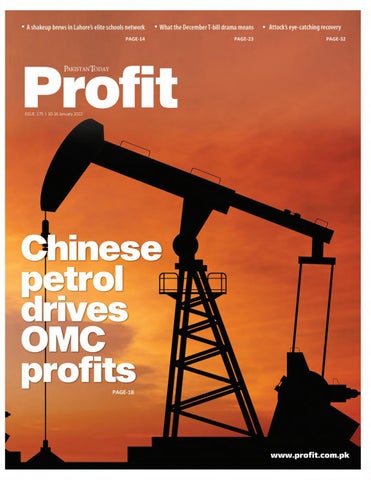
18 Chinese petrol drive OMC profits 23 What the December T-bill drama means 25 Can the sun be taxed? Ammar H Khan
14
32
27
27 Riding disruption Uzair Younas 28 Decolonizing the mind Dr Asad Zaman 30 What does a financial crisis really look like?
Profit
32 Attock’s eye-catching recovery
Publishing Editor: Babar Nizami l Editor: Khurram Husain lJoint Editor: Yousaf Nizami l Assistant Editor: Abdullah Niazi Reporters: Ariba Shahid l Babar Khan Javed l Taimoor Hassan l Meiryum Ali l Shahab Omer Chief of Staff & Product Manager: Muhammad Faran Bukhari Regional Heads of Marketing: Muddasir Alam (Khi) l Zulfiqar Butt (Lhr) l Malik Israr (Isl) Layout: Ahmad Salahuddin l Photographers: Zubair Mehfooz & Imran Gillani l Business, Economic & Financial news by 'Pakistan Today' Contact: profit@pakistantoday.com.pk
Editorial No, this is not a financial crisis
Rising economic stress does not translate to being an ‘economic crisis’ Pakistan is under mounting economic stress these days as the current account deficit continues to rise along with inflation and the exchange rate is under persistent pressure, but the casual way in which this situation is described as a “financial crisis” in our discourse needs to end. The stresses are there, and they are growing, and the country cannot evade the need for resumption of the IMF program at the earliest, but nothing happening today can be described as a “financial crisis”. For a clearer idea of what a financial crisis really looks like we should take a look at countries like Kazakhstan, Turkey or Lebanon. All of these countries have seen civil unrest and economic stress to the level where day to day life of the citizens is impacted. In Lebanon, for example, the government doubled the exchange rate for dollar withdrawals from foreign currency accounts overnight, sending charged mobs into bank branches clamouring to withdraw their holdings fearing a freezing of the accounts. The black market rate for dollars reached 20 times the official rate. Inflation hit 174 percent in October with no signs of abating. Shortages of fuel and medicines are now everywhere since the country imports 80 percent of its essential supplies. An estimated 77,000 people have fled the country as refugees over the last year as the crisis mounted and the country struggled to come to an agreement with the IMF for a bailout. This is what a financial crisis looks like. The riots in Kazakhstan may well have been long in the making, but they were triggered by the removal of a price cap on LPG that had become a fuel of choice for many citizens as oil prices rose. The cap removal immediately doubled the price but the government argued they had no choice since the cap was leading to shortages. The intensity of the riots was so severe as to prompt an appeal for help from neighbouring countries, leading to a swift deployment of Russian troops to put down the disturbances. This is what a financial crisis looks like. Turkey’s economy is far more solid than either of the other two, with foreign exchange reserve cover
far above the required three months, but the inflation rate there is above 30percent and exchange rate depreciation is so severe as to prompt massive interventions by their central bank. Despite the mounting pressures, President Erdogan has charged ahead with cutting interest rates from 19 percent in September to 15 percent by December, describing his actions as an “economic war of independence”. It is not clear what he is seeking independence from, but the country has seen four central bank chiefs come and go over the last two years. The inflation and exchange rate pressures have created a flight from the lira, into foreign exchange or even gold, to the point where gold traders resorted to selling in smaller and smaller quantities. Sporadic reports of protests and riots have emerged from the country as 2021 drew to a close, but so far Turkey has not seen civil unrest on the scale of Lebanon or Kazakhstan. But given how stubbornly Erdogan is wedded to his approach of priming the engines of his economy with printed money, it is hard to see how the road he is embarked on ends in any other way, unless there is a sharp change of course. Pakistan may not be in the throes of an economic crisis like the ones these countries are seeing, but their example stands as a stark warning to us of what happens when poor economic management and deteriorating fundamentals are allowed to fester for too long without corrective action. In each of these countries the political leadership failed to understand the real impact of their actions on their citizenry, either because they were accustomed to an authoritarian style of rule like in Kazakhstan, or too preoccupied with political wrangling like in Lebanon where the approach of an election has kept the government distracted from its growing economic woes, or worse still, where the leader is living in a delusional world of his own making like in Turkey. We may not be in the middle of a financial crisis at the moment. But these are the follies that pave the road to such a crisis. In Pakistan, the need for corrective steps is stark. The need to avoid a financial crisis is even starker.
7
Readers Say I just read your story, didn’t read any mention of a long mechanism of bank treasuries or about how the rupee is being kept stable. The dollar in the open market has almost always been more expensive than the official rates. The price is determined by supply and demand. Apropos: Flight to the dollar and the new shape of currency supports HarrisRichard77, Twitter @sameerchishty & I co-authored this piece. It is mostly Sameer. Building a technology stack on top of physical and knowledge infrastructure is easy, but building the same tech stack on weak or non-existent physical and knowledge infrastructure restricts growth. AgriTech startups will have trouble scaling up to glory in absence of more transparent commodity markets, formal credit, information symmetry, substantial storage, and specialized transport and related supply chain infrastructure for farm to market operations. The infrastructure enabling scale is a gigantic near-term investor opportunity which we hope entrepreneurs chase down. FinTech is the furthest along in having a usable stack due to the introduction of smart bold recent moves such as the launch of Raast. There remain substantial infrastructure opportunities such as the identity layer. We believe there is a mega opportunity for startups that identify and build and rent out parts of the full foundational stack required upon which FinTechs can go to market with confidence. Apropos: The unicorns are here and it’s time to invest in our tech infrastructure @rogueonomist, Twitter Cohesive strategies make for tools to handle challenges; present, upcoming or in the offing. Handling every nail in the plank with a hammer of populism or activated perception of theology usually makes for memes, autocrats and failed regimes, not the creed of leadership. Apropos: The challenges at the end of the tunnel @oachayar, Twitter
facebook.com/Profitpk twitter.com/Profitpk linkedin.com/showcase/13251020 profit.com.pk profit@pakistantoday.com.pk
HOW TO CONTACT
8
While the Nov 2022 change of guard will be a major inflection point for the govt & set the tone for 2023 elections, the way in which Khan & his cabinet deal with economy & Pakistan’s 2nd war on terror will ultimately make or break PTI’s electoral chances. Apropos: The challenges at the end of the tunnel @Roohan_Ahmed, Twitter Whoever wrote this is salty and probably also unaware of how start up valuations are going on globally, how companies evolve and how these granular calculations are equally nonsensical. The agenda behind this doesn't make sense. Air-
lift is Pakistan's first unicorn & we should be proud rather than launching these biased criminal investigations. India announced several unicorns this year only and we as typical haters are hating on our first! Thirdly, I'm sure most people are aware that for start ups the board members are usually mentors too and having an active board member who works with you is nothing bad nor questionable. The "market sources" & these calculations won't be necessary since the growth and expansion models of startups are subject to such frequent changes. Apropos: Airlift may have hit a billion, but is it for real? @AliRazaRiz34, Twitter This is such a good read. So insightful. From the numbers presented here, it seems Airlift is hiding something but I hope this isn't the case because it will be confidence shattering for the nascent Pakistani startup space. Apropos: Airlift may have hit a billion, but is it for real? @Shahrookh, Twitter Hey Taimoor, If Aatif Awan is actually personally a majority or sizable stakeholder in Airlift as indicated in the article above, it opens many issues for the investors of Indus Valley Fund and the SPVs that he created for Airlift. These are to be looked at Q1- Were investors in Aatif’s Indus Valley Fund told of the double-sided relationship of Aatif in Indus Valley, as well as Airlift? There is conflict of interest to fund your own company with the money raised for a venture fund. At best, bias of being a sizable stakeholder in Airlift can cloud the judgment of making best investments for investors of Indus Valley Fund. At worst, Indus Valley Fund can be used as the facade of ‘independent’ investor into Airlift, encouraging other investors to join in the investment into Airlift. Also, why would an investor want to pay management fee and 20% carry on investing in the personal asset of Aatif? Q2- Take Q1 above and ask the same questions for the SPV that was created by Aatif to raise more money directly from investors to sell equity of Airlift and charge a fee/ carry for it. Were these investors told that it’s actually Aatif’s own company? Was there bias and why was sizable fees/carry charged for these SPVs for raising money for his very own company? If Aatif is actually a sizable co-owner of Airlift, it has pretty serious implications because of the two sided dealings and conflict of interest. If he is not, none of the above applies or matters and he would be fine. Taimoor, How hard could it be to find that out? Aatif, why don’t you confirm by yourself? Apropos: Airlift may have hit a billion, but is it for real? Pro Investor, Website
COMMENTS
IN BRIEF The ECC of the cabinet has approved import of 50,000 tonnes of urea from China. Fertiliser manufacturers welcomed the government’s decision to import 50,000 tonnes of urea to overcome its shortage in the country.
The PSX turned bearish on Thursday after seven consecutive positive sessions, with the benchmark KSE100 Index shedding 325.59 points (-0.72 percent) to close at 45,082.3 points. The market opened on a negative note and remained bearish throughout the session, following global trends.
Independent power producers (IPPs) are still not lifting locally processed furnace oil that they’re required to store on their premises for emergency use, even a month after local crude processors first raised the issue. The country’s energy managers had imported excess furnace oil for IPPs while expecting a shortage of LNG in the winter. The SBP has unveiled a licensing and regulatory framework for digital banks with an aim to introduce a complete digital bank that will provide all the banking services from account opening to deposit and lending through digital means. The framework contains details for setting up digital banks as a separate and distinct category in Pakistan. The government on Tuesday finally laid the controversial mini-budget in front of the Senate. The bill’s approval will seek to amend certain laws related to taxes and duties as well as the SBP bill is necessary for the sixth review of the $6 billion IMF programme Pakistan is currently in.
The FBR has once again extended the deadline for the corporate sector to switch to digital payments, extending the date to January 31. This is the third time that the tax department has extended the date. Grey transactions are highly prevalent in business value chains as almost 99 per cent of all business transactions are on cash. The Senate Standing Committee on Finance Revenue and Economic Affairs has rejected proposals to impose a 17 per cent sales tax on items including precious jewellery, formula milk, bicycle and contraceptives. The current sales tax on these items is 1.5pc and 2pc, and 3pc respectively.
9
DMing for price and praying at Data Sahib this week in Pakistan’s business and economics twitterverse
T
here is much to talk about this week, beginning with the classic question of why instagram stores insist on having you “DM for price.” On the same note, we also look back at an old story and think about arbitrage on instagram ‘thrift stores’ selling ‘pre-loved’ clothes. We also discuss startup culture and some very interesting services being offered on Fiverr. Ariba Shahid brings you all this and more in this week’s social media roundup.
Service economy going whack
HR would like a word!
I wish there was a person that I could pay to go to random weddings instead of me. Capitalism is great. On a completely unrelated note our assistant editor offers a similar service. For exactly Rs6,000, he will go to your wedding, stand alone in a corner with a single teardrop hanging from the corner of his eye, and sing “channa mereya” to make everyone at the wedding think you had a mysterious ex that nobody knew about. He has not taken to Fiverr just yet, but feel free to email him for service details. You need to watch this video to get the tweet, sorry print readers. I don’t know about everyone else but work from home just feels natural at this point. I don’t even remember life before it. {Note from the editing staff: We think Ariba is forgetting that Profit started work from the office a few weeks ago. We don’t mean to rat you out here, but HR might want to have a word.}
10
{Note from the editing staff: We make no guarantees as to how good the rendition of “channa mereya” will be. All we can confirm is that he will indeed sing it and people will notice.}
Some confusing numbers
If you work in the financial sector, numbers are your bread and butter. We all know that the SBP and PBS data shows different numbers based on the fact that the accounting procedure is different, and the calculation method too. However, the fact that a minister is tweeting different data makes one look at three different numbers for a parameter. That is just annoying and causes more confusion in the market than one would want.
DM for price
Being an instagram seller is hard. You’ve got to manage orders and deal with DMs. As a consumer, “DM for prices” is the largest deterrent to buying from a page. However, here Manahyl shows us the other side of the picture. It isn’t as rosy for sellers when they quote prices and are shamed for them. However, this shows the Pakistani approach to haggle for prices – degrade a product you like until the seller gives you a discount. That said, the end goal of a small business as well is to make money. Not putting prices on display detters potential customers. Our advice would be to get rid of the “DM for price” and ignore rude customers that try to bully you into decreasing prices. Remember, always know your worth and the worth of your products, do not take rudeness, but also know your target market well enough to give them what they want so you can maximise profits.
Collective headaches
Online landa
This is because the demand for paracetamol has risen due to the headaches the talk shows give us. It is actually quite a miracle that the production has almost doubled and not increased even more than that.
Startup culture We’ve previously written about this arbitrage in thrift shops and the arbitrage these instagram pages take part in. “Curated content” lol. One has to hand it to enterprising young minds for going ahead and making money this way. There are a lot of young students that get into the business and make a decent side hustle of it by being quick to recognise brands at the landa and being savvy with social media marketing. That said, the distaste surrounding the nature of the business is not easy to sake.
Startup culture is top tier. Honestly, nothing is better than waking up at work. Basically, you wake up and start working in bed. That’s life. No work just vibes. That and fudging some numbers on company time just for the lols.
SOCIAL MEDIA ROUNDUP
14
By Abdullah Niazi
T
here is a shakeup underway in Lahore’s elite private schools network. Long dominated by the likes of the Lahore Grammar School (LGS), Beacon House, Aitchison College, and other big names, the entry of a new competitor has triggered concerns in the established powerhouses of private education. Established in 2020 during the Covid-19 pandemic, the International School Lahore (ISL) currently operates on a single campus built on 42-kanals off Ring Road in Lahore’s defence phase 6. Within two years, it has become the largest single A-level programme in Lahore housing more than 1200 intermediate level students in addition to an O level programme that is at capacity, as well as a junior and middle school. Overall, ISL houses upwards of 3000 students. How has it managed to attract so many students in such little time? Because the school is in essence an off-shoot of LGS. It has been founded by Shahzad Tahir, who until starting ISL had been associated with LGS for nearly two decades, serving as a director of the school’s branches in Defence at the end of his time at the organisation. Along with Shahzad a host of LGS’ key faculty from teachers to accountants as well as students all made an exodus to the new school. ISL has since done much better than their own projections. But the break between Shahzad and LGS was not clean and makes for some dramatic reading. In the two years that ISL has risen, it has been dogged by an underground fist-fight between the two schools. The brawl has spilled over into the public sphere with both sides attempting to win over students and faculty, and messy court battles. As of now, ISL is still quite small but it is already eyeing expansion. LGS, the multi-pronged behemoth that it is, has its guard up. The question now is whether ISL has a business model that will be able to sustain the rapid growth trajectory that they have found themselves on, and whether or not LGS will be able to clap back. Profit spoke with ISL’s founder Shahzad Tahir, a senior LGS administrator who spoke on the condition of anonymity, and teachers that have worked with both organisations to assess the future of the network of elite schools in Lahore and whether the position of dominance they have now grown accustomed to might be vulnerable to a disruption.
Enter the challenger
O
n the 8th of June 2020, Shahzad Tahir took a deep breath and announced that he was launching the International School Lahore
(ISL). The announcement came after months of serious deliberation and the idea had been budding in his mind for a while. For 15 years Shahzad had worked as a loyal and trusted employee of Lahore Grammar School. An old Aitchisonian who worked as an actuary and then as an investment banker after graduating from the London School of Economics, Shahzad moved back to Lahore in 2005 and decided to switch career paths to teaching. He joined LGS as a maths teacher. Soon after this, he caught the eye of Ms Neelum Hussain, the managing director of LGS branches in the defence area. From here, Shahzad was given more responsibilities going on to become an administrator, principal, and eventually a director at the school, albeit without any shareholding. Eventually, however, it seems Shahzad became too big to handle for his own bosses. According to reports from teachers within the LGS branches where Shahzad was the director, there was a clash of egos between him and Neelum Hussain, the director overseeing him. As a result, Shahzad began thinking of opening his own school. “The rumours had started as early as 2017 that Shahzad was thinking about starting his own thing, even Ms Neelum knew about this. However, everyone laughed it off and didn’t take it seriously. Now the LGS administration are concerned because Shahzad has broken a lot of teachers and students from them,” said the senior teacher on condition of anonymity. “The idea was first brought to me by Ali” Shahzad tell Profit in an interview, referring to Muhammad Ali, the chemistry teacher who was his colleague a decade ago and now a partner in the new venture. “I have a very special bond with him. Back in 2012 I gave him a break as an A levels teacher and today he is the most in-demand Chemistry teacher in all of A levels. This was his brainchild, and there was a lot of sentiment among senior staff that the directors had become far too complacent and did not respect their human resource staff. That is when I started seriously considering this venture,” Shahzad tells Profit in an interview. Essentially, Shahzad wanted to take his experience from LGS and create a school that offered around about the same fee structure (an A level programme from both LGS and ISL costs between Rs 30,000 - 40,000 a month depending on whether the student has lab charges etc) but provided those services that LGS had neglected in the eyes of the parents. ISL was not just going to be Shahzad tranferring his knowledge to the new school, it was also going to be him exploiting the weaknesses that he knew existed in the LGS infrastructure. “Initially, when rumours started
circulating that Shahzad was breaking away from LGS and starting his own venture, nobody took it seriously,” says the earlier quoted teacher. “It was only when he went ahead with the announcement in June that the alarm bells started ringing for the LGS administration.” This is where LGS first retaliated. Less than a month after the announcement for ISL was made, Shahzad received a call from his lawyer telling him that a case had been filed against him in civil court for violating a non-compete agreement. The legal team of LGS claimed that Shahzad had signed a non-compete clause as part of his employment contract with LGS in 2008, he was told. Shahzad claims the contract was “fake” and fough the case. When approached for comment, LGS did not respond to the allegations made by Shahzad, but non-compete clauses are a part and parcel of the contracts that LGS teachers are supposed to sign. While Shahzad Tahir did not show Profit a copy of the original contract or the one he claims has “fake signatures” on it, Profit has seen contracts of other LGS teachers hired around the same time and they have non-compete clauses in them. In any event, the case was withered on the vine. The court document that was made available to this correspondent was the judgement order passed on the 13th of August 2020 in the court of Justice Muhammad Amjad saying the case was dismissed because both parties had reached an amicable settlement outside of court. “Why did LGS withdraw its case within two weeks if they had anything on me?” asks Shahzad. Profit reached out for comment to Neelum Hussain as well as other senior administration of LGS defence but received no response. Cases being filed and taken back within weeks of the filing are not as irregular as one might assume. Whatever the reality of the court case and its retraction from the docket, it was at this point that it became apparent things were heating up between LGS and ISL. LGS did not feel particularly threatened by ISL at this point. What they did clearly feel, however, was hurt. “We were blindsided. Ms Neelum was blindsided and there was a sense of having been betrayed,” says one high-up in the hierarchy of LGS Defence. But once the dust settled, it became clear that LGS and its directors were not going to take the emergence of competition from one of their own lightly. If they could not fight their battle in court, they would fight it out in the open. From this point onwards, it was an all-out war. And LGS is one of the most (if not the most) seasoned campaigners in the private school business.
EDUCATION
Measuring the giant - where did LGS come from?
L
GS is no small fish to take on. Just consider the market that they dominate and the sort of hold that they have on private education in Pakistan, having started from humble beginnings. Back in 1979, when the Bhutto administration was upended by Zia ul Haq’s military coup, Bhutto’s ambitious plans for nationalisation came to a grinding halt and it became apparent that the public education system was in disarray. Throughout the 1980s and all the way up to the 2000s, the trend of investing in small, privately owned and run schools picked up pace with dizzying speed. In Lahore in particular, some schools like Syed Public next to the Mian Mir Darbar or Crescent in Model Town became famous for both their facilities and high educational standards. However, these schools were still teaching local matriculation syllabi. Private education in most parts of the world is a high end business. A robust public education system means that only the richest of the rich send their kids to private schools and academies, and most people go to public schools. In Pakistan, since government schools so often did not even have facilities like chairs and tables, let alone an abundance of quality teachers, parents were willing to pay extra for educating their children. But there is only so much that middle and lower-middle class families could bear. According to a report in Dawn from 2016 titled ‘Booming business of education,’ a typical middle class urban Pakistani family spends estimated 20-30pc of their income on education - the third biggest expenditure after rent and kitchen expenses in their household budget. Compared to that, most families in the US spend 2pc of their income on education while the average Indian family spends 17pc. Overall, there are some 90,000 private schools in Pakistan and nearly 20pc of the 17 million strong student population is educated in these schools. Comparatively in the United States, there are 25,000 private schools that cater to less than 10pc of the student population in the US. Of course, this is an anomaly. The idea of the ‘cheap’ private school exists in Pakistan only because around the 1980s it became obvious that the national education system was not up to par. Elite private schools had existed before. In Lahore alone there was Aitchison College, St Anthony’s, and The Convent of Jesus and Mary. In Karachi there were schools like the Karachi Grammar School and Mama Parsis’. However, it was felt that Lahore in particular did not have a good, elite, private school available for young girls. In 1979, around the same time that the
16
investment in ‘cheap’ private schools was beginning, a group of women banded together and established Lahore Grammar School because they felt there was no good private school for girls in the city. The rest, as they say, is history. The first LGS was opened out of an old bungalow in Lahore’s Gulberg area with the address 55-Main. In those early days, the beginnings were humble. The school started with a small batch of students consisting mostly of their own children, the daughters of their friends and
The prodigal son?
W
ithout LGS, Shahzad would not have been able to get to where he is today. It was here that he learned his skills as an administrator. It was here that he met, worked with, and built relationships with the staff that would go on to build ISL with him. He would also meet his partners here. In short, the way LGS has a grip on Lahore, it would be very
Who owns LGS? To this day, the school is owned by a group of women including most of the original founders. It is currently owned and operated through Lahore Grammar School (Pvt) Ltd which has Nasreen Shah, Sultanat Bukhari, Samina Rahman, Nighat Ali, Neelam Hussain, Syeda Abida Hussain, Syed Abid Hussain Imam and Fauzia Najam as directors and shareholders. Some of these directors like Syeda Abida Hussain simply sit on the board while others manage branches depending on the area. For example, Ms Samina Rahman is the director of the Johar Town branches while Mrs Neelam Hussain looks after the defence branches, and Nasreen Shah is responsible for the original branches in Gulberg. With average fees for A level students ranging between Rs 30,000-40,000 a month, and thousands of students enrolled just in the A level programme, the revenues and profits of LGS are huge. If it were to go public, it’s worth would be in the billions of rupees. However, since the directors all look after different regions of Lahore, their interests can often clash. They are paid dividends based on their shareholdings, but directors also get bonuses based on how well the region they are taking care of does. other relatives. Initially they taught, managed, administered, and did everything themselves. What they quickly realised was that what had begun as a small but dedicated mission clearly had a lot of demand - providing an upper–class education and providing an elite environment for young girls to learn in. Parents very soon began clamouring to admit their daughters in this school. Over the next four decades, LGS grew. It spread all over Lahore with multiple dedicated branches for junior, middle, and high school in all major areas of the city. There are currently nearly half-a-dozen branches of LGS each in Johar Town, Defence, Gulberg, and Model Town with other single branches dotting the city’s map in areas from Township to Shalimar and Wapda Town. They have also expanded outside Lahore, building branches all over the Punjab in areas like Multan, Bahawalpur, and Sahiwal, as well as a couple of branches in the federal capital. Clearly LGS casts a long shadow. Many teachers that have over the years become known for their teaching skills and attract large numbers of students to private academies as well were given their starts by LGS. The school has also consistently gotten the best results in O and A levels, securing ivy league admissions and scholarships every year. Challenging this well entrenched network with powerful brand appeal was never going to be a small task, and it was always going to take someone on the inside.
difficult to open a school here without having been on the inside for a while. “You need to know the ins and outs. If you are a large industrialist with a lot of money, you can make a school and even have it become popular, but you can’t make an institution with a legacy and impact unless you have experience and know the intricacies of the space you are occupying,” he says. The biggest challenge at such a moment, of course, is making sure that such an ambitious project also has a sustainable business model. When the school was still looking for investors back in 2019, it had promised the people it was in talks with that they would have 1000 students in four years and would have 200 within the first year. They were also planning a much smaller campus. However, at one point Shahzad and his partners Ali and Salman decided to put in their own money and not just a small amount of it. Initially they had approached some large investors including a few industrial groups but failed to attract the kind of interest they were seeking.So they went to their friends and family. From here, they gathered around 10 major investors, most of whom are settled abroad, and got them to put in the money. However, most of the money came from three active partners. According to Shahzad, the biggest shareholding is his own and his partners Ali and Salman. These three have the controlling shares. Shahzad is the principal of the school.
Ali is working as Director of Academics whilst Salman is the Director of Student Affairs. All in all, the total investment into the school is close to Rs 80 crore. Around Rs 8-10 crore have been spent on working capital like libraries, advance salaries, customer acquisition, and marketing. The main expenditure has been the 42 kanal building. ISL got a 22-year lease on the land and constructed the purpose-built campus on it themselves. This cost about Rs 65 crores as per Shahzad, some of which has been sourced as a bank loan. “We have around 10 investors, most of whom are not in Pakistan and are all sleeping partners. The rest we decided to go all in and haven’t had any regrets about it,” says Shahzad. “In the end we delivered more than what we promised. We promised our investors we would have 200 kids at the end of 2021 and 2000 in the school colours by 2024. Instead, we had 1200 enrollments by the end of 2021 and currently have more than 3000 students on the defence campus. The overwhelming demand is also why we are thinking of expansion. Our school’s logo is a Markhor. It is the national animal of Pakistan and known for always climbing upwards. That was our philosophy as well.” {Aside: In an interesting anecdote, Shahzad told Profit that initially people thought this was a military school because the Markhor is also the symbol of the ISI. However, the spymasters were nice about it and even sent the framed head of a Markhor for the school to hang at its reception as a gesture of goodwill. The school accepted the gift but has not hung it up out of respect for animal rights activists.} The success that ISL has managed over the past couple of years has been obvious. It has also been very obvious that it has set itself up as not just any school, but specifically as a competitor to LGS - something their owner and principal is not shy about. “Now as we head towards expansion, you will see the locations we open. They will stand face to face with prominent LGS branches in defence and Johar Town and one other location that we are on the verge of announcing,” says Shahzad. And going by the playbook that they used to build the first ISL branch, any expansion will be based on using inside information on LGS against them. This time, however, they do not have the element of surprise - which might just make things a little tougher for them.
The ISL playbook
O
ver the years, LGS has stood out differently by maintaining its elite airs about it. It has battled competition and consistently come out on top in the upper-class markets that it has always targeted. It has a very specific selling point and it has worked for them for a very long time. However, Shahzad was able to exploit two very key weaknesses that he says he knew from
being on the inside for so long. The first was that he knew the pain points of the parents and what they were unhappy about. The second was that he knew how the LGS ownership was structured, which allowed him to exposed chinks in their armour. ISL has been built by LGS faculty that knows the strengths and weaknesses of the school. They knew why parents brought their children there and why parents were unhappy. They used that knowledge to build ISL. Take for example ISL’s varsity structure. The school has introduced teaching assistants for all courses and has also designated office hours for all teachers in the school. In this time, students can go to the teachers and seek academic attention. They also have a walk-in policy for parents. If a child wants to take an after-school tuition from one of the teachers at the schools, it will be free of charge but will have to be approved by the principal. These are a few of the significant steps that have been taken to set themselves apart from LGS. Profit reached out in this regard to LGS as well. One senior administrator, the one quoted earlier, responded on condition of anonymity. “When an organization is as large as this one, there are bound to be certain things that aren’t perfect. However, we are a strong school with strong values and parents trust us. That is something that is not going to change.” The second thing Shahzad did was to target all of the well-known teachers in Lahore. “I attribute this success first and foremost to LGS. Not because they were very nice to me or happy for me, but because they gave me free marketing. When I announced the launch of the school, they started calling parents and telling them that I was breaking away and that’s how most parents first found out about ISL,” he explains. The calls were confirmed to Profit by parents. However, they also added that the LGS admin were not the only ones making the calls. While he was still working as a director at LGS, Shahzad was making calls to LGS parents telling them he was starting his own venture. And that wasn’t it, because he was also calling the teachers. In A level and O level programs, LGS is known to have high quality teachers. These teachers become famous for their teaching styles and draw big crowds of students at schools and academies. They go from school to school as visiting faculty and teach in multiple places. Shahzad pulled a lot of his muscle from the LGS faculty. According to teachers that Profit has spoken to, Shahzad offered them more money than LGS and more importantly offered respect. “It was a point of pride as well for some of us that one of our own, someone that had started off as a teacher, had risen high up in the ranks and was in a position to start their own school,” said one teacher. How did LGS react? They began by
telling their teachers that if they wanted to teach at LGS, they could not teach at ISL at the same time. This rubbed a lot of teachers the wrong way. A number of them were fired from LGS branches in defence, while the branches in Johar Town also told their teachers they could not teach at both places at the same time. Profit reached out to the LGS defence administration including Neelum Hussain in this regard but got no response. Shahzad was also relentless in response. He continued breaking faculty and LGS continued to bleed students. A large number migrated from LGS Johar Town and LGS Defence. While students also came from other schools like Beacon House, most of the composition of ISL – both staff and student alike - is made up of former LGS people. The breaking of staff and students also revealed what could be fissures between the different directors of LGS. As mentioned in the box accompanying this story, LGS is owned by a group of women including Neelum Hussain. However, since the directors all look after different regions of Lahore, their interests can often clash. They are paid dividends based on their shareholdings, but directors also get bonuses based on how well the region they are taking care of does. For example, Ms Neelum Hussain is the director of the defence branches while Ms Samina Rehman looks after the branches in Johar Town, and Ms Nasreen Shah is responsible for the Gulberg branches. Initially, the rise of ISL seemed to be a fight with the branches of LGS in defence. In fact, when Shahzad made the announcement for the launch of LGS, the principal of LGS Johar Town, Faiqa Afzal, called Shahzad and congratulated him on the venture saying “finally a school is around that will give us competition.” In fact, at first it was only the branches in defence that stopped their teachers from joining ISL part-time. It was only after there was a large exodus of students from the Johar Town and Gulberg LGS branches that all of the directors got on the same page. The current policy of all LGS branches, as told to us by teachers working at LGS that have attempted to join ISL as visiting faculty, is that the school does not allow them to work at ISL if they want to work at LGS. There has been no response from LGS on this front. While ISL has had a good run with their first branch, breaking more students away from LGS is going to be a tough task - especially since LGS has far more money and resources than ISL, which is still in its nascent stage. As the new academic term begins, the two schools once again find themselves locked in a battle to see who can poach which teacher and who can get more admissions. ISL is also eyeing expansion close to where branches of LGS currently exist. Where this will go, no one can tell. What is clear is that this is not over by a stretch. n
EDUCATION
18
COVER STORY
By Ariba Shahid
W
hen the China Pakistan Free Trade Agreement (CPFTA) was signed back in November 2006, one of its stated objectives was to “provide fair conditions of competition for trade” between the two countries. Since then the agreement has been renegotiated substantially via a process that began in 2011 leading to the signing of a protocol in April 2019 that changed duty structure, country of origin rules as well as range of goods impacted and mechanisms for arbitration of disputes. But the objectives remained the same. The idea was that through duty exemptions there should be an acceleration in trade between both countries by making this trade more profitable. More profits made by companies in Pakistan would mean more taxes for the state, since these profits are taxed. It would also promote greater competition within Pakistan as companies used their increased profitability to gain more market share. And for listed companies, rising profits would mean greater benefits for shareholders in Pakistan. But that is not how things seem to be working out in the oil marketing sector. It has now been two years since the terms of the revised CPFTA went into effect, through an SRO issued by the Federal Board of Revenue that activated the reduced duties applicable on 6786 goods. One such item that has been exempted from custom duties is fuel from China which includes Motor Gasoline, HOBC and deisel. And private oil companies in Pakistan availed the benefits substantially. In the year 2021, for example, petrol imports from China accounted for 16 percent of the total motor gasoline imports. In the years before the CPFTA II went into effect, this proportion was close to zero. In effect, 2021 was the first full year of fuel imports from China, a fact that leaves many surprised considering that China is itself a net importer of fuel, despite being the world’s fourth largest producer of oil. 2021 was also the first full year of fuel imports from China since the previous year saw severe disruptions across the economy due to the lockdowns, that effected fuel imports as well. Shell’s gross margin in the nine month period running from January to September, for example, leapt from less than 3 percent in 2020 to almost 8 percent in 2021, probably the largest margin recovery in Pakistan’s OMC sector. Next in line was Attock Petroleum, whose gross margin went from less than 1.81pc to 5.29pc in the same period, followed by PSO that went
20
from less than 1pc to 4.36pc. But it is hard to say how much of this recovery was due to its fuel imports from China because lubricants also make up a large portion of the sales of some of these companies, especially Shell. Oil company executives involved in this trade say some of the benefit from duty exemption from the CPFTA II is eaten up by higher freight costs, given the longer distance vessels have to travel from China compared to ports in the middle east, and some of it is taken by the supplier, who often charges a premium from Pakistani buyers knowing that they will be availing an advantage on custom duty exemption. “On net, importing petrol from China yields us a benefit of $1.5 to $2 per barrel” one insider from a local OMC tells Profit, pointing out that much of the duty benefit is whittled down by the time the product lands at a Pakistani port. Others paint a different picture. One insider tells Profit that OMCs are pocketing much of the benefit through practices like transfer pricing and over invoicing as a means to overcome hurdles faced while repatriating profits, but there is no concrete data to support this claim. Practices like transfer pricing and over invoicing are common around the world but they are notoriously difficult to catch, even for governments and regulators with their access to detailed and granular information from companies and ports. OMC sources tell Profit that they are finding it harder to repatriate dividends and royalties as administrative hurdles mount in an effort to contain erosion of foreign exchange reserves. One source alleges that the 10% the OMCs are saving through importing fuel from China is transfer priced among the buyer and the trading company. Repatriating money, i.e. sending money out of the country remains difficult, however, through transfer pricing, the money doesn’t enter the country to begin with. What is not difficult to see, however, is that in the oil marketing sector the benefits from duty exemption do not reach the people, nor the government which has to forego substantial amounts in customs duty recovery but it is doubtful that they recover anything similar through tax on profits. Rather the benefits are divided up among the various players in the oil supply chain, from traders and other suppliers to the OMCs, buoying their margins and creating opportunities for accumulating a portion of the resultant profit outside the country, where it cannot be taxed. Oil marketing is a low margin, high volume business in which money is made on cents. “Even a five cent difference in the price from one cargo to another can yield large
differences in price” says an oil company executive who only spoke on condition that his name will not be used. So even a $2 difference per barrel is in fact a very large margin. One company stands out in particular: Shell Pakistan Ltd. More than 80 percent of the petrol imported by Shell in 2021 came from China, by both volume and value, according to data from Karachi’s two ports obtained by Profit. It may be the towering giant in these figures, but Shell is by no means the only company that availed itself of the benefits of the CPFTA II in 2021. Data of petrol imports at Karachi’s two ports available with Profit shows other companies such as Be Energy, Gas and Oil Ltd, Attock Petroleum and Hascol also imported substantial quantities of petrol from China in the same year, although the total amounts, or even the proportion of Chinese imports in their total imports, were nowhere near what they were for Shell (see graphic). Rising imports from China were not the only large development rolling through the year 2021. As the government wrestled with the terms for resumption of the IMF program all year, oil pricing and specifically recovery of larger amounts in tax and levy from fuels loomed large on its agenda. In the budget announced in June, the government budgeted a whopping Rs610 billion as collection from the Petroleum Development Levy but implementation of this was stopped once global oil prices rises had to be passed through to consumers. In July the weighted average cost of supply of one litre of petrol for the OMCs was Rs86, which rose to Rs108 by December. The hit to the consumer was massive, as the price at the pump rose from Rs112 to Rs140 by mid December. Along the way the clamour from OMCs and their dealers for raising their margins in the price build up also rose as inflation ate into their cost of doing business. The OMC margin had already been revised upward by 5.7 percent in March but as inflation powered on the clamour for another substantial hike mounted. In early December dealers announced a strike to pressure the government but the OMCs backed out of participation, announcing that their company operated pumps will remain open. The government yielded within days and allowed a further 31 percent increase in OMC margins, less than what the companies had asked for, but a large hike nonetheless. Price pressures in the oil supply chain mounted throughout the year, sending the retail price of petrol to record highs of Rs145 and bringing the government under intense criticism. Meanwhile OMCs increased their reliance on imports from China. Data from the ports shows in the month of March just
under 231 million litres of petrol was imported from China. In October this figure rose to slightly above 422 million. Oil sector insiders tell Profit that fuel imports from China picked up pace after July when the government raised customs duties on petrol to 10pc (from 7.5pc) in the budget for FY2022. This gave Chinese imports an edge since they were exempted from the duty.
What does the CPFTA have to do with OMCs?
O
MCs can import fuel from China through the CPFTA without having to pay any custom duties. From all other countries Tte custom duties payable on the import of fuels is 10%. This means when an OMC imports from China they save out on 10% of the cost that they would have naturally paid had they imported from any other country. This FTA was essentially put into place so that consumers like you and me get cheaper products and firms have better margins, enjoy higher profits which the state can then tax and their shareholders can share via higher dividends. But this is not how it seems to be working out in reality. The prices of fuel in the country are decided based on the average price available through Platts plus PSO’s premium. The weighted average cost of supply is calculated by OGRA, the oil sector regulator every fortnight the cost build up for the marketing companies is then applied to this average to include margins for OMCs and inland freight equalization, commissions for the dealers, petroleum development levy and so on. The retail price is set by the regulator in this way. OMCs can make their money from the margin allowed to them in the cost build up, or by hunting down sources of supply cheaper than the weighted average cost calculated by the regulator using data from PSO and Platts. S&P Global Platts is the leading independent provider of information and benchmark prices for the commodities and
energy markets. Platts is a price benchmark service for the oil industry. PSO premium is easy to obtain considering PSO, being the State owned OMC, procures its fuels through competitive tenders. PSO goes through the process of posting tenders for suppliers, accepts bids, and chooses the bids for Pakistan’s supply of petrol. This is where the Chinese imports come in. Their landed value is higher than fuels bought from ports nearer to Pakistan, which is why PSO finds it hard to use this source because they have to follow PPRA rules and give their bids to the lowest bidder. But a private OMC can buy from China, pay the higher landed cost, and recover its money from the duty exemption under the CPFTA II. How much they save will vary from one cargo to the next. But if there is a cargo in which the saving is large, the temptation to keep part of that saving abroad where it will not be taxable by Pakistani authorities, opens up before the importer. PSO has a single stage two envelope procedure for bidding which is being followed for import tenders as per PPRA Rules Clause 36(b). The technical bids are opened and technically evaluated as per the evaluation criteria laid down in the tender documents. The Commercial bids of only the technically qualified bidders are opened in the presence of bidders. The Commercial bids of those bidders are returned unopened who do not qualify in the technical evaluation. It is not necessary for a bidder to own a refinery. Globally, the oil industry operates through traders which may or may not be backed by a refining business. Generally, these traders/suppliers operate independently and almost every refinery has their trading arm or marketing business units. PSO does not restrict or put any conditions as it follows an open competitive bidding procedure as per PPRA rules in order to encourage healthy competition. PSO procures High Speed Diesel on a long term agreement with Kuwait Petroleum Corporation (which is a Government entity of the state of Kuwait). This Agreement has been in place since the last forty years and
OMC sources tell Profit that they are finding it harder to repatriate dividends and royalties as administrative hurdles mount in an effort to contain erosion of foreign exchange reserves. One source alleges that the 10% the OMCs are saving through importing fuel from China is transfer priced among the buyer and the trading company
initially it was handled by the Government of Pakistan and in the year 2000 it was handed over to PSO. What all this means is that the price at which an OMC other than PSO procures fuel at, doesn’t have anything to do with the fuel prices you get.
What does this mean for a common citizen?
E
ssentially, if you’re a common citizen, you don’t reap the benefits of the CPFTA when it comes to fuel unless its PSO that is procuring from China. The price benefit simply isn’t passed onto you. While speaking to Profit, OGRA spokesperson stated, “The prices of petroleum products are worked out on the basis of import incidentals, including duties/taxes paid by PSO as per the policy of the Federal Government. Therefore, any MOGAS/HSD imported from China by PSO and waiver of customs duty granted by FBR on it is passed on to the consumers automatically.” “As explained above, if the PSO imports the cargoes under FTA, the benefit of reduced prices will automatically be passed on to the consumer. However, only when PSO does not import China-origin fuel and prices are set on full duty basis, and if other OMC’s import china-origin fuel and enjoy duty waiver, then there is no mechanism in the pricing formula to ensure that the customs duty waiver is passed on to the consumer. Being a policy issue, the Federal Government has to advise the policy guidelines in the matter to OGRA.” FBR collections are also lower which may result in additional taxes for you too. However, the very fact that the quantum of trade of fuel from China has increased has resulted in the prices of cargoes to go up. A source explains, “the Chinese can see that there is a greater demand for fuel from China. They have picked this up and adjusted their prices in accordance. However, despite that, OMCs are willing to import from China in order to make internal adjustments through the 10% margin they now get.” As a result, OMCs are allegedly paying more for fuel from China, than they would have had they procured from anywhere else. This has added pressure onto the rupee as more foreign exchange is going out of the country. The flipside for this, however, is the fact that had OMCs been able to repatriate dividends, the same outflow would have happened. However, that would have earned taxes for the country. This doesn’t. Profit has reached out to Shell for a response. They have declined to respond. n
COVER STORY
What the December T-bill drama means The SBP is trying to inject liquidity and provide cheaper money to commercial banks
T
he banks do not believe that the SBP will pull back the rising interest rates anytime soon. That much has become apparent since the TBill auction on the 15th of December 2021, which happened after the monetary policy statement of December 14, 2021. In the auction, the cutoff yields of 3 month and 6 month T-bills have barely budged. Meanwhile, the SBP is clearly on a mission to inject liquidity through reverse repo transactions. What has been even more interesting is that the government has recently conducted three 63 day reverse repo OMOs (open market operations) in a row. Normally, the SBP conducts OMOs up to 11 days and the
ANALYSIS
longest tenured OMO before this was 17 days back in August 2011. For an OMO to go over two months is unprecedented by a mile - and for there to be three such OMOs in a row says even more. Subsequently, the SBP governor went on Bloomberg to state that there will be a “pause” in rate rises. As per the market participants quoted in the newspapers, the SBP putting its money where its mouth is by providing cheaper money to commercial banks by engaging in longer tenor OMOs, which essentially means they are lending money to commercial banks at fixed rates for a period to nudge them to bid at a lower rate in the upcoming T-bill auction of Jan 12, 2022. All of this would indicate that the
recent reverse OMOs is a liquidity injection. Normally in a reverse repo, the central bank creates reserves out of thin air and uses them to purchase eligible collateral from commercial banks. The central bank’s balance sheet expands to include eligible securities (referred to as monetary policy assets) on the asset side and there is a corresponding increase in the reserve balances of commercial banks on the liability size. The size of the commercial bank’s balance sheet, however, remains the same. The only change is that a liquid asset (treasury securities) gets replaced by the most liquid asset of the banking system (central bank reserves). The central bank injects liquidity into the system by expanding its balance sheet.
23
This raises two questions. The first is, how does one reconcile the fact that the SBP injected liquidity of Rs.1.775 trillion on Dec 17 and yet the monetary policy assets decreased by Rs.56 billion on Dec 24? Not only this but the SBP injected another Rs.1.082 trillion yet the monetary policy assets only increased by Rs.60 billion? The second question is whether or not the SBP is tapering off shorter OMOs? On the SBP website, putting aside the shorter tenor OMOs, 7 day OMOs are usually for Rs.1.7 trillion and above. The recent OMOs are declining i.e. Dec 17 was for Rs.1 trillion, Dec 24 was for Rs.700 billion and Dec 31 was for Rs.330 billion. In answer to these questions, we can surmise that since the SBP’s monetary policy assets aren’t increasing despite liquidity injections, it means they are engaging in rollovers. On December 10th, the total monetary policy assets were Rs.1.746 trillion. Assuming all of these were 7 day OMOs, when it came for rollover on Dec 17, the SBP converted 689 billion to 63 days and rolled over Rs.1086 billion for 7 days. The 7 days OMO of Rs.1086 billion would have come up for maturity on Dec 24. Of this, the SBP converted Rs.381 billion to 63 days and rolled over around Rs.701 billion for another 7 days. When the time came for the maturity of this OMO, the SBP converted another 274 billion to 63 days rolling over Rs.330 billion for another 7 days. What does any of this mean? Essentially that the SBP is tapering off the week long OMOs, and the introduction of longer OMOs means that in reality fewer
The below table shows the “liquidity injection” on the date of 63 days OMOs. There were 3 and 4 days OMO subsequently but the liquidity injection in those OMOs was insignificant compared to these.
and fewer OMOs are maturing. The difference between the maturing amount and the new rollover is a function of the cut off rate chosen by SBP - and thus controlled by the state bank. Thus, due to maturity transformation, it appears that 7 days OMOs are being tapered off while in reality, there are less and less OMOs that are maturing. On Dec 10, 100% of OMOs were 7 day OMOs. As of Dec 31, only 20% of total OMOs are 7 day OMOs.
If this was truly a new liquidity injection, the balance sheet of the SBP and specifically the central bank’s monetary policy assets should be increasing by Rs.1.775 trillion on Dec 17, Rs.1.082 trillion on Dec 24 and Rs.604 billion on Dec 31. When we look at the weekly statement of affairs of SBP, State Bank of Pakistan (sbp.org.pk), the monetary policy assets hover around the Rs.1.7 trillion mark.
The next rollover will be January 7. It will be interesting to see if the SBP rolls over the 7 days OMOs or engages in further maturity transformation. The 13 January auction target is Rs.250 billion for 3 months, Rs.250 billion for 6 months and Rs.100 billion for 12 months for a total target of Rs.600 billion. In the last three OMOs, SBP has provided Rs.1.34 billion to commercial banks at around 9.9% for two months (63 days). SBP and the Ministry of Finance will be expecting banks to participate at a lower rate in the January 13 auction.
24
ANALYSIS
OPINION
Ammar H. Khan
Can the sun be taxed?
terms), it is now less than 6 cents. In a span of 11 years, levelized cost has not only reduced substantially but is also lower than competing fossil fuels. A decline in cost has spurred greater adoption driven by market fundamentals rather than any subsidies or rents. In Pakistan, the cost per unit of electricity generated via solar is much lower than the cost of acquisition of the same unit via the grid. Instead of paying for inefficiencies of the state through he future is zero carbon, whether that be through reduced extortionate tariffs, consumers now have the option to harvest the reliance on fossil fuels, increasing reliance on nuclear, energy of the sun and become self-sufficient. If a consumer can or through extracting energy from the ever abundant self generate electricity at PKR 9 per unit, why would they bother radiation provided by the sun with a fuel cost equivalent paying PKR 23+ per unit from the grid, for energy which has subto zero. Climate change is real, but promises to reduce stantial environmental externalities. carbon emissions are hollow. A glimpse of similar hollow promises Like all good things must come to an end, sales tax has been was evident when the government recently imposed a sales tax on soimposed on solar panels, which will make them more expensive. In lar panels, essentially discouraging investment in the same by making PKR terms they had already gotten expensive due to depreciation it more expensive. of PKR, but additional taxes would be a cherry on top. A product Driving through the length and breadth of the country, one can which reduces consumer's cost of energy, while having no adverse see solar panels peppered all over the place, whether it be to operate a effect on the environment has been made more expensive to meet tube well, or to operate a small shop in a rural setting with no access arbitrary and myopic revenue targets regardless of potential to the electric grid. Solar panels have electrified the country when positive externalities. A tax policy which is myopic in nature and the bloated and inefficient electricity distribution infrastructure had is not grounded in sound economic policy loses sight of the forest failed. Areas where load shedding used to extend for a dozen hours at for the trees, where myopic revenue objectives supersede consumer stretch now rely on the sun for their energy needs. welfare and expansion of economic pie over the mid to long term. Even in the most economically backward areas of the country, The future is not only zero carbon, but the future is also desolar makes up a significant chunk of energy usage. It is estimated centralized, with electrons traded in a competitive market through that across all households, 20 percent of rural households rely on solar which it would be possible for a consumer to reduce cost, while for their energy needs, with the number going as high as 80 percent for producers would be incentivized to keep costs low, and bring certain districts of KPK. Solar is not a typical urban core phenomenon about more efficiency to stay alive in a competitive market. For as often thought, its multiplier effect resonates far and wide across the such a competitive market to exist, it remains essential that concountry. sumers are also allowed to become producers through elimination The capital cost for setting up a facility to generate electricity of barriers of entry, such that a two-way exchange of electrons and from solar is less than one-third of what it was in 2010. If the levelized money can determine an equilibrium price. Currently, electricity cost of energy generated via solar was 35 cents in 2010 (in 2019 US$ price is set in a highly authoritative manner through a long-winded top-down approach, while distribution companies continue to ramp up losses, making the consumer pay for their inefficiency. The recent tax acts as a signal. A signal pointing towards a direction where a competitive market may not materialize, while the state continues to The writer is an independent micromanage prices, picks winners (power plants & distribution companies), and losers macroeconomist and (consumers), while distorting incentives and efficient allocation of capital in the process. energy analyst. If Pakistan is serious about its climate commitments, an accelerated approach towards adoption of renewables needs to be a high priority, and among the option set available for renewables, solar is the most modular and decentralized option. Pakistan’s energy value chain is already plagued by operational and financial inefficiencies – burdening the consumer more through arbitrary taxes will not only reduce consumer welfare but also prop up negative externalities.
Like all good things must come to an end, sales tax has been imposed on solar panels.
T
COMMENT
25
OPINION
Uzair Younus
Riding disruption
it has over its rivals – the company’s battery technology, powered by software that updates cars in ways Apple updates its iPhones, gives it a massive edge. And unlike twentieth century behemoths like General Electric and Ford, technology giants like Google, Facebook, and AlibThe ‘new economy’ could mean a lot of aba employ a fraction of the people to generate an astounding amount of wealth for their shareholders. changes (and money) for Pakistan. If This means that old economy Pakistani businesses would have they get the right environment to export a lot of socks and bedsheets to generate even a fraction of the wealth new economy Pakistani entrepreneurs can create for the eismic technological shifts have historically brought country. But to do this, Pakistani talent needs the right skills and about political upheaval in the world. The emergence of tools to create globally competitive technology-first businesses while modern nation states and modern capitalism, for examsitting in Multan, Peshawar, and Karachi. This is especially true for ple, would not have been possible without the industrial talent that is skilled to compete and thrive in the emerging Web3 revolution. As the first quarter of the twenty-first centuecosystem powered by blockchain and crypto-assets. This talent can ry draws to a close, modern civilization is facing another earn, regardless of location, hundreds of thousands of dollars a year seismic technological shift where software is eating the world. This from the comfort of their home and accumulate a stake in tomorrow’s then begs the question: will the challenges of the twenty-first cenmulti-trillion-dollar networks. tury be met by systems of governance built in the twentieth century But like the industrial revolution, today’s technology revolution and informed by philosophies of the nineteenth century? will also upend status quo models of governance. Trust in institutions This question is even more important for countries like Pakiand systems of governance is declining all over the world, including stan that, burdened by the extractive legacy of colonial institutions, the world’s oldest democracy. A new generation of citizens, inheriting are unable to fulfill the ambitions and aspirations of a globally back-breaking levels of debt, climate change, and record inequality do connected youth. At surface level these developments may look like not believe that old men occupying high office have the answer. This a threat, especially to status quo beneficiaries, but they represent a new generation is harnessing technology to disrupt media, finance, unique opportunity for the country to leapfrog ahead and break free and education: the rapid global adoption of crypto, growth of Discord from the tyranny of the past. communities, and the ability to code for unicorns without formal In today’s digital-first world, wealth is being created by innodegrees are all evidence that gatekeepers are not only needed but are vators capable of making software that disrupts the old economy. also not welcome. Apple is valued at $3 trillion not because of the phones it makes but The response from the status quo is predictable: the initial because of the walled garden that it has created. This walled garden reaction is to ignore these trends, followed by rash dismissal, and conis built on best-in-class software that powers everything an Apple cluding with panic over how a “privileged and soft” youth is not ready customer wants, from entertainment to cloud storage to advanced to live in the real world. But eventually this rising tide of discontent video editing software needed to influence people on social media. and disruption turns into a flood, wiping away the old and giving Tesla is valued more than many automakers combined not because birth to the new. of the number of cars it sells but because of the technological edge The second quarter of this century will experience this flood. But the question is: will Pakistan learn to live and thrive in this new world or risk upheaval that will lead its citizens to miss one of the most profound revolutions in human history? The current trends do not inspire confidence. After all, a country ruled by a cabal of cronies extracting wealth for personal gain, where 25 percent of youth is illiterate, The writer is Director and which is facing an ongoing climate catastrophe, simply has too much going against it. But history shows us of the Pakistan that leaders in a new world often emerge from places that have been devastated in the past: the United States, for Initiative at the example, emerged as a global superpower in the decades after a devastating Civil War that culminated in 1865. Atlantic Council, a To fulfill their potential, the tens of millions of young Pakistanis must look within themselves. Only they Washington D.C.can fully understand and ride the tidal wave of disruption. Only they can imagine the possibilities of a new econbased think tank, and omy where software eats away the old order. And only they can imagine a mode of governance where innovation host of the podcast and hard work, not proximity to the corridors of power, brings success. Pakistonomy. He But to make this a reality, Pakistan’s youth must stop believing in the ability of boomers to reform the systweets @uzairyounus. tem that has destroyed so much. To create a better, more equitable and wealthier Pakistan, the youth must first embrace itself. n
S
COMMENT
27
OPINION
Dr Asad Zaman
Decolonizing the mind
this short essay, we will provide a crude and over-simplified account as a brief guide. How does Western conquest of the East shape the minds of the Easterners? Minds are shaped by an educational system designed to produce admiration and awe of the West while instilling contempt and hatred for the East. A perfect illustrative example is Salman Genuine liberation requires deeper Rushdie whose books Shame, Midnight’s Children, and Satanic Verses ridicule his own family and culture, his people and their politics, analysis of the mechanisms by which and his religion and heritage. The goal of education in the colonies colonization of minds occurs today was to produce “a class of persons, Indian in blood and colour, but English in taste, in opinions, in morals, and in intellect”. These people he process of global conquest and colonization were to mediate between the handful of white colonizers and the by people of European descent led to European millions of the colonized, so the education ensured complete devotion control over about 90% of the globe by the early to the colonizers. 20th Century. The material effects of this conquest A Western education reinforces the story of the White Man’s created the vast gap we see today between the rich Burden: colonization was meant to educate and civilize the savage and the poor countries on the planet. The looters of and barbarian indigenous races. This policy of painting brutal meththe world are the rich, and those who got robbed are the poor. But ods of mass exploitation as beneficial to the natives continues to this this material effect is of little importance compared to the largely day; the occupation of Iraq for control of oil was painted as an effort unrecognized psychological effects of global conquest. The West to bring democracy and civilization to the masses, and to free them and the East are convenient shorthand terms for the colonizers and from an evil dictator. the colonized. Those with colonized minds wear their chains with pride. They One aspect has been summarized by Edward Said in “Oriproudly display the defects and evils of their own culture, heritage, entalism”: all knowledge about the East by the West – whether religion, and character for all to see. However, they cannot stand the its literature, movies, social media, or academic research – are slightest insult to their White masters or their ideological Gods, like colored by the superiority complex created by the conquest. In this democracy, freedom, and capitalism. Any allegation of defects in the essay, our main concern is with the inferiority complex created by West will be countered by a set of automatic responses – whatever colonization in the East. There is an extensive literature on how failings the West has, the East is even worse. Any account of Western colonization, conquest, control, and slavery affects the enslaved. In brutalities and oppression of the East will be countered by shifting the blame to the victims – we were oppressed and colonized because we deserved to be. One of the most powerful arguments to counter discussions of the evils of colonization is that political independence was achieved more than 70 years ago. It is futile to discuss the remote past. Similar, we are counselled to look to our own defects, instead of seeking to shift the blame for The writer is our lack of progress to others. The problem is that psychological colonization of minds continues to Ex-Vice Chancellor, this day – the educational systems currently in use all over the world continue to produce colonized Pakistan Institute minds, who are unable to think outside the constraints imposed by the current system. The ideologOf Development ical and philosophical colonization of minds continues in full force today, but the white colonizers Economics have been replaced by the coconut class, which is brown on the outside but white inside. The path to de-colonization of minds and genuine liberation requires deeper analysis of the mechanisms by which colonization of minds occurs today. The main tool used for this purpose is the Western education which dominates the world today. This education instills certain ideologies deep within the minds and hearts of innocent students who are unaware that they are being brainwashed.
T
28
The essence of colonization is conquest of minds, and as long as Western educational process continues to create respect, awe, and admiration of the West, there is no possibility of freedom. The first small step towards freedom is simply to expose the ideological foundations on which a Western education is built. The most fundamental of these is the idea that all useful & relevant knowledge available today is a creation of European intellectuals, or those trained in their intellectual tradition. That is, non-whites have made no significant contributions to production of knowledge in all of the thousands of years of human history. This massive lie leads major intellectuals and historians to statements like “Only the White races have the capability for rational and scientific thought”. This kind of racist thinking providing justification of mass murders, genocides, and enslavement of millions in the process of colonization. It continues to guide politics today as the killing of 4000 whites is taken as sufficient cause for complete destruction of two countries, killing millions of non-whites. The process of decolonization is long and difficult. First, we must learn to see through the lies we have come to believe through the process of our own Western education. Because all university courses are based solely on European authors, or followers of their intellectual traditions, this education teaches us that the only knowledge worth having today has been produced by the West. To undo this deception, we have to unravel a myth which has been manufactured over centuries. Christian hostility to Islam, generated by the Crusades, led to the “Greek Strategy”: all
knowledge produced by the Islamic Civilization during the dark ages of Europe (roughly 500AD to 1500AD) was either backdated be Greek, or post-dated and attributed to European translators and plagiarists. “Is Science Western in Origin?” by Professor C. K. Raju provides an excellent explanation of the “Greek Strategy” for denying creativity and rationality to non-whites. But exposing the fact that the West plagiarized from the East without acknowledgement does not take us
very far towards the goal of decolonization. One cannot overcome the awe of the West by learning that they stole both wealth and knowledge from other sources. What is needed for decolonization is the construction of a genuine alternative to Western education, which builds on the intellectual foundations created by the Islamic Civilization. Both social and physical sciences were developed to justify and assist in the process of colonizing the globe, and exploiting the planet. This opens the pathway to the construction of an alternative approach based on Islamic moral foundations and perspectives. For an outline of how this can be done, see “Uloom ul Umran: An Islamic Alternative to Western Social Science” (http://bit.ly/AZUUU). Similarly, the physical sciences were created for enhancing the power to exploit the planet. Transforming them to serve humanity and the planet would avert the looming climate catastrophe, and also enable massive improvements in the lives of billions who live below the poverty line. To see this, note that world military expenditures stand at around $2 Trillion per year, whereas only about $700 Billion is needed to provide for basic needs of everyone on the planet. We need to rebuild the entire structure of knowledge on the foundational assumption that all of the creation of God is the family of God, and He loves most those who serve His family the best. This would be radically different from the current foundations which teach us the human beings are like animals, and survival of the fittest in the jungle of cutthroat competition is the best way to organize society. n
COMMENT
What does a
financial crisis really look like?
Before using those words frivolously, it is a good idea to look at those countries that are actually passing through a financial crisis and what really got them there By Ariba Shahid
K
azakhstan is currently engulfed in the worst street protests the country has seen in its short life of three decades. Government buildings have been burned down, protestors killed and injured, the government dismissed, a state of emergency declared, and the Russians coming in to help. To think, all this happened because of a sharp rise in petroleum prices.
The background
O
n January 2, 2021 protests began in Zhanaozen, an oil town in Kazakhstan, when the government lifted its cap on prices of liquefied petroleum gas (LPG). This was a step in the gradual phasing out of subsidies on fuel in the country along with a shift to electronic trading of LPG.
30
The reason for removing the subsidies was that structural issues had emerged due to it where most of the fuel produced was exported instead of being supplied domestically. As a result, a resource rich country such as Kazakhstan faces shortage of butane and propane. This prompted the government to move towards liberalization of fuel prices so that the market would sort things out and more fuel would be diverted to the domestic market resulting in no domestic shortages. However, the liberalization didn’t work out as planned with prices of LPG shooting up to twice their price within a day of the subsidies ending. It is important to know that on the backdrop, the country was battling an inflation rate of nearly 9 percent. Adding to this is the fact that 1 million Kazakh people out of a total of 19 million live below the poverty line. Protestors took over the streets demanding the price cap to be reinstated and the
government to pack their bags and go home. What began in just a region spread throughout the whole country. Things got worse as resentment towards the former leader Nursultan Nazarbayev escalated after he renamed the new capital after himself. Nazarbayev was replaced by Kazakh President Kassym-Jomart Tokayev, allegedly handpicked by Nazarbayev himself through a heavily doctored election. While protesting, you could hear individuals chanting Nazarbayev’s name in anger. While the surge in fuel prices prompted the protests, the root cause had been building up for a while. Despite the fact that Kazakhstan is one of the largest and wealthiest of the former Soviet Union republics, there has been some discontent within citizens. Owing to the massive reserves of oil, natural gas, precious metals, uranium, etc, the country was able to grow and bolster a middle class. This, however, also led to an unequal increase in the wealth for the elite. Corrup-
tion, like other Central Asian Republics, also remains a concern. The resentment over the unequal spread of wealth also stems from the fact that Zhanaozen and its neighboring areas are where most of the nation’s resources are. The region’s energy riches, however, as per citizens, hasn’t been fairly spread among the local population. Moreover, to add to all this, the same party has been in power since the country’s independence making citizens feel they are living in an authoritarian regime. Press controls and social media shutdowns have been used in the past to silence dissenting voices and criticism. Amnesty International called the protests “a direct consequence of the authorities’ widespread repression of basic human rights.” Marie Struthers, Amnesty’s director for Eastern Europe and Central Asia in a statement said, “For years, the government has relentlessly persecuted peaceful dissent, leaving the Kazakhstani people in a state of agitation and despair.”
What is the government doing?
P
resident Tokayev has declared an emergency, and also removed Nazarbayev and his family members from several government positions. Nazarbayev, was the country’s head of security council and has been relevant in the country’s political scene even before the country gained independence. In addition, Tokayev has instructed the government to reinstate the price caps on LPG, Gasoline, diesel and other “socially important” consumer goods. Tokayev ordered the government to reduce the price of LPG to 50 tenge ($0.11) per liter “to ensure stability in the country.” For the next 6 months, the government would continue to regulate fuel prices and there would be a pause on increasing utility tariffs. The President also said that they would consider rent subsidies. He also declared a state of emergency in several areas such as Almaty, the capital which has a night time curfew to limit movement and mass gatherings. There is also a government imposed nationwide internet blackout. He also called the protestors “terrorist gangs” under “foreign” influence and called the protests and demonstrations a terrorist threat. “Terrorist gangs are international, they have underwent (sic) extensive training abroad and their attack on Kazakhstan can and should be viewed as an act of aggression. ... In this regard and relying on the Collective Security Treaty, today I reached out to the heads of the CSTO member-states to assist Kazakhstan in overcoming this terrorist threat,” said Tokayev on television.
What about the Russians?
R
emember when we said Kazakhstan is a relatively young country? Well, it’s a former Soviet state gaining independence on 16 December 1991 when it declared its sovereignty on its territory as a republic within the Soviet Union. It was the last of the Soviet republics to declare independence. It is also a member of the Collective Security Treaty Organization (CSTO), which is a Moscow led intergovernmental military alliance in Eurasia that consists of select post-Soviet states. In his speech on television, Tokayev talked about how he has reached out to the CSTO. Tokayev has asked CSTO states to help restore order in the country. The CSTO sent in Russian paratroopers. The Russian led forces have arrived in Kazakhstan as per the president’s request. 25,000 soldiers were sent into Kazakhstan and will stay in the country until stability ensues, with no clear end date announced. In a statement on Friday, Tokayev said “constitutional order [had] largely been restored in all regions of the country” and that “local authorities [were] in control of the situation”. The US state department said it was closely monitoring the deployment of Russian troops. “The United States and, frankly, the world will be watching for any violation of human rights,” a spokesman said. “We will also be watching for any actions that may lay the predicate for the seizure of Kazakh institutions.” It is important to note in 2020, Russia sent help to Belarus during protests and threats of toppling the country’s president, Alexander Lukashenko. Lukashenko is the first and only president for Belarus since independence. Russia is known to keep a close eye on political unrest in former USSR nations. However, while all this happens, Russian presence at its borders with Ukraine have resulted in greater eyes on the issue considering plans to add Ukraine in the NATO military alliance.
Lebanon & Turkey
I
n November, 2021 demonstrators in Lebanon took over the streets to protest economic meltdown owing to the weakening currency. The economic crisis began in 2019 and led to more than three quarters of the population being pushed into poverty as the currency plummeted by over 90%. The Lebanese pound sank to more than 25,000 against the dollar in November from a peg of 1,500 in 2019. In Turkey, the fate of the Lira is a major cause of their concerns along with skyrocketing inflation that has crossed 30 percent. Street protests have taken place after trade unions denounced the rise of poverty in the country and asked for an increase in minimum wages amidst
rising economic concerns. The Lira lost 30% in December 2021 and more than 43% in 2021. Inflation shot up over 20% wiping out the country’s purchasing power. The reason for the currency free fall is primarily the country sporting negative real interest rates despite strong inflation. President Erdogan views high interest rates as a cause of high inflation and therefore the Central Bank has been easing. This also puts the Central bank’s autonomy and independence into question. The very fact that three central bank governors have been sacked by Erdogan since July 2019. The country’s inflation target is 5%, however it has remained in double digits in the past two years. Residents and members of the opposition party say the inflation numbers are understated and the reality is worse. During another currency crisis in 2018, the central bank aggressively hiked the main interest rate but the likelihood of a repeat under Erdogan is low. It is said that Erdogan is prioritizing growth with the economy expected to expand by 9% in 2021 and 3.5% in 2022.
What does all this mean for Pakistan?
W
e are not being alarmist and saying things in Pakistan are as bad as they are in Kazakhstan, Lebanon, or Turkey despite the current Finance Minister, Shaukat Tarin referring to the Erdogan model and considering implementing it in Pakistan. Just to make it clear, there are no signs of unrest of similar magnitude in Pakistan. However, it is important to think about the fact that the problems in these countries had been stemming for a while. All it took for things to get worse was a trigger. In Kazakhstan, that trigger was fuel prices. While inflation in Pakistan has not entered hyperinflation territory and the rupee weakening has been gradual and not rapid, the income inequality that the country faces has been in existence for decades. The words “financial crisis” get thrown around very casually in Pakistan. But few people realize what they actually mean. One look at the three countries discussed above shows that the words describe a situation of intense seriousness. Various kinds of follies can get a country into this kind of a situation. Extreme indifference to the impact that its policies are having on the people as in Kazakhstan, or a delusional leadership too self assured of its own popularity to realize that it is embarked on a dangerous course of action as in Turkey, or a government consumed by its internal political schisms and factionalism to the point where it is paralyzed to take action to stave off disaster in time as in Lebanon, all pave the road towards financial crisis. n
INTERNATIONAL
Attock’s eye-catching recovery
After recording its lowest net profit in nearly a decade last year, Attock has made a big comeback By Asad Ullah Kamran
L
ast year, Attock Petroleum recorded its lowest net profit in over seven years, at just a little over Rs1 billion, or 0.51% of sales. And yet, fast forward to fiscal year 2021, and Attock’s net profit jumped an eye-catching 390% to Rs4.9 billion. What makes this even more remarkable is that during the same period, overall sales actually fell from Rs201 billion to Rs188 billion. So, what gives? First, some history: Attock Petroleum limited is recognized as an oil marketing company, and is. It is an integral part of the vertically integrated Attock Oil
32
Group of companies. It has a broad product portfolio consisting of lubricants, industrial and commercial fuels; marketing and supplying fuels to the armed forces, manufacturing industry, power producers, government/
semi-government entities, FMCG companies, the developmental sector, and agricultural customers.In terms of shifting consumption patterns, industrial and economic activity, international oil prices, the pricing mechanism
for petroleum products in the country, government policies such as furnace oil curtailment, power sector merit orders, and so on, there has been a lot going on in the sector. Attock Petroleum had had an unpredictable last few years, to say the least. It started off strong in 2014, due to volumetric growth in retail fuels and peaking furnace oil consumption in the power sector. That year, Attock petroleum was able to increase its market share from 9.3 % in fiscal year 2013 to 10.1 % in fiscal year 2014. The growth in the retail sector continued in fiscal year 2015 as oil prices continued to decline and the economic activity burgeoned. However, lower oil prices also brought inventory losses and affected the liquidity position of the downstream oil marketing companies. Attock’s market share increased slightly from 10.1 % in fiscal year 2014 to 10.4 % in fiscal year 2015. Higher oil prices resulted in inventory gains in fiscal year
2016, which resulted in an increase of revenues. The phase-out of furnace oil, on the other hand, had a negative impact on the company’s overall volumes. As a result of the poor margins, Attock lost market share in its attempt to limit exposure in furnace oil. Attock petroleum’s revenue increased significantly in fiscal year 2017, owing to increased volumetric flows, particularly diesel
and petrol sales, which had a positive impact on the bottom line. Overall, Attock’s earnings increased by 38% year over year. In fiscal year 2018, Attock maintained its income growth as petroleum prices remained high and volumes increased. During the year, better gross margins were achieved because of increased sales volume and inventory gains due to the positive pricing trend of petroleum products.
ENERGY
During the period 2016-19, sales revenue consistently rose and peaked in 2019, when Attock Petroleum recorded its highest sales revenue in the period under review. However, during the same time from 2017-20 the net profit margin took a nosedive from 3.82% in 2017 to 0.50% in 2020. Likewise, net profit fell by 81% to Rs 1 billion from Rs 5.2 billion 2017. High costs, the depreciation of the rupee coupled with a volatile oil market causing a steady decline in profitability. Many sectors, notably the OMCs, had a rough year in fiscal year 2020, owing to demand destruction. Attock’s earnings fell to Rs1 billion, a level not seen for at least a decade. Profit
34
erosion due to inventory losses from lower petroleum product prices in the country versus international prices, as well as a drop in volumes, proved to be major obstacles. Apart from the weak topline and higher inventory losses, a rise in finance costs due to high interest rates, decreased other revenue, and lower associated profits all contributed to the bottom-line decline. But 2021 is a different story.. The sector also saw some demand recovery with the relaxation of the lockdown and limitations, as well as an increase in the volume of petroleum products sold by enterprises. This in particular benefitted Attock Petroleum, as the finan-
cials show.In spite of the fact that the overall sales revenue has declined by 6% from fiscal year 2020, the profitability in comparison has skyrocketed, net profit margin rising by nearly 2% and the overall net profit increasing at an exceptional 390%.Increased prices, paired with efficient inventory management, better margins on imported and deregulated petroleum products, lower operational expenses, and sound decisions by the management, resulted in increased gross profit. During fiscal year FY2021 Attock recorded its highest gross profit over the course of the last nine years at Rs 9.98 billion, up by record breaking 174% for the company from the previous year at Rs 3.6 billion. n
ENERGY