CONTENTS
10
18
10 Financial inclusion and chair politics - this week in Pakistan’s business and economics twitterverse 13 Who will buy Samba Bank and why?
18
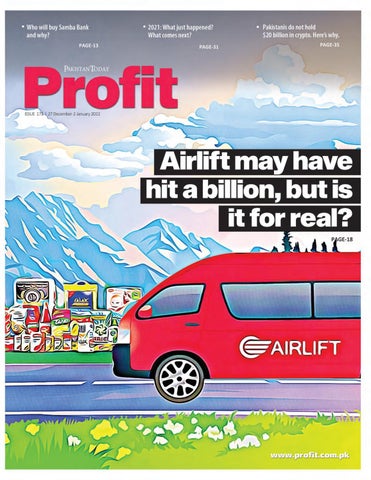
18 Airlift may have hit a billion, but is it for real? 27 How (not) to induce market failure Ammar H Khan 29 Newsmakers 2021
13
29
35 35 Pakistanis do not hold $20 billion in crypto. Here’s why. 36 The futility of exchange rate curbs Uzair Younas
Profit
37 What it means to build a team S.M. Talib Rizvi
Publishing Editor: Babar Nizami l Editor: Khurram Husain lJoint Editor: Yousaf Nizami l Assistant Editor: Abdullah Niazi Reporters: Ariba Shahid l Babar Khan Javed l Taimoor Hassan l Meiryum Ali l Shahab Omer Chief of Staff & Product Manager: Muhammad Faran Bukhari Regional Heads of Marketing: Muddasir Alam (Khi) l Zulfiqar Butt (Lhr) l Malik Israr (Isl) Layout: Ahmad Salahuddin l Photographers: Zubair Mehfooz & Imran Gillani l Business, Economic & Financial news by 'Pakistan Today' Contact: profit@pakistantoday.com.pk
Editorial A word of caution for the startups It was a big year for tech and the startup space to say the very least. The largest Series A and Series B rounds in Pakistan were announced with Bazaar getting $30 million and Airlift $85 million respectively. Overall, $337 million was raised across 71 deals throughout the year. There are no two opinions about this being fantastic for Pakistani startups. The country’s economy is better off for having all of this attention from investors, the startups are proving to be great employers for young professionals looking to break into the corporate world, and the continued attention towards Pakistan has meant more interest and more entrepreneurial spirit. Celebrating this success is important. It is, however, also equally important that there be a word of caution regarding all that is happening. The attention of foreign venture capital firms will have far reaching implications for Pakistani startups in terms of financing and business strategy for Pakistani startups. In the race to secure more funding and have the biggest round, startups may find themselves forgetting to focus on the most important thing - good business fundamentals. The high and heavy approach that has dominated Pakistan’s startup scene has been that of Blitzscaling. Startups, in order to start off strong and get lots of people on their platform, burn a lot of cash to acquire customers. There is a certain logic behind the method. Spending money on getting customers then allows you to have a solid customer base that pays for the initial investment spent on Blitzscaling. However, as has been detailed in this week’s cover story in the case of Airlift, Blitzscaling can have its consequences and the art is a very delicate one in a country like Pakistan. Startups need to have an accurate if not precise understanding of the size of their market, so that they can reasonably keep true to investor expectations. The best way to go about it is
to focus on the business at hand and make sure that the plans that are being made are realistic and that the right people are around to execute them. The problem is that when investors see a startup that is continuously getting funding and is spending on customer acquisition, they will not know where the buck stops. That information is with the people running the show. And when investors are constantly feeding into the frenzy, it is also very easy for the startups themselves to get into the rat race of convincing angel investors and VCs regarding the merits of their case. There is nothing wrong with that until the pitches and the marketing overshadow the actual idea and zeal that gave life to the startup in question. As long as they keep raising a round larger than the last, investors will stay in profitability which means the startup will continue to have enough money to keep running. However, it takes only a single bad round for a startup to go from being the darling of investors to being sneered at. One down round in which they raise less than they did in the previous round and investors will be unhappy and future investors will turn their backs on them. When something like this happens, the only thing that can keep a business going is good fundamentals. Again, we must stress that there is nothing wrong with trying to raise large sums of money and spending on customer acquisition, but the approach to it must be measured. It is not a competition to see who can get the most funding. It is rather a race to see which idea can transform itself into a sustainable business in the shortest amount of time. As the next year approaches and more funding rounds loom, there will naturally be more funding fever - especially since Pakistan is currently a hot market that has the eye of foreing VCs. It would be best for the startups to take full advantage of that, but with a pinch of salt and some thought before action.
9
IN BRIEF $4.6 billion:
The federal government has obtained $4.6 billion loans and grants during the first five months of the current fiscal year 2021-22. The federal government borrowed the amount from commercial banks, multilateral institutions and different countries during the July-November period.
The government is likely to revise the State Bank of Pakistan (SBP) Amendment Bill once again, owing to reservations from different quarters. Sources said that various institutions have raised questions over the draft amendment bill, especially over unlimited powers of the central bank’s governor.
Fatima Fertilizer has confirmed its intentions to acquire Samba Bank Limited. According to an announcement made by Arif Habib Group, a consortium that includes Fatima Fertilizer has publicly announced its intention to purchase majority shareholding in Samba Bank Limited from the Saudi National Bank.
Rs 23.6 billion:
The Executive Committee of the National Economic Council (ECNEC) on Wednesday approved the Rawalpindi Ring Road project. The project will be financed under the provincial Annual Development Programme (ADP) while the Rawalpindi Development Authority (RDA) will execute the construction.
Reserves fall:
Foreign exchange reserves of the State Bank of Pakistan (SBP) decreased by $415 million to $18.15 billion during the week ending on Dec 17. The dip came because of external debt repayment during the period.
The benchmark index of the Pakistan Stock Exchange (PSX) barely inched up in rupee terms during the outgoing calendar year. With only seven trading sessions remaining in 2021, the KSE-100 index has gained just one per cent in rupee terms while the dollar-based return is -9pc.
Shaukat Tarin is set to take the oath as finance minister on Monday ending a period of protracted ambiguity around his role. As Advisor he was unable to chair key meetings or wield executive powers. The Utility Store Corporation (USC) has not been able to operationalise Point of Sales (POS) machines in all of its outlets due to a delay in the delivery of the machines. However, the USC has claimed that all outlets will have functional machines by Dec 31. The federal government on Tuesday assigned charge of the Petroleum Division to Ali Raza Bhutta, a BS-22 officer of PAS. He has come in after the removal of secretary Petroleum Dr Arshad Mahmood.
10
Financial inclusion and chair politics
this week in Pakistan’s business and economics twitterverse
O
nce again this week finds Profit beating the old drum about having financial inclusion for women. It is a tiring proposition to bring it up again and again, but the issue is also so vital that it cannot simply be ignored. A lot else was going on too in the background, with people being asked why they wanted a job, others going to twitter for advice, and some very smart kids that have some financial advice for you. Ariba Shahid brings you all this and more in this week’s social media roundup.
Not-so-musical chair
Eye-to-eye Is this really a thing in corporate Pakistan? If true, then it’s scary. I mean how fragile does one’s ego have to be to think a chair shows how important you are. A person’s spot is a person’s spot. Doesn’t matter if you’re the most important person in the room or not. Bosses need to understand that their employees aren’t servants. Then again, the Urdu word for job is basically naukri and mulazmat, which come from the word naukar and mulazim meaning servants. No wonder this sense of entitlement from some bosses.
Smart kids
Aankhon Ko Aankhon Nay Jo Sapna Dikhaaya Hai Dekho Kahin Toot Jaye Na. Puzzled whether to quote Junaid Jamshed or to quote Taher Shah and his masterpiece eye to eye. It’s all in the eyes. The eyes never lie Chico. Okay enough
SOCIAL MEDIA ROUNDUP
My 3 month old nephew said that the stock market is not an accurate indicator of the economy. Whereas my niece said that interest rate hikes don’t work in a cost-push inflationary environment. Kids are so smart these days. Gotta love it. This survey shows you just that.
11
Ad-nauseum
Why do I need this job? To pay for my KFC
Take a shot of cough syrup every time a VC says Young population, 220 million population, disrupt, return to Pakistan, or says revolutionise. You’d pass out with liver failure 5 minutes into the monologue because that’s how much these terms are done to death. Zahid does however raise a valid point, if the population is enough of a driving source for investment, why does every startup that makes it big look beyond Pakistan. Why not capture a greater chunk of the local market first. Stop selling the market to be bigger than it is when in reality the population isn’t as tech adaptive and urban as you’re making it seem. Your foreign brought solutions don’t always fit in with all 220 million. Admit it. The sooner you do, the better.
Financial inclusion for women
It’s not easy getting finance if you’re a woman in the country. We’ve established that. We wonder when it will be and when Profit can move beyond such tweets in our social media round up. Our gut feeling tells us that there is still a long way to go. Banking and the availability of financial tools to women are still controlled by an archaic system. We sincerely hope that financial inclusion for women is realised sooner rather than later, especially since it is one of the most important aspects of gender equality. There is no point in banks turning their logos pink for a few days if they aren’t going to take affirmative action to ensure women stop getting the short end of the stick. Until that day, we will continue reminding everyone that it is high time to move forward with financial inclusion for women.
12
Honestly, I don’t know why businesses expect you to have a flowery reason for why you want to do a certain job. Why can’t I just say “to pay for my unhealthy coping mechanisms.” Why does one always have to write made up nonsense like “to challenge myself in a competitive and educative environment.” Why does the world obsess over fancy statements? Fluff is fluff. All it tells a person is your ability to bs your way through bureaucratic hell - which we suppose is something a lot of companies look for in candidates. We need more people like Miroslav to say it like it is.
SOCIAL MEDIA ROUNDUP
Who will buy
Samba Bank
and why?
A set of traditional and non-traditional buyers are lining up to make their bid for Pakistan’s smallest bank
S
By Yousaf Nizami
amba Bank is up for sale, and the buyers are lining up waving cash in hand trying to get their hands on the bank. Why are there so many contenders to buy out the smallest commercial bank in Pakistan? For starters, it is a nice, clean, well-run operation. The other reason is that banks are hard to come by for people in the market shopping for one. Back in 2018, three major banks went up for sale. This was a first in Pakistan’s banking history,a and the news was broken in these very pages back then and did not bounce to the extent that the banks, namely Bank Alfalah,
BANKING
Meezan Bank, and Faysal Bank, were indeed on the market, but neither was actually sold to a new buyer and all three are still being run under the same ownership structure. That even one of these banks would be up for sale, let alone three simultaneously, was strange to say the least as all three were doing quite well at the time, infact, thriving and growing in the individual space that they had created for themselves over the years. So why didn’t they sell then? In one case, the State Bank of Pakistan (SBP) was not comfortable with any such transaction (more on that later) and in the others there was a realisation of ‘why fix it if it ain't broke’, and all three corrected course. But Samba going up for sale offers a
unique opportunity to a number of different players licking their lips at the prospect. On the one hand there are two of Pakistan’s largest banks as claimants. The Fatima Group has also thrown its hat in the ring, and perhaps most interestingly at least one fintech startup has made its intentions known. Which of these players will be successful? Profit looks at how good of a deal Samba really is, and which potential buyer has the best chance to close the deal.
The tiny clean bank?
T
he origins of Samba go back to as early as 1955, when Citibank first established itself in Jeddah, Saudi Arabia. However, it wasn’t until
13
”We felt Samba is a clean bank that would add something extra to our balance sheet while helping us expand our branch network and corporate client portfolio as well” Irfan Siddiqui, President & CEO, Meezan Bank
1980 that the Saudi American Bank (Samba) was formed as the result of a change in the law which required all foreign banks to be at least 60% Saudi owned. Samba continued to grow, expanding its international presence by entering the United Kingdom in 1984, and creating one of the largest financial institutions in the Middle East after a merger with United Saudi Bank in 1999. By 2004, Citibank had sold all of its remaining shareholding to local investors, making the Samba Financial Group a wholly Saudi owned subsidiary, looking to expand internationally. In 2007, Pakistan did not seem like a bad place to be, with other foreign banks such as RBS and Barclays entering the market
14
the same year. Samba bought a majority stake in a fledgling 5-year old Crescent Commercial Bank and began operations. Looking at its growth trajectory, it seems there was never any real ambition to grow fast and grow exponentially. The focus remained on continuing to build a stable bank with a small to medium sized presence in all aspects of commercial banking. It is therefore a pretty boring bank to look at, one that is content with its size and low risk appetite. This is further evidenced by the fact that Samba has also avoided building too big a branch network, adding only 10 branches in the past 10 years to bring the total to 40. It is then no wonder its market share in terms of
deposit size has remained between 0.3%-0.5% over the past eleven years, the lowest in the industry. At the same time however, although the deposit base is small, its 5-year CAGR for deposits is an impressive 15.9% compared to the industry’s 5-year CAGR of 13.9%. As far as revenue and profitability are concerned, there is healthy growth, with the 5-year CAGR for gross income (interest plus non-interest income) at an acceptable 11.32% while 5-year CAGR for net profit after taxation stands at a comfortable 18.62%. Apart from the financials and size, the bank is not at all politically indulged, which is an attractive characteristic for any bank that is up for sale in Pakistan, as it reduces the
likelihood of discovering dirt at later stages of a deal. Summit Bank is one such example, which was accused of laundering money for ex-president Asif Ali Zardari. There are, however, some questions that arose during our research into Samba, answers for which were not given. To begin with, there is a key indicator of health that is missing in the balance sheet 2012 onwards, the much looked at Non-Performing Loans, figure. Up until 2012 It is listed in the ‘other information section’, but in the following 7 annual reports, it is either excluded, or at least presented in a way that is hard to understand. Profit reached out to the bank’s CFO for some clarity on the matter but was unable to get an answer. Secondly, there is the matter of Punjab Beverages Company Private Limited, a major bottler for Pepsi in Punjab and a key corporate client at Samba. According to market sources this relationship turned messy recently when ‘bank guarantees’ Samba had provided on behalf of its client were called up. ‘Bank
guarantees’ are off-balance sheet allowances made to clients and therefore do not show up in published financial statements. For clarification, Profit reached out to Corporate Business Head Central and North Ali Raza Syed. He explained that the account had been transferred to Special Assets Management (SAM) Group, meaning it had been classified as an irregular account by the Bank. Profit was unable to reach Samba’s Group Head Legal Affairs, Zia Shamsi, who according to Syed is currently overseeing the matter. Therefore, it is safe to say that while largely clean, some problems may be highlighted when it comes to the due diligence stage.
Why sell?
I
f Samba is so financially stable, runs a relatively tight ship and is also profitable, why is it being sold? Profit tried to get the Bank’s perspective on this key question but to no avail. Alternatively, we took a look at a recent major development with regards to
the ownership of the bank to try and understand the sale. Back in April of this year, Saudi Arabia’s largest corporate lender National Commercial Bank (NCB), successfully merged with Samba Financial Group to become the kingdom’s biggest bank with an asset base of $239 billion. The move fits in with its consolidation strategy as well. Eight months later, the NCB has decided to pack up its Pakistan operations and for good reason. To begin with, Samba Pakistan is merely a speck in NCB’s portfolio that does not generate a lot of revenue. In order to maintain its operations here, no matter how small, it has to allocate some capital, capital it could use elsewhere more efficiently. Following the financial crash of 2008, ‘basel 3’ was formed, a regulatory framework that sets and monitors global minimum capital standards for commercial banks. According to one senior banker, the minimum liquidity requirement relative to Pakistan would roughly
BANKING
translate into NCB deploying an extra $1 to cover each dollar of capital it has parked with Samba Pakistan. The new ownership does not view this as a viable cost to do business in Pakistan where it would take a tonne of more capital to grow in size and make more money. It just doesn’t make sense. Another consideration for a foreing financial group investing in Pakistan is the dearth of foreign banks left in the country, with practically only Standard Chartered Bank qualifying as one with a considerable presence and scale of operations.Others, such as Citibank and Deutsche operate on a very miniscule scale and specialised manner.
The potential buyers Fatima Group:
The contender who is the farthest along in the bid for Samba is one of the largest business conglomerates in the country with interests in fertiliser, energy, textile and sugar. According to official documents, FFCL is making the bid as part of a consortium that also includes the current management of Samba Bank represented by its current CEO, Shahid Sattar and Gulf Islamic Investments LLC, looking to acquire up to 84.51% of shares of the bank. Additionally, Arif Habib, CEO of Arif Habib Corporation Limited who is also the chairman of FatimaFert Limited, a subsidiary of Fatima Group, is also representing FFCL, which is why, naturally Arif Habib Limited will be the manager of the transaction. FFCL is perhaps the strongest of the contenders with a mega business conglomerate at its back. According to some industry experts however, Fatima Group, other than its fertilising arm FFCL, has had trouble making its other businesses big success stories. Its energy interest, for example, struggled to take off and
16
has recently secured long-term restructuring for a facility it availed from a consortium of banks. To understand the intentions of the sponsors of Fatima group, or for that matter any big business group in pursuing a bank can be well understood through an anecdote: Many years ago at a dinner party filled to the brim with the elite of this city, a friend of the Publishing Editor of this magazine was introduced to a gentleman that was not particularly impressive to look at. As is customary in such parties, the friend asked him, “and what do you do?” “I’m a banker” came the response. The man in question was back then not very well known by face because his pictures had not yet gone out to the media - but he was not a banker. Yes, he owned a bank, but in reality he was an industrialist, and one of the richest men in Pakistan back then and to this day. Yet when someone asked him what he did, he responded by saying he was a banker. That is the sort of respectability that the profession commands - and among the elite, there is a certain pride in having made money through the world of finance rather than business. The bid by FFCL will therefore be purely to get a commercial banking licence and enter the banking sector. It will most likely try to grow Samba larger than its current size with adequate capital injection to become a more competitive bank. That it has a Shariah compliant Gulfbased financial advisory firm in Gulf Islamic Investments LLC indicates that there is perhaps an Islamic Banking angle to the acquisition. As a subsidiary of GII Holding group (GII), with international presence in major markets, it brings a lot to the table. The inclusion of a foreign buyer in the consortium also addresses the SBP’s concern about capital leaving the country as it allows FFCL to arrange the payment outside of Paki-
stan, via UAE to Saudi Arabia. The investment into the newly bought bank would then be generated locally.
TAG
The underdog in the running also happens to be the best suited to procure Samba. TAG, abbreviation for Talal Ahmad Gondal, the CEO of the fintech startup looking to become Pakistan’s first digital bank, is perfectly placed to take advantage of Samba’s availability on the market. Although it already has an in-principle approval for the Electronic Money Institution (EMI) license to operate as a digital wallet from the SBP, TAG’s ambitions are larger, as it wants a seat at the big boys’ table, the commercial banking sector. Why does TAG desperately want a commercial banking licence when it has an EMI license? Well, an EMI license has limitations that a conventional commercial banking license does not. EMIs are outrightly banned from paying an interest rate to depositors. While EMIs are allowed to invest deposits into government bonds, it is limited to 50% of the previous three months’ balance, and with their higher capital requirements than banks, this means they can realistically invest much less of their deposits than banks. Then there are restrictions on customers as well. In terms of putting money into their digital wallet, the cap is Rs 50,000 in a month, which can be increased to Rs 200,000 provided the wallet holder has completed biometric verification. As far as withdrawals are concerned, the limit is Rs 10,000 per day, no matter what level of authentication has been completed. For commercial banks, once biometric verification of a client is done, there is virtually no limit on deposits or withdrawals. Upgraded versions of an EMI license that SBP also offers are Digital Retail Bank (DRB)
and Digital Full Bank (DFB) licenses. A DRB can perform all regular banking functions but cannot tend to corporate clients. A DFB can serve all categories of clients but cannot have a physical branch network. For EMIs to get a DRB or DFB license is no easy task either. EMIs therefore simply cannot compete with conventional banks. For TAG, getting Samba’s commercial banking license by purchasing the bank is the quickest and cleanest way to enter and disrupt the commercial banking sector.T That it is funded by venture capitalist firms such as New York-based Liberty City Ventures and Banana Capital is a plus for TAG, for it can easily arrange to pay NCB for Samba outside of Pakistan, thereby removing SBP’s apprehensions about capital leaving the country. Infact, in all likelihood, the initial cash injection that will be required to take Samba to the next stage, that some market experts put at around $50 million, will translate into much-needed FDI for the country. It is therefore a win-win for the central bank. However, TAG’s obvious advantage to be able to raise capital abroad is partially trumped by its credibility problem. To begin with, there is the debatable $100 million valuation that Profit has extensively covered and explained already . Then there is the composition of the board that is problematic. Talal, who was able to get SBP to approve his company’s EMI license in a matter of months while it took others well over a year, is politically connected. Additionally, it has on its board a former general of the Pakistan army who was head of the National Disaster Management Authority (NDMA) and has so far unsatisfactorily explained to the Supreme Court where and how the Covid-19 fund that was under his discretion was used.
Meezan Bank
T
he country's largest Islamic bank was in the running to procure Samba Bank. Speaking to Profit Meezan’s CEO, Irfan Siddiqui confirmed that it had submitted an initial non-binding offer to Samba’s auditor’s KPMG Pakistan.
“We were very interested in Samba but our initial bid, which is the first step before approaching SBP for approval to begin due diligence, was too low so we are out of the running”, explained Siddiqui. ”We felt Samba is a clean bank that would add something extra to our balance sheet while helping us expand our branch network and corporate client portfolio as well”. Meezan’s un-audited deposits as of September 30, 2021 are Rs 1.34 trillion while Samba’s are Rs 86.7 billion for the same period. Samba would have therefore increased Meezan’s deposits by 6.45% if a deal was made, hardly a significant bump, which would somewhat explain why Meezan’s initial non-binding offer was on the lower side. Meezan Bank has previously made two successful acquisitions in Pakistan. It bought Societe Generale Group in 2002 for its commercial banking licence. Later in 2015 it acquired HSBC Oman that provided the growing bank with better systems and some valuable human resources.
UBL
According to Market sources, United Bank Limited (UBL) is also interested in Samba. At time of writing UBL was yet to confirm or deny this to Profit. Whatever the case may be, it is difficult to understand why a bank the size of UBL would be interested in a bank as small as Samba. But why would one of the largest banks in Pakistan be interested in acquiring such a small bank? This begs another question: how does one grow a bank like UBL, that is already so big, with over Rs1.8 trillion in deposits? For any business that reaches this stage, there are effectively two routes: grow market share through acquisition, or growth of the market itself. The latter being easier said than done. The last time UBL showed interest in acquiring a bank was in 2012 when it's request to conduct due diligence of HSBC's Pakistan operations was turned down by SBP along with those made by HBL, ABL and MCB. The SBP had apparently used 'too big to fail' doctrine
while rejecting these requests. After a decade UBL is going to try its luck once again. One issue that would most definitely arise, would be resistance from the SBP, as there would be an outflow of capital, something the central bank ill-affords at the moment. In fact, this was the reason why Meezan had to take itself off the market in 2018. UBL’s un-audited deposits as of September 30, 2021 are Rs 1.80 trillion while Samba’s are Rs 86.7 billion for the same period translating into a meagre 4.79% increase in UBL’s deposit base. Compared to Meezan, it would make even less sense for UBL to go for Samba, considering the negligible increase in deposits it would bring and an already impressive portfolio of corporate and SME clients that UBL has. At the same time, UBL would have had to inject some capital into Samba’s operations to comply with SBP’s capital adequacy requirements, which it could easily manage internally as it is heavily capitalised. However, Samba would not be bringing much to the table for the amount of money UBL would have to invest. It does not seem likely that UBL would pursue this deal too far even if it is interested. There are also reports that Askari Bank has also shown interest, however Profit was unable to verify this independently.
Who will take it?
B
oth TAG and Fatima group have approached the SBP for permission to begin due diligence of Samba. This is the first step in what is likely to be a long road for both entities to eventually acquire Samba. There are no guarantees that either TAG or FFCL will get this permission. For FFCL, a serious consideration for the central bank will be its somewhat problematic relationship with its bankers. As far as TAG is concerned, its profile and credibility will be under scrutiny. Samba’s ability to negotiate a good price will depend on how many buyers are able to secure the permission to begin due diligence and move onto the valuation and bidding process. n
TEXTILES BANKING
18
COVER STORY
By Taimoor Hassan
T
here is a new unicorn in town, and its name is Airlift. Profit has confirmed that the erstwhile mass transit startup will soon be announcing the $1 billion valuation. This announcement will come with another announcement that the startup has managed to raise another successful round - $350 million (approximately Rs 63 billion) this time. Add the previous $85 million they raised and their funding alone accounts for more than half of what has been raised in total by Pakistan’s startups this year. As they sit poised to become Pakistan’s first unicorn tech startup that derives the bulk of its value from Pakistan operations, it is worth looking at how Airlift got here. In the past three years, Airlift has been conceived, been launched, raised money, been brought to its knees by Covid-19, been reimagined during the pandemic, has raised a record breaking $85 million in series B funding, and is now on the brink of announcing a billion dollar valuation and a second record breaking series of funding. This journey has been celebrated, questioned and scrutinized. Back when they raised their initial $85 million in funding and declared a valuation of $275 million, the market was rife with rumours that there was something amiss here. Industry sources were suspicious, and soon enough rumours were abound. The scrutiny could easily have been the result of competitors being alarmed at Airlift’s significant gains which could be detrimental to their own business. At the core Airlift is very much a story of success. That is because they have played the startup game well and have consistently managed to stay relevant and keep the money rolling in. There are, however, certain aspects of the startup playing field in Pakistan (and elsewhere) that mean there is often less to this success than meets the eye. Beginning with their great pivot from mass-transit to grocery delivery, and going all the way down to their record valuations, this is the brief yet very telling history of Airlift. Our main characters are Usman Gul, the dedicated CEO of Airlift and Aatif Awan - the venture capitalist who took a huge gamble and now wants to see it pay off. This is the story of Airlift and all it stands for.
The evolution of Airlift
I
n late 2018, Usman Gul and one mysterious Daniyal Khan conceived the idea of Airlift - a mass transit system to provide an alternative to dilapidated public transportation. For the first six months, Securities and Exchange Commission of Pakistan (SECP) records show Daniyal Khan was the CEO but very little is known about him. The man is a ghost with no
20
public profile, no mention in Airlift’s media coverage, and no Linkedin profile. After this initial period, Usman Gul took over and there has been no looking back since. Airlift’s model was simple - they would hire privately owned buses on rent and run them through selected routes all over the cities they were operating in. The users would book their seat on these buses through the app, arrive on time at designated bus stops, and then be taken to the bus stop closest to their destination - you know, how buses work but through an app. The idea gained some early momentum, and vast fleets of privately owned buses with the Airlift branding on them started popping up everywhere in Lahore and Karachi. Airlift offered five free rides to new customers, and during office hours these buses ran filled with salaried passengers and students commuting to their universities. Things really started heating up around the summer of 2019. In July, Airlift got its first taste of competition when the Egyptian company Swvl entered Pakistan. Swvl, which has now been acquired in a $1.5 billion SPAC (Special Purpose Acquisition Company) deal decided to launch decentralised mass transit operations in Egypt back in 2017. It entered Pakistan after raising $42 million in June of the same year. After the SPAC deal, SWVL is somebody else’s headache now. Why it’s a headache comes below. Swvl had raised $30 million in November 2018 and $8 million in April 2018. While Swvl did not have any immediate plans to enter Pakistan, it was probably because of Airlift’s presence that they wanted to enter the market early and not let Airlift cement its feet and let Airlift threaten SWVL in other geographies if it grew in Pakistan. The next month, in August 2019, Airlift got its first public validation as a serious business that had investors’ attention when the startup announced a seed round of $2.2 million (approximately Rs347 million) - then Pakistan’s largest seed round with participation from international investors, one of which was Aatif Awan. Aatif is a former Linkedin executive turned investor who launched his own fund by the name of Indus Valley Capital (IVC) to invest in startups primarily in Pakistan. A little over two months down the line, Airlift scored $12 million (approximately Rs1.8 billion) in Series-A financing - again Pakistan’s largest Series-A funding round at that time, giving an impetus to the public perception that mass-transit was a serious business. The eyes were turning and international investors had started looking with interest at Pakistan. In the times to come, Airlift’s big rounds would get investor attention on the rest of Pakistani startups as well. The round was announced in the beginning of November 2019. By October, as per numbers available with Profit, Airlift had crossed the threshold of 10,000 bus bookings per day,
generating annualised revenue of $1.42 million. Subsequent injection of $12 million Series-A financing pushed bookings to over 17,000 per day in November, over 22,000 per day in December and over 33,000 per day in January, having grown over 200% between October and January. The strategy at play here is called Blitzscaling. Derived from the German war strategy in World War 2 known as ‘Blitzkrieg’ meaning ‘lightning war’ - the term was a portmanteau coined by LinkedIn founder Reid Hoffman. The core value of the strategy is spending money to gain customers by giving incentives and cheap rates. Essentially, you are burning lots of cash, fast, to attract users to the platform in the hopes that your product will become essential to them, and competition will not be able to keep pace. Later on, when Airlift would make its quick commerce pivot, they would use the same technique. Even though this would be the technique that got their mass-transit model in trouble in the first place. Blitzscaling makes sense on some level since it does result in rapid growth. And Airlift’s investor, Aatif Awan, was one of the key people in charge of implementing Reid Hoffman’s blitzscaling ideas at LinkedIn. But this growth then needs to be backed by solid business fundamentals and an unwavering resolve. While Airlift was growing and showing great numbers, the problem here was that these bookings were not happening naturally. With competition heating up from Swvl and customer acquisition a constant expense, keeping up the growth and keeping Swvl at bay was coming at the expense of a cash burn of over $1 million minimum each month. Staying true to Blitzscaling, Airlift investor Aatif asked for more money in an email to investors. In an update to investors sent on January 29, 2020, Airlift told its investors that “Airlift’s current cash runway goes until mid June, giving the company 4.5 months to secure additional capital.” Airlift was promising its investors that they were about to strike gold if they just kept up their effort and belief for a bit. By February, the startup would have scaled to 41,000 bookings for buses, aiming to hit 50,000 rides by March. By the start of March 2020, the company had a little over $5 million in its purse which gave it a runway till June 2020. In a scenario where Covid-19 had never happened, Airlift was going to continue operating as it was. And why would it not? Things were looking up after all. Weren’t they?
What investors didn’t necessarily know
T
here was nothing wrong with Airlift asking for more money from investors. There was also nothing wrong with them presenting a rosy picture. To be
fair, Airlift must have thought that they were going to win the battle. What they did not tell investors, and understandably so, was that the horns they had locked with Swvl were now digging into their skull and causing serious headaches. As mentioned earlier, the main motivation for Swvl to enter Pakistan was to not allow competition to brew in another country in the region. If Airlift had been allowed to operate freely in Pakistan, it could one day have challenged Swvl in its international expansion plans. So when Swvl raised $42 million in June 2019, the first thing it did was use some of that funding to enter Pakistan in July 2019. Sources that have worked with Swvl told Profit that they entered Pakistan in a rush to stop Airlift from possibly becoming big enough to challenge it in other geographies. This meant they entered Pakistan in a bit of a hurry, without realising that Airlift was not sure it would really break through in Pakistan, and international expansion was not even a distant dream for them. At this point the major cost in Airlift’s operations was on the supply side. Both Airlift and Swvl were renting out buses, and they kept raising how much they were willing to pay bus owners to try and undercut each other. In the last month before shutting down because of the pandemic, January 2020, Airlift burnt $1.54 million in cash to keep their operations afloat. Out of this, an overwhelming $1.12 million was spent on the buses and their maintenance. Swvl did much the same, and both companies found themselves spending money in the hopes that the other would blink first and the space would be open for them to do whatever they wanted. No one was willing to bring their cost down just yet. And that is when they were both saved by the bell.
Covid-19 to the rescue?
R
ight at the precipice of destruction, a light emerged. Airlift and Swvl were two warriors engaged in an epic battle. Exhausted, wounded, and unable to turn away because of their egos, they suddenly found themselves with an honourable way out - a larger threat that required them to turn their attention elsewhere. Ferdowsi or Homer could not have scripted it better. As soon as the Covid-19 pandemic hit, Airlift shut shop. They shut down their buses even before the government officially announced a lockdown and a closure of public transport. This was the responsible thing to do, but Airlift responded very quickly - almost unusually so. For a startup banking on keeping their momentum up, they did not even try to introduce social distancing on their buses and instead put an abrupt end to their operations. According to CEO Usman Gul, it was in the
“Amidst Covid-19, we sat around a table and very quickly realised that we did not believe in our own product of selling bus rides through a mobile application,” Usman Gul, CEO Airlift days right after this that the core team at Airlift realised that the business model they were giving everything to was not worth it. Yet sources close to Usman Gul and familiar with Airlift’s idea have said that this realisation had come long before the pandemic started. According to them, Airlift’s business model was unviable in Pakistan and this was something Usman Gul and the rest of the team knew only months after beginning the company in 2019. Customer retention was low, and promising numbers like growth in new users was massive because of the discounts on the rides. Which is why Airlift was not going to turn profits anytime soon - never maybe. Despite this, they were willing to plead for investor funds, convince them that their idea was working and ask for more money to spend on their mass transit project as late as March 2020. Why would they do this? For starters, changing course before an unprecedented event like the pandemic would have made their investors lose faith in them. Investors rarely appreciate a dilly dallying CEO that changes course on whims and wishes. If they could not stick to their first idea, why would their second be any better? It would have needed some Don Draper level pitch to get everyone on board. The other factor was Swvl - and the battle that the two companies found themselves inextricably embroiled in. Add to this marketing costs, and you have a very unviable business model. Airlift realised this pretty early to some extent, and turned to the rickshaw method of even trying to rent out their buses as ad space. However, none of this was enough to stop the rot. According to sources, Airlift in its first year took a loss of over Rs1.2 billion, which testifies that the unit economics of the business were terrible. In an email response to Profit Gul, however, conveyed that the mass-transit model continues to be an incredible market opportunity and one that Airlift is quite excited about. “Amidst Covid-19, however, we’re not sure if this is the right bet to get behind. If and when the pandemic subsides, we would be very
interested in re-exploring transit. The success of Swvl is a validation of the transit model,” he said. The comment from Gul, however, comes after his earlier acknowledgement in an interview with Bloomberg that the company did not really believe in the model of selling air-conditioned bus rides through an app. But despite that, the company was raising new funds. “Airlift has also secured $9 million of a $10 million Series-A extension on the same terms as Series A. If you’d like to participate in the remaining $1 million or can make intros, please let me know,” wrote Aatif in an email to LPs of the fund, sent at the onset of the pandemic. “With this new cash infusion and reduced burn, the company has de-risked materially. In the meanwhile, they are investing in improving the core product as well as the routing engine that reduces empty distance and hence the unit economics. They are also experimenting with some ideas that would diversify the business so that it has some tailwinds from covid. I’ll share more on this in due time,” he wrote further. Airlift and Swvl were either too proud or too scared to tell their investors this was not working out. And since Swvl had more money than Airlift, the latter was more desperate and continued to ask for more money despite knowing that it was a lost cause. Covid-19 provided the perfect cover. It gave Airlift a second lease on life and the rare opportunity in the startup world to go back to square one. Airlift would now not come across as wayward, but quick on their feet. Innovators not dreamers.
The pivot - who is really in control?
T
he pandemic appeared as a blessing that allowed both Airlift and Swvl to pivot gracefully. Very quickly, before even waiting to see how the pandemic would play out, Airlift moved into groceries while Swvl added to its services and started
COVER STORY
providing mobility solutions for corporates and intercity travel for consumers. However, as the pivot panned out, questions started to emerge over who was in control of Airlift, the CEO or Aatif Awan? One of the first moves post pandemic from Airlift other than terminating bus contracts were layoffs. They fired over 90% of their workforce including co-founders Muhammad Owais and Zohaib Malik, who have since been working on their own B2B ecommerce platform Dastgyr. The layoffs would have been imminent anyway, with funds going dry and revenues at a halt because of the pandemic. However, Usman Gul as CEO has always claimed and been known for being very close to his employees. Most former employees still hold him in high regard, and he personally helped a lot of the out-of-work employees find new places to work. Why then did he ok the firings? Within the industry, insiders and sources have said the driving force might have been Aatif Awan. As an investor, Awan was actively involved in the company, they allege, even when he wasn’t supposed to be. He was holding daily phone calls with Gul, discussing the pandemic, and finding new investors. Gul allegedly exhibited a desire to keep investors happy and let Awan steamroll him. Airlift has denied this, saying that Airlift’s strategy has been led by the team. “Airlift operates on a decentralised decision-making framework, one in which decisions are made by those closest to the information”. Furthermore, Gul said that the investors were partners on the capital markets front and were not involved in operating the business and/or formulating strategy. Awan’s interest is natural. Airlift is one of the core investments of Indus Valley Capital and in Airlift he has invested in his personal capacity as well. ACRA filings show that Awan owned 11.21% shareholding, not much less than CEO Usman Gul’s 11.8% until Airlift’s Series-A round. Aatif and the fund he manages own around 21% of the company, making them collectively the single biggest shareholders in the company out of 52 listed shareholders and investors. It is not the wildest stretch to say that the pivot towards grocery delivery was thought up by Aatif Awan, and that he is the one pulling operational strings. Awan has long been interested in the quick commerce business. He had previously been involved in talks to invest in a grocery delivery startup a few years ago and had an idea of what the business required. Insiders and people from the grocery startup in question have gone so far as to say Aatif Awan used his past knowledge of the startup he was willing to invest earlier into to gain valuable insights into the company. That claim is one that cannot reasonably be ascertained or be a cause for blame. The tactics
22
“...this is not how VCs and startups operate. Stop making things up to harass startups who are working hard to shape Pakistan’s future” Aatif Awan, founder Indus Valley Capital
sound more coincidental than underhand. But they do point to one thing - Aatif Awan has more than a little operational pull at Airlift. Profit reached out to Aatif for comments, who said that much of the information, without specifying which bit, was false. On the other hand, Gul remained quiet on a question about Airlift’s pivot towards grocery delivery.
The valuation blackbox
O
n July 1, 2020, Airlift officially announced moving into the grocery delivery business with another investment of $10 million in an extended Series-A round. Under the new model, Airlift would be setting up its operations to make swift deliveries through a network of dark stores to deliver groceries in a short span of 45-minutes under the quick-commerce model. A few months later, the grocery delivery promise was reduced to 30 minutes. Just over a year later in August 2021, Airlift announced raising a record $85 million in Series-B funding, and a valuation of a little over a quarter of a billion dollars ($275 million). Within the industry, claims that the company had misrepresented its numbers to investors to secure a big amount at a big valuation came quickly on the heels of the announcement. Sources with knowledge about how quick-commerce works say that Airlift’s claims to investors are not possible. Sources inside Airlift also say that Airlift’s claim was exaggerated. A prominent supplier of one of the large FMCG company’s products also said that Airlift’s procurement from them was less than others. The company then was not valued at $275 million (as claimed) and instead only negotiated a valuation cap of $275 million with the investors - all of that based on growth that it had been able to show to investors. According to the Airlift’s pitch deck presented to investors ahead of the Series-B round, and available with Profit, Airlift claimed to have
reached annualised GMV of $27 million for the second quarter of 2021. The GMV number was also confirmed by Gul in an email response to Profit. Gul further said that Airlift had exceeded $50 million in annualised GMV as of September, 2021 The increase in the GMV was 175% more than the GMV in the first quarter of 2021, which was reported to investors at $9.8 million. On a non-annualised basis (the actual GMV for the quarter), that’s $6.75 million for the second quarter made in three months (April-June 2021). Airlift claimed to its investors that the average order value for the quarter was Rs1,285. Market sources say this number is problematic (read, too high) to claim. The quick commerce model is one in which the average order value is small. Airlift categorises itself as a quick commerce delivery for all household essentials. But billboards put around in Lahore and other advertisements on social media have been around groceries more than other categories such as electronics. And when it comes to groceries, quick commerce is about instant fulfilment, meaning you require the product instantly. These are small value products and operations are set up according to that. So when Airlift says it is between Rs1,285 or $7.70 average order value, it means that most of the customers are ordering large value items which is not the way quick commerce operates. People familiar with quick-commerce operations believe that is not possible. For context, pandamart, which is bigger in terms of scale than Airlift and processes more orders daily, then had an average order value of around Rs750. A higher average order value is possible if there are big orders, and big orders are placed on both Airlift and Pandamart by the very neighbourhood stores that these startups are out to disrupt. In our survey of the neighbourhood convenience stores, store owners told Profit that enticed by the discounts, they buy from Airlift themselves and because they are buying for the purpose of selling, the orders are
TEXTILES
large, running in thousands of rupees, which can inflate average order value. Market sources claim that Airlift delivers approximately 30% of its orders to stores. Of course there would be some consumers too that would once in a while order large value items but the frequency of such orders would be less. An insider at Airlift told Profit that the average order value of Airlift in Q2 2021 was around Rs1,000-1,100, but fell when the company expanded into smaller cities like Gujranwala and Sialkot in July. The purchasing power in these cities is low as compared to KLIs (Karachi, Lahore and Islamabad) and would hence skew the overall average order value. Even if we believe that the company’s average order value was as it was claimed, it would mean that to yield $6.75 million GMV for the quarter, it would require 9,633 orders per day. In its investor presentation, the company claimed that it was doing over 10,000 orders per day when it was operational in three cities only. The source at Airlift corroborated to Profit that the 10,000 order number was exaggerated and that the company’s average orders daily would be around 5,000-6,000 per day on average. “Orders have gone through the roof from August onwards. There has been a massive increase in volume and the company has increased its presence and warehouses many times over. But in the months of April, May and June, we did not even have many warehouses,” says the source. Our source further says that Airlift had an estimated 8 dark stores overall in April, 10 in May and 12 in June. On average, a dark store delivers 500-600 orders per day, which averages to 5,000-6,000 orders. Think of this another way: pandamart had 20 dark stores in Karachi, Lahore and Islamabad in May 2021 and delivered 13,993 orders per day. It had 28 dark stores in June and was doing around 14,600 orders per day. So Airlift with less dark stores than pandamart claiming to be delivering more orders on average is an unlikely scenario. On the other hand, a supplier of two of Pakistan’s prominent FMCG companies also said that Airlift’s procurement from them was less than others. This is what the market is crying foul about; that Airlift secured a huge investment with questions around the authenticity of its numbers.
How did they show growth to investors?
F
or investors, the company growth shown to them to secure the investment is not what it seems. If Airlift was doing 5,000-6,000 orders per day instead of the claimed 10,000 plus daily
orders, even at the $7.7 (Rs1,285) average order value, the total GMV for the quarter would be somewhere between $3.5-$4.2 million, which is slightly above half of what is claimed. On an annualised basis, it would come down from $27 million to only over $14-16.8 million. But with the earlier mentioned discrepancy in the numbers, it became apparent that investors had been convinced that the company was worth investing in and hence a massive round was raised. In a tweet on August 18 this year, Harry Stebbings, one of the investors in Airlift’s Series-B round, cited “far superior unit economics than western models” as one of the reasons he invested in Airlift. The problem is that if the numbers are not what they really are, the unit economics falls apart and investors’ expectations of growth are less likely to pan out. Add to that the Series-B round was raised as SAFE investment, according to an investor email seen by Profit, a thorough due diligence might not have been done by most of the investors. The investors in the round are mostly angel investors, without participation from a prominent VC. Because names like Harry Stebbings and Josh Buckley had participated in the funding round, this becomes a situation where investors are willing to put in money because they see others putting in money. Together with the growth it was able to show, this is also how Airlift was able to negotiate a valuation cap of $275 million. In an interview with TechCrunch, Airlift CEO Usman Gul claimed that the company’s valuation following the $85 million round was $275 million, when the company had in fact raised the money on a $275 million valuation cap. Profit reached out to Aatif to seek comments about Airlift continuously raising funds for mass-transit business despite the business not holding great potential, his unusual involvement at Airlift, the pivot towards groceries, and the allegations of misrepresentation of numbers. “Much of it is completely false,” Aatif said in a WhatsApp message. When asked what was false precisely and what was true, Aatif said: “All of it is either false or does not make any sense as this is not how VCs and startups operate. Stop making things up to harass startups who are working hard to shape Pakistan’s future.” A subsequent request was made for an interview but no response was received from Aatif. Profit reached out to Airlift to verify the authenticity of numbers claimed to investors, and about Airlift’s pivot, raising funds for the earlier business despite little promise and Aatif’s involvement. Gul responded to all as factually incorrect and, in particular, said about numbers claimed to investors that “Airlift operates on an open data infrastructure, which
means that Airlift investors have real-time access to the internal data systems.” This would mean investors can see what is going on at the company, the order numbers and value, if there was something wrong, the investors had the means to know it right away. This is where the waters get a little murkier. Information rights of startup investors are usually restricted to monthly or quarterly reports and access to granular information is not given. Why? Because investors have vested interest in adding value to the investments that they make from their fund and startup founders are unlikely to grant granular level access to investors to keep them from using information in case investors end up turning to a competitor. A couple of startup investors Profit spoke to said that under the information rights, it is highly unlikely that all investors would get such access, especially the ones that are low-ticket investors. They called Airlift’s claim that its investors had access to internal systems mostly a spoof. They did, however, confirm that investors under their rights can ask for an immediate audit of the company. Only one set of investors, however, are most likely to have such access: ones that have put in a lot of money in the startup and occupy a seat at the board. Aatif Awan is one of the two investors that we know of who occupies a board seat at Airlift. Harry Stebbings, who joined the Airlift board following the Series B investment, being the second board member. Profit reached out to multiple Airlift investors to confirm CEO Gul’s claim that investors had live-access to Airlift’s internal systems or not. None of the investors responded to queries regarding this. Profit reached out to Airlift again requesting access to the same systems to reconcile the numbers claimed to investors, offering to sign a non-disclosure agreement to protect confidentiality of the company, and also offering to publicly put down rumours of alleged fudging of numbers to investors, if the claimed numbers could be reconciled with actual numbers. The access was denied to us. Instead, Profit was served a legal notice by Airlift, and Aatif Awan. The notice claimed that by asking questions and trying to ascertain the claims of numbers being fudged, Profit had caused damage to their reputation. Profit has responded to the legal notice, which can be read in the online version of this story. {Editor’s note: During the drafting of this story, Airlift approached Profit to inquire about a marketing arrangement. No such arrangement was entered into. In hindsight, we feel that Profit was approached to get this story killed in exchange for ad revenue} After this, a letter has also been circulating amongst Airlift investors claiming Profit is publishing a story because of a rejected
COVER STORY
marketing proposal, even though it was Airlift that approached Profit for such an arrangement. Airlift and its investor are free to offer an explanation of how the numbers reconcile and we will promptly publish their explanation and revise our story accordingly. However, as of the publishing of this story, which has been months in the work, Airlift has refused to acknowledge or respond to the allegations.
The valuation kerfuffle
A
irlift chasing a billion dollar valuation is because quick commerce startups around the world have been able to get very high valuations in record times. They have also been able to raise very high sums of money because quick-commerce picked up during the pandemic. Europe’s Gorilas and Flink, US-based JOKR, and Turkey’s Getir all became unicorns this year along with massive rounds raised. How startups get valued during a funding round depends on what sort of valuations peer startups are getting around the world. Quick-commerce is hot around the world and there is a demand for such deliveries because of the pandemic, which means there is going to be growth. Other startups have been able to grow and have raised funds at massive valuations, which for Airlift means that if it is also able to show growth, it would be able to get a similar amount of funding at internationally comparable valuations. Pakistan has a massive population of 220 million and if Airlift is able to show growth in Pakistan very quickly, investors would be willing to invest high amounts of money and give them a bigger valuation. Airlift’s pitch of international expansion has also been similar to other startups in quick commerce who have become unicorns and with all of that combined, it isn’t surprising that Airlift was able to raise $350 million and get a unicorn status. There is a strong case to be made here that Airlift kept its actual numbers under wraps ahead of the $85 million investment, which means that future projections of the GMV and unit economics also fall apart. It has strong competition in pandamart which would pull down Airlift’s growth and could only be dealt with if Airlift had more money. Market sources tell us that Airlift’s orders currently stand at 17,000 daily from around 30 warehouses, whereas pandamart has scaled to 50 dark stores and is currently doing 22,000 orders daily. Disruption of neighbourhood convenience stores is also difficult. In a survey carried out by Profit of around 50 neighbourhood stores located in high-income neighbourhoods, such as DHAs in Lahore and Karachi, most of the shop owners said that they had not yet
24
seen any decrease in sales because of delivery apps like Airlift and pandamart. Only a handful of stores that did say their sales had declined, saw a slight decline but were unsure if it was because of the apps or because inflation had increased. They had seen a similar decline in sales in earlier periods of inflation. Moreover, all of them had their delivery service and delivered orders in the neighbourhoods they served by taking orders on phones. Pakistan is going to form the bulk of Airlift’s operations because in contrast to Pakistan, Airlift’s dark stores in South Africa, the only country Airlift has yet expanded to, are estimated to be 9. So the bulk of the value for Airlift’s business is coming from Pakistan. South Africa would also not be an exciting market for investors and growth potential would be limited given that South Africa’s population is only 59 million, which is about only a little over a quarter of Pakistan’s.
Who is responsible?
T
he question is, who is responsible for concerns surrounding the accuracy of numbers. One obvious person to whom attention turns when this question is asked is the CEO. He has to earn a return for himself and investors more than himself from whom millions of dollars worth of investment was secured. It is going to be a terrible legacy for Gul to have failed a startup that raised multi-million dollars in funding. On the contrary, it would be a great legacy if Gul created a Pakistani tech unicorn in a record breaking period. On the other hand, a strong case is to be made that Aatif Awan knew all along what was happening and was involved in what was happening. There are obvious blueprints of Awan working closely with Gul during the pandemic, his involvement in how the company pivoted, and the likelihood of him having access to Airlift’s internal systems. The incentive for a fund is also clear: a fund manager has to generate returns for investors in the fund. So if Airlift is able to get a $1 billion valuation now and exits later at an even higher valuation, the fund that invested would get better returns to investors than if the valuation was low. Moreover, it is in a fund manager’s interest to pump money into a startup that is doing well. So if Airlift is doing well on the back of inaccurate numbers, the fund manager has a cause to invest more from the fund into that startup because it is doing well. And as more funds are deployed in a single startup that is doing good, the fund manager can close the fund quickly and raise a new fund. The management fee alone of these funds can turn out to be pretty big. Because any exits are going to happen over a 7 or 8-year horizon, it is the fund management fee that the manager
gets as compensation. Management fee is usually 2% of the size of the fund, per year. As mentioned earlier, the exit for a company is going to come after a few years and during that time, the manager can deploy multiple funds and earn hefty management fees each year. So even if the startup fails, the fund manager will still make good money. Was the investment in Airlift worth making a further investment? Aatif would think so. In an email sent to Indus Valley investors, Aatif offered to set up an SPV (special purpose vehicle) to make investment into Airlift’s Series-B round. The fund could not make investment directly because it had reached a concentration limit for the Airlift investment, but had allocation to invest in Airlift because of its pro-rata rights. Pro-rata rights are rights an investor has to keep up his shareholding in a company in later financing rounds. Investors usually exercise pro-rata rights in companies that are doing good. But in the case of Airlift, there was no mention in funding announcements of any prior investors, like First Round Capital or Shorooq Partners, following on in the Series-B round. The email also mentioned that most of earlier investors, including Indus Valley Capital were taking their pro-rata in the Series B round. Clearly IVC has a vested interest in Airlift but prior investors not exercising their pro-rata rights means they do not consider it to be a good investment anymore. Who took their pro-rata rights, except IVC, is unknown. But if a VC like First Round Capital did, it would have been worth mentioning because it would have given confidence to other investors too. If in fact, this is a case of misrepresentation to investors, two possible names come to mind. CEO Gul and investor Aatif, who could have done it in cahoots with each other. In any case, the investor is most likely to get away from it unscathed, and that too with some money, because of a disclaimer: “While the information presented herein is believed to be relia ble, no representation or warranty is made concerning its accuracy,” Aatif wrote to investors in the same email in which he told them how Airlift was doing great with $27 million in annualised GMV and over 9,000 order per day. That one email in and of itself says a lot about how Airlift has gotten where it has. When the startup revolution happened in Pakistan, the expectation was that with young, bright minds coming to the fore this would be a clean, open, slate where things could be built. Even Airlift should not be immune to questions on the property of its numbers. More than anything else, the worrying part is that it has also proven it has something to hide and that it does not want to open up about it no matter what. n
COVER STORY
OPINION
Ammar H. Khan
How (not) to induce market failure Once in surplus, pricing structures of no economic sense mean there is now a shortage
A
shortage is often a consequence of market failure, whether that be a shortage of a commodity, a currency, or something as essential as water. The incessant need of a state to fix prices often results in disastrous consequences. Rarely has a price fix yielded a welfare surplus for everyone involved. Our recent history is full of failed state interventions. Despite a floor price for wheat, we continue to have shortages of wheat -- the most essential commodity out there. Instead of creating a vibrant market and a supply chain infrastructure which minimizes losses, a price floor disincentivized any improvement in yield while creating a circular debt for wheat to support state procurement of wheat. Similarly, a price floor for sugarcane and through enactment of high barriers to entry, yet another low-value added commodity succumbed to the realities of political economy. In the presence of a price floor there exists high volatility in the price of sugar, often resulting in shortages. Natural gas is another classic example. Once there was a surplus, but due to a pricing structure devoid of any economic sense there is now a shortage. Instead of allocating a resource to high economic value-add areas, pricing incentivized it’s usage in highly inefficient areas. Despite early warning signals which were apparent ten years ago, continued state intervention to micromanage allocation while controlling the price only made things worse. We now have a natural gas shortage, which is only going to get worse.
The writer is the chief risk officer for Karandaaz Pakistan, an organisation that seeks to promote financial inclusion in Pakistan. He has previously worked at several financial institutions in Pakistan, both in commercial banking and capital markets
COMMENT
There is a also a shortage of water in urban areas, and if things don’t change there will be a shortage for agricultural uses as well. As climate change takes a toll on water supply, water availability is only going to reduce further. But we still don’t price it according to it’s economic use. The price that is fixed by water utility companies is not even sufficient to cover operations and maintenance of water supply infrastructure. Meanwhile, households continue to pay a massive premium to the grey market while state-operated utilities continue to struggle. In some areas of Karachi, market clearing price of water is as high as any other developed city in the world. Electricity is another example. Excessive state intervention through price fixing has resulted in creation of circular debt which plagues all components of the energy value chain. The cost of such inefficiencies is borne by the customers and the economy at large as the cost of production increases, hurting competitiveness across the board. Although not exactly market failure but availability of imported consumables despite heavy duties, and non-tariff barriers also points towards how goods will find a way as long as there is demand. Non-tariff barriers such as labeling in Urdu, and halal certification for imported consumables has led to a drop in formal imports, but at the same time has encouraged smuggling. The consumer pays a higher price, while the state loses out on precious revenue which can be generated through formal imports. If commodities and utilities weren’t enough, the same market failure can also be seen in the market for currencies. As a central bank enacts restrictions on fluid buying or selling of a particular currency, a parallel exchange rate pops up, where the exchange rate parity is at a premium to what the central bank would want the ‘fair’ value to be. Once again, a grey market is propped up where transactions continue to happen at a premium while the official exchange rate becomes a joke. Recent examples of Argentina and Lebanon are a case in point. In all these instances, those who demand products (whether essential or not) are already paying a market clearing price (if there is an option), while the state remains adamant that a fixed price or excessive interference yields more welfare, wherein it distorts incentives and destroys welfare in the mid to long term. In view of this the incessant need to form price fixing committees, and prescribing price lists is counter intuitive at best. It is a sloppy way out of the mess of distorted incentives, which creates more problems. Fixing supply chains through an enabling environment and to let the market set the price remains critical for any coherent economic policy.
27
Profit takes a look back at the most significant names that were in the headlines for the year past, what note they ended their year on, and what the year ahead might have in store for them By Abdullah Niazi
Shaukat Tarin
Reza Baqir
In the space of less than an entire year, Shaukat Tarin has managed to become finance minister, be de-jure demoted to Adviser to the Prime Minister on Finance, win a senate election so he is able to present the upcoming budget to parliament and once again appointed as federal finance minister. Just one of those things would be an event of a lifetime for most people. With the amount of effort the PTI is putting in to keep Tarin in the economic driving seat, it is hard to imagine that there was a two-week period in April where the government was strongly denying rumours that Tarin was slated to come in and up-end Hammad Azhar’s then nascent run at the wheel of the ship. However, eight months down the line Tarin has proven to be a level-headed and consistent guide at the very least. He came in without any big punches, and stayed on course in terms of not interfering in the value of the rupee - much as he did between 2008-10 when he was finance minister in the Gilani cabinet. With a disagreement over why the country is facing inflation still brewing between the Tarin-led finance ministry and the Reza Baqir led State Bank, it is very likely that he will be a mainstay in the headlines in the year to come.
State Bank Governor Reza Baqir has made an impression. The job of SBP Governor is often a bit overstated in terms of workload if not importance. At the end of the day, any governor of the state bank has a few levers on their desk that can be pulled to change policy rates and adjust monetary policy. Because of this, most SBP Governors often go through their tenures quietly doing their jobs without much fuss. Reza Baqir has been different in that sense. He was for quite some time known among finance circles as “Agent 007” - both because he maintained the interest rates at 7% time and again, and as sly allusion to ridiculous claims that he is some sort of ‘agent’ because he worked for the IMF before getting the top job at the central bank. Governor Baqir spent 2020 being begrudgingly admired even by his detractors or the bank’s decisions to slash interest rates and boost jobs as much as possible in a crisis. This year has proven to be the one in which he has come into his own, and made tough calls when he has had to. We can only watch with anticipation what the Governor will do next year.
Zia Chishti The Pakistani origins American CEO of The Resource Group (TRG) and up and coming tech company Afiniti saw a disgraceful downfall after the testimony of a former employee at Afiniti saw him implicated in sexual assault allegations. The harrowing allegations also saw an effect on TRG stock in Pakistan, but it took a while for Chishti to be officially removed as CEO of TRG Pakistan. While his absence has already sent shockwaves through Afiniti, TRG Pakistan stock has managed to stabilise and it is yet to be seen how far reaching the effects of his downfall will be.
2021 RETROSPECTIVE
29
Pakistan Cricket Board The Pakistan Cricket Board closed 2020 on a high. After years of being in stagnant loss, the board declared an after tax profit of Rs 3.8 billion, with reserves of Rs.17.08 billion compared to PKR 13.28 billion in the 2018-19 financial year. Other than the net profit, the board has also seen an increase in income of 108pc, bringing in Rs 10.696 billion through different sources this year compared to the year before. Fast forward to the middle of 2021 and everything was in shambles. New Zealand and England pulled out of tours they had promised causing millions of rupees in losses to the board, star CEO Wasim Khan resigned, and the board was suddenly being headed by Ramiz Raja, a former cricketer with no experience in finance. Things seemed bad. But almost as if they were galvanised by the team stepping up and having a stellar performance in the 2021 T20 World Cup, the board has in the last few months of the year had some big wins. New Zealand has promised to tour Pakistan twice in 2022 to make up for the losses incurred when they cancelled their tour to Pakistan, and both England and Australia have also promised to tour the country. The appointment of Faisal Hasnain as new CEO has also been followed by the board signing lucrative broadcasting deals with PTV Sports and A-Sports which should bode well for the future.
Azfar Ahsan Azfar Ahsan was featured on Profit’s cover this year back in October in an in-depth story on corporate lobbying in Pakistan. And that was even before his lobbying firm hired former Chief of Air Staff Air Chief Marshal Sohail Aman or before he was appointed Chairman of the Board of Investment (BoI) with the status of a minister of state. Before this year, Azfar had largely been unknown and out of the public eye. He was more of a backstage character, especially as the organiser of conferences and founder of the ‘Corporate Group Pakistan.’ With his behind-the-scenes role converted to a more public one, the coming year will be an interesting one for Azfar.
Hammad Azhar
Airlift
Hammad Azhar’s 2021 saw him get the unfortunate distinction of being the shortest lived finance minister the country has ever seen. When he was brought into the office, it seemed it was an attempt by the PTI to return to its core values and present a new poster-boy to the nation. But after less than three-weeks in office, he was shifted to the energy ministry, where he has presided over a badly managed gas crisis, a strike at petrol pumps, and a host of unfortunate television appearances on the Shahzeb Khanzada show. To his credit, he has tried to be open and available to the public, and has followed in the well-liked footsteps of his father Mian Azhar, who was a very popular governor of Punjab in his day. At barely 40 years old, Hammad Azhar has a long political career ahead of him. While this year may have been one of hits and misses, he will be one to watch out for in the future.
Airlift has reportedly successfully raised another investment, another eye popping figure this time but an unusually large one - $350 million. The raise is undoubtedly massive, and together with the previous $85 million announcement this year, will take Airlift’s funding alone to more than half of what has been raised in total by Pakistan’s startups this year. What is also big news is that they seem to have managed to get a valuation of $1 billion. There will be a lot of speculation surrounding this, but could this be Pakistan’s first even unicorn? Or will this dizzying high be followed by a resounding crash to a dismal low? The year ahead will be on to watch out for.
KIA Lucky Motors Between August 2019 to August 2021, KIA Lucky Motors managed to sell 25,000 models of its crossover SUV, the KIA Sportage. That translates to roughly more than 1000 cars per month. And to roughly translate those numbers into words - that’s a pretty big deal. KIA entered Pakistan’s automobile industry as an underdog, especially given the very strong triopoly that exists between Japanese automobile companies Toyota, Honda, and Suzuki. The South Korean KIA has managed to circumvent the norms of the auto industry in Pakistan, and set the trend for the introduction of cheap crossover SUVs - a category of cars previously unavailable in Pakistan. Their success has also emboldened other entrants on the market like the MG and Hyundai. KIA has almost single handedly managed to bring life to Pakistan’s car market and have made the ‘Big Three’ sweat. That in itself is a huge achievement. While they have faced issues in the second half of the year with their smaller unit the ‘Picanto’ being short in supply because of the global semiconductor chip shortage, it seems KIA will go on to have a strong 2022 as well.
30
What just happened? What comes next? A year that started off very strong is ending on a starkly different note. Where will the next year take us?
By Khurram Husain
R
arely have we seen such a sharp and rapid reversal in a government’s fortunes as we saw in 2021. The year opened with growth powering ahead, the fiscal and current account deficits narrowed, the government basking in the applause of the business community. The economy had turned the corner, we were told. Growth had returned, foreign exchange reserves were high, the twin deficits had been conquered and the curse of repeated boom bust cycles finally broken. The State Bank Governor took to the air around March to declare that this particular bout of growth was different from all preceding ones because it was sustainable whereas the earlier ones were not. Inflation was still high, but it was due to one off factors, we were told, which would be sorted once the temporary disruptions, such as a poor wheat harvest the previous year, were taken care off by the end of the wheat harvesting season in June. But by year’s end it had all vanished. The current account deficit is now powering ahead faster than anything else, and if present trends continue till the end of the fiscal year, it could come in as high as $17 billion, too close to comfort to the $18 billion “record high deficit” that this government never ceased to remind us all it inherited from its predecessors. The State Bank projects this figure to be closer to $13 billion by June, largely in the expectation that import pressure will subside in the coming months due to falling commodity prices and lower demand at home. Even at $13 billion, it will be a challenge to manage. Inflation has spiked to touch 11.5 percent with no signs of
abating any time soon. The exchange rate has depreciated by more than 18 percent since the start of the year and remains under pressure. Interest rates have spiked by 275 basis points in three months as the “forward guidance” issued by the State Bank at the start of the year promising all further rates will be “gradual and measured” was abandoned dramatically due to “unforeseen circumstances”. Meanwhile the applause from the business community at the start of the year gave way to an acrimonious exchange of serious allegations between government ministers and industry leaders by the year, driven on by gas shortages and rising interest rates. The country’s apex chamber, the FPCCI, called the gas crisis a “conspiracy” against the government, and implied that its own ministers were involved in it. The one thing that remained constant from the beginning of the year till the end was the government’s desire to resume the IMF program, which was suspended in April 2020 following the imposition of the lockdowns. Two key demands – to pass an amendment to the State Bank Act giving the central bank sweeping autonomy to make decisions free from governmental interference, and a finance bill to withdraw a vast array of tax exemptions along with sharp curbs on development spending – are proving to be serious sticking points. The year began with the government promising to get back onto an IMF program within weeks. It ended with this promise being repeated with no end in sight. Along the way we saw two trajectories diverge. One was the government’s triumphant rhetoric about restoring growth. “We have moved from stabilisation to growth” declared Shaukat Tarin in June during his budget
speech. “After considerable effort, the government has finally succeeded in stabilising the economy and putting it on the path of growth.” A few months earlier the government was celebrating an unusually high GDP growth rate figure of 4 percent that took most analysts by surprise. They revelled in the attendant growth in revenues, 18 percent, which they argued was “the highest in five years”, the growth in exports, 14 percent, which they said was “remarkable” and owed itself to government support. “A variety of concessions were offered to revive the export industry” Tarin declared in his budget speech, “which included rebates, duty drawbacks and subsidies on utilities”. But below the surface and triumphalism, trouble was brewing. Key indicators of economic health were cratering while key metrics of growth were hitting a plateau. Food inflation nearly doubled between January and April before coming off its peak, giving the State Bank the opportunity to declare that this trend was “largely supply driven and transient”. The index of Large Scale Manufacturing, one of the key metrics they used to argue for their industrial revival, had already peaked in January, and by the summer had fallen back to the same levels it was at a year earlier at the start of the whole growth story. More worryingly, the dreaded current account deficit made its return at the same time as this triumphalism was rising towards its peak. From January to March it crossed $600 million while the government swatted away concerns about it by saying it is driven by one off events like unusually large wheat imports due to a bad harvest. From April to June it crossed $2.5 billion. By year end it was still contained at below $2 billion (for the full year) giving the government room in which to
2021 RETROSPECTIVE
argue that it remains “manageable”. None of these trends subsided. Inflation proved to not be transient and by year end the State Bank was forced to raise its fiscal year inflation target to 11 percent from 9 percent. The current account deficit powered on, crossing $3.4 billion by September and $7 billion by November. The large scale manufacturing index flattened out around 140, oscillating slightly around this level from July to October, below its level from the same period in the previous year. The rupee approached 180 to a dollar in the interbank market and scarcities began to be reported in the open market in many cities around the country, forcing the State Bank to announce more and more measures to restrict its sale. All this was coming. Anybody who read the agreement that Hafeez Shaikh had signed with the IMF back in April knew the growth boom they were touting was built on a massive stimulus and that stimulus had to be unwound. It could not continue. Shaikh had effectively agreed to roll back all the industry support that Tarin listed as his government’s successes, grant autonomy to the State Bank so it could never again become a source of lending to the government or runaway printing of money through refinance schemes. A raft of new taxes had to be imposed, expenditure cuts implemented and interest rates hiked. Days later Shaikh was unceremoniously dismissed and replaced with Tarin who backpedalled on all these commitments and promised he would renegotiate the conditions with the IMF. In June Tarin announced an expansionary budget with higher expenditures targets and an ambitious tax target that banked heavily on the potential revenue windfall from expanding the use of tax registered point of sale machines in retail outlets. All summer he argued that he would produce the revenues the IMF wanted to see without burdening industry and consumers with heavy taxes on essential items or fuels. In short, he agreed to power ahead with the stimulus through high government spending and low interest rates, thinking that somehow he would be able to manage the resultant fallout. The State Bank played along. In March the Governor gave televised interviews touting the revival of growth, pointing to the rising foreign exchange reserves, and argued that “this time the growth is sustainable, unlike previous episodes”. But instability was already knocking at the door. In May the exchange rate was hit by a strong bout of volatility and began a slide that took the rupee from 150 to a dollar to 175 by October, with no end in sight. Foreign exchange reserves were being built through heavy recourse to borrowing, with two bond flotations in March and July that raised $3.5 billion between them.
32
By September the consequences of powering on became too large to manage. Reports emerged of massive State Bank interventions in the foreign exchange markets to try and dampen the volatility that had battered the exchange rate all summer. The current account deficit continued rising, and despite a fresh injection of $2.8 billion by the IMF as part of a global initiative to support foreign exchange reserves around the world to mitigate the effects of the Covid lockdowns, Pakistan’s foreign exchange reserves (held by the State Bank) fell from a peak of $20.1 billion in August to $18.1 billion by the middle of December. Had an additional $3 billion in borrowed support from Saudi Arabia not arrived in late November, this figure would have been closer to $15.1 billion. The level of the reserves by now had fallen to below 2.8 months of import cover, far below their level in August of 3.3 months. In September the realisation began to sink in among top levels of government decision making that serious course correction is needed. Tarin spoke for the first time of “overheating” in the economy, a situation where growth is accompanied by rising inflation and destabilising deficits, particularly the current account deficit, which puts pressure on the exchange rate. The State Bank shifted gears and raised interest rates for the first time since the massive rate cuts from the summer of 2020, announcing that it would now be “gradually tapering the significant monetary stimulus provided over the last 18 months.” But the acknowledgement was still muffled and muted. In the accompanying statement released with the rate hike decision, the State Bank could still say that real interest rates will “remain accommodative in the near term” barring “unforeseen circumstances.” But circumstances did not cooperate with their wishes. The October and November current account deficits remained high, taking the five month figure to $7.1 billion and putting the economy on course to hitting a level it had last hit in 2018. And then came the jolts. In two surprise moves the State Bank sharply hiked the discount rate by 2.5 percent citing “unforeseen circumstances” and announced a new calendar that would see more frequent monetary policy decisions. The financial markets smelled blood and started demanding sharply higher yields in government debt auctions and the flight to the dollar picked up pace. The finance minister lashed out at the banks, accusing them of engaging in speculative trades in foreign exchange, and threatened them with punitive action in a televised interview. The State Bank Governor dialled down some of these remarks in a subsequent interview given to Profit magazine, saying he would not call the banks’ behaviour speculation, preferring the term “self
fulfilling expectations of buyers and sellers” instead. Tapering the stimulus was going to be tricky business, it seemed. And to top it off a fresh bout of winter gas shortages hit the economy, borne in large measure from mishandled LNG purchases made earlier in the year, when winter supplies have to be arranged. Reports emerged of surplus furnace oil stocks imported against faulty demand projections made by the power division, while refinery stocks filled up to the brim with furnace oil that the power sector was not lifting, forcing cuts in throughput or outright shutdowns. Everything was starting to fall apart. The business community, particularly the textile exporters who had been the darlings of government largesse during the growth boom, took to the airwaves to accuse the government of severe mismanagement while government ministers shot back accusing them of being rent seekers addicted to subsidies. The entire narrative of triumphalism around the growth figures was now inverted, with the love affair between government and big business turning looking more and more like a messy divorce. The year 2021 began with industry booming, exports rising and the government touting its growth miracle. It ended with industry closures, rising debt, inflation, deficits and pressures on the exchange rate. It began with the government saying it had revived the economy. It ended with the same government acknowledging that the economy could not afford to grow in the way that it was. If 2021 felt a bit like the high an addict gets from a fresh injection, 2022 will be the hangover. A government fractured from within, with its relationships with key power brokers in the country frayed severely, and battered at the ballot box will have to undertake a tough adjustment to reality. It will have to impose hefty taxes on an inflation-burdened citizenry, further raise interest rates on a business community already at loggerheads and find a way to work with the opposition to get critical legislation passed through parliament. Their hopes are pinned, for the moment, on the projection that global commodity prices would have peaked by March. But if “unforeseen circumstances” should once again intervene to dash those hopes, they could find themselves chasing the financial markets in an effort to find the right yields at which government debt becomes palatable for its creditors. Already their forays into global markets for a fresh Sukkuk floatation have not attracted as much interest as their earlier forays did in 2021. Without fresh financing coming in from abroad and bereft of political capital at home, the government is likely to be left clutching at straws for a lifeline as it heads into an election year. n
TEXTILES
The year that was: The highs and lows of the stock market Continued waves of Covid-19 marred what was supposed to be a strong recovery year By Ariba Shahid
W
hile the stock market might not be (debatable, I think it isn’t) an accurate indicator of the economy, it is an important metric to look at when talking about the financial world and its performance. Off to a good start, the PSX opened on January 1, 2021 at 44,434.80 points and gained due to the reopening of global economies and a slowdown in COVID infection ratios for the country. However, with recurring Covid-19 waves, pressure on the external account, rising inflation, and downgrading in the MSCI list, the market witnessed a downward turn. With another round of monetary tightening underway, the PSX witnessed some withdrawals into fixed return assets amidst this higher interest rate environment. The index, however, closed on 43,901 points generating a 0.3% return. As per Arif Habib Limited’s Pakistan Investment Strategy 2022, this is equivalent to a -9.99% return in USD basis. As per the report, the Research team anticipates the index to close at 55,036 points by December 2022. “Our December 2022 target for the KSE 100 Index is set at 55,036 points, portraying an upside of 25.4% from index closing of 17 Dec 2021.” This year, tech was a sector gainer up 904 points, followed by commercial banks with a positive 870 points. Systems limited was a winner this year with a positive contribution of 810 points making 90% of the contribution in the Tech sector. Cement, Oil & Gas Marketing Companies, and Refineries didn’t perform that well on the PSX, negatively contributing with 505 points, 362 points, and 353 points respectively.
Volume leaders
I
n terms of volumes, worldcall led the market by more than double of Byco, the second most traded share in terms of volumes. Approximately 55 million shares of worldcall were traded, whereas 25
million for Byco, 19 million for HUMNL and Telecard. Just a reminder for all those that have forgotten, On the 26th of May, the Pakistan Stock Exchange (PSX) saw an all-time high daily trading volume. As usual, government ministers were quick to jump on the news to try and portray the big day at the stock exchange as an indicator for the economy. Federal Minister for Planning and Development, Asad Umar, attributed the development to the market reacting to signs of sustained economic recovery. Other government ministers and spokespersons joined in on the fanfare. The traded volume clocked in at 1,560 million shares in today’s session, which is the highest ever in the history of the PSX, exceeding the previous record by a massive 39%. Carrying the lion’s share of gains for the investors was Worldcall Telecom Limited (WTL), which added volumes of 707 million shares to the overall trading activity — almost half of the total intraday volume, while achieving a steep gain of 41.23pc in its share price. This was all backed on an acquisition attempt which ultimately ended up turning into an alleged pump and dump. This is just an example of how volumes and indices can be misleading.
Summary of Capital Raised
T
hroughout the year, 8 equity IPO transactions were witnessed. The very fact that the PSX managed to raise capital during a pandemic is something to celebrate especially considering the depth in the market and the investor base. An IPO is the first time a company is able to sell securities to the public. IPOs are called Primary Markets. Their purpose is to bridge companies that need funds with investors. Now, there are different things that you can sell through an IPO. What we have been talking about up until now is selling equity in the company in the form of shares. However, you can also sell quasi equity as well as debt using an IPO.
If we dive deep, out of the 8 transactions, 6 new listings were on the main board while the remaining 2 were on the newly introduced GEM board. The six listings are Panther Tyres, Service Global Footwear, Citi Pharma Limited, Pakistan Aluminum Beverage Cans Limited, Airlink, and Octopus Digital Limited. The two Gem board listings include Universal Network Systems Limited and Pak Ago Packaging Limited. Combined, all six managed to raise equity worth Rs 19.92 billion during the calander year. The GEM Board is reserved for “growth companies” carrying higher investment and liquidity risks than mature companies listed on the main board of the exchange. Moreover, 16 companies issued right shares during the year which resulted in Rs 12.1 billion in capital being raised. Businesses weren’t too keen on raising capital considering cheaper credit and finance that was available in the form of TERF by the SBP.
Potential in the market?
W
hile we’ve talked about this in detail on how oversubscription is a result of too much regulation, it is also a proxy that one can use to determine how excited the market is about a company that they believe in. Let’s take the case of Octopus. the IPO was oversubscribed 27 times by the end of the two day process. The company received offers of over 745.6 million shares against its offer of 27.35 million at the initial price of Rs 29 per share. To put this in perspective, the IPO was fully subscribed within the first half hour on the first day. This shows how hungry the market is for successful tech companies. That being said, 2022 might not be a massive year for capital raising considering the estimated equity that will be raised is Rs 14-15 billion as per AHL Research. They expect this to be raised through 8-10 new IPOs in the automobile assemblers, pharma, chemicals, textiles, and construction and materials sectors.
2021 RETROSPECTIVE
Pakistanis do not hold
$20 billion in crypto. Here’s why
The misconception came from a confusion between assets held and volume traded
L
By Mutaher Khan
ast week, there was a sudden revival of interest in cryptocurrencies by the local media and finance circles. The debate was sparked by a surprising claim by Federation of Pakistan Chambers of Commerce and Industry’s President Nasir Hayat Magoon that Pakistanis hold $20 billion of cryptocurrency. The number was huge. For context, the State Bank of Pakistan’s forex reserves stood at $18bn as of 23rd December. So where was it coming from? Mr Magoon made this claim at a press conference for the launch of FPCCI’s policy brief Prospects of Cryptocurrencies: A context of Pakistan, saying “As per our research, Pakistanis have cryptocurrency worth $20 billion.” By “our research”, he was actually referring to a report published by Chainalysis - a blockchain data platform - on October 14th which ranked Pakistan third in the Global Crypto Adoption Index, just behind Vietnam and India. More specifically, the $20 billion figure came from the report itself and a Dawn article referring to it. However, this number represented the cryptocurrency value received by Pakistan during FY21. It’s akin to the traded value by stock exchanges, which in the case of PSX was recorded at almost $30bn during the corresponding period. While we don’t exactly know the number of crypto investors in the country, even the most conservative numbers put it
EXPLAINER
higher than those of the local bourse’s 250,000 odd people. What basically happened was the FPCCI president misconstrued traded value as “assets held” and got quoted by The News. Given the shock factor with both the amount involved and crypto generally, the item was quickly picked up by social media accounts and circulated on WhatsApp, becoming a key talking point of the December wedding season. For those who are still confused about the difference, let me expand: say you buy $1,000 worth of bitcoin on July 1 which appreciates to $1,300 by September end so you decide to sell. With these proceeds, you invest all the amount in Cardano on the same date and sell three months later for $1,200. So while the crypto assets held as of Dec 31 will be worth $1,200, the traded value of crypto will be 4x higher at $4,800. Chainalysis has a more technical definition of on-chain cryptocurrency value received. “We calculate the metric by estimating total cryptocurrency received by that country, and weighting the on-chain value based on PPP per capita, which is a measure of the country’s wealth per resident. The higher the ratio of on-chain value received to PPP per capita, the higher the ranking, meaning that if two countries had equal cryptocurrency value received, the country with the lower PPP per capita would rank ahead,” the report says. Though there is hardly any data on the exact numbers, anecdotal evidence suggests that Pakistan has a healthy retail investor
culture in crypto, and these average Joes don’t shy away from day trading either. That should pump up the value much higher than the asset base, which itself is very sensitive to the volatility in crypto. What should have instead caught the eyes of finance, policy and media fraternities and failed to even get a mention in the FPCCI report was Chainalysis attributed the lion’s share of cryptocurrency value SENT to large institutional (>$10M), institutional ($1-10M) and professional investors (<$1M) at around 90%. FPCCI in its report also recommends setting up a crypto exchange platform under the umbrella of the Securities and Exchange Commission of Pakistan. While it might make sense at the first look, the proposal is a bit outdated as globally much of the activity in cryptocurrencies is moving towards decentralized finance (DeFi) platforms that are based on the premise of Web 3.0. In fact, Chainalysis data showed that 59% of the activity in India came via DeFi platforms whereas the corresponding share for Pakistan was about 25%. Blockchain evangelists argue that once the DeFi protocols develop and mature, the cost of transaction will come down significantly in addition to bringing in more transparency that are currently lacking in centralised services. Even beyond crypto, activity in DeFi is heating up across verticals from insurance to savings, raising $2.01 billion across 191 deals in 9MCY21, according to CB Insights. Meanwhile, only one startup from this space and based in Pakistan managed to raise investment. n
35
OPINION
Uzair Younus
The futility of exchange rate curbs
market quickly believed that all internet stocks were like the leaders, which then fueled a dramatic boom cycle in internet stocks. But the party did not last forever, and the stocks came crashing down. But the stampede was such that the market did not distinguish between good and bad internet stocks and companies across the board in the technology sector took a drubbing, from which they took years to recover. The nature of markets around the The ongoing flight to the dollar’s safety in Pakistan is being world is such that a few developments fueled by weak economic data and uncertainty in the markets. This is fueling speculation, but policymakers including the central bank result in a snowball effect must share some of the blame, given their inconsistent messaging and approach to policy. he State Bank of Pakistan is taking no prisoners on But let’s save that argument aside for another day. the foreign exchange market as it continues to pursue The fact of the matter is that the demand for the dollar is measures that seek to stifle the flight to the U.S. dollar strong, and the market is expecting sustained weakness in the rupee in the country. After placing biometric requirements on – market participants I have spoken to argue that the dollar exchange foreign exchange transactions, the central bank has also rate is going to hit 200 in the coming weeks. Whether this predicmoved to limit purchases of dollars through exchanges tion is right or wrong does not matter, because once enough people at $10,000 per day and $100,000 annually in the form of cash or remitbelieve that this is where things are headed, a self-reinforcing cycle tances sent abroad. This, the argument goes, ought to reduce the flight kicks in. to the dollar’s safety in the markets, where finding the greenback has In such a situation, action by the central bank to further curtail already become quite a challenging task. the flight to safety only fuels further panic and speculation. After Some are arguing for more action in the coming weeks, including all, if the central bank is concerned about this, then things must be a “tax on credit card spending outside Pakistan” with the argument beawful and are about to get a whole lot worse. This line of thinking ing that Pakistanis “need to tighten belts as a nation.” But what if these would make rational market participants to be the first ones to flock measures, while well-meaning on paper, exacerbate the very challenges to safety. And as they flock to safety, the very thing that the central the country is facing as it relates to the flight to the dollar’s safety? bank is seeking to prevent happens. Which then reinforces the view Understanding why these choices might be counterproductive that the rupee is weak, which then means more flight to safety, and I requires us to better assess how markets operate and the ways in think you get the picture by now. which herd mentality, especially amid a weak economic environment, During this entire cycle, the central bank’s curbs in the official sows panic and initiates a stampede towards the exits. market means that demand for the dollar is being fulfilled by the The nature of markets around the world is such that a few develinformal market, since it is hard to get a hold of the currency due to opments build momentum, creating a snowball effect which culminates the bank’s regulations. The growth of the black market would further a massive move to the upside or the downside, depending on where accelerate the flight to safety, primarily because the informal market momentum is building. This is how the dotcom boom and bust in the would demand a premium over the official exchange rate. This premilate 1990s, for example took shape: internet stocks were the new hot um, which would grow as more curbs are placed by the bank, would thing with companies like Yahoo! and eBay leading the revolution. The again be a signal to the market that it is only a matter of time before the rupee depreciates further. And this signal then further accelerates the flight to safety cycle described above. In sum, while the central bank’s decision to curb the market’s demand for dollars may sound great on paper, the fact of the matter is that these actions would only accelerate the dollarization of the economy. EvenThe writer is Director tually, more wealth would find its way into the black economy, meaning that by the time regulators wake up of the Pakistan to what has happened, they would have to dust off the old playbook and offer, you guessed it, another amnesty Initiative at the scheme to bring assets back into the formal economy. Atlantic Council, a My advice to the central bank and folks arguing for more “belt-tightening” is as follows: before you go Washington D.C.down this disastrous path, conduct an internal assessment on how such curbs would play out in the market. based think tank, and This can be done by engaging with market participants, learning from history and other countries, and better unhost of the podcast derstanding the underlying factors fueling the flight to the dollar’s safety. Based on this analysis, much of which Pakistonomy. He should be shared publicly, the central bank can take appropriate actions that deal with the root causes, not the tweets @uzairyounus. symptoms as evidenced by market developments.
T
36
COMMENT
OPINION
S.M. Talib Rizvi
What it means to build a team
hiring the right people for a particular job. The other perspective is to ensure that whenever a project needs to be executed by a team, the right mix of people are chosen to maximise the success level of the project. It is no secret that organisations recognize the value of team building and invest heavily to ensure their capability in creating strong teams because of the positive impact it has on the organisation. Team building leads to a positive work environment where people are able to trust one another and communicate effectively. When people are able to rely on one another and talk openly about the task at hand or about their concerns, a sense of unity is developed amongst the team members which increases the potential of what the group is ultimately able to achieve. “No matter how brilliant your mind or strategy, if you’re playing a solo A successfully built team also fosters creativity and learning. game, you’ll always lose out to a team.” – Reid Hoffman People are more inclined to voice their ideas when they know that others value their perspective. In such a scenario, all the eam building is one of the most fundamental individuals in a team are eager to listen to one another, leading to components of creating a successful organisation. the generation of innovative ideas to tackle problems and allows An organisation cannot hope to achieve success individuals to learn from the approach of their team members to without having the right people that can work address their weak areas which ultimately helps them in becoming and learn in harmony. Companies that have risen more well rounded professionals. to the top are well-known for having strong Team building is a crucial component of creating strong relateams that not only perform effectively to deliver successful tionships between individuals and allows them to develop a better outcomes, but also have profound relationships between their understanding of their team members. This ensures that people members. are not only able to resolve any conflicts between them which may One idea behind successful team building is to look at arise during the project, but also are in a better position to recogtwo different angles to come up with teams that are capable of nize when their team members are facing difficulties and provide driving the organisation forward towards achieving their goals them with the necessary support to overcome those issues. and objectives. The first perspective is to hire the right people This is why building a team is arguably the most crucial elefor your organisation and ensure that the role and capabilities of ment in determining the potential of the team, because regardless an individual are aligned. From this perspective, it is important of the individual skill level and expertise that the team may have, that there is a clear understanding of the criteria of how talent if a team is unable to create an environment where individuals are is acquired and that the company has a high success rate of able to comfortably work together and trust one another, they are unlikely to succeed in their goals which ultimately affects the organisation’s capability to move forward. Organisations also realise this and they want to ensure that their team building is top notch to maximise the potential of their workforce and create a cohesive unit of employees. The writer is a senior Team building can be done in a wide variety of ways. When we look at renowned corporations of the Silicon Valley like Facebook, Salesforce, and Uber, they ensure that professional banker with their team building strategy provides a unique experience for their employees. They have varied experience spanning invested so much in creating unique team building activities that are not only effective over 25 years. He presently from the standpoint of building chemistry between employees, but they also provide the employees with an entertaining experience which aligns perfectly with the culture of the serves as the executive company and the expectations of the employees. This includes activities such as playing director for TAG espionage themed adventure games, arranging massive music video competitions where
‘Team Building’ is a term that is thrown around a lot. But what does it actually take?
T
COMMENT
37
teams battle head to head with one another and also includes going to an island in San Francisco to take part in adventurous challenges in which team members have to work together to win a particular prize. This type of approach has successfully been implemented in various Silicon Valley companies which undoubtedly has become a huge recruitment tool and leads to people all over the world eagerly coming there to enhance their careers. However, successful team building is not limited to big companies or to companies in Silicon Valley. Team building involves a very careful understanding of the culture of the organisation, in conjunction with successfully identifying and creating the desired relationship dynamics between individuals in a team whilst ensuring that members of the team are able to complement one another to create a successful collaborative effort which overcomes any weaknesses that individuals may have. This principle is true regardless of the size of your organisation or the location of your company and it is essential that organisations overcome the various roadblocks that adversely impact the process of team building. Particularly, if we look at Pakistan, barring a few, organisations are not able to experience a high rate of success with their team building because of certain limitations emanating from the way most Pakistani organisations operate. In Pakistan, the biggest hurdle to team
38
building is that in a substantial number of cases, there is a lack of meritocracy in the way people are assigned roles in a team and the lack of trust individuals have in each other due to biases that people fall rather easily into. Quite often we see that under qualified people are given substantially powerful roles in teams which is likely to cause other members to feel disgruntled and they are unmotivated to work in unison because they feel that they are unable to rely on those people. Moreover, we often see that in Pakistan, people are unfairly evaluated based on criterias that are not relevant to the task at hand. It is often a hidden truth that people are not allowed to blossom in teams due to factors such as their background or their personality,and things like these unfortunately play a part in the autonomy provided to certain individuals in a team which can easily lead to factions within the team which makes it difficult for the group to function properly. People are also hesitant to share their ideas when they know their perspective is not valued and this ultimately causes the team to suffer from a lack of creativity in how they deal with emerging challenges in a project and this also puts a ceiling on what a team is capable of achieving. Teams also suffer from a lack of clarity regarding their objectives and the management is unable to align everyone towards a common goal. In this scenario, individuals make their own assumptions about the project and these
differences lead to people swaying in different directions which ultimately makes it difficult for the team to row in one single direction. In light of these realities, organisations in Pakistan need to substantially improve their capacities to build powerful teams and create a culture that empowers teams rather than individuals. Undoubtedly, this will not only lead to a better working environment for all parties, but also will cause the organisation to sustain success for a longer period of time. It is also crucial that organisations have a strong policy of succession. This allows for the development of future leaders within the organisations and ensures that the organisation does not have to rely on external sources for acquiring talent. It is also key to remember that even more than skills, the focus should be on the attitude and aptitude of employees whilst building teams. This is because organisations can always arrange training to help employees acquire the necessary skills for the job, but they cannot do much to teach the right kind of attitude to work in a team environment. The importance of team building is reflected by the reality that individual brilliance has a limited upside in terms of success, whereas team brilliance has unlimited potential of the type of success that is possible. Henry Ford sums up the significance of successful team building quite wonderfully when he says “If everyone is moving forward together, then success takes care of itself.” n
COMMENT