CONTENTS
10
18
10 Grocery delivery and meme game this week in Pakistan’s business and economics twitterverse 14 How can the Asaan Mobile Account change Pakistan?
18
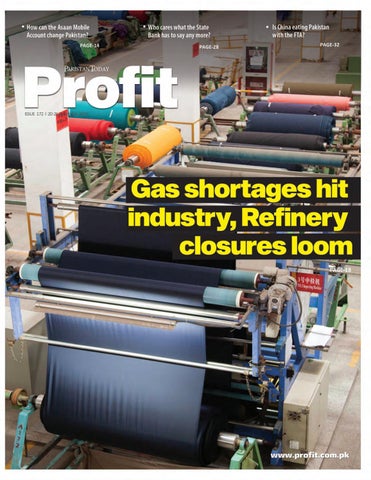
18 Gas shortages hit industry, Refinery closures loom 25 Crushing the knowledge economy Ammar H Khan
14
28
26 26 The China-Pakistan impasse is very real Uzair Younus 28 Who cares what the State Bank has to say any more?
Profit
30 Is China eating Pakistan with the FTA? Suleman Maniya
Publishing Editor: Babar Nizami l Editor: Khurram Husain lJoint Editor: Yousaf Nizami l Assistant Editor: Abdullah Niazi Reporters: Ariba Shahid l Babar Khan Javed l Taimoor Hassan l Meiryum Ali l Shahab Omer Chief of Staff & Product Manager: Muhammad Faran Bukhari Regional Heads of Marketing: Muddasir Alam (Khi) l Zulfiqar Butt (Lhr) l Malik Israr (Isl) Layout: Ahmad Salahuddin l Photographers: Zubair Mehfooz & Imran Gillani l Business, Economic & Financial news by 'Pakistan Today' Contact: profit@pakistantoday.com.pk
Editorial Trapped by vested interests It was a week of sharp reversals. It began with an interest rate hike and ended with a fuel crisis sweeping the country. Along the way we had data releases showing the government’s vaunted economic growth rates are plateauing out while all indications are in place that the current account deficit, data for which is set to be released very soon, will show a sharp rise for another month. Between a rate hike and gas curtailment, industry now faces the prospect of a sharp reversal of its fortunes and the government faces the prospect of a sharp hike in its debt service obligations, putting pressure on its fiscal framework. The forthcoming week will bring a mini budget laden with taxes, including perhaps on medicines as well, and large cuts to development spending. The government is now caught in an avalanche of the consequences of its own actions. They used large scale subsidies – on gas and credit – to try and kickstart exports, and momentarily basked in the applause of the business community, presenting it all as markers of its success. But now it has to roll these back, urge the same industry to move away from subsidized gas a primary fuel for its power requirements and face the backlash that always comes from this opportunistic fraternity whenever they are asked to share some of the burden of financing the needs of a growing economy. The days and weeks to come are likely to bring us rising acrimony between industry and government as the impact of the rate hikes raises their debt servicing costs, and the gas shortages intensify. On top of this a brewing crisis with the refineries reached boiling point in the last week. For months refiners have been warning that power producers are not lifting furnace oil stocks in sufficient quantities and the resulting pile up of inventories is filling up their storage tanks. Once these reach the top the refineries will have little option but to shut down operations. That moment arrived last week. One refinery announced a closure while another warned that it is very close to following suit. Reports coming from sources that did not wish to speak for attribution say the other two refineries are delivering similar warnings to the government and asking the power division to take more vigorous action
to ensure offtake of FO from the power producers so inventory levels can be brought down. The energy minister took to the airwaves to argue that this situation arises every year because of low power demand in winter, which reduces the need for furnace oil. He blamed refiners for using “outdated technology” and not investing in their upgrades. Refiners shot back by accusing four minister and advisors of the government, including the energy minister, of malfeasance by suggesting that they might be looking to personally benefit from their public criticisms of the refiners, who are listed companies. They urged the Prime Minister to begin NAB and FIA investigations of these minister’s actions, specifically looking to see whether they are trading in refiners shares through third party related accounts. Meanwhile the finance minister has accused the banks of currency speculation, and unnamed government officials are accusing textile exporters of extorting subsidies to the tune of Rs100 billion from the government while refusing to entertain government entreaties to shift their operations away from gas fired captive power plants towards grid electricity instead. In short, across the board the government is now grappling with big business, the very constituency it sought to serve through largesse in the name of industrial revival. In the days, weeks and months to come, this contest is likely to intensify, especially once implementation of the IMF program gets going in earnest. This is not an enviable position to be in for any government, least of all one that has touted industrial revival as one of its key successes. But it was inevitable. Showering largesse on big business and industry is not the way to kickstart a moribund economy, at least not in any sustainable manner. It was a colossal mistake to bow so deeply before the vested interests of big business and shower them with subsidies on fuel, power and credit because it should have been sufficiently obvious at the outset that such a course of action will have to be unwound at some point. Last week that point arrived and from here onwards the government will be left grappling with the consequences of its own actions.
7
Readers Say The country has to make a choice between prosperity and poverty. Provincial assemblies must promulgate laws for the ban of religious activities (excluding Namaz) including display of religious symbols at work places. Employers should immediately respond to this incident by making and implementing rules for banning all kinds of religious activities (excluding Namaz) at business and factory locations. They must enforce the wearing of secular clothes. They must enforce rules to stop employees from engaging in discussion on religion. Apropos: How far will the tremors of Sialkot travel? Mumtaz Hasan, Website This handful of people cannot grasp the extent of damage they have caused to Sialkot’s economy. Apropos: How far will the tremors of Sialkot travel? Haroon, Website So real estate amnesty has caused the economy to overheat? I beg to differ, if it was true then 5MFY22 construction material sales must be in double digits, (which is not). Also, see September 2021 LSM growth number, it came in just at 1% YoY, October number will be the same. Our current predicament is because of the increasing size of the cash economy. Going through our 4MFY22 import numbers, you will see that there is hardly any increase in quantities imported. Price factor is the biggest contributor to the overall trade balance overshooting. Apropos: Too much growth? @lifeofjoy86, Twitter Expect another rate hike by 02.5 – 0.5% in the next MPC announcement as it will be in line with “MPC expects monetary policy settings to remain broadly unchanged in the nearterm”. Unfortunately the SBP governor, unlike any of his predecessors, wants to appear in TV shows and give interviews which seems very unprofessional. Maybe he is thinking of a career post SBP governorship. Apropos: 100 bps hike brings policy rate to 9.75pc Faisal, Website
facebook.com/Profitpk twitter.com/Profitpk linkedin.com/showcase/13251020 profit.com.pk profit@pakistantoday.com.pk
HOW TO CONTACT
8
New jazz app is absolutely horrible. It is slow; it hangs for minutes at a time from one menu to another. Better to use your own hands and physically take cash to another person. Money gets transferred and balance gets reduced but doesn't show in the statement. Horrible. I am switching immediately. How can such a big company have such a horrible
app? The statement menu has to and from dates reversed! Apropos: JazzCash Business app hits a snag as users fail to sign up, transfer funds View Post Yasir, Website In this regard, sources in the textile sector said that the government will most likely cut off gas supply to export-oriented CPPs in Punjab as mentioned in the gas load management plan for December 2021 and January 2022, while those in Sindh will be spared during this winter. Apropos: Gas supply for Punjab export sector likely to be curtailed Sir, your point is valid but 1) SEPL is still a well run company (even if in a monopoly situation). Karachi electric, PIA and several other monopoly/ oligopoly companies do worse. 2) Foreign investors in majority (let alone minority) felt the SECP lack of action in the famous Hum TV saga last year when elections for the company were not held by the management. The true reason for low valuations is the SECP at the time and it’s poor governance. SBP’s minor inefficiency in managing SEPL is not a big issue. Apropos: The SBP has failed to manage its own investments. How can it manage Pakistan’s? Ahmed, Website Firstly I would refrain from the usage of words like Useless, and other words you have used. Secondly, you need to understand Shareholder activism doesn't mean only badly managed sponsors are given the push it means all such companies which are not acting in a fiduciary capacity of managing funds of shareholders should all be questioned. If SEPL is such a well managed company why are they giving their property to Old CEO to live in? Moreover, in the entire article I have given you proof of what the company should be doing while in your comment you seem to only talk about broad things (we are talking of a specific case and then you generalize and talk about textile sector etc) so you need to have your priorities right. If SEPL is such a well managed company then why is the share price trading at close to the value of cash in the company? It should be trading at multiples of that! Kindly talk about facts and then we can have a discussion. Your point about revaluation is completely wrong. I suggest you relook or read on it before you indulge in a discussion here. Apropos: The SBP has failed to manage its own investments. How can it manage Pakistan’s? Suleman Maniya, Website
COMMENTS
IN BRIEF The federal government reduced the prices of petrol and diesel by up Rs5 per litre against the proposal of OGRA which called for reductions of up to Rs10. Sales tax was hiked to absorb part of the reduction. The development comes as crude oil fell in world markets.
State Bank of Pakistan (SBP) Governor Reza Baqir told Bloomberg on Friday that the central bank will pause interest-rate hikes after delivering two massive hikes since November. A wider current-account deficit, faster inflation and stronger economic growth are factors that could get the State Bank of Pakistan to resume its rate hike journey, he said.
The residents of Gwadar who had been protesting against illegal fishing for almost 31 days announced to call off their sit-in after reaching an agreement with the government. The residents of Gwadar were also demanding civic amenities and employment opportunities for the local people. Data released last week painted a mixed picture of economic performance. The Large Scale Manufacturing index showed negative year on year growth for the month of October after posting lacklustre growth in the preceding month as well. Meanwhile Foreign direct investment (FDI) plunged by 39 per cent month-on-month to $135.6 million in November. However, the inflows grew by 12pc year-on-year to $798m in the first five months of the current fiscal year. The Pakistan Refinery Ltd (PRL) announced a temporary shut down of its production on Thursday because of “operational and ullage constraints”, a reference to its storage capacity having reached its limit with growing inventories of Furnace Oil. The refinery will stay shut “until the situation improves”, said the notice by PRL filed with the stock exchange.
Information Minister Fawad Chaudhry revealed that the federal Cabinet has only granted a 12-month extension for the replacement of currency notes of Rs10, Rs50, Rs100 and Rs1000. It is pertinent to mention here that the SBP had sought a six-year extension for the replacement. After the apex committee on Afghanistan, the AICC, had taken notice of disruption of trade via Torkham border for negligence of Ministry of Food Security and Research, Prime Minister Imran Khan has reportedly directed authorities concerned to send the issue of malpractices at the ministry to National Accountability Bureau (NAB). The food ministry is yet to respond.
9
Grocery delivery and meme game
this week in Pakistan’s business and economics twitterverse
T
his week there seemed to be a lot of talk about grocery delivery and how the so-called disruptions aren’t disruptions as much as they are old ideas with some water sprinkled on them to make them fresh. We also look at some top notch memes, jokes about fractions, and the joke that is “ Digital ” Pakistan. Ariba Shahid brings you all this and more in this week’s social media roundup
Meme game on point
Another boomer
Fawad Chaudry hates being called a boomer but sometimes he does act like one. While Crypto and CBDC are different, the very fact that the SBP is looking into CBDCs should make the ministry also mul over crypto.
10
The meme in this tweet makes it to our roundup because we’re definitely in awe of @2paisay’s meme game. On that note we also wonder what he does for a living especially considering his witty humor regarding boring old macroeconomic developments.
“ Digital ” Pakistan
Some jokes just write themselves. Digital Pakistan is the joke that keeps giving, again and again and again. I mean, if we look at all our social media round ups Digital Pakistan is probably the thing we’ve made fun of the most. Make up your mind. Do you want to be digital or be archaic? It’s that simple. Then again, how can one not expect these taxes, we’re also a country that charges withholding taxes on the fees payable at educational institutions. I don’t know, tax extravagant weddings, clothes, cars- basically everything other than the fees students pay and of course laptops at the very least?
Ghost of Sparta
The Ghost of Sparta seems to have a talent for dialogue writing. Maybe in another life this guy is not someone that works in the soul dead financial sector and probably has an artist within him. However, it’s sad that monetary “setting” developments are his inspiration to bring out this artistic side.
Not so funny funnies Mom is kinda right
When I told my mom we could vegetables through an app within 20 mins, she said we can get them from the thela wala also with the added benefit of being able to haggle. I then told her she could get milk, tea leaves, and masalas the same way and she said the general store guy sends a shop assistant to deliver things over a phone call. Apparently she didn’t buy the “disruption”. While I’m not trying to downplay ecommerce, my mom did have a point. We feel our readers at Profit are ones that will appreciate this humor about fractions. Especially considering they probably spend their whole day looking and calculating percentages. {Editor’s note: Profit bears no responsibility for whether the jokes it’s journalists share are funny or not. It is their personal opinion entirely.}
Ending the pandemic
The key word here is equity and not equality. The pandemic ending is good for everyone, all countries. Some just need more help than others.
SOCIAL MEDIA ROUNDUP
How can the
Asaan Mobile Account
change Pakistan?
Pakistan has a huge unbanked population. What will the AMA do to change that? By Taimoor Hassan
O
n December 13, the State Bank of Pakistan (SBP) launched the Asaan Mobile Account (AMA) scheme at the central bank’s headquarters in Karachi. Those in attendance were the governor and deputy governor of the State Bank, CEOs of some of the largest banks in Pakistan, chairmen of the National Database Registration Authority (NADRA) and Pakistan Telecommunication Authority (PTA), officials from Virtual Remittance Gateway (VRG) and other officials from central bank. The launch comes after a long and uneven ride for AMA and the parties involved, with unwanted delays in the launching of the scheme, wilted faces of some of the participants of the scheme and uneasy interactions. But this discourse is not about delays, wilted faces or uneasy interactions. It is rather about
14
the scheme and what it holds for Pakistan. The scheme is the embodiment of a rare cooperation between commercial banks, mobile network operators or telcos like Mobilink and Telenor, and a young fintech company, VRG, which is at the centre of making this cooperation possible. The scheme is finally here, with ambitious targets of banking a massively unbanked population and a promise that if this population is banked, it can change the destiny of the entire nation.
Why is AMA the best bet to bank the unbanked?
T
he idea of AMA is to get banking services to the unbanked population on a USSD-based channel so that it can eliminate the need for the inter-
net. The USSD code system is one most mobile phone customers are familiar with. Each time they use a prepaid card to load more money into their mobile balances, they are using a USSD code to conduct that transaction (that *786 or *123 or similar code followed by the scratch card code that you use is called a USSD code). In turn, it is expected to boost financial inclusion which comes with its own prize for the economy. Talk to bankers and they will tell you how they avoid interacting with low-income people, say some shepherd in a village, and even deny them entry at a bank branch. These customers can create an image problem for the bank and its wealthy customers would feel uncomfortable with their presence at a bank branch. Banks also consider these customers hard to work with because of low literacy among such segments, and banks have long considered these segments a bad business case since the cost of serving these
“If you look at it from a profit and loss perspective, a female having a bank account has as much impact on a bank as it has in the case of a male. A researchbacked fact is that women save more and there is some evidence as well that they default less,” SBP Deputy Governor Sima Kamil
customers at a branch is high whereas the money banks can make on these customers is less. But ignoring such customers because of their low literacy, how they look and how they speak is wrong on many levels, and criminal if done for long. Considering that the majority of the population belongs to the low-income group, it can have serious consequences for the economy due to a high rate of financial exclusion. So if a majority of the population is ignored by banks and they can not go to the banks, what do you do? You take the bank to them. The case for having AMA is a simple one. Pakistan’s unbanked are not banked because of one or more of the underlying reasons: they either simply do not have enough income or work menial jobs to be able to qualify for a current account; documentation is a hassle and not everyone is literate enough to fill paperwork and open a bank account; and access to a bank branch is not easy for everyone especially women. So how do you take the bank to these people? There are 187 million active cellular subscribers according to data from the PTA, so banking on phones is the most convenient way to get the unbanked bank accounts. But not all cellphone subscribers have a smartphone to carry fancy banking applications or other wallets on. Until October 2021, 52% of the total cellphone users in the country were smartphone users whereas the remaining 48% use feature phones. The ones that do have smartphones, especially the ones in the low-income demographic of the country, are not likely to have internet access on these phones sometimes because of infra-
structure constraints and sometimes because the internet would be too expensive to afford. Whereas they would always have the USSD system of codes available wherever a mobile network operator (like Telenor, Jazz, Ufone and Zong) operates. Operating a bank account on a USSD channel has been around for a while. Askari Bank, Bank Alfalah and Soneri Bank for instance allow bank account holders to operate their accounts on a USSD-based channel provided by Ufone. The problem, however, is that such arrangement is only restricted to one bank and a telco under a one-to-one model where one bank offers mobile phone banking services in partnership with a telco. The limitation here is obvious: only one telco’s outreach is being utilised by one bank. Therefore, the scope of banking is restricted to the customers of one bank and users of one telco. Another model under which a telco can partner with multiple banks, a one-to-many model, can reach out to more users but it is still restricted to the outreach a telco has, that is the number of users of a particular telco. The AMA scheme, however, is the embodiment of a different kind of model classified as a many-to-many model under which many banks and many telcos partner to offer services to almost all bankable customers, which is an estimated 100 million adults in Pakistan. Profit’s research into bank and telco partnerships for mobile banking on USSD channels does not show many banks in partnership with telcos to offer mobile banking. Only a handful of banks have partnerships with Ufone to offer mobile banking services, but they are restricted to financial trans-
actions: you can not open an Askari Bank account or a Bank Alfalah account by dialing a USSD code and would have to visit a bank branch to do that. On the other hand, telcos Mobilink and Telenor are the major players in branchless banking and operate JazzCash and EasyPaisa wallets and over-the-counter (OTC) mobile banking. Through branchless banking licenses of the banks that back them, both the telcos have been able to promote financial inclusion by providing access to banking to low-income demographics; the segment of population that is unbanked. Under the National Financial Inclusion Strategy (NFIS) of the Government of Pakistan, a target of 65 million active digital transaction accounts has been set to be achieved until 2023. As of September 2021, there were 260,829 active branchless banking agents in the country providing OTC banking services, according to data from the State Bank of Pakistan. This is in stark contrast to only 16,308 bank branches in the country as of June 2021. So if the network of branchless banking agents is leveraged effectively whereby an HBL or a UBL customer can cash-in and cash-out or get assisted mobile banking services at an EasyPaisa or JazzCash branchless banking agent, financial inclusion can increase manifold. Clearly there is scope; Pakistan has a huge unbanked population that needs to be banked to bear fruits of financial inclusion, digitise payments, curb money laundering and digitise the economy overall. There is also a way to do it through interoperable infrastructure sharing between banks and telcos for which the many-to-many model is
MOBILE BANKING
the only effective one, and there is also the willingness to do it following the third-party service provider (TPSP) regulations creating that interoperability and the official launch of AMA last week.
Where is the convenience here?
S
o under the AMA scheme, a smartphone or a non-smartphone user, without any internet connection and without the need of going to a bank branch, can simply dial *2262# (the USSD code for AMA scheme available on all telco networks) and open an Asaan Mobile Account with any one of the 13 partner banks part of the scheme. The interface on the mobile phone will take the CNIC number of the user and expiry date, following which identity verification will be done by NADRA which is connected with banks’ systems. An official connected with the scheme, choosing to remain anonymous, said that the actual account opening takes under or up to a minute only. Once the account is opened with any one of the partner banks, financial transactions like funds transfers and bill payments can be done through the same phone on a USSD channel. And interoperability means that users will be able to carry out financial transactions between banks on the same USSD channel. The frictions that earlier restricted a segment of the population from opening a bank account, the AMA account removes those. People will have the facility to transfer funds, make payments, pay bills and do mobile top-ups to begin with. The facility will, however, be open for banks to add new products and services such as disbursing loans into AMA accounts. The success of AMA, however, is based on an assumption that people who were not literate enough to open a bank account at a branch, would be savvy enough to open and operate AMA accounts on their phones. That is at least what the skeptics in the banking industry have to say about the scheme. The counter to that argument, and what is precisely the point of interoperability and which has been the mainstay of branchless banking business, is the vast agent network which provides assisted banking services to wallet users. With all that in place, AMA looks promising to make a headway in financial inclusion. For women in particular, which have long been ignored by banks despite virtues for these banks. “If you look at it from a profit and loss perspective, a female having a bank account has as much impact on a bank as it has in the
16
case of a male. A research-backed fact is that women save more and there is some evidence as well that they default less,” SBP Deputy Governor Sima Kamil had earlier told Profit in response to a question on bank’s lack of interest in financial inclusion for women. Add to that the SBP has planned to give targets to get more women into the formal financial sector, for which AMA can be crucial. The central bank’s own target is to get 20 million women into the financial system by 2023 and for the AMA scheme, SBP Governor Reza Baqir said at the inauguration of the scheme that AMA can potentially add 50 million accounts. The only question is if that would happen. An expert Profit spoke to said that it will all depend on how the scheme is marketed and people can be persuaded to join the banking net. “After a certain time, people stop signing up for wallets. But if Jazz or Telenor give a Rs100 top-up to a user if he signs up with JazzCash or EasyPaisa, they will likely sign up immediately. Even then it would be a sign up and not an active account so the key would be to keep AMA accounts active as well,” he said.
It all starts with an account
P
rofit has been a skeptic of the rhetoric of providing access to financial services to a population that perhaps does not need it. In an earlier critique, Profit argued that those that the country is trying to bank are likely better off by staying unbanked: a bank account changes nothing for them. An official stakeholder of the scheme, however, said that it has to start with a bank account. “There are conveniences attached with making payments digitally. Billions of rupees worth of payments are done in Pakistan in cash, for example payments at vegetable and fruits markets all across the country are done in cash on a daily basis by millions of people. If you aggregate all of these payments, it is a massive amount of money that is cash-based and if digitised, this money is going to help the economy overall,” he said. People that Profit spoke to said that right now, if people are skeptical about the conveniences of such an arrangement, it is because nobody has been able to show to them these conveniences at a mass scale, and the AMA scheme is just the beginning of that. “Getting active users is going to start with getting users first on AMA and that has happened. It is only a matter of time that they see it as a convenient mode of payments and use it as a priority over cash.” “Under the AMA scheme, the use cases
are what a common man needs. He sends money, he pays bills but without a bank account, it’s all cash-based. The convenience is there and AMA is there to ensure that they have this option,” another official said. “Moreover, banks do have the option of offering value added products and services for this demographic and these products will also be interoperable: banks would be able to offer these to customers of other banks too through AMA,” he added. Banks have long been ignoring retail consumers for financing, housing finance in particular. Their excuse, quite legitimately, has been that there are not many options available to assess credit worthiness of the demographic that needs to get housing finance facilities from commercial banks. There is a shortfall of 10 million housing units, according to the State Bank of Pakistan. The Pakistan Tehreek-e-Insaf government’s housing initiatives like Naya Pakistan Housing Scheme and Mera Pakistan Mera Ghar for low-income communities. The problem at the centre again has been that the demographic targeted for this facility, there are not enough data points to assess their credit worthiness. And without proper credit assessment, the rate of default would be high. Since AMA plans are meant to be for low income communities, transactional data on AMA accounts would provide data points for assessing credit and possibly make the housing dream a reality for low-income people. Once billions of rupees worth of cash is digitised, banks’ deposits will also increase and then a better case could be made to push banks to offer better consumer products and services for low-income demographics. Banks would then tailor products, say loans, focused on a subset of such demographic, say women, just because they had an AMA account and they used it to make payments. Then, the willingness of banks will also be high and the low-income groups would be made to feel privileged by the very banks that once ignored them. So far, the uptake of the AMA scheme has been encouraging. As many as 2 million AMA accounts have been created so far. These accounts have processed 14 million transactions worth Rs14 billion in value. If the uptake continues and AMA is able to get 50 million people into the banking net and there are active transactions on these accounts, it will substantially increase financial inclusion and lay the grounds for a country in which financial services and products would be available for the now financially excluded. Then, it will be a promise of a better financial life and uplift of the low-income households which will alter the course of their lives towards a better destiny. n
MOBILE BANKING
18
COVER STORY
APTMA, SNGPL square off as gas crisis worsens Industry cries foul as gas supplies are disconnected with the onset of winter By Shahab Omer
T
he much anticipated winter gas shortages finally arrived last week, pitting the government and its utility companies in a battle of wills and narratives against industry owners who cried foul as their connections were severed to curtail demand. Over the weekend, reports surfaced that production activities in half of the entire textile export industry had come to a complete or partial halt after the Sui Northern Gas Pipelines Ltd stopped gas supply to the captive power plants (CPPs) compelling the industry to run on electricity. To put that into perspective, Pakistan’s textile industry is the largest in the country. It is the largest contributor to an already weak export bill at around $3.5 billion in 2020, contributes nearly 10% to the GDP, and employs about 45% of the total Labor force in the country from farmers to skilled workers in factories. On the other hand, the government has accommodated longstanding demands of the textile industry with a conviction that none of its predecessors did. One of the leading demands was of “rationalising” gas prices between north and south zones - Punjab and Karachi - to provide gas at $6.5 per mmbtu, the unit in which gas prices are usually denominated. From November 30, however, the government revised this to $9 per mmbtu instead keeping in view the rising price of LNG, drawing sharp protests from industry, which took the tariff revision to court and won a stay order against it less than two weeks later. The court action did not go down well with the government. And the main issue isn’t even the shutting down of the CPPs. During the winter months the textile export industry expected their CPP gas connections to be cut. They were naturally not happy about it but they knew it would happen and could have prepared accordingly. The main bone of contention is that the government has allegedly shut down not
20
just the CPPs, but also the cogeneration gas connections as well (cogen are the second kind out of three different gas connections that the textile industry uses - more on this later). Sui Northern Gas Pipeline Limited (SNGPL), however, claims that nothing of this nature has happened and only the CPP connections have been halted. However, sources within the SNGPL have told Profit that while the official line is different, the cogen connections have also been affected by the gas shortage. The ensuing tete a tete has been public and bordering on the nasty, with the government claiming that the industry has been irresponsible with its use of energy and All Pakistan Textile Mills Association (APTMA) waging a battle to get the government to acknowledge that the gas supply has been affected beyond the CPP connections.
Why does the industry have three different connections?
A
ny textile export setup will generally have three different kinds of gas connections. One for “process,” which means running their boilers, a second for their power plant, and another for what is called “cogen” which stands for co generation. Essentially, these industries need to produce steam either to produce electricity or to run their machines - most machines run on electricity. Gas is used to run boilers which then produce this steam. The first is the general industrial gas connection that all industries get, which is used directly to produce steam from gas. The second kind of connection is the previously mentioned CPPs. The CPPs are important because they provide gas for the inhouse power generation plants of the industry. The textile sector needs gas to produce steam and run their boilers, but most of their machinery runs completely on electricity. Industry owners say they are not in a position to take electricity directly from the grill because of
load shedding, constant fluctuation, and under capacity transmission lines. “Captive connections are already the most important to us and they were shut down. Through captive connections, our industry generates electricity only from gas,” says Kamran Arshad, vice chairman of APTMA. Because of this, textile manufacturers usually use their CPP gas connection to fuel their power plants which provide them with a steady, stable, stream of electricity. Relying on the WAPDA or LESCO connections does not work for them because every interruption or disturbance in supply causes the machines to shut down, only to be started all over again, which takes time and a toll on efficiency - which is already low in Pakistan’s textile sector and makes it less competitive internationally. In the winter months, this becomes a serious issue. According to SNGPL, the total demand for gas on normal days was 1600 mmcfd. In the winter months, with increased demand coming in from the domestic market as well, the demand went up to 1800 mmcf. The government suddenly had a significant shortfall of what it could provide, and decided to cut back on providing as to industries. In this regard, they were cutting off the CPP connection. However, APTMA has been up in arms because apparently the cogen connection has also been cut. “Through co-gen connection the electricity is generated from gas and then the fumes that are formed during this process are recovered and the steam is made and used in the process. Co-gen is technically the most efficient connection and has been closed with captive connections. The government says that it will not allow us to generate electricity from gas, however, the industry which produces direct steam from gas will be given priority,” says Arshad. In cogen, the mills use the gas to run a power plant, then use the heat exhaust from the power plant to operate their boilers. This has happened even though the SNGPL is supposed to disconnect all power plant connections only. Now, the SNGPL has maintained
officially that they have only cut the CPP connections. However, sources high up in the SNGPL, on conditions of anonymity, have confirmed to Profit that cogen connections have indeed been cut as well.
What exactly is going on?
O
ver this issue, there has been a prickly back and forth between APTMA and the SNGPL. While the concerns of APTMA are valid since they were not informed about the cogen connections and there continues to be no official clarity over the issue, the SNGPL has long been asking the textile industry to switch to electricity and come onto the grid. Speaking to the media, APTMA chairman Abdul Rahim Nasir has said that the operation of large units exclusively on electricity, according to industry, is difficult since the steam that is used in dying and other processes cannot be generated. “Only the new machines, and not the used ones, can be run effectively on electricity. But with captive power, all can be run efficiently leading to the generation of steam and production as per demand. We also cannot switch to electricity because it couldn’t work due to a 14-hour long power shutdown caused by tripping of the respective grid stations.” Speaking to Profit, Kamran Arshad, vice chairman of APTMA North Zone, said that the CPP connection was already a huge problem and now on top of that the co-generation connections had also been shut down. he said. “The decision was sudden and unilateral and the industry was not informed about it at all. We had been hearing rumors that the government was going to take a decision to cut off gas, but then we realised it had happened without us getting so much as a warning when our factories informed us that there was no gas.” The SNGPL has tried to rubbish the claims of APTMA and the textile industry. Amjad Ikram, an official in the media affairs department at Sui Northern Gas Pipelines Limited (SNGPL), tells Profit that it was in fact a misconception that gas supplies to industries had been suspended. “SNGPL had cut off gas supply only to the captive power sector. Gas is being supplied to export and general industries as every industry has a general industry connection. Similarly, gas is also being supplied to commercial connections. The decision was taken under an approved load management program and WAPDA now has the capacity to provide electricity to industries at affordable rates,” he said. The official further informed that there were about 2300 industrial connections in Punjab and Khyber Pakhtunkhwa (KPK) out
of which gas supply to only 400 captive power plants has been cut off. “Now if you talk about commercial connections, the company [SNGPL] has provided 60,000 commercial connections in Punjab which are being supplied with gas. Through these commercial connections, many small industries are getting gas and running their business.” On the other hand, senior officials of the SNGPL have confirmed that cogen connections have also been halted. However, the official made it a point to say that industries should not cry over gas suspension to captive power plants as they have ample options for alternative energy sources. “If we talk about small industries like pottery or cutlery etc., they do not have general industrial connection but these industries are running their business through commercial gas connections,” they said. “The advantage to this is that gas closures on commercial gas connections are minimal. In winter, as the demand for gas consumption of domestic consumers increases, incidents like decrease in pressure occur somewhere but if you visit these industries secretly, these industries are using more illegal gas compressors than domestic consumers and our field staff is often involved in this activity.” The officials believed that the protest of the textile sector about the closure of gas in the captive sector was baseless and a traditional attempt to put pressure on the government. According to the SNGPL, both the official speaking anonymously and the official line, anytime a captive connection is provided to any company one part of the contract is that there will be a failsafe system of having electricity in case the gas supply falters, especially because of shortage in the winter months. “We can see why they are upset. SNGPL provides them with captive connections that result in uninterrupted and steady electricity to run their industry. Typically, if an industry uses 0.3 MMCFD gas, it is generating one megawatt of electricity and each industry produces electricity according to its own needs under the same method.” “However, any time an industry is given a captive connection, an undertaking is taken from the industry that they will build a dual fire arrangement system and the main reason for this undertaking is that as there is a shortage of gas in winter and the industry can use alternative energy sources from dual fire arrangement system and will not be shut down. Almost every captive connection has a dual fire arrangement system. Even if the industry uses electricity directly, its system can run. In fact, WAPDA is providing electricity to the industries at cheap rates. WAPDA is providing electricity to industries at RS 14 per unit while the cost of gas unit at captive connection is RS
20. The industry cannot be harmed if it runs its appliances on electricity instead of gas.”
Why does the textile industry not have a backup?
O
ne of the biggest issues here is the fact that the textile industry has not been able to cope without the supply of gas. Most of the industry is in shutdown mode at the moment, and they are unwilling to operate on electricity. There are a few reasons for this. The first is that electricity is unreliable for an industry where there is a need to run machines constantly and without break. The other reason is that to setup an industrial electricity connection, the industrialist would have to buy land to set up a plant, which can end up being a Rs 100 million investment. However, at the same time, SNGPL has a point that a backup system is written into the agreement with the captive power connections. While the cogen issue still exists, the defence of the textile industry has been that the industry and SNGPL have a Gas Supply Agreement (GSA) that is being breached. “The agreement states that SNGPL will supply gas to us for eight to nine months in a year and is not bound to supply gas for three to four months as pressure drops in gas pipelines in winter but we have been getting gas in recent years and gas prices in our province are also higher than others,” says Kamran Arshad. “We cannot be expected to rely on grid electricity. When it comes to running the industry on electricity, it is very difficult in these situations because the cold has increased the fog and the moisture comes on the transmission lines which causes tripping and our machines, which are running at very high speeds, suddenly shut down. It takes one to two hours to restart these machines,” he said. “The second issue is load shedding. As soon as our gas connections were cut off, the industry suddenly started using electricity and the power supply companies were not prepared for this sudden increase in load. As a result, areas like Bhai Pheru, Sheikhupura, Okara, Manga Mandi and Phool Nagar were without electricity for 14 to 15 hours and the industry was shut down. The gas shutdown affected not only the textile sector but also every small and big industry.” SNGPL insists that everything is above board, and that the disconnections are within the bounds of the GSA. According to them, the industry has two excuses - the first is that electricity is not reliable and the second is that they were not informed and this happened unilaterally and they had no fair warning to get their affairs in order. “As far as the first
COVER STORY
complaint is concerned, the industry also has a third option to generate electricity through furnace oil or diesel and the cry of gas closure is only because if there is load shedding or fluctuation then the third option has to be used.” Some haze also surrounds the second concern of not being informed on time. APTMA officials claimed that they suddenly came to know about the decision to cut off gas while the preparation of the association shows that the industry was already aware of all the issues. According to the SNGPL official, the decision was taken at 5:30 pm on December 15 to shut off gas from captive connections and the announcement was made at 7 pm on the same day. On the other hand, senior officials of APTMA including the Chairman of APTMA Pakistan and the Chairman of North Zone were meeting with the Advisor for Commerce, Textile, Industry and Production, and Investment of Pakistan to Prime Minister Abdul Razak Dawood at 5:30 pm on the same day.
“Do you really think they did not know about this decision? We can’t even question the textile sector because they are big capitalists and have direct contact with important government figures. This sector also gives expensive gifts to the government officials and if there is any problem in their gas connection or we ask them counter questions then they also arrange our transfers,” explained another high ranking official of the SNGPL on condition of anonymity. “The decision to stop gas on captive connections was not ours but the government’s. We had to shut off gas from the Consumer Meter Station (CMS) of all captive connections through our field staff in 24 hours.” Meanwhile, when APTMA officials were confronted with the meeting and the SNGPL’s accusations that they were not unaware and had meeting with Razzaq the day that it was announced, the Vice Chairman claimed that it was not discussed and before going into the meeting his sources had told him that the government had already made the decision. It is
pertinent to mention here that it was informed in the press release of SNGPL that gas will be cut off on captive connections from 9:30 pm on December 15, while the Vice Chairman claimed that gas cut off was done before 5:30 pm on the same day. All in all, this issue is one that does not look like it will have a conclusion anytime soon. As the gas supply remains suspended for the textile industry in the midst of a gas shortage in the country, there is a dire need for two things. The first is for the SNGPL to be more upfront, especially about the cutting of the co-generation connections which they are still officially stating have not been cut. The second thing is for the textile industry to do some serious introspection and realise that since this might be a persistent problem in the future, they must figure out other ways to keep their furnaces and boilers burning. If they do not, it will be their loss, and all the complaining and whining in the world will not stop if there is just not enough gas being supplied.
After PRL, three more refiners warn of closure as
furnace oil stocks reach full capacity Industry insiders blame disconnect between power and petroleum divisions for the crisis sweeping their sector By Ahmad Ahmadani
L
ess than 24 hours after the announcement by Pakistan Refinery Limited (PRL) that they were temporarily shutting down production owing to operational constraints, the CEO of Attock Refinery Limited (ARL) met with the Secretary Power to warn him that he might have to follow suit and shut down operations as his storage capacity was filled to the brim with furnace oil. Sources tell Profit that National Refinery and Byco have issued similar warnings but confirmation was not available till the filing of this report. Attock is the second major refinery out of four to make it known that the capacity issue has now reached a stage for them to halt operations. Others are expected to follow suit. Profit has learned that Attock’s CEO, Adil Khattak,
22
met Secretary Power, who has the additional charge of the petroleum division, specifically to inform him of Attock’s impending closure. The issue has been caused because refineries in Pakistan have high stocks of furnace oil. The stocks have grown because of the refusal of Independent Power Producers (IPPs) to lift the furnace oil, which has caused the refineries to accrue a build up. Fearing that they would be forced to shut down because of this, refineries have been asking the petroleum division to take measures for lifting the furnace oil to “safeguard the country’s strategic assets.” With no response from the government on this front, they lamented that all power plants’ storage is currently under utilised, which is severely affecting all local refineries, which are heading towards a forced shutdown that will impact motor spirit (MS), high speed diesel (HSD) and jet fuel availability.
Adil Khattak, Chief Executive Officer (CEO) of ARL, told Profit that in his meeting with Secretary Power, he had been reassured that the problem would be resolved very soon. However, as he also pointed out in the meeting, Attock could be forced to shut down any day and there seems to be no progress in terms of lifting the furnace oil. “We have already started closing down its operation mainly because the refinery has left with furnace oil storage capacity of only four to five days,” he said. “ARL has repeatedly requested the petroleum division to intervene and resolve the storage constraints of the refinery. However, no mentionable action has been taken in this regard.” He also said that the ARL on Thursday closed operation of one small unit with capacity to refine 5,000 barrels per day (BPD) and if the situation does not improve in the near future then ARL will have to suspend its operation
TEXTILES
from its second unit with capacity to refine 10,000 BPD until the situation improves. In addition to oil, ARL has been producing 485Million Cubic Feet per Day (MMCFD) of liquefied petroleum gas along with petroleum products. Meanwhile, sources in the petroleum division also told Profit that National Refinery Limited (NRL) has also communicated the storage constraints and hinted to shut down its operation. However, no confirmation from the NRL was available in this regard at the end of this week. A senior official of Byco has also said that they have obtained a rented storage at Port Qasim and called tender for the sale of 37,000 tonnes and so far it has transported 30,000 tonnes of the FO to the rented storage. At present, Byco Refinery’s storage capacity is full, and is faced with ullage constraints. On Friday, a senior official of PARCO informed that the PARCO has taken precautionary measures to deal with likely storage constraints and planned to export 50,000 tonnes. PARCO has obtained storage at the Port Port Qasim. So far, 40,000 tonnes of FO has been transported to the rented storage while remaining 10,000 tonnes of FO will be transported in the next two to three days while PARCO has called tender for sale of FO. The issue has been brewing for a while. In a letter written to the Director General (Oil) of the petroleum division, the Oil Company Advisory Council (OCAC) had requested that the government ensure the lifting of furnace oil from refineries. Pakistan State Oil (PSO) also wrote a similar letter to the DG, in which the state owned company pointed out that IPPs have not been lifting significantly since as far back as July, meaning the accumulation of inventory is pretty serious at this point. “You are requested to kindly take up the
matter with MoE (Power Division) to advise power plants to lift the product for stock build up as the current stock with these IPPs especially HUBCO, TPS Muzaffargarh and TPS Jamshoro are negligible whereas these power plants should maintain at least 21-30 days’ stock in order to avoid any untoward situation,” the letter said. Sources in the oil industry have said that allowing the Oil Marketing Companies (OMCs) to import furnace oil during July-November 2021 is one of the major reasons behind the IPPs reluctance to lift FO stocks from local refiners, leading to over accumulation of inventory and ullage constraints. The feeling in the industry is that PSO has imported refined oil in large quantities and remained unwilling to supply the fuel to IPPs which are faced with financial constraints. IPPs of 2002 Power Policy are also faced with financial problems as their dues are so far not cleared by the government due to which they are unable to lift the furnace oil, said sources. When contacted, a PSO official said that the company has only one HSFO cargo at the outer anchorage, and the same will be berthed in the coming week. “PSO imports FO based on demand provided by the power division,” said the official. The sources also said that refineries are shutting down their operations largely due to lack of coordination between the power and the petroleum divisions. They added that despite repeated efforts by the local refineries, OCAC, Petroleum Division’s DG (Oil), the power division has paid no due heed to the ullage constraints of refineries and resultantly refineries have started shutting down their operations unfortunately. The OCAC has also stated that for ensuring availability of all the other petroleum products, refineries’ smooth operations is key,
therefore, the DG Oil must approach the Power Division for immediate placement of orders by IPPs on OMCs. The OCAC also highlighted that OMCs are to consume finished products produced by refineries before importing any new stock and that only deficit volumes can be imported. “On the firm demand of the Power Division, OMCs were allowed to import LSFO/ HSFO during July-November 2021. But non-uplifting of the committed quantities by the power producers has resulted in a stock build up. Therefore, before finalising any new import, locally produced furnace oil may be accounted for. This will result in decreasing the ever building stocks of fuel oil at refineries and improve the availability of other petroleum products,” the letter concluded. The OCAC also stated that local oil refineries are the backbone of the country’s energy security, supplying over 11 Million Metric Tonnes (MMT) of various petroleum products but due to non-uplifting of fuel oil and limited storage, they are forced to reduce and in some cases, almost shut down crude processing which will affect the availability of the petroleum products, eventually disturbing an already fragile supply chain. The OCAC pointed out that the government, during this year, has so far made substantial payments to IPPs that are bound to keep mandatory stocks as required according to Fuel Supply Agreements (FSAs) with OMCs. The Directorate General (Oil) of Petroleum Division, in a letter dated 9th December 2021, has requested the power division to direct the power plants to uplift furnace oil (FO) through PSO/ OMCs immediately for stock buildup and provide payments/ LCs to PSO. Despite repeated attempts, Secretary Power was not available for comments. n
COVER STORY
OPINION
Ammar H. Khan
Crushing the knowledge economy
economy, but not a myopic one, which exists to meet just the next taxation target. GSM Association (GSMA) estimates that every 10 percent increase in digitization yields an increase in labor productivity by 2.62 percent, and total factor productivity by 2.28 percent – critical factors which feed into overall GDP growth. Similarly, access to affordable broadband can trigger a snowball effect where every Individual can become an export machine without any atrocious or distortionary direct or indirect state subsidies. The gross incidence of tax on broadband internet in Pakistan is in excess of 20 percent. The lowest end mobile devices have the highest tax incidence as well. Recently, there have been talks of imposing additional taxes on laptops -- making them much more expensive than the ou are probably reading this on a screen of some type. If region, or even when compared to other developed economies. by some miracle you are reading this on newsprint, it will In-effect, instead of expanding the pie, the policy makers are not be long before your eyes find themselves focused on a grabbing the low-hanging fruit hindering the growth of the knowledge screen again. That is to say, the accessibility to technology economy just to meet their next taxation target. A digital device is a and connectivity because of the internet has never been critical tool for the modern economy, if our policy makers can dole out greater, which gives rise to new kinds of economic opportunities. close-to-free cash in the form of subsidized loans for industries which Never has there been a better time to work from anywhere in the belong to the last century, maybe the least that they can do is not to kill world, and earn in currency of choice as long as you have a broadband growth of industries which will shape the future. Policy formulation is connection, and a digital device. Learning has been democratized, a a function of elite capture here. Selected few sectors belonging to the old multitude of resources are freely available to learn anything. From the economy keep getting concessions, subsidies, and cheap loans without Classics, to the latest in technology, the information is all there — the any impact assessment, or evaluation. Meanwhile, access to the knowlonly thing required is the will to learn and an affordable broadband edge economy is made more inaccessible, more unaffordable. connection. It is no surprise that most technology companies that operate out A digital device, whether that be a laptop, or a mobile device of Pakistan keep their cash offshore and not reinvest in the country, and is not a luxury anymore. It is a necessity. It is not solely a consumer neither do they recognize most revenue in Pakistan -- lest some policy good, but it is also a capital good, which catalyzes economic activity. maker starts salivating and imposes an irrational tax to kill the industry. The new economy rewards knowledge, the marginal cost of acquisiThe country needs an accelerated national broadband and digital tion of which is close to zero now. It doesn't matter what your pediaccess plan, which actually puts devices in the hands of people with high gree is, or where you went to school. If you have the right skillset, you speed data, and is not an elaborate real estate scheme. Pakistan currently can earn thousands of dollars without leaving your village, or your city. has a smartphone penetration of 53 percent which is constrained by the Millions of sellers exist online, without any brick and mortar sales affordability factor, as due to a mix of taxes, duties, and PKR depreciapresence, exclusively relying on e-commerce, thereby increasing comtion, total cost of ownership of a smartphone has increased over the last petition and expanding the choice set for consumers. As competition few years. Increase in penetration can only be done by making devices increases, so does innovation, and the overall economic pie expands. more affordable, and that cannot be done through imposition of regresA forward-looking policy would double down on the digital sive taxation measures. Similarly, quantum of digital payments processed in Pakistan is minuscule when compared to peers largely due to absence of an operational and affordable digital payments infrastructure. A multi-pronged strategy is required which targets reduction in total cost of ownership of a digital The writer is the chief device, and that cannot be done with imposition of arbitrary taxes and duties. Efforts need to be made risk officer for Karandaaz to make it easier for individual entrepreneurs and small businesses to excel, whether it be through easier Pakistan, an organisation access through banking channels, or through payment systems. The mindset shift needs to move from the that seeks to promote tangible to the intangible. financial inclusion in Software will eat the world, and that is already happening. As an example, India exports more Pakistan. He has previously software than Saudi Arabia exports oil. Alternatively, China imports more microchips than it imports oil. worked at several financial The world is pivoting towards the intangible and it is doing that at a breakneck speed. We can either deinstitutions in Pakistan, velop our capacity accordingly like our peers have done, or we can continue celebrating low-value added, both in commercial banking highly subsidized, and distortionary exports. and capital markets
It has never been easier to learn in all of history. Why are we trying to make it less affordable?
Y
COMMENT
25
OPINION
Uzair Younus
The China-Pakistan impasse is very real
Multan-Sukkur Motorway; and issues at SEZs including water, gas, and electricity connections for projects worth almost $1 billion. To many domestic investors, the above are familiar challenges they face when operationalizing major projects in the country. As a result, Pakistan’s geoeconomics ambitions are hitting the brick wall of reality that is propped up by misgovernance and reinEven as the government claims all is sunshine forced by a dysfunctional bureaucracy. Ease of doing business remains a challenge in the country, with most local investors preferring to park and rainbows, tensions continue to rise their money in unproductive assets like plots. The Chinese, who had high hopes of leveraging their strategic relationship with Pakistan to he Chinese are not happy. Once known and proudly shown not only bypass but bring down this wall, are quickly realizing that off as Pakistan’s all-weather friend, the relationship between their optimism may have been unfounded. These challenges mean that the two countries is precariously balanced on a knife’s edge. the risk-adjusted returns in productive assets are simply not worth The relationship started to go awry soon after the PTI the trouble and investors, both domestic and foreign, either avoid government came to power. The first cracks in the relationtaking risks or demand guaranteed rates of return with the sovereign’s ship became apparent when Abdul Razak Dawood in September 2018 backing. Government interlocutors including senior ministers who deal told the Financial Times that Pakistan was rethinking its role in the Belt with the Chinese on a regular basis insist, both publicly and privately, and Road grand plan. that these are not serious issues. Their argument is that the Chinese The downturn has only accelerated in recent months, with the have a direct line to the very top levels of Pakistan’s government and Dasu terror attack marking a major inflection point in the China-Pakistan that all issues are resolved in an efficient manner. Others outside the economic relationship. Mounting issues have become an irritant for the government who also engage with the Chinese believe these claims Chinese and a warning signal for international investors who dare to look and agree that all is not well. But for argument’s sake let us agree that at Pakistan as a potential destination. journalists are sensationalizing routine issues and that all is well. A key The most recent Joint Cooperation Committee (JCC) meeting, held question still lingers: why is it that routine issues require attention from in September 2021 after a two-year hiatus, brought all the major issues and intervention by senior government officials? After all, a half-decent into the limelight. According to media reports the Chinese demanded ingovernment machinery ought to provide water and gas connections at creased security as a “precondition” for progress on CPEC. Pakistan’s deSEZs and clear materials through the ports in an efficient and timely sire to renegotiate power tariffs with Chinese investors was also rebuffed manner without any delays. by the Chinese. Pakistan also assured that almost $1.5 billion in payables The data from 2018 onwards highlights the costs these issues to China would also be disbursed in the coming days. In recent weeks have inflicted: after peaking at $1.3 billion in 2017-18, foreign direct Special Advisor to the Prime Minister on CPEC Khalid Mansoor has also investment (FDI) inflows from China have declined to $758 million in sought intervention from the Chinese government to push Sinosure to 2020-21. From 2013 to 2018, the average annual inflow from China was provide insurance coverage for almost $13 billion worth of projects. The almost $823 million and this has dropped by almost 30 percent to an Chinese are also facing a whole host of other issues including, but not average annual inflow of almost $578 million. The immediate pushback limited to: imposition of anti-dumping duties on construction materials against this data might be that a twin deficit crisis inherited by this for Gwadar Airport; delays in issuance of work visas, with procedural government coupled with a once-in-a-century pandemic has meant issues leading to penalties; pending payments on projects including the that the investment climate has been difficult. While this may be true, comparative data from across the border shows that India attracted a record-high $81.7 billion in FDI during 2020-21, meaning that the fallout of the pandemic, which included a traumatic national lockdown, need not dampen investor confidence. The fact of the matter is that Pakistan’s byzantine governance and bureaucratic system needs massive overThe writer is Director haul, especially if those at the helm of affairs are serious about a geoeconomics pivot. The decline in FDI coupled with of the Pakistan the issues faced by the Chinese is evidence that misgovernance and a dysfunctional bureaucracy are major unresolved Initiative at the issues that are scaring away investment. And while this government, like its predecessors, has conducted yet another Atlantic Council, a multistakeholder process to pursue institutional reforms, the lack of implementation means that things are only Washington D.C.getting worse. As I have argued elsewhere, succeeding at geoeconomics requires the state machinery to operate like a based think tank, and well-drilled orchestra, with each musician playing their instrument in sync with everyone else. For non-Chinese inhost of the podcast ternational investors then, the performance is just not good enough to command attention. After all, if a strategic ally Pakistonomy. He with a relationship that is proverbially higher than the Himalayas is struggling to navigate Pakistan’s dysfunctional tweets @uzairyounus. governance and bureaucratic structures, what hope do others have?
T
26
COMMENT
Who cares what the
State Bank
has to say any more?
The SBP has to put money where its mouth is to make the market believe it By Ariba Shahid
D
oes anyone even care what the State Bank of Pakistan says any more? We asked around and it looks like nobody really does anymore. Not in the markets anyway.The SBP had been on an extensive spree trying to get the right message out, however, eventually they had to calm the markets through its actions. Earlier this week on Tuesday, the Monetary Policy Committee (MPC) at the State Bank of Pakistan (SBP) announced a 100 bps policy rate hike, bringing the policy rate to 9.75%. Within the span of 25 days, there have been two hikes of a cumulative total of 250 bps. The impact of the policy rate hits the debt market. However, as of late, the debt market was and probably still is practically calling the shots getting in ahead of the central bank. As one might imagine, this has rubbed neither the ministry of finance nor the central bank the right way. “Following today’s rate increase and given the current outlook for the economy, and in particular for inflation and the current account, the MPC felt that the end goal of mildly positive real interest rates on a forward-looking basis was now close to being achieved. Looking ahead, the MPC expects monetary policy settings to remain broadly unchanged in the
28
near-term,” the SBP said in a statement. This seemed like an attempt to make the markets believe in the fact that the MPC felt that they were close to their goal of mildly positive interest rates. The move was meant to reduce uncertainty, especially at a time when debt markets have been “bullying” the government (Shaukat Tarin’s words, not ours). The finance minister had said that the banks had a dressing down for being too greedy. The irony of that statement is not lost on any of us. Moreover, the MPC took this a step forward and said that the uncertainty and reaction of market players as “unwarranted”. The statement reads, “across all tenors, secondary market yields, benchmark rates and cut-off rates in the government’s auctions have risen significantly. The MPC noted that this increase appeared unwarranted.” On Tuesday night, Reza Baqir, the Governor State Bank of Pakistan, went live on Aaj Shahzeb Khanzada Kay Saath where he said categorically that Pakistan is not headed towards a situation where the interest rate in the country could surge to 13.52%. “The last time Pakistan faced such a situation was when there was a severe financial crisis in the country, when the CAD was around $19bn,” he explained. “We are going to take a pause to first look at the effects of the tightening that we have already done, and then we will consider what monetary policy settings should
be afterwards,” he said later in the week while talking to Yvonne Man and Rishaad Salamat on ‘Bloomberg Markets: Asia’.
The regulated regulate the regulator
O
ne would wonder why the market isnt taking the SBPs words seriously. Why wouldn’t they? Immediately after announcing the one percentage point hike in the discount rate, the Governor SBP was called into an unscheduled meeting with the Prime Minister. As a result he was absent from a crucial conference call that the central bank holds with bondholders and analysts following every policy rate announcement. His Deputy, Murtaza Syed took up the job and conducted the entire session until near the end when the Governor joined just in time to take two questions after the main presentation had ended. The video has been uploaded online. “The Governor is in a meeting with the Prime Minister right now and will try to join us before the call is through,” said Murtaza Syed, Deputy Governor SBP as he began the presentation. While one is not entirely sure why the PM summoned the governor on such short notice at such a time, one has to wonder what was so pressing that couldn’t wait. Then again, when the PM calls, you’re supposed to answer - no questions asked.
However, for a minute, let us assume the meeting was unrelated to the policy rate hike and about some other urgent issue, the very fact that the governor was missing in action does not send off the right signals to the participants, especially at a time when the SBP is trying hard to communicate. In addition, while there are no rules for the conference call to be head by the governor, it is the norm. Moving against the norms at a time of uncertainty and market speculation makes the situation worse. On the December 15 Treasury Bill (T-Bill) auction, cut off yields remained flat despite the fact that the policy rate had shot up by 100bps. The bids in the three month paper are key here. We will get to that later. In an overview, the government was able to borrow Rs 1.37 trillion against the target of Rs 1.4 trillion. It is important to note that T-Bills worth Rs 1.5 trillion matured, and the amount raised included Rs 94.5 billion non competitive bids. If we break this up, the government borrowed Rs 805 billion through 3 month tenor T- Bills at 10.78%, Rs 385 billion for 6 month tenor at 11.5%, and Rs 95 billion at 11.51% for 12 month. The weighted average yields are up around 30 bps, the cut off for 3 month paper is 100 bps above the policy rate, and 175 bps higher for 6 month paper. On 6M, the spread is a whopping 1.75% While the market often jokes about the policy rate touching 13.25%, it is funny and interesting to note a bidder bidding Rs 30,000,0000 in 3 month paper against a 13.25% yield per annum. While this bid has obviously been rejected, we appreciate the sense of humor this participant has.
What is to come?
T
he next T-bill auction is scheduled for Dec 29 to borrow Rs1.2tr against a maturity amount of Rs1.1tr. Prior to Friday’s OMO injection, the cut off yield implied that the market anticipated a policy rate hike in February and May bringing up the policy rate to 10.5% and 11% respectively. The very fact that the participation remains
“This would signal to the market that SBP is willing to accept fixed costs for 2 months, which means policy rates would remain unchanged in the near term,” Fahad Rauf, Head of Research at Ismail Iqbal Securities concentrated in the 3 month paper also shows how strongly the market believed in a rate hike. Moreover, the 6 month KIBOR dropped to 11.26% from 11.54% which is still approximately 100 bps higher than usual spread over the policy rate which also strengthens the expectation of a 100 bps hike in the policy rate. In order to deal with the sentiment, the SBP has been actively trying to communicate through forward guidance and local and international media appearances to calm sentiments. The Ministry of Finance also gave the banks an earful.
The SBP walks the talk and strikes back
D
espite these multiple attempts to calm down markets and prevent them from pushing the SBP for a faster pace at monetary tightening, the debt market participants have chosen to ignore. That is when the SBP pulled out the big guns and conducted a 7 and 63 days OMO injection on Friday. The amount offered was Rs 1,086 billion in 7-days and Rs 735 billion in 63 days. Through this injection, the SBP picked Rs 1,086 billion at 9.82% in 7 days, and Rs 689 billion at 9.9% in 63 days.
Open Market Operation is a tool used by a Central Bank (or monetary authority) to inject or mop-up funds, based on the liquidity requirements, from the banking system via the purchase or sale of eligible securities. The SBP does OMOs frequently so the fact that they’re doing an OMO isn’t a surprise. The very fact that they’re doing a 63 day tenor OMO is what is surprising. For context, as per data available from 2008, this is the largest maturity cycle for an OMO. The previous high was 17 days in August 2011. Which is relatively a fraction of 63 days. All of the 7 day target was met but not entirely for 63 day tenor because the rate that was bid on was still higher that what they wanted to pay. Interesting to note that the cut off was 9.9% for the 63 day tenor primarily signaling that the SBP may be trying to put a hard stop over the double digit policy rate speculation. The market is seeing this in different ways. “This would signal to the market that SBP is willing to accept fixed costs for 2 months, which means policy rates would remain unchanged in the near term,” says Fahad Rauf, Head of Research at Ismail Iqbal Securities. Essentially, this move just cements the markets belief that the January MPC decision will be status quo to stabilize the market. The question
MONETARY POLICY
remains, what happens afterward. Another way to look at this is to see this as a liquidity injection to banks so that they can lend it back to the government later while also bringing down yields. This draws semblance to the SBP buying bonds in the secondary market to give confidence to the banks with the hope that banks will add a lower risk premium in future knowing SBP will buy their bonds back. Basically the OMO operations are a tool to provide funds to the government through the banks considering the government just can’t knock on the SBP’s door to print some money anymore. You could also say this isn’t really the SBP striking back, instead it’s the SBP falling to the whims of the market. Essentially the equivalent
PAKISTANI DYNAMICS Pakistan hasn’t been a country where the policy rates have been historically low. Between 1991 and 2021, the lowest the policy rates have gone is 5.75%, whereas the maximum they’ve gone is 20% The average for this period is approximately 11.28%. Out of a total of 77 MPC decisions during the same period, 48 monetary policy decisions resulted in double digit interest rates, whereas 29 MPC decisions resulted in single digit policy rates. The market is pretty much used to the high policy rates even when the world is undergoing easing cycles. Considering the fact that the global markets are going for a tightening cycle, the market seems hawkish in its response to the developments. Keeping this in mind, you don’t need to be a genius to know the policy rates aren’t going to stay single digits for long, and our favorite 13.25% might not be as far fetched as you think. of saying “please take our money and lend it back to us, but hey, hold back on the yields, will you?”
However, with secondary yields coming down following the OMO, one could say the SBPs move did work. Despite that, one can’t really ignore the fact that the market didn’t really believe the SBP until the SBP actually put their money where their mouth is. “The demand for funds was huge, around Rs 2.6 trillion between 15-29 December. The market exploited that,” says Rauf. Following the injection the yields for 3 month T-Bills dropped 41 bps day on day, and 34 bps day on day for the 6 month T-Bills. “Forward guidance is just guidance, and this (OMO injection), on the other hand, is a concrete step,” says Rauf.
Will the SBP be able to regain control?
I
n an exclusive interview with Profit, State Bank Governor Reza Baqir explained how the November 19 MPC sought to put the SBP ahead of the markets. “If the rate increases too much, well above the hundred basis points that the markets were expecting, then that may be counterproductive, because it may signal something that we don’t want to signal” he told Profit at that time. “It may signal that the concerns about developments are actually very pronounced, which is not really the case. So the discussion in the MPC was to strike the right balance. And in the view of the MPC, 50 basis points more than what the market anticipated was considered to be striking the right balance given these considerations.” The December 1 and December 15 T-Bill auction however have shown that the SBP still has some catching up to do before gaining control again and leading. The December 17 OMO injection however can be seen as the SBP striking back whilst also being seen as the SBP bending over backwards for banks. The question remains, how long will the SBP have to make concrete steps to reinforce their stance. When will their words be enough? When will the SBP lead the market? Lastly, it needs to be said. Sometimes when you communicate and clarify too much, you’ll raise more suspicion and panic. Chill. n
30
MONETARY POLICY
News analysis
Suleman Maniya
Is China eating Pakistan with the FTA? The trade deficit with China has surged faster than with any other country since the exemptions under the agreement went into effect
O
ne of the biggest issues with the Pakistani economy is its inability to increase exports compared to the amount of imports we consume. This single issue has led to the massive Balance of Payments crisis the country faces, which has been a major factor in the debasement of the Pakistani Rupee, (yes debased is the appropriate word for what has happened to it). Our Currency, since FY04, has depreciated by a staggering 1.8x or a CAGR depreciation rate of 6.4%. When compared to peers, this is the one of the highest rates of currency depreciation of any major country in the same development cycle that Pakistan is in. It seems the government is in the middle of increasing duties on luxury goods and making it difficult for imports of CBU’s of vehicles, the import of food stuff which is produced locally, and chemicals to name a few. All these measures may lead to some imports coming down and may reduce some pressure on the Rupee, but none of this will be a game changer. The results will mostly be cosmetic. We need something big which can perhaps lead to around a reduction of at least in excess of $5 billion or so in imports. The solution? I have
The author is Head of Advisory at Vector Securities. He has 11 years of experience as a portfolio manager and financial analyst managing investments in Pakistan
32
no doubt that a renegotiation of the FTA with China or its complete scrapping will do exactly that. It is surprising that none of the so-called experts have been able to pinpoint who is to blame and where we can get an actual bailout. From the SBP to the Ministry of Commerce Department to the Planning Department to the Govt in power must acknowledge the role that the lop-sided FTA (Free Trade Agreement) signed with China has had. On the face of it this seems difficult to digest however when one delves deeper into numbers we will come to understand how pervasive the destruction has been! What has Pakistan lost due to this? A weaker currency leads to more outflows, low confidence from foreign investors and huge opportunities for local investors to park their wealth outside the country to reduce their risk of wealth destruction. The local economy also loses as it faces competition not at a similar level of scale: The Chinese govt subsidized a number of utilities for their exporters along with giving them access to cheap credit etc. Their market size is no match to Pakistan’s. So why did
we sign this FTA? The Chinese companies have ASEAN to benefit from while they (Chinese authorities) put up frivolous Non Tariff Barriers to make sure our exporters don’t get the benefit envisaged from. Hence, over the years anything which could or would have been manufactured in Pakistan, the locals started importing from China at a cheaper price. A lot of fake imports or grossly under reported imports also took place where money was moved from Pakistan which resulted in duty evasion (to lower the incidence of taxation and a number of items which would have attracted regular duty were shown as under the FTA esp MDF board, Tiles and a litany of other goods). This impacted a number of major industries from tile manufacturers to chemical manufacturers, plastic manufacturers etc. It seems over the last 5-7 years Pakistan has been caught in this trap which
has led to one thing: lower standard of living for its population! Moreover, we haven’t learnt a thing or the govt in power, The PTI to be exact, doesn’t have the wherewithal to stand up against the Chinese and make sure we are not on the losing end. The FTA with China was signed in 2006 and the second round of the agreement went into effect on January 1, 2020 when the FBR issued an SRO to exempt 3251 tariff lines covering 6786 goods imported from China from customs duties. Pakistan’s exports before the FTA were, FY04 USD256mn, FY05 USD282mn, FY06 USD412mn, registering growth rates of 33%, 10% and 46%. The imports simultaneously were USD 1.1bn for FY04, USD1.5bn for FY05, USD2.0bn for FY06, registering growth rates 19%, 33%, 31% respectively. Following the FTA in 2006, Pakistan recorded USD547mn worth of exports in FY07 growing at 32%, whereas imports recorded USD 2.3bn, growing 15.4%. After FY07, we saw a free for all in the imports coming from China while our exports did not grow by that much. The trade deficit between the two countries grew by 109% during the FY03 to FY06, after the FTA from FY07 to FY21 it grew by a staggering 535%. This was also responsible for the huge currency depreciation which followed. Is there anyone from the Ministry of Commerce/SBP even looking at these figures? What are we getting from turning such a blind eye to the Chinese imports and making sure import substitution doesn’t prosper? The recent increases in the SBP policy rate and the tightening which is happening. Can they think of trying to tighten imports from China to reduce the imports and lower our Trade Deficit thereby taking some pressure off the currency? This should also help us have a concerted Make in Pakistan campaign! With CPEC having materialized majorly, the burden on Pakistan’s imports have significantly increased which was expected to taper off. The imports are projected to increase further, as the remaining projects under CPEC come online. Diversion of Pakistani imports
from other countries to China due to lower tariffs, increase in demand for cheap imported raw material and robust demand for cheap Chinese goods have increased Pakistan’s import bill. This is not a sustainable strategy and due to this the local population is severely under pressure. Pakistan’s local SMEs have been losing out, which is evident from the import data released by the State Bank. The data shows that Pakistan is importing finished consumer goods from China due to China’s cost of scale prices. The Pakistani importers keep increasing their margins, at the expense of increased imports. The unavailability of local substitutes in the market further assert this fact. The State Bank in its annual report a few years ago on Pakistan China’s trade, highlighted and as visible from the trade data available by the State Bank that local ceramics, electrical and medical equipment, chipboard, plywood industries have been vastly affected due to cheap imports from China. One of the main factors that eroded Pakistan’s export market was China’s subsequent and much favorable FTA’s signed with ASEAN
countries in 2010-11. This eroded Pakistan’s margin of preference in cotton and rice by East Asian countries, specifically Vietnam. Moreover, Pakistan’s exports have been limited, since China itself has outpaced Pakistan in its exports sector. Textile is the major export of Pakistan, China itself is a major textile powerhouse, this does not give Pakistan room for increased textile exports to China. Moreover, Pakistan has failed to realize the potential in China’s export market as the business community in Pakistan resorts to a non-innovative export approach. The recent slowdown in China’s economy is another major factor of lower demand for Pakistani exports. According to the SBP, Pakistani products having greater export potential were given no concession in China’s offer list. Pakistan’s dried fruits exports were tariffed at 25 percent, semi milled rice 65 percent, footwear 24 percent, garments 16 percent. Telephone sets, electronic goods, raw materials were included in the tariff elimination list of China for Pakistan, which discourages the growth of these industries in Pakistan.
Recommendations:
P
akistan should immediately undo the FTA signed with China and put up higher Tariffs on Chinese imported goods. We need to completely wean ourselves off the Chinese imports. In the last 10 years alone, we have had a BOT (Balance of Trade) deficit of USD 65bn with China. This is USD 65bn going into Chinese pockets while looking at the loans they have given us it just dwarfs that. We also need to think of only signing FTA with countries on a similar development track than Pakistan is at because if we were to sign with an advanced country then we would have perhaps the same issues. n
NEWS ANALYSIS
New startup sells furniture, computers left over by failed startups
By The Dependent
A
new startup is banking on the model of selling the furniture, computers and office supplies of failed startups. BrokenDreams.io, currently in its Series A funding stage, is attempting to capitalise off the large number of startups unable to sustain themselves. “What BrokenDreams plans to do is to swoop in on these startups, even before they tank, and take stock of all of their inventory, down to the
34
mugs and foosball tables,” said Hashim Chishti, CEO of BrokenDreams.io. “So when we can know what we’re going to buy and sell even before that particular startup CEO’s tearful all-staff address.” “Take, for example, this startup started by LUMS kids called ScrunchyShare which they call ‘the Uber of haircare products’ whatever that means,” said Chishti. “Since we already know it’s going to fail, we’ve already taken stock of their entire inventory. (ScrunchyShare CEO) Seher’s elder brother is my friend and
I feel bad about this but business is business.” “Right now, I’m on the way to the auction of the furniture ClassFellows, a social media platform that tries to do what Facebook already does but doesn’t do it well, but somehow got funding at Plan9.” STOP PRESS: after the filing of this news report, BrokenDreams.io was shut down by initial investors on account of ‘the very existence of Daraz and OLX,’ on which they also listed the office furniture and computers as up for sale.
SATIRE