CONTENTS
09
16
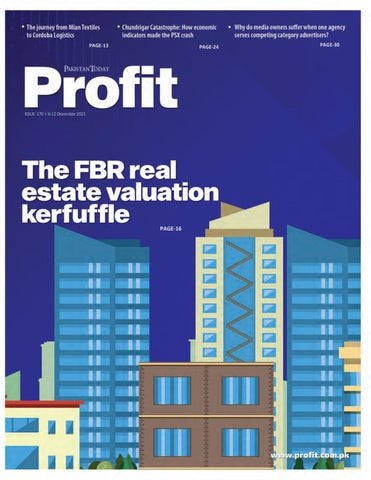
09 Chilgozza supremacy - this week in Pakistan’s business and economics twitterverse 13 The journey from Mian Textiles to Cordoba Logistics 16 The FBR real estate valuation kerfuffle
22
22 Writing a safe, smart, and sustainable future 24 Chundrigar Catastrophe: How economic indicators made the PSX crash 28 The SBP has failed to manage its own investments. How can it manage Pakistan’s? Suleman Maniya
13
33
30
30 Why do media owners suffer when one agency serves competing category advertisers? 33 Why oil companies had a great November
Profit
34 Is there a silver lining to a new coronavirus variant?
Publishing Editor: Babar Nizami l Joint Editor: Yousaf Nizami l Assistant Editor Abdullah Niazi Reporters: Ariba Shahid l Babar Khan Javed l Taimoor Hassan l Meiryum Ali l Shahab Omer Chief of Staff & Product Manager: Muhammad Faran Bukhari Regional Heads of Marketing: Muddasir Alam (Khi) l Zulfiqar Butt (Lhr) l Malik Israr (Isl) Layout: Ahmad Salahuddin l Photographers: Zubair Mehfooz & Imran Gillani l Business, Economic & Financial news by 'Pakistan Today' Contact: profit@pakistantoday.com.pk
Readers Say Lots to think about in this interview of State Bank Governor Reza Baqir by @AribaShahid and @meiryumali in the latest issue of @Profitpk . The interview seems to say more than that full page press release the SBP issued yesterday. This cycle of monetary tightening is different from the one in 2019, he argues. "At that point, the economy was slowing, but there was a much bigger problem of stabilization. This is a stage of moderation, the extent of growth...to prevent overheating." Domestic demand is rising now he says, citing growing motorcycle sales as one eg. This is adding to the commodity price spiral to drive inflation. "It follows therefore that in an economy, which already is not producing enough to meet its demands, it faces demand side pressure.” Intrayear peak to trough movement in the exchange rate "is what it is", he says, but the average rate in 2021 is not far below what it was last year. "..the average of the exchange rate for this calendar year is Rs 161, for the same period last calendar year it was Rs162.." Contra Tarin, speculation is not driving the exch rate, it is "self fulfilling expectations" he says. "If tomorrow, everybody comes to the view that the rupee is going to appreciate then...people will buy $...The rupee..will appreciate. You will fulfill your expectations." There are plenty more thoughts in the article, on RDAs and Naya Pakistan Certificates and the carry trade taking place through these. Worth reading. Apropos: What is Reza Baqir thinking? @KhurramHussein, Twitter
facebook.com/Profitpk twitter.com/Profitpk linkedin.com/showcase/13251020 profit.com.pk profit@pakistantoday.com.pk
HOW TO CONTACT
7
In this interview with @AribaShahid , SBP governor says that there are three factors causing inflation in Pakistan. International commodity prices Increased consumption and this is where the SBP is using monetary policy to control it Exchange rate How is monetary policy affecting consumption, with little to no mortgages/personal finance and limited private sector credit? In my opinion, the purpose is to penalize the federal government with higher interest expenses and reduce fiscal room (as Uzair hints tongue-in-cheek). Apropos: What is Reza Baqir thinking? @2paisay, Twitter Our supplies and input are mostly cash based. Then how can the SBP claim that monetary policy or an increased rate can desist it? Probably paved way for increased savings and inviting ultra hot money. Apropos: What is Reza Baqir thinking? @UsmanBahl, Twitter
"Why didn't I wear a tux for this interview, dammit" is what he's thinking. Apropos: What is Reza Baqir thinking? BabarKhanJaved_, Twitter Do the unthinkable. Reduce expenses by reducing the Pakistan bureaucracy by 25%. Sell Pakistan Steel Mills plus all state enterprises. Build Karachi’s infrastructure, enhance the ports, reduce GST to single digit, and make it easy to buy PIB and Treasury Bills for the common man. There are other steps too. Increase saving rates, put a moratorium on buying military weapons for two years, monitor federal funds and provincial funds expenditures, and most importantly there must be no increase in salaries in the upcoming budget. Apropos: No need to panic as trade deficit will shrink, Tarin reassures citizens Yusaf A Dadhaboy, Facebook A few points. It was never ever 10 hours travel time. It was a maximum of 6.5 hours including the 25-30 min stay for lunch. Sharp turns still exist. Landslides/rock slides will be more frequent and deadly owing to the most unique and efficient blasting system adopted. And yes, the newly carpeted road will reduce the travel time from 6hrs to 4hrs for a while for sure. Apropos: PM to inaugurate long-delayed Juglot-Skardu road next week Asif Ali, Facebook This is a mindset issue and is probably, although not reported by this article, about the Pakistani sellers’ distrust of bringing the proceeds of their sales into Pakistan fearing that they will have to pay tax for the first time in their lives. Pakistani’s self interest stems from governments not having their back and they have struggled to eek a living for themselves and feel they don’t owe anything to Pakistan. The issue is that without tax receipts and increased exports Pakistan can’t get out of the cycle of living beyond its means. I sincerely hope that these sellers will move their operations into Pakistan and start to sell products with good packaging adding value to their products and services. They will see increased revenue and pay tax on their profits. Overall it will benefit them and foster an expansion of industry and logistical support to meet the demands of what the sellers are selling. Apropos: Amazon added Pakistan to its list of authorized sellers. The sellers didn’t want it Riaz Alam, Website
COMMENTS
IN BRIEF $2.9 billion:
Advisor to Prime Minister on Trade and Investment Abdul Razak Dawood on Wednesday said that Pakistan’s exports increased to a record high on a monthly basis, clocking in at $2.9 billion in November.
Prime Minister Imran Khan has directed the federal and provincial governments to shift industrial units away from cities and promote electric vehicles (EVs). According to him, developed countries had shifted to modern technology including conversion of public transport to electric vehicles (EV).
Adviser to the PM on Finance Shaukat Tarin has claimed that the trade deficit will shrink and the national economy will further strengthen with an increase in exports and remittances. He said the country is facing escalation in import bills and inflationary pressure due to surge in prices of imported commodities.
$8 billion:
Foreign Minister Shah Mahmood Qureshi Thursday said that economic ties with the United Arab Emirates (UAE) were strengthening, with trade volume between the two countries increasing to over $8 billion, making it Pakistan’s biggest trade partner in the Middle East and Northern Africa. The Auditor General of Pakistan (AGP) has found massive irregularities in the authority’s finance department. According to the audit and inspection report on PSQCA for the year 2020-2021, proof of deposit of income tax amounting Rs93.047 million in a government account was missing.
The Federal Board of Revenue (FBR) has increased the valuation rates of immovable properties by 25 to 110 per cent. As per details, the hike in valuation rates has also jacked up the transfer fee. This step has been taken to collect more taxes from the properties including commercial, residential, apartments and flats. Prime Minister Imran Khan is likely to inaugurate the strategically important GilgitSkardu Road next week. According to sources, the prime minister may visit Skardu for the inauguration of the 167 km project, which has reportedly been completed after over a period of four years, on December 9. After remaining in papers since 2009, work on this project was started in 2017.
8
Chilgozza supremacy this week in Pakistan’s business and economics twitterverse
T
he truly inspiring moment that shines through from last week is Muzzamil Ahsan eating chilgozay on live television. People have criticised him for not being serious about national issues because of his eating, but this is one hill we are willing to die on. A lot else was happening as well, with moments of introspection, complex math, and debates about Whatsapp all around. Ariba Shahid brings you all this and more in this week’s social media roundup.
Cheap encouragement
Moment for introspection
We often find ourselves comparing Pakistan to India while talking about just about anything. Honestly though, this is a moment to self-inspect. What have we as a nation built to push STEM forward? What have we done to push innovation? Does the elite capture even let regular everyday talent progress in life? Only then can we compare ourselves to India. {Editor’s note: The only populist STEM based ‘national hero’ we have is the recently deceased Dr Abdul Qadeer Khan, whose most daring feats had more to do with clandestine smuggling operations than with scientific innovation and discovery. The closest we have to an actual (not populist) STEM based inspiration is Nobel winner Dr Abdus Salam, and his legacy in Pakistan has been tarnished precisely because our priorities as a nation lie in all the wrong places.}
SOCIAL MEDIA ROUNDUP
The film industry in Pakistan has been asking for support for a really long time. It’s kind of like when a child makes an ugly painting but you say it’s beautiful to encourage and nurture their talents. Too bad the child is now old and should be able to sustain themselves and take criticism. I guess this one just isn’t leaving the nest. Moreover, without criticism, can the industry ever flourish? We get a lot too and appreciate the fact that someone is taking the time out to tell us how to improve or whatever.
9
Chilgoza supremacy
Complex math
It was so easy when the dollar traded at 100 against the rupee. All you had to do was add 2 zeros. Now you’ve got to do a whole lot of math to know how expensive your splurge at Sephora is going to be, or how expensive everything good in life actually is.
Parents’ word is law
There is literally so much out there that you can criticize Muzzamil for. His Farooq Sattar-esque justifications for policies, the shoddy economics he throws around from time to time, and his price comparison strategies. However, eating pine nuts on tv may be one of his saner tv appearances. However, not a pretty sight seeing him try to open a pine nut in his mouth. We stand by his right to eat on tv the same way we stand with the right to drink healthy apple juice on tv.
Change the guy
Don’t you just love it when the government tries to act like your mom telling you that you don’t need Cheetos and doritos because they’re insanely expensive?
Cyber risks
Cyber security in Pakistan is a joke. Just stay safe kids.
If you can’t change the guy, change the guy. This is something I’ve heard my frustratingly single friends say while giving relationship advice. It’s funny though, I feel someone has given it to Imran Khan too because how can you change a finance secretary this often? Do you have commitment phobia? Also one would expect the finance ministry to be the most important in terms of long term stability.
10
SOCIAL MEDIA ROUNDUP
The journey from
Mian Textiles to Cordoba Logistics What is the former textile mills company doing in the business of logistics and other ventures? By Taimoor Hassan
M
uch has been going on at Mian Textile Industries. In March 2020, the fledgling publicly listed textile company was being courted by Ali Arif from Next Capital before the bid fell apart because of the coronavirus pandemic. Then, in October last year, Mian Textile suddenly had another suitor. Danish Elahi, CEO of the Elahi Group of Companies, announced his intentions to buy Mian Textile Mills.
LOGISTICS
This time, there was no hindrance in the deal and Danish Elahi acquired the textile producer. In April 2021, the deal was finalised and Danish Elahi acquired a comfortable majority of 70.23% of the company. However, the change in ownership was not the only transformation that Mian Textiles was undergoing. Since Elahi took over, the company has made a hard pivot towards what would seem like an unrelated field - logistics and other ventures. This is where the Elahi Group of Companies has their expertise. The final change has been a change in
name. No longer related to textiles, Mian Textile Industries within a year has gotten a complete makeover and is now Cordoba Logistics and Ventures and for the financial year 2021 remained in the acquisition mode, seeking regulatory approvals. Now, after the acquisition is complete, the company has resumed operations in a new vertical that it claims to have expertise in by virtue of the new shareholder’s decades long association with logistics through Elahi Group of Companies. The question now is whether the pivot and new lease on life will work, or whether Cordoba will fall?
13
What is the company upto?
I
n the first quarter of 2022 ending September 30, 2021, Cordoba Logistics and Ventures (CVL) Private Limited reported a revenue of only Rs500,000, and a net loss of Rs2 million. The company, however, only started business in the said quarter after being in regulatory limbo since last year. But now that it has finally taken off, the management of the new company helmed by Misbah Khalil as the chief executive officer, is hopeful that investment in logistics is going to be a sizable opportunity. So what does it plan to do? In a recent corporate briefing, the CEO of the company said that Cordoba’s logistics business is going to be focused on mass logistics and retail logistics, where the company would be providing logistics and transportation solutions to clients in various sectors. “In the logistics sphere, we have already started providing services to companies across Pakistan to provide them transportation and other logistics services. Our main service is providing logistical vehicles to companies across the country and we see a lot of opportunity in this sphere,” says Misbah Khan, their CEO. “Our focus is entirely on logistics; mass and retail logistics, which includes trucking as well,” says Misbah. “It is open for us to enter and create more opportunities and value for our shareholders. We will not be focusing on just one aspect. Our principal line of business is logistics, and other ventures. We will continue to invest in and direct all our resources and capital to our logistics responsibilities and provide warehousing, as well as looking into options of trucking business.” The company has already made investment into Trukkr and plans to increase that manifold. Trucking, however, has recently become very competitive with the entrance of new startups. As many as five very well-funded trucking startups have entered the foray to digitise trucking but despite that, the CEO is hopeful there is still potential. While the company looks serious about investing more into the trucking side where it will be deploying its own fleet and then leveraging the Trukkr ecosystem for orders, it plans to do almost everything imaginable in logistics. “If you see sugar, 30-40% of the value of sugar is lost during the transportation process and facilities that are not provided. There is a huge opportunity to bridge that gap and there is an opportunity to bring down that wastage. Logistic companies like us can provide solutions and bridge that gap and provide an opportunity to create a platform where they could use our services to reduce that wastage
14
“There are a lot of companies coming up for that matter, but they do not provide one set of solutions and have the capital injection that is required. We have a mandate from the board to find those opportunities and fill those gaps and we have been working on these opportunities to fill those gaps” Misbah Khan, CEO of Cordoba Logistics and ventures as well as create value for the middleman and the farmer. That is where we see there is great potential.” “Apart from that there are companies in the retail sector and for them we want to provide transport service including but not limited to logistical solutions for creating timely dispatches and processes. There are a lot of companies coming up for that matter, but they do not provide one set of solutions and have the capital injection that is required. We have a mandate from the board to find those opportunities and fill those gaps and we have been working on these opportunities to fill those gaps,” These services would have multiple customer bases, and we would be providing services on multiple fronts. In line with its strategy to grow the logistics business, the new sponsor of the company injected Rs25 million and the company successfully resumed commercial activity in line with its principal activity in June this year by acquiring a private equity stake in Trukkr, which is a tech enabled logistics company. Trukkr provides a marketplace for businesses to send shipments from one city to another. Cordoba launched into the logistics business with over Rs200 million committed in funding by the sponsors out of which Rs5055 million has been injected, and now plans to raise as much as Rs1 billion depending on credit facilities made available by the banks and through other means to fund long term growth of the company. “All of these will form the basis of the logistics business. The company is working with advisors to raise funding in all spheres including right shares and other matters. We want to create more financial options for the company. Once that is in place, we will be able to make further investments in other spheres and we will be able to take this principal line of business forward,” says Misbah. The company has only just started and the CEO was assertive that the space is good enough to create value for shareholders. CPEC is picking up, there is scope in transportation
of agricultural produce, and then there is trucking where businesses can move freight like steel and commodities from say manufacturer to distributor. Elahi Group has presence in both steel and commodities and will most likely be leveraging Cordoba’s logistics presence to move freight for its own businesses. Nonetheless, that is if the company is actually able to grow and create value for shareholders as it has planned to. How far away would be profitability then? Misbah was not candid enough to disclose exactly when they expect the company to be profitable, but was candid enough to say that their plan is to make the company profitable in the short to medium term, which is likely going to be a timeline of 2-3 years. All that, however, depends upon if the company is able to raise funds that it aims to and then execute successfully as well.
What about ‘other ventures’?
I
n June this year, Cordoba started its commercial operations with a Rs13 million investment in Trukkr which is in line with its broader plan to lay the ecosystem for logistics and transportation. In September, however, the company invested Rs31 million to acquire 32.5% equity in a financial services and data analytics platform Finox. Both the Trukkr and Finox investments are going to bear returns when Cordoba makes an exit from any of these companies and the investments generate returns for shareholders as well. The company, however, has plans to not restrict itself to a single sector for such investments but says that ‘other ventures’ is going to remain very limited and the bulk of the business will be focused on the logistics and transportation segment. The timeline, again, on the exits from ventures was tentative, spanning over 2-3 years. But the company says that the performance is going to pick up and the forthcoming financials would show the services expanding in the region and providing opportunities for business to the company. n
LOGISTICS
16
T
By Abdullah Niazi
he real estate industry is up in flames. At the beginning of this month, the Federal Board of Revenue (FBR) announced that they were revising the valuation prices of immovable property, including commercial, residential, apartments, flats and other areas of 40 selected major cities of the country. Since the announcement, there has been outrage coming from realtors, property dealers, and investors. The results of the revised valuations have not instantly become clear, but in the few days following it has become apparent that immediately the market is bound to slow down. Already reports are coming in of major deals falling through with buyers pulling out at the last second, and sellers suddenly finding a conspicuous lack of buyers for both their residential and commercial plots. Essentially, the FBR has increased their valuation of the property prices for two reasons. The first is the very obvious one, which is that they will use this increased valuation to generate more tax revenue from real estate transactions. The second reason is that the real estate business in Pakistan has long been a cesspool of black money, hyperinflated values, tax evasion, and all other manner of shady practices. While the market value of real estate in Pakistan is high, its official value on documentation is usually quoted as quite low in an attempt to keep taxes payable low. The new rates have made an attempt to fix this very old problem — the official value of plots of lands being much lower than the actual market value of the same plots. This problem has been around for a while now. Its roots are in a complex system of DC rates and FBR rates that anyone who has had to go through the displeasure of buying and selling urban property will be familiar with. It is a system based on lies, deceit, and attempts to evade taxation. Through its property valuation, the FBR is essentially trying to bring the official rate of property and the market value together. In its current attempt, the board may have overshot a little, since there are a lot of cases in which their valuation has actually been higher than the market valuation. However, the FBR has already said it will negotiate with stakeholders in the
COVER STORY
industry, which means that the extra valuation is simply there as wiggle room for when the government inevitably negotiates with the real estate industry to bring the valuations down.
Real estate in Pakistan
F
eel free to skip this brief section. Mostly because it doesn’t exactly have to do with the current problem, but is instead a brief comment on the nature of the real estate industry in Pakistan. In July 2020, Faroor Tirmizi did a story for Profit titled ‘Why (and how much) Pakistanis overinvest in real estate.’ The story pointed out how even though the obsession with real estate has understandable foundations and originates in a fundamentally good idea: the need to buy assets that generate inflation-beating returns, it has gone too far and is now starting to create a drag on economic growth, investment opportunities, and housing affordability. Real estate in Pakistan is a strange obsession. It has been co-opted by some of the shadiest characters this country has seen and because there are such few regulations, things very easily manage to get out of hand. Pakistan real estate agents and realtors don’t really have licenses or exams that qualify them to do the job that they do. It is easy to find loopholes in documents and development is vapid and relentless. These are many of the characteristics that have made this sector the degenerative mess that it currently is. It is also why it has been accused of being used to park black money, and because of which organizations like the IMF and FATF are unhappy with Pakistan, which we will discuss further on in the story.
18
Plot pricing 101
T
axes is where the issue begins. Under Section 236C of the Income Tax Ordinance 2001, anytime there is a sale of an immovable property a specific percentage from that sale must be paid as tax to the government. Currently, that percentage is 1% for residential plots in Pakistan. Essentially this means that if you own a plot worth Rs 35 million (3.5 crore) and sell it for that much anywhere in Pakistan, you will have to pay Rs 350,000 on that as Advance Tax. Now because of this tax, buyers and sellers of real estate found that it would be much easier to simply exchange Rs 35 million amongst themselves while listing the official price of the plot much lower. So if Person A sold their plot for Rs 35 million to Person B, both would agree that on the official documentation they would write the value of the property actually being Rs 10 million. This would mean that instead of paying Rs 350,000 in Advance Tax, they would now be paying Rs 100,000 in advance tax. Similarly, all other taxes paid based on the value of the property would be reduced including things like stamp duty. When this practice became common, real estate also became a hotbed for parking illegally obtained money. A person that had made Rs 50 million can buy a plot for that much, and the documents show that they bought it for Rs 20 million. They would pay tax only on that and in the process convert the rest of the Rs 30 million into ‘white’ money as well. It is a complex and sinister process that became very common once immovable property started being seriously taxed by the government. “Property prices in Pakistan have always been high. The situation was made worse by the
fact that a large number of investors that came into this sector early had black money. Other major investors in this sector were overseas Pakistanis. Asa result it has become a complete industry and a very profitable business,” explains Shahab Omer, a journalist with expertise in the real estate sector. “Even as the industry grew, its contribution to the national tax net was equal to the salt in flour. There was one percent registration fee and one percent stamp duty. Even this was paid on made up prices that people would write on documents, and not on the actual prices that these properties were being sold for. This is where the start of the infamous ‘DC’ rate system began.”
Why the FBR evaluates property prices
T
he story has been the same for a long time. Property is taxed by a lot of different institutions, from the FBR to the municipality. But how is the rate of taxation on property determined? Every single plot of land that is sold, whether commercially or residentially, goes for a different price. Two 1 Kanal plots next to each other in DHA Phase VII in Lahore might have varying prices. One plot might go for a hypothetical price of Rs 25 million and the other might go for Rs 27.5 million. Now, logically, it would appear that the solution to this would be to tax each piece of property based on the price it goes for. This is how things were done in the past, except this method had serious flaws. The more technical flaw was that this method of taxation had the potential to become quite unfair. Say, for example, that you own the earlier mentioned
I think the people who are working on the new valuation in the FBR are very smart because they have deliberately increased these rates from three hundred to four hundred percent so that even if the real estate sector negotiates at that rate, even then, the property remains at fair market value Shahb Omar, real estate journalist
plot in Defence Phase VII in Lahore and need to liquify your investment at the earliest. While the plot could possibly go for as much as Rs 30 million, you might be forced to sell it at Rs 24 million. This would mean that a person taking advantage of your situation to get a good deal would have to pay less tax on property that could otherwise have earned the government more money. The more significant problem was the one discussed above, in which undervalued prices would be given officially which would mean tax would not be paid at the actual market rate of these plots. This is when the FBR decided to start evaluating properties itself and assigning general rates. Under this system, suddenly there was an attempt to assign values to certain areas and charge all real estate in those areas tax per that valuation. So going by the earlier example, if the FBR valuated a 1 Kanal plot in Defence Phase VII in Lahore at Rs 25 million, the tax payable on the sale of that plot would be Rs 250,000 even if it were officially sold at a rate of Rs 10 million or a rate of Rs 30 million. This naturally shook the real estate market up since they could no longer play as fast and loose with the rates as they once could.
Things were now getting tighter. However, it was apparent that the FBR rates were lower than market value. At this point, Pakistan now has three different valuation systems for real estate, which is an anomaly possible the world over. There is the DC rate, which is usually almost 10 times lower than the actual market rate, and then there was the FBR valuation rate which was around 3-4 times less than the actual market rate. The DC rate would be the one that is used for stamp duty purposes and at this rate property is registered with Property Registration Authorities. The FBR rate is the one at which Withholding Tax is charged according to their “filer” and “non filer”status and FBR requires explanation of sources at least to the extent of this valuation.
Why these valuations matter
A
gain, it is a simple matter of math. The price of a plot is the price at which all taxation surrounding it will be calculated. Now that the FBR has increased its valuations, it has essentially raised
the taxation rate on the property business. And this time around, the FBR has not been kidding around with how they have increased the prices. The last serious such push came in 2019, when the FBR had jacked up the valuation rates of property by 30 to 85 per cent but this time the unprecedented increase was made with effect from December 1, 2021, whereby the real estate agents stated that the rate went up by 100 to over 600 per cent in one go. According to one report in The News International, the valuation table for DHA-1 Rawalpindi for the residential property per Marla increased from Rs 640,000 in 2019 to Rs 4.5 million per Marla off the road and Rs 5.4 million per Marla on the road. For the commercial property, the valuation has been increased from Rs 3.5 million per Marla in 2019 to Rs 8.5 million per Marla. There are also other serious examples of over the board increases in property valuation by the FBR. In 2019, what the FBR had done was bring the valuation prices close to the actual market prices of real estate. This time, they have increased the prices more than the market value. For example, there is a signifi-
COVER STORY
cant increase in the valuation of plots in DHA Lahore. By the new valuations, the FBR estimate of what a 1 Kanal plot costs in Defence Phase VII is Rs 43 million (4.3 Crore) while the market value for such a plot is actually Rs 30 million (3 Crore). The increase in property valuations has been across the board. Just in Lahore, the per Marla rate of residential and commercial properties has increased in 1235 localities of Lahore. This increase is fair enough since earlier even the FBR was undervaluing property prices. However, in some areas such as in the example of Defence Phase VII, the prices have gone even above market value. In the same report by The News International, it was also pointed out that The Federal Board of Revenue has increased the rate of each of its categories for the properties in Karachi and in a few cases changed categories, which the property agents say the valuation has gone even up by 300%. Islamabad has also been a particularly dire example, where for example, the valuation for an apartment in E-7 has been quoted as Rs 251,500 per sqft. An average apartment covers around 2,000 sqft, which means such an apartment would be valued at close to Rs 503 million. Another similar example as per FBR valuation, an 800 sq ft one bed apartment in remote B17 sector of Islamabad is worth over 8 Crore. Selling price of Apartments in B17 range between 6500-8000 but they are declared as 105,000 per Sq Ft. and in E11 Islamabad the rate is 8000 Sq Ft.
Are the valuations too high?
I
n short, yes, they are right now. But this has been a long time coming and this is also very much a tactic from the FBR, which is planning on using these over-
20
shot estimates in their negotiations with the real estate industry. In the short term, the response has naturally been panic. And there has also been a lot of accusations that the wild valuations on the part of the FBR have come because of pressure from the IMF and the FATF. “The rate of all these taxes has been increased in the new valuation. Apparently with this new valuation, it seems that the government is trying to take real estate in the market towards fair price, but in reality this is not the case,” says one real estate expert not wishing to be named. With this valuation, the real estate market has suddenly panicked because the new property rates for the areas that have been given are unrealistic. “I think the people who are working on the new valuation in the FBR are very smart because they have deliberately increased these rates from three hundred to four hundred percent so that even if the real estate sector negotiates at that rate, even then, the property remains at fair market value,” says journalist Shahab Omar. The real estate sector has been frustrated by all of this. Different associations have come forward and said that they condemn the over valuation and want to negotiate with the government. However, in conversations with Profit, their representatives have had to admit that it is high time to match market value prices with documented prices of real estate as well. “We admit that there has been a problem in the past. But right now the FBR has made valuations that are ridiculous and it is imperative that prices are brought back to a normal level” said a ranking member of the Real Estate Professionals Forum wishing not to be named. “The entire business is going down at this point and the FBR needs to come to the table
at least. Meanwhile speaking to the media, the chairman of the same forum has said that the change in valuation would backfire as the sector has already been struggling and foreign investors would be reluctant to invest in the country because of the policy changing every now and then, and that the government has done this on the behest of foreign powers. The FBR to its credit is not paying hardball. In a statement posted by the board’s spokesperson’s twitter account, the FBR said that “the recently notified property valuation by FBR was finalized through a consultative process by the Field Formations. However, if there are some instances of valuation beyond the market price, the same will be reviewed in consultation with the key stakeholders.” This means that the board is willing to revise their valuations. It also means that because of the panic that has set in, the real estate sector will also be willing to negotiate more easily. “There was pressure from the IMF and the FATF that might have resulted in these new valuations as well,” says one of the experts Profit spoke to. “This will mostly affect people that either bought plots to flip houses or as investment. It will not affect the average home buyer because if a person wants to buy a house for themselves the extra tax won’t feel like a big hit. It is mostly a problem for those parking their money in plots and trying to turn black money into white,” they said. The comment is a pertinent one. Because black money can so easily be hidden in property in Pakistan, it has been a cause for concern for organizations like the FATF. So while this might have been done to get Pakistan off the grey list and away from the black list, there is still the factor that in any case this was long overdue. n
COVER TEXTILES STORY
Writing a safe, smart, and sustainable future In this interview with Profit, ABB’s Hammad Amjad speaks on the electrification business in Pakistan
H
ammad Amjad is Vice President, Commercial Operation for ABB’s electrification business for the Middle East and Africa Region. In recent times, ABB has played an instrumental role in turning around the electrification business in Pakistan. ABB Electrification is a global technology leader in electrical products and solutions, operating in more than 100 countries with over 50,000 employees globally. By combining ABB’s deep domain expertise with connectivity and software innovation, ABB Ability™ solutions future-proof infrastructure and transform key business processes for safer, smarter operations that contribute to a low-carbon future. The market has gone from being a couple million dollars to going into the tens of millions. This significant growth has been achieved through a complete and dedicated focus to maintaining a strategy of profitable growth across
22
various sectors. In this interview, Amjad explains the potential, prospects, and promise of the electrification sector in Pakistan and the strategies that ABB has for the future. Profit: How do you see the potential of the electrification sector in Pakistan? Hammad Amjad: Pakistan is a high potential country in terms of electrification outlook. However, there is much room for improvement and growth with a surplus generation and weak distribution network. Moreover, we have many instances of loss of human lives due to broken conductors, oil spillages of transformers. So safe distribution of power is an important area to focus upon. E-Mobility is another growth area, and ABB is the pioneer in EV charging solutions globally. We are helping our customers seamlessly make this transition by offering the latest EV charging technology and round-the-clock
services. Profit: What strategies is ABB opting for to enjoy a maximum market share in Pakistan? Hammad Amjad: Understanding the market’s needs and acknowledging that the local consumers are price conscious has helped us optimize our supply chain to provide the best quality European products at competitive prices with local partners to ensure product availability. Our approach has led to a complete paradigm shift and helped our customers move to high-quality solutions that comply with global IEC standards. Furthermore, this also helped to bring down the market prices and gave rise to healthy competition, which allowed the industries to opt for these solutions. Furthermore, we are leading the EV revolution globally with more than 75000 chargers already sold. In Pakistan as well, ABB installed
the 1st DC fast charger, and we are working with all the major Oil marketing companies to create a network of DC chargers. Profit: Please share some landmark projects won by ABB in the near past. Hammad Amjad: ABB has its products and solutions today installed across all sectors, including Infrastructure, Industries, and Utilities. From the most significant infrastructure projects in Pakistan like DHA, Emaar, Bahria Town to major Industrial groups like Nestle, Engro, Nishat, Fouji, Tata, Lucky, Artistic, we have a large installed base. From renowned hospitals like SIUT, Aga Khan, Indus Hospital, PKLI to Utilities like NTDC, K-Electric, WAPDA, DISCOs, we are helping our customers by providing the best solutions and products. Profit: Please elaborate on your long term and short-term plans. Hammad Amjad: At ABB, we are completely committed to writing a future that has safe, smart, and sustainable electrification for everything - from industry and power plants to infrastructure and transportation. Our vision is to achieve a zero-emission reality not only for the future but the immediate future. As pioneers in electricity and automation, we help to address the world’s energy challenges. Our solutions make homes, offices, factories, and transportation more energy-efficient and safer. Our people make the difference. Their expertise is why customers come to us with their biggest challenges. Together, we push the boundaries of technology to drive performance, shape new business models, and find new ways of working that benefit our customers, partners, and society. In alignment with ABB global we have re-emphasized two straightforward goals in 2018 in the local market. The first is to make available the best-in-class technology at market-driven to promote healthy competition. The second is to achieve double-digit growth, enabling us to provide these solutions to a maximum number of customers. Having already achieved these goals, we are now on the way to create a safe and sustainable electrification for our customers and in turn, the people of Pakistan. Profi: How is ABB handling the competition in the local market? Hammad Amjad: As previously outlined, we strongly believe in healthy competition because it brings out the best for the customers in all aspects. With our leading technology, best-inclass solutions, vital product availability through our distributors and partners, preferred services to all - we serve our customers. Profit: What are some major challenges in the local market and how
iss ABB trying to overcome them? Hammad Amjad: The biggest challenges we face in the market are unethical business practices and counterfeit products. We at ABB operate with the highest ethical standards hence the reason our customers trust us. ABB offers the authenticity of its products by a network of distributors and partners and by providing barcode / QR code-based authentication. Profit: Experts are of the view that the post-pandemic world will be highly encouraging for the business in the local market. Will ABB be able to take the advantage and how? Hammad Amjad:The industrial sector has already come out of the COVID challenges, and there is significant growth in every sector with favorable government policies. With the accessible financing facilities to large-scale manufacturing units and infrastructure, the industry, especially textile and housing, is expanding. We are fully aligned with the growing momentum at ABB by increasing resources and strengthening our partner network to fulfill the increasing market requirements. Having double-digit growth for the past four years and even higher growth anticipated this year, we have availability of products and solutions to serve the market’s growing needs. Profit Do you think that positive macroeconomic indicators will help ABB in Pakistan? Hammad Amjad:We appreciate the proactive approach taken by the Government of Pakistan due to which our country came out of the situation, and the effects of COVID were minimal. The growth trajectory, restored at the end of 2020, helped our business growth, and we are working with customers in all sectors across Pakistan for collaborative value creation. Profit: What are the targets of ABB Pakistan for the next 5-10 years? Hammad Amjad: In the next ten years, we aspire to become a technological leader in electrification by writing a safe and sustainable future for our customers in Pakistan. Profit: EV charging stations are the need of the time. How is ABB planning to take charge of the situation? Hammad Amjad: ABB is the world leader in EV charging solutions globally, with more than 75,000 chargers sold and more than 18,000 chargers already installed. We installed the first DC fast charger in Pakistan and already have multiple charging sites across the country. We are working with major OMCs like PSO, APL, Shell, GO, Total PARCO, and private stakeholders to further extend the charging infrastructure for the ease of the EV owners. In addition, we have put in place a
network of partners for product availability and after-sales services to serve our customers. Profit: Your suggestions for the overall market improvement based on your past experience. Hammad Amjad: We are currently in the fourth industrial revolution globally, building on millions of digital devices. Our Digitalization initiative, ABB Ability, helps customers in utilities, industry, transport, and infrastructure develop new processes and advances existing ones by providing insights and optimizing planning and controls for real-time operations. It will leverage the power of the digital revolution by enabling reduced maintenance costs, longer asset life, more efficient operations, reduced environmental impacts, and improved worker safety. In Pakistan, we see a slower adaptation of digitalization. Based on my experience, we need to increase the pace of digital transformation to help the industry assess, automate, optimize and collaborate. Profit: Is there anything you would like to talk about that you feel is important to this conversation surrounding electrification? Hammad Amjad: ABB understands and takes full responsibility for the reduction in carbon emissions and climate change. ABB has a long history of sustainable and responsible business practices. In 2020 ABB exceeded many of its sustainability targets, including reducing its greenhouse gas emissions by 58 percent compared with a 2013 baseline. With the introduction of the company’s 2030 sustainability strategy, even more ambitious targets have been set, focusing on enabling a low-carbon society by reducing emissions, preserving resources, and promoting social progress. ABB’s 2030 low-carbon commitment includes achieving carbon neutrality in its operations and helping its customers reduce their CO2 emissions. ABB’s sustainability targets contribute to the United Nations’ Sustainable Development Goals, of which ABB has always been a strong advocate. Over the past seven years, ABB has focused on reducing its carbon footprint. Our work to reduce ABB’s carbon footprint during the current reporting cycle has been highly successful. This achievement forms the foundation for our ongoing ambition to make even more significant contributions to the global effort to realize the climate goals enshrined in the Paris Agreement, which is fundamental to limiting global warming. That is why, despite achieving our climate action target a year ahead of schedule, in 2020, we pushed to achieve further reductions in greenhouse gas (GHG) emissions in ABB’s operations. n This content is produced in paid collaboration with ABB.
SPONSORED CONTENT
Chundrigar Catastrophe: How economic indicators made the PSX crash The stock market might not be an indicator of the economy, but the economy has a long, invisible, hand By Ariba Shahid
B
oxing Day Sales came early with the PSX crash. Stocks are now cheaper than they were before. The index flirted with a market halt nearly touching it throughout the trading day. Had the market plunged 5%, we would have seen a market halt, the first of its kind following March 2020. Stocks on Thursday recorded their worst single-day fall in more than 20 months, with investors stuck in a selling frenzy over economic fallout from ballooning trade deficit and fears
24
of another rate hike. The MPS policy came early this month, earlier than usual because the SBP could anticipate angst in the market. The last time the PSX witnessed a market halt was when equities around the world plunged in light of COVID 19 due to uncertainty regarding the global economy, liquidity crunches, and loss of productivity for businesses due to lockdowns. So what really triggered this? What went so wrong that the market went into absolute mayhem. “It’s a knee jerk reaction to mainly a couple of factors,” says Fahad Rauf, Head of Research at Ismail Iqbal Securities.
The reasons behind Thursday Turmoil?
W
e’re going to attribute this to three major reasons, the current account deficit, the debt market yields, and
sentiments.
The current account deficit
T
he Pakistan Bureau of Statistics (PBS) on Thursday released data which showed that the trade deficit widened to $20.6 billion in the first five months of the
Circuit breakers help PSX from a free fall in panic situations — like 2008 and 2020. These circuit breakers not only limit the daily losses, they also give people time to rethink their investment strategy for the next day or any positive development that comes after market hours will have limited losses on their portfolio Saad Rafi, head of Sales at Al Habib Capital Markets
current fiscal year due to a significant surge in imports that outpaced the increase in exports. The deficit clocked in at $10.9 billion, or 112%, more than the comparative period of previous fiscal year. In absolute terms, there was an increase of $2.6 billion in exports during FY22. In this fiscal year, exports stand at 47% of the annual target of $26.3 billion. However, the Ministry of Commerce projects that exports will touch $31 billion in the full fiscal year. In absolute terms, the imports grew $13.5 billion, according to the PBS, despite the SBP introducing a cash margin requirement for more imported goods in addition to steps to curtail consumer finance. On a monthly basis, November Imports jumped to $7.84 billion in November, which were higher by 83%, or $3.6 billion, over a year ago, according to the PBS. This was the highest-ever import figure, which was $1.5 billion more than the estimate of the Ministry of Commerce, making the external sector projections come into question. Exports of goods remained at $2.9 billion in November 2021. They clocked in higher by 33%, or $713 million, over the same month of previous year. As a result, the trade deficit widened 134% year-on-year to $5 billion in November 2021. Moreover, it is important to note that the exact import numbers were released later with bits of information making it to twitter through the Finance spokesperson and other sources.
Debt market yields
T
he government has raised Rs338.4 billion by selling three-month T-bills at 10.78% yield against an offer of Rs423.4 billion. It raised another Rs111 billion by selling six-month T-bills at a yield of 11.5%. Banks had offered Rs201 billion. The government raised Rs55 billion by selling 12-month T-bills at 11.51% against an offer of Rs125 billion. Before we analyze the yields it’s very important to have context for the market reaction. On November 16, the SBP announced the
Monetary Policy Committee meeting would be held 7 days earlier than planned, i.e. November 19 instead of November 26. This came a day after the CRR was increased by 100 bps on Monday or November 15. On November 18, the SBP held a T bill auction where 6 month t bill bids were rejected at 10.2%. We will discuss that shortly. On November 19, the MPC meeting was held and the policy rate went up by a whopping 150 bps. This development was important enough to warrant a cover story and an interview by the Governor State Bank of Pakistan. On the same day, the SBP announced more MPC meetings than before which also signals the rate hikes may be faster, or may require less drastic jumps like 150bps given the repeated frequency. On November 30, the PBS released inflation stats where inflation clocked in at a 21 month high, thus signaling that the policy rate is bound to go up in the future too. Inflation stood at 11.5% in November, higher than the market estimates of 10%. In October, inflation clocked in at 9.2%. On December 1, a T bill auction was held where Rs 110 billion 6 month t bills were accepted at 11.5%. The next day, December 2, the PSX crashed, or as we’d like to call it Chundrigar Catastrophe. This is also the day we got our trade numbers but you’ve already read about that. So what’s happening on the lending front? The lending rate of commercial banks for offering budgetary support to the government soared on Wednesday when inflation shot up to a 21 month high. Basically there is a sharp increase in the banks’ lending rate for three, six, and twelve month treasury bills as banks anticipate another aggressive policy rate hike. The cut off yields increased by a massive 228 basis points for the three month t bills bringing them to 10.78% compared to 8.5% in the previous auction held on November 17. The next MPC meeting is scheduled for December 14. The market anticipates another rate hike and would rather participate in the auction following the hike.
Pakistan Investment Bonds (PIBs) yields rose to their highest in over two years on Friday. In the run-up to the State Bank of Pakistan’s next monetary policy meeting on December 14, the market expects a 100 basis points increase in the policy rate to 9.75 percent considering inflation, current account deficit, global commodity prices, depletion of foreign currency reserves, etc which will push up the policy rate. Bond yields are up 52 bps over the past two days. After more than two years the 3-year PIB is hovering around 11.89 percent, while 5-year is at 12 percent and 10-year is at 12.3 percent. Bond yields are up 40-55 bps since the last PIB auction on November 29, while they rose 145 bps since SBP increased the policy rate by 150 bps on November 19. The six-month Karachi interbank offered rate (KIBOR) also rose, hitting a 21-month high to reach 11.5% on Friday. This is 415 bps from a low of 7.3%.The sudden changes in yields and the KIBOR happened after the T-Bill auction on Wednesday. The spread between KIBOR and policy rate has increased significantly to 275 bps compared with the last three-year average differential of 50 bps. It is important to note that with the IMF program in place, the government will be borrowing more from banks as this is the largest window available for government borrowing. More importantly, this also puts a lot into question regarding financial prudence. The 6M auction on November 18 was of Rs 111 billion, the same as the amount that was raised on December 1. Rejecting bids on November 18 now means that the government of Pakistan will now be paying 1.2% extra interest on the debt raised. This means they will be paying 11.5% per annum as opposed to 10.2% they could have been paying. To put this in easier numbers, the government will now pay Rs 666 million more interest for 6 months. The fact that the MPC was brought about earlier further makes it absurd that the bids were rejected, especially knowing there is going to be a rate hike (it was so obvious).
STOCK MARKET
Sentiments
F
olks down at the PSX aren’t the most rational out there. They tend to panic more than usual. However, considering everything that was going on, it does not come as a surprise. Following the MPC announcement, the Governor State Bank made 5 media appearances including on TV, international media, and through an Op-ed. Not only that, the SBP also issued a clarification note in response to critical op-eds. While the goal would have been to calm sentiments not necessarily targeting the PSX, the messaging was the opposite. This made a sense of panic within sectors of the economy over the future and what is to come. Moreover, with the inflation numbers being published and then taken off the web, trade stats being released after a lot of speculation, the PSX had a bad day. While the PSX is not really an accurate indicator of the economy, it is pertinent to note that the PSX investors reacted to the local economic climate as opposed to precious covid related crashes we saw earlier in 2020. “Stock market is cheap on valuations, but in the short term sentiments can overshadow fundamentals. In the longer term, equities have outperformed other asset classes and could continue to do so in my opinion,” says Rauf. However, it is also important to note that when the interest rate goes up investors are often seen withdrawing their funds from equities and moving them into safer haves such as government paper and securities or merely
26
“It’s a knee jerk reaction to mainly a couple of factors,” Fahad Rauf, Head of Research at Ismail Iqbal Securities investing in banks for solid stable returns. It is likely that the PSX index may not recover as robustly as it would have under a situation of lower interest rates.
What are market halts?
T
hese automatic halts are triggered in order to calm panic-stricken market conditions and present an opportunity for the markets to cool down. A ‘market halt’ is a standard protocol for risk management purposes which is triggered when the KSE-30 Index moves 5 per cent either way and remains there for five consecutive minutes. It is pertinent to mention that the Pakistan Stock Exchange (PSE) widened the circuit breakers and introduced a market halt from January 20, 2020. As per the announcement, the exchange applies index-based market halts when the KSE-30 index moves 4pc either way from its opening index value. However, once the circuit breakers reach the level of 7.5pc, market halts are only applicable in case the KSE-30 index
moves 5pc either way. The central idea behind the implementation of market halts is to give investors the time to think about the market conditions without chaos crowding their judgment. This also gives them time to review and reassess the situation, gather information and make informed decisions. Market halts act as speed bumps and prevent the markets from heading full speed toward a crash. Saad Rafi, head of Sales at Al Habib Capital Markets, commented, “Circuit breakers help PSX from a free fall in panic situations — like 2008 and 2020. These circuit breakers not only limit the daily losses, they also give people time to rethink their investment strategy for the next day or any positive development that comes after market hours will have limited losses on their portfolio.” According to market participants, while the automatic halts are an attempt to inject stability in the market, they may not be as effective at calming panic-induced selling. As levels that induce market halts approach, some investors increase their panic-induced selling due to the fear of not being able to sell. This may push them to dump their stocks at any price they can get. This is known as the magnet effect. The magnet effect theory claims, “As the market approaches levels near the circuit breaker threshold, investors will increase the volume by which they are unloading their shares. This is driven off the fear of being stuck with their positions given the market halt is put in place.” A disadvantage of the market halts is the impact they have on liquidity. They reduce liquidity and have a strong impact on price discovery. Price discovery is the quantification of the willingness and investor has to sell or buy a number of shares. This may result in a larger bid-ask spread, which will further slow down the price discovery. Sami Tariq, Head of Research and Business Development at Arif Habib limited said, “The circuit breakers in the market should be placed at a reasonable level. 5pc is too little.” n
STOCK MARKET
OPINION
Suleman Maniya
The SBP has failed to manage its own investments. How can it manage Pakistan’s?
Pakistani equities. Apart from economic issues, a major part of the decline can be explained through the role of non-protection of minority shareholders rights. Foreign investors see the way that companies are run here and are not confident in the lack of safeguards for minority shareholders. If there is no protection to the rights of these investors, including domestic investors, why would anyone want to invest? The way companies are being run it seems investors are being punished for investing and taking risks. It also seems as if the key standard of decision making is putting your money in fixed income instruments or to buy US Dollars. This is indeed tragic and something which needs to be reversed. One such company is the Security Paper Limited (SEPL). The company is indirectly owned by the State Bank of Pakistan (SBP) and has seen significant inefficiency which has time and again been pointed out by investors. It is strange that nothing is being done to allay their concerns, nor of other shareholders where decision making of the management is also destroying value for majority shareholders as well. In a nutshell if SBP, the premier institution of handling Pakistan’s foreign and local his oped is written first and foremost as a student investments, can’t manage its own investments with a fiduciary of finance to give readers an understanding of the responsibility then how can it manage Pakistan’s? investment climate in Pakistan, in which minority SEPL is 40% owned by Pakistan Security Printing Corinvestors are being pushed between a rock and a poration of which Dr Reza Baqir, the Governor of SBP, is the hard place. The topic of minority shareholders is Chairman. Up until recently, the erstwhile Deputy Governor of very high importance, and sparking a debate Mr Jameel was the Vice Chairman of the company until his resurrounding them can result in much needed introspection on cent retirement from the SBP. A snapshot of the income statecorporate governance in Pakistan. ment/balance sheet of the company has also been included. The Pakistani equity markets are currently trading at one of As can be seen, operationally the company has done their lowest ever price points compared to their regional and global well. However, since the SBP acquired PSPC in July 2017 and peers. Even then, there is still incessant foreign selling in the local consequently drove the decision making at Security Papers equity markets with foreign institutional investors selling in excess Limited (PSPC owns 40% of the company), dividend payouts of $1.3 billion (and that is a Capital B) in the last three years of have consistently gone down and there has been a significant decline in it with FY21 dividend payout at an abysmal 36.6% of earnings. This is perhaps the lowest dividend payout percentage to earnings in the company over the last 10 years or so. Suleman Maniya When it comes to the utilization of cash proceeds, it has increasingly been seen that is a Portfolio Manager, Travel management has not used the cash in expansion of the business but have invested in PIBs, T Junkie, Avid Sportsman, bills and some mutual funds (whose returns have also been questionable at best). It would be best to look at the returns of these mutual funds from the time they were invested in around Public Speaker, Foodie and 2017 till now and where the returns have even been lower than the returns on fixed income opinionated. He has a MSc instruments. Finance (Gothenburg) in Things become particularly strange when you consider that Security Papers Limited has Corporate Valuation with a firm a roster featuring star ex bankers on its board. Mr Aftab Manzoor was nominated by the SBP and remained Chairman of the company for example. That is why it is surprising that the com-
The story of SEPL is a story of inefficiency, contradictions, and the typical problems of public companies in Pakistan
T 28
pany has close to zero leverage and hence shareholders are losing out on the benefit of the debt shield (interest expense is tax deductible) while the cost of debt is always cheaper than cost of equity. The company has a net equity of Rs 6.7 billion. As stated earlier, Rs 4.5 billion of that is invested in cash or near cash instruments making a return of 8% (where this is significant value destruction as return on cash is around 7-9%). While the core business makes more than double digit returns hence having higher cash leads to value destruction as total return goes down. Management over the last few years has been stating that they are keeping cash for some planned expansion. However, it is strange when the SBP itself announced its TERF scheme the company did not raise any financing from it where it could have easily raised Rs 4-5 billion of financing at 3-4% fixed rates for 10 years. Who should be held responsible for this? The loss of shareholders and primarily minority shareholders is a serious problem. From FY2017, the company’s cash pile has significantly gone up while no project has been announced. In effect, shareholders are also being penalized as any forthcoming investment which the company wants to do would be done at a higher dollar rate. This would mean that the company has lost out over the years, while the loss in the last four years alone is 68% due to devaluation. Moreover, the company owns some property in DHA Karachi of 1,193 sq yards which is currently being utilized as the accommodation for some ex CEOs. Why does Security Paper have to own property to give to management? Why can’t it give rental property to management? Infact this type of property should not be there as the company’s mandate is not to own property but do its principal business. Lastly, the 20 acre facility in Malir is still valued at cost (at less than Rs 0.5 million only) while it is worth a huge amount, perhaps more than Rs 5-6 billion. This is one company which should be a leading light for investors with regards to its business fundamentals and the strong equity base of the company, however the current position is quite different. It is high time the SBP should improve the workings of its own companies or its own investments. If they can’t do that, then it should be buying out the minority shareholders and doing whatever it wants to do with the company. n
COMMENT
T
he entire media supply chain is mired with examples of conflicts of interest, which are situations in which the concerns or aims of two different parties are incompatible. And yet, we tolerate it when Google, the owner of YouTube, pushes its own media platforms - YouTube, paid search, the display network - on to advertisers and media agencies using its self-serve advertising tools. And for some reason, people are appalled by the idea that an advertising group could own a TV channel. The rationale here is that if Taher Anwer Khan owns both the Interflow Group of Companies and Airwaves Media - which are respectively an advertising group and media house involved in broadcasting television, radio, and allied media content - it would no doubt place its own media in plans for advertisers with high priority. There is little proof, aside from industry gossip, to quantify claims of this manner, nevertheless, they do occur. The biggest elephant in the room behind the Conflict shop phenomenon in advertising story is that Facebook and Google - which control 75% of digital media spending around the world - serve competing for category advertisers and no one bats an eye. But for some reason, when a media agency does
30
the same thing, it becomes a problem. Bear in mind, that both Google and Facebook have self-serve advertising tools. “Some advertisers are particular about category exclusivity, and some are happy to let it slide,” said Imran Irshad, the CEO of M&C Saatchi. “Developing a competitive advantage in a category and then getting multiple advertisers on-board is a lucrative proposition for agencies. Some agencies - not us - come up with smart strategies, such as the creation of sister brand agencies that sit in the same premises, or on-boarding separate teams within the same agency to handle multiple brands.” To use a media agency in the year 2021 is to signal to the market that you don’t want to pay Google and Facebook on the day the campaign runs, plain and simple. This is because the medium to large media agencies become defacto channel partners for Google and Facebook, earning rebates and undisclosed rewards for passing along business and also better credit terms which SME advertisers are not privy to. Yes, that’s right, the brain-dead millennial brand marketers and agency executives bragging about getting Google and Facebook certified are unpaid glorified sales agents for Google and Facebook, the best part of which is they don’t know how stupid they sound in bragging about being certified in a tool
”Some agencies - not us - come up with smart strategies, such as the creation of sister brand agencies that sit in the same premises, or on-boarding separate teams within the same agency to handle multiple brands” Imran Irshad, the CEO of M&C Saatchi
and becoming a tool. Imagine getting ARY or GEO certified - what a farce - which tells you everything you need to know about the state of education in Pakistan. All said and done, the reason media owners in Pakistan have been groaning ever since Nestle left GroupM for Publicis Media, has a lot to do with why there are fewer than three journalists in Pakistan that cover the media & advertising industry: media owners would rather self castrate than upset an advertiser or media agency. And once The Coca-Cola Company left Starcom-affiliate Brainchild Communications Pakistan (BCP) for Mediacom under GroupM Pakistan, these groans turned into wails of terror. “The clients need to understand that there are endless possibilities to make a rela-
tionship transparent,” said Rizwan Merchant, the founder & CEO of M2 Pakistan. “Client needs to know what they require from the agency and get it audited through specialized media auditor firms.” GroupM Pakistan operates three media brands in Pakistan: Mindshare, Wavemaker, and Mediacom. It does this because each media brand has its own frameworks, teams, category clients, and leverage with media owners. PepsiCo and The Coca-Cola Company, the market leaders in the carbonated soft drinks (CSD) category in Pakistan, are respectively served by Mindshare and Mediacom. Both CSD companies are headquartered in Lahore and so are the shared office spaces of their media agencies, whether in Karachi or Lahore, separate by floors or rooms.
ADVERTISING
Through affiliations with Z2C Limited subsidiaries BCP, PMC, and Blitz Advertising, the Publicis Groupe operates Starcom/ MediaVest, Publicis Media, and Spark Foundry. These companies are separated by cities, including separate buildings, and with different reporting lines. Just as GroupM Pakistan serves the market leaders in CSD, the companies under Z2C serve three of the four big telcos namely: CMPak Limited, Pakistan Mobile Communications Limited, and Telenor Pakistan Limited. Media owners and broadcasters that spoke to Profit recalled frustrating cold wars between GroupM serving PepsiCo and BCP serving The Coca-Cola Company with regards to which agency gets which slot to air content around their respective music platforms, the inane demands around one-upping the other in terms of spot frequency, and worst of all, the absurd payment terms. Given that PepsiCo’s advertising expenditure (AdEx) budget is nearly three times greater than that of The Coca-Cola Company, the fiduciary responsibility of in-house favoritism for future cold wars places the ball in PepsiCo’s court. “Through an agreement with the ICC, The Coca-Cola Company gets first dibs to sponsor international cricket tournaments and has to get 60% more airtime than any CSD competitor,” said a broadcast executive that requested anonymity. “PepsiCo sponsors local cricket and has the same pissing contest around more airtime than its competitor. Our CTS departments hate these advertisers and their media agency yes men that give in to these demands.” The Coca-Cola Company has Coke Studio and PepsiCo has Battle of the Bands. And they will both be grilled through the operating principles of GroupM Pakistan that have stood the test of time, until now. These include which advertiser exclusively gets the best GroupM talent as a business leader with the most CSD experience and how the media agency will decide as a whole. This barely scratches the surface.
Rates
A
s the largest media investment company in Pakistan, it should come as no surprise that GroupM Pakistan has so much buying power that it has an internal rate card based on the volume of spending. The more an advertiser spends, the better their rate. If PepsiCo’s AdEx is three times that of The Coca-Cola Company, the pricing each gets won’t be what the new client is used to. “GroupM rate structure works in multiple layers: at the base level, thanks to our scale, we get a (guaranteed) rate advantage
32
“The clients need to understand that there are endless possibilities to make a relationship transparent. Client needs to know what they require from the agency and get it audited through specialized media auditor firms” Rizwan Merchant, the founder & CEO of M2 Pakistan over the industry,” said Naveed Asgher, the CEO of GroupM Pakistan. “On this, based on the size of the agency and consequently the size of the advertiser, type of inventory, deal structure, etc, gets more add-ons in terms of even better pricing. For each client, there is a formula specific to their business objectives and KPI’s. Which means, that our offering is tailor-made.” Speaking with Profit, a media executive shared that clients don’t know what rates are being offered to their category competitor, adding that GroupM’s potential rate slab is because media is all about scale and cloud economies. Channels are contractually bound to give the WPP media agency the best possible rates and then options are shared with advertisers.
Platforms
T
he Coca-Cola Company has Coke Studio, and PepsiCo has Battle of the Bands as music platforms. Here arises another issue when both advertisers want a specific time slot on a particular day for a specific channel within a unique day of programming. “The brand essence, positioning, and future growth plans drives the platform and strategy selection,” said Asghar. “It is a co-created process between the advertiser and us their media partners.” Sources shared that since Mindshare and Mediacom have their own way of marketing, in which they are striving best to tackle these kinds of issues, everything is based on merit apart from the negotiations and some other factors are involved in terms of securing the right place for a client.
Sponsorships
W
hen both CSD advertisers want the same bit of media inventory - such as the first ad spot after a wicket or six by the team Pakistanis are rooting for - how does GroupM Pakistan choose which advertiser gets it first? “Any decision of exploring an opportunity should be driven by the brand’s need and optimized by the right buy and negotiation,”
said Asghar. “Hence our role is to enhance the offering by bringing our knowledge and expertise of media. We continue to bring innovations, exclusive platforms, and properties to extract the maximum return for our client’s investment.” Sources told Profit that it’s the advertiser’s call and depends on Mindshare and Mediacom as they have their own teams which mostly handle these issues independently. Multiple factors are taken into account when closing deals and negotiating.
Exclusivity
W
ithin the HoReCa space, there is a select number of branding opportunities to connect a CSD to a meal, and food festivals are no exception. At the Food Street and Karachi Eat Festival, only one CSD shall reign supreme, calling into question which of the two CSD’s under GroupM will win the bid? This applies to broadcast events too across Ramadan, Eid, and Independence Day. Which client gets the first right of refusal, the loyal one or the new one? “Competition client management is taken extremely seriously, and it comes naturally to GroupM Pakistan,” said Asghar. “We have been managing this for over two decades in Pakistan. Being the only multinational media agency in Pakistan, we follow stringent security and compliance protocols which are prevalent in all our other markets across the globe.” Sources told Profit that most media agencies have their own air-tight protocol, with each agency negotiating and competing for its advertisers to get the best possible deal, and everything is separate in terms of working. They added that for the upcoming Omni Karting Circuit, negotiations are already underway to ensure that only one CSD is present at the circuit itself for regular events and also for the upcoming races. As reported, the media landscape is murky and it is only through periodical media audits through firms run by former media agency CFOs do advertisers have a shot to get the whole picture. Till then, the facade of shock and awe will soldier on. n
ADVERTISING
Why oil companies had a great November
Led by furnace-oil, sales in the oil sector were through the roof
T
he month of November has turned out to be a stellar one for oil marketing companies. In a note sent to clients on December 3 by Sharukh Saleem, analyst at investment bank AKD Securities, he noted that the oil company had been benefiting from a pickup in economic activity and government support. And similarly, in a separate note sent by Saleem on December 2, Saleem noted that the Economic Coordination Committee (ECC) had approved margin revisions, which can only bode well for oil companies. So, turning to sales, OMC sales clocked in at 1.8 million tons for November 2021, up 2% year-on-year. Meanwhile, on a month-on-month basis, sales witnessed a decline of 12%. Most of the year-on-year increase was led by furnace oil sales; this is because power production on furnace oil has increased, mostly because many LNG (liquified natural gas) defaulted. That led to a lower than expected LNG supply and hence LNG-based power production. However, on a month-on-month basis, furnace oil sales declined by a massive 46%, though this is to be expected: the overall power demand in the country falls during winter. Meanwhile, sales for high speed diesel (HSD) increased by a mere 1% year-on-year, but according to Saleem, that small increase is only because there was already a high base to begin with. In fact, HSD sales during November 2020 stood at 802,000 tons, or an increase of 17% against the average HSD sales of 686,000 tons for fiscal year 2021. The sales of motor spirit remained flat on a year-on-year basis for November 2021. Finally, HOBC (High Octane Blending Component) sales rose by 18% year-on-year, and 36% month-on-month. According to Saleem, more people are switching from motor spirit to HIBC, because it is cheaper. Of all the oil marketing companies, Attock Petroleum was the clear winner, with an increase in total volumes of 19% year-on-year, against the 2% year-on-year of the industry. This difference was even more stark in the retail fuels segment with Attock;s retail fuels’ volume increasing by 34% year-onyear against 1.1% year-on-year of the industry. That means Attock’s market share rose from 6.8% in November 2020, to 9% for No-
OIL
vember 2021. “The resurgence in the company's market share could be a reason for the improved storage network of the company on which Attock has been working since last year,” said Saleem. On the other hand Pakistan State Oil (PSO), saw an increase in overall volume of 9% year-on-year, against 2% year-on-year for the industry, Most of this was due its sales for furnace oil sales increasing by 86% year-on-year against 3% year-on-year for the industry. In the retail fuels’ segment, PSO’s volume increased by 0.8% against 1.1% of the industry, taking PSO’s market share to 44.8% for November 2021 against 44.9% in November 2020. Meanwhile, private players increased their market share in the retail fuel segment to 35.4% for November 2021, compared to 33.2% in November 2020. According to Saleem: “We expect OMC volumes to tread the same path with economic activity picking up pace while we believe the incentives provided in the fiscal year 2022 budget to the agriculture sector along with focus on infrastructure spending can provide a significant uplift to volumes in the medium term.” Additionally, Saleem said that the government’s continued vow to increase curbs on the influx of grey products have provided an additional uplift to volumes of high speed diesel in particular. If the policies continue, high speed diesel volumes can continue to be uplifted. He expects motor spirit to post a growth of 10% year-on-year, and for high speed diesel to post a growth of 9% year-on-year for fiscal year 2022. There is also an additional factor to consider: the recent revision by the ECC. A study by Pakistan Institute of Development Economics (PIDE) was conducted to determine the basis for revision in OMC margins. Apparently, four
recommendations were provided by PIDE which were i) inflation- indexation approach where 50% of the margins were proposed to be revised by consumer price index annually, while other 50% to be revised once in two years based on interest rates, ii) margins to be determined as a percentage of retail prices, iii) complete deregulation of margins, and iv) discounted cash flow approach where cash flows from standard operations were discounted based on consumer price index and a risk free rate of return. In the last recommendation, PIDE concluded that to cover the deficit of the last five years for oil marketing companies, margins need to be increased by Rs0.71 per liter. And it was the last recommendation that the ECC ended up going with. To recall, the last increase in margins took place in April 2021 of 5.7%, which was overdue by nine months. What does this news mean? According to Saleem, this will affect the earnings per share of both Attock and PSO, of say about Rs5, and Rs5.2 per share. But Saleem is hesitant: “Even though the margins have been increased, we await clarity on the mechanism to be adopted moving forward before incorporating it into our estimates.” The EPS for PSO could range anywhere between Rs44.7 to Rs49.4 per share for PSO, and Rs59 to RsRs62.8 per share for Attock, depending on the margins being revised. Saleem is confident about Attock, citing its low leverage protecting it against any increase in interest rates, high payout ratio, and improved storage network as reasons to watch out for it. On the other hand, PSO is expected to suffer from increased circular debt build up in light of higher power production on furnace oil and increasing prices of LNG. Still, PSO could do well if power sector reforms are implemented. n
33
Is there a silver lining to a new coronavirus variant? Not really, in the grand scheme of things; but hey, at least importing oil is now cheaper
P
By Meiryum Ali
oor South Africa. The world should be lauding that country’s scientists,for its advanced genomic sequencing that helped identify the new variant of coronavirus known as Omicron. Instead the world panicked, and banned all flights to South Africa (Pakistan did so as well). Never mind that in today’s world, the virus had probably already been present in Europe and Asia well before it was detected in South Africa. Does this mean anything for us? In fact, yes it does. In a report sent to clients by senior analyst at AKD Securities Hamza Kamal, this new scare would cause a commodities spiral - which ultimately, may benefit Pakistan in a roundabout way. But first, the virus. As Kamal puts it, since Covid-19 struck a year and a half ago causing widespread disruptions and bringing global economies to a screeching halt, many variants have come to lightThe latest inclusion in this group is the ‘Omicron’ designated by WHO. This poses a risk of carrying materially different properties than the original Covid-19 virus. Though data remains inconclusive, and South African authorities are still trying to gauge risk, the world is already frenzied. Europe in particular is bracing for a bleak winter, and western Europe wants to initiate lockdown. Already, Austria, Slovenia and the Netherlands have declared a lockdown. The spike in COVID cases in Europe manifests into risks of lower than expected economic growth in the region. This has in turn spooked commodity prices with oil
34
spiraling down 9.4% to $74.5 per barrel, which is the lowest it has been since August 2021. “While the breather could be short-term, however, possible continuation of measures to clip growth across the globe could put fetters on longer-term price trends in our view,” says Kamal.
But what about Pakistan? Here it is a different story. The government has been fretting about its over reliance on imports. And yet, a 5% drop in oil price translates into $700 million import savings, while moderating pressure on exchange rate, and a 60 basis points impact on monthly inflation. This would further allow the govern-
ment to meet its petroleum development levy (PDL) target of Rs330 billion through higher upfront adjustments, and benefitting from compounding factors. “From sectoral vantage, we believe EU restraining social activities is negative for textiles while intensification of the same might disrupt supply chains for pharma and surgical items while still far fetched, stringent measures by SA Govt. to curb Omicron’s transmission may potentially disrupt coal supply chain, sending prices upward/ negative for Cement plays,” explains Kamal. This is buoyed by recent evidence from the stock market: fertilizers stood as the only sector yielding positive return of 2.3% given the defensive nature and increase in global prices improving earnings outlook while Cements were down 5.6% stood as the worst performer primarily. Meanwhile the jute sector turned out to be the best performer with 10.6% month-on-month gain while automobiles was down 7.2%. Still Kamal is positive about the future: “With IMF-related uncertainty largely behind and MSCI-related rebalancing near complete, the latest developments could act as a catalyst for the index gaining upward momentum with year-end phenomena carrying the Index forward. Also, ease-off in commodity prices could slow the pace of monetary adjustments in our view—another positive for the market.” Instead he said that sectors to look out for include banks, due to the recent monetary tightening, cement, as coal prices declining will improve outlook, and oil marketing companies. n
PANDEMIC