CONTENTS
09
16
09 Hammad Azhar and ugly charts (again) - this week in Pakistan’s business and economics twitterverse 11 Why we need to give crop insurance more attention
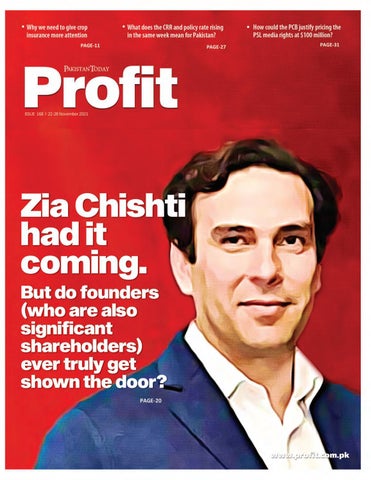
16 Zia Chishti had it coming. But do founders (who are also significant shareholders) ever truly get shown the door? 24 TikTok was just unbanned. How long do you give it? Ariba Shahid
11
31
26 26 What does the CRR and policy rate rising in the same week mean for Pakistan? 31 How could the PCB justify pricing the PSL media rights at $100 million?
Profit
Publishing Editor: Babar Nizami l Joint Editor: Yousaf Nizami l Assistant Editor Abdullah Niazi Reporters: Ariba Shahid l Babar Khan Javed l Taimoor Hassan l Meiryum Ali l Shahab Omer Chief of Staff & Product Manager: Muhammad Faran Bukhari Regional Heads of Marketing: Muddasir Alam (Khi) l Zulfiqar Butt (Lhr) l Malik Israr (Isl) Layout: Ahmad Salahuddin l Photographers: Zubair Mehfooz & Imran Gillani l Business, Economic & Financial news by 'Pakistan Today' Contact: profit@pakistantoday.com.pk
Readers Say Well put. But in conclusion, the figure on total demand per day in winters does not add up. To be completely fair, the shortfall is coming at a time of peak winters which makes sense. Apropos: LNG 202: Volatile spot markets and record breaking prices @Aniqzafar, Twitter Would you please send a copy to @shazbkhanzdaGEO? Apropos: LNG 202: Volatile spot markets and record breaking prices @Shahnawazgrewal, Twitter This is a very interesting and informative piece. I would only like to add that according to Jeffrey Sachs, lobbying in the USA has also led to rampant corruption in the political class during the last 40 years. If corporations are organized and people have no organized presence as interest groups no one can check corruption. Apropos: Sons, bribes, perks, and jobs – the murky world of corporate lobbying in Pakistan Fayyaz Baqir, Website It is a very good read. I loved the way the satisfaction of the customer is highlighted throughout the article, and how it is so important to gain trust and success in businesses. Could you also please share a comparative analysis of strategies used for customer satisfaction deployed by successful businesses in Pakistan and strategies that have been used abroad? Is Pakistan up to speed or is it lagging behind? Would like to have that insight too. Apropos: Customer experience – chai, culture, and happy customers Dr Zafar, Website
facebook.com/Profitpk twitter.com/Profitpk linkedin.com/showcase/13251020 profit.com.pk profit@pakistantoday.com.pk
HOW TO CONTACT
7
Every single policy that this government has brought tells a tale of cruelty and disregard towards the lower classes. It is pathetic. If you are really a party that claims to have come to power on the back of ‘change’ then you need to begin by cleaning up in the upper classes - not by snatching the livelihood of old people that are simply trying to live out their final days with a little dignity and respect. With this act, the government would essentially be condemning the old pensioners. Not all pensioners are getting hundreds of thousands every month. This is going to result in the elderly retired persons keeping money in the bank and letting the interest do the job for them. They do not have the capacity to be involved in doing business at their age. The government should seriously review this move. Apropos: The pension time bomb {video} Chaudhry Waqas, Pensions of soldiers and judges should be stopped. They get enough facilities during their
service. Meanwhile honest government employees keep entering and no facilities are found. Pension is what they rely on for bread after retirement. This should continue. It is the big fish that need to be wrangled and dismissed from the pension list. Apropos: The pension time bomb {video} Syed Tariq Mahmood First of all, the salaries of government employees should be equal to the private sector. Only after this can the pension contributions scheme be implemented. The second thing to do is to stop corruption so that these pensions can at least be justified. Thirdly, ministers, MPAs, and MNAs should all not get any discretionary funds or pensions. Their job is lawmaking. They should stick to it. The fourth important aspect of this is controlling the massive pension bill of the armed forces which is eating up the entire country’s budget. Government employees should also be given annual bonuses so that they can fulfill their needs and invest for their future. Apropos: The pension time bomb {video} Ali Zain Awan, A vast majority of this pension bill goes to a certain holy institution. But because of the nature of that institution, nothing can either be said about it nor can anything be done about it unless the government wants to shoot itself in the foot in the process. Apropos: The pension time bomb {video} Asif Waris The government immediately needs to follow through and revise its pension policy. In the current economic climate, we cannot bear more burden than we already have. In fact, we need to cut out on a lot of this. We simply cannot afford it. Apropos: The pension time bomb {video} Shoaib Sheikh, Almost 90% of the pension bill goes to retired army soldiers. These officers often retire at the age of 40 when their promotions stop or they want to go into the private sector. After this they spend their whole life collecting their pension from such a young age. This needs to be rectified at the earliest - especially since army pensions go through the civilian budget not the already massive chunk of the budget given to the military. Apropos: The pension time bomb {video} Zeeshan choudhry If you don't have a finance background and are interested in the stock market, here are some of the basic ratios for screening stocks for further evaluation. Apropos: New to stock market investment? Here’s some advice – think returns not dividends @analystfahad, Twitter
COMMENTS
IN BRIEF Rs56 billion
The government rejected almost all competitive bids in the auction of treasury bills held on Wednesday while it accepted only Rs0.5 billion for three-month tenor. However, the government raised Rs55.258bn through non-competitive bids for three-month making the total as Rs55.8bn. The cut-off yield remained unchanged at 8.5 per cent.
Adviser to the Prime Minister on Finance and Revenue Shaukat Tarin has assured land developers that the federal government will extend the exemption on wealth reconciliation statement for first-time home buyers beyond Dec 31.
All Pakistan Textile Mills Association (APTMA) Chairman Abdul Rahim Nasir has rejected the sudden hike in gas prices from $6.5/MMBTU to $9/MMBTU for export oriented units. The announcement was made at a hastily called emergency presser organized by APTMA.
€200 million
The United Kingdom (UK) and Germany will provide £50 million and €150 million, respectively, in climate change assistance to Pakistan under multiple agreements signed during the international climate change conference, 26th Conference of Parties (COP-26).
Share price of The Resource Group (TRG) Pakistan crashed 9.78 per cent on the Pakistan Stock Exchange (PSX) on Wednesday as the news of sexual harassment allegations against company CEO Zia Chishti triggered panic selling.
The SBP has decided to raise its policy rate by 150 basis points (bps) to 8.75 per cent. The unprecedented move comes after the central bank had increased the benchmark policy rate by 25 bps to 7.25pc in previous reviews after keeping the rate steady at 7% for a long time. The net foreign direct investment (FDI) into different sectors like power, communications and oil and gas exploration dropped 24 per cent to $223 million in October 2021. Out of the $223 million, $145m was attributed to direct investments, whereas disinvestment of $78m was attributed to equity securities.
8
Hammad Azhar and ugly charts (again)
this week in Pakistan’s business and economics twitterverse
T
his week we have a bone to pick with Hammad Azhar for not being able to explain the LNG crisis, embarrassing himself with his conduct on Shahzeb Khanzada’s show, and somehow still wanting to debate him. Other than that we discuss ugly charts, political operatives with thin skin, and how banks make your life difficult. Ariba Shahid brings you all this and more in this week’s social media roundup.
Where is the woman in the room?
Lost opportunities
NIT had the ability to be so much more than it is now. Considering the portfolio it has, it can very much rekindle.
SOCIAL MEDIA ROUNDUP
This is why you need to have women and their pov taken into consideration when making policies
9
Bone to pick with Hammad Azhar
Chart nerds
A sitting minister is singling out a journalist and challenging him. Kind of childish if you ask me. Yes, the LNG issue has become a hot debate, but the fact is that if Khanzada’s information was wrong, it was wrong as either a matter of interpretation or the provision of incorrect facts from the government. In either case, it is the government that has failed to communicate the price LNG issue effectively both to the media and to the general public. At this point, a debate might just be more embarrassing for Hammad Azhar than anything else. While he may have been taught at Aitchison that perseverance commands success and all that other mambo jumbo they preach at assemblies while kids freeze in shorts during the winter months in that massive relic Mr Azhar and his friends call a school, this might be a moment to sit out another debate. I for one speak from experience considering I’ve reached out to Mr Azhar a number of times for clarification on the govt’s stance for other decisions only to be left unanswered. In such situations, I’ve tried to make sure my reporting was fair by putting in effort to understand government rationale. It would’ve been easier had Mr Azhar merely responded like his counterpart ministers do. Heck, some even call back.
Thicker skin needed
Sometimes you don’t need a yellow chart to be wrong. Sometimes all you need is a graphic designer with no aesthetic sense and someone willing to commit a chart crime. Considering how many ugly charts are out there with bad math, how about a compilation of the worst charts we’ve seen categorised by mathematics, representation, and aesthetics? Let us know if anyone would be interested. Even if nobody isn’t, we will probably do it anyway because we’ve got a few chart nerds at the office.
Mundane silliness
Let’s go back to the first grade when idiot and stupid was considered a bad word. What is up with the govt personnel and shutting up dissenting voices? Sir, with all due respect, grow a thicker skin. If you’re in the business of government and policy, you’re bound to be called an idiot, and most likely at some point or the other the person calling you an idiot is going to be right. Learn to laugh some things off - you might live longer.
10
Imagine taxing helmets when you’re not self sufficient and your country already suffers from a small proportion of people wearing helmets.
SOCIAL MEDIA ROUNDUP
Farmers need to be incentivized and encouraged to leave traditional methods behind
By Shahab Omer
W
hen you think about insurance you think about cars, houses, buildings, people, and other tangible constructions. Things that are likely to go up in flames, crash, fall down because of earthquakes, die because of heart attacks and so on. However, insurance can cover almost anything. Insurance is a means of protection from financial loss. It is a form of risk management, primarily used to hedge against the risk of a contingent or uncertain loss. An entity which provides insurance is known as an insurer, an insurance company, an insurance carrier or an underwriter. Since it is a business that deals in risk, anything valuable that could be at risk can theoretically be insured. Footballers, for example, have gotten their feet insured and actors and models have gotten their faces and other body parts insured. One form of insurance that does not get much attention but should be widespread, particularly in a country like Pakistan, is crop insurance. The reason it does not get much attention is because crop insurance is burning, but that does not make it any less important. And because it is boring, and very far flung
AGRICULTURE
from the urban debate on the economy and business, most insurance in Pakistan is life insurance. Now, however, the Punjab government is providing crop insurance, which might be a game changer for farmers of the province.
Crop insurance in Pakistan
T
he first instance of agricultural insurance in Pakistan did not come for crops but for livestock. When people quote the oft repeated fact that Pakistan is an agrarian society, the image in most people’s mind is wheat fields and farmers hard at work at sunset. However, a large chunk of that majority agrarian economy belongs to livestock farming. That is why in 1983, Adanijcer Insurance Company and the Eastern Federal Union Insurance Company both introduced livestock insurance on a pilot basis. The experiment produced mixed results, but it was a failure in the long term since livestock insurance didn’t quite catch on. It also took many decades for Pakistan to come to a place where insurance for crops was being offered. Crop insurance was introduced in 2008 under a public private partnership for a national crop loan insurance scheme. Livestock and poultry insurance has been written on a small-scale in the past by various private
insurance companies. Since the Rabi season 2008/09 a group of ten insurance companies in conjunction with 20 commercial banks have been involved in the implementation of the national crop loan insurance scheme. The insurers include New Jubilee, EFU General, East West, National Insurance Company, UBL, Adamjee, United, Silver Star, Atlas and Alfalah. In this regard, Pakistan has seriously lagged behind. In countries where crops are not even that important, crop insurance has been a major security point for a long time. Crop insurance actually began in Sweden in 1950 and came to India in 1979. And while it was discontinued in 1989 and 2006, crop insurance in India is still working. There is a dire and serious need for this as well. Punjab is the most populous province of Pakistan with a population of over 110 million according to the 2017 census. With a share of 62 percent in the national economy, the province is the most prominent in the agricultural sector. It provides 76 percent of the country’s annual grain production. The cotton, rice and other crops grown here provide a large share of the country’s treasury. Khaula Walayat, a local insurance expert, says that agricultural insurance is relatively undeveloped in Pakistan despite how central crops are to the country. She also believes that livestock insurance is available
11
“However, some loopholes have been found in the credit policy, especially in the Crop Loan Insurance Scheme (CLIS). In my opinion and according to research inefficiencies in the scheme were highlighted by the farmers during a survey conducted in the flood-prone tehsils of Sargodha” Khaula Walayat, insurance expert
on a limited basis and includes both livestock cattle, buffalo, small ruminants and poultry insurance. “Since Rabi 2008/09 individual grower multiple peril crop insurance has been available for field cereal crops and sugar cane. The policy adopts a unique two-trigger indemnity procedure: 1) catastrophe losses as a result of an insured peril that exceeds 50 percent of the normal average regional (e.g. block) area yield must first be declared by a competent authority, and 2) this opens the policy for a loss adjustment at the individual farmer level. For crop insurance, the most important delivery channel is through linkage to agricultural credit for farmers through the banks,” she explains. Agricultural insurance is compulsory for farmers who have taken seasonal loans from the banks. The scheme carries a maximum agreed indemnity limit of 300 percent loss ratio. There is a stop loss reinsurance cover that is placed with international reinsurers. It is understood that on account of the very severe flooding in 2010 the stop loss reinsurance programme has incurred high losses. No further details of the stop loss treaty are available. Among credit policies, the CLIS is a unique scheme launched in 2008. It provides credit for five major crops, namely, wheat, rice, sugarcane, cotton and maize. This is accompanied with insurance against natural disasters like flood, drought, hailstorm, pest attack and fire damage. With support of the government, the insurance premium is subsidized for subsistence farmers, defined as those having up to 25 acres of land for cultivation. The crop loan insurance scheme attracts premium subsidy support from the government (SBP, 2010). According to SBP (2010), in 2008/09 the government reimbursed the banks RS 183 million (US$2.2 million) for the cost of premium subsidies to subsistence farmers. This would be equivalent to a premium subsidy level of 58 percent. In the first year of operation, the crop loan insurance scheme generated a premium of US$3.8 million or a 2.1 percent penetration rate for the insured crops, ranging from 1.0 percent penetration rate for maize to 4.0 percent for sugar cane.”
12
How it works
M
eanwhile, a deputy director of the department of Agriculture Punjab informed this scribe that for self-reliance in agriculture, small and medium scale farming, rainfed areas, roads from farm to market, transmission of electricity to tube wells have gained more attention. “The Department of Agriculture aims to establish agriculture on a business basis, making it less costly and more profitable. We believe that special attention should be paid to the welfare and productivity of the farmers and food security should be ensured to provide strong support to the national economy. In the event of crop damage due to natural disasters, diseases and pandemics, government-sponsored protection programs to stabilize farmers’ incomes are essential for a farmer’s economic survival. Crop insurance is crucial for farmers’ financial assistance, post-disaster recovery and compensation. According to international experience, government support for insurance work is of paramount importance in agriculture.” “This assistance can be provided to farmers by subsidizing the insurance installment. The Punjab government has introduced crop insurance (Takaful) scheme for the farming community in case of natural calamities / disasters. It is an agreement between a farmer and a financial institution (insurance company) in which the farmer pays a small amount to the insurance company, called the insurance premium and if the crop is lost in whole or in part due to natural causes, the farmer files an application or claim with the insurance company to be compensated for the loss,” they said. According to the official, even in Punjab, the insurance company keeps the insurance premium money with it, through which it is able to continue its work and pay the claims of other farmers. “This practice is not only in Pakistan or Punjab but all over the world. The good thing is that insurance protects a farmer’s capital and keeps his income stable. At the same time, the farmer is freed from the fear of natural disasters and his standard of living improves. Crop insurance not only enhances the reputation
and value of the farmer but also encourages modern production methods and technical and professional skills and if, unluckily, crops are destroyed, there is also financial support for farmers and in the event of a loss, it is possible to secure capital for the next crop through insurance,” Essentially, crop insurance, known locally as Takaful, was started in 2018 Kharif (Jun-Nov). When the government saw the importance of this scheme in Kharif and Rabi (Dec-Mar) 2018, the scope of this program was expanded in 2019 and it was started in 18 districts of Punjab. These 18 districts included Sahiwal, Sheikhupura, Lodhran, Rahim Yar Khan, Multan, Muzaffargarh, Narowal, Faisal Abar, Rajanpur, Bhakkar, DG Khan, Kasur, Khanewal, Layyah, Mandi Bahauddin, Bahawalpur, Bahawalnagar and Okara. Keeping in view the international procedure, the Punjab government had for the first time launched a crop insurance (Takaful) scheme. When the first phase of the scheme was launched in Sheikhupura, Sahiwal, Lodhran and Rahim Yar Khan in Kharif 2018, it was applicable only to cotton and rice farmers. The initial move made sense since cotton and rice are both crops that are volatile and tend to face harsher natural conditions. Rice is dependent on the right amount of rain, there needs to be enough to flood the fields but not so much that the flood overflows and the entire crop is destroyed. However, according to the Deputy Director, the scheme was launched in phases in Rabi 2018 and was applied to sugarcane, maize, wheat, orchards and vegetables. In the first phase, under this scheme, the Punjab government provided 100 percent subsidy on insurance premium to farmers owning 5 acres of land, similarly, government also provided 50 percent subsidy on insurance premium to farmers of 5 acres to 25 acres and in the case of orchards also provided 50 percent subsidy on insurance premium to farmers. “In the first phase (Kharif 2018), insurance was applied to agricultural creditors
(E-Credit, CLIS) as crop insurance schemes were mandatory for agricultural creditors of E-Credit, therefore, they were registered under the automated system. Moreover, agricultural creditors were asked to approach their respective agricultural banks. In the next phase (Rabi 2018) crop insurance scheme was brought to other farmers besides the agricultural creditors. For registration, the farmers used to register themselves by calling or SMS to the specific toll free numbers of the Punjab government. Or register through the nearest department of agriculture (Extension) or a representative of the designated insurance company. However, the registration service was also available through the online system,” he said. “Now if you look at the performance of the Punjab government, under the insurance program for Kharif 2021-22, the process of insurance program registration has been started for cotton and paddy farmers in 27 districts of Punjab to compensate for climate change, natural disasters and locust damage. Similarly, South Punjab includes Multan, Lodhran, Khanewal, Vehari, DG Khan, Muzaffargarh, Rajanpur, Layyah, Bahawalpur, Bahawalnagar and Rahim Yar Khan Districts. The program will provide 100 percent subsidy on premium for farmers owning up to 5 acres of land and 50 percent subsidy on insurance premium for farmers owning 5 to 25 acres of land. Policy certificates will be issued to farmers who insure cotton and paddy crops in Kharif 2021-22. In case of loss / loss of production at tehsil level, announcement will be made in December 2021 and the concerned insurance company will contact all the insured farmers in January 2022 and will be bound to compensate the loss,” he added.
Why it is important
W
alayat believed that along with the threat and disasters caused by climate change, farmers are facing issues of salinity, water scarcity and decreasing groundwater levels which slash their income from crop harvests. “Such issues have made it more difficult for them to repay their debt. With the growing challenges, the demand for agriculture credit from the farmers has gone up in an attempt to improve their harvests. Provision of credit to the agriculture sector reached Rs704.5 billion in fiscal year 2016-17, up 17.8 percent compared to the previous year,” she said. “However, some loopholes have been found in the credit policy, especially in the Crop Loan Insurance Scheme (CLIS). In my opinion and according to research inefficiencies in the scheme were highlighted by the farmers during a survey conducted in the flood-prone tehsils of Sargodha. Majority of the farmers have avoided taking formal credit because of
their own savings and easy access to loans from informal sources. Some farmers are interested in insurance policy alone, but CLIS offers crop insurance to only those that borrow from banks. Finally, some of them do not consider insurance policies to be in line with Islamic principles.” This hesitance means that farmers instead end up borrowing from informal sources like individual lenders in their areas since they find this easier, quicker, and more efficient. There are also major loopholes in the policy, including the declaration of calamity by the government as a major issue. When this happens the bank or insurance company concerned sends their representative or an independent consultant to assess the loss. This causes a delay of around six months. Owing to the delay, the assessment of field losses is not accurate. The assessors, most of the time, rely on prediction rather than actual data. After the assessment, slow disbursement of insurance claims takes at least another month. These drawbacks force the farmers to borrow from informal sources for planting their next crop. “The money paid in insurance claims is also meagre that neither covers the loss nor the input cost. Moreover, political influence is another hidden factor found during consultation with the farmers as such influences play a role in whether or not a village should be declared calamity-stricken. Apart from these, absence of political support leads to negligence of villages that are severely affected by disasters but are never declared calamity-hit. Farmers also complain about lower resilience against natural disasters and climate change, which is the outcome of a lack of proper guidance by agriculture extension officers and ineffective early warning system. The process documents itself is a big problem due to hidden conditions and lack of understanding by poor farmers that made them impossible to claim. Insurance companies all over the world hide behind faulty law procedures and the long pending cases for claims disappoint farmers mostly,” explains Walayat.
How the banks are organizing
I
t is pertinent to mention here that a month ago, HBL, The Bank of Punjab (BoP) and TPL Insurance Ltd. have entered into a strategic partnership for the pilot testing of the Area Yield Index Insurance (AYII) product, proposed by Pakistan Agriculture Coalition (PAC) with PULA Advisors as implementation partner & SCOR as global reinsurer. Under the product, farmers availing crop production loans from HBL and BoP in pilot districts will be provided yield insurance coverage bundled with their loan product. The incremental premium cost for the value-added services for additional cover under AYII will be jointly shared by HBL, BoP and TPL.
The product will ensure climate resilience and financial stability through insuring the crop production risks against climatic abnormalities including windstorm, frost, excessive rainfall, heatwave, hail, flood, drought, pest and diseases. It will facilitate the insuring farmers without any payout limitations or waiting for calamity declaration from Government agencies. The pilot project will initially focus on wheat and rice crops in four districts i.e. Pakpattan, Gujranwala, Hafizabad and Sheikhupura of the Punjab Province. The crop yield will be insured against a pre-set average benchmark yield on the basis of historical data and the insurance claim will trigger if average farm yield is below 70 percent of the threshold. The crop yield will be measured through crop cutting experiments carried out by international partners i.e. PULA. In a joint statement, Muhammad Aurangzeb, President & CEO – HBL, Zafar Masud, President & CEO – BOP and Ali Jameel, Group CEO - TPL Corp shared, “We are excited to partner on this landmark initiative that has the potential to transform the agricultural landscape of Pakistan by facilitating the farming community through financial coverage of their agricultural produce. This will encourage the farmers to take broader steps by adopting latest farming techniques on the back of flexible and enhanced risk coverage, thereby ensuring financial inclusion and sustainability”. Speaking about the AYII the DD agriculture department speaking to Profit informed that the special feature of this scheme was that the loss or loss of production would be estimated on a scientific basis instead of the traditional method, for which ‘AYII’ was to be introduced. The purpose of crop insurance (AYII) was also to overcome the shortcomings of traditional crop insurance and to suit the needs of small scale farmers. “The most important point is that it does not cover crop damage at the level of an individual farmer or field. Rather, under this method, production loss or a specific geographical area (such as a district, tehsil, union council or village) is considered, however, the geographical area is usually called the Unit Area of Insurance or UAI. Under this method, in case of less than average production in UAI by area (index), area, production, index product pays compensation. Damage is compensated in case of sudden causes like flood, rain, drought, disease / pest attack, hailstorm etc. Moreover, the loss is estimated on the average yield of a given area (tehsil) rather than the individual farmer’s land. AYII is based on scientific principles and in this index, crop harvesting experiments are carried out scientifically in different places at the level of a specific area (tehsil) in Punjab,” he explains. “These experiments are performed by the
AGRICULTURE
“We are excited to partner on this landmark initiative that has the potential to transform the agricultural landscape of Pakistan by facilitating the farming community through financial coverage of their agricultural produce. This will encourage the farmers to take broader steps by adopting latest farming techniques on the back of flexible and enhanced risk coverage, thereby ensuring financial inclusion and sustainability” Muhammad Aurangzeb, President & CEO – HBL, Zafar Masud, President & CEO – BOP and Ali Jameel, Group CEO - TPL Corp Crop Reporting Services Department of the Department of Agriculture for almost all crops each year. The production survey is divided into five phases which include preparation list, selection of fields, identification of plots, harvesting, and masonry, cleaning and drying. Since the Crop Reporting Service has been computerized in the Department of Agriculture, all the work of Gardawari has now been computerized, thanks to which the preparation of field indexing and selection of experimental fields is done by computer.” As he explains, the special feature of this scheme is that if there is a crop deficit compared to the average production of a particular area (tehsil), it will be compensated. This scheme will make it possible to repair the damage caused by sudden disasters. If the production of the area falls below the set average production this year, then the difference between the set average production and this year’s production will be borne by the insurance companies. Unexpected situation refers to damage to crops due to floods, pest or disease infestation, drought, flash floods, rains or any other cause. Estimates of production will be made by the Crop Reporting Service Department of Agriculture. In order to offset the loss, the current year’s production should not be less than the prescribed regional production. “The farmer should have a crop insurance policy and the insurance premium has been paid in full. The crop that is being claimed must be insured and the government will
14
calculate the claim through its online crop insurance portal. Insured farmers will be notified via SMS and will be able to check on the internet with their valid computerized identity card. The claim amount will be transferred to his bank account through branchless banking. The Punjab Crop Insurance will apply only to the production data obtained at the tehsil level which will be issued by the Crop Reporting Service Department of Agriculture. Farmers should register for free at local agriculture offices (Crop Reporting Service / Agriculture Extension) or on the website,” he said. “It is a seasonal cover for crop yield shortfall below the historical average yield in a unit area of insurance [UAI]. Your insurance yield is based on your actual production history (APH), which is the average yield obtained on the insured unit for four to ten consecutive crop years in which that crop was produced,” says Walayat. “There are two decisions that determine the amount of protection obtained from YP: level of yield coverage. But as the average yield cannot be standardized and other problems of agriculture cannot be determined accurately so it is not very effective in countries like Pakistan which has an unstructured and informal agricultural market. Contrast this index to a very successful one where corporate farming is applied. In my opinion crop insurance can certainly be the major participant in a country’s growth. If we fix the loopholes and red tapism in bureaucracy being an agrarian economy we can not only address our domestic
demand but can export. We need to implement corporate farming as this goes hand in hand with policy making to improve agriculture.” “A few quick fixes in crop insurance are badly needed. The benefits of CLIS cannot be denied, there is always room for improvement. Suggestions given by the farmers can provide useful input for the policymakers and economists and help the growers to cope with multiple challenges. In order to bring improvement, the farmers recommend effective assessment of individual loss, quick settlement of insurance claims, increase in the amount of claims and giving cover to horticulture as well, especially orange orchards and vegetable crops. While Sargodha produces 90 percent of oranges in the country and generates millions of dollars from exports, the government should also consider including excessive or erratic rains, hailstorms and pest attacks along with floods in CLIS.” One of the key suggestions is to provide crop insurance without linking it with formal credit at least in major growing areas. The current CLIS mechanism depends on damage-based insurance, but it can be improved by developing a weather or yield-based index. Such agriculture credit policies are successfully functioning in neighboring countries such as India. They will help speed up the process of effective and individual loss assessment to clear the way for releasing claims before the start of plantations in the next season. Such changes will boost farmers and help them achieve sustainable agriculture growth. n
AGRICULTURE
16
COVER STORY
By Abdullah Niazi
Z
ia Chishti had it coming. That much has become apparent after the harrowing testimony of Tatiana Spottiswoode, a former Afiniti employee, who has accused the Pakistani-American entrepreneur of sexually assaulting her. The details that have come out as a result of Ms Spottiswoode’s testimony have been graphic and intolerable. The abuses committed against her are vile. But why is this any of our business? The incident took place place years ago, and it has only come to light as part of a congressional investigation on the culture of forced arbitration for victims of sexual abuse in the workplace. It is a thoroughly American problem, with an American at the center. But the fallout from Chishti’s outing has had a corresponding effect on Pakistan. The share prices of TRG Pakistan, a holding company of which Chishti is the CEO, fell from Rs 130 to Rs 111 in a single day as the company faced the charge from panic sellers. According to Topline Secu¬rities, TRG Pakistan Ltd alone dragged the benchmark index down by 101.51 points. And somehow the effect on the stock market is perhaps the most insignificant and short-term impact that the whole affair has had on Pakistan. In response to the allegations surfacing, the general response from the finance community of the country has either been silence, or a complete denial of Ms Spottiswoode’s accusations. The claim has been that the testimony was part of some ‘conspiracy’ to put down a major player in the American tech space because he was a Pakistani. The truth is that Chishti has turned out to be a vile man that has been accused of egregious, violent, criminal behaviour and is now facing the music. What is Pakistan’s role in all of this? Nothing. There is, of course, the impact on the stock market and this article will discuss that near the end. But the main
18
Whether the stock was worth that much or not, it is the fact that people certainly believe it. In interviews conducted by Profit back then all sources interviewed either alluded to the document, or simply quoted the document verbatim as analysis. Some even went so far as to call TRG Pakistan as a nontraditional company trying out something new, that it was revolutionary. The other reason they gave was that Zia Chisti was ‘charismatic’ outcome of the entire event has been that there are truths being revealed about Pakistan’s finance community, most of all that in the age of the MeToo movement corporate Pakistan is vastly unprepared to deal with such fallout, and there are plenty of lessons to be learned.
What happened
C
hishti has been profiled in the past by this magazine. In 2017, a story about his life and work appeared in Profit precisely because his story is undoubtedly a compelling one. Everything you need to know about Chishti’s early life and his rise is in there. All you need to know for now is that he was now on his second heavyweight company and on his way up to being an A-lister. Founded in 2006 as a call-center operator, Afiniti started to identify itself as an AI pioneer, saying its software could supercharge the efficiency of call centers by matching customers with agents most likely to solve their problem or make a sale around 2017. On the back of this pitch and at a time when technology companies were getting the lion’s share of new investment, it seemed nothing could stop Afiniti. On Friday, Chishti was ousted unceremoniously from his position as CEO of Afiniti, marking an uncertain and tumultuous moment
in the company’s history. Pakistan’s involvement in this entire affair stems from the fact that Afiniti is partly owned by TRG (The Resource Group) Pakistan, which was created in 2002 specifically to act as the global holding company for all of TRG’s investments. It was listed on the then Karachi Stock Exchange in July 2003. TRG was the original company that Chishti had founded out of which Afiniti had grown. The ownership structure of TRG is highly complex and consists of several layers of holding companies. TRG Pakistan is the overall holding company, but it does not own the entirety of TRG International, which in turn does not necessarily own the entirety of the shares in its portfolio companies. At each stage, there are minority investors who own significant stakes, which makes it difficult to track exactly how much the overall portfolio is worth, and how much of it is owned by the shareholders of the publicly listed company on the Pakistan Stock Exchange. For most of its existence, TRG Pakistan’s subsidiary was TRG International, which is a British Virgin Islands-incorporated holding company that in turn owns stakes in most of TRG’s portfolio companies. However, in June 2020, TRG Pakistan’s share in TRG International changed from 57.16% to 46.03%. It is no longer a subsidiary, but is instead, technically, an affiliated company. While Chishti’s removal as the CEO of
Afiniti has been announced, no word has been heard about his position as CEO of TRG Pakistan. The grapevine is indicating that Chishti is as well as gone from TRG Pakistan as well, but an official statement is still awaited.
The problem in Pakistan
T
his is where our conversation about attitudes in Pakistan begins. Almost immediately after videos of the testimony surfaced, the reaction from Pakistani quarters was to raise ifs and buts. Najam Ali, the CEO of Next Capital, tweeted saying “I met Zia Chishti in 2003 while approving TRG IPO prospectus at SECP. He was full of ideas and wanted to grow the company at an international scale which he did successfully. I was saddened to see the news this morning. We don’t know the whole truth but it is irrelevant now.” Investment banker Fahad Sheikh took it one step further saying “Every time a Pakistani tries to strike it big on the global stage, he will be brought down. History is replete with such examples.” This kind of attitude is exactly what is wrong with corporations not just in Pakistan but all over the world. The immediate reaction to powerful men being outed as harassers and abusers is suspicion. Suspicion, not of those facing the fire, but of the accusers that gather up the courage to actually come out and name the people that caused them harm. All of this is despite the fact that for a survivor of abuse to come forward and name the person responsible requires going through legal and bureaucratic hell, especially when it comes to this kind of behaviour in the workplace. And workplace sexual harassment is a very serious and pervasive problem in Pakistani society. In a special report by Dawn in 2018, it was reported that in a survey of 300 working women in Pakistan, buse and discrimination in Pakistan’s workplaces, including universities, are pervasive, mostly unreported and ignored by senior managers. The report stated that in response to being asked whether women were made to stay silent about workplace harassment, 61 per cent said their employers did not coerce them to keep quiet, but a significant 35pc were told to remain silent by their colleagues and bosses. That is a massive percentage. When it comes to formal reporting mechanisms, testimonies from women suggest most lack faith in the process — only 17pc of those who experienced harassment approached their organisation’s internal inquiry committees. Despite 59pc reporting that their management does take harassment seriously, most women expressed worry that managers wouldn’t sanction harassers and their work situations would not improve. Most women
felt they would not be believed during investigations or when perpetrators had support in high places. Essentially, these harassers are taken seriously enough to get a reprimand and a slap on the wrist. Pakistan is clearly far behind in this regard, and the attitudes towards the outing of Zia Chisti has shown that more than ever. Even in the current case, Ms Spottiswoode has not come forward as part of an investigation of the culture at Afiniti, but as part of a congressional investigation on workplaces that add forced arbitration clauses to the contracts
of their employees. This means that if senior management does something untowards, a person cannot take them to court because their contract means they have to go to the arbitration table no matter what. At the table, these large companies manage to use their A-list lawyers to bully and strong-arm people into taking settlements and signing non-disclosure agreements. In Pakistan, there is nothing so sophisticated. Companies do not add forced arbitration clauses because they know even if accusations came to light, they would either
COVER STORY
not be taken seriously or languish in the court system forever. In the process, the woman filing the complaint would end up also in a heap of social and legal trouble. Perhaps the most significant case in Pakistan where this was on display was that of Patari. Unlike Afiniti, Patari was a company that was doomed to fail from the first day because it was a bad business model. When allegations against their founder and CEO came to the surface, initially the company made it seem like he would be stepping aside. When it came forward that he was still very much running the show just from behind the curtain, senior management of the company stepped down in opposition. However, nothing became of the matter and it turned into a situation where the CEO, Khalid Mubashir Bajwa, continues to play a role in the operations of Patari. These matters are always quite complicated. In the case of Chishti, it must be remembered that while the board might have ousted him as the CEO of Afiniti, he is still one of the largest shareholders both in this company, and the company’s parent and holding companies. This means that Chishti, even if he goes to prison, will have a huge chunk of Afiniti and might even be able to throw his weight around a little. A company like Afiniti which has solid business fundamentals and funding is bound to continue making profits if it has a product that is valuable on the market. In such a situation, what can companies actually do? In more developed places where the impact of the MeToo movement has been stark, companies have playbooks that they use for situations like this. They have strategies, they have restructured at times to improve workplace culture and avoid the kind of fallout that Afiniti is now facing because of Chishti. It has become clear that Afiniti did have a serious culture of hard drinking and partying which led to situations like this. But in Pakistan, instead of facing the reality, companies prefer to either ignore the problem, belittle it, or the people accused of such crimes then find legions of supporters that help them poison
20
Who is Zia Chishti?
B
orn in 1971 in the US state of Maine to an American father and a Pakistani mother, his name at birth was Wilson Lear. When his father died in 1974, Chishti’s mother moved back to Pakistan and changed his name so that he would not stand out in Lahori society. Chishti’s father had been an American convert to Islam and was intimately familiar enough with Pakistan to request burial near a Sufi saint’s shrine in Faisalabad, but Saadia Chishti, who has a PhD in education from Cornell University, still wanted to make sure that her son would not be seen as “foreign” in Lahore. But despite the name change, the American side of Zia never really went away. It helped that he went to Lahore American School, and then went off to college at Columbia University in New York. And it probably helped that his life in America really was the American dream. After graduating from Columbia, Chishti was able to land a job as an investment banker at Morgan Stanley, one of the most prestigious names on Wall Street, working in both New York and London before leaving to attend Stanford Business School. At Stanford, he got the idea to fix what was probably the only thing wrong with his appearance: his teeth. He came up
social media narrative in their favour.
The effect on the stocks
T
here have been immediate effects of Chishti’s removal in Pakistan. While he has not been removed as CEO of TRG Pakistan, it is a move that
with the idea of using transparent aligners instead of braces to help straighten his teeth, and in doing so, inventing a way for others to straighten theirs. Since Chishti was at Stanford from 1995 to 1997, the heyday of the first Silicon Valley bubble, getting funding for an orthodontic technology for an inventor who was not an orthodontist was a realistic possibility. And Chishti landed what is arguably the biggest venture capital investing name of them all: Kleiner Perkins Caufield & Byers. If you have not heard of them, you may have heard of some of their other investments: Amazon, Electronic Arts, and Google. The heli-skiing Pakistani–American who previously launched the Invisalign dental braces business that is now worth $47 billion, founded the company that would become Afiniti in 2006 as a call-center operator. Around 2017, it started to identify itself as an AI pioneer, saying its software could supercharge the efficiency of call centers by matching customers with agents most likely to solve their problem or make a sale. All of those efforts have come crashing down as Zia’s untowards behaviour has come forward. The future for the Pakistani-American A-lister seems (hopefully) bleak. Whether he answers for his crimes is yet to be seen. according to many experts is just around the corner after his ouster from the Afiniti chair. TRG Pakistan stock has long been considered a holy and long game that will always work out. Much of this has been because of the recent pivot of Afiniti and it turning the corner towards becoming a ‘tech’ company. Back in April 2020, TRG’s stock stood at around Rs12. It then climbed to Rs51
TEXTILES
in August 2020. Between December 2020, to February 2021, the stock climbed an absurd amount, the current Rs125. Back then there was an expectation, according to market rumours, that it would certainly cross north of Rs150. That is why the current fall has been quite alarming for investors. The company has this many investors for a few reasons. The first is that it is a tech company which is easy to hype up. Back in February this year, a document with no author has been making the rounds on Whatsapp, which puts the valuation of TRG Pakistan at roughly Rs400. It does so by comparing the various subsidiaries – Afiniti, E-telequote – to their listed peers on American stock exchanges, and arrives at a projected total valuation of TRG Pakistan. Whether the stock was worth that much or not, it is the fact that people certainly believe it. In interviews conducted by Profit back then all sources interviewed either alluded to the document, or simply quoted the document verbatim as analysis. Some even went so far as to call TRG Pakistan as a non-traditional company trying out something new, that it was revolutionary. The other reason they gave was that Zia Chisti was ‘charismatic’, that both the JS Group and AKD – traditional rivals- were bullish about TRG. That charisma is not only
On Tuesday, Tatiana Spottiswoode, the former employee, testified before the House Judiciary Committee that Mr. Chishti harassed her for months after she began working for the company in 2016, when she was about 23 years old gone now, it is very much in the dumps and Chishti’s personal role in the company has made the life of investors incredibly difficult. Despite this, after the initial fall the price of TRG stock has remained relatively stable and it seems it might even climb once
The truth is that Chishti has turned out to be a vile man that has been accused of egregious, violent, criminal behaviour and is now facing the music. What is Pakistan’s role in all of this? Nothing. But the main outcome of the entire event has been that there are truths being revealed about Pakistan’s finance community, most of all that in the age of the MeToo movement corporate Pakistan is vastly unprepared to deal with such fallout
the dust settles. People still very much believe in TRG Pakistan and its history of providing profits. The company claims to have an ‘unbroken track record of over a decade’ in generating positive returns on each investment. That is what they will be banking on right now. What this also tells us once again is that the effect on the stock market is not the story. In fact, the stock prices staying as stable as they did means that not as many investors panic sold as they might. That also points towards the indifference in Pakistan towards allegations such as the one against Chishti. The stock prices will eventually rise, and Chishti may even be removed as CEO of TRG Pakistan, but when will corporate Pakistan catch up to the reality of the times? Not any time soon by the looks of it. The only question is whether there will be a rude awakening that will make them. n
COVER STORY
OPINION
Ariba Shahid
TikTok was just unbanned. How long do you give it? The audio-video based social media app has gone from banned to unbanned over and over again.
W
elcome to Banistan where an app used to make and post content in the form of short videos was until this weekend banned. If you haven’t guessed it, let me explain. TikTok was banned in Pakistan, it was later unbanned, and then banned and unbanned thrice more. It has now been unbanned as of Friday night after being banned four times in 10 months. Need we remind you the app has 1 billion monthly subscribers as of late - sadly the number of Pakistanis on it were either overseas or using a VPN and pretending to be overseas.
What is TikTok?
R
ecently, TikTok has managed to take the world by storm. The app is basically a platform where users are able to record, edit, and post short videos as content. They can keep their profiles private or public - it is up to them. The
Ariba Shahid
is a business journalist at Profit. She can be reached at ariba.shahid@pakistantoday. com.pk or at twitter.com/ AribaShahid
24
content on tiktok ranges from makeup, skincare, cooking, vlogging, dancing, singing, to even educational content such as stock and crypto analysis, and an insight into other cultures. You don’t need to know fancy editing or own hi tech equipment to use make and post content on tiktok. All you need is your smartphone. With a rise in the number of smartphone users in Pakistan and an increase in the proportion of people connected on the internet as a result of cheaper internet, TikTok managed to emerge as a mass market product. Earlier this year the Economist Intelligence Unit has said that Pakistan ranked highest in the “Affordability” pillar due to improvements in the competitive environment and a decrease in mobile phone costs. The country ranked 67th in the “Affordability” category which examines the cost of access relative to income and the level of competition in the internet marketplace. In 2020, of the 83 million people in Pakistan with mobile internet connections, 51.4 million – or nearly 62% of them – have 4G connections. That number just two years ago was just barely over 25% of a much smaller population of mobile broadband internet users.
Did it add any value?
I
’m not going to criticize the content on the platform at this point because it’s a form of expression and art and the right to express is a fundamental right I strongly believe in. Before I move on to the monetary benefits of the app, I feel it is important to mention the fact that the app has emerged as a form of entertainment for individuals who post and view content. You cannot put a price on that. On the other hand, the app has managed to open a lot of avenues for users. For instance, let us say you’re a good cook and you post great recipes on the app. A masala company likes the reach you have and sponsors or pays for product placement. The very fact that someone at home could
earn through brand collaborations, partnerships, and sponsorships is brilliant. Moreover, a number of TikTokers found their way to the media through their content. Media houses picked up on raw talent while individuals who would’ve never had the connections to enter the showbiz found themselves lucky. You’re probably wondering why I’m mentioning this considering such content and opportunities present themselves on other social media platforms too. The reason is simple. On the App Store, TikTok overtook apps created by Google, Facebook, and Zoom as the preferred video-sharing social networking service worldwide, while ranking third on Google Play Store with apps by Facebook and Snap Inc sharing the top five slot. No app comes close. According to a ByteDance pitch deck seen by Profit, TikTok has 25 million downloads in Pakistan of which 68% are female and 96% are Android users. User behavior data shows that the app is opened an average of five times a day, generating 14 billion views a month, and consuming an average 34 minutes of each user’s day. TikTok’s meteoric rise resulted in it taking the top spot in 2020, surpassing WhatsApp, the top app in 2019. TikTok had nearly 987 million downloads in 2020, an increase of 37pc year over year. While TikTok is a gen Z application across the world, the app was first accepted and widely used by the lower income segment in Pakistan - or in other words the masses. Other applications, in comparison, have wealth blocks that prevent you from getting as popular as one can on TikTok. Think about it. Look at all the bloggers you follow on Instagram. Most of them spend enormous amounts on their larger than life lifestyles and then manage to hook in some brands. Facebook is dead and only used to remember birthdays or to make sure you don’t offend your relatives by having them added on at least one social media platform. Twitter is primarily for the educated lot considering it uses words as a primary source of content. TikTok manages to be unique in this regard because of the simple
The time it took for the country to catch up after the youtube ban was long. Our youtubers have finally managed to catch up with the world and compete. A 3 year ban held the country back for longer than that.Lastly you’re stealing the voices of the disenfranchised. Resentment and frustration over censorship tends to accumulate which is not good for anyone and easy to use UX that someone who is not familiar with words could figure out.
Why this ban was classist and ageist
T
ikTok empowered a segment of society that had often found it hard to have its voice heard. This segment was able to reach larger audiences and have their voices amplified. This was truly the power of social media. While people like you and me cringed at the content for being cheap, it was our classism and elitism talking. Moreover as TikTok usage increased around the world, GenZ hopped onto it. The ban resulted in the voices of the youth being taken away. Of course, other applications of similar models existed such as snack video. The ban proved to be unfair to individuals that had worked hard to create an account on the application. They had lost their hard work. Some even lost their livelihoods.
A history of bans
B
ans are not new to Pakistan and TikTok is no exception.This gives a flashback to the ban on TV channels and press freedom during the early 2000s. When the world was integrating onto the web, spending more for research and development of the medium, Pakistani media struggled. That did however push more channels to eventually branch out towards digital content but not at the pace one would expect. The
TikTok’s meteoric rise resulted in it taking the top spot in 2020, surpassing WhatsApp, the top app in 2019. TikTok had nearly 987 million downloads in 2020, an increase of 37pc year over year. While TikTok is a gen Z application across the world, the app was first accepted and widely used by the lower income segment in Pakistan - or in other words the masses
reason was simple. In the early 2010s, YouTube was banned. At a time when a number of YouTube channels popped up and pushed out content, Pakistan was yet again left behind.
What good do these bans do?
S
ince we’re a business magazine we’re going to talk numbers first. The ban resulted in a lack of confidence by platforms in Pakistan. Why would any platform invest in a country where they can be banned any moment? It just doesn’t make any business or commercial sense. Moreover, the way the app was banned a day after the president of Pakistan joined leaves a lot to question. It shows the haphazard ways decisions are made in the country and how even people at the top do not have control of what is happening. Of course, we know the 18th amendment exists and these were court decisions, but the political messaging of this for any investor or platform is bad which would further make them want to avoid the country. In the past, TikTok has worked directly with a handful of local businesses for the hashtag challenge offering – for which the company charges a flat $50,000 fee – such as Tecno Mobile Pakistan, Haier Pakistan, OPPO Pakistan, and Honor Mobile. Considering the reach, a number of marketeers found it to be underpriced. In addition, in a world where bloggers and influencers are virtual ambassadors of the country, you’re missing out on the gains one could have. With the government trying to push tourism and a positive global image, banning twitter or other platforms just won’t help. In fact they make you seem archaic. The time it took for the country to catch up after the youtube ban was long. Our youtubers have finally managed to catch up with the world and compete. A 3 year ban held the country back for longer than that.Lastly you’re stealing the voices of the disenfranchised. Resentment and frustration over censorship tends to accumulate which is not good for anyone. n
COMMENT
What does the CRR and policy rate
rising in the same week mean for Pakistan? The increase in both factors has wide ranging implications for both liquidity in the market and the economy at large
L
By Ariba Shahid
ast week, the State Bank of Pakistan (SBP) increased the Cash Reserve Requirement (CRR) by one percentage point to 6pc for scheduled banks in order to contain monetary expansion. The SBP said it has decided to increase the average CRR to be maintained during a period of two weeks by scheduled banks, from 5pc to 6pc and minimum CRR to be maintained each day from 3pc to 4pc. This move wipes out liquidity of Rs 170bn from the banking sector and has the potential to bring down sector earnings by 3.5%. However, due to the increase in the policy rate by 150 bps, (which we will get to later in this article), the banks that have a higher proportion of current accounts of their deposit portfolio will benefit more since high current accounts exposure will
26
protect banks from higher deposit costs. Banks with a higher exposure towards T-Bills and floater bonds will also tend to witness a quicker improvement in NIMs since yields will re-price upwards faster, whereas banks with high exposure to fixed bonds will be stuck with fixed yields. Last year, the SBP decreased the CRR by 100 bps to inject liquidity into the market. “With the economy recovering briskly from last year’s acute Covid shock, there is a need to gradually normalize policy settings, including the growth of monetary aggregates,” said the SBP in a statement. The hike in the CRR was a clear indication that the policy rate was to rise, which it in fact did by 150 bps. It is pertinent to point out that this was done earlier than expected to combat the uncertainty around the policy rate. The last time
the SBP increased the CRR was in 2008. This indicates that the SBP is clutching straws to curtail demand and inflation. This is a means of aggressively tightening the money supply. “The Pak Rupee has been bearing the
Consistently high energy prices, incorporation of the same inflation via second round effects is going to push expected inflation in the double digit region. Add another 2% of the long term average of real rates, something which we have not been maintaining since the pandemic struck, and we are looking at 13%. At this level, the USD carry trade becomes remunerative and you get a lot of USD flows, straight out of the central bank’s playbook in 2018 Ammar Habib Khan, economist
brunt of a concerning external account position, depreciating by 3.4% since the last meeting. Therefore it became necessary for the SBP to turn to more tools to stop the economy from overheating, such as rate hikes and raising the average Cash Reserve Requirement (CRR) of banks recently, to reduce the flow of money in the economy in order to control aggregate demand. This has been a stance from gradual and measured policy response to ensure the growth remains sustainable while gradually targeting mildly positive interest rates over time,” says Tahir Abbas, Head of Research at Arif Habib Limited.
What is the CRR and SLR?
C
entral banks have four primary monetary tools for managing the money supply. These are the reserve requirement, open market opera-
tions, the discount rate, and interest on excess reserves. These tools can either help expand or contract economic growth and work by increasing or decreasing total liquidity. Total liquidity is the amount of capital available to invest or lend. It's also money and credit that consumers spend. The CRR is the minimum percentage of a bank’s deposits that are to be held in the form of cash. It is applicable on demand liabilities and time liabilities with tenor of less than a year. The banks, however, don’t hold this cash themselves. Instead, it is deposited with the SBP. Even though the bank and SBP are separate entities, having the CRR deposited with the SBP is the equivalent of holding cash with themselves. The CRR does not earn interest for the bank. Essentially, the higher the CRR, the lower the amount that banks can lend. For instance, let's say a bank’s deposits increase by Rs 100 billion. With the CRR at 6% at
present, this means that the bank will put up an additional Rs 6 billion in the form of CRR. The bank can only lend out Rs 94 bn. previously when the CRR was 5%, the bank was able to lend Rs 95 bn. Through the CRR the SBP is able to control the liquidity in the market by increasing the CRR to reduce the lendable amount. A change in the CRR is harder for smaller banks considering they don’t have as much to lend in the first place. Moreover, the difficulty in modifying procedures means that central banks do not alter the CRR often. The SLR or Statutory Liquidity Ratio is the minimum percentage of deposits that a bank has to maintain in the form of cold, cash or other approved securities. It is the ratio of liquid assets to the demand and term liabilities or deposits. When the SLR is increased, the bank’s leveraged position is restricted. This pumps more money into the economy and therefore regulates credit growth. Banks are
EXPLAIN-IT-LIKE-I’M-FIVE
The Pak Rupee has been bearing the brunt of a concerning external account position, depreciating by 3.4% since the last meeting. Therefore it became necessary for the SBP to turn to more tools to stop the economy from overheating, such as rate hikes and raising the average Cash Reserve Requirement (CRR) of banks recently, to reduce the flow of money in the economy in order to control aggregate demand Tahir Abbas, Head of Research at AHL
able to earn interest on the SLR.
Why was this done?
S
imply put, the CRR was increased to tighten money supply growth so that domestic demand is sustained at moderate levels whilst being able to sustain economic growth, achieve inflation targets and reduce the pressure on the rupee. The primary purpose of this is to increase the propensity to save considering banks would offer better returns to attract deposits in order to meet the difference in the liquidity. The growth in M2 has been higher than the historical average as of late. M2 growth has been registered between 16-17% during the past two years. This is the highest in more than a decade. The historical average has been approximately 14%. A prime reason for this is due to the NFA flows which have been greater than usual.
28
What does this mean for Pakistan?
W
hile we do not officially have an example of quantitative easing in Pakistan, you need to understand that most liquidity injections end up in the form of buying T-bills and PIBs. With a low risk appetite by banks, banks generally prefer to lend to the government. This is amplified by the fact that the government can no longer borrow from the SBP. The IMF program restricts the government from borrowing directly from the SBP. Instead, the government borrows from commercial banks. This rise in the CRR brings it back to the level the CRR was at prior to COVID. Essentially, one could say that this is bringing it back to equilibrium. The impact on the private sector isn’t as drastic as you’d think because like we’ve mentioned, banks already
preferred lending to the government instead of the private sector. Refinance schemes do not really depend on the liquidity and so they will continue as usual. The demand for private sector credit has been low. In terms of GDP, private credit stock stands at approximately 15%. In the past this has hovered around 25%. Moreover, the SBP has taken notice of the ADR of banks. With banks aiming to increase ADR to reduce tax burden, banks are likely to continue lending. In an economy where nearly 30% of the money supply consists of cash in circulation, bringing back the CRR to 6% really makes no sense. It is unlikely that you’ll be able to control inflation through this especially when the cash in circulation is a primary source of inflation as opposed to the deposits in banks and the lending that results in growth. The cash, however, primarily fuels consumption led growth.
Looking ahead, the MPC re-iterated that the end goal of mildly positive real interest rates remains unchanged, and given today’s move, expects to take measured steps to that end. Positive real rates mean another 100-200bps increase, considering inflation trend Fahad Rauf, Head of Research at Ismail Iqbal Securities
With this money being moved to the SBP and left idle, one is to wonder whether this is the right move. The timing isn’t ideal either, especially considering the liquidity that would be wiped out following the introduction of a single treasury account as per the IMF’s instructions. The single treasury account system, as explained by Profit last week, means the IMF wants Pakistan to close all bank accounts maintained by public sector entities and the defense ministry in commercial banks. All that money is to be transferred to the central bank in one account. The concept is as simple as it sounds – all public money must be gathered in a single account maintained by the central bank. In a country where inflation remains a major issue due to rising costs and supply shocks, as opposed to demand pull inflation, reducing the money supply has more of an inflationary implication than you would expect. As a result of this hike, borrowing will be more expensive. If you add on the hike in the policy rate too, this is amplified. Investment, while generally showing a weak relation to interest rates, will likely taper down.
What about the hike in the policy rate?
T
he fact that the CRR was increased was enough to indicate that the MPC would increase the policy rate. This is because increasing the CRR alone would not curtail demand. As expected, the policy rate was increased. The extent, however, came as a surprise to many. The policy rate was increased by 150 bps bringing it to 8.75% from 7.25%. There was a mixed view in the market regarding the policy rate. With the SBP imposing cash margin on imports, limiting auto financing, and obviously increasing the CRR, some expected a gradual rise in the policy rate over the next few months. “Consistently high energy prices, incorporation of the same inflation via second round effects is going to push expected inflation in the double digit region. Add another 2% of the long term average of real rates, something which we have not been maintaining since the pandemic struck, and we are looking at 13%. At this level, the USD carry trade becomes remunerative and you get a lot of USD flows, straight out of the central bank’s playbook in 2018,” says Ammar Habib Khan, an
economist. The MPC stands ready to respond appropriately to any medium-term developments in inflation, financial stability and growth."Looking ahead, the MPC re-iterated that the end goal of mildly positive real interest rates remains unchanged, and given today’s move, expects to take measured steps to that end. Positive real rates mean another 100-200bps increase, considering inflation trend,” says Fahad Rauf, Head of Research at Ismail Iqbal Securities. Inflation continues to soar, rising by 1.9% on a MoM basis with headline CPI for October clocking in at 9.19%. It is pertinent to note that demand-side inflation has overshot. Moreover, inflation expectations of households and businesses have also adjusted upwards with further room for upside to the forecast 7-9% for FY22 amid higher energy prices. With rising commodity prices and robust domestic demand, the CAD stands at USD 5.1bn in 4MFY21, against a positive balance of USD 1.3bn last year. While exports and remittances have shown improvement, the surge in imports has been concerning. The MPC expects the CAD to “modestly exceed” the previous estimates of 2-3% of GDP. n
EXPLAIN-IT-LIKE-I’M-FIVE
How could the
PCB
justify pricing the PSL media rights at $45 million?
And can any broadcaster or agency even afford to pay that much?
T
By Profit
he latest rating data from Kantar-MediaLogic shows that the report tired ‘Why are advertisers in Pakistan ignoring the 2021-2023 Cricket World Cup?’ - which cited data on why advertisers and agencies were being apprehensive about sponsoring the 2021 ICC Men’s T20 World Cup - was in fact, on the money. Across Ten Sports, PTV Sports, and Geo Super, the first Pakistan Super League (PSL) games had an average rating of 0.7, 3.4, and 0.7, while the second PSL games had an average rating of 1.0, 5.2, and 1.8, and the third PSL games had an average rating of 1.7, 4.7, and 2.0 – with the cumulative ratings between the first and third PSL doubling across three channels. Even without Ten Sports airing the fourth, fifth, and sixth PSL games, MediaLogic data shows that the cumulative ratings generated by PSL Sports and Geo Super were 8.9 for PSL 4 and 8.6 for PSL 5. Amid the COVID-19 pandemic delaying PSL 6, the cumulative rating for PSL 6 was 3.6 and was projected to cross 9.9 according to its trajectory at the time. So how did the 2021 ICC Men’s T20 World Cup perform across PTV Sports, Ten Sports, and A Sports by ARY? According to the latest rating data from Kantar-MediaLogic,
ADVERTISING
as of the 31st of October 2021, all three sports channels have a cumulative rating of 5.7 so far, which is 35% less than the 2019 PSL, the highest-rated PSL event which only aired on two channels. As the youngest channel of the three, A Sports by ARY managed an average rating of 1.1, while Ten Sports managed an average rating of 1.4, and PTV Sports achieved an average rating of 3.3 as of the 31st of October 2021. How does this compare to the prior ICC games?
the 42 total matches of the 2016 ICC World Twenty20, Pakistan only played in eight of them. During the ongoing 2021 ICC Men’s T20 World Cup, the cumulative ratings tabulated by Kantar-MediaLogic as of the 31st of October 2021 across A Sports, Ten Sports, and PTV Sports between matches where the Pakistan cricket team play is so far 23.1 while the cumulative ratings for the match against India, New Zealand, and Afghanistan were respectively 28.8, 19.7, and 20.7.
Apples to apples
Why does this matter?
D
uring the 2016 ICC World Twenty20, the cumulative ratings across Ten Sports and PTV Sports between matches where the Pakistan cricket team were playing was 13.8 whereas the ratings fell to 3.6 when the Pakistan cricket team are not playing. Of the 35 total matches of the 2016 ICC World Twenty20, Pakistan only played in four of them. During the 2019 ICC Cricket World Cup, the cumulative ratings tabulated by Kantar-MediaLogic across Ten Sports and PTV Sports between matches where the Pakistan cricket team were playing was 11.1 whereas the ratings fell to 4.0 when the Pakistan cricket team are not playing. Of
T
hese ratings will impact not just how advertisers will justify the committed media spending with the 2021 ICC Men’s T20 World Cup, it will also be the basis of determining just how much they will need to allocate for the 2022 PSL next year. For context, the PCB valued PSL 2016 to 2018 at $11.7 million and then increased the price by 326% for PSL 2019 to 2021, bringing the media rights tender at $36 million. Blitz Advertising, the largest sports marketing agency according to the 2020 REMCA media agency rankings, secured both of these tenders and helped the PCB turn a profit.
31
We have broadcast media rights for the Lanka Premier League, Kashmir Premier League, Pakistan Celebrity League, and are closely working with the Pakistan Hockey Federation, Pakistan Volleyball Federation, and the Pakistan Kabaddi Federation, along with Trans Group Ahsen Idris, CEO of Blitz Advertising
Sources told Profit that the Spark affiliate paid $30.5 million for local media rights while Techfront paid $5.5 million for global streaming rights. A similar ratio is expected for the bid for PSL 2022 to 2025, with media rights being a catalyst for client acquisition and retention. Given that the Ismail Industries media review was won by GroupM Pakistan on the basis of its partnership with ARY for the 2021 ICC Men’s T20 World Cup broadcasting rights, it is safe to say that advertisers that are cricket focused will be keen to saddle up with the media agency that wins the bid for the 2022 PSL. From the first to the sixth PSL, the media broadcasting and commercialization rights for the PSL have been with Blitz Advertising, which is the largest sports marketing agency in Pakistan. There is a direct correlation between Blitz Advertising investing in
32
securing media rights for mainstream and niche sports events and in its rise to the top five slots of the annual media agency rankings from RECMA. “We have broadcast media rights for the Lanka Premier League, Kashmir Premier League, Pakistan Celebrity League, and are closely working with the Pakistan Hockey Federation, Pakistan Volleyball Federation, and the Pakistan Kabaddi Federation, along with Trans Group,” said Ahsen Idris, the group CEO of Blitz Advertising. Given that Star Sports was paid $7.5 million by the ARY Digital Network for the broadcasting rights of the 2021 ICC Men’s T20 World Cup, the ratings listed above would suggest that the 2022-2025 PSL will be valued at upwards of $45 million, given that Kantar-MediaLogic projected the games would exceed 9.9 in ratings, without the stoppage created by COVID-19.
Given the shrinking AdEx in Pakistan, it is difficult to fathom which media agency will be able to cough up this amount, which is 2.25% of the $2 billion media and advertising industry in Pakistan and roughly 10% of what the top eleven largest full-service media agencies in Pakistan made in 2020, according to the annual media agency rankings from RECMA. “When the Pakistan Cricket Board (PCB) announces the media rights tender for the next four years of the PSL - that is from 2022 to 2025 - we believe it will be valued at a multiple of at least six times the price paid by ARY Digital Network for the ICC media rights tender,” said Ali Rehman, the founder of Allee, a luxury goods conglomerate which designs, manufactures, distributes, and sells jewelry. “This means that the PCB will start the bid at $45 million because Pakistani’s only care about the matches where their fellow citizens are playing, evidenced by the Kantar-MediaLogic data around the ongoing ICC 2021 games. And we know that every PSL match will be watched in record numbers by Pakistanis, that too across four seasons. It will be a steal for both advertisers and agencies.” Rehman added that the era of securing a network agency affiliation - such as Adcom Media being affiliated with Zenith under Publicis Groupe - as a means of guaranteed business development is over, especially since Zenith won the Nestle media review regionally but Adcom Media was not handed the account because the agency is on a downward trajectory. “From now on, owning the media broadcasting rights on unique content - be it conventional media or digital media - will be the primary basis of media agency selection,” said Rehman. “Advertisers simply cannot risk choosing a WPP agency because it has good rates for all programs, only to see Kantar-MediaLogic data which shows that the content under a Publicis agency is breaking records and that approaching them now will only mean seeing a premium rate card, whereas clients of a Publicis agency get a reasonable rate card.”
Media agencies are still analyzing this data and advising advertisers where to spend their money. And to make things more complicated in the media supply chain we see media agencies bidding for cricket event rights including PSL, KPL & ICC Rizwan Merchant, leading advertising professional
He added that the valuation of the next four PSL seasons is dependent on whether Pakistan holds matches at home, whether international stars such as David Wiese are willing to come to play at the PSL, how much the PCB is willing to invest behind promotion & marketing, and the quality of the broadcast itself, which has been conventionally aired with Geo Super and digitally with the bSports.pk across its website, app, YouTube channel, and Facebook page. Stream theft was a problem with every PSL season and could have been avoided by protecting the uplink feed. By using a proper CAS encryption system and an integrated receiver decoder, PCB could have authorized downlinks. The latest victim of this lack of preventative systems has been Daraz Live, which paid $1.5 million for exclusive rights to air the 2021 ICC Men’s T20 World Cup on its app of 15 million monthly active users.
Daraz representatives told Profit that the eCommerce company took down over 500 links that were streaming the match, most of whom were doing so using an ad-free feed, and capturing desktop and mobile pixel & tracking data of the site visitors. In checking the ads.txt URL for these sites, it was clear they were all approved by demand-supply platforms and supply-side platforms as valid destinations for ads.
Elephants in the room
T
he assumption that the 2022-2025 media rights for the PSL will be worth $45 million hinges on the assumption that the Kantar-MediaLogic data pertaining to the previous PSL events and the ongoing 2021 ICC Men’s T20 World Cup is accurate, to begin with. This is amid a plethora of market rumors suggesting that the PeopleMeters installed by Kan-
tar-MediaLogic have not been compromised in some shape or form. “The system seems to be rigged,” said Malik Bejar Ali Khan, the deputy general manager of sales & marketing at BOL Network. “[There is] not enough data, the new collaboration with PTCL data doesn’t make sense as I don’t think SEC C and D have enough money to spare to pay a per-month fee, the data speaks louder than words - Ten Sports has been the main source of cricket in Pakistan for 13 years [and it] went down on ratings drastically while a channel that was launched four days ago with no track record knocks it out of the park. [For the time being], there is a monopoly and no other players can audit or provide data, we all will follow blindly.” As reported by Profit, BOL Network parent company Labaik Pvt Limited launched MediaVoir in mid-2017 after it rejected the low ratings tabulated by MediaLogic pertaining to BOL TV and BOL Entertainment. MediaVoir was positioned as providing accurate television viewership data and trends. Comparing itself to Media Bank, The Media Trackers, and MediaLogic, the rating agency claims to offer accurate results and greater insights at a lower price. “The only thing that BOL was onto was introducing new PeopleMeters and rating system which would have broken the monopoly of the existing ones,” said Gibran Ashraf, the former head of the Islamabad city desk of The Express Tribune. “[It would] not [have] necessarily [improved] the system and obviously gamed to keep just one company top, but I believe that there is a dire need for independent but regulated rating companies in the world of OTA viewership.” If Google Trends data can be used as a benchmark for organic interest, we can see that the top searched destinations to watch the Pakistan vs India match on the 24th of October were ranked as PTV Sports, Ten Sports, Daraz Live, and A Sports, at 100, 38, 18, and 6 respectively. Similar to the Broadcast Audience Research Council (BARC) scandal in India, where unscrupulous people bribed household
ADVERTISING
heads to turn on a specific channel, media planners across Pakistan are worried that their recommendations are based on faulty data. This worry is further compounded by Kantar-MediaLogic blocking all attempts by PEMRA to conduct a forensic audit. “We have not seen a periodic forensic audit of this rating system from the regulatory bodies including the Pakistan Advertiser Society (PAS),” said Rizwan Merchant, the leading media auditor in Pakistan.”Media agencies are still analyzing this data and advising advertisers where to spend their money. And to make things more complicated in the media supply chain we see media agencies bidding for cricket event rights including PSL, KPL & ICC.” The lion’s share of TVCs that aired on PTV Sports during Pakistan’s match against Namibia was for GroupM clients such as Unilever (airing ads for Sunsilk, Surf Excel, and Lifebuoy), English Biscuit Manufacturers (for the Peek Freans Smile Chocolate Donut Cake), Pakistan Telecommunication Company Ltd (for Ufone 4G and Ubank), Faysal Bank, and PepsiCo. Merchant said that advertisers who advertised during KPL were nowhere to be found during the 2021 ICC Men’s T20 World Cup, which isn’t true because TVCs for Zong 4G, EasyPaisa, and Coca Cola, have been spotted on PTV Sports during Pakistan’s match against Namibia. Being a client of the agency with media broadcasting rights for the 2021 ICC Men’s T20 World Cup - or be it any type of high demand and exclusive content - comes with better pricing perks, which explains how GroupM Pakistan won the Ismail Industries media review recently. This is just one of the many symptoms of Pakistan’s murky media supply chain.
Spinsters at work
T
hree weeks ago, marketing executives across LinkedIn and Facebook echoed a suspicion that the ARY Digital Network had successfully determined the households and areas used
34
by Kantar-MediaLogic for the placement of PeopleMeters, citing unusual rating spikes for A Sports during matches where Pakistan was not playing, which has historically been the sort of event that has the worst ratings because Pakistani audiences statistically gravitate towards matches where its team is playing. Industry insiders told Profit that the actual reasons were strategically sinister instead of outright sinister. They said that cable operators had been instructed to place A Sports before PTV Sports and Ten Sports during the channel selection option, with cable operators incentivized to do so because ARY had failed to secure a bombardment of ads for the matches. “There is a very simple explanation for why people were switching away from PTV Sports and Ten Sports,” said one media executive. “These channels [PTV Sports and Ten Sports] run ads at the worst possible moment - before the over is complete and don’t cut back to the match in time. Many instances have been recorded of the ad ending and jumping to the match where viewers are watching the replay of a wicket or a run, instead of getting to watch it in real-time. Whereas this wasn’t as bad an issue on A Sports [under the ARY Digital Network], since the channel had no prior rating data it could not secure a lot of ads.” Anticipating this, the ARY Digital Network offered both Ten Sports and A Sports together in its proposal for packages around sponsoring the 2021 ICC Men’s T20 World Cup. The total possible advertising expenditure (AdEx) based on this proposal was Rs. 617.5 million ($3.625 million). This was justified by the ARY Digital Network on the premise that the cumulative rating for A Sports and Ten Sports would be at least 5.5, which has since been proven to be an exaggeration. Kantar-MediaLogic data as of the 31st of October 2021 shows that less than half of the target promised by the ARY
Digital Network was achieved as A-Sports by the ARY Digital Network managed an average rating of 1.1, while Ten Sports managed an average rating of 1.4.
Capturing a greater share of the $2 billion AdEx pie
B
earing in mind that the first PSL was aired on Ten Sports, PTV Sports, and Geo Super, the ratings across the three channels were 0.7, 3.4, and 0.7, respectively. These data points are reportedly a source of confidence for the decision-makers at the ARY Digital Network, keeping in mind the 1.1 ratings A-Sports achieved thus far in their first gig as a sports channel. In order for the ARY Digital Network to bid for the media and broadcasting rights of the 2022-2025 PSL, ARY Digital Network president Salman Iqbal will have to forfeit his ownership of the Karachi Kings, due to concerns that his own team would get greater deals and airtime. After Profit outed the open secret that A-Sports is under the ARY Digital Network, despite the HD sports channel being registered under Horizon Communications where Iqbal’s wife and sister in law are listed as directors - industry insiders told Profit that Iqbal intends to transfer ownership of his prized PSL team to his wife or other family members, while still pulling the strings behind the scenes. “Even if he does that and the regulator does jack all, as usual, he won’t have a strong enough business case with the PCB since his ratings are worse than that of Geo Super, which historically will work with Blitz Advertising, due to its strong track record in sports monetization,” said a media executive. “It would take a considerable amount of corruption for the pendulum to yet again swing in any other direction.” n
ADVERTISING