CONTENTS
10
16
10 Is Queen Elizabeth moving to Pakistan? - this week in Pakistan’s business and economics twitterverse 13 New stock market investment? Here’s some advice - think returns not dividends
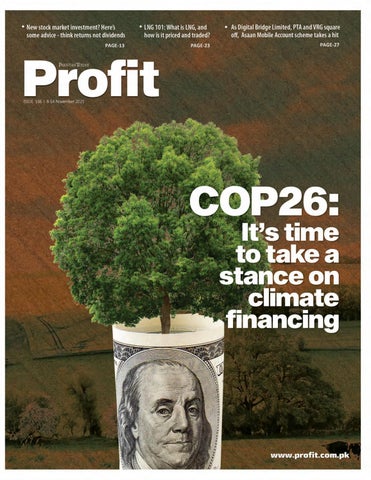
16 16 COP26 - It’s time to take a stance on climate financing 23 LNG 101: What is LNG, and how is it priced and traded? 25 Customer experience - chai, culture, and happy customers S. M. Talib Rizvi
13
33
27
27 As Digital Bridge Limited, PTA and VRG square off, Asaan Mobile Account scheme takes a hit 30 Lessons from AdvertisingWeek New York for women’s sports in Pakistan
Profit
33 Green Earth Pakistan takes on gargantuan recycling project
Publishing Editor: Babar Nizami l Joint Editor: Yousaf Nizami l Assistant Editor Abdullah Niazi Reporters: Ariba Shahid l Babar Khan Javed l Taimoor Hassan l Meiryum Ali l Shahab Omer Chief of Staff & Product Manager: Muhammad Faran Bukhari Regional Heads of Marketing: Muddasir Alam (Khi) l Zulfiqar Butt (Lhr) l Malik Israr (Isl) Layout: Ahmad Salahuddin l Photographers: Zubair Mehfooz & Imran Gillani l Business, Economic & Financial news by 'Pakistan Today' Contact: profit@pakistantoday.com.pk
Readers Say Final nail in the coffin of @ImranKhanPTI @PakPMO on the shadowy appointment in @investinpak. The news of "unprecedented relief package & giving of hundreds of jobs" gives the impression that the government is trying to hang onto some last straw. Apropos: Sons, bribes, perks, and jobs – the murky world of corporate lobbying in Pakistan @Shahbaz_IQ, Twitter You gotta be kidding me Abdullah Yusuf's wife? Surprised but not so surprised. Funny how the Profit has printed the portrait of Azfar Ahasan. That was 2019, perhaps the age of innocence. Now all of them would have rebranded themselves. Middlemen, influencers, lobbyists, and more. There are no rules of the game. They operate in the shadows. There are such middlemen in each and every union council subdivision. There are people who spend most of their time creating and extending a circle of "chaploosi." Apropos: Sons, bribes, perks, and jobs – the murky world of corporate lobbying in Pakistan @motasim, Twitter Pakistan is like Gotham city, beyond recovery, no hope. Mafia supporting Mafia. I have experienced people who live in either black or white never flourish. People who recognize, live and accept grey areas prosper and rule. All they have to do is relinquish integrity, values, and justice. Apropos: Sons, bribes, perks, and jobs – the murky world of corporate lobbying in Pakistan @samujtaba, Twitter Awesome article! The author has the potential of being the Tom Clancy of Pakistan’s Financial world. Apropos: What makes NAB interested in SadaPay? Syed Faizan Naqvi, Website
facebook.com/Profitpk twitter.com/Profitpk linkedin.com/showcase/13251020 profit.com.pk profit@pakistantoday.com.pk
HOW TO CONTACT
8
Seems like another statement that is full grandstanding. It is clearly very overambitious, unreasonable and unrealistic. Officials always set grand targets to sound impressive or serious or dedicated, but the end result is always chaos and these targets are never met. This is one of the main reasons Pakistan is lagging behind - constantly setting ridiculous targets we can never meet. The people in positions talk without keeping in mind the ground realities. It took decades to reach this current level of vehicle production, then how is it possible to achieve production of about 9 million vehicles in the next 5 years? Think about it sir. Apropos: Pakistan to enhance automobile production to 1m units: Ambassador Haque Javaid Noshai, Website Elon Musk’s personal shares in electric car company Tesla were worth more this week than the
entire market capitalization of ExxonMobil (traditional oil and gas); this is something to think about in terms of where things are headed. Pakistan needs to stay in touch with global trends and also check it’s emissions reduction performance due to global warming and pollution. Refineries in Pakistan which operate mostly on imported crude also deal with traders hence the suggestion that Mr Farooq Rahmatullah is biased in favour of traders is ludicrous. Apropos: PRL, NRL & BYCO refute allegation of high carbon footprint, rally against proposed shutdown Taimur Khan, Website I hope the ambassador only wants production to increase for export purposes only because the domestic infrastructure is struggling to cope with the existing vehicles running on the road. This is especially so in the case of Karachi where the roads are in an extremely dilapidated state. Although it is proven that an efficient public transport network should always be preferred over private vehicles. However, in Pakistan, public transport is not up-to the mark. Apropos: Pakistan to enhance automobile production to 1m units: Ambassador Haque Faisal Malik, Website Get this man a kool-aid and a towel. In-depth and hard hitting truth that is not meant to be anti-growth but rather eye-opening. Read between the lines, people. If we can’t be brutally honest and critical of ourselves, then we’re helping bubbles form where we need substance and transparency. Apropos: No, TAG isn’t worth $100mn. And here is why it might never be Anonymous, Website Other than the specific comment above, overall this article has correctly highlighted the problem currently being faced within the IT sector of Pakistan. Obviously there is no clear solution for now. More and more IT companies are joining this ratrace and are offering higher salaries to fulfill their resource needs. With the demand exceeding supply, this is bound to happen and it will be interesting to see when/where does this trend end. Though this is not the core topic of this article but want to mention that the salary range specified for Fresh Graduates is incorrect irrespective of the source from where this has been obtained. Graduates from good universities working in reputed software houses/start-ups are earning more than twice of what has been mentioned here. I would assume that others would still be earning at least far more than the 40k – 50k figure quoted here. Apropos: As Pakistan’s IT sector booms, software companies and startups lock horns over tech talent Jawad Husain, Website
COMMENTS
IN BRIEF Petrol prices rose once again, this time by Rs8.03 reaching an all time high of Rs145.82 per litre. It is another rise among a continuously hiking trajectory, as other parts of the economy are also affected by inflation rising by the day.
Azfar Ahsan, the founder of Pakistan’s first dedicated corporate lobbying firm, has been picked to head the Board of Investment as its Chairman with the status of minister of state. Mr Ahsan has decades of experience organizing conferences and is famous for his vast network of political, corporate, and military officials.
The Federal Board of Revenue (FBR) is set to launch a Single Sales Tax Portal during this month in order to facilitate taxpayers and ensure ease of doing business (EoDB) through automation, digitisation, and minimisation of human interaction with taxpayers.
Rs 120 billion:
Prime Minister Imran Khan on Wednesday addressed the nation and announced “the country’s biggest ever” subsidy package worth Rs120 billion, providing 30 percent discount on ghee, flour and pulses to support 130 million people for ebbing away the impact of inflation from them.
In accordance with recommendations from the NCOC, Pakistan will implement revised inbound air travel rules starting November 10. The NCOC statement further noted that vaccination for inbound travel to Pakistan was being enforced.
The government’s efforts to bring down sugar prices have failed to produce any results so far, as the price of sugar has been jacked up in various parts of the country. The ex-mill price of the essential commodity has gone up Rs9 in Sindh after which its price has soared to Rs136 per kilogram now. In two weeks, the ex-mill price of sugar has gone up by Rs44 per kg.
$17.2 billion:
Foreign exchange reserves held by the State Bank of Pakistan (SBP) rose 0.3 per cent on a weekly basis up by $53 million to $17,199.6 million as of October 29.
9
Is Queen Elizabeth moving to Pakistan? this week in Pakistan’s business and economics twitterverse
A
long thread by Miftah Ismail is what we start with this week, but things get a little better and lighter (as light as anything in Profit can get) as we move on to how the government is consistently gaslighting us, the emergence of MMT bros, and the possibility of Queen Elizabeth moving to Pakistan because of the low petrol prices. Ariba Shahid brings you all this and more in this week’s social media roundup.
Cheap Chanel
Do better
Hammad, stop embarrassing yourself. You’re smart. We expect better. That said, sharing articles like this is an incredibly ton-deaf thing to do. We know you went to Aitchison College, but that really is not a very good excuse when you are a federal minister. Besides, for your own good, don’t do it because Shahzeb Khanzada will be smelling blood again, and this time it will look even worse if you try the “I’ll have a word with your manager” technique.
Who said Chanel is expensive? Pakistani markets show its dirt cheap.
Aren’t you the PM?
I think this is one of those moments where the PM says his wife reminds him that he is the PM.
This tweet goes here just to show how my social media roundup is the Sind Club of social media roundups. For those that don’t get the reference, you’re missing out on some quality drama from this article: Sons, bribes, perks, and jobs – the murky world of corporate lobbying in Pakistan
10
Government gaslighting
LNG and NAB
After chikonimcs, we have kaddunomics which is an apt name for our inflation management. Also who are we to tell the government what to do but guys at least STOP GASLIGHTING US.
Lizzy cuts back
When it comes to economic decisions, Pakistanis have a way of making them political. People like Miftah Ismail and Shahid Khaqan Abassi have had their fair share of issues with the NAB over LNG related issues. When they say inflation is a global phenomenon, they mean it. Just look at the Queen. Of course, maybe if the Queen lived in Pakistan she would go around in a car instead. Remember, as the Prime Minister keeps reminding us, the petrol prices here are still lower than in the rest of the world. Elizabeth moving would also make for one spicy season of The Crown.
MMT bros
I absolutely love hearing MMT bros go on about MMT because it’s a buzzword for them. Understand the concept bro. And if there is one thing we will always do, it will be to fight people that think they have all the answers - particularly the different brands of finance ‘bros’ out there in the world.
{Editor’s note: As has been pointed out by this publication in previous articles, nobody wants to be involved with the accountability bureau. It is a bloated, vain, arrogant, and deeply misguided institution that is hurting Pakistan on countless fronts and giving grief to innocent people. Their attention is something you wouldn’t wish upon your worst enemy.}
Welcome to the bird app
We see Ghias Khan has finally joined the twitter bandwagon. We wonder if he’s just going to tweet work or will he be a troll sometime like me? Take some advice from a seasoned tweeter, you get in more fights if you work tweet but it’s far more fun to be a trol.
SOCIAL MEDIA ROUNDUP
New to stock market investment?
Here’s some advice - think returns not dividends You can invest in companies that offer steady and regular dividends, or you can understand the ratios that will help you make more profitable decisions By Ariba Shahid
A
few days ago, a reader suggested we come up with a list showing companies that give out the most dividends as a guide to explain what companies are the best to invest in. However, merely getting some dividends should not be your end goal if you are investing in the Pakistan Stock Exchange (PSX). The goal should be to maximize your returns. Buying stocks of companies that pay pretty nice and steady dividends is one of the best ways to invest on the stock market, especially if you’re not someone that wants to watch their portfolio a couple of times during the day. Before we get back to the list and explain the ratios we’re using and why one list is just not enough, let’s understand what dividend income really is.
What is dividend income?
B
asically when a corporation that is publicly listed generates profits, it could either reinvest, retain and save, or share the returns with shareholders in the form of dividend payments. Unlike interest, dividend changes from year to year and
STOCK MARKET
companies can choose just not to give any. For instance, let’s say a share is worth Rs 50 and the dividend for the year is announced as 5% that means the dividend you will get is Rs 2.5 per share. If you have 1000 shares, you will earn Rs 2500 in dividends. For some investors, earning dividend income is their favorite way to grow and invest. While this is a good investment strategy, one should know that dividends are never guaranteed and companies have the right to decide not to announce dividends or announce less than expected dividends. We will later come around to how this happens more in some sectors and less in others.
when we want to look at historical performance and the track record for a scrip, we look at trailing ratios as well,” says Fahad Rauf, Head of Research at Ismail Iqbal Securities. For the purpose of this story, we will be using ratios derived from Bloomberg. “The estimates for the forward ratios are from Bloomberg. For instance, in the case of the forward dividend yield, Bloomberg takes estimates from various analysts and releases estimates in accordance. They can be right or off depending on whether everything goes as per analyst expectations or whether there is an exogenous shock,” Rauf explains.
What ratios should I look at before investing for a dividend?
T
T
his article isn’t targeted towards those investors that know their ratios well and understand market dynamics. This is a basic finance 101 for those that are new to investing on the stock market and are doing their research. We will look at the forwards and trailing dividend yield, the forward and trailing Price Earnings Ratio, and the trailing Price to book ratio. “The market is forward looking so that is why we look at the forward ratios. However,
Dividend yield
o understand what a forward and trailing dividend yield is, we need to understand what exactly is meant by a dividend yield. Dividend yield is a financial ratio calculated in the form of a percentage that shows how much a company pays out to shareholders in the form of dividends each year relative to its stock price. Because this ratio is based on the share price, it changes as the price of the share rises or falls. This means that the dividend yield will rise when the price of the stock falls, and fall when the price of the stock rises. A forward dividend yield is calculated by estimating the year’s dividend as a percentage
13
For growth companies and sectors we look at the price earning multiple. The lower the better, keeping other things constant. However, one needs to factor and consider other ratios and the financial standing. For instance, look at the debt levels. Always look at the other factors Fahad Rauf, Head of Research at Ismail Iqbal Securities of the current stock price. By taking the most recent actual dividend payment and annualizing it, one can get an estimate of the expected dividend and use it to calculate the ratio by dividing the future dividend payments by a stock’s current share price. The opposite of a forward dividend yield is a trailing dividend yield that is calculated based on the company’s actual dividend payments made relative to its share price over the previous 12 months. This is best used when it is difficult to predict future dividend yields.
its regular price would be expected, moreover, as an investor you bought a dividend yielding share at a price lower than what you’d normally get. “Industries that have matured, such as fertilizer and power perform better when it comes to dividend yield. This is because these companies usually have little room to grow. They don’t need to hold on to their profits to reinvest them in expansion activities. They also tend to have stable cash flows. Therefore, they are more likely to announce dividends,”
Let’s take an example. Let’s say company ABC has a current share price of Rs 50 per share and paid Rs 2.5 in annual dividends. The dividend yield is 5%. Let’s say due to issues within the company there are some issues with performance which are reflected by a fall in the share price to Rs 25. The dividend yield will now go up to 10%. While the dividend yield did rise, the reason behind it was not one that would be encouraging to invest. Similarly, if the same share had fallen to Rs 25 due to short term political instability that has no impact on the performance of the company and instead is just due to an exogenous shock, one would suggest buying the stock as likelihood of the share returning to
explains Rauf. On the flip side, when we’re talking about dividend yields, on the other end of the ladder we have industries like cement which are continuously growing. “They have expansion cycles so you cannot exactly expect higher payouts. However, one can get some dividend and also make capital gains,” says Rauf.
14
Price to Earnings Ratio
T
he next ratio we’re going to look at is the price to earnings ratio that is used to measure the current share price of a company against the
earnings per share (EPS). The price to earning ratio is also called the price multiple of earnings multiples. It is calculated by dividing the market value per share by earnings per share. A reason why this ratio is used is because it can be used to determine the relative value of a company’s share against its past record, against companies in the same sector, or sector aggregates over time. A high price multiple could either mean that a company’s share is overvalued. It could
also mean that investors are expecting it to achieve high growth rates in the future. The PE ratio can only be calculated for companies that earn. Companies that have no earnings or are losing money do not have PE ratios because the denominator cannot be zero. The PE ratio is very important because it is most widely used to determine stock valuation. It is also used to determine whether a share is overvalued or undervalued in comparison to the sector or a benchmark or index. Basically, the ratio gives you an expectation of how much return you can potentially “earn” off every rupee invested. It can also be perceived as how much an investor is willing to pay per rupee of earnings. For
instance, if a company is currently trading at a PE multiple of 10x, that means that an investor is willing to pay Rs 10 for Rs 1 of current earnings. One would assume that it is better to invest in a company with a lower PE multiple because you’re paying less for every rupee of earnings that you will receive. However, one needs to know the reasons behind the PE to make an informed investment. Chances are the share could be undervalued and the market hasn’t priced it correct yet. But it is also possible that the company has a low PE because its business model is headed towards saturation.
“For growth companies and sectors we look at the price earning multiple. The lower the better, keeping other things constant. However, one needs to factor and consider other ratios and the financial standing. For instance, look at the debt levels. Always look at the other factors,” explains Rauf. The forward price earnings ratio uses the future earnings guidance. This is used to compare current earnings with future earnings. The trailing price to earnings ratio depends on past performance whereby the
current share price is divided by the total EPS for the past one year. One downside of using the PE multiple as your only metric while investing on the PSX is that you can’t assess many stocks and sectors using it such as tech and consumer goods. “This is because, in the case of tech, earnings aren’t the focus. The objective is to achieve scale and then translate it into earnings,” states Rauf.
high ratio means it is overvalued. The ratio is used for comparisons between companies in the same sector preferably companies with a similar asset and liabilities standing.
Tips for investors?
Price to book ratio
W
a company’s shares over its book value of equity. The book value of its equity means the value of the assets expressed in the statement of financial position. The book value is defined as the difference between the book value of assets and the book value of liabilities. This ratio is primarily used to understand whether a share is valued properly. So if a stock is trading in line with the book value of the company, it’s fairly valued. If it has a low P/B ratio then it is undervalued, a
This is not an article meant to offer specific advice on what to invest in. In fact, unless you are being paid for the service, there is no point in offering investment advice. At best the person makes money off the person advising’s intuition, and at worst the person asking for the advice bad mouths the other person after losing money. The purpose is to help new investors understand that merely getting some dividend shouldn’t be the end goal of your investment journey. The goal should be to maximize your returns. n
“I
n the case of banks, one should check out the price to book ratio,” says Rauf. The price to book ratio is the ratio of the market value of
hile these are definitely not all the ratios you need to be a finance whiz, these will get you going on your journey to investing. One tip, however, is to do your own research and consider all factors. Do not look at ratios as a standalone. Moreover, remember that all industries are different and so are their dynamics.
STOCK MARKET
16
COVER STORY
By Abdullah Niazi
C
oal is facing the firing squad, or that is at least what the 2021 United Nations Climate Change Conference, more popularly known as COP 26, would have you believe. As world leaders gathered at Glasgow to determine how the next three decades will go in terms of climate policy, one of the key points circulating within the media has been putting an end to coal and focusing on clean energy. Yet the ones calling for an end to coal, which is technically a just cause, are the leaders of developed countries that have for decades built their economies on the back of a persistent and dangerous use of coal. Now that their economies have developed, they expect countries that are still developing to give up on that opportunity. Pakistan is one of these countries, and it is in fact one of the countries that will possibly be ramping up its usage of coal in the near future. This is one example of the many inequalities that play out at conferences like COP 26. Countries in the first world have a large debt to pay in terms of the destruction they have caused to the earth’s natural environment. Their role in climate change has been disproportional, yet small states are the ones that are often expected to give innovative solutions and take on a lot of the heavy burden. This year has been a watershed moment for Pakistan in terms of its global role in climate action. The Pakistani delegation has been impressive in some ways, particularly with flashy programs like the Billion Tree
Tsunami. It has also impressed by being very vocal about the need for climate financing, calling out world leaders for once again delaying a decades old promise. However, what has been even more impressive is that the Pakistani delegation has not shied away from subverting the direction of the conversation and questioning the role of developed countries in fixing the problems that they have so overwhelmingly contributed towards. Unlike other countries in the region like India and Nepal, Pakistan has not committed to a carbon neutrality policy and has also maintained that while it will not introduce new imported coal projects, it will also not consider ending coal power as of yet. As the Pakistani delegation points out, it also needs to look after its own economy. As Malik Amin Aslam, the adviser to the prime minister on climate change, and the rest of the Pakistani delegation fight a topsy turvy battle in Glasgow, back home climate activists and corporations alike are also taking a stand. And while there remain serious differences in how to tackle the issue of climate change, one thing that is becoming clear is that it is a subject that both the government and some corporations want to take seriously. A fascinating instance was a recent radio panel discussion which was dominated by Ghias Khan, the President of Engro Corporation. Alongside azifa Butt, senior manager for the WWF, Durlabh Ashok of the WEF, and Yasir Hussain, who is the founder of the Green Pakistan Coalition, the panel tried to strike a balance between fighting the climate change menace while keeping a Pakistan first outlook and taking care of our economy.
It is not often that we find ourselves in a position where we must defend Pakistan or take the side of the government. To be clear, that is not what we are doing now. There are serious flaws in both how the government and local corporations are planning on addressing the very real and very dangerous climate issue, especially since Pakistan is the fifth most polluted country in the world. However, it is also worth looking at the fact that conferences like the COP 26 regularly ascribe blame and responsibility to smaller countries for not achieving targets that they themselves are only able to achieve because of the decades of development they managed to get on the back of dirty fuel. So if Pakistan and other countries take a stand and speak out over the slowness of the conference to release funding, which has once again been delayed, then we hope it will make the world stop, turn, and take a good long look at who is really to blame.
What is COP26?
I
f countries gathering under the banner of the UN to discuss the environment sounds familiar, it is because it has happened numerous times before. COP stands for ‘Conference of the Parties’ and the ongoing summit in Glasgow is the 26th such meeting of world leaders. The conference was born in Germany in 1995, which hosted COP1. Back then, the conference was arranged on an emergency basis as it was becoming very clear that climate change was a growing problem. The understanding among the scientific community that the world was warming up rapidly and headed towards
G20 leaders perform the traditional coin toss in front of the Trevi Fountain at the G20 summit in Rome before the COP26.
18
environmental and ecological disaster had already been around for decades, and this was the point where politicians and world leaders were finally taking it seriously. COP1 in 1995 was in essence talks between world leaders brokered by the UN. Taking place in a world freshly emerging out of the shadow of the cold war, it seemed that perhaps the end of a bipolar world would mean it would be easier to reach consensus over how to confront the problem. COP1 achieved the goal of reaching a general consensus that it was important to reach net-zero carbon emissions (an idea Pakistan has refused to pledge to this year). The next major development came in 1998, when COP3 took place in Japan. This resulted in the Kyoto Protocol, which legally bound countries to reduce emissions. However, the first cracks began to appear when the biggest emission producer in the world, the United States, refused to join the Kyoto protocol. Their reasoning was that developing countries like China were not bound to follow the protocol, despite the US and other developed nations having a far higher impact on the entire globe. After this, there was a stalemate, and all COPs after 9/11 received very little attention and climate change slid to the back of the global agenda. It was not until COP15 in 2009 that the world’s attention was on the COP meet again, which is also when world leaders promised to provide $100 billion in climate financing to developing countries (this will become very important in the context of COP26) by the year 2020. The next big step came at COP16 in Paris in 2015, which is when major world leaders bound themselves to the Paris Climate Agreement. That was until US President Donald Trump pulled the US out of the agreement, once again leaving the biggest polluter in the world free of any consequence or responsibility. However, there was extra attention on COP26 because incumbent US President Biden reentered the Paris Climate Agreement and promised sweeping changes at COP26. The world was also watching because 2020 has passed and the promised $100 billion have still not been made available and the financing has once again been delayed. As the world watches, COP26 has become a pivotal moment, and this time it seems like developing countries including Pakistan have come with a purpose, and their voices are being heard.
The threat
“T
hrowing coins in the Trevi Fountain is not going to wish climate change away,” says Malik Amin Aslam in an inter-
“First world countries built themselves on the back of dirty fuels and now it is time for them to pick up their slack. We must think of this from a local perspective as well and consider things like our balance of payments” Ghias Khan, President of Engro Corporation
view given to The Third Pole. It is one of the many statements in which Aslam has shown grit and shown that Pakistan is unhappy with climate financing. The Pakistani delegation to COP 26 has also shown resilience in terms of sticking to its guns and insisting it will pave its own path instead of blindly making pledges it will then never be able to meet. “In Pakistan, we don’t believe in the net-zero concept at the moment. We believe in the concept of a decisive decade in the next 10 years. If the world does not change in the next 10 years, then we’ll be too late for any net-zeros in 2050, 2060 or 2070. I believe that net-zero if it translates into concrete action in the next decade is good, but most of these announcements are just announcements.” Conferences like the COP 26 often get a lot of attention because big names are there. But as we saw with the now widely ridiculed picture of world leaders flipping coins for
good luck in dealing with climate change, much of it at times can be pomp and show. These conferences are well and good, and a lot of times they are an important meeting point to get the wheels turning on forming an international policy to tackle an international issue. According to the Center for Global Development, developed countries are responsible for 79% of historical carbon emissions. Yet studies have shown that residents in least developed countries have ten times more chances of being affected by these climate disasters than those in wealthy countries. Further, critical views have it that it would take over 100 years for lower income countries to attain the resiliency of developed countries. Unfortunately, the Global South is surrounded by a myriad of socio-economic and environmental factors limiting their fight against the climate crisis. “What has the developed world done
COVER STORY
Climate finance is central to all of it, because every transition requires finance. If finance cannot be directed towards this pathway, it just shows the big 20 polluters are not serious. Throwing coins in the Trevi Fountain is not going to wish climate change away Malik Amin Aslam, Adviser to the Prime Minister on Climate Change
in the last few decades? First world countries that are now considered to be developed were the ones that used coal power excessively and without restraint to get to the position that they are in currently. Now that the consequences of those decisions are knockin on their doors, they are looking towards the third world to go green and help everyone out,” says Engro President Ghias Khan in the earlier mentioned radio panel discussion. According to him, despite the history of how we got here, Pakistan does not have a choice in terms of what they have to do. “We are the fifth most polluted country in the world. Our future is at stake here and we can either sit around pointing fingers or do something about it.” One of the core issues has been the fact that the developed world faces an existential threat not because of their own actions, but because of the actions of first world countries throughout the 20th and 21st centuries. Currently, Pakistan has been slow to acknowledge in so many words the history of how the world has gotten to this state. What they have managed to do is state very clearly what Pakistan can do. “We’re trying to link up our financing streams with clear performance
20
indicators on nature. We have floated our first green bond which is US $500 million for renewable energy. We’ve done the national capital evaluation for our blue bonds, with mangroves, and we’re also looking at nature performance bonds which link up debt relaxation or reduction with nature performance,” says Malik Amin Aslam. “We have committed to no new imported coal projects. We have followed this up with clear action by shelving two projects of 2,400MW, which were already signed off. We have shifted to 3,700MW of hydropower. We have also decided to look for the best available technology which would be less polluting. We’ve worked on some options which have been used in South Africa, but we’re still searching for the best available technology. That’s what these forums should be able to provide.” This kind of clarity is rare which is why it is refreshing. The Pakistani delegation still needs to be stronger in its decisions, but this is perhaps the first time that a delegation has gone from Pakistan that is providing data, research, numbers, and is letting the world know what it can commit to and what the world must do to help countries like Paki-
stan on this journey. Pakistan has shown initiative by doing things like signing the US-led global methane pledge, which agrees to cut methane emissions by 30% by the end of this decade in an effort to tackle climate change. In addition to such moves, the Pakistani delegation has still struck a fine balance and managed to remain clear in its purpose while advocating for its own interests and the interests of others in the region. And the most important aspect of it is climate financing.
The importance of climate financing
N
one of this takes away from the fact that Pakistan, like other countries, has a major emissions issue, however, there is a difference between allocating emissions and allocating responsibility for those emissions. The developed world has a massive emissions debt that it must pay to the developing world for the damage it has caused them. One of the real sore points has been climate funding worth $100 billion that was promised more than a decade ago. The promise was made twelve years ago, at a United Nations climate summit in Copenhagen, rich nations made a significant pledge. The pledge to put in $100 billion a year towards less wealthy nations by 2020, to help them adapt to climate change and mitigate further rises in temperature. That promise was broken. Figures for 2020 are not yet in, and those who negotiated the pledge don’t agree on accounting methods, but a report last year for the UN1 concluded that “the only realistic scenarios” showed the $100-billion target was out of reach. “We are not there yet,” conceded UN secretary-general António Guterres. A recent article in Al Jazeera pointed out that developed countries must make good on their promise to provide $100bn per year, through to 2025, to support climate action in developing nations. This decade-long pledge
TEXTILES
must finally be honoured – both to deliver the intended effect on the ground, and also as a fundamental issue of trust. The amount is equivalent to just 0.1 percent of the combined annual gross domestic product (GDP) of advanced economies, or about 5 percent of the $2 trillion the world spends each year on military. Promises should be kept. “Secondly, this funding must recognise the need for us to adapt to the ongoing effects of climate change, as much as it supports efforts to mitigate it. The number of climate-related disasters within the Commonwealth, for instance, has doubled from 431 between 1980 and 1990, to 815 between 2010 and 2020. Over the last decade, these killed 48,000 people, affected 677 million and caused $197bn in damages. We are not dealing with a challenge for the future – the crisis is already here,” the article went on to say. This is an issue that has been discussed in Pakistan as well. “COP 26 has been planning on providing this financing for a while and it was supposed to come in 2020, and now it seems it will be delayed to 2023. There are major issues with this,” says Ghias Khan. “If I was in the Pakistani delegation, I would make my strategy very clear. What will the developed world do for our balance of payments? Yes we have to go environmentally friendly, but we can’t do it at the cost of raising our imports and decreasing our exports so that people suffer from inflation even more. That is the approach we must take. This funding is a point of unity among developing countries. “We’ve done our arithmetic on the emissions and believe that with the sequestration projects that we’re doing, Pakistan could well be on its way to levelling all its emissions,” says Malike Amin Aslam. “Our NDC shows that we’ve gone 9pc below our business-as-usual trajectory in 2020, and we can go 50pc below by 2030. It’s a very clear directional target, but we have made it conditional on getting US $100 billion of finance which can allow us to make a clean and just energy transition.” The problem, of course, is that not everyone agrees on what to do if this funding is finally released.
What are corporations and the govt doing?
“F
irst world countries built themselves on the back of dirty fuels and now it is time for them to pick up their slack,” says Ghias Khan. He makes a very ardent point. Engro’s approach, as an example of a corporation, has been impressive. They have taken on board experts, they plan to go net-zero
“Imagine the sea going up to the Punjab border in a hundred years. Right now inequality is already extending in Karachi the rest of the city will be below any proper living standards. We have to micromanage these things,” Yasir Hussain, founder of Green Coalition Pakistan soon, and they are going to be investing in net-zero businesses anytime they invest in a new business. As Khan explains, it is not just virtue signalling but they feel it is what they need to do to remain competitive. However, there must be a reward for their efforts and as part of repaying their emissions debt, the developed world must give some benefits and perks to corporations like Engro working in the third world. “Climate responsibility is at the heart of our policy. We want to be globally competitive and for that we have to be globally up to date,” he says. “We have looked at carbon footprint and our water usage and are trying to get to net zero. It is all about how we develop our future businesses, which are all going to be sustainable, and how we fix our old businesses and gently bring them into the fold of sustainability. It is not a choice for us anymore. There are sustainability metrics in place, we recently signed an agreement at the WEF where we were the only Pakistani company to sign these matrices and made a public pledge to this. “Imagine the sea going up to the Punjab border in a hundred years. Right now inequality is already extending in Karachi the rest of the city will be below any proper living standards. We have to micromanage these things,” says Yasir Hussain, the founder of Green Coalition Pakistan. For him, it is about striking the right balance between the present human cost and the cost we may have to pay in the future. “Labour unions and greens have come together on this in Germany for example, so why can we not do the same in Pakistan? The effort needs to be concentrated. If we are planning on producing plastics more efficiently, then we must plan on training the workers at those old plastic factories to learn how the new production methods work. All the people with stakes need to be on board.” “We are tracking ourselves. We are managing plastic waste as well and we are doing a lot of internal research,” says Ghias Khan. “The issue is not plastic but how we manage plastics and how we invest in the circular economy of plastics. Science has yet not come for a replacement of some plastics, but Pakistan is importing from bad ways to make it. We want to adopt new, good tech
that is sustainable for the environment. We will offset the rest with tree plantations.” “This transition is new to everyone, and it becomes a very complex subject because it has also become economically viable and thus that much more important for companies. However, we have not used our natural resources for decades. Remember, Thar Coal is going to produce at 11rs/kw. We have to save dollars and we cannot afford to waste it. We have to look at it from a local perspective as well. We need to be helped through this problem, because the developed countries need to realise this and provide market access, tech transfer, and cheap financing, including that $100 billion.” This is one place where the government has not shied away either. They do feel that while it is a threat that must be addressed immediately, before they get into any kind of pledges, they need to keep a Pakistan first mindset. “We’re not talking about climate change in a silo, we’re shifting the direction of our mainstream development towards being climate-friendly. That is what really needs to happen all across the world. Pakistan is still responsible for less than 1pc of global emissions – even if we closed down everything in Pakistan, it wouldn’t matter for the world. What does matter is that a country like Pakistan is paving the way towards climate-friendly development, based on nature and based on clean energy,” says Malik Amin Aslam. “The leaders’ summit to me was a disappointment. Of the big five, two didn’t turn up, and the third came up with a joke of a 2070 announcement. The remaining two have been trying, but I don’t think they’ve reached the mark,” he added. “The big disappointment is US $100 billion [in climate financing for developing countries] which has been pushed now to 2023. It’s a decade-old promise – if they cannot deliver that, it’s meaningless to expect delivering a very ambitious climate agenda.” “We’re still hoping for the best, not for Pakistan but for the world. Climate finance is central to all of it, because every transition requires finance. If finance cannot be directed towards this pathway, it just shows the big 20 polluters are not serious. Throwing coins in the Trevi Fountain is not going to wish climate change away.” n
COVER STORY
LNG 101:
What is LNG, and how is it priced and traded?
In the first part of Profit’s LNG classes, we explain the basics of what LNG is and why it costs as much as it does
L
By Ariba Shahid
iquified Natural Gas (LNG). Discourse around the supply and provision of LNG in the country elicits shudders and headaches, and why would it not? Why we need LNG, why we import it, how we import it, and all of the issues faced in the process are controversial because of differing political stances. It does not help that LNG is a complex issue to understand, and it helps even less that most conversations surrounding it are convoluted and make an already complex issue even more difficult to understand. In an attempt to understand and explain LNG, its nature, history, and current role in our energy sector, this will be the first in a series of Profit articles on LNG. The questions surrounding LNG are plenty and their answers are often tedious, which is why it is perhaps better to break the topic down rather
ENERGY
than try to understand it in one fell swoop. We are not claiming here that LNG is rocket science, but because of the numerous bad takes by the countless dime-a-dozen pundits talking their heads off on cable television, it is important to clear the air about LNG. This initial article will explain what LNG is, how it is obtained, how it is priced, traded, and eventually used. After this initial functional understanding, the other articles in this series will expand on issues such as how the international LNG market is structured and functions, Pakistan’s LNG policy, and the current role of LNG in the country’s on-going energy crisis.
What is LNG?
L
NG is what we get when natural gas is cooled to -162 degrees Celsius. It is a clean, colorless, and non-toxic liquid. The cooling process results in the volume of natural gas shrinking 600 times, which makes it easier to transport and store. In
addition, once liquefied, LNG does not ignite. Very simply put, there is not much beyond the product than its name - it is natural gas in liquid form. If gas was not cooled and converted into a liquid, transporting it would be a nightmare. When in liquid form, it can more easily be carried across oceans. Now, the problem is that LNG in and of itself is quite useless. It cannot be used as fuel like petrol and therefore LNG is only around for the transportation process. Once it arrives at its destination, it needs to be regasified in a controlled environment so that no natural gas is wasted. This process is undertaken at large import terminals, called regasification terminals, where LNG carriers which are basically tanker ships discharge their LNG cargo. The LNG is transferred to these terminals where it is stored in tanks and then regasified prior to being transferred through pipelines in the form of natural gas. Regasification terminals could either be onshore where the LNG is regasified at the
23
import terminal. A floating storage and regasification unit is a floating terminal with storage and regasification facilities. FSRUs are used primarily because building onshore regasification terminals require massive investment and a consistent supply of LNG. In the case of FSRUs, a country/ company can charter the vessels and pay operational expenses as opposed to incurring a capital expense. These regasification units are essentially large floating ships just off-shore that convert LNG into a gaseous state before it is then used as a hub to start the gas-supply. An FSRU is a special type of ship that is a vital component required while transiting and transferring Liquefied Natural Gas (LNG) through the oceanic channels. Ships carrying LNG carry them in a slushy form. These ships do not go to the port, and instead steer close to the FSRU, which stands stationary in the water, and basically just plug themselves into the FSRU. The FSRU is equipped with the facilities to conduct the heating and liquefaction process on the ship itself. The slush is thus transported from the travelling vessel to the FSRU, it is heated and then finally fed directly into the gas pipelines. To understand them better, we recommend you read Profit’s coverage of Engro’s Dry Docking Drama. LNG has many uses. It can be used in households for cooking, heating and generating electricity. Commercial uses include heating, generating electricity, manufacturing products which include paint, medicine, fertilizers, etc. and is also occasionally used to fuel commercial vehicles.
How is LNG priced?
L
ike all commodities, natural gas prices are a function of market supply and demand. Increase in supply means lower prices, a surge in demand means higher prices. This is basic high school economics. The amount of natural gas production, levels of natural gas in storage, volumes of natural gas imports and exports are supply side factors. Demand side factors include variations in winter and summer weather, level of economic growth, and the availability and prices of other fuels. The availability and prices of other fuels is important because they’re substitutes that can be used in place of LNG. Some large volume fuel consumers/users such as power plants, steel mills etc can switch between natural gas, coal, petroleum, based on the cost of fuel. When the cost of other fuels rises, using LNG seems like the economically feasible option. As a result, the demand for LNG might rise which could result in prices of LNG rising too. In fact, back during the Nawaz administration, it was decided that the country needed to begin importing natural gas as well. It allowed private sector companies to set up
24
Profit LNG Classes LNG 101 1. What is LNG? 2. Pricing 3. Trading contracts LNG 202 1. International LNG Market Overview 2. Long term versus short term/ spot contracts 3. Pakistan’s capacity LNG 303 1. Pakistan’s investment in LNG and LNG Policy 2. Explanation of QatarGas 3. An analysis of Pakistan’s LNG procurement LNG 404 1. Pakistan’s current energy crisis and LNG’s role 2. Cross subsidies in LNG 3. Comparison with south Asian countries 4. Govt vs opposition, NAB vs SKA and Hammad Azhar vs Shahzeb Khanzada LNG import terminals. That meant that the thermal power plants that could no longer run on domestic gas could now run on imported gas rather than imported oil. This change had the effect of both reducing Pakistan’s import bill (even LNG is cheaper than furnace oil) and reducing carbon emissions (burning gas emits less carbon dioxide than burning oil). It is however interesting to note that sometimes short term increases in demand or a fall in supply can cause huge jumps in the pricing of LNG, especially in winter. This is because the supply and infrastructure constraints aren’t as easy to overcome. Consumers can’t just switch fuels immediately. Therefore short term impacts are felt stronger.
Components of LNG Prices
P
akistan started importing LNG six years ago but the dependence on the fuel has increased drastically over the years. Only PSO and Pakistan LNG Limited are allowed to import LNG. The supply chain of imported LNG starts at Port Qasim. PSO has signed a contract with Qatar Gas, a state owned entity for 15 years at the rate of 13.35% of Brent Crude oil. LNG imported by PSO is regasified at the Engro Elengy Terminal Limited (EETL) at Port Qasim on the basis of a tolling tariff. We’ll explain this deal in detail later. PLL has short term contracts with Gunvor
and Shell. PLL is able to take advantage of spot rates. PLL had hired the PGP Consortium limited for regasification at Port Qasim. Regasified LNG (RLNG)’s price is determined in US$ and has eight components which include the Cost of supply to SSGC and SNGPL, T&D volume adjustment, LSA Management fee, retainage volume adjustment, terminal charges, PSO/PLL margin (2.5%), PSO/ PLL import costs, and RLNG price (DES).
Changing trends in LNG Contracts
O
ver the last two decades, the LNG contracts dynamic has vastly changed. In the past, long term contracts between exporters and importers were far more common than they are now. LNG markets have matured over the years. In the past, exporters engaged in long term contracts to finance their large investment. However, now with early long term contracts reaching culmination and with spare capacity, these suppliers that no longer need to worry about financing their investment have also entered into the short term and spot market. There is a greater move towards short term and spot markets than to signing new long term contracts. This could be considering the volatility associated with the commodity and of course the unprecedented events happening around the world. n
ENERGY
OPINION
S.M. Talib Rizvi
Customer experience - chai, culture, and happy customers A company striving for greatness has to look no further than the happiness of its customers
C
In Pakistan, the importance of certain values cannot be understated. Pakistan is a country where Eastern culture and religious values are prominent in all walks of life. Values of hospitality, taking care of each other, respect and honesty are some of the most revered values in Pakistan
orporations can become successful in a wide variety of ways. If we look at the tech industry, we see that giants such as Amazon, Apple and Microsoft have achieved success based on constantly innovating their products and ensuring that the user experience is optimised in every aspect. On the other hand, if we look at sportswear giant Nike, they have created a very strong culture where employees are encouraged to not only focus on their professional development through various trainings and programs, but also get the opportunity to attain a healthy lifestyle by getting access to various sports facilities such as basketball courts, gyms, physiotherapists and much more. This provides Nike with a content workforce that gets the opportunity to develop both physically and professionally and undoubtedly this has become one of the key reasons why Nike has become a household name all over the world. Despite there being different ways in which a company can rise to the top, one key factor is always present in all thriving companies. They always ensure that they focus on enhancing customer experience and ensuring that they have a customer centric approach whilst
S.M. Talib Rizvi is a senior professional banker with varied experience spanning over 25 years. He presently serves as the executive director for TAG COMMENT
developing their products or services. Customer experience or CX is your customers’ holistic perception of their experience with your business or brand. It is the result of every interaction a customer has with your business, from navigating the website to talking to customer service and receiving the product/service they bought from you. Everything you do impacts your customers’ perception and their decision to keep coming back or not—so a great customer experience is your key to success. CX is one of the most fundamental aspects that a product or a company needs to thrive and compete in this world of cutthroat competition. The statistics on this are clear - there has been a very obvious shift of power from the sellers to the customers. Who gave them this power? The World Wide Web. Customers now have a plethora of options to choose from. Also, customers have the ability and resources to educate and gain awareness before making purchases. Not long ago, people chose products and companies based on pricing only, but today the ease of doing business has become the main drivers for people when deciding between alternatives. This is why I believe that customer experience should be the core of any business. How can you gauge your customer service to determine what you’re doing well and where there’s room for improvement? Not long ago, when you would go to a bank to open your bank account or conduct any transaction, it was almost expected that you would be treated well by the employees and that they would make every possible effort to ensure that your experience was as smooth as possible. This included a warm welcome at the reception by a professional gentleman or a woman, answering all of your concerns convincingly, being courteous throughout the conversation, and, if in Pakistan, offering you the famous corporate ‘chai’ which has been a social catalyst for decades. If any of these elements were missing, the customer was likely to be unhappy with how they were treated and would leave with a very negative impression of the company. The service offered in terms of product and its
25
applicability was at the lowest of the pecking order when deciding between alternatives. The ‘chai’ held power when making a selection between different banks. When a person goes to a bank, they want to know what the bank can offer but they also want to know that they will be respected by the bank. However, as times change, people and their expectations evolve. Technology is embedded in every walk of life. Companies like Uber, Airbnb, Amazon, etc. have transformed customer expectations and have given a new meaning to customer experience and customer service. How were they able to do that? Technology, technology, and technology! Customer service has been shaped significantly by advancements in technology. These advancements in technology have raised the bar of consumer experience and now it is essential for companies to have well-integrated technology-based solutions to augment and complement customer experience. Particularly now, technology has supplanted the element of cultural values in CX. Nowadays, companies focus on using technology-based solutions to optimize the customer experience in terms of convenience, speed, and ease. This is mainly due to consumers becoming more tech-savvy and increasingly aware. Recently, consumers have started to rely on digital support more than ever. The physical touch has slowly dissipated and has been replaced by better, more efficient and easy digital solutions. The reason Uber and Airbnb were successful in acquiring a large customer base in such a short time wasn’t because of how they greeted their customers or because they were courteous enough but based entirely on how they transformed the lives of their consumers by using technology. Customers have slowly increased their expectations of service and have been on a trajectory of a gradual shift to contactless transactions. This has become the new normal. Digitization is accelerating and end users’ demands are changing due to a monumental shift towards a mobile-first economy. You can either ride with this wave of technology or slowly get left behind opposing this. Following market leaders, companies have now changed how they engage with customers and there has been a greater emphasis on developing and incorporating technology-driven solutions that are not only able to respond to consumers rapidly but also are capable of providing customers with a seamless experience. Looking specifically at FinTechs, we notice that there are countless examples of how CX has been revolutionized with the implementation of technology. Monzo is a UK-based FinTech that has made life easy for its users. What has substantially differentiated them from other FinTechs is their excellent customer service. They have
26
Particularly now, technology has supplanted the element of cultural values in CX. Nowadays, companies focus on using technology-based solutions to optimize the customer experience in terms of convenience, speed, and ease. This is mainly due to consumers becoming more tech-savvy and increasingly aware integrated customer feedback through the feature of Monzo Labs, where consumers are able to test new features of the app and provide feedback in terms of how the functionality can be improved. Monzo is therefore able to incorporate consumer feedback seamlessly into their final product and establish a strong relationship with consumers by showing that their input is valued by the company. Additionally, Monzo has focused on CX by making their app very easy to use and the concerns of consumers are responded to instantly and a transcript of the conversation between the customer support representative and the customer is also generated and provided to the customer for greater clarity. This has been possible due to the use of technology and tools such as AI and machine learning which are employed by several companies to enhance the CX. Globally, this has been done so successfully that now consumers do not need to physically meet customer support for any help, and customer support representatives can easily work from home and still assist consumers effectively. Such a revolution has taken away the element of physical touch in customer experience in these countries, but such a change is unlikely to occur here at home. In Pakistan, the importance of certain values cannot be understated. Pakistan is a country where Eastern culture and religious values are prominent in all walks of life. Values of hospitality, taking care of each other, respect and honesty are some of the most revered values in Pakistan. This is especially relevant for organizations which must consider incorporating these elements into their customer experience so that consumers can identify strongly with what the company is offering. Pakistanis have and will always take great pride in our values and their presence in customer service plays a significant role in shaping the perception of the company by consumers. Its absence will hurt any company that is trying to establish a strong relationship with its customers. The foundation of any company’s CX in Pakistan must incorporate the values that Pakistanis cherish dearly. On the other side of the coin, there remains no doubt that technology is increasingly
shaping the customer experience, particularly as consumers pivot towards wanting speed and convenience from their product. Consumers in Pakistan have now become self-aware. Mobile internet users have reached a total mass of approximately 100 million plus and the availability of the internet to the masses has educated the consumers on how superior products, technology, and ease of use are the real deal-breakers when deciding between alternatives. A company cannot hope to strengthen its relationships with customers without using technology-based solutions and as Pakistan transitions towards adopting digitalization, it is crucial that companies also develop more technology-based solutions to improve the experience that a customer gets. Therefore, in the context of our homeland, it is not possible to build your customer experience on the basis of either technology or cultural values alone, but rather a shake hand of the two is needed to provide a customer experience that is best suited for this country’s consumers. The human touch will open the door and provide leverage to initiate relationships with customers. However, to enhance and build upon this customer experience you need to focus on technology-based solutions that will take customer experience to the next level. A combination of the two will allow any company to not only get the benefits of technology in terms of speed and convenience but also establish equity in the minds of its customers through the incorporation of cultural considerations. It is therefore imperative that organizations in Pakistan focus on both of these elements together whilst building their customer experience. This is especially relevant for the financial industry, where FinTechs are on the rise and although they should aim to incorporate as much innovation from technology in their products as possible, they should ensure that their customer experience includes the presence of cultural values and a human touch. Ultimately, I believe that Maya Angelou sums up the importance of customer experience quite beautifully when she said “I’ve learned that people will forget what you said, people will forget what you did, but people will never forget how you made them feel.” n
COMMENT
As Digital Bridge Limited, PTA and VRG square off,
Asaan Mobile Account scheme takes a hit
DBL approached the court afraid that if the court did not intervene, the PTA was likely to destroy the prospects of DBL of having a successful business By Taimoor Hassan
T
he Sindh High Court on Wednesday dismissed a case filed by Digital Bridge (Pvt) Limited (DBL) against Pakistan Telecommunication Authority (PTA) which had been awaiting decision by the court since February this year. The recent judgment clears the way for Virtual Remittance Gateway (VRG) to move ahead with the commercial launch of Asaan Mobile Account (AMA) scheme of the State Bank of Pakistan (SBP) under its National Financial Inclusion Strategy (NFIS) to bank the unbanked. The case appears to be one of those old school moves in the business world of using courts to slow things down for a competitor from launching a scheme which can potentially
FINANCIAL TECHNOLOGY
benefit the economy at large. Digital Bridge Limited, allegedly backed by some serving and former executives of Pakistan’s telecom companies is another third-party service provider gunning to launch the AMA to bank the financially excluded. It’s competitor, Virtual Remittance Gateway, is ahead of DBL in terms of readiness for the launch of AMA and claims to have already crossed 1 million AMA accounts in it’s pilot phase. The final authorisation for the commercial launch has to come from the PTA in the form of a ‘commencement certificate’ granted to a company that has fulfilled all the prior conditions and VRG was on the verge of getting it that worried DBL. Before VRG could get their hands on the commencement certificate, in August last year, DBL approached the Sindh High Court and obtained a stay order against
PTA to stop it from granting the commencement certificate to VRG, citing that the PTA was giving preferential treatment to VRG for the launch of AMA under TPSP license and discriminating against DBL. There are insinuations of collusion and conspiracy, outright claims of harassment and high-handedness, playing victim by a party and between all that, the collateral damage is the scheme called Asaan Mobile Account scheme (AMA) which can be a phenomenal opportunity to give access to formal financial services to the underprivileged segments by allowing them to open transactional banking accounts over feature phones. The AMA dream of the SBP was mandated under infrastructure sharing where banks and telcos would share their infrastructure to achieve interoperability. Banking for the
27
underprivileged population would be possible in remote areas where 3G/4G and wi-fi access is restricted, through a system of USSD codes on non-feature phones. The current branchless banking agent network uses the USSD code system for banking on EasyPaisa and JazzCash using non-feature phones. This interoperability is going to be powered by a third-party service provider (TPSP) under a license from the PTA which will be authorised by the SBP. Both VRG and DBL are licensees at different stages of the 11-step process to a full-scale launch. VRG is simply far ahead in this process which DBL alleges VRG was favoured by PTA to achieve.
A delaying tactic at best
D
BL approached the court apparently with a fear that if the court did not intervene, the telecoms regulator PTA was likely to destroy the prospects of DBL of having a successful business by allowing VRG to move in first and capture the market. In it’s petition, DBL asserted that PTA was favouring VRG in the award of the TPSP license and DBL gets to lose on the market share. Under the requirement for the TPSP license, DBL asserts that it is the only TPSP with its own USSD (Unstructured Supplementary Service Data) platform, inspected and approved by the regulator in 2019. But despite being inspected and approved, the regulator was not issuing DBL the commencement certificate which was the final step before a TPSP licensed company can commence commercial operations. On the other hand, PTA had issued a letter in June 2020 regarding the ‘Readiness of Commercial Launch of AMA Scheme’, in which it had endorsed that VRG was ready for commercial launch. The aggrievement here was that under the TPSP license, a company is required to have its own USSD platform to qualify to provide TPSP services and DBL asserted that VRG did not have its own USSD platform and was entering into partnerships with telcos to use their USSD platforms for TPSP services. DBL perceived the letter as an approval from PTA to VRG to launch commercial operations when VRG had not yet fulfilled all the requirements, making DBL the wronged party in
While DBL insinuated that there was some sort of a collusion between PTA and VRG which was hurting DBL, it also asserted that VRG, at the same time was able to assert pressure and harass the telecoms regulator which was hindering PTA’s capacity to act partially, and the only way to stop the regulator from acting partially was through the oversight of the court the arrangement. If VRG had started commercial operations without having its own USSD platform, it would be with an unfair advantage given to VRG while DBL had to build its own platform. And because it thought it was being wronged, it straight out pleaded the court to stop VRG from undertaking any commercial activity, declare some of their agreements illegal, and take penal action against the company to the extent of cancelling VRG’s TPSP license if necessary. While DBL insinuated that there was some sort of a collusion between PTA and VRG which was hurting DBL, it also asserted that VRG, at the same time was able to assert pressure and harass the telecoms regulator which was hindering PTA’s capacity to act partially, and the only way to stop the regulator from acting partially was through the oversight of the court. The assertion is debatable because there is a history of antagonism of telcos with the TPSP regulations which earlier faced an inordinate delay allegedly because of the lobbying by the telcos. The initial memorandum between PTA and SBP to launch TPSP regulations was announced in 2012 and it took three years to finally announce TPSP regulations. Add on the fact that the PTA is a telecoms regulator and telcos have been around for decades while VRG is still a young company only a couple of years old. Telcos are likely to have more clout in PTA by virtue of being associated with the industry for a long time than VRG, and there are rumours in the market too that DBL was launched by telcos, which adds more weight to the fact that telcos have purpose towards dragging the launch of AMA. In fact, VRG has earlier alleged that PTA was favouring DBL and was delaying issuance of VRG’s commencement certificate for commercial operations.
To reiterate again, VRG claims to have crossed 1 million Asaan Mobile Accounts on its platform and it is still in the pilot phase and plans to add another 4 million accounts by the end of this year and 10 million more by the first quarter of next year 28
Both VRG and DBL were granted a TPSP license in 2018, which would eventually culminate in the commercial launch after fulfilling all requirements of the 11-step process, from submission of application for license to issuance of commencement certificate by PTA for commercial launch. VRG has thus far completed all steps, however the commencement certificate was delayed because of the court order. The court also said that VRG had, in fact, installed its own USSD channel and gave a successful demonstration to the State Bank of Pakistan and the finance minister. VRG further launched a pilot in September 2019 which was completed in January 2020 and court observed that records show that VRG fulfilled all the requirements for the issuance of commencement certificate and that the PTA several times inspected USSD channels installed by VRG and confirmed its satisfaction to the cellular mobile operators. The ‘Readiness of Commercial Launch of AMA Scheme’ letter was also hence sent to cellular mobile operators by the PTA to apprise them of the operational readiness of the scheme so that they could execute agreements with TPSP. In fact, the letter was not even received by VRG and was not at all tantamount to giving the final commencement certificate to VRG. An official application to request the commencement certificate was submitted to PTA by VRG nearly two months after the readiness letter was sent to telcos. VRG has already signed an agreement with Jazz, the biggest cellular services operator in Pakistan and others are also in the final phases of the conclusion of the agreement. On the DBL side, PTA said that Digital Bridge Limited counsel confirmed that they had not yet satisfied requirements for the commencement certificate and had not even filed an application for getting the certificate. In fact, DBL had even not submitted an application at the SBP for their authorisation (Step 10 in the flow chart), therefore it had wrongly asserted that their launch was being delayed by PTA. The argument also turns then, insinuating that the entire court case was simply a ma-
licious ploy by DBL to delay VRG’s commercial launch by blaming the regulator which argues it was acting impartially. The counsels of both VRG and DBL also argued in the court that because DBL was lacking on the requirements to fulfil for the commercial launch because of its own lethargy, it was now dragging the regulator and its competitor to court to delay the commercial launch of competitor just so that it does not get a head start in the market, and hence obtained a stay order from the court. To reiterate again, VRG claims to have crossed 1 million Asaan Mobile Accounts on its platform and it is still in the pilot phase and plans to add another 4 million accounts by the end of this year and 10 million more by the first quarter of next year. VRG is aggressive but DBL has not been able to keep up the pace, and in its desperation, it perhaps had no other way but to use delaying tactics like obtaining a stay order. What the regulator did affirm was that the commencement certificate will not be granted if the PTA finds any shortcomings at VRG’s ends. VRG counsel also affirmed that VRG will not commence operations until a commencement certificate was received from PTA. And even if VRG somehow did get the commencement certificate while flouting rules, and what goes on to prove as well that the case was filed to delay the launch of AMA, the aggrieved party has the right to appeal the regulator’s decision under the Telecom Act which governs the regulator. Section 7 of the Telecoms Act gives right to any person aggrieved by any decision or order of any officer of the PTA to appeal the decision with Pakistan Telecommunication Authority and the authority has shall decide the appeal in 30 days. Going to the court could have been avoided and the matter could have been resolved with the regulator. Even if PTA had issued commencement certificates to VRG and DBL had a cause to believe that PTA had gone over the top and overlooked rules in doing so, DBL could have simply appealed the decision with PTA under the Telecom Act. Even after the appeal if DBL was not satisfied with PTA’s ruling in respect of VRG’s certificate, it could reach out to court to seek respite against the appeal decision. Instead, DBL chose the more lengthy and arduous process of reaching out to courts first asking for a stay order, perhaps knowing that the stay would be lifted because the court in its judgment also said that the stay order could not be maintained because DBL failed to make a case that its grievances were unjustified with respect to restraining VRG from doing business. What it did for DBL was give it time. The stay order was obtained on August 18, 2020. The court, being a steward of justice and due
process, took its time to evaluate the case and eventually lifted the stay after over 14 months on November 3, 2021. That is 443 days for DBL to remove any deficiencies in its systems and comply with its obligations with regards to the process for obtaining commencement certificate for itself while VRG was embroiled in the case and could not move forward with anything because it had no other requirements to fulfil. All the while, the costs caused by the delay were also borne by the VRG sponsors.
The victim
I
t’s a win for DBL but an inglorious one. DBL lost the case but it succeeded in getting done what it had intended with the filing of the case; that is delaying VRG from launching AMA which can potentially be a game changer for the economy. It can still file the appeal with PTA if it has reservations since the commencement certificate has been granted to VRG, and can still choose to go to court just to frustrate the process and competitor. But what’s really going to be delayed is the Asaan Mobile Account scheme through which the underprivileged and the poor can gain access to formal financial services. Bare
access to a bank account can ease the bare basic function of transferring money from one bank account to another for those that have less means. Funds transfers from banks alone are still the best option cost-wise for transferring money than the traditional ways of transporting cash from one place to another and transferring money through branchless banking agents. AMA will have functionalities more than just funds transfers like mobile top-ups and payments of utility bills. With the launch of AMA being delayed, however, the underprivileged are being deprived of their right to less costly banking facilities which are currently restricted to cities only. It would have been a different case if users had not shown interest towards AMA but if VRG’s numbers are to be believed, 1 million plus AMA accounts in the pilot phase that have processed 11 million transactions worth over Rs6.2 billion turnover, show that the project holds promise which can eventually help with digitisation of economy, lead to introduction of new financial products for the low-income groups such as micro loans or micro insurance, encouraging economic development eventually. n
FINANCIAL TECHNOLOGY
Lessons from
AdvertisingWeek New York for women’s sports in Pakistan There is still a massive disparity in the amount of coverage female athletes receive in broadcast games, media, and sponsorship
I
f there is any silver lining to being a third-world nation or not having peak digital sophistication is that Pakistanis can watch how early adopters of a policy, law, idea, or technology interface with it and the indirect & direct ripple effects of that first-mover advantage. We can then choose to learn from the lessons documented by our relatively advanced counterparts and hope that we do not make the same mistakes or perhaps, account for the possibility that there are safeguards to prevent us from experiencing the worst outcomes of those inevitable mistakes. For instance, studying the entire Airbnb journey, we can inform our policy making around start-ups such as Roomph.pk, or by studying the aftermath of a tragedy, we can hope to uncover a framework on crisis communications. With such little investment towards R&D, both academic and corporate, we hope to learn from the nations that appear to be ahead of us. With the 2021 ICC T20 World Cup underway and the bidding process for the 2022-2025 PSL across the corner, along with the appointment of Tania Mallick as the new head of women’s cricket at the Pakistan Cricket Board (PCB), Profit sought to understand Everything standing between the PCB and a women’s PSL. The reasons for the absence of a women’s PSL was boiled down to a low supply of quality female athletes, particularly those that would not quit due to pressures created by their families and partners. Spillover reason applied to the poor incentives that would encourage families and partners to support their daughters and wives to remain in the game for the long haul. Having attended AdvertisingWeek
30
New York last month, in a bid to understand what the advertisers and agencies of Pakistan need to be wary of when they dabble in the metaverse, collegiate sports, eSports, advanced influencer marketing, DEI initiatives, and activities that boost ESG outcomes, we are crestfallen to report that even our relatively advanced counterparts struggle to make any real changes when it comes to women’s sports. During the panel, The Coverage Gap: A Step Toward Leveling Visibility and Viewership Disparity in Women’s Sports, speakers from The Female Quotient and from the DAZN Group shared research about the massive disparity in the amount of coverage female athletes receive in broadcast games, media, and sponsorship. The research found that even though the audiences and fans numbers were present, there is still much that needs to be done in order to move the needle on more equal representation in women’s sports. “We live in a world where nearly every men’s game for every major mainstream sport can be available at our fingertips in an instant, anytime, anywhere (usually primetime!) and with highlights posted within seconds,” said Shelley Zalis, the CEO of The Female Quotient. “The same is not true for women’s games, and this, rather than lack of fan interest, is one of the reasons why the coverage gap persists.” The research, which covered the entire world of sporting enthusiasts, found three key reasons why more people do not watch women’s sports games: they do not know enough about the athletes and teams, they don’t have as many opportunities to watch those games, and they are unaware of when or where to watch the games that are available. Data from MediaLogic from Pakistan itself lines up with this, with the disparity in the coverage given to women’s cricket
athletes, weak promotional investment around the key players and the team as a whole, and a small number of channels willing to air the matches. The 2021 ICC T20 World Cup is being aired by PTV Sports, Ten Sports, Daraz Live, and A Sports by ARY whereas at any given point in time in the past three years, no more than two channels were interested in air women’s cricketing events. Moreover, media executives told Profit that the weak ratings are a reflection of weak investments towards creating a celebrity status around the players and with weak match marketing. “The potential for women’s sports however is immense,” said Urooj Hussain, head of MediaVest at Brainchild Communications Pakistan. “The change in perception and interest for women’s cricket will not happen overnight though. The recipe for growing ratings and audience interest is a mix of sustained coverage overtime via news coverage, talk shows, interviews, and PR mileage to really put women’s cricket in the spotlight.” This gap is exacerbated by a lack of year-round storytelling for women’s sporting events compared to nonstop men’s sports and athletes. Data from The ViewLytics and Walee.pk shows that social conversation from Pakistani cricketing fans reflects a permanent buzz throughout the year surrounding male athletes and events, but the conversation around female athletes only spikes around select events, such as the ICC Women’s T20 World Cup. “News coverage of men’s sports includes both in-depth analyses relevant to the sport and human interest stories, such as male athletes’ charitable work in the community, which builds an emotional connection with the audience,” said Haiwen Lu, VP of global communications & social impact at the DAZN
Group. “Though female athletes often participate in the same amount of charity outside of their sport, for example, their contributions are rarely covered in sports media.” The study found that in the early 2000s, on-air commentary focused on positioning female athletes as mothers, wives, and girlfriends, rather than their technical ability within their sport, which was overcorrected in the past decade so much that the commentary is now in danger of becoming boring. “Data show that broadcasters consistently deliver commentary without the enthusiasm or vocal excitement prevalent in men’s sports,” said Zalis. “To compound the issue, exposure to quality media coverage of women’s sports is practically non-existent, appearing only around major events. The lack of engaging on-air commentary paired with the inconsistent quality of contextual storytelling of women’s sports broadcast and news coverage leaves little room to build or sustain an audience.”
Cricket Events Ratings Comparision (Live Matches Only) TG: All Individuals Pakistan Urban Period: 2017-2019 Channel: PTV Sports, Geo Super & Ten Sports
Possible solutions
“I
t was only after Samina Baig became the first Pakistani woman to climb Everest in 2013 that advertisers such as HBL began to pay attention to her, latching onto her own brand equity to siphon it towards themselves,” said Ali Rehman, founder of Allee, a luxury goods conglomerate which designs, manufactures, distributes, and sells jewelry. “Pakistani advertisers are focused on peddling commodities. Had they been in the brand building business, they would have been involved with personalities that reflect their core values from the grassroots level.” Rehman added that instead of sponsoring and supporting athletes during their preparation days, advertisers in Pakistan have always preferred to let someone else do the hard work and then attach themselves to the bandwagon. “Advertisers in Pakistan began to attach themselves to Olympians once there was sufficient attention towards them,” he said. “An advertisers unwillingness to involve themselves from the bottom up is a wasted opportunity in brand building. Retention is always cheaper than acquisition, loyalty is always cheaper than last-minute leeching, which - just by the way for so-called data-driven marketers - millennials can see right through.” The DAZN study found that in order to close the gap between fans who say they are interested in women’s sports and fans who are actually actively watching women’s sports, it’s imperative to invest in storytelling that increases visibility and builds dedicated interest in matchups, rivalries, fan stories, the profiles of the athletes themselves, and more – in equal, consistent volumes and with
the similar breadth and depth in which men’s sports are covered. “This, paired with quality and increased broadcast and media coverage – all working together to muster the time, enthusiasm and diligence women’s sports deserve,” said Zalis. “It’s way past the time when women’s sport should be the subject of this kind of unresolved discourse around inequity and imbalance.” Grassroots investments towards women’s sports year-round may also be pitched to advertisers and agencies as an excellent avenue from a brand equity perspective, with most CPG advertisers in Pakistan leaning their urban targeting towards women empowerment, the role they would play in elevating female athletes would pay dividends for the decades to come. “The top five largest advertisers in Pakistan should make reasonable investments
to grow women’s sports because women are usually their target customers and the visibility is long overdue,” said Fatima Hyder, the group chief strategy officer at Z2C Limited. “Women literally represent 50% of the sheer athleticism, unrivaled personalities, and inspiring stories of the country. Instead of dismissing and missing out on half the opportunity to captivate and delight fans around the country.” She added that female-oriented advertisers can uplift their target audience by placing strong, capable, fast, and empowering role models on a pedestal in order to make strong the new sexy and break stereotypes in a meaningful manner. “Brands must strive to reflect the diversity of their entire audience wherever possible, and for many brands, that means better and ever-increasing investment in women in sport as well as women’s sports. n
ADVERTISING
Green Earth Pakistan
takes on gargantuan recycling project It has taken decades to spread recycling awareness among businesses. There is still a long way to go
O
f all of the packaging that Tetra Pak produces globally, nearly 27% of it is recycled worldwide. Yet in Pakistan, Tetra Pak has a higher rate of recycling than the global rate, with nearly 41% of Tetra Pak products in Pakistan successfully recycled. What makes this statistic even more impressive is that this does not only include the materials that Tetra Pak collects and recycles from its own factories but also those products that either are in the homes of end users that buy Tetra Pak packaged products like milk and juice from their clients like Nestle, Shakarganj or FrieslandCampina. The aluminum in the packages is separated, and nearly 75% of the packaging is made from tree/sugarcane/cellulose materials that can be extracted and reused to make paper products. The rest of the plastic material from the packaging is compressed into planks that then go into plastic furniture and the like. How has Tetra Pak managed to pull this off? With the help of Green Earth Recycling plant, a massive recycling plant in the heart of Lahore with the capacity to recycle nearly 100 tonnes of material in a day. Founded and headed by Zaffar Bhatti, who is interestingly the son of the late Major Aziz Bhatti, Green Earth Recycling has been
RECYCLING
operating for decades. In this entire time, they have witnessed a complete indifference towards the concept of recycling transform into a care to do away with plastics from both large and small companies, as well as the general public.
Green beginnings
T
heir business story has been one of perseverance and forward thinking, and because of that they now have a first mover advantage on a business that is likely to have a continued rise in demand over the next few years. A major part of this story have been companies like Tetra Pak. Green Earth Recycling was started in the 1980s by Zaffar Bhatti. At the time that East and West Germany were reunifying, there was a great push from the Western side to modernise the country’s industry. There were already recycling plants in the West by then, and Bhatti was able to set up his recycling plant using machinery and technology that the Germans were getting rid of because they wanted a fresh start on this front. By collecting plastic waste and by signing with different organizations to take their plastic waste off their hands, Green Earth began to repurpose this plastic waste as green furniture. If you are not familiar with
what this is, the very specific green benches and tables you often see in parks are made out of this material. “The first thing we targeted were plastic bags. These were everywhere in the country, and with the technology that we have it was easy to compress them and turn them into planks that we could then use for our purposes,” says Zaffar Bhatti. “Plastics have not been around long enough for us to know what their life is and how long it takes for them to biodegrade. Some scientists used to say it takes a hundred years, but now we know that it could be as long as four or five hundred years as well.” “This nature of plastic is what has always been its greatest flaw and its greatest problem. Now, we are taking that flaw and turning it into its biggest advantage. Because plastic does not biodegrade or get damaged, the furniture we make lasts, holds its shape, and is a win-win situation.” Green Earth Recycling’s business model is based on converting plastic waste into useful “recycled plastic furniture” giving the plastic a second life, through a successful combination of material and technology. The company’s sustainably made furniture is resistant to natural damage and helps save trees while reducing solid plastic waste. The concept is to create innovative sustainable materials that reduce the negative
33
impact of plastics on the environment and drive down dependence on natural resources such as wood. Initially, however, there was very little understanding of what this company was doing. People did not completely understand the need to recycle and trash heaps seemed a distant problem. “There were still some companies that knew this was a worthwhile service we were providing. Take Tetra Pak, we have only started doing larger scale projects with them since around 2013, but we have been working with them since as far back as 1995. Back then Germany was also outsourcing its plastic waste to us,” says Bhatti. “However, the entire concept was for us to make sure that even if we got a plastic that was difficult to recycle, we would still take it on. If we did not have the technology to deal with a plastic product, then we would design and produce solutions tailored for the companies that came to us.” “We try to think of ourselves as a multifaceted recycling programme, not just a factory that has some machines. If we can’t recycle, we will provide a management solution for it. There was very little concept of this a few years ago, but companies like Tetra Pak are conscientious and now many large companies are also trying to cut back on their carbon footprint and so come to us. Today, Green Earth has many major clients across Pakistan, including companies like Unilever. They are often booked for four or five months and there is often a long waiting list to get in on the service. However, this was not always the case. “The most challenging part of the equation has been raising awareness. There is such a dire lack of awareness about recycling. It has gotten better recently but it has been a long road getting here. Campaigns from corporations,
34
from us, and from the government have all played a part in this,” explains Bhatti.
Challenges and future plans
T
he solutions that Green Earth offers are elegant and they work, which is why they are getting work as well. There are advantages to being in the business before anyone else, most of all the fact that everyone comes to you. WASA is among the recent clients of Green Earth, and that is despite the fact that they are a government agency and do not normally work without tenders and owning some stake in the company. But since no one else is doing this work at such a large scale, they have no other option. “We only have very small competitors, and some of them were actually trained by us. When we set up, it was an investment of around 8-9 crores, and if someone wants to do it now then they will have to spend around 12-15 crores just on setting up the machinery, not counting the infrastructure and area. So it is expensive to set up, and we already have a reputation that makes it difficult to break into the business,” says Bhatti. “However we want more players out there because there is more than enough room for it. Many players can make money here and in the larger scheme of things we will be better off.” “Daily capacity of the recycling plant is 70 tons, while so far only 50 tons of the recyclable waste material is collected from streets,” he said, adding that almost 60-65 percent of it was collected from Punjab. The pulp, obtained after the recycling process, in finished and semi-finished forms was being supplied to top paper and paper-board pro-
ducers of the country. “The demand for these sheets is so high that we have advance booking agreements for it for the next four months. However, due to the limited collection of the Tetra Pak cartons waste, the demand could not be met,” Bhatti explained. “Tetra Pak Pakistan and GER have worked hard to achieve this target as the recycling at the plant was started with almost 5 tons a day, which has now reached 50 tons a day. This means now substantial quantities of recyclable Tetra Pak cartons are being collected from the streets of the country and recycled; however, still a huge quantity of waste is not being lifted from the street for which more hard work is required.” This seems to be a sore point for Green Earth - they have enough capacity to do even more than what they are right now, but there is not nearly enough available collecting resources. The reason Tetra Pak has a 41% rate of recycling is because the company works in collaboration with Green Earth to get as much material to the recycling plants as possible. If there was a more concentrated effort from the government, things would have been significantly easier for them. “Things take time, admittedly, but collection is our biggest concern. Transport costs from everywhere else are so high that it seems an impossible task, but right now the government in Sindh is paying Rs7 crore a month to a contractor to simply pick and dump trash with no attention to recycling, which is such a waste of resource,” says Bhatti. “Awareness is so important, even last time when the Turkish companies were operating in Lahore, they were interested in how much they could collect to maximise profits rather than collecting and sorting so that things could improve in the bigger picture.” n
RECYCLING