CONTENTS
10
16
10 Avoidance or evasion - this week in Pakistan’s business and economics twitterverse 13 What’s going with Naya Nazimbad?
14
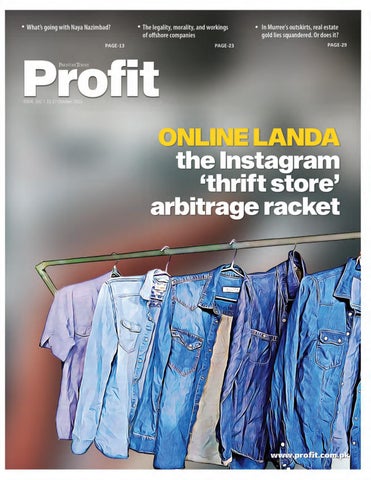
14 With new competitors closing in on the Big Three, capex spending in auto industry surges 16 Online landa - the Instagram ‘thrift store’ arbitrage racket 23 The legality, morality, and workings of offshore companies
28
14
29
26 After nearly a century of success, Mahmood Group embarks on a retail dream 27 As covid seems to slow down, global oil demand begins to climb upwards 29 In Murree's outskirts, real estate gold lies squandered. Or does it?
Profit
32 US-based NRD Capital set to open office in Pakistan eying investments in startups
Executive Editor: Babar Nizami l Managing Editor: Farooq Tirmizi l Joint Editor: Yousaf Nizami Reporters: Ariba Shahid l Babar Khan Javed l Taimoor Hassan Abdullah Niazi l Meiryum Ali l Shahab Omer Chief of Staff & Product Manager: Muhammad Faran Bukhari Regional Heads of Marketing: Muddasir Alam (Khi) l Zulfiqar Butt (Lhr) l Mudassir Iqbal (Isl) Layout: Ahmad Salahuddin l Photographers: Zubair Mehfooz & Imran Gillani l Business, Economic & Financial news by 'Pakistan Today' Contact: profit@pakistantoday.com.pk
Readers Say If Pakistan has any small hope of competing, then they should really increase the quality of the raw products they use and change their techniques to make the final product better. There has to be more of a focus on maintaining standards from the textile industry. Currently, the local industry uses rubbish quality cotton to make t-shirts because they are more focused on exporting high quality cotton to make a quick buck rather than investing in it themselves. Apropos: Bangladeshi export leftovers are wreaking havoc on Pakistan’s fashion retail industry Muhammad Muneeb, Facebook Our exports are not competitive with our regional competitors due to price issues. High electric power prices and low product quality are the main issues that result in our exports being unable to compete in international markets. Apropos: Bangladeshi export leftovers are wreaking havoc on Pakistan’s fashion retail industry Shahid Khan, Facebook The local industry has done absolutely nothing to bring innovation to the textile market in Pakistan. Absolutely nothing at all. All of these mill owners simply have generational wealth and enough properties and money that any time they are in a fix they sell something off and inject money to fix things. They think they are very high and mighty but they do not know the first thing about textiles and are simply living off the inertia of previous generations. Apropos: Bangladeshi export leftovers are wreaking havoc on Pakistan’s fashion retail industry Arqam Khan, Facebook What have your local retailers done over the past 40 years?? Just take a look at the pathetic Service and Bata. Apropos: Bangladeshi export leftovers are wreaking havoc on Pakistan’s fashion retail industry Saad A Khan, Facebook
facebook.com/Profitpk twitter.com/Profitpk linkedin.com/showcase/13251020 profit.com.pk profit@pakistantoday.com.pk
HOW TO CONTACT
8
The reason is that your own market is pathetic, and Bangladesh is sweeping the floor with you. Bangladesh, whose currency the ‘takka’ used to be an insult now has a currency with greater value and respect than the Pakistani rupee. In Pakistan, even if you give the industry incentives, they simply raise prices instead of actually developing their industry and investing in better practices - the result is the same quality at higher prices. Of course people are going to find other ways when they are so blatantly being shortchanged. Apropos: Bangladeshi export leftovers are wreaking havoc on Pakistan’s fashion retail industry Sanaan Umar Khan, Facebook
Our economic conditions do not allow us free float of exchange rate. Managed Float of exchange rate suits us. In free float, market forces freely determine the exchange rate without intervention of government / regulators. In the managed float system, market forces are allowed to determine the exchange rate but when the need arises the government/regulators intervene to stabilise the exchange rate. Apropos: Breaking the habit: will the government let the rupee go? Irfan Mir, Facebook This is a ridiculous approach. Pakistan is going to turn into the next Zimbabwe or Venezuela if the market is allowed to determine the exchange rate for the rupee. The rupee is going to become worthless instantly if it is allowed to fall. Apropos: Breaking the habit: will the government let the rupee go? Mustafa Abbasi, Facebook This is incredibly stupid propoganda. Half of what is being said does not even make sense. If remittances are increasing, loans are at an all time high. Then why is the rupee falling the way that it is? The devaluation makes no sense and you are simply trying to go to all lengths to prove PTI right. Apropos: Breaking the habit: will the government let the rupee go? Irfan Qaiser, Facebook The current economic situation is not about letting the entire burden fall onto the common people, it is rather about cutting down on the massive expenditure of this very bloated government structure. Expenditures are the highest ever in the history of Pakistan right now. The loans that this government is taking to meet these expenditures are also the highest that there have ever been in the history of Pakistan. So what is the point of this government and its resolve if they are on not just the same track as previous governments of taking loans and letting the rupee fall in value, but are in fact making it worse with the volumes in which they are doing this? Apropos: Breaking the habit: will the government let the rupee go? Umer Sheikh, Facebook Let the exchange rate settle naturally. Imports and exports will take care of themselves. Country will grow too once the real prices set in. The same formula has worked for Malaysia, India, and many other countries not just in the region but all over the world. The George Soros example is a bad one because he made $1 billion because the Bank of England was targeting a managed exchange rate. The Bank of England had to float the currency to cut the losses. Apropos: Breaking the habit: will the government let the rupee go? Sohail Ahmad Rana, Facebook
COMMENTS
IN BRIEF The central government’s total debt increased by 11.5 per cent in August this year from August 2020 while the external debt in rupees increased by 8pc in the first two months of the current financial year (2MFY22). External debts also increased significantly by Rs1.3 trillion in a year’s time mainly on account of appreciation of US dollar against local currency.
“Panama, Paradise & now Pandora papers have confirmed 1000s of offshore companies used for money laundering of looted wealth. The 700 linked to Pakistan must be investigated for illegality & source of money. Plundered money must be brought back. But what about these tax havens?” Dr Arif Alvi, President of Pakistan
$15 million:
Finance Minister Shaukat Tarin revealed yesterday that at least $15 million cash was going into Afghanistan from Pakistan on a daily basis. While appearing on a private TV channel, Tarin explained how such leakages were causing dollar shortages in the market and contributing to the depreciation of the rupee. Pakistan’s rupee reached a fresh low against the US dollar, closing near the 171 level in the interbank market on Wednesday. The relentless surge of the rupee has left the government sweating as it decides whether it will let the currency fall or intervene to try and stop it from getting completely out of hand. A high-level ministerial committee is set to formulate recommendations for the removal of restrictions on construction of high-rise buildings in the country on the directions of Prime Minister Imran Khan.
The SHC has invited the SECP, the finance ministry and the SBP to come up with comments and suggestions as to how cryptocurrency can be allowed and regulated in Pakistan. Since the SBP and SECP were not allowing cryptocurrency business transactions, this mode of trade is completely underground.
$5 billion:
Highlighting the positive outcome of the “Make-in-Pakistan” policy, Adviser to Prime Minister on Commerce and Investment Abdul Razak Dawood announced that investment worth $5 billion is in the pipeline for the establishment of new textile units.
9
Avoidance or evasion this week in Pakistan’s business and economics twitterverse
A
nother very busy week as insane amounts of heroin worth more than entire airlines were recovered and we look into just how well the implementation of the new minimum wage has been (surprise: it hasn’t been going well) and questions about tax evasion and tax avoidance (they are not the same thing. Ariba Shahid brings you all this and more in this week’s social media roundup.
Terrifying paperwork
Favourite child Have you received a tax refund? Yes? Wow you’re great at this and have your life all sorted out. But if you’re like us and haven’t got a refund yet, why is that? Because you’re scared of the paperwork.
Implementation is key
The joke has been done to death. The State Bank of Pakistan needs to be renamed to the SBOP. It’s time. They’re not even trying to hide their favoritism anymore and we’re turning green with jealousy.
10
This year we applauded the budget for increasing the minimum wage. But what’s the point when it isn’t implemented, and that too by a booming industry? We need to do better in terms of our domestic help, but there also needs to be a lot of regulation of industries operating in the formal sector.
Rambo was where?
Why is Ramiz Raja at the PSX? We don’t really know but to be honest celebrities do open trade for exchanges around the world. A more pertinent question here could be why there are no sports companies or teams listed on the PSX? Why isn’t the PSL and its teams listed?
Humble beginnings
One good idea can make a business. This is an example. If you’re from Karachi you know just how big Imtiaz is and the humble beginning it took off from.
Evasion or avoidance?
Tortoise and the hare
Do you find taxation daunting? It’s actually pretty confusing. This is what pushes towards tax avoidance and unfortunately evading because of how complicated it gets for filers. This is kind of like the chicken and egg problem. Then again, an argument could be made that tax avoidance is undertaken by those that actually understand (or have lawyers that understand) taxation, while tax evasion can be quite accidental.
Heroin heroin, my airline for some heroin
Ever heard the legendary fable of the tortoise and the hare. Well in the real world, sometimes the tortoise wins, sometimes the hare, sometimes both. But undervaluing or underestimating the tortoise is only going to give you investor fomo.
I wonder how many kilograms of heroin PIA is worth? Then again, that is a whole lot of heroin as well.
SOCIAL MEDIA ROUNDUP
What’s going with
Naya Nazimbad? The financial performance for the year declined as compared to the corresponding period on account of no new developments being launched during the period By Meiryum Ali
B
uying a house is no small matter, for any individual. One thinks about price, location, fit, distance from work, needs of the family - the list goes on. But one thing that needs to be paramount in all this is that the house - the physical building itself - has some value, some longevity. That it is not going to collapse or flood or a myriad other worst case scenarios. Unfortunately, in the country’s largest city, these are legitimate questions to worry about. And nothing kills consumer confidence like a few freak accidents here or there. Such is the case of Naya Nazimabad, which was meant
REAL ESTATE
to be a stellar new housing project, became entangled in the horrifics monsoon rains that flooded the city in 2020. And it seems that that has had an impact on sales and so on. In the most recent annual report released to the Pakistan Stock Exchange (PSX), Javedan Corporation, the company that owns Naya Nazomabad, recorded its lowest consolidated revenue figure since 2013 - when the company formerly kickstarted - and its second lowest consolidated net income. What happened? To understand, it helps to have context. Naya Nazimabad was meant to echo the original Nazimabad, a middle class suburban neighbourhood in Karachi established in 1952. As they housed mostly refugees and immigrants from India, these neighbour-
hoods came to embody the promise of ‘Pakistan’ – prosperity for the middle class. To this day, they command some of the highest per-squarefoot prices in Pakistan real estate. Now, Arif Habib Group, the conglomerate started in 1970, owns majority shares in Javedan Corporation, which was incorporated in 1961 and started off as a cement factory. Javedan owns around 1,300 acres of land at Manghopir, near SITE in Karachi. The area used to house Javedan’s cement plant, dilapidated by years of neglect, which in the last decade was converted in 2012 to a housing project, or Naya Nazimabad. As a project, Naya Nazimabad was conceived to “accommodate the housing demand of the middle income group and to provide a quality lifestyle for the progressive middle
13
class,” according to its website. The land is divided up into eight blocks (A, B, C, D, K, L, M, N), with each block designed to have its own commercial area, mosque, and park. The houses are divided up into 120, 160, 240 and 400 square yards residential plots. Once fully made, the project will have up to 30,000 homes, accommodating a population of over 100,000 people. Initially, the company recorded a consistent loss between 2009 to 2012, the last few years it was still a cement factory, before recording a profit every year since then (after having converted to a real estate developer), hovering around the Rs800 million mark. In 2017, it recorded its highest profit, at Rs990 million. Similarly, revenue streams also looked good, in particular in 2017 and 2018, where the company brought in revenue greater than Rs2 billion. And then, in 2019 and 2020, the slippery slope began. The company’s profit after tax more than halved, from Rs580 million in the year ending June 2019, to Rs209 million in fiscal year 2020. That is the lowest profit after tax since the company began. Most of it is due to revenue from contracts decreasing, from Rs1,899 million in 2019, to Rs 1,678 million in 2020. And things just got worse in 2021, with revenue falling to Rs1,117 million, and profit after tax standing at Rs262 million (the difference between the two profit figures for 2020 and 2021 is simply different taxation rates). By way of explanation the company’s official standpoint was: “The financial performance for the year declined as compared to the corresponding period on account of no new developments being launched during the period. Going forward, the management expects sales and profitability to improve as many new projects are set to be launched in the market.” In addition, the company administrative expenses for the period grew by 9% to Rs420 million. Why is revenue falling? Well it may have something to do with the negative press not just of the rains, but also the fact that there were multiple petitions to cancel Naya Nazimabad altogether. The Deputy Commissioner (DC) Manghopir District West Karachi sent two letters in December 2019 and January
14
2020 to Director General (DG) Sindh Building Control Authority to scrap the project entirely. Javedan then had to file a petition in the Sindh High Court in February 2020. Finally in April 2021, the DC withdrew his earlier letters. This was noted by the court in September 2021. When not arguing for the existence of the project in the first place, the company is also trying to make sure the mistakes of 2020 do not happen again. To that end, it has emphasized the development of an external storm water
drain before the monsoon season. The external drain measuring 7700 ft has been laid from Haji Fazal Town, while bund has been built between block B, C, D to control flow of stormwater. While a technical consultant has been hired, there is little else information provided. Not that is stopping the company from building more: it just received a loan of Rs1 billion at a 0% markup from HBL to create the Naya Nazimabad Hospital. But will people move there to begin with? n
With new competitors closing in on the
Big Three,
capex spending in auto industry surges The entry of KIA and Hyundai and other new entrants into the market has meant big changes for the auto industry overall
W
hat’s the best way to assess how the car industry of Pakistan is doing? For Saroash Saleem, investment analyst at AKD Securities, it’s easy: use the quarterly capex for the three companies that produce cars in Pakistan. Capex is short for capital expenditure,
also known as funds typically used by a company to upgrade, and maintain physical assets such as plants or buildings, and are also the funds used to undertake new projects or investments by a company. Which is what Saleem highlighted in his note to clients sent on September 30 - that the rising capexs of the three companies represent a paradigm shift in the automobile industry.
So, first in the picture is Pak Suzuki Motors. According to its latest financial statements, it had a capex of Rs3.4 billion in the first half of calendar year 2021, which represents a year-on-year increase of 5.6 times. That makes sense as this means that the new Suzuki Swift is in the pipeline. On the other hand, Honda Atlas Cars capex fell from Rs2.1 billion in the last quarter, to Rs234 million this quarter, representing a quarter-on-quarter fall of 80%. This is because the company finally finished upgrading its plant and will start producing the new Honda City in the first quarter of model year 2022. Finally, Toyota Indus Motors spent Rs571 million in the last quarter, taking the annual capex in fiscal year 2021 to Rs2.5 billion. A further Rs5.1 billion, or $30 million, capex is expected in the upcoming fiscal year 2022 to increase Indus Motors’ capacity by 20%. In addition to this, the company has announced a capex of Rs17 billion, or $100 million, over the period of the next three years to upgrade its plant to produce a number of Hybrid Electric Vehicles in Pakistan. This decision came after the duty structure for electric vehicles’ parts changed in Pakistan. It also helps that the prices of imported for completely assembled vehicles shot up, prompting the case for new alternatives. Where is all this capex coming from? Saleem takes a long view, and asks people to consider the context of these three players. The truth is, these three companies are just not as competitive as they used to be. There are several more new entrants now out in the market. During fiscal year 2021, Kia sold over 20,000 cars, which is an astonishing growth of around 162%. Meanwhile Hyundai sales grew by 16 times year-over-year. “The local industry landscape has become competitive, hence, we can expect rising levels of capex in upcoming quarters,” said Saleem. According to Saleem, the success of Kia’s Sportage and Hyundai’s Tucson has heavily
Where is all this capex coming from? The truth is, these three companies are just not as competitive as they used to be. There are several more new entrants now out in the market. During fiscal year 2021, Kia sold over 20,000 cars, which is an astonishing growth of around 162%. Meanwhile Hyundai sales grew by 16 times year-over-year. hampered the volumes of existing sedans. This is especially true for the Honda Civic, where the total volumes in fiscal year 2021 stood at 29,000 cars, which was only a little higher than the much newer company Kia. And it’s not looking too good for Honda: its other mainstay car, the City, has had to absorb other incomers like the Toyota Yaris, and even Chinese plates, like the Changan’s Alsvin and Proton’s Saga. It’s why the new City for Honda Atlas is so important: in fact, the order book of Honda became healthy, and the company seems confident to deliver 9000 cars per quarter in fiscal year 2022. Plus, the new Civic in the pipeline helps Honda’s position as well. Meanwhile Indus Motors is banking on the Yaris in the compact sedans. Still, that didn’t exactly become the cash cow it hoped it would be, because of consumer’s depleted disposable income (which was not about to be spent on sedans). Instead, one company that did benefit was Pak Suzuki. It received a lot of customers who were switching from the Cultus and Wagon-R to the newly launched Alto, which ended up becoming the company’s cash cow. Still that doesn’t mean one can write out these three players entirely. In fact, this may just prompt them to become more competitive. As Saleem says, “We expect the competition to gear up, however, we believe the big three OEMs to weather out the competition and sustain their position in the local industry
landscape.” He bases his view on the companies’ existing brand image, extensive dealership network, consistent resale value, and frequent new model rollouts. As he explains, “Cars in Pakistan are not just a mode of transport but also an investment where a year old vehicle sells at the price of a new vehicle”. And thats where these three companies have an edge: consumers prefer the vehicles from Toyota, Suzuki and Honda over new entrants, especially the Chinese players, which might be nice cars to drive, but might have plummeting resale value. Plus, these three companies have realized the level of competition and hence have started to revamp their strategies. Saleem points out, “In light of limited cost pass-on, we expect frequent new model rollouts by OEMs to fetch the ball back in their courts in terms of pricing power.” He adds that according to sources, Honda Atlas is expected to start upgrading its plant to launch the new model of Civic in fiscal year 2023, while Indus Motors and Paks Suzuki have already started their process of upgrading. ANd Saleem seems optimistic on all thee noting that Pak Suzuki has an edge because of an increasing demand for smaller vehicles, and Honda Atlas has its new models to look forward to. The best remains Indus Motors, which seems ready to venture into the hybrid segment. All of this means more cars, and more choices for the average Pakistani car buyer - and that’s always a good thing. n
CARS
16
COVER STORY
By Shahab Omer and Abdullah Niazi
T
he first thing you notice when you walk into the landa bazaar is the smell. You can’t quite call it bad, it definitely isn’t good, but it is unique. Strong, almost heady like petrol with a hint of hospital, the smell is a strange one to newcomers and a familiar one to veterans of Lahore’s famous (or infamous depending on where you’re looking from) flea market for clothes and other apparel. That very particular landa smell comes from the fumigation that the clothes in these markets go through before they come to Pakistan and other developing countries. Most if not all of the clothes you find in these markets are hand-me-downs that have been given away in charity by people in countries like the United States, England, Australia, Japan, and South Korea. Charities, churches, and community centers collect these clothes, and sell them to second-hand retailers. The clothes are then graded, fumigated, and shipped off to developing countries where they are sold for cheap. The market for this is massive, and Pakistan is one of the major importers of these clothes. According to a 2015 article in The Guardian, most donated clothes are exported overseas. A massive 351m kilograms of clothes (equivalent to 2.9bn T-shirts) are traded annually from Britain alone. The top five destinations are Poland, Ghana, Ukraine, Benin, and yes, Pakistan. Low-income families in these countries then go to the flea markets where these clothes end up and shop for them, particularly for warm clothes for the winters. This has been happening for decades. But in the past few years, things in the landa have started to change. People from relatively affluent backgrounds, mostly women, have started visiting the landa and sifting through the second-hand but branded clothes and buying them in bulk. They then sell them online through Instagram, marketing themselves as sustainable fashion brands dealing in ‘preloved’ clothes. The business model is enterprising and profitable, and it is also a classic example of the economic concept of arbitrage, in which you buy the same product in one market at a lower price and sell it in another market at a significantly higher price. It has also resulted in Pakistan’s imports of these hand-me-down clothes increasing at exasperating rates. While the changes in market dynamics are fascinating, there are also moral questions surrounding whether these clothes are getting to the people that they were intended for or not.
18
A history of the landa
T
his heading is admittedly a bit of a misdirection. While an anthropological or historical analysis of the landa could be done, there is very little point to it. There are loose claims that the original landa bazaar in Lahore was set-up by a woman named Linda, who was the wife of a colonial officer, and used to collect old clothes from the British to give to the locals for the winter. There is not much readily available to support this claim, but what we do know about the landa is that the items sold here go through a long journey to get there and they have some value. The process by which they get here is quite straightforward. Charity organizations in developed countries like Oxfam, the Salvation Army, and even the Roman Catholic Church collect second-hand clothes from their donors. These donors often think that the clothes will be shipped off to the third world to be distributed freely among people that need them. This is a common misconception. Packing the clothes and distributing them would be an expensive task, so instead these charity organizations end up selling these clothes and using the money to fund other charitable activities. To be fair to the major charities, they do not claim to give your old jeans and T-shirts away for free, but it is not readily apparent that donated clothes will be sold to traders who will then retail them. These retailers have made a business out of hand-me-down clothing. The clothes are literally bundled up and sold at a rate of per-kilogram. These retailers then sift through the clothes, and separate torn or useless items. are recycled and used again as things like insulation materials, and soiled garments end up in landfill or incinerated. The more in-shape items end up going to flea markets within the home country, but the vast majority of the entire bulk is exported to sub-Saharan Africa and Asia, where they dominate local market stalls. The market for this is massive. The earlier mentioned report in The Guardian estimated that globally the wholesale used clothing trade is valued at more than £2.8 billion. It is a textbook example of arbitrage, an economic concept in which an asset is bought in one market where its value is lower, and sold in another market where the value of that product is higher without any
value addition. Donated clothes are sold dirt cheap in developed countries, but since they are not readily available to low-income families in the third world, their value is higher in that market. Arbitrage is essentially a risk-free way of making money by exploiting the difference between the price of a given good on two different markets. Pakistan plays a significant role in this arbitrage, and in the past few years the demand for these clothes has only increased. According to data released by the Pakistan Bureau of Statistics (PBS), during the last fiscal year (FY 2020-21), the import of used clothing increased by 90 per cent to $309.56 million and it weighed 732,623 metric tons. The year before that, there was an increase of 83.43 percent in terms of price. Pakistan imported 186,299 metric tons of pre-used garments during the first two months of the FY 2021-22 (July-August), which makes up for an increase of 283 per cent over the same period of last year, which translates to a spending of $79 million.
According to Mian Fayyaz, a wholesaler that deals in imported second-hand clothes and has been selling to shopkeepers in Lahore’s landa bazaar for the past three decades, the increase in demand in recent years has been because of general inflation in the country. “People used to be ashamed of buying clothes from the landa. It was taboo for the middle class, but as prices for everything skyrocket, they have no choice but to come to the landa,” he explains. However, this cannot possibly be the only reason. There has also been increased demand, as we are arguing, from Instagram thrift stores that are buying these clothes directly from the landa and selling them online at a higher price. While they do engage in marketing these clothes, there is no value addition which essentially means that the clothes that already come in as the result of an arbitrage strategy are once again the subject or arbitrage. First, these second-hand clothes go from the market of the developed world to the developing world where they have a higher value. Then, within these developing countries, they go from being sold to low-income families visiting the landa market to middle-class and even upper-middle class people buying it on the online market where it is sold at a higher price. In fact, an example of arbitrage often cited in textbooks is that of vintage clothing, and how a given set of old clothes might cost $50 at a thrift store or an auction, but at a vintage boutique or online, fashion conscious customers might pay $500 for the same clothes. Enter Instagram - sanitizing the landa Up until now we have largely discussed how these clothes get to Pakistan and where they come from, and how they are sold here by western traders as a classic arbitrage strategy. While it is not quite the same in Pakistan, since people buying these clothes through Instagram are looking for a good deal and not vintage clothing. However, the process and ethos behind these pages is fascinating. College going students need clothes, and a lot of the time they do not have the money to buy designer clothes that are a status symbol in elite universities. So for those students on a budget that want to keep up with their richer peers, the landa has been a saviour for decades. While the clothes might not be in the best condition, they are branded, comfortable and stylish. Middle and upper-middle class sensibilities keep people away from the landa, because the market is dingy and there is a complex about buying used clothes. However, young people are able to traverse shabby markets and have less of an ego when they are on a budget. International brands are readily available at the landa and with some washing and sprucing up, entire wardrobes can be made for dirt cheap.
Landa-bound clothes are brought into Pakistan packed in large containers, and within those large containers they are stuffed into massive bundles. Once they get here, wholesalers buy entire containers without even knowing what is inside, and this is the part that is a bit of a gamble. To reduce their risk, they then break these bundles up into smaller bunches known as ‘lots.’ These lots are then sent all over the country and shopkeepers by them according to their weight, not knowing what will be inside. For the longest time, the landa was a place for very low-income families to go shop for warm clothes for the winters. But with decades of experience, these shopkeepers gain an understanding of the brands coming in and price products both according to how exclusive they are and what condition they are in. The problem is that the customers that come to the landas all over the country do not always realise this, so the prices of these clothes remain relatively low. Their shops are also shanty, which means they cannot display the clothes as they would like. However, the easy availability of brands means that the landa quickly became a year-round affair. These clothes are often even noticed by their high-rolling peers, who recognise the brands as not easily available in Pakistan. This was all there was to it, until of course, Instagram came about. The trajectory has actually been quite ingenious, and the way some of these pages operate is truly enterprising. “I used to get almost all of my clothes from the landa since I started studying in Karachi,” says one student from IBA that runs a thrift store on the side when she isn’t busy with her studies. “I’ve always gotten compliments from friends and strangers alike for my outfits. It isn’t just as simple as going to the flea-market, you really have to have an eye for the right stuff and that means knowing about fashion.” According to this online thrift store owner, most of the people running such stores are women. “I didn’t have this idea immediately or on my own. I noticed other girls that went to the landa doing this on the side. They would buy 20 t-shirts for Rs 2500-3500 and sell them at Rs 500 per t-shirt and make a quick buck. People in college were going crazy at how cheap these branded products were, and they were also interested in the product since it was sustainable fashion, so I started a page of my own and pretty soon I was getting orders not just from the people around me but all the way from Lahore and Islamabad,” she explains. It is actually very enterprising work to be going to the landa and then selling clothes from there through Instagram. People do not like going to flea-markets, so these people with an eye for fashion and an understanding of landa dynamics go to the market for them.
Many of these women then buy clothes and shoes in bulk, bring them back home, clean them or fix them if they need fixing, and after that photograph them aesthetically. Some of them even model the clothes themselves or get their friends to model them for them. “There is barely any additional cost. There is the careem fare that I incur going to and from the landa, and then sometimes I wash the clothes again, and then I put them on, set my camera on timer-mode and model them myself too. I upload the pictures and start getting DMs, my customers then bank-transfer me the payment and they pay for shipping too,” says the online thrift store owner we spoke to. “There are many ways to go about it, some people buy in bulk and others just do it less regularly whenever they go themselves. There are entire processes by which you announce that a new collection is dropping in 24 hours, and people even pre-order. It isn’t simply about bringing the clothes home, taking pictures, and selling them. It is about curating an entire experience,” she said. And indeed, a lot of these online thrift-stores have actually specialised to great extents. There are entire instagram pages dedicated to either selling t-shirts, boots, all kinds of shoes, lingerie, knick-knacks, bags, coats and all kinds of apparently items. When you go to the landa you find everything there. Curtains, chandeliers, carpets, decoration pieces, furniture and precious crockery, then branded bags, shoes, glasses, electronic accessories and so on are all readily available. It is a simple matter of taking the plunge and going ahead with creating a page. As long as
COVER STORY
you have marketing skills and some aesthetic sense, people will want to buy it. Essentially, these enterprising young women sanitize the landa for an entire market. They brand their products as ‘preloved’ or ‘rescued’ and supporting sustainable fashion, which they claim is environmentally friendly. All of this coupled with well-done photography means that middle and upper-middle class people that see these pages are more than happy to buy from them, especially since they are so cheap. However, despite the innovation of the idea and this being a near flawless arbitrage strategy, there are certain moral questions that need to be raised considering the clothes are supposed to be fulfilling a charitable function. And even more than that, the shopkeepers at the landas across the country are catching on to what is happening, and they are not happy.
A moral quandary
I
n 2019, Netflix launched Marie Kondo’s series “Tidying Up with Marie Kondo.” Kondo suggested making major changes and getting rid of things that you do not need. This launched a donation craze in the United States. Within several weeks of the premiere, clothing, shoes and more overwhelmed donation centers. As we have mentioned before, most people donating these
20
clothes think that they will either go to local underprivileged people Value of clothes imported or be distributed in million in FY 2019-20: developing countries. However, as mentioned earlier, the clothes are sold and then exported to counValue of clothes imported million tries like Pakistan. The in FY 2020-21: issue here is that even though these clothes are being sold, they were still very much for low-income groups to Total increase buy. The landa was a year-on-year = way for the poor to have good quality clothes that would last them a long time at cheap rates. The sanitizing of Value of clothes imported million these clothes and their first quarter 2021-22: sale to high-income or even middle-income groups presents us with a situation in which clothes are being taken Total increase compared away from the poor to first quarter of 2020-21: and going to the rich. It is a reverse Robin Hood scenario. Already, even increased from $2,000 to $4,000. The freight without the influx of Instagram thrift from Europe has also increased from 1,800 stores, the prices of these clothes euros to 2,500 euros and from China it has have been soaring because of the gen- increased from $3,000 per container to $9,000.” eral wave of inflation in the country However, one cannot completely dismiss caused by the devaluation of the Pathose engaging in the Instagram sale of these kistani currency. In addition to this, clothes as somehow stealing from the poor. the government has also increased Pakistan’s imports of these clothes have induties and taxes on the import of creased for a reason, and that is because there these used clothes. Completely is more demand now and no shortage of supply ignoring the class of people that buy - there is plenty to go around. It should also these clothes, the government has be kept in mind that while the people selling imposed a 10 percent regulatory duty these clothes through Instagram might not be on the import of these second-hand poor and could even be solidly middle-class, clothes. Valuation and import duties most of them are young people doing it out have also been increased and the of necessity and not some misplaced sense of price of used items has gone up by justice or boredom. The collections of clothes 30 to 35 percent due to the influx of and apparel that they end up curating are crerevenue. atively done, do take hard work, and the entire Under the preceding govbusiness model is quite enterprising. While it ernment, the value of duties on a is a little cringe-inducing to watch these pages container was Rs150,000, which try to claim they are inspired by sustainable has increased to Rs 350,00 under fashion and call the clothes “rescued” or “prethe present government. Earlier, loved,” one must also admire the fact that this the same duty rate was levied on tactic has been very successful. If these small all used items but now the FBR businesses are making money, which they are, (Federal Board of Revenue) has fixed there is no real harm in this. And while the separate categories for footwear, landa shop owners are not happy about this clothing, bags and leather products development - who would like to hear that from which different duties are being their item is being bought from them and then levied. Similarly, after Covid-19, being sold to someone else at a higher price - it the freight from the United States has also spurred them into action and gotten
$143
$309
90% $79
273%
TEXTILES
many people in these shops to also sell their products online.
What about the shop owners?
S
hams Khan of Peshawar runs a used clothing business in Lahore’s Landa Bazaar, and believes it is a very lucrative business anyway. “Be it an importer of pre-used clothes, a wholesaler, a shopkeeper or a wheelbarrow, no one has ever lost in this business. The main reason for this is that the price fix is only for the imported container and not for the pre-used clothes coming out of it. We take the pre-used clothes from the importer or wholesaler where the clothes are delivered in bundles and the price of the bundle depends on its weight, grading and type,” he explains. According to him, there is no way anyone can make a loss in this business because of how ridiculously cheap the second-hand clothes are. One needs to understand that these clothes are extremely undesirable in their home markets, and the traders that buy them there buy them from charities that want the masses of clothes off their hands and quickly which means they settle for very cheap rates. “Very simply speak-
ing, if I buy a bundle that has been tagged Average weight of as B category, and the bundle weighs around one bundle in market: 60 kilograms, then I have to pay RS 500 to RS 600 per kilogram for it. So this 60Kg bundle ends up costing me Average price around Rs 36,000. Now, per Kg: we take the example of t-shirts, then it takes around 18-20 t-shirts to make one kilogram. This means for Rs Average amount 36,000 I have hypothetof shirts: ically bought 1200-1800 t-shirts if that is all there was in the bundle,” he explains. “When we sort the bundle approxiTotal cost: mately 500 to 600 shirts come out that look brand new and these shirts are of famous brands and easily sell for between Rs 300 to thriving more than ever and profits are con500. Now if I sell 500 shirts myself for Rs 300, stant, this does not mean that the old players in it becomes RS 150,000 and think the game are happy about changing times and for yourself, I bought this bundle the influx of people buying from the landa and for 36,000, so I have more than selling these clothes online. “The landa used to tripled my initial investment. The be only for the poorest of the poor. They would other aspect is that I do not sell come here not to buy brands, but military these 500 shirts myself but I sell leftover coats for the winter. But as inflation has them to five different shopkeepincreased, people from the middle classes have ers at the rate of Rs 150 per shirt. been forced to turn to the landa as well. This is Even then I earn Rs 75,000 and simply the natural trajectory of things,” explains make a profit. The rest of the Fayyaz. He is surprisingly accepting and non1000 shirts that were not as high chalant about it, a view not post shop owners quality I can sell to smaller shop in these markets hold. “The middle class, and owners or roadside merchants. the upper middle class also buy from here now. At the rate of Rs 50 per shirt, I But the gentry considers it wrong and shameful can earn another Rs 50,000. There to be in these markets, so buying these clothes is no losing here.” online is an easy solution for them.” There is no loss here beHowever, many shopkeepers are not cause, as we have gone to painful happy about this. They see the new entrants lengths to explain, there is no loss coming in and buying clothes from them as in arbitrage. The shirts are so dirt competition, and have also set up their own cheap in the countries they come pages on Instagram and Facebook, but have from because they are considered been unable to find the same success since they worthless. Even if they were given are not as tuned into the aesthetic that the upa price, no one would buy them per-middle classes crave. “A lot of shops refuse since brand new clothes are not to sell to some of us,” explains the Instagram that expensive either. They are thrift store owner we spoke to before. sold cheap according to weight, “They tell us since we look rich, we will and since people here don’t have go sell their clothes on the internet and make access to cheap new clothes, they money from them. If they don’t sell to us, we buy the second-hand products will simply have to change track and buy difor significantly less than what rectly from the wholesalers, but this might be they would have to pay for new difficult for a lot of the girls that are just doing clothes. this as a small side-business. But I don’t think And while the business is things will take such a drastic turn just yet. n
60Kg
Rs 500-600
1200-1500
Rs 30,000 36,000
COVER STORY
The legality, morality, and workings of offshore companies In the wake of the Pandora Papers, it is important to try and understand how offshore companies work
I
By Ariba Shahid
s it legal? Yes. Is it moral? Ask a bishop. The old adage goes deep into the heart of what our modern legal code stands for. It is also an invitation to look into our own selves and see where it is we stand. As a business and economics magazine, Profit does every now and then find itself in a position where a moral judgement has to be taken. Business ethics are important, especially since big decisions have big consequences. In the case of the recently revealed Pandora Papers, there is a strange forked path between the moral and the legal. The area can often be gray, and at other times very clearly either right or wrong. On this occasion, we will refrain from making a call on whether offshore accounts are good or bad. That is not the scope of this article, and perhaps best left for another time. What we do feel, however, is that there is a dearth of information and understanding about what exactly offshore accounts are and
EXPLAIN-IT-LIKE-I’M-FIVE
how they work. People simply hear offshore and assume corruption at worst and greed at best. They are not necessarily wrong, but the assumption, even if correct, is not based on facts. Back in April 2016, then opposition parliamentarian and now Prime Minister Imran Khan had declared in a tweet that “the only reason people open offshore accounts through Panama is to either hide wealth, especially ill-gotten wealth, or to evade tax or both. But again, little was said about the nature of these offshore accounts. Generally shady, and at times ingenious in how they manage to avoid tax, these accounts have a complex history and a simple premise. That premise is that while tax evasion is illegal, tax avoidance is not, and offshore accounts are a tool to avoid tax rather than evade - but a tool that often ends up blurring that fine line between avoidance and evasion. For this purpose, to explain the reasoning behind these ‘tax havens’ as they are known, this article will approach the subject at times from a devil’s advocate position.
What is offshore banking?
W
hen we hear the word offshore bank account, one often finds themselves using words like stash and hide. Both with negative connotations. One thing that needs to be clear is the fact that using the services of a bank in another country is not illegal. You don’t even need to be rich to open an offshore bank account. The minimum balance requirement varies with some even opening for less than $300. Compliance exists depending on the bank and the country in which they are operating in. In the past, Swiss bank accounts were not linked with names. To ensure utmost privacy, you were assigned a number. However that has changed and now not only are names associated but Switzerland also gives information to foreign governments on behalf of their account holders to reduce tax evasion. Holding money in an offshore bank account is not illegal, and it is also not tax-exempt.
23
What legal reasons exist to set up an offshore company?
S
ome people use the word Shell Company/ offshore company interchangeably. However we won’t do that. Shell companies are companies created in tax havens that only exist on paper. They have no employees, offices or functioning. They’re empty shells. For instance, a single office building in the Cayman Islands is home to more than 19,000 shell companies. Of course, all on paper. These shell companies are usually used as proof that a person has a source of income, even though they do nothing. A person can thus show their ill gotten income as coming from a shell company and on paper it will all look fine and dandy. Meanwhile the Cayman islands can get some cash out of the whole deal. Not all offshore companies are shell companies because some companies actually exist. Shell companies, however, do not always carry out illegal tasks. However, they’re most popular for tax evasion, illicit activities, in addition to tax avoidance (which isn’t illegal). There has been a lot of debate on the extent of privacy one is entitled to. Are you more skewed towards having complete privacy and avoiding google? Or are you the kind that doesn’t care about your digital footprint or being discovered? Let’s bring it back to finance. Sometimes not wanting people to know how much money you have is a matter of privacy and safety. Let’s flashback. A few years ago when Karachi was relatively less safe than it is now, people would frequently find themselves getting “bhattay ki parchhaiyan.” Financial privacy and your net worth, if leaked locally, would’ve made you a recipient of such parchiyan. So essentially, someone in Karachi that has a lot of money may be inclined to set up a foreign company to add a layer of privacy to their business. You could be paying taxes on this but went through the extra effort of setting up offshore to add to your privacy. Some countries do not allow you to buy property or set up offices locally. In order to go forward with the purchase some companies use money from their company located in their home country to buy a property in the target country. All they have to do is set up a company in the target company, whose shareholder would be your home based country, making it a subsidiary. After doing so, you can carry out the purchase. For instance, Turkey gives concessions on companies buying properties as they want to incentivize businesses in Turkey. A reason a number of people have companies or accounts in the Cayman Islands is because the tax rules are pretty chill. This is why a number of funds that operate through
24
In the past, Swiss bank accounts were not linked with names. To ensure utmost privacy, you were assigned a number. However that has changed and now not only are names associated but Switzerland also gives information to foreign governments on behalf of their account holders to reduce tax evasion multiple countries register in places like the Cayman Islands for tax neutrality. They do not have to deal with a strict Securities and Exchange Commission either. Setting up a company in a country where there is better adherence to law and legal architecture is sometimes a goal. Some individuals and companies choose locations such as Bulgaria to have better access to courts and also be able to experience operational efficiency. Similarly, sometimes having an offshore company may help you get more banking opportunities. Setting up an offshore company in a country like Hong Kong may not save you tax but the infrastructure and access to banking may make up for it. In addition, sometimes people set up offshore companies in order to save their assets. In countries where there are strict laws regarding bankruptcy, splitting assets on divorce, suing, etc. Some individuals find themselves wanting to protect their assets. By setting up an offshore company, you could save your assets if faced with a defamation or if you were sued because the plaintiff would have to post a bond before they sued you, if they even knew you had that asset to begin with. This however, can be debated as a means to prevent someone from getting their lawful right. Similarly in countries with political and economic instability, people would rather store their money elsewhere where they think it’s safe and can be moved around. For instance a number of people were scared following Nawaz Sharif freezing dollar accounts in the past. Paying lower taxes on operations is a reason people decide to set up offshore. Apportioning taxes between a low-tax jurisdiction and a high tax jurisdiction is the tricky bit because that is where morality comes in - apportioning revenues where they actually belong. This can’t work with shell companies.
Illegal reasons for an offshore company
H
aving offshore companies and accounts and not reporting or disclosing them in your wealth statement or yearly tax returns is
illegal. A number of offshore companies are used for illegal activities. This could range from hiding corruption money, bribes, hiding ownership from law enforcement authorities, money laundering, financing terrorist activity, or money received in exchange for crimes. All this is no doubt illegal. The reason offshore companies and accounts are used for this is because of the complex structure with which they operate and become difficult to track. Some countries still allow bearer shares. These have been banned in a number of countries. These shares mean that whoever has possession of the physical copy of shares is the legal owner. The shares aren’t registered in anyone’s names. This is like the prize bonds we talked about. This means that ownership isn’t recorded and companies can change hands. This could be used to make payments for criminal activity. In addition, transfer pricing can also be done through offshore companies in order to evade taxes or inflate the prices of a good or service. Essentially you’re selling something to yourself and earning on both sides of the transaction while causing the public a disservice.
The root problem?
T
he existence of tax havens is the root of the problem. They do not generally add to the wellbeing of the world through their existence. Of course, they help people make money and are a source of income for the country itself. Tax Havens often have a number of lawyers, accountants, and office staff/ administrative staff working in various financial service provider companies. However, left unchecked, there is more likelihood of them being used wrong than right. Especially when it is left to morality. Tax haven countries/ cities/ states are usually financial centers that have low or no corporate taxes. They also provide some sort of privacy or limit public disclosure about companies and their owners. They are also called secrecy jurisdictions. Some examples include the Netherlands, Cayman Islands, Seychelles, British Virgin Islands, Panama, and also include states like Delaware. n
EXPLAIN-IT-LIKE-I’M-FIVE
After nearly a century of success,
MAHMOOD GROUP
embarks on a retail dream Group Director Jawad Khawaja is the reckoning force behind the fashion retail brand Beyond East
N
early a century ago, Khawaja Muzaffar Mahmood set up his first leather tanning business. His son Khawaja Muhammad Masood along with his brother further expanded the leather tanning business and started a textile mill in Muzaffargarh, now well recognized as Mahmood Textile Mills. Since then, the company has evolved into Mahmood Group which is now a conglomerate and run as a family business with a global presence in more than 70 countries. The group’s diverse businesses include leather tanning, textiles, food, and real estate. Although since its inception, the company grew massively in both; textile and leather, its operations were seriously affected during Bhutto’s era of nationalization. Like many other large businesses, Mahmood Group also lost their factories to nationalization and in those uncertain times, Khawaja Masood’s timely decision to shift the focus to farming reduced significant damages to the business. He invested in agriculture and started growing cotton, a product that he was familiar with and also yielded great results. Once the situation with na-tionalization improved in 1970s, Mahmood Group took back the position off their factories. Then,
26
under the leadership of Khawaja Masood, the company repositioned its business model and transitioned from merely growing cotton to producing yarn and weaving fabric and this timely strategic move helped with the growth of the company, even in changing political and economic environment. “Today, Mahmood Group has 12 diversified companies under its umbrella with over $800 million annual turnover as of 2020. Apart from producing fabrics, we have a fully equipped stitching unit called ‘Multan Fabrics’, and a woven stitching unit called MG Apparel and we remain the largest leather exporter in Pakistan. In real estate, we have a joint venture with the hotel and hospitality giant, Avari group. In the education sector, we have a joint venture with City College Multan” explains Jawad Khawaja, the director. Moving forward, Mr. Jawad Khawaja unveiled ambitious business plans for the group and embarked into retail fashion industry by launching Beyond East, which focuses on western and fusion wear. Mr. Jawad Kha-waja before joining the family business was trained in textiles and since this was also his family’s legacy business, he felt the need to revolutionize fashion retail by bridging the gap in the local retail market with Be-yond East. “We were already exporting yarn, fabric,
and leather to many renowned international fashion hous-es including Tory Burch, Zara, Dockers, and Calvin Klein and have the expertise in providing premium mate-rials hence we are confident that launching Beyond East is the right next step towards business expansion. Al-so, I saw a huge gap in Pakistan’s fashion retail especially for western and fusion wear which convinced me to launch Beyond East” says Mr. Jawad while explaining the inspiration behind Beyond East. The purpose of Be-yond East is to redefine the image of fashion by offering people western and eastern attires with an iconic de-sign philosophy and offering collections that include a wide range, keeping both international trends and east-ern aesthetics in mind. For Mr. Jawad, it marked the triumphant point when each and every business domain turned out to be a massive success for him, from managing multiple Subway branches in Multan as a starting point to fully en-tering into the hospitality business by launching ‘London Courtyard’, a popular restaurant both in Multan and Lahore followed by another restaurant ‘Aangan by LCY’, which offers Pakistani cuisine in Multan launched in 2019. Talking about Beyond East Mr. Jawad said, “We want to revolutionize the local fashion market by of-fering a one-
stop apparel platform to our audience. Currently, in the eastern category, we are offering pret, casuals, and evening wear along with unstitched fabrics. There is western wear for men and women. In the fu-ture, we plan on expanding our product lines with perfumes, cosmetics, accessories, and footwear,” he ex-plains. In recent years, Mahmood Group has grown massively under the auspicious leadership of Jawad Khawaja. A constant urge has always stirred up his passion to delve into new avenues of business where he can take his family legacy towards the path of unwavering success. For Jawad, joining Mahmood Group was not only a matter of joining a family business - it was about inheriting a legacy. He completed his training in spinning, weaving, and ginning and also had expertise in the textile business. “It is a family tradition to join MG. My brother was already in the business so I did not feel a lot of pressure to join immediately, I utilized that time to get trained in the relevant fields,” he explains. In his business victories and accrual of wealth, Jawad also faced many challenges as the coronavirus pan-demic hit the world. During such unprecedented times, entering into the fashion retail was an ardent decision “Initially, it was a difficult time for the local industry. However, with the increasing severity of the covid situ-ation in India and Bangladesh, many US and European buyers shifted their focus to Pakistani textile and gar-ment manufacturers. It also taught the industry to offer consistent quality every time to ensure long-run busi-ness,” he says. Mahmood Group takes immense pride in its export businesses. “Our businesses are mostly based on exports which generate foreign exchange, increasing aggregate demand that leads to higher econom-ic growth. Our vast network has helped in creating jobs and provided employment opportunities to more than 11,000 people. Along with that, sustainability has always been at the forefront of our agenda. We are proud to represent Pakistan in the global market by manufacturing quality products that are exported all around the world. Now with Beyond East, we want to provide high-end apparel that is designed in conjunction with the highest global standards but at consumer-friendly prices,” he says. Mahmood Group’s latest venture into launching an apparel brand is hoping to open new doors of success, but can also bring many challenges. Since the economy is gradually recovering and any major changes in the global economy can slow down the growth in the Pakistani economy as well. “Currency is devaluing rapidly and there is a general economic downturn,” says Mr. Jawad. “From a manufacturer’s perspective, the biggest chal-
lenge is to offer quality products that provide maximum value to customers yet are competitively priced. Tackling this is our goal, and is also a challenge for us. In the next five years, I see Beyond East as the go-to brand for our new generation. We plan to open stores in all major cities of Pakistan. We will be launch-
ing more product lines soon, making Beyond East a complete apparel solution. I am really looking forward to tak-ing Beyond East to the global arena in the coming years.” n This content is produced in association with Mahmood Group.
As covid seems to slow down, global oil demand begins to climb upwards
Overall, for the first quarter of the fiscal year 2022, OMC sales increased by 24% year-on-year, of which furnace oil saw an increase of 38% year-on-year
T
he world just wants the pandemic to be over. Every second government or even organization can be heard passing statements some few months which will contain some variation of the following phrases: ‘vaccines’, ‘growth’, and ‘recovery’. And so it goes even with sectoral organizations. Take the International Energy Agency (IEA) or Organization of the Petroleum Exporting Countries (OPEC). For the IAE, “The latest news on the Covid front is more optimistic, with global cases falling in recent weeks, continued progress in vaccine manufacturing and inoculations, and less restrictive social distancing measures in many countries.” Meanwhile, OPEC has said it expects global oil demand to exceed its pre-pandemic level next year because of economic recovery. They’re not wrong: Global oil demand is expected to rise by 5.2 million barrels a day this year, and 2022 growth will stand at 3.2 million barrels a day, according to the report. And one can see that already, even on a local scale. Analyst Shahrukh Saleem at AKD Securities, an investment bank, said as much in a note sent to clients on October 5, noting that OMC sales had increased by 24% for the first quarter of 2021. For the specific month of September 2021, OMC sales clocked in at two million tons, increasing by 29% year-on-year. Most
of this growth was because of low sales in September 2020, as Covid-19 restrictions had kept the base low that year. On a month-on-month basis, OMC sales actually remained flat. Most of the yearly increase was brought by high-speed diesel (HSD), which increased by a stunning 51% year-on-year. According to Saleem, the rapid rise is probably due to increased economic activity, a decrease in influx of grey products, increased power production on high-speed diesel (as global energy commodities witnessed a surge in prices.) Motor spirit (gasoline) also witnessed a rapid increase, rising 25% year-onyear. Eleven better, fuel sales rose by 9% on a monthly basis, which signals a stronger overall economic activity. On the other hand, HOBC, or (High Octane Blending Octane Component), has been doing poorly. As prices of fuel increased, sales for HOBC dropped by 8% year-on-year, and 16% month-on-month, which is surprising as there is very little difference between HOBC and motor spirit (which has done well, in contrast). Meanwhile, furnace oil sales have increased by 7% year-on-year mostly due to the increased share of furnace oil based power production in the mix. Plus more are switching to furnace oil and coal and LNG prices significantly increased due to the global energy crunch. Overall, for the first quarter of the
NATIVE CONTENT
fiscal year 2022, OMC sales increased by 24% year-on-year, of which furnace oil saw an increase of 38% year-on-year, while motor spirit saw an increase of 14% year-on-year, and high speed diesel saw an increase of 27% year-on-year. What about local players? Here, Pakistan State Oil (PSO) stands out as the clear winner for the month of September 2021, with an increase of 41% year-on-year, compared to the 29% year-on-year for the industry. PSI did exceptionally well against other companies in the retail fuel segment, with an increase of 49% year-on-year, against 36% year-on-year for the industry. The company has aggressively expanded its footprint across the country, and even gained ground which had previously lost to Hascol. That is why the company’s overall market share for September 2021 increased from 46% in September 2020 to 50% in September 2021. In the retail fuel segment PSO’s market share used to stand at 43% in
28
September 2020, which has now increased to 47%. Meanwhile, Hascol is not having the greatest of times. With its fair share of financial difficulties (that this magazine has previously covered in depth), the company’s market share declined from 4% in September 2020, to 1% in September 2021. Attock Petroleum saw its volumes increase by 22% year-on-year to 205,000 tons in September. Again in this, high speed diesel increased by 50% year-on-year, while motor spirit increased by 31% year-onyear. Unlisted OMCs market share stood at 33.9% in September 2019, losing market share by 0.5 percentage points year-on-year and 0.8 percentage points on a monthly basis. So what can one look forward to? According to Saleem, OMC volumes can be expected to tread the same path with economic activity picking up pace. Specifically, two events will help: first, the two incentives provided in the fiscal year 2022 budget to the
agriculture sector; and the second, a focus on infrastructure spending, which will raise volumes in the medium term. “Additionally, the governments have continued vow to increase curbs on the influx of grey product provided an additional uplift to volumes of HSD in particular and continuation of the same can keep HSD volumes uplifted,” noted Saleem. He expected motor spirit to grow 10% in fiscal year 2022, and high speed diesel to grow 9% in the same year. He also included a short, but important, caveat to PSO’s growth trajectory: “Even though PSO remains our top pick from the sector, we would like to advise cautiousness in near term as LNG prices continue to climb up which can result in significant buildup of receivables on PSO’s balance sheet. However, the medium term outlook remains strong as the company continues to improve its retail footprint while it is also making heavy inroads into the lubricant segment.” n
OIL
In Murree’s outskirts,
real estate gold lies squandered
The provision of facilities by the government will make it possible to turn the outskirts of Murree into developed tourist destinations and revamp tourism in the area
By Shahab Omar
W
hen you think of the real estate industry in Pakistan, you think mostly about cities like Lahore, Karachi, Islamabad, Multan, and Faisalabad. Or maybe even developing cities like Gujranwala or Gawadar. There are large projects being undertaken in these cities - all massive, all gaudy, all ridiculously priced, and almost all full of fraud, scheming, and corruption. But as much as Pakistan seems to love grossly made housing societies with little planning and a lot of nauseating design choices, there is perhaps one place where housing societies could be done right - up north. Pakistan has a breathtaking northern province, a lot of which is accessible and a lot
REAL ESTATE
more of which is very quickly becoming so. Perhaps the most famous of these locations is Murree, once in contention with Simla to be the summer capital of the British empire in India. Serene, beautiful, and a bit of a tourist city that has slowly been poisoned by high visitation, Murree still has vast tracts of land that can be developed and turned into both commercial and residential real estate. While the bulk of the stimulus received as part of the construction package has not been focused up north, a place like Murree would be an ideal location for investment. Most projects in the Punjab need hooks - recreating Paris, or Egypt or some other ostensible and silly whim that some real estate developer thinks is a good idea. With a place like Murree, you don’t need a gimmick since you are selling natural beauty. It is a clean, simple kind of development that a place like Murree needs.
Tourism is booming and the prices of land, houses, shops, hotels and plazas in these areas are skyrocketing. International hotel chains, restaurant chains, and coffee shops are also making good profits by setting up their businesses here and it seems that the hotel and restaurant industry is also eager to make further investments in these areas. Since the northern areas are mostly tourist destinations, everyone wants to invest here for residential and commercial purposes. The situation is similar in Murree, a popular tourist destination in Pakistan. By the way, it is a hill station and falls within the limits of Punjab, but since it is full of tourists all year round and the expressways and GT road leading to this city are very beautiful and dynamic due to the government’s attention, therefore, most of the real estate projects have started to grow here as well. Apparently, the management
29
of such projects claims that the projects are extremely beneficial from the point of view of investment and the investor today will also get huge benefits in the future but it is too early to say whether this will actually happen or not.
How things stand in Murree’s real estate market
P
eople from Punjab and other areas being interested in buying property in Murree is not new news. Amjad Ali, from Masyari (a village near Murree) runs a real estate agency. He believes that in the next few years, there will be more housing projects around the expressway because most landowners in the vicinity of this road are now interested in forming housing societies. “This is not a recent development over the past couple of years. It has been over the past decade and more that we have gotten here. The signs were there to see for anyone that wanted to look,” he explains. “Most investors here are interested in investing in tourism, naturally. Murree is still a hot spot that attracts people from all over the country, which is why accommodation is always going to be a problem and hotels are always going to be in demand. And it isn’t just that accommodation is not available, it is more about how unregulated it is,” he says. There is a point to this. There are no set prices for hotel rooms in Murree, and while all hotels do nudge prices depending on availability, it is crazy how much they fluctuate in Murree. For example, on normal days when there is not a lot of rush, a simple hotel room becomes available for as low as Rs 2000 per night. But if the rush increases, then prices automatically jump up astronomically and the prices can go as high as Rs 10,000 to Rs 12,000 per night. “Imagine this from a tourist’s point of view. When a tourist comes here to spend a week or more on vacation, he spends around one Rs 100,000 on renting a simple room and in order to eat and drink, he either has to buy from the hotel where he is staying or he has to eat from a hotel or restaurant outside which is very expensive. If a family of six comes to spend a week here, it spends Rs 200,000 to 300,000 on food and accommodation.” And even when they are paying such insane amounts of money, the accommodation is rarely good. It is uncomfortable, the staff is unhelpful and rude because they know they have clients queuing outside. So for a family that visits a couple of times a year or likes to set up base camp in Murree to go further up north, staying in a hotel becomes quite a tasking activity. Because of this, a lot of people prefer to buy small apartments, flats, cabins, or houses in Murree. Even if they are a little off center from
30
where the hotels are, the convenience and cost saving is enough for them to consider it. This was the case as early as back in the late 1990s and the early 2000s. People from Punjab started buying properties in Murree and made summer houses here. When they were not around, these properties would be rented out and become part of the hospitality industry in the area and start engaging in the same practices. Other small properties were bought by locals who also turned their homes into small guest houses or apartments for tourists to stay in. Very quickly, even as demand rose for property in Murree, people were not willing to sell them because of how profitable they were, meaning the prices rose significantly and they have continued to rise since. Properties within the city of Murree have become expensive in recent times, and the land rates in the main areas have gone up to Rs 1.5 million to 2 million per marla. Secondly, there are investors who want to do business in or around Murree and such investors pay more attention to an area that has beautiful scenery rather than how central the location is. Even for such investors, it is very difficult to find properties within the city of Murree because the people who have bought properties here in the past were either locals or came here for business and their properties are giving them so much profit that they hardly think of selling them. Ali believed that when investors did not have access to properties within the city or would get very expensive prices, they would invest outside the city. “As Murree is a small town and properties outside it are selling at a faster rate within a range of ten to fifteen kilometers. For those who come here after a long journey from other cities, covering a distance of more or less ten to fifteen kilometers is not a big problem. Similarly, the Murree Expressway has easy access to the motorway, Murree and the northern areas, so people here are selling their lands at a faster pace,” he explains. “Similarly, the Murree Expressway has easy access to the motorway, Murree and the northern areas, so people here are selling their lands at a faster pace. Now when it comes to buying and selling land, the procedure is very simple as file culture has not yet developed here, so people are more focused on buying plots instead of files. Many private developers who own or have purchased land now sell the land to the customer. For this they simply go to the Patwari and follow the whole procedure and transfer the land to the buyer. This is the practice in and around Murree. Yes, but it is also the responsibility of the buyer to check the land before purchasing and before buying the land, get the demarcation from the Patwari so that he knows whether the land the seller is showing him is the same as the seller is telling him.”
The buying and selling process
H
owever, most of the property agents and developers in and around Murree used to follow the same procedure of buying and selling land but for further investigation Profit approached the management of a housing project ‘Snow Pines’ near Murree to investigate further. The management claimed that their project covered 80 Kanals and that they were building and selling land and houses here. The issue now is not the sale and purchase of plots or land, but the need to see whether the land in these areas at Rs 300,000 to Rs 400,000 per marla or land in the main areas of the city which was selling at Rs 1.5 million to 2 million per marla was not a loss-making deal. In this regard, Sheikh Ilyas of Lahore, who runs a restaurant, believed that even if land was available cheaply in these areas, the investment would be a little risky. “I also thought about investing when the government relaxed the lockdown and opened up tourist spots. Because the restaurant industry in Lahore was in crisis and people were camping in tourist places. I also tried my luck to buy a restaurant-hotel in Murree, and I was shocked when I met many property dealers and agents and they all started advising me to buy land outside Murree or showed me such places in Murree where it was impossible to do business.” The sentiment seems to be clear in this regard. For people wanting to invest in small guest houses or buy summer homes for their families, investing in the areas right outside Murree was not a bad idea at all. In fact, for not a lot of travel time lost, you could get these places much cheaper with the certainty that they will develop over the years and that Murree will expand. However, commercial real estate is a more difficult sell as people looking to set up businesses want to wait until people have bought places and settled in enough numbers. Then again, the opening up of restaurants and other commercial ventures would attract more people so it really is a vicious cycle, but one that is bound to end up in Murree expanded and both commercial and residential land being sold in these outskirt areas. Explaining his reasoning for not ending up investing in the areas right outside Murre, Sheikh Ilyas said that he was shown GT Road coming from Islamabad to Murree and also the Murree Expressway, as well as lands in Galyat and also on Khaqan Abbasi Road. “In fact, it is worth noting that there was a hotel called Premier Inn on Murree’s View Fourth Road and next to this hotel was another hotel which was very old and dilapidated and had
been closed for a long time. I thought that now that this hotel is not running and has been closed for a long time, why not try to buy it? I intended to revamp it after purchase and since it was on the View Fourth Road and very close to the Mall Road, the business here will also flourish but when I tried to contact its owner, he was not ready to sell it and the demand he was making for this four kanal area was very unrealistic,” he says. “He was demanding Rs 200 million for this four-kanal piece of land, while if we look at the Murree market, the value of this hotel was not more than RS 80 million. After that I saw a lot of land in Galyat which was located on the main road. These lands were cheap, i.e. land was available on the main road for RS 600,000 to 700,000 and on GT Road, land was even available at RS 100,000 per marla. What happens now is that ordinary investors are quick to buy cheap land, but I don’t think they should.”
What investing would mean
“A
lthough there is no problem with land, there are many other factors that, when taken into account, indicate that it has made a loss-making investment. Let me give you an example. Suppose you find a beautiful piece of land of four or five kanals on the Galyat or Expressway where business can run very easily and you plan to open a hotel cum restaurant. First of all, keep in mind that construction is a very difficult task here because the whole area is hilly. Here leveling the land and then constructing it means that the plot you have got at RS 400,000 lakh per marla will cost RS 600,000 per marla just to straighten the plot or maybe even more. After that, construction costs are very expensive here and labor is also very expensive because the construction techniques are a bit different here,” he explains. “Once you have done all of this, you have to get the map approved to build the place of your choice and interestingly, new construction is not allowed in Murree. Of course, new constructions are allowed outside Murree, but taking construction materials and labor there means that it will take a year to complete the construction. Now that the building is built, there is a need for labor to work in your new hotel and restaurant. Such labor is easily found here but since the building is outside Murree and even if it is on the main road it means that it is in the jungle. There are no street lights and there are security problems at night. During the day, only travelers can come here to eat and drink, but the risk of spending the night, especially for families, is very high.” This then means that hotels in these areas need to make compromises, and start
renting out rooms for Rs 500 - Rs 1000 a night. These rates and the lack of security generally only attract bachelors and other such parties. It is a shame to have to say this, but it is true that then these establishments are looked down upon and they never really get off the ground as tourist spots for families - which is what hotel owners want since families spend more money as well. In fact, in some areas outside of Murree room rents can be as low as Rs 200 per night because these hotels are trying desperately to stay afloat. Issues like road closures, lack of gas in the winters, and electricity all makes operating a hotel outside the main Murree area quite tricky. “Investment here will only be beneficial when the government provides light and security on the roads, as has been done by the government in Murree. There is a roundthe-clock movement of tourists and they travel without fear, but this is not possible outside the city. Even if I had invested Rs 80 million here, I would have had only one building to own and I would have had to wait for a good time to make a profit,” says Sheikh Ilyas. The residential equation On the other hand, lands sold for residential purposes are fine, but the housing societies or housing projects started by private developers are almost all illegal. The director of the housing project, Murree Snow Pines, speaking to Profit informed that he was selling a four-marla double-storey villa for RS 16 million, which was also available in installments. “Our land is clear, there is no fraud. We are not only building and selling houses, but also providing tenant services to buyers in their absence, including house security. We have investors who can use their villa whenever they want and if they want to rent it through us, they can also get a very reasonable rent every month. We are currently offering a 15 per cent discount on our project. We also have a villa available in eight marlas which is priced at RS 20 million and is also available in installments,” he said. When asked if the housing project has been approved by the Rawalpindi Development Authority (RDA), he said the area would need the approval of the TMA (Town Municipal Administrator) and not the RDA and the said society was approved by TMA. On the other hand, Aftab, a demolition staff of Murree TMA, said that the society called Snow Pines was not approved as it did not meet many legal formalities. “If a developer has an area of one 100 kanals of land, then his society can be approved. Otherwise, a place with less area is not called a society but a subdivision. They do not have 100 kanals of land yet. The sub-division also requires land to be packed on all four sides with forest on one side and population on the other so that the developer cannot buy more land than the 80 Kanals. The second step is to keep
the space thirty feet wide and the streets thirty feet wide to give way, then the sewerage and gas etc. will be in the name of TMA and then they can apply for approval and it is not an easy task to get approval from TMA as approval from TMA comes after a lot of scrutiny. As for Murree, almost all the subdivisions here are unapproved,” Aftab revealed. When asked how the housing societies or sub-divisions are selling land, he replied that the housing societies or sub-divisions are only selling plots here. “When the plot is in the name of a buyer, he will have to come to TMA for its succession and for any kind of construction there and will have to go through all the stages and get permission to build there,” he said. When asked if any action has ever been taken against such an illegal housing society, he had no answer. However, he informed that a ban had been imposed by the Supreme Court in 2018 that the Shamlat land in the area could not be sold nor could construction work be done on them. “Many housing societies such as Judicial Town, Sky Garden, Green Valley, Bahria Town, OGDC, Utility Stores Corporation Housing Society, which started on Murree GT Road and Expressway following the orders of the Supreme Court, stopped their work. As many societies were established on Shamlat lands and in Murree also many societies were formed on such lands. If we talk about Pines City, the area of this society also includes Shamlat Land. However, earlier they were saying that they have bought 40 kanals of land and after buying the remaining 40 kanals, they will start work with the approval of TMA. But that hasn’t happened yet,” he added. However, sources in the TMA office of Murree believe that buying land in private societies for residential purposes is a big risk. For example, if a person buys a plot in an unapproved housing society or sub-division, he will later face problems such as lack of access or development by the society because no society here has started development work yet. Second, the sale and transfer of Shamlat land is a very complex issue. Because there is no one owner of this land but there are many owners and it is a difficult task to take this place from all of them and then transfer it to the name of the society and from there to the name of the buyer. In Murree, however, there is no check on this illegal purchase and sale. In fact, there was no check here even when construction was banned. Every influential person violated the orders here despite the ban. What do you think about the fact that the houses of big politicians in Murree were not constructed or renovated during the ban? The staff here is very corrupt and the government deliberately ignores the irregularities here,” they lamented. n
REAL ESTATE
US-based NRD Capital set to open office in Pakistan eying investments in startups Despite all of the recent attention, Pakistan has not had venture capital firms setting up offices in the country By Taimoor Hassan
E
veryone is waking up to Pakistan. The year 2021 has been nothing but momentous for the country’s startup ecosystem in terms of the money being poured in from outside of Pakistan. Everyone now feels that Pakistan’s startups hold the potential for technology companies to come in and disrupt a system that has been running in a set way for decades. Seths have been upset about it, only to join the league a little later realising startups are the direction in which things are going to go for now. Consider banking seths who are now waking up to fintech companies, changing their slogans from ‘Jahan Khwaab, Wahan HBL’ to ‘a
32
technology company with a banking license’ in the case of Pakistan’s largest bank. The shift has been rather quick, however, change happens quickly when there is big money involved.For the first nine months of 2021, Pakistan’s startups have successfully clocked close to $300 million in funding from leading names in the Venture Capital world, and that has definitely turned the tides. Names like Andreseen Horowitz and Kleiner Perkins, two of the world’s biggest startup investors based in the US, have also been involved. Pakistan’s startups are really turning heads and the country has caught the eye of some big names. However, while Pakistan has been getting serious attention, it has still not been enough for any of the big names in venture capital to actually open up offices in Pakistan -
a bigger commitment not just to a single startup but to the country on a whole. Pakistan’s startups have to reach out to these guys in the US or some other place in the world to convince them of the opportunities in Pakistan. It has only been expat Pakistanis who have flown back to Pakistan and set up funds in their home country. Now, another one of the investors that is US-based and again helmed by an expat Pakistani, plans to invest in Pakistan’s startups and to do so, is going to have boots on the ground. That means it is not going to invest from its headquarters in the US; rather it is setting up an office in Pakistan to evaluate the opportunities on the ground. The investor is US-based NRD Capital which is ready to test waters in Pakistan with an allocation for startups, from what NRD Capital says is a $300
million fund. Headquartered in Atlanta, NRD Capital is a private equity firm which specialises in franchises and is the owner of Ruby Tuesday, one of the largest restaurant franchises in the United States. Besides Ruby Tuesday, the firm has investments in other restaurants, service and retail brands and technology startups. The firm’s website says that it clocks in a yearly revenue of $1.5 billion and it is helmed by Aziz Hashim, a Pakistani immigrant to the US who is now considered one of the world’s leading expert in franchising, and is the chairman of the International Franchise Association (IFA), the world’s biggest franchise association. Aziz is being helped by Salim SherMohammed, a Pakistani-South African and senior advisor emerging markets at NRD Capital, to set up Pakistan operations for NRD Capital.
The investment plans for Pakistan
I
t’s a cautious entry for NRD Capital in Pakistan. The firm plans to invest in startups raising Series-A and beyond, which naturally means less deals to begin with but ones that are solid and less risky. Let’s analyse the deal flow here. Pakistan’s startups raked in roughly $280.6 million across 55 deals this year so far. Out of the 55 deals, 12 startups raised pre-seed rounds, 33 startups raised seed rounds, whereas only 7 startups raised pre-Series A or Series-A rounds. Only Jabberwock Ventures and Airlift raised Series-B rounds. According to Crunchbase, less than half (42%) of the startups that are able to raise seed funding, grow enough to move on to raise Series-A rounds. Extrapolating on that, 14 out of the 33 startups that have raised seed rounds so far should be able to make it to Series-A, which NRD Capital can potentially look into, besides the 7 startups that have raised pre Series-A or Series-A rounds, and the two Series-B startups. Earlier, Bykea has raised a Series-B round and is considered one of the most promising startups in Pakistan. In short, Pakistan has enough startups following the 2021 funding rush, for investors like NRD Capital to come and potentially look into for investment. “We are respectful of any new market places that we enter to understand it and therefore we walk before we run,” says Salim SherMohammed, displaying cautious optimism, because these are still the early days of Pakistan’s startups, despite the spike in funding. There aren’t many solid exits and stories of lucrative returns for investors, for others to see and come rush-invest in every other startup. Tech casualties are very much on the cards, which is why NRD Capital is aiming to invest in startups which have shown some promise on their growth, and in such startups, it plans to
“There is no hard allocation for Pakistan - our fund gives us flexibility and we have a strong co-investor base so we have the resources to participate in the full spectrum of transactions” Salim SherMohammed, senior advisor emerging markets NRD Capital take leading positions as an investor. If a startup has shown the growth promise, NRD Capital will be willing to get a major share, like 10% of the company. 10% of a startup that has made it to the growth stage of its journey could add up to millions of dollars but for the size of the startups and the valuations they are getting these days, the 10% is not going to add up to much of an investment for them as NRD Capital claims. Therefore, even a small allocation can go a long way in the venture capital space in Pakistan. While the exact size of the allocation for Pakistan was not revealed to us, Salim did give a hint that they plan to start small, eventually ramping up the investments as more opportunities bloom. For the companies that are really solid and strike a cord, NRD Capital won’t be shy of putting a big investment in such companies. “There is no hard allocation for Pakistan - our fund gives us flexibility and we have a strong co-investor base so we have the resources to participate in the full spectrum of transactions” says Salim. “We are long term players and will be deliberate and that is why we are establishing our offices to have a physical presence in the country and participate in the venture ecosystem fully. It’s important to us to create what we call a ‘Knowledge Bridge’ between our global offices - this helps us avail of a large network of talent across many sectors which can not only provide initial underwriting support but subsequently bring best practice and assistance to our portfolio companies.” Most of the startups that raised investments this year came into seed stage startups. Some of the big names in the global venture capital scene have put their money in seed stage startups. Is NRD Capital missing out in some way? Maybe not, if you consider that NRD Capital is primarily a private equity firm. Private equity guys are more measured and careful, and even after that, they might not make an
investment. Startup venture capitals are more impulsive, therefore, less cautious and tend to make more risky investments. This private equity discipline also reflects NRD Capital’s cautious approach towards investing in startups in Pakistan. It is choosing to invest in growth stage startups which are less risky and therefore the investment is big, compared to investing small amounts in early stage startups which are more risky investments. This private equity discipline is eventually going to turn into more risky investments into early stage startups, with NRD Capital hiring a local team specialising in venture capital, and making allocations for seed stage startups after they have established their presence with a few late stage investments. “We will not ignore seed stage investing. We believe in participating across all stages so we will definitely play a part in Seed rounds and we are in discussions with potential local partners to further our access to such opportunities.” “Our sweet spot is in Series A and B but in an emerging tech market like Pakistan it is important to support seed opportunities which help downstream as they lead to A and B rounds ,” adds Salim. Startups are the buzz every other investor is falling for these days. NRD Capital, however, says that because they are primarily in the private equity space, they will not ignore private equity investments in Pakistan, besides venture capital investments into startups. And the timeline with regards to formally launching the fund is weeks rather than months. To give a better perspective on how things are moving at NRD Capital, they have already received an allocation in one company and are set to invest. More are also being evaluated. With the kind of ethos and seriousness NRD Capital is exhibiting with its approach towards Pakistan’s startups, it is one investor to look forward to. n
STARTUPS
New VC fund plans to be the Uber of startups that want to be the Uber of something SATIRE
By The Dependent
C
onnect^n, a new venture capital fund, has announced that it wants to be the Uber of startups that want to be the Ubers of something. “Seriously, I can’t count the number of times we’ve had to shut up a founder during their pitch, right after hearing they
34
plan to be the Uber of something,” said Chief Angel Mazhar Siddiqui. “I mean learn to take ‘yes’ for an answer. Take our money and shut up!” “No, no, we don’t care about the so-called ‘path to monetisation’ (ugh) or even market structures or even anything in numbers,” he said. “All we need to know is your wanting to be the Uber of something. No, scratch that; all we need is your saying you want to
be the Uber of something.” “Nothing succeeds like success,” he said. “So, we also hope to get further investments into our own fund when our own investors hear we, too, are the Uber of something.” “It’s a tough gig, getting money out of someone but we’ve got our Uber speech prepared, as well as our word that we don’t want to make a profit anytime soon. Or ever.”
SATIRE