CONTENTS 16
10
10 Art debate and email etiquette this week in Pakistan’s business and economics twittervers 12 Celebrating the Pakistani tech story the right way Taimoor Hassan
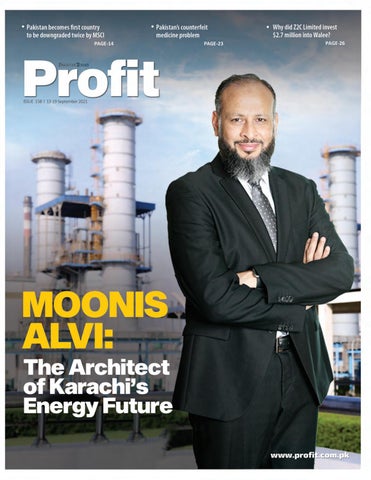
14 14 Pakistan becomes first country to be downgraded twice by MSCI 16 Moonis Alvi: The Architect of Karachi’s Energy Future 21 The how, what, and whys of Initial Public Offerings (IPOs)
29
23
24 23 Pakistan’s counterfeit medicine problem 26 Why did Z2C Limited invest $2.7 million into Walee? 29 After years, Matco Foods makes a surprising loss
Profit
Executive Editor: Babar Nizami l Managing Editor: Farooq Tirmizi l Joint Editor: Yousaf Nizami Reporters: Ariba Shahid l Babar Khan Javed l Taimoor Hassan Abdullah Niazi l Meiryum Ali l Shahab Omer Chief of Staff & Product Manager: Muhammad Faran Bukhari Regional Heads of Marketing: Muddasir Alam (Khi) l Zulfiqar Butt (Lhr) l Mudassir Iqbal (Isl) Layout: Ahmad Salahuddin l Photographers: Zubair Mehfooz & Imran Gillani l Business, Economic & Financial news by 'Pakistan Today' Contact: profit@pakistantoday.com.pk
Readers Say Sedan sales all over the world are declining and SUVs are all the rage. Even in India, the sales figures of the Honda Civic are abysmal. The one thing I am concerned about, however, is the long term reliability of Korean and Chinese brands. Apropos: Can KIA be King, or do the Big 3 have another trick up their sleeve? @bashirahh, Twitter When they launched Sportage, there was simply no other SUV type product you could show off in Rs 5 million. The used, imported Vezel was barely enough to turn heads in around Rs 4 million. To be honest, I was surprised at the response as the styling of the Sportage seemed polarising to me. Even now, the only competition it has in show-off value is MG HS, which has only just entered local assembly. Tucson is too conservatively styled, X70 lacks the production volume, and Glory Pro...it's just Chinese. KIA Lucky Motors were way ahead of the game. Apropos: Can KIA be King, or do the Big 3 have another trick up their sleeve? @ahmedsopinion, Twitter If KIA has sold more than 25000 cars in the past two years, and each car is going at around the Rs 5 million mark and more than a thousand cars are being sold each month, that means KIA is making more than Rs 5 billion in revenue every month just off the back of the Sportage. This is exceptional for an entrant company. Apropos: Can KIA be King, or do the Big 3 have another trick up their sleeve? @shajeeamer, Twitter I didn't know that the Sportage had the reputation of being ugly. Because I really don't see it man what are you guys talking about? I understand calling the car bland and ordinary, but I don't think it is fair to call it ugly. Also, considering the options we have here in Pakistan, the Sportage seems like the best option right now. In the hatchback category, Hyundai's Santro was pretty popular once upon a time. They need to make a comeback. Apropos: Can KIA be King, or do the Big 3 have another trick up their sleeve? @mcmuffin786, Twitter
facebook.com/Profitpk twitter.com/Profitpk linkedin.com/showcase/13251020 profit.com.pk profit@pakistantoday.com.pk
HOW TO CONTACT
8
It's quite disliked as a bland, ordinary looking car abroad. Basically the classic middle aged man car. In its class, it's probably the best car there is. Wish Kia and Hyundai would compete better in smaller cars though. Apropos: Can KIA be King, or do the Big 3 have another trick up their sleeve? @pakistansagara, Twitter
KIA has not brought competition in the auto sector just yet. The Sportage has been successful because it is considered a ‘cheap SUV’ which actually falls under the crossover category. There was no option in this category available and in this price range, which is why the Sportage has sold so many models. KIA, and indeed other new entrants introducing crossovers, have simply taken advantage of the fact that Pakistan’s car market is behind a few decades. If you really want to see KIA’s overall position, then you should take a look at the Sorento and the Picanto - which are competing in the luxury SUV and hatchback categories respectively. Overall, the Sportage is not the best selling car in the country even in the last year probably 6th in all categories. However, that is still pretty impressive. Honda seems out of the game with no idea what to do, and KIA will probably be at number three in the Pakistani automobile industry soon, but it has a long way to go before it beats Suzuki and Toyota. Honda is at a loss because it seems like they’re not interested in expanding their product line at the moment. Apropos: Can KIA be King, or do the Big 3 have another trick up their sleeve? @AhsanTanoli, Twitter Dude, is this like a sponsored post or what? Kia’s only pride and glory in Pakistanis the Sportage, and the only reason for that is because we really don’t have a crossover SUV option in Pakistan that you can truly rely on. Especially in this price range, considering how the others are new entrants and the way they are pricing their cars. Toyota’s Corolla and Yaris sales are insane and so are the sales of the Honda Civic. And not to mention the options Toyota has in almost every price range. KIA isn’t even a prince, a king is a far cry. Bit of everything but that doesn’t change the point. I do believe the numbers are wrong also even for arguments sake if they were correct a 2+ year sales sheet doesn’t hand them the crown. Also, the Sportage is ugly. Apropos: Can KIA be King, or do the Big 3 have another trick up their sleeve? @noidsama, Twitter A very poorly written article - the Sportage is ugly? Really? I don't think 25,000 plus customers will see eye to eye with you on that. The authors reallys could have kept their opinion to themselves or have added it in the end. Or perhaps at least take some customer reviews or delve deeper into the company’s success model? Apropos: Can KIA be King, or do the Big 3 have another trick up their sleeve? @oxingzhe, Twitter
COMMENTS
IN BRIEF $3.8 billion:
Pakistan was facing a $3.8 billion annual economic loss due to climate change whereas in view of the rising climate issue, especially in the developing countries like Pakistan, experts have urged developed countries to raise at least $100 billion every year in climate finance.
Finance Minister Shaukat Tarin said on Thursday that Indian hackers had attacked the Federal Board of Revenue’s (FBR’s) website. He said that the attack on the website had come from India and a similar Indian attack had taken place in 2019.
Pakistan complies with 35 out of 40 FATF recommendations that provide the level of effectiveness of the AML/CFT system. These were mentioned in the Mutual Evaluation Report (MER) that recommended how the system could be strengthened. This upgrade took place after Pakistan requested MER to re-rate the Recommendations 10, 18, 26 and 34. The National Electric Power Regulatory Authority (Nepra) has suggested that a price cap of Rs45 per unit should be placed on the tariff for electric vehicle charging stations. They also requested a subsidy on electricity prices to attract investors to engage in the business.
Rs21.8 billion:
The Punjab government generated Rs21.8 billion revenue from the auction of only five plots of Central Business District (CBD) Lahore through bidding. In the past prime state land in Lahore was auctioned at only Rs100 million per Kanal but now it was auctioned at Rs 420 million per Kanal.
Ufone is likely to obtain additional spectrum as no foreign or local operator except the Ufone has submitted its bid to acquire the spectrum till the expiry of a deadline given by the PTA in this regard. Ufone has emerged as the single operator to participate in the spectrum auction as no foreign or local operator has submitted its bid for the auction of the said spectrum.
€10m:
Ambassador of the European Union to Pakistan Androulla Kaminara has said that the EU will provide 10 million euros to Pakistan for the promotion of four Small and medium-sized enterprises (SMEs) sectors including Gems Jewellery and mining, Information Technology, handicrafts & fashion wearing and travel as well as tourism.
9
Art debate and email etiquette
this week in Pakistan’s business and economics twitterverse
T
he debate around the Single National Curriculum has taken over our timelines, and what we’re wondering is how this will affect all those big fancy private schools. And if Sindh doesn’t implement, will parents move from Karachi to Lahore for the sake of their kids’ education? Could this be the end to the city wars? It would be a sad way to end it. Ariba Shahid brings you all this and more in this week’s social media roundup.
Help wanted
Lobster prices
Why is the duck on the menu so expensive? Because duck prices have gone up. It’s that simple. Literally that simple. I don’t know why economists talk so much. It would be fascinating to see how the person that came up with this disclaimer would explain the effects of menu costs that the increased prices of lobster would have. Priceless podcast content.
10
Onboarding is difficult but it’s worthwhile if you discover amazing pizza through the process. This also makes me wonder if professional food tasters exist in Pakistan. If yes, please link me to them. Sorry boss, that may be an offer I cant say no to.
Email etiquette
The use of Dear is questionable. It’s best to just call women Ms instead of Miss or Mrs. Why assume someone’s relationship status. Honestly, just keep it simple. If it’s Mr for all men, it’s Ms for all women. Those should just be the rules.
SNC hour
Honestly the debate on the SNC has taken over our timelines. Very few people have actually bothered reading up about it and are commenting on random snippets. Besides, how worse can it get for a country that already has so many ghost schools?
Art is art Calling Mr Hanif
There has been great debate on art being treated as art. And a lot has been said on the fact that India is no longer our friend, of course they made that abundantly clear when they sent Abhinandan here. Well, that aside, does the Pakistani movie industry really face competition from international movies? Or are they so terrible that no one really wants to watch them? But also to add to Hassan Zaidi’s tweet, Israel isn’t exactly famous for good movies - just genocide and crocodile tears. The only recent movie star they’ve produced is Gal Gadot, and even she is a war criminal. Overall, very confusing tweet that isn’t here nor there.
We’re waiting for KE to come up with a Mohammed Hanif line in response to him. They might think of one before he gets his power back. Who knows?
Museums
How to make money 101
Museums that cost us a fortune to maintain. Our country is that obsessed with relics from the past.
Honestly, if someone was making that much money they wouldn’t care about you registering for a course and paying $20. So how about you stop trying to get shortcuts to money and try doing it the old fashioned way by trial and error.
SOCIAL MEDIA ROUNDUP
OPINION
Taimoor Hassan
Celebrating Pakistani tech story the right way
country’s entrepreneurial ecosystem. Wednesday’s conference was the inaugural virtual event by PakLaunch to showcase Pakistani startups to the global community, with a particular focus on international investors to reinforce their confidence in Pakistan. The conference was titled “Why Pakistani startups are the next big thing”. The conference included a welcome note by the president, panel discussions, investors who have presented in Pakistan and their experience with Pakistani startups, and heads of Ministry of Science and Technology, the State Bank, the Pakistan Stock Exchange and Special Technology Zones Authority. It was encouraging to hear from international investors who had invested in Pakistan, reposing their trust in Pakistani tech founders and teams, and how tech Pakistan had grown f you have recently attended PakLaunch’s inaugural conferbetter than how it had grown in other emerging markets like ence on startups online and were amazed by the potential Indonesia during the similar time period. It was also encourPakistan’s startups hold, I can tell you with certainty that aging to hear government officials the event looked ‘rigged’ to make few names from Pakistani But while the conference had encouraging remarks from startups shine above others and one investor in particular these investors and the government office bearers sharing the made look bigger. initiatives they were taking to support startups, there was Because there was so much amiss, which I discuss below, much amiss which could have added more value to the subject the event failed to live up to many people’s expectations. I attendmatter of the conference and could have showcased the Pakied Nest I/O’s 021Disrupt last year and it did a phenomenal job in stani tech scene better globally. highlighting Pakistan’s tech scene from various angles, was more The agenda of the conference primarily highlighted inclusive and, therefore, gives a standard to compare with and call one particular investor and its portfolio companies. Most of out when and where it goes below. the investors that were invited to present their experience of This year, PakLaunch, which is an online community of investing in Pakistan had invested in one of the two startups successful Pakistani entrepreneurs, tried doing the same. These Indus Valley Capital had invested in. entrepreneurs have the noble intentions of now wanting to give it Some high-profile investors that spoke during the conback to Pakistan and they are doing it by helping to strengthen the ference were Shorooq Partners which has invested in Airlift, Antler which has invested in Bazaar, Fatima Gobi has invested in Airlift, Next Billion Ventures has invested in Bazaar, Quiet Capital has invested in Airlift, Wavemakers partners has invested in Bazaar, Harry Stebbings has invested in Airlift, and Acrew Capital has also invested in Bazaar. While some of these investors have also invested in companies which are competitors to Indus Valley portfolio companies, their founders Taimoor Hassan were nowhere to be seen during the conference. covers technology and And as I came to know from one company that I was able to speak with, they did startups for Profit. He can be not even receive any invite for the PakLaunch conference, while members from Bazaar and Airlift, and another portfolio company of the same investor, Aimfit, were part of a panel reached at taimoor.hassan@ discussion. pakistantoday.com.pk Then the agenda of the conference floated before the actual conference date was reshuffled, perhaps by design. As I have come to know, the event was pre-recorded and the
An interesting concept, PakLaunch’s conference of entrepreneurs left a lot else to be desired
I
12
agenda was reshuffled to achieve some vested desired effect to glorify few startups. Sure, it still goes and looks good to international investors, that Pakistan is the next big destination for investing in startups, but controlling narrative through such events is eventually going to go bust. The startups that got the limelight are big. They are big because they have raised big rounds but raising big rounds could also be strategic errors at times. So media hype can be distorted; reality can be quite different. So here’s the punchline: PakLaunch did not look much about “Why Pakistani startups are the next big thing”, it looked more about “Why Indus Valley Capital startups are the next big thing”. While Aatif Awan of Indus Valley Capital got to be the first speaker for the event, other local investors that participated in the conference, like 47 Ventures, Sarmayacar and i2i Ventures, were 4th in the list on the agenda of the event, but appeared 7th in line for their panel discussion. By the time these investors
were in front of the audience, viewership of the event had fallen to a few hundreds of viewers, from 2,000 in the beginning. That apart, Pakistan’s angel investors community could have been included to get their perspective on why international investors should consider Pakistan as the next big thing. Great things are happening in the startup ecosystem with local entrepreneurs shining bright, solving problems for Pakistan. Fintech funding is picking up, edtech funding is picking up, road freight is going digital, all of these spaces have been penetrated by the startups. Abhi Finance, KTrade, SadaPay, PostEx, Edkasa all have raised good amounts also and are solving interesting problems. Rider, Trax and Swyft Logistics are challenging the decades-old seth-run logistics companies. COLABS is running a community of startups and houses many exciting startups and teams. BNPL startups have also entered the foray. Including new startups could have presented Pakistani startups as a more compelling proposition for international investors.
More importantly, the conference, while it was themed on showcasing startups to international investors, did not have any new startups that were looking for funding, to present their ideas to these investors through short pitches. Investors could have gotten to know about new ideas taking shape in Pakistan and then interested investors could have gotten in touch with the PakLaunch management to connect them with these startups. The Securities and Exchange Commission of Pakistan (SECP) which is the companies regulator in Pakistan, was also visibly missing to inform the global audience the sort of measure SECP was undertaking to support entrepreneurship in Pakistan. It could also have candidly talked about the problems and its seriousness to solve these problems. The conference looked more like the tech story of a few, that only a few startups and their founders were the next big thing, which is not how Pakistani tech story should be told. It should be more inclusive for it to be told the right way. n
COMMENT
Pakistan becomes first country to be downgraded twice by MSCI The downgrading might actually result in a big fish in a small pond effect for Pakistan
W
hat is Pakistan really? For a long time we were poor (in fact, one could argue, we still are poor). We have also been the antiquated third world - but mostly we’ve gone back and forth between poor and developing. As the world shed old terms, and adopted other more factual ones, it seemed like we were making some headway. We were an emerging market. We were part of the new, global world or what have you. Which is why the downgrading of Pakistan from an emerging market to a frontier market seems to have made headlines at home. Even though it’s just a technical terminology by one index - Morgan Stanley Capital International, or MSCI - it signals something bigger - as if we have failed somehow, or remained stagnant.
14
What the downgrade is
W
hat is happening, essentially, is that MSCI calculates the worth of different markets around the world and assigns them different rankings. A developed market is the best ranking and a standalone market is the lowest ranking. To calculate these rankings, MSCI provides market indices. A market index is usually a single number that is calculated from different economic factors, like prices or income. These numbers are calculated to be able to compare different economies in different countries. An example for such an index would be the Gross Domestic Product (or GDP). Pakistan up until this announcement had Emerging Market status with the MSCI, but it has recently been downgraded o a Frontier Market. This is also the second time that Pa-
kistan has been downgraded, and it is now the only country to have been downgraded twice by the MSCI. This means that foreign investors will now look at Pakistan and not be as excited about investing there. Essentially, the downgrading would mean Pakistan appears a riskier investment than it would if it remained an emerging market. However, it also means that certain other kinds of investors willing to take on more risk in exchange for more freedom and the chance of greater returns will be interested. The last time Pakistan was at a bleak edge like this was in 2008. Back then, Pakistan had the status of an emerging market, which was an ideal place to be in. Pakistan was far away from the dreaded stand alone market status, and had stayed in the emerging category since 1994. The names of these categories are not particularly important, nor do they mean much. All you need to know is that a devel-
oped market is the highest rank, followed by emerging markets, frontier markets, and then finally standalone markets at the bottom rung. For countries that fall under the developed category, the ranking is not particularly important. These are large, stable players in the world economy like the United States, Canada, the United Kingdom, Japan, Germany and Australia. The only Middle Eastern country that has this status is Israel, whil Hong Kong is the only Asian country other than Japan to have this status. These are countries where there is no shortage of investors trying to get an in. The real competition is between countries that are either in the emerging markets list or in the frontier market list. These are the countries that are very much trying to look for foreign investors and make themselves attractive opportunities. Naturally, frontier markets are considered riskier investments so less prolific investors usually end up investing there. Emerging markets status is coveted.
What it means
I
n a note sent to clients on September 8, chartered financial analyst Jehanzaib Zafar argues that in fact, it is ok. At best, it will be a case of big fish in a small pond. At worst, it will change absolutely nothing for Pakistan. So to recap: MSCI relegated Pakistan from MSCI Emerging Market index to MSCI Frontier Market index on September 8. MSCI announced its official decision in the early hours of the day, following feedback received from market participants over the reclassification proposal of MSCI Pakistan Index.The transition will be a one step process, coinciding with Nov ‘21 Semi Annual Index Review (SAIR). Pakistan had an emerging market for four years, but this particular move had been long anticipated; however, The decision comes as a result of the three existing stocks - Habib Bank Limited, MCB Bank, and Lucky Cement - no longer meeting the standards for size and liquidity. Since the November 2019 review, none of the Pakistani companies in the MSCI
The last time Pakistan was at a bleak edge like this was in 2008. Back then, Pakistan had the status of an emerging market, which was an ideal place to be in. Pakistan was far away from the dreaded stand alone market status, and had stayed in the emerging category since 1994 Pakistan equity universe meet the Emerging MarketS ize and Liquidity criterion under the MSCI Market Classification Framework and the country had been avoiding downgrade solely on the back of index continuity rules. It only met the criteria for Market Accessibility under the classification framework for Emerging Markets. So, what does this mean? Starting with the November 2021 SAIR, the MSCI Pakistan Indexes will be rebalanced using size and liquidity require-ments for smaller, average liquidity of Frontier Markets. The MSCI Pakistan index currently has a weight of 0.02% in MSCI Emerging Markets Index and three constituents including Lucky, MCB Bank, and HBL. Post-reclassification, MSCI Pakistan Frontier Market index has potential weight of 1.9% in the index with four constituents, with OGDCL being the new addition. The MSCI Emerging Market Small Cap Index has thirteen constituents from Pakistan, while the MSCI Frontier market Small Cap Index is simulated to have 19 constituents – with Indus Motors, Bank Al Habib, Abbot Laboratories, National Bank of Pakistan, Packages, Systems Limited all additional constituents. Despite the looming downgrading, some analysts think not only will it not negatively affect foreign investment in Pakistan, it might even help out. You see, an emerging market and a frontier market attract very different kinds of investors. An emerging market attracts cautious investors while those that want to invest in frontier markets are willing to take more risks. In the nine years Pakistan was a frontier market, it did well as one.
The real competition is between countries that are either in the emerging markets list or in the frontier market list. These are the countries that are very much trying to look for foreign investors and make themselves attractive opportunities. Naturally, frontier markets are considered riskier investments so less prolific investors usually end up investing there. Emerging markets status is coveted
Frontier economies are less advanced economies in the developing world. It is generally believed that emerging markets earn greater returns with lower risk, whereas frontier markets are considered riskier. These countries usually have equity markets that are less established compared to emerging markets, are smaller, less accessible and are more risky. Political uncertainty, poor liquidity, problems with regulations, substandard financial reporting, and currency fluctuations are some deterrence for investors. So while Pakistan would generally be considered a small fish in a big pond as an emerging market, it would be a better prospect for frontier market investors. According to Zafar, this might lead to a ‘Bigger fish in a smaller pond versus a tiny fish in an ocean’. Market data flow suggests that total assets under management in emerging markets stand at $1.8 trillion, while the assets under management of frontier markets stand at $15 billion. Therefore, given the weight Pakistan had in Emerging Market and likely weight it will have in Frontier Market, the net outflow will settle around $70 million to $80 million “However, this risk gets somewhat mitigated considering the foreign outflow witnessed since the country’s reclassification in Emerging Market where FIPI outflow cumulated over $1.9 billion,” notes Zafar. “Furthermore, we also find major funds performing due diligence on frontier markets which could unlock fresh allocations. Consequently, the inflows and outflows owing to the reclassification will largely be balanced, with a slight upward bias,” he added. According to Zafar, the benchmark index is up 2% in USD terms, which is in line with MSCI Asia ex-Japan (up 2%), However, this is significantly underperforming regional peers like Bangladesh (up 32%) and Vietnam (up 24%). “Continued geopolitical instability and emerging risks related to current account sustainability has put solid corporate profitability on the back burner,” he notes. “Impending decisions related to reclassification in FM, FATF and IMF reviews have also contributed to capping market performance. Market may take a knee jerk reaction in the immediate aftermath of reclassification, however, the attractive valuations may eventually be able to woo investors given solid risk/return profile,” n
INVESTMENT
16
I
n June 2018, Moonis Alvi was appointed CEO of K-Electric, succeeding Tayyab Tareen as the top executive of Pakistan’s only privatized power utility. With 28 years of experience in driving operational efficiencies and financial planning, Moonis had been heavily involved in KE’s transformation since 2008, also serving as the utility’s Chief Financial Officer prior to his elevation. At the time, K-Electric had embarked on the next phase of its vision of the future of Karachi’s power supply and corresponding socioeconomic development of the city. The utility had been awarded a new Multi-Year Tariff (MYT) with a “control period” of 7 years from 2016 to 2023. The National Electric Power Regulatory Authority had approved an investment plan of PKR 299 billion to enhance Karachi’s infrastructure. The power utility has since reportedly invested heavily in its network and has undertaken a number of tech-based, future-centric initiatives to support the continued growth of Pakistan’s largest city. Profit sat down with Moonis to understand the journey that the company has undertaken, and what the future holds for Karachi.
NATIVE CONTENT
Profit: Give us a little background on the drivers behind K-Electric’s progress as a power utility. Moonis Alvi: Since privatization, KE has invested over PKR 415 billion across its value chain. We’ve added over a gigawatt of our own generation capacity, expanded our transmission and distribution network to twice the size, and drastically reduced the transmission and distribution losses from approximately 35% to approximately 17% in 2021. Almost one-third of our network has been converted to Aerial Bundled Cables as well, which is critical to a smooth supply of power. Driving a reduction in transmission & distribution losses is a capital-intensive effort and requires targeted investments across the value chain to yield benefits for the end consumers. Since privatization, K-Electric has been working consistently to achieve maximum loss reduction in Karachi and its adjoining areas. Increased electricity consumptions across all sectors drives economic productivity and generates higher tax revenues that ultimately benefits the Federal Government. Our improved progress has also been documented in annual performance reports published by the regulator. As of 2021, we have invested PKR 256 billion of our allowed PKR 299 billion and have submitted an enhanced investment plan of around PKR 440 billion for NEPRA’s approval. Not only will these investments prepare our system to support the future, they also remain critical for the provision of a safe, smooth, and reliable supply of power to consumers. Profit: There’s a significant amount of attention being paid to the global impact of climate change. How is K-Electric responding to this? MA: Climate change is fast becoming a reality that cannot be ignored. Just recently, Hurricane Ida has impacted over a million consumers across the southeastern United States. Earlier this year, Germany and parts of Europe were
18
affected by flooding and unprecedented rainfall as well. Karachi has also been no exception with the torrential rainfall that the city received in 2020. Following the events of last year, KE has been working to bolster its infrastructure and improve the resilience of its system. To enhance the safety and reliability of our distribution network, during 2017-2021, we have invested over PKR 32 billion which also includes targeted investment in elevating our infrastructure in low-lying areas across the city that were vulnerable to urban flooding. This ensures a safe and reliable supply of power to these areas even amid inclement weather. The total investment earmarked specifically for the safety and reliability of our distribution network and the rain emergency plan is PKR 66 billion for the period 2017-2023, subject to regulatory approvals. This is part of our enhanced investment plan of PKR 140 billion over and above NEPRA’s allowed levels of PKR 299 billion for the period 2017-2023 (out of which we have already spent PKR 256 billion). So, our total investment in the system will exceed PKR 400 billion subject to regulatory approval. We believe this investment is absolutely necessary today to secure Karachi’s energy future. Profit: Power utilities are responsible for supplying electricity; why is there a need for technology and digitization? MA: In today’s day and age, utilizing the latest technology is fundamental to sustained business operations. Today’s business environment is evolving rapidly, especially with the advent of an enduring global pandemic. With improved data analytics capabilities, we can improve the decision-making process and enhance our agility as a business as well. Utilities serve a critical role in the functioning of cities; we provide electricity to around 3.2 million consumers across Karachi and its
adjoining areas. Knowing where and how this electricity is being used, and how these patterns are changing on a seasonal basis, helps us prepare for the future when we are planning our supply and demand projections as well as enables us to make targeted investments in the network. Recently, we have partnered with global specialists in energy management and automation to upgrade our Geographic Information System (GIS) platform with the addition of ArcFM suite. This tool enables us to map our entire transmission and distribution network with infusing electrical intelligence, giving us unprecedented geospatial visibility of our entire infrastructure with a view unique to a power utility. With this tool, we are able to visualize outages in an integrated environment and maintain a closer oversight over the health of our network. Our operations are facilitated with making the medium-voltage network’s SLD (Single Line Diagrams) to be database driven, thus making it visible across the enterprise network of K-Electric. The system of records becomes the system insights, helping us improve our ability to serve customers because we can prioritize our investments to areas that require it the most, enabling us to improve service levels. We are also installing Automated Meter Readers (AMR) at PMT and large industrial consumer levels so we can get visibility on the consumption of electricity at a granular level. COVID-19 also impacted the way our consumers are connecting with us. During FY20-FY21, we noticed an uptick from 22% to 31% in the utilization of Alternate Delivery Channels (ADC) such as internet banking and ATMs to pay utility bills remotely. At the outset of the pandemic, physical interaction at our Customer Care Centers had to be avoided, and consumers began relying on social media, our call center 118, and KE Live App for assistance with their queries and complaints. Recognizing this as a need of the hour, we’ve partnered with Infobip, a global leader in omnichannel communication offering a suite of tools for advanced customer engagement and support to launch a WhatsApp Self Service channel for the continued convenience of our customers. WhatsApp is a ubiquitous service and customers will be able to use it to connect with KE and avail a suite of services including duplicate bill generation; technical complaints; payment of bills; downloading New Connection forms and a checklist of documents. Technology is helping us bridge the gap between the utility and consumers, and we believe that data-driven decision making is what will ensure our efforts are targeted and effective so that we can continue supporting Karachi’s growth and paving the way for Pakistan’s progress.
Profit: Karachi’s power demand will continue to grow; is KE prepared? MA: Our internal estimates keeping in view the economic growth and favorable government policies suggest that Karachi’s peak power demand is expected to have a Compound Annual Growth Rate (CAGR) of 6.5% over the next 5 years. We expect over 700 MW of new connections in the next 2 years, with more than half in the industrial sector. Naturally, the addition of these consumers will have a direct impact on the national GDP and tax collection. We have been working with a number of international partners including Siemens AG and Harbin Electric on establishing our 900 MW Bin Qasim Power Station 3. This will be a major investment capable of absorbing Karachi’s future industrial, commercial, and residential growth. The addition of the power plant is accompanied by the addition and/or upgradation of 4 associated grids as well to transmit the electricity to the city. Since our privatization, we’ve been working on expanding our transmission and distribution capacity and have successfully doubled it as well. Our future investment plan includes establishing interconnections and grids at key locations with the support of the Federal Government, the Ministry of Energy, and associated departments. This will enable us to offtake additional power from the National Grid as well, to meet Karachi’s power appetite. This is a win-win because the offtake of additional power from the National Grid will reduce the burden of capacity payments at the national level, while also supporting Karachi’s power needs. Today, 78% of the city is receiving an uninterrupted power supply; with our combined efforts and sustained investments, we envision taking this number to over 90% in the upcoming years. Profit: Along with climate change, renewable energy is also gaining momentum, with the Prime Minister also committing to increase the share of renewables in Pakistan’s energy mix. How is KE contributing to this? MA: KE appreciates the Prime Minister’s vision and agrees that renewable energy is an integral part of the future energy mix. KE currently has approximately 250 MW of renewable energy in its generation capacity and our future diversification strategy aims to increase this by another 350 MW in the upcoming years. We have also witnessed a rising trend in the distributed generation space. Earlier this year, K-Electric established K-Solar, a wholly-owned subsidiary, that is focused on assisting consumers in acquiring a customized distributed energy solutions. We have been in the business of electricity for over 100 years and believe our legacy provides us with the expertise
to find consumers the best possible solution regardless of whether they are residential, commercial, or industrial customers. In the interim, we are incorporating cleaner ways of generating electricity through efficient technology. Our upcoming Bin Qasim Power Station III (BQPS-III) once complete, will be among the top 5 most efficient power plants in the country. We believe this will not only reduce the utility’s carbon footprint but also support the Government in lowering fuel import costs and drive the shift away from conventional furnace oil in power generation. Profit: We have spoken about operations and investments at length. What is one project aside from this that is close to your heart? MA: Unfortunately, the participation of women in the workforce in Pakistan’s urban areas remains low, with some data suggesting only 25% of women are actively and formally contributing to the economy. Part of our future strategy also focuses on changing this trend. Earlier this year, Chairman NEPRA visited Karachi and launched our Roshni Baji Project, which is a pioneering initiative in Pakistan’s power sector. This project is a women’s neighborhood ambassador program on safety awareness and reducing electricity theft. It is a compelling example of women breaking barriers in untraditional gender areas. In this way, the Bajis served as a connection between KE and the communities. We now have insights on community perceptions on illegal connections and non-payment and can therefore help design appropriate interventions. In the process, the Bajis were also able to identify electrical hazards and raise safety awareness among women in the communities who are often the victims of electrocution accidents. Through this awareness-raising, communities are less vulnerable to electrocution during high monsoon rainfall, urban flooding, and other disasters. In a country where public transport and women’s mobility is severely limited due to patriarchal norms and lack of access – KE
is providing these women with motorbike training to gain agency over their movement. In communities where women do not occupy public spaces, it was also important to make them feel safe and confident while doing their job. This was achieved through self-defense training. With the awareness-raising targets achieved, the Bajis were trained to become electricians the first of its kind initiative in Pakistan. Through this, the women will be able to join KE’s resource pool or serve in their neighborhoods. With Pakistan ranking 151 out of 153 on the WEF Global Gender Gap Index, KE is empowering women in roles where women are almost non-existent. Gender barriers are being tackled head-on in the design; such as flexible working hours to accommodate a large number of single mothers and selecting women from within the communities to abide by cultural norms that frown on women leaving their neighborhoods. Profit: How do you feel about the future of the electricity market in Pakistan? MA: There has been a growing conversation around liberalizing the electricity market in the country, particularly the introduction and implementation of the Competitive Trading Bilateral Contract Market (CTBCM) which aims to open up the market at the wholesale level. It is heartening to see the regulator and stakeholders adopt such a progressive approach. That being said, KE and all other DISCOs operate in a regulated environment and policymaking has a lasting impact on our ability to plan and sustain our investments. The implementation of CTBCM will be a monumental transition for Pakistan’s power sector and we must be prepared to enable a smooth transition. This requires clarity and timely finalization of a sustainable framework with adequate time to plan. We are confident that appropriate policy decisions and alignment of key areas keeping in view the best practices would help shape a resilient electricity market for the future. n
NATIVE CONTENT
The how, what, and whys of Initial Public Offerings (IPOs)
Everything you need to know about IPOs both as the owner of a company, and as a possible investor By Ariba Shahid
E
very time that a company making an Initial Public Offering (IPO) enters into the news cycle, there is some confusion as to what exactly an IPO is and how it works. As the name suggests and one might intuitively guess, an IPO is when a private company decides to go public and offers people the opportunity to buy shares or stocks in it. But to understand the technicalities of this, one must know what stocks are exactly and how they work, as well as the different ways that one can participate in an IPO and the advantages and disadvantages that come with these different ways. Essentially, an IPO happens when a company is looking to gain capital and turns to the general public for it rather than getting a loan from a bank and increasing their debt. It usually means that a company is looking to expand and expand at a certain rate. However, in Pakistan, IPOs are not that common and a lot of family owned companies that have made it big (think Tapal or Shan) want to keep the business limited to themselves and shy away from going public. This is mostly due to the business culture in Pakistan, but if a large privately owned company in Pakistan wanted to raise some serious capital and go on an aggressive expansion project.
What are shares and stocks?
B
efore we get into the details of what an IPO is, we need to begin with a very brief understanding of what a private company is, what shares are,
EXPLAIN-IT-LIKE-I’M-FIVE
what stocks are, and how the trade of these entities work. Essentially, any company is owned in shares between numerous people. Stock is all of the shares into which ownership of a corporation is divided. A single share of this overall ‘stock’ represents a fractional ownership of the company. The stock exchange is where you can buy and sell shares in publicly traded companies. As soon as you buy shares of stock on the stock market, you become a shareholder within the company by acquiring an ownership stake of the business. All publicly-traded companies have their equity split up in a great number of shares that are constantly switching owners throughout the day. So one question that you might ask yourself is: How many shares does a company have? The answer to this question depends. Since there is no restriction for the number of shares within a company, different types of companies can have varying numbers of existing shares. A start-up might only have a few shareholders, while multi-billion dollar companies will usually consist of millions or even billions of shares outstanding. Deciding on how many shares a company should start with, depends on the future growth potential of the company. Therefore, the number of shares is completely determined by the business and its owners. This is also where IPOs become important. You see when a company is privately owned, it may issue stock and have shareholders, but their shares do not trade on public exchanges. When these companies do want to go public, they offer shares in their stock through an initial public offering (IPO). Essentially, when a company wants
to bring in capital they decide that they will offer shares at a certain price that the general public can then buy - meaning the number of shares that make up their overall stock increase. And since these new shareholders are bringing in money, the overall size of the stock also increases. The new shareholders will eventually get dividends based on the profits that the company makes. The goal is that the freshly raised capital through the selling of shares will allow the company to grow and thus make greater profits for everyone involved. Generally, a company can choose how many shares it chooses to have. Choosing a number depends on how big you expect your company to get and how much you think it will be worth it - a valuation the company has to make. Take for example an IPO that is made at around $10 per share value. If you estimate your company’s value to be $1 million at the IPO, then the number of authorized stocks should be 100,000. In the beginning, your business won’t be worth $1 million, so each stock won’t be worth $10. Each share may be worth pennies, but over time, its value will hopefully increase. Once you’ve decided on your number, you want to decide how you’re going to issue stocks. A general formula that is at tims recommended is that startups should issue 60 percent of authorized stocks and reserve 40 percent for investing and stock options. The rest belongs to the founders of the company. You can keep more or less of your stocks for founders - that is up to the company. Many businesses have between 5 and 30 percent founder ownership at the company’s IPO.
21
The details of IPOs and who can invest
A
n IPO is the first time a company is able to sell securities to the public. IPOs are called Primary Markets. Their purpose is to bridge companies that need funds with investors. Now, there are different things that you can sell through an IPO. What we have been talking about up until now is selling equity in the company in the form of shares. However, you can also sell quasi equity as well as debt using an IPO. What is interesting is that not only can you sell new shares through an IPO to raise capital, even though it is the most common, sometimes existing shareholders sell their shares through IPOs to liquidate their investment. Now, technically anyone can invest in an IPO provided that they have a CNIC, a bank account at any commercial bank, a CDS account, an email address, and mobile phone number. You are treated as a single applicant and therefore can only make one application for at least the minimum number of shares mentioned in the prospectus. A CDS account is an investor account with the CDC (Central Depositary Company) or a sub account with CDS participants. That means an account with a securities brokerage company or commercial bank. Under Section 72 of the Companies Act, 2017, companies are required to issue shares in the book-entry form only and therefore physical form of shares are a thing of the past. You can no longer trade physical shares. You need a CDS account to trade them if you’re holding on to old shares. Once you get shares through an IPO, they are credited to your CDS account.
How do I make an IPO?
T
he company first chooses an investment bank to act as an advisor on the IPO and to provide underwriting services. This is where the company makes a valuation essentially, and decides how many shares they want to issue in their IPO. Now, you might think a company would want to keep the price high and the stocks few so they can keep control of the company and get more capital out of it. However, they also want to offer it at a price where people will bite … without it getting oversubscribed. We’ll explain oversubscription later, but as you can see it gets a little bit tricky here. Underwriting is when the investment bank acts as a broker between the issuing company and the investing public to help sell the initial set of shares. The underwriter is contractually bound to purchase the issue
22
from the issuing company at a specific price. It later sells to the public. You could have one underwriter or multiple. However, in the case of multiple, one investment bank is chosen as the lead or the book-running manager. The company then files a registration statement including the prospectus and private filling. The prospectus is issued so that anyone that is interested to invest in the company can read more about it. Following this, the road show begins. This is the phase in which the shares are marketed to institutional investors. Throughout this stage the demand for the shares is evaluated. Once the IPO is approved by the regulator, in our case the SECP, an effective date is decided. The day before the effective date is important because that is when the issuing company and the underwriter decide the offer price and the number of shares to be sold. The offer price is the price at which the shares will be sold by the issuing company. The offer price depends on how well investors received the roadshow pulled off, the plans of the business, and the conditions of the economy. This is what is known as the fixed price method. The book building method is when the price is determined based on the Dutch auction method. A floor price is decided by the issuer. Institutional investors and high net-worth individual investors then make bids during the bidding process which can be seen on the PSX website. This helps determine demand. Following this a strike price is decided. Shares are then provisionally allotted to the successful bidders at the strike price determined through the book building process and then offers of shares to retail investors can be made at the strike price of less than it. Once the company files for an IPO and its application gets approved, investors can subscribe to its shares within a given time period. This is usually between 3 to 10 days. During this period of IPO subscription, retail investors and others can subscribe for the company’s shares. There are three possible scenarios here- and IPO can be undersubscribed, fully subscribed or oversubscribed. When an IPO is undersubscribed, it acts as a reflection of the lack of demand for the issuer company’s shares. In this case, most of the investors in the IPO subscription get as many lots of shares as they had applied for. However, what raises concern here is a lower-than-expected demand. This usually results in a crash in share price on the day of listing. When an IPO is fully subscribed, each investor simply gets the number of shares applied for. An IPO is said to be oversubscribed when the demand for shares exceeds the total number of shares on offer. This means that
investors have applied for a greater number of share lots than what was put on offer by the company. If an IPO is oversubscribed to such an extent that all investors cannot be allotted a minimum of one lot each, then the share lots are allotted to subscribers using a lottery system. In such a case, many subscribers may not be allotted any shares. Then comes the stabilization period. This is when the underwriter is able to create a market for the issued stock. They can even purchase shares at the offering price or below it to stabilize the market. This is a short span of time when the underwriter has freedom to trade and influence the price of the issue given that price manipulation prohibitions are temporarily suspended. The quiet period ends in 25 days and then the shares are listed on the stock market. No longer do investors rely on the prospectus. They now rely on market forces. The underwriter now puts on another hat, this time they’re an advisor and evaluator and help provide estimates on the earning and valuation of the company,
So how do I invest in an IPO?
T
here are three ways to invest in an IPO in Pakistan. The old-school way is manually by filling out a form from your bank. All you need to do is go to a bank that is being used for the issue of shares, fill out the form and pay. You could also download this form from the PSX website, the consultant to the issuer and issuer website as well. Another way is electronically through the Centralized e-IPO System CES. You’ve got to register with CES for this. All you need to do is go to www.cdcepio.com. You only need to register once and can participate in multiple IPOs through this account, given you make applications for each IPO. There is no fee for registration. You could also fill an e-application through the link shared in the prospectus. Some banks such as UBL, Summit Bank and Bank Alfalah provide E-Ipo facilities to their account holders. After closing of the subscription period, all the applications received are then sent for balloting and scrutiny. If you were unsuccessful with your application, you will get a refund into your bank account within a specified time period. However, if you are successful, shares will be credited into your CDS account within 10 days of the closing of the public subscription period. Later on, if you want to buy or sell shares once listed you can do so through your brokerage agent. n
EXPLAIN-IT-LIKE-I’M-FIVE
A complete lack of regulation is allowing this morally reprehensible business to flourish By Shahab Omer
W
ithin the world of fraudulent businesses, what one fraudulent business comes to mind that is the most morally reprehensible yet commonplace? A business practice that makes a lot of money and does unspeakable damage that can scarcely be made sense of. This categorisation is not limited to one or even just a few businesses, but one business that does fall under this description is that of selling counterfeit drugs. Preying on the sick and helpless, making them pay exorbitant amounts of money only to give them fake or subpar medicine, is truly a low one would hope to never witness. Unfortunately, Pakistan is a country where substandard and counterfeit drugs are sold openly and no one is going to lay a finger on a single hair of the mafia behind the buying and selling of these fake drugs. According to a survey conducted by Profit, more than 40 percent of medicines sold in Pakistani markets are either counterfeit or substandard. Similarly, 4,000 pharmaceutical companies are registered in the country, while more than 100,000 companies are making and selling drugs without anyone asking. There is not a single government civil or military hospital in the whole country where the ruling classes or government bureaucrats like to get their treatment. And the problems are not just limited to substandard drugs being sold - even actual drugs can be misused and brought out on the
MEDICINE
streets. Such as 2012, when the heart medicine ephedrine was misused, and an investigation into whether two drug manufacturing companies in Pakistan turned ephedrine allocations into street drugs garnered international attention. In either kind of case, the issues is that regulation of drugs in Pakistan is abysmal. People fall prey to new diseases due to faulty and counterfeit medicines every day. Everybody knows and recognizes the traders involved in counterfeit medicines in the markets here, but people turn to the same medical stores for medicines. But the real question is, who allows this and how does it go unattended for so long?
How do substandard drugs reach the markets?
T
here is a wholesale market for medicines near Shah Alam Market in Lahore and all kinds of medicines are available here even if they are banned at the government level. Naeem Abbas, a wholesaler in the market, informed Profit that there are four categories of drugs available in the market. The first category includes drugs that are of good brands and quality, and the second category is drugs made by unknown brands and companies and the majority of them are substandard drugs. The third category is that of drugs that are completely counterfeit and the fourth is the banned drugs. “Now if you ask how substandard and counterfeit drugs come into the market, believe me it is a very easy task in our system because
there is no one to ask. A pharmaceutical company is one that is registered and a pharmaceutical company is one that is not registered at all. It is no longer necessary for the registered company to supply medicines in the market to be standard quality because substandard drugs of many registered companies are also sold openly in the market,” he said. “If we talk about quality medicines, the quality medical stores are also available there like Fazal Din Pharmacy, Mahmood Pharmacy, Clinics, Servaid, etc. These stores do not have substandard medicines and people trust such medical stores. Now here comes the sale of substandard medicine and the first difference between substandard medicine and standard medicine is quality and the second big difference is price. The medicine that is being sold at a lower price in the market is not necessarily substandard. These substandard medicines do use the salt of the desired medicine, but the results are not very good. But even then, these drugs work to some extent. Third, counterfeit drugs which are very dangerous and their use can lead to many new diseases.” Abbas revealed that not only in Lahore but all over the country, many counterfeit medicines with similar names of Novidat, Risek, Skilax, Voltral, Cefiget and many others are easily available in the market. “Now consider that Novidat is an antibiotic medicine and is used by a patient who is trying to get rid of an infection. Now a similar name Novaedaxin is easily found in the market and it is a counterfeit medicine. Interestingly, the manufacturer of the counterfeit medicine has not only prepared the packaging of his medicine like the real Novidat but has also put a price of RS
23
In our hospital, only the patient is prescribed the medicine by the consultants and the hospital has no role in this. Our own effort is to keep in our hospital medicines that are either manufactured by multinational companies or medicines from local companies that export their own medicines Dr Shahid Khawaja, Chief Executive of National Hospital
450 on it. This counterfeit medicine is now available in our market for RS 30 to 40 while the price of real medicine is between four to five hundred rupees. Think for yourself what will be the material in counterfeit medicine for forty to fifty rupees,” he explains. The manufacturer pays Rs 5 per packet for the packaging of this medicine. Similarly, when the medicine comes in the market, the wholesaler has to pay a commission of 20 to 30 percent and the cost of transportation will also be incurred. If we look at the total cost of this medicine, then it becomes Rs 20. “Take another example, this time of these drops called Consticare, similar to Skilex,” he explains. “This medicine is used to relieve constipation and there is a huge difference in the price of real and fake medicine. If we talk about Rizek, this medicine is used by more or less every person. This medicine contains omeprazole salt which cures gastrointestinal disorders and most of the gastrointestinal problems. “The price of this packet of medicine in the wholesale market is RS 430 whereas a similar medicine is also available in the market under the name Renzk, the packaging of which is very similar to the original medicine and its packet is available at RS 30. These are just a few examples of counterfeit medicines being sold in the market for diseases such as heart disease, kidney, liver, stomach, blood pressure, diabetes and cancer. Even life-saving counterfeit medicines are sold openly in the market,” he lamented. Now, the question arises as to how these counterfeit drugs reach the market, to which Abbas answers by saying that
in most parts of the city, the counterfeiters have opened factories secretly manufacturing these drugs. “These factories are not registered anywhere. The owners or employees of these factories come to our wholesale market and offer to sell their counterfeit medicines to many shopkeepers in the lure of higher profits.” “These drugs are brought to the market in various shoppers and bags. However, such drugs are not displayed in the shops. Because of the small means used for the transportation of these drugs, these drugs reach the market from these unregistered factories without any checking,” he said. Abbas believed that when it comes to the sale of drugs or medicines, the wholesale market sells 40 to 60 million daily, of which 50 percent is counterfeit drugs.
Who is buying these counterfeit drugs?
A
pparently, counterfeit medicines are being sold openly in the wholesale markets, but the answer to how these medicines travel from the wholesale market to the general market is given by Hassan Malik, the owner of a medical store in Lahore. “We visit the wholesale market daily because we have to buy some new medicine on a daily basis. When it comes to the wholesale market, many well-known shopkeepers also come to shop in this market and these shopkeepers are the ones whose medical stores are located around various government hospitals and streets in the city. When the wholesaler is asked for the required medicine, most of them [wholesalers] recommend buying
When medicine returns, it is counted and remains in DRAP’s custody. Any pharmaceutical company in Pakistan needs to get a license for the manufacture of any medicine. We take full action against counterfeit and substandard drugs sold in the market Dr Ghazzanfar, senior DRAP official
24
cheap medicine,” he explains. “Apparently this [fake] medicine looks real and the price is very low so many shopkeepers buy this medicine. In buying it, the medical store owner has the advantage that the price of the counterfeit medicine is written on the packet of the original medicine while the shopkeeper buys the counterfeit medicine for between Rs 30 and Rs 40. Many medical store owners buy counterfeit medicines from this market instead of buying real ones. Now that these medical stores are open on streets or around government and small private hospitals, most people who visit them do not pay attention when buying medicine. When someone asks these shopkeepers for Risek, they say that we have run out of Risek, but the same medicine is available under another name which is also cheaper by ten or twenty rupees. The common man does not pay attention and buys counterfeit medicine. On the other hand, these shopkeepers do not even tell the naive people and sell them counterfeit medicine instead of the real medicine. Obviously this is counterfeiting and there is a lot of profit in it,” Malik said. Clearly the issue here is one of collusion. Wholesalers are producing these medicines, and medical store owners are buying them and selling them to patients. The patients, who are getting the short end of the stick, do not buy these medicines because they are cheap they still pay what they would pay for the real thing. The reason is that medical store owners allow their greed to get ahead of them and play with people’s lives. However, on the other hand, Abbas also believes that the wholesale market supplies medicines to the whole of Pakistan, so it is not only medical stores that come to this market. “Medical stores, private clinics and private hospitals from every small and big city come to our market to buy counterfeit medicines. Since there are no large medical stores in small cities, these counterfeit medicines are easily sold there, while many quacks and qualified doctors keep these medicines in their clinics and make patients use these medicines and charge the full bill of medicines,” he says.
Our company has always provided the best quality medicines in the market. We have problems like fluctuations in the prices of medicines. The Drug Regulatory Authority of Pakistan (DRAP) and the Federal Investigation Agency (FIA) have conducted most operations against counterfeiters. Counterfeit drugs do more harm to a common man than to us because they [common man] are not only healthy but also get sicker Osman Khalid Waheed, CEO of Ferozsons
“Similarly, small private hospitals have set up pharmacies within their hospitals where these drugs are sold. Hospital doctors prescribe counterfeit medicine and tell the patient that it will be available from their pharmacy and buy from there. Second, many private hospitals treat patients with substandard or counterfeit medicines and charge them for the original medicine. If you look, there are pharmacies within many large and small clinics and hospitals and those who seek treatment from these hospitals and clinics also buy medicines from these hospitals and their pharmacies. Not only that, but the big contractors who supply medicines in government hospitals also often buy counterfeit medicines from here and sell them in hospitals. Those who check all these activities silently accept bribes and push the people to the brink of death.” Abbas further revealed that the illicit trade in foreign / unauthorized sex drugs is also on the rise in Pakistan and these drugs are also available in open markets including wholesale markets. “Indian Vega, Pangara, Viagra and other such anti-health drugs are easily available in the market and these drugs go from the wholesale market to large department stores, cosmetic stores and medical stores. This is a disgusting business and Pakistan has RS 1.3 billion sex drug business. These medicines are available in the market in the form of food supplements, drops, sprays, syrups and tablets. In Pakistan, these medicines are delivered through Afghanistan, while Indian and Chinese medicines are widely available in the market,” he said. On the other hand, Dr. Shahida Khawaja, Chief Executive of the National Hospital, strongly criticizes the use and business of substandard and counterfeit medicines. Speaking to Profit, Dr. Khawaja said that in the National hospital, the patient is always prescribed the best medicine. “In our hospital, only the patient is prescribed the medicine by the consultants and the hospital has no role in this. Our own effort is to
keep in our hospital medicines that are either manufactured by multinational companies or medicines from local companies that export their own medicines. We always use medicine in our hospital from a company that has market credibility. We do not use medicines from companies that make new or unknown brands, even if they are cheap. We also try to get our consultants to prescribe the best medicine that will benefit the patient. If the patient does not benefit or does not get good results from substandard medicine, then it will not be the name of the consultant but the name of the hospital. Every private hospital has its own policy but the trade and use of substandard and fake drugs is a disgusting practice that needs to be closely monitored,” she suggested. Osman Khalid Waheed is the CEO of Ferozsons Laboratories Limited informed this scribe that an operation was carried out in the 90s against factories that made counterfeit cigarettes and sold them in the market. After the operation, many of them stopped making counterfeit cigarettes but started making and selling counterfeit drugs in the market under different names. “Our company has always provided the best quality medicines in the market. We have problems like fluctuations in the prices of medicines. The Drug Regulatory Authority of Pakistan (DRAP) and the Federal Investigation Agency (FIA) have conducted most operations against counterfeiters. Counterfeit drugs do more harm to a common man than to us because they [common man] are not only healthy but also get sicker,” he said.
What is the stance of the institutions on counterfeit medicines?
A
senior FIA official informed Profit that action had been taken against the agency whenever it received any information regarding coun-
terfeit drugs. “Not only that, but the different teams of the agency also keep taking information from the markets and keep looking for the makers of counterfeit drugs. In the recent past, the FIA has carried out most of the operations against counterfeiters, including sealing medical stores in several cities and nabbing counterfeiters,” he said. Dr Ghazanfar, a senior DRAP official, informed Profit that there were drug testing labs to check for counterfeit drugs. “There are five drug testing labs in Punjab and similar laboratories in other provinces. Just as there are labs in Quetta, Karachi and Peshawar, so the Federal Drug Testing Laboratory is also testing drugs. Our inspectors at the federal or provincial level keep a close eye on the drugs sold in the market and many operations have been carried out against counterfeit drugs. To test any medicine sold in the market, three samples of the said medicine are taken and one of them is sent to the lab. These samples are taken for medicines of pharmaceutical industries that are registered with the DRAP. If a sample of any drug fails, the industry is given a chance to appeal,” he said explaining the process. “Sometimes a panel from DRAP even goes and checks where they are making mistakes so that they can be corrected. In addition, a lab is set up at the National Institutes of Health and samples are also sent there upon appeal. If a sample of any medicine fails there, we initiate action and order the company to recall all the distributors to whom it has sent the medicine. When medicine returns, it is counted and remains in DRAP’s custody. Any pharmaceutical company in Pakistan needs to get a license for the manufacture of any medicine. We take full action against counterfeit and substandard drugs sold in the market.” n
MEDICINE
I
f you can’t build it, buy it. In what has been the most obvious chess move within the $2 billion advertising and media industry in Pakistan, Z2C Limited has made - what insiders refer to as - a significant investment into Walee, an influencer marketing ecosystem. “Since 2019, advertisers and agencies in the region have relied on the Walee ecosystem
26
to advance influencer marketing campaigns and utilize social listening tools,” said Ahsan Tahir, co-founder of Walee. “This equity financing from Z2C comes as Walee scales to meet strong demand in the region pertaining to influencer search, campaign management & measurement.” The decision came less than a month after the Z2C Limited owned media agency
Brainchild Communications Pakistan (BCP) - which has a nonownership agreement with the Publicis Groupe to use the Starcom and MediaVest trademarks - signed a partnership agreement to exclusively distribute Walee Enterprise, an AI-enabled consumer intelligence (AICI) marketing technology (MarTech) platform. “While we have a number of tools in
the market which allow advertisers to gather insights based on paid, earned, shared, and owned media, there is no solution in the market quite like Walee Enterprise,” said Farhan Khan, the CEO of Starcom affiliated Brainchild Communications Pakistan. “With this AICI platform, we are now able to take a quantum leap - seeing beyond an advertiser’s customers’ current behaviors, needs, and preferences. There is immense potential in delivering actionable insights on emerging trends, outliers, and unexpected shifts or changes in consumer behavior.” As reported by MENAbytes, the $2.7 million seed funding by Z2C Limited into Walee takes on a minority stake in the company, which touts itself as an influencer ecosystem, a concept similar to that of the AnyMind Group and that of INCA by GroupM. The latter, which Profit reported on in March 2021, is set to launch in Q4 2021 and has capabilities around influencer matchmaking, social listening, and more importantly, a data depreciation readiness protocol. With its influencer marketing solution acting as an online marketplace that connects multichannel networks and influencers with advertisers and media agencies, Walee offers content creators a digital infrastructure to seamlessly find clients, show interest to partake in a campaign, execute on the deliverables, and recover payments all in one system. It was that system that shared the data with Profit in 2020 - along with four more influencer-focused technology platforms and agencies - to launch Pakistan’s first influencer pricing report. “Walee’s data-driven content analysis and influencer ecosystem approach is a paradigm change for the media and advertising industry,” said Fatima Hyder, group chief strategy officer at Z2C Limited. “Given our ongoing investments across OTT, eCommerce, and eSports platforms, the inclusion of Walee fits perfectly into our vertically integrated business strategy. We understand, better than most, how challenging it is to build a business from scratch and to scale it amidst the pandemic.”
Since 2019, advertisers and agencies in the region have relied on the Walee ecosystem to advance influencer marketing campaigns and utilize social listening tools Ahsan Tahir, co-founder of Walee
The market forces driving investment
S
ources told Profit that a key determinant of selecting the winning agency for the $20 million Nestle media review - with Wavemaker as the incumbent while both BPN-affiliate IG Square and BCP make the shortlist - is defined data ethics and diversity, equity, and inclusion (DEI) guidance, including proof of adherence. “With 2020 shining a light on the big issues facing society, from privacy violations to the inequity of COVID-19 mortality and the reframing of the gender binary, advertisers and marketers around the world are tackling these issues from within,” said an independent media auditor that is overseeing a major media review. “Agencies are expected to provide outside-in support and act as a sort of ethical compass. The acquisitions and investments towards data-centric companies - such as the upcoming influencer marketplace from East River - means that agencies are attempting to demonstrate abilities around data strategy, customer profiling, and ad targeting.” Sources also shared that new media review briefs - such as the recently concluded Pizza Hut digital media review, awarded to East River - have begun to demand an inde-
pendent media audit that validates that client work doesn’t violate key ethical principles. In a future that will make it increasingly hard to infer consumers’ needs, clearly, the media, creative, and digital agencies at the forefront of data ethics and DEI will be best positioned to help companies nurture values-based customer relationships. Amid recent hires by Z2C Limited to create a public affairs and lobbying team, including the expansion of the existing public relations teams at BCP, the investment into Walee gives both Z2C and BCP an edge during corporate and consumer PR pitches, sources have shared. Using the sentiment analysis tools of Walee, executives from both agencies have been able to pitch real-time crisis communications services using a data-first approach, beating several seasoned PR agencies out of government and blue-chip contracts. “Gone are the days when agencies sold reactive PR,” said a press relations officer (PRO) employed with a Cabinet-level ministry of the Government of Pakistan. “The era of technology means that perspicacity of social media data has become table stakes. Legacy PR agencies lose pitches in the public and private sectors for touting the use of sentiment analysis tools such as Brandwatch, NetBase Quid, Sprinklr, And Talkwalker which offer limited capabilities for
We have seen RFPs from leading digital and social media agencies looking to build their own social sentiment analysis tools, with most agency owners seeking enterprise-wide appeal by expanding their scope to non-social and proprietary data Ali Rehman, CloudiTwins
ADVERTISING
the Pakistan market. Given that Walee was made in Pakistan, it poses no such limitations.” A leading telecommunications company executive that spoke to Profit relayed that the sentiment analysis tools help them anticipate customer crisis and hashtags long before they begin trending, with scenario planning deploying the necessary bots or human agents to defuse any mounting issues due to one or two bad customer experiences. “We have seen RFPs from leading digital and social media agencies looking to build their own social sentiment analysis tools, with most agency owners seeking enterprise-wide appeal by expanding their scope to non-social and proprietary data,” said Ali Rehman, a project manager with CloudiTwins. “Instead of replicating existing solutions that are not a market fit for Pakistan - such as Synthesio, Digimind, Linkfluence, and Meltwater - we would recommend these agencies focus on brand measurement in visualizations and broad tech integrations in order to position themselves to successfully deliver enterprisewide consumer and social intelligence.” The PRO that spoke to Profit shared that various new RFPs shared by his counterparts have called for the use of a tool that can ingest standard social media data streams, diverse proprietary data sources, out-of-the-box text and visual analysis, custom classifier capabilities, deep supporting services, and most importantly balance a seamless self-service platform. “Having played with the Walee sandbox in mid-2021, I would denounce claims of the solution having AI capabilities, citing the need to make manual data requests and sentiment analysis requests to dedicated teams at Walee, instead of the platform being self serve as it claims to be,” said a media agency executive who asked not to be named.
Differentiate or Die
A
s first reported by Branding In Asia, INCA was launched by GroupM in 2019 as an influencer marketing agency, with later reports suggesting that it became a software as a service (SaaS) that allowed influencers and brands to sign up and discover each other. Over the past two
Walee’s data-driven content analysis and influencer ecosystem approach is a paradigm change for the media and advertising industry Fatima Hyder, Z2C Limited
years, INCA has demonstrated capabilities across influencer matchmaking, social listening, and more importantly, a data depreciation readiness protocol. For Z2C Limited, these capabilities are strewn across a BlueKai powered second-party marketplace under BCP, bSecure, an OTT
While we have a number of tools in the market which allow advertisers to gather insights based on paid, earned, shared, and owned media, there is no solution in the market quite like Walee Enterprise Farhan Khan, the CEO of Starcom solution, and Walee. Clearly, INCA currently has the advantage of a relatively refined product and a one window solution. All of the above gives INCA a clear competitive advantage, save for a delayed speed to market, which is currently dominated by Amplifyd, Bradri, Ishtehari Influence, and DEN.
Amna’s unrivaled understanding of digital space and innovation in Pakistan, her many years of GroupM experience, and someone who fully understands our devotion to diversity and inclusion will make her a great source of continuity and progress for Wavemaker Naveed Asghar, CEO of GroupM Pakistan
28
Insiders shared that INCA will be led by GroupM chief digital officer Amna Khatib, who has taken on the additional responsibility of interim managing director for Wavemaker, a role that was awarded to seasoned CPG brand marketer Ali Khan-Bajauri exactly a year ago, as reported first by Profit. “Amna’s unrivaled understanding of digital space and innovation in Pakistan, her many years of GroupM experience, and someone who fully understands our devotion to diversity and inclusion will make her a great source of continuity and progress for Wavemaker,” said Naveed Asghar, the CEO of GroupM Pakistan, in a memo sent on the 2nd of September 2021. Taking note of the moves by Z2C Limited and its subsidiaries in the growing influencer ecosystem, the timetable to launch INCA has reportedly been moved up and alpha testing is open to a select number of clients under GroupM Pakistan. Clients under Wavemaker spoke to Profit about an invigorated focus around data depreciation readiness, citing workshops on how legacy approaches to data enrichment and identity will be less effective. They added that ethical collection and use of data to acquire and retain customers is part of the GroupM playbook, along with prioritizing targeting and personalization at scale. Citing recent proposals, a brand marketer stated that while GroupM focuses heavily on using first-party interactions and deterministic approaches to build accuracy rather than building reach, BCP capitalizes on a general shortage of data for audience targeting by pushing its second-party marketplace, which touts a tried and tested framework reportedly used by Coca-Cola, National Foods, and Mondelez. In the end, INCA has been tried and tested in several APAC markets with widespread claims around self serve while Walee has a lot of ways to go. As platforms now under the media investment groups with a combined 75% market share of Pakistan’s media and advertising, the name of the game is speed to market in the self-serve influencer selection, social listening, and data depreciation readiness space. n
ADVERTISING
After years,
Matco Foods makes a surprising loss
Production and administrative costs are what have spelled the downward trajectory
A
t first glance, it is almost like the financials made an accounting mistake. Matco Foods, one of the few commodity-oriented food companies listed on the PSX made a loss in the year 2021. This is strange for two reasons: first, this is the company’s first loss since 2013, the last year for which there is publicly available data. And second, this loss happened despite this being the second-highest revenue that the company has earned in the last nine years. And what’s even odder, is that the year 2020 was, ironically enough, great for the company. According to that year’s company’s annual report, Pakistan’s basmati rice exports grew by 35%, mostly because there’s been a surge in food products because of the pandemic (people are eating, cooking and stocking up more). India, which is the biggest exporter of basmati rice, was badly affected by the pandemic, which meant that Pakistan actually
FOOD
took over some of the basmati demand. At that time, the company had the highest sales in 2020, at Rs11,289 million. Fast forward to 2021, and sales dipped just a little bit to Rs10,566 million. But net income fell from a profit of Rs150 million, to a loss of Rs60 million. To understand what is happening with Matco, it helps to have a little context. The company has been around since 1964 (proudly noted still, in the logo), when it was founded by Syed Sarfraz Ali Ghori (Ghori family members still hold more than 60% of the company).He got the new name from the abridged version of the mother company, M.A. Trading Company. In 1967, the company set up its first rice processing plant in Larkana, Sindh. Its global ambitions were apparent right from the beginning: in 1970, just three years after its first plant, the company began to supply rice to the Satake Group in Japan, which specialize in rice processing. It also provided machinery to the Government of Pakistan. In 1980, this relationship was further strength-
ened, when Matco became an agent for Satake in Pakistan. And that is how Matco got the ultimate pay-off, with the first fully automated, modern rice processing plant in Pakistan supplied by Satake in 1990. Backed by its Japanese friend, Matco gained confidence, and in 1999 shipped its first container of its own brand, Falak, and launched the brand formally in 2004. In 2000, it constructed its second plant in S.I.T.E in Karachi and added a fourth processing line in 2008. It added another plant in Gujranwala in 2010. In 2012, it became the only agro processing company in Pakistan in which the International Finance Corporation, which is a member of the World Bank, has invested, with a 15% share of the company. The Falak Brand is the company’s flagship brand (it also has two other brands of rice, Amber, and Bahar).It is Falak that is shipped and distributed to 40 different companies – there’s even organic brown rice made specifically for health conscious EU residents.
29
Its brand ambassador is Mehboob Khan, better known as the beloved chef judge on MasterChef Pakistan. The company has sometimes experimented: in 2016 it launched himalayan pink salt, for example. But by and large, it remains a ‘rice’ company, though it has wanted to move away from that label. In 2015, the company changed its name from Matco Rice Processing to Matco Foods, right before it listed on the PSX in 2018. Even so, by one estimate, it was exporting over 75% of its Basmati rice abroad due to increased profit margins. Between 2013 and 2020, Matco had brought in reasonable, even great, revenues. Revenues climbed from Rs6,289 million in
30
2013, to Rs8159 million the next year. It then dipped, but stayed more or less in the Rs6 to Rs 7 billion range. Net income on the other hand has been volatile. It’s also been significantly lower. In 2013, the company brought in Rs130 million, then Rs177 million the next year. But profits drastically fell to just Rs4 million in 2016, which was also the year of the lowest recorded revenue figure (at Rs5,557 million). Profits then began to climb in 2017, at Rs268 million, then the highest recorded profits at Rs413 million. It then fell again to Rs151 million in 2020, and then its first loss in close to a decade, at Rs60 million. What happened? Understanding the
revenue figures is not enough. The problem is the cost of the production is also quite high. In particular, distribution and administrative expenses cut operating profit by more than half every year. And over the years, while distribution expenses have stayed in more or less the same ballpark range, administrative expenses have simply shot up.In 2015, administrative expenses stood at Rs 165 million - in 2020 this figure had shot up to Rs271 million. And in 2021, the year in question, it had jumped to Rs309 million. The company;s operating profit stood at Just Rs151 million - the lowest that figure has ever been. That leaves little leeway to bear other costs, like finance, which resulted in a loss for that year. n
FOOD
By Babar Nizami
T
here are very few people that can make writing about business interesting. Generally speaking, writing is not an easy task. People talk, and communicate, and use words every single day of their lives but the ability
BOOK REVIEW
to tell a story in writing or to captivate an audience in words is a rare talent. So when it comes to writing about business, it is even more difficult - since the details surrounding businesses are generally boring. Which is why when we initially picked up Kamal K Jabbar’s book titled ‘UAE Business Essentials: Practical legal protections for individuals, entrepreneurs and SMEs’, a deep breath was taken. You have to brace yourself
when you are about to read a book like this. While the content is important, it is usually dense and technical which does not exactly make for leisure reading. It was thus surprising that the book was not just correct and thorough, but it was also a breezy read that anyone interested in the topic would understand and also want to read. The writer, Kamal K Jabbar, is a corporate lawyer who has been based in Dubai
31
for the past decade. With more than two decades of experience in law, he is a partner at Keystone Law Middle East LLP and advises on banking and corporate matters. While the book is specifically about corporate laws in Dubai, it also paints an interesting picture of the very deep running and intricate nature of the relationship between the world of business and the world of law. When one imagines a lawyer, the automatic image that pops up is of the quintessential trial lawyer - eloquent, sharply dressed, quick witted, and full of impassioned speeches meant to sway juries and defend clients. But perhaps some of the sharpest and most important legal minds out there are corporate lawyers - these are the women and men that draft contracts between corporations, find irregularities in agreements, and make sure businesses are above the board. They are firefighters in both a preventive and corrective sense. In particular, this book works in two ways. The first is that Dubai is a major hub for business, and everyone wants a piece of it. There is no doubt about the amount of money flowing in and out of the small UAE state. And there is also no doubt about the fact that this book will have Pakistani eyeballs trained on it because of the obsession that Pakistanis have with Dubai. In fact, this obsession was the subject of a Profit cover story back in November last year. As we pointed out back then, the UAE is the second largest source of remittances to Pakistan, only slightly behind Saudi Arabia (which has an expatriate Pakistani population nearly twice the size of the UAE), and nearly as much as the remittances from the United States, Canada, and the European Union combined. It is also our second-largest trading partner, behind only China, and the single largest source of Pakistan’s oil imports. Even more importantly than this, everyone knows that Pakistanis – particularly the upper middle class and the wealthy elite – like to park money in the UAE. But Profit has conducted an analysis that has, to a degree, been able to quantify at least the part of that capital that flows back towards Pakistan. And this is why the book might have such a significant audience here. Even though Dubai attracts entrepreneurs from around the world, most people don’t know much about the UAE’s legal system, its business environment, or their rights and responsibilities. The information is often hard to come by, dry as a stone and difficult to comprehend. UAE Business Essentials is a no-nonsense guide to help anyone understand the system, so that they can protect themselves and thrive in one of the most vibrant economies in the world. Crisply written in a fluid tone that nods towards the writer’s experience as a fiction
32
writer, the book covers a wide range of topics from protecting assets, to using NDAs to safeguard assets, raising funds for a business, patents, copyrights, trademarks all the way to factors such as doing business online, negotiating employment contracts, and essentially complying with the basic laws of the UAE. With the many people hoping to get a slice of the Dubai pie, the book offers a very good base to go armed with into this very global market. As the writer himself says, “this book is for you if you: • wish to know more about UAE’s business environment and legal system • are an entrepreneur planning to launch a business in the UAE • are running a small or medium-sized business • are seeking guidance on protecting yourself and your assets • are investing or looking to invest in the UAE • wish to have more informed conversations with your advisers • are employed by or do business with a UAE based company.” The launch of the book also comes at an interesting time, with the Dubai Expo 2020 kicking off on the 1st of October 2021, in which 191 countries are participating, meaning that the world’s attention, quite literally, is once more turning to Dubai. The theme of
the six-month event is “Connecting Minds, Creating the Future”, and the focus will be on business opportunity and sustainability. Entrepreneurs from around the globe will be looking at the rich opportunities that the UAE offers, its many pro-investment policies, and its ecosystem. This will also be an opportunity for the book to do business. The target audience of the slim yet impactful volume are individuals and small businesses across the world. The book will be available through Amazon. The issue is that to the uninitiated, information on UAE’s legal system and business laws can be challenging to access and fully comprehend. A highly readable new book addresses a crucial need for pertinent data conveniently available in a single source. The book formally launched on the 7th of September and provides an easy guide to understanding the UAE’s ecosystem, its commercial laws and the nuances of doing business in one of the most vibrant economies in the world - all in simple and engaging English. While it cannot possibly be a complete guide, it is a great starting point, and has some interesting details for people that are thinking about setting up their own business in Dubai. n
EXCERPTS “The nuances of doing business and the cogs of the judicial machinery in civil law systems are very different. The UAE is an interesting amalgam - and far from being monolithically common law or civil law based.” “Remember, generally, mainland courts do not issue injunctions or stay orders. If an irate employee whose pay increase request you politely declined threatens to spill the beans about your company’s repressive work culture, you cannot get a gag order to stop her. You’ll have the option to sue for damages once she’s done the deed... unless the NDA is governed by DIFC/ADGM laws and a DIFC/ADGM court issues an injunction.As you will recall, DIFC/ADGM courts are common-law based courts with injunction issuing powers.” “What do Krispy Kreme Doughnuts, KFC and the New York Times Best-Seller List have in common? They all have closely guarded trade secrets known only to a few individuals who are tightly bound by confidentiality agreements. NDAs are that secret sauce for Dubai.” “When you are looking to issue company shares to investors to raise funds (i.e. equity capital) keep in mind that CCL (Common Commercial Law) does not provide for different classes of shares in mainland companies and only the issuance of common stock is possible. This limitation often makes free zones such as DIFC, ADGM and DMCC the preferred jurisdictions for startups.” “According to the Stoics, we have control over ourselves and our actions and these should be the focus of our energies. You cannot control how much money you will make in stock trading, but you can control how much you will lose. When entering a trade, it is imperative to know when you will exit if things do not work out as planned.”
BOOK REVIEW
T
By The Dependent
he Federal Board of Revenue has updated its cyber security system, which faced a massive hack a couple of weeks ago, up from Rs 70 pirated CD bought from Rawalpindi Sixth Road’s Dubai Plaza. “We have moved on from such ad hoc measures,” said Syed Ahsen Raza, Member (Technology) of the FBR, while speaking at the National Assembly Standing Committee on Finance, Revenue, Economic Affairs and Statistics. “An IT manager working for us has found an absolutely free software at pirate.boobs.mymy573.cn and after only
34
three days we also figured out which the correct download button was,” he said. “This will save the exchequer $200, which, given how the dollar is at 168, is quite a lot.” “Yes, yes, our data will be absolutely safe, we have made sure of that. There won’t be another hack,” he said. “I find such press reports extremely detrimental to the effective working of our organisation. Just because there is a massive hack doesn’t mean the media should go around saying there has been a massive hack. That is not the role of the media.” The session had to be cut short as Raza had to rush to the FBR building after being informed of a massive hack of the FBR database.
SATIRE