CONTENTS 14
08
08 Chilli milli bribes and startup extravaganza - this week in Pakistan’s business and economics Twitterverse 11 As Pakistan’s IT sector booms, software companies and startups lock horns over tech talent
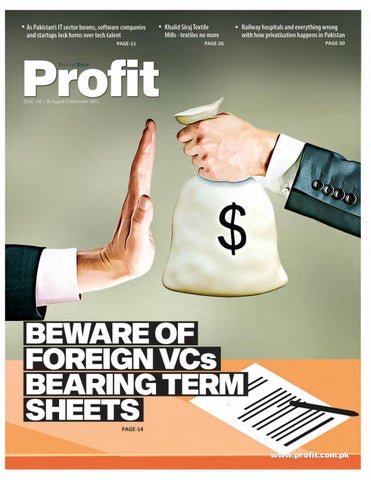
14 14 Beware of foreign VCs bearing term sheets 20 FMCGS have great second quarter 23 Storytelling in business: The fine line between inspiration and manipulation
26 26 Khalid Siraj Textile Mills - textiles no more 29 The Pakistani meme that shook the world Hamza Mahmood
Profit
30 Railway hospitals and everything wrong with how privatisation happens in Pakistan
Executive Editor: Babar Nizami l Managing Editor: Farooq Tirmizi l Joint Editor: Yousaf Nizami Reporters: Ariba Shahid l Babar Khan Javed l Taimoor Hassan Abdullah Niazi l Meiryum Ali l Shahab Omer Chief of Staff & Product Manager: Muhammad Faran Bukhari Regional Heads of Marketing: Muddasir Alam (Khi) l Zulfiqar Butt (Lhr) l Mudassir Iqbal (Isl) Layout: Ahmad Salahuddin l Photographers: Zubair Mehfooz & Imran Gillani l Business, Economic & Financial news by 'Pakistan Today' Contact: profit@pakistantoday.com.pk
Readers Say One of the most objective and well researched articles I’ve seen from this publication. There was a lack of a reference piece for the general public on something that is likely to alter the experience for the common customer irreversibly. I think something like this should also be covered via video on Youtube to make it even easier for people to consume. Apropos: Would the RAAST revolution live up to its promise? Hamza Nadeem Jami, Website The banks in Pakistan do not deserve sympathy, they deserve to be pushed towards making reforms. The Pakistani banking sector is still stuck in the last century, and the only way to pull them out of it is by pushing them towards the present, not even the future. Apropos: Would the RAAST revolution live up to its promise? @JhonyJunaid, Twitter Dawning of Private Equity ecosystem by HNW, Corporate-sector players and family-offices, although it existed earlier via offshore-routes but remained seldom-discussed. The current situation signals an upward-trajectory ahead in the innovation-funding arena. PE ecosystem would pave ways for the Financial-Capital to be rightly & productively-invested, thus fuelling the nationalproductivity by its subsequent multiplicity & addressing the problems with solutions. Indeed a nicely-authored piece by @AribaShahid & @taimmzz. Apropos: Pakistan’s private equity potential @ar_shoro, Twitter My personal favourite thing from econ Twitter is Ariba putting people in their places with her intelligence. I’m a fan! Apropos: No, the stock market is not an accurate indicator of the economy @hifzakhan, Twitter She’s right! The only true indicator of the economy is the PTI achievements Twitter account. Apropos: No, the stock market is not an accurate indicator of the economy @arhuml92, Twitter Not true. It’s the number of calls the PM receives from the world leaders. Apropos: No, the stock market is not an accurate indicator of the economy @amroayaar, Twitter
facebook.com/Profitpk twitter.com/Profitpk linkedin.com/showcase/13251020 profit.com.pk profit@pakistantoday.com.pk
HOW TO CONTACT
7
There is no indicator which is an accurate representation of the economy. Every indicator has its own flaws. Apropos: No, the stock market is not an accurate indicator of the economy @Ryan7890r, Twitter The entire stock market is all about making pump and dump plays. The government. pumps
the market by increasing the circulation of the money in the economy even when the economy is collapsing in dire straits. They do this by manipulating interest rates. The whole system cannot be trusted. Apropos: No, the stock market is not an accurate indicator of the economy @ashxraptor, Twitter The market can no longer attract any investors when the commissions and taxes are too high. As long as this continues, there is no hope. This is why the rule was always to sell on strength in so many of the scripts. Apropos: No, the stock market is not an accurate indicator of the economy Ali Faisal, Facebook The key is to bring SME lending platforms to the digital platforms where securitization and collateralization is integrated. Secondly, unless Pakistan comes up with some sort of credit beacon scoring system, full utilisation of fintech will never take place. Apropos: Should the fintech playbook scare the banks? Saad A Khan, Facebook This man is the biggest fraudster in Pakistan. Never buy anything in Bahri or any of his projects. Especially don’t buy anything in Bahria on installments - ever. Never ever. Apropos: Obituary: Malik Riaz the banker Azeem Hussain, Facebook There is a vast difference that exists between a property dealer and a banker. Malik Riaz very much falls squarely in the former category. Obituary: Malik Riaz the banker Tauqir Ahmed, Facebook Aleem Khan has recently just bought out a news channel. Maybe he will be interested in buying a bank too, even one so poorly named. Perhaps Malik Riaz should contact him? I would advise them to kindly contact each other. Obituary: Malik Riaz the banker Haseeb Shad, Facebook Another example. Leaving your area of expertise and investing in something one knows nothing about is doomed to fail. Obituary: Malik Riaz the banker Mustafa Shah, Facebook I also heard that he was interested in purchasing Summit Bank (that was sometime around Sindh Bank and Summit Bank's merger). Then last I heard that he was interested in a major chunk of Silk Bank (when its equity was wiped out around December 2020). Obituary: Malik Riaz the banker Jawad Ali Zuberi, Facebook
COMMENTS
IN BRIEF Rs 40 billion:
Prime Minister Imran Khan on Wednesday said the Ravi Riverfront Urban Development Project, in addition to its climate benefits, was expected to generate $40 billion in annual revenues. He claimed that the project would be beneficial for Lahore as well as the entire country in addressing the environmental and financial crisis.
Taking notice of approximately Rs 240 billion annual loss to the national exchequer owing to smuggling of petroleum products and its shortage in many areas of Balochistan, President Arif Alvi summoned a high-level meeting to address petroleum shortage and smuggling.
Rs 6 billion:
Adviser to Prime Minister on Commerce and Investment Abdul Razak Dawood has announced the release of Rs6 billion under Drawback on Local Taxes and Levies (DLTL) schemes. This includes Rs5.6 billion for the textile sector and Rs400 million for the non-textile sector. Cotton prices have shot up in Pakistan to a historic high in response to rising dollar value and low local production. Cotton has reached a level of Rs 14,100 per maund after a Rs 200 increase in the past few days, which the ginners say is a reaction of delayed imports of cotton bales and rising dollar rates. Members of a Senate body have asked the government to enter the names of the officials of Hascol Petroleum officials on the Exit Control List (ECL) over alleged involvement in a fraud of over Rs66 billion, accusing the company of also having strategic storage.
Although smartphone users in Pakistan are expected to increase 23 per cent by 2025, the country would still be at the lowest end in terms of phone usage and 5G internet in Asia Pacific. As per the report up to 74 per cent of Pakistanis will use smart-phones in the next four years up from 51pc. The Pakistani rupee depreciated Rs1.08 against the US dollar for a third consecutive day reaching close to an all-time low seen in the middle of August 2020. According to the State Bank of Pakistan (SBP), the local currency had closed at Rs 166.28 against the greenback on Wednesday.
7
Chilli milli bribes and startup extravaganza this week in Pakistan’s business and economics twitterverse
T
he startups had a field day following Airlift’s announcement of their massive valuation, but other things were in store as well with Miftah Ismail making tall promises about changes at Ismail Industries in exchange for votes given to the PML-N. We also discuss occupational hazards for reporters, the Pakistani state’s favourite expats, and just how central Whatsapp is to - well - everything in our lives. Ariba Shahid brings you all this and more in this week’s social media roundup.
You know what to do
For the chilli milli
So that was all we needed to do? Get Miftah Ismail a seat in the parliament so that the chilli milli go back to being jawwwuicy and hopefully the number of cocomo increase? Well, Pakistanis can blame Karachi folks for not voting for him. However, we do not know if Ismail is using this as an incentive to get votes, or is extorting our favorite childhood goodies. What is next? Will our political will be held hostage to the number of cocomos in a packet? Or will we be promised the return of Khati Meethi Candy, Candyland ki Fanty in exchange for voting for the PML-N. Given the seriousness of the issue, we suggest the Election Commission of Pakistan look into this. We also suggest that the PTI make a formal complaint to the Competition Commission of Pakistan and say the PML-N is using beloved products in the confectionery sector to mess with them in the electoral politics segment.
Job first
Kind of confused because aren’t we supposed to dress for the job we want, rather than the job we have. But yeah, optics can come later. More important to get things done than to play adult dress up and pretend.
8
We’re not going to say much, but if it’s your last day at a workplace you hate, you know what to do. There are other more creative things you could do as well, but those are perhaps things we do not want to discuss right here. Particularly since our bosses do read this magazine too.
Occupational hazards
Mama loves you, Expat!
If you’re a non-resident Pakistani you should know you’re the favorite child. You’re the one that is given the drumstick during every meal. You’re the favorite. Life is easier for you and it will be made easier.
Post pandemic world Mascots are meant to be annoying. Imagine getting paid to annoy people. I feel journalists manage to annoy plenty of people too, even though it isn’t our intention. {Editor’s note: Being a nuisance is unfortunately an occupational hazard for reporters. You can’t get important comments out of most people without being a pest in some capacity. But let us let you in on something - reporters are equally a nuisance to the editorial staff and vice versa within their organizations. Both in terms of their writing and getting us in trouble along with them.}
Enough with the groceries
If you’re unlucky enough to be dragged into a meeting, make sure you wear a mask. Not only is it the safe thing to do but also lets you express your boredom without offending anyone.
Good week for startups
“We will disrupt Pakistan through a grocery startup!” Give it a rest guys. It’s been done to death. Think beyond groceries and deliveries. The world is your oyster. Maybe go out and find some industry where you don’t have to worry about razor thin margins and might become self-sufficient?
Whatsapp State
Umm, just office communication? We hate to break it to you but the government runs on Whatsapp too. We just wish whatsapp had an option that didn’t show you’re online because honestly that would be great!
It’s been a cool week for the Pakistani startup space. $85 million by Airlift and $30 million by Bazaar. Pakistan has managed to raise more in funding from this year alone than in 5 years. Which is great. It means Pakistan is now on the map in the startup world and is getting serious money and is being taken seriously. Good luck to all!
SOCIAL MEDIA ROUNDUP
By Taimoor Hassan
P
akistan is having a startup boom, and most of these startups are based on and using technology to try and bring about their respective disruption. Other than innovation and ideas, what is the one thing that drives this growth and these startups? It is talent. Talented people capable of not just handling but excelling at the technical aspects that these startups are built upon. For any country to have a vibrant startup ecosystem, there needs to be a culture in which talent is nurtured, retained, and developed. In Pakistan, we have a strange relationship with our tech talent. On the one hand, we have a phenomenon of exporting
HUMAN RESOURCES
IT services to the Western world primarily. Prominent software companies in Pakistan like Systems Limited, Netsol and Confiz, all provide IT-based services to clients abroad, primarily to the companies in the US and Europe. We have IT engineers working in companies for clients located in other countries which choose Pakistani tech companies because of the low labour cost. Average entry-level salary for an IT graduate in the US is $61,812 yearly, according to data obtained from Glassdoor. Average entry level salary in Pakistan on the other hand for the IT sector falls within the range of Rs40,000 to Rs50,000 for majority of the roles according to P@SHA Salary Survey 2021, translating into an average Rs540,000 on a yearly basis. This low cost of labour is what Pakistan’s IT sector thrives on for
exports. Pakistan’s IT exports crossed the $2 billion mark for the first time in fiscal year 2020-21 that ended on June 30 this year. On the other hand we have technology startups in Pakistan, growing exponentially in numbers, trying to solve problems within the Pakistani society using tech-based solutions and scaling up on the back of serious funding. These startups are what you could call product companies - they do not provide IT services to any other consumer or company, they have their own product that they are scaling. Now, these startups actually pay pretty well. And not only this, but they give you opportunities for professional growth and the work is such that it is not mind numbingly boring. Somewhere in between are tech engineers that are part of the gig economy,
11
Startup funding is a major factor because of which the entire IT industry is facing the demand and supply gap when it comes to recruiting new employees. Startups are offering flexible work hours and high salaries as they have minimum infrastructure cost with high returns. Software houses are competing by developing succession layers and creating in-house talent pools to cover the shortage Toima Asghar, chief HR officer at Systems Limited
providing services to clients abroad, some of them hustling to grow to become an IT services company. And with so many avenues for earnings, a dearth has hit the market in terms of recruiting tech talent in Pakistan and the war for talent between startups and software houses has distorted pay parities, with engineers now with greater negotiating power than ever before.
What talent are we talking about?
T
ech talent has historically been employed by software houses and agencies to provide project-based work opportunities to software engineers. When it comes to software houses, they are primarily engaged towards providing services to various clients. The engineers they hire work on projects, one after the other, for the company’s clients. The experience these engineers get is across the breadth of various projects. Gig workers provide services like software houses to clients abroad but in individual capacities.While startups on the other hand are product companies. While there is a requirement for generalist engineers who can handle almost every project, startups require engineers who have had experience working on a technology product before, and therefore the criteria for hiring steers a little bit away from fresh graduates. The pool is automatically less because such startups are always looking for candidates who have seen scale in solving such problems. For instance, Bykea or Careem or Uber will be more inclined towards hiring engineers who have worked on scaling similar platforms before. According to startups, such engineers are harder to find in Pakistan to begin with because historically, software engineers and developers have worked at software companies earlier where most of their experience had been in development-related work where they would be developing applications for
12
companies in Europe and US because of labour arbitrage. The nature of work at software companies is fundamentally different from product companies like startups Bykea, Uber and others that have now sprawled up.
What exactly is happening?
B
ut regardless of what sort of engineers are needed, what’s constant is that IT-related talent is needed by both sorts of tech companies. Because they were historically concentrated in the software houses, the emergence of startups is making software houses bleed the talent they housed for years and nourished it, only to see them lose this talent to the young startup companies. And the way startups are snatching this talent is old school, i.e. throwing VC money, which has the big software companies in plight, disrupting an order that has been in play for years. Startups have raised a lot of money recently. The startup funding during the first six months of 2021 was $125 million, with most startups’ securing average ticket size of over a million dollars. So when you have that kind of money, you are ready to throw more at your employees. Startups are highly risky and it would be a while before they establish themselves as sustainable businesses. Because startups are highly risky, engineers working at established software houses will not be willing to take the risk unless they are paid more. Which is why startups have no other option but to offer extra if they want to recruit top talent. And as new startups sprawl and more funds come in for existing ones, it simply means extra pressure on the industry. They have to get engineers to scale their products which is why software companies believe that the startup phenomenon has flared the dearth of talent in Pakistan. That they attract talent through fancy designations and money.
“Startup funding is a major factor because of which the entire IT industry is facing the demand and supply gap when it comes to recruiting new employees. Startups are offering flexible work hours and high salaries as they have minimum infrastructure cost with high returns. Software houses are competing by developing succession layers and creating in-house talent pools to cover the shortage,” says Toima Asghar, chief HR officer at Systems Limited. Now why in the world would that be a problem? Can’t the software houses pay more? Yes they can. They do actually to retain their employees. The problem, however, has snowballed as salaries for various software and IT engineers have gradually increased from a lower base level and further disruption is not healthy for software companies. The recruiters at top software companies are grumbling about the fact that higher salaries offered by startups has disrupted internal and external pay parities and software houses now have to pay more for the same kind of engineers to pull them from a startup, than what they would be paying engineering at same roles with similar kinds of experience already working with them. “From a hiring manager’s perspective, they have to manage parities; both internal what is being paid within the company, and external - what is being paid in the market,” says Saqib. Money trumps everything. A higher salary in Pakistan is likely going to prompt any engineer to switch jobs and software houses believe that startups are breaking existing parities for no good reasons. It makes sense from the perspective of software companies. For instance, they have an employee working in a software engineering role at the company that pays, let’s say Rs100,000 per month. Now if that company gets a new project from a client and the recruitment department of the IT company goes on a hiring spree, they would find less experienced engineers for the same role
working at startups at Rs150,000, whereas their own more experienced engineers would be working at Rs100,000. Now if the urgency of the project requires hiring to be completed in a matter of days, the recruiting managers would be left with no choice but to try to recruit that engineer at a salary even higher than Rs150,000. This is the dilemma here. You cannot have new hires with less experience working at salaries higher than more experienced employees at the company. If you do, you run the risk of losing these employees to startups and then you would have to recruit them at an even higher salary. The only choice one can be left to have is to increase the salaries of these engineers as well, disrupting the internal pay parity for one new hire in the company, which eventually pushes up the salary base for any new hires. You see, software companies believe that the parities that they had set for years are actually what the technology engineers are worth in the Pakistani market. And that the VC-money backed startups coming in and throwing in extra money are giving strong negotiating powers to engineers’ means that the established order is distorting and going strongly against software houses. “Software houses lose their tech talent to freelancing as well, with new graduates preferring to work as freelancers with their own flexible work schedule, and experienced engineers leaving to do the same, thereby creating the problem of employee retention,” says Saqib Tiwana, head of human resources department at Lahore-based Confiz Solutions. Employee retention problem is faced by startups as well because, and it will come later down, that startups are also in a lurch because they also lose talent to new startups who have even more money to throw to recruit top talent. But at least in the case of the gig economy, freelancers are not switching for higher salaries and therefore do not distort salary levels. The reason why big software companies feel threatened by the new order in which they are not able to control salaries is because, and as earlier mentioned, these companies are primarily software exporters, making money because of the clients that are mostly foreign companies that are doing business with companies in Pakistan because of low cost labor. So when the labor costs go up, the margins for these companies shrink. They make less money, but importantly, if this continues to happen, sometime in the future, Pakistani software companies will lose the competitive advantage because of low cost labor and then it would mean serious trouble.
The problems for startups
B
oth startups and software companies are bleeding each other, trying to get hands on each other’s talent. It is more of a problem for software companies because that eventually increases their costs. As mentioned above, startups are mostly building their own product that they want to scale in the Pakistani market. This creates a pull for engineers, new entrants as well as experienced ones working at software houses, to join startups to get in-depth experience of building a product and scaling it up. At software houses, these engineers are working on projects from. They will start on something, develop it and move on to the next one. The engineers would be across the breadth of projects which would involve building products for others and then moving on to the next when the product is built. Nowhere in this experience is deep learning for the engineer. His or her core KPI is to keep the company’s client satisfied, even if the client is satisfied with a bad product. While for some engineers, this could be triggering – having to leave a project with bad product, wanting to improve it but not being able to do anything about it because the client likes it that way. For some engineers, the experience would not be fulfilling, with the desire of deep learning about the product unsatisfied. There is also no ownership of the product, because as soon as the client’s requirement is fulfilled, an engineer is done working on the project. This is another pull that startups have. Because they are product companies, engineers get a chance to deeply learn about the product they build, keep an eye out on analytics, scale the product and troubleshoot problems, which gives them a sense of ownership. This is where the problem arises for startups. That the market does not have experienced engineers who know how to scale products to begin with. Most engineers in Pakistan would be generalists, whereas scaling technology products would require specialists. While this is a pull for anyone to work in a startup, for a startup, it means that engineers looking for such roles would be limited because not every engineer would have the urge to become specialists. The trends are still favourably skewed towards software houses with candidates de-facto preferring to join established software houses that have built their reputation over the years. Startups are small right now, with their products being used by tens or hundreds of thousands of users. The complexity that comes with it is that the kind of problems a software engineer faces when the transaction level with a product is small is very different, very
different from problems that come when the transactions are huge. So even though there are engineers that can handle product scaling, they perhaps do not have the experience to handle the product when it scales further to millions of transactions a day. The number of experienced engineers who could handle this at massive levels is considerably less in Pakistan and the problem is further compounded when other startups, equally or more well-funded, are also competing for the same talent and that further inflates the pay scale for such engineers. “Historically, the skill-set that experienced engineers have of scaling products has been very small in Pakistan,” says Abbas Shahid, vice-president of growth at Bykea. “You will only find some engineers who would have some level of exposure or academic background from a different place who can manage product scaling and they are generally interested in it as a passion not as a career. Through self-learning, these engineers have been able to teach themselves. We are utilising those people to give that sort of exposure to the Pakistani market as well,” he adds. Another problem that startups recognise is that the startup ethos encourages participation in decision making whereas Pakistani tech engineers are by default a shy lot that feel uncomfortable having conversations besides strictly what to build in. They can develop the what of the product but will remain hesitant to ask the why of it. They would not go back and contest that if something is being developed, what’s the logic behind it and what would be a better way to do it. Most of this attitude has to do with restricting engineers to engineering only at universities, without feeding them the knack of looking at all things engineering from a business perspective. The problem at the end of the day for everyone in the IT industry is the dearth of IT engineers. Some of it in numbers: while there is no official repository of data on how many IT graduates are in the market, news reports online say that the number is roughly 300,000 graduates, with 20,000 graduates entering the market annually. While this looks like a healthy number, the demand is very high with as many as 2,000 software companies working in Pakistan that employ these graduates. But top universities are few and far between and the number of top notch graduates is in reality restricted to a handful of universities like GIKI, FAST, LUMS and NUST and it is this talent perhaps that is most attractive and worth fighting for. Perhaps what Pakistan needs is more tech universities that can produce more quality graduates as the IT sector is further set to boom with software companies recording record exports and startups bagging record funding. n
HUMAN RESOURCES
14
By Farooq Tirmizi
W
e could start by telling you all the superlatives, such as the fact that the largest Series A and Series B in Pakistani history (Bazaar’s $30 million and Airlift’s $85 million respectively) were announced in the same week and put together were more than total startup funding raised by all startups in the country over the previous three years combined. We could tell you that this is a fantastic thing for Pakistani startups, and that the country’s economy is better off for having all the attention from foreign investors. We could list all of those foreign investors and tell you why each one is significant. We could even write a piece telling you why these investors should have been paying attention to Pakistan all along. But those are all obvious takes and you have no doubt read countless of them already, including in the breathless tweets that quote-tweeted these announcements (including one from this author… guilty as charged) on Twitter. Instead, we will focus on a layer below: why is this happening, what it will mean in terms of financing and business strategy for Pakistani startups and, crucially, what could potentially go wrong and how to avoid the more obvious pitfalls.
Why are foreign investors coming to Pakistan?
L
et us start with the biggest and most obvious question: why is big money finally looking at Pakistan? As we see it, there are five key factors, one of which we classify as a push-factor, and the other four are pull factors.
1. Exit from China: the push factor
Sure, there are some factors that are pulling investors towards Pakistan, and we will discuss those momentarily, but perhaps some of the biggest factors might be push factors: investors are coming to Pakistan because they cannot go elsewhere. Specifically, they cannot go to China as much anymore. As the government in China starts cracking down on companies that have extensive ties with the United States and generally makes life difficult for foreign investors in the country, US venture capital investors have been seeing their opportunities to invest into China dry up. And the speed and scale of the regulatory crackdown have stunned investors. In 2018, $17.4 billion of US venture capital dollars went into China, or about 14% of the total $122 billion in VC funding raised by US startups that year. Just two years later, that flow has fallen a staggering 86% to just over $2.5 billion in US venture capital investments into China in 2020. And the year 2021 is not off to a great start either. All of that US venture capital money that was allocated towards China has to flow somewhere. And while some will no doubt remain in the United States, the vast majority of it will flow out of the US to emerging and frontier economies. Pakistan, like many other geographies, is at least partially just a passive beneficiary of that push-factor: China does not want US VC money, so US VC money is flying around the world in search of profitable investments.
2. Pakistan is an attractive market, and better connected than ever before Of course, there is certainly a pull factor for Pakistan as
COVER STORY
well. It is among the 10 largest countries in the world by population and finally has a substantial portion of its adult population now connected to the internet for the first time, and thus able to access internet and software-based services, the kind that attract the bulk of venture investing dollars.
3. The domestic VCs
Pakistan also has a domestic venture capital industry now – albeit a small one – that speaks the language of global technology investors and can serve as local guides to foreign investors looking to establish a toe-hold into the country’s startup ecosystem. And while the Pakistani diaspora in Silicon Valley is dwarfed by the ones from India and China, it does tend to punch above its weight by sheer numbers, with a number of prominent venture capital funds in the United States having partners and senior investment professionals of Pakistani origin, who have not been shy about deploying capital into the country.
4. Pakistan’s Silicon Valley expats
For example, Mikal Khoso of Wavemaker Partners led their investment into the B2B marketplace Bazaar. Mamoon Hamid led the investment for Kleiner Perkins into Bazaar’s rival Tajir. And Immad Akhund, a prominent entrepreneur and angel investor personally invested in the pre-seed round for neo-bank startup TAG.
5. The Careem mafia’s Pakistan contingent
And then, of course, there is the Careem factor: the most prominent venture-backed exit in the entire Middle East and North
16
Africa region is Uber’s $3 billion acquisition of Careem, which has led Careem to become for the region what PayPal became for the US tech startup ecosystem in the early 2000s: a font of tech talent and experienced operators who have the credibility to raise capital from global VCs comforted by the brand name on those founders’ resumes. It is not just Founder-CEO Mudassir Sheikha: a substantial portion of Careem’s employee and executive base in many of its markets even outside of Pakistan is Pakistani, meaning a substantial portion of those Careem-mafia-chasing VC dollars will flow to Pakistani founders, many of whom are focused on the Pakistani market. Perhaps the most prominent of these is Saad Jangda, one of the two cofounders of Bazaar, which has raised $38 million in VC funding in the 15 months it has existed, including a $30 million Series A, the largest ever for a Pakistani startup yet.
Where will the money go? Blitzscaling
S
o what do you do as a startup founder when you get lots and lots of money from investors? You could invest a significant portion of it on hiring software developers, product managers, and designers to build out better versions of your product, and you probably will. You could hire marketing, customer service, and other support staff to help grow your operations and make them sustainable, and that is also certainly something a well-funded startup will do. It will also pay its founders a reasonable salary, spend on good office space, and a whole host of other benefits to make working at the start-up feel like it has the best of what a large company has to offer. But mostly, you will probably spend money on blitzscaling.
Blitzscaling – which is a portmanteau coined by LinkedIn founder Reid Hoffman, derived from the German “blitz” for lightning – includes all of the other elements described above. But, to crudely simplify, its core objective is to spend money to get users to come onto whatever platform the tech startup is building and to do so largely by spending money on incentives that make it attractive for users to stay on the platform. So, for instance, think of the deals and low fares Careem offers riders, or the high compensation it offers drivers. The whole point is to try to get drivers to keep driving their cars for Careem and for riders to keep using Careem until both sides get so used to using Careem – and the service becomes so efficient – that the promotional rates can be taken away on both ends and the system would keep working. Without asking any executive at Airlift, we can hazard an educated guess that the overwhelming bulk of the $85 million raised by the company will be spent on incentives for drivers and subsidised prices for customers. The goal will be to get more and more people to start using Airlift’s services as well as to retain existing customers. The logic behind blitzscaling is the following: if the value of a business is based on the number of paying customers it has, and there is a certain cost to acquiring those customers, ceteris paribus, a company’s founders and investors will earn a higher return on their investment if those customers are acquired faster rather than slower. Building a platform faster also reduces the risks of competitors building similar or better products and taking away market share. Let us illustrate this with a specific example. In a story published in February 2021, Profit laid out estimates for Careem Pakistan’s customer acquisition costs (CAC) and average
revenue per user (ARPU). We showed that, by the end of year 3, Careem had over 3.1 million users, which resulted in net revenue for Careem (after paying the captain’s share) of $9.6 per user per year. Careem spent $117 million acquiring those 3.1 million users. What return did Careem’s investors earn during those three years? For simplicity’s sake, let us assume that 40% of Careem Pakistan is owned by employees and the remaining 60% by investors. At the end of year 3, Careem was earning about $30 million in net revenue. Applying a valuation multiple of 10 times revenue (not uncommon for a fast-growing tech startup), we arrive at a valuation of $300 million. Using the simplifying assumptions above, Careem’s investors would have an internal rate of return (IRR, a measure of investment returns that takes into account timing of cash flows) of 32% per year. Now, suppose instead of investing that $117 million over three years, they invested it over two years. What would that do to the IRR? It would go up to 51% per year. (Do not try to replicate these numbers. We used Careem Pakistan’s actual cash flow numbers and applied our modifications to those numbers, so this math would be impossible to replicate without that data in front of you.) Obviously, if you can pull up the growth, it makes a lot of sense to do so, even if it means investing a larger amount of cash up front. That, in a nutshell, is one of the biggest advantages of blitzscaling. It is particularly relevant for companies that expect to take several years to hit the point of cash-flow breakeven, let alone generate enough capital to internally finance their own growth. Incidentally, one of the key people in charge of implementing Reid Hoffman’s blitzscaling ideas at LinkedIn? Aatif Awan, the founding partner at Indus Valley Capital,
one of the major local venture capital funds in Pakistan, and a backer of both of the two record-holders of the largest Series A and Series B fundraising rounds for Pakistan. Before founding Indus Valley Capital, Awan was VP of Growth at LinkedIn.
The limits of blitzscaling in frontier markets like Pakistan
Y
ou will notice one big underlying assumption behind the concept of blitzscaling: that the users are there to be acquired and that the CAC will not be disproportionately increased by compressing it into a shorter timeline. This assumption holds true in many market segments, even in Pakistan… but up to a point. And when committing to a blitzscaling strategy, it is absolutely critical that a startup founder have at least a rough idea of when that point would be reached. Because the investors will not know. Only the person actually in the business will have the ability to know the answer to that question, and the answer to that question determines how much money is appropriate to raise. We do want to emphasise: precision is not important, but accuracy is. So, for example, it is okay for a startup to think their market is 10 million people and it turns out their market was only 6 million people. It is not, however, okay if they thought their target market was 100 million people and it was still just that 6 million people. How does one determine how big a market one has? Think about every single characteristic that a person needs to have in order to be a customer and user of the company’s product or service, and then obtain as close to reasonably accurate estimates as possible
of the proportion of the total population that meets all of the minimum characteristics needed to be a user. In Pakistan, the two challenges startups frequently run into are income and infrastructure. So, for example, for Careem, the minimum requisite characteristics of a customer include ability to read English, own and operate a smartphone, have mobile broadband internet, and have enough disposable income to be able to afford a Careem ride on at least a monthly basis, but not have enough income to own a car available for exclusive personal use. It turns out that once you filter for all of those characteristics, of the 220 million people who live in Pakistan, the total number who fit that profile is just over 3.1 million. How do we know that? Because Careem’s cost of customer acquisition skyrocketed when it tried to grow beyond 3.1 million users. Careem acquired its first 1.4 million customers for about $34 per monthly active user, the next 1.7 million customers for about $38 per monthly active user. The next 0.5 million customers? They came at an average price tag of $122 per monthly active user. If, after the first million users, Careem had raised money assuming they would have 20 million monthly active users, they would have been in big trouble if they had tried to raise it all in a short amount of time. Luckily, they did it somewhat slower, which allowed them to gauge just how much money they needed to raise without asking for too much money and then suffer the ignominy of disappointing expectations. For Airlift, having the example of Careem before it gives them a fairly good sense of just how much they might need to spend in order to achieve scale. For Bazaar and Tajir, the task of determining just how much money they need is a bit harder, but the risk is lower: much of their capital is likely going into inventory
COVER STORY
that will likely be sold at some point, even if not as fast as they are hoping. But what these examples show is this: startup founders need to have a clear sense of who their customer is so that they can have a reasonably good guess as to how much money they will need. For example, a neobanking startup needs to understand that the vast majority of its customer base will already have existing bank accounts, but will exclude people who are high earners and thus want to transact in large volumes, which are currently prohibited by the State Bank of Pakistan. So, sure, there are about 20 million people with bank accounts in Pakistan, but a neobank’s prospective customer base is a much smaller subset of that, and a less lucrative one at that (since the most profitable customers are the richer ones who have large balances in their current accounts). If a startup gets these estimates badly wrong (a little wrong is okay), they run the risk of encountering what can be the kiss of death for a business that has been raising large sums of capital: a down-round, which decimates their ability to keep raising money to grow.
The expectations problem, and what to do about it
A
down round is when the valuation of a startup in a particular fundraising round is lower than it was in the previous fundraising round, resulting in its previous investors suffering losses. If previous investors suffered losses, prospective future investors will start to shun the startup, severely limiting its ability to keep on raising money, which – for a business that has grown accustomed to paying for rapid growth – can
18
be the death knell. This is going to be particularly important for Pakistan, considering the fact that foreign venture capital investors are getting their first taste of the market, and have never been through a Pakistani market downturn. Indeed, most of these investors have never even been through an emerging and frontier markets downturn in venture capital. The industry is simply too new for that to even have happened yet. And historically, if public equity markets investors are a reasonable precedent to go by, Pakistan tends to get penalized more heavily for market downturns – in the form of panic sells – than other similar economies. The nature of venture capital makes panic-selling somewhat less likely. But one can expect future inflows to completely dry up if investors completely get spooked. And that is before we even get into the prospect of fraud or other deception by Pakistani startups, which would be a body blow to the ecosystem regardless of what phase of the investing cycle the market was in. One way to avoid the problem for the Pakistani startup ecosystem? For founders to not get too greedy when fundraising, and appraising the offers of investment not on the basis of the highest available amount, but the one closest to the startup’s needs. That will require holding venture capitalists to a fiduciary standard with respect to their own investors, as well as the startup founders. What does that mean? It means they need to be incentivised to act in a manner that maximises the returns for investors, regardless of whether or not that has an adverse impact on the revenue line for the venture capital firm itself. One might assume that, considering the fact that the vast majority of a VC fund’s revenue comes from successfully closing out all investments at huge profits, that the incentives
of investors and VCs would be completely aligned. And while it is true that there is general alignment, there can at times be a conflict of interests, particularly when the VC is trying to raise more funds on the back of being able to show good paper returns on existing investments. Raising more money for an existing fund, or for a new fund entirely, can result in a new revenue stream for the VC managers that is independent of – and sometimes conflicts with – the interests of its existing investors. See, to raise new funds, the VC needs to show their existing investments are doing well, which means having the ability to mark up the value of those investments. In illiquid investments such as venture capital, the only time a markup comes along is when another round of funding is executed, which gives a VC who is in fundraising mode for their current or new fund an incentive to seek larger rounds at a higher valuation. But higher valuations mean higher expectations, and a higher possibility of disappointing those expectations for the founder, and raising the danger of losing control of the company or even outright failure. Hence why VCs need to act as fiduciaries to their existing investors: acting in their best interests, even if it does not completely align with the financial interest of the VC themselves. It is a tricky business, knowing how much you need, and having the strength of conviction to turn down more money than one expected. But for their own long-term financial interests, and for the interests of Pakistan’s startup ecosystem, Pakistani tech founders need to resist the urge to go for the biggest cheque sizes if it is the wrong number, regardless of who is calling and how much they are offering. Greed, in this case, is not good at all. n
COVER STORY
FMCGS
have great second quarter Nestle Pakistan and FrieslandCampina Engro half-year results show a robust FMCG sector
20
F
or a while there, the Covid-19 pandemic seemed to upend all retail experiences and shopping habits of Pakistanis. Unnecessary splurges were gone, petrol consumption died, and even retail suffered. And yet one sector remained buoyant despite it all. Fast-moving consumer goods (FMCG) companies survived it all because pandemic or no pandemic, Pakistanis needed their food. And that is why even though 2020 and 2021 - despite the various lockdowns and the vaccination slowdowns and the multiple variants FMCGs are having one of their better years yet. One only has to look at the recently-released half year results for Nestle Pakistan and FrieslandCampina Engro Pakistan (formerly Engro Foods). For the half year ending June 30 2020, Nestle Pakistan recorded a revenue of Rs65.8 billion, an increase of 12.7% compared to the same period of last year. Its
profit after taxation stood at Rs5.7 billion, compared to last year’s Rs3.876 billion. In the case of FrieslandCampina Engro, ist revenue stood at Rs24.5 billion, compared to Rs20.1 billion in the same period last year. Meanwhile, its profit after tax stood at Rs1.4 billion, a huge jump compared to the profit of the same period last year, at Rs292 million. What explains this jump? Let’s first look at Nestle Pakistan, creator of the much beloved brands Nestle MilkPak, Nescafe and Fruitavitals (beverages). According to its financial reports, most of the growth was actually due to the depressed base from last year due to the strict lockdowns. Still the company also had some factors going for it. For one, the company’s financing cost for the period reduced by 45.9% due to a lower interest rate. The operating profit for the period was Rs9.9 billion, an increase of 24.3% compared to the same period last year. Most of that was
driven by what the company called ‘volume growth, overheads control and value chain cost optimization initiatives’. While those may sound like fluff phrases, a more fuller picture emerges from the company’s annual report of 2020. Because of the Covid-19 pandemic, the company had taken some optimization steps that have long-ter, positive repercussions for the company. For instance, it set up a B2C home delivery solution, and introduced tele-sales. It also collaborated with tech startups so that products could reach retailers on time, even when order bookers couldn’t physically visit the shops. Their sales division also continued with door to door sampling and selling throughout villages of Punjab. It even deployed a new cloud based system at various distribution sites in order to speed up efficiency, including Salesforce effectiveness, and analytics. The end result was that Nestle Pakistan managed to record revenue growth
FMCG
of 2.4% in 2020. It was also helped by the launch of a bunch of new products, such as Nestle Milkpak butter, Nestle Fruita vitals Anaar, Nestle Chilled Mocha, and other products. Now, let’s look at FrieslandCampina Engro Pakistan. It is much more heavily focused on dairy, with its brand Olpers a direct competitor to MilkPak in the milk space. The recent financial results did not specify the reasons for the increase, but there are clues in the quarterly report for the preceding quarter. In that quarter, the dairy and beverages section had grown 15% compared to the same period last year. Most of that had been due to new outlets, and the company had expanded its retail footprint by more than 11,000 outlets during the year. Additionally in that quarter Olpers UHT pouch pack was introduced in Pakistan, with the low price point of Rs50 per pack. Olper’s Flavored Milk, Olper’s full cream milk powder, Tarang Tea Whitening Powder (TWP) had
22
It’s important to note that both companies are heavily invested in theri dair segments. Almost 80% of Nestle Pakistan’s sales comes from dairy products, while that figure stands at 92% for FrieslandCampina Engro also gained a foothold in the market space. Additionally, the company’s ice cream and frozen dessert segment had skyrocketed, with an 84% growth compared to the year before. Engro had strategically decided to plan early to the summer seasons, creating a brand building ‘summer blockbuster’ campaign, which resulted in the highest ever sales during the January to March period. This trend must have continued on in the second quarter as well. It will be interesting to see how the company fares in this space, where it is not up against Nestle, but instead Unilever’s Walls desserts.
It’s important to note that both companies are heavily invested in theri dair segments. Almost 80% of Nestle Pakistan’s sales comes from dairy products, while that figure stands at 92% for FrieslandCampina Engro. And there is still a a lot of space to grow in this area. For all the talk of FMCGs, much of Pakistan still buys loose milk, compared to packaged milk. There is still limited legislation on the minimum pasteurization for milk in this country, and federal and provincial food laws often differ. If those kinks in the system can be ironed out, then one can expect financial results like these for years to come. n
FMCG
Storytelling in business
The fine line between inspiration and manipulation Bharat Avalani spoke about storytelling and business in a TerraBiz Digital webinar By Abdullah Niazi
A
lot of what we do here at Profit is storytelling. Of course, what we call the meat of the story are the facts - the numbers and words we gather and then analyse that make these stories important and why people read them. Our reporters make themselves a nuisance to CEOs and bank presidents, messaging and calling them incessantly, and they trawl through financial statements, and legal documents to make sure that the information our readers are getting is important and accurate. But after the reporters are done gathering and verifying the information, the process of actually writing the story begins. First the reporters themselves and then the editorial staff need to figure out how the information on
PUBLIC RELATIONS
hand needs to be conveyed to our readers. Will we make an emotional appeal or instead take on a more dramatic voice? Will we tell the story as a factual narration or a gripping tale? Our goal is usually to do the latter, particularly when we write one of our longer long-form featured pieces. A barrage of facts and numbers stretching over pages and pages would never keep the attention of our readers. That is why we try to stick to the style of writing popularised as narrative nonfiction. We do not merely want to set the facts straight for the record, we want to communicate the story that those facts tell. Which is why, perhaps, TerraBiz Digital’s webinar featuring Bharat Avalani was particularly relatable to Profit. Much like politics, the world of business is at the end of the day made up of humans. And while the ethos most businesses aspire to is cold and cutthroat - at the heart of all businesses is
human emotion. Every company in the world has a story, and how that story is spun can make or break a business. More than products, particularly in marketing, what we are doing is selling stories.
Inspiration and manipulation - the power of storytelling
A
Malaysian expert in Brand Management, Consumer Insights, Media Strategy, Brand Activation, Market Development and Integrated Brand Communication, Avalani is also a Unilever veteran that has crisscrossed 69 countries (including Pakistan on numerous occasions) and comes with decades of experience. Despite his impressive track record in the corporate world, when asked what his profession is, Avalani
23
Storytelling is a skill in business, not an art. It is a tool you use for effective communication and nothing else. “The question is, where does storytelling help? And the answer is that it helps us to inspire and engage with our audience no matter what that audience is Bharat Avalani, storyteller and memory collector
likes to call himself a “storyteller and a memory collector.” You see Avalani is a Global Partner of Anecdote International, recognized as a world’s leader in the use of storytelling in business, and the CEO of Connecting the Dots Marketing Consultancy. Avalani believes that effective communication from business leaders comes not from a place of power through which business leaders assert themselves, but through a place of common human emotion and shared experience. Famous for his workshops, Avalani has made it his mission to teach leaders in business how to effectively communicate to their employees, their partners, and their bosses through storytelling. At the webinar hosted by TerraBizz, the full force of Avalani’s acumen was on display as he explained the depths of storytelling, and it’s very practical uses in the corporate world. “Storytelling is a skill in business, not an art. It is a tool you use for effective communication and nothing else” he told the more than 600 strong webinar audience on Thursday. “The question is, where does storytelling help? And the answer is that it helps us to inspire and engage with our audience no matter what that audience is” he explained. This was an interesting moment in the discussion, particularly because it happened in the beginning parts of the webinar. Very early on Avalani did away with any pretenses that writers of business executives had about the soul or essence of storytelling. For writers and other people with an artistic vision, telling stories is all about emotion and vitality. And yes, while this is true for storytelling in business too, the goal must be very clear - it is to communicate better so you can run your business better. It was a startling moment, particularly because in very clear words he was saying business leaders should appeal to the emotional side of people to inspire them into action or convince them. In such a moment, a very fine line is drawn between inspiration and manipulation - both of which can be achieved through stories. This philosophy does away with the wishy-washy ‘artistic’ view of storytelling and utilises storytelling instead as not a ‘soft skill’
24
but a solid tool used by business leaders to get their way and inspire people. In this way, Avalani draws a barrier between regular storytelling and storytelling in business. However the one thing he stresses on and finds in common between business storytelling and more artistic storytelling is that all storytelling is, at the end of the day, communication. Great authors communicate our greatest fears, hopes, and desires in words that we ourselves cannot frame. The reason Shakespeare is so eternal is because he managed to communicate base human emotions to us in poetry - he framed in beauty both love and treachery, he exalted both loyalty and cowardice, and presented to us as equals both love for country and love for the self. In the same way, Kafka managed to communicate the absurdism and aporias of modern life and Toni Morrison communicated the realities of race and gender in expressions we never knew we had the capability to comprehend let alone formulate. It is als why Ronal Reagen, the 40th President of the United States famous for his quips and jokes, is still today remembered as ‘the great communicator’ - because he used stories to reach into the hearts of a people and embed himself in them. All of these are examples of communication through storytelling for different purposes. In the case of business, storytelling can be an effective way to communicate and make money. “At one end of the communication spectrum is the ‘assertion’ approach that focuses on statements, opinions and abstract concepts. At the other end of the spectrum is the ‘story’ method that focuses on specific moments,” says Avalani. The first approach, essentially means coming from the top and using power and influence to steamroll other people. The storytelling approach means using anecdotes, parables, examples, and personal philosophies to appeal to the emotional side of the people you are trying to communicate with. It is a little dark when one thinks about it - Avalani is sugges “But there is a problem. In our research into leader communication, we estimate that about 90% is strongly oriented towards the
‘assertion’ method. In essence, leaders are not making considered communications choices, they are defaulting to a method they have been conditioned to use — a method taught from the time we leave primary school, reinforced at University and beaten into us in the workplace. True, the assertion method has valid applications and some strengths, but it also has major limitations,” says Avalani. According to Avalani, in research his organization conducted in 2019, two videos were shared with nearly 1000 business leaders. One used the assertion method; the other used the story method. The participants were then asked to record one or two words describing their reaction to each version. For the video using the assertion method, the most frequently used words were ‘boring’, ‘cold’, ‘arrogant’ and ‘unengaging’. For the story approach, the most frequently used words were ‘emoting’, ‘engaging’, ‘passionate’, and ‘inspiring’. The difference between the two methods is as clear as night and day. There is much more that can be made of it, and much more that was said at the webinar. Alvani told stories of his visits to Pakistan in 1996 and then again in 2015 and the lasting impact those had on him. He answered questions about his storytelling method. He said, for example, that a story in the world should be told without ever saying “I am going to tell you a story” - because the perception is that stories are used to manipulate people and get out of situations and make excuses. The story should flow naturally and it should aim to inspire and move the person that is being talked to without them feeling like they are being subjected to something untowards. The essence of the webinar, and Alvani’s philosophy, however was clear. The most successful leaders are storytellers. By mastering business storytelling they achieve extraordinary business results. As a modern – day leader, you know you should develop this skill, but you don’t have the time to do this in an adhoc way. What you need is a practical, reliable method to follow, one that will allow your business to reap the benefits of storytelling as soon as possible. n
PUBLIC RELATIONS
Khalid Siraj Textile Mills
textiles no more A company that has been doing poorly for years is finally facing its reckoning
C
ompanies are bound to have bad years - it’s the nature of the game. Perhaps one year production fell, or the economy tanked, or a calamity hit; whatever reason will have to be explained in that year’s directors report. And yet it really takes something for a company to not be able to generate profits for years on end. In the case of Khalid Sairaj Textile Mills, the company has generated a loss consistently for every year since 2007, the earliest year for which publicly available financial data is available. And yet somehow, KSTM thinks its going to generate a profit in 2022, with increasing returns moving ahead till 2025. In fact, it has laid out a business plan explaining exactly that to the Pakistan Stock Exchange on August 16, 2021. How is KTSM so confident? To understand it helps to know exactly how the mills
26
got to their dismal state in the first place. Khalid Siraj Textile Mills Limited was incorporated in Pakistan as a public limited company on 17 January 1988 and is quoted on Pakistan Stock Exchange. The principal business of the company was manufacturing and sale of yarn. Its registered office is in Lahore, and its manufacturing facility is in Kasur. For a while the company did ok. And ok really was the extent of their ambitions it seemed. To be clear, the standard being used here is that the company was able to produce something. Between 2007 and 2010, the company had a net turnover between Rs500 million and Rs700 million. Then, in 2011, net turnover climbed to Rs1.1 billion, the highest it has ever been. In 2012 the net turnover may have fallen to Rs796 million, but in 2013, it climbed to Rs1.08 billion. Sadly, this did not translate to higher profits. In fact, the company made consecutive
losses. Its worst year was in 2009, when it made a loss of Rs95 million - the greatest loss it has ever recorded. The larger sales did not translate to profits at all - just more manageable sized losses. And then, in 2015, the mills simply gave up. In the annual report for that year, the company itself gave no explanation for what happened, giving a one-line vague reference to ‘depreciation on revalued fixed assets’. The auditor’s note was more illuminating: that the company had accumulated losses of Rs291.9 million at the close of the year ended 30 June 2015, and that its current liabilities exceeded its current assets by Rs88 million. “The Company is facing an operational and financial crisis and has lost key management without replacements coming in and as a result the commercial operations of the company have ceased. These conditions indicate the existence of material uncertainty which
may cast a significant doubt about the company’s ability to continue as a going concern and therefore it may be unable to realize its assets and discharge its liabilities in the normal course of business,” the auditors noted. This was a paragraph to be repeated verbatim over the next few years. The company made Rs17 million and Rs105 million in revenue in 2016 and 2017, and then had no revenue for the next three years. Meanwhile, its losses kept increasing, from Rs49 million in 2016, to Rs76 million in 2018. Losses fell to a more manageable level of Rs40 million in 2019, and Rs20 million in 2020. That year’s annual report finally spelt out the problem: The existing plant & machinery has become too old, obsolete and inefficient to compete with the latest machinery which is highly cost efficient and more productive. To make matters worse, the textile market was ‘highly depressed under current government policies and uncertain political climate’ which means that sponsors did not want to invest in the company’s BMR plans. Essentially, the company had done so poorly, and the overall sector it was in had also done so miserably, that no one wanted to put in their money. Plus, it didn’t help that the
Khalid Siraj Textile Mills Limited was incorporated in Pakistan as a public limited company on 17 January 1988 and is quoted on Pakistan Stock Exchange. The principal business of the company was manufacturing and sale of yarn. Its registered office is in Lahore, and its manufacturing facility is in Kasur COVID-19 pandemic had halted any thought of investment. And most worryingly, the Securities and Exchange Commission of Pakistan had authorized the company Registration Office, Lahore to present a petition for winding up of the company. This would not do. So in April 2021, the company came to a new decision. Instead, it would lease out to ASM Industries Pvt Ltd for three years for a rental amount of Rs2.2 million a month. This would have an annual increment of 10%. Then, it would cut 75% of the monthly rental amount, and use it to pay back the initial investment of Rs22 million which is needed to restore operations of the unit. Then, it decided to pay back its out-
standing electricity bill of Rs22 million so that its unit could get power again. What would that entail? According to the company’s own financial projections, this would mean that it would earn Rs4 million in 2021, Rs26 million in 2022, Rs 29 million in 2023, Rs 33 million in 2024, and Rs36 million in 2025. This would start translating into profits starting the year 2022, culminating in a profit of Rs13 million in 2025. To be clear, this doesn’t really change anything. It simply means that the company can pay off other outstanding liabilities, and pay back bank borrowings. There is still a long way to go before KTSM is able to be a player in the textile industry again. One wonders where the business plan for that is - if at all. n
TEXTILES
OPINION
Hamza Mahmood
The Pakistani meme that shook the world
that is never used more than once. An art piece is ‘minted’ when the creator uploads the content after paying a processing fee to the marketplace. It's like buying a plot of land, but think digital. If you ask what artifacts could be defined as an NFT, it could be a number of things and as I list them, they progressively get stranger — Fine art, digital collectible cards, music, memes, tweets or even crypto-kitties are all valid examples that have been sold. Most of these are hosted on the Ethereum Blockchain, the platform of choice for many marketplaces such as Foundation, Open Sea and Rarible where artists and creators can sell to the highest bidder. In conversation with one of the co-founders of Alter; the team behind the successful auction of the ‘Friendship with Mudassir’ NFT, narrated the journey from acquiring an invite to the immensely exclusive Foundation App, to reaching out to Mudassir to obtain copyrights to auction the meme. n August of 1st, Muhammad Asif Raza went live on ‘Building a strategy to promote the NFT involved considerable Facebook, as he sat with both new best friend Salman effort but the reward was worth it and gave us a big push to continue Ahmad Naqsh and ex-friend Mudassir Ismail Ahmad, contributing to this space’ said the co-founder. Through this success, huddled side by side on a couch as the meme they Alter is currently working with Pakistani digital artists and plans to becreated back in 2015 got auctioned and sold for 20 ETH. come the partner of choice to help launch and promote local artwork on Converting the amount into dollars makes it equivalent to $64,575 or the blockchain. Another emerging trend is to build large NFT collections PKR 10,658,103. Gratitude was in the air as the three actual friends exwhich usually follows a specific theme. pressed their love to supporters of the meme watching the live stream. Inspired by the CryptoPunks; considered as the pre-cursor to The “friendship ended with Mudassir” meme is embedded NFTs, Matt Hall and John Watkinson of Larva Labs generated a collecas part of modern Pakistani internet culture and for all the unusual tion of 10,000 unique funky-looking characters through a computer script reasons. The quirkiness of the message typed in WordArt and green that they started as an art project back in 2017. The characters are 24 x colored cross on the friend, a symbol marking an end of a friendship. 24 pixel-art pieces and debate is ongoing on how they are challenging the A perfectly imperfect MS-Paint job generated seismic-level buzz that concept of ‘ownership’ in the digital art market. Each cryptopunk has a broke the internet. track history of past owners. To-date, the highest sold value is of ‘Punk The meme went viral first in the global south and as it reached #7804’ for ETH 4200, worth $7.57 Million at the time. The cheapest one western shores, it became a worldwide sensation. Considering the apis available for 51.85 ETH or $165,929. While on the topic, knowing that peal of memes within Gen-Z and Millennial circles, mixed with their internet users can make copies of the image, what allows these nifty relatively higher buying power, it only made sense to put up the most pieces of art to still retain their value? One podcast host gave an excellent popular meme to come out of Pakistan as an NFT. analogy of taking Andy Warhol’s famous artwork of the Campbell Soup For the uninitiated, an NFT stands for Non-fungible tokens. Can whose worth is at $11 million. Its value is based on three factors: 1) Here ‘non-fungible’ means unique or one-of-a-kind. Imagine trading a Proof of creation; where Warhol is the original creator, 2) Proof of scarcirare Pikachu Pokemon card for a Wasim Akram collectible card from ty; that only one original piece exists and 3) Proof of ownership; currently back in the day, is a non-fungible transaction since both cards are owned by the Museum of Modern art (MOMA). different and vary in value. A fungible transaction would be if one curThe art can be sold to many but it really only has one official owner. rency is used interchangeably to get a good of equivalent value. What With that being said, when digital art is minted, a similar mechanism is makes NFTs unique is that tokens are assigned an internet address; applied where information like the internet address and owner ID among other details gets linked to the blockchain. The economics around the tokens is hard to determine, considering NFTs are getting sold in the hundreds to millions of dollars in the marketplace. One thing is for sure that anyone owning at least one NFT attains a form of social status fitting for what people are dubbing as the Web Hamza Mahmood 3.0 era. NFT owners who use Twitter are seen putting up their display pictures as one of the is a solutions consultant at punks, apes or kittens which many would find this strange but people within the crypto and Voiant, and writes deep-dive NFT space consider it as a flex. 2021 is already an exciting time where technology is moving in the direction of the ‘metaverse’ and NFTs are a big part of this movement. essays on the Pakistani tech How can more creators in Pakistan reap the benefits of this movement? It starts with the ecosystem on Takhleeq. His artists, animators, meme creators or even musicians —as long as folks who are willing to share Twitter handle is @mahmooyo their craft on a platform or work with an intermediary to get it minted, the sky's the limit. n
A recap of how one humorous meme got sold for thousands of dollars, what NFTs are, how they work, and where Pakistan fits in?
O
COMMENT
29
By Shahab Omer
P
rivatisation. It is a word that is contentious across the political divide, and is usually one of those things that the government is criticised for by the opposition. Ideally, there should be no privatisation. Governments privatize things when they are unable to run them efficiently and are incurring losses too heavy to sustain. They need cash and that means they sell things off to make a quick buck. The problem? A lot of government
30
owned entities (not all but some like public transport and hospitals) exist to make a loss. They are a service being provided for people and are thus not supposed to be turning any profit since they are benefitting taxpayers. The issue on hand is that the government seems to be on a trajectory where privatisation is their only option - a need exacerbated by Covid-19. Take, for example, the Pakistan Railways. According to a recent report by Pakistan Railways, the railways have incurred a total loss of over RS 119 billion in the last two years and in these two years, the number of trains has dropped from 120 to 84. In 2018-19, the
railways had incurred a deficit of RS 32.76 billion and in 2019-20, the department had incurred a deficit of more than RS 50.15 billion. This does not yet include losses incurred from the closure of trains because of Covid-19. Even before this current situation arose, two years ago, then minister for railways Sheikh Rasheedd Ahmad had said that in order to increase the revenue of the department and reduce the deficit, it was imperative to build commercial plazas on the valuable lands of the railways and all hospitals would be privatized in future. Now, with Azam Swati in Rasheed’s old portfolio, the process is finally
Pakistan Railways is facing a constant deficit and there are many projects on which the railways do not want to spend money. When these hospitals are outsourced, not only will their condition improve but the public will also benefit Nazia Jabeen, Director Public Relations, Pakistan Railways
underway. And while the merits and demerits of privatisation continue to be debated, this government has found it hard to even do that efficiently. Last Thursday, the Privatisation Commission auctioned the Services International Hotel in Lahore at the highest bid of Rs1.951 billion against the reserved price of Rs1.949bn with the small difference between the two prices raising some eyebrows. Only two bidders participated in the auction and a renowned real estate developer of Lahore, Faisal Town Pvt Ltd, emerged successful, according to an official announcement. The auction took place in less than transparent circumstances. Within departments, the process is much the same. At other times, the government simply fails to build interest or find buyers. In its report on the economic performance of the PTI at the three year mark of their government, The News pointed out that Entities such as PIA, Pakistan Railways, Pakistan Steel and others have deteriorated in terms of performance while losses and liabilities have piled up significantly. Even worse, the government has been unable to undertake a single privatisation transaction over the last three years, which have seen no reform, no restructuring and no privatisation. What will become of this latest attempt at privatisation? Profit takes a look.
The Pakistan Railways
A
document prepared by the Railways revealed that up and down 36 trains were closed due to increase in deficit, and operation losses were increased due to Covid-19. The number of trains was reduced due to running deficit and for better commercial benefits, 15 passenger trains were offered on contract. On the other hand, according to the same report, the situation was that the federal, provincial departments and private institutions were also in default of RS 9.89 billion of Pakistan Railways. Federal departments owed Rs 1.17 billion and provincial departments were defaulters of RS 2.44 billion. Similarly, the National Highways
Authority (NHA) owes RS 55.4 million and Pakistan Post owes RS 37.5 million. The Postmaster General was defaulter of RS 64.8 million, State Bank of Pakistan RS 38.2 million, Provincial Food Departments were defaulter of RS 759.1 million and the railways owes RS 1.49 billion to the provincial highways. PSO was a defaulter of RS 2 billion and RS 2.45 billion was owed to privately run trains and WAPDA owes RS 530 million to Pakistan Railways. Services being provided in a country depict how developed a country is. They tell us what taxpayers are worth to the government, and whether it is willing to spend money on its people and make their lives better. When it comes to infrastructure in particular, the services of transportation being provided are a looming example. In the sub-continent, railways have been existing and functional since before the existence of Pakistan itself. Sir Henry Edward Frere was appointed Commissioner of Sind after its annexation with Bombay in 1847. Seeing the potential of Karachi as a seaport, he conceived the idea of a railway line to the country and recommended Karachi to be a seaport in 1855. The survey for construction of a railway line from Karachi was started in 1858. Initially a railway line was proposed from Karachi City to Kotri, then steam navigation through rivers Indus/Chenab up to Multan and from there on a Railway line to Lahore and beyond. After partition, as with everything else, the railway system was divided as well on the basis of region. The Pakistan railway emerged as a department named ‘Pakistan Western Railway’. The current Pakistan Railways (PR) system is a mode of commute and transportation. People travel and the goods are transferred from one place to another. Along with the passage of time and development in other things, Railways systems as well improved from steam engines to coal engines to modern efficient engines. After that, more time passed and development remained on paper and the deficit of railways increased. If we compare Pakistan Railways and India, the difference between earth and sky can be seen. The railway tracks laid in the Sub-Continent before the formation of Pakistan, which had become part of the
railway infrastructure in Pakistan after the partition, were not expanded. India not only expanded its railway system but also extended the railway tracks to more areas but many railway tracks in Pakistan were completely destroyed. Many railway route tracks still exist today as evidence of archeology, showing that trains once ran here. Then when the PTI government came to power in 2018 and Awami Muslim League Chief Sheikh Rasheed Ahmad took over the ministry of railways again after 12 years, so for the betterment of the situation, the people had again pinned their hopes on the Railway Minister for a new setup and major changes. In the face of constant challenges, the railways have been facing financial deficits for decades. Addressing a meeting after taking over the ministry post, Rasheed had announced that in order to increase the revenue of the department and reduce the deficit, it was imperative to build commercial plazas on the valuable lands of the railways and all hospitals would be privatized in future. However, two years later, the portfolio of railways was withdrawn from Rasheed and the ministry was handed over to Azam Khan Swati. Now Swati has decided to privatize the hospitals of Railways to reduce the deficit and the bidding of which will be held on September 25. It is a bit of a no-choice situation. A document prepared by the Railways revealed that up and down 36 trains were closed due to increase in deficit, and operation losses were increased due to Covid-19. The number of trains was reduced due to running deficit and for better commercial benefits, 15 passenger trains were offered on contract. On the other hand, according to the same report, the situation was that the federal, provincial departments and private institutions were also in default of RS 9.89 billion of Pakistan Railways. Federal departments owed Rs 1.17 billion and provincial departments were defaulters of RS 2.44 billion. Similarly, the National Highways Authority (NHA) owes RS 55.4 million and Pakistan Post owes RS 37.5 million. The
PRIVATISATION
On 2nd September, we are going to organize a protest at Peshawar station. Senator Mushtaq Khan and the head of Peshawar union are expected to participate in the upcoming protest. Other protests have also been planned. The Government is going to have a surprise before the bidding of this outsourcing Sheikh Anwaar, President of Railways Union
Postmaster General was defaulter of RS 64.8 million, State Bank of Pakistan RS 38.2 million, Provincial Food Departments were defaulter of RS 759.1 million and the railways owes RS 1.49 billion to the provincial highways. PSO was a defaulter of RS 2 billion and RS 2.45 billion was owed to privately run trains and WAPDA owes RS 530 million to Pakistan Railways.
What will bidding look like?
T
his is where things usually get murky - particularly when people aren’t told who is bidding and only a couple of bidders (or in some cases one) show up and snag these prized properties. “It will be outsourced under BOT (Build Operate Transfer) basis under Public Private Partnership. In this regard, the advertisement has invited applications from nationally and internationally renowned companies through a competitive bidding process,” says Sameenullah Khan Gandapur, General Manager Welfare and Special Initiatives, Pakistan Railways. According to him, the railways had issued an advertisement to outsource railway hospitals across the country, including the establishment of four medical colleges. “Outsourcing includes Railway Karen Hospital Lahore, Railway Hospital Mughalpura, Railway Hospital Multan, Railway Hospital Karachi, Railway Hospital Sukkur, Railway Hospital Quetta and Railway Hospital Peshawar. We are inviting people from all public sectors to finance, innovate, expand, maintain and upgrade these hospitals under the Public Private Partnership Amended Act 2021 and in addition, they can run these hospitals, renovate them and share revenue with Pakistan Railways,” Gandapur added. When Gandapur was asked how long these hospitals were being outsourced, he replied that these hospitals would be leased for thirty years. “Some conditions have been laid down in the proposals sought from national and international companies for outsourcing of these hospitals. For example, firms/bidders, joint ventures / consortia must be registered with the Securities and Exchange Commission
32
of Pakistan (SECP).” “The international company must be registered with the relevant regulatory body of its country. Similarly, the bidder must possess a valid registration certificate with the Federal Board of Revenue (FBR) or relevant tax authority of the foreign country. The bidder (lead and all members of the consortium) should not be blacklisted by Pakistan Railways or other regulatory bodies inside or outside Pakistan, including any bilateral agreements, government or non-government bodies,” he said. Gandapur further said that a pre-bid conference in this regard will be held on August 27, 2021, the place and time of which will be formally invited to the registered depositors before August 25. “Pre-Bid Meeting will be held on September 1 at 11:00 AM at Railway Headquarters Lahore and for companies interested in this bid, it will also be necessary to send separate technical and financial proposals for each package to the relevant address by September 25, 2021. Later the technical proposals will be opened on the same day and at the same place and time in the presence of the participating bidders / representatives.” Gandapur believed that outsourcing would be a mechanism that would not only facilitate the restructuring of these hospitals but would also give PR a share of the revenue generated from these hospitals. According to the data obtained from Pakistan Railways, in Lahore Cairn and Mughalpura hospitals are currently functional under the PR and the number of available beds is 226 and the annual expenditure of these two hospitals is Rs 2.2 billion whereas total traffic of patients is 0.21 million. There is also a medical college along with these two hospitals which is included in the PPP scheme. The data also mentioned that these hospitals can support up to 500 beds for patients and the total area of these hospitals and medical colleges is 7.1 acres whereas only 3.4 acres of land is covered. The annual contract payment for these hospitals include (1) annual minimum guaranteed payment which is set to be Rs 1.5 billion annually and (2) annual revenue share.
Similarly, Multan hospital which operates under the Pakistan Railways has only 84 beds currently, even though it has a capacity of 500 beds. The traffic of patients is only 55 thousands per annum here and this hospital consists of a medical hospital and college. The annual budget of these facilities is RS 49 million approx. The area of hospital and medical college is 3.68 acres and 4.84 acres respectively out of which only 0.69 Acre is covered. The annual minimum guaranteed payment from these facility centers is set at 1.5 billion annually with share in annual revenue. It is thus being vastly underutilized and needs to be restructured and handed over to the new administration to be fully operational and serve the people. Cases such as this can be found all over the country. In Karachi, there is a hospital named Karachi Hassan Hospital where the current number of beds for patients is 68 but it is proposed that the hospital can support 500 beds. Annual budget of this hospital is Rs 66 million approx. whereas the traffic of patients is 0.17 million per annum. Total area of this hospital is 3.7 Acres out of which only 1.3 acre of area is covered. The annual minimum guaranteed payment set for this hospital is Rs 60 million along with share in annual revenue. Sukkur Hospital is also operational with 46 beds for patients only but like other facilities, the number of proposed beds in this facility centre is also 500. This facility includes a hospital and medical college. The budget of this facility is 41 million approx. The traffic of patients in this facility is very low which is 19 thousand only. The area of hospital and medical college is 2.03 acres and 10 acres respectively. For this facility, the annual minimum guaranteed payment under contract is set at 80 million annually along with share in annual revenue. Quetta hospital is operational with 52 beds for patients. The addition in the number
of beds is proposed to be 500. This facility centre consists of 1.5 acres and some vacant land allocated for this facility. Budget of this facility is 27 million. The traffic of patients is 26 thousand per annum. For this facility, the minimum guaranteed payment is set to be 80 million annually along with share in annual revenue. Peshawar hospital is operating with 30 beds only but the addition in the number of beds is proposed to be 250. This facility consists of a hospital only. The budget of this hospital is 35 million per annum. Whereas the traffic of patients is 20 thousand. The area of this hospital is 1.5 acre. For this hospital, the minimum guaranteed payment is set to be 40 million annually along with a share in annual revenue.
Should these hospitals really outsource?
P
rofit approached various private hospitals in this regard and tried to find out whether investing in these hospitals would be really beneficial and whether it should be. In this regard, the Chief Executive of National Hospital & Medical Centre, DHA Lahore speaking to Profit said that the government should not outsource this hospital as it would harm the interest of the common man. “The government should never privatize its property because it can never generate the revenue it is planning. On the contrary, if Pakistan Railways manages its own hospitals and runs them well, it can be more beneficial. The other thing to consider is that whether it is a railway hospital or other government hospital, the facility is available to an under-privileged citizen, and such a facility cannot be availed by a common man even from a cheap private hospital because he can’t afford it. I am personally against the privatisation of government land as it is an asset of the state. Whether the PR leases it for two years or for fifty years, once the land is out of hand, it does not come back,” she said. “Some time ago some foreigners were interested in buying some of the big hospitals in Lahore. I had protested then that these hospitals should not be privatized and I would still protest today that the railways should not outsource their hospitals. Now if we talk about the railways trying to privatize these hospitals under the guise of its deficit, then not much money is spent on restructuring the hospitals. All that is needed is proper planning. The deficit in these hospitals is also due to poor planning. Recruiting more people on recommendation has increased the load of salaries and pensions, while if people are placed on merit who give good results, the confidence of the common man in these hospitals can
It will be outsourced under BOT (Build Operate Transfer) basis under Public Private Partnership. In this regard, the advertisement has invited applications from nationally and internationally renowned companies through a competitive bidding process Sameenullah Khan Gandapur, General Manager Welfare and Special Initiatives, Pakistan Railways be restored and the government can benefit. Many ideas can be worked on to improve here, the condition of labs can be improved, ICUs can be made state of the art but leasing is not the answer. If only the HR of these hospitals is managed, the deficit can be eliminated automatically,” she suggested. The CEO of another well-known private hospital in Lahore believed that investing in these hospitals could not be of much benefit anyway. “There is already a lot of corruption in the railway system. You cannot run a hospital with other things on your plate and you shouldn’t - there are lives at stake here just like there are lives at stake with the running of trains on time and safely. If a canteen is leased from the railways, the extortion mafia will not give up and these are hospitals, think for yourself that in addition to revenue sharing, bribes will also have to be paid for the approval of anything,” they said. The general opinion about these hospitals is that the employees of the railways get free treatment from here and in such a situation they will either pay for the treatment or pay to the railways. They will have to bear the cost of medical treatment. Otherwise, if the Railways itself bears the cost of medical treatment of its own employees, then instead of leasing these hospitals, it should improve their condition. The area of these hospitals is undoubtedly large, but people spend more than going to the Mughalpura area, especially such people who have to spend money on medical treatment. However, if these hospitals are converted into specialized hospitals, then perhaps a good revenue can be generated.” On the other hand, the central president of Railways Prem Union, Sheikh Anwaar, speaking to Profit said that “it is a common initiation of every government to privatize the railway instead of raising the voice that this institute (railways) of state can work. Same is with Imran Khan’s government. The PTI government kept claiming that we can bring this institute back on track, restore and operationalize it but now the situation is in front of everyone. A project of privatisation has been proposed which is not acceptable.
Since the day of this (PTI) government, they have been announcing the privatisation of state institutions and department’s i.e PSMs (Pakistan Steel Mills) and now PK (Pakistan Railways). But it is to be told to the government that this time things are not going to be any easy for them. We (Union) will resist, protest and will not support this privatisation. We will approach courts against this initiative if necessary.” “On 2nd September, we are going to organize a protest at Peshawar station. Senator Mushtaq Khan and the head of Peshawar union are expected to participate in the upcoming protest. We held a protest at Rawalpindi station on August 7 and in that protest Liaqat Baloach participated along with the core union team of Karachi. On 8th September, a protest is going to be held at Multan station. All these protests are recorded against the privatisation of the Railway. The Government is going to have a surprise before the bidding of this outsourcing.” Moreover, Sheikh shared his concerns and reservations, pointing out that the importance of Carin hospital Lahore needs to be understood as that hospital is spread over 48 Kanals but the facilities and situation in that hospital is dire. “The government should enhance the facilities of this hospital. This hospital is enormous, the government should associate a medical college with it. This will bring advancement and development in college. Name compared a private hospital and mentioned that the private hospital is not big enough but still a medical college is associated with it.” Nazia Jabeen, Director Public Relations, Pakistan Railways, informed Profit that this outsourcing would be better for the railways in every way. “Pakistan Railways is facing a constant deficit and there are many projects on which the railways do not want to spend money. When these hospitals are outsourced, not only will their condition improve but the public will also benefit. This is a great project and private companies can not only make good profits by investing here but will also share revenue with the railways,” she maintained. n
PRIVATISATION