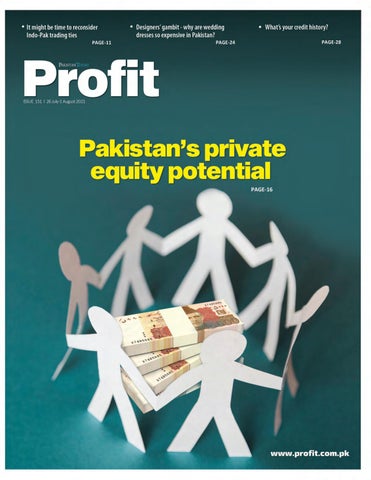
Contents_Layout 1 7/25/2021 2:22 AM Page 1
CONTENTS 18
9
09 Ryan Gosling and clutzy interns this week in Pakistan’s business and economics Twitterverse 11 What’s your credit history?
14 14 How can influencers evade exploitation from advertisers? Sehar Raothar 18 Pakistan’s private equity potential 23 Cognitive Real Estate: The Most Exclusive Properties on the Market Kazi Akber
29 24 It might be time to reconsider Indo-Pak trading ties 28 As the government continues to back construction, real estate is hustling
Profit
33 nfluencer matchmaking AI is not the silver bullet it claims to be Hamza Nizam Kazi
Executive Editor: Babar Nizami l Managing Editor: Farooq Tirmizi l Joint Editor: Yousaf Nizami Reporters: Ariba Shahid l Babar Khan Javed l Taimoor Hassan Abdullah Niazi l Meiryum Ali l Shahab Omer Chief of Staff & Product Manager: Muhammad Faran Bukhari Regional Heads of Marketing: Muddasir Alam (Khi) l Zulfiqar Butt (Lhr) l Mudassir Iqbal (Isl) Layout: Ahmad Salahuddin l Photographers: Zubair Mehfooz & Imran Gillani l Business, Economic & Financial news by 'Pakistan Today' Contact: profit@pakistantoday.com.pk
Readers Say How many of the people discussed in this article as prospective future Finance Ministers are PHDs? How many books have they written? Have any of them even written books? Are they consistently writing articles that are being published and lauded by the leading financial academic journals of the world? And if they are not the academic sorts, then which of them has focused on working towards poverty alleviation? Who has had raising living standards as their focus? What are the rates of success on the many plans they have made? These are all the important questions that we must ask ourselves when taking into consideration the people that may one day be responsible for our economy. Apropos: Q Block - The next generation Shams Uddin, Facebook 'Seven in 10 institutional investors expect to invest in or buy digital assets in the future, although price volatility is the main barrier for new entrants, a study by Fidelity’s cryptocurrency business found" I copied the first paragraph and it clarifies that price volatility is the main issue. Individual investors should know that unless something spectacular happens, losses will be made mostly. Apropos: Most institutional investors expect to buy digital assets, study finds Fuzail Zubaid Ahmed, Facebook Nadra may give access to the SECP through a special portal to get the data of companies, and all its office bearers through their CNICs. This way the SECP can check which employees are vaccinated and which ones are not. This way the SECP may maintain comprehensive details of vaccination figures. However, this is only if they are actually keen on doing so and not just serving notices to companies for the sake of appearing to be doing something and getting some good press and a pat on the back out of it. Apropos: SECP for action against companies with unvaccinated employees Adil Tirmizi, Website
facebook.com/Profitpk twitter.com/Profitpk linkedin.com/showcase/13251020 profit.com.pk profit@pakistantoday.com.pk
HOW TO CONTACT
7
It is greed which is driving the boom and not any actual usage of bitcoin. It is like a pyramid as each of us wants to invest in it to double our money overnight. For the uneducated there was ‘Double Shah,’ and now for the semi-educated/educated there is ‘Bitcoin’. Apropos: Pakistan moves to bring cryptocurrency boom out of the dark Faisal, Website The Chinese authorities have released several memos and circulars for the fulfillment of these demands. Earlier, Chinese steel industry had faced a lot of problems regarding the implementation of the law on tax exemption. Many projects were stopped because of the resistance of local businessmen who did not want the government to give
away the concessionary benefit to the big businesses. But now all these problems have vanished because the government has changed the law recently. Although this has increased the number of projects in development, it has helped Chinese industries to gain more income through tax-free sales. Apropos: Chinese steel firms convey concern over facilitating non-taxed units in tribal areas Anonymous, Website Steel prices have already been rising above pre-recession levels. In an effort to hold supplies stable, Steel producers in the United States have been offered price increases. Steel Industry experts say that increased demand, higher investments in mill sites and new processing technologies, along with increased government support are all contributing factors to the increase in raw material costs. Some analysts say that the US government may ease off its pressure on Steel producers as the economy and consumer spending recovers. Steel costs continue to rise but the positive effects of lower costs will soon be offset by higher costs from increased demand. Apropos: Steel industry blames raw material shortage for rising costs Anonymous, Website I had a discussion recently with somebody about what NRP does for Pakistan. This is assuming the NRP is living in Gulf where they must return to Pakistan once they retire or live in another western country but with the intention to return to Pakistan after retirement How NRP help Pakistan: 1) Remittance sent to Pakistan means covering some of the deficit made by Pakistan. 2) A job held by an NRP overseas means less competition for the ever rising unemployed population in Pakistan. If an NRP holds a job in Dubai, instead of in Pakistan, this means the job in Pakistan will go to somebody else instead. 3) NRPs usually prefer to invest their excess in Pakistan. That is money coming into Pakistan which supports Pakistan. In other countries this same act is done via foreign investments but historically Pakistan has failed to attract foreign investors. 4) NRPs create employment. A typical NRP will try to build a home in Pakistan. This means they will support the economy by paying for the labor and all the raw materials which support the local industry. There are several other benefits NRPs bring in for Pakistan. We are not living far from our family because we hate Pakistan. We are living away from Pakistan because we have to help our family and the only way we can think of is by moving to an unknown land where we are abused daily. We deal with all of that abuse and then once we return to Pakistan, we are labelled as unpatriotic. Apropos: Naya Pakistan Certificates are ridiculously attractive for investors. But here is why that is bad for Pakistan Adeel, Website
COMMENTS
IN BRIEF Minister for Finance and Revenue Shaukat Tarin on Saturday said The government has decided to give Rs1.6 trillion to Kamyab Pakistan programme in the next three years to uplift the under-privileged population of the country.
“The government is successfully completing its agenda of economic stability, however the country must focus on regional trade which is quite low. We must focus on regional trade. We have very low trade with regions. The EU regional trade is 90 percent,” Adviser to Prime Minster on Commerce and Investment Abdul Razak Dawood
The Foreign Office has said that work on the Dasu Hydropower Project will soon resume as both Pakistan and China were committed to the timely completion of this and other projects being undertaken with Beijing’s cooperation. Minister of Planning and Development Asad Umar has said that 49 percent (27.31 million) of people belonging to the working class were affected due to the coronavirus pandemic, and that 37 percent of the workforce lost their jobs and were unable to find a replacement. Pakistan has seen a boom in trading and mining cryptocurrency, with interest proliferating in thousands of views of related videos on social media and transactions on online exchanges. Thanks to FATF directives, Pakistan is moving to bring its cryptocurrency boom out of the dark.
Like the rest of the country, Khyber Pakhtunkhwa (KP) has witnessed a 50 per cent drop in business activities due to inflation and rising prices of basic commodities. The sharp surge in inflation, particularly of petrol, hasn’t just affected the general public but also traders.
$1 billion:
Pakistan is hopeful to get a third relief in debt payments from the G20 countries, seeking a suspension of over $1 billion payments. The country has sought an overall debt relief of $3.78 billion from G20 countries which would be provided in three phases.
8
Ryan Gosling and clutzy interns
this week in Pakistan’s business and economics twitterverse
S
o much to discuss this week. We have two different movie recommendations for you (both old ones but both worth a watch), the one man army bringing companies into the tax net, some opinions on cricket, and acts of kindness this Eid. Ariba Shahid brings you all this and more in this week’s social media roundup from Pakistan’s business and economics twitterverse.
Moneyball
One-man-army We won’t comment on Misbah and Waqar but we will comment on how robust data analytics is needed to improve decision making in performance in businesses and in sports. For more on how sports, business, and the need for modernisation are connected, read an old Profit cover story: READ: How to turn the PCB into a lean, mean, business machine
On empathy and kindness
Zubair Ahmed Khan is single handedly doing more to bring more people into the tax net than most of us twitteratis put together. He is lodging complaints against unregistered businesses and getting them registered - so far he is one more short of a half century. Now this is what we call civic duty. What we also love is that the first business he went after was Pak Cuisine - the restaurant owned by ARY ‘anchor’ and professional intruder Iqrar ul Hassan Syed. We are a little sad that no one knocked down his doors and shoved a camera and mic in his face asking him why his restaurant was not registered, but this was still something.
SOCIAL MEDIA ROUNDUP
While this isn’t exactly business and economic related, we feel that considering the Eid season it is important to add this tweet here to remind you all of how McDonald’s is a poor man’s meal in most countries around the world but is beyond the means of the middle class in Pakistan. Empathy and kindness go a long way. Thank you for this idea. We also might need to consider why in Pakistan there are valet services outside McDonald’s branches. We truly can give off a dystopian image at times.
9
A note of congrats!
Everyone loves milestones. Whether it’s your baby’s first steps or if it’s your first major client or breakthrough. It’s a proud moment indeed. First steps matter. Congratulations to our managing editor on becoming a ‘real company’. And we say this without any bias, this is one to look out for. We wish you luck.
Mic drop moment
You didn’t have to mic drop so hard, Ahfaz. Statistically speaking, yes you would. Logically speaking, it shouldn’t count. Oh well!
Really?
For the love of Ryan!
The Big Short is a movie we recommend all of you to watch not just because of Ryan Gosling, but also because of the introductory course into the financial crisis. It is a few years old at this point, which is why we are sure many of our readers must have seen it already. In case you haven’t and you’re interested in a finance based high-stakes thriller, do watch it. In case you haven’t, rewatching really won’t hurt. Like we’ve said, Ryan Gosling alone is enough reason to watch the movie and then to maybe even rewatch it.
TikTok in the slammer again
So they banned Tiktok a day after President Arif Alvi joined. Are they worried about the cringe content the president might put out? Is this preemptive image saving? We have too many questions and no answers. However, digital Pakistan is a joke that keeps on giving.
10
Some jokes write themselves. We won’t say much but corporate twitter accounts need to be wittier.
SOCIAL MEDIA ROUNDUP
What’s your credit history? How Pakistan needs to help out its credit bureaus - for its own good
W
hen does one hear about the State Bank of Pakistan in the news? Typically, it is when there is some news about the interest rate. In fact, just this week, the monetary policy committee is set to announce a new rate. But outside of that function, and the usual news rush regarding it, there are few who hear what the central bank is up to, let alone read its multiple annual reports.
BANKING
And yet buried away in the third quarterly report of the board of directors for the year 2020-2021, which was then submitted to parliament, is a section that Profit, at least, deemed somewhat curious. The report covered the usual areas of interest: real sector, monetary policy, inflation, public debt (one can almost hear the reader nodding off at this point). But there was a special section attached titled “Private Credit Bureaus in Pakistan: Enhancing credit penetration by addressing
information asymmetries.” The title may be a mouthful, but the gist is that Pakistanis don’t have credit histories, and that there are significant hurdles in the way of trying to create an actual credit profile. Still, there could be potential solutions to be gleaned from other developing countries with the same problem, argue authors Ahmad Mobeen, senior analyst at SBP; Sohaib Jamali, senior economist at SBP; and Sabahat Zafar, deputy director at SBP. The situation So, first, what is the scale of the problem? In a nutshell, pretty bad. According to Jamali, Mobeen and Zafar, formal credit to the private sector is among the lowest among emerging and developing markets. Private sector credit to GDP ratio stood at 17.4 over the last decade - lower than Sri Lanka at 40; Bangladesh, at 44.1; Nepal, at 59.4; and India, at 97. Even as banks profitability has improved, ‘information asymmetries’ aka a lack of information means that they have been reluctant to lend to agriculture, small and medium enterprises. If formal lending is entirely geared towards the well-off and people who have documented credit history, exactly how will credit penetration improve? Enter the concept of a credit bureau.
11
These are privately operated businesses that gather credit related financial and non-financial data from various data providers. These are separate from credit registries, which are usually governed by the public sector, and help supervise ‘financial soundness’ in a system. Crucially, the latter focuses on information gathered from banks and financial institutions; while the former also collects information from non-financial sources, like retail outlets and utility and telecom sources, and court decisions, or property records. These bureaus can then sell their services to banks or businesses who are looking to assess the creditworthiness of a potential borrower. These sound simple, but the impact is oversize. For instance, the report mentioned that countries with such bureaus saw their bank lending to GDP ratio almost 20 percentage points higher than other countries, and that nonperforming loans typically fell by one percentage point. The more credit bureaus it seemed, the greater the proportion of adults borrowing from a financial institution in any economy.
The Pakistani landscape
O
k, perfect. Surely Pakistan must have implemented this? Yes: The Credit Information Bureau (CIB) was formed in 1992, with the stated objective of utilizing information for better lending. This credit registry served as a database for all loans greater than Rs500,000. This was brought online in 2003 (now referred to as eCIB), and has been updated five times over the last 30 years to keep it up to date. Since the late 1990s, a few private sector bureaus have also popped up, including DataCheck and Credit Chex. Their presence prompted parliament to pass the Credit Bureaus Act in 2015, after which the SBP could give licenses to private credit bureaus. To date, there are only two licensed bureaus in Pakistan: Tasdeeq, in 2018, and DataCheck, in 2019. The two can provide credit reports, portfolio scrubee microfinance credit reports, and are also working in credit scoring services (limited to consumer banks). But the overall information on hand is paltry. eCib, for instance, has data on 14.9 million people, or around 12% of the population, while private bureaus have information on 8.6 million individuals, or 6.7% of the overall adult
The Credit Information Bureau (CIB) was formed in 1992, with the stated objective of utilizing information for better lending. This credit registry served as a database for all loans greater than Rs500,000. This was brought online in 2003 (now referred to as eCIB), and has been updated five times over the last 30 years to keep it up to date population. This is only marginally better than the minimum threshold of 5% as defined by the World Bank. If the act was passed in 2015, what has happened - or not happened - in the last six years? There are a few overarching problems that the bureaus face, which has limited their growth. First, the act says that every credit institution has to become a member of ‘at least’ one private sector bureau. There are 32 banks in the country, but 20 are members of both, and 11 are members of only one. The authors are at a loss as to why the banks haven’t bothered becoming members of both, considering it is a nominal cost and the bureaus do not charge fees (hint: it’s because they don’t take lending, and extension, credit information seriously). Second, beureas in Pakistan only cover consumer loans, and not corporate loans. Some of this has to do with the historical reasons: credit bureaus rose out of the need for credit information on riskier consumer loans bank in the 2000s, and secondly, most institutions end up using eCIBs resources, as they are legally bound to get an eCIB report of any broorwer before giving out a loan. Essentially, why bother using a credit information bureau, if eCIB suffices? Then banks essentially collect very little information which they pass on to credit bureaus: such as age literacy, education, sector wise, or crop size lending, or family structure. This limits the usefulness of credit bureaus Finally, the aspect that makes credit bureaus so attractive - their ability to collect non-financial data - is essentially non-existent. There is no data on telephone bulls, utility payments rental information which could be used as a proxy for income and expenditure. This is despite the notifications issued by the government itself. For instance in April 2020, the government told all electricity and gas transmission companies to become members
If the act was passed in 2015, what has happened or not happened - in the last six years? There are a few overarching problems that the bureaus face, which has limited their growth. 12
of cr. But only K-electric joined up. Then in 2019, the government instructed telecom companies and mobile operators to become members of the credit bureaus. But instead, telecom operators maintain that they were restricted to do so under another government mandate: the PTAS’s telecommunication consumer protection regulations, 2009. In 2016, the ministry of finance said that all court documents related to debtors should be included in public record for the credit bureaus. But the court documents are not available in an essay, online format. Then there are basic procedural problems: eCIB can fine members for delaying the sharing of data, but credit bureaus cannot. DO you think commercial banks will be sharing such information on time?
The solution
S
o, what can be done? A few things: first, forcing all commercial banks to become members of bath, meaning that competition sfts focus from pure goes from pure data acuclmuton to actual value-added services. Then, notifying a sunset clause on eCIB, so that there is new market space created for private sector credit bureaus. Then cretaign a huge emphasis on alternate data on a national scale. The benefits have potential: the small country of Guyana saw its financial inclusion rise from 2.4% in 2015 to 16.4% just one year later once they fixed the regulations to obligate utility providers to share information with credit bureaus. Some of these fixes are quite simple: for instance Sindh has a tenancy registration system, which includes a photo signature and rental agreement, but does not record whether or not monthly payments were made. A simple ad would benefit not just credit bureaus, but also the FBR and tenancy litigations. A fund could be established to help pilot and use credit scoring models - which do not exist in Pakistan - which could also help with financial literacy in general. Essentially, the message needs to be gotten across that paying on time will be rewarded, and not paying on time will be penalized. n
BANKING
OPINION
Sehar Raothar
How can influencers evade exploitation from advertisers?
them content that does not go with the influencer’s persona and expecting unrealistic targets. When social media audiences are bombarded with sponsored content on their feeds, they are less likely to engage with both influencers and advertisers, which is reflected in recent studies which reveal an overall decline in Instagram engagement. Reports show that “The engagement rate for sponsored posts fell to 2.4% in Q1 2020 from 4% three years earlier, while the rate for non-sponsored posts slid to 1.9% from 4.5% for the comparable periods.” So how can marketers circumvent this industry-wide issue? Rather than working with influencers who have large followings, consider that “nano-influencers” are able to interact more with their audiences and are able to form more tight-knit communinfluencer marketing has become one of the hottest trends in ties, thus inspiring higher engagement. It is all about engagement. marketing in the past few years. And for good reason: In 2020, The same report states that “the engagement rate for Instagram 81% of marketers reported that using influencers to bolster influencers with at least 10,000 followers is steady at about 3.6% their marketing plans was an effective strategy. worldwide. Influencers with 5,000 to 10,000 followers have an Given so many marketers are already working with engagement rate of 6.3% and those with a following of 1,000 to influencers, or are considering it, it is worth delving into what 5,000 have the highest rate at 8.8%, per Influencer DB.” When some of the pitfalls are in brand-influencer partnerships where the choosing which influencers to work with, focus more on engageinfluencers can feel exploited in different ways. ment than name recognition. However, micro-influencers are As social media allows for more people to achieve fame and more likely to not be paid the right amount for brand promotions influencer status, it has quickly become oversaturated with influencand content generation. ers. It is impossible for audiences to keep up with all of the content Everyone knows that it’s not always a given that influenc(especially sponsored content) coming from the influencers they ers use (or even like) the products or services they endorse on follow. It’s also worth noting that fame, particularly the kind formed social media. While many advertisers don’t seem to care if an on social media, is fleeting. The same influencers that capture the auendorsement comes from a place of true authenticity (however dience’s attention may not be holding onto that attention tomorrow. hard that may be to measure), should audiences be able to interHowever, how can this make a brand overuse its influence? Giving pret influencer endorsements as inauthentic or misleading, the brand and influencer lose credibility. A study reports that 47% of customers are tired of influencer content that appears inauthentic and 62% of customers believe that influencer endorsements take advantage of impressionable audiences. Sehar Raothar The best practice would be partnering with influencers who have used and liked the brand’s product or service before even entering an endorsement deal, but at the very least, marketers leads strategy for the BL should make sure they partner with influencers who have authentic connections to their brand. Group Of Companies and For instance, a beauty brand should probably find an influencer who people look to for beauty can be reached on sehar. advice. Makes sense, right? It is also crucial that marketers give influencers autonomy in creating the copy and images/ raothar@gmail.com video for sponsored content. While marketers may be inclined to tighten the leash, influencers know their audience best. A great example of a brand and influencer partnership is Jonathan Van Ness’s Instagram
As advertising continues to pivot towards influencers, they need to look out for themselves
I
14
partnership with Lipton. JVN is known as an extremely authentic personality and his audience would probably be very thrown off if they saw a post on his Instagram that didn’t reflect his usual quirk and loving flair. The same goes for a local influencer like Taimoor Salahuddin aka Mooroo working for a clothing brand, Furor, and being given leverage to best show the clothing styles through a travel Vlog rather than doing a fashion parade in front of the green screen Chroma key background. Influencers are also typically the ones curating their non-sponsored content and are consequently able to curate copy for endorsements that reflect their own voice and personal brand, which makes for the kind of content audiences like to see; making the influencers stay in control of the situation and not let the brand take over their feeds. In the same vein of authenticity, marketers should now be cognizant of the sanctions they could face should their sponsored content be interpreted as misleading. In April of 2017, the FTC revealed in a release that they sent over 90 letters to influencers, telling recipients that they “should clearly and conspicuously disclose their relationships to advertisers when promoting or endorsing products through social media.” Mostly this means utilizing the correct hashtags, such as #spon, #ad, or #partner, and now many social media platforms have built-in tools to mark posts as paid, but many influencers aren’t keen on the rules which might not protect them in return. A 2020 survey of influencers showed that 41% of respondents only label their endorsements with the FTC-mandated hashtags when they’re explicitly asked, while 7% never label their content at all. Advertisers and influencers may be hesitant to employ hashtags and other labeling tools to avoid drawing attention to the paid nature of the content, but it’s better to just bite the bullet and abide by the guidelines set out by the FTC. Focus on curating the content in a way that appeals to audiences despite the hashtags and labels rather than getting hit with an FTC citation and advertisers exploiting influencers for the same reasons. It feels like every other day there’s a new influencer creating controversy and taking years off of their brand partners’ lives. Influencers are human beings and make mistakes, but marketers should be wary that even if an influencer has an enticing fan base, certain influencers themselves could prove to be dangerous investments. Marketers can make sure they’re free to cut ties with a problematic influencer by including a morality clause in any contract with an influencer, allowing them to cut ties easily if an influencer does something that goes against their brand’s values. But to an extent, marketers have to be cognizant of who they are
investing in. Maybe the YouTuber you’re trying to work with has the perfect target audience but is known for their spontaneous behavior. Ultimately, make sure you do your homework before signing a contract and understand that an influencer who is notoriously wild will probably continue with the same behavior. But the contract is a two-way street and should equally give the right to the influencer to cut off ties with a brand if the brand fails to give the right offer to the influencer. The ethical implications of influencer labor may be the last thing on a marketer’s mind when they partner with an influencer. But that’s the very problem: influencers being treated more as a commodity than humans. As influencers have to concern themselves with striking a balance between making money and not looking like they’re selling out, marketers are able to craft contracts in their favor, pushing FTC compliance, morality restrictions, and exclusivity agreements onto the influencer. Ultimately, influencers choose the career and take on the obligations and risks that come with it, but marketers should recognize the hard work that influencers do and not take advantage of it as best they can. One of the best ways marketers can make the job of an influencer easier (while also improving the quality of sponsored content) is by giving influencers creative license when it comes to crafting content. Allowing influencers to do what they know best: create social media content. They’ll be less concerned with upsetting their audience and your content will seem more authentic. Influencer marketing can be an extremely beneficial tool for marketers, but it is important to note the areas where influencer marketing can go awry. The art of ‘influencing’ is all about making authentic connections with followers, and effective influencer marketing is about capitalizing on real conversations and the relationship that exists between an influencer and their followers. The key is authentic content that resonates with followers and not trying to force a brand endorsement into conversations and posts. Many companies have specific brand guidelines which can seem very advertorial when influencers are asked to incorporate them into their content; red flag for an influencer. The nature of social media dictates an informal and more relaxed tone, which can – at times – be at odds with ‘corporate speak’. Don’t micro-manage. Allow influencers to be content creators and use their own language to promote your brand. ‘Corporate speak’ works for press releases and articles, but social media is all about authentic content, shared from an individual’s own point of view, so as long as the influencer is aware of your brand values and corporate ideology, let them be creative and expressive in
their own words, to promote your brand. If a brand has correctly vetted the influencer, then the values, tone, and messaging should align – offering flexibility to an influencer will result in authentic content that will be well received by the followers. Influencers can reach countless people. But they need to approach audiences with authentic content; staged product endorsements can kill an influencer’s impact. Rather than look like glaring ads, influencers should tell stories in their style. An influencer’s true story builds brand image. On the flip side, perfected pictures or careless endorsements are usually a miss. Staged content can reflect poorly on a brand and its influencer. And blatant promotions can cause an uproar in social communities—with the fallout from followers being equally harmful. That is why influencer agreements and contracts are some of the most important aspects of an influencer marketing campaign because they protect advertisers and influencers from potential missteps, mistakes, and failures. Related to the issue of deliverables, influencer agreements and contracts make expectations clear upfront and mitigate confusion and miscommunication between advertisers and influencers. Contracts that are incomplete or are riddled with mistakes, oversight and loopholes threaten to hurt advertisers and influencers, both, turning campaigns into liabilities. For example, contracts between influencers and advertisers that explicitly state the requirement of an FTC complaint disclosure on influencer-posted content eliminate confusion around the need for disclosures. Additionally, advertisers should consult with social media influencers before recycling content intended for a specific audience and created for a specific campaign and/or social media channel. Republishing or re-sharing content without permission and/or without giving credit to the influencer may at the very least adversely affect the company’s relationship with the digital influencer and at worst, tarnish the brand’s reputation amongst both influencers and audiences. Contracts don’t have to be difficult, but they do have to be properly executed. Influencer marketing agencies are experts in dealing with contracts between influencers and advertisers and can ensure that a brand’s bases are covered. Having planned and carried out dozens of influencer marketing campaigns with different goals, different influencers, different deliverables, and different end results, agencies have the requisite knowledge base to help advertisers create campaigns that are effective and are enforced and protected by contracts that outline expectations and provide guidance for disclosure compliance, messaging, brand association, and more. n
COMMENT
16
FINANCE
By Ariba Shahid and Taimoor Hassan
W
hat are your options if you want to start a business? You could either start your own company or buy an existing one. And no, you do not always have to resort to the stock market to buy a company or a part of it. In fact, a less explored option in Pakistan is equity investment in well-established but privately held businesses that have the potential to be more than they are now. Similarly, if you’re an existing business owner aiming to raise capital to try a new risky idea, you could get a bank loan, but that would require you to come up with an acceptable collateral and with it the constant worry about repayments and losing the collateral just in case the bet doesn’t pay-off. You could go public but your business might not be big enough and since you do not account for all your revenue, your books are a mess. On paper your case is right up private equity’s alley. And you are not alone. Considering the low number of businesses that avail bank loans or are publicly listed, the private equity space must then be booming in Pakistan? Well, not even close. Private equity in Pakistan is either shied away from or not widely available to small and medium sized enterprises (SMEs) that need it the most. And with banks not providing loans as they should, more private equity investment is the need of the hour. And it is also possible. Recently the Pakistan Aluminum Beverages Company went public. You must be thinking so what? Well the interesting part about this IPO was the fact that it marked an exit for Ashmore, a FTSE 250 British investment manager dedicated to the emerging markets. This exit was well within the investment horizon planned out by the group and also proves to be a case study into how Private equity in Pakistan can work,
and exits can happen successfully. To understand what private equity is, we spoke to different players that either have taken or provide private equity. But before we get to those directly involved, Profit explains what private equity is, how you can apply for it, and why you should consider it.
What is private equity
I
n very simple words, the way it works is that different people go to an investment management firm or a private equity company and give them money to invest. The company then forms a fund. Private equity transactions are carried out in the form of acquisitions, funding to support operational growth or expansion. Now, when a company that doesn’t want to take a loan from the bank or go to the stock market (yet) wants to expand, they come to this investment firm and they use the fund to provide the company with money. In exchange for this money the firm gives them some stake, allow a new member on their board, and jaraha voice to shed guidance and experience, but for the large part, the private equity investors are patient partners. They wait for an agreed amount of time and then exit, hopefully with profits. The private equity firms themselves charge money for management in addition to performance fees from investors in a fund. The valuations, however, are mutually decided instead of in an open market. Despite that, for a company, private equity investment is relatively easier for them to deal with considering limited stress of quarterly performance by investors. Private equity investors are often considered patient when it comes to their investment and the returns they anticipate. They need to dedicate substantial investment for an extended period of time. Usually investors withstand long holding periods for a greater turnaround period which culminates in the form of the sale of the business or an IPO, marking an exit. The investment
horizon is usually 5-7 years.
Treading history
I
nstitutionalised private equity started taking off in 1995 in Pakistan when the Securities and Exchange Commission of Pakistan (SECP) introduced a regulatory framework that enabled setting up fund management companies in Pakistan. Pakistan is late in almost everything. And it was late in private equity fund management as well. The concept of private equity and fund management predates Pakistan itself and while there is no concrete timeline to trace the genesis of private equity, historical records suggest that initial private equity transactions can be traced back to the industrial revolution in the 1850’s when prominent merchants financed industrial establishments in the West. It was only later on, after almost half a century, that the first notable instance of private equity transaction that can be classified as the transaction closest to a modern day buyout was JP Morgan’s acquisition of Carnegie Steel for $480 million in the US in 1901. In 1946, however, the first two venture capital firms came into being, the American Research and Development Corporation (ARDC), founded by Georges Doriot who is considered the father of venture capitalism with two other partners, and J. H. Whitney & Company founded by John Hay Whitney and Benno Schmidt. It is also important to note that Doriot was a former dean at Harvard Business School and one of his partners Karl Compton was the former president of MIT. The ARDC worked with the goal to encourage investment in businesses that were run by World War II soldiers upon their return. The ARDC has an important place in the history of private equity considering the fact that it was the first of its kind, an institutional private equity investment firm that was not restricted to capital from wealthy families.
The private equity firms themselves charge PE localized: Offices money for management in addition to performance Family ow that we have a preliminary understanding of what private fees from investors in a fund. The valuations, equity is and how it began, the however, are mutually decided instead of in an open question we are now heading to answer is private equity in Pakistan. market. Despite that, for a company, private equity One could say that private equity investment is relatively easier for them to deal formally entered Pakistan significantly late, 1995, Since then three revisions have been with considering limited stress of quarterly inmade in 2001, 2008, and then finalized in 2015. However, given the changes in the performance by investors industry dynamics and Pakistan’s formaliza-
N
18
tion of industry, investment and businesses, another revision in the framework will not be a surprise. Despite interest in trying their own hand at private equity, very few actually dived in such as JS, Ijara, Baltoro, and Abraaj. JS was the first to set up shop, however it is pertinent to note that JS did this through a fund registered offshore to mitigate their risks. Abraaj was another entrant that had invested in BMA and later on in big names such as BYCO and then known as KESC. The two, however, found it difficult to successfully deploy their capital in Pakistan given the business environment, the lackluster opportunities, and the regulatory issues. USAID, then came up in the early 2010s with the Private Public Investment Initiative that injected a $24 million commitment into Abraj, JS, and Baltoro in order to get private equity going in Pakistan. Again, due to the lack of a regulatory framework, all three were registered offshore. The short answer, nothing worthy of calling an achievement. Abraaj froze its fund and returned capital that was not invested back to the investors. In simple terms, JS did nothing. It didn’t even manage to make its first investment. As far as Baltoro is concerned, they managed to make two investments, namely in AGP Pakistan that listed, and in Jhimpir, a wind power company. A more recent wave of private equity is made up of new faces that includes Lakson investment private equity, PNO Capital, and Ijara. Karandaaz, Ithica Capital, Cyan Capital, etc are some other names. However, the family offices for major groups like Arif Habib, JS, House of Habib, and Atlas do engage in private equity in their own way. There are and have been private equity funds in a formal structure such as Abraaj, JS, and Ijara. However, another type that has been undertaken in Pakistan includes groups that are buying companies or expanding. In Pakistan’s case, formal funds haven’t done too well. Private Equity on a group or family level that are making strategic or non-strategic investments are performing better. A possible reason is that there are a limited number of funds. There needs to be the right kind of managers to set up a fund however it is hard to find professionals with private equity experience in Pakistan. As far as family groups are concerned, they’ve realized the importance of inhouse teams for proper investment. Groups have their own teams and are less reliant on sell side analysts. When it comes to private equity in Pakistan, family offices have generally done better than private equity funds. But because of the dearth of high-growth businesses to invest in, lack of private equity funds that grow the market and regulatory bottlenecks,
even family offices have stayed away from private equity investments, and rather chose to invest in public equity, that is investing in public companies that offer quicker returns. For instance, Karachi-based Cyan Capital started off as a private equity fund but rather chose to divert money to public equity. For clarification, we’re using Cyan as an example considering the fact that it was set up by the Dawood Family, a family that takes business very seriously and strives for success. Cyan however started off as a now defunct insurance company that provided insurance to Dawood Group Companies. Through their business of insurance they were able to generate a significant pool of reserves, approximately Rs 2 billion in 2011. That is when they thought they could put this money to better use, and left the business of insurance by revoking their license. They then set up Cyan Capital under the management of Samad Dawood. Dawood got Suleman Mehdi involved as well, in addition to Asfundyar Shaheen. None of these three had any idea how Private equity is undertaken in Pakistan, in fact none had any experience in private equity. That is when they brought in Shehryar Ahmed, a former Goldman Sachs employee to create a business model for them. The business model was simple: take a significant minority stake in high growth businesses worth 5-10 million dollars per investment. While they were looking for places to invest and checking feasibility, they invested in Dawood Group Companies on the stock market. Later on they moved beyond the Dawood Group. A lot of companies, however, were evaluated and none were followed through. That is when Cyan Capital, a firm that was set out to be a private equity firm turned into Cyan Limited, a public equity firm. The failure of Cyan Capital to undertake private equity investment bottles down to a few reasons, there had become a conflict of interest with regards to how the money was to be invested. With two teams, private and public equity, competing for the same capital, public equity won primarily because of the quicker returns. Similarly, if we take the group aspect in mind and the fact that this was a few years ago, one could also assume that the framework for private equity and minority investment was something the Dawood group was not too comfortable with. On the flipside, one could argue, Cyan with a $50 million fund was insignificant for the Dawood Corporation. Moreover, after Cyan started off, Samad Dawood found himself elevated in the group and thus may have had less time to give to Cyan. Something similar
can be said for JS where the PE fund they had set up was too small to be a concern for them in the grand scale of things for the group.
Why is PE important?
P
ublic markets are not an accurate representation of the economy as a whole. With only 576 listed companies out of approximately 60,000 registered with the SECP; a market cap to GDP of around 35% and a significant portion of that dominated by banks and Oil & Gas. On the demand side, access to capital for private enterprises is also limited, mainly due to conservative lending practices by banks and crowding out from the public sector. The banking sector in Pakistan is not a big lender to smaller businesses or nonpublic entities. Banks require collateral while that is not the case around the world. Companies like Apple and Google are able to borrow money for which they have zero assets to secure based on their cash flow. Cash flow lending is not prevalent here because of the lack of sanctity of contracts. In fact, it all comes down to the enforceability and sanctity of the contract. But this is not a story on how the banking sector needs to do more. The SME sector in Pakistan needs a push. This sector is important because it is accessible and has potential to grow at larger multiples. However, raising money in Pakistan often remains a struggle. Banks generally have a low risk appetite and would rather invest in government paper. When they do lend to the private sector it is usually to big names, blue chip companies in other words. SMEs are not able to get the same access to finance. Private equity gives them not only the opportunity to receive investment that can help drive their business but also gives them the perspective of an outsider that can advise on business matters. Usually a private equity investment results in someone from the fund, or in Pakistan’s case, a family office a seat on the board. Very often, individuals that are given a seat have business acumen that can help the company that has received investment. It may not be feasible for a number of SMEs to have specialized analysts and advisors, this however gives them access to it alongside patient investment that does not have to be repaid. While funds may be the way to go for other countries, Pakistan has found its own way at carrying out private equity transactions. This localized solution is not something that one needs to be weary of as long as the family offices do not turn predatory.
FINANCE
The players
W
hen we started this story, we began with the Pakistan Aluminum Beverage Can Company Ltd. The reason that instance was such a fascinating case study was that it was one of the few examples of a truly successful and well executed private equity story in Pakistan. To try and understand better how the process works, we sat down with Babar Lakhani from Lason Investments, Naveed Goraya from Karandaz, Ali Saigol from Baltoro, Haider Ali from Ithaca, and Farukh Ansari from Ijrah Capital - all of the major private equity firms in Pakistan - and asked them the same questions. These are their responses:
3. How many successful exits have you made? What do you think is a successful exit? As a team we have been involved in several large exits. A successful exit for us is delivering the anticipated returns to the investors, and ensuring local investors are comfortable reinvesting in the private equity asset class. 4. Why do you think structured PE hasn’t been able to flourish in Pakistan? As with any new asset class, it takes some time before investors become comfortable with them. PE investments are long-term, usually 7 to 10 years, which makes them more suitable to institutional investors. 5. What exit options does a PE fund have, other than an IPO? To us, a ‘true’ exit is one of a trade sale where all investors can entirely be cashed out. Besides a market listing or a trade sale, there are opportunities for a secondary buyout or leveraged recap. Funds may also use a dual track process for an exit, filing an IPO prospectus and pursuing a trade sale at the same time. 6. What is the size of your fund? Approximately $20 million
Babar Lakhani
CEO Lakson Investments 1. How would you describe the private equity space in Pakistan? Private Equity in Pakistan is at a nascent stage. Historically, we have had some offshore PE funds make investments in Pakistan, however the asset class was not open to Pakistani investors. In 2016, the SECP introduced the “Private Equity and Venture Capital 2015” regulations which created two new asset classes for domestic investors. Under the new regs several firms have received licenses which today manage funds.
Chief Investment Officer at Karandaz
2. How many PE investments have you made in Pakistan? Can you name them? We have made two investments in the Lakson Private Equity Fund. Our fund is healthcare focused and the first acquisition was OMI Hospital in 2018, and the second was Shan Hospital in 2020.
1. How would you describe the private equity space in Pakistan? Private equity space is relatively new in Pakistan. The industry is yet to make any significant progress despite the fact that the regulatory framework for private equity and venture capital has been in existence for some time. The previous regulatory regimes did
20
Navid Goraya
not garner a lot of interest, however, with the introduction of new private equity and venture capital regulations in 2015 a number of new players have emerged in the private equity landscape. 2. How many PE investments have you made in Pakistan? Can you name them? Karandaaz Pakistan has made a number of private equity investments in a diverse range of sectors and we continue to look at various private equity opportunities. KRNs core objectives are to deliver business and economic growth, generate higher and sustainable incomes, and increase employment and trade opportunities. The list is as follows: HAC Agri Ltd: A Controlled Atmospheric (CA) storage facility for fruits and vegetables. It is the first of its kind project in Pakistan to ensure the availability of the fruits & vegetables in off-season with the same freshness and quality as in season. Techlogix Pakistan Ltd: A leading IT services and enterprise solutions company with operations based out of Pakistan. Excel Labs Ltd: Excel Labs, one of the largest laboratory and diagnostic services providers in Pakistan, has presences at more than 100 locations across Punjab, KPK, AJK and Sindh. Wahdat Poultry Farms Ltd: A pioneer in introducing Pakistan to branded healthy eggs through modern layer farming. NRSP APC Ltd: Established as a subsidiary of NRSP to provide warehousing, processing and income enhancement facilities to small rice farmers. Secure Logistics Group Ltd: The company provides a unique combination of long-haul and short-haul logistics, tracking, and security services to clients across Pakistan. 3. How many successful exits have you made? What do you think is a successful exit? Private Equity by nature is patient capital with a typical investment horizon of 5 – 7 years. Karandaaz growth capital to SMEs with commercial and development objectives in line with the mandate. The vintage of Karandaaz portfolio is relatively new, hence, we have not exited any investment at this stage. We would measure the success of an exit with the achievement of development objectives and achieving financial returns. 4. Why do you think structured PE hasn’t been able to flourish in Pakistan? Some of the key reasons for slow growth of PE space in Pakistan are the constant changes in the regulatory regime. There are hurdles in movement of capital, limited options for exit, a very vast undocumented sector, the constantly changing economic environemnt, and limited market and sector data, as well as
TEXTILES
research houses. 5. What exit options does a PE fund have, other than an IPO? A PE fund can go directions other than an IPO. There can be an acquisition by a strategic buyer. Secondary sale is an option in which the private equity firm will sell its stake to another private equity firm. There could be a management Buyout in which the management group does a takeover by using significant amounts of leverage to finance the acquisition of the company. There could also be a repurchase by the majority shareholder, in which the majority owners purchase the stake from the private equity investors.
on this activity and ended up encapsulating their brokerage activities as fund investments. We do believe there is a lot of liquidity floating around in the local market which is currently deployed in low yielding asset classes. This indicates that there is a strong case to be made for an experienced Fund Manager with a track record to ‘pull’ some of this capital towards a fund structure and help the PE space to grow. 2. How many PE investments have you made in Pakistan? Can you name them? We as a team have made roughly 10 investments. However, we’ve made three disclosed investments directly through Baltoro’s Growth Fund. Namely AGP (pharmaceutical), Triconboston (renewable energy), and NBP funds (financial services).
cient, and your asset story can be reasonably understood, then an IPO can be a good route to maximizing your investment. Sometimes strategic buyers can also be out there who may be able to price in some synergies and give you a higher valuation than you may be able to secure in an IPO market. Sale to other sponsors in the industry is also an option. The broadening of the public markets is exactly what happened in other emerging markets 10 -15 years ago. This is a good sign and offering IPOs as a viable option. When AGP went Public in 2015, only 2-3 IPOs that year. The number of IPOs we’re seeing now is promising.
3. How many successful exits have you made? What do you think is a successful exit? A successful exit is anything that provides underlying investors a good return on their investment. We invested in AGP in 2016 and the company went public in 2018, hence providing us with a good mark-to-market based on the publicly traded share price. An IPO can be considered as a step towards an exit, as an eventual sale from here onwards (whenever that is) is straightforward to execute at our discretion.
Ali Saigol CEO of Baltoro
1. How would you describe the private equity space in Pakistan? A number of PE-like transactions do take place through M&A, family offices or through private consortiums. However, a smaller number of transactions have been done through formal PE structures. There have been several false starts to formal PE Funds in Pakistan. There was an initial wave of PE in 2007, which was triggered by JS. Then a second wave of formal funds came about in 2015 which included funds by Abraaj, JS and Baltoro. These were the funds that had international institutional investor backing and were set up under funds best practices of corporate governance. On the heels of this activity, a lot of local PE activity also started coming about which can be termed as being more opportunistic and on a deal-by-deal basis as opposed to under formal Fund structures. In addition, on the periphery, some market brokers also tried to capitalize
4. Why do you think structured PE hasn’t been able to flourish in Pakistan? There is no question in our minds that the PE market will take off in Pakistan. It is just a matter of time. You can see the entire ecosystem coming together. There is a lot of liquidity in the local market as well as in the international investor arena who are willing to look into investments in Pakistan. You have a lot of investable assets in Pakistan that are ripe for transactions, and you have a lot of talented managers who are building successful track records in Pakistan capable of becoming recipients of this available capital to deploy. In addition, you have a conducive regulatory environment that is receptive and willing to work with investors and managers to address any concerns in order to facilitate new investment into Pakistan. Once you have enough data points, you will have validation in the market. 5. What exit options does a PE fund have, other than an IPO? The main goal of any exit is to ensure that you are able to maximize your investment proceeds for your investors. Trade sales, sale to local and international investors, yield seekers, and IPOs are ways to exit. If markets are effi-
Haider Ali Hilaly CEO Ithaca
1. How would you describe the private equity space in Pakistan? Thus far private equity funds in Pakistan have, for the most part, tried to take minority stakes in private companies because: 1) they don’t have the capacity to take control of a portfolio of 8-10 businesses; 2) the HR to operate businesses isn’t readily available in the market so generally one has to rely on the founder/sponsor to run operations. 3) The founder/sponsor is usually not in favor of selling a majority / controlling interest to a financial investor (who may or may not know anything about running their business). We now take controlling stakes because of our experiences. Generally private equity, as an asset class in frontier markets, is a passive financial investment where the investor takes minority stakes. However, we have the benefit of having operating companies which have given us operational insight and management bandwidth, which enable us to manage controlling stakes.
FINANCE
2. How many PE investments have you made in Pakistan? Can you name them? We have 12 portfolio companies in Pakistan out of which all but one are privately held. Daewoo Express, Habibullah Coastal Power Company, Bykea, Kidco, Hetz, Mustang Security, Calcorp, Athena Brands, Mustang HRMS, Partners, and Mustang Eye. 3. How many successful exits have you made? What do you think is a successful exit? Divestments have been made in Cinepax, Hawa Energy, Red Top Cab, Business Day, Rocket Rickshaw, Optimus Tech 4. Why do you think structured PE hasn’t been able to flourish in Pakistan? Formal private equity funds generally have an investor base of institutional investors including Development Finance Institutions. This investor base is particularly concerned with good corporate governance and full compliance with all applicable laws (including best practices in ESG). It is therefore incumbent on the Fund manager to ensure that any investment made by the Fund accurately reflects the values by which the Fund’s investors would like to deploy their capital. As such, formal PE investors are required to diligence many different aspects of a potential investment which can often be an onerous and expensive process. Whereas for a family conglomerate, it’s actually the family’s money and they can decide to invest it with a level of due diligence that is satisfactory to them. When you have an institutional third-party capital provider that has compliance and disclosure requirements, there needs to be a level of transparency both in the current operations and future operations and in the accounting records. Unfortunately, we operate in a country where the environment around private businesses, generally speaking, lacks transparency. There are several questions that arise: is the company compliant with tax laws, are the profits fully accounted for and transparent to all regulators? PE funds and their investments need to be able to check all of these boxes. There is hardly any formal private equity in Pakistan. The committed capital to the private equity asset class is not more than $100 million if I’m being very generous. However, we do have private equity activity in the country and most of this activity is being conducted by the large families, who have accumulated large cash balances from their existing rent-seeking business and are now looking to redeploy this capital into attractive opportunities (that are limited in the public markets or even within
22
their existing businesses). Even within this space, if I take out VC, and we talk about early to late stage M&A activity, you will seldom find a family conglomerate taking a minority position. This works for the families because they like control and because they have a pool of HR, from existing businesses, that can be redeployed in the newly acquired companies.
in pursuing investments in Pharmaceuticals, Logistics & Warehousing, and Technology sector, and other investments are under the process of due diligence. IJARA Group has a long history of acquisitions and managing investments, going back to even before the development of the current Private Equity ecosystem.
5. What exit options does a PE fund have, other than an IPO? Strategic sale is usually a good option, but it is normally only possible if you own majority or have a path to control, ii) sale back to the sponsor but that doesn’t really work and creates a disconnect in incentives (i.e. you want max price and sponsor wants min price).
3. How many successful exits have you made? What do you think is a successful exit? Our current vintage of the fund has not yet reached its maturity date. We aim to exit from our fund investments by the year 2023 – 2024.
Farrukh Ansari
Founder and CEO of Ijara Capital 1. How would you describe the private equity space in Pakistan? Private Equity is a nascent industry in Pakistan with the majority of the funds being incorporated after 2017. The Private Equity sector in Pakistan has huge potential to grow if supported by the government in terms of corporate and taxation reforms. 2. How many PE investments have you made in Pakistan? Can you name them? We currently manage Pakistan Emerging Market Fund – I (“PEMF-I”), with a size of PKR 10 bn which was partly invested to acquire 100% shareholding of Quick Food Industries (Private) Limited (“QFIL”), one of the pioneers and leaders in frozen food in Pakistan. It currently markets its products under the brand name “MonSalwa”. We are underway
4. Why do you think structured PE hasn’t been able to flourish in Pakistan? We think it comes down to a couple of reasons: Investor Pool: The majority of the Investors in Pakistan who are willing to invest in Private Equity are usually large business houses as compared to Pension Funds and Insurance Companies in developed countries because of which a limited pool of investment is available. There have been a lot of uncertainties regarding the taxation of Private Equity Funds and Private Investors. Recently the Government has withdrawn tax provisions that were vital for Private Equity Funds and their investors. The existing taxation regime lacks any tax incentives for investors of Private Equity Funds. The foreign exchange regime is complex in Pakistan which creates hurdles in executing foreign investments by a Private Equity Fund. Also, difficulties in the repatriation of proceeds make it difficult for investors to invest from abroad in Private Equity Funds. 5. What exit options does a PE fund have, other than an IPO? IPO is considered to be the best option for exits, only if the environment allows us. Whereas, Targeted Sale, Secondary Sale, and Strategic Sale are also good options, as historically industries in Pakistan have witnessed a good return on strategic sale and a fair augmentation in the overall valuation of the asset. Special-Purpose Acquisition Company (“SPAC”) is also scaling attention and could be used as a potential option. The law for which is currently in its draft form. 6. What is the size of your fund? We have the aforementioned PEMF-I fund currently active and another fund on the way. The second fund was due to be launched in 2020 but was delayed due to the uncertain situation of COVID-19. We are currently shortlisting investing opportunities in Healthcare, Warehousing & Logistics, and Technology for the upcoming fund. n
FINANCE
OPINION
Kazi Akber
Cognitive Real Estate: The Most Exclusive Properties on the Market
and they forced him to drink hemlock for his troubles. Perhaps the concept of societal progress is a fallacy. Perhaps what is most pertinent here, is that an overpopulated cognitive landscape is easy to predict and pander to. If an understanding of cognitive capital is attained. Businesses might go about purchasing cognitive capital with ideas that might work to offer a definitive and desired bottom line. Why, one wonders, are we subjected to archaic concepts in our advertising spaces? Well, because profit maximization is desirable and a formulaic understanding of content ensures steady profits. Add to this the proliferation of digital content consumption technologies; cellphones, Ipads et al. One hardly need to allocate any cognitive resources at all to propose why the average Pakistani does This is not meant to sting. But it will not have cognitive capital to spare, when, for instance, attempting to understand why the impending ban on apps like ‘Tiktok,’ might ognitive capital is a phrase that props up often in psybe governed by monetary interests and not moral quandaries. chodynamic theory when attempting to understand But alas the average Pakistani would much rather allocate the marginal capacity of the mind. In line with the cognitive real estate to the suffering of a Palestinian family when finitude of human existence, the concepts of scarcity children in Thar die of thirst just the same. The bite in that stateapply to cognition. Meaning, that is not only possible ment might lead to an inference of bitterness but above all else, it is but highly likely that one could run out of space. sympathy and want to understand, that governs this writing. It is in Space for what? Space for concern, space for empathy, space to our nature as finite beings to not be able to concern ourselves appro‘feel’ as it were. priately with multiple humanitarian crises simultaneously. And so And so, what ideas or concerns own a majority of the average instances of ‘burnout’ and ‘empathy fatigue,’ are highly prevalent. As Pakistanis cognitive real estate, merit research. Because as proposed human beings, we are ill-equipped to withstand being inundated by above, eventually, there will be no more real estate for new ideas. Land this level of information. reclamation allegorical to Karachi’s Phase 8 might be a possibility, but Being inundated by the amount of information that the it is an arduous process to expand one’s cognitive capital. average cell phone can deliver leads to cognitive overload, there A cursory reading of Pakistani news headlines tells the story of a is no question that one cannot actively interact with that level of societal psyche overrun by religious dichotomies, a preoccupation with stimulation. Far too often I have sat across brilliant actors, filmmaka bastardized version of propriety, and general intolerance to disagreeers, business owners, and journalists to do a podcast and have been ment. Socrates is rumored to have said that ‘it is the hallmark of an regaled with similar flavors of conversation about cognitive burnout educated mind to be able to entertain a thought without accepting it,’ and how they have had to build up conventions to protect their psychic space from the information. In the journals of psychodynamic theory, it is posited that cognitive overload will invariably lead to psychosis, and a quick look at the mental health statistics for Pakistan will paint exactly that picture for you. In converKazi Akber sation with the head of Taskeen, Taha Sabri, I was told that the preeminent psychic characteristic is the host and creator in Pakistan, is national low self-worth. On average, and it appears as a default, a person in Pakistan of Kiya Kahe Ga Kazi, a understands themselves to be less than their Indian or Chinese counterpart. But ‘less than,’ on an intrinsic level. That kind of low self-worth is not intuitive, it is not rational, it alerts one to the podcast that hopes to compromised societal psyche housed in Pakistan. interact with the myriad A compromised psyche that will not let a person hope for better, for themselves or their rungs of Pakistani society. loved ones, because, well because they’re less than, why would they expect any better? And in that light, the general apathy in Pakistan towards, subpar, content, construction, He can be reached on his governance, and product can all be explained. And it is reasonable to propose that if efforts are Instagram @kaziakber undertaken to free up cognitive capital at a societal level, that the average Pakistani might again, begin to understand themselves to be worthy of dignity and effort from entities that might understand, only, the language of numbers.
C
COMMENT
23
24
By Shahab Omar
T
rade with India is in our best interest. As Profit has time and time reiterated in its editorials, “there is absolutely no scenario in which Pakistan becomes a developed country, or even a middle-income country without a significant opening of trade ties with India. It is simply impossible.” Trade ties between the two countries have been a sore spot over the decades. Any time there is a flare up in tensions or a development on the Kashmir issue, the first response is to suspend trade ties with India. The only problem is that Pakistan and India are natural trade partners. We understand that the politics of doing business with India has become more difficult in recent years, but to ignore the potential of trade with India while obsessing over dwindling exports is an exercise in lunacy. That trade ties are the most natural thing in the world between India and Pakistan is proven by the complex networks that run through different parts of the world that make sure Pakistani products make it to India and Indian products make it to Pakistan. Back in December last year, Profit did a story on how Pakistani lawn has a massive market in India and how designer suits as well as knock-offs from Pakistan make their way to India through the Indian expat community in the gulf and Europe. And much like there is demand for Pakistani products in India and thus ways to get it there, Pakistan also faces the reality of Indian products being high in demand and it being smuggled into Pakistan one way or the other. We look at smuggled goods coming to Pakistan from India through the eyes of the people that sell them.
The potential and the paradox
I
n August 2019, following India’s decision to revoke Article 370 of its constitution that granted occupied Kashmir a special status, Pakistan downgraded diplomatic relations with India and suspended bilateral trade with it. This made India, the closest neighbour Pakistan has culturally, the only country other than Israel to have no trade ties with Pakistan whatsoever. Even before this complete shutdown of trade with India, the trading relationship between India and Pakistan has been fraught with bad blood. In the wake of the Pulwama attack in February the same year, India had imposed a 200 percent customs duty on all goods imported from Islamabad. New Delhi
also revoked the MFN (most favoured nation) status granted to Pakistan. Despite all of these hurdles and challenges, trade between the two countries was estimated to be around $2 billion — with bilateral trade through formal channels tilted in favor of India. According to one report of the World Bank, this figure was abysmally low and that without artificial barriers had the potential to be as high as $37 billion a year - which would make India Pakistan’s largest trading partner. The $2 billion trade volume that still existed was mostly agricultural produce being moved across borders. Pakistan’s exports to India include vegetable products, textiles, dry dates, rock salt, cement, leather, surgical instruments, carpets, and gypsum. While India’s exports to Pakistan consist of cotton, organic chemicals, dyes and pigments, machinery, pharmaceutical items, teas and spices, iron and steel and plastic goods. The cutting off of trade ties resulted in a while in prices for basic food items such as onions and tomatoes skyrocketing to never before seen heights. Now, these are very basic products that the two countries have agreed on trading with each other at different points. Estimates such as the one made by the World Bank do project that trade of such products would increase, but they also argue that if trade was free between India and Pakistan, there would be a lot of consumer products that would have markets across the border. Both Pakistanis and Indians consume media created by each other, and there is demand for things like clothes, pre-packaged food items, jewelry, sporting equipment and other things on both sides of the border. Profit has already done a feature on the demand of Pakistani lawn in India, and much like that, there are numerous Indian products that are highly sought out in Pakistan. The trade of such things has long been a pipedream. However, the massive potential of it has always been very obvious because of the informal trading network that exists between private traders of both countries. Informal trade between the two countries also takes place through smuggling via land borders or third countries, such as Thailand, the United Arab Emirates, and Singapore. From 2012-2013 informal trade between India and Pakistan was reported at USD $3.9 billion— almost double formal trade. Informal trade between the two countries further increases when formal trade is suspended. Currently, this smuggling either happens across borders in high risk situations, and if it happens through third countries as mentioned earlier, it is an unnecessary and unfortunate detour that only ends up raising prices beyond the means of a lot of people.
The shopkeepers’ tales
A
ll throughout the oldest markets of Lahore, products from across the border can easily be spotted. In fact, with regards to some products, there is a clear demand for Indian products over their Pakistani counterparts. According to a shopkeeper of Karachi Lee Market, there are many old streets and chowks in Karachi where fans of Indian products flock. “For example, in Lee Market, Bolton Market and Motan Das, Indian products are available at higher prices than Pakistani products and people buy them with great enthusiasm despite the extra cost,” says the shopkeeper. This is not necessarily always because they are products that are only available in India or are of a better quality, but also because these products have great marketing in Pakistan. Despite the ban on Indian movies and television shows (yes that is still a thing), Pakistanis get around this and consume Indian media regularly. This means they see advertisements for their products and see them in use in film and television, which results in them wanting to buy the products. The number of shops selling Indian products on the outskirts of the city have persisted, and these products are now available in all the supermarkets located in different parts of the city. Currently, there are hundreds of brands of Indian products available across the city. Everything from shampoo sachets, to sarees and banarsi clothes are sold here. Salt, sesame, biscuits, chowder, oils, shampoos, soaps, toothpastes, medicines, make-up products, coconuts, pineapples and other fruits, betelnut, tobacco, challah, puddings, dyeing colors and even medical equipment, computers, and magazines can be found here. These products and brands are so popular that even the majority of children will know them by name. This is a picture of two countries that should be at trade. It makes sense to import and export to each other both economically and culturally. Despite Indian products being banned in Pakistan for trading, Pakistanis still manage to find ways to get their hands on these products. Go deep into the winding streets of Karachi and you will even find traders and agents exchanging currencies and trading in both Indian and Pakistani rupees. The question is, how? And the answer lies at the same doorstep - expat populations in Dubai and other countries.
TRADE
On the evening of Sunday, July 4, a large truck entered Lahore and its destination was a warehouse on Band Road. There was a driver and two helpers in the truck and they were bringing a truck loaded with goods from Faisalabad. Customs intelligence officials were already waiting for them on the closed road Asad Raza Jaffri, Director of Customs Intelligence
How Indian products get here
T
here is a massive population of both Indians and Pakistanis in both the Middle East and in Europe and America. These expats go to these countries for work and better lives, but once they are there, they miss their homeland. This is why there is a significant export of both Pakistani and Indian products to places like Dubai. From here, Pakistani expats are freely able to buy Indian products and Indian expats are able to buy Pakistani products - creating a small version of the trade harmony abroad that could exist between India and Pakistan at home. However, it is also from here that these products are then smuggled back to India and Pakistan. Naturally this means a higher cost since instead of trade happening directly across the border, products first have to go to Dubai and then be brought back. Some Indian travellers come by train and sell their luggage as soon as they get off at Lahore. But Lahore is only the second busiest city in this regard the busiest is Dubai. And being a free port, the products are then easily brought into Pakistan and Karachi through Dubai. Lahore’s Anarkali Bazaar and its ‘Paan Mandi’ is the largest market for smuggled goods from India, which is probably why buyers call it ‘Mini India’ or ‘Little India’. Traders here are also unaware of the strain in bilateral relations. A shopkeeper from Pan Mandi informed Profit that Pakistan-India relations affect their business and when the situation worsens, they have to import Indian products from Dubai. “Indian goods have a market here and Indians also give us concessions. What sells for Rs 10 in India, exporters get at Rs 8. Although India is a big country, its products are still manufactured there and the manufacturing companies and factories make so much that all of it cannot be sold in India, which is why they give us goods at a cheap rate,” explains one shopkeeper.
26
On the other hand, Baniyamin, a wholesale dealer in Shah Alam Market in Lahore, believes that it is not cheap to order or smuggle goods directly from India. “At least 90 percent of the products smuggled from India are expired. For example, almost all cosmetics products from India are expired. There are many items that are not included in the direct trade list and reach Pakistan from India via Dubai. Even if direct trade between Pakistan and India is stopped, the things that are in demand come from Afghanistan and Dubai. For example, Indian cloth comes to Pakistan from Dubai. In Dubai, they stamp the clothes as manufactured in China and sell them to Pakistan. This has been going on for years and is expected to continue uninterrupted,” he said.Baniyamin added that smuggling of Indian products into Pakistan takes place in two ways, one which we can call direct smuggling and the other which is indirect. “Direct smuggling means that people whose relatives live in India and they visit them bring different things from India with them when they return.” This is usually a small scale operation. A passenger is allowed to bring a certain amount of luggage with him to Pakistan and the purpose of this permission is that the luggage will be for the personal use of the passenger and not for sale. What happens is that people with between four and eight family members benefit greatly. They take orders from vendors selling Indian products in Pakistan. These people take their luggage to India and bring back clothes, cosmetics, jewelry and other products. The staff of our customs employees at the borders also cooperate with them and these things cannot come to Pakistan without their consent. The second way is that some people who go to Dubai from here or come to Pakistan from there bring Indian products with them but the price of Indian products coming through Dubai is higher and they are sold at higher prices in the market. The open sale of Indian products in Lahore, Karachi, Peshawar, Rawalpindi and other major cities continues
even in these circumstances. So when travel between India and Pakistan is easier and trade restrictions are fewer, goods flow more freely across the border and at very cheap rates. When things are bad, however, they have to come through places like Dubai which makes their prices rise.
Clothes and accessories galore
S
imilarly, if an investigation is carried out on clothes smuggled from India, hundreds of containers of clothes arrive at the Rang Mahal market in Lahore almost daily. Most of these containers contain Indian cloth. In these markets, the smuggled clothes are sold so openly that many retailers do not even bother to remove the Indian labels on their stock. Most of the cloth that comes from India is unstitched, and is hidden in the basements of these markets for a while before being sold openly. In recent times, there has also been rising demand for readymade Indian clothes, particularly the Banarsi Sarees that India is famous for. These saris sell for between Rs 5,000 and Rs 15,000 and people love them greatly. Similarly, Indian jewelry is considered a high end commodity particularly their jewelry designs that people see actresses wearing on television. In fact, even when it is not being imported, goldsmiths in Anarkali copy the designs from the jewelry worn in Indian dramas, serials, and such.
A dying proposition?
I
ndian products are readily available in Pakistan from clothes to biscuits. However, recent trends in the markets are indicating that they may not be as popular as they once were. For example the people that come to Pan Market to shop for Banarsi Sarees do always ask to see the India cloth, but they do not buy it as readily as they once would, both because of price and because as access to Indian media lessens, their products fall out of fashion. Then there is also the fact that cheaper
local options have become more readily available, and since goods are only coming through Dubai these days, Indian products have become particularly pricey. The same goes for cosmetics, which often have expired by the time they get here from India. As people are becoming more and more aware of cosmetics, women choose cosmetics more wisely which come from Dubai and other foreign countries. Ibrar Mian, a trader at Lahore’s largest wholesale market named Shahalam Market, says that there are some Indian products that are in demand in the market, such as hair oil, which are still very popular. However, he also says this is not sustainable. “Those who do business of Indian products, if they import through Dubai, the prices of these products will be so high that no one can buy them. As is the case with other items. So they bring these products here illegally and use the Afghanistan channel,” he explains. “But now that the security situation is very tight, the goods reach the market very slowly and that is why many items expire. But still people change the label and bring it to the market. There are only two reasons for doing business with so much risk: one is that some people do something special from the beginning and they have created a market so they want the goods to reach their customers. The second is that smuggled goods are cheaper and people take such risks in the lure of getting rich quickly. But there are very few taking this risk nowadays.”
Where does the government come in?
A
ftab Bhatti, a trader in Akbari Mandi who deals in Indian hot spices, said that hundreds of items including chemicals, hot spices, dried fruits, herbs and crop seeds were imported from India. “Our family has been doing business in Akbari Mandi for the last 65 years. We have experienced putrid conditions before, but never have we had to face anything like we are facing right now,” he says. According to him, people are getting poorer and prices are increasing meaning no one has the luxury to buy things from India anymore. “On the one hand, the purchasing power of the people has decreased and on the other hand, the government policies are beyond comprehension. Last year, sales of our hot spices dropped by 70 per cent on Eid-ul-Adha. However, Eid-ul-Adha is the biggest season for selling hot spices and such a big drop in sales was a big blow to our business. Akbari Mandi is one of the major markets in Lahore where billions of rupees are traded in a day and it is one of the markets that is directly affected by trade or not from India.” As an example, Bhatti tells us about a
Lahore’s Anarkali Bazaar and its ‘Paan Mandi’ is the largest market for smuggled goods from India, which is probably why buyers call it ‘Mini India’ or ‘Little India’. Traders here are also unaware of the strain in bilateral relations. A shopkeeper from Pan Mandi informed Profit that Pakistan-India relations affect their business and when the situation worsens, they have to import Indian products from Dubai chemical called ‘Ringolate’ which is imported from India. Its price was Rs 22,000 but now it is Rs 35,000. “Smuggling is taking place in India and Pakistan through two routes, one directly through the border and the other through Afghanistan. When the winter season begins, many Indian goods will reach Pakistan through Dubai through regular trade, but their volume will be less than that of the smuggled goods. Now, the products that reach Pakistan via Dubai are not more expensive than the smuggled products in the market. One of the main reasons for this is that whatever the market forces are, they have pushed commodity prices to a place where they had to reach after trade via Dubai, so it won’t make much difference,” he explains. On top of all this keeping an eye out are 22 departments in the country that monitor the trade process and clear the goods. Despite this, smuggling continues, which is badly affecting the real traders and causing huge losses to the government. This is not because of the closure of trade with India, but because of the government’s import policies and new taxes. “What is the use of such a trade embargo when the same goods are being smuggled in? If you look at it emotionally, there is no need to open trade at all considering what India is doing to the Muslims in its own country and in Kashmir. The rationale is that governments on both sides are politically treacherous and they deliberately link political issues to each other’s economic issues. In this whole process, the people on both sides are depressed. Do you think that the Indian traders who used to sell their goods to Pakistan are not cursing their government? So I think trade is the backbone of our countries. The better the trade environment, the better the living standards of the people. I am in favor of a trade embargo with India. But what is the use of such a ban if the same goods are coming from smuggling and making trade with other countries extremely difficult?” he said. Meanwhile, Director Customs Intelligence Asad Raza Jafari informed that during the last one month, Customs Intelligence has seized a large consignment of Indian products from Lahore in two separate operations. “On
the evening of Sunday, July 4, a large truck entered Lahore and its destination was a warehouse on Band Road. There was a driver and two helpers in the truck and they were bringing a truck loaded with goods from Faisalabad. Customs intelligence officials were already waiting for them on the closed road,” he said. “As the truck approached the warehouse, customs officials seized the truck and arrested the driver and two helpers. The truck was full of Indian products. It contained similar items, including cosmetics, shampoos, hair oils and perfumes and they can be valued at a minimum of RS 3.2 million. It was all smuggled. The majority of the products were expired. They were also re-labeled. We are now investigating through which network it reached Faisalabad and then Lahore. We have some links that led to this intelligence and we got to this stuff. The rest of the details cannot be shared with the media yet.” Another Customs Intelligence official told Profit that there were almost no Indian products in the market and that those available were regular imports via Dubai. “Similarly, there are some spices and chemicals sold in Akbari Mandi which are made in India, so they are definitely getting expensive but they are not illegal. Prevention has been made but goods are still being brought to Pakistan from Afghanistan through under-invoicing and incorrect labeling but now it is not so easy. The job of the customs intelligence is that if someone misguided officials and brings the goods into the country, then our work starts again and the result is in front of you,” he said. Elaborating on government measures to curb smuggling from India, a Federal Board of Revenue (FBR) official said that strict measures have been taken to curb smuggling on both Pakistan’s borders with India. “Due to restrictions on the Wagah border and the Khokhra cross-border, traffic is also low, so the chances of smuggling are very low. Informal trade takes place in Dubai through Jabal Ali and the labels of the goods are changed and sent to Pakistan. Pakistan has also taken up the matter with the Dubai authorities to prevent this,” he added. n
TRADE
By Shahab Omer
T
he real estate sector in Pakistan has made people into millionaires and it has destroyed families by entangling them in legal battles over land that last decades and generations. The dream of every Pakistani with aspirations of building wealth is to have property. But property in Pakistan has been greatly unregulated and has caused too many too much grief. As recently as 2016, there were still problems in this business due to unnecessary taxes and increase in valuation table. Second, due to the government’s lack of interest, the country’s multi-billion rupee revenue sector was in decline. Real estate offices were closing, people were becoming unemployed, overseas Pakistanis were no
28
longer investing back in Pakistan, and the market was slowing down very quickly. It was at this point that the government introduced a great drive to move towards the simplification of the property buying and selling system and the reduction of taxes. It was hoped that this would boost the sector and it would grow exponentially in the near future and create more employment opportunities across the country and more than fifty other industries related to this sector will work. It was also expected that overseas Pakistanis would also invest without fear. However, the experiment has not given the results that it should have. To try and improve the real estate sector further, last year the government introduced amnesty for investors in the real estate sector. People in the sector had expressed hope that the sector would now improve. However, a survey conducted by Profit
“A board will also be formed to address all issues and matters related to the industry. All industries that are connected to construction will continue to function even during the lockdown. The construction sector generates jobs for daily wage workers, many of whom have lost their income due to the ongoing lockdown” Imran Khan, Prime Minister of Pakistan
found that the average investor, despite various incentives and subsidies from the government, is still afraid to invest in the sector, largely due to a lack of awareness of the law and growing culture of fraud in this sector. Profit looks at what the amnesty scheme is, and whether it will change anything.
The purpose of amnesty
I
n 2016, a Standing Committee of the National Assembly (NA) on Finance and Revenue approved an amnesty scheme for the property sector on Tuesday. According to this scheme, property investors were required to pay 3% tax on the difference between the DC rate of property and prices declared by the Federal Board of Revenue (FBR) in its valuation tables to whiten their untaxed money. This was supposed to be a one-time amnesty. This had to do completely with the buying and selling of property. The next opportunity for the real estate sector came in May of 2020 last year, when the federal government elevated the status of the construction sector to that of an industry while announcing incentives for investors and businessmen. Why was the government trying to do this? It was the peak of the coronavirus and they wanted to mitigate some of the economic damage the pandemic had caused by giving a boost to the
construction sector, now with the status of an industry. Under the amnesty scheme, a lot of very attractive and possibly lucrative conditions were set down. All the people investing in the construction sector that year would not be questioned about their source of income. The tax rate would be fixed for the construction sector, and people carrying out construction in the Naya Pakistan Housing Scheme for the poor would only have to pay 10 percent of the fixed tax. Withholding tax was being waived off for all construction sectors except the formal sectors of steel and cement. Sales tax was reduced in coordination with provinces. Any family selling their house would not have to pay any capital gains tax, and a subsidy of Rs 30 billion to be given for the Naya Pakistan Housing Scheme. Now, this entire scheme was introduced to get people to step up and invest in construction. And while the scheme was not particularly useful to most people affected badly by the economic crunch, it did foster an environment of economic activity and the possibility of affluent and well to do people making fortunes. But another thing happened - where there is construction, there is real estate as well because you need land to construct on. The real estate sector piggybacked on this amnesty scheme and a lot of people that had been hesitant to invest in property because they were worried about being asked what their source
of income was suddenly started investing heavily in property under the amnesty scheme. Then in January this year, the decision to extend the amnesty scheme was no surprise. Prime Minister Imran Khan described the extension of the fiscal, monetary and policy incentives announced in April last year to encourage investments in real estate as a ‘New Year gift’ for the construction industry. According to the FBR, the government has extended tax amnesty, the most controversial part of the package, for investors — builders and developers — for another six months to June 30, as well as the period for them to avail a fixed tax regime to the end of the calendar year. However, there was a major problem with this. As an editorial in Dawn about the extension in the amnesty scheme pointed out, “While Mr Khan happily informed the nation that real-estate incentives had so far brought in investments of Rs186bn with more projects worth Rs116bn in the process of registration, there are indications that the bulk of new investments has been made in land rather than construction.”
Som examples
Z
aigam Hussain, who is in the real estate and construction business in Faisalabad, told Profit that he was happy with the government’s deci-
REAL ESTATE
sion to give the real estate and construction sector industry status and that the sector had benefited from the government’s considerable attention. “If you look at the government data, the cement sector has more orders than it can handle. The growth of the construction sector in Pakistan is measured by the sale of cement. Cement sales in January 2021 increased by 16.28 percent compared to January 2020. Sales of local cement increased by 23.67 percent and exports declined by 14 percent,” he said. “The decline in exports is due to an increase in domestic orders over capacity. Billions of rupees worth of machinery has to be imported to increase capacity. Demand for bricks has also increased, which has led to an increase in prices of more than 36 percent. Brick kilns owners are unable to fulfill orders. If we talk about gravel sand, the price has gone up by more than 30 percent due to high demand. The government claims that construction has been given industry status and the progress is being made in more than 40 sectors.” Hussain added that the amnesty, which was due to expire in December 2020, has been extended and construction projects worth almost RS 186 billion have been registered and about RS 116 billion worth of projects are in the pipeline. This is the same ration that was mentioned and quoted above. “The number of projects is growing so fast that more than 250 projects in Karachi city alone are in the process of approval due to lack of time. Employment is growing and it is estimated that building a commercial market on a 1,000-yard plot employs more than 700 people. The construction of thousands of projects is creating millions of jobs. Punjab alone is expected to create more than 2.5 lakh jobs. Land records are being digitized to make it easier for overseas Pakistani to buy and sell. In addition, the banking sector has also supported the construction sector. Lending to the construction sector in Pakistan was less than one percent, which is now being sought to increase. The SBP has required banks to raise the lending rate to the construction sector to five per cent. Moreover, the government has provided home loans to the people at discounted rates and on easy terms through banks. The government has directed the commercial banks to settle the loan application under Naya Pakistan Housing Projects and report it to the government within a month. Similarly, the public is being facilitated by increasing the loan amount and simplifying the terms.” Saeed Bhai, who is running a real estate firm in Lahore, disagrees that investment despite amnesty here is not safe until the fraud culture in the sector is eradicated. “Buying and selling land and investing in it is such a com-
30
Now, this entire scheme was introduced to get people to step up and invest in construction. And while the scheme was not particularly useful to most people affected badly by the economic crunch, it did foster an environment of economic activity and the possibility of affluent and well to do people making fortunes plex task that sometimes people like us who have been involved in this business for years are deceived. One of the main reasons for this is the rampant business of illegal societies,” he says. “Investors with an investment of RS 40 million are so humiliated by these illegal societies that they are forced to think what their fault is and not being fully aware of the laws. If we talk about overseas Pakistanis, they still seem reluctant to invest in this sector. It is very difficult to explain to them about any genuine real estate project and they hardly believe in its transparency,” he said. Saeed’s point is taken forward by Manzoor Khokhar, a resident of Lahore, who tells Profit that he had an investment of RS 20 million and could not decide in which business to invest the money. Khokhar was confused and then he saw news on TV last year that the government had issued a construction amnesty scheme. When Khokhar asked his friend what the construction amnesty scheme was, he said that anyone investing in the property would not be asked where the money came from. So, Khokhar began to think that by investing in real estate and construction, he would make RS 20 million in white money and start a business. “By the time I got home from my office, I had decided that I had to invest in a real estate business. The next day I started visiting different housing societies. A private scheme gave me a reasonable plot rate and I bought the plot by paying cash and happily went home holding the file in my hand. I went to my wife and children and told them the good news that I had managed to get a good plot at a low rate but that happiness did not last long. The next day when I went to my brother, he told me that the society was not approved by the LDA. I asked what it was. So the brother said in simple words that if you build a house on this place, the government can demolish this house at any time and take possession of the land because the government did not allow the construction of houses on the site. I immediately went to the Society’s office where I was told that the LDA had applied for approval and the society will be approved
soon,” he said. Khokhar added that less than ten days after the incident, a friend told him that a house was being built on the plot he had taken. “When I reached the spot, I found out that the plot had been sold to three more people. When I reached the Society’s office, I was told that I would give you a better plot in another block. For four months I kept visiting the Society’s office, but no solution was found. I applied to the police station but to no avail. I then went to the FIA with the help of a friend and applied there but there was no hearing. I then applied to the NAB where the matter is still pending.” Khokhar informed that he hired a mediocre lawyer according to his status and is worried about whether the state will bring him to justice. “Government measures are meaningless to me. I will believe the government’s claims when my sunken money is returned. Almost all of my capital has sunk, but there is still hope in my heart that the government may help millions of people, including me, and get our money back. The law of Pakistan guarantees the return of money including interest in such cases, even the NAB law states that the interest rate should be increased from time to time in the money of the victims and the money should be recovered from the accused and given to the victims. Laws are made in Pakistan but even the best laws have lost their status due to non-implementation,” he said. Khokhar informed Profit in more detail when he asked the lawyer if his money would be refunded? So the first lawyer kept giving him hope but after repeated insistence, he told the truth. “The lawyer told me that first of all, the owner of the scheme would use tactics to avoid arrest by NAB. Even if caught, he will be released by paying about one-fourth of the total fraud under the NAB’s plebiscite law. That is, first of all, you will not get anything and even if you get something, you will get only RS 4 million and that too after many years. The remaining 16 million, you think, drowned. This news was disappointing and surprising for me. I was wondering what kind of a country this is where people cheat so openly
and there is no one to hold them. Government ministers appear on TV in a benevolent manner to say that the construction amnesty scheme has run more than 40 industries but are unwilling to talk about the fact that thousands are illegal under the government’s nose. Societies are working where the life savings of millions of people are being sunken but there is no one to ask them,” he lamented. “I was thinking that many people have not yet realized that they have been cheated and the NAB is probably unable to take action against them because it could harm the real estate business and it is possible that after five years of the current government, the NAB will get its hands on real estate fraud, by then it will be too late and many innocent people will have fallen victim to the fraud. If the agencies take immediate action, the investments of more people can be saved. During this time I met an expert lawyer of the amnesty scheme and I also came to know that the amnesty for which I had invested RS 20 million was not for residential houses but for commercial projects. When I shared this news with other people who have invested in real estate, I was even more surprised that they also did not know about it because the government deliberately confused the people in advertisements and did not share the clear picture about any package or amnesty. When I asked a commercial project builder why he was building the building, he said I would get amnesty for it but when I asked how to get so he was also ignorant of the method. However, when I will file my tax return, I will tell the government that I invested the money under Amnesty so it should be considered white money,” he said. Majeed Kahlon of Islamabad has a different view on investment in the real estate sector as he believes that the situation has changed a lot and the tendency of people to invest in mega projects has increased in the last one year. It is a fact that due to Coronavirus many investors had withdrawn their investment from the market and were avoiding new investments but then as the situation started improving Lahore, Karachi, Islamabad, Faisalabad, Rawalpindi etc. In the cities, not only new real estate projects started appearing in the market but also people started investing in them. Now the situation is that instead of investing in big plots, investors are building shopping malls and plazas with joint ventures and it is also a fact that these projects are selling fast. Now where the question of fraud arises, there were frauds in this sector even before the introduction of the amnesty scheme. The only difference is that people are now turning to this sector to whitewash their money, when in fact there are many more benefits to investing in this sector. Many of us are
Under the amnesty scheme, a lot of very attractive and possibly lucrative conditions were set down. All the people investing in the construction sector that year would not be questioned about their source of income still unfamiliar with the culture of amnesty. To get an amnesty, the government has to be informed before starting the project. Amnesty is approved once the conditions are met. After that you will get amnesty if you start every project. It is not that he started the project whenever he wanted and claimed amnesty whenever he wanted. Many people are investing heavily in the amnesty cycle, but most are unaware of its true spirit. If people invest in this sector after a thorough investigation, it is the most profitable sector. The real estate business is considered to be as complex as any investment business, as it is very difficult for the investor to estimate property prices and potential profits.For this purpose, it is very important for the investor to have access to accurate statistics of current prices in the real estate market, which is a difficult task as far as Pakistan is concerned. Because the biggest problem of the property sector here is easy access to authentic information. On the other hand, our investors fall prey to the temptations offered by fraudsters instead of investigating themselves. Even now, if people invest carefully in this business, they will not complain about cases like fraud. Rukhsana Tur, a resident of Lahore’s DHA informs that her brother Shahnawaz Tur is an overseas Pakistani and has lived in Oman for the past 20 years. “When my brother heard about the amnesty scheme introduced by the government, he also thought of investing in real estate here. In the last one year, we have invested in two real estate projects in Lahore and two in Islamabad and now it turns out that those all projects are illegal. Now think for yourself how abusive it is to be treated like this overseas Pakistanis who work so hard to save money by leaving home and sending money to Pakistan to drive the wheel of our economy. The land records system in Pakistan has not yet been fully digitized and my brother is disturbed sitting abroad. Here projects are made first and people invest, then later projects close on court decisions but those always survive who allow such projects to take place and take bribes. In such circumstances, the government may introduce as many amnesty schemes and special packages as it wants, but overseas Pakistanis will think before investing here. Taxation and file work comes much later, here the whole investor’s money sinks,”
she lamented. Major (r) Rafiq Hasrat, convener of the Central Committee for Construction and Properties of the Federation of Pakistani Chambers of Commerce and Industry (FPCCI), told Profit that the real estate sector has a lot of potential and people are investing heavily in it. have been. “In the current budget, the government had proposed a 20 per cent gain tax on property and other taxes levied on income above Rs 5 million, up to 35 per cent. After the proposal, there was a fear that investment in the sector would be affected and business people would move their investments to other countries. Obviously, when investment ceases to exist, the jobs of the people involved in this sector will also be lost and the risk of unemployment at a high level will also increase. We had talked to the government on the issue of first taking the stakeholders into confidence for proposals like gain tax, on which the government had accepted our demand and withdrew the gain tax and now again the same old method which had only 10 percent gain tax which was reduced in the second year to 7.5 percent, in the third year to 5 percent and in the fourth year to zero has been proposed,” he said. Similarly, an issue in this sector right now is the use of Section 203A of the FBR which has also given the authority to arrest businessmen on the basis of suspicion. We demanded that the government take it back immediately. It is also worth mentioning that the second proposal in the current finance bill in which profit more than Rs 5 million will be added to other income and tax will be charged. We also demanded its return from the government. The government should give special rebates to Overseas Pakistanis for investing in Pakistan. The amnesty granted to properties since June has not been extended and could affect investment in the sector. Overall, the sector has grown tremendously in the last one year and people have taken full advantage of the amnesty. At the moment, if you look, every major group is investing in real estate. Of course, we have frauds in this sector due to Patwar Khans, land records and corrupt elements, but in spite of all this, there is a lot of potential in this sector and the investment of billions of rupees is proving this,” Hasrat concluded. n
REAL ESTATE
OPINION
Hamza Nizam Kazi
Influencer matchmaking AI is not the silver bullet it claims to be
AI systems can collect data for marketing firms and then have them narrow down the influencers they want to target or have the brands be endorsed by them
While it has solved a lot of problems, a one-fit solution can never be our best bet
they display analytical skills in more efficient ways than they would work through human intelligence. AI influencer marketing systems use Artificial Neural Networks (ANN) to analyze millions of online images and videos within a few seconds. This, in turn, helps identify images with certain attributes or characteristics such as a particular brand logo or product. In this developing technological time where people n continuation of my opinion piece titled ‘How can influenctend to have millions of followers, likes, and views on their ers ensure they are not held hostage by platforms?, it is pertiInstagram, Facebook, and YouTube pages - and with similar nent to mention the new technologies, especially artificial platforms like TikTok, Bigo, and SnackVideo being downloadintelligence (AI), that are at the disposal of marketers and ed in millions per day - it is commonly known that the best branding firms to enhance the promotions and brand equity way to reap profits for any particular brand, product or service of companies. is to precisely and accurately target the audience through Artificial intelligence is demonstrated by machines when influencers. However, instead of having to do this research by feel, AI platforms simplify this process and help brands match with influencers having similar traits in a very less time AI systems can collect data for marketing firms and then have them narrow down Hamza Nizam Kazi the influencers they want to target or have the brands be endorsed by them. This helps is a corporate and technology them in identifying unique and upcoming trends, trace the existing ones, and manage to monitor their growth strategy according to a very specific plan. Influencers can be lawyer having experience evaluated on the basis of how much reach they have, and brands can thus calculate in the telecom industry and how much potential investment can be further made. advising digital startups. INCA by GroupM is among the various Pakistan based solutions such as Bradri, Den, Walee, and Amplifyd are now in either the development phase or have already He can be reached on started working through this AI system. This AI system helps in identifying the fake hamza.n.kazi@gmail.com followers and engagement done by the influencers as well which also gives the marketfor advice on legal and ers that edge over traditional methods. This can be identified by inflation of followers, fake engagements, fake posts. AI helps in identifying these loopholes. regulatory issues pertaining With great power comes great responsibility—one of the popular phrases of Stan to the telecom sector and Lee comics Spiderman, the firms have gotten their hands on a genie of Aladdin or a electronic media. wishing dragon which they believe is solving their problems. Be it gathering the data,
I
COMMENT
33
cross-referencing it with other social media platforms and followers, filling up numerous spreadsheets and dashboards and recommending in seconds on the strategy to be used to target and push its brands. With so much work done in so little time and with so much ease, marketers and firms are now relying heavily on this AI system. In fact, it can be considered as a cure to a lot of problems in the digital world. However, Influencer matching through AI is not the silver bullet it claims to be. It is just a solution that is currently working and is a one size fits all approach thus getting desired results sooner than later. Why is this so? Firstly, because the influencers who have smaller follower numbers mean that the influencer has more of an effect on each individual follower than having millions of inflated numbers to meet the target. There are bot generators that produce and generate inflated and fake numbers. A 'bot' is a software program that performs automated, repetitive, predefined tasks. Bots typically imitate or replace human user behavior. Because they are automated, they operate much faster than human user. Secondly, and most importantly, an AI system is a learning system and it keeps on updating itself and the data that is being fed
34
With so much work done in so little time and with so much ease, marketers and firms are now relying heavily on this AI system. In fact, it can be considered as a cure to a lot of problems in the digital world to it. The more refined the data and the more accurate procedure the marketers follow and the better results they will get. What really matters is that due to AI, the elements of human interaction, and emotion - the traits that help marketers identify what influencer would have the best association with their brand or product - are taken out of the equation. The audience sentiment, the overall environment and the creation of the brand is hampered. Further it requires dedicated resources and human capital to study the influencers, their routine, habits, the product or service to be endorsed, the target market and then calculate the return on investment (ROI) will take time in this quick result oriented field. Then comes the brand and quality of product service issues. If the influencer matches the brand as per the AI system, the number shoots up but later on due to lack of
quality of that product the same influencer loses the number the AI system would automatically learn and adapt on the data it gets. Irrespective of the quality of the product and the endorsement of influencer which was not under his/her domain but the loss of numbers is easily picked up by the AI system thus showing skewed results. The loyal followers or genuine numbers would always tend to stick with the influencer and be responsive on their posts whether it’s Instagram picture, YouTube or TikTok video. In no manner does it means that benefits of technology cannot be utilized, only a machine can deal with the mass amounts of data and inputs and give top-level insights, the whole question revolves around how well the marketers and the firms improvise on the directions and instructions that they give to the AI system as all programs are only as good as the instructions it is provided and that is through a human to help it and guide it. n
COMMENT