CONTENTS 18
10
10 Mosharraf Zaidi and the Uzbek this week in Pakistan’s business and economics Twitterverse 12 Can the Pakistani eCommerce industry survive without tax relief?
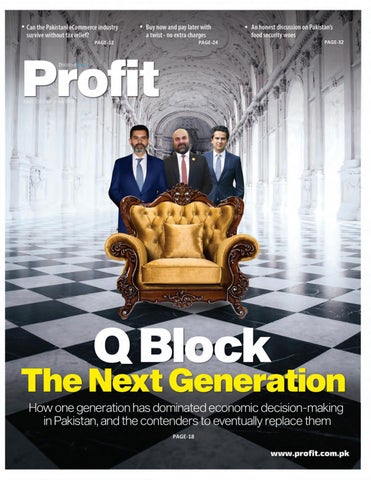
18 18 Q Block: The Next Generation 24 Buy now and pay later with a twist - no extra charges 27 WorldCall 2020 results
29 30 Cognitive Real Estate: The Most Exclusive Properties on the Market 32 An honest discussion on Pakistan’s food security woes
Profit
Executive Editor: Babar Nizami l Managing Editor: Farooq Tirmizi l Joint Editor: Yousaf Nizami Reporters: Ariba Shahid l Babar Khan Javed l Taimoor Hassan Abdullah Niazi l Meiryum Ali l Shahab Omer Chief of Staff & Product Manager: Muhammad Faran Bukhari Regional Heads of Marketing: Muddasir Alam (Khi) l Zulfiqar Butt (Lhr) l Mudassir Iqbal (Isl) Layout: Ahmad Salahuddin l Photographers: Zubair Mehfooz & Imran Gillani l Business, Economic & Financial news by 'Pakistan Today' Contact: profit@pakistantoday.com.pk
Readers Say Pakistan's grocery landscape has been disrupted. For the past 15 years those of us who worked in the FMCG sector waited for the traditional evolution from small to organized grocery. Despite initial strides, it didn’t evolve at the pace expected. But then Digital happened. Hum Mart is a good "bad example" but such ambitious diversifications do generally fail. We have some delightful examples to counter it too. Packaged goods manufacturers are adopting digital as a serious channel. Challenge lies in fresh groceries. Apropos: The big, wild, eGrocery gamble that has the startups mesmerised @PNJunkIEE, Twitter Hum Mart struggled due to absence of a startup mindset and not raising funds at the right time. Grocery delivery is a billion dollar + play in Pakistan and the right players (foodpanda, airlift) will crack it. Apropos: The big, wild, eGrocery gamble that has the startups mesmerised @ABinthemix, Twitter Sad state of media in Pakistan where focus is on sensationalism and trash talk shows. It has become almost impossible to sit down with family and watch some decent local shows. Local regulatory authorities need to become more vigilant wrt the content on local channels.Apropos: As Samaa drowns in losses, Aleem Khan offers to buy the channel Faisal Malik, Website This is so wrong. Politicians should not be allowed to buy media houses and media house owners should not come into politics. I am staunchly pro PTI but I want the media to be strictly neutral. Apropos: As Samaa drowns in losses, Aleem Khan offers to buy the channel @AamnaFasihi, Twitter
facebook.com/Profitpk twitter.com/Profitpk linkedin.com/showcase/13251020 profit.com.pk profit@pakistantoday.com.pk
HOW TO CONTACT
7
The media shouldn't be neutral at all, and the expectation that it should be is ridiculous. Over here, there are more than 16 channels that are running their own propaganda on a daily basis, especially in the prime time hours between 7PM and 11PM. So if any member of the PTI is buying a channel, then it really shouldn’t be any cause for worry for anyone. Especially since they do not need to buy the whole channel for influence. Here Aleem Khan is paying Ra3.54 billion for this entire channel, when in all honesty, if he wanted anchors on his payroll they would have sold out for far far less than this. For a fraction of that actually. Apropos: As Samaa drowns in losses, Aleem Khan offers to buy the channel @Yousafhussain9, Twitter What about businessmen? Should they be allowed to run a media house? Are they allowed
to do politics? And should politicians be allowed to do business? Or journalism? Or for that matter, should journalists be allowed to do business or politics? Where does it end? Who will define or allow anybody to do politics, business or journalism? The next thing you know we will be deciding who is and who is not allowed to vote. ‘Apropos: As Samaa drowns in losses, Aleem Khan offers to buy the channel @NaeemQurban, Twitter Now that’s funny. This is how it works all over the world. Different media organizations speak the voice of their owners, not the conscience of the journalists that run them. My advice would be to stop glorifying the media as a messiah. They are corporations which run for profit. It does not matter who owns them. Apropos: As Samaa drowns in losses, Aleem Khan offers to buy the channel @AliRiz24, Twitter It's not that they don't have reach - the trend is changing to other mediums such as YouTube which is significantly cheaper to operate with less restrictions and regulations. TV channels are trying to adapt but whenever change is coming from the bottom down it is slow and any meaningful change happens too late. Apropos: As Samaa drowns in losses, Aleem Khan offers to buy the channel @smuazsha, Twitter As always, sophisticated and nuanced reporting by Profit. Nobody in the industry is doing what you guys are doing. Solid, factual and insightful business journalism rounding all bases(including political which is probably overweight given how things run in our country). Keep up the good work. You will always have an avid reader in me. Apropos: As Samaa drowns in losses, Aleem Khan offers to buy the channel Shamiq Saeed, Facebook Seems like the "Profit" falls for the propaganda of the opposition parties. Only Samaa has the courage to show the real face of our society, it is quite easy to belittle someone in the name of no credible source. Apropos: As Samaa drowns in losses, Aleem Khan offers to buy the channel Iftikhar Ahmed Raza, Facebook At least 90 percent of these news channels just have nonsense and soap operas in the name of news analysis talk shows. There is hardly any world news or anything to learn from. So for me it is good riddance if these channels shut down. Apropos: As Samaa drowns in losses, Aleem Khan offers to buy the channel Farooq Khan, Facebook
COMMENTS
IN BRIEF Finance Minister Shaukat Tarin, while chairing a meeting of National Price Monitoring Committee (NPMC) on Monday, directed to import another 100,000 of sugar in one month in addition to an equal amount of the commodity arriving in Pakistan by mid of August.
“Let’s say Pakistan had enough capacity to provide quality education to only half its kids. If Pak population growth drops to that of Bangladesh, in 10 years we will accommodate every child in the country of primary school age and in 15 years in secondary school,” Planning Minister Asad Umar
Prime Minister Imran Khan has said his government was considering introducing a new legislation to target landgrabbers to ensure strict action against them. He said the mafias acted nefariously to grab properties, and that legal proceedings were slow and inefficient. The government on Thursday increased the price of petrol by Rs5.40 per litre and that of high-speed diesel by Rs2.54 per litre. This happened after Ogra, in view of rising petroleum prices in the international market over the last few months, had recommended that the price of petrol be increased by Rs11.4 per litre. Like other parts of the country, the pharma industry association in Khyber Pakhtunkhwa (KP) has announced a strike, demanding that the government revoke advance tax on the sector. This includes 0.1 million medical stores, 17,000 wholesalers and up to 1,200 distributors in KP.
Pakistan Post is set to inaugurate south Punjab’s first Amazon Fulfilment and Facilitation Centre (AFFC) in Multan after Eidul Azha. The facility will provide local handmade and cultural products access to the international market. In a trip that will mostly be remembered for his claim that he knows Uzbek history better than most Uzbek people, Prime Minister Imran Khan also said that Pakistan’s connectivity with Uzbekistan in trade and bilateral spheres would open up new avenues of prosperity in the region. The government is working to ensure availability of quality seeds, development of cold storage facilities and farm mechanisation to enhance per-acre output of major crops to try and ensure that Pakistan moves towards a position of food security.
8
Mosharraf Zaidi and the Uzbek
this week in Pakistan’s business and economics twitterverse
T
he week was dominated by Prime Minister Imran Khan claiming that he knows Uzbekistan more than the Uzbeks, and the moment proving to be another foot-inmouth instance despite the best attempts of Mosharraf Zaidi and others of the same ilk to defend the Prime Minister. Ariba Shahid brings you memes, advice, and a lot more in this week’s social media roundup from Pakistan’s business and economics twitterverse.
Say your piece
They brought back up
You guys may not relate to this one but as journalists we do. The number of times I’ve walked in to interview someone and seen myself outnumbered. My personal favorite was when a bank had 6 people from their team and it was just me. And no, some of them aren’t quiet.
10
It is very difficult to stay politically correct on the internet. There will always be someone that can find a flaw in your statement or argument. Should that stop you from sharing, no! Tell the world you hate oranges if you want. Who cares? Let a few people shake. Of course, we would suggest doing things like fact checking and making sure your math is right, because otherwise you can have egg on your face (figuratively). Of course, if it is something subjective like you liking literal egg on your face for whatever weird skincare reason please feel free to share with the world. Life is too short to worry about twitter feuds. Besides, for the current generation, twitter fights will be the stories to tell the grandkids
No Mosharraf, you’re not becoming SAPM
Phadda phadda
Fighting over talent is no fun. It also makes it difficult to retain them over the long run. While universities have added programs and increased their batch sizes, the quality of these grads remains an issue. In house training at this point is your best bet. Perhaps we are moving back to the old days, where a liberal arts major could very easily go and work for a bank. It might not be the worst idea for employers to not expect much from universities. The modus operandi should be as long as you’ve studied something and are a hard worker, come on board and learn on the job. The only problem is, with tech jobs, you can’t quite learn very quickly on the job at the very least.
It is inspiring to see someone hard at work and trying their best to achieve a goal they have set out for themselves. One such example is Mosharraf Zaidi, who has since 2018 and even before been trying incredibly hard to land some sort of advisory position in the government. Mr Zaidi looks on with starry eyes as Moeed Yusuf embaraces himself in front of everyone, and wishes that could be him. We are sorry to inform Mr Zaidi that he probably isn’t going to get one. We aren’t saying he isn’t smart enough, or capable enough to get there because the people already serving in some sort of advisory capacity to the government do not really inspire confidence. However, it is just that desperation is not a good colour on anyone. However, we applaud Mr Zaidi for continuing to try despite his consistent failures. This kind of spirit is always inspiring. Keep going Mosharraf, never stop and never let anyone tell you your dreams are stupid. Not even us. {Editor’s note: This is a rare but necessary addition to this weekly list by the editorial team, and not brought to you by our reporter}
Life imitating art
For the delivery boys
Delivery boys struggle to make ends meet despite working a long tiring job delivering things from one end of town to the other. They often carry cash around which is also unsafe keeping in mind the mugging incidents. Locating houses and offices is also not always easy considering the inaccuracy of some google map locations. They’re then made to spend their own mobile credit reducing the money they’re saving from their job even more. They need our voice.
Climate change is real. Life imitating scary art is also very much a possibility. With these extremely devastating rains in Germany, we can’t help but think of the destruction we’d face if it happened in Pakistan. May we all stay safe. It is unfortunate how often we have to rely on miracles, divine intervention, and the kindness of strangers for our most basic safety, but that is where we are as a nation. Every year on the brink of countless people being swept away forever as part of the monsoon season.
SOCIAL MEDIA ROUNDUP
I
By Taimoor Hassan
f you have been a business journalist for a while, then you will relate to this. And if you are a reader of financial news, you will also recognise the pattern. Any time a business, or an industry association is interviewed - no matter what that industry is - they will always say the same thing. Relief. They want relief in some form or another. They want relief in the budget, they
12
want stimulus packages, they do not want to be taxed, and they do not want to be questioned. And this princely treatment they both expect and demand, and when they do not get it, they whine about it and they whine loudly. So the reader will understand that anytime we hear complaints like this, we are less than receptive to them. Still, we tolerate it because old industries like textiles, agriculture, steel, and others have worked that way for a while and are stuck in their ways. What is surprising is when newer
industries that we expect to behave differently engage in the same sort of behaviour. So when the eCommerce industry went up in arms with a systematic campaign against the budget for the fiscal year 2021-22, it had everyone surprised. On this occasion, however, the campaign may have been justified. You see, this was not complaining or asking for handouts, this was an issue of definitions. In the most recent budget, the government decided to include ‘online marketplaces’ in the category of Tier-1 Retail-
This (2.5%) is a cost that if an unregistered seller analyses, he would realise that he is getting access to a new market through the online platform that he cannot do it himself. This is a cost which is a good step forward Nauman Sikandar, CEO Foodpanda
ers, effectively burdening the marketplaces with the responsibility of reporting sales tax for their sellers. Online marketplaces in Pakistan are new, and eCommerce has only just found its true wings in the past couple of years, so at this point it is very important (fiscally speaking) to define what these platforms are exactly and how they should be treated by the tax authorities. But the new definition prompted the question: why should eCommerce businesses take on taxation responsibilities, and help formalise the informal economy at their own cost, when there are government departments to do that? So, the move jolted companies like Daraz, and they hustled to get the clause of designating online marketplaces as Tier-1 Retailers removed from the budget before it was passed. They were successful. On Tuesday, June 30, the budget was passed without the said clause. Instead, however, the Federal Board of Revenue (FBR) managed to get a tax imposed: marketplaces like Daraz are now required to withhold 2.5% of the amount of their unregistered sellers as withholding tax (WHT), as well as from registered sellers that are not filers. According to FBR officials, the rate of WHT is 2.5% whereas online marketplace Daraz contends that the rate was 2%. Since the rate from FBR is 2.5%, we will stick to considering that as the rate that is officially effective. In the earlier plan that the government had to declare online marketplaces as retailers, Daraz would have to report the numbers. Under the new provisions, they still have to report taxation to the government, but only have to deduct 2.5% as WHT from sellers. And that, of course, is critical to the sellers on platforms like Daraz, PriceOye, Telemart, Homeshopping and others. The difference in tax percentages fundamentally affects online marketplaces because the number of unregistered sellers on these platforms are over and above the number of registered sellers on these marketplaces. In a recent interview, a high-ranking official from the FBR disclosed that 93% of the sellers on Daraz were unregistered.
There are four realities to be aware of to understand the implications of these new rules. The first are the perpetual efforts of unregistered businesses, offline sellers as well as online sellers on eCommerce platforms, to remain out of the tax net. The second is the eternal desire of the tax authorities to bring unregistered businesses into the tax net. The third are online marketplaces that bear the brunt of the war between the revenue authorities and these sellers, trying to strike a balance. The fourth, perhaps most important reality is that eCommerce businesses are in losses and their business model is under stress. There’s a lot to unpack here and we’ll start with some basics of tax avoidance.
Taxation hacks
I
f you are a business registered with the revenue authorities, chances are that you might have placed an order for an electronic product with an online marketplace. For the sake of understanding, let’s say that you are a business looking to purchase an iPad for use at your office and decide to get that online because that saves you the convenience of not going out to buy one. Now, any business registered with the revenue authorities is required to withhold 4.5% of the amount if the value of the purchase goes beyond Rs50,000 in a calendar year. As a registered business, you have to withhold an amount from the sale price that you get on an online marketplace and submit it to the FBR. The 4.5% that is reported to the FBR can be claimed by the marketplace or a seller on the marketplace as tax paid on the income and will only have to pay the remaining percentage of the income tax at the end of the year. The 4.5% was already paid and reported to the FBR on behalf of the marketplace or the seller by the business while purchasing the iPad. The problem is that if the marketplace or the seller is unregistered and already out of the tax net, it is going to hike the price given on the website for the iPad by 4.5%. Why? Because unregistered marketplaces, if they are selling the iPad to you directly, or sellers on a
marketplace if they are unregistered and selling it to you through the marketplace, don’t want to pay any income tax. Since they do not want to pay any income tax, they wouldn’t want the 4.5% to be deducted by the business that has been obligated to deduct and report. This is simply a lost income for unregistered sellers or marketplaces. The consequence is that the business ends up buying that iPhone at a higher price, up by the percentage amount of the withholding tax. From the market research done by Profit, three of the known online marketplaces, Telemart, Homeshopping.pk and Tejar, added WHT on top of the price of various electronic products listed on the website, during price inquiries as a business. Let’s also lay out a distinction here: there are online marketplaces that are retailers themselves, that buy and hold inventory, and sell it to consumers like a retailer. An eCommerce player that follows this model is Daraz. There are certain products that Daraz keeps as its inventory and if a consumer buys that product, Daraz charges the GST on to the consumer, just like any other offline retailer that is registered. Daraz pays the taxes on its income earned through this segment of the business. Then Daraz acts as a middleman, online, opening its online platform to individual sellers to find buyers for their products, does marketing for them and when the sale is made, deducts a predetermined commission before reimbursing the remaining transaction amount to the seller. And as mentioned above, companies like Daraz pay a service tax on this commission to the government from this revenue stream as well. This distinction could open up avenues for tax evasion for companies that follow both models and here it gets trickier. The platform could actually be a retailer posing as a marketplace. For instance, you could be purchasing an iPad that Daraz might actually be selling as a retailer and in that case, it’s Daraz that is adding the WHT on top to avoid taxes and not the seller. This can happen with marketplaces that claim they are marketplaces and retailers, active taxpayers, but are not transparent about who the seller is. But in the case of Daraz at least, most of
ECOMMERCE
On offline channels as well, if you are a registered business owner and go to a shop that is unregistered, they will increase the price by the percentage of withholding tax. In unofficial channels there is the harmony of prices Adnan Shaffi, CEO at online marketplace PriceOye
the time you would see the name of the seller who is selling a product to you on the website. It would be a third party seller most of the time because only 10-15% of Daraz’s business comes from retail and 85-90% comes from the marketplace. Daraz’s retail is mostly restricted to Daraz Select, which is its private label brand. Besides, some brands, mostly the FMCG brands as Daraz tells Profit, sell their inventory to Daraz which then stocks that in its warehouses. “Daraz buys that inventory and fulfills that under the banner of ‘fulfilled by Daraz’,” Daraz told Profit in a statement. For the inventory that Daraz sells itself, no WHT was added on top of the listed price on the website for these products during our price inquiries. Whereas for products of other sellers, a representative from Daraz said that it would be up to the seller if he adds WHT on top or not. Daraz’s transparency gives it an edge over others. For instance, Telemart also claims it is a marketplace, has an option on the website to register sellers, but does not name sellers with the products it lists like Daraz does. On the other hand, Homeshopping.pk calls itself a marketplace but there is no option on their website to register as a seller and neither does the website list vendor names with the products. Its most trickier in the case of Homeshopping.pk to verify if it is the platform selling the product itself or selling the product of a third party seller. An official at Homeshopping.pk says that they do not buy inventory from sellers, or keep it, and the transaction process looks something like this if you are purchasing as a business: sellers would give Homeshopping a fixed price for the product that they list on the website that the buyer can initially see; customer would put an inquiry for the product; the platform would send a quotation to the customer, approved by the seller, which might or might not have WHT added on top of the listed price; the buyer places the order and the platform would pick the product from the seller, fulfill it at its centres and deliver it to the customer; the payment is collected and the platform deducts its commission on the transaction and pays the remaining amount to the seller. Nowhere in the transaction is Homeshop-
14
ping buying the product from the seller or selling it to the customer means that the evasion comes from the seller, or that is apparently what it looks like. Some of the prominent names in the eCommerce industry, like Lahore-based Shophive, are not marketplaces. If you order a mobile phone on Shophive, it will not be from a third party seller that Shophive would be connecting you with through its platform. It would be selling that phone to you, as Shophive that bought the phone from the seller first and held it, before selling it to you. Which means that Shophive is obligated to charge the consumer the government mandated GST percentage, and if a business is buying, it should be able withhold a percentage of the WHT transparently, without having to see the price of the product going up by the WHT percentage. That is not the case with Shophive, however. It does not charge GST to its consumers, deals in cash and evades withholding tax deductions by businesses. Same is the case with Tejar.pk. It adds WHT on top of the product price to evade taxes. Here’s a guiding principle: if someone is evading taxes (like by adding WHT on top of the price), chances are that he is hiding his income in totality and not paying any taxes. And if he is reporting his income, he is most likely underreporting it. It is the e Commerce players like Shophive and Tejar.pk that, because they do not bear the burden of taxes, are most likely profitable and because they are profitable should be taxed more. While there is little transparency with some eCommerce players as to who is the actual seller to identify if the eCommerce player evades itself or the seller that does it, there is admission of the fact that tax evasion happens. Marketplaces acknowledge the practice of jacking the price by percentage of WHT, but say that it happens with a very small percentage of transactions as sales to consumers are much higher compared to sales to businesses. As Telemart, for example, tells Profit, only 1% of their transactions are with businesses where sellers jack up the price and the remaining 99 per cent are with individual consumers. The 1% B2B sales are further diminished if the sellers are registered and don’t mind
withholding tax being deducted during the transaction. “On offline channels as well, if you are a registered business owner and go to a shop that is unregistered, they will increase the price by the percentage of withholding tax. In unofficial channels there is the harmony of prices,” says Adnan Shaffi, CEO at online marketplace PriceOye. This here reflects the mindset of the unregistered sellers, offline and online. That they want to avoid taxes as much as possible. Different narratives are presented by CEOs as to why unregistered sellers avoid taxes. Some sellers push the narrative of lack of trust in the government, that what they pay in taxes will not come back to them in social services. However, from the versions received from the CEOs, sellers predominantly do not want their income to diminish. And if taxes are forced upon them, in case of selling on online marketplaces, they will simply switch to the vastly undocumented offline channels.
Government objectives
T
he government wants to impose withholding taxes on sellers to increase their cost of doing business. The idea of such a technique is that paying taxes while being outside of the tax net becomes so expensive that it is cheaper and good for business to be within the tax net. This way, everyone is happy. Now, the only way to implement this effectively is if the government actually goes after the sellers to begin with. Instead, the FBR found an easy way out of their job. Instead of going out to thousands of sellers itself, through regulatory fiat, it simply held the online marketplaces by the neck and asked them to do it for the FBR. That is what the categorisation of online marketplaces as Tier-1 Retailers essentially meant: that marketplaces were burdened with collection of 17% GST from sellers and then reporting it to the FBR. The marketplaces cannot possibly be responsible for the taxation liability of the sellers on their platform, particularly because of the
kind of medium that online shopping is. While the condition was repealed, a 2.5% withholding tax to be collected by the marketplaces was imposed. One could logically argue that online marketplaces should not have a problem with asking their sellers to pay the general sales tax of 17% to the online marketplaces facilitating their sales and then the marketplace would report these to the revenue authorities. Final reconciliations can be done when sellers file returns. But it turned out to be a big problem mainly because the majority of the sellers selling on online marketplaces are unregistered, who want to stay untaxed. Why they want to stay is already established. But what’s prompting them to stay untaxed is where the beef is. It’s the offline untaxed retail industry. Consider an example of an unregistered sports equipment seller that sells via a physical retail outlet as well as online through a marketplace. In this example let us say that this platform is Daraz. At their retail store, this seller is selling their equipment tax free. They do not charge the 17% GST on equipment to consumers. The retailer sells in cash, and is able
to keep details of their earnings on the down low. The same seller is also able to reach a wide range of customers through Daraz and sells at the same price as through offline retail, and does not charge the usual 17% sales tax to its customers. Sellers have various ways to hide the GST. The most common is to report a price that is inclusive of GST. The seller enjoys healthy margins because the taxes are not there, and taxes can really add up to the cost of doing business. “There are multiple layers of taxes and eventually it can add up to 30-33% in taxes paid to the government which these sellers consider as lost income,” claims Adnan Shaffi. Now, consider this. The government pops up one day out of the blue and tells Daraz that they now have to collect GST from their sellers (most of whom are unregistered) on each transaction, and then also log and report this collection to the FBR. Daraz suddenly needs to invest in a tax team, make changes in its web code, run after its sellers, and all despite the fact that they are not a retailer. Once again, platforms like Daraz simply connect buyers with sellers online and facilitate the transaction only.
Online marketplaces are burning money and still paying taxes. Unregistered businesses are earning profits and still not paying taxes Hamza Rauf, CEO of Telemart
They only earn a commission for facilitating the transaction, and as a platform, pay taxes on the commission earned. As a platform, they do not force sellers to charge a buyer 17% in sales tax on each transaction. Hence in the earlier setting, unregistered sellers would not be charging any GST if they were unregistered. Now if you mandate the platform to collect taxes on behalf of the government and report it as well, essentially, that tax percentage is an added cost for the unregistered seller. Because he is not paying the same in the offline channels, that is his own physical retail store, his cost of doing business via the marketplace goes up by 17% and he simply has the incentive to revert back to offline channels, or to make up for the lost online revenue stream, would move to unregistered online marketplaces selling like him, or would set up his own Instagram store or sell via Facebook page where he will continue to sell without the burdens of taxes. In all instances, that is a seller that is no longer on Daraz’s platform. Now it would not have been much of a problem if only a handful of sellers were unregistered. But we are talking about a majority here, over 90% that are unregistered sellers, small in size, selling stuff online from their homes. So if over 90% of the sellers from a marketplace move to their own online channels or offline, a tax as simple as the usual GST can become a threat to the existence of marketplaces. To reiterate here, 2.5% is still a problem, but it is less of a problem than 17% would be.
Marketplaces stuck in the middle
“T
his (2.5%) is a cost that if an unregistered seller analyses, he would realise that he is getting access to a new market
ECOMMERCE
Our argument with the FBR was not about more or less tax but on the definition of marketplace. What we were further asserting was that payment of taxes was the responsibility of the sellers for whom we act like agents. We are not in the business of doing tax collection Ahmad Hassan, chief financial officer at Daraz
through the online platform that he cannot do it himself. This is a cost which is a good step forward,” says Nauman Sikandar, the CEO of Foodpanda. Foodpanda is itself a marketplace that connects restaurants for food orders. In turn, it charges commission to the restaurants for the service it provides. Nauman says that they have quite a few restaurants that are unregistered, and this will have a considerable impact on foodpanda. It all sums up to this: taxing unregistered sellers on marketplaces while keeping the massive offline retail untaxed is not going to help. The government would not be able to gather much because sellers would move online because those channels are still open and that would consequently result in the death of marketplaces. Registered marketplaces pay their due share of taxes, as imposed on them, from whatever model they follow. Which is why marketplaces argue that asking them to further bear the costs of tax collection and reporting would be penalising them for being registered because unregistered marketplaces would be free from this burden even if imposed. “Total retail in Pakistan is estimated at around $250 billion. Whereas eCommerce retail is around $1 billion. As a percentage of overall retail, eCommerce is very small. Even if we say it is 1 per cent of the overall retail, even though it is much less, by extension, that also means that only 1 per cent of the unregistered sellers are online compared to 99 per cent that are offline. The government has found it convenient to document only 1 per cent of the unregistered sellers against 99 per cent that are offline,” says Hamza Rauf, CEO at Telemart. “Online marketplaces are burning money and still paying taxes. Unregistered businesses are earning profits and still not paying taxes,” says Hamza. The government and the FBR are not completely wrong, however. From industry
16
sources that include a tax lawyer and a CEO of another online marketplace, companies like Daraz and others are better equipped to get the sellers registered. They are already equipped with technology, have the systems to do it because they already are collecting taxes, and because they have all the systems, integrating them with the FBR would not have been much of a problem. On the contrary, to document the sellers individually who are not well-versed in taxes, lack the technology and systems to do it online and integrate with the revenue authorities, and are sometimes even illiterate to do it even themselves, is going to be a colossal challenge. Perhaps that is why the government stuck with keeping some tax to be collected by the online marketplaces, and that is why the industry did not raise much voice when the government withdrew the 17% GST collection requirement and only mandated collection of 2.5% WHT (withholding tax). The cost of tax collection and reporting is still there, which was earlier decried, goes on to say that the problem really was not collection and reporting, but the percentage of tax imposed on sellers that would have driven them away from online platforms. Marketplaces do not overtly acknowledge tax percentages as the reason that prompted them to lobby to have the GST withdrawn, but appreciate the lesser percentage as WHT. Officially, they stick to the argument that in principle, asking them to collect taxes is wrong. “Our argument with the FBR was not about more or less tax but on the definition of marketplace. What we were further asserting was that payment of taxes was the responsibility of the sellers for whom we act like agents. We are not in the business of doing tax collection. That is not our primary responsibility. It’s not about being tax collection easy or difficult, it’s just that tax collection is not our primary aim or purpose,” says Ahmad Hassan, chief financial officer at Daraz.
The fledgling state of eCommerce
M
arketplaces dread sellers leaving their platforms because of taxes. This argument runs in parallel with the fact that marketplaces make losses. All of them. From financials available with Profit, Pakistan’s largest online marketplace, Daraz, has been running losses in billions of rupees. If the largest, and oldest existing marketplace, is running losses, there is a little chance that the newer and smaller ones would be generating profits. And the industry acknowledges that marketplaces run losses right now. We would restrict this argument to registered ones only, however, who are active taxpayers. Marketplaces are running losses with unregistered sellers on the platform. You forcefully tax the sellers, the loss making marketplace will die. The unique proposition of online shopping is convenience. Yet in Pakistan, eCommerce is mostly discount driven, which typically can only be offered to customers by constraining the profit margins of marketplaces. Only when the model shifts from discounts to convenience will profits emerge. “Marketplaces are struggling to change behaviour. When scale is reached and behaviour is changed, that is when you can adjust prices,” says Adnan. “For marketplaces, when their volumes increase that of physical retail outlets like Carrefour or Imtiaz, then marketplaces would be able to negotiate better deals with sellers and pass it on to the customer without burning the money of the marketplace,” he added. Till then, the industry is going to need tax relief to survive. Should the government give tax relief? Well, it already has given some relief by decreasing turnover tax from 0.7% to 0.25%. That needs to be done concomitantly with documenting the offline retail economy. Unless that is done, the industry is going to keep on asking for relief. n
ECOMMERCE TEXTILES
18
COVER STORY
I
By Farooq Tirmizi
f there is one thing the last 10 years have demonstrated, it is this: the country appears to have a shortage of people who are deemed worthy of serving as Finance Minister. Why else would the Pakistan Tehrik-e-Insaf (PTI), which railed against all of its political rivals, end up recycling not one but two of the Pakistan Peoples’ Party’s (PPP) finance ministers after a rocky start with one of its own? This magazine has previously profiled what the job of the finance minister entails, which we initially did when the Imran Khan Administration first came into office. As we approach the final two years of the current term of the administration, with the finance ministry helmed by a man who first held this office more than a decade ago under a very different prime minister, we thought it would be good to look at not just who has previously held the job, but who are the leading contenders to hold the job in the future. This article also has a very specific political agenda which we will state up front: we would very much like for Abdul Hafeez Shaikh to never become finance minister again, and if we can avoid having Shaukat Tarin return to the job after this particular term of his ends, we would be grateful for that as well. Nothing against either gentleman, but we would like to see some fresh talent occupy the top corner office in Q Block. What we will outline instead are a few names of people who are currently serving in the trenches in other posts in government – some more prominent than others – who form a talent pool from which whoever the next prime minister is can pick their next finance minister. To start our conversation, we will first lay out who has occupied the office in the past, why we think there is a vacancy now, and who are some of the leading candidates to fill those vacancies. We also want to be very specific: in no way are these people the ones we think are the best or most qualified, though many of them are well-credentialed. This is simply our best guess for a list of names that is likely to come under consideration for finance minister the next time a cabinet is formed.
Who wants to be Finance Minister?
B
efore we dig into who we think will become finance minister in the future, let us dig into who has become finance minister in the past. The list and profiles of the office holders in the past is quite illuminating with respect to the qualities
20
we have sought in the person placed at the helm of what is probably the most important ministry in the federal government. A total of 30 people have ever served as Finance Minister of Pakistan, though for the purposes of our analysis, we are counting people who served as Advisor to the Prime Minister on Finance as the full minister because, effectively, that is what they were. This list of 30 includes four people who served as interim finance minister in between governments. Of those 30, only two women have ever served in the finance ministry. One was Shamshad Akhtar, the former State Bank Governor who briefly served as interim finance minister before the 2018 election. The only elected woman who ever served as Finance Minister was when Benazir Bhutto served as her own finance minister in the 1990s. No man has ever appointed a woman to this position in cabinet. Ever. Since Partition, the ministry has been left unoccupied for a total of 862 days (a little over two years) in between various appointments. That is a rather long time to have left this vital ministry unattended, but then again, take a look at how long we have gone without an elected prime minister, and you feel less bad for this ministry. So how long has the average minister been in office? Well, excluding the ones explicitly appointed as interim ministers, the average finance minister has spent about 990 days (a little over two years, 8 months) in the job. This, however, counts multiple stints for the same person as one, which probably overstates the level of stability there has been on this job. However, the average is hiding some important details. For instance, the three longest serving finance ministers of Pakistan were all ones who served under military dictatorships. In descending order of the length of their time in office were Shaukat Aziz (President Musharraf), Ghulam Ishaq Khan (President Ziaul Haq), and Muhammad Shoaib (President Ayub Khan). The longest serving democratically elected finance minister is Ishaq Dar, though that is across three terms in office. All told, Dar served about 5 years, 2 months as finance minister. The next longest serving is Abdul Hafeez Sheikh, who, across two terms, served about 4 years, 11 months on the job. The third longest democratically elected minister was Sartaj Aziz, who served in Prime Minister Nawaz Sharif’s cabinet in that role in the 1990s. We will exclude the dictators’ ministers, since we believe there will never be a military government in Pakistan ever again. What do the democratic ministers have in common? They all had some vaguely ‘economic’ work experience prior to being assigned the ministry
and were already close to the Prime Minister who appointed them. None of them were appointed solely because the incoming Prime Minister believed they would be the best person for the job, and did not otherwise have a previous relationship with them. That pattern, we believe, was both bad for the country, and likely about to change in the future. And that brings us to the subject of the Vacancy.
The Vacancy in (most) political parties
I
t has happened at least partly by accident and partly because the government of Pakistan systematically decided to not invest in educating our population since Partition. But the result is that, of the three major political parties in Pakistan, there is now no clear designate for Finance Minister of Pakistan in two of them. Let us explain what we mean by that. While Profit generally tries to stay away from political analysis, it is likely a fair assessment that the three biggest political parties in Pakistan, and the ones that have the highest probability of winning and election and forming a government, are the Pakistan Peoples Party (PPP), the Pakistan Muslim League Nawaz (PML-N) and the Pakistan Tehrik-e-Insaf (PTI). Of these three, only the PML-N has a clear favourite for who would become finance minister if the party were to win the next general election. Assuming the PML-N wins in either the 2023 or the 2028 elections, it is very likely that Miftah Ismail will become the finance minister. Who will be the nominee for either the PPP or the PTI? For the PPP, it is obvious that there is no clear frontrunner. They might plug in Abdul Hafeez Shaikh again for lack of any other options, but there is no clear party member who would be appointed to the job. (Note: Abdul Hafeez Shaikh is the Microsoft Internet Explorer of cabinet ministers. If you do not select a better option, he is your default setting. He comes with the operating system.) For the PTI, you might say: well, if they win re-election in 2023, they will likely continue with Shaukat Tarin. That is certainly possible, and even likely. But what if they lose and then win in 2028? Who is the nominee? It is unlikely that Tarin, who would be 75 then, would be available to serve for a third term in a very grueling job. Who then? There are many guesses, but no one clear answer. Wait, you might say. There is no clear designate for any cabinet position for any political party. So why this article?
Because unlike the other ministries, there is now a convention in Pakistan – similar to other parts of the world – that the finance ministry at least requires some semblance of technical expertise. Other ministries could benefit from ministers who were familiar with the subject matter under their jurisdiction, of course, but such a convention has not yet been established for those cabinet positions, which tend to be awarded on the basis of political considerations more than technical merit or managerial talent. So who are the next generation of economic leaders in Pakistan? Who is likely to be on the shortlist for Finance Minister of Pakistan? Let us dive into the list.
The List: Leading PTI Contenders
Of the list of people who might conceivably get the job in the near future for the current ruling party, there are three names that we believe have a somewhat higher likelihood of landing the job, based largely in part on where they are now, and their actions since having achieved the current positions they hold.
Makhdoom Hashim Jawan Bakht The current finance minister of Punjab is one of the young guns of the PTI who has both the professional resume and the political credentials to make a strong contender for the Finance Minister job in Islamabad. In terms of professional credentials, he spent the bulk of his career as an investment banker at Citigroup. He has an undergraduate degree from McGill University, arguably the most prestigious university in Canada. But, of course, his professional credentials are not what got him the job. There were probably at least a dozen people with the
same or better educational and professional experience than him, even out of his own class at Aitchison. What makes Bakht interesting is the fact that he is from a politically prominent family from Rahimyar Khan, the kind that can win an election without having a political party affiliation. Bakht previously served as a PML-N member of the Punjab Assembly before switching sides and joining the PTI in 2018. His name is routinely floated as a potential future chief minister of Punjab, and in the event that the PTI has to rely on anyone other than Tarin, his name would be on the very shortest of shortlists for federal finance minister. Born in 1979, Bakht is only 41, so he has a long political career ahead of him. (Editor’s note: Bakht’s elder brother Khusro Bakhtiar is currently a federal minister in the PTI cabinet, and considering the family’s ever changing political associations in the past, either of the brothers can be the candidate of choice from any of the three leading political parties.)
Taimur Khan Jhagra As the finance minister of Khyber-Pakhtunkhwa, the 43-year-old Jhagra is a strong contender for promotion to the federal job, and
COVER STORY
would probably have been the leading contender had he been from Punjab. Nonetheless, in terms of professional credentials, Jhagra’s resume reads even more impressive than that of Bakht. Jhagra got an undergraduate degree in mechanical engineering from the Ghulam Ishaq Khan (GIK) Institute of Engineering Sciences and Technology in 2000. Following his undergraduate degree, he got a job as an engineer at Schlumberger, the global oil field services giant. After six years at that job, he then got an MBA from London Business School, one of Europe’s two best MBA programs, in 2008, following which he joined McKinsey & Company, the formerly prestigious management consulting firm. Jhagra rose fast through the ranks of McKinsey, rising to the coveted rank of partner before quitting to launch his political career. That ambition, of course, was helped by the fact that he is son of retired federal secretary Saleem Khan Jhagra, nephew of late PPP leader and provincial minister Iftikhar Jhagra and grandson of Ghulam Ishaq Khan, the influential bureaucrat who served as President of Pakistan between 1988 and 1993 and was the second-longest-serving federal finance minister under Ziaul Haq, from 1977 to 1985.
undergraduate degree at Harvard, and a PhD in economics at the University of California at Berkeley. Following his PhD, Baqir worked both in academic positions and eventually as an economist at the International Monetary Fund (IMF), a position he held for almost two decades. Unlike the previous two, he does not have the same kind of political family connections. And no State Bank governor has gone on to become the finance minister, though there is recent global precedent for such a move: former United States Federal Reserve Chairperson Janet Yellen recently became the US Treasury Secretary. And unlike his predecessors on the job, Baqir does not behave like a neutral technocrat but rather more like a political appointee, somewhat akin to a junior minister rather than an independent central bank governor.
A bit of a political outsider, Reza Baqir is the current Governor of the State Bank of Pakistan, which would not normally rule him in the running for the finance ministry job, but Baqir is more overtly political – and more openly aligning himself with the Prime Minister – than is the norm for a person in his position. Clearly, the central bank governorship is not the end of his ambition. In terms of academic and professional credentials, Baqir is no lightweight. The second Aitchisonian on this list, he got his
22
The List: The PML-N’s man
Miftah Ismail
Hammad Azhar
Reza Baqir
credentials are somewhat lighter, though he appears more comfortable publicly defending the government in contentious policy matters than some of the other contenders, which is very likely a point in his favour. Yes, he is Aitchisonian too.
At 19 days, Hammad Azhar’s tenure as federal finance minister is the shortest one in Pakistani history. And for a junior minister to be turned down for the senior job might ordinarily have been taken to mean that his prospects for the top job are over. But we cannot rule out the 39-year-old Hammad Azhar for a variety of reasons. Firstly, he may not have been given the finance ministry job, but he was given the prominent, if somewhat amorphous federal energy ministry, suggesting that he is politically important enough to be granted a senior cabinet member position. It helps that he is the son of former Punjab Governor Mian Muhammad Azhar and delivered an important constituency from Lahore to the PTI. A graduate of the School of Oriental and African Studies (SOAS) of the University of London and Lincoln’s Inn, Azhar’s professional
Unlike the other names on this list, the only thing that will determine whether or not Miftah Ismail gets the job is whether of not the PML-N wins the general election. If that happens, it is all but certain that Ismail will get the job, just as he held it in the final days of the Nawaz Administration. The 49-year-old Karachiite has a PhD in public finance from the Wharton School at the University of Pennsylvania, and worked as an economist at the International Monetary Fund for three years before returning to home to Karachi to run his family business, the publicly listed Ismail Industries, a confectionery manufacturer with a market capitalization of over Rs27 billion. Miftah got the job when Ishaq Dar was ousted, and given how much legal trouble Dar is in, combined with how much he is reviled by the country’s business community and how much Ismail is trusted, it is all but certain that Ismail will get the finance ministry job if his party wins the election. The PML-N may still be debating who to run for Prime Minister, but they already have their finance minister sorted. While Ismail is not from a political family himself, he has tried to run for the National Assembly from his home constituency in Karachi, but lost the 2018 election as well as his by-election.
TEXTILES
The List: Slim pickings for the PPP
Syed Murad Ali Shah Why on earth would the Chief Minister of Sindh want the federal finance ministry job? Because his party might need him to. Of all the political parties who are in desperate need for candidates for finance minister, the PPP is the most desperate, because their leading contender is a man they equally desperately
TENURE
need for his current role. Murad Ali Shah has politics in his bloodstream. He is Chief Minister of Sindh and the son of a former Chief Minister of Sindh, Syed Abdullah Shah. He is also as Karachi as they get: an alumnus of St Patrick’s High School and NED University, from where he got a degree in civil engineering. He then got not one but two masters degrees from Stanford University. He worked as a structural engineer for the Water and Power Development Authority, the Port Qasim Authority, and the Hyderabad Development Authority before switching careers completely and going on to work as a banker at Citibank in Karachi and London. In the event that the PPP wins a general election, their only serving chief minister is also their only candidate for finance minister, assuming they decide not to go with Hafeez Shaikh. He is also probably the only candidate who might be passed over for the job because his party cannot decide on a replacement. (It is a remarkably precarious balance in Sindh for who can get the Chief Minister job without annoying all the factions of the PPP.)
What the list means
We would like to highlight the fact that the top names all have something in common: they all have extremely impressive professional and educational credentials, and many of them
even have political connections through their families, as the sons of prominent politicians and civil servants. (Did we say “sons”? Yes, we did. There are no women on our list. We did not say this is the way things should be, merely the way they are.) Why does that matter? Because it used to be that the only thing that mattered was how strong your political connections were. But as Pakistan’s political elite has grown in size, with a larger number of heirs vying to succeed their parents, there is now internal competition within the elite for the top jobs, and a restricted kind of meritocracy that is beginning to take shape. There are probably dozens of young political aristocrats who graduate from Aitchison every year, but the ones who are leading contenders for the finance ministry are the ones who were good enough to do well as bankers at Citigroup or consultants at McKinsey. Conversely, there are dozens of Pakistanis who are doing well professionally as bankers, engineers, and consultants in New York and London, but the only ones being considered for the cabinet are ones who have politicians in their families. We still have an establishment, but we no longer have to suffer their fools. We appear to have made enough progress to be getting the better credentialed among our ruling elite to rule us. Will that make a difference? Let’s find out. n
Ghulam Ishaq Khan
5-Jul-77
21-Mar-85
Ishaq Dar
6-Nov-98
12-Oct-99
No appointment
22-Mar-85
9-Apr-85
No appointment
13-Oct-99
5-Nov-99
Malik Ghulam Muhammad
15-Aug-47
19-Oct-51
Mahbub ul Haq
10-Apr-85
28-Jan-86
Shaukat Aziz
6-Nov-99
15-Nov-07
No appointment
20-Oct-51
23-Oct-51
Yasin Wattoo
28-Jan-86
29-May-88
Salman Shah (caretaker)
16-Nov-07
25-Mar-08
Chaudhry Muhammad Ali
24-Oct-51
11-Aug-55
No appointment
30-May-88 8-Jun-88
No appointment
26-Mar-08
30-Mar-08
No appointment
12-Aug-55
16-Oct-55
Mahbub ul Haq
9-Jun-88
1-Dec-88
Ishaq Dar
31-Mar-08
12-May-08
Syed Amjad Ali
17-Oct-55
7-Oct-58
No appointment
2-Dec-88
3-Dec-88
Naveed Qamar
12-May-08
8-Oct-08
No appointment
8-Oct-58
14-Nov-58
Ehsan-ul-Haq Piracha
4-Dec-88
6-Aug-90
Shaukat Tarin
8-Oct-08
22-Feb-10
Muhammad Shoaib
15-Nov-58
8-Jun-62
Sartaj Aziz
6-Aug-90
18-Jul-93
No appointment
22-Feb-10
18-Mar-10
Abdul Qadir Sanjrani
9-Jun-62
15-Dec-62
No appointment
19-Jul-93
22-Jul-93
Abdul Hafeez Shaikh
18-Mar-10
19-Feb-13
Muhammad Shoaib
15-Dec-62
25-Aug-66
Syed Babar Ali (caretaker)
23-Jul-93
19-Oct-93
Saleem Mandviwalla
19-Feb-13
7-Jun-13
N M Uqaili
25-Aug-66
25-Mar-69
No appointment
20-Oct-93
25-Jan-94
Ishaq Dar
7-Jun-13
28-Jul-17
No appointment
26-Mar-69
4-Apr-69
Benazir Bhutto
26-Jan-94
10-Oct-96
No appointment
29-Jul-17
26-Dec-17
Vice Admiral Mohammad Ahsan 5-Apr-69
3-Aug-69
Naveed Qamar
10-Oct-96
5-Nov-96
Miftah Ismail
27-Dec-17
31-May-18
Muzaffar Ali Khan Qizilbash
4-Aug-69
22-Feb-71
No appointment
6-Nov-96
10-Nov-96
Shamshad Akhtar (caretaker) 5-Jun-18
18-Aug-18
No appointment
23-Feb-71
23-Dec-71
Shahid Javed Burki (caretaker) 11-Nov-96
17-Feb-97
Asad Umar
20-Aug-18
18-Apr-19
Mubashar Hassan
24-Dec-71
22-Oct-74
No appointment
18-Feb-97
24-Feb-97
Abdul Hafeez Shaikh
18-Apr-19
29-Mar-21
Rana Mohammad Hanif Khan 22-Oct-74
28-Mar-77
Sartaj Aziz
25-Feb-97
6-Aug-98
Hammad Azhar
29-Mar-21
16-Apr-21
Abdul Hafiz Pirzada
5-Jul-77
No appointment
7-Aug-98
5-Nov-98
Shaukat Tarin
17-Apr-21
7/18/2021
30-Mar-77
COVER STORY
I
By Taimoor Hassan
t’s a Sunday night. You’re sitting at your laptop and you’re browsing through the website of some clothes retailer or looking at shoes. You spot something you really like and suddenly you’re mesmerised. It’s a shirt, or a pair of shoes, an imported chocolate, or an alarm clock for that matter - it could be anything really, that bit doesn’t matter. What matters is that you want it, and sitting at home on Saturday just window shopping online your finger is absolutely twitching to move the product from the shopping
24
cart to check out. What do you do? You move towards the button that says ‘BUY’ and you stop yourself. No, it is the end of the month and there are a few more days until you get paid. And the rent is due first and you still haven’t paid your internet bill. The few thousand rupees you’ve got left in your account are to get you through the next pay day. You whinge but you do the sensible thing to empty the shopping cart. You shut your laptop and go to sleep, and that impulse buy you almost made will now forever be lost. Somewhere in some ecommerce headquarters, a market-
Basically people who are going to spend are the ones who are going to afford it, is the assumption that rationalises that there is less risk of customer default. People won’t spend money that they don’t have Jordan Olivas, CEO at QisstPay
ing or sales person died a little on the inside when you emptied your shopping cart and made the smart decision. Because last minute hesitancy while shopping is a serious problem for ecommerce retailers and platforms. It happens to everyone of course. But that is a lost sale for a merchant because you have to manage your finances according to your pay cycle and in this setting, you lose and the merchant also loses. Cart abandonment is a big problem for eCommerce merchants. Globally, the percentage of customers that add products into a cart but do not complete the transaction is roughly 70%, meaning that out of every 10 orders that are added to the cart, only 3 are actually purchased. According to an official at one of Pakistan’s big fashion retailers, the cart abandonment rate in the apparel industry is 50%, whereas the checkout abandonment rate is 20%. Checkout abandonment is when a customer has initiated the checkout process but leaves the website without completing the purchase. The rate for cart abandonment and subsequently checkout abandonment, will certainly decrease if consumers have more buying power in general, or if a service that gives them an option to ‘Buy Now, Pay Later’ facilitates the transaction by reducing the initial payment and spreads the rest over a period of time. This is what startups like QisstPay are trying to introduce. But this is not the kind of Buy Now Pay Later (BNPL) system we are used to in Pakistan, because there is no interest or additional cost charged. Instead, the BNPL apps make money because websites where you use BNPL platforms to purchase an item are benefitting from getting the sale immediately and give a cut to the apps - which is how they make money. Will it work in Pakistan? Profit investigates.
Not what you’re thinking
A
t least as a term, BNPL is nothing new in Pakistan. For high value items like motorbikes and cars or even electrical appliances like
air conditioners, we are used to this system. Goods traders offer consumers electronic products, cars, bikes and expensive household items, which a family on a budget would not be able to afford to pay for in one go, installment plans to make the purchase more affordable. A low initial upfront payment would get you the product and the rest would be spread over a period of weeks or months. To avail this facility, however, the trader might require a few people to vouch for you so that in the case you default, the trader could recover the amount from the guarantors. The catch here for the trader is that he is going to charge you a certain percentage on top of the original amount of the product for financing your purchase. The actual amount you pay as financing cost could be ludicrous, which increases consumer’s debt burden, crippling purchasing power in the longer run. Buy now, pay later, is financed by banks as well with the same arrangement in place. They charge the consumer an interest amount as a cost of financing that purchase on top of some additional charges like processing fees. Likewise, credit cards can finance purchases at zero rate but if the credit card payments are rolled over, charges can go up exponentially. Now you see this draws up a rather sorry picture of the Pakistani consumer. They have a low disposable income in a country with soaring inflation rates and only a few financing options if they have to make a hefty purchase. They end up relying on this kind of BNPL system popularly known as ‘qistain.’ In fact, for the moment, forget financing options for big purchases. Most people in the low income bracket are not able to afford making purchases in one go for everyday consumption items such as groceries. People end up having to split their expenses in small purchases throughout the month for effective cash management to make things go smoothly for the family money-wise. But the startup concept of buy now, pay later is different. The above examples more or less fall in the definition of consumer financing that has an interest element, or rentals. The startup concept of BNPL is to en-
able consumers to make a purchase, without having customers pay anything extra on top of the product price. QisstPay is one of the startups that has officially unveiled its plan to launch the BNPL service by the end of this quarter. Another startup, Spotii, which has operations in the UAE, is also reportedly launching in Pakistan, and KalPay is the third one. Buy now, pay later essentially solves the problem of cash management for more purchases for consumers which eventually helps merchants get better conversion and sales. What’s the quantum of decrease in these rates BNPL can bring for merchants? While none of the BNPL startups have officially launched yet in Pakistan to quote hard numbers for increase in sales at merchants that actually occurred, QisstPay claims that their service is likely to increase sales between 10-30% for merchants. Some industries are naturally going to benefit more from the service than others. Fashion for example. According to an official at a fashion retailer, BNPL is going to be attractive for their brand especially on occasions such as Eid days as there are no payment deferments offered by retailers. “As one goes up in terms of prices, BNPL becomes an attractive option for customers. For example consumer products, or any product that has a price point above Rs5,000,” they say. “For the apparel industry, when there are occasions, shopping ticket size goes up substantially. Rs20,000-25,000 could be your average ticket size. On that basis, this becomes an attraction for customers to defer payments and potentially shop more products than without the service. Grocery could potentially be a good vertical as well because average ticket size goes up if you buy in one go.” The idea is simple. If you are a consumer and want that lawn suit that costs Rs5,000 but also do not want to mess up your cash
FINANCIAL TECHNOLOGY
cycle, you can simply choose a service like QisstPay on the checkout page online on the website of the retailer, in-store where you can pay with QisstPay through a link sent to your cell, or at the QisstPay website and mobile application where it will list products of merchants it partners with, while you are making a payment and the Rs5,000 is going to be split up into payments for you. Four in the case of QisstPay (Note: QisstPay says that they would have more installment options for customers but refused to share before they launch). You’d be required to pay an initial upfront payment, while the remaining is going to be split into 3 monthly installments. QisstPay pays the merchant in full and recovers the monthly installments from you directly. It’s a win-win for everybody.
The scope
B
ut you cannot simply buy anything using QisstPay, for now. The limit for purchases is from Rs1,500 to Rs35,000 for consumers, with bigger purchases that will be coming in the future. The startup, QisstPay, does not run a credit check on you, there’s no ID card required to sign up and the eligibility is assessed through what QisstPay said was their proprietary algorithm. “We are not giving credit or a loan. There is no such underwriting. We are a fund management company that helps people better manage their money,” says Jordan Olivas, CEO at QisstPay. According to QisstPay, they don’t have to assess creditworthiness; they just have to know if the person is real or not and the ‘secret algorithm’ approves the purchase. “We have the information that they submit to us and we make our decision based on that data.” When we talk about banks, consumer lending forms a tiny proportion of their overall lending portfolio because of the high-risk nature of such lending which increases the cost of such financing by banks, and makes it further painful and expensive because of the concomitant costs associated with recovering such loans. While a lack of interest on the part of banks to lend to consumers gives a room to players like QisstPay to fill the gap, it also begs a question that why players like QisstPay would be willing to offer BNPL to consumers that banks consider have a high risk of defaults. Banks, by default, have marked low-income borrowers as high-risk and low-income is what Pakistan is with average income for salaried persons standing at Rs18,136 in 2019, according to data from Pakistan Bureau of Statistics. QisstPay does not assess credit before a consumer’s purchase. So from where does the conviction that consumers won’t default on
26
their payments come? “BNPL is going to help consumers increase spending. What we have noticed based on data is that the only consumers that increase their spending are the ones that do not default. So the ones that default, actually don’t overspend more than what they originally buy anyway. Basically people who are going to spend are the ones who are going to afford it, is the assumption that rationalises that there is less risk of customer default. People won’t spend money that they don’t have,” says Jordan. “The good customers actually increase their spending and will not be late on their payment,” he claims. Though the startup said recovery measures were in place, it refused to disclose exact details about it. Unlike your other financing options like the cash-based traders that require guarantors or banks that have minimum salary requirements and an account with the bank to let you avail the financing facility, QisstPay does not have any such requirements and it does not even charge anything to the customer while he is making a purchase, or even if he is late on the payments schedule. The only penalty a customer would have is that QisstPay is going to block the defaulters account, and he would not be able to make any more purchases unless his outstanding balance is cleared. “At the end of the day, the average order average is going to be very low and it does not make sense to go on and recover let’s say a shirt. So rather than having a recovery option, QisstPay will nudge the customer to ask if they want to delay their payments. We would do that for customers calling in and asking to delay or defer their payment with no fees instead of trying to recover payments from them,” says Jordan. That should get one wondering how the service makes money, then? For starters, everything is not on the house and QisstPay is going to charge users an account reopening fee if they are ‘very, very late’ on the payments. But the main income is going to come from charging merchants for the service that now enables them to get better conversion and higher sales. “It’s a percentage of the sale that we charge to merchants and how much we charge really depends on the vertical the merchant is in. The percentage charged varies from middle single digits to below teen (13%),” says Jordan. “It really depends on the merchant. What is their volume, order value, what the risk profile of the merchant looks like,” says Jordan. According to sources, however, the percentages being charged to merchants for
BNPL do not make sense from the perspective of making money for the business. Startups like QisstPay are going to be using venture capital money to finance BNPL purchases. QisstPay has so far raised a million dollars and is in the process of raising another venture round, claiming that the new round is going to give them a $30 million valuation from $4.5 million valuation in the previous round. According to the source, a BNPL service has recently signed a fashion retailer at 6%, which does not make sense from a returns perspective with all the costs associated with running the business. According to the source, it would make sense if the percentage charged is above 10 but would merchants be willing to sign up at 10%? The fashion retailer Profit spoke to said that even 6% was too high for them. However, as Jordan says, they would be willing to negotiate percentages with merchants which shows their willingness to negotiate smaller rates, at least in the beginning. All this points towards the typical startup ethos of seeking growth at the expense of profits. UAE-based Spotii has already made an exit worth $16 million this year, after its initial launch in 2019. Perhaps, it would go the same way for QisstPay, after all, according to Jordan, making QisstPay a lucrative business is not his concern right now but growing it is. An exit, however, does not necessarily mean the service is going to stop. In fact, it could lead to service being available at a bigger level. Spotii’s expansion into Pakistan comes on the back of the exit by the founders of the company. Some limitations for the growth of BNPL would be that it requires a debit or a credit card that a customer would have to put in the QisstPay application for automatic repayment of the installment obligations. It’s a small number of debit card holders in Pakistan, with unique bank accounts at 66 million for a population of over 200 million. Credit cards are further less. Moreover, most of the merchants in Pakistan prefer to deal in cash. It would be interesting to see if BNPL services are able to get merchants into the digital economy through the allure of better sales conversion on buy now, pay later platforms. But for the customers that will be able to use BNPL services, it is going to be a jackpot. However, the caveat is that the attraction underpinning BNPL for consumers is that it is going to make products look cheap, and products that look cheap can lead to impulse buying which can add on to the future debt burden. As BNPL has set the stage in Pakistan, it remains to be seen how consumers will spend. We can only pray that they spend wisely. n
FINANCIAL TECHNOLOGY
WorldCall
2020 results
P
icture the scene: It is 2006. This writer, after many fits and tantrums, has finally convinced their parents that a desktop computer in the house is a net benefit (“it’s for school, I promise!”). Of course, at the time, the house’s television provider was WorldCall - and so naturally, our internet provider was also Worldcall. And like any good kid of the era, this reporter too wasted time upvoting movies on the WorldCall exclusive movie TV channels. Fast forward to 2021, and no one watches the actual TV (it’s all netflix on laptops or smartphones). No landline calls either, for that
28
Despite its slump, the group has found many suitors
matter: smartphones exist. And when this reporter clicked on WorldCall’s website link, they were met with the following: “This site can’t be reached. Worldcall.com.pk took too long to respond.” This is all to say, that the last decade has not been kind to the company. In fact, it is amazing how much attention a company like WorldCall gets, considering that its competitors have outshone it, and that it made a loss in eight years out of the last 11 years. It also received a lot of attention for being at the center of a bidding process by ARY Group (and the alleged pump and dump that occurred, previously covered in depth by this magazine).
In the midst of this apparent scandal, the real scandal is that the company still was not releasing its latest financial statements, missing the deadline to publish its quarterly statements, and annual report. Finally, in July of 2021, the company released the financial results for the third quarter of the period ending September 2020, and also the financial results for the year ending December 2020. The result? The company posted the lowest revenue figures in two years, at Rs3.1 billion, and a loss after three years (of Rs146 million). But the phrase it likes strips any context to the story of WorldCall. In truth, its net income over the year has fluctuated wildly,
and is not indicative of actual performance - rather, a series of other income windfalls, loans, or loans written back. From the beginning: WorldCall was started by former governor of Punjab and business magnate Salamn Taseer, with a payphone network in 1995. It was formally incorporated in Pakistan on March 15, 2001, and commenced operations in December 2004. A majority stake in World Call was acquired by Omantel, Sultanate of Oman’s incumbent operator, in 2008. It provides Wireless Local Loop (WLL) and Long Distance & International (LDI) services in Pakistan, and re-broadcasting wireless, cable television and radio signals. When it launched in 2003, WorldCall was seen as a game-changer: offering broadband internet and cable television in one package, the first company of its kind in Pakistan. Its brand name allowed it to attract some of the most talented graduates from Pakistan’s best engineering schools at the time.And yet, while WorldCall became famous for its consumer-facing broadband business, the core of its business was always wireless local loop (WLL) phones and long-distance calling. The WLL business yielded significant revenues to the company for a while, but then effectively died, because cellphones entered the market. In fact, by 2006, there were six cellphone operators in Pakistan, and their fierce competition caused cellular prices to plummet, eviscerating the last remaining advantage of using WLL. WorldCall revenues kept growing, though, peaking in 2009 at Rs8.4 billion. That, however, is when the game began to change, with cellular penetration in Pakistan passing more than 50% of the population, and the state-owned Pakistan Telecommunications Company Ltd (PTCL) launching its own broadband internet services, coupled with
In the midst of this apparent scandal, the real scandal is that the company still was not releasing its latest financial statements, missing the deadline to publish its quarterly statements, and annual report. Finally, in July of 2021, the company released the financial results for the third quarter of the period ending September 2020, and also the financial results for the year ending December 2020 cable television capabilities. There was literally no technological or economic advantage left in using virtually any service offered by WorldCall. That is when the company’s slide downwards began. It was not apparent at the time: after all, revenues between 2009 and 2012 hovered above the Rs7 billion mark. But then it tumbled to Rs3.2 billion in 2013, to Rs1.8 billion in 2016, its lowest point. In those years, management scrambled to figure out what went wrong: but the truth was, neither the management or the majority shareholder had invested enough in the company’s infrastructure. The company made a series of losses in the billions during the years between 2012 and 2016, including one horrific loss of Rs10.6 billion in 2015. This was mostly because of a one time impairment loss of Rs 4,240 million. That was a bad year in particular, where the company’s current liabilities exceeded its current assets by Rs15,254 million. In 2017, the company (which financed much of its expansion by issuing bonds and long term loans from banks) managed to scrap together Rs8.1 billion in other income, resulting in a net income higher than the revenue for that year. That was mostly liabilities, including loans
from the Bank of Oman, written back. The company has just managed to struggle along, with revenue climbing back to Rs4.3 billion in 2018, and Rs3.8 billion in 2019. Net incomes for these years were recorded at Rs446 million, and Rs72 million respectively. But the problem with WorldCall is that try as it might to get revenue and general costs in order - and indeed it does, with profit before interest, taxation and depreciation and amortization often positive - the depreciation and amortization, and finance costs, are so high, that the it is inevitable that the company will post a final loss. In fact, it is remarkable that so many companies have taken an interest in the company to begin with: initially Dunya Technologies in 2016, and then ARY, on and off, between 2019 and 2021. For its part, the company has tried to stay positive: “The demand for data is still there and is growing at an ever increasing rate. With a huge carrier network across the country WTL has a comparative advantage in offering quality infrastructure services to households as well as to corporate entities,” its 2019 annual report said. The numbers - now that 2020 financial statements have dropped say something else. n
TELECOMMUNICATIONS
Commodities do well Prices have surged and Pakistan must get used to a normalizing world
P
akistan has had odd luck with the pandemic. When it ravaged the global north, Pakistan went into lockdown, and escaped the worst of it. And yet when the world sighed with relief when vaccinations went into force, to date, Pakistan has only vaccinated 2.1% of its population. As the world moves forward, Pakistan - and other developing countries - seem to still be in limbo, with the country not fully back to normal. And yet the world is moving back to normal, whether Pakistan likes it or not. Witness, as one example, the surge in commodity prices. In a research report released on July 12 by AKD Securities, an investment bank, the report noted that commodities had continued their rebound from multi-year low, and in fact recorded its strongest run in a decade in fiscal year 2021, with a 54.7% year-on-year increase due the optimism surrounding normalcy amid vaccine roll-out. And as international prices rise, so are Pakistani commodities affected, including, oil, coal, scrap, diammonium phos-
30
phate (DAP) fertilizer, cotton, and the FAO (Food and Agriculture Organization) price index. First, in the realm of oil, global crude oil prices have averaged at $73 per barrel in June 2021, which is a two year high, and an increase of 50% year-on-year. According to AKD Research, “Easing travel restrictions courtesy vaccination rates ramping up in US and EU regions, drove the oil price gains..increasing demand with constrained production from OPEC+ and stable US production levels led to decline in global oil inventory.” But there are still problems ahead: OPEC in its monthly meeting of July 2021 failed to reach a conclusion on increasing oil production from August 2021 onwards. And because the alliance is still maintaining 50% of production cuts introduced in 2020 because of the pandemic, whatever decision it makes will shape oil output, and consequently oil prices in the months to come. Meanwhile, coal prices have averaged for June 2021 at $114.3 per ton, up 12.7% against
$101.4 per ton in May. There are multiple reasons for this: a shortfall of natural gas, flooding in Indonesia and Australia, and a trade war between Australia and China. What does this mean for local players? Manufacturers in Pakistan have increased prices byRs25-30 per bag in the last month to pass on the cost in coal prices. Yet, according to AKD Research, “In our opinion, another Rs15-20 per bag increase will be required to fully pass on the increase in coal costs...local players have ample pricing power to increase prices.” Additionally, the report said that coal prices were likely to remain elevated in the near to medium term. In the world of scrap, prices had jumped to an astonishing 7-year high, at $506 per megaton compared to the 2020 average of $287 per megaton. Most of this is to do with one country, China, as it lifted restrictions on the import of scrap after local Chinese scrap prices made multi-year highs. To consider: China managed to import 763,000 tons of scrap in April, or twice the total imports of the entire year of 2020. What about China’s neighbors to the south? Pakistani local steel manufacturers increased their local rebar prices to Rs155.5157.5 per ton. Meanwhile, DAP prices shot up to $618 per megaton in June 2021, or an increase of 6% month-on-month, because of a global shortage in the commodity. This has meant the local DAP price has shot to Rs6,400 per bag, compared to the usual price range of Rs5,800 per bag. In Pakistan, 60% of DAP consumption is imported: so it is a disruption in the regional supply chain which is causing a rise in local DAP prices. According to AKD Research, FFBL, the only local DAP producer, may continue to capitalize on the supply shock in upcoming months, given that more gas becomes more readily available. Oddly enough, it is cotton prices that have remained flat on the international level with an increase of 4% month-on-month. This is not expected to last: according to AKD Research, cotton prices are expected to surge as demand outstrips supply. Cotton prices in Pakistan stand at Rs13,696 per maund, which is the highest it has ever been since 2011. The government is predicting that cotton production will reach 10.5 million bales in fiscal year 2022. Achievable? Probably: the high prices should lure farmers towards cotton over other crops. And finally, it is the FAO Index that has witnessed a decline, for the first time in 12 months, ar 124.6 points in June 2021. Yet according to AKD Research, this was a good thing for Pakistan: “The diminishing global food prices is a welcome trend from Pakistan’s perspective which should likely put inflationary trends in check.” n
COMMODITIES ROUNDUP
An honest discussion on
Pakistan’s food security woes Balanced agriculture policies, and value chain investments are desperately needed to curb food inflation
By Abdullah Niazi
O
ne of the key conversations taking place all the time in both political and academic circles about Pakistan’s economy is the question of food security. As an agrarian economy, Pakistan has long relied on the fact that it is capable of producing enough food to fulfill the caloric requirements of its own population, and then have enough leftover to be an exporter. In reality, Pakistan has been a country with a serious food deficit problem for the last three to four decades. Despite the natural advantages that the country has in the shape of fertile land, access to fresh water, and a rich history of farming practices it has suffered in this regard mostly because of a lack of political will to improve and adapt agricultural practices with the times. Pakistan remains behind on value addition and storage, which means we waste a lot of produce and end up having to import food we could simply grow at home and actually even export. Some of the problems behind why Pakistan has faced the kind of issues it has are well known. Farmers are not encouraged to use modern farming methods, they are not provided with better seeds that are resistant to disease, and they tend to focus more on cash crops and less on farming for subsistence since
32
the demand for money and services is high. This often leads to there being food shortages in rural areas where the food is actually grown rather than in urban centers - perhaps one of the reasons why Pakistan’s food security risks stay out of the media and out of public discourse. The problem is that whenever this topic comes up, the conversation surrounding it is boring because it has been done to death. Only last week the federal minister for food and agriculture, Fakhar Imam, said that he government is working to ensure availability of quality seeds, development of cold storage facilities and farm mechanisation to enhance per-acre
The world has moved on. It is not possible to have food security until we have harmony between rural and urban areas, and we know where we want to see the country in ten years Syed Mahmood Shah, Senior VP at Sindh Abadgar Board
output of major crops. “A lack of quality seeds, cold storage facilities, farm mechanisation, trained manpower, post-harvest management, processing industries, and digital agriculture platforms were the main hurdles in local agriculture development,” he said. The only problem is that all of these talking points have been done to death. What the federal minister has said can be parroted by any ninth grader that has glanced over the geography section of their Pakistan Studies’ textbooks. Quality seeds, cold storage, value addition, mechanisation and all these other buzzwords are well and good as bullet points, but there is more nuance with regards to where Pakistan’s current situation lies and the options that the country has in the face of its challenges. A discussion of great depth and insight on the topic took place at Karachi’s Institute of Business Administration (IBA) last week. IBA hosted a panel discussion of the Agri Webinar Series organized by Engro Fertilizers and the Pakistan Agricultural Coalition. The hybrid panel discussion had an audience attending in person in Karachi as well as a live stream link for those joining over the internet. The session, titled “Rethinking Pakistan’s approach to managing food inflation and strategic reserves”, included Dr Akbar Zaidi (Executive Director, IBA), Syed Mahmood Shah (Senior VP, Sindh Abadgar Board), Rashid Langrial (Additional Secretary, Min-
There is more demand in urban areas, so rural areas are beginning to supply more and thus face shortage and more expenses themselves. Most people in rural areas mostly want to sell more because they need more hard cash. The produce they used to keep themselves they now sell for cash Dr Akbar Zaidi, executive director at IBA
istry of National Food Security & Research) and Imran Nasrullah (CEO, Cargill Pakistan) as the panelists. The session was moderated by Arif Nadeem, CEO of Pakistan Agricultural Coalition.
The challenge
T
he session began with a candid conversation about the state of Pakistan’ agricultural economy, and the exact nature of the problem that the nation faces. “Our inflation levels have been at 11-12%, but throughout that period food prices have been at an inflation rate of 14-15% and that is not counting the fact at other points food inflation has been as high as 25% explained Dr Akbar Zaidi, Executive Director at IBA. Zaidi claims that weak supply chain infrastructure, changes in demographics, currency devaluation and transition towards the market economy are some factors contributing to food inflation in Pakistan. Think of these three factors this way: if there are no storage facilities then the supply chain is incredibly weak, if people move from rural to urban areas then there are fewer people working on the land, and the pivot towards a market economy means farmers now need cash more than they do produce. This causes them to plant more cash crops that they can sell immediately and then buy other products. The problem with this is that since much of the other products are not being grown, they become more expensive and the farmers can no longer afford them.
“There is more demand in urban areas, so rural areas are beginning to supply more and thus face shortage and more expenses themselves. Most people in rural areas mostly want to sell more because they need more hard cash. The produce they used to keep themselves they now sell for cash,” he says. “Look at Punjab. It once provided food to the entire world; it was a famous breadbasket. Now we are a country that is importing food. And we are importing the same things we could grow ourselves.” The rest of the panelists concurred with Dr Zaidi and expanded on the reasons behind Pakistan’s food security woes. “The Asian Development Bank has said that Pakistan produces 13 billion fruits and vegetables. Yet we don’t have space for more than 1 million cold storage. The world has moved on. It is not possible to have food security until we have harmony between rural and urban areas, and we know where we want to see the country in ten years,” said Syed Mehmood Shah of the Agri Board. He was also of the opinion that the impressions that growers make insane amounts of money must be dispelled as soon as possible. “Pakistan should learn from global examples, such as Indonesia, to develop balanced agricultural policies that promote value-addition and exports to offset the import bill and ensure food security through staple crops,” said Imran Nasrullah, the CEO of Cargill Pakistan - a company that connects food deficit areas with food surplus areas. He added that the country has tremendous potential in exports of milk,
rice and wheat through value-addition, and improvement in quality controls and logistics. As Nasrullah explained, Pakistan’s problems are complex. It has the typical issues of inflation that most Asian and developing countries face. The commodity super cycle means that when there is a deficit in the supply chain, the deficit countries have to turn to the countries with a surplus and they are then even more disadvantaged economically than they were before.
The solution
T
he panel also offered a fascinating conversation on how exactly it was that Pakistan could get out of this - and the only solution seems to be ending the structural issues plaguing the country’s agriculture. Syed Mahmood Shah reiterated that basic infrastructural issues need to be fixed to enable the development of value-added exports and to enhance the country’s food security. “There is a dire need to replace ad-hoc policies with long-term solutions that promote farmer well-being, otherwise the growers will not prioritize crop yield and quality. Further, the government must provide credit facilities and ensure power supply to rural areas to integrate rural centers in the value chain through the development of processing units in those areas,” he said. Meanwhile, Dr Zaidi was of the opinion that to manage the food inflation and food
Pakistan should learn from global examples, such as Indonesia, to develop balanced agricultural policies that promote value-addition and exports to offset the import bill and ensure food security through staple crops Imran Nasrullah, CEO of Cargill Pakistan
FOOD
A lack of quality seeds, cold storage facilities, farm mechanisation, trained manpower, post-harvest management, processing industries, and digital agriculture platforms were the main hurdles in local agriculture development Fakhar Imam, federal minister for food and agriculture
security challenge, there needs to be a greater focus on comprehensive planning and forecasting to accurately determine the supply-demand dynamics. “While strategic reserves are important, the basic challenge of maintaining those reserves by preventing pest infestation and spoilage would remain till investments are made in the supply chain and infrastructure,” he said. Imran Nasrullah added that Pakistan has remained a food deficit country for the last few decades as systemic issues of yields and capacities are not being overcome. The plan presented by Nasrullah was a sensible one. It essentially said that we could also choose to focus on one product and become the go to producers and exporters of that product in the world. That way, even if we had to import food, we would be exporting enough of that one product to offset our exports and not be going down the path of financial ruin. Furter, all of the panelists said that it was essential, based on global learnings, that Pakistan should take urgent steps to promote women empowerment in cooperatives and farming to enable them to add greater value. Meanwhile, highlighting the initiatives of the government to uplift the agriculture sector, Rashid Langrial shared that the government is seriously contemplating building strategic reserves of certain commodities to counter any price manipulation in the market. “The government is fully focused on the agriculture sector with its agricultural transformation plan to modernize the infrastructure, develop
cold storages and commodity warehousing facilities, boost farm level productivity, and mechanization and research. With the launch
of pilot projects, new export opportunities in the value-added sector, such as shrimp farming, are also being explored,” he said. n
“The world has moved on. It is not possible to have food security until we have harmony between rural and urban areas, and we know where we want to see the country in ten years Syed Mahmood Shah, Senior VP at Sindh Abadgar Board
34
FOOD