CONTENTS 15
9
09 Eid hampers, and Careem fraud this week in Pakistan’s business and economics Twittervers 11 MNCs claim to care about the environment. Can this Pakistani startup convince them to walk the talk?
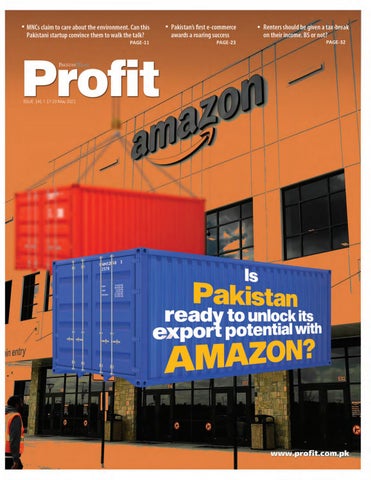
15 15 Is Pakistan ready to unlock its export potential with Amazon? 21 Pakistan wins over Amazon: De-coding another dream Ali Asad Sabir
23
23 eCommerce Awards 2021: Winners that went down the storm and how they made it 32 Renters should be given a tax-break on their income. BS or not?
Profit
Executive Editor: Babar Nizami l Managing Editor: Farooq Tirmizi l Joint Editor: Yousaf Nizami Reporters: Ariba Shahid l Babar Khan Javed l Taimoor Hassan Abdullah Niazi l Meiryum Ali l Shahab Omer Director Marketing: Zahid Ali l Regional Heads of Marketing: Muddasir Alam (Khi) Zulfiqar Butt (Lhr) l Mudassir Iqbal (Isl) l Layout: Rizwan Ahmad l Photographers: Zubair Mehfooz & Imran Gillani l Business, Economic & Financial news by 'Pakistan Today' Contact: profit@pakistantoday.com.pk
Readers Say If other people think about anything other than this country’s obsession with property then maybe they would be able to get somewhere as well. People just find it easier to flip properties and make a quick buck instead of accumulating wealth. These families mentioned here are market makers, and more importantly, they are all taxpayers. They should not be compared with tax evaders. Apropos: Who owns Pakistan? @Sabbandkardo, Twitter This is the problem of the mindset of Pakistani business community that it remains concentrated within the family. That's why many great business conglomerates vanished in a span of 10 to 30 years. Apropos: Who owns Pakistan? @ShakilKhatak, Twitter We should rather celebrate the inclusion of all new business groups in the top most ranking, irrespective of how the research is conducted. Wealth creation and progress of business houses should be welcomed. @FarooqTirmizi acknowledges that while 31 families may seem to dominate the economy today, this perceived dominance is hardly indicative of any ongoing-governance or monopoly situation in the economy. It may only reflect some problem that we may have had in the past. Apropos: Who owns Pakistan? @Chaudree, Twitter What audit quality should one expect in a country where the government gives amnesty every five years officially to incorporate black money in the corporate books of accounts? Still the construction industry is enjoying amnesty and builders are not required to disclose their source of investment. Continuous amnesty schemes depicted that the overall business, financial, and tax cycle has so many problems. Unrealistic tax rates, excessive withholding taxes and cash a large economy is a big hurdle in documentation of the economy. First we need to fix these basic financial and tax problems before we go to discuss audit quality. It’s like we are discussing sewerage water on the road but ignoring broken pipe lines. Apropos: The fault in our auditing environment Muhammad Yameen, website
facebook.com/Profitpk twitter.com/Profitpk linkedin.com/showcase/13251020 profit.com.pk profit@pakistantoday.com.pk
HOW TO CONTACT
7
Why is the writer writing anonymously? Perhaps they themselves are an ACCA? That would make sense, but they are still making some good points that need to be addressed. ICAP is an autonomous organization and it shall remain so, which is why I think they should themselves come forward and address these issues. ICAP is probably the best Pakistani civil institution recognized on an international level, and it is doing
a fine job in this department. As a regulatory body, however, there are deeper problems. A lot of these can be drastically improved with the help of digitization and the use of technology. Apropos: The fault in our auditing environment @messe_curls, Twitter The right points should be addressed by SECP then. The conflict of institution vs regulator should be addressed by the SECP. As for ICAP, they can put their house in order themselves. I think the whole system needs an overhaul. We should be following the CPA model, localised and effective. And this is precisely one of the reasons why Pakistan does not progress. Apropos: The fault in our auditing environment @Akhan_75, Twitter Dewan group which became a household name in the past is now hardly talked of. The variety of industries they invested in, their shares are hardly purchased in the KSE100 index. It is sad. Apropos: Dewan Cement is struggling. But why? Anonymous, website What is really shameful is that PIA was one of the world’s greatest airlines under Nur Khan’s management. Since then the airline has been gradually dragged into the gutter where it currently resides because of falling standards, appaling in-flight service and pilots flying with fake licences.PIA needs to be rebuilt with new contracts negotiated, induction of new technology and state of the art operating systems to improve operating margins together with being focussed on offering excellent value for money air travel services. PIA can once again soar to great heights but a lot of change needs to occur. Standards of excellence cannot be allowed to be watered down. Only highly competent, highly qualified and very professional people deserve jobs with the airline, the rest should seek alternative employment. Apropos: PIA: still a loss, but hey, it’s not as bad as before Turhan, website To all the sellers on Daraz: Last year Amazon globally removed 10 billion fraudulent listings. Apropos: The advertising industry scrambles in wake of Amazon announcement Adanir Hussain, Facebook Quality of products and maintaining standards will be a great challenge to prospective sellers that are looking to compete on this level. This is one of the very basic elements of market capturing. Business potential, especially in the retail business, will flourish in our country. Moreover, direct delivery mechanisms also open new avenues to its network. Apropos: Amazon adds Pakistan to approved sellers list Shamsuddin, Facebook
COMMENTS
IN BRIEF Federal Minister for Information Fawad Chaudhry on Wednesday congratulated farmers of Punjab as well as the province for achieving the production target of 20 million metric tonnes (MT) of wheat. The information minister informed that the country’s agricultural economy has increased by Rs1,100 billion.
After terming the locally manufactured ventilators useless, Minister of Science and Technology, Senator Shibli Faraz, has also claimed that the vehicles being manufactured and assembled in the country are not as per international standards.
The UAE on Monday announced the suspension of entry for travellers from Bangladesh, Pakistan, Nepal and Sri Lanka on national and foreign flights from Wednesday, May 12. The decision was made by the UAE General Civil Aviation Authority and the National Emergency Crisis and Disaster Management Authority in view of a rapid surge of Covid-19 in several countries.
$100 million:
Karachi-based Getz Pharma is willing to invest up to $100 million to set up a vaccine manufacturing facility in Pakistan, reported an international media outlet on Thursday, as governments and organisations around the world push for increased production of Covid-19 vaccines in developing countries.
The price of per tola gold registered an increase of Rs100 to Rs106, 100 in the domestic market on Monday. The rate of 10 grams of gold increased by Rs86 to Rs90, 963. According to a commodity expert, the outlook of gold remains strong over the next week. Gold is expected to trade high. The Adjudicating Authority under Benami Transactions has ordered the confiscation of a benami property allegedly owned by Karachi’s famous jeweller, Diamond Collection. The title of the plot in question remains in the name of benamidar, Khawjaa Kashif Hassan, even after the promulgation of the Benami Transactions (Prohibition) Act, 2017.
$500 million:
Foreign Minister Makhdoom Shah Mahmood Qureshi announced that the Kingdom of Saudi Arabia (KSA) has decided to invest another $500 million to strengthen the energy sector in Pakistan.
8
Eid hampers, and Careem fraud
this week in Pakistan’s business and economics twitterverse
A
s the Eid announcement steamrolled through from the now Mufti Munnebless Ruet-e-Hilal committee, the business and economic twitterverse in Pakistan had more than a few topics on hand last week. There was Careem fleecing its customers’ bank accounts and being in no hurry to fix the mistake, and we talked about certain cultural business practices like business dinners and how tiring interviews and meetings can be. There were also the Eid baskets, and while we would begrudgingly say we are happy for all the corporate employees getting these little trinkets, we would also like to remind them not to be too distracted by this. Solutions to Pakistan’s energy woes, Sania Nishtar in the senate, and more as Profit’s Ariba Shahid brings you this week’s social media roundup.
Careem giving customers a ride (not the ride you think)
The wine and dine litmus test
If you can’t eat with them, don’t bring them on board. If you wouldn’t want to pay for them, don’t invite them to your board. This litmus test sounds fair. However, we think it is unfair for people with larger appetites that run the food bill through the roof, or individuals with good personality and experience that are loud chewers. A messy eater is not necessarily a bad business partner or short on intellectual capital. It reminds us of one of the senior editors of this media group, who once expressed how one of their greatest fears was being stuck at a dawat where their in-laws might offer (and then insist) that they eat a mango. If the resulting carnage can cause marriages to crack and engagements to be called off, messy eaters won’t fare well in the world of business. But on a serious note, it is true. You’ll make better progress with people you generally want to be around or appreciate. Without that, there is no point of having a fancy name on the board whom you resent.
Boss Lady in the house (Senator House)
On the second day of Eid in Pakistan, the biggest scandal in the tech startup sphere has emerged. Apparently, Careem wrongly charged large amounts of global currencies from debit and credit cards saved on their app. One of the victims of this is Faseeh Mangi, a fellow business and economics journalist. Another victim of a similar situation is Jibran Peshimam, who also happens to be a business and economics journalist. We know causation and correlation are different, but to be safe, we’re removing our cards from apps for the time being too. We would also urge our readers, journalists or not, to do the same for the time being until this whole business is sorted out. As for Careem, they’re processing a refund that will take approximately half a month and have also given Faseeh a free ride.
SOCIAL MEDIA ROUNDUP
Sania Nishtar is a Boss lady. And as the cool kids would say, we ‘stan’ for her work on poverty alleviation and social protection. The senator’s new approach to the issue has helped put Pakistan on the radar. The World Bank now ranks the Ehsaas Emergency Cash program in the top four social protection interventions around the world based on the total number of people covered. Moreover, Pakistan ranks 3rd in terms of the proportion of people covered.
9
Winter is coming
Can this be an email?
While one should celebrate a good decision, securing contracts is tricky business and you don’t always come out on top. So we’ll save the party poppers for something more celebratory. As for the latter half of the tweet, an energy dependent and starved nation like Pakistan definitely needs to work on capacity development and mull more RLNG plants. Winter is coming. Best be prepared.
Don’t let the pizza parties fool you
Did your workplace send you corporate fluff in a beautifully packed gift hamper? If they did, we’re jealous of you. While that is a cute gesture one cannot forget that this does not alleviate your workplace from better working conditions. While these gifts help boost morale, we hate to break it to you but they’re often just a PR exercise. Your workplace owes you a decent salary, healthcare, days off, and other basic human necessitates. They can send you corporate fluff in addition to that.
10
For us journalists, replace the word meeting with interview, and the rest remains the same. Despite working mostly on zoom, the aftermath of a meeting or interview is real. It just tires one out. That is why we often question ourselves before setting up meetings and interviews. “Do we have to? Can this be an email/ call or text message? Is it really even that important? Do I need this job?”
SOCIAL MEDIA ROUNDUP
MNCs claim to care about the environment.
Can this Pakistani startup convince them to
walk the talk?
ENVIRONMENT
11
By Ariba Shahid
F
or the people running Davaam, the biggest problem is how to most efficiently market themselves. For once, we are sympathetic to their plight, because in the same store this one company sells both solar panels and shampoo. An energy services company and a sustainable lifestyle store, Davaam has dipped its fingers in everything that might help make a sustainable world and secure the future of planet earth. They sell energy solutions like rooftop solar panels and provide installation and engineering services as well. At the same time, they have a business to business and business-to-consumer section where they sell the latest energy efficient technologies available in Pakistan. They also have a waste management service, as well as a lifestyle store that sells everything from shampoo to chia seeds. Despite their big ambitions and tireless commitment, they are a very small operation, and one that on the surface seems to be biting off more than they can chew. Recently, however, this cross between an engineering firm and a lifestyle brand has produced a product that might very quickly be integral in reducing plastic waste from the country. As a company whose core ethos is based on sustainability, Davaam understands how important it is to tackle the plastic waste management problem. Davaam has recently launched a refilling machine in their store in Karachi where customers can bring their shampoo bottles and refill them at a discounted price. Now, Davaam is a very small lifestyle brand, so this serves little purpose on a larger scale. But since Davaam is also an engineering company, the implications of the technology they have developed themselves to create these refilling stations are much more. For the past few years, Unilever has been claiming they are preparing to launch refilling machines in Pakistan as well. And according to sources, they have shown interest in the design that Davaam has produced. And since Unilever is the largest FMCG company in Pakistan, other MNCs and FMCGs might also follow suit or have to follow suit in installing refilling machines, both saving customers money and reducing overall waste in Pakistan. And if that does happen, companies will prefer using the locally made machines rather than importing expensive ones from abroad that also do not fit their specifications.
Cornerstone: Sustainability
“P 12
erfectly fine, sturdy material that could have been reused was thrown in the trash which most of the time just ended up in the
landfill. We keep buying bottles every month, paying extra for it and discarding them. Our idea was to create a mechanism where people can reuse their bottles and just pay for the product rather than the packaging every time,” explains Salman Tariq, Co-founder & CEO of Davaam. Along with his co-founder and Managing Director Omar Ghaznavi, Salman has spent a career trying to minimise and curtail waste. “Both Omer and I worked together in KESC 10 years back where we started looking at clean energy projects and particularly Waste-to-Energy. One of the projects was in bhains colony (landhi cattle colony) really became an integral part of our lives. The environmental catastrophe of 3,000 tons per day of manure, which was flushed out of the farms, flowed as brown streams, rivers, waterfalls and finally found its way to the sea – everyday! We worked on this for a good four to five years, trying to create one of the largest biogas plants of its kind. While it succumbed to the usual multi-faceted stakeholder problems, we exited with immense knowledge and passion for creating opportunities out of wasted resources.” This is where the inspiration for Davaam comes from. The idea has been to create circular economy initiatives in order to manage wastage in society. “Without realizing we waste a lot of energy, we create a lot of trash and end up burning a lot of money trying to fix things. We help consumers to become more energy efficient, adapt clean energy resources, and produce less trash footprint.” But Davaam had a problem. Their entire company was based on the idea that they were helping reduce waste for other companies and providing environmentally sustainable solutions. At the same time, their lifestyle brand was producing the same kind of waste they were trying to help others cut down on. This is why they decided they needed a refilling plant. “There is an opportunity to save 15-20% of our costs on these personal care products if we just refill. Since we were opening our “sustainability retail” store that displays clean tech, we thought this would also be a good place to reduce waste by encouraging refills and minimal packaging, especially personal care products like shampoos and liquid soaps,” explains Salman. “We initially started looking for ready-made machines but we couldn’t find exactly what we wanted. What we found was either extremely expensive to bring to Pakistan and would not allow the concept to be scalable. Moreover, all supply chains had been shuttered because of the pandemic.” With the deck stacked against them, Davaam decided they would stop looking for machines and use their considerable engineering resources to build the machines themselves. “Our own in-house engineers and
design team stepped up and created this machine,” says Salman, saying they are constantly looking to improve the technology. For now the team has made only one prototype but are looking into ways to improve on newer versions and upgrades. The parts for the machine are all locally accessible making the machine feasible not only from a price point but also through a supply point of view. Currently, they have the machine on display to dispense shampoo, and will soon have it ready to also be able to dispense products with the viscosity of oils. This journey behind how they created their own machines is why Davaam is worth looking at. If this were just some company that decided to import a ridiculously expensive machine for their own products then it would not have been a big deal, since they have a relatively small clientele for their own products. But what can happen now is larger companies using their machines and paying them for it. This is something Davaam is well aware of and have already worked out a business model for, with Salman telling Profit that they will not be selling the machines, and will instead opt for
People do end up seeing the value in long term savings vs short term cost. Our job is to just remove this perception that Sustainability Retail is just about the environment, which unfortunately is not enough for people to spend money or make lifestyle changes, no matter how “woke” they seem to be on the environment. If we are to move the needle on environmental improvement, we need consumers to play their part as well Salman Tariq, co-founder and CEO of Davaam
a service based model in which they will rent the nozzle and will provide maintenance for the machinery. Already, the machinery has gotten its first customers in a way, with Davaam partnering with CoNatural, a natural and organic skin and hair care brand founded by Myra Qureshi and Reema Taseer in 2014. It is the first brand to jump the automated refill station bandwagon in Pakistan. You can now refill your bottle of CoNatural conditioner at the refill machine located in Davaam’s retail store. To create hype, Davaam and CoNatural both partnered to give out free refills to clients in order to raise awareness about the refill station in addition to the shampoo. While this is a business decision, it is important to note that CoNatural has the first mover’s advantage when it comes to these refill stations and can also use this as an opportunity to further its image of being conscious of its environmental footprint. This in itself is a big PR move, especially for their clientele or potential customers that prefer sustainable brands with smaller carbon footprints.
The FMCG question
U
p until now, what is clear is that Davaam has serious business potential providing services to customers like CoNatural that boast environ-
mentally friendly products. In fact, once these services become more common knowledge, any eco friendly brand worth its salt will have to consider it. But the other question is how much of an impact this technology can have on Pakistan’s waste management problem and in breaking the culture of plastic bottles as packaging. This is very heavily dependable on whether or not they can snag a big fish, and their eyes should be set on an FMCG like Unilever. In 2019, Unilever announced that they’re working on ways to reduce the impact of plastic packaging so that shoppers can buy one plastic container and refill it over and over again. Nearly two years later, Unilever joined the refill game by launching their first refill station at Carrefour located in Dolmen City Mall, Karachi. Now, we do not have details about their machinery but it is imported and not sourced from Davaam. What we do know however is that Unilever is aware of Davaam and likes what they see, so if this experiment at Dolmen Mall in Karachi goes well, there might be the possibility of them wanting to expand refilling stations elsewhere in the city and beyond. This is Unilever’s pilot run for this initiative which goes in line with their global commitment to reduce plastic. The brand has committed to recycle more plastic than they use by the year 2025. This is one of steps that Unilever is implementing amongst many others in order to achieve that goal. “Consumers are
FMCGs are known to tick off KPIs to know they’ve done their job. A number of FMCGs collect a few bottles of shampoos, recycle them and check off their responsibilities for their Environment, Social, and Governance Report. Considering the fact that FMCGs are major contributors behind the use of single use plastics, they should be the first to play their part in coming up with a solution to counter it
encouraged to bring in any plastic shampoo bottle to the SSK refill station. In exchange for these bottles, they can buy personalized Sunsilk refillable bottles at Rs 20 discount. For shampoo purchase in the future, they bring back their Sunsilk bottle and get shampoo refilled. The plastic that is saved from this initiative will be used to build benches for parks and schools,” explains Hussain Ali Talib of Unilever. “If they don’t bring any bottle, they can purchase at the normal price without discounts and with the pledge to save plastic from their next purchase.” “It is a one-push automated machine. Preferably it will be operated by the brand ambassador due to SOPs, but otherwise the consumers also have the option to push the button. A weighing gram is built in the machine which displays the grammage of the bottle. We only have the option of 185 ml as of now.” All of this sounds good. From an environmental perspective, it is not enough. What we need is government legislation that makes it compulsory for people to only buy one bottle and keep refilling it. As long as consumers have options of convenience to buy in bulk, they will not bother with remembering to carry their empty shampoo bottles with them on grocery runs no matter how many times corporations encourage them. Customers will not sacrifice their convenience for a Rs 20 discount. Either the discount has to be big enough for this campaign to be successful, the government needs to intervene on an emergency basis for the sake of the environment and implement taxes on producing plastics, or there needs to be an effective awareness campaign. The odds are against this refilling station by Unilever in one mall becoming a massive success and spreading to other parts of the city let alone the country. If it does somehow happen, however, there is the very high possibility that other FMCGs will have to jump aboard the refilling ship, and if that happens, it might be game on. Will other FMCGs hop on board? Even if
ENVIRONMENT
they do, the fear is that they might only be doing so for cosmetic purposes. Even with Unilever, they have not invested heavily into promoting refilling stations. But by putting this one up, they will be able to check a box and claim they are environmentally friendly, even though that requires a lot more work, particularly since these FMCGs are the ones causing most of the damage. FMCGs are known to tick off KPIs to know they’ve done their job. A number of FMCGs collect a few bottles of shampoos, recycle them and check off their responsibilities for their Environment, Social, and Governance Report. According to Salman Tariq, considering the fact that FMCGs are major contributors behind the use of single use plastics, they should be the first to play their part in coming up with a solution to counter it. “The large FMCGs are responsible for wreaking havoc with the environment. The top 10 polluters every year are these big name FMCGs; now that we have shown the way and created a locally built solution, we expect these companies to join hands in scaling up the idea. “They have the reach, the products, and the relationships with retailers. They know their customers. Together we can make a tectonic shift in the way consumers buy things.” When asked about how he sees his refill stations achieving scale, Tariq says that it will only be possible once FMCGs take this concept seriously. Moreover, possible avenues could also result in refilling stations becoming a norm at all supermarkets. “Scale will be achieved when these large FMCGs think of this as more than a cosmetic “sustainability” check mark and a PR stunt. We really need to make this the new normal which can be done if our refill station is present in every retail store and if this refilling option is there for multiple products.”
The sachet economy
A
sachet economy is one where consumers buy products such as shampoo, detergent, powdered milk, and masalas in single use packages called sachets. These are often found in poorer countries where the purchasing power of a large number of people remains weak. This encourages consumption of small units of product for consumers that are not able to save a lot or face irregular income. Such consumers are unable to buy in bulk and purchase smaller units or amounts in the form of sachets. The prevalence of this economy whilst on one hand reduces the barriers to economic participation of those that would have been excluded from buying larger quantities, is often criticized for its impact on the economy. These sachets are usually plastic and often end up as litter which can lead to drain blockage in some
14
For the past few years, Unilever has been claiming they are preparing to launch refilling machines in Pakistan as well. And according to sources, they have shown interest in the design that Davaam has produced. And since Unilever is the largest FMCG company in Pakistan, other MNCs and FMCGs might also follow suit or have to follow suit in installing refilling machines, both saving customers money and reducing overall waste in Pakistan cases. While designing biodegradable packaging is a solution, it is not one that all companies can afford, or all products can withhold. As a result, exploring various alternatives is the need of the hour.Refill stations are one way to reduce the economic barriers of letting lower income consumers using a product, whilst bringing down the impact on the environment. It is also important to note that if you go into any local grocery market such as Water Pump, Gol Market, or Jodia Bazar, you’ll often find sellers refilling oil cans. This is a traditional form of refilling stations where consumers pay for the grams they buy. Thus allowing consumers to buy quantities based on their disposable income. Some oil brands in the past took this as an opportunity and set up branded oil carts that would refill your oil bottles/cans from the comfort of your street. However, for other products that are not oil, the sachet economy still exists. Like cooking oil, refilling stations can help. “The reach of FMCGs, the retail network and the incentive of savings can make this idea appealing to the masses. Introducing “Sachets” was a very south Asian concept scaled up by these FMCGs given the consumers; same possibilities with refill stations,” notes Salman.
Is sustainability only for the rich?
I
t is often heard that leading a sustainable life is expensive considering cruelty free and environmentally friendly brands often charge their client more because their products are more expensive to make. Therefore, the sustainable lifestyle is often labeled as something for the rich. Davaam argues that that is not always true.“People are always ready for saving money; it’s just that they don’t know that this “Sustainability” sector has more to it rather than it being just a fluffy first world concept which is just good to do,” says Salman. “People do end up seeing the value in long term savings vs short term cost. Our job is to just remove this perception that Sustainability Retail is just about the environment, which unfortunately is not enough for people
to spend money or make lifestyle changes, no matter how “woke” they seem to be on the environment. If we are to move the needle on environmental improvement, we need consumers to play their part as well.” The possibilities, of course, are endless. While Davaam has started with a shampoo refill station in addition to the other products and services they provide, they plan on moving towards other products as well. “The possibilities are endless; now we can do shampoos, soaps, powders and even perishable products like milk that can just be refilled rather than buying tetra pack or PET bottles every time.” Currently, the startup is in talks with all leading FMCGs to get them on the refilling and sustainable bandwagon. Moreover, they are in talks of raising seed funding from angels at the moment. “Davaam plans on becoming the hub for sustainable products. We operate a dedicated online marketplace at www.dvm. com.pk which features only energy saving, eco-friendly and natural/organic products. Our idea is to make it easier for people to access products that can save them money, help improve the environment and also our personal wellbeing.” “I think the Pakistani market is ready for this. People are always ready for saving money and it is just that they don’t know that this “Sustainability” sector has more to it than being a fluffy first world concept which is just good to do. There has been an exceptional rise in uptake of solar because it’s cost has exponentially decreased, cost of power is continuously rising, there is financing available and the technology trust deficit decreased; 161MW has been net-metered in the last three years because people started seeing savings.” “The same concept also applies for energy efficient appliances, and water & gas saving devices. People do end up seeing the value in long term savings vs short term cost. Our job is to just remove this perception that Sustainability Retail is just about the environment, which unfortunately is not enough for people to spend money or make lifestyle changes, no matter how “woke” they seem to be on the issue of the environment.” n
ENVIRONMENT
ADVERTISING
15
By Babar Khan Javed
W
hen any news about Amazon and Pakistan breaks there are bated breaths and soaring hopes. Pakistan is nowhere close to having Amazon here warehousing and distributing products like it is in other parts of the world. Yet the $1.7 trillion company is so famous and it’s constant referencing in mass media has meant that the desire to see Amazon-like services in Pakistan is high, particularly because of the growing worries over fraudulent sellers on local platforms like Daraz. So when the consumers found out that Amazon was not coming to Pakistan but had rather just added Pakistan to its list of authorized sellers, This does not mean that Amazon products are going to be available in Pakistan, but it does mean Pakistani producers can now sell their products on Amazon. This is a big deal, particularly because after decades of selling a range of products through Amazon using businesses registered outside Pakistan, manufacturers and brands from the world’s fifth-most populous country may finally be able to unlock their export potential through Amazon. It’s worth noting that as of 17th May 2021, Amazon has not actually added Pakistan to its list of countries accepted for seller registration. The only visible change is that Pakistan and the PKR have been added to the list of countries and currencies supported by Amazon for disbursement. Nonetheless, this article addresses whether the people behind Pakistan’s stagnant export trajectory have the will to use the platform that reportedly generates $70 billion a year in exports for China. Assuming that Prime Day occurs in the second quarter of 2021, the market leader in shopping, entertainment, smart devices, and cloud computing expects its net sales to be between $110.0 billion and $116.0 billion in the second quarter of 2021, which is a growth of between 24% and 30% compared
with the Q2 2020. According to the latest earnings call, the operating income for Q2 2021 at Amazon is expected to be between $4.5 billion and $8.0 billion, compared with $5.8 billion in the second quarter of 2020. This guidance assumes approximately $1.5 billion of costs related to COVID-19. For context, the $110 billion that Amazon expects to earn during the second quarter of 2021 is $3 billion more than the combined annual exports for the four years between 2016 to 2019 from Pakistan according to Macrotrends. The market capitalization of the 27-year-old company is nearly six times greater than the GDP of the 74-year-old 33rd-largest country by area. Data from the World Bank states that Pakistan went from a current account deficit of US$2.0 billion for June-December 2019 to a recorded surplus of US$1.1 billion for June-December 2020, the first half-yearly surplus in almost a decade. The international financial institution chalked this up to strong official remittance inflows which more than offset a wider trade deficit, which itself grew to the users of informal channels to send remittances to the country no longer being able to do so due to COVID-19. The inclusion of Pakistan in the Amazon seller list (ASL) will reportedly create new opportunities for exporters to sell their products through the platform, which serves both brand owners and resellers, as well as mass producers that want to produce for Amazon brand items. It’s worth being wary and skeptical given the evidence that Amazon colludes to control a powerful customer by engaging in loss-leading pricing and other forms of aggressive behavior which threaten to create a monopoly, reducing consumer choice, and diminish the vitality of the top export categories in Pakistan. Using offices outside the country, some local manufacturers and brands already sell on Amazon, with sources expecting that the inclusion in the ASL democratizes platform adoption for small & medium businesses - and their subsequent access to the daily active users
on Amazon - including the ability for the Government of Pakistan to finally widen the tax net and collect capital gains taxes from businesses that sell their Amazon accounts. “There are over a million third-party sellers on Amazon,” said Omer Gajial, the former general manager of category development for North America at Amazon during a webinar hosted by Shoaib Sarwar, the deputy consul general of Pakistan in Los Angeles. “Last year, my team and I undertook a pilot wherein 60 companies from Pakistan were onboarded on Amazon.com as sellers. Then we sorted the shipping of items from the various ports in Pakistan to the rest of the country. The pilot was successful.”
What revenue lift is expected?
S
ources told Profit that it is impossible to quantify the revenue lift that ASL will create for manufacturers and brands in Pakistan due to the way in which success on Amazon is created. Sources from Extreme Commerce told Profit that Pakistani brands generated $350 million in the past three years on the marketplace, with an additional billion-dollar rise since the officiation being a reasonable target. “Almost all our sales are from Amazon,” said Jabran Niaz, CEO of Utopia Industries. Utopia Industries is a textile and steel products manufacturer that is one of the top Amazon sellers from Pakistan. “Our USA company Utopia Deals revenue for the last 12 months is $361 million, we sell around 50,000 units of products daily. We started selling in 2011. Initially, we had to pack each order and that was some effort. Later we shipped inventory to Amazon fulfillment centers, they provided packing services to us that made things easier.” He told Profit that the ASL development is significant, allowing local garment brands and similar businesses to sell their products at Amazon in various countries where they can use DHL or similar services to ship their products. He added that only a very small percentage
There are no hidden costs involved. Amazon charges a basic fixed monthly subscription fee, commission on every sale, and a fixed fee for pick, pack & ship services which depend on the size of the product, along with Inventory storage costs which may cost approx 1-2% of the product selling pric Hameer Ali, general manager of Extreme Commerce
16
Our USA company Utopia Deals revenue for the last 12 months is $361 million, we sell around 50,000 units of products daily. We started selling in 2011. Initially, we had to pack each order and that was some effort. Later we shipped inventory to Amazon fulfillment centers, they provided packing services to us that made things easier Jabran Niaz, CEO of Utopia Industries
of products will be feasible in such a model but these sellers may eventually set up their companies in foreign countries. “Utopia Industries was formed less than 2 years ago, to move our manufacturing from China to Pakistan,” said Niaz. “This fiscal year ending June 2021, we expect to export around $50 million.” To improve their discoverability within the platform, Amazon offers a host of advertising tools to help online sellers such as hosting shoppable live streams, using audio ads on the ad-supported and free Amazon Music platform, sponsored posts that appear in the feed of the Amazon app, and more. The advertising business division has been a consistent source of revenue for Amazon, generating $21 billion in total across the four quarters of 2020, with the latest reported numbers of $6.9 billion earned in Q1 2021 being a 76% growth when compared to the same period last year. As a result of its prominence, sellers on Amazon that use proprietary advertising services have a higher chance of being discovered by the daily active users of the platform and securing preferential treatment. This aforementioned preferential treatment matters a great deal given the plethora of examples coming out of Daraz featuring third-party resellers scamming hapless shoppers with defective products, false advertising, and poor customer service. According to Gajjal, enough strikes against the benefit of the end
customer can lead to even the largest multi-million dollar companies being delisted from Amazon, forever losing their account and access to the CRM database they built. Manufacturers that are used to business development based on under-the-table dealings may find this shift most distressing and difficult to adjust with, where a privileged class can no longer bank on their family name or subsidies to compete with an algorithm led and customer-centric platform. It remains to be seen whether the meritocracy of ASL sits well with the status quo of the manufacturers in Pakistan. Much like how the labor unions representing film and television performers nationwide lobby to have fame democratization apps such as TikTok and SnackVideo blocked by the Pakistan Telecommunication Authority in order to limit the competition for endorsement deals, it remains to be seen how large manufacturers seek to influence the commerce ministry on which sellers should be cleared for the ASL.
Paths to success Logistics
Taking a leaf out of the China playbook with regards to Amazon, Gajjal shared that the stateowned enterprise operating the official postal service of China - known as China Post - knows how to ship eaches and containers, whereas in Pakistan only the latter is prioritized. Gajjal said that manufacturers and brands in Pakistan
Gajjal shared that listening to the voice of the customer is an uncommon practice across Pakistan adding that businesses that wish to win with ASL need to shift their business culture towards customer-centricity. This statement mirrors the oft-repeated hypothesis of Extreme Commerce (EC) founder Sunny Ali, who runs a business that helps ordinary people setting up Fulfillment by Amazon accounts
that hope to benefit from the ASL need to focus on eaches and packets instead of thinking that the container strategy will immediately work for them on an online marketplace. “Chinese brands did their research on US, European, and Latin American customers with the hope of understanding how to solve the problem of the customer,’ said Gajjal. “While they do worry about their P&L, they understand that first and foremost the need of the customer needs to be understood and how the customer can be consistently served. The Chinese electronics company Anker Innovations earns close to a billion dollars from Amazon alone.” Speaking with Profit, Niaz said that despite the ASL development, he would not switch his Amazon account to sell from Pakistan due to the high shipping costs from Pakistan to the USA. He added that Pakistani sellers don’t have to pay income tax if they ship from Pakistan and that Amazon will collect sales tax for both local and Pakistani sellers.
Ease of payments
In the event that various infrastructure and power issues create inventory shortages or delay production cycles, there will be a need for brands and resellers to order products from China to make up for the local delay. With the drop-shipping model, when a store sells a product it purchases the item from a third party and has it shipped directly to the customer outside Pakistan. Due to archaic regulations of the SBP, sources shared that they are unable to pay their suppliers in China due to rules around bringing the purchased stock first to Pakistan, which only raises overheads. The SBP requires an import receipt in order to allow local businesses to pay their suppliers, a rule that should have evolved a decade ago. So while Pakistan is included in the reseller list, this regulation can get in the way of scaling the benefits of the platform, which lobbyists at PASHA are reportedly engaging policymakers on in the coming weeks.
ADVERTISING
I urge the creation and registration of brands, work on the brand equity & identity, and build a customer connection beyond pricing. Brand owners are excused from certain defects due to their manufacturer status and can flag any seller that attempts to violate their IPs Omer Gajial, the former general manager of category development for North America at Amazon
Customer centricity
He shared that the success of Anker Innovations on Amazon is rooted in customer centricity, listening to concerns, and chasing verified & authentic customer ratings on the marketplace. Gajjal shared that listening to the voice of the customer is an uncommon practice across Pakistan adding that businesses that wish to win with ASL need to shift their business culture towards customer-centricity. This statement mirrors the oft-repeated hypothesis of Extreme Commerce (EC) founder Sunny Ali, who runs a business that helps ordinary people setting up Fulfillment by Amazon accounts. “Amazon listens to the customers,” said Gajjal. “The star rating of a seller impacts their financials, logistics, and enforcement. Apparel manufacturers from Pakistan need to understand that they cannot trick the system because customers vote and it’s a marketplace. The color on the items sold starts to fade or there is an issue with the size shipped or an issue with the material/fabric used, the negative customer review will trigger an algorithm that attempts to benchmark the average number of negative reviews per million sales across the same product category. If you exceed the mean/median average, Amazon will block your account and question the root of these defects.” Gajjal added that Amazon will kill seller accounts if it finds evidence of attempts to tamper with the review system with fake or paid reviews, which is a problem the company faces all over the world. In the Pakistan market, businesses recruit various writers through freelance marketplace websites to write fake reviews in order to boost ratings on Google Map listings, Facebook pages, and marketplace accounts. One of the most prominent destinations for fake reviews is the Facebook group for Pakistan Freelancers, which is known to feature posts of buyers and sellers requesting or offering services to create fake video views, subscribers, and worsen the advertising fraud problem in Pakistan. “It’s a marathon, not a 100-meter race,” said Gajjal. “On Amazon, there are resellers for
18
Shan Foods masala products but the manufacturer itself is not selling directly on the platform, which - if it were - would be classified as a brand owner, who has greater privileges on the marketplace than the reseller.
Branding
Given the tremendous emphasis on product detail pages (PDP) and quality image photography on Amazon, Profit expects that services such as Brandverse will have a competitive advantage in the Pakistani market in providing images with speed and scale, cross-benefiting with listings on Chikoo. “Our largest manufacturers know how to create products, they may even understanding branding, but the science of presentation and positioning on Amazon is very valuable now,” said Aisha Humera Moriani, Joint Secretary at the Ministry of Commerce & Textile. “If we use this opportunity to grow our exports, particularly those products that are made in Pakistan, that can be a success story for us.” A 2020 survey from GroupM of over 200 marketers and 500 online shoppers concluded that the former group values the PDP for its important role in driving conversion. Nearly 45% of the consumer group indicated that they visited a PDP at the time of purchase while 41% of those said PDPs had the biggest influence on their purchase. As stated many times over by Brandverse founder Raza Matin, high-quality images lift trust which in turn increases the chances that a casual shopper will turn into a customer. “The detail page with rich content has a conversion that is 30% higher,” said Gajjal. “Amazon has its own standards that photographed products will have a white background, standards on the types of claims that can be made, and video that will be attached to lift chances of conversion.” Any business that competes on price as a means of luring customers is a commodity, whereas brands compete on value and the story they help customers tell themselves or others about themselves. Even if manufacturers in Pa-
kistan learn to accept that they need to invest millions of dollars into brand development and an omnichannel presence, the Pakistan market itself is scarce in professional services firms that can help with doing so. At present, very few brand strategy consultancies operate in the Pakistan market, understandable due to the price-centric mindset around product commodification, hence the absence of high demand for the service. Leading brand marketers in Pakistan named a handful of service providers such as Penumbra, Designist, Madvertising, and KBW as being among the few leading players that offer full-service strategic brand consulting and design services. “It is not easy,” said Niaz. “There are ten million sellers at Amazon and they are very smart and competitive. You must learn Amazon selling very well and then start with low competition products and slowly make your way up.”
Pricing
“The general rule of thumb for customer acquisition at Amazon can be somewhere between 60-70% of the selling price which includes product cost plus shipping cost plus Amazon storage cost plus Amazon referral cost plus FBA fees,” said Atif Ahmed, the sourcing lead at EC. According to an Amazon sales margin calculator, a hypothetical clothing business with a selling price of $100 for a ten-ounce package and a cost of good per unit of $1 that uses FBA will keep $79 in margin per sale after a $17 category referral fee and an FBA fee. When being mindful of the pricing tiers used for apparel in Pakistan, how feasible will this be with the eaches approach? Businesses that are vertically integrated across their supply chain are likely to benefit the most despite these challenges. In Competing with Complementors: An Empirical Look at Amazon.com researchers from Harvard University and the University of Oklahoma concluded that when working with platform owners, sellers must take value capture into account when building businesses on platforms. As platform owners are often
TEXTILES
strategic players, sellers need to understand the incentives and capabilities of platforms and not treat platform-based markets as being like regular markets. ”A high return rate is an indicator of problems with product quality which in turn reflects dissatisfaction amongst customers, hence strict check on product quality is important to ensure low return rates,” said Hameer Ali, general manager of EC. “Amazon, however, recommends staying within 4% breach of which could result in account suspension. “Amazon charges a basic fixed monthly subscription fee, commission on every sale, and a fixed fee for pick, pack & ship services which depend on the size of the product, along with Inventory storage costs which may cost approx 1-2% of the product selling price.”
Stranger danger
T
he antitrust implications of platforms introducing their own competing products have been well documented, with Amazon being no exception. The antitrust cases against plat-
form companies such as video game consoles, smartphones, online auction markets, search engines, and social networking Sites that pushed successful products out of their markets, not by competition, but by choosing to compete directly with the registered sellers. In 2008, Apple denied the sale of Podcaster on the App Store because it duplicates the functionality of iTunes. In 2012, the Mountain Lion operating system update by Apple rendered ten popular competing apps obsolete. The creation of Internet Explorer and Windows Media Player by Microsoft extinguished Netscape and Real Networks. Platform intermediaries operating in two-sided markets seek to profit by transferring surplus from the seller to the consumer. When the growth on one side of a matched market induces growth on the other, exploitable surplus is created, much to the dismay of antitrust regulators. Academics have documented that when a product category enjoys a combination of high sales, good reviews, and the absence of the Amazon fulfillment service, Amazon will
According to an Amazon sales margin calculator, a hypothetical clothing business with a selling price of $100 for a ten-ounce package and a cost of good per unit of $1 that uses FBA will keep $79 in margin per sale after a $17 category referral fee and an FBA fee
enter 3% of those spaces over a ten-month period. Research finds that Amazon is less likely to enter product spaces that require greater seller effort to grow. “Our empirical evidence suggests that Amazon’s entry strategy is likely premised on acquiring new information after forming partnerships with third-party sellers,” said the researchers from Harvard University and the University of Oklahoma. “Using propensity-score matching to compare products affected and unaffected by Amazon’s entry, we find that entry increases product demand and reduces shipping costs, and affected third-party sellers are discouraged from growing their businesses on the platform.” It is, therefore, imperative more than ever that third-party sellers that choose to have a presence on Amazon invest in building a brand that competes on value more than it competes on price, and that significant heed is paid to the oft-repeated advice of Profit to create owned commerce points of sale as a means of collecting first-party data and turning customer retention into a science. An upcoming paper from the Anderson School of Management will help businesses convert sales rank data into sales quantity, which can be used to understand the top margin categories with inelastic demand. n Additional reporting by Ariba Shahid and Taimoor Hassan
ADVERTISING
OPINION
Ali Asad Sabir
Pakistan wins over Amazon: De-coding another dream
T
here was celebration all over the country when Commerce Advisor Abdul Razak Dawood tweeted that Pakistan will before long be added to Amazon’s rundown of the list of seller countries. The celebration was for what it’s worth. Social media was flooded when this news broke as Pakistan in Amazon’s seller list is the key to all deep economic snags of the country. Even the country’s premiere, Imran Khan, took to Twitter to congratulate the nation. Already in the flux of e-commerce and the novel COVID-19 made online platforms inevitable. Pakistan’s local entrepreneurs already have a way to sell their products online. Selling online internationally often comes with different criteria and ways of its own. Mainly, by registering an LLC in the U.S. setting up a bank account, and paying a fee for incorporation. Amazon adding Pakistan space to its seller list will eliminate all these barriers, take less time, and cut down all the formalities at other channels. But, is this the right thing to celebrate? Is Amazon going to take Pakistan out of economic hell?
Ali Asad Sabir is a former research fellow at the Centre for Security, Strategy, and Policy Research at the University of Lahore. He can be reached at aasad6889@ gmail.com
20
Amazon has separate agreements with suppliers to deliver goods directly to customers with free two-day delivery through Amazon Prime. Contrary to this, other Amazon Marketplace vendors, on the other hand, are not automatically provided this service
Let’s break down how Amazon operates, because it is not that simple as we think it is. The biggest tech organizations around the globe like Amazon, Google, Facebook, and Apple, in their inescapable development and broadening, contain components of the entirety of the platforms like Transaction and Exchange Platforms, Ad-Supported Platforms, and Software Platforms. Amazon is best perceived as retail, transportation, and logistic dais that works as the foundation for twenty-first-century retail business. Amazon goes about as a transaction stage through Amazon Marketplace by simplifying the transactions between third-party merchants and users. Amazon likewise works as an ad-supported platform that facilitates the promotions and accommodating ads all through its platform for the items sold on Amazon and outside items and services. Amazon is also structured as a software platform. It includes its Kindle device and application. It is a place where Amazon associates the digital book readers with the publication houses and writers. Amazon additionally singlehandedly rules the infrastructure and logistics. Amazon no doubt is operating by a wide margin the biggest cloud-computing platform. For independent sellers, Amazon provides its services under the banner of Fulfillment By Amazon (FBA) which acts as a logistics and delivery service for autonomous merchants. All of these services when used in sequential order create an efficient framework that greatly benefits the consumers. But, here lies the issue. The third-party marketplace of Amazon, the world’s largest e-retailer with 31.3% of the e-commerce market, is similar to a traditional transaction network. It connects buyers and sellers of new and used goods via the company’s website and mobile app. But, one of the most notable rivals that sellers face is Amazon itself. Amazon has separate agreements with suppliers to deliver goods directly to customers
with free two-day delivery through Amazon Prime. Contrary to this, other Amazon Marketplace vendors, on the other hand, are not automatically provided this service. Amazon produces a subset of Amazon Prime products, most notably under the AmazonBasics product line. So, let’s suppose if a buyer wants to purchase a chair, a buyer can get an AmazonBasics chair or a chair of an outside-brand from a third-party seller on Amazon. The list of all retailers is made available for goods that are available from a number of sellers, including Amazon itself. However, 82% of purchases are made without any consideration of third-party sellers. Amazon sells its product through Amazon’s “buy box.” The buy-box is simply Amazon’s add-to-cart button, which selects a default vendor for a customer based on an algorithm that updates in real-time. The buy-box algorithm uses price as the most significant factor in determining the default seller. But it isn’t the only one. Consumer reviews and seller ratings are also taken into account. As of 2017, even the goods that Amazon sells directly are subject to the buy-box algorithm. As a result, Amazon Marketplace can be viewed as a transaction platform that also competes with its seller side. Amazon provides a platform to buy and sell and still competing with the sellers with an edge over them. Still, due to the bulk of Amazon’s efficient services, both customers and vendors multi-home. For example, third-party sellers can opt for other platforms to sell their products and buyers can also look for other platforms but the services which Amazon provides at a single platform efficiently don’t make the buyers look for other platforms. That is the reason the vendors don’t consider other platforms sustainable enough to compete. The trust of quality and bulk of services leave vendors no choice but to sell on Amazon regardless of being in the competition which they are unable to compete. Amazon does not only work on theories. Through vertical integration, Amazon gathers a range of customer data in real-time. Regarding which goods are sold to whom, at what price, and which packaging or promotions work. It assists Amazon miraculously in better understanding its customers. It also provides information about possible competitive risks, which Amazon will use to decide that what firms it should ban, which potential firm it should purchase, and how it should expand strategically. However, Amazon is not doing it unreservedly. In the United States, Amazon has been accused of tying the marketplace and logistics services together. The real question is whether Amazon is taking advantage of its market supremacy in order to gain an advantage in another?
Amazon goes about as a transaction stage through Amazon Marketplace by simplifying the transactions between third-party merchants and users. Amazon likewise works as an ad-supported platform that facilitates the promotions and accommodating ads all through its platform for the items sold on Amazon and outside items and services Antitrust in vogue
T
he original purpose of antitrust laws was to prioritize consumer welfare and competition protection. The main emphasis was on preventing cartels from setting rates and avoiding monopolistic mergers.
Amazon and Germany
A
ccording to a current complaint against Amazon. Third-party sellers in Germany argued that Amazon’s terms of service were unreasonable, and the German Cartel Office agreed. The power to suspend or threaten to suspend sellers is Amazon’s most threatening weapon. When a retailer is removed from Amazon’s website, it will now be given 30 days’ notice and a justification of removing. Amazon was used to ban any seller without prior notice or clarification. The changes affect not only Germany, but also its marketplaces in the United Kingdom, France, Italy, and Spain, as well as its other international locations in America and Asia. Amazon also dropped price balance or most-favored nations (MFN) provisions in contracts with third-party European sellers as a result of European investigations.
Amazon and India
I
ndia being a billion-dollar economy has more than 650,000 sellers on Amazon. In India, a coalition of over 2,000 online merchants has filed an antitrust complaint against Amazon, claiming that Amazon favors certain retailers whose online discounts put independent vendors out of business. According to the complainants, Amazon India’s wholesale division buys products in bulk from producers and resells them to sellers at a loss. These sellers then sell their wares on Amazon at steep discounts. Amazon, according to the seller community, charges lower prices to some vendors, essentially making it impossible for independent online
retailers to compete on its platform. According to the group’s filing, Cloudtail, one of Amazon’s largest India sellers, pays Amazon a 6.3% charge for electronic goods, while independent sellers pay roughly 28.1%. As of the latest case filing against Amazon in India; some items, such as groceries and detergents, were listed with a discounted price by between 8% and 45% on Amazon’s website when compared to retail prices visible on the e-commerce website. Having been said, Pakistani authorities shouldn’t celebrate at a high pitch of being indulged in the seller list by Amazon. Pakistani vendors while having to compete with the other vendors worldwide, but, have to compete with Amazon itself on its own platform to sell their products. Locally manufactured products also face barriers to being exported worldwide due to low standards. Authorities, rather than congratulating the nation on this development should focus on B2B and B2C business and assure the quality of the product. Government should take the driving seat in getting the mid-range and lower manufacturer to the international markets. Ministry of Commerce through proper channels and negotiations deal with the Amazon team to safeguard Pakistan vendors before opening up the avenue to list their products through the lens of anti-trust practices and strict policies. Being relying on Amazon to expand the export band is mere ill-thinking. Who would’ve thought that an e-commerce retail store would narrow enough to prevent any effect of the form on countries? Some analysts have already indicated that even these antitrust complaints may end up being insignificant. However, successfully alleging an antitrust violation is challenging enough. Governments have to step up to safeguard the rights of their entrepreneurs with long-haul parleys. Pakistan has to learn from the anti-trust incidents of Amazon and its policies before pushing its citizens into another short-sighted and unsustainable retail business. Or, it’s too early to call the odds? Here’s to cautious optimism. n
COMMENT
Pakistan’s first e-commerce awards a roaring success
P
akistan’s first eCommerce awards, showcasing more than 400 eCommerce websites spanning over 11 different categories, were held successfully with the host team was beyond grateful for all the amazing partners, sponsors and participants who made this venture a success. It was a great race in which the People’s Choice awards received more than 108,683 people votes. The awards were divided into two classifications named founders’ choice and peoples’ choice awards. Each of these had further categories for participants to compete in.
The winners of the Founder’s Choice awards are as follows:
E-COMMERCE
23
People’s choice
All of the nominated participants expressed gratitude and were honoured to be part of such an enthralling event. There were some outstanding winners but many were not far behind and deserve a chance
of appreciation and recognition. Some honourable mentions are: category company Grocery Naheed.pk New eCom StartUp 2020 JOMO
The awards came to an end with hope for a bigger and better event next year and a yearning to continue this as an annual event.
eCommerce Awards 2021 –
How, Why & What’s Next
We discuss Pakistan’s first eCommerce Awards, the results from our survey of 14,000 consumers and plans for next year
P
By Adam Dawood
akistan’s eCommerce industry is tiny! The global average for eCommerce transactions as a percentage of total retail is in the 15% range (pre-covid). Digital-first economies such as China are expected to have the majority (>50%) of their retail sales now happening digitally.
24
Pakistan’s eCommerce sales in comparison are easily less than 1% of the retail industry. We have a long way to go, however, the industry has been growing rapidly and we wanted to help showcase the best eCommerce startups locally by hosting the first eCommerce awards in Pakistan. The industry does not work in a silo. eCommerce startups are supported by payment gateways, logistics companies, software
houses, and many other digital tools and services that help them provide amazing experiences to consumers. For this reason within the first eCommerce awards, we created the Founder’s Choice Awards, where the founders of eCommerce startups could vote for their best service providers in the industry. We wanted to achieve all of this while being as fair and transparent as possible. This is why our awards focused only on votes from
consumers or customers of the services that are being given. Finally, we wanted to understand from actual consumers what their thoughts and views were on the eCommerce industry. For that, we organised the eConsumer Research Survey The objectives of the award were threefold n Promote the best eCommerce companies in Pakistan n Set a benchmark for service providers so
that eCommerce founders can make informed decisions and service providers are given direct customer feedback from their customers n Be fair and transparent
The Mechanics of the Awards There were two categories of Awards.
1. Public Choice Awards
n Where the general public voted for their
favorite eCommerce store. n Each vote was cast after a mobile phone
number was taken and the validity of that phone number was checked via a one-time password. n Each mobile phone number could only vote once per category n The winner in the public choice category was the nominee who had the most votes.
2. Founder Choice Awards
n This is where each Founder/CEO/Business
Manager of a nominated eCommerce company voted for various service providers they used. n Each Founder was able to vote only once but for as many service providers they used in the last 12 months. n Voting was done on a scale of 1 – 5 with 1 being “Poor” and 5 being “Excellent” n There could be multiple winners in the founders choice category. To win a Gold Medal the service provider had to have an aggregate score of 4.5 or above, for Silver it was 4 and for Bronze it was 3.5. n Alongside the aggregate score the service provider also had to have a minimum number of votes from founders before they could qualify for a medal. The awards also had no profit motivation. No revenue was collected during the awards (quite the opposite). We also turned away offers of sponsorship from those who were themselves nominated to ensure we could not be biased into creating unfair or biased awards.
The Voters Behind the Results People’s Choice Awards
Within the people’s choice award we had a total of 108,683 votes cast from 93,426 voters (1.16 votes per phone number). 77% of people only voted in one category while 603 people voted in 5 or more categories. We had 332,858 visitors to the website until the 7th of April 2021 (i.e vote deadline). 213k of those visitors were from Karachi or Lahore and 94% of all visitors came on mobile devices with 80+% of mobile users on Android. In terms of demographics 58% of the visitors were female and 88% of visitors were between the ages of 18 and 44.
Founders Choice Awards
In the Founders choice awards we had a total of 101 service providers nominated and of those 58 had received enough votes to be eligible for a medal. However, only 52% of eligible nominees won a medal, i.e almost half the nominees did not get a score of 3.5 or above from the founders of eCommerce companies. The awards were given based on the votes of over 80 Founders from across the industry. In the Payment Gateway and National Logistics category voting was divided over 4 or 5 sub-sections.
Payment Gateways n n
21 eligible gateway (3 international) 5 Sub-sections n Onboarding Experience n Integration Experience n Payout Speed n User Experience n Refund Experience
The average score that payments gateways got for each of the voting categories was as follows:
National Logistics
n 8 eligible logistics companies n 4 sub-sections
n n n n
Payout Experience Delivery Speed Rejection at Doorstep %age (COD) Pickup Speed
The average scores that national logistics companies got for each of the categories was as follows
Transparency Report n 2
nominees in the public choice award sent communication asking for votes in return for the chance to win a gift. n We were told about one of these within 24 hours of the post going live and we reached out to them to remove the post which they did immediately n One of these nominees ended up in the top 5, and as such the management committee decided to remove all votes accrued by the nominee over the period for which the communication was live. n 2 nominees were asked to withdraw from the public choice awards as: n One was a B2B2C company whose service was not live yet n The other was a B2B company n 1 nominee was entered into the FB/Instagram store category. It was asked to withdraw as they had 4 retail stores as well. n 1 nominee in the FB/Instagram store was asked to withdraw as the facebook store they submitted was not active. When we reached out to the founder in question they responded by sending us multiple facebook store addresses some of which were active a few months ago but not currently and it was not clear exactly what they were selling. n Two startups run by the members of the management committee made it into the winners list. To ensure the long-term impartiality of the awards we, therefore, decided to withdraw our entry. n Initially, in the founders awards, we had kept the criteria for the medal as 4.7, 4.2, and 3.7, however, after the votes were cast we felt that the benchmark was too high given the nascency of the industry and we reduced it down to 4.5, 4.0 and 3.5 for Gold, Silver and Bronze medals respectively. n In the Founders awards, 9 votes were disqualified. 3 because they voted for their own companies, 4 had fake profiles, and 2 seemed to be selected votes for 1 company only with dubious email addresses.
Areas of Improvement for Next Year
For next year we will be also asking customers in the public choice awards to vote on a scale of 1-5 rather than just a simple vote. We feel that asking customers to give an actual score will result in more meaningful feed-
E-COMMERCE
back for startups and it will also remove the competition element as you can then have multiple Gold, Silver, and Bronze winners in a category, rather than just first, second, and third place prizes. We opted out from doing that this year because we wanted to keep the overall consumer voting journey as simple as possible. However, given the extremely strong voter turnout this year, we feel that we can add that level of complexity while still getting a large voter base. For the Founders choice awards due to lack of development time, we ended up doing the vote via a 3rd party form sent via email to all nominees. Next year we will build the system directly into the awards
website and ask people to vote as part of their nomination. This will result in a much higher percentage of nominees voting for the founders awards. The overall UI/UX of the website needs to be streamlined a lot more to encourage voting, especially on mobile. This year on mobile devices you could only see one nominee at a time on the page. To further improve the fairness and transparency of the awards we will also be bringing in an audit firm to tally the results. This will result in a trusted 3rd party ensuring that all votes were counted fairly and faithfully and be a double check on the count by the management team.
Conclusion
We believe the eCommerce Awards are an improvement first step to grow the industry and understand where our current limitations also lie. We should not be arrogant or boastful about where we are or how far we have come. Instead, we should realise the journey is still long and we need to move forward together as an industry and support each other. If you would like to support us next year please do get in touch at hello@ecom-awards. com and or if you are a service provider who wants to better understand your exact results (without revealing the names of those who voted for you) we would be happy to oblige you.
eConsumer Research Survey 2021 Introduction
As part of the eCommerce Awards 2021 we conducted a detailed survey of the 90k+ thousand unique mobile numbers that voted. 14.6k of those people agreed to take part in a survey and we have some of the results from
26
that survey below.
Why Cash on Delivery Cash on delivery is easily the most popular payment method with 79% of consumers preferring it other methods. When those
who preferred CoD were asked as to why this was the case the biggest contributing factor was Trust with it making up 49.5% of the vote (Option 2, 3 & 5), with Access to a non-cash payment method second with 33% of the total and finally knowledge on how to pay online being the last factor at 10%
Building Trust Building trust is a key component of getting customers to move away from CoD as 63% of respondents said that they would be willing to pay online if the store they bought from delivered the first 3-5 orders perfectly. Social media plays a major part in building trust as well with 66% of respondents saying they check social media before they purchase from a new store online.
Customer Segments
The survey was sent out to 83,000+ people and just shy of 15k people filled out the survey in the first 5 days. The breakdown of the sample in terms of segments is as follows
Purchasing Behaviour
The majority of purchases online are also below rupees 10k (64%) and 83% of people place less than 10 orders online every month.
E-COMMERCE
Other Data
eCommerce Awards 2021 –
Winners that went down the storm and how they made it
I
n March this year, Pakistan’s eCommerce landscape witnessed a milestone. Pakistan’s first eCommerce Awards acknowledged the achievements of eCommerce businesses. While the eCommerce industry in Pakistan is only picking up, the awards were momentous that gave eCommerce businesses a moment to cherish their success-
28
es, further affording an opportunity to the contenders to introspect. The highlight of the ceremony was the People’s Choice Award where the general public voted for their favorite eCommerce stores in 11 categories. Within the People’s Choice Award, a total of 108,683 votes were cast by 93,426 voters. 77% of these voters only voted in one category while 603 people voted in five or
more categories. These votes resulted in the following winners in the following categories: beauty fashion e-commerce startup Bagallery won the award in the Beauty category, Daraz won as the best Electronics and Gadgets marketplace and J. won the award in the Fashion category. Broadway Pizza was the winner in the Food category, pandamart made it in the
TEXTILES
Grocery category, Sehat.com.pk won in the Healthcare category while PakMoto emerged winner as the New eCommerce Startup (2020). Likewise, Smart Mirror Labs, Bookme.
pk and Book Bee remained winners in Specialty Store, Travel and Ticketing, and Facebook/ Instagram Seller categories, respectively. In the Ride Sharing category, Suk-
kur-based Savaari made it as the winner, outdoing both Uber and Bykea. Let’s see what the First prize winners of People’s Choice Awards have to say.
you are collecting full numbers, customer data was coming in for a neutral body so NDA (non-disclosure agreement) for that and other legalities also have to be considered.
(1)
Bagallery Bagallery sells beauty, cosmetics, skincare, fashion and lifestyle brands on its platform. Launched in 2017 by Mina Salman, Bagallery is now run by Mina and her husband Salman Satter, with Salman now acting as the CEO. Profit: What are your views on the awards? Salman Sattar: I think it’s a great idea this industry is growing the faster locally and globally and such kind of events will only attract more capital and create more jobs in this segment. I think next time it should be a live event. Profit: What do you think resulted in you winning the award? Salman: We have very high engagement with our consumers on social media and that’s why many of them have voted for us. Also our portfolio and variety of brands have helped us achieve this milestone. Profit: How will you continue to win consumer confidence? Salman: We are working on continuously improving our customer service which will help us stay relevant to our customers. Also we are working on improving our return policy so that customers can buy without any hesitation.
(2)
Daraz Daraz is Pakistan’s largest e-commerce marketplace that provides a platform for sellers from various categories to connect with buyers. The company was founded in 2012 and was acquired by AliBaba in 2018. Over the years, the marketplace has evolved to launch its own delivery service called Daraz Express and is currently helmed by its CEO Ehsan Saya. Daraz’s Chief Marketing Officer Ammar Hassan reflects his views on this year’s eCommerce Awards. Profit: What are your views on the awards? Ammar Hassan: The only thing we have to see is that the brands with the biggest consumer base might be able to attract the biggest votes. Since all the brands are pushing to their customer base to vote for them, the neutrality will only remain when ecommerce awards will remain when a third party neutral domain asks people about it. Whereas I did not see any campaign where eCommerce Award on its social media pages pushed voting mechanism. Votes were mostly gathered by respective brands themselves. And since
Profit: What do you think resulted in you winning the award? Ammar Hassan: Daraz secured the top spot in the electronics and mobiles category because all the original and big stores in this category are on Daraz. Daraz Mall is also credible. Secondly, because of EMI (easy monthly installments), the middle class population of Pakistan uses this service to buy electronics. Automatically, the assortment that Daraz has for the mobile and electronics category, because of that our consumer base is pretty good. And it is an authentic experience because users are not buying socks that simply anyone can afford. All this has simply improved consumer confidence in the mobile and electronics category with Daraz and that is what we think helped us win. Profit: How will you continue to win consumer confidence? Ammar Hassan: It is a two-pronged approach. Another policy is to improve the quality check on your customers. Secondly, marketplaces struggle worldwide when it comes to providing each and every customer a flawless experience. Daraz’s strategy to improve consumer confidence would revolve around improving customer experience further. The way to win customer confidence is that a company should have a phenomenal customer protection policy. And companies like Daraz invest heavily in returns, refunds and customer service department growth. That is how one can win the confidence of the customers.
E-COMMERCE
(3)
(4)
(5)
J.
Pandamart
Sehat.com.pk
J. was established in 2002 to revive the country’s heritage through clothing. It’s popularity can be related to whom it is named after, the late Junaid Jamshed. The brand now has more than 100+ outlets nationwide and has more than 20 outlets outside Pakistan. The brand has evolved from just selling shalwar kameez for men into a female clothing brand, jewellery, shoes, makeup and party wear. It’s online presence and tracking services helped the brand push itself up and win the award. In addition, the consumer base for J. is vast considering the number of sales it has going on throughout the year. Salik Gadit, senior manager eCommerce at J., shares his experience of the Awards.
Recently, Foodpanda launched Pandamart, a grocery shopping experience using the Foodpanda app. Consumers are able to order groceries online that are delivered within 30 minutes. This is catered towards the customers that need something immediately as opposed to those that are shopping for their monthly groceries. Nauman Sikandar, CEO of FoodPanda says:
Sehat is an online pharmacy in Pakistan providing retail B2C online medicinal sales in Pakistan. It is one of the oldest healthcare conglomerates in Pakistan. Founded in 2014, portal supplies the majority of its medicines directly from the manufacturer and provides nationwide delivery.
Profit: What are your views on the awards? Salik Gadit: I think it’s a great initiative and I hope next year, it will be more competitive. Ecommerce in Pakistan should be recognized properly and officially. Profit: What do you think resulted in you winning the award? Salik: We reached out to our customers in every way we could and asked for their support and they showed us their love for the brand. Profit: How will you continue to win consumer confidence? Salik: I believe next year will be tougher as more brands will be actively fighting for the award. So we have to up our game.
30
Profit: What are your views on the awards? Nauman Sikander: A great platform to celebrate entrepreneurship and startup culture in Pakistan, helping brands gain better customer insights in addition to their own rating and NPS mechanisms Profit: What do you think resulted in you winning the award? Nauman: Providing convenience coupled with our desire to continuously improve on our assortment and speed of delivery helped us win customers’ confidence and hence people’s choice award Profit: How will you continue to win consumer confidence? Nauman: We aim to further build on our success, providing ultra-convenience to our users at times when nobody else is open through our round the clock operations. We further intend to add social listening and sentiment analysis as a real-time feedback loop into our operations to provide even stellar service and consumer experience.
Profit: What are your views on the awards? Bilal Mumtaz: I think the awards are a great way to recognize the country’s best performing ecommerce sites and partners. It is a platform where we can collect data on voters to further better their ecommerce experience Profit: What do you think resulted in you winning the award? Bilal Mumtaz: There was a lot of commotion amongst our stakeholders and business partners where we were recognized at the forefront of epharma in Pakistan. It certainly lifted my teams spirits and created a much more positive culture within the company. Business results improved naturally as a result of winning Profit: How will you continue to win consumer confidence? Bilal Mumtaz: For Sehat this award means we need to continue nurturing our customers and making sure our USP’s and services are highlighted for them. Our customers have always been our biggest strength, and showing this to our strategic partners will.help us consolidate a solid epharma market in Pakistan
detailing, auto accessories, stereo, garage tools, automotive apparel, safety gear, lighting, performance, styling and much more. Users can also book their favorite services from thousands of workshops all across the country from your comfort zone. Waleed Tariq, the CEO of PakMoto, speaks to Profit about his experience of the awards.
PakMoto
Profit: What are your views on the awards? Waleed Tariq: In my opinion ecom awards are one of the best ways in which we can recognize the best performing ecommerce startups in Pakistan. It also facilitates the new entrants in getting recognition early on, which proves quite significant in their journey.
Pakmoto is Pakistan’s first specialized Auto Parts Virtual Marketplace, offering a comprehensive product catalog with over half a million auto parts from thousands of sellers from across the country. Products range from auto body parts to engine and drivetrain, suspension, steering, tires and wheels, auto
Profit: What do you think resulted in you winning the award? Waleed: Speaking on behalf of Pakmoto, I would say it lifted the spirits of our entire team and gave us a new motivation to carry on with the project with devotion and commitment. It has had quite a positive impact on
(6)
(7)
Smart Mirror Labs Four years ago, Lahore’s University of Management Technology (UMT) graduate Uzair Hussain co-founded Smart Mirror Labs that provides smart mirrors that display different widgets on these mirrors. The startup was co-founded by another UMT graduate Saliha Aslam. The startup was incubated at Plan9 in the incubator’s 11th cycle in 2018. Profit: What are your views on the awards? Uzair Hussain: As we all know e-commerce businesses are so common these days but the recognition as per the choice of the customer is very important. The Awards held for the first time in Pakistan is such a great initiative as it was the celebration of excel-
lence in the e-commerce industry and I think it was a much needed thing. It helped businesses quantify where they stand according to the people’s choice. For that, these awards must be held every year. Profit: What do you think resulted in you winning the award? Uzair: We won the Specialty Store category in the eCommerce Awards. For that we are so grateful to all our customers who supported us and showed their love. Our company is working to find the perfect harmony of design and technology in every product so that every individual gets the most from every space they are in. I think the reason being what people loved about us is that we are working on it and offering a wide range of fully customizable mirrors with integrating technology in them. The time we are living in is full of technology and people like our technology and therefore support us. Profit: How will you continue to win consumer confidence? Uzair: Offering the best customer service is the key and this is what we aim to offer forever to our lovely customers
the company’s culture. With winning came recognition which led to improved results of the business. Profit: How will you continue to win consumer confidence? Waleed: Winning consumer confidence is a journey that never stops. Highlighting the USPs we have over our competitors is one of the most important keys in winning consumer confidence as it clearly differentiates us and tells the consumer how and where we are better. Once your consumer is clear on that, I believe that’s when we start to see an actual change. Our win is a huge win for the Auto Parts Retail Industry in Pakistan as well as the motorsports and automotive community. They have been our biggest strength and our motto Access, Variety and Transparency shines through in our win. We’ll be working hard to ensure that buying auto parts and accessories in Pakistan becomes a hassle-free process for the consumers, with better access, more variety and transparency.
that through recognition that is helpful for the growth of one’s brand and identity.
(8)
Book Bee Book Bee, as the name suggests, is an online seller of books that was founded by Nazia Kamran. According to the company, it was founded with the idea that purchasing books should be easy and seamless; in other words, digital. The store relies primarily on selling via Facebook and Instagram and was chosen as the winner in the same category. Nazia Kamran tells us about her experience of the Awards. Profit: What are your views on the awards? Nazia Kamran: I am glad that someone took this initiative. New startups need the boost and these awards provide just
Profit: What do you think resulted in you winning the award? Nazia: People trust our brand and trust it more now after we won the award. Ordering from an award winning online bookstore has made my customers happy and satisfied. Sales have also increased and I am very thankful to the management and the team for giving us this opportunity to take part in eCommerce Awards. Profit: How will you continue to win consumer confidence? Nazia: I will be providing free delivery to my customers. For me, after-sales service is very important. We always replace the defective or misprinted books free of cost. Customer satisfaction is most important for us. We have books on lowest rates, fastest and free delivery and discounted deals for our customers. This will make us continue to win consumer confidence insha’ALLAH.
E-COMMERCE TEXTILES
A
s all good things do these days, it started off with a tweet. Twitter handle @ mubarizsiddiqui, who is a lawyer by profession, suggested that the government should give tax breaks to property renters. The principle is that because renters do not own a house, their circumstances are not as good as the ones that own a house. Therefore, renters deserve a tax break on their income. Here’s an example to establish grounds for this assertion. Let us take an example. If person A and Person B have a similar monthly income of around Rs 250,000 per month, both are effectively paying the same income tax at the end of the year. But if Person A lives on rent, they are paying around Rs50,000 per month in rent, while Person B either owns their house or lives with their family. “While the tax on their income is the same, their circumstances are completely different,”
32
notes the tweep, meaning because one of these two people has a home of their own, they have more spending power. At same monthly income levels, both are earning Rs3 million annually and tax obligations for both are Rs282,500 for the year. The Twitter user proposed that renters be allowed to deduct rent paid by them from their taxable income. If such relief is given, Person A’s annual taxable income would be Rs2.4 million and their tax would be Rs180,000. This will also supposedly encourage the tenants to declare their real rents which will increase transparency in the sector. This will also reveal landlords’ real rental income that can now be taxed. How sensible is this proposition? Profit talks to experts
People who are likely living on rented properties in Pakistan are the ones that are low-income. And if you go down the income brackets, most renters are likely people earning Rs40,000-50,000 a month and this income bracket is already exempt from income tax Aadil Nakhoda, economist and professor at IBA
Methodology
P
rofit spoke to prominent economists, a lawyer with knowledge about property taxes, a banker and a real-estate developer to understand if the measure was substantial in its implications. While everyone agreed that tax-breaks should be provided to low-income people, providing tax-breaks to renters is not going to be an ideal measure. The policy is likely to create a lot of complications for the largely undocumented real-estate sector. Moreover, if it is intended to target the right segment of people, it is likely going to have a limited impact. Experts further highlighted the structural flaws in the taxation system that makes tax-break for renters not an ideal measure. The arguments are presented below.
Adjusting the example
A
lmost everyone Profit spoke to for this piece found the example rather unfit to explain the problem and the incentive proposed. A banker said that for a person whose monthly income is Rs250,000 belongs to the upper echelon of the society, and is more likely to possess a house or can readily finance one from a bank thereby ridding himself of rental expenses or simply continue to afford paying the rent. Because he has a higher salary, banks would be more willing to finance his house
compared to a person who is earning let’s say Rs50,000. The sheer difference in circumstances and opportunities created by having a higher salary means that giving tax-break to these people would create a burden on the rightly deserving low-income people. Former finance minister Salman Shah said that if the income of the renter is coming from a personal business, then the question of tax discounts does not arise. Simply because for taxes on the income coming from small businesses, expenses are adjusted first and then the tax is paid and amounts paid in rent can be adjusted in that. “People who are likely living on rented properties in Pakistan are the ones that are low-income. And if you go down the income brackets, most renters are likely people earning Rs40,000-50,000 a month and this income bracket is already exempt from income tax,” says Aadil Nakhoda, a Karachi-based Economist and professor at Institute of Business Administration (IBA). “These are the people who are most likely to not own a house but are also not paying any income tax,” he adds. Moreover in most Pakistani families, multiple earning members are contributing towards household expenses including the rent. It’s simply not just one man or woman’s burden and that comes as a relief to the entire household. Then there is a class of people that earns more than Rs40,000-50,000 per month. Something like Rs100,000 per month. These people fall in the tax bracket, get their tax deducted at the source and are not house-owners. Now the
government can think of targeting these people for such an incentive. If that happens, however, there is a risk that such incentives would create complications in the market.
Shadier than before
T
he first thing that will happen as soon as you start giving tax-breaks like these is that people will start renting their primary residences and move to rented properties to claim these tax-breaks. “It can very likely arise that a person who is a house owner can rent it out, and start living in a rented place. If that person starts claiming a tax discount, it will start creating acute inefficiencies in the property segment. Incentives will be going to the wrong places,” claims Aadil Nakhoda. The real-estate sector in Pakistan is as shady as it can get. People have properties in the names of their children, even their grandchildren. Add to that, that documenting income sources is already a big challenge in Pakistan where people hide their incomes in various ways to collect tax breaks already, introducing such a measure is only going to create more complexities in the market. “If you give incentives to such a sector before properly documenting it, these incentives will always backfire,” says Nakhoda. Importantly, such incentives further run the risk of being transferred to the landlord instead of the renter. “Landlords, now because they know that the tenant is getting a tax rebate, have the incentive to hike up the rent of the property. If the yearly increase right now is 10%, they can
If you dig for the numbers, you would find that the number of people that are living on a rented property are very small. Any sort of revenue measure that reduces taxes for a small number of people will have a limited impact Dr Nadeem ul Haq, vice chancellor PIDE
BS METER
That is where the problem with giving a tax discount to renters is. It might give a relief to the renter for sometime but it would be artificial. Since the low-income people are indirectly taxed, they would be bearing the burden of this foregone tax in the form of some other tax that the government would levy indirectly to keep its revenues up Ahmed Uzair, barrister
demand a 20% increase each year and the whole rental property prices can turn upside down,” says Nakhoda. The tax-break is then shifted to the landlord, who can simultaneously be living in a rented property and claiming a tax break there as well. “If the person changes the house, for the next tenant, the landlord can negotiate a higher base price for the rent and eventually the whole rental prices would go down,” Nakhoda adds. Though the landlord will be paying taxes on rental income, the tax-break he’d be claiming will be bigger than the amount he pays in taxes, and that will still put the landlord in benefit. When this happens, the net effect would be that the renter would stand where he was before. Now since he would now be paying more in rents because the landlord increased the rent, he would be claiming for higher tax-break from the government, making it unsustainable for the government to keep it up in the long run. “It is rather better for the government to expend resources for making housing affordable so that people don’t have to rent anymore. That
would be a savvier proposition,” says Maaher Taazeem, managing partner at Lahore-based Maaher Builders and Developers.
But it’s a small number!
B
ut people with taxable incomes that are living on rent are small in number, according to Dr Nadeemul Haque, former deputy chairman of the Planning Commission and vice chancellor of Pakistan Institute of Development Economics (PIDE), and therefore there is simply no need to consider such a proposition. “If you dig for the numbers, you would find that the number of people that are living on a rented property are very small. Any sort of revenue measure that reduces taxes for a small number of people will have a limited impact,” he says. According to Dr Haque, any tax measures should target the broader population of the society rather than a certain class of people.
Give all the rebates to the poor and tax the wealthy
A
ccording to Barrister Ahmed Uzair, there is an inherent problem in the taxation system that is biased against the poor. The example that renters should be allowed some form of tax relief also, in principle, states that the poor should have a minimum tax burden. Unfortunately, however, the structuring of the tax system has been done in such a way that low-income people have to bear the most. This unjust structuring is exhibited in the largely indirectly taxed economy where if you buy petrol for your car, get a phone voucher or do some grocery shopping, the amount of tax a rich person pays is the same as the amount of tax a low-income person pays on the product. “That is where the problem with giving a tax discount to renters is. It might give a relief to the renter for sometime but it would be artificial,” says Ahmed Uzair. “Since the low-income people are indirectly taxed, they would be bearing the burden of this foregone tax in the form of some other tax that the government would levy indirectly to keep its revenues up,” he adds. The argument then rounds up to this: yes, it would provide relief to renters but it would not be an ideal measure. A better solution? “Give all the rebates you can to the lower-income people and tax wealth of the rich as much as you can. That is more sustainable,” Uzair says.
Conclusion
B
ased on the comments above, introducing a tax break for renters because they don’t own a house is likely going to be more problematic for the economy. It will create more inefficiencies, incentivise cheating and will give benefits to the undeserving segments. Therefore, under the current circumstance, this ranks highly on our BS Meter. n
34
BS METER