CONTENTS 16
10
10 Women in the workforce and the same old faces - this week in Pakistan’s business and economics twitterverse 13 How Butterfly is beating back Always in the sanitary napkins market
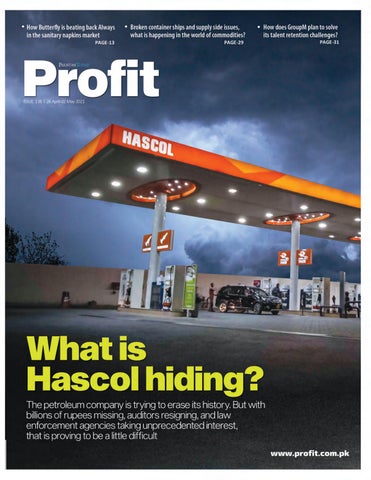
16 16 What is Hascol hiding? 23 Engro Polymers exceeds expectations as usual
25
29 31
29 Broken container ships and supply side issues, what is happening in the world of commodities?
25 Despite an ambitious policy, importing and registering electric vehicles remains strenuous for Pakistani consumers
31 How does GroupM plan to solve its talent retention challenges?
28 Textiles industry finally picks up, improving in Marchto the mass market - matric and FSc
Profit
Executive Editor: Babar Nizami l Managing Editor: Farooq Tirmizi l Joint Editor: Yousaf Nizami Reporters: Ariba Shahid l Babar Khan Javed l Taimoor Hassan Abdullah Niazi l Meiryum Ali l Shahab Omer Director Marketing: Zahid Ali l Regional Heads of Marketing: Muddasir Alam (Khi) Zulfiqar Butt (Lhr) l Mudassir Iqbal (Isl) l Layout: Rizwan Ahmad l Photographers: Zubair Mehfooz & Imran Gillani l Business, Economic & Financial news by 'Pakistan Today' Contact: profit@pakistantoday.com.pk
Readers Say I know that they seldom like to share profits and tend to keep share prices controlled inside out and to me that's enough to label them dodgy to start with. I'd take the accusations pretty seriously... even if they might be an inside job! Apropos: The scapegoating of Byco… and what it says about Pakistan’s energy sector Zuhaib Khan, Facebook Byco Petroleum has notified the Exchange that IGCF Oil and Gas Limited, one of the shareholders of Byco Industries Incorporated, is desirous of reducing its indirect equity investment in BYCO held through BII. BII intends to divest up to 22% shares of BYCO. Apropos: The scapegoating of Byco… and what it says about Pakistan’s energy sector @nomanaziz83, Twitter
facebook.com/Profitpk twitter.com/Profitpk linkedin.com/showcase/13251020 profit.com.pk profit@pakistantoday.com
8
I can remember KC opening bakeries in Karachi which later closed, but no mention of it in the otherwise very informative article or why they failed in Karachi. Apropos: Kitchen Cuisine is thriving yet struggling. Will it rise to the occasion once more? Tariq Hassan, Website
“Byco’s refinery may be old, but it is the only one in Pakistan that has the capacity to do so.” All the refineries in Pakistan have installed isomerization units. Please do a basic fact check before publishing. Apropos: The scapegoating of Byco… and what it says about Pakistan’s energy sector Syed Basil Muqtadir, Website
The KC outlets in Islamabad are very bad, with bad quality food at high prices. I used to be a fan of KC in the early 200’s but no more. KC is not relevant, at least in Islamabad. Apropos: Kitchen Cuisine is thriving yet struggling. Will it rise to the occasion once more? Anonymous, Website
I served Highnoon back in 1989-92, as GM Marketing for Nutrition Division, under the dynamic leadership of Mr. Baber Agha and Chairman Mr. Javed Tariq Khan. It was their vision which has given Highnoon the foundation on which now Mr. Tausif Khan is carrying so aptly. All the best Highnoon for a still brighter future. Apropos: Highnoon meets the hype Azam M Khan, Website
Interesting that the article does not mention once the substandard, usually expired content KC sells specially in Islamabad which is the main reason for KC not working at its potential. Just do an exit survey at any of their outlets and add the info too. The story is not complete without it. Their items are really tasty and they are one of the top bakeries in town, however the quality control is horrible. Ask any customer and he would tell you he is here because the items are great, but hardly anyone would bet on them being fresh or tasting the same as before. Apropos: Kitchen Cuisine is thriving yet struggling. Will it rise to the occasion once more? Ali, Website
The aviation minister should be sacked for telling the truth? What about the staff and the previous governments who helped taxi drivers get badges to fly? What if a serious accident happens in the west by one of those pilots, will Pakistan be able to pay for the public liability? The country would be bankrupt, which is why I say stuff PIA in the cabinet of failed ideas, sack the lot of them, and start again. Apropos: PIA: still a loss, but hey, it’s not as bad as before Zed Razzaq, Website
HOW TO CONTACT
Shouldn't one blame the local partners too? PWC and EY have diversified into technology consultancy and even ERP implementations recently, how good they are is another story but they've both gained pretty good business because of their auditing/accounting and intl legacy. Apropos: The auditors want to leave @UsmanMalik, Twitter
That pilot which was involved in the accident did not have a fake degree. Our (in)competent Minister just went to make a heading for news sake that 262 pilots have fake degrees. Later most of them were released of the accusation. This has shaken the confidence not only in the PIA, but Pakistan’s aviation industry and allied authorities. Apropos: PIA: still a loss, but hey, it’s not as bad as before Anonymous, Website
Very good article, I can relate to all of what has been mentioned in it being an allottee of a plot in sector N of Bahria Enclave, Islamabad, where I was promised possession in 2013 but despite paying the full amount of money 8 years ago still waiting for possession. Basically they cheated by selling the land at the start of project, back in 2011, that they do not own even to this date. What’s more funny, while I was paying installments, they would charge “late payment surcharge” even if I would fall one day short of their given schedule. It would be nice if you do an article on this scam as well. Apropos: The great Pakistani real estate racket Anonymous. Website
COMMENTS
IN BRIEF In just three weeks, the finance minister has been shuffled yet again, with former PPP minister Shaukat Tarin taking charge. The decision confirms the rounds of rumours which floated after Azhar’s appointment, which speculated that Shaukat Tarin would soon replace Azhar. The federal government has allowed the incumbent chief executive officer (CEO) of GENCO Holding Company Limited (GHCL), Muhammad Imran, to continue working on his post for a period of twelve months based on this satisfactory performance. Imran assumed the charge of the CEO in April 2018.
A lobby in the health sector is attempting to knock down the private sector’s Covid-19 vaccine facility with the help of DRAP. DRAP had halted the administration of the products from private vaccination centres till the verification of cold chain maintenance and then strangely allowed its resumption the very next day.
$60 million:
Pakistan is likely to lose a $60 million concessional loan due to vested interests of the bureaucracy. DG Muhammad Riaz’s actions would most likely lead to the cancellation of the concessional financing which had been converted into a grant for PMD.
Despite the government’s claims, the sugar crisis in Lahore could not be overcome and has instead intensified, leaving citizens worried due to the product’s unavailability in markets during Ramzan. Vendors of departmental stores said that they were unable to get sugar for customers as it is not available in any of the main wholesale markets.
$6 billion:
The Chinese government has sent Pakistan’s first modern railways’ infrastructure project — Main Line-1 (ML-1) — to the Exim Bank of China for approval of a $6 billion loan after all technical, administrative and other issues have finally been resolved, paving the way for launching civil work on this scheme within this year.
Rs 240 billion:
Pakistan is bearing an annual loss of Rs240 billion due to the smuggling of Petroleum products, according to the Petroleum Commission’s report which was made public on Tuesday after the federal cabinet’s approval.
9
Women in the workforce and the same old faces this week in Pakistan’s business and economics twitterverse
Cars, the coronavirus in India, and the Forbes 30 under 30 list dominated conversations this week
E
very week we compile the highlights from Pakistan’s business and economics twitterverse. This week we come to you with a pledge, to try and include more women. There are already fewer female voices in this space than male, and the ones that are there often get drowned out. So we encourage you to tag, highlight, and share any tweets from women that you feel would fit in this section. Other than women’s inclusion, the same old faces looking for new economic solutions, blasts from the past, twelve Pakistanis making it to the Forbes 30 under 30 list, and newer car options dominated conversations on social media. All this and more, as Profit’s Ariba Shahid brings you our social media roundup.
Women’s inclusion
As Moiz Ur Rehman points out, Pakistan’s dismal positioning in the global gender gap index goes hand in hand in its slow economic progress. For him, a socioeconomic revolution awaits once the gap is bridged and women have the same opportunities as men. It is also pertinent to note that for the social media round up, much like many other stories, most of the people featured are men. It is not because we do not value female voices, but there are fewer voices that make it to the surface. But we are committed to trying and making sure that women’s voices are given attention and listened to.
10
Profit’s reporter Ariba Shahid analyses the business and economic highlights from Pakistani Twitter this week.
Same old same old
Blast from the past
Blast from the past from the VC space. Aatif Awan, from Indus valley capital talks us through how strongly he felt about Bazaar and how he’s glad about being right. They say if you believe in something, you should go all in. Looks like it worked out well. Our only question is whether Hamza, Saad, and Aatif used to send whatsapp messages saying “email sent, please respond” after sending emails to each other.
Speaking of voices, @2paisay, an account we absolutely love to follow is right on the money in their observation of the silliness of expecting fresh ideas and creative solutions from the same faces that have been sitting as economic advisors for decades now. “Same faces, different government” works well in Pakistan, and cabinet pictures from the past two decades put side by side could make for some very intense games of “spot the differences.” We are not saying that the old faces are all useless by virtue of being old. There are serious and very intelligent academics like Dr Ishrat Hussain, who despite being an old face, is a face reporters feel reassured to see in meetings. But expecting out of the box solutions from these same old people is delusional.
Thirty under thirty
The Forbes 30 under 30 lists feature 12 individuals from Pakistan which include Abdullah Siddiqui a musician, Shayan Mahmud, Managing Partner of Eikon7, Iman Jamall and Hasib Malik, co founders of creditbook, Yaseen Khalid, Mohammad Saquib Malik, and Nabeel Siddiqui - co founders of ModulusTech Pvt ltd - Saad Jangda and Hamza Jawaid, co-founders of Bazaar Technologies, Zohaib Ali & Owais Qureshi, co founders of Dastgyr, and Hannia Zia a mentor for Venture for Pakistan. Kalsoom tweets her appreciation for all the Pakistanis that made the list especially the ones from the VC world in Pakistan.
Edhi - Our best foot forward
Breaking the big three
Planning on buying a new car in 2021? Arsalan Hanif, an investment analyst at a leading brokerage firm points out that 15+ new cars are expected to launch giving you more variety to choose from, given that you have the money to pay for one. However, what is interesting is the fact that no longer do we see just Toyota, Honda and Suzuki on the list. United Motors, Changan, Proton, Lucky Motors, Hyundai Nishat, MG, BAIC, and Cherry have made the list too!
Monetary tightening
The Edhi Foundation has always been a name Pakistanis can pride themselves over. Salam to Edhi sahib and the legacy he left behind. Humanity is beyond the constructs of religion, race, and the construct of borders. Humanity is universal. We must point out that this is more a symbolic gesture in the grand scheme of things, but one that is touching. On a less heartwarming note, with how things are going in Pakistan and the government’s continued refusal to take action, we hope Pakistan will not be needing Edhi’s services like this.
Faizan Kamran, an investment analyst at a leading brokerage firm feels that behavior of the yields is not a surprise and that the chances of a rate hike are as slim as the chances of this reporter having something healthy for iftar. In his opinion, the decision to go for monetary tightening would be premature especially given the current circumstances due to covid
SOCIAL MEDIA ROUNDUP
By Marylou McCormack
O
ver the past couple of years, there has been a visible change in the feminine hygiene products category in Pakistan. For nearly three decades, Procter and Gamble’s global brand of sanitary napkins, ‘Always’ has reigned supreme. With its huge marketing budgets, widespread availability, and global reputation, Always is considered a heritage brand by many Pakistani consumers and strong brand loyalty to the market leader has meant that women don’t switch easily, or if they do, it is based on personal recommendation. Despite the odds, however, Butterfly, the decades-old local brand of sanitary napkins
FMCG
owned by Santex, is making a comeback. According to an article published in the January-February 2016 issue of Aurora, Always had 68% of the market share while Butterfly was at 12%. But according to new information available with Profit, Always now accounts for 60% of the value share while Butterfly stands at 24% of this Rs 13 billion sanitary napkins category (Source: Foresight Consumer Panel Data, 2020) with smaller players like Trust and other international and local brands making up the rest of the category. Butterfly was launched by Santex in 1983 and was a pioneer in the category with several innovations to its name. However, with the launch of Always in the mid-1990s and as a result of taking its eye off the ball in terms of marketing and distribution, Butterfly
suffered significant losses. The recent revival of the brand is a testament to the parent company’s continued commitment to innovation and quality, along with a renewed focus on digital and traditional marketing. Dione Rodrigues-Almeida, Marketing Manager at Santex, is at the forefront of this shift; Profit sat down with her to understand how Butterfly is changing the game in the sanitary napkins category.
A comeback after decades
“O
ur vision is to be the brand that is in every second woman’s handbag,” says Almeida. When she joined Santex in
13
mid-2018, the company had already undergone a change in leadership a few years earlier with a young, second generation director coming on-board. Talha Rahman, the current managing partner is a nephew of the first generation of owners and his initiation into the company in 2009 saw an overhaul of the product line. Prior to this, Butterfly’s product line mainly consisted of straight, stick-on pads without wings which the company launched in 1983. Over time this product was transitioned to a brand called Mother Comforts meant to target a cross section of society, and a Value Range with wings, ultra thin and big saver pads was also introduced, however a conspicuous lack of marketing, deficiencies in the distribution strategy, and Always’ ubiquity meant that consumers were not necessarily aware of these changes or even interested in the brand. When Rahman came on board, he realized that despite the onslaught from Always, continued innovation was still Butterfly’s cornerstone and this led to the launch of the Butterfly Breathables premium range of sanitary napkins in 2014. “Breathable pads have a microscopic backsheet which promotes breathability and helps prevent odour, rash, and bacteria buildup,” explains Almeida. Butterfly was the first, and to date remains the only brand to launch this innovation in the country and while Always has a similar breathable product in other markets, it has yet to bring it to Pakistan. Armed with the USP of being the first and only product of its kind in Pakistan,
14
Almeida and her team used the Breathables range as the launchpad to regain a foothold in the market. But before any marketing was undertaken, the first step was to make the Butterfly Breathables available to the customer through ecommerce.
Marketing change up
S
elling via e-commerce was a logical first step because Breathables targets young women between the ages of 18-35 from socio-economic segments A and B. But there was more to it than just that. “Butterfly wanted to start getting a piece of the pie from Always, so we had to start hitting the Always consumer in whatever way we could and the best way to do that was through digital,” says Almeida. Instead of relying solely on third party ecommerce websites, Butterfly also decided to start its own dot com. The first six months were slow but as Covid-19 lockdowns began, people increasingly turned to ecommerce for their shopping needs and brands were clamoring to set up an online presence. Butterfly Breathables was ahead of the game… it really was a case of being in the right place at the right time. Eventually the company also decided to add its Value and Mother Comforts range to the ecommerce portal. While there was a significant uptake in online sales and this touchpoint continues to grow, Almeida admits that it only accounts for 1% of overall sales and therefore it was essential to overhaul the distribution strategy on the ground. To this end, she explains, “To attain large scale reach we revamped our
sanitary napkins market size
Rs 13 billion
(Source: Foresight Consumer Panel Data, 2020) traditional sales and distribution strategy nationwide. We also focused on a modern trade strategy whereby our in-store placements and product range have improved our share of shelf.” Alongside these efforts, the brand decided to get maximum mileage from its limited marketing resources by “creating noise about the breathability aspect” of the premium range with the launch of the Let’s Talk campaign. A DVC with a doctor doing a ‘breathability’ test on the product got plenty of likes but no comments or discussion was forthcoming, highlighting the fact that in a conservative society like Pakistan, women were not comfortable talking about menstruation and sanitary products openly. The brand then targeted female influencers on Instagram and on Facebook and got them to post on closed women’s only groups like Soul Sisters and others and the comments, says Almeida were, “eye-opening. We saw what the issues were and what women were going through.”
“Our vision is to be the brand that is in every second woman’s handbag” Dione Rodrigues-Almeida, marketing manager at Santex
As luck or serendipity would have it, Butterfly’s efforts were going to pay off in a totally different and unexpected way. In late 2019, certain posts started doing the rounds on closed women’s groups that Always pads, despite claims of quality, caused serious rashes. This wasn’t just a local concern; allegations that Always Maxi Pads cause contact dermatitis were also making international headlines, especially in Africa. (P&G did not respond to repeated requests for comment.) As more and more women gave firsthand accounts of their experiences, Butterfly used the unforeseen but tailor-made opportunity to promote Breathables and build further on the Let’s Talk campaign.
Consumer specific challenges
B
utterfly’s strategy of marketing Breathables helped to put the brand back on the map as a serious contender in the feminine care category. Apart from generating interest and talkability, it has also helped the brand improve its market share. However, Pakistani consumers present their own unique set of challenges that Butterfly had to contend with. Many Pakistan women, even those in the large cities, use branded sanitary napkins
in conjunction with homemade cloth pads, and even though brand penetration is high overall, the category is witnessing only single digit growth each year. Collectively, these factors imply that Butterfly not only has to supply consumers with a great experience so they will consider switching brands, but also has to continually invest in awareness and education activities to convert cloth consumers to pads. Efforts are already underway to this end through what Almeida calls the company’s ‘outreach program’. As part of this program, Butterfly is working with social development organizations and schools to talk to women and girls across socio-economic classes about good period hygiene, period related myths, and explaining how women can talk to their daughters about menstruation. The ultimate goal of these activities is to convert women to Butterfly pads and here Almeida feels that the brand has a huge advantage because “we have a value proposition for every consumer across the different SECs, which means we can target them based on their needs with a lower priced product or a premium one.” With more international brands such as Sincere by Ontex and others officially entering the Pakistani feminine care market, Butterfly will need to be more focused than ever to achieve its vision. Almeida is cognizant of
this saying the idea is to “delve further into the category and gain greater market share.” Although the brand has massively relied on very functional communication to achieve this so far, last year a new TVC, DVC and radio campaign called ‘Butterfly Hero’ was launched depicting women helping each other in stressful period situations. The campaign was based on the insight that conservative Pakistani consumers do not want to see a pad in a TVC or other communication especially when they are sitting with their fathers and brothers and therefore the brand decided to create a story around a situation that most women will identify with. Although the path to becoming ‘the pad in every other woman’s handbag’ is a long one, there is evidence, according to Almeida, that the market leader has noticed Butterfly’s initiatives. “We have had a lot of firsts in digital – first in this category to do blogger campaigns, the first to have a dot com, and the first brand to use the word, ‘period’ – and we have noticed that they started re-activating their Daraz store and started an Instagram account after this.” Whether these moves are a response to Butterfly’s marketing or simply an attempt to stay relevant to changing consumer needs, ultimately, as Almeida puts it, “it is healthy to have competition, it builds up the category.” n
FMCG
16
PETROLEUM
I
By Babar Nizami & Meiryum Ali
t is September 2019, and Mumtaz Hasan Khan is a confident man. And why wouldn’t he be? He is the chairman of Hascol Petroleum, a company that has been doing exceptionally well over the past decade. Between 2010 and 2018, Hascol saw its topline surge by an astounding 52.7% per annum, from Rs7.9 billion to Rs234 billion. And while there are concerns over a looming crisis, all he has to do is keep a steady ship sailing smoothly. “There is nothing to worry about for the company. There come different phases in the life of individuals and companies. And with the grace of Almighty, we will overcome the crisis. We have a very good management team,” he said back then. But fast forward to today, and nothing remains the same. At the end of a year full of drama and chaos, Mumtaz has been fired, and the company has shuffled CEOs twice. The company’s CFO resigned multiple times, and as of now, the seat remains empty. In 2019, the company made a loss of Rs 26 billion for the year ending December 30. In its recently released report for the third quarter of 2020, it has managed to make a loss of Rs20.9 billion. The company is crippled by severe debt, which stands at Rs58 billion. The 14 banks Hascol owes money to are now forming a consortium to get the company potentially restructured. As one source put it, Hascol’s rise and fall is a reminder of the damage that can be shaped by obtaining heavy loans and giving unnecessary discounts to achieve growth. Sitting on top of the rubble from the destruction of the past year is Alan Duncan, a former Member Parliament of the United Kingdom House of Commons that has remained minister of state in both the May and Cameron cabinets in the United Kingdom. A staunch conservative politician with links stretching back all the way back to Margaret Thatcher and John Major, more telling for the purposes of our story is his past as a business executive. He broke out from Oxford working for Shell, but more famously found his sea legs working for notorious financial criminal Marc Rich, who was indicted in the United States on federal charges of tax evasion and making oil deals with Iran during the Iran hostage crisis. As Profit lays out what happened to Hascol this year, and all the drama that the company kept seeming to land in, two former CEOs - Saleem Butt and Aqeel Ahmed - declined to comment for this story. And the current CEO, Adeeb Ahmad, tried to avoid Profit as best as he could, saying anything he had to say could be found in the latest report, and did not want
18
“The party’s name is SR Fuel Experts [which owes Rs8 billion to the company] but any other information is confidential” Adeeb Ahmed, CEO of Hascol to answer the trouble within the financials.
First, some history
O
ver the course of barely a year, Hascol cracked and wilted until it finally broke open at the seams. What makes this downward spiral more shocking is that it is not something that has long been on the cards. In fact, Hascol used to be considered a rising star within the oil marketing companies (OMCs). Hascol was incorporated as a private limited company in 2001. The company received its oil marketing license from the government in 2005, which allowed it to purchase, store, and sell petroleum products like high speed diesel, gasoline, fuel oil and lubricants. In 2007, the company was converted into an unlisted public company. In 2014, it was finally listed on the Karachi Stock Exchange. Hascol’s fortunes changed in 2009, when veteran energy executive Saleem Butt took over as the executive director and chief operating officer of the company. Under Butt’s leadership, the company was able to expand its access to debt. Previously banks had been somewhat less forthcoming with this new entrant in the oil market, but as COO, Butt established a strong relationship with Summit Bank, one of the smaller banks in the country, to begin extending the company the credit needed to expand. From then onwards, Hascol started to become bigger every year with Saleem Butt at the helm of affairs, first as COO, and then as CEO. Interest grew in the company, and in 2015, Dutch energy giant Vitol acquired a 15% stake in the company, and bought another 10% in 2016 to become the largest shareholder in the company. Hascol and Vitol also entered into a joint venture deal for marketing of LNG with a 30-70 ratio respectively. By 2017, Hascol rose to become the second largest oil marketing company in the country, overtaking both Shell and Attock Petroleum, and behind only the government-owned PSO. Over the course of its existence, the company has always managed to increase revenues. It saw a revenue increase from Rs 10.3 billion in 2009, to Rs 274 billion in 2018, with there
being only a slight dip in 2015. Indeed, between 2010 and 2018, the company saw its revenues climb at an astonishing average of 52.7% per year (Hascol Petroleum’s financial year ends December 31 of each year.) For most of its existence, it has just about managed positive net incomes, as cost of sales has also been quite high. It experienced a loss of Rs275 million in 2010, and Rs123 million in 2018, but in the three years prior to 2018, it has a net income greater than Rs2 billion.
What in the world went wrong in 2019
A
nd then 2019 happened. Typically, when a figure is that absurd, we avoid making a graph of it, for risk of spoiling the aesthetics of the magazine, but we have included it here just to show how truly bizarre that year was for Hascol. Revenue dipped from Rs 274 billion in 2018, to Rs180 billion in 2019 and net income went from a loss of Rs123 million in 2018, to a loss of Rs 26 billion in 2019. Also observe net cash flow: Hascol had one remarkable year in 2015, where net cash flow stored at Rs22 billion, but in 2018, its net cash flow was negative Rs12 billion, which fell to negative Rs16 billion in 2019. By way of explanation, at the time, Hascol’s chairman had very little to say. “There has been significant volatility in the international oil market, and serious currency devaluation in the local economy. This has combined with punitively high interest rates, which has placed a severe burden on the company’s cost of financing,” he wrote in the company’s annual report that year. Read between the lines, and what you get is what we now know very well, that the government regulates prices of oil products sold in the country and does not adjust prices fast enough to keep pace with the extent to which prices change in international markets. As a result, companies like Hascol are sometimes stuck with inventory that they bought at much higher prices and are forced by the government to sell at much lower prices.
The year 2020
S
o what happens when a company has a catastrophic 2019 and then has to deal with the coronavirus to follow up from that? The recently released third quarter data was not pretty to say the least. For the nine month period ending September 30, 2020, the company’s net revenue stood at Rs99.4 billion, significantly lower than the Rs130 billion achieved in the same nine month period in 2019. The company’s loss for the nine month period ending September 30 stood at an astonishing Rs20.9 billion, compared to a loss of Rs14.4 billion in 2019. If one looks at the annualized data, then the company’s net loss for the year 2020 stands at Rs32 billion. In 2020, with the repeated pattern of poor performance, the company decided to elaborate in its quarterly report, writing that “during Q1 2020, the shareholders injected Rs8 Billion as additional capital, to bolster the operations and address the liquidity position of the company, both of which had been adversely affected in fiscal year 2019. But due to the lockdowns imposed by the government to tackle the C-19 situation; not only the sales volumes decreased due to a drop in consumption of oil products, the unprecedented fall in oil prices and devaluation of currency also had a severe dampening effect on the Company’s financial performance.”
Do Hascol’s explanations hold up?
A
dmittedly, the year 2020 has not been good to most major oil companies. Consider Shell Pakistan. For the nine month period ending September 30, its gross revenue stood at Rs135 billion, (compared to Hascol Rs99 billion) while its net loss stood at Rs6 billion (compared to Hascol’s loss of Rs20.9 billion).
Both Attock and Pakistan State Oil have financial years that end on June 30 (Hascol’s financial year ends on December 31). But if one looks at the quarterly report for the first quarter for both those companies i.e. the quarter that ends on September 30, the figures tell a different story. In Attock’s case, sales stood at Rs46 billion, while net loss stood at Rs562 million. The same figures for Hascol for the quarter of September 20 are very different. Gross sales for that quarter stood at Rs30 billion, while net loss stood at Rs3 billion. PSO is the only company in this case which managed to post a profit during this period. In PSO’s case, sales stood at Rs333 billion, while net profit stood at Rs5 billion. While other companies have posted losses, they are not close to the scale of financial losses that Hascol is experiencing. So what else is plaguing the company?
The mysterious write-off and other bad practises abound
T
he year 2020 has been full of controversies for Hascol. For instance, in October 2020, the Oil and Gas Regulatory Authority (OGRA) suspended its marketing and distribution license in KPK. Apparently, Hascol had been operating illegal and unauthorised storage and selling of petroleum products (petrol and diesel) at Amangarh Depot, despite OGRA’s clear directives for the stoppage of operation of Amangarh Depot. But perhaps most importantly, the company took a whopping Rs7.6 billion impairment against receivables, and revealed hardly any details on it who the counterparties were. It also leaves unanswered questions: how many counterparties were there? What was the credit policy? Was the parent company, Vitol, aware?
To understand how this could have happened, it helps to know how petrol is sourced and distributed. Roughly, most OMCs in Pakistan source petrol either through refineries locally or through imports. A company like Hascol does both. The oil is then sold either to dealers (who are petrol pump owners) or to end consumers through company operated pumps. Hascol has a mixture of both dealer-operated and company-operated pumps, though in its case, the dealer operated is far larger. In the OMC business, one can only sell direct through one’s own pumps, or through dealers that operate one’s company-branded pumps. If it is the latter, then the usual credit terms are three to seven days and sometimes collateralized by guarantees or bonds. Which leads to the ultimate mystery that the market is asking: who was allowed this much credit by Hascol? One explanation floating in the market: that the petrol was actually sold to a middleman, who then “dumped” this stock into other OMCs petrol stations, such as PSO and Total etc. Before we try to uncover this middleman, let us pause for a moment and first understand what dumping is and how it takes place. Let us say there is OMC A. Its dealer operated pump is committed by law and contracts of Pakistan to purchase petrol and diesel from OMC A. The price at which that transaction happens is at a regulated price established by the federal government. ‘Dumping’ is when another company, say OMC B, basically decides to sell to OMC A’s dealer at a lower price, which OMC B is not legally allowed to do. Why would OMC B do this? If both OMC A and B are sourcing their fuel from a refinery in Pakistan, then they are receiving it at the same price and there is no reason to dump. But if OMC B is able to procure smuggled fuel or otherwise offshore fuel at a better price, then they have a price ad-
PETROLEUM
vantage, and they can ‘move’ that fuel. OMC A may sell to their own dealer for Rs100, but OMC B may come to that dealer and sell at Rs98. This transaction typically happens off the books, and in the middle of the night. According to one source, some of the amazing volatility in certain OMC sales is not just related to a lack of supply, but also related to the fact that there has been a crackdown on this dumping practise. And the rumour about Hascol persists, in part due to the perception that dumping within the OMC market has been particularly prevalent in the last few years. Another way OMCs could dump and make money is by manipulating the inland freight equalisation margin (IFEM). The government of Pakistan has set the price of petrol the same across the country, whether you are buying it in Gilgit or Karachi. Obviously to transport petrol all the way to Gilgit is a lot more expensive than to Karachi. OMCs report their sales to the government, and charge the government what is called IFEM; or a way of getting reimbursed for freight costs. This business can be abused if an OMC starts to show a lot of sales in Gilgit, instead of in Karachi i.e. charge long distance freight charges, even when the product was being
20
The company took a whopping Rs7.6 billion impairment against receivables, and revealed hardly any details on it who the counterparties were. It also leaves unanswered questions: how many counterparties were there? What was the credit policy? transported and sold to dealers of other OMCs at shorter distances. This system benefits the dumping OMCs, dealers, and middlemen; in some cases, dealers practically became mini OMCs in their own right. Needless to say, this is illegal.
The middleman
P
rofit tried to ask Adeeb Ahmad about the impairment, who only said that the party’s name was one SR Fuel Experts, and that they had owed Rs 8 billion to the company, and said any other information was confidential. While Profit could not find information on SR Fuel Experts, but there is a company called Fuel Experts, which formed in 2011, that specializes in the distribution and trans-
portation of oil and gas products. Its CEO is Hamid Khan, who, according to his LinkedIn, worked at Shell Pakistan from 2003 to 2010. Now, here is where it gets interesting. The company called ‘Fuel Experts’ isn’t confidential at all. In fact, the company, along with the founder Khan, were named in the ‘Report of the Inquiry Commission on Shortage of Petroleum Products in Pakistan’, headed by FIA Additional Director-General Abubakar Khudabaksh, and commissioned by the Pakistani government in July 2020, to probe the shortage of petroleum products. That damning 155-page report leaked in December asked for the dissolution of the industry regulator for a litany of failures starting from 2002. On top of pointing out malpractices of the OMC industry in general, that report said two things of particular relevance to Hascol.
TEXTILES
First, it confirmed the theory of smuggling and dumping, noting it is an open secret that petrol products are being smuggled into Pakistan from the western border of Taftan, Iran. The second thing the report went on to mention were the dealings of Hamid Khan with Hascol. “Hamid Khan is reported to have extensive business dealings with Hascol,” it reads. “However, after reportedly defaulting on huge credit in Hascol, he has now established a company by the name Fuel Experts Pvt Limited. Although Fuel Experts is not an OMC, it is dealing with the supply of petroleum products by procuring it from different OMCs (read Hascol) and openly supplying it to several retail outlets countrywide on his self generated invoices and delivery notes in violation of OGRA rules.” At least according to this report, Hascol seems to have lost a lot of money on this one middleman. Or did they? While Adeeb Ahmed was reticent, Profit did manage to contact the head of sales at Fuel Experts, Wasif Khan. The tale he told was very different, and according to his version of events, while Fuel Experts did do significant business with Hascol, they did not owe Hascol anything. “Fuel Experts have paid off all invoices that were raised by Hascol in the name of Fuel Experts and one can check the official books of Hascol to confirm this,” said Khan while maintaining that his company is not liable for any other dealings of the company. “Where is the old CFO and where is the old CEO?” he asked rhetorically. When asked if his company was involved in dumping on behalf of Hascol, he naively explained “If an old PSO pump owes money to PSO and is not in good financial health, then PSO would not supply fuel to this pump. Now the owner of the pump will not close his business just because of this. He will obviously look for other suppliers of fuel”. But something still does not make sense. If it is not Fuel Experts that owes Rs8 billion to Hascol, then where did this money get lost? And why would a company like Hascol allow one middleman such lenient credit terms? Unless of course, if the middleman was only a frontman for Hascol own management at the time. Indeed, a related party to the controversy heavily insinuated that that is exactly the case, and that Hascol used to maintain multiple sets of books to do just that. We are told that Hascol has managed to get a stay order against the Securities and Exchange Commision of Pakistan, which wanted to conduct a thorough investigation into the accounts of the company but with recent reports of the National Accountability Bureau and FIA taking interest in the affairs
According to a senior member of the accounting fraternity, the problem in Hascol was with the opening balances and the records presented by the management very obviously not enough for EY to verify these independently of OMCs, things may heat up soon.
The banks get fed up
T
he banks are not happy with Hascol, and they have been publicly getting passive aggressive with them. Take Meezan Bank for example, which in its analyst briefing for their fourth quarter of calendar year 2020 results, made a special mention to Hascol alone. The bank said that the higher provision charge in the fourth quarter mainly relates to Hascol, which has a negative equity and has been delayed on its debt servicing obligations. As early as late 2019, Hascol had become the target of rumours that banks had stopped lending to the company. To understand why, one needs to remember that much of the company’s success before 2018 had been based on huge loans. The company’s rise had relied on a very aggressive pricing strategy where discounts were offered to capture market share. This allowed for huge investments in retail outlets and storage facilities. Then, as already mentioned, the company in 2019 began to suffer losses because of the macro-economic issues, such as devaluation and plummeting inventory prices. Yet despite these issues, according to sources, the company kept on borrowing for working capital. but allegedly diverted these loan proceeds for other than their initially stated use. So rather than managing its working capital requirements, the company continued to expand its retail network on a fast track basis, adding almost 100 outlets per year with these short-term borrowings. This made the company over-leveraged and caused a mismatch in borrowings. Currently, the company’s debt stands at Rs58 billion, and it owes money to at least 14 banks. Part of the problem with Hascol is a larger problem with companies borrowing from banks in general. In Pakistan, there is no disgrace attached to defaulting on bank loans. This has in part to do with the lengthy judicial process it takes for banks to retrieve their money from defaulters, often between five to 10 years. This gives a defaulter a lot of time to go about their business, while the case is pending in court. As per one source, this practice gives a sense of liberty among industrialists, many of whom are politically connected as-well, and can drag the legal case
on for years. So, what can a bank do in this situation? Banks in Pakistan usually try to make the company operative through restructurings, rather than demand their money. And that is exactly what happened. In its quarterly report, Hascol said “... The Company’s lenders agreed to partially convert short-term debt to long-term (which completed subsequently in September, 2020) to improve the Company’s debt maturity profile. However, due to the subdued economic conditions and volatility of the oil markets, the expected results were not achieved.” Similarly, Hascol also said it was in talks with banks (though it did name which banks) to partially convert debt into equity and restructure all of the company’s short term debt into long term facilities. The banks seem to have no choice but to play ball.
Auditors resign
M
ost unusually, the company’s auditors, EY Ford Rhodes, resigned as co-auditors last year. It is always a cause of concern when an auditor resigns - particularly when it is one of the ‘big four’ firms: Deloitte, PwC, Ernst & Young, and KPMG. Essentially, it boils down to this: it is actually very stressful to be an auditor for a Pakistani company. There is immense pressure by the global heads of the accounting companies on their local Pakistani subsidiaries to apply an extra layer of scrutiny on Pakistani companies. Why? Because the world simply does not trust them. It is an unfair assumption perhaps, but it does explain why auditing companies are extremely wary of having or real estate companies in Pakistan as clients. It is simply too dodgy. Simply performing poorly is no indication of fraud. But since Hascol has performed so poorly, it is also likely under immense pressure to perform, and show better financials. EY seems to have wanted a fair amount of distance between itself and Hascol. When contacted, the CEO was unwilling to disclose why the auditor resigned, despite multiple attempts at contact. After the sugar inquiry report, international accounting firms have also come under their fair share of criticism for giving a clean chit to companies that were clearly maintain-
PETROLEUM
ing two books of accounts and making off the books sales. According to a senior member of the accounting fraternity, the problem in Hascol was with the opening balances and the records presented by the management very obviously not enough for EY to verify these independently. EY Ford Rhodes also declined to comment for this story citing client confidentiality. Instead, Grant Thornton Anjum Rahman Chartered Accountants alone reviewed the books and expressed doubt about the proposed plan to fix the financials, saying: “The management’s assessment highlighted that the liquidity of the Company is dependent upon the proposed restructuring arrangement of the Company’s overdue financial liabilities. However, we were unable to obtain sufficient appropriate evidence to support our conclusion in respect of the proposed restructuring. These condensed interim unconsolidated financial statements do not reflect any adjustment that would be required should the Company be unable to continue as a going concern...we have not been able to obtain sufficient appropriate evidence to form a conclusion on these condensed interim unconsolidated financial statements.”
...and management resigns as well
I
22
n 2019, Mumtaz Khan had this to say: “The same management was delivering excellent results. Between 2011 and 2017, we were growing very rapidly. They are
competent people and they are all professional people. There is no one from my family like a nephew or son or something. The company has been run professionally just like Shell or Total...It is a professionally run company. That is why Vitol has taken shareholding. The management, they are good people, competent people, honest people. And they have been delivering good results often. Every company faces bad times.” So much for that. The year 2020 has been a series of revolving doors for major management members. First, let us look at the CEOs. On February 19, 2020, Saleem Butt resigned, citing personal reasons. On February 24, Waheed Ahmed Shaikh was appointed CEO. Shortly afterwards, on April 2, Aqeel Ahmed was appointed as CEO. On September 17, he was reappointed as CEO - except on September 22, just a few days later, he was resigned as the CEO of Hascol Lubricants, a subsidiary, and Adeeb Ahmed was made the CEO instead Now, for the CFO (an important job, considering the state of the company’s financials. On February 19, Khurram Shehzad ceased to be CFO, and Muhammad Ali took his place. On July 17, the two CFOs were swapped out (Khurram became CFO again). Then on September 10, Shahid Bhutto became CFO, before resigning from that position on January 22. The position is yet to be filled. And finally, the chairman. On March 31, Mumtaz Khan was replaced with Alan Duncan. Of all the people mentioned so far, he has the most colourful past life: he was a director of Vitol Dubai Ltd., the parent com-
pany. He had studied at Oxford with former Prime Minister Benazir Bhutto, helping her campaign for the President of the Oxford Union (which she won). He then stayed in close contact with her, and was one of the few people she emailed right before she died in 2007. That is not his only connection to Pakistan. During 1990-92, following the invasion of Kuwait, he was a major supplier of refined products to Pakistan following the termination of the country’s supplies from Kuwait Petroleum. In 2001, Pakistan opened up an investigation into the supplies: allegedly, British firm Vitol sold 280,000 tonnes of ‘contaminated’ oil to Pakistan State Oil in 1993, picked off the coast of Kuwait and contaminated it with sand and salt. The oil caused £100 million worth of damage after one of Pakistan’s main power stations broke down in January 1994, plunging Lahore and Karachi into several hours of darkness. According to a Guardian article from the era, “At the time of the blackouts, the Pakistan government, then ruled by Benazir Bhutto, began an inquiry into the scandal that was subsequently dropped with little explanation.” Duncan, clearly, moved on: he was International Development Minister 2010-14, and Foreign Minister 2016-19. And now, he is the chairman of the equally worrisome and controversial Hascol.
The future
S
o, concerns about dumping, debt, and an interesting chairman: what will Hascol do now? In its report, the company said it would try the following: significant reduction in operating costs, recapturing and growing sales volumes and market share, disposal of non-core assets, shoring up working capital and raising of additional equity to reduce leverage and address negative book equity. And on March 1 of this year, it sold two properties it held in Dolmen Sky Tower, as part of its restructuring to improve cash flows. Good for them: but what about the people who lost their money in the meantime? Consider this: between January 2018 and November 2018, the share price of Hascol stood between Rs270 to Rs310 range. On November 1, the price stood at Rs287. By December 31, it crashed to Rs148. And by September 2019, it had fallen to a shocking Rs22. As of April 23, 2021, it is now trading at Rs9.13. Considering their track record, their insistence to keep things secretive, can anything the company says now be trusted? One sure hopes so, for the sake of their lenders and investors at least. n
PETROLEUM
Engro Polymers
exceeds expectations as usual The domestic market saw its highest ever imports of 90 kilotons of OVC, as importers capitalized on historically low global price
E
ngro Polymers and Chemicals has that unusual honour of being one of those few companies that have really taken off in the last three years or so, with ever increasing revenues, and skyrocketing net incomes (in comparison to previous years). And the year 2021 is proving no different. On April 19, the company announced its first quarter results for the calendar year 2021 - and they exceeded expectations of most analysts. The
POLYMERS
company’s net profit after tax stood at Rs4.14 billion, compared to Rs193 million in the same period last year. Similarly, the company’s earnings per share stood at Rs4.56, compared to Rs0.21 in the same period last year. Much of this increase was led by a combination of factors. For one, revenues experienced a 122% increase year-on-year. Then, there was a 63% increase in PVC (plastic polymer) ethylene margins and higher PVC volumetric sales, that resulted in gross margins
standing at 40% in this quarter (compared to 18% in the first quarter of 2020). Finally, there was a 48% year-on-year drop in finance costs. Even compared to just the last quarter of the calendar year 2020, there was a 14% increase in earnings. This again, was led by a 26% increase in revenue on a quarterly basis, and 215% quarter-on-quarter increase in other income, and finally, an 11% quarter-on-quarter decline in finance cost. The results are glowing - but to under-
23
stand why this is happening, it helps to see the company as an early player in the PVC market, which is only now beginning to take off in Asia, and SOuth Asia in the coming decades. For some context, Engro Polymer & Chemicals Limited is the only integrated chlor-vinyl chemical complex in Pakistan. It is also the sole manufacturer of PVC resin in Pakistan. The company also produces Chlor Alkali products like Caustic Soda, Sodium Hypochlorite and Hydrochloric Acid. It is a subsidiary of Engro Corporation, which holds 56.19% in the company (a remaining 11.01% is owned by Mitsubishi). The company was started in 1997, under the name Engro Asahi Polymer and Chemicals. The first PVC plant was commissioned in 1999, with 100 kilotons capacity. A second PVC plant was set up in 2008, which was also the year that the company was listed on the stock exchange. Commercial production was declared in 2019, while a caustic flakes plant was announced in 2019. All the while, the company’s revenues have slowly improved. Between 2009 and 2013,
24
revenue went from Rs11.6 billion, to Rs24.6 billion. Revenue then fell for two years, before climbing against between 2017 and 2020. This rise was extremely rapid, shooting to nearly Rs38 billion in 2019. But the biggest change was in net income. The company experienced a loss between 2009 and 2011, and again between 2014 and 2015. But then in 2016, the company made a profit of Rs660 million. This shot up to Rs2 billion the very next year, and then Rs4.9 billion in 2018. In the year 2020, this shot up to the highest ever recorded profit for the company at Rs5.7 billion. What is going on? The company’s annual report notes that “South Asia continues to be a crucial market in the vinyl world due to its large supply deficits both for PVC and feedstocks, and serves as an important lever in balancing the global vinyl supply and demand. The potential for growth in the region remains enormous for at least the next decade based on the large population of over 2 billion and a per capita consumption of only 2 kg which in comparison with global average of 6 kg per person is considerably low.”
The report also said that the importance of agriculture in the region cannot be emphasized enough in terms of PVC demand. “ “Pipes and fitting account for 73% of total PVC regional demand [in South Asia], which considerably outweighs the global proportion of 45%. Other applications like chlorinated PVC pipes, wire and cable, and PVC profiles continue to gain wider acceptance in the region owing to their better value proposition compared to competitive products,” the report noted. And this has ramifications for Pakistan as well. PVC is now being used in a wider variety of products in the country, such as PVC flooring, garden hose, garden furniture, PVC roofing, wall panels and ceiling. That being said, the domestic PVC market in the first half of 2020 saw a decline of 15% year on-year due to the national lockdown imposed by the government in response to the pandemic, and the diversion of government spending from development projects to COVID-19 prevention and support programs. But, in the second half of the year, the government announced a stimulus package, and switched to smart lockdowns. The PVC market recorded an increase of 38% from the first half, which translated into an overall market increase of 3.3% in 2020 in comparison to a 7% decline in 2019. In fact, the domestic market saw its highest ever imports of 90 kilotons of OVC, as importers capitalized on historically low global price, amidst the international commodity crash. And that is why things are looking up for Engro Polymer - and they know it. As the report said, “In view of the government’s focus on affordable housing, expected improvement in economic growth and our continued efforts to develop downstream applications, we are hopeful that the country’s per capita PVC consumption will increase in the years to come and converge towards international levels.” n
POLYMERS
L
By Shahab Omer
ast year, the government of Pakistan (GoP) unveiled an ambitious National Electric Vehicle Policy (EVP) to promote the growth of electric vehicles in Pakistan. Under the new policy, government interventions were supposed to make imports, production and registration of electric vehicles seamless to achieve, perhaps, an overly ambitious target; one of replacing 30 per cent of passenger vehicles on the roads in Pakistan to electric vehicles by 2030. But despite the plans and all the hard work around this policy, importing and registering electric vehicles in Pakistan remains strenuous for Pakistani consumers. To begin with, the policy itself is being delayed for implementation, according to Shaukat Qureshi, general secretary at Pakistan Electric Vehicles and Parts Manufacturers and Traders Association (PEVPMTA). “One reason for the delay is that the policy prepared by the Ministry of Climate Change (MoCC) has been set aside and the policy prepared by the Engineering Development Board (EDB) has been approved in which all the facilities provided to the manufacturers have been abolished,” Qureshi said. According to Qureshi’s version, the policy from EBD not only abolished tax relief but also revoked the
AUTO
import permit that allowed 100 vehicles to be imported. Instead, the policy allowed the import of only 10 vehicles that discouraged many investors from making further investments into promoting electric vehicles in Pakistan. Qureshi hints at a mafia-like hold of big automobile manufacturers in Pakistan that discourage the growth of electric vehicles in Pakistan. “The Engineering Development Board does not include a single person with the knowledge of electric vehicles. Instead, the board has representatives [from big automobile manufacturers in Pakistan] who will not allow EV policy to be implemented until the big auto companies start making electric vehicles,” he asserts. “In the current situation, large-scale imports and local production of electric vehicles do not seem possible for another three to four years. If the government is serious about this, it should immediately form a separate Electric Vehicles Board.” However, a senior official from EDB denied Qureshi’s allegations, asserting that the board was, in fact, working to promote EVs.
Importing inflates prices
A
sim Jalandhari, an aspirant for electric vehicles, told Profit that he had been waiting for a cheap and good electric car in Pakistan for a long time. “The fact is that the availability of electric cars around the world is still not as common as that of ordinary petrol and diesel cars and because they are being developed with the latest technology, their prices are also a bit higher,” Jalandhari said. The total number of electric vehicles on roads all
25
over the globe was 7.2 million vehicles. 47% of these vehicles were in China. There are many low-cost Chinese EVs on the internet such as on the Alibaba platform. Some cars are up for sale at $6,000-7,000 (approximately Rs918,000-Rs1,071,000) on Alibaba. The problem, however, is that though the foreign companies selling on Alibaba would sell you the car, they would only deliver it to the port in Pakistan and this is where all the troubles begin. The problems start and end with the strenuous processes of taxation, releasing and registering the vehicles at the port. “The process is complex, even if all the FBR rules and regulations and the fee structure are met,” says Jalandhari. And by the time cars come to the end-user in Pakistan, the price has swelled many times. Take Sigma Q4 for instance, which is a Chinese electric vehicle that recently launched in Pakistan in partnership with United Auto Motorsports. The online price of the car is $6,000-7,000 whereas, in Pakistan, the price is Rs2 million. “It is a perception that these electric cars can be easily imported into Pakistan. It is not an easy task. We had launched Chinese motorcycles in Pakistan and we faced a lot of criticism at that time but we aimed to provide a motorcycle to a low-income person as well,” says Omer Ashraf, the CEO of United Auto Motorsports. Umer Ashraf informed Profit that this car cannot be easily imported. “Similarly, the Sigma Q4 electric car is for a low budget consumer. Because other electric variants in the market, for instance, the BMW or Audi electric vehicles, come with a price tag of Rs200 million. Even at huge costs, these vehicles cannot be taken out of Lahore because of the lack of charging infrastructure. On the contrary, we are offering Sigma Q4 for Rs2 million only we are receiving flak because the price of these cars actually is $6,000 to 7000. The reality, however, is that imported vehicles become expensive because of the duty structure,” adds Jalandhari. Jalandhari explained that for some electric cars he had imported last year, he had paid 25% in customs duty, 17% in sales tax, 7% in additional customs duty, 3% in additional sales tax and 5.5% in income tax, all on top of the original price of the car. All these percentage additions on top inflate the price multiple times and importing a car into Pakistan simply becomes an expensive proposition. “It took us six months to import the car. We had ordered these cars in July 2020 but they reached us in Pakistan in November. The cumbersomeness of the processes at ports can be recognised from the fact and it
26
took us two more months to get these cars released from the port. All the demurrages were also borne by us during that time,” explained Jalandhari. As per Jalandhari’s experience, custom authorities do not have expertise when it comes to electric vehicles and they end up levying arbitrary amounts of duties that not only adds to the cost of the car but also becomes time-consuming since the error redressal process is lengthy. “Customs authorities have no information on the electric cars. Initially, when we imported these cars, they imposed a duty of 50%. Now it is difficult to justify these to people who still believe that the price of the car is less because they saw that online,” he says. On the other hand, multiple other charges have gone up because of the Covid-19 pandemic. “Freight charges, for instance,” says Jalandhari. Before Covid-19, single container freight would cost $600 and the rate has now gone up to $3,500 for the same container, said Jalandhari, explaining the cost component buildup on importing a car. “We further have operational expenses relating to providing after-sale service. As more cars come in, after-sales service would become a serious component of our business. And I can tell you that we are not earning a ridiculous profit from the customer. On an Rs2 million car, our profit is only Rs50,000 rupees and from a business perspective, this is not a very good profit margin,” he adds. Jalandhari further explains that relaxations in taxes on electric vehicles under the new policy are currently only for cars that are being manufactured or being assembled in Pakistan. Whereas the cars that are being imported have to follow the present duty structure. On the other hand, a senior Pakistan Customs official said that the process of importing the car was seamless as long as the person importing was paying related taxes and duties “Whenever an EV is imported, we check the vehicle invoice and related data for its import from the internet. To estimate the price of the car, we also look at the actual price on the company’s website. A consumer has to pay 25% in customs duty, 7% additional customs duty, 17% sales tax and 12% withholding tax to clear the import of his electric car. Documents such as vehicle invoices, taxes and duty payments will be required in this regard,” he explained. Surprisingly, the customs official put the entire blame of the dearth of EVs in Pakistan to the difficult process of registration of these vehicles.
Cumbersome registration process
R
egistration of EVs is indeed an onerous undertaking and a survey conducted by Profit revealed that many electric vehicles owners have expressed their concerns and complained to the government of the stressful car registration process. Aamir Shakeel, an Audi e-Tron customer, believed that the government had promised a lot of tax exemptions and incentives to facilitate electric vehicle users, but failed in executing them. “Currently, the biggest problem facing EV users is registration,” Aamir said. “Under normal circumstances, vehicles have to go to the excise office for registration and depending on the car’s engine, the vehicle is registered after paying various taxes, including annual or lifetime tokens. The cars can be put on the road seamlessly,” he said. “Not electric vehicles, however,” Aamir resented. The problem with registering electric vehicles in Pakistan is that your normal petrol or diesel cars are categorised according to engine size, also identified as ‘cc’ in technical parlance. However, electric vehicles do not have engines. They instead have motors and their power is determined based on the size of the battery and various other aspects. It is due to these technicalities that officials that are trained to categorise cars according to their engine powers are faced with a different situation, for which they are not even trained, alleges Aamir. “Consequently, Excise, Taxation and Narcotics (ET&NC) department charge different registration amounts from different individuals. In my case, ET&NC Lahore told me that for registration of my vehicle, I was required to pay Rs975,000.” ET&NC Additional Director General Rizwan Sherwani admitted that EV owners are facing many difficulties from the point of view of registration, told Profit that in the past, Pakistan did not have any policy or law regarding the registration of EVs. “However, three months ago, ET&NC formed a committee and I was the convener of this committee. The purpose was to provide recommendations regarding concessions on EVs registrations fee and token taxes,” he said. “However, we have recommended that the registration fee for EVs registered in the first two years be reduced by 25 to 50 per cent and token tax fees should also be reduced by 50 per cent,” he added. “We have sent these recommendations to the government and our proposal has been incorporated in the forthcoming Punjab budget,” said Rizwan. n
AUTO
Textiles industry
finally picks up, improving in March After a long slog in the trenches, things are looking up (with conditions)
T
here was a time, early in 2020, when the textile industry seemed like it was teetering on the edge of disaster. Well, to clarify, after a string of exceptionally kind years in the late 2000s, the entire industry was on the verge of collapse in the mid-2010s, what with the depreciation of the currency and volatile economic order. And the year 2020, besieged as it was with the fall out of the pandemic, was not particularly kind to the industry either. Witness the news items from that year: for instance, in May of last year twelve major textile industries filed a petition in the court against the Sindh government’s order against laying off employees during the lockdown, arguing they were simply unable to pay their employees. Then in June, the federal government announced the release of an additional grant of Rs6.2 billion for the textile sector
28
(under the Drawback of Local Taxes and Levy (DLTL) scheme). “I hope this will resolve the liquidity issues of our exporters and enable them to further their exports through investments,” the Adviser to the Prime Minister on Commerce and Investment Abdul Razak Dawood had said at the time. Has it worked? Analyst Mohsin Ali at AKD Securities certainly seems to think so. In a report sent to clients on April 23, he noted some huge improvements in the sector. According to the data released by Pakistan Bureau of Statistics (PBS), textile exports for the month of March 2021 saw growth of 30.4% year-on-year, and 9.8% month-onmonth, to stand at $1.35 billion. This was due to sales picking up with the arrival of spring season. The segment-wise value exports saw a rise of 34.1%year-on-year, while non-value added exports saw a rise of 18.9%year-on-
“Going forward, crop quality concerns and fear of lockdown of the third wave of COVID-19 are key sources to keep prices flat or in attrition” Mohsin Ali, analyst at AKD Securities year respectively. In particular, the increase in non-value added segment incurred despite yarn exports declining 4.8% month-on-month, as cotton cloth surged 23.4% month-onmonth.
What explains this shift? Local manufacturers have intensified efforts in capturing US textile imports from China. To recall, the United States banned the imports of all products which use cotton from the Xinjiang region in China, on the account of human right violation committed against Uighur Muslim population that resides in the region. That region also accounts for 80% of China’s output. However, the overhwlemignly Muslim country to the south of China has no such qualms, and manufacturers here were eager to capture the gaping hole left in the market with China’s exit. It also helps that other major exporting regions in Asia are experiencing a severe third wave of Covid-19 and are undergoing mass lockdowns (see: next-door neighbour India). It remains to be seen though how severe Pakistan’s own third wave is, and whether the textile industry will have special exemptions should lockdowns be once again imposed in the country. In the value added segments, readymade garments and bed wear registered a solid rebound of 22.9% year-on-year and 43.7% yearon-year respectively. Knitwear outperformed the segment with a growth of 49.6 year-onyear and 7.5% month-on-month, despite the appreciation of the rupee. In March 2021, the segment stood at $20,602 per unit, compared to $19,614 per unit in February 2021. Overall, the first nine months of fiscal year 2021 textile exports saw an increase of 9% year-on-year to stand at $11.4billion, with value added segment registering an uptick of 15% year-on-year.
“I hope this will resolve the liquidity issues of our exporters and enable them to further their exports through investments,” Abdul Razak Dawood, Adviser to the PM on Commerce and Investment What about cotton prices themselves? Here, it is important to make a distinction between local and global markets. International cotton prices ended March 2021 on a low notes, trading at $85.3 per pound, down 1.87%. In fact, international cotton prices fell towards December 2020 price levels, after hitting their highest in February 2021 of $98.5 per pound in about two years. On the other hand, domestic prices soared to Rs12,518 per 40kg or 10.37% monthon-month increase, showing an opposite trend in comparison to global cotton prices. Still, in the last week of March 2021, prices showed a slowdown. Still, some good news: the removal of import duty on cotton yarn till June 2021 will provide a breather to downstream textile industry as Pakistan’s cotton crop output falls to an estimated 8.9 million bales for fiscal year
2021, compared to 13.2 million bales in fiscal year 2020, a reduction of 34%. “Going forward, crop quality concerns and fear of lockdown of the third wave of COVID-19 are key sources to keep prices flat or in attrition,” said Ali. According to Ali, the textile sector has turned out of favor in recent months, following rupee appreciation, but, “with the advent of result season, we expect the sector to return to limelight.” The research house said it would continue to have a preference for Nishal Mills Limited. Additionally, spinning companies are expected to record stronger results as older cotton inventories benefit local manufacturers in streaming through the recent bull cycle in commodities, translating into higher margins. It also helps that the US-China trade spat has opened up opportunities for these players to penetrate the US market.
Broken container ships and supply side issues,
what is happening in the world of commodities? Both in Pakistan and worldwide, commodities are in a flux
W
hat is going on in the world of commodities? If one goes by the latest report from AKD Research, the research arm of brokerage house AKD Securities, then it will tell you that the world of commodities is in flux. The relatively bullish run of commodities has somewhat stumbled, as concerns over complete demand recovery
in the short term amid shaky COVID vaccine roll-out in parts of the world. The report highlighted six key areas that had been affected. The first was oil, of which prices increased 6% month-on-month in March 2021, averaging at $65 a barrel. Why? First, a supply crunch courtesy the cold weather in the second half of the previous month in the United States. Then, there was a 1 million barrels per day cut in crude oil production during February 2021 and
April 2021. It doesn't help that a container ship decided to collapse in the Suez Canal (spawning thousands of memes and hilarity), and also disrupting global trade. That being said, Saudia Arabia recently announced it would increase its output gradually over May 2021 to July 2021, which would keep a cap over global crude oil prices. Conversely, oil demand could be hurt due to the third wave of coronavirus and subsequent lockdowns, particularly in EU
TEXTILES
countries. A slow roll-out of vaccinations in the EU compared to the US and UK, and the potential of new emerging variants, could also affect oil demand. Meanwhile, coal prices have risen globally, mostly due to massive supply chain disruptions. For instance, the supply from Australia tightened after floods in Eastern Australia impacted operations and resulted in shipments being delayed. The delays come at a time when demand from India is expected to ramp up as stockpiles are built before the monsoon season. “Moving forward, economies coming back online will continue to provide steam to coal prices particularly as vaccination continues at a fast pace. However, easing out logistical issues can impart downward pressure on prices.” the report noted. According to the report, even though local cement prices were increased by Rs4550 per bag to pass on the impact of coal prices, if coal prices sustain high ground, prices will need to be further increased in order to pass-on the impact. According to AKD Research, the increase in coal prices affect Pioneer Cement the most, while Maple Leaf Cement Factory is least affected. What about cotton? International cotton prices ended March 2021 on a low note, with international cotton prices receding towards December 2020 price levels, after hitting their highest in February 2021 of $98.5/lbs in about two years. Meanwhile, on the domestic front, prices have soared to Rs12,518/40kg. or 10.37% month-on-month. This is opposite from global prices, but still: prices seem to have started to recede in the last week of March 2021 because of thin trading volumes and a delay in abolishment of ACD and RD synthetic yarns. “Going forward, crop quality concerns and fear of lockdown of third wave of COVID-19 are key sources to keep prices flat or in attrition.” the report said. As for fertilizers, their prices continued to increase in March 2021. Global DAP prices averaged at $580/MT in March’21, up 86% year-on-year and 14% month-on -month. Because 60% of fertilizer consumption in Pakistan is imported, this naturally means an increase in local prices (local DAP price is at Rs 5,600 per bag). It doesn't help that there is a regional supply chain disruption, which is leading to continued upsurge in local DAP
The FAO index is at its highest level since June 2014, mostly on account of an increase in demand for vegetable oils, meat and dairy. International palm oil prices recorded their 10th consecutive monthly increase as concerns over tighter inventory levels coincided with the gradual recovery in global import demand prices. “FFBL, the only local DAP producer may continue to capitalize on the supply shock in upcoming months, given the gas availability situation improves,” the report said. Phosphoric acid prices have increased only 35% year-on-year and 3%month-onmonth in March 2021, while urea prices have also climbed up by 53% year-on-year and 7% month-on-month.Fertilizer players have increased PkR70- 75/bag in last six months, after passing on the benefit of GIDC elimination early last year. What about scrap? That has to do with China: the country lifted its ban on imports of metal scrap, leading to a surge in demand and prices. International scrap prices have increased by 7.6% month-on-month in March 2021 to average at $445.5/mt compared to
According to the report, even though local cement prices were increased by Rs45-50 per bag to pass on the impact of coal prices, if coal prices sustain high ground, prices will need to be further increased in order to pass-on the impact 30
the last six month average of $387.2/mt. Demand has also increased because of a change in raw material mix:there has been an active effort to substitute pig iron in iron and steel making in China due to the decarbonization program. “Moving forward, we expect medium term demand for scrap to remain upbeat as Chinese players looking to enhance EAF capacities due to the decarbonization campaign in China and in Europe,” the report said. Finally, food commodities. The FAO index is at its highest level since June 2014, mostly on account of an increase in demand for vegetable oils, meat and dairy. International palm oil prices recorded their 10th consecutive monthly increase as concerns over tighter inventory levels coincided with the gradual recovery in global import demand. There has been a surge in international butter prices consequent to tight supplies in Europe and anticipation of robust food service recovery, There has also been an increase in poultry and pig meat quotations due to higher imports by China and consumption by Europe. n
COMMODITIES
T
By Babar Khan Javed
he recent departures of Haris Shahid from Wavemaker, both Aimen Iftikhar and Mohammad Shadab from Mindshare, and Agha Fasieh from GroupM have once again raised concerns among chief clients of the largest media investment company in Pakistan. “They cannot retain, they cannot recruit, they don’t know how to evaluate talent,” said a client of the WPP media agency. “In speaking with their other clients, we have learned that we are being labeled as bad clients as justification for people leaving the agency. They don’t know how to present a team structure, don’t have training plans for staffers, no onboarding, don’t know how to motivate their teams, and are not even able to bring their teams together as a basic to collaborate and simply work together.” In speaking with nearly a dozen former GroupM employees that resigned in the past 12 months, Profit learned that the concerns - which allegedly could not honestly be shared in exit interviews due to fear of being blacklisted or labeled a troublemaker - were predominantly on
ADVERTISING
the employee experience (EX). These include the frustration with a problematic culture fixated on media that is the best source of commissions, the gradual erosion in media strategy experimentation, and the absence of empathy across the leadership team, among others. As reported earlier by Profit, the high churn of talent is an issue across the $1.75 billion advertising and media industry in Pakistan, with GroupM enjoying a relatively impressive track record of employee retention among media agencies. Across Mindshare, Mediacom, Wavemaker, Xaxis, and MEC, GroupM averages a 44-month employee tenure, which is 19% better than the average tenure of an employee of Z2C Limited across Starcom Pakistan, Blitz Advertising, Starcrest Communication, Brainchild Communications Pakistan, and PakMediaCom.
Domino effect
T
he talent churn issue at GroupM was amplified in 2020 due to former GroupM CEO Fouad Hussain joining the Omnicom Media Group as its new CEO coupled with former Maxus managing director Sarwar Khan co-founding IG
31
They practice ego and fear-led managerial styles and operate from a healthy lack of self-awareness, expecting the organization to orbit them. It is no surprise then, that when these precedents are set and modeled as “leadership”, the same trickles down to lack of loyalty and ownership in the overall ‘work experience’ by their human rank and file Tajdar Chaudry, former associate digital director at Wavemaker
Square, a media buying house specializing in fit for format media solutions that embrace data, content, and technology. The departure of Khan followed a wave of high-profile resignations from Maxus. Chief among them were Umais Naveed, who left for the Digital Engagement Network, and Roshan Ejaz, who left to lead marketing at Jomo. The largest blow, however, came in the form of Tajdar Chaudhry who left to take over marketing at RDX Sports. In addition, two Maxus business managers - Farooq Akbar and Ahsan Khan - left to join IG Square within six months of Khan’s departure. To make matters worse, around this time Z2C Limited poached several GroupM employees to join either Starcom or Brainchild Communications. These include Faheem Siddiqui, Muhammad Fahad, Zunair Sheikh, and the eminent Nathan John. A spokesperson from GroupM insisted that these departures have roots in premium salary offers. The only seemingly amicable departures among this wave are Kiran Khan Ali who chose to retire and Hussain Lotia, a former PepsiCo business manager at Mindshare, who left to pursue a master’s in Ireland. On the other hand, GroupM Pakistan is clearly a career accelerator, according to analysis based on 2020 data. Alumni go on to join consumer goods, technology, automotive, and banking organizations across the APAC and MENA regions, with nearly two-thirds of alumni going on to join client-side roles. LinkedIn data shows that alumni of the media investment firm that immigrated to Canada were able to land work within the network or its client base relatively quickly after obtaining permanent residency, whereas counterparts working with affiliate media agencies took three to six months to find work after securing permanent residency in Canada.
Symptoms of toxicity
I
n speaking with several Pakistan-based former employees of GroupM, the overall consensus shared with Profit was to replace the entire executive committee.
32
This includes the chief digital officer, the chief financial officer, the chief investment officer, the managing director of Mindshare, the general manager of m/Six, and the new managing director of Wavemaker. “The easiest thing to do in the world is to assign blame, and this only serves those with a fixed mindset, not a growth mindset,” said Tajdar Chaudry, a former associate digital director at Wavemaker. “That largely sums up what GroupM is, and will likely continue struggling with until conscientiously, accountably, and transparently are addressed. No amount of lip service will make up for action, or lack thereof.” Echoing the off-record testimony of several former GroupM employees, Chaudry stated that people leave bad managers, not bad jobs, adding that the buck always stops at leadership and it would be easy recommending that the executive committee is merely replaced. “It’s their departments’ people are leaving, not the CEOs,” he said. “The last one was removed, the problems persist. They’re the constant, whether we/they like to admit it or not. Saying all that would not be coming from a place of kindness and empathy, however, which is my purpose as I [voice] this. I want to highlight the critical ingredients lacking in a majority of present [executive committee] members and incidentally the exact ones needed to navigate & lead a modern workplace through approaching existentialists such as mental health, wellbeing, and mindful leadership.” Speaking to Profit, Chaudry insisted that the behavior of the executive committee which has led to a toxic working environment - is not likely intentional and is more likely yet another example of the globally witnessed Dunning-Kruger effect. “At present, they are ‘clueless’ – a word that is both accurate and kind,” he said. “They practice ego and fear-led managerial styles and operate from a healthy lack of self-awareness, expecting the organization to orbit them. It is no surprise then, that when these precedents are set and modeled as “leadership”, the same trickles down to lack of loyalty and ownership
in the overall ‘work experience’ by their human rank and file.” He told Profit that when he voiced an interest to join the technology team, a member of the executive committee in his reporting line told him he was too old - which is ageist - and it was not his job to take initiative. This experience, among others, left him appalled, incensed, and understandably confused. “When viewed from a place of non-judgment however, their words were an insight into a person that believes they might be too old to be operating in their present capacity. They carry that limiting belief - of age and performance - through into their judgment, words, and actions and confirm to everyone but themselves, that they live and operate out of that fear-led place.” Approaching his experience from an empathic standpoint, Chaudry said that the mindset postulated above creates a guarded and insulated presence that views any ambitious subordinates as a threat, which is then rewarded with a maze of redirections instead of a career path for creating a future leader. “They lack that, so they’re unable to pass it on to someone as their own,” he said. “I have a cornucopia of similar examples - by other executive committee members - that confirm the validity of my diagnosis. I am comfortable sharing it because I am not emotionally invested in the outcome. I’m choosing to share for the human beings still working there, who have similar - or worse - toxic experiences under the present leadership, and maybe looking to make sense of them. The present status quo is not normal. Not for any place existing in 2021, let alone a company-operated outfit that’s part of the world’s largest media holding company.” He insists that replacing the executive committee is the first step, whether that takes shape as the current executive committee pledging to bring forth better versions of themselves or in the shape of new faces entirely. “Being human is a prerequisite, not an option,” he said. “Rebirth or reckoning? It’s entirely their choice.”
If we would inculcate a performance-driven culture, we would have better traction and better loyalty coming through from our performers. It would be a combination of having the right intrinsic and extrinsic means & motivators to hopefully keep our best talent rewarded and recognized at all times and that’s an effort we are making to keep our people happy Naveed Asghar, CEO of GroupM
GroupM shares its talent action plan
T
o understand what GroupM intends to do about the wave of departures, Profit reached out to understand what reasons the media investment firm has identified in exit interviews is at the root behind the talent churn and what the company intends to do about it. “As the best in class in terms of media, we have a kind of three-pronged challenge,” said Naveed Asghar, CEO of GroupM, in an interview with Profit. “If there are any brands that want to strengthen their media departments, they reach out and poach our talent because (a) they know that they are very ethical and they are dealing with people with impeccable integrity, well trained, well-groomed staff. The second challenge is our ace competitors offer a premium and get our people on board. The third is the
influx of startups and tech companies which invariably look at GroupM as the prime suspect to get the right talent on board.” To his point, there are a number of examples of client-side media managers originating from GroupM, notably Shayan Ahmed at RB, Umber Jawed at Ismail Industries Limited, Momina Gardezi at Xiaomi Technology, and many more. The same has happened in mid-2020 with all agencies under Z2C Limited, particularly Starcom, notably Fareeha Waheed joining Stylo and Amna Tariq joining Nestlé, among several others. “It becomes a challenge and a half to retain good people,” said Asghar. “Having said that, we are always trying to inculcate the right culture at GroupM which will give more reasons for people to stay loyal and create differences between performers and nonperformers. If we would inculcate a performance-driven culture, we would have better traction and better loyalty coming through from our performers. It would
be a combination of having the right intrinsic and extrinsic means & motivators to hopefully keep our best talent rewarded and recognized at all times and that’s an effort we are making to keep our people happy.” He added that the EX was being enriched through rotations, job enhancements, both on the job and off-site training, and an open & candid culture that would encourage anyone to challenge the status quo. He claimed that GroupM has managed to keep its employee attrition rate below 20%, which he stated is the market average. “In the past year, we conducted a culture survey to understand the needs of the employees and making things better in terms of creating new policies, being more flexible about how they would like to see their organization to be, thinking about how Gen Z would want us to be going forward,” said Naureen Awais, the general manager of human resources at GroupM. “Bringing that shift in the leadership in itself is a big initiative that we have taken in the past year.” She said that GroupM has ramped up the frequency of town halls and surveys in an attempt to boost employee engagement, adding that performers are publicly recognized and rewarded through a new program called Mengage. Her team resumed a program around developing new leaders, has ramped up virtual training and has raised the frequency of activities that bring the company together, which she says is especially important amid work from home. “When people are moving from one organization to another, I don’t think salary is the only aspect,” she said. “What we really need to focus on is what is beyond money within the media that becomes the anchor for a person to stay in the organization. That needs to be more highlighted going forward.”
Cross-industry expertise
I
n the critically acclaimed 2020 research paper titled “The effectiveness of employee retention through an uplift modeling approach”, academics Evy Rombaut and
ADVERTISING
Marie-Anne Guerry of the Vrije Universiteit Brussel found that providing younger employees with public recognition and significant boosts in compensation had a quantifiable impact on retention. Furthermore, the research duo found that young employees have a great need for constructive feedback and recognition for their work. For older or more seasoned employees, the study found that flexibility as a family-friendly work practice and regular advanced training has a measurable impact on employee retention. The researchers concluded that with varying stages of an employee’s life - single, married, parenthood - needs change from extrinsic to intrinsic. “While remuneration is important in attracting talent, its impact on retaining that talent becomes limited over time,” said Jinan Budge, a principal analyst at Forrester. “This means you need to create an environment that compels your staff to stay by moving beyond financial rewards, making work-life flexibility a priority, and cultivating a strong team culture.” Through a LinkedIn post, Budge learned that before even thinking about reshaping culture, companies must accept the reality that toxicity exists and needs to be dealt with directly. She said that infighting, unhappiness, and aggression between team members are signs of a toxic culture in practice “Fix the hero complex as soon as you spot it,” she said. “Our interviewees described teams rife with individuals who talk and act as if they are invincible, know everything, or are misunderstood geniuses. These individuals can be identified as early as the interview process, but if you miss it, call it out immediately, offer ways for them to correct it, and be prepared to act if they don’t.” She added that toxic leaders - such as those in an executive committee - could be identified through qualitative feedback suggesting a lack of organizational support, low
What we really need to focus on is what is beyond money within the media that becomes the anchor for a person to stay in the organization. That needs to be more highlighted going forward Naureen Awais, general manager of human resources at GroupM
leadership maturity, lack of role clarity, poor communication skills, and the inability to create team buy-in. “Make the case for investing in yourself and people management,” she said. “You have a central role in motivating and cultivating meaningful work for your team, which in turn drives retention. Seek executive coaching for yourself and your team on how to build mental toughness by first understanding your own performance as well as your workplace behaviors, motivation, and environment.” Given its recent acquisition of social media agency Likeable, Profit spoke with talent retention leaders at the Pakistani-owned technology services firm 10Pearls which has now grown in functional market share with advertising services. With a talent retention strategy that places purpose and people first, the company boasts a workforce of over 750 employees as of January 2021, which is nearly double from the same time last year. “Out of our total workforce, 150+ people have been with us for 5+ years, whereas 100+
Seek executive coaching for yourself and your team on how to build mental toughness by first understanding your own performance as well as your workplace behaviors, motivation, and environment Jinan Budge, a principal analyst at Forrester
34
have been with us for 3-5 years,” said Syeda Sana Hussain, the senior director of human capital at 10Pearls. “The variables we focus on to attract and retain top talent circle around representative recruitment, personal growth & professional advancement, lifestyle and remuneration benefits and leveraging technology for a better employee experience.” The company claims to employ human-centric policies, a mentorship mindset and programs, goals-driven appraisals, continuous improvement plans, training opportunities, an open-door policy, and constant growth opportunities for all the employees. “Our global pool now incorporates not only tech and business resources, but also a creative/digital media team,” said Hussain. “Whether it’s tech team, business/support functions, or creative/media team, the key is to proactively listen to them, understand their work and the nuances of the market they operate in and foster an ecosystem/culture that motivates, recognizes, and incentivizes them, helps them grow, take ownership and genuinely be an advocate of your brand!” With nearly a third of its workforce being female, Hussain claims that 20% of the current female staff has been with the company for over five years with a few for as long as eight years. She says this is why 10Pearls is a threetime winner of the “Best in Gender Diversity” Award from P@SHA and that more than 35% of 10Pearls’ new hires from Q1 2021 are women. “We have numerous benefits and growth opportunities aimed to encourage women to apply, which includes an onsite daycare for working parents, toddlers learning center (currently not operational due to COVID), flexible timings and WFH option for all, gym and wellness programs, paid maternity leave, numerous women’s events, travel and training opportunities, and an overall culture that ensures a safe and encouraging environment for women,” she said. n
ADVERTISING