CONTENTS 20
10
10 Twitter blackouts and another finance minister - this week in Pakistan’s business and economics twitterverse 12 A professional’s guide to calculating Zakat
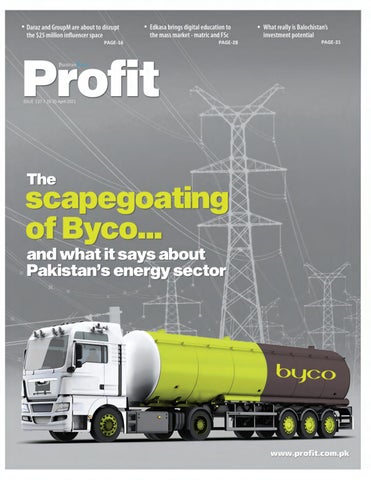
16 16 Daraz and GroupM are about to disrupt the $25 million influencer space 20 The scapegoating of Byco…and what it says about Pakistan’s energy sector
26
26 An open letter to the chief blocking officer at the PTA 28 Edkasa brings digital education to the mass market - matric and FSc
31 31 What really is Balochistan’s investment potential
Profit
Executive Editor: Babar Nizami l Managing Editor: Farooq Tirmizi l Joint Editor: Yousaf Nizami Reporters: Ariba Shahid l Babar Khan Javed l Taimoor Hassan Abdullah Niazi l Meiryum Ali l Shahab Omer Director Marketing: Zahid Ali l Regional Heads of Marketing: Muddasir Alam (Khi) Zulfiqar Butt (Lhr) l Mudassir Iqbal (Isl) l Layout: Rizwan Ahmad l Photographers: Zubair Mehfooz & Imran Gillani l Business, Economic & Financial news by 'Pakistan Today' Contact: profit@pakistantoday.com.pk
Readers Say One of my businessman friends once told me that essentially no business in Pakistan maintains clean books. They all maintain two books to do heavy tax evasion. Is this the reason why international auditors are exiting the Pakistan market? Apropos: The auditors want to leave @umarsaid, Twitter Partly yes. This seriously restricts their market. And with the recent sugar forensic report, it is clear that this entire sector is unauditable. Back when I was CEO of Deloitte Pakistan, and this was several years before I decided to quit, we took principled decisions not to accept any audits of sugar companies. The entire business of the big four is managed by the tenet "which client to accept and which not to accept," especially in the audit business. They have learned from past experience that if you accept a wrong client, even at a lucrative fee, it proves to be much more costly and may cause total destruction in the long run. However, saying that "no business in Pakistan maintains clean books” is exaggerated, as there are many wonderful exceptions. Few sectors, MNCs and certain businesses (a small number) in most sectors do maintain credible books, at least those that are audited by larger firms. Also, a few minor errors in reporting. When I left Deloitte Pakistan in 2017, its revenue was around Rs 900 million (approx $8 million), not Rs 500 million. Not sure about the current revenue, but if we assume the same levels, in dollars, may have been reduced to less than $6 million. I also think that KPMG’s revenue is understated. The major issue for the profession and for Pakistan, is the very low level of fees. Neither the private nor public sector is willing to pay reasonable fees to obtain good quality advice, as our bureaucrats and Seths think they are smart enough to manage on their own. So poor outcomes shouldn't be surprising. Apropos: The auditors want to leave @Asad_AShah, Twitter
facebook.com/Profitpk twitter.com/Profitpk linkedin.com/showcase/13251020 profit.com.pk profit@pakistantoday.com
HOW TO CONTACT
7
Yousaf Adil had years of litigation amongst the local partners. I think it has proved to be baggage for Deloitte, even from a turnover point of view. Largely books are neat but still audit is a risky game all over the world and risk is increased when auditing in a cash dominant economy. Apropos: The auditors want to leave @aamirshahbaz, Twitter Out of the big four, Deloitte exited last year, and the other three are exiting soon. But I want to drive your attention towards the organizational culture these firms have. They are treating CA interns worse than slaves, paying
sometimes as low as Rs 200 per day for 12 hours of work just by avoiding registering with ICAP. Apropos: The auditors want to leave @be_wquat, Twitter So what exactly are the auditors doing then if they are not able to find the discrepancies out on their own? And let us say that the management is capable enough to hide their double books, then these auditors must not have made sure to satisfy themselves about if such risk exists before they take on the job. What a stupid excuse to leave. Apropos: The auditors want to leave @darkayria, Twitter Normally, international auditors do not audit businesses or sectors where it is normal to have two books. They have high standards of risk assessment. Their prime consideration is to cover their own reputation risk. They carry a big responsibility in front of their stakeholders as well as the fact that they have to face the heat of regulators, which cannot be ignored. Apropos: The auditors want to leave @murtazamahmud, Twitter Globally the most sought after qualification for Management Consultants is an accredited MBA. In Pakistan, a non ICAP cannot be a partner at any of the big four companies. Globally, the most sought after qualification for a CFO is an accredited MBA but in Pakistan it 's exclusively reserved for ICAP. Apropos: The auditors want to leave @AnayaKhan2021, Twitter This has more to do with the audit framework in Pakistan. Only ICAP members can sign audit reports in Pakistan and to carry out an audit in Pakistan, your firm must be registered with ICAP. So naturally CA's became dominant when the firm expanded. From my personal experience, my firm is continuously working for more diversity, but things can't change overnight and therefore challenges remain. Apropos: The auditors want to leave @ORC1996, Twitter Lack of the big four in Pakistan will also mean limited overseas jobs for our accountants. Pakistani accountants are able to secure overseas jobs purely based on their big four tags that they carry very proudly. In my experience with EY and KPMG UK, you don’t normally find a Pakistani who isn’t big four trained. This will hurt a lot in the long run! Apropos: The auditors want to leave @mudassiraslam, Twitter
COMMENTS
IN BRIEF The Iranian Consul General in Peshawar, Hamid Reza Ghomi, has said that efforts are being initiated to sign a free trade agreement between Iran and Pakistan. He said that Iran wanted to boost bilateral trade and economic relations with Pakistan to strengthen the regional economy.
$500 million:
Prime Minister (PM) Imran Khan has said the implementation of Pakistan Single Window (PSW) will bring $500 million annual savings and reduce cargo clearance time from days to hours by integrating over 75 regulatory departments.
“Pakistan and Germany have high prospects of cooperation in trade and investment and I am confident that the new consulate will speed up development in this regard. A consul general would be appointed at the Munich mission to supplement the diplomatic efforts of embassy in Berlin,” Foriegn Minister Shah Mehmood Qureshi announcing the opening of a consulate in Munich
The Economic Coordination Committee (ECC) of the Cabinet has withdrawn customs duty on import of cotton yarns and waived 66 per cent take-or-pay commitment in power purchase and gas supply agreements for three public sector RLNG-based plants. Finance Minister Hammad Azhar presided over the meeting.
Prime Minister Imran Khan, at the foundation ceremony for a project of the Naya Pakistan Housing Scheme, has said the government’s special focus on the housing and construction sector would strengthen the national economy, stabilise industrial growth and generate employment for youth.
The Competition Commission of Pakistan (CCP) has expressed reservations over the Punjab government’s decision to fix sugar prices, warning that it would cause movement of sugar from Punjab to other provinces apart from having other consequences. The commission in its Policy Note advised the government to deregulate the sugar industry to promote free trade mechanisms.
he federal government has estimated 3 percent GDP growth for the ongoing fiscal year (FY21) and 4.2pc GDP growth for the next fiscal year (FY22). According to sources, the government has planned to allocate Rs 450 billion for subsidies in the next fiscal year budget. On the other hand, the IMF has projected Rs459 billion subsidies for the ongoing year and Rs 530 billion for next year.
8
Twitter blackouts and another finance ministe this week in Pakistan’s business and economics twitterverse
If last week was slow, this one made up for it with a whole load of crazy.
Profit’s reporter Ariba Shahid analyses the business and economic highlights from Pakistani Twitter this week.
CFAs, it’s nothing personal
L
ast week we said it had been a slow week. The world might have taken just a bit of offence to that, because this week threw the kitchen sink and then some at us for the social media roundup, and that was despite social media in Pakistan (including Whatsapp) going down for a few hours on Friday. There is a lot of ground to cover this week, with the cute little boy in that old picture with Imran Khan now being the former finance minister after a 19 day stint at the job, which makes us feel a little silly for discussing him as the PTI’s new posterboy, but not nearly as silly as it must be making the PTI bots feel that are now talking about the experience and maturity Shaukat Tareen brings to the job, not even three weeks after they were celebrating the injection of fresh blood and new ideas into the finance ministry. We look at all this, the creeping and grubby hands o influencers in politics, why everyone that says they are a finance guru is not a finance guru, take stock of this week’s memes and try to asses the crazy side of twitter and more, as Profit’s Ariba Shahid brings you our social media roundup.
10
Just because you have a CFA doesn’t mean you’re a finance guru or even good at finance. Azam Khan shares his hiring woes with twitter. We also might point out that while Azam takes a more analytical approach and mentions retention and what is being taught to them, we would venture as far as to say most people claiming to be finance gurus are not really finance gurus, despite any qualifications that they may hold. Then again, this holds true for most things, there are countless talking heads out there.
Important lessons Dr Adnan Haider from IBA karachi comments on investment in unproductive assets that bring up capital gains on sale only. These assets do not produce any output as a result do not bring economic benefit and are just merely held.
Dr Adnan Haider from IBA karachi comments on investment in unproductive assets that bring up capital gains on sale only. These assets do not produce any output as a result do not bring economic benefit and are just merely held.
Tilting at windmills
As kids, we were often told that we shouldn’t act crazy. That’s the whole schtick with growing up. But apparently, if you’re a startup founder, some level of craziness is encouraged. We could trace a long history of the ‘mad genius’ character archetype, but madness is encouraged in the hopes that someone will come up with an idea crazy enough that it will actually work. “The lunatic, the lover, and the poet are of imagination all compact,” writes the Bard. We wonder if he would have added ‘startup founder’ if he were writing in our day and age. In all seriousness, it might take a very, very, crazy idea to get the team at Profit to follow deadlines. Right now we have Asana, but we invite all those crazy dreamers out there to make the lives’ of our senior editors easier.
Influenza threat
The GoP of Pakistan tried to pull off a PR masterclass. They invited people that are known for supporting the PTI (despite some tinelt criticism), who were invited to meet the PM and question the new finance minister. Like any regular PR exercise they were given the chance to ask questions, which in Pakistan is good enough to win these people over and eventually return back to their homes singing the praises of the government for giving them some attention. Influencers? More like influenza. Sadly, this wasn’t voluntary, it was the government using them knowing very well what they were doing, as @rogueonomist points out.
Another one? Seriously? Internet, we have a problem We don’t mean to shame the government for having a fourth finance minister in 30 months, but that is definitely a high rate of turnover. Bilal Moon, a serial investor (as per his twitter), thinks that Imran Khan is running an MT program. Well, does that mean this reporter could be finance minister for a day, maybe an hour? Regardless, the government has had 4 finance ministers in 30 months. God only knows how many more are to come. Similarly, Osman Mohiuddin, ex banker and startup founder, says the situation we’re in is reminiscent of 2010. So if you’re wondering where the tabdeeli went, and came and went in 19 days in the shape of Hammad Azhar.
No internet. No social media. Is this second degree censorship? That said, how would we have done this roundup without the internet? VPN maybe? Of course not, we would never do something like that. We at Profit are all law abiding citizens to the greatest degree. We don’t even know what a VPN is. We would also like to apologise to all internet providers unfairly cussed and shouted at before everyone realised it was the government blocking social media sites and not PTCL’s fault (this time).
While this isnt Pakistan centric, the Pakistani admiration for dogecoin, a meme inspired crypto is not a surprise considering the country is meme obsessed. We haven’t had this much fun since GameStop.
SOCIAL MEDIA ROUNDUP
12
E
By Profit
very day, the call to prayer is made five times a day to remind you of your obligation to pray. Every year, announcements regarding the beginning of the Holy month of Ramadan and Zill Hajj remind you of your religious obligation to fast for a month and perform Hajj at least once in your lifetime, depending upon your financial situation. However, in the case of Zakat, the announcement is a little more understated. There is no announcement on the mosque speaker and no committee to come on television and remind you of this religious obligation. The only reminder comes from the government of Pakistan when it announces Nisab each year, which is a minimum rate that is used as a threshold to determine if Zakat is obligatory on you. For this (lunar) year, the government has fixed Rs80,933 as Nisab for Zakat. Based on interviews of Islamic scholars, Profit explains what is included in Nisab and how you can calculate your Zakat amount based on your Nisab.
Working definitions and calculations
W
hile the government has fixed the Nisab limit, quite simply, Zakat is obligatory on each and every Muslim who is in possession of wealth and income that is equal to or greater than the Nisab limit. Each Muslim, if they want to find out if Zakat is obligatory on them, therefore, has to calculate their own Nisab. Nisab can be calculated individually by simply calculating the difference between the value of one’s zakatable assets and one’s zakatable liabilities (explained later). For instance, if person A owns assets worth Rs100,000 and their liabilities are Rs10,000, the difference between their assets and liabilities comes out to Rs90,000, which is that person’s Nisab. Since this value is greater than the Nisab limit set by the government, Zakat is obligatory on this person. However, there’s a certain distinction between the assets on which Zakat is due. While calculating Nisab, all forms of assets cannot
be accounted for. For the purpose of Zakat, following assets are to be considered i) gold and silver, ii) currency in any form iii) tradable goods iv) livestock v) minerals and vi) agricultural produce. Gold and silver are zakatable in all forms, for whatever reason it is owned, whether it is under use or not - so this includes any gold and silver jewelry if it is worth more than the Nisab amount. Zakat is also due on any currency you hold, whether it is savings in a box at home, bank deposits, or money that you have lent to someone. It also includes committee savings, money that is saved for Hajj or marriage, and bonds. Essentially any cash that you are holding without the intention to spend it has Zakat due on it. The third category is trading goods. This is a little more complicated to categorise, and for this the conscientious person must peruse their intentions more closely. For the purpose of Zakat, anything would be considered a trading good if it was acquired with the purpose of reselling it. So if you buy a plot, for example, with the sole intention of selling it in the future, that piece of real estate is a Zakatable asset. The value of such assets is calculated on the basis of their approximate sale price rather than their purchase price. However, if the intention for buying was to one day use the real estate, or to simply park excess liquidity in a long term asset with no intention of selling it for now, it would not become part of the Nisab. Receivables in all forms also need to be included for calculating Nisab. Though doubtful receivables are zakatable only when they are received. For instance, if you receive them next year, they would be calculated for Zakat for the year they would be received and when Zakat is due. For receivables that you are unsure about if they would be received or not, deferring is allowed and when these receivables are collected, paying Zakat would be applicable for the previous years as well. Similar to receivables that are doubtful, bad debts, which are receivables that have close to no chance of being recovered, can be also taken out of Nisab calculation, but with one extra distinction: If a bad debt is recovered, Zakat on it will not be due for the previous years. Liabilities can range from short-term liabilities to long-term liabilities. Few examples of liabilities can be loans taken for personal use,
utility bills, employee salaries, Zakat for previous years. It also includes committee installment if the committee savings have been collected in full already. Liabilities can also come in form of taxes payable to the government or installments for goods that have been purchased. For the purpose of accounting Zakat, only liabilities that are payable immediately are considered. For instance a loan installment that is due when you are calculating your Zakat obligation. But if you have a liability of a loan that is due next year, it can not be accounted for calculating Zakat in the present year. A particular distinction is made about loans that are taken to procure raw material for production of trading goods. These loans are considered liabilities and can be discounted while calculating Zakat. Whereas loans procured to buy fixed assets can not be discounted. So this is the very simple formula. You look at your assets and whether or not they fit any of the five categories on which Zakat is due, and then you calculate your liabilities. Subtract the liabilities from the assets, and if the amount you have left is over the Nisab limit set by the government, then you will have to pay 2.5% of that amount as your Zakat, which is the standard rate. Let us take an example. Assume you have savings worth Rs100,000 and you possess gold worth Rs100,000 and you have no outstanding receivables. Both savings and gold are zakatable. On the liabilities side, you have, let us say, Rs15,000 in utility bills, Rs15,000 again in children school fee and another 15,000 in loan payment that is due immediately, your total liabilities would add up to Rs45,000. Your Nisab would be the difference between the value of assets and liabilities, which in this case is Rs155,000. Since Rs155,000 is above the Nisab limit of Rs80,933, Zakat is obligatory to pay. Going by the standard rate of 2.5% (which is applicable not on the Nisab limit (Rs80,933) but on the individual Nisab amount (Rs155,000 that you calculated), the amount due in Zakat for this person would be Rs3,875 (2.5% of Rs155,000). (Note: In case Nisab is not fixed by the government, the standard rate is the rupee value of 52.5 tola silver according to market rate. In case a person only possesses gold and has no other asset, the Nisab rate in that case would be rupee value of 7.5 tola gold)
Of course, there is no Zakat due on a company or an organization, because businesses do not have On calculating Zakat a faith and are exempt from this kind of religiously for businessmen shareholders mandated taxation. However, while businesses do not andaying Zakat each year is a very personal owe any Zakat, for the people that own them the net and sacred process for Muslims. Of course, there is no Zakat due on a Zakatable assets of the businesses would become part company or an organization, because of their individual Nisab businesses do not have a faith and are exempt
P
PERSONAL FINANCE
from this kind of religiously mandated taxation. But most of the time, questions that come to religious scholars are about jewelry, and real estate and savings. However, while businesses do not owe any Zakat, for the people that own them the net Zakatable assets of the businesses would become part of their individual Nisab. Let us start with the case of a business that one own’s partially or fully. In case of a medium size business structured as a partnership or a private limited company, for instance, Zakatable assets are going to be computed based on one’s shareholding in the business. So if you own a company and hold 51% of the company, whereas your partner holds the remaining 49% of the company, how will Zakat be figured out? The calculation is simple. If the company has current assets worth Rs 50 million and current liabilities worth Rs25 million, the total value of Zakatable assets would be Rs 25 million. The Rs 25 million would be paid off according to ownership percentage. You (with 51%) would be required to pay Zakat on Rs 12.75 million, which amounts to Rs318,750 at 2.5%. Your partner (with 49%) would be required to pay Zakat on the remaining Rs 12.25 million at 2.5%, which comes out to Rs306,250. And in case the business is owned completely by one person, Zakat would be calculated on 100% ownership. Then there are instances, like in the case of publicly listed companies, that shares are bought that also reflect ownership in the company. If you are a shareholder in a company, Zakat is obligatory on you regardless if you have bought shares for the purpose of trading or if your intention is to keep the shares and receive dividend income on them. In the case the shares were bought to trade, Nisab is going to be calculated on their market price. This means that your shares are like other tradable goods and their Zakat value is what the market price of these shares is. For instance, if you are a shareholder in Engro Corporation and own 100,000 shares that are in your possession on the date Zakat is due, Zakat would be applicable at 2.5% of the market value of these shares. For more clarity, if your Zakat is due on the 3rd of Ramzan. The closing price of Engro Corporation’s share for the 3rd of Ramzan was Rs289.10 per share. For the 100,000 shares of Engro Corp that you own, the cumulative market value of these shares
based on the closing price on the day your Zakat is due computes to Rs28.9 million. At 2.5%, Zakat on these shares comes to Rs722,750. Things become a little different, however, if you purchased these shares with the intention of receiving dividends at the year end. Zakat in this case would be calculated based on the zakatable book value of the shares rather than
If you buy a plot with the sole intention of selling it in the future, that piece of real estate is a Zakatable asset. However, if the intention for buying was to one day use the real estate, or to simply park excess liquidity in a long term asset with no intention of selling it for now, it would not become part of the Nisab 14
the market value of these shares. In this case, for the purpose of calculating Zakat, the Zakatable assets of the company need to be calculated after discounting the Zakatable liabilities of the company to compute Zakatable value of the share you own. Roughly, the difference between the current assets of the company and current liabilities would give the value of Zakatable assets of the company. Let’s take the case of Engro Corporation again. The value of total outstanding current assets of Engro as per the latest annual report 2020, is Rs226.5 billion. Whereas the total outstanding current liabilities of the company are Rs143.26 billion. The total Zakatable value of the company comes to Rs83.24 billion. The Rs83.24 billion amount, however, is
of the total outstanding shares of the company. A simple division would yield the value of the individual Zakatable share. In the case of Engro Corp, the total number of shares as on December 31, 2020, are 576.1 million. Based on these numbers, the value of a single share comes out to Rs144.4. Since you, as an individual, own 100,000 shares in the company, the total monetary value of your shares that are Zakatable would be Rs14.4 million. That is the amount that is Zakatable at 2.5%, which comes out to Rs361,000. (Disclaimer: The calculations above represent the general framework around calculating Zakat in simple cases. The case of Engro Corporation in this piece is used as an example to illustrate the general framework around calculating Zakat if you are a shareholder in a public company. The case of companies like Engro Corporation is a little nuanced, however, since such conglomerates further have ownerships in other companies. Therefore, it is best to consult a shariah scholar to understand any nuances in individual cases before undertaking any calculations and giving Zakat)
When is Zakat due?
I
t is a little tricky pin this one down, especially if you haven’t been paying Zakat while you have been making assets for yourself. For instance, if you are thirty years old but started earning from the age of 20 and made assets on which Zakat is due, the date on which you first time became Sahib-e-Nisab, that is achieved enough wealth that Zakat was obligatory on you, is the date you should pay your Zakat each year. So if a person became Sahib-e-Nisab on the 1st day of Muharram, each year onwards, his Zakat obligation would be due on the 1st of Muharram. It is on this day that he should calculate all his assets and liabilities. It is important to note that Zakat date is to be determined
according to lunar years. All the gains in wealth prior to this day would be accounted for in the calculation of Zakat, whereas all the losses the day after would not be deducted from Zakat. Therefore, it is important to monitor one’s career progression and when for the first time a person becomes Sahib-e-Nisab. However, it might be a little difficult for some people to ascertain when, for the first time in their life, they became Sahib-e-Nisab. Scholars consulted for this piece said that in case a person is not able to remember the exact date, he or she should take an educated guess around when they might have for the first time become Sahib-e-Nisab. For instance, when someone received his first salary might be the day when Zakat became obligatory on them. For some women, it might be the day of their marriage when they received
dowry from their parents and Zakatable assets like gold or silver came into their possession. It is only in the case that someone has not even the slightest idea that when was the first time he or she became Sahib-e-Nisab that the person can arbitrarily choose a date in the Islamic calendar to be the date when he pays Zakat. Each year onwards, he would calculate Nisab on the same date. It also goes to dispel the notion that Zakat should only be paid, as beliefs exist, on the 1st of Ramzan only. No, Zakat can be calculated on other dates as well, depending on what date the person has chosen for himself in case he does not remember when was the first time he became Sahib-e-Nisab. However, there is a condition under which the date can change. The Zakat date can be changed when a person goes totally bankrupt and is not Sahib-e-Nisab anymore. In this case, his Zakat date would be the date when he becomes Sahib-e-Nisab again. n Editor's note: This article is based on interviews of scholars of the Sunni Hanafi school of jurisprudence, which is followed by the majority of Pakistanis. For specific questions please write to us at profit@pakistantoday. com.pk and we will try our best to get these answered by competent shariah scholars.
PERSONAL FINANCE
By Babar Khan Javed
T
he latest data from Sensor Tower pertaining to Pakistan shows that half of the top ten apps downloaded in Q1 2021 were social media apps such as SnackVideo, Snapchat, TikTok, StarMaker, and Likee. These apps
16
allow their users - also known as social media content creators (SMCC) - to upload videos, clips, and images of themselves in a range of creative activities, attract a following and monetize their audiences through deals with media agencies and advertisers. As repeatedly reported by Profit, the tactic of using SMCCs to help advertisers raise awareness, grow trust, and lift consideration is proving to be an effective
component of business-to-consumer (B2C) tools. Popularly referred to as influencer marketing, the repeated use of the tactic has spurned Pakistan-based platforms such as DEN, Walee, Amplifyd, and Bradri. In speaking with researchers at firms such as Ipsos and Kantar, Profit was told that considering the findings from post-campaign effectiveness research exercises - which include conjoint analysis,
Zaltman metaphor elicitation technique, netnography - marketers are learning that one-way advertising is gradually declining in terms of recall, positioning reinforcement, and engagement. These include television commercials, as well as advertising on the radio, print, and out-of-home advertising, with the marketing community actively seeking alternatives. One such alternative appears to be using SMCCs who create seemingly off-the-cuff and unpolished content, appear relatively relatable and approachable to the Generation Z populace. “The extent to which the salesperson was perceived to be likable and similar to members of the buying firm and frequency of business contact with the salesperson had significantly positive effects on the trust of the salesperson,” said celebrated researchers Patricia Doney and Joseph Cannon in their critically acclaimed 1997 paper “An Examination of the Nature of Trust in Buyer-Seller Relationships” in Journal of Marketing Vol. 61. “In general, trust of the supplier firm and trust of the salesperson influenced a buyer’s anticipated future interaction with the supplier.” Applying the rationale that the new normal in Pakistan with Generation Z suggests high signals of trust with SMCCs, the incoming investments from the largest online marketplace in Pakistan and the largest media investment company in Pakistan are about to disrupt the current status quo by which SMCCs can earn the title of influencer.
GroupM will use its size to regulate the market
I
n speaking with Profit, executives from the largest media investment agency in Pakistan have shared that their influencer marketing campaign management solution - INCA - will roll out for large, medium, and small advertisers nationwide by Q3 2021. “As marketers, you always continue going back to the drawing board in terms of your value proposition,” said Naveed Asghar, CEO of GroupM Pakistan. “From time to time, you see brands doing a launch or relaunch in order to strengthen the overall value proposition. The same is the case with us that we have seen the market for influencer marketing grow leaps and bounds across the globe and even here in Pakistan.” In 2017, GroupM introduced a campaign management tool called MFluence which allowed advertisers to view a database
of SMCCs, including their self-reported audience insights, and pricing. While executives from GroupM that spoke to Profit would not disclose whether an application programming interface (API) would be used to bridge SMCC accounts with INCA, they did say that the tool would rank SMCCs based on engagement rates instead of follower counts. This mirrors the approach used by G&B, an influencer management firm. “The initial screen test to see about fake followers is the engagement to follower ratio,” said Kyle Hjelmeseth, the founder & CEO of G&B, in a statement to Profit. “A lot of fraud detection tools use this as an initial screen of whether or not an account bought followers. But, it’s important to analyze that sample properly and take a ‘statistically significant’ sample of the influencer’s followers and then determine how many are “fraudulent accounts” or bots.” Asghar told Profit that INCA would allocate SMCCs to advertisers based on alignment first with the target audience and then by the type of product, acknowledging that SMCCs and the platforms they occupy are just touchpoints for marketers. “In this market, INCA might even open doors for us to penetrate into other accounts - the SMEs so to say - which at times have budgetary constraints and this kind of solution can certainly help us give them a reason and a way to utilize their marketing budgets which are relatively small yet give the right return rather than trying to give them a solution that spread them too thinly across multiple mediums,” said Asghar. “This could be a replacement, giving them a focused and targeted approach of getting traction with relatively smaller budgets.” That said, the WPP media agency is once again dipping its toes into a space that lacks a level playing field, expecting SMCCs to abide by brand safety guidelines, register themselves as taxpayers, and make a drastic change to how they conduct themselves off-camera to limit controversies for the advertisers they are aligned with. As the only SOX-compliant media agency in Pakistan, GroupM cannot reportedly conduct itself as its competitors can. “We are a very compliant, transparent, and ethical company that operates in this domain,” said Asghar. “And in fact, that might come back to haunt us at some stage because others have an unfair advantage for resorting to certain tactics. That’s a risk that we are absolutely okay to live with but we’re not going to stoop down to their level.” Asghar firmly resisted the idea that a case is made that the regional headquarters of GroupM gives the Pakistan team leeway
to localize their go-to-market approach, stating that two wrongs do not make a right. He believes that in staying the course of doing business the right way, the market will adapt and follow suit. “We have been doing influencer marketing on a small scale here and there and all the influencers that we worked with earlier, in the beginning, were not tax registered but they did,” said Amna Khatib, the chief digital officer of GroupM Pakistan. “Rather than us changing the rules and doing something wrong, [SMCCs] will realize that if they want to work with GroupM they have to be tax registered which will actually create the right shift for everybody.” She said that SMCCs that want to approach the monetization of their audiences as a business will register themselves while those that look at the field as a hobby will not, with GroupM preferably aligning itself with those that take the work seriously. She said that the team in Pakistan will adhere to regional guidelines on how to onboard SMCCs. “INCA doesn’t believe in reach, only outcomes which are engagement,” said Ateeq Rehman, chief investment officer at GroupM. “Even if someone has good reach but how effective they are [means that] the market will move towards a much more realistic delivery parameter which is why INCA promises guaranteed outcomes.” Similar to how it approaches digital publisher inventory on Xaxis, GroupM does plan to place a select number of SMCCs in a private marketplace (PMP) within INCA, allowing advertisers to use SMCCs with lookalike audiences that match the specifics of their respective target audiences. The media agency will approach the monetization of INCA - be it flat fees, retainers, performance based on targets, media commission - based on the size and goals of clients. “INCA would be a product where we would have that level of flexibility,” said Asghar. “We will have the door open to pitch INCA to non-GroupM clients because why should we confine our services but I think there would be enough demand & traction from our clients, to begin with, that our hands will be quite full, there’s no restriction per se.” Khatib told Profit that authentic content will be heavily weighted within INCA in ranking SMCCs, preferring those that are original and high quality, as well as those that resonate with audiences enough to generate organic shareability and not just consumption. She noted that today advertisers use SMCCs at the last minute to amplify their campaign reach, which she said would not
ADVERTISING
“From time to time, you see brands doing a launch or relaunch in order to strengthen the overall value proposition. The same is the case with us that we have seen the market for influencer marketing grow leaps and bounds across the globe and even here in Pakistan” Naveed Asghar, CEO of GroupM Pakistan
happen under her watch, with SMCCs engaged early on as a sophisticated piece of the campaign rollout and buyer decision journey. “The influencer will be remunerated based on the sort of results they generate and not just because they are a big name who may not have the right quality of following,” said Khatib. “So the absence of quality following will not dictate the money offered, the quality outputs will dictate the money that should be given. Because it’s an unregulated industry, influencers’ [payments are based on arbitrary factors] and these are practice variables which will improve.” In this way, Profit believes that INCA will allow GroupM to compete at a much more sophisticated level against competing platforms, small media & digital agencies, multichannel networks, and the forthcoming content marketing initiative from Daraz.
Daraz will change how advertiser value SMCCs
T
he leading online marketplace is tapping into SMCCs such as Tabish Hashmi as the face of a new content marketing initiative which will help the business retain eyeballs and drive contextual sales on the back of a shopper-entertainment experience. Within the Daraz app, the company plans to publish programs in the genre of comedy, cooking, fashion, and game shows, all of which either display a product that can be purchased in real-time on the Daraz app or will proactively offer viewers - through the app - a chance to either win one or win digital cash that only is redeemed on the platform. “TV viewership has decreased year on year, billboards have also decreased, traditional advertising consumption is decreasing,” said Pireh Shafiq, the public relations and user communications lead at Daraz. “Only the first ten seconds of video content
18
is consumed on digital assets as well. Advertising needs to be more consumable and relevant, consumers are avoiding advertising, we need to adopt more entertainment-based marketing. Content marketing is a growing area for marketing and education as well. Content marketing is far more than what we are doing.” Recognizing that the only reason people open the Daraz app is to make a purchase, while also admitting that the daily active user (DAU) rate spikes when the online marketplace offers exorbitant discounts, Shafiq said that this investment into creating entertaining content is meant to give people more reasons to visit Daraz. “People don’t only go to a mall for shopping, reasons to visit need to increase, [such as] entertainment, bills, etc,” she said. “Lazada has also adopted this strategy, they recently invited Katy Perry and saw great success in terms of numbers.” Simulcast across six countries on the 26th of March to kick off its ninth-anniversary celebrations, Lazada Super Party was a virtual concert created by Alibaba-owned Lazada. Hooking viewers in to watch live musical performances, the eCommerce company offered its customers across Indonesia, Malaysia, the Philippines, Singapore, Thailand, and Vietnam to tune in via the in-app live stream channel LazLive and partake in the birthday sale for the platform. According to Lazada, more than 80% of local LazMall brands had participated in the one-day birthday sale, reportedly earning RM9,500 for every RM1 invested with the sponsored product discovery tools of the marketplace. “During Ramadan, since our user base and general masses are more inclined towards entertainment content, we have also seen great examples of TV shows focusing on interactive game shows for better ratings,” said Shafiq. “Daraz wants to move away from just a discount-based online shopping platform, our app backed by Alibaba tech has much more to offer in terms of entertainment, browsing, games, and bill payments –
shopping should not be the only reason users visit Daraz.” Profit believes that this initiative by Daraz will result in a new standard of measuring the value of SMCCs, one which looks at the average gross merchandise value (GMV) they have helped businesses move and the ratio between said GMV being fullpriced versus discounted. This, Profit believes, will matter much more - as it rightly should - than the vanity metrics SMCCs are currently priced based on, such as followers and engagement. It will be the impact SMCCs have on moving GMV which will truly result in them earning the right to call themselves influencers, which is a term this scribe actively avoids using when covering SMCCs due to their value being measured by advertisers based on vanity metrics. The SMCC with a million followers and the ability to move a billion rupees of GMV will be much more valuable to advertisers than the SMCC with ten times that following and one percent of that commercial influence. Think of it as the average revenue per follower. Furthermore, Profit believes that Daraz will list its top GMV moving SMCCs on a localized version of AliMama, the key opinion leader marketplace by Alibaba. The detailed insights within this could further segment and rank the SMCCs by the ratios comparing GMV moved at a discounted price versus a full price, which is the difference between commoditizing a product and allowing it to retain its brand equity. At scale, this decision by Daraz could fundamentally change the way advertisers and media agencies price SMCCs, including the role they play in the buyer decision process by virtue of GMV, moved and the recorded average revenue generated per follower. Profit believes that this initiative, coupled with the launch of INCA and the mainstreaming of competing platforms will disincentivize SMCCs from seeking fake followers and engagement, focusing more on quality content and their salesmanship. n
ADVERTISING
20
COVER STORY
By Ariba Shahid
“S
omeone must have been telling lies about Joseph K., for without having done anything wrong he was arrested one fine morning.” Thus begins Franz Kafka’s novel The Trial, one of the most important works of European literature. There are days when the Byco management and shareholders must find themselves relating well with the tribulations of the fictional Joseph K. In recent months, Byco has found itself in the news for all the wrong reasons, and it usually stands accused of doing something that it later transpires it had never come even close to doing. Creating an artificial shortage in the Pakistani oil market? Apparently Byco has the power to do that. Violating international sanctions? Accuse Byco. Defrauding state-owned oil companies? Sure, why not? Throw that accusation onto the pile too. Some of the accusations are just utterly ridiculous, like the one about Byco being responsible for causing the oil shortages in Pakistan in 2019. Byco simply does not have the kind of market share to be able to do that, and data presented in the government’s own inquiries found that Byco’s storage capacity was in fact responsible for helping ameliorate the crisis rather than exacerbating it. Strangely, the government seemed unwilling to state that fact, even though its own numbers said as much. And other accusations are really because officials at the National Accountability Bureau (NAB) do not seem to understand the concept of receivables and payables on a company’s balance sheet. This story is not about those accusations or a debunking of them. The above paragraphs are sufficient to address the seriousness of the charges in question. Instead, this story is about why those accusations have been made in the first place, who has the most incentive to make those accusations and why, and what their existence says about the state of play in Pakistan’s energy sector.
22
It is an examination of a company that is emblematic of Pakistan’s private sector oil and gas companies: trying to serve the country’s energy needs while competing against some of the biggest oil and gas giants in the world, and hamstrung by a regulatory environment that places them in a bad halfway house between market-based pricing and government-controlled pricing. Why does any of this matter? Because Byco is Pakistan’s largest refinery company and one of its larger oil marketing companies. What happens to this company is reflective of important trends in Pakistan’s oil and gas sector.
Byco’s origins
T
he story of Byco starts with that of its founder, Parvez Abbasi. Born in 1940, Abbasi attended Government College Lahore, from where he graduated in 1960 and joined Shaw Wallace Pakistan, a shipping and trade finance company that was the local subsidiary of RG Wallace, a UK-based company. He worked there for nine years before moving on to working at Caltex Pakistan, the local subsidiary of what is now the American oil giant Chevron. Abbasi stayed at Caltex for the next ten years. That experience working in both shipping and oil marketing gave Abbasi the kind of expertise one would need to set up their own oil company in Pakistan, which he was eventually able to do in 1995, when he set up Bosicor Pakistan Ltd, an oil refining company. But while Bosicor was set up in 1995, construction of its refinery did not begin until 2001, and its refinery did not start production until 2004, when its refinery in Hub, Balochistan started production. The refinery started off with a capacity of handling just 8,000 barrels of crude oil per day but grew to a capacity 30,000 barrels per day within its first year. In 2009, the company renamed itself Byco. In 2007, the company launched its petrol retailing business, opening up its first petrol pump in Sukkur. In 2008, the Dubai-based Abraaj Capital bought a 40% stake in the company. The injection of that capital allowed
Byco to begin work on the country’s largest oil refinery, with a capacity to handle up to 120,000 barrels of oil per day. That refinery was completed by 2012, and became part of the publicly listed entity of the group by 2017. Combined with the enhanced capacity of its first refinery of 35,000 barrels per day, Byco’s total capacity to refine oil is about 155,000 barrels per day, making it the 105th largest refinery company in the world, and the largest in Pakistan. Previously, the largest refinery company in Pakistan was the Pak Arab Refinery Company (PARCO), which is a 60-40 joint venture between the governments of Pakistan and the emirate of Abu Dhabi, and has the capacity to refine 100,000 barrels per day of crude oil. The next largest refinery company in Pakistan after Byco is the Attock Group, which owns the Attock Refinery as well as a majority stake in National Refinery Ltd. If PARCO is able to finish its massive Khalifa Refinery – with a capacity of 250,000 barrels per day – in Gwadar, it will regain its title as the largest refinery company in Pakistan. That second refinery is a reflection of the company’s ambition. In 2007, Byco was the smallest refinery company in Pakistan. By 2012, it was the largest, an achievement that the company invested $750 million in securing. To do this, the group imported a refinery that was owned by Chevron in Milford Haven, UK. The entire refinery was taken apart and moved to Byco’s 600-acre site in Hub, Balochistan where it has since been re-assembled and re-calibrated to operate in the Pakistani environment. It took almost two years – from 2007 to 2009 – just to move the refinery and another three years to reassemble it.
The refinery business – and why Byco is different
I
t is not just the size of Byco’s refinery that is impressive. What distinguishes this refinery is its ability to process crude oil beyond a level that other refineries in
The government says [oil prices are] deregulated. I have said this to the government and to [former Prime Minister] Shahid Khaqan Abbasi too that “Aadha teetar aadha batair” is the problem. Either go full teetar and regulate. There’s no harm. It was done in the past. Even go on and nationalize the industry or go on and change prices every 3 months. Everything used to work then too. So, if you want to regulate, go all in. If you do not, leave it onto us Mohammad Wasi Khan, board member at Byco Petroleum
Pakistan offer. Tucked away in the massive refinery complex at Hub is a small segment called the isomerisation unit, the first of its kind in Pakistan and the pride and joy of the company’s engineers. This unit allows the refinery to convert 12,500 barrels per day of naphtha into motor gasoline, commonly known as petrol. That may not sound significant, but in the world of refining, it is big news. Here is why: one of the most astounding things about the oil refining business is just how much of it is unprofitable. A plurality of the product produced by most refineries in Pakistan yield negative gross margins, meaning that they sell for below the price of the crude oil that went into making them. Approximately 50% of the refined products produced by most Pakistani oil refineries are furnace oil, liquefied petroleum gas, and naphtha. All three yield either negative gross margins or at best flat margins. Refineries make their money off diesel fuel and petrol, and even there, the margins are quite narrow, often in the single digits. Taken together, petrol and diesel constitute about 50% of the refinery’s production. If, however, a refinery is able to add the roughly 8% of its production that is naphtha and yields negative gross margins into petrol – which
yields positive gross margins – the refinery will significantly boost its profitability. Byco’s refinery may be old, but it is the only one in Pakistan that has the capacity to do so, which makes it one of the few that actively engages in value-addition in the refining business.
The collapse of furnace oil
S
o oil refining, as you can see, is a tough business. You make a loss on a substantial portion of your product because so much of it is furnace oil. “Around 25-30% of our product turns out to be furnace oil,” said Mohammad Wasi Khan, a member of Byco’s board of directors, in an interview with Profit. Now imagine if you could not even sell that product for a loss. What would that do to your overall cash flow and profit margins? That is the situation the Pakistani oil refining business finds itself in. “A few years ago, the local demand for furnace oil was around 9 million tons, of which 3 million was produced locally. The rest was imported. However, as of now, the total consumption of furnace oil in Pakistan is 2-2.5 million tons,” said Wasi Khan. What caused that change? In a word,
power. The electricity generation sector in Pakistan switched over from the much more expensive fuel source that is furnace oil to the much cheaper source that is liquefied natural gas (LNG). This was good for the economy overall because it meant Pakistan’s electricity generation costs went down, and it was also better for the environment. For the refineries, however, it has been a devastating blow. “Refineries are underutilised,” said Wasi Khan. “If they work at full capacity, they’ll have surplus furnace oil which if not sold in the country [anymore since the power sector switched to LNG], so it will have to be exported very cheaply because the global demand has decreased. The reason is because it hardly is used for power generation any more and our type of furnace oil is no longer sold as a fuel for ships because it is high-sulfur furnace oil. So, we make only that much that we can sell.” He is not exaggerating about operating below capacity. For the financial year ending June 30, 2020, Byco operated at a capacity of about 31%, and the highest it has ever operated at is 35% of total capacity. The company built up a massive refinery for a fuel mix that no longer exists, and hence most of its refining capacity has to sit idle. Of course, the refineries have a choice.
COVER STORY
They can either continue to keep their capacity idle, or they can invest in upgrading the capacity of those refineries to be able to further crack furnace oil to become lighter hydrocarbons that can be sold for higher prices. “Lubricant can be made from [furnace oil] and asphalt for roads. If you further crack it, you can make gasoline and diesel,” said Wasi Khan. Cracking refers to the chemical process by which heavier hydrocarbons present in crude oil are broken down into lighter hydrocarbons. Light and heavy in this case refers to the number of carbon atoms per molecule in each product. But of course, it only makes sense for refineries to make that investment if they know that they will be able to sell that refined product at prices that make sense for them. Unfortunately, the Oil and Gas Regulatory Authority (OGRA), which has the power to set prices in the country, does not have a pricing mechanism that is conducive to making that sort of investment.
The pricing problem
I
n theory, the prices of oil products in Pakistan are ‘deregulated’. In practice, however, the government is still in charge of setting prices. “The government says [oil prices are] deregulated,” said Wasi Khan. “I have said this to the government and to [former Prime Minister] Shahid Khaqan Abbasi too that “Aadha teetar aadha batair” is the problem. Either go full teetar and regulate. There’s no harm. It was done in the past. Even go on and nationalize the industry or go on and change prices every 3 months. Everything used to work then too. So, if you want to regulate, go all in. If you do not, leave it onto us.” “The best thing for the country will be to completely deregulate the downstream oil industry. Market-based pricing means [the government] can’t decide the prices. For instance, if there is an oil company that is free to set its prices, it will decide based on its inventory and its inventory price. It won’t sell at a loss and
24
will compare its prices to companies around it. Sometimes it might sell at a lower cost, sometimes higher. Ideally you need a regulator, which could be OGRA, to check if there are cartels and if they’re fleecing consumers.” Wasi Khan also said that he believes that OGRA could be effective at regulating margins without having to rely on price ceilings. “If you are leaving it free, then there is no point. Also, OGRA knows the price of the product in the Middle East. Diesel import with duties should be for Rs100 per litre, let’s say. If someone is selling at Rs105 or Rs110 per litre, that is not fleecing… The best thing to do would be put a cap on the margins as a percentage,” he said. If you cannot set your own prices, what incentive do you have to invest in improving your production capacity? There is no guarantee that the government will allow you to earn the cash flows you will need to pay off that investment.
The shortages and brittle supply chain
T
he problem with the regulatory mechanism goes way beyond pricing, however. If companies are not able to charge the prices they need to, they tend to run heavy losses, which is evident in the fact that all refineries in Pakistan frequently post negative net income. That would be bad enough, but the problem gets much worse during periods of high price volatility, particularly when global oil prices are declining. In periods like that, governments are often anxious to be seen as passing on the full effects of a price decline immediately to consumers, even though the oil consumed on any given day in Pakistan is usually something that was imported one month ago, and the prices for which were likely agreed three months ago.
If the global price suddenly drops from $60 a barrel to $40 a barrel, but the inventory for the oil marketing companies was bought when it was $60, the government cannot reasonably expect the oil companies to suddenly drop to the new prices. In a reasonable regulatory framework, that lower price would be allowed to be phased in with the same lag as exists in the supply chain: three months or sometimes even more. Alas, the government does not believe in being reasonable when it comes to oil prices and often tries to force oil companies to immediately pass on the effects of the lower prices and absorb any ensuing losses. And that problem of forced losses is made worse by the energy sector’s intercorporate circular debt – which is also caused by the government’s bad management, in this case of the electricity sector. The circular debt means that oil com-
panies in Pakistan are running on low cash reserves since so much of their payments are stuck in that circular debt. That means that when they are hit with a shock like the forced losses of lower oil prices, they simply lose the ability to access cash, which means they cannot pay for the oil they need to import, and so they import far less than the country needs, which results in massive oil shortages. This has now happened at least twice, once in early 2015, and again in 2019, with the country effectively running out of petrol for several days. Now, the government owns about two-thirds of the oil supply chain, through its ownership of Pakistan State Oil, as well as the oil exploration and production companies such as the Oil and Gas Development Company (OGDC), Pakistan Petroleum (PPL), Pakistan Refinery (PRL), and PARCO. And yet, somehow, they manage to blame the private sector for the supply shortages.
The blame game, and the allegations against Byco
I
n their interviews with Profit, the Byco management and board of directors were careful not to cast blame on absolutely anyone for the constant barrage of accusa-
tions the company has faced in the press in recent months. Yet, even a cursory glance at the nature of the allegations – and the incentives of the players involved in the industry – make it obvious as to who stands to gain from such allegations. Think about it this way: you are a civil servant who runs the petroleum ministry and have supervisory authority over OGRA. You are, in effect, in charge of the country’s oil and gas supply chain, and there is a sudden shortage of petrol that you should have foreseen, and for which the media is searching for someone to blame. What would you do? If you had integrity, you would come forward, accept responsibility, apologise to the public, and offer your resignation to the Prime Minister. Unfortunately, the Civil Service of Pakistan does not encourage that kind of personal accountability.
Alas, the government does not believe in being reasonable when it comes to oil prices and often tries to force oil companies to immediately pass on the effects of the lower prices and absorb any ensuing losses. And that problem of forced losses is made worse by the energy sector’s intercorporate circular debt – which is also caused by the government’s bad management, in this case of the electricity sector
If accepting responsibility is not an option, then accepting blame is not a viable option either. The next logical move is to adopt the strategy articulated by American political dirty trickster Roger Stone: “Admit nothing, deny everything, make counter accusations.” It is the “make counter-accusations” part that Byco has found itself the target of, with government reports simultaneously accusing the company of wrongdoing while providing the data that clearly indicates otherwise. There are the NAB inquiries that seem to target Byco as being responsible for cash flow difficulties at Pakistan Petroleum, even though Byco accounts for a tiny fraction of PPL’s receivables. And so, the accusations and scapegoating of Byco represent a fundamental problem with Pakistan’s oil and gas sector. The government owns most of it, badly manages it, does not want to admit its own failures, and does not want to give up control of it, and so it continues to level accusations at private sector companies, one of the largest of which is Byco. If our hypothesis is correct, here is what you can expect to happen: one by one, the government will accuse every major oil and gas company of wrongdoing of one sort or another, claiming fraud or malfeasance. One by one, every private sector oil company will find itself in the hot seat. Miraculously, that same scrutiny will never quite shine on the stateowned PSO. Strange how these things just seem to work out that way. n
COVER STORY
OPINION
Babar Khan Javed
An open letter to the chief blocking officer at the PTA
Who knew that in the age of technology, solutions exist that negate the need to blanket ban apps just so a few sociopaths can’t coordinate their desire to channel the devil while he’s locked up? Public affairs teams need to step up their game or hire a local expert to represent them
The decision-makers at the PTA need to establish a liaison office with the public affairs teams of Facebook, Google, Twitter, Bytedance, and many more social & digital media app companies in order to map out policies of working together as well as scenario planning on how specific content will be curtailed for the public good
Dark Side by Muse for the song “Pyaar Ka Rog” by Strings and subsequently ripping off the melodic and rhythmic material for “Haven't Met You Yet” by Michael Bublé for the song “Mere Dil Ne” by Sara Haider & Uzair Jaswal, the Ad Mad Dude edited videos showing both songs followed by their poorly mimicked versions. nce upon a time, the infamous advertising industry Upon smashing the publish button on both Facebook pundit known as the Ad Mad Dude attempted to and YouTube, the Ad Mad Dude was met by messages that the expose pop duo Strings of plagiarising the music content had been blocked from being uploaded due to copyright used in two songs that were published on Velo issues. The technology which detects copyrighted visuals and Sound Station. audio is known as Content ID on YouTube, while Facebook uses Ripping off the harmonic material for The its own digital fingerprinting system. Both companies have in place machine learning algorithms that flag advertisers when they attempt to upload videos or photos - in the form of ads - that do not line up with the rules Babar Khan Javed of their specific platform. The point is if these companies have technology in place to detect and unpublish content that is detected to be abusive, copyright infringement, and goes against fixed Babar Khan Javed is advertising formats, the technology can be reformatted to blacklist keywords, content, and videos the chief investigative that stand in the way of peace and stability. journalist covering the The decision-makers at the PTA need to establish a liaison office with the public affairs teams of Facebook, Google, Twitter, Bytedance, and many more social & digital media app advertising industry companies in order to map out policies of working together as well as scenario planning on how and marketing function specific content will be curtailed for the public good. in Pakistan. He can be Had this been in place, on Friday the PTA need only use social listening tools - such as Brandwatch, Digimind, Linkfluence, ListenFirst, and Meltwater - to identify the accounts that reached on babar.khan@ are publishing or sharing the content deemed inappropriate. These accounts would be placed on a
O
pakistantoday.com.pk
26
blacklist and shared with the public affairs liaison of the technology platform, which is then expected to either block or ban the account altogether. With a Privacy Sandbox model, if the aforementioned technology companies interface with the PTA through a collective interest group - which they should - the metadata on the blacklisted accounts can be used to determine what other social media accounts they have and block or ban those too. The PTA can then use predictive analytics and machine learning (PAML) to identify accounts that will be for the extremist narrative that they want to be shelved, sharing suspicions with the collective interest group in real-time for the subsequent block or ban. While suppression is ongoing, they also need to enhance the reach of key opinion leaders that are sharing the ground realities that have been vetted. In doing the above, the PTA need not rob the entire nation of essential services just to quell the agenda of a few sociopaths. And what about live videos? In 2018, researchers from the University of Notre Dame developed a crowdsourcing-based copyright infringement detection (CCID) scheme by exploring a rich set of valuable clues from live chat messages. “Our solution is motivated by the observation that the live chat messages from the online audience of a video could reveal
While suppression is ongoing, they also need to enhance the reach of key opinion leaders that are sharing the ground realities that have been vetted. In doing the above, the PTA need not rob the entire nation of essential services just to quell the agenda of a few sociopaths important information of copyright infringement,” said the researchers. “If a video stream is copyright-infringing, the audience sometimes colludes with the streamers by reminding them to change the title of the stream to bypass the platform’s detection system. However, such colluding behavior actually serves as a “signal” that the stream has copyright issues.” The researchers add that the semantics powering the signal can be applied to cut off propaganda and hate speech as well and acts of violence or vandalism aired live, using comments from viewers to feed the scheme. The meta-data of the videos such as view counts and the number of likes/dislikes can help in early detection as well. In 2020, researchers from the Qatar Computing Research Institute found that the XGBoost classification algorithm is an effective model for online hate detection using multi-platform data. The researchers generous made their code publicly available for applica-
tion in real software systems as well as for further development by online hate researchers. A simple Google search can help decision-makers at the PTA find many more workarounds. For bureaucrats who value the ease of doing business index and subsequently the rate at which FDI flows into Pakistan, this approach - which is based on existing technology and frameworks that take roughly a week to set up - signals to the businesses worldwide that the regulator for telecommunication in Pakistan is led by technocrats who are up to speed on how artificial intelligence works, instead of the current perception that digital immigrants are at the wheel. It gives more app publishers the confidence to formally approach Pakistan as a potential market for doing business, reassured that the regulator has taken proactive intelligent steps in place to foster coordination and nearly eliminate the need for bans due to user-generated content.
COMMENT
E
By Taimoor Hassan
dkasa, an up and coming education technology (edtech) startup, has announced raising $320,000 in a pre-seed round and launched a mobile application for secondary and higher secondary students to help them prepare for their exams in an all-digital setting. With education seemingly slated for at least a partially online existence in the near future as well as in the post-Covid world, the startup points towards important trends in how
28
education is evolving. The pre-seed round was led by Islamabad-based i2i Ventures, a venture capital firm that invests in early-stage startups, with participation from Lahore-based Walled City Co., Zayn Capital, and strategic angel investors in Southeast Asia. The startup has thus far expensed the pre-seed amount on launching the mobile application and building the team, with plans to utilise the remaining amount until the larger seed or pre-Series A round within the next 8-12 months. The startup founder, without disclosing the target
“If you look at the larger education landscape, we are here to basically sort of meet the gap of people that have the need to go to an academy or hire a tutor to prepare for exams. It creates a lot of difference in large cities like Karachi, Lahore and Islamabad when it comes to exam performance. But outside of these major cities, these ccntres are not available to students or they are very rare. We basically provide an alternative to that at a lower cost” Fahad Tanveer, CEO and founder of Edkasa for the next round, said that though the size of the next round is going to be contingent upon the performance of the company, it is likely going to be 10x the amount raised in the pre-seed round. “It all depends upon how we grow and where we want to focus our attention on as we grow over time,” said Fahad Tanveer, CEO and co-founder at Edkasa. The co-founder of the company disclosed that the pre-seed round was the first external funding round raised by the company against equity since its inception in 2017. It has earlier received $15,000 grant money from US-based D-Prize, a non-profit organisation that funds early-stage startups, and Tufts University, a $25,000 grant from USAID in Pakistan, and a £60,000 grant from Spring Accelerator, an East Africa and South Asia focused business accelerator.
What is Edkasa
E
ssentially, it is an online tutoring application, Edkasa hopes to rid the students of their woes when it comes to preparing for exams by providing them with a customised platform for easier learning that is effective. The concept builds on the broader
qualitative problem in the secondary and higher secondary education landscape of Pakistan where students, though they attend schools in the morning, feel the need to go to academies in the evening to prepare for tests and exams. Edkasa is simply a digital alternative to the traditional brick-and-mortar academies. And where there are no academies, like in smaller towns or villages, Edkasa hopes to become the go-to digital academy. “If you look at the larger education landscape, we are here to basically sort of meet the gap of people that have the need to go to an academy or hire a tutor to prepare for exams. It creates a lot of difference in large cities like Karachi, Lahore and Islamabad when it comes to exam performance,” says Fahad Tanveer. “But outside of these major cities, these centres are not available to students or they are very rare. We basically provide an alternative to that at a lower cost.” Creating a digital academy can be as simple as setting up a Youtube channel or starting a Facebook page and posting customised videos to help students prepare for exams. That is also how Edkasa started, except that when with the online platforms, Edkasa was not able to control the user experience that they or the users want-
ed. “That was our limitation. We did not own the platform and, therefore, the user experience was not in our hands,” says Fahad, explaining the need for building an application that was built using the funds from the recent pre-seed round. “Another limitation was that presence on social media platforms is not scalable.” The startup, Edkasa, has currently consolidated its focus on secondary and higher secondary students, ones in matriculation or intermediate classes, and offers services for science subjects only, for now. As they grow, Edkasa plans to roll out options for other students as well as they grow.
The competition
E
dkasa is not the only edtech startup in Pakistan. In the same league is Outclass, another online platform that likes to call itself a digital academy. The difference? App-based learning is what sets Edkasa apart from the competition. Out-Class is a website only learning platform. Secondly, the business model. Edkasa has a subscription-based model that charges its students on a monthly basis based on the plan they choose, whereas Out-Class allows students to buy courses that are available as standalone or bundled.
“Annum, Fahad and the founding team at Edkasa are transforming the education and learning sector in Pakistan, bringing technology and differentiation to students by connecting them to Pakistan’s top teachers and helping them master essential concepts during their exam preparation” Shoaib Malik, a partner at Walled City Co
EDUCATION
“Annum (another co-founder of the company) and Fahad are exactly the kind of founders we like to invest in at i2i Ventures. They are using an innovative approach to solve an enormous problem in Pakistan, focusing on exam preparation while building on learnings from their large student user base” Kalsoom Lakhani, co-founder and general partner at i2i Ventures has found for itself that makes it different from its only focuses on exam Butcompetitors. it really is theItniche that Edkasa has preparation forthat matriculation and intermediate found for itself makes it different from its students through app-based platform. In competitors. It onlyanfocuses on exam preparaanother example, Taleemabad has an online aption for matriculation and intermediate students plicationanfor primary students, whereas Noon through app-based platform. In another Academy,Taleemabad another online learning example, has an onlineplatform, application provides live sessions from select teachers. for primary students, whereas Noon Academy, “Ifonline you look at theplatform, edtech space in Pakianother learning provides live stan, there areselect people who are trying to work sessions from teachers. in the“If technology space, but they arein using you look at the edtech space Pakidifferent be using webstan, theremediums. are peopleSome whowould are trying to work in sites or Youtube channels. If you India, the technology space, but they are look usingatdifferandmediums. the real competition space is in ent Some wouldinbeedtech using websites or India, thechannels. high school exam Youtube If you lookpreparatory at India, andspace the has competition many unicorns and they are is doing exactly real in edtech space in India, the whatschool we areexam trying to do. Thespace difference is that high preparatory has many while being least the size of the unicorns andat they areone-fifth doing exactly what we are Indiantomarket, do not have so while many being apps,” trying do. Thewe difference is that says Fahad. at least one-fifth the size of the Indian market, of apps,” the fewsays thatFahad. are appwe do “So not we haveare soone many based.“So People areone doing very niche like we are of the few that things are appIELTSPeople and ACCA preparations but we are based. are doing very niche things like IELTS and ACCA preparations but we are going
30 14
going for the mass market which is matriculation which is a high-volume andand for the and massFSc, market which is matriculation high-space adds Fahad. What Edkasa FSc, which ismarket,” a high-volume and high-space also boasts is Fahad. the competitive learning the market,” adds What Edkasa alsoat boasts platform on whichlearning students get competiis the competitive at can the platform on tive feedback, a leaderboard, to give an which studentsthrough can get competitive feedback, idea to the student where a respective through a leaderboard, to give an idea tostudent the stustands against others. “This helps students dent where a respective student stands against take remedial actions and improve in exams,” others. “This helps students take remedial says Fahad, also highlighting core also actions and improve in exams,”that saysthe Fahad, market for Edkasa the students that do not highlighting that theiscore market for Edkasa is do well in exams, that the students thatthat are the students that do notisdo well in exams, not able to pass examination. is theeven students that areannot even able to“We pass are, an however, not“We restricted to thesenot students only. examination. are, however, restricted The platform hasonly. benefits top students as to these students The for platform has benewell,” fits for he topadds. students as well,” he adds.
What do dothe the What investorssay? say? investors
“W
are excited excited to tolead lead ee are this deal deal in in the theedtech edtech this space in in Pakistan,” Pakistan,” space says Kalsoom Kalsoom Lakhani, Lakhani, says
co-founder and general partner at i2i Venco-founder and (another general partner at i2iofVentures. “Annum co-founder the tures. “Annum (another co-founder the of company) and Fahad are exactly theofkind company) andlike Fahad are exactly theVentures. kind of founders we to invest in at i2i founders likeantoinnovative invest in atapproach i2i Ventures. They are we using to They using an innovative approach tofosolve solve are an enormous problem in Pakistan, an enormous problem in Pakistan, focusing cusing on exam preparation while building on on exam preparation while building learnings learnings from their large studenton user base,” from their large student user base,” she says. she says. Shoaib Shoaib Malik, Malik, aa partner partner at at Walled Walled City City Co., and Co., also also has has high high hopes. hopes. “Annum, “Annum, Fahad Fahad and the the founding founding team team at at Edkasa Edkasa are are transforming transforming the the education education and and learning learning sector sector in in Pakistan, Pakistan, bringing technology and differentiation to bringing technology and differentiation to students students by by connecting connecting them them to to Pakistan’s Pakistan’s top top teachers helping them master essenteachers andand helping them master essential tial concepts during their exam preparation,” concepts during their exam preparation,” says says Malik. Malik. “We to partner partnerwith withEdkasa “We are are delighted delighted to Edkasa in these challenging times and in these challenging times and are reallyare excited really about the ahead opportunities ahead about excited the opportunities as we move as we move futureand of learning towards thetowards future ofthe learning helping and helping students realise their potential,” he students realise their potential,” he adds. n adds. n
EDUCATION EDUCATION
By Shahab Omar
In the past few years, BBoIT has picked up its game. What could the results be? INVESTMENT
O
f the many lies that Pakistan Studies textbooks tell children in this country, one of the most frustrating ones is about the country’s potentials. We bring this up every possible chance we get precisely because it is these misrepresentations that lead to people in earnest believing Pakistan is a jackpot waiting for the right person to come along and help it realise its potential. So everytime we see a rosy picture painted about the country’s production of sports goods and surgical equipment from Sialkot, or its mangoes and textiles, our reaction is one of frustration. Yes, Pakistan is an agricultural economy, yes it is rich in minerals, but so are many other countries. The one thing we
are the largest exporter of is lawn, and even that we refuse to export to its biggest market. The example this week of a rosy Pak-Studies picture that is not so rosy is Balochistan. Pakistan’s largest province by land mass, rather than its long history of political turmoil and neglect by the center, students are taught about the many minerals and resources that exist in this province. They are taught about the warm waters of the Gwadar port that gives access to sea trade not just to Pakistan but large parts of Central Asia. Its potential with regards to the China Pakistan Economic Corridor has also been a shining beacon for the ‘PakPositive’ blogger types. The real question is, with all of its political uncertainty, does anyone actually want to invest in Balochistan? The answer is yes, and leading the effort is the Balochistan Board of Investment and Trade (BBoIT), a provin-
31
“The BBoIT was formed in 2010 and at that time of Dr. Abdul Malik Baloch, who was the Chief Minister here and many departments were transferred to the provinces through the 18th Amendment in constitution” Farman Zarkoon, CEO of BBoIT
cial development institute that has become functional in recent years, and has performed commendable. In the last 3 years, the institution has taken some solid steps to initiate and spread the words about the benefits of investing in Balochistan. The institute has portrayed a clear vision of what Pakistan, especially Balochistan is about to become in near future. Profit interacted with some officials of the BBoIT to dig out the actual proceeding, methodology and initiatives of the department.
The beginning
H
ere is the first thing you need to know about the BBoIT. It does not have a very particular jurisdiction about what sectors it is working in. The body is simply the focal organization that organizes efforts for the economical progression and prosperity of Balochistan by facilitating the investors and promoting trade and investment. Say, for example, you are a foreign investor (or for that matter even a local one) interested in doing business in Balochistan. You could be interested in anything, whether it is using the Gwadar port or investing into mineral mining, energy production, livestock farming, fisheries, agriculture, or even tourism or housing for that matter. Who do you get in contact with? Before the formation of the
32
BBoIT, you would go straight to the relevant ministry, whose processes would be kneedeep in bureaucratic red-taping. Now, you can simply reach out to the BBoIT and they will facilitate any moves you want to make or answer any questions you may have. “The BBoIT was formed in 2010 and at that time of Dr. Abdul Malik Baloch, who was the Chief Minister here and many departments were transferred to the provinces through the 18th Amendment in constitution. At that time, the need was felt that Balochistan itself had seen the facility of investors coming in certain sectors and there was also a need for an organization that could help the investors, facilitate them in dealing with technical capabilities and rules and regulations that is why this organization was formed,” explains Farman Zarkoon, the CEO of the BBoIT. “Prior to the 18th Amendment, there was only the Federal Board of Investment, which assisted all sectors. The main objective of BBoIT is to promote investment and Balochistan has investment opportunities and potential. When an investor comes directly, they may have concerns about the commercial viability of the projects. So we’re working on an investment guide. We are identifying all the gaps that investors can fill and that can lead to success for both of us. We are prioritizing according to the needs of the investors, we want what the investors want. We all know
that we are endowed with natural resources while there were some things that we knew but we never took advantage of. As we have a large population of young people skilled in IT who are fluent in English.” “BBoIT is giving special consideration to investors both local and foreign whereas some specific schedules are developed for foreigners. They have been given some incentives from the government. If we talk about the foreign investors, purchasing land here was considered a difficult task for them, which the board has made extremely easy. Similarly, staffing was required to obtain technical and administrative services from abroad, for which obtaining a Pakistani work visa is no longer difficult,” explains one source in the BBoIT. Essentially, the argument is that Balochistan is a great investment opportunity but that investors shy away because they are worried about inefficiency in getting started and security issues. It is the BBoIT’s role to make sure that no investor feels that investing in Balochistan is difficult for them. And one of the main target investors the BBoIT wants to bag are foreign investors. “The government has given certain relaxation for issuing work visas to foreigners. Pakistan has been successful in making bilateral investment treaties with 47 countries. Furthermore, tax has become the concern of many investors. The Pakistan government has agreement over avoidance of
double taxation with 52 countries. Similarly, to facilitate the foreign investors, the government further has taken some initiative to assist them.” As our source explains, other measures have also been taken. Things like making the procedure for registering foreign companies go online. Payment of taxes, integrated borders, custom clearing systems, have all also been shifted online. In addition to facilities, incentives attract investors. Certain relaxations are provided in GST in Balochistan region as regular GST implemented overall Pakistan is 17 percent but in Balochistan it would be 15 per cent. Pakistan has been successful in making trade agreements with different countries including China, Malaysia, Mauritius, Indonesia, Iran, USA and South Asia free trade area. These are all attractive propositions for investors, especially since the main draw is Gwadar port, which is the trump card of the BBoIT in their attempts to convince investors.
Gwadar factor
“G
wadar is in the eyes of all and sundry after the collaboration with China over the CPEC project. The surety of ownership of land is given to the foreign investors. 23 years of not just tax relaxation but tax holiday is being provided in our investment policy. Moreover, in addition to all the prior mentioned facilities, the investor will be exempted on custom duties for construction and operation 100 percent.” There is a lot to be discussed in regards to the country’s Gwadar policy. Because right now, it is essentially to get whoever can bring money there to do exactly that. It is a question of creating ease of doing business, and some policies specifically target this objective. Leasing land for upto 99 years is a point that attracts all potential local investors in Pakistan. The status of the power sector and energy cannot be undermined for industry as Balochistan is bringing out energy from renewable resources like solar, geothermal, micro-hydro and wind systems. From solar and wind based plants, 50 MW energy is in feasibility stage and in this regard A G-2-G (Government to Government) project between Pakistan and Saudi Arabia is agreed. Another project Aramco Refinery worth 9 Billion has already been signed between the two governments. Nearly 80 percent of the total fish catch from the Balochistan coast is exported to the Middle East, South Asia, Central Asia and many other international destinations. With these statistics, one can calculate the scope of fisheries on the coastline of Balochistan. Fishing has been the major occupation on the Makran coast for generations. “Balochistan is an unexplored land.
“In order to understand the role of our institution [BBoIT] it is important to understand where it works. Balochistan is the largest province of Pakistan and is very strategically located in all regards” Abdul Mannan, project head BBoIT Many tourists are interested in visiting far flung areas but as there is no such established industry, therefore private investors and companies are interested in investing and exploring the region. Balochistan is home to some of the most beautiful tourist destinations in Pakistan,” our source added. However, on the other hand the project head of BBoIT, Abdul Mannan, informed Profit that in terms of investment, Balochistan is being considered to become the province that brings in the largest investment. “In order to understand the role of our institution [BBoIT] it is important to understand where it works. Balochistan is the largest province of Pakistan consisting of 44 per cent of land and its geo-statistical location makes it more attractive and beneficial as it connects with the international borders of two other countries, Iran and Afghanistan. It also connects with all three provinces (Punjab, Sindh and KPK) of Pakistan. Other than land, if the sea scenario is considered, out of the entire coastline of Pakistan, the 720km coastline falls in the region of Balochistan which is above 70 percent of the total coastline,” explains Mannan. “CPEC is the most major current project on the coastline which is being developed in Gwadar and Gawadar is the gateway to CPEC. Investment is coming in different sectors and industries in the Gawadar region as the largest Asian port is about to become real. Other than this mega project, certain other projects are in process. In the term of economy, there is a vast development in the sectors of Mineral, agriculture and livestock.” But it isn’t just Gwadar that they are pouring their efforts into, as Mannan explains. However investing in Gwadar means that the potential of other things in Balochistan will also be unlocked. Referring to the mineral sector, Mannan believes that Balochistan is rich in minerals and compared to Pakistan, Balochistan has the highest mineral resources. “There exist more than 50 different types of metallic and nonmetallic minerals in Balochistan including Rico dick, Iron, manganese and coal. Companies are investing in abstraction and processing. Livestock sector, which has attracted many people and companies in
recent months, is acquired by the market in a large amount on a daily basis. If the sector of livestock of Balochistan is discussed, it would be very interesting for all to know that 22 per cent production of livestock of the whole country is coming from Balochistan, and this is true not just for camels, goats, and sheep, but also for poultry. “Similarly, 52 per cent of the whole number of sheep in Pakistan are in Balochistan. The meat and milk production and processing attract industries through the statistics. The byproducts of livestock are raw material in many industries as well. On the other hand, when we consider the agricultural sector, Balochistan produces 13 million tons of food annually. The most famous agricultural sector goods include apple, grapes, cherry and pomegranate.”
Foreign and domestic investors
W
hile Mannan and others at the BBoIT were open to the media, they were still cagey about the details of exactly who these people were that were investing in Balochistan. However, while there are extra perks and incentives for foreign investments, there are also domestic investors, particularly from the relatively nearby Karachi, which is the only other coastal city in Pakistan. “Many people from Lahore, Karachi and all over Pakistan are investing in different sectors. Local investors are generally more interested in the coastline, iron mining, and cement resources,” he said, indicating that the investors might be players that are already present in the iron and steel industry or the cement industry in Pakistan. Manan explains the efforts of the BBoIT by saying that it has become functional in a short time span as the institution has progressed by leaps and bounds in 2018 and 2019, but in 2020 machinery of different steps stopped and it has affected projects but with the advancement of technology BBoIT remains playing its role sufficiently. “The department integrated with different platforms via webinars and workshops. An initiative is underway as the department
INVESTMENT
is planning to publish a book which contains 22-25 major or as people may refer to mega, projects. It will include specific details and things which attract investors,” he said. Investment in Pakistan, especially foreign investment, is talked about and there are claims that this investment is coming to change the destiny of the country, but in practice it does not appear to be so mature. According to Mannan, there is a problem with investors following through, and most of the investment in Balochistan is also in-pipeline process but not on-ground investments. “The Board works hard to reach out to foreign and local investors and tells every potential investor the potential of Balochistan. BBoIT has shared its guidelines, projects and statistical analysis with embassies and certain banks. Mediums like embassies and banks play sufficient roles and interact with both parties (BBoIT and foreign investors) and the department interacts with them via webinars these days. On the contrary, local investors are attracted via different modems including calls, meet-ups, and inviting them to certain workshops. Some departments help to spread the word especially in highlighting the projects. Board of investment of other provinces and chambers of commerce of different cities filter the potential investors,” he said. So at this point, the board is clearly not a stage where investors are coming to them but one at which they are reaching out to investors,
34
which makes their job all the more important and difficult. When asked that for the purpose of promotion of industries and special sectors, the government takes certain actions and makes policies. In Pakistan SEZs (Special Economic Zones) are established for industries and certain corporate companies and in such zones certain facilities are provided including cheap electricity, Tax holiday and low land rates with premium facilities with the mere purpose to promote sectors, Mannan replied that 2 projects of SEZ were underway. “Bostan SEZ and Lesbala SEZ and some private companies will also be accommodated in these areas. A Chinese company has recently gained limelight for establishing a liquor production unit in Pakistan. Prior to this, the same company has established a power plant, two cement units and currently an oil processing unit is under development,” he informed. About the matter of land procurement Mannan elaborates that Balochistan is a very vast region but the population census in this province is very low comparative to other provinces of Pakistan. “A huge amount of land is available to be occupied here in Balochistan. BBoIT works to facilitate the investors if some investors are interested. Land is available and most of it is unexplored for a long time, Companies usually are interested in development on unexplored lands. The government even provides them land on lease but the procedure
and rules are followed in every case. Interested companies, especially foreigners, have queries about systems and procedures for how they approach the BBoIT,” says Mannan. He further adds that more than 100 queries they have received from the day of operation beginning of BBoIT and currently the Chief Operating Officer of BboiT Farman Zarkun is in meetings of certain boards and investors. In minerals, oil is considered a major source as news cum rumours have been circulating for a long time about mega pipeline projects and Mannan put some light on the matter and informs that oil is not being dug anywhere in Balochistan. On the other hand, Farman Zarkoon, CEO of the BBoIT, said that various sectors are available for investment in Baluchistan and numerous incentives have been provided by the government for investment in these sectors. “A large number of international countries are ready to invest in Balochistan. We have more than 40 international companies operating, including Gwadar alone, with more than 24 foreign companies already operating. We are working on an investment guide. Following the example of USAID, the World Bank and the European Union, we are also developing various policies to facilitate investors that will be helpful in long-term projects. As the Chairman of our Board is the Chief Minister here, this organization is taken very seriously and all the institutions support us.” n
INVESTMENT