CONTENTS 16
7
07 Fintechs, Zakat cuts, and Linkden ‘wins’ - this week in Pakistan’s business and economics twitterverse 09 Your new car probably isn’t arriving any time soon because of a global semiconductor shortage
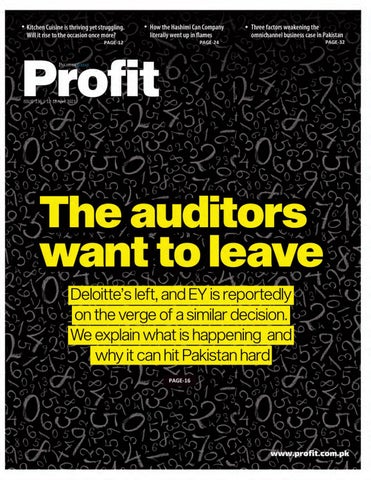
12 12 Kitchen Cuisine is thriving yet struggling. Will it rise to the occasion once more? 16 The auditors want to leaveI
22
22 PIA: still a loss, but hey, it’s not as bad as before. 24 How the Hashimi Can Company literally went up in flames
26 26 Fatima Fertilizer: revenue down, but profits up on lower gas costs
Profit
28 Money goes digital - a complete guide to CBDCs in Pakistan
Executive Editor: Babar Nizami l Managing Editor: Farooq Tirmizi l Joint Editor: Yousaf Nizami Reporters: Ariba Shahid l Babar Khan Javed l Taimoor Hassan Abdullah Niazi l Meiryum Ali l Shahab Omer Director Marketing: Zahid Ali l Regional Heads of Marketing: Muddasir Alam (Khi) Zulfiqar Butt (Lhr) l Mudassir Iqbal (Isl) l Layout: Rizwan Ahmad l Photographers: Zubair Mehfooz & Imran Gillani l Business, Economic & Financial news by 'Pakistan Today' Contact: profit@pakistantoday.com.pk
Fintechs, Zakat cuts, and Linkden ‘wins’ this week in Pakistan’s business and economics twitterverse
With Ramzan in sight and prices skyrocketing, it was a slow week
A
s the time for the holy month of Ramzan rolls around, things seem to be slowing down just a little. But the week did have its highlights, with continuing inflation front and center of conversations of and around Pakistan’s business and economics Twitterverse, and State Bank Governor Reza Baqir’s interview on CNN had people responding with thoughts aplenty. For this week’s social media round up, we look at whether or not the State Bank of Pakistan is providing a healthy environment for fintechs to thrive in a country desperate to accelerate digitization of the economy. The PIA’s woes are discussed by Abbas Nasir, with some more general conversations about what the right way to reject someone for a job is and where the money that gets cut in lieu of Zakat every Ramzan. Profit’s Ariba Shahid looks at all this and more.
Ammar habib, a regular in our twitter feed compilations, comments on Pakistan’s low tourism growth rates. @Allahsfav however feels that using white women bloggers to lie about Pakistan may not be the right strategy at getting things done. Even if it is the right strategy, we would argue that simply for reasons of annoyingness, cringe-inducing content, and nauseating pandering these bloggers should still be avoided. It serves no purpose other than making the days of twitter users sour.
SOCIAL MEDIA ROUNDUP
Profit’s reporter Ariba Shahid analyses the business and economic highlights from Pakistani Twitter this week.
When other airlines are making a killing in earnings after international travel has opened up again, PIA’s performance has been underwhelming. You know what they say, you snooze, you lose. Abbas Nasir bemoans the state of the national airline and its continued failure to do very basic things that aren’t that complicated.
On a lighter note, with every other person posting their wins on LinkedIn, one cant help but feel like they are underperforming. However, with fun posts like this, this reporter thinks that she can also post her “wins.”
7
Osman Mohiuddin, ex banker and a startup founder comments on how the SBP is providing the right environment for fintechs. While commenting on the SBP Governor Reza Baqir’s interview with Julie Chatterley, he says the potential is immense. As per Baqir, the SBP is studying opportunities regarding Central Bank Digital Currency which is exciting news that can help Pakistan counter money laundering, counterterrorism and can help boost financial inclusion. Naya Pakistan is a term used to describe the Pakistan made by the PTI government. Murtaza Solangi, a journalist, comments on how the price of flour has more than doubled throughout the tenure of the PTI government. After the title of Captain, Solangi gives out a new title, Double Shah - a nod to the infamous ponzi scheme merchant that made headlines back in 2007 and eventually came to an inglorious end. Foreshadowing? We’ll find out eventually.
With Ramzan, right around the corner, Mahim Maher, Editor of Samaa Digitial, asks an important question about Zakat deductions from accounts. For all you that do not know, yes, Zakat is deductible from your savings accounts unless you’ve submitted the CZ 50 affidavit, regardless of whether it is an individual or corporate account. And yes, sometimes in the case of some banks you may have to submit the affidavit every year. Perhaps another question we may want to ask is what is then done with the money that has been deducted? Ideally, it should be for charitable purposes, but is there any way to trace where exactly this amount is going?
8
The 5 AM club might sound nice to some, but for this reporter, it sounds like a nightmare. However, Mubashir is right when he says that you don’t need certain habits to make money. There are no fixed habits that can make you a millionaire, however if you already have a couple grand that makes it much easier.
SOCIAL MEDIA ROUNDUP
Your new car probably isn’t arriving any time soon because of a global semiconductor shortage
With a global semiconductor shortage, Pakistani automobile manufacturers have no option but to delay deliveries By Taimoor Hassan
O
ne of the most familiar sights on Pakistani roads over the course of the past few years has been the Kia Sportage. The success of the car has been astounding, and the formula behind it has been simple - Kia offered the public an SUV style car at the price of a top range sedan. You see, in Pakistan, for decades there has been a tense hold of the ‘Big Three’ companies (Suzuki, Honda, and Toyota) over the automobile industry. Suzuki would produce hatchbacks while Toyota and Honda would duke it out in the sedan category with the Honda City, Honda Civic, and the Toyota Corolla. The Pakistani market has always been resistant to change, and this triopoly might have continued unabated if it had not been for Pakistais getting used to the comfort of refurbished Japanese cars. While that business has slowly gone to its inglorious death, it has opened up a chance for companies like Kia (which is South Korean) to come in and stake a claim in Pakistan’s car market. And while their Sportage has been the biggest success story, other cars and companies have also laid a claim. The Kia Picanto has done well in the hatchback category and Hyundai’s Tuscon has seen favourable response in the SUV segment. The problem, however, is that the influx of these cars on the roads might just be set to see a drop, and not because these companies have done anything wrong, but because globally there is a shortage for a car part called the semiconductor, which provide power for
AUTO
battery management, in-car entertainment, driver assistance systems, and much more. These little devices that otherwise get no attention are behind everything from connectivity platforms to mapping applications, graphics processing systems, and advanced driver warning systems. The world is still reeling from the effects of Covid-19 pandemic but the post-pandemic new normal has upended the global automotive industry way too quickly. A bane has surged for the global automobile industry after the pandemic in the form of shortage of chips that has led to a cut in production of automobiles at all leading manufacturers. From Ford to Volkswagen to Honda, and Hyundai. In Pakistan, Hyundai Nishat Motors is the first one to feel the heat of the chip shortage. The company has announced that it will not be delivering orders for its Tucson variant for September, 2021, owing to the disruption in the supply of semiconductor chips that are critical in the production of these cars. Tucson is a compact crossover SUV produced by South Korean automobile manufacturer Hyundai. In Pakistan, it was launched by Hyundai Nishat in August last year. The company has thus far sold 2,800 units of the SUV since its launch, till March 2021. “Deliveries for all other variants of Hyundai cars in Pakistan will continue as usual,” says Norez Abdullah, CFO at Hyundai Nishat Motors. While Hyundai Nishat is the first one to stop deliveries, others are expected to follow. Kia has already told Profit that delivery for their flagship Sportage and Picanto are both being impacted by the global shortage. Essen-
“There is essentially a shortage of semiconductor material that is creating a shortage on the chip side all over the world. Deliveries for all other variants of Hyundai cars in Pakistan will continue as usual” Norez Abdullah, CFO at Hyundai Nishat Motors.
tially, all the car companies that receive car parts from abroad and only assemble those in Pakistan, are facing a similar shortage and are most likely assessing the stock of each and every model of their car, and deliberating a similar decision of stopping deliveries as Hyundai Nishat and Kia. It is only a matter of time when that happens for the rest of the companies as well.
A global crisis
I
f we go back to the time when pandemic lockdowns started, global automobile manufacturers halted production because of the decrease in demand. And
9
because the production had decreased, orders for chips from these automobile manufacturers had also fallen. Hyundai Motors in South Korea had been one of the shrewd ones to keep a healthy stock of these chips and even accelerated chip purchases. However, last month, even Hyundai announced suspending production at its plant in Ulsan, South Korea, because of shortage of semiconductor chips. “There is essentially a shortage of semiconductor material that is creating a shortage on the chip side all over the world,” says Norez. There are only a handful of semiconductor chip manufacturing companies, called foundries, globally. Taiwan-based semiconductor foundry TSMC is one of the largest manufacturers of these chips in the world and accounted for 55.6% revenue of semiconductor foundries in the first quarter of 2021. TSMC was followed by Samsung Korea forming 16.4% of the industry revenue. “Post Covid, though factories started production, the demand for high-tech electric goods witnessed a surge and the semiconductor chip supply diverted towards those goods,” says Norez. Automobiles are not the industry where these chips are used. In fact, automobiles are the smallest purchasers of these chips. From the numbers of TSMC for the fourth quarter of 2020, smartphones formed 51% of the revenue from chip sales, followed by PCs and servers at 31%. Automotives on the other hand formed only 3% of the total sales of the company. Post pandemic, demand for other electronic goods such as phones, laptops and TVs has surged globally and these foundries have preferred to cater to these goods because they form the bulk of their revenues over automobiles. On the other hand, a rise in electric vehicles has also caused a surge in demand for chips for these high-tech automobiles. But since automobiles are not a priority and there is also a surge in demand, there has been a shortage of chips for automobiles. The shortage of chips has led to shutdowns and production suspension not only at Hyundai but almost with all the leading manufacturers. For instance, Honda had shutdowns at its plants in the UK and Japan, followed by weeks of production cuts at these plants. Similarly, Toyota had a three week shutdown at its plant in Texas, US, followed by eight weeks of reduced production. Likewise, Tesla in the US had a two week shutdown of its California plant in the aftermath of shutting down a major semiconductor chip foundry in Texas. Volkswagen, Ford, General Motors, Audi, almost all have
10
“This is a global issue whereby there are supply constraints for semi conductors. However it is expected to improve in our case. It’s not that extreme that the production has to be shut completely however our demands for semiconductors are not fully met” Muhammad Faisal , Chief Operating Officer at Kia Lucky Motors.
had times recently where these companies had to shut down plants, had to reduce production, or did both, all induced by the shortage of semiconductor chips.
The case of Hyundai
T
he CFO explained that Hyundai has an exponential use of semiconductor chips in smart accessories of its cars. Secondly, there was a catastrophic fire at a major chip vendor in Japan, called Renesas, that led to a major disruption in supply of chips for global automakers including Hyundai. “In the West, there was a cold snap in Texas in late winters and a foundry was shut down that led to major supply disruptions. All of this has formed a perfect storm to spur a major disruption in the industry causing production cuts to total shutdowns at auto plants across the globe,” adds Norez. When it comes to Hyundai’s Tucson SUV in Pakistan, the parent company in Korea supplies the Pakistani entity knockdown kits comprising hundreds of car parts that are then assembled here in Pakistan. The chips are pre-installed in the kits coming from Korea. And now because there is a chip shortage, these kits are not coming anymore and hence the halting of deliveries. “It is due to the uncertainty around these chips and subsequently the kits from Hyundai Korea, we are not entertaining further bookings from September. Right now, whatever we have allocated until August, we will honour and deliver that,” says Norez. “We don’t have reason to believe that we will not be able to deliver August allocation on time for Tucson. For other models, we will keep on taking the bookings and we will keep on delivering on time,” adds Norez. The situation is precarious for the global auto industry. Following the Renesas fire, shares of Honda, Toyota, Nissan and other Japanese carmakers took a hit. Renesas has around 30% share in the global market of semiconductor chips. “All the auto manufacturers; Ford,
General Motors, Mazda, Tesla, have had late deliveries of different models because of the chip shortage,” says Norez. The company, Hyundai Nishat Motors, is hopeful of resuming deliveries for Tucson as soon as they have some certainty and visibility about the chip stocks. Until then, deliveries for the SUV will remain suspended from September “until further notice”. Kia Lucky motors is slightly optimistic “This is a global issue whereby there are supply constraints for semi conductors. However it is expected to improve in our case. It’s not that extreme that the production has to be shut completely however our demands for semiconductors are not fully met,” says Muhammad Faisal , Chief Operating Officer at Kia Lucky Motors. He adds that the company is in contact with customers and has explained the situation to them. However, the delay in deliveries is not across all car models. For instance, the deliverties of Kia Sportage have been impacted, however, Picanto deliveries have been delayed. “‘There are delays in certain vehicles which we are communicating with our customers. Picanto has been delayed, while there is also impact on Sportage.” Despite that, there is light at the end of the tunnel and Faisal seems optimistic about a resumption in semiconductor supply. Faisal says, “We’re trying to arrange adequate supplies and expect the situation to be better in May/ June.”
What about the others?
P
rofit has reached out to Indus Motor Company, Suzuki, Faw, Changan, and Al Haj/ Proton regarding the impact of the shortage on their production capabilities. Responses have not been received until the printing of this story. However, it can be said that a global shortage is likely to impact car deliveries across all automobile manufacturers in Pakistan, just like the rest of the world. n
AUTO
The untold story of one of Pakistan’s most inspiring local food chains
12
T
By Abdullah Niazi
here is, among the middle class of Lahore, a nostalgic fascination with the lemon tarts from Shezan bakery. On twitter, in colleges, and in workplaces Lahoris regularly bond over the overly sweet lemon curd encased in the hard shell that they would end up buying on visits to the chain bakery that were meant to get only eggs and bread. Now, the culinary world is not really Profit’s realm of expertise, but for a brief moment we will ask our readers to humour our attempt to make a comment on food. Shehzan’s lemon tarts, while a nice little treat, cannot in all honesty be called a lemon tart. By definition a tart needs to taste, well, tart. The Shezan lemon tarts simply lack the acidity, and the sharp, acetic flavour profile that a lemon tar should have. But for most Lahoris, Shehzan’s sweet, honeyed, and largely ornamental lemon tarts were the only ones widely and readily available. That was until Kitchen Cuisine arrived on the scene. In the mid-1990s, the now widespread Kitchen Cuisine opened its first commercial outlet in Lahore on M M Alam road, and it was an immediate hit. Bakeries like Shehzan had been around since the early 1960s, and while they had found popularity and managed to grow significantly, their focus was always on products like bread, biscuits, and traditional mithai. Kitchen Cuisine burst onto the scene with chocolate fudge cakes, strawberry puffs, and lemon tarts that are actually tart. It is hard to imagine now, but back in the 1990s, this was a big deal. High-end desserts were limited to either home-cooks that sold on pre-order, or you had to find imported items and take your own baking skills out for a spin. So to say that Kitchen Cuisine changed the perception of what pre-made desserts should offer would not be a stretch, and behind the entire operation has been Nadia Raja, an Islamabad based homecook turned confectionery entrepreneur. Raja began her journey from her kitchen at home, simply by making desserts for friends and family when they would visit. Eventually, people began asking her to make desserts for their parties and get-togethers, and very soon people outside of her circle were also asking for these services. Since those early days, Kitchen Cuisine has opened 20 branches across Lahore, Islamabad, and Rawalpindi as well as restaurants, a catering service, and most recently, has gotten into the airline catering business. It has been an inspiring journey in many ways, but has not always gone smoothly. At different points KC has seen dips in popularity,
and has been given a run for their money by the likes of competitors like Masooms. Right now, with the airline catering business and the coronavirus, times have been lean, and concerns have been raised over expansion plans throwing a spanner in what has been for decades a successful business model. But despite all odds, the one thing Kitchen Cuisine has always done best is persevere and bounce back stronger. Will they one more time?
A home-cook with no Instagram
I
t started out like any other home business. Nadia Raja would make desserts for her friends and her family at her house in F-7. As time went on and her skills continued to grow, she started a small business in which her friends and family would come over to her house, catch up, place their order, and pick it up the next day. Eventually, her desserts became so popular that people she did not know began approaching her for orders. Without any social media marketing, the business grew completely on the basis of word-of-mouth, and by those standards spread rapidly. At this point, she was still only working with the domestic help already employed in her home. In 1988, Nadia and her family made a big decision and built a small structure inside their house to display some of her most popular items. The little room was constructed around a date tree, and in the early 1990s, security in Islamabad was not such a concern, so the gate to their house would remain open and people would come in and buy whatever it was that they needed. This was a very simple,
cash-based business model that worked quite well. At this point, it was Raja’s husband, who wishes to remain unnamed for anonymity, that saw the business potential in Kitchen Cuisine. He decided to quit as the Managing Director of a successful IT company in Islamabad, and devoted his time to the confectionary business completely. It was also around then that they realised there was a lot of demand from Lahore for their products. An alumnus of Kinnaird College, Nadia Raja had a vast circle of friends and family in the city, and it seemed to be the perfect place to expand the business. With her husband on board, the family decided to begin services in Lahore, which is where KC would really put down its roots. In 1993, Nadia Raja would get a loan of $3000 from the First Women’s Bank of Pakistan, which in those days amounted to nearly Rs 40,000. The problem was that the Rajas were settled in Islamabad, but needed someone to look after their business in Lahore and look after it in a very hands on manner. This is when Nadia’s cousin Sadia Noone joined Kitchen Cuisine. The business was very low investment to begin with, and the share capital was low enough that they still do not have to file anything about their earnings with the Securities and Exchange Commission of Pakistan, something that is only for very small businesses - so one can imagine the scale of the endeavour when the first Kitchen Cuisine branch opened in Lahore. “We basically started from inside our homes in Lahore as well,” Sadia Noone tells Profit, who herself is an accomplished baker and responsible for a lot of Kitchen Cusine’s
FOOD
signature products. “In those initial days it was a very small investment and it was completely a labour of love. Since those initial days, it has grown by a lot.” Sadia Noone essentially came on board as a 50% partner in just the Lahore business. It became apparent very soon after this that the Lahore business would be where Kitchen Cuisine would flourish, and Sadia Noone was instrumental in spreading it. Normally, this is the point in Profit features where we begin telling the story of how success and jealousy start tearing apart families that build businesses together. In a pleasantly refreshing change, however, it appears that even three decades into the business the two sides of the family involved still have a very stable working relationship. “From the very beginning, Nadia and I have been very good friends, and I think that is what has really driven our relationship in the business as well. We are friends, but we are also partners,” explains Sadia Noone. “I think it is because of this that there has been a great level of trust between us, and Nadia’s husband has of course been involved in the business and has helped in growing it.” Of course, the journey has not been free of its bumps. Almost a decade into having set-up and established themselves in Lahore, Kitchen Cuisine was finally getting some competition. In fact, the bakery fell out of fashion some time around 2001-2002, which is also when Jalal Sons began a line of gourmet desserts, and new bakeries like Masooms were entering the space and really picking up the pace. Kitchen Cuisine’s whole popularity had been based on the fact that nobody else was doing what they were doing as well, but
“From the very beginning, Nadia and I have been very good friends, and I think that is what has really driven our relationship in the business as well. We are friends, but we are also partners. I think it is because of this that there has been a great level of trust between us, and Nadia’s husband has of course been involved in the business and has helped in growing it” Sadia Noone, managing director of Kitchen Cuisine Lahore suddenly they had competition. During this time they tried a number of things to come out of the oblivion new competition was condemning them to. This included trying cafe-style dining (the last of their cafe’s in Lahore went out of business a couple of years ago in Gulberg Galleria) and other methods. They were not conservative in their business approach, and after a few years that were stagnant and even on a downwards trend, they did manage to revamp their products, introduce new items, and keep a stronger check on quality assurance - a role in which Sadia Noone thrived in Lahore while Nadia Raja kept the ship steady in Islamabad. Over the years, the core ethos of the business has been to provide the kinds of desserts that older chain bakeries just cannot compete with. While their prices were higher, they were not so much higher that Kitchen Cuisine was exclusively an upper-class brand. The
reason why Sadia Noone was brought into the fold in the first place and why she remained successful was because the core focus has always been on making sure that the food is individually prepared, and that the staff making it are trained directly by the upper management, which abhors the idea of food items coming off a conveyor belt. They very quickly managed to stabilize, and are generally considered a go-to bakery for quality desserts wherever they are found. In fact, soon after getting their first taste of fortune, a 2005 news item in Fortune shows how they grew and managed to stay on that track after that initial $3000 loan. In 2005, it was reported by Fortune that Nadia Raja was “the CEO of a popular nine-outlet national chain boasting about $3 million in annual sales and employing 220.” In the past 15 years, at least in terms of the numbers of branches, these numbers have doubled.
Don’t try to fix what isn’t broken
P
erhaps one of the most admirable things about the Kitchen Cuisine story has been that they found a business model that works for them and stuck to their guns. Take, for example, Dost Muhammad - the first employee that Kitchen Cuisine had from the days when it was just Nadia Raja in the kitchen. Any time a new branch would open or the staff would have to be trained, Dost Muhammad would be assigned the job. It has been more than 30 years and he is still involved with the company. Over the years, KC has shown its ambition. In 2001, a restaurant by the name of ‘KC Grill’ was launched, and in 2006 they would also enter the airline catering industry. Today, Dost Muhammad isn’t training new cooks for a branch, but is involved in the airline catering side of the business. The problem? It isn’t going as well as the KC management had imagined. The airline catering business is very dif-
14
ferent from the bakery business that Kitchen Cuisine had been running before. In essence it does have to do with the food, but it operates in an entirely different transactional mode. With a bakery, you have countless individual clients and you are not dependent on any one group of people even. In the airline catering business, there are only a few corporate clients. Add to this the fact that suddenly Kitchen Cuisine had a lot of money tied up in credit after decades of doing a cash based business, and you start to worry about cash-flow problems. At this point, the threat is that the backlash from the airline catering business is hitting the bakery business that has been thriving for 30 years. According to sources that spoke to Profit anonymously, Kitchen Cuisine has been teetering on the brink of defaulting at different points. Payments for their fleet of cars to JS bank, while not late, have regularly been submitted at the last possible minute. Suppliers have also been complaining about not being paid on time. A major blow came when one of their corporate clients, Shaheen Air, went bankrupt leaving tens of millions of rupees in receivables tied up. And after the blow from Shaheen Air going bankrupt, another one of their major clients, PIA, has also been holding back payments. These are all classic signs of cash flow problems in any company. Again, we must say at this point that Kitchen Cuisine has operated very successfully over the years. The one thing that has remained constant is the commitment to quality, and that holds true even now. It has been a very ‘keep your head down and do good work’ approach. Over the years, bakeries like Masooms gave Kitchen Cuisine a run for their money. They had flashier products, better marketing, and a younger, cooler vibe that sustained them. Meanwhile Kitchen Cuisine did not have a Facebook page until 2012. Despite this, they have been able to overcome their slumps and be the go-to bakery, at least in Lahore, where they currently have 16 branches. But perhaps one false step might have been not separating the bakery business and the airline catering business. One can see why the decision was made, because with their regular catering business and restaurants, there has been no need to separate the businesses because they have been successful. And to be fair, while there has been a serious learning curve involved, the airline business has also been profitable.
Airline catering and cashflow
T
rue to form, it was not Kitchen Cuisine that sought to join the airline catering industry. It was Airblue that pitched the idea for Kitchen Cuisine to cater their flights, and that is how they got
their start in Karachi in 2006. By 2008, they had already established facilities in Lahore and Islamabad, and airlines had been receiving positive reviews from their customers. In 2011 they provided scheduled inflight catering uplifts to their first international carrier, Uzbekistan Airways, from Lahore. After this, they would continue to bag other clients. Two years later in 2013, KC first established a facility in Sialkot which was followed by them getting both Shaheen Air International as a client, and catering their first Emirates flight from Islamabad. By the next year they had started provision of services for the national carrier, PIA, and catered their first foreign dignitary flight from Saudi Arabia. Very quickly after this, Malindo Air and Srilankan Airlines would use their services in 2016, and Serena Air would by 2017. In the meantime, they made major expansions on their Lahore facility and opened a new state of the art facility in Islamabad in 2017 to go with the new airport. For all intents and purposes, they were working diligently and providing quality service. The problem was that they misread the situation. Airlines do not pay immediately on cash like their bakery customers, which means that since the bakery and the airline catering business were not separate, cash flow from the bakery side was being used to fuel the airline catering business. At this point, Shaheen International went bankrupt. It was at that point Pakistan’s second largest airline, and when it liquified in 2018, it still owed Kitchen Cuisine an amount that ran in the tens of millions, a loss in receivables that would cause problems for much larger companies.
With Shaheen Air gone, PIA on the brink of destruction, and flights majorly affected by the Covid-19 pandemic, there are clear concerns that the numerous facilities they had set up all over the country are being underutilized. These are all real worries, and perhaps some of the bigger challenges that Kitchen Cuisine has faced in its more than 30 year history. What is hopeful, however, is that their bakery business is still standing strong, and slumps have come and gone before. What could the company possibly do to mitigate the problems it has been having? For starters, the obvious play would be to separate the bakery business from the airline catering business. The airline catering business needs attention, but it cannot continue to be supported by the bakery. The bakery business model has stood the test of time, and using it to run other sides of the business is a slippery slope that could lead to sacrificing a golden goose. There is, also, the possibility of the company expanding into other cities and approaching a private equity player to bridge the cash flow gap and also fund the growth. Its success up until now has been based on the strong family basis on which it is built, but it has grown far beyond a typical mom-and-pop bakery. In the years to come, they might want to think about turning it into a franchise offers for which they have received over the years but have not accepted because of quality concerns. There could also be the possibility of an Initial Public Offering at some point - all part of the many options Kitchen Cuisine should use to continue to do what it has done so well for so long. n
FOOD
16
By Babar Nizami and Farooq Tirmizi
O
n November 15, 2020, an earthquake shook Corporate Pakistan, and absolutely nobody wanted to talk about it. On that day Deloitte, the largest accounting and professional services firm in the world, and the biggest of the Big Four firms globally, left Pakistan. Search the newspapers for the next day, or frankly for several weeks after that, and you will find absolutely no announcement, no coverage, and no analysis. But the silence does not change the facts. Yes, Deloitte was the smallest of the Big Four accounting firms in terms of its revenue share in Pakistan, but this is still a big deal. A very big deal. And it has considerable implications that will reverberate far beyond the world of accounting in Pakistan. With Deloitte’s exit in November 2020, Pakistan is now the largest country by population – and the only one among the biggest ten countries in the world by population – to not have all Big Four accounting firms present inside the country. Pakistan is the second-largest economy after heavily-sanctioned Iran to not have all Big Four accounting firms. The next largest economy to not have all Big Four is Ethiopia, which
18
is about one-third the size of the Pakistani economy. There are economies in other parts of the world that are one-hundredth the size of Pakistan that still have all of the Big Four firms supporting their corporate sector. This story will talk about why Deloitte left Pakistan, what that means for Pakistan’s accounting sector, and what it means for the wider economy.
What made Deloitte leave
L
et us first specify exactly what happened. Each of the Big Four accounting firms – or really any of the major accounting firms – is a global network of partnership firms. What that means is that Deloitte in Pakistan is a partnership legally incorporated in Pakistan in which the global parent – Deloitte Touche Tomahatsu Ltd, the UK-registered entity – has no shares. Instead, it has a legal agreement that allows the Pakistan entity to use the Deloitte name in exchange for both monetary compensation and for agreeing to abide by a certain set of standards. That partnership agreement – and specifically the right to use the Deloitte name and sign off with the Deloitte logo on its letters auditing Pakistani financial statements – is what has been taken away from the Pakistani partner firm.
When approached by Profit to comment on why they left Pakistan, the global parent company gave a statement that, while confirming the development, did not provide a significant amount of detail as to the reasons. “We can confirm that as of 15 November 2020, Deloitte Yousuf Adil, Chartered Accountants (the Deloitte member firm in Pakistan) withdrew from the Deloitte network and is no longer a Deloitte member firm. The firm is now an Independent Correspondent Firm (“ICF”) to the Deloitte network, and its legal name has been changed to Yousuf Adil & Co. The decision to undertake this change was made in the backdrop of present geopolitical, macroeconomic, and market challenges,” wrote Lauren Mistretta, a spokesperson for Deloitte, in an e-mail to Profit. We did not have any better luck in getting an explanation from the local former Deloitte partners either. “We have nothing further to add,” said Nadeem Yousuf Adil, managing partner at Yousuf Adil & Company, in a WhatsApp response to a question from Profit. The only person from Deloitte willing to speak with us on-the-record was Asad Ali Shah, former managing partner of Deloitte Yousuf Adil, a position in which he served from February 2009 through May 2017. Shah is also the son of former Sindh Chief Minister Qaim Ali Shah. And Asad Ali Shah stated that he believed the main reason was a problem of economics: Deloitte’s presence in Pakistan created risk for the global partnership, but did not bring in a material enough amount of revenue to justify that kind of risk. “The Big Four accounting firms don’t really get much out of Pakistan,” said Asad Ali Shah, in an interview with Profit. “The biggest firm in Pakistan is AF Ferguson (PricewaterhouseCoopers Pakistan) and they have approximately Rs3 billion in revenues, the bulk of which goes to the partners and the local staff. And what little does go to the global firm, they have issues remitting the profits because of permissions needed from the State Bank of Pakistan, etc.” “The global firm makes money out of Pakistan in two ways: one, they help the local firm buy professional insurance against the risk associated with providing services. And secondly, they earn a management fee, which can be around 3% to 4% of revenue,” he said. Even at 4% of revenue, that implies that the global partnership of PricewaterhouseCoopers (PwC), for example, would earn just about Rs120 million from Pakistan, which is just $800,000 at the current exchange rates. To place that in context, in the United States, which is the largest market for all of the Big Four firms, the average total compensation for a partner at PwC is $600,000. About one-third of the revenue of any accounting firm goes to its partnership ranks,
“We can confirm that as of 15 November 2020, Deloitte Yousuf Adil, Chartered Accountants (the Deloitte member firm in Pakistan) withdrew from the Deloitte network and is no longer a Deloitte member firm. The firm is now an Independent Correspondent Firm (“ICF”) to the Deloitte network, and its legal name has been changed to Yousuf Adil & Co. The decision to undertake this change was made in the backdrop of present geopolitical, macroeconomic, and market challenges.” Lauren Mistretta, spokesperson for Deloitte
with the remainder paid out in salaries for the junior accountants, as well as other expenses. For a firm like PwC, with 30 or so partners in Pakistan, that comes out to a respectable Rs30-35 million per partner per year in revenue shares. In short, the firms are set up to benefit the local partnership much more than the global parent company, and yet the global parent company bears all of the risk that the local partners bear as well. “The global company has 100% of the risk of Pakistan. If something goes wrong here with an audit, they will take a hit on their
reputation,” said Asad Ali Shah. You can see the problem here: all of the risk, and very little of the reward means that the Big Four accounting firms have a hard time justifying their presence in places where they see elevated risks. And the problem for Deloitte was that it had very little in revenue compared to the other firms. “PwC is the biggest in Pakistan, with Rs3 billion in revenue. Ernst & Young (EY) is not far behind at roughly the same number. KPMG makes Rs1 billion in revenue, and Deloitte was the smallest with just Rs500 million in revenue,”
said Shah. This, by the way, the opposite of its global standing. In 2020, Deloitte had a record-year worldwide, bringing in $47.6 billion in revenue. It is comfortably the largest accounting and professional services firm in the world. The second-largest in the world is PwC, with $43 billion in revenue. EY and KPMG are third and fourth respectively in terms of global revenues. And that is the heart of the matter. Deloitte’s global partnership is used to making a lot of money in other markets, and in particular, they have a large presence in the high-margin management consulting business in the United States. By contrast, in Pakistan, not only do they have significantly lower revenues than their Big Four peers, but the bulk of those revenues come in the form of the low-margin audit and assurance business. Then along came the increased pressure on Pakistan in the form of being grey-listed by the multilateral Financial Action Task Force (FATF) in 2018 for insufficient attempts by the country’s regulators and financial system to crack down on money laundering and terrorism financing, and the risk perception about Pakistan – already quite high – went up a lot. What makes this development unfortunate is the fact that Deloitte Pakistan was actually among the most careful and conservatively managed of the Big Four accounting firms in the country and did not have any major scandals relating to its audit and assurance work with Pakistani companies that might taint its reputation, either locally or worldwide. Deloitte left Pakistan because of the risk of what might happen rather than what actually did happen. Incidentally, the weak financial incentives for Deloitte and the other major global accounting firms to lend their name to a local partner has resulted in a shift in the thinking of at least Deloitte, which wants to shift from the model of being a global network of partnerships to be-
The Big Four accounting firms don’t really get much out of Pakistan. [But] the global company has 100% of the risk of Pakistan. If something goes wrong here with an audit, they will take a hit on their reputation Asad Ali Shah, former managing partner of Deloitte Pakistan
coming much closer to a single global partnership that has a unified ownership, partnership, and management structure, in some ways closer to how management consulting rival McKinsey & Company operates.
What this means for Pakistan’s accounting industry (Editor’s note: Feel free to skip this section if you could not care less which accounting firm gets to gain or lose from this development) In order to understand what this means for Pakistan’s accounting industry, it is necessary to first take a quick look at the structure of the accounting profession, both in Pakistan as well as globally. While there are thousands of accounting firms worldwide, the Big Four really do dominate. To understand just how much, consider the following fact. KPMG is the smallest of the Big Four and it is three times bigger in terms of
20
revenue than the number five firm, BDO. Why is that the case? Mainly history: the Big Four are the successors to some of the oldest accounting firms in the world. And it is a testament to just how much Britain dominated the world in the 19th century that three of the four firms are headquartered in London. (The fourth, KPMG, is headquartered in the Netherlands, the country that invented the stock exchange and the joint stock company.) And it is because of their histories and big brand names that the Big Four command a certain cache with investors in companies that other accounting firms – for the most part – do not. Why do investor perceptions matter here? Because auditing financial statements of a company is the act of reviewing them for accuracy on behalf of the owners – that is, the investors – in a company. Hence, who investors trust to perform that role matters a great deal. The Big Four are trusted more than other firms, and by more investors, which means that they get to command a higher fee than other firms. In Pakistan, in recent years, the price differential has grown incredibly steep. One of the authors of this story (Tirmizi) is the founder of a fintech startup, and was given two quotes by two accounting firms for auditing the startup. KPMG quoted a minimum fee of Rs1 million for the audit. Grant Thornton, the seventh largest accounting firm in the world, and the number five firm in Pakistan, quoted Rs250,000 in fees. That is correct: the Big Four
firm quoted a price four times higher than the number five firm. Of course, that price tag does not exist in a vacuum. The Big Four can charge it because there are people willing to pay more for the ability to say that they are subjecting themselves to the rigours of an audit conducted by one of the Big Four firms, which is perceived to be better and more thorough than that of their smaller rivals. Is it actually more rigorous? The answer to that question does not matter as much as that the audit is perceived to be more rigorous, and to the point that people are willing to pay considerably more for it. What this means is that the bulk of Deloitte Yousif Adil’s business was likely companies that wanted to do business with a Big Four accounting firm. What happens now that it has gone from being Deloitte Yousuf Adil to being simply Yousuf Adil & Company? How many of its clients will still want to continue doing business with the firm? It is too early to say definitively, and the company declined to answer any of Profit’s questions. But the answer is likely to be that the firm will take a huge hit. Yousuf Adil & Company will remain an independent correspondent firm with Deloitte, which means that it is authorized to provide services to Deloitte clients who have signed a global agreement with the firm and need services in a geography where Deloitte does not maintain a presence of its own. That means Yousuf Adil & Company will keep at least some portion of its clients. However, many others will likely decide that they would rather work with one of the other Big Four firms than one that is simply a ‘correspondent’ firm. But here is the punchline: it will likely struggle to get new clients. Why? Think about it from a company’s perspective. If you have enough cash and can afford a Big Four audit fee, why would you go with Yousuf Adil & Company rather than one of the other three that still do business in Pakistan? And – assuming you were one of those companies that did business with Deloitte Pakistan because you had an old deal for a low
TEXTILES
audit fee that was still going, would you rather stay with a local firm that used to be a Big Four, or would you rather just cut your costs and go to the number five firm? Because, let us be honest: yes, the Big Four have the best-known brand names, but any investor worth their salt also knows of Grant Thornton and BDO. If you have financial statements signed with the logos of either of those firms, you know that any investor you present them to will have a reasonable amount of confidence in them. But take an audit report with the “Yousuf Adil & Company” letterhead, and you might get asked a few questions about why you chose this particular auditor, which some foreign investors especially may have never heard of. All of this is to say that Deloitte’s loss is likely to be Grant Thornton and BDO’s gain. Both firms have a significant presence in Pakistan (as does every single one of the other top 10 accounting firms in the world) and are likely to be well positioned to pick up clients. Indeed, it is also possible that some of the Yousuf Adil & Company partners will decide to take their relationships to either of these two firms – or any of the other Big Four that will have them – rather than trying to remain independent without the Deloitte brand to back them up. And lest you think this is pure speculation on our part, there is some precedent for what we are talking about. In 2002, there used to be the Big Five accounting firms, with the Chicago-based Arthur Anderson being the fifth global accounting firm. When Arthur Anderson imploded in the aftermath of the Enron scandal – after it emerged that they had signed off on fraudulent financial statements from Enron – Arthur Anderson’s Pakistan affiliate began to face problems retaining clients. That affiliate with Sidat Hyder, which almost instantly began to lose clients. In June 2002, Dawn reported that Singer Pakistan had dropped Sidat Hyder and instead appointed KPMG Taseer Hadi as their auditors. By the following month, the situation had grown so bad that Sidat Hyder decided to merge with the EY member firm in Pakistan: Ford Rhodes Robson Morrow. That is why the EY member firm in Pakistan is still called Ford Rhodes
“We have nothing further to add.” Nadeem Yousuf Adil, managing partner at Yousuf Adil & Company
Sidat Hyder. What that tells you is that an accounting firm’s brand and credibility matter a great deal, and that its fortunes can change overnight if the perception of that brand changes.
What the Deloitte exit means for Pakistan
W
hy should you care about Deloitte leaving Pakistan if you are not an accountant, or a CFO looking to hire an audit firm? Because it represents a fraying of Pakistan’s international reputation to a point from which it may be difficult to recover unless the government and the corporate sector decide to take drastic action. It is, in no uncertain terms, a national embarrassment that Pakistan is now the largest country in the world – and the largest non-sanctioned economy in the world – that does not have the presence of all of the Big Four accounting firms. But even beyond the embarrassment of it all, there are practical implications for the Pakistani economy, and most specifically for foreign direct investment into the country. Investors look first and foremost on accurate, reliable information sources that they can trust about the country and companies they are about to invest in. And the departure of Deloitte means there is one less credible voice that they will trust that might be telling them that it is okay to invest money into Pakistan. If you are a company in Pakistan that wants to have a global set of investors from whom it is looking to raise capital, if you are a
What will we tell ourselves and foreign investors if EY decides to leave? That would be tantamount to saying: Pakistani companies and entrepreneurs cannot be trusted to tell the truth, their auditors cannot be trusted to verify their statements on behalf of investors and there is no hope that the regulator will fix the situation anytime soon
startup that is looking to raise money from global venture capital funds, there are now fewer accounting firms that you can put on your financial statements that would give those investors the comfort that you are telling the truth about the financial health of your company. Credibility, more than anything else in the world of business, matters, and Pakistan just lost a significant source of it. Of course, we should also not exaggerate the effects. This is one of four firms, and the other three are still here. But Deloitte’s departure is a warning and a bad precedent, particularly in light of reports that Ernst & Young is actively evaluating whether or not they want to stay in Pakistan. The situation at Deloitte and EY are completely unrelated. But the fact that both are happening at the same time – and that Deloitte decided to pull the plug – means that Corporate Pakistan’s international credibility is about to be put into question right when startups are expanding the definition of what it means to be a Pakistani company and finally beginning to attract serious volumes of money into the country. At least with Deloitte, there is the reasonable explanation that they had low market share and that there were clearly no scandals or problems that were covered up. What will we tell ourselves and foreign investors if EY decides to leave? They have the second largest market share in the audit market in Pakistan, only narrowly behind PwC. That would be tantamount to saying: Pakistani companies and entrepreneurs cannot be trusted to tell the truth, their auditors cannot be trusted to verify their statements on behalf of investors and there is no hope that the regulator will fix the situation anytime soon. If that were to happen, we would find ourselves struggling to attract even the meagre levels of foreign investment that flow into the country right now. And in as capital-starved an economy as ours, that is a luxury we can ill-afford. n (Editor’s note: Despite repeated reminders, Asim Siddiqui, country managing partner EY Ford Rhodes, Pakistan did not respond to the questions emailed to him by Profit)
PIA:
still a loss, but hey, it’s not as bad as before
According to its latest financials, the losing airline has managed to curtail losses
J
ust how bad is Pakistan International Airlines (PIA) doing? Let us see. For a company that has the word ‘international’ in its name, the national carrier is not exactly doing any international flying. As of time of writing, the airline has been banned from its EU, US and UK operations, as the Pakistan Civil Aviation Authority (PCAA) is yet to meet the safety standards of the International Civil Aviation Organization (ICAO) and European Union Aviation Safety Agency (EASA). That's pretty
22
much the entire western world off limits to the airline. According to one report, 35% of PIA’s revenue comes from those three markets. And yet, there is one bright spot in this sad tale. On April 7, the company released its financials to the Pakistan Stock Exchange (PSX) for the year ending December 31, 2020. And yes, revenue did fall - sharply in fact, from Rs147.5 billion to roughly Rs95 billion. But here is something surprising: PIA actually managed to lower both its costs, and its loss for the year. The operating expenses fell from
Rs140 billion, to Rs93 billion. And net loss stood at Rs53 billion in 2019, or the second biggest loss in the last 20 years. This has finally been curtailed to a net loss of Rs35 billion this year. Put another way, that is the smallest loss of the last five years. Of course, this is still nothing to celebrate. As everyone at this point knows, the company has been struggling for quite some time And as everyone else also knows, it was not always so. The airline was started in 1951, shortly after independence, when Pakistan de-
cided it needed a national carrier. Its first flight was in June 1954, between Karachi and Dhaka, in what is now Bangladesh. And in 1955, PIA flew its first international service, between Karachi and London via Cairo. It was also the year that PIA formally took over the assets and routes of another Pakistani operator, Orient Airways, which had in effect been part of PIA since 1953. The following decades were a series of firsts: PIA was the first airline from an Asian land country to fly the Super Constellation (a type of plane in the 1950s). It was the first Asian airline to be granted maintenance approval by the US Federal Aviation Administration (FAA) and the Air Registration Board, predecessor of the British Civil Aviation Authority (CAA). In 1960, PIA was the first Asian airline to operate a jet aircraft (a Boeing 707-321). In 1964, it became the first non-communist airline to operate a service in China (it flew to Shanghai). It was the first airline in the world to fly to Tashkent, Uzbekistan; and also, the first Asian airline to start flights to Oslo, Norway. It was also the first airline in the world to induct the Boeing 777-200LR, the world's longest range commercial airliner. Unfortunately, the company has done miserably in the last 20 years (the period for which financials are publically available). Between 2000 and 2012, the company’s revenue rose from Rs39 billion, to Rs112 billion. It then fell, rising to Rs147 billion in 2019, before falling again to Rs95 billion in 2020.
Unfortunately, the company has done miserably in the last 20 years (the period for which financials are publically available). Between 2000 and 2012, the company’s revenue rose from Rs39 billion, to Rs112 billion. It then fell, rising to Rs147 billion in 2019, before falling again to Rs95 billion in 2020 Still the expenses also climbed during that same period. In fact, between 2000, and 2020, the company’s operating expenses have exceeded operating revenue in 14 years. And that is also why the company has only recorded three years of profit in 2002, 2003, and 2004. The rest have all been losses. The years of loss were particularly deep in the latter half of the 2010s, from Rs 31,744 million in 2014, to Rs67,327 million in 2018, and finally to Rs55,451 million in 2019. Did things improve in 2020? Not quite. According to the company’s half yearly report for the six month period ending June 2020, the company’s revenue stood at Rs51,471 million, compared to Rs65,924 million for the same six month period during 2019. Additionally, the company’s loss before taxation stood at Rs36,896 million, around the same as 2019’s Rs37,563 million. Then, according to the company’s latest financials for the period ending September 2020, revenue had only climbed to Rs74,362
million, compared to 2019’s Rs107,339 million. What happened? According to PIA, the outbreak of Covid-19 pandemic in 2020 resulted in a crushing blow to the airline industry. (It is really saying something that the worst year in aviation history simply looks like a normal year when it comes to PIA’s financials.) The company’s core passenger and cargo revenue fell by 44% because of reduced passenger capacity. The charter revenue of the company increased by 98.7 % due to special cargo planes. On the bright side, because of reduced capacity, fuel costs fell by 52.9%, mostly due to the lack of flights. Similarly, direct expenses by 34.1%. So, what happened this year? Turns out, if you don’t fly as much, your costs also fall. The company was also helped significantly by other income of Rs11.2 billion, which did not exist in 2019, and significantly helped reduce the size of the loss. But the airline is still nowhere in the clear. And if the ban continues, then it may be some time before the company's revenues can rise again. n
AIRLINES
How the
Hashimi Can went Company literally up in flames A Field marshal’s son, the storming of a factory, fire, revival, and the coronavirus. The Hashimi Can story has not been boring to say the least By Ariba Shahid
T
his one is straight out of a Hollywood blockbuster. We say that because it has everything. Powerful men with powerful connections that have stakes in the company. Workers unionizing, rising in revolt, and storming their place of work to seize control. Possible arson and a global pandemic. Take any one of these aspects and you will be able to tell a gripping story. The company’s entire history, all the way from its establishment in the early 1960s to its production facility bursting into flames in 2018 does not have a single dull moment in the middle, and a recent auditor’s report for what happened at their production facility in 2019 has shed more life on the company’s colourful history. So let us get started, shall we? Colonial beginnings The story starts in the early 1950s, at a time when plastic had still not taken over the world and packaging was dominated by tin cans and caps. Before partition, there were only two tin container manufacturing units in the subcontinent owned by a giant company, Metal Box of the United Kingdom. These factories were located in Bombay and Calcutta, which catered to the demand of undivided India. While they were important for commercial products as well by the turn of the 20th century, their main role was providing packaging for food used in the colonial army. After partition in 1947, however, the Pakistan army did not have a facility making tin packaging for their food. For the first few years, Metal Box exported these items to Pakistan and the army used a few skeleton facilities which flattened and repurposed old cans. Given the severity of the situation, Metal Box decided to set up a facility in Pakistan as well. In 1953,
24
with the collaboration of local sponsors, a production facility was established in Karachi for tin containers and cans under the name Hashimi Can Company. From its very inception, Hashimi was the largest tin manufacturer in Pakistan and had the business of the Pakistan Army, which meant it grew very quickly. At the start, the company was managed by the British directly, and expanded its activities by opening branches in Chittagong, Lahore and Peshawar. In late 1966, the management changed hands and Pakistani management took over and the company was listed on the Karachi Stock Exchange (now PSX). This new management would stay until the 1980s, and it would be under them that the seeds for the eventual chaos of this century would be sown. And the man at the helm would be Gaohar Ayub, the enigmatic son of former President Ayub Khan, son-in-law of General Habibullah Khan, and former Speaker of the National Assembly of Pakistan, who would remain the Chief Executive Officer (CEO) of the Hashimi
Can Company from 1968-1980. It would be under his watch that labour issues would arise, and that management would change hands once again.
Enter the Field Marshal’s son
H
ere is what we know up until now. At the time of partition, Pakistan had no tin can manufacturer so a British company set-up a facility in Karachi. In 1966, British management was forced out and Pakistani management took over, and Gohar Ayub took over as CEO. Here is all you need to know about Gohar Ayub - up until 1969, he was the most entitled man in Pakistan, and used his position as the son of the President to accumulate massive amounts of wealth. Initially, Gohar had hoped to follow his father into the military and was at different points treated by Ayub as a possible successor, acting as his father’s aide de camp on trips to
Europe and helping run his father’s controversial 1965 presidential campaign against Mohtarma Fatima Jinnah. His career in the army, however, would not see the heights of his father. While his father would award himself the highest military rank possible (Field Marshal) Gohar Ayub would never be promoted beyond Captain. Allegations of disciplinary and professional misconduct followed his career, and he was eventually given premature retirement by the army’s promotions branch. With an early end to his career in the military forced upon him, Gohar Ayub would enter the world of business. You see, he was originally expected to follow his father in doing well in the army, and had early on in his career been married off to the daughter of General Habibullah Khan, the founder of Ghandhara Industries. So when he was made to retire in 1962, his father-in-law set him up with Universal Insurance Co., and he would also work as a Managing Director in Ghandhara Industries from 1963-1968. Since Hashimi Cans already had such a great relationship with the army, in which Gohar Ayub had countless connections, once his stint at MD would end, he took over as CEO of Hashimi Cans, where he would stay for the next 12 years. It would be in this era that Hashimi Cans began to face serious labour issues. The company had more employees than it could manage, and at this point, plastic was starting to become more popular than tin for caps and packaging. Eventually, in 1980, new management had to be brought in again after the company's plant in Karachi was shut down because of the ongoing tussle between management and the labour force. To run the show, Munawar A Malik was brought in as Managing Director. Malik managed to revive the fortunes of the company. On the company's website, he is referred to as being famous as a 'doctor of sick industries.' Since then the company is being run with professional skills. Subsequently few more can making units started operating. The present can making capacity in Pakistan is more than the current demand for containers, but Hashimi can company is concentrating on specialty tin containers and exports.He brought the company back to life and had managed to help Hashimi Can to the extent that it won the 25 companies award in 1996 and in 1997. But the baggage of the company's past and its issues would continue to haunt Munawar.
Things start going bad
T
hings however took a turn for the worse again when the company could not keep up with the changes in market dynamics. The world had moved on to plastic as opposed to tin. Despite
Flash forward to 2010. The company was now functioning with 70 employees on payroll. It did manage to survive but it was not thriving. However, things got more difficult when the Supreme Court of Pakistan passed a judgment stating that the workers terminated in 1999 were to be reinstated into employment. This decision managed to push the company in the worst possible situation it had hoped to find itself in Malik’s suggestions, the company continued with tin packaging and managed to lose out on its precious market share. As a result, it became less profitable and eventually had to let go of 389 permanent workers out of a total of 600. The employees however did not feel that lack of business remains a strong enough reason to terminate their jobs and therefore filed grievance applications in court. Hashimi Can faced its fair share of litigation and lawsuits. During all this, the sponsors decided to exit and offered Malik the chance to buy out their stake to which he accepted. Flash forward to 2010. The company was now functioning with 70 employees on payroll. It did manage to survive but it was not thriving. However, things got more difficult when the Supreme Court of Pakistan passed a judgment stating that the workers terminated in 1999 were to be reinstated into employment. This decision managed to push the company in the worst possible situation it had hoped to find itself in. As per the management, not only was the cost of additional 389 employees a financial burden then found hard to bear, but the company remained wary of them as they still deemed them as the “miscreants who were behind the shutdown of the company in the 1980s.” Following reinstatement, the workers demanded at least one million rupees as compensation for eleven years. This, however, was not asked for by the Supreme Court in their judgment and therefore the company denied falling to their whims. This prompted the employees to unionize once again and strike without notice on November 3, 2020. They also organized a sit in. This time, the employees managed to get a stay order from NIRC against termination whilst protesting indefinitely. Once again, the company found itself with the difficult decision of shutting down under Standing Order 11(1) of Industrial and Commercial Employment Ordinance 1968. Through this ordinance, they had terminated the services of all employees on January 18, 2011. The story doesn’t end here. Instead of going home and accepting their termination upon the closure of the company, the employees returned and “stormed the factory” and “took
illegal possession of the premises”. All the while, the company records were destroyed in addition to damages made to the installation, plant and machinery.
Did things get better?
H
ashimi Can Company is not a company known for its luck. In 2018, the company premises caught fire resulting in the building being weak enough to collapse. For a company that was already struggling, investment seemed out of the question and therefore the management decided to sell the plot of land and settle all their liabilities. In the meanwhile, as per the company management, the terminated employees did not quit their antics against the company. The employees threatened real estate agents and said that they would not let new occupants operate their business on that land. Despite that, the sale was executed in May 2018. Flash forward to the present, the company still exists. However, over the decade three senior directors passed away. It was extremely difficult for the company to induct directors considering its unfortunately tricky history, its outstanding liabilities, and legal matters. With the remnants of the proceeds of the land, the management decided to go into the business of food can caps which are easy open ends. They are often imported and this will help serve the local industry. In addition, the business also mulled the decision to go into the business of trading specialty tin cans and closures. Luck, however, came in the way again and when things seemed better for Hashimi Can, the global pandemic hit. As of now the company is a defaulter on the PSX. The sponsor however has managed to take back control of the company. It now has to answer to the PSX and SECP for the delays in filing, holding AGMs and other formalities the company was unable to do keeping in mind the destruction of records and the illegal occupation of the premises by the workers. The company now requests the PSX to help it get out of trouble and become an active member. n
PACKAGING
Fatima Fertilizer: revenue down, but profits up on lower gas costs
If one of your plants isn’t running, then you don’t have to pay for it either
O
n March 26, Fatima Fertilizers announced their financial results for the year ending December 31. Keen observers noticed something interesting: the company’s gross margin went up despite their lower revenues. In 2020, their sales stood at Rs71.2 billion, while sales in 2019 stood at Rs74.9 billion. But somehow, their gross profit was higher, at Rs28.7 billion, compared to Rs27.9 billion in 2019. And, in the same vein, their final net income in 2020 stood at Rs13.3 billion, compared to Rs12.1 billion in 2019. Somehow, the company’s cost of goods
26
sold actually fell, from Rs47 billion in 2019, to Rs42.5 billion in 2020. Now, a fertilizer company’s costs consist in large part of natural gas costs. The acute natural gas shortage in the country and rising gas prices for everyone then begs the question, what is going on? First, some context on the company. While the company is called Fatima Fertilizers, it is in fact a joint venture between two major business groups in Pakistan, the Fatima Group and Arif Habib Group. Both Arif Habib, and Ali Mukhtar are prominently displayed in an equal frame in the company’s annual report. Arif Habib related companies hold a cumulative 16.11%, while the Fatima Group companies
cumulatively hold 22.92% Fatima Fertilizers makes two intermediary products - ammonia and nitric acid - and three final products, which are urea, calcium ammonium nitrate (CAN) and nitro phosphate (NP). The company, which was incorporated in 2003, has three units in Punjab: the Sadiqabad plant, Multan plant and the Sheikhupura plant. The oldest plant of the three, Sadiqabad, had its foundation stone laid in 2006, while commercial production began in 2011. The 1,095 acres complex has a dedicated gas allocation of 110 MMCFD from Mari Gas Field and has 56 MW captive power plants in addition
to off-sites and utilities. Under its revamped capacity, it can produce 500,000 metric tons of urea, 470,000 metric tons of CAN, 490,000 metric tons of NP. The ammonia plant’s current daily production capacity stands at 1713 MTPD. The Sheikhupura Plant was acquired by the company in 2015. It is capable of producing 445,500 metric tons per annum of urea. Finally, the company acquired its third plant in Multan from its associated company, Pakarab Fertilizers Limited, in September 2020. It can produce 846,900 metric tons per annum of mixed fertilizer product. So, what happened in 2020? The company’s annual report, released on April 5, offered some clues. First, production went up. But this was less because of some miracle, but because the third plant in Multan was acquired in September 2020, increasing production capacity. The Sadiqabad plant also had one whole year of operations without any disruption. The plant that was disrupted? Sheikhpura, which remained out of operations for eight months because there was no gas. Turns out the gas shortage in Pakistan did end up affecting Fatima Fertilizers after all. “With all the three plants in operations at Sadiqabad, Multan, and Sheikhupura, your company is committed to ensure a continuous supply of its products to the farmer community through a cumulative annual nameplate capacity of 2.57 million MT per year,” the
But the kicker is that the cost of sales of the company declined by approximately 10% compared to last year. Turns out, there is an advantage to one of your plants not running: you don’t have to pay for its operations. In fact, manufacturing costs did not shoot up until the production plants of Pakarab Fertilizers were bought in September company tried to say, reassuringly. So, sales revenue fell 5% year-on-year. According to Fatima Fertilizers,this was due to a a reduction in NP and DAP prices especially in the first half of the year. Prices started improving sharply in the second half of the year. Urea and NP were the dominant contributors to the sales revenue with 34% share each, followed by CAN and DAP with 19% and 12% respectively But the kicker is that the cost of sales of the company declined by approximately 10% compared to last year. Turns out, there is an advantage to one of your plants not running: you don’t have to pay for its operations. In fact, manufacturing costs did not shoot up until the production plants of Pakarab Fertilizers were bought in September. Fatima Fertilizers was also helped by the release of subsidy from the Government of Pakistan for the prior year amounting to
Rs 5.7 billion, as the difference between full RLNG price billed to the Company relating to its Sheikhupura plant by SNGPL, and the Gas price capped by GOP for fertilizer plants operating on RLNG. Fatima Fertilizers also gained a temporary gain on remeasurement of the already booked provision for the Gas Infrastructure Development Cess (GIDC), amounting to Rs877.51 million. It also has also temporarily recognized a loss allowance of Rs360.24 million on remeasurement of subsidy receivable from the Government of Pakistan. And that is how all the cards fell in place for Fatima Fertilizers, and how it managed to have its net income to increase by 10% year-onyear, from Rs12.07 billion, to Rs13.27 billion. Not bad for a company that had one dysfunctioning plant, and another it did not acquire until well into the financial year. n
ENERGY
After Reza Baqir’s statements on CNN, Profit looks at Pakistan’s decision on launching CBDCs, and the pros and cons
P
By Ariba Shahid
akistan is carefully studying the possibilities opened by central bank digital currencies (CBDCs). In the words of the governor State Bank of Pakistan, Dr Reza Baqir, and the country is “waiting to burst as far as digitalization is concerned.” “The benefit for us is twofold: not only does [potential CBDC issuance] give another boost to our efforts for financial inclusion, but, second, if the central bank issues a digital currency it allows us to make further progress in our fight towards anti-money laundering, towards countering terrorism financing. So we are at a stage where we are studying it, we hope to be able to make
28
an announcement on that in the coming months,” states Baqir in an interview with CNN reporter Julia Chatterley on April 8. Baqir also comments that countries like China are showing the way for CBDC issuance.
Pakistani CBDC in the works since 2019
D
uring the interview, Baqir also pointed out that the central bank has already given the green light for a framework within which digital banks can begin to operate in Pakistan. Neobanks, act as a challenge. In April 2019, the SBP’s Deputy Governor Jameel Ahmed said that the central bank was currently working on a concept of issuing digital currency by the year 2025 in order to improve financial inclusion and reduce
inefficacy and corruption. In addition, he stated that the central bank would become fully digitalized and technology equipped by the year 2030. Pakistan is not the only country that is eyeing central bank digital currencies (CBDCs). In fact, China has started largescale trials of e-Yuan and the Bahamas have already started the circulation of the sand dollar. As per a survey by the Bank for International Settlements (BIS), 80% of central banks are exploring CBDC at some level. The BIS surveyed 63 countries, including Pakistan in 2019. This means 50 out of 63 countries are exploring CBDCs. The number has increased to 86% in 2021 with 14% working on the deployment of pilot projects, while 60% were experimenting with the technology.
The benefit for us is twofold: not only does [potential CBDC issuance] give another boost to our efforts for financial inclusion, but, second, if the central bank issues a digital currency it allows us to make further progress in our fight towards anti-money laundering, towards countering terrorism financing Reza Baqir, governor SBP
What is a Central Bank Digital Currency?
B
itcoins are popularly known among the general population, however, Central Bank Digital Currencies (CBDC) is a concept not many knows of or understand. A CBDC is also called digital fiat currency. It is a digital banknote that can be used by individuals to carry out monetary transactions. This could range from transactions between financial institutions relating to financial markets, to something as simple as paying a shop or carrying out day-to-day business. The money held on a CBDC app/ website or platform will be equivalent to having a deposit at the central bank. Cash issued by the SBP is anonymous or token-based and universally acceptable. Since it is paper money, it is not digital. CBDCs are essentially universally acceptable, token-based, and of course digital. Technological advancements and the reducing use of paper money have prompted central banks around the world to research various possibilities of introducing digital alternatives to cash. CBDCs are the government’s way to answer the threats posed by unregulated cryptocurrencies that have been criticized in the past for their use in illegal activities and for bringing about exchange rate volatility. Despite that, Central banks are doubtful about introducing CBDCs.
Does a Pakistani CBDC make sense?
D
uring the interview, Baqir notes that Pakistan is a large market home to the fifth-largest concentration of people worldwide. Considering the levels of tech literacy and the population demographics whereby the youth consists of a whipping majority, digitalization has vast potential. In addition, keeping in mind the pan-
demic the decision to eliminate bank fees on transfers led to a massive 150-200% increase in mobile banking transactions for the quarter ending December 2020 as compared to the last year. It is also important to note that digital transactions in Pakistan are growing at a faster pace than cash. Despite that, it is important to note that 70% of ebanking transactions still remain paper based such as withdrawals from ATMs. However, as per Ammar Habib, an economist, CBDCs for Pakistan make little sense. “We can’t manage uninterrupted, prompt flow of payments, alias driven payments, or even internet banking. We are yet to fully operationalise Raast, or even recognize digital currencies as legitimate. With such weak foundations, CBDC isn’t for us yet”
Are CBDCs worth it?
F
irst and foremost, they make the process of making payments more efficient, especially in cases where the cost of managing cash is high. This also helps improve financial inclusion because users of CBDCs do not need a bank account to hold CBDCs. Moreover, CBDCs have the potential to lower the barriers of entry for new firms in the payment sector. CBDCs also hold the potential to improve the transmission of the monetary policy as long as they bear interest. Therefore, the use of CBDCs can improve direct control over the money supply. They have lower transaction costs. They can also provide a considerably cost-efficient alternative to cash for value storage. CBDCs do not incur costs on production, storage, transportation, and disposal. As per Faiz Ahmed, Founder of Macro Pakistani, “The cost of printing currency has more than doubled from PKR 6.1 billion in 2014 to PKR 13.3 billion in 2020.” Considering the Pandemic, a number of businesses changed their payment process to contact fewer payment mechanisms. However, the steps taken are quick fixes that do not serve the larger economy. For that purpose, the system needs an overhaul. CBDCs is an exam-
ple of such an overhaul as this would serve as a system that significantly reduces the friction in cash exchanges. While this may not be important to all, but CBDCs provide better anonymity in comparison to commercial bank card payments whilst also being legal.
What’s the harm?
B
asically, with the introduction of CBDCs, there remains the risk of disintermediation of central banks. What this means is that consumers may move money from bank accounts into CBDC. However, banks are unlikely to go down without a fight. As a result, it is expected that they may raise deposit rates to attract money. The downside would be less bank credit extended at higher interest rates, which also has the possibility of propping up higher inflation. A risk of greater bank runs also stands especially in times of financial crisis. Secondly, any weakness within the CBDC will thereby be used as a proxy to assess the central bank. For instance, if there are any glitches, cyber security attacks, or any other unfortunate circumstances, the perception of the central bank would be impacted negatively. While this is a shortcoming and not really a disadvantage, the acceptability of CBDCs is restrained in the country that issues them.
Failed attempts at issuing CBDCs
T
here have been attempts made to issue CBDCs which have not been successful. Ecuador is an example. The state backed crypto currency Dinero Electronica (DE) was announced and also launched in 2014. The CBDC was designed in a way to support the country’s dollar based system rather than compete with it. The DE was pegged to the USD in the ratio 1:1. However in 2017, the Ecuadorian government discontinued the currency program as it was not able to garner considerable traction. n
By Taimoor Hassan
O
n Wednesday, the Securities and Exchange Commission of Pakistan (SECP) officially allowed private companies to offer Employee Stock Option Plan (ESOP) to their employees, which is essentially an effort by the SECP to support Pakistan’s nascent startup ecosystem.
30
ESOP is a popular method of attracting, motivating, and retaining employees. Stock option plans permit employees to share in the company’s success without requiring a startup business to spend precious cash. But startups in Pakistan have been giving stock options to their employees even before the SECP approval to attract and retain talent. So what makes the SECP’s approval significant? Besides, what value do these stock options have for people who have low salaries
and would almost always prefer a higher salary in a country like Pakistan? Why are ESOPs important for startups? Employee stock option is basically an option for an employee to acquire a share in a company at a certain price. These shares do not give voting rights to the shareholder and the employee options are protected under the law. For a startup whose only objective is to grow with limited cash, there has to be a con-
trolled cash burn. Therefore, in the early days, a startup would likely be paying its employees salaries that are not market competitive. At the same time, the startup needs talented employees that can help the startup grow. So to make up for the salary that the startup is unable to pay because of its own cash constraints, companies offer employees ownership of the company in the form of these shares. “Finding and retaining high-quality talent is a constant challenge for startups in Pakistan. ESOPs therefore helps; it creates incentives for talent to stay & grow with these companies, in order for them to be successful in the long-term,” says Kalsoom Lakhani, co-founder and general partner at Islamabad-based venture capital firm i2i Ventures. “Stock options essentially put employees’ incentives in the same basket of the person who owns the company or the investor who has invested in the company,” says Mubariz Siddiqui, legal counsel for Lahore-based venture capital firm Sarmayacar. “Founder(s) and investor(s) are going to make money when the share price goes up and he sells it. Now the employee will also make more money when he has ownership of the company, same as founders and investors,” he adds. But from Pakistan’s perspective, the biggest benefit, according to Mubariz, is that official approval for ESOPs for startups is a great signal that will attract foreign investment into Pakistan. “People were earlier wary of making direct investments into Pakistan from abroad. The biggest constraint earlier was that holding companies were not allowed. The regulators now have allowed that. The next big constraint was that ESOPs were not allowed because of which investment was not coming into Pakistan. That hurdle has now been removed,” explains Mubariz.
How was it happening earlier?
I
t is a known fact that because of the regulatory constraints around flow of capital, startups in Pakistan would register the main entity somewhere outside of Pakistan, for instance in the Cayman Islands or Singapore. The main entity abroad is where the actual value of the company would be. The main entity abroad would also be where the founders and investors would have their ownership and in the country where these entities are registered, ESOPs are completely legal. So employees were already being offered stock options in these main entities of private companies via internal contracts. The famous Careem exit in the $3.1 billion deal with Uber created many billionaires and millionaires in Dubai and Pakistan, who were all either
“People were earlier wary of making direct investments into Pakistan from abroad. The biggest constraint earlier was that holding companies were not allowed. The regulators now have allowed that. The next big constraint was that ESOPs were not allowed because of which investment was not coming into Pakistan. That hurdle has now been removed” Mubariz Siddiqui, legal counsel for Sarmayacar founders, investors or employees of Careem. So if this was already happening, what makes the SECP’s approval for ESOPs significant? “Earlier, there was no legal clarity on ESOPS. Companies were trying to find ways around the Companies Act and the regulations to offer stock options to employees. But it was happening in a bit of a grey area,” SECP Chief Information Officer (CIO) Abdul Rahim Ahmed told Profit. “We had consultations with the startup industry and it was their demand that this should be clarified. Earlier, it was clear for public companies that they can issue employee stock option plans but there was a lack of clarity for private companies. So that lack of clarity has now been rectified and now it is officially allowed that private companies can issue employee stock option plans,” Rahim says. How does this change things? The employees now have a legal cover when it comes to stock options offered by their employer. For further ease of startups, unlike public companies that require SECP approval before offering ESOP, private companies would not need SECP’s approval. To keep the process less onerous, the SECP has allowed the startups to simply notify the Commission that they have a contractual agreement with their employees under which they will be issuing shares to the employees.
The caveat
C
onversations with startups and experts revealed that ESOPs are not very popular among employees, especially those that have low salaries because these employees are either not really aware of or understand the benefits of stock options, or simply can’t let go of any of their income. Stock options are essentially a trade-off for these employees. They would most likely, depending on the offer from the company, have to forego a part of their salary and accept shares in the company instead. The caveat,
however, is that it does not work with all the employees and certainly not in a low-income country like Pakistan where people have to make it through the month on their monthly income. From the experiences of people that Profit spoke to, employees almost always want a higher salary instead of stock options, unless the salary is pretty decent to begin with. However, stock options are almost always a better option over a higher salary, even for low-salary employees, because of the ability of the stocks to generate wealth for these individuals. “Salary is income. Shares and equity are wealth. Equity can multiply and compound in value much faster than your salary,” says Mubariz. Look at it this way: your salary might, depending on the generosity of your employer, increase by let’s say 0.5x after a year. Equity, on the other hand, can increase six or eight times in a year. So an employee is getting the same salary regardless of the value of the company. His salary would be the same if the company’s value is Rs10 billion, and it would be the same if the company’s value is Rs1 million. “So it brings a buy-in of the employees in the company’s success. That is important for startups because now the employee will make money when the owners and investors will, and this is a great way to align incentives,” adds Mubariz. The question, however, remains: what value do ESOPs bring for an employee who has a higher income requirement to meet expenses and cannot wait for the value of the stock to go higher? Firstly, shares are always optional, not mandatory. Secondly, for low-income employees, according to Mubariz, the startup should offer them company shares anyway. ESOPs are new in Pakistan and according to a startup founder, employees at startups need to see the benefits of ESOPs. But for that to happen, Pakistani startups have to make successful exits; ones in which employees also generate wealth. This is only the beginning, he says. n
I 32
By Babar Khan Javed n a 2019 research paper published with the Journal of Marketing and Consumer Research, researchers from the Karachi University Business School (KUBS) at the University of Karachi sought to measure the sophistication - or lack thereof - with regard to omni-
channel projects and initiatives with the 25 largest fashion retailers in the country. “As per retailer perspective, we found that we are at an extremely early stage of omnichannel,” said KUBS researchers Syed Muhammad Abbas Rizvi and Dr. Danish Ahmed Siddiqui in their Omnichannel Development within the Pakistani Fashion Retail 2019 paper. “Organizations are slowly transforming but some retailers are
still under threat because of associated risks with changing their business models. Omnichannel loyalty service was found to be the weakest in current development due to profitability factors for the organization which seems more important, and retailers also need to focus on data and analytics & IT structure to improve the omnichannel journey.” Nonetheless, the researchers conclud-
ed that retailers in Pakistan should integrate all customer touchpoints - be it points of sale or advertising - in a way that creates a unified and seamless shopping experience, thereby lifting purchase intent. They found that companies that lack digital maturity in the board room, that historically struggle with change, and that fail to invest in data & analytics would be left behind. Did decision-makers at the largest fashion retailers in Pakistan follow through with advice provided at the beginning of 2019? Why would they, business was doing well, and investing in the worst-case scenario is heresy. As reported by Profit in mid2020, the last-minute scramble - during the nationwide lockdown - to shift inventory meant for retail to eCommerce and the complications that arose are just one of many symptoms clearly signaling a lack of sophistication among the majority of retailers. Fast forward to 2021, Profit spoke with decision-makers at 15 of the 25 retailers selected by the researchers from KUBS, learning that while COVID-19 knocked enough sense into business owners to allocate funds towards omnichannel, the undertaking is rife with several challenges. Speaking with respondents at 15 of the largest fashion retailers, the challenges can be split into three categories: data, attribution, and privacy. These are: finding information on all interactions with each customer during the different stages of the customer journey, qualitatively understanding the impact of various touchpoints on customer behavior while quantifying the return on investment of its marketing spend, and determining how to embrace an omnichannel strategy while respecting consumers’ privacy.
Data
A
s predicted by a report from Branding In Asia, 2019 was the year of data. While business executives based in the APAC region took the publication seriously before it was too late, it took a pandemic for Pakistan-based companies to even start taking action towards gathering data and integrating it from different sources. “As COVID-19 has proven until a business has its kneecaps shot right off, a business owner will not think to plan for the future, with all the investment coming only once shit hit the fan, not the year prior when qualified technopreneurs were telling them to diversify points of sale,” said Danish Ayub, CEO of MWM Studioz. “Today there is a scramble to create a data science team in order to know the extent to which data on the same customers is within the firm, which is only made worse by how siloed a
“There isn’t a single CPG player in Pakistan who can prove positive ROAS with regards to digital marketing. That’s a very real problem the question is this an issue of measurement or attribution, or are marketeers running blindly after [ad spend] diversification.” Raza Matin, co-founder of Brandverse self-proclaimed data-driven company is.” Speaking with Profit under the condition of anonymity, an eCommerce team member with an American multinational consumer goods corporation shared that their company owns none of the points of sale touchpoints, only having a media agency to handle the paid, owned, and earned media which is used to create demand. Any data on product issues encountered, cross-category purchases made, and singular customer purchase frequency remains with the modern trader, usually without structure. As for fashion retailers that own large points of sale, Profit was told there are data integration challenges that stand in the way of generating insights. When the data is stored on a range of vendor databases, the lack of uniformity creates yet another hurdle in the form of different rules, data formats, and reporting standards. Sources told Profit that this lack of foresight in hardware and software has created challenges in matching data on the same customer. In a Twitter thread, LUMS professor Umair Javed shared that despite providing a bank with a card cancellation application for his deceased father, which included the death certificate, graveyard slip, and proof of payment, he continued to receive bills for the next 11 months. Assuming this isn’t the case of purposeful incompetence in a bid to make more money, department silos on how data is shared may be to blame here. A former data scientist with Daraz told Profit that this problem can be resolved by using federated learning, which allows data science teams to use data from multiple decentralized data servers. While keeping their respective servers’ training data private, the teams then construct a machine-learning model. The source said that before doing this, the data science teams need to make decision-makers understand that the model requires several training iterations, so they must be patient and not expand solutions in an instant. Further refinement of the model means that they must be exposed to a significantly wider range of data, which will with time be
able to fuse customer data together without having to transport them across various departments within an organization.
Attribution
I
n an effort to provide a foundation in marketing, one of the concepts taught is called a purchase funnel, often in the share of an inverted triangle. With awareness at the very top implying that branding efforts will reach a mass audience among the determined segments, the funnel gradually narrows with each proceeding step. These are interest, consideration, intent, evaluation, and purchase. Students of marketing are taught that this is the journey every customer goes through before making a purchase. As an executive with practical experience in marketing will attest, this funnel is merely a simplified model for the reality, which is that the purchase journey is scrambled and resembles a purchase fish that is traversed by customers in a non sequential manner. “There isn’t a single CPG player in Pakistan who can prove positive ROAS with regards to digital marketing,” said Raza Matin, co-founder of Brandverse. “That’s a very real problem - the question is this an issue of measurement or attribution, or are marketeers running blindly after [ad spend] diversification. In 2021, has the media industry in Pakistan, proven you can move the needle on sales in digital with the CPG category? Where are the success stories? Where are the proof points?” Sources spoke to Profit about being unable to quantify the effectiveness and role of each customer touchpoint in the decision journey, including its incremental role on overall sales conversion. With an omnichannel setting, attribution grows in complexity due to the self-selection of the end-user. Sources that admittedly lack dedicated data scientists, struggle to infer the causal effect of interventions, and given the vast number of marketing communication channels, there is no known way to have sufficient causal
ADVERTISING
variation. “After a business hires a data science team, they can model the customers’ state of mind using three methods,” said a data scientist at Careem who requested anonymity. “The first is a Hidden Markov Model (HMM) which will assess the impact of the paid, earned, owned media touchpoints at different stages of the purchase journey. The second is to use a hierarchical Bayesian model to individually measure the differences in purchase propensity and the subsequent responses. The third is to use an attribution model that is graph-based to map the sequential nature of customer paths including idiosyncratic channel preferences and spillover interaction effects both within and across channels categories.” They said that the above recommendations are much easily adapted by companies owned and led by digital natives, with digital immigrants struggling with the prospects of breaking away from the old ways. She added that if a company is sophisticated enough, they should consider undertaking carefully curated randomized field experiments powered by advanced machine learning. To evaluate the effectiveness of marketing interventions, she recommended the use of econometric methods such as multi-armed bandits, which is perfect for situations where conditions change over time, as is the case with COVID-19 and the disparate lockdowns. She excogitated that multi-armed bandit experimentation - which can be slower than traditional A/B testing - can be applied to help businesses optimize the visuals & copy they use in digital advertising by creating a series of ads on YouTube’s Director
Mix with multiple concurrent combinatorial tests to understand the best combinations for driving clicks, conversions, and revenue. While this method is considered slow in the data science community, it is much more robust in dynamic contexts, leading to much more reliable digital attribution analysis.
Privacy
I
n 2019, Pakistanis learned that Gul Ahmed installed machine vision cameras in every store in order to predict the emotional state of shoppers for a more
In an effort to provide a foundation in marketing, one of the concepts taught is called a purchase funnel, often in the share of an inverted triangle. With awareness at the very top implying that branding efforts will reach a mass audience among the determined segments, the funnel gradually narrows with each proceeding step. These are interest, consideration, intent, evaluation, and purchase. Students of marketing are taught that this is the journey every customer goes through before making a purchase 34
refined in-store experience. The short-lived uproar from the urban white-collar social economic class in Pakistan due to this revelation had its roots in privacy. Learning from the outcry, retail marketers that spoke to Profit expressed concern over how they would reach a fully integrated view of the customer across all touchpoints. The widespread nature of the customers’ digital footprint is mired by the fact that companies such as Google and Facebook can claim ownership over user data due to certain interpretations of privacy regulations and customer privacy preferences. Most respondents said that they had yet to hear from general counsel about how to go about omnichannel in light of the 2020 Personal Data Protection (PDP) Bill, which is slated for an update, the details of which are unknown. Data scientists that spoke to Profit about this said that businesses will have to consider framing their internal policy on customer data such that the end result doesn’t feel intrusive to the potential buyer. Depending on what the updated PDP bill says, technocrats that spoke to Profit said that businesses can always use a data exchange platform to deidentify and match data sets without personally identifiable information leaving internal servers. n
ADVERTISING