CONTENTS 16
9
9 PSX dips, bancassurance, and woes for freelancers - this week in Pakistan’s business and economics twitterverse 11 Exchange Traded Funds: An Opportunity Lost? Ammar H Khan
13 13 Out with the old, in with the new: Ravi Textiles gets new management and a new CEO 14 Economic recovery helps banking sector manage risks
16
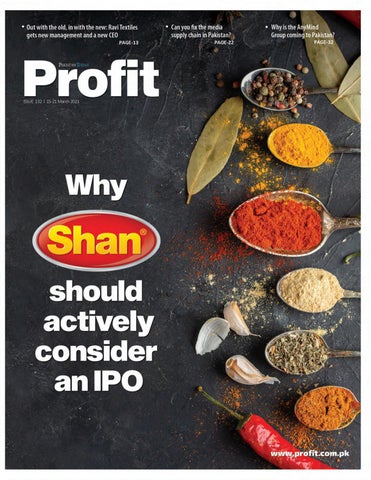
16 Why Shan Foods should actively consider an IPO 22 Can you fix the media supply chain in Pakistan?
26 30
30 Why is the AnyMind Group coming to Pakistan?
32
32 Hubco to acquire ENI Pakistan upstream operations
Profit
26 Punjab’s cluster development scheme for SMEs falls prey to the typical implementational hurdles 29 Engro makes a splash
Executive Editor: Babar Nizami l Managing Editor: Farooq Tirmizi l Joint Editor: Yousaf Nizami Reporters: Ariba Shahid l Babar Khan Javed l Taimoor Hassan Abdullah Niazi l Meiryum Ali l Shahab Omer Director Marketing: Zahid Ali l Regional Heads of Marketing: Muddasir Alam (Khi) Zulfiqar Butt (Lhr) l Mudassir Iqbal (Isl) l Layout: Rizwan Ahmad l Photographers: Zubair Mehfooz & Imran Gillani l Business, Economic & Financial news by 'Pakistan Today' Contact: profit@pakistantoday.com.pk
Readers Say All I know is Atif gets UX. That alone will make this bank a dangerous competitor. If you play on experience you have an edge even money can't get you. And by UX i don’t mean just marketing. Of how an organization interacts with the customer at all touch points. UX also means orienting the entire organization around the customer. Which is arguably the aim of digital transformation too. Apropos: Back in the game? Habibullah Khan, Founder Penumbra Atif has built a great franchise. Banking in the current form has become a commoditized business. Let’s see how banks distinguish their brands through products, service and technology. Alfalah is a big success story and the role of the Bashir Tahir and Pervez Shahid family has had a substantial contribution in building the franchise. I had a discussion with Atif Bajwa last week and he says he is trying to rebuild the old energy. Can’t talk about specifics since it is a listed company. Apropos: Back in the game? Najam Ali, CEO Next Capital, via Twitter So far, the numbers are struggling. Hope to see the numbers revive with his return. Banking being so heavily regulated and straight jacketed has been commoditized always with the same products across the board. It will remain so in future too. Yet, one has to differentiate to emerge above others. Being a service industry, one has to appease the customer to win the game. New ways to reach and appease customers have to be thought of. I think technology remains the answer in the new post-Covid world. Invest in it! Apropos: Back in the game? @Doer_Does_It, Twitter There is no doubt that Atif Bajwa has done well in building on the successes of the founding management led by Parvez Shahid, who had built and took Bank Alfalah from a sapling with three branches to a regional-level bank with 450+ branches in Pakistan, Afghanistan, Bangladesh, Qatar, as well as an independent operation in Georgia. Apropos: Back in the game? @FahadSheikh3, Twitter
facebook.com/Profitpk twitter.com/Profitpk linkedin.com/showcase/13251020 profit.com.pk profit@pakistantoday.com
HOW TO CONTACT
9
I do not see traditional banks fading away. That is, if they are willing to change and adapt to the needs of customers. So, will customers set foot inside banks in the future? In the Pakistani paradigm, yes! With self-service technology covering their needs, the average customer will likely be able to bank without a physical branch. We'll likely see the number of branches continue to decline, but physical branches will always exist. And that is exactly what Mr.Bajwa speaks of.. in-
vesting in technology & the right human capital is the,” Way Forward.” Apropos: Back in the game? Shakil Sadiq, Facebook Banking in Pakistan is mediocre. The TV ad campaigns gloss over the poor services that most branches have to offer. There is no standardisation of service. Solicitation of financial advice requires financial licensing. Sales staff mis-sell in order to achieve targets. There is no need for an identification sales process. Learning and Development is ignored and compromised. Digital banking is the only way forward. And very soon you will not need banks for that. So Bajwa should start saving his one crore a month salary. WeBank has recently conducted a billion dollar trade payment purely from a virtual platform. Your investment portfolio is going to shift towards AI based investor recommendations, but gradually. Apropos: Back in the game? Saad.A.Khan, Facebook While I agree with a couple the points made by Saad.A.Khan , digitization is not the answer as the Client mentality, at least in this part of the world, is to have a Brick and Mortar set up in order for them to feel secure about their funds, and that they do by visiting their RM on a weekly basis, at least! I’m sure you are aware of the 80-20 rule in Banking. 20% of the clients own 80% of the deposit base. These clients are the sophisticated ones who, invariably, are Private Banking Clients abroad and use their accounts here for their necessary expenses. The rest are your core clients who want the service that is “Second to None”, and these are the clients who increase your core deposit base which is more permanent as opposed to the HNW deposit base. These clients are not that electronic savvy, and only a very small percentage even use ATM’s. In order to have an effective sales process, one needs to hire professionals who are committed to excel in their career, instead of contractual employees who are only interested in their commission and not focused on service standards. So my friend, Banks need to focus more on hiring the “Right Fit” instead of trying to go mass market with mediocre resources. Going into riskier products has been tried and tested. Citi was the first retail bank in Pakistan to introduce mass market, personal, auto and Mortgages. While the business, in terms of lending did well, repayments and installments were highly inconsistent and negligible, resulting in re-possession as well as foreclosure, which was very damaging to the Institution’s bottom line! Currently, Banks are investing in PIB’s as well as T-Bills, not only because of the return, but more so because of the sovereign security of these instruments. Apropos: Back in the game? Adnan Haider, Facebook
COMMENTS
IN BRIEF Pakistan’s economic growth is projected to remain below potential, averaging 1.3 per cent for 202122, according to a new World Bank (WB) report titled “South Asia Economic Focus: Beaten or Broken, Informality and Covid-19.” This base-line projection is highly uncertain and has been predicted over the absence of significant infection flare-ups. The Lahore High Court (LHC) has issued notices on a petition seeking directives for the government to bring down prices of chicken in the province. Prices of chicken have gone up considerably to as much as Rs500 per kg.
“The government is firmly committed to uplifting the agriculture sector through effective and speedy implementation of the Agriculture Transformation Plan. I urge all concerned to come up with a clear action plan along with timelines and a responsibility matrix to finalise different proposals.” Finance Minister Abdul Hafeez Sheikh
Rs 52 billion:
The Central Development Working Party (CDWP) has approved six development projects at an estimated cost of Rs52 billion. Two projects related to the transport & communications sector and four related to the water resources sector were approved.
People in the capital and other parts of the country crowded clinics and hospitals on Wednesday as the country began the second phase of a nationwide coronavirus vaccination drive to inoculate all above 60, with social distancing measures going out the window because of mismanagement at different locations
$1.3 million:
The Japan International Cooperation Agency (JICA) would provide $1.3 million to the Food and Agriculture Organisation of the United Nations (FAO) to support pest control operations, besides enhancing food and nutrition security for locust-affected smallholders.
With the arrival of new investors in the mobile phone manufacturing industry, the Ministry of Industries & Production (MoIP) expects that the new industry will overtake the country’s automotive industry in the next few years. Prime Minister Imran Khan is unhappy over the Federal Board of Revenue’s performance, as it failed to show any recoveries from sugar mills owned by prominent personalities. The FBR presented a report showing recoveries of more than Rs400 billion mostly from small-scale sugar mills.
8
PSX dips, bancassurance, and woes for freelancers This week in Pakistan’s business and economics twitterverse
The charms of I.I.Chundigar road, female financial inclusion, and more make it to this week’s social media roundup
I
Profit’s reporter Ariba Shahid analyses the business and economic highlights from Pakistani Twitter this week.
The woes of speculation are the woes of regulation
t has been a long, long week. The Senate Elections and the screws that may or may not have been cameras (they were) have given both the media and the meme makers on social media a field day, and the vicious propaganda against Aurat March has had activists scrambling to try and stop people from getting hurt. On the sidelines, a lot else was happening that may not have gotten the attention it deserves. Pakistani freelancers were up in arms after another method of receiving payments for them was taken away in the same week that TikTok was banned, the stock market went through a serious dip under shady circumstances, and women’s day sparked conversations about financial inclusion for women.
Financial inclusion for women
Halima Iqbal, Founder and CEO at Oraan, comments on the need for equal opportunities for female financial inclusion and how it is a dire need for the progress of women and the nation as a whole. Moreover, she highlights the work Oraan is doing in regards to this. Women in Pakistan are now a more visible part of the economy than ever before, and are being recognised for their labour, and the using the fruits of their work to be a huge buying force.
SOCIAL MEDIA ROUNDUP
The stock market, as we like to keep reminding people, is not a reliable indicator of the economy. It is, after all, a glass palace made out of risks and speculation. And as Najam Ali (NajamAli2020), the CEO of Next Capital, pointed out in a tweet this week, speculation is not what is bad, but it is the absence of a level playing field that is the problem. Najam Ali’s tweet came out only a day after he went on the night time talk show, Aj Kamran Khan Kai Saath, to discuss the recent dip in the Pakistan Stock Exchange (PSX). Mr Ali managed to get Kamran Khan out of his achkan long enough to be able to declare live on the show that the recent dip was not a natural occurrence, but a synchronized sell-off that was coordinated. He urged the regulator to look into it. Once again, Ali’s tweet on the matter afterwards clarified that speculation is a norm the stock market is built on and that he does not oppose it. Speculation in stocks is not something new. In fact ups and downs in the stock market, much like this week are speculative in nature over what people anticipate about the future. These speculations and anticipations do not always translate into reality. It is simply the lack of scrutiny that is being criticized.
9
The charms of I.I Chundigar road
Freelancers assemble With the FBR annoyed at Payoneer for being an alternative to Paypal to bring in money to Pakistan, freelancers will be back to square one trying to figure out how to get paid. Remember, the Imran Khan government does not just want a ‘Digital Pakistan,’ but has directly made promises to freelancers to help them in receiving their payments. That is also why the government has often talked about bringing paypal to Pakistan. Now the chances of that happening seem slim, so the only question remains, why ban a platform that was doing that job? A bird in the hand is better than two in the bush, and it is definitely better than no bird at all. As bystanders, we could also say the chances of paypal may be slimmer if there is more resistance against Payoneer. H U Khan (@Huk06) takes a poignant dig at the banning.
Bancassurance
I. I Chundrigar road in Karachi is often referred to as the Wallstreet of Pakistan. We like to think of it as a one of a kind street. Gulraiz Khan (@ gulraizkhan, the head of design and customer experience at a noted bank, does too. As he points out in his tweet accompanied by a surprisingly stirring picture of the iconic road and some of its most noted occupants, Khan makes a case for the historicity and prestige of the road, even if he makes an uncalled for dig at charpai straps. What we do like is that he agrees that I. I. Chundigar road has its own personality. “Let us also please stop calling it Pakistan’s Wall Street. It is actually much larger and more interesting than Wall Street. Far more diverse heritage and living fabric. If you wanna call it anything, call it Mecklaroad, as it has been lovingly called for generations.” Despite that, the facilities provided to people working or commuting to the street remain minimal such as the partition between the up and down side of the road. While UBL, HBL, and MCB earn from across the country, their headquarters in Karachi and on this road results in three buildings within a km of radius depositing approximately Rs 55bn of taxes.
10
Bancassurance can be termed as a nuisance considering the fact that there is no risk profiling and unaware pensioners and citizens often fall into the trap with little to no knowledge. Featured once again in Profit’s roundup, our columnist Ammar H Khan (@rogueconomist) comments on the fact that insurance companies are negligent with funds and operate much like a hedge fund. Keep an eye out for his threads.
Women’s day panels
A women’s day panel at Daraz was organized by Daraz. Jehan Ara, Nadia Patel, Gangjee Arusha Imtiaz, and Annum Salman were present. The panel talked about women empowerment and celebrated successful women. Once again, while panels like these are important for inclusion, they also have a real world, economic impact.
SOCIAL MEDIA ROUNDUP
OPINION
Ammar H. Khan
Exchange Traded Funds: An Opportunity Lost? Only four equity ETFs have been launched, and their market volumes have been dismal.
these ETFs have been dismal at best. Since the launch of the first ETF, a cumulative of Rs 170 million worth of seed capital has moved towards these ETFs. Flow of capital from external retail or institutional investors would be less than Rs 50 million. Assets under management through ETFs are less than 0.1 percent of total equity AUM being managed by the asset management industry. Average daily volume traded for all ETFs is 75,648 units, while the median is one-third of it at 23,750 units. The average daily traded value is around PKR 0.56 million, making the ETFs practically illiquid under any liquidity measurement criteria. In a nutshell, there is barely any traded volume, and that is not because of any lack of demand, but largely due to supply side inefficiencies.
D
uring the last ten years, more capital has flowed into Exchange Traded Funds (ETF) than conventional mutual funds on a global level. This has given rise to low-cost passive investment management strategies. Retail and institutional investors alike have adopted indexing in favor of active management, where high expense ratios often resulted in underperformance vis-a-vis the relevant benchmark. Adoption of indexing has created a new class of power brokers among those who develop and maintain indices, shifting the balance of power away from active fund managers. In the local context, the asset management industry has largely stayed behind the curve. After much deliberation and multiple committees established by the regulator over a decade, the first ETF was finally launched in 2020 amidst much fanfare. To this day, only four equity ETFs have been launched. Market volumes associated with
Ammar H. Khan
is the chief risk officer for Karandaaz Pakistan, an organisation that seeks to promote financial inclusion in Pakistan. He has previously worked at several financial institutions in Pakistan, both in commercial banking and capital markets
COMMENT
The underlying mechanics of an ETF are simple. An asset management company (or any other designated entity) launches an ETF to track a pre-defined index. An Authorized Participant (AP) is appointed which can either buy or sell units of ETF from the asset management company against a basket of index constituents. Issuance and redemption of ETF units is only done ‘inkind’, where an AP would exchange ETF units against a fixed basket of index constituents. In conventional funds, the units are exchanged for cash, rather than ‘in-kind’. The AP then ideally does transactions in the market, providing liquidity as and when required. In addition to an AP, the critical lever for ETFs is the presence of a market maker who can provide liquidity for both sides of a transaction whether buy or sell by providing two-way quotes. The scant volumes in the market can be attributed to the absence of a designated entity which can provide liquidity for efficient execution. A market maker effectively profits off any arbitrage opportunities present between the market price of an ETF, and the Net Asset Value (NAV) of an
11
ETF as reported by the AMC. If the price of an ETF in the market is greater than the NAV, the market maker can buy units of the ETF from the AP, and sell it in the market -- pocketing the gain. Alternatively, if the market price of an ETF is lower than the NAV, the market maker can buy units of the ETF on the market, and exchange the same for a basket of stocks from the AMC. Through this regular interplay of two-way arbitrage, ample liquidity is generated, while any price discrepancy is also addressed. The key function of a market maker requires the ability to place two-way quotes (bids & offers) regardless of market direction. As the mandate of the market maker is to provide liquidity, and not take directional bets, the market maker needs to stay market neutral, and for that requires instruments to hedge its exposure. If a market maker is holding inventory of a certain ETF, and it wants to remain market neutral, the logical thing to do would be to take a short position in the constituents of the respective ETF. Such a strategy would ensure that the market maker remains insulated from market movements, and only focuses on addressing price discrepancies for any arbitrage gains. However, in the local context, it is possible to take short positions only through future contracts, and for a handful of stocks only where ample liquidity is available. Before a thriving market for ETFs can be established, short positions must be allowed at least for ETF constituents in order to enable effective hedging. Another structural hindrance which discourages market makers is presence of circuit breakers. Following the market turmoil in 2008, a circuit breaker of five percent (or PKR 1) was imposed, whichever is higher (or lower).
12
In-effect, the price of a majority of stocks could not move by more than five percent. Such an arbitrary mechanism adversely affected the price discovery process, while minimizing the need for risk management, as daily losses were essentially capped, leading to complacency in managing market risks. For a market maker to effectively manage its position, it is essential that unfettered access is available to ETF constituents for buying and selling. A circuit breaker essentially restricts a market maker from taking a long position when a stock is capped, and from reducing a position when a stock is at the floor. Such an anomaly contributes towards a tracking error, while hindering the process of market making. Recently, the circuit breakers were expanded to seven and a half percent after being fixed at five percent for more than a decade. These circuit breakers eventually need to be phased out, and replaced by market halts. The sooner they are phased out, the better it will be for ETFs, and for other products, as structuring options, or other synthetic products is not possible, or efficient with arbitrary circuit breakers. The asset management companies also do not have an incentive to promote ETFs, or invest in the same. Cumulative seed capital in existing ETFs is only PKR 170 million, or less than one percent of their total assets under management. ETFs given their low-fee structure, with a management fee of less than one percent have the potential to cannibalize existing funds, where management fee is in the range of two and a half, to three percent. Incumbent players simply do not have an incentive to push for growth of ETFs, as that actually hurts their existing business model where expense ratios can be considerably higher. The problems associated with ETFs are
supply-side related, whether it is the absence of market makers, arbitrary circuit breakers, or a collusive market structure which may get upended once low-cost passive funds make more economic sense for retail, and institutional investors alike. Any move to transition away from market-based pricing to a formula-based pricing would also be detrimental for the evolution of ETFs in an already product starved capital market. The opportunity is still not lost. Economic green shoots are emerging, and capital markets can play a pivotal role in supporting overall macroeconomic growth, while also developing the capital market ecosystem. Development of new ETFs, particularly on the fixed income front can play a key role in enabling retail investors, and savers alike to invest directly in sovereign and corporate paper. The critical lever even in this case would be a market maker, with enough depth to provide two-way quotes for sovereign paper for starters. Such a class of ETFs will upend the fixed income market largely dominated by a few big institutional players, and support market depth. Number of active retail investors in Pakistan is less than 300,000, with depressingly low growth rates over the years. The hope here is that technology will disrupt capital markets in the country, through the likes of a local version of Robinhood, or Zerodha, or through highly efficient and low-cost execution through technology. ETFs are a convenient vehicle through which novice and expert investors both can take exposure to the market, whether they be local, or foreign investors. Having the right market infrastructure in place remains critical, which necessitates solving supply-side issues. If you build it (market infrastructure), they will come (investors). n
COMMENT
Out with the old, in with the new:
Ravi Textiles
gets new management and a new CEO What in the world is a profitable steel company doing buying a dud textile mill?
TEXTILES
S
o it finally happened. The two steel mill owners took over a publicly listed textile mill. Back in October 2020, this magazine had covered an unusual piece of news from the Pakistan Stock Exchange. Ravi Textiles Mills had just been informed that two individuals, Chauhdry Muhammad Shafique and Muhammad Ahmad Raza, wanted to aquire more than 51% of all shares in the company, along with management control. The offer was so new, that when Profit contacted Ravi Textiles at the time, they had no idea who the group was or their motives, apart from the fact that they were based in Lahore. Well, no longer. Ravi’s staff will now have to
deal with an entirely new management - assuming they are kept around at all. In a notice to the PSX on March 4, the exchange was informed that the two aquirers had entered into a share purchase agreement with 14 individuals and two private limited companies to acquire 15,748,746 shares, or 62.99% of the company. The total cost was to be Rs30 million. That is a fair amount of money for Ravi Textiles - a company that ceased production in 2015. To recap, the company is a publicly listed company that was incorporated in 1984, and was designed to to manufacture and trade yarn. But it failed to do so. Its mill, which is located in Kasur district, suspended operations between 2012 and
13
2014, and again between 2015 and 2020. If one looks at the ‘Six years at a Glance’ section of the company’s financials, there is a gaping blank where it should say ‘Yarn Sales’. What happened? At the start of the 2010s, Ravi Textile Mills fortunes began to dip. As the company noted in its financials, it had a litany of problems including but not limited to “volatile changes in prices of raw materials, disproportionate increase in price of yarn, volatile yarn market, bearish yarn market, increase in energy cost, scheduled and unscheduled extensive load shedding of electricity, and high mark up rates charged by banks.” This resulted in a ‘squeezed liquidity’ position of the company, and the mill was not able to repay its short term borrowings and finance costs. Banks chose to not renew the credit facilities of the company, which expired in June 2011. And so management suspended operations at the mills, while it sorted out compromises with banks. Scraping together some directors’ loans, the company managed to resume operations of the mills in June 2015. This turned out to be very short lived, and it was suspended again in August 2015. It seems that Ravi Textile Mills was facing the full brunt of the crisis in the textile industry. So the company decided to sell its assets. In February 2019, it sold the mills located in Kasur to Waqas Rafique International – all except the vehicles – for Rs300 million. The money from the sale of the assets was then used to repay the company’s liabilities. The company made Rs113.3 million in ‘other’ income in 2019, which allowed it to make a profit of Rs 101.9 million, after a loss of Rs34.7 million the year prior. In 2020, the company made Rs41.7 million in ‘other’ income, and Rs30.2 million in profit. Then, in August 2020, the company decided to lease a cotton ginning factory in Bahawalnagar from Noman Cotton Ginning Pressing Factory in Bahawalnagar. It was an unusual move, as a ginning factory is technically a step back in the textile supply chain. But the move paid off. An annual lease rent of Rs1.6 million was signed, and the factory was handed over to Ravi, just in time for the ginning season that begins in September. According to the latest annual report, after the completion of necessary repair and maintenance, the company started its new operations from September 2020, and heard that magical word: revenue (the company earned Rs25 million in that month). It seems that the entire chain of events was just a prelude to this change of control. Chaudhry Muhammad Shafique is the CEO and head of the Chaudhry Steel Re-rolling Mills, a public unlisted company in Lahore. Muhammad Ahmed Raza has more than 30%
14
Ravi Textiles Mills is currently sitting on the PSX’s defaulters list. There is a slim possibility of a reverse merger, in which a private company becomes a public company by acquiring it. Acquiring a non-operational listed company is often easier and less time consuming than an IPO share in BECO Steel Re-rolling mills, a private company. While there is limited information on BECO, Chaudhry Steel Re-rolling has been around since 1992, makes bars and billets, and has an annual production capacity of 348,480 MT per annum (in 2017). Its profit in 2017 stood at Rs512 million (Rs191 million in 2013). And change they did. Of those 14 individuals, seven used to sit on the board of directors. Muhammad Waseem-ur-Rehman was the CEO. No longer: the two steel owners brought in an entire new board, and Chaudhry Muhammad Shafique is now the new CEO, while Sarwar Sultana is the new chairperosn of the board, replacing Aftab Sarwar. So what is a profitable steel company
doing in buying a dud of a textile mill, particularly when the steel sector is expected to take off due to the recent construction sector boom? Well, Ravi Textiles Mills is currently sitting on the PSX’s defaulters list. There is a slim possibility of a reverse merger, in which a private company becomes a public company by acquiring it. Acquiring a non-operational listed company is often easier and less time consuming than an IPO. Will it happen? Let us see. After all, on March 10, the exchange was informed there will be a board meeting to discuss business operations and other corporate matters. Will Ravi cease to exist? We will have to wait to find out. n
Economic recovery
helps banking sector manage risks
The banking sector’s stability in the face of Covid-19 has been surprising, and pleasantly so
W
hen the Covid-19 pandemic hit Pakistan, there were worries that the banking sector would not recover. But timely intervention by the State Bank of Pakistan, and banks’ over-compensation somehow saved the sector. And this is not just anecdotal or conjecture, because this February and March, when every bank started releasing their annual reports to the State Bank of Pakistan, the figures were, surprisingly, in line with expectations. The
fear was that banks would do far worse than expected even given the circumstances. Instead, in some cases, it could almost be said that Covid-19 had next to no effect at all. In a note issued to clients on March 9, senior investment analyst Hamza Kamal, made the observation that the banking sector delivered a much better than expected performance on loan quality in a ‘tumultuous’ calendar year 2020. “The total non-performing loans of our private banking universe (representing 55.4% of total industry advances, excluding Habib
TEXTILES
Metropolitan Bank) surged by 6.8%, inline with yearly historical averages, attributable to timely response by SBP,” he said. According to Kamal, the asset quality demonstrated exceptional resilience in the calendar year 2020. The help from the State Bank also had other benefits. It provided banks which have international operations much needed space to absorb delinquencies on the international loan book, which jumped 3.8% in the first nine months of calendar year 2020 in US dollar terms. However, the sharp downtick in these non performing loans in US dollar terms in the final quarter (where they fell by 2.6% on a quarterly basis) can be taken as an indication of a near term trend in non performing loans from overseas. So what about domestic loans? The news is still bright, and as Kamal explains in his note, the loan book reflected exceptional resilience in most part of the year with total non-performing loans increasing 3.3% in the nine month period of calendar year 2020; while the final quarter witnessed an uptick of 4.4%. “We still remain comfortable on domestic asset quality as the relief period expires awaiting more data points suggesting an alternative view,” he said. This view was also reportedly shared by the managements of their universe banks: that after aggressively building up loss reserves in the second and third quarter (around Rs18.4 billion, or 0.5% of gross advances), banks either opted to reduce pace of accumulation or partly reverse provisions eyeing improved economic performance.
“Moreover, while we expect the Central Bank to discontinue its forbearance measures as the timeline ends, we do not rule out SBP providing reliefs on particular sectors or companies affecting the entire banking industry as also seen in the past” Hamza Kamal, senior investment analyst Furthermore, Kamal said the normalization in credit costs is expected, with recoveries to counter fresh non-performing buildup. The overall cost of provisioning stood at 1.6% in calendar year 2020, which is the highest since 2013. Kamal expects costs to normalize going forward even after the expiration of the relief period. “Our assumption is based upon heightened economic activity particularly in real estate translating into improved recovery prospects for the banking universe as indicated by recovery ratio in the fourth quarter in 2020, standing at 2.2%, which is the highest quarterly average since December 2017,” he said. “Improving the business outlook distinctly in the textile space is likely to make debt swap arrangements feasible. This was seen in Habib Metropolitan Bank, where non-banking assets jumped Rs2.6 billion in September 2020 versus Rs414 million in June 2020.” Because of this, potential reversals in credit charge could assist in countering any fresh NPL accumulation in our view. says Kamal. “Moreover, while we expect the Central
Bank to discontinue its forbearance measures as the timeline ends, we do not rule out SBP providing reliefs on particular sectors or companies affecting the entire banking industry as also seen in the past,” the analyst added. Kamal expects MCB Bank to speed up recoveries from NIB’s non-performing loans portfolio, as 50% of the targeted amount is yet to be recovered. UBL, according to Kamal, has gotten over the hump of its overseas loan portfolio. Additionally, the MCB and Bank Alfalah lead the pack in terms of loss reserves buildup relative to its loan book. The banking sector to return to limelight as expectation of an eventual rate hike comes into play: The banking sector has underperformed the market by 4.1% despite heavy dividend payout as below expected earnings and payouts in select bank stocks deteriorated investor sentiments. “Going forward, a bull-cycle in commodities spurring concerns on inflation and external account and increasing market expectation of an eventual rate hike by the Central Bank could bring the sector into limelight.” n
BANKING
16
COVER STORY
By Ariba Shahid and Farooq Tirmizi
Y
ou do not have to be young to grow a business, but you do have to be hungry. But founders of a company – after a long run of success – can find themselves in a position where they are no longer as driven as they once were, but competing against those who are. That, it seems, is the position Shan Foods finds itself in. Its founder and chairman – Sikandar Sultan – has an extraordinary story of building a business – and a brand that is now a household name in several countries around the world – almost completely from scratch alongside his wife over the past 40 years. (Citing privacy concerns, Sikandar’s wife, through him, declined to be identified by name.) Now, however, comes the moment of truth: Sikandar knows he needs to do the hand off to a new generation of management, and is currently orchestrating the transition, but faces a challenging competitive environment. It comes down to this: Shan’s biggest competitor is larger by overall revenue, has a broader product portfolio, and is growing faster. All of this is happening while the company is still in the midst of deciding its future direction, one of the central questions of which – until recently – was whether or not to go public through a listing on the Pakistan Stock Exchange. Shan Foods’ management has publicly stated in the past that they were considering an initial public offering (IPO), though in a recent interview with Profit, the company’s chairman made it clear that an IPO was no longer on the cards. As we will demonstrate through the analysis presented in this story, however, it is our contention that – far from ruling it out – Shan Foods should actively pursue a public listing. Because one of the biggest advantages their competitor National Foods has over them, in our opinion, is that it is a publicly listed company.
How Shan got its start
B
efore diving into that analysis, however, we would like to lay out how Shan became such an iconic brand, from its humble origins to its current heyday. The story starts with Sikandar, who comes from a family that had historically been in completely different business lines. His grandfather made carriages, some of which the family claims were even used in the ceremony for Queen Elizabeth II’s coronation ceremony in 1953. And his father was in the carpet business. Sikandar, however, was different. Upon completing his college education at the Institute of Business Administration (IBA) Karachi in 1982, he started off as a photographer and a film-
18
We are definitely considering an IPO… we are evaluating the advantage of an IPO. Do we need the funds, is the question Sikandar Tiwana, CEO of Shan Foods, in May 2018
maker. Whilst pursuing this passion he made a livelihood by conducting training sessions in photography, in addition to creating films for the corporate sector. A religious experience soon after college, however, persuaded him to give up photography and filmmaking. In the meantime, however, Sikandar stumbled upon a talent for making spice mixes. In the late 1970s, in the absence of air-tight jars that could keep out the humidity, households would keep jars of common combinations of spices in solidified masala patties in their homes, breaking off a small piece to add to food during cooking. While he was still young, Sikandar’s mother traveled to Lahore for a few days, and in her absence, the household ran out of the masala patties. His sisters tried to replicate his mother’s recipes, but were unsuccessful. Frustrated, his father asked Sikandar to give it a try, and he had better luck. That was the first time Sikandar considered going into the spice business. However, despite his amateur success, it was his wife who was instrumental in helping Shan get off the ground. Sikandar and his wife started making masala mixes in an empty servant quarter that they converted into a home office in 1981. “In the beginning, we started off as a one-room operation where my wife and I spent countless hours perfecting our recipes. From the get-go, the response was great, maybe because he launched right before Eid, a time when most people buy masalas,” said Sikandar, in an interview with Profit. As business took off, Sikandar needed capital to expand, and turned down an offer from his father to help provide the necessary funds. “I sold everything I had except for my shoes,” he said. The bulk of the initial capital for Shan, however, came from the family-funded real estate business that Sikandar – like many upper middle-class men – had: buying and selling properties, using part of the profits to fund Shan Foods’ operations. “My wife is the custodian of the recipes,”
he said. During the initial days, Sultan and his wife would go in and mix the masalas themselves. “Now that the business has expanded to such a level, we do have certain highly trusted members of the team who know what ingredients we use and what the perfect ratios are that make our recipe mixes distinct. There are no secret ingredients.” The recipes themselves are a product of the cultural background of the couple. “While I am Sindhi because I was born in Karachi, my family migrated from Delhi. My wife’s family migrated from Bombay.” Both regions have deep traditions of spice mixes unique to Muslim families that were originally developed in the kitchens of Mughal emperors and nawabs. That specific regional origin may play a role in the market positioning of the company today. “Taste preference is definitely something that results in brand loyalty. You can see this in how we are a market leader in Sindh but not in Punjab because of their varied taste palate. So definitely taste preferences surely does play a big role in brand loyalty,” said Sikandar. And that certainly stands to reason: Muhajirs from Delhi, Bombay and other areas of Northern India primarily settled in Karachi and Hyderabad after Partition and may prefer Shan because it tastes similar to their family recipes. Fast forward to the present, Shan has grown manifold. Far from being a one-room operation, it has manufacturing facilities in Pakistan, Saudi Arabia and the UAE. “We have about 88 different recipe mix masalas. Out of these, our top running mixes across the globe include Bombay Biryani, Karahi, Achar Gosht, and Korma. We are now a global brand, present in over 75 countries, and we have a strong resonance in terms of top of mind recall with the kind of communication that we put out,” said Sikandar. The company’s impact on Pakistan’s corporate landscape is quite literal: the roundabout on Korangi Road in Karachi near the Shan office is called Shan Chorangi. Yet despite all that growth, Shan Foods’
aversion to external capital sources remains a constant, particularly avoiding debt. “We’ve never taken a loan out for the business. Religion plays a role in this but also the fact that we do not make profits our lifestyle. We reinvest that into the business,” said Sikandar. That austerity may have worked well in the past, but the market today is tougher than it was when Shan first started in the early 1980s. And while Shan has grown significantly over the last several decades, and remains the market leader in masala mixes, it is not the biggest company in the broader condiment market. That would be the publicly listed National Foods, which is not only larger, but also growing faster and, more worryingly for Shan, evolving somewhat better with the market. Specifically, the main source of growth for the Pakistani condiments industry is to serve the increasing Pakistani diaspora, particularly in North America. And on that front, Shan is losing badly.
North America: the battleground for the Pakistani condiment market
A
s we stated earlier, Shan has a higher market masala mix market, but National – by virtue of its larger product line of condiments such as ketchups and achaars – has had higher aggregate revenues since at least 2009, the earliest year for which Profit has been able to obtain financial data for both companies. If you look at the aggregate numbers, the disparity is not that huge. On a consolidated basis across all subsidiaries, Sikandar says that Shan’s revenue in 2020 was approximately Rs24 billion. That is smaller than the Rs29 billion in revenue for National Foods that same year, but not worryingly so. The problem appears once one drills down into the details of the numbers. While the spice market within Pakistan is growing respectably, the key driver of growth has been exports to serve the Pakistani diaspora
There is no plan for an IPO. We don’t want to lose our control, nor do we have a major project in mind for which we need public money Sikandar Sultan, chairman of Shan Foods, in March 2021
overseas, specifically the one in North America, driven by everyone and their cousin moving to Canada. For both Shan and National Foods, revenue growth in exports has consistently been higher than that of local revenues in five of the six years between 2013 and 2019, the latest period for which Profit was able to obtain detailed financial data for both companies. However, National’s share of the export market has been growing significantly faster than that of Shan, a fact that can best be summarised with a single statistic: in 2013, Shan exported more than twice as much as National Foods in terms of revenue, but by 2019, the numbers had reversed, and National exported nearly twice as much as Shan. The numbers are not paltry: in 2019, Shan Foods exported Rs5.6 billion worth of products, mainly to North America, while National Foods exported Rs9.4 billion. Shan does not break out the precise geographic mix of its exports, but does state that North America is its most important market. “Our North American market is the biggest one for us, making up for the largest segment of our international consumers,” said Sikandar. National Foods, being a publicly listed company, offers significantly more detail about its exports. In 2020, exports to the United
States and Canada accounted for 92% of all exports by National Foods. And if National Foods’ numbers are a reasonable proxy for the market (and we at Profit, based on the National data and commentary from Shan’s management, believe that they are), then exports to North America drive a plurality of the growth in the market for Pakistani condiments. Here is how it breaks down at National Foods: between 2015 and 2020, National Foods saw an increase of Rs22.9 billion in gross revenues. Of that, Rs10.3 billion – 45% of the total – came just from the rise in exports to the United States and Canada. The domestic market accounted for Rs12.5 billion. Yes, those numbers are correct: growth in exports to serving Pakistani expats in North America nearly equaled the growth that came from serving 200 million Pakistanis living inside Pakistan. That spectacular growth in North America has been powering National Foods to grow faster than its rival Shan. In the five-year period between 2009 and 2014, Shan was handily crushing National Foods in terms of growth numbers, posting an average revenue growth rate of 27% per year during that period. That was before National turned on the turbo-boost engine on its North American sales. As recently as 2015, National sold just Rs391 million worth of products in the United States
COVER STORY
and Canada combined. Since then, however, its growth has skyrocketed. In the subsequent five-year period spanning 2014 through 2019, National has handily beaten Shan in revenue growth, averaging a 20% per year growth rate compared to Shan’s more modest average of 12.5% per year. It is true that Shan owns some manufacturing and trading facilities abroad, which may artificially decrease its numbers somewhat, but even by the numbers that Sikandar gave Profit for the company’s global consolidated sales, National has higher revenues than Shan: Rs29 billion for National to Rs24 billion for Shan. And the details in Shan’s financial statements indicate that the bulk of its manufacturing abroad still relies on ingredients exported from Pakistan, numbers that show up as export revenues for the Pakistani company, suggesting that the foreign subsidiary’s earning power is largely accounted for in the Pakistan numbers. This is not to say that Shan has not had wins in the international market, particularly on the branding front. In December 2020, Gigi Hadid’s featured her spice collection on her Instagram stories, which included a few boxes of Shan masala. This, of course, is not entirely accidental: Gigi’s partner is Zayn Malik, formerly of British band One Direction. Zayn’s father is of Pakistani origin and Zayn himself grew up in Bradford, which at this point is more Pakistani than Chak Shahzad.
20
“It was in fact heartening to see that a famous personality like Gigi Hadid is a part of our loyal consumer base across the globe. Such exposure brings more awareness to the brand and its effect cannot be measured in a short period,” said Sikandar. That branding win aside, however, the money is in getting on the shelves of Walmart in Mississauga. And on that front, National appears to be ahead. How did National manage to turn the tables on Shan Foods? It is our contention that National is helped by being a publicly listed company, consistently accountable to minority shareholders – including long-term foreign shareholders like the Singapore-based investment firm Arisaig Partners – who view National Foods as a growth stock, and therefore demand that it continue to invest in expansion and growth opportunities.
Public vs private: a difference of perspectives
T
he public company has fallen out of favour in recent years in the United States and Europe, but the corporate form retains several advantages, foremost of which is transparency which brings with it a level of scrutiny and accountability that, at its best, can spur a company’s management to perform at their best. This is not to
suggest that well-run private companies cannot do just as well, or even outperform, their public counterparts, but merely to suggest that there is more pressure to perform well in a public company. And, to be clear, Shan Foods is a well-run private company. Its management pays itself salaries that are well within the norms of comparable companies their size (perhaps even slightly on the lower side) and Profit’s revenue of their detailed financial statements from the past five years did not turn up any of the kind of lucrative perks that the owners of private companies often pay themselves. There are also no unnecessarily large dividends either, with the company dutifully plowing back a respectable amount of its free cash flows into the business. Measured by capital expenditures as a percentage of earnings before interest, taxation, depreciation, and amortisation (EBITDA), Shan Foods reinvested a healthy 28.4% of its free cash flows into its own business during the five-year period between 2014 and 2019. No, Shan’s problem is not that it is not well-run, just that its competitor is doing even better. For instance, while Shan does well in terms of reinvesting for future growth, National does even more: capital expenditures as a percentage of EBITDA at National averaged 58% during the same period. And it is not just things like capital
TEXTILES
expenditures. National is clearly willing to get aggressive in terms of its growth strategy in other ways as well, pulling all sorts of levers to ensure its ability to command a greater share of its target markets. For instance, between 2015 and 2018, the company doubled its spending on marketing and distribution – even at the expense of temporarily depressing its operating profit margin – in order to be able to achieve the kind of international growth it wanted. Again, Shan has not been a slacker in spending on marketing and distribution. It just faces a more aggressive competitor. What does National being public have to do with its aggressive stance on growth strategy? National’s management own only about 39% of the total stock in the company compared to 82% of Shan’s shares owned by Sikandar and his family. National’s management, in other words, are more vulnerable to irate shareholders demanding changes to the way they do things, and generally value being viewed positively by their institutional shareholders. Shan’s management, by contrast, face less pressure and thus act with less urgency, a factor that shows up in the relatively lower levels of investment into growth compared to their rivals. Then there is the approach to succession and control over growth assets. Shan – unlike many other family businesses – does not have the problem of the next generation being uninterested or incompetent at running the family business. Sikandar’s daughter and son-in-law, for instance, have started a new brand of sauces called Dipitt, The brand is doing very well with Pakistan’s upper middle class consumers as well as restauranteurs, and the couple – emulating her father – have gone on to build on that success and opened Wingitt, a chicken-wingthemed restaurant that utilises sauces developed by Dipitt. Both Dipitt and Wingitt are a natural extension of Shan’s product line and the fact that they came from the next generation of the family’s owners is even better. The problem? Neither Dipitt nor Wingitt are owned by Shan Foods the company, but instead a separate
company that is owned by Sikandar’s daughter and son-in-law. The best innovation coming out of Shan will not be part of the company itself. Compared to that, National’s new business lines – including its new packaging business called A-1 in Canada – all of which have been added as wholly-owned or majority-owned subsidiaries to the publicly listed company, thus adding to the company’s strength. Of course, one model is not necessarily better than the other: the difference in public and family-owned business models is one of perspective. The National management see it as their obligation to forward the interests of the company, whereas in the family-owned Shan, there is an additional layer of concerns about family well-being and relationships.
Why a public listing could solve (many of) Shan’s problems
S
han’s management – and its chairman Sikandar – are of course intimately familiar with every issue we have laid out above, in greater precision and detail than we have. And they have publicly toyed with the idea of an IPO. As far back as January 2014, the company participated in the Pakistan IPO Summit, organised by the country’s leading investment banks as a conference meant to increase interest in public listings by prominent private companies. And in a May 2018 interview with Profit, CEO Sikandar Tiwana said: “We are definitely considering an IPO… we are evaluating the advantage of an IPO. Do we need the funds, is the question.” But in the most recent interview, conducted by Profit in March 2021, Sikandar said there was no plan to list the company. “We’re exploring our procedures and systems. However, there is no plan for an IPO. We don’t want to lose our control, nor do we have a major project in mind for which we need public money.” As is indicated in both statements, the company’s board and management are both looking at the question of an IPO as one of
whether or not they need the money. That, in our opinion, is too limiting a question to ask. Instead, the broader question should be: Would a publicly listed Shan Foods be a stronger company than a private Shan Foods? In our view, the answer is yes. There are three main advantages of doing so: succession planning, incentives for management, and better recruitment that comes with the greater visibility of being public. Firstly, Shan is clearly going through a transition as Sikandar has effectively moved into a semi-retired phase after having spent over four decades building out a strong business. He has handed over management to a professional, non-family management, led by Tiwana. That whole process of a new management taking control would be much easier if the equity being offered as incentive to that management was publicly traded and had a price they could easily look up and calculate. Secondly, and relatedly, even if the management is given shares in a private company, it is not as powerful an incentive as shares in a public company, which offer both transparent pricing and ease of liquidity: if the managers need the money for personal reasons, they would easily be able to cash it out. And lastly, if the company wants to remain an engine for innovative products after its founders move on to other things and their heirs build businesses of their own, it needs to attract the best talent. And the only companies that attract the best talent are either the multinationals, or else publicly listed local companies. In short, when faced with an aggressively expanded, publicly listed competitor, Shan Foods can no longer afford to remain private. Even if does not have a specific plan of what to do with the money, it should raise the capital anyway. Money has a way of finding uses for itself. But in the condiments business, National Foods has now made being publicly listed table stakes. Shan either needs to call the bet, or watch its competitive position slowly be eroded away. One of those options is clearly preferable to the other. n
COVER STORY
By Babar Khan Javed
F
or advertisers with advanced mindsets, the quest to race to the bottom on media pricing is over and leaders in procurement teams have agreed to shift away from commoditizing media, preferring quality media. No, this isn’t from an alternative timeline, it’s just what the latest Global Trading Survey for 2021 by ID Comms claims, which suggests a dramatic shift in favor of quality buys over commodity buys in the three years since the survey was last conducted. The outcome of the ID Comms research comes mere months after the World Federation of Advertisers published an ultimate guide for value-based procurement as part of its Project Spring initiative, which intends to evolve perceptions in order to bring out a revolution in marketing procurement. The
22
initiative requires that marketers change the way procurement works with its stakeholders by evolving to procurement processes, building new performance KPIs beyond just savings, and involving external partners to ensure a true perspective. “Media is this intangible commodity where in theory somebody can also supply it cheaper than the next person,” said Tom Denford, CEO of ID Comms Group. “Because you are procuring media inventory impressions from a third party - typically through a media agency - and they are buying them from somebody else. Media agencies are using their nouse, leverage, or skills to constantly negotiate better prices. As soon as those prices get a bit difficult to deliver then, of course, the quality of media impressions then starts to erode.” Quoting Seth Godin, Denford said that in the race to the bottom no one wins, with
advertisers seeing weaker commercial outcomes against cheap media buys, which further erodes the perspective that media inventory is an essential asset for driving commercial outcomes - which can be improved through quality media buys. By agreeing to the race to the bottom, even the media agency loses ultimately due to commoditization which only makes winning new clients or retaining existing clients even more difficult. “The pressure on lower and lower prices arguably has caused the amazing flourishing success of fraudulent or counterfeit advertising,” said Denford. “So when things become impossible to deliver for the price, you then tend to get fake versions of that thing and so historically the marketers or the advertisers’ obsession with lowering the cost of media, making it a commodity, has actually resulted in a gigantic, fraudulent, counterfeit, impression industry.”
I have known ABMs who were in a position of power to make decisions and they will just go against you because they have the power. It’s not just the seth, it’s your biggest multinational, your biggest telcos - they are so cocky because they know this is a short stint. In that short stint, they have to embrace the power, find the next possible gig, make enough khaancha from out of home, below the line, hoarding, talent anything to make as much money as possible, otherwise how else will they drive an Audi? Syed Yawar Iqbal, executive creative director at JWT Grey
Much like how Muslim Pro sold user data to any willing buyer - even the US Army - because the app was free, advertisers who choose to view media as a commodity or choose to take advantage of their media agency by paying a low retainer or expect a low agency commission will, in turn, become the product. In contrast, the Daily Muslim app by YouTube sensation The Meaning of Islam is a subscription-based habit-forming product that charges the user, hence does not sell user data to third parties. In doing so, the app is the product, not the user. By not paying for the actual skill set at
a media agency, advertisers in Pakistan are willfully setting themselves up for failure and the erosion of brand equity. The latter of which is more troubling and the pandemic ought to have imprinted the message that inelastic demand will remain for brands that have built a reputation around precision and consistency, even in media. Every technology-first company in the world - where agile mindsets thrive and the culture thrives on optimization with continuous innovation - is a testament to this best practice.
“Why should we evolve?” - everyone in Pakistan
I
n Pakistan however, nothing much has changed. In the four years, this scribe has been covering the media & advertising industry of Pakistan, one of the most common questions from readers is this: why is the media market in Pakistan the way that it is? For nearly four years, the answer has been more or less the same: everyone knows exactly what they are doing and if something looks off
ADVERTISING
The pressure on lower and lower prices arguably has caused the amazing flourishing success of fraudulent or counterfeit advertising. So when things become impossible to deliver for the price, you then tend to get fake versions of that thing and so historically the marketers or the advertisers’ obsession with lowering the cost of media, making it a commodity, has actually resulted in a gigantic, fraudulent, counterfeit, impression industry Tom Denford, CEO of ID Comms Group
rest assured that they are all in on it. “Whether it be a creative, media, or digital review, in the beginning, both marketers and procurement executives talk a big game about strategy and innovation, but when you’re in the final stages of the selection process, the reverse auction comes out,” said a seasoned media leader with one of the large network agencies in Pakistan. “This practice led by marketing and procurement executives - encourages participating advertising agencies to undercut each other.” In Pakistan, by and large, advertising is viewed as a cost and not as an investment. This is the root of the problem, piled on by marketing professors at leading universities who lack an iota of practical working experience in demand generation, coupled with glorified dinosaurs in the boardroom who declare ‘this is how we have always done things’ as if this is a mindset one ought to be proud of. There are companies in the world, led by agile mindsets that break old ways of work for new ways of doing things, and those companies on their own are worth more than every company in Pakistan combined. At the start of the 20th century, the media industry in Pakistan experienced exponential growth, which made room for specialized outlets offering media planning services. These media agencies are expected to help clients reach the right audience and for marketers that have no performance targets tied to commercial outcomes, this means selecting a media agency based on the lowest pricing possible. Whether it be NutriCo Morinaga moving its $2.5m media account to Starcom, Reckitt Benckiser (RB) moving its $7.5m media account to Blitz Advertising, or Packages Limited moving its $1.5m media account to Brainchild Communications Pakistan, sources across the board told Profit that the race to the bottom played a role in determining the winning agency. When the decision-maker on the client side chooses the deal where a media agency
24
seemingly makes no money, he will be played behind the scenes whether his Big Four auditor figures it out or not. For the media industry in Pakistan, one of the silver linings for the disparity and lack of incentive alignment between the Pakistan Broadcasters Association (PBA) and the Pakistan Advertisers Society is that no attempts have been made to fund a media transparency study, akin to the 2016 report produced by K2 Intelligence for The Association of National Advertisers. In the specific context of media buying, non-transparent business practice is one in which an advertiser does not have full access to the information necessary to assess the value of media purchase and the associated margin. Illustrative and non-comprehensive examples include: n E xistence of incentives such as discounts or rebates offered by suppliers to agencies to buy certain media even if other media have high-quality inventory or better rates n W hether or how an advertiser benefits from these incentives, should they exist n W hether the agency or holding company incentivizes its media planners or media buyers to purchase certain media eg if the agency is also a reseller for Google or Facebook n T he underlying cost of media and the agency margin, which is usually 15% n T he existence of and degree of any markup on non-media costs n T he existence of commercial arrangements or partnerships with media suppliers that have the potential to influence media buying choices, such as upfronts, n T he quality of the media and all relevant information about the audience it is meant to target. Given the state of the media industry in Pakistan, a similar study conducted by either PAS or the Marketing Association of Pakistan (MAP) may have concluded that there are
numerous opaque or non-transparent business practices taking place regularly, often with the full working knowledge of the marketer on the client side who is in on it. This includes cash rebates to media agencies, which unsurprisingly find their way to clients in one form or another, such as rigging a lucky prize draw for a car or admitting the clients’ children in a prestigious grammar school.
The root cause behind the commoditization of advertising services
“I
n all honesty, this is a Pakistan problem - anybody sitting on a powerful position or in any capacity of power - they will treat their most vilified as the subservient one. Because that will give them a different hard-on about their power position and that can be any gender,” said Syed Yawar Iqbal, executive creative director at JWT Grey, during an interview with advertising industry pundit Ad Mad Dude. “I have known ABMs who were in a position of power to make decisions and they will just go against you because they have the power. It’s not just the seth, it’s your biggest multinational, your biggest telcos - they are so cocky because they know this is a short stint. In that short stint, they have to embrace the power, find the next possible gig, make enough khaancha from out of home, below the line, hoarding, talent anything to make as much money as possible, otherwise how else will they drive an Audi?” This mindset culminates in a situation where advertisers not only want the lowest possible price to reach audiences - without evaluating the quality of the reach itself - but also want the media agencies bidding for its business to play a lose-lose auction to see which media agency will charge the lowest media commission, which ranges between 3% and
15% depending on who you ask. To play devil’s advocate, if a media agency has to accept a 3% commission for an assigned budget - which barely covers salaries - it will then close back door deals with media owners - including digital, print, out-of-home, and television - to make ends meet. The advertiser and his quest for the lowest possible pricing - without considering the quality of audience reached - are to blame. Not to mention supporting news or entertainment channels which air questionable content that may break all the rules of brand safety while fueling toxic mindsets and extremist behavior. Even without a regulator or an industry body conducting a study to determine the extent to which the media ad buying ecosystem is nontransparent, advertisers have always had the option to conduct media audits on their own dime. When an advertiser is complicit in the less than ethical actions of his client, media audits are avoided. In some cases, to appease procurement or compliance teams, media audits are conducted but at the expense of the media agency being investigated, which gets to pick its auditor, often one of the Big Four firms - which have no experience in media fraud. When the auditor is picked by and paid for by the media agency, guess what the auditors are incentivized to do if they find any discrepancies? If you guessed ‘make the discrepancies go away’, yeh water cooler aap ka hua. As such, when both the demand side and the supply side of the media ad buying ecosystem are relaxed about the state of affairs, there is no room for improvement while plenty of blame to go around. And this is why, when either side is caught red-handed, not only is no one surprised by the allegations but everyone wonders what the actual reasons are behind the apprehension since they are all doing the exact same practices as the accused.
Action Plan
T
he need to build a transparent media supply chain across viewability, measurement, ad fraud, transparency, and harmful content is ever-present, with a need for leaders at MAP, the PBA, PEMRA, and PAS needing to come together and create tangible change while ending the decades of lip service around making marketers a positive economic and social force. Learning from 15 ways white-collar criminals are fleecing advertisers in Pakistan report by Profit and the outcomes of the K2 report, it should be reiterated that advertisers’ efforts to drive down agency fees are a reason why media agencies are seeking additional sources of revenue beyond commissions. This needs to change as does the upskilling of marketers to understand the increasing complexity of the media-buying landscape, which was a key talking point during a Media Buoyz panel discussion featuring media leads of Nestle and RB. In addition, the path forward is one where the media audit is normalized given that the outcome of such activity often results in insights on media optimization which
in turn improves the returns on investment pertaining to media. For more advertisers, the sum of money spent on airtime is the single largest purchase on their list and a media audit can help them optimize the cost or efficiency of their media agency. These checks and balances go a long way for all stakeholders in the industry due to media audits seeking to understand the procedures being adopted by the agency, including whether outcomes line up with or exceed those defined in the contract. When a target has been exceeded, the benchmark and subsequent goal post need also be readjusted, which only challenges planners to declutter the brand presence across each stage of the buyer decision journey. As evidenced by a recent episode of Media Buoyz regarding the top media auditor in Pakistan, whenever marketers and their media agencies hear the word audit they assume it’s an accountability exercise under the International Financial Reporting Standards (IFRS) and we all know how much Pakistanis yearn for accountability. For those unaware, the media audit is merely a basic practice that seeks to assess whether the processes and practices are in compliance with the media contract which is signed between the agency and the client. Verifying the utility of each and every rupee spent on a campaign according to the predetermined KPIs in the contract, the media audit is a specialized function, the increased frequency of which can avoid - in the case of government-led projects - millions of rupees loss to the national exchequer. What will you choose, prevention or cure? n
ADVERTISING
By Shahab Omar
W
henever the economy is being discussed, the focus is on large scale manufacturers and titans of industry that drive economic growth and decision making. These big names and personalities come with a certain allure, and in the face of this, what often goes ignored are smaller scale enterprises. Categorized in economic jargon as small and medium enterprise (SMEs), these seemingly unassuming firms are, or at least should
26
be, the true engine of economic growth. SMEs in Pakistan are generally those firms that have fewer than 50 employees, and despite this, there are enough to leave a huge impact. The Pakistani economy consists of almost 3.3 million Small and Medium Enterprises. These may consist of (amongst many other variants) service providers, manufacturing units and startups. SMEs make up over 30% of Pakistan’s GDP and approximately 25% of generating exports. The fact is that the higher the share of SMEs in economic growth, the higher the level of income as they play an important role in job creation and product innovation. One of the places that has particularly been identi-
fied for the success of SMEs is Punjab, which has a huge potential for exports. However, SMEs here seem to be stagnant instead of growing, mainly due to the lack of basic facilities for SMEs and the system that has been created for them has a weak structure. The development of SMEs is possible only when the root causes of their stagnation are properly addressed. It was to this end that the Punjab government recently launched an initiative to support SMEs and provide them with technical assistance. This was the cluster development initiative (CDI). The logic was that with economic development, certain businesses could pop up in a cluster in one particular and very specific geographical area.
drawn up and presented in all kinds of shiny, elaborate ways. Then it is handed over to incompetent people for implementation who forget the mission and choose to focus on eyewash, creating fancy offices and expensive marketing campaigns, focusing all their energies on photo-ops, and in the end the projects go incomplete, and are quietly shelved with none of the pomp and circumstance with which they were started. From here, they lie comatose, a place for bureaucrats to go relax and do no work while getting paycheques and benefits. This is the story of one particular project, but you might as well fit it on any other.
A promising idea
T
Take for example, Lahore, where there is a concentration of eateries on M.M.Alam road and Mall1 in Gulberg. Essentially, a few restaurants initially opened up here and became popular, and that resulted in more people investing in that business in that particular area. The same is the case with Hafeez Center or Hall Road in Lahore for electronics. This is what the government wants to pull off, except for export oriented industries instead of for consumer industries. Examples of these clusters that were identified included Surgical Instruments in Sialkot, Auto Parts in Lahore, Readymade Garments in Lahore, Leather Footwear and Products in Lahore, Sports Goods in Sialkot, Electric Fans in Gujrat, Cutlery and Hunting Knives in Wazirabad, and Gloves in Sialkot. What happened? Exactly what happens to any seemingly good idea in Pakistan. It is
he story began when the Punjab government adopted the Punjab Growth Strategy 2018 for private sector development, which resulted in an annual GDP growth of 8 percent in the province. One of the basic tenets of the strategy was the development of the industrial sector, which could undoubtedly not only pave the way for growth but also increase exports, including increasing employment opportunities. As the Punjab government was a part of the development plan, an initiative was also introduced by the government for manufacturing businesses in clusters as explained above. The project was very interesting, and garnered the attention of the World Bank, which sent a mission to visitPakistan to support the implementation of key parts of the Industrial Development Plan and to review the current mandate and functions of the project. However, the World Bank Mission also conducted interactive sessions with the provincial departments of Punjab and designed a program called Jobs and Competitive Program for Results (J&CP for R). In this context, the Government of Punjab has signed an agreement with the World Bank for a $100 million supplemented by $180 million by the provincial government. The total $280 million includes a$ 6 million component for technical assistance for the development of several industrial clusters in Punjab province, and to support their further integration into global value chains; i.e. the Cluster Development Initiative (CDI). The CDI was aimed at industrial growth, and the benefits that come with it. Similarly, the other objectives of the project were to increase the production, profitability, technology upgrade and quality of industries and gearing up the high growth clusters to penetrate in the international markets and rise in exports. With industries in clusters, it is much easier to obtain economies of scale. And since this is geared towards SMEs, the
increased competition or even collaboration will result in the quality of the overall industry improving. All in all, this was a solid economic initiative. So where’s the problem? As with all things shiny and hopeful in Pakistan, it was the implementation. The project was being spearheaded by the Punjab government, but the responsibility of implementing the project was delegated to the Punjab Small Industries Corporation (PSIC), which is working on this project in collaboration with United Nation Industrial Development Organization (UNIDO). The project was planned to start in July 2016 and was scheduled to be completed by December 2021, but because of our government affairs and bureaucratic whims, the project started late and has yet to be completed. However, according to information available to Profit, the project is the subject of an investigation that suggests that it will be further delayed.
How wrong did it go?
I
t is very clear that the project was initiated to support cluster based development to facilitate industrial growth, and was approved by the Provincial Development Working Party (PDWP) with a final approved cost of Rs588.479 million with a project gestation period of almost four years from 2016 to 2021. However, according to some documents obtained by a sub department of the Planning and Development Board revealed that the actual expenditure of the project was RS 388.680 million, which shows 80 percent financial utilization against the released amount of PKR 487.227 million. Now, it remains to be seen how much work has been done after utilizing such a huge amount of money and unfortunately, our government departments are still not serious about running such an important project. Interestingly, based on the Punjab Planning Manual, all projects costing Rs50 million to Rs500 million and above should be based on feasibility studies prepared by the professionals hired by the ministries, divisions, departments or executing agencies for respective Project Management Units or Planning Cells. But as the investigation documents suggest, despite meeting these criteria in terms of the scope and cost of this project, the feasibility study regarding identification of clusters had not been conducted before implementation of CRIs, which is a clear proof of the incompetence of the officers. Now, after spending such a large amount of money on the project, the basic targets of the project have not been achieved, while according to the documents, some of the basic objectives of the project are well
SMEs
behind schedule.
Same old story
T
he first thing that is the tradition when a government project begins is hiring, beginning a marketing campaign with ads in the papers and photo-ops. This is followed by getting a Human Resources team, which is recruited. In this case, this team itself was 28 people, after which IT equipment was arranged, including state of the art laptops, computers, printers and all manner of other equipment. This is all accompanied side by side by the purchase of office furniture, electric equipment, setting up offices and the like. All of this was done in a hurry and very enthusiastically, which made it seem like the project will be completed on time, which as we know, did not happen. But again, it is easier to pick colour schemes and choose office wallpaper than it is to actually put in the work required to pull off these projects. If we look at the plan of the project, according to it, the project executing agency (PSIC) had to create a website and print material for marketing, for which a website has been created since the project started and 500 booklets of CDI, six hundred copies of each cluster’s diagnostic study report and several flyers and printing materials were produced. One study tour was conducted for exposure to well performing clusters in relevant sectors for best practice exchanges, four analytical studies were conducted including value chain analysis and cluster diagnostic studies whereas analytical studies in four newly selected clusters were carried, 11 sensitization and awareness raising events for key stakeholders in the priority sectors were conducted, the development of concept paper for the establishment of an Industrial Intelligence Unit has been submitted by the PSIC, two international experts have carried out five missions to Lahore (June, July, August, September and December 2017) to provide on the job training and guidance to cluster management teams. Moreover, they [missions] have provided technical support to cluster management teams from afar during the implementation of the cluster diagnostic studies as well as action plans. Seeing all these activities, it seemed that no force could stop the success of the project, but the report of the sub department of P&D showed that the project has not fully achieved its original objectives. The basic aim of the project was to enhance productivity and competitiveness of SMEs, in this regard, the project has identified eight clusters: Surgical Instruments in Sialkot, Auto Parts Lahore, Readymade Garments Lahore, Leather Footwear and Prod-
28
“The project is not behind schedule at all, but we added four clusters to the project which were not part of the PC-1 of the project. We have forwarded all the queries regarding the project to the said department and the report issued by them will be corrected soon. When the final report comes, everything will be clear in it” Tayyba Kamal, project director CDI ucts Lahore and all these four clusters were approved and in execution phases whereas the other four clusters including Sports Goods Sialkot, Electric Fans Gujrat, Cutlery and Hunting Knives Wazirabad and Gloves Sialkot were also approved and cluster teams were working on diagnostic study report of the clusters. The report revealed that as per the plan, the project has a target of 12 Cluster Reinforcement Initiatives (CRIs) in the identified clusters and as per PC-I, an amount of RS 250 million were also allocated for CRIs. However, the project has executed only 4 CRIs in the clusters. In the Auto Part cluster, implementation of CRI-I (Operationalization of the Auto Parts Support Center (APSC) was under process and a business plan was developed whereas to operationalize APSC, review of options under PPP (Public, Private Partnership) mode was also under process. Similarly, in the Leather Footwear & Product cluster, CRI-I (Establishment of Design Centre) was under process and business plan has developed and to operationalize the design studio and collaboration with local and foreign institutions was under process in PPP framework. Moreover, the 2nd CRI related to above mentioned clusters i.e. Productivity Improvement was under process and the hiring of consultant firm(s) for implementation of intervention was in process. The consultant firm(s) has been pre-qualified and RFPs (request for proposal) have been floated to the shortlisted consultancy firms. “Based on field monitoring, it is recommended that the project team should gear up the project’s activities (Especially execution of 12 planned CRIs) to complete them within the approved timeline as per PC-I. Sustainability Plan / Exit Strategy should be the part of PC-I document which is not part of the PC-I. Planned CRIs under this project should be implement in parallel to avoid delays in the execution of these initiatives. The work on the project’s Impact Assessment Study should be started without any delay as the activity is already behind the planned scheduled time
i.e. 3rd quarter of 2019-20 to 2020-21. Internal monitoring of the project by the Admin department should be conducted on a regular basis and the monitoring reports should be online for ready reference” read one passage from the report. The report also stated that the delay in implementation may lead to increase in cost overrun and resultantly financial burden on the government and delay in facility may cause increase in the revenue as well as recurring cost. P&D sources believed that the government had not allowed any shortage of resources for the completion of the project. “On the one hand, the government claims that most of the work is being done to facilitate SMEs and on the other hand, such projects are being destroyed. Is anyone going to ask the project stakeholders why the work on CRIs could not be completed despite so much time and resources? The minister for industries has been making statements that the project will revolutionize investment in the province, while on the other hand, it is not yet known who is responsible for the delay. The Industries Department and the concerned agencies should conduct a thorough investigation of the project and audit the amount spent and take action against those responsible for the delay in the project,” they suggested. Surprisingly, the project stakeholders are not willing to answer any questions. When the project director Tayyba Kamal was approached by Profit in this regard, she objected to the report and said that the said report was not final yet but only a draft of the report has been prepared. “The project is not behind schedule at all, but we added four clusters to the project which were not part of the PC-1 of the project. We have forwarded all the queries regarding the project to the said department and the report issued by them will be corrected soon. When the final report comes, everything will be clear in it,” she maintained. However, the director apologized for being too busy answering further questions. n
SMEs
Engro
makes a splash
Despite the pandemic, Engro did well for itself in 2020
“2
020 was a reminder that sometimes we're tested not to show our weaknesses but to discover our strengths, as EFERT continued to grow. When the Food Security of the Nation rests upon our shoulders, our teams rise to the occasion, go above and beyond for the farmers and, for Pakistan.” That bit of corporate speak you just read comes from Engro Fertilizer’s brand new annual report for the year ending December 31, 2020, (the report itself was released on March 9, while the financial results were released a little earlier, on February 15). The hyperbole aside, the company actually did quite alright. The company’s revenues in 2020 stood at Rs105.8 billion, or a decline of 13%, compared to sales revenue of Rs121.4 bil-
FERTILIZERS
lion in 2019. According to Engro, this decrease can mainly be attributed to decrease in Diammonium Phosphate (DAP) Fertilizer offtakes and reduction in Urea prices announced during the year. “The fall was partly mitigated by the stellar performance of our sales team that achieved the highest ever volumetric Urea sales
during the year,” the report noted. Meanwhile, the finance cost of the company decreased by 17% to reach Rs3.2 billion from Rs3.9 billion in 2019, mainly due to declining interest rates and decrease in outstanding long-term loans of the company. The company’s tax expense for 2020 stood at Rs3.2 billion, a decrease of 70% compared to the 2019 tax expense of Rs10.5 billion. One of the major reasons for this decline is the reversals of nearly Rs3.4 billion in tax provisions. For the year 2020, on a standalone basis the Company’s profit after tax stood at Rs16.8 billion, compared to Rs18.6 billion in 2019, registering a decline of 10%. On a consolidated basis the company posted a profit after tax of Rs18.1 billion showing a growth of 7% compared to profit after tax of Rs16.9 billion in 2019. As a result, consolidated earnings per share increased to Rs13.57 per share compared
29
to Rs12.64 per share in 2019. So all round, not a bad year at all. It is at this point that Profit’s short reports typically shed light on the history of a company for context. With Engro, the exercise seems a little futile. After all, it is Engro. But a refresher does not hurt. In 1957, a joint Esso-Mobil venture called Pak Stanvac discovered vast deposits of natural gas in Mari. Esso proposed the establishment of a giant urea plant in Daharki, about ten miles from the Mari gas fields, which would use natural gas produced as its primary raw material to churn out urea fertilizer. Talks with the Government of Pakistan bore fruit in 1964, and an agreement was signed allowing Esso to set up a urea plant with an annual capacity of 173,000 tons. The total investment made was $46 million – it was the single largest foreign investment made in Pakistan to date then. The plant started production on December 4, 1968. This, by the way, was Pakistan’s first branded fertilizer manufacturer. The branded urea was called “Engro” – an acronym for “Energy for Growth”. In 1978, Esso became Exxon, and the company became Exxon Chemical Pakistan Limited. The way that the now infamous story in Pakistan’s corporate history goes, in 1991, Exxon decided to divest its fertilizer business on a global basis. The employees of Exxon Chemical Pakistan themselves decided to buy out Exxon’s 75% equity. This was perhaps the most successful employee buy-out in Pakistan’s corporate history to date. Over the years that followed, Engro Chemicals Pakistan Limited started venturing into other sectors namely: foods, energy, chemical storage, handling, trading, industrial automation and petrochemicals. By 2009, Engro was already fast-growing and had diversified its business portfolio in as many as seven different industries. In 2010, a new Engro sub-
30
sidiary, Engro Fertilizers Limited was set up. Today, the company is one of the largest urea manufacturers in Pakistan. It has head office in Karachi, two plants - Dharki and Zarkhez - three zonal offices, and eight regional offices. It employs 1362 people (of which just 69 are women. The company’s chief executive is Nadir Salar Qureshi, who has been in charge since 2018, and had originally joined the company way back when as a business analyst. For his part, Qureshi has been nothing but optimistic about the company’s potential. “Over the last two years, with continuous focus on operational excellence by the plant team, we have been able to increase our production by ~330KT. This is a paradigm shift in the local fertilizer industry whereby urea
manufactured from indigenous gas has largely ensured self-sufficiency to address domestic demand...our sales team delivered an outstanding performance as the company sold the highest ever urea volume of over two million tons.” And nor is there any threat of competition. The fertilizer industry is part of the manufacturing sector and typically has a highly capital-intensive operational structure. The potential risk and threat from new entrants in the industry is minimal, given various factors including high initial capital cost, significant competition from major players and the competitive supply of industry’s primary raw material, which is natural gas. Engro has those factors pat down, which is how it was able to sail through the last year. n
Hubco
to acquire ENI Pakistan upstream operations One more multinational leaves the country
T
ypically, when covering news on the PSX, Profit tries to piece together why a company is behaving in this manner. Is it their cash flow? Are they optimistic about their future? Are they defaulting? But one piece of news submitted to the PSX on March 8 is unusual, in that it says very little about the actual company
announcing it ie. the Pakistani firm ‘the Hub Power Company’. Instead, it says a lot about the other company mentioned in the notice: the Italian multinational oil and gas company ENI. The giant has a presence in 66 countries, as of 2019 - and now, in 2021, it will operate in 65. The company is exiting Pakistan. According to the notice, Hub Power Holdings Limited, which is a wholly owned
subsidiary of The Hub Power Company Limited, together with ENI’s local employees (in a 50:50 joint venture) has executed definitive agreements to acquire all the upstream operations in Pakistan of Eni and renewable energy assets owned by Eni in Pakistan. The above transaction is subject to requisite compliance(s) with applicable legal and regulatory processes and approval from competent authorities. The actual figure of sale has not been released yet. Separately, on March 9, ENI released a statement: that the joint venture is called Prime International Oil & Gas Company, which has been formed by Hub Power and former ENI employees. The activities covered by the agreement include interests in eight development and production leases in the Kithar Fold Belt, and the Middle Indus Basins, and four exploration licenses in the Middle Insud and the Indus Offshore Basins. Eni's main permits were in Bhit and Badhra (40% of working interest) and Kadanwari (18.42% of working interest). Other shares were in the permits for Latif (33.3%), Zamzama (17.75%) and Sawan (23.7%). Now here is the key reason: “This agreement aligns to Eni's wider strategy of reshaping and simplifying the company's portfolio, extracting additional value from its strategic assets and disposing non-core businesses as per its strategic plan 2021-2014.’ Time for some (Italian) context. The company ENI was formed in 1953. The acronym
used to stand for Ente Nazionale Idrocarburi, or National Hydrocarbons Authority, though this was eventually dropped some decades later (the acronym stayed). The company had been providing local development support to the country since the 1970s, but officially entered the exploration and production and gas and power sector in the year 2000. The company’s upstream operations is a tried-and-tested strategy that it has employed in different countries, including Egypt, Algeria, Angola, Ghana, Vietnam and Indonesia. It basically includes oil and gas production-chain activities prior to the transportation and commercialisation stages, including obtaining exploitation rights, exploration, development and production. “Our operating model is designed to incorporate all these stages while increasing both speed and productivity, enabling us to respond more quickly to global energy needs,” syas ENI. In Pakistan, exploration and production in the country is governed by concession contracts for onshore work and a production sharing agreement for offshore. Development in 2019 included drilling new wells in producing fields. At the end of 2019, ENI oopened a solar plant with 10 MW to support production facilities in the field in Bhit. ENI alos supplies liquefied natural gas to Pakistan, after winning an international tender in 2017. ENI will provide the Pakistani national LNG company with a load every month for 15
years, for a total of more than 11 million tonnes of LNG in 180 loads. According to reports, Eni formally put its local operations on sale in June 2020 after it, along with other players in the oil and gas exploration sector, failed to convince the government to revise up their profit margins and the incumbent and the previous government in the centre prolonged delay in auction of new oil and gas exploration blocks in the country. As per the same report, in January 2021, the government finally auctioned 15 new blocks nationwide following improvement in the law and order situation in the country which was an impediment earlier. But what is also true, is that ENI had an absolutely lousy 2020. According to its 2020 report, “The pandemic-induced demand shock led to a collapse in the prices and margins of commodities: the Brent crude oil benchmark was down by 35% y-o-y, the benchmark price of natural gas at the Italian spot market was down by 35% and the Eni benchmark refining margin “SERM” was down by 60%, which materially and adversely affected the Group results of operations and cash flow.” The company’s net income fell from €4,126 million in 2018, to €148 million in 2019, to a loss of €8,563 million in 2020. This meant ENI had to revise the company’s strategy and plans for the short-to-medium term, according to the report. And that plan seems to include selling Pakistan’s operations. n
RENEWABLE ENERGY
By Babar Khan Javed
B
acked by popular demand, the AnyMind Group is finally coming to Pakistan. What is the AnyMind Group? With an end-to-end Brand Enablement Platform and its own proprietary software that enables individuals and businesses for brand building, the Singapore based media company was founded by Kosuke Sogo and Otohiko Kozutsumi in 2016. Inspired by the relatively rapid mar-
32
ket acceptance of intelligent business solutions such as DEN, bSecure, and Brandverse, the Singapore-based end-to-end brand enablement platform is bringing its publisher business and its creator business to Pakistan. The corresponding products are AnyManager and CastingAsia. “In the past year, we have built up our offerings for app publishers on our AnyManager platform, and in the past three months, we have received a strong enough demand from app publishers in Pakistan to start building a dedicated team for the market that will work remotely
with app publishers for now,” said Kosuke Sogo, the CEO and co-founder of AnyMind Group, in an exclusive interview with Profit. Sogo told Profit that Pakistan has an astounding mobile penetration rate and a growing pool of app developers, adding that the Google Certified Publisher Partner status which was awarded to AnyMind Group a year ago - means that the company can help web & mobile app publishers improve their monetization and user experiences. “Additionally, we’re providing app publishers across Asia with extended solutions such as our AnyCreator platform for social media account analytics, AnyFactory platform for producing merchandise, and AnyShop for e-commerce enablement, to further extend the growth opportunities for publishers,” said Sogo. “All our platforms can be used by customers anywhere in the world, and we’re looking to continuously grow and innovate across the D2C, marketing, and publisher monetization spaces.” Sogo told Profit that since the second half of 2019, the AnyMind Group has been building up strong direct-to-consumer offerings for influencers and enterprises across cloud manufacturing, e-commerce, and logistics, adding to existing digital marketing, publisher monetization, and influencer marketing platforms. “Based on a report by We Are Social and Hootsuite, internet user penetration [in Pakistan] is at 27.5% in 2021 but also saw a 21% year-on-year growth rate,” said Sogo. “Pakistan is a very interesting market for us - we are seeing increased inbound and outbound demand from publishers, influencers, and businesses in Pakistan to use our platforms, but also there is still a strong opportunity for the market to grow and go digital.” In light of COVID-19 revealing the
“Numerous top YouTube stars are under contract with large multichannel networks – without awareness of the audience. It can be argued that with the rising power of [media] agencies it becomes a necessity to be under contract with one of the major [MCN] agencies in order to be successful, connected, and visible” Sophia Gaenssle, junior researcher at Ilmenau University of Technology.
inherent weaknesses of brick and mortar business models, Sogo told Profit that businesses around the world need to build a sustainable foundation to do business digitally, and the AnyMind Group are looking to provide the
necessary infrastructure to help businesses transform.“Over the years, one of our key considerations for expansion plans has been driven by customer demand,” said Sogo. “We’ll look to launch an office if there is
ADVERTISING
In the past year, we have built up our offerings for app publishers on our AnyManager platform, and in the past three months, we have received a strong enough demand from app publishers in Pakistan to start building a dedicated team for the market that will work remotely with app publishers for now Kosuke Sogo, CEO and co-founder of AnyMind Group
a strong demand for our platforms or to have a local team situated in the country, but as of now, customers in Pakistan can easily tap on our various products remotely to drive their business growth.”
The competition CastingAsia
Based on Mediakix data, Business Insider Intelligence said that the influencer marketing industry is on track to be worth up to $15 billion by 2022, up from as much as $8 billion in 2019, adding that Instagram is the gold standard for the media tactic. As reported by Profit, advertisers in Pakistan are projected to spend nearly $25 million in 2021 on influencer marketing, touting it as an alternative source of original branded content that has greater engagement than regular commercials. Going up against the likes of Pakistan-based Amplifyd, DEN, and Walee representing influencer campaign management tools the CastingAsia business division is in a position to help various D2C advertisers in Pakistan reach international audiences. Representing over 35,000 micro and macro-influencers in 17 APAC markets, boasting a combined 180 million followers across
34
social media such as TikTok, Facebook, Snapchat, and Instagram, CastingAsia has a greater international reach than all Pakistan-based tools combined. The business also represents an additional 500 YouTube and LINE TV channels within its network that reaches over 30 million subscribers that have generated over half a billion monthly views. This pales in comparison to the reach of Pakistan-based MCNs such as Dramas Central, Ishtehari-partnered Metamorph’d, and the Dot Republic Media-owned CreatorsOne. MCNs represent online celebrities and offer supporting services across production, distribution, marketing; cross-promotion with other stars of the network, digital rights management, the organization of live events, merchandising, and audience building. “MCNs act as ‘silent power’ behind the stars,” said Sophia Gaenssle, a junior researcher at the chair of Economic Theory at the Ilmenau University of Technology. “Numerous top YouTube stars are under contract with large multichannel networks – without awareness of the audience. It can be argued that with the rising power of [media] agencies it becomes a necessity to be under contract with one of the major [MCN] agencies in order to be successful, connected, and visible. The market experience in algorithm management, the in-
tegration into a substantial star network, and the provision of equipment and knowledge can make a big difference for potential stars and newcomers.”
AnyManager via AdAsia
According to the Google Certified Publisher Partner directory, only eleven companies are cleared to work with businesses in Pakistan. These are all foreign-owned businesses offering website & mobile app publishers monetization services such as direct deals, direct sales, programmatic direct, real-time bidding, and optimization for both video ads and website ads. These include the Indian-owned Affinity Global Advertising, the American-owned Ezoic, and the Israeli-owned Total Media Solutions, among others. While not listed on the Google Certified Publisher Partner directory, the trading desks by GroupM and Starcom - Xaxis and Precision - already work with website & mobile app publishers in Pakistan to improve digital asset monetization and optimization. As does Eskimi, which is represented in Pakistan by TikTok reseller Jack of Digital. Operating under the AdAsia business division of the AnyMind Group, the AnyManager tool helps the business play both sides of a premium publisher marketplace, working with advertisers and agencies to serve rich media, video ads, and display ads to a curated list of publishers. The AdAsia pitch deck claims that this service offers media planners strong and direct publisher relationships and targeting functions, both of which are accessed by planners across Pakistan through Display & Video 360 (DV360). Through long-standing relationships between Google and leading media agencies in Pakistan, it is not likely that the AdAsia business division will be able to sway planners away from the Google-owned programmatic enterprise-level solution unless they are incentivized to do so or take a leaf from the Spotify playbook by hiring a reseller for its DV360 alternative. n
ADVERTISING