CONTENTS 20
12
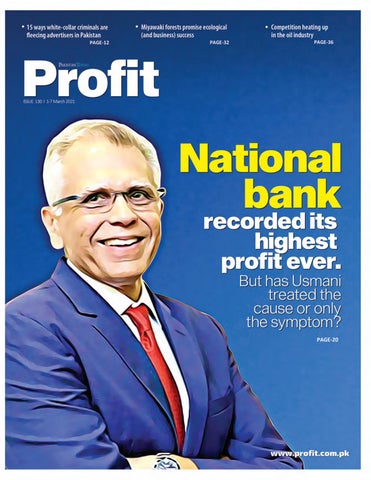
12 15 ways white-collar criminals are fleecing advertisers in Pakistan 20 National bank recorded its highest profit ever. But has Usmani fixed the problems or only the symptoms?
26 26 Why is Pakistan’s internet so slow? 28 Pakistan’s not-so-cool refrigerator industry
31 31 Fauji Cement finally decides to expand 32 Miyawaki forests promise ecological (and business) success
36 36 Competition heating up in the oil industry 37 Moody’s: Islamic banks will continue to grow as economies recover
Profit
Executive Editor: Babar Nizami l Managing Editor: Farooq Tirmizi l Joint Editor: Yousaf Nizami Reporters: Ariba Shahid l Babar Khan Javed l Taimoor Hassan Abdullah Niazi l Meiryum Ali l Shahab Omer Director Marketing: Zahid Ali l Regional Heads of Marketing: Muddasir Alam (Khi) Zulfiqar Butt (Lhr) l Mudassir Iqbal (Isl) l Layout: Rizwan Ahmad l Photographers: Zubair Mehfooz & Imran Gillani l Publishing Editor: Arif Nizami l Business, Economic & Financial news by 'Pakistan Today' Contact: profit@pakistantoday.com.pk
Readers Say Just read the intro - I guess you missed the most important part: ‘dire need of customers with no alternate means of transport’ which trumps everything. Apropos: The Careem playbook, decoded Omer Zeeshan Khan, Facebook Well researched and written! Glad to read what was happening behind the shocking headlines. Apropos: Why luxury car importers are prone to fraud – the case of Porsche in Pakistan Asad Asif, Website Agreed. A well written and well researched article .Giving a good insight into the luxury car business. Apropos: Why luxury car importers are prone to fraud – the case of Porsche in Pakistan Khurram Saeed, Website You can get a great deal out of LinkedIn if your advertising campaigns are created for achievement. A well run LinkedIn advertising campaign can generate you highly qualified top of the funnel leads for your business. The amount you spend on advertising may appear sort of a lot, but your lifetime value will almost assuredly prove to be worth more in the long run. Apropos: Why do advertisers in Pakistan ignore LinkedIn? Muhammad Armaghan, Website To ensure a great uptake of this technology in Pakistan, the major housing societies need to be taken on board. DHA and Bahria have their own construction rules which cater to ancient materials and methods. If they can be approached by a manufacturer and made amenable to such construction, I could and would undertake these house projects myself. These iconic societies set the tone that the rest of the country follows. So targeting them would be a wise approach. Also, the materials need to be durable enough to withstand the humidity of monsoon, the wide temperature swings, the high intensity UV sun, and chemical-ish rain. Of course no house is possible without safety grills in windows! Apropos: Henan D.R. brings a new hope to the Naya Pakistan Housing Project Ahsan, Website
facebook.com/Profitpk twitter.com/Profitpk linkedin.com/showcase/13251020 profit.com.pk profit@pakistantoday.com
HOW TO CONTACT
8
With online behemoths – both of the ‘search’ and ‘social networking’ variety – undercutting the ad spaces of all print journalism, and with one towering oak tree of a news brand after the other falling loudly, some within the sector pinned their hopes on another, older form of sustenance: paid subscriptions. Sometimes modern problems need older solutions, they
reasoned, because nearly all of the modern solutions had been tried out, and had failed. Apropos: Dear offended reader… Joseph, Website Surprisingly then you had a paid sponsored story by HBL recently. Not sure why you are referring to the HBL story given everyone covered it. Maybe to ‘force’ them to advertise with you? Apropos: Dear offended reader… Naheed Janjua, Website Couple this issue with excess capacity which is going to come online in the next few years and we are looking at a scenario where there is no money left in the budget for basic developmental projects in education, health, etc but only funds to serve domestic and international debt. Apropos: Circular debt to reach Rs2.8tr in next four months, NA panel told Faisal Malik, Website People in Pakistan are skeptical about TRG because it is the only listed company in Pakistan which is an investment vehicle involved in Private equity . Due to the structure of the company it used to consolidate its accounts and was in a loss as expected because it has invested in startups . If Vision fund ( SoftBank ) starts to consolidate its accounts with its invested subsidiaries it will probably have lost 50% of its 100 $ Billion investment . This is not the case as most high growth startups incur huge losses but command billions $ valuations. This concept was alien to Pakistani investors and hence the reason for its low share price. Now One of its companies is listed and others are in process which include its AI investment , a company with a valuation of anything north of $ 5 Billion . It’s not rocket science , do your maths and you will realise TRG is still cheap at current price. Apropos: The TRG stock phenomenon, explained Anonymous, Website PIA will never give up this attitude until the next plane crash and then they will come up with excuses. PIA has a despicable non professional and irresponsible attitude towards everything. If the government wants to save the organization, the best thing it can do is fire the entire current management staff and restructure the airline with a 5 year plan. Also it needs PIA to be privatized by 35% in another group that will look after the hiring and firing matters and keep up the standards of the airline. Apropos: PIA to continue using 12 Boeing 777 jets Arshad, Website
COMMENTS
IN BRIEF $12.9 billion:
Foreign exchange reserves in the country witnessed an increase of $19 million in the week ending on February 19 as net reserves held by the State Bank of Pakistan (SBP) stood at $12,908 million, according to the central bank.
Grey List:
The Financial Action Task Force (FATF) on Thursday decided to keep Pakistan on its ‘grey list’, with the country’s status set to be reviewed next in June 2021. The announcement was made by FATF President Dr Marcus Pleyer at a press briefing from Paris.
Spotify, the world’s most popular audio streaming subscription service, has been officially launched in Pakistan, Bangladesh, and Sri Lanka, a statement issued by the company read. With a worldwide community of more than 345 million monthly active listeners, including 155 million Premium subscribers, Spotify will offer a personalized listening experience for local and international music of over 70 million tracks. While the government has issued a presidential ordinance for early implementation of the Electric Vehicle (EV) policy, registration of vehicles is still not possible due to the need for an amendment in the relevant act. According to sources, an amendment was needed to implement the revised registration fee (for imported vehicles) under the EV policy and presidential ordinance. The Power Division has informed a parliamentary panel that an inquiry committee probing into last month’s countrywide blackout has held officials of the Guddu Thermal Power Plant responsible.
The Khyber Pakhtunkhwa (KP) government’s Planning and Development (P&D) department has deducted Rs2.477 billion from various departments and transferred Rs1,148 million to various projects in Swat, the home district of the Chief Minister (CM) Mahmood Khan.
Rs 30.58 billion:
The earnings of National Bank of Pakistan (NBP) surged 84pc to Rs30.58 billion during the year ended December 31, 2020, according to financial results announced by the bank on Wednesday. Against a 28.95pc growth in total income, the bank saw a 4.36pc decline in total expenses, which further helped boost its earnings. The bank’s earning per share (EPS) was recorded at Rs14.33.
10
By Babar Khan Javed
W
hen a potential client walks into a shiny, self-dubbed, data-driven media agency, they walk in expecting numbers, and a company that will have their best interest at heart. That is the least they can expect. Essentially, media agencies are supposed to handle media companies their clients want to advertise with on their behalf. But instead of being in their corner, these media agencies take rebates, kickbacks, and other incentives from media companies across TV, print, radio, out of home, and digital in exchange for selecting their inventory. At the annual session of the Association of National Advertisers (ANA) in 2015, former Mediacom CEO Jon Mandel said this and more in a bombshell speech delivered to a room full of advertisers and agencies. He said that this practice has been going on for decades, and is not in the best interests of advertisers. He cited a private study conducted among unnamed industry executives on behalf of the ANA Media Transparency Task Force, the results of which showed that media agencies lack transparency and recommend media inventory that works for their own financial gain. His comments led to several leading audit firms and industry associations to investigate the full extent of this claim and in the
12
meantime marketers around the world doubled down on inaction. Here was the situation: advertisers had just found out that their media agencies were in cahoots to take more money for fewer advertising. Naturally, this was a concern for companies that were paying big numbers to media agencies. How to ideally respond to this situation? A data-driven marketer would have taken a number of steps in such a situation. They would have started by reviewing media agency contracts and opt-in contracts by agency trading desks, followed by hiring an independent media auditor to assess whether the goals defined by the media contract have been fulfilled or not. This should have been followed by asking difficult questions from account managers and possible legal action against the media agency in question. Instead, chief media officers and the marketers on the advertiser side did what they do best: jack all. In the aftermath of the speech by Mandel, several industry associations uncovered a wave of corruption at leading media agencies. Guidelines were shared, promises were made, lip service led to vanity social media points, and nothing came out of it, especially in the realm of digital media. According to some estimates, for every $100 an advertiser hands over to their media agency or to an advertising technology company, only $50 of the amount reaches the intended media inventory, with the remaining $50 evaporating in fees for the agency itself, and other expenditures. Dr. Augustine Fou, an independent ad fraud auditor, theorized that the reason advertisers have spent nearly a decade being fleeced by media agencies and advertising technology companies can be boiled down to key performance indicators (KPIs) that campaign success is measured against. These include the quest for high levels of impressions and clicks, both of which can be manufactured by click farms and bots. Fraud has been front and center here, and in Pakistan, it has been much the same. Profit looks at 15 ways media agencies fleece advertisers in Pakistan.
Defining advertising fraud
F
our years ago, Procter & Gamble chief brand officer Marc Pritchard delivered a keynote at the 2017 Interactive Advertising Bureau (IAB) Annual Leadership Meeting about how the world’s largest advertiser continues to raise the bar on creativity to develop advertising that’s a force for growth and good. He spoke about the need to build a transparent media supply chain across viewability, measurement, ad fraud, transparency, and harmful content. Four years later, the advertis-
ing community has struggled to create any tangible change despite the plethora of lip service around making marketers a positive economic and social force. If fraud is the wrongful or criminal deception intended to result in financial or personal gain, then advertising fraud is a white collar crime which can be defined as a collection of practices that misrepresent advertising inventory or disguise machines as humans in order to steal advertising expenditures. This includes when media owners attempt to trick media planners and media monitoring firms, including when media agencies recommend inventory that is not in the best interest of the advertiser, weakening the effectiveness of integrated marketing campaigns. Most industry estimates indicate that fraud takes 10-30% of total digital advertising revenue, the mitigation of which leads large advertisers to solutions such as FouAnalytics or Integral Ad Science, with small and medium sized businesses turning to Spider Labs for help, which is represented in Pakistan by Jack of Digital.
The most common forms of advertising fraud in Pakistan
1
Buying content for $1, selling it for $1.5, arranging ads worth $3, disclosing nothing
According to two people with direct knowledge of the matter, since 2015 some of the largest media agencies in Pakistan approached TV channels with Ramadan transmission content and ordered said content be purchased from their media agency - at a premium - which would in return guarantee the participation of advertisers in the form of TVCs, branded placements, and inclusions in prizes or giveaways. Conflicting statements from sources suggested the practice stopped in 2018 while certain broadcasters said the practice is ongoing with greater discretion. Yes, this happens annually during the Holy month of Ramadan. The irony of this aside, this practice allegedly takes place to this day, and is a clear conflict of interest, with some of the media agencies working with select production houses to buy content off them, sell it to TV channels at a 150% premium, and then guaranteeing advertisers at another 150% premium. The media agency earns an undisclosed kickback from the production house for selecting them and gets a kickback from the TV channel for diverting advertising to the content that the media agency once owned. Regulators in Pakistan are asleep at the
wheel or nonexistent. The Pakistan Broadcasters Association (PBA) being all about recovering payments, the Pakistan Electronic Media Regulatory Authority existing to tell either halt dramas that expose the grotesque true plight of the masses or tell anchors what they can’t say, and the Pakistan Advertisers Society (PAS) existing to launch awards at anyone with a pulse - there is little to suggest that there is an industry watchdog to keep everyone in line.
2
Selling free of costs spots meant for client ABC to client XYZ
Let’s say that a media plan for a CPG client includes 100 paid spots worth Rs 1 million, and 50 free of cost (FOC) spots worth Rs 400,000 as per the rate card aligned between the media agency and the TV channel. This means that Rs 6,666 is the average spot rate. What happens next is that the TV channel airs all 100 of the paid spots and just 10 of the intended 40 FOC spots. The TV channel only provides an invoice for the paid spots and hence bills the aforementioned Rs 1 million to the CPG client, who pays for it. Reaching an understanding, the media agency and the TV channel do not inform the CPG client about the unused 40 FOC spots which are later sold to Telco clients as paid spots for which the media agency raises its own invoices and does not provide an invoice from the TV channel to Telco clients. In some cases, the same FOC spots are given to the CPG client against their agency volume deals.
3
Price discrimination
For the same audience on the same TV channel, a media agency delivers an annual cost per rating point (CPRP) of Rs 10,000 for CPG client Alpha and Rs 20,000 for CPG client Beta.
4
Two for the price of one
When news channels air the channel ID between ads to trick advertisers into considering them as two separate mid breaks and considering spot positioning of ads accordingly.
5
Purposefully miscalculated
In an effort to show that low CPRPs were delivered, a media agency will include the gross rating point (GRP) of scrolls and logo on-screen advertisements up to five seconds - which are usually FOC - into CPRP calculations.
ADVERTISING
Some OOH vendors analyze the financial strength of an advertiser and exaggerate the pricing of their media than their actual price and then offer a so-called discount. I know a big media vendor who initially asked about 3.2 million for a billboard, but when the advertiser showed reluctance in investing such a huge amount on that particular billboard, the vendor tried to show open heartedness and offered a discount of Rs 800,000. Even after such a discount the price was exaggerated Muhammad Armaghan, the managing director of Adbuq
6
The same goal post, year after year
7
Apples and oranges
8
Out of Home viewability fraud
This type of fraud, perpetuated by a client-side media manager, is when - for example - a media agency hits 100% of its KPIs one year and the goal post is not increased, leaving the media agency hitting the same target repeatedly, year on year.
A common occurrence concerning media inventory for live sports matches when the sales agents at the broadcaster categorize ad spots placed before the live match starts and during the inning breaks as a live match. The rates for live matches and highlights are usually similar and the advertiser that has not bothered investing in a media monitoring service has no idea where such an expensive ad inventory was placed properly for the desired results. Instead, the advertiser in his infinite wisdom tells the media agency to select and pay a media monitoring service, which in the interest of keeping the media agency happy reports on exactly the promises the media agency and the broadcaster promised. The advertising fraud examples listed above can be easily avoided with iron-clad media contracts, regular checks, and balances led by an independent media auditor, and an advertiser-funded media monitoring agency. Even as of 2021, TV advertising will represent the majority of promotion budgets for marketers and the lack of effort on the prevention and cure equation is haunting.
Clearly one of the major problems advertisers
14
have is a lack of verification, and media agencies and media companies hiding them makes things worse. So one can only imagine that the lack of verification is even more in other mediums, like outdoor advertising. Currently, the non-availability of outdoor media on a centralized platform makes it difficult for advertisers and agencies to compare prices from different vendors. He said that a vendor may be charging Rs 500,000 for a billboard and another billboard vendor might be charging Rs 700,000 on the same road but the advertiser or agency may not be aware that a lower-priced billboard is nearby available. In 2014, Samsung marketing leader Najiyeh Akbar co-founded 24Grey, which in turn launched a cloud-based platform called Outnet which sought to improve OOH efficiency. Solving for the challenge that OOH buying and planning is highly opaque and based entirely on perception, Outnet, integrated contextual and quantitative analytics to dramatically improve OOH efficiency. Akbar said that while there is no concrete data on the value of the fraud or losses in efficiency, anonymous estimations suggest that 70% of OOH marketers admitted to being offered a kickback, while 90% of OOH vendors admitted to paying an off the books incentive in the last three years. Since being launched, Outnet has delivered up to 72% improvements in CPM and 48% improvement in cost per square foot in test scenarios. In 2015, Rafi Hasan founded Online Aggregated Analytics (OAA) as an out of home (OOH) advertising monitoring system. Based on feedback from independent media auditor and a network of marketers, Hasan learned that OOH billboard owners would collude with OOH media agencies to dupe advertisers by placing the campaign hoarding up on an agreed location, snapping a picture of it with a daily newspaper, and use the same spot for multiple brands.
The solution by the OAA crowdsourced locals to cross verify these claims by acting as citizen journalists, taking their own pictures of various billboard sightings around rural areas and uploading the content into the OAA database. Within a year of rolling out nationwide, OAA was acquired by Ipsos in Pakistan as a trusted monitoring service. In 2018, seasoned financial auditor Muhammad Armaghan founded Adbuq, a search engine for OOH media locations. On the platform, advertisers and agencies can search for billboards and other types of OOG media by type, availability, size, city, price, and additional variables. The search engine is integrated with Google Maps, allowing advertisers to view pictures and videos of OOH media, making comparisons and contact vendors directly. “Some OOH vendors analyze the financial strength of an advertiser and exaggerate the pricing of their media than their actual price and then offer a so-called discount,” said Muhammad Armaghan, the managing director of Adbuq. “I know a big media vendor who initially asked about 3.2 million for a billboard, but when the advertiser showed reluctance in investing such a huge amount on that particular billboard, the vendor tried to show open heartedness and offered a discount of Rs 800,000. Even after such a discount the price was exaggerated.” “This loophole is closed by using adbuq which will help in cost saving as well as empower advertisers and agencies to compare prices, size, impressions & much more,” he claimed. “This will help in quick decision making and achieving higher ROI. Further, those advertisers who want to retain more control over their outdoor advertising, and want to bypass the middleman (advertising agencies) can directly contact OOH vendors and negotiate terms & conditions especially prices by using adbuq, thus saving costs.”
[High levels of impressions and clicks] are the metrics most often reported by ad exchanges, ad tech companies, media agencies and even the analytics dashboards used by marketers. These are the easiest numbers to report and easiest to understand, so they are universally liked by all. But, consider for a moment, whether they tie to your business outcomes at all Dr. Augustine Fou, an independent digital advertising fraud auditor
He said that in the current OOH advertising landscape, advertisers and agencies have to go through a long process of finding perfect billboards for their campaign. This includes the tedious and mind numbing manual tasks of ascertaining the availability of specific inventory from OOH vendors using PDF files passed from between agencies, with no verification on how updated the information and the listed rates are.
9
Programmatic advertising fraud
Speaking with Profit under the condition of anonymity, several marketers charged with media budgets in excess of $5 million shared that they were being forced to work with agency trading desks which act as middlemen between them and DV360. The media agencies that own the media trading desks would deal with client-side decision makers that were too embarrassed to confess a lack of knowledge pertaining to digital, signing off on opt-in agreements which block advertisers from accessing transaction level data and where advertisers would waive the data rights to conduct a financial analysis of their programmatic investments. In these agreements, advertisers and marketers are legally unable to verify delivery, verify costs, supply chain fees, verify contract compliance, and evaluate programmatic media buys. The loss of these fundamental rights means that advertisers cannot enforce contracts and cannot tell how much of their digital media spend is actually spent on intended publishers. Speaking with Profit under the condition of anonymity, an independent media auditor shared that these opt-in contracts are the reason some advertisers have left few of the largest media agencies in Pakistan and moved themselves to newer agencies like IG Square, which reportedly offer their clients a source of independent transactional information for their media buys.
If advertisers fail to gain a straight answer from their media agency, they need to ask advertising journalists and industry watchdogs which digital media company or social networking service is their chosen media agency a reseller for.
10
Suspected fraud on Google, Facebook, TikTok, and Instagram in Pakistan
“With Facebook the biggest issue that I find is the algorithmic fraud through which it’s making a fool out of advertisers,” said Ghulam Jilani Kothari, the newly promoted business director for Xaxis. “For example no matter who you target and how many targeting filters you place, sweet princesses will like and comment on the post. Second when you’re buying for video views and if your video has one million views the completed views would be 50,000.” He told Profit that advertisers misinterpret this to mean that the cost per video is going down with every passing day when in fact the video is getting more expensive with every passing day. On the Facebook audience network, Kothari said that advertisers cannot verify the percentage of impressions served on platform and served off platform. On Google, Kothari said that the Universal App Campaigns (UAC) meant to drive mobile app installs are ineffective. “You can see UAC driving a lot of app installs for advertisers at a very cheap price which requires a combination of display, MP4, video, and YouTube video which covers almost all placement across devices, looks very efficient but mostly the app installs are driven through reward based placements which in latest world is known as affiliate partner traffic that executes a lot of fraudulent traffic as the actions are associated to the payouts,” he said. Kothari told Profit that for advertisers this results in dead installs and a high percentage of uninstalls, with weak KPI planning
leading marketers to choose advertising products that look good on paper for driving vanity metrics yet result in a weakened business case for the format. He added that the user interface (UI) for Google AdWords once showed a distinction between clicks and views, with a recent update merging the two under one term: interactions. “When you try going for a deeper interaction on a click based buy campaign, this is explained as a user hovering over a banner and clicking it due to which an interaction is counted,” he said. “The moment an interaction is counted the advertiser is charged but there is no traffic generated on the advertisers site.”
11
Domain spoofing
This is when an advertising exchange misrepresents advertising inventory. In 2017, the Financial Times discovered that several different advertising exchanges were selling display ads and video ads against inventory masquerading as FT.com, even though the Financial Times doesn’t even sell video ads programmatically. It found that 300 accounts on the identified advertising exchanges were selling inventory purporting to be for the Financial Times. In a bid to open themselves up to more revenue opportunities, digital publishers sign up to be accessible by as many SSPs and DSPs as possible which connect with media agencies looking for advertising inventory to purchase. According to digital planners at the Oktopus Media Group, domain spoofing is a widely practiced form of ad fraud in Pakistan, with the only mitigation variables being using the ads.txt standard by the IAB Tech Lab which increases market transparency and accountability. This enables publishers to publicly identify authorized advertising sellers and resellers, so that buyers can audit ads.txt files to avoid unauthorized sellers. Ads.txt adoption was boosted significantly when Google adopted and promoted the standard, but Google did not actively support
ADVERTISING
These things keep happening due to the absence of third-party verification tools, which makes it very easy for walled gardens - Google and Facebook - to very easily manipulate results for a non digital literate or a beginner level person who wouldn’t be able to crunch and crack these nitty-gritties that are inflating the buy price with under deliveries Ghulam Jilani Kothari, the business director for Xaxis
the standard until after a significant number of publishers adopted it. Publisher adoption is widespread. Newer standards ads.cert, sellers.json and the OpenRTB Supply Chain Object enable similar disclosures by other market participants, with these efforts meaningfully reducing fraud borne by supply chain participants.
12
Machine learning, for evil
This type of fraud is meant to trick advertisers who have tasked their media agency to generate traffic and activity on a website, valuing engagement instead of conversions. In this instance, the media agency works with a click farm to enable botnets - machines that mimic human behaviour - which consist of a central server and a host of malware-infected computers. Connected machines take orders from the server to take specific actions in ways that resemble organic behaviours and for advertisers and publishers that lack fraud detection tools such as FouAnalytics, machine activity is difficult to distinguish from human activity. This type of fraud is also used to fool media agencies and advertisers that value publishers that attract large audience sizes, without considering the depth of the audience which is where the meat lies. Why would an advertiser want his ads on a publisher site that attracts all types of people when they could instead work with a niche publisher that has the exact target audience present? The obsession for large reach and impression numbers leads advertisers to be duped. “Marketers should continue to call for third-party, MRC-accredited validation of anti-fraud on all platforms and publishers, including the big digital platforms,” said Marc Pritchard, chief brand officer of Procter & Gamble. “Until that happens, we cannot be certain that marketers are not wasting money on fraudulent ads. At the same time, publishers can adopt best practices from the Trustworthy
16
Accountability Group, the leading global certification program fighting criminal activity and increasing trust in the digital advertising ecosystem.”
13
Charging advertisers for invisible ads
Identified by Kothari, a new form of advertising fraud perpetrated by digital publishers appears to be the creation of a unit of digital inventory which the publisher places outside the website canvas. Dubbed as a hidden ad unit by Kothari, the impressions are recorded without any visibility or interactions, and are the result of direct campaigns. “So I was able to identify it through various websites especially where there are a lot of cross buttons where you don’t get to see ads,” said Kothari. “When you click on the inspect element you can see the code or tag coming in through Google DoubleClick for Publishers. When I went into further details I could see a lot of such tags plastered outside the website canvas as well where there were ads continuously loading from the backend.” Kothari told Profit that it was difficult to quantify the dollar value of the advertising fraud being conducted and that it depends on site traffic and which geography an audience is coming from. He said that it was unclear how digital publishers were placing these hidden ad units in their waterfall and floor pricing.
14
Duping data-fearing marketers with fake influencers
As previously reported by Profit, social media content creators (SMCC) profiles that frequently part of advertiser campaigns are rife with fake followers. The presence of low engagement rates on SMCC profiles and the popularity of apps & services to boost organic followers means that advertisers investing in influencer marketing are being duped to work with SMCCs with a high number of fake
followers. This circles back to the advertisers quest for audience size instead of audience depth. In being too cheap to work with influencer marketplaces such as the Digital Engagement Network, Amplifyd, or Walee, advertisers are choosing to lose out on data which can tell them which influencers have fake followers and whether the target audience is a part of the SMCC fanbase. Several leading digital media and public relations agencies that spoke to Profit lamented at the lack of willingness from their clients to invest in data resources such as influencer marketing campaign management tools to determine which SMCCs are worthy to work with, setting themselves up for failure.
15
Digital advertising viewability fraud
As reported by Profit, the 2020 Dew Gamers Arena attracted nearly 250 thousand unique spectators on YouTube and 1.92 million unique spectators on Facebook. YouTube counts a view after 30 seconds whereas Facebook counts a view after ten seconds, hence the disparity which stems from the absence of a common standard for assessing viewability. This is important for conducting business transparently and comparatively across platforms, especially when advertising. “However, for many years, each platform created its own viewability metric, which was used to set payment terms for advertising,” said Pritchard. “For example, Facebook considered an ad viewable and therefore “billable” for payment as soon as one pixel entered the screen, while YouTube considered an ad billable only after the entire ad was shown. Not having a standard meant Procter & Gamble and other marketers wasted time and money trying to understand, analyze, and explain the differences between various viewability metrics claiming to be the right metric for each platform.” Pritchard said that in order to solve this, every marketer should insist that every digital platform and publisher provide third-party,
TEXTILES
Marketers should continue to call for third-party, MRC-accredited validation of anti-fraud on all platforms and publishers, including the big digital platforms. Until that happens, we cannot be certain that marketers are not wasting money on fraudulent ads Marc Pritchard, chief brand officer of Procter & Gamble
Media Ratings Council accredited viewability measurement. He said that from that measurement standard and benchmark, marketers can analyze the view time for digital ads to ensure they are being seen and are effective in driving awareness, engagement, and sales. If not effective, media money can then be shifted into more effective vehicles.
Possible root causes
1
Domino effect of advertisers expecting agencies to work at 3% commission
According to the rules and regulations by the PBA with regards to media buying houses (MBH), provisionally or full accredited MBHs are entitled to a trade discount that does not exceed 15% of the invoice, adding that no MBH will claim or demand any discount or compensation from a member publication beyond the said specified rate. “Provided that at its option, a broadcast house may allow a trade / cash or any other form of discount to an agency / MBH as per industry practice on the business placed by advertising agency / MBHs on behalf of its clients during a period,” says the PBA. Demand dictates supply. In the Pakistan market, advertisers for the most part view media as a commodity and not as an investment. Secondly, advertisers do not value strategy and expect ideation & planning for free. Thirdly, after all this effort, the advertiser holds a reverse auction, expecting media agencies to undercut each other, creating an ecosystem where there are no winners. “If I’m the client and an agency comes to me and says they will work at a 0% commission, I will ask them why and how they will recover the cost incurred as a result of the scope of work,” said Fouad Husain, the CEO of Omnicom Media Group in Pakistan, adding that the one-year media agency contracts pushed by advertisers creates no job security
for top talent. This mindset culminates in a situation where advertisers not only want the lowest possible price to reach audiences - without evaluating the quality of the reach itself - but also want the media agencies bidding for its business to play a lose-lose auction to see which media agency will charge the lowest media commission, which ranges between 3% and 15% depending on who you ask. To play devil’s advocate, if a media agency has to accept a 3% commission for an assigned budget - which barely covers salaries - it will then close back door deals with media owners - including digital, print, out-of-home, and television - to make ends meet. The advertiser and his quest for lowest possible pricing - without considering the quality of audience reached - is to blame. Not to mention supporting news or entertainment channels which air questionable content that may break all the rules of brand safety while fueling toxic mindsets and extremist behavior. Even without a regulator or an industry body conducting a study to determine the extent at which the media ad buying ecosystem is nontransparent, advertisers have always had the option to conduct media audits on their own dime. When an advertiser is complicit in the less than ethical actions of his client, media audits are avoided.
2
Advertisers that view media as a commodity
Dr. Mark Ritson is a brand consultant and former marketing professor. He has a PhD in marketing and has taught the subject at leading business schools including London Business School and the Massachusetts Institute of Technology. The first lesson he teaches his students is about market orientation. Simply put: you are not the customer. When professionals think that they are the customer, they assume many things without looking at the data or the market research. Due to different incentives or strategic objectives, intra-firm inefficiencies may result from misalignments between functional depart-
ments or business units within a firm. When the CFO is the one setting the marketing budgets and reviewing advertising effectiveness, it can be a source of tension within an advertiser organization. Without quality training in the science of marketing, a CFO may expect marketers to quantify the effectiveness of long-run and short-run objectives, without realising that under-investing in brand-building advertising could reduce long-run profits. The misalignment of internal beliefs and incentives may distort marketing tactics. If every action of the marketer has to be measured within three month increments, this creates misalignment between the firm’s time horizon and that of the manager, with the manager often taking a more short-run view than the firm as a whole. Suboptimal advertising policies and customer focus may be the result of poor integration and incentive alignment between the marketing and the sales teams. When the goals of the marketing team conflict with other functional groups, this can distort the impact the advertiser has on the media value chain. If the procurement team uses media or creative reviews to award a contract based on a reverse auction, in the short run this act may meet a goal of minimizing expenditures. In the long-run, the low-bidding agency may then provide a lower quality of service or fail to fully realize marketing objectives. Dr. Mark Ritson is a brand consultant and former marketing professor. He has a PhD in marketing and has taught the subject at leading business schools including London Business School and the Massachusetts Institute of Technology. The first lesson he teaches his students is about market orientation. Simply put: you are not the customer. When professionals think that they are the customer, they assume many things without looking at the data or the market research. Due to different incentives or strategic objectives, intra-firm inefficiencies may result from misalignments between functional departments or business units within a firm.
ADVERTISING
3
Advertisers lack media training and hold themselves hostage with weak contracts
One of the largest media agencies in Pakistan reportedly has various large advertisers signed into an opt-in agreement which strips them of many rights they would normally have. Populated with complex technical terms pertaining to the scope of work to be completed by the agency trading desk, the advertiser in a bid to appear knowledgeable refuses to ask questions which seek to understand the contracts better and reach better terms and conditions. Marketers who spoke to Profit under the condition of anonymity shared that the former CEO of this large media agency in Pakistan was suspected of spreading rumors against the media and brand managers who dared question the contracts placed before them, with the rumors questioning integrity. It seems marketers need to get out of their own way and learn to ask questions, push back on inane terms and conditions, and secure greater control over where campaign budgets are being assigned.
4
Advertisers lack a coalition to address these concerns
While on paper, advertisers and marketers in Pakistan have the option of having a collective voice through the Marketing Association of Pakistan (MAP) or PAS, client-side media and brand managers that spoke to Profit doubted the efficacy of these two industry associations. The advertisers in Pakistan can easily solve this by using social media and WhatsApp forums to form an alliance and represent their collective interests against the large media agencies that are hurting the effectiveness of media placements through the methods cited above.
5
Advertisers do not invest in media audits
In an interview with five of the largest advertisers in Pakistan, only one admitted to engaging an independent media auditor on an annual basis, the outcome of which has been less than transparent to those below the C-suite. Media auditors frequently face financial pressure from media agencies and broadcasters to modify their findings so as not to rock the boat. Advertisers that are serious about improving the effectiveness of media need to be ready to blacklist any and all agencies or broadcasters that threaten or attempt to intimidate the media auditing process. They must also ensure the media auditor is a former CFO of a media agency and not hire an auditor from the Big Four who won’t know what to look for.
6
Advertisers that punish ad fraud detection
When advertising agencies’ private incentives depart from marketing principles’ profit incentives to measure credible ad effects, there are bound to be issues. One such issue is that media agencies may misreport the extent of ad blocking or ad fraud to their clients, especially if negative information might reduce the client’s advertising budget and, consequently, the agency’s commission. Informing advertisers about ad fraud may contribute to the statistical challenge of measuring advertising effectiveness by reducing the number of valid advertising exposures delivered. Another consequence of misaligned incentives or the ignorance of instances where there is a conflict of interest occurs when marketers ask digital advertising agencies to evaluate their own performance. Under what conditions and contracts are agencies incentivized to report truthfully? Contracting problems have received limited attention in the specific context of digital advertising.
Advertising delivery systems seldom require proof of humanity
7
Advertisers, media agencies, and publishers make no effort to verify human recipients of ads by requiring users to solve a reCAPTCHA before serving ads. When a computer requests a page from a web server, ads are delivered, placing ad exposures in the set of activities that are trivial for botnets to perform programmatically. Often described as a cat-and-mouse game, digital ad fraudsters develop new tactics when previous tactics have been neutralized.
8
The absence of consequences
Aside from the above, additional reasons why media agencies are emboldened to stay the course have to do with the absence of any regulator to hold them accountable, the absence of any large advertiser taking them to task after a media audit, the absence of pressure to reform from the likes of PEMRA, PAS, MAP, and the PBA. The inaction by the entire ecosystem who are at this point in time equally complicit - has made these white collar crimes the norm. In a 2019 paper published in the Journal of Financial Crime, Virginia Tech sociology professor Dr. Thomas Dearden suggested that white-collar criminal decision-making is impacted by optimism biases, hypothesis testing biases, problem solving insight and stress. “It is logical to hypothesize that the optimism bias distorts white-collar offenders into thinking that they can succeed in their activities, with many situations promoting their risky and illegal behaviors,” said Dr. Dearden. “For example, optimism can be realistically fueled by the fact that police departments and other regulatory agencies are struggling with detecting and prosecuting white-collar offenders. On the federal level, regulatory agencies for financial markets are also struggling with policing.” The practices of media agencies in Pakistan are not challenged by any regular or any advertiser-led nor any broadcaster-led industry association, hence the absence of any legal pressure or public affairs campaigns creates no incentive for reform. When a three hour flight from Pakistan to the UAE transforms the apathetic driver into an empathic driver, it is not a split personality disorder at work but rather the knowledge that there will be consequences.
Prevention and cure
A
ll of the above can be avoided by hiring an advertiser-funded media consultant that is with the advertiser from the media review, is part of
18
TEXTILES
the media agency selection process, leads the media audits of the competing media agencies, co-creates the iron-clad media contract, and is regularly tasked to ensure that the winning media agency is adhering to the aforementioned contract. Without this critical step, an advertiser cannot prevent fraud. The media contract is an extensive legal document, the full extent of which is only known to a seasoned media auditor that has been the CFO of a large media agency. Briefly speaking, the iron-clad media contract represents a win-win relationship between the advertiser and the media agency, one which views media as an investment which drives business growth and results. First and foremost, advertisers must update or renegotiate agreements where disclosure of data and the access to it is prohibited. This should ideally be mentioned from the get go during the media review and briefing process so as to avoid issues towards later stages. In addition, the advertiser should have n Media supply chain disclosure: which
gives the advertiser data on all costs and fees incurred in the process of buying each media impression, and allows for review and approval of contracts with vendors, suppliers, and ad-tech partners used in the process, n Third-party fee disclosure: which knows the true cost of DSPs, ad server fees, data fees, and verification fees, while clarifying what is the mark-up if any, n Data ownership and control: the advertiser must have ownership, control, access to, and the ability to transfer the data collected through campaigns, n Ecosystem audit: where the advertiser can audit all partners involved in its transactional chain including agency trading desks, barter companies, and other affiliate, Security assurances: where the advertiser requires suppliers to invest in adequate data security protections in place that are consistent with corporate policies. To avoid being defrauded by Facebook, Kothari recommends that advertisers stop focusing on long form videos to generate views and instead place short videos on the social networking service. “Stop audience network selection for targeting to ensure the system delivers everything within the Facebook environment,” he said. “This will bring efficiency in terms of completed views and visibility within the platform. If you’re placing longer duration ads like six second plus then look at completion rates across mediums like Facebook, YouTube, in-app, and others.” Kothari recommended that advertisers should test the creative element of their campaigns by running them on a cost per thousand
impressions basis and not on objectives such as engagement or video videos due to the likelihood that the chosen online media platform will show the content to click farms. “Similarly when you run a Google UAC ads you get a lot of users to download the app but nobody engages with it whereas when you run a display campaign and generate traffic for your app through the App Store those downloads will have low uninstall ratio higher engagement and better registrations expensive CPA but quality is driven through this route,” he said. “For the Google Display Network, use an ad server to track clicks and impressions where the difference between interaction on Google ads and the ad server clicks is all interactions with advertising after which the advertiser can drive their actual CPC instead of relying on UI.” Advertisers need to also consider seeking reimbursement for fraud detected ex post. There are also industry collaborations, such as the Trustworthy Accountability Group, which publishes a monthly Data Center IP List, a “common list of IP addresses with invalid traffic coming from data centers where human traffic is not expected to originate.” “There [is] also industry-standard contractual language intended to help advertisers obtain relief for fraudulent ads,” said researchers in a 2021 Journal of Marketing report concerning inefficiencies in digital advertising. “Measurement difficulties make it challenging to know how advertiser-facing fraud has changed over time. Advertiser concern and awareness about fraud have increased, but at the same time, fraudsters have grown more sophisticated and discovery of large-scale botnets has increased.”
The legal route
S
peaking with Profit, Multinet Pakistan head of legal & corporate affairs Hamza Nizam Kazi said that if an advertiser discovered that their media agency or broadcast partner breached the agreement penned down, then a lawsuit could be filed for not complying with the contract. This would especially be applicable with using ad fraud tools to inflate the views or followers for a website or an influencer. “For example, if the agreement explicitly mentions that the followers should be real persons with real IDs, profile then the social media content creators would be bound to comply with those terms and conditions, however in most cases here in Pakistan there is a silent understanding between the Parties to the Agreement that what followers/likes means and how to pursue them,” he said. Prevention of Electronic Crimes Act 2016, section 13 “Electronic Forgery”, section 14 ‘Electronic Fraud’ and section 26 ‘Spoofing’ can also be added in the lawsuit if the conditions have been violated by placing fake followers/likes for any brand or company.” Kazi said that Pakistan is currently going through an early phase in the fourth industrial revolution adding that regardless of how companies front themselves in the global market, local companies are still adhering to agreements, trademarks, copyrights, and non disclosures. In international markets, Google, Facebook, and even LinkedIn are the defendants in ongoing lawsuits around digital advertising fraud, primarily stemming from reported reach inflation. Hiring a seasoned media auditor that has been the CFO of a large media agency is the only path forward for proactive marketers. n
ADVERTISING
20
BANKING
I
By Taimoor Hassan and Meiryum Ali
f you are already the largest bank in Pakistan, do your financials really matter? Actually, yes. On February 24 of this year, the federal government-owned National Bank of Pakistan (NBP) reported massive earnings for the foregone year. The bank’s after-tax net income surged 84%, from Rs15.8 billion in 2019, to Rs30.5 billion in 2020. To put that in perspective, that is the highest net income that NBP reported in the last decade, by a long shot. Here’s what the National Bank of Pakistan claims it is: it is the largest bank in Pakistan with Rs3.1 trillion in assets, it is the largest lender to agriculture with Rs225 billion disbursed to farmers, has the largest rural branch network with over 750 branches, and the bank was declared the best bank for agriculture in 2019. And to add to that, the bank has a customer portfolio of over 9 million customers. But despite all these distinctions, Arif Usmani believes that all’s not well at NBP. In a candid interview with Profit, he described a gargantuan bank suffering from severe disorganization, which was plodding along mostly though sheer luck. And he is here to change that.
Who is Arif Usmani?
B
efore we talk about the bank’s strategy, let’s start with a little about the man himself and the bank he heads. So first, the bank: the NBP was established in November 1949 under the National Bank of Pakistan Ordinance 1949, with an issued capital of Rs15 million. The government owned 25% of its issued share capital and the general public the remainder. In 1974, NBP and all other banks in Pa-
22
Because we started late, and were left behind I am calling it ‘project leap’ internally in the bank nomenclature. We can’t have an incremental digital strategy, like catching up at the pace of a turtle. We have to have a much more aggressive strategy Arif Usmani, president National Bank of Pakistan
kistan were nationalised, in the general wave of nationalization that gripped the nation. Between 1995 and 2001, the assets, liabilities and operations of the former National Development Finance Corporation and Mehran Bank Limited were amalgamated with NBP, following a decision by the Government of Pakistan. The bank was wholly owned by the Government of Pakistan until 2001, when the state sold a 10% stake to the general public through an IPO. Subsequently, the bank was listed on the Karachi Stock Exchange. In 2002, the government sold a further 10% stake in NBP to the general public. As of 2019, the Government of Pakistan retains a 75.6% stake in the bank. And in 2019, Usmani was appointed as the CEO of the bank. Usmani belongs to the old guard of Pakistani bankers having started his career with Citi Pakistan in 1981 in the Corporate Banking Group, and since then held a number of positions with the company. With a career now spanning 40 years, the veteran banker served across several geographies and markets
in various banking divisions, mostly in corporate banking. From 1989 to 1994, while still part of the Citi Bank, he was on deputation from Citi with Saudi Arabia’s second largest bank SAMBA in Riyadh within the Corporate Banking business. 1994 onwards, Usmani relocated to the Asia Pacific region, where for five years he held a number of critical positions in different countries including Hong Kong and Singapore. Later, he moved as Citi Country Officer to Slovakia taking over as Country Head Citi Nigeria and Regional Head West Africa. The latter role involved management of the Citi Franchises in Nigeria, Côte d’Ivoire, Cameroon, Gabon, the Republic of Congo as well as Senegal. Between November 2003 and August 2007, Usmani was the Chief Risk Officer of the Samba Financial Group in Saudi Arabia. Between January 2008 and March 2012, he served as the Managing Director of Citibank Pakistan. Then, between March 2012 and October 2013 he was the Global Head of Wholesale banking
at Abu Dhabi Islamic Bank (ADIB). Between November 2017 and February 2019, he was the Chief Risk Officer at Mashreq Bank. Both ADIB and Mashreq Bank are based in the UAE. Usmani dealt with his own minor controversy when he joined the bank: a Member of National Assembly (MNA) Ahsan Iqbal last year alleged that the NBP president, during his services in Nigeria, was involved in money laundering during his stint in Nigeria. The president categorically denied the claims, terming them ‘frivolous’, and even procured a letter from Citibank Nigeria, which said Usmani had not committed money laundering during his time as Managing Director. But would it really be NBP if there was not some controversy or the other? As far as Usmani is concerned, the real scandal is the way the bank was being run.
A thorny inheritance
W
hat’s the worst you can inherit at the bank? “When I joined the bank, the issues were related fundamentally to the infrastructure of the bank, the core banking system and core banking application
which had been acquired in 2005 and was implemented in 2013,” disclosed Usmani in an interview with Profit. It was a view he had reiterated earlier last year, at the Digital Banking and Mobile Payments Summit 2020. Usmani had expressed frustration at the bank’s digital efforts:“We look at the digital piece where we are behind the curve. Private commercial banks have invested heavily to move the needle forward. National Bank has not. I see this as an opportunity to catch up and leapfrog the competition. We have a very wide reach of customers and we can significantly change their experience and journey with a few buzzwords at National Bank.” He had further reiterated: “Today our customers have to deal with National Bank, and if we want to change from ‘have to deal with’ to ‘want to deal with’ National Bank, this technology transformation both internal in our infrastructure and external as we touch the customer has to change.” “We have a long way to go and we have historically been a branch centric, physical infrastructure bank which is no longer relevant. And how we reach our customers
by opening branches in rural areas etc may still be relevant but it is getting less relevant. People can access the branch remotely on the phone and all that is happening. We have obviously not gotten there yet. And the more we see happening in this space, the less National Bank feels comfortable with its preeminent position as the government’s payment bank. I think we could become irrelevant if we don’t fix our game in this space.”
Historical financials
S
o, how well has the bank done in the last decade? Let’s take a look. First up, the bank’s deposits have been steadily increasing since 2009, when deposits stood at Rs 727 billion. In particular, deposits grew 16% year-on-year in 2015, and at 16.5% year-on-year in 2018. Deposits crossed the Rs1,000 billion mark in 20123, and the Rs1,500 billion mark in 2015, and finally, crossed the Rs2,000 billion mark in 2018. If one looks at the deposits as a share of the total deposits in the banking industry, NBP has always commanded around roughly the same share. The bank’s highest market share in this period was in 2009, at 16.8%; this fell
BANKING
to 14% in 2017, the lowest it has been in this period. However, market share has climbed back to 15% in both 2018 and 2019. And, if one one looks at the compounded annual growth rate for deposits for the five year period between 2014 and 2019, NB has done well: the rate is 12.25%, which is higher than the industry average for the same period, at 11.89%. NBP’s revenue during this period has been on a steady upward trajectory, from Rs44.8 billion in 2009, to Rs140 billion in 2020. Most of this is driven by net interest income, which stayed in the Rs50-60 billion ballpark between 2015 and 2018, before drastically jumping to Rs72 billion in 2019, and
then Rs104 billion the year after. Non interest income shot to Rs35 billion in 2015, fell somewhat in the years after, and then was maintained at Rs36 billion for the period 2018-2020. While revenue has been somewhat stable, the same cannot be said about net income trajectory. Between 2009 and 2011, net income hovered in the Rs17 billion range. It then drastically fell to Rs5 billion in 2013, a particularly poor year. It then crossed the Rs20 billion mark in 2016, where it hovered until falling to Rs15.8 billion in 2019 (a poor year), and then climbed to Rs30.5 billion in 2020 (its best year so far). From the information available in some annual reports, NBP has had varying return
on equity (ROE) which is an indication of financial health (basically, how effectively management is using a company’s assets to create profits). The bank’s ROE stood at 5.4% in 2013, jumped to 19.3% in 2016, before falling to 10.2% in 2019. So what explains the meteoric comeback of this year? As mentioned before, the earnings of NBP surged 84% to Rs30.58 billion during the year ended December 31, 2020. Against a 28.95% growth in total income, the bank saw a 4.36% decline in total expenses, which further helped boost its earnings. The interest income increased by 7.64%, with decline in interest expense by 8.3%. Thus, the net interest income of NBP grew by 44.66%. However, the non-interest income didn’t show the same momentum as it fell by 1.06% on account of lower fee income, dividend income, forex income as well as noncore income.Still, the sheer size of the interest income more than made up for it. It is worth mentioning that NBP saw a 265% growth in securities. However, some setbacks were faced in the form of a 128% increase in provisioning costs, as well as a 28.12% rise in income tax expense.
Non-performing loans
I
f one were to just look at the historical numbers above, and the excellent year that was 2020, one would think that the bank has few concerns. But perhaps the biggest problem area for the bank has been, and continues to be, the share of non-performing loans the bank has. In the last decade, there has been exactly one year where the bank’s infection raito was lower than the industry average - almost every other year the bank's infection ratio has been higher. The greatest discrepancies have actually been seen in just the last few years: in 2015, the infection ratio was 18.4% compared to the industry’s 11.4%; in 2016, 25.5% compared to the industry’s 10.1%; in 2017, 14.1% compared to the industry’s 8.4%; and in 2018, 12.6% com-
24
TEXTILES
pared to the industries 8%. This is deeply concerning, and Usmani is aware of it. In conversation with Profit, he admitted that the NBP of the past had been forced to give out political loans. But that has changed. “I am very happy to report that I have had zero pressure from the government in the last two years to give any loans. So we don’t really have new loans of political pressure now, there are old ones. There is legacy but not flow, which is great for NBP.” he said. He added: “And frauds are real, banks have to live through frauds because of the inherent nature of the business. Sometimes it happens at the branches, sometimes with fake signatures, sometimes errors and omissions. So operational risk is there, we have to minimise that.”
Lessons in restructuring
T
here were a few things Usmani did when he joined the bank. Within the commercial and retail banking group, the SMEs, agriculture and commercial segments were all amalgamated. Usmani’s first task was to disentangle the segments, in what he described as a ‘major and painful surgery’ at NBP. One group was made into a pure retail and consumer bank, and the other was the SME, agriculture and commercial activity, which was then further subdivided into three. The effect of this was to realize exactly how small the agriculture division is. Of course, one would not know this based on the figures available. NBP gave out Rs61 billion in agriculture loans in 2020; the bank has set a target for Rs66 billion for 2021. It serves over 260,00 small farmers, and even when the ‘Best Bank in Agriculture’ award recently. Usmani was not impressed, however. “The reason we got the ‘Best Bank in Agriculture’ is that we have 260,000 farming clients. There are 9 million farmers. What is 260,000?
We should be at a million.We are at 260,000 right now, which is not even 25% of what we should be doing.” “In my room, I have a map that outlines Pakistan’s GDP and interactions of NBP in the various segments of the GDP. In that map, our interaction appears very small in agriculture. So when I disentangled SME and agri business, the purpose was to highlight how small we are in agriculture. And the purpose of carving out a group is so that we can become the biggest group.” Usmani also created a separate division for the government of Pakistan and specialised agencies, which had also been subsumed into retail banking. Agencies like Pakistan Atomic Energy, and the Controller of Military Accounts, were now being treated as retail clients. Usmani said, “I corporatised it, and now they see the difference. We call on them regularly, we solve their problems. We have corporate finance, investment banking people looking at railways, their financial needs. Their collection of cash, their trade finance, all of this we have professionalised. This is one of my lasting changes, I hope it lasts longer than I last at NBP. This is a fundamental change, everywhere I go in Islamabad, the government of Pakistan and the specialised agencies division, I get real pleasing remarks from our customers saying that now we see National Bank, as a proactive, full relationship management. Because a retail bank is an amorphous relationship with 8 million people. You can not run it as a corporate relationship bank as it is supposed to be run. And we were running all three businesses as a hotchpotch.” This approach is not with its fair share of detractors: “The people, old ones in retail banking, said that Usmani Sb has brought it into corporate. The fact is that it comes in corporate. You were managing it wrong from the last 70 years.” As an example, he brought up an anecdote: “ I had a dinner with the entire [Pakistan]
railways team the day before yesterday, nobody has ever invited them to anywhere to talk to them, and discuss their trade finance requirements, their new railway line that is from Lando Kotal to Karachi is being laid with Chinese help, how is it going to be financed. National Bank was [previously] just a collection bank for them. They had accounts at 260 stations. Now that is a change at National Bank.”
The future
S
o what is next for the bank? First NBP will sort out its digital strategy. Usmani is in the process of selecting a digital financial officer, a position which has now been changed to directly report to the president. Usmani also realized that NBP’s technology infrastructure was weak, so created the technology and digitalisation department, designed to tackle hardware problems. “Because we started late, and were left behind I am calling it ‘project leap’ internally in the bank nomenclature. We can’t have an incremental digital strategy, like catching up at the pace of a turtle. We have to have a much more aggressive strategy.” Despite the recent corporatization and restructuring, Usmani is aware of the mandate of the bank: “NBP fundamentally is a rural bank. Our rural distribution is higher than other banks. Habib Bank has more branches,but we have more branches in unbanked and rural areas. If you read our vision statement, it is now around development and sustainable and inclusive development. We have tried to change this bank from just being a larger version of other commercial banks to a more focused on outreach and development and sustainability environment as a national bank should be.” Usmani has laid the groundwork for a transformation. If the bank can get a handle on non-performing loans, and rework its digital infrastructure, perhaps the bank will go from ‘have to deal with’ to ‘want to deal with’ after all. n
BANKING
By Ahmed Ahmadani
W
hat does one do when one is forced to stay indoors? Million of Pakistanis thought the same last year during the lockdown imposed by the federal government. As workplaces and schools shut down and moved online, Pakistanis were relying on the internet for their education and livelihood. Even just to kill boredom in self-isolation, people watched more movies online, played more video games online, and chatted incessantly with their friends But all of the above is predicated on a robust internet infrastructure. And that is just it: Pakistan’s internet speed is much, much slower in comparison with the internet speed of neighbouring countries, and even when compared to other much less developed countries in the world. As per Speedtest Global Index, Paki-
26
stan’s internet speed on mobile was 17.95 megabits per second (Mbps), and on fixed broadband was 10.84Mbps, as of January 2021. Compare this to the internet speed of our neighbouring countries, like India (54.73 Mbps), Iran (19.42 Mbps), Nepal (24.86 Mbps), Bhutan (22.30 Mbps), Sri Lanka (27.87 Mbps). Then consider countries like Somalia (16.05 Mbps), Rwanda (13.62 Mbps), Cambodia (27.69 Mbps), and the Republic of Congo (25.36 Mbps). If you are alarmed by these figures, you should be. But first, some context: how did we end up here in the first place?
Poor infrastructure
S
ources within the information technology and telecommunication industry disclosed that there were multiple factors that affected the internet’s speed, including technology, available backhaul and international internet bandwidth acquired. But broadly speaking, in Pakistan, the
relatively slow internet speed of broadband and cellular services is because of limitations of maximum available bandwidth per site, the low penetration of optical fiber cable infrastructure, complications in deployment of telecom infrastructure, and the fragile state of the telecom sector. So first: according to experts, wireless broadband, such as 3G,4G and LTE have limitations on the maximum available bandwidth per site. This is usually between 20 to 35 Mbps. That refers to the available bandwidth that is shared among mobile users who are actively using the internet at a given time, thus reducing speed if there are more users per site. Most developed countries increase the density of towers as a solution. However, emerging countries have a tough time doing the same: the high costs of dense networks and lower returns are a major challenge. Fixed broadband access technologies which connect houses directly with optical or copper cables provide much higher speeds. However, the deployment costs are also
much higher. Broadband service providers in Pakistan offer these services in large cities like Karachi and Lahore, where more people can afford them. Some examples include Nayatel, PTCL GPON/DSL, Cyber Net’s Storm Fiber, Multi-Net Metro Ethernet, NTC Metro Fiber, and Wateen HFC Network. In developed countries, with the proliferation of fixed broadband, most users at home enjoy high-speeds at home, and offload the mobile network’s data services. But in developing countries, due to the lower penetration of optical broadband access, mobile networks become overloaded, and perform poorly. Optical fiber is the technology of choice to carry data from a mobile tower nationally or internationally. But in Pakistan, there is poor penetration of optical fiber, which ends up reducing the end user speed experience, said experts. These problems are compounded by the high levels of taxation on the telecom sector. Telecom operators also suffer from other financial headaches, like declining average revenue per user, and increasing operational costs.
Why fast internet is important
T
elecom and IT experts agree that broadband is a driver of growth, and that there is a sizable impact of broadband proliferation on gross domestic product (GDP). According to the World Bank, a 10% increase in high speed broadband connectivity contributes to approximately 1% growth in GDP. High speed internet encourages more activities to be done online such as paying bills, money transfers, online shopping, e-education and e-health. This has ripple effects on the economy: “High speed broadband and cellular services create a positive impact on the overall economy of a country besides indirectly making value addition to other sectors positive,” said one expert. Conversely, slow internet has a cross-sectoral impact, and affects a country’s startup ecosystem, entrepreneurship, e-commerce, e-governance and so on. The good news is that in major cities in Pakistan, high-speed internet is the norm, as most things have gone online. Software houses, call centers and IT services exporters are already using well connected offices or have leased spaces in software technology parks, where high speed internet is available. Similarly, somewhat deeper penetration of broadband has been helping people of semi-urban and rural areas to leverage broadband, and to sell products in main cities, get better prices and try reaching international markets. Pakistan Telecommunication Authority
(PTA) officials told Profit that the telecom sector contributed Rs278 billion in 2020, one of the largest contributions to the national exchequer. Similarly, the sector contributed $622.5 million, or 24%, of the total net foriegn direct investment in the country. According to the World Bank report on Pakistan, exports of IT and IT–enabled services increased from just $433 in 2010, to $1 billion in 2019, or an average compounded growth rate of 11%.
What is being done
T
he Ministry of Information Technology and Telecommunication (MoITT) is apparently aware of the problem, and has taken steps to increase cellular and broadband access and speed, in line with the government’s vision of a digital Pakistan. Officials in MoITT told Profit that the internet speed will increase using multiple strategies: through auction of available spectrum, intensive fiberization, resolution of right of way issues, Rolling Spectrum strategy implementations, tax rationalization, and local manufacturing of electronics and parts. So far, the MoITT has tried to provide more spectrums to cellular operators. Multiple optical fiber projects have been launched in southern Punjab and Sindh that will connect union councils and small towns. The increased optic fiber footprint will provide much needed backhaul to cellular operators, banks, government institutions and private users. In turn, the optical backhaul provisioning to tower sites will increase internet speed. Additionally, more LTE (Long-Term Evolution) services are being rolled out in semi-urban and rural areas, which offer higher speed and better services to cellular subscribers. According to Shoaib Ahmad Siddiqui, secretary of MoITT, a major optical fiber program rollout has been started and fast tracked. The reason is simple: the fiber optical programme has ‘strategic importance’ and in line with the government’s vision for Balochistan. In particular, significant investments have been made in southern Balochistan that will help the China-Pakistan Economic Corridor (CPEC), which explains why it is being fast-tracked. Siddiqui also added that data services are being extended to rural areas under the Universal Service Fund (USF), a government organization which is mandated to provide high-speed internet to under-served communities. The minimum benchmark is 512 Kilobits per second (Kbps), while average speeds range between 1 to 2 Mbps. This was backed by the chairman of the PTA, Amir Bajwa, who told Profit the federal government is chipping in special funds to the USF. According to Bajwa, the USF has award-
ed projects worth billion rupees to improve services in rural areas. Bajwa added that network expansion was not only being carried out by the licensees as per their commercial plans, but was also being imposed through the license terms and conditions in the form of rollout obligations. According to him, mobile operators had been complying with the network rollout obligations, and none of them have defaulted the obligations yet. “The PTA is ensuring that enhanced quality of roll out obligations are included in all new licenses to improve internet services,” he said. Bajwa did add, that the government could only help up to a point: it was up to telecom operators to continue to invest, in order to stay up to date technologically, and remain cost-effective. He said that it was in the interest of the telecom operators to provide fast internet services to retain their customers. “The telecom sector is one of the most vibrant sectors of the economy, whereby the government, the regulator, and the operators have been working hand in hand to offer best possible services to the people of Pakistan,” said Bajwa. According to Bajwa, Pakistan is one of the few countries in the world that has carried out tests and trials of 5G services.
High speed internet will lead to more exports
E
ven if Pakistan does get 5G, what of it? Well, as our internet speed improves, so does pretty much everything else. As Siddiqui said, once the right policies are implemented - like establishments of incubations centers, increased broadband access, grants to startups - then no doubt IT exports will increase. He went so far as to say that the Covid-19 pandemic had, to some extent, helped the country in the sense that while the rest of the world went through lockdowns, Pakistan’s policy of smart lockdowns kept the IT industry running. That gave global service seekers a better, more viable and cheaper alternative i.e. Pakistan’s ICT Industry. According to Pakistan Software Export Board Performance Report, the country’s IT and IT-enabled services export remittances rose to $379.251 million, at a growth rate of 43.55% during the first three months of the fiscal year 2020-21. Additionally, Pakistan is the fourth largest country in terms of freelancers. All they need now, is some high-speed internet. It’s up to the government to provide. n
TELECOMMUNICATIONS
A
By Ariba Shahid
sk any millennial Pakistani and they will have a refrigerator story. Nothing interesting like getting stuck inside one or tipping one over, but a story about their ever reliable, ever present refrigerator that has been around in their home since before they were born. Sometimes, this refrigerator is a wedding gift, and one that stands the test of time and stands witness to the lives families build. At other times, they are hard fought items bought after months of waiting patiently for money from a committee. On average, the lifespan of a refrigerator is around 5 years across the world. For people in Pakistan, that lifespan is much longer, usually even more than ten years. Because of this, Pakistanis are generally very sentimental about their home appliances. So when a refrigerator does finally bite the dust, it is a moment of sorrow. Despite all of this importance and attachment to home appliances and refrigerators, people in Pakistan are surprisingly limited in the kinds of fridges they buy, who they buy them from, and how many of them we buy as a nation, and how often. Profit looks at the refrigerator industry in Pakistan.
Market realities
I
f you walk into an electrical appliances store, whether that store is in Saddar in Karachi or in Lahore’s Abid market, and ask to see their selection of refrigerators, the shopkeeper will automatically assume that you want a direct cool refrigerator. Direct cool refrigerators are common in Asian countries and in Africa. These refriger-
28
ators start collecting ice on the inside in their freezers, which will be a familiar sight for most people in this country. “Considering the climate in Pakistan, people mostly sell direct cool refrigerators. In fact, these refrigerators are so common that they account for around 99% of all fridges sold. Most people don’t even know about other options,” says Murad Saigol of Pel. “With load shedding being a problem, and the average family size being around 6 people, consumers want a fridge that keeps perishables cool despite the power being out or the refrigerator being opened repeatedly.” This, of course, makes all the sense in the world. Unless you have a constant supply of electricity and mini-fridges in your rooms, you need a direct cool refrigerator. But there is a small minority of refrigerators sold that are not of the direct cool variety. This 1% of the refrigerator world are no frost refrigerators. All of these are imported. “The primary reason why no frost refrigerators are imported is because there is a lack of demand for them. The technology is not what is preventing local manufactures from producing no frost refrigerators, it’s the fact that only a very small amount of people are out to buy them,” Saigol explains. While no frost refrigeration is how things are done in most parts of the world, and Pakistan is capable of producing them, the focus remains on direct cool refrigerators. Currently, the market leader in Pakistan is Haier, which is a recognised international brand and has been prominent in the international arena for at least the last five years. “There is one simple reason for Haier’s success, and that is their low prices, which are approximately 10 to 15 % cheaper than others in the market,” says Saigol. A Chinese brand that also operates in Pakistan, Haier has also had the foresight to have effective marketing. One of the avenues they have used is cricket, sponsoring a number of different players. Their CEO, Javed Afridi,
This, of course, makes all the sense in the world. Unless you have a constant supply of electricity and mini-fridges in your rooms, you need a direct cool refrigerator. But there is a small minority of refrigerators sold that are not of the direct cool variety. This 1% of the refrigerator world are no frost refrigerators. All of these are imported is most popularly known as the owner of Peshawar Zalmi. Their major competitor is Dawlance, another major player in Pakistan, is a Turkish brand that is owned by Arcelik. They are roughly tied at second place with Pel, the only major local player in the refrigerator market in Pakistan. While there are other smaller players in the market, both local and international, their share is far too small compared to the cumulative share of Haier, Pel, and Dawlance. “Despite the competition in price, I would say that Pel refrigerators are far more successful in Pakistan considering they are produced keeping in mind local conditions such as the tropicalized environment and large family size in Pakistan,” says Saigol. ”As for Covid-19, the second quarter of the calendar years is always an important time for us. Air conditioners and refrigerators are often sold during this time. However, this also coincided with the lockdowns. Nearly 40 to 50% sales of refrigerators take place in the hot months of the second quarter. It is also important to note that refrigerators and air conditioner sales are of greater value than washing machine and television sales that often occur in winter months. In order to deal with the pandemic, the industry in general ordered less and revised down their sales plans.” Consumer behaviour is one of the issues in the industry that different companies have had to face. As with anything, people like to
wait until the last possible moment for necessary purchases. So just like you are delaying paying your bills, or how the reporters at Profit wait until the last possible moment to file stories and how their editors wait until the last possible moment to edit them - people wait until it is unbearably hot to buy refrigerators and air conditioners. That is why April, May, and June are the moneymaking months for this industry.
Our per capita refrigerator stats are far from cool
E
ven in some pakki abadis in Karachi, refrigerators are seen as a luxury only for the rich. In such neighborhoods, if one such household has a refrigerator, all the other residents share it as much as they can. Access to a refrigerator is scarce because they are expensive one time investments. “The per capita consumption of refrigerators is quite low in Pakistan. The number of households with a refrigerator is around 30-40 million. You could multiply that with the average family size and the number would still not be very large. The market is under penetrated.” A number of people still rely on purchasing ice from ice depots for storing perishables and for having cool drinking water. Saigol, however, claims that as per an analysis conducted by his team at Haier, it would be
CONSUMER GOODS
“Refrigerators are consumer necessities, and all refrigerator manufacturers produce for the masses. Our goal is to achieve economies of scale and produce all parts in Pakistan” Murad Saigol, Pel
cheaper to pay a monthly installment for a fridge than to buy ice for a month. For this very purpose, refrigerator producers sell to dealers who then sell to customers on either cash or installment basis. “What is very interesting is that platforms like Daraz can now pick up what smartphone you are using, and determine your creditworthiness by it. This means they could give you 3 times the credit and low markup rates, making it easier to buy an appliance online on installments. This is good for producers because this allows for better cash flows.” “However, the online home appliance space needs to improve. In India, approximately 15% of their home appliance sales are carried out online, In Pakistan that statistic stands at 1%.” Despite all this, basic access to a refrigerator remains weak in Pakistan because of the fact that industry has not been able to grow to the extent where it achieves mass economies of scale and eventually exports whilst coming up with low cost solutions for those that need it most.
Production process and export potential
T
he refrigerator making industry is not new to Pakistan. It has existed for over forty years. However, what is important is the fact that a large
30
number of raw materials used to produce refrigerators is imported. For instance, Saigol points out that approximately 25% of the cost of a fridge is attributed to the compressor. However, they aren’t produced here because Pakistan does not manage to achieve economies of scale with regards to them. For this, he illustrates that approximately 1.6 million units of refrigerators are sold in a year, whereas the smallest of international compressor makers make on average 14 million units. According to him, economies of scale is what can help the local industry flourish. “Raw materials make up around 60 – 70% of a refrigerator. 25% of that is the cost of a compressor. However, we have local value addition. We are now able to buy some steel used in our refrigerators from Pakistani manufacturers like ISL (International Steels Limited). However, we still have to import cold rolled steel, VCN, glass and plastic granules, in addition to other materials.” “Refrigerators are consumer necessities, and all refrigerator manufacturers produce for the masses. However, we have three types of categories, good refrigerators, better refrigerators, and the best refrigerators. The market share for the highest grade is just 10 – 15%” explains Saigol. “Side by side, French design refrigerators are either completely imported from abroad, or their parts are imported and the fridge is assembled locally. These refrigerators are not as popular because they are expensive.”
Now, if we look at the trends globally, direct cool refrigerators are preferred in hot developing countries that also face power struggles. That is an opportunity for Pakistan. The home appliance industry, including refrigerators, began in the United States and Europe. However, as the US moved to higher tech, mass market production began in Japan, and South Korea followed suit and picked up on the Japanese model so that they could export too. China later entered the arena successfully using its cheap labour. While it began producing unbranded units that could be whitelabel, it later started selling under the brand name Haier as a means to ensure quality and standards. However, what Japan, South Korea, and China have in common is the fact that the local industry was protected in order for the producers to become big enough to attain economies of scale efficiently. Meanwhile they also worked on producing the raw materials for the industry locally. For Pakistan, exporting refrigerators is currently a pipedream, especially considering the ups and downs in the value of the rupee. With moves in the rupee, the cost of assembling or making a fridge drastically change. For that very purpose, if Pakistan is able to produce special high quality glass, steel, and plastic initially and at later stages the electrical components; then exporting refrigerators does not seem far fetched. n
CONSUMER GOODS
Fauji Cement finally decides to expand The cement sector is doing very well, allowing Fauji to take some belated risks
A
t first glance, the notice seems almost routine. On February 19, Fauji Cement Company issued a notice to the Pakistan Stock Exchange (PSX), that it had approved the setting up of Greenfield Cement Manufacturing Plant of 2.05 million tons per year at Dera Ghazi Khan. The construction work on the project is expected to start this financial year, and is expected to have a construction period of two and half years. The total project cost will be announced after negotiations with suppliers and contractors, while the equity portion of the expansion will be funded through internal cash generation. According to the notice, the board decided to take this decision as construction activity has picked up, and significant spend on infrastructure is expected to continue. So far, makes sense. But what makes this interesting is: is this a case of too little, too late for Fauji Cement? Let us explain. First, Fauji Cement is part of the umbrella of the Fauji Foundation. In 1954, the Pakistan Army set up the Fauji Foundation, as a charitable trust initially designed to help provide welfare for the army’s retired soldiers as well as their dependents. In 2020, it has sprawled into a massive conglomerate, that runs 21 associated companies, and three fully owned companies, in industries as varied as fertilisers, cement, power, oil, gas, food, grain, and even banking (Askari Bank). By its own estimates, its welfare programs serve 9 million beneficiaries. And where is the money for this welfare program coming from? The two most important, and most lucrative, of those companies are Fauji Fertilizer Bin Qasim Ltd (FFBL), and Fauji Fertilizer Company (FFC). Fauji Foundation owns 39.4% of Fauji Cement, while FFC owns 6.79%. And this is the most crucial point: part of the issue for Fauji Cement relative to its
CEMENT
peers in the cement industry may be the dividend bias that the company’s holding group – the Fauji Foundation – has from some of its larger businesses such as Fauji Cement and Fauji Fertilizers. Given the mandate of the Fauji Foundation to generate cash to be distributed to orphans and widows of fallen soldiers, the foundation often ends up requiring its portfolio companies to pay out significantly larger sums of money in dividends than other investors might. As a result, comparatively little is left for capacity expansion, unlike its competitors, which are freer to reinvest their profits without necessarily having a strong mandate to deliver cash dividends. And one can see this in the company’s own history: essentially, Fauji Cement ends to post better results than its peers because it has historically refused to expand. This lack of operational expansion is actually quite a big problem. Take, for example, the fact that Fauji underinvested in cost-efficient projects like captive and waste-heat power plants, which means that Fauji is over-dependent on the grid. Its a small fact, but something its rivals have actively worked on. Now, whenever the cyclical recovery kicks in, Fauji’s competitors will have a greater capacity to cater to demand because they expanded much earlier (most expanded in the years between 2006 and 2009). Not only will the plant be more expensive now, but the construction time of the plant itself, of around 30 to 36 months, would eat into the recovery cycle period – which means any expected benefit will bypass Fauji completely. But once in a while, when the cement sector picks up, the conditions are such that it is almost impossible to not want to expand, and reap any benefits. And that is exactly what happened in the latter half of 2020.
First, the interest rate was cut significantly by 625 basis points to 7%, helping with loan repricing, and new loans for large projects. Second, the federal government announced a construction package in April 2020, upon which investors will also be granted a waiver of up to 90% on tax, if they are investing in construction projects under the Naya Pakistan Housing Scheme. The industry will also have a fixed tax regime, instead of taxes on profits. The government also followed up with more incentives for the industry in the new budget for fiscal year 2021. Around Rs69 billion was allocated for dams, and Rs30 billion was allocated for the Naya Pakistan Housing Scheme. Third, the central bank asked commercial banks to allocate 5% of their total lending to the construction sector, which will be provided at a low rate of 5% and 7% for five and 10-marla houses (one marla is around 272 square feet). This will hopefully improve lending in general: as is, banks’ current exposure to the sector is only at 1% of overall advances. All of these incentives means that the cement industry can finally start making some serious revenue. It is especially true for those companies that had already invested in expanding their capacity to meet rising demand from their existing customers. Fauji Cement has finally, belatedly, realized the importance of a new plant. n
31
I
By Shahab Omer
n May 2016, under the pro-development and pro-infrastructure auspices of the then Punjab Chief Minister Mian Shahbaz Sharif, the corridor between Lahore’s Liberty roundabout in Gulberg all the way to Shadman via Jail Road was turned into a signal free corridor. This patch of road in the provincial capital was one of the busies, messiest, and most chaotic stretches of the entire City. While the time it took to complete the project was a nuisance, at the end of it, Lahoris breathed a sigh of relief. And this was not the first one, especially since similar projects by the Sharif administration had gotten similar results. However, blinded by the comforts offered by the road, nobody noticed the damage that had been done to Lahore’s urban horticulture. The Signal Free Project consumed 196
32
trees along the route from Liberty roundabout to Shadman’s Fawara Chowk, and it was not even the only project decimating greenery in the City. For the Lahore Orange Line Metro Train Project, 620 grown-up trees were felled on its 27.1km long route from Dera Gujran to Ali Town. The authorities also started uprooting about 1,300 trees for the Canal Road widening project at three stretches. For the Link Canal Road from Punjab University land Via Kareem Block, completed about two years ago, 120 trees, a majority of them of mango, were removed. Likewise, another mega project - the Elevated Expressway Project from Gulberg to the Motorway - caused the uprooting of over 1,700 trees. As much as any cultural marker, Lahore’s trees are a symbol of the City’s history and a thing of pride for its residents. Lahore’s trees have been a major victim of the City’s impressive development in the past decade. It has also been in this time that Lahore has the dishonour of becoming the most polluted city in terms of air in the entire world. While this
The Miyawaki technique
O
has more to do with coal based power plants, the absence of trees only exacerbates the effects. It is the age old question, is development worth it at the expense of our environment? To this end, the incumbent government has made efforts to not just restore but increase Lahore’s green area. In the past, government’s have tended to plant easy shrubs and quick growing trees not necessarily helpful to the environment. But recently, Prime Minister Imran Khan launched an urban forestry programme on the lines of Miyawaki technique in Japan where the trees grow 10 times faster and 30 times denser, and offer protection from air pollution. The first center for this has been the Liberty round about, which only five years ago had to go through the destruction of its trees. How effective is this technique, and can Lahore become a successful model for the rest of the country in this regard? Profit investigates.
ne of the most pressing yet undermined issues we have today is deforestation. Massive efforts have been made to rehabilitate former forest land that has been stripped bare for logging and other commercial activities. However, the biggest cause of forest covered areas disappearing is rapid urbanization. However, while further urban expansion needs to be controlled, one of the ways to reclaim some forestation is to enact plans in which cities and forests can coexist. This is where the Miyawaki technique comes into play. The Miyawaki afforestation method is a unique way to create an urban forest and is pioneered by Japanese botanist Akira Miyawaki. ... In the Miyawaki technique, various native species of plants are planted close to each other so that the greens receive sunlight only from the top and grow upwards rather than sideways. If you want to be eco-friendly, help biodiversity and reduce your carbon footprint, growing a small forest sounds like a great idea. How much space do you think you need for this activity? If your answer is more than an acre, you should think again because through the Miyawaki technique you can grow a sustainable forest in a few hundred square feet. In fact, there is a story behind the Miyawaki forest, or Miyawaki methodology that began in the 1960’s when a Japanese botanist, Akira Miyawaki, used the methods of mapping potential natural vegetation (PNV) and found traces of ancient forests that still surround most of Japan’s temples and shrines. Miyawaki later did more research and introduced a technique that helped create dense and ancestral forests. Experts believe that with this technique, big cities can be rejuvenated very quickly. Since the methodology can be used for urban forestry by growing more and more forests in less time and in less space, many countries of the world are using it now. In Pakistan, the pioneering work has been done in the private sector, starting with an urban forest that was first created in Karachi in 2016. In January of 2020, a private firm named RESTORE created a 10,000 saplings forest in collaboration with LDA in Lahore’s Liberty Market. The project was sponsored by Izhar Monnoo Developers, a well-known real estate firm who had previously made a Miyawaki Forest in one of their housing schemes. It was looking at the success of this project that Imran Khan announced this new project. Highlighting the success of Liberty Market Forest recently, he launched an urban afforestation campaign starting with the decision to plant 51 Miyawaki forests in Lahore. Parks and Horticulture Authority (PHA) in Lahore has been assigned the task to make these forests. “I have been fascinated with Nature for
very long and when I learnt how Miyawaki methodology takes its inspiration from Nature, I started digging deeper into how nature based solutions can help cure some of the most wicked problems our planet faces today,” says Bilal A. Chaudri RESTORE’s Founder & CEO. As he researched the technique, he observed that the methodology had a lot of potential as a business. “In 2017, I had the opportunity to meet with Shubhendu Sharma, an Indian entrepreneur whose organization had already done some work with urban forests, and the Karachi based company run by a friend and fellow forester Shahzad Qureshi. Shubhendu’s company AFFORESTT has made forests across India as well as in several other countries. He encouraged me to take up this work commercially, even though I had been running a textile and apparel firm since 2003. RESTORE was formally launched in 2018.” “Initially, the goal was to create public awareness about the benefits of forests in general and urban forestation in particular. As the time passed, we expanded our outreach from private to public sector. RESTORE has completed dozens of projects and our clients now include educational institutions, private housing schemes, healthcare facilities, NGOs, industrial organizations, farmland and private home owners to name a few,” he added. However, recent times have not been smooth sailing for RESTORE either. While the company experienced steady growth in 2019, the Covid-19 outbreak hit them hard as an afforestation business. In response, they decided to actually diversify and made several trials with agricultural crops applying their learning of the forest ecosystem. The company currently works with several clients as a farm production and management company. As with their forest making methodology, they use no chemical fertilizer or pesticides in farming. The Liberty market project in Lahore, which was recently highlighted by the PM in his speech and on his social media, was the first forest RESTORE had created on public land. “Not only did RESTORE create this forest, we have been managing it as a company too. While we are glad to see the government’s recently announced initiative in this sector, it is critical that experts of the Miyawaki methodology are consulted in order to ensure long term success and sustainability of these urban forests,” he said, pointing a very obvious finger towards himself and his company. However, the Chief Operating Officer (COO) of Izhar Mannoo Developers, Sheraz Mannoo, who recently decided to grow the Miyawaki forest in Liberty, told Profit that strategically growing urban forest’s will greatly improve our cities. Growth in urban populations creates opportunities for urban forests to deliver ecosystem services critical to human wellbeing and biodiversity. “Our challenge is to
ENVIRONMENT
Our team includes designers, architects, environmentalists and other managers to run the essential functions. Everyone in the organization has a specialized role. Marketing strategy comes under the domain of external communication and they work in close consultation with me. RESTORE is a young organisation that believes in collaborative effort Bilal A. Chaudri, Founder & CEO of RESTORE
strategically expand urban forests and provide our communities, particularly the vulnerable, with healthier, happier, and enriched lives. Trees are too often removed for urbanization, Urban forests help to filter air and water, control stormwater, conserve energy, and provide animal habitat and shade,” Mannoo said. “In addition, they add beauty, form, and structure to urban design. I planted my first Miyawaki urban forest at Dream Gardens Lahore with 6,000 trees and then sponsored a second at Liberty Market Park Lahore with 10,000 trees. Both have grown 10 times faster than conventional planting methods and have been very well received by the public and government bodies. My hope is they will take the Miyawaki model forward and plant hundreds of forest all around the country in the next 2-3 years.”
The business end of things
L
et us get this straight, RESTORE is doing wonderful work and it is coming at a critical time. However, they are not (and should not be expected) to work as a philanthropic enterprise. Bilal Chaudri is in this because he loved nature, but also because there is serious business potential in urban forestry for the private sector. “We are a for-profit social enterprise. Most of the work we do is in the urban areas where the population is very dense. That is where greening projects are most needed in order to provide a healthy, cleaner and stress free environment for city dwellers. However, it is not an easy business to make a profit because of the common perception that planting trees should be a low cost activity,” he explains. “The methodology we employ however is very elaborate and intensive in its use of equipment, material and labor, thus requiring a significant one-time investment by the clients. The good thing is that these native tree forests can be made in very small areas, including peoples’ lawns and backyards. Once sustainable, they do not require any maintenance and
34
that is what makes our forests more affordable in the long run. The more important reason to invest in these forests instead of traditional landscaping and lawns with only grass however is their contribution towards a healthy environment.” From a purely financial standpoint, this might not be a very lucrative business for a private investor with little knowledge to get into. It is also why the government would do well to get the right advice from the right people. Sound knowledge of how the methodology works, significant hands-on experience of forest making on ground, meticulous planning and project management skills are among the essential parameters to run this business successfully. Most importantly, one must be willing to learn and work with nature. “With every new project comes new findings and we keep honing our skills accordingly. Pakistan has one of the world’s lowest forest covers. We also have large-scale desertification in the country. That said, it is always challenging to convince other businesses to pay for a project in which they do not see a tangible return on investment,” says Bilal Chaudhri. “Our team includes designers, architects, environmentalists and other managers to run the essential functions. Everyone in the organization has a specialized role. Marketing strategy comes under the domain of external communication and they work in close consultation with me. RESTORE is a young organisation that believes in collaborative effort. We welcome other players to come forward and help us in expanding our efforts. We are also looking to partner with retail brands, industrial manufacturers, educational institutions, corporate enterprises, professional bodies, NGOs, civil society, governmental organisations, farming communities as well as volunteer groups and individuals. Recently, we have seen a surge in online inquiries through our website www.restore.green which reflects increasing awareness and interest in our services.” Speaking about the lack of awareness about the environment Chaudri said, “This problem is not unique to Pakistan. However,
the level of awareness has been steadily raised around the world. Climate change is a reality as are its existential threats to humans and all things living. Creating awareness about the importance of native vegetation, healthy soils, water cycle regulation, carbon sink, biodiversity and other ecosystem benefits that forests provide is a core social responsibility our organization performs through our work on the ground.”
What does the government do?
T
he question that arises now is that if the work of urban forestry is to be done by the private sector, then what are the government departments doing? The Punjab Forest Department, the Punjab Horticulture Authority, and even the Lahore Development Authority are doing no solid work in terms of urban forestry. They plant easy trees and shrubs that suck up precious fresh water and are usually not native to the land. They cause health problems and never really grow the way they are supposed to. Manicured lawns and sculpted grass statues are all papering over massive cracks in the environments of Lahore and other major cities as well. Take for example the testimony given by an official of Punjab Forest Department who believe that the department is doing a very good job on paper but if we look at the progress of the department with regard to forest development or new forests, in many places the negligence and dishonesty of the responsible officers becomes clear. For example, the official revealed that the Punjab government once started a project to make Forest Park Bahawalpur beautiful and beneficial to the people for which the government had spent RS 190 million but that project failed miserably. The main objectives of the project were to beautify the local area through the project, but when the project was monitored, it was revealed that no activity was done to beautify the area. Similarly, there was no facility for
Our challenge is to strategically expand urban forests and provide our communities, particularly the vulnerable, with healthier, happier, and enriched lives. Trees are too often removed for urbanization, Urban forests help to filter air and water, control stormwater, conserve energy, and provide animal habitat and shade Sheraz Mannoo, COO of Izhar Mannoo Developers
physical activity for the general public and no activity was done to eliminate pollution. “Aesthetic area (20 acres) was not developed properly in the park and it was not being maintained. Weeds were present in the area. Survival rate of the aesthetic plants (Pilkin, Melaleuca, Takoma and Calliandra) was very low (ranging between 50% and 63%). Water channels, of the aesthetic area, were full of weeds. Electrification was incomplete in the project area. Transformers were not installed on the electric poles. The lack of proper monitoring mechanism during project implementation was observed,” the official added. The official went on to say that it was a matter of a project, as well as many other projects on which many observations already exist and can be applied because of the shortcomings in the completion of these projects.“The second issue is the timber mafia. If you look at the northern areas, including Punjab, the people there cut down trees without thinking about the damage,” he said admitting that forests across the country were declining rapidly due to the timber mafia. “One of the main reasons is poverty, and the other big reason is the collusion of forest department officials with this mafia. In the northern areas, it is common for a person to cut down a tree once a week, which he uses as fuel, while the mafia buys valuable timber from these people at very cheap prices. Now, if we talk to the higher ups of the forest department, they will continue to give different interpretations and make excuses that they are doing their job wholeheartedly and are determined against the timber mafia while the reality is the opposite. The officials of our departments do not even know about the modern techniques of forestry,” he said. The views of Parks and Horticulture Authority (PHA) sources were also similar to those of the Forest Department official. “An authority like PHA is working as a gardener instead of developing parks or establishing new parks or forests. Unfortunately, the officials here think that just what is available should be watered and a new flower or tree should be planted in it. They have no plan
to eradicate environmental pollution from Punjab,” they said. SM Imran, who is the Vice Chairman of Lahore Development Authority (LDA) and spokesperson of River Ravi Urban Development Project, also believed that the forest department does its work in specific areas, “The Forest Department’s job is not to establish forests in urban areas, but to improve areas or forests for pre-existing forests. Similarly, if we look at the PHA, this authority has been designed in such a way that it has to do only gardening work. However, the PHA has experts and can easily follow the Miyawaki technique if they wish.” Imran said that the first Miyawaki forest to be created in Lahore was made through the efforts of LDA as LDA had requested the sponsors to contribute their share for this cause. “This is a very interesting technique and can be used to grow trees faster. Miyawaki forests are ideal for the development of urban areas,” he said. When asked if the Miyawaki forest was also considered necessary in the Lahore master plan, however, Imran replied that the LDA could not do so.“The preparation of the master plan is done by independent consultants and if they propose that Miyawaki forests are necessary for the development of the city, it will definitely be made a part of the master plan. Yes, of course we have proposed some LDA sites where Miyawaki forests can be grown and if that happens then the control of these forests will be handed over to PHA later.”
What we should be doing
T
he solution here, of course, is not what the LDA is doing. We need to stand up and say goodbye to standalone grassy grounds, manicured lawns, exotic plants and invidious tree species that have the endless thirst for our precious water resources. Pakistan needs to grow native trees that are not taxing for the environment and sustain themselves while lending aesthetic value to your property. There are as many as 50 different species planted in as little as 100 meters square. You can choose to have forest
patches made up of predominantly flowering, bird-attracting, fruiting, ancient-native, or just randomly mixed species. Factories, residential communities and private homes are the best candidates for our forest gardens. “Our coverage is minimum 10 square meters, and there can be patches up to 500 square meters for contiguous forests. At less than 2% of its land area, Pakistan is among the least forested countries globally. It is also why any agroforestry here has almost completely been practiced on private farmland but mainly in order to fulfill timbering and fuel wood demand. While most of our irrigation system relies on fresh water underground, there are now drought warnings across major cultivation regions,” Chaudhri explains. According to one estimate, up to 40% of water flowing through irrigation waterways in agricultural fields alone is wasted due to bank erosion. This not only wastes precious resources, but also damages crops. We design agro forests that would stabilize our riparian systems, restore fertility back to the fields while providing additional income for farmers and safe habitat for aquatic and wildlife. Similarly, our fruit forests not only have abundance, they are best in class.” Chaudri went on saying that global warming, fresh water scarcity, land degradation, disease, poverty, and food insecurity for a growing world population are among the leading problems facing humanity. He believes that these problems are interlinked and pose threat to very survival of an increasing number of communities and countries. “This demands action on all levels, starting from the individual who consumes responsibly to the communities and governments who must take steps before it is too late. Our food forests are an innovative concept for targeted communities to mitigate all of the afore-mentioned problems but more specifically, these are designed to address the pressing and immediate need of providing healthy food where it is needed most. Therefore the concept is especially lucrative for growing such forests on public land and keeping them open for all to take from,” he suggested. n
ENVIRONMENT
Competition heating up in the oil industry Listed oil marketing companies are losing ground to other players
A
KD Research, the research arm of brokerage house AKD Securities, has for the most part been bullish on Pakistan’s oil marketing sector. In a 24 page industry wide report published in December 2020, the research wing explicitly said: “We assume a bullish outlook for domestic OMCs with an investment thesis premised on favorable policy developments entailing national storage benchmarks, assured annual margin revision, increased barriers to entry; and improved
36
liquidity vis-à-vis potential clearance of circular debt.” The analyst writing that report, Shahrukh Saleem, has now followed up with a smaller, but no less interesting analysis of the fourth quarter of the year 2020. There are three main trends of this quarter: listed players losing market share, increased throughput levels in the last quarter, and a bright future, particularly for Pakistan State Oil (PSO). First, it is important to note that the mix of fuels in the fourth quarter changed
somewhat. Saleem points out that despite improving economic activity, there has been increased power generation of furnace oil. This in turn has slightly reduced the share of retail fuels in the overall volume mix, with retail fuel’s share standing at 84% for the fourth quarter of calendar year 2020, against 85% for the fourth quarter of 2019. Meanwhile, increasing consumption in the economy has led to increased demand for transport fuels, which means transport now accounts for 92% of high speed diesel demand, compared to 89% in the third quarter
of 2020. Motor spirit, or petrol continues to be dominated by the road segment, contributing around 99% of total sales. Now, to the first point: listed players have lost market share to unlisted players in the retail fuel segment. The share of listed companies stands at 67% for the fourth quarter of 2020; compare that to 68% in the fourth quarter of 2019. Within this segment, Attock Petroleum Limited faced the largest contraction, as the company’s retail fuel market share declined to 7.2% for the fourth quarter of 2020, compared to 9.2% in the fourth quarter of 2019. Second, two factors have helped oil marketing companies. One, there has been an improvement of economic activity post the listing of Covid-19 restrictions; and two, the government has continued its drive against the influx of grey products (the term for fuel sold through non-authorized distribution channels). The results are in: the average throughput levels of listed oil marketing companies increased by 6% year-on-year, and 7% quarter-on-quarter to 663,000tons. High speed diesel throughput witnessed a higher increase of 7% year-on-year, and 23% quarter-on-quarter, as the fuel was most influx of grey product. Motor spirit (petrol) throughput increased by 5.7% year-on-year7, but declined on a quarterly basis, because of decreased mobility due to the winter season. What about individual companies themselves? Hascol had a throughput level of 521,000 litres per outlet, or a decrease of 25% year-on-year and an increase of 7% quarter-on-quarter; Shell Pakistan had a throughput level of 648,000 litres per outlet, or a increase of 16% year-on-year and an increase of 16% quarter-on-quarter; Attock Petroleum had a throughput level of 515,000 litres per outlet, or a decrease of 19% year-on-year and an increase of 10% quarter-on-quarter; and PSO had a throughput level of 635,000 litres per outlet, or a increase of 17% year-on-year and an increase of 7% quarter-on-quarter According to Saleem: “Financial constraints continue to grapple Hascol, with company’s throughput decreasing by 25% year-on-year while PSO outperformed listed peers with a growth of 17% year-on-year as company continues to capitalize on widespread storage network.” All four companies added new outlets in the fourth quarter of this year, from one new outlet for Shell, to 14 for Hascol. So what does this all mean? Saleem points to the some interesting figures: the difference between the levels of high speed diesel and petrol (102,000 liters per pump, in the fourth quarter of 2020, compared to the 164,000 litres per pump in the third quarter of the same year), means that there has been
a significant decrease in smuggling. In fact, the government’s continued drive against an influx of grey products will further improve the offtake for high speed diesel, according to Saleem. After the winter season, petrol sales are expected to pick up as well. According to Saleem, the different figures also sheds light on different strategies adopted by different companies. For instance, Shell’s strategy of focusing on urban centers has resulted in the highest difference of 164,000 litres per mump. Meanwhile, PSO’s difference stands at just 23,000 litres
per pump, highlighting the company’s widespread retail network. “Moving forward, with the overall competitive landscape improving after incorporation of exchange losses and reduced exposure to oil price volatility, we expect competition to only intensify with players focusing on discounts and loyalty cards,” says Saleem. He singles out PSO as a top pick, based on the clearance of circular debt, shift in cash profile of cash flows due to increased share of retail fuels, and an improving storage infrastructure. n
Moody’s:
Islamic banks will continue to grow as economies recover The international credits ratings company is optimistic about the potential for Islamic banking in Asia, including in Pakistan
T
hat Islamic banking has grown exponentially in Pakistan is a well established fact, covered extensively by this magazine alone. The number of Islamic banks in Pakistan have grown in the last two decades from just two at the start of the 2000s, to now, twenty-two. Similarly, Islamic banking constituted just 0.8% of all banking deposits in 2003, but accounted for 18% of total deposits in 2019. One can see this growth reflected in deposit numbers as well. Between 2003 and 2018, deposits in the conventional Pakistani banking system grew at an average rate of 20.2% per year, according to data from the State Bank of Pakistan (SBP), from Rs1.8 trillion to Rs13.4 trillion. That looks impressive, until one looks at the growth rate of the Islamic banking sector: during that same period, deposits at Islam-
ic banks and Islamic banking windows of conventional banks grew at an average of 65.1% per year, or from Rs14.4 billion to Rs2.2 trillion. And in a new Moody’s sector indepth piece published on February 24, analyst Tengfu Li and associate analyst Chong Jun explain that this is set to grow. The areport is titled “Islamic banks – South and Southeast Asia: Sector is well positioned for continued growth as economies recover”, but has some broad insights that cover Pakistan as well. Li explains that that slamic banks in Bangladesh, Brunei, Indonesia, Malaysia and Pakistan have ample capital and liquidity buffers to meet increased demand for financing in 2021 as economies bounce back from the coronavirus pandemic. Prospects for longer-term growth are also bright for the sector, thanks to young, growing populations and government
OIL
efforts to develop Shariah-based financing. "Although Islamic banks' profitability in these regions weakened in 2020, their capital buffers remain mostly robust, supported by government measures to soften the impact of the coronavirus outbreak. Strong capitalization will in turn enable Islamic banks to meet increased demand for financing as economies recover," says Li. Liquidity has also eased or remained stable because of strong growth in low-cost deposits as consumers and businesses cut spending, and as central banks relaxed reserve requirements and carried out open market operations. Moody's expects Islamic financing will continue to expand faster than conventional loans across South and Southeast Asia, increasing the share of Islamic financing in total financing. Prime-age populations, or people aged 25-54 years, will boost the long-term expansion of Islamic banking, especially given these countries' large untapped market. Key to the growth of Islamic banking are efforts by governments of major Islamic banking markets in South and Southeast Asia to develop the sector, given its role in increasing financial inclusion and inherent alignment with environmental, social and governance principles, which are growing in
38
relevance amid the pandemic. Additionally, Islamic banking is part of a halal ecosystem governments want to create to spur economic development. More specifically, when it comes to Pakistan, most banks in the country have robust capital buffers, well above regulatory minimums. Among the countries examined, Pakistani Islmaic banks had the second higher capital adequacy ratio, after Indonesia, and ahead of Bangladesh and Malaysia. As Li explains, government aid has been instrumental in protecting banks from the worst of the pandemic: “A key part of such aid has been regulatory forbearance that allows banks to temporarily restructure repayment terms for stressed accounts without having to classify them as default or set aside additional provisions. This has given banks time to build buffers against potential losses while helping affected customers cope with disruptions to their income.” Due to measures of the government, Pakistan also saw its non performing loans decrease (the other country that witnessed such a change was Malaysia). Pakistan will also benefit from its young, growing populations, who have a cultural affinity with halal products and services, which will fundamentally underpin demand
for Islamic financial services. Pakistan has the highest percentage growth, at 18%, of the countries examined, when it comes to primeage populations, or people aged 25-54 years. On the other hand, it also has the lowest financial inclusion of the countries included, with just 20% of adults above the age of 15 having a bank account (compare that to nearly 50% in Bangladesh, and 85% in Malaysia). Still, the report is optimistic: corresponding increases in smartphone ownership will also aid the expansion of Islamic banking, especially with the progressive rollout of electronic know-your-customer services that will facilitate remote verification of identification. And the lack of financial inclusion means that there is a huge untapped market for Islamic banks in countries like Pakistan. Finally, the government remains the backbone spurring growth in Islamic banking in the region. This is true as well in Pakistan, where in July 2020, the central bank started allowing Islamic banking windows, which are dedicated counters in branches of conventional banks, to offer financing on condition the branches become fully Shariah-compliant within three years. As part of the country's financial inclusion strategy, the Pakistani government aims to increase the share of Islamic banking to 25%. n
BANKING