CONTENTS
12
14
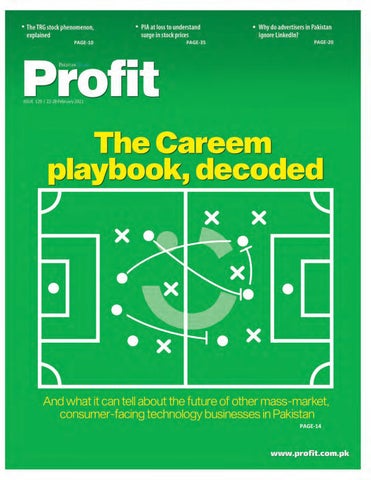
10 The TRG stock phenomenon, explained 14 The Careem playbook: how to build consumer-facing tech in Pakistan
20 20 Why do advertisers in Pakistan ignore LinkedIn? 24 Here’s your Zoom link: how corporate event management companies used technology to create experiences for their clients
28 28 Why luxury car importers are prone to fraud - the case of Porsche in Pakistan
28
35
34 Buckle up: KIA Motors enters the 7-seater market
35 35 PIA at loss to understand surge in stock prices 37 Henan D.R. brings a new hope to the Naya Pakistan Housing Project
WELCOME
Dear reader... ik aur dariyā kā sāmnā thā 'munīr' mujh ko maiñ ek dariyā ke paar utrā to maiñ ne dekhā
With online behemoths - both of the ‘search’ and ‘social networking’ variety - undercutting the ad spaces of all print journalism, and with one towering oak tree of a news brand after the other falling loudly, some within the sector pinned their hopes on another, older form of sustenance: paid subscriptions. Sometimes modern problems need older solutions, they reasoned, because nearly all of the modern solutions had been tried out, and had failed. In theory, this logic adds up. Yes, it would be a tall order to eke out subscription dues from a customer base that is, by now, completely used to free news content (the oldest millennials turn 40-years-old this year) but at least it would be an ideal worth pursuing; a light, even if elusive, at the end of the tunnel. With shrinking ad revenues, the news outlets are becoming more and more beholden to the few advertisers that remain. With subscriptions, rather than advertisers, driving revenue, news outlets would be in a position to politely tell overbearing advertisers to leave after offering them a cup of tea. Independent journalism. Advertising-financed outfits serve the advertisers; reader-financed outfits serve the readers. Alas, even this model might not yield objective, independent journalism because, in this post-truth era, many of the readers, much like most of the advertisers, don’t seem too invested in the truth. ———————————-
Permit me the vanity when I say this, but there are currently many eyes on Profit. I am not referring to those captains of industry and commerce or the regular, discerning readers who have come to rely on our content. Instead, I am referring to those within the news industry, looking at Pakistan’s first publication in recent times to take the plunge and hide the premium bits within its reportage behind a paywall. Will it or won’t it work? Yes, business and economy reporting is a bit of a niche, but a success could still be a proof of concept for the rest of the news media. Before we hopefully win this bet of ours, one thing has become painfully clear: the readers can be more fickle, not less, than the large advertisers. A report making conclusions unflattering to a reader’s political persuasions can yield a prompt cancellation of subscription. In the times of yore, tempers would have cooled down by the time one has gotten through to one’s newspaper hawker at the end of the month, requesting a cancellation. Now, the ease of digital activation that we have worked so hard on turns out to be a double-edged sword, with readers as easily able to opt out of our subscription as they are to leave a fuming comment under a news feature.
FROM THE EXECUTIVE EDITOR
The New York Times faces this in its reporting, with its leftleaning readership not taking kindly to conservative viewpoints, hence driving their coverage. And plenty of examples of conservative papers around the world, whose readers are offended by space given to liberal voices. So what, you may ask. A tribalisation of news outfits might not be ideal but at least all ends of the spectrum would have found their voice. Political science professors cite ‘interest articulation’ as one of the benefits of having political parties, so why not let that articulation of interests go one step further? Won’t sparring publications yield a more spirited and lively marketplace of ideas? No, it won’t. For starters, no one is going to believe anything that is written in another paper, even if it is not an opinion piece, but an expose relying on solid, incontrovertible evidence. Second, more dangerously, a publication might play fast and loose with the truth and objectivity to retain the support of its readership. It will go further and further to the end of the political spectrum where even the relatively reasonable adherents of a political ideology might feel underserved as compared to their more extremist neighbours. This further slide towards right or left will first lead to inflexibility and then to a hard-as-granite echo chamber completely impervious to opposing ideas and, more dangerously, objective reality. We at Profit have had some passionate champions, the sort of influencers who had urged their friends and families to subscribe to our publication, cancel their own subscription on the basis of just one (yes, one) news feature. And they publicly announced it, urging others to do the same. This was the best case scenario that we were hoping for? I’m afraid so. This is the ‘other river’ from Munir Niazi’s couplet at the beginning. So what should we do? Well, several years ago, we were the only publication that properly covered the HBL’s fiasco at its New York office. Yes, HBL, Pakistan’s single largest advertiser. As we noted, in our editorial at the end of that year: “Since the New York episode, till this goes to press, HBL hasn’t come out with its next advertising campaign. ‘Pakistan Today’ may or may not be a part of the next campaign. Do we care? Yes. Would we do things differently? No.” We would like to say the same to offended, uncomfortable readers. Do we care? Yes. Would we do things differently? No.
Babar Nizami Executive Editor
7
Readers Say @BrandverseG believes in democratizing access to ecommerce for everyone. @GetChikoo is our first step towards that, where regardless of budget or technical capability, every business can claim their place online. We are “sachet”-sizing ecommerce to bring Pakistan online. We have unwavering belief in the entrepreneur ability of the average Pakistani. Give them the tools, in a way that is accessible and affordable, and they will build something extraordinary. It’s time to build that ecommerce muscle, Pakistan. There are no excuses anymore! Apropos: The path of least resistance: the rise of whitelabeled e-commerce @raza_martin, Twitter Yes, certainly the association is with the corrupt influentials than the people of this country . They have lubricated and assisted the movement of black money from this country. Apropos: The path of least resistance: the rise of whitelabeled e-commerce Salman Nusrat, Facebook What has the textile industry done to promote research on seed development of cotton? The largest textile exporter Nishat mills has an export of $300mm plus, a pittance compared to what the industry should be doing. Done leave everything to the government, given that textile is the largest beneficiary, they should be charged research tax for seed development. Apropos: Govt establishing cannabis farms as alternative to cotton: Chaudhry Anonymous, Website Being a modern urban area and a business hub, Karachi is perfect for people who are seeking job opportunities. So many people have moved to Karachi. I think the population in big cities should be controlled. It's called the city of lights so it should stay the best city always. Apropos: Rebuild Karachi Anonymous, Website
facebook.com/Profitpk twitter.com/Profitpk linkedin.com/showcase/13251020 profit.com.pk profit@pakistantoday.com
HOW TO CONTACT
8
“they were running according to timelines...'' Amazing to hear this statement being made at such a high level government meeting and astonishingly that some one who belongs to Karachi simply accepts this statement on the face value. The only explanation could be that the timeline which the PTI govt has decided is not to complete the project in this term but to defer it till the next term (if they come into power)… Apropos: Asad Umar for monthly survey of KCR, RFC projects Anonymous, Website
I am also a local cement dealer and I had no idea that without any new taxes, cement prices are increasing day by day. My point is that government bodies should keep a proper check and balance on the prices of cement and other construction products otherwise this will be not good for construction sector ana also for our economy Ahmed Hasnain, Website Probably the best way to get foreign investment is privatization of state owned entities. Build Operate Privatize. This could be the way forward for the government. Apropos: Pakistan invites Egyptian entrepreneurs to explore investment options Fuzail Zubaid Ahmad, Facebook Economic conditions of both countries are no different. When Egypt took IMF loan , Baqar Raza was deputed by IMF in Egypt which further landed into more economic crises. Now Baqar Raza is in Pakistan to do the same. Saudis came to help Egypt with 12 Billion and Pakistan has no friends. One can imagine where Pakistan is heading. Apropos: Pakistan invites Egyptian entrepreneurs to explore investment options Khawar Afroze, Facebook A test case to review the Digitisation in Pakistan of telecom networks. This means the network's media, which is the OFC Optical FiberCable will transport the bandwidth of the internet from your home throughout the SEAMEWE network. The whole country has Digitised with the exception of PTCL ISP which provides internet services. There is an urgent need to consider the Digitisation of PTCL networks to the UN/ITU recommendations for Digitisation particularly in Karachi. The whole city is analog. Please consider. Apropos: Break the monopolies! Haroon Rashid, Website We are facilitating China in all manners but what are we getting in return? Nothing is clear, and we shall watch our interests closely and shall brief the Pakistani public. We have seen them purchasing lands everywhere, why are they allowed to do this. Remember, the Jews bought land from Palestinians and then declared it Israel. We shall not be the only optimistic/stupid country in the world, especially since we have experienced the East India Company. Apropos: Pakistan mulls alternate CPEC route to cut down distance to China border Anonymous, Website
COMMENTS
IN BRIEF The Economic Coordination Committee (ECC) of the federal cabinet is likely to accord approval for the abolishment of the 10-paisa per unit NeelumJhelum surcharge from electricity bills, after 13 years. In this regard, the ECC would meet under the chair of Finance Minister Abdul Hafeez Shaikh on Friday to mull over an eight-point agenda.
The government’s strategy to involve the banking sector has yielded successful results in increasing foreign remittances. All of the country’s economic indicators are witnessing positive trends despite the coronavirus pandemic, adding that the volume of Pakistan’s exports crossed its competitors in the sub-continent, including India and Bangladesh. Prime Minister Imran Khan
The International Monetary Fund (IMF) and Pakistan on Tuesday reached a staff-level agreement that Pakistan had completed reforms required for the release of around $500 million in IMF funds that had been suspended for about a year.
$59 million:
The foreign exchange reserves held by the State Bank of Pakistan (SBP) fell 0.45pc on a weekly basis, according to data released by the central bank. On February 12, the foreign currency reserves held by the SBP were recorded at $12,889.7 million, down $59 million compared with $12,949.1 million in the previous week. After the registration of Geographical Indications (GI) for Basmati rice, Pakistan has now decided to register pink salt as its GI product in order to stop India from registering the same as Himalayan salt. Pakistan is already fighting a case regarding the GI tagging of Basmati rice against India in the European Union.
The Drug Regulatory Authority of Pakistan (DRAP) has granted ’emergency use approval’ to the CanSinoBIO Recombinant Covid-19 Vaccine Adenovirus Type 5 Vector (Ad5-nCoV) and its marketing through the private and public.
$500 million:
Prime Minister Imran Khan has thanked overseas Pakistanis for responding positively to the State Bank of Pakistan’s Roshan Digital Accounts (RDA) by sending $500 million in just five months. The prime minister said that 87,833 accounts were opened from 97 countries around the world and the momentum continues to rise with $243 million coming in the last six weeks alone.
9
The TRG stock phenomenon, explained
Or how everyone in Pakistan suddenly discovered the existence of the company By Meiryum Ali
W
hat on earth is going on with TRG Pakistan’s stock price? In April 2020, TRG’s stock stood at around Rs12. It then climbed to Rs51 in August 2020. At the time, several complaints were lodged in the Prime Minister’s portal, alleging ‘insider trading’, which has prompted the Securities and Exchange Commission of Pakistan (SECP) to ask the PSX to submit a report on the issue.
10
That was then. Now of course, those complaints seem quaint. Because between December 2020, to February 2021, the stock climbed an absurd amount, the current Rs125. There is an expectation, according to market rumours, that it will certainly cross north of Rs150. But why? Exactly what happened in the last two months to account for the meteoric rise of the company in the eyes of Paskiatni investors? Even TRG Pakistan seems nonplussed. In a letter to the SECP sent on December 11, the company reiterated “We would like to inform you that we have no formal means of knowing what speculations are cir-
culating in the market and are, hence, unable to directly address these. We would also like to inform you that we do not have knowledge of any material information that may have resulted in the increase in market price of the Company and which has not previously been disclosed to the market.” To understand the market rally, it helps to have some context. So first: exactly who is TRG Pakistan? TRG, which is short for The Resource Group, is a venture capital company which specialises in making acquisitions and investments in the business process outsourcing (BPO) sector, typically investing in around one or two investments in a year, and
typically in technology, IT-enabled services and medicare insurance sectors. The company claims to have an ‘unbroken track record of over a decade’ in generating positive returns on each investment. The company is the brainchild of Chisti, a Pakistani-American in every sense of that hyphenated label, born to an American father and Pakistani mother, who grew up in Pakistan but studied and worked in the US. After being ousted from his first billion dollar company, he decided to form TRG. In 2002, TRG Pakistan was created, specifically to act as the global holding company for all of TRG’s investments. It was listed on the then Karachi Stock Exchange in July 2003. The ownership structure of TRG is somewhat complex: TRG Pakistan is the overall holding company, but it does not own the entirety of TRG International, which in turn does not necessarily own the entirety of the shares in its portfolio companies. Crucially, at each stage, there are minority investors who own significant stakes, which makes it difficult to track exactly how much the overall portfolio is worth, and how much of it is owned by the shareholders of the publicly listed company on the Pakistan Stock Exchange. This is a key point we will return to. For most of its existence, TRG Pakistan’s subsidiary was TRG International,
A document with no author has been making the rounds on Whatsapp, which puts the valuation of TRG Pakistan at roughly Rs400. which is a British Virgin Islands-incorporated holding company, that in turn owns stakes in most of TRG’s portfolio companies. However, in June 2020, TRG Pakistan’s share in TRG International changed from 57.16% to 46.03%. It is no longer a subsidiary, but is instead, technically, an affiliated company. However, that does not diminish TRG International’s importance for TRG Pakistan. According to the latest annual report released to the Pakistan Stock Exchange, TRG International consolidated revenues reached $600 million, or a 15% increase from last year’s $515 million. Much of this came from the ‘customer experience’ segment, which made up 67% of total revenue (or $405 million). Health insurance marketing contributed 19% of revenue, while enterprise software made up 14% of revenue. The significant company within the ‘customer experience’ segment is Ibex, which TRG International has a 64.2% stake in. The company provides contact centre services and other BPO facilities to enterprise customers.
Today, it has around 90 clients, is found in seven countries, and has more than 22,000 employees worldwide. In August 2020, this company completed its initial public offering on Nasdaq. At the time, its post money valuation was approximately $350 million, with the total amount raised in the IPO, prior to expenses, of approximately $90 million. Ibex has done generally well: its revenues increased to $405 million in 2020, or a 10% growth from the same period in fiscal 2019. The company’s EBITDA (or net income, with interest, taxes, depreciation, and amortization added) increased from $36 million to $54 million. Now, the second segment. TRG International’s health insurance marketing company, E-Telequote, saw its revenue shoot up from $35 million in 2018, to $65 million in 2019, to $113 million in 2020. According to TRG, this increase was a result of the continued investment in business and expansion of service delivery locations. In part due to the larger scale, the company’s profitability has also increased with EBITDA rising from $28
TECHNOLOGY
million to $43 million. As mentioned in previous reports and announcements to the PSX, TRG has been actively seeking to monetize this company, though it is unclear when this will happen. In a recent letter sent to the PSX on February 12, the company noted that “no decision has been made as of this date relating to the listing of Etelequote Limited on NASDAQ or any other exchange.” It further added: “As stated in our previous disclosures, we continue to evaluate various monetization alternatives for our portfolio companies, including assessing the US public markets and private transactions. We would also like to reiterate, as we did in our earlier disclosures, that due to the volatility in the financial markets there is no certainty as to the timing, valuation and potential success of any such transaction.” The crown jewel in TRG’s portfolio, however, is Afiniti, a company that develops artificial intelligence software that is designed to help companies improve the efficiency of their business processes, specifically their call center operations. TRG’s investment in Afiniti started in 2005 as a seed investment into a company that was developing a solution that TRG felt its portfolio companies would be able to use. Over time, it morphed into a business in its own right. And it is not hard to see why Afiniti gets the bulk of the attention: it is a rapidly growing business in an area of technology that can truly be described as cutting edge. In 2016, the company achieved Rs1.6 billion in revenues, a number that had skyrocketed to Rs11.2 billion by 2019, the latest year for which TRG clearly broke out Afiniti’s revenues on its consolidated financial statements. Afiniti was last valued at $1.6 billion in its Series D fundraising, which was in October 2018, according to sources familiar with the matter. It is unclear if the company’s valuation has risen by much since then. Rumours of Afiniti being listed on the NASDAQ have been doing the rounds since at least 2016. In total,
12
Afiniti has raised close to $200 million in funding across several venture capital rounds, as well as its most recent debt financing. Much of what has been disclosed above is publicly available information from the company’s annual reports. Indeed, Profit has done a feature story on Zia Chisti, and two follow up articles, in the last three years, explaining some of the intricacies of the company. In speaking to sources, one thing that clearly sticks out is that not enough people were simply aware of TRG Pakistan’s investments, and therefore the stock was criminally underpriced. According to one, many in Pakistan were not even aware it was essentially a venture capital vehicle. According to one analyst, at the macro level, the IT sector and pharma sector are two verticals that everyone is really talking about. This renewed interest in the sector means that more people are honing in on companies like TRG, which fit the bill. But when it comes to TRG in particular, there are other forces at play. A document with no author has been making the rounds on Whatsapp, which puts the valuation of TRG Pakistan at roughly Rs400. It does so by comparing the various subsidiaries - Afiniti, E-telequote - to their listed peers on American stock exchanges, and arrives at a project-
ed total valuation of TRG Pakistan. First, let us reiterate: because there are minority investors who own significant stakes in TRG Pakistan, it is difficult to track exactly how much the overall portfolio is worth, and how much of it is owned by the shareholders of the publicly listed company on the Pakistan Stock Exchange. But leave aside whether or not the stock is worth Rs400; it is the fact that people certainly believe it so. All sources interviewed either alluded to the document, or simply quoted the document verbatim as analysis. Some even went so far as to call TRG Pakistan as a non-traditional company trying out something new, that it was revolutionary. They also pointed to the fact that Zia Chisti was ‘charismatic’, that both the JS Group and AKD - traditional rivals- were bullish about TRG. In reality, Chisti is often known to make decisions that are behind schedule - this is true for both Afiniti, and TRG Pakistan itself. Far from growing the business, as early as 2017, Chishti had confirmed that TRG is in the process of seeking to sell its stakes in all of its portfolio companies so that it can convert its initial investors’ holdings to cash to return to them. There isn’t growth at all - yet the people putting their bets on TRG seem convinced otherwise. n
TECHNOLOGY
14
COVER STORY
By Farooq Tirmizi and Ariba Shahid
T
he hardest, most profitable thing to do in the business world is to get ordinary people to change their behaviour. Doing so in a low-trust society like Pakistan is harder still. And convincing other people to give you the money to do that hardest of hard things in business, well... you would have to be at least slightly insane to try that. The team at Careem, however, have managed – largely – to pull off all three, and done so very successfully. Yes, we know. Careem is technically a regional startup based in Dubai, but Pakistan is clearly an important part of their story, and for the purposes of this analysis, we at Profit will be focusing on their Pakistan operations. Before going any further, we would like to clarify one thing: this is not another “how they built it” story about Careem. That story has been told, including in this magazine, and while fascinating, at this point is not new. Instead, this is an analysis – using financial and operational data from Careem’s Pakistan operations – to understand exactly what it took for Careem to induce the change in behaviour needed for their business to succeed (including estimates of actual amounts spent), and whether that bargain was successful. We do this to illustrate a simple point: building a business that relies on an entire population that is still new to technology to start using your service off their mobile phones is hard – and expensive – but ultimately worth it.
The relationship between CAC, ARPU, and LTV
B
16
efore we dive into our analysis, it would be helpful to lay out some concepts that, while intuitive, are nonetheless useful in understanding
the viability of a business. They are customer acquisition costs (CAC), average revenue per user (ARPU), and lifetime value of a customer (LTV). The customer acquisition cost is the marketing costs, broadly defined (advertising, but also costs of promotional giveaways, etc.), divided by the number of customers the company is able to add. The average revenue per user is usually a per year or per month number (in this analysis, we will use per-year data). And the LTV represents the ARPU multiplied by the number of years a customer is expected to remain a customer. The biggest problem with many consumer-facing technology companies is that they are able to use heavy promotions and absurdly discounted prices to lure customers in the door, but then are not able to keep them there, usually because it becomes unviable to keep up the discounted prices and too many customers simply leave once the low prices end. The successful ones are able to keep customers around either by developing hardto-shake habits, or because customers fall in love with the product, or because they went after the right customers who only needed the promotional pricing to try the product and once they did, they were comfortable paying full price. For a business to be viable, its CAC needs to be lower than its LTV or else it will never make money. For it to become profitable, its CAC needs to go lower than its ARPU before its investors lose patience and stop giving it the money to keep going. To put this in accounting terms, if a company’s gross margins become positive, at some point, it can be assumed that it will achieve the scale it needs to become profitable. This is why venture investors tend to pay attention to unit economics more than the bottom line. The big concern investors have in a market like Pakistan is that the ARPU takes too long to exceed CAC and thus significantly reduces investor returns and increases the likelihood of business failure.
The opportunity for growth in deliveries and food business in the region is massive. It is an unprecedented time, but Careem is well-positioned to pivot and simplify and improve the lives of our customers the best way we can Zeeshan Hasib Baig, CEO of Careem Pakistan
As we will see in the case of Careem, however, there is evidence that it is certainly possible to have CAC and ARPU converge, even for a market where one has to invest heavily to gain an adequate customer base.
A note on methodology (feel free to skip)
F
or this analysis, we rely on data from Careem’s financial statements from 2016 through 2019. We were not able to obtain the 2020 financial statements and the company declined to share revenue data for the year, though they did share some interesting operational data, some of which we have previously reported on already. That detailed financial data allows us to examine how much the company bills customers, how much it pays out to drivers, and how much it spends on different types of promotional expenses (how much given in bonuses to drivers, and how much in credits, etc. to riders, for example). That gave us the amount it spends in total on customer acquisition. In order to calculate CAC and ARPU, however, we need to have the total number of active users for each year. Careem’s financial statements do not include that data, and their management declined to share historical data on the number of active users. Careem’s management did, however, share that they currently have 3.6 million active users on their platform, and approximately 200,000 active drivers. For our analysis, Profit assumed that the number of active users did not materially change during 2020 and that the number at the end of 2019 was effectively quite similar. We then used some operational data that Careem had shared on the average fares from 2016 through 2020 to calculate the total number of rides by year, divided the number of rides by the number of users for 2019, and then made a simplifying assumption that the number of rides per user did not change in previous years to calculate the number of active users at the end of each year. We also assumed that
non-ride-hailing revenue was negligible from 2016 through 2019. Once we had those numbers, we could easily calculate how many users, on net, Careem gained in each year, which allowed us to use the financial data from its financial statements to calculate approximations of their CAC and ARPU. These numbers, we cannot emphasise enough, are Profit’s estimates and not actual data from Careem. We think we are close, but we are not 100% accurate in our estimates.
Careem’s narrowing losses
T
he first thing that is evident from the data is that Careem’s customer billings (not the same as its revenue) skyrocketed between 2016 and 2018, but then stalled somewhat in 2019. Part of that is due to the fact that we are presenting this data in US dollars. In Pakistani rupees, Careem’s revenue actually grew by 24% to Rs25.9 billion,
but that rupee growth was almost entirely wiped away in US dollars by the depreciation of the rupee against the dollar. And Careem’s CAC does not have an obvious pattern: it starts off high in 2016, declines by almost half in 2017, rises somewhat in 2018, and then suddenly skyrockets again in 2019. So, what is happening with this business? When Careem started out building its network, it faced a chicken and egg problem: if it did not have drivers and cars, no riders would want to use the app. But if it did not have riders, no drivers and cars would want to join its network either. Each would need the other to be there to make it worth their while, but neither would start unless the other was already there. Careem solved this problem – as every ride-hailing company does – by incentivizing the drivers to be available, no matter whether or not they had riders. “All startups initially spend lots of money to acquire stakeholders,” said Zeeshan Hasib Baig, CEO of Careem Pakistan, in an interview with Profit. “We did too. Initially, we had to provide captains [what Careem calls its drivers] monthly income and other incentives.” “During the initial phase of our entry in the market, we used to offer a certain captain guarantee on the ride-hailing front to create the supply needed to fulfill the demand of the customers. Since the demand on the platform initially was not enough to make a decent ROI [return on investment] for a captain, Careem funded it in-form of incentives and bonuses, as the demand and user base increased these incentives naturally reduced and the earnings were ensured by higher demand in the form of more rides for captains,” said Baig. Those incentives did not come cheap. Between 2016 and 2019, Careem spent a total of Rs12.5 billion in incentives to drivers, over and above the Rs43.7 billion they were paid in their share of customer fares over the course of those
COVER STORY
four years. These numbers exclude the amount of money Careem paid to incentivize people who own fleets of cars with employed drivers to have them join the Careem network. In 2016, about 29% of the income that captains derived from Careem was from bonuses and guarantees alone. As the business has grown, that number has declined to about 19% in 2019. “As our customer base grew, we no longer need to [offer such incentives]. We do not have to pay captains from our own pockets anymore,” said Baig. Driver incentives form the core of Careem’s customer acquisition costs. About twothirds of its CAC goes in the form of direct payments and bonuses to drivers and fleet owners, with about a quarter going to riders as credits and other incentives, and the remainder on digital and other marketing expenses. So, when Careem says they value their captains, their financial statements back up that assertion. “Captains are at the heart of what we do and a priority area for us since we started services; to put it simply they are an integral part of the Careem family. Careem has always been at the forefront of coming up with initiatives designed at improving the quality of lives for captains,” said Baig. Over the past four years for which Profit was able to obtain data, the captains made about 72% of the total amount of money spent by Careem, a number that has remained remarkably consistent during that time, though much more of it now comes in the form of their share of the customer fares than the Careem bonuses and incentives than it used to. So, if CAC consists largely of the incentives to captains, and the amount Careem has to spend as a share of its business on those incentives is going down, then why has the CAC number fluctuated so much? Because the actual costs are just the numerator. The denominator, which is the net growth in the number of users,
18
has been more volatile.
The hard task of growing the user base
B
y Profit’s estimates, Careem has done a remarkable job in growing its user base. During 2016, its first full year of operations in Pakistan, the company had approximately 118,000 active users, according to Profit’s estimates using the company’s financial and operational data. By 2020, that number has grown to 3.6 million, a remarkable feat by any stretch of the imagination. That growth, however, has not come at a consistent pace, with most of the riders joining the platform within the first three years, and relatively slower growth since then. So if the company is spending the same amount of money to acquire users, and fewer new users join, the CAC would go up. Let us break down what happened. When Careem started its services in Pakistan,
it was mainly in the major cities of Karachi, Lahore, and Islamabad, and initially only in the upper middle class neighbourhoods of those cities. These are Pakistan’s most urbane, sophisticated consumers, most of whom had smartphones before there was 3G internet in the country and had considerable discretionary spending ability. To attract such users, Careem basically had to spend money to get them to try the service, but once they tried it, they were likely to stick with it and mention it in casual conversation with their friends who were perhaps not as early adopters of new technology. So when Careem’s advertising and marketing reached that next circle of people who were the friends and family of its early adopters, it did not need to spend nearly as much to convince them to join, resulting in a jump in the number of users without the marketing spending needing to rise by the same amount. It also achieved a certain amount of economies of scale: if there were more riders, more of a driver’s active time was covered by a customer fare and did not have to be subsidized by a Careem bonus or incentive payment. So, it makes sense that when it saw rapid growth in the first three years, its CAC declined. What happened next – when it hit approximately the 3 million user mark – is a sad commentary on Pakistan’s segregated political economy: the number of people who can afford Careem’s services (and need them) begins to dwindle past those 3 million people. In 2019, Careem continued to offer the same level of incentives to its drivers and riders as in 2018, but its active user base – which had grown by 1.7 million people in 2018 – only grew by approximately 460,000, according to Profit’s estimates. The CAC then skyrocketed. At that point, Careem – which did not yet have ARPU that was above its CAC – faced a choice: it could, to borrow American football parlance, either go wide or it could go deep.
TEXTILES
Going wider would mean going after more customers with the same service. Going deeper would mean going after its existing users with newer products and services that it could deliver and that they might like. Careem’s management, while not using this explicit language, has made it abundantly clear that they choose to go deeper rather than wider.
To increase ARPU, raise the R, not the U
I
n 2020, even before the pandemic hit, Careem’s global management as well as the one in Pakistan was getting ready to launch their super app, which would begin to offer a wider array of services beyond just ride-hailing. Of course, the coronavirus pandemic then hit the global economy, with shut downs decimating any kind of travel and transportation business, including that of Careem. The company’s management is shy about releasing data on their operations in 2020 and we do not blame them: the numbers will look bad, and will not in any way be reflective of the fundamentals of the business. They will serve mostly as noise that will distract from the ability to understand the direction it is taking as a company. That said, however, the initiatives it launched in Pakistan – both the delivery business as well as Careem Pay – indicate that Careem is interested in gaining a higher share of wallet from its core base of about 3 million active users rather than converting more of its 11 million registered users into active ones. That stands to reason: those 3 million people have more money to spend and they are spending it right now on services that Careem is well positioned to provide. It has a fleet of cars, motorcycles, and other vehicles, along with drivers, so expanding into delivery is a
natural expansion. “The opportunity for growth in deliveries and food business in the region is massive,” said Baig. “It is an unprecedented time, but Careem is well-positioned to pivot and simplify and improve the lives of our customers the best way we can.” “We will continue to leverage our Super App to cross sell to users across different verticals by developing a stronger loyalty program as a differentiating factor which would offer additional value. We also look forward to expanding our food delivery business in major cities of Pakistan and offer a seamless delivery experience,” he said. And, in a country with a still largely inadequate electronic payments mechanism, Careem has built the largest internet-based business in Pakistan, proving that it can get people to trust it with money over the internet, so why not expand its payments capabilities as well? “The entire Super App infrastructure also requires a robust payments solution, which is
extremely critical to the entire equation, since it not only encourages the over 90% cash-based transactions on the platform to go digital but also provides a range of financial services which fills a big gap in the entire region,” said Baig.
What is the risk?
I
t seems like a relatively straightforward proposition: Careem can continue to leverage its core assets to build a great platform that will allow it to increase revenues with relatively less investment in seeking to gain new users. What could possibly be the downside? None, if executed well enough. But every major consumer-facing tech company thinks they can build a WeChat-like Super App and yet almost nobody else has succeeded in doing so yet, and for a reason. Offer too much in one app, and you risk overwhelming your customer with too much choice, and a cumbersome user experience where they are not able to conveniently access the services they most value, and so they may stop using your services entirely. Adding delivery and payments may seem simple enough. But Careem’s plans go beyond that. “For next year, in some countries we are exploring to add innovative solutions to the Super App such as engaging with other businesses and startups to integrate their services on the Careem Super App through its open architecture,” said Baig. “This way they can benefit from our customer engagement and also benefit from the enabling services we have built, whereas our customers benefit from having more services at the same platform.” Becoming a platform for other startups sounds like it may be a great idea, or it may just end up creating confusion for users and detracting from the core Careem experience. What direction it will take will depend entirely on the quality of its technology and product managers. No pressure, folks. n
COVER STORY
20
By Babar Khan Javed
P
akistanis love LinkedIn. At the end of January this year, the professional-social website had 1.5 million people logging in and actively using the platform every day, and 5.3 million users doing the same every month in Pakistan. And the trend is only growing, particularly since the 5.3 million monthly users figure is up by 5.5% from 5 million back in October 2020. And this isn’t an issue of LinkedIn becoming more popular globally, it is seeing specific rise in numbers in Pakistan. According to Sensor Tower, the American business and employment oriented online service has ranked in the top ten most downloaded business apps in Pakistan since July 2020. The reasons why the app is being downloaded are diverse. For some businesses, as Anita Rajan from Reon Energy, explains - the app is ideal for finding leads and business to business solutions with tools like the LinkedIn Sales Solutions, which allows you to target the right companies and people. Beating the likes of Gulf Jobs, Freelancer, Indeed, Upwork, and Rozee, Sensor Tower ranks LinkedIn as the second most downloaded white collar job discovery app in Pakistan since October 2020, with the first slot going to Fiverr, an Israeli online marketplace for freelance services. The spikes in popularity coincide with the sporadic unemployment created by the pandemic, with apps being a source of both job hunting and skills development, as well as networking. A trusted source of enterprise-grade market intelligence and performance metrics in the mobile app ecosystem, Sensor Tower data further shows that LinkedIn is among the top five business apps in two countries, top ten in 55 countries, and top 100 in 44 countries. In addition, the largest user bases for LinkedIn is from India, followed by the US, China, Canada, Denmark, and Singapore. So why aren’t advertisers and agencies flocking to a niche app which has a growing local user base, a high net worth international audience, consistent brand safety guidelines, and value proposition unlike any other business app on the planet? To understand, Profit spoke to the key decision makers in recruiting and B2B marketing roles.
directors have historically and globally proven a tendency to favour those inventory options that offer them a direct return on their investment. A rebate, in this case, broadly refers to a benefit that a media supplier provides to a media agency. These benefits can include cash, free media inventory, debt forgiveness, equity or contingent equity, and other forms of non-cash benefits. In some cases, media suppliers will pay the rebate to an affiliated entity within the same agency holding company instead of paying it to the media agency of record, which is a tactic to avoid detection during a media audit. This is not the same as a discount, which is typically a price reduction applied to inventory at the point of sale, while a rebate is paid retrospectively. “If LinkedIn wants to be listed in digital media plans which concern B2B marketing and employer branding, it can proactively establish an incentive program designed to encourage media planners and media buyers to direct a greater amount of spend toward a certain type of its ad space,” said the owner of one top five media agency. “The ad space would be purchased at a pre-negotiated and fixed cost, rather than on a public exchange. The incentive program will establish tiers, slots, and certain thresholds for both overall spend and year-over-year growth, above which agencies receive a cash rebate at the end of the year.” Basically, what is being said here is that media agencies in Pakistan are not forward thinking. They do not see the numbers LinkedIn is getting, and can also see a lack of immediate benefit to them. This is why they choose to focus on keeping things safe and on track, and if LinkedIn wants their business, it will have to play along. The only problem is, LinkedIn might want advertisers, but media agencies should
also see the opportunities that they are missing out on. Taking the example of Google, the unnamed media executive added that the metrics required to trigger the rebate and the percentage of rebates provided are determined on an agency by agency basis. A prominent reseller for an international social networking service told Profit that rebate contracts include a provision for the payment of a referral fee representing between 10% to 15% of the media agency spend, which Profit was told is another name for a rebate. This reseller shared that for advertisers opting into a non-disclosed buying agreement, the benefit passed back to the media agency of record is reformulated from a cash payment to a discount applied to the price of inventory on the front end. The media suppliers are placed on an internal hit list of entities known only to the planning team to which client advertising spend should be allocated.
Pricing
W
ith the absence of clear rebates being the principle reason large media agencies are ignoring LinkedIn, smaller digital media planners told Profit that since marketers in Pakistan view media as an expense instead of as an investment, therefore the high price per click and price per impression found on LinkedIn seems absurd to decision makers who chase vanity metrics. This weakens any internal business case for experimentation as well. “LinkedIn is usually ten times more expensive than Google or Facebook which also allow marketers to segment audiences for B2B marketing,” said one planner. “The challenge is that a mental shift takes place when a user is
Rebates
W
henever someone asks the question, why are the advertisers not paying attention, your head should always turn towards the media agencies. As the principal gatekeepers between advertisers and media owners, media agencies and their investment
ADVERTISING
In any decision you make in life, you can be right or wrong and you can be either contrarian or consensus. In other words, you can do what everyone is doing (consensus) or you can do what no one is doing (contrarian). Now if you’re wrong, it doesn’t really matter if you’re with the crowd or against the crowd. In fact, it’s particularly awkward to be contrarian and wrong because everyone hates you and you’re wrong (trust us). That’s why most people prefer to stay far away from contrarian ideas Jon Lombardo, global lead at the B2B Institute
logged into LinkedIn, navigating the app with a professional metaphorical hat on and more reception to content or ads that help them reach career goals. This is possibly why the same finely targeted B2B ad on YouTube or Reels is relatively ineffective.” One planner told Profit that LinkedIn needs to get rid of its minimum ad budget requirement and introduce payment plans for small to medium sized digital agencies. It also needs to set up a partner program or open one up for the Pakistan market. With the plethora of B2B focused software companies in the country, Profit was told that driving sales qualified leads with LinkedIn usually trumps the marketing qualified leads from alternatives such as Xing. While it is the slowness and obsession with good numbers of the Pakistani market that is resulting in this important platform being ignored, these long-held beliefs are not going anywhere, and LinkedIn may have to play along. “People and teams with a growth mindset are in it for the joy of learning,” said Jann Schwarz, director of the B2B Institute
at LinkedIn. “They relish the ambiguity and temporary discomfort of being bad at something to get good at it over time—in an environment of abundant opportunity. This takes self confidence, self-awareness, and courage.” Admittedly, the culture of an organization that leans towards experimentation and learning also matters.
Audience intent
I
t was the opinion of multiple respondents for this report that the majority of users from Pakistan on LinkedIn were active on the platform to hunt for jobs, not for networking and learning. The perception may have to do with the abundance of advertisers on LinkedIn that tend to focus sales materials around educating customers about the depth of a problem being solved and the uniformity of the solution being suggested. It’s possible that respondents misinterpreted this content a job seeker would be interested in. “While earlier a purchase funnel was used
If LinkedIn wants to be listed in digital media plans which concern B2B marketing and employer branding, it can proactively establish an incentive program designed to encourage media planners and media buyers to direct a greater amount of spend toward a certain type of its ad space. The ad space would be purchased at a pre-negotiated and fixed cost, rather than on a public exchange. The incentive program will establish tiers, slots, and certain thresholds for both overall spend and year-over-year growth, above which agencies receive a cash rebate at the end of the year The owner of a top five media agency
22
to best describe the decision-making path of a typical customer, the situation has significantly changed over the years, primarily for firms competing in growing markets where the pace and volume of digital usage is rapid,” said Marcos Inácio Severo de Almeida, a marketing researcher and professor at Federal University of Goiás, Brazil. “A modern customer, in this digital age, follows a purchase–consumption circular loop, and with the proliferation of information in the digital space, the customer is more informed, enabling the firms to start with a narrower consideration set. This phenomenon is particularly pronounced in the business markets since B2B customers fall under the high involvement category.” Inácio Severo de Almeida said that B2B customers generate a plethora of content that is highly useful to marketers, albeit unstructured and difficult to comprehend. This is particularly important in emerging markets because of the institutional voids that prevail in such markets, which makes it hard for marketers to gain access to relevant information. “In any decision you make in life, you can be right or wrong and you can be either contrarian or consensus,” said Jon Lombardo, global lead at the B2B Institute. “In other words, you can do what everyone is doing (consensus) or you can do what no one is doing (contrarian). Now if you’re wrong, it doesn’t really matter if you’re with the crowd or against the crowd. In fact, it’s particularly awkward to be contrarian and wrong because everyone hates you and you’re wrong (trust us). That’s why most people prefer to stay far away from contrarian ideas.”
No expertise in B2B marketing
“I
n any decision you make in life, you can be right or wrong and you can be either contrarian or consensus,” said Jon Lombardo, global lead at
The beauty of the Sales Navigator is that it allows you to create search groups, gives notification on job status of potential leads, and offers a group-wide view. It also helps you extend your reach to similar audiences and can help you meet various other goals. Sales Navigator requires a lot of time and cost investment in order to reach your goals Anita Rajan, the marketing manager for Reon Energy
the B2B Institute. “In other words, you can do what everyone is doing (consensus) or you can do what no one is doing (contrarian). Now if you’re wrong, it doesn’t really matter if you’re with the crowd or against the crowd. In fact, it’s particularly awkward to be contrarian and wrong because everyone hates you and you’re wrong (trust us). That’s why most people prefer to stay far away from contrarian ideas.” To his point, several respondents to this story told Profit that the scope of work in Pakistan pertaining to integrated marketing campaigns predominantly leans towards business to consumer. This was coupled with testimony across a range of business school alumni that insisted that B2B marketing was never taught as a subject or specialisation or looked too dull to take. While undoubtedly marketing courses can cover the B2B lens with case studies and examples, in Pakistan it tends to be avoided due to the perceived nature of B2B customer acquisition and retention, relying solely on relationships, promises, and favours being exchanged,
At the Rausing Executive Development Centre, the upcoming annual Sales Force Management course appears to encompass the closest equivalent of B2B marketing for the business school. At the likes of the Institute of Business Administration, the Institute of Business Management, the Karachi School of Business & Leadership, and the Karachi University Business School, an elective for industrial marketing surfaces within the undergraduate program, with recent alumni telling Profit that the classes were not popular due to the nature of the course and the faculty. Nonetheless, as cited above that most B2B marketing programs are educational in nature, LinkedIn offers its existing and future customers a variety of resources in getting started with the platform. Within the framing of its own media supply chain, the American business and employment-oriented online service positions its products as those used by those that embrace the mental shift toward seeing marketing as a mindset for growth and not just as a tactic for
customer acquisition. In their 2013 book ‘The Long and the Short of It,’ researchers Les Binet and Peter Field advance a very simple and contrarian idea which suggests that there are two types of marketing: sales activation and brand building. The former delivers short-term growth, increases sales right away, and the results decay quickly. This approach is favored by marketers who are incentivized by supervisors and corporate culture to deliver commercial outcomes even at the expense of the brand. The latter delivers long term growth - with some short-term lifts - compounding over time and influencing future sales from future buyers. It is brand building that actually generates the demand in both the long term and the short term, whereas sales activation just helps businesses capture the demand that already exists. Working with LinkedIn, the famed marketing researchers recently published a B2B marketing guide to help advertisers and agencies balance long-term brand building with short-term sales activation. n
By Ariba Shahid
T
he year 2020 was a year of canceled plans and events. Pakistanis had even put a ban on weddings, something they take extremely seriously. And yet one niche did very well: corporate event management companies. Turns out, Pakistan’s corporate sector returned to business as usual quite rapidly, which meant corporate events. Even though the year 2020 was devastating to society at large, and at least for the first few months there were no physical events, some event managers managed to end the year in positive. As Azfar Ahsan, CEO at the Nutshell Forum, an event management company said, “Despite all the hardship, we ended 2020 with greater sponsors than before and better gains.” Exactly how did they achieve this? Profit takes a look.
First, the bad days
B
efore we talk about success, it is important to note that the initial days of the pandemic still hit most companies out of the blue. Hasan Daudpota, CEO of Keys Pro-
24
ductions explained, “2020 as a year overall and specifically March onwards was super disturbing for many people including us. For the first two months we couldn’t figure out anything as something like this was never on the cards. Being an events agency, we never thought of the world coming to halt and everything shutting down so abruptly.” For Ahsan, the virus came at the absolute worst time. He was scheduled to host approximately 1000 delegates, including more than 175 foreign attendees and speakers, at the 4th edition of Leaders in Islamabad Forum during March. “In February, the virus was not as serious in Pakistan as it was in the outside world. Despite that, our team took a timely decision to postpone the event keeping in mind global dynamics and the fact that the conference was to host global leaders. We tentatively rescheduled to organize the event in July. No one in their wildest thoughts would have assumed the virus and lockdowns would stretch out beyond that,” he said. While the event could not take place in July, because the virus unfortunately extended its stay, Ahsan said that his team remained busy in organizing online dialogues, roundtables, and conferences.
2020 as a year overall and specifically March onwards was super disturbing for many people including us. For the first two months we couldn’t figure out anything as something like this was never on the cards. Being an events agency, we never thought of the world coming to halt and everything shutting down so abruptly Hasan Daudpota, CEO of Keys Productions
“We scheduled them at 9:30 PM regularly. This allowed people to watch and participate after they’re done with their days’ work and dinner.” Ahsan said, “I know a lot of people that spent the lockdown phase planning and understanding dynamics. They decided to remain in business and wait for the devastating impact of the virus to go away. However, I also know people that went out of business or decided to do something else because the event management business had come to a standstill.”
How did these businesses start making money?
P
akistan is one of the few countries that opened up relatively quickly compared to others. The reason? Smart lockdowns implemented by the federal government. Pakistan was also lucky in that the number of cases and deaths were not as alarming as other countries. As a result, the corporate world went back to business as usual, which also meant a return to corporate events. That is where the event management companies found business. In November 2020, Ahsan hosted The Future Summit. “In 2019, we hosted more than 1000 people. However, this year we hosted 300 people at the event. Despite that our reach was much bigger and we got 20% more sponsors than ever. I, however, did not increase my charges for the event compared to 2019. Despite that, the year ended on a positive note.” For Ahsan, organizing the Future Summit was an accomplishment. He says that the event was organized at a time when very few events of such scale were happening anywhere in the world. Keys Production was able to stay afloat due to its diversified services. “We have an independent PR department and an independent content department, which worked hard
to make sure the work kept coming. In fact, the workload on the PR, production and design side increased a lot and made us survive 2020 well, and we ended the year on a very good note,” notes Daudpota.
Hybrid events
A
nother key factor for many event management companies was to hold ‘hybrid’ events, also called ‘phygital’ events. These are events that are both attended physically in person, and virtually online. “Keys Productions is one of the very few agencies in Pakistan that disrupts on a regular basis, we are an agency that questions its own success formulas by believing in Kaizen every single day,” said Daudpota [Kaizen is a Japanese term which means ‘continuous improvement’.] He went on to explain: “The very first step was to move properly on the virtual and hybrid events size, as we have always been extraordinary on the technical production side, be it creative set designs, quality broadcast,
flawless executions, safety management and much more. We executed more than 20 virtual and hybrid Events in 2020 only, and so far we have done three similar projects in 2021 as well,” said Daudpota. He also said the most difficult task while organizing events during the pandemic was to obtain no objection certificates, or NOCs, and approvals. “During Covid-19 especially, our biggest concern for each production or query was NOCs and permissions. It is hard to explain to clients that it is costing us and even a postponement costs us a lot, but there are always 100 other agencies in the line who are ready to do anything to score that same client, so things become challenging at times. But we are so used to the hustle now,” he said. Once permission is out of the way, then the agency must solve for execution – particularly in managing the digital element. Daudpota said, “For equipment, we already had our production tech suppliers. For broadcast, we partnered with internet service providers for dedicated internet connections and used our broadcast software. For platforms and inte-
EVENT MANAGEMENT
There was very little acceptance for online or virtual events, or virtual speeches prior to Covid-19. Sponsors and participants did not seem too keen. However, when the world came to a stand still and there was no other alternative, people realized what could be gained Hamza Hashmi, CEO of TerraBiz
grations, we invested in multiple platforms, bought corporate connections mostly ranging from $500 to $5,000, and more at times, depending on the magnitude of the project and client requirements.” Ahsan explained that his business had already been in practice of using streamyard for live streaming broadcast quality event coverage on Facebook live and YouTube in order to reach a greater number of people. “Our sponsors were happy with the fact that their logo placement was not only present physically at the event, but also displayed throughout our online stream. It gave them a brand presence,” explained Ahsan.
Why were digital events not common before the pandemic?
A
ccording to Hashmi, “There was very little acceptance for online or virtual events, or virtual speeches prior to Covid-19. Sponsors and participants did not seem too keen. However, when the world came to a stand still and there was no other alternative, people realized what could be gained.” He adds that prior to the pandemic, individuals would disrupt their whole schedule to fly out to different cities for a short speech
or session, when in reality, the same impactful speech or session could have been done virtually. Another reason why attendees and sponsors seemed hesitant to accept digital aspects in events was because of the lack of infrastructure.
Should virtual events be cheaper?
C
orporate events in Pakistan, just like in much of the rest of the world, are expensive affairs. Often hosted in a city’s most expensive hotels, events consist of expensive food, travel and lodging arrangements, large teams, and fancy equipment. One would assume that entirely digital events would be drastically cheaper, whereas hybrid events would also be a form of saving money. That, however, is not always the case. Hashmi said, “Digital events should not be seen as a way to cut down on costs. While organizers and sponsors may not have to pay for expensive business class flights, visas, and hotel stays, they still have to heavily invest in various technological aspects for a successful event. The same goes for hybrid events.” “Even prior to Covid-19, the industry faced many challenges like having no companies doing event insurance whereas it’s pretty common in so many other countries. cli-
ents in Pakistan don’t focus much on safety management. Even if they do (on paper), they are not willing to pay any extra amount to ensure safety at the event, that creates challenges, especially under extraordinary circumstances like Covid-19,” Daudpota explained. He went on to say: “Half of our clients in Pakistan are multinational companies, and they were already familiar with virtual events, but still they were completely clueless about the planning time, execution details etc, so it was a learning experience for them as well. The hardest part was convincing clients on budgets, as they were also taking quotes from agencies who are not as experienced as we are and they were quoting [a lower budget]. It’s really hard to convince any client that the budget we are charging is actually good for your event and your brand image and you should not be compromising on it.” What came as a surprise is the fact that with hybrid events, not only do the organizers and event managers have to spend on the physical layout of the event, but also need to invest heavily in various digital event platforms. Convincing clients about higher charges for hybrid events could sometimes be a challenge. Daudpota explains, “Reaction to costs vary client to client. We have clients who never question our cost structures and appreciate our transparency, even when the
You can now have greater access to international speakers, consultants, celebrities, and audiences. The return on investment is greater. The future for the event management industry is very exciting. While Pakistanis have access to the global world, Pakistani event managers can also be organizers for international events Umer Khan, founder and CEO of Evenement
26
In 2019, we hosted more than 1000 people. However, this year we hosted 300 people at the event. Despite that our reach was much bigger and we got 20% more sponsors than ever. I, however, did not increase my charges for the event compared to 2019. Despite that, the year ended on a positive note Azfar Ahsan, CEO of Nutshell Conferences
numbers cross several dozen millions. We also have clients who question us on every tiny miny amount. We follow the same cost structure for each and every client, and we always share breakdowns and details, which save our time of explanations and confusions. Most of our clients know the quality standard that we follow, so it was not too difficult to convince them on our budgets, as they have already seen our quality at their previous on ground events.” There are also significant additional costs associated with hybrid events. “The most difficult part was to get the internet connection costs approved, as on average we charge around Rs250,000 to Rs300,000 for primary and secondary internet connections combined for main and backup connection for broadcast, as dedicated and uninterrupted internet connection is a must for a live broadcast.” Ahsan added that while Nutshell Conferences uses Streamyard for now, the future requires more modern platforms. “The starting price for a good platform could be approximately $20,000. There is no upper limit to this,” he said. According to him, investing in platforms is the future, and there is no survival without it.
How are digital platforms acting as game changers?
A
ccording to Daudpota, “We started off with giving extreme comfort to our clients by doing their virtual and hybrid sessions at their own offices, by providing them creative sets, customized lights and also provided them with our virtual branding and broadcasting platforms from our partners in the US. Keys Productions is the first company in Pakistan who provided these solutions to local clients here. With our own platforms, we don’t need to use platforms like Zoom or Teams, and our platforms are way more secure and provide us complete freedom of branding and customi-
zation. We did a lot of integrations on virtual and hybrid sessions like doing online games for 500 people, online polls, online quiz, and online learning. We also provided virtual breakout rooms for the breakout sessions with complete automation.” This is reminiscent of events held earlier last year. Consider last year’s technology conference 021 Disrupt, organized by The Nest I/O. The event was conducted digitally, but the organizers created a stage and held it on Hoppin rather than just live streaming it over Zoom or YouTube. As a result, attendees, whilst at the comfort of their homes or offices could engage, interact and network despite not being there in person. For that very reason, Umer Khan, founder and CEO of Evenement also uses Hoppin for events. For Khan, Hoppin is a platform for digital events that can also be used for hybrid events. “There are various alternatives, some made in the US, India, Singapore, etc. As far as replicating the platform is concerned, that does not make much sense,” he said. Hamza Hashmi, CEO of TerraBiz, and another user of Hoppin, felt that not only do event managers have to make sure the on ground experience is great, but also have to provide the right environment for virtual attendees and delegates. “People attend events with two purposes in mind, to learn and network. While one can learn online, networking remains a challenge. However, with the right platforms that can be done. Unfortunately we have to move beyond using live streaming features on social media sites and find creative ways to provide the right experience,” he said.
The future of the event industry
W
hen asked about how he sees the industry post the pandemic, Khan said, “I see a surge in events. A lot of corporations are holding back on events. As soon as the situation allows for it, they will push for physical events.” He added: “It would be a sweeping
statement to say that hybrid events are definitely the future but any forward thinking entity or individual will always look into it. However, in the medium to long term, one question will stay. We will always question whether a task or event has to be done physically or can be done digitally.” All four interviewed, however, agreed that as a result of hybrid events, the world is now accessible. According to Khan, “You can now have greater access to international speakers, consultants, celebrities, and audiences. The return on investment is greater.” In addition, he said, “The future for the event management industry is very exciting. While Pakistanis have access to the global world, Pakistani event managers can also be organizers for international events.” Hashmi felt there will be a lot more investment in technology, along with the creation of jobs. Like Khan he also said that local Pakistanis may find work at international events due to the nature of the digital world. For Khan, the possibilities were endless. He believed that public events and expos could now be undertaken virtually whilst maintaining contact, engagement and interaction. He also felt that the government could also jump the bandwagon, with regards to its policy making and outreach. Currently, the federal government tends to broadcast its decisions and policies on television. Daudpota said that digital avenues were being explored even before the pandemic hit, but the way Pakistanis have responded to the rapid integration of technology seems promising. “We in fact had our platform introduced in Pakistan for virtual events, even before the pandemic happened. We strongly believe that virtual events would be saving a lot of time, energy, money and hassle. However, it will take time in a country like Pakistan where people believe in physical meetings and look for avenues for the same. The way we saw Pakistan in the last one year, running parallel with the world, I strongly believe that Pakistan will improve and disrupt further on the virtual world.” n
EVENT MANAGEMENT
Why luxury car importers are prone to fraud
Porsche THE CASE OF
IN PAKISTAN
Profit takes a look at the murky business of luxury cars importers in Pakistan
By Taimoor Hassan
T
his is a story about rich people and their rich people problems. And the premise is that the rich are not used to getting fleeced out of their personal money, and when that does happen, usually it is at the hands of another very rich person. Today’s instance is about luxury cars, and more specifically, how in the world the CEO of Porsche Pakistan pinched Rs 800 million from some of the most rich and influential people in the country. To understand how all these things happened, we must first have an idea of how upper-class life is structured. It is a sheltered world in which you rarely have to deal with people below your pay-grade, and end up socialising, giving and receiving favours all while flitting between the same familiar faces in the same crowds as always. One of the faces amongst this crowd is Syed Abuzar Bokhari, the CEO in question that has left his customers stranded without their money. You see, if you’re filthy rich in Pakistan, and you want to buy a car, you aren’t going to be walking into a local Suzuki or Toyota dealership or browsing ads for cars on Pakwheels. You’ll be going to a high-end, luxury, car dealership with a reference from a friend. And when you’re going in expecting the best, and can see yourself surrounded by opulence in these dealerships, the last thing on your mind is fraud. The situation is simple: Syed Abuzar Bokhari took partial prepayments for cars that were booked for deliveries that never got delivered to customers. And while this story is very much about what happened at Porsche Pakistan, it is more so a story of how the business model of selling luxury cars to customers as authorised importers or authorised dealers has
28
always been somewhat flawed, and customers always run the risk of being defrauded.
Pakistan and cars
I
n 1897, the first car ran on an Indian road, and for the next three decades, cars would remain a spectacle seen rarely. They were driven either by the ruling classes, or industrialists, Nawabs, and politicians that could afford to have them imported. The first car assembly line of the subcontinent was not set up until 1942, when Walchand Hirachand started Premier Automobiles Ltd in association with Chrysler from the United States. The first car in India would not be assembled until just a year before partition in 1946, when Premier kicked off the automobile revolution in India by assembling De Soto and Plymouth cars. Over the half century after partition, India would see its automotive industry boom. Today, it competes with Germany as one of the top five automobile manufacturers in the world. And right before the turn of the century, India would manage to make its first car built from scratch in India - the Tata Indica - in 1998. In 1994, luxury car company Mercedes entered India and by 2009 had set up an assembly line spread over 100 acres in Chakan near Pune. India’s adoption and ownership of the automotive industry has been an inspiring story, and one that even luxury car brands like Mercedes and BMW have not been able to ignore. In Pakistan, however, the story has been painfully different. Pakistan managed to produce its first vehicle as early as 1953 with the help of General Motors. Vauxhall cars, trucks, buses, were all being assembled in the country’s first assembly plant in Karachi in the 1950s. But since the 1950s, assembly lines have been as far as Pakistan has gotten where cars are involved.
The closest Pakistan has come was when the Atlas group struck a deal with the then still relatively new Honda to begin manufacturing motorcycles in Pakistan as early as 1962. In fact, it was this early success of the Atlas group to popularise Honda in Pakistan that resulted in the trifecta of Japanese car manufacturers that dominate Pakistan’s car market even today. After going through nationalisation in the 1970s under Zulfiar Ali Bhutto followed by deregulation in the 1980s and 1990s, the ‘Big Three’ companies - Honda, Toyota, and Suzuki - became mainstays in Pakistan. Despite the hold that these companies have over the Pakistani middle-class which considers them sensible buys with good resale value, the Pakistani imagination was captured not by Japanese, but by German cars. Sleek Mercedes, BMWs, and Porsches are rare yet breathtaking sights that continue to dazzle to this today, even if the sightings have become less rare. However, German companies coming here even to assemble has been out of the question. But because of the allure of these vehicles, there has been a steady demand for these cars to be imported. Essentially since the birth of Pakistan, when Jinnah used to travel in his personal Rolls Royce, the rich and powerful have demanded luxury, and the demand has been met by imports. This demand has gone through stages. Initially, most of the imports were by the government that used these vehicles as state cars meant to come with public office, not for private ownership. Even since before partition, Nawabs and industrialists had been importing these cars because there were no cars being locally assembled. But during the 1970s and 1980s, when Japanese cars were on their way to general popularity, it became harder and harder to find luxury German cars. The manufacturers were now rejecting import applications from
single customers, and German cars became harder and harder to acquire. That is where we hear strange stories of people buying smuggled Mercs with bullet holes in the windscreens, and having to go through a dozen middle men to walk away with the car and still not be sure if you legally own it or not. Eventually, however, people caught on to the business opportunity that this presented, and thus the authorized dealership was born. An authorised dealer is essentially a company that is given permission to import cars from a certain company. They do not represent that brand, and are simply acting as a facilitator in getting the car imported. Take, for example, BMW. In January 2004, according to a Pakwheels article, the Dewan Group got the rights to BMW in Pakistan. Dewan Farooq, in particular, held the BMW venture here, the same group who assembled and sold Hyundai vehicles through Pakistan’s most advanced automobile assembling plant, as reported by multiple sources of the automotive industry. However, BMW wasn’t assembled here, rather it was imported to Pakistan. So for all intents and purposes, the Dewan group was acting as a middle man to help facilitate the transaction and nothing else. While this may sound better than how people got cars like these back in the1970s and 1980s, there are still serious flaws in the system, as has been proven with the Porsche saga.
The Porsche fiasco
B
ack in early 2019, when Profit had profiled Porsche Pakistan, rumours had already started surfacing that Porsche Pakistan was getting late on deliveries to customers. It would only later turn out that a full blown case of fraud would be reported, in which the CEO of Porsche Pakistan, Syed Abuzar Bokhari, would be accused of running away with Rs800 million of customers’ money for cars that they never received. That amount of money is no joke, and to run away with it using the name of one of the most reputable automotive companies in the world and taking the money from the most wealthy and well connected people in Pakistan is even more of a head turner. How did this happen, or more importantly, what exactly happened? Let us begin with the story of Porsche Pakistan. If you are trying to get a Porsche car into Pakistan, you have two options: you can reach out directly to Porsche (pronounced paw·shuh or por.shuh) at their head office in Stuttgart, Germany; the Stuttgart-headquartered Porsche AG is responsible for the actual production and manufacturing of Porsche automobile line, or you can go to an authorised importer that will book the car of your choice and have it delivered to Pakistan for you. In the case of Porsche at least, if you go
“The payments from customers were received as per commitments from Porsche, to deliver these cars. My job was to deliver the cars, but the company had stopped the delivery and we resorted to arbitration for that” Abuzar Bokhari, CEO of Performance Automotive Ltd to Porsche AG directly, they will straight out reject your request to import directly unless you are of significance to them. They only want to sell their cars and deal with customers that are worth it to them. That is why they appoint an official importer in countries like Pakistan that can do this grunt work for them. In 2008, Performance Automotive Ltd. (PAL), headed by CEO Syed Abuzar Bokhari, was set-up and appointed as this authorised importer for Pakistan. But there was a catch, the company was appointed as an importer for Porsche Middle East (PME), not Porsche AG, thus creating the first hurdle. The second catch was that PAL was appointed through a letter of intent (LOI). The way the business works is that you walk into the dealership of the designated importer, pick a car, pay an up-front partial payment, the importer sends out your order, it is manufactured, and then you get your car in a few months and pay the rest then. So there was nothing unusual about Syed Abuzar Bokhari accepting these down payments. The problem arose when the incumbent government came to power and there were some regulatory changes in line with FATF requirements that tightened rules for foreign exchange payments. This is the line that Bokhari has been maddeningly pushing in the media. The problem? If this was indeed the case, how is it that other luxury car importers in Pakistan have managed the same problem with the SBP much better? It could be possible that companies like Mercedes, BMW, and Range Rover are simply better to their importers, but that argument sounds thin. “We tried explaining to Porsche that our customers are influential and resort to court cases very quickly. However, there was no convincing them, which was frustrating because it was only two payments ( 88,000 euro payment
and a $60,000 payment) that became a bone of contention,” an official from PAL says. “And this was not a big amount of money because we had carried out transactions worth millions of dollars with Porsche ME since 2008.” When Porsche refused to listen to any of his pleas, Bokhari did the one thing that he could do and wrote to the bosses at Porsche in Dubai and Germany, telling them that PAL will be invoking alternative dispute resolution (ADR) options, namely arbitration, to settle the dispute. “The payments from customers were received as per commitments from Porsche, to deliver these cars. My job is to deliver the cars, but the company had stopped the delivery and we resorted to arbitration for that,” Abuzar told Profit. But this may have been a hasty move. A week after PAL invoked its right of taking Porsche to arbitration, Porsche ME invoked its legal right of terminating the import agreement with PAL with a one-year notice. On Jan 30, 2020, PME terminated the agreement with termination to be effective on February 1, 2021. An official from PAL claims that the notice of termination was sent by PME at their own convenience, without providing any reason for termination of the contract. The problem? All of the cars for which Bokhari had accepted initial payments that were supposed to be delivered soon would now have to wait. “When PME was initially sent the notice of arbitration, they had agreed that there will be a negotiation period of 90 days to sort out any matters in good faith. Surprisingly, while we were intimated about the negotiation period, we received the termination notice on January 30, 2020,” says the official from PAL. Though the official further says that when termination notice was sent to PAL, the company reached out to the SBP and told them
AUTOMOBILES
that their approval process had potentially cost PAL their business. Though subsequent pressure by PAL made SBP clear pending payments to PME, the notice of termination was not withdrawn. “For avoidance of doubt, termination notice will not be recalled,” the official said, quoting the response PME received when PAL informed that SBP approval had gone through and they would be able to settle payments immediately upon condition that PME will allow quotas to PAL for Porsche cars.
Enter Mansha
U
p until now, the story has been pretty simple. Local importer had a disagreement with Porsche, tried to take them on, was made to eat humble pie, and the customers got the short end of the stick. In this case, it was Porsche, but it might as well have been Mercedes or BMW or any other authorised importer - all of them work under the same business model. Except, that did not happen to any of the others. The reason Porsche is in this conundrum is that they continued to accept payments at a time when they knew there was a chance that the cars would never arrive. It was irresponsible, and especially since there were others competing with Bokhari to be the Porsche company in Pakistan. This is where the story gets a little spicier, and the added ingredient is Mian Hassan Mansha. An avid car enthusiast, Mansha was a regular customer of PAL, and his was one of the cars that has been delayed. Other than being a customer, Mansha has also for a while been interested in buying PAL. An offer running in the millions of rupees was made to PAL by the Mansha group, but was yet to be accepted. Could it be possible that Masha catalysed the souring of relations between Porsche ME and PAL so he could get his hands on a Porsche dealership once PAL was out of the picture? In an email that Hassan Mansha wrote to Porsche ME complaining that his Porsche 911 Turbo that he had booked in January 2019 against a payment of Rs28.5 million was not being delivered. The email was written in October 2019 to PME. While Mansha complained about late delivery, he also pitched his group portfolio in what PAL says was an attempt to get the dealership after maligning Abuzar’s reputation first in front of PME. In the email, Mansha also requested a meeting with PME, if the meeting helped “resolve the matters.” In another email, Mansha requested a meeting with PME bosses while he was in Dubai. This, of course, has since ticked Abuzar off. Once again, it is important to remember that all of these people know each other and there is a web of personal rivalries and dislikes that has fueled this entire episode. Mansha has been one of the wronged parties in this whole scenario.
30
“I wrote an email to Porsche that if they are looking to change their dealer in Pakistan, I can look into that. But I never received a reply. Things never moved forward with them” Hassan Mansha, director at Nishat Mills However, because he was interested in getting a Porsche import license as well, Bokhari began claiming that this entire episode has been an effort to malign him so that Mansha could have his dealership. The claims are tall, especially when you factor in that there were insinuations from officials at Performance Automotive that the representatives at Porsche ME were colluding with Mansha. But then this also makes little sense since if Mansha had that sort of leverage, why would he need to get rid of Bokhari this way to have a dealership of his own? “I wrote an email to Porsche that if they are looking to change their dealer in Pakistan, I can look into that. But I never received a reply. Things never moved forward with them,” Hassan Mansha told Profit. Add to this that Bokhari does not have the most ideal record. In email correspondence available with Profit, there was evidence that Bokhari had been selling more cars than the quota that Porsche ME had allowed him as an importer. He had also been booking cars, like the Porsche 911, that were not being imported into Pakistan because of fuel quality concerns. That is the story that the PAL is sticking to, however. Hassan Mansha tells Profit that he made the offer to invest in PAL because Abuzar was looking for investors, seeking as much as Rs500 million, to revive PAL that had been affected by PME not delivering cars. He further denied any active efforts to get a Porsche dealership for Pakistan. He says that the Porsche 911 was never allowed to be imported into Pakistan by PME. Therefore, it was malicious on the part of Abuzar to have booked the order in first place. A legal explanation was sought by PME from PAL as to why Performance Automotive was taking orders when there were no quotas allowed to them. “PAL gave us a letter that read that PME was not giving them the car because of fuel issues. When I forwarded that letter to Porsche, they wrote to Abuzar that he had made a fake quota letter and sought an explanation from
him,” Hassan added. While Porsche Middle East was not delivering any cars to Pakistan on fuel quality issues in Pakistan and settlement of outstanding dues, Porsche’s all-electric variant, Porsche Taycan, was launched in 2019. Amid all that, PAL was allowed 10 Porsche Taycan cars in 2019 for which PAL could take orders from customers in Pakistan for delivery in 2020. The Taycans were never received, despite the PME allowing quotas to PAL. And that is what can be held against PME. Allowing quotas and then when orders were booked and prepayments were taken, why were the deliveries not made? At the same time, it also remains undisclosed if PAL overbooked Taycans, beyond the allowed quota in this case as well.
The plot thickens
A
t this point, the story could swing either very different direction. Initially, it may have seemed like the whole scandal was because of a silly but ultimately not malicious mistake on Bokhari’s behalf, and he was simply caught in the middle of an unwinnable fight. But then, one wonders why he allowed cars to be booked when he knew this was happening, particularly why he allowed customers to book the Porsche 911, for which Porsche was not allowing imports to Pakistan. Add to this his wild and eratic claims about this being a conspiracy against him, and things become even more murky. And yet the story gets stranger. Of the customers that have filed FIRs against Abuzar Bokhari, none have been more vocal than Mian Ali Moeen, a director at Grand City Housing Scheme in Kharian.Except that when Profit asked Ali if he could share his order booking receipt outlining the payment he made to PAL, Ali shared a document that did not carry his name. Even the FIR that he had been claiming he had registered against Abuzar carried a different name. And as it turned out, Ali Moeen was never a Porsche customer himself, though he was pre-
senting himself everywhere as a customer that had been robbed by PAL. There is very little clarity over the facts here, especially with wildly divergent claims. What is clear is that Bokhari definitely messed up, and people like Mansha got caught up in his mess. At the end of it, conspiracy or no, a number of customers have seemingly lost their money, and a lot of it too. That can simply not fly. And this also brings the Porsche brand into disrepute. Officially, PME, and Porsche AG, have denied all the allegations made by PAL against them. Regardless, Profit reached out to PME in an attempt to know their version of the facts of the case for us to conclude what actually happened. Porsche Middle East remains silent on the matter and in an emailed response told Profit that they are unable to comment on the matters as there are currently ongoing proceedings (litigation and arbitration) between Porsche Middle East and Africa FZE and Performance Automotive (Pvt.) Limited. No matter what, at the end of the day, the customers in this case have been taken for a ride - and not the kind of ride they would have been hoping for. While this is the first time a fullblown case of an alleged scam at PAL has come to surface, this is not the first time customers have faced delayed deliveries of Porsche cars. There have been customer experiences before this where they complained of delayed car deliveries. As mentioned earlier, similar models are followed by other luxury car importers like Dewan Motors and Shahnawaz Motors, the official importers of BMW and Mercedes cars, respectively, in Pakistan. The word in the industry is that Dewan Motors, the official importer of BMW cars in Pakistan is notoriously late when it comes to fulfilling commitments with customers of car deliveries. A few luxury car owners Profit spoke to said that they received their 2017 model BMWs as late as the end of 2018. In fact, the whole gambit by Bokhari over at Porsche should serve as a warning to anyone looking to buy luxury cars, particularly BMW, whose dealership is owned by the Dewan group. With financial woes aplenty, it could very well be that they take payments like this and leave their customers stranded. Usman Ashraf, the owner of MDS Foods (Hardees) in Lahore’s DHA neighborhood, narrated his ordeal to Profit when he booked his BMW 5-Series car in 2017 and received it in 2018, all the while hearing irrational excuses from Dewan Motors for the delay in delivery of the car. What was more concerning was that when Usman’s car reached the port in Pakistan in 2018, duties had changed and euro exchange rate fluctuated. “The exchange rate was agreed upon in 2017 when the car was booked but in
2018, because the car was delivered late, the difference in exchange rate had increased the price of the car substantially,” Usman told Profit. “Despite earlier agreement, the commitment on exchange rate was not honored by Dewan Motors and the difference in exchange rate would not have been much had the car been delivered on time. This was a long dispute with them and we finally settled that I would pay 50% of the difference and they would pay the remaining 50%,” Usman told Profit A good example of a different model has been Premium Motors, which imports Audis. “Audi Pakistan has the running stock of Audi cars at their centres. These are the cars that have high demand and Premier Systems keep them in stock because they know that there are customers out there who will buy the car,” explains Asad Nizami, an Audi customer. This protects the consumer and the importer bears the financial risk. It is only when a customer requests a car that is not with them already, Premier Systems will have it imported for the customer. Several luxury car owners that Profit talked to said that they have generally had a pleasant experience with Premium Motors, for purchase of Audi cars. Audi has an advantage ahead of others. There are certain Audi car variants that are available at price points for many customers, not just high net worth individuals. Because the demand is better, Premium Motors knows that the variant high in demand will eventually be sold and, therefore, is able to keep a running stock. Same customers also said that their experience with Shahnawaz Motors has also been somewhat pleasant than the rest for purchase of Mercedes cars. But then this is the model that can be followed by business groups that have the financial backing to bear this risk. This also gives the incentive to business owners that do not have strong financial backing to simply run away when things get tough for them. This also means that a strong financial group like Nishat Group would be better off at protecting the interest of the customers if they in fact become the importers for luxury cars. In case of Abuzar, however, the CEO got caught into a vicious loop of cash flow issues because the orders were being booked, prepayments were taken to keep the business up and running, but the deliveries were not coming through that eventually finally broke the company, PAL, financially. Hence, the reports that Abuzar was seeking investors also makes sense.
Who protects the consumer?
L
et us put this straight - there are a lot of other people that need protecting before the average Porsche customer. But there is no doubt that a great
unfairness has been committed against the people whose money is stuck and from a strictly technical point of view, the question has to be asked, is there no one wronged customers can turn to? Business groups, like Toyota Indus and Honda Atlas are publicly listed companies. Their assets are known that can be liquidated to refund customers. And there are business groups that are private but financially strong enough, though still prone to these scams, that can keep running stocks and keep the customers safe. And then there are business groups or individuals that do not at all have the financial strength to keep a running stock of cars like in the case of Porsche. In another case, for example, Morris Garage (MG) recently launched their car in Pakistan. The company, MG Pakistan, is owned by the CEO of Haier Pakistan, Javed Afridi. MG Motors recently issued a press release and said that they had booked 10,000 cars. If for instance they took Rs2 million per booking for even 1,000 cars, that is Rs2 billion which is a hefty amount. The case again here is that if MG has all the incentive to run away with the money because all the money is in prepayments, the company has not invested in any infrastructure and has little financial interest to keep deliveries smooth for customers. So who protects the consumer in this case? For Suneel Munj, co-founder of Pakwheels, this is completely a job for the government. “The government should know the worth of a company that is importing the car and mandate them to not book cars above their worth,” he says. The principle is simple. A government regulator needs to ensure that frauds like this are minimised. Like the SBP does in the case of banks in Pakistan. “The government should mandate luxury car importers to make security deposits with the regulating entity before they can start doing business. The importers should then be allowed to take orders only worth the amount they have deposited as security to the regulator. The information should be public about how much money the company has deposited, and the number of cars they have booked at a certain time. The customers should be able to see how many cars they are allowed to book and when they can not book any further, that information should also be publicly available,” says Suneel. Rs800 million or any other amount, customers in the case of Porsche have been affected and deserve to know if their money could be recovered. Presently, as things stand, PAL CEO is in London pursuing the arbitration proceedings against Porsche AG and Porsche ME. The fate of the case remains unclear until a clear verdict is reached. n
AUTOMOBILES
Buckle up:
KIA Motors
enters the 7-seater market The new Sorento is causing ripples in the market and bodes well for the company, even if an older model is being introduced
O
n the surface, it seems like common sense. The average Pakistani household has 6.7 people. Yet our preferred method of transportation is the classic, stuff everyone in the tiny car, philosophy. Barring that, it has been a ‘van’ - think the Suzuki Bolan, or APV, that is useful for larger families For families that own cars, sedans are the done deal. The trend of SUVS has been slow to catch on in Pakistan - they are expensive, they consume a lot of fuel, and in previous years, the road conditions did not warrant such nice cars. But this has changed in the last few years, with the advent of the SUV. As other outlets have noticed, SUVs are now the rage for that group of people who would typically have opted for a high-end sedan. SUVs account for less than 10% of all car sales in Pakistan, but are expected to grow (consider India, where SUV car sales now account for 36%). Those that would have bought nice Honda Civics and Toyota Corollas are now gravitating towards compact SUVs. Kia Lucky Motors has been at the forefront of this, introducing the Kia Sportage, which appeals to those who bought high-end sedans; and the Picanto, which captures the mid-size passenger car range. And now, it is back, offering a brand new seven seater, the Sorento. This will be offered in three variants: 2.4L front wheel drive, 2.4L all wheel drive, and 3.5L front wheel drive. In a note sent to clients on February 16, Shahrukh Saleem, analyst at AKD Research, said: “Though prices have not been finalized yet, with the car being a direct competitor to Toyota’s Fortuner, we believe introductory prices can potentially be at a discount to Fortuner’s price range of Rs7.7 million to Rs9.1million.”
32
So first, the good news: assuming an average price of Rs8.1 million and conservative estimate 3600 units sold during fiscal year 2022, the contribution to revenue could stand at Rs29.2 billion. And if one assumes an operating margin of 7%, the operating profit will stand at Rs 2 billion. Reportedly, the Sorento has already done well, with 1200 units sold in pre-booking. The company wants to sell 400 units a month, though this remains to be seen. Now, the bad news: the Sorento is up against the Toyota Fortuner, which also has three variants: Fortuner G (4x2 Std), Fortuner V (4x2 Hi) and Fortuner Sigma4 (4x4 Hi). “Though the specifications being offered are attractive, we believe the path to success will not be as smooth as was the case with Sportage which commanded first mover advantage while Sorento will be competing with a well established brand of Fortuner,” explains Saleem. Still, automobiles are a safe bet for Lucky Cement, the parent company. As Saleem points out, In just its second year of operations, the automobile segment has become a significant part of Lucky profitability with operating profit contribution to consolidated accounts) from the segment standing at 15% for the first half of 2021, compared to -11% in the first half of 2020. This is due to the operating profit standing at Rs2.6 billion for the first half of 2021. This is due not only because of increased volume, but also on improvement in margins, with operating margins standing at 8% for the first half of 2021, compared to -2% for the first half of 2020. Kia Lucky Motors has played the optics game well: it was the first company not to introduce older models of the Sportage and Picanto in the country, which is typical for Pakistani auto manufacturers. This marked it as different from other Pakistani manufacturers, who often introduce older models of
an existing car in Pakistan (which is why the cars on Pakistani roads always look, well, not as brand new as cars in other countries). Yet, the company has decided to introduce an older version of the Sorento in Pakistan, perhaps marking a break from its previous behaviour. That being said, the overall landscape remains intact for further growth in automobile sales, after they have increased by 22.8% year on year for the first seven months of 2021, as economic activities picked up post the Covid-10 pandemic, and low interest rates also helped. To top it off, even though Lucky Motors does not report its numbers to Pakistan Automotive Motors Association (PAMA), the company reportedly was able to sell more units than Honda Atlas in January 2021. In fact the company had to move into a double shift in order to cater the increasing demand. All this can only spell good news for Lucky. Accordingly, Lucky has performed 23% during the last six months against 17% for KSE- 100, mostly because of proving cement prices and upbeat demand, which have continued to positively impact profitability. Increasing coal costs may affect the company, but that seems manageable for now. What about the future? According to Saleem, more offerings are also in the pipeline, with Kia Cerato also expected to be launched during 2021. That will mark Lucky’s entry into the sedan market: essentially the opposite growth route of what other car sellers have tried before in Pakistan. Aside from cars, onlookers are patiently waiting for the commencement of Lucky Energy (LEPL) which is now slated for the first quarter of 2022, subject to the availability of grid connection. According to Saleem, once commissioned, it is expected to contribute Rs24.5 to consolidated earnings per share in 2022, and Rs23.27 to earnings per share in 2023. n
AUTOMOBILES
OPINION
Sikander Baig
How a public-private partnership model will achieve import deletion
managing a problem like this, they begin suggesting quick fixes that will immediately give a cosmetic makeover to the numbers. However, while this may make things look better, they do not always have the desired lasting impact. The government’s current approach has been to adopt a pro-export policy in which it encourages and gives benefits to manufacturers capable of producing products to export. Now, more exports mean we are earning money that we can then spend on buying imports, but the government has ignored another important avenue that could act as a major catalyst to this problem - import deletion. The concept of import deletion is that instead of (or at least in addition to) focusing on making products that can be exported to other countries, the import bill be focused on and items that can be produced locally be deleted from the import bill. A number of different people have suggested this strategy, and the most recent proponent of the concept has been the Pakistan Association of Automotive Parts and Accessories Manufacturers (PAAPAM). ne of the premier goals of the incumbent govPAAPAM is an association of more than 600 SME units ernment since it has come into power has been involved in the production of automotive parts. Members of fixing Pakistan’s endemic balance of payments the association produce an impressive range of products from issue. This near single minded purpose to reduce metals, to rubbers and plastics. In a recent letter to the Federal the current account deficit does make sense in Minister for Industries and Production, Hammad Azhar, the many ways. association has asked that the government meet with them to A country's balance of payments tells you discuss the possibility of import deletion of industrial rewhether it saves enough to pay for its imports. It also reveals whether placement parts, in addition to the automotive parts, through the country produces enough economic output to pay for its growth. public-private partnership. So it is not a stretch to say that focusing on making the numbers The suggestion is a common sense solution to a problem better would help the economy in the long-term. The problem here that is one of the government’s pet issues. Even more so, the is that a lot of the times when bureaucrats are assigned the duty of formula being suggested by the PAAPAM is one that can apply not just to their industry, but across the board. Essentially, what this would look like is the government declaring that it is going to stop importing, for example, Sikander Baig Pakistan Railways has a long list of critical parts that is on their import list which can easily be is convener busienss replaced by local vending industry saving millions of dollars to the exchequer. Similarly, there would be hundreds of such products which can be indigenized for other public sector bodies, development corporations and industries . But before deleting this product off the import bill, the governcommittee of ment needs to make sure that there are local producers that can make products of the same PAAPAM quality and sell them.This is where PAAPAM comes in. There are, currently, quite a few industries that are capable of producing products that
If the government hears PAAPAM out, their automotive model can work for Public sector bodies and corporations
O 33
COMMENT
Pakistan is importing almost exclusively . The only question is, if they are capable of producing these products, why do they not simply begin producing them? The problem is that the government shows little interest in these, and normally shelves these products7 because of bureaucratic red taping. In the experience of the PAAPAM, many of their members have put in significant effort, and investment in making these products only to be rejected by uninterested segments of the government that use flimsy excuses to dismiss their products. The government must consider this vending industry at par with the exporting industry in terms of support and concessions. A paradigm shift in the bureaucratic mind set is a big ask for sure, but worth a shot. This is a simple issue of the government being stuck in its ways, something it will have to snap out of if it is to ever achieve the lofty but noble targets it has set for itself with regards to the balance of payments problem. How do organizations like PAAPAM propose this problem be solved? Simple, through public-private partnership.
34
A public–private partnership is a cooperative arrangement between two or more public and private sectors, typically of a long-term nature. In other words, it involves government and business that work together to complete a project and/or to provide services to the population. What has happened by this point is that these industries and associations have lost faith in the government. And they have a point, unless you have connections or are lucky enough to meet a forward looking person in charge, chances are that they will be more than happy rejecting your product and continuing to import freely and make the import bill balloon. However, if the government were to throw its hat in the ring and provide certain guarantees to these producers, it would mean that they would be accountable to someone and the government would actually be interested in solving the problem. In the case of the PAAPAM, such an arrangement is entirely possible because the members of the association have actually managed some impressive feats. One of the
hopeful signs has been that over the years, these SMEs have successfully learnt the science of reverse engineering technology and now are capable of producing products of the same quality at home. Under this process, they acquire a small number of samples of the product in question, deconstruct it, and in the process figure out its design plans and through this learn how the production process works. If they can do this for enough products, and the government agrees to take their hand in public-private partnership, the association could very well make a significant dent in the import bill by simply taking these products off it. And eventually, if production can be ramped up, the excess can then be exported. Here, the association has come to the government with a plan. Ideally, it should be the government approaching producers to take part in such partnerships. However, in this case, where the PAAPAM has come to the government with a detailed plan, no response has been received as of yet. The government would do well to at least hear them out. n
COMMENT
PIA
at loss to understand surge in stock prices
Made more unusual by the fact that PIA’s financials have nothing going for it, as expected
W
hat is going on with PIA-B? (B? We know the national carrier has seen better days, but B actually refers to a different class of shares, available to the
AIRLINES
public). On February 4, the Pakistan Stock Exchange (PSX) sent a letter to Pakistan International Airlines (PIA) inquiring about why there had been a sudden surge in the price of PIA ‘B’ class shares. This story is interesting because one, it seeks to a larger story of unexpected surges in
the last two months in various stocks on the stock exchange; and two, it is an interesting reveal into PIA’s structure. So, on February 12, the company wrote back. First, PIA explained that according to its annual report of 2019, PIA has issued a total of 1.499 million ‘B’ class shares. Of those, 1.462
35
million shares are held by the federal government, and another 37,000 are floated in the market. This, by the way, is separate from the ‘A’ class shares, which number 5,233 million. Of those, the federal government holds 4,791 million shares, while 173 million are held by individuals. All in all, the federal government holds a whopping 91.56% of PIA. Individuals hold just 3.3% of PIA. the ‘A’ class shares are issued at Rs10 each; the ‘B’ class shares are issued at Rs5 each. The letter then explained that a substantial increase in price of PIA-B shares was observed in December 2020 and January 2021. Apparently, a transaction of 500 shares was carried out on December 10, at the rate of Rs19.79 per share. Then, just eight days later on December 18, another transaction of 500 shares was carried out, this time at a price of Rs27.24 per share. Thus, an increase of 37.64% was observed between the two transactions. According to PIA, no transaction was recorded in the said shares during the month of December 2020 and January 2021, yet the closing price showed a consistent upward trend up until January 19, 2021. “Despite the consistent upward price trend, no major volumes were traded nor any transaction took place during the aforementioned period,” explained PIA. Instead, PIA put the onus on the PSX for figuring out what the problem was. “As mentioned before, the number of free float PIA-B shares held by the general public is such that
36
no manipulation could effectively be managed thereof. It is for the pSX to determine why such an activity of price movement is taking place despite the fact that no actual transaction is materializing. We will appreciate it if the factual position in this regard is shared with us.” PIA is right: the number of shares held by the general are indeed far too small for manipulation to occur. But perhaps what is more interesting, is the spate of letters from the PSX demanding so and so company to explain why their stock is surging. This has been particularly acute for the months of December and January. Most of these rising stock prices and volumes which can be observed in many stocks,cannot be attributed to any reason. This magazine actually dedicates a whoe story in this issue, trying to parse the reasons behind the rally in the TRG stock. Similarly, on February 15, the telecommunications company WorldCall told the SECP that they were not aware of any material information which may result in unusual movement in the volume of World Call Telecom in the last few days. Is there something unique to PIA that has motivated this rally? Let us see. Historically speaking, between 2014 and 2019, the company's operating revenue has gone from Rs99,519 million to Rs147,500 million. The revenue fell in the years between 2015 and 2017 to around the Rs90 million mark, before having an exceptionally good year in 2019. Still the expenses also climbed during that same period,
from Rs114,457 million in 2014 to Rs166,91 million in 2019. And that is why the company’s losses have also deepened, from Rs 31,744 million in 2014, to Rs67,327 million in 2018, and finally to Rs55,451 million in 2019. Did things improve in 2020? Not quite. According to the company’s half yearly report for the six month period ending June 2020, the company’s revenue stood at Rs51,471 million, compared to Rs65,924 million for the same six month period during 2019. Additionally, the company’s loss before taxation stood at Rs36,896 million, around the same as 2019’s Rs37,563 million. Then, according to the company’s latest financials for the period ending September 2020, revenue had only climbed to Rs74,362 million, compared to 2019’s Rs107,339 million. What happened? According to PIA, the outbreak of Covid-19 pandemic in 2020 resulted in a crushing blow to the airline industry. The company’s core passenger and cargo revenue fell by 44% because of reduced passenger capacity. The charter revenue of the company increased by 98.7 % due to special cargo planes. On the bright side, because of reduced capacity, fuel costs fell by 52.9%, mostly due to the lack of flights. Similarly, direct expenses by 34.1%. It is really saying something that the worst year in aviation history simply looks like a normal year when it comes to PIA’s financials. There is nothing to see in PIA’s financials which would warrant a surge in share price. n
AIRLINES
Henan D.R. brings a new hope to the
Naya Pakistan Housing Project
Plant of Easy Prefabricated Homes (Limited) at Faisalabad free zone
Naya Pakistan Housing Authority Deputy Chairman Amir Aslam infront of the 3-marla double storey model house
With itse prefab ‘Easy Houses,’ Henan D.R. is trying to make housing easier for Pakistanis
B
uilding a house. In Pakistan, it is an act that people belonging to middle and lower-middle income families aspire to take part in their entire lives. For most people, it is an aspiration not just towards comfortable accommodation, but towards permanency, tangible proof of social security, and feeling grounded. And for most of these people, it is a dream that either goes unrealised or they end up spending a lifetime of savings on. It is a long, difficult journey. An average person would have to save up diligently all his life to be able to afford the luxury of buying a plot, even a small 2-5 marla plot, because of how inflated real estate prices are in Pakistan. And even if someone manages to do this, there is the high cost of building a house. There is
NATIVE CONTENT
no culture of contractors - and a house is built over years, with worries about finding the best bricks and labour at the cheapest price. Homelessness is a huge problem in Pakistan. Out of a population of 220 million, at least 20 million people lack adequate housing and live in slums. As a young population comes into its years of maturity, building a house is becoming much more elusive. This fact has been one of the reasons behind Prime Minister Imran Khan making the Naya Pakistan Housing Program one of his flagship initiatives in government. While the plan to make tens of millions of homes has been called ambitious, the entry of Easy Prefabricated Homes (Private) Limited, a Chinese owned prefabricated homes company, may be a major step towards realising this goal. The easy to assemble, environmentally
friendly, and quality homes could be exactly what Pakistan’s homelesness epidemic might need. Currently, the company is in talks with the Naya Pakistan Housing Authority, as confirmed to Profit, and an announcement could be on the cards very soon in this regard. And the story of how the company arrived in Pakistan is heartening one. A question of trust Easy Prefabricated Homes (Limited) is a company wholly owned by a Chinese businessman named Huang Daoyoun. While this is the name of his company in Pakistan, he is the Chairman of Henan D.R. Construction, a privately owned company that has become huge in China, Africa, and other regions of the world. The company has a history of innovative design, and a very unique approach to building problems. Their portfolio in the construction
37
industry ranges from windows for skyscrapers to Nuclear chimneys. All of that is very impressive, and begs the question, why did they decide to set up shop in Pakistan? According to well placed sources, the seeds of this venture were sown on the first visit of Prime Minister Imran Khan to China back in 2018, where he met with Huang and other members of Henan D.R. A person close to the Prime Minister knew about the work that Henan D.R. was doing and thought it would be exactly the kind of opportunity that Pakistan would be looking for. He acted as an intermediary and a meeting between Imran Khan and the company’s Chairman was arranged. The Prime Minister was immediately impressed by the technology that Henan D.R. had to offer. Most people’s conceptions of prefabricated homes is that they are unreliable, flimsy, and only temporary structures. But
offer. Why would Henan D.R. want to move to Pakistan and make a major investment in a country where they had no guarantee of orders or demand? Especially since they would be untrusting of how willing Pakistanis would be to live in prefab homes - a concept new to the country. Despite this, Huang agreed to the Prime Minister’s request and saw potential in Pakistan. In the end, it was the Prime Minister’s tact and diplomatic skill that has to be credited with this success. As one person close to both parties revealed, Huang was constantly impressed with the sincerity of the Prime Minister, and has since always held and said that Imran Khan “speaks from the heart.” With the promise of no bureaucratic red taping and a direct line to the Prime Minister’s office, Henan D.R. arrived in Pakistan. This was all they needed. After coming here, without
PM Imran Khan inaugurating the Easy Prefabricated Homes (Private) Limited project
with their advance in technology, Henan D.R. was offering walls made of cold form steel slabs and reinforced styrofoam sheets. Thick, sturdy, and as tough as nails, these houses require no bricks and no cement, are easy to assemble, and more importantly are quick and cheap to assemble as well. Earthquake, fire, and most things nature proofed, these houses came with a 70 year guarantee, and the sort of 2-3 marla units that were needed for the Naya Pakistan Housing Project could be fully prepared in a week. It was a dream situation, and for Imran Khan, a way to prove his critics wrong. However, this is where there was a slight impasse. The Prime Minister loved the idea of the prefab homes that Henan D.R. was offering, but fresh into government, did not want to disturb his plan to fix the balance of payments and was not willing to see an increase in imports for his pet project’s sake. This is where he made an offer to Henan D.R. to setup a plant in Pakistan to produce their materials and build these houses. It was a bold
38
In addition to this, they are fireproof, sound proof, and insulated - with a noticeable six degree celsius difference of inside and outside temperatures. Add to this the fact that because there are no bricks or cement involved, there are no problems such as seepage and cracking walls or peeling paint. The houses, once assembled, are also delivered in refined conditions with the walls painted, lighting, electricity, heating, and plumbing all done. For the sample units made for the Naya Pakistan Housing Project, the company has made 3 marla houses that have two bedrooms, a washroom, and a living room was put together in three hours, which has reportedly highly impressed the Naya Pakistan Housing Authority. The total cost for a single unit like this comes up to a total of Rs 2 - 2.2 million. Henan’s goal is to be the go to place
Plaque marking the groundbreaking of Easy Prefabricated Homes (Private) Limited
any government assistance they bought six acres of land in the Faisalabad M3 Industrial Park so they could run operations in a Special Economic Zone. Since then, they have built a number of sample houses and have been producing their core materials in Pakistan as well, which they could even export to regions like Africa where they already have a large existing market. While nothing has been finalised or announced as of yet, talks with the Naya Pakistan Housing Authority are underway and are expected to go positively. How it will work There have already been a lot of requests from the private sector to let them make use of this new technology. The offer is attractive. The houses can be built in a matter of a week, with no involvement of heavy machinery, no bricks, no cement, low labour costs. Other than being fast and cheap, the houses are also reliable. Made of reinforced sheets in metal frames that are 9-14 cm thick and 10x5 feet in dimension, the houses are completely secure.
when anyone in Pakistan thinks of making a general civil residential building with two stories or less, with the ideal size of the houses being 3-5 marlas. Low-rise buildings such as hospitals, schools, and barracks can also be made with these materials and model schools are already being developed for areas like Balochistan. Since the eight months that it has been setting up in Pakistan, Easy Homes has now become fully operational in Pakistan. The recent model houses built by them that cover areas ranging from 3.5 marlas to 7 marlas. Completely moisture proof because of there being no bricks and cement, the houses do not have problems such as peeling paint and are not a fire hazard. During natural disasters, their survival rate is more than 90%. Their heat conductivity and energy conservation is also far beyond the national standard. Easy Homes is bringing to Pakistan a dynamic and possibly revolutionary change. In times like these, it is a moment of hope, and must be lauded as such. n
NATIVE CONTENT