CONTENTS
12
14
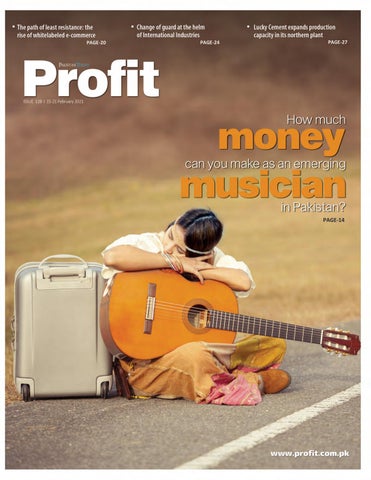
12 Ahmed Bozai appointed head of Citibank Pakistan 14 How much money can you make as an emerging musician in Pakistan?
20 20 The path of least resistance: the rise of whitelabeled e-commerce 24 Change of guard at the helm of International Industries
25 25 Nimir Industrial Chemicals to invest Rs1.6 billion in expansion projects 27 Lucky Cement expands production capacity in its northern plant
25
36
28 AGP to bring Russian Covid-19 vaccine to Pakistan
32 32 Bringing technology to farmers, Ricult maintains its strong growth trajectory 36 The mercurial pricing of thermometers in Pakistan
Readers Say Hoping to see more American e-commerce and digital payment platforms arrive in #Pakistan and start winning market share. Apropos: Daraz is number one in Pakistani e-commerce. Can it stay that way? @USPakistan, Twitter
The article doesn’t really discuss how the numbers improved. How did they reduce their distribution cost for example? This should have been discussed. Apropos: Najam Sethi’s turnaround of Mitchell’s off to slow, but promising start HAQ, Website
Profit genuinely has some of the most insightful and interesting articles. Highly recommended. Apropos: Daraz is number one in Pakistani e-commerce. Can it stay that way? @zaid_rahim, Twitter
Unfortunately the Payment System function of SBP is dormant. Banks will promote only those cards which give them big profit. VISA and mastercard charges interchange fees of about 23 percent in Debit Cards also. Banks get their share of profit. SBP must take steps similar to those taken by EU SEPA and now EPI. I worked as Director Payment Systems from 2004 to 2010 and know the internal and external factors hampering digitalization of the economy. The PM must take Digitalization of the Economy directly under him. Apropos: SBP wants the cheap PayPak to be the default debit card; the banks don’t Muhammad Saleem Rehmani, Website
Finally, someone making use of hard to find but publicly available information! Apropos: Daraz is number one in Pakistani e-commerce. Can it stay that way? @rogueeconomist, Twitter The total number of people that need to be vaccinated is not 220 million as none of the vaccines have been authorised for those under the age of 16. The number of people under this age will have to be subtracted from the total population in order to get the true number of people who will require vaccinations. This is common knowledge so I wonder how it was overlooked? Apropos: How will Pakistanis get vaccinated for Covid-19? Shahwaiz Ahmed, Website Given SBP directives last year, which stopped the banks charging any money on inter-bank transfers despite making payment to onelink, has forced the banks to look at alternate sources of revenues. It is imperative that SBP / MoF should undertake some more steps to encourage transfer of wealth from informal sector to the formal sector, such as cancellation of PKR 5K and PKR 1K currency notes, increase in ATM fees (to discourage currency in circulation), mandate salary payment through wallet / bank accounts, reduce cash withdrawal charges on wallet accounts (especially if encashed from banks) among others. Apropos: Banks introduce ATM receipt fees Anonymous, Website
facebook.com/Profitpk twitter.com/Profitpk linkedin.com/showcase/13251020 profit.com.pk profit@pakistantoday.com
HOW TO CONTACT
10
Hey, very detailed and informative article about customers reporting increasing incidents with fraudulent sellers on Daraz.pk. I am also an online shopping lover. I usually shop online for my desired product, but for this, I have used some specific websites like Troops.com. They also update awareness about sales and clothing updates daily. Apropos: Customers report increasing incidents with fraudulent sellers on Daraz.pk Asim, Website
It is not an international payment vendor. So it is obviously rubbish. I don’t need a bank to tell me that. PTI just wants to keep money from going out. That's all. It's a violation of everyone’s civil liberties in the name of democracy. Instead of being internationally competitive this govt thinks it can manage the same level of development locally without paying any attention to the socio economic and social welfare retardation evident in the Country. Skewed priorities. Apropos: SBP wants the cheap PayPak to be the default debit card; the banks don’t Reza, Website The IMF’s opposition to the increase in salaries of government employees in Pakistan shows the extent to which Pakistan has become a slave to international powers. If any other country is talked about, then this situation is taken as a violation of sovereignty. But Pakistan has become so compelled today because of its poor policies that it cannot even protest against the IMF. Pakistan never paid attention to its economic conditions due to spreading terrorism in neighboring countries and opposing India. This is the reason that today Pakistan is also dependent on loans for its day to day expenses. That is why today IMF can interfere in so many internal issues of Pakistan. The Pakistan Army and ISI are responsible for this condition of Pakistan. Together these two institutions have immersed Pakistan’s fleet in the agenda of antiIndia. Apropos: IMF opposes govt’s plan to increase employees’ salaries Abdul Karim, Website
COMMENTS
IN BRIEF $14.9 billion:
Pakistan’s trade deficit during the first seven months (July-January) of the current fiscal year (2020-21) increased 8.25pc to $14.96 billion, compared to $13.82 billion in the corresponding period of the last financial year.
Payment Service Provider (PSP) 1Link has clarified that the fee being charged on receipts after withdrawing cash from ATMs is a part of Go Green exercise to ‘reduce litter’ and to ‘lower the cost of printed receipts’, which users can opt out of by not operating the machine to produce the receipt.
Rs 48.25 billion:
The Board of Directors of MCB Bank Limited (MCB) met under the chairmanship of Mian Mohammad Mansha to review the bank’s performance, and announced a record high of Rs 48.25 billion in before tax profits. Pakistan has been ranked 3rd in government support provided to SMEs to mitigate the impact of Covid-19, according to a recently launched survey report titled “Impact of Covid-19 on SMEs” conducted online by Small and Medium Enterprises Development Authority (SMEDA), Asian Development Bank Institute (ADBI) and Asian Productivity Organisation (APO). The International Monetary Fund (IMF) has opposed the federal government’s plan to increase the salaries of its employees, saying that there was no need to go ahead with this move especially at a time when expenditures were being met through loans, they added.
While the government is yet to issue an ordinance or approve a money bill to implement the muchawaited Electric Vehicle (EV) Policy, the Ministry of Climate Change (MoCC) formally launched the policy on Thursday.
$2 billion:
For the first time in eight years, Pakistan’s exports have crossed the $2-billion mark for four successive months (Oct-Jan FY21), data released by the Ministry of Commerce showed. During a consultative meeting of MoC officials held via video link on Friday, it was informed that exports in January 2021 increased 8pc to $2.13 billion as compared to $1.97 billion in January 2020.
11
Ahmed Bozai appointed head of Citibank Pakistan
Bozai will be looking to build on the legacy and influence that Citibank has in Pakistan, and the good work it has done over the past decade
C
iti has announced a new Citi Country Officer (COO) for Pakistan, with a veteran of the Citigroup, Ahmed Bozai, taking on the role that will see him assume responsibility for driving Citi's business in the country. The appointment has garnered interest
12
from different quarters of the finance world in Pakistan, thanks to Citi’s long history of influence on the country’s financial outlook. As an advisor to the Pakistan government, and the bank that has produced the most financial leaders in Pakistan. The bank counts amongst its most influential alumni two former federal finance
ministers – Shaukat Aziz and Shaukat Tarin. Out of these two, Aziz) went on to become Prime Minister. They also include two provincial finance ministers – Murad Ali Shah of Sindh and Hashim Jawan Bakht of Punjab – out of whom Shah went on to become provincial chief minister. Until this most recent appointment,
I am delighted to return to Pakistan after almost twenty years, and particularly excited with this opportunity to lead Citi’s franchise. Together with the Citi Pakistan team, we will continue to provide the highest standards of innovation and banking solutions to our clients and fulfil our role as an active member of the Pakistani banking community Ahmed Bozai, head of Citibank Pakistan
Ahmed Bozaid had been the Chief Operating Officer for the EMEA Emerging Markets (EMEA EM) cluster based out of Dubai. He has previously worked with Citi in Pakistan, Greece and the United Kingdom in a number of areas, including Corporate Banking, Treasury & Trade Solutions, and Operations & Technology. “I am delighted to return to Pakistan after almost twenty years, and particularly excited with this opportunity to lead Citi’s franchise,” commented Ahmed on his appointment. “Together with the Citi Pakistan team, we will continue to provide the highest standards of innovation and banking solutions to our clients and fulfil our role as an active member of the Pakistani banking community.” Bozai is one of the more significant new faces that has arrived after the retirement of former Chief Executive Officer of Citi in Pakistan, Nadeem Lodhi. Lodhi retired in October 2020 after he reached the age of superannuation at Citi. While his replacement had not been announced, in the meantime, Moiz Hussain Ali, the Markets and Securities Services Head for Citi ,has been officiating as the acting Chief Executive Officer of Citibank Pakistan. However, as CCO, Bozai will be reporting directly to Elissar Farah Antonios who has been recently appointed as the Head of Citi’s Middle East and North Africa (MENA) cluster.“Ahmed’s diverse international experience and his knowledge of our Pakistan operations will be of great value to our clients in Pakistan,” said Atiq Rehman, CEO-Citi EMEA EM cluster about the appointment. “As we celebrate our 60th anniversary in the country this year, we are confident that under Ahmed’s leadership the franchise will continue to flourish and sup-
port the needs of our local and global clients.” As a Profit feature has pointed out almost a year ago, while Citi is not by any stretch the oldest foreign bank in Pakistan, it is the one that has most captured the Pakistani imagination. Historically, the bank in Pakistan has been much smaller compared to its competitor, Standard Chartered, but holds more prestige as a place of employment. In recent times, Citi has reaped the rewards of a consistent and against the grain strategy. Back in the early 2010s, foreign banks were closing shop in Pakistan. RBS Pakistan, which had acquired ABN Amro’s assets in Pakistan, sold off its operations in the country to Faysal Bank in June 2010. HSBC had announced its intention to sell off its Pakistan branches in early 2012 as well. And, at the time, it had become widely understood that Barclays was struggling in Pakistan and likely to exit the market entirely. So the idea that Citibank might be thinking of exiting Pakistan – while still a shock – was not entirely inconceivable. Despite everyone around them leaving, Citi persisted, and in the eight years since 2012 has proven to be correct in their faith. The global bank remains committed to its corporate and investment banking operations in Pakistan and – in 2019 – passed an important milestone: it earned higher profits than at any point in the last two decades, and likely in its history in the country. Bozai will be hoping to continue the same trend. Citi has a proud history internationally, and is a leading international bank with approximately 200 million customer accounts and does business in more than 160 countries and jurisdictions. Citi provides consumers,
The bank counts amongst its most influential alumni two former federal finance ministers – Shaukat Aziz and Shaukat Tarin. Out of these two, Aziz) went on to become Prime Minister. They also include two provincial finance ministers – Murad Ali Shah of Sindh and Hashim Jawan Bakht of Punjab – out of whom Shah went on to become provincial chief minister
corporations, governments and institutions with a broad range of financial products and services, including consumer banking and credit, corporate and investment banking, securities brokerage, transaction services, and wealth management. Operating in Pakistan since 1961, for the last six decades, the bank has been offering a full range of corporate and investment banking services to major local and global corporations, Public Sector entities and financial institutions operating in the country. Citi has also been an active corporate citizen with a particular interest in supporting financial education and microfinance in Pakistan. From the initial messaging that has come from the bank after Bozai’s appointment, there are not really any big changes in the offing. With their recent success in terms of profits, it will be hoping to cement its place in Pakistan even further. As Citi’s former CEO, Nadeem Lodhi, once expressed at an event in February 2019, Citi is “a trusted advisor to the government of Pakistan. The first Sukuk bond was in 1996 with Citi (a floating rate bond). We have led every [bond offering] transaction for the sovereign.” Among the major global capital markets players in the world – it is the only one that has a longstanding presence in Pakistan, and one that it has used in order to help the government of Pakistan gain access to cash from global investors for its bonds and to help Pakistani companies gain access to global investors. In addition to this Citi has always had a model in which they have innovated for the Pakistani financial market, and has at different times led innovation in Pakistani banking, including basic moves such as being the first to introduce credit cards to Pakistan. With Bozai’s experience in international markets and his knowledge of the Pakistani market, this tradition looks to be in safe hands. The hope is that he will prove to be an asset to Citi and its customers, will continue to provide the highest standards of innovation and banking solutions not just to Citi clients, but also be a leader in Pakistan’s banking landscape. n
MANAGEMENT CHANGES
14
COVER STORY
By Meiryum Ali Asaan Te Jana Ae Billo De Ghar// Kine Kine Jana Ae Billo De Ghar// Ticket Kataao, Line Banao!//
Y
ou’ve already started humming it, haven’t you? The song is so many things: it catapulted Abrar-ul-Haq, a former Pak Studies teacher, into Pakistani consciousness. It established Pakistani Punjabi pop as a distinct genre. Its lyrics were audacious, silly, and playfully poked fun of Section 144 (of the Code of Criminal Procedure). And in true Pakistani fashion, it got the ultimate stamp of approval: a temporary ban by the Nawaz Sharif government in the late 90s for being ‘immoral’. Billo de Ghar is many things, to many people. But one thing it did not make is money – specifically for Abrar-ul-Haq. Industry gossip and rumours abound, and some say that Abar had a particularly poorly worded and exploitative contract, which only allowed him to take home 1% of royalties. Wait: one of Pakistan’s all time iconic songs barely netted an income for the singer itself? How is that remotely possible? And yet almost every musician, artist, and manager interviewed for this piece were in agreement that the Abrar-ul-Haq-1%-royalty-rumour was a totally plausible scenario; why, that it was practically ubiquitous. We are a country that genuinely enjoys their pop music: you can go on Youtube and find dedicated playlists curated with titles like ‘golden oldies’ or ‘patriotic anthems’. There is no shortage of online critique or loyal fan base, or artist profiles. But there is never really a conversation about money, or more accurately, the lack thereof. How do artists make money? What are their revenue sources? If someone is in their late teens, has a voice, or a guitar, and is uploading home-made tracks to Soundcloud: what does their career trajectory and corresponding income level in their 20s or 30s look like in Pakistan?
First, some definitions
F
or the purposes of this article we will be referring to pop, and indie, music in Pakistan. Technically pop is short for popular. However, it is a bit of a sociological nightmare to assess exactly what should be counted as popular in Pakistan, a multilingual country with thousands of musical traditions. But when we refer to pop music in Pakistan, we are referring to a particular niche of music: the typically urban and most usually
16
Urdu productions of the last three decades. Think the rock bands of the 90s, the emo boy bands of the 2000s, and the electronic and rap inspired tracks of the late 2010s. Ok, so what is indie? Technically, indie means ‘independent’, and refers to the underground music scene of Pakistan. These are often new artists with niche followings, who often perform at small venues in Karachi or Lahore. Technically, they could have a ‘pop’ sound, or they could break out and actually become ‘popular’. But using the term ‘indie’ in a Pakistani context can be misleading. As Zahra Paracha – musician, audio engineer, and one half of the band Biryani Brothers – explains, in reality, every artist in Pakistan can be considered indie, since even the most mainstream of artists are often working on all parts [of the production process]. “In most fields abroad, the process has been compartmentalized, where different players are focusing on one thing. There is an ecosystem. Everything here is kacha – it’s hard to differentiate the process,” she says. Which leads to our final definition: Pakistan’s music industry. What is our eco-system anyway? Natasha Humera Ejaz – singer, songwriter and producer – declined to even use the term ‘industry’. “A more relevant term would be fraternity. Industry implies there is a marketplace for the music, that there is an infrastructure in place.” she says. Pakistan does not have those qualities.
What’s our scale?
G
eography is also important when it comes to understanding the audience. The general consensus is this: on one end of the scale there is Atif Aslam, Rahat Fateh Ali Khan, and Abida Parveen. And on the other end of the spectrum, is everybody else. That is because those artists have broken out – which is to say, they have reached Bollywood. India is a much more sophisticated market, which proper record labels, contracts and royalties structure. The income levels that those three artists earn is enough to distort the entire model of Pakistani revenue. By one estimate, a singer like Atif Aslam can command somewhere like Rs70 lacs (Rs7 million) for a single concert. But this is not an article on Atif Aslam. Most Pakistanis artists can only dream of 70 lac rupees. Take Amna Zafar, the CEO and founder of CheckBox media, a strategic communications consultancy. She realized there was barely any artist management in Pakistan, often leading to young artists not being protected within the industry. Currently, her team is representing Abdullah Siddiqi, the 20-year old singer and electronic pop music producer. Abdullah has produced three albums and collaborated with
established artists like Meesha Shafi and Aima Baig. Yet Zafar still worries immensely, not just about Abdullah, but about young artists in general. When she talks to an artist, she says she stresses: “I can’t promise you an income. I can’t promise that you’ll make money. What I can do, is push your career forward, build your brand, and maybe open up avenues of income for you.” There are two ways to think about income streams. One is by the level of importance and exposure. In this scenario, brand placements and endorsements, and income received from those are of utmost importance, since they build artist visibility. Then, come concerts and gigs. Then come licensing and placements for individual songs, which can be a steady source of income. And finally, at the bottom tier are album sales. Most artists do not make a lot of money from individual albums, and neither are they key to success. This is true in both Pakistan, but also globally, as listening habits have changed (people are more likely to stream or download singles, rather than buy an album). Ironically, it is the production of an album – or a smaller EP – itself that necessitates the hierarchy of the above tiers. Yet it nets the least value add. The second way to think about income is in terms a percentage structure. Despite various sounds and levels of ‘indie’, the breakdown was surprisingly similar for young-ish artists: concerts are the largest chunk of income, accounting for somewhere between 40% to 60% of incomes for artists. Streaming – and this includes both Spotify and Apple Music, and Youtube – in total account between 15% to 20% of total income.
The trouble with concerts
S
o you’ve cracked the code: you’re a new artist, and you know concerts can make some money. Now – exactly where do you perform? The trouble for young artists is that there is somewhat a dearth of options, and locations are often run out of the kindness of highly dedicated individuals. Such is the case of True Brew Records, a live entertainment space in Lahore run by producer Jamal Rahman. It’s a space which Sikander Ali is familiar with, as the rapper Maanu (who he manages) has often performed there. Ali also manages the producer and DJ Talal Qureshi, and fell into this space of artist management somewhat accidentally: he was an old family friend of Maanu (whose real name is Rehman Afsher), had a knack for social media, and then as he explains ‘everything snowballed’. (The ad hoc nature of artist management, a relatively new concept in Pakistan, is quite common – Amna Zafar, for instance, is a friend of a friend of Abdullah Siddiqui, which is how
People say, oh they’re now everywhere, they’re getting branded deals [such as from Samsung]”, he says. “But people don’t realize how hard these people worked. It’s been seven years since Shamoon’s [earliest songs] Jutt Blues, seven years is no joke Faraz Ahmed, client-partner of Httpool Pakistan
she was introduced). Niche spaces like True Brew, or District 19 in Karachi, operate on a revenue sharing model. Upto 150 people can be present at the space in a given period, and depending on the artist, the entire income can come out to between Rs70,000 to Rs120,000. How much the artist gets to take home, depends on the agreement with the space; in some cases, an artist earning Rs120,000 can take home Rs50,000. Often. Ali says, the venue and artists may jointly pay for small costs, such as between Rs20,000 to Rs40,000 for security or sound. Spaces like True Brew or District 19 are quite small events, with peculiar audiences: True Brew, which has the reputation for the best sound in Lahore, has a familiar crowd that regularly attends each function, regardless of artist, according to Ali. Meanwhile, District 19, which sometimes holds concerts, had a small outdoor concert earlier this year featuring Maanu, rapper Taha G, and singer Hasan Raheem. The crowd was almost exclusively filled with young Gen-Z Karachiites – which makes sense, since the artists themselves are in their early 20s, and in the case of Maanu, have still to finish college. For some, these places serve an unmet need. According to Bilal Baloch, lead singer for the alternative pop band Towers, True Brew was the only indie venue with a
recording studio in Pakistan. So, what about concerts on a larger scale? At this, nearly everyone’s attitude changes. Organizing a large concert in Pakistan is an absolute nightmare. The first problem is that it has to be priced at a point where Pakistanis will actually want to come, A recurring theme is that it is difficult to get Pakistanis to actually pay for their music (unless it is Atif Aslam, but as we have discussed, he is the exception, not the rule). Paracha, along with Natasha Noorani, helped organize LMM, Lahore Music Meet, for the last five years. Paracha describes it as a not for profit community project- though not for lack of trying. “The moment I even tried exploring the idea of charging tickets for the final performance, it was shut down.” she says. Charging for tickets would mean suddenly involving the Federal Board of Revenue. According to sources, different players, like the venues themselves, wanted under-the-table cuts of the revenue. This is particularly acute in Punjab, where the official entertainment tax estimates are anywhere between 40% to 60%. On top of that, organizers are required to obtain two NOCs: one from the local administration, and the second from the excise and taxation department. Should one get in the room with bureaucrats, then one has to explain why a concert is
a net good to begin with. Paracha bemoans that often, one is talking to an old uncle sipping chai, who often counter with ‘Aap loag education ke barein mein baat karein.’” “How can you explain concerts to someone who doesn’t even understand what the point of music is?” she says. “There is no state patronage, no state interest in music.” The barriers to entry are so high, that often it means organizing concerts in Sindh, where it is relatively easier. But this poses its own barrier of entry: not all artists can afford a Rs20,000 ticket to Karachi, and afford accommodation as well. Organizations like Salt Arts, which organizes private concerts in Karachi, are trying to create another alternate space for musicians, following a similar revenue sharing model. But the eye-popping ticket prices – Rs5,000 – and the locales – the Beach Luxury Hotel, the French restaurant Cote Rotie – often mean only a select few, with a certain type of profile (ie. rich) get to listen to that music. For instance, a source mentioned some rappers who did not want to necessarily work with Salt Arts, simply because it did not fit with their idea of who should have access to their music.
The trouble with brands
I
n the absence of state patronage, capitalism will make moves. And that’s how Pakistan now has brands directing the future of music: Coke Studio, Pepsi Battle of the Bands, Nescafe Basement, Velo Sound Station. Even Bisconni – a biscuit, for God’s sake – is creating music shows. Much has already been written about these brands, and whether they are a force of good or evil. There are two aspects this piece would like to touch upon: the legal binds that artists may find themselves in, and the pay structure itself. Bayaan, the band that won the Pepsi Battle of Bands in 2018, signed multiple legal contracts: to enter the competition, when they reached the top 20, the top 10, and the final two. Once they won, the band won a year long
COVER STORY
contract to produce one album, some money for one music video, and Rs5 million (split between the band members). For the most part, according to Muqueet Shahzad, the guitarist and songwriter for Bayaan, the experience has been good. For one, the band received a ton of exposure. Secondly, they were able to produce a few music videos that they would not have been able to make out of their own pockets. Were there random corporate demands they had to give into? Of course. “For one of our music videos, we were told to wear blue, because red is Coke’s colour. Then we forgot that our lead singer had been wearing a red muffler the entire song, and we tried to colour correct it afterwards,” he recalled, somewhat amused. Shahzad carefully states that it is not really about the brand’s direction, but who happens to be sitting at the brand at the time: what they think of the music, how much they interfere in the creative process. Still, at least Pepsi was unusual in that they offered a contract. Most artists who appear on shows are offered a lump sum amount of money to appear. Artists can expect payments of anywhere between 1.5 lac to 5 lacs, depending on their profile. Money is spent on advertising the artist, on giving the artist brand recognition, but the rights – and royalties – remain entirely with the brand. Despite the lumpsum approach, the offer is often too good to resist. A source cited Mehdi Maloof as a good example: while a darling of the underground scene for his witty songs like “Gandi si Building’, which pokes fun at apartment living, music executives only seemed to take him seriously once he had appeared on this year’s Coke Studio. That is enough to propel perhaps future income streams. “A company’s top priority is its brand image. It’s about the product and the profits – ultimately, a company must make money to continue running,” Zafar stresses. “Even its best intentions and actions are secondary to
In most fields abroad, the process has been compartmentalized, where different players are focusing on one thing. There is an ecosystem. Everything here is kacha – it’s hard to differentiate the proces Zahra Paracha, musician at Biryani Brothers
that goal.”
Did someone mention royalties? What royalties?
L
et’s go back to Pepsi Battle of the Bands for a minute. Shahzad conceded that Pepsi had been generous when it came to the creative process, and in helping build a brand process. But ask Shahzad about the royalties, and he pauses. It turns out, any song made by Bayaan and uploaded on the Pepsi channel, has no monetization – as in, Bayaan does not earn money. If a commercial project were to use the Pepsi song, then Bayaan would receive royalties. Shahzad points out that Pepsi has also not uploaded any song of Bayaan’s on Spotify or Apple music, which would create some streaming income. Ejaz is adamant that royalties and sync licencing – or the lack thereof – is one of the biggest impediments to an artist making money. “The onus is on the artist to make sure that they are receiving correct licensing, brands will
A company’s top priority is its brand image. It’s about the product and the profits – ultimately, a company must make money to continue running. Even its best intentions and actions are secondary to that goal Amna Zafar, CEO and founder of CheckBox media
18
not care...as an artist it is your right to make money for the rest of your life [off your art].” According to Ejaz, this means being astute about contracts, and picking your battles wisely. In the past, she would sometimes charge a higher fee, simply to offset the fact that she will not receive royalties in the future on that project. While artists are struggling to make money through contracts, one organization has perfected their legal stance: EMI Pakistan. The company is extraordinarily particular in making sure it receives payments for any song of theirs – and considering it is the record label ‘of record’ in Pakistan, that is a lot of songs. It is also an incredibly lucrative business: after all, almost every single brand show out there is remixing old Pakistani songs. Sources complain of annoying, laborious forms to fill out when requesting a song from EMI, where a single mistake means the process has to be restarted all over again, and may take weeks to get approval. Others complain that EMI has enough money to do what regular record labels do: i.e. scour for new talent and promote new sounds. But EMI Pakistan is allegedly content with minting money off decade old pop hits, instead of creating new ones.
The trouble with not being man
I
f the structural problems of Pakistan’s music industry were not enough, your income could also be affected by what gender you identify with. “If a woman is a producer, she has to be twice as good as her male counterpart,” Paracha says flatly. Paracha also works as an audio engineer, and to the best of her knowledge, there are perhaps only three other women working in audio in Pakistan. The onus is always on them to on them to prove more. Some of it is also cultural: “Men are more confident at asking more, sometimes more
TEXTILES
than what they deserve,” she explains. Women are not, which affects their income. The same holds true for vocalists – sources mentioned Aima Baig as someone who would have to prove herself much more than a comparable male vocalist. Ejaz is so done with the music industry’s condescending attitude towards women that she simply does not entertain them: “I don’t really get into the conversation with gender-biased clients if I know it’s going to waste my time.” Still, she says that the conversation on gender is “massive” right now, which might positively impact the music scene. Though as Paracha points out, in an effort to create gender parity, brands and executives run the risk of tokenization of women – which is a whole other can of worms. No serious artist wants to be considered a ‘gimmick’.
Streaming: the final frontier
S
potify does not pay artists well – that is an established fact. Numbers vary but by one estimate Spotify pays around artists on average $0.0032 per stream. Some artists here were candid: Ali said Maanu earned around $200–$500 over a year and half period; Shahzad said Bayaan earned around $1,800 over a seven month period (this is including Apple music). The problem is not earning money: that is a global Spotify issue. The problem is the fact that Spotify does not exist in Pakistan. This has a ripple effect. For one, artists can’t actually access the funds, which means they have to call a friend who lives in Canada, or the United States, transfer money to their account, and then transfer money to Pakistan. Sometimes the cost of transferring the money exceeds the actual amount earned, in the case of smaller artists. Secondly, exactly who has Spotify in
For one of our music videos, we were told to wear blue, because red is Coke’s colour. Then we forgot that our lead singer had been wearing a red muffler the entire song, and we tried to colour correct it afterwards Muqueet Shahzad, guitarist and songwriter for Bayaan
Pakistan? It’s often people who already had access to Spotify when in other countries, or, and the more common method, people who have the hacked version. This is set to change, as Spotify Pakistan becomes an actual entity. Technically, Spotify itself is not coming to Pakistan. Instead a company called Httpool, which is a global partner of major media platforms around the world, has been set up in Pakistan. Sources have confirmed that its first product will be Spotify. The client-partner of Httpool Pakistan, Faraz Ahmed, is himself a musician, and also served as a project manager for Nescafe Basement Season 5, learning the ropes of the music industry (at least from one vantage point). When contacted by Profit, Faraz Ahmed was open about the state of the industry. He is a big believer in chance: “Some things out of your control, like whether you became famous or not, whether people like your music.” But the things that are in your control? The ability to protect your interests. Ahmed says it is imperative that artists are aware of their rights, and constantly stresses that they must be firm
The onus is on the artist to make sure that they are receiving correct licensing, brands will not care...as an artist it is your right to make money for the rest of your life [off your art] Natasha Humera Ejaz, singer, songwriter and producer
with record labels or distribution companies about the amount of money they are receiving. Optimistically, he also thinks that several artists in the new generation are better educated about their rights, and have more business acumen, than the generation before. He cites Ali Azmat as an example of an artist, who, whether you like or dislike his music, has been able to make the music industry work for him, and not the other way around. He also praises pop singers like Shamoon Ismail (of ‘Marijuana’ fame) and Asim Azhar for their strategic choices regarding cultivating a celebrity persona. “People say, oh they’re now everywhere, they’re getting branded deals [such as from Samsung]”, he says. “But people don’t realize how hard these people worked. It’s been seven years since Shamoon’s [earliest songs] Jutt Blues, seven years is no joke.” Ahmed is relentlessly optimistic about the possibility of Spotify changing the digital economy for artists in Pakistan. So are some artists themselves. As Shahzad pointed out, most of their listeners ended up from Spotify India, or diaspora Pakistanis: actually earning money from Pakistan would be a nice change. Ali said that brands like Spotify can change a band’s life: witness the traction that the progressive metal band Takatak got when they were featured on a curated list by Spotify International. As for Paracha, it’s almost a matter of principle: “Streams from baahir, it’s just weird. Everybody is counting on it [Spotify]”. And yet, others like Baloch say that Spotify entering Pakistan still won’t solve the major roadblocks and hurdles that artists face. So in short, you might not earn as much if you’re a woman; and you might have to deal with cantankerous old bureaucrats hell bent on making sure young people don’t have fun: but it is 2021, and the internet might just save the day. Just make sure to read the fine print. n
COVER STORY
By Babar Khan Javed and Ariba Shahid
W
hen Rocket Internet launched Daraz. pk in 2012 in Pakistan, it brought with it an idea that had not been truly explored in the country in the online sphere. The idea only exists in retail stores and was easy enough to explain at the time. When business development managers of the European internet company met with prospective customers, be it manufacturers or merchants, they made them two offers they could not refuse. One: an online presence in a store designed and built by a multinational company. Two: the chance to have an online presence within days with the technology of a European company. For the first proposition, products of the manufacturer or merchant would appear on the Daraz.pk website either on the home page, category page, or when a site visitor searched for them. For the second, the manufacturer or merchant would have a dedicated page showcasing just their product and their logo including
20
brand identity. And in a bid to create a sense of competition, Rocket Internet launched another online marketplace in 2013 called Azmalo. pk led at the time by Cheetay co-founder Ahmed Khan. After a few months of growing the top line, the business was rebranded to Kaymu.pk with the Azmalo team migrating as well. In 2016, Kaymu was merged with Daraz which was purchased by the Alibaba Group in 2018.
The least amount of time it takes for someone to activate an account on our platform is six hours. It takes 20-30 hours for a sole proprietor, longer for limited companies because of internal approvals that they require. Once you log in to bSecure, you do not need to enter the same details when buying from other merchants also using bSecure Adam Dawood, co-founder of bSecure
Across all three teams, the online marketplace business development teams of Rocket Internet faced resistance from merchants due to a number of factors. These included the expectation of dedicated inventory commitments for e-commerce sales, the subsequent double digit cut for the online marketplace which was at the time considered unfair, an impenetrable last mile customer experience, unclear cash flows, and unknown costs pertaining to items lost, stolen, or rejected. Chief among the concerns was the lack of uniformity and content quality for the products being listed on the marketplace in addition to the checkout process considered unfriendly for the customer. To solve these issues, three Pakistani-led white-label e-commerce software as a service (SaaS) companies are attempting to speed up the process from offline to online. A subsidiary of Pathway Capital Partners Ltd, Brandverse is a technology company that helps brands create what it refers to as “rich, immersive, omni-channel ready, brand-safe product content, purpose-built and future-proofed for digitally-enabled commerce businesses and their supply chains,” through the power of a cutting edge robotic camera solution. A subsidiary of Z2C Ltd, bSecure is a universal checkout solution aimed to help online merchants and digital publishers increase the checkout conversion rate by simplifying the checkout process. Unique to the Pakistan market, bSecure solves the problem created by forced account registration across a range of sites, which Econsultancy research suggests leads to 26% of shoppers abandoning their cart. From the co-founder of Eat Mubarak, Blinkco is a whitelabel solution that allows all manner of brick & mortar (B&M) stores - be it HoReCa, pharmacies, or supermarkets - to create a branded mobile app or branded online store, accessing an proprietary analytics dashboard either way. Launched at the height of the pandemic-induced lockdown, Blinkco
aims to help businesses build their direct to consumer channel, with demand varying depending on how strict lockdown measures are - which vary city by city in Pakistan.
What are they doing?
F
rom the outside, Brandverse appears to be a company that consumer packaged goods (CPG) companies such as Shan Foods or National Foods approach to create a high-res catalogue of their products using a cutting edge robotic camera solution; but this is the soft sell. The actual business model relies on an app called Chikoo, which allows CPG companies to upload the photographs to a branded online store for direct selling. If enough CPG companies pay Brandverse to take high resolution photos of their products - which can be ported to any online marketplace or even the Chikoo app - this investment can improve the quality of images uploaded to online stores of groceries stores such as Tee Em Mart, which is also an enterprise customer of the technology company. “Content distribution flows into Chikoo,” said Raza Matin, co-founder of Brandverse. “Every new store creates network effects and we are connected to a database of over 250 million products. And merchants can create the products themselves alternatively through optical character recognition.” In convincing CPG companies to invest in photographing their products, grocery stores such as Tee Em Mart can showcase products on their Chikoo website or app, with high resolution imagery signalling confidence in the shopper who may have experienced too many setbacks with sights with less than eye catching images. “There could be an on-demand delivery player that needs to start a grocery delivery service yesterday,” said Matin. “We can help them get started because we have the data they require to populate their online store or app and we can do that very very quickly.” Not to leave any money on the table,
Profit believes that the above encapsulates the demand side of the monetisation model at Brandverse, with the supply side involving an application programming interface (API) which creates a bridge between Chikoo and courier apps such as Bykea and Careem. Given the technical talent at Brandverse, it is likely that the business will employ a reverse auction model which allows bikers of Bykea or Careem to bid on a chance to be the preferred delivery partner for any order than is placed within the Chikoo ecosystem - regardless of which CPG or B&M is the branded store. This is likely the same monetisation spin used at Blinkco. Over at bSecure, the premise is very simple: to simplify the checkout experience. If Website A uses this universal checkout solution, the customer that goes through the site to complete a transaction will no longer need to re-enter her details at the point of checkout on Website B if bSecure is used there as well. This removal of steps is the very essence of the customer experience which banks on convenience. “We are not a payment gateway, we are a technology company that basically integrates with multiple banks,” said Adam Dawood, co-founder of bSecure. “We connect small and medium sized stores with banks. Essentially, problems with a payment gateway include technical issues and onboarding. We’ve made the technology part simple. All you need is a bank account for the onboarding process. For this reason, we’ve partnered with banks. Our platform conducts robocalls for merchants to confirm orders. Our clients no longer need to incur the fixed cost of a customer service agent. The business model is as such that we charge for additional services such as insurance, installment payments, etc. Jubilee and TPL insurance are the insurance providers we’re looking for. We’re aiming to be the super app for e-commerce.” With the backing of Z2C Ltd, bSecure has created a range of additional features which include the ability to sell without a
TECHNOLOGY
Content distribution flows into Chikoo. Every new store creates network effects and we are connected to a database of over 250 million products. And merchants can create the products themselves alternatively through optical character recognition Raza Matin, co-founder of Brandverse
website. The product catalogue feature makes it so that a merchant with a presence on platforms such as YouTube or Facebook need not fuss over creating an entire site just to sell their products. By signing up to bSecure, the merchant can create a custom checkout page alone, possibly providing the customer assurance of legitimacy in the process. “As for Bsecure, we got the idea in February,” said Dawood. “Before we jumped the gun, we talked to a bunch of builders and asked if this solution worked for them. We gauged if there were potential customers. We noticed restaurants received a thousand orders a day through their website.” As for the former head of Yayvo since its launch in 2015, the value proposition for bSecure was likely incepted in Dawood’s mind after a number of setbacks. He told Profit that there was once a crisis at Yayvo involving payment fraud worth 1.3 million rupees, which was the result of a hacker. “The bank said it was not their responsibility,” said Dawood. “We had to fight hard. Took three months for the Yayvo tech team to reassure the banks that they had checked their bases and the issue wasn’t from their side, three months to convince the bank it was their fault and three months for us to get the money. When we tell merchants that they’ll get money, they will get it.” If the largest media agency is backing a checkout solution, it stands to reason that bSecure will converge at some point with additional products under Z2C Ltd with similar brand architecture such as bSports and bEntertainment. As reported by Profit, Z2C Ltd is working on its own connected TV business coupled with an over-the-top content platform that merges with programmatic advertising and real-time e-commerce as sources of revenue. As part of the equation, Profit speculates that bSecure will undoubtedly be utilised as the only universal checkout solution available to merchants looking to target specific neighborhoods and zones in various cities for direct response campaigns. So the next time someone watching a drama or morning show comments on the outfit of an actress
22
or anchor, the viewer will have the option to purchase said outfit or accessory directly from their CTV, with the purchase powered by bSecure.
Why does this matter?
B
efore the pandemic, the solutions listed above would struggle to gain traction among the majority of merchants due to analysis paralysis. The pandemic on the other hand has shown business owners of all sizes that speed to market trumps everything else. With Chikoo, bSecure, Blinkco, and similar one-tap whitelabel e-commerce solutions, business owners who find themselves having to adhere to lockdown orders - shutting off their principal customer touchpoints - are no longer unable to reach their customers. Downloading the Chikoo app, any B&M business owner can sign on the platform and proceed to self-photograph the barcode of listed products - which acts as a verification for claimed products sold - after which the user needs to insert the number of product units the store has in stock. Similarly, the set up for bSecure - both in English and Urdu - is equally quick, with only the brief time needed to set up the content of the catalogue page and checkout page, generating a custom URL for each. “The least amount of time it takes for someone to activate an account on our platform is six hours,” said Dawood. “It takes 20-30 hours for a sole proprietor, longer for limited companies because of internal approvals that they require. Once you log in to bSecure, you do not need to enter the same details when buying from other merchants also using bSecure.” With Blinkco, enterprise customers can launch an online store or app within days, with a simple interface for customising the look and feel of the stores. In accessing these localised interpretations and subsequent executions of whitelabeled e-commerce stores, the speed to market equation has effectively been democratised.
Not always rainbows and butterflies
A
s reported by Profit, Unilever created SuperSauda and severed its relationship with Daraz - which hosted an online store for the CPG business - due to being denied the first-party data generated as a result of products being sold. This is a problem faced by CPG leaders when dealing with online marketplaces and e-tailers, which admittedly clearly mention this caveat in their terms of service. While merchants using Chikoo, bSecure, and Blinkco will undoubtedly be able to take their businesses online overnight, they are still placing their eggs in one basket. The gradual erosion of third-party cookie tracking across Apple and Android ecosystems means that advertisers and merchants ought to actually own the app or website they use to close a transaction, capturing first party data in the process and the entire customer experience. That said, in a bid to get one’s feet wet, starting off white a low cost, easy set-up whitelabel solution is the first step forward with traction building the business case for the sizable investment in the digital asset that is an owned dot com. Merchants that rely on these whitelabel solutions needs to recognise the inherent risks and understand that they do not actually own the stores, with a number of technical or operational issues pertaining to discoverability and last mile delivery bringing the brunt of a bad customer experience on the merchant and not necessarily the platform they are hosted on. All in all, whitelabel solutions remove the time or investment required for creating an owned dot com from scratch, with the former being a matter of business survival or extinction during a pandemic. If COVID-19 creates a wave of deaths or diagnoses that results in yet another scricter lockdown, it will be direct to consumer solutions such as Chikoo, bSecure, and Blinkco that advertisers and agencies rely on to help B&M stores, HoReCa, or CPG companies reach their customers wherever they are. n
TECHNOLOGY
Change of guard at the helm of
International Industries
Riyaz Chinoy steps down, Kamal Chinoy takes his place. Will things be more of the same?
L
et us play a word association game. If we say the name ‘Chinoy’, what does that name conjure up for you? If you are a foreigner, or someone interested in the arts and media, that name may remind you of Sharmeen Obaid-Chinoy, Pakistan’s first Oscar winner (and it is a testament to SOC that she created an entirely distinctive brand name on top of an existing one). But perhaps you are someone who is more interested in business, the name might remind you of the Chinoys, one of the
24
industrialist families behind perhaps the most recognizable brand out there: Pakistan Cables. They are also behind International Industries, which manufactures steel pipes. The company remains very much within the Chinoy family. But the question is, of course, which Chinoy. In a notice issued to the Pakistan Stock Exchange on February X, International Industries announced that there would be a change of CEOs: from Riyaz Chinoy, to Kamal Chinoy. Who are these people? For that it is necessary to go back to the beginning. Interna-
tional Industries is the brainchild of Amir Sultan Chinoy, an industrialist born, as many of Pakistan’s family patriarchs have, on the other side of the border, in British India in 1921. He migrated to Pakistan and almost immediately had a massive impact on the industrialisation of the nascent country, incorporating International Industries (it initially dealt in electronic instruments). Chinoy initially named the company Sir Sultan Chinoy & Co. Ltd., after his father. In 1953, Chinoy sponsored the establishment of Pakistan Cables Ltd, for which International Industries acted as a distributor.
It was in 1966, that the company pivoted and began to produce cold rolled tube, and steel furniture.Towfiq H. Chinoy took over the company as Managing Director in 1977, and began to produce galvanised iron (G.I) pipe in 1982. In 1984, IIL was listed on the Karachi Stock Exchange. In 1989, the company set up the country’s first private sector cold rolling mill, and began to export pipes in 1996. In 2006, the company began to produce HDPE pipes, and then in 2015, it set up stainless steel pipe facility, and API lines pipes in 2016. International Industries also owns a majority share of International Steel Ltd., which was incorporated in 2007 for flat steel products. This focuses exclusively on producing hot dipped galvanized coil (HDGC), cold rolled coil (CRC), and color coated galvanized coils (PPGI). The subsidiary has an annual manufacturing capacity of over 1 million tons and annual revenues of over Rs48.1 billion. In addition, the company also owns Pakistan Cables Ltd, incorporated in 1953, which manufactures electrical cables, wires, copper rod, aluminum sections. It also has two wholly owned subsidiaries: IIL Australia, which represents the group's interest in the Asia Pacific region; and IIL Americas Inc, which is Canadian, and represents the group’s interest in North America. Much of International Industries success, interestingly enough, has been in serving the furniture and bicycle industry, since 1969, and the auto industry since 1989. It started making bicycle parts, such as chains, rims mudguards etc, and began to cater to the growing two wheel motorcycle market. In fcat, more than 60% of bicycle and motorcycles manufactured in Pakistan use parts made by International Industries. That is a lot of bikes. Today, that continued growth has paid off. The company is now Pakistan’s largest manufacturer and exporter of steel, stainless steel and plastic pipes, with an annual manufacturing capacity of 817,000 tons and annual revenues of over Rs 26 billion. It exports to 60 countries across six continents, with exports exceeding $238.4 million. The man at the helm of the company for the last ten years has been Riyaz Towfiq Chinoy, Towfiq Chinoy’s son. He had worked at the company for 28 years, and will continue to serve on the board of IIL. The last ten years have seen some uneven results. Between 2010 and 2020, net sales of the company have improved. In 2010, they stood at Rs13.5 billion, increasing to Rs18 billion by 2015, dipping the next two years, and then shooting up to above the Rs25 billion mark in 2018 and 2019. The year 2020 proved a poor year, with net sales
again dropping to the Rs18 billion mark. The company’s profit has similarly fluctuated: from Rs1 billion in the first two years of the decade, then falling to Rs300 million in 2013. It would not cross the Rs1 billion mark again till the year 2017, and stayed consistently above the Rs1.5 billion mark for the next two years, before posting the first loss in ten years in 2020, of Rs694 million. Who is coming in to take his place? Kamal A. Chinoy. He is the cousin of Riyaz
Chinoy, and according to sources, widely seen as the ‘competent’ one within the family. This would make sense: after all, he was the CEO of Pakistan Cables for 27 years, and is the current chairman of the Aga Khan Foundation. He has also been director of International Industries since 1984, and at one point was the architect of the company's sales and marketing practices. In picking this CEO, the Chinoy family has demonstrated that it would like older, safer hands, to steer their smaller company as well. n
Nimir Industrial Chemicals
to invest Rs1.6 billion in expansion projects Manufacturer wants to upgrade its fatty acid and soap noodle plant; and build a brand new wax plant
O
ne does not exactly think of personal care products when one says ‘Nimir Industrial Chemicals’ – or really the name of any industrial chemicals manufacturer. But indeed, one could set up, say, a very nice luxury showcase bathroom using products that Nimir has a hand in. Soap? Nimir. Toilet paper? Nimir. Air freshener? Ditto. The deodorant on the counter, the hairspray - even the cleanser and moisturizer - are all formed with products that Nimir Industrials manufactures and sells. And it is doing a pretty good job of it. That is why on February 4, 2021, the company announced to the Pakistan Stock Exchange (PSX) that its board had approved two new capital investments. The first is a new chlorinated paraffin wax plant, which will include a chlorine liquefaction plant. This will produce 30 tons a day, or 10,000 tons annually, and will cost Rs1 billion. The second is a renovation and upgrade of the
fatty acid and soap noodle plants, which will increase the capacity of soap noodles by 15,000 tons annually. The more interesting figure of the two is the Rs1 billion being spent on the new plant. But to understand why, let us first take a look at the company's history. Nimir Industrial Chemicals is part of the Nimir Group, which includes Nemir Resins – which manufactures surface coating resins, polyesters, optical brightener and textile auxiliaries – Nimir Holding, and Nimir Management. Nimir Holding has voluntarily winded up, and its assets are now part of Nimir Chemicals; Nimir Management is designed for investment in Nimir Resins. Nimir Chemicals was incorporated in Pakistan in February 1994, but started its commercial operation in January 2000. The company was initially involved in the manufacturing of oleo chemicals but is now also involved in making chlor-alkali. Its plant is located in Sheikhupura, Punjab. Oleo chemicals actually refers to veg-
STEEL
etable oil and animal fats. This includes soap noodles (used in the manufacturing of soaps), stearic acid, glycerine and distilled fatty acids. These components are then used in finished products like toilet soap, tyres, rubber, textile softener, metal polishing, cosmetics, candles, pharmaceuticals and tobacco. Chlor-alkali refers to the industrial process of electrolysis of sodium chloride. Nimir’s products include caustic soda, sodium hypochlorite and hydrochloric acid. These are then used in cleaning, bleaching, textiles, water treatment and steel. Finally, on a contractual basis, it makes toilet soap bars and toilet soap finishing and packing for different companies. It also provides certain solvent and palm oil products. In other words, Nimir produces the precursor products to many of the home and personal care products – such as soaps, laundry detergents, bleaches, and household cleaners – that Pakistanis use in their daily lives. Nimir Industrial Chemicals has done well: in the last six years, it has consistently made a bigger profit after tax than the year before. In 2016, it recorded Rs441 million in standalone profit; in 2018, it recorded Rs696
26
million; in 2019, it recorded Rs810 million, and in 2020 it recorded Rs926 million. Net sales in 2020 were recorded at Rs17.1 billion, up from Rs14.9 billion in 2019, and Rs12.1 billion in 2018. This is impressive, as net sales numbers were not too long ago of just Rs7 billion in 2017, and Rs3 billion in 2014. The earnings per share has increased from Rs2 in 2015, to Rs8.4 in 2020. It is also a far cry from the tumultuous years of the mid-2000s, when there was concern about the operations of the company and its ability to survive as a standalone entity, and the caustic soda plant still had to commence operations. Nimir Chemicals did very well in the year of the pandemic; after all, the company quite literally manufactures the precursor to soap, the number one defense humans have against the Covid-19 pandemic. As the annual report for 2020 explained: “Nimir Industrial Chemicals Limited, being the producer of soap – an effective prevention tool against the virus, continued its operation throughout the lockdown period while adhering to the SOPs imposed by the government to ensure health and safety of the workforce. Therefore,
the Company stayed resilient in its performance and posted better results on the back of increased sales and profitability during the financial year under review.” It is this financial soundness that has allowed the company to make expansion plans. For instance, in the year 2020, the company approved Rs3,060 million in the new solid-fuel based 20 MW power plant; approved Rs 450 million in a third party toll manufacturing facility; and approved an investment of Rs250 million in the second line of aerosols. But the new chlorinated paraffin wax plant represents a bold shift away from personal care products, and diversification into a new sector: manufacturing. The global chlorinated paraffin wax market includes lubricating additives, plastic additives, rubber, paints, and metalworking fluids. As it is flame retardant, it is typically used by the aerospace and automotive sector. The Asia Pacific region leads in the manufacturing of this wax, and this entire sector is expected to boom in the next ten years, and the Asia Pacific region develops further. Pakistan is no exception, and it seems Nimir Industries has spotted an opportunity that it can reap the benefits from for the next decade. n
INDUSTRIALS
Lucky Cement expands production capacity in its northern plant The company decides to expand its production capacity at Pezu by 3.15 million tons, in light of favourable cement industry conditions
R
egular readers of this magazine will know that typically companies are not forthright about exactly why they have decided to take X or Y action. At Profit, we do our best through reporting or analysis to come to an understanding of why or how a company is behaving in the way it is, but often, we are simply operating on our own intelligence, piecing together what could possibly be behind an often two sentence notice sent to the
CONSTRUCTION
Pakistan Stock Exchange. It seems Lucky Cement are also avid readers of Profit. That is because, in their latest notice issued to the PSX on February 1, they decided to make our lives easier, and clearly spell out three reasons on why they were behaving in a certain manner. Thanks, Lucky Cement. So, the action itself: the company has decided to enhance its cement production capacity at its Pezu plant by 3.15 million tons annually. The total project costs for the above
expansion will be finalized after conclusion of negotiations with the suppliers and contractors. The construction work on the project is expected to start this financial year, and is expected to have a construction period of 1.5 to two years. Now, for the logic behind this expansion. Reason one, the increasing demand in the domestic cement industry; reason two, on the back of the revival of economic activity; and reason three, and uptick in construction projects including both retail level projects
27
as well as mega infrastructure development projects. Before diving into exactly what this entails, it is helpful to first take a historical look at Lucky Cement. The company is part of the Yunus Brothers Group. This group is behind such companies as Gadoon Textile Mills, Yunus Textiles, Tabba Heart Institute, Tabba Kidney Institute, and perhaps most famously, the LuckyOne Mall in Karachi, which is the largest mall in Pakistan. Lucky Cement in turn owns 55% of ICI Pakistan, and 71.55% of Kia Lucky Motors, among others. Members of the Tabba family sit on the board of directors, while Muhammad Ali Tabba is the CEO. The company was incorporated in 1993, and listed on the then Karachi Stock Exchange in 1994. It commenced commercial operations in 1996., and by 2005, had become Pakistan’s largest cement producer, and by 2006, had become Pakistan largest cement exporter. Lucky cement signed a joint venture to set up a cement plant in the Democratic Republic of Congo in 2011, and another joint venture to set up a cement grinding plant in Iraq in 2012. Interestingly, the company bagged some local recognition: the CEO was awarded the Sitara-i-Imtiaz in 2018, while the chairman was awarded the Sitara-i-Imtiaz in 2019. The registered office of the Company is located at Pezu, District Lakki Marwat in Khyber Pakhtunkhwa, and the head office is situated at Muhammad Ali Housing Society, in Karachi. The company has two production facilities: at Pezu, District Lakki Marwat, and at Main Super Highway in Karachi. T The Pezu plant is very clearly, however, the star of the company. Its total capacity is 12.15 MPTA, makign Lucky cement the largest cement producer in Pakistan. In the last six years, the company net turnover has stayed above the Rs41 billion mark. In 2014, the company’s net turnover stood at Rs 44.8 billion, climbing to its peak of Rs 48 billion in 2019, before falling to Rs41.8 billion in 2020. The company’s profit after taxation has fallen from a peak of Rs13.7 billion in 2016 to Rs10.49 billion in 2019, and then just Rs3.34 billion in 2020. What happened that year? According to the company’s latest annual report ending June 2020, “As s result of Covid-19 lockdowns locally and internationally during fourth quarter 2020, both local and export sales were adversely effected.” But that was then. In the latter half of the 2020, the cement sector saw a boom - which is what the Lucky Cement notice was referring to. For one, the government recently announced a slew of policies meant to spur growth in the housing and construction sector, which appear at last to be bearing fruit. One of those policies was the mandate by the
28
State Bank of Pakistan for the banking sector to increase lending towards construction and real estate to equal 5% of their total private sector lending. Then in July, the Prime Minister announced major construction projects and provided a subsidy of Rs30 billion for the Naya Pakistan Housing Project so that people could build their dream house at an affordable cost. The many projects of the China-Pakistan Economic Corridor (CPEC) are also still ongoing, pandemic or no pandemic.
Analysts have also noted that recovery has been driven in large part by actual demand for construction materials as the country’s real estate sector gears up to offer affordable housing to a rising middle class that increasingly has the ability to buy their own homes. It is the combination of these factors that have led Lucky Cement to feel, well, a little lucky. So what if the year 2020 was not as profitable as the year before? As far as management is concerned, this is the right time to plan an expansion.
to bring Russian Covid-19 vaccaine to Pakistan
As the government fails to procure enough vaccine to inoculate the population from the pandemic, it has fallen to private sector companies to import whatever supplies they can
V
accine. The entire world has waited with bated breath for any signs of that elusive precaution against the raging global pandemic. And in 2021, a spate of countries, and companies, announced their versions of the vaccine. Here’s some good news on the Covid-19 front. In a notice issued to the Pakistan Stock Exchange on February 2, the pharmaceutical company AGP said that Drug Regulatory Authority of Pakistan, also known as DRAP, has granted the emergency use of the Gam-COVID-Vac, combined vector vaccine against the Covid-19, also known as SARS-CoV-2 virus. The vaccine is known as Sputnik V. And if that name sounds familiar, it is because Sputnik V is a Russian vaccine. According to AGP, the vaccine was developed by the Gamalama National Center of Epidemiology and microbiology, Russia, one of the world’s leading research institutions. This vaccine has been approved by fifteen countries, including Russia, Hungary,
Argentina and the UAE. As per the interim clinical study report which is based on the Phase III trials of 21,862 volunteers, the efficacy of Sputnik V has been determined at 91.6% with 10% efficacy against severe cases of Covid-19. “This is by far the most effective Covid-19 vaccine to have been received EUA in Pakistan, and can be administered to person aged 18 and above, including persons aged above 60.” The company has also been authorized to import and introduce the vaccine and is now making efforts to ensure availability of sufficient supplies on an emergency basis order to play a key role in supporting the governement;s objective of vaccinating the masses’. That is a lot to geist here. One thread of information has to do with the company, AGP. The second has to do with global vaccines, and how Pakistan is handling its own vaccination program. Let’s tackle the easier one first: exactly what is the company AGP that is distributing these vaccines? AGP Limited (AGP)
began its commercial operations in 1989 as an independent pharmaceutical manufacturing company in Karachi, Pakistan. It manufactures and markets products under licensing arrangements with many international companies, and also through manufacturing and marketing its own brands. Aitkenstuart Pakistan (Private) Limited (parent company) holds 52.98% of the share capital of the company, and West End 16 Pte Limited, Singapore is the ultimate parent company. Though it has been around since 1989, it was only incorporated as a public limited company in 2014, and was listed on the Pakistan Stock Exchange in March 2018. From the very beginning, the company had an international bent. In 1995, the company signed an agreement with UCB Belgium to manufacture and market their reports. In 2006, the company signed an agreement with OM Switzerland to manufacture their products. It purchased the brand rights for Rigiz in 2007, and signed an agreement with Mylan to sell their products in Pakistan in 2015. So, why is it a big deal that AGP is distributing the vaccine? Because the company uses Muller and Phillips Pakistan, which is the largest distribution network for pharmaceuticals in the country. It has 65 branches in Pakistan, with access to about over 46,000 pharmacies. Granted, the vaccine rollout will
not be in small pharmacies, but it is important to note that AGP understands scale better than most. So. to the second point: where is Pakistan when it comes to vaccination? Our vaccination programme officially started on February 2, when the first ever jab was administered to a doctor in Islamabad. Most of Pakistan's vaccines come from China: SIinophram, and the CanSinoBIO vaccine. According to Special Assistant to the Prime Minister (SAPM) on Health Dr Faisal Sultan , the CanSinoBIO vaccine has shown a 74.8% efficacy in preventing symptomatic cases and a 100% success rate in stopping severe disease among Pakistanis in an interim analysis. DRAP has not only approved Sinopharm, but also the Oxford-AstraZeneca vaccine. Pakistan is also set to receive vaccines through Covax, an international alliance that has pledged free vaccines for 20% population of around 190 countries, including Pakistan. According to Planning Minister Asad Umar, 17 million doses of the AstraZeneca vaccine would be provided to Pakistan in the first half of 2021, through Covax. Somewhat optimistically, Dr Sultan also said that the government aims to get at least one million doses of coronavirus vaccines by March, and hoped to inoculate 70% of the country's population against the virus.
Online and otherwise there has been chatter: has Pakistan just randomly been approving vaccines that are manufactured by China and Russia? Are not Moderna, Pfizer-BioNtech or AstraZeneca better vaccines? There has been deep suspicion regarding the actual efficacy of these vaccines, and the idea that both countries have somehow fudged the numbers. A recent New York Times opinion piece titled “Its time to trust China’s and Russia’s vaccines’ (apt heading) attempted to debunk this line of thought. Whether or not one agrees with the arguments put forward, the opinion piece did raise a few facts. For one, many rich countries have already bought western vaccines (all of Moderna’s vaccines and 96% of Pfizer-BioNTech’s have been bought up). Secondly, the World Health Organization signs off on vaccines from a list of regulatory authorities quite rapidly. For every other country, the W.H.O. conducts a full evaluation from scratch, including a physical inspection of the manufacturing facilities. The problem is, the list only includes Europe, Australia, Canada, Japan, and the US - that's it. Russia and China’s vaccines simply haven't gotten that official stamp of approval, because of the way the UN was set up in the 1940s. So in short: Sputnik V, and others, are our best shot at combating the virus. n
PHARMACEUTICALS
S
By Taimoor Hassan
tartups all have their quirks. It is either because they are trying to disrupt something, trying to draw attention to themselves or just trying to be a different kind of presence in their industry. Sometimes however, these quirks sound a little bizarre at first glance. Take Ricult for example. It is an agritech fintech company that has its major operations
32
in Thailand and Pakistan and is headquartered in the United States. While that is the best way to describe what Ricult does, it is an explanation-and-a-half and there is a lot to unpack here. Being an agritech company, of course, means that the startup focuses on using technology in agriculture to maximize yields and efficiency. Since it focuses on the financial services side of the agriculture business, it also falls into the category of being a financial technology or ‘fintech’ company.
Ricult is basically a data analytics platform that sources data from multiple stakeholders and then runs it through its proprietary algorithm to forecast the future related to agriculture. We help different stakeholders in the value chain to make more informed decisions. Ricult is moving into financing in a big way. We are going to do our own financing for farmers Usman Javed, cofounder of Ricult
That in itself is a mouthful, but add to that where it operates and even more eyebrows are raised. With its major operations in Thailand (middle-income) and Pakistan (lower-middle income), Ricult is headquartered in the high-income United States, and thus surfs a strange web. The strangeness of the entire venture and how it is organised, however, makes more sense when you look at its origins. You see, it all happened at an entrepreneurship class at the Massachusetts Institute of Technology (MIT), where the Pakistani American Usman Javed first met the Thai-American Aukrit Unahalekhaka. The two quickly became friends, and discovered they had very similar ideas and inspiration. While both were American raised, the idea of giving agriculture a technological boost came naturally. Pakistan is an agrarian economy, and Thailand is among the largest exporters of rice in the world. And while Thailand is considerably more developed and modern than Pakistan, it also has many of the same agricultural problems as here. The solutions for both countries would then be similar. And since the two met at MIT, the world’s leading university in technology, that is where Ricult was incubated. Even today its headquarters are a couple of blocks away from the MIT campus, where Ricult continues to collaborate closely with MIT and relies heavily on data sciences and employs experts in data sciences that are all also based in the US. Together, the two want to end the exploitative relationship that farmers have with middlemen predominantly, helping increase yields and incomes of small farmers in their respective home countries by entrenching technology into the agricultural ecosystem. Usman Javed currently operates as the CEO of Ricult Pakistan, and Aukrit Unahelekaka, who comes from a family of generational farmers in Thailand, is his Thai counterpart. With their headquarters in the US, the two hope it will be easier to attract institutional investors. This is their story.
Predicting the future of agriculture
H
ere is what the life of a small scale farmer looks like in Pakistan. In all likelihood, he does not own his own land and is a tenant farmer. This means that every year he has to pay rent to the owner of the land, no matter what the crop that year has been like. This means that the farmer sustains himself on the little that he can save for himself after the crops have been sold to pay off the rent. Since the owner has no responsibility or interest, the thought of using technology or modern techniques is a distant one. In case you are a small scale farmer lucky enough to own your own piece of land, you suffer from the informality of the sector in Pakistan. Local middlemen remain important players in the entire agricultural value-chain that offers arbitrary prices to farmers for their produce. The middleman sells cheap and low quality farming inputs to the smallholder farmer on credit at exorbitant rates. On this lent amount, he charges an annual markup of 60 per cent to 150 per cent, a variance which is subject to his generosity. But it doesn’t stop here. Come harvest time and the creditor takes all the produce from the farmer at a lower rate than the market rate, sells it to the market at the market rate, and then deducts the amount owed to him by the farmer to return the remaining amount to him. In most cases, the middleman refuses to release the full amount he owes to the farmer, thereby exploiting the farmer even further. And what recourse does the middleman adopt when a natural disaster like floods hit the crop? Lend some more to the farmer and make him pay the outstanding amount next year. Always keeping him dependent and entrapped in the never-ending cycle of falling profit margins and rising debt. It is a vicious and never ending cycle. The dependence on these middlemen and their exploitative practices is exactly
what Ricult wants to put an end to. The company was the subject of a Profit profile back in 2017. The way they operate is to connect farmers with relevant stakeholders to buy inputs for crops, like fertilizers, and subsequently connected farmers with potential buyers of their crops. The startup has since broadened its product offerings for farmers, like connecting farmers with banks to apply for loans, AI-based services that help farmers predict weather patterns and monitor crop health. Essentially, earlier Ricult was cutting out the middlemen that exploit farmers. Now, they are doing that as well as acting as the middlemen between farmers and the banks. Let us look at an example of how this works. If you are a farmer growing sugarcane in Pakistan, Ricult will be your partner throughout the lifecycle of the crop. From pre-sowing until the selling of the crop, the platform enables farmers to make insightful decisions about the farm and the crops through remote sensing that it uses to monitor the farms. This helps farmers take the right decisions in terms of what kinds of inputs to apply, at what time they should be applied, all to improve the yield of the crop. Now, there is also the additional benefit of having access to loans and financing. Usually, a farmer can simply use Ricult to see what inputs they should be using and when. This is important because it gives small scale farmers access to modern farming techniques that only large scale farmers in Pakistan are currently using. But sometimes these inputs can be expensive, or the weather can cause problems. In such a situation, these farmers can connect with banks and apply for loans through the Ricult application. Finally, the application connects farmers with mills or middlemen to sell the crop to, giving them the best rates in the process, also eliminating delays in the transaction. “Ricult is basically a data analytics platform that sources data from multiple
TECHNOLOGY
stakeholders and then runs it through its proprietary algorithm to forecast the future related to agriculture,” explains Usman. “We help different stakeholders in the value chain to make more informed decisions. Ricult is moving into financing in a big way. We are going to do our own financing for farmers.” “We are working on introducing a model where we will pay off the farmer at the time of his harvest. He would not need to find buyers and wait for payments that would eventually hurt his cash flows. This model will be a three way arrangement between Ricult, farmer and a mill where the farmer will have an option that if any mill accepts his product and he wants money instantly, he can take the money from us and we will recover the payment from the mill,” Usman, who also heads agritech initiative at National Incubation Centre Lahore (NICL), explains. Agriculture is among the five key initiatives launched at NICL, as part of its broader strategy to overhaul the technology incubation centre, to promote entrepreneurship in education, environment, healthcare and financial inclusion, besides agriculture. “Unfortunately, in Pakistan, nobody really focuses on output financing even though it is a concept that is practically implemented in all parts of the world,” Usman adds. Ricult is doing all that it is doing, and more that is in the pipeline, on the back of $5 million that it raised from institutional investors in the US, Singapore and Thailand between 2017 and today.
Ricult Pakistan vs Ricult Thailand
I
t has been a strong-growth journey for Ricult so far. The startup has signed up farmers that now run in hundreds of thousands in numbers that use the Ricult application. The startup has witnessed more growth over the years in Thailand as compared to Pakistan. Thailand’s GDP in 2019 was $543 billion whereas Pakistan’s GDP for the same year was $278 billion, which is almost half of what Thailand’s gross domestic product was in 2019. This is despite the fact that Pakistan spans over a much larger area, 881,913 km², against Thailand that spans over an area of 513,120 km². The Southeast Asian country is among the biggest rice exporters in the world. It has a 16.2 million labor force that works in agriculture. In contrast, almost 40 million people are farmers in Pakistan, of which, 60 per cent or 24 million are smallholder farmers, according to the latest census. But with the adult literacy rate above 90% against Pakistan’s 59%, the Thai farmers are generally considered very progressive
34
It all happened at an entrepreneurship class at the Massachusetts Institute of Technology (MIT), where the Pakistani American Usman Javed first met the Thai-American Aukrit Unahalekhaka. The two quickly became friends, and discovered they had very similar ideas and inspiration. and have been able to stay ahead of Pakistani farmers when it comes to adopting technology. Hence the better performance of Ricult Thailand despite the fact that Pakistani agriculture is bigger than agriculture in Thailand. The Thai government takes digitisation and technology in agriculture very seriously as well. “The Central Bank of Thailand invited us over to understand what we were planning to do in agriculture. They were actually keen to learn themselves about the technologies that we were using and how it all worked,” says Usman Javaid. The general opinion about Pakistan is that it is a nation with people that are resistant to change. Startups have complained about how technology adoption has become a challenge for their growth in rural Pakistan because people sometimes don’t understand or don’t want to understand how technology can improve their lives. Sometimes, however, this is little more than an excuse people use when they fail to capture the imagination of these farmers living in rural areas. Go to a village in South Punjab and they will tell you about their newfound love and fascination for TikTok and Facebook. They know and love these platforms because they are intuitive to use, and these people are intelligent and interested in what the world has to offer. However, they will not know about agritech and fintech applications because they have perhaps been badly marketed to them and they do not trust lofty promises. It is also because applications like TikTok and Facebook have proliferated in the rural expanses in Pakistan, Ricult markets its platform through these applications besides through field agents and training programmes. The proliferation of the internet out of urban centers means that a technological revolution is possible, but it will not happen if the people leading it turn up their noses and say it is the fault of the farmers that they are not coming to their platforms. The platforms must be taken to the farmers. The expectation that somehow these companies are doing a favour to the farmers is painfully banal. The farmers are the customers in this case, and they must be wooed, not scoffed at. The general lack of interest and knowledge about apps like Ricult is why Ricult Thailand has been able to stay ahead
of Ricult Pakistan. It is true that farmers in Thailand might be more aware of these possibilities, but that is because the scale of the issue is different in both companies, and that is something Ricult Pakistan must understand and work accordingly with. In numbers, the startup’s Thailand operations boast 180,000 registered farmers using the Ricult application whereas in Pakistan, the number stands at 120,000 farmers on the application. The overall numbers are higher and in Thailand presently even though Ricult Thailand started operations in 2017 whereas Ricult Pakistan started operations a year earlier. “The farmers in Thailand is progressive. The cell phone penetration is also slightly better in Thailand and that reflects in our numbers,” says Usman. “Where we add a thousand farmers on our platform every week in Pakistan, in Thailand, we add a thousand farmers every day. We started from tehsil (sub-district) Kasur and farmers on our application are not concentrated in Kasur only. We have expanded towards at least 17 tehsils in Punjab now where farmers use our application,” he adds. While the company has expanded its geographical footprint and moved beyond Kasur, it has not yet gone beyond Punjab into other provinces. And it has not gone beyond the usual cash crops that its AI system can monitor even in Punjab. “These are small crops that we want to introduce on our platform that can be monitored for a farmer. We are looking at chillies, soybean; crops that are majorly imported into Pakistan,” says Usman. Now how does Ricult make money? It does not charge the farmers anything. It charges the institutions that it works with. Banks for instance. Whenever a farmer applies for a loan at a bank using the Ricult mobile app, Ricult makes money out of that by charging the bank. Revenues at the company have also swelled since 2017. The CEO, Usman, says that the year-on-year growth in revenue has remained between 40-50% and expects a further increase as new services like financing for farmers are rolled out. “By 2021, as new interfaces are launched on the Ricult app, we aim to hit 1 million number of farmers using the Ricult platform in both Thailand and Pakistan,” Usman says. n
TECHNOLOGY
By Shahab Omar
W
hile the Covid-19 pandemic has run rife and flipped entire businesses previously thought pillar of society to crumble, for many others, it has proven profitable. Companies like Zoom and products like surgical face masks have seen massive surges in demand and have prompted competitors to also spring up. One sector where things in the economy have been going well, of course, was medical equipment. And while oximeters and scrub suits were less common purchases, one of the pieces of equipment that became necessary were
36
thermometers. And in the last six months alone, according to a survey conducted by Profit, the price of thermometers has increased by as much as 200-300%. Why have these prices gone up the way that they have? More importantly, why has it happened exactly at a time when people might want to buy more thermometers so they can keep tabs on their health and check quickly and safely whether or not they have Covid-19 symptoms or not? Profit talks to the wholesalers, manufacturers, and the Drug Regulatory Authority Pakistan (DRAP) to get to the bottom of the issue.
A larger issue
T
he first thing to understand is that this is not just the case with thermometers for some odd reason. Other equipment that is higher in demand because of the pandemic has also become much more expensive, and that makes a lot of sense. The only problem is, why haven’t the regulators
They were all coming from China in bulk, so I think there was probably no motivation in its local production. Due to Covid-19, there has been a temporary jump in the price of everything, but this has happened not only in Pakistan but globally. The scale at which China manufactures thermometers is very difficult to compete with the cost Osman Khalid Waheed, CEO of Ferozsons Laboratories Ltd
managed to stay on top of this problem, and how bad has it exactly gotten. This sentiment is what runs through most involved in the business. One wholesale dealer of medical devices, Muhammad Zulfiqar, who operates in the old Lohari market (which is one of the wholesale market of medical devices and medicines in Lahore) informed Profit that the recent fluctuation in prices of medicine and medical devices was drastic which has risen up to 300 times. “Surgical equipment is also facing this scenario,” he said. As Zulfiqar explains, there are different types of thermometers for sale in the market. There are the classic glass and mercury kin, which are old fashioned but reliable and have been in use for decades. Then there are digital thermometers, which have plastic bodies, a metal tip, and a small display screen that tells you the temperature. Finally, there are infrared thermometers, which you have seen at the entrance to any store or restaurant and are shaped like a gun. These require no contact with skin, and simply shoots out a laser that detects temperature and displays it on a small screen. These have become very popular in the past year because they are a necessity. “These devices have brought a lot of leisure and have made the procedure of evaluating temperature much easier.” When asked about the current situation of the market, however, Zulfiqar says that this is not a lasting trend however, and that is something people involved in the business should know. “In recent months, Infrared thermometers have become wildly popular. People and organisations like this product despite its price. The reason it is so popular is that it is the only device that can check temperature without any contact,” he says. “However, the quality of product remains a great concern for companies. But as the situation is getting normal, demand for IR thermometers is reducing day by day. Over the current ups and
downs in recent months, import of mercury-in-glass was also affected immensely.” Meawhile Muhammad Mubashir, a manager at Punjab Surgicals in Lahore told Profit that there was stiff competition between companies in the market that are trying to control the thermometer business. “Infrared thermometers, which have recently gained favour, are being sold by different companies at different rates starting from Rs1,500. The demand really started during the lockdown, and while more came on the market, the demand kept increasing as the need grew to the extent that there was a shortfall again even after production was ramped up,” he explains. “As a result of this, different pharmacies or even companies have sold these thermometers in the market at rates up to 1000 times more than the original price. At one point when everyone was panicking to get these thermometers, since the government mandated that they have to be used before people enter places of business, thermometers were sold for as high as Rs 25,000 even in the early lockdown days.”
Glass thermometers
T
hen there are the traditional thermometers that we are all used to. One of the major problems with these, of course, is the fact that Pakistan does not produce thermometers itself. Currently, there is not a single production unit established in Pakistan, even for simple glass thermometers with mercury in them. And because of the lack of imports and factories being closed, inflation has increased across the board and especially for products like thermometers. As a result, a lot of manufacturers are looking to find some other ways of making thermometers. The core cause, as the dealer shares, is the steadily increasing prices of mercury in the international market. “The substitute chemical is performing well up until now as most of the chemicals in glass thermom-
eters are put in mouth in order to measure temperature and there is no harmful impact of this chemical as well.” Awais Ali, an owner of a wholesale pharmacy franchise, informed Profit that there were two types of mercury in glass thermometers, one was called a clinical thermometer and the other one was known as a safety thermometer. “There is a great difference between the price of both meters but nowadays there is no fixed or control rate in the market as these items are not being produced by manufacturers. Manufacturers are not producing mercury in glass products as mercury is getting banned from China and other countries. Nowadays, there are very few dealers in the market who have these products but sell these at their own rates”. Moreover, Awais informed that medical staff as well general people prefer digital meters now. “Mercury in glass meters is mostly made of glass. Therefore there is always danger of their setting being broken. Avoiding any type of danger people prefer using a digital thermometer. No hard skill is required to use these meters. They are simple and easy to use. Accuracy in digital meters is much better than that of mercury in glass.” Abdul Razzaq who is an expert of the wholesale market of medical devices and has bee running a business for around 30 years was hopeful about the market situation.He believes that the market was improving and government officials were paying heed to various markets including medicine and surgicals.“Thermometers are a regular product normally. But in the past months when their requirements have surged swiftly, it becomes difficult to compete with their demand and supply for all traders. The black market has become visible on ground.” Razzaq was hopeful that Pakistan is making progress by leaps and bounds and that the state will be independent in the near future in fulfilling the requirement of medical equipment, and then there will be an end need to import all the instruments.
MEDICAL PRODUCTS
Why do the prices go up in the first place?
A
ccording to Dr. Noor Mehr, President, Pakistan Drug Lawyers Forum, the prices of various medical devices go up suddenly because the system to control them is ineffective. While it is natural for demand to result in higher prices, this should never happen so unabashedly. “It is the job of the Drug Regulatory Authority of Pakistan (DRAP) to control the situation, but the authority is too small and there is a lot of work to be done,” he says. “I am also an importer and keep ordering medical devices. Now the market of medical devices is about the same size as the pharmaceutical market. About 5,000 medical devices are imported into Pakistan. The government has increased the import duty by 65 per cent, which has significantly reduced imports, even if they are related to saving human lives. Another reason is that the DRAP has imposed very strict laws on medical imports, and even if someone’s consignment arrives legally, it takes a lot of effort to get it out of there and every device has to be registered first. The importer also runs away from this unnecessary burden and complexity. The government should simplify the system and increase the efficiency of the DRAP.” On the other hand, a senior official of DRAP admits that thermometer prices have risen, but says there is no precedent for controlling the price of medical devices such as thermometers anywhere in the world. Speaking to Profit they said, “Even before the pandemic like coronavirus, the thermometer was undoubtedly a very important medical device, but since then the demand for it has increased tremendously. Now if we talk about price fixing or controlling of this device, in Pakistan, the open markets have always decided their prices.” “We should also keep in mind the fact that if a thing was worth ten rupees before the lockdown, now it cannot be found again at the same price because it has become expensive. There are many factors that make things expensive and the biggest factor when it comes to thermometers is the rising prices of this device in international markets. Pakistan imports a large number of thermometers from China, but during the Covid-19 lockdown, many things were going to China from here because China itself was not able to meet the demands of its many needs.” Another possible reason why thermometers are so expensive could be that the black market has been galvanised. When the importers here know that the demand for anything is increasing, they stockpile it and later sell it at a higher price and this practice is very
38
old and is not just in this industry, but everywhere. Once again, while the DRAP points to this, they forget that it is their responsibility to make sure that the black market is not able to operate with impunity. “At our divisional level, officers are often reluctant to carry out operations for which they make excuses, saying that the prices of these devices are not controlled all over the world, so why should we waste our energy on this. Even if the device was manufactured locally, its price could have been reduced, but to date no investor or industry has ever thought of investing in this sector and we have not received any application in this regard, so it is not our fault,” said the official. “We must entertain every investor who is interested in setting up a pharmaceutical industry or unit. The business of manufacturing thermometers is one in which investors do not see much profit, which is why no one has ever come here. Its exports also do not have much potential as China and a few European countries have a large share in the international markets and supply thermometers to the whole world. However, its prices have also risen temporarily and as soon as some investors find out that there is a margin in this product and they start importing it, fresh competition will start which will cause the prices to come down again.” Osman Khalid Waheed, Chief Executive Officer (CEO) of Ferozsons Laboratories Ltd, also endorses this claim of the DRAP Official to some extent, and says that there should be no obstacles in the local level manufacturing of thermometers and historically this device
has been very cheap.“They were all coming from China in bulk, so I think there was probably no motivation in its local production. Due to Covid-19, there has been a temporary jump in the price of everything, but this has happened not only in Pakistan but globally. The scale at which China manufactures thermometers is very difficult to compete with the cost,” he said. Waheed complained that the price control of some medicines should be done on a real basis while this is not the case in Pakistan. “The prices of our medicines are always regulated and all the quality manufacturers are under pressure under this price control structure. Now, if we talk about drugs like Angised or Thyroxine, their prices are very low, even in the local market, they cost one or two rupees. We have a simple chewing gum or toffee for five rupees and lifesaving drugs for one to two rupees.” “In such cases, it becomes very difficult to maintain the supply and quality of low price medicines. It is very difficult to provide a pill that has medicine in it and it also affects the patient for one or two rupees. In such a price controlling structure, either waste will be sold or quality manufacturing will not be possible and the loss is ultimately to the patient. At the government level, it is said that they have fixed the price of the pill at thirty paisa, but then there is always a shortage of it in the market and the patient then imports what causes a separate loss to the patient and a separate loss to the manufacturer. Price control should be done keeping in view the real aspects.” n
MEDICAL PRODUCTS