CONTENTS
11
14
11 Byco denies the WhatsApp rumour mill 12 Servis: the iconic shoe company doubles down on its tyre manufacturing business
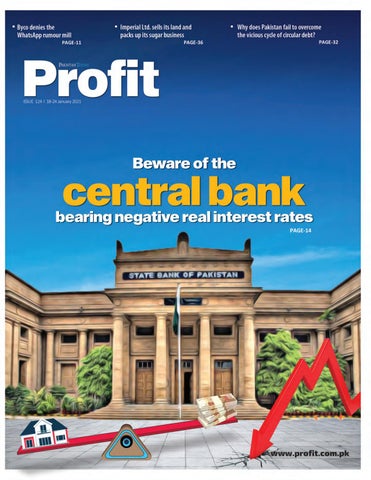
14 14 Beware of the central bank bearing negative real interest rates 20 Seth Abid: Pakistan’s ‘pious’ smuggler, mythmaker, and the last of the outlaws
24 24 Tackling the Multi-Headed Energy Hydra Ammar H Khan 26 Despite a pandemic, Pakistani startups had their best year yet with over $65 million in funding
08
20
31 Pakistan needs to fix its electricity network. Here’s one way Humayun Akhlaq
32 32 Why does Pakistan fail to overcome the vicious cycle of circular debt? 36 Imperial Ltd. sells its land and packs up its sugar business 37 Cherat Packaging to invest Rs1 billion in polypropylene plant
WELCOME
Why institutional reform matters
One of the biggest critiques of neoclassical economics – usually levied by people who do not understand it – is that it falsely assumes that people will behave rationally. The truth is that while it is indeed correct that some neoclassical economic models are too simplistic, the central insight they offer into human behaviour is not that people are rational, but that people will respond to the set of incentives they are offered. If you want to understand why a person is behaving the way they are, in short, study the set of incentives they face. While the field of economics has since borrowed from psychology, sociology, and even neuroscience to understand the various factors that go into shaping human perceptions of their incentive structures, one thing remains clear and true: it is irrational to expect people to consistently behave in a manner that goes against the incentives they are offered. That is the underlying theme of our cover story this week, which explores the rationality of how each actor in the great play that is the macroeconomy of Pakistan is behaving rationally based on the incentives that they are offered, but the end result is one that does not work for the country as a whole. Our cover story explores one specific bad idea – that somehow negative real interest rates are sustain-
able in the Pakistani economy – but it touches on a broader theme that we have explored in other stories: one of the incentive structure facing key decision makers in Pakistan, and how – if we expect better results – we need to think in terms of institutional reforms. The current administration is a perfect example of the fact that an obsession with corruption is utterly unhelpful and unhealthy for our country’s political economy. Whatever our differences with Prime Minister Imran Khan, we feel comfortable stating categorically that that we do not believe he is personally corrupt, and if anyone alleged that he had stolen even a single rupee from the national exchequer, we would be highly sceptical of such a claim. But his personal honesty is utterly useless to the people of Pakistan because he has not put that to any use insofar as changing the institutional incentive structures of the government are concerned. What is the point in going after the corrupt when the honest run the government just as badly, if not worse? All we do is give anti-corruption a bad name.
Farooq Tirmizi Managing Editor
Profit
Executive Editor: Babar Nizami l Managing Editor: Farooq Tirmizi l Joint Editor: Yousaf Nizami Reporters: Ariba Shahid l Babar Khan Javed l Taimoor Hassan Abdullah Niazi l Meiryum Ali l Hassan Naqvi l Shahab Omer Director Marketing: Zahid Ali l Regional Heads of Marketing: Muddasir Alam (Khi) Zulfiqar Butt (Lhr) l Mudassir Iqbal (Isl) l Layout: Rizwan Ahmad l Photographers: Zubair Mehfooz & Imran Gillani l Publishing Editor: Arif Nizami l Business, Economic & Financial news by 'Pakistan Today' Contact: profit@pakistantoday.com.pk
FROM THE MANAGING EDITOR
7
Readers Say Ever since the PTI has come to power, investor confidence in Pakistan’s economy is growing stronger and better. Seven years after delisting, Unilever Pakistan is investing heavily in growth and this is great news for the economy. Apropos: Seven years after delisting, Unilever Pakistan is investing heavily in growth @wkwazir33 Unilever Pakistan is providing us almost 60 products. It is good to have a foriegn company even providing us soaps and toothpaste. Apropos: Seven years after delisting, Unilever Pakistan is investing heavily in growth Umair Shahzad Tariq, Facebook These big multinationals rule the world and destroy or buy the local economy. Apropos: Seven years after delisting, Unilever Pakistan is investing heavily in growth Ahmad Khan, Facebook Unilever must talk to their bosses first instead of saying or doing such things that infiruiate the cultural sensitivities of the Muslim world including Pakistan. Otherwise next time there won't be any Unilever in any Muslims country including Pakistan. Apropos: Seven years after delisting, Unilever Pakistan is investing heavily in growth Sajadullah, Facebook Garbage company from Turkey. How pathetic is this. There is no Pakistani company who can handle Garbage? This is what happens when we depend on others to do everything for us and fleece use instead of encouraging business in our own people so that they stay and do business in Pakistan honestly. This is so sad to see. Apropos; Lahore government versus its trash collectors: what went wrong? Mirza Baig, Facebook In principle, this is a good idea and the need of the hour. But can it even establish some foothold with the current provincial setup? Apropos: Rebuild Karachi Adnan Hamid, Website
facebook.com/Profitpk twitter.com/Profitpk linkedin.com/showcase/13251020 profit.com.pk profit@pakistantoday.com
HOW TO CONTACT
8
Karachi needs a miracle like the purge. For now, the Memons are never going to invest in Karachi for the betterment of Karachi. They are only ever going to do it either to save money or for their own benefit. What world are you living in? Other business communities might just take action, but that is highly unlikely as well. Apropos: Rebuild Karachi Anonymous, Website
The construction business is also at its peak in Karachi, and there is a heavier presence of construction industry in Karachi compared to any other city in Pakistan. There are at least a dozen buildings in Karachi that have twenty stories at least. And the biggest of the buildings have up to forty, fifty, and sixty floors. How is this city not developing or getting its business community to put up money to uplift it? Apropos: Rebuild Karachi Anonymous, Website The writer has some great points in his explanations on the deteriorating situation of Karachi. However, there is one element he has failed to explore or perhaps even realise. Have we forgotten about the politically successful but economically disastrous slogan of the PML-N back in the 90s of “Jaag Punjabi Jaag'' or are we just ignoring it? The very slogan that moved many excellent businesses of Karachi to Faisalabad. The MQM was used as a pretext for this. If we all agree that peace is restored in Karachi within four years, then why the same approach was not taken during the shift of business from Karachi to Punjab? I am not against Punjab, but its growth should not be at the cost of Karachi. The scenario is to be well realized by Bengalis who only remember Punjab as a taker of their piece of bread. We have structural problems that can not be easily fixed without the sincere will of strong stakeholders. Pakistan is for all, but when deprivation is presumed and prevailed then things go wrong ways. In my career time in Karachi the policy was to get Punjab domicile for Karachi to get a job in Karachi. Apropos: Rebuild Karachi Raid, Website I fully agree with the author’s idea, that in order to rebuild Karachi, the business community of the city must step up. Unfortunately, we’ve seen notable businessmen from Karachi being silent on the issues of Karachi. And in a hypothetical situation like Karachi is facing, where there are Administrator, CM, Fed govt involved in its politics but not a single entity is ready to own it, it is only the business community which forces the govt to work for the betterment of the city. Imagine, Arif Habib or Ali Tabba conveyed the problems to the PM and CM and warned them about the consequences and its effects? Apropos: Rebuild Karachi Musaf Hanif, Website What is more surprising is the lack of ownership shown by the businesses that are either based in Karachi or have a large presence here. The Memons, the Chiniotis, the Dehli walas are just some of the big business communities whose home base is Karachi. Apropos: Rebuild Karachi Zohair Nanjiani, Twitter
COMMENTS
IN BRIEF Renowned Pakistani industrialist and social figure Seth Abid Hussain passed away in Karachi on Friday. The 85-yearold gold smuggler, who was one of Pakistan’s first richest persons, died after a short battle with an illness.
Raast:
In an effort to shift the country’s economy from cash to digital, Prime Minister Imran Khan has launched Pakistan’s first instant digital payment system ‘Raast’. Addressing the launching ceremony on Monday, the PM said that the ‘Raast’ initiative will help boost formal economy, financial inclusion of women, and eradicate poverty from the country.
The federal budget deficit soared to nearly Rs1 trillion in the first five months of the current fiscal year (5MFY21), which was largely in line with the annual budget target due to a continued squeeze on defence and development spending and keeping some expenditures off the books.
The foreign exchange reserves held by the State Bank of Pakistan dropped 0.09pc on a weekly basis, according to data released by the central bank. On January 8, the foreign currency reserves held by the SBP were recorded at $13,400 million, down $12 million compared with $13,412.3 million in the previous week. The central bank gave no reason for the decrease in reserves.
International Business Machines Corporation (IBM) has successfully delayed a suit for recovery worth $510,000. The case pertains to a former IBM territory manager named Wasim Iqbal who claims to have been denied a total of Rs 81.5 million as a result of closing business deals for IBM.
$600 million:
The government has requested the World Bank for a loan of $600 million to roll out an innovative hybrid social protection scheme to support its aspirations around risk mitigation and financial inclusion among the poor and informal workers.
$500 million:
UAE’s Culture, Youth and Social Development Minister Sheikh Nahayan bin Mubarak Al Nahayan has said that the Abu Dhabi Group would further their investments in Pakistan by launching a new project worth $500 million in the near future.
9
Byco
denies the WhatsApp rumour mill Several WhatsApp groups had forwarded messages claiming that Byco had started two new production lines; Byco’s share price went up on the PSX
I
f the year 2020 has taught us one thing, it is that misinformation has to be the greatest threat to societies around the world. Witness the flurry of ‘fake news’ circulating on Twitter, Facebook, and WhatsApp. The news, and its consequences, range from the truly random (No, Khala jaan, ginger
PETROLEUM
does cure Covid-19), to the deeply damaging (see: the entirety of the Trump presidency). The platform WhatsApp faces a particular challenge, since its messages are encrypted, and therefore cannot be policed in the same way Facebook and Twitter can be. WhatsApp has tried to fix the problem of misinformation by reducing the amount of times one can
forward a message: in 2018 users could forward a message at once to 250 groups, which was reduced to five in 2019, and then one in 2020. Still, WhatsApp forwards can make it through. This is doubly true in Pakistan, where WhatsApp forwards are often how financial news breaks, particularly in dedicated business WhatsApp groups with like minded individ-
11
uals. And that is how last week petroleum company Byco found itself at the center of a mild WhatsApp controversy. In this case, the consequences were not dire, but still confusing; the share price of Byco actually increased. Here is what happened. In the past week, information was circulated across WhatsApp groups that Byco had begun production from two units, the Diesel Hydro DeSulphurising Unit, and the Fluid Cracking Unit, through its subsidiary Byco Industries Incorporated. The share price of Byco increased in light of this information. For context: Byco’s share price on December 30 was Rs8.85 per share. On January 1, the share’s price stood at Rs8.79. And yet, all of a sudden, the share began to trade at Rs9.79 on January 6, and then Rs9.81 on January 7, reaching a peak of Rs10.41 on January 8 (a Friday). This 18.4% rise over the span of about one week was enough to warrant a response by Byco. On the following Monday, January 11, the company issued a notice to the Pakistan Stock Exchange calling the circulating information false. “The company strongly denies the accuracy of the information stated in the above WhatsApp circulation and makes it clear that it does not reflect the factual position on the matter,” the notice read. It went on to clarify that at its last Extraordinary General Meeting held on April 2, 2020, it had instituted an upgrade project. This consisted of installing a Fluid Catalytic Cracking (FCC) unit, along with its associated plants, to crack furnace oil into gas and diesel; and a Diesel Hydro Desulfurization (DHDS) unit to remove sulfur from diesel. Byco said that the company had made progress on the project, but that a groundbreaking ceremony was held on Saturday, January 9, 2021 to commence the civil construction of the project. “We further clarify that the company, its sponsors, major shareholders and directors have no connection to the above cited false WhatsApp circulation which has apparently caused an unexpected rally in Company's shares traded on the PSX,” the notice said. It seems that in the build up to the groundbreaking ceremony, the fake news began to circulate. The groundbreaking ceremony itself, a clip of which can be found online, is in of itself quite standard: around 100 people seated on tables under a marquee , with the usual congratulatory messages, and team building speeches. It is no surprise that these projects were announced in April 2020: last year, Byco had to innovate as Covid-19 threw a wrench in the oil industry’s plans, and definitely in Byco’s own rise. The company was founded by Parvez Abbasi in 1995. Construction on the first oil
12
refinery with a capacity of 30,000 barrels per day started in 2011, at Mouza Kund, Hub, Balochistan, while commercial production began from July 2004. In 2007, Byco set up its first retail outlet in Sukkur (it is now present in 80 countries). Then in December 2015, Byco commissioned what was at the time the largest refinery in the country, with a capacity of 120,000 barrels a day. Between 2015 and 2018, the company’s net income was positive, increasing from Rs72 million in 2015, to above Rs1000 million in 2016, all the way to Rs5,020 million in 2018. Its net sales hovered below the Rs10,000 million mark, before jumping to Rs166,290 million in 2018. And yet despite net sales increasing in 2019 and 2020, the company made a loss of Rs1,684 million in 2019, and Rs2,431 million in 2020. In the company’s annual report of 2020,
Byco pointed to the consistent decline in local consumption of High Sulfur Furnace Oil (HSFO), which stood at one third of what it was in 2017. Then, because of the International Maritime Organization’s 2020 restriction on the use of HSFO as bunker fuel from January 2020, HSFO prices nose dived in the international market between November 2019 to March 2020. This is what spurred Byco in the first place to set up the FCC unit which will allow the company to convert HSFO into motor spirit and diesel. The government has also changed the specification of imported motor spirit and diesel to Euro V, which means refineries now have to upgrade to be able to produce those specifications. This is what the DHDS unit is meant for: to reduce the sulfur content and produce Euro V compliant diesel. n
the iconic shoe company doubles down on its tyre manufacturing business The rubber goods manufacturer is setting up a joint venture with foreign investors to expand its production of radial tyres
“M
ehndi ke function mai, Maham, Anam, Sanam, Jasmine aur Auntie Parveen... Office ke cabin mai Faheem aur kamchor peon Kareem” If you do not follow up with ‘Hamary rockstar Usman, Adnan, and lead vocalist Arsalan’, were you even alive on the internet in 2020? The iconic Servis shoes advertisement, which had originally aired in 2012, suddenly found a new lease on life in June last year, when it was rediscovered, rejiggered as a meme, and then seemed to play on loop
constantly. Even Servis picked up on the ad’s inherent ludicrousness, starting the #ServisShoesChallenge, where fans could create and share their Servis ad memes for prizes. The ad was a good reminder of the iconic brand, introduced to most Pakistani school children (along with Bata) as the place to buy school shoes. The brand has been around since before the creation of Pakistan, and its tagline is ‘Servis: shoes for everyone’. Except, Service Industries has long ceased becoming a shoe brand. In fact, it has increasingly evolved to become a tyre brand,
and recents events have shown that it is willing to put a lot of investment into expanding that segment. In a notice issued to the Pakistan Stock Exchange on January 6, Service Industries said that its subsidiary Service Global Footwear Ltd was going to be included in a joint venture project, Service Long March Tyres. The other shareholders in the Service Long March are Chinese company Chaoyang Long March Tyre, and Myco Corporation (from Pakistan). This joint venture will manufacture and sell truck and bus radial (TBR) category of tyres in Pakistan for both local demand and to export. Interestingly, Service Global Footwear is in the process of raising capital through an initial public offering, or IPO, the proceeds of which will go to making investments in the joint venture. That is a lot to unpack here. Let’s start right at the beginning. In the 1930s, three recent college graduates, Chaudhry Nazar Muhammad, Chaudhry Mohammad Husain and Chaudhry Muhammad Saeed, pooled together Rs62 and decided to start a business. Initially operating out of a four-bedroom apartment in Lahore, the company made mosquito nets, steel products and leather slippers (chappals), mostly for government personnel. Much of their target market consisted of non-Muslims who resided in Delhi, Bombay, Calcutta, Madras and Kanpur, according to a recent BBC article. Cognizant of rising Muslim-Hindu tensions in the the 1940s, the friends decided to pick the neutral ‘Service Ltd’ name, to avoid any potential boycott of their
brand. After independence, the company had to find new markets, and decided to concentrate solely on slippers (chappals). The company Service Industries was formed in 1953, converted to a public limited company in 1959, and listed on the stock exchange in 1970. In 1954, they installed a shoe manufacturing plant in Gulberg, Lahore, and then followed up with a giant complex in Gujrat, that manufactures not just footwear, but also canvas fabric and bicycle tyres and tubes. Today, the company has production facilities in Gujrat, Muridke and in Negombo, Sri Lanka, while manufacturing facilities are in Raiwind, Punjab, and Nooriabad, Sindh. Between 2014 and 2019, sales rose from Rs16,495 million, crossed the Rs20,000 million mark in 2017, and settled on Rs26,156 in 2019. The company’s net income was a little more shaky, fluctuating from a low of Rs773 million in 2014, to Rs1,245 million in 2016 and Rs1,061 in 2018. Of the 2019 sales figures, a whole 61% was supplied from tyre sales. In fact, local sales of shoes - aka the very people in that Sevris jingle - only made up 19% of total sales. It is a trend that has only increased in the last few years: in 2018, tyre sales made up 52.3% of total sales, while local shoe sales made up 20%. Service Industries has been cognizant of this shift in its fortunes. So, it has gone about to try and reorganize itself around the segment. First, it approved a scheme in December 2019, which was then sanctioned by the Lahore High Court in January 2020, under which its footwear business in Muridke would be de-
merged and become Service Global Footwear Ltd. The completion date for this scheme was set for June 2020. Essentially, this bifurcation means that Service Industries gets to act as a holding company for Service Global Footwear Ltd, with independent management. Around the same time, in November 2019, Service Industries entered the same joint venture with Chaoyang Long March Tyre Co and Myco Corporation. Thus, Service Long March Tyres was incorporated in January 2020. The new notice is simply an update to this plan: that Service Industries Ltd will own 51% (including Service Global Footwear, which will not hold more than 23%), Chaoyang Long March Tyre owning 44%, and Shabir Ahmad of Myco Corporation owning 5%. The total cost of this project is $250 million. In February 2020, Service Industries made a long-term equity investment of $31 million in the joint venture; to date, the Company has made an equity investment of Rs765 million, or roughly $5 million. According to Service, the targeted production capacity for this project is 2.4 million tyres a year, of which 85% will be exported. This makes sense: currently, exports only make up 8% of all tyre sales, which means Service is looking to rapidly expand this segment. “This is the size of the plant which is mandatory to achieve sustainable economic viability, and to go deep in the global market, and also to compete with big giants from China,” the company said in its most recent annual report. Clearly, the company has set its sights on bigger fish than shoes; will it be tyre jingles from now on? n
CONSUMER GOODS
14
COVER STORY
I
By Farooq Tirmizi
t is a simple enough story and almost nobody in the government – and even some people outside of government – seems tired of telling it: the Pakistani economy was on its path to recovering from the 2018-19 recession when it was struck hard by the lockdowns induced by the coronavirus pandemic, leading to a short, sharp recession. But the government swung into action with a fiscal stimulus, regulatory incentives for investments in some sectors, and looser macroeconomic policy, and the recovery has been just as rapid, at least insofar as industrial activity is concerned. The problem is that the last bit of that story – the part about low interest rates being part of the stimulus that has led to the economic recovery – is not entirely supported by the data. And that has significant consequences, because if that last bit is not true, then a lot of Pakistani macroeconomics needs to be rethought. Why, you might ask? Because most of macroeconomic theory assumes that governments do not behave like cocaine addicts. And if, as in the case of the Government of Pakistan – specifically the Finance Ministry – a government does behave like a cocaine addict, macroeconomic models break down and if one’s policy decisions are based on those models, one will end up making the wrong decision. What we will tell next is the story of a cast of characters – each behaving rationally, given the constraints they are operating under – and every single one of them contributing to a most irrational state of affairs.
16
Here is our central thesis, based on an analysis of banking sector data from the State Bank of Pakistan and other macroeconomic data from the Pakistan Bureau of Statistics: the effect of monetary policy on lending – and therefore economic growth – is very limited in Pakistan, in large part because the government is the dominant borrower that crowds out the private sector. That much is well-established, including by research conducted by economists at the State Bank itself. It is also established that monetary policy has little to no influence on the government’s willingness to run large budget deficits. So, if we are saying that monetary policy has little stimulative effect on the economy, some influence on inflation (but less than in other economies), and has no impact on the government’s willingness to borrow, what is it good for? Why not permanently set interest rates low so that industries looking for loans face a low financing cost and thus are able to borrow more and grow faster? Many, many reasons why. In this story, we will first lay out how and why the government of Pakistan became the dominant borrower of the financial system, then lay out how that completely cripples the ability of the State Bank of Pakistan to use monetary policy as an instrument of economic policy in Pakistan, followed by an explanation of why, despite their lack of effect on lending, the central bank should not adopt a policy of permanently low interest rates (you would think we would not need to say this, but this tends to be one of the most consistent demands of every business lobby in Pakistan.)
How the government came to dominate borrowing
A
t one level, this is a simple story: the government of Pakistan has simply failed to get its fiscal house in order through poor enforcement of tax laws and as a result runs massive fiscal deficits. The borrowing needs of that deficit are so high, that the government now accounts for a majority of the lending in the banking system. But, of course, the simple story tells us absolutely nothing useful. The more relevant questions to ask are why the government of Pakistan has gotten to this point. Because if we stop the story at “the government simply is not doing its job”, we assume the problem is corruption, or incompetence, or some combination thereof. The more fleshed out story, however, will reveal that the problem is one of incentives. Here is what has now been happening more or less uninterrupted since the late 1980s in Pakistan: a new administration comes into office and the civil servants who constitute the more permanent fixture of the government decides it is time to tell them the truth. The truth is usually that the previous government was painting a rosier picture of their record than the reality, and that the country’s finances are in bad shape. At that point, the new administration – whether it be an elected politician, or a military dictator – has a choice. They can announce the corrected numbers (in one fashion or another, most governments in Pakistan end up doing that), and then either adopt policies
Price signals often fail in structurally distorted economies. A desperate borrower does not respond to price signals; this is especially the case with addictive goods/ services. While increasing interest rates is sufficient to deter an individual from borrowing more, in the case of a government with a short-term horizon, the rising cost of credit will not deter fresh borrowing, but only increase the government’s indebtedness and squeeze the fiscal accounts further Mushtaq Khan, former Chief Economic Adviser to the State Bank of Pakistan
that would fix the problem over the long run, or they can adopt policies that will win them the next election. Nobody has yet seemed to figure out one set of policies that will do both. (Side note: Pakistan has had authoritarian dictatorships, but not totalitarian ones, which means even our dictators do not exercise absolute control and – at one point or another – have had to contest a semi-fair election. There are many, many implications of what that means, but this publication will leave those to experts who understand these subjects better than we do.) The government’s first option is that it can crack down on tax evasion and try to implement taxes on currently untaxed portions of the population which will result in no growth in tax collection in the short run but may increase collection in the long run, with no guarantees of success. In the meantime, the government will have no means of dealing with the short-term collapse in the country’s foreign exchange
reserves, which will mean that the rupee will keep depreciating. Given Pakistan’s reliance on imported energy – in the form of both oil and liquefied natural gas (LNG) – the country will face higher inflation if the currency keep depreciating. The second option is to let the civil servants who run the finance ministry and the Federal Board of Revenue (FBR) run the tricks that they do in order to increase tax revenues in the short run. The ability to quickly raise revenues allows the government to show international lenders like the International Monetary Fund (IMF) that it is doing better at managing its finances, which allows them to access foreign borrowing. That foreign borrowing allows the rupee to remain stable. Keeping the rupee stable allows the government to brag about low inflation, since inflation in Pakistan is tied to energy costs. Low inflation – governments seem to believe – will help them win re-election. Needless to say, every government
– both civilian and military – has chosen option number two. You can see why it is the rational choice for them. Option one is better for the country in the long run, but there is no guarantee of success and, in any case, any administration simply does not have the kind of time that it would take to implement that long-term fix. They will be in the middle of a re-election campaign long before then. Why do the civil servants offer this option, though? After all, the whole justification of having a permanent civil service who cannot be fired (only transferred) is that they are supposed to help the cabinet and the prime minister think long term. Well, if your power within the civil service is predicated on how much the prime minister or the powerful cabinet member relies on you for advice, then it is in your best interest to deliver advice to them that they will perceive as helping them win re-election. Nobody ever got fired or transferred in the civil service for not suggesting ideas that would help the country’s economic progress
COVER STORY
in the long run. So, both the politicians (and military dictators) and the civil servants are behaving in a manner that serves their own interests, but one that ensures that – in the long run – Pakistan’s economy remains mired in one chronic fiscal and external account crisis from which we have struggled to escape. That is not a problem of corruption, or incompetence, but one of incentives. And it is a problem that remains constant, regardless of whether we switch to a military dictatorship or a democracy. At Profit, we have covered the implications of the obsession with the rupee before. In this story, however, we will cover what this means for the Pakistani banking system and for monetary policy.
The government as a dominant borrower
T
he problem with choosing option two, outlined above, is that it is a bit like taking cocaine when you are very tired and need to work. Yes, the drug will give you an energy boost and you will be able to keep going longer, but now you have a different problem: you are a drug addict. The same is true of the government of Pakistan. All those tricks that the FBR uses (those withholding taxes you pay on your cellular credit and bank transactions are two examples of such tricks) to increase tax revenue work in the short run, but do not actually help reduce Pakistan’s budget imbalances in the long run, which means that the government’s budget deficit never really goes down in any sustainable way. Running a budget deficit means the government needs to borrow to pay for its expenses, which it does by issuing bonds. In theory, the government of Pakistan is
18
open to selling those bonds to anyone, and indeed, though National Savings, it sells them directly to individuals as well. But given the dominance of the banks in Pakistan’s financial system, the bulk of the bonds it sells are bought by the banks. Given just how long the government has been running these deficits, and how large they are relative to the size of the economy, over time, the banks’ lending to the government has reached the point where it now constitutes a majority of their total lending portfolios. Government borrowing became a majority of total borrowing in the economy in the second quarter of 2011, and has effectively stayed the majority since then. The State Bank has noticed that trend and has used language that indicates that it considers the government’s borrowing to be a major macroeconomic problem. As far back as 2013, the central bank talked about ways to address the government’s borrowing and how it was confounding its ability to make monetary policy. See, the problem is not just that the government borrows a lot of money. The problem is that the government borrows a lot of money and does not care what interest rate it pays to borrow that money. In a working paper for the central bank quoted in its third quarterly report for fiscal year 2013, then the SBP’s Chief Economic Adviser Mushtaq Khan wrote: “Price signals often fail in structurally distorted economies. A desperate borrower does not respond to price signals; this is especially the case with addictive goods/services. While increasing interest rates is sufficient to deter an individual from borrowing more, in the case of a government with a short-term horizon, the rising cost of credit will not deter fresh borrowing, but only increase the government’s indebtedness and squeeze the fiscal accounts further.” [Note that it is the State Bank that used
the language about ‘addictive substances’. We simply added the ‘cocaine’ part. In our defense, the SBP started it.] Why is this relevant? Because raising rates has historically been used by central bankers to wake up their governments to the inflationary impact of their excessive borrowing. By raising interest rates, and therefore the amount of interest the government has to pay on its debt, central banks hope to induce governments to reduce their borrowing. But if, as in the case of the government of Pakistan, the government is behaving like an addict, then monetary policy’s impact on the fiscal situation of the country is virtually non-existent. In such a situation, there have been many who argue the following: “if the State Bank cannot use interest rates to knock some sense into fiscal policy, why not reduce interest rates so that at least the rest of the economy can access capital at lower borrowing rates, which would then increase economic growth?” That is just a flat-out terrible idea, not least because it effectively means giving in to the government’s worst habits: giving more cocaine to an addict. We have no idea what the equivalent of a government overdosing to death looks like, but we suspect it will not be pleasant. Actually, we do know: it is called hyperinflation, followed by swift economic collapse. (See Weimar Germany, Zimbabwe, and Venezuela for details.) And then the supposed effect on the rest of the economy – even assuming we can avoid a catastrophic hyperinflation – is not good. Specifically, here is our contention: given the role of the government as the dominant borrower in the banking system, lowering interest rates will have no material stimulative impact on the economy.
TEXTILES
Why lower interest rates will not work to boost economic growth
W
e will caveat the following analysis by stating categorically that we do not claim to have made substantive findings, and that our research is merely what we hope is a useful starting point for a more robust analysis. These are simple, univariate ordinary least-squares regression analyses and a more multivariate approach is likely to yield findings that may differ from ours. With that said, our initial analysis of deposit and lending data from the State Bank of Pakistan and inflation data from the Pakistan Bureau of Statistics indicates that when the SBP’s discount rate exceeds the inflation rate, there is a positive effect on deposit growth at the banks, but when the benchmark discount rate is below inflation, there is no material impact on private sector lending growth. Before we dive into our findings, first a brief note on our methodology. We used real interest rates, which we defined as the trailing 12-month average of the State Bank’s discount rate minus the trailing 12-month average of the rate of inflation as measured by the national consumer price index (CPI). For both private sector lending, and for deposits, we used real – meaning inflation-adjusted – growth rates. Again, we used trailing 12-month averages for both. Adjustments for inflation involved geometric, not arithmetic subtraction. We examined data from January 2002 through November 2020, with the data for each month representing the preceding 12-month period. This gave us 215 observations for the period in question. We then ran a single-variable linear regression of real interest rates against real deposit growth, and real interest rates
against real private sector lending growth. Why use private sector lending and not total lending? Because in order for monetary policy to have a stimulative impact, it needs to increase the private sector’s access and desire for capital to indicate that the economy is growing. If it only increases government borrowing, all it is doing is increasing the government’s willingness to borrow. The effect we observe on deposits is exactly what we would expect to find: if real interest rates go up, so does the inflation-adjusted increase in deposits, meaning that deposits increase faster than inflation the higher interest rates are relative to inflation. This stands to reason: the better the inflation-adjusted returns banks can earn on their borrowing, the more they can pass on to depositors, which in turn will attract more depositors. The effect on private sector lending, however, is less clear: there is a very weak relationship between real interest rates and inflation-adjusted growth in private sector lending. We would expect to find a negative relationship: the lower the interest rates, the higher the growth in private sector lending. Instead, we find a weak positive relationship, and a very low r-squared value (0.032), which suggests that real interest rates have very little explanatory power in determining the direction of growth in private sector lending. Indeed, in the 42 months during which there were negative average real interest rates over the preceding year, exactly 21 were periods that saw positive inflation-adjusted private sector lending growth, and exactly 21 that saw negative inflation-adjusted private sector lending growth. In effect, when real interest rates are negative, there is exactly a 50% probability that private sector lending will increase, and a 50% probability that it will not. A literal coin-flip. And this result stands to reason: if the government is the dominant borrower, accounting for the bulk of borrowing from the banks,
the overwhelming bulk of new loans would go to the government, not the private sector. There is also another reason this makes sense: if negative real interest rates decrease deposit growth, there will be a lot less new money for the banks to deploy into new loans, and in an environment where rates are low, banks will go for the option that will do the most to increase their return on equity, which in the case of the Pakistani economy means government bonds. Why? Because government bonds do not require the banks to set aside any capital in order to invest in them. If Habib Bank wants to buy Rs100 billion in new government bonds, it needs to increase its capital base by precisely Rs0, but if it wants to increase its lending by Rs100 billion, it needs to set aside around Rs10 billion in either shareholder equity, or some other form of capital to be able to lend that much. That means that any returns it earns on those government bonds will translate into a higher return on equity than any private sector lending. And that is before we even get into fact that there is a risk of defaults in private sector lending, but not in government lending. What does all of this mean? It means that if the State Bank of Pakistan were to lower interest rates to below inflation, it would significantly decrease the growth in deposits in the banking system, but would not actually do anything substantive to increase the kind of lending that actually boosts economic growth. So then why would the State Bank do such a thing at all? It would incentivise bad behaviour by the finance ministry, cripple the formal financial sector, and have no meaningful impact on economic growth. So the next time you see some industry lobbyist on television calling for lower interest rates, know that what they are calling for will help absolutely nobody but the addict. And probably not even the addict. n
COVER STORY
20
By Abdullah Niazi
R
uddy faced, small in stature, and unimposing in his demeanor, the normalcy of Seth Abid Hussain betrayed the extraordinary life he lived. In the presence of important, powerful, men one expects to feel daunted. But amongst a crowd, the Seth was unassuming. A shadowy figure that possessed an easy confidence when he had to speak, but maintained a stock disposition of reserved silence. His death, much like his person, was shockingly normal, and he died as one would expect any normal 85 year old to – of sickness in a hospital bed. On the surface, at the end of his life at least, shockingly normal is very much what he was. An ordinary old man that happened to be very wealthy, and used some of that wealth for charitable causes. In death he was remembered as a philanthropist, the founder of the Hamza Foundation for deaf and dumb children, one of the first and largest donors to the Shaukat Khanum Memorial Hospital, and a real estate developer that was once the largest property owner in Lahore. But to generations before this one, Seth Abid was the center of every conversation in drawing rooms back in the 1970s and 1980s. This seemingly docile, gentlemanly, indistinguishable figure was for much of his life known as the ‘Gold King’ of Pakistan. A man of humble birth, for decades he flitted between Lahore, Karachi, New Delhi, London, and the Persian Gulf smuggling gold from one place to another, with authorities from both India and Pakistan as well as Interpol on his tail. As his fortune grew, so did his profile, and Seth Abid’s life was one that would go on to blur the line between legend and myth. His enormous wealth, as well as his real life involvement, spats, and collusion with the Pakistani state, gave rise to the stories about him that are still unverifiable, and still whispered about to this day. From smuggling nuclear equipment in a container, to offering to pay off Pakistan’s
debts in exchange for the freedom to do his business, and to kidnapping Benazir Bhutto – Seth Abid’s life is enshrouded in the mists of rumor and speculation. His closely guarded but still visibly tragic personal life has only made the public more curious about this man. And that is not so strange. Money and the high life are attractive, and people tend to try and live vicariously through others. Distant but ever present names like Malik Riaz and Mian Mansha will always garner interest, curiosity, and envy. The same is true for figures outside of the law, like Billa Truckanwala, Abid Boxer, or Taji Khokhar, whose lives of bravado and violence will never not receive the romanticised awe of young boys that know no better. Seth Abid was both rich and lived outside the law, yet he managed to garner something even more than the distant admiration you would expect. He captured the imagination of the masses and inadvertently succeeded in entering the vernacular as a metaphor, with ‘aida tu seth abid aya’ a bonafide part of Punjabi sayings. Well before his death, his fame and dominance in the everyday was already on the wane, and he was a much more feeble and mainstream figure than he himself would have liked to be remembered as. But what remains behind is his legend, and the many versions of his life that are told, and the many versions that will continue to be told. Profit looks at the life and times of the Gold King of Pakistan.
Innocuous beginnings
S
eth Abid Hussain was born in 1935 at a village in Kasur that would eventually be a border town between India and Pakistan. Little is known about his early years or his education. What we do know is that he belonged to a modest family of traders that worked in transporting animal hides for leather tanning. His family was from Calcutta, and only by chance of business moved to Kasur around the time Seth Abid was born. His family managed to mostly avoid the violence of Partition, but in 1950 his father
This is how by the end of 1950 Seth Abid, who until then had been a teenager hanging around at his father’s shop and learning the tricks of the trade, was introduced to Kashif Bhatti. Bhatti was a seasoned gold transporter from Delhi. When Partition happened, he turned smuggler and began bringing the metal in from India through the border and from the Middle East as well
moved them to Karachi, where he set up shop selling gold and silver. This is where the story begins. Pakistan has no gold mines or gold reserves of its own, but is a gold crazy culture. People in this country tend to not just spend fortunes buying gold jewelry, but also (falsely) consider the precious metal a good investment that does not lose its value. So where does all this gold come from? Either the Gulf, the Americas or from neighbouring India. Now imagine the scenes in early 1950s Karachi. Here is a country that has only been around on the map for less than half a decade, and whose birth was marked by the largest and most violent migration ever witnessed in the history of the world. In the early 1950s, the border between India and Pakistan was relatively porous, and while it was dangerous, people easily came back and forth from it particularly in the Punjab. The Pakistan Navy, which even today is little more than a glorified coast guard, back then possessed exactly two sloops, two frigates, four minesweepers, two naval trawlers, and four harbour launches. In other words, the Karachi port was open for business both official and unofficial. And despite the terror of Partition, people were still very much getting married and the demand for gold in Pakistan continued to be high. So it was only natural that Seth Abid’s father got much of the gold and silver he sold from smugglers that were bringing in the gold either from India, or the Gulf, or from the Americas through London. This is how by the end of 1950 Seth Abid, who until then had been a teenager hanging around at his father’s shop and learning the tricks of the trade, was introduced to Kashif Bhatti. Bhatti was a seasoned gold transporter from Delhi. When Partition happened, he turned smuggler and began bringing the metal in from India through the border and from the Middle East as well. Seeing a spark in Abid, Bhatti took him under his wing and the two became a successful partnership. This is also where Seth Abid first learned what would become his smuggling ethos. Bhatti told him that just because the borders had gone up did not mean what they were doing was immoral, because they were simply trading legal goods, which was in fact a tradition of the Prophet Muhammad. The initial days of smuggling involved bringing in gold through the Karachi coast. Very quickly, Seth Abid’s new endeavour became a family affair. His younger brother, Haji Ashraf, quickly took on the Gulf side of operations because of his fluency in Arabic. The business grew fast and within a couple of years, the authorities were on to them. This is when Seth Abid decided to go back to his roots, and began using the Punjab
OBITUARY
border to smuggle gold in from India. In Delhi, which is where Bhatti initially used to take him, Seth Abid’s brother-in-law, Ghulam Sarwar, held sway and introduced him to people that would sell him gold. In April 1958, however, not even a decade into running this racket, Seth Abid was arrested by the Customs authorities in Karachi with 3,100 tolas (31.4 kilograms) of gold in the bags he was trying to transport. At the time, that amount of gold was worth $40,790 or approximately Rs195,000. At today’s international prices, that would be worth approximately $2 million. In a telling tale about the measure of the man, Ilyas Chattha in his obituary for BBC Urdu writes that “when customs sent out a press handout saying they had seized 200 tolas of gold, Seth Abid corrected them and said it was actually 3,100 tolas.” This was the first time Seth Abid found his name in the press. We cannot possibly know how he felt about it, because even though he claimed to dislike the attention, he never bothered to try to put an end to it. Seth Abid’s name was now out there, but after a brief five-month detention in jail he was out and would never serve time again. In a short span of eight years, he had created an international smuggling network and another network of bureaucrats and policemen within Pakistan that would get things done for him and keep him out of trouble. In the initial days, Seth Abid was still seen out and about in Sarafa Bazar (literally, the “Goldsmith’s market”) in Karachi and personally undertook smuggling missions. This arrest was the end of that, and from now on he would become a figure that stayed in the background and let his agents get their hands dirty for them. In this time, he became a very rich man at a very young age. Throughout the 1960s this wealth increased, and at a time when tracking money was difficult and hiding it in plain sight much easier than it is today. Seth Abid began buying property in Lahore and started fortifying himself as a legitimate businessman with other sources of income as well and began forming the ‘Abid Group’ – which
is today one of the largest conglomerates in Pakistan. This may have been how things continued, and Seth Abid could have lived on as he was, but that is when the Zulfikar Ali Bhutto era arrived and presented him with the conflict that would make him.
Enter Bhutto
L
et us take stock of where we are in this story again. Seth Abid is a gold smuggler with an international reputation. He is a target for Indian authorities, and in the 1960s, and that makes him a national hero in the eyes of the Pakistani public. In 1963, The Times of India published a story that the ‘Gold King of Pakistan’ was hiding somewhere in India, and that his brother-in-law, Ghulam Sarwar, had been arrested with 44 bricks of gold – news that only raised his stature. Add to this the fact that he
According to BBC Urdu, the Seth Abid international smuggling case was discussed in the National Assembly and a special committee headed by Chaudhry Nisar was given charge to investigate. The committee not only cleared Seth Abid, but also ordered the return of the 3,100 tolas of gold that had been confiscated from him by the Karachi Customs authority back in 1958 22
is famously charitable and we have a proper Robinhood on our hands. The stories of Seth Abid’s magnanimity – never verified – were already widely talked about in Lahore and Karachi. He would go to the children’s ward in hospitals and hand out thousands of rupees to anyone he would see. He supported countless families without them even knowing that he was their benefactor. He went on the Hajj every year and brought back with him gold that he would distribute for free among the poor preparing for the marriages of their daughters. These were only some of the tales that people would happily tell, and the Hamza Foundation for the deaf and dumb being established in 1964 was living proof of his generosity. And the fact that he was a smuggler made him even more attractive as a prospective legend. For starters gold is naturally alluring, and someone in the business of gold is alluring by association. The 1960s were also the peak of the Imran Series in Pakistan, and the idea of benevolent criminals and the gentleman robber were romanticised and firmly believed in. Wherever he was during this era, whether it was London, Saudi Arabia or India, Seth Abid was a looming figure and any whispered news about him was listened to with attentive ears. Then came the war of 1971 and the independence of Bangladesh. With the entire nation being torn in half and the regime of Zulfikar Ali Bhutto coming into office, a person like Seth Abid seemed to be the last
person on anyone’s mind. That is until the Bhutto government decided to take on the Seth. Bhutto was running a steamroller over most rich people in Pakistan at the time, and many of Seth Abid’s assets were seized and cases registered against him. No one knew where he was at this time, so he once again avoided arrest, but a raid on his Model Town home in 1974 shocked the nation. Seth Abid was supposed to be untouchable, but his house had been plundered. The haul that was recovered from the house was plastered all over the papers the next morning, and the fascination with this man grew stronger. Reports claimed Rs12.5 million in Pakistani currency, Rs4 million in gold, and Rs2.5 million in Swiss watches were found and seized from the house. When Abid was still not found, Bhutto decided to ramp up his efforts and what was then the largest manhunt in the history of the country was launched in 1974 to find Seth Abid and present him before a court. The next few years involved some near hits and misses. In 1977, while the Seth was in Pakistan, his girlfriend’s apartment was raided minutes before he was due to arrive to see her. It was also around this time that rumors (untrue) began circulating that Seth Abid had Benazir Bhutto, who was then studying in the UK, kidnapped so he could demand his assets be released in exchange for her release. But then, right as the hostilities between the Pakistani state and Seth Abid were coming to a boil, Bhutto was removed from office by a military coup and in came the regime of General Zia ul Haq, which would become one of Seth Abid’s greatest partners.
Becoming Seth Abid
I
n September 1977, after fighting and running from the Bhutto regime for four years, Seth Abid presented himself humbly and willingly to the military regime of General Zia ul Haq. There were no conditions, no prior discussions that we know of, and apparently no fear. It was an audacious move, and a stroke of genius. Seth Abid had hoped that Zia would accept him simply because of their mutual hate of Bhutto, who remained alive and incarcerated in a Rawalpindi jail. He surrendered himself and laid down arms and very politely asked for his assets back that he claimed were unjustly taken from him by the government. The assets were returned and it seemed the Seth had simply asked and been given with no favours being asked in return. But it became clear that things were not as simple as they seemed when in December that very year, he gave a sizable donation to the then Governor Sindh, Lt General Jah-
The stories of Seth Abid’s magnanimity – never verified – were already widely talked about in Lahore and Karachi. He would go to the children’s ward in hospitals and hand out thousands of rupees to anyone he would see. He supported countless families without them even knowing that he was their benefactor. He went on the Hajj every year and brought back with him gold that he would distribute for free among the poor preparing for the marriages of their daughters anzeb Arbab, for the building of two new hospitals. With public perception already on his side, Seth Abid continued to ride the tide of popular support and his philanthropy continued. What would truly establish Seth Abid in the minds of the Pakistani people as a master smuggler, however, would happen in 1985. This is when, reportedly, Pakistan was bringing in a reactor that it needed for its nuclear programme all the way from France. The problem, of course, was that Pakistan was not allowed to import such technology because of UN sanctions. The government then enlisted the help of Seth Abid, who smuggled the equipment into Pakistan from France. This public rumour, of course, is not even remotely true. France did sign an agreement in 1976 to help Pakistan set up a nuclear power plant at Chashma, but after strong intervention by the United States, including a personal trip to Islamabad by US Secretary of State Henry Kissinger, that deal was cancelled. What appears to have some basis in fact is that he did indeed have some role to play in Pakistan’s nuclear programme, which did involve the theft of at least some nuclear equipment designs, if not actual centrifuges, from Europe. What we also know is that right after this, Pakistan took a big step towards achieving nuclear power and that he received a boon from the Pakistan government soon after. According to BBC Urdu, the Seth Abid international smuggling case was discussed in the National Assembly and a special committee headed by Chaudhry Nisar was given charge to investigate. The committee not only cleared Seth Abid, but also ordered the return of the 3,100 tolas of gold that had been confiscated from him by the Karachi Customs authority back in 1958. From here on out, however, it seemed that Seth Abid and the Abid Group began to rely less and less on smuggling gold and focused more on their legitimate businesses, the most important one being property. The Abid
Group founded projects like Eden Villas and Eden Gardens, and developed vast swathes of land around the Defence Housing Authority area in Lahore. During the 1990s, Seth Abid easily became the largest property developer in the city of Lahore. However he began to hand the business over to his son, Seth Hafiz Ayaz Ahmad. Gold smuggling was no longer as easy as it once was. The borders were tighter and financial scrutiny was tougher, and Seth Abid himself was a scrapper that liked to do things on his own. He was known to visit the houses in the societies he developed and introduce himself very plainly to potential buyers and get their opinions on how they would want things changed. But as more time passed by, he focused on the Hamza Foundation. Much of his passion came from the fact that he himself had differently abled children, other than his son Ayaz. At this point, his popularity was on the wane as the Abid Group stayed out of trouble compared to before, but his name continued to be used as a synonym for wealth and power. In 2006, his son Seth Ayaz was gunned down by an angry security guard. After that, Seth Abid became more reclusive than before, rarely appearing publicly although he maintained close relationships with different governments that came and went at the time. The time out of the public eye has diminished his legend, but his remains a storied life. As technology advances and the world continues, Seth Abid may have been one of the last of his kind. Heists and activity outside of the law is now conducted over the internet, through hacking. Smuggling gold by trudging through borders is a relic of the past relegated to action movies. A senior editor at this paper wrote of Nawabzada Nasrullah upon his death that he was ‘The last of the Churchillian’ politicians. Of Nawab Akbar Bugti, the same editor referred to him as the ‘last of the feudal Nawabs.’ Seth Abid may just go down in Pakistan’s history as the last of the outlaws. n
OBITUARY
OPINION
Ammar H. Khan
Tackling the Multi-Headed Energy Hydra
in unintended consequences for the rest of the value chain. The ability to zoom out, take a macro view, and carefully optimize the various linkages has always been missing, until the latest power czar took up the challenge, who had recently resigned, but then was reinstated again, thereby continuing the juvenile game of musical chairs that is a hallmark of the incumbent government. The plan is simple: deregulate the energy markets, whether it be electricity, or petroleum products. A vibrant market with multiple buyers and sellers ought to create an environment which enables price discovery in a transparent manner. This certainly is a vanilla neoclassical prescription, but how it pans out on the ground in an environment where contract enforcement is weak, judicial interference is rampant, and rent-seeking is the order of he energy value chain in Pakistan in its current the day, remains to be seen. state is tantamount to exploring a labyrinth with a The plan, as prescribed in a slide deck by the current power multi-headed hydra. Cutting off one head (solving czar, calls for decentralizing power generation, and distribution one problem), would result in more heads popping from the federal to the provincial level. Transferring ownership up (unintended outcomes of that policy preof distribution companies to the provinces against a notional scription), while you further lose your way in the amount of one rupee, while the debt remains with the sovereign. labyrinth. However, once the transfer is completed, the provinces will be The value chain is plagued by multiple factors, from long-tailed responsible for the distribution companies, from back-stopping take-or-pay power generation contracts with sponsors addicted to losses to enabling public-private partnerships. rent seeking, to grossly inefficient electricity distribution companies Through this maneuver, the federal government would which regularly lose up to more than one-fifth of electricity diseffectively avoid dealing with the overstaffing and redundancy patched, as well as an overarching circular debt, which has dragged related issues of the distribution companies. These distribution the value chain into a liquidity trap. The trap plagues entities across companies (excluding K-Electric) have annual losses of more the value chain, from electricity generators and distributors, to oil than Rs. 100 billion, which would be transferred to the provinces. marketing companies, refineries, and energy exploration companies. Revitalizing these entities would initially entail trimming the If the problems weren’t complex enough, lack of direction, or fat and a voluntary separation scheme, it is still not clear how a clear-cut plan right from the top was always missing. Most policy prescriptions target a specific component of the value chain, resulting that will be funded. A revitalization plan without backstopping a voluntary separation scheme would be setting up the plan for failure. A transfer of ownership would certainly push provinces to have more skin in the game, as any transmission & distribution losses and other inefficiencies will eventually eat into provincial finances, encroaching on already constrained fiscal space. However, there needs to be a transition Ammar H. Khan period for the same before any transfer can take place, as a revitalization plan needs to be develis the chief risk officer for oped for each distribution company with a clear-cut funding plan, backstopped by the sovereign Karandaaz Pakistan, an for the initial few years. This will ensure that there is buy-in from the provinces before any transorganisation that seeks to fer takes place, while also ensuring that adequate funding is in place to revitalize the distribution promote financial inclusion in companies. Pakistan. He has previously A ridiculously inefficient distribution network is the weakest link, which will continue worked at several financial to add to a bloated circular debt, the cost of which will be borne by consumers either directly institutions in Pakistan, both in through higher tariffs, or indirectly through finance costs, etc. It is estimated that roughly 18 commercial banking and capital percent of electricity is simply lost during the distribution process, and there is little to no inmarkets
Fixing one problem causes three more
T
24
centive for distribution companies to enhance inefficiency. Packing them up, and giving them off to provinces without making any structural changes is only going to make things worse. Recent injection of liquidity in IPPs through cash and in-kind issuance of Pakistan Investment Bonds can only alleviate liquidity constraints only to a certain extent, till the next time the circular debt is bloated further, largely due to distribution inefficiencies. Another tenet of the plan is to utilize renewable energy, and indigenous coal for power generation, and capacity additions in the future, without getting stuck in long-tailed take or pay contracts. This would catalyze increasing energy security for Pakistan, while also conserving precious foreign exchange reserves. However, renewable energy, and coal is an odd couple, or even an oxymoron. Economic costs of power generation through indigenous coal must also include healthcare, environmental, and other externalities. Once those costs are added, sole reliance on indigenous coal to provide base-load creates more problems than it solves. Taking a macro view of the energy value chain does demonstrate that indigenous coal can be used to create synthetic gas, or liquids, with a much lower carbon footprint. The recent commitment of the Prime Minister to transition towards ‘coal to gas’, and ‘coal to liquid’ further testifies to that. Renewable energy has a seasonal component which can be leveraged to optimize the energy mix, while also expanding utilization of relatively cleaner sources, such as nuclear energy, and natural gas. Lowest hanging fruit for renewable energy is making it easier for retail, and commercial
renewable energy producers to opt for net metering – which will not only incentivize greater uptake, but also lay foundations for creation of a vibrant electricity trading market. Incentivizing micro-grids powered by renewables in areas with a patchy, or non-existent distribution network would remain critical in enhancing access to electricity for a large area of the country, which is still currently in the dark. The plan also envisages establishment of power transmission projects under a Public-Private Partnership model with an open access policy. Such a model would crowd-in private capital in a component of the energy value chain which has largely been ignored for more than two decades now, and is responsible for significant inefficiencies. A market-oriented model, which can even take the form of a Real Estate Investment Trust (REIT) would be incentivized to minimize energy losses during transmission. A precedence in the case of sharing of telecom infrastructure already exists – decoupling that to include private capital can push towards resolution of the transmission problem, amidst all opposition, and regulatory bottlenecks. The recent grid failure which plunged almost all of the country into darkness further illustrates the precarious and vulnerable state of the country’s transmission network. The ultimate objective remains availability of electricity at affordable prices, such that the economy remains competitive, and the consumer is not burdened – while also ensuring that adverse environmental externalities can also be kept to a minimum. Affordability is a function of fuel prices, inefficiencies, and taxes, with inefficiencies and taxes making up more
than two-third of potential cost overhang that can be minimized. A tough reform program through revamping of transmission network, and distribution companies is the only way out – kicking the can down the road will only make things worse as the size of circular debt continues to inflate. Almost halfway through the incumbent government’s tenure, not much effort has been made to undertake tough reforms in the transmission, and distribution space. Although there have been some gains extracted from renegotiated power contracts, but in the larger scheme of things, it does not move the needle on the affordability front. It will only be through weeding out inefficiencies, and through rationalization of taxes for the consumer that electricity prices can become competitive at the end-user level. A vibrant energy market with a multitude of buyers and sellers, who have the right set of incentives to keep inefficiencies to a minimum is the only way forward. Reformation of distribution companies whether through privatization, or through public-private mode is a decision that cannot be delayed anymore. The consumer has been facing the paying a significant price for such inefficiency, and which is not sustainable anymore. The hydra will continue rearing its multiple heads, but it isn’t the first time that an energy mess has been sorted in a developing country, and it will definitely not be the last. Sticking with the principles of reducing inefficiencies, creating the right set of incentives for all stakeholders, rationalizing an extractive taxation regime, whilst enabling a competitive market for electricity is the only way to annihilate the hydra. n
COMMENT
26
The coronavirus pandemic may have actually helped some startups, particularly as the fintech space in Pakistan continues to grow By Taimoor Hassan
O
ne thing no one will disagree on is that 2020 was quite some year. And while the consensus would be because of how quickly and radically the world has changed, for some, 2020 will be the year that opportunities presented themselves and they reached out and grabbed them. One of the groups that have had cause to celebrate the last year are Pakistani startups, which according to various estimates, have raised between $61 million to $66 million in disclosed and undisclosed funding during the year 2020. The $61.7 million in disclosed funding number comes from the Islamabad-based invest 2 innovate (i2i) Ventures, a venture capital firm that invests in early-stage startups. Whereas according to Data Darbaar, an up and coming platform providing insights on startups, the total raised by startups in 2020 was as high as $66.24 million. The number is visibly higher than in 2019, when startups raised a total of $47.5 million, according to i2i Ventures. At least 41 disclosed deals were made in 2020 compared to 32 in 2019, whereas only three women-led startups raised funding
that accounted for a meagre $1.8 million in 2020. While the number is low, it is telling of the fact that there are just very few startups that are founded by women in the first place. While among the different sectors startups operate in, transportation and mobility received the most amount of funding at $23.7 million. Notable rounds were raised by Bykea that raised $13 million in Series B and Airlift that scored a $10 million extended Series A round. A boom was seen in the grocery delivery and B2B ecommerce space that saw a smattering of new entrants in the space, almost immediately after the lockdowns started. The prominent ones that raised funds include GrocerApp, Taajir, Bazaar and Retailo. In total, B2B and B2C retail/grocery startups raised $17.6 million in 2020. This could of course mainly be attributed to the increase in people wanting and willing to use such services to minimize their exposure to the coronavirus. The financial technology sector follows next with $12.6 million in disclosed funding received by numerous startups during the year. This was followed by e-commerce that saw a hefty $9.3 million raised by startups.
Digitisation and increase in investments
D
uring the pandemic, a lot of sectors that were previously more difficult to digitise were suddenly galvanized into action. That happened in the grocery sector, as well as with a few entrants in the B2B space. This encouraged the investors to invest aggressively in the startups that were going to benefit from this shift and leverage the opportunity that opened with the pandemic. The impact was sectoral and funds were mobilised towards companies in sectors that were considered “Covid proof’; companies that were likely to thrive from the pandemic instead of firefighting. “The
reason why a lot of investors were wanting to put money in Covid proof companies was because with all of us, the reality was that the pandemic was not going to last six weeks or for a couple of month,” explains Kalsoom Lakhani, the co-founder and general partner at i2i Ventures. “We knew that there was a constant shutdown that was going to be happening and there were companies that were going to be some companies that were going to be somewhat immune to that. So those were the trends and that is why we saw an uptick in the investments and investor activity go up by spring.” While investments have been substantial in certain sectors, like in logistics and financial technology, the increase in investments was fueled by the pandemic, and once the pandemic subsides, chances are the change in adoption and behaviour is likely going to remain favourable. Even before the pandemic, key shifts were happening in various industries in terms of technology and the entire sectors were going through an overhaul where technology infrastructures were being erected by startups to erect entire technology-centric ecosystems in these sectors. The coronavirus has simply acted as a catalyst. In financial technology for instance, banks are opening their APIs and sharing payment rails with startups that kind of allows other companies to come in on top of that and build their startups. Such verticals were bound to see an increase happening. It just got fuelled during the pandemic. “I think logistics is something that is going to be growing regardless of there being a pandemic or not being a pandemic. Obviously the need for it is bigger during the pandemic itself, but the demand will not go away. What we are seeing in other industries around the world is that we are going to see the impact of the pandemic stay a lot longer in a lot of ways even when it is over,” explains Kalsoom. “In other countries, the government often incentivises digitisation. In Pakistan, however, that hasn’t been the case. What we are going to see is a snapback where consumers are going to be really comfortable to, for instance, buy their groceries online and get things delivered. But we do think that we as a society still are a society that is very tangible and like to touch things.” Essentially, what this means is that there are going to be some things that revert back somewhat to how they were before the pandemic, while others will not. However, the government can always play a role to push for digitisation generally, as we have seen in India as well, where the fintech space has been actively promoted for all sectors. It is not about promoting a certain kind of fintech, but of
TECHNOLOGY
In other countries, the government often incentivises digitisation. In Pakistan, however, that hasn’t been the case. What we are going to see is a snapback where consumers are going to be really comfortable to, for instance, buy their groceries online and get things delivered. But we do think that we as a society still are a society that is very tangible and like to touch things Kalsoom Lakhani, co-founder and general partner at i2i Ventures
promoting the general concept. And with the State Bank of Pakistan (SBP) pursuing aggressive policies to digitise financial services in the country, things are on the up for startups. “Right now, the SBP is being much more amenable under Reza Baqir. We have been seeing a lot of opportunities in the fintech space so there is a shift that is happening that over the next two years will present exciting
28
opportunities and we are going to see interesting fintech companies come up,” says Kalsoom. According to i2i Ventures, more has happened for the startups scene in Pakistan in the last two years that it had in the five years before that combined. “What is interesting is that the numbers pertaining to fintech startups is not actually encompassing all the companies that actually did raise investment.
The actual number of fintech companies remains undisclosed and the number is actually higher, she believes.” As Angela Strage of American venture capital firm Andreessen Horowitz also says, every company is going to be a fintech company. That is also the case with Pakistan, where all companies are realising that financial services play a very strong role in the company
Hottest Sectors
Startup Funding Roundup 2020 Startups that received the most funding Name
Sector
Funding
Bykea
Transportation & Logistics
$13,000,000
Airlift
Transportation and Logistics
$10,000,000
Finja
FinTech
$9,000,000
Tapmad
Media & Entertainment
$4,000,000
MedznMore
HealthTech
$2,600,000
Funding over the last �ve years 50
40M
13
28
30
19
20M
15 $27,170,000
2016
$14,570,000
2017
$24,550,000
$42,100,00
2018
Funding
2019
$66,240,000
Total Deals
Funding
Largest Round: Finja ($9,000,000)
FoodTech
5
Largest Disclosed Round: Byte ($150,000)
SaaS
5
HealthTech
10
Largest Round: MedznMore ($2,600,000)
E-commerce
14
Largest Round: Retailo ($2,300,000)
Largest Round: Integry ($1,000,000)
45 33
0
4
While the e-commerce sector got the highest number of deals, 38.35% of the total investment went towards transportation and logistics, continuing the 2019 trend when it accounted for a massive 72% of the aggregate.
*The data for 2016-2018 has been taken from Invest2Innovate 60M
FinTech
0
2020
Transportation and Logistics
$25 400 000
E-commerce
$11 330 000
FinTech
$9 600 000
HealthTech
$7 075 000
MediaTech
Startups
Out of 50 total startups, only three were led solely by women.
W
6 B2B startups raised funding of $7,025,000
8 B2C startups raised funding of $4,275,000
Out of those three, AimFit was in the lead by scoring a seed round of 1,000,000
that they are building. In Pakistan, the difficult thing in the past is that from savings to lending, cash is still king and so until we create incentives for people to use credit cards and go online, it is still going to be a bit of a challenge. However, people like Kalsoom are still hopeful, and as he optimistically notes, the fintech space is poised for take-off since people are getting much more comfortable with digital payments generally.
Were there any sectors that were overlooked?
Y-Combinator
E-Commerce
The increase in total investment from 2019
The average ticket size which slipped from $1.56M in 2019
$4 000 000
Total Deals
57.34%
$1.32M
Airlift Though Airlift is technically a part of the T&L sector, its bus operations remain suspended for the last ten months and it has been expanding into grocery delivery
hile Covid pushed many verticals towards a boom, others witnessed a bust in growth owing to the lockdowns and
subsequent fall in demand. Such startups raised funds to survive. From an investors perspective, however, Kalsoom does not think that any sector was overlooked because of the pandemic. Roomy raised investment this year despite the fact that tourism, both domestic and international, suffered because of lockdowns. In fact, Roomy’s round suggests that domestic travel is booming and that it leveraged and raised a large round of $1 million from Lakson VC. “The pandemic actually enabled investors to negotiate favourable deals and that is also why we see the surge in investments this year,” says Natasha Uderani, chief operating officer at startup insights company Data Darbaar. “Many startups raised contingency funds with terms more favourable for the investors than the startups. So the investors that were cautious to invest during the pandemic did invest because of favourable terms and that includes sectors that Made with
Pakistani startups have finally caught the attention of the well-known accelerator as two more companies, Byte and Safepay, were selected in the program, following Tajir's lead last year.
witnessed a drop in growth.” Different verticals also have expanded opportunities now. According to Kalsoon, ‘Dukaan tech’, that is basically not just B2B kiryana stores but also the digitisation of financial ledgers but all the SMEs in this space is an interesting thing investors will be looking at. “We are going to see some really interesting players come up. Edtech startups are going to be coming up much more vigorously. People are getting much more comfortable with online learning and that is where innovation can come into play,” he says. Moreover, health tech adoption was also slow pre pandemic and though during the pandemic there has been an increase in demand for health tech, people are still in the wait-andwatch mode that whether or not the bump that a lot of telehealth companies and a lot of like doctor-booking companies have seen is going to stay. Consequently, people are currently cautious about health tech and whether things will improve in this space once the pandemic is over, explains Kalsoom. Made with
There are a few reasons why women led companies have not been able to raise substantial amounts in Pakistan. Kalsoom explains that one issue they learnt from 75% of the A meagre $1.8 million investors they surveyed was that there was no difference in raised by female the quality of female led companies, but quite simply there founded startups here are a few reasons why women were not enough female-led companies to start with. The led companies have not been able to issue, therefore, is a funnel issue and not that of quality of raise substantial amounts in Pakistan. Kalsoom explains that one issue they startups or founders.
T
TECHNOLOGY
“The pandemic actually enabled investors to negotiate favourable deals and that is also why we see the surge in investments this year. Many startups raised contingency funds with terms more favourable for the investors than the startups. So the investors that were cautious to invest during the pandemic did invest because of favourable terms and that includes sectors that witnessed a drop in growth Natasha Uderani, chief operating officer at Data Darbaar
learnt from 75% of the investors they surveyed was that there was no difference in the quality of female led companies, but quite simply there were not enough female-led companies to start with. The issue, therefore, is a funnel issue and not that of quality of startups or founders. Consequently, female-only startups that have females as founders, not co-founders, raised only $1.8 million between Aimfit, Conatural and Dot and Line, according to i2i Ventures. That is only 3.11% of the total disclosed amounts raised by startups in Pakistan. “This, however, mirrors the global trends of female founded companies which is also like 2
“The second issue is that you see a lot of women in Pakistan that have raised very early capital but not later. There is also an issue of diversity of capital so we have also launched a programme called WeRise which is another women entrepreneurial finance initiative with the World Bank that is a bespoke coaching and advisory programme for women led companies that are looking to raise capital,” says Kalsoom. Though the statistics about funding for female-led startups are not great, what is interesting, however, is that the companies that did raise the deal sizes were larger than what has prevailed in the market before.
per cent.” Whereas the number of mixed gender startups that include both male and female co-founders is around $3 million in Pakistan. Kalsoom explains that a lot of women led companies are raising seed and pre seed and there hasn’t really been a Series-A round raised yet by a female led company. “In this regard, what we are doing in one initiative with the World Bank is that we have been training about 300 women led companies and also training incubators and accelerators in Pakistan how better to deliver content around investment readiness in Pakistan.”
Pre-Series A Karachi took the lead this year both in terms of deal count and funding
Investment raised in each round Accelerator
Lahore 30.19M
Karachi 32.375M
Angel Pre-seed Seed
Islamabad 3.525M
Pre-Series A
compared to only one the year before.
$900,000 $1,150,000 $5,140,000
Series B
20
International Offices
16 12 8 4 0
24
21
5
Karachi
Lahore
Islambad
Retailo, Ricult, Lorryz, Integry and InventHub are not exclusively Pakistani, having some setup abroad
$7,650,000 $23,000,000
Local Education 0
Bykea was the only startup to raise Series B Funding this year
True to the reputation of being cash-heavy, B2C startups attracted most of the capital B2B 24.51%
B2C 59.86% Hybrid 15.63
BookMe, a travel and leisure startup, was the only one to raise funding through a SAFE note.
47 2020 saw the participation of at least 47 unique investors in funding rounds
30
Out of those forty-seven, 30 were foreign investors.
5
Karavan funded five startups, making it the most active investor for 2020
$57,315,000 $8,925,000 5M 10M 15M 20M 25M 30M 35M 40M 45M 50M 55M 60M
86.53% of the total investment made in Pakistani startups was awarded to startups that had atleast one founding member with a foreign degree
30
$13,000,000
Series B
The Foreign Education Dividend Foreign Education
SAFE Note
$12,500,000
Series A 24
2020 witnessed 10 deals at Pre-Series A,
Made with
This year also saw the participation of a major name in the VC world, Prosus Ventures, an asset division of Naspers Group with a market cap of around €140 billion. It entered the Pakistani market by leading Bykea's $13 million Series B
TECHNOLOGY TEXTILES Made with
OPINION
Humayun Akhlaq
Pakistan needs to fix its electricity network. Here’s one way
the network automatically reconfiguring itself to resupply affected customers via another path. It could have taken hours to fix this fault if we were talking about a traditional grid. In my opinion, smart grids are the very foundation of an energy revolution. The technology has many benefits, including improved reliability and efficiency, increased flexibility and resilience, and allow utilities to better integrate renewable energy sources. A fault can be immediately spotted and the energy supply rerouted. And they’re also future-proof, allowing the grid to integrate renewable energy resources such as solar, wind and hydro – both from large, utility-owned projects as well as prosumers, consumers, and businesses who want to sell excess electricity that they’re producing through rooftop paneling. aturday night was memorable, and sadly for all the wrong While smart grids are one answer to this challenge, the other reasons. The power went out across much of Pakistan, inis even simpler. We all have to be more energy efficient. Again, cluding Lahore, Islamabad, Karachi, Rawalpindi and Multan technology will play a crucial role here. Increasingly, we are being for several hours. The initial reason for the blackout seems approached by industrial companies with a simple question – how to have been a drop in frequency at a power plant in Sindh, can we make our infrastructure more energy efficient? One example which caused a domino effect that effectively choked the of this is DG Khan Cement Company. Cement factories are energy country’s electricity grid. intensive, and we worked with them to design a system that would This isn’t the first time that Pakistan has been hit by electricity use less power for their new Baluchistan plant at Hub. Energy shutcuts, but it can be the last. We have the technology to put a stop to downs cost businesses money, and executives are looking for new power shutdowns. And we also have to think about what we all can do, ideas to ensure their operations aren’t impacted by power fluctuaas responsible citizens, to be more energy efficient. tions or brownouts. Let me address first how technology can help on a national level. This is also where we should be considering the concept of You may have heard of a smart grid, but what is this concept and how smart building. Globally, over 30% of energy is used in our buildcan it help Pakistan? Smart grids have long been discussed by the ings, and many of the places that we live in and work at are energy electrical industry as the future for the transmission and distribution of inefficient, resulting in wasted power and bills that are far too electricity. Smart grids connect to the internet and sensors throughout high. Anyone can reduce how much energy they use in their home the network connect to one another and to the cloud. or office by up to 30%, simply by installing devices that measure, The technology behind smart grids helps utility companies to monitor, and analyze energy patterns. Connected home technologies reduce power surges and outages. One example of this is the self-healsuch as WISER give home-users a view into their energy usage and ing grid we’ve developed with Stedin, one of the largest utilities in the provide recommendations on how they can reduce their consumpNetherlands, for a self-healing grid solution in downtown Rotterdam. A tion. Algorithms can communicate with your lighting, air conditionblackout caused by a broken cable was resolved in 18 seconds thanks to ing, heating – pretty much any electrical device – and help residents reduce energy usage automatically. Home energy management systems put the power in the hands of residents, saving them money over the medium to long term. Humayun Akhlaq We’re seeing an increased interest in smart home solutions, and we’re working with a number of leading real estate developers to make their projects future ready. The result is buildings that is the Country General are greener, more sustainable, and cost less to run. And they’ll use less electricity, which will help to Manager for Schneider reduce the load on the national grid. Electric in Pakistan, which Access to energy is a basic fundamental right. And we need energy to power our growth and produces the WISER development. Each and every one of us needs to think about how we can live more sustainably, so that technology that monitors this resource is available to all. Let’s all play a role in making Pakistan an example of how we can turn a energy usage in homes, and crisis into an opportunity to live better, greener lives. smart grid solutions [Editor’s note: The article discusses solutions to Pakistan’s electricity network problems provided by the author’s company, Schneider electric. They are viable solutions, but not the only ones.]
Technology must be on the forefront of how we choose to deal with this problem
S
COMMENT
31
T
By Hassan Naqvi
he story of Pakistan’s power sector has been a tale of institutional weaknesses, weak governance and a lack of financial sustainability. The result has been decades of power outages and expensive electricity thanks to the incompetent corporate governance and implausible financial management in country’s power companies. This has led to a chronic shortfall between inflows and outflows, which are commonly known as circular debt. Basically, circular debt is a shortfall of payments at the Central Power Purchasing Agency (CPPA). CPPA does not receive the out-
32
standing payment from power distribution companies (DISCOs) due to shortfall in receivables by the state-owned distribution companies (DISCOS) and privatised K-Electric (KE). Because of this, the CPPA does not make payments to other power companies in the supply chain. These include state-owned generation companies (GENCOs), Independent Power Producers (IPPs), and the National Transmission and Dispatch Company (NTDC). This leads to GENCOs failing to clear their dues to fuel suppliers, and similarly IPPs are also unable to make payments to their fuel suppliers because of the government delaying their payments. This is followed by the fuel suppliers defaulting on their payment towards refineries and international fuel suppliers. As a consequence, most of the thermal plants are forced to operate at a very low ‘capacity factor’. For the last many years, Pakistan’s circular debt has been on the rise. It is a vicious cycle of unpaid bills in the power sector, starting from the power generation end of the process, and going all the way to the distribution process to recovery and electricity theft. Eventually, however, the bulk of the burden cuts around the fuel supply companies and ultimately ends up at the doorsteps of consumers in the form of expensive electricity. Since energy prices are not stable, neither is circular debt, and the cost of power generation and of doing business is erratic, despite government efforts to curtail losses by checking power theft as well as recovering unpaid bills.
Rising circular debt
T
he Federal government on January 7 confirmed that the power sector’s circular debt went past Rs2.306 trillion as of Nov 30, 2020, up by Rs156 billion over the first five months of the current fiscal year, at a rate of Rs31.2bn per month. During a meeting of the Cabinet Committee on Energy (CCoE) presided over by Planning and Development Minister, Asad Umar, one solution tabled to this problem was a new, meterless, smart metering system that has been successfully tested and proven on the ground but was not adopted by power distribution companies. The meeting was also told that a bulk share of the increase in circular debt was poor governance in the public sector itself. During the meeting, it was also revealed that the Rs156bn increase in circular debt included the non-payment of budgeted and unbudgeted subsidy, delayed payments on account of interest to independent power producers (IPPs), other mark-ups, pending price adjustment on account of quarterly and monthly adjustments and non-payments by K-Electric. The information technology ministry also complained in the meeting about the fact that it had been repeatedly asking the Power Division
since November 2018 to adopt Electrocure, the meterless smart metering system developed by a government company called Ignite that was mentioned earlier. Ignite claims that the new meters will help in reducing chronic issue of line losses, power supply, and identifying electricity theft. Speaking to Profit, former Federal Minister for Finance during the PML-N’s tenure, Miftah Ismail, said that what is even more alarming than this unprecedented level of circular debt, now equal to 6% of GDP, is the monthly increase in circular debt. “We are now adding about Rs 70 billion to this every month. This is devastating not just for the energy sector, but for the fiscal sector as well,” he said. “The PTI has increased Transmission and Distribution losses, reduced bill collection and violated NEPRA’s merit order. If you run power plants on diesel and not on gas, this is bound to happen.” Opinions from other stakeholders and economists are not particularly hopeful either. Sakib Sherani, a former member of the prime minister’s economic advisory council, tells Profit that the sharp increase in circular debt since 2018 can be explained by a few main factors. “There has been a 35% increase in installed capacity since the beginning of 2018, coupled with a nearly 10% decline in capacity utilisation, a suspension of electricity tariff adjustments since January 2020 and a deterioration of nearly 4% in recoveries.” Economist Dr Aima Mehdi says the power sector’s circular debt has plagued Pakistan’s economy since 2007. “This vicious cycle is fuelled by delays in cash inflows and outflows by the Central Power Purchasing Agency along with a series of other causes. Prime Minister Khan promised that he would set the country free of its Rs 1.148 trillion (June 30, 2018) debt by the end of 2020 however this figure had surged to Rs 2.306 trillion by November 2020,” she tells us. “The reasons why Khan could not fulfil his promises are evident in the flawed system running the energy sector of the country, yet a reflective view shows the absence of corrective measures as well. It is failure to comprehend these causes which has helped the figures to surge by approximately Rs 1 trillion. The first and the foremost issue is the delay in tariff determination to match the time periods.” Dr Mehdi rightly points out that since this delay in tariff settlement causes revenue issues to the suppliers, the end result will always be further addition to the debt status. The most sophisticated way to charge for electricity prices in order to keep the system is called half hourly settlement, which allows prices to be settled 48 times every day to keep prices in balance. This allows timely circulation of payments and maintains balance in payments. Further, there are several administrative
issues that need to be addressed. These issues include inefficiencies posed by DISCOs because DISCOs are not offered any incentives on a performance basis. DISCOs are given subsidies equally which poses no interest for them to improve and enhance their distribution networks. There is a chunk of consumers that remain unbilled. The metering issue has remained unsolved over the decades. For Dr Mehdi, there is confusion between the roles of NEPRA and the Ministry of Power. NEPRA is meant to be a regulator and nothing more, but has its hands tied to the power of the Ministry. In order to get the regulator to work efficiently, it needs to be given the due authority. After doing so the regulator can be held responsible for its actions. “This is why the government should have taken the required actions to restructure NEPRA with bright minds,” she says. “Furthermore, NEPRA should be held accountable on several fronts, such as setting competitive bids for the distributors to take up networks. These distributors should submit their business plans and cost/revenue structures to NEPRA. As a regulator, NEPRA should develop a competitive environment where the consumers are safeguarded and benefitted alongside development and maintenance of the infrastructure of transmission systems.” Another major problem, of course, is a demand and supply mismatch. The problem is not shortage in supply but the problem is with DISCOs who hold supply due to payment issues. Therefore, by making accurate forecasts and allocating payments on time a lot of undue inefficiencies can be easily resolved. On a macro level, circular debt has sequentially multiplied due to dollar indexation. External pressures from the IMF have exacerbated our debt position. Another major challenge is to fight the political forces that have done much harm to the development of the power sector.
How did we get here?
T
he question at this point is, how exactly did Pakistan get here? What was the point where the circular debt problem came to life? According to Professor Dr Qais Aslam, who teaches economics at University of Central Punjab (UCP) in Lahore, the issue is one of bad deals with IPPs that have not been made any better, and can be traced back to the second government of the late Benazir Bhutto, which made a deal with the IPPs that was very expensive per unit for consumers. “The Musharraf regime then made it worse by not allowing the public sector to produce cost effective hydro electricity, therefore creating a demand and supply gap that further made electricity expensive and scarce,” Dr Qais added. “After that, the Zardari government allowed electricity to be produced in the private sector with second hand machines that had
ENERGY
completed their economic life and depended on foreign oil and gas. Whereas, the PML-N government of Nawaz Sharif in order to solve the energy crisis also depended on IPPs, producing from oil, gas and coal with inefficient and old technology.” After all of these mistakes piling up, the PTI government has only added on to them in their own fashion. “The line losses from electricity proliferation and stealing are great. 70 percent of electricity is stolen by the government itself and 25 percent by businesses of parliamentarians,” he alleged. “Unless the government adopts new state of the art technologies which are cost effective and eco friendly to reduce the per-unit tariffs, the problem of circular debt cannot be solved.” Meanwhile, Special Assistant to Prime Minister (SAPM) on Petroleum, Nadeem Babar, during a webinar in August last year observed that historically, the power sector has operated as a controlled monopoly by the state. Private power generators were only introduced 20 years ago. Tariffs are determined entirely by the state without allowing open market competitiveness. The basis of tariff is cost plus, because of which efficiency in generation takes a back seat. The government provides subsidies in order to meet the gap between revenue and cost. It is a blanket subsidy without having a focused target. “About 43% of Pakistan’s power generation relies upon imported fuels. As the exchange rate fluctuates, the cost of imports rises further contributing to increasing the costs of power generation. There are substantial losses due to leakage, non-recovery and theft,” he told the webinar. “Energy production has not risen in the last several years, despite growing demand. Furthermore, gas production is declining at a rate of 9.5% annually. The supply side needs to grow to meet the rising demands of an increasing population.” The special assistant recommended that the power sector should be opened up, and the government monopoly should be broken. Regulatory reforms should be instituted to create an open trading environment for electricity. Market forces of demand and supply should be allowed to regulate the prices, and instill competitiveness and efficiency within the sector. “The government plans to bring about changes to the fuel mix. Domestic sources of energy will be developed, using Thar coal and hydroelectric power plants. By 2025 the government plans to use 60-75% of domestic inputs to generate power,” he said. He also recommended that old defunct plants be shut down, and the existing oil refineries be upgraded. To address the growing problem of air pollution, the government will be improving the quality of fuel being imported. Pakistan has been importing high sulphur fuels up until now. From September 1st 2020, all petrol imports will have to comply with Euro
34
Standard 5, which is a low-sulphur fuel that reduces emissions.
Government agreements with IPPs
T
he Committee for negotiations with IPPs, notified by the Government of Pakistan in June 2020 and the IPPs representing the 2002 Power Policy projects, had several rounds of discussions and they have agreed to alter their existing contractual arrangements and signed MoU’s in August 2020 with the government. Following this, solar based IPPs had signed MoU’s in August 2020 and had reached an agreement with the government negotiating team for signing amended agreement to slash power tariffs. On January 10, 2021, the solar energy-based independent power producers (IPPs), bagasse-based IPPs also agreed to sign amended power purchase agreements with the government. The signing of the amended purchase agreements will slash the existing tariffs to a considerable extent. According to details, eight bagasse-based IPPs will sign an amended deal of power tariff with the government, whereas both sides will sign the amended agreement after endorsement from the federal cabinet. “The new power agreement will also require approval from the governing boards of the bagasse-based IPPs,” sources had earlier told Profit. Presently, the government’s negotiating team is in talks with IPPs over their dues payment mechanism and signing the amended PPAs. Prime Minister Imran Khan in a tweet on August 14, 2020 had stated that the government is fixing the damaging structure in the Power sector that his PTI government inherited. “After long negotiations we have signed new agreements with Independent Private Power Producers (IPPs) which will bring down the cost of power generation and reduce circular debt. Next reform target is the power distribution system,” the PM tweeted. Federal Minister for Power, Omar Ayub Khan, during a press conference on August 17, 2020 stated that the federal government is leaving no stone unturned through its new agreement with the IPPs, and was working towards mitigating the cost of electricity in the country. He had said that the reforms pertaining to the power sector would be initiated within the next three weeks. The power minister put the blame of the energy crisis on the previous governments. He added the previous governments during their tenures had not done the sufficient level of work to boost the energy sector. While commenting on the new agreement with the Independent Power Producers (IPPs), Khan stated that the agreement will help in mitigating the burden of circular debt and will also promote the industries. “The new agreement with IPPs will help
the federal government in providing cheaper electricity to the end consumers. The government is interested in providing cheap electricity to the agriculture sector and small businesses,” he said. The narrative that the mess is solely because of previous governments is one that is the official government line and can be found coming out of the mouths of almost all government ministers. During a press conference on August 15, 2020, Minister for information and Broadcasting, Shibli Faraz, said that the new agreement with IPPs would help the government in purchasing cheap electricity from the private power producers and providing it to end consumers at lower rates.Faraz had said that the initial or basic agreement has been signed with independent power producers which is the major step towards providing cheap electricity to the masses (consumers). “The previous governments had failed to negotiate properly with the IPPs that led to expensive power contracts being signed and it was not possible to get rid of such contracts unilaterally,” he said. “The prime minister wanted to take up the issue of expensive electricity on war footings due to which a team was constituted which negotiated with the IPPs to revisit the former contracts. As per the new agreement signed with the IPPs, payments will only be made against the electricity acquired and consumed instead of the total installed capacity of a particular power plant. From now onwards, the return on equity will be paid in Pakistani rupee rather than the US dollar.” During the same press conference, SAPM on Power Division Shahzad Qasim had said that one of the key milestones achieved in the newly signed MoU with the IPPs is fuel efficiency, and that all of the plants will be duly tested. “The IPPs would not only have to follow the prescribed limit of the National Electric Power Regulatory Authority (NEPRA) but the savings would also have to be shared with the government that would help in reducing the cost of electricity,” Qasim had said.
Can agreements with IPPs mitigate circular debt?
T
o a lot of experts, however, the agreement between the government and the IPPs is not much more than a wish list that is unlikely to bring about any material change in terms of reducing circular debt and power tariffs. One of these is Shahid Shafi Sial, an expert on the Power Sector and IPPs, and Honorary Secretary of The Institution of Electrical & Electronics Engineers Pakistan (IEEEP). Sial claims that the only good thing about the MoU is that it may put a cap to a certain extent on any further exploitation of
consumers in Pakistan, and may put an end to the periodic grandstanding that every incumbent regime deems appropriate to undertake in order to hide persistent policy failures. “The 660kV Lahore-Matiari DC transmission line, a flagship CPEC project, is expected to be operationalized by March 2021, which may prove to be another permanent source for jacking up circular debt. Since many power generation projects in the south of the country seem to have been inordinately delayed because of Covid-19, the government’s failure to evacuate power and the consequent payment of capacity charges may further aggravate the current situation.” Although, this arrangement has to be time-bound, yet there are many a mile between the cup and the lips. Savings in terms of fuel and O&M as envisaged in the MoU are insignificant and may not alter current tariff structure. However, willingness on the part of IPPs to undertake Heat Rate tests is a significant development, and if implemented in true spirit, may bring some benefit to consumers. Clearance of all outstanding IPPs payments by the government of Pakistan prior to signing of revised contracts is a big question mark, however. “The turnaround of the power sector and consequent reduction in circular debt and electricity prices is directly linked with the creation of more electricity demand for industrial and commercial usages. Unfortunately, we failed on this count,” said Sial. “One more problem is that the engineers, who are the main stakeholders in this conversation, have been excluded altogether from the decision making process, which in turn precipitated this downfall of the sector.” On the other hand, former managing director Pakistan Electric Power Company (PEPCO), Tahir Basharat Cheema, told Profit that the agreement between the IPPs and the federal government is a welcome move which would definitely decrease the cost of service for the end consumers and they would get the electricity at the cheaper rates. “But this will only be effective if different institutes of the power sector improve their efficiency and implement the agreements in true letter and spirit, otherwise it won’t work.” Earlier, when the MoU were signed between the government and power producers, Sunny Kumar, a research analyst at Topline Securities Limited, had said the government of Pakistan and Pakistan IPPs, as per the media reports, under the 1994 and 2002 policies have reportedly reached agreements, whereby IPPs have agreed to lower their returns along with mark up on late payments for the first two months. The IPPs should also be content with these MoUs as there is unlikely to be any stern action given the accusations made in the IPPs commission report. “The most crucial part of this agreement,
in our view, is the release of outstanding receivables. This amount is estimated at Rs800-900bn, which is likely to be cleared after consultation with IPPs. Any deduction on account of previously received excess profits (from savings generated through O&M and Fuel) cannot be ruled out. As for the future the government has also decided to receive sharing from IPPs under the same head,” he wrote. Kumar added that their initial impression suggested that it is a good win for the government after the IPPs commission report, where the MoU shows material progress to handle the matter. The current agreements, in our view, will not lead to substantial decline in the country’s power tariff, where the key will be the negotiations on CPEC projects, where the government intends to elongate the debt tenure to make a substantial impact on tariff. After the MoU’s signed between the government and IPPs in August 2020, Ailia Naeem, a Senior Research Analyst at AKD Securities Limited had said MoUs between the government of Pakistan and power plants operating under 1994 and 2002 power policies (PP), Pakistan power sector seems to be headed towards a more sustainable environment over the long term, a feat unachievable previously, where stand-alone short-sighted policy of cash injections remained futile in containing circular debt accumulation. “The capacity additions of 8,600MW (60% of pre-expansion capacity) over FY17-19, compounded by steep currency devaluation, have led to inflated capacity payments to Rs900bn, and were expected to surpass Rs1bn in FY20,” she said. “However, with the recently signed MoUs, the capacity payments are likely to freeze at these levels, while accompanying Energy Sukuks may finally bring down the circular debt levels. These MoUs are valid for 6 months and shall stand terminated at the signing of the detailed agreements, the senior research analyst stated.”
backing of IMF after it agreed to increase the base electricity tariff as demanded by the international lending body. The payment of the first installment will materialise the MoUs signed between the government and IPPs in August last year into agreements that will reduce the size of the guaranteed capacity payment or the fixed costs paid to the IPPs which is a major source of accumulation of the country’s circular debt. According to estimates the government is expecting to save Rs850bn over a period of 10 years following the modifications in power purchasing agreements (PPAs). The MoUs provide for changes in the terms of the existing power purchase agreements that will reduce the size of the guaranteed capacity payments or fixed costs paid to the IPPs, a major source of accumulation of the circular debt. The government is expecting savings of Rs850bn over a period of 10 years, following the modifications in PPAs. The federal government’s settlement scheme caters to 50-odd IPPs which were initiated in the 1990s and 2000s and had consented to the alterations proposed in their power purchase deals with the government. As per details, the majority of these plants have completed their life cycles or paid off their debts. So, as per experts Pakistan should not expect an immediate solution to the vicious circular debt problem even after the materialization of the revised deals with independent power producers. In recent years, the major contributor towards the country’s rising circular debt is capacity payments to large power projects established since 2015, primarily being part of the multi-billion dollar CPEC initiative, with Chinese money. Although we are being told that contacts have been made with Beijing at the highest level but on paper so far no progress has been made to get the terms of PPAs with those companies renegotiated and unless and until these contacts pay off, the issue of mounting power sector debt is unlikely to be solved.
The government’s plan to payback IPPs
IPPs unhappy from government’s offer
T
he Imran Khan led federal government is considering to settle the outstanding dues of IPPs which stands at Rs450bn in three equal installments which seems to be the only first step headed to liquidation of the power sector’s circular debt. As per reports, the independent power producers will get 30pc of their total outstanding amount in this month and the remaining amount in two equal installments in June and December. According to the plan, one-third of the arrears will be paid to the power producers in cash and the remaining amount will be given in the form of Pakistan Investment Bonds at the floating rate. The PTI government’s plan also enjoys the
T
he Independent power producers (IPPs) have reportedly rejected payment plans offered by the federal government and demanded at least 50pc upfront cash payments before signing the formal agreements for tariff discounts. According to the details, an implementation committee headed by Finance Minister Dr Abdul Hafeez Shaikh had recently offered payment of about Rs450bn to the independent power producers in three equal installments through a combination of cash and trade able bonds next month, June and December 2021 and each installment would comprise of one third (Rs50 bn) cash and two-thirds (about Rs100 bn) bonds. n
ENERGY
Imperial Ltd. sells its land and packs up its sugar business
The struggling company has tried to keep going in various capacities, but has finally decided to exit its core business completely
W
hat’s in a name? One sugar mill in Punjab has tried them all, but nothing seems to have stuck just yet. In May 2007, a sugar mill was set up by the Colony Textile Mills. Colony owned 46.98% of the company in 2009 (the earliest available financial statement), while the CEO of Colony Textile Mills himself, Fareed Sheikh, owned 20.7% of the mill. While
36
the office was based in Lahore, the two manufacturing facilities were located at Tehsil Phalia, District Mandi Bahauddin, and Tehsil Mian Channu, District Khanewal. Colony Sugar Mills continued to be known as such, all the way until May 2015, when it was rebranded as Imperial Sugar. The mill not only distanced itself from the Colony logo and brand name, but got a brand new logo: gold swirly lettering, and a purple and gold crown to go with the name as well. (It did not,
however, distance itself from Colony Textile Mills, which in 2015 still owned 16%, while three Sheikh relatives held 28%). This name would then last another five years, before switching to Imperial Limited in August 2020. This time, the logo is an intricately designed I and L next to each other (no crown in sight). The change is recent enough that the link to Imperial Limited’s website still leads one to Imperial Sugar’s previously designed website. One can also still find Imperial Sugar in PSX’s
listings. The change of name last year was a deliberate move: the latest incarnation of the sugar mill is determined to not exist as a sugar mill at all. In a notice issued to the Pakistan Stock Exchange on January 4, 2021, the company said that the board of directors had discussed to consider and approve selling the land, building, plant and machinery at Tehsil Phalia, District Mandi Bahauddin (this is subject to the approval of shareholders in the forthcoming annual general meeting). That plant has a sugar plant that can refine 7,500 million tons a day, and an ethanol distillery with a production capacity of 135,000 million tons a day. Except, of course, the mill has not really made any sugar for a while now. Profit took a look at the company’s financials to try and piece together what happened. Perhaps the signs were always there. In the company’s earliest financial statement from 2009, the company had noted worryingly, that despite a higher revenue and higher profits that year, “Sugar and ethanol are both projected to be in short supply for the year 2009–2010, globally. Growers are claiming much higher prices ....In light of the prevailing situation, the company is also procuring sugarcane at higher rates. This will result in significant increase in the cost of
production. Unless there is a corresponding increase in the sugar selling price, the profitability of the sugar divisions may be affected.” And that is exactly what happened. Between 2008 and 2013, objectively, the sugar mills revenues climbed, from Rs2,107 million to Rs7,234 million. And yet net income peaked in 2009 at Rs309 million, dropping to below Rs200 million between 2010 and 2012, and hitting Rs262 million in 2013. What explains this irregularity? One can look at the company’s gross margins during the same time period. In this case, the gross margin in 2008 stood at 32% – yet by 2013, that figure stood at 9%. In other words, in 2008, Imperial earned Rs32 in gross profit when compared to their costs of goods sold, but it earned Rs7 in gross profit by 2013. If a company’s ratio is falling (which it is, in this case), it means the sugar mill sold its inventory for a lower profit ie. it has to pay the farmers more for their sugar cane. That is exactly what Imperial predicted would happen, driving up costs of production and hurting the company. In 2014, the company made a loss for the first time, of Rs126 million, and the gross margins dipped again to just 5%. But things were only about to get worse. In 2015, the company made a loss of Rs500 million. The Phalia
facility was temporarily shut down, while only intermittent crushing was going on at the Mian Chanu facility – both due to a lack of working capital. It was to be the last year that the mill produced any sugar. In 2016, both units remained suspended, and the company took the decision to dispose of the plant’s properties and assets. It managed to execute at least half of that decision the next year, selling the Mian Chanu unit for Rs5,000 million in 2017. The proceeds from that sale were used to pay off loans from the National Bank of Pakistan, The Bank of Punjab, Habib Metropolitan Bank Limited and BankIslami Pakistan. But the Phalia unit remains, as there seems to have been no agreement in the last four years. According to the company, the total current market value of the land, building, and plant, comes out to Rs8,765 million. In the meantime, the company has transformed into its current phase: “to carry on the business of buying, selling, holding or otherwise acquiring or investing the capital of the company in any sort of financial instruments.” In its recent annual report, it had only one line about potential future plans: to set up a hydroponics project. One wonders what the name of that project might be. n
CONSUMER GOODS
Cherat Packaging to invest Rs1 billion in polypropylene plant
P
Cherat is taking out a long term loan to start its fourth line, in light of rising demand for the bags
akistan’s cement sector is doing well - really well. Just last November, the sector posted a profit after four consecutive quarters of losses. Part of this has to do with the uptick in demand for cement: the federal government announced a construction package in April 2020, in an effort to boost the sector. For instance, investors will be granted a waiver of up to 90% on tax, if they are investing in construction projects under the Naya Pakistan Housing Scheme. The industry will also have a fixed tax regime, instead of taxes on profits. Commercial banks were also told to allocate 5% of their total lending to the construction sector (banks’ current exposure to the sector is only at 1% of overall advances). All of the above means more cement. But it also means someone needs to produce more bags to carry that cement. Enter Cherat Packaging, which has taken up the opportunity. In a notice issued to the Pakistan Stock Exchange on January 5, the company decided to install its fourth polypropylene line to make woven bags, at its existing site in Gadoon Amazai, Khyber-Pakhtunkhwa. This new plant, to be commissioned by December 31, 2021, will cost Rs1 billion, for which Cherat is taking out a long-term loan. The production capacity of the plant is 65 million bags a year, which means Cherat’s polypropylene divisions’ capacity will increase to 260 bags a year. Why exactly is Cherat making such a huge investment? It has to do with the company’s own trajectory, and the realization that it will have to make greater sales, to combat fluctuation in the rupee-dollar exchange rate. Some context: Cherat Packaging was started in 1992. It is part of the Ghulam Faruque Group, founded by Ghulam Faruque, who served as the chairman of the Pakistan
38
Industrial Development Corporation (PIDC) in the 1960s, which is also the decade he managed to get control of PIDC assets like the Mirpurkhas Sugar mill (founded in 1964), and Cherat Cement (started in 1981). The group also owns Greaves Pakistan, which specializes in engineering equipment. Faruque Group, the parent company, owns 10.25% of Cherat Packaging, while Cherat Cement owns 7.35%, Mirpurkhas Sugar Mills owns 4.97%, and Greaves owns 5.02%. Initially, the company focused on making paper sacks. In 1992, it started off with one tuber, and one bottomer, which could produce 50 million paper sacks a year. In 1998 it added its second bottomer, and in 2003 it added its second tuber, its third tuber and bottomer in 2006, and in fourth tuber and bottomer in 2009. Having rapidly expanded its paper sack production to 265 million sacks, the company turned its sight on to polypropylene bags, installing the first such line in 2012. It installed a second line in 2014, and a third line in 2016, with a total production capacity of 195 million bags. Cherat then entered the Flexible Packaging segment (used for food items) in 2017, expanding the capacity to 12.6 million kgs in 2019. Ok, so paper sacks, polypropylene bags, and flexible packing: why is Cherat interested in the second segment? Polypropylene, which is the world’s second most used commodity plastic. Woven polypropylene, which is what the new line will make, is a type of resin material that has been woven in two directions to create a simultaneously light but heavy duty material. It is popular as a bag material because it is lightweight, easy to produce, non-staining, non-toxic, water-proof and resistant to stress: essentially, everything a good bag should be. Unlike regular plastic bags, it also does not
tear easily. It is often why it is used as bags for industrial purposes, such as to store sand, fertilizer, and cement. Cherat’s expansion in the last decade has meant an increase in sales. Between 2015 and 2020, the company’s net turnover went from Rs6,223 million in 2015, to Rs7,092 million in 2018, Rs8,093 million in 2019, and Rs9,436 million in 2020. And yet, the company’s net income has not risen at the same rate. After jumping to Rs918 million in 2016, it then fell to the Rs700 million mark in the subsequent years, and then Rs563 million in 2019, before a paltry Rs70 million in 2020. What happened? According to the company’s annual report for 2020, the turnover increased over the past six years because of expansions, increased market share, new divisions, and appreciation of market prices. But - and this is a big but - gross profit declined because of higher production costs, which was mostly due to an increase in prices of imported raw material, and the rupee’s depreciation. Look at the figures: nearly 80% of the company’s raw material for Kraftpaper and Polypropylene bags is imported, while only 20% is sourced locally (mostly materials like films, inks and solvents. Even then, buying locally still does not solve the issue: as the annual report noted, “The company is exposed to foreign currency fluctuation, not only for its direct imported raw materials, but also for those materials which are although procured locally but materials are commercially imported by our suppliers.” In fact, according to the company’s own estimates, a 10% increase or decrease in exchange rate during the year would have an impact of Rs 343 million on net income. Will the expansion mean even more imports, and decreased net income? Or will the new line, and potential new sales, make up for this fluctuating variable? Seems like Cherat is banking on the latter scenario. n
PACKAGING