CMYK
Wednesday, 18 March, 2020 I 23 Rajab, 1441 I Rs 20.00 I Vol X No 259 I 16 Pages I Lahore Edition
Corona will spread but '’aap ne ghabrana nahi hai’ g
PM IMran rULES OUT COUnTrYWIdE LOCKdOWn aS OffICIaL nUMbEr Of PaTIEnTS TOUCHES 237
g
SIndH GOvT IMPOSES ParTIaL LOCKdOWn frOM TOdaY fOr 15 daYS In a bId TO COnTaIn dEadLY vIrUS
LAHORE ASHER JOHN
“a
aP ne ghabrana nahi hai [You don’t need to panic]," Prime Minister Imran Khan said on Tuesday, as he sought to calm the panicked Pakistani populace amid a rapid surge in the positive cases of the deadly coronavirus, that touched 237 by Wednesday midnight, across the country. The PM's address came a few hours after the Sindh government announced a partial lockdown in the province for 15 days starting Wednesday. "It is our belief that life and death are in the hands of allah," Imran said in a prerecorded address to the nation. He added that the federal government had decided not to impose a lockdown in the country even though the virus outbreak was expected to
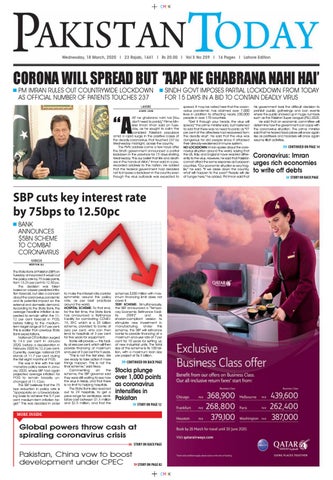
SBP cuts key interest rate by 75bps to 12.50pc g
banK annOUnCES $5bn SCHEME TO COMbaT COrOnavIrUS KARACHI MEIRYUM ALI
The State bank of Pakistan (SbP) on Tuesday announced it would cut the policy rate by 75 basis points, from 13.25 per cent to 12.50 pc. The decision was taken based on a lower predicted inflation forecast, but also a concern about the coronavirus pandemic and its potential impact on the external and domestic demand. according to the State bank, the average headline inflation is expected to remain within the 1112 per cent forecast in fY20, before falling to the mediumterm target range of 5-7 per cent. This is earlier than previous State bank expectations. national CPI inflation surged to 14.6 per cent in January 2020, before a deceleration in february 2020 to 12.4 per cent. Currently, average national CPI stands at 11.7 per cent during the first eight months of fY20. This was in line with the last monetary policy review in January 2020, where SbP had again projected average inflation for fY20 to remain broadly unchanged at 11-12pc. The SbP believes that the 75 bps reduction in policy rate is “appropriate on a forward-looking basis to achieve the 5-7 per cent medium-term inflation target.” This was decided in order
to make the interest rate corridor symmetric around the policy rate, as per best practices around the world. HOSPITAL SCHEME: To that end, for the first time, the State bank has announced a refinance facility for combating COvId19, rfC which is a $5 billion scheme, provided to banks at zero per cent, who can then lend to hospitals at 3 per cent for five years for equipment. banks will provide — this facility, at zero per cent, which will then provide financing at maximum end-user of 3 per cent for 5 years. “This is not the first step. We are ready to take action if more things happen. This is not the final scheme,” said reza. Commenting on the scheme, the SbP governor said they were still waiting to see how the virus in fields, and that there is no limit to helping hospitals. The State bank also reached out to 29 hospitals, to get a price range for ventilators. ventilators cost between $1.5 million and $2.5 million, and that the
schemes $200 million with maximum financing limit does not cover it. TERF SCHEME: Simultaneously, the SbP announced a “Temporary Economic refinance facility (TErf)” and its shariah-compliant version to stimulate new investment in manufacturing. Under this scheme, the SbP will refinance banks to provide financing at a maximum end-user rate of 7 per cent for 10 years for setting up of new industrial units. The total size of the scheme is rs 100 billion, with a maximum loan size per project of rs 5 billion.
CONTINUED ON BACK PAGE
Stocks plunge over 1,000 points as coronavirus intensifies in Pakistan STORY ON PAGE 12
more inside
Global powers throw cash at spiraling coronavirus crisis STORY ON BACK PAGE
Pakistan, China vow to boost development under CPEC
STORY ON PAGE 02 CMYK
spread. It may be noted here that the coronavirus pandemic has claimed over 7,000 lives in addition to affecting nearly 200,000 people in over 170 countries. "Get it through your heads, the virus will spread," the prime minister said, but hastened to add that there was no need to panic as "97 per cent of the affectees had recovered from the deadly virus". He said that the virus was dangerous for old people since it attacked their already-weakened immune system. NO LOCKDOWN: Imran spoke about the coronavirus situation around the world, saying that the US, Italy and England have reacted differently to the virus. However, he said that Pakistan cannot afford the same response as European countries. "Our economic situation is very fragile," he said. "If we close down the country, what will happen to the poor? People will die of hunger here," he added. PM Imran said that
his government took the difficult decision to prohibit public gatherings and ban events where the public showed up in huge numbers such as the Pakistan Super League (PSL) 2020. He said that an economic committee will determine how the government can cope with the coronavirus situation. The prime minister said that he feared food prices will once again rise as profiteers and hoarders will once again resume illicit activities.
CONTINUED ON PAGE 14
Coronavirus: Imran urges rich economies to write off debts STORY ON BACK PAGE
02-03 NEWS 18 MARCH-20_Layout 1 3/18/2020 1:41 AM Page 1
02
Wednesday, 18 March, 2020
NEWS
section 144 Being flouted in lahore amid corona scare TABLEEGHI JAMAAT IGNORES GOVT BAN, CONTINUES TO HOST RELIGIOUS GATHERING IN RAIWIND LAHORE
a
SHAHAB OMER
MID a hike in coronavirus cases, the Punjab government on Tuesday scrambled to find ways to contain the deadly disease as chaos and panic marred the daily routine amid a violation of a ban on public gathering. The government had imposed Section 144 to discourage public gathering in the wake of cases in Lahore and DG Khan; however, it was having a difficult time implementing the ban, as a religious gathering in Raiwind continues to flout the prohibition. There are at least 10,000 people residing at the Tableegi Markaz in Raiwind, with another mosque, Masjid Ibrahim, ramping up preparation to hold a big gathering to mark Shab-e-Juma. These centres
are sending off at least a dozen parties to 150-200 mosques in the city for preaching purposes, whereas almost 1000 parties [jamaats] are going across Pakistan for the same purposes. The activities of these parties are a recipe for disaster, as they can lead to a countrywide spread of the virus. Raiwind Assistant Commissioner Adnan Rasheed said the ijtima [gathering] won’t lead to an increase in the coronavirus cases. He said the authorities washed and chlorinated the area where the gathering was being held. Deputy Commissioner Afzal Danish said the Raiwind gathering was in violation of the law and such transgression would be dealt with. “All gatherings have been banned so far. There is no decision on Friday prayers as of yet because we need the sanction of religious authorities,” he said, adding any other activity inside or outside mosques
LUMS, PRIVATE SCHOOLS VIOLATE DIRECTIVES, REMAIN OPEN FOR FACULTY AND NON-FACULTY will be a violation. He said the shelter homes have been told to serve food to a two-three people group at a time in addition to bedding made at a distance of three feet. However, the shelter homes operating in Lahore were not observing measures imposed to discourage social interaction, as almost 4,484 people were living together and hundreds gather there to eat daily. Separately, the schools and universities are also flouting the ban. The Lahore University of Management Sciences and various private schools remained open for faculty in complete disregard of the measures taken by the government. The Punjab government is also grappling with the shortage of hand sanitisers and face masks being sold at increased rates. “Most of the stores do not have face masks and hand sanitisers, and if they have they are selling these items at 300 per cent
surge rate,” said a report submitted to the Chief Minister Usman Buzdar. Meanwhile, the young doctors have also gone on a strike over the shorage of safety kits. Young Doctors Association (YDA) representative Dr Salman Haseeb said, “The government should provide safety kits to the doctors who are treating the corona patients,” and added only the most serious patients should come to the hospitals. Governor Chaudhry Sarwar took the notice of strike and ordered the vice chancellor of the University of Health Sciences to provide safety kits to the doctors within 24 hours. In addition to this, the government is going to purchase 200 ventilators and expand isolation wards in Mayo and Services Hospitals. The Pakistan Kidney and Liver Institute and Research Center has been dedicated to the coronavirus treatment while a separate block on 70 beds is
Buzdar denies report of first coronavirus death in punjaB LAHORE: The Punjab government on Tuesday denied the Ministry of National Health’s report of the country’s first coronavirus death, urging the people to act responsibility during the “testing times”. “We have received test reports of Imran Ali, who lost his life in Mayo Hospital, and his cause of death was not #COVID19. So far Punjab has 8 confirmed cases and are being provided best available treatment. I urge everyone that these are testing times & we should act responsibly..,” Punjab Chief Minister Usman Buzdar said in a tweet from his official handle. The death was announced on a web portal the federal health ministry launched on Monday to keep a track of the spread of the virus. The under-treatment patient was hospitalised in a health facility in the provincial capital of Lahore. Punjab, till now, has eight confirmed cases. Punjab Health Minister Dr Yasmin Rashid had said the patient was brought to a hospital in a critical condition, and that he had a history of travelling from Iran where most of the 212 people got the infection. However, CM Buzdar denied the reports, saying the deceased had tested negative for COVID-19. STAFF REPORT
being established. Punjab Government would also purchase 300 screening kits. Further, the government will also provide coronavirus kits at subsidised rates to private hospitals and private laboratories.
fatwa calls for postponing political, religious gatherings 'immediately'
Pakistan, China vow to boost development under CPEC ISLAMABAD STAFF REPORT
ihc dismisses petition against ali Wazir ISLAMABAD APP
The Islamabad High Court (IHC) on Tuesday dismissed a petition seeking to disqualify the Pashtun Tahaffuz Movement (PTM)’s leader Ali Wazir of the membership of National Assembly (NA). Chief Justice Athar Minallah declared the petition as non-maintainable. The bench conducted hearing on the petition filed by a citizen Abdul Wali challenging the eligibility of Ali Wazir. At the outset of the hearing, the chief justice observed that if there was any allegation against anyone then there was a proper procedure. He asked whether the petitioner was directly affected by the membership of Ali Wazir. The petitioner’s counsel pleaded that his client was affected as he was a respected citizen of this country to this chief justice remarked that there were already a number of pending cases in courts. Every citizen living in the country was sincere with the state, he remarked. The petitioner adopted the stance that PTM and its leader Ali Wazir had been involved in anti-state activities. He prayed the court to declare Wazir as disqualify under Article 62 and 63 of the constitution.
Pakistan and China on Tuesday vowed that the new phase of high-quality development of China- Pakistan Economic Corridor (CPEC) will promote industrialisation and socio-economic development in Pakistan. The promise was made during President Dr Arif Alvi’s meeting with his Chinese counterpart Xi Jinping during his visit to China. Chinese Premier Li Keqiang and other high ranking officials were also present on the occasion. Both sides vowed to expand deepening comprehensive strategic cooperation between the two strategic partners as President Alvi visited China on the invitation of his Chinese counterpart. The visit was undertaken at a time while China and Pakistan along with the rest of the world are engaged in a massive struggle to contain COVID-19. President Alvi praised the relentless efforts undertaken by China for containing and controlling the virus, and was confident that the Chinese people, under the leadership of President Xi, will emerge stronger and victorious in the aftermath of the coronavirus pandemic. The president was accompanied by the foreign minister, minister for planning development and special initiatives, and senior officials. In a joint declaration, both the sides hoped that the 10th Joint Cooperation Committee (JCC) meeting of CPEC, to be held soon, will further contribute to making CPEC a highquality demonstration project of the Belt and Road Initiative (BRI). Both sides stressed that the economic and social impact of CPEC on the region will be substantial and beneficial and hoped that the international community will support such efforts that underpin economic development. President Alvi also appreciated China’s keen resolve to look after Pakistan’s nationals during this difficult time. The Chinese leadership had assured that it was taking the best possible measures to ensure the safety, health and well-being of Pakistani nationals, including the students. Xi thanked Alvi for visiting China at a critical time and expressed profound gratitude for Pakistan’s gesture of support and solidarity. The Chinese leadership stressed that since the outbreak, the Chinese Communist Party and government have given top priority to people’s life and health.
A hostel of the University of Engineering Technology has been converted into a 400-bed hospital for the coronavirus patients. Also, the campuses of UET and GCU in Kala Shah Kaku have also been selected for the suspected patients.
ISLAMABAD STAFF REPORT
On the basis of nation-wide mobilisation, China adopted the most comprehensive, rigorous and thorough measures in little time to contain the virus. The Chinese side emphasised that China has made major progress in the prevention and control of the virus and will win “People’s War” against COVID-19. Both China and Pakistan underlined that COVID-19 is a common challenge for humanity and all countries should unite and cooperate to overcome this challenge together. President Alvi spoke highly of China’s major progress in battling the epidemic and acknowledged that China’s efforts have won time and set a model for the rest of the world to combat the epidemic, and have made contribution to safeguarding global public health security. Both sides also exchanged views on the situation in Indian Occupied Kashmir (IOK). The Pakistani delegation briefed the Chinese officials on the latest developments, including its concerns, position, and current urgent issues. The Chinese side underscored that it was paying close attention to the current situation and reiterated that the Kashmir issue was a dispute left from history, and should be properly and peacefully resolved based on the United Nations Security Council (UNSC) resolutions and bilateral agreements. Both Pakistan and China welcomed the signing of the peace agreement between the United States and Taliban and hoped that the intra-Afghan negotiations would be the next logical step. The two sides agreed that all Afghan parties must seize this historic opportunity and work together constructively to secure durable peace and stability in Afghanistan.
The Pakistan Ulema Council (PUC) on Tuesday said that in light of the fast-spreading novel coronavirus, all political and religious gatherings should be postponed “immediately”. The direction was part of a fatwa issued by the PUC after a meeting presided over by Chairman Hafiz Tahir Ashrafi. In the decree, religious scholars have told people to follow the measures issued by the government in order to prevent COVID-19 from spreading. The decree further says that Urdu sermons during Friday congregations should be discontinued while Arabic sermons should be shortened. A safe distance should be kept between the rows of worshippers, who should pray on the floor — which should be washed with soap and water — instead of prayer mats. It would be preferable, the fatwa said, to pray in an open space. Furthermore, the elderly and the sick have been advised to pray at home. The cleanliness of bathrooms and ablution sinks at mosques should be ensured and soaps and sanitisers should be placed for worshippers. Philanthropists have been asked to donate sanitisers, soaps and other cleaning supplies. The decree further said that people should greet each other by saying Assalam Alaikum instead of shaking hands or hugging, as experts have advised against both practices. The fatwa strictly forbade the hoarding of hand sanitisers, masks and soaps and directed people to report those who were involved in the practice. It also told people to avoid rumours as they spread fear.
Repatriation of Afghan refugees temporarily suspended amid coronavirus PESHAWAR: The United Nations High Commission for Refugees (UNHCR) on Tuesday suspended the voluntary repatriation of registered Afghan refugees in Pakistan following the closure of the Torkham and Chaman border crossing points with Afghanistan. The UNHCR took the decision due to precautionary measures taken by the federal government to limit the spread of COVID-19. “We have temporarily suspended voluntary repatriation due to the extenuating circumstances. UNHCR’s utmost priority is to support global efforts on lessening the spread and impact of COVID-19, and to assist the Government of Pakistan with its comprehensive preparedness and response plans,” said the UNHCR Deputy Representative in Pakistan Iain Hall in a press release. The statement added that the voluntary repatriation program had resumed on March 2, 2020, after a three-month winter break. Nine families – a total of 28 individuals – have so far returned to Afghanistan this month. STAFF REPORT
CMYK
02-03 NEWS 18 MARCH-20_Layout 1 3/18/2020 1:41 AM Page 2
Wednesday, 18 March, 2020
KhaWaja Brothers get Bail in paragon housing scam ISLAMABAD
t
STAFF REPORT
HE Supreme Court (SC) on Tuesday approved the bail of Pakistan Muslim LeagueNawaz (PML-N) leaders Khawaja Saad Rafique and Khawaja Salman Rafique in the Paragon housing scam. The apex court approved the bails of the Khawaja brothers against two bonds worth Rs3 million each. The brothers have been facing a corruption reference filed by the National Accountability Bureau (NAB). On December 11, NAB arrested the Rafique brothers after the Lahore High Court (LHC) rejected their request for an extension in their pre-arrest bail in the case pertaining to the housing society scam. The Rafique brothers had approached the apex court after the LHC had cancelled their bail plea. Following their arrests, NAB Lahore issued a press release and stated that “accused Saad Rafique along with his benamidaar wife Ghazala Saad Rafique, brother
abbasi hopes pm imran has concrete plan against coronavirus ISLAMABAD APP
Pakistan Muslim League-Nawaz (PML-N) leader Shahid Khaqan Abbasi said on Tuesday that Prime Minister Imran Khan should lay out a comprehensive plan regarding official measures being taken to curb the ongoing coronavirus outbreak, which has infected around 193 people in the country. The PML-N leader was addressing a press conference, during which he criticised the government for failing to manage an influx of returning pilgrims from Iran, who have been the primary group affected by the rising nationwide tally of coronavirus cases. The former prime minister stated that 500 people had entered Punjab from Taftan, and that the failure to manage them by the government could wreak havoc in the entire country. While referring to PM Imran’s appeal to the world community to write-off the debt of developing countries, Abbasi said that the PM does not even know where the debts have been taken from. The PML-N leader said that most of Pakistan’s debts are due to internal debtors and the prime minister’s irresponsible statement can exacerbate the already fragile economy. Abbasi said that the PML-N has been demanding that the government take timely measures to curb the spread of the coronavirus. “The steps should include containment, social distancing and managing those already sick,” said Abbasi.
Salman Rafique in association with Qaiser Amin Butt and Nadeem Zia established a housing project in the name of Air Avenue which was converted into a new housing project namely M/S Paragon City Pvt Limited. Record shows that M/S Paragon City is an illegal society. “Accused in collusion, connivance and collabora-
tion of Qaiser Amin Butt and Nadeem Zia cheated the members of public at large and obtained illegal pecuniary benefits from the funds of said illegal housing project,” it added. Further, it stated, “Accused is operating this illegal housing project through his associates/ co-accused persons who are collecting deposits from general public despite clear directions from LDA that this project is unapproved.” “Accused has been and is continuously obtaining illegal/ illegitimate funds/ benefits from said project as he obtained 40 kanal plots in his own name and the name of his brother Salman Rafique.” The press release continued, “Accused by misusing his official position continued the expansion and marketing of illegal housing project and also obtained undue benefits in the form of sale of numbers of commercial plots worth billions of rupees which were actually not owned by M/S Paragon City. Thus the buyers have been cheated through this action of corruption and corrupt practices.
Cabinet apprised of steps taken to defeat coronavirus ISLAMABAD APP
The federal cabinet on Tuesday was apprised about the overall situation relating to the coronavirus and the steps taken by the National Coordination Committee (NCC) to deal with the pandemic. The NCC was working in coordination with the provincial governments to monitor the situation and take steps, which were also being informed to the public on daily basis, Special Assistant to Prime Minister Dr Firdous Ashiq Awan said while briefing the journalists regarding the decisions taken in the cabinet meeting. Flanked by Minister for Religious Affairs and Interfaith Harmony Noorul Haq Qadri, Minister for Aviation Ghulam Sarwar Khan and Council of Islamic Ideology (CCI) Chairman Dr Qibla Ayaz, Dr Firdous said Prime Minister Imran Khan would address the nation to take it into confidence regarding the situation arisen due to the coronavirus. She said Adviser on Finance Dr Abdul Hafeez Shaikh while briefing the cabinet on the budget strategy paper, said unprecedented achievements had been made in a relatively shorter period
of time. She said the cabinet reviewed the amounts spent on food security, health, higher education, tourism, and other sectors. It was informed that the present government had paid Rs 5,000 billion debt taken by the previous regimes, financially empowered the ministries and increased revenue by 17 percent. She said under the Public Sector Development Programme (PSDP), Rs 700 billion and under the public-private partnership, Rs 250 billion was earmarked. The prime minister congratulated his adviser on finance over his efforts for the stabilization of the economy. The SAPM said it was told that due to the bad policies of previous governments, a long term programme was adopted for reducing the higher load of utility bills. The cabinet, she added, was briefed in detail on the country’s energy situation. It was told that all areas of energy, including production, delivery, and distribution had shown improvement since the Pakistan Tehreek-e-Insaf took charge of the government. The prime minister issued directives that in the changed circumstances, there was a need to start consultations with the power generation companies over the renegotiation of the tariff.
The prime minister, on the occasion, was also apprised about the measures taken to increase exports, on which he expressed his satisfaction. Replying to questions, she said the coronavirus was an international challenge and it was unfortunate that the opposition was trying to get political mileage of it. There was a need for unity and cohesion on the occasion, and the entire nation should stand united to defeat the threat. The prime minister, in his address, would give a road-map for overcoming the international threat, and lead the nation towards safety, he added. To a question, she said due to the coronavirus, Pakistan’s economic growth would be affected and measures would be taken in consultation with the International Monetary Fund and all the stakeholders to better it. She said the prime minister tasked the Adviser Finance and Secretary Finance to bring a plan of action for ending parity in the salaries of federal government employees.
NEWS
03
soldier martyred as army responds to indian aggression on loc RAWALPINDI: A young Pakistani soldier embraced martyrdom as Pakistan Army responded to India’s unprovoked firing at the Line of Control (LoC), the military’s media wing said on Tuesday. According to the Inter-Services Public Relations (ISPR), the Pakistan Army “responded effectively” after “Indian Army troops resorted to unprovoked fire in Shahkot Sector along LOC with heavy weapons”. “Pakistan Army responded effectively targeting those post which initiated fire, inflicted heavy losses on enemy in terms of men and material,” the ISPR’s statement read. “During exchange of fire, one brave soldier Sepoy Wajid Ali, age 20 years, resident of District Dadu, valiantly responding to Indian ceasefire violation embraced shahadat [martyrdom],” it added. STAFF REPORT
armed forces geared to meet any eventuality arising from virus outbreak RAWALPINDI: The Inter-Services Public Relations (ISPR) on Tuesday said the armed forces of the country are geared to meet any eventuality arising from the coronavirus outbreak in the country. An ISPR statement stated that “all medical facilities of the armed forces are operationalised” and COVID-19 testing labs have established at all major military hospitals of the country. A central testing lab has also been established at the Armed Forces Institute of Pathology (AFIP). The ISPR added that Chief of the Army Staff General Qamar Javed Bajwa has “directed all commanders to take maximum necessary measures to assist civil administration for safety and well being of the people of Pakistan”. “Armed Forces of Pakistan are fully involved in assisting the government and provincial administrations to tackle the situation since the outbreak and duly vigilant of the developing situation post-COVID19,” it further said. Provincial authorities on Tuesday confirmed 10 new cases of the novel coronavirus in Sindh and Punjab, pushing the country’s tally of confirmed COVID-19 cases to 194. STAFF REPORT
Govt requests CJP to adjourn civil cases for three weeks ISLAMABAD STAFF REPORT
The federal government has requested the apex and high courts to adjourn civil cases for three weeks, as the tally of coronavirus cases continues to rise in the country. A summary of the minutes of the March 13 National Security Committee huddle was forwarded to Chief Justice of Pakistan Gulzar Ahmad with the following recommendations: Instruct all courts to not schedule cases of civil nature for three weeks and stop judicial magistrates and session court judges from visiting concerned jails for three weeks to process remand and bail cases. It was decided that the move will be implemented by the Law and Justice Division, Office of the Attorney General of Pakistan and advocate generals of the provinces. Similar action has also been advised to the governments of Azad Jammu and Kashmir
and Gilgit-Baltistan “in consultation with respective judiciaries”. Meanwhile, the Supreme Court has also issued a guideline on preventive measures to judges, lawyers, litigants, staff and security staff across the country in a bit to minimise the spread of COVID-19. All judicial staff has been directed to “take stock of the preventive measures at high and district level courts”. The top judge has called an emergency meeting of the National Judicial Policy Making Committee (NJPMC) on March 14 at 4:00pm at the apex court in Islamabad “to discuss the issue at length and devise an effective strategy for the courts”. All chief justices of high courts are members of NJPMC. Litigants represented by their counsels have been advised to avoid entering the Supreme Court premises to escape overcrowding but respondents and in-person petitioners/parties “may” attend the court as and when summoned.
“In Supreme Court Building, washbasins along with liquid soap dispensers have been installed at all entry gates so that people can enter into the building after washing/cleansing their hands. Fumigation has been done to disinfect the building and biometric attendance of the staff has been suspended,” reads the advisory. “Medical Staff has been deputed at all entry points to monitor the temperature of every person regularly through Infrared Thermometers while entering in the Supreme Court Building and employees have been advised to wash their hands properly prior to joining their work or after receiving any file or document and avoid shaking hands/physical contact with office colleagues and use face masks.” “Sanitizer dispensers have been installed in nook and corner of the building.”
04 News 18 March 2020 LHR_Layout 1 3/17/2020 11:31 PM Page 1
04 LAHORE
Wednesday, 18 March, 2020
WEATHER UPDATES WEDNESDAY
260C
Labour minister reviews anti-coronavirus measures LAHORE: Punjab Minister of Labour and Human Resource Anser Majeed Khan on Tuesday reviewed the precautionary measures taken in Social Security
150C
THURSDAY
270C
150C
FRIDAY
Hospital for dealing with coronavirus as well as reviewed the measures taken for the department’s automation. He was chairing a high level meeting here at the Punjab Employees Social Security Institution (PESSI). PESSI Commissioner Tanveer Iqbal, Medical Advisor Dr Nasir Jamal, Director Development Malik
Don’t come out of homes unnecessarily, government tells citizens LAHORE
STAFF rEPOrT
P
uNJAB Health Minister Yasmin Rashid on Tuesday confirmed that the number of coronavirus cases in the province had risen to 6 — pushing the country's toll to 193 — while also warning citizens not to treat this period as a "holiday". "Our job right now is to mitigate [the spread]. This is why a medical emergency was declared in the province a few days ago. Do not think of this as a holiday. We want to have the minimum number of people coming out of their homes [during this period]." Addressing a press conference alongside Punjab Information Minister Fayyazul Hassan Chohan, the health minister maintained Punjab would bear the biggest burden, when it comes to coronavirus cases in the country. "Right now we have around 750 Zaireens that are being tested for the virus. The next batch of pilgrims is approximately 1,200 people, therefore, our number of patients will be greater [than Sindh]." Rashid confirmed the new cases were also reported from the pilgrims currently under quarantine in Dera Ghazi Khan who had travelled from the PakistanIran border at Taftan by road. "Around 736 patients are under quarantine in Dera Ghazi Khan and are being tested," she said, adding that the Punjab government will keep the public informed about the situation on a daily basis. Commenting on the death of a suspected coronavirus patient in Lahore.
Construction work of 4000 MW 660 kV HVDC Matiari-Lahore transmission line in full swing LAHORE The construction work on ±660 kV High Voltage Direct Current (HVDC) Matiari-Lahore transmission line under CPEC project is at full swing and overall 86 percent work has been completed. Major milestones like completion of 95% tower foundations and 40% of towers erection have already been achieved, besides the conductor stringing activity has been inaugurated by Dy Managing Director NTDC Mr. Wajahat Saeed Rana at Hasilpur, Punjab. Spread over around 890 km, the spokesman informed that the transmission line is being developed under the framework of China-Pakistan Economic Corridor (CPEC) Agreement having a great national importance. National Transmission and Despactch Company (NTDC) and Project Company M/s Pak Matiari-Lahore Transmission Company (Pvt.) Ltd (PMLTC) along with NTDC Engineers & local sub-contractors are striving hard to meet the stringent timelines. The Project is designed to have bipole HVDC technology, having two converter stations, one each at the ends of Matiari (Interior Sindh) and Balloki (Punjab), three repeater stations and two grounding electrode stations. The mega transmission line project will evacuate 4000 Megawatts of Power from Coal Based Power Plants in Thar region and thermal power plants incuding Nuclear power plants of Sindh to the Northern load centers of the country. This transmission facility will primarily be utilized to transmit power generated from indigenous Thar coal based power generation projects with an aim to enhance the share of indigenous fuel based generation and saving the significant amount of foreign exchange. As per the agreed milestones, the Project is expected to formally start its commercial operation on 1st March 2021. Pr
260C
170C
PrAyEr TimingS FAJR SUNRISE
ZUHR
ASR MAGHRIB ISHA
4:53
12:12
3:37
6:13
6:11
7:32
Naveed Khokher, IT Director and other concerned officers were present on the occasion. Expressing his satisfaction with the preventive precautionary measures taken by PESSI officials for coping with coronavirus, the minister announced that all the doctors’ holidays have been cancelled due to medical emergency. Pr
Wednesday, 18 March, 2020
NEWS 05 KP to give 15-day leave to govt emPloyees above 50, considers closing offices PESHAWAR: Adviser to
Khyber
Pakhtunkhwa
Chief Minister on Infor-
mation Ajmal Wazir on Tuesday urged citizens to not panic after the province reported 15 cases of coronavirus in a single go a day earlier. “There is no need to be worried but precautions are very necessary. Avoid going out, stay away from people who have a high temperature and wash your hands,” he said while speaking at a news conference. He added that Khyber Pakhtunkwa does not have its own case yet, all the people who tested positive are people who returned from the border. Refuting rumours that a person who died in the Hayatabad Medical Complex on Monday had coronavirus, he said that the person died of pneumonia. He added that the number of infected people in KP had not increased. Wazir added that the KP government’s focus was to protect the people from coronavirus as much as possible and it had taken certain decisions in this regard. “We are considering closing government offices. All employees aged 50 and above will be given a 15-day leave, prisoners’ sentences will be reduced by two months. Police training in all training centres across the province have been postponed and police officers
have been asked to come back to duty […] schools have also been shut.” Talking about the 250 pilgrims who would return from the border on Tuesday, he said that quarantine facilities have been arranged for them at Gomal Medical College in Dera Ismail Khan. He added that Chief Minister Mahmood Khan directed that adequate groceries and other amenities be provided to those quarantined. Wazir said the KP government had started interacting with the ulema, it would brief them and bring them on board. He added that he would soon address a joint press conference with these religious leaders and bring forward a plan. Responding to a question on coronavirus preparations in Peshawar’s Lady Reading Hospital, he said that the hospital “carries the burden for the entire province. If a patient of coronavirus or a carrier came to the hospital it would be catastrophic”. He added that arrangements had been made at the Police Services Hospital in the same city. The adviser said the KP government was “closely monitoring the situation” and would make
AJK govt imposes 3 week ban on tourists MIRPUR APP
Azad Jammu and Kashmir Cabinet Tuesday imposed a ban on arrival of tourists into Azad Jammu Kashmir (AJK) for a period of three weeks as a precautionary measure to deal with the increasing threat of coronavirus pandemic in the region. Senior minister Chaudhary Tariq Farooq presided over the meeting. On the occasion, the Chief Secretary Mathar Niaz Rana briefed the cabinet members regarding the steps being taken to stop the outbreak of coronavirus in AJK. Speaking on the occasion, the ministers gave valuable suggestions for preventing Coronovirus pandemic in the region. They stressed the need for mobilizing the district administration for raising awareness among the common masses. They pointed out that Coronavirus had affected many countries, including China, Iran, Saudi Arabia, Italy, and Spain. They expressed satisfaction over the steps being taken at state level to control the pandemic. During the meeting, it was revealed that a high level state coordination committee has been set up to deal with coronavirus. “Ten district hospitals including AIIMS, CMH have separate wards to deal with these patients”, they said adding that the quarantine facility was available. Moreover, district administration and the police have also been fully mobilised to deal the situation. The ministers were also briefed about the public awareness campaign being set in motion to educate general masses. It was stated that necessary instructions for the protection of the coronavirus have also been uploaded on the website and social network sites. The participants of the meeting were briefed about the presence of Chinese citizens in Azad Kashmir. “There are currently 249 Chinese residents in Azad Kashmir who have been tested”, the authorities said adding there were 97 pilgrims who had been cleared. It was said that the pilgrims coming from abroad via Balochistan were being picked up from Dera Ghazi Khan in special ambulances and tested properly. “Special wards in Chaman Kot, Muzaffarabad and Mirpur have been setup for coronavirus affected patients”.
further decisions in the best
interests of the province’s
people. AGENCIES
Wednesday, 18 March, 2020
06 WORLD VIEW
What scientists have discovered about hoW each age group spreads covid-19
Guardian
e
PetRA KlePAc
arly detection and early response. In the case of Covid-19, detection is much harder because some transmission is possible before people show obvious symptoms, in this case a fever and cough. If there are no symptoms, it is impossible to identify people who are infected unless they are tested and their infection is confirmed in a laboratory, which is why airport screening at arrival is not very effective for Covid-19. This makes the virus much harder to control. Sooner or later, an infected case escapes detection and starts a chain of transmission, and quickly leads to a growing number of cases, which can become impossible to contain. As a result, containment has failed in a number of countries and the World Health Organization has declared a pandemic that is here to stay for months, if not longer. So how does an epidemic spread through a population – and how do we control it? In outbreak analysis, we measure transmission using the reproduction number (otherwise known as R), which tells us how many other people a typical Covid-19 case will infect on average. If one person is expected to infect more than one other person, the infection will grow and create an outbreak; if a person infects less than one other, the infection will peter out. The larger the value of R, the easier the virus spreads through a population and the higher the number of infections. For seasonal flu, one infection leads on average to 1.4 new infections. For Covid-19, one infection leads
to 2-3 others in the early stages of an outbreak. How many other people we end up infecting depends on several things: how many susceptible people there are in the population, how long we are infected for (the longer we are infected the more chances there are to pass on the infection), the number of people we come into contact with, and the probability of passing on the infection to those contacts. In order to control the epidemic, we need to reduce R below 1. For diseases such as measles, we can achieve this by vaccinating a large enough proportion of the population so that the disease can no longer spread. Exactly what proportion we need to vaccinate to reach community immunity depends again on R. For R of 2, we need to immunise half of the population to interrupt transmission; for R of 3 we need to immunise two thirds of the population to get R below 1. However, an effective vaccine for Covid-19 is unlikely to be available for another 12-18 months at best. Shortening the duration of infection could also reduce transmission, and for some infections, such as influenza, this can be achieved with antiviral therapy. There are currently more than a hundred clinical studies in progress, which could produce therapies that reduce the duration of infection or infectivity. However, both of these control options are not yet available. Another option to reduce the duration of infection is continued testing; this is a measure that can be effective throughout the epidemic. Finding infected people and advising them to self-isolate for the duration of the infection minimises the risk of them passing on the infection, which therefore slows down the spread. This is again a basic intervention method that we know works well, but in order for it to be most effective, results need to be processed quickly (in the UK it takes 2-4 days to get the results, in Wuhan it is under 4 hours).
If we can’t easily reduce susceptibility or duration, we are left with two things: the probability of transmitting the infection upon contact and the number of different people we come into contact with. Both of these are things we as individuals can change by modifying our behaviour. Washing hands frequently for 20 seconds with hot water and soap, not touching our faces, covering our coughs and sneezes, staying at home if we are sick – all of these reduce the risk of getting infected or passing on the infection to someone else. Cancelling large gatherings, working from home and school closures are all social distancing measures aimed at reducing the number of contacts between people, each of which is an opportunity for passing on an infection. But this will not be a simple case of just cancelling events and closing schools for a couple of weeks. More severe measures will be necessary to bring the infections to low enough levels to keep the pressure off the healthsystem long-term. As individuals, we must all reduce the number of different people we come into contact with on a daily basis, and be prepared to do so for a prolonged period of time. But what sorts of contacts are most important for transmission? Together with Adam Kucharski, also from the London School of Hygiene and Tropical Medicine, I have recently collaborated with the BBC on a massive citizen science project, led by Professor Julia Gog from Cambridge University. Called BBC Pandemic, the project collected information on how people of different ages interact with one another in different contexts (home, work, school, other) from over 35,000 volunteers. We have recently been fast-tracking the release of contact data to help inform UK Covid-19 modelling efforts and potential intervention strategies. What we have found in this data is that adults aged 20-50 make most of their contacts in workplaces. If those
The secret to keeping your kids happy, busy and learning if their school closes due to coronavirus
time sUsIe AllIson
As millions of children are displaced from their schools due to the coronavirus, a subcrisis has risen for American parents: What will the kids do all day? The widespread school closures have sent a ripple effect into parent communities as many scramble to find ways to smoothly transition kids into at-home life. It’s one thing to entertain them all day on the weekends. It’s another when you have seven days a week to fill for an indefinite period of time. The secret is one that schools know well: Make a routine. Kids are used to following a schedule, so making a blueprint for the day will help everything fall into place. It’s a lot easier than you might think. Grab a pen, paper and actually map out how the days will look at home. The goal is to keep kids busy and learning while allowing you to get other things done too. Here’s how to set a routine for your child: START WITH THEIR SCHOOL ROUTINE: *Use school as the framework and honor what had been your child’s routine. *When are they used to having breakfast? Snack? Lunch? *When is recess? *Break the day into small chunks much like school does with subjects. *If your child has assigned schoolwork, do they work best in the morning or afternoon? DEDICATE TIME FOR PLA: YOnce you’ve mapped out times for things like food and school assignments, you’re ready to fill in the rest of the day, and actually carving out time for dedicated child-led play is huge for kids. When a child is imagining, creating, building or inventing,
they are doing some serious learning. In your new daily schedule, have a few 15- to 30-minute blocks (more or less time depending on your child’s age and play development) of dedicated child-led play. The more a child plays, the more they learn to play. A few tips for effective playtime: *Weed out the unused and broken toys: If it’s hard to find the good toys, it’s hard to find the good play. *Move the “open-ended toys” to the front: Toys with lights and batteries that sing and talk won’t hook your child into play as well as simple toys (think toys from your childhood – blocks, cars, dolls, kitchens…). *Limit adult involvement: play is the child’s job, not the adults. Accept some play invitations, but don’t feel guilty about skipping others. Kids need to play independent of adults (independent doesn’t mean unsupervised). SCHEDULE IN SOME EASY INDOOR ACTIVITIES: While you can just put out toys for unstructured free play, kids also get excited when parents facilitate some of the fun. Think of activities as “invitations to play.” Easy indoor activities can be a lifeline, a great way to practice school skills and a way to quietly entertain kids. These activities do not need to be complicated or take hours to set up. As you plan your schedule, think of places where an activity might be helpful to transition from one time block to the next, like after snack time or before dinner. Here are four easy indoor activities perfect for breaking up a day: Box Road – Flatten out a box and draw a road in marker. Add blocks, trucks and other toys for kids to build a city. Toy-Washing Bin – Let your kids wash their plastic toys. Add tear-free bubbles, sponges, towels and other supplies. Trash Art – Find some recycled materials and let your kids paint them. Kids love painting random objects and making beautiful creations from them. Sticky Match-Up – Draw shapes, letters, numbers, words or math problems on sticky notes and hide them around the house for your child to find. Then have the child match them up on a “key” that hangs on the wall. BUILD IN READING Study after study shows the importance of reading to kids. Being home all day is a great chance to increase that habit.
Put in reading blocks. Fifteen to 20 minutes a day is a great place to start (remember, that’s total minutes, not all at once. Break it apart). Consider structuring this reading block in a few different ways: parent reads aloud, child reads aloud (if the child can read), and family silent reading time. GO TO RECESS: If possible, add in two to three recess times for your child to explore outside. Remember that recess time is a part of school life and kids are used to a little cold and a little rain. While there is no official guidance in the U.S. on how much time to spend outside these days, some experts have recommended open spaces like parks over playgrounds, where the equipment isn’t necessarily the most hygienic. Or, if you have a backyard, let the kids run around there. Outdoor time has lots of benefits for kids – and a key one for you: If they burn off steam, they may be more tired and willing to go to sleep at night. MAKE A SCREEN TIME ROUTINE If you choose to have screens available to your kids while school is closed, use them wisely, as a parenting tool. To keep your kids from “over-indulging” on screens: *Make screen time predictable: have a set time in the schedule so children know when to expect screen time (like while you make breakfast or before nap time) and for how long. *Turn it off: Follow through when the scheduled time for screens is over, and don’t leave TV on as background noise. If the house feels too quiet, turn on some music instead. *Outside of the scheduled time block, only use screens when you (the parent) chooses it because you need it. Save screens for big moments, like when you have a conference call or dinner prep isn’t going well. Of course even with the most perfectly planned schedule, you will still have days when you just can’t muster the energy to come up with even the simplest activity and instead let them watch another episode of their favorite show. That’s O.K too. Susie Allison is a former teacher and mom of three. She is the creator of Busy Toddler and author of Busy Toddler’s Guide to Actual Parenting: From the First “No” to Their First Day of School (and Everything in Between).
FOR SOME, WORKPLACES ARE HOTSPOTS. FOR THE OVER-65S, IT’S SHOPS AND RESTAURANTS. WE URGENTLY NEED TO CHANGE OUR BEHAVIOUR of us who can work remotely start doing so now, it will contribute to lowering overall transmission in the population. Another important finding is that people over 65 – who are particularly at risk from severe Covid-19 illness – make over half of their contacts in other settings (not home, school or work), such as shops, restaurants and leisure centres. By avoiding these interactions, people who are most at risk from the new coronavirus could halve their risk of infection. By changing our behaviour now, and sustaining these changes throughout the outbreak, we can significantly reduce our own risk of infection, and the risk to others, and by doing so help protect those most vulnerable. Sustainability is key here; these measures may reduce the reproduction number R, but as soon as they are lifted we could see transmission again, and another outbreak. We must all take individual action to reduce Covid-19 transmission and slow down its spread, limit the number of infections and reduce the pressure on the health system so that everyone who needs medical care can get it. Dr Petra Klepac is assistant professor of infectious disease modelling at the London School of Hygiene and Tropical Medicine.
What Islamic hygienic practices can teach when coronavirus is spreading
Conversation Rose s AslAn
As outbreaks of the coronavirus spread throughout the world, people are reminded over and again to limit physical contact, wash hands and avoid touching their face. The recent Netflix docuseries “Pandemic: How to Prevent an Outbreak” illustrates how the Islamic ritual washing, known as “wudu,” may help spread a good hygiene message. The series focuses on Syra Madad, a Muslim public health specialist in a New York hospital, who takes a break to say her prayers at the Islamic Center of New York University. Before entering the prayer room, Madad stops to perform wudu, and washes her mouth and face as well as her feet. Islamic law requires Muslims to ritually purify their body before praying. As a scholar of Islamic studies who researches ritual practices among Muslims, I have found that these practices contain both spiritual and physical benefits. The Prophet Muhammad (PBUH) left detailed guidance for Muslims on how to live their lives, including how to pray, fast and stay ritually pure. This guidance is available in collections called the Hadith. Wudu is to be performed, as was done by the Prophet Muhammad (PBUH), in a specific order before praying, which takes place five times a day. Before each prayer, Muslims are expected to wash themselves in a certain order – first hands, then mouth, nose, face, hair and ears, and finally their ankles and feet. While washing with water is required when it is available, if a person has limited access to water, then a Muslim is permitted to symbolically “cleanse” their hands and face with dust or sometimes sand or other
natural materials. A Quranic verse says: “And if you are ill or on a journey or one of you comes from the place of relieving himself or you have contacted women and find no water, then seek clean earth and wipe over your faces and your hands [with it]. Indeed, God is ever Pardoning and Forgiving.” A hadith from Prophet (PBUH) also describes the Earth as a purifying agent if there is a scarcity of water for washing. Major impurity is defined in Islamic texts as occurring after sexual activity or when a woman completes her menstrual cycle. A Muslim woman should not pray during her menstrual cycle. To purify oneself after such an impurity, a Muslim is required to take a shower, called “ghusl.” A person needs to wash their entire body, from head to toe, including their hair. Preparing for prayer by washing one’s body using water can be a deeply spiritual act for Muslims. Islamic studies scholar Paul Powers argues it isn’t “empty ritualism,” but an embodied practice that helps the individual center on an inner religiosity. Similarly, another Islamic studies scholar, Marion Katz, explains in her 2002 book “Body of Text” that the importance of wudu lies in its symbolic cleansing. It does not always cleanse the parts of the body that are “physically involved in the pollution act.” Ritual purity is different from hygienic practices, although Islam also emphasizes good hygiene. Muslims take care to wash often, including using water after going to the bathroom. In view of the coronavirus risk, Muslim leaders around the world, including in the U.S., have aligned their religious opinions with public health experts. Muslim institutions have begun to recommend that people make sure to wash their hands for 20 seconds with soap before doing wudu. Emphasizing that wudu alone cannot prevent the virus from spreading, other Islamic institutions recommend that mosques supply extra soap and hand sanitizer near the washing area. They have issued rulings to cancel Friday prayers, urged Muslims to wash their hands with soap regularly, refrain from touching their face and practice social distancing. While people have cleared local store shelves of hand sanitizers, wipes, cleaning supplies, gloves and masks, basic hygiene practices remain the best way to prevent the spread of the coronavirus and other viruses. Rose S. Aslan is Assistant Professor of Religion, California Lutheran University.
Wednesday, 18 March, 2020
FOREIGN NEWS 07
Biden-SandeRS voTe pRoceedS in 3 US STaTeS deSpiTe viRUS feaRS WASHINGTON
M
AGENCIES
ILLIONS of anxious Americans troop to polling stations Tuesday in three states, but not Ohio, as the coronavirus pandemic roils the nation’s Democratic primaries featuring frontrunner Joe Biden and his rival Bernie Sanders. Campaigning has shifted from rallies to online events, candidate debates are audience-free, and multiple states have postponed their primaries as the virus, which has killed more than 80 people nationwide, prompts unprecedented alterations to the political landscape in an election year. Ohio became the latest and largest state to upend the voting schedule when officials ordered polling stations closed. Governor Mike DeWine, a Republican, defied a court ruling and declared a health emergency late Monday — hours before residents of the industrial Midwestern battleground were to begin casting ballots. Democrats are in the midst of choosing a nominee who will challenge Repub-
lican President Donald Trump in November’s election, but doubts and concerns have undercut the process. As Arizona, Florida, and Illinois prepare to vote Tuesday, there is confusion over whether polling stations will be safe, given the pandemic. Voters are also conflicted about venturing out to cast ballots after Trump urged Americans to restrict gatherings to groups
Two bombs explode outside Thai government office in Yala, wounding
of fewer than 10. DEMOCRACY MUST GO ON: Despite DeWine’s move to shutter polling stations in Ohio, he appeared to be a lone official voice calling for delay, and failed to win support from Trump, who said it was “up to the states” to make the call. Ultimately, the president said, “I think postponing is unnecessary.” But the vote could be undermined in
China hits out at Nobel laureate Vargas Llosa over virus article BEIJING
BANGKOK
AGENCIES
AGENCIES
China hit out on Monday at Peru’s Nobel literature laureate Mario Vargas Llosa for allegedly expressing “irresponsible and prejudiced opinions” over the origins of the coronavirus pandemic. The writer penned an article for Spain’s El Pais newspaper and La Republica in Peru in which he said the coronavirus outbreak would have played out differently if China was a democracy. “No-one seems to be remarking that none of this could have happened in the world if popular China was a free country and democratic rather than a dictatorship,” said the 2010 Nobel Prize in Literature winner. That brought a furious rebuke
Two bombs exploded in front of a government office in Thailand’s insurgency-hit southern Yala province on Tuesday, wounding 18 people, a security official said. The explosions took place in front of the Southern Border Provinces Administrative Center (SBPAC), a Thai government body that oversees the administration of three mostly Malay-Muslim majority provinces of Narathiwat, Pattani and Yala where an insurgency since 2004 has killed some 7,000 people. SBPAC was hosting a government meeting on the region’s response to the outbreak of the coronavirus prior to the explosions. “The first bomb was a grenade throne to the area outside the SBPAC office fence to draw people out,” Colonel Pramote Prom-in, a military regional security spokesman told Reuters. “Then a car bomb about 10 meters from the first explosion went off. This was hidden in a pick-up truck where the perpetrators parked near the fence. Eighteen are wounded and no one died,” he said. The car bomb exploded ten minutes after the first explosion and among the wounded were five reporters, five police officers, two soldiers and other bystanders, Pramote said. There was no immediate claim of responsibility. Such claims are rare following attacks in the region. The population of the provinces, which belonged to an independent Malay Muslim sultanate before Thailand annexed them in 1909, is 80 percent Muslim, while the rest of the country is overwhelmingly Buddhist. Conflict has flared on and off for decades as insurgent groups fought a guerrilla war to demand independence for the area. A peace dialogue between the Thai government and the main insurgent group, the Barisan Revolusi Nasional (BRN) has resumed this year, after the group pull out of the process in 2014.
part by a potential scare factor for the elderly, who are at highest risk of contracting COVID-19. Officials in Florida, with the most delegates in play Tuesday, said the state is pulling out all the stops to keep the process safe. In Arizona, Governor Doug Ducey said state and Democratic Party officials agreed that the primary should go on. “We have no guarantee that there will be a time in the future when it will be safer than tomorrow,” Ducey said Monday. “Democracy must go on.” Biden, 77, tops polling by significant margins in Arizona, Illinois and especially Florida, where the former vice-president could strike a hammer blow against his rival by building an insurmountable lead in the delegate count. Tuesday may be a make-or-break moment for the leftist Sanders, who will face mounting pressure to quit if he does not score a major upset. Meanwhile, Americans are staying home from work or school by the millions as the country implements emergency measures against a worsening crisis.
from the one-party state that has been widely criticized by rights groups for brutally crushing dissent. “We respect freedom of expression but that doesn’t mean accepting arbitrary defamations and stigmatizations,” said China’s embassy to Peru in a statement. The embassy called on Vargas Llosa “as a public figure, not to spread irresponsible and prejudiced opinions that serve no purpose.” Vargas Llosa, 83, noted in his article that “at least one prestigious doctor, and maybe several, detected this virus in plenty of time and instead of taking the corresponding measures, the government tried to hide the information and to silence that voice, or those sensible voices, and tried to stifle the information, as
do all dictatorships.” Vargas Llosa also refered to the virus as “coming from China,” which the embassy in Peru claimed was “inaccurate.” “The World Health Organisation (WHO) has so far not been able to identify the origin of COVID-19,” said the embassy. The virus is widely believed to have originated in a live animal market in Wuhan, the capital of China’s Hubei province. China first notified the WHO at the end of December about an unusual pneumonia it had detected in Wuhan. A week later officials announced they had identified a new virus. It was another week before the first reported case appeared outside of China, in Thailand.
Tom Hanks, Rita Wilson have reportedly left the hospital post coronavirus treatment Oscar-winning actor Tom Hanks and his wife, Rita Wilson, have left a hospital in Australia’s Queensland state five days after testing positive for the coronavirus, it was reported on Monday. The pair are now resting at a rented home in Australia and remain under quarantine in the house, the U.S. magazine’s report said, citing a representative of the actor. Last week, Hanks wrote on Twitter that he and Wilson had tested positive for the virus in Australia, where he is working on a film, after they felt tired and achy with
slight fevers. Both Hanks and Wilson are 63 years old. Hanks had traveled to the Gold Coast, on Australia’s east coast south of Brisbane, to begin filming a movie about Elvis Presley. He is set to play Presley’s manager, Colonel Tom Parker, in the Warner Bros production. Hanks and Wilson were the first major American celebrities known to have contracted the coronavirus, which causes a disease, COVID-19, that has infected more than 180,000 people globally with over 7,000 dead. AGENCIES
US drops case against Russian firm accused of 2016 election meddling WASHINGTON: The US Justice Department abruptly dropped its criminal case Monday against the company controlled by a confident of Russian President Vladimir Putin that allegedly funded the campaign to meddle in the 2016 elections. Just weeks before the trial was to begin, the Justice department announced it was withdrawing the eight-count indictment of Concord Management and Consulting, a company owned by close Putin ally Yevgeniy Prigozhin. Concord, which funds the St. Petersburg-based troll factory the Internet Research Agency, was part of an indictment against 13 Russian individuals and three companies — one of the major outcomes of Special Counsel Robert Mueller’s 22-month investigation into Russian interference in the 2016 vote. The Internet Research Agency, Mueller charged, actively pumped disinformation, memes and fake news into social media through false accounts to influence US voters and tilt the election four years ago to help President Donald Trump. Like Mueller, US intelligence chiefs concluded that the Concordrun operation was one half of a sweeping campaign overseen by Putin — the other half was hacking by Russian intelligence — to help Trump and hurt his rival, Democrat Hillary Clinton. In a filing in Washington federal district court, the Justice Department said that Concord’s tactics of trying to use US law and court procedure to pry out classified intelligence related to the evidence against it was a threat to national security. “The government has concluded that further proceedings as to Concord, a Russian company with no presence in the United States and no exposure to meaningful punishment in the event of conviction, promotes neither the interests of justice nor the nation’s security,” it said. Concord was the only one of 25 Russians and three Russian companies charged by Mueller to be brought to trial. The rest are considered out of reach of US law, but the charges against them — including Prigozhin– remain in place. The Justice Department said recent rules changes regarding evidence based on classified US intelligence made it harder to proceed in the case without exposing secrets. AGENCIES
Turkey detains 19 people over 'provocative' coronavirus posts ISTANBUL: Turkey has identified 93 suspects who have made “unfounded and provocative” postings on social media about the coronavirus outbreak and has detained 19 of them, the Turkish Interior Ministry said. The move came as Turkey closed cafes, entertainment and sports venues, suspended mass prayers in mosques and extended a flight ban to 20 countries to contain the coronavirus spread, as the number of confirmed cases rose to 47. The interior ministry statement said there were social media posts which were targeting officials and spreading panic and fear by suggesting that the virus had spread widely in Turkey and that officials had taken insufficient measures. “Nineteen of these suspects have been detained and the process of detaining others who have been identified is continuing,” said the statement, issued late on Monday. AGENCIES
UN report calls for political mission in Darfur KHARTOUM AGENCIES
A joint UN-African Union report released Monday on Sudan and Darfur called for a political mission to replace the peace operation there, raising fears by rights groups that civilians could lose all protection. The United Nations Security Council will meet on March 26 to decide whether or not to gradually withdraw by the end of October some 7,800 troops, known as the “Blue Helmets,” from the United Nations-African Union Mission in Darfur (UNAMID). The council was originally supposed to discuss the issue on Wednesday, but the session was suspended over concerns about the novel coronavirus. “In Darfur, armed violence between rebel groups has declined, but the fundamental conflict drivers remain unresolved and exacerbate intercommunal tensions,” the re-
port said. Civilian protection “is the responsibility of Sudan,” the report continued. “A post-UNAMID mechanism may provide advisory and capacity-building support,” but if a mandate for the “physical protection of civilians” were requested, then this “would require a very significant deployment, commensurate with the size of the area of operations.” Without such a mandate, “a post-UNAMID mechanism would not be in a position to provide such protection and should therefore not be expected to do so,” the report added. For the post-UNAMID period, starting in early November, the report authors recommend “the establishment of a political and peacebuilding integrated support presence, headquartered in Khartoum.” Kenneth Roth, the director of the NGO Human Rights Watch, slammed the move.
“Darfur is not like the rest of Sudan,” he said. “The UN Security Council should recognize that Darfur requires a far more gradual withdrawal and keep a UN security presence on the ground to actively protect civilians,” he added. When UNAMID last expired at the end of October 2019, the Security Council unanimously extended its mission for one year with unchanged numbers until the end of March 2020. A joint peace force with the African Union, UNAMID has been deployed in Darfur, in western Sudan, since 2007 and has deployed up to 16,000 peacekeepers. According to the UN, the conflict in Darfur between Sudanese forces and ethnic minority rebels who consider themselves marginalized by the central government has resulted in about 300,000 deaths and more than 2.5 million displaced people since 2003.
Wednesday, 18 March, 2020
08 COMMENT
How India uses economic leverage for political advantage
Policy of keeping people in the dark But for how long?
A
LL the evidence that has emerged so far regarding the spread of coronavirus in Pakistan leads to two conclusions. First, the overwhelming number of those who spread the virus comprised Pakistanis returning from Iran. Two, the socalled facility set up at Taftan acted as an incubator. After visiting Taftan in February SAPM for Health Services Dr Zafar Mirza had promised that those returning from Iran who eventually turned out to be in thousands, would enter Pakistan “after full health screening.” The promise was not fulfilled. Despite reports in the media exposing the horrific conditions prevailing at the so-called quarantine facility, protests by the inmates and voices raised in the national Assembly by MnAs, the matter was pushed under the rug by the PTI government. Later thousands of coronavirus carriers were let loose into the country with the disastrous consequences that we are witnessing now. now that the country faces the outcome of unfulfilled undertakings, we are being assured once more, this time by the Prime Minister himself, that the government’s top priorities are to ensure uninterrupted economic activities and the protection of jobs. The PM has set up an inter-ministerial committee headed by finance advisor Abdul Hafeez Sheikh to keep a vigil on the country’s economy on a daily basis and devise steps to fulfil his promises. What one sees after the onslaught of coronavirus in developed countries are deserted airports, empty trains and thinly occupied restaurants. The task assigned to Dr Sheikh and his inter-ministerial subcommittee is therefore no walk in the park. With the economies of the major importers of Pakistan’s goods in turmoil, one does not expect any significant rise in the country’s exports. Most of the investments in months to come were expected from China, which is currently focused on reviving its own economy. The promises by the PM require unhindered industrial and business activity with transport running, shopping centres opening and government offices working normally and mafias under control so that there is no hoarding or profiteering. One waits to see how the Houdini act is performed by the PM’s team.
Why a poor country throws its money around aMjed jaaved
I
n today’s market economy, no country can live in economic isolation. The USA (or its proxy India) has a flexible format to dub or delete a country as part of an axis of evil, a sponsor of terrorism or a pariah (Tamil paraiyar, outcaste), or a rogue (Iran, Sudan, north Korea, Cuba, Venezuela).The Ottoman Empire was persecuted as an outcast by European states since the Treaty of Westphalia in 1648 until the 19th century on a ‘religious basis’. Geldenhuys points out criteria for declaring a state pariah– having ‘artificial borders’ (Iraq), a siege mentality, anti-West sentiments and a desire to subvert the international status quo (Pakistan?), or not being a considerable `world power’. China being a `world power’ is not pariah despite complaints about its human rights record in Xinjiang. Through aid or trade, India is now influencing not only internal but also external policies of countries: the Rafale deal with France, the recent helicopter and air defence deal with the USA, trade relations with Saudi Arabia and the United Arab Emirates. In Sri Lanka, India brokered to defeat Mahinda Rajapakse in his 2015re-election bid as President. Rajapakse had given China strategic entry into Sri Lanka, by leasing out Hambantota port to China and allowing it to build Colombo port and dock its submarines in Sri Lanka. now Sri Lanka has handed over control of Hambantota to India. India gave $45.27 million aid to develop KKS harbour in Sri Lanka. Rajapakse is back in office, being appointed PM by his brother Gotabaya after he was elected President in 2019. India extended nepalese Rs 2.1 billion aid to nepal as the first tranche of housing support to 42,086 India-supported beneficiaries in nuwakot and Gorkha districts. It pledged nepal $1 billion aid and soft loan for nepal’s post-earthquake reconstruction. It also pledged to contribute Rs 4.5 billion to Bhutan’s 12th five-year plan (2018 to 2023). It completed the Mangdhechu Hydroelectric project and Ground Earth Station for South Asia Satellite and the launch of the RuPay card in Bhutan. Besides, it committed assistance of Rs 45 billion for implementation of
‘Digital diplomacy’ Could have waited
MuhaMMad Tahir iqbal
I
n last 30 years, India witnessed three violent riots, pogroms to say the least, against its Muslim minority which forms 18 percent of its total population. One was executed in the aftermath of the Babri Masjid demolition in 1992. More than thousand died in the carnage. The Supreme Court of India called that a “crime” which shook the secular fabric of the Indian Constitution. The second blood-soaked incident took place at Gujrat in 2002. Independent sources reveal that more than two thousand people died in the bloodbath, most were Muslims. “Angry mobs of Hindus dragged women and young girls out of their homes and raped them”, wrote Aditya Chakrabortty in The Guardian. The third horrendous eventuality befell recently in new Delhi, the capital of India, where 53 people, mostly Muslims, were dispatched to the callous valley of death. All these three incidents have two very important commonalities. First, each gory incident carried the allegation of the Bharatiya Janata Party (BJP) being the main instigator behind the mass homicide. Second, each incident was planned and doctored, and not the outcome of some naturally developed untoward matter. Santosh Dubey, named in the Gujrat massacre case, told The Wire in 2017 that they (rioters) gathered at the site of the mosque on the commands of L.K. Advani (BJP president) and other Rashtriya Swayamsevak Sangh (RSS) leaders. They were told to erase the sign of the slavery of 500 years. The recent orgy of violence started on the night of 23 February in Delhi. Fuming crowds of Hindus armed with pistols, iron rods, crowbars, hammers, gas cylinders, big jerry cans of acid and petrol and other heavy tools, attacked Muslims, their houses and shops. In one such incident of violence, a man named Ashraf was intercepted by a mob of Hindus and asked for his identity. Disturbed and dismayed, he could not properly respond to them; so his trousers were shoved down. His circumcision provided them the reason to get irked and inflamed. So, he was thrashed to death. The Chairman of the Delhi Minorities Commis-
Arif Nizami Editor Umar Aziz
Asher John
Executive Editor
Deputy Editor
Lahore – Ph: 042-36300938, 042-36375965
Amjed Jaaved is a freelance journalist, has served in the Pakistan government for 39 years and holds degrees in economics, business administration, and law. He can be reached at amjedjaaved@gmail.com.
naam Anjali hai, aur ghar ka naam Adeeba.” (“My ‘name’ in the Metro is Anjali, and at home, it is Adeeba.”) A very important development has taken place in the mean time. The families of the victim opine that the attackers, mostly outsiders, carried out attacks on the Muslims and their houses with some precision. The rioters knew where Muslim houses and shops sion, Zafarul Islam Khan, says, “It was one-sided vi- were. Only Muslim houses and shops were singled olence. Most of the damage has been done to Mus- out and attacked. This points towards a very dangerlims’ properties, houses, shops, and even mosques. ous revelation– the assaults were made in connivance Muslims bore the major brunt. The maximum dam- with the active support of the neighbours who have age was executed with local support. It was a highly been living with their Muslim counterparts for decades and centuries. planned riot.” Communal violence is not new to India. Hate Ashutosh Varshney, a lurked there but it was Brown University profesnever so virulent as it has sor and author of the turned now. The desire in prize-winning Ethnic India for bolstering the Conflict and Civic Life: There does not seem to be any pluralistic, secular, demoHindus and Muslims in India, believes that last glimmer of hope in the near future as cratic and diverse culture seems to lose the battle in week’s riots in Delhi bear long as politicians keep instigating the face of the imperious hallmarks of an organized norm of ultra-sentimenpogrom. During the recent the mobs, the media keep fabricating talism steeped in the poison of chauvinistic height of violence in realities, the intelligentsias keeps intolerance. Delhi, Guru Teg Bahadur Under any murky atcrafting arguments to support the Hospital in new Delhi mosphere where things used to be thronged with oppressors and, above all, the cruel are turning into dilapipeople who stood there forms, the media’s with doleful expressions, planners keep updating the designs dated role becomes paramount– ready to receive sad news it acts as a guide and menwith heavy hearts about to harm the minorities through tor that suggests ways out. their dear ones who someheinous ways. But here the vista presents how became prey to the ire a very gloomy picture. of the hateful mob of HinJournalists have become dus bent to metamorphose salesmen, selling proudly India into a Hindu Rashtra. The dead bodies they received, bore signs of and gleefully the hate-ideology with as much verve worst torture. Some were not identifiable because as the ultra-nationalist Hindus are executing it in the they were found from gutters and drains, so they were streets of Delhi. What may befall next? Will this monster of bigidentified through DnA tests. Many families are still on the hunt to locate their otry keep wreaking its vengeance over the Muslims missing members. They have been to many morgues in India? Will the vulnerable denizens ever find moments of respite? The answer is that there does not in the area to find their dear ones’ bodies. now, the rampage has considerably subsided, yet seem to be any glimmer of hope in the near future as fear still lies heavy on the people subsisting there. A long as politicians keep instigating the mobs, the symbolic and ‘typical’ trait which identifies a person media keep fabricating realities, the intelligentsias as belonging to a particular minority group has be- keeps crafting arguments to support the oppressors come a source of threat. Muslims in the areas say that and, above all, the cruel planners keep updating the they have ceased saying “Salaam” and “Allah Hafiz” designs to harm the minorities through heinous ways. in public. Muhammad Tahir Iqbal can be reached at: Adeeba, a student living in the suburbs of Delhi, He tweets forbids her friends to call her real name during travel tahiriqbalstars@gmail.com, in the metro bus. She fearfully says, “Mera Metro ka @TahirIqbal87
The latest mayhem in New Delhi resembles past BJP-instigated riots
Dedicated to the legacy of the late Hameed Nizami
Joint Editor
was given asylum in Malaysia in 2018 after Indian allegations of money laundering and “hate speech”. Prime Minister Mahathir Mohamad’s views on Kashmir and the Citizenship Amendment Act irked the Indian government, which retaliated by unofficially stopping the import of palm oil from the country. nepal, too, will be affected by the de facto Indian ban on Malaysian palm oil. Malaysian palm oil is refined in large quantities in nepal and exported to India. Malaysia may retaliate if India is unrelenting in its decision to stop the import of palm oil. Mahathir Mohamad’s media adviser has called for tighter regulations of Indians working in the country and a reciprocal ban on the import of Indian products. More than 100,000 Indians are employed in Malaysia, constituting more than 6 percent of the foreign workforce. now that Mahathir has been replaced by the opposition, it remains to be seen what policy Malaysia follows. The Indian government has also sought to penalise Turkey by not allowing it to bid for construction contracts. Mahathir Mohamad, along with Erdogan and Pakistan Prime Minister Imran Khan had in fact agreed to organise a “global Islamic forum” to highlight the major issues facing the Islamic community worldwide, including in Palestine and Kashmir. Under pressure from Saudi Arabia and the United Arab Emirates, Imran Khan cancelled his visit to the Islamic Forum meeting in Kuala Lumpur in December at the eleventh hour even though Kashmir was sought to be highlighted. Erdogan said that the Saudis had threatened to withdraw their financial backing to Pakistan and send back the large numbers of Pakistanis working in the Kingdom. Indonesia, too, succumbed to pressure from the Arab monarchies and excused itself from the threeday moot at the last minute. While all peripheral countries are growing by leaps and bounds, Pakistan is engrossed in bail-outcentred siege mentality. To avoid being isolated, Pakistan should promote national harmony to emerge as a `world power’ to be reckoned with as a beacon of democracy.
A planned pogrom
T
HE PTI government’s announcement that it will form a 23-member digital media team within the federal Information Ministry is quite unnecessary, given the circumstances. Of course, the Information Ministry, or any ministry for that matter, is allowed to consolidate existing departments to create a more efficient organizational structure, which is one thing this new ‘digital media wing’ aims to achieve, but the urgency with which it is being done and the lack of details around its exact purpose will raise questions. At a time when all resources should be deployed towards fighting an out of control pandemic in the country, Rs 43 million have been earmarked for this ‘digital diplomacy’ project. A failed attempt was made last month, in a similar haphazard manner, to regulate social media in the country through a set of unrealistic and frankly ridiculous demands put towards major social media platform companies. This included, but was not limited, to them setting up offices in Pakistan and sharing personal information of users that the government demanded. One hopes that this new initiative at the Information Ministry is not an extension or a less extreme version of that digital media policy. Pakistan’s media landscape has changed over the past two years with a host of challenges that are both financial and relating to self-censorship. As it is, conventional media has gone through a major shift globally with an increased emphasis on developing and investing in online media properties where overheads are much less. Although it is much cheaper to run such platforms, the revenue that can be generated through them so far in Pakistan does not justify shutting down newspapers or television channels that are already running. It would have been better if all stakeholders are taken on board during the formulation of policies that are bound to affect the media industry. All such exercises however need to wait until the dangerously uncertain Coronavirus spread is not under control.
Aziz-ud-Din Ahmad
development projects and Rs 4 billion for a transitional Trade Support Facility during the Plan. Under it, 51 large and intermediate projects and 359 Small Development Projects and High-Impact Community Development Projects are being carried out. India’s commitment to the 12th Plan constitutes about 14.5 percent of the Plan outlay, which is around 38.75 percent of the capital outlay and 71 percent of the total external assistance. To Bangladesh, India extended three $8 billion loans. A total of 1.16 GW of power is now being supplied by India to Bangladesh. The increase, in the reckoning of the Prime Minister, signifies a “quantum jump from megawatts to gigawatts and is symbolic of a golden era” in bilateral ties. Markedly, West Bengal Chief Minister Mamata Banerjee has pledged to raise the power supply to Bangladesh to 1000 MW. Though electricity will not be a substitute for Teesta water, the plan to boost power supply is on the anvil. Launching the ‘Act Far East’ policy, India’s Prime Minister narendra Modi announced in September that India will give a line of credit worth $1 billion to Russia for the development of the Far East. India has provided lines of credit worth $96.54 million to niger for projects in transport, electrification, solar energy and potable drinking water. It granted $15 million to niger for organising the African Union Summit Opposed to China’s Belt-Road Initiative, India and Japan, meanwhile, have launched their own joint initiative in the shape of the Asia-Africa Growth Corridor (AAGC) for undertaking development and cooperation projects in the African continent. Relations with Malaysia and otheRs: Former Malaysian Prime Minister Mahathir Mohamad’s views on Kashmir and the Citizenship (Amendment) Act (CAA) irked India. He had said in September that India had “invaded and occupied” Kashmir. He was joined by Turkey’s President Recep Tayyip Erdogan, who said that India had virtually imposed “a blockade” on Kashmiris. About the CAA, he commented he was “sorry to see that India, which claims to be a secular state, is now taking action to deprive some Muslims of their citizenship”. India lodged a formal protest stating that it went against the accepted diplomatic practice of “non-interference in each other’s internal affairs”. Already, India was angry as Malaysia refused to hand over Indian Islamic televangelist Zakir naik. He
I
Karachi – Ph: 021-35381208-9
I
Islamabad – Ph: 051-2204545
I
Web: www.pakistantoday.com.pk
I
Email: editorial@pakistantoday.com.pk
Wednesday, 18 March, 2020
COMMENT 09 Editor’s mail Send your letters to: Letters to Editor, Pakistan Today, 4-Shaarey Fatima Jinnah, Lahore, Pakistan. E-mail: letters@pakistantoday.com.pk Letters should be addressed to Pakistan Today exclusively
UHS and their game of gargoyle and goons
Coping with coronavirus Now is not the time to play politics
Malik MuhaMMad ashraf
T
HE coronavirus, which has affected almost the whole world as more than 145 countries are reported to have so far been confronted with the menace, has rightly been declared a pandemic by the World Health Organisation. The world has never seen a pandemic like the one sparked by the coronavirus. With its epicentre shifting from China to Europe, and more and more countries in Asia as well becoming its victim the situation is extremely worrying, which demands a collective and coordinated action by the world community through the good offices of the Un in view of the fact that most of the countries of the Third World are not in a position on their own to deal with the effects of the coronavirus due to lack of resources and of availability of the required health facilities. When the developed countries with state-ofthe-art health facilities are finding it difficult to arrest the spread of the virus, it really is more worrying for the less developed countries. There is a genuine concern that if the virus is not controlled as soon as possible it could lead to the collapse of the global economy besides leaving indelible scars on the lives of the people across the world. Reportedly the number of coronavirus cases currently stands at 133,970 with the possibility of an exponential increase in them in the coming days. More than 5000 people have lost their lives. Pakistan is lucky so far that only 31 persons have been found affected by the virus out which 30 are people who have come from abroad, or have travelled outside the country in the recent past. Only one case in Karachi has been reported of the virus being transmitted from one affected person to the other. However, that does not warrant any complacency on the part of the government or the society, as the WHO has warned that the countries that have not been affected by the virus in a big way must ready themselves for any eventuality. The warning cannot be taken lightly. It is pertinent to point out that the govern-
ment of Pakistan, ever since the spread of the COVID-19 and it is being implemented very virus, realizing the danger posed by it, has taken effectively. Authorities are doing their job and adequate measures to ensure that the travelers now it is the responsibility of the people to folcoming from abroad are screened and sent to low the instructions and take preventive and quarantine before allowing them to go to their precautionary measures to avoid contracting homes. The closure of borders with Iran and the viral disease”. The government has not only taken adeAfghanistan was the first step in this regard, particularly sealing of the border with the former in quate steps to tackle the spread of the coronview of the spread of the coronavirus in that avirus but has also unleashed a sustained country. The priority and urgency given by the awareness campaign for the masses in regards government to the challenges posed by the coro- to the precautionary measures that they need navirus is amply proved by the fact that the issue to take to avoid the possibility of contracting was deliberated in the meeting of the national the disease. The WHO representative is right Security Committee, which decided to set up a on money in advising the people to follow the national Coordination Committee charged with instructions given by the government. Tackling the responsibility of evaluating the situation and the coronavirus surely requires collective efforts by the governtaking all necessary ment and society. As measures to deal with they say prevention is the emerging situation. better than cure. one The committee comThe Pakistani media has a great can hardly take an prises concerned fedissue with the precaueral ministers, chief responsibility in the developing tionary measures anministers, the Chairnounced man nDMA, the Sursituation particularly with regard government byand the the geon General of Pakistan, and repreto sensitizing the masses about need for the masses is to fully comply with sentatives of the ISI, the impact that the spread of this them. ISPR and Directorate The challenges of Military Operations. virus in Pakistan can have, and posed by the panPM’s Special Assistant demic need a well-coon Health Dr Zafar also urging them to follow the ordinated national Mirza would be the precautionary instructions issued effort and there is convener of the comhardly any room for mittee. The formation by the government, besides politics on the issue. of the committee is undoubtedly a prudent exposing the elements who are But it is regrettable to note that notwithstep as dealing the sittrying to politicize the issue for standing the fact that uation demanded the the WHO has euloexistence of a hightheir narrow ends gized the Pakistani aclevel body for coorditions as world’s best nated efforts and national Response unanimous decisions Programme, some elat the national level to ements are trying to reap political gains from curb the pandemic. The decision by the nSC to close educa- the situation by castigating the government for tional institutions, borders with Iran and an inadequate response to the challenge. A ruAfghanistan, restrict international flights to mour mill is also rolling in the social media only three airports, and cancel the Pakistan Day with a view to create panic in the country. Parade, are timely steps to check the spread of Those who are doing so need to revisit their acthe coronavirus. Adequate arrangements have tions and support the government efforts in already been made at the airports to screen the dealing with the situation. Politics and settling arriving passengers at airports and the land scores can wait for appropriate times. Indulging entry routes into the country, particularly at in them right now is tantamount to harming the Taftan where a quarantine has also been set-up. national cause. The Pakistani media has a great responsibilThe provincial governments are also fully alive to the situation and have also taken a number ity in the developing situation particularly with of measures at their own level to cope with the regard to sensitizing the masses about the impact situation. no wonder then that the WHO has that the spread of this virus in Pakistan can have, declared that Pakistan has world’s best national and also urging them to follow the precautionary response programme. Perhaps it would be per- instructions issued by the government, besides tinent to quote what WHO country representa- exposing the elements who are trying to polititive of WHO Dr Palitha Gunarathan Mahipala cize the issue for their narrow ends. said in this regard. He observed “Pakistan has Malik Muhammad Ashraf is an academic. timely come up with one of the world’s best national Response Programmes against He can be contacted at: ashpak10@gmail.com.
LITTLE did the graduating college students of 2019 knew about the battlefield that awaited them on the way of getting into medical universities only because they bore a birth mark of being a Pakistani citizen. It taught them the first lesson of work ethic pertinent to our nation which no doubt is yet forefront in debilitating the health sector inside out, i.e. deception, disdain and torture. With a fluctuating group of incompetent medical boards and a so called ‘executing board’-UHS, defending itself as a guileless party, has jeopardized the future of medical students by implementing a hare-brained scheme of three college preferences out of 35+ options. naturally being no statistical analysts, hundreds of cases have been accounted where students with good merits didn’t meet their preferences and have been stashed in universities either far from their homes or low in merit! Recently, a solution was devised by the government of Punjab advising readmission with no 3-preference rule. This gave a sigh of relief to the beaten ones but understandably already admitted students didn’t wanted to tour back through the conundrum so the issue travelled to LHC. UHS is failing miserably in resolving this issue, trying to find a diplomatic end on the expense of time of the troubled party of students who are either not going to a university that is far off and doesn’t even have a hostel on premises, who can’t afford extra dime on hostels on top of the expenses of private colleges and those who are planning to quit because they are in low merit colleges. neither time is waiting for the ones who fell off into the pit of this predicament and nor LHC is being steadfast in making a bridge for them by extending court hearings and delaying obvious measures! I plead LHC to immediately put a stop to this turmoil hijacking the current academic year of students along with a devastating frameshift of five years and to resolve issues of students who haven’t settled in a university yet, by providing individual rights or enforcing readmission policy which is expected to be fruitful. HIbA NASIM bASHIr Lahore
Karachi shutdown UnFORTUnATELy Karachi and Sindh have been the worst affected areas so far. The SIndh Government has taken a big decision. According to the spokesperson of the sindh government Murtuza Wahab; All restaurants, malls, shopping centers will be closed in Sindh from tomorrow to 15 days. Additionally he said, section 144 will be imposed at the beach and parks.He further said, ‘ It is clarified that shopping stores and chemists will remain open. Citizens are once again urged to cooperate.’ On the other hand, recently Sindh’s information minister nasir Shah has strongly denied the rumors that Karachi has been put under lock-down and clarified that the provincial authorities have only announced preventive measures and a rising number of corona cases. Adding that he said people should remain calm, the provincial government is fully capable of dealing with the problems. MoNIS SALMAN Karachi
Handling of Corona In Karachi Coronavirus is spreading steadfastly , Almost 90% infected people include traveling history from different countries including Iran , Doha , Iraq , London etc . If proper measures had been taken previously and adequate screening had made possible then these cases can be controlled easily. Sindh government spokesperson is confessing that the federal government has administration of Karachi Airport and are not playing their role respectively. Still Corona cases are increasing day by day and all of them are travelling to Karachi Airport from different countries. Competent authorities should have to take adequate measures and proper screening with diagnostic tests should be performed at the Airport so that this un-manageable disease should be prevented. HAruM SHuJAuddIN SIddIquI Karachi
PSL on the backburner THE Pakistan Super League has been postponed due to the spread of the coronavirus. There are 184 confirmed cases of COVID-19 in Pakistan according to the latest update, with two in Punjab (of which Lahore is a part), and the number has been going up with each passing day.The Punjab province is under Section 144, a law that bans all private and public sports activity as well as other public gatherings. PSL organizers decided on March 13 to change the schedule of the tournament following the premature departure of a number of overseas players and the increased risk in Pakistan, cancelling the four-match playoff stage (March 17 to 22) and introducing two semi-finals (as a double-header) and the final on March 17 and 18. More players have left Pakistan since then. Team owners and management staff of PSL 2020 accepted the decision. Various international cricketers also decided to withdraw from Pakistan super league before the announcement. rAzI rEHMAN Karachi
Inflation hike THE increase in inflation has an adverse effect on people’s life. Pakistan’s population is increasing day by day and it difficult for the breadwinner of the family to provide their families with even basic facilities and needs. The poor are getting poorer and the rich are getting richer. People have to sacrifice a lot because of this the majority of people in Pakistan are middle class and it’s difficult for them to fulfil their families desires and needs. Half of the population is deprived of quality education because the fees are so high and not everyone can afford.The Government should look into this matter and do something to control the increasing prices of things. ArEEbA Karachi
Wednesday, 18 March, 2020
10 FOREIGN NEWS
G7 pledGe To 'do whaTeveR iT TakeS' To SafeGUaRd econoMY TAORMINA
l
AGENCIES
EADERS of the G7 industrial powerhouses pledged Monday to join forces to halt economic freefall in the wake of the coronavirus pandemic, which they called “a human tragedy.” And US President Donald Trump later acknowledged the American economy “may be” headed into a recession. As the outbreak caused more countries to shut down and brought the global economy to a screeching halt, the leaders stressed the need to join forces and move quickly to address the damage. “The COVID-19 pandemic is a human tragedy and a global health crisis, which also poses major risks for the world economy,” a joint statement from Britain, Canada, France, Germany, Italy, Japan and the United
States said. “We resolve to coordinate measures and do whatever it takes, using all policy tools, to achieve strong growth in the G7 economies and to safeguard against downside risks,” the leaders said in a statement following an emergency videoconference. The measures aim to “support immediately and as much as necessary the workers, companies and sectors most affected,” the statement said. The G7 likewise said it would work together on “border management” following the drastic curtailment of movement across borders in an effort to slow the spread of the illness. With market selloffs triggered by mass quarantines and travel restrictions, governments in the world’s wealthiest countries are under pressure to show they can control the situation. Trump told reporters at the White House
the impact could wash through the economy by July or August or it “could be longer than that.” But Trump, who frequently uses the stock market as a bellwether of his presidency, said markets could see a “a tremendous surge,” once authorities gain the upper hand in the battle with the virus which he called “an invisible army.” The G7 leaders instructed their finance ministers to consult weekly to implement policy measures and “develop further timely and effective actions.” Health ministers will likewise talk weekly to try to coordinate information to the public and medical know-how and equipment. The G7 leaders noted the disruption to supply chains due to transportation shutdowns, as well as the harm to families. They called on global institutions like the IMF to “swiftly” deploy financial assis-
tance to countries that need it. “We are committed to working together with resolve to implement these measures to respond to this global emergency,” the leaders said. And they added they are “determined not only to restore the level of growth anticipated before the COVID-19 pandemic but
also to build the foundation for stronger future growth.” In Washington, the White House called the videoconference “historic” and said the G7 leaders worked to “accelerate the national health and economic responses to the coronavirus pandemic in order to save lives and restore economic growth.”
Asian markets swing after virus sparks Wall Street collapse coronavirus vaccine test opens with first doses in US WASHINGTON AGENCIES
US researchers gave the first shots in the first test of an experimental coronavirus vaccine on Monday, leading off a worldwide hunt for protection even as the pandemic surges. With careful jabs in the arms of four healthy volunteers, scientists at the Kaiser Permanente Washington Research Institute in Seattle began an anxiously awaited first-stage study of a potential COVID-19 vaccine developed in record time after the new virus exploded out of China and fanned out across the globe. “We’re team coronavirus now,” Kaiser Permanente study leader Dr. Lisa Jackson said on the eve of the experiment. “Everyone wants to do what they can in this emergency.” The Associated Press observed as the study’s first participant, an operations manager at a small tech company, received the injection in an exam room. “We all feel so helpless. This is an amazing opportunity for me to do something,” Jennifer Haller, 43, of Seattle said before getting vaccinated. Her two teenagers “think it’s cool” that she’s taking part in the study. After the injection, she left the exam room with a big smile: “I’m feeling great.” Three others were next in line for a test that will ultimately give 45 volunteers two doses, a month apart. Neal Browning, 46, of Bothell, Washington, is a Microsoft network engineer who says his young daughters are proud he volunteered. “Every parent wants their children to look up to them,” he said. But he’s told them not to brag to their friends. “It’s other people, too. It’s not just Dad out there.” Monday’s milestone marked just the beginning of a series of studies in people needed to prove whether the shots are safe and could work. Even if the research goes well, a vaccine would not be available for widespread use for 12 to 18 months, said Dr. Anthony Fauci of the US National Institutes of Health. At a news conference, President Donald Trump praised how quickly the research had progressed. Fauci noted that 65 days have passed since Chinese scientists shared the virus’ genetic sequence. He said he believed that was a record for developing a vaccine to test. This vaccine candidate, code-named mRNA-1273, was developed by the NIH and Massachusettsbased biotechnology company Moderna Inc. There’s no chance participants could get infected because the shots do not contain the coronavirus itself. It’s not the only potential vaccine in the pipeline. Dozens of research groups around the world are racing to create a vaccine against COVID-19. Another candidate, made by Inovio Pharmaceuticals, is expected to begin its own safety study next month in the US, China and South Korea. The Seattle experiment got underway days after the World Health Organization declared the new virus outbreak a pandemic because of its rapid global spread, which has infected more than 169,000 people and killed more than 6,500.
BANGKOK AGENCIES
Asian markets fluctuated Tuesday after Wall Street suffered its worst day in more than three decades with coronavirus panic sweeping the planet, though European equities enjoyed an early bounce. While governments and central banks attempt to soothe markets with massive stimulus pledges and interest rate cuts, more countries are going into lockdown to prevent the outbreak’s spread — bringing the world economy juddering to a halt. There is a broad consensus that the disease, which has wiped trillions off market valuations, will cause a global recession, with the airline industry among the first in the firing line, leading company heads to plead for billions of dollars in state help to prevent them going under. “Drastic measures by the Federal Reserve and other central banks have failed to appease markets, with investors still running towards the exit door of risk assets as governments step up their radical measures to contain the COVID-19 outbreak,” said National Australia Bank’s Rodrigo Catril. The Philippines became the first country to shut down its stock market as the country goes into lockdown, and the bourse will be closed until further notice. Sydney rose 5.8 percent, a day after crashing 9.7 percent in its worst day on record. But after an early advance, the rest of Asia swung in and out of positive territory through the day. Tokyo ended up 0.1 percent after a roller-coaster session, Hong Kong added 0.9 percent and Mumbai rose 0.7 percent,
while Bangkok was slightly higher. But Shanghai slipped 0.3 percent, while Jakarta sank more than four percent. Seoul, Taipei and Singapore were all down. Wellington dipped despite New Zealand becoming the latest country to announce monetary support, unveiling a US$7.3 billion package of measures. That was followed later Tuesday by a 45 billion euro ($50 billion) aid pledge by France for its businesses. In early trade, London rose 2.9 percent and Frankfurt surged 4.5 percent, while in Paris, where the market regulator banned short-selling on 92 stocks, the CAC 40 rallied four percent. ‘CRYING OUT’ FOR HELP: Wall Street indices collapsed Monday in their worst day since 1987, with the S&P 500 and Nasdaq dropping about 12 percent and the Dow sinking nearly 13 percent. US futures rallied Tuesday. “The message from markets is that as much as monetary stimulus is a welcome move, lowering the price of borrowing and increasing liquidity are not enough,” added Catril. “The required COVID-19 measures are hampering the global economy and with activity grinding to a halt, governments need to step in and provide support. Markets are crying out for more fiscal backing.” Heads of the Group of Seven leading economies pledged to “do whatever it takes” to protect the economy, while US President Donald Trump acknowledged the world’s largest economy “may be” headed into recession. However, he added that the crisis should wash through the economy by Au-
gust, after which there would be a “tremendous surge in the stock market”. Oil prices edged up after Monday’s collapse that saw Brent falling more than 12 percent to a four-year low, and WTI sliding below $30 a barrel. Adding to the weakness in crude markets is the price war between major producers Saudi Arabia and Russia. “Presumably, the market is getting supported by physical bargain hunters, but those storage facilities are rapidly filling,” said AxiCorp global chief market strategist Stephen Innes. But “if storage does fill, quashing that demand, oil prices are sure to collapse further”, he said in a note. “The global markets will then have to hope that the dispute between Saudi Arabia and Russia is resolved before we reach that point of no return.” IHS Markit said rising production and slumping demand could result in the “most extreme global oil supply surplus ever recorded”. KEY FIGURES AROUND 0820 GMT: Tokyo – Nikkei 225: UP 0.1 percent at 17,011.53 (close) Hong Kong – Hang Seng: UP 0.9 percent at 23,263.73 (close) Shanghai – Composite: DOWN 0.3 percent at 2,779.64 (close) London – FTSE 100: UP 2.9 percent at 5,300.74 Dollar/yen: UP at 107.00 yen from 105.92 yen at 2130 GMT Euro/dollar: UP at $1.1144 from $1.1117 Pound/dollar: DOWN at $1.2225 from $1.2240 Euro/pound: UP at 91.22 pence from 91.10 pence
facebook to award $100 million in grants, ad credits to small businesses WASHINGTON AGENCIES
Facebook Inc said Tuesday it plans to award $100 million in cash grants and ad credits for up to 30,000 small businesses in over 30 countries to address the economic impact of the coronavirus outbreak. The majority will be in cash grants and Facebook will disclose more details soon about how businesses will be able to apply for assistance. Facebook Chief Operating Officer Sheryl Sandberg said in a post Tuesday that the economic disruption poses a severe risk to small businesses. “We’ve listened to small businesses to understand how we can best help them. We’ve heard loud and clear that financial support could enable them to keep the lights on and pay people who can’t come to work,” Sandberg said, adding that Facebook is also going to make it easier for small businesses to get training and support from its teams. Facebook said companies will be able use cash to pay rent, cover operational costs or run advertising on Facebook.
On a roll: The psychology behind toilet paper panic CANBERRA AGENCIES
It’s a scene that’s become familiar around the world: From the US to France to Australia, rows of empty supermarket shelves where toilet paper used to be, the result of coronavirus-induced panic buying. What exactly is it about the rolls of tissue that has caused mayhem across cultures, including at times violent clashes that have reverberated on social media? At its most basic, say experts, the answer lies in game theory: If everyone buys only what they need, there will be no shortages. If some people start panic buying, the optimal strategy will be for you to follow suit, to make certain you have enough squares to spare. But this doesn’t explain it entirely — toilet paper can’t save you from infection, and we haven’t yet seen the same level of hoarding for more key items like canned foods — so something else is clearly afoot. “I think it probably stuck out in the dramatic images in social media because it was quite clear, the packets are quite dis-
tinctive and it’s become associated in the minds of people as a symbol of safety,” Steven Taylor, author of “The Psychology of Pandemics” told AFP. “People feel the need to do something to keep themselves and their family safe, because what else can they do apart from wash their hands and self-isolate?” added the psychiatry professor at the University of British Columbia. Another theory Taylor put forward is rooted in our evolutionary aversion to
things which disgust us, heightened when people feel threatened with infection. “And so I think this is one reason they latched on to the toilet paper, because it’s a means of avoiding disgust.” TAKING CONTROL: Economists have also suggested people may be trying to eliminate one risk that is relatively easy and superficial, rather than doing something more costly that may reduce their risk a greater amount. This is known as “Zero risk bias.”
“My guess is we want to feel in control and have limited budgets,” said Farasat Bokhari, a health economist at the University of East Anglia in Great Britain. “So we go buy something that is cheap to buy, that we can store, and we know at the back of our minds that we are going to use anyway,” he said. A more expensive but necessary item to stock might be non-perishable food — but if frozen meals, canned foods and ramen aren’t exactly your favorites, you could be stuck with a big bill for items you eventually throw away, should the worst fail to materialize. According to Taylor, many of the behaviors we see now also occurred in previous pandemics, including the Spanish flu in 1918, which killed almost 700,000 Americans and sent panicked citizens to stores and pharmacies to hoard goods. Some at the time even floated the conspiracy theory the virus may have been a bioweapon devised by Germany. The new coronavirus has been called a Chinese weapon and an American bioweapon, depending on who is making the accusation.
Wednesday, 18 March, 2020
BUSINESS 11
CORPORATE CORNER JS Bank implements measures to fight coronavirus LAHORE: To protect internal and external stakeholders, JS Bank has implemented a business continuity plan to fight the spread of coronavirus. The bank has implemented across the board communication of precautionary measures, distributed masks and sanitizers at locations nationwide, disinfected operating locations and implemented thermal screenings for employees, customers and other visitors. In addition, paramedic teams have been deployed nationwide. The bank has also moved to skeleton working model with team strengths working on 50pc rotating model. Digital solutions are also being explored to allow a fully work from home model. PRESS RELEASE
Jazz issues mandatory workfrom-home policy nationwide KARACHI: In an effort to curtail the spread of the coronavirus, Jazz has mandated its 3000+ employee base to work from home – one of the most comprehensive work from home orders in Pakistan to protect employees and business partners. These orders are effective from 17th March till 31st March. Being Pakistan’s leading digital company, Jazz has directed employees and business partners to utilize existing digital tools to communicate, while staff critical for business continuity will continue to operate from the office. PRESS RELEASE
TExTilE SECTor, EConomiSTS ‘diSaPPoinTEd’ wiTh SBP’S nEw inTErEST raTE LAHORE
T
HASSAN NAQVI
ExTILE exporters and economists on Tuesday rejected the 75-basis points cut in policy rate announced earlier today by the State Bank of Pakistan (SBP). Talking to this scribe, All Pakistan Textile Mills Association (APTMA) Punjab Chairman Adil Bashir said that inventories have started to build up due to cancellation/delays in shipments, adding that the export-oriented sector cannot bear such exorbitant interest rates. "The State Bank of Pakistan should waive interest rates for three months and freeze all repayments till coronavirus situation improves," Bashir stated. "This meagre reduction in interest rates will lead to large scale closures if inventories don't move. In one word, disappointed." Agreeing with him, APTMA Group Leader Gohar Ijaz said that it is a huge mistake on the part of
‘SBP Should waive intereSt rateS For three monthS and Freeze all rePaymentS till coronaviruS Situation imProveS’ SBP to drop the interest rate by 75bps only and keeping it as high as 12.5pc. "My humble submission is that it is not workable for the economy," Ijaz said. Naveed Gulzar, a leading textile miller from Faisalabad, said the 75bps reduction is insufficient, as people were expecting at least 200bps cut in the policy rate. Talking to Pakistan Today, economic expert Dr Ikramul Haq said that the general response on SBP's decision is that of 'disappointment'. "The SBP has not taken into account the ground realities. Many are of the view that the decision was taken due to the fear of losing hot money. They [SBP] should have brought it
Foreign outflows reach close to $1bn KARACHI MEIRYUM ALI
KARACHI: Indus Motors Company (IMC) recently organized its Career Day at all three Toyota Technical Education Programme (T-TEP) institutes, functioning in three regions of Pakistan. P RES S REL EA S E
KARACHI: The management of Aga Khan University held a press conference to highlight the efforts being made against the spread of coronavirus. P RES S REL EA S E
Total gross divestment during March 2020 has reached $995 million, according to data released by the State Bank of Pakistan (SBP), as part of the continuing trend of ‘hot money’ leaving the country, as foreign investors seek safety elsewhere due to the COVID-19 outbreak. Foreign investors divested $222 million net worth of treasury bills (T-bills) on March 13, as per the Special Convertible Rupee Account (SCRA), which tracks inflows and outflows from foreign countries. The net investment in T-bills from July 2019 to date now amounts to $2.1 billion. This gross divestment is higher than the predicted $800 million-mark of T-bill outflows last week. This brings to an end last week’s particularly bad spell, in terms of divestment from tbills. Foreign investors divested $166 million net worth of treasury bills (T-bills) on March 12,
with total divestment at that point reaching $772 million. On March 11, foreign investors divested $251 million net worth of T-bills, while on March 10, foreign investors divested $136 million of Tbills on March 10. This is part of a general pattern of divestment that started in late February. Foreign investors divested $67 million of T-bills on February 28 and divested $103 million net worth of T-Bills on March 3. The divestment on March 3 was particularly significant because it represented the first time there had been net selling in eight months. The outflows are connected to the ongoing oil war between Saudi Arabia and Russia due to the COVID-19 outbreak, that is typical not just for Pakistan, but also other emerging markets. According to analysts, the hot money outflows are likely to cause another round of rupee depreciation and is likely to cause another round of inflationary pressure.
KARACHI: The management of the Hamdard Pakistan recently inked a Charter of Demand (CoD) with the Collective Bargaining Agency (CBA) of Hamdard employees. P RE SS REL EA S E
SECP introduces cybersecurity framework for insurance sector ISLAMABAD: The Securities and Exchange Commission of Pakistan (SECP) has issued guidelines on cybersecurity framework for the insurance sector, providing principles to make the information technology systems of insurance companies and their partners secure and resilient. In a statement issued on Tuesday, the commission noted that cyber risk presented an evolving challenge for the insurance sector due to growing interconnectedness. "Insurance companies gather, store, and maintain substantial volumes of confidential personal and organizational information. Because of these data reservoirs, insurers may become potential targets for cybercriminals," the statement read. SECP guidelines provide a principle for the formulation of a sound cybersecurity framework to anticipate, withstand, detect, prevent and respond to any possible cyberattacks. The suggested measures include the appointment of Chief Information Security Officer and obtaining cyber risk insurance through the deployment of other adequate cybersecurity systems. APP
Engro Corp reports 32pc increase in revenue KARACHI MEIRYUM ALI
KARACHI: Renowned banker and author Sirajuddin Aziz recently unveiled his eighth book -- The Art & Craft of Management -- at a local hotel. P RE SS R EL EA SE
down by 250bps to 350bps." He said in addition to its decision on interest rates, the monetary policy committee also noted that the SBP’s new ‘Temporary Economic Refinancing Facility (TERF)’ for businesses – that provides SBP refinancing for bank lending for plant and machinery for new projects at 7pc fixed for 10 years – should provide important additional support to investment in response to the anticipated slowdown in activity due to coronavirus pandemic. Economist Dr Qais Aslam said that it is high time to think about the declining investment climate in the country rather than the interests of the government and foreign portfolio investors.
Dr Aslam shared that bringing down the bank rate should stimulate local investment and manufacturing, bringing down the cost of doing business. He said the finance ministry should at the same time bring down the indirect tax rates and business taxes, gas and electricity as well as the prices of petroleum products for an overall cut in costs otherwise the monetary policy alone might not be enough to stimulate the economy, which has been strongly hit by the contraction of the world economy and the Pakistan GDP growth. Dr Aslam said that TERF and the refinancing facility for mitigation of coronavirus are appreciable measures of SBP. "It is important is to find ways to give online employable and income generation opportunities for SMEs and the youth," Dr Aslam said. "New outof-the-box solutions have to be chalked out in order to help the economy and the people of Pakistan to increase income growth in these difficult times."
Engro Corporation on Tuesday released its annual report for the year ended on December 31, 2019. According to the annual report, Engro Corp’s consolidated profit after tax grew 28pc to Rs30.3 billion for 2019, up from Rs23.6 billion the previous year. The company’s consolidated revenue grew by 32pc from Rs171,568 million in 2018 to Rs225,920 million. This meant an Earnings per Share (EPS) of Rs28.69 in 2019 compared to Rs22.06 for 2018. On a standalone basis, the company posted a PAT of Rs14.3 billion against Rs12.7 billion for the previous year. According to the company, the increase in the standalone profitability is primarily due to higher dividends from the subsidiaries, as well as higher interest income on investments. The company’s capital expenditure stood at Rs46.9 billion. Much of this expenditure was due expansion and production capacity efforts by the corporation in its polymer and power and mining segments.
Easily the best performing sector was Engro Energy, where revenue grew from Rs11.9 billion in 2018 to Rs50 billion in 2019, or a 320pc increase. The segment was led by its coal mining operations in Sindh. Both the Sindh Engro Coal Mining Company (SECMC), and Engro Powergen Thar Ltd began commercial operations in July 2019. In 2019, the company was able to produce 2.3 million tonnes of coal from its mine. Engro Fertilizers’ revenue increased to Rs121 billion in 2019, up from Rs109 billion in 2018. However, profit after tax stood at Rs16.9 billion, down by 3pc from last year, mainly due to a one-off deferred tax impact of higher future corporate tax rates. The segment saw its highest-ever urea production of 2,003 KT, due to better plant efficiency and higher gas availability, according to the company. Engro Polymer and Chemicals revenue grew marginally from Rs35 billion in 2018 to Rs37.8 billion in 2019; however, its profit after tax decreased from Rs4.9 billion in 2018 to Rs3.6 billion in 2019. The company said this was due to higher financial costs. Engro Foods saw its revenue increase to Rs42.5
billion in 2019, from Rs34.9 billion in 2018. Within the foods business, the dairy and ice cream segments shot up, reporting a revenue of Rs39 billion, up by 20pc since the previous year. However, it posted a post-tax loss of Rs955 million for the year, due to higher commodity prices because of rupee depreciation. The weak financial performance of the dairy sector led to Engro booking a one-off impairment provision of Rs 1,224 million against its investment in FrieslandCampina Engro Pakistan Limited. On the bright side, rice exports also continued to grow and saw a volumetric increase of 22pc over 2018, and the business closed the year in profit for the second time in a row. Engro Terminals revenue grew from Rs15.8 billion in 2018 to Rs16.7 billion in 2019. Engro Vopak, a terminal and storage facility for bulk liquids at Port Qasim witnessed a volumetric increase of 6pc for chemicals and LPG handled over last year, which is mainly attributable to higher chemical imports. Meanwhile ELEngy terminal, according to the company, fulfils more than 12pc of the country’s gas requirements.
Moody’s lowers growth forecast for Pakistan to 2.5pc ISLAMABAD GHULAM ABBAS
As global spread of new coronavirus (COVID-19) will significantly slow economic growth, the Moody’s Investor Service on Tuesday lowered the forecast for Pakistan’s growth rate at 2.5per cent for the current fiscal year. The New York-based rating agency had earlier projected Pakistan’s growth rate at 2.9pc for 2019-20 in December 2019. The agency said risks for the entire AsiaPacific (APAC) region were generally on the downside. “Risks for APAC firmly tilted to the downside, including from much weaker European and American economies than currently assumed”, said Moody’s in its latest “Regional Credit Outlook Update on Evolving Coronavirus Impact”. It forecast 4.8pc growth rate for China, down from 5pc earlier, on assumptions of slow resumption of
economic activity and weak export demand. It said the revised forecasts for the APAC region were based on coronavirus implications, incorporating ongoing travel restrictions and heightened containment measures, as well as the recent oil price shocks. “Our baseline scenario assumes declining consumption levels and continuing disruptions to production and supply chains in the first half of 2020, followed by a recovery in the second half of the year,” says Christian de Guzman, a Moody’s Senior Vice President. In the short run, this is playing out as both negative supply and demand shocks, and the longer the disruptions last, the greater the risk of a global recession. Rising infection rates would further impede global sentiment, heightening asset price volatility and tightening financing conditions, which could snowball into a deeper economic contraction. A number of governments have already announced measures to cope with the impact of the coronavirus, and Moody’s expected
there will be more fiscal stimulus as the extent of the economic fallout becomes clearer. However, some governments – mainly frontier markets – may be constrained by their high indebtedness and limited access to funding. Pakistan is among them owing to more than 80pc of GDP debt burden and weaker fiscal balances. At the same time, the Moody’s noted significant economic fallout from more rapid and wider spread of the coronavirus as dampening domestic consumption demand in affected countries exacerbates disruptions to supply chains and cross-border trade of goods and services. “The longer the disruptions last, the greater the risk of global recession becomes”, Moodys said adding risks were skewed to the downside. Moreover, oil price shock was adding to growth and fiscal pressures for exposed sovereigns. A period of lower oil prices will further weigh on the economic and fiscal fundamentals of oil exporters, while mitigat-
ing the trade shock for importers. It said the global financial volatility was heightening the liquidity and external vulnerability risks for APAC’s frontier markets. Tighter funding conditions and exchange rate depreciation could stress sovereigns with high foreign currency exposure, heavy reliance on external market funding or low foreign currency reserve coverage. As per the agency, global automakers are also under great pressure because of their reliance on international supply chains, while gaming and non-food retail in certain regions are also exposed to supply chain disruptions, and the inevitable decline in foot traffic Moody’s Investors Service has said the COVID-19 will significantly slow economic growth, which will in turn amplify its financial impact on several key free movementdriven sectors. “Sectors reliant on trade and the free movement of people are most exposed, such as passenger airlines, shipping, and lodging
and leisure, which includes cruise lines and restaurants,” Vice President – Senior Credit Officer – Benjamin Nelson at Moody’s said in a statement. “Companies’ ability to withstand the effects of the virus will depend on its duration, and we caution that as events unfold very rapidly on a daily basis, our assessment of exposure will change over time,” another Vice President – Senior Credit Officer – at Moody’s Richard Morawetz said. The agency’s downside scenario factors in a jump in cases and public fear that the virus will not be contained in the first half of 2020, leading to extensive and prolonged travel restrictions and quarantines, along with a prolonged slump in commodity prices. The number of deaths around the world linked to COVID-19 has topped 7,000, after Italy announced a new surge in fatalities, with over 1,75,000 infections recorded globally so far.
Wednesday, 18 March, 2020
12 BUSINESS MARKET DAILY
COVID-19
Stocks plunge over 1,000 points as coronavirus intensifies in Pakistan KARACHI
Pm imran aSkEd To announCE BailouT PaCkagE For ExPorT SECTor ISLAMABAD
STAFF REPORT
After registering its biggest decline in a decade yesterday, the Pakistan Stock Exchange (PSx) continued with its downward trajectory on Tuesday, with the KSE-100 Index sliding below the 33,000-mark. Investors remained under selling pressure due to worsening of the situation caused by an increase in the number of coronavirus cases in Pakistan, analysts said, adding that investors also remained cautious ahead of the monetary policy announcement. On the economic front, the country's net Foreign Direct Investment (FDI) increased by 151pc to $289 million in February 2020 as compared to the same period last year. On a month-onmonth basis, the FDI rose by 30pc. Highest investment was once again received from China, followed by Malta, UAE, Hong Kong and the Netherlands. For the third consecutive month, power sector managed to attract the most amount of investment. Contrary to the recent trend, the KSE-100 Index started the session on a positive note, recording its intraday high at 33,893.84 after accumulating 208.93 points. However, the index failed to sustain the gains and soon collapsed to hit its intraday low at 32,416.41 (-1,268.50 points). It finally closed lower by 1,067.98 points at 32,616.93. Among other indices, the KMI-30 Index plunged 1,263.49 points to end at 50,753.68, while the KSE All Share Index declined by 618.88 points, settling at 23,248.34. Out of the total traded shares, traded 80 advanced and 228 declined. The overall market volumes increased from 215.44 million in the last session to 240.38 million. The Bank of Punjab (BOP -6.59pc), Pioneer Cement Limited (PIOC -7.48pc) and Maple Leaf Cement Factory Limited (MLCF -0.71pc) remained the volume leaders of the day, exchanging 24.61 million, 20.08 million and 15.51 million shares, respectively. Sectors that drove the KSE-100 Index south included banking (-531.28 points), oil & gas exploration (-147.28 points) and cement (85.49 points). Among the companies, Habib Bank Limited (HBL -156.23 points), United Bank Limited (UBL -106.25 points) and MCB Bank Limited (MCB -102.16 points) dented the index the most. The banking sector turned out to be the top loser of the day, losing 5.20pc from its cumulative market capitalization. The fall was witnessed ahead of monetary policy announcement as investors remained unclear about the new rate. Habib Bank Limited (HBL 7.50pc) and United Bank Limited (UBL -7.50pc) touched their lower locks, while Meezan Bank Limited (MEBL 7.44pc), Bank AlFalah Limited (BAFL -7.44pc) and Bank AL Habib Limited (BAHL -5.67pc) also closed in the red.
T
HASSAN NAQVI
HE Ministry of Commerce (MoC) has recently recommended Prime Minister Imran Khan to announce a bailout package for the export sector amid the rising fear of coronavirus (Covid-19) pandemic, informed sources told Profit on Tuesday. During a recent high-level meeting with Imran Khan regarding 'Coronavirus impact on Economy', the PM was recommended to form a cabinet subcommittee to develop economic emergency reforms. INT'L MARKET POST OUTBREAK: According to sources, after the spread of Covid-19, the United States (US), European Union (EU) and United Arab Emirates (UAE) are closing their markets and port operations. "Major retailers are closing their stores worldwide and Pakistani exporters are being told not to ship consignments till further notice," an official informed. World economic growth forecast has declined from 4.9pc to 2.9pc while China's GDP projection has contracted from 6.1pc to 4.8pc. In addition, SME global revenues are expected to shrink by 30pc to at least 50pc of the last fiscal year. "All trade fairs and exhibitions stand cancelled and we (Pakistan) also sealed the Afghanistan border," the official said. IMPACT ON PAK EXPORTS: Sources said that Pakistan's export revenues are likely to fall
due to a three-month delay in consignments; the payments to exporters would be delayed by at least six months. Inventories of Pakistani exporters will go up while delayed payments would lead to cash flow crunch for businesses, sources feared, adding that shut down of factories may lead to increased unemployment. Sources said in order to mitigate job losses, the MoC has recommended two weekly holidays for labourers instead of one. To improve the cash flow of exporters, the ministry has recommended the premier to ensure GST refunds, adjust interest rates, reduce liquidity ratio requirements of banks and increase credit availability for exporters. The MoC also recommended providing relief to exporters by deferred payments on export finance along with the suspension of EOBI, social security payments as well as markup on bank loans for a year. "We recommended the PM to extend export refinance (ERF) tenure for a year and take the industry back to zero-rated," a ministry official said. "To reduce the cost of exports, the MoC has recommended the premier to eliminate duties and sales tax on machinery, raw materials and intermediary products." EIGHT-MONTH DATA: The MoC informed the premier that Pakistani exports to the EU stood at $5,327 million during the first eight months of FY20 as compared to $5,120 million during the same period of FY19, showing a growth of 4pc. Similarly, exports to the US grew by 4.4pc ($2,690
numS signs dou with Siemens healthcare, it’s a deal Gmbh and PowerGroup FBr confiscates non-duty paid cigarettes worth over rs60m
motorbike, three-wheeler sales drop 9.6pc ISLAMABAD APP
The sale of motorbikes and three-wheelers witnessed a decline of 9.68pc during the first eight months (JulyFebruary) of the current financial year (2019-20) as compared to the corresponding period of last year. During the period under review, as many as 1,081,272 motorbikes and three wheelers were sold, as against the sale of 1,197,222 units in the same period of FY19, according to data issued by the Pakistan Automobile Manufacturing Association (PAMA). The sale of Honda motorcycles in the country witnessed a decrease of 4.46pc, from 732,918 units last year to 700,194 units this year, while that of Suzuki motorcycles also dipped by 7.32pc, from 15,689 units last year to 14,540 units. The sale of Yamaha motorbikes witnessed a nominal decrease of 0.89pc, from 16,893 units to 16,742. During the period under review, United Auto motorcycles went down from 255,038 units to 225,561 units, showing decrease of 11.55pc, while the sales of Road Prince motorcycles decreased by 25.59pc, from 112,086 units to 83,400 units. Meanwhile, the sale of Road Prince three wheelers decreased by 10.42pc, from 7,473 units last year to 6,694 units. The sale of Qingqi three wheelers plunged 38.61pc, from 15,586 units to 9,567 units, while that of United Auto three wheelers dropped by 46.48pc, from 8,166 units to 4,370 units.
million) as compared to $2,578 million last year. During the period under review, Pakistani exports to China witnessed a 7.5pc ($1,271 million) growth while that to UAE saw 53.6pc ($806 million) increase over last year. The PM was further informed that the country's export target for FY20 was $24 billion while its exports during the first eight months of FY20 stood at $15,666 million, showing an increase of 3.6pc as compared to $15,138 million worth of exports during 8MFY19. PROJECTED LOSSES: The MoC fears that in the remaining four months of FY20, the country's exports would decline significantly. The MoC presented two scenarios during the meeting; the first was based on a 25pc cut in the country's exports to EU, USA, China, UAE, Afghanistan and other countries. Under such circumstances, exports are likely to fall by $461m, $214m, $91m, $78m, $62m and $429m, respectively. The second scenario (worst case scenario), was based on a 50pc cut in the country’s exports to EU, USA, China, UAE, Afghanistan and other countries. In this scenario, exports are likely to fall by $922 million, $428 million, $182 million, $156 million, $124 million and $858 million, respectively. The ministry informed the premier that during the last four months of FY20, the country’s total exports are likely to fall by $1,336 million in the first scenario, while they could decrease to $2,672 million in the worst-case scenario.
National University of Medical Sciences (NUMS) has devised a multi-pronged strategy to play an effective role in strengthening the overall national healthcare service delivery system and advance medical research in accordance with the vision of the prime minister to make medical care accessible and affordable to all. This was stated by NUMS Vice Chancellor Lt Gen (r) Syed Muhammad Imran Majeed at the signing ceremony of Document of Understanding (DoU) with Siemens Healthcare Ltd, Powergroup and It’s a Deal GmbH to collaborate in establishing Pakistan’s first ever medical city in Islamabad, NUMS Institute of Advanced Studies & Research (NIASR) in Rawalpindi and other mega healthcare projects. The three leading German companies will assist NUMS
during all stages of financing, investments, technological upgradation and education in order to enhance medical care to international standards. Referring to the current spread of coronavirus globally and in Pakistan, he emphasized that “it is urgent that we enhance our state of preparedness to address such medical emergencies”. The vice chancellor expressed his confidence that the universityrun, patient-centered, comprehensive, integrated healthcare delivery system at the medical city and NUMS medical centres would provide safe and affordable healthcare services of international standards to its citizens. He said that NUMS shall remain progressive in its approach and with the support and assistance of its leading German partners will be able to deliver
cutting edge healthcare services. General Majeed said that NUMS is a broad-based healthcare university with the capability to operate all over the country. Siemens Healthcare Managing Director and CEO Khurram Jameel commented, “It is in many ways a giant leap for healthcare in Pakistan where we welcome German investors to invest with NUMS in developing state of the art healthcare facilities in the country”. Giving details of investment model for supporting NUMS to build medical infrastructure in the country Philomena Poetis, CEO, It’s a Deal GmbH explained, “We wanted to setup an investment vehicle that allows investors to support projects with social impact without losing its economic viability and feasibility. PRESS RELEASE
ISLAMABAD SHAHZAD PARACHA
The Federal Board of Revenue (FBR) has confiscated 4.2 million non-duty paid cigarettes, worth over Rs60 million, in two different raids. According to sources, the high-ups of the FBR's Inland Revenue (Hyderabad) and regional tax office (Sukkur) confiscated 2.7 million (271 cartons) non-duty paid cigarettes during a raid on 'Sheikh Goods Transport' near Sukkur Bypass. The value of these items was around Rs60 million, as the culprits evaded federal excise duty and the sales tax on these items. On the other hand, RTO Peshawar Commissioner Tariq Jamal Khattak, with the help of Nowshera and Chamkani Police, seized 1.5 million non-duty paid cigarettes worth Rs2. 7 million while searching a vehicle (LOT-1801). Sources said the culprits were transferring cigarettes to Punjab from Khyber Pakhtunkhwa, adding that officials have transferred the confiscated goods to the Peshawar tax office. According to officials, the FBR has increased the surveillance against those people who were involved in the business of non-duty paid cigarettes around the country.
Punjab govt appoints Zafar Masud as BOP president KARACHI MEIRYUM ALI
The Punjab government has appointed Zafar Masud as the president and CEO of The Bank of Punjab (BoP). The appointment was made via notification issued on Tuesday by the government’s finance department. According to the notification, the appointment is subject to clearance of the fit and proper test by the State Bank of Pakistan. The terms and conditions of his appointment shall be settled separately, it added. When contacted by Profit, Zafar Masud said he has accepted in-principle. However, he said there are a couple of loose ends to be tied-in, as mentioned in the notification.
Masud currently serves as the interim CEO for InfraZamin Pakistan, a credit financing company being developed with help of international finance organisations. He also serves in the Board of Directors of National Bank of Pakistan and has also worked as consultant for Karandaaz Pakistan. Until August 2018, he was the Director General of National Savings at the Ministry of Finance. His previous banking experience includes Barclays Bank (where he was CEO for Southern Africa), Dubai Islamic Bank, Citibank and American Express Bank Pakistan. In making this decision, the Punjab government is returning to their fall back option, as Masud’s name had previously been in the running as a potential candidate for the slot. Previously, Atif Bajwa was named as the
president and CEO of The Bank of Punjab in January 2020. However, he had excused himself from the position citing personal reasons and returned to Bank Alfalah as president in February 2020, leaving the BoP slot open once again. BOP STRUGGLES TO FIND PRESIDENT: For all of 2019 and now 2020, the bank has been embroiled in controversy regarding its top position. This is mostly to do with issues regarding the ‘Fit and Proper Test’ for executives, where either the SBP has refused to clear a candidate, or has not received a test request from BoP at all. After the end of President Naeemuddin Khan’s tenure in December 2018, Khalid Siddiq Tirmizey, the Deputy CEO of the Bank of Punjab, was made the acting presi-
dent of the bank. In April 2019, after evaluating many candidates, the Punjab government appointed Talib Rizvi as the BOP president. However, soon after in June 2019, in a reply to the bank’s request dated April 26, 2019, for the ‘fit and proper test’ clearance, the SBP refused to clear Talib Rizvi for the position, stating his lack of ‘diversified experience’ as the core reason. This controversial move surprised many in the banking industry. There were even questions about political pressure to remove Rizvi. However, the whole exercise, in which many other candidates were also shortlisted, was shelved, and Tirmizey returned as the Acting President. Then, after many months, Atif Bajwa’s name was approved for the slot of the Pres-
ident of BoP during a meeting of the Punjab cabinet in Lahore on January 7, 2020. That meeting was chaired by Chief Minister Usman Buzdar. Among the 19-point agenda, both Bajwa’s and Masud’s names were discussed as potential candidates for president. Yet despite the finalization over Bajwa, there was still some confusion about whether Bajwa was actually going to join, or whether there was still additional processing regarding the role. When contacted by Profit earlier, the SBP categorically stated that they did not receive any such request vis-a-vis fit and proper test from BoP for Atif Bajwa. It is still not confirmed whether BoP has sent the request for the fit and proper test to the SBP for Zafar Masud.
DR. ZARQA TAIMUR BEING AWARDED FOR HER COMMENDABLE HUMANITARIAN SERVICES One of the top dermatologists currently working in Pakistan, Dr. Zarqa is known for her social work as well. Recently, Dr. Zarqa was awarded a token of appreciation for her applaudable humanitarian services for free health care medical camps in the Volunteer Appreciation Ceremony held at Pakistan Association Dubai. This is what the brilliantly talented woman has to share about her journey. By Rohama Riaz
3
You were awarded a token of appreciation for your tremendous humanitarian services for free health care medical camps in the Volunteer Appreciation Ceremony held at Pakistan Association Dubai. Why do you think that it’s important to take part in such activities? Any community to thrive and survive must give back what it received. Giving back is an Expression of Gratitude to the society and the universe. The more you give back the more you receive. So even if you don’t know how just try and see how GIVING can enrich your life and give MEANING to your existence.
4
Explain briefly about your philanthropic work and how has been the journey so far? I have idolized Abdul Sattar Edhi since I was a twenty year old. I still wish I What was the inspirational journey be- could lead a life like his’; it is something I hind this award nomination, and was the missed. So what I do is nothing, very minvision encapsulated precisely? imal and there is a long way to go. I lived in Dubai for 10 years; it’s a glamorous city but lacks reality. I started What do you think acts missing Pakistan immensely while I was there. as a catalyst in your So I thought to get involved with the Pakistani Consulates growth? initiatives for our people in the UAE. I think it is part of My first really fun endeavor was to start free English my spiritual journey and classes for Taxi drivers. The dream was to contribute in an personal development. impactful manner to our community. What little I do is for myself You received an Award from Pakistan and makes me happy. association Dubai / Ambassador Ghulam Dastgir for Volunteer servGive us an insight into ice as President Medical Wing PAD. your Aesthetic and Are you excited about being awarded Anti-Aging medicine? How was the experience for you? This is a great part of It was a wonderful experience because my life, making others for once they remembered my contribution to the initiahappy, meeting some very tion of a grand project which has taken 13 yrs to come to interesting and nice people, fruition. It was also phenomenal because of being part of a and doing something I enjoy immensely. committed team; Dr. Nighat the current President, Dr. Am- We are a creative family and sculpting mara, Dr. Aftab, Dr. Naseem, and their entire team have someone’s face is an artistic endeavor that worked tirelessly to achieve our dream of a free medical requires competence, skill, experience, and service to the needy in the heart of Dubai which is now love. an extremely expensive city. Using the latest techniques of fillers, We also converted a rundown community hall into a huge and beautiful community center with multiple activ- botox, thread lifts, best products and giving a fantastic experience is my aim. ities from sports to social affairs.
1
HOLLYWOOD BOLLYWOOD
2
5
6
Blake Lively, Ryan Reynolds pledge $1 million for coronavirus relief With the outbreak of coronavirus pandemic affecting families across the globe, star couple Blake Lively and Ryan Reynolds donated $1 million to two hunger relief funds. The actors announced their contributions that will be split between Feeding America and Food Banks Canada through their social media. "COVID-19 has brutally impacted older adults and low-income families. Ryan & I are donating $1 million to be split between @feedingamerica and @foodbankscanada .If you can give, these orgs need our help," read a statement by Lively. "Though we must be distancing ourselves to protect those who don't have the opportunity to self-quarantine, we can stay connected. Remember the lonely and isolated. Facetime, Skype, make a video. Remember the love that can travel through all this," she added. Lively further asked people to stay at home to prevent the spread of the highly contagious virus. "Communities are stepping up-- shopping for the elderly, making lunches for children. We can all do something for one another, even if that's simply staying home," read the statement.
ZURIA DOR RUNG! Lahore, a city famous for its gardens, has hosted spring for centuries; a celebration that is part of our DNA. And so in 2020 we wanted to celebrate spring in our own Zuria Dor way. As a brand, we strongly believe in the well-being of the mind. Playing, laughing, singing, dancing…these are the things that flood us with all those happy happies. Without fun, even fashion would start looking dull. #ZuriaDorRung was held at Lahore Polo Club and Event PR was managed by Centaur One.
According to the record holder for tallest waffle stack, Guinness World Records has a 40-page document defining what a waffle is. Alina Faizan, Sadaf Fawad Khan, Fatima Rizwan, Ilham Rokhri & Shireen Rehman
Faisal & Abeer
Amna Zain
Aymen Hikmat
Minahil & Sara
Ilham, Zahra, Saira & Sofia
Marie Curie remains the only person to earn Nobel prizes in two different sciences.
It’s illegal to own only one guinea pig in Switzerland. (They get lonely.)
Madhuri Dixit’s sweet birthday wish for son Arin: Inside Shweta Bachchan’s birthday with ‘Know that when I scold you, it’s only because I care’ daughter Navya Naveli, son Agastya; Bollywood actor Madhuri Dixit Nene has posted a picture with son Abhishek Bachchan has the last word
Arin and wished him happy birthday with an emotional message on Twitter Tuesday afternoon. In the image the dancing diva shared online, she is seen standing with her son who is wearing a white tshirt. Madhuri looks gorgeous as usual in a pastel coloured dress. “Know that when I scold you, it’s only because I care, and when I hug you, it’s always cause I love you. Wherever life takes you, whatever the goals that you seek for, I will always be so proud of you! I wish for only the best in life for you, Happy Birthday Arin,” she wrote along with the picture. Madhuri married Dr Sriram Nene in 1999. She returned to India in 2011 with her family -- husband Sriram and children Arin Nene and Raayan Nene (now 17 and 15 respectively) . Talking about her kids being followed by the paps, Madhuri had told Hindustan Times in an interview,“We are like any other normal family and thus, have managed to keep a low profile with my kids in the media. Fans also understand that for me some things are private and they will always be that way and they respect that.
Shweta Bachchan celebrated her 46th birthday on Tuesday. The writer- entrepreneur took to Instagram to thank her fans for the birthday wishes along with a family picture. Sharing a picture from her time with daughter Navya Naveli and son Agastya, Shweta wrote, “No Cabin Fever here!!! ( thank you for all the birthday love ).” All three seem to be enjoying some quality family time on the occasion. Praising Agastya for applying a filter to the picture, Abhishek Bachchan wrote, “Maggie’s editing skills.” The actor posted a rare family picture from their childhood on Instagram to wish Shweta. He wrote, “Happy Birthday Shwetdi! Have the best year. Evidence that you’ve been trying to be a fashionista since childhood... The dress!!! Wow!!! Love you. @shwetabachchan.” The picture shows Jaya Bachchan sitting with Abhishek on her lap while Amitabh Bachchan is holding Shweta in his arms.
14-15 Sports 06 MARCH 2020 new_Layout 1 3/18/2020 1:21 AM Page 1
Wednesday, 18 March, 2020
14 NEWS
iHC Grills nab in Houses allotment Case iSLamaBad
t
APP
HE Islamabad High Court (IHC) Tuesday expressed displeasure with the National Accountability Bureau (NAB) for producing a list of houses’ allottees with a message of ‘confidential’ in a case pertaining to the interim bail of former housing minister Akram Khan Durrani. Chief Justice Athar Minallah expressed annoyance with with NAB prosecution team and observed that whether the bureau wanted to blackmail the court. He questioned that when and under what law the house was allotted to IHC’s Justice Aamer Farooq to this, NAB IO said that this allotment was made on merit. Justice Minallah asked that then why Justice Farooq’s name was included in this list. The chief justice further asked that when an allotment was issued on his name at this the NAB official answered that it was given in April 2019. The chief justice remarked that whether this matter should be sent to the Supreme Judicial Council (SJC). Why these names were included in the list and
it was declared as confidential, he questioned. Addressing the NAB officials, the bench remarked that did they think the court would hide this list. Whether the situation had reached to this extent, he said. The bench asked the NAB to provide the minutes of the housing ministry’s meeting dated August 2014. What was illegal if a deputy commissioner was allotted a house, he asked the NAB. The bench asked whether the petitioner was part of this meeting. Justice Miangul Hassan Aurangzeb observed that whether the NAB would arrest IHC’s registrar who was part of the said meeting. The NAB IO answered in no; at this Justice Aurangzeb said that then it would be wrong, the NAB should arrest the registrar and federal secretary as well. Justice Minallah remarked that if this list was produced with the approval of the NAB chairman. What law had been violated in this case, he questioned, adding that should the court summon NAB chairman to seek answers. Additional Prosecutor General NAB Sardar Muzafar Abbasi adopted the stance that NAB prosecutor Jahanzeb Bharwana would give arguments on this matter but he
Fayazul Hasan CHoHan misquotes quran, Calls disabled CHildren a 'punisHment oF God' Punjab Minister of Punjab for Information and Culture Fayyazul Hassan Chohan on Tuesday said traders who stock up on illicit and illegal profits by hoarding items in times of need are the kind of people who get ‘punished’ in the shape of disabled children. The Pakistan Tehreek-e-Insaf (PTI) leader was holding a press conference on the coronavirus situation here in Lahore for appealing to traders to not hoard masks, sanitisers or any other product that is needed during the pandemic. “Those who do illegal hoarding will face the wrath of God not only on the day of judgment but also during their lives as their children will be born disabled,” Chohan said. “When such people have disabled children then the whole society knows why they have these kinds of children. They are Allah’s azaab,” he added. The minister was also rebuked by Federal Minister for Human Rights Shireen Mazari. “Special children are not an “azaab” [punishment] but are special human beings to be cared for and loved and allowed to develop their own potential. In fact, no child can ever be an “azaab”, and for anyone to make such a cruel, inhumane statement is absolutely unforgivable and condemnable,” she tweeted. Further, a user on Twitter clarified that the Quran was being misquoted whereas there is a clear difference between azaab and trails. The Human Rights Commission of Pakistan (HRCP) also condemned the minister. Another user on Twitter pointed out that Chohan has a history of problematic statements which cause harm to society. It may be noted here that in March 2019, the PTI minister had made derogatory remarks directed against the Hindu community for which he was sacked for some time but was reinstated soon after the matter cooled down. On another occasion a few months prior to that, Chohan, while talking to reporters in Lahore, had repeatedly used the word “Kashmiri” with the names of Sharif family members, reportedly in a scornful way. NEWS DESK
was currently busy in the Supreme Court. The chief justice observed that the court would make this list public, adding that no judge of this court could be blackmailed. The chief justice asked the NAB IO that why the name of IHC judge was added in the list when the bureau knew that it was a legal allotment and why the list was declared as confidential. Justice Athar Minallah observed that they would present themselves for accountability first. The court asked the bureau to the public the allotment list. The chief justice asked that who had given the final approval of this list to this NAB IO said that the minister of the relevant ministry had approved this. Many things were in knowledge of this court, he
sC seeks report on money collected at shrines iSLamaBad APP
observed and asked the NAB to tell what was a crime in it, the court observed. Chief justice remarked that today the government was taking thousands of decisions, may be some of them would prove wrong later. If it was so then whether the NAB would start making cases against them, he asked. If there was corruption, the NAB should lodge the case, Justice Minallah said, adding that now the bureau had to tell that whether the judges were entitled to houses allotments or not. The NAB IO said that the judges were entitled to houses to this the chief justice remarked that then what was a crime in this case. The court asked the NAB to tell the bench on the next hearing that whether chairman NAB had approved this list.
BRT cost increased by 17 per cent, observes PHC iSLamaBad APP
The Supreme Court on Tuesday adjourned the hearing of the case regarding the Peshawar Bus Rapid Transit (BRT) project for one month. A three-member bench of the apex court headed by Justice Umar Ata Bandial and comprising Justice Faisal Arab and Justice Qazi Muhammad Amin Ahmed heard the case filed by the Peshawar Department Authority against Peshawar High Court verdict regarding the structural change in Bus Rapid Transit, BRT, Project. During the course of proceedings, Justice Umar Ata Bandial asked how much the project cost. Bilal Jhagra a representative of PDA said the total budget of Peshawar
Metro was Rs 66.4 billion. Justice Umar Ata Bandial said he had heard that buses at some point could not cross. Bilal Jhagra said there was nothing like this on the ground. Justice Bandial said the Peshawar High Court had ruled that the nation’s money was being wasted. The cost of the project had increased by Rs 17 billion, he added. The counsel said the reason for the increase in cost was the change in Project Cycle-1 (PC-1) and the increase of the two kilometers route. He said the PHC gave a verdict regarding a residential house situated in the route of the bus project. The advocate general said the provincial government had responded to every observation of the high court. Justice Umar Ata Bandial said if the court granted out of the way com-
Former MNA Syed Mumtaz Alam Gilani passes away at 79 LaHore STAFF REPORT
Pakistan’s first human rights minister and slain prime minister (PM) Benazir Bhutto’s chief coordinator Syed Mumtaz Alam Gilani died on Tuesday after a protracted illness at the age of 79. He was the elder brother of senior journalist and leftist activist Imtiaz Alam. Mumtaz Gilani started his political career as a local body member in Karachi, soon after which he went on to become Ms Fatima Jinnah’s chief election agent. He was a progressive democrat and fought against all military dictators during
his lifetime. He won his first election to the National Assembly (NA) from Bahawalnagar by defeating the top feudal lord of the area and was also one of the founders of the Pakistan Peoples’ Party (PPP) who attended the party’s founding convention. In 2008, he again became a member of National Assembly (MNA) and was appointed as the country’s first human rights minister. Syed Mumtaz Alam Gilani will be buried on Wednesday in his ancestral city Bahawalnagar after Asar prayers and his qul will be held on Thursday after zohar prayers.
Corona will spread but ‘Aap ne ghabrana nahi hai’ Continued from page 01 “I want to warn these people [profiteers, hoarders] not to make money from the people’s misery,” he said. “The state will take stern action against you,” he added. He said that the virus was spreading in countries and the government was studying responses of other governments and how they were acting to eliminate the pandemic. He also paid tribute to the Balochistan government and the Pakistan Army for ensuring that pilgrims arriving from Taftan were quarantined despite the hardships being faced in the provision of logistics to the remote area. The prime minister urged people to join hands with the government in its ‘war’
pensation to anyone then the whole city would file petitions. He observed that the cost of the project had increased by 17 per cent. Justice Faisal Arab observed that sometimes contractors used delaying tactics to increase the project cost. Bilal Jhagra said the project was continuing according to its timeline. Justice Umar Ata Bandial asked whether all steps of the projects were completed in accordance with the rules and regulations? He said the court would review all the stages of the project. Addressing Adnan Afridi, a respondent in the case Justice Umar Ata Bandial said sometimes it has to be sacrificed for the country and the nation. He said the BRT project was nearing its completion. Later, hearing of the case was adjourned for one month.
against the novel infection and act responsibly. He asked the people to avoid large gatherings and refrain from shaking hands with each other. He urged the nation not to panic and said that every person should not get themselves tested based on only mild flu symptoms. He said that testing kits should be used for only people who were really suffering from the novel virus. Imran praised the efforts of doctors and nurses and said that the government will help them in their ‘jihad’ against the coronavirus. PM Imran said that he understood the plight of overseas Pakistanis at this hour, especially the Pakistani students who were stranded in Wuhan.Addressing the country’s religious scholars, Imran said that it was their respon-
sibility to play a positive role in the crisis. Expressing satisfaction at the availability of face masks, he said in severe cases, they could require ventilators and other equipment, and assured that arrangements in that regard were being made. The prime minister concluded by saying that the core medical committee was continuously advising the government after reviewing the world scenario and the latest experiences. 237 CASES IN PAKISTAN: Meanwhile, in light of the new directives issued by the Sindh government, shopping malls and restaurants will remain closed in the province, however, grocery stores, fish markets and pharmacies will remain open. Po-
The Supreme Court (SC) on Tuesday rejected the Punjab government’s report and directed all four advocate generals to submit reports regarding money collected at shrines. A threemember bench of the court headed by Chief Justice Gulzar Ahmed and comprising Justice Ijaz Ul Ahsan and Justice Sayyed Mazahar Ali Akbar Naqvi heard the case regarding collection of ‘nazrana’ at shrines. During the course of proceedings, the court also sought report regarding spending of donations. The court directed all four provincial advocate generals to submit forensic audit reports of accounts of shrines. The chief justice said that salaries of Auqaf department Punjab were being paid from the donation money. Justice Ijaz Ul Ahsan said that money was being minted from the shrines. The Advocate General Punjab said that the provincial government was trying to use the donation money properly. He said that the Auqaf department also renovated shrines. The money from these donations was also given in dowry fund, he added. The chief justice said that the devotees gave money at shrines for acceptance of their pray. He observed that the amount should be spent for religious teachings. He said that hospitals, educational institutions and orphanages could also be established from the money. The court sought forensic audit of amount received at shrines in two weeks and adjourned hearing of the case.
Fo suspends walk-in consular services due to coronavirus iSLamaBad STAFF REPORT
The Foreign Office (FO) on Tuesday announced the suspension of all walk-in consular services from March 18 till April 3 due to the coronavirus outbreak. FO spokesperson Aisha Farooqui, in a tweet said the decision has been taken to deal with the rising threat of Covid-19. She, however, clarified that the attestation of power of attorney will not be suspended in this time period. “Facility of attestation would be continued through courier companies i.e. Pakistan Post, Gerry’s, Leopard & TCS,” said Farooqui The spokesperson also announced that the foreign ministry has established a special cell for coordination on coronavirus to liaise with diplomatic corps in Pakistan and Pakistani missions abroad. The number of confirmed coronavirus cases rose to 188 in Pakistan after five more cases were reported in the country.
nadra halts CniC renewal process amid coronavirus outbreak neWS deSK In view of the coronavirus outbreak in Pakistan, the National Database & Registration Authority (NADRA) has stopped the renewal process of national identity cards. According to a notification, 90,000 people visit NADRA offices daily for the purpose of card renewal, out of which, 50,000 have expired CNICs. Gathering of such a large number of people heightens the risk of spreading coronavirus. Keeping this in view, NADRA has decided to extend the expiration dates of CNICs expiring between September 1, 2019 and June 30, 2020. According to the notification, the new expiration date of these cards will now be July 1, 2020.
lice contingents will be deployed at all supermarkets of Karachi.The provincial government has also decided to shut down the inter-city bus service and government offices from Thursday. Sea View and other public recreational spots will also be closed. “Only takeaways & deliveries will be allowed. Section 144 also to be imposed at beach and parks. It is clarified that shopping stores & chemists will remain open. Citizens are once again urged to cooperate,” he added. “We want to restrict people to their houses,” the Sindh government spokesperson said, as the province remains the worstaffected by the virus with the tally of affected persons reaching 172 on Tuesday. Adviser to the Sindh Chief Minister on Law Senator Murtaza Wahab said that the provincial government has established a relief fund “with seed money of Rs3 billion”. The fund will see contributions by the chief min-
ister, provincial ministers, advisers, special assistants and all Pakistan People’s Party (PPP) lawmakers equivalent to one month’s salary. Meanwhile, the Balochistan government confirmed six new cases in Quetta, taking the total number of coronavirus cases in Balochistan to 16. According to the spokesperson for the Balochistan government Liaquat Ali Shahwani, the affected individuals are under treatment at the Sheikh Zayed Hospital. 26 CASES IN PUNJAB: In Punjab, Chief Minister Usman Buzdar said that the number of cases in Punjab has risen to 26. The previous tally for the province was eight. “We are testing all the suspected patients and 736 zaireen quarantined in DG Khan. 1,276 zaireen coming from Taftan will also be quarantined,” he added. Earlier in the day, Punjab Health Minister Dr Yasmin Rashid confirmed six new cases in the province.
14-15 Sports 06 MARCH 2020 new_Layout 1 3/18/2020 1:21 AM Page 2
Wednesday, 18 March, 2020
SPORTS 15
psl 2020 suspended as enGland star sHows virus symptoms LaHore
p
AGENCIES
AKISTAN'S Twenty20 cricket league was suspended Tuesday after English batsman Alex Hales developed suspected coronavirus symptoms before the start of the semi-finals. The Pakistan Super League (PSL) announced last week that the playoffs would be truncated with this week's semi-finals and final in Lahore to be played with no spectators to prevent the spread of COVID-19. The final had already been brought forward from Sunday to Wednesday. Pakistan Cricket Board (PCB) chief executive Wasim Khan said officials were forced to reconsider after a foreign player they wouldn't identify showed coronavirus symptoms. Hours later, however, Hales confirmed on Twitter that he was the player
in question, saying he first started developing flu-like symptoms on Sunday after returning to Britain. "In the light of the speculation and rumour that is currently circulating within the cricket world and on social media, I felt I needed to give a full explanation of my situation," Hales said. "Like many other overseas players, I reluctantly left the Pakistan Super League early because, with COVID-19 reaching global pandemic status, I felt it was more important to be with my family rather than face a period of lockdown thousands of miles from home. "I returned to the UK in the early hours of Saturday morning feeling perfectly fit and healthy and with absolutely no symptoms of the virus. "However, I awoke early on Sunday morning having developed a fever and followed the government's advice of self-isolation, a process I am obviously still following having developed a dry
and persistent cough. "At this stage, it has not been possible to be tested although I am hopeful that might be the case later today so that I can get absolute confirmation of my current health status." Hales was one of the top international players in the PSL, playing for the Karachi Kings as a batsman. The lofty 31-year-old has played 11 Tests, 70 one-dayers and 60 Twenty20 matches for England since making his international debut in 2011. Other overseas players -- including from England, Australia, New Zealand and the West Indies -- have been leaving the country en masse in recent days as cases of coronavirus rise. POSTPONED: The PCB's Khan said officials were in the process of carrying out "immediate tests of all those who were involved with the (PSL)". "The PCB hopes and prays that normalcy returns quickly to our society so
that everyone can return to a healthy and routine lifestyle and we can bring back cricket to the fans", Khan added. The announcement comes a day after Pakistan said it had also postponed Bangladesh's upcoming tour because of the virus. Pakistan has recorded at least 187 confirmed cases of the novel coronavirus, but no deaths so far. However, officials have tested only about 1,500 potential cases in the country of 215 million people, where healthcare is frequently inadequate. The month-long PSL began in February, with games held solely in the cricket-mad country for the first time in its five-year history. Previous editions were held wholly or partially in the United Arab Emirates over security fears. A deadly 2009 attack on the Sri Lanka team bus halted international cricket tours to Pakistan, but visits are gradually resuming following an improvement in security.
UEFA proposes postponing Euro 2020 by a year due to coronavirus pariS AGENCIES
england paceman archer hits out at racist abuse LONDON: England pace bowler Jofra Archer said racism should be "addressed properly" after he posted on his Instagram account racist messages he had received. The 24-year-old has been subjected to racist abuse in the past, notably during the second Test defeat by New Zealand last year. A spectator was subsequently banned from international and domestic matches in New Zealand for two years. Archer -- who in just seven Test matches since making his debut last year has taken 30 wickets including three fivewicket hauls -- said it beggared belief people could post such hateful things. "I will never understand how people feel so freely to say these things to another human being," he said. "I have given a lot of thought about reacting to this and I hope that no one else has to deal with stuff like this on a regular basis, it isn't ever acceptable and should be addressed properly in my opinion." Archer is presently recovering from a stress fracture of his right elbow but is seen as the future point man for England pace bowling with Stuart Broad set to turn 34 in June. AGENCIES
UEFA has proposed postponing this year's European Championship until 2021, a source close to European football's governing body told AFP on Tuesday, as the continent battles with the coronavirus pandemic. The source's confirmation of the proposal came after the Norwegian FA tweeted that the new plan is for the tournament to take place from June 11 to July 11 next year, turning Euro 2020 into Euro 2021. The proposal was made as UEFA held crisis talks with its national associations as well as clubs and players bodies via videoconference on Tuesday. The proposal is likely to be ratified at a UEFA Executive Committee meeting in the afternoon. The move comes with most of Europe's domestic leagues having ground to a halt over the last week as football confronts its biggest issue in modern times. The UEFA Champions League and Europa League competitions for clubs have also been suspended, with both still in the last-16 stage, but postponing the European Championship for national sides means they, along with national leagues, will have the chance to be completed, assuming travel restrictions are lifted in time. Europe has become the epicentre of the coronavirus pandemic, with France on Tuesday having joined Italy and Spain in applying strict lockdown measures and European leaders also planning to ban all non-essential travel into the continent. More than 2,100 people have died in Italy, which was supposed to host the opening game of Euro 2020 in Rome. The head of the Italian football federation, Gabriele Gravina, had already led calls for the Euros to be postponed. Euro 2020 was due to be held in 12 different cities across the continent, from as far apart as Dublin and Bilbao, to Saint Petersburg and Baku. The semi-finals and final were due to be played in
Japan olympic Committee deputy head says he has coronavirus TOKYO: Japan Olympic Committee deputy chief Kozo Tashima said Tuesday he had contracted coronavirus, as doubts increase over whether Tokyo can safely host the Summer Games. "Today, my test result showed positive for the new coronavirus," Tashima said in a statement, issued via the Japan Football Association, which he also heads. "I have a mild fever. Examinations showed a symptom of pneumonia, but I'm fine. I will concentrate on treatment following doctors' advice," he said. He began feeling chills and experienced a mild fever from Sunday. He went to a local public health centre on Monday and told them about his travel history. During the UEFA gatherings, Tashima said he saw Swiss and Serbian football chiefs, who have tested positive for the virus, although he added it was not clear how he contracted the infection. His positive test came out on Tuesday. "I have chosen to face the illness as so many people are doing in Japan and around the world," he said, adding that he hoped his decision would help eradicate the stigma attached to the infection. AGENCIES
no deadline for olympic decision: ioC’s Coates
London and there would considerable knock-on effects to postponing the competition -- the women's European Championship is scheduled to run from July 7 to August 1 next year in England, with the final at Wembley. UEFA have also planned to stage an Under-21 Euros in Hungary and Slovenia in June next year. Twenty of the 24 teams set to take part in the Euro have already qualified, but play-offs to determine the final four participants, due to be played later this month, will have to take place at a later date. COLLISION COURSE WITH FIFA? Moving the Euro by a year also puts UEFA on a collision course with football's world governing body FIFA, whose president Gianni Infantino has planned to stage the inaugural edition of his highly lucrative Club World Cup in June and July next year in China. Some of Europe's top club sides are expected to be involved. "FIFA will keep in regular contact with all relevant stakeholders during this difficult period and look to find in due course solutions in a spirit of cooperation, taking into account the interests of football at all levels," Infantino wrote in an open letter on Monday.
CANBERRA: The International Olympic Committee's point man for the Tokyo Games has insisted there's no deadline to call off the event and that it was still going ahead as planned. John Coates, chairman of the Tokyo coordination commission, was speaking before his return from Switzerland to Australia, where he is facing a mandatory two-week quarantine. The Lausanne-based IOC is set for emergency talks Tuesday as doubts grow over whether it remains feasible to hold the Games during the coronavirus emergency, with world sport largely grinding to a halt. Senior IOC member Dick Pound suggested last month that a final call would be made by late May. But Coates, who is also president of the Australian Olympic committee, disputed the timeline. "The IOC didn't recognise any dates that Dick came up with and I think Dick backed off that as well," he told Tuesday's Sydney Morning Herald. "It's all proceeding to start on the 24th of July. "It's never been the IOC's position. It was Dick's idea," he added of the apparent deadline. "There is four months to go." Japanese Prime Minister Shinzo Abe and International Olympic Committee chief Thomas Bach have repeatedly insisted preparations should continue as scheduled even as the virus scare intensifies. The IOC's executive board is due to meet via conference call to prepare an "information exchange" ahead of a series of talks with athletes' representatives, National Olympic Committees and International Federations. AGENCIES
Tokyo 1940: The Games that became the ‘Missing Olympics’ toKYo AGENCIES
Fears are growing that this year's Olympics may be postponed or axed because of the coronavirus pandemic but Japan has been here before -- the cancelled summer Games of 1940 were also due to be hosted in Tokyo. Japan's military aggression in Asia forced the annulment of what became known as the "Missing Olympics" after the Games were switched to Helsinki before finally being scrapped because of World War II. Tokyo officials originally touted a bid for the 1940 Games as a way to show the city had recovered from the devastating 1923 earthquake, according to author David Goldblatt in his history of the Olympics entitled "The Games". In much the same way, Japan has framed the 2020 Olympics as the "Recovery Games" -- a chance to show the country is back on its feet after the catastrophic 2011 triple disaster of earthquake, tsunami and nuclear meltdown. Tokyo's 1940 bid was spearheaded by Jigoro Kano, the founder of modern judo and first Japanese member of the International Olympic Committee, who stressed the importance of bringing the Games to Asia for the first time. "I carry a grave resolve. The Olympics should naturally come to Japan. If they don't,
the reason for this must be something unjust," said Kano in his plea to the IOC. The Japanese had a special reason for wanting to celebrate 1940, as it coincided with the 2,600th year since the enthronement of the nation's legendary first emperor, Jimmu. Tokyo launched an official bid in 1932 and found themselves up against Rome and Helsinki. Japan engaged in a fierce lobbying campaign that included pleading with Italy's fascist dictator Benito Mussolini to step aside in their favour. "In the you-scratch-my-back kind of deal that has become the norm in international sports politics, Mussolini announced with unusual candour, 'We will waive our claim for 1940 in favour of Japan if Japan will support Italy's effort to get the XIIIth Olympiad for Rome in 1944," wrote Goldblatt. With just Tokyo and Helsinki left standing, the IOC plumped for the Japanese capital by 37 votes to 26. CULTURAL DIPLOMACY: Before the bid had been tabled, Japan in 1931 invaded the Chinese province of Manchuria and two years later withdrew from the League of Nations -- the precursor to the United Nations -- after the body refused to sanction the occupation. The Olympic bid was therefore also an attempt to shore up international diplomacy, according to Asato Ikeda, assistant professor
at Fordham University, New York, who has written about the 1940 Games. Japan's bid was "part of its international cultural diplomacy in order to ameliorate the relationship with the Western democratic nations, especially Britain and the United States," Ikeda wrote in an essay in the AsiaPacific Journal. As preparations for the Games gathered pace, a schedule was drawn up and posters were printed. The Opening Ceremony was set for September 21, 1940. There were some hiccups though, including questions about whether the Emperor could declare the Games open, as the Japanese then held him to be semi-divine and therefore unable to be seen and heard by ordinary citizens. NO OTHER COURSE: As diplomatic pressure grew on Japan from outside, there was increasing clamour inside the country for cash to be diverted for military purposes. Japanese diplomats at the time voiced concern in cables back to Tokyo that powers such as Britain and the United States could boycott the Games over Japan's war-like activity. Yet, in words familiar to those following the story of the 2020 Games, Tokyo insisted the show would go on. Barker cites a cable from Tokyo City Hall to the IOC which said: "The citizens of Tokyo are doing their utmost to make the 1940 Games a success."
CMYK
But the Japanese Olympic Committee eventually bowed to the inevitable and forfeited in July 1938, saying what they euphemistically called "the trouble with China" had made staging the Games impossible. "The organising committee and the people of Japan were deeply disappointed in having to give up the Games, but, in the circumstances, no other course was open," the "Olympic News" bulletin published in Tokyo wrote at the time. "With the worsening international relations and increasing military activities in the
Asian continent, the cancellation might not have been that surprising," Ikeda told AFP. The Winter Games, due to be held in the northern Japanese city of Sapporo, were also scrapped and the war put paid to the proposed rescheduling in the Finnish capital. The next time the Olympic torch was lit was for London in 1948, four years after the city had originally been due to host. But Japan, as a defeated power, was excluded and Helsinki staged the next summer Games in 1952. Tokyo finally became the first Asian city to host the Olympic Games in 1964.
Wednesday, 18 March, 2020
NEWS
global Powers throw Cash at sPiraling Coronavirus: imran urges riCh Coronavirus Crisis eConomies to write off debts UK UNVEILS £330BN FINANCIAL PACKAGE TO SHORE UP ECONOMY WASHIngton/LonDon
t
AGENCIES
HE world’s richest nations prepared more costly measures on Tuesday to combat the global fallout of the coronavirus that has infected tens of thousands of people, triggered social restrictions unseen since World War Two and sent economies spinning toward recession. With the highly contagious respiratory disease that originated in China racing across the world to infect more than 190,000 people, governments on every continent have implemented draconian containment measures from halting travel to stopping sports and religious gatherings. While the main aim is to avoid deaths currently at over 7,500 - global powers were
also focusing their attention on how to limit the inevitably devastating economic impact. In the world’s biggest economy, the United States Senate prepared to consider a multibillion-dollar emergency spending bill to offer relief from the pandemic, but the Trump administration pressed for $850 billion more. Airlines are among the worst-hit sector, with U.S. carriers seeking at least $50 billion in grants and loans to stay afloat as passenger numbers evaporate. Britain, which has told people to avoid pubs, clubs, restaurants, cinemas and theaters, unveiled a 330 billion pounds ($400 billion) rescue package for businesses threatened with collapse. Budget forecasters said the scale of borrowing needed might resemble the vast amount of debt taken on during the 1939-1945 war against Nazi Germany. “Now is not a time to be squeamish about public sector debt,” Robert Chote, head of the Office for Budget Responsibility, told lawmakers. QUEEN ELIZABETH TO MOVE: Underlining how the crisis has shaken even the most august of institutions, Britain’s Church of England suspended services while 93year-old Queen Elizabeth was to move from
Buckingham Place to Windsor Castle outside London. France is to pump 45 billion euros ($50 billion) of crisis measures into the economy to help companies and workers, with output expected to contract 1% this year. “I have always defended financial rigor in peacetime so that France does not have to skimp on its budget in times of war,” Budget Minister Gerald Darmanin was quoted as saying by financial daily Les Echos. The European Union (EU) eased its rules to allow companies to receive state grants up to 500,000 euros ($551,000) or guarantees on bank loans to ensure liquidity. Such promised cash splurges did not, however, enable world share markets or oil prices to shake off their coronavirus nightmare after Wall Street on Monday saw its worst rout since the Black Monday crash of 1987.The Philippines was the first country to close markets, while Europe - now the epicenter of the pandemic - saw airline and travel stocks plunge another 7%.With various central banks around the world having cut interest rates to try and help beleaguered economies, investors fret that they may have used up their policy ammunition early with far longer to go before the global health crisis is curbed.
ISLAMABAD STAFF REPORT
Prime Minister Imran Khan on Tuesday feared the new coronavirus will devastate the economies of developing nations and warned the international community to be prepared to write off the debts to developing nations if the same happens. In an interview with The Associated Press, the prime minister expressed concerns over the devastating impact the virus may have on economies of “poorer countries”. “My worry is poverty and hunger,” Imran said, adding: “The world community has to think of some sort of a debt write-off for countries like us, which are very vulnerable, at least that will help us in coping with (the coronavirus).” Expressing fear of a possible economic fallout of COVID-19, Imran said that if a serious outbreak happens in the country, the government’s efforts to lift the economy out of nearcollapse would begin an unstoppable slide backward. “Exports would fall off, unemployment would soar and an onerous national debt would become an impossible burden,” the premier added. The prime minister noted that Pakistan, being a developing economy, does not have the capability and resources to deal with the adverse effects of coronavirus. “It’s not just Pakistan. I would imagine the same in India, in the subcontinent, in African countries,” he said, referring to the virus. “If it spreads, we will all have problems with our health facilities. We just don’t have that capability. We just don’t have the resources.” IMRAN TERMS GHANI’S COMMENTS ‘DISAPPOINTING’: Prime Minister Imran also criticised recent comments by the president of neighboring Afghanistan, which appeared to reference allegations that Pakistan used militants to further its own goals in years past. Imran called Ghani’s comments “disappointing,” and said that since taking office, he’s worked hard with the US to help cobble together a peace deal in Afghanistan.
SBP cuts key interest rate by 75bps to 12.50pc ContInueD froM pAge 01 On the subject of TERF, the SBP said the TERF was similar to the highly popular LTFF, which was a credit scheme for exporters. “It can be accessed by all manufacturing industries, with the exception of the power sector, where an SBP refinance facility for renewable energy projects already exists. In line with the SBP’s other refinancing schemes, the credit risk will be borne by banks and the selection of projects to finance will also be determined by them.” TERF has been initiated during the coronavirus outbreak, as the economic activity may be affected as people are scared. “This scheme will help counter any possible delays in the setting up of new projects that investors were planning prior to the Coronavirus outbreak.” Through TERF, the SBP wants to make investment attractive and decrease the cost of investment. The LTFF is offered at 6pc, while TERF is at 7pc. This is because the SBP still wants to incentivize exporters, while giving non-export sectors some benefits. The TERF also has a one-year limit, to act as pressure for instant investment. “It will be available for one year only, requiring a letter of credit (LC) to be opened by endMarch 2021.” MARKET ANALYSIS: The policy rate is not in line with market expectations. Almost all major investment banks had predicted that the policy rate would be cut, according to a survey conducted by Profit, Bloomberg, and IMS. However, 16 out 23 research houses had predicted a policy rate cut of 50 basis points. Three had predicted a policy rate cut of 100 basis points, and two had predicted no policy rate cut. Only one research house, Standard Capital, had anticipated a 75 bps cut. Naushad Chamdia, CEO of Standard Capital Securities, said: “SBP cut interest rates by 75bps to 12.5% keeping in line with their average inflation outlook of 11%-12% at the start of the year. Though SBP also feels that inflation is getting moderate in the coming months hence we feel it can further be lowered down in the coming months. Though market participants were expecting a better cut in line with the international trend” Previously, market analysts had believed that a cut in the policy rate will happen much later in the year, in July or even September. However, the pandemic forced the State Bank’s hand. According to Adnan Sheikh AVP Research at Pak Kuwait Investment Company: “Although the SBP move was in line with street consensus, looking at
the attrition at share prices of banks and other cash-rich companies along with the resilience of cyclical and levered companies hints that the market was looking for way more, and the SBP has disappointed” OUTFLOWS:: Commenting on outflows, Baqir said that the foreign outflows were not related to the Pakistan interest rate. Instead, as the whole world is panicked because of coronavirus, there has been a general ‘flight to safety’. Pakistan is not the only one affected; this has affected all emerging markets. The SBP also said that they had enough reserves of $10.6 billion to cover the magnitude of risks. “Notwithstanding recent volatility in foreign exchange markets, the SBP’s FX reserves have maintained strong growth, driven by the narrowing current account deficit. Reserves increased from US$ 7.28 billion at end-June 2019 to US$ 12.76 billion as of end-February 2020 – an increase of US$ 5.48 billion” Analysts expect that the currency is likely to be under pressure considering the outflow of dollars due to the liquidity concerns of foreign investors. Considering how gold, a safe haven, has not managed to save itself from this liquidity selling spree, the rupee is likely to lose unless an intervention takes place. According to sources, the State Bank of Pakistan (SBP) intervened at 4 pm on Friday to ensure the stabilization of the rupee to bring the dollar down to Rs157.25 by pumping liquidity. The IMF has allowed the SBP to intervene in the exchange rate during disorderly market conditions Commenting on disorderly market conditions, the state bank governor said the bank looked at three things when intervening. One, the movement of the trade; the bid/ask spread and the distance, with the greater distance the more the uncertainty; and the market supply and demand. As reported yesterday, total gross divestment during March 2020 has surpassed $772.3 million, according to data released by the SBP, as ‘hot money’ leaves the country amid ongoing concerns about the impact of the COVID-19 outbreak. IS PAKISTAN FOLLOWING INTERNATIONAL RATE CUTS? “When we consider the interest rate, we look at two reasons: one the inflation projection, and two the expectation of GDP,” said Baqir. Baqir was also quick to say that the interest rate cut was not due to other central banks cites. “We are not competing with other central banks”, he said. When
looking at central banks they should be divided into advanced economies and emerging markets. “Emerging markets do not have the same advantages. The US prints dollars. We, print rupees.” Global interest rates are averaging at approximately 5.5 per cent, following a wave of interest rate cuts. Out of 166 countries, 27 countries or 16 per cent of the world have double-digit policy rates. According to Chmadia: “We feel that interest rate cut is far less than the market required where even new investors have lost horrendously due to the global Coronavirus crisis. SBP rate cut is less than 10% compared to places like Egypt which cut rates by 300bps for stimulus. US & Canada cut rates by 80% & 60% respectively to boost markets wherein we have made a symbolic cut that will not go down well with businesses in the country which need stimulus packages from the government to make things running. In our opinion interest rate cut is not as per market expectation”. IMPACT OF CORONAVIRUS: As per the SBP, the cut was not primarily due to the coronavirus. “The MPC emphasized that the current market volatility is externally driven and the strengthening in the fundamentals of Pakistan’s economy that drove the improvement in Pakistan markets before the Coronavirus outbreak remains intact.” However, in the statement, the SBP mentions that the cut “should provide important additional support to investment in response to the anticipated slowdown in activity due to the coronavirus pandemic.” “Recent high-frequency indicators re-affirmed that the decline in most economic sectors was bottoming out before the Coronavirus outbreak.” Having infected more than 130,000 individuals, and with a death toll surpassing 5,000 people, coronavirus (COVID-19) – now labeled global pandemic – has managed to bring life to a halt around the world. As a result of the deadly virus, global economies are feeling the heat due to the disruptions in supply and dampened demand sentiments. Global GDP estimates have been slashed by 5 bps to 2.4pc as opposed to previous estimates of 2.9pc. The impact on Pakistan is likely to be subdued considering how the slump in oil prices has cushioned the costs to the economy. According to Baqir, the biggest single impact is the oil drop, which is a positive supply-side shock and a positive supply-side shock for the economy as well. As per BMA, “During FY19, Pakistan imported $16 billion worth of
oil, 31pc of the country’s total import bill. We estimate that for every $10 per bbl decline in Arab Light’s spot price, Pakistan’s import bill can fall by $ 1.6 billion.” As per a report by BMA Research, the impact is likely to hit Pakistan due to the impact on trading with infected countries. The report reads, “A large portion of Pakistan’s economy is driven by imported materials including most key sectors such as textiles, automobile, energy, steels, pharmaceuticals, and consumers.” Considering how a number of these countries are in quarantine, analysts expect that Pakistan’s trade with these countries will be impacted thereby disrupting supply chains. Speaking on the potential of exporters orders cancelled, the SBP said they were not too concerned about the impact on exports, saying that since Pakistan’s exports to GDP ratio was less than 10 per cent, we would not be as affected as a more export-reliant country, like Vietnam. “In a way, it’s good we are not outward-oriented”. With global export leaders impacted by the spread of the virus, this could lead to Pakistan emerging as an exporting nation. “SBP now projects real GDP growth for FY20 of around 3.0 per cent, while expecting a modest recovery next year provided that the spillover impact of the Coronavirus outbreak on global trade and financial markets is moderate and short-lived.” “Fundamentally we are dealing with a disease,” said Baqir, adding that there are a lot of factors that are out of the control of the State Bank. Even if interest rates are cuts, people will not take the risk of leaving their houses, and start spending. STOCK MARKET: As per Al Habib Capital Market expectations, the banking sector and E&P will see a slash in earnings across the board. Steel and IPPs, however, will likely see a rise in earnings. The PSX, however, owing to uncertainty, hit four market halts in the past seven days. Today, the market was held back in terms of volume with the expectation of the MPS. “I think the cut is below market expectations. However, as the market has fallen significantly in the past two sessions, therefore, it shouldn’t decline further. Stability in the external account and increment in foreign exchange reserves is essential for investor confidence.” Commenting on the stock market, the SBP said that the stock market covers market uncertainty, whereas the bank covers the real economy, such as factories, experts, and people.
Published by Arif Nizami at Qandeel Printing Press, 4 Queens Road, Lahore. Ph: 042-36300938, 042-36375965. Email: newsroom@pakistantoday.com.pk
CMYK
s&P global warns coronavirus could lead to global recession
neW YorK AGENCIES
The sudden economic crunch due to coronavirus containment measures might cause a global recession this year and could see US corporate default rates spike above 10% in the next 12 months, ratings agency S&P Global cautioned Tuesday. “The sudden economic stop caused by COVID-19 containment measures will lead to a global recession this year,” S&P said in a new report A cash flow slump and much tighter financing conditions as well as the simultaneous oil price shock will hurt creditworthiness, it added. “These factors will likely result in a surge in defaults, with a default rate on nonfinancial corporates in the US that may rise above 10% and into the high single digits in Europe over the next 12 months.” Wall Street’s main indexes looked set for a bounce on Tuesday, a day after its biggest drop since the 1987 crash, as efforts to contain the rapidly-spreading coronavirus upended parts of the economy and dampened business sentiment. The Federal Reserve’s severe move to cut interest rates to near zero on Monday sent the benchmark S&P to late 2018 lows, marking its third-biggest daily percentage drop on record, beaten only by the 1987 rout and the Great Depression crash. Randy Frederick, vice president of trading and derivatives for Charles Schwab in Austin, Texas expressed skepticism over the market’s bounce and said that the sentiment still remained weak. “We have not experienced an issue like this in the last several decades, where it affects all industries and businesses everywhere in the world.” As governments in the United States and Europe start shutting restaurants and schools, as well as asking people to stay home, several investors are concerned the current crisis could snowball into something bigger than a recession, including a credit crisis or even a depression. “A recession is a fairly high probability. The question is when does it start,” Frederick said. Wall Street’s three main indexes have plunged about 30% from their record closing highs in mid February, ending the US stock market’s longest-ever bull run.