CMYK
15 March, 2020 I 20 Rajab, 1441 I Rs 30.00 I Vol X No 256 I 84 Pages I Lahore Edition
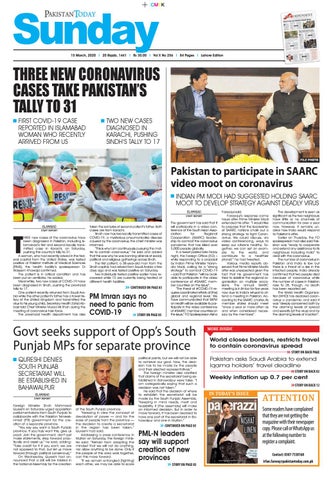
Three new coronavirus cases Take PakisTan’s Tally To 31 g
First coVid-19 case rePorted in islaMabad woMan who recently arriVed FroM us
g
two new cases diagnosed in Karachi, Pushing sindh’s tally to 17 FILE PHOTO O O
Pakistan to participate in SAARC video moot on coronavirus g
indian PM Modi had suggested holding saarc Moot to deVeloP strategy against deadly Virus ISLAMABAD staff report
ISLAMABAD
T
staff report
hree new cases of the coronavirus have been diagnosed in Pakistan, including islamabad’s first and second locally transmitted case in Karachi, on saturday, pushing the country’s tally to 31. a woman, who had recently arrived in the federal capital from the united states, was tested positive at Pakistan institute of Medical sciences (PiMs), the health facility’s spokesperson dr waseem Khawaja confirmed. the patient is in critical condition and has been put on ventilator, he added. Meanwhile, two new cases of coVid-19 have been diagnosed in sindh, pushing the provincial tally to 17. one patient recently returned from saudi arabia while the other patient’s father has a travel history of the united Kingdom and transmitted the virus to his young child, secretary health Zahid abbasi told chief Minister Murad ali shah during the meeting of coronavirus task force. the provincial health department has also
taken the samples of second patient’s father. both cases are from Karachi. sindh now has two locally transmitted cases of coVid-19, a mysterious pneumonia-like disease caused by the coronavirus, the chief minister was informed. “this is why i am continuously pursuing the matter to contain coronavirus,” he said and added that this was why he was banning all kinds of social, political and religious gatherings across sindh. the first patient, a 38-year-old man from the sindh capital, had arrived from saudi arabia a few days ago and was tested positive on saturday. two individuals tested positive earlier have recovered while 15 are currently being treated at different health facilities.
CONTINUED ON PAGE 03
PM Imran says no need to panic from COVID-19 STORY ON PAGE 03
the government has said that it will participate in a video conference of the south asian association for regional cooperation (saarc) leadership to combat the coronavirus pandemic that has killed over 5,000 people globally. in a tweet posted late Friday night, the Foreign office (Fo) – while responding to a proposal by indian Prime Minister narendra Modi, calling for a “strong strategy” to combat coVid-19 – said that Pakistan “will be available to participate in the video conference of #saarc member countries on the issue”. “the threat of #coVid-19 requires coordinated efforts at [the] global and regional level. we have communicated that saPM on health will be available to participate in the video conference of #saarc member countries on the issue,” Fo spokesperson aisha
Govt seeks support of Opp’s South Punjab MPs for separate province g
Qureshi denies south Punjab secretariat will be established in bahawalPur ISLAMABAD staff report
Foreign Minister shah Mahmood Qureshi on saturday urged opposition parliamentarians from south Punjab to collaborate with the Pakistan tehreeki-insaf (Pti) government for the creation of a separate province. “you say you want a south Punjab province. if you truly want this, give us proof. join the government, don’t just make statements, step forward practically and assist us,” he said, adding: “take credit for it if you want, we are not opposed to that, but let us move forward [through political consencus].” on wednesday, Qureshi had announced that a bill will be tabled in the national assembly for the creation
of the south Punjab province. “Keeping in view the concept of devolution of power — and for the ease of people from the province — the decision to create a secretariat in the region has been taken,” Qureshi had said. addressing a press conference in Multan on saturday, the foreign minister said: “refrain from adopting the mindset that we will not do anything, nor allow anything to be done. only if the people of this area work together, can this move forward. “if we remain entangled [fighting] each other, we may be able to score
political points, but we will not be able to achieve our goal. now, the decision has to be made by the people and their elected representatives.” the foreign minister also clarified that claims of the secretariat being established in bahawalpur were false. “i am categorically saying that such a decision was not taken.” he said that the decision of where to establish the secretariat will be made by the south Punjab assembly. “Keeping in mind needs, merit and feasibility, it [the assembly] will make an informed decision. but in order to move forward, it has been decided to have one part of the secretariat in bahawalpur and one in Multan.”
CONTINUED ON PAGE 03
PML-N leaders say will support creation of new provinces STORY ON PAGE 03
Farooqui said. Farooqui’s response came hours after Prime Minister Modi extended his offer. “i would like to propose that the leadership of saarc nations chalk out a strong strategy to fight coronavirus. we could discuss, via video conferencing, ways to keep our citizens healthy. together, we can set an example to the world, and contribute to a healthier planet,” he had tweeted. Various media reports observed that Prime Minister Modi’s offer was unexpected given the fact that his government has tried to sideline the regional organisation on multiple occasions. the annual saarc meeting is in limbo for five years now due to india’s refusal to attend a meeting in Pakistan. according to the saarc charter, its member states should meet “once a year or more often as and when considered necessary by the members”.
the development is seen as significant as the two neighbours have little or no channels of communication for over a year now. however, it remains unclear how india would respond to Pakistan’s offer. earlier on thursday, the Fo spokesperson had also said Pakistan was “ready to cooperate and extend any assistance to its neighbours including india” to deal with the coronavirus. the number of coronavirus in Pakistan and india is low but there is a threat of a rise in the infected people. india already confirmed that two people died because of coronavirus while the number of cases in Pakistan rose to 28, though, no death has been reported yet. the world health organization (who) has declared coronavirus a pandemic and said it was “deeply concerned both by the alarming levels of spread and severity (of the virus) and by the alarming levels of inaction”.
more inside
World closes borders, restricts travel to contain coronavirus spread STORY ON BACK PAGE
Pakistan asks saudi arabia to extend iqama holders’ travel deadline STORY ON BACK 02
Weekly inflation up 0.7 per cent STORY ON BACK 12
in today’s issue
attention Some readers have complained that they are not getting the magazine with their newspaper copy. Please call or WhatsApp us at the following number to register a complaint. Contact: 0307-7338168 irfan.farooq@pakistantoday.com.pk
02
Sunday, 15 March, 2020
NEWS
PAkiStAn ASkS SAudi ArAbiA to extend iqAMA HolderS' trAvel deAdline
t
NEWS DESK
HE Pakistani government has requested the Saudi Arabian government to extend the travel deadline for Iqama holders by March 25 on humanitarian grounds to allow more time to travellers to reach their destinations. The 72-hour deadline set by the kingdom on Thursday is due to expire on Sunday at 3pm. The Saudi government had asked its citizens and Iqama holders (residency permit holders) to return to their respective countries as part of preventive measures to stop the spread of coronavirus. “The decision gives a 72-hour period for citizens and those with valid residency of the citizens of those countries to return to the kingdom, before the travel suspension decision becomes effective,” the official Saudi Press Agency had announced on its website. Aviation authorities of Pakistan and Saudi Arabia, including national and private airlines management, have requested the Saudi officials to allow more time as they were unable to handle the large number of passengers in the given deadline,
which is due to expire on Sunday. According to reports, 142 special flights were operated between Pakistan and Saudi Arabia since Thursday in which as
Pre-arrest bail 'special concession', not for every suspect, SC says
many as 39,980 passengers from both the countries travelled. There are still over 5,000 Iqama holders in Pakistan and similar number of pas-
sengers in the kingdom who want to return to their countries, officials said. On Thursday, Saudi Arabia temporarily suspended travel of citizens and residents and halted flights with several states including Pakistan which also caused passengers to face delay. CAA officials have expressed hope that the Saudi government will seriously consider their request. COVID-19, a mysterious pneumonialike disease which originated in the central Chinese city of Wuhan in December last year, has now spread all over the world. The global death toll is now over 5,500 with more than 145,500 confirmed cases, according to the World Health Organisation, which has declared the outbreak a pandemic. Oil-rich Saudi Arabia has so far reported 24 additional cases, taking the national total to 86. The kingdom, besides extending travel bans to and from the EU and 12 other countries, also closed land crossings with Jordan, allowing only commercial and cargo traffic. The kingdom had already banned travel to some 19 countries, including neighbouring Arab states.
In a first, Pakistan’s parliamentary business suspended due to COVID-19 scare ISLAMABAD MIAN ABRAR
ISLAMABAD INP
The Supreme Court (SC) said on Saturday that pre-arrest bail is a special concession and cannot be given to every suspect. The court said that the law was amended to allow pre-arrest bail for the protection of what is termed innocent. It can be granted to suspects only in special circumstances, the court ruled, without further elaborating special circumstances. The court was hearing a petition for pre-arrest bail filed by Ghulam Farooq Channa who is accused of making a fake death certificate for a woman to take over her assets. The court dismissed Channa’s petition for pre-arrest bail in the case.
For the first time in Pakistan’s history, the parliamentary business of the country has been suspended due to the scare of novel Coronavirus with the legislation as well as the meetings of the standing committees of both houses of the parliament suspended forthwith. An official at the Parliament House told Pakistan Today that the Speaker National Assembly Asad Qaisar had abruptly prorogued the ongoing session of the National Assembly on Friday which was scheduled to continue till March 19. The official said that the decision had been taken in view of the decisions taken at the exclusive meeting of the Cabinet Committee on National Security chaired by Prime Minister Imran Khan and attended by all the services chiefs and high ranking civilian bureaucracy. The National Assembly had to discuss the presidential address besides already decided debates on situation in Indian Occupied Jammu and Kashmir, Delhi carnage, agriculture reforms and foreign policy.
The official said that the National Assembly had also to take up a heavy business of legislation as key bills were up for grabs at the Parliament. The official said that the Speaker also suspended all the Standing Committees of the National Assembly including the Public Accounts Committee. The official said that the Speaker has yet not made up his mind whether the review would take place after April 5, the date set by the Cabinet Committee on National Security for future decisions. An official at the Senate told Pakistan Today that Chairman Senate Sadiq Sanjrani has suspended the Senate session till April 5 and a future decision would be taken after a review of the situation after two weeks’ time. The official said that the parliamentary proceedings and the holding of the standing committees have been suspended for the first time in the country’s 72-year history. The official said that the parliamentary business has never been suspended even in war times but for the first time this step has been taken by both the houses of the parliament due to the serious nature of scare posed by novel Coronavirus.
PPP founding member Mubashir Hassan passes away LAHORE: Veteran politician and Pakistan People’s Party (PPP) co-founder Dr Mubashir Hassan passed away here on Saturday. Hasan, 98, had been unwell and under treatment for the past three days. He is survived by his wife, Dr Zeenat Hussain. Hassan was a confidant of the former prime minister and founding chairman of PPP, Zulfikar Ali Bhutto. It merits a mention here that the party held its inaugural session at Hassan’s residence in Gulberg. He was also one of the contributors to PPP’s first-ever manifesto. Along with JA Rahim and S Mohammad Rashid, Hasan was one of the main architects behind organising the PPP across cities, towns and villages of then West Pakistan. He was elected as a member of the National Assembly in 1970 and served as a finance minister in Bhutto’s cabinet from 1971-74. He helped Bhutto in establishing the Ministry of Science in 1972 and was assigned the responsibility to arrange funding for Pakistan’s nuclear project. He also helped establish the Kahuta Research Laboratories. Later, Hassan developed differences with the PPP and left to join Ghinwa Bhutto’s PPP-Shaheed Bhutto. Three years ago, he also resigned from the Punjab presidency of Ghinwa’s party. Hassan was also one of the founding members of the Human Rights Commission of Pakistan (HRCP) and the Pakistan-India People’s Forum for Peace and Democracy. Besides being a seasoned politician, he was a civil engineer, scientist, journalist and analyst and author of over 10 books. The PPP’s Punjab chapter expressed condolences on Hassan’s death. The chapter’s president, Qamar Zaman Kaira, in a statement said Hassan “became the voice of the oppressed”, adding that his services for the people would always be remembered. The Human Rights Commission of Pakistan in a tweet also “deeply mourned” the veteran politician’s death. Hassan’s funeral was held at his residence on Saturday evening. STAFF REPORT
Coronavirus: CAA suspends flight operations from several airports KARACHI STAFF REPORT
The Civil Aviation Authority (CAA) has announced that flight operations from several airports across the country will remain suspended after the total number of confirmed coronavirus cases reached 31 on Saturday. The CAA said that international aircraft operations will only be available to and from Jinnah International Airport in Karachi, Islamabad International Airport and Allama Iqbal International Airport in Lahore. The notice stated that operations from all other airports will remain suspended to control the spread of Covid-19.
International airline Thai Air also announced a temporary suspension of its operations between Karachi and Bangkok. The decision will be effective between March 16 and March 31, as per their notification. A day earlier, seven new cases surfaced in pilgrims who were put in quarantine at Taftan border on returning from Iran, jumping the total number of confirmed COVID-19 cases to 28 in Pakistan, State Minister on Health Dr Zafar Mirza confirmed. Pakistan’s top civil and military leadership decided to adopt a number of precautionary measures to contain the spread of the novel coronavirus including sealing the country’s western border with Iran and Afghanistan and cancelling the Pakistan
Day parade scheduled for March 23. The World Health Organisation (WHO) has already declared the outbreak
of COVID-19, a mysterious pneumonialike disease caused by the coronavirus, a pandemic.
NCC on coronavirus holds first meeting ISLAMABAD APP
The first meeting of National Coordination Committee on Coronavirus was held here on Saturday to discuss plans to effectively curb the spread of disease by evaluating the situation on day to day basis. Special Assistant to the Prime Minister on National Health Services, Dr Zafar Mirza chaired the meeting of the National Coordination Committee which was constituted on the direction of Prime Minister Imran Khan. The meeting was also attended by the provincial chief ministers through video link. Special Assistant to the Prime Minister on Information and Broadcasting Dr Firdous Ashiq Awan and Special on National Security Division Dr Moaeed Yousaf also at-
tended the meeting besides other members including Secretary Ministry of Information and Broadcasting Akbar Durrani, Secretary National Health Services Dr Tanveer Qureshi, Secretary Finance Naveed Kamran Baloch, Chairman National Disaster Management Authority (NDMA), Surgeon General of Pakistan and Director General Inter Services Public Relations (ISPR). The meeting reviewed the implementation status of decisions of National Security Committee (NSC) and was informed that provinces had started implementing the decisions of the NSC. It was informed that all educational institutions including public and private schools, universities, vocational institutions and Madaris had been closed in the country with immediate effect and till April 5.
The meeting decided to make and implement coordinated and effective strategy to fight coronavirus. It was informed that taking the situation as a national challenge, all possible steps were being taken to ensure implementing national action plan and for this all available resources would be utilized to protect citizens from the disease. The meeting was informed that effective screening mechanism had been adopted at all Points of Entry (POE) to have check on coronavirus patients. Proper screening mechanism has been developed at all airports besides availability of personal protection equipment kits for health staff and regular surveillance. The committee expressed confidence that due to better health strategy there was
CMYK
no chance of outbreak of disease in Pakistan. It was informed that during last one month the federal government had taken several steps and adopted standard operating procedure (SOP) for prevention of the disease. The committee was informed that the federal and provincial governments were on same page and implementing a unified policy to protect Pakistan from the virus. The participants were of view that there was no need of creating any panic and advised citizens to take preventive measures against the disease. It was decided that the Ministry of National Health Services, Ministry of Information and Broadcasting and ISPR will update the public about disease situation. Dr Zafar said that so far 29 confirmed Coronavirus cases had been reported throughout the country. He added that disease diagnostic facility was being provided to Gilgit Baltistan with the support of Na-
Aziz Memon’s body to be exhumed for post-mortem KARACHI: The body of journalist Aziz Memon will be exhumed on Sunday for his second post-mortem examination to ascertain the actual cause of his death. A three-member medical panel led by the medical superintendent of the PMC Hospital Nawabshah has been notified for the purpose. The provincial health secretary, the relevant sessions judge, Kandiaro judicial magistrate, members of the joint investigation team (JIT) probing the alleged murder and others will be present during the exhumation of the body. Earlier this week, a local court had approved a request by the JIT to exhume the body for an autopsy. The investigation team said they found many flaws in the previous post mortem report, which declared the cause of death suffocation but it did not mention more details of how he died. STAFF REPORT tional Institute of Health (NIH). He said isolation rooms had been allocated in hospitals throughout the country, adding eight laboratories had been providing disease diagnostic facilities included NIH Islamabad, Shaukat Khanam Memorial Cancer Hospital Lahore, Public Health Laboratory Lahore, Nishtar Medical College Multan, Public Health Laboratory, Khyber Medical University Peshawar, Agha Khan University Hospital, Karachi, Dao Medical University Karachi and Public Health Laboratory Quetta. He said the evolving situation demanded to form such a high-level body so that the pandemic could be curbed through coordinated efforts after taking unanimous decisions at the national level. He said in case of any suspected coronavirus patient, information should be shared immediately with the health officials, doctors or at Health Ministry’s helpline number 1166.
Sunday, 15 March, 2020
PMl-n leAderS SAy will SuPPort CreAtion of new ProvinCeS ABBASI SAYS PML-N STANDS WITH MEDIA FRATERNITY IN ‘THESE TIMES OF DISTRESS’ MuLtAN
P
STAFF REPORT
AKISTAN Muslim LeagueNawaz (PML-N) senior leader Shahid Khaqan Abbasi on Saturday urged all political parties to work together for the establishment of new provinces, saying the incumbent government is not a true representative of the masses. Addressing a joint press conference with Javed Hashmi and Ahsan Iqbal, the former prime minister said that the PML-N was not fighting for power but for the supremacy of law and constitution. “Elected representatives of the people should solve problems of the
masses. The present government came into power as a result of controversial election,” he said, adding that a single political party cannot establish a new province. Abbasi said that the country is suffering from flour and sugar crises but government is busy in suppressing political opponents by making false accusations of corruption. He said that sending Mir Shakilur Rehman to jail is government’s message to the media that if you air the truth then the same fate awaits you. NAB had on Thursday arrested the editor-in-chief of the Jang Geo Media Group in connection with property allegedly bought illegally from a government entity more than 34 years ago.
Court orders nAb to allow family's meetings with Mir Shakilur rehman
“The government is so obsessed with the media that it has used every tactic to put curbs on it,” he said. Abbasi said that this is not only applicable to Mir-Shakilur Rahman and that the overall situation of the media is bad. “His (MSR) newspaper portrays the truth. They tried to pressurise him to stop him from telling the truth. And when they failed, the government made a fake case against him,” he said. “They (government) cannot bear criticism. All of you must have seen that they have shifted GEO News to the last numbers (on cable TV),” he said. “What happened the day before yesterday (Thursday), I believe is the darkest chapter in the history of Pakistan’s democracy,” he noted. The former premier vowed that in these times of distress he would stand with the media fraternity. Shedding light on the cases made against the PML-N leadership he said: “Imran Khan has not been able to prove corrup-
tion against us, even after 1.5 years of PTI-led government.” “They cannot scare the PML-N by putting its leadership behind bars,” he added. Addressing the reporters, Ahsan Iqbal said that the opposition would offer unconditional support to the government if it was serious in establishing the South Punjab province. Iqbal said that today there is a war between “fascism and democracy” in the country and the government has opted for the former. “We cannot bear to lose this war, we have to win it for our future generations,” he said. “The enemies of Pakistan have invested in Imran Khan and through that investment, he was imposed on the people of Pakistan,” he noted, adding: “Everyone has seen that in 1.5 years he has ruined every sector of the country.” The PML-N leader said that if things move forward in the same way then the “country’s atomic power might be in danger”.
PML-N, Opp have split narratives, says Firdous
LAHORE: An accountability court on Saturday directed the National Accountability Bureau (NAB) to facilitate the meetings of Jang Group editor-in-chief Mir Shakilur Rehman with his family members according to the law. Rehman was arrested by the anti-corruption watchdog on Thursday when he appeared before NAB in a 34-year-old case relating to a 54kanal land allegedly allotted to him in 1986 by then-Punjab chief minister Nawaz Sharif. The court had on Friday granted NAB 12-day physical remand of Rehman. On Saturday, Rehman’s son Mir Ibrahim Rehman, mother Mrs Khalilur Rehman and wife Shaheena Shakeel filed an application in the court, seeking permission to visit the media mogul on a daily basis. The application stated that Rehman is “an old and sick person, who needs medicines and other ancillaries for the safety of his health on daily basis”. Due to his poor health, the visits by his family on a daily basis are necessary to ensure the provision of medicines, food and other items, it added. “If the above-said facilities are not allowed to be provided on [a] daily basis to [Rehman] then his health may deteriorate day by day which cannot be tolerable for him. STAFF REPORT
ISLAMABAD APP
Special Assistant to the Prime Minister on Information and Broadcasting Dr Firdous Ashiq Awan Saturday said the Pakistan Muslim League-Nawaz lacked a unanimous narrative as its own members had been demanding the return of its leader Shehbaz Sharif from abroad. “The PML-N believes in only one narrative which is ‘to conceal assets and evade NAB (National Accountability Bureau),” Dr Firdous said in a series of tweets. Instead of sending show cause notices to its members of parliament, she said the PML-N should have served it to Shehbaz Sharif asking him to return from abroad. Referring to former prime minister Nawaz Sharif, Dr Firdous said the party which pretended to be bearer of democratic norms, should have also sent notice to its leader who laid foundation of ‘Changa Manga’ politics in the past. “The PML-N members are matchless who by securing their personal gains, have devoured the national economy, growing richer at the cost of poor public. They have also pushed the people into a ‘quagmire of loans’ by transferring money through TTs (Telegraphic
As part of precationary measures, the Sindh government has closed all educational institutions till May 30. The federal government, a day earlier, decided to adopt a number of precautionary measures to contain the spread of novel coronavirus including sealing the country’s western border with Iran and Afghanistan and cancelling the Pakistan Day parade scheduled for March 23. The National Security Committee (NSC) meeting, chaired by Prime Minister Imran Khan, was attended by the provincial chief ministers and the civilian and military leadership. The huddle decided that all educational institutions in the country will be closed till April 5, while Pakistan’s border entry points with Afghanistan and Iran will be closed for two weeks. In a series of tweets, Federal Minister for Education Shafqat Mehmood
said that all schools and universities, public and private, vocational institutions and seminaries will remain closed till April 5. He said that the situation regarding the closure of all educational institutions in the country would be reviewed by the Ministry of Education on March 27, and further decisions will be taken after that. Speaking about the ongoing examinations of 9th grade in Punjab, the minister said that respective schools and boards shall ensure that arrangements are made for the exams to be taken as per schedule. According to an order issued by the NSC, the border closure would come into effect on March 16 “in the best interest of all three brotherly countries”. It was decided during the meeting that only three airports in the country — Karachi, Islamabad and Lahore — will be allowed to operate international flights in limited numbers, while other airports will only allow
03
PM imran says no need to panic from CovidPrime Minister Imran Khan on Saturday announced that he will address the nation ‘soon’ on the outbreak of the novel coronavirus, urging people to follow the safety instructions issued by the government. Taking to Twitter, the prime minister informed his followers that he was “personally overseeing measures to deal with COVID 19”. I want to inform the nation I am personally overseeing measures to deal with COVID 19 & will address the nation soon. I would advise people to follow safety instructions issued by our govt. While there is a need for caution there is no need for panic. — Imran Khan (@ImranKhanPTI) March 14, 2020 “While there is a need for caution there is no need for panic,” he tweeted. PM Imran said that his government was alert to the dangers of the virus and that “sufficient protocols” for the safety of the people had been put in place by the government. We are alert to the dangers & have put in place sufficient protocols for the safety and health of our people. The WHO has commended our efforts as being amongst the best in the world. — Imran Khan (@ImranKhanPTI) March 14, 2020. NEWS DESK
two new polio cases reported in kP, Sindh ISLAMABAD: Two new cases of poliovirus have been detected in Khyber Pakhtunkhwa and Sindh on Saturday. In KP’s Khyber district, a three-year-old girl was diagnosed with the poliovirus. She was previously administered polio vaccine during the anti-polio campaign. This is the seventh polio case reported in Khyber district and 16th in the entire province. The overall tally of polio cases across the country reaches 29. Meanwhile, the Sindh Emergency Operation Centre for polio confirmed one new polio case for the year 2020 in District Nowshero Feroz. This takes the total tally of Sindh to 9 and Pakistan to 30 for the current year. According to a statement released by the EOC, a four-year-old girl contracted the polio virus. So far the child has received seven doses of oral polio vaccine (OPV) according to parents with no inactivated polio vaccine (IPV) administered, as investigation is still in progress. STAFF REPORT
Govt seeks support of Opp’s South Punjab MPs for separate province CoNtINuED fRoM pAgE 1
Transactions),” she stressed. The special assistant said the people got rid of the PML-N government by standing against its fascistic rule. The special assistant said it was evident from the history that both the PML-N and Pakistan People’s Party had only admitted the results of those elections in which they stood victorious. The opposition also kept on harping the split narratives, she added.
Three new coronavirus cases take Pakistan’s tally to 31 CoNtINuED fRoM pAgE 1
NEWS
domestic flights. The pilgrims who have returned to the country from Iran will be screened again, and will be placed under quarantine if they test positive for the virus. Officials said foreign missions in Pakistan and Pakistan’s missions abroad have been directed not to host any ceremonies or functions. Similarly, large public gatherings will be discouraged. The NSC decided to give the National Disaster Management Authority (NDMA) the lead role in dealing with the coronavirus threat, adding that the authority will coordinate with the provincial governments to streamline the efforts. A system for coordination between the federal and provincial governments will also be established. The meeting also decided to close the Kartarpur Corridor for Pakistanis, however Indian pilgrims will be allowed to continue visiting the Sikh holy site.
The NSC also decided to request the chief justice of the Supreme Court and chief justices of the provincial high courts to instruct all courts not to schedule cases of civil nature for three weeks. They would also be requested to direct judicial magistrates and session court judges to visit the concerned jails for three weeks to process remand and bail cases. No visitors will be allowed to visit prisoners in jails for three weeks, the meeting decided. The World Health Organisation (WHO) has already declared the outbreak of COVID-19, a mysterious pneumonia-like disease caused by the coronavirus, a pandemic. Originated in China late last year, the pandemic has so far claimed over 5,500 lives while hitting more than 130 countries around the world. Out of total around 150,000 infected, around 75,000 have so far recovered.
The foreign minister said that by doing so, the government had demonstrated a “determined, political decision”.“In the future, no one will be able to reverse this decision.”Commenting on South Punjab’s representation in the Senate, Qureshi maintained that this was only possible if the region becomes a federating unit. Elaborating on his point, he added that only federating units can claim funds from the National Finance Commission (NFC). “Since we want to move forward, we have decided that 35 percent of the funds from Punjab’s annual development program will be allocated for South Punjab.”He maintained that in the past, governments had made allocations for the southern districts. However, that money was later reappropriated.“To prevent this, it has been decided that development funds for South Punjab will only be spent in the province’s southern districts.” All these decisions show the PTI’s serious attitude towards this matter, he maintained.
whiteLIES Apollo
For feedback, comments, suggestions and, most importantly, tips, contact us at whitelies@pakistantoday.com.pk
Corona has caused a lockdown and the elite Begumaat of Lahore and the rest of the country don’t quite know how to show off their jewellery and clothes now that weddings, engagements and other such ceremonies are being delayed. Pandemics be damned! ************* Meanwhile, several cabinet members and the prime minister himself took to Twitter to bask in the glory of a WHO official claiming that Pakistan had one of the best responses to Corona in the world. Only to be informed by the rest of the twitterati that it was the Sindh government the official was referring to. Ouch. ************* Speaking of the PTI itself, former KP CM and current ‘kicked upstairs’ federal defence minister Pervez Khattak had a political gathering organised in his hometown Nowshehra, despite the provincial government’s ban on public gatherings. At the event, he also spoke about how the government was taking steps to fight Corona. One of the steps he named was the ban on public gatherings....
04 LAHORE
Sunday, 15 March, 2020
WEATHER UPDATES SUNDAY
210C
110C
Opp should not to do politics over coronavirus: Governor LAHORE APP
Punjab Governor Chaudhry Mohammad Sarwar said on Saturday that opposition should not do politics on corona virus and support anti-coronavirus efforts of government institutions. Talking to various delegations led by PTI MPA Saeed Ahmed Saadi, PTI Vice President Chaudhry Ashfaq and others here at Governor House, he added, “Tough times come in nations’ lives. Political, religious and all other parties will have to get united to defeat coronavirus.” Punjab Governor Chaudhry Moham-
mad Sarwar said the government was utilizing all resources to get rid of coronavirus and all the public sector institutions were fully alert to control corona virus. “People’s protection is responsibility of the state and the government will fulfill its responsibility at all costs,” he vowed. Sarwar said that in addition to government, people from every walk of life must also play their role in creating awareness among the masses about safety measures against coronavirus, and “In Sha Allah, together we all will do away with challenge of corona virus and people will be protected from this virus.”
MONDAY
230C
140C
TUESDAY
240C
140C
PrAyer Timings FAJR SUNRISE
ZUHR
ASR MAGHRIB ISHA
4:54
12:12
4:28
6:15
Private edu institutes flouting govt’s closure directive LAHORE shAhAb Omer
d
eSPITe the imminent threat of coronavirus across Punjab, many private schools in the province remained open on Saturday whereas the government had directed schools to remain closed till April 5, Pakistan Today has learnt. Various marriage halls and cinemas were also seen flouting the order, however, the district administration sealed the halls that had done so. According to the details, Lahore Grammar School (LGS) eMe
FACULTY MEMBERS ARE ALSO BEING GUILT TRIPPED TO COME TO EMPTY INSTITUTES IN THE NAME OF SALARIES branch, Akhter Saeed College of Nursing, American Lycetuff Azmeer Town branch and KIPS College Johar Town were among the schools that did not shut down and called for selective classes to be held as per schedule. Many educational institutions have directed faculty members to remain on duty even if students are not present. Rukhsana Naeem, a teacher at a private school in Johar Town said, “Schools are of the opinion that since they pay
us heavy amounts of salaries, we must be present there despite all odds. Our parents and family members are concerned about us but we cannot take days off from work”. Similarly, a private university teacher Farooq Ahmed said that the university was off for students but not for faculty members. “If any faculty member catches coronavirus his or her entire family would surely suffer and I think the management should understand this fact. Despite the
medical emergency in the province, despite there being no students, we are asked to come to work,” he said. The govt, however, has warned that no institute would be allowed to function before the said time. Lahore Deputy Commissioner (DC) Danish Afzal said that strict actions would be taken against the educational institutes who violate the government’s directions. “educational in-
6:09
7:30
stitutes have been closed by the government for both students and faculty members. No violation will be accepted in this regard. Our teams are in the city and closing all institutes that are still conducting classes,” he said. “We have sealed Cinepax in Packages Mall and Q Cinema because they ignored orders. Similarly, our teams have sealed 36 marriage halls across the city out of which 19 were in Raiwand, four in Cantt and 13 in other parts of the city. Our teams and assistant commissioners (AC) will monitor these places at night,” he said. The Lahore DC also revealed that his teams had appealed to the people for informing their relatives to postpone marriage ceremonies and other family gatherings.
Sunday, 15 March, 2020
NEWS
05
Sindh govt orderS cloSure of marriage hallS, ShrineS for 3 weekS KARACHI
S
STAFF rePOrT
INDH Chief Minister Murad Ali Shah on Saturday directed officials to establish a quarantine room in each district to combat the spread of coronavirus, as the province reported another case of the virus. In addition, the government has also decided to close all marriage halls, shrines and cinemas for the next three weeks. Chairing a meeting of the provincial task force on COVID-19 on Saturday, the Sindh chief minister directed the Sukkur commissioner to begin screening Zaireens coming in from the Iran-Pakistan border at Taftan, adding that he was personally monitoring the situation and will stay in touch with the Sukkur commissioner over the matter. Addressing the health department, the Sindh chief minister said there were a total of 853 Zaireens at the border. Therefore, more preparations were needed in this regard to prevent any untoward situation, he added. Shah said he had sent his helicopter
MQM-P hints at besieging Sindh CM House KARACHI STAFF rePOrT
Accusing Sindh Public Service Commission (SPSC) of violating merit, Muttahida Qaumi MovementPakistan (MQP-P) convener Dr Khalid Maqbool Siddiqui on Saturday said that institutions have been handed over to incompetent and corrupt people in the name of merit. Addressing a press conference in Karachi, Maqbool Siddiqui said that SPSC is the most corrupt institution in the province. He maintained that officials in SPSC had been appointed on political basis. Recently, over 75 police officers were transferred to Karachi from Larkana to recruit more police officers in interior Sindh, the MQM convener added. Pakistan Peoples Party
(PPP) led Sindh government is compelling them to take to the street, he said and added that they will besiege Sindh CM House if allowed by the Rabita Committee. Last year on June 21, Mayor of Karachi Wasim Akhtar had said that Sindh government was neither working nor letting them work. Talking to journalists during his visit to Lines Area, Wasim Akhtar had said that the whole city was going through agony due to the poor performance of the provincial government. He had alleged that the Sindh government was deliberately creating problems for the people in Karachi and added that water crisis and prolonged power breakdowns were the major issues of the city.
KP Iqama holders in a fix as Saudi deadline nears THE COUNTRY WILL FURTHER BE BURDENED AND DEPRIVED OF MILLIONS OF DOLLARS IN REMITTANCES IF WORK PERMITS OF IQAMA HOLDERS EXPIRE PESHAWAR Aziz Buneri
Following the Saudi government’s orders for iqama holders to return within 72 hours, passengers are not only forced to buy airline tickets at 100 to 150 per cent increased prices, but are also unable to get confirmed flights due to the closure of service at the Peshawar airport. Iqama holders in Khyber Pakhtunkhwa (KP) have lined up outside offices of Air Blue, Pakistan International Airline (PIA), and Saudi Airline but are not getting tickets at normal prices as the schedule of all flights from Bacha Khan International Airport has been suspended in light of the National Security Council’s (NSC) decisions that directed all international flights to be shifted to Lahore, Karachi and Islamabad. It may be noted here that around 15,000 iqama holders need to return to Saudi Arabia before the 72 hour deadline announced on Thursday for residents from 12 countries, including Pakistan, to return to the Kingdom. The decision was taken amid fears of the global coronavirus pandemic. On the other hand, while both the airlines and government have failed to facilitate iqama holders and save their work permits, airline tickets have started being sold in black. Amjad Afridi, who works in the Saudi city of Dammam, told Pakistan Today that in addition to having an immensely short deadline to return, people are being forced to purchase a ticket at Rs150,000 in order to save their work permits and Saudi visa.
He also lamented that flights are not confirmed although tickets are being sold in black and asked the government to take action to solve this sudden crisis. Amjad said that most iqama holders work as labourers in Saudi Arabia and were in the country for vacations. “Millions of educated young people are already unemployed in Pakistan. If their visas expire, the country will further be burdened and deprived of millions of dollars in remittances,” he warned. Iqama holders who have been queuing outside airlines offices revealed that attention is paid to touts rather than to facilitate the public whereas their grievances have fallen on deaf ears despite complaints made to law enforcement agencies. Afzal Rahman, another Iqama holder, said that he had purchased a return ticket from Emirates while coming for vacations and is now in a conundrum as only PIA, Air Blue and the Saudi Airline are allowed to fly into Saudi Arabia. “We are living in fear of our livelihoods being terminated. I request the government to provide us relief. We are not just individuals, we have families depending on us,” he cried. Similarly, iqama holder Gulzman told Pakistan Today that he has been working as a contractor in Saudi Arabia for the past several years and has never seen such a situation before. “Our government has not taken a single step to facilitate the people who are trying to meet the deadline and if the Saudi government doesn’t extend the deadline, thousands of poor people will be deprived of their work permits,” he observed.
to Sukkur to bring back blood samples of the Zaireens arriving from the Taftan border. Meanwhile, Sindh government spokesperson Barrister Murtaza Wahab added that the Sindh government had also decided to close all cinemas, marriage halls and shrines for the next three weeks. Speaking to reporters in Karachi, Wahab said the first batch of Zaireens from the Iran-Pakistan border at Taftan had entered the province and a separate quarantine facility had been established for them in Sukkur. He said: "A total 308 people were moved from the Taftan Border to the quarantine facility in Sukkur. They will be kept here for the next 14 days. If they test negative for coronavirus, they will be allowed to leave." Wahab said there were a total of 853 Zaireens at the Taftan Border, who will later be shifted to the quarantine facility, adding that the facility had the capacity to hold 2,048 people. "Fully equipped isolation centres have been established at these institutions and, in addition to ensuring the provision of medicine, ventilators have also been made available," he said. The Sindh spokesman added that two
separate hospitals had been established to deal with the coronavirus, refraining from disclosing the exact location of the facilities. "Around 16 ventilators have been provided to these facilities," he added. The Sindh government on Saturday also issued advisories for prisoners and prison staff, visitors to hotels and guest houses, and the general public. According to the advisories, all prisoners must be kept in their cells at a distance of one metre away from each other. Further, all people including prison employees who arrived in the country within the last 15 days, particularly those with a cough, fever or shortness of breath, will not be allowed to enter prisons. The advisory also urged people to stay at home and refrain from going to crowded places and urged all those who had entered the country in the last 15 days to self-quarantine.In addition, it directed management of all hotels and guest houses to check staff and visitors for a fever before allowing them to enter their premises. The Sindh government urged all citizens to take precautionary measures such as washing their hands, limiting their movement, and avoiding touching their faces.
Sunday, 15 March, 2020
06 WORLD VIEW
Delhi’s shame is inDia’s shame
Hindu
m
Minister, also engaged in verbal pyrotechnics. Opposition leaders were no less irresponsible. Provocations from both sides of the political divide thus largely fanned the violence. The Central government demonstrated an obvious unwillingness to step in to quell the violence, despite the fact that law and order in Delhi is primarily the responsibility of the Home Ministry. The Home Minister is reported to have kept himself abreast of the situation in northeast Delhi, but seemed to have done little else. Political analysts have speculated that this may be due to the Bharatiya Janata Party’s angst, consequent on the rebuff it received in the recent Delhi elections. While the Union Home Ministry seems to have endorsed the muscular law and order tactics adopted by the Delhi police once the riots broke out, what is surprising and unfortunate is that the Aam Aadmi Party government, which had been elected on a promise of restoration of social harmony, and had sought to distinguish itself from the policies followed by the BJP government at the Centre, sat out the conflict, at a time when social harmony was at high risk, and sizeable segments of the population in northeast Delhi were facing extraordinary high levels of risk to their lives and livelihoods. The Chief Minister’s failure to apply the necessary balm to try and contain the situation has certainly stained his image. In security and law and order parlance, intelligence and police constitute the vital last 10%. Compounding the failure of the political and administrative leadership has been the ineptness displayed by the police and intelligence agencies. No agency could have missed the steady build-up — not only of tensions but also of actual preparations for violence — well before the incidents of February 23 and subsequent days (which took a toll of over 50 lives). A mixture of police overreaction (within the precincts of Jamia Millia University) and of police inaction in Jawaharlal Nehru University had already sounded the bugle for what lay ahead. The Delhi police would also, no doubt, have known that the
M K NarayaNaN
OrE than 100 days since protests against the Citizenship (Amendment) Act, or the CAA began, and weeks after the worst ever communal riots in Delhi since 1984, questions are being raised as to what went wrong. It is quite evident by now that collective failure lay at the root of what could have been restricted in scope, if not entirely prevented. THE MIX THAT IGNITED: Some saw in the Delhi riots the shadow of 1984. The comparison is, however, flawed. The 1984 Sikh riots took the authorities by surprise, while the country has been in a kind of ‘slow burn’ ever since the CAA was passed by Parliament in December 2019. Over time, protests against the CAA became larger in scope, specially in urban centres such as Delhi, Mumbai, Chennai and Bengaluru, but no attempt was made on the part of the authorities to defuse the situation. A mixture of political insensitivity, deliberate apathy in allowing the situation to simmer, social disharmony, pronounced incompetence of those responsible for law and order, and, above all, a highly polarised atmosphere, helped stoke the embers of conflict. The statement of Supreme Court judge, K.M. Joseph, that timely action by the Delhi police could have saved lives, set-off a flurry of accusations by others against other organs of the state as well. Even the Delhi High Court and the Supreme Court came in for a share of blame, albeit for not intervening effectively to contain the violence. One former Justice of the Supreme Court argued that had the judiciary been more proactive, lives lost in the recent violence could have been saved. The Chief Justice of India, Sharad Bobde, opined that courts were not ‘equipped’ to handle palpable ‘pressure’ being created to somehow step in and prevent violence. THE POLITICS: Sections of the political class seemed to revel in the unsavoury scenes witnessed during the riots. Some leading members of the ruling party, including at least one Member of Parliament and a Central
‘peaceful demonstration’ in Shaheen Bagh was an aberration of sorts, and that they should be prepared for violence once protests spread to other areas. A LAPSE: Arguments adduced subsequently that nearly 7,600 members of the Central Forces — Delhi has about 80,000 police officers and men — were deployed to contain the riots, cannot obscure the extent of failure. Preparations for violence and the polarising rhetoric had made it all too evident that violence could be expected. Provocation was there in plenty from both sides. What was unpardonable, however, was that prominent leaders belonging to the ruling dispensation were allowed a free rein by the authorities to vent their ‘bilious views’ in public, which were heavily laced with communal overtones. Blaming the police is par for the course whenever a major riot occurs. Sometimes the police are taken unawares, but this time the police had ample warning, from their own accumulation of day-to-day information and presumably from central intelligence agencies as well. What then explains police ineptness on this occasion? The Delhi police does function under a kind of diarchy, controlled not by the Chief Minister, but by bureaucrats in the Union Home Ministry, who operate through the Lt. Governor. In effect, no one remains in control. Yet, even this does not quite explain why the Delhi police failed to see what was coming. The most widely held view is of political interference with actions being dictated by political considerations. If this indeed is the case, it seems to have been a very high a price to pay. Even then, the Delhi police needs to provide a true explanation for their utter ineptitude. TARGET FOR ALL: The riots in Delhi did not fall into the category of nuclear science. If it were the latter, one could at least have attributed this to intelligence failure. The steady build-up of tension was all too obvious. Areas that needed to be properly screened for the presence of agent provocateurs and trouble-makers ever ready to exploit such situations were known. Even a far less endowed police force, would have been able to effectively handle a situation that has since become a symbol of
shame for Indian democracy, inviting the wrath of not only bodies such as the Office of the United Nations High Commissioner for Human rights, but also allowing countries with little pretence to secular democracy to point fingers at us. This is hardly a place to discuss modern policing techniques. It is inconceivable, however, that the Delhi police would not have carried out proper data mapping, so critical for efficient law and order management, one which all modern police forces adopt. This is the fundamental basis of all intelligence-led policing today. It is difficult to believe otherwise. Admittedly, however, to use an age-old idiom, there are many ways to skin a cat and, possibly in this instance, the Delhi police were perhaps directed by their political superiors to adopt another tack. Delhi’s shame is India’s shame. Trouble-makers taking advantage of this lapse may feel encouraged to try and repeat the same in the future. The Delhi police need to set their house in order for, alongside other police forces across the world, they need to prepare for a future in which technological advances are creating an entire new paradigm of threats. In the age of rampant social media, they need to be ready to deal with the ‘weaponisation of social media’ — this may have already occurred in the Delhi case. In the era of artificial intelligence, they will also need to prepare for the so-called ‘deception revolution’, including dealing with ‘deep-fake’ threats, where digitally manipulated audio and video material designed to be as realistic as possible, becomes near impossible to separate from the truth. This would create a whole new portfolio of dangers. As we face untold new dangers, it would be unfortunate that through a combination of factors, including unwarranted interference in its role and activities, India’s law and order showpiece, the Delhi police, is portrayed as inefficient and ineffective, even to deal with a mundane communal riot. M.K. Narayanan is a former National Security Adviser and a former Governor of West Bengal
Why are there so many cases in Italy? ITALY HAS BY FAR THE LARGEST NUMBER OF NOVEL CORONAVIRUS CASES IN EUROPE. BUT WHY? THERE ARE MANY REASONS, AND RECOGNIZING THEM COULD BE VITAL FOR OTHER COUNTRIES AROUND THE WORLD spiegel Julia Merlot
More than 10,100 people. That is how many people in Italy have been infected by the novel coronavirus, according to numbers released by the World Health Organization (WHO) on Wednesday. It is the highest number outside of China. And it is by far the most of any country in Europe. By way of comparison, France has the second-highest number of cases in Europe, with around 1,700 and Germany is in fourth with 1,300, behind Spain. And there is another number that pops off the page: 631. That is the number of people in Italy who have died thus far. That isn't just the highest number in Europe by far in absolute terms, it calculates to a death rate of 6 percent, which is unusually high. In China, where there have been 81,000 infections thus far, according to WHO, the death rate is under 4 percent, and WHO has calculated a global rate of between 3 and 4 percent. That means that out of 100 people proven to be suffering from COVID-19, an average of three to four will die. WHY IS ITALY DIFFERENT? The difference between the rate in Italy and the rate calculated by WHO may seem small. But if you apply the lower rate of 3.5 percent to the number of cases discovered in Italy thus far, it would mean 270 fewer deaths. The more people get infected, the greater the discrepancy in absolute numbers will become. What, then, makes the outbreak in Italy different? Before we try to answer that question, it is important to make a crucial point: Experts assume that there is a huge number of cases out there that haven't yet been discovered. The real global death rate could actually be far lower than the numbers mentioned above. Virologists actually believe the number is closer to 0.7 percent or so. There are, though, several possible reasons for the extremely high death rate among those confirmed to be infected with the coronavirus. One is the population's average age: Italy's is the oldest in Europe, with a median age of 46.3 years. Because it's a median, it means that half of the
country's population is older than that. In Europe as a whole, the median age is 43.1 years. Logically enough, in older societies, there are more people suffering from preexisting health problems and who are susceptible to severe symptoms. PREVENTING EXPONENTIAL EXPANSION: On top of that is the fact that in Italy, the number of infections climbed extremely rapidly early on, much more quickly than in Germany or France. A mass spread of the virus is the biggest risk it currently poses. If too many people get sick all at the same time, there is a danger that not all critical cases can be appropriately treated in hospitals because of a shortage of resources. That's why the focus in Germany is currently on slowing down the spread of the disease through measures such as social distancing, the cancellation of large events and much more assertive hygiene practices. The idea is to prevent exponential expansion (explained in detail here) of the kind that occurred in Italy. The rapidity of the spread has been a key reason why the Italian health-care system has struggled to keep up. "CORONA HIT US LIKE A TSUNAMI": The numbers from the Chinese province of Hubei, where the epidemic got its start, seem to indicate the same thing. Of the 68,000 people in the region who have been infected with the virus, more than 3,000 have died -- a death rate of around 4.5 percent. One can assume that the hospitals there were also overwhelmed during the rapid spread of the outbreak in Wuhan. The situation has calmed significantly since. But the rapid spread is continuing in Italy. In the last 24-hour period for which numbers have been released by WHO, there were almost 980 new cases. The high numbers are primarily the result of the virus having spent several weeks circulating more or less invisibly. The first three cases in the country were discovered in late January, including two Chinese tourists. They were isolated and all those they had come into contact with were tracked down. Shortly thereafter, Italy became one of the first countries in the world to put a stop to all flights to and from China.
THE RIOTS WERE STOKED BY A SERIES OF FACTORS, BUT IT IS THE STARK POLICE INEPTITUDE THAT MUST CAUSE MUCH INTROSPECTION
THE ITALIAN LOCK-DOWN: It looked initially as though the outbreak was under control, but it wasn't. In the northern Italian province of Lombardy, the virus has apparently been secretly spreading via a different chain of infection. It remains unclear who brought the virus to the region, but there are a number of possibilities. Northern Italy is home to the country's economic epicenter and is also full of tourist sites. It hosts a lot of international visitors. Experts believe such a thing could have happened anywhere. But there were also misunderstandings that gave the virus valuable time to continue spreading. The government and local hospitals were apparently not on the same page when it came to when people should be tested for coronavirus and when not. The result was that, when a sick 38-year-old man visited his family doctor in mid-February before then making several visits to the local hospital, he wasn't tested for the virus because he hadn't been in China. During that time, he infected several people he came into contact with before finally being isolated, 36 hours later. He became known as "Patient Zero" in the Italian media. Undiscovered cases are so dangerous because each person infected with coronavirus passes it along to an average of three other people. That results in a chain reaction: from three to nine to 81 to …. The higher the number gets, the more difficult it becomes to control the outbreak. Furthermore, undiscovered cases distort the statistics. It is quite possible that the death rate in Italy is actually far below the value that has thus far been calculated because numerous cases with no or only mild symptoms haven't been discovered. On Wednesday night, Italy isolated the entire country and placed limitations on travel and assemblies of large numbers of people. Apart from supermarkets and pharmacies, all shops and restaurants have been closed down. Christian Althaus, who models the spread of diseases at the University of Bern, told the Guardian that he considers the sealing off of regions hit hard by the disease to be the correct move.
Be shameless: Don’t judge your body by the stare of others Times of india Body positivity is easier said than done. But the quest must go on. Because to constantly compare ourselves negatively to others, to hate the body in the mirror, is too painful. At best the perpetual feeling of inadequacy means anxiety and depression. At worst it can be paralysing, making a person incapable of study or work. Incorporation of body diversity in media and public figures speaking out, are important means for battling the toxic ecosystem that breeds body shame. For teen idol Billie Eilish challenging societal “assumptions about people based on their size” has been a running theme. She’s known for signature baggy clothes, which are a big contrast to how other leading female pop stars dress. In an ad she explained this choice as protection: “Nobody can be like, she’s slim-thick, she’s not slim-thick, she’s got a flat a**, she’s got a fat a**.” But there is also big solidarity with girls who dress otherwise. And she took that further by taking off her own layers in a recent video, “While I feel your stares, your disapproval or your sighs of relief, if I lived by them, I’d never be able to move.” In the face of relentless judging, sometimes after much struggle the best we can achieve is body tolerance. That’s OK too. Healthier. Meanwhile the divas are crushing the trolls. Like Sonakshi Sinha said in the face of being called elephant and cow on the catwalk, she is #BiggerThanThem. Pun happily intended.
Sunday, 15 March, 2020
FOREIGN NEWS 07
US SUmmOnS CHIneSe enVOy OVer BeIjIng'S COrOnaVIrUS COmmenTS WASHINGTON
T
AGENCIES
he US State Department summoned the Chinese ambassador to the United States on Friday to protest against comments by Beijing suggesting the US military might have brought the coronavirus to Wuhan, as tensions between the two global powers over the outbreak intensified. David Stillwell, the top US diplomat for east Asia, delivered a very “stern representation” to China’s ambassador Cui Tiankai, a State Department official said, adding that Beijing’s envoy was “very defensive.” The State Department official, who spoke on condition of anonymity, said China was seeking to deflect criticism of its role in “starting a global pandemic and not telling the world.” “Spreading conspiracy theories is dangerous and ridiculous. We wanted to put the government on notice we won’t tolerate it for the good of the Chinese people and the world.”
Defense Department Spokeswoman Alyssa Farah wrote on Twitter on Friday that “the Communist Party of China has chosen to promulgate false & absurd conspiracy theories about the origin of COVID-19 blaming US service members. #ChinaPropaganda” The virus, also called COVID-19, has infected 138,000 people worldwide and killed more than 5,000. China’s embassy did not respond to requests for comment. Despite the signs of tension, US President Donald Trump praised Beijing on Friday for its “data sharing”. Asked by a reporter during a White house news conference about “odd narratives” being offered by some Chinese officials, Trump appeared to brush off any concern, saying he had read one article on the subject, but that he did not think it was representative of his discussions with Chinese President Xi Jinping. Trump, who in a national address this week called the outbreak a “foreign virus” that started in China, added: “They
know where it came from, we all know where it came from.” Tensions escalated after Chinese Foreign Ministry spokesman Zhao Lijian took to Twitter on Thursday. “When did patient zero begin in US? how many people are infected? What are the names of the hospitals? It might be US army who brought the epidemic to Wuhan. Be transparent! Make public your data! US owe us an explanation!” Zhao tweeted in english. The episode is the latest in an increasing war of words between
Washington and Beijing, whose already strained ties over issues including trade, intellectual property rights and press freedom have further been tested by the virus outbreak. The coronavirus, which emerged in China in December, has spread around the world, pummeling financial markets, halting industry, bringing some flights to a standstill, closing schools and forcing the postponement of sports events and concerts. Zhao’s comments came days after Robert O’Brien, the US national security adviser, said China
had reacted slowly to the coronavirus, probably costing the world two months when it could have been preparing. Wuhan was ground zero for the outbreak, which the World health Organization this week labeled a pandemic. It has infected more than 127,000 people worldwide, including nearly 81,000 in mainland China, and killed more than 5,000 people. Beijing was criticized for initially attempting to censor some Chinese doctors who sounded an alarm over the virus. Since January, it has imposed draconian containment measures, effectively locking down Wuhan and the surrounding hubei province, home to 60 million people. US Secretary of State Mike Pompeo has complained that the US response had been hindered by what he called imperfect data from Beijing. he and several other US politicians have angered Beijing by referring to the “Wuhan virus.” In a national address on Wednesday, Trump called the outbreak a “foreign virus” that started in China.
Some Rome churches reopen after angry pope steps in ROME AGENCIES
Hindu group offers cow urine in a bid to ward off coronavirus NEW DELHI: A hindu group hosted a cow urine drinking party on Saturday as they believe it wards off the coronavirus, as many hindus consider the cow sacred and some drink cow urine believing it has medicinal properties. experts have repeatedly asserted that cow urine does not cure illnesses like cancer and there is no evidence that it can prevent coronavirus. The “party,” hosted by a group called the Akhil Bharat hindu Mahasabha (All India hindu Union) at its headquarters in the country’s capital, was attended by 200 people, and the organizers hoped to host similar events elsewhere in India. “We have been drinking cow urine for 21 years, we also take bath in cow dung. We have never felt the need to consume english medicine,” said Om Prakash, a person who attended the party. Chakrapani Maharaj, the chief of the All India hindu Union, posed for photographs as he placed a spoon filled with cow urine near the face of a caricature of the coronavirus. Leaders from Prime Minister Narendra Modi’s hindu nationalist party have advocated the use of cow urine as medicine and a cure for cancer. A leader from India’s north eastern state of Assam told state lawmakers earlier this month during an assembly session that cow urine and cow dung can be used to treat the coronavirus. The pathogen, which has infected more than 138,000 people worldwide and left over 5,000 dead, has no known scientific cure and governments across the world are struggling to control the spread of the pandemic. AGENCIES
Some of Rome’s Catholic churches reopened Friday after Pope Francis voiced displeasure with the Italian authorities’ push to shut them because of the coronavirus pandemic. The rare standoff between the 83year-old pontiff and Prime Minister Giuseppe Conte’s government came as Italy’s death toll reached 1,266. The Mediterranean country has suffered more than half the COVID19 fatalities reported outside China and has seen the toll grow by hundreds each day. Conte has responded by shuttering most shops and all restaurants and other public places in the hope of stemming contagion and easing the burden on overstretched hospitals. Italians have been told to avoid going outside without a good reason and machine-gun toting soldiers now patrol city streets. But churches have stayed open in the overwhelmingly Catholic country throughout what many now call Italy’s biggest crisis since World War II. That changed when the vicar of Rome said Thursday he could no longer withstand government pressure and was closing all Catholic places of worship across the Italian capital. The Rome diocese lists slightly over 1,000 churches — about 900 of them Catholic ones. The pope’s response was unusually swift and blunt.
“Drastic measures are not always good,” the Argentine-born pope said in livestreamed Friday morning prayer. NOT CLOSING DOORS: he prayed for “pastors to have the good judgement… not to leave the holy, faithful people of God alone.” The vicar of Rome then issued a statement explaining that he had had “a further meeting” with the pontiff in which it was decided to let at least some churches to reopen their doors. Vicar Angelo De Donatis said he ultimately decided that closing churches “will sow confusion” among the faithful and see some “feel even more isolated”. his decree explained that all of Rome’s churches would remain closed to tourists. But smaller houses of worship would open in some places specifically for the faithful.
“Dear priests, we rely on your wise discernment,” the Rome vicar wrote. “help everyone feel like the Church is not closing its doors on them.” Yet Rome now stands a deserted city in which almost nothing functions and barely anyone ventures outside. Much of Italy is the same. A clip that went viral from the Tuscan city of Siena showed mostly elderly voices joining in a traditional choir song that rang out from their windows and over the empty streets. A similar scene with more upbeat signing played out in one of the residential highrise areas of the southern city of Naples. And people danced on their balconies to the “Macarena” in northern Turin. The pope urged priests Friday “to have the courage to go out and see the sick, bringing the strength of the word of God”.
Trump says he’s likely to be tested for COVID-19 after repeat exposure WASHINGTON: President Donald Trump said Friday he will “most likely” be tested for the novel coronavirus, as questions swirled about why he, his top aides and his family weren’t doing more to protect themselves and others after repeated exposure to COVID-19. Trump has now had multiple direct and indirect contacts with people who have tested positive for the pandemic virus, which on Friday prompted him to declare a state of emergency as schools and workplaces across the country shuttered, flights were canceled and Americans braced for war against the threat. Trump spent time last weekend at his private club in Florida with at least three people who have now tested positive. The Brazilian embassy in Washington announced late Friday that the country’s chargé d’affaires, Nestor Forster, tested positive after sitting at Trump’s dinner table. So, too, have a top aide to Brazilian President Jair Bolsonaro and an individual who attended a fundraiser Sunday with Trump, according to two Republican officials who spoke on condition of anonymity in order to discuss private health matters. Several top administration officials, including Attorney General William Barr and Trump’s daughter and senior adviser Ivanka Trump, also met last week with an Australian cabinet minister who on Friday was confirmed positive. Multiple lawmakers and citizens across the country who have had the same degree of exposure have opted to voluntarily quarantine themselves and get tested out of an abundance of caution. But Trump, who has long tried to minimise the threat posed by the virus, insisted Friday — contrary to the advice of many medical professionals — that he did not need to isolate himself because he wasn’t exhibiting symptoms. he conceded that he would “most likely” submit to testing “fairly soon,” but continued to flout public health officials’ advice by repeatedly shaking hands with attendees during a Rose Garden press conference on efforts to combat the pandemic. even so, Trump told the nation, “All Americans have a role to play in defeating this virus.” “Anyone can be a carrier for the virus and risk transmission to older Americans and those with underlying health conditions,” Trump said, adding, “We must take all precautions and be responsible for the actions that we take and that we see other people take.” The president, according to two people close to the White house, has been reluctant to take the test for fear it would project weakness or worry. Trump has wanted to appear in full control during the crisis, especially as he tries to calm stock markets amid historic drops, and has expressed concerns that taking personal steps could undermine that appearance. Asked whether he was being selfish by refusing to isolate himself to avoid potentially infecting others and what advice he had for people who may be receiving contradictory messages, Trump said, “I think they have to listen to their doctors.” AGENCIES
Keep calm and carry on: what is the logic behind Britain's coronavirus bet? LONDON AGENCIES
British Prime Minister Boris Johnson has cautioned that more families will lose their loved ones to the coronavirus but has taken a distinctly different approach to tackling the outbreak. Below is the scientific and public health argument behind the British approach. WheRe IS The UK? The United Kingdom is about four weeks behind Italy and other european countries. Between 5,000 and 10,000 people are believed by scientists to be infected in the United Kingdom. British cases of coronavirus rose 35% to 798 over the past 24 hours. A total of 32,771 people have been tested in the country, the health ministry said on Friday.
DELAY AND REDUCE THE PEAK: “What you want to do is protect people in the most infectious period,” said Patrick Vallance, the British government’s chief scientific adviser. Britain wants to “delay the peak and to push the peak down”, he said, to prevent the National health Service from being overwhelmed and to push the peak into the summer months when the health service is less burdened. Scientific and medical experts say they are adopting a “staged” approach, not bringing in more stringent measures until the infection rate increases “significantly”, which may not happen until a “few weeks” from now. They say the science of the virus is “broadly agreed” internationally but countries will take different measures to tackle the spread.
TIMING IS CRUCIAL: There is no point isolating the entire population at such an early stage as too few are infected, people get fed up with staying at home and a prolonged period of isolation could result in loneliness, the scientists say. Currently, the British government is asking people to stay at home and self-isolate for 7 days if they have coronavirus symptoms. Closing schools is not logical at this point as they would have to stay closed for 13-16 weeks, many children would resist social distancing for so long and parents, including those working in the National health Service, would be forced out of the workplace. In essence, more stringent isolation measures will be needed but not yet. “We do need to do it at the last point it is reasonable so that people maintain their energy and enthusiasm to get through what will
be quite difficult things to do,” said Chris Whitty, england’s Chief Medical Officer. Isolating the entire elderly population so early is not logical, according to the government’s scientific advisers. “Asking elderly people to stay at home – that is one thing that you really have to time… so that it coincides with the period at which the epidemic is at its peak,” Johnson said. “That is one of the reasons we are not triggering that draconian measure now.” NO WHIPLASH: Isolating the population would suppress the virus temporarily but it would then release it back into population and the entire health crisis would be repeated. “If you completely locked down absolutely everything probably for a period of four months or more then you would suppress this virus,” Vallance said. “All of the evidence from pervious epidemics suggests
that when you do that and then you release it, it all comes back again.” PROTECT THE VULNERABLE: The disease has five days of mild viral illness, when sufferers could be very infectious, and then a small proportion of people have a second phase in which they have some sort of immune response which causes the damage. The elderly and sick are the ones in the gravest danger. HERD IMMUNITY: The British scientists do not believe the virus can be eradicated at this stage and that it will return. “We think this virus is likely to be one that comes back year on year and becomes like a seasonal virus and communities will become immune to it and that’s going to be an important part of controlling this longer term,” Vallance said. “60% is the sort of figure you need to get herd immunity.”
Sunday, 15 March, 2020
08 COMMENT
Fight against coronavirus
Finally, a COVID-19 strategy
A race against the clock
Sans leadership role
t
HE National Coordination Committee (NCC) has its work cut out for it, and it is going to be hard. With seven new coronavirus cases surfacing at the taftan border and another in Sindh, the number of affectees has risen to 29. What is happening in more developed countries with more efficient institutions and better financial resources should have opened the eyes of the administration by now. that the government waited so long before launching the NCC indicates its lack of responsiveness.the first test for the NCC is to arrange special flights for Pakistani Iqama holders to Saudi Arabia who were told on Friday to reach the country within 72 hours. Unless this is done urgently hundreds of Pakistani workers could lose their jobs. Pakistan is currently ill-prepared to face any rise in the number of patients, all the more so if there is a sudden spurt in their numbers. the examples from other countries indicate that this can happen any time. the way Pakistan has dealt with polio or epidemics like dengue fever underlines the shortcomings of our health system. Healt SAPM Dr Zafar Mirza is still looking for funds to purchase personal protective equipment. More primers, supportive medicines and viral transport media would be required in case of a sudden outbreak. the hospitals designated to collect the patients’ samples can hardly cope with patients on normal days and will not have enough doctors to deal with an emergency of momentous proportions. Punjab, which has a greater population than the other three provinces combined, is likely to pose the biggest problem. Chief Minister Usman Buzdar has already announced emergency in the province without spelling out what specific measures the provincial government is taking. As things stand there is still no quarantine arrangement anywhere near the Lahore airport. Hospitals in the province have not yet acquired extra ventilators. While the Sindh Chief Minister had by Friday held the 17th meeting of the provincial coronavirus task force, a similar body was set up in Punjab only a couple of days back by its easy going Chief Minister. On Friday Mr Murad Ali Shah was passing orders to accommodate busloads of pilgrims from taftan in the isolation centres of Sukkur. One does not know how many of the thousands of taftan internees have headed towards Punjab.
T
HE deadly Coronavirus (COVID-19) pandemic can be termed as a modern-day plague. Over 103 countries including Pakistan are afflicted by its lethal effects. At least 139,000 people have been infected worldwide and more than 5000 have died according to the latest count. German chancellor Andrea Merkle had the moral and political courage to declare that 70 percent of Germans could be eventually affected by the Coronavirus. It has already devastated Italy where the death toll has reached 1000 with the country in a state of a virtual lockdown. Even the US president Donald trump who for quite a while was in a state of denial has woken up to the threat. He has declared a national emergency and in his signature style, banned all flights from Europe to the US barring the UK with one stroke of a pen. But more significantly the US president has reached a compromise with his nemesis, House of Representatives speaker Nancy Pelosi, to legislate a bailout package for Americans, that includes unemployment benefits, free virus testing, aid for food assistance programs and federal funds for Medicaid. this is how it should be in a responsible democracy. In sharp contrast to this sense of urgency; Pakistan has just barely woken up to the looming crisis. We were depending more on our luck- and perhaps benevolence of Allah on the Islamic republic- rather than properly thought out contingency plans to deal with the impending crisis. take the case of testing facilities for the virus. the state has hitherto not provided any such facility free of cost for its citizenry. In the meanwhile, private hospitals and testing laboratories are making a killing, charging Rs 7000 plus to get the test done. Another example of heartlessly making money out of misery is some newspapers planning advertising supplements on the pandemic. Most of the reported cases of COVID 19 are from Sindh. the Sindh chief minister Murad Ali Shah is playing a much more proactive role in overseeing protective as well as remedial measures, including closure of educational institutions and having remaining PSL (Pakistan Super League) cricket matches sans audience. Punjab where ostensibly there are so far no reported cases, a health emergency has been imposed. CM Sindh had proposed an interprovincial meeting of the chief ministers of all the provinces with the prime minister to chalk out a joint strategy. Predictably Khan shelved the idea. Only Shah turned up
Weaponized accountability Arrest first, ask questions later
S
APM on Information and Broadcasting Firdous Ashiq Awan has said that the government should not be linked with the National Accountability Bureau (NAB) with regards to the recent arrest of Jang/Geo Group Editor-in-Chief Mir Shakil-ur-Rahman (MSR). this oft-repeated narrative put forth by the PtI government that NAB is an independent institution has gotten stale. It has become an undeniable objective fact that NAB’s wrath is reserved only for opposition party leaders, bureaucrats that have worked closely with past governments and anyone critical of the present government. Days before the arrest, the Islamabad High Court was highly critical of this practice of arresting individuals first and asking questions later, adding that this was an obvious misuse of power to cause reputational harm. MSR’s arrest therefore comes across as a strong reply by NAB to the IHC’s observations. Had the accountability watchdog’s track record for effectively prosecuting the cases it initiates been remotely satisfactory, one could perhaps understand and appreciate the utility of the institution. Most politicians and bureaucrats, after spending months in custody, have been granted bail after the courts found no grounds to detain them any longer. Governments and dictatorships have used accountability institutions to persecute political opponents in the past, so it is nothing new. But the sort of heavy-handedness and excessiveness on display under the new set-up is unprecedented. the ubiquitous nature of this ‘witchhunt’ style of operating has made bureaucratic red tape worse, with businessmen jittery and afraid to invest out of fear that they too could be made a party to any investigation based on some trivial oversight. It seems that the decision to arrest, no matter if the evidence merits it or not, is usually already made in such cases. Internationally, it does not portray a soft image of the country with regards to freedom of speech either. the US State Department has “noted with concern”, while UK lawmakers have condemned, this latest arrest. While it is up to the courts now to decide on the merits of the case, MSR’s arrest does not bode well for the freedom of media in the country, which has already been trampled on in the past two years. the government should rationalize and amend the NAB law with input from all stakeholders because not long from now, they may very well be on the receiving end of this sham accountability.
A much larger schengen The world-state is still far away
Rabia ahmed
I
t may be a joke that UF President Donald trump imagines Schengen to be a place ‘somewhere out there in China’, but he may well do so, given the rest of his misconceptions, even worse than the idea that we have been ruled by turks for 600 years. Yet, the idea of Schengen, although it may be restricted at present to an area comprised of just 26 European states with no border or visa controls like one big state, and even though the ‘one big state’ is only for the purpose of international travel: you get a Schengen visa and you can visit any of those26 states– that idea makes you stop and think. Would something like that, even more than that, on a much larger scale, be possible? Like a much larger, much more powerful Schengen; Civilisation after all seems to have been moving from a scattering of individuals towards a conglomeration of individuals into a single unit, the unit getting larger and larger until who knows, unlikely as it seems at present, one day Dante’s dream of world government may come true. Even ancient Mesopotamian and Egyptian Kings dreamt of ruling ‘all that the sun encircles.’ Somewhat flawed as to the science if encircle means to travel around, but the idea was out there. those scattered groups of humans went on to
Dedicated to the legacy of the late Hameed Nizami
Arif Nizami Editor Aziz-ud-Din Ahmad
Umar Aziz
Asher John
Joint Editor
Executive Editor
Deputy Editor
Lahore – Ph: 042-36300938, 042-36375965
aRif Nizami
the latest victim is Dr. tauqir Shah who was prinfor a meeting. Special assistant to the prime minister on health Dr Zafar Mirza who was spearheading the cipal secretary to chief minister Punjab in 2014 during government’s strategy to deal with the pandemic re- the Model town incident in which 14 protesters beportedly asked for more funds from the federal gov- longing to Pakistan Awami tehreek (PAt) died as a ernment. Unsurprisingly, he was told that the result of police firing upon them took place. On the provinces should use their own funds for the purpose. protest of PAt chief Allama tahir ul Qadri, Dr tauqir Finally, the prime minister summoned an emer- was removed within a week of his appointment. Dr tauqir, who is well known for his compegency meeting of the NSC (national security Committee) on Friday in which all the chief ministers tence, was handpicked by the PM’s advisor on esparticipated along with the top military brass as tablishment Shahzad Arbab. this betrays a well to discuss measures to prevent the Coronavirus jaundiced mindset that perhaps considers every from spreading. Now it has been decided that the bureaucrat that had served with Shahbaz Sharif a NDMA (National Disaster Management Agency) persona non grata. With global recession knocking at the doors, will play a lead role in meeting the Coronavirus since last Monday the greenthreat. Measures like closure of backs posted a sharp jump of educational institutions includRs 3.65. there has been furing universities, restricting ther upward movement of the large gatherings, sports events dollar against the rupee and travel restrictions were long overdue on a national level. Another example of political throughout the week. As anticipated, according to Obviously, it could no longer some estimates out of $3 billion be business as usual in the face expediency dominating the the ‘hot money’ parked in of an existential crisis that has far agenda is changing three of Pakistan, investors have already reaching social and economic costs. Khan was traversing the health secretaries within pulled out one billion from the country for greener pastures. country almost on a daily basis announcing ambitious schemes. days at a time when the top the stock exchange has also been in a free fall since ‘Black But there was no use continuing bureaucrat of the health Monday.’ With foreign punters with an ostrich-like attitude. A serious exercise should be ministry should be playing a running away with their shortterm gains this was bound to conducted as well to bring the opposition on board in order to pivotal role in implementing happen. this also partly explains depreciation of the Rupee evolve much-needed consensus policies relating to after being stable for at least six on such a grave issue. At a time against the dollar. when the media should be playprevention and control of months the good news however is ing a pivotal role in informing that international oil prices fell the public regarding a national the Coronavirus. further, by 30 per cent. As a reemergency, a vendetta against it sult, according to some estihas been ramped up. mates, the oil bill would fall by take the case of the editorat least $3.2 billion.the slump in- chief of the Jang-Geo group in international oil prices will Mir Shakilur Rahman. the errant publisher was arrested from NAB premises in Lahore provide not only a much-needed cushion for the on thursday where he had been summoned to answer cash strapped economy but also a window of opquestions about the residential property, he purchased portunity. Even if half of this relief is passed on to the consumer it would mean a significant decrease back in 1986. the NAB has claimed that it believes in the rule in inflation to single digits. Along with this, a reduction in policy rate will of law and the freedom of press. But under what law was Shakil arrested at such an initial inquiry stage? be a boon for investment as well as for our stagnant Khan’s spat with the Jang-Geo media group dates exports. the country can only deal with challenges back to his days in the opposition. And predictably it emanating from the Coronavirus threat and impending economic issues as one nation. this is the ophas continued unabated. Another example of political expediency domi- portunity for the prime minister to play a leadership nating the agenda is changing three health secretaries role by providing the healing touch rather than within days at a time when the top bureaucrat of the harping on divisive issues. health ministry should be playing a pivotal role in imArif Nizami is Editor, Pakistan Today. He can be plementing policies relating to prevention and control contacted at arifn51@hotmail.com. of the Coronavirus.
I
Karachi – Ph: 021-35381208-9
I
form tribes, which still exist today, although today they are part of one State or another. Before that it was after hundreds of years of living as independent tribes that Sumer came into being around 4500 BC, and what might have been the first ever city, Uruk. Uruk had some 50,000 to 80,000 citizens living in approximately a 2.5 sq mile area surrounded by walls. the region in was what is now Iraq, east of the Euphrates River. there were no countries at that point. Not many people know much about San Marino or even of its existence today, but that was the first country as we know it, and it came into existence a few thousand years after Sumer in 301 BC. Its constitution, which was written in 1600 AD, is one of the oldest in the world. today it is one of the world’s smallest countries, a tiny mountainous area entirely surrounded by Italy. But from a single country the world went on to many, and then groups of several nations banded together for various reasons, for example the African Union (AU), the Commonwealth of Nations, the Association of Southeast Asian Nations (ASEAN) and others, with the European Union as the most recognized, with its open borders, single currency, and unified economic policy. When the League of Nations came into being after the First World War it was unable to prevent the Second World War. Around then came Communism at its peak, and the United Nations which came into being after the Second World War with its most important feature, the Universal Declaration of Human Rights. the UN’s members consist of almost all the recognized countries of the world, that is 196 out of 199. But it seems unlikely that even the United Nations as it exists today will be able to prevent a third world war if it comes to the point. the United Nations must widen its remit. Several persons including Gandhi, Bertrand Russell and Einstein were keen to allow the UN to grow towards becoming a world federal government, but for now it is still restricted to aiming for international justice, peace and security, fostering economic cooperation, education, and providing a meeting point for the nations of the world. the idea of a single entity is now more than ap-
Islamabad – Ph: 051-2204545
I
Web: www.pakistantoday.com.pk
I
pealing. It appears almost inevitable with the means of transport we now possess, and the communications technology at our fingertips which is almost impossible to control. In fact communications and viruses have been thumbing their noses at authorities today, crossing borders with impunity despite controls, respecting neither regulations nor differences. the list is likely to grow. After Dante, many people have advocated world government. Kant, Ulysses Grant, and even Lord tennyson, who said: “…in the Parliament of man, the Federation of the world. there the common sense of most shall hold, a fretful realm in awe. And the kindly earth shall slumber, lapped in universal law.” there was also William Gladstone, Friedrich Nietzsche, and then later Bahaullah, the founder of the Baha’i faith. Bahaullah apparently ‘envisioned a set of new social structures based on participation and consultation among the world’s people, including a world legislature, an international court, and an international executive empowered to carry out the decisions of these bodies. Bahai’s great grandson described Bahai’s vision of a world state as per the Bahai faith as ‘the world’s future super-state’ with the Bahai faith as the ‘state religion of an independent and sovereign power.’ And this is where the problem comes in. Of the factors that would prevent a world state, two of the most major are likely to be racial and religious constraints. Unless the major religions can be brought to sit at the same table without each trying to eliminate the other, unless governments that build walls against other nations can be taught to build bridges instead there can be no such thing as a single unified independent and sovereign force that includes all the people of the world. And till that happens, war is likely to be the method of choice in resolving disputes. People can be taught racial non-discrimination, but can they be persuaded to leave religion out of matters of State? Rabia Ahmed is a freelance columnist. Read more by her at http://rabia-ahmed.blogspot.co
Email: editorial@pakistantoday.com.pk
Sunday, 15 March, 2020
COMMENT 09 Editor’s mail Send your letters to: Letters to Editor, Pakistan today, 4-Shaarey Fatima Jinnah, Lahore, Pakistan. E-mail: letters@pakistantoday.com.pk Letters should be addressed to Pakistan today exclusively
COVID-19 EVIDENCE shows that the principal means of an exponential increase in infected cases of Novel Corona Virus, is community transmission. that is why the federal government has correctly closed down educational institutions and restricted public gatherings. But the Punjab Provincial Government absurdly requires all public Universities staff to report for duty because of the rules regarding paid leave. Why should University staff be subjected to the risk of exposure to this deadly Virus ? Are we not human beings? Moreover if University staff contract the disease the provincial government will be responsible for actually defeating the federal government’s attempt to contain the spread. Will the provincial government please apply their minds? the country is facing an unprecedented national emergency and they are following arcane rules that are counterproductive in the current situation. DR. AkmAL HUSSAIN Lahore
PrOgressIVe PuNjAb
Now is the time to deliver What is required is a change of mindset. Nothing less will do
Candid Corner Raoof hasaN “Dad?” she said. “Do you want some coffee,” he asked? “Are you okay?” She shook her head. No. “there are only so many hours you can sleep in a stranded vehicle.” He glanced at the dashboard of her car, then at the untouched receipt – her receipt, sticking out of the machine a few feet away like a white tongue. “there are only so many times you can try to resurrect the dead. You can sit there all you want, but you are not going anywhere. And stuck as you are, you’ll be forced to think about it, forced t,o wake up at some point, forced to depart or die here.” —Angela Panayotopulos: ‘The Wake Up’
W
hat is going on around us does not appear real. A pernicious sentiment appears to be driving the narrative. On the one side, the government comes across as struggling on some fronts, but it is also making earnest efforts to incorporate reform and mitigate the sufferings of the poor, be it in its endeavours to bring down the cost of the essential commodities, or providing support for sustenance by enhancing the quantum of help and expanding the network of beneficiaries. the effort may still be wanting in certain respects, but the sentiment is genuine. Unfortunately, this does not resonate with the parties which constitute what we refer to as the opposition and their support network. For them, every effort that the government makes is fallacious and fake. they consider it a fabrication of the establishment (read military) which has just about failed, and holding another election has become essential. Even its significant achievements which were never even thought of by the former rulers, including initiatives for providing relief to the poorest segments of the society, are brashly rubbished. these are the two opposites that we are squeezed between: the government which is trying to make a difference, and the opposition which insists that the incumbent is not capable of running the country and must quit forthwith. Neither of these positions is based entirely on substantive logic and rationale. More appropriately, they reflect the respective bucket lists. But, the head-on does not appear to be sub-
siding. this is also understandable because it is together in drafting a progressive work plan and a different kind of battle that is waging. It is not putting together effective and transparent implelike the good old times of sharing the spoils of mentation mechanisms to move into the future. Now is the best time to do that because power by taking turns. Hidden behind a fake appearance of confrontation, the two leading par- the opposition is in utter disarray. there are ties would continue to collaborate to their wide cracks appearing within the PML-N and individual and combined benefit. this approach some of its legislators are openly raising a resided in keeping the institutions weak and sub- voice against the myriad misdemeanours of servient to the diktat of the executive so that they their leaders who have yet again decamped could not pose a challenge to the despotic dis- leaving them to suffer the consequences and pensation of the oligarchs and clean up the enor- shame of their illicit deeds. Meetings of its mous mess that had piled up over decades of parliamentary party present the sight of a battleground as factions have emerged, each carcorruption and misrule. On the other hand, the incumbent govern- rying its own bag of grievances. Nawaz ment secured power on the promise of invoking Sharif is history, Shahbaz Sharif is fast betransparency and accountability. While it may coming so and Maryam Safdar was a nonhave been successful in creating a relatively con- starter. the likeliest scenario is that the party ducive environment for the former, it needed in- may break up into fragments with a bulk stitutional support for tackling the second switching over to the PtI. the other so-called mainstream party, the challenge. that it did not have, and will not have in the immediate future, because creating insti- PPP, is only a humiliating shadow of its past self. this bit, too, is fast dissolvtutions is a time-consuming ing into the poisonous process. the performance juices of its corruption and of the NAB is a classic incompetence. the case. Instead of helping the province that it has ruled for government clean up the of the past 50 years is mess, it has become an emThe Prime Minister’s heart most a living example of their barrassment. there is not a vile apathy and criminal insingle conviction it has is in the right place. He dulgences to the deprivabeen able to secure in mega also remains committed to tion of the poor and the corruption cases except there does not apthat weakling one about his original agenda. But he needy. pear a chance in hell that Nawaz Sharif. All they are this would improve even interested in is to arrest the cannot do it alone. He marginally in the days to accused, keep them incarneeds a team of the very come. In fact, their very excerated for prolonged perias a political party ods of time and negotiate best. They are available. istence may be gravely imperilled. plea bargains with them so the government’s woes that they could pocket their He should look afresh at revolve around the people it share of the bargain. his choices with a flexible has as part of its team. this Just when the governhas generated a trust deficit. ment appeared to be enjoymind and make the It is time for Prime Minister ing a breather from the Imran Khan to get cracking ceaseless clamour of the changes which have been on selecting the best to take opposition, there is NAB forward the core of his deagain with its ill-conceived long overdue velopmental agenda. Obviplans– this time by arrestously, some heads will roll, ing a media mogul in a 34but that is a small price to year old case. It is already pay for the resurgence of a being (wrongly) painted as party which is still associan act of political vendetta, but that’s how every such action would be pro- ated with change. Mistakes made with no ultejected by an increasingly beleaguered opposition rior motives are quickly forgotten. the leader and media. In the end, it would accrue further and his assemblage of people will be remembered for irreversibly transforming the fate of embarrassment for the government. Other institutions of the state have fared no the impoverished millions of the country who better, including the FBR and the BOI – two key survive on the throw-away morsels of the beneones in the context of taking the country for- ficiary elite. I know that the Prime Minister’s heart is in ward. Individuals of dubious merit were posted who were later relieved of their charge when the right place. He also remains committed to his they were found unable to deliver. the question original agenda. But he cannot do it alone. He is why due diligence is not carried out before needs a team of the very best. they are availmaking these appointments. If competent and able. He should look afresh at his choices with capable individuals are selected in the first place, a flexible mind and make the changes which it would save the government a lot of mortifica- have been long overdue. Now is the time to deliver. tion and help it take its developmental agenda forward at a quick pace. The writer is a political and security strateAnd this developmental agenda is also the government’s key strength. If it has to bring any gist, and heads the Regional Peace Institute – transformative change, it need to have a team of an Islamabad-based think tank. Email: Twitter: qualified and competent people as in-charge of raoofhasan@hotmail.com. various institutions so that they are able to knit @RaoofHasan
HAS Punjab really set sail towards progress and development? Different people have different opinions. Some people are of the opinion that the PtI led government has failed to provide any kind of relief to the masses while there are others who certainly believe that the government has taken many initiatives which are really meant for the welfare and wellbeing of people of the province. there is always an objective reality out there, but unfortunately we view it through the spectacles of our misbeliefs, stigmatic attitudes and self-asserted values. If we take such spectacles off then we might be able to understand what reality is! Some recent developments in different sectors have shown that Punjab is certainly heading towards progress and development. By realising the need to adopt a few measures and introduce some special initiatives, the Punjab government has really shown a very serious attitude in ensuring the betterment of its people. to provide lodging facilities to the poor, needy. and homeless citizens the government has established “Shelter Homes”. to facilitate the citizens and help protect Police records and provide secure access to the Police Station Record Management System, the government has set up “Mobile Police Khidmat Marakaz”. to provide affordable housing facility to the low-income segments of the country, the government has started “Naya Pakistan Housing Program”. Likewise, the government has launched “Punjab Ehsas Program” to provide necessary socio-economic protection to the disenfranchised sections of society. the government has launched “Sehat Insaf Cards” (health cards) to provide medical facilities to under-privileged people in a swift and dignified manner. Similarly, the government has launched “Smart Card for Registration of Vehicles”, abolishing the traditional registration books. Moreover, the government has taken many initiatives to empower women and eliminate different forms of discrimination and violence against them in all its manifestations. to enhance the role of social partners in improving the condition of workers, the government has launched a new labour policy “Punjab Labour Policy 2018”. the list goes on. SyED ALI QASIm Lahore
COrPOrAl PuNIshmeNT IN sChOOls It is a well-established fact that teachers are the decorators of the future of their students. However, corporal punishment against the students is likely a blemish on the glory of teachers. Students are disturbed not only physically but also mentally by these erroneous actions. In the war for grades, students are socially isolated. Students, despite being called the bright future of the nation, are being treated like animals. Actually punishment is prohibited, but still this practice is going on. Many students are depressed immensely due to their studies and many students quit school, while many commit suicide. In like manner, parents are worried about their children's protection. Yet no actions have been taken to resolve this catastrophe. that's why I request the relevant authorities to institute a strong law against this criminal practice as soon as possible. ASIF mURAD UmRANI karachi
NeeD FOr A COhereNT eDuCATION POlICy It is important that the government of Pakistan establishes certain educational policies, aiming specifically at the rural areas of Pakistan, such as parts of Sindh, Khyber Pakhtunkhwa and Balochistan. It is stated that education is a crucial need for the betterment of the future of Pakistan as the current population consists of 64% of youth. therefore the current government should adopt certain policies which help develop schools, colleges, and other academic institutes with fully functioning capabilities and abundant resources in order to reduce the risk of illiteracy. Both the private and the public sectors should take this issue under serious consideration and aid the children of these areas in terms of providing them with quality education. this will not only increase Pakistan’s literacy rate rapidly on a national level but will also bring advancement in Pakistan’s soft power projection on international platforms while at the same time changing the future of the children living in these rural areas. ZALANDA WIQAR SHAH Islamabad
The DOCTOrs’ FArCe RECENtLY I took one of the members of my family to the Civil Hospital turbat in order to test his blood, but we got a lamentable response from the doctor. He told us that they could not test his blood there because a satisfactory result could not be obtained in Civil Hospital turbat. Further, he told us he would sit in a private hospital at night were we should come for blood testing. In turbat the doctors are just passing their time in the hospital and the patients are in grave trouble. How can an underprivileged person afford to visit private hospitals for his treatment? therefore I would like to request the concerned authorities as well as the government of Balochistan to please facilitate our government hospitals and regulate our doctors. moHAmmAD JAAN QADIR Bolan
Sunday, 15 March, 2020
10 FOREIGN NEWS
Iraq COnDemnS US aIr STrIkeS, warnS OF COnSeqUenCeS KERBALA/WASHINGTON
I
AGENCIES
RAq condemned overnight US air strikes on Friday, saying they killed six people, and warned of dangerous consequences for what it called a violation of sovereignty and targeted aggression against the nation’s regular armed forces. President Barham Salih said repeated such violations could cause Iraq to unravel into a failed state and revive the Islamic State militant group. Iraq’s foreign ministry announced plans to bring a complaint to the United Nations. The United States defended the air strikes, saying all five targets were legitimate and stored Iranian-supplied weapons used by the Kataib hezbollah militia to attack the US-led coalition. Washington launched the strikes in retaliation for a rocket attack on Wednesday on a base north of Baghdad that killed US and British troops. “These locations that we struck are clear locations of terrorist bases,” said Marine General Kenneth McKenzie, head of the US military’s Central Command. “If Iraqis were there and if Iraqi military forces were there, I would say it’s probably not a good idea to position yourself with Kataib hezbollah in the wake of a strike that killed Americans and coalition members,” he told a Pentagon news briefing. The Iraqi military warned the air strikes would have consequences while the foreign ministry said it summoned the US
and British ambassadors. Long-standing antagonism between the United States and Iran have mostly played out on Iraqi soil in recent months, stoking deep-seated tensions between elements of Iraqi society who oppose the US military presence and those who see USled coalition support as vital to preventing the resurgence of Islamic State militants. McKenzie said the death toll from the strike appeared limited. Iraq’s Joint Operations Command said in a statement that three soldiers, two policemen and one civilian were killed, according to an initial toll, and that four soldiers, two policemen, a civilian, and five militiamen were injured. “The pretext that this attack came as a response to the aggression that targeted the Taji base is a false pretext; one that leads to escalation and does not provide a
solution,” Iraq’s Joint Operations Command said in a statement. The civilians killed and wounded were construction workers at an airport building site in the Shi’ite Muslim holy city of Kerbala, Iraqi religious authorities said. McKenzie acknowledged that a structure had been hit near the Kerbala airfield but said it was being used to store weapons. “That was a clear target,” he said. PROXY WAR: Around 5,000 US troops remain in Iraq, most in an advisory capacity, as part of a wider international coalition formed to help Iraq drive back and defeat Islamic State militants. But the Iraqi military said the new US air attack went against “any partnership” under the coalition. “It will have consequences that subject everyone to the most serious dangers.”
Iran’s foreign ministry said on Friday that the “presence and behaviour” of US and allied forces in Iraq was to blame for attacks against them. Iranian-backed paramilitary groups have regularly rocketed and shelled bases in Iraq that host US forces and the area around the US embassy in Baghdad. The United States, which believes Iran wants to drive it from the region, has conducted several strikes inside Iraq, killing top Iranian general qassem Soleimani and Kataib hezbollah founder Abu Mahdi alMuhandis in January. Many Iraqis say it is they who stand to suffer most from US-Iranian tensions and some, including caretaker Prime Minister Adel Abdul Mahdi, have called for US troops to withdraw. McKenzie said he was confident the United States would be able to keep troops in Iraq. he added that while the latest US strikes would deter militia from waging similarly deadly rocket attacks, the risk from Iran and the groups it backs remained high. “I think the tensions have actually not gone down,” he said. Parliament passed a resolution calling for all foreign troops to leave after Soleimani was killed. The recent air strikes could see those calls renewed. Iraq has suffered decades of war, sanctions and sectarian conflict, including the US-led invasion of 2003. Iraq is grappling with anti-government unrest in which almost 500 people have been killed since Oct. 1. It also faces an unprecedented power vacuum after Abdul Mahdi stood down from most of his duties and his designated successor withdrew his candidacy.
US should 'think twice' before returning 1MDB funds, says ex-PM Mahathir KUALA LUMPUR AGENCIES
The United States should “think twice” before giving Malaysia back the money recovered from an anti-kleptocracy probe into state fund 1MDB, former prime minister Mahathir Mohamad said on Friday, as the party accused of graft at 1MDB was back in power. Mahathir, 94, abruptly resigned last month before being replaced by Muhyiddin Yassin, whose coalition includes the former ruling party United Malays National Organisation despite voters rejecting UMNO in the 2018 general election amid a backlash over the multi-billion dollar scandal at 1MDB. The US Department of Justice (DoJ) says over $4.5 billion was looted from 1MDB under UMNO prime minister Najib Razak, who is now on trial for allegedly receiving some of the stolen money. The DoJ, in its biggest ever anti-kleptocracy case, has recouped about $1 billion from the seizure and sale of assets allegedly bought with 1MDB funds. The DoJ returned nearly $200 million to Malaysia in May, but a second transfer
of about $240 million was delayed last month amid uncertainty following Mahathir’s resignation, sources have said. Mahathir told Reuters the DoJ should re-consider its decision to send the money to Malaysia after the return of Najib’s party to the government.
“When we took over, the DoJ was willing to give it to us because we overthrew the people who stole the money,” he said in an interview. “Now, the people who stole the money is going to get back the money they stole. I think the DoJ will have to think twice.”
At least six countries are investigating alleged graft and money laundering at 1MDB, founded by then-premier Najib in 2009. After an unexpected election victory in 2018, Mahathir reopened probes into 1MDB and Najib’s involvement at the fund. Najib is facing five trials, the first of which – involving seven charges linked to $10 million misappropriated from a 1MDB unit – is expected to reach a verdict within months. he has pleaded not guilty and says he was misled by Malaysian financier Jho Low and other 1MDB officials. Low, who has been charged in Malaysia and the United States, has consistently denied any wrongdoing. Najib told Reuters last week that he expected an atmosphere more conducive to a fair hearing now that Mahathir was out of power. The case has also led to scrutiny of Goldman Sachs, which Malaysia has accused of misleading investors over bond sales totaling $6.5 billion that the bank helped raise for 1MDB. Three units of the bank have pleaded not guilty.
Lebanon's Hezbollah won't oppose ImF aid under 'reasonable conditions': chief BEIRUT: Lebanon’s powerful hezbollah movement, which has strongly opposed foreign interference in the country’s crisis-hit economy, said Friday it could accept Beirut receiving an International Monetary Fund financial rescue package under “reasonable conditions”. “Any help within reasonable conditions, there’s no problem with it in principle,” the Shiite movement’s chief hassan Nasrallah said in a televised address. But he warned that “Lebanon must not fall under anybody’s trusteeship or hand over its financial and economic administration” to outside parties. One of the most indebted countries in the world, Lebanon has been rocked by a monthslong political and financial crisis. The country’s pound has tumbled in value and banks have imposed strict limits on dollar withdrawals amid a strangulating liquidity crunch and mass protests against the political class. Lebanon said last week it would default on its eurobond debt for the first time, saying that was the only way to shore up its foreign currency reserves. Banking experts have called for an IMF rescue package, saying it would secure desperately-needed international assistance and reassure creditors. But the powerful Shiite movement hezbollah, which along with its allies holds a majority in parliament, has opposed such moves. It has rejected conditions and “ready-made recipes” which global bodies could impose, warning against what it called “foreign guardianship” over the economy. hezbollah is backed by Iran, whose arch foe the United States has a virtual veto on IMF decisions. The IMF on Thursday urged Lebanon to quickly implement reforms to stabilise the economy. “Given the severity of economic conditions in Lebanon, it’s important that the government designs and implements promptly a comprehensive package of reforms to effectively address the economic challenges and improve Lebanon’s economic prospects,” IMF spokesman Gerry Rice told reporters. AGENCIES
India increases fuel taxes in a bid to shore up revenue NEW DELHI: India on Saturday increased taxes on petrol and diesel in a desperate attempt to increase government revenue at a time when tax collections have fallen amid the weakest economic growth in six years. The excise duties on the fuels, which have been hiked by 3 rupees per litre, is expected to result in up to 400 billion Indian rupees ($5.42 billion) increase in revenue, a senior government official told Reuters. Taxes on petrol and diesel, which account for more than a third of retail fuel prices, are one of the biggest sources of income for Prime Minister Narendra Modi’s government, which has more than tripled revenue from taxes on fuel since first coming to power in 2014. India stopped controlling petrol prices in 2010 and diesel prices in 2014, linking them to global crude markets in a bid to ease pressure on government finances and improve the earnings of oil refiners. Global oil prices posted their biggest week of losses since the 2008 global financial crisis, rocked by the coronavirus outbreak and efforts by top exporter Saudi Arabia and its allies to flood the market with record levels of supply. AGENCIES
Microsoft co-founder Bill Gates leaves board REDMOND AGENCIES
Microsoft on Friday announced that cofounder Bill Gates has left its board of directors to devote more time to philanthropy. The 64-year-old stopped being involved in day-to-day operations at the firm more than a decade ago, turning his attention to the foundation he launched with his wife, Melinda. Gates served as chairman of Microsoft’s board of directors until early in 2014 and has now stepped away entirely, according to the Redmond-based technology giant. “It’s been a tremendous honour and privilege to have worked with and learned from Bill over the years,” Microsoft chief executive and company veteran Satya Nadella said in a release. “Bill founded our company with a belief in the democratizing force of software and a passion to solve society’s most pressing
challenges; and Microsoft and the world are better for it.” Nadella said Microsoft would continue to benefit from Gates’ “technical passion and advice” in his continuing role as a technical advisor. “I am grateful for Bill’s friendship and look forward to continuing to work alongside him,” Nadella said. COMPUTING AND COMPASSION: Gates left his CeO position in 2000, handing the company reins to Steve Ballmer to devote more time to his charitable foundation. he gave up the role of chairman at the same time Nadella became Microsoft’s third CeO in 2014. Regularly listed among the world’s richest people, William h. Gates was a geekylooking young man when he and Paul Allen co-founded Microsoft in 1975. Gates grew up in Seattle with two sisters. his father William was an attorney and his late mother Mary was a schoolteacher
and chairwoman of United Way International. he began programming computers as a 13-year-old student, and fell in love with the machines. Among the tales told about Gates is that while working on school computers, he tinkered with programming to put himself in classes made up mostly of girls. With his parents’ blessing, Gates dropped out of harvard to start “Micro-soft” with his late childhood friend Allen. A key move was to focus on licensing software to computer makers in numerous “partnerships” that resulted in affordable machines being available to the masses. As the personal computer market grew, Microsoft became the world’s top software company. Its virtual monopoly led to a much-publicized antitrust trial, in which the company managed to avert a break-up but had to endure years of government monitoring. Gates went on to turn his attention from
software to fighting disease and other humanitarian challenges with his wife, under the auspices of the Bill and Melinda Gates Foundation. “This move is not surprising to the Street as Gates has continued to focus more on his
myriad of philanthropies across the globe over the past decade,” Wedbush analyst Daniel Ives said in a note to investors. “Gates is a historic figure in the technology world and his legacy at Microsoft will be felt in Redmond for decades to come.”
Sunday, 15 March, 2020
buSineSS 11
Airline Swiss to ground half its fleet, cut work hours ZURICH AGENCiES
Lufthansa subsidiary Swiss International is taking half its fleet out of service and reducing working hours for flight personnel to help safeguard its finances during the coronavirus outbreak, it said. “To compensate for the sharp fall in demand and resultant lost revenue, SWISS has decided to take immediate further precautionary action to secure liquidity,” it said in a statement late Friday. Payout of variable salary components would be postponed to the end of this year for both flying personnel and senior management, the airline said, adding all recruitment besides apprentices and interns would also be halted and all non-essential projects halted or postponed. Major US and European airlines have begun discussions with governments on obtaining financial assistance to weather a crippling travel slump brought on by the coronavirus, which has hobbled global travel and is threatening thousands of industry jobs. Parent group Lufthansa on Friday said it would scrap its annual dividend, slash its flight schedule further and was also considering a request for state aid to help it deal with the impact of the virus outbreak. Swiss said it was in contact with authorities and would initially apply for short-time working hours for cockpit and cabin staff, and was also considering such measures for workers on the ground.
Govt’S deCiSion to SeAl torkhAm border irkS kP trAderS ‘BORDER SHOULD BE CLOSED FOR PUBLIC BUT NOT FOR FREIGHT VEHICLES’ PESHAWAR
C
AZiZ BUNERi
LOSURE of the Torkham border by the federal government could cause millions of rupees worth damages to the traders in Khyber
Pakhtunkhwa. Pakistan has closed its border with Afghanistan for two weeks in a bid to control the spread of coronavirus. Owing to this decision, traders believe Pakistan's $2.5 billion worth trade volume with Afghanistan was now in jeopardy. Talking to this scribe on Saturday, Sardar Chamber of Commerce and Industry Vice President Shahid Hussain termed the government's decision to close the border with Afghanistan as a "non-serious" step. He demanded that the border should be closed for public and not for freight vehicles, as drivers and conductors could easily get screened for the virus.
"Border closures will not only affect Khyber Pakhtunkhwa businessmen but traders in Afghanistan will also suffer huge losses," he said. "The chamber will decide on Monday its future course of action regarding the government's decision." As KP traders export dozens of products, including cement, medicines, vegetables etc. to Afghanistan on a daily basis, traders believe the border closure for two weeks would affect millions of people in the province. Former customs official Ziaul Haq Sarhadi said that the government was committing economic massacres by closing the Afghan border for two weeks. "KP factories and traders are largely
dependent on Afghan and Central Asian trade. The government will have to review the decision as there are other ways available to prevent virus spread." Meanwhile, traders in PhanduSabzi Mandi in Peshawar protested the closure of Pak-Afghan border, saying that the government had earlier decided to close the border on March 16, but it closed the border March 14, causing millions of rupees damage to traders. Traders have demanded the government and other law enforcement agencies to keep the border open till March 16 so that they could transport the already loaded trucks of vegetables and fruits.
Urea price differential may lead to higher offtake for FFC LAHORE HASSAN NAQVi
A 3pc YoY decline in urea offtake has neutralised the impact of higher urea prices (Rs260 per bag over 2019 vs. gas price hike impact of Rs180 per bag), keeping the gross profit flattish. Ailia Naeem, a senior research analyst at AKD Securities, said that results remained below their expectations due to one-off. Naeem shared that Fauji Fertilizer Company (FFC) posted 19pc YoY higher profit after tax of Rs17.1 billion (EPS: Rs13.45). Higher other income, up 85pc YoY, led by interest earned on cash reserves (GIDC accumulation) was the major earnings growth driver during CY19 while major drags included (i) 51pc YoY higher finance cost and, (ii) 62pc YoY higher other expenses, led by Rs1.1bn of impairment of FFL recorded (-ve EPS impact: Rs0.61/share) during 4QCY19. HIGHER OFFTAKE: She recalled that the ECC had approved the removal of Gas Infrastructure Development Cess on feed/fuel gas supply for the fertilizer sector on January 20, in a move to make urea prices more affordable. Following the GIDC waiver, FFC announced Rs300/bag urea price cut w.e.f. February 1, 2020, passing only a partial impact of GIDC reduction (Rs400/bag) in anticipation of gas price hikes. With gas price hike delayed till June 2020, FFC passed on the full impact of GIDC elimination w.e.f March 2, 2020, taking the cumulative reduction in urea price to Rs375/bag CYTD. She opined that while the current urea price has neutralised the earnings impact for GIDC elimination for FFC, the price differential of Rs215 per bag between FFC and Engro Fertilizers Limited (EFERT) could lead to higher urea offtake for the former. "Note that FFC’s urea offtake declined 3pc YoY to 2.46 million tonnes in CY19 vs. average 1pc per annum growth over the previous five years," Naeem said.
HYDERABAD: People wearing surgical to prevent the spread of the coronavirus as they work at their office. ppi
UAe central bank announces $27bn plan to contain coronavirus CAIRO/DUBAI: The central bank of the United Arab Emirates (UAE) announced on Saturday a 100 billion dirham ($27 billion) economic plan aimed at containing the impact of the coronavirus outbreak, which has infected 85 people so far in the Gulf Arab state. The move is aimed at supporting banks and businesses in the country, where the outbreak is impacting vital economic sectors such as tourism and transportation. The central bank said it will provide 50 billion dirhams through collateralized loans at zero cost to all banks operating in the UAE while an additional 50 billion dirhams will be freed up from banks’ capital buffers. “The CBUAE is allowing banks to free-up their regulatory capital buffers to boost lending capacity and support the UAE economy,” it said in a statement. The move comes after the government of Dubai on Thursday announced a 1.5 billion dirhams stimulus package aimed at supporting the retail, trade, tourism and energy sectors. Concerts, sporting events and industry conferences have been canceled or postponed in the past few weeks in the UAE to contain the spreading of the new coronavirus. In Dubai - the Middle East’s trade, finance, tourism and transportation hub - some businesses have started to feel the pain from the global travel slowdown caused by the outbreak. The central bank said the scheme was to offer banks temporary relief from the payments of principal and interest on outstanding loans for affected private sector companies and retail customers. “Participating banks should use the funding to grant temporary relief to private sector corporate customers and retail clients for a period of up to six months,” it said. AGENCiES
For Pakistan's economy, coronavirus not as deadly as feared KARACHI ARiBA SHAHiD
Having infected more than 130,000 individuals, and with a death toll surpassing 5,000 people, coronavirus (COVID-19) – now labelled a global pandemic – has brought life around the world to a halt, resulting in global economies feeling the heat due to disruptions in supply and dampened demand sentiments. In the wake of the deadly virus, global GDP estimates have been slashed by 5bps to 2.4pc as opposed to previous estimates of 2.9pc. Although the spread has been curtailed in Pakistan, and the World Health Organisation (WHO) has expressed satisfaction with national policies against the disease, Pakistan is not an island, and thereby the impact of the virus is likely to penetrate into the economy. TRADE IMPACT: As per a report by BMA Research, the impact is likely to hit Pakistan due to its trading with infected countries. The report reads, “A large portion of Pakistan’s economy is driven by imported materials including most key sectors such as textiles, automobile, energy, steels, pharmaceuticals and consumers.” Considering how a number of these coun-
‘PAKISTAN MUST CONSIDER DEVELOPING ITS EXPORT SECTOR TO TAKE ADVANTAGE OF OPPORTUNITIES ARISING FROM CHALLENGES BEING REPORTED BY LARGE MANUFACTURING POWERHOUSES’ tries are in quarantine, analysts expect that Pakistan’s trade with these countries will be impacted thereby disrupting supply chains. However, with global export leaders impacted by the spread of the virus, this could lead to Pakistan emerging as an exporting nation. Dr Aadil Nakoda, Assistant Professor of Economics at the Institute of Business Administration opined, “Pakistan must continue with its policies to boost its export volume. Although the growth in global trade is likely to slow down this year, Pakistan must consider developing its export sector to take advantage of opportunities as a result of the challenges reported by the large manufacturing powerhouses.” OIL PRICE SHOCK: As a result of the damped demand sentiments, oil prices took a historic downturn last week. This was further aggravated by the disintegration of the
OPEC+ resulting in the world’s two biggest oil exporters, Saudi Arabia and Russia, engaging in a price war. This, however, is a development for Pakistan’s economy. As per BMA, “During FY19, Pakistan imported $16 billion worth of oil, 31pc of the country’s total import bill. We estimate that for every $10 per bbl decline in Arab Light’s spot price, Pakistan’s import bill can fall by $1.6 billion.” As a result, inflation is likely to go down considering the low energy tariff and transportation costs. Considering how developed countries are stockpiling on low priced oil, Pakistan is expected to follow. Trump said the US will “purchase at a very good price large quantities of crude oil” for storage in the Strategic Petroleum Reserve (SPR) emergency stockpile, a move that could help US producers. MONETARY EASING: In order to prop up
demand, central banks around the world have slashed policy rates. Considering how the market pushed forward the expectation for a policy rate cut in Pakistan later to beyond May, analysts now call for a sooner rate cut. BMA notes, “In the backdrop of lower inflation trajectory and anticipated economic slowdown, we expect Pakistan’s central bank to follow suit. We contend for a 100bps cut in policy rate in the upcoming Monetary Policy Committee (MPC) meeting scheduled for March 17.” CURRENCY: The currency is likely to be under pressure considering the outflow of dollars due to the liquidity concerns of foreign investors. Given how gold, a safe haven, has not managed to save itself from this liquidity selling spree, the rupee is likely to lose unless an intervention takes place. According to sources, the State Bank of Pakistan (SBP) intervened at 4 pm on Friday to ensure the stabilisation of the rupee to bring the dollar down to Rs157.25 by pumping liquidity. As reported by SBP on Friday, total gross divestment during March 2020 has reached $772.3 million, as ‘hot money’ left the country amid ongoing concerns about the impact of the COVID-19 outbreak. It is expected that by the end of this
week, T-bills’ outflows from the Special Convertible Rupee Account (SCRA) will cross $800 million. Foreign investors divested $166 million net worth of treasury bills (T-bills) on March 12, as per the SCRA, which tracks inflows and outflows from foreign countries. The net investment in T-bills from July 2019 to date now amounts to $2.327 billion. WHAT THE FUTURE HOLDS: As China recovers from the adverse impacts of the virus, it is expected that things will return to normalcy in due time. However, the surge continues in western countries and is likely to go on till June. BMA expects the stock market to recover at a similar pact to the international oil prices. “We are of the view that the Pakistan stock market has the potential to bounce back from current levels. The pace of prevention in the virus-hit countries along with movement in international oil prices will determine the speed of recovery in local equities.” While no one can deny the impact the oil price drop brings to the local economy, the relative short-term aspect of it makes the positive impact questionable. This places pressure on the government to devise the right policies to bolster demand and investment while avoiding adverse supply shocks.
Sunday, 15 March, 2020
12 buSineSS
CoronAvirUS FAilS to derAil PAkiStAn rAilWAyS LAHORE
Apple to close retail stores worldwide, except Greater China, until 27th Apple Inc said late on Friday it will close all its retail stores, except those in Greater China, for the next two weeks to minimize the risk of coronavirus transmission. "We will be closing all of our retail stores outside of Greater China until March 27," Apple CEO Tim Cook wrote in a letter posted on the company's website. “In all of our offices, we are moving to flexible work arrangements worldwide outside of Greater China,” he added. “That means team members should work remotely if their job allows.” Apple reopened all 42 of its branded stores in China on Friday. The company’s donations to the global coronavirus response, to help treat those who are sick and to help lessen the economic and community impacts, reached $15 million on Friday, Cook wrote in the letter. More than 138,000 people have been infected worldwide and over 5,000 have died, according to a Reuters tally of government announcements. AGENCiES
Weekly inflation up 0.71pc
r
SHAHAB OMER
EGARDLESS of the prevalent outbreak of coronavirus, Railway Minister Sheikh Rasheed Ahmed said on Saturday that 134 passenger trains and 15 freight trains would continue their operations as per routine. He, however, said the department was upgrading its hospitals, staff and dispensaries for efficient precautionary measures against coronavirus. "The department will seek help from the World Bank for the rehabilitation of hospitals, while discussions with the private sector are underway for the smooth operation of hospitals," the railway minister said while talking to media at the railway headquarters. He said upon his directions, the railways' medical staff was instructed to raise awareness among all divisional hospitals, medical superintendents and divisional medical officers. "Emergency has been imposed in all hospitals regarding coronavirus. For the screening of suspected patients, doctors and paramedical staff will remain on duty round the clock. Separate isolation
wards have also been set up in the hospitals. Further, in all the colonies, offices, hospitals and related buildings, pamphlets and awareness material are being distributed," he said. Rasheed continued that first aid centres and counters for the screening of patients have been established at all main railway stations and that cleanliness and solid waste management would be ensured come what may. On a query, he said three trains; Jinnah Express, Fareed Express and Lassani Express would be given to the private sector, whereas in the next eight to ten days, three more trains would be handed over to the private sector. "We have a target of giving 10 trains to the private sector. Initially, the trains running in deficit will be given to the private sector and this would be done
through proper tender process by setting up various benchmarks. We are hopeful that before the new budget [announcement], these trains will be given to the private sector." He said the Khushal Khan Kahatak Train was in deficit and till the 1st of next month, the decision regarding its privatisation would also be made. "We prefer the outsourcing of Hazara Express, Khushal Express and Sindh Express so as to facilitate the people of these areas." The minister said that the benchmark for outsourcing the next three trains would be reduced as the oil prices have been decreased. "Trains under single tender will have the benchmark according to the price of oil," he added. On another query, Rasheed expressed concerns over the sale of the train tickets on exorbitant rates. "Many people travel on trains without tickets and some are selling it in black. This results in deficit and losses to the departments. As of now, we are not being able to apprehend those travelling in the trains without tickets." Regarding the Main-Line 1 Project, he said, "CPEC will not be disturbed because of coronavirus. Till the 10th of May, the tendering process of ML-1 will be completed."
Packages Limited posts 76pc fall in consolidated profit LAHORE HASSAN NAQVi
ISLAMABAD: The Sensitive Price Indicator (SPI)-based weekly inflation for the week ended on March 13 increased by 0.71pc as compared to the previous week. The SPI for the week under review in the combined consumption group was recorded at 129.66 points against 128.74 points registered in the previous week, according to latest data released by the Pakistan Bureau of Statistics (PBS). The weekly SPI 100 was collected with base year 2015-16, covering 17 urban centres and 51 essential items for all expenditure groups. The SPI for the lowest consumption group, up to Rs17,732, also witnessed 0.75pc increase as it went up from 132.60 points in last week to 133.60 points during the week under review. As compared to the corresponding week of last year, the SPI for the combined consumption group in the week under review witnessed a surge of 12.40pc, while for the lowest group, it increased by 0.71pc. Meanwhile, the SPI for the consumption groups from Rs17,733 to Rs22,888, from Rs22,889 to Rs29,517, Rs29,518 to Rs44,175 and above Rs44,175 per month grew by 0.78pc, 0.74pc, 0.78pc and 0.66pc, respectively. During the week under review, average prices of nine items registered a decrease, while that of 14 items prices increased with prices of 28 items remaining unchanged. The prices of commodities that recorded an increase in their prices included chicken farm (live), potatoes, eggs (farm), onion, long cloth, curd, wheat flour, shirting, mutton, milk fresh, beef, sugar, pulse gram and pulse moong. On the other hand, the prices of commodities that witnessed a decline included LPG, garlic, pulse (masoor, mash), mustard oil, gur, bananas and firewood. Commodities with no change in their prices included rice (basmati, irri-6), bread, powdered milk, cooking oil, vegetable ghee (tin), ghee pouch, salt powder, chillies powder, tea, cooked beef, cooked daal, cooked beef, tea (prepared), cigarettes, lawn, georgette, gents sandal, gent sponge, ladies sandal, electricity charges, gas charges, energy saver, washing soap, matchbox, petrol, hispeed diesel, telephone call and toilet soap. App
SHEIKH RASHEED SAYS 134 PASSENGER AND 15 FREIGHT TRAINS WILL CONTINUE THEIR OPERATIONS AS PER ROUTINE
The Board of Directors (BOD) of Packages Limited (PKGS) met on Friday to review the company’s performance and announce its financial results for the accounting year ended December 31, 2019. During the meeting, the board recommended a cash dividend to the shareholders for approval at the Annual General Meeting (AGM), purposed to be held on April 29, 2020. The BOD recommended dividend to the preference share/convertible stockholder (International Finance Corporation) as per the term of the subscription agreement between Packages Limited and IFC; and to the ordinary shareholders at the rate of 120pc i.e. Rs12 per ordinary share of Rs10 (2018: cash dividend 150pc i.e. Rs15 per ordinary share of Rs10).
The packaging giant posted a profit after tax of Rs1.346 billion during the period under review as compared to Rs2.736 billion during the same period last year, showing a decline of 50.8pc. Meanwhile, the company's consolidated profit after tax clocked at Rs278 million as compared to Rs1.160 billion during the same period last year, depicting a decrease of 76pc. On the other hand, PKGS' gross profit increased by 33.32pc, from Rs3.28 billion last year to Rs4.373 billion in 2019. The company reported a consolidated gross profit of Rs10.187 billion for the year ended December 31, 2019, as compared to Rs6.739 billion, showing an increase of 51.16pc. PROPOSED RESTRUCTURING: During the meeting, the BOD also resolved to complete the transfer of the company’s packing business to Packages Converters Limited and to hold the transfer of its investment business to Packages Investments
Limited for the time being. PKGS, in its letter to the Pakistan Stock Exchange (PSX) on Friday, stated, "As mentioned in our earlier announcement on April 25, 2019, this transfer to our wholly-owned subsidiary (Packages Converters Limited) will not affect the rights of the PKGS shareholder." PKGS in its letter had also enclosed a form which disclosed that Packages Converters Limited and Packages Investments Limited (wholly owned subsidiaries of the company) have informed the Securities and Exchange Commission of Pakistan (SECP), which has approved their respective applications for issuance of shares for consideration. "We included the form disclosing the above information in accordance with Section 96 and 131 of the Securities Act, 2015 and Regulation 5.6.1(a) of the PSX Rule Book."
GUJRANWALA: People purchasing face masks at a local bazaar to prevent against the spread of coronavirus. ppi
Business community calls for prudent govt policies amid corona scare KARACHI STAFF REpORT
Federation of Pakistan Chambers of Commerce and Industry (FPCCI) President Mian Anjum Nisar has urged the government to take preventive measures and develop a robust strategy to protect the economy from the likely impact of global slowdown caused by the recent spread of novel coronavirus. It may be noted that globally, more than 145,682 people have so far been diagnosed with coronavirus, with the death toll rising
to 5,436. China, South Korea, Italy and Iran remain the top four countries with the most number of reported deaths. The United States confirmed 41 deaths from the outbreak, along with more than 1,264 confirmed cases. "In order to safeguard the national economy from the impacts of coronavirus and other global challenges, the government should announce an economic relief package to protect the country's industry," Mian Anjum Nisar said. He noted that Europe has now become
the "epicentre" of the global coronavirus pandemic, and that "the Europe Union (EU) is the second-biggest trading partner of Pakistan where around 20pc of Pakistani exports enjoy duty-free access, while 70pc avails preferential treatment". The FPCCI president further informed that the US Congress had voted for a $50 billion emergency funding package to fight the coronavirus, adding that several central banks around the world, including the US Federal Reserve, have lowered their interest rates to support their economies amid the
virus outbreak. "Lowering interest rates make borrowing costs cheaper and could encourage business to take loans and spend, which, in turn, will stimulate the economy." Earlier this week, the FPCCI had organized a consultative session seeking feeding back from the stakeholders on likely impact of this coronavirus on Pakistan’s foreign trade. Addressing the session, SBP Deputy Governor Dr Murtaza Syed had said that Pakistan’s economic fundamentals "are strong enough to absorb coronavirus shocks".
"Pakistan’s economic fundamentals are strong and resilient enough to bear the shocks, unlike other countries which had been severely hit economically," he had stated. He said the significant fall in petroleum prices in the international market would benefit Pakistan’s economy as it would help build foreign reserves, besides bringing down the current account deficit and inflation rate. "Pakistan's supply chain with China will soon be restored as coronavirus cases are coming down there."
C M YK
13
Sunday, 15 March, 2020
Lawrence Wright’s New Pandemic Novel Wasn’t Supposed to Be Prophetic
M
The New York Times By LawrenCe wright
Y new novel, “The End of October,” which comes out next month, is a work of imagination. The book is not prophecy, but its appearance in the middle of the worst pandemic in living memory is not entirely coincidental either. It began with a simple question from the filmmaker Ridley Scott, who had read Cormac McCarthy’s postapocalyptic 2006 novel “The Road” and asked me, “What happened?” How could human civilization become so broken? How could we fail to preserve the institutions and social order that define us when we are confronted with something unexpected — a catastrophe that in retrospect seems all but inevitable? This is not the outcome I anticipate for the current coronavirus (Covid-19) pandemic. In writing my book, however, I’ve come to appreciate that we would be naïve and prideful to believe we have escaped the snares of disease that nature is constantly devising. I’ve been accused of being uncannily prescient before. In 1998, “The Siege,” a movie I co-wrote (with the director Ed Zwick and his writing partner Menno Meyjes), addressed a similar question: What would happen if terrorism came to America, as it already had to London and Paris, not to mention Tel Aviv. What if it happened in New York? The movie, which starred Denzel Washington and Annette Bening, supposed that radical Islamists were behind the attacks. It was a box office bust, but after 9/11 it became one of the most rented movies in America. It felt a little creepy to have imagined an awful future that went on to
become an even more awful reality. Now, as I read the papers and watch the news, I have that same unsettled sensation of revisiting scenes that I have already written. I’m constantly judging what I got right and what I missed entirely. for instance, quarantine plays a big role in my novel; the virus breaks out during the hajj, and Mecca, with three million pilgrims, is sealed off. I worried that these scenes would come off as unrealistic — until China put 11 million people in Wuhan on lockdown. Now governments around the world are trying to enforce similar draconian measures. What may seem like prophecy is actually the fruit of research. As a writer, I’ve always been more surprised by reality than by imagination, so I try to hew to science, history and human experience. In both “The Siege” and “The End of October,” I examined what had happened in similar episodes in the past. I spoke to experts who could guide me to create a plausible narrative — from facts that would resonate with the fiction on the screen and on the page. Pandemics — like wars and economic depressions, with which they often coincide — leave scars on the body of history. So much of the story of civilization has been about our struggle to survive in close quarters with one another, which allows pathogens to proliferate. As some of the most fearsome communicable diseases of the past — polio, typhus, cholera, yellow fever — have been tamed or eliminated, they have receded from the awful prominence they once held in human affairs. Plague killed perhaps 50 million people during the reign of the Emperor Justinian in the sixth century, about half the world’s population at the time. The next plague pandemic, known as the Black Death, was the deadliest in human
history, arising in China in 1334 and stalking the trade routes of Central Asia and Europe until it subsided 200 years later. Smallpox, one of the most infectious diseases on record, killed about 400,000 people a year in Europe alone, and of the survivors, about a third became blind. The scourge didn’t abate until 1796, when an English doctor named Edward Jenner realized that milkmaids seemed immune to the disease. He theorized that they had been protected by their exposure to cowpox, a similar disease found in cattle but not fatal in humans. To test his theory, he took a sample of cowpox from a farm girl named Sarah Nelmes and injected it into his gardener’s 9-year-old son. Months later, Jenner injected the boy with smallpox as well. When the boy failed to become infected, a new age in medicine was born. As I researched my novel, I realized
how close we had come in recent times to facing an existential disease threat. One of the heroes of public health was Carlo Urbani, an Italian doctor who specialized in parasitic illnesses. He devoted himself to fighting flatworms in children living along the Mekong River. In february 2003, he received a call from the french hospital in Hanoi. A dangerously ill patient had arrived from Hong Kong. Antibiotics were ineffective. Doctors and nurses in the hospital were falling ill. (Altogether the man infected 80 people, including more than half the medical workers who cared for him.) Dr. Urbani imposed a quarantine on the hospital. He was the first to identify what came to be called severe acute respiratory syndrome, or SARS, notifying the World Health Organization of a highly infectious novel disease that could easily become pandemic. He personally ferried blood samples on his moped through the panicked city to a
lab. He persuaded the Vietnamese government to address the contagion transparently and decisively. Thanks to his actions, Hanoi was spared the worst, the disease’s spread was curbed in 16 other countries and SARS was contained within 100 days. This was hailed as the most effective response to a potential pandemic in history, but the triumph was shadowed by Urbani’s own death of SARS a month after the outbreak began. In 2012, another fearsome disease, the Middle East Respiratory Syndrome, or MERS, broke out in Saudi Arabia and later spread to South Korea. The disease originated in camels but became transmissible among humans. Like SARS and Covid-19, MERS is a coronavirus. SARS killed about 10 percent of those infected; MERS about 35 percent. Both are far more lethal than Covid-19, but perhaps not as contagious. In my novel, I chose to make influenza the central character. The disease remains unconquered, killing tens of thousands of Americans every year, and hundreds of thousands in the rest of the world. I imagined what would happen if a brand-new strain of influenza arose, like the Spanish flu of 1918, which killed at least 50 million people. In the modern era, with billions of people traveling, meeting and shopping, how quickly would such a disease progress? How many would die? What would happen to our economy, our government, our civilization? How long would it take to develop a vaccine or find a cure? And what would it take to do so? I was fortunate in writing “The End of October” to have been able to consult some of the ingenious and courageous scientists and health care workers who are now at the front lines of fighting the very real virus that threatens us today. It is to them that I have dedicated my book. g
FURTHER READING
Your Quarantine Reader The New York Times By Joumana KhatiB, ConCepCión de León, tammy tarng and aLexandra aLter
I
f the constant news and updates are making you anxious, consider one of these novels or stories. You wouldn’t be alone: Publishers are reporting booming sales for books whose fictional plots revolve around pandemics, including Albert Camus’s “The Plague” and Ling Ma’s “Severance.” And while many of these books conjure an all-out apocalypse, you might find comfort in dipping into a fictional worst-case scenario — and, with some of them, seeing how the characters make it out alive. ‘The Andromeda Strain,’ by Michael Crichton When an unknown microorganism reaches Piedmont, Ariz., all but a few of the town’s residents die. What follows is a race by scientists to understand what it is and how to keep it from harming others. Our reviewer called this book, published in 1969, “a reading windfall — compelling, memorable, superbly executed.” ‘Cold Storage,’ by David Koepp In his 2019 debut novel, Koepp, who wrote the screenplay for the film adaptation of “Jurassic Park,” describes the race to contain a zombielike fungus that hijacks the brains of its hosts. There’s plenty of grossness here, though this is a classic thriller; our reviewer said Koepp “has a wicked sense of humor and his characters are so keenly, intelligently and even movingly drawn that they might have stepped out of a literary novel.” ‘The Companions,’ by Katie Flynn Katie flynn’s debut novel, “The Companions,” grew out of her “unhealthy fascination with outbreaks.” “The Companions,” published earlier this month, takes place in a future California where citizens have been quarantined in the wake of a deadly virus. The borders have been shut down and survivors live under surveillance, sequestered in high-rise towers. In a surreal twist, the dead persist as sentient machines called “companions,” devices that dying people upload their consciousnesses into. The narrative, which unfolds from the perspective
of eight characters, wrestles with the question of what separates humans from intelligent machines. ‘The End of October,’ by Lawrence Wright In his forthcoming novel, “The End of October” — which will be published on April 28 — The New Yorker writer Lawrence Wright describes the chaos that a global pandemic might unleash: hundreds of millions of deaths, hospitals and health care systems stretched to the breaking point, the collapse of governments and civil society. The novel’s protagonist, a microbiologist and epidemiologist named Henry Parsons, is on the front lines of trying to slow the virus’s spread and engineer a vaccine as the pandemic cripples countries around the world. In an interview with Publishers Weekly, Wright said he was alarmed by the overlap between his fictional pandemic and the coronavirus outbreak. “When I read the accounts of the spread of this new disease, I feel like I’m reading chapters from my own book,” he said. “I just hope it turns out better in real life than it does in the novel.” ‘The Masque of the Red Death,’ by Edgar Allan
Poe In this 1842 short story, the “happy and dauntless and sagacious” Prince Prospero and a thousand of his nobles retreat to a walled abbey to escape the Red Death, a plague that kills its victims within an hour. When Prospero holds a masquerade ball in seven different colored rooms of the abbey, he and his court find a figure donning bloodsplattered robes and Red Death symptoms making his way through each of the rooms. ‘The Passage,’ by Justin Cronin In this 2010 novel, the human race is nearly obliterated when a failed government experiment produces a mass of hungry vampires, or “virals,” into the world. Years later, fewer than 100 humans remain, and the light source that keeps the virals at bay is on its last legs. Hoping to find power for their batteries, several survivors venture into a world they barely know anymore to figure out how to survive. This book, according to our reviewer, is “astutely plotted and imaginative enough to satisfy the most bloodthirsty reader.” ‘The Plague,’ by Albert Camus
In this 1947 classic, a disease spreads through an Algerian town under quarantine. Interpretations of “The Plague” over the years have ranged from a critique of the Nazi occupation during World War II to a leading example of existentialist literature. It is one of several books about pandemics whose global sales have spiked as the coronavirus has spread. ‘The Stand,’ by Stephen King In King’s 1,200-page novel, a computer error at a lab doing biological warfare research leads to the release of an influenza strain that kills over 99 percent of the world’s population. Survivors — both good and evil ones — converge and attempt to set up governments, but they soon realize that “the reality of a democracy no longer exists: ‘The President is dead, the Pentagon is for rent, nobody is debating anything in the House or the Senate except maybe for the termites and the cockroaches.’” What follows, our reviewer writes, is “a nation exposed over and over to itself, as in an enormous mirror, part trite situation comedy, part science fiction, part cop show.” ‘Station Eleven,’ by Emily St. John Mandel A pandemic has wiped out most of the global population, and it brings about a near-total societal collapse. Twenty years later, the world is practically unrecognizable, with borders and countries dissolved. Kirsten, the central character, is part of a troupe that travels among the remaining towns scattered across North America, performing mostly Shakespeare, to keep spirits afloat. Our reviewer said this 2014 novel “offers comfort and hope to those who believe, or want to believe, that doomsday can be survived.” ‘Severance,’ by Ling Ma Shen fever has broken out in New York: families evacuate, scores of people fall ill and life all but stops. But Candace, the heroine of this 2018 debut novel, remains, part of a small group of healthy workers; when she’s not working, she posts her photographs of the eerily empty city under an online pseudonym. Alongside the horror, the book interweaves a critique of capitalism while evoking “a first-generation immigrant’s nostalgia for New York,” our reviewer writes. g
Sunday, 15 March, 2020
14 SPORTS
Premier League 'may not finish', says fa chief LONDON
f
AGENCIES
OOTBALL Association chairman Greg Clarke has reportedly told the Premier League he does not believe the domestic football season will be completed because of the coronavirus pandemic. The Premier League suspended all fixtures at an emergency meeting on Friday. Matches in the English Football League, FA Women's Super League and Women's Championship are also on hold. "It was unanimously decided to suspend the Premier League with the intention of returning on 4 April, subject to medical advice and conditions at the time," the Premier League said in a statement. Clarke said at the meeting that he did not think it was feasible for the season to be completed, according to a report in the Times. The virus is not expected to peak in Britain for many weeks, raising doubts over an early April re-start for the Premier League. The Times said it is understood that Brighton and Hove Albion chief executive Paul Barber also questioned the brevity of the suspension. Richard Masters, the Premier League chief executive, is reported to have said it would at least allow time to consider the potential consequences and debate the possible solutions. The decision was taken after Arsenal manager Mikel Arteta and Chelsea
winger Callum Hudson-Odoi tested positive for COVID-19. Arteta welcomed the move to put the season on hold. "Feeling better already," he tweeted. "We're all facing a huge & unprecedented challenge. Everyone's health is all that matters right now." Liverpool are 25 points clear at the top of the Premier League with nine games remaining, chasing their first English top-flight title for 30 years. If results had gone their way this week-
TOKYO AGENCIES
Japanese Prime Minister Shinzo Abe on Saturday resisted pressure for changes to the Tokyo Olympics schedule even as sporting events worldwide fall victim to the coronavirus pandemic. Abe pledged Japan would host the Games as planned in July and said he had no immediate intention to declare a state of emergency over the virus outbreak, which has now seen more than 140,000 people infected across the globe and over 5,400 killed. His comments come two days after US President Donald Trump suggested the Japanese capital postpone the Games for a year as the spread of the virus wreaks havoc on the sporting calendar. "We will respond by closely coordinating with officials concerned, including the IOC (International Olympic Committee). There is no change in this," Abe told a news conference. "We want to hold the Olympics as planned without any trouble by overcoming the spread of infections," he said. Organisers, Japanese government officials and the IOC have insisted preparations are on track and there will be no postponement or cancellation. England's football Premier League, America's NBA basketball season and the Augusta Masters golf major are just some of the competitions swept aside by the pandemic. On Friday Abe and Trump spoke on the phone about the outbreak and Olympics after Trump proposed a delay. "We agreed that Japan and the US will cooperate and closely coordinate for success in the Olympics," Abe said, adding they had not discussed any postponement. The Japanese parliament on Friday approved legislation that gives Abe the power to declare a state of emergency to combat COVID-19 but Abe insisted such a declaration was not yet necessary. The coronavirus has infected more than 700 people across Japan and been linked to 21 deaths. Separately, 700 people on board a cruise ship that docked near Tokyo last month were also infected.
end they could have wrapped up the title at Everton on Monday but manager Jurgen Klopp said he supported the move to suspend football. He said in a club statement: "If it's a choice between football and the good of the wider society, it's no contest. Really, it isn't." West Ham vice-chairman Karren Brady said if the Premier League fixtures could not be completed, the only fair solution would be to declare the season "null and void".
Japan's Abe pledges Olympics to go ahead despite virus havoc A state of emergency would allow local governments to require that people stay indoors, schools close and public facilities limit use. Land and buildings could be requisitioned for makeshift hospitals. IOC chief Thomas Bach told German television
I'm supernatural, says Semenya, as she pursues Olympics 200m slot
TOKYO AGENCIES
Double Olympics 800-metre champion Caster Semenya called herself "supernatural" this weekend after saying she
Writing in The Sun, Brady, whose club are just two places above the relegation zone, said: "Who knows who would have gone down or come up if the games have not actually been played in full? "A huge blow to Liverpool, who might be robbed of their first title in 30 years." FINANCIAL HIT: Football clubs at all levels face enormous losses if the season is not finished. One senior figure in broadcasting told
hoped to compete in the 200m at the 2020 Tokyo Games. The 29-year-old South African cannot defend her 800m title as she refuses to abide by World Athletics testosterone-reducing regulations covering races between 400m and the mile. "I call myself supernatural," said the
broadcaster ARD on Thursday that the body would follow recommendations by the World Health Organization but that work continued for a successful Games. He acknowledged however that cancellations of Olympic qualifiers are starting to pose "serious problems".
three-time world 800m champion after clocking 23.49 seconds to win a provincial championships 200m final in Pretoria. The time she set here leaves her 0.69 sec outside the time needed to qualify for the July 24-August 9 Tokyo Olympics. Semenya will have at least four chances during April to lower her time to at least 22.80 sec and secure a place in the South African Olympics team. She can compete in three Athletics South Africa Grand Prix meetings and at the national championships. The champion was thrilled at her latest 200m time, having slashed 0.77 sec off her 2019 personal best in two races spanning seven days. "We are chopping the times and I call myself supernatural. I can do anything I want," she told reporters. "You now me -- I always challenge myself. This (switching from 800m to 200m) was not an easy decision to make. ANYTHING IS POSSIBLE: "I am used to running two laps and then you come and run half a lap. You have to adjust, which is not easy, but anything is possible. "With what I have already done -- I have run three 200m races -- it is doable," said Semenya as she eyes making the Tokyo qualifying time before the June 29 deadline. The athlete born in northern region capital Polokwane holds the South African records at 300, 400, 600, 800, 1000 and 1500m. Semenya took the athletics world by storm 11 years ago when becoming the world 800m champion in Berlin at the age of 19.But as her list of successes grew, rival female athletes began to question how the South African could leave them trailing in her wake. Semenya is among a minority of female athletes who have an unusually high level of testosterone, which gives added strength.
The Times: "The commercial reality for the Premier League and (European governing body) UEFA is that if they don't complete their seasons then they are in breach of their broadcasting contracts. "You would have broadcasters from all around the world saying, 'In that case we are not paying for the season.' For the Premier League you are talking around ÂŁ3 billion ($3.7 billion) income a year from overseas and domestic TV rights. There would also be financial implications if the competitions were squeezed so fewer matches were played." Football finance expert Kieran Maguire told the BBC that clubs, especially in the lower divisions, would be hit hard by the disruption. "Many clubs are surviving on a matchto-match basis and are reliant on the loyal few thousand turning up," he said. "We have to consider the staff at clubs, they are reliant on the income they get from football clubs to pay their own bills as well." The Premier League clubs are reportedly due to meet again next Thursday. There are matches taking place on Saturday in the National League -- the fifth tier of English football -- but a number of games have been postponed, including the Yeovil v Barnet fixture. "We currently have four staff that are showing symptoms of COVID-19 who are following government advice and self-isolating," Barnet said in a statement.
all Badminton World federation tournaments suspended BIRMINGHAM AGENCIES
The Badminton World Federation is to suspend all tournaments from Monday until April 12 due to the coronavirus epidemic. "The suspension of the circuit will come into effect following the completion of the Yonex All England Open in Birmingham on Sunday," it said in a statement. The tournaments affected include the Swiss Open, India Open, Orleans Masters, Malaysia Open, and Singapore Open. The decision comes after top shuttlers hit out at the world body, accusing it of not taking the epidemic seriously and putting them in danger by going ahead with international tournaments. The coronavirus outbreak, declared a pandemic by the World Health Organization on Wednesday, has led to more than 5,000 deaths globally. Dozens of major sporting events have been cancelled over the epidemic, from Formula One motor racing to England's Premier League and the Masters golf major. BWF also warned that the cancellations could hurt Olympic qualifying, which closes on April 30. In February, BWF said it would not make any adjustments to the Olympic qualification period despite a string of events being impacted by the virus in the lead-up to the Tokyo Games, which are due to open in July. But in the latest statement, the world body signalled it may reconsider, saying "BWF will make a further announcement on regulations related to Olympic qualification points at a later date".
caf to assess anti-virus measures in cameroon ahead of chan BAMENDA AGENCIES
CAF medical experts will assess this weekend the measures hosts Cameroon have taken to combat the coronavirus pandemic ahead of the African Nations Championship (CHAN). The central African country is scheduled to stage from April 4 to 25 the biennial competition for footballers playing in their country of birth. Cameroon reported two cases of the deadly COVID-19, which has shredded sport schedules across the globe. On Friday, CAF postponed indefinitely two rounds of 2021 Africa Cup of Nations qualifiers, set for March 25 to 31. Regarding the CHAN, a CAF statement said the delegation "would assess the preventive measures taken by the local organising committee". Matches are due to be played in the capital, Yaounde, at two stadiums in second city Douala, and seaside city Limbe.
Sunday, 15 March, 2020
SPORTS 15
hBL PsL 2020: sharjeeL Khan, BoWLers ProPeL Karachi Kings into Last four
HBL PSL tODAY’S mAtCH vS 2:00 Pm Lahore QaLandars
KARACHI
t
hbl SCorECArD ISlAMAbAD UNITED INNINGS (20 ovEr MAxIMUM) Rizwan Hussain c †Walton b Umaid Asif ..........................................................................................17 PD Salt † c Jordan b Imad Wasim ........................................................................................................25 Hussain Talat c Delport b Iftikhar Ahmed .........................................................................................37 Shadab Khan (c) c Iftikhar Ahmed b Arshad Iqbal .........................................................................12 CA Ingram run out (†Walton/Jordan) ..................................................................................................14 Asif Ali c Usama Mir b Jordan .................................................................................................................2 Faheem Ashraf not out ..............................................................................................................................12 Zafar Gohar not out ....................................................................................................................................13 Extras: 4 (nb 1, w 3) ToTAl: 136/6 (20 Overs, RR: 6.8) Did not bat: Muhammad Musa, Rumman Raees, Akif Javed boWlING: O-M-R-W Mohammad Amir 4-0-28Umaid Asif 2-0-14-1 CJ Jordan 4-0-28-1 Imad Wasim 3-0-23-1 Usama Mir 2-0-18-0 Arshad Iqbal 2-0-13-1 Iftikhar Ahmed 3-0-12-1 Karachi Kings Innings (target: 137 runs from 20 overs) Sharjeel Khan lbw b Akif Javed .............................................................................................................37 Babar Azam b Muhammad Musa ..........................................................................................................19 CS Delport b Shadab Khan ......................................................................................................................11 Imad Wasim (c) c †Salt b Zafar Gohar ...............................................................................................26 Iftikhar Ahmed c Asif Ali b Shadab Khan ..........................................................................................1 CAK Walton † c Hussain Talat b Rumman Raees .........................................................................11 CJ Jordan not out ........................................................................................................................................6 Umaid Asif not out ......................................................................................................................................13 Extras: 13 (b 2, lb 5, w 6) ToTAl: 137/6 (19.2 Overs, RR: 7.08) Yet to bat: Usama Mir, Mohammad Amir, Arshad Iqbal boWlING: Muhammad Musa 4-1-24Zafar Gohar 4-0-20-1 Akif Javed 3-0-20-1 Rumman Raees 3.2-0-31-1 Faheem Ashraf 1-7-0 Shadab Khan 4-0-28-2 Hours of play (local time) Match Details: National Stadium, Karachi 19.00 start, First Session 19.00-20.30, Series: Pakistan Super League Interval 20.30-20.45, Second Session Toss: Karachi Kings , elected to field first 20.45-22.15 Player Of The Match Match days: 14 March 2020 - night match Karachi KingsSharjeel Khan (20-over match) Season: 2019/20
BCCI to wait and watch before fixing IPL schedule MUMBAI AGENCIES
The BCCI and the IPL franchise owners have decided to adopt a wait-and-watch approach over when and how to hold the IPL. They want to give health and safety of the players and people involved in holding the IPL priority and are likely to discuss its schedule again after two-three weeks, depending on how the COVID-19 (novel coronavirus) situation unfolds in India, where, as of Friday, two lives have been lost because of it. The BCCI top brass met top executives of all eight franchises at its headquarters in Mumbai on Saturday, including Kolkata Knight Riders co-owner Shah Rukh Khan, Mumbai Indians owner Akash Ambani, Kings XI Punjab co-owner Ness Wadia, among others, after the board had deferred the start of the tournament until April 15. BCCI president Sourav Ganguly said that now that two weeks of the schedule was lost, there was no option but to hold a "truncated" IPL, and the board would "assess and monitor" the situation in the country on a weekly basis. Whether the IPL will be truncated in terms of days or matches remains to be seen. Wadia said that the BCCI, the franchise owners and host broadcaster Star Sports had decided to prioritise people's health and that they were not concerned by any monetary downsides.
LAHOre
muLtan suLtans
vS 7:00 Pm
AGENCIES
HE good times had to end some day, and for Islamabad United, that day was today. The PSL's most successful team bowed out of the competition at the first hurdle for the first time since its inception, with a fantastic comeback against Karachi Kings not quite enough in the end to keep them in contention. An ordinary effort with the bat meant they had a mountain to climb if they were to restrict Karachi's slew of explosive batsman under the 137 they had set them for victory, and a disastrous first two overs that saw Sharjeel Khan bludgeon 36 didn't help matters. They would pull Karachi back magnificently in the middle overs, and towards the end looked like they had done enough for a great escape act, but a pair of lusty blows from the unlikely bat of Umaid Asif meant sneaked Karachi home with four balls to spare, and through to the last four, at the same time sending Islamabad out. Just as in the previous game, Karachi had their bowlers to thank for making things easier in the second innings. In a superbly disciplined bowling performance, they would stifle Islamabad right from the outset, no bowler allowing himself to be a weak link the batsman could pick off. Mohammad Amir began superbly, the changes of pace and the sideways movement keeping Islamabad on their toes, while five different bowlers were amongst the wickets. No bowler, Usama Mir aside, went for over 7.7 an over. Then Chris Jordan's customarily brilliant death bowling prevented Islamabad from the big finish they desperately needed to keep themselves in contention. Islamabad, in truth, were severely hampered by the absence of four key overseas players, and it showed in the top order. The absence of Luke Ronchi and Colin
Karachi Kings
KArACHI
Quota gLadiators
australia v new Zealand cancelled with travel restrictions in place
Munro was crippling, with Phil Salt and Rizwan Hussain not able to put the bowlers under similar pressure, and Colin Ingram, who they needed a big contribution from, was run out after a mix-up. Even Shadab Khan, who has been a revelation with the bat, was subdued, and only managed a scratchy 14-ball 12 before top edging Arshad Iqbal. A low total meant Islamabad needed early wickets, but what they got instead was a brutal onslaught from Sharjeel Khan that looked like it had put the game to bed. He flew to 32 off 9 balls, with four sixes and a couple of boundaries as Karachi knocked off nearly a third of the target in the first two overs. His wicket slowed things down considerably, and Karachi were nearly punished for being overly cautious when the asking rate began to creep up and the pressure mount. When Imad Wasim, Cameron Delport and Iftikhar Ahmed fell, they still needed over 30 to win, and the required rate had shot up beyond 10. A six and a four from Walton helped, but when he chopped one to extra cover, the game looked gone. Asif would step up as Shadab's patchy form with the ball continued, the Islamabad captain conceding 13 runs in the penulti-
mate over meaning Karachi needed just five from the final one. The win was sealed with a glorious off drive from Asif, and Islamabad's charmed relationship with the PSL finally suffered its first serious blow. It was quite a day Muhammad Musa had, and didn't seem an especially memorable one for the teenager when Sharjeel carted him away for two fours and two sixes in his first over. It would get worse when he finally came back on for his second spell, the first ball driven back hard by Babar Azam, the ball clattering into his shin. He spent some time writhing in agony, but it was just the start of a sensational comeback spell. That over would end up being a wicket maiden, with the wicket being that of Azam. With Karachi more circumspect during the middle overs in the belief they could coast through, Musa tightened the screws, tighter than a taxman's purse as he allowed just four in his remaining two overs. After getting smashed for 20 in his first over, Musa would concede just four in his remaining three, helping his side get to the brink of victory. There was more than one, but let's allow recency bias to look at the one that finally decided the game's fate.
CHRISTCHURCH AGENCIES
The remaining two matches of the Chappell-Hadlee oneday series will not take place along with the three-match T20I series between the two teams in New Zealand later this month due to new travel restrictions imposed by the New Zealand government amid the coronavirus pandemic. On Saturday afternoon, the New Zealand government tightened border restrictions saying those entering the country from Australia would be subjected to a mandatory 14-day self-isolation period. This new border restriction comes into effect on Sunday at midnight (10pm Sydney time). Therefore, the New Zealand team needs to get back home in the next day to avoid having to undertake the self-isolation. The team management was making arrangements for the majority of the squad to leave Sydney on Saturday evening. On Friday evening, after the first ODI of the series had taken place behind closed doors at the SCG, the NZC said that Lockie Ferguson had been isolated from his team-mates and undertook a precautionary COVID-19 test after reporting a sore throat. The results are still awaited but it is considered a very low chance of being coronavirus. The new restrictions also mean that the three-match T20I series, which was due to be played in Dunedin,
england's root backs decision to scrap Sri Lanka tour over virus fears LONDON AGENCIES
England Test captain Joe Root has backed the decision to abandon the Test tour of Sri Lanka over the coronavirus pandemic, saying the players' minds were "elsewhere". A practice match in Colombo was halted on Friday and the team announced they would be flying back to London. The two-Test series, which was due to start in Galle on March 19, has been postponed. The England and Wales Cricket Board said the physical and mental well-being of the players and support staff was paramount. "There was an element of relief. The right decision has been made," Root told the BBC. "You could see looking at the players that their minds were elsewhere thinking about people back home. Now that we can go and look after families and be with loved ones, that's put a lot of guys at ease." The skipper said there had been a lot of talk about the virus in the dressing room and it had started to overshadow the cricket. "Looking at how quickly things have happened at home, you're thinking about family and friends who might be a bit more vulnerable and that's hard when you're a long way away. "It was clear it was getting in the way of performance and affecting the mental well-being of the guys." New Zealand abandoned their one-day tour of Australia on Saturday after Wellington tightened border restrictions to combat the spread of coronavirus.
CMYK
Sunday, 15 March, 2020
NEWS
World closes borders, restricts travel to coNtaiN coroNavirUs sPread PARIS
c
AgENciES
OUNTRIES around the world on Saturday continued to close borders, impose strict entry and quarantine requirements and restrict large gatherings in efforts to contain the spread of the new coronavirus. Apple Inc said it will close all its retail stores worldwide, outside Greater China, until March 27. Apple reopened all 42 of its branded stores in China on Friday as the spread of the virus on mainland China slowed dramatically. Countries have shuttered museums, tourist attractions and sporting events to minimize the risk of coronavirus transmission, with more than 138,000 people worldwide infected and more than 5,000 dead. Colombia said it will close its borders with Venezuela and stop visitors who have been in Europe or Asia, while a US ban on entry for most people from continental Europe was due to start midnight Friday. The World Health Organization (WHO) says Europe has become the pandemic’s current epicenter after reporting more cases and deaths than the rest of world combined, apart from China where the coronavirus originated last December. Saudi Arabia will suspend all international flights for two weeks, starting Sunday, state news agency SPA said, Taiwan will require travelers from mainland Europe, Britain and Ireland to self-isolate for 14 days, while New Zealand implemented a similar measure for all those entering the country. Prime Minister Jacinda Ardern also called on cruise ships, a major source of infections in some countries, not to come to New Zealand until June 30. “Alongside Israel, and a small number of Pacific Islands who have effectively closed their border, this decision will mean New Zealand will have the widest ranging and toughest border restrictions of any country in the world,” she said. The country has just six confirmed
UN chief calls for ‘prudence, not panic’ in combating coronavirus NEW YORK AgENciES
cases and has had no deaths, but Ardern said that number inevitably would rise. “That is why ultimately, we must go hard and we must go early,” she told reporters. Chilean President Sebastian Pinera announced a ban on public events with more than 500 people on Friday, joining countries such as Australia where the ban will come into force on Monday. Britain will introduce emergency laws next week to ban mass gatherings, said a government source, an escalation of its crisis plan which critics had said was too relaxed. The Philippines capital Manila, home to 12 million people, announced nighttime curfews on Saturday and urged shopping malls to close for one month. “To limit the spread of the virus, we need to limit the movement of people. We are slowing down the movement of people in Metro Manila,” said Jose Arturo Garcia, general manager of the Metropolitan Manila Development Authority. CHINA NEW INFECTIONS FALLING: While infections continue to climb around the world, in mainland
China the number of new cases is falling. The number of new coronavirus cases imported into mainland China from overseas surpassed the number of locally transmitted new infections for the first time on Friday, data released by the National Health Commission showed on Saturday. Mainland China had 11 new confirmed cases on Friday, up from eight cases a day earlier, but only four of those – all in the virus epicenter of Hubei province – were locally transmitted. Hubei has now seen new infections fall for nine straight days. All four of the new cases on Friday, down from five a day earlier, were in provincial capital Wuhan. The flu-like virus has infected 80,824 people in mainland China, the commission said. SHOPS, SPORTS, MUSEUMS SHUTTER: In a bid to limit the economic damage from a pandemic that has infected the US House of Representatives passed an aid package that would provide free testing and paid sick leave. The US military said it will halt most domestic travel, extending earlier restrictions on international travel for its more
than a million active-duty troops around the world. Travel bans have hammered airlines and travel companies worldwide, while financial markets have been hit by panic selling this week. The impact of the coronavirus on everyday life is also deepening. The Czech government will shut most shops and restaurants from early Saturday, with exceptions including food stores, pharmacies and gas stations. In Paris, the Eiffel Tower, the Louvre museum and the Moulin Rouge cabaret closed their doors. The Smithsonian museums in Washington were preparing to do so on Saturday and Broadway theaters in New York went dark. The kissing of the Blarney Stone, one of Ireland’s oldest tourist traditions, was suspended. The global sporting calendar has also been left in tatters with major tournaments cancelled, postponed or forced to continue without spectators. But sport’s biggest showpiece, the Olympics, will still proceed as planned, according to Tokyo organizers.
Trump takes coronavirus test, says result not yet received WASHINGTON AgENciES
US President Donald Trump disclosed on Saturday that he had taken the coronavirus test and was waiting to receive the result. Appearing at a White House news conference where he attempted again to provide guidance and assurance to worried Americans, Trump said he had yet to receive the results of his own test. Contrary to medical advice, the president was seen Friday shaking hands all round as he gathered his coronavirus response team at the White House -- a practice he said Saturday owed to long-time habit as a politician but which he said would have to change. Trump said Friday he´d "most likely" get tested for
the novel coronavirus, as he was grilled on his recent contacts with several members of a visiting Brazilian presidential delegation who have since tested positive. But a White House doctor later walked that back, saying he "remains without symptoms" and did not need to be tested. Briefing reporters on Saturday, the president said he did indeed take the test on Friday night, and expected the results in a day or two. The White House announced earlier in the day that "out of an abundance of caution, temperature checks are now being performed on any individuals who are in close contact with the president and vice president." Before Saturday´s briefing, a member of the White House medical team took the temperature of all journalists wishing to attend. One of them was excluded after a high reading.
UN Secretary-General Antonio Guterres has assured the world that the COVID-19 virus will peak, and the global economy will recover but, until then, “we must act together to slow the spread of the virus and look after each other”. In the face of a health crisis unlike any other in our lifetimes, the Secretary-General said in a video message that it is natural to feel anxious, worried and confused. The most vulnerable in society are also the most affected, and the social and economic fallout will affect most of us for months to come. However, “this is a time for prudence, not panic. Science, not stigma. Facts, not fear”, Guterres said. The pandemic can still be controlled, preventing infections and saving lives, but it will take “unprecedented personal, national and international action”, he added. This will involve putting effective containment strategies into place; activating and enhancing emergency response systems; dramatically increasing testing capacity and care for patients; readying hospitals, and developing life-saving medical interventions. The crisis, Guterres said, has shown the importance of international cooperation, with governments working together to revitalize economies, expand public investment and ensure support for the most vulnerable. “We are at a critical point in the global response to COVID19. We need everyone to get involved in this massive effort to keep the world safe”, Tedros Adhanom Ghebreyesus, WHO Director-General, said. Funds will go towards supporting actions outlined in the WHO’s COVID-19 Strategic Preparedness and Response Plan, to enable all countries – particularly those most vulnerable and at-risk, and with the weakest health systems – to prepare for and respond to the crisis.
Pilgrims in Quetta leave quarantine to protest The pilgrims who were placed in quarantine in Quetta’s Hazarganji area broke out of the quarantine centre and held a protest on Mastung Road on Saturday. According to officials, the pilgrims were shifted to the quarantine centre after they reached Quetta on Friday. They had already spent 14 days in quarantine in the Pakistan-Iran border town of Taftan and wanted to go home. The officials said that the protesters wanted to enter the city but were stopped by security forces. They returned to the quarantine centre after talks with the administration. Dr Faheem Khan, director-general of health in Balochistan, said that the authorities will test the pilgrims again and they will be kept at the centre for two more days. They will be allowed to go home if their tests are negative, he added. NEWS DESK
Children less sick from COVID-19, but still spread the virus NEW YORK AgENciES
For reasons unknown, children rarely have severe symptoms when infected by COVID19 and may even be a bit less likely to get the disease in the first place, experts told AFP. But that doesn’t mean infants, toddlers and teens are not carriers for the new coronavirus, which jumped from animals to humans in central China at the end of last year. As of Friday, there were over 140,000 confirmed cases in 124 countries, with more than 5,000 deaths. Experts estimate that the true number of infections — many with mild or no symptoms — is far higher. “We know children get infected with the virus, but they don’t appear to get very sick or die,” said Justin Lessler, an epidemiologist at the Johns Hopkins Bloomberg School of Public Health. “What we don’t know is how much these asymptomatic or mildly symptomatic kids transmit,” he told AFP. “This is key to
understanding their role in the epidemic.” In a study from mid-February of 44,000 confirmed cases in and around the city of Wuhan, where the pandemic began, the 10to-19 age bracket made up one percent of infections and a single death. Patients under 10 comprised less than one percent, with no deaths reported. “We are still trying to wrap our heads
around the deficit of cases among those under 20,” said Cecile Viboud, an epidemiologist at the US National Institute of Health’s Fogarty International Centre. There are several theories as to why kids, especially young ones, are less prone to serious symptoms. “Children see so many illnesses in the first years of life that their immune systems
are tuned up and respond nicely to novel infection,” commented Sharon Nachman, head of paediatric infectious disease at Stony Brook Children’s Hospital in New York state. Whatever the reason, how easily children transmit the disease despite their relative imperviousness to illness “is directly relevant to the idea of closing schools,” according to Viboud. On Thursday French President Emmanuel Macron said all schools in France — from kindergarten to college — would shut their doors as of Monday, until further notice. So far, 29 countries — including Ireland, China, Italy, Poland and Japan — have suspended classes nationwide, affecting nearly 400 million kids, according to UNESCO. Another 20 nations having taken partial measures. Some argue that locking children out of the classroom is not worth the social disruption caused, and that keeping kids at home may further expose older people to the disease. “It might make the epidemic or the ability to manage the consequences worse,” sug-
Published by Arif Nizami at Qandeel Printing Press, 4 Queens Road, Lahore. Ph: 042-36300938, 042-36375965. Email: newsroom@pakistantoday.com.pk
gested Keith Neal, an emeritus professor of epidemiology and infectious diseases at the University of Nottingham. It could, for example, result in a reduction in the number of healthcare workers to care for the sick, and “an increase in grandparents delivering childcare — an age group at much greater risk,” he told AFP. Thomas House, a statistician at the University of Manchester, said there are pros and cons. “It helps to contain the spread of infection, but it creates a wider problem in society, like missing out on an education,” he said. But most experts come down in favour of shuttering schools in order to slow the disease’s progress and distribute the number of critical cases over a longer time period in order to avoid overwhelming critical care units in hospitals, as happened in Wuhan and Italy. Doctors in both places described warlike triage in which they incubated a patient on the last available respirator knowing that one or more others in equal need was likely to die.