Saturday, 28 August, 2021 I 19 Muharram, 1443 I Rs 15.00 I Vol XII No 58 I 12 Pages I Lahore Edition
Situation on Pak-afghan border iS normal and under control: iSPr dg
i
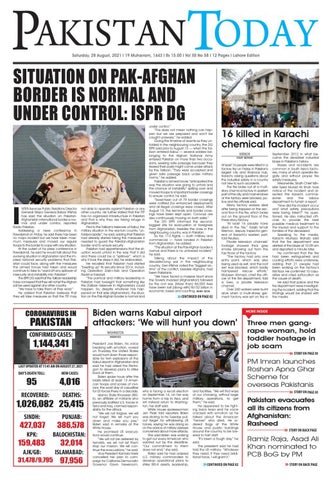
nter-Services Public relations Director General Major General Babar Iftikhar has said the situation on PakistanAfghanistan international border is normal and under control, reported radio Pakistan. Addressing a news conference in rawalpindi on Friday, he said there has been no major incident but we have taken maximum measures and moved our regular troops to the border to cope with any situation. At the outset of his press conference in rawalpindi, he said he would talk about the evolving situation in Afghanistan and the implied national security problems that Pakistan could face, along with the measures the armed forces had taken and would continue to take to “ward off any spillover of insecurity and instability into Pakistan”. the ISPr DG said that the taliban leadership have conveyed that they will not let the Afghan soil be used against any other country. “We have to take them at their word.” He added that Pakistan believes that they will take measures so that the ttP may
not able to operate against Pakistan or any other country. He further stated that the ttP has no organized infrastructure in Pakistan and that is why they are taking refuge in Afghanistan. Prior to the taliban’s takeover of Kabul, the military situation in the war-torn country “unfolded rapidly”, he said, adding that Pakistan had already started taking the measures it needed to guard the Pakistan-Afghanistan border and to ensure security. Pakistan had apprehensions that the situation would unfold in the way that it did and there could be a “spillover”, which is why it took the steps it did, he elaborated. He recalled that Pakistan had started “beefing up” its security since 2014, including Operation Zarb-i-Azb and Operation radd-ul-Fasaad. “the political and military leadership in Pakistan had foresight that something like this (taliban takeover in Afghanistan) could happen. So, despite whatever has happened on that side (Afghanistan), the situation on the Pak-Afghan border is normal and
coronaviruS in
PakiStan
CONFIRMED CASES:
1,144,341
LAST UPDATED AT 11:41 AM ON AUGUST 27, 2021
DAY'S DEATH TOLL:
NEW CASES:
95
4,016
RECOVERED:
DEATHS:
1,026,082 25,415 SINDH:
PUNJAB:
427,037
386,578
KPK:
BALOCHISTAN:
159,483 AJK/GB: 31,478/9,795
32,014 ISLAMABAD:
97,956
under control.” “this does not mean nothing can happen but we are prepared and won’t be caught unaware,” he added. Giving the timeline of events as they unfolded in the neighbouring country, the DG ISPr said prior to August 15 — when the taliban entered Kabul — several soldiers belonging to the Afghan national Army entered Pakistan on more than two occasions, seeking safe passage because they feared their posts might come under attack by the taliban. “they were accepted and given safe passage back under military norms,” he added. Pakistan’s armed forces “anticipated the way the situation was going to unfold and the chance of instability” spilling over and moved troops to important border crossings to ensure control, he said. “Seventeen out of 78 border crossings were notified [for enhanced deployment] and all illegal crossings were closed. After August 15, the terminals and border crossings have been kept open. Convoys are also continuously moving on both sides.” the DG ISPr informed the secondbiggest site for evacuation of foreigners from Afghanistan, besides the ones in the neighbouring country, was in Pakistan. So far, 113 flights — both military and commercial — have landed in Pakistan from Afghanistan, he added. “the situation at the Pak-Afghan border is normal and there is no untoward incident,” he said. talking about the impact of the decades-long war in the neighbouring country, Gen Iftikhar noted the “biggest victims” of the conflict, besides Afghans, had been Pakistanis. “We have faced a massive brunt since the Soviets invaded [Afghanistan] followed by the civil war. [More than] 86,000 lives have been lost [along with] rs152 billion in economic losses and counting. News Desk
CONTINUED ON PAGE 02
16 killed in Karachi chemical factory fire KARACHI staff report
At least 16 people were killed in a factory fire on Friday in Pakistan’s largest city and financial hub, Karachi, raising questions about the industrial safety in a country not new to such accidents. the fire broke out at a multistory chemical factory in eastern part of the city, and most windows of the factory were blocked, police and fire officials said. Many factory workers died after being trapped on the second floor in the fire, which broke out on the ground floor of the three-story factory. “At least 16 people have died in the fire,” Saqib Ismail Memon, deputy inspector general of Karachi’s eastern part, told reuters. Private television channels’ footage showed thick grey smoke billowing out from the top floors of the factory. “the factory had only one entry point, which was also being used as exit, and the roof exit was blocked, which badly hampered rescue efforts,” Mubeen Ahmed, chief fire officer of the fire department, told a Geo, a private television channel. Over 260 workers were burnt alive when a multi-storey garment factory was set on fire in
Biden warns Kabul airport attackers: ‘We will hunt you down’ WASHINGTON ageNcies
President Joe Biden, his voice breaking with emotion, vowed on thursday the United States would hunt down those responsible for twin explosions at the Kabul airport in Afghanistan and said he had asked the Pentagon to develop plans to strike back at them. Biden spoke hours after the blasts killed at least 13 American troops and scores of civilians, the worst day of casualties for US forces there in a decade. Islamic State Khorasan (ISISK), an affiliate of militants who previously battled U.S. forces in Syria and Iraq, claimed responsibility for the attack. “We will not forgive, we will not forget. We will hunt you down and make you pay,” Biden said in remarks at the White House. He promised US evacuations would continue. “We will not be deterred by terrorists, we will not let them stop our mission. We will continue the evacuations,” he said. Vice President Kamala Harris cancelled her plan to campaign for California Democratic Governor Gavin newsroom,
September 2012 in what became the deadliest industrial blaze in Pakistan’s history. Blazes and accidents are common in South Asia’s factories, many of which operate illegally and without proper fire safety measures. Meanwhile, Sindh Chief Minister Syed Murad Ali Shah took notice of the incident and directed the Karachi commissioner and the labour department to furnish a report. “How did the incident occur and what safety precautions were being taken?” he questioned. He also instructed officials to provide the best possible medical treatment to the injured and support to the families of the deceased. Speaking to the media, Karachi Murtaza Wahab said that the fire department was alerted of the blaze at 10:09 am and departed a minute later. He confirmed that the fire had been extinguished and cooling efforts were underway, adding that 21 people had been working on the factory’s first floor. He confirmed 10 casualties and cited suffocation as the cause of death. He said that police and the fire department were investigating the incident, adding that the findings would be shared with the media.
more inside
Three men gangrape woman, hold toddler hostage in job scam STORY ON PAGE 03
PM Imran launches roshan Apna Ghar Scheme for overseas Pakistanis who is facing a recall election on September 14, on her way home from a trip to Asia, and will instead return to Washington, her staff said. White House spokeswoman Jen Psaki told reporters Biden was sticking to his tuesday pullout target for withdrawing US forces, saying he was doing so on the advice of military advisers concerned about more attacks. She said Biden was working to get out every American who wanted out by the deadline. “Our commitment to them does not end,” she said. Biden said he had ordered U.S. military commanders to develop operational plans to strike ISIS-K assets, leadership,
and facilities. “We will find ways of our choosing, without large military operations, to get them,” he said. He appeared to be fighting back tears and his voice cracked with emotion as he talked about the American “heroes” who died. He ordered flags at the White House and public buildings around the country to be lowered to half staff. “It’s been a tough day,” he said. the president said he had told the US military: “Whatever they need, if they need additional force, I will grant it.”
CONTINUED ON PAGE 02
STORY ON PAGE 03
Pakistan evacuates all its citizens from Afghanistan: Rasheed STORY ON BACK PAGE
ramiz raja, Asad Ali Khan nominated to PCB BoG by PM STORY ON BACK PAGE
02
Saturday, 28 August, 2021
LAHORE
NEWS
ProteStING youNG doCtorS CLASH wItH PoLICe IN LAHore
y
newS deSk
OUNG doctors protesting against the National Licensing Exam (NLE) in Lahore on Friday clashed with the police when they tried to enter the examination centre. As a result of the clash, a few policemen collapsed to the ground as a
result of the scuffles and the Pakistan Medical Commission also cancelled the exam. “NLE exam scheduled in Lahore at Saphirre Hall has been rescheduled for Sunday, 29 August 2021, due to unavoidable reasons.” a PMC announcement said. Doctors are protesting against the NLE, which has been made mandatory by the government. Reportedly, all
graduates who are currently doing house job or ready for it must have to clear the NLE exam for their permanent registration. Both MBBS and BDS students must have to clear the NLE for their permanent job and medical practice in Pakistan. The move has encountered opposition from the medical fraternity. Meanwhile, Pakistan Muslim League-Nawaz President Shehbaz Sharif
SC urges state to take measures to resolve missing persons’ issue iSLamaBad News Desk
The apex court on Friday urged the government to take concrete measures to resolve the issue of missing persons, wherein the chief justice of Pakistan warned that the country should ‘not be turned into Guantanamo Bay’. The Supreme Court made the above remarks during the hearing of a case related to a missing person, Imran Khan,
a resident of Islamabad. Commenting on the case, the court observed that the state had not been able to recover Khan despite the passage of five years. The court sought a response from the authorities on providing the missing person’s mother monetary aid. Acting Chief Justice Umar Ata Bandial said the high court ordered to provide financial aid to Khan’s mother on a humanitarian basis, according to a report by Tribune. The additional attorney general responded that there was no law
that supported the provision of financial aid to the family of such sort of missing persons. At this, Justice Bandial asked the AAG, “How difficult is it for the state to [financially] assist a 75-year-old woman?” He further said, “The government changed the name of Benazir Income Support Programme to Ehsaas Programme; she may be assisted under the Ehsaas Programme.” The top judge,
condemned the action by police to disperse protesting doctors. “The use of batons and tear gas on doctors is regrettable,” Shehbaz said. Doctors are fighting coronavirus while the government is fighting doctors, the PML-N leader regretted. “Every citizen who raises his voice against oppression is being batoncharged by the government.”
in reference to the notorious US prison, remarked that, “This is our beloved country, don’t turn it into Guantanamo Bay.” Subsequently, the court approved the AAG’s request for more time to submit a response pertaining to the financial aid, and adjourned the hearing for an indefinite period. In May this year, the Sindh High Court had directed the federal interior secretary to submit a comprehensive report on efforts made to recover missing persons. A two-member bench, comprising Justice KK Agha and Justice Abdul Mobeen Lakho, was hearing a set of pleas seeking the recovery of missing persons. The court directed that all resources must be used to recover missing persons.
Schools to resume in-person classes with 50pc attendance newS deSk Schools across Sindh have been allowed to reopen from August 30 with 50 percent attendance. These schools will operate six days a week. “All the heads of educational institutions will ensure 100 percent vaccination of teaching and non-teaching staff by producing evidence to the concerned regional head,” a notification issued by the Sindh Education and Literacy Department said. The education department directed all the educational institutions to ensure 100 percent compliance of Covid-19 SOPs already issued by the government. Sindh Education Minister Sardar Ali Shah earlier this week had announced the provincial government would allow schools that have completely vaccinated their staff to operate from August 30. The government had late Sunday night announced that all public and private schools across the province would remain closed till further orders. “We want the rate of vaccination to increase in the education sector,” the education minister had said while addressing a press conference in the port city. The provincial minister had said the quicker people get vaccinated, the sooner Pakistan could get rid of coronavirus. “We are getting reports that private schools have vaccinated 80 percent of their staff.” Shah had said the government would allow the operation of schools at 50 percent capacity for six days throughout the week, while regular PCR tests would also be conducted.
PIA revenue declines 46pc in 1H 2021 newS deSk
Biden warns Kabul airport attackers: ‘We will hunt you down’ Continued form page 01 Biden defended his handling of his most serious foreign policy crisis, saying ultimately it is his responsibility while assigning some blame to his predecessor, Republican Donald Trump, for the 2020 agreement Trump negotiated with the Taliban. He said he did not trust the Taliban but believed it was in the group’s interest to let the evacuations continue. Psaki said the United States also had “an enormous amount of leverage” – including economic leverage – over the Taliban, which are subject to U.S. and U.N. sanctions. The Afghan government has also long relied on transfers of dollars from their central bank assets, many of which are held in the United States. An administration official said any such assets would not be made available to the Taliban. MILITARY DEATHS IN AFGHANISTAN NIGHTMARE SCENARIO FOR BIDEN: President Joe Biden, anxiously seeking to complete the U.S. evacuation from Afghanistan, watched a nightmare scenario unfold on Thursday when suicide bomb explosions outside the Kabul airport killed at least 12 US troops and wounded 15 others. Biden had already gathered in the White House Situation Room with his top military and diplomatic advisers for a daily update on the chaotic evacuation
effort early on Thursday when the blasts occurred outside the airport in the Afghan capital. The team did not emerge from the Situation Room until more than two hours later, then Biden migrated to the Oval Office, as a steady stream of Pentagon personnel, some in uniform, filed in and out of the White House. Some staff learned of the growing numbers of U.S. military dead from mounted television screens in the White House West Wing as the day progressed, and let out cries of despair as the numbers multiplied. “We’re outraged as well as heartbroken,” Biden said of himself and his wife Jill in public remarks late on Thursday. The couple had “some sense what the families of these brave heroes are feeling today” after the death of his Army major son Beau from brain cancer, which Biden has previously linked to his son’s military service. Islamic State claimed responsibility for the attack which also killed scores of civilians. Biden, facing criticism over the US evacuation after the rapid Taliban takeover of Afghanistan as American forces were pulling out after two decades, has sought to hammer home a message in days before the attacks that the United States was leaving Afghanistan in order to save the lives of US troops. The US military death toll in the Afghan war since 2001 is roughly 2,500.
IHC admits plea of Noor’s parents against bail to therapy centre staffers iSLamaBad
Remaining any longer, the Democratic president told reporters on Aug. 20, could mean he would need to “send your sons, your daughters – like my son was sent to Iraq – to maybe die. And for what? For what?” Thursday’s U.S. military casualties were the first in Afghanistan since February 2020 and represented the deadliest day for American troops there in a decade. ‘THE NIGHTMARE WE FEARED’: Some critics blamed the rushed evacuation, which threatens to leave some Americans behind in Afghanistan, for the deaths among the roughly 5,200 Americans providing security at Kabul’s airport to close out U.S. involvement in Afghanistan after 20 years of conflict. US officials said on Thursday about 1,000 Americans remained in Afghanistan. “This is the nightmare we feared – and it’s why for weeks, military, intelligence and congressional leaders from both parties have begged the president to stand up to the Taliban and push out the airport perimeter,” Republican U.S. Senator Ben Sasse said. “As we wait for more details to come in, one thing is clear: We can’t trust the Taliban with Americans’ security,” added Democrat Bob Menendez, chairman of the Senate Foreign Relations Committee, in an implicit criticism of Biden’s strategy. Biden, who took office in January, pushed a May withdrawal target set by
former President Donald Trump to August 31. But, under pressure from Pentagon officials who warned that security risks from Islamist militants were rising at the airport, Biden refused to move it back further, despite pressure from allied nations. A Biden adviser, speaking on condition of anonymity, said the deaths of American troops underscored both why Biden made the decision to withdraw in the first place and the risks of an extended engagement in the country. There are further risks to the president, including worsening internal Democratic Party divisions that have been brewing, the adviser said. Until now, the White House has tried to push back on hostile media coverage, the adviser said, by citing the lack of U.S. deaths in the evacuation effort. A long-time skeptic of the 20-year military presence in Afghanistan, Biden has said the United States long ago achieved its original rationale for invading the country in 2001: to root out al Qaeda militants and prevent another attack on the United States like the one launched on Sept. 11, 2001. read more The mastermind of that attack, al Qaeda leader Osama bin Laden, was killed by a U.S. military team in neighbouring Pakistan in 2011. Afghanistan’s Taliban rulers had harboured al Qaeda militants ahead of the 2001 attack before being toppled from power after the 2001 US-led invasion.
Pakistan International Airlines Corporation Limited (PIACL) on Friday announced 46 percent decline in net revenue for the half year ended June 30, 2021. The airline recorded net revenue of Rs27.64 billion for the half year January-June 2021 as compared to Rs51.47 billion in the same period of the last year. However, the losses of the company reduced sharply during the period. The net losses of the airline came down to Rs25 billion for the half year ended June 30, 2021 as compared to Rs36.536 billion in the corresponding period of the last year.
SSGC, SNGPL relieve 2,668 reinstated employees iSLamaBad TLTP
The Sui companies have terminated 2,668 employees who had been reinstated under the sacked Employees (Reinstatement) Ordinance with immediate effect in compliance with the judgement of the Supreme Court in this regard. According to details, Sui Southern Gas Company Limited (SSGC) has relieved 1,951 individuals including 385 executives and 1566 subordinates from the company's service. The Sui Northern Gas Pipelines Limited (SNGPL) has relieved 717 reinstated employees, including 195 executives and 522 subordinate staff. The Sui companies said that they took the decision in compliance with the judgement of the Supreme Court of Pakistan in Civil Appeal # 491/2012, titled “Muhammad Afzal & others versus the secretary Establishment Division Islamabad & others.” Earlier on August 17, declaring the Sacked Employees (reinstatement) Act 2010 unconstitutional, the Supreme Court ruled that no illegal benefit could be granted under cover of legislation.
Situation on Pak-Afghan border is normal and under control: ISPR DG
TLTP
Continued from page 01
Taking up the plea of slain Noor Mukadam’s parents for bail cancellation of six accused persons on Friday, the Islamabad High Court (IHC) admitted the petition and issued notices to respondents in the matter. Earlier, on August 23, Additional Sessions Judge Islamabad Muhammad Ata Rabbani has granted post arrest post-arrest bail facility to six accused persons including Tahir Zahoor, Chief Executive officer of Therapy Centre, and staffers of the Centre including Amjad Mehmood, Dileep Kumar, Wamiq Riaz, Samar Abbas and Abdul Haq. Assailing the order of the Additional Sessions Judge Islamabad before the IHC, the Shaukat Mukadam, the petitioner contended that the trial court has crossed the tentative assessment of record saying at bail stage law doesn’t allow deep observation of the evidence. The petitioner contended that the sessions judge did not fulfil the criteria of justice and urged the IHC to cancel the granted bail to the accused persons saying the trial court has ignored the principles, settled by the top court in bail granting. Appearing before the bench on Friday Barrister Qasim Nawaz Abbasi said all the six accused persons were present on the spot during occurrence of the heinous crime, adding this very fact is established by the record of PIMS hospital in the name of Amjad Mehmood accompanied by Delip Kumar.
“While we were involved in this war on terror during the last two decades, we have had three major escalations on the eastern border. At the peak of this period, there were more than 90 terrorist incidents taking place in a year in Pakistan.” Furthermore, 12,312 ceasefire violations had occurred on Pakistan’s eastern border since 2014, he added. Giving details of military operations during this period, the DG ISPR said the armed forces conducted 1,237 major and minor operations and cleared more than 46,000 sq km area along the western border against terrorists and their infrastructure. “With the support of our great nation and LEAs (law enforcement agencies), our armed forces were able
to turn the tide.” He shared that Pakistan had been reaching out to the Afghan government to formalise a border control mechanism to deal with the “instability” along the PakAfghan border. Pakistan also suggested an intelligence-sharing mechanism, however, the initiatives were “not responded well to”, he said. Pakistan had also reached out at the military level, he shared. “There were several high-level visits by Pakistan’s military leadership, [including] four visits by the chief of army staff. We offered [to build] a mechanism for intelligence-sharing and training of Afghan soldiers and officers in Pakistan Army institutions. “We offered it (training) several times but only six cadets came. However, hundreds and thousands of Afghan Army soldiers went for
training to India and several Indian Army training teams were placed in Afghanistan to train forces,” he said. The reason for making the offers was because “we believe peace in Afghanistan is directly linked to peace in Pakistan,” he further said. He pointed out that Pakistan had been “repeatedly cautioning the world about the negative role played by spoilers” in Afghanistan who were continuing to do so. While Pakistan’s armed forced were conducting operations on its western border, there were “massive” ceasefire violations on its eastern border, he said. “There was a massive capacity enhancement initiative in 2017; Chief of Army Staff Gen Qamar Javed Bajwa [put forward a] vision of securing the western borders comprehensively. We raised more
than 60 new wings for Frontier Corps in Balochistan and Khyber Pakhtunkhwa.” Along with this, Pakistan took other measures to secure its border, including upgrading technology and surveillance, constructing hundreds of border forts and fencing the border, 90 per cent of which had been done, he added. “After two decades, we can say we have fought off the menace of terrorism very well with the whole-ofnation approach. All these operations are the epitome of insurmountable spirit and supreme sacrifice of the whole nation’s efforts.” When asked when Pakistan expected the situation to normalise, Gen Iftikhar said: “We are hoping for the best. We have taken measures and Pakistan will reach out when government-to-government contact is established.” Responding to another question, he said there was no military-to-military contact with other countries for now. However, reports of India using wild animals to attack and conduct surveillance along the Line of Control were “concerning”, he said.
Saturday, 28 August, 2021
LAHORE
NEWS
03
PM IMrAN LAuNCHeS roSHAN APNA GHAr SCHeMe for overSeAS PAkIStANIS iSLamaBad
P
sTAFF RePORT
RIME Minister Imran Khan on Friday launched the “gamechanger” Roshan Apna Ghar scheme for overseas Pakistanis According to the State Bank of Pakistan (SBP), non-resident Pakistanis can use Roshan Digital Account to get finance to purchase a house.
“I think this [initiative] will help us attract a lot of money because Pakistan needs dollars and overseas Pakistanis are the only source to decrease the gap between the country’s exports and imports” Prime Minister (PM) Imran Khan made this statement at the launch ceremony. He expressed his view that hopefully, this new scheme will help in recovering the current account deficit by narrowing the import-export gap.
The PM expects to draw potential investment from nine million overseas Pakistanis through this initiative. The nation will observe sustainable development by guaranteeing assistance to abroad Pakistanis in the lodging area under the venture. "Pakistanis based abroad need to be given confidence so they invest back home without any fear of fraud," he said. He also emphasizes the obstacles such as corruption faced by overseas Pakistanis. “a
segment of people habitual of working in a corruption-free society will not prefer to work in corrupt societies.” He added “A lot of [overseas] people informed me about a plot they purchased in Pakistan which later got occupied illegally,” he said. Itemizing what separates Roshan Apna Ghar, the PM said banks were associated with the plan which will add to the certainty of overseas Pakistanis. Moreover, he claimed that his
government has made it easier to do business in Pakistan. Finance Minister (FM), Shaukat Tarin. said the plan would assist to retain money coming through Roshan Digital Account and expects ample investments through this initiative. State Bank Governor, Reza Baqir, remarked that all obstacles that overseas Pakistanis faced previously in housing investment had been removed through effective utilisation of digital technology.
three men gang-rape woman, hold toddler hostage in job scam LaHore INP
The Lahore police are hunting for three men accused of gang-raping a woman after holding her two-yearold daughter hostage in Garhi Shahu. According to the investigation officer on Friday, a rickshaw driver, identified as Saif, lured the woman, who is from Mughalpura, with the promise of a job. “On August 26, Saif took the woman and her daughter to an empty plot in Garhi Shahu. Two other suspects were already there,” the officer said. “The suspects held the child hostage at gunpoint and raped the woman one by one.” An FIR under sections 375A [rape] and 376 [punishment for rape] of the Pakistan Penal Code has been registered. A special police team has been formed to trace the culprits as soon as possible. The survivor’s medical tests have been conducted. Further investigations are underway.
Government reaches out to opposition to fill vacant eCP posts
RAWALPINDI: A shopkeeper arranges clay ovens outside his store. ONLINe
Pakistan making preparations for accommodating evacuees newS deSk Pakistan is making preparations for accommodating evacuees from Afghanistan. Reportedly, the Karachi administration has begun making accommodation arrangements for “Afghan nationals and foreigners” being evacuated from Afghanistan in the wake of the security situation following the Taliban takeover of the country. The arrangements for evacuees will be made in the vicinity of the Jinnah International Airport, according to the commissioner’s office. A copy of the notification issued by the Karachi commissioner’s office. In a notification dated Aug 26, the office of the Karachi commissioner said at least 2,000 people were expected to arrive in Karachi in the next three to four days, adding that they would stay in the
provincial capital “for the next few days”. “The Deputy Commissioner Malir is requested to make adequate arrangements on emergency basis in the vicinity of the Jinnah International Airport, Karachi for the boarding, lodging, transport, and security of Afghan nationals and foreigners arriving at Karachi airport for transit purposes in coordination with Provincial Disaster Management Authority and law enforcing agencies,” the notification read. This decision was taken at a meeting on Aug 26 at 5 Corps headquarters with “chief of staff” in the chair, according to the commissioner’s office. Two hotels and marquees surrounding the Karachi airport were identified by the administration for hosting people coming from Afghanistan. “The passengers availing the facility at identified hotels shall themselves bear all the expenses of their stay at the hotels,”
the administration said. The commissioner’s office also asked the Federal Investigation Agency, provincial health department and power utility KElectric to make necessary arrangements in coordination with Malir deputy commissioner to facilitate the process. A day ago, Islamabad’s administration took control of all hotels in the capital for several weeks to arrange accommodation for foreigners being evacuated from Afghanistan. About 1,500 foreigners were scheduled to arrive from Afghanistan on Friday aboard separate flights while over 1,000 foreigners are expected to land in Islamabad on each day of the next couple of weeks, according to officials. The capital’s administration asked the managements of all the hotels to close reservations for 21 days starting on Friday, leaving all the vacant rooms in them at the disposal of the
newS deSk
administration. A notification issued by the office of district magistrate said that in view of the current situation across the border, thousands of people were being evacuated from Afghanistan and passengers using transit flights for the purpose were staying in Islamabad. On Aug 1, National Security Adviser Moeed Yusuf had said that arrangements should be made to keep displaced Afghans inside their country instead of pushing them into Pakistan. Yusuf had said Pakistan was focused on ensuring that tensions in Afghanistan do not lead to more bloodshed. “But if a situation arises, it is the responsibility of the international community to create a secure area inside Afghanistan.” “Why make them dar-ba-dar (homeless)? Make arrangement for them inside their country. Pakistan does not have the capacity to take more refugees,” he had emphasised.
SC forms bench to hear journalists’ harassment case iSLamaBad TLTP
The top court on Friday constituted a three-member bench to hear the journalists’ harassment case. Acting Chief Justice of Pakistan (CJP) Umar Atta
Bandial has formed the bench comprising Justice Ijazul Ahsan, Justice Munib Akhtar and Justice Qazi Muhammad Amin Ahmed. The bench will take up an application of journalists seeking action over their alleged harassment on August 30 (Monday). On August 26, the top court’s five-member bench
had withdrawn a suo moto notice taken by a two-member bench headed by Justice Qazi Faez Isa ruling that only the CJP himself can take cognizance of the matter using the constitutional prerogative. Acting CJP Bandial, who headed the five-judge bench, said the SC bench can only recommend a suo moto notice to the CJP.
The government has reached out to the opposition to fill the vacant posts of the Election Commission of Pakistan. In this regard, as per Federal Minister for Information and Broadcasting Fawad Chaudhry, Prime Minister Imran Khan has written a letter to opposition leader and Pakistan Muslim LeagueNawaz President Shehbaz Sharif, asking him to submit a response “at the earliest”. Fawad shared a copy of the letter written by the premier, saying the latter had suggested three names each for Punjab and Khyber Pakhtunkhwa provinces. The ECP, he said, would be able to make appointments after the opposition’s response to the names suggested by the prime minister. According to the letter, Prime Minister Imran has proposed the names of Ahsan Mahboob, ex-officer of the Police Service of Pakistan; Raja Amer Khan, advocate Supreme Court of Pakistan; and Dr Syed Pervaiz Abbas, a retired officer of the Pakistan Administrative Service (PAS) for the vacant post of the ECP member from Punjab. For the appointment of the ECP member from KP, the premier has suggested the names of retired Justice Ikramullah Khan; Faridullah Khan, ex-officer PAS; and Muzammil Khan, advocate Supreme Court of Pakistan. Under the Constitution, the prime minister is required to initiate consultations with the leader of the opposition in the National Assembly for jointly recommending a panel of three consensus nominees per vacancy for confirmation of one of them by a parliamentary committee. In case there is no agreement, the prime minister and the opposition leader are supposed to separately send three names each to the committee having equal representation from the treasury and opposition benches. The law mandates that no ECP position should stay vacant for more than 45 days.
PSX extends losses for fourth day, sheds 226 more points karaCHi TLTP
The Pakistan Stock Exchange (PSX) continued with bearish trend for the fourth consecutive day on Friday due to the rollover week and evolving situation in Afghanistan, with the benchmark KSE-100 Index shedding 226.74 points (-0.48 percent) to close at 47,136.53 points. The market opened on a positive note and gained around 30 points; however, it switched towards the red zone soon and remained there till the end of the session. Overall, the KSE-100 Index shed around 975
points in the last four sessions. The KSE-100 Index moved in a range of 523.1 points, showing an intraday high of 47,392.2 points and an intraday low of 46,869.1 points. Among other indices, the KSE All Share Index shed 135.25 points (0.42 percent) to close at 32,229.17 points, while All Share Islamic Index shed 47.4 points (-0.20 percent) to close at 23,250.02 points. A total of 376 companies traded shares in the stock exchange, out of them shares of 102 closed up, shares of 257 closed down while shares of 17 companies remained unchanged. Of the 100 traded companies in
the KSE-100 Index, 26 closed up, 66 closed down, while eight remained unchanged. The overall market volumes increased by 21.56 million to 382.37 million shares. Total volume traded for the KSE-100 Index was 181.76 million shares. The number of total trades decreased by 5,153 to 131,109, while the value traded increased by Rs1.55 billion to Rs13.29 billion. Among scrips, WTL led the table with 31.63 million shares, followed by KEL (26.43 million) and BYCO (20.08 million). Stocks that contributed significantly to the volumes include WTL, KEL, BYCO, YOUW and BOP, which formed 30 percent
of total volumes. Major contributions to the index came from Meezan Bank Limited (MEBL), Systems Limited (SYS) and Lucky Cement (LUCK), as they cumulatively contributed to 100 points. On the other hand Engro Corporation Limited (ENGRO), Habib Bank Limited (HBL), International Industries (INIL), Service Industries Limited (SRVI) and Oil and Gas Development Company (OGDC), as they weighed down on the index by 110 points. Indus Motors Company Limited (INDU) posted its 4QFY21 result announcement in
which its posted earnings per share of Rs56.1 along with a final cash dividend of Rs.36.5/share. Bank of Punjab (BOP) in the banking space posted 2Q2021 EPS of Rs1.4. Abbott Laboratories (Pakistan) Limited (ABOT) for its 2Q2021 posted EPS of Rs.18.79 along with an Interim cash dividend of Rs20/share. The analysts said that the market largely remained under pressure during the trading session due to the Kabul airport attack as well as the rollover week. They hoped that the market may recover in the next week as there would be no pressure on the investors about the rollover week.
Saturday, 28 August, 2021
04 NEWS
LAHORE
DollaR SlipS to RS165.62 aS Rupee ReCoveRS 19 moRe paiSaS
p
NEWS DESK AKISTAN rupee strengthened against the US dollar in the interbank for the second consecutive day and recovered Rs0.19 (+0.11 percent) on Fri-
day. According to the State Bank of Pakistan, the US dollar opened at Rs165.81
and closed at Rs165.62. Within the open market, the rupee was traded at Rs165.60/166.40 per dollar. Overall, Pakistani rupee shed Rs1.44 against the US dollar during this week, while depreciation during the fiscal year 2021-22 has been Rs8.26. The local unit has shed Rs5.43 against the US dollar in the current year 2021. According to currency experts, the
Sales tax on services collection rises 26.18pc to Rs294bn in 2020-21 NEWS DESK The collection of sales tax on services by the provinces increased by 26.18 percent to Rs294 billion during the last fiscal year 2020-21 as compared to the collection of Rs233 billion made during the preceding financial year 2019-20. According to the statistics released by the Finance Ministry on Friday, the provinces showed an impressive performance in the collection of sales tax on services, despite adverse economic conditions due to the coronavirus pandemic. Punjab remained the highest contributor in the sales tax on services. The province posted 31 percent growth in the revenue collection to Rs138.36 billion during the fiscal year 2020-21, compared with Rs105.55 billion in the preceding fiscal year 2019-20. Sindh posted a growth of 23.29 percent to Rs123.09 billion in the last fiscal year, compared to Rs100 billion in the preceding fiscal year. Khyber Pakhtunkhwa collected Rs19.33 billion during the fiscal year 2020-21, compared to Rs17 billion in the preceding fiscal year. Lastly, Balochistan posted a growth of 21 percent to Rs12.85 billion in the fiscal year 2020-21, compared with Rs10.63 billion in the preceding fiscal year. The collection of sales tax on services to the GDP is slightly improved but it is still below one per cent. The sales tax on services to the GDP improved to 0.61 per cent in the fiscal year 2020-21, compared with 0.55 percent in the preceding fiscal year.
Gold price increases to Rs96,100 per 10gm NEWS DESK Gold prices inched up in the international market for the second straight day on Friday as a softer tone around the US Treasury bond yields kept the dollar bulls on the defensive. At 1210 hours GMT, gold in the international market was available at $1,797 per ounce after gaining $3.40. However, the price of 10 grams of yellow metal in Pakistan increased to Rs96,100 after gaining Rs500. The closing prices of the yellow metal in the country remained Rs95,600 on Thursday last. The increase in prices in the local market was due to an overnight jump in gold prices a day earlier. According to experts, gold struggled to capitalise on its modest intraday gains after reaching $1,805 and retreated below the $1,800 mark. They said that underlying bullish sentiment in the financial markets acted as a tailwind for gold. From a technical perspective, bulls, so far, have struggled to make it through the 100-day/200-day SMAs confluence hurdle, currently around the $1,810 region. This should now act as a key pivotal point for short-term traders and help determine the next leg of a directional move for gold. They said that the Kabul airport bombing and escalating Delta Covid variant concerns are keeping the sentiment around safe-haven gold underpinned.
market witnessed sufficient supply of dollars from export receipts and workers’ remittances, which helped the rupee make gains. They, however, said that demand for import payment remained high due to last trading day of the week. They said the external payments pressure would continue to haunt the local currency in the coming days. They said the rupee struggled till
mid-week owing to the situation in Afghanistan and higher import bill. They said that delay in payments from Afghanistan against Pakistan’s export created pressure on the rupee. They pointed out that Afghan traders are opening import LCs from Pakistan as they cannot open from their own country due to ongoing turbulence which has also weighed on the rupee.
Sale of imported, local cars surge in July NEWS DESK The coronavirus pandemic increased the trend of buying cars in the country as sales of imported and locally manufactured passenger cars during the first month of the financial year 2021-22 increased by 85 percent and 153 percent, respectively, on a yearon-year (YoY) basis. According to the data released by the Pakistan Bureau of Statistics (PBS) on Friday, the imports of old and used cars increased to $33.03 million in July 2021, compared to $13.07 million in the same month of the last year. Market sources attributed the surge in car imports to ease in the coronavirus restrictions globally. The import of motor vehicles was adversely affected during the last year due to strict lockdown imposed to prevent the spread of the pandemic. The federal budget 2021-22 was another reason for the higher imports in July. The sources said importers delayed Customs clearance of cars in the hope of a cut in duty and taxes in the budget. The government announced reduction in the federal excise duty on both locally-assembled and imported cars in the budget. The car imports are also 7 per cent higher in July, compared with $30.85 million in June 2021. On the other hand, according to the data released by Pakistan Automobile Manufacturing Association (PAMA), as many as 15,325 cars were manufactured in the country during July 2021 against the production of 8,280 units in July 2020, showing an increase of 85.08 percent on a year-on-
year (YoY) basis. The production of Toyota Corolla cars went up by 43.11 percent from 1,561 units to 2,234 units during the month under review whereas the production of Suzuki Swift also rose by 213.11 percent from 61 units to 191 units. Similarly, the newly launched Toyota Yaris also witnessed an increase as its production jumped to 1,947 units in the month under review from 1,879 units in July 2020. Production of Suzuki Cultus increased from 1,428 units to 3,051 units, witnessing an increase of 113.65 percent while the production of Suzuki Wagon-R also witnessed an increase of 385.66 percent from 300 units to 1,457 units during July 2021, according to PAMA. However, the production of Honda cars declined from 2,193 units to 1,856 units, showing a decrease of 15. Similarly, the production of Suzuki Bolan declined by 45.75 percent from 730 units to 396 units whereas the production of Suzuki Alto increased from 128 units to 3,893 units, witnessing growth of 2941.40 percent, the data added. It is pertinent to mention that sales of passenger cars during the last financial year 2020-21 increased by 57 percent as compared to the preceding fiscal year 2019-20. According to a monthly report released by PAMA, the sale of passenger cars during the month of June 2021 was recorded at 11,569 units against a total production of 18,154 units, which is around 11 percent lower as compared to the 12,934 units sold in May 2021 and 58 percent higher as compared to June 2020.
Fiscal deficit shrinks to 7.1pc in last fiscal year NEWS DESK Pakistan’s fiscal deficit has been recorded at 7.1 percent of the gross domestic product (GDP) in the fiscal year 2020-21, which has come down from the previous fiscal year’s deficit of 8.1 percent. According to the statistics released by the Ministry of Finance on Friday, the budget deficit of the country stood at Rs3.40 trillion in the fiscal year 2020-21, compared with Rs3.37 trillion in the preceding fiscal year. Analysts at Arif Habib Limited said the fiscal deficit came largely with the expectations and also the government’s estimate of 7 percent of the GDP. This is the first time that Pakistan has reported the fiscal deficit worth 7 percent of GDP for three consecutive years after 1987-88 (i.e. after 33 years), which, in turn, has resulted in higher borrowings by the government, and subsequently higher money supply and higher inflation. The analysts said the government was unable to contain the primary balance, which recorded a deficit of Rs654 billion during the fiscal year under review, compared with the IMF’s June-end performance criteria of a surplus of Rs246 billion. Last year, the primary balance recorded a deficit of Rs757 billion. The government financed Rs1.338 trillion, around 39 percent of the overall deficit through the net external financing and Rs2.065 trillion, around 61 per cent through net domestic financing. All the four provinces recorded the budgetary surplus during 2020-21, clocking-in at a cumulative surplus of Rs314 billion. In the fourth quarter of 2020-21, the overall budget deficit came in at 3.5 percent of GDP, which was 4.3 percent of GDP in the preceding fiscal year with a primary deficit of 2.4 percent of GDP as against the preceding fiscal year’s 2.2 percent of the GDP. The analysts expect Pakistan’s fiscal deficit to clock-in at around 7 per cent to 7.5 percent of GDP in the fiscal year 2021-22.
Crude prices surge around 2pc on supply concerns
Weekly inflation goes up by 0.22pc NEWS DESK The Sensitive Price Indicator (SPI) based weekly inflation for the week ended on August 26, 2021 for the combined consumption group witnessed an increase of 0.22 percent as compared to the previous week while it went 12.67 percent up on a yearon-year (YoY) basis. According to data released by the Pakistan Bureau of Statistics (PBS) on Friday, the combined index was at 152.14 on August 26, 2021 as compared to 151.80 on August 12, 2021 while the index was recorded at 135.03 a year ago on August 27, 2020. The SPI is computed on a weekly basis to assess the price movements of essential commodities at a shorter interval of time so as to review the price situation in the country. The SPI comprises 51 essential items and the prices are being collected from 50 markets in 17 cities of the country. During the week under review, out of 51 items, prices of 22 (43.15 percent) items increased, prices of five (9.80 percent) items decreased, while prices of 24 (47.05 percent) items remained unchanged. The SPI for the current week ended on 26th August, 2021 recorded an increase of 0.22% with most of the items increased, mainly, chicken
(9.52%), pulse Masoor (9.32%), onions (7.55%), garlic (5.21%), bananas (5.02%), pulse Mash (3.33%), eggs (2.86%), pulse gram (2.85%), mustard oil (2.02%) and vegetable ghee 1-kg (1.80%) with joint impact of (0.64%) into the overall SPI for combined group of (0.22%). On the other hand, a decrease in the prices of tomatoes (29.88%), LPG (2.63%) and Potatoes (2.11%) was observed. According to the PBS data, the year on year trend depicts increase of 12.67% with most of the items increased, mainly, LPG (57.28%), electricity for Q1 (46.55%), chicken (38.24%), vegetable ghee 1-kg (37.90%), mustard oil (36.72%), vegetable ghee 2.5kg (36.28%), chillie powder (35.71%), cooking oil 5-liter (34.84%), eggs (33.81%), gents sandal (33.37%), gents sponge chappal (25.13%), washing soap (21.72%) and match box (21.51%), while a major decrease was observed in the prices of potatoes (25.43%), pulse Moong (19.17%) and tomatoes (6.66%). The weekly SPI percentage change by income groups showed that SPI across all quantiles ranged between 0.15 percent and 0.31 percent. The lowest income group witnessed a weekly increase of 0.20 percent while the highest income group recorded an increase of 0.15 percent.
NEWS DESK Crude oil prices went around two percent up on Friday in anticipation of disruptions in output in the Gulf of Mexico ahead of a potential hurricane forecast and on growing expectations that OPEC+ may resist raising supply given the recent delta variant impact over demand. At 1310 hours GMT, Brent, the international benchmark for two-thirds of the world’s oil, gained $1.30 (+1.88 percent) to reach $72.37 a barrel. Similarly, the US West Texas Intermediate (WTI) reached $68.85 a barrel, up by $1.43 (+2.12 percent). The price for Opec Basket was recorded at $69.71 a barrel with 3.53 percent increase, Arab Light was available at $72.81 a barrel with 0.52 percent increase, while the price of Russian Sokol jumped to $71.48 after gaining 0.38 percent. According to Reuters, companies started airlifting workers from Gulf of Mexico oil production platforms on Thursday and BHP and BP said they have begun to stop production at offshore platforms as a storm brewing in the Caribbean Sea was forecast to barrel through the Gulf on the weekend. Gulf of Mexico offshore wells account for 17 percent of the US crude oil production and 5 percent of dry natural gas production. Over 45 percent of total US refining capacity lies along the Gulf coast. The prospect of US Gulf supply outages helped turn the market around from losses on Thursday, which had been partly spurred by output returning at a Mexican oil platform following a fatal fire.
Experts stress on academia role for smooth energy transition ISLAMABAD TLTP
The gap among policy makers, academia and industry needs to be bridged for smooth and efficient energy transition in Pakistan. The experts from academia and research institutions said this while sharing their views with the participants at the webinar ‘Road to COP26: Role of Academia in Energy Transition of Pakistan,’ organised by Sustainable Development Policy Institute (SDPI). Dean of Energy Department, Lahore University of Management Sciences
(LUMS), Dr Fiaz Chaudhry said what is missing in existing policies pertaining to the energy sector is the right planning to meet needs of the day. He said, “We need to modernise grids and develop human resources to respond to the new challenges in the sector.” Prof Nadeem Ahmed Shaikh, Dean, Department of Mechanical Engineering, International Islamic University, Islamabad (IIUI), highlighted the importance of broader collaboration amongst the stakeholders in the energy sector and said that sustainability of the natural resources should also be evaluated. Besides, the local challenges in the energy
sector are also imperative to be considered to develop rational policies, he added. Elaborating on the importance of data regarding the energy sector in Pakistan, Dr Abdul Sattar Nizami, associate professor of Government College University Lahore, opined that to reduce the knowledge gap in the sector, the academia and policy makers should work together to simplify the knowledge. He said accurate data could play a critical role in policy making regarding energy transition in Pakistan. Dr Muzzafar Ali, University of Engineering, and technology (UET) Taxila, high-
CMYK
lighted the effective communication between all stakeholders including academia and government institutions should be focused upon for smooth energy transition in the country. Dr Muhammad Farooq, associate professor, UET Taxila, was of view, “Our universities are producing large number of PhDs every year but we lack in evidencebased research to ascertain our real needs and challenges in energy sector.” He said that consultation with academia and industry should be ensured for energy sector policies. Dr Sajid Amin, research fellow at SDPI, emphasised that local energy transition
needs local solutions. Besides, countries like Pakistan that are facing economic challenges in the Covid-19 scenario, should be supported through measures such as debt-swap with the climate actions. He said, “We also need climate financing, and it is important for the academia to come up with recommendations to be presented at COP-26 in this regard.” It would help developing countries like Pakistan to invest in green energy initiates as well, he added. Ubaid-ur-Rehman, Research Associate, SDPI, earlier underpinned the importance of the role of academia for energy transition in Pakistan.
Saturday, 28 August, 2021
LAHORE
NEWS
Corporate briefing session of sui northern gas pipelines limited
05
corporate corner Indus Motors declares Rs12.8bn after tax profit for FY20-21
Corporate Briefing session of Sui Northern Gas Pipelines Limited (SNGPL) was held on 27th August 2021 at Pakistan Stock Exchange, Karachi. Managing Director SNGPL Ali J. Hamdani briefed the analysts, investors and shareholders about the Vision 2025, financial performance and future outlook of SNGPL. The analysts, investors and shareholders in large number attended the session and shown keen interest in the briefing conducted by the Company’s team led by the Managing Director Ali Javaid Hamdani. Mr. Faisal Iqbal, Chief Financial Officer; Syed Jawad Naseem, SGM(Business Development); Mr. Qaiser Masood, SGM(Distribution) and Mr. Imtiaz Mehmood, Company Secretary were also present. The Management briefed audience about the Company’s vision and mission, history and its latest financial results. It was informed that Company’s glorious history spans more than 50 years and is the largest downstream integrated gas company serving more than 7 million consumers through an extensive network of more than 145,000 kilometers in
EFU Life wins Best Domestic Life Insurer of the Year Pakistan at the Insurance Asia Awards 2021 KARACHI: EFU Life Assurance Limited, the leading life insurance provider in the country, has been awarded Best Domestic Life Insurer of the Year at Insurance Asia Awards 2021. As an industry leader, EFU Life has been committed to bringing new groundbreaking innovations in its products and services, coupled with a strong technical capacity and effective use of digitalization. Speaking on the occasion, Taher G. Sachak, EFU Life's CEO and Managing Director, said, "In Pakistan, life insurance is never considered a priority when it comes to financial planning. With the pandemic, the industry took a bigger hit, as our business model relies on face-to-face meetings and customized financial plans depending on the need and life stage of the prospect. Despite these challenges, EFU Life managed to not only sustain but expand its business and further strengthened its financial base.' In Pakistan, where the gross domestic product contracted for the first time in six decades, EFU Life rose to the challenge and immediately developed a COVI D-19 response strategy. Press release
Shell Pakistan announces financial results for H12021 KARACHI: The Board of Directors of Shell Pakistan Limited (SPL) announced the half-year 2021 financial results on August 26th. The company posted a profit after tax of PKR 2,150 million compared to the loss of PKR 7,873 million made in the same period last year. The first half of 2021 saw a significant recovery compared to a very tough last year. The encouraging turnaround is mainly driven by improved business performance focusing on strategic priorities such as differentiated fuels and lubricants, cost efficiencies and safety for employees and customers. During this period, the Mobility business signed a Memorandum of Understanding (MoU) with K-Electric Limited, to jointly pilot Electric-Vehicle Charging Stations across Karachi and its connecting highways. The Lubricants business has been powering Pakistan's progress in construction, textile and mining through an uninterrupted supply of high-quality lubricants. In addition, an affordable premium product in the motorcycle engine oil category was launched namely Advance Fuel Save 10W-30. During the meeting on August 26th, the Board of Directors of Shell Pakistan Limited appointed Waqar Siddiqui as the Chief Executive Officer of the company effective November 1, 2021. Waqar Siddiqui will succeed Haroon Rashid who will resign effective November 1, 2021, having served as Chief Executive Officer for 3 years and as a Board Director since 2011. Shell Pakistan will continue to actively work to minimize the impact of current challenges and endeavour to capture opportunities to ensure the company plays a key role in developing Pakistan’s energy future. Press release
Punjab, Khyber Pakhtunkhwa, Islamabad and Azad Jammu & Kashmir. The Company’s share in country’s overall energy mix is around 30% while its share in gas sector is approximately 70% including supply of LNG to meet the energy demand of the Country. The Managing Director highlighted the profitability of the Company which stood at 6 Billion Rupees in FY 2019-20. The first quarter profitability for FY 2020-21 has increased to Rs 3.2 Billion as compared to Rs. 1.9 billion in the last year. This increase in profitability is due to interest rate reduction and significant reduction in UFG which shows the relentless commitment of the Company towards a total turnaround of the Company. MD SNGPL said that the country’s indigenous supplies are continually decreasing and its gas supplies now comprise of around 55% RLNG. The dependence on RLNG will therefore continue to increase being cheaper than alternate fuels. Government of Pakistan is planning to introduce weighted average cost of gas which should mitigate and reduce the high price of RLNG for the pub-
lic at large. While briefing about the future outlook of the Company, the Management highlighted the Company’s future vision and targets which included diversification / integration of existing business, enhancing the use of modern technology to increase the efficiency, continuous upgradation and rehabilitation of gas infrastructure, improvement in Customer Services and complaints redressal through E-Kacheri. He talked about the digitization initiatives being taken by the Company in order to facilitate the consumers at their doorsteps. He said that consumers can communicate their queries and lodge their complaints through the Company’s Official Social Media Accounts. MD SNGPL also emphasized the importance of investing in Human Resource capacity building and gender diversity. The briefing was followed by Question & Answer session in which all the queries were responded by the Managing Director and Senior Management in a very positive manner. Press release
South City Hospital welcomes on board international spine specialist Dr Younus Hanif Lodhi KARACHI: Leading private medical institution South City Hospital welcomes onboard international Spine Specialist, Dr Younus Hanif Lodhi, as its Consultant of Spine & Trauma and Orthopedic Surgeon. Dr Lodhi will be introducing spine-related services as a subspeciality in the hospital for the first time. With a primary focus on spinal conditions, the international doctor is said to treat patients with conditions in the spine that start from the base of the skull to the tailbone including deformities such as scoliosis and kyphosis or any other spine-related pathology. South City Hospital has continued to successfully combat covid-19 while also providing quality medical care for other illnesses. Press release
Minister for Climate Change inaugurates Coca-Cola Beverages Pakistan’s ‘Clean and Green’ drive KARACHI: In the presence of Minister of State for Climate Change, Zartaj Gul, Coca-Cola Beverages Pakistan Limited (CCI Pakistan) inaugurated its Clean and Green’ drive 2021 at its production facility in Pakistan. As per a Memorandum of Understanding (MoU) signed earlier in the year between both entities, CCI Pakistan had pledged to plant 50,000 tree saplings across the major cities of Pakistan, out of which more than 10,000 saplings were donated during this first drive event. The event was attended by other high ranking government officials and senior members of CCI Pakistan’s team. The tree saplings consisting of Malta, Arjun, and Olive fruit varieties were handed over to the Ministry of Climate Change for plantation in Faisalabad by the senior members of the CCI Pakistan team. Press release
National Bank’s profit after tax up 12pc for H12021 KARACHI: National Bank of Pakistan (NBP) reported on Friday, profit after-tax for the half-year ending June 30, 2021, of PKR17.0 billion or PKR 7.97per share, on total revenue of PKR 65.4 bn. This is compared to profit after tax of PKR 15.1bn, or PKR7.14 per share, on total revenues of PKR 66.8 bn for the corresponding half year period of 2020. Strong financial results demonstrate the resilience of the Bank’s business model and the efforts of its staff during this period. Press release
Standard Chartered announces #SCWomenInTech, 2021 Winners KARACHI: Standard Chartered Bank Pakistan, in partnership with INNOVentures Global (Pvt.) Limited, announces the top seven winners of the #SCWomenInTech Programme 2021. Standard Chartered Women in Tech (WiT) supports female-led entrepreneurial teams with business management training, mentoring and seed funding. These accelerators were designed to help address gender disparity in the technology sector and to use technology to tackle social challenges faced by communities. Press release
Shan Foods, Child Life Foundation carry out plantation drive KARACHI: In its mission to create a sustainable community, the leading food company, Shan Foods, recently conducted a tree plantation activity in collaboration with Child Life Foundation, a non-profit organization working for affordable healthcare for children in Pakistan. The drive was carried out under Shan Foods’ brand-new CSR identity, Shan Shares, which is committed to playing its part for an economically, environmentally, and socially sustained world in response to the United Nations Sustainable Development Goals. Press release
CMYK
KARACHI: The Board of Directors of Indus Motor Company Ltd. (IMC) met on August 26, 2021, to review the company’s financial and operating performance for the year ended June 30, 2021. The company posted net sales revenue of Rs179.2 billion, a 108 per cent increase compared to Rs86.2 billion last year, while profit-after-tax increased by 151 per cent to Rs12.8 billion from Rs5.1 billion posted last year. Profit-before-tax increased by 150 per cent from Rs7.3 billion last year to Rs. 18.2 billion as of the fiscal year-end. During the year, the sales volume of CKD and CBU vehicles increased by 100 per cent, to 57,731 units as against 28,837 units sold last year. Consequently, due to increased demand, the company produced 59,187 units for the year, as compared to 28,519 units produced in the same period last year. The increase in turnover and profitability for the year was mainly due to higher CKD and CBU volumes, primarily due to improved economic conditions and healthy demand generated on account of the launch of the facelift models of Corolla, Hilux and Fortuner along with wider acceptance of Toyota Yaris, the best-selling sedan for the year. The profitability also increased on account of an increase in other income mainly due to return on placements on account of improved fund position of the Company. Press release
Saturday, 28 August, 2021
06 COMMENT
Indian Policy in Afghanistan: Implications of US Withdrawal
PTI’s third year in power Claims versus ground realities
P
RIME MINISTER Imran Khan spent sufficient time in his speech on Thursday to enumerate the difficulties he faced after takeover. The idea behind the emphasis on inherited problems is to try to paper over the shortcomings highlighted by critics during the last three years. No government in Pakistan faced the type of mindboggling problems encountered by Quaid-e-Azam and his team at the creation of Pakistan. These included settling millions of refugees, arranging finances to run the country, and maintaining peace after mass killings and looting. Being fully concentrated on building the new country, they took the difficulties in their stride. The PTI leadership knew very well the issues they were going to face. As they opted to vie for power one doesn’t expect them to whine about difficulties. The government took the covid-19 pandemic lightly, letting in hundreds of pilgrims into Taftan without proper quarantine arrangements. It goes to its credit though that it formed the NCoC which managed things better. Recently the government has introduced the Kissan Card which would reportedly help farmers get subsidized fertilizers, seeds and pesticides, low-interest loans and compensation for damaged crops during natural calamities. Mr Khan has also promised to make the agricultural sector a part of the CPEC project for enhancing production through Chinese technology. Initiated this year, it would be premature to pass a judgment on the efficacy of these measures. There is no doubt a record increase in the production of bikes and cars. Motorcycles are a necessity for the employed poor in big cities who continue to complain against rising petrol prices. The big sale of sedans and sports utility vehicles indicates that the rich are getting richer under the PTI. The sufferings of millions of common people continue to multiply. First, the 10 million jobs promised by Imran Khan remain a pie in the sky. Second, inflation has reduced the purchasing power of most of the population. Snap surveys all over the country indicate a nearuniversal decline in buying capacity. Major indicators challenge the claims of a better future within the next two years. Circular debt is rising, so is current account deficit, remittances declined by 2 per cent in June causing anxiety and there is insignificant foreign investment. The situation emerging from the fall of Kabul to the Taliban is rife with uncertainty. Meanwhile differences between the IMF and the government continue to persist.
Nobody knows what India could do next
Dr rajkumar Singh
N
o country of the region, not even India itself, is certain about New Delhi’s future steps in Afghanistan because the situation there became very delicate for India since the US announcement that it would withdraw from Afghanistan before September 11, without making any post-exit political arrangement for stability, peace and development in the country. Apart from strategic interests of getting an edge over Pakistan, India had invested a lot in infrastructure since the beginning of the War on Terror in october 2001, mostly related to education, irrigation development, power generation projects, help in construction of Shahtoot Dam near Kabul along with supply of anti-Covid-19 vaccination recently, and at the juncture all India-related risks depend only on the way Afghanistan Keeps the Taliban at bay after the US pullout. Even the Trump Administration’s exit from Afghanistan was conditional on Taliban taking measures to prevent Al-Qaeda or any other militant group from harbouring in the country, along with an assurance of agreeing to a dialogue on power-sharing in Afghanistan, while in the Biden Administration there no such thing and the only focus was on an early pull out, indicating his frustration at the two decades long war in Afghanistan. The increased wave of violence and forced occupation of territories vacated by the foreign forces in different parts of Afghanistan have wor-
Suo motu power restricted Decision reflects increasing trepidation among some?
TamSeel aqDaS
T
HE expeditious legitimacy of the Taliban government in Afghanistan took the world by astonishment, and inquiries concerning the progress of Afghanistan were stressed. Nonetheless, as women continue their designated jobs and education, a swift shift in Taliban ideology is revealed. The transition largely unaffected the US resentment against Taliban officials, however, the case of Abdul Ghani Baradar can throw doubt on the credibility of their claims. Abdul Ghani Baradar is officially documented as an Afghan militant and one of the founders of the Afghan Taliban. he is anticipated to be the upcoming president of Afghanistan. Hence, it is worthwhile to acknowledge the role of the USA in the rise of this key political figure, as he was released from Pakistani prison under the pressure of the Trump Administration in 2018. In fact, he demonstrated a prominent role in the Doha negotiations and headed the Taliban political office. This fact was further confirmed in US Special Envoy Zalmay Khalilzad’s address to the US Institute of Peace on 8 February 2019. He confirmed that the release of Abdul Ghani Baradar from Pakistani prison was undertaken at his request. Accordingly, the support extended to key Taliban players puts the role of the USA in the current dynamics of Afghanistan into question. Adding on, the Taliban forces have demonstrated effective public relations strategies to counter media warfare, such as readily accepting interviews by female journalists, taking selfies in the streets of Kabul, and debunking propaganda through their Twit-
Dedicated to the legacy of late Hameed Nizami
Arif Nizami (Late) Founding Editor
Yousaf Nizami M. A. Niazi
Umar Aziz
Joint Editor
Joint Editor
Executive Editor
Lahore – Ph: 042-36300938, 042-36375965
The writer is head of the political science department and dean of the Social Sciences faculty of the B.N.Mandal University, Madhepura, Bihar, India. He can be reached at rajkumarsinghpg@gmail.com
The Curious Case of Abdul Ghani Baradar
T
HE decision by the full bench of the Supreme Court, that only the Chief Justice can take suo motu notice of any matter, was pronounced on the division bench taking notice of the disappearance of journalists, will be subjected to criticism because the bench itself was headed by a judge who has legitimate expectancy of becoming Chief Justice of Pakistan and thus could be assumed to have a personal interest in the matter. The division bench had summoned certain government officials to explain their position, who were not used to having to explain their actions, at least not in public. It is something of a paradox that the division bench was headed by a judge who has legitimate expectancy of becoming the next Chief Justice of Pakistan but one. It is obvious that he has become a cause of trepidation in certain quarters, particularly the ones which had been criticised by him in his judgement in the Faizabad sit-in, of which he had taken suo motu notice. It was Mr Justice Qazi Faez Isa who had taken notice by converting a petition, and it is possible that his assumption of the Chief Justice-ship, which should occur in September 2023, which he will hold till his retirement in october 2024, is unwelcome in certain quarters? It is almost as if the limit on suo motu powers was meant to protect certain quarters, to allow the time needed for the sort of attacks on Mr Justice Isa as was seen when he was hauled before the Supreme Judicial Council, and then when the Federal Board of Revenue was made to probe his affairs, which he was only able to shake off because of a case before the Supreme Court in which he had to appear for himself. The learned full bench is obviously cognisant of the law, but it is puzzling to the layman that where the Constitution allows the Supreme Court suo motu powers, it does not mention the Chief Justice except once, and without giving him any powers more than other judges. How the Full Bench explains its reasoning, which it shall do in its detailed judgement, will be awaited by all students of the Constitution anxiously, and with the greatest of interest.
Editor Aziz-ud-Din Ahmad
ried not only India but Russia, Iran and China about anti-Afghan activities and the political future of the country. In the circumstances, the critical situation for India if war in the present form continues, and converts into civil war to linger for years. But the situation will be worse if the Taliban take over the administration as in 1996 and work as a puppet government controlled by Pakistan. In that case the possibility of India sending forces to Afghanistan cannot be ruled out. The history of bilateral relations between India and Afghanistan have been friendly and strong over the last several decades barrings the brief period when the Taliban ruled (1996-2001). In the post-Taliban phase India attached itself to the government elected under the 2004 constitution, framed as a result of the Bonn Agreement, in which Taliban were not invited on the insistence of the USA, which later recognized thias a mistake after resurgence of the Taliban after 2003. After the end of Taliban rule, India became the largest regional provider of humanitarian and reconstruction aid. on a number of occasions Afghan authorities praised Indian efforts and investments. In April 2006 when Hamid Karzai visited India, the two countries signed three Memoranda of Understanding (MoU) for strengthening cooperation in rural development and education and promoting bilateral business. Relations between the two improved significantly in 2011 with the signing of a strategic partnership agreement and four years later as a follow-up India donated three Mi-25 attack helicopters to Afghanistan with a promise to send one more to counter the Taliban. From 1996-2001 Taliban ruled about three quarters of Afghanistan’s land and implemented a strict type of Sharia and transferred the capital to Kandahar of the new Islamic Emirate of Afghanistan, recognised only by three nations— Pakistan, Saudi Arabia and the United Arab Emirates. As the country had suffered a lot on account of militancy and gang war in the last two decades the role of international charitable and development organisations became most significant in war-torn territories to look after the needs of the masses, but in this period the most affected portion of the government were humanitarian aid, supply of food, employment, reconstruction, and other services. The rule of the Taliban and their allies were responsible for massacres against Afghan civilians as they conducted the policy of scorched earth, burnt vast areas of fertile land and destroyed tens of thousands of
homes, banned hobbies, but totally failed to check violence and the ongoing gang or group wars on the soil of Afghanistan. All international agencies, including the United Nations organisation, reported against the misrule and anti-humanitarian attitude of the Taliban rule for which the Government of Pakistan was also responsible, who extended all helps— moral, material, financial, logistical and military. The then regime of Afghanistan, according to several international sources, took help of Pakistani nationals, Pakistani trained fighters, and Al-Qaeda militants to fight against the anti-Taliban forces in the country. Simply the end of Taliban rule in December 2001 did not mean the total elimination of the group and it re-emerged in 2003 more powerful and stronger and began fighting against the US-led foreign forces which launched a War on Terror in Afghanistan. over the years its strength multiplied many times and it faced foreign forces as usual, leading the USA to think about negotiations and finally announcing withdrawal. Despite the US assurance and its airstrikes on Taliban’s hideouts /camps in Afghanistan, in recent weeks, there is no allies left in the country like America which had extended security cover for the last 20 years and the Taliban has taken control of about 203 districts out of 325 districts in Afghanistan while remaining 122 will also come under influence of the Taliban after the pullout of foreign forces. The increasing power of Taliban is in no way beneficial for India and poses a daunting challenge for Indian investments in Afghanistan as well as extremist elements of Kashmir and other parts of India. As geographically both India and Pakistan are closest to Afghanistan, any anarchy or instability there will cast a dark shadow on both but if Taliban becomes powerful and Pakistan again emerges as its sole ally in the region, the coming days will be harder for New Delhi. Presently India is trying hard to prevent Taliban’s expansion of power and influence in Afghanistan while Indian interests lie in making the Taliban weak and the Government strong to protect and promote its developmental works done in the last two decades. At this juncture, India needs to re-orient its policies towards Afghanistan and deal with the changing dynamics of power politics in the region to safeguard its interests.
I
Karachi – Ph: 021-35381208-9
I
ter handles and press conferences. The extraordinary public relations communication further throws doubt on the role of the USA, as such anorganizational structure is hard to attain under tribal circumstances. Academics largely depict and address the notion that the 20-year war against the Taliban forces demonstrates US resentment against the militants. However, it can be argued that their rise to power was promoted by ambitions of containing China and its rising influence across Afghanistan and Central Asia. The land of Afghanistan has access to abundant resources, such as chromium, copper, gold, iron ore, lead, zinc, lithium, marble, and talc, in addition to energy resources of natural gas and petroleum. on the contrary, the state of China also exhibits aspirations of accessing Central Asian states through the Wakhan Corridor under the sovereignty of Afghanistan, under the Belt and Road Initiative. Along with that context, the US intelligence predicted a civil war subsequent to the Taliban takeover, thereby impacting China’s objectives in the region. Instability in Afghanistan carries the capability of directly impacting the means of China seeking benefits, and coming across as the victor in the recently induced cold war. Henceforth, the US played a critical role in the Taliban’s rise to power and is responsible for the ascent of prominent political figures such as Abdul Ghani Baradar. Nevertheless, the contemporary dynamics of Afghanistan lie in favor of China, despite the Taliban takeover. The effective public relations and shift in Taliban ideology resulted in its fast acceptance among the Afghan population. In addition, the former US-backed government of Ashraf Ghani being riddled with corruption, hence people readily accepted the Taliban government, and progression towards a civil war was sidestepped. In addition, the withdrawal of US strops allowed China to attain maximum op-
Islamabad – Ph: 051-2204545
portunities in Afghanistan. Shortly after the takeover, the Foreign office of China released statements regarding establishing friendly cooperation with the new Afghan government and projected affirmations that it would play a role in reconstructing the war-torn land while respecting its sovereignty. Hence, China will aim to access the resources of Afghanistan and Central Asia in the near future. It is also critical to acknowledge that the rise of the Taliban in Afghanistan, acts as a potential safe haven for terrorist groups. Since China is home to militant Uighurs and is combating their insurgent movements, the relations of these states can be tested. It will bring up the relation of Taliban forces with the East Turkestan Islamic Movement into question, which serves as a source of unrest in China’s Xinjiang province. The relation of the USA with prominent Taliban figures like Abdul Ghani Baradar questioned the legitimacy of US resentment against the Taliban government. Accordingly, the notion of the USA backing the Taliban forces to generate a civil war to contain China’s aspirations in Afghanistan and Central Asia was brought up. Nevertheless, the acceptance of Taliban forces among the Afghan population and the recognition by China allows for China to attain the benefits of the region without the presence of US troops. However, the future of China and Afghanistan remains uncertain under the influence of Uighur militants, and their affiliation with the Afghan Taliban. Accordingly, the notion of potential safe havens for Uighur militants in Afghanistan has been brought up, raising the question whether China and Afghanistan will be able to pursue economic interests despite ideological clashes?
The relation of the USA with prominent Taliban figures like Abdul Ghani Baradar questioned the legitimacy of US resentment against the Taliban government. Accordingly, the notion of the USA backing the Taliban forces to generate a civil war to contain China’s aspirations in Afghanistan and Central Asia was brought up
I
Web: www.pakistantoday.com.pk
I
The writer is a freelance columnist
Email: editorial@pakistantoday.com.pk
Saturday, 28 August, 2021
COMMENT 07 Editor’s mail Send your letters to: Letters to Editor, Pakistan Today, 4-Shaarey Fatima Jinnah, Lahore, Pakistan. E-mail: letters@pakistantoday.com.pk Letters should be addressed to Pakistan Today exclusively
Pakistan’s environmental challenge
Israel: Idea, Ideology and Beyond Behind the latest bloodshed in Gaza
FaTima Zubair
“F
oR if life had taught her anything, it was that healing and peace can begin only with acknowledgment of wrongs committed.” ― Susan Abulhawa, Mornings in Jenin “At Basel I founded the Israeli state,” wrote Theodor Herzl in his diary after the First Zionist Congress in 1897. He was an Austrian literary figure whose role in Zionism defied his literary and humane persona as an academic and litterateur. Back then in the 19th century it was hard for the world to accept Jewish prominence, since with the commanding presence of the ottoman Empire this was a far cry. While slowly Jews were getting permission to observe religious rituals in Palestine they were not allowed to settle.Their activities were invariably dubious, threatening the state and empire; hence the Muslim leaders were watchful of them. Herzl, nonetheless, wrote that in some years it would be the norm despite all difficulties. This systemic ethnic cleansing of Palestinian Arabs follows a pattern that enlarges on a global strategic desensitization campaign. The things that were unimaginable back in the 1800s are prevalent today. A “Report on Israeli Settlement in the occupied Territories” by the Foundation for Middle East Peace published in 2009 said that Israel was unlawfully demolishing homes in occupied Palestinian territories. The USA said it could not help it much. The report condemned the actions and the advisor to the Palestinian Prime Minister resigned due to global insensitivity. This Israeli daring was objectionable back then but given the current scenario where Palestinians are being bombed, given deadlines to evacuate their homes and their cases being held in Hebrew-speaking Israeli courts, one only wonders where it all will end. It keeps escalating. Israel strikes and the world cries and suddenly all goes mum in no time. The UNo, ruled by permanent members, fails time and again to find a solution. The world getting bored with the impasse has now become insensitive. The slogan Herzl used for Zionism was that there will be a land– one for all– and alI Jews will fight for it– all for one. Steven Beller wrote in his famous essay “Theodor Herzl and Austria- A Century Later”, that he must have been foolish to think of consolidating thousands of Jews in an uninhabited land. But he did so because his messianic urgings drove him on to lead his people from the desert of misery back to the Promised Land”. Also he says, “Herzl was too proud, much too proud to be a good human”. Meaning he could jeopardize an entire nation for his slogan. In the backdrop of relentless Israeli slaughter of the indigenous Palestinians one just wonders
how it all came about. With each murderous massacre of the poor locals, year after year, Israel only rises in strength in the world community. The world plummets deeper into silent slumber. Despite worldwide protests again the masters of world politics remained frozen. Painfully enough even some Arab nations! Under the barrage of Instagram and Facebook stories, media hype and general outcry on the recent Israeli occupation and annihilation of Palestinian neighborhoods of Sheikh Jarrah, Silwan among others, where did it all begin? How did Israel start to end this once thriving country? For this it is vital to know the history of Zionism, leading up to today’s chaos. Many places were thought of as a probable country for the Jews but slowly it all boiled down to Palestine. It assumed that a state without people, Palestine, would cater to the people (Jews) without a state. Some places in South America and South Africa were also considered, but Palestine was the final decision. This was a fundamental flaw in the ideology that was based on a fraudulent assumption. It entailed a massive massacre and illegal settlement policy. Palestine was the motherland Jews had been driven out from therefore return to the motherland was fundamental to the theory. This was opposed by ultra-orthodox Jews. The basic problem was how to turn the Arabs from an indigenous nation into a minority. Anita Shapira writes in Israel a History that this ideology of Zionism even defied the Jewish pledge with God that they would not settle in a land by oppressing the nations of the world. They will wait for the Messiah, or else, their actions of destroying nations will hasten the arrival of their messiah, who in their connotation is the Anti-Christ. It is important to know Jews were always looked upon as a canker. They faced atrocities and discrimination from European empires. They were persecuted and marginalized in Europe, east and west, and around the globe were looked at as troublemakers. Due to fewer opportunities they were poor and underprivileged. Their status began to change with the Hapsburg Empire’s 1780s ‘Edicts of Tolerance’ that allowed them education and economic advancement. Now religion alone was not a determinant of inclusion. Similarly, in Tsarist Russia, Czar Alexander II promised reforms to uplift people under his rule. This included Jews as well. The Pale of Settlement was the area in the newly conquered lands allowed to Jews to settle down who were driven out of the Russian mainland, created In 1791 by Catherine the Great. But things turned bitter with the murder of Tsar Alexander II, when Jews turned out to have assassinated him. This triggered rounds of persecution in Russia called the pogroms. The earlier 1821 odessa pogroms marked the beginning of the 19th century pogroms in Tsarist Russia; there were four more such pogroms in odessa before the end of the century. Jewish self-governing Kehillahs were abolished by Tsar Nicholas I in 1844. This violence across Eastern Europe prompted a wave of Jewish migration westward that totaled about 2.5 million people. This was a turning point for Jews to migrate to other places under the pretext of fleeing from atrocities. As the empires in Europe faced nationalist movements and calls for liberty, fraternity and equality, religion was put on the road to some anachronistic destination. Religion was losing grip over the masses hence creating a secular world. In these circumstances Jewish rise to key positions worldwide became easy. While the world kept plunging deeper into the secular pit, Zionist Jews kept making hay.
Jewish immigration started. Many flew to the USA while countless moved to South Africa, South America and Palestine. This first immigration into Palestine was called the First Aliya. This was the agricultural phase. Steamship and locomotive advancement made these Jewish dreams possible. To escape pogroms Jews needed an excuse. Holocaust was an addition. Toward the end of the ottoman Empire things had started to shape up. Frederick Mayor writes in his book The Rothschilds that with the help of rich banking families such as the Rothschilds, stay and survival in Palestine was made possible for Jews. Baron de Rothschild once said, “I created the Yishuv all alone.” Yishuv means a Jewish community. He believed that “never speak of it always think of it.” This was the indoctrination of the Jewish people. Every day the Jews prayed for their return to Zion. “Next year in Jerusalam” they said every Passover. They mourned the destruction of the Temple. Hence yearning for Zion was instinctual for Jews. Jonathan Lawrence writes in his article “The Plot Against Caliphate” that the biggest outcome of the decline of the ottomans was the free hand Jews gained in Palestine through diplomacy. Under the ottomans Jews were not allowed to settle there, so heightened diplomacy was needed to abolish the biggest stumbling block to their dream. The Caliphate allowed the Jewish pilgrims initially for a month and then later three months to visit their holy sites in Palestine. Each local ruler made allowances according to his own understanding. This gave Jews sufficient loopholes to benefit. Due to the changes in the ottoman Empire, citizens could move more freely, and from 1869, travel improved because of the Suez Canal, which reduced the travel time from Yemen to Syria. Certain Yemenite Jews interpreted these changes and the new developments in the Holy Land as heavenly signs that the time of redemption was near. By settling in ottoman Syria, they would play a part in what they believed could precipitate the anticipated messianic era. Anita Shapira writes in her book that Jews have waited for the Messiah ever since, and therefore they now look upon him for their rise and redemption. The promise they made to God that they will not persecute nations of the world to establish their homeland has been broken. This will only help their Messiah come to the fore sooner than later. The Messiah is the Antichrist also known as Dajjal to Muslims. This explains how religious undertones of the Israeli occupation of Palestine and the ensuing conflict are so heightened. It is not just an imperial ambition of land grab from the locals but a complete and systemic Arab ethnic cleansing to prepare for the Messiah who alone will guarantee the unhindered Jewish rise in the world. Susan Abulhawa writes in her classic novel Mornings in Jenin, “Toughness found fertile soil in the hearts of Palestinians, and the grains of resistance embedded themselves in their skin. Endurance evolved as a hallmark of refugee society. But the price they paid was the subduing of tender vulnerability. They learned to celebrate martyrdom. only martyrdom offered freedom. only in death were they at last invulnerable to Israel. Martyrdom became the ultimate defiance of Israeli occupation.” The writer is a freelance columnist and author of the bestseller “A Child of the New Millennium, Stories and Essays from Pakistan”, launched in Kinnaird College for Women in 2015. She writes on international affairs, literature and humanities, holistically. http://archive.pakistantoday.com.pk
THE majority of Pakistan industrial sectors for example fishing and agriculture , which count for more than one for of the output and two fifth of employment in Pakistan are highly dependent on country natural resources. Hence in order to sustain economic growth there is a high demand on already scarce resources. However it is ironic that what the country depends on for growth is also what threats the future welfare and success of the country. The World Bank report in 2013 started in Pakistan top environmental issues air pollutions inadequate supply of uncontaminated drinking water noise pollution and the health detritions of urban and rural populations due to pollutions. These environmental concems not only harm Pakistani citizens but also pose a serious threat to the country economy. The report also state that the increase in industrialization, urbanizations and motorization will inevitably worsen this problem. Pakistan is classified as a water stressed nation by the world bank there are seven main river that enter Pakistan from upper riparian states including the Kabul River that enters from Afghanistan and the Indus river, Jhelum river, Chenab river and Sutlej river that enter from India. Among these Ravi and Sutlej and diverted in upstream India, for which consumptive use was awarded to India under the Indus water treaty. The magnetic of Pakistan such as Karachi, Lahore, Islamabad and Rawalpindi face the issue of noise pollutions. The main source of this pollution is the traffic noise caused by busses, cars, trucks, rickshaws and water tankers. A study showed that on one Karachi main roads the average noise level around 90 dB and was capable of reaching about 110dB. This high level of noise pollution can cause auditory and non- auditory health issues. ShEhzadi haSan ali Karachi
Politicians vs people THE PDM leaders claim that it is their democratic right to protest the sitting government to highlight its poor policies. The right to gather and speak might be guaranteed by the constitution, but only if the protestors remember the rights of their fellow citizens. Creating traffic blocks, damaging property, and most importantly endangering peoples’ lives in times of a pandemic for sure is not guaranteed under any provision of the constitution. one person’s freedom ends where the rights of another person start. Most importantly, the opposition parties must understand that their infights between the old and new faces of the PPP and PMLN are benefitting nobody. The government is incapable of doing anything and the opposition parties are no less in their movement against the government. While the farce between opposition parties and the government continues, people sigh under the burden of inflation. I wonder if anyone cares about the people of Pakistan? raja Shafatullah iSlamabad
Needless political stalemate SIR, When political workers rise from the grassroots level, they emerge as mature individuals, with tolerance for dissent, trained to work as team mates. There is no place for egoistic pursuits in the political arena, where democracy and people’s will must dominate. It is the political process with free and fair elections that separates the chaff from the wheat. PDM has become a victim of the egoistic immaturity of its leadership. The All-India Muslim League was one such party, and so was the Congress or KhudaiKhidmatgar headed by Bacha Khan, although they had varied goals. All these political parties, despite their differences, wanted independence from tyrannical British Raj, which had over a century, indulged in institutionalized plunder of the subcontinent and sowed seeds of divide and rule, which unfortunately has been adopted by remnants of the Raj. Despite all these pitfalls Quaid-e-Azam, because of his commitment, emerged as a leader of all Muslims, who believed that Congress was slave to Hindu supremacists and their belief that Hindus and Muslims were two separate nations and could not live together as one nation. Modi has proven that the likes of Abul Kalam Azad were wrong. Pakistan’s political problems started when those politicians who had risen from grass roots in the political struggle waged by All India Muslim League were banned from politics under EBDo by a military dictator and political engineering process started, creating King’s party under varied brand names. We have witnessed the shameless manner in which Mohtarma Fatima Jinnah was subjected to a slanderous campaign and called a traitor, by those, who themselves were serving interests of foreign powers. It is also very ironic that those who opposed the political struggle for independence from British Colonial Raj and served them were exempted from restrictions imposed by EBDo. Let us not forget the political drama where a tinpot dictator chose his own brother as an opposition Leader. maliK tariq ali lahorE
Genetic engineering GENETIC engineering is a kind of technology which is related to the transformation of genes. It is not just part of the human body, but it can be helpful to make things artificially. Pakistan is not adopting such technological benefits. on other hand, Chinese people eat a heavy amount of non veg food. Currently they are working to make all kinds of meat artificially through genetic engineering to save the life of animals. The US also adopted genetically modified organism (GMo) techniques to make soyabean, corn, sugar, and cotton. In 2018, the US made 94% of soybean and cotton, 92% of corn and in 2013, 99.9% sugar was made through genetic engineering. on the other hand, A researcher said, Pakistan made corn and maize through genetic engineering, but few farmers claimed this technology damaged the land and caused allergies and cancers. Still many issues arise in implementation of genetic engineering. However, such reasons and research does not seem effective. Because the world is going to be competitive. When competition increases then moving back or giving arguments is considered as defeat. If there is a problem then a solution is also present. Why have other countries adopted such technology? Are they not faced with such issues? Genetic engineering is a kind of technology where making profits is easy by enhancing the ratio of imports. Specifically, Pakistan is taking on a large amount of debt to fulfil economic demands. ragni lund daharKi
Saturday, 28 August, 2021
08 WORLD VIEW
don’t blaMe the afghans IF THE UNITED STATES FAILS TO UNDERSTAND ITS MISTAKES, IT WILL CONTINUE TO REPEAT THEM
ForeiGn PoliCy
W
KishorE mahBuBani
HY does the United States, arguably the world’s most successful society, expend so much blood and treasure on foreign ventures—from Cambodia and Vietnam to Afghanistan and Iraq—and fail so spectacularly? Americans search for explanations in events and personalities. Actually, there may be deeply structural reasons for these spectacular failures. The reasons can be captured in three Cs: control, culture, and compromise. U.S. society’s greatest strength is its can-do spirit. When Americans strive for an ambitious goal, such as sending a man to the moon, they take full control and charge full speed ahead. This works wonders on U.S. soil. It creates disasters on foreign soil. I got my first glimpse of Washington’s problem with the first C—control—in Phnom Penh in 1973. Serving then as a young, single diplomat in the Singaporean Embassy in the war-torn Cambodian capital, I dated a young female diplomat from the U.S. Embassy. She had an easy job. Each morning, she would get clear instructions from Washington on what Cambodia should do with its troubled economy. She would personally drive over and deliver the instructions to the Cambodian minister of the economy. Since Washington had some of the world’s best economists, this made sense. But it also deprived the Cambodian government of any sense of agency or control over its own destiny. Hence, when the United States left, the hapless government collapsed. Similarly, the larger Afghan army of 300,000 people performed well against the smaller Taliban army of 75,000 people when U.S. commanders and soldiers were embedded with Afghan army units to make decisions and decide when and how to fight. Like the Cambodian government,
the Afghan army had no control over its destiny. Hence, when U.S. control left the scene, everything collapsed. Future historians will remark on a curious paradox in this sad Afghan chapter. The United States went to Afghanistan to build and nurture a democracy. But by taking effective control of Afghanistan for 20 years, the Americans couldn’t have behaved in a more undemocratic fashion. The second problematic C is culture. Americans assumed the government of Afghan President Ashraf Ghani was legitimate because it had been elected under U.S. democratic norms. Really? Only around 1.8 million Afghans out of 9.7 million registered voters and a population of 31.6 million people voted in the last national elections. By contrast, when a United Nations mission led by brilliant Algerian diplomat Lakhdar Brahimi tried to recreate an Afghan government after the collapse of the first Taliban government in 2001, Brahimi reached deep into Afghan history and culture and convened a loya jirga, a traditional council of regional leaders that deliberates important national questions. The process was a messy one. The United Nations couldn’t control it. But the government that emerged from the loya jirga process enjoyed more legitimacy and standing than the so-called democratically elected Ghani government. It’s surprising the United States learned no valuable lessons from its more successful occupations overseas. Following the capitulation of Japan in 1945, it was a brilliant decision to keep then-Japanese Emperor Hirohito on the throne instead of prosecuting him as a war criminal, which the United States could have done. His continuity in office gave the Japanese assurance their culture was respected. The Americans deployed in Afghanistan to rebuild the Afghan political system showed little respect for Afghan culture. The third C is compromise. When treading on foreign soil, it is pure common sense to make compromises and accept local institutions. Iraq failed spectacularly because of one disastrous decision resulting from a refusal to compromise: the full disbanding of the Iraqi army and Ba’ath Party, two pillars of Iraqi society. When the United States occupied Germany after World War II, on the other hand, U.S. military command quickly gave up on wholesale denazification after realizing it needed all the administrators
it could get to prevent the country from descending into chaos. Since party membership had been virtually compulsory for government service, there simply weren’t enough experienced but untainted administrators around. The United States’ enormous power is its biggest asset—and also its biggest weakness. With so much power, Washington is never under any pressure to compromise, even when it would be common sense to do so. Here’s a simple example: Afghanistan is an ancient society with an even older neighbor, Iran. After millennia of living together, there must be a lot of wisdom in Iranian history and culture on how to live with Afghanistan. The most commonsensical thing for any U.S. administration to have done would have been to compartmentalize its differences with the Iranians on other issues and at least talk to them about creating a strong and independent political entity in Afghanistan. And Iran might very well have cooperated because it had even more to lose than the United States from a Taliban-controlled Afghanistan. Yet the very idea of a compromise with Iran appears to be unthinkable in Washington. If the United States fails to understand the key structural mistakes it made in Afghanistan and elsewhere, it will continue to repeat them. Yet there are few signs of any serious rethinking. Instead, many people in Washington are blaming the Afghans for this catastrophic failure, pointing their fingers in particular at corruption. But corruption requires both demand and supply. If the United States hadn’t drowned Afghanistan in a tsunami of poorly accounted for dollars, corruption wouldn’t have happened. Curiously, one of the academic authorities on this subject is Ghani himself. In a 2008 book, he and co-author Clare Lockhart describe a project that illustrates the problem of much foreign aid. Even though the aid was disbursed by various United Nations agencies and nonprofits, most of the money came from the United States. This story, also discussed in Lockhart’s essay for Prospect, is worth quoting at length as it perfectly describes what went fundamentally wrong with the U.S. venture in Afghanistan. Lockhart met a villager in Afghanistan who told her the story of $150 million literally going up in smoke. She
I served with the nato mission in afghanistan – it was a bloated mess Guardian
t
anonymous
HE images plastered across our screens in recent days of Afghan civilians at Hamid Karzai airport desperately trying to flee the country, as well as the bombing on Thursday, have been heartbreaking. And, for me, slightly surreal. I lived in that airport while serving as a soldier in the British army. Watching the scenes of chaos on the tarmac, my first thought was for the civilians who worked inside the airport. I spent many afternoons after work sitting in the Afghan-owned Istanbul Cafe, a ramshackle building of several floors that overlooked the airfield, drinking the strong coffee prepared by women and men I came to know and respect. Their journey into work every morning was 10 times as dangerous as anything I ever did in Kabul. They ran the gauntlet on bicycles while we took shelter inside armoured vehicles. I cannot help but wonder: are they safe? Did they get out? As the shock of what had happened subsided, and the Taliban raised their flag above Kabul, I grew resentful and angry, thinking about why the mission in Afghanistan failed and whether it could have gone differently. I worked as a soldier at the coalface of Nato’s Resolute Support mission, which was supposed to train, support and assist Afghan security services and institutions. We provided security for advisers while they engaged with their Afghan counterparts in Kabul. Generally, this would mean picking them up, taking them to the meeting, providing security for the meeting and bringing them back to base. From my perspective, there were at least two fundamental errors in the mission’s approach. The first was the massive outsourcing to the private sector that underwrote the operation. Let me state categorically, our service people are not to blame. The soldiers I served with, those who fought in Helmand and later safeguarded in Kabul, acted, almost without exception, with the utmost professionalism and valour. To have served alongside them is the great honour of my life. But Nato’s mission was not fit for purpose. When I was in Afghanistan, private military
contractors numbered almost 30,000. Some were engaged in protection tasks, but many more were responsible for training and mentoring Afghans who held positions of significant influence. They advised on intelligence, war-fighting, diplomacy, policing, you name it. Some of them were doing their best. Many more didn’t give a damn. Many were on six figures and had been for years. Afghanistan for them was a cash cow, a way of putting their kids through college (most were American) or paying off a mortgage. In sum, there were too many poorly qualified people working without accountability, getting paid far too much. If you want an answer to the question of why Afghanistan’s military crumbled in weeks, take a long hard look at their so-called mentors. Then there was the simplistic assumption that everyone in Afghanistan could fall into two categories, enlightened liberal reformers who would welcome a western presence, and conservative folk susceptible to the Taliban. Needless to say, things were more complicated than that. There were some pretty unsavoury characters who worked with us in Kabul. One morning, an interpreter who had worked with the British for decades sidled up to me at breakfast and pointed at a young Afghan woman who also worked as an interpreter. In a voice loud enough for her to hear everything, he declared her a “filthy whore”. His reason? She was wearing a pair of jeans and a bright pink headscarf. This sort of language and these attitudes were commonplace and generally went unchallenged by soldiers and contractors, who didn’t want to be seen as undermining locals. And if they were accepted in a Nato base, what hope was there of combating the Taliban’s brutal misogyny? Corruption existed at every level. One afternoon I provided protection for a meeting between an Afghan air force lawyer and his US adviser. As I sweated into my body armour, they discussed an investigation relating to unauthorised travel on Afghan air force flights. In brief, the Taliban had been able to board flights reserved for Afghan soldiers and fly across the country with impunity. After several hours of back-andforth on how best to proceed, the American even-
tually lost his cool and shouted: “You have to get rid of these [corrupt] people!” The Afghan lawyer calmly answered: “Would you like me to disband the entire Afghan air force?” The American had no answer to that. The west has had no answer to that for 20 years. How Nato believed that these fragile institutions were capable of holding back a group like the Taliban, who spoke with one voice and strove towards one end, is beyond me. In truth, it probably didn’t – it was accepting of Afghanistan’s fate and the fate of its hopeful youth. In what we call the combat estimate, we ask ourselves a number of questions. One of them is, “What resources do I need to accomplish each effect?” Essentially, troops to task. Nato got this one wrong. It did not need 30,000 self-interested mercenaries who cared more about their bank accounts than the future of Afghanistan. It needed a small and dedicated grouping of experts supported by an appropriately small and well-equipped protection force. This, coupled with virtual engagement (if Covid-19 has taught us something it’s that we can work at distance), would have had the same impact as the bloated mess that Resolute Support eventually became. Importantly, maintaining boots on the ground, albeit in a limited capacity, would have sent a clear message to the Taliban: these new Afghan institutions do not stand alone. To those who say that our presence was unwanted and fruitless, to those who claim that we could never hope to help change Afghanistan for the better, I would ask them to take a look at the videos of the young desperately clinging to the undercarriages of C-17s. Take a look at the figures establishing themselves in offices once held by the democratically elected. Take a look at the devastating attack by the Islamic State. Our presence was enough to stop all of this. Sometimes preventing a change is as important as instigating one. To those whom we promised a future, we must now open our arms. Lives are at stake. Cost is irrelevant. We must do what we can. The author was a soldier in Nato’s mission in Afghanistan.
recounts the man saying: “We heard on the radio that there was going to be a reconstruction programme in our region to help us rebuild our houses after coming back from exile, and we were very pleased.” “This was the summer of 2002,” Lockhart goes on to describe. “The village was in a remote part of Bamiyan Province, in Afghanistan’s central highlands, and several hours’ drive from the provincial capital—utterly cut off from the world. U.N. agencies and NGOs were rushing to provide ‘quick impact’ projects to help Afghan citizens in the aftermath of war. [That $150 million] could have transformed the lives of the inhabitants of villages like this one.” “But it was not to be, as the young man explained: ‘After many months, very little had happened. We may be illiterate, but we are not stupid. So we went to find out what was going on. And this is what we discovered: the money was received by an agency in Geneva, who took 20 per cent and subcontracted the job to another agency in Washington DC, who also took 20 per cent. Again it was subcontracted and another 20 per cent was taken; and this happened again when the money arrived in Kabul. By this time there was very little money left; but enough for someone to buy wood in western Iran and have it shipped by a shipping cartel owned by a provincial governor at five times the cost of regular transportation. Eventually some wooden beams reached our villages. But the beams were too large and heavy for the mud walls that we can build. So all we could do was chop them up and use them for firewood.’” Future historians will be puzzled by how U.S. taxpayers spent $1 trillion in Afghanistan with no positive results. This small story illustrates how it likely happened. Multiply the story by countless agencies and contractors each taking their slice of the pie. It would therefore be a huge mistake for Americans to blame the Afghans, who were victims of mistakes made in Washington. That is exactly where the serious reflection has to take place. Kishore Mahbubani is a distinguished fellow at the National University of Singapore’s Asia Research Institute.
Why Iraq Is noW a MIdeast peace broker Christian sCienCe Monitor Editorial Board
For half a century, Iraq has been either an aggressor toward its Middle East neighbors or a victim of them. On Saturday, it will try to play a different role, that of a regional mediator for peace. It is a role learned the hard way and now largely driven by young Iraqis, whose common slogan is “We want a country” (Nureed watan). Prime Minister Mustafa al-Kadhimi, whose past work includes leading an Iraqi foundation for conflict resolution, will be hosting a summit of Arab and Iranian leaders. The main aim is to end the violent rivalry between two big neighbors, Saudi Arabia and Iran, as well as their meddling in Iraq. Since coming to power as a reformer last year after mass protests against a corrupt elite, Mr. Kadhimi needs regional calm. Elections are due in October and Iraq faces an acute drought, electricity cutoffs, and terrorist attacks on democracy activists. “We are in a sensitive situation. We need to calm the political situation until we reach the elections,” he told The Associated Press in an interview. Since early 2021, he has brokered initial talks between Iran and Saudi Arabia, using his experience as a former journalist and intelligence chief to find common interests between them. His convening of a summit suggests both countries are ready for a deal, perhaps first in settling one big dispute, their proxy war in Yemen. “Iraq has succeeded in gaining the trust of these countries, and accordingly, it is working toward the stability of the region,” he told AP. Since Iraq’s liberation from a dictator in 2003 by the United States, its fledgling democracy has been racked by internal rivalry between Sunnis, Shiites, and Kurds. But the Iraqi people found some unity in their 2017 victory over the Islamic State caliphate, followed by youth protests in 2019 against corruption and the divvying up of resources by ethnicity and religion. Iraq is not alone in feeling pressure from restive youth. Leaders in Saudi Arabia and Iran know they must satisfy the demands of young people, which can only happen with regional peace and economic investments. In Iran, voter turnout for a June presidential election was the lowest since the 1979 revolution. In frequent protests, Iranians shout “Down with the dictatorship.” Within Iraq, Mr. Kadhimi has earned enough trust between political factions to make modest reforms. Now he also has enough trust with neighboring countries to act as a bridge for reconciliation. He has seen Iraq as both aggressor and victim. He can help others find a way to end that cycle of conflict.
Saturday, 28 August, 2021
BUSINESS 09
LAHORE
GOvt pRepARes cOMpRehensIve plAn tO AchIeve InclusIve, sustAInABle GROwth ISLAMABAD
Business activities in Afghanistan reduce by 80pc PESHAWAR AZIZ BUNERI
Investors in various sectors continue to lose millions of dollars after the Taliban seized power in Afghanistan on August 15 as the business activities in the region reduced by 80 per cent due to banks and other commercial centres not operating. Billions of dollars have been invested in real estate over the past ten years because of the improved law and order situation in Afghanistan, commented a real estate investor, Zardad. He added that now there are no investors and that they are unable to access their own capital as the banks across the country are closed. Zardad said that in the last ten years, most of the investment in Afghanistan was in real estates, such as residential plazas and commercial plazas and investors were making hefty profits. But now because of the uncertain situation, business is down by 70 to 90 per cent. He added that in addition to real estate, Afghans and foreign investors had set up various industrial units. The units not only helped in manufacturing products locally but also generated much-needed job opportunities. A local factory worker, Wali Stanikzai, said that he was working with a plastic factory for eight years, adding that it was the source of livelihood for his family. Stanikzai lamented that now there was uncertainty all around and no one was sure about the reopening of the industrial units to start earning their living. He remarked that in the current situation, people were forced to sell household items because of unemployment. Lastly, he added that if the situation continues like this, the people will either resort to crimes to feed their children or will leave their country to find the source of living in the neighbouring countries.
FIA to conduct forensic audit of Multi Residencia & Orchards project ISLAMABAD SHAHZAD PARACHA
The Federal Investigative Agency (FIA) has decided to conduct the forensic audit of Multi Residencia & Orchards, a project of the Multi-Professional Cooperative Housing Society. Sources said that FIA Corporate Crime Circle, Islamabad had written a letter to Tehsil Municipal Officer (TMO) Hassanabdal about requisition of records of the Multi Residencia & Orchards. FIA Corporate Circle was conducting the subject enquiry into the affairs of the Multiprofessional Cooperative Housing Society, Islamabad with Forensic Audit of Cooperative Societies ordered by the Supreme Court (SC) of Pakistan. To proceed further, FIA asked the TMO to provide an attested copy of the layout plan of Multi Residencia & Orchards. In addition, FIA also asked to provide the attested copy of the revised layout plan submitted by the management committee of the housing society for its project, besides a detailed report regarding a violation of approved LOP identified, if any. It is pertinent to mention that SC has ordered the FIA to conduct a forensic audit of housing societies. Recently, the government conducted the audit of more than dozens of societies established in Rawalpindi and Islamabad excluding the projects of the Multi-professional Cooperative Housing Society. The scribe approached FIA Director Islamabad Waqar Chauhan for his comments on this matter but no reply was received till the filing of the story.
F
SHAHZAD PARACHA
EDERAL Minister for Finance Shaukat Tarin has said that the Pakistan Tehreek Insaf (PTI) government on the recommendations of the Economic Advisory Board (EAB) has prepared a comprehensive plan to achieve inclusive and sustainable growth. He along with the other ministers as well as members of the Economic Advisory Council (EAC) explained to the media about the short-term and longterm plans prepared by the verticals of EAC. The finance minister (FM) commented that economic ministries were working without any proper planning since 1972 so the PTI government had formed a high-level EAC and added the private sector officials in different groups. He also said that the Pakistan Institute of Development Economics (PIDE) will help the EAC groups to implement the recommendations furnished by these verticals. “The groups will brief Prime Minister (PM) Imran Khan every month about the implementation of the plan,” he announced. Tarin further added that positive sentiments were coming from overseas chambers as well as the business community. “Pakistan textile exports grew by 16 per cent and Pakistan has also started manufacturing mobile phones which is a good omen for the country,” he said. Minister for Industries and Production Khusro Bukhtiyar said that Covid-19 hit Pakistan’s manufacturing sector badly. However, large scale manufacturing (LSM) grew by 15 per cent due to prudent policies of the government including industrial support packages, relief and incentives to export-oriented industries, duty exemption under China-Pak Free Trade Agreement-II and electricity and gas subsidies. The minister further said that the government had also announced various policies such as auto, Small and Medium Enterprises (SME) and mobile device manufacturing policies and these had not only generated income but also employment. The minister explained that 236,664 automobiles
SHORT-TERM AND LONG-TERM PLANS PREPARED BY THE VERTICALS OF EAC were sold in 2020-21 while production in 2021-22 will cross 300,000. He also said that the government will promote and develop the allied sectors of large-scale manufacturing under the SME policy. In addition, the ministry has not only simplified the regulatory regime but has also announced certain tax incentives in the recent budget. Under the mobile device manufacturing policy, Pakistan is now manufacturing mobile phones. Domestic production was 12.27 million (including 5,500 exported) from January to July 2021 whereas 8.29 million cellphones were imported. He also announced that M/s Samsung will start local manufacturing shortly. “The government will now focus on the expansion of production capacity in these sectors to meet expanding requirements,” Tarin added. He further revealed that the government was going to establish a Karachi Industrial Park on 1,500 acres of Pakistan Steel Mill land which will cost around Rs7 billion. The project will further augment the mercantile potential of Karachi. Minister for National Food Security Fakhar Imam said that new initiatives are being launched to strengthen the agriculture sector. He informed that the country witnessed a significant increase in major crops. He mentioned that the focus was now on improving cotton production by providing quality seeds and other inputs to the farmers at reduced rates. Imam said that the research institutes will be upgraded to achieve high productivity in the agriculture sector. Furthermore, the government was giving special emphasis to improve the living standards of the farmers. For this purpose, the government had increased the support price of wheat from Rs1,400 per
40 kilograms to Rs1,800 per 40 kilograms. “Efforts are also afoot to upgrade the livestock sector,” he said. Moreover, Adviser on Commerce and Board of Investment Abdul Razak Dawood said that the government's target was to bolster exports. He claimed that the export targets were being achieved. Dawood added that the government wanted to rationalise imports by encouraging local production and expressed satisfaction over the local manufacturing of mobile phones. He said that the government had rationalised tariff and 50 per cent of the raw material being imported was duty-free. He mentioned that this facility will be further expanded in the next budget. Dr Ishrat Hussain also emphasised the need for empowering the local bodies to provide basic amenities to the people at their doorsteps. “A plan has been prepared to revamp the state-owned enterprises,” he added. Members of the EAC, Arif Habib and Muhammad Ali Tabba, commended the government's probusiness policies. Tabba said that more people were showing interest in manufacturing as a result of the government's policies. He was confident that the government will surpass the growth target set for the current fiscal year. Habib was appreciative of the government's construction package and the housing scheme. While answering a question, Tarin ruled out the possibility of coming out of the International Monetary Fund (IMF) programme. “Our negotiations with the IMF are going on and I will also visit Washington in October for one-onone talks with the international lender,” he added. Answering another question, he said that he could not comment on the last three years' performance but could share the details of work done during his tenure. “Our intent is noble, and we have prepared these plans to put the economy on a growth trajectory and I am also ready to sit with the opposition parties on finalising the character of the economy,” Tarin added.
OCAC asks for separate policy for oil marketing companies ISLAMABAD AHMAD AHMADANI
Oil Companies Advisory Council (OCAC) has asked the Petroleum Division to devise a separate policy for Oil Marketing Companies (OMCs) to address their issues, specifically with regards to investment in infrastructure, periodic review of OMCs margins, phased deregulation etcetera. OCAC chief executive officer (CEO), in a letter dated August 26, 2021, to petroleum secretary, floated the suggestion of a separate policy for OMCs mainly to address their issues and also assured full cooperation and support of OCAC in this regard. “We feel that a separate policy is required for oil marketing companies to address their issues, specifically with regards to investment in infrastructure, periodic review of OMCs margins, phased deregulation etc. Should you need any inputs, we are available to extend our full support to the Ministry of Energy, Petroleum Division for the same,” said the OCAC letter. On behalf of downstream industry OCAC CEO Syed Zawar Haider, in his letter to Secretary Petroleum Dr Arshad Mahmood, also appreciated the govern-
ASSURED FULL COOPERATION AND SUPPORT OF OCAC
ment’s efforts to address the industry issues as well as its serious commitment to developing a consistent policy framework for meeting ongoing and upcoming challenges to ensure proper infrastructure planning given the growing demand of petroleum products. He said that the incentives for the refining sector have a complementary impact on other sectors of downstream
industry, that is the consequent investments and upgrades will strengthen the overall industry in terms of logistic advantage (by increasing local supplied) increasing storage capacity, reducing demurrage costs and reducing working capital requirements for OMCs. “As you are aware, the oil industry has been facing various challenges over the past few years which were
brought to the attention of relevant forums/authorities by CACA on numerous occasions,” said the OCAC letter. Regarding draft Refining Policy 2021, the OCAC chief’s letter said that it has adequately addressed the need to attract greenfield and brownfield investments in the refining sector. The policy incentivises investors by providing income tax holidays, tariff protection and customs duty exemption on import of plant/machinery while also ensuring commitment for upgrades from the refineries. Expressing confidence in the draft Refining Policy 2021, OCAC said that the proposed Refining Policy 2021 would bring about a new era for refining, eventually cascading its positive effects to other sectors of the economy and lead Pakistan further on the path of economic growth. “The refining sector plays a critical role in the energy supply chain of the country and is of great importance to national security. Keeping in view the growing demand for petroleum products, there is an urgent need for investments in this sector to improve refining capacity, thereby, moving a step closer towards self-sufficiency in product supplies,” said the OCAC letter.
SCCI, NCEG ink agreement to attract investment in mine and mineral sector PESHAWAR AZIZ BUNERI
Sarhad Chamber of Commerce and Industry (SCCI), the third prime chamber of Pakistan and the National Centre for Excellence in Geology (NCEG), University of Peshawar have joined hands to collaborate in joint research and proper mapping of mineral deposits in Khyber Pakhtunkhwa (KP) in order to attract foreign direct investment in the province. In this regard, a Memorandum of Understanding (MoU) was signed between SCCI and NCEG here at the chamber house on Friday. SCCI President Sherbaz Bilour and CCEG Director Dr Liaqat Ali signed the agreement, meant to jointly carry out research and development in the mineral sector in the province.
The chamber Senior Vice President (VP) Engineer Manzoor Elahi, faculty members Dr Muhammad Hanif, Dr Khalid Latif, Research Assistant Faheem Ahmed and others were present on the occasion. As per the agreement, both sides will make vigorous efforts to attract investment and try to boost this sector under a proper mechanism and policy. Bilour while speaking on the occasion said that the KP has rich natural mineral resources and has huge potentials to attract direct foreign investment by a proper building mechanism and policy. He lamented that mineral development was a highly neglected sector, which should be prioritized to attract investments. Blessed with a variety of rare and precious marble and mineral resources, the SCCI chief said KP newly merged tribal dis-
tricts are offering immense opportunities for domestic and international investors to earn maximum returns on their Foreign Direct Investments (FDIs) in this vital sector. This huge variety of marble is a great opportunity for investors to explore it, he added. He mentioned that the entire erstwhile Foreign Direct Investment (FATA) especially Bajaur, Khyber and Mohmand, KP’s Malakand division mostly Buner, Shangla and Swat districts are naturally rich in worldclass marble, granite and other mineral resources. He added that over 70 per cent of marble quarries and processing units existing in KP, mostly in Bajaur, Mohmand, Swat, Buner and Shangla, North and South Waziristan districts cater to the pressing demands of the growing construction industry.
Saturday, 28 August, 2021
10 FOREIGN NEWS
LAHORE
'I sAw DoomsDAy', sAys KABUl AIRpoRt BlAst sURvIvoR
E
REUTERS
vEN for a city as used to violent death as Kabul, the scenes after twin blasts tore through crowds thronging outside the airport in hope of evacuation were apocalyptic. For one man, a former employee of an international development group with a U.S. special immigrant visa, the day began early. He joined thousands of people around the airport hoping to clear the gates and get onto one of the flights ferrying in and out in the final days of the airlift. He had been in the queue near the airport's Abbey Gate for around 10 hours when, at around 5 p.m., a powerful explosion went off. "It was as if someone pulled the ground from under my feet; for a moment I thought my eardrums were blasted and I lost my sense of hearing," said the man. "I saw bodies and body parts flying in the air like a tornado taking plastic bags ...
into the air. I saw bodies, body parts, elderly and injured men, women and children scattered in the blast site. "It is not possible to see doomsday in this life, but today I saw doomsday, I witnessed it with my own eyes." The man did not wish to be identified, because in a city now under Taliban rule, many associated with the former Westernbacked government and civil society groups that grew up around it fear reprisals. The Taliban have sought to reassure Afghans that they would respect their rights and were not out for revenge. Kabul has endured frequent suicide attacks in the 20 years since the Taliban were first driven from power, and the city's residents have grown used to police and security teams sealing off the blast sites and carrying away the dead and wounded. Today, as the wounded were helped away or carried off in wheelbarrows, it was shocked survivors who were left to stumble over the bloodstained corpses of dozens
flung by the blast into a sewage ditch. "Today there was no one to handle the issue and move the bodies and the wounded to hospital or take them out of sight of the
public," the witness said. "Dead bodies and wounded were lying in the road and in the sewage canal. The little water flowing into it had turned into blood.
Half a million Afghans could flee across borders: UNHCR
Contaminant in Moderna vaccines suspected to be metallic particles: NHK
GENEVA REUTERS
Up to half a million Afghans could flee the crisis in their homeland, the U.N. refugee agency UNHCR said on Friday, appealing to all neighbouring countries to keep their borders open for those seeking safety. "In terms of numbers we are preparing for around 500,000 new refugees in the region. This is a worst case scenario," Kelly Clements, deputy U.N. High Commissioner for Refugees told a Geneva news briefing. "While we have not seen large outflows of Afghans at this point, the situation inside Afghanistan has evolved more rapidly than anyone expected," she added.
TOKYO REUTERS
A contaminant found in a batch of Moderna Inc's Covid19 vaccines delivered to Japan is believed to be a metallic particle, Japanese public broadcaster NHK reported, citing sources at the health ministry. Japan on Thursday suspended the use of 1.63 million doses shipped to 863 vaccination centres nationwide, more than a week after the domestic distributor, Takeda Pharmaceutical, received reports of contaminants in some vials. NHK, in a report published late on Thursday, cited ministry sources as saying the particle reacted to magnets and was therefore suspected to be a metal. Moderna has described it as "particulate matter" that did not pose a safety or efficacy issue. A health ministry official said the composition of the contaminant has not been confirmed. Takeda did not immediately respond to a request for comment by Reuters. News of the contaminant could provide a fresh setback for Japan's inoculation drive as it struggles to persuade many - particularly young people - to get vaccinated. On Friday, eight more prefectures entered a state of emergency, meaning about 80% of Japan's population is under coronavirus restrictions. The government reported nearly 25,000 new infections and severe cases at a record 2,000 for Thursday. The ministry has said the suspension of the Moderna batches was a precaution but it prompted several Japanese companies to cancel worker vaccinations and the European drugs regulator to launch an investigation.
Biden shedding support from independent voters as Delta variant spreads: Reuters poll NEW YORK REUTERS
Airline ANA Holdings Inc said it had secured more Moderna supplies and would resume inoculations on Saturday after a two-day suspension of the shots. Spanish pharma company Rovi, which bottles Moderna vaccines for markets other than the United States, said the contamination could be due to a manufacturing issue on a production line. A spokesperson said the company could not say anything more while
it was investigating. Moderna put the lot in question and two adjacent ones on hold. Another health ministry official said it would take "some time" to confirm how many shots from the contaminated batch had been administered in Japan. Kyodo News reported that at least 176,000 shots have been used based on its own tally of figures reported by municipalities.
IS attack signals West's least bad option for Afghanistan: the Taliban REUTERS The deadly attack on Kabul airport has underlined the realpolitik facing Western powers in Afghanistan: engaging with the Taliban may be their best chance to prevent the country sliding into a breeding ground for militancy. Almost two weeks after the Taliban's surprise return to power, officials in Europe are beginning to acknowledge that their pragmatic option is to put aside distaste for the country's new leaders and work with them instead. "It is clear: the Taliban are reality in Afghanistan now," German Chancellor Angela Merkel said this week. "This new reality is bitter, but we have to work with it." A senior European Union official said it is not enough for G7 powers to
"Physically, I am OK ... but I don't think the mental wound and the shock I sustained from today's blast will ever let me live a normal life."
take the moral high ground and adopt an aggressive stance towards the Taliban, not least because that would hand China and Russia greater say over the future of the country. He said that in recent days, Pakistan and Turkey have urged Western nations "not to corner the new regime too quickly", to hold off imposing sanctions on Kabul and keep channels of discussion open to avert a security and migration meltdown that could have ripple effects across the globe. Aid will be an important part of that outreach given the humanitarian crisis in a country beset by conflict and drought, with 5.5 million of its 40 million people internally displaced. The EU said this week it would increase its support for Afghans still in the country and those fleeing it to over 200
million euros ($235 million) from over 50 million euros. The United States is taking steps to allow humanitarian work to continue but has not reduced sanctions pressure on the Taliban,which it designates a terrorist organisation. read more Washington does not appear to have come around to the view held in European capitals that the Taliban is the least bad option. 'MORALE BOOST FOR RADICALS': The United States' unruly retreat from Afghanistan after 20 years trying to bring it stability and democracy has been, in the words of former US ambassador to Afghanistan Ryan Crocker, "an enormous morale boost for radicals everywhere". The suicide bombings outside Kabul airport on Thursday, which were claimed
by so-called Islamic State, an enemy of the West and the Taliban alike, were a reminder that extremist militants could gain a foothold if the country was allowed to implode. US officials believe IS Khorasan (ISIS-K), an Afghan affiliate of IS with a reputation for extreme brutality, was behind the attacks. They say it has used the instability that led to the collapse of the Western-backed government this month to strengthen its position. "The issue is not that the Taliban control the country right now, it's that the Taliban really don't control the country and nobody does," Crocker told CNN. "That is a breeding ground for these kinds of actions and for these kinds of people to come back and take root. And that is what brought us 9/11, we've now got the same dynamic."
President Joe Biden is shedding support from independents, a crucial voting bloc that helped Democrats win the White House and Congress last year, as a resurgence of Covid-19 cases slows the country's return to normal from the pandemic, Reuters/Ipsos polling shows. The drop in support comes at a precarious time for the first-year president, whose administration has been under fire for its handling of the pullout of U.S. forces from Afghanistan. On Thursday, more than a dozen U.S. troops and dozens of civilians were killed when suicide bombers struck the crowded gates of Kabul airport. At home, the Covid-19 pandemic has surged anew, especially in populous Republican-led states such as Florida and Texas that have resisted new restrictions to hamper the spread of the Delta variant of the virus. Despite Biden's push for vaccinations, 39% of U.S. residents have not had even their first shot, according to data from the U.S. Centers for Disease Control and Prevention. The national opinion poll, conducted Aug. 13-19, found that Biden’s net approval among independents dropped by 14 percentage points overall since June, and by 19 points for his handling of the coronavirus. Still, a slim majority of independents - 53% - said they approve of Biden's pandemic response. Independents are turning away from Biden even though most share his concerns about the coronavirus and have consistently joined with Democrats in supporting more preventive measures. The August poll found that 66% of independents support mask requirements at restaurants, gyms and on airplanes, while 25% oppose them. Fifty-five percent say vaccines should be required for people who want to go back to the office, while 37% say they should not. When asked who should be blamed for the resurgence of Covid-19, 47% of independents said unvaccinated people, compared with 12% who blamed Biden. The decline in Biden's popularity is more likely to be a sign of exhaustion with the pandemic than it is about their support for his ideas, said Robert Blendon, a health policy and public opinion expert at the Harvard School of Public Health.
Saturday, 28 August, 2021
SPORTS 11
LAHORE
Ronaldo TIPPed To leave JuvenTuS foR ManCheSTeR CITy FORMER MANCHESTER UNITED GREAT HAS DECIDED TO LEAVE ITALY FOR ENGLAND WITH THE TRANSFER WINDOW SET TO CLOSE ON TUESDAY PARIS
P
AFP
REMIER League champions Manchester City were reported to be closing in on a deal late Thursday to bring Portuguese superstar Cristiano Ronaldo back to England. Despite Juventus insisting the 36-year-old was staying with the Serie A giants, media reports in Italy suggested that the former Real Madrid and Manchester United star has decided to leave. Sky Sport Italia claimed the Portugal captain has even cleaned out his locker in the dressing room at Juventus and is reluctant to make himself available to face Empoli this weekend. If a deal is to be reached, the clock is ticking with the transfer window set to close on Tuesday. Premier League champions City have been widely linked with a move for the fivetime Ballon d'Or winner after missing out on England captain Harry Kane. The fee, however, could be a problem with the Italians believed to be wanting in
the region of 25 million euros. Ronaldo, who has one year remaining on his contract, has also been linked with Paris Saint-Germain and a return to Madrid. Ronaldo joined Juve in 2018 to huge fanfare. Last weekend, Juventus coach Massimiliano Allegri insisted that he had received assurances from the Portugal star over his future. "Let's clarify this issue, Ronaldo told me that he's staying," Allegri said in response to numerous questions on Ronaldo's form and mindset ahead of Sunday's Serie A opener at Udinese. "He has always trained well and has always been available. I've read rumours in the papers, but he's never wanted to leave Juventus." Italy's top scorer last season with 29 goals started the Udinese game on the bench. Last week, Ronaldo himself rubbished reports of a move back to Real Madrid, calling them "disrespectful" and saying that stories of his departure were written with "nobody ever being concerned about trying to find out the actual truth". Real have since had an initial bid of 160
Pakistan can beat India during T20 World Cup: Wahab Riaz
million euros for PSG star Kylian Mbappe rejected, but according to French media reports are set to make a second offer of 180 million. That would close any route for Ronaldo back to the Santiago Bernabeu, although as well as the reports of a possible move to City, there have also been rumours
he could join old rival Lionel Messi in Paris to replace Mbappe should the Frenchman leave. Ronaldo scored 118 goals in 292 appearances for Manchester United early in his career before leaving for Madrid in 2009. He joined Juve in 2018 after scoring a remarkable 450 goals in 438 appearances
Messi close to debut but PSG preoccupied by Mbappe future
NEWS DESK Pakistan’s pacer Wahab Riaz, in an interview with PakPassion.net, claimed that the Men in Green can beat India during the upcoming T20 World Cup. The 36-year-old believed that Pakistan could beat any team in the world if it played up to its potential. “They definitely have the ability to achieve that result. If Pakistan plays to its potential, then they can beat any team in the world including India. Twenty20 cricket is such a format that the whole match can turn in the space of a few balls or even one incident and the Pakistan versus India match will be no different. If Pakistan play at their best, they can certainly beat India,” Wahab said. “Given the conditions and where it’s being held, I believe Pakistan has a very good chance of winning the tournament. Pakistan has played a lot of cricket in UAE, and this gives them a very good chance to win the competition. They’ll be familiar with the conditions, and they’ll know what the ball will do. If they can utilise the conditions and use them to their advantage, then there is no reason why they can’t be considered amongst the leading contenders for the title,” he added. The fiery pacer stated that he had nothing to prove while revealing that the final decision of his inclusion in the squad rested with the national selectors. “If it was up to me, then yes you will. But it’s up to the selectors who they want included in the side and who they think will provide the maximum utility. As a player, all you can do is to perform and that’s what my aim is and that’s what I am doing around the world. Lately I’ve played in the Pakistan Super League (PSL), and I have showed what I am capable of, and I don’t think I have to prove it again and again. Regardless of what they feel, I am performing well wherever I am getting a chance to play.
ARGENTINE CONTINUES TO WORK ON HIS FITNESS AS THE 22-YEAR-OLD IS THE CENTRE OF ATTENTION ABOUT HIS FUTURE WITH REAL PARIS AFP
Lionel Messi could make his hotly anticipated debut for Paris Saint-Germain against Reims in Champagne country on Sunday but it is Kylian Mbappe who is the centre of all the attention just now amid ongoing speculation about his future. Messi has not featured in either of PSG's two Ligue 1 games since arriving in the French capital as he continues to work up his fitness having returned to training late after captaining Argentina to Copa America glory last month. "It will be a long week, but if everything goes well we hope he can be in the squad and feature in the team," Pochettino told ESPN after the Qatar-owned club beat Brest 4-2 last time out. There is logic in giving Messi a run-out against Reims, so that he is not completely lacking in match sharpness before joining up with the Argentina squad for a series of World Cup qualifiers at the start of September. The same applies to Neymar, who has also not featured for his club this season after playing against Argentina in the Copa America final and then enjoying an extended summer break. Neymar and Messi could come up against each other again with Brazil due to host Argentina in Sao Paulo on September 5, although the international window is under threat with clubs elsewhere in Europe refusing to release players to travel to represent their countries. The match at the 21,000-capacity Stade AugusteDelaune -- with its statue of former Ballon d'Or winner Raymond Kopa, the ex-Reims and Real Madrid great, outside -- is a sell-out, and the Champagne region is
fizzing with excitement at the prospect of welcoming Messi. In Paris, though, they are more concerned about Mbappe, after a week which saw Madrid put in an offer of 160 million euros ($188m) for the 22-year-old World Cup winner. Mbappe, in the final year of his contract, has already been starring for PSG this season and scored his first goal of the campaign last week in Brest. But with time running out before the transfer window closes on August 31, it remains to be seen if Mbappe will feature in Reims, if the game could be his last in Ligue 1, or if he might already have left by then. "If a player wants to leave, he will leave. The club, the project is bigger than any one person," admitted PSG sporting director Leonardo. Losing Mbappe would be a hammer blow to PSG's prestige, but then again having Messi and Neymar ready to step in suggests they might cope without the France forward. A rolls royce of a footballer, 21-yearold midfielder Tchouameni has just been called up to the full France squad for the first time for their upcoming World Cup qualifiers. It is the reward for an outstanding last season at Monaco, and the ex-Bordeaux player has started this campaign in the same manner, although he could not prevent the principality side suffering a painful exit from the Champions League in midweek as they lost to Shakhtar Donetsk in the play-off round. Tchouameni and Monaco head to Troyes on Sunday looking to bounce back from their European disappointment. 108 - The number of goals Mbappe has scored in 151 appearances in Ligue 1 since starting out at Monaco. He has been the top scorer in France's top flight in each of the last three seasons.
in a glittering nine-year spell at the Bernabeu that also included four Champions League triumphs. At Juventus, his hopes of winning another Champions League have been thwarted, with the club failing to get beyond the quarter-finals during his time.
Mbappe's proposed Real Madrid move a financial 'win-win' for Spanish giants MADRID AFP
Despite the continuing devastating impact of the Covid19 pandemic, Real Madrid have still been able to make a 160 million-euro ($188m) bid for Paris Saint-Germain star Kylian Mbappe and are in a "win-win" position. The offer was rejected with PSG's sporting director Leonardo saying on Wednesday it was "not enough" for the 22year-old who arrived from Monaco four years ago in a 180 million-euro deal. A dramatically increased proposal from the record 13-time European champions could possibly even see Mbappe replace Parisian team-mate Neymar, who moved to the French capital from Barcelona for 222 million euros in 2017, as the world's most expensive player. According to Real's latest accounts, published in July, they boast net assets of 534 million euros and had 122 million euros cash in the bank. Their total wage bill for last season was 448 million euros, slightly below the limit of 473.3 million euros set by La Liga. Since then they have got captain Sergio Ramos's enormous salary off the wage bill and sold Mbappe's international teammate Raphael Varane, another high earner, to Manchester United for a reported 40 million euros. They also raised a similar amount from the sale of Martin Odegaard to Arsenal. In 2020, Morocco wing-back Achraf Hakimi, Spain defender Sergio Reguilon and midfielder Oscar Rodriguez departed the Santiago Bernabeu for an accumulated 90 million euros. A leader in the field of football finances believes Los Blancos can afford Mbappe. "Real Madrid have around 290 million euros for recruitment," Placido Rodriguez Guerrero, professor at Oviedo University and president of the Sports Economics Observatory in Spain, told AFP this week. "Mbappe's annual salary at Real Madrid would be about 35 million euros a year net, (70 million euros gross)."To cushion the investment, in my opinion, Real will offer a contract of at least six seasons.
Liverpool face Chelsea in early title showdown, Arsenal aim to stop rot at Man City LONDON AFP
Liverpool and Chelsea face off in the first heavyweight clash between title contenders of the Premier League season, while Arsenal aim to get off the mark when they visit Manchester City on Saturday. Arsenal suffered at the hands of Chelsea last weekend as Romelu Lukaku scored on his second debut in a 2-0 win for the Blues. The Belgian, who returned to Stamford Bridge this month for a club record £97 million ($133 million), scored his 114th Premier League goal at the Emirates, but his first for Chelsea after failing to make an impression in his first spell at the club. Now 28, Lukaku looks the complete package and the final piece needed to turn Thomas Tuchel's European champions into Premier League winners.
Chelsea and Liverpool are two of five teams to take maximum points from two games alongside West Ham, Tottenham and Brighton. But of the pre-season title favourites, they have already opened up a two-point advantage over Manchester United and three-point lead on Manchester City. Lukaku faces a much tougher test at a full Anfield with Liverpool rejuvenated by the return of fans and talismanic centre-back Virgil van Dijk from injury. The Dutchman's presence has seen Jurgen Klopp's men keep two clean sheets in their opening games against Norwich and Burnley. But goalkeeper Alisson Becker acknowledged that beating Chelsea would send a far stronger signal to their title rivals that Liverpool are back to their best. "For what we believe and for what we want to achieve, it's a good sign because you are playing one of the favourite sides in the title race and if you can beat one of these sides it's always good for you to give con-
fidence," said the Brazilian. "We won the Premier League before and we know that we need to think always about the next challenge that we have in front of us, so this game is important." Arsenal sit second bottom without a point or even a goal to show from their first two league games and face a daunting trip to the defending champions if they are to break that drought before a two-week international break. The Gunners got a morale-boosting 6-0 win over a youthful West Brom side in the League Cup in midweek to ease the pressure on manager Mikel Arteta with captain Pierre-Emerick Aubameyang scoring a hat-trick in his first start of the season after testing positive for coronavirus. Arteta has reportedly been given until the October international break to turn things around, but Arsenal's recent record against City gives little cause for optimism come Saturday.
City have not lost to Arsenal in the league since 2015 and can ill-afford another slip up after losing to Tottenham on the first weekend of the season. City were forced to concede another defeat to Spurs chairman Daniel Levy this week after Harry Kane announced he will be remaining at Tottenham this season. The England captain had wanted to move to the Etihad with the aim of ending his wait to win a trophy, but City were unwilling to meet Levy's demands of a fee well in excess of the Premier League record £100 million they paid for Jack Grealish earlier this month. Despite the speculation over his future, Kane was given a hero's welcome by the travelling Tottenham support away to Wolves last weekend. After committing his future to his boyhood club, he is expected to start for the first time in the league this season when Spurs aim to keep their perfect start going at home to Watford.
Saturday, 28 August, 2021
pRayeR timings
newS
PAKisTAn EvACuATEs All iTs CiTizEns frOm AfghAnisTAn: rAshEEd LAHORE
i
app
NTERIOR Minister Sheikh Rasheed Ahmed on Friday said that the federal government had successfully evacuated all its citizens from Afghanistan, who wanted to return to the country. However, he added, there were some Pakistanis who did not want to leave Afghanistan for their personal reasons and, therefore, they were still there. Addressing a press conference at National Database and Registration Authority here, he said that the federal government had issued transit visas to 1,500 people, while about 1,480 people were given access to Pakistan’s territories through Torkham border crossing, he added. Both Torkham and Chaman border crossings were opened for those intending to travel to Pakistan if they had valid documents, he added. Sheikh Rashid Ahmed said that it had been decided to issue 21 days transit visas to all foreigners including members of non-governmental organisations (NGOs), delegates, journalists and others at the Islamabad airport and Torkham border crossing, adding that the world community had appreciated the Pakistan government efforts to evacuate its citizens besides foreigners from Afghanistan.
Ocean surface climates may disappear by 2100, says study PARIS afp
Up to 95 percent of Earth’s ocean surface will have changed by the end of the century unless humanity reins in its carbon emissions, according to research published on Thursday. Ocean surface climates, defined by surface water temperature, acidity and the concentration of the mineral aragonite — which many marine animals use to form bones and shell — support the vast majority of sea life. The world’s seas have absorbed around a third of all carbon pollution produced since the Industrial Revolution. But with atmospheric CO2 levels increasing at a rate unprecedented in at least three million years, there are fears that ocean surface climates may become less hospitable to the species it hosts. US-based researchers wanted to see what effect carbon pollution has already had on ocean surface since the mid-18th century. They also projected the impact of emissions through to 2100. To do so, they modelled global ocean climates across three time periods: the early 19th century (1795-1834); the late 20th century (1965-2004); and the late 21st century (2065-2014). They then ran the models through two emissions scenarios. The first — known as RCP4.5 — envisions a peak in greenhouse gas emissions by 2050 followed by a slow decrease across the rest of the century. The second scenario — RCP8.5 — is a “business as usual” approach, where emissions continue to rise throughout the next 80 years.
An emergency helpline was being set up by the interior ministry to register people’s complaints pertaining to any issue and law and order situation, he said and added that the Indian media was resorting to baseless criticism as the Indian intelligence agency, RAW, had attempted to hatch conspiracies against China-Pakistan Economic Corridor (CPEC) which had been foiled. CPEC was of paramount importance for progress and prosperity of Pakistan, he added. Earlier, the minister congratulated the PTI government over completion of its three years and said that significant reforms were brought during this era to provide relief to people and enhancing institutions’ performance. The interior ministry had launched online visa, renewal and extension system besides issuance of Covid-19 vaccination certificates during this period, he added. To a question, Sh Rashid said that Afghanistan’s land could not be used against Pakistan, while Pakistan would not allow anyone to conduct any activity against Afghanistan from Pakistan as Prime Minister Imran Khan’s statement in that regard was a clear message to the international forces. To another query, he said Pakistan had become the focal point in the context of prevailing situation in the region so that the opposition, instead of in-
dulging in negative politics, should support the government and wait until the next general elections, if they were not satisfied with the government’s performance. He said that Prime Minister Imran Khan-led PTI government would complete its five-year constitutional term and it would win the next general elections and form the government, he added. To another question, the minister said that Nawaz Sharif’s passport could be renewed for only 24 hours if he wanted to return to the country, adding that the corrupt leaders plundered the national exchequer and then wanted to spend such looted money in foreign countries. He said that the Pakistan Democratic Movement (PDM) had been exposed before people now. He suggested that Maulana Fazlur Rehman, instead of pursuing his personal agenda, should play a positive role in the country’s progress and prosperity. To a query, he said that the National Database and Registration Authority (NADRA) was making arrangements for registration of votes of about 10 million overseas Pakistanis so that they could take part in national politics. He said that during the next two years, the accountability process would be further intensified and more corrupt elements would be sent behind the bars.
Ramiz Raja, Asad Ali Khan nominated to PCB BoG by PM Former cricketers and renowned commentators Ramiz Raja and Asad Ali Khan have been nominated as members of the Board of Governors for the Pakistan Cricket Board by Prime Minister Imran Khan, it emerged on Friday. According to an official notification, the premier, in his capacity as the patron-in-chief of the PCB has nominated the two former players to the board for a period of three years. The development follows days of speculation over the appointment of the PCB chief, with Raja being one of the hopefuls and reports of the likelihood of outgoing PCB chairperson Ehsan Mani being asked to serve another term as his current one ended on Wednesday. Raja’s nomination lends some validity to the latter. A day earlier, Ramiz Raja asserted that he had accepted the post of Pakistan Cricket Board chairman, as per Cricbuzz. “The aim is to reset Pakistan cricket’s GPS and will be in pursuit of excellence,” Ramiz Raja was quoted by the website as saying. Three days earlier, he had told the website, after meeting the prime minister, “I have given him (Imran Khan) my plans. He will
make a call.” Days after meeting with Prime Minister Imran Khan, Ehsan Mani Thursday excused himself from continuing to work as the PCB chairman. In a telephone call, Mani confirmed to Geo News that he is not interested in working as PCB chairman anymore. When asked if he has suggested any name for the coveted post, he replied that the details for it will be released by Prime Minister Office. Responding to another question, Mani said that he does not want to carry on his job as the PCB chairman. The sitting PCB chairman hung up the phone, saying that he has said whatever he has to say. On the other hand, sources said that PCB Chief Executive Wasim Khan has been given additional charge of the post of chairman temporarily as per the constitution of the board. Earlier on August 24, a key official had told Geo News that Ehsan Mani was likely to serve as the chairman of the PCB for a second term. The development came after media reports that the prime minister was considering appointing former Pakistan captain Ramiz Raja as the PCB chairman. Meanwhile, according to a re-
port published in The News, Mani is likely to continue to be a PCB Governing Board member and ultimately contest elections as the chairman of the board for the second term in office. Sources privy to the development said that it is believed Raja would serve as the deputy to the chairman for a specific period, and then again a change would come. Mani and former Pakistan Test captain Raja on Monday had called on PM Imran Khan individually to discuss the future setup of the cricket board. Mani was first to call on PM Imran Khan, who is also the patron of the board. Ramiz also met the premier for a short duration. The likely scenario emerging from the meeting is that Mani and Ramiz would get the premier’s approval as the PCB Governing Board members for the next three years. A source within the PM House revealed: “There are good chances that Mani would continue to be Governing Board member and ultimately contest elections as the chairman of the board for the second term in office. However, would he be able to complete his second term in office is another question.” news desk
FAJR SUNRISE
ZUHR
ASR MAGHRIB ISHA
4:08
12:06
3:43
5:32
6:37
8:03
China says Kabul attacks show Afghan security situation ‘severe’ BEIJING: China on Friday condemned the deadly attacks by so-called Islamic State suicide bombers outside Kabul airport, saying Afghanistan still faces a “complex and severe” security situation as the United States withdraws. Two blasts killed at least 85 people including 13 US soldiers near the airport on Thursday, ripping through crowds desperate to flee Taliban-controlled Afghanistan. The Islamic State group said it carried out the attacks. The blasts show “the security situation in Afghanistan is still complex and severe”, Chinese foreign ministry spokesman Zhao Lijian told reporters on Friday. “China is shocked by and strongly condemns the explosions,” Zhao said, adding that the ministry had not received any reports of Chinese casualties. More than 100,000 people have been evacuated from Afghanistan since the Taliban swept to power on August 15, with many Afghans desperate to escape the feared hardline rule of the militant group. The Taliban have allowed US-led forces to conduct the airlift while they finalise plans for a government to be announced after the American troops leave. But Islamic State militants, rivals of the Taliban with a record of barbaric attacks in Afghanistan, were intent on capitalising on the chaos in Kabul. Zhao on Friday said China “hopes the relevant parties can take effective measures to ensure a smooth transition of the situation”. Beijing has said it is ready to deepen “friendly and cooperative” relations with Afghanistan after the Taliban seized power in a lightning offensive amid the chaotic pullout of American troops. There is a potential resource boom to be had from Afghanistan’s vast copper and lithium mines but experts say the perilous security situation means any immediate commodities rush by Chinese firms is unlikely. afp
Turkey, Taliban hold first official talks in Kabul: Erdogan Turkish President Recep Tayyip Erdogan on Friday said Ankara held first official talks with the Taliban in Kabul, as the situation rapidly changes in Afghanistan after the group’s take over. Turkey has not made a final decision on a Taliban request for support to run the Kabul airport after foreign forces withdraw over security concerns and uncertainty in Afghanistan, Erdogan said, adding talks were still underway. Turkey — which is part of the North Atlantic Treaty Organization (NATO) mission — has been responsible for security at the airport for the last six years. Erdogan, speaking to reporters, said discussions were held at a military facility at the Kabul airport where Turkey’s embassy is temporarily stationed, according to Al Jazeera. “We have held our first talks with the Taliban, which lasted three and a half hours,” the Turkish leader said, adding: “If necessary, we will have the opportunity to hold such talks again.” Meanwhile, two officials told Reuters Turkey will not help run Kabul airport after NATO’s withdrawal unless the Taliban agree to a Turkish security presence after deadly attacks outside the airport highlighted the perils of any such mission. The Taliban have asked Turkey for technical help to run the airport after next Tuesday’s deadline for all foreign military forces to pull out of Afghanistan, an ultimatum they say applies equally to Turkish troops. Keeping the airport open after foreign forces hand over control is vital not just for Afghanistan to stay connected to the world but also to maintain aid supplies and operations. On Thursday, just days before the military withdrawal deadline and as countries were still racing to evacuate civilians, at least one Daesh suicide bomber killed 85 people, including 13 US soldiers, outside the airport gates. One senior Turkish official said the attack raised doubts about the Taliban’s ability to secure the airport or to keep any Turkish operational staff safe. “The operation can be done by Turkey technically […] but our demand is that security should be ensured by Turkey too. ReuteRs
Once enemies, US and Taliban find common ground against ISIS After fighting each other for 20 years, the US and Taliban are suddenly finding their interests aligned against a common enemy — but their own bloody history stands in the way of eliminating the threat. The blast at Kabul airport late Thursday, which killed 13 US service members and at least 60 Afghans, showed the world the terrorism risks emanating from Afghanistan as American troops prepare to leave next week. After the attack, President Joe Biden vowed to strike against the extremist group ISIS-K while explaining why the US is cooperating with the Taliban on the evacuation. It’s “in the interest of the Taliban that in fact ISIS-K does not metastasize beyond what it is,” Biden said when asked why the US depended on its longtime adversary to secure the perimeter of the airport. He added: “It’s not a matter of trust — it’s a matter of mutual self interest.” Asked later if US-Taliban cooperation would continue beyond the evacuation, White House Press Secretary Jen Psaki said “I don’t want to get ahead of where we are.” The situation is awkward for both the US and the Taliban. Each side wants to prevent Afghanistan from turning into a key staging ground for fighters of the so-called
Islamic State to plot global terrorist attacks, but they also find it politically unpalatable — if not impossible — to cooperate. For the US, the Taliban’s treatment of women and political opponents has spurred calls for diplomatic isolation and financial sanctions. Yet that only risks weakening the Taliban and emboldening rival extremists, undermining Biden’s claim that the US accomplished its mission of rooting out terrorism in Afghanistan. At the same time, the Taliban face a dilemma: They want good relations with the international community to stabilize the country, but cooperating with the US to fight IS could spur a backlash that prompts more rank-and-file members to join the more violent extremist group. “The situation is tough for the Taliban — what will they tell their cadres who have lost lives to this cause of throwing out the US invaders?” said Kabir Taneja, author of “The ISIS Peril: The World’s Most Feared Terror Group and its Shadow on South Asia.” “They want no US presence in any of these places,” he added. “So in a sense, we are back to square one unless Biden lets this go. Whatever happens now in Afghanistan will have wider international consequences.” IS Khorasan, a local franchise of the
group in Iraq and Syria, was formed largely by defectors from the Taliban and Tehrik-eTaliban, a U.S.-designated terrorist group dedicated to overthrowing Pakistan’s government. While ISIS-K was nearly wiped out by both US and Taliban strikes, the group is estimated to have about 2,000 fighters. ISIS-K has been responsible for some of Afghanistan’s most lethal attacks in recent years, such as targeting schoolgirls, hospitals and even a maternity ward in Kabul, killing newly born babies and pregnant women. ‘ROUTED AND DISPERSED’: Biden on Thursday vowed to strike the assets, leadership and facilities of ISIS-K militants “at the place we choose, and the moment of our choosing.” He spoke about an “over-the-horizon” capability to fight terrorism that didn’t require a US troop presence in Afghanistan. Still, American success in doing that hinges largely on “how far away the horizon is” as well as the strength of local partners, according to William Wechsler, a former deputy assistant secretary of defense for special operations and combating terrorism. “In this case in Afghanistan our local partners have just been routed and dispersed,” Wechsler, now the director of Middle East programs at the Atlantic Council,
told Bloomberg Television. “The longer term threat is quite troubling.” Without a presence in landlocked Afghanistan, it’s unclear exactly how the US would conduct strikes against terrorists. In May, the Wall Street Journal reported that Biden administration officials were looking to base forces and equipment in Central Asia and the Middle East, particularly as Pakistan — the major staging ground for the 2001 invasion — is now off limits. PAKISTAN, CHINA: The US has a long history of conducting drone strikes against terrorists in Pakistan, a touchy subject that previously spurred protests in the country even though more than 70,000 Pakistanis were killed in attacks over the past few decades. Prime Minister Imran Khan this week cited the drone strikes “by our own allies” in explaining why he “won’t let our country to be used by the outsiders.” While China also has an interest in preventing Afghanistan from becoming a hotbed of terrorism, leaders in Beijing have sided with close friend Pakistan in blocking the United Nations Security Council from listing groups targeting India as terrorists. That strategy has been risky: Chinese interests have been targeted by bombs in Pak-
istan, where it is financing more than $60 billion infrastructure and energy projects. “China is perfectly okay with a level of instability in its other client, Pakistan,” said C. Christine Fair, a Georgetown University professor who has written numerous books on South Asia and terrorism. “What China wants is that none of these militants turn their guns on China.” ‘THERE’S NOTHING THE AMERICANS CAN DO’: The Taliban’s swift victory over the US-backed Afghan army also served as a recruiting opportunity for ISISK, particularly as the lack of a central government gives room for militants to regroup. Moreover, intelligence-sharing between the former Afghan government and other nations is now halted at a time when many jailed militants have been set free. ISIS-K sees Afghanistan as a “big opportunity space” particularly as the Taliban demonstrate they don’t yet have control of the country, said Greg Barton, chair in global Islamic politics at Deakin University in Australia. “There’s nothing the Afghan Taliban can easily do about this,” Barton told Bloomberg Television. “And despite what President Biden says, there’s nothing the Americans can do. agencies
Published by Arif Nizami at Qandeel Printing Press, 4 Queens Road, Lahore, for PT Print (Pvt) Limited. Ph: 042-36300938, 042-36375965. Email: newsroom@pakistantoday.com.pk