Saturday, 3 July, 2021 I 22 Dhul-Qadah, 1442 I Rs 15.00 I Vol XII No 4 I 12 Pages I Lahore Edition
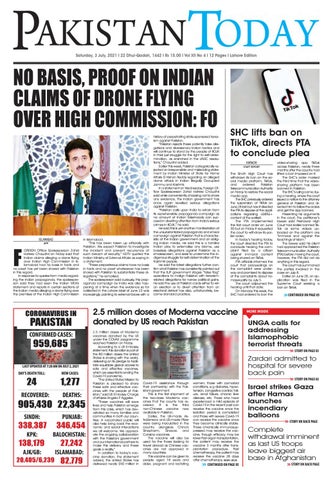
No basis, proof oN iNdiaN claims of droNe flyiNg over high commissioN: fo
ISLAMABAD app
f
OrEIGn Office Spokesperson Zahid Hafeez Chaudhri on Friday said that Indian claims alleging a drone flying over Indian High Commission in Islamabad had no basis in facts and no proof has yet been shared with Pakistan in this regard. In response to queries from media regarding the Indian propaganda, the spokesperson said they had seen the Indian MEA’s statement and reports in certain sections of the Indian media alleging a drone flying over the premises of the Indian High Commission
in Islamabad. “This has been taken up officially with Pakistan. We expect Pakistan to investigate the incident and prevent recurrence of such breach of security,” nDTV quoted the Indian Ministry of External Affairs as saying in a statement. “These preposterous claims have no basis in facts and no proof whatsoever has been shared with Pakistan to substantiate these allegations,” he remarked. The spokesperson said curiously, this propaganda campaign by India was also happening at a time when the evidence so far collected in the Lahore blast of June 23 was increasingly pointing to external forces with a
coroNavirus iN
pakistaN
CONFIRMED CASES:
959,685
LAST UPDATED AT 7:20 AM ON JULY 2, 2021
DAY'S DEATH TOLL:
NEW CASES:
24
1,277
RECOVERED:
DEATHS:
905,430 22,345 SINDH:
PUNJAB:
338,387
346,454
KPK:
BALOCHISTAN:
138,179 AJK/GB: 20,405/6,239
27,242 ISLAMABAD:
82,779
history of perpetrating state-sponsored terrorism against Pakistan. “Pakistan rejects these patently false allegations and diversionary Indian tactics and will continue to stand by the people of IIOJK in their just struggle for the right to self-determination, as enshrined in the UnSC resolutions,” Chaudhri added. Earlier this week, Pakistan categorically rejected an irresponsible and misleading statement by Indian Minister of State for Home Affairs G Kishan reddy regarding an alleged drone attack in Indian Illegally Occupied Jammu and Kashmir. In a statement on Wednesday, Foreign Office Spokesperson Zahid Hafeez Chaudhri said while conveniently choosing not to share any evidence, the Indian government has once again levelled serious allegations against Pakistan. “Pakistan calls upon India to refrain from its reprehensible propaganda campaign as no amount of Indian falsehoods can succeed in diverting attention from India’s serious crimes in IIOJK,” he said. He said this is yet another manifestation of the unsubstantiated propaganda and smear campaign against Pakistan that is characteristic of the Indian government and an obliging Indian media. He said this is a familiar Indian ploy to externalise any blame, use baseless allegations against Pakistan as a smokescreen, and seek to undermine the indigenous struggle for self-determination of the Kashmiri people. He said the latest allegations further confirm what Pakistan has consistently pointed out that the BJP government stages “false flag” operations to malign Pakistan with terrorismrelated allegations for narrow political gains. He said the use of Pakistan cards either to win an election or to divert attention from an electoral defeat has also, unfortunately, become standard practice.
SHC lifts ban on TikTok, directs PTA to conclude plea KARACHI staff report
The Sindh High Court has withdrawn its ban on the social media platform, TikTok, and ordered Pakistan Telecommunication Authority on Friday to restore the social media app. The SHC previously ordered the suspension of TikTok on June 28 last but now it directed the PTA to dispose of the applications regarding LGBTQ+ content at the earliest. The PTA implemented the first court order on June 30 but on Friday it requested the court to withdraw its earlier order. In today’s hearing today, the court directed the PTA to conclude hearing the complaint filed by a citizen against immoral content being shared on TikTok. PTA officials informed the court that proceedings on the complaint were underway and promised to dispose of the complaints about homosexuality by July 5. The court adjourned the hearing until that date. On Monday this week, the SHC had ordered to ban the
2.5 million doses of Moderna vaccine donated by US reach Pakistan 2.5 million doses of Moderna vaccines donated by the US under the COVAX programme reached Pakistan on Friday. According to a US Embassy statement, this donation is part of the 80 million doses the United States is sharing with the world, delivering on its pledge to facilitate equitable global access to safe and effective vaccines, which are essential to ending the Covid-19 pandemic. “The United States Mission to Pakistan is pleased to share these safe and effective vaccines with the people of Pakistan,” said US Embassy Chargé d’affaires Angela P Aggeler. “These vaccines will save lives and help Pakistan emerge from this crisis, which has devastated so many families and communities in both our countries. A vaccinated public will also help bring back the economic and social interactions we all welcome. We appreciate the ongoing collaboration with the Pakistani government and our international partners to make this delivery and these goals a reality.” In addition to today’s vaccine donation, the statement added, the United States has delivered nearly $50 million in
video-sharing app TikTok across Pakistan, nearly three months after the country had lifted a ban imposed on it. The SHC’s order marked the third time that the videosharing platform has been banned in Pakistan. The SHC’s ruling came during a hearing, where the court issued a notice to the attorney general of Pakistan and directed him to follow the orders and get the app banned. Presenting his arguments in the court, the petitioner’s lawyer said Peshawar High Court had earlier banned TikTok as some videos uploaded on the platform are “immoral and against the teachings of Islam.” The lawyer said his client had approached the Pakistan Telecommunication Authority (PTA) before moving the court, however, the PTA did not do anything in this regard. The court has summoned the parties involved in the case on July 8. Earlier on June 28, an application was filed in the Supreme Court seeking a ban on Tiktok.
CONTINUED ON PAGE 05
more inside
UNGA calls for addressing Islamophobic terrorist threats STORY ON PAGE 03
Zardari admitted to hospital for severe back pain Covid-19 assistance through their partnership with the Pakistani government. This is the first shipment of the two-dose Moderna vaccines that the county has received. It is the third non-Chinese vaccine now available in Pakistan. Earlier, the UK-made AstraZeneca and US-made Pfizer were being inoculated in the country alongside China’s Sinopharm, Sinovac and Cansino vaccines. The vaccine will also be used for the those looking to travel abroad as Chinese vaccines are not approved in many countries. This vaccine can be given to people aged 18 years and older; pregnant and lactating
STORY ON PAGE 02
women; those with comorbid conditions, e.g diabetes, hypertension, congestive cardiac failure, renal failure, chronic liver disease, etc. Those who have experienced a mild episode of Covid-19 in the recent past can receive the vaccine once the isolation period is completed and those with severe Covid-19 can receive the vaccine once they become clinically stable. Those chronically immunosuppressed may receive the vaccine, though efficacy may be lower Post organ transplantation, the patient may receive the vaccine 3 months after transplantation procedure. Post chemotherapy, the patient may receive the vaccine 28 days after chemotherapy. News Desk
Complete withdrawal imminent as last US troops leave biggest air base in Afghanistan
CONTINUED ON PAGE 05
STORY ON BACK PAGE
Israel strikes Gaza after Hamas launches incendiary balloons STORY ON BACK PAGE
02
Saturday, 3 July, 2021
lAhore
newS
Zardari admitted to hospital for severe back pain
p
news Desk
AKISTAN People’s Party Cochairman and ex-president of Pakistan Asif Ali Zardari was admitted to a hospital on Friday after his health deteriorated, it emerged. PPP Chairperson Bilawal BhuttoZardari flow into Karachi from Islamabad, while Bakhtawar Bhutto-Zardari and her husband have reached the city from Dubai to attend to the ailing party leader. The former president had arrived in Karachi recently from Lahore and
Islamabad. In Lahore, he had attended a meeting with former Punjab chief minister Pervaiz Elahi. Dr Asim Hussain said the former president had undergone a medical check-up at a private hospital during which he had complained of severe back pain. “An orthopedic surgeon is treating Asif Zardari, and he has undergone necessary medical tests,” he said while speaking to Geo News. During his recent address at the National Assembly, Bilawal had said that Zardari had attended a budget session despite being unwell. Back in January, Zardari had been
shifted to Dr Ziauddin Hospital, Clifton, on account of ill-health. A team of doctors had conducted a series of tests of the former president following his medical check-up. Per them, he had a backache as well as pain in his spinal cord. They further said Zardari’s blood pressure was not stable besides he was also facing difficulty in breathing. Doctors even temporarily barred visitors from meeting the former president, except his family members. He has been allowed only one attendant. He has been admitted to hospital due to
bad health in the past as well. In October, he was shifted to a private hospital in Karachi after he felt “unwell”. Zardari, who is nominated in multiple corruption cases filed by the National Accountability Bureau, has been out on bail granted by the Islamabad High Court on medical grounds in 2019. At the time, he had been indicted in a mega-money laundering, Park Lane properties and Thatta water supply references instituted by the bureau. During a hearing of the bail petition filed by Zardari, his legal counsel, Farooq H. Naek, told the court that the former
SC turns down PPP leader’s apology in contempt case
president “is a chronic patient suffering from multiple ailments.” “He is a heart patient having three stents in his heart. He has a Holter Monitor attached to his chest so that the doctors are able to check and note variations in his heartbeat and blockages in his arteries. The petitioner is a patient of ischemic heart disease, which means that his heart may have an inadequate supply of blood and oxygen”. Naek had said Zardari also “suffers from various other ailments such as cervical and lumbar spondylosis, sensory and motor neuropathy with impaired proprioception”.
pm didn’t attend national security meeting due to opp’s reservations: na secretariat IsLAMABAD
IsLAMABAD INP
Turning down a local Pakistan People’s Party leader Masoodur Rehman Abbasi’s apology in contempt of court case, the Supreme Court ruled on Friday that he will be indicted on the next hearing. The four-judge bench, headed by Justice Umar Ata Bandial, said it would frame charges against Abbasi in the next hearing, a date for which would be fixed later. The court also appointed the attorney general as the prosecutor in the case. Justice Mazahir Naqvi, a member of the bench, asked the Federal Investigation Agency to ascertain on whose directives the PPP leader made the speech. “Such a speech is not possible without a well-thought-out plan,” he remarked. “I am a poor person and apologise to the court,” Abbasi said. “I am the sole provider of my two wives and seven children.” At this, the bench said that the PPP leader should have thought all this before making contemptuous remarks against the chief justice of Pakistan. “Due to my troubles, I don’t know what I uttered. Judges are like fathers for me,” said the PPP leader as he pleaded forgiveness, adding that he was ready to apologise in whatever manner the court ordered. To this, Justice Ijazul Ahsan recalled that in the video Abbasi had said if the court summoned him, he would “show the court its status”. “What does the chief justice have to do with the atom bomb and missile [technology]? This way anyone can apologise after making insulting statements,” Justice Ahsan added. Justice Bandial asked Abbasi who had told him that the chief justice was “sector in-charge of a political party” to which the latter replied that no one had told him and he had said so himself. FIA officials informed the court that they
were investigating Masoodur Rehman and assured them that they won’t give any concession to whoever is found backing him. On July 1, a special court remanded the PPP leader in the FIA custody in the contempt case. Senior Civil Judge Aamir Aziz approved the physical remand of Masoodur Rehman Abbasi until July 4. Abbasi, an office-bearer of the PPP’s Karachi chapter, is facing contempt of court charges for uttering derogatory remarks against the CJP at a public gathering. In a video and audio clip circulated on social media websites, the PPP leader could be seen making indecent and disrespectful remarks about the judiciary. The investigation officer produced him before the court and requested that his custody be handed over to the Federal Investigation Agency for ten days for investigation. However, the court approved his physical remand until July 4. Abbasi was arrested on Wednesday night. The court said it would review similar cases of Pakistan Muslim League-Nawaz’s Nehal Hashmi, Daniyal Aziz, Talal Chaudhry and others. Earlier this week, after having examined the report of the FIA, which found the video clip of Abbassi as genuine, the Supreme Court directed him to submit a written reply in the matter. A four-member SC bench headed by Justice Umar Ata Bandial had issued a showcause notice to Masood-ur-Rehman Abbasi, general secretary of PPP in PS-114 constituency, on his derogatory speech against the chief justice. During the course of the hearing, Justice Bandial asked whether the PPP leader admits that he has delivered controversial speech. Responding to the query of another member of the bench, Justice Ijazul Ahsan asked Abbasi if he was in senses when he made the speech in question, the latter submitted, “No, I was not in my senses.”
Pakistan rejects inclusion in US Child Soldiers Prevention Act List
Abbasi’s video surfaced after the top court Karachi registry heard a case on June 15 where Chief Justice Gulzar Ahmed irked by the PPPled Sindh government’s failure to attend to the civic issues of Karachi said there seems to be no government in Sindh and the system is being run by influential persons from Canada, London or Dubai. On Monday, appearing before the bench, Abbasi requested the court for permission to express his stance about the speech in question to which Justice Bandial plainly asked him to submit in writing whatever he intends to say. A contempt proceeding was been initiated against Abbasi on account of derogatory and contemptuous language wherein notices were issued to Attorney General for Pakistan, FIA, Pemra and a show-cause notice to Masoodur Rehman Abbasi through IG Sindh in the matter. The PEMRA official apprised the bench that no television channel has disseminated Abbasi’s speech. A member of the bench Justice Ijazul Ahsan asked whether offensive content has been removed from Facebook, to which Pakistan Telecommunication Authority (PTA) official responded that once the FIA completes the evidence-gathering process in the matter, the content in question would be removed from the site. He further submitted that ongoing investigation would be affected if the content is removed from the site. Justice Bandial directed the FIA to collect admissible evidence, saying PTA should be informed about evidence being collected. Justice Bandial directed that the PTA should remove controversial content from social media platforms once the FIA completes the process of evidence gathering. Later, issuing directives to the PPP leader to submit a reply in response to the contempt charges, the bench adjourned a hearing of the matter till July 2.
APP
A spokesman of the National Assembly Secretariat on Friday said Prime Minister Imran Khan did not attend the Thursday’s meeting of Parliamentary Committee on National Security following the reservations by “some opposition leaders.” The spokesman dubbed the media report regarding non participation of the prime minister in the meeting of Parliamentary Committee on National Security held on July 1, 2021 as factually incorrect. “Prime Minister was always willing to attend the meeting of the parliamentary committee and the only reason of his not coming to meeting was reservations conveyed to Assembly Secretariat by some opposition leaders,” the spokesman clarified. Water Issues: Indian delegation fails to visit Pakistan despite three months lapse
Water issues: indian delegation fails to visit pakistan despite three months lapse IsLAMABAD MIAN AbRAR
Despite three reminders sent by Pakistan to India, the Indian water experts’ delegation has yet not visited Pakistan to discuss ways and means to resolve issues regarding the Indus Basin Agreement. India and Pakistan, the two nuclear-armed neighbours, are locked with water issues since past few decades. India over the decades has been cutting water from rivers flowing into Pakistan by building dams and diverting rivers through tunnels and dams. This conflict, the experts believe, can trigger a nuclear clash between the two neighbours. India, being the upper riparian, has been stealing water of its lower riparian neighbours, including Pakistan, Bangladesh and other South Asian countries. An informed source has told Pakistan Today that under the Indus Basin Agreement, the Indian water experts have not visited Pakistan even after the lapse of three months. According to the source, India’s stubbornness on water disputes continues and delaying tactics are being employed. The source said that Indian water experts did not visit Pakistan despite three reminders have been sent in the past three months. The source said that under the Indus Water Treaty, the Indian delegation was to visit Pakistan and Pakistan had to send site inspections of projects to the Indian Indus Water Commissioner. “It seems India wants Pakistan to suffer with water woes. India doesn’t want to resolve issues,” the source added. Asked to explain, the source said that under the Indus Water Treaty, the Indian delegation has to pay a mandatory visit as it was decided in the meeting to be held in India that the Indian delegation will also pay a visit Pakistan in the month of April.
Delta variant sweeps Asia, prompting curbs as vaccination remains tepid
news Desk
seOUL/sYDneY
Pakistan has rejected its inclusion in the United States’ Child Soldiers Prevention Act (CSPA) List. “We categorically reject the unsubstantiated and baseless inclusion of Pakistan in the ‘Child Soldiers Prevention Act (CSPA) List’ – published under a domestic U.S. legislation – in the U.S. State Department’s Annual Trafficking in Persons (TIP) Report 2021,” the Foreign Office said in a statement. “Pakistan does not support any nonstate armed group; nor any entity recruiting or using child soldiers. Pakistan’s efforts in fighting non-state armed groups including terrorist entities are well recognised. The inclusion of Pakistan in the ‘CSPA List’ depicts a factual error and lack of understanding. No State institution was consulted by the U.S. prior to the publication of the report. Nor were any details provided of the basis on which the conclusion was reached,” it stated. “Overall, on the issue of Trafficking in Persons, Pakistan is committed to fighting this scourge both at the national and international levels. We have taken a range of legislative and administrative actions in that regard during the last one year, including the approval of Rules under the domestic Trafficking in Persons and Smuggling of Migrants Acts; National Action Plan 2021-25 prepared jointly by the Federal Investigation Agency (FIA) and the UN Office on Drugs and Crime (UNODC); and enhancement of capacity building and inter-agency cooperation of Law Enforcement Agencies involved in anti-human smuggling,” it added. “Pakistan has been voluntarily submitting information for the TIP Report to the U.S. Government since 2007 and has actively worked on implementing the practicable recommendations of these reports,” it further said.
The highly contagious Delta variant of the coronavirus is surging through Asia this week, with record numbers of infections in Australia and South Korea, prompting some countries to tighten curbs and others to hasten vaccination. The variant, first detected in India in December last year, has spread to about 100 countries and the World Health Organisation warned recently that it could soon become the dominant form of the virus. It is also driving a spike in cases in Japan, casting a pall over this month’s Olympic Games. On Friday, Australia’s New South Wales state, its most populous, reported the biggest daily rise in new cases so far this year. Total cases in the state in the latest outbreak have topped 200, a majority caused by the Delta variant. Sydney, home to a fifth of the country’s 25 million population, is halfway through a two-week lockdown to contain the outbreak, which has alarmed authorities amid a sluggish nationwide vaccination drive. “I think the vaccine will certainly
ReuteRs
reduce the disease, it will certainly reduce hospitalisation. But we’ll certainly have the virus circulating in the community for those people who aren’t vaccinated,” said Professor Jill Carr, a virologist with the College of Medicine and Public Health at Flinders University. Australia, like several other countries in Asia, has struggled to inoculate people as initial successes in containing the pandemic led to vaccine hesitancy, and manufacturers were slow to ship doses. Australia has fully vaccinated only 6% of its population, while Japan has vaccinated 12%. Japan reported on Wednesday that the Delta variant now accounts for nearly a third of all cases in the eastern part of the country, including Tokyo, and that could grow to 50% by mid July. Tokyo and three neighbouring prefectures are among areas under a ‘quasi’ state of emergency set to run through July 11 and the recent uptick in infections has officials leaning towards keeping restrictions in place, government sources have told Reuters. On Friday, Tokyo governor Yuriko Koike reiterated that a ban on
spectators for the Olympic Games, which start on July 23, would be an option if the coronavirus situation worsened. In South Korea, officials said on Friday daily coronavirus cases topped 800, the highest in nearly six months, with vaccination below 10%. The average number of new infections in the country has risen for 10 days straight, and authorities in Seoul have delayed relaxing social distancing measures. read more “The Delta variant is a strain that is most optimised for widespread transmissions,” said Chun Eun-mi, a respiratory disease specialist at Ewha Womans University Medical Center in Seoul. “The cases of Indonesia, India and Britain show that not just Korea but many other countries will need to rethink their vaccine strategy and reopening plans,” she said. Indonesia, the world’s fourth-most populous country, imposed emergency measures that begin on Saturday until July 20 to contain a spike in cases. In India, the number of new infections has eased to two-month lows since hitting a peak of 400,000 a day in May, with the government focusing on
mass vaccinations. COVID CERTIFICATE: The United States has also seen a rise in Delta variant infections in parts of the country where vaccination rates remain low, and the White House said on Thursday it would send special assistance to those hot spots. Europe, too, is battling an increase in infections, which the WHO has blamed on crowds at Euro 2020 football stadiums. It has warned that a new wave was inevitable if people did not remain disciplined. Britain is gearing up to lift lockdown restrictions on July 19, even as Delta variant cases rise. Germany said on Thursday it expects the variant to account for up to 80% of infections this month and Portugal imposed nighttime curfews. The fresh cases have put a damper on summer tourism in the continent, although the launch of a European Union Covid-19 travel certificate may prompt more travel. Europe’s drug regulator said on Thursday the Covid-19 vaccines approved in the European Union offered protection against all coronavirus variants, including Delta.
Saturday, 3 July, 2021
lAhore
UnGa calls for addressinG islamophobic terrorist threats UNGA UNANIMOUSLY ADOPTS THE REVISED GLOBAL COUNTER-TERRORISM STRATEGY news Desk
t
HE UN General Assembly (UNGA) on Friday unanimously adopted the revised Global Counter-Terrorism Strategy (GCTS) and called on the international community to take appropriate measures to address new and emerging terrorist threats on the basis of Islamophobia, xenophobia and racism. Pakistan, together with other Organisation of Islamic Cooperation (OIC) countries, spearheaded the
initiative for the recognition of Islamophobia as an emerging terrorist threat under the GCTS. The UN GCTS also urged for ending the direct and indirect forms of religious and racial discrimination and counter incitement to hatred and violence propagated by terrorist groups on such basis. It also called on the UN Secretary-General, António Guterres, to report on the threat posed by such extremist and Islamophobic terrorist groups. In a statement, Foreign Office Spokesperson Zahid Hafeez Chaudhri said Pakistan has repeatedly called on the international community to
collectively act against Islamophobia, including by taking effective actions through the United Nations. “Pakistan has also been expressing grave concern at the rising tide of Islamophobia, xenophobia and right-wing extremism across the world,” Spokespoersn Chaudhri said adding that Pakistan had also been expressing concerns regarding terrorist threat posed by the far-right or extreme right-wing groups. The recognition of terrorist threats caused by Islamophobia in the GCTS constitutes a landmark achievement to address the increasing number of terrorist attacks against Muslims and their places of worship in many parts of the world.
INP
The government of Pakistan is mulling over to increase Pakistan International Airlines flights in wake of thousands of Pakistanis stranded abroad owing to cancellation of flights from foreign airlines, INP reported on Friday. According to sources privy to the matter, the government is mulling to convey directions regarding an increase in flights and use of big aircraft to the PIA aimed at facilitating the stranded Pakistanis. It is pertinent to mention here that the foreign airlines booked extra flights preempting ease in Covid restrictions before the National Command & Operation Centre meeting on June 29 and had to cancel the flights after the decision-making body on Covid restrictions decided against any ease. This led to the airlines cancelling their booked tickets, which Pakistanis bought at higher rates.
Thousands of Pakistanis in Turkey and Doha have faced cancellation of their booked tickets, causing mental agony for them. In this regard, Civil Aviation Authority on Friday issued a warning to some foreign airlines for the “sudden cancellation” of flights to and from Pakistan, causing hardships to passengers. It was not immediately clear which airlines have been issued the warning. On June 01, after Pakistan’s decision to limit international flights amid the coronavirus pandemic, two International Airlines cancelled their scheduled flights for Pakistan from the US. However, some international airlines cancelled flights to Pakistan without prior intimation to the CAA, prompting the authority to take notice and issue warnings to them. As per details, Turkish and Qatar International Airlines have cancelled their scheduled flights from the United States to Pakistan. The flights were
pm orders more incentives for expats to attract maximum remittances ISLAMABAD: Prime Minister Imran Khan has directed the relevant ministries to consider extending more incentives to overseas Pakistanis to attract maximum remittances. Chairing a follow-up meeting on Friday regarding facilitating overseas Pakistanis, particularly to ease and incentivise home remittances through legal channels, the prime minister said that overseas Pakistanis are a precious asset of the country. He said that the remittances sent by overseas Pakistanis have an important role in the country’s economic stability. He said that the government is determined to extend full facilitation to overseas Pakistanis and their families. He also emphasised the need for evolving a strategy to achieve the targets set for different sectors. According to data released by the central bank, the remittances sent home by overseas Pakistanis rose 33.5 percent to $2.5 billion in May on a year-on-year basis. On a cumulative basis, the remittances surged to $26.7 billion during July-May FY21, higher by 29.4 percent compared to the same period of the last year. “Remittances in the first 11 months of FY21 have already crossed the full FY20 level by $3.6 billion,” the SBP said. According to the central bank data, Pakistanis in Saudi Arabia sent home $7 billion during July-May of fiscal year 202021 compared to $5.86 billion in the same period of last year, an increase of 19.5%. During this period, remittances from the United Arab Emirates rose 9.7% to $5.6 billion. Inflows from the Middle Eastern country had stood at $5.1 billion in the same period of last year. tLtP
scheduled to land in Pakistan in the first week of July. Following the cancellation of the flights, Pakistanis in the US who were willing to return to the homeland, are facing difficulties, said sources. Reacting to the situation, the spokespersons of the CAA, said that both the airlines did overbooking on the Pakistan-bound flights. Meanwhile, an official of Qatar Airways told Dawn that some of its flights had been cancelled to comply with the NCOC’s restrictions [on capacity]. The NCOC, in its statement, said it had developed an integrated system to prevent the spread of the Covid-19, and in this regard, inbound flights were subjected to routine testing and quarantine of passengers upon arrival, if they were tested positive for the disease. “So far, 280,000 people who landed home from abroad have been tested, and 600 were quarantined after being found positive for Covid-19,” the NCOC said.
An official of the Ministry of National Health Services had said Pakistan had introduced three categories — A, B and C — in October last year to deal with Covid-19. “The countries in category A are exempted from the mandatory coronavirus testing, those in category B require a negative PCR test that has to be taken 72 hours before travel, while people coming from countries in category C have to face restrictions and are only allowed under strict NCOC guidelines,” he had said. Pakistan had revised travel restrictions for inbound passengers from countries in category C in the second week of June, allowing Pakistanis to travel without the exemption letter. However, foreigners need the letter as per restrictions. Passengers transiting through category C countries (not leaving the airport premises) also not require an exemption letter irrespective of the country of origin.
PM commends FBR for raising 'historic level of tax revenues' news Desk Prime Minister Imran Khan Friday gave the Federal Board of Revenue (FBR) a pat on the back for collecting “historic level of tax revenues” during the outgoing fiscal year. “I commend efforts of FBR in achieving historic level of tax revenues of Rs.4732 bn in 2020-21 – exceeding target of Rs 4691 bn &18% higher than last year,” tweeted the prime minister. The premier said that the performance of the Bureau is a testimony to the economic revival brought about by his government’s policies. A report on Thursday said the Bureau had met its target for the fiscal year 2021-22. The FBR, as per the report, went over its tax collection target of Rs4,691bn for the fiscal
03
infantry to be modernised to tackle future threats: coas MARDAn tLtP
Govt mulls increasing PIA operations in wake of foreign flights cancellation kARACHI
newS
year 2020-21 and managed to collect Rs4,725bn. But the FBR didn’t manage to meet its initially envisaged tax collection target of Rs4,963 billion for 2020-21, which was revised downward to Rs4,691 billion in line with the IMF agreement. Tax collections increased by 18.2% during the financial year, FBR sources told the newspaper. Last year, the FBR had collected revenue amounting to Rs3,997bn. The FBR made a net collection of Rs555bn in June 2021 that helped the Bureau jack up its overall collection to Rs4,725bn on June 30, 2021. The FBR’s collection stood at Rs4,170bn during the first 11 months (July-May) period of the current fiscal year, so after adding the collection of June 2021, the overall collection went up to Rs4,725bn, The News reported.
Chief of Army Staff (COAS) General Qamar Javed Bajwa has said that Pakistan Army is committed to modernising its infantry as part of its overall drive to prepare for future threats. The army chief said this while interacting with the officers and troops during his visit to Punjab Regimental Centre in Mardan on Friday, said the Inter-Services Public Relations (ISPR) in a statement. The army chief appreciated the regiment for displaying the highest standards in all professional pursuits including its exemplary performance in operations. During the visit, the COAS installed Lieutenant General Majid Ehsan, Inspector General Arms as Colonel Commandant of the Punjab Regiment, said the ISPR. Outgoing Colonel Commandant of the Punjab Regiment Lieutenant General Shahid Baig Mirza (retired), a large number of serving and retired officers and soldiers attended the ceremony, said the military’s media wing. He also laid a floral wreath at Yadgar-eShuhada. Earlier on arrival at Punjab Regimental Centre, General Bajwa was received by the incoming, outgoing colonel commandants and commandant of Punjab Regimental Centre.
daily covid infections reach highest level since June 9 IsLAMABAD tLtP
After a three-week decline in daily cases of Covid-19, the country on Friday reported over 1,277 new cases, the highest daily number since June 10. According to the data provided by the National Command and Operation Centre (NCOC) on Friday, the country recorded 1,303 new infections on June 09 and 663 on June 21, the lowest number since October 20, 2020. With 1,277 new cases, the country’s overall caseload has reached 959,685. While 24 more people died in the past 24 hours, bringing the total number of fatalities to 22,345 and 905,430 recoveries. At least 153 new coronavirus cases were recorded in Punjab during the past 24 hours, taking the provincial tally to 346,454. According to the Punjab Primary and Secondary Health Care Department, at least eight more patients succumbed to the pandemic as the total reached 10,761. The department added that at least 327,422 patients had recovered from the deadly virus as of yet.
pm didn’t attend security briefing as shehbaz would’ve walked out: fawad news Desk
Protests erupt in Punjab against power outages in sizzling heat LAHORe tLtP
Citizens from several cities of Punjab, including Lahore, Multan, and Gujranwala, took to the streets on Friday to protest the prolonged unannounced electricity loadshedding in their respective areas. According to details, hordes of people, affected by the power crisis, flocked to the streets, set tires on fire, and blocked roadways.
The protests were staged at Nawabpur Road in Multan and Gondlanwala Chowk in Gujranwala where protesters chanted slogans against the Multan Electric Power Company (MEPCO), Gujranwala Electric Power Company (GEPCO) and the government, saying that 16 hours of power outage has made their lives miserable. Meanwhile, in the provincial capital of Lahore, intermittent load-shedding
continued for the last 24 hours, agitating the citizens as they have to bear the sweltering heat. According to the Lahore Electric Supply Company (LESCO) officials, unscheduled loadshedding is occurring within LESCO’s boundaries due to electricity production shortfall, while issues related to frequent feeder trips are also being experienced due to the increased pressure on grid stations.
Minister for Information Fawad Chaudhry on Friday commented on the prime minister’s absence from the military and intelligence leadership’s briefing on national security, Afghanistan and Kashmir to parliamentary leaders, claiming that the premier had not attended the briefing to accommodate the leader of opposition. “The prime minister was scheduled to attend the national security huddle, but the opposition leader [Shehbaz Sharif] had conveyed to the speaker that if [Prime Minister Imran Khan] came to the briefing, he would not attend,” Fawad said during an appearance on a private TV show. Echoing the talking points from a day earlier, Fawad said the government hopes and prays that there is a peaceful transfer of power in Afghanistan.
CPEC: Pak, China Relations Steering Committee finalises its scope of work, ToRs IsLLAMABAD MIAN AbRAR
Pakistan, China Relations Steering Committee held its first sitting and finalised its Terms of Reference (ToRs) and its scope of functioning here on Friday. The meeting was chaired here with Federal Minister for Planning, Development & Special Initiatives Asad Umar to discuss the committee’s scope and rationale.
Prime Minister Imran Khan had recently constituted Pak-China Relations Steering Committee to give further impetus to the implementation of projects and initiatives involving Pak-China collaboration. The committee has high-ranking officials from civilian and military bureaucracy and the high-level forum reflects the special status of the Pak-China relationships in the PM’s vision. Formation of the committee is aimed at resolving the issues and removing
bureaucratic hurdles in implementation of the decisions of the Joint Cooperation Committee (JCC) to help take further the CPEC projects. The 15-member Committee includes Deputy Chairman of the Planning Commission, Secretary Planning, Secretary, Ministry of Foreign Affairs, Secretary, Ministry of Interior, Secretary Railways, Secretary Power, Secretary Finance, National Security Adviser, Chairman China, Pakistan Economic Corridor (CPEC) Authority, and Chairman Gwadar
Development Authority. Other members of the committee are the Director-General of the Joint Staff Headquarters, Chief of General Staff/Director General Military Operations, Chief of Staff Naval Headquarters, and Director General Intelligence/Analysis of the ISI. The meeting discussed its modus operandi and TORs in detail, and it also solicited suggestions on how to make the committee more effective and efficient in order to further deepen Pakistan-China relations.
Saturday, 3 July, 2021
04 NEWS
LAHORE Parched man dies in landmine explosion in Sibi A man was killed when his motorcycle hit a landmine in Sibi on Friday. According to reporte, Asad Ullah, son of Wahid Baukhsh, was going to fetch drinking water on his motorcycle. When he reached Izat Shah area near Sibi Mithri, his motorcycle hit a landmine that exploded with a bang, killing the rider on the spot. Levies personnel rushed to the place of the incident. An Edhi ambulance took the man’s body to Sibi Civil Hospital. The incident occurred a day after six soldiers of the Pakistan Army sustained injuries in a blast in Quetta. Balochistan Home Minister Mir Zia blamed on India and said extremist groups may have been used for such terrorist activity. Rescuers rushed to the explosion site and shifted the injured to a hospital. The minister paid tribute to the forces for their sacrifices in the fight against terrorists and reiterated the resolve to continue with efforts to maintain law and order. A few days ago, four soldiers, including a junior commissioned officer, embraced martyrdom in a blast in Quetta. NeWS DeSK
Man suffers heart attack during case hearing
Quetta: A security official stands alert after narcotics set on fire. INp
Punjab faceS energy ShOrtfaLL Of 2,000MW LAHORE
t
INp
HE Lahore Electric Supply Company (LESCO) on Friday said that energy shortfall across Punjab has crossed 2,000MW. The spokesperson of the LESCO in his statement said that the energy shortfall in the province has been recorded more than 2,000MW and as a result of which, the urban and the rural areas of the province are facing unannounced power cuts. “The grid stations in Lahore are overloaded, which is resulting in tripping of the stations,” the LESCO official said. The sources within the power division have said
that the loadshedding is increasing due to the low level of inflows in Tarbela Dam and no supply of gas and oil to the power houses. They said that the situation will improve in the next two to three days. On Thursday, it was reported that the overall energy shortfall had reached 6000 megawatts in Pakistan. According to sources, the country had an aggregate power demand of 25000 megawatts on Thursday, while the overall power supply from various resources was around 19000MW. The power outages have reached six to eight hours daily in big cities, while small towns and villages facing up to 10 hours power loadshedding in a day.
A man suffered heart attack during hearing of a case hearing at a court in Lahore on Friday. He appeared in the court of Additional Sessions Judge Shehzad Muzaffar Hamdani after submitting an application for interim bail in a fake cheque case. He, however, collapsed during the hearing and the court staff immediately rushed him to the Mayo Hospital. A case was registered against him by the Township police for giving a fake cheque to another person. NeWS DeSK
One killed, six injured in two separate accidents in Lahore One person was killed and six other sustained injuries in two separate accidents in Lahore on Thursday night. One accident occurred at the Ferozepur Road near Kalma Chowk, where a speeding truck hit a motorcycle, killing a youth and critically wounding his father. Police and rescue teams reached the spot and shifted the dead and injured to a nearby hospital. Rescue sources said that the identity of the dead and injured not known yet. Meanwhile, the residents of the area handed over the driver of the truck to the police. Another accident occurred near Jail Road, where a speeding car overturned, injuring at least five persons. Rescue teams reached the spot and shifted the injured to a nearby hospital. NeWS DeSK
CoP urges govt to protect church properties in Quetta from land mafia to sell the sacred heritage of the CoP. “We have officially notified that none of these persons is associated with the CoP, nor are these persons recognized as bishops and trustees of church properties. The CoP will take all measures to prevent misappropriation of church properties,” it stated. It added that church properties are trust properties and therefore cannot be
LAHORE Staff RepoRt
The Church of Pakistan (CoP) has expressed serious concern over attempts being made by some elements to illegally grab and sell church properties in Quetta, Balochistan. In a letter addressed to the Balochistan governor, chief minister, chief secretary, Quetta corps commander and the inspector general of police, Bishop Arshad Kaleem John, the moderator’s commissary bishop of Karachi and Balochistan, stated that a group of imposters was trying to sell the CoP’s properties namely Christian Hospital, Mission Road, Quetta, Saint Teresa School, Vicarage, the residence of priest of Saint Mary’s Church, Saint Mary’s School-Cantonment, Bethel Memorial Church, Zargoon Road, and Hospital Compound (known as Mission Compound, opposite Christian Hospital, Quetta), on fake documents allegedly with the connivance of government officials and the land mafia. “The Lahore Diocesan Trust Association (LDTA) and Methodist Board for Properties are the real owners of the stated church properties
whereas the Diocese of Karachi/Balochistan is the legal attorney and custodian of those properties,” the letter stated. The letter added that some elements in the Christian community had formed two different CMTAs (Church Mission Trust Association) and were making efforts to sell the properties to the land mafia on fake registration deeds and illegal agreements. “The government and law enforcement agencies must take notice of these malicious activities and ensure that the church properties are protected from illegal possession,” the letter concluded. Separately, the CoP’s Synod Coordination Office has also expressed its concern over a press conference held at the Quetta Press Club on June 29, by “self-proclaimed bishops” Farrukh Javed, Younis Masih, Samuel Bashir Massey and Sunny E J Mall, and Hanook Masih (purporting to be the President of CMTA), Ms. Ruby Barkat (purporting to be the General Secretary of CMTA). In a press statement, the Synod office stated that these persons are using the name and nomenclature of Church Missionary Society (CMS) and Church Missionary Trust Association (CMTA)
CMYK
sold, transferred or leased. “Whosoever executes any such illegal deal with these persons shall be guilty of misappropriating trust/church property. The Church of Pakistan requested the authorities and the general public to be aware of these fraudulent tactics being used to carry out illegal deals of church properties,” the statement concluded.
Saturday, 3 July, 2021
LAHORE
NEWS
Exports surgE 18pc in FY 202021 to hit all-timE high: Fawad ISLAMABAD
m
TLTP
INISTER for Information and Broadcasting Fawad Chaudhary has said the country achieved its highest ever export target with 18 percent increase in the fiscal year 2020-21. In a tweet on Friday, the information minister said if the service sector is also included, the exports are more than $31 billion. He expressed the confi-
dence that the exporters will prove to be an important pillar of Pakistan's economic stability in the years to come. It is pertinent to mention here that exports of goods grew by 18 percent to $25.3 billion during the fiscal year 2020-21, which are the highest ever in the history of Pakistan. According to the data shared by the Ministry of Commerce, the exports in June 2021 were also the highest in any month in the past and remained at $2.7 billion. The exports of services for
the year are projected to be $5.9 billion. The cumulative exports of goods and services during the fiscal year 2020-21 will, therefore, cross the $31 billion mark. Separately, Adviser to Prime Minister on Commerce and Investment, Abdul Razak Dawood has said that Pakistan’s exports to the United Kingdom increased by 33 percent to $2.025 billion during the just concluded fiscal year 2020-21 as compared to $1.526 billion during the financial year 2019-20. In a series of tweets on Fri-
day, the advisor said that the increase in exports to the UK remained $499 million. Showing his happiness on the upward momentum in exports, the advisor said that the UK is a very important trading partner of the country and it is for the first time in history that Pakistan’s exports to the UK have crossed the $2 billion mark in any financial year. He commended exporters as well as the Ministry of Commerce’s trade and investment officers for this remarkable accomplishment.
SHC lifts ban on TikTok, directs PTA to conclude plea contInueD froM pAge 01 Ali Zeb, a resident of Pakpattan, said that TikTok was promoting crime, with people using drugs and weapons and uploading videos, while the use of TikTok in educational institutions was leading to a bad environment for the students The petitioner said individuals are likewise making recordings of endeavors like an attempt of suicide to get views on TikTok, while the content on it was against the Islamic laws of Pakistan. The petitioner requested that effective policy-making be carried out by partially shutting down TikTok and ordering the government to set up a mechanism to censor the content. Back in April, Pakistan, for the second time, had officially lifted a ban on Chinabased ByteDance’s app TikTok consequent to a local high court’s order. This was done almost a month after the same judicature had directed the state-run telecommunication authority to “immediately block access” to the short-form video-sharing service. However, the PTA had also issued a stern warning to TikTok against “vulgar and objectionable content”, which it was told to remove. The “PTA has issued directions to the service providers to unblock access to the TikTok App”, the authority said in a press release shared on Twitter. “However, the TikTok App management has been told to ensure that vulgar and objec-
tionable content are to be made inaccessible in accordance with the PECA provisions and directions of the Honorable Court,” it warned. The court in Peshawar was told during the hearing on April 1 that TikTok had appointed a focal person to focus on “immoral content” and what action should be taken in that regard. PHC Chief Justice Qaiser Rashid Khan had told the PTA’s director-general that the body should have a system that could differentiate between “good and bad”. “When PTA takes action [against immoral content], people will not upload such videos,” Justice Qaiser had said, to which the latter said the authority had spoken to TikTok to block repeat offenders. The PHC had then ordered the PTA to “open TikTok but immoral content should not be uploaded”, asking the official to present a detailed report on the matter during the next hearing. Separately, More than six million videos were removed from TikTok in Pakistan in three months, the app has reported, as it battles a series of suspensions. Wildly popular among the youth, the Chinese-owned app has been shut down by the courts twice over “indecent” content, most recently in March after which the company pledged to moderate uploads. “In the Pakistani market, TikTok removed 6,495,992 videos making it the second market to get the most videos removed after the USA, where 8,540,088 videos were removed,” TikTok
Pakistan’s latest transparency report announced on Wednesday, covering January to March. Around 15 per cent of the removed videos were “adult nudity and sexual activities”. A spokesman said the Pakistan-made videos were banned as a result of both user and government requests. In the Muslim nation, posting videos in Western clothes that reveal too much skin is taboo, and is often met with abuse. Earlier this month, small anti-TikTok rallies were held against what protesters called the spreading of homosexual content. “One can speculate that this is a result of government pressure or a reflection of the large volume of content produced in Pakistan given the popularity of the platform, or both,” said digital rights activist Nighat Dad. “Social media platforms are more willing to remove and block content in Pakistan to evade complete bans,” she said. It comes as the app faces a fresh court battle in Karachi, where the Sindh High Court has asked telecommunication authorities to suspend it for spreading “immoral content”. The platform is still working in Pakistan, however. Dating apps have been blocked and last year regulators had asked YouTube to immediately block all videos they considered “objectionable” from being accessed in the country, a demand criticised by rights campaigners. With additional input from INP
Pakistan urges ASEAN member states to invest in CPEC SEZs ISLAMABAD TLTP
Pakistan has asked the member countries of Association of Southeast Asian Nations (ASEAN) to consider making investments in Special Economic Zones (SEZs) set up under the ChinaPakistan Economic Corridor (CPEC) project. The call was made by Foreign Secretary Sohail Mahmood while delivering a keynote address at the Experts Dialogue on Pakistan-ASEAN: Shared Future and the Way Forward," coorganised by the Embassy of Indonesia and the Institute of Strategic Studies, Islamabad (ISSI) on Friday. Noting the steady trajectory of PakistanASEAN relations, the foreign secretary underlined the high priority accorded by Pakistan to its relations with the Southeast Asian nations and its recognition of ASEAN’s vast economic potential and its centrality in the regional architecture. Consistent with “Vision East Asia” policy, the foreign secretary underscored Pakistan’s commitment to further strengthen PakistanASEAN partnership in all dimensions. He specifically stressed the importance of forging closer cooperation in political, economic, security, tourism, education and socio-cultural domains. He highlighted the range of steps taken by Pakistan to foster multifaceted engagement with ASEAN and the commitment to deepen trade and economic linkages with ASEAN member states. He said that this is in line with Pakistan’s economic diplomacy outreach and consistent with the leadership’s emphasis on geo-economics. He also underlined the importance for Pakistani business community to see how mutually-beneficial collaboration could be achieved by engaging with the Regional Comprehensive Economic Partnership (RCEP), recently concluded by ASEAN and its key trading partners.
cMYK
05
2.5 million doses of moderna vaccine donated by us reach pakistan contInueD froM pAge 01 It cannot be given to people if they have had a severe allergic reaction (anaphylaxis) or an immediate allergic reaction, even if it was not severe, to any ingredient in an mRNA COVID-19 vaccine (such as polyethylene glycol) or after getting the first dose of the vaccine, should not get a second dose of either of the mRNA Covid-19 vaccines. The vaccine is not recommended for persons younger than 18 years of age pending the results of further studies. In general, persons with an immediate non-anaphylactic allergic reaction to the first dose should not receive additional doses, unless recommended after review by a health professional with specialist expertise.
withholding tax on used cars, cng, air travel abolished ISLAMABAD: The Federal Board of Revenue (FBR) has abolished withholding tax on bank transactions, purchase of used cars, domestic and international air travel, compressed natural gas (CNG) and minerals. The tax has been abolished under the Finance Act 2021, the FBR said in a notification on Friday. The people buying new cars will be required to register the vehicles in their own names. They will have to pay Rs200,000 for failing to do so. There will be no withholding tax on sending money abroad through credit or debit cards either, according to the FBR. The FBR required businesspersons to have business accounts to ensure documentation of the economy. Taxpayers will have to declare their business accounts. Hiding the taxable income can now result in the arrest of an individual, according to the notification. The FBR will identify tax evasion through a third party. Forms to file tax returns for FY2021 are available on the FBR website and the Tax Asaan mobile app. TLTP
Saturday, 3 July, 2021
06 COMMENT
The solution to Pakistan’s Agricultural woes through sustainable financing
Briefing on National Security And a shot across the bow by US
t
HE precarious security situation in afghanistan and its dangerous ramifications for Pakistan led the security establishment to hold a high-level briefing for over 40 important parliamentarians under the aegis of the Parliamentary Committee on national security. Parliamentarians are usually taken into confidence only when polices formulated by the establishment lead to a cul de sac. Pakistan is in a pretty pickle these days. While the afghan government never trusted Pakistan, now the taliban too are unwilling to heed its advice. the Usa is reportedly behind the FatF decision to prolong Pakistan’s stay in the gray list. the sword of the iMF meanwhile continues to hang over Pakistan’s head. Whether Pakistan will be able to retain its GsP-Plus status is anybody’s guess. as a warning shot, the Usa has included Pakistan in the child soldier recruiter list, a designation that could lead to strict sanctions on military assistance. the parliamentarians tried to seek all the “sensitive” information they needed from the security establishment. Politicians frequently claim that the establishment encroaches upon the elected governments’ turf and makes policies that harm the country. it is now for the political leaders to step up to the plate. a PML(n) leader who attended the briefing has asked the government to call a joint session of Parliament to prepare a national response to the situation. there are several challenges the country is facing. Proxies, the meeting was told, were being triggered by external forces as was evident from the increase in terrorism in Balochistan and last week’s explosion in Lahore. With a civil war raging in afghanistan, there would be an inevitable influx of refugees into Pakistan. this has caused complicated problems in the past. this time there is a likelihood of individuals belonging to terrorist groups sneaking into Pakistan pretending to be refugees. it was maintained during the briefing that Pakistan’s territory was not being used in the ongoing conflict in afghanistan. Hopes were expressed that afghanistan too would not let its soil to be used against Pakistan. neither the afghan taliban, nor the afghan government, showed interest in taking out or reining in these networks in the past. there is little likelihood of their obliging Pakistan now. the complicated problems can only be dealt with through collective brainstorming in Parliament.
Green Banking in the way forward
Syed ASim Ali BukhAri
P
akistan is an agriculture-based economy with the agriculture sector contributing approximately 20 percent to the country’s GDP, employing over 40 percent of the country’s workforce and providing raw materials for more than two-thirds of merchandise exports. However, Pakistan’s agriculture sector is facing a losing battle for its survival. this agricultural country is plagued with food shortage, continuously escalating food inflation and an economically, socially and environmentally unsustainable growth pattern mainly caused by uncertain irrigation water availability, unpredictable weather patterns, underdeveloped cold storage facilities, low investments in extension services and research, rising input costs, and current lack of awareness among farmers for adopting sustainable agricultural practices. the agriculture sector of Pakistan needs a drastic digital and sustainable makeover. it needs to be revitalized on the concept of agriculture 4.0, i.e., digitalization and sustainable agricultural practices, processes, and equipment. the future of agriculture is the synergistic blend of precision agriculture, digital agriculture, climatesmart agriculture and organic farming to achieve sustainable agricultural growth. these concepts can revolutionize every aspect of the agricultural value chain through new techniques such as Hydroponics,
Hankering after other systems Without doing the hard work needed
The Afghan imbroglio provides one
TAhir khAn
A
FGHanistan has been known as the “graveyard of mighty empires”. it has doomed multiple empires that have attacked its land. the two prominent examples after World War ii are the death and ultimate destruction of the former UssR; and the destruction of the Usa and its allies in terms of the loss of thousands of lives and billions of dollars in a war with no positive results for them. it is the reason that the Usa wants to end the longest war in its history and wants a complete and swift withdrawal of its forces from afghanistan even before the given time. this state of affairs presents a score of challenges for regional countries including Pakistan, but it also offers Pakistan a good window of opportunity. initially, the war was launched by the Usa and its natO allies without thinking of ifs and buts. the day’s administration under President George W. Bush was so arrogant that it did not even give Pakistan a chance to think whether to be part of this war or not. Pakistan was told straightforwardly in a threatening posture, “either you are with us or with them (taliban ruling regime in afghanistan)”. Hence, Pakistan joined the war which was not its own. in this way, an attack followed by bloody civil war began in the region. that war brought destruction not only for afghanistan but for the whole region beyond its borders. the most affected regional country, in this regard,
Dedicated to the legacy of the late Hameed Nizami
Arif Nizami Editor Managing Editor
Joint Editor
Umar Aziz Executive Editor
Lahore – Ph: 042-36300938, 042-36375965
tree plantation on the country’s vast highways can substantially increase production and reduce import dependency. the “kissan Card” has been launched to support and facilitate small farmers. However, there is a lack of any clear-cut policy that connects Green Banking with sustainable agricultural initiatives, enabling the agricultural sector to simultaneously achieve economic and environmental sustainability. Farmers should be trained in sustainable agricultural techniques and products and educated about various green financing options available for them. in a rapidly evolving technological environment, the government needs to introduce new technology, both in agriculture and the public sector, more broadly. if the government subsidizes technological upgrades, farmers may reap the fruits of technology at more reasonable rates, producing food more productively and growing the sector. Focus should be given to developing agricultural research institutes functioning in line with the best global practices and coordination with the concerned industries. the agricultural sector cannot flourish until the small farmers reap the benefits of their hard work as much as the other value chain partners. in Pakistan, farmers suffer from low income and low awareness regarding alternative agricultural methodologies. Green Banking initiatives aimed at nurturing a sustainable agricultural sector can ensure more efficient farming practices reducing waste of natural resources and maximizing economic returns. Our planet cannot survive our current wasteful, resource-intensive and polluting model. Changing how we make and produce food through the transition to a circular economy can help us to tackle climate change and feed the global population of tomorrow. integrating the agricultural sector in the country’s circular economic model can be the solution to Pakistan’s economic, social and environmental woes. it can provide a solution to the current food shortage and inflation problems and play an instrumental role in achieving a number of related United nations-sustainable Development Goals (Un-sDGs) 2030. agriculture is inherently the backbone of Pakistan’s economic system and without the adoption of sustainable agricultural practices, the country’s other economic sectors cannot achieve sustainable development. Syed Asim Ali Bukhari is currently serving as a Chief Manager - Green Banking Officer in Bank AL Habib Limited, Lahore, Pakistan. He can be contacted at aasimalibukhari@yahoo.com.
A window of opportunity for Pakistan
P
RiME MinistER imran khan is not the first Pakistani leader in search of a quick-fix. the admiration he expressed for China’s progress, expressed to a group of Chinese journalists on the occasion of the centenary of the founding of the Chinese Communist Party, indicates that he may not have fully understood the reasons for the rise of China to the position where it is increasingly being seen as the next superpower. Perhaps he has still not fully understood that the CPC achieved certain precise targets before it moved to the next stage of economic and industrial development. the first thing achieved was food security, which was no mean feat for a country with such a huge population. this also fed into providing the population, still mostly rural, with prosperity and prospects. this was naturally linked to the second prerequisite, poverty alleviation, which also involved heavy investments in education and healthcare. then, there was a very firm commitment to establishing order. this was applicable to all crime, not just the corruption that Mr khan picked on. apart from the absence of these prerequisites, Mr khan, in wishing to import the Chinese model, should have noticed that democracy, the system he has speculated about replacing, has not had a fair run in Pakistan. Mr khan’s own regime has not got the best of records in the protection of basic freedoms, such as that of speech, particularly of criticising the government or any of its components. Most problematic has been the Pti’s failure to show itself as a force for social transformation that the CPC has been. Most tellingly, it has not shown the ability, or even the willingness, to put in the kind of disciplined hard work that the CPC did, so as to achieve the prerequisites of prosperity and progress. Flying off after the latest model, without being ready to put in the sheer hard work needed, and paying the necessary attention to detail, will not deliver prosperity to Pakistan. Rather than look to others’ success stories, even if it is that of a friendly neighbour like Pakistan, Mr khan would do better to concentrate on the mundane problems that confront him. solving them properly will bring the desired result.
Yousaf Nizami Aziz-ud-Din Ahmad
Bioplastics, Desert agriculture, seawater/rainwater farming, Vertical/Urban farming, 3D-printing, Drone technology, Data analytics, nanotechnology, and artificial intelligence. the goals of sustainable agriculture are mainly increasing the productivity of the crops while ensuring higher environmental and social sustainability. Green Banking is just the vital ingredient required by Pakistan to make this transformation possible. Being the engine of a country’s economic transitions, banks can facilitate Pakistan’s agricultural sector through this sustainable transformation. Green banking, a paradigm shift in the banking ideology, is the solution to Pakistan’s agricultural woes. the digital revolution in any sector requires investment, which is where the banking industry comes into play. Banks can finance various digital farming or sustainable agricultural solutions under the umbrella of Green Banking through providing green financing facilities. the state Bank of Pakistan has issued ‘Guidelines for Efficient agricultural Water Management Financing’ to promote water conservation across the agriculture sector through the banking industry. sustainable/Green financing schemes, with low-interest rates, can be launched for various ecofriendly agricultural techniques, equipment, and processes such as solar-powered tubewells, use of drone technology in crop maintenance, minimization of water wastage through sustainable irrigation systems like drip/trickle irrigation systems, water conservation systems such as rainwater harvesting, development of agricultural waste management systems, production of bioplastics, setting up of urban/vertical farming systems, and so on Banks should educate and facilitate all the value chain partners, including farmers and other supply chain partners, about the various environmentally and economically sustainable agricultural products and processes available, which will increase per acre yield and minimize adverse environmental impacts. the implementation of Green supply Chain practices is vital for the development of sustainable agricultural practices. Green financing can be provided for the development of eco-friendly warehouses, transportation, and cold-storage units near the farms to facilitate food storage and help the small farmers prosper economically. Prime Minister imran khan has taken steps towards advancing the country’s agricultural sector and has encouraged the cultivation of olives, avocados, maize, and saffron for wealth creation. the planting of palm trees across the vast coastal areas and other
I
Karachi – Ph: 021-35381208-9
I
was Pakistan. it witnessed hundreds of terrorist attacks, bore loss of thousands of lives and suffered loss of billions of dollars to its economy. it tried hard to fight those insurgents and destroy their whereabouts. it launched multiple operations against those terror outfits. Even then, it was asked to Do More, by its natO allies. they, on the one hand, did not praise Pakistan for its sacrifices in their war, on the other hand, pressurized it and condemned it for not doing enough. similarly, the United states and its natO allies tried all the methods and techniques to subdue the afghan taliban fighters and end the insurgency, but he taliban remained firm and fought back with the mighty empire and its allies. this made the Usa and its allies realize that they were unable to win over the taliban and that their taxpayers’ money and soldiers’ lives will be lost in this long and protracted war. Hence, they decided to save face, talk to the taliban and leave their land with a deal. Following this, the Usa and its natO allies began to take help from different countries to ask the taliban to come to the negotiation table and resolve the issue accordingly. Hence, after the lengthy and great efforts of various countries such as Qatar, Russia, turkey and Pakistan, the afghan taliban accepted the Us offer of talks. the most important role in bringing the taliban to the negotiation table, no doubt, was of Pakistan that wields a good amount of influence over the afghan taliban and their leadership. now, when both parties are negotiating with some gaps and divergences in their aims and objectives, it is Pakistan again that has to play a vital role, so that a sustainable deal may be concluded. a sustainable deal is not only in the favor of both parties involved, but is also of great importance for the peace in afghanistan and the region beyond. it is really important for Pakistan also, because peace in Pakistan can only be created when there is peace on its borders. Moreover, Pakistan has suffered a lot at the hands of this war without any personal interest or gain. therefore, the current regional situation is really favorable for Pakistan, as through it peace would be
Islamabad – Ph: 051-2204545
established in the western corner of the country and it has also provided a window of opportunity for Pakistan as it is the most important regional actor due to its influence upon afghan taliban. Furthermore, as the Usa wants to monitor afghanistan once its troops are gone, Pakistan can play a vital role in this regard. Pakistan, as stated by its Foreign Office, has taken a right step by not providing any physical presence to the Us and natO troops through Pakistani bases, and by demanding the transfer of modern technology equipment so that Pakistan can monitor situation in afghanistan and can bring peace in Pakistan as well as in the region beyond its borders which might be disturbed by non-state actors after the withdrawal of the Us and natO forces. Furthermore, Pakistan can fully benefit from the prevalent situation in such a way that it might ask the Usa and its Western allies to persuade the international Monetary Fund to provide it a loan on relaxed conditions,as discussed by Finance Minister in his recent postBudget press conference. additionally, Pakistan can also pursue leaders of the world to take Pakistan out of the financial watchdog FatF’s enhanced monitoring Grey List, as Pakistan was not put into this list purely on merit but due to the pressure of some states that wield a good amount of influence on the watchdog. Pakistan is an important regional actor and it is playing a great role to create peace in afghanistan. it has been pursuing afghan taliban, from day one, to come to terms with the Usa and natO in order to end the longest war in the region’s as well as Us history. no doubt, the taliban have responded to Pakistan’s call and are engaged in talks with some reservations. therefore, Pakistan has to take its all steps very cautiously and act prudently to gain peace for it and for the region and above all cease the opportunity to revive its political and economic position on the global stage.
Pakistan is an important regional actor and it is playing a great role to create peace in Afghanistan. It has been pursuing Afghan Taliban, from day one, to come to terms with the USA and NATO in order to end the longest war in the region’s as well as US history.
I
Web: www.pakistantoday.com.pk
I
The writer can tahirkhan@ir.qau.edu.pk
Email: editorial@pakistantoday.com.pk
be
reached
at
Saturday, 3 July, 2021
COMMENT 07 Editor’s mail Send your letters to: Letters to Editor, Pakistan today, 4-Shaarey Fatima Jinnah, Lahore, Pakistan. E-mail: letters@pakistantoday.com.pk Letters should be addressed to Pakistan today exclusively
Who is the real terrorist?
Female right to inheritance Women must get their due if there is to be economic development
dr FAqir huSSAin
N
OtWitHstanDinG the islamic injunctions, principles of international law and legal and Constitutional safeguards on the empowerment of women, they are deprived of their economic and social rights, including the right to inheritance. such denial is condoned on the pretense or pretext of misconceived religious notions, evil customary norms, wild tribal traditions and the unfair patriarchal system. the right of women to specified a share of inheritance and entitlement to own and possess property, enshrined in the Quranic edicts and duly regulated by state legislation, remain unenforced. Consequently, far from enjoying equal rights or status in society, they lag behind and suffer exploitation and discrimination. this is indefensible, especially in an islamic Republic. therefore, remedial measures are warranted to let them enjoy their economic rights, so as to ameliorate their conditions in life and improve their status in society. a redeeming feature of our contemporary world is the emerging realization/consciousness that till the time women attain emancipation and empowerment, and are conferred equal rights and status, the goals of economic development and social progress cannot be achieved. that is why concerted efforts are being made to end injustices and discrimination against women and improve their conditions in society. thus, the new World Order lays enormous stress on respect for human rights and the equal rights of men and women. the Charter of the United nations, the Universal Declaration of Human Rights, two international Covenants, the Convention on Elimination of all Forms of Discrimination against Women and the Convention on the Rights of the Child, provide for equality of rights and opportunities to women and protection of their civil, social, economic and political rights. and Pakistan, having ratified such conventions, is bound to honour its commitments. The Constitution of Pakistan guarantees Fundamental Rights including the right to life, liberty, dignity, property and equality. it ordains the state to take affirmative action for the welfare and protection of women and children and establish equality of status, of opportunity and before law, for all citizens. it goes on to dictate that the “state shall protect the marriage, the family, the mother and the child”, and take steps
to “ensure full participation of women in all spheres of national life”. amongst the religious movements, islam devotes a considerable part of its thought and philosophy to ending injustice and oppression or exploitation of the weak and vulnerable sections of society. it ordains the emancipation and empowerment of women, ending their abuse and exploitation and improving their civil, social and economic status. says the Quran in emphatic words: “and why should ye not fight in the cause of allah and of those who, being weak, are ill-treated and oppressed? Men, women, and children whose cry is: Our Lord! Rescue us from this town, whose people are oppressors; and raise for us from thee one who will protect; and raise for us from thee one who will help!” (sura Al Nisaa: 75). the islamic law, based on the Quranic edict, recognizes the right of women to inherit from blood relations and the spouse. the right to inherit and own property has a close nexus with enjoying legal personality. that such right was conferred fourteen centuries ago, was truly unparalleled. no such rights or privileges were given to women in the Western civilization. thus, the British women could not inherit property because of the law of “primogeniture”, according to which the elder son claimed the entire real estate to the exclusion of all other sons and daughters. this nefarious practice lasted till 1925. Moreover, the principle of “coverture” led the legal personality of married woman (i.e. her rights and obligations) to be subsumed into the husband. it was only through the Married Women’s Property 1882, that the practice was abolished. notwithstanding this headstart by Muslim women, as ordained in Quran and regulated by law [the Muslim Personal Law (shariat) application act 1962], nothing much has changed on the ground. inheritance is generally denied to women. the superior courts have laid stress on the strict implementation of the law and observed that legal hitches/technicalities and procedural lacuna, including the principles of “res judicata”, “estoppel” and “adverse possession”, may not deprive a female of her right to inheritance. the supreme Court further nullified the customary practice of depriving Christian women of their right to inheritance by male heirs, such practice being found contrary to the principle of justice, fair play and good conscience. in yet another landmark judgment, it rejected the legal claim of “adverse possession” by brothers, thereby upholding the claim of the sister in ancestral property. a recent amendment to the Pakistan Penal Code (s. 498C) further
strengthened the enforcement of the law by penalizing those who deny inheritance to women. it says that the denial of inheritance through illegal or deceitful means shall be punishable with imprisonment for up to 10 years, with minimum 5 years and fine of one million rupees. some recent provincial statutes help facilitate the implementation of inheritance law. in Punjab (through an amendment to the Land Revenue act 1962), the revenue authorities are obligated to transfer shares to all legal heirs including women through necessary mutation in the Record of Rights. similarly, the authorities in the Excise and taxation Department are obligated to effect succession through distribution of the urban property amongst all male and female heirs. in kP, through the succession (amendment) act 2019, naDRa is empowered to issue letters of administration and succession certificates to the legal heirs. the same facility has recently been introduced for the residents of the islamabad Capital territory. the kP Enforcement of Women Ownership Rights act 2012 penalizes the practice of depriving women of their ownership through fraudulent or coercive means. the punishment is imprisonment for up to five years and a fine of Rs 50,000. again, the kP Enforcement of Women Rights act 2019 helps facilitate the recovery of women’s property through the office of the Ombudsperson. the other provinces need to move in the direction of improving the enforcement mechanism to ensure that women get their due share in inheritance. needless to say that the mere enactment of laws is not enough. the Government’s responsibility goes beyond. it is required to enforce and implement them through the use of its coercive apparatus and by taking welfare measures, including the allocation of resources for enhancing the capacity of all stakeholders in the administration and justice sector to enforce the law. the test of good governance is indeed in making laws beneficial for its citizens and their full and effective enforcement. this still leaves out the issue of unequal shares of male and female heirs in inheritance. turkey is perhaps the only Muslin country, which provides equal male or female shares in succession. the anomaly is currently debated in Egypt and tunisia. the issue needs to be debated among islamic scholars and discussed in the Parliament and Provincial assemblies. the author served as Registrar of the supreme Court of Pakistan, secretary of the Law and Justice Commission and Director General of the Federal Judicial academy
Mere enactment of laws is not enough. The Government’s responsibility goes beyond. It is required to enforce and implement them through the use of its coercive apparatus and by taking welfare measures, including the allocation of resources for enhancing the capacity of all stakeholders in the administration and justice sector to enforce the law.
The writer served as Registrar of the Supreme Court of Pakistan, Secretary of the Law and Justice Commission and Director General of the Federal Judicial Academy)
i have grown up listening to allegations my mind would never accept, surely we all hear it everyday through the western world. i always used to wonder that a religion which gives so much importance to peace and prosperity, which gives high importance to human rights, how can the Muslims be called terrorists. But what happens when we grow up and see the history, we observe the first world war, which resulted in the killing of millions of people, then ‘world war 2’ again the deadliest war of all time resulted in killings of 85 million people. so do you think that Muslims were Victorious in those wars and they killed those millions of people? then we see the people dying in Palestine, korean war or how can i forget Burma. Please let me know if that was Muslims who did this bloodbath in history. Clearly we can see the world has been controlled by these western powers who killed millions of people for their dominance on the world, but then they talk about human rights and it’s violation. Until when you will blame Muslims for your egoistic behavior. Right now i am not talking about other incidents where you killed a lot of innocent people being on the back as we all know who was behind the cold war or the wars in arab regions but somehow for personal interest of western countries they made innocent people suffer. there is a famous quote which states “How can you have a war on terrorism when war itself is terrorism” there are always good and bad people, but if you blame Muslims for every bad terrorist activity that happens in the world then it’s also the racism which you don’t talk about but you degrade Muslims just because inside you know that we have the strength and better understanding of human rights than you. You are scared that we Muslims have the courage to rule the world due to our better understanding in law and regulations. i would add the name of the Daughter of the nation Mrs affia siddiqui, who has been prisoned in the Usa, We will never forget her. Unfortunately our real Muslim leaders in past were assassinated by these Western Powers because these powers were scared of the will and courage of those true leaders. and in today’s time most of the leaders have the sense of fear that if they won’t agree to the terms of western world they might lose their power, so understand the point here that one is being played and the other one is playing, here what my mental level explains me, the real terrorists are those who are playing not the one who are being played. SyEd HaidEr Sultan iSlaMaBad
Good news for Karachites as the coronavirus pandemic creates panic across the country, karachi has witnessed a drastic drop in the city’s crime rate this week. this certainly has come as a surprise for many in the metropolis when they got the news. according to details shared by the local authorities, the crime rate in sindh’s capital has decreased by 60% due to the lockdown imposed to prevent the spread of the coronavirus. Moreover, as police, rangers and army guard are on the roads of the city, the incidents of motorcycles, cars and other valuables robberies have also decreased. in the past, between 60 and 55 motorcycles and 35 to 40 cars were stolen from the city daily. the number has now decreased to 20 only. a policeman even said that there was no report of any car robbery in the city during the last eight days. People are happy with the better law and order situation in the city where high crime rates have always been an issue. Many of them took to twitter and shared their excitement and pleasure over the latest development. Provincial Chief Minister sindh also recently extended the lockdown period in sindh. it is now being anticipated that at least the security situation in karachi will remain the same even if there is no improvement in the pandemic. niMra HaQuE KaracHi
Legal aid in Pakistan a system which provides free advice about law and helping to the people who are poor or unable to afford it. Majority in Pakistan do not get proper guidance regarding justice, people are not aware of such channels which are working tirelessly to make ease on the path of justice. the legal aid is the substantive right of people under the constitution which makes it obligatory on the state to provide inexpensive justice to eliminate all forms of exploitation, people does not have firm faith in our judicial system so they avoid to go in courts instead they prefer to solve their problems on their own because judicial process is lengthy and takes plenty of time , there are many legal aid provider associations in all over Pakistan for women, children, prisoners, and this concept of legal aid can be traced back in 1944 when in Britain lord chancellor Viscount simon formed Rushcliffe committee to give legal assistance to people. Pakistan Bar Council free legal aid rules 1999 were framed to provide free legal support to suppressed masses, in pursuance of these rules free legal aid committees were constituted at federal provincial district levels. Sarfraz ali SooMro tHaru SHaH
Forgotten pensioners aCCORDinG to the media reports, the government has increased the pay of government officers by 25%. the decision seems to have been made by the government in haste to appease the protestors. the government should have set up a pay commission to properly assess the amount of raise needed for the government employees and the pensioners. the commission must consider not only the serving employees but the pensioners also. in addition, the government needs to pay special attention to lower cadre employees who bear the brunt of inflation. the high-ranking officers enjoy better salaries and perks. they are less affected by inflation as compared to lower-ranking employees, who have meager salaries with no perks. However, the percentage increase in salaries has quite the opposite effect. While such increases bring a good increase for high-ranking officers, the lower cadre employees end up with increases that are not good at mitigating the effects of rising inflation. Even worst are the poor pensioners, who like this time are either forgotten by the government when announcing pay raises or get raises that are no less than a joke. We must support the weak, who need help the most and are at mercy of a deteriorating economy as compared to strengthening and pleasing those who already are at the top of the food chain. raja SHafaatullaH iSlaMaBad
Saturday, 3 July, 2021
08 WORLD VIEW
CanaDa is a waRning: moRe anD moRe of The woRlD will soon be Too hoT foR humans WITHOUT AN IMMEDIATE GLOBAL EFFORT TO COMBAT THE CLIMATE EMERGENCY, THE EARTH’S UNINHABITABLE AREAS WILL KEEP GROWING
Guardian
T
SiMoN LEwiS
he climate crisis means that summer is a time of increasingly dangerous heat. This week in the Pacific north-west, temperature records are not just being broken, they are being obliterated. Temperatures reached a shocking 47.9 C in British Columbia, Canada. Amid temperatures more typically found in the Sahara desert, dozens have died of heat stress, with “roads buckling and power cables melting”. Another heatwave earlier in June saw five Middle east countries top 50°C. The extreme heat reached Pakistan, where 20 children in one class were reported to have fallen unconscious and needed hospital treatment
for heat stress. Thankfully, they all survived. Additional warming from greenhouse gas emissions means that such extreme heatwaves are more likely and scientists can now calculate the increase in their probability. For example, the 2019 european heatwave that killed 2,500 people was five times more likely than it would have been without global warming. In most places, extreme heatwaves outside the usual range for a region will cause problems, from disrupting the economy to widespread mortality, particularly among the young and old. Yet in places in the Middle east and Asia something truly terrifying is emerging: the creation of unliveable heat. While humans can survive temperatures of well over 50 C when humidity is low, when both temperatures and humidity are high, neither sweating nor soaking ourselves can cool us. What matters is the “wet-bulb” temperature – given by a thermometer covered in a wet cloth – which shows the temperature at which evaporative cooling from sweat or water occurs. humans cannot survive prolonged exposure to a wet-bulb tem-
perature beyond 35 C because there is no way to cool our bodies. not even in the shade, and not even with unlimited water. A 35 C wet-bulb temperature was once thought impossible. But last year scientists reported that locations in the Persian Gulf and Pakistan’s Indus river valley had already reached this threshold, although only for an hour or two, and only over small areas. As climate change drives temperatures upwards, heatwaves and accompanying unliveable temperatures are predicted to last longer and occur over larger areas and in new locations, including parts of Africa and the US southeast, over the decades to come. What can governments, companies and citizens do? First, cut off the supply of ever more extreme heatwaves by halving carbon dioxide emission this decade, then reaching net zero emissions by 2050. Second, prepare for the inevitable heatwaves of the future. emergency public health planning is the initial priority: getting essential information to people and moving vulnerable people into air-conditioned locations. heatwave forecasts should include
Donald Rumsfeld, rot in hell
Jacobin
D
BEN BuRgiS
onAlD Rumsfeld just died at the age of eighty-eight. obituaries at outlets like the new York Times and Cnn consistently mention the same memorable but pointless bits of trivia. he was America’s youngest secretary of defense (in the Ford administration) and the oldest (in the George W. Bush administration). he wrote so many memos about so many subjects that they came to be known as “snowflakes.” Arriving at the Pentagon in the 1970s, the Times tells us, he became famous for “his onehanded push-ups and his prowess on a squash court.” Rumsfeld served in a variety of positions in the nixon administration throughout the first term. he left the White house in 1973 to become the US ambassador to nATo, only to return after nixon’s resignation to become transition chairman and then the White house Chief of Staff for President Ford. he was Chief of Staff until 1975 — the year the last American helicopter left Vietnam. In october of that year, he became secretary of defense. To put these bland facts into perspective, remember that Richard nixon ran on the absurd claim that he had a “secret plan” to end the war in Vietnam. As a matter of fact, as Christopher hitchens explains in detail in The Trial of henry Kissinger, nixon and his allies conspired to sabotage peace talks between the United States and north and South Vietnam in order to guarantee that nixon would win the election. nixon’s “plan” was, at least in practice, to slowly lose the war — but only after expanding it by bombing and invading neutral Cambodia. During Rumsfeld’s years at the nixon and Ford White houses and then nATo, the American empire was shooting, dismembering, and quite literally burning alive vast numbers of Vietnamese peasants in order to preserve a corrupt and wildly unpopular US-aligned regime. During this time, nixon can be heard on his White house tapes referring to Donald Rumsfeld as a “ruthless little b******.” It’s worth taking a beat to think about what sort of person would earn that kind of admiration from nixon, a man who illegally conspired against his domestic political enemies and oversaw genocidal levels of deaths in Vietnam, laos, and Cambodia. To be fair, Rumsfeld spent the first year or so of his time in the nixon administration helping to shut down programs to help poor people in this country as the head of the office of economic opportunity. But Rumsfeld’s most significant personal involvement in crimes against humanity happened later, during his second stint as Secretary of Defense. he oversaw the invasion of Afghanistan, kicking off the longest war in US history. The official justification was that the Taliban government refused to hand over osama Bin laden to the United States after the 9/11 terrorist attacks. Consistently applied, the principle that harboring terrorists is sufficient
grounds for war would license Cuba to bomb Miami. During Rumsfeld’s second year as George W. Bush’s secretary of defense, when Bush, Rumsfeld, Cheney, and the rest of the gang were pushing for an invasion of Iraq, the justification was even weaker. Saddam hussein, we were told, might use “weapons of mass destruction” himself, or share them with Al Qaeda at some point in the future. So it was important to cluster-bomb, invade, and occupy the whole country to make sure that never happened. In an infamous column that year at the national Review, Jonah Goldberg made the bluntest version of the case for invading Iraq, approvingly quoting an old speech by his friend Michael ledeen: “every ten years or so, the United States needs to pick up some small crappy little country and throw it against the wall, just to show the world we mean business.” Warming to the same theme around the same time at the new York Times, Thomas Friedman said that “these countries” and their “terrorist” pals were being sent an important message by the very unpredictability of the Bush Administration’s warmongering: We know what you’re cooking in your bathtubs. “We don’t know exactly what we’re going to do about it, but if you think we are going to just sit back and take another dose from you, you’re wrong. Meet Don Rumsfeld – he’s even crazier than you are.” here’s what the craziness of Donald Rumsfeld looked like in practice for the citizens of the “crappy little countries” the United States picked and threw against the wall during Rumsfeld’s years as Bush’s Secretary of Defense: a peer-reviewed study published in The lancet, one of the world’s most prestigious medical journals, in 2006 — the year Rumsfeld left office — estimated 654,965 “excess deaths” in Iraq since the invasion in 2003. That’s 2.5 percent of the total population of the country dead as a result of the violence. This doesn’t, of course, take into account the spiraling waves of chaos and bloodshed that have continued to rock the region throughout the eighteen years since the region was destabilized by the 2003 invasion. A similar story has played out on a smaller scale in Afghanistan — where US troops are still present and wedding parties are still being bombed almost two decades after Rumsfeld and his friends got their invasion. And this counting of corpses leaves out the heartbreak of families in these countries that lost loved ones. It leaves out the millions of refugees displaced from their homes. And it leaves out one of the most gut-wrenching aspects of Rumsfeld’s time in office: his and President Bush’s open embrace of what they called “enhanced interrogation techniques,” or what any human being with a shred of conscience would simply call “torture.” Suspects illegally detained on suspicion of involvement in terrorism (or even involvement in resistance against the invasions of their countries) were tortured under Rumsfeld’s watch in Iraq and Afghanistan, in the notoriously lawless “facility” at Guantanamo Bay, and elsewhere around the world. Some of that was done under the auspices of the CIA. But much of it fell under the purview of Rumsfeld’s department of defense. In 2006, Berlin attorney Wolfgang Kaleck filed a formal criminal complaint against Rumsfeld and several other American officials for their involvement in torture. needless to say, Rumsfeld never had to see the inside of a courtroom in Germany or anywhere else. In that sense, and only in that sense, Donald Rumsfeld died too soon. Ben Burgis is a philosophy professor and the author of Give Them An Argument: Logic for the Left. He is host of the podcast Give Them An Argument.
wet-bulb temperatures so that people can learn to understand the dangers. Plans should account for the fact that heatwaves intensify structural inequalities. Poorer neighbourhoods typically have fewer green spaces and so heat up more, while outdoor workers, often poorly paid, are especially vulnerable. The rich also buy up cooling equipment at high prices once a heatwave is underway and have many more options to flee, underscoring the importance of public health planning. Beyond crisis management, governments need to invest in making countries function in the new climate we are creating, including the extremes. In climate policy terms this is known as “adaptation”. of paramount importance is energy supplies being resilient to heatwaves, as people will be relying on electricity for cooling from air-conditioning units, fans and freezers, which are all life-savers in a heatwave. Similarly, internet communications and data centres need to be future-proofed, as these are essential services that can struggle in the heat. Beyond this, new regulations are needed
to allow buildings to keep cool and for transport systems, from roads to trains, to be able to operate under much higher temperature extremes. Many of these changes can meet other challenges. Retro-fitting homes to be energyefficient is also the perfect opportunity to modify them to also keep us cool. For example, installing electric heat pumps to warm houses in the winter means that in the summer they can also be switched to run in reverse to work as a cooling system. Cities can be kept cooler with green roofs and more green spaces, which also make them better places to live. The final task is future-proofing agriculture and the wider ecosystems we all ultimately rely on. heat can cause havoc with crop production. In Bangladesh, just two days of hot air in April this year destroyed 68,000 hectares of rice, affecting over 300,000 farmers with losses of US$39m (£28m). new heat-tolerant varieties of crops need developing and deploying. The alternative is higher food costs and food price spikes with the increased poverty and civil unrest that typically accompanies them. Given these immense challenges how are governments doing on climate adaptation? Very poorly. The Paris agreement on climate change obliged countries to submit their adaptation plans, but only 13 countries have done so. one of those is the UK, but government plans were judged by its own independent advisors to have “failed to keep pace with the worsening reality of climate risk”. The Glasgow Cop26 climate talks will need to put the spotlight on adaptation planning and funding for vulnerable countries. Simon Lewis is professor of global change science at University College London and University of Leeds.
Drones are transforming war — we need a doctrine
Hill
T
SETH J FRANTZMAN
he weekend news that the U.S. launched airstrikes on the Iraq-Syria border in response to recent drone attacks on U.S. troops underscores the fact that drones in various forms are transforming the battlefield and pose increasing challenges for countries that seek to incorporate them — and the necessary defenses against them — in a way that is not just piecemeal. A menagerie of systems — from the “loyal wingman” program in Australia, where drones act as a potential Sherpa alongside a manned aircraft, to Iran’s influence on kamikaze drone technology in the Middle east — is changing the role of drones on the battlefield. Attempts to incorporate small tactical drones into ground forces illustrate the daunting challenges. Though these challenges are not new, most militaries have yet to adopt a systematic drone doctrine that deploys unmanned systems throughout their services. Drones have been around for decades — Israel used them in the 1980s to find Syrian air defense, for example. In the U.S., the Pentagon acquired the Predator and Global hawk unmanned systems that came to be a staple of counter-insurgency operations. A 2005 roadmap for American unmanned aerial vehicles (UAVs) noted that there were some 20 types of drones in use that had flown 100,000 hours during operations in Afghanistan and Iraq. Their range of missions was rapidly expanding, as was their diversity in size, from micro drones weighing less than a pound to the 32,000-pound Global hawk. While the Pentagon has fielded impressive UAV systems, from the Predator to the stealthy Sentinel, gaps remain in how to incorporate drones throughout the armed services and what the next drone war might look like. As the U.S. shifts air defenses from the Middle east to Asia, it is likely drones will play a role in future tensions with China. Key to the challenge is also defending against drone threats, such as the attacks on U.S. forces in Iraq in recent months. Gen. Kenneth McKenzie, commander of U.S. Central Command, has warned about these increasing threats, including what he termed “drones from Costco” that could be used by militant groups. Meanwhile, Turkey, China, Iran and other countries are fielding an impressive array of drones. Turkey is selling Bayraktars to Poland and Ukraine, and showcasing new tactical loitering munitions, such as the Alpagu. These types of smaller drones are fired out of a tube and the drone consists of a warhead so
that it searches for a target and then flies into it like a missile. Such systems have become common in Iran, and among Iranian allies such as the houthis and hamas and pro-Iranian militants in Iraq. Another example is Israeli-made drones such as the harop, a drone that can be used in a “suppression of enemy air defense (SeAD)” mission. As warfare strategy changes, it’s unclear what role drones ultimately will play; no two major powers have gone to war with each other. Drones are used by both sides in some wars — such as fighting in Ukraine between Russian-backed separatists and the Ukrainian army or between Israel and hamas — but there is asymmetry in those operations. For example, hamas fielded only a few Ababil-style drones in the war with Israel in May, but Israel is one of the leading drone producers in the world. This mismatch in new technology is comparable to the limited role that airplanes and tanks played in World War I, as opposed to the role they would play in World War II, when everyone had them. The quest for a drone doctrine, like the quest for how best to use armor, whether en masse or spread among units, is where most countries find themselves today. Innovator elon Musk raised eyebrows last year when he said the F-35 could be defeated by a drone eventually. In interviews I conducted in Israel for “Drone Wars,” an F-35 pilot and a drone designer both agreed that the next jet age may be dominated by drones. The manned-unmanned teaming system Boeing has sold to Australia and the first aerial refueling with the MQ-25 Stingray could point the way to an era in which drones refuel each other in the air. A survey of systems being rolled out by China, Iran, the U.S. and Israel illustrates that the components exist for boosting reliance on drones. That means unmanned vehicles launching loitering munitions to penetrate enemy air defenses. It also can involve robotic dogs being used in unison with small quadcopters to enter and map houses before special forces conduct raids. The array of options is staggering, but building a multi-dimensional unit around them, such as a combined arms drone unit, is a challenge. here is where militaries still have an ad hoc element to using unmanned systems. Israel’s advances in UAVs, and its pioneering of loitering munitions and man-packable drones, still meant it faced challenges in the recent war in Gaza with hamas. Drones played a key role from the start of U.S. involvement in Afghanistan, but U.S. forces nevertheless are exiting, which could lead commanders to conclude that drones are oversold as a platform strategy. The quest for a drone doctrine will be answered by the first country to field a force that is fully integrated with the technology and air defenses to stop drone threats. Drones have proved themselves useful in ungoverned spaces where asymmetric warfare is typical, such as hunting militants in Somalia or in the fighting between Saudi Arabia and the militant houthis in Yemen. Drones primarily work well in uncontested airspace against those who lack integrated, multi-layered air defense. Seth J. Frantzman is the author of “Drone Wars: Pioneers, Killing Machines, Artificial Intelligence and the Battle for the Future” (Bombardier Books, 2001).
Saturday, 3 July, 2021
buSIneSS 09
lahore corporate corner DIB signs a Marketing Alliance MOU with a Canadian Company for promotion of RAD KARACHI: Dubai Islamic Bank Pakistan Limited (DIB) entered into an MOU for promotion of its Roshan Digital Account (RDA) with a Canadian based company, Zeal Corporation. The company provides Islamic Financial Data Services such as equity investment screening, data analytics and trading platform for institutional and individual clients globally. Using this massive client base, DIB will use their services to promote RDA amongst the Pakistani communities in the Canadian and US regions. RDA is a unique initiative by State Bank of Pakistan (SBP) to enable overseas Pakistanis to digitally open a bank account in Pakistan from anywhere in the world. Through RDA, overseas Pakistanis can invest in high yielding government instruments in PKR & FCY, in Capital Markets as well as in Real Estate. The MOU marked the first successful online signing ceremony for DIB in these changing times of remote working. DIB and Zeal shall continue benefiting from digital platforms for promotion of each other’s products & services using webinars, online sessions, social media etc. PRESS RElEaSE
'Shocked' Mitsubishi Electric CEO to quit over data deceit TOKYO REUTERS
Mitsubishi Electric's CEO said he will step down to take responsibility for "three decades of systematic deceit" during which the Japanese firm falsified inspection data for air conditioners and brake compressors used in trains. The admission by Mitsubishi, whose products range from air conditioners and vacuum cleaners to industrial printers and satellites, further dents Japan's reputation for high-quality manufacturing, already tarnished by other cases of companies falsifying or covering up test data. "I am shocked by this," Takeshi Sugiyama told a news conference, at which he apologised for the falsification and promised to appoint a successor as early as this month once he had helped coordinate the company's response to the problem. Sugiyama, who became CEO in 2018 and has been with Mitsubishi for more than four decades, said on Friday he regretted not informing shareholders at its annual meeting on June 29. Mitsubishi management was aware of the air conditioner data problem two weeks before and knew about the air compressor falsifications the day before shareholders met, but chose not to release the information until June 30, he said. The latest corporate scandal comes amid heightened concern over corporate governance in Japan after an investigation found managers at Toshiba Corp, another wellestablished conglomerates, had colluded with the trade ministry to pressure foreign shareholders. Japan's economy and trade minister, Hiroshi Kajiyama, said earlier that the government would act if it found that Mitsubishi had broken any laws or regulations. Mitsubishi said the equipment supplied with falsified inspection data posed no safety risk, and although it breached contracts with customers, did not break any laws. The company said it would release a full report in September, alongside measures to deal with the problem. In the 35 years that Mitsubishi falsified inspection data, it supplied 84,600 air conditioning units to 80 rail companies. It said it shipped 1,500 compressors, used in train brakes and doors, including in Japan's high-speed bullet trains, to 20 mostly domestic companies.
NEw SAUDI AIRlINE plAN tAkES AIM At EMIRAtES, QAtAR AIRwAyS DUBAI
S
REUTERS
AUDI Arabia plans to target international transit passenger traffic with its new national airline, going head-to-head with Emirates and Qatar Airways and revving up regional competition. Crown Prince Mohammed bin Salman, who is pushing economic diversification to wean Saudi Arabia off oil revenues and create jobs, announced a transportation and logistics drive on Tuesday aimed at making the kingdom the fifth-biggest air transit hub. Two people familiar with the matter said the new airline would boost international routes and echo existing Gulf carriers by carrying people from one country to another via connections in the kingdom, known in the industry as sixth-freedom traffic. The transport ministry, which has not released details of the plans, did not respond to a Reuters request for comment. The strategy marks a shift for Saudi Arabia whose other airlines, like state-owned Saudia and its low cost subsidiary flyadeal, mostly operate domestic services and point-to-point flights to and from the oil-rich country of 35 million people. The Saudi expansion threatens to sharpen a battle for passengers at a time when travel has been hit by the coronavirus pandemic. Long-haul flights like those operated by Emirates and Qatar Airways are forecast to take the longest to recover. "Commercial competition in the aviation industry has always been fierce, and regional competition is heating up. Some turbulence in regional relations is on the horizon," said Robert Mogielnicki, resident
scholar at the Arab Gulf States Institute. Dubai, the world's largest international air travel hub, has announced a five-year plan to grow air and shipping routes by 50% and double tourism capacity over the next two decades. Any airline requires substantial start-up capital and experts warn that if Saudi Arabia's ambition is to compete on transit flights it may have to contend with years of losses. Emirates reported a record $5.5 billion annual loss last month with the pandemic forcing Dubai to step in with $3.1 billion in state support. Etihad Airways has scaled back its ambitions after it spent billions of dollars to ultimately unsuccessfully compete in building a major hub in United Arab Emi-
rates capital Abu Dhabi. Riyadh has already moved to compete with the UAE, the region's business, trade and tourism hub. The Saudi government has said that starting 2024 it would stop giving contracts to firms that do not set up regional headquarters in the kingdom. Prince Mohammed is trying to lure foreign capital to create new industries including tourism, with ambitions to increase overall visitors to 100 million by 2030, from 40 million in 2019. People familiar with the matter said the new Saudi airline could be based in the capital Riyadh, and that sovereign wealth fund PIF is helping set it up. PIF did not respond to a request for comment.
India joins global consensus framework to tax multinational firms NEW DELHI REUTERS
India has joined a global consensus framework deal to tax multinational companies, the government said on Friday, an effort backed by the United States. Officials from 130 countries, including G20 nations and OECD members, agreed on Thursday in Germany's business hub of Frankfurt to the broad outlines for an overhaul of rules for taxing international companies. "The principles underlying the solution vindicate India's stand," the government said in a statement. It listed advantages such as a greater share of profits for the markets, consideration of demand-side factors in profit allocation and tax rules to stop treaty shopping. But some issues, such as profitsharing and the scope of tax rules, remain open and need to be resolved,
it added. U.S. Treasury Secretary Janet Yellen urged Indian Finance Minister
Nirmala Sitharaman on Tuesday to discuss a "robust global minimum tax". The deal calls for a minimum tax
rate of at least 15%, a key element pushed by the administration of U.S. President Joe Biden. An implementation plan and remaining issues will be finalised by October, with the deal expected to be implemented in 2023, said the Organisation for Economic Cooperation and Development (OECD), which coordinated the global campaign. After the agreement, Yellen has said global consensus would move the world a step closer to ending a "race to the bottom" on taxation and allow for critical investments in infrastructure, education and pandemic relief. India favours a consensus solution that is "simple to implement and simple to comply with," the government said. "The solution should result in allocation of meaningful and sustainable revenue to market jurisdictions, particularly for developing and emerging economies," it added.
Analysis: US states ending jobless benefits early hit labor market milestone in March WASHINGTON REUTERS
U.S. states halting federal unemployment benefits early had crossed a key threshold in their economic recovery early this spring, with the number of available jobs exceeding the number of unemployed people, new federal data shows. The data, which estimates job openings and turnover at the state level, showed the ratio of job openings to the unemployed had risen to 1.01 in March in the 26 states that are ending a $300 federal jobless benefit before its nationwide expiration in September. The ratio was 0.74 in the other 24 states and the District of Columbia, meaning there were still more unemployed people than available jobs in those parts of the country. The new figures - currently being published on a quarterly basis by the U.S. Bureau of Labor Statistics as an experimental series - offer some texture to the uneven nature of the U.S. labor market recovery and the fierce political debate about the need for continued safety-net measures for those out of work as the coronavirus pandemic abates around the country. Matt Luzzetti, chief U.S. economist for Deutsche Bank, said his analysis comparing
job openings to hiring, what is known as the "vacancy yield," showed that while hiring was tough across the country, it had hit a particular lull this spring among the states that subsequently decided to end the federal supplement. "For that group of states, they have been having more difficulty translating job openings to hires," said Luzzetti, while cautioning that the data did not allow conclusions about the impact of the lower unemployment benefits on the job market. The data uses the agency's Job Openings and Labor Turnover Survey (JOLTS) to produce state-level estimates of the number of jobs available. It also provides state-by-state volumes of hires, layoffs and employee "quits," information that economists use to understand how labor markets are working at a level beyond the headline unemployment numbers. More recent data are not available, and the state-level JOLTS estimates do not answer the central policy question of whether halting the unemployment benefits early will affect hiring and job creation by encouraging people currently reliant on those benefits to take jobs. Insight on that may come later this month when state-level employment estimates are issued for June, when the first of
the states halted federal benefits. 'URGENCY MISMATCH': So far, data and surveys point to a potentially modest impact of policies that have taken on a partisan hue, with virtually all Republican governors in the country halting the benefits early, and only Louisiana, among Democratic-led states, joining them. Benefits began running out in early June, with states generally announcing their plans in May. Since then, continuing claims for state unemployment have fallen more in states that have already halted or intend to halt the benefits early than they have elsewhere. That does not mean those unemployed people took jobs. A recent online survey by hiring site Indeed suggested the federal benefits ranked behind other factors like spousal income, lingering fears of the coronavirus, family obligations and even the desire for time off in influencing individual decisions about whether to work. Critics argue that ending the benefits now is putting workers at risk at a still-sensitive moment in the pandemic. Economists, meanwhile, have been parsing the data in what has become an experiment in unemployment policy at a time when the U.S. economy seems almost befuddled - with record job openings, relatively
CMYK
high unemployment, yet slower-than-anticipated hiring. "All the signs that we have right now is that those benefits going away might have some positive effects on labor supply, but it is not going to be huge," said Nick Bunker, economic research director for North America at the Indeed Hiring Lab. The online survey of 5,000 people from May 26 to June 3 found "an urgency mismatch," Bunker said. "Employers would like to ramp up quickly. But a large chunk of job seekers are more patient and want to take more time." REGIONAL VARIANCES: Still, the new data does suggest that labor markets in states cutting benefits early had tightened faster than elsewhere, underscoring the concerns of officials like Montana's Republican Governor Greg Gianforte, who announced on May 4 that he would halt the federal unemployment benefit early. "I hear from too many employers throughout our state who can't find workers. Nearly every sector in our economy faces a labor shortage," Gianforte said in a statement announcing his plan to cut the benefits in June. As of March, according to the BLS estimates, Montana had 1.75 job openings for each unemployed person, the seventh-high-
est ratio in the country. The overall U.S. figure was about 0.84 at that point - half of Montana's but an improvement over previous months. The fact that national job openings were nearing the level of the unemployed caught the attention of policymakers like St. Louis Federal Reserve President James Bullard as a sign that labor markets might be closer to fully recovered than realized. The data, which the BLS will start publishing monthly in October, showed broad regional variations and the potential for geographic mismatches between labor demand and labor supply to slow hiring at the national level. In a highly politicized policy debate, both sides may have a point: 21 of the 26 states stopping benefits early had more job openings than job seekers, while 16 of the remaining 24 states still had more unemployed than available jobs as of March. There are outliers on both sides. Vermont is not stopping benefits, for example, but as of March had the highest ratio of jobs to unemployed people, with 2.07 openings for each job seeker. Texas, Arizona and Louisiana - three of the states stopping benefits early - still had appreciably more unemployed people than job openings.
Saturday, 3 July, 2021
10 FOREIGN NEWS
LAHORE
Hundreds belIeved dead In us, Canada Heatwave despIte efforts to Help WASHINGTON
a
AP
S forecasters warned of a recordbreaking heatwave in the Pacific Northwest and western Canada last weekend, officials set up cooling centres, distributed water to the homeless and took other steps. Still, hundreds of people are believed to have died from Friday to Tuesday. Many of the dead were found alone, in homes without air conditioning or fans. Some were elderly — one as old as 97. The body of an immigrant farm labourer was found in an Oregon nursery. An excessive heat warning remained in effect for parts of the interior Northwest and western Canada on Thursday. The death toll in Oregon alone reached 79, the Oregon state medical examiner said on Thursday, with most occurring in Multnomah County, which encompasses Portland. In Canada, British Columbia’s chief coroner, Lisa Lapointe, said her office received reports of at least 486 “sudden and unexpected deaths” between Friday and Wednesday afternoon. Normally, she said about 165 people would die in the province over a five-day period. She said it was too soon to say with certainty how many deaths were heat-related, but that it was likely the heat was behind most of them. Washington state authorities have linked more than 20 deaths to the heat, but authorities said that number was likely to rise. In Oregon’s Multnomah County, the average victim’s age was 67 and the oldest was
97, according to County Health Officer Jennifer Vines. In a telephone interview on Thursday, Vines said she had been worried about fatalities amid the weather forecasts. Authorities tried to prepare as best they could, turning nine air-conditioned county libraries into cooling centres. Between Friday and Monday, 7,600 people cooled off amid the stacks of books. Others went to three more cooling centres. Nearly 60 teams sought out homeless people, offering water and electrolytes. “We scoured the county with outreach
efforts, with calls to building managers of low-income housing to be checking on their residents,” Vines said. But the efforts weren’t enough, she said: “It’s been really sobering to see these initial (fatality) numbers come out.” Oregon Office of Emergency Management Director Andrew Phelps agreed. “Learning of the tragic loss of life as a result of the recent heatwave is heartbreaking. As an emergency manager — and Oregonian — it is devastating that people were unable to access the help they needed during an emer-
gency,” he said. Among the dead was a farm labourer who collapsed on Saturday and was found by fellow workers at a nursery in rural St Paul, Oregon. The workers had been moving irrigation lines, said Aaron Corvin, spokesman for the state’s worker safety agency, Oregon Occupational Safety and Health, or Oregon OSHA. Oregon OSHA, whose database listed the death as heat-related, is investigating labour contractor Andres Pablo Lucas and Ernst Nursery and Farms, which did not respond to a request for comment. Pablo Lucas
US adds Turkey to list of countries implicated in use of child soldiers
WASHINGTON ReuteRs
The United States on Thursday added Turkey to a list of countries that are implicated in the use of child soldiers over the past year, placing a NATO ally for the first time in such a list, in a move that is likely to further complicate the already fraught ties between Ankara and Washington. The US State Department determined in its 2021 Trafficking in Persons (TIP) that Turkey was providing "tangible support" to the Sultan Murad division in Syria, a faction of Syrian opposition and a group that Washington said recruited and used child soldiers. There was no immediate reaction from Turkey on the move. In a briefing call with reporters, a senior State Department official also made a reference to the use of child soldiers in Libya, saying Washington was hoping to work with Ankara on the issue to address it. "With respect to Turkey in particular...this is the first time a NATO member has been listed in the child soldier prevention act list," the State Department official said. "As a respected regional leader and member of NATO, Turkey has the opportunity to address this issue -- the recruitment
and use of child soldiers in Syria and Libya," she said. Turkey has carried out three cross-border operations in Syria against the so-called Islamic State, as well as Kurdish militia and has frequently used factions of armed Syrian fighters on top of its own forces. Some of these groups have been accused by human rights groups and the United Nations of indiscriminately attacking civilians and carrying out kidnappings and lootings. The United Nations had asked Ankara to rein in these Syrian rebels while Turkey rejected the allegations, calling them 'baseless'. Turkey, through proxies and its own armed forces, has also been involved in the Libyan conflict. Ankara's support has helped the Tripolibased government reverse a 14-month assault from eastern forces backed by Egypt and Russia. Governments placed on this list are subject to restrictions, according to the State Department report, on certain security assistance and commercial licensing of military equipment, absent a presidential waiver. It was not immediately clear whether any restrictions would automatically apply to Turkey and the move raised questions whether it could derail Ankara's ongoing negotiations with Washington on Turkey's bid to run Afghanistan's Kabul
airport once US completes its pullout of its troops. State Department spokesperson Ned Price said the two things won't likely be linked. "When it comes to trafficking in persons, I would not want to link the report today with the constructive discussions we're engaging in with Turkey, in the context of Afghanistan or any other area of shared interest," he said in a briefing. Turkey has offered to guard and run Hamid Karzai airport after NATO's withdrawal and has been holding talks with the United States on logistic and financial support for the mission. The mission could be a potential area of cooperation between Ankara and its allies amid strained ties, as the security of the airport is crucial for the operation of diplomatic missions out of Afghanistan after the withdrawal. To carry out this task, Ankara has sought various financial and operational support, and President Joe Biden, in a meeting last month with Turkish President Tayyip Erdogan had said that US support would be forthcoming, Biden's national security advisor Jake Sullivan had said. Price described Turkey as a "very constructive and very helpful partner" when it comes to Afghanistan and added that Washington could have more to say on the implications.
declined to comment on Thursday. Farm worker Pedro Lucas said the man who died was his uncle, Sebastian Francisco Perez, from Ixcan, Guatemala. He had turned 38 the day before he died. Lucas, who is cousins with the labour contractor, was summoned to the scene. But by the time he arrived, his uncle was unconscious and dying. An ambulance crew tried to revive him but failed. Lucas said Perez was used to working in the heat and that the family is awaiting an autopsy report. Reyna Lopez, executive director of a northwest farmworkers’ union, known by its Spanish-language initials, PCUN, called the death “shameful” and faulted both Oregon OSHA for not adopting emergency rules ahead of the heatwave, and the nursery. Corvin said Oregon OSHA is “exploring adopting emergency requirements, and we continue to engage in discussions with labour and employer stakeholders”. He added that employers are obligated to provide ample water, shade, additional breaks and training about heat hazards. An executive order issued in March 2020 by Oregon Governor Kate Brown would formalise protecting workers from heat, but it is coming too late for the dead farmworker. Brown’s order focuses on reducing greenhouse gas emissions and also tells the Oregon Health Authority and Oregon OSHA to jointly propose standards to protect workers from excessive heat and wildfire smoke. They had until June 30 to submit the proposals, but due to the coronavirus pandemic, the two agencies requested the deadline be pushed back to September.
Iraqis protest over power, water cuts BAGHDAD ReuteRs
Hundreds of Iraqis protested in Baghdad on Friday over worsening power and water cuts as temperatures exceeded 50 degrees Celsius in some parts of Iraq. At Friday prayer in the Sadr City district of Baghdad, men sweated and prayed under parasols, then held a protest criticizing the government for not providing its citizens with enough electricity. "It's just getting worse. We can take power cuts, even 10 hours of cuts a day, but just give us something," said Haider Hussein, a 32-year-old labourer. Power went out completely across most of the country's provinces before dawn, residents said, in some of the worst shortages this year. Some main grid electricity had returned to Baghdad by the afternoon. The sky over Baghdad, where residents enjoy better supply than poorer southern parts of Iraq, clouded with smog after sunrise as homes ran their diesel-fuelled generators for much longer periods than usual. Power from Iraq's main grid suffers year-round from hours-long cuts each day, but the shortages worsen during the hot summer months when temperatures regularly reach 50 degrees and households rely on air conditioning. Iraqis blame a government which relies on energy imports from Iran and which they say has failed to develop Iraq's own grid to serve its population. Iraq's electricity minister resigned this week under pressure over the power crisis, local media reported. Haider al-Saidi, a 52-year-old tribal leader protesting in Sadr City, blamed the political class that has ruled Iraq since the overthrow of Saddam Hussein in 2003. "From that regime to this one, still we don't have enough electricity. What has democracy brought? It just goes from bad to worse," he said. Reduced power supplies from Iran this month and a series of attacks on power lines have compounded the electricity crisis.
Saturday, 3 July, 2021
SPORTS 11
LAHORE
Wimbledon: djokovic doWns kudla to reach fourth round LONDON
n
REUTERS
OvAK Djokovic roared into the fourth round at Wimbledon, raising his game, and occasionally the decibel levels, on Court One to dispatch plucky American qualifier Denis Kudla 6-4 6-3 7-6(7) on Friday. World number one Djokovic spent much of the third-round encounter cruising on auto-pilot but there were moments when the going got tough for the Serb against the 114th-ranked Kudla. Djokovic, however, knows how to turn up the volume, literally at times, and accompanied by a few chest-thumping shouts, he dug deep to subdue the fiery Kudla and continue onwards in his quest for a sixth Wimbledon title. Djokovic upped the ante at key moments in the first two sets to take the match away from Kudla and when his back was against the wall in the third, trailing 4-1 and then by the same score in the tiebreak, he showed a stubborn determination to hang tough. Few can match Djokovic when it comes to his wilful refusal to buckle under pressure and the Serb has an inkling of why that stubborn streak is embedded deep in his sporting soul. "Part of it is genes, my family, the way I have grown up during difficult times in the 90s for my country," he said referring to the NATO bombings of Belgrade during the Kosovo War. "Failure was never an option for me or my family, we had to find a way to fund the basic needs to survive... "I spent a lot of time in the mountains with wolves and this is wolf energy there. I am not kidding," he added after setting up a fourth round clash with Chile's 17th seed Cristian Garin A lot is riding on this Wimbledon for Djokovic. He is halfway to the calendar-year sweep of all four majors and can also match Roger Federer and Rafa Nadal's men's record haul of 20 Grand Slam titles. On current form, it will take a lot to knock him off course, but there were times when Kudla at least managed to rattle his cage. Djokovic seemed to be playing with the handbrake on for much of the first set, but he tugged on the throttle when it mattered, breaking the American for the first time to take the opener and then again to open a 2-0 lead in the second. Kudla, however, broke back, leading an optimistic fan to shout that he was "under the skin" of the Serb. Djokovic, perhaps offended by the affront, was brutal in his retribution. He immediately broke again and when Kudla threatened to strike back, Djokovic greeted each point won with bellowing roars of "come on" repeated over and over until the crowd got the message. Kudla would not go down without a final stand and snatched an early break in the third, which he held on to until the seventh game and then he streaked into the lead in the tiebreak when Djokovic's first four serves were all off target. He would not be dragged into a fourth set, however, and after a final 19-shot rally on Djokovic's second match point, Kudla finally succumbed before being applauded off court by the Serb.
Pliskova trumPs martincova to move into last 16 LONDON REUTERS
Eighth seed Karolina Pliskova threw caution to the wind on her second serve to triumph over Tereza Martincova 6-3 6-3 in the battle of Czechs on Court Two to move into the last-16 at Wimbledon on Friday. Former world number one Pliskova fell at first hurdle in the tune-up tournaments in Berlin and Eastbourne last month but the 29-year-old has yet to drop a set at Wimbledon. The last time the two met was in the first round of the U.S. Open in 2019 and there was little to separate them then with Pliskova advancing only after winning tiebreaks in two sets. Although Pliskova made 36 unforced errors and nine double faults, she fired 30 winners past her compatriot who struggled with her first serve and managed to convert only one break point opportu-
nity. While others usually opt for the cautious second serve, Pliskova's high double fault count was a result of going for a strong second serve which has moved her to the top of the aces charts with 22 in the tournament. "Some of the double faults, I think, they are quite good, in a good way," Pliskova, who also tops the double fault charts with 17, told reporters. "I think that's a good combination if it's also like lot of aces. With the second serve, I feel like I do (win) a lot of points. Then you just put pressure on the opponent, on their serve." "Definitely I'm going for the serve a bit more here, because I think you can just have more points with that if you go for the serve. Pliskova, who has reached at least the quarter-finals of every Grand Slam barring Wimbledon, will play either American Sloane Stephens or Russian wildcard Liudmila Samsonova in the next round.
PCB gives top West Indies down South Africa in tier central fourth T20I contracts to Hassan, Rizwan GRENADA AFP
NEWS DESK The Pakistan Cricket Board (PCB) on Friday announced the central contracts for 20 cricketers for the year 2021-2022, offering Hassan Ali and Mohammad Rizwan Category A contracts. The contracts will run from July 1 to June 30, 2022. The cricketing body said that match fees across all formats of cricket has been equalised. All players, including those who even don’t have central contracts, will receive the same amount for any match. According to details, Faheem Ashraf and Fawad Alam have been offered Category B contracts while Mohammad Nawaz, Nauman Ali, Haris Rauf and Mohammad Hasnain have been given Category C contracts due to their contributions. Youngsters Imran Butt, Shahnawaz Dahani and Usman Qadir have been placed in the Emerging Category. However, Asad Shafiq, Haider Ali, Haris Sohail, Iftikhar Ahmed, Imad Wasim, Mohammad Abbas, Naseem Shah, Shan Masood and Usman Shinwari are missing from the list of 20 players. Category A players include Babar Azam, Hasan Ali, Mohammad Rizwan and Shaheen Shah Afridi. Category B players include Azhar Ali, Faheem Ashraf, Fakhar Zaman, Fawad Alam, Shadab Khan and Yasir Shah. Category C players include Abid Ali, Imamul Haq, Haris Rauf, Mohammad Hasnain, Mohammad Nawaz, Nauman Ali and Sarfaraz Ahmed. Emerging Category players include Imran Butt, Shahnawaz Dahani and Usman Qadir.
Dwayne Bravo’s career-best T20 International figures of 4-19 led the West Indies to a successful defence of a modest total as the home side pulled off a series-levelling 21-run victory over South Africa in the fourth match of the five-game series on Thursday. Set a target of 168 after captain Kieron Pollard belted an unbeaten 51 off 25 balls with five sixes and two fours to lift the West Indies to 167/6, the Proteas relied heavily on the consistent Quinton de Kock in their quest to clinch the contest ahead of the final match on Saturday at the same venue. However his dismissal to Bravo for a top score of 60 at the start of the 18th over was the death-knell for the visitors’ effort. The ebullient all-rounder added two more victims in what was the final over of his allottment to ensure that the last encounter of this South African tour will have the feel of a final. South Africa finished on 146/9 and will be concerned about the fitness of key pacer Anrich Nortje, who took a painful blow on the left knee in the midst of Pollard’s late assault. Pollard’s innings and an unbroken seventh-wicket partnership of 66 with Fabien Allen (19 not out) were critical in giving the Caribbean side a fighting chance after they were put in to bat for the first time in the series. West Indies again struggled against the spin of Tabraiz Shamsi and George Linde with Shamsi equalling his personal-best economical figures of two for 13 from the third match in claiming the important wickets of Nicholas Pooran and Andre Russell. Linde was no less effective, his four overs costing 16 runs while he had considerable cause for celebration
in claiming the wickets of Lendl Simmons and Shimron Hetmyer. Simmons got his team off to a blistering start, taking 20 runs off the opening over of the match from parttime spinner Aiden Markram. He set the early pace with an innings of 47. However the introduction of the two specialist slow bowlers put an immediate brake on the scoring and then wickets started falling at regular intervals. When Russell’s top-edged sweep to Shamsi was taken at short fine-leg the West Indies were labouring at 101 for six in the 16th over. It took the aggression of Pollard, who helped to take 25 runs off the penultimate over of the innings from Kagiso Rabada, and the support of Allen to get the World T20 champions up to a score on par with South Africa’s three totals batting first earlier in the series. “I was just happy to be there at the end to make an
important contribution,” said the West Indies captain. “I must commend Bravo’s effort with the ball as well, especially as he has faced a lot of unnecessary criticism with people saying he is too old now to be a productive member of this team.” West Indies were hampered in the field when frontline spinner Fabian Allen injured his right shoulder attempting a boundary save early on. By then though the senior players were already making significant contributions as Chris Gayle, back in the team for this match, had de Kock’s opening partner Reeza Hendricks stumped with the first ball he bowled. Andre Russell, notwithstanding the constant challenge with knee ailments, took two wickets and Pollard himself joined in the wicket-taking by having Rassie van der Dussen caught behind in the highlight of a fourover spell where he conceded 24 runs.
Saturday, 3 July, 2021
PrAyer Timings
NEWS
Complete withdRawal imminent as last Us tRoops leave biGGest aiR base in afGhanistan
a
LL US and Nato troops have left the biggest air base in Afghanistan, a US defence official told AFP on Friday, signalling the complete withdrawal of foreign forces from the country was imminent after two decades of war. Bagram Air Base served as the linchpin for US operations in the rugged country, where the long war against the Taliban and their Al Qaeda allies was fought with air strikes and resupply missions from the airfield. “All coalition forces are off Bagram,” said the official — who asked not to be identified — without specifying when the last foreign troops left the base, 50 kilometres north of the capital Kabul. He did not say when it would be officially handed over to Afghan forces, but Ministry of Defence Spokesman Rohullah Ahmadzai said government authorities were “fully prepared” to take over the base. The US military and Nato are in the final stages of winding up involvement
in Afghanistan, bringing home an unspecified number of remaining troops by a deadline of September 11. The Taliban have launched relentless offensives across Afghanistan in the past two months, gobbling up dozens of districts as Afghan security forces have largely consolidated their power in the country’s major urban areas. The ability of Afghan forces to maintain control of Bagram airfield will likely prove pivotal to maintaining security in Kabul and keeping pressure on the Taliban. The exit of foreign forces from Bagram base “symbolises that Afghanistan is alone, abandoned, and left to defend itself against the Taliban’s onslaught”, said Australia-based Afghanistan expert Nishank Motwani. “Having reached home, Americans and allied forces will now watch what they fought so hard to build over 20 years burn down from afar and knowing that the Afghan men and women they fought with risk losing everything.” ‘A LOT OF INSECURITY’: Media re-
Gold price increases to Rs90,300 per 10gm
ports say the Pentagon will probably retain about 600 US troops in Afghanistan to guard the vast US diplomatic compound in Kabul. Residents from Bagram said security will only deteriorate with the exit of foreign forces. “The situation is already chaotic [… ] there is a lot of insecurity and the government does not have (enough) weapons and equipment,” Matiullah, who owns a footwear shop in Bagram bazaar, told AFP. “Since they started the withdrawal, the situation has got worse. There is no work […] there is no business,” said Fazal Karim, a bicycle mechanic. Over the years the mini-city has been visited by hundreds of thousands of US and Nato service members and contractors. At one point it boasted swimming pools, cinemas and spas — and even a boardwalk featuring fast food outlets such as Burger King and Pizza Hut. The base also housed a prison that held thousands of inmates.
Bagram was built by the US for its Afghan ally during the Cold War in the 1950s as a bulwark against the Soviet Union in the north. Ironically, it became the staging point for the Soviet invasion of the country in 1979, and the Red Army expanded it significantly during its neardecade-long occupation. When Moscow pulled out, Bagram became central to the raging civil war — it was reported that at one point the Taliban controlled one end of the 3km runway and the opposition Northern Alliance the other. In recent months, Bagram has come under rocket barrages claimed by the militant Islamic State, stirring fears that militants are already eyeing the base for future attacks. As of May 2021, there were about 9,500 foreign troops in Afghanistan, of which US troops made up the largest contingent of 2,500. So far Germany and Italy have both confirmed the full withdrawal of their contingents. AfP
Israel strikes Gaza after Hamas launches incendiary balloons
ISLAMABAD TLTP
Gold price spiked to over one week tops in reaction to mixed US jobs report and increased over 0.50 percent in the international market as of 13:40 GMT on Friday. Gold was available in the international market at $1787.80 per ounce with a gain of $10.10. Meanwhile, the price of 10 grams of yellow metal in Pakistan increased to Rs90,300 with a gain of Rs100. The closing price of yellow metal in the country remained Rs90,200 on Thursday. According to analysts, gold prices increased in reaction to the mixed US jobs report, albeit lacked any follow-through and remained capped below the $1,800 mark. The headline Non Farm Payrolls (NFP) in the United States smashed expectations and showed that the US economy added 850,000 new jobs in June. The big beat, however, was offset by an unexpected rise in the US unemployment rate to 5.9% from 5.8% in May. This offered a reason for the US dollar bulls to take some profits off the table, which, in turn, provided a modest lift to the dollardenominated commodity. Meanwhile, the latest employment details seem to have dashed hopes for an earlier than anticipated policy tightening by the Fed. This was evident from a sharp fall in the US Treasury bond yields, which was seen as another factor that benefitted the non-yielding gold. That said, the underlying bullish sentiment – as depicted by an extended rally in the equity markets – acted as a headwind for traditional safe-haven assets and capped gains for gold.
FAJR SUNRISE
ZUHR
ASR MAGHRIB ISHA
3:22
12:06
3:46
5:00
7:12
8:51
bitcoin slips to $33,333 as cryptos struggle ISLAMABAD TLTP
The prices of major cryptocurrencies struggled on Friday and the market cap dropped $1.41 trillion with a decrease of 2.6 percent as of 13:25 GMT. The price of Bitcoin (BTC), the largest cryptocurrency, decreased to $33,333 after shedding 1.16 percent. With this decrease in price, the market capitalisation of the BTC has reached $625 billion. Likewise, ethereum (ETH) price shed 3.33 percent to reach $2,064. With this decrease in price, the market capitalisation of ETH has reached $240 billion. Similarly, XRP shed 3.56 percent to reach $0.643. The market capitalisation of XRP stands at $64.3 billion after this decrease. On the other hand, Cardano (ADA) price reached $1.36 with a 1.56 percent increase in its price. Its market capitalisation has reached $43.8 billion with this increase. However, Dogecoin (Doge) shed 4.55 percent to reach $0.242. With this increase in price, the market capitalisation of Doge reached $31.4 billion. Meanwhile, crypto hedge fund Nickel Digital Asset Management cycled into a cash position following the crypto market collapse of May. The $200 million crypto hedge fund led by JPMorgan and Goldman Sachs alumni redeployed its capital in anticipation of another explosive price run for cryptocurrencies. Prior to piling into a cash position, Nickel Digital focused on cryptocurrency arbitrage opportunities resulting from cryptocurrency price differences across the spots and derivatives markets. Commenting on the fund’s investment thesis, Nickel Digital CEO Anatoly Crachilov said, “We don’t take directional bets, so whether Bitcoin goes up 300% or down 70%, we will seek to capture arbitrage opportunities from market dislocations.” He further said, “Our market-neutral, low volatility strategy is designed to provide positive returns irrespective of market directionality. It’s meant to make a transition into the crypto market easier for investors with lower risk tolerance.” Nickel Digital has reportedly earned 29% in gains at 3% volatility, far lower than the 78% market average for crypto assets. However, Bitcoin’s (BTC) blow-off top back in April and the ensuing altcoin capitulation in May has reportedly upended these arbitrage opportunities for hedge funds like Nickel Digital.
dollar climbs to Rs157.87 on first session of new fY KARACHI TLTP
Israeli fighter jets struck Gaza overnight in response to incendiary balloons launched over the frontier into Israel, the military said early on Friday. There were no immediate reports of casualties from the strike, which the Israeli military said targeted a facility used by Hamas fighters to research and develop weapons. It was the third time Israel has carried out airstrikes in Gaza since the end of the 11-day period of at-
tacks and bombings on the territory and its Hamas rulers in May. Each came after activists mobilised by Hamas launched incendiary balloons that caused fires in nearby Israeli farming communities. Hamas uses such tactics to pressure Israel and international mediators to ease a crippling blockade imposed on Gaza when it seized power from rival Palestinian forces in 2007. Israel has vowed to respond to
even minor attacks. Egyptian and international mediators have been trying to shore up the informal ceasefire that ended the most recent period of violence. In recent days, Israel has eased restrictions to allow in Qatar-funded fuel, extend Gaza’s fishing zone and permit increased cross-border commerce. Israel says such steps are contingent on Hamas preserving calm along the frontier. The AssociATed Press
Pakistan rupee depreciated against the US dollar in the interbank on the first trading session of the new fiscal year 2021-22 on Friday and shed 33 paisas (-0.21 percent). According to the State Bank of Pakistan, the US dollar opened at Rs157.54 and closed at Rs157.87. Within the open market, the US dollar was traded at 157.70/158.50. Overall, Pakistani rupee shed 25 paisas against the US dollar during this week. However, the local unit has gained Rs10.17 against the greenback in the current fiscal year 2020-21 while appreciation has been Rs2.27 in 2021. The currency experts said that the rupee remained under pressure because the market opened after a closure of one day. They said that the demand for the foreign currency remained high during the day due to corporate and import payments.
Explainer: When is the US war in Afghanistan really over? As the last US combat troops prepare to leave Afghanistan, the question arises: When is the war really over? For Afghans, the answer is clear but grim: no time soon. An emboldened Taliban insurgency is making battlefield gains, and prospective peace talks are stalled. Some fear that once foreign forces are gone, Afghanistan will dive deeper into civil war. Though degraded, an Afghan affiliate of the so-called Islamic State militant network also lurks. For the US and its coalition partners, the endgame is murky. Although all combat troops and 20 years of accumulated war materiel will soon be gone, the head of US Central Command, General Frank McKenzie, will have authority until September to defend Afghan forces against the Taliban. He can do so by ordering strikes with US warplanes based outside of Afghanistan, according to defence officials who discussed details of military planning on condition of anonymity on Thursday. US officials said on Friday that the US military has left Bagram Airfield in Afghanistan after nearly 20 years. The facility was the epicenter of the war to oust the Taliban and hunt down the al Qaeda perpetrators of the 9/11 attacks on America. Two
officials say the airfield was handed over to the Afghan National Security and Defence Force in its entirety. They spoke on the condition that they were not named because they were not authorised to disclose the handover to the media. WHAT’S LEFT OF THE COMBAT MISSION? Technically, US forces haven’t been engaged in ground combat in Afghanistan since 2014. But counter-terrorism troops have been pursuing and hitting militants since then, including with Afghanistan-based aircraft. Those strike aircraft are now gone and those strikes, along with any logistical support for Afghan forces, will be done from outside the country. Inside Afghanistan, US troops will no longer be there to train or advise Afghan forces. An unusually large US security contingent of 650 troops, based at the US Embassy compound, will protect American diplomats and potentially help secure the Kabul international airport. Turkey is expected to continue its current mission of providing airport security, but McKenzie will have authority to keep as many as 300 more troops to assist that mission until September. It’s also possible that the US military may be asked to assist any large-scale evac-
uation of Afghans seeking Special Immigrant Visas, although the State Department led effort may not require a military airlift. The White House is concerned that Afghans who helped the US war effort, and are thereby vulnerable to Taliban retribution, not be left behind. When he decided in April to bring the US war to a close, President Joe Biden gave the Pentagon until September 11 to complete the withdrawal. The US Army general in charge in Kabul, Scott Miller, has essentially finished it already, with nearly all military equipment gone and few troops left. Miller himself is expected to depart in the coming days. But does that constitute the end of the US war? With as many as 950 US troops in the country until September and the potential for continued airstrikes, the answer is probably not. HOW WARS END: Unlike Afghanistan, some wars end with a flourish. World War I was over with the armistice signed with Germany on November 11, 1918 — a day now celebrated as a federal holiday in the US — and the later signing of the Treaty of Versailles. World War II saw dual celebrations in 1945 with Germany’s surrender marking Victory in Europe and Japan’s surrender a
few months later as Victory Over Japan following the US atomic bombing of Hiroshima and Nagasaki. In Korea, an armistice signed in July 1953 ended the fighting, although technically the war was only suspended because no peace treaty was ever signed. Other endings have been less clear-cut. The US pulled troops out of Vietnam in 1973, in what many consider a failed war that ended with the fall of Saigon two years later. And when convoys of US troops drove out of Iraq in 2011, a ceremony marked their final departure. But just three years later, American troops were back to rebuild Iraqi forces that collapsed under attacks by militants of the so-called Islamic State. VICTORY OR DEFEAT? As America’s war in Afghanistan draws to a close, there will be no surrender and no peace treaty, no final victory and no decisive defeat. Biden says it was enough that US forces dismantled al Qaeda and killed Osama bin Laden, the group’s leader considered the mastermind of the September 11, 2001, attacks. Lately, violence in Afghanistan has escalated. Taliban attacks on Afghan forces and civilians have intensified and the group has taken control of more than 100 district
centres. Pentagon leaders have said there is “medium” risk that the Afghan government and its security forces collapse within the next two years, if not sooner. US leaders insist the only path to peace in Afghanistan is through a negotiated settlement. The Trump administration signed a deal with the Taliban in February 2020 that said the US would withdraw its troops by May 2021 in exchange for Taliban promises, including that it keeps Afghanistan from again being a staging arena for attacks on America. US officials say the Taliban are not fully adhering to their part of the bargain, even as the US continues its withdrawal. NATO MISSION: The Nato Resolute Support mission to train, advise and assist the Afghan security forces began in 2015, when the US led combat mission was declared over. At that point, Afghans assumed full responsibility for their security, yet they remained dependent on billions of dollars they received in US aid in a year. At the peak of the war, there were more than 130,000 troops in Afghanistan from 50 Nato nations and partner countries. That dwindled to about 10,000 troops from 36 nations for the Resolute Support mission, and as of this week, most had withdrawn their troops. The AssociATed Press
Published by Arif Nizami at Qandeel Printing Press, 4 Queens Road, Lahore, for PT Print (Pvt) Limited. Ph: 042-36300938, 042-36375965. Email: newsroom@pakistantoday.com.pk