Wednesday, 9 December, 2020 I 22 Rabi al-Akhir, 1442 I Rs 15.00 I Vol XI No 160 I 12 Pages I Lahore Edition
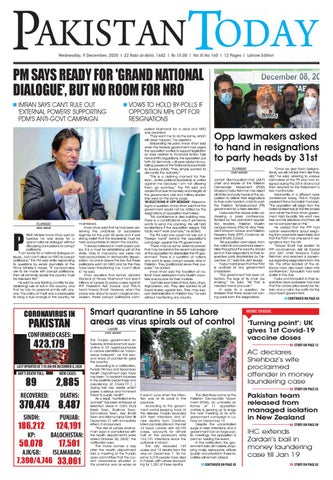
PM says ready for 'grand national dialogue', but no rooM for nro g
iMran says can't rule out 'external powers' supporting pdM's anti-goVt caMpaign
ISLAMABAD MIAN ABRAR
P
riMe Minister imran Khan said on tuesday he was ready for a ‘grand national dialogue’ without discussing concessions to corrupt politicians. “i am ready for a national dialogue on issues...but i can’t allow an nro to corrupt politicians,” the pM said while responding to questions by senior journalists at the prime Minister’s house. “if compromises are to be made with corrupt politicians, then all criminals across the country must be released first.” he said he was fighting a battle for (establishing) rule of law in the country, and that he has no personal enmity with anyone. the policy of merit was a prerequisite to bring a true change in the country, he
Pakistan
CONFIRMED CASES:
423,179
LAST UPDATED AT 7:35 AM ON DECEMBER 8, 2020
89
RECOVERED:
NEW CASES:
2,885 DEATHS:
370,474 8,487 SINDH:
PUNJAB:
186,212
124,191
KP:
BALOCHISTAN:
AJK/GB:
ISLAMABAD:
50,078
Vows to hold by-polls if opposition Mps opt for resignations
maintained. imran Khan said that he had been observing the practices of successive regimes for the past 40 years and it was strong belief that the leadership must be held accountable to reform the country. “i always believed in merit-based policy. it is a must for establishing writ of the state. only in monarchy are rulers not held accountable. in democratic dispensation, no one is above the law. but these politicians want an nro and for this they have been threatening me. i can’t allow it,” he said. Khan recalled that former dictator general (r) pervez Musharraf had spent billions of rupees to probe cases against ppp president asif Zardari and pMl-n head nawaz sharif. however, when the probe was about to reach a logical conclusion, these corrupt politicians com-
Coronavirus in
DAY'S DEATH TOLL:
g
17,501
7,390/4,746 33,061
pelled Musharraf for a deal and nro was awarded. “they want me to do the same, which will never happen,” he asserted. elaborating his point, imran Khan said when the federal government had urged the opposition parties to support legislation on laws related to financial action task force (fatf) regulations, the opposition put forth 34 demands – all were related to curtailing powers of the national accountability bureau (nab). "they simply wanted to dismantle the authority." “this is a defining moment for pakistan…entire political leadership is united against me because i am not allowing them go scot-free,” the pM said and added that due to honesty and integrity of the government, civil and military leadership were on the same page. ‘BY-ELECTIONS IF OPP RESIGNS’: responding to a question, imran Khan said that the government would not be rattled by the resignations of opposition lawmakers. “My confidence is also building now. there is a constitutional way if someone wants to send me packing. we will hold by-elections if the opposition resigns. this tactic won’t work anymore,” he stated. the pM said one could not rule out a "foreign hand" behind the opposition’s campaign against the pti government. “there may be some ‘external powers’ that may be behind the recent campaign of the opposition to destabilise the pti government. there is a coalition of nations who want to keep corrupt people atop in pakistan. they [politicians] serve their purpose,” he added. imran Khan said the "coalition of nations" have destroyed many Muslim countries one-by-one for their motives. "Just take examples of iraq, syria, libya, afghanistan, etc. they also wanted to pit saudi arabia against iran. they may support destabilization in pakistan too,” he said without mentioning any country.
Opp lawmakers asked to hand in resignations to party heads by 31st ISLAMABAD STAFF REPORT
Jamiat ulema-e-islam-fazl (Jui-f) chief and leader of the pakistan democratic Movement (pdM) Maulana fazlur rehman has asked all Mnas and party heads of the opposition to deliver their resignations to their party heads in a bid to push the pakistan tehreek-e-insaf (pti) government for a fresh election. fazlur said the above while addressing a press conference, flanked by two prominent opposition leaders, pakistan Muslim league-nawaz (pMl-n) Vice president Maryam nawaz and pakistan people’s party (ppp) chairman bilawal bhutto Zardari. “all opposition lawmakers, from the national and provincial assemblies throughout the country, should send in their resignations to their respective party leaderships by december 31,” said the Jui-f leader. fazlur maintained that the pdM is unafraid of any government crackdown. “the government has been affected, the legs of its chair are shaking,” he said. “all that is needed now is one push.” in reply to a question, he stressed that there would be turning back from the resignations.
Smart quarantine in 55 Lahore areas as virus spirals out of control LAHORE STAFF REPORT
the punjab government on tuesday enforced smart quarantine in 55 neighbourhoods in lahore identified as “coronavirus hotspots”, as the second wave of pandemic grips the country. according to a notification, punjab primary and secondary health department said there has been “a constant increase in the positivity percentage and prevalence of covid-19 […] during last two weeks which poses a serious and imminent threat to public health”. as a result, “controlled entry and exit” has been enforced at selected areas in data gunj baksh town, shalimar town, samnabad town, aziz bhatti town and allama iqbal town till december 21 with immediate effect, it announced. “the rest of lahore shall remain open in compliance with the health department’s order dated october 30, 2020,” the notification said. the move comes a day after the health department told a meeting of the punjab apex committee that the current coronavirus situation in the province was as worse as
“once we give them [resignations], we will not lick them like they did,” he said, referring to various lawmakers of the pti who had resigned during the 2014 dharna but then returned to the parliament a few months later. Meanwhile, in a different news conference today, pMl-n punjab president rana sanaullah had said, “the opposition will resign from the national assembly (in the first phase) and not let the imran Khan government hold by-polls. we want new free and fair elections and there will be no compromise on this.” he added that the ppp had certain reservations about resigning from provincial assemblies and that the pdM may only send in resignations from the na. “nawaz sharif has spoken to ppp co-chairman asif ali Zardari and Jui-f chief Maulana fazlur rehman and reached a consensus regarding resignations from the na. the other leaders of the alliance have also been taken into confidence,” sanaullah had said earlier in the day. fazlur and sanaullah in their respective news addresses had said that the lahore jalsa would be historic and a nail in the coffin for the incumbent government.
CONTINUED ON PAGE 05
more inside
‘Turning point’: UK gives 1st Covid-19 vaccine doses STORY ON PAGE 12
ac declares shehbaz’s wife proclaimed offender in money laundering case STORY ON PAGE 03 it was in June when the infection was at its peak in the province. according to the government portal keeping track of the disease, punjab recorded 429 fresh infections and 41 new deaths from covid-related complications in the last 24 hours. lahore, with 60,755 cases, accounts for almost half of the province’s total 124,191 infections since the outbreak in March. the city recorded 149 cases and 13 deaths from the virus on december 7. so far, some 3,218 people have died in punjab, with lahore accounting for 1,282 of these deaths.
the directives come as the pakistan democratic Movement (pdM), an umbrella alliance of 11 opposition parties, is gearing up to stage the next meeting of its antigovernment campaign in lahore on december 13. despite the uncontrolled surge in fresh infections and a government ban on large public meetings, the opposition is bent on holding the event. in the notification, the government said all markets, shopping malls, restaurants, offices (public and private) in these localities will remain closed.
Pakistan team released from managed isolation in New Zealand
CONTINUED ON PAGE 05
STORY ON PAGE 02
STORY ON PAGE 09
ihc extends Zardari’s bail in money laundering case till Jan 19
02
Wednesday, 9 December, 2020
NEWS
PaKIstaN wItNesses HIGHest sINGLe-Day CovID DeatH toLL IN fIve MoNtHs ISLAMABAD
t
STAFF REPORT
HE second wave of coronavirus continues to wreak havoc in the country, as Pakistan recorded 89 new fatalities - the highest singleday deaths over five months during the last 24 hours, data shared by National Command and Operations Centre (NCOC) revealed on Tuesday . According to the NCOC, 89 more people succumbed to the disease in the past 24 hours, taking the death toll to 8,487. The country also reported 2,885 new infections during the said period, taking the total tally to 423,179, out of which 44,218 cases are active. A total of 13,932 patients recovered from the virus during the last 24 hours while 2,486 patients are in critical condition. Overall, 370,474 people have recovered from the deadly disease so far. As many as 33,610 tests were conducted across the country during the aforementioned period, while 5,827,852 samples have been tested so far. The country's coronavirus positivity
Another 89 die, 2,885 infected; hotels, shopping mAlls seAled rate has now climbed up to 8.58pc, with the highest Covid-19 prevalence observed in Karachi, as 21.8pc of the PCR tests conducted in the past 24 hours SARSCoV-2. Mirpur has reported an 18.31pc positivity rate, followed by 16pc in Muzaffarabad. On the other hand, Hyderabad's positivity rate has fallen to 9.15pc and Lahore's to 5.98pc, whereas Rawalpindi recorded 8.51pc positivity rate. Both Sindh and Punjab recorded 41 new deaths while six died of coronavirus in Khyber Pakhtunkhwa and one in Azad Jammu and Kashmir. Balochistan and Gilgit Baltistan reported no deaths in the past hours. Overall, Sindh has the highest case positivity rate of 13.87pc, AJK is second at 9.77pc, closely followed by KP at 9.67pc while Balochistan reported 8.68pc,
IHC extends Zardari’s bail in money laundering case till Jan 19 ISLAMABAD TLTP
The Islamabad High Court (IHC) on Tuesday extended the interim bail of former president Asif Ali Zardari until January 19, in a case related to a suspicious transaction of Rs8 billion in the money laundering case. The former president sought an extension in his bail and exemption from the court appearance due to his medical condition. The court will now resume the hearing of the case on January 19. The former president’s medical report was submitted to the court on Monday last, stating that he’d sustained head injuries during a fall. Zardari’s counsel Farooq H Naek had filed an application with the court requesting that his client be exempted from appearing in person in the fake bank accounts case. The medical report further revealed that the ex-president was readmitted to a hospital on November 22. The report said the ex-president had a swelling in his head and pain on the left side of the chest after the fall adding that the chest pain increased whenever he walked. Zardari also complained of tension and pain in the lower back. The report said a CT scan of the expresident’s brain was also conducted and he was advised against travelling on medical grounds.
LNG reference against former premier adjourned till 15th ISLAMABAD TLTP
An accountability court on Tuesday adjourned the hearing on LNG reference against former prime minister Shahid Khaqan Abbasi and others till December 15. ACII Judge Muhammad Azam Khan headed the hearing on graft reference filed by National Accountability Bureau (NAB). Former prime minister Shahid Khaqan Abbasi and other accused appeared before the court. However, the court adjourned the case without further proceeding due to the absence of Abbasi’s counsel Barrister Zafarullah. The court was told that the defence lawyer had quarantined himself due to the risk of Covid-19.
Islamabad 4.88pc, Punjab 4pc, and GB 2.78pc. The country reported 13,932 new recoveries in the past 24 hours - 12,214 of which were reported in Punjab - raising the total recoveries to 370,474. Meanwhile, Special Assistant to the Prime Minister on National Health Services Dr Faisal Sultan has again urged the people to strictly adhere to the precautionary measures to contain the spread of Covid-19. Talking to the media persons in the federal capital on Tuesday, Dr Faisal Sultan said that the second wave of coronavirus is getting intensified as 89 people have died of Covid-19 during the last twenty-four hours. The SAPM said, “By following the standard operating procedures (SOPs), including wearing face masks and observing social distancing, we will be
Journalist gunned down in DI Khan
able to overcome the second wave as well like the first wave.” In a bid to curtail the mushrooming cases, the federal government has made face masks mandatory in public spaces, limited large public gatherings to 300, banned indoor weddings, closed shrines, cinemas, and theatres, and instructed public and private offices to adopt a workfrom-home policy and 50 percent occupancy. All provinces have also banned indoor dining and limited timings for markets, shops, and shopping malls. Many areas in the country have been placed under smart lockdowns. Moreover, Lahore administration sealed and fined several hotels, restaurants, marriage halls and shops on Tuesday. In the last 24 hours, as many as 33 hotels, cafes and restaurants were sealed after being found violating the health-related SOPs. Two private schools, 21 marriage halls and 74 shopping malls were also sealed by the administration. Meanwhile, a fine of Rs98,000 was slapped over private transport and 21 vehicles were seized over violations.
Sh Rasheed seeks Egyptian investment in railways
PML-N takes notice of ‘unpleasant incidents’ with Maryam
ISLAMABAD TLTP
Railways Minister Sheikh Rasheed Ahmed and Egyptian Ambassador Dr Tarek Dahroug met on Tuesday to deliberate Egyptian investment prospects in Pakistan’s railway department. The two sides discussed at length a possible bilateral partnership between the railways department in which Rasheed said that Pakistan will welcome investments by Egypt. The railways minister underlined the touted importance of the Main Line 1 project which will connect Karachi to Peshawar with over about 1,872 train tracks, adding that this line will crop up new investment opportunities for people. He said Pakistan shall welcome Egyptian Railways and private railways companies in Egypt to participate in investments here wherein he added that the railways department of Pakistan has globally advertised tender openings for 230 passenger wagons and 820 freight wagons. In the five years from now, Pakistan will run advanced trains ensuring best travelling facilities for commuters, said Rasheed, convincing Egyptian ambassador to consider participating in the process. Reportedly, the ambassador Dr Dahroug said Egypt would encourage a national level investment plan for Pakistani railways department. It may be pertinent to note that earlier last month, in an interesting development, Pakistan Railways on Tuesday decided to procure 230 high-speed passenger
PESHAWAR: Unidentified gunmen shot and killed a journalist in Dera Ismail Khan, police said on Tuesday. A police official, Aslam Khan, said shooters riding on a motorcycle opened fire on Qais Javed near his home after midnight and fled from the scene. He said Javed was shot multiple times and was rushed to the city’s main hospital but died on the way. Javed, 37, previously worked as a cameraman at Geo News station and had recently started his own web channel. No group immediately claimed responsibility for the killing and police said they were investigating to determine the motive. Armed attacks on journalists in Pakistan have intensified in recent times. Earlier in September, a female journalist, Shaheena Shaheen, was shot dead at her home in the Turbat area of Balochistan’s Kech district. Shaheen, 25, was a local anchorperson at state-owned broadcaster PTV and editor of a local magazine. At the time, Kech Superintendent of Police (SP) Najeebullah Pandrani said “the killing was the result of domestic violence”. The same month, human rights office of the United Nations voiced concern over growing instances of threats of violence against journalists particularly in Pakistan, calling upon the government to take “immediate, concrete steps” to ensure their protection. The UN rights office said it had followed “with increasing concern” numerous cases of incitement to violence — online and offline — against journalists in the country, particularly against women. STAFF REPORT
coaches and 820 freight vans to modernise its system. According to a spokesperson of Pakistan Railways, in the first phase, 46 modern passenger coaches will be procured, while, in the second phase, 184 such coaches will be prepared at Carriage Factory Islamabad. The spokesperson said that passenger coaches will include 80 compartments each for the economy and airconditioned class, 30 parlour cars, and 20 vans each for luggage and brake.
LAHORE: The leadership of Pakistan Muslim League-Nawaz (PML-N) has taken notice of the unfortunate incidents that took place with the party’s vice president Maryam Nawaz during rallies in Lahore. Reportedly, the senior leadership of the party was angry with the organizers over the poor arrangements made during the recent rallies held in connection with the PDM’s December 13 jalsa. During a rally organized by the PML-N on Tuesday, Maryam had visited different areas of the city and when she reached Shahdara and started her address, an attempt was made to attack her. Reportedly, a participant in the rally threw a stick at Maryam during her speech and it struck her directly on her head. After the incident, she left the speech immediately. The culprit has not been identified as yet. Similarly, on Monday afternoon, there was another unfortunate incident involving the PML-N VP wherein a man touched her inappropriately while attending the rally. The party workers nearby were enraged by this and slapped the man. Furthermore, during the rally, a man threw notes at the party’s vice president. After such incidents, the senior leadership of the party was angry with the organizers and used harsh words against them. SHAHAB OMER
govt stabilised economy, brought down inflation despite pandemic: shibli ISLAMABAD STAFF REPORT
Federal Minister for Information and Broadcasting Shibli Faraz has said that the government has managed to stabilise the economy and bring down inflation despite the coronavirus pandemic. Addressing a news conference here on Tuesday, the minister expressed satisfaction over the prices of essential commodities, including sugar and wheat flour. He said: “Our aim is to generate economic activities to create job opportunities for the people. We are constructing two new dams and two new cities.” The minister further said that the government is trying to address the internal and external challenges, but the opposition is damaging the country's interests and putting the lives of the people at stake by holding public gatherings.
He criticised PML-N leader Maryam Nawaz and said that the daughter of an absconder is lecturing them on how to run the affairs of the state. The opposition parties do not want improvements in the country. They also awarded jobs on favoritism. He added that the aim of the opposition parties, which were rejected by the people in the 2018 elections, is not to serve the country but to protect their vested interests. This is a democratic and elected government and the opposition parties will have to wait for the next three to eight years. The minister made it clear that no NRO will be given to the corrupt leaders, as they damaged national institutions and promoted nepotism during their regime. The opposition is divided over the issue of the resignation. Maulana Fazal-ur-Rehman and Maryam Nawaz would go for the resignations, as they are not part of the parliamentary politics.
“PPP leaders do not raise objections on the results of their winning seats. They only raise objections where they lost the elections. The opposition is no one to ask the incumbent government to go home. The opposition cannot blackmail the government through pressure tactics. However, we are ready to hold negotiations with them on the genuine issues of the country,” said the minister. “The people should follow the coronavirus SOPs to cope with the second wave of the virus, which is proving to be more fatal as compared to the first one. Next two months are important due to the upcoming winter season. If the situation is not improved, the government will have to opt for strict restrictions and those restrictions will surely affect the livelihoods and economy. At present, the country has sufficient inventory of oxygen cylinders and other relevant equipments.
Wednesday, 9 December, 2020
aC DeCLares sHeHbaZ’s wIfe ProCLaIMeD offeNDer IN MoNey LauNDerING Case reference Accuses shArif fAmily of possessing Assets disproportionAte to sources LAHORE
a
STAFF REPORT
N accountability court in Lahore on Tuesday declared proclaimed offender the first wife of National Assembly opposition leader and PML-N president Shehbaz Sharif in a money laundering reference filed by the National Accountability Bureau (NAB). The court observed that Nusrat Shehbaz, despite being repeatedly summoned, failed to appear before the court. It said she was given a 30-day respite which has been completed. Nusrat, along with other members of her family, was declared absconder on November 26 for their perpetual absence from the trial proceedings. During the proceedings, the defense
counsel could not appear as he was busy with a hearing of Sharif’s son and Punjab Assembly Opposition Leader Hamza bail petition in the Supreme Court. Presiding Judge Jawadul Hassan said the suspects should cross-examine the anti-graft agency’s witnesses themselves. The hearing was later adjourned. The main suspects in the case are Nusrat, her sons Hamza and Suleman Shehbaz (also an absconder), daughters Rabia Imran and Javeria Ali. Other suspects are alleged frontmen and business partners of the family including Nisar Ahmad, Qasim Qayum, Rashid Karamat, Masroor Anwar, Fazal Dad Abbasi and Shoaib Qamar. The reference mainly accuses Sharif of being a beneficiary of assets held in the name of his family members and frontmen who had no sources to acquire
terrorists involved in sectarian killings arrested: CtD The Counter-Terrorism Department (CTD) said Tuesday it has arrested two suspected militants affiliated with a banned outfit involved in sectarian killings. According to CTD DIG Omar Shahid Hamid, the slleged militants were identified as Karar Hussain alias Pathan and Kamran Haider alias Kami. They were trained for using arms, ammunition, suicide jackets, Improvised Explosive Devices (IED), Vehicular Borne IED (VBIED), and counter-surveillance training. Both the suspects, during initial interrogation, confessed to being involved in several sectarian target killings, he said. Kamran confessed to killing Jamia Binoria’s Maulana Yousuf Ludhianvi, Mufti Nizamuddin Shamzai, and another organisation's leader Mufti Mehmood, the CTD official said. The suspect was involved in the killing of seven activists of another banned outfit, MMA leader Wasif Aziz in 2007, and others. The other suspect, Hussain alias Pathan, is also involved in several sectarian target killings, DIG Hamid said. The CTD also recovered two pistols, with nine live rounds from the possession of the arrested accused, he noted. DIG Hamid added that further investigations were underway and more confessions were expected from the suspects. NEWS DESK
such assets. It says the suspects committed offenses of corruption and corrupt practices as envisaged under the provisions of the National Accountability Ordinance, 1999, and money laundering as delineated in the Anti-Money
Laundering Act, 2010. The reference further says the family failed to justify the sources of funds used for the acquisition of assets. It asks the trial court to try the suspects and punish them under the law.
SC summons details of all NAB Lahore pending cases NEWS DESK Supreme Court on Tuesday summoned details of all National Accountability Bureau cases pending in court. A three-member bench led by Justice Mushir Alam and comprising Justice Sardar Tariq Masood and Justice Yahyah Afridi heard a petition filed by PMLN leader Hamza Shahbaz seeking post-arrest bail in a case pertaining to money laundering and assets beyond means of income. During the hearing, Hamza's counsel Advocated Amjad Pervaiz said his client was arrested on June 11 2019, a reference was filed in against him in August 2020 and he was indicted on November 11 2020. The lawyer maintained that the anti-graft watchdog has, to date, recorded statement of only three witnesses out of 110 listed. Observing that the case pertained to 23 fake accounts, Justice Alam asked whether the counsel
wanted his client to be given a chance to respond. Justice Afridi asked NAB how much time was required to record witness statements. "Six months," replied Additional Prosecutor Imranul Haq. When Justice Alam questioned why it was taking so long, Haq argued that the witnesses were employed by the Sharif family hence it was proving difficult to call them to record statements. Justice Alam asked the bureau why other accused in the case have not been arrested yet. "They have been declared absconders," said Haq. To this, Justice Masood observed that the anti-graft watchdog "arrests one and lets other accused roam free" and questioned why the bureau had not confiscated properties of the accused yet. "One day, we will summon all NAB filed and check daily proceedings. The bureau has locked up people. It is unfair," he remarked, as the court sought details of all pending NAB cases. The bench adjourned hearing for an indefinite period.
Justice Bandial rebukes Sarina Isa for questioning CJP's impartiality NEWS DESK Supreme Court (SC) judge Justice Umar Ata Bandial on Tuesday expressed anger over Justice Qazi Faez Isa's wife, Sarina Isa, for questioning the impartiality of Chief Justice of Pakistan (CJP) Gulzar Ahmed for not constituting a full court to hear her review petition against the June 19 order. Appearing before a six-judge larger bench, Sarina stated that the CJP should be impartial and that he was a respondent in this case as a member of the Supreme Judicial Council. She also questioned whether a six-judge larger bench could overturn a judgment of seven judges. Surprised at her remarks, Justice Bandial asked Sarina Isa to "not overstep your limits". "You should be careful while talking about the CJP and the institution," he further observed. Justice Bandial added that the chief justice as the head of the institution left the matter related to the inclusion of three judges to this larger bench. Justice Isa's counsel, Muneer Malik, while pressing his application regarding the inclusion of the three judges, cited several judgments to establish that the review petition should be heard by the same bench. Rasheed A Rizvi counsel for Sindh High Court Bar Association stated that if three judges are not included in the bench it could damage the public perception. Justice Qazi Amin Ahmed remarked that the court decides cases in accordance with the law and the Constitution rather than on the basis of public perception. Sarina Isa, however, asked the bench why only she and her children were being held accountable and nothing is being sought from public office bearers. SCBA President Lateef Afridi sought time to present his arguments in this case. Hearing of the case is adjourned until Thursday. Earlier, on July 21, Sarina Isa had filed a review
petition against the Supreme Court’s June 19 short order, contending that the split order is discriminatory as it singles out Justice Isa’s family from a newly created “class of persons”. "By issuing orders under Article 184(3), the Honourable Supreme Court has, effectively, created a class of persons and redefined the private and confidential affairs of individual citizens falling within such class as matters of ‘public importance’," said the petition filed under Article 188 of the Constitution. A ten-judge full court on June 19 quashed a presidential reference that accused Justice Isa of committing misconduct by not disclosing his family member’s foreign properties and sought his removal. In the split order, seven of the judges had, however, referred the case to the Federal Board of Revenue (FBR) and ordered the tax authority to launch an inquiry into foreign assets of Justice Isa’s family. A day before today's review petition hearing, Supreme Court Justice Syed Mansoor Ali Shah maintained that a judge, who dissented from the majority judgment, if available, must be part of the bench constituted to hear review petition. "There are many other cases of our jurisdiction as well as the Indian jurisdiction wherein dissenting judges were part of the benches that heard the review petitions against the judgments of the court pronounced in terms of the majority opinion,” says the 22-page dissenting note authored by Justice Shah in his review petition against the apex court's judgment in the GIDC case. The observation was termed significant in the context of Justice Isa's review petition, wherein three judges, Justice Maqbool Baqar, Justice Syed Mansoor Ali Shah and Justice Yahya Afridi, who held a minority view, are excluded from the larger bench that has taken up the SC judge's case.
NEWS
03
Maryam among PML-N leaders booked for flouting Covid-19 restrictions LAHORE: Police on Tuesday registered a case against Pakistan Muslim League-Nawaz (PML-N) vice president Maryam Nawaz and other leaders and activists of the party for violating coronavirus restrictions during corner meetings the party held a day earlier in different constituencies of Lahore to mobilise workers for the opposition’s upcoming power show at Minar-e-Pakistan. In addition to Maryam, police also booked party’s central spokesperson Marriyum Aurangzeb, MP Malik Riaz, Waseem Khokhar, Talal Chaudhry, Malik Abrar and others in a case filed at Shahdara police station. The PML-N leadership was booked under the Punjab Sound System (Regulation) Act, 2015, violation of coronavirus guidelines and provoking public sentiments against the government. The meetings come as the Pakistan Democratic Movement (PDM), an umbrella alliance of 11 opposition parties, gears up for its upcoming event in Lahore on December 13. Despite an uncontrolled surge in fresh infections and a government ban on large public meetings, the opposition is bent on holding the event. During a joint presser a day earlier, PML-N, JUI-F, and Pakistan People’s Party (PPP) announced to hold the meeting “at all costs”. Meanwhile, Punjab Chief Minister Usman Buzdar said the opposition should realise that coronavirus was spreading. “We will take action against the opposition for violating the law [Covid-19 SOPs],” he warned. STAFF REPORT
Wednesday, 9 December, 2020
04 NEWS
Utility stores to introdUce central it system for all warehoUses to maintain data ISLAMABAD
i
GHULAM ABBAS
n a bid to reduce the challenges faced by cash and carry stores and other megastores in the country, the state-owned retail company Utility Stores Corporation (USC) has decided to equip all the offices, warehouses and retail outlets with central IT system by June next year, which will enable the managers of USC to maintain accurate data logs of inventories. The USC has already set up the required Information Technology (IT) infrastructure and a modern data centre with Private Cloud has been established in its head office. The USC has prepared a report to be forwarded to the ministry of industries and production detailing how the automation will help identify trends in topselling items and locations. The report also outlines that the move would enable stocks to be moved with precision and achieve higher sales volumes. The state-owned retail company is not only facing serious competition from the private cash and carry stores across
the country but also from the gaps in its purchase, distribution and sales sections. The management of the company has already established an integrated data centre at the cost of around Rs5 million and a consultant will be hired in the current month for connectivity of 4,881 retail stores and 124 warehouses of the USC. Under the system, all USC retail outlets and warehouses will be automated and linked with the central system for real-time sales and inventory management, and all USC business processes in-
Pakistan looks to new tech to curb crop burning and cut smog LAHORE AGENCIES
Air pollution is a long-standing problem in Pakistan, but every October and november contaminates in the air in Punjab shoot up as farmers burn rice stalks left behind after harvesting to clear their fields to plant wheat. During these cooler months, the provincial capital Lahore, which is surrounded by rice-growing districts, is covered with thick smog. “It is a health emergency – the air quality monitors in Lahore routinely show hazardous levels in november,” said Farah Rashid, a climate and energy program coordinator for green group WWF-Pakistan. now the Punjab government hopes to tackle the problem by providing 500 rice farmers around Lahore with a set of machines that together eliminate the need to burn crop stubble. The machines include
a shredder that breaks down rice stubble and mulches it into the ground and a seed drill — called the Happy Seeder — that follows to sow wheat through the mulch. “It’s a useful technology,” said farmer Aaamer Hayat Bhandara, who has used both machines at a friend’s large farm, and has pushed the government to subsidise them. “These machines used together could really make life much easier for us farmers,” said Bhandara, from Pakpattan in Punjab. Malik Amin Aslam, climate change adviser to Prime Minister Imran Khan, called air pollution a “silent killer” and said Lahore’s smog had increased in intensity and frequency over the last five years. He explained that rice farmers traditionally use combine harvesters to cut their rice in October, leaving behind about four inches of stubble.
cluding supply chain, warehousing, financials, human resource records, payroll, and e-commerce will be automated by June 2021. “The whole inventory will be controllable and USC will be able to forecast the number of items needed, thus preventing both product shortages and overstocking,” USC Managing Director Umer Lodhi said while responding to a query. He added that through automation of USC, synchronisation of warehouses and retail outlets data into the centralised data centre will provide a consolidated
view of the corporation’s performance. The USC has been facing serious criticism even from the ministry of industries over not maintaining proper records of items at various warehouses and even retail stores, and the automation is likely to overcome this issue due to centralised monitoring of sales. The USC has already launched a pilot project of deployment of Point of Sale (POS) system is successfully executed initially at 10 Utility Stores, where data transformation of all USC saleable items with barcodes to be used with warehousing and POS system. The objectives of pilot POS system deployment was introducing technology and system to improve acceptability; transformation of all Stock Keeping Units (SKUs) of the corporation to a new integrated system; identification of problems and issues in the automation of the corporation; identifying and removing barriers in stores’ automation; bringing cultural change and training people to use the new system efficiently. All USC SKUs are also digitized with barcodes to be used with warehousing and POS systems.
SHC orders demolition of commercial buildings on state land in Sukkur SUKKUR TLTP
The Sindh High Court (SHC) Sukkur Bench on Tuesday ordered demolition of commercial buildings raised on the land of the irrigation department within 48 hours. The bench also demanded a compliance report of the order from concerned officials on the next hearing of the case on Thursday (tomorrow). “Why were the illegally raised buildings not demolished within the two-week deadline given by the court?” the bench questioned. “These buildings should be demolished within 48 hours at any cost,” the court ordered. Earlier, the bench expressed resentment over non-compliance with the court order to remove encroachments from the land. The court also questioned
permissions granted for construction of the buildings on the state land and ordered the arrest of Sukkur Building Control Authority Assistant Director Abdul Latif Jarwar. The police immediately arrested the building control official in the court premises. The officials of provincial irrigation and revenue departments were present during the hearing. The Sindh Advocate General pleaded the court to grant twomonth time for the removal of illegal structures from the land. While observing that the Sindh government has already gained time to launch the operation, the SHC also ordered to remove residential structures from the lands within a month after proper arrangements for the affected people. The bench had ordered demolition of the commercial structures on november 19.
Punjab cm approves health coverage for all citizens LAHORE: Punjab Chief Minister Sardar Usman Buzdar on Tuesday granted approval to provide health coverage to every citizen of the province. The CM accorded approval during a high-level meeting about universal health coverage programme in Lahore. The meeting was attended by Provincial Health Minister Dr. Yasmin Rashid, Punjab Chief Secretary and some others. During the meeting, the CM said that a target has been set to provide universal health coverage in all the districts of the province by the end of next year. In the first phase, complete health coverage will be provided in two districts of the province. He further said that Insaf Sehat Cards will be provided to every citizen for health insurance worth Rs 720,000, as it is the basic right of every citizen to get medical facility. The CM also tweeted that the decision to provide health coverage was taken in accordance with the vision of Prime Minister Imran Khan. TLTP
mercury drops to minus 10 in Kalam, siberian winds hit Karachi ISLAMABAD: The mercury dropped to minus 10 degree Celsius after heavy snowfall in Kalam on Tuesday. The area received up to two feet of snow, which caused hardships for the citizens. Snowfall was continued in Shagar, Kharmang, Ghanche and other areas of Skardu region since Monday night. The plains in the region received up to two inches of snow, while the upper areas received up to three inches of snow. The spell of snowfall affected normal life in the area. The inter-district transport service remained suspended while the vehicles remained trapped at several places. “The temperature was dropped to minus 4 Celsius in the plains of Skardu region, while it was gone down to minus seven Celsius in the hilly areas,” the Met Office said. Mirpur and adjoining areas of Azad Jammu and Kashmir also received rainfall, which brought the temperature down in the region. Meanwhile, cold Siberian winds from the north and northeast blew in Karachi to drop the temperature to 15 degree Celsius. TLTP
Karachi ranks worst on air quality index KARACHI: Karachi ranked worst on global air quality index (AQI) with 351 particulate matter on Tuesday morning. The port city was closely followed by Kyrgyzstan capital Bishkek (347) and Indian capital Delhi (272). Lahore ranked fourth-worst with 214, while Kabul was at fifth place with 203 particulate matter. Kolkata (194), Dhaka (189), Mumbai (177), Kathmandu (158) and Wuhan (158) were other five cities on the index. According to experts, the air is heavier in winter as compared to summer, which causes poisonous particles in the atmosphere to move downwards and make the atmosphere polluted. Consequently, a layer of polluted particles, including large amounts of carbon and smoke, makes a city polluted. TLTP
Wednesday, 9 December, 2020
NEWS
SBP LauDED FOR PROmOtiNG FiNaNciaL iNcLuSiON OF wOmEN, ExPaNDiNG DiGitaL PaymENtS KArAcHI
P
APP
RESIDENT Dr Arif Alvi has appreciated State Bank of Pakistan Governor Dr Reza Baqir for taking initiatives in the areas of women empowerment through financial inclusion and expanding the landscape of digital payments in the country. He was speaking at an online meeting with SBP governor, SAPM on Poverty Alleviation and Social Safety Dr Sania Nishtar, senior SBP officers, presidents/CEOs of banks and other stakeholders, said SBP statement on Tuesday. On women empowerment, the SBP governor gave a detailed briefing to the president about a number of regulatory and financing measures taken by the central bank to enhance the flow of financial services to women. He said that SBP has been providing financing under its subsidized Refinance and Credit Guarantee Scheme for women entrepreneurs since 2017 to facilitate women owned start-ups and small scale businesses by providing loans of up to Rs5
million. For the benefit of the women of Balochistan by encouraging them to avail loans under this scheme, 20pc of this fund had been reserved for women entrepreneurs of the province. The governor said SBP’s efforts were aligned to the government’s priorities of encouraging self-employment as under the Prime Minister Kamyab Jawan Youth Entrepreneurship Scheme a quota of 25pc had also been reserved for the women. He remarked that SBP was collaborating with Ehsaas program to implement the Prime Minister’s vision of having ‘One Woman One Account’ beyond the existing facility of cash disbursements through branchless banking agents only. He also highlighted the key features of SBP’s upcoming ‘Banking on Equality’ Policy, which would ensure equality in banking and reduce gender gap in financial inclusion. On digital payments, the Governor SBP briefed the President on various initiatives to promote it in the country. He elaborated SBP’s multi pronged strategy including developing an interoperable and digital payments infrastructure, providing enabling legal and regulatory
Fisheries ex-secretary, DG arrested in Rs1bn corruption charges QUETTA: National Accountability Bureau (NAB) arrested Balochistan Fisheries Director-General Munir Moosani and former secretary Aftab Ahmed Baloch on Tuesday on charges of corruption of over Rs1 billion. The NAB spokesperson, in a statement, said the suspects gave contracts on the purchase of a green fibreglass boat, sea ambulances, patrolling boats and vessel monitoring systems to a company which was not registered by the Mercantile Marine Department. “The company was not even a trustworthy one,” he said, pointing out that during the coronavirus pandemic, contracts and tenders were illegally given to irrelevant companies. The spokesperson added that in May and June, heavy payments were made by the suspects despite failure in the delivery of boats and other equipment. Baloch and Moosani were arrested and are being investigated by the bureau. Earlier, they were presented before a court today wherein they have been remanded. APP
Pakistan Navy marks 62nd Gwadar Day KARACHI: Pakistan Navy observed the 62nd Gwadar Day with traditional fervor. The day is observed every year to mark the merger of Gwadar with Pakistan, said a news release issued here on Tuesday. Various activities were held at Gwadar under the auspices of Pakistan Navy and Commander Coast (COMCOAST), Vice Admiral Zahid llyas graced the occasion as chief guest. The chief guest, while interacting with the notables, highlighted Pakistan Navy’s commitment for the development of coastal region. He also underscored rigorous efforts of Pakistan Navy to ensure Maritime Security of Gwadar Port and China Pakistan Economic Corridor (CPEC). In the historical context, Gwadar was formally handed over to Pakistan in 1958 by Oman. Initially, a Naval platoon led by the then Lt. Iftikhar Ahmed Sirohey of Pakistan Navy landed at Gwadar and unfurled Pakistan's flag. The day was started by an impressive Flag Hoisting Ceremony held at PNS AKRAM, Gwadar. Various activities were organized by Pakistan Navy including conduct of boat rally, Hovercraft maneuvers, demonstrations by Special Service Group (Navy) and Naval Aviation at the beach front. The enthusiasm of the locals remained prodigious wherein large number of spectators enjoyed the events. Gwadar Day celebrations were aimed at rekindling the awareness about the history of Gwadar among the masses. A large number of audience including Civil dignitaries, Military officials and local notables also witnessed the activities while observing Covid-19 precautions. APP
K-Electric shares transfer to SEP discussed ISLAMABAD: A high-level meeting on Tuesday discussed the transfer of K-Electric shares to Shanghai Electric Power (SEP), China. Federal Minister for Privatisation Mohammedmian Soomro co-chaired the meeting along with the Federal Minister for Petroleum Omar Ayub Khan to discuss transfer of K-Electric shares to SEP and related issues. The meeting resolved that all-out efforts will continue for timely and meaningful progress in the matter. TLTP
environment, ensuring security of digital payment channels and finally promoting and experimenting with new technologies and Fintech companies. Sharing numbers on the progress of digital payments, SBP's Governor updated the President that digital transactions in Pakistan had seen an upward trend in recent years. He highlighted that, during FY20, 906 million transactions amounting to Rs 66 trillion were processed through retail e-Banking channels, whereas internet-banking channels processed 57 million transactions amounting to Rs 3 trillion. He added that a promising growth could also be witnessed in mobile banking with three million new users added within one year and overall number of transactions of 83 million worth Rs 2 trillion during the fiscal year. Also, e-commerce transactions amounting to Rs 35 billion were conducted and bill payments worth Rs 213 billion were made by consumers using digital payment channels in Pakistan. President Dr. Arif Alvi thanked Governor for SBP’s efforts and progress on women empowerment and promotion
of digital payments. He also acknowledged the role of MPG in unlocking the potential for economic benefits. He also appreciated the idea that the young female entrepreneurs with large social media following may be identified as brand ambassadors to create awareness among public about SBP policies and products for promoting gender financial inclusion. Special Assistant to the Prime Minister Dr. Sania Nishtar thanked SBP Governor and other management for extending support and facilitation to Ehsaas beneficiaries through branchless banking. They were working with SBP on use of micro payment gateway for facilitating digital payments to Ehsaas beneficiaries. Earlier, Deputy Governor Sima Kamil gave an update on implementation timelines of micropayment gateway. The meeting was also attended by CEO/Presidents of banks and representatives from digital payments ecosystem, who shared their unique perspectives and experiences on women empowerment and digital payments.
ECC meeting postponed due to court restriction on advisers, SAPMs ISLAMABAD SHAHZAD PARACHA
The meeting of the Economic Coordination Committee (ECC) has been postponed following the Islamabad High Court’s decision against the inclusion of prime minister’ advisers and special assistants in cabinet committees. The finance adviser had summoned the ECC meeting on Wednesday to discuss seven agenda
items, including Karachi transformation plan. However, sources said that the meeting has now been deferred till Thursday. The court on Monday had declared the formation of the Cabinet Committee on Privatisation as illegal (against the rules and procedure), following which Adviser to the Prime Minister on Finance and Revenue Abdul Hafeez Shaikh cannot head the committee under the law. The court on Tuesday in its de-
tailed order stated that advisers cannot become a member or chair the cabinet meeting. “The adviser can make a speech in the parliament but cannot participate in voting.” Recently, the National Accountability Bureau (NAB)-Karachi had also summoned the finance adviser to probe “misuse of authority” in award of "CARe Pilot Project" to M/s Agility (PWC) and subsequent illegal payment of $11.125 million to M/s Agility (PWC) on account of “access fee”.
No minority safe in India, FM Qureshi says ISLAMABAD: Foreign Minister Shah Mahmood Qureshi has said that no minority, including Muslims, Dalits, Sikhs and Christians are safe in India. In a statement on Tuesday, the foreign minister pointed out that India has introduced controversial legislation such as Citizens Amendment Act and National Register of Citizens (NRC) to crush the minorities. The foreign minister said the whole world is witness to the Delhi riots in which several Muslims were killed and properties on large scale were ransacked. He said the construction of the temple at the site of Babri mosque reflects the Hindutuva mindset. The foreign minister said that Indian forces are persecuting Muslims in Indian occupied Jammu and Kashmir.
In a separate message, Foreign Minister Shah Mahmood Qureshi said that Pakistan Democratic Movement (PDM) needs to review its policy of holding public gatherings in view of the alarmingly growing number of coronavirus cases. He said that the positivity ratio in Lahore is touching 10 per cent near the venue the PDM wants to hold a public meeting. The minister said, “It is not time for holding public gatherings if we see the threats being posed to human lives due to the pandemic.” He said internal instability is not good for the country as there is a grave situation in Indian illegally occupied Jammu and Kashmir and the Afghan peace process is entering into its final stage. The minister said the economy of the country is also reviving due to the efforts of the government. STAFF REPORT
IHC restores licence of suspended pilot ISLAMABAD: The Islamabad High Court (IHC) on Tuesday nullified the suspension of licence of a pilot by the Civil Aviation Authority (CAA). The plea of pilot Saqlain Akhtar against the suspension of his licence was taken up by the IHC Chief Justice Athar Minallah. CAA Secretary Hassan Nasir Jafferi appeared before the court. Justice Minhallah asked who finalised the report of pilots having fake licences. The CAA lawyer said that out of 250 pilots having suspicious credentials, licences of 50 were cancelled and 32 were suspended. The IHC top judge said that an important regulator body has been non-functional for the last two years and remarked that the federal government cannot give additional charge of DG CAA to the CAA secretary. The court after hearing arguments from both sides declared the July 14 verdict regarding the suspension of licence of pilot Saqlain Akhtar as null and void. Aviation Minister Ghulam Sarwar Khan had announced in June that 262 airline pilots, whose credentials may have been falsified, would be grounded at once. Among these pilots are 141 from Pakistan International Airlines, nine from Air Blue and 10 from Serene Air, he said, adding that the remaining were affiliated with flying clubs, chartered plane services or foreign airlines. STAFF REPORT
05
Opp lawmakers asked to hand in resignations to party heads by 31st contInueD froM pAge 01 “The Dec 13 rally will be held at all costs and people from across the country will participate in it, while Nawaz Sharif will deliver his decisive speech on the occasion,” PML-N leader Rana Sanaullah had said. Earlier in the day, the leadership of the PDM had held a strategy meeting –attended by former premier Nawaz Sharif and ex-president Asif Ali Zardari via video-link, and Maryam Nawaz in person – in the federal capital to decide on its course of action.
Smart quarantine in 55 Lahore areas as virus spirals out of control contInueD froM pAge 01 “There shall be a complete ban on [the] movement of people to and from these areas by public and private transport except for [the] limited movement of one person per vehicle to and from the exempted facilities.” “There shall also be a complete ban on gatherings of all kinds for social, religious, or any other purpose at any place, public or private throughout these areas.” Meanwhile, grocery stores, fruit and vegetable shops, tandoors and petrol pumps have been allowed to operate seven days a week from 9:00 am to 7:00 pm. All medical services, pharmacies, laboratories, clinics and hospitals have been allowed to operate 24 hours a day for seven days a week. Milk and meat shops have been allowed to open seven days a week from 7:00 am to 7:00 pm.
Likee all set to launch operations in Pakistan after one million downloads neWS DeSK Likee, world's leading global short video creation platform with around 150 million unique monthly users worldwide, is all set to launch its operations in Pakistan. The platform has already crossed a million downloads mark in the country and is expected to make new records with the localized version launch. The Singapore-based app is unique in the sense that it offers users with the capability to easily create the videos and add special effects to them. The special effects can be fourdimensional, attractive and dynamic stickers as well as a video editing tool. The platform plans to employ resources in the channel sales development, content operations, brand safety teams, and influencer talent management spheres. The planned launch is a timely step as Pakistan has a market of 76.38 million internet users, according to the estimates of the current year. Interestingly, the number of users increased during the past one year by 11 million. If we look at the social media users, it stands at 37 million as of now, according to the report. Stats also suggest a 73 percent of online users preferably watch videos. So, investing in video consumption and creation area may open limitless avenues of growth for the platform.
Renowned businessmen Siraj Kassam Teli passes away ISLAMABAD STAFF REPORT
Renowned businessman and former president of Karachi Chamber of Commerce and Industry (KCCI) Siraj Kassam Teli passed away on Tuesday in Dubai. A few days earlier he was admitted to a hospital after cardiac arrest and was later put on a ventilator due to suffering from pneumonia. Teli was pronounced dead by the doctors on Tuesday. He was 67. He had gone to Dubai for the engagement of his son. He was the 27th president of the KCCI.
Siraj Kassam Teli was a distinguished industrialist and belonged to a renowned family that has been active in business since the inception of Pakistan. As Chairman of the Businessmen Group (BMG), Siraj Teli was recognised for his extraordinary leadership of the Business and Industrial community over the past 19 years. He brought about revolutionary and progressive changes in trade politics and in the functioning of the Karachi Chamber of Commerce & Industry, the SITE Association of Industry and other platforms of public service and social work. He also served as Director of Pak-
CMYK
istan Beverage Ltd. Apart from the beverage sector, he possessed considerable experience in textiles, dairy products and energy. Due to Siraj Teli’s outstanding contribution to the national economy and public service, philanthropic work, and extraordinary indulgence in the Ashura incident, the then president of Pakistan Asif Ali Zardari conferred upon him Sitara-e-Imtiaz in 2011. He was born in 1953 in Karachi. Teli graduated from Government Commerce College in 1974. Teli was known for his blunt comments on law and
order. He never shied away from speaking the truth. Sindh Chief Minister Murad Ali Shah expressed deep sorrow over the demise of Teli. KCCI President Shahriq Vohra said Teli was a visionary and leader for all. “This is a loss for the whole of Pakistan. We are in a state of shock,” Vohra said. Ex-KCCI chief Zubair Motiwala said Teli's demise has created a wide gap in the leadership of the business community. “He always spoke the truth without considering the consequences,” Motiwala said.
Wednesday, 9 December, 2020
06 COMMENT
Victims of “Cancel Culture”
Sad state of narcotics control Putting a whole generation at risk
I
T is rare for Prime Minister Imran Khan to take note of any social problem other than corruption. After spending half his tenure, Mr Khan suddenly realise d on Monday that there are seven million drug addicts in the country and there is a need to devise a strategy to check drug abuse among youth. However he again unnecessarily bracketed the issue with corruption. “Anti-narcotics Force (AnF) and national Accountability Bureau (nAB) alone cannot curb use of narcotics and corruption, therefore the whole nation and the government will have to make collective efforts to fight the menace.” The fixation with corruption has stood in the way of Mr Khan’s realizing the magnitude of some of the most important issues the country faces like over-population, poverty and extremism, to name just a few. One welcomes nevertheless the resolve he has displayed to formulate a policy and also to implement it. The incidence of drug addiction is rising at an alarming rate in Pakistan Despite the gravity of the situation, however, the government has no fresh data on drug users in the country as the last national level survey— Drug Use in Pakistan– was carried out by the Pakistan Bureau of Statistics in 2012 in collaboration with the Ministry of narcotics Control and United nations Office on Drugs and Crime (UnODC). A recent study notes a rapid increase in drug addiction among students of academic institutions. The results unveil that students consume drugs in the universities without much restriction and risk as the academic institutions, which face an unprecedented funding crunch, have not taken serious steps to address the issue on their premises. The way the government has politicized institutions would remain a major hurdle in controlling the spread of narcotics. PML(n Punjab President Rana Sanaullah was hauled up by the AnF on charges of heroin trading, kept behind bars for six months without substantiating the charge, and only then enlarged on bailed. This has sullied the AnF’s reputation. Mr Khan has promised to devise a strategy soon to check drug abuse among youth. He has also promised to run an anti-drug campaign across the country. There can be no two opinions about the need to save our next generations from drug abuse. The PTI government will however have to prove that it has the required competence to perform the job
How Palestinian voices are being suppressed Dr. James J. Zogby
I
n the very month in which I read articles condemning the “cancel culture” – which some apply exclusively to the “left’s efforts to silence or shame views with which they disagree”– several disturbing incidents caught my attention. A Palestinian American Congresswoman was called an anti-Semite because she greeted the announcement of President-elect Biden’s pick for Secretary of State with the hope that her right to support the movement to Boycott, Divest, or Sanction Israel (BDS) would be recognized. An accomplished Arab American woman, of Palestinian descent, appointed to a position in Biden’s White House, was condemned for an observation she made as a student, two decades ago, in which she pointed out how it must have been despair that drove young Palestinians to become suicide bombers. The California Board of Education removed Arab American studies from a model ethnic studies curriculum and eliminated any mention of Palestine. Secretary of State Mike Pompeo announced that the State Department will adopt a definition of anti-Semitism that conflates criticism of Israel with anti-Semitism. As a result, he will designate the BDS movement as an anti-Semitic “cancer” and may also sanction respected human rights organizations because of their criticism of Israeli policies. Though these incidents are different, they are examples of the pervasive “cancel culture” working to silence voices that are critical of Israel or supportive of Palestinian rights. Collectively, they raise several important concerns. In the first place, silencing Palestinians and their supporters is born of bigotry. Denying Palestinians their fundamental right to express pain and to protest is to deny their very humanity. Compounding this is the unprecedented use of state authority silence Arab Americans and those who advocate for Palestine. While it is shameful for the US State Department to consistently ignore Israel’s systematic violations of Palestinian human rights, it is beyond shameful to now seek to call Palestinians and their supporters anti-Semites for speaking out against these violations or calling for a non-violent boycott. This is a violation of Palestinian human rights– the right to freely speak out and to act against injustice. But then, if the US officials in question can only see Israeli humanity and do not see Palestinians or Arabs as full human beings, then it follows that Palestinian rights should be subordinated to the concern that Israel be protected from criticism. There is a clear double standard being applied here. When Baruch Goldstein, an extremist Israeli settler, massacred 29 Palestinian worshipers in a mosque
Unelected advisers IHC brings up the elephant in the room
W
ITH five advisers and 18 special assistants to Prime Minister (SAPM), all of whom are unelected, in addition to 27 elected ministers, the PTI’s federal cabinet is no doubt a little overcrowded. Although there is no restriction as such on the PM appointing his advisers and special assistants, it can be frowned upon when the number almost equals that of elected members. The inclusion of three advisers in the Cabinet Committee on Privatisation (CCoP) was perhaps pushing it, forcing the IHC to take notice and deem the appointments illegal; stating in a short order that unelected advisers and special assistants could not interfere into the executive’s domain. The order highlights an important distinction between unelected advisers and elected ministers who are representatives of the people in that the former is “not responsible to the Parliament in terms of Article 91 (6) of the constitution” while the latter is. As such, advisers cannot be sitting in important positions such as heading the CCoP, as privatization is a national issue and therefore should be handled by an elected member of Parliament. Speeding up the process of privatizing public sector enterprises is an IMF condition under its $6 Billion Extended Fund Facility (EFF). Had the government not been so reliant on advisers that it had to install them into a position where they would be performing executive functions, an unnecessary delay in the proceedings of the CCoP would have been avoided. It is not as if the government has not been warned before. Back in August, IHC Chief Justice Athar Minallah, disposing of a petition filed against the appointment of Adviser to the Prime Minister on Interior Mirza Shahzad Akbar, had ruled that unelected advisers and SAPMs could not exercise executive or administrative powers. Elected members of the PTI also do not support this ‘hybrid system’ of government, as evidenced by Federal Aviation Minister Ghulam Sarwar Khan’s statement earlier this year that the running of the government through unelected special assistants and advisors was anathema to a parliamentary system. It would have been best if the government had not overstepped constitutional boundaries. Yet again, the judiciary has had to step in and remind it of its limits.
Special force in UP to arrest people without warrant 10-year imprisonment for interfaith marriage amJeD JaaveD
I
nDIA has a slew of laws to persecute minorities. The police or armed forces can cordon and search any premises, and arrest any person without a warrant. For instance, the Armed Forces’ Special Powers Act grants the forces impunity. Courts are debarred from looking into their atrocities. Then there are the national Security Act, Public Safety Act, national Investigation Agency, besides the Prevention of Terrorism Act, Uttar Pradesh, ruled by a Hindu monk chief minister, is in the forefront of states persecuting minorities. He has passed two additional laws. ‘Love Jihad’ is an Islamophobic term akin to Romeo marriage that implies a Muslim marrying a Hindu female. The saffron state government has issued an ordinance to make interfaith marriages between Muslim males and Hindu females a non-bailable offence, punishable with 10-year imprisonment. The Hindu monk chief minister is impervious to the investigation carried out by a Special Investigation Team into 14 cases of interfaith marriage. The team reported that there was no element of coercion or deceit in any of the investigated cases. The state government issued the ordinance notwithstanding. Two more BJP-ruled states, Haryana and Madhya Pradesh, have announced to undertake legislation against “love jihad”. At least five opposition-ruled states have condemned the law as an encroachment on personal liberty. A Maharashtra Congress minister, Aslam Shaikh, pointed out that the Indian Constitution allows a citizen to marry anyone and adopt any reli-
Dedicated to the legacy of the late Hameed Nizami
Arif Nizami Editor Aziz-ud-Din Ahmad
Umar Aziz
Asher John
Joint Editor
Executive Editor
Deputy Editor
Lahore – Ph: 042-36300938, 042-36375965
in Hebron, The Washington Post carried a feature article asking the question– “What happened to drive this Jewish doctor to do what he did?” There was no mention of the Palestinian victims. nor were there interviews with the victims’ families or those who survived the mass murder. Goldstein, a troubled man, was the subject of the story. His victims were mere objects– an abstract body count, a number to be noted and then dismissed. But when a 20-year-old Palestinian American attempted to understand why a young Palestinian would be in such despair that he would commit suicide in an act of terror, she is condemned today. She was no more justifying the Palestinian’s act than The Washington Post was justifying Goldstein’s. Hers was an effort to understand what could have led any young person to commit such an atrocity. That this involved speaking about a Palestinian as a person, albeit one who was deeply disturbed, was deemed unpardonable. It is also important to note that many groups who are quickest to denounce Arabs as anti-Semitic for legitimately condemning Israeli policies are the very ones who will accept the view of Palestinians and Arabs as prone to violence because of their culture or religion. This, without question, is also bigotry. What is equally disturbing about the effort to silence criticism of Israel by conflating it with antiSemitism is the damage it does to the battle waged against real anti-Semitism. Anti-Semitism is bigotry. It is hatred of or prejudice against Jews based on stereotypes that portray Jewish people, not as individuals, but part of a collective, sharing the same attributes, physical or cultural, or participating in nefarious activity because of their “Jewishness.” Since the 1970s, however, some pro-Israel groups have been campaigning to equate criticism of Israel with anti-Semitism. They argue that since, as they see it, Israel is the “Jewish State,” then excessive criticism of Israel is by extension an attack on all Jews, as a group. To be sure, there are instances where criticism of Israel can be anti-Semitic– when it attributes Israeli behaviour to negative stereotypes of Jews, as a collective. But to go from this to seeing all criticism of Israel as anti-Semitic not only strains logic, it distorts the meaning of the word. It is also a crude effort to shield Israel from criticism, while at the same time rendering people powerless to oppose the crimes Israel commits daily against the Palestinian people. To rebut this charge, advocates of this expansion of the definition of anti-Semitism say that they will allow for “legitimate criticism.” What concerns them, they say, are critics who focus exclusively on Israel or those whose criticism is “excessive.” Using that same logic, would we say that human rights advocates should be seen as Sinophobes because they criticize China’s oppression of Uighurs or
I
Karachi – Ph: 021-35381208-9
I
gion. There is already a law in existence against forced marriages. Earlier, the UP government had notified (on September 15) a Special Security Force to search or arrest any person or place, or arrest any person without a warrant. The Congress termed the Special Security Force Act 2020 as another Rowlatt Act (referring to the Anarchical and Revolutionary Crimes Act of 1919). Subsection (1) of Section 10 (“Power to arrest without warrant”) of the UPSSF Act says: “Any member of the force may, without any order from a Magistrate and without a warrant, arrest any person, who voluntarily causes hurt…”, or a person against whom there is a “reasonable suspicion”, or any person, who attempts to “commit a cognizable offence”. The force will also have the right to remove trespassers on the premises under its protection. However, the Act says that the manner in which the powers under this section would be exercised would be “governed by the rules prescribed in this behalf”. There are as yet no rules to limit misuse of the law. Special-force law is draconian and against the Roman, Talmudical and Islamic law. Roman Law: The sixth-century Digest of Justinian (22.3.2) provides, as a general rule of evidence: “Proof lies on him who asserts, not on him who denies". That is, Ei incumbit probatio qui dicit, non qui negat is there attributed to the second and third century jurist Paul. It was introduced in Roman criminal law by te emperor Antoninus Pius Talmudical law: According to Talmud, "every man is innocent until proven guilty. Hence, the infliction of unusual rigours on the accused must be delayed until his innocence has been successfully challenged. Thus, in the early stages of the trial, arguments in his defence are as elaborate as with any other man on trial. Only when his guilt has become apparent were the solicitous provisions that had been
Islamabad – Ph: 051-2204545
I
Web: www.pakistantoday.com.pk
I
its oppressive behavior in Hong Kong? Or does one become a Russophobe because they oppose Russian aggression in Ukraine or its threatening behaviour toward its Western neighbours? Or is it anti-Arab if someone criticizes the domestic or foreign policies of Arab governments? Of course, one could be seen as a Russophobe, a Sinophobe, or anti-Arab if they based their criticism on what they deem are the inherent qualities or negative stereotypes of the Russian, Chinese or Arab character or culture. That same degree of discernment is necessary when one considers critics of Israel and its policies. Otherwise, the blanket determination that criticism of Israel or its policies as anti-Semitism should be seen as nothing more than a crude effort to silence such criticism. The expanded definition of anti-Semitism includes those who condemn the injustice to the Palestinians resulting from the foundation of the State of Israel. But when we rightly welcome a discussion of the injustices done to the indigenous peoples of te USA or the crimes of slavery and Jim Crow, how can we deny Palestinians the right to protest their expulsion and dispossession? And if we entertain a discussion about compensation to native Americans or African Americans, why would we deem it anti-Semitic for Palestinians to demand repatriation and compensation? Unless, of course, we view Palestinians as less worthy of rights or inherently dangerous. Even before this current campaign to conflate criticism of Israel with anti-Semitism, some major Jewish organizations made a determined effort to silence Arab Americans. Groups like the Anti-Defamation League, AIPAC, and the American Jewish Committee published reports warning of the danger posed by “pro-Palestinian” or “Arab propagandists.” As a result of this campaign, Arab Americans (myself included) were denied jobs, harassed, had speaking engagements cancelled, and received threats of violence. Much the same is being done today by the likes of Canary Mission and Campus Watch. In other words, “cancel culture” is nothing new. It’s been around for decades, with Arab Americans and Palestinian human rights supporters as the main victims. And now with over 30 states passing legislation criminalizing support for BDS, the Departments of State and Education adopting the conflation of criticism of Israel with anti-Semitism, the effort to silence pro-Palestinian voices is escalating. Caution and discernment are required when we speak about Israelis and Palestinians, Jews and Arabs. Thoughtful proponents of reasoned discourse, in particular among progressive Arab Americans and American Jews, must make a determined effort to convene a respectful conversation to challenge this dangerous slide toward repression and incivility. The writer is President of the Arab American Institute
made to protect defendants waived". Islamic law: Similar to that of Roman law, Islamic law also holds the principle that the onus of proof is on the accuser or claimant, based on a hadith documented by Imam nawawi, "Suspicion" is also highly condemned, this also from a hadith documented by Imam nawawi as well as Imam Bukhari and Imam Muslim. After the time of Muhammad, the fourth Caliph Ali ibn Abi Talib has also been cited to say, "Avert the prescribed punishment by rejecting doubtful evidence." In legal parlance, the law for special force is unnecessary. In UP, it appears to be malafide and aimed at Muslim persecution. That’s obvious from its definition of an “Installation” that includes “statue” and “monument”. Again, the law defines “Establishment” as both public and private buildings. The law is too wide in scope to frisk away any person without a warrant. India already has a plethora of laws to protect its sensitive installations like nuclear research centres, industrial undertakings, State Security Corporation , “State and Central Government offices, employees of all such establishments, Public Sector Undertakings, vital installations, financial institutions, religious institutions, cultural institutions, medical Institutions or commercial establishment like malls, multiplexes, clubs and hotels etc.” The UPSSF’s definition of “Installation”, by contrast, also includes “statue” and “monument”. It defines “Establishment” as both public and private buildings. The infinite scope of the new law is meant to empower the force to persecute minorities with impunity. India claims to be the “world’s greatest democracy”. But, the shining face of democracy has been disfigured by repressive Indian laws. The cataclysmic impact of these laws is that they clothe police and security or armed forces with phenomenal powers without explicitly abrogating people’s fundamental rights under the Indian Constitution. Amjed Jaaved is a freelance journalist, has served in the Pakistan government for 39 years and holds degrees in economics, business administration, and law. He can be reached at amjedjaaved@gmail.com.
Email: editorial@pakistantoday.com.pk
Wednesday, 9 December, 2020
COMMENT 07 Editor’s mail Send your letters to: Letters to Editor, Pakistan Today, 4-Shaarey Fatima Jinnah, Lahore, Pakistan. E-mail: letters@pakistantoday.com.pk Letters should be addressed to Pakistan Today exclusively
You cannot teach an old dog new tricks EDUCATIOn is the most powerful weapon which you can use to change the world. Unfortunately this is not the case in Pakistan, Education in Pakistan is facing many problems, but in contemporary era a debate of professionals and non-professionals added fuel to fire, worth mentioning a cogent example of ESED KPK vacant posts which is recently announced through nTS, which is in deep black clouds. Some professionals do not favor nonprofessional graduates to compete them in exams. Although the court has granted permission that non-professionals can compete in exams. However, again some professionals want to take back this case to court, which will cost delay in the recruitment process as well as cause brain drain in future. This is a crying need of the hour, as soon as possible the KPK government should tackle this problem for the sake of children’s future. You can't stop the future you can't rewind the past the only way to learn the secret ...is to press play. ZOHAIB JAMIR KAKA KHEL NOWSHERA
Growing Corona situation in Lahore and PDM
March towards good governance Local bodies must be empowered
malik muhammaD ashraf
T
HE concept of good governance centres on the responsibility of governments and governing bodies to meet the needs of the masses as opposed to select groups in the society. It involves a process of decision making and the implementation of those decisions through the state institutions created for the purpose. The major attributes and characteristics of good governance universally acknowledged and advocated are responsiveness of the system of governance to the public needs, sensitivities and complaints. If we apply the foregoing touchstone for judging the quality of governance and review the developing situation, we can safely infer that over the last 70 years the people have endured bad governance and the successive governments have failed to deliver with regard to provision of civic facilities and resolving their complaints and grievances concerning government departments and functionaries. no mechanism was available to the people to invite the attention of the rulers to their plight in this regard. It was in the backdrop of this dismal situation that the PTI government launched Pakistan Citizens Portal to make the lives of the people comfortable by ensuring that their complaints and grievances against the government departments were taken care of without any loss of time. The complaints were monitored at the Prime Minister’s Secretariat under his personal care. This arrangement has been a tremendous success. The Prime Minister, addressing a ceremony on the completion of the two-year since the launch of the Portal, revealed that since its launch on 28 October 2018, around three million people registered themselves on the portal and reported 2.7 million complaints, out of which 2.5 million had been resolved. The forum not only helped in resolving the public complaints but also gave a fair idea to the Prime Minister about the performance of his ministers and different government departments. It also pinpointed the inadequacies in the system of governance. The Prime Minister observed that most of
the complaints pertained to local and municipal of intellectual and political analysts, is that polissues, and acknowledged that the local govern- itics of more provinces is nothing but a political ment system was not working well in the coun- gimmickry. Carving out new provinces from the try and therefore his government was going to existing provinces would require approval from introduce a new system of autonomous local a two-thirds majority of the respective provincial bodies. The Prime Minister has rightly diag- legislatures, as well as a similar nod from Parnosed the problem. The country needs a system liament, which looks a distant possibility in view of local bodies in conformity with Article 140A of the present ambience of political confrontation. Even if by any chance the concerned parties of the Constitution. Our Constitution envisages a three-tier sys- agree to the propositions as a result of give and tem: Local governments, Provincial govern- take, the creation of new provinces under the ments and the Federal government. But it is a present system of governance and the existing regrettable reality that the country has mostly mode of electing the representatives on the basis been run on two tiers. Even more painful is the of single constituency, is not going to resolve the fact that the elected governments, which were real issues which are advanced as arguments for interspersed by military regimes, paid no atten- the balkanization of the existing provinces. It tion to this constitutional obligation and ironi- would lead only to the creation of more centres cally it were the latter which established local of power to the advantage of the vested interests, with the elitist class and feudal lords belonging governments during their power stints. to the concerned areas The only local becoming the new body election held by power wielders. an elected government People want their was in December 2013, problems resolved at not because it had dePeople want their problems the local level which cided on its own to go resolved at the local level can be done only for the fulfillment of through strengthening the constitutional obliwhich can be done only the local government gation but it was oraccording to the Condered by the apex court. through strengthening the stitution. It is therefore However, the local local government according to incumbent upon the pogovernments establitical parties to shun lished as a result of the the Constitution. It is therefore their traditional politics foregoing elections of fooling the people were not structured in incumbent upon the political and show honesty of conformity with the parties to shun their traditional purpose in resolving spirit of the Constitutheir problems through tion. politics of fooling the people improved governance Article 140A of the in consonance with the Constitution says and show honesty of purpose Constitution. As far as “Each province shall, providing justice to the by law establish a local in resolving their problems people at their government system and through improved governance doorsteps or near their devolve political, adhomes goes, this can be ministrative and finanin consonance with the done through setting up cial responsibility and High Court benches at authority to the elected Constitution every district headquarrepresentatives of the ters and separating the local governments.” It judiciary from the adis abundantly clear that ministration in line under this Article the with Article 175(3). local administration It is also imperative to break the hold of the (including policing) is supposed to be under the elected bodies, besides the responsibility of car- elitist classes and feudal lords on the political rying out development projects and having pow- power by changing the present system of electers to generate financial resources of their own. ing our MnAs and MPAs. In the single-conBringing the police under control of the local stituency system only wealthy people can government can greatly help in eliminating the contest the elections and instead of the party ‘Thana Culture’ and giving back their honour to leaders the real power rests with the so-called electables who play a pivotal role in the making the people. But that was never done. The real issue is of good governance. The and breaking of regimes. Since the majority of successive governments have failed to deliver to the constituencies belong to the rural and tribal the people because of the perpetuation of the ar- areas, the prevalent system strengthens the hold chaic colonial system of governance which has of the feudal lords or the elitist classes belonging in built avenues of graft and entitlement. The so- to the urban areas which have a common interest lution lies in two things: establishment of the in perpetuating the archaic colonial system of local governments in conformity with Article governance. 140A, and changing the way we elect our repreMalik Muhammad Ashraf is an academic. sentatives. My considered opinion, shared by a myriad He can be contacted at: ashpak10@gmail.com
THE surging cases in the heart of Punjab, Lahore, has compelled the Punjab Primary and Secondary Health Department on Tuesday to enforce 'smart lockdowns' in several areas of Lahore. The grim rise in cases is frightening since the PDM is about to stage its protest and sit-in to demand the resignation of the incumbent government and new general elections across the country. The intransigency of the PDM to gather the people in such situation is a chilly step to ask the people to honor the vote while showing complete cold shoulder to the lives of the people who are ready to answer the calls of their so called leaders. The government must not allow the PDM to demonstrate their protest in such huge gatherings. Such protests and demands could be voiced on live video calls like those of nawaz Sharif from London. ALI AqdAS LAHORE
The Beautiful Journey MOST media houses from Europe like BBC have been talking about the royal trip of Prince William and his wife Kate on board the Royal Train to England, Scotland and Wales. This has been scheduled to show a great deal of gratitude towards all the workers and other frontline staff involved in the fight with COVID-19. Full credit goes to the duo of William and Kate, the British media houses and the government machinery for this silent yet great plan to honour all those involved in the corona fight. Highly appreciated for its prestigious trips and strong connection with the British family down the line, the Royal Train will definitely awaken the spirits of all those workers out there besides going down as a new ray of hope amid the pandemic. Everyone out there in the world is in need of help and support in difficult times like this. Farmers, for instance, have been feeding this world non-stop through their long toil and farm produce. So the federal/government support should be right there for the farming community in need. There have been a bunch of farmers rigorously involved in agricultural activities in my native areas like Korkai, Tiruchendur, Tuticorin, Kanyakumari, Tirunelveli in Tamil nadu. Finally, all the world needs is the "Midas touch" from the beautiful people and Royal Family members like William not to mention the powers that be to heal the world wounds and save the human society from all the malaises out there. P SENTHIL SARAvAANA duRAI MuMBAI
Rising population THE population of Pakistan is getting higher day by day with rising issues. The government has endowed with condoms in some places. However, the people are not given this product. The lake of providing it, the population is mounting because lots of people cannot afford to buy the item for using it. As a result, the increasing population of people is making more issues. Many people who has given birth of many children, but cannot make their children’ dreams possible. Even though, some people can’t feed their children due to a large. As a result, many of them commit suicide. What’s more, lots of people are not able to study with a huge genealogy and they become compelled to go to small work places with less salary income. Further, unavailability of product population is increasing and jobs are not enough for people and many people who are educated become compelled to do illegal works which cause the country economically and socially. Lastly, the food product is being used and soon we will need to import food products, we were exporting to other countries. The health government is requested to provide condoms for free otherwise, the growing population will cause more problems. MuBARAK SAJIdI AWARAN
Bureaucracy reforms PRIME minister Imran Khan has approved the new Civil Servants (Efficiency & Discipline) Rules, 2020 to improve the internal structure, accountability process and transparency culture in the civil bureaucracy. The new rules make it sure, it seems, that the bureaucrats would no more get away with any kind of misconduct on one side, and, on the other side they provide the chance to bureaucrats to be heard in case of such incidents. It is a good step by the incumbent government since their effective and transparent implication would provide a sigh of relief for anti-corruption agencies as being partial and target oriented in building unsubstantiated cases against the bureaucrats. The government must ensure that these reforms be not used by the political people with self-served interests for their own agendas in short term or long term. It would, needless to say, be better had the old colonial structure dismantled. The suggestions by the prime minister’s adviser, Dr Ishrat Husain, must, also, be slept on: directory retirement rules, performance contracts, new promotion criteria. ALI AqdAS LAHORE
Wednesday, 9 December, 2020
08 WORLD VIEW
Want vaccines fast? suspend intellectual property rights OTHERWISE, THERE WON’T BE ENOUGH SHOTS TO GO AROUND, EVEN IN RICH COUNTRIES
New York Times AchAlPrAbhAlA, Arjun jAyAdev And deAn bAker
a
s some reports would have it, this is the beginning of the end. Three coronavirus vaccines have posted excellent results, with more expected to come. But this is not the beginning of the end; it is only the beginning of an endless wait: There aren’t enough vaccines to go around in the richest countries on earth, let alone the poorest ones. That’s why it makes little sense that the United states, Britain and the European Union, among others, are blocking a proposal at the World Trade Organization that would allow them, and the rest of the world, to get more of the vaccines and treatments we all need. The proposal, put forward by India and south Africa in October, calls on the W.T.O. to exempt member countries from enforcing some patents, trade secrets or pharmaceutical monopolies under the organization’s agreement on trade-related intellectual property rights, known as TRIPs. It cites the “exceptional circumstances” created by the pandemic and argues that intellectual property protections are currently “hindering or potentially hindering timely provisioning of affordable medical products”; the waiver would allow W.T.O. member countries to change their laws so that companies there could produce generic versions of any coronavirus vaccines and Covid-19 treatments. The idea was immediately opposed by the United states, the European Union, Britain, Norway, switzerland, Japan, Canada, Australia and Brazil. It was op-
posed again at another meeting in November, and again last week. By our count, nearly 100 countries favor the proposal, and yet because almost all decisions at the W.T.O. are made by consensus, a small number of countries can thwart the will of the majority, even a super majority. (The organization has 164 members.) The U.s. trade representative is reported to have said that protecting intellectual property rights and otherwise “facilitating incentives for innovation and competition” was the best way to ensure the “swift delivery” of any vaccines and treatments. The European Union has argued that there was “no indication that intellectual property rights issues have been a genuine barrier in relation to Covid-19-related medicines and technologies.” The British mission to the W.T.O. agrees, characterizing the waiver proposal as “an extreme measure to address an unproven problem.” In fact, the novel technology at the heart of the Moderna vaccine, for example, was developed partly by the National Institutes of Health using U.s. federal funds. Moderna then received a total of some $2.5 billion in taxpayer money for research support and as preorders for vaccines; by the company’s own admission, the $1 billion contribution it received for research covered 100 percent of those costs. Moderna has pledged not to enforce its “Covid-19 related patents against those making vaccines intended to combat the pandemic.” But as Doctors Without Borders has pointed out, that offer is less generous than it seems since other types of intellectual property, such as know-how or trade secrets, typically are needed to develop and produce vaccines. Pfizer, for its part, received a $455 million grant from the German government to develop its vaccine, and then, by our count, nearly $6 billion in purchase commitments from the United states and the European Union. AstraZeneca benefited from some public funding while it was developing its vaccine, and received a total of more than $2 billion from the United states and the European Union for both research and in purchase commitments. It also signed a deal worth $750 million to supply the Coalition for Epidemic Preparedness Innovations and Gavi, the Vaccine Alliance with a total of 300 million doses. In other words, the vaccines developed by these companies were developed thanks wholly or partly to taxpayer money. Those vaccines essentially belong to the people — and yet the people are about to pay for them again, and with little prospect of getting as many
as they need fast enough. We calculate, based on Pfizer’s and Moderna’s stated vaccine-production capacity and their supply deals with the United states and the European Union, as well as Japan and Canada, that these countries can expect, at best, to have about 50 percent of their populations covered by the end of 2021. Considering that 82 percent of the vaccines Pfizer says it can produce through next year and 78 percent of Moderna’s have already been sold to rich countries, according to the advocacy group Global Justice Now, imagine the likely shortages and delays for the rest of the world. (Canada is said to have placed so many preorders that it could end up with 10 doses per capita.) AstraZeneca, to its credit, has struck deals with manufacturers in India and Latin America, as well as with Gavi, to help poor countries get access to its vaccine. (It has also committed not to make a profit from its vaccine during the pandemic — though, according to a Financial Times report based on company documents, AstraZeneca has retained the right to declare the end of the pandemic as early as July 2021.) That said, the company estimates that it will be able to make three billion doses by the end of 2021; that’s enough for only 20 percent of the world’s population. Poor countries have faced such problems before. The W.T.O.’s creation in 1995 coincided with a surge of H.I.V./AIDs in sub-saharan Africa. By 1996, new treatments were developed that made AIDs a mostly manageable condition — though only for people who could afford them. Nongeneric drugs cost about $10,000 a year at the turn of the century, and were well out of the reach of many people in, say, south Africa. It took the south African government almost a decade to break the monopolies held by foreign drug companies that kept the country hostage, and kept people there dying. In Brazil, Gilead sciences, the monopoly owner of sofosbuvir, a breakthrough treatment for hepatitis C, has been in a deadlock with the government over expanding and cheapening access to the drug for Brazilians. By several accounts, when Gilead sciences obtained patents for sofosbuvir in early 2019, it hiked the price for Brazilian public agencies from $16 to $240 a capsule. Yet that would drop to about $8 if the drug were produced locally under a compulsory licensing scheme that the TRIPs agreement already allows in some circumstances. Countries in which drugs are relatively cheap, such as India, face another kind of challenge: attempts to overturn the laws that make those drugs accessible there. Novartis, the swiss pharmaceutical giant, fought a decade-long battle to secure monopoly control in India
the case for a quadripolar World ACCORDING TO THE CONVENTIONAL WISDOM, THE TWENTY-FIRST CENTURY WILL BE CHARACTERIZED BY THE GLOBAL SHIFT FROM AMERICAN HEGEMONY TO SINO-AMERICAN RIVALRY. BUT A BIPOLAR INTERNATIONAL ORDER IS NEITHER INEVITABLE NOR DESIRABLE, AND WE SHOULD START IMAGINING AND WORKING TOWARD ALTERNATIVE ARRANGEMENTS ProjecT sYNdicaTe
h
dArOn AceMOGlu
AVING diminished America’s global role while refusing to accept China’s growing clout, Donald Trump’s presidency represents the last gasp of a unipolar epoch. But while many assume that the unipolar post-Cold War world is giving way to a bipolar international order dominated by the United states and China, that outcome is neither inevitable nor desirable. Instead, there is every reason to hope for, and work toward, a world in which Europe and the emerging economies play a more assertive role. Former Us Federal Reserve Chair Janet Yellen's forthcoming appointment to lead the Department of the Treasury is good news for advocates of rules-based monetary policymaking. Following a period of emergency measures, what the Us needs now is a return to clear and predictable decision-making. To be sure, as the world’s most economically successful autocracy, China has al-
ready achieved significant geopolitical influence in Asia and beyond. During the two most recent global crises – the 2008 financial collapse and today’s pandemic – the Communist Party of China quickly adjusted the country’s political economy in response to changing circumstances, thereby solidifying its grip on power. Because countries that do not want to toe the Us line now routinely turn to China for inspiration and, often, material support, what could be more natural than China emerging as one of the two poles of global power? In fact, a bipolar world would be deeply unstable. Its emergence would heighten the risk of violent conflict (according to the logic of the Thucydides Trap), and its consolidation would make solutions to global problems wholly dependent on the national interests of the two reigning powers. Three of the biggest challenges facing humanity would either be ignored or made worse. The first challenge is the concentrated power of Big Tech. While technology is often presented as a key front in the Us-China conflict, there is considerable congruence between the two countries. Both are committed to the pursuit of algorithmic
dominance over humans, whereby digital platforms and artificial intelligence (AI) are used as tools by the government and corporations for surveilling and controlling the citizenry. There are differences, of course. Whereas the Us government has adopted Big Tech’s own vision and become subservient to the industry, Chinese tech giants remain at the mercy of the government and must abide by its agenda. For example, recent research shows how local governments’ demand for surveillance technologies shapes Chinese AI creators’ research and development. In any case, neither country is likely to strengthen privacy standards and other protections for ordinary people, much less redirect the trajectory of AI research so that its benefits are unambiguous and widely shared. Likewise, advocacy for human rights and democracy would be a low priority in a bipolar world. With repression in China growing, the Us may appear by comparison to remain an exemplar of these values. But America’s principled commitment to democracy and human rights is thin and generally not taken seriously abroad. After all, the Us has overthrown democratically elected but insuffi-
over its treatment for leukemia, and in the process tried to have a key provision of Indian patent law struck down as unconstitutional. (It failed on both fronts.) What’s more, the crisis of access to affordable medicines also affects countries whose governments defend extensive intellectual property protections for companies: Insulin, for example, can be punishingly expensive in the United states. Remdesivir, a drug used to treat Covid-19 (with mixed results), is now in short supply in the United states and Europe. Gilead sciences, remdesivir’s manufacturer, has retained its monopoly over the drug in rich countries, but in May it signed licensing agreements with companies in 127 countries so that they could produce generic versions for sale there. The result? While there have been shortages of the drug in the West, it has been available in increasingly stable supplies in several poor countries, sometimes at one-tenth of the price. But the governments of rich countries can push back against Big Pharma, too, and sometimes have done so — despite the pharmaceutical industry’s sometimes colossal financial clout. (Campaign and lobbying contributions from drug makers to the U.s. federal government totaled some $4.7 billion between 1999 and 2018, according to one recent study.) In the aftermath of 9/11, the United states feared an anthrax attack and needed unusually large supplies of ciprofloxacin from Bayer; when the government threatened to bypass the company’s patent and buy generic alternatives, the company lowered the price of the antibiotic and increased supplies. In Britain last year, families of children with cystic fibrosis petitioned the government to suspend a company’s monopoly over Orkambi, the first significant treatment for the disease. After political parties threw their weight behind the petition, Vertex, the maker of Orkambi, agreed to sell the drug at a much lower price than it had been holding out for. As for coronavirus vaccines and Covid-19 treatments, another meeting of the TRIPs Council is scheduled for Dec. 10; on Dec. 16 and 17 the W.T.O.’s general council, one of the organization’s highest decision-making bodies, will meet. The United states, the European Union and Britain are expected to dig their heels in. Yet mounting pressure from poor countries at the W.T.O. should give the governments of rich countries leverage to negotiate with their pharmaceutical companies for cheaper drugs and vaccines worldwide. Leaning on those companies is the right thing to do in the face of a global pandemic; it is also the best way for the governments of rich countries to take care of their own populations, which in some cases experience more severe drug shortages than do people in far less affluent places. Last month, the editorial board of The Wall street Journal denounced the TRIPs waiver proposal put forward by India and south Africa as a “patent heist,” adding that “their effort would harm everyone, including the poor.” In fact, the effort would help everyone, including the rich — if only the rich could see that. AchalPrabhala is the coordinator of the AccessIBSA project, which campaigns for access to medicines, and a fellow of the Shuttleworth Foundation, in Bangalore. Arjun Jayadev is a professor of economics at Azim Premji University, in Bangalore, and a senior economist at the Institute for New Economic Thinking. Dean Baker is a senior economist at the Center for Economic and Policy Research in Washington, D.C.
ciently friendly governments in Latin America, Asia, and Africa. And when it has supported democracy in places like Ukraine, it has generally had an ulterior motive, such as the desire to counter or weaken Russia. The third big issue likely to receive short shrift in a sino-American bipolar world is climate change. In recent years, China has appeared more supportive of international agreements aimed at reducing greenhouse-gas emissions than the Us has. But the two superpowers are not just the world’s two biggest emitters; they also are both beholden to energy-intensive economic models. China will remain dependent on manufacturing growth, while consumers and growth industries (like cloud computing) will sustain high demand for energy in the Us. And one can expect that both sides’ short-term interest in economic supremacy will trump everyone else’s interest in a swift green transition. All of these problems would be more likely to be addressed in a world with two additional poles, represented by the European Union and a consortium of emerging economies, perhaps within a new organization – an “E10” – comprising Mexico, Brazil, India, Indonesia, Malaysia, Turkey, south Africa, and others. such a quadripolar world would be less conducive to a new cold war, and it would bring more diverse voices to global governance. For its part, the EU has already emerged as a standard-bearer for privacy protection and regulation of Big Tech, and it is well positioned to push back against algorithmic automation. Even though it is Us and Chinese companies that largely drive concerns about privacy, consumer manipulation, and labor-replacing AI, the European market is so large and important that it can tilt the playing field globally. But a strategic pole that speaks for emerging economies may be even more consequential. If AI continues to displace humans in the workplace, emerging economies will be the biggest losers, because their comparative advantage is abundant
human labor. With automation already cutting into the supply of jobs that had previously been offshored to these economies, it is critical that they have a voice in global debates that will determine how new technologies are designed and deployed. Europe and the emerging world also can form a powerful constituency against fossilfuel emissions. While the EU has become a world leader in decarbonization, emerging economies have an acute interest in climate action, because they will suffer disproportionately from global warming (despite having contributed the least to the problem). To be sure, a quadripolar world would not be a panacea. With a wider array of voices and the possibility for more opportunistic coalitions, it would be much more difficult to manage than was the unipolar world of the recent past. With Brazil, Mexico, India, and Turkey all now led by authoritarians intent on silencing their opponents, independent media, and civilsociety groups, Europe inevitably would find itself at odds with this bloc when it comes to human rights and democracy. Yet, even here, a quadripolar world would offer more hope than the bipolar alternative. Bringing these countries to the international table might make them more willing to countenance opposition at home. Moreover, emerging economies can cooperate as a united front only if they abandon their most authoritarian, nationalistic, and destructive behavior. Ushering in a quadripolar world may thus yield unexpected dividends. Us President-elect Joe Biden may have promised a “return to normalcy,” but the truth is that there is no going back. The world is changing in fundamental ways, and the actions the world takes in the next few years will be critical to lay the groundwork for a sustainable, secure, and prosperous future. Daron Acemoglu, Professor of Economics at MIT, is co-author (with James A. Robinson) of Why Nations Fail: The Origins of Power, Prosperity and Poverty and The Narrow Corridor: States, Societies, and the Fate of Liberty.
Wednesday, 9 December, 2020
BUSINESS 09 corporate corner
PUnJAb gOVERnmEnt APPROVES EStAbLIShmEnt OF FIVE CEmEnt PLAntS LAHORE
KARACHI: Faysal Bank Limited, together with Pakistan International Airlines (PIA), announced four lucky draw winners for the third ballot of the “Welcome Home – Roshan Digital Account” campaign, during a ceremony held at Faysal House. Press release
Jazz collaborates with CDA, Activemedia to bring drive-in cinema experience to Pakistan KARACHI: Jazz, Pakistan's number one 4G operator, is bringing the drive-in cinema experience to Pakistan in collaboration with the Capital Development Authority (CDA) and Activemedia. The Jazz Drive-In Cinema will be launched in Islamabad on 18th December at the Parade Ground adjacent to Islamabad Highway. Starting as a onemonth pilot in the capital, the cinema will also be introduced to Karachi and Lahore. Speaking about this exciting initiative, Jazz COO Asif Aziz said, "Drive-in cinema is the only way to provide the big screen experience and entertainment safely with moviegoers in these changing times. We have to adapt to the new normal and as the leading technology company, Jazz is proud to bring the first of many drive-ins by deploying state-of-the-art technology to present a socially distanced cinematic experience to movie fans from the comfort and safety of their cars.” Press release
OLX auto inspection service introduced in Rawalpindi, Islamabad LAHORE: OLX, Pakistan’s number one online marketplace, has introduced its auto inspection service under the ‘OLX Autos’ umbrella to facilitatecar sellers and buyers residing in the twin-cities of Rawalpindi and Islamabad. Under the OLX auto inspection service, formerly known as CarPro, a detailed car inspection is carried outsupported by a comprehensive post inspection report which accurately indicates the current condition of the used vehicle. The OLX auto inspection service saves time and adds confidence for the buyer and seller to carry out the intended transaction without facing any unnecessary hassle or risks that are typically associated with the sale and purchase of used vehicles. The service is also very convenient to avail since the inspection can also be carried out at the customer’s doorstep. Press release
Fauji Foundation, Cargill partner to strengthen agricultural supply chain in Pakistan ISLAMABAD: Cargill and Fauji Foundation have entered a long term strategic partnership in Pakistan. With this investment, Cargill has taken a minority equity stake in Fauji Akbar Portia Marine Terminal Limited (FAP), Pakistan’s leading bulk terminal, and will handle grains, cereals, rice, oilseeds and fertilizers at Port Qasim. Fauji Foundation, through this partnership with the world’s leading agriculture company, will transform FAP’s supply chain to enhance overall value for all stakeholders including suppliers, customers, employees and shareholders. Fauji Foundation Chairman Waqar Malik stated: “We are excited to have Cargill join hands with us at FAP Terminal, Port Qasim. To conclude this transaction at this point in time is a clear signal and validation of the Pakistan opportunity seen by the world’s leading player in agriculture commodities.” Press release
In a first, Pakistan's monthly exports to US cross $400m benchmark BUSINESS DESK Pakistan’s exports to the United States surpassed the $400-million mark during the months of October and November 2020, said Adviser to Prime Minister on Commerce Abdul Razak Dawood. “I am glad to share that exports of Pakistan to US during the months of October and November 2020 stood at $430 million and $437 million, respectively,” the adviser said in a tweet on Tuesday. “This is the first time that our exports to the US have crossed $400 million mark in a month. It is a great achievement by our exporters and I encourage them to market their exports to the US aggressively in order to capture a greater share of the market.” It may be mentioned that the US remained the top export destinations of the Pakistani products during the first four months (July-Oct) of FY21, followed by United Kingdom (UK) and Germany. Total exports to the US during JulyOctober FY21 were recorded at $1.46 billion as against the exports of $1.42 billion in the corresponding period last year, showing growth of 2.27pc.
sTaFF rePOrT
t
HE Punjab cabinet has given approval for the establishment of five cement plants in the province. Addressing a press conference in Lahore on Tuesday, Special Assistant to Punjab Chief Minister on Information Dr Firdous Ashiq Awan said that the provincial cabinet has accorded approval to an investment of Rs200 billion in these cement plants. Earlier in the day, Chief Minister (CM) Usman Buzdar had also posted about the development on his official Twitter handle. He said there were only 12 cement plants in the province till recently, but the Punjab cabinet, with per-
sistent efforts of his team, approved no-objection certificates (NOCs) for five more plants. On December 4, Punjab Minister for Industry and Commerce Mian Aslam Iqbal had said that the provincial government has provided a one-window facility to investors and expedited the process of issuance of NOCs for setting up new cement plants in the province which would result in investments worth billions of rupees. He was talking to a delegation of Bestway Cement Group led by brigadier (r) Syed Kausar Hussain. He said that relevant departments are bound to issue NOCs within the timeline, adding that NOC winning companies will also be made bound to set up the plant within six months. The minister also congratulated cement compa-
Pm to inaugurate airSial, uplift projects in Sialkot today LAHORE sTaFF rePOrT
Special Assistant to Punjab Chief Minister on Information Dr Firdous Ashiq Awan has said that Prime Minister Imran Khan will inaugurate AirSial Airline and other development projects in Sialkot today (Wednesday). In a statement issued on Tuesday, she said that Prime Minister Khan will meet the political, social and business community in Sialkot, adding the PM would be accompanied by Chief Minister Usman Buzdar. She informed that the PM is
visiting the city on the invitation of Sialkot Chamber of Commerce and Industry. Dr Firdous said that Sialkot is one of the economic hubs of Pakistan’s economy and generates foreign exchange valuing about $2.5 billion annually. “The PTI government gave confidence to the business community and due its effective policies, the economy of Pakistan is heading towards the right direction,” she maintained. She said that the government is working on different public welfare projects including health and education in
Sialkot. Skilled development program is not only providing employment opportunities to the people of Sialkot but also ensuring skilled labour to local industry, she added. Dr Firdous said that different projects have been started in Sialkot to resolve the longawaited problems of the water supply and sewerage system. “Shehbaz Sharif invested only in mega projects of Lahore and neglected small cities and rural areas. The PTI government believes in the equal and fair distribution of resources and ensures composite development in the province.”
Volkswagen to enter Pakistani automobile market in 2022 BUSINESS DESK Volkswagen, the world’s largest automaker, is set to begin production of its vehicles in Pakistan in 2022. The VW Group has some of the most prolific auto-manufacturers as its subsidiaries, including Bentley, Porsche, Audi, Lamborghini, Bugatti, SEAT, and Skoda. According to a Volkswagen Premier Motors representative, the company will start off by introducing Amarok, a pickup truck that comprises single and double cabins akin to those featured in the Toyota Hilus Revo. Media reports state that Amarok will compete with Toyota Hilux and Isuzu D-Max, whereas the Transporter Van will go up against the likes of
Kia Grand Carnival and Hyundai Grand Starex. The German automotive giant will assemble vehicles in Pakistan under green-field status, which it obtained in the wake of the government’s Auto Development Policy (2016-21). Nearly a dozen new manufacturers have entered Pakistan’s automotive field after the ADP, including big names like Kia. The ADP policy ends in June 2021, however, models introduced by new companies will be considered for duty relaxations. There is no word as to when and if the automaker will compete in the passenger car segment of Pakistan. It should be noted, however, that the prices of Volkswagen’s cars are regarded to be more on the expensive side, even in the established automotive markets.
Pakistan among top five countries with most investment in 1HCy20: WB ISLAMABAD aPP
Pakistan has become one of the five countries in the world with the most investment in the first half-year of 2020 for the first time, according to a World Bank (WB) report released on Tuesday. “Pakistan had the fourthhighest investment commitments – a new entrant to the top five countries this year—with $1.9 billion of investment commitments, accounting for 0.69 per cent of the GDP,” the Private Participation in Infrastructure (PPI) 2020 Half Yearly Report said. The report had termed the current year’s PPI unprecedented because of Covid-19 which brought many sectors, including infrastructure, to a near standstill. Since the beginning of 2020, existing infrastructure projects were delayed or can-
celled due to supply chain disruptions, travel and shipping restrictions, and other obstacles. Total commitments in the 1HCY20 stood at $21.9 billion across 128 projects in 34 countries, a decline of 56pc from the corresponding period in 2019. The pandemic has significantly decreased financial closures of investment projects across the globe, particularly in the East Asia and Pacific (EAP) region. According to the report, the Thar power plant in Pakistan and the pipeline in Mexico were the only two megaprojects around the world to reach financial closure in the first half-year of 2020. The coal power project was developed under the umbrella of the China-Pakistan Economic Corridor (CPEC). It is part of an effort by the government to improve energy security and reduce the average cost of power generation by transitioning from oil to coal. The re-
CMYK
port added that the South Asian Region (SAR) region had the second highest 1HCY20 investment level at $4.9 billion, driven by Pakistan $1.9 billion, India $1.8 billion, and Bangladesh $1.2 billion. In the past few years, China has been an active infrastructure sponsor, speeding up slow progress on major infrastructure projects in South Asia, especially in Pakistan and Bangladesh. Nevertheless, investment levels saw a 33pc dip from the first half-year of 2019 levels. In the first half of 2020, the energy sector outpaced the transport sector, attracting $15.1 billion across 73 projects. This accounted for 69pc of global PPI investments. The transport sector received $4.5 billion across 17 projects, accounting for 20pc of investment commitments in the said period.
nies on recent investments. “We welcome the investment of Bestway Cement Group in the cement sector in Attock, Khushab and Mianwali and will provide all possible support to the group,” he said. The cement group discussed setting up new cement plants in Attock, Mianwali and Khushab. The head of the delegation said that the group has applied for setting up new cement plants in Attock, Mianwali and Khushab and is awaiting issuance of no-objection certificate (NOC). “As soon as our group gets NOC, it will make new investments of billions of rupees in the cement industry,” he said. It may be mentioned that the government also approved an assistant package of Rs100 million for various districts of the province affected by the floods and locust attack during the cabinet meeting.
market daily
Stocks close flat on lack of triggers KARACHI sTaFF rePOrT
The Pakistan Stock Exchange (PSX) fell flat on Tuesday, as investors adopted a cautious approach amid political uncertainty and rising coronavirus cases. Global equity markets displayed a negative trend, whereas crude oil prices also slipped lower from the previous close; WTI crude price falling 0.35pc to $45.61 while Brent crude price declining 0.37pc to $48.61. “Investors witnessed a choppy session today with the benchmark swaying both ways in search of a clear direction. Cement stocks rallied on the news of further investment in the sector in Punjab; however, late selling pressure brought the prices down. Banking sector performed relatively better with growing interest in NBP, MCB and UBL. International crude prices remained muted, resulting in consolidation in E&P stocks,” a report issued by Arif Habib Ltd read. MARKET SUMMARY: The benchmark KSE-100 Index endured a volatile session on Tuesday, touching its intraday low at 41,948.35 (-166.96 points) and high at 42,233.96 (+118.65 points). It finally settled flat (-13.53 points) at 42,101.78. Among other indices, the KMI-30 Index lost 57.76 points to close at 67,956.59, while the KSE All Share Index dropped 5.72 points, ending at 29,476.76. The overall volumes jumped from 380.47 million shares in the previous session to 409.52 million shares (+8pc). Average traded value also increased by 3pc, from $111.8 million to $115.4 million. Maple Leaf Cement Factory Ltd (MLCF +4.26pc), Fauji Foods Ltd (FFL +4.22pc) and TRG Pakistan Ltd (TRG 1.62pc) led the volume chart, exchanging 31.70 million, 23.13 million and 22.55 million shares, respectively. Sectors that dragged the benchmark index to the red included oil & gas exploration (-22.63 points), technology & communication (-15.22 points) and oil & gas marketing (-7.70 points). Among the companies, Pak Petroleum Ltd (-12.54 points), Systems Ltd (SYS -7.96 points) and Fauji Fertilizer Company Ltd (FFC -7.87 points) deneted the index the most.
IDP Pakistan receives over 10,000 registrations for ‘Study Abroad Virtual Expo’ KARACHI: In a period of one month, 10,000 students got registered and 45 leading international education institutions came together for IDP’s Study Abroad Virtual Expo, making it this year’s biggest education roadshow in Pakistan. Students were able to join virtually from the comfort of their homes as well as external venues in Karachi, Lahore, and Islamabad. Students who joined IDP’s offices were able to receive trusted and expert guidance from IDP’s counselling teams on study abroad opportunities in Australia, New Zealand, Canada, Ireland, the USA, and the UK. Humayun Bin Akram, Country Manager Pakistan, said the virtual roadshow allows students and their families to plan their next study steps with confidence and clarity. IDP is a global leader in international education, with a history of more than 50 years in the industry and offices in over 40 countries. Press release
Shop & win Rs100,000 every day with Samsung Pakistan’s eStore ISLAMABAD: The Samsung eStore brings you a chance to win Rs100,000 everyday! Shop on the Samsung eStore till 12th December, 2020, and enter a daily draw for the chance to Win Rs100,000 every day. All you need to do is go to shop.samsung.com/pk, order your favourite smartphone directly from Samsung, and get it delivered to your doorstep to automatically enter the lucky draw based on your Order Number. The lucky winner will receive Rs100,000 (inclusive of taxes) each. Samsung will be announcing ten winners in ten days! Buyers will be also be able to take advantage of free nationwide shipping on all products listed on the eStore. Payments can be made via card or through Cash on Delivery. Moreover, Samsung eStore also offers a 70pc discount on screen replacements for all devices purchased under Samsung Care. Press release
Wednesday, 9 December, 2020
10 FOREIGN NEWS
AThenS AccUSeS TUrkey of fAciliTATing SoMAli MigrATion To greece ATHENS
Striking Tunisia medics protest following doctor's death TUNIS AGENCIES
Thousands of striking Tunisian medics and hospital staff staged an angry protest on Tuesday over the country's crumbling public health infrastructure, after the death of a young doctor in a lift accident. Badreddine Aloui, 27, died last week after falling down an elevator shaft when the doors opened with no lift in place -- despite the fault having been reported several years earlier. His death sparked calls for the health minister to resign and renewed anger over the failings of Tunisia's long-neglected healthcare system, buckling under the strain of the coronavirus pandemic. The protesters, many of them wearing white coats, gathered outside the health ministry in Tunis and chanted angry slogans against the country's political class. "Killers of our children! Thieves of our country!" they shouted. "Strike! Strike! No crime unpunished!" An AFP photographer said doctors, nurses, hospital staff and teachers took part, with many carrying Tunisian flags or portraits of Aloui. It came as Tunisia prepares to mark 10 years since a revolution that many had hoped would address official corruption and economic woes in the North African country. "The public health sector is in a catastrophic state," said a doctor who addressed demonstrators after they marched to the prime minister's office. "It's us who will change it -- don't wait for anything from (the political class), they don't want to do anything." Tunisia's health sector, which was opened to private investors a decade before dictator Zine El Abidine Ben Ali was toppled in 2011, suffers from chronic mismanagement and corruption. The situation has been exacerbated by the coronavirus pandemic which has infected over 100,000 people in Tunisia and killed over 3,500.
Uzbekistan repatriates 98 people from Syrian camps TASHKENT AGENCIES
Uzbekistan brought home 25 women and 73 children on Tuesday from Syria where they had been staying at camps with other families of Islamic State fighters, the Tashkent government said. A government source said last month dozens of ethnic Uzbeks remained in the Al-Hol and Roj camps in the Kurdish-controlled part of Syria “in deplorable conditions”. Kurdish fighters have seized much of northern and eastern Syria from Islamic State and have since held thousands of militants in prisons, while their wives and children - numbering tens of thousands - are living in camps. UNICEF said in August eight children had died in al-Hol, where it said children from 60 countries were languishing and Covid-19 infections among camp workers had worsened conditions. Thousands of people from the predominantly Muslim Central Asia, where Uzbekistan is the most populous nation, are believed to have joined Islamic State, with men often bringing their families along. While many Western countries stall over returning their citizens, fearing possible attacks, Uzbekistan repatriated 220 women and children from Syria last year. There have been no recent reports on their whereabouts. It said on Tuesday the new returnees would first enter a medical facility and then get help with jobs and accommodation. “The necessary conditions will be created for them to return to a peaceful life and fully adapt to society,” It did not say where they would live.
T
AGENCIES
HE Greek government on Tuesday accused Turkey of encouraging Somali migration through promotion campaigns and visa offers, and then allowing the migrants to continue on to Greece. Athens has long accused Ankara of weaponising migration to pile pressure on the European Union. Turkey counters that the EU is providing insufficient support to enable it to accommodate around four million migrants, many of whom want to travel to Europe. In February and March, there were days of skirmishes between migrants and police at the GreekTurkish border after a surge the Greek government says was orchestrated by Turkey. "In Somalia, we understand that the Turkish authorities, the ministry of education and other ministries, are promoting immigration to Turkey," Migration Minister Notis Mitarachi told a news conference. Citing alleged testimony from Somali migrants,
Mitarachi said applicants were being "facilitated" by a Turkish liaison office in Mogadishu to obtain visas based on certificates and documents provided by Turkish-funded institutions in Somalia. These include a hospital and a university in Mogadishu, the minister said. "We understand that as many as 300 people have flown to Turkey in this way," Mitarachi said. "These people are essentially arriving legally in Turkey, for the express purpose of illegal trafficking into Europe." "When Somalis arrive in Istanbul, they are transferred in vans, to specific areas of the city where they stay until their relocation to the western Turkish coast can be arranged," he said. "It is obvious that these people are not at risk in Turkey and therefore should be given asylum there, if appropriate. "It is worrying that Turkey appears to be facilitating the arrival of these migrants by willingly providing visas for travel," Mitarachi said. He added that Somali asylum seekers were also
UK's Johnson says 'long way apart' with EU on Brexit talks
allegedly using "subsidised tickets and visas paid for by NGOs". There was no immediate comment from Ankara to the allegations. A Greek migration ministry source said relevant testimony had been drawn from Somali survivors of a migrant sinking on December 2 in which two women died. Athens has accused the Turkish coastguard of failing to assist the boat, which it said had issued a distress call in Turkish waters. Turkey has accused Greece of engaging in illegal pushbacks. On Tuesday, Ankara's coastguard said it had rescued at least 69 asylum seekers whose boats were allegedly pushed back by the Greek coastguard into Turkish waters. Mitarachi on Tuesday said Athens was "very proud" of the Greek coastguard's life-saving efforts. "We believe no pushbacks have happened, that is the outcome of our investigation," he said, adding that a similar probe by European border agency Frontex also found "no evidence of any breach of rules up to now".
More Thai protest leaders charged with royal defamation BANGKOK AGENCIES
LONDON AGENCIES
Prime Minister Boris Johnson said on Tuesday that Britain and the European Union remain far apart, as he prepares to head to Brussels to try to salvage a post-Brexit trade deal. "I am always hopeful, but I have to be honest with you, the situation at the moment is tricky," he said, touring a hospital in London for Britain's historic rollout of a coronavirus vaccine. "Our friends have to understand the UK has left the EU to exercise democratic control. We are a long way apart still," he said, ahead of face-to-face talks with EU commission chief Ursula von der Leyen. "It is looking very difficult at the moment. We will do our level best. I would say to everybody there's great options ahead for our country." After the negotiating teams' latest session in Brussels -- and with just over three weeks until Britain leaves the EU's single market -- Johnson held a phone call with von der Leyen late Monday and an invitation to head over in person. "We agreed that the conditions for finalising an agreement are not there due to the remaining significant differences on three critical issues: level playing field, governance and fisheries," the pair said in a joint statement. "We asked our chief negotiators and their teams to prepare an overview of the remaining differences to be discussed in a physical meeting in Brussels in the coming days." It was not immediately clear whether Johnson's visit would be a separate event, or whether he might be slotted in before an EU summit on Thursday, with the other 27 EU leaders meeting in person.
The announcement of Johnson's trip came after a pessimistic day of talks, during which EU negotiator Michel Barnier told sceptical members of the European Parliament that Wednesday was the effective deadline for a solution ahead of the summit. 'FALL-BACK OPTION': Barnier and UK counterpart David Frost were due to hold another session Tuesday in Brussels, to review their progress and draw up a report for their leaders. "Both sides will undertake additional efforts to reach a deal," Germany's Europe minister Michael Roth said. "We want to reach a deal, but not at any price. What we need is political will in London. "Let me be very clear: our future relationship is based on trust and confidence. It is precisely this confidence which is at stake in our negotiations right now." In one olive branch, the UK government said it was ready to revoke clauses in Brexit legislation that have provoked legal action by the EU and undermined trust in London. However, it kept the clauses intact as a "fall-back option" when the Internal Market Bill returned to debate in the House of Commons on Monday. MPs voted to keep them in the text, rejecting a bid by the upper House of Lords to excise them. Britain left the EU on January 31 and entered a transition period to allow negotiations to establish a trade relationship with zero tariffs and zero quotas. Sources agree the hardest issue has been how to guarantee fair trade in future ties and establish a quick penalty mechanism if either side were to backtrack on, for example, environmental or health standards. The EU fears Britain slashing its regulations, which could allow its companies to undercut European firms.
More than a dozen leaders of Thailand's prodemocracy protest movement were charged Tuesday under the kingdom's tough royal defamation law for headlining demonstrations demanding reforms to the monarchy. Thailand has strict lese majeste laws, enshrined in section 112 of the penal code, shielding the ultrawealthy King Maha Vajiralongkorn from criticism. But that has not stopped a youth-led movement from demanding reform -- including the abolition of the law in a direct challenge to the monarchy. On Tuesday authorities summoned prominent protest figures to charge them under section 112 at police stations across Bangkok and neighbouring Nonthaburi province. Eleven were charged for with lese majeste crimes the first time, but it was a second for three others -- Panupong "Mike" Jadnok, Parit "Penguin" Chiwarak, and Panusaya "Rung" Sithijirawattanakul. Voicing defiance as they left the police station, those charged wore T-shirts emblazoned with the number "112" and a strike through it. "The Thai government is using the monarchy and section 112 to target people who have different political stances," Panupong said, insisting the movement will continue unabated. "Using 112 against us could light the fire for us, for the people who disagree with the existence of the law," he told reporters. Anyone convicted under section 112 faces between three to 15 years in prison per charge. The law has long drawn criticism from human rights activists, who say it is a tool to suppress dissent. The use of it has slowed since 2018 due to the "mercy" of the king, according to Prime Minister Prayut ChanO-Cha, but last month the premier gave the green light to deploy it again after months of protests. Since then, some 16 protest leaders have been charged. It will send the message that "the established centres of power... will ride out the storm and prevail at any cost", said political scientist Thitinan Pongsudhirak of Chulalongkorn University Tuesday. But "tightening repression will likely radicalise the protest movement because their genuine grievances have no outlet", he added. Besides calling for royal reform, protesters are demanding a rewrite of a militaryscripted constitution and the resignation of Prayut -- who they consider illegitimate because as army chief he masterminded the 2014 coup.
Everest 'grows' as China, Nepal agree new height KATHMANDU AGENCIES
The highest point on Earth got a bit higher Tuesday as China and Nepal finally agreed on a precise elevation for Mount Everest after decades of debate. The agreed height unveiled at a joint news conference in Kathmandu of 8,848.86 metres (29,031 feet) was 86 centimetres (2.8 feet) higher than the measurement previously recognised by Nepal, and more than four metres above China's official figure. The discrepancy was due to China measuring the rock base on the summit and not - as with the new reading -- the covering of snow and ice on the peak.
TRIGONOMETRY: Employing trigonometry hundreds of miles away on the Indian plains, British colonial geographers first determined Everest's height in 1856 at 8,840 meters (29,002 feet) above sea level. After Edmund Hillary and Tenzing Norgay Sherpa famously first reached the summit of Everest on May 29, 1953, an Indian survey readjusted the altitude to 8,848 meters (29,028 feet). That measurement was widely accepted, with the number alluring not just ambitious mountaineers but also inspiring names for adventure clothing lines, restaurants and even a vodka. In 1999 the US National Geographic Society concluded the world's highest point was higher at 8,850 meters (29,035 feet). But
Nepal never officially recognised this new height, although it is widely quoted. China meanwhile conducted several surveys, and in 2005 came up with its measurement of 8,844.43 metres (29,015 feet). The provoked a row with Nepal which was only resolved in 2010 when Kathmandu and Beijing agreed that their measurements referred to different things -- one to the height of Everest's rock and the other to the height of its snowcap. TECTONIC PLATES: Nepal decided to conduct the survey -- the first time it has done its own -- after suggestions that tectonic plate movements including a major earthquake in 2015 may have affected the height. About 300 Nepali experts and surveyors
were involved in the exercise, some walking on foot with using helicopters to reach data collection stations. Last spring, Nepali surveyors reached the summit of Everest with over 40 kilograms (90 pounds) of equipment, including a Global Satellite Navigation System (GNSS) receiver. They spent roughly two freezing hours collecting data as dozens of climbers stood on top of the mountain. "Climbing Everest alone is a challenging task, but we also had to measure it," Khim Lal Gautam, a Survey Department official who lost a toe to frostbite in the expedition, told AFP. - China involvement Nepal was due to release the results ear-
lier this year but then China became involved after a visit to Nepal in October 2019 by Chinese President Xi Jinping. This year a Chinese survey expedition had a more quiet working space on the summit as they were the only climbers on a mountain shut because of the coronavirus pandemic. Dang Yamin, an expert at the National Bureau of Surveying and Mapping, told Chinese state broadcaster CCTV that the final result was an average value between the measurements by Nepal and China, in accordance with scientific rules. "The final height was concluded after both sides jointly shared and processed data virtually," said Damodar Dhakal, spokesman at Nepal's Department of Survey.
Wednesday, 9 December, 2020
SPORTS 11
PakisTaN TEam rElEasED from maNagED isolaTioN iN NEw ZEalaND CHRISTCHURCH
T
AGENCIES
HE Pakistan cricket squad has been allowed to leave managed isolation to begin its preparation for Twenty20 and Test series against New Zealand. All members of the squad tested negative on the 12th day of their 14-day stay in isolation and were allowed to travel to the South Island resort of Queenstown, where they can now train as a group. The team’s exemption to train in smaller groups after the third day in isolation was revoked by New Zealand health authorities when players breached protocols by mingling in corridors and sharing food. Six members of the 53-strong squad tested positive for Covid-19 on arrival and two more subsequently returned positive tests and were moved to the quarantine wing of their hotel. Earlier, New Zealand’s Ministry of Health reported 52 members of the Pakistan squad would be released from the quarantine facilities in Christchurch. “One case will remain in the Christchurch quarantine facility until
fully recovered,” the ministry said in a statement. “One person repeatedly tested negative and is being released from the Auckland quarantine facility today, where they had been transferred on arrival as a precaution.” The person was reported to have shown symptoms of Covid after arriving in New Zealand from Dubai but has since tested negative. “After extensive testing and completion of their time in managed isolation in Christchurch, the medical officer of health is satisfied these people pose a very low risk to the community,” the ministry said. Cricketer Shadab Khan shared a picture with his teammates on Twitter with the caption "life and smiles after quarantine". Head coach Misbahul Haq earlier was quoted as saying the players had suffered “mentally and physically” during their time in isolation. “Top professional athletes require a certain environment to prepare so that they can perform at the minimum expected levels every time they represent their countries,” Misbah said in a statement issued by the Pakistan Cricket Board. He said Pakistan players and of-
ficials “respect and understand” the health and safety regulations implemented in New Zealand to protect the community against Covid-19. New Zealand is currently leading a two-Test series against West Indies, and will host Pakistan in three T20s on Dec 18, 20 and 22 before a twoTest series starting Dec 26. New Zealand’s borders have been closed to all but returning New Zealand citizens and residents, though exemptions have been allowed in the case of the touring West Indies and Pakistan teams. New Zealand has had only 25 deaths from Covid-19 and currently has no community cases. “There is no denying the fact that the implementation of certain regulations has affected our athletes, both mentally and physically prior to an international series,” Misbah said. “I want to compliment my players and the management team for their patience, sacrifices and the hardships they have endured to ensure they not only lead the safe resumption of international cricket during the Covid-19 pandemic but also try to give their best every time they step on the field.”
was caught off a no-ball, had a six prevented by athletic Sanju Samson fielding over the rope and finished with three sixes before he was out for 54 off 36 balls. Wade put on 90 with Maxwell for the third wicket before he was leg before wicket to Shardul Thakur for 80 -his highest T20 score -- off 53 balls with seven fours and two sixes. "It was a great series, and we just happened to be on the wrong end of the first two," Australia captain Aaron Finch said. "It's the first time in a T20 series we've had two leg-spinners in the side, and they were bold with the short boundaries here, so credit to both of them." Maxwell was given the new ball and got KL Rahul's wicket with his second delivery in India's innings, hitting down the throat of Steve Smith at deep mid-wicket. But Smith put down a similar catch when Kohli was on nine in Maxwell's next over in what could have been a major turning point. Sams took a superb diving catch at the second grab in the deep to dismiss Shikhar Dhawan for 28 off leg-spinner Mitchell Swepson in the sixth over. Smith made amends for his earlier AustrAliA costly fumble to catch Samson for 10 off 186 for 5 (WAde 80, Swepson and then pulled off an incrediMAxWell 54, sundAr 2- ble leap over the ropes to prevent a six off Kohli next ball. Swepson finished 34, nAtArAjAn 1-33) beAt his final over with the wicket of Shreyas indiA 174 for 7 (Kohli 85, Iyer, lbw for a first-ball duck to finish with three for 23. He was named mansWepson 3-23, ZAMpA of-the-match. Sams had 20 runs taken off 1-21) by 12 runs his second over, two sixes by Kohli and another one from Pandya to rev up India's runrate. India needed 43 runs off the last three overs eventful Glenn Maxwell half-century lifted Austo win, but leg-spinner Adam Zampa crucially removed tralia to 186 for five after India had won the toss. Maxwell had a night out. He survived two reviews, Pandya for 20, caught by Finch.
Australia fight off blazing Kohli to win final t20 match SYDNEY AGENCIES
Virat Kohli blasted 85 but it wasn't enough to prevent Australia from fighting off a T20 series sweep with a thrilling 12-run victory in the final match in Sydney on Tuesday. While Kohli was at the crease in his imperious 61-ball knock, India had hopes of pulling off victory, but when he fell to a sensational diving outfield catch by Daniel Sams 11 balls from the finish India's hopes went with him. Before a raucous crowd of over 30,000 -- with attendance limits lifted in new Covid-19 protocols by the New South Wales state government -- Australia set India a competitive 187-run target to chase. But India could not replicate their dynamic batting at the Sydney Cricket Ground two nights ago when they sealed the T20 series after losing the preceding one-day international series 2-1 to the home side. "At one stage when Hardik (Pandya) started going we thought we could pull it off," Kohli said. "The middle over phase during our batting cost us the game. A partnership of 30-odd would've made it easier for Hardik. We are finding ways to come back and give the opposition a scare and the series win is a little asterisk for us to finish the 2020 season on a high." Matthew Wade blasted his highest T20 score and an
National Tennis Championships roll into action from Dec 14 ISLAMABAD APP
The Benazir Bhutto Shaheed National Tennis Championships 2020 (G-1) will roll into action here at the Islamabad Tennis Complex from December 14. According to the press release, the main draw of the championships will start from December 14 while the men singles final will be played on December 19. Events of men singles, men doubles, women singles, U-18 boys singles, U-14 boys singles, U-14 girl singles, U12 mix singles, U-10 mix singles, 45+ seniors doubles, 60+ seniors doubles, special children and media singles will be held during the championships. Iran’s Adel Borghei will supervise the championships, which will be organised under the rules of International Tennis Federation (ITF) and Pakistan Tennis Federation (PTF), while Shezad Alvi will act as referee.
England squad given Covid-19 all-clear in Cape Town CAPE TOWN
Sri Lanka all-rounder Mathews accepts Test bowling days are over COLOMBO AGENCIES
Veteran Sri Lankan all-rounder Angelo Mathews is slowly coming to terms with the fact his body can no longer stand up to the rigours of Test bowling and that his future role in the team will be as a specialist batsman. The 33-year-old, who has been battered by injuries throughout his career, has not bowled in a Test match since 2018 in Christchurch due to concerns about the physical toll from his workload across all three formats. Sri Lanka did call upon his seam bowling in their home limited-overs series against West Indies earlier this year but
Mathews said the workload was probably the most he could handle. “Unfortunately I haven’t bowled much in Test matches, purely because of the workload,” Mathews told a news agency from Hambantota where he captains Colombo Kings in the Lanka Premier League. “I’ll definitely keep bowling in the shorter formats as long as possible ... but to bowl in Test matches, my workload would be extremely high and it’s very demanding when you play all three formats.” Mathews made his Sri Lanka debut in 2008 as a strapping seam-bowling allrounder but broke down frequently due to persistent leg injuries. He did not regret playing as much, though acknowledges he could have put more thought into his
training. “Only thing I could have changed, or I should have changed, was how I trained,” he said. “But that’s all history, I’m glad that I’m feeling good right now and hope to continue in the same manner.” Mathews said Sri Lanka could still benefit from his bowling in limited-overs cricket. “I’ve started bowling in the last 18 months in the short format where obviously we play a lot of cricket,” he added. “In shorter formats, I think my experience and bowling can help the team in a big way in terms of team balance and giving that extra option to the captain and the coach.” Mathews became Sri Lanka’s youngest Test captain at the age of 25 in 2013.
AGENCIES
The two members of the England touring squad in South Africa with unconfirmed positive Covid-19 results in their last round of testing have been given the all clear, the England and Wales Cricket Board (ECB) said on Tuesday. “Following the independent ratification of the two unconfirmed positive Covid-19 tests from the England camp in South Africa, the ECB can confirm that, following further testing and analysis... the two individuals are not infected, and do not pose any risk of passing on the infection to the rest of the party,” a statement said. “As such, the advice is they are now free to join the rest of the group and are no longer self-isolating.”
southampton edge brighton in south coast derby BRIGHTON AGENCIES
Southampton came from behind to beat traditional south coast rivals Brighton & Hove Albion 2-1 in the Premier League on Monday as Jannik Vestergaard and Danny Ings cancelled out a Pascal Gross opener for the home side. German midfielder Gross fired Brighton ahead with a 26th-minute penalty before Vestergaard levelled with a superb
header on the stroke of halftime and Ings turned the match on its head with an 81stminute penalty. Vestergaard said an improved secondhalf performance allowed Southampton to chalk up an important win in their quest to stay in the upper half of the table. “We knew it would be a difficult game as Brighton are a very good team, very organised and know what they are doing,” the Danish centre back said. “They gave us some challenges throughout the game. They
made it difficult for us but I still think we managed to get into the game and in the second half I thought we did very well and deservedly won.” The result left Southampton fifth in the standings on 20 points from 11 games while Brighton stayed 16th on 10 points, four clear of the relegation zone. James Ward-Prowse handled an innocuous-looking ball in the area and Gross made no mistake with the spot-kick, sending goalkeeper Alex McCarthy the wrong way.
Ward-Prowse made amends when he floated in an inviting corner for Vestergaard to head home inside the far post as Southampton pressed in the closing stages of the first half. When the match seemed to be heading for a draw, Solly March was deemed to have fouled Kyle Walker-Peters just inside the penalty area and Ings drilled in the spot-kick to silence some 2,000 home Brighton fans. Neil Maupay missed Brighton’s best chance to salvage a draw in the closing
stages as his shot on the turn sailed inches wide. Saints manager Ralph Hasenhuettl was pleased with his team’s perseverance after falling behind. “With the ball I didn’t think we played our best game,” he said. “It was slippery on the pitch, every player had problems. The crowd was also there, for the players a little bit more stress. In the end a brilliant penalty by Danny Ings. A win like this last season I don’t think we had a lot of. Good to see.”
Wednesday, 9 December, 2020
PRAyER TImINGS
NEWS
PM uRges sAARC stAtes to tAke AdvAntAge of PAkIstAn’s geo-eConoMIC loCAtIon ISLAMABAD
P
STAFF REPORT
AKISTAN attaches great importance to the success of the South Asian Association for Regional Cooperation (SAARC) and reaffirms its commitment to the objectives and purposes of its charter, Prime Minister Imran Khan has said on Tuesday. In his message on the 36th SAARC Charter Day, the PM said, “On behalf of the people and the government of Pakistan, I wish to felicitate the governments and the citizens of the member states of South
Iran prosecutes another close Rouhani ally
Asian Association for Regional Cooperation (SAARC) as we commemorate the 36th SAARC Charter Day.” He said that the true potential of SAARC can be exploited by adhering to the principles of sovereign equality and mutual respect among the member states. The PM said that Pakistan’s pivotal geo-economic location offers a great opportunity for the region, adding that his government’s vision for Pakistan is to leverage its location to act as a trade and transit hub to benefit the people of the region and beyond. “It is unfortunate that due to longstanding unresolved disputes amongst the member states, SAARC countries have
been unable to take advantage of Pakistan’s potential as a melting pot for positive economic interest and consequently the region has not been able to achieve the desired socio-economic cooperation and prosperity in the region so far. I hope that the SAARC process would be allowed to move ahead without artificial obstacles being erected in its progress and SAARC would be enabled to function as an effective instrument of regional cooperation.” Referring to Covid-19, Imran Khan said that the deadly virus has further underscored the importance of poverty alleviation for national governments in a region that is home to one of the world's
largest poor populations and remains one of the least integrated globally. He said, “Now is the time to pool our resources rather than looking inwards for providing a better future to the vulnerable segments of our societies.” The premier noted the SAARC Charter was envisioned to promote regional cooperation and to accelerate the pace of social and economic development in South Asia. The association encapsulates the hopes and aspirations of one fifth of humanity. It symbolises the hope that the challenges faced by the region can be overcome through regional cooperation, he added.
Farmers in India block railway tracks, roads in national action against new laws
TEHRAN
NEW DELHI/MUMBAI
AGENCIES
AGENCIES
Iranian prosecutors have pressed criminal charges against a deputy of President Hassan Rouhani, the judiciary said on Tuesday, making him the second Rouhani ally to face prosecution in recent weeks. Vice President Isa Kalantari, who is Iran's environment chief, is involved in an ongoing case involving the condition of a lagoon in north of the country as well as "remarks that circulated recently on social media," judiciary spokesman Gholamhossein Esmaili told reporters. He did not elaborate. Kalantari has faced strong criticism from conservative media in recent days over comments he made in a yearold interview that they deemed insulting to the founder of the Islamic republic, Ruhollah Khomeini. "He has presented his explanations. We must wait and see what the court decides, as he has only been recently summoned," Esmaili said. Kalantari told state news agency IRNA on Sunday that his comments had been taken out of context. "If you listen to the whole interview, you will see no such (insult) has taken place. It's not logical to draw conclusions from 20-40 seconds of a twohour interview," he said. The 68-year-old served as agriculture minister in the 1990s and was appointed head of the environment department in 2017. The charges against Kalantari come just days after it was reported that former vice president Shahindokht Molaverdi had been sentenced to two and a half years in prison on charges of handing classified information to foreign parties and "propaganda" against the state. Molaverdi served as vice president for women's affairs during Rouhani's first term as president and was replaced by current Vice President Masoumeh Ebtekar in 2017. She said she intends to appeal. When asked about her case, Esmaili said he could not comment as the "verdict issued is not yet final."
Railway tracks and highways were blocked across India as farmers launched a national day of action on Tuesday against reforms deregulating the agriculture sector, upping the stakes after 10 days blockading the capital. Tens of thousands of farmers have set up barricades on roads into New Delhi since November 26, vowing not to move until the laws are repealed in one of the biggest challenges to the Hindu nationalist government since it was reelected in a landslide in 2019. “We are worried, extremely worried. Our children will starve, what could be a bigger worry than this?,” farmer Ved Singh told AFP ahead of the strike, echoing fears of his peers that large corporations would lower prices and destroy their livelihoods. “There would be nothing to eat [...] How will we earn money? This is the biggest worry for us.” Authorities put on extra police in Delhi and boosted security in the rest of the country in a bid to head off any trouble. The farmers were supported in their call for action on Tuesday by railway workers, truck drivers, teachers and other unions. In many eastern and western states, protesters blocked railway tracks, roads and halted trains. “We want to support the farmers' cause,” a senior leader from the Communist Party of India told AFP in eastern West Bengal state. The blockade and strike have taken on a political dimension with the national ruling Bharatiya Janata Party accusing opposition parties of opportunism by rejecting measures they had called for when in power. Delhi Chief Minister Arvind Kejriwal's Common Man Party said he had
been placed “under house arrest” since Monday by Delhi Police, which is controlled by the national government, after he visited the farmers' blockade site. Police denied the claim. Footage posted on Twitter showed an opposition Congress leader in western Gujarat state riding a scooter being chased by a police vehicle as he sought to join the strike. FRUITLESS TALKS: Five rounds of talks have failed to narrow differences between farmers and ministers. The laws will allow farmers to sell their produce on the open market — including to supermarket chains — instead of through state-run organisations that guarantee a minimum price. Farmers say the industry will be taken over by major firms that will force prices down. “The government is misleading the farmers to benefit a few companies, whether Indian or foreign,” Sonipat Agricultural Market Traders Association president Pawan Goyal told AFP. “If the law continues in future, the farmers will be reduced to labourers and become workers for big companies.” But the government insists the
changes are necessary to give agriculture — still the backbone of the Indian economy — a long-term future. Indian Prime Minister Narendra Modi said on Monday at a rail project launch that “reforms are needed for development”. “We cannot build the next century with the laws of the previous century,” he added, in remarks seen as alluding to the protests. The blockade has already caused fruit and vegetables prices in Delhi to rise over restricted supplies. The farmers are strongest in the north, but even the government in the southern Karnataka state suspended online school lessons for the day to show support. Top athletes including wrestler Kartar Singh, who has won gold medals at the Asian Games, said they would return national awards in protest at the laws. Singh, alongside hockey player Gurmail Singh — gold medallist at the 1980 Moscow Olympics — and former women's hockey captain Rajbir Kaur tried to march on the presidential palace on Monday to return their awards but were stopped by police.
‘Turning point’: UK gives 1st Covid-19 vaccine doses LONDON AGENCIES
UK health authorities rolled out the first doses of a widely tested and independently reviewed Covid-19 vaccine Tuesday, starting a global immunisation program that is expected to gain momentum as more serums win approval. The first shot came at one of a network of hospital hubs around the country where the initial phase of the program will be rolled out on what has been dubbed “V-Day.” The first recipient was Margaret Keenan, who turns 91 next week. The former jewelry shop assistant received the shot at University Hospital Coventry at 6:31 am while wearing a surgical mask and a blue Merry Christmas Tshirt decorated with a cartoon penguin wearing a Santa hat and red scarf. “I feel so privileged to be
the first person vaccinated against Covid-19,” she said. “It’s the best early birthday present I could wish for because it means I can finally look forward to spending time with my family and friends in the New Year after being on my own for most of the year.” Public health officials have asked the public to be patient because only those who are most at risk from the virus will be vaccinated in the early stages. Medical staff will contact people to arrange appointments, and most will have to wait until next year before there is enough vaccine to expand the program. “Today is just the first step in the largest vaccination program this country has ever seen,″ said Simon Stevens, head of England’s National Health Service. “It will take some months to complete the work as more vaccine supplies become available
[…] but if we all stay vigilant in the weeks and months ahead, we will be able to look back at this as a decisive turning point in the battle against the virus.” The first 800,000 doses are going to people over 80 who are either hospitalised or already have outpatient appointments scheduled, along with nursing home workers. Others will have to wait their turn. Among those older Britons scheduled to get vaccinated is Hari Shukla, of Newcastle. “When I received the telephone call, I was very excited I got the opportunity of joining in and taking part in that,″ he said. Buckingham Palace refused to comment on reports that Queen Elizabeth II, 94, and her 99-year-old husband, Prince Philip, would be vaccinated as a public example of its safety. Public health officials else-
where are watching Britain’s rollout as they prepare for the unprecedented task of vaccinating billions of people to end a pandemic that has killed more than 1.5 million. While the UK has a well-developed infrastructure for delivering vaccines, it is geared to administer them to groups such as school children or pregnant women, not the whole population. The UK is getting a head start on the project after British regulators on December 2 gave emergency authorisation to the vaccine produced by US drugmaker Pfizer and Germany’s BioNTech. US and European Union authorities are also reviewing the vaccine, alongside rival products developed by US biotechnology company Moderna, and collaboration between Oxford University and drugmaker AstraZeneca. On Saturday, Russia began vaccinating thousands of doctors,
teachers and others at dozens of centers in Moscow with its Sputnik V vaccine. That program is being viewed differently because Russia authorised use of the shot last summer after it was tested in only a few dozen people. The first shipments of the Pfizer-BioNTech vaccine were delivered to a selected group of UK hospitals on Sunday. At one of those facilities, Croydon University Hospital, south of London, staff members couldn’t so much as touch the vials, but they were thrilled to just have them in the building. “I’m so proud,” said Louise Coughlan, joint chief pharmacist at Croydon Health Services NHS Trust. The vaccine can’t arrive soon enough for the UK, which has more than 61,000 Covid-19-related deaths — more than any other country has reported in Europe. The UK has more than 1.7 million cases.
FAJR SUNRISE
ZUHR
ASR MAGHRIB ISHA
5:23
11:54
3:22
6:50
4:59
6:26
Armenia opposition launches 'disobedience' drive to unseat PM YEREVAN AGENCIES
Armenian protesters on Tuesday blocked streets in the capital Yerevan, launching a "civil disobedience" campaign to force Prime Minister Nikol Pashinyan to quit over a controversial peace agreement with Azerbaijan. Shouting "Armenia without Nikol" and "Traitor", opposition supporters blocked traffic across the capital and paralysed the city's subway. Police detained dozens of demonstrators. In a fresh blow to the embattled premier, the influential head of Armenia's Apostolic Church, Catholicos Garegin, on Tuesday called for Pashinyan's resignation "to avoid tragic developments" and pointed to "mounting tensions in society". Last week, 17 opposition parties said Pashinyan had until Monday to step down and proposed that former prime minister Vazgen Manukyan take over his duties. Pashinyan, 45, has been under huge pressure since agreeing on November 9 to a Moscow-brokered deal with Azerbaijan that ended six weeks of fierce fighting over the disputed region of Nagorno-Karabakh. Several thousand people have died in the conflict. Under the agreement, Yerevan ceded to Baku parts of the disputed enclave and seven adjacent districts of Azerbaijan controlled by Armenian separatists since the 1990s. The decision sparked fury in Armenia, where demonstrators stormed and ransacked government buildings and briefly took control of Pashinyan's residence while he went into hiding. Some 10,000 demonstrators rallied in central Yerevan on Saturday in the protest movement's biggest protest so far. Pashinyan, whose wife and son were at the front during the conflict, has said he has no plans to quit and the peace deal was Armenia's only option, ensuring Karabakh's survival. Even though the ethnic Armenian enclave lost swathes of territory, it will see its future guaranteed by nearly 2,000 Russian peacekeepers deployed for a renewable five-year mandate. The Armenian authorities last month said they had thwarted a plot to assassinate the prime minister.
us military rejects 'one-sided' report on Afghan civilian deaths KABUL AGENCIES
The US military in Afghanistan on Tuesday rejected a "one-sided" report that found civilian casualties caused by American and coalition air strikes soared after Washington relaxed its rules of engagement. The number of civilians killed annually in the strikes increased by 330 per cent from 2016 to 2019 as the US escalated attacks on the Taliban, according to the Costs of War Project at Brown University. The report linked the increase to Washington loosening the criteria for strikes as it reduced the number of US troops on the ground. Airstrikes killed 700 civilians last year –- the highest toll since the war began in 2001-2002 -- with the Afghan Air Force now "harming more Afghan civilians than at any time in its history", said Neta C. Crawford, co-director of the project. But Colonel Sonny Leggett, spokesman for US forces in Afghanistan, said the analysis was "one-sided", and relied on disputed data that "ignores civilian casualties caused by the Taliban and ISIS". Leggett also defended Afghan security forces, saying they had taken an "extraordinary amount of effort and care" to prevent civilian casualties. The US eased back on air strikes after agreeing a peace deal with the Taliban in February 2020, but Afghan forces have filled the breach even as they entered talks with the insurgents. While total deaths from air strikes have fallen this year, casualties from Kabul's forces have accelerated in recent months, the report said. Crawford said some 86 Afghan civilians were killed and 103 injured in Afghan air strikes in the first six months of this year.
Published by Arif Nizami at Qandeel Printing Press, 4 Queens Road, Lahore, for PT Print (Pvt) Limited. Ph: 042-36300938, 042-36375965. Email: newsroom@pakistantoday.com.pk