Thursday, 5 November, 2020 I 18 Rabi-ul-Awwal, 1442 I Rs 15.00 I Vol XI No 126 I 12 Pages I Lahore Edition
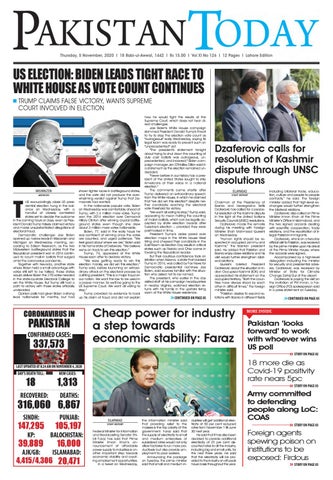
US ElEction: BidEn lEadS tight racE to WhitE hoUSE aS votE coUnt continUES g
Trump claims false vicTory, wanTs supreme courT involved in elecTion
WASHINGTON aGeNCIes
t
He excruciatingly close us presidential election hung in the balance on wednesday, with a handful of closely contested states set to decide the outcome in the coming hours or days, even as president donald Trump falsely claimed victory and made unsubstantiated allegations of electoral fraud. democratic challenger Joe Biden opened up narrow leads in wisconsin and michigan on wednesday morning, according to edison research, as the two midwestern battleground states that the republican president won in 2016 continued to count mail-in ballots that surged amid the coronavirus pandemic. Together with nevada, another state where Biden held a small advantage with votes still left to be tallied, those states would deliver Biden the 270 votes needed in the state-by-state electoral college to win the white House. But Trump still had a path to victory with those states officially undecided. opinion polls had given Biden a strong lead nationwide for months, but had
shown tighter races in battleground states, and the vote did not produce the overwhelming verdict against Trump that democrats had wanted. in the nationwide popular vote, Biden on wednesday was comfortably ahead of Trump, with 2.6 million more votes. Trump won the 2016 election over democrat Hillary clinton after winning crucial battleground states even though she drew about 3 million more votes nationwide. Biden, 77, said in the early hours he was confident of winning once the votes are counted, and urged patience. “we feel good about where we are,” Biden said in his home state of delaware. “we believe we’re on track to win this election.” Trump, 74, appeared at the white House soon after to declare victory. “we were getting ready to win this election. frankly, we did win this election,” Trump said, before launching an extraordinary attack on the electoral process by a sitting president. “This is a major fraud on our nation. we want the law to be used in a proper manner. so we’ll be going to the us supreme court. we want all voting to stop.” Trump provided no evidence to back up his claim of fraud and did not explain
coronavirUS in
PakiStan
CONFIRMED CASES:
337,573
how he would fight the results at the supreme court, which does not hear direct challenges. Joe Biden's white House campaign slammed president donald Trump's threat to try to stop the election vote count as "outrageous" early wednesday, saying its legal team was ready to prevent such an "unprecedented" act. "The president's statement tonight about trying to shut down the counting of duly cast ballots was outrageous, unprecedented, and incorrect," Biden campaign manager Jen o'malley dillon said in a statement as the election remained undecided. "never before in our history has a president of the united states sought to strip americans of their voice in a national election." The comments came shortly after Trump delivered an extraordinary speech from the white House, in which he claimed that "we did win this election" despite neither candidate reaching the electoral vote threshold for victory. "we want all voting to stop," Trump said, appearing to mean halting the counting of mail-in ballots, which can be legally accepted by state election boards after Tuesday's election -- provided they were postmarked in time. president Trump’s aides pored over election maps in the white House west wing and cheered their candidate in the east room as election day results in critical states such as florida and ohio came in favoring the republican leader. But their cautious confidence took on irritation when arizona, a state that backed Trump in 2016, was called by fox news for democratic presidential nominee Joe Biden, said sources familiar with the situation who asked not to be named. The president, who earlier in the day visited staff at his campaign headquarters in nearby virginia, watched election returns with his family in the upstairs living room of the white House residence.
CONTINUED ON PAGE 05
Dzaferovic calls for resolution of Kashmir dispute through UNSC resolutions ISLAMABAD staff report
chairman of the presidency of Bosnia and Herzegovina sefik dzaferovic has called for a peaceful resolution of the Kashmir dispute in the light of the united nations security council (unsc) resolutions. dzaferovic made the remarks during his meeting with foreign minister shah mahmood Qureshi on wednesday. “Human rights should be respected in occupied Jammu and Kashmir,” the Bosnian president said. He added that pakistan and Bosnia enjoy close relations and his visit would further strengthen bilateral relations. Qureshi briefed president dzaferovic about the situation in indian occupied Kashmir (ioK) and appreciated his statement on the occupied territory. “Both the countries have always stood by each other in difficult times,” the foreign minister said. “pakistan desires to expand relations with Bosnia in different fields
Cheap power for industry a step towards economic stability: Faraz
including bilateral trade, education, culture and people to people contacts,” he said. The foreign minister added that high-level exchanges would further strengthen the bilateral relations. dzaferovic also called on prime minister imran Khan at the prime minister’s office in islamabad, and the two signed accords dealing with scientific cooperation, trade relations, and the repatriation of illegal pakistani immigrants. dzaferovic, who is on a two-day official visit to pakistan, was received by the prime minister upon his arrival at the prime minster House, where the accords were signed.. accompanied by a high-level delegation including the minister for security and presidential advisers, dzaferovic was received by minister of state for climate change Zartaj Gul at the airport. dzaferovic is paying the visit on the invitation of pm imran, a foreign office (fo) spokesperson said in a press statement on Tuesday.
CONTINUED ON PAGE 05
more inside
Pakistan ‘looks forward’ to work with whoever wins US poll STORY ON PAGE 02
18 more die as covid-19 positivity rate nears 5pc
LAST UPDATED AT 8:24 AM ON NOVEMBER 4, 2020
DAY'S DEATH TOLL:
18
RECOVERED:
NEW CASES:
1,313
STORY ON PAGE 03
DEATHS:
316,060 6,867 SINDH:
PUNJAB:
147,295
105,197
KP:
BALOCHISTAN:
AJK/GB:
ISLAMABAD:
39,889
16,000
4,415/4,306 20,471
ISLAMABAD staff report
federal minister for information and Broadcasting senator shibli faraz has said that prime minister imran Khan’s announcement of affordable power supply to industries is another important step towards economic stability and creating employment opportunities. in a tweet on wednesday,
the information minister said that providing relief to the masses is the top priority of the government. faraz said that the supply of electricity to small and medium enterprises at subsidized rates would not only allow factories to run more productively but also provide employment to poor workers. announcing the package on Tuesday, the prime minister said that small and medium in-
dustries will get additional electricity at 50 per cent reduced rates from november 1 till June 30 next year. He said that it has also been decided to provide additional electricity at 25 per cent discounted rates to all the industry, including big and small units, for the next three years. He said that the electricity will be provided to the industry on off-peak hours basis throughout the year.
Army committed to defending people along LoC: COAS STORY ON PAGE 03
foreign agents spewing poison on institutions to be exposed: firdous STORY ON PAGE 03
02
Thursday, 5 November, 2020
NEWS
PakIstan 'looks forward' to work wItH wHoeVer wIns Us Poll ISLAMABAD
a
STAFF REPORT
S the United States decides whether Donald Trump or Joe Biden will be its next president, Pakistan on Tuesday conveyed its best wishes to the American people, saying it looks forward to working with whoever wins the highstakes election.
“Pakistan looks forward to working with anyone who wins today [Wednesday],” Foreign Office spokesperson Zahid Hafeez Chaudhri said while speaking to Arab News. Chaudhri said the election was an “internal matter” of the US but Pakistan conveyed its best wishes to the people of the country. US-PAKISTAN TIES: Since 2019, the USPakistan relationship has been marked by cooperation on the Afghan peace process and
attempts, with limited success, to boost the relationship on other fronts. The reset in Washington’s approach to Islamabad that occurred last year was due not to “Trump’s impulsiveness, but to a transactional approach” driven by the latter’s usefulness in the peace process which allowed the former to exit war-torn Afghanistan after almost two decades. International observers do not expect any significant change in Washington’s current Afghanistan policy regardless of who
wins the presidential contest. Trump has also repeatedly offered to help resolve the Kashmir dispute — an offer which New Delhi has rejected, saying the matter had to be addressed between Pakistan and India. ‘EVEN-HANDED TREATMENT’ WITH RESPECT TO INDIA: Last Saturday, days after the US and India signed an agreement allowing the latter to access the former’s satellite data crucial for targeting
SC judges issue dissenting notes on Justice Isa case NEWS DESK After a Supreme Court (SC) bench ruling on Justice Qazi Faez Isa and his family members in regard to a Federal Board of Revenue (FBR) inquiry, two of the judges, Justices Maqbool Baqar and Syed Mansoor Ali Shah, issued their dissenting notes. Justice Shah, in his note, said that the reference against Justice Isa contained malafide of both law and fact. “The actions of entertainment of the complaint, the investigation and surveillance for the collection of evidence, the putting up of Summary before the prime minister by the law minister and finally the approval of the Summary by the prime minister and placing the ‘information’ before the president under Article 209 (5) of the Constitution for removal of the Petitioner Judge from office are found to be
tainted with both malafide of law and malafide of fact,” Justice Shah wrote in his 65-page note. The justice also held all government parties involved in the case responsible, placing special emphasis of the role of the prime minister in these matters. “The major burden of these malicious actions fall on [the premier’s] shoulders who also happens to be the leader of a political party that had filed the review petition with an astonishingly unique prayer seeking ouster of the petitioner judge for expressing an independent view.” Justice Shah also said that “vengeance and resentment against the petitioner judge” were evident. “If we start reading the events after the Faizabad Dharna judgment, one is compelled to conclude that the petitioner judge was deliberately targeted for his observations and directions made in that judgment,
which perhaps were considered hostile and troublesome by those in power. This fact is floating on the record of the review petitions,” he maintained. He also said that these actions were in violation of fundamental human rights granted by the constitution. “There is no law in our country that authorises any law enforcement or intelligence agency to pry into the privacy of any person through surveillance and interception, except the IFTA [Investigation for Fair Trial Act 2013],” Justice Shah wrote. Dubbing the right to privacy as “absolute”, he said that without any law to regulate such an inquiry into a person’s private sphere, any evidence collected must be absolutely inadmissible, adding that the ARU had violated the judge’s privacy in its attempt to collect evidence. “Therefore,” he said, “such evidence/material was liable to be excluded from consideration without any exception, and the law minister and prime minister could not have relied and acted upon it, for making the “Summary” and advising the President respectively.” In conclusion, Justice Shah said, “had the chairman ARU been acting for recovery of the alleged illegally acquired foreign assets of the judges as per the so-called mandate of the ARU, the fact that a judge had resigned could have made no difference for taking legal proceedings for the recovery of his alleged illegally acquired foreign properties.” Meanwhile, Justice Maqbool Baqar said in his note that he “found that the allegations against the petitioner were wholly unfounded, baseless, frivolous, misconceived and mala fide, and that the petitioner was right in claiming the purported Reference to be a product of animosity, malice of law as well as of facts
and that it streams from the ill-will harboured by some functionaries of the executive against the petitioner”. “It was found that despite commissioning the entire government machinery, to somehow ferret some excuse to proceed to dislodge the petitioner, and misusing the government departments, and resources, in unconstitutional and unlawful manner, in that pursuit, including covertly surveilling the petitioner, and his family, the official respondents have neither been able to show any illegality or misconduct on the part of the petitioner nor that the wife and children of the petitioner are his dependents,” Justice Baqar added. He said that there was no justification for directions given to the FBR, which went beyond the scope allowed by the petition. Furthermore, Justice Baqar said that the five-year limitation for tax assessment of the petitioner’s wife and children had expired years ago. He further added that “the assessments that have attained finality with the afflux of time cannot be ordered to be re-opened and the FBR’s reopening of the same shall be in violation of the legal prohibition and disability. Such would also violate the vested rights of the wife & children”. “The role of the three organs of the state, the Executive, the Legislature and the Judiciary, are well defined by the Constitution. Judiciary being the guardian of the Constitution has to ensure this principle is maintained by all the three,” he maintained, adding that the onus of maintaining the prescribed balance is heaviest on the judiciary. The SC judge added, “This Court has persistently reiterated the well-established principle that the courts cannot and should not create any right, liability or obligation that is not founded in law.
missiles and other military assets, Prime Minister Imran Khan had said that Islamabad expected an “even-handed treatment” from Washington with respect to New Delhi. Referring to the Kashmir dispute in a wide-ranging interview to a German publication, Der Spiegel, Imran had noted the South Asian region was a “hotspot that could flare up at any time”, saying the long-standing dispute needed international attention. Imran, while observing that India has territorial disputes with almost every neighbour, said, “India is a threat to its neighbours, to China, Bangladesh, Sri Lanka and to us [Pakistan].” “It has the most extremist, racist government on the subcontinent. It is a fascist state, inspired by the Nazis in the 1920s and 30s,” he added. “That’s why,” the premier said, “we [Pakistan] expect the US, as the strongest country in the world, to be even-handed, whoever becomes president.”
IHC rejects Vawda’s request to adjourn hearing of disqualification suit ISLAMABAD STAFF REPORT
The Islamabad High Court (IHC) on Wednesday turned down a petition of Minister of Water Resources Faisal Vawda seeking to stay disqualification proceedings against him for allegedly concealing his United States nationality when filing his nomination forms during the 2018 general elections. During the proceedings, Justice Aamer Farooq took up Vawda’s petition seeking adjournment of the hearing on a petition seeking his disqualification as a member of the National Assembly (NA) for concealing his dual nationality. Issuing notices to respondents nominated in his petition to submit their comments, the judge declined to issue a stay order. He recalled the court had already ruled to decide the case in view of the record submitted by the Election Commission of Pakistan (ECP). Last month, Justice Farooq sought record from the ECP to proceed on the petition. Despite several notices served on Vawda, he never responded to the petition. During Wednesday’s hearing, the court expressed displeasure over the minister for failing to submit his response. “Why haven’t you submitted a reply when this court had given clear instructions [in this regard],” the judge censured the counsel. “Don’t play Chupan Chupai [hide and seek] with the court. This won’t benefit you,” he remarked, noting the counsel was also not appearing before the ECP. THE PETITION: The petition states that Vawda contested the elections from NA-249 (West-II) Karachi in July 2018 on a ticket of the Pakistan Tehreek-e-Insaf (PTI). However, he was a dual national at the time of filing of his nomination papers, concealing his US nationality by falsely declaring on oath before the ECP that “he didn’t have any foreign nationality”.
$25bn brought to Pakistan as result of CPEC, says spokesperson BEIJING STAFF REPORT
Seven years after the launch of the ChinaPakistan Economic Corridor (CPEC), spokesperson of the Chinese foreign ministry, Wang Wenbin, said that major progress has been made and that the projects had brought more than $25 billion of direct investments to Pakistan. During a regular briefing, Wenbin lauded the completion of Pakistan’s first electricityrun public transport project, the Orange Line Metro Line in Lahore. The OLMT was made operational last month, marking the beginning of the subway era for Pakistan, he said. Speaking on another project of CPEC, he said that the Belt and Road Initiative (BRI) launched by China, under the dynamic leadership of President Xi Jinping, had enhanced infrastructure
and power supply in Pakistan and created employment opportunities for the locals as well as contributing towards the growth of GDP. These projects created more than 70,000 direct positions and contributed 1 to 2 percentage points of the country’s GDP growth, he said. He also said that the projects had helped regional connectivity and prosperity, citing the example of Afghanistan, which was importing food and other essential items from the Gwadar port. “Gwadar port, since first half of this year, started shipping cargo, weighing about 20,000 tons that carried wheat, sugar and fertilizers to Afghanistan. This created about 1,000 jobs,” he added. Reiterating support to the flagship project, which was launched after a consensus between the leaderships of the two countries, he said that China’s support to CPEC will continue. Existing programmes have focused more
on livelihood, industry and agriculture, and to change the CPEC into a demonstration project of high-quality BRI development which will bring more benefits to the two countries and the region, he added. Appreciating the positive remarks made by Pakistan’s top leadership towards the CPEC projects, Wenbin said, “We have noted the remarks about CPEC which is an important pilot project and flagship projects of China-Pakistan cooperation and BRI development.” Last month, China had lauded President Dr Arif Alvi’s remarks about the CPEC, when the premier had termed the Belt and Road Initiative (BRI) as a visionary project. In an interview, President Alvi had expressed optimism about the future of Pakistan and said, as a result of CPEC projects, Pakistan was going to emerge as a geostrategic economic hub.
Thursday, 5 November, 2020
NEWS
03
18 More dIe as CoVId-19 PosItIVIty rate nears 5PC ISLAMABAD
t
TLTP
HERE has been no letup in increasing number of coronavirus cases in the country with virus positivity rate reached 4.94 per cent, as 1,313 more people tested positive after the tests of 26,565 over the last 24 hours, according to the data shared by the National Command and Operations Centre (NCOC) on Wednesday. According to the NCOC, the country reported 18 more deaths due to coronavirusrelated complications during the past 24 hours, taking the death toll from the disease to 6,867. According to the NCOC, 1,313 fresh infections lifted the national tally of
cases to 337,573. There are 14,646 active cases of the coronavirus as 316,060 patients have so far recovered from the disease. So far, Sindh has reported 147,295 cases, followed by Punjab with 105,197 cases while Khyber Pakhtunkhwa (KP) reported 39,889, Balochistan 16,000, Islamabad 20,471, Gilgit-Baltistan (GB) 4,306 and Azad Jammu and Kashmir (AJK) reported 4,415 cases. There are 959 patients admitted in different hospitals across the country and 117 of them are stated to be in critical condition who have been shifted to ventilators. Meanwhile, Sindh has reported eight more coronavirus-related deaths in the past 24 hours, said Chief Minister Sindh Murad Ali Shah. “The province has registered 492 fresh coronavirus cases in the past twenty-
ParlIaMent HoUse sealed after staffers test PosItIVe for VIrUs
four hours,” the CM said in his daily briefing. Out of 492 cases, 354 cases have been reported in Karachi only, he added. The overall death toll due to coronavirus has reached 2,647, while the province has registered 1,47,787 cases so far. As many as 1,39,633 people have recovered their health from the disease. A total of 191 patients suffering from the virus are said to be critical out of which 29 are on the ventilators, said chief minister Sindh. Adviser to the CM Sindh, Murtaza Wahab said that the ratio of Covid-19 positive cases in Sindh has reached 6.6 percent in the last 24 hours. He said that coronavirus cases are rapidly rising in Sindh. After dropping in coronavirus infections to one percent, the people were thinking that the
Lahore still a Covid-19 hotspot, minister says
ISLAMABAD
LAHORE
STAFF REPORT
STAFF REPORT
The government on Wednesday sealed the Parliament House after at least 30 of their staffers tested positive for coronavirus last week, reports suggest claiming the building will remain closed until November 9. The Capital Development Authority has assumed the responsibility of disinfecting the building, while Senate Chairman Sadiq Sanjrani, National Assembly (NA) Speaker Asad Qaisar, and several other officials selfisolated themselves anticipating exposure. Due to the emergence of fresh infections, the Senate and NA have also cancelled scheduled meetings and announced new dates. Reports further suggest that even after reopening the complex, only select staffers will be allowed to show up for work. As against the directives of the government for strictly implement the coronavirus standard operation procedures, people blatantly violated the rules during different Senate and NA sittings last week. A monitoring system — comprising closedcircuit television (CCTV) cameras — would now be installed in the Parliament House, while special staffers were to be deployed in the complex to ensure the strict implementation of the standard operating procedures (SOPs), reports added. This is the second time that the Parliament House has been sealed after some staff members fell prey to the virus.
Punjab Health Minister Dr Yasmin Rashid on Wednesday disclosed the majority of the coronavirus cases in Punjab were being reported from Lahore. “Lahore has been the province’s hotspot since the outbreak in Pakistan and even now, most positive cases are bein reported from Lahore,” she said while speaking to a television channel. Over 200 neighbourhoods in Lahore were put under smart lockdown recently. Rashid said that the virus hotspots were continuously switching places in Lahore. She further said a total of 1.6 million tests have been conducted so far. Across Punjab, smart lockdowns have been imposed in 44 areas in Multan, 47 in Rawalpindi, 16 in Sahiwal, 24 in Sargodha, 37 in Bahawalpur and 17 in Dera Ghazi Khan. Another 34 localities in Faisalabad, 35 in Bhakkur 35 and 14 areas in Gujranwala were put under a smart lockdown. The federal authorities said it is closely monitoring Lahore “as every second case is being reported there”. Prime Minister Imran Khan told a cabinet meeting Tuesday that the provincial governments
army committed to defending people along loC: Coas RAWALPINDI: Chief of Army Staff General Qamar Javed Bajwa has reiterated that Pakistan Army shall continue ensuring protection and security of people along the Line of Control (LoC). The army chief said this while visiting the Corps Headquarters Rawalpindi on Wednesday. He appreciated the resilience of Kashmiri population who are being deliberately targeted by Indian Army on both sides of the LoC. The COAS was given a comprehensive briefing on prevalent situations along the LOC and operational preparedness of the formations. General Bajwa was also briefed on the developmental work being undertaken in Rawalpindi Cantonment. The army chief expressed his satisfaction over the progress and appreciated the civil administration in this regard. TLTP
pandemic has come to an end in Pakistan, Wahab said. SCHOOLS TO REMAIN OPEN: Minister for Federal Education and Professional Training Shafqat Mehmood said that the situation of Covid-19 has not worsened to the point where the government needs to close all educational institutions in the country. In a statement on Wednesday, the minister said that the government is keenly observing the situation in educational institutions but has not yet taken any final decision to close them. The minister added that all teachers and other staff in the educational institutions are being tested for the virus. He stressed that coronavirus cases are increasing in the country day by day so everyone should strictly follow the standard
should implement more “smart” lockdowns and improve their testing and tracking to reduce the spread. Pakistan on Wednesday reported 1,313 infections of the novel coronavirus after conducting 26,565 tests — a positivity ratio of 4.94 percent. PM Imran on Tuesday reiterated his longstanding view that Pakistan cannot afford another quarantine and urged citizens to wear face masks in public to curb the spread of the virus and protect lives and livelihoods. Health authorities have been sounding the alarm about a second wave of the virus for several weeks now. Daily infections and deaths are once more on the rise, raising fears that disease is making a comeback as the public becomes more apathetic toward social distancing measures. Meanwhile, the country has yet to fully utilise its claimed testing capacity of 73,472 and is currently testing significantly below numbers proposed by global health experts. According to the World Health Organisation (WHO), the government’s testing policies likely only record the most symptomatic patients while ignoring the spread among asymptomatic carriers, which recent studies have suggested comprise the majority of infections in the country.
Zahida Parveen appointed as Information Division secretary NEWS DESK Zahida Parveen, a BPS-22 officer, has been appointed as the secretary of the Information and Broadcasting Division. Zahida had been an officer in the Information Group, and had been awaiting posting in the Establishment Division, but has now been transferred and posted in the aforementioned division. The notification in this regard
was issued by the Cabinet Secretariat, Establishment Division. Earlier, she had been a BPS-21 officer serving as additional secretary of information and broadcasting. This transfer comes shortly after the reshuffling of the Punjab cabinet. Earlier this week, several provincial ministers, including Fayyazul Hassan Chohan, Mehar Muhammad Aslam and Zawar Hussain Warraich, were removed from their posts, while former spe-
Bilawal violated election code of conduct in GB: CeC ISLAMABAD TLTP
Gilgit-Baltistan Chief Election Commissioner (CEC) Raja Shehbaz Khan has said that Pakistan People’s Party (PPP) Chairman Bilawal Bhutto Zardari has violated election code of conduct in GB. “Notices have been served on 95 people including leaders of the PPP over violation of the code of conduct,” the CEC said while addressing a press conference on Wednesday. Reacting to claims of pre-poll rigging in GB, Khan said that he is in Islamabad currently and the parties levelling the allegations of rigging should meet him. “We will hold transparent elections in GB,” he vowed. Describing the arrangements made by the election commission of GB, Khan said that GB Scouts will also perform duties along with police during elections. The CEC said that the number of registered voters in the area in 2015 was 6,18,624 while the number currently stands at 7,45,362. Khan said that all preparations have been made in accordance with the election act for the upcoming polls in GB and added that a control room has also been established for the announcement of the results. Bilawal is currently in GB to carry out his party’s election campaign in GB. It may be noted that general elections for the GB Assembly will be held on November 15.
cial assistant to prime minister Dr Firdous Ashiq Awan was appointed as the chief minister’s aide.
Maryam to lead PMl-n campaign in GB from today LAHORE TLTP
Pakistan Muslim League-Nawaz (PML-N) Vice President Maryam Nawaz would head to Gilgit-Baltistan (GB) for a seven-day visit from November 5 to lead the election campaign of the party in the GB polls. According to details issued by the PML-N regarding Maryam Nawaz’s visit to the region, the vice president would reach Skardu on November 05 and address a public gathering at Guwahati later in the day. She would address PML-N rallies in Skardu and Dambudas areas of the Gilgit Baltistan on November 6 and November 7 followed by public gatherings in Gahkuch on November 8, Astore on November 10 and Chilas on November 11. Maryam Nawaz would also lead a rally, to be taken out from Shigar to Skardu, on November 06. It is pertinent to mention here that the polls in Gilgit Baltistan are scheduled for November 15.
Hearing adjourned in assets case against safdar PESHAWAR: The Peshawar High Court (PHC) on Wednesday adjourned the hearing in an assets case against Pakistan Muslim League-Nawaz (PML-N) leader Captain (r) Safdar Awan following a strike of the Khyber Pakhtunkhwa Bar Council. The council has been on a strike since October 17 against changes to the Code of Civil Procedure which were introduced through an ordinance in December last year. The inquiry against Safdar has been in progress for around two years over the possession of assets allegedly disproportionate to known sources of his income, which is a crime under the National Accountability Ordinance, 1999. STAFF REPORT
operating procedures to remain safe from the pandemic. Shafqat said that the country is witnessing another wave of Covid-19 and the health ministry has been advised to keep a tight eye on the developments. Similarly, Special Assistant to the Prime Minister on National Health Services Dr Faisal Sultan asked the people to adhere to precautionary measures against Covid-19. During a press conference, he said that the government would continue its smart lockdown policy during the second wave without putting additional pressure on the common man. Earlier on Tuesday, Prime Minister Imran Khan reviewed the government’s steps and implementation of the standard operating procedures (SOPs) devised to curb coronavirus spread.
foreign agents spewing poison on institutions to be exposed: firdous LAHORE TLTP
Special Assistant to Punjab Chief Minister, Dr Firdous Ashiq Awan has said that the government with the help of people will expose those handful foreign agents and their facilitators who are spewing poison on state institutions. Addressing a press conference here at Directorate General Public Relations on Wednesday, Firdous said that people and media both are fully aware that all the efforts of anti-state elements to save plundering money have failed. She also criticised the futile efforts of Marayam Nawaz for the sake of power. Public meeting is the beauty of democracy but no one will be allowed to act against the country in the garb of processions, she added.She said that the opposition is upset over her appointment, however, she offers “Burnol” for their wounds. She said that the government has taken revolutionary measures for providing relief and solving problems of farmers. The question should be asked from the wicked group which is supporting farmers why they did not increase the support price of crops in their tenures. The Pakistan Tehreek-e-Insaf (PTI) government increased the support price of wheat up to Rs300 and paid Rs175 billion to the sugarcane growers.A policy of setting up of journalists’ colonies throughout the province is being introduced for solving the residential problems of homeless journalists.
04
Thursday, 5 november, 2020
news LAHORE
t
TLTP
HE Kissan Ittehad Pakistan on Wednesday called off their ongoing sit-in after assurance from the Punjab government. President Kissan Ittehad Akhtar Malik has announced to end the ongoing strike after successful talks with Punjab Law Minister Raja Basharat. The CCPO Lahore and AC Raiwind were also present in the meeting. Earlier in the day, the farmers under Kissan Ittehad Pakistan resumed their sit-in after a police crackdown on the protesters late at night on Tuesday. The Kissan Ittehad had announced to stage a protest outside the Punjab Assembly on Wednesday in favour of their demand for increase in support prices for wheat and sugarcane crops. The police and the Anti-Riot
FArmers end sit-in AFter suCCessFuL tALks witH PunjAb govt Force personnel started a late night crackdown against the farmers at Thokar Niaz Baig locality of Lahore. The police resorted to baton charge and tear gas shelling, and arrested scores of protesters, who pelted policemen with stones. The clash between the farmers and the law enforcement personnel resulted in traffic jams in the area. The protesters were demanding support prices for their wheat and sugarcane crops and said they would continue the protest till the government notified revised prices after approval of their demand. Protesting farmers with sticks in
their hands blocked Multan Road at Thokar Niaz Baig, causing hardships for commuters. Kissan Ittehad Chairman Chaudhry Muhammad Anwar, while talking to the media, said that no talks will be held until release of the arrested farmers. “We are peaceful. They resorted to violence and shelling in late night against unarmed farmers,” the protest leader said. “The police also stole mobile phones and cash from the sleeping farmers,” he alleged. Earlier on Tuesday, Kissan Ittehad Pakistan announced to call off its strike after holding successful talks
PIA mulls fleet expansion for new Gwadar airport KARACHI ARIBA SHAHID
Pakistan International Airlines (PIA) plans to operate international flights and increase the frequency of domestic flights to and from Gwadar upon competition of the Gwadar International Airport. In addition to the statement on increasing flights to and from Gwadar during his visit to Rawalpindi Chamber of Commerce & Industry, PIA CEO Air Marshal Arshad Malik also responded to the RCCI's request for direct flights from Islamabad to Gwadar, USA and Europe and to increase the frequency of flights to Afghanistan.The CEO assured the businessmen that the national airline would look into the feasibility of their re-
quests. Presently, due to the lack of proper refueling facilities and shorter runway, the Karachi airport is used as a replacement for Gwadar. With regards to flights to Europe and USA, the Air Marshall reminded the business community that the flights were subject to the removal of restrictions imposed. He added that PIA has addressed all formalities and is awaiting approval. RCCI President Muhammad Nassir Mirza assured the PIA CEO of their support in travel as well as cargo business, while the Malik has directed PIA officials to devise a business package for the chamber members. A MoU for this will be signed once confirmed. Malik also reiterated that the airline does not plan on selling Roosevelt Hotel.
with Punjab Law Minister Raja Basharat. Kissan Ittehad chairman, in his meeting with the Punjab law minister, highlighted the demands and the problems being faced by the farmers. Speaking on the occasion, Basharat said that providing relief to the farmers is the prime object of the incumbent government and steps are being taken to provide relief to the farmers on the guidelines issued by Prime Minister Imran Khan and Punjab Chief Minister Usman Buzdar. He assured the farmers to address their reservations about wheat, cotton and sugar crops.
LAHORE: Police arrest a protesting farmer on Thokar Niaz Baig. The protest had turned violent when the police launched crackdown on farmers. ZUBAIR MEHFOOZ
43 Pakistani prisoners in Sri Lanka return home ISLAMABAD STAFF REPORT
43 nationals jailed in Sri Lanka on various charges returned to Pakistan early on Wednesday to complete their remaining jail term in the country, Pakistan High Commission in Colombo said. The repatriation of these prisoners is in accordance with a 2004 agreement on the transfer of offenders between Pakistan and Sri Lanka. Under the agreement, transfers are allowed in cases where sentences exceed a minimum of six months. High Commissioner Major General (r) Muhammad Saad Khattak saw the prisoners off at the airport, a tweet from his office said, from where they took a chartered flight Pakistan International Airlines (PIA) flight home. Addressing the returning nationals in the departure lounge of Bandaranaike International Airport in
Colombo, Khattak “advised them to refrain from such crimes in the future so as to lead a better life with their loved ones once they reach Pakistan.” Reports citing diplomatic sources suggest the prisoners were handed over to Pakistani prison officers at Bandaranaike International Airport. Many of the Pakistanis were reportedly detained on drug trafficking-related charges. Last year in December, during Foreign Minister Shah Mahmood Qureshi’s visit to Colombo, Sri Lanka had sought Islamabad’s assistance in its fight against drug trafficking. Colombo is a growing hub for international drug trafficking. While Sri Lanka does not appear to be a final destination for many of the drugs transiting the country, drug abuse has spiked in recent years, prompting the government to launch ambitious measures.
Civil servant's judicial remand extended in Ashiana housing scam LAHORE: An accountability court in Lahore on Wednesday extended the judicial remand of former Lahore Development Authority (LDA) director general Ahad Khan Cheema till November 9 in the Ashiana-e-Iqbal Housing case. According to the details, accountability judge Amjad Nazir Chaudhry postponed the hearing in the case without any proceedings as lawyers were on a strike. The hearing of the case will resume on Monday during which the defense counsel will cross-examine the prosecution witnesses. Cheema was arrested in 2018 after he failed to appear before a combined investigation team of the National Accountability Bureau in connection with the investigation in the scam. According to the agency, Cheema had allegedly misused his authority and with criminal intent prepared, processed, recommended and got approved a fraudulent and illegal request by awarding contract of the Rs14 billion project. INP
14-year-old seeks court protection after being married to her teacher NEWS DESK Another case of child marriage was presented to the Sindh High Court (SHC), wherein a 14-yearold girl, Fauzia, had approached the court for protection after being married to her 18-year-old teacher, Noor Bani. Sindh’s laws do not allow a woman to go with her husband until she is 18 years of age, and the SHC asked the minor girl if she would like to go back with her parents, who present in the court, or to go to a shelter in Darul Aman Larkana. The girl chose to go to a shelter. The marriage had taken place recently, and it had reportedly been “by choice”.
Punjab dengue fever toll reaches 157 with six more cases LAHORE: Punjab health authorities on Wednesday reported six more cases of dengue fever in the province during the last 24 hours. According to a spokesperson of the Primary and Secondary Healthcare Department Punjab, the tally of confirmed dengue fever cases in Punjab has reached 157 this year since January 2020. He further stated that no death has been reported in the ongoing year due to the dengue virus, adding that most dengue patients have recovered. Earlier on Monday and Tuesday last, two cases each of dengue fever were reported in Punjab. TLTP
LHC seeks record of recent hike in medicine prices LAHORE: The Lahore High Court (LHC) on Wednesday ordered the Drug Regulatory Authority of Pakistan (DRAP) to provide a copy of the record detailing recent hikes in the prices of medicines. Justice Sajid Mahmood Sethi was hearing a writ petition that requested the high court to declare the September 22 decision of increasing rates of 94 essential medicines annulled. APP
PHMA welcomes cut in power tariff for small and medium enterprises LAHORE SHAHAB OMER
The Pakistan Hosiery Manufacturers and Exporters Association has welcomed the cut in power tariff for small and medium enterprises and the omitting of peak-hour charges to encourage manufacturing. They added that the three-year relief package will boost the exports and enhance the competitiveness of the local industry. Zonal chairman of PHMA, Faisal Mehboob Sheikh, and its chief coordinator, Adil Butt, observed that the Industrial Energy Package announced by the prime minister would boost productivity, lower costs and generate employment. “Elimination of peak hours from electricity tariff of all industries, 50 per cent discount on consumption of additional units for B1, B2 B3 connections till June 2021 and 25 per cent discount on additional consumptions for all industrial connections for three years is really is great relief for the industry and we are very happy with this decision,” the PHMA zonal
chief said. He added that this is the first time that normally high power rates in Pakistan are being reduced. Pakistan’s exports have become expensive compared to the rest of the region and its competitors. The discounted power rates would provide a breather to the export sectors and indicate that the economy is now moving towards a positive trend, he added. Previously, the industry was being charged peak electricity tariffs between 7 pm to 11 pm, but now an industry that has B1, B2 or B3 connections would get a 50 per cent discount on additional units by June. Faisal Mehboob Sheikh said that it was important to reduce the power price to improve production output. Adil Butt added that the power relief package would help in increasing employment opportunities and boosting the economic activity in the country. “The move is good but it will not have a very significant impact, as the government has announced discounts on addi-
tional electricity use. The industry will benefit from this relief package of consuming additional electricity when it expands which definitely takes time,” he said. He urged the government to reduce the tariff for existing use of electricity, which would really benefit exporters. He called for further ease-of-doing-business, decrease in the cost of production, solution to liquidity crunch through early refunds payment, long term and consistent energy tariff policy and relaxed import policy for industrial raw materials. Adil Butt said the apparel sector was performing well and should be encouraged by making it truly zero-rated for its whole value chain. He was of the view that the core issue in Pakistan was the high cost of doing business, which had rendered its industrial production uncompetitive. According to him, the liquidity crunch is a major stumbling block in improving exports. He said the decision will benefit small and medium industries, which are the backbone of the economy.
Thursday, 5 November, 2020
NEWS
05
Pakistan strives to learn from China on Poverty alleviation ISLAMABAD
t
GHULAM ABBAS
he Joint Working Group of Pakistan and China on Wednesday has discussed socio-economic development projects under China–Pakistan economic Corridor (CPeC) framework, and during the meeting, Pakistan showed its desire to learn from China’s experience of alleviating poverty. During the meeting, the Pakistani side discussed the poverty alleviation research project with the Chinese side and desired to
learn from Chinese experience in this area. The meeting was co-chaired by the vicechairman of China International Development & Cooperation Agency, Boqing, and the secretary of the Ministry of Planning, Development and Special Initiatives, Mathar Niaz Rana. The Joint Working Group also discussed and reviewed the projects under $1 billion Chinese grant. Rana suggested holding monthly review meetings to speed up the implementation of the projects. The implementation of Covid19 prevention also came under discussion.
Both sides expressed satisfaction over the progress of the projects being undertaken under this JWG in key areas of agriculture, education, health, poverty alleviation and vocational training. The Pakistan side appreciated the assistance provided by the government of the People's Republic of China for socio-economic uplift of the country and also acknowledged the support extended during the pandemic; especially the medical equipment and supplies. The projects reviewed including agriculture technology laboratories, provi-
sion of equipment & tools and demonstration stations in the agriculture sector, smart classroom project and overseas student scholarship programme in the education sector, solarisation project in Balochistan, drinking water supply project for Kashmir and Khyber Pakhtunkhwa (KP), and more. The Pakistani side emphasised expediting technical education projects, including cooperative projects with Pak-Austria Fachhochschule: Institute of Applied Sciences and Technology in KP and Punjab Tianjin University of Technology.
The Chinese side appreciated the level of preparation and commitment of Pakistan towards the early implementation of the projects and acknowledged the level of coordination provided by the Ministry of Planning, Development and Special Initiatives. The meeting concluded with the decision to prepare documents for signing as deliverables of the forthcoming Joint Cooperation Committee. It was also decided to prepare projects for the third phase and a request was made to the Chinese side to send their experts for the implementation of priority projects.
US Election: Biden leads tight race to White House as vote count continues continued on page 01 “He’s calm, chilling,” said a source familiar with the scene. “He’s in the hunt.” Voting concluded as scheduled on tuesday night, but many states routinely take days to finish counting ballots. Huge numbers of people voted by mail because of the pandemic, making it likely the count will take longer than usual. the close election underscored the political polarisation in the united States. the next president will take on a pandemic that has killed more than 231,000 americans and left millions more jobless at a time not only of gaping political divisions but of racial tensions and differences between urban and rural americans. the trio of “blue wall” states that unexpectedly sent trump to the White House in 2016 - Michigan, pennsylvania and Wisconsin - remained too close to call. officials in nevada said they would not update the count until thursday. two Southern states, georgia and north carolina, were also still in play; trump held leads in both. a win for Biden in either one would narrow trump’s chances considerably. Biden’s victory in arizona, which had previously voted for a democratic presidential candidate only once in 72 years, so far remained the only state to flip from the 2016 results. trump’s most likely path requires him to win pennsylvania as well as at least one Midwestern battleground and both Southern states. officials in Michigan and georgia said on Wednesday they expected the states to complete their counts by day’s end. at the moment, Biden leads 224 to 213 over trump in the electoral college vote count, according to edison Research, aiming to reach the needed 270 electoral votes, which are based in part on a state’s population. World leaders were in limbo as they waited for clearer results, with most avoiding weighing in amid the uncertainty. in global markets, investors moved to price a greater chance of uS policy gridlock. Trump addresses The naTion: earlier in the evening, trump won the battlegrounds of Florida, ohio and texas, dashing Biden’s hopes for a decisive early victory, but Biden said he was confident he was on track to winning by taking three key Rust
Belt states. “We feel good about where we are,” Biden said in his home state of delaware, shouting over a din of supporters in cars honking their horns in approval. “We believe we’re on track to win this election.” Biden speaks To The naTion: Biden leads 224 to 213 over trump in the electoral college vote count, according to edison Research. trump leads in georgia and north carolina, states he carried in 2016, but votes are still being counted in both. “the president’s statement tonight about trying to shut down the counting of duly cast ballots was outrageous, unprecedented, and incorrect,” Biden’s campaign manager Jen o’Malley dillon said in a statement. global stocks gyrated in early trade as results streamed in, with a final call now seen unlikely for days and the outcome raising the potential for gridlock that complicates the chance of a quick u.S. government spending boost to counter the effects of the pandemic. ‘We are up Big’: “We are up Big, but they are trying to SteaL the election. We will never let them do it. Votes cannot be cast after the polls are closed!” trump tweeted before his White House appearance. twitter swiftly tagged the tweet as possibly misleading.] “it’s not my place or donald trump’s place to declare the winner of this election. it’s the voters’ place,” Biden said on twitter in response to the president. trump has repeatedly and without evidence suggested an increase in mail-in voting will lead to an increase in fraud, although election experts say that fraud is rare and mail-in ballots are a longstanding feature of american elections. in pennsylvania, democratic governor tom Wolf said the state still had to count more than a million mail-in ballots. He called trump’s remarks a partisan attack. according to edison Research, more than 2.4 million early ballots were cast in the state, of which nearly 1.6 million were by democrats and about 555,000 by Republicans. Supporters of both candidates called the election a referendum on trump and his tumultuous first term. the winner will lead a nation that has been strained by a pandemic that has killed more than 231,000 people and left millions more jobless, as well as racial tensions and political polarization that
has only worsened during a vitriolic campaign. Voters were also to decide which political party controls the u.S. congress for the next two years, and the democratic drive to win control of the Senate appeared to fall short. democrats picked up only one Republican-held seat while six other races remained undecided - alaska, Maine, Michigan, north carolina and two in georgia. no early surprises: there were no early surprises as the two contenders split the uS states already projected. trump captured conservative states like alabama, indiana, Kentucky and tennessee while democratic-leaning connecticut, Massachusetts, new York and Vermont went to Biden, according to projections by television networks and edison Research. trump’s strong performance in Florida was powered by his improved numbers with Latinos. His share of the vote in counties with large Latino populations was larger than it was in the 2016 election. For months there had been complaints from democratic Latino activists that Biden was ignoring Hispanic voters and lavishing attention instead on Black voters in big Midwestern cities. opinion polls in key states showed Biden underperforming with Latinos in the weeks leading up to the election. Many younger Hispanics were ardent supporters of uS democratic Senator Bernie Sanders during the party’s primary campaign, but in opinion polls expressed little enthusiasm for Biden, viewing him as too moderate and out of touch. in the Miami area, Latinos are predominantly cuban americans, where generations of families have fled communist rule in cuba. trump’s messaging about Biden being a socialist seemed to work with them and with Venezuelans there despite Biden’s denials. edison’s national exit poll showed that while Biden led trump among nonwhite voters, trump received a slightly higher proportion of the nonwhite votes than he did in 2016. the poll showed that about 11% of african americans, 31% of Hispanics and 30% of asian americans voted for trump, up 3 percentage points from 2016 in all three groups. edison’s national exit poll also found that support for trump declined by about 3 points among older white voters, compared with 2016, while it rose by about 15 points among older Latinos and by 11
points among Black voters between 30 and 44. the poll found Biden made significant gains in the suburbs. in 42 suburban counties spread across 13 states where most of the votes had been counted, Biden was doing about 5 percentage points better than clinton did in 2016 and than Barack obama did in 2012. uS stock futures jumped late on tuesday. S&p emini futures were last up 1.9%, extending a rally during the official trading session in which the S&p 500 delivered its strongest one-day gain in almost a month. “Markets have taken a step back from the democratic sweep scenario,” said Stephen innes, chief global Markets Strategist at axi. on betting website Smarkets, odds reflected a 74% chance of trump winning, up from 33% earlier in the day. pandemic sTrains: Voters, many wearing masks and maintaining social-distancing to guard against the spread of the coronavirus, streamed into polling places across the country through the day, experiencing long lines in a few locales and short waits in many other places. there were no signs of disruptions or violence at polling sites, as some officials had feared. Biden, the democratic former vice president, put trump’s handling of the pandemic at the center of his campaign and has held a consistent lead in national opinion polls over the Republican president. But a third of uS voters listed the economy as the issue that mattered most to them when deciding their choice for president, while two out of 10 cited coVid-19, according to an edison Research exit poll on tuesday. in the national exit poll, four out of 10 voters said they thought the effort to contain the virus was going “very badly.” in the battleground states of Florida and north carolina, battleground states that could decide the election, five of 10 voters said the national response to the pandemic was going “somewhat or very badly.” trump is seeking another term in office after a chaotic four years marked by the coronavirus crisis, an economy battered by pandemic shutdowns, an impeachment drama, inquiries into Russian election interference, uS racial tensions and contentious immigration policies.
Dzaferovic calls for resolution of Kashmir dispute through UNSC resolutions continued on page 01 the prime minister spoke at a press conference after the accords were signed, where he said that trade between the countries currently stood at€4.5 million, but that they “ will have further meetings to improve trade and cooperation in all fields”. He also expressed his gratitude to the Bosnian president for his principled stance on the Kashmir dispute. He said that india has been taken over by a fascist regime that is not only persecuting innocent people in occupied Jammu and Kashmir but also targeting its minorities, especially the Muslims. the prime minister said that they discussed the rising tide of islamophobia during the meeting. Voicing his concerns over the rising trend of islamophobia, the pM imran said that freedom of speech should not be used as a tool to hurt the sentiments of any religious community. He said that desecration of Holy prophet (peace Be upon Him) causes the greatest pain to the Muslims and the Western countries must understand it. the premier said that he and dzaferovic discussed the publication of blasphemous caricatures in France and condemned the act in the name of freedom of expres-
CMYK
sion. pM imran said that Holy prophet (pBuH) and Muslims should not be targeted. He also condemned the advertisement of blasphemous caricatures in France. dzaferovic strongly condemned islamophobic incidents in the world. He said that these are unacceptable and religious feelings of the Muslims should not be hurt. He called for a dialogue to build bridges and evolve unity around diversity. “ We condemned terrorist acts by Muslims in France but we felt that for inter-religious harmony, it is important that freedom of speech is not used as an instrument to hurt the sentiments of any religious community,” he said. He was appreciative of the fact that pakistan has successfully tackled the covid-19. He thanked pakistan for offering assistance to Bosnia in the fight against the pandemic. He said that pakistan devised a successful strategy to curb the spread of the novel coronavirus. He also invited pM imran to visit Bosnia, for which the prime minister thanked him. the Bosnian president said that both the countries have stood by each other in difficult times. Sefik dzaferovic said he felt happiness
while visiting pakistan. He added that pakistani peacekeepers in united nations (un) missions played an important role in his countr y. this is dzaferovic’s first visit to pakistan, but the premier had met the president on the sidelines of the organisation of islamic cooperation (oic) summit in Makkah in May last year. according to the memorandum of understanding (Mou), the process of readmission of pakistanis in Bosnia & Herzegovina would be streamlined. this Mou signed by interior Minister (r) Brigadier ijaz ahmed Shah and Bosnian Minister for Security Selmo cikotic. Similarly, an Mou regarding scientific cooperation between the countries was also signed by Federal Minister for Science and technology Fawad chaudhr y and the Bosnian security minister. pakistan enjoys traditionally warm and friendly relations with Bosnia & Herzegovina. the two countries have extended support to each other in times of need. during 1994-95, pakistan was a significant contributor of troops to the un peacekeeping Mission. Bosnia & Herzegovina provided assistance to pakistan during the 2005 earthquake and 2010 floods, the press release said.
Thursday, 5 November, 2020
06 COMMENT
Power grab not transfer
Claiming victory before counting of votes
We must act to stop power grabs
New challenges to democracy
W
HILE millions of votes were yet to be counted, including in key battleground states and mail-in ballots, and Joe Biden still enjoying a lead over him, President Donald Trump declared early Wednesday morning (in the USA, though night-time here) he had won the election. He claimed a conspiracy was afoot to steal the election and wanted all voting to stop. The announcement was duly rejected by Joe Biden’s campaign manager who called Trump’s remarks outrageous, unprecedented, and incorrect while Twitter placed a “disputed” label on the tweet. Trump however hinted at taking the matter to the Supreme Court, which is unusual as the nation’s highest court is rarely the first judicial venue for a case, instead it reviews lower court rulings. Trump is confident as he had appointed Amy Coney Barrett as a Supreme Court justice just days before the election, creating a 6-3 conservative majority that could favor the president if the courts weigh in on a contested election. The US is on course for the highest electoral turnout in a century. The presidential election is on a knife edge. Trump has a soft corner for white supremacists; he has a hardline stance on immigration; he has denigrated movements that supported equal rights for women and justice for black people; he supported police in its heavyhanded treatment of protesters in the name of preserving law and order and he called slave-owners national heroes. That the electoral contest is neck and neck, dashes hopes that Trump’s ideology would be repudiated by a large majority of the American voters. Instead it highlights the vast reservoir of racial, religious and xenophobic prejudices that exists in American society. Democracy has taken time to advance. In the mid-19th century, males without property got the right to vote for the first time. The suffragettes however had to fight long to enable women to get voting rights. The system has yet to overcome weaknesses that are causing a lot of human suffering. The wave of populism has brought to power authoritarian and nationalist leaders like Donald Trump, Jair Bolsonaro in Brazil, narendra Modi in India and Benjamin netanyahu in Israel. They have used democratic structures to get elected and then taken measures that violated basic democratic values and traditions.
Dr FariD a Malik
I
n its over seven decades of history, the Islamic Republic of Pakistan has never experienced an orderly transfer of power. Even the mighty Ayub Khan did not have the courage to follow his own constitution under which the Speaker of the national Assembly was next in line of succession. Power was grabbed from the first dictator by the second in March 1969. General Agha Muhammad Yayha Khan, after taking oath of office as President, abrogated the 1962 Constitution. A Legal Framework Order (LFO) was enacted to run the country till a new document could be prepared by an elected Legislative Assembly. Free and fair elections, as promised, were held in 1970 on the basis of one man one vote, or adult franchise, but again power was not transferred, which resulted in civil war in the Eastern Wing, and the rest is history, as they say. Pakistan started off well. The last British Viceroy, Lord Louis Mountbatten, handed over power to Muhammad Ali Jinnah as the first Governor General of the new state. The father of the nation then took oath of office from the elected Prime Minister (PM) and his six member cabinet. The Government of Pakistan started to function in the barracks in Karachi, which was declared the capital city. The task was daunting but the founding fathers did not give in. There was honesty of purpose and dedication. The colonial establishment kept flexing its muscles. There were several behind-the-scene intrigues and manipulation. yet the consolidation process continued. Baba-e-Qaum died a year after the partition in September 1948, and Khawaja nazimuddin, one of the prominent founding fathers of Pakistan, succeeded him. The slide started with the murder of the first PM, nawabzada Liaquat Ali Khan, whose biggest blunder was to promote a very ordinary and ambitious officer to the office of Commander-in-Chief of the Army, though he had been superseded by the Governor General himself.
Piling on the agony The landgrabbing case against Mrs Sharif is aimed at her sons
T
How India balanced a strong centre with states’ rights Dr rajkuMar Singh
T
HE demand for restructuring Centre-State relations is as old as the adoption of the Constitution of India in 1950. The Founding Fathers of the Indian constitution took note of the emerging trend of cooperative federalism in the traditional federations. They were not committed to any principle of federalism; rather their sole aim was to hammer out a constitution which was capable of solving the problems that the country was subjected to on the eve of independence and would also be confronted with in the future. Its makers were enamoured with the idea that it should work for the progress, peace and prosperity of the people. The framers evolved, developed and improvised a substructure in the constitution, to promote cooperation and minimize tensions between the centre and states. They provided a framework in which the federal government was vested with wider powers than were granted to the governments of the states. The religious, linguistic and ethnic diversities of India, the outbreak of communal riots, the trauma of partition and its ghastly aftermath, Gandhi’s assassination, the Communist upsurge in Telangana, problems of India’s external security and te complex international order, and squalor of the teeming millions, affected the mood and thinking of the framers of the Indian constitution. They believed that only a strong centre could act as a foil to India’s propensity to decentralise to the point of dismemberment, that the goal of the nation, the welfare of the people, would be achieved only with a centralised cooperative federation. The history of federalism and centre–state relations in India is marked by political mobilisation and intermittent struggle to fashion a more federal set-up. In the first phase, lasting until the late 1960s, the task of nation -building and development was the main concern of the nation’s rulers. This period was not solely dominated by the trend of centralisation. Whatever conflicts arose, and there were many major ones, were all sought to be resolved under the Constitution. The geographic boundaries of the States have often been reorganised. In 1956, they were organised on linguistic basis. This laid the basis for the later asser-
Dedicated to the legacy of the late Hameed Nizami
Arif Nizami Editor Umar Aziz
Asher John
Joint Editor
Executive Editor
Deputy Editor
Lahore – Ph: 042-36300938, 042-36375965
terim constitution was passed by the national Assembly which was then followed by the 1973 permanent version. The elections in 1977, the first under the new document, were again disputed and another power grab took place on 5 July 1977, the same route has then been followed meticulously by establishment parties like the PML(n), PML(Q, MQM, MMA, among others. now being at the receiving end, PML(n), the hounding party of Pakistan, is talking sense. It is not only ‘Vote Ki Izzat’ (respect for the vote) which is at stake, as a nation we have to agree and follow an orderly power transfer mechanism. This grabbing has to end. The entire administrative system is totally compromised. Due to loot and plunder of the last 40 years the stakes are very high. Victory at all costs has become the norm. Decency in politics no longer exists. Accountability through common law is almost impossible. For the first time after the enactment of the 1973 Constitution, the Chief Election Commissioner has been appointed from the civil administration as the Judges of the superior judiciary repeatedly failed to deliver credible ballots, starting from 1977 till 2018. Malpractices and glitches of all kinds were encountered in every electoral contest. While our neighbour India has had several orderly transfers of power through the ballot, we have totally failed. Electoral process is a massive logistic exercise which the Judiciary cannot deliver. After a disputed ballot the establishment decides the transfer of power framework, which defeats the entire exercise and results in a power grab. In its three stints in power, only the PML(n) has enjoyed a comfortable majority once and an absolute majority twice but did no meaningful legislation. It sought Khilafat and total control, clearly indicating the appetite to grab more power. In the absence of strong national institutions, neutrality of the ballot can only be ensured if the entire electoral staff is brought from another province and then flown out after counting the votes. Ayubia Leagues and ‘Gamma Grab’ have to be effectively dealt with. A reference should be filed in the Supreme Court to ban these power-grab leagues, to clean the mess. The Muslim League House on 33 Davis Road should be taken over and converted into a ‘ Democratic Panagah ‘ where lessons in democracy should be imparted to the coming generations together with dossiers of those who dared to dissent from preserving democracy in the land of the pure. Indeed ‘Democracy is the best revenge’, which is only possible through an orderly transfer of power which has not happened thus far. Dr Farid A Malik is ex-Chairman, Pakistan Science Foundation. He can be contacted at: fmaliks@hotmail.com.
Initial developments of Centre-State relations in India
HE proceedings in a civil suit against the mother of former Prime Minister nawaz Sharif and PML(n) President Shehbaz Shraif, accusing her of landgrabbing, come at a particularly sensitive juncture, at the time when the Pakistan Democratic Movement (PDM) is ratcheting up the pressure against the PTI government. The plaintiff alleges that Mrs Sharif had illegally got the plaintiff’s mother to sign the transfer deed by force, and has asked the civil court to set aside the sale deed. In her response, Mrs Sharif said she had bought 108 kanals legally, had all relevant documents, and possessed all relevant documents. The rights or the wrongs are not for anyone but the court to decide, and clearly it has not, for it has told the plaintiff to file a response at the next hearing. As it is a civil suit, it cannot be assumed that there will a decision any time soon. However, the moving ahead of the suit must be seen within the context of the PDM movement. The PTI might claim that the hearing was merely a coincidence, but that would ignore the highly violent statements by PTI chief Imran Khan, which may not only reflect his personal biases, but also his appeals to his base, which seems informed by a personal animus against the Sharif brothers. Mr Khan’s talk of ‘dragging back’ Mr nawaz Sharif from London, along with the twists and turns caused by the fact that he was the one permitting him to travel, merely strengthen the impression that, unable to get anything from a direct persecution of the brothers (one of whom is abroad, the other in jail in nAB custody), or of their children (nawaz’s daughter Maryam is out on bail, Shehbaz’s son Hamza is also in jail in nAB custody), the government is now turning its attention to their mother. The apparent obsession of the PTi with the Sharifs should not exceed the bounds of the law, and should not chase after shadows. The law must take its course, and the accountability machinery should not be demeaned by being used for partisan politics.
Aziz-ud-Din Ahmad
The induction of Khawaja nazimuddin as second Governor General was very orderly but then the game of powergrabbing started. Baboo Ghulam Muhammad (Gamma) succeeded in grabbing the coveted slot of the head of state while Khawaja Sahib became the PM. Gamma played havoc with the country. It was an era of colonial intrigue to thwart the march towards freedom. It was a perfect ‘Gamma Grab’ like the famous ‘Inoki Lock’. He dismissed governments, dissolved the Parliament. Finally he was incapacitated yet he refused to step down. Only his loyal female personal secretary of foreign origin could read his movements and then convey the official decisions. Another power grab took place, and Iskander Mirza, the senior bureaucrat, combined with the Army Chief to force the Governor General to step down. Mirza Sahib had the unique distinction of becoming the first President of the Republic. Elections were to be held in 1958 under the unanimously approved 1956 Constitution. Fearing defeat the President, in connivance with Ayub Khan, tried to grab power by imposing martial law on 7 October 1958 after abrogating the Constitution. Only 20 days later, on October 27, Ayub took complete control of the government to derail the march towards freedom and emancipation of the masses. Since then the power grab has become the norm. Ayub Khan then added a civilian add-on to this grabbing phenomena. It should have been named Ayubia Muslim League instead he misused the name of the founding party and called it Pakistan Muslim League (Convention) for which a Muslim League House was dedicated, on 33 Davis Road Lahore. All Muslim Leagues, including the PML(n) and PML(Q), that we have to deal with today, came out of this incubator. They are certainly not the founding, as claimed, rather the hounding parties of the country. Conceived at Gate no 4 of GHQ and then launched through the Muslim League House, a combination of Ayubia-style conspiracy combined with the ‘Gamma Grab.’ It took me a while to understand the obnoxious and apolitical behaviour of PML(n). It is based on power grab as they were launched by the Master Grabber Zia and his team. The PPP, being a genuine political entity, behaves totally differently despite being repeatedly hounded by the establishment. First it was Bhutto and then his daughter who tried to serve the people, unfortunately they were hounded by anti-democratic forces like the Sharifs of Lahore and Chaudhrys of Gujrat, who have a history of grabbing, not earning, the people’s mandate. Even after the break-up of Quaid’s Pakistan in 1971, Yayha Khan refused to step down. Again a power grab revolt was carried out by some Generals and the Air Chief who wanted restoration of civilian rule. Bhutto was sworn in as Chief Martial Law Administrator (CMLA), and continued in this capacity till the 1972 in-
I
Karachi – Ph: 021-35381208-9
I
tion by the States for greater powers. Later more States were formed─ Haryana, Himachal Pradesh, nagaland, Manipur, Mizoram, Arunachal Pradesh and Goa. Even in 2003, three large States were bifurcated to create three new States of Jharkand, Uttarakhand and Chhatisgarh to respect and encourage the local aspirations of the people. In this regard installation of non-Congress governments at the state level after 1967 is considered as the beginning of the process of erosion of Congress hegemony. But in fact this was the starting point for the emergence of coalition politics in India. The decline of the ‘Congress System’, as advocated by Austin, brought a number of issues to the surface. One of these issues was to make room for other political parties to play their roles in the national as well as local politics. The 1977 development is the process of culmination which started way back in 1967. In the post-1967 phase the Dravida Munnetra Kazhagam decided to carry on a campaign on centre–state relations in a systematic and scientific manner. In February 1970, in the DMK Conference in Tiruchy, a popular slogan, ‘Autonomy for the States; Federalism at the Centre’, was given. In its 1971 Election Manifesto, the DMK announced: ‘Though the Constitution of India is described as federal, the balance is more tilted towards the Centre and hence the States are not able to function freely in the administrative and financial spheres. Only such powers as are necessary for the Centre to preserve the strength of India should be assigned to the Centre and all the other powers should be left to the States without impairing the ideal of a strong India’. The DMK is of the view that for proper and ideal centre–state relations, there should be more powers for the states. In the reign of Rajiv Gandhi, the strategies adopted to meet the crises originating from the states under non-Congress government became counterproductive on many issues. Initially, the Congress tried to penetrate into the Hindi heartland states in order to regain its electoral superiority. But the results in the Assembly elections in as many as ten states did not register a steady growth. In Maharashtra and Punjab almost the same picture could be seen. In a bid to settle these issues, mainly in Punjab, a peace accord was concluded between Rajiv Gandhi and the religious leader Harchand Singh Longowal which failed
Islamabad – Ph: 051-2204545
I
Web: www.pakistantoday.com.pk
I
to satisfy either the people of Punjab or the government at the centre. The demand for state autonomy in the matter of finance, was also made by Biju Patnaik of Orissa towards the end of 1973 and in 1990 when he became the Chief Minister of Orissa. In an interview to The Indian Express in September 1991, Patnaik reiterated his demand and suggested a radical restructuring of Centre–State relations. In fact the framers of the Constitution adopted a federal form of governance in the hope that the Union and the States would work within the limits of the Constitution by mutual willingness and cooperation. States should not become over-ambitious and the Union should also not be too coercive. Federalism can operate only if the Union tolerates the States and vice versa. ‘Federalism is primarily a device with considerable potential for integrating the political assertion of diverse regional interests and providing a framework for reconciling demands for increased representation and participation in national development. Thus viewed, the issue is more than merely devolution of powers from the Centre to the States.’In other words, the Constitution avoids the tight mould of federalism and it can be both unitary and federal according to the requirements of time and circumstances. For the first time in 1989, a national Front coalition government headed by V.P. Singh, which included major regional parties like the DMK, took office at the Centre. Though shortlived, this government took certain steps to strengthen the federal principle. The Inter–State Council was constituted in 1990. The entry of regional parties in a coalition government at the centre became a regular feature in 1996 with the formation of the United Front government, and in all subsequent ones, and presently in the United Progressive Alliance government. The left parties, which supported both the national Front government in 1989 and the United Front government in 1996-1998 and the present UPA government, are strong supporters of the federal principle. An analysis of the nature and dimension of federal government in India will show that there has been qualitative changes in the inner dynamics of political parties in India, both at the national and regional levels. Dr Rajkumar Singh is head of the political science department of the B.N.Mandal University, Madhepura, Bihar, India and can be reached at rajkumarsinghpg@gmail.com
Email: editorial@pakistantoday.com.pk
Thursday, 5 November, 2020
COMMENT 07 Editor’s mail Send your letters to: Letters to Editor, Pakistan Today, 4-Shaarey Fatima Jinnah, Lahore, Pakistan. E-mail: letters@pakistantoday.com.pk Letters should be addressed to Pakistan Today exclusively
Corona trap AS everyone knows Corona virus is hunting people’s lives all over the world. But as Corona’s spread increases day by day, It also Hunts world economies.And the crude oil market crash is a live example of this economy hunt by COVID-19.Pakistan’s economy is also in Corona virus trap. The trap which is created by coronavirus lock down. And due to this trap, Poverty in Pakistan is increasing day by day. Country is going in loss, in a great loss. Which is affecting growth rate directly. People are losing their jobs and the unemployment rate is increasing. Poverty as compared to the past is much more and unemployment as well. The Government should take some serious actions to take control of this hunt otherwise we will pay for it. And our country in this situation is not ready for this. So please consider this issue. The issue about which we have to think and make suitable solutions for it. SyEd kaShifullah Shah iSlamabad
Expensive medicines
Data-driven dumb decisions Can we trust big data? aneel SalMan
T
‘Policies in Pakistan are failing!’ HIS is the chant in almost every sphere in Pakistan, whether public, private, nGO or think tank spaces. The lack of solutions was earlier laid at the feet of ‘research’─ that there simply was not enough of it and even if there was, no one within policy corridors was interested or had time to read it. Over the past two or three years, a new buzzword, has entered the scene, ‘Big Data’. now, like the gold rush, every institution thinks the answer lies in ‘Big Data.’ no, not ordinary ‘data’ which the understaffed, underpaid statisticians churn out at the Statistics Bureau, and which no one (not even various government departments) ever trusts. Big data is extremely large data sets that may be analyzed computationally to reveal patterns, trends, and associations, especially relating to human behaviour and interactions. The supposed idea is that with a large enough sample size, data points can show statistically significant correlations because at some level everything is related to everything else. Psychologist Paul Meehl famously called this the ‘Crud Factor’ leading us to believe there are real relationships in the data where in fact the linkage is or may be entirely trivial. But for those within policy circles who already don’t keep abreast of anything except the next election cycle or are part of the groupthink yes-man or yes-woman mindset, throwing around words like Big Data, Mega Data or Meta Data is like impressing one’s girlfriend on the first date. In reality, all this Big Data is a pile of trash unless mined by geniuses. It’s a new phenomenon by data nerds to create and save their jobs and telling the computer to do the job by making things more complicated. According to Uta Frith, Developmental Psychologist at the University College London, “Data is often full of errors and the bigger the set the more errors there are likely to be. Interpretations can be distorted by random events. The idea that big data will enable more control of behavior may be a lot of hype.” My main problem with data is its authenticity and veracity. Who ensures that? And then the bigger question, are they trustworthy and if so on what basis? Just because, something is coming out of the data set of a major financial or health institution, doesn’t mean it can be trusted. Because, let’s face it, if the data is bad, the fancy machine learning tools being marketed and employed to analyze it will be utterly useless. In 2011, a blogger noticed that whenever actress Anne Hathaway was mentioned in the news, the stock prices of Warren Buffet’s Berkshire Hathaway (BRK.A) rose as well. The hypothesis was, apparently that the ‘automated, robotic trading programming was picking up the same chatter on the Internet about ‘Hathaway’ and applying it to the stock market.’ Co-relation is not causation: which is why the context is so critical.
Algorithms require constant monitoring and tinkering to adapt to changing behaviour and trends. In 2018, Strava’s online exercise-tracking map unwittingly revealed remote US military outposts and even the identities of soldiers based there. The situation shows how data collection can lead to unintended consequences. Companies like Cambridge Analytica amassed data on voters through the use of an app that collected data on approximately 50 million Facebook users, including 30 million psychographic profiles. Political parties and governments continue to want access to social media intelligence and continue to develop profiles on us, to shape and manipulate us. There are data brokers who use this big data without our knowledge without any restraints and sell it to banks, insurance companies to earn big profits. The data which dummies are using to make decisions may not be organic nor real. In fact, most data on consumers is tailored and created by data brokers. In short, many decisions our policymakers are making using what they are calling big datasets are not authentic and organic, therefore, the policies and decisions being made are simply not sticking. The on-ground realities are different. The real tragedy is that we, as citizens, have no choice but to go along with the so-called numbers being thrown at us, whether from the Finance Ministry on inflation, the Commerce Ministry on trade or the Health Ministry on covid-19. Data can so easily be non-simulated, made-up, fraudulent or for lack of a better word, ‘synthetic’, and no one, not even our country’s leaders, will be the wiser. now, thanks to the magic of social media, organizations, parties, governments can literally create ‘following’ or ‘consent’ based on numbers on a screen or social media platform to convince us that what they are doing, saying and how they are doing and saying it is the ‘truth’—-is what WE as citizens have been wanting, demanding, craving all along. In Pakistan, we like to follow the developed world fads whether they are useful for us or not. Since ‘big data’ is the new fad, let’s restructure our government departments and think tanks and collect trash data or rather data put together by someone else, somewhere else, about us or our region or our lives and the way we think, or should feel and what we want (or should want) and let’s find gold in it. Under the label of ‘big nudging (big data with nudging)’, our governments and organizations want to make sure that we do the things (or THInK the things) that they consider right, proper and here in Pakistan ‘patriotic’. Why have elections or referenda, do mass surveys or have national debates when making constitutional changes and amendments like those in India or Pakistan, Singapore or even China for that matter? Why involve citizens in democratic processes when we, the citizens can now be governed by a data-empowered ‘wise king (or queen)’, who would be able to produce desired economic and social outcomes with a digital magic wand. In all my interactions with so-called ‘big data gurus’ and ‘data scientists’ in Pakistan, my one alarming observation was that they all proudly claim that data will show whatever they want it to. In fact, they all firmly believe in the words of economist Ronald Coase, beat the data
long enough and hard enough, and it will eventually confess anything. Even the West is struggling with how to work with big data in an ethical and responsible way. GAFA (Google, Apple, Facebook and Amazon) showed amazing data-driven success which has pushed states and companies to embrace the data-driven mindset frantically regardless of whether this approach is toxic or not. In reality, GAFA is the new name of American Cultural Imperialism. Walmart and Best Buy have one of the biggest of databases, call it meta data, but still their revenues are decreasing and the data analytics have not solved their problems. The irony is that one can have data without information, but thanks to the new reality we now live in, we have been forced to believe that we can’t have information without data. During the German swine flu epidemic in 2009, for example, everybody was encouraged have vaccination. However, we now know that a certain percentage of those who received the immunization were affected by narcolepsy. Governments have been collecting data on their citizens, listening to phone calls, tracking emails, but still terrorism and fifth-, sixth- (I lost count after the fourth) generation hybrid warfare takes place. When adequate transparency and democratic control are lacking, there can be ‘erosion of the system from the inside. Search algorithms and recommendation systems can be influenced.’ And what about how data analytics or big data can lead to the creation of echo chambers? After all, if mass-scale manipulation is to stay unnoticed, ideas/opinions need to be sufficiently customized to each individual. So, in the end, all we get is our own opinions reflected back at us in our ‘echo chamber’. The latter causes social polarization resulting in the formation of separate groups that don’t understand each other and come increasingly in conflict with each other leading to extremism and discrimination (something we in Pakistan are all too familiar with). At my doctoral alma mater in the States, my Behavioral Economics Professor would always say that ‘less is more’ which meant that collect less data but relevant data, talk to your citizens directly, observe and understand their behaviour, stay close to them and you will know when, why and where the problem is and even how best to solve it, rather than by looking for patterns in numbers which one can easily conjure out of thin air. Local, indigenous, grassroots knowledge and facts are important to reach good solutions and decisions. The great caliphs of Islam used to remain within proximity of their followers and were fully aware of their conditions– they did not need numbers on a screen or one-page policy memos to know the plight of the people they served. There is no going back from big data and data analytics, but the real future lies in collective intelligence and socio-diversity, in crowdsourcing, online discussion, collaboration, deliberation platforms and citizen science, where ideas and innovation from real people, and not bots or trolls or digital soldiers, are considered, curated and constituted. The writer is a Behavioral Economist based in Islamabad. He can be reached at aneelsalman@gmail.com
InFLATIOn has brought many difficulties in people’s life in the country. Many people cannot buy good things. The biggest problem that people are facing is prices of medicines which have increased again for the second time in a month, the prices of medicines have increased by five to fifty percent. However, the price of essential items are already out of reach of a common man, and with recent development, the poor are being deprived of medical treatment by making medicines more expensive. On the other words, the rates of medicines for all diseases, including heart disease, diabetes, blood pressure, hepatitis and cancer has been increased. now these medicines are beyond reach of the poor. The hiked prices of medicines making trouble for middle class people, especially for the poor, cannot buy medicines. So, the government should decrease the rising price of life saving drugs so that the poor should be able to buy medicines and should be treated well. SamEEr aSlam awaran kulli
FIFA failure in Pakistan HOW does a country of 200 million people fail to win a single FIFA World cup qualification game since 1990? But Pakistan has achieved this dubious distinction. Moreover, if you look further than the country’s current FIFA ranking of 200, you will see glimpses of missed chance, dodgy coaching and sometimes truly bad luck that have prevented the Pakistani Shaheens from getting past even the first hurdle. Every four years, fans from 32 nations share the delight of seeing their teams at the FIFA World Cup. Hearts are broken, heroes are made and legends are born during the world’s greatest sporting event. Similarly, Pakistan is the only Asian country never to have won a FIFA World Cup, but the FIFA’S regulations, Asian teams get 4-5 slots at the World Cup, four of them being direct entries and another being an intercontinental play -off. Pakistan isn’t a name that comes to mind when talking about football - unless you talk about producing actual footballs rather than playing the sport. But the features countries such as Bhatan once the lowest ranked team in the world) Timor leste won matches against Mongolia, later docked by FIFA. Pakistan is the only one that hasn’t won a single FIFA world Cup. However, this is abysmal for a country where it can be argued that football is the number two sport and, in terms of following, the sport has grown in leaps and bounds over the last two decades, leading to 14.9 million people watching the 2014 FIFA world Cup ( Asia’s 8th largest country audience as per FIFA. Why Pakistan has underperformed, one must turn back the clock to 1989, when Pakistan played the FIFA World Cup qualifiers for the first time - taking on the South Yemen, Kuwait and United Arab Emirates. najEEb Sowali TurbaT
Two more dengue cases WITH two more fresh cases of dengue, the total number of dengue fever in both public and private sector in Punjab raised to 151 this year so far. According to a report these two new cases have been confirmed in Lahore. The news report further disclosed that eight dengue fever patients are under treatment in hospitals, while all other patients have recovered and no death due to dengue fever has occurred in Punjab this year so far. The government should take immediate measures for the eradication of the lifethreatening disease which is spreading rapidly and affecting a large number of people. So this is the demand of time to create awareness about the dangerous virus and there should be serious action to prevent the disease before it goes out of hand. bakhTiyar Phullan abSor
Earthquake in Turkey THE recent earthquake in Turkey was the deadliest which caused much destruction in the majority of the destructions. However, Turkey is crossed by fault lines and is prone to earthquakes. According to the report more than 500 people were killed in a 2011 quake in the eastern city of Van, while another in January this year killed 41 people in the eastern province of Elazig. Eventually, the earthquake which was like a little Tsunami and has crossed the sea level altitude and sabotaged the areas was a very bad scenery and a little destroyed the good image of Turkey. In 1999, two powerful quakes killed 18,000 people in north-western Turkey. In fact, Turkey has a mix of older buildings and many structures are built cheaply which can lead to serious damage resulting in deaths when earthquakes hit these regions. It makes me feel very cautious to mention the earthquake which happened some days before, yet the rescue work is continued. Although the earthquake caused destruction and worse conditions. After dozens of buildings were damaged, this was a bad scene as thousands of residents were forced to spend the fourth night in tents in Izmir. Turkey had reported more than 1, 464 aftershocks following the earthquake, including 44 that were above four in magnitude. barkaTullah TurbaT
Thursday, 5 November, 2020
08 world vIew
US and UK IntellIgence and SecUrIty relatIonShIp WHOEVER WINS BALLOTS IN THE US, ONE ELEMENT WILL REMAIN ROCK-SOLID: THE UK–US SECURITY AND INTELLIGENCE PARTNERSHIP
rusi.orG
U
JOHn ScARlETT
S election is upon us. We now see much discussion of the US’s relationships with longstanding allies across the world and the advantage such alliances bring, both to the US and to the countries involved. There are some who question the future of these alliances, including the continued resilience of the closest of all – that with the UK. These questions prompt me to reflect on my personal experience of the Special Relationship and its durability for the future. On 15 November 2016, one week after the last presidential election, I spoke to a large audience at Queen’s University in Charlotte, North Carolina. I shared the platform with General Michael Hayden, former director of the NSA and the CIA, and a close friend. We discussed our mu-
tual experience of working together to protect and promote the national security of the US and the UK. Towards the end, I felt challenged to clarify my understanding of the Special Relationship. I spoke impromptu as follows: ‘All my professional life I have bet on my country’s relationship with the United States of America. This is not going to change’. There was immediate impact. The audience stood en masse and cheered me off the stage – an emotional moment. I first met colleagues from the CIA in 1979 as a young officer at the age of 30, so quite early in my professional career. I had already been engaged in an operation providing valuable intelligence which my service shared with the CIA. I learned early on that we did not always agree with our US colleagues on operational tactics and decisions and that each of us was naturally inclined to protect our independence of judgement. As services in exceptionally close contact, we were also vulnerable to mutual stereotyping, such as for being over-adventurous and risk taking, or for being risk averse. But I understood from the beginning that this relationship was exceptional and based on decades of shared experience and activity across all our national agencies.
In later years, I came to learn more about our shared history. Notably, on 8 February 2016, as chairman of the Bletchley Park Trust, I attended, with the directors of GCHQ and the NSA, a ceremony and BBC interview in the office of the wartime director and effective founder of Bletchley Park, Commander Alistair Denniston. The event was to celebrate the 75th anniversary of the arrival (in that same office) of US code breakers who came to exchange our most secret assets, the breaking of the Enigma (German) code and the Purple (Japanese) Machine. If there was a beginning of the Special Relationship, this was it. It was the first step to the BRU SA intelligence relationship (March 1946) and eventually the Five Eyes. As my career continued, I worked directly or indirectly with US colleagues on a whole range of issues and threats from classic Cold War strategic reporting, to the end of Apartheid, conflict in the Balkans, Afghanistan, Iraq and, of course, jihadi extremism and terrorism after 9/11. Together, we experienced the opportunities and complexities presented by rapid technological change. Throughout these years of collaboration, I saw how our relationship was based on mutual respect for each other’s qualities
America is a failing state AND ESTABLISHMENT POLITICS CAN’T SOLVE THE CRISIS
GuArdiAN
I
BHASKAR SUnKARA
N 2020, America has shown itself to be exceptional in the worst possible ways. No other rich country has such a poor public health infrastructure or such a tattered social safety net. America’s levels of both police violence and violent crime find their closest peers in countries like Venezuela and South Africa, not Canada and Germany. And even Cuba and Bosnia and Herzegovina beat the world’s only superpower in infant mortality and other key social indicators. In the most powerful country on Earth, 29.3 million people say that they “sometimes” or “often” do not have enough to eat. Forty million Americans are impoverished, according to the UN. Half a million are homeless. And all this was true before the full brunt of the pandemic’s economic recession hit. Given these stark figures, the relative stability of the United States is a wonder. The country has maintained popular suffrage and democratic institutions (for white males, at least) for two centuries and married that form of government with a dynamic capitalist economy capable of creating vast wealth. In fact, American business owners have managed to avoid even the rise of a major social-democratic or labor party; in the US, demands for economic justice are filtered through – and watered down by – a centrist Democratic party and a byzantine system of government deliberately designed to limit popular passions. But perhaps that muzzling is reaching its limit. The past decade has seen bolder challenges to the establishment order – the Occupy movement, the surprising outsider challenge of Bernie Sanders, the equally unexpected rise of Donald Trump and the populist right, and street protests against police violence. Faced with all of this, as well as its inability to address the Covid pandemic, the American state looks embarrassingly ineffectual and increasingly lacking in popular legitimacy. Part of the problem lies with the federal structure of the United States. With power split between the local, state, and federal levels and among different branches of government, there are countless “brake” points in the sys-
tem that stall or stymie attempts at reform. Of course, this structure has a certain utility for elites. The labor journalist Robert Fitch put it well: “The aim of the right is always to restrict the scope of class conflict – to bring it down to as low a level as possible. The smaller and more local the political unit, the easier it is to run it oligarchically.” For those on the left who want to change things, the dilemma is not just how to reach power and government (hard enough as that is) but how to reconstitute the American republic in a way that allows us to actually achieve justice. The most important periods of progressive activity in US history – Abraham Lincoln and the struggle against the slaver class; the populist era; the New Deal – have embodied this spirit. For Franklin D Roosevelt, new collective bargaining rights and entitlement programs needed to be safeguarded by more effective government institutions. His administration pushed for new agencies to enforce labor law, reorganized the executive branch, and attempted a sweeping modernization of the US supreme court. Roosevelt even flouted the (at the time, unofficial) presidential two-term limit. The success of FDR and his predecessors was ultimately limited. Yet despite our past failures, popular organizing has yielded enough gains, over time, to create a US that is not quite the worst of all possible worlds. We have maintained crucial democratic rights and extended those rights to black Americans, women and other oppressed groups. We have a limited welfare system for the very poor and the elderly and public guarantees to primary and secondary education for all. But we live in the shadow of the failure of our workers’ movement to take root in the US as firmly as it did in the 20th century in other developed countries. The result is a state woefully inadequate to address either slow-moving crises like hunger and poverty or more acute ones like coronavirus and climate change. Winning mass support for a program of Medicare for All, green jobs, affordable housing, and more seems within reach. But the left must find a way to not just popularize our goals, but secure the means – institutional reform – to achieve them. Liberal figures like Senator Elizabeth Warren and, yes, the journalist Jeffrey Toobin have trumpeted the need for some of these changes. But we can’t just stop at the abolition of the electoral college and the Senate filibuster, or even full Congressional representation for Washington DC residents. We must more fundamentally fight to transform the pre-modern political system that we’ve grafted on to our modern economy and society. For progressives, that’s a battle far more daunting than just getting Trump out of the White House – but it’s just as necessary. Bhaskar Sunkara is the founding editor of Jacobin magazine and a Guardian US columnist. He is the author of The Socialist Manifesto: The Case for Radical Politics in an Era of Extreme Inequality.
and capabilities. In terms of available resources, of course, it could not be balanced. I was always aware of the vast resources available to my US colleagues, the responsibilities they carried as a result and the generosity they displayed to the great advantage of the UK’s safety and security. Our collaboration and relationship were not always straightforward. There were certainly ups and downs. Throughout the Cold War both sides suffered from major espionage penetrations (although the British failures tend to be better known). Subsequently, counterterrorism work and operations in South Asia and the Middle East brought high levels of tension and public/political controversy. But, in my experience, these difficulties never undermined the fundamental strength of the relationship. Our ability to speak openly and honestly to each other, to provide support and, where necessary, criticism, played a critical role. This last observation goes to the heart of the relationship as it has existed over the past 70 years. On many occasions through these decades US and UK policy has not been fully aligned. The Suez Crisis in 1956 is one obvious example. But even then, the records show that we kept up the exchange of sensitive intelligence. The UK did not follow US policy in Vietnam; in the 1980s there was tension in the Caribbean and subsequent differences of approach in the Balkans. More recently, we have had different approaches to Libya and Iran. But, in my experience,
and to my knowledge, these policy differences have not affected the underlying sense of commitment and collaboration shared by professional servants of the state. This commitment has been, and remains, rock solid. The spirit of the relationship was well summed up by one of the US code breakers at Bletchley Park during the Second World War. Speaking many years later, and well after the Suez Crisis, this officer described how the relationship was based on personal trust and friendship without regard for the politics of the moment. He was confident this spirit would continue indefinitely. He was right. The commitment, trust and personal emotion apply now, just as they did then. The UK and the US face a world of geopolitical change and uncertainty, accentuated by the pandemic. Liberal democracies are challenged by assertive, authoritarian states and non-state actors, above all perhaps by the remarkable rise and success of China. Our countries, our way of life and our values urgently need the leadership that only the US can provide. I know the UK will be there to provide essential partnership and support. Sir John Scarlett was Chief of the British Secret Intelligence Service, and chaired the Cabinet Office Joint Intelligence Committee. He is RUSI’s ViceChair. The views expressed in this commentary are the author's, and do not represent those of RUSI or any other institution.
Indo-Pacific's military equipment buying spree risks arms race REGION'S ECONOMIC GROWTH PROPELS WEAPONS EXPORT VOLUME TO COLD WAR LEVELS Nikkei AsiA SHOTARO MIYASAKA And JUnnOSUKE KOBARA
Global arms exports are on the rise. From the Middle East to Southeast Asia, emerging economies are building up their arsenals. This time, unlike during the Cold War, weapons export countries are marketing their products with more of a business mindset than a political one, but if these weapons are implemented, they could trigger an arms race and exacerbate regional tensions. A number of countries in the Middle East have expressed their desire to procure F-35 stealth jets -- a fifth-generation jet that is difficult to detect on radars. While Japan, Israel and other U.S. allies already use the F-35, the United Arab Emirates and Qatar have also expressed interest in the jets, which are produced in the U.S. At a press conference in August, U.S. President Donald Trump said, "They have the money and they would like to order quite a few F-35s." Arms imports are increasing in the Middle East. According to data from the Stockholm International Peace Research Institute, Qatar's arms imports in the 2010s were 15.6 times higher than in the 2000s, while Saudi Arabia's imports increased 6.6 times in the same period. In Southeast Asia, where tensions are rising in the South China Sea, Vietnam's imports have increased 6.7 times and Indonesia's 2.5 times over the same period. The economic growth of Indo-Pacific nations is driving the demand for arms. Nikkei analyzed the military expenditure of 68 countries and regions with spending of more than $1 billion in 2018. When comparing the data with 2009, there was a clear correlation between the nations' economic growth and increase in money spent on arms. Some countries increased their defense spending more steeply than their economic growth, such as Indonesia, where defense spending in 2018 was 2.5 times that of 2009, while the nominal gross domestic product grew 81% in the same period. The volume of arms exports is approaching Cold War levels, according to the database of SIPRI, but the picture has changed dramatically since it ended in 1991. During the Cold War, the U.S. and the Soviet Union exported most of their arms to their allies, such as the members of NATO and the Warsaw Pact. In the last two decades, Saudi Arabia has become the largest customer for U.S. arms, and the Middle East is becoming an important market for the U.S. defense in-
dustry. In the past, the U.S. refrained from selling advanced weapons to Arab countries to maintain the military superiority of Israel. Nowadays, markets in the Indo-Pacific region are increasing their share of global arms consumption. This can largely be explained by the fact that the region is home to many allies of the U.S., including Australia, South Korea and Japan. Heigo Sato, a professor at Takushoku University in Tokyo, explained: "The U.S. thinks that rather than deploying their own troops, they should export arms and enhance their allies' military capabilities." Although exports from the former Soviet Union dropped in the late 1990s, Russia is now on the offensive again. The administration of President Vladimir Putin is making a dent in arms-hungry markets such as in Asia and North Africa. Yu Koizumi, a project assistant professor at the University of Tokyo and an expert on Russia's military policy, said: "The Russians sold weapons as a package with Russian energy and infrastructure. Another advantage of Russian-made weapons is [their proven] use in actual battlefields," he said. The U.S. and Russia, the world's two major arms exporters, have also secured domestic jobs with their export industries. Other countries have also begun to increase exports. The share of global arms exports from the U.S., countries of the former Soviet Union, and Russia was 70% in the 1970s, but the figure fell to 57% in the latter half of the 2010s. For example, South Korea signed a contract with Indonesia in April to build three submarines. Israel is also exporting arms to India and other countries in the region. China has not seen a marked increase in its exports, while its imports are decreasing. Beijing is currently prioritizing the modernization of the People's Liberation Army. But Bonji Ohara, a senior fellow at Japan's Sasakawa Peace Foundation, said, "China will start to export older generation models of armaments massively at a low-price in the near future." Japan eased its ban on arms exports in 2014, paving the way for the sale of made-in-Japan weapons. During a visit to Vietnam in October, Prime Minister Yoshihide Suga reached an agreement on the export of defense equipment from Japan to Vietnam. In the six years since 2014, however, Japan has sealed only one contract; Mitsubishi Electric in August signed a deal to supply warning and control radar systems to the Philippines.
Thursday, 5 November, 2020
BUSINESS 09 corporate corner Soneri Bank selects AFS for IFRS 9 compliance KARACHI: Soneri Bank Ltd has signed an agreement with Advanced Financial Solutions (AFS) to facilitate IFRS 9 compliance in line with the regulatory guidelines of Pakistan. The agreement would see AFS develop IFRS 9 models for Soneri Bank Limited, to enhance its credit scorecards for optimal risk undertaking in light of fluctuating dynamics of the market and provide strategic solutions for model management. Present at the signing ceremony was Soneri Bank Chief Risk Officer Mubarik Ali and AFS Country Manager Sadaqat Sattar. Speaking on the occasion, Mubarik Ali stated, “Soneri Bank Limited finds AFS to be the right partner to work with, as we value the potential of dealing with an international consultant and solutions provider with proven track record of similar engagements in mature markets based on their combined ability to implement software and advice on best practices.” PRESS RELEASE
CEmEnt SECtoR ContInuES to ShInE AS dESPAtChES hIt RECoRd 5.73m tonnES In oCt LAHORE STAFF REPORT
P
AKISTAN’s cement sector continued with its upward trend in Oct 2020, as total desptaches during the month surged to record 5.735 million tonnes, as compared to 5.213 million tonnes (also a record) in Sept 2020. The local uptake of cement increased by 15.83pc to 4.859 million tonnes in October 2020, as compared to 4.195 million tonnes in October 2019, whereas exports registered an increase of 11.58pc, from 784,433 tonnes in Oct last year to 875,266 tonnes in Oct 2020. In the northern region, domestic cement despatches increased 15.53pc to 4.165 million tonnes in Oct 2020 from 3.605 million tonnes in October 2019. Exports from the region also rose by 8.54pc to 0.283 million tonnes from 0.261 million tonnes in Oct 2019.
LOCAL UPTAKE INCREASES 15.8PC YOY TO 4.8 MILLION TONNES; EXPORTS RISE 11.6PC YOY TO 875,266 TONNES IN OCT 2020 Meanwhile, domestic cement despatches in the southern region increased by 17.70pc to 695,221 tonnes from 590,690 tonnes in Oct last year. Exports from the south also continued with the growth momentum, rising 13.09pc to 591,877 tonnes in Oct 2020 from 523,353 tonnes in the same of last year. On a cumulative basis, total cement despatches during the first four months (July-Oct) of the current fiscal year (FY21) increased by 19.89pc to 19.321
million tonnes from 16.116 million tonnes in JulyOct 2019. During the period under review, domestic despatches registered a healthy increase of 17.94pc, from 13.315 million tonnes to 15.704 million tonnes, whereas exports surged by 29.15pc, from 2.8 million tonnes to 3.617 million tonnes. In the southern region, domestic growth remained healthy at 12.08pc, as consumption increased from 1.860 million tonnes last year to 2.085 million tonnes in 4MFY21. Exports from the south posted a growth of 46.56pc during the period under review, from 1.85 million tonnes in Jul-Oct FY20 to 2.712 million tonnes. According to the All Pakistan Cement Manufacturers Association spokesperson, cement consumption could increase further if the government rationalizes duties and taxes and withdraw excise duty.
SECP registers 2,107 new companies in Oct ISLAMABAD APP
LAHORE: Amidst a decline in economy, there is an added responsibility on flourishing organizations to spend their resources on social causes. To this effect, renowned designer of Pakistan, Maria.B, has signed a memorandum of understanding with Child Protection & Welfare Bureau-Lahore for three social responsibility projects over one year. PRESS RELEASE
BoP, Engro Fertilizers launch warehouse receipt financing project to support farmers To address food security challenges of Pakistan, Bank of Punjab and Engro Fertilizers Limited have entered into a collaboration to deliver accessible warehouse receipt financing to farmers, traders and processors, for the upcoming winter maize and basmati rice crop in Sahiwal and Muridke. Under the project, farmers will be able to store their product in international standard silo storage facilities and obtain commodity-based financing against this inventory, which acts as a collateral for the banking institution. Typically, farmers face immense pressure at harvest time to sell their crop at unfavorable prices due to limited quality storage options and urgent need for cash to invest in the next crop cycle. Traditional grain storage methods expose the product to quality degradation and potential infestations, which severely depletes or completely erodes its value. As a result, farmers and the agricultural sector of Pakistan do not reach their full potential. By providing farmers a facility to store their produce safely and sell it at a time and rate of their choice, the warehouse receipt financing project will empower farmers through better economic outcomes and provide them sufficient cashflow to meet their expenses. In a joint statement, Zafar Masud (President & CEO, Bank of Punjab) & Nadir Qureshi (CEO, Engro Fertilizers) shared, “We are excited to partner on this initiative that has the potential to transform the agricultural landscape of Pakistan by promoting organized financial inclusion of small farmers and improving storage practices to reduce post-harvest losses significantly. Prioritizing the financial inclusion and wellbeing of small farmers is key to develop the agricultural sector, which in turn progresses Pakistan.” PRESS RELEASE
The Securities and Exchange Commission of Pakistan (SECP) registered 2,107 new companies in October, witnessing an increase of 26 per cent as compared to the corresponding period last year. According to the details, around 99pc companies were registered online and 34pc of applicants were registered on the same day whereas 97 foreign users registered companies from foreign countries. Similarly, around 69pc companies were registered as private limited companies, 28pc were registered as single-member companies and the remaining 3pc were public unlisted, not for profit asso-
ciations, foreign companies and limited liability partnerships. The trading sector took the lead with the incorporation of 341 companies, construction with 245, I.T with 231, services with 182, real estate development with 137, food and beverages with 110, tourism with 86, e-commerce with 78, corporate agricultural farming, market and development and pharmaceutical with 59 each, textile with 51, engineering with 48, education with 47, healthcare with 35, transport with 31, mining and quarrying with 26, auto and allied, and chemical with 25 each, fuel and energy with 22, logging with 21, power generation with 20, steel and allied with 19, paper and board with 16, communications, and cosmetics and toiletries with 15 each, broad-
casting and telecasting, and cables and electric goods with 14 each and 76 companies. Foreign investment from countries including Algeria, Belgium, China, Denmark, Germany, Korea South, Mexico, Singapore, Sri Lanka, Turkey, the UAE, the UK and the United States of America (USA) was reported in 35 new companies. The highest numbers of companies, i.e. 714, were registered in Islamabad, followed by 611 and 318 companies registered in Lahore and Karachi, respectively. Similarly, company registration offices (CROs) in Peshawar, Multan, Faisalabad, Gilgit-Baltistan (GB), Quetta and Sukkur registered 171, 125, 67, 53, 37 and 11 companies, respectively.
Industrialists urged to benefit from PM’s energy relief package Advisor to Prime Minister on Commerce Abdul Razak Dawood has urged the industrialists to get the maximum out of the prime minister’s ‘energy relief package’ announced for manufacturers’ facilitation. Taking to Twitter on Wednesday, Dawood said the longstanding demand for reduction in energy prices was now met [by the government], so it was a good time for exporters, including SMEs, to utilize the benefits of reduced energy costs. “It was a longstanding demand of our industry that our energy tariff be made competitive in order to reduce their cost of doing business. This demand has now been met. Exporters, large & SMEs, please utilize the benefits of reduced energy costs,” the advisor tweeted. He maintained that the Ministry of Commerce would always support exporters in the hour of need.
Prime Minister Imran Khan had on Tuesday announced a comprehensive package to provide electricity to industries at reduced rates. As per the package, small and medium enterprises (SMEs) would get additional electricity at 50pc reduced rates from the first of Nov 2020 till 30th of June next year. “For example, if an industrial unit was buying electricity at a rate of Rs16 per unit, he will now get the same at 50pc discount on consuming additional electricity,” the PM had explained. “Meanwhile, additional electricity would be provided at 25pc discount to all the industry, including big and small units, for next three years.” Electricity would be provided to the industry on off-peak hours basis throughout the year, the PM added. NEWS DESK
Hafeez Shaikh, Murad Ali Shah discuss wheat support price ISLAMABAD: Adviser to Prime Minister on Finance Dr Abdul Hafeez Shaikh and Sindh Chief Minister Syed Murad Ali Shah on Wednesday held a virtual meeting to discuss an optimum support price for the wheat crop during the fiscal year 2020-21. National Food Security & Research Syed Fakhar Imam, along with finance and national food security secretaries, also participated in the meeting, according to a press statement issued here by the Finance Ministry. The adviser exchanged views with the Sindh chief minister for a coherent wheat support price across the country. He stressed the need for agreeing upon a well-coordinated support price to strike a balance between producers and consumers and ensure maximum productivity during the FY 2020-21. Dr Hafeez Shaikh said that there was a need to look at a holistic picture for determining a minimum support price for wheat crop, keeping in view its financial implications in the long run. TLTP
MArket dAIly
KSE-100 fails to extend overnight rally, sheds 198 points KARACHI STAFF REPORT
Failing to sustain gains accumulated in early trade, the Pakistan Stock Exchange (PSX) closed in the red on Wednesday. Global equity markets, on the other hand, mostly showed a positive trend, whereas crude oil prices continued to move north from the previous close; WTI crude price appreciating 2.26pc to $38.51 while Brent crude price rising 2.29pc to $40.62. According to a report issued by Arif Habib Ltd, "The stock market opened on a positive note, gaining over 400 points during the initial trading hours, in addition to yesterday's 1,368 points. But late selling pressure in key stocks, particularly banking, cement and oil & gas marketing sectors, dragged to the index towards the red." Accumulating 433.71 points in early trade, the benchmark KSE-100 Index recorded its intraday high at 40,914.59. It, however, lost momentum thereon and fell to intraday low at 40,223.45 after shedding 257.43 points. The index finally settled lower by 198.92 points at 40,281.96. Among other indices, the KMI-30 Index lost 319.81 points to end at 64,336.08, while the KSE All Share Index dropped 64.93 points, closing at 28,366.00. The overall market volumes increased from 383.93 million shares in the previous session to 427.26 million shares (+11pc). Average traded value, however, only inched up 1pc, from $86.3 million to $87.0 million. Unity Foods Ltd (UNITY -3.89pc), Fauji Foods Ltd (FFL +5.78pc) and Hascol Petroleum Ltd (HASCOL -0.20pc) led the volume chart, exchanging 47.73 million, 34.77 million and 30.33 million shares, respectively. Sectors that dragged the benchmark index lower included banking (84.43 points), cement (-42.76 points) and power generation & distribution (-41.09 points). Among the companies, Hub Power Company Ltd (HUBC -36.43 points), Habib Bank Ltd (HBL -32.73 points) and United Bank Ltd (UBL -26.57 points) dented the index the most. Shedding 2.08pc from its cumulative market capitalization, the power generation & distribution sector ended as the session’s top loser, with Hub Power Company Ltd (HUBC -2.04pc), KElectric Ltd (KEL -3.36pc) and Altern Energy Limited (ALTN -5.63pc) ending in the negative.
ECC forms committee to resolve circular debt issue ISLAMABAD STAFF REPORT
The Economic Coordination Committee (ECC) of the Cabinet on Wednesday formed a committee to prepare a proposal on modalities for clearing the circular debt of the Petroleum Division. The ECC meeting was chaired by Adviser to Prime Minister on Finance Dr Abdul Hafeez Shaikh. As per the sources, circular debt in the petroleum sector has surged to Rs1,601 billion, of which the debt of Pakistan State Oil
(PSO) stood at Rs323 billion, Oil and Gas Development Company Limited (OGDCL) Rs401 billion, Government Holding Private Company Limited (GHPL) Rs113 billion, Pakistan Petroleum Limited (PPL) Rs378 billion, Sui Northern Gas Pipeline Limited (SNGPL) Rs54 billion, Sui Southern Gas Company (SSGC) Rs293 billion and Pakistan LNG Limited (PLL) Rs39 billion. During the ECC meeting, the Petroleum Division revealed that many entities in the petroleum sector were on the verge of bankruptcy, as their dues were not being cleared and that they had to depend on bank loans to
manage their operations. The adverse impact of circular debt had also badly affected exploration & production activities of the stateowned companies, it added. After detailed discussions, the ECC formed a committee to holistically consider circular debt issues and chalk out a solution in this regard. The said committee would comprise members from all the relevant stakeholders, including the Finance Division, Power and Petroleum Division, Planning Division, Securities and Exchange Commission of Pakistan (SECP), Oil and Gas Regulator
CMYK
Authority (OGRA), OGDCL, PSO, SNGPL, PPL, GHPL and PLL. The committee has been tasked to prepare a well-rounded proposal with in a month and submit the same before the ECC. Meanwhile, the ECC approved technical supplementary grants for National Accountability Bureau (NAB), Ministry of Health (immunisation programme), Ministry of Religious Affairs (Hajj expenses) and Anti-Narcotics Force. The Ministry of National Food Security & Research updated the ECC on the import of wheat into the country. It was informed
that the Trading Corporation of Pakistan (TCP) had opened the 6th tender for 110,000MT wheat, after which the total picked up quantity would reach 320,000MT. The ministry further informed that there would be sufficient availability of wheat in the country by January 2021 and with the increase in supply, the prices would be lowered eventually. Moreover, the ECC enhanced the wheat quota of Gilgit-Baltistan by another 10,000MT as per its request, from 150,000MT to 160,000MT. The modalities for increased quota for GB would be decided later.
Thursday, 5 November, 2020
10 FOREIGN NEWS
RoUhaNi SigNaLS toUgh timeS ahead aS US coUNtS voteS TEHRAN
i
AGENCIES
RANIAN President Hassan Rouhani has said it does not matter who wins a surprisingly tight United States presidential election and that his country has planned for “difficult conditions” in the future. In a televised speech on Wednesday, the Iranian leader said whoever the next president in Washington was, he should respect international treaties and laws. “We want to be respected, not subject to sanctions [by the US]. No matter who
wins the US election… What we want is for the US to return to law… to return to international and multilateral accords,” he said in reference to a nuclear deal Iran signed with world powers in 2015. In May 2018, US President Donald Trump unilaterally withdrew from the landmark deal and imposed harsh economic sanctions on Iran. His Democratic challenger Joe Biden says he will return to the nuclear deal and lift sanctions on Iran in an effort to restart wider negotiations. Rouhani on Wednesday said if the next US administration chooses to change course, that could change facts on the
Indian police arrest, charge firebrand journalist Arnab Goswami NEW DELHI AGENCIES
Indian police on Wednesday said they arrested a firebrand television news anchor and charged him with abetment to suicide in connection with the 2018 deaths of an interior designer and the designer’s mother. Senior Mumbai police officer Sanjay Mohite said the charges against Republic TV founder Arnab Goswami are linked to the deaths of interior designer Anvay Naik and his mother, which police determined to be suicide. A suicide note found by the police and determined to have been written by Naik said he took his life because Goswami and two others owed him a huge sum of money and had refused to pay it back. Goswami has denied the allegation. Goswami is known for aggressively backing up Prime Minister Narendra Modi and his nationalist policies during his nightly shows, often shouting down opponents. Critics have accused Republic TV of pandering to Modi’s agenda at a time when other media channels say press freedom is under threat.
Republic TV in a statement called Goswami’s arrest a “black day of India’s democracy” and alleged he was physically assaulted by the police. His channel showed a video of Goswami being forced into a police van by the officers outside his residence in Mumbai. Multiple senior leaders of Modi’s Bharatiya Janata Party were quick to condemn Goswami’s arrest. “Blatant misuse of state power against Republic TV & Arnab Goswami is an attack on individual freedom and the 4th pillar of democracy,” tweeted India’s powerful Home Minister Amit Shah. “This attack on [the] free press must be and WILL BE OPPOSED.” Railway Minister, Piyush Goyal, called his arrest a “fascist move” and “a sign of [an] undeclared emergency.” “We must all stand up against this attack on India’s democracy,” Goyal tweeted. Another senior minister from the ruling party, Smriti Irani, tweeted: “You may not like him, you may not approve of him, you may despise his very existence but if you stay silent you support suppression.”
ground, but that Iran is not holding its breath and would prepare for the worst. “We have planned based on the assumption that the methods and behaviours of the US will not return to the correct approach,” he said. “If the Americans come to a realisation … that they must choose another way, so much the better. But if not, our decisions are based on how to run the country if conditions are difficult.” Since abandoning the nuclear deal, Trump has followed a “maximum pressure” campaign that has blacklisted the entire Iranian financial sector. The long sanctions have significantly damaged the Iranian economy, leading to
sharp currency devaluation and high inflation. Iran says it will not be pressured to renegotiate the nuclear deal and will adhere to all its commitments once the US lifts all sanctions and returns to the negotiating table. In a speech on Tuesday, Iran’s Supreme Leader Ayatollah Ali Khamenei said the outcome of the US presidential elections would not affect Iranian policy towards the US. “Some people talk about what will happen if this or that one is elected. Yes, certain events may happen but they don’t concern us. Our policy is calculated and clear.” he said.
EU, UK so far fail to bridge gaps to secure trade deal LONDON AGENCIES
The European Union and Britain have so far failed to reach agreement on three most persistent sticking points in talks, both sides said on Tuesday, suggesting any breakthrough in securing a trade deal is still a way off. After nearly two weeks of intensified talks to try to strike a deal to protect nearly a trillion dollars of trade from severe disruption, stubborn differences over fisheries, fair competition and settling disputes have yet to be overcome. Irish Foreign Minister Simon Coveney said time may run out to strike a deal, adding that some progress on safeguarding economic fair play was not enough. “If there is not a basic set of rules around fair competition… and if there
is not a governance structure that can deal with disputes, then in my view there will not be a trade deal,” Coveney told an online conference. “There is some progress being made in this area but it’s far from concluded yet.” Any deal should be agreed by Nov. 15 so it can be ratified by the European Parliament before Britain’s standstill transition out of the EU expires at the end of the year. Businesses hope that the time pressure and a Covid-19 crisis spiralling across much of Europe can focus minds on clinching a deal to avoid chaos in commerce, energy ties and aviation. But even then, Britain’s government and businesses will not be prepared, the Institute for Government (IfG) think tank said, describing disruption as inevitable in January
Biden energy plan may be more similar to Trump policy WASHINGTON AGENCIES
American presidents have long wanted the US to be self-sufficient when it comes to oil, and if former Vice President Joe Biden wins the presidency, he will likely have a similar agenda but with an added emphasis on clean energy. During President Donald Trump’s administration, the U.S. has become the world’s largest energy producer, surpassing both Russia and Saudi Arabia in oil production. It also became a net exporter of oil, when including refined products like diesel, jet fuel and gasoline. “We finally became energy independent. Every president since Nixon — nine presidents — have been calling for energy independence, and we finally achieved it and now we’ll see what happens,” said Daniel Yergin, vice chairman of IHS Markit. U.S. oil production peaked at 13.1 million barrels a day this year, before declining as Covid-19 slammed the world economy and sapped oil demand. U.S. oil production fell for a while below 10 million barrels a day, but was again averaging 10.6 million barrels a day over the past four weeks, according to U.S. government data. “It was the Obama administration that presided over the rapid expansion of U.S. oil and gas. They talked about it as independence and a freer hand in foreign policy,” said Helima Croft, head of global commodities strategy at RBC. She said the Trump administration has taken the discussion further to the issue of U.S. dominance in oil, where it could be “weaponized” or used as a heavy handed policy lever.
with or without a deal. Fisheries, a sector laden with symbolism for Brexit supporters in Britain, is proving an especially tricky problem, with London insisting on annual negotiations on quotas – a demand the EU resists. “We have not yet found a solution on fisheries,” a spokesman for the EU’s executive European Commission told a news briefing. “We are not there yet. A lot more work remains to be done.” A spokesman for Prime Minister Boris Johnson said: “We’ll only be able to make progress if the EU accepts the reality that the UK will have the right to control access to its waters. “There are significant gaps that do remain between our positions in the most difficult areas, and there is much work still to be done if we are to bridge those gaps.”
Berlin concerned over 'explosive' situation in US BERLIN AGENCIES
A high ranking official with the German government has assessed the situation in the United States following the Presidential election as 'explosive'. German Defence Minister Annegret Kramp-Karrenbauer said on Wednesday that the situation in the United States after the election is explosive and that she is concerned it could lead to a constitutional crisis. "This is a very explosive situation. This is a situation that can lead to a constitutional crisis in the US, as experts are rightly saying. And it is something that must cause us great concern," she said on German television channel ZDF. The remarks come as US incumbent President Donald Trump has claimed early victory, noting that Democrats are trying to 'steal' the election. He has also called for stopping counting votes. However, Democrats have slammed the provocative remarks of Trump, noting that all the votes should be counted. Meanwhile, protests have erupted across the country with fans of both rivals accusing the other party of fraud.
Properties in New York, London suburbs record strong demand amid pandemic LUXEMBOURG AGENCIES
Real-estate companies are seeing clear evidence of New Yorkers and Londoners ditching city centres for suburbs as the pandemic changes the way people live and work. IWG, which operates Regus-branded serviced offices in cities around the world, has seen “a strong pickup in demand” for suburban space versus major cities, especially in places reliant on commuting. While deals for its downtown New York offices have collapsed by 30 per cent since the virus outbreak earlier this year, activity in southern Connecticut has surged more than 40 per cent, according to a statement. Across the pond, UK housebuilder Crest Nicholson Holdings' expected slump in fullyear profit may not be as bad as previously flagged, partly thanks to developments in southern England outside of London, it said in a quarterly update. A “structural change to the balance of office and home working” featured strongly in customers’ buying decisions, it said. Shares in IWG climbed as much as 11 per cent in Tuesday morning trading in London, while Crest Nicholson shares jumped as much as 22.5 per cent, the most on record.
Thursday, 5 November, 2020
ThE oThER MoToGP chaMPionshiP baTTlE To GET ExciTEd abouT
T
AGENCIES
HE 2020 MotoGP season truly has been a banner one for the world championship in its 71st anniversary year. MotoGP may have been unable to escape Covid-19’s claws, but the wait for it to get going was worth it as eight different riders have won in the last 11 grands prix and 32 points cover the top six in the championship with just three rounds to go. The never-ending, nerve-shredding, ageaccelerating stings in the tail MotoGP has delivered this year have been truly breathtaking, and with a bit of luck the battle between Joan Mir, Fabio Quartararo, Maverick Vinales, Franco Morbidelli, Andrea Dovizioso and Alex Rins will go down to the wire in Portugal in three weeks’ time. But while all eyes are fixed - rightly - on the title fight, there is another battle brewing worthy of attention. The rookie of the year challenge is finely balanced ahead of the Valencia/Portugal triple-header that will bring the curtain down on the 2020 season (Covid interruption notwithstanding, though organisers insist the final races will still take place). All three rookies still mathematically have a shot at that particular crown, with 75 points up for grabs. Tech3’s Iker Lecuona is firmly an outside bet given his 40-point deficit, though, with the honours set to go to either KTM stablemate Brad Binder or Honda’s Alex Marquez - both of whom are currently sat on 67 points. Fittingly the top two riders in the Moto2 standings in 2019, with champion Marquez leading Binder by three points at the final chequered flag in Valencia last November, their campaigns in 2020 have been an intriguing subplot within the overarching narrative. For the first half of the season, it looked like the rookie of the year title was
WHILE THE MOST UNPREDICTABLE MOTOGP TITLE FIGHT IN MODERN TIMES DOMINATES THE HEADLINES, THE PREMIER CLASS ROOKIES ARE PRODUCING THEIR OWN PERSONAL TUSSLE HAVING PICKED UP FROM WHERE THEY LEFT OFF IN THE JUNIOR CLASSES, SAYS LEWIS DUNCAN merely a formality for Binder. Though Marquez beat him to 12th in the opening Spanish Grand Prix, Binder’s pace would have put him on the podium had it not been for an early mistake that sent him off-track and out of the top 10. A clumsy incident with Tech3 KTM counterpart Miguel Oliveira at Turn 1 in the second Jerez race, and his eventual crash, allowed Marquez to steal a march when he steered through the attrition ahead to claim eighth on the RC213V. But the pace Binder had shown at Jerez burst through to the fore at the Czech GP, when he dominated by over five seconds to claim a sensational maiden victory for himself and KTM. Finishing fourth at the following Austrian GP put him 24 points clear of Marquez. Binder’s take from the following races - an eighth in the Styrian GP and 12th at the San Marino GP – marked a dip in form, but non-scores for Marquez strengthened his position. However, he squandered podium pace in the Emilia Romagna GP with an early crash and hasn’t cracked the top 10 since, with 11th at Catalunya, 12th at Le Mans, 11th at the first Aragon race and a crash in the second his scorecard of late. “We’ve had some really good ups and downs this year, but lately we’ve had quite a few downs in a row,” Binder said at Aragon last month. “So I’d quite like to turn things around and finish the season in a way I know we can. The speed is there,
I’ve been missing maybe a couple of tenths which would make such a massive difference. I want to try and clear everything out and go to Valencia and start fresh.” The absence of Alex’s brother Marc Marquez may have been - in a bleak way a blessing, as it forced Honda to try and adapt the difficult RC213V to riders not as anomalous in terms of riding style Binder’s downturn in form on the KTM coincided with Marquez’s emergence on the Honda. The 2020 RC213V had a troubled start to life, its aero package causing severe turning problems throughout testing. With the problem only diagnosed on the final day of the Qatar test, the winter was rendered largely useless. For reigning Moto2 champion Marquez, it meant he wasn’t given much of a chance to simply ride his bike. Though he scored points from the first four rounds, he was nowhere near the podiums Binder was able to make a regular target. A disastrous San Marino GP weekend, in which he qualified 21st and finished seventh marked the turning point. On the test after the race on the Tuesday, Marquez tried numerous new parts - most notably a suspension upgrade, a new chassis and a tweaked wheelbase before being allowed to just go and spin some laps to understand the bike. He charged through seventh from 17th in the Emilia Romagna GP, before scoring back-to-back podiums at a wet Le Mans and the Aragon GP - the latter very close to
being victory, having crossed the line just under three tenths behind Suzuki’s Alex Rins. In the five races from the Emilia Romagna GP to the first Aragon round, Binder scored 14 points while Marquez chalked up 52. “When a rider arrives in a new category, he needs an adaptation process,” Marquez’s crew chief Ramon Aurin told Autosport’s sister site Motorsport.com in its Spanish MotoGP podcast. “Some adapt faster than others. In the case of Alex, I would say that so far he has gone step by step, but always forward. Probably no one expected [the podium] to arrive so soon.” The absence of Alex’s brother Marc Marquez may have been - in a bleak way a blessing, as it forced Honda to try and adapt the difficult RC213V to riders not as anomalous in terms of riding style. But to doubt that he was ever good enough was foolish, regardless of his early-season form. This is, after all, the bike that effectively ended triple world champion Jorge Lorenzo’s career and finding success immediately was never realistic to expect. The KTM, in contrast, is still a young motorcycle and was still in a big developing phase over the winter. The RC16 Binder rode in the first test in Malaysia was drastically different to the one he was “stone last” on in the Valencia post-season test in 2019. KTM’s extensive testing programme with its race riders (something it could use due to the concessions it held pre-season) as well as with test rider Dani Pedrosa gave it a distinct advantage at several tracks - namely at Brno and the Red Bull Ring. That it struggled in the first Misano race was a surprise, given the race riders’ tested there in June. Marquez wasn’t afforded the same testing opportunities due to Honda being a nonconcession manufacturer. This weekend’s European GP at the Ricardo Tormo Circuit near Valencia represents a level playing field for the two
Lockdown makes finishing F1 season ‘very challenging’ warn Williams AGENCIES Williams head of vehicle performance Dave Robson has warned it could be “very challenging” to complete the Formula 1 season as European nations lockdown for a second time. France and Belgium have re-entered such a period, Germany has imposed ‘light’ restrictions while England faces a four-week lockdown from midnight on Wednesday as a reaction to the rising number of Covid-19 cases across the continent. Although seven of the 10 teams are based in England, elite sport has at least been granted an exemption to continue. Robson, however, was cautious when
asked if F1 could complete its final four races safely. “It’s hard to know,” he said. “At the moment it’s worked out probably way better than we thought it would back in the spring, but it’s definitely going to be very challenging for the final few races. “It’s definitely going to be hard. I think with everything we’ve got in place and we are working to, we’ve got a good chance of seeing it out. “But, admittedly, when we get back home, and even just doing the travel to and from the venues, we’re increasingly at risk, as the general population are, and the cases are rising.” In order for racing to return in the summer, F1 introduced a number of measures to ensure a Covid-secure working environ-
ment that included restricting the number of personnel who could enter the paddock, a rigorous testing regime and other socialdistancing measures. Robson believes, however, there always remains the possibility of one case not being caught in time that could then tear rapidly through the sport. “We’ve done, and are doing everything we can, but it could get difficult quite quickly,” added Robson. “That’s the problem. It can all seem okay and then if it starts to infiltrate the paddock, I imagine it will run through very, very quickly despite the controls in place.” An added concern for Williams, espe-
cially after George Russell’s crash at Imola, is the number of spare parts available as some are produced externally by companies that have now been forced to close for a month. “We’re fortunate that we do an awful lot of it in-house but for certain we do rely on some external companies for some particularly specialised processes, particularly on metallic components,” said Robson. “That may become an added restriction and I think, probably, touch wood, we’ve got most of the parts we need to get us through the season as long as we don’t have a string of incidents. “[But] It is possible we could get caught short on some of those external processes.”
The ‘strong case’ to scrap Premier League pay-per-view AGENCIES There is a “strong case” for the Premier League and its broadcast partners to revert to the Project Restart model for televising matches, according to the leader of a major fans’ group. All 92 matches played to complete the 2019-20 season were televised, with 33 of them made available free to air. Top-flight clubs are meeting on Thursday to discuss the best approach to screening matches this term beyond the November international break in the continued absence of spectators from stadiums. They will consider whether to scrap the controversial £14.95 pay-per-view charge which currently applies to matches not selected for regular broadcast, and it is understood going back to the ‘Project Restart’ model will be looked at again, with a new national lockdown looming. Tom Greatrex, the vice-chair of the
TOP-FLIGHT CLUBS ARE MEETING ON THURSDAY TO DISCUSS THE BEST APPROACH BEYOND THE NOVEMBER INTERNATIONAL BREAK Football Supporters’ Association, feels in the circumstances that might be the best approach. “Given the situation we’re going into now is most similar – albeit with colder weather – to the situation we were in in June, there is a strong case for following that same model and approach,” he told the PA news agency. “But we understand it is complicated by the position of the broadcasting contracts. “It’s not just about the clubs, it’s the broadcasters. Our message is not just to the Premier League – it’s to Sky, and BT Sport as well, that they need to think very carefully about the context we’re in and the impact on their brand and how far people will continue to be their customers in the future.
“I don’t think it’s overstating it to say that people will think about that, and remember that, when we’re out the other end of this.” Supporters’ groups have spoken out against the pay-per-view pricing model, with many choosing to donate the money to charities, including food banks, instead. It is understood other options open to the clubs are to scrap the PPV model entirely or reduce the price, but any decision the clubs make must also be acceptable to the broadcasters. Greatrex said the Premier League had “given an undertaking” that the FSA’s position on pay-per-view matches would be put to the clubs, following meetings between supporters’ representatives and the
CMYK
league on Tuesday. He said the Premier League should have consulted with fans before bringing in the £14.95 price model, but said the context of the pandemic had changed since the competition made that decision. “They should have talked to supporter organisations, which could have avoided this whole mess,” he said. “The second thing is that contextual point – at the time they made this decision we were towards the end of the situation, (so they felt they) could behave as they have habitually behaved over many years, and though a few people might grumble it wouldn’t make much difference. “That proposition has been pretty thoroughly debunked by the reaction.” There are no Arsenal, Chelsea or Manchester City representatives in our rundown of the top ten players of the season. Nor Manchester United, of course, but Jay Rodriguez gets in?!
SPORTS 11 rookies to lock horns. Both have prior knowledge of the circuit on MotoGP machinery, with the pair split by 0.132s at the bottom of the time sheets in the test last November. Binder has won twice at the venue in Moto2 and Moto3, while Marquez only managed a best of second in 2018 Moto2 race. Pedrosa tested at Ricardo Tormo late last month, which could provide Binder with a crucial advantage. The two Valencia rounds are expected to be run in cold conditions, with KTM struggling in the Catalan GP and the first Aragon race chiefly because the temperatures weren’t suitable for its preferred harder front compounds. Marquez’s strong run at Aragon can in part be attributed to the nature of the circuit, which suits the RC213V. Honda riders have won the Valencia GP in five of the last 10 years, and while the tighter nature of the circuit doesn’t necessarily suit the current bike, the way the RC213V behaves when grip is at a premium will play into Marquez’s hands. As will the way the Honda generates heat in the front tyre. To totally rule out Tech3 rider Lecuona from this fight would be unfair. He made his MotoGP debut at Valencia last year as replacement for the injured Oliveira and was on for some points before crashing out. His has been a tough rookie season, given his grand prix experience is 89 outings less than that of Binder’s. But Lecuona comes into the final triple-header off the back of a small purple patch, having equalled his best result of the season of ninth in the Teruel GP, qualified a career-best 11th and helped Pol Espargaro on the factory RC16 to a strong fourth through his set-up work in practice. Overhauling a 40-point deficit to both Binder and Marquez will be a tall order in three rounds, but the drama in 2020 certainly isn’t restricted to befalling just the frontrunners - not least with the total unknown of the Algarve circuit ending the season. In all likelihood, the rookie of the year prize will go to either Marquez or Binder. Both would be immensely deserving of it, but perhaps for the Honda rider it would hold a greater weight to repeat what his elder brother achieved in 2013 given the doubt levelled at the younger Marquez this year, as he’s successfully forged his own path out of Marc’s shadow. This article was originally published on Autosport
Yamaha names Rossi’s standby for European GP Yamaha has named World Superbike rider Garrett Gerloff as Valentino Rossi’s standby replacement for the MotoGP European Grand Prix, after the latter failed a recent Covid-19 test. Rossi was forced to miss the Aragon double-header last month after testing positive for Covid-19 following the French GP. Yamaha has revealed Rossi underwent a Covid test on Tuesday, which returned a positive result, and will undergo another one on Wednesday. Should this one return a negative result, Rossi will have enough time to undergo a second PCR test and fly to Valencia should that one also come up negative. However, should Rossi be declared unfit, Yamaha will put American WSBK rider Gerloff in his place for this weekend’s European GP. Gerloff – a former MotoAmerica Superbike rider – made his WSBK debut in 2020 with the GRT Yamaha squad and scored three podiums across the Catalunya and Estoril rounds. Should Gerloff get the call up from Yamaha, it will mark his MotoGP debut and the first premier class race appearance for an American rider since Nicky Hayden stood in for the injured Dani Pedrosa at Honda in the 2016 Australian Grand Prix. Yamaha not putting its official test rider Jorge Lorenzo in Rossi’s place comes off the back of the three-time MotoGP champion admitting he was in discussions with Aprilia about a test ride for 2021 – though stressed his priority was to remain with Yamaha. Yamaha elected against putting Lorenzo the M1 for the Teruel GP, citing a desire not to overload an already-stretched race team in adapting a different rider to the bike. However, as per MotoGP’s regulations, Yamaha was obliged to run a replacement this weekend should Rossi be unable to race. Gerloff called the opportunity a “dream”, stating: “I‘m so honoured that Yamaha has considered me for this opportunity. This year has already been quite the adventure, and this would be the cherry on top,” Gerloff said. “It‘s been a dream of mine to ride the Yamaha YZR-M1 MotoGP bike since I started racing so many years ago, and to potentially have it happen is really exciting. AGENCIES
Thursday, 5 November, 2020
PrAyEr TImINGS
NEWS
FAJR SUNRISE 4:59 6:22
IsraelI army destroys entIre palestInIan vIllage In Jordan valley
I
AGENCIES
SRAEL’S army has demolished the homes of nearly 80 Palestinian Bedouins in the occupied West Bank, officials and witnesses said Wednesday, in a rare operation targeting an entire community at once. Late Tuesday, Israeli bulldozers razed the village — including tents, sheds, portable toilets and solar panels — near Tubas in the Jordan Valley, according to an AFP photographer at the scene, who found dozens of people left homeless. Palestinian prime minister Mohammed Shtayyeh accused Israeli troops of having “completely demolished the village of Homsa al-Baqia, leaving around 80 people homeless”. The branch of Israel’s army responsible for civilian affairs in the West Bank, COGAT, said it had destroyed structures “built illegally in a firing zone (military training area) in the Jordan Valley”. The Jordan Valley falls in the West Bank’s Area C that is fully controlled by Israel’s army, which has occupied
IsraelI troops kIll palestInIan securIty man, say he shot fIrst NABLUS: A Palestinian motorist fired a pistol at Israeli soldiers in the occupied West Bank on Wednesday and was killed by them, a military spokesman said, and Palestinians identified the dead man as an officer in their security forces. There were no Israeli casualties in the incident at a roadside military position near the Palestinian city of Nablus. A Palestinian security official named the dead man as Bilal Rawajba, a Preventive Security Service officer and resident of a village outside Nablus. Rawajba had been expected to drive from home to his workplace on Wednesday, the official said. Preventive Security is among Palestinian security services that have often cooperated with Israel in keeping a cap on West Bank violence that has simmered since diplomacy between the sides stalled in 2014. President Mahmoud Abbas called off the security coordination in May, however, in protest at Israel’s plan — since shelved — to annex parts of the West Bank, among territories where Palestinians seek statehood. Palestinian medical officials could not immediately retrieve Rawajba’s body. A military spokesman said it was in Israeli custody. AGENCIES
the West Bank since 1967. Under Israeli rules, Palestinians cannot build structures in the area without permits, which are typically refused, and demolitions are common. According to Abdelghani Awada, left homeless by the operation, the Is-
raelis who arrived in vehicles and with bulldozers gave people “10 minutes to evacuate our homes”. “Then they started bulldozing,” he told AFP. He stressed that his family had lived in the area for generations and accused Israel of trying to “empty
the Jordan Valley of its Palestinian population”. The late-night operation in Homsa al-Baqia was unusual given that so many homes were targeted at the same time, according to the Israeli anti-occupation non-government organisation B’Tselem. “The wiping off of a whole community at once is extremely rare, and it seems like Israel was making use of the fact that everyone’s attention is currently set elsewhere to move forward with this inhumane act,” B’Tselem said in a statement sent to AFP, referring to the US presidential election. In a separate statement B’Tselem said that “while the world deals with the coronavirus crisis, Israel has devoted time and effort to harassing Palestinians instead of helping … residents living under its control”. B’Tselem, which tracks demolition data, said that 798 Palestinians in the West Bank have been left homeless by Israeli demolitions so far this year. That is already the highest annual tally since 2016, the year the organisation began collecting such data.
Hopes fading for senate control, Democrats had a disappointing election night as Republicans swatted down an onslaught of challengers and fought to retain their fragile majority. Several races remained undecided into Wednesday and at least one headed to a runoff in January. It was a jarring outcome for Democrats who had devised an expanded political map, eager to provide a backstop against President Donald Trump and his party’s grip on the senate. The races attracted an unprecedented outpouring of small-dollar donations from Americans apparently voting with their pocketbooks to propel long-shot campaigns. The voters’ choices will force a rethinking of Democratic Party strategy, messaging and approach from the Trump era. While Democrats picked up must-win seats in Colorado and Arizona, they suffered a setback in Alabama, and Republicans held their own in one race after another — in South Carolina, Iowa, Texas, Kansas and Montana, dramatically limiting the places where Democrats hoped to make inroads. “You wasted a lot of money,” said White House ally Sen Lindsey Graham in Columbia, South Carolina, after defeating Jamie Harrison, despite the Democrat’s stunning $100 million haul for his upstart campaign. “This is the worst return on investment in the history of American politics.” Trump loomed large over the Senate races as did Democratic rival Joe Biden. The Trump administration’s handling of the Covid-19 crisis, its economic fallout and the nation’s uneasy mood all seemed to be on the ballot. Voters ranked the pandemic and the economy as top concerns, according to AP VoteCast, a national survey of the electorate. “It’s time for a different approach,” said Democrat John Hickenlooper, a former governor who unseated Republican Sen Cory Gardner in Colorado, during a live video message posted on Facebook. Yet voters, for the most part, stuck with the status quo. Securing the senate majority will be vital for the winner of the presidency. Senators confirm administration nominees, including the cabinet, and can propel or stall the White House agenda. With Republicans now controlling the chamber, 53-47, three or four seats will determine party control, depending on who wins the presidency because the vice president can break a tie in the senate. Democrats contested seats from New England to the Deep South and the Midwest to the Mountain West, reaching deep into GOP strongholds. But by early Wednesday, the tally was not too different from before Election Day. The Democrats’ gains were in Colorado and Arizona, where former astronaut Mark Kelly beat GOP incumbent Martha McSally. But they couldn’t hold on in Alabama: former college football coach Tommy Tuberville defeated Sen Doug Jones. Several battlegrounds broke for Republicans: In South Carolina, Graham survived the race of his political career against Harrison; in Texas, Sen John Cornyn turned back former Air Force helicopter pilot MJ Hegar; in Iowa, Sen Joni Ernst defeated Democrat Theresa Greenfield in a race seen as a toss-up; in Montana, Sen Steve Daines routed Gov Steve Bullock; and in Kansas, Rep Roger Marshall prevailed over state Sen Barbara Bollier, a former Republican who energised Democrats in a state that hasn’t elected a Democrat to the Senate
ASR MAGHRIB ISHA 3:33 5:10 6:33
twitter, facebook push back on trump's election posts Facebook and Twitter faced tests of the they announced to handle premature claims of victory in the United States election as they flagged some of President Donald Trump’s comments on the vote, which remained too close to call. Twitter hid a Trump tweet that said “we are up BIG, but they are trying to STEAL the Election” behind a label that said it was potentially misleading and restricted users’ ability to share the post. Facebook also added a label to the same post that said “final results may be different from initial vote counts as ballot counting will continue for days or weeks”. But Twitter did not label a separate post in which Trump said he would make a statement and added: “A big WIN!” “As of now we have not placed a warning on this Tweet as the language is vague and unclear about what victory is being claimed,” a Twitter spokeswoman said. Facebook affixed a notice to the post that said “votes are still being counted. The winner of the 2020 US Presidential Election has not been projected.” A Facebook spokesman said that following this post, it was running top-of-feed notifications on Facebook and Instagram to say votes are still being counted and a winner has not been projected. He also said Facebook had started applying automatic labels to both candidates’ posts with this information. Trump falsely claimed in a live-streamed on both platforms that he had won the election with millions of votes still uncounted. His Democratic rival Joe Biden said earlier he was confident of winning a contest that will not be resolved until a handful of states complete vote-counting over the next hours or days. “Frankly, we did win this election,” Trump said after claiming he was winning several battleground states where votes were still being tallied. Election laws in all US states require all votes to be counted. The video feed had no label or warning on Twitter, where it was posted by the Trump campaign and retweeted by the president. AGENCIES
Democrats losing paths to senate control as Republicans hang on AGENCIES
ZUHR 11:46
since 1932. The final breakdown awaited the outcome of races in Alaska, Maine, Michigan, North Carolina and Maine. Senate Majority Leader Mitch McConnell acknowledged the uncertainty still ahead even after he secured a seventh term in Kentucky, fending off Democrat Amy McGrath, a former fighter pilot in a costly campaign. “We don’t know which party will control the senate,” McConnell said from Louisville. “But some things are certain already. We know grave challenges will remain before us, challenges that could not care less about our political polarisation. We know our next president will need to unite the country, even as we all continue to bring different ideas and commitments to the table.” North Carolina Republican Sen Thom Tillis has struggled against Democrat Cal Cunningham, despite the married challenger’s sexting scandal with a public relations strategist. And in Maine, the race between GOP Sen Susan Collins and Democrat Sara Gideon could be another one that pushes later into the week. If no one in the multi-candidate field breaks the 50 per cent threshold in the first-round votes, then there are additional tabulations in which last-place finishers are eliminated. Under the state’s rank-choice system the tabulations continue until a candidate achieves a majority. In Georgia, two seats were being contested and at least one is headed to a runoff after no candidate reached the 50pc threshold to win. GOP Sen Kelly Loeffler will face Democrat Raphael Warnock, a black pastor at the church where the Rev Martin Luther King Jr preached, in the Jan 5 runoff special election for the seat Loeffler was tapped to fill for retired Sen Johnny Isakson. In the other, GOP Sen David Perdue, the former business executive Trump calls his favourite senator, tried to stave off Democrat Jon Ossoff, another candidate who has benefited from the “green wave” of campaign donations. It, too, could go to a runoff. Republicans were on defence in most states. But in the presidential battleground of Michigan, Republicans made an aggressive push for John James, a black Republican businessman who stood by Trump at a rally late Monday, against Democratic Sen Gary Peters. In South Carolina, Graham eventually caught up with Harrison’s fundraising as the Senate Judiciary Committee chairman led the confirmation of Trump’s Supreme Court nominee Amy Coney Barrett, sometimes making pleas for cash during appearances on TV. Harrison energised voters, among several black candidates for senate including Warnock, drawing an outpouring of national support in a year of racial reckoning. “We didn’t get the result at the ballot box that we wanted, but we showed courage and determination,” Harrison said on Twitter. “We brought hope back to South Carolina.” Stuck in Washington as McConnell rushed the Senate to confirm Barrett a week before Election Day, senators quickly fanned out — some alongside the president — for last-ditch tours, often socially distanced in the pandemic, to shore up votes. Democrats tried to win over voters promising to protect access to health care and provide a plan to reserve the Covid crisis. Republicans promoted their alliance with Trump, and their success in confirming conservative judicial nominees, including three to the Supreme Court.
Published by Arif Nizami at Qandeel Printing Press, 4 Queens Road, Lahore, for PT Print (Pvt) Limited. Ph: 042-36300938, 042-36375965. Email: newsroom@pakistantoday.com.pk