Wednesday, 4 November, 2020 I 17 Rabi-ul-Awwal, 1442 I Rs 15.00 I Vol XI No 125 I 12 Pages I Lahore Edition
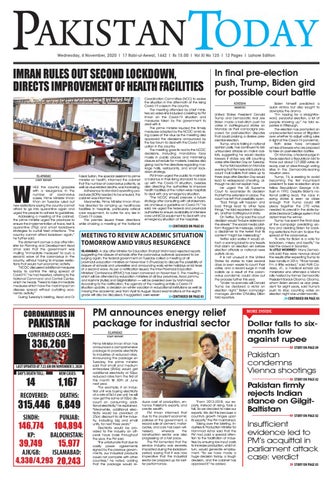
Imran rules out second lockdown, dIrects Improvement of health facIlItIes
ISLAMABAD staff report
w
HIlE the country grapples with a resurgence in the number of coronavirus cases, Prime Minister Imran Khan on Tuesday ruled out new restrictions saying the country cannot afford to go into quarantine again and urged the people to adhere to guidelines. Addressing a meeting of the cabinet, the prime minister urged the provinces to ensure the implementation of trace, test & quarantine (TTQ) and smart lockdowns strategies to curtail fresh infections. “The country cannot afford lockdown again,” he further said. The statement comes a day after Minister for Planning and Development Asad Umar said that the government was mulling “immediate measures” to curb a second wave of the coronavirus in the country, without having to impose restrictions that would hurt economic activity. “NCOC discussed additional measures today to control the rising spread of Covid19,” he had tweeted, referring to the National Command and Control Center, which he heads. “Need to take immediate measures which have the most impact on disease spread without curtailing economic activity.” During Tuesday’s briefing, Asad and Dr
Faisal Sultan, the special assistant to prime minister on health, informed the cabinet that the number of coronavirus patients, as well as virus-related deaths, was increasing. Adherence to standard operating procedures (SOPs) needed to be ensured, the cabinet was informed. Meanwhile, Prime Minister Imran Khan has directed for ramping up healthcare facilities in hospitals, particularly critical care equipment, to cater for any rise in Covid-19 cases. The premier issued these directions while chairing a meeting of the National
ISLAMABAD: A day after Minister for Education Shafqat Mahmood rejected reports suggesting the closure of schools after the coronavirus outbreak appeared to be surging again, the federal government on Tuesday called a meeting of all provincial education ministers on November 5 (Thursday) to discuss the possibility of closure of schools and universities and announcing early winter holidays amid fears of a second wave. As per a notification issued, the Inter-Provincial Education Ministers’ Conference (IPEMC) has been convened on November 5. The meeting — which will be attended by education ministers of all four provinces, Azad Jammu and Kashmir (AJ&k) and Gilgit-Baltistan — will be presided over by Mahmood. According to the notification, the agenda of the meeting entails a Covid-19 situation update, a decision on winter vacation in educational institutions as well as moving the academic year from April to August. Board examinations of the eighth grade will also be discussed, it suggested. staff report
pakIstan
CONFIRMED CASES:
336,260
LAST UPDATED AT 7:22 AM ON NOVEMBER 3, 2020
14
RECOVERED:
NEW CASES:
1,167 DEATHS:
315,446 6,849 SINDH:
PUNJAB:
146,774
104,894
KP:
BALOCHISTAN:
AJK/GB:
ISLAMABAD:
39,749
15,977
4,330/4,293 20,243
CONTINUED ON PAGE 03
MEETING TO REVIEW ACADEMIC SITUATION TOMORROW AMID VIRUS RESURGENCE
coronavIrus In
DAY'S DEATH TOLL:
Coordination Committee (NCC) to review the situation in the aftermath of the rising Covid-19 cases in the country. The meeting attended by chief ministers via video-link included a briefing to PM Imran on the Covid-19 situation and measures taken by the government to deal with it. The prime minister lauded the timely measures adopted by the NCOC amid rising cases of the virus as the meeting also approved the decisions announced by the top forum to deal with the Covid-19 situation in the country. The meeting gave its nod to the NCOC decisions, including mandatory face masks in public places and minimising closure schedule for markets, besides also giving nod to the directives regarding marriage halls, restaurants, and smart lockdown strategy. PM Imran urged the public to maintain a balance in their living standard to cope up with the Covid-19 situation, besides also directing the authorities to improve health facilities at the nation-wide hospitals to deal with any emergency situation. “The NCOC should prepare a future strategy after consulting with all stakeholders and issue a guideline on Covid-19,” he said. He urged the federal and provincial authorities to ensure availability of intensive care unit (ICU) equipment to deal with any emergency situation at the hospitals.
CONTINUED ON PAGE 03
In final pre-election push, Trump, Biden gird for possible court battle KENOSHA aGeNCIes
United States President Donald Trump and Democratic rival Joe Biden made a last-ditch push for votes in battleground states on Monday as their campaigns prepared for post-election disputes that could prolong a divisive presidential election. Trump, who is trailing in national opinion polls, has continued to lob unfounded attacks on mail-in ballots, suggesting he would deploy lawyers if states are still counting votes after Election Day on Tuesday. Trump told reporters on Monday evening that Pennsylvania’s plans to count mail ballots that arrive up to three days after Election Day would lead to widespread cheating, although he did not explain how. He urged the US Supreme Court to reconsider its decision that left the extension in place. The court has left that possibility open. “Bad things will happen and bad things lead to other type things,” he told reporters in Wisconsin, another battleground state. On Twitter, Trump said the court decision would “induce violence in the streets.” The social media platform flagged his message, adding a disclaimer to the tweet that its content “might be misleading.” Twitter said earlier it would attach a warning label to any tweets that claim an election win before election officials or national news outlets do so. It is not unusual in the United States for states to take several days or even weeks to count their votes, and a record surge in mail ballots as a result of the coronavirus pandemic could draw out the process further this year. “Under no scenario will Donald Trump be declared a victor on election night,” Biden campaign manager Jennifer O’Malley Dillon told reporters.
PM announces energy relief package for industrial sector ISLAMABAD staff report
Prime Minister Imran Khan has announced a comprehensive package to provide electricity to industries at reduced rates. Announcing the package on Tuesday, the prime minister said that small and medium enterprises (SMEs) would get additional electricity at 50pc reduced rates from the first of this month till 30th of June next year. "For example, if an industrial unit was buying electricity at a rate of Rs16 per unit, he will now get the same at 50pc discount on consuming additional electricity," he explained. "Meanwhile, additional electricity would be provided at 25pc discount to all the industry, including big and small units, for next three years." Electricity would be provided to the industry on offpeak hours basis throughout the year, the PM said. "It is unfortunate that due to costly power agreements signed by the previous governments, our industrial products could not compete with other countries," he noted, adding that this package would re-
Biden himself predicted a quick victory but also sought to downplay the drama. “I’m hoping for a straightforward, peaceful election, a lot of people showing up,” he told reporters in Pittsburgh. The election has prompted an unprecedented wave of litigation over whether to adjust voting rules in light of the Covid-19 pandemic. Both sides have amassed armies of lawyers who are prepared to take on post-election battles. On Monday, a federal judge in Texas rejected a Republican bid to throw out about 127,000 votes already cast at drive-through voting sites in the Democratic-leaning Houston area. Trump, 74, is seeking to avoid becoming the first incumbent president to lose re-election since fellow Republican George H.W. Bush in 1992. Despite Biden’s national polling lead, the race in swing states is seen as close enough that Trump could still piece together the 270 votes needed to prevail in the state-bystate Electoral College system that determines the winner. Trump has spent the final days of the campaign predicting victory and deriding Biden for backing restrictions that aim to slow the spread of the coronavirus. “A vote for Biden is a vote for lockdown, misery and layoffs,” he told the crowd in Scranton. ‘A LITTLE WORRIED’: Many Democrats said they were nervous about the results after expecting Trump to lose handily in 2016. “I’ll be honest, I’m a little worried,” said Patti Cadoso, 41, a medical school administrator who attended a Miami rally hosted by former Democratic President Barack Obama. Obama, whom Biden served as vice president for eight years, said Trump’s push to stop counting votes on election night was undemocratic.
CONTINUED ON PAGE 03
more inside
Dollar falls to sixmonth low against rupee STORY ON PAGE 09
Pakistan condemns Vienna shootings STORY ON PAGE 02
duce cost of production, enhance Pakistan's exports, and create wealth. PM Imran informed that due to the prudent economic policies of the government, a record sale of cement, motorcycles, and cars has been witnessed, whereas the construction sector was also progressing at a fast pace. The PM lamented that the service industry was severely impacted during the lockdown period, saying that it was now imperative that the industrial sector be propped up for better performance.
"From 2013-2018, our exports, instead of rising, took a fall. So we decided to raise our exports. We did this because a country's growth hinges upon its exports," the PM maintained. Taking over the briefing, Industries & Production Minister for Hammad Azhar said that the PM had paid a special attention to the facilitation of industries by ensuring low input costs to increase production, which in turn, would generate employment. "So we have made a huge decision today, a tough decision, and the cabinet has approved it," he added.
Pakistan firmly rejects Indian stance on GilgitBaltistan
STORY ON PAGE 02
Insufficient evidence led to PM’s acquittal in parliament attack case: verdict STORY ON PAGE 03
02
Wednesday, 4 November, 2020
NEWS
PakIstaN coNdEMNs VIENNa shootINgs LAMABAD
P
AGENCIES
AKISTAN on Tuesday strongly condemned the attack in the Austrian capital that left at least two dead — including one of the assailants — and 15 wounded. “We extend our deepest condolences & sympathies to families of victims & wish [a] speedy recovery to those injured,” the Ministry of Foreign Affairs said in a tweet. “#Pakistan reiterates its condemnation of terrorism in all its forms and manifestations,” the tweet added. Late Monday night, gunmen opened fire on people enjoying a last night out at Vienna’s cafes and restaurants before a coronavirus lockdown Monday in what au-
thorities said was a terrorist attack. “We are victims of a despicable terror attack in the federal capital that is still ongoing,” Austria’s Chancellor Sebastian Kurz said hours after the gunfire erupted. “One of the perpetrators was neutralized, but several perpetrators appear to still be on the loose,” he said. “They seem to also, as far as we know, be very well equipped, with automatic weapons. So they were very well prepared.” Police said that several shots were fired shortly after 8:00 pm (1900 GMT) on a lively street in the city center and that there were six shooting locations. Unverified footage on social media showed gunmen walking through the streets, apparently shooting at people at random, wounding several.
The motive was under investigation, but Kurz said the possibility it was an antiSemitic attack cannot be ruled out, given that the shooting began outside Vienna’s main synagogue. It was closed at the time. Interior Minister Karl Nehammer said the army had been asked to guard key locations in the city as hundreds of heavily armed police hunted for the gunmen. He urged people in Vienna to stay indoors and avoid the city center and encouraged parents not to send their children to school on Tuesday. Kurz praised police for killing one of the attackers and vowed: “We will not never allow ourselves to be intimidated by terrorism and will fight these attacks with all means.” Vienna Mayor Michael Ludwig said
15 people were hospitalized, seven with serious injuries. Oskar Deutsch, the head of the Jewish community in Vienna, said it was not clear whether the main synagogue had been targeted. Rabbi Schlomo Hofmeister said he saw at least one person shoot at people sitting outside at bars in the street below his window. “They were shooting at least 100 rounds just outside our building,” Hofmeister said. President Donald Trump tweeted American support for Austria in fighting terrorism. “Our prayers are with the people of Vienna after yet another vile act of terrorism in Europe. These evil attacks against innocent people must stop,” he wrote. Other leaders also condemned the attack.
‘Pakistan set to cope Pakistan firmly rejects Indian stance on Gilgit-Baltistan with challenges on external front’ ISLAMABAD TLTP
ISLAMABAD TLTP
Foreign Minister Shah Mahmood Qureshi has said that Pakistan is set to cope with several challenges on the external front. The foreign minister said this on Tuesday in a meeting with Ambassador-designate to Ethiopia Shozab Abbas. The foreign minister said that Pakistan is faced with several challenges on the external front, adding: “We will have to devote all our energies to cope with them.” He gave special directions to the ambassador about priorities of Pakistan's foreign policy including economic diplomacy. Meanwhile, FM Qureshi condemned in the strongest terms the heinous terrorist attack in Central Vienna which resulted in the loss of precious lives and wounded
QURESHI CONDEMNS HEINOUS TERRORIST ATTACK IN VIENNA several others. He denounced the terrorist attack in a statement. He expressed his grief and sorrow over the loss of lives in the despicable incident. Expressing solidarity with the government and people of Austria, he said that Pakistan condemns terrorism. Gunmen attacked six locations in central Vienna starting outside the main synagogue, killing two people and injuring at least 14 in what Austria called a “repulsive terror attack” while hunting one or more assailants on the loose.
Pakistan has categorically rejected Indian Defence Minister Rajnath Singh’s unwarranted comments regarding Gilgit-Baltistan (GB). The Foreign Office (FO) in a statement on Tuesday said that India has no locus standi whatsoever on the issue. It said that gratuitous repetition of false claims by the RSS-BJP leaders, one after the other, for political point-scoring can neither change facts nor can it draw attention away from the reprehensible human rights violations being perpetrated against the Kashmiri people by Indian occupation forces in Indian Occupied Kashmir (IOK). The FO said that Pakistan’s princi-
pled position on the Jammu and Kashmir dispute remains firmly anchored in the relevant United Nations Security Council (UNSC) resolutions. It said that administrative, political and economic reforms are a long-standing demand of the people of GB. The envisaged provisional reforms reflect the aspirations of the indigenous populace of the autonomous region. The FO called upon India to immediately end its illegal and forcible occupation of parts of Jammu and Kashmir. It said India must comply with its international obligations by allowing Kashmiris to exercise their inalienable right to self-determination through a free and impartial plebiscite under the auspices of the UN as enshrined in the relevant UNSC resolutions.
IHC orders government to appoint aviation DG ISLAMABAD STAFF REPORT
The Islamabad High Court (IHC) on Tuesday directed the government to fill the vacant position of Civil Aviation Authority (CAA) director general at the earliest. A single bench comprising IHC Chief Justice Athar Minallah gave this direction while hearing a petition moved by a pilot challenging revocation of his licence. During the hearing, the chief justice remarked that his court couldn’t meddle in the issue of revocation of pilots’ licences. “The power to revoke and restore licences rests with the relevant authority and not the
court,” he observed. At present, the country’s aviation regulator is non-functional, Justice Minallah noted, adding the licence issue would get resolved once a permanent director general of the authority is appointed. Observing that it is up to the CAA DG to decide whether to revoke pilot licences, he called for the matter to be placed before the authority’s chief after appointment to the post is made. The government needs to fulfil its duty properly in a timely manner, he said. The IHC bench summoned the attorney general to appear in person on next hearing on November 24.
FM apprises EU counterpart of Muslims’ concerns over rising Islamophobia ISLAMABAD: Foreign Minister Shah Mahmood Qureshi has apprised his European Union (EU) counterpart Josep Borrell of concerns of Muslims over rising Islamophobia in some of the EU countries. The foreign minister was speaking at the beginning of the fifth session of strategic dialogue between Pakistan and the European Union via video-link on Tuesday. The foreign minister said that Pakistan and the EU enjoy multidimensional bilateral relations. He told Josep Borrell about concerns of Muslims all over the world, including Pakistan, regarding rising Islamophobia in some of the EU countries. Views were also exchanged on efforts for peace in Afghanistan during the meeting. Both the foreign ministers termed intra-Afghan dialogue as a milestone for durable peace in Afghanistan. Qureshi called for joint efforts at the international level to face the global challenge of Covid-19 pandemic. He called upon the global community, including EU, to play its due role in resolution of Kashmir issue in accordance with United Nations (UN) resolutions. Expressing satisfaction on the Strategic Engagement Plan approved between Pakistan and EU last year, both sides agreed to further enhance bilateral cooperation in fields of mutual interest. TLTP
Nawaz's mother accused of land grabbing LAHORE APP
A court in Lahore on Tuesday took up a civil suit accusing the mother of deposed prime minister Nawaz Sharif of illegally occupying 65,340 yards (108 kanals) of land in the vicinity of Jati Umra. Judge Muhammad Kashif heard the case filed by a citizen, Rabia Roshan. He directed the plaintiff to forward their final arguments on the next hearing and adjourned the case. In her response, Shamim Bibi, said she legally purchased the land in question and had documents to substantiate her claim to the property. She alleged the woman filed the suit to blackmail the Sharif family and expressed willingness to place on record all relevant documents regarding the property. In her plea, Roshan stated that Shamim Bibi illegally got her mother to sign the deed of transfer of the land and pleaded with the court to declare that the land deed is void and of no legal effect.
Bailable arrest warrants issued against Safdar in NAB office clash case LAHORE APP
A district and sessions court in Lahore on Tues d ay is s ued b ailable ar r es t w ar r ants ag ains t P ak is tan M us lim League-Nawaz (PML-N) leader Captain (r) Safdar Awan in a case pertaining to a clash between party workers and po lice o uts ide the N atio nal A ccountability Bureau Lahore office on the appear an ce of the par ty ’s vice
president Maryam Nawaz in September. J ud icial mag is tr ate H af iz N af ees hear d th e cas e w her ein the p r o s ecu tion to ld h im abo ut no n - co mpliance of the orders by accused persons despite being summoned. The prosecution requested for issuance of warrants of the accused to make progress in the trial. Later, the court issued bailable arrest warrants of the accused and adjourned the hearing till December 5.
Wednesday, 4 November, 2020
NEWS
03
PoLIcE gEt cUstody oF sUsPEct IN aRzoo Raja casE KARACHI
a
STAFF REPORT
district and session court in Karachi on Tuesday granted police custody of a man accused of kidnapping, forcibly converting and marrying a minor Christian girl. Arzoo Raja, 13, was allegedly abducted
from her residence in Karachi on October 13 and two days later her older neighbour, Syed Ali Azhar, while claiming to be her husband, produced a marriage certificate saying she was of legal age, 18, and had converted to Islam. A first information report (FIR) was lodged at Ferere police station subsequently on behalf of her father and nominated Azhar as the prime suspect. Following the filing of
Indian troops' firing along Loc leaves 45-year-old injured: IsPR Unprovoked firing by Indian troops in Bagsar Sector along the Line of Control (LoC) left a 45-year-old man injured, the Inter-Services Public Relations (ISPR) said Tuesday. According to the military’s media wing, the injured man was evacuated to a nearby hospital for necessary medical care. “Pakistan Army, responding to unprovoked Indian [firing], targeted Indian post which [had] initiated fire,” said ISPR in its statement. Meanwhile, according to a Foreign Office (FO) statement issued last month, India has committed 2,580 ceasefire violations, resulting in the loss of 19 lives and serious injuries to 199 innocent civilians. NEWS DESK
the complaint, the police arrested Azhar’s brothers — Syed Shariq Ali and Syed Mohsin Ali — and a friend, Danish, for allegedly abducting Raja. Azhar was arrested by Sindh police a day earlier who presented the suspect before a magistrate for his judicial remand. During the hearing, the defence counsel claimed Raja had willingly wed Azhar, contending
Faraz slams PDM for toeing Indian agenda ISLAMABAD TLTP
Federal Minister for Information and Broadcasting Senator Shibli Faraz has said that opposition's narrative against Pakistan and national defence is not acceptable in any case. Addressing a press conference regarding the steps taken in the cabinet meeting on Tuesday, the minister said that Pakistan Muslim League-Nawaz’s (PML-N) recent narrative is aimed at putting aside their corruption cases. He said that negative propaganda of PML-N is not acceptable to any segment of Pakistani society. The minister slammed Pakistan Democratic Movement for toeing the Indian agenda of spreading anarchy in the country. Faraz said that the government has planned to an-
nounce a reasonable support price for wheat that will help reduce the artificial shortage of flour in the country. He said that the Sindh government's failure to purchase wheat in time led to flour shortage. He also said that Pakistan People’s Party (PPP) of the 80s has dissipated and the party at present has no relevance with its forebears. Noting the behaviour of Sindh’s ruling party following the global pandemic outbreak, Faraz claimed the party tried to spread uncertainty but it only turned out to be a blow-back for it. The federal minister said the Sindh government forced the citizenry into buying expensive wheat flour whereas if it had released the provincial stocks, things would have been better. He claimed PPP created an artificial crisis and said shortages of sugar and wheat were created by the ruling party of Sindh.
In final pre-election push, Trump, Biden gird for possible court battle COntInuED fROM pAgE 01 “That’s what a two-bit dictator does,” he told a rally in Miami. “If you believe in democracy, you want every vote counted.” After visits to North Carolina and Pennsylvania, Trump headed to Wisconsin and Michigan – four states he won narrowly in 2016 but that polls show could swing to Biden this year. As he has done for months, the president spoke to large crowds, where many attendees eschewed masks and social distancing despite the resurgent Covid-19 pandemic. Biden, 77, who has made Trump’s handling of the pandemic the central theme of his campaign, has restricted the size of his rallies to avoid spreading the virus. The latest Reuters/Ipsos poll in Florida, a perennial swing state, showed Biden with a 50 percent-46 percent lead, a week after the two were in a statistical tie. Early voting has surged to levels never before seen
in US elections. A record-setting 98.7 million early votes have been cast either in person or by mail, according to the US Elections Project. The number is equal to 71.6 percent of the entire voter turnout for the 2016 election and represents about 40 percent of all Americans who are legally eligible to vote. That unprecedented level of early voting includes 63 million mail-in ballots that could take days or weeks to be counted in some states, meaning a winner might not be declared in the hours after polls close on Tuesday night. Some states, including critical Pennsylvania and Wisconsin, do not start processing mail-in votes until Election Day, slowing the process. Trump has repeatedly said without evidence that mailin votes are prone to fraud, although election experts say that is extremely rare in U.S. elections. Mail voting is a long-standing feature of American elections, and about one in four ballots was cast that way in 2016.
Meeting to review academic situation tomorrow amid virus resurgence COntInuED fROM pAgE 01 The notification comes a day after Mahmood clarified rumours pertaining to a shutdown of schools. “Rumours again afloat regarding school closures. It is again clarified that educational institutions are NOT being closed,” he had announced on Twitter. The minister added that the government would keep a close on the situation and monitor the health of students and teachers. Punjab Education Minister Murad Raas had earlier
the prosecution could not be given either arrest or judicial remand. The plaintiff, in its arguments, said a DNA test will further explain the situation. At this, the court directed the police to submit a DNA report before the bench on the next hearing. After hearing arguments from both sides, the magistrate reserved the verdict. The Sindh High Court (SHC) on Mon-
said that no schools were being closed in spite of the rising number of cases. “Keeping a very close watch on COVID 19 cases in Schools of Punjab. Random testing is being done continuously. There is a slight increase in numbers but nothing alarming. [The] situation being analysed on daily basis. There is NO plan to close Schools as of right now. Please follow SOPs [standard operating procedures],” he had tweeted. Pakistan on Tuesday reported 1,167 infections of the novel coronavirus after conducting 27,984 tests—a positivity ratio of 4.17 percent.
PM sets three-month deadline for imposition of electoral reforms ISLAMABAD TLTP
Prime Minister Imran Khan on Tuesday set a threemonth deadline for imposition of electoral reforms in the country. The deadline was set by the prime minister after getting a briefing from the Federal Minister for Anti-Narcotics Azam Swati about election reforms in the meeting of the National Coordination Committee (NCC), according to a media report. The premier also directed to hold Senate elections via open ballot. “We are not afraid of the results, but electoral reforms are need of the country,” the PM was quoted as saying. PM Imran also stated that it is the first time in the country’s history that an incumbent government is striving to hold fair and free elections in the country. He said that he introduced the trend of impartial umpires in the cricket matches as earlier the matches were being fixed, he added. It may be noted that National Assembly (NA) Speaker Asad Qaiser in the month of September had convened a meeting of parliamentary leaders to seek recommendations from the political leadership over the electoral reforms.
Imran rules out second lockdown, directs improvement of health facilities COntInuED fROM pAgE 01 The health authorities have been sounding the alarm about a second wave of the virus for several weeks now. Daily infections and deaths are once more on the rise, raising fears that disease is making a comeback as the public becomes more apathetic toward social distancing measures. The government portal on Tuesday reported 1,167 infections of the novel coronavirus after conducting 27,984 tests—a positivity ratio of 4.17 per cent. Meanwhile, the country has yet to fully utilise its claimed testing capacity of 73,472 and is currently testing significantly below numbers proposed by global health experts. According to the World Health Organisation (WHO), Pakistan’s testing policies likely only record the most symptomatic patients while ignoring the spread among asymptomatic carriers, which recent studies have suggested comprise the majority of infections in the country. Last week, Sultan announced that the second wave had “arrived” and new restrictions and lockdowns were “inevitable”.
day directed the provincial government to shift Raja to a shelter home. Following the SHC order, Sindh Governor Imran Ismail said the case would be solved according to the law. “There can be no compromise on cases involving underage marriage,” he said while meeting representatives of minority communities at the Governor House.
Earthquake jolts Quetta QUETTA: A 4.4 magnitude earthquake jolted Quetta and adjoining areas on Tuesday morning, authorities said. However, no loss of life or property was reported. According to the details, the depth of the quake was recorded 35 kilometres while the epicentre 90 kilometres in the west of the provincial capital. The earthquake comes a day after tremors were felt in Karachi on Monday morning. APP
COAS orders FWO to complete national importance projects in time RAWALPINDI: Expressing satisfaction over the progress of Frontier Works Organization (FWO), Chief of Army Staff (COAS) General Qamar Javed Bajwa has directed the organisation to ensure timely completion of projects of national importance. General Qamar Javed Bajwa said this on Tuesday during his visit to the FWO headquarters, said the Inter-Services Public Relations (ISPR), He appreciated the public-private partnership initiatives and said that the private sector must be supported in greater national interest. TLTP
04
Wednesday, 4 November, 2020
NEWS
Covid-19 positivity ratio in punjab risEs to 3pC LAHORE
i
SHAHAB OMER
N the second wave of Covid-19, the positivity ratio in Punjab has increased from 1 to 3 per cent, and the restoration of backup wards for the treatment has also been started in view of increasing cases, Pakistan Today learnt on Tuesday.
According to the spokesman of the Punjab Health Department, 340 new cases of coronavirus have been reported in the last 24 hours; of this, 148 were from the provincial capital. In addition, seven deaths have also been reported. A total of 52,551 people have been infected with coronavirus in Lahore out of which 929 patients have died from this pandemic so far. The Punjab Health department spokesperson said that the repair of
backup wards has been started in view of increasing cases of Covid-19 in Punjab. The coronavirus ward in Pakistan Kidney And Liver Institute Lahore has also been reopened and two patients are currently undergoing treatment there. Furthermore, preparations are being made to open the Triage Centre at the Expo Centre Field Hospital, which was established specifically for Covid-19 patients and prevent other hospitals from being
Importers of Pakistan’s basmati rice to challenge Indian GI claims in EU PAKISTAN TO FILE OBJECTION BY FIRST WEEK OF DECEMBER ISLAMABAD GHULAM ABBAS
While Pakistan is going to officially challenge the Indian application for exclusive Geographical Indication (GI) tag for basmati rice in European Union (EU), the importers of Pakistani rice in the EU are also set to challenge the Indian move. According to official sources at the Ministry of Commerce, Pakistan will be challenging the Indian application in the EU by the first week of December as almost all the required homework in this regard has been completed. The process of appointing consulting firms for the same would be completed soon, they added. Apart from the country’s formal objection to Indian application, brown rice millers in Europe, who import raw rice from Pakistan, would also file objection to Indian application, as granting the exclu-
sive GI tag to Indian rice would damage their business. "Indian rice off late has been facing resistance in European countries due to pesticides' issue. This has forced the importers of brown rice to look towards Pakistan to meet their demand," said a rice exporter. He informed that India's rice export to Europe had plunged by over 40 per cent during 2018-19 due to issues pertaining to maximum residue level (MRL). "India apparently wants to exclusively register its basmati so as to keep Pakistani products away from lucrative markets." According to sources, brown rice millers of Europe, especially in the UK, are concerned about the Indian application. The EU may take the millers' application more seriously as compared to that of Pakistan since the EU would give priority to the interests of its millers, they added.
overburdened. The total number of Covid-19 cases reported in Punjab has reached 104,894, with 2,372 deaths. According to the National Command and Operations Centre (NCOC), a total of 336,260 cases of Covid-19 have been reported so far in Pakistan, and the total number of deaths due to the pandemic has reached 6,849. There are 13,965 active cases currently.
Compared to the finished rice being imported from Pakistan and India, the duty is relaxed on the import of raw rice. European millers usually prefer to import brown rice and sell the same after processing. According to officials of Intellectual Property Organization (IPO) Pakistan, an attached department of Ministry of Commerce, the ministry has shortlisted two Brussels-based international law firms, Messrs Altius and Messrs Liedekerke Wolters Waelbroeck Kirkpatrick, to fight the country’s basmati GI tag case in the EU. Prime Minister Imran Khan is expected to announce the finalised option in the regard soon. The government had decided to oppose India’s application demanding exclusive rights of claiming a GI tag to basmati rice in the EU on September 22. India had applied for the tag under Article 50(2)(a) of Regulation (EU) No 1151/2012 of the European Parliament and of the Council on Quality Schemes for Agricultural Products and Foodstuffs, mentioned in the EU official journal dated September 11. The protection of geographical indications is aimed at boosting exports, helping support rural development in the country, and enhancing the livelihood of agriculture producers and skilled craftsmen. The marketing of GI products also enhances secondary economic activities and boosts regional economic development. GI law protects local products such as the Peshawari chappals, Multani blue pottery, Hunza apricots, Hala ajrak, Kasuri methi, Chaman grapes, Turbat dates etc. Currently, India and Pakistan have 65pc and 35pc shares of basmati in the world rice trade, respectively. Basmati rice fetches Pakistan around $800 million to $1 billion annually.
PKM urges CM Buzdar to take action against sugarcane mafia LAHORE STAFF RPEORT
Pakistan Kissan Movement Secretary General Hanif Gujjar, while talking with media on telephone from Rahim Yar Khan, said that in spite of the Punjab government fixing sugarcane price at Rs200 per 40 kg, the middlemen/cane buyers from Sindh, who have opened up their kandas and pur-
chase centres in Rahim Yar Khan, have openly started flouting the decisions of the Punjab government. “No CPR is being issued to Rahim Yar Khan growers, whereas the Punjab government has specifically announced that CPR of each purchase, whether it is middlemen or mills, be issued up to Rs200/40kg.”He said the farmers are very upset because after harvesting of sugarcane they are
bound to sell cane at whatever price these middlemen would offer to the farmers. “These middlemen are purchasing cane in huge quantities and loading it on long vehicles/trucks and heavy transport which could carry these huge chunks of sugarcane to the sugar mills in Sindh.” Hanif Gujjar said that if Punjab government of can ban the transportation of sugar to Sindh, why cannot
NAB ask ECC to approve Rs433m grant for payment of case fee ISLAMABAD SHAHZAD PARACHA
The National Accountability Bureau (NAB) has asked the Economic Coordination Committee (ECC) to approve a Technical Supplementary Grant of Rs433 million for payment of legal fees in a London high court case, Pakistan Today learnt on Tuesday. Broadsheet LLC pursued a case of arbitration against the government of Pakistan through the NAB in the Chartered Institute of Arbitration, London. The arbitrator issued Part Final Award (Quantum) and Part Final Award (Costs) for $27.2 million, with interest enforced after 60 days. $2.3 million is still outstanding. In
addition, there is the matter of the fees of foreign lawyers and firms, which amount to £150,000. Due to scarcity of funds in the current financial year, NAB is not in a position to meet its recurring expenditures within the authorised budget. In view of the financial constraints against mandatory expenditures, the anti-graft body approached the ECC to help cover the Rs433 million shortfall. The Finance Division has provided funds of Rs433m out of their own resources, enabling NAB to initiate a case for allocation of a TSG. The office of attorney general of Pakistan (AGP) has already clarified that the NAB may process their summaries directly without routing through the Law and Justice Division.
AG opposes Firdous’ inclusion in cabinet in light of Justice Isa case verdict LAHORE TLTP
The provincial government has been advised by the advocate general against the inclusion of Dr Firdous Ashiq Awan in the cabinet as she has been named as an alleged contemnor in the Supreme Court verdict in Jus-
tice Qazi Faez Isa case. The Punjab government has been reminded by the province's top law officer that the apex court has said Firdous used contemptuous language against a sitting judge, and her appointment as CM’s assistant may, therefore, be considered as dismissive of the Supreme Court's (SC) verdict.
they ban this illegal practice of supply of sugarcane to Sindh by ordering Police to take action against these unapproved and unauthorized middlemen working in district Rahim Yar Khan. He urged the Punjab chief minister to take notice of this illegal practice and take action against the sugarcane mafia who have bent upon fleecing the sugarcane growers of district Rahim Yar Khan.
Envoy stresses focus on value addition to increase exports to China KARACHI: Pakistan's Consul General in Shanghai Hussain Haider has stressed the need to focus on value addition in order to increase Pakistan's exports to China. Speaking at a webinar organised by the Karachi Chamber of Commerce & Industry (KCCI) in collaboration with Pakistan's Consulate in Shanghai, Hussain Haider pointed out that raw materials like copper and articles worth $551.2 million along with cotton yarn and fabrics valuing $351.95 million were the top products exported to China in 2019, whereas exports of value-added products like knitted apparel and woven apparel stood at $47.49 million and $31.38 million, respectively, which clearly indicates that Pakistani exporters are mostly tilted to exporting raw material instead of value-added products. This first moot was part of a series of webinars scheduled to be organized by KCCI to promote trade and investment cooperation with countries around the world. The webinar was attended by KCCI President Shariq Vohra, SVP Saqib Goodluck and VP Shamsul Islam Khan. Haider informed that YRD region in China, which comprises four provinces namely Shanghai, Jiangsu, Zhejiang and Anhui, is the most technologically advanced region with highest per capita income and highest contribution to Chinese GDP. "This is the region where Pakistani exporters must focus in terms of value addition, besides giving attention to digitalization, as it has been observed that digitalization for both businessto-business (B2B) and business-to-consumer (B2C) has predominantly increased in the YRD region." He informed that the Pakistani Consulate in Shanghai has identified numerous sectors, including textiles & clothing, value-added textiles, garments, made-ups, medical & surgical equipment, sports goods, inflatable balls, exercise equipment and outdoor games equipment, leather apparel, articles of leather including trunks, suitcases, briefcases and vanity cases, etc, in which Pakistani manufacturers already have the expertise and they will certainly be able to capture a sizeable share in the Chinese markets. STAFF REPORT
Wednesday, 4 November, 2020
NEWS
National security liability By Dr MuhaMMaD ali Ehsan In February last year, Pakistan Air Force shot down two Indian fighter aircraft when they violated our airspace. That was when an attack came from outside. Ten years ago, in this very month of November, another attack came from outside — a NATO airstrike martyred our 24 soldiers at Salala checkpost. That too was responded to as two days later the NATO route that delivered 80% of supplies to US forces in Afghanistan was completely shut down. American military theatre in Afghanistan which was occupied by over 140,000 troops and thousands of civilian support personnel could now only function through the supply route from Central Asia from the North and by air. Our relationship with the US was disconnected and in fact for following nine months we had no relationship at all with the US. When attacked from outside, military can shoot down aircraft or block the GLOC (Ground Lines of Communication). But what should the military do if the politics of its own country loses the ‘sane head on its shoulders’ and starts attacking it? Does this happen anywhere else in the world? Why does it happen in Pakistan? If this time the PML-N has made the bad choice of letting down its own military and its own country, in 2011 the PPP government led by President Asif Ali Zardari also made a similar choice. The US was conveyed that “a military takeover was imminent”. The memo scandal that followed saw President Zardari leaving Pakistan and staying in Dubai for medical treatment for over two weeks and it was rumored that he might never return and step down as President much like Nawaz Sharif whose return to Pakistan these days is also being termed doubtful. Why does politics fail to learn its lessons? Why does it continue to willfully ignore its national responsibilities? Comply while in power and threaten and blackmail when outside — is this democracy? Is democracy all about the possibilities of creating social unrest? Is democratic fight limited to winning and losing political space and political power or does it ever think about the future of the people as well? We all want to predict a better future for ourselves but our future we are already creating by doing what we are doing in our present. All futures are the product of our decisions in the present. This past week some political leaders lost their political balance and in the service of their political master made the erroneous judgement of bringing Pakistan military under attack. Few used the forum of National Assembly to execute that attack. But they cannot be blamed because the political master himself laid
the foundations of this attack and some reasonable and seasoned politicians even forgot their national security responsibilities and said things that only the enemies of Pakistan could have said. Unsurprisingly, in a very short span of time the PML-N which as a political party was once the defender of our national security has now relegated itself as a party that is more of a national security liability. The targeting of Pakistan military and its leadership by the PML-N is a poorly thought-out political strategy, and more than reviving the party’s political fortunes this strategy is fast damaging its political relevance and credibility. In the past three decades, many leaders in the PML-N have built their political careers and in some cases fortunes by saying and doing things that their political master wished. But they must carefully read the future and must not overlook the political implications of the most dangerous game that their political master has now chosen to play — misleading the people. The PML-N may still be a major political party with a strong following but with its continued tirade against the military it is fast becoming a product in the political market about which it is usually said that it has outlived its usefulness — in political context, the loss of its usefulness to the national security establishment and to this country. And why not? Politics must never spread enemy’s narrative and must desist from directly attacking is own military and its morale. Pakistan military stands with and for the common people. The whole idea of an externally driven strategy of driving a wedge between the military and the common people by exposing Pakistan military as a villain in the past is a failed strategy. Opposition continues to speak about ‘yesterday’ in its relationship with the military, not realising that the dangers of tomorrow are not like the dangers of yesterday. They are different and more intense. The most important military and national concern is to stop politics from executing “false and damaging public military accountability”. The staged ridiculing of your own military is a political sin that only a dying politics can commit. The people of Pakistan are all too familiar with such kind of politics and saw how it resulted in the division of the MQM into MQM-London and MQM-Pakistan. Is a similar fate awaiting the PML-N now? The PML-N has exhausted both its low-risk and high-risk options — low risk when it stayed quiet for a very long time and carried out the backdoor diplomacy for accountability relief. The exposure of this definitely dented its political credibility. As it looks, the high-risk option of directly hitting the military is very unpopular with the common man in Pakistan and is hitting back and hurting PML-N itself.
05
Imported sugar wIll be sold at rs83.5 per kg In local markets lahorE
t
Shahab Omer
hE district administration has issued a notification to sell imported sugar at Rs83.5 per kg in the markets, adding that the imported sugar will not be sold on a commercial basis or to wholesalers, Profit learnt on Tuesday. Lahore Deputy Commissioner Mudassar Riaz confirmed the above-mentioned notification. “This sugar will be given to the retailers and a regular record of the sold sugar will be kept. The rate list of imported sugar will be
displayed prominently. Imported sugar will be sold at Rs81.5 per kg in the Sahulat Bazars and its rate will be reduced by Rs2 in the Sahulat Bazars from the general market. All price control magistrates have been directed to implement it immediately,” the DC said. The decision of the district administration has been welcomed by the public and it is hoped that the availability of low-priced sugar in the markets will also increase. Akhtar Ali, a resident of Allama Iqbal Town, said that the government has imported sugar to overcome the sugar crisis, but questioned who would guarantee its availability to the shopkeepers and the general public.
Persistent partners By MuhaMMaD asif noor A second wave of the novel coronavirus has begun. Already the public health crisis has had a huge impact on the global economy. One of the few bright spots is China’s economy is rapidly recovering after it took decisive action in its battle against the virus. China’s exports climbed by 9.5 percent during August and this bears testimony to the huge trust countries have in China’s unbreakable supply chains. This has been of particular importance to those countries participating in the Belt and Road Initiative, as China’s economic recovery has meant cooperation under the framework of the initiative has been sustained. A manifestation of the close-knit cooperation between Pakistan and China, the ChinaPakistan Economic Corridor is the crown of their economic ties and it has been progressing at a steady pace despite the pandemic. Demonstrating the close cooperation be-
tween Pakistan and China, the CPEC projects remain in full swing despite all the challenges. The two countries cooperated at the beginning of the pandemic, adopting strict prevention and control measures and precautions. As a result of these measures, CPEC projects have been able to continue on the planned timelines. It is important to note that the CPEC remains the largest and one of the most active of all the Belt and Road programs and it is contributing toward the realization of the vision and mission to create a modern Silk Road that is based on connectivity, togetherness and a community with a shared future. It is also important to note the CPEC projects remain safe from the virus even though there are hundreds of thousands of nationals working in both Pakistan and in China. Currently, the people-centric second phase is ongoing with the focus on agriculture cooperation, industrial cooperation and socio-economic development. CPEC is helping to alleviate poverty and
“The government claims to supply and sell low priced food items, including sugar, at utility stores, but in reality these items are often not available at utility stores. The district administration will also have to keep a check on the supply chain of the sugar,” Akhtar added. Amir hussain, a resident of Sabzazar, said that instead of getting cheap sugar to the people, wholesalers would buy it and later it would be sold again at higher prices. “The government must take special care to ensure that imported sugar is supplied for domestic use only and is not allowed to be stored,” he said.
improving people’s lives. Pakistan is expected to build an economic development environment that can offer more than 2.3 million employment opportunities. The pandemic has been a severe test for all countries. But Pakistan and China have been steadfast in their support for each other. In March, Pakistani President Arif Alvi was one of the first heads of state to visit Beijing and meet with President Xi Jinping after the outbreak of the virus. On Aug 21, in a message to President Alvi, President Xi stressed the importance of the CPEC to deepening the China-Pakistan allweather strategic cooperative partnership and building an even closer community with a shared future between the two countries. During the pandemic, China has provided material support to Pakistan, including masks, ventilators, medicines and all kinds of supplies. And when China was struggling against the virus, Pakistan immediately expressed its solidarity and offered donations and assistance despite its own difficulties. Both countries committed to continue cooperation on the CPEC, and the work on CPEC projects has continued with the same vigor as before.
Make new strides in building a closer China-Pakistan community of shared future in the new era nong rong I am honored to be the 18th Ambassador Extraordinary and Plenipotentiary of the People’s Republic of China to the Islamic Republic of Pakistan. A few days ago, I departed from Beijing, flew over the towering Karakorum Mountains and arrived in the beautiful city of Islamabad with joy. Although this is my first visit to this country, Pakistan is not at all unfamiliar to me. China and Pakistan are closely interdependent neighbors linked by mountains and rivers. Coming here is just like visiting my brother’s home. The Chinese people have created a unique name for Pakistan: Iron Brother to describe the preciousness of the all-weather friendship between China and Pakistan. Over the past 69 years since the establishment of diplomatic relations between China and Pakistan, no matter how the international situation changed, our two countries have always stood with each other, sharing joy and sorrow, understanding and supporting each other’s core interests. China-Pakistan relations have stood at the forefront of the times and been the model of state-to-state friendly coexistence. In 2015, President Xi Jinping paid a historic state visit to Pakistan. The leaders of the two countries upgraded China-Pakistan relations to the All-Weather Strategic Cooperative Partnership, rendering China-Pakistan traditional friendship new connotations and bringing China-Pakistan relations to a new height. Prime Minister Imran Khan’s thrice visits to China and four meetings with President Xi Jinping after assumed office further consolidated political trust between the two countries. In aligning Belt and Road Initiative with the development strategy of “Naya Pakistan”, the China-Pakistan Economic Corridor (CPEC) is progressing smoothly. The exchanges and cooperation between the two countries in fields such as trade and investment, science and technology, culture and education, defense and security have deepened continuously and benefited the two peoples. Since the outbreak of COVID-19 pandemic this year, China and Pakistan have firmly supported and generously helped each other, and set a model for international cooperation against the pandemic. As President Xi Jinping said to President Dr. Arif Alvi, China and Pakistan are true friends who go through thick and thin together, and good brothers who share weal and woe.
CMYK
China always views China-Pakistan relations from a strategic and long-term perspective, and gives priority to Pakistan in its neighboring diplomacy. The recent Fifth Plenary Session of the 19th Central Committee of the Communist Party of China confirmed a set of long-range objectives to basically achieve socialist modernization by 2035 and the major goals of economic and social development during the 14th FiveYear Plan period (2021-2025). In particular, the session pointed out that China should actively foster a "dual circulation" development pattern in which domestic economic cycle plays a leading role while international economic cycle remains its extension and supplement. That means China will not only build a strong domestic market, but also implement a high-level opening up with the high quality development of the Belt and Road Initiative. China’s diplomacy will continue to uphold the principles of peace, development, cooperation, and mutual benefit, and promote the building of a new type of international relations and a Community with a Shared Future for the Mankind. We are ready to work with Pakistan to seize the new opportunities brought by China’s development and inject new impetus into bilateral cooperation. President Xi Jinping pointed out that China-Pakistan relations should become a model of neighbourhood friendship, a pillar of regional peace and stability, and a benchmark for the Belt and Road international cooperation. The year 2021 marks the 100th anniversary of the founding of the Communist Party of China and the 70th anniversary of the establishment of diplomatic relations between China and Pakistan. We should take this opportunity to work together to build a Closer China-Pakistan Community of Shared Future in the New Era. China is committed to maintaining the momentum of high-level exchanges with Pakistan, and deepening China-Pakistan strategic cooperation. We should earnestly implement the important consensus reached by the leaders of the two countries, strengthen the exchanges of experience in governance, bring synergy in the development strategies, continue to support each other on issues involving the core interests and major concerns of both sides, and firmly safeguard national sovereignty, territorial integrity and national dignity. China is committed to expanding all-
round practical cooperation with Pakistan to achieve mutually beneficial results. We should promote the high quality construction of the CPEC, focusing more on the cooperation in industrial development, agriculture, science and technology, information, and livelihoodrelated sectors, so that the dividends of the CPEC can benefit more people of both countries. The two sides should also continue to engage in cooperation of fighting COVID-19, including vaccine cooperation, to create a community of common health for mankind. China is committed to working with Pakistan to uphold multilateralism and promoting the democratization of international relations. China-Pakistan relations must be at the forefront of promoting the building of a community of a shared future for mankind. Both sides should adhere to the path of openness, inclusiveness, mutual benefit and winwin cooperation, jointly safeguard peace and security, defend international fairness and justice, and oppose hegemonism, unilateralism, and protectionism. China is committed to enhancing people-to-people bonds with Pakistan and consolidating friendship for generations. The Pakistani film Parwaaz hai Junoon will be released in China this month, and the Chinese audience is eagerly looking forward to it. Next year, China and Pakistan will jointly commemorate the 70th anniversary of the establishment of diplomatic relations, strengthen party-to-party exchanges, and advance exchanges and cooperation in various fields. We would like to encourage people from different walks of life in the two countries to carry out a variety of celebration activities, so that the friendship between China and Pakistan will reach deeper into the hearts of the two peoples, and play a new chapter of harmonious exchanges and mutual learning between different civilizations. It is both a glorious mission and heavy responsibility for me to assume office at this important juncture. I will stay true to my original aspiration, fulfill my duties, implement the consensus reached by the leaders of our two countries, work closely with all sectors of Pakistani society and make my own contribution to the goal of building a Closer China-Pakistan Community with a Shared Future in the New Era. I have full confidence in the bright prospect of ChinaPakistan relations in the future! Chin-Pak Dosti Zindabad! The writer w is China's ambassador to Pakistan.
Wednesday, 4 November, 2020
06 COMMENT
Why does the FATF treat Pakistan as a bête noire?
The fifth Information Minister in Punjab Can words fill empty stomachs?
F
OR Prime Minister Imran Khan, the Information Ministry holds the key to keep the opposition down and complete his tenure. With little success to show, the PTI’s strategy relies on opposition bashing. Besides a fulltime Federal Information Minister, Mr Khan has collected together several spokespersons who meet regularly to take directions from him on how to demolish the opposition. With the PML(n) still enjoying widespread support in Punjab, the province is seen as the PTI administration’s Achilles heel. The principal target here is the PML(n), which is being attacked on two issues of corruption and disloyalty to the state. Mr Khan however remains dissatisfied with the performance of the provincial government’s spin doctors. This explains why Punjab Information Ministry has changed hands five times over the last two years. Mr Khan wants an information minister who can tear apart the opposition’s anti-government narrative in a brash and abrasive manner. While Fayyazul Hasan Chohan was vicious enough, he was repetitive and too crude to appeal to the urban middle class. Mr Chohan has been replaced by former SAPM Firdous Ashiq Awan, who was removed a few months back amidst allegations of corruption and misuse of authority. Her rise as Special Advisor to Chief Minister makes the PTI’s claim of fighting a crusade again corruption a mere charade. This is not the only case that shows that the PTI leadership is ready to sacrifice its hifalutin moral standards on the altar of political exigency. Last year Mr Chohan was removed from the post of provincial Information Minister following his derogatory remarks about the Hindu community, only to be reinducted as Information Minister within months. It reflects well neither on Mr Chohan nor the PTI administration that the outgoing Information Minister didn’t know beforehand, as he claims, that he was being relieved. Such is the decline of self-respect however, that ignominies of the sort are tolerated wearing a poker face. While the PTI’s propagandists go full blast maligning the opposition what remains to be seen is whether their campaign can make the common man forget his daily suffering caused by shooting prices, increasing power and gas charges and rising unemployment.
Why no focus on Arab world charities? Amjed jAAved
I
n its latest review, the Financial Action Task Force conceded that Pakistan has addressed 21 of the 27 items of its Action Plan, though te Indian media would have us believe that only 13 of the listed shortcomings have been rectified. There was no voting, but Indian media reported that even Saudi Arabia voted against Pakistan. It is however true that Islamabad has been given four more months to complete swiftly its full action plan by February 2021. The Financial Action Task Force has ostensibly noble objectives. It provides a `legal’ regulatory framework for muzzling the hydraheaded monster of money-laundering by identifying loopholes in the financial system and plugging them. Aside from its declared objectives, the FATF has become a diplomatic tool to coerce or pamper countries, accused of financing terrorism or facilitating money laundering. The FATF is more interested in disciplining a state like Pakistan, not toeing US policies, than in checking money laundering. The consequences of being in the grey list may entail economic sanctions and difficulties in obtaining loans from international donors like International Monetary Fund, World Bank and Asian Development Bank. The trade-and-aid difficulties may retard economic progress of a country. The US Senate Banking Committee reviewed money laundering and terror financing in the Middle East. During the review they looked at the situation in India, and Pakistan also. India has a much larger GD P and a much larger and wealthier Diaspora, particularly in the Middle East and the USA. The hawala and other money transfer practices among Indians and Pakistanis are similar. Yet the FATF keeps Pakistan in focus but looks the other way when it comes to India. US Assistant Secretary of State for Economic and Business Affairs Anthony Wayne told the Committee that in India, two accounts belonging to terrorist individuals/entities had been identified. However, the Indian government had not frozen any assets. Wayne noted that India’s Prevention of Money Laundering Act criminalises money laundering and requires te reporting of transactions valued at over $23,000.
Violence rages in Afghanistan Twin attacks spell trouble for the peace deal
A
S the USA goes to the polls to either pick a new Democrat President in Joe Biden or reelect Republican incumbent President Donald Trump, the Afghan peace deal between it and the Taliban has gone on the backburner, losing the momentum seen a few months back. This has been accompanied by a deadly increase in violence with at least two major terrorist attacks taking place in the country within a week. Two days back gunmen stormed a university in Kabul, resulting in an hours-long gun battle ending with 22 students dead and as many injured. Earlier, a suicide bombing at an education centre in the same city claimed 24 lives, mostly from Afghanistan’s Shia community. That responsibility for both attacks was claimed by ISIS and targeted educational institutes specifically shows that that a new brand of terrorism is emerging in the country. Although ISIS is but a shadow of its former self, it seems the group is still able to recruit militants to plan and execute attacks on soft targets. Its emergence and evident prominence in Afghanistan adds a dangerous new layer to an already precarious security situation. The Taliban on the other hand are testing the Afghan government and the USA’s resolve by opening up a new offensive in the southern Afghan city of Lashkar Gah last month even though negotiations were ongoing. The USA, despite a ceasefire agreement, was compelled to bomb selected Taliban targets in the same area to defend Afghan troops that had come under attack. It is clear that there is not going to be any immediate let-up in terrorist activity in Afghanistan. Whatever the result of the US presidential election, the Afghan endgame will remain as complex and difficult a problem as it has remained for the past two decades since the war started. These distressingly high levels of violence should be worrying not only for the US, Afghan government and Taliban negotiators who want a peaceful solution, but also Pakistan whose own stability and security depends on that of Afghanistan. Spoilers such as Taliban fighters not onboard with the peace deal, countries like India operating in the region through agencies and groups like ISIS must be dealt with swiftly with all stakeholders working towards a common goal: a peaceful Afghanistan.
Education must go beyond passing exams PreetA HindujA
A
SSESSMEnT and Evaluation are interdependent and have a central role among schools’ practices. Assessment is ‘the process of gathering, recording, interpreting, using and communicating information about a child’s progress and achievement during the development of knowledge, concepts, skills and attitudes’. There are various modes of assessment such as presentations, conferences with peers, written/verbal examinations, debates, and classroom participation. The very first step and the most dominant practice of gathering data for assessing students’ performance is the administration of the written test. However, construction of a standardized test paper is a challenging task. While analyzing the test papers from different mainstream public-sector schools, it has been observed that questions are neither aligned with the pre-set standards, nor measure age/gradebased competency. Construction of test is highly imbalanced in ratio of different levels of objectives. Simultaneously, having pondered over the matriculation Board examination papers, studies have found that test papers of different academic subjects are derived from trlower two levels of learning objectives under Bloom’s Taxonomy: ‘Remember and understand’. A small portion of te test paper assesses four top-most higher levels learning objectives that are, Apply, Analyze, Evaluate and Create. It has been noticed that most of the students do not attempt higher-level questions and leave them ‘in choice’. Furthermore, the similar paper pattern and questions from te past ten years are repeated in the following years. Thus the commonly held practice is that students purchase ten years unsolved or solved papers and memorise the answers written by field experts to pass the examination. Students even at secondary level feel hesitation in attempting any question that required them to write answers on their own. This is due to the classroom practices that are to prepare the students according to
Arif Nizami Editor Umar Aziz
Asher John
Joint Editor
Executive Editor
Deputy Editor
Lahore – Ph: 042-36300938, 042-36375965
sition wants the interception clause to be omitted lest there should be invasion of privacy. Through the Anti-Money Laundering (Amendment) Act, anti-money-laundering laws are to be brought in conformity with international standards prescribed by the FATF. Proposed punishment for money laundering is up to ten years, fine extendable to Rs 25 million, plus forfeiture of property, when done by a natural person, or Rs 100 million for a legal person. A national Executive Committee is composed of the finance and foreign ministers and others mentioned in Schedule-II, has been constituted. The Committee makes recommendations to the government on effective implementation of the Act, determination of offences, application of countermeasures to combat money laundering and so on. There is a Financial Monitoring Unit, to be an independent decision-making authority, having a financial expert as director general. numerous business restrictions have been imposed, including on business with anonymous customers. Offices working under the Act have been provided protection from civil or criminal liabilities, which may result in infringement of rights. Fundamental rights are being sacrificed at the altar of ‘accountability’. The Islamabad Capital Territory Waqf Property Act, The Companies (Amendment) Act prohibiting the issuance of bearer shares or bearer share warrants, Limited Liability Partnership (Amendment) Act, makes Limited liability partnerships maintain particulars of beneficial owners, have all been passed to meet FATF requirements. Pakistani and Hamas charities are under a scanner. The Senate Banking Committee appreciated tat Pakistan has created a Centre for Philanthropy. Yet no tangible action is visible in regard to charities based in Arab world including Saudi Arabia, UAE and other countries. The Saudi charities allegedly dole out money to anti-Iran entities. Political considerations, not primary objectives, determine voting behaviour at FATF. Pakistan has not been able to speed up further enactments for a host of difficulties including opposition’s reservations. Pakistan needs 15 out of the FATF’s 39 members to exit the “grey list”. Amjed Jaaved is a freelance journalist, has served in the Pakistan government for 39 years and holds degrees in economics, business administration, and law. He can be reached at amjedjaaved@gmail.com.
Assessment and evaluation skills are yet to be learnt
Dedicated to the legacy of the late Hameed Nizami
Aziz-ud-Din Ahmad
A recent report by the International Consortium of Investigative Journalists has blown the lid off the suspicious financial transactions by Indian banks, public and private sector companies. The ICIJ report based on Financial Crimes Enforcement network (Finsen) files represent less than 0.02 per cent of the more than 12 million suspicious activity reports that financial institutions filed with Finsen between 2011 and 2017. not only banks but public and private sector companies were also the culprits. They include Hindustan Aeronautics Limited, Bhutan Steel Limited, Bharti Airtel and Essar. Indian banks figure in over 2000 transactions valued at over $1 billion between 2011 and 2017. Pakistan is a bête noire and India a protégé at FATF only because of stark geopolitical interests. Otherwise the money laundering situation in India is no less gruesome than in Pakistan. India has even been the conduit of ammunition to the Islamic State. A study conducted by Conflict Armament Research had confirmed that seven Indian companies were involved in supplying over 700 components, including fuses or detonating cords, used to construct IEDs. FATF was scheduled to review India’s money laundering and terrorist financing regime over a 10year cycle in September-October 2020. However, this has been postponed to January-February 2022, ‘ostensibly’ in view of the Covid-19 pandemic. International watchdogs look the other way for India. Pakistan’s current predicament negates sentiments expressed in the US Senate’s Banking Committee about Pakistan.A Senator said, “ Turning to Pakistan, let me just note that we, of course, all welcome the concrete actions that it has taken to implement its U.n. Security Council resolutions, the freezing of over $10 million of Al-Qaeda assets, and the terrorists they have apprehended, including Abu Faraj al-Libbi, Al Qaeda’s operational leader. We are also encouraged that Pakistan is showing increased concern about the infiltration of terrorist groups into charitable organizations.” Pakistan has successfully convicted four designated persons and two other senior leaders, and terror financing cases have been instituted against 11 designated persons (61 cases) and eight other leaders (37 cases). The Anti-Terrorism (Third Amendment) Act, 2020 enables law-enforcement authorities to carry out undercover operations, intercept communications and access computer systems. Detention period of 60 days may be extended to another 60 days. The oppo-
I
Karachi – Ph: 021-35381208-9
I
the memory-based questions and focusing on only passing in the Board Exams, and being promoted to the next standard. Tragically, in order to showcase a positive image, several schools have been started teaching ninth-grade course books to the eighth-grade students so that students may get two years’ time to adequately memorize the concepts. The results of these practices provide the basis on which students’ progress is evaluated. Evaluation is a more comprehensive term than assessment. It includes both quantitative and qualitative description of students’ performance. It provides the value judgment regarding the desirability of the performance, for example: excellent, good or poor, etc. The question arises whether it is enough to judge students on the basis of reproduced texts. This practice has pushed students behind touching the mastery of skills and produces resistance in the way of developing higher-level thinking. Most of the students are unable to construct correct sentences and compose a paragraph by their own. Consequently, the lack of competence causes hindrances towards entering the job market, and most of them are unable to achieve careers related to the education and degree acquired. The career achievement of pupils is highly dependent on the way and specific environment under which they are nurtured. Schools are the social institutions that have wider impacts on mental growth of students. Paulo Freire, a Brazilian activist and educationist challenged ‘Banking concept of education’ in which teachers intend to hoard the stuff of knowledge in students’ minds. He advocated the need of critical thinking. According to him, teachers are politicians and classroom researchers, who have been provided a social platform to scrutinize and defend the interests of pupils. He considered teacher’s role as intellectuals who are capable of changing the fate of their pupils. now this is a high time to plan strategies that help to attain mastery of learning. This requires schools and teachers to pay attention to student’s needs and provide them diagnostic feedback so that they may identify their weak areas. This would suggest directions of efforts towards specific content. Ironically, classroom instructions do not equip
Islamabad – Ph: 051-2204545
I
Web: www.pakistantoday.com.pk
I
students with autonomy to generate inner feedback and even so it not intended to surface pupils’ potential. The application of effective assessment strategies, such as portfolio, self and peer-assessment, are yet missing parts of teachers’ pedagogy. However, it is without doubt that there are certain other factors affecting the classroom practices of public sector schools, such as t admission policy, classroom size, basic and technological facilities, teachers’ professional development, management of schools and parental education. Students’ performance is co-related with these potential factors. Admissions and promotions in upper grades in public-sector schools do not purely based on competence. This raises students studying in a similar grade but different academic background, as most of the students possess less previous knowledge and skills and hence they require more time and differentiated feedback from teachers. However, due to time constraints and pressure of course completion on teachers, less focus on students’ individual differences, multiple intelligences, creativity and skills development is made. As a consequence, students are found less creative and competent. Due to never practicing learning skill since the early years of schooling, students are experiencing constant fear of making mistakes in their academic subjects. Thereby, we need to rethink on mode of Assessment and Evaluation. It is suggested that test should be constructed of higher-order questions, and thus classroom assessment practices required diversions towards questions enabling students ‘to apply, to distinguish, to develop, to solve, to criticize and to conclude’ the knowledge. Moreover, along with the standardized tests, students’ learning behaviours should be gauged through classroom participations, their art work, presentations and peer conferencing. This will provide a holistic picture of child’s progress. In addition to this, self-assessment strategies that are related to meta-cognitive development need to be incorporated in classroom instructions. Also, admission and promotion to the next standard must be purely based on prerequisites set of skills required to fit in desired standard. This can truly help in evaluating both the students’ and teachers’ performance. Preeta Hinduja is a freelance columnist
Email: editorial@pakistantoday.com.pk
Wednesday, 4 November, 2020
COMMENT 07 Editor’s mail Send your letters to: Letters to Editor, Pakistan Today, 4-Shaarey Fatima Jinnah, Lahore, Pakistan. E-mail: letters@pakistantoday.com.pk Letters should be addressed to Pakistan Today exclusively
Second-wave SIR, due to the increasing cases of Covid-19 in Pakistan the second wave of the deadly virus has started in the country. This is the result of not following SOPs . People are not considering this fatal disease as a serious disease. So, it is compulsory for all citizens to wear a face mask when stepping out of their homes. And the government needs to force the people to follow SOPs , especially in bazzars, shopping malls, public transport and restaurants. On the other hand, Karachi, Lahore, Islamabad, Rawalpindi, Multan, Mirpur, Peshawar,and Quetta were among areas where more than 2 percent tests came out positive. Government should give more attention to these citizens. ImtaIz JavId awaran KullI
Political turbulence
India violates international law with impunity The world is taking risks with the BJP
mAlik muHAmmAd AsHrAf
W
HILE Indian security forces continue the killing-spree in IndianOccupied Jammu and Kashmir, the BJP government has taken yet another step to implement its agenda of consolidating its hold on the state and to change demographic realities. It has promulgated a law allowing Indian nationals to buy property and land in Indian-Occupied Kashmir. notwithstanding the fact that Kashmir is a disputed territory whose fate is to be decided through a plebiscite held under the auspices of the Un, India repealed Article 370 of the Indian Constitution on 5 August 2019 which gave Indian-Occupied Kashmir special status with the state having its own constitution and legislative assembly. It was followed by bifurcation of the state into two territories and their amalgamation into the Indian Union on 31 October 2019 through the Jammu and Kashmir Reorganization Act 2019. It moved a step ahead by enacting the new domicile law to change the demographic features of the state. All the foregoing actions of India are a blatant violation of international law, the Un resolutions on Kashmir, the fourth Geneva Convention and te decisions of the International Court of Justice. India has taken these steps with impunity as the international community and the Un have not reacted to these illegal actions by India as they should have. India is actually emulating the Israeli model in the Indian-Occupied Kashmir. Like the Palestinian land, Kashmir is an occupied territory and not India’s integral part as claimed by her. This Indian stance was repudiated by the Un through her resolutions 91 and 122 in the 1950s when India, after promulgation of the state constitution by its constituent assembly of Indian-Occupied Kashmir declaring accession of Kashmir to India, started calling the state its integral part. This position has also been reiterated in three informal meetings of the UnSC held in the backdrop of the Indian actions in the Indian-Occupied Kashmir. The international community has also refused to accept the Indian narrative that what it did there was her internal matter. All the foregoing measures taken by India are on the pattern of what Israel is doing in Palestine. The international community considers the establishment of Israeli settlements in the Israelioccupied territories illegal on one of two bases: that they are in violation of Article 49 of the Fourth Geneva Convention, or that they are in
breach of international declarations. The United losing the high moral ground and their pronations Security Council, the United nations claimed humanitarian and peace-loving credenGeneral Assembly, the International Committee tials. India is not only breaching the Un of the Red Cross, the International Court of Jus- resolutions and the international law, but is also tice and the High Contracting Parties to the Con- acting as a war-like state. Her hegemonic devention, have all affirmed that the Fourth Geneva signs in the region and hostile posturing towards Pakistan and disputes with almost all her neighConvention applies to Israeli settlements. numerous Un resolutions and prevailing in- bours are ominous portents in regards to peace ternational opinion hold that Israeli settlements and security in the region. India is flanked by two nuclear powers, in the West Bank, East Jerusalem and the Golan Heights are a violation of international law, in- China and Pakistan, against whom it harbours cluding Un Security Council resolutions in 1979, aggressive designs. Indian clashes with China in 1980 and 2016. Un Security Council Resolution Ladakh, and its attack on Pakistani territory on 446 refers to the Fourth Geneva Convention as 26 February last year, constitute ample proof of the applicable international legal instrument, and her aggressive designs. The attack on Pakistani territory, which cost calls upon Israel to deIndia two planes and sist from transferring its the capture of one of its own population into the pilots, could have easterritories or changing If India is not stopped in her ily led to a full-fledged their demographic war between the two makeup. 126 Representracks and dissuaded from nuclear powers. But the tatives at the reconrestraint shown by Pakvened Conference of pursuing the policies dictated istan and the interventhe High Contracting tion by some friendly Parties to the Geneva by the RSS ideology of countries saved it from Conventions in 2014 Hindutva, it could consign the turning into a catadeclared the settlements situation. illegal as have the priregion to perennial instability clysmic The Prime Minister mary judicial organ of of Pakistan, Imran the Un, the Internawhich might also undermine Khan, has been soundtional Court of Justice, the strategic and commercial ing a warning to the and the International world community ever Committee of the Red interests of the USA and her since his address to the Cross. Un General Assembly The foregoing resallies. Greater responsibility regarding Indian deolutions of the Un however lies with the UN, signs and the consethough adopted in the quences of her actions context of the Israeli which as a peace-promoting in Indian-Occupied actions in the PalestinKashmir. He has also ian territory, along with body is under obligation to persisted with that mesthe fourth Geneva Consage on all the internavention, ICJ decisions take notice of these tional forums, in his and international law developments and initiating interaction with the are equally applicable world leaders, as well to similar situations action for the implementation as in his interviews to elsewhere. They have the international media. universal application. of the UNSC resolutions if it He is right in likening But it is regrettable really believes that the the RSS ideology to to note that Israel has nazism which heaped been defying the Un solution to the Kashmir unfathomable death resolutions and also viand destruction on the olating the Fourth dispute must be found in world, particularly in Geneva Convention accordance to the principles the European continent. with the support of the The world cannot afUS and her western alof the UN Charter and the ford yet another similar lies. The situation in tragedy. case of Indian action in relevant UN resolutions If India is not Indian-Occupied Kashstopped in her tracks mir is also similar to the and dissuaded from Israeli action in Palespursuing the policies tine as here again the USA, as strategic partner of India, due to her role dictated by the RSS ideology of Hindutva, it in ‘contain China’ policy along with its tradi- could consign the region to perennial instability tional partners, is looking the other way from the which might also undermine the strategic and illegal actions of India and the atrocities being commercial interests of the USA and her allies. committed on the people of the occupied terri- Greater responsibility however lies with the Un, tory. This stance of the USA and her allies is en- which as a peace-promoting body is under oblicouraging BJP regime, headed by Prime Minister gation to take notice of these developments and narendra Modi to continue with her defiance of initiating action for the implementation of the the Un resolutions, the Fourth Geneva Conven- UnSC resolutions if it really believes that the tion, international law as well as the decisions of solution to the Kashmir dispute must be found in accordance to the principles of the Un Charthe International Court of Justice. What the strategic partners of India conve- ter and the relevant Un resolutions. niently overlook is that they are imperiling the Malik Muhammad Ashraf is an academic. peace and security of the region to protect their strategic and commercial interests at the cost of He can be contacted at: ashpak10@gmail.com
THE case study of Pakistan for any person interested in the field of politics may have quite an intrigue while going through the series of chains of events happening in Pakistan, both domestic and its predictable consequences on international politics. In terms of its domestic politics, an attention worthy event is the ongoing protests orchestrated by opposition. Out of the two motives which placed opposition on one page is, firstly, the undeniable fact of increasing inflation and the national Accountability Bureau (nAB) accountability, which is consistently filing cases against opposition leaders. The argument here is now it’s time for the citizens of Pakistan to analyze through which lens they perceive the opposition. The opposition leaders fear they may not have any political future if nAB accountability continues the way it is at current times; in the past the economy of Pakistan was gravely crippled by the corruption done by these traditional leaders. Opposition leadership is also worried about the consequences of fair accountability. The opposition has gathered in the name of Pakistan Democratic Movement (PDM) and initiated a series of nationwide protests against the government of Pakistan headed by Prime Minister Imran Khan. More worrying is however the fact these protests are less against government and more against military leadership and establishment. PDM is trying their level best to drag military into political issues which is dearly observed in their past few rallies and speeches. The safe assumption behind this driving force of the opposition’s agenda is either they want to pressurize Imran Khan and military leadership for some kind of national Reconciliation Ordinance (nRO) or want to disrupt good civil-military relationship. Keeping in mind of the second wave of Covid-19 that has fallen out in Pakistan, such gatherings are source of great menace and God forbid if it goes wrong who will be answerable for such a horrific crisis, the Government or the Opposition? The question does arise is it a suitable time for opposition to declare protest or are they not aware of the second wave of Covid-19. Insistence on the argument here is Opposition is not on streets for the grievances of the citizens rather for their desperate attempts of political survivability. Second wave of Covid-19 is indeed an insignificant threat which cannot be overlooked and it demands serious precautionary measures. Opposition on their part is giving a tough time to the government, however, it is giving the Anti-State lobbies’ ample opportunities of portraying a propagated picture of the ongoing political turbulence to the world and has been effectively manipulating citizens of Pakistan through electronic and social media. national Counter Terrorism Authority (nACTA), the department responsible for looking after the security situation of the country, has also warned the expected terrorist attacks that may happen on the political leaders and prominent personalities of Pakistan. Moreover not so long ago a terrorist attack was carried out on the security forces which received martyrdom of 20 army officers. aSfandyar Qayum ISlamabad
Sean Connery BORn on 25th August 1930, in UK the legendary actor Sean Connery passed away on 31 Oct 2020. He was an actor par excellence. For the first time he portrayed the role of James Bond, a secret British agent, in English Action movies and this title remained his identity till his death. He ruled hearts of millions of people during his career spanning over five decades. Starting from 1962, the bond series, he continued it until 1983. His marvelous movies as James Bond were Dr. no. (1962), From Russia with Love (1963), Goldfinger (1964), Thunderball (1965), You only live twice (1967), Diamonds are Forever (1971), and never say never again (1983). His impeccable and irreproachable acting moved the hearts of his lovers. He remained an iconic figure despite the entry of other “Bonds” in the film industry. This great hero left this mortal world silently in sleep on 31st October. In the annals of history his name will shine as a real bond who entertained people across the globe. Rest in peace Sean Connery. IftIKHar mIrza ISlamabad
Embarrassing loss BLESSInG Muzarabani. In a game with two centuries, two five-fors, a tie, and a Super Over, Muzarabani made all the difference as Zimbabwe almost fluffed their lines before pulling off a win in the third and final ODI via the one-over shootout. In normal time, Muzarabani took a five-for. He was at it again afterwards, picking up two wickets to give his batsmen a three-run chase, which they pulled off. That the match ended in a tie was down to Pakistan - thanks to Babar Azam’s 125 and Wahab Riaz’s 52 - dragging their chase of 279 deep, and the Zimbabweans losing their composure towards the death. Sikandar Raza, who later scored the winning run, dropped a straightforward chance in the deep off Riaz, and a Tendai Chisoro misfield let the final ball through for four, levelling the scores. The door seemed to have been shut on Zimbabwe there, but Muzarabani ensured a first win for Zimbabwe in 11 ODIs, and Pakistan’s first defeat in ten. Pakistan’s record chasing over 250 hasn’t been the best of late: they have won just four of the last 23. But on an excellent strip for batting, they would have fancied their chances though the target wasn’t small. Muzarabani, however, had other ideas, knocking back Imam-ul-Haq’s off stump in the first over, while Richard ngarava removed Haider Ali and Fakhar Zaman in quick succession. Pakistan, like Zimbabwe earlier, had lost the top three in no time. aHmad raza laHorE
Wednesday, 4 November, 2020
08 WORLD VIEW
France Should grow up and apply liberté, égalité, Fraternité to all oF itS citizenS More than 50 MusliM-run charities are being investigated and threatened with closure; at least 70 schools and MusliM-owned coMpanies have already been closed. dozens of MusliMs have had their hoMes raided
middle east monitor
i
YvonnE ridlEY
T looks as if French President Emmanuel Macron is looking for a way out of the mess he has created with his fiery rhetoric and attack on the Muslim world and his Turkish counterpart, one of the most popular Muslim leaders. Of course, it is hard to tell if Macron is genuinely sorry for the hurt and pain he has caused the world’s Muslims, or is simply more concerned about the potential havoc that a boycott of all things French will have on his country’s economy and his own chances of being re-elected. On Saturday he gave an exclusive interview to Al-Jazeera in which he said that he understood the upset caused by the cartoons of Prophet Muhammad (peace be upon him). Choosing the Qatar-based TV station for his interview was obviously his way of reaching out to the Muslim world. The shocking truth is, though, that it wasn’t the horrific murder of school teacher Samuel Paty that began this latest crisis. It actually began two weeks earlier when Macron announced a new set of laws “against separatisms”, which focused solely on policing and controlling Muslim communities in France. This isn’t the first time that Macron has completely misjudged the public mood. He
failed to tune in to the views of ordinary French people who gave birth to the Yellow Vests movement (“Gilets jaunes”) in France, a grassroots protest movement responsible for mass demonstrations against economic injustice. Throwing himself on the mercy of French voters earlier this year he said: “It is a gigantic collective failure for which I share responsibility. But I have three years to change that… Lots of people were ashamed of their life, of not being able to make ends meet despite their best efforts.” He ended by saying, “We’re the ones who should be ashamed.” The Yellow vests hit out initially at fuel taxes, but this broadened to encompass other issues. Macron was viewed by the poor and working class as a president of the wealthy elite. French voters will make their own judgement in 2022 when the country goes to the polls. However, in the meantime, he has an even bigger problem on his hands: the world’s 1.8 billion Muslims. Now that he has obviously worked out the maths, Macron has been jolted into action by sitting down with Al-Jazeera. During the interview he claimed that his remarks had been twisted to make it seem as if he supported the cartoons, which he emphasised were published by an independent media outlet. The French president was at pains to point out that most victims of terrorism are Muslims, and the acts committed in the name of their religion are a blight on them. In front of Al-Jazeera’s cameras Macron abandoned the unrestrained anger, ignorance and outrage that we’ve heard from him since the latest publication of the notorious Charlie Hebdo cartoons.
In considering this, we shouldn’t downplay the terror attacks and murders which have saddened and shocked reasonable people inside and beyond France, including it is fair to say most Muslims around the world. The victims so far include three people killed in a Nice church by a young Tunisian immigrant; two sisters wearing hijab who were knifed near the Eiffel Tower; and Paty, who was beheaded. French police also shot dead an armed man in Avignon on Wednesday after he threatened a North African shopkeeper. According to media reports there were cries of “Allahu Akbar” and headlines proclaimed yet more Islamist terrorism, but the incident in Avignon was soon linked to the far-right Generation Identity. The “alt-right” group campaigns against immigration and Islam, and pushes the white supremacist trope of “Great Replacement”, which claims that white Europeans are being replaced by non-Europeans through mass immigration. However, if Macron is serious about apologising to the Muslim world, he needs to repair the damage that his petulant whirlwind has caused in his own back yard, and quickly. First he needs to assure the world that no French publication will re-publish the vile cartoons of Prophet Muhammad (PBUH) or allow them to be projected onto buildings in the country. This would not be an admission of guilt of any kind, just an acknowledgment of the pain that has been caused to people of faith. Nor would it mean the end of freedom of expression, whose vociferous proponents don’t come out of this with much credibility. I don’t remember politicians protesting that freedom of speech was under threat when Charlie Hebdo cartoonist Maurice Sinet was sacked in 2009 for
drawing anti-Semitic cartoons which mocked the relationship between former French President Nicolas Sarkozy’s son and a wealthy Jewish woman. There seems to be an agenda at play in France, and it is targeting Islam and Muslims per se, not only the extremists, the likes of which can be found in all faith groups. In September, Macron launched a war on Islam in his country by unveiling plans which included granting local authorities the power to dissolve Islamic organisations without any due legal process. He also plans to tax French Muslim pilgrims who go to Saudi Arabia for the annual Hajj in order to raise funds for anti-radicalisation schemes. Religious organisations will be banned from arranging any non-religious activities. All Islamic organisations, plans Macron, will be monitored through security, tax and legal means. Those which do not support the government may be closed, and those which highlight Islamophobia will, amazingly, be criminalised. As I write, more than 50 Muslim-run charities are being investigated and threatened with closure; at least 70 schools and Muslim-owned companies have already been closed. Dozens of Muslims have had their homes raided, which the French Interior Minister has admitted is nothing to do with Paty’s murder. It is simply to “send a message” to France’s six million Muslim citizens. In arguably the most sinister move approved by the French president, two organisations involved in monitoring human rights abuses have been labelled as “enemies of the Republic”. The Collective Against Islamophobia in France (CCIF) records such abuses, and BarakaCity is a major humani-
the Modi government is spending ever more on media ads. who benefits?
newslaundry anmol Somanchi & Supriti david
Government advertising accounts for a sizable chunk of revenue for Big Media. In the time of an economic downturn, media companies come to rely even more heavily on ad spending by governments in states and at the Centre. These ads, however, come with strings attached. Governments tend to distribute ads in lieu of favourable coverage or use it as a stick to beat journalists into compliance. The control that governments are able to exercise over the media, then, should concern all news consumers because it ultimately shapes the information they consume. Moreover, given that governments spend public money on advertising, it is all the more crucial to examine how these governments spend. Newslaundry examined data on government ad expenditure gathered by Reetika Khera, associate professor of economics at IIT Delhi, and Anmol Somanchi, an independent researcher. The data was collected through RTI requests. For political parties, the data was compiled from their annual audit returns submitted to the Election Commission of India. These data throw up interesting trends in ad expenditure by the Indian government and political parties. GOVERNMENT’S EXPENDITURE: In recent years, the Indian government has followed a global trend of ballooning state ad expenditure. The first major systematic use of media to disseminate government propaganda occurred during Atal Bihari Vajpayee’s “India Shining” campaign in the runup to the 2004 general election. Around the same time, economists Jean Drèze and Reetika Khera analysed the content of government ads that appeared in leading English newspapers in the runup to the 2004
election and concluded that not only were the ads misleading (relying on clever statistical manipulation) but that the media campaign “lay bare the intimate nexus that has developed between the state, the ruling party and the business world…brazen use of taxpayer money for party propaganda purposes is one symptom of this nexus”. That government ad expenditure grew exponentially over the next decade and a half is a good reason to worry about media capture by the government. The government ad expenditure began rising in 2004-05 (the “India Shining” campaign perhaps played a part) and continued to gradually increase during Manmohan Singh’s two terms. The biggest spike in ads came in 201314 under the UPA II government, just before it unsuccessfully faced its second election. Interestingly, instead of returning to pre-election trends, ads under the Narendra Modi government continued to rise even further, peaking in 2017-18. Now, let’s look at how the composition of total ad expenditure going to different media types has evolved over the last three governments. Between Manmohan Singh’s first term from 2004-05 to 2008-09 (UPA I) and Narendra Modi’s first term from 2014-15 to 2018-19 (NDA II), the share of print ads in the Centre’s total ad expenditure fell by 22 percentage points from nearly 64 percent to just over 42 percent. In turn, the share of electronic ads increased from 34 percent under UPA I to 38 percent under UPA II, and subsequently to 44 percent under NDA II. Interestingly, the share of outdoor publicity (including advertisements on LCD/LED screens in airports, hoardings on roads and petrol pumps, display boards at bus stands, bus wraps etc) increased significantly over the years. From three percent under UPA I, it rose to about 15 percent under NDA II. ELECTRONIC MEDIA: With the proliferation of cable and satellite TV in this millennium, India’s government walked the same path as other advertisers, towards the electronic media. In 2004-05, for instance, when the 14th general election was held, there was a leap of nearly 25 percent in the share of government ads to the electronic media as compared to the print, which had dominated until
then. In 2009-10, when the 15th general election was held, ads given to electronic media went up by 15 percent compared to the previous election season. By 2014-15, when the 16th Lok Sabha election took place, the electronic media accounted for half of all government ad expenditure. This coincided with a gradual but significant decline in spending on print media ads. Similarly, outdoor publicity had a negligible share in government’s total ad spending in 2002-03. It’s share began increasing slowly during UPA II, rising to nearly 10 percent by 2013-14. Picking up briskly after 2014-15, outdoor publicity accounted for 20 percent of the total ad money by 2018-19. There’s another aspect of the spending on electronic media that merits discussion. The electronic media is a blanket term for TV, radio, internet, and other media. In 2015-16, All India Radio, text messaging and TV received less ad money compared to the previous year. But expenditure on all three increased the following year. The upward trajectory of spending on SMS continued in 2017-18, but TV saw its lowest government ad revenue in four years, of only Rs 154.5 crore compared to Rs 280.8 crore in 2016-17. Government ad revenue for All India Radio also fell in 2017-18, by Rs 3.2 crore. Spending on ads in the radio category – which does not include All India Radio or community radio stations – saw the highest oneyear spike across sub-categories, from Rs 94.5 crore in 2015-16 to Rs 145.6 crore. It fell marginally to Rs 133 crore in 2017-18. Could the increase in spending on radio ads possibly indicate the government’s desire to reach radio listeners in urban areas (such as those who drive to work)? Only data on radio listeners can reveal who the target audience is. POLITICAL PARTIES: Now, let’s look at ad spending by India’s two main political parties – the Bharatiya Janata Party and the Congress. According to annual returns filed by the two parties with the Election Commission, the BJP’s annual advertising and publicity expenditure has been higher than the Congress’s regardless of which party has been in power at the Centre. It is important to note, however, that since these numbers are self-reported, there is a pos-
sibility of discrepancy between what the parties have reported and what they might have actually spent. It is also possible that different parties report items slightly differently in their reports. Even if we treat these as the lower limit – and imprecise - on ad spending, the data provide useful insights. The BJP’s reported expenditure on ads increased drastically in election years. From nearly Rs 17 crore in 2003-04, it rose to Rs 60 crore in 2004-05. The expenditure increased to Rs 150 crore in 2009-10, and subsequently jumped to an astounding Rs 470 crore in 2014-15. In contrast, the Congress has never reported spending more than Rs 50 crore on advertising and publicity, even during election years. Information stops abruptly in 2011-12 for the Congress and in 2014-15 for the BJP. That is because after these respective years, the INC followed by the BJP stopped listing publicity and ad expenditure separately in annual returns, instead clubbing it in the broader category of “Election and General Propaganda”. The income and expenditure disclosure by the parties more generally have become more opaque over the years. No other political party comes remotely close to the BJP’s spending. Of the other major parties except the BJP and the Congress, the Samajwadi Party spent the most on advertising and publicity – Rs 75 crore in 2016-17, when it faced reelection in Uttar Pradesh. The party still lost to the BJP. The Aam Aadmi Party spent Rs 38 crore in the election year of 201415. Other parties showed no consistency in their spending trends. In conclusion, the government’s ad expenditure has grown vastly in the last decade and a half. The sums involved are huge. For perspective, during Modi’s first term, the government ad budget was on an average 12 percent of the budget for midday meals in schools (up from 6.5 percent during UPA II). Similarly, the government’s total ad expenditure of Rs 1,179 crore in 2018-19 exceeded the total budgetary allocation of Rs 1,055 crore for its flagship maternity entitlements scheme, Pradhan Mantri Matru Vandana Yojana. Is such profligacy justified? Especially considering that government advertising often ends up being self-congratulatory, vanity campaigns rather than genuine efforts to educate people about public schemes.
tarian charity. CCIF has special status with the UN and is a key NGO within the Organisation for Security and Co-operation in Europe. Widely respected by all of its partners across Europe, it helps thousands of victims of racism every year. BarakaCity has helped millions of men, women and children around the world who are trapped in a cycle of poverty; for many this simply means providing them with clean water. The NGO has been closed down by Macron’s government despite having no links to any of the terror attacks in France. Idriss Sihamedi, the head of BarakaCity, has asked Turkey publicly for asylum for himself and his organisation, following the French government’s crackdown. His home was raided by anti-terror police three weeks ago over allegations of harassment and extremism. Sihamedi tagged Turkish President Recep Tayyip Erdogan on Twitter and said: “Following the lies of the [French] government… and the closure of the humanitarian and human rights NGO, I officially request political asylum for BarakaCity.” That asylum, he wrote, should be granted also to “my team and myself, who are under threat of death.” Macron claimed that “Islam is in crisis”, but the truth is that French Muslims are in crisis because of his racist policies. If he is genuinely sorry he will seek to right all of the many wrongs which affect so many of his own citizens, starting by establishing a special advisory group of French Muslims. He needs to understand that insulting anyone — in this case Muslims — simply because you can is not an acceptable way for the president of a democracy to behave. As he sits down and considers this, perhaps it would also be a good time for France to make its peace with the people of Algeria by acknowledging, apologising and compensating Algerians for the barbaric crimes committed during 130 years of brutal French occupation of the North African country. Algerian men, women and children were slaughtered — many of them beheaded with their heads taken as “trophies” — for daring to demand the sort of freedom and liberty that Macron and his predecessors have all boasted about. Liberté, égalité, fraternité must apply to everyone, regardless of their faith, race or political affiliations, otherwise it is a meaningless slogan used to oppress rather than free the people. It is time that France grew up and started to understand and implement that very basic principle of democracy.
Stop attacking interfaith marriages Hindustan times Editorial
The idea of “love jihad” — where Muslim men ostensibly entrap Hindu women (sometimes by masking their own religion) and lure them into marriage (and then force them to convert), with the objective of changing the demography — has been a part of the vocabulary of Hindutva politics. From the fringe, this idea has got increasing mainstream acceptance within the political system. Now, Uttar Pradesh chief minister (CM) Yogi Adityanath has threatened death for those supposedly engaged in it, while Haryana CM Manohar Lal Khattar has spoken of bringing a law against “love jihad”. This is surprising because as recently as February, the home ministry told Parliament that the term isn’t defined in law and that no such cases were reported by central agencies. The use of such vocabulary to describe interfaith relationships is insidious. It is a reflection of bigotry and patriarchy and has tremendous inflammatory potential. Indian society must embrace relationships across class, caste, and yes, religion, for there is no more effective way to integrate communities, develop empathy and understanding, and deepen national unity. No relationship or marriage should of course be based on either coercion or deception — and if there are any such instances, irrespective of the gender or religion of the person, then there must be legal implications. But to bracket any relationship which may involve a Muslim man and Hindu woman as an instance of a conspiracy to undermine Hindus is outright false. It is based on treating women as the property of others and denies them their agency; it is also based on manufactured fears and false stereotypes about Muslims. If a couple wants to get married, it is the State’s duty to enable them to exercise their right. Instead, the political regime appears to be enabling a climate of fear, distrust and violence and reinforcing the paranoia around interfaith marriages.
Wednesday, 4 November, 2020
BUSINESS 09
corporate corner TPL Trakker launches TrakkerPro – an industry-first in stolen vehicle recovery LAHORE: Delivering on its commitment to continuous innovation, TPL Trakker, Pakistan’s leading IoT Company, has launched yet another industry-first initiative TrakkerPro. With TrakkerPro, TPL Trakker has gone the extra mile to give customers complete peace of mind. For the first time in Pakistan, TrakkerPro customers will get the cash equivalent of the value of their car if, due to unforeseen circumstances, the Company is unable to recover their stolen car. The Company’s intent to provide customers with innovative solutions that are fully transparent is evident with the new product’s tagline, ‘GaariNahiTohCash.’ PRESS RElEASE
LAHORE: Red Bull Half Court’s inaugural edition in Pakistan has created quite an impact and has left a strong legacy. Ouj-e-Zahoor, the official of the Pakistan Basketball Federation, had stated at the start of the tournament, “If there were 10 steps to take the game forward in the country, the tournament would take Pakistan to step five.” PRESS RElEASE
BankIslami’s nine-month profit surges 81pc to Rs1.76bn BUSINESS DESK The Board of Directors of BankIslami Pakistan Limited recently approved the bank’s financial results for the nine months ended September 30, 2020. BankIslami posted a profit after tax of Rs1.76 billion for 9M2020, depicting a growth of 81pc vis-à-vis same period of last year. Similarly, operating profit of the bank has increased to Rs4.79 billion i.e. 72pc growth over 9M2019. The growth in profit was achieved on the back of 20pc rise in Core CASA deposits, persistent growth in earning assets, along with improvement in net spreads and cost to income ratio. Total deposit base of the bank grew by 11pc, while total assets grew by 8pc during the nine months of 2020. Keeping in view the credit risks emanating from Covid19, the bank has recorded additional provisioning so as to improve its risk appetite.
DoLLaR faLLS To SIx-monTh Low agaInST RuPEE KARACHI
P
STAFF REPORT
akistani Rupee continued its winning streak against the Us Dollar in the interbank market, as PkR gained another 14 paisas on tuesday to push the greenback below the psychological level of
Rs160. according to a tweet of the state Bank of Pakistan, the Us dollar was opened at Rs160.11 and closed at Rs159.97. the Pakistani Rupee gained Rs1.11 in the last week against the greenback. it may be noted that the last time the dollar stood at similar levels was earlier this year on May 8, when it was changing hands at Rs159.97 in
the interbank market. according to sana tawfiq, analyst at arif Habib Ltd, “Uptick in remittance inflows ($2 billion per month since the beginning of FY21), a quarterly current account surplus ($792 million) after more than five years (last time a surplus was recorded was in 3QFY15) against a deficit of $1.49 billion in the same period last year coupled with the dollar depreciating against all major currencies (the dollar index is down 10pc since March) are some of the factors that led to appreciation of the rupee.” the deferment of $1.8bn loan repayment to G20 till December 2020 – with a further relaxation anticipated till June 2021 – and expected improvement in inflows with the launch of Roshan Digital account have also helped
stabilise the exchange rate, she added. tawfiq said that the REER (Real Effective Exchange Rate) stands at 94.1199 as of september, 2020, which shows further room for the rupee’s appreciation. “Given these factors, we expect the PkR to hover in the range of 159-161 till December 2020,” she said. the local currency has gained as much as six per cent against the dollar after hitting a low of Rs168.45 in august. Outlook for the rupee has improved in the last month mainly on the back of higher foreign inflows in the form of remittances and export earnings. On the flipside, outflows have declined due to the debt suspension programme by G20 countries and lower imports.
Trade deficit contracts 22.6pc in October ISLAMABAD STAFF REPORT
A meeting of the Ministry of Commerce was held on Tuesday under the chairmanship of Advisor to Prime Minister on Commerce and Investment Abdul Razak Dawood to review the country import-export trends. The meeting was informed that as per the provisional trade data for the month of October 2020, the country's exports increased 2.1pc to $2,066 million as compared to $2,024 million in October 2019. On the import side, the country witnessed a contraction of 10.3pc, as imports fell from $4,074 million in October 2019 to $3,653 million in October 2020. Based on the import-export data, Pakistan's trade deficit shrank 22.6pc ($1,587 million) in October 2020, showing an improvement of $463 million over the same month of last year. The adviser was briefed that dur-
ing the July-October FY21 period, exports decreased marginally by 0.1pc. The exports during this period stood at $7,540 million as compared to $7,547 million in July-Oct FY20. During the period under review, the country's balance of trade declined 4.5pc to $7,424, as compared to $7,776 million last year. The advisor expressed satisfaction at the export trends and praised Pakistani exporters for bringing the exports back to pre-Covid levels despite uncertainty and contraction in the country's major markets. Meanwhile, the meeting was also briefed on the trends of major exportable products. It was informed that during July-October FY21, an increase in export volume was witnessed mostly in the value added sectors. These included home textiles (10.0pc), women garments (20.8pc), jerseys & pullovers (35.3pc), made-up articles of textile (10.4pc), stockings & socks (19.2pc), cement (10.8pc), pharmaceutics (26.8pc), tarpaulins
(66.8pc), and made-up clothing accessories (245.2pc). On the other hand, exports in the non-value added sectors recorded a decrease during JulyOctober FY21; cotton fabric (8.0pc), cotton yarn (-40.1pc), worn clothing (-63.6pc), raw leather (38.4pc), crude petroleum (-53.7pc), and cotton (-95.7pc). The meeting was further briefed on the geographical spread and growth of exports. As compared to the same period last year, Pakistan’s top five growing markets during July-October FY21 remained Indonesia (39.3pc), Qatar (34.5pc), Denmark (24.9pc), S Korea (22.5pc) and Afghanistan (15.6pc). The advisor hoped that Pakistan's economy would continue with its upward recovery trend and directed the ministry officials to proactively facilitate exporters and businessmen. "No stone be left unturned to counter the effect of the second wave of Covid-19 in the country's major markets."
ADB, Pakistan sign $2m deal to combat pandemic BUSINESS DESK Pakistan and the Asian Development Bank (ADB) on Tuesday signed a $2 million grant agreement to strengthen Pakistan’s efforts to combat the Covid-19 pandemic. Economic Affairs Division Secretary Noor Ahmed and ADB Country Director for Pakistan Xiaohong Yang signed the agreement. The grant, financed from the Asia Pacific Disaster Response Fund, would help provide life-saving medical supplies, diagnostic and laboratory facilities and other critical equipment for communities affected by the pandemic. Yang and United Nations Children’s Fund (UNICEF)
Pakistan representative Aida Girma also signed the administrative agreement that would enable UNICEF to procure the supplies and equipment using the grant. “The grant to be administered through UNICEF will help strengthen Pakistan’s response to the Covid-19 challenge. Pakistan needs to maintain its strong efforts to contain the pandemic through robust prevention and control measures as well as by ensuring the provision of essential medical and emergency healthcare facilities, considering the recent increase in the infection rates,” the ADB country director for Pakistan was quoted as saying in a statement released following the signing of the agreement. The grant supplements an initial $500,000 provided
by ADB through UNICEF to support Pakistan’s procurement of emergency supplies and personal protective equipment (PPE). The equipment had been delivered to doctors, nurses, and other medical staff in major health facilities prioritised by the government. “We have also endeavoured to ensure the continuation of essential services including immunisation and health, nutrition, education, child protection and water, sanitation and hygiene. We appreciate the ADB’s continued and generous financial support to UNICEF’s response to the Covid-19 pandemic”, UNICEF Pakistan representative Girma added.
MARKET DAILY
Bulls return to bourse, lift KSE-100 by 1,368 points KARACHI STAFF REPORT
The Pakistan Stock Exchange (PSX) staged a massive rally on Tuesday, which propelled the KSE-100 Index up almost 1,400 points intraday. "The overnight increase in international crude oil prices, coupled with a positive trend in global stock markets (following the election day rally), helped the local bourse stage a comeback rally on Tuesday," said a report issued by Arif Habib Ltd. "Besides, the PM's announcement with regard lowering of electricity cost for industrial consumers, which came by the end of session, also helped strengthen the index." The banking sector, which had been under significant selling pressure for the past few sessions, saw buyers taking charge today, giving way for stock prices to trade near upper circuits. The benchmark KSE-100 Index remained in the green zone throughout the day, marking its intraday high at 40,499.64 after gaining 1,387.46 points. It settled higher by 1,368.70 points at 40,480.88. Among other indices, the KMI-30 Index accumulated 2,534.73 points to end at 64,655.89, while the KSE All Share Index added 864.72 points, closing at 28,430.93. The overall market volumes jumped from 322.16 million shares in the previous session to 383.93 million shares (+19pc). Average traded value also increased by 15pc, from $74.8 million to $86.2 million. Unity Foods Ltd (UNITY +3.74pc), Power Cement Ltd (POWER +10.02pc) and Hascol Petroleum Ltd (HASCOL +7.31pc) topped the volume chart, exchanging 42.54 million, 35.56 million and 29.11 million shares, respectively. Sectors that painted the benchmark index green included banking (+356.40 points), oil & gas exploration (+169.94 points) and cement (+157.14 points). Among the companies, Habib Bank Ltd (HBL +83.41 points), United Bank Ltd (UBL +78.76 points) and Pakistan Oilfields Ltd (POL +69.55 points) remained the top contributors.
APTMA, PHMA lock horns over duty-free import of cotton yarn LAHORE HASSAN NAQVI
The All Pakistan Textile Mills Association (APTMA) and Pakistan Hosiery Manufacturers and Exporters Association (PHMA) have locked horns over the duty-free import of cotton yarn. The PHMA has demanded the government abolish customs and regulatory duties on import of cotton yarn, claiming that the basic raw material was unavailable for apparel and home textile sectors in local markets which may lead to a decline in textile exports. Former PHMA chairman Shahzad Azam told Profit that the spinning sector was allowed to import cotton free of duty, but the apparel and home textile sector were not allowed the same, which, according to him, was a discriminatory practice. When asked about the reason why government should allow duty-free import of cotton yarn when it could damage the local spinning industry which already produces
the material with more than 13.4 million spindles in use, Azam replied, "Why should we buy expensive cotton yarn from them when we can import it at cheaper rates?" The former PHMA chairman alleged that spinning millers have formed a cartel and were blackmailing them by selling cotton yarn at higher rates. "It is our right to import the material at duty-free prices just like spinning mills are allowed to import duty-free cotton," he added, reiterating that the government must concede to their demand if it wished to control a decline in exports. 'NO SHORTAGE' Meanwhile, APTMA Punjab Chairman Abdul Rahim Nasir told this scribe that there was no shortage of cotton yarn in the country. "In fact, the import of cotton yarn during the first quarter of FY20 was 11,047 tonnes, while it rose to 13,976 tonnes in Q1FY21, showing an increase of 27pc," Nasir shared. In addition, he maintained, yarn exports have also reduced significantly, signifying an
enhanced supply to further processing and value addition in the country. Nasir said that the apparent 'shortage' being touted was based on commercial considerations that have affected the price of yarn worldwide; exporters have booked orders at an exchange rate of Rs168-170 to a US dollar while the current exchange rate was Rs161.5, leading to a hike in the cost of pre-booked export orders. He added that similarly, cotton which was being traded at 63.8 cents/lb just three months ago was currently at 76 cents/lb, increasing the cost of yarn proportionately. The APTMA official stated that the notion that Pakistani exports would miss Christmas orders due to a "shortage of yarn" was false as manufacturing and shipping procedures require at least 3 to 4 months, a timeframe which has long passed. "The real issue is rooted in incorrect export pricing and misplaced expectations on the exchange rate," he said. It may be noted here that duty-free import of yarn for re-export after further pro-
CMYK
cessing has always been readily available to registered exporters through Duty and Tax Remission for Exports (DTRE). "APTMA has and always will support the import and simplification of procedures for duty-free raw materials or other inputs for export purposes," Nasir said. Further, he said that the argument that a reduction in taxes would increase supply or reduce costs for exporters was illogical, as exporters were already entitled to the dutyfree import of yarn through DTRE or bond. APTMA emphasises that any blanket approval for import of duty-free cotton yarn would lead to dumping of the material and would also result in the facility's misuse. "This will result in the closure of many of units and the stopping in the track of many expansions and new projects which are planned or are underway, thereby hampering the progress made by the economy in recent months owing to export-led growth," the APTMA Punjab chairman said. He said that the government must take
yarn exporters’ concerns into account and note the real values of yarn's import and export to prevent misinformation and rectify the root cause of the problem. "A shortage certainly does not seem to be the problem here," he added. Talking to this scribe, Naveed Gulzar, a leading spinning miller from Faisalabad, corroborated APTMA's statement, saying that cotton yarn is available in abundance and the allegation of cartelisation amongst spinning millers is baseless because cartels are only formed when there are 4 to 5 players in the market. "How one could have a cartel amongst 400 textile mills," Gulzar asked. The leading spinning miller said that the price of cotton yarn has increased due to an increase in the prices of raw materials needed for its production rather than a shortage. He maintained that yarn and especially poly cotton yarn is available with everyone. “However, if there is such a thing going on then it could be because of hoarding by Sutar Mandi brokers,” Gulzar added.
Wednesday, 4 November, 2020
10 FOREIGN NEWS
PomPeo ComPleTes AsiA visiT wiTh sTronG AnTi-ChinA underTone WASHINGTON
s
agencies
TEPPING up his efforts to restrain China’s growing footprint in the Asia-Pacific region ahead of US presidential elections on November 3, US Secretary of State Mike Pompeo’s five-day tour was full of anti-Beijing rhetoric targeting the Communist Party of China. The itinerary of Pompeo’s tour included a visit to the island nation of Maldives for the first time in two decades and coincided with 25 years of diplomatic relations between the US and Vietnam. In his meeting with Maldives President Ibrahim Mohamed Solih and Foreign Minister Abdulla Shahid, Pompeo said the two sides discussed plans for an “economic recovery and ways we can cooperate to increase security and counter terrorism.” The US will also open an embassy in the country, he added. In India, where he held a 2+2 dialogue alongside US Defense Secretary Mark Esper with their Indian counter-
parts, Pompeo denounced the CPC as “no friend to democracy, the rule of law, transparency, nor to freedom of navigation -- the foundation of a free and open and prosperous Indo-Pacific.” “In New Delhi, we held our third USIndia 2+2 Ministerial, which reinforced our strong bilateral ties. The US is proud of our relationship with India as we continue to cooperate on a breadth of issues, including security in the Indo-Pacific region,” said Pompeo after his visit. Countering China’s influence in the region remained the focus during his trip to Sri Lanka, which is also a close ally of Beijing. “In Sri Lanka and Maldives, I was proud to meet with my counterparts to discuss the issues that affect us most in the region and beyond. Our partnerships are critical and will only make us safer and more secure at home in the Indo-Pacific region and around the world,” he said. “My meetings with President @GotabayaR [of Sri Lanka] and Foreign Minister [Dinesh] Gunawardena reaffirmed Sri Lanka’s pivotal role as an
Ant Group's $37 billion listing suspended as China slams on brakes HONG KONG
Indo-Pacific partner. Together, we’re committed to advancing our shared interests in the region, including security, stability and prosperity,” he tweeted. Pompeo also laid a wreath at the Shrine of St. Anthony, one of the sites of the 2019 Easter Attacks which killed and injured hundreds of people. “We stand with the Sri Lankan people and the world to defeat violent extremism and bring perpetrators to justice,” he said. “Our cooperation on health and humanitarian issues is strong, and the approaches we discussed to post-pandemic recovery will ensure sustainable and inclusive long-term development,” Pompeo said after meeting his Sri Lankan counterpart. However, after Pompeo met President Gotabaya Rajapaksa, the Sri Lankan president tweeted: “Sri Lanka will always maintain a neutral stand in foreign policy and will not get entangled in struggles between power blocs.” The two sides also discussed defence cooperation, investments and support for development needs in Sri Lanka.
Coinciding with the silver jubilee of bilateral relations with Vietnam, Pompeo said the US renewed its commitment to a “strong and independent Vietnam” during his visit. “I announced an additional $2 million in @USAIDSaveLives assistance to support response efforts to severe floods in central Vietnam,” Pompeo said as his visit followed devastating floods in the Southeast Asian country. In his meeting with Vietnamese Prime Minister Nguyen Xuan Phuc, Pompeo said: “We have enormous respect for the Vietnamese people and your country’s sovereignty.” “We look forward to continuing to work together to build on our relationship and to make the region -- throughout Southeast Asia, Asia and the Indo-Pacific -- safe and peaceful and prosperous.” The US secretary of state said later in a tweet that “we are committed to a peaceful and prosperous Indo-Pacific with ASEAN.” “Together, we are elevating the USVietnam security partnership,” he added. In Indonesia, Pompeo delivered a
IMF urges more fiscal stimulus to boost recovery amid global liquidity trap
agencies
WASHINGTON
China suspended Ant Group’s $37 billion stock market listing on Tuesday, thwarting the world’s largest IPO with just days to go, in a dramatic move that left investors and bankers scrambling for answers. The Shanghai stock exchange first announced that it had suspended Ant's initial public offering on its STAR market, prompting Ant 6688.HK688688.SS to also freeze the Hong Kong leg of the dual listing, which was due on Thursday. Ant said that its listing had been suspended by the Shanghai stock exchange following a meeting that its billionaire founder Jack Ma and top executives held with Chinese financial regulators. The Chinese financial technology giant said it may not meet listing qualifications or disclosure requirements, and also cited recent changes in the fintech regulatory environment.
Gita Gopinath, chief economist of the International Monetary Fund (IMF) has urged policymakers to provide more fiscal stimulus to boost the recovery from the COVID-19 pandemic as the global economy is in a liquidity trap. "For the first time, in 60 percent of the global economy -- including 97 percent of advanced economies -- central banks have pushed policy interest rates below 1 percent. In one-fifth of the world, they are negative," Gopinath wrote in an op-ed article in the Financial
agencies
Times, adding central banks have little room to further cut interest rates if another shock strikes. "It has led to the inescapable conclusion that the world is in a global liquidity trap, where monetary policy has limited effect. We must agree on appropriate policies to climb out," Gopinath said, noting fiscal policy must play a leading role in the recovery. Gopinath suggested that fiscal authorities can actively support demand through cash transfers to support consumption and large-scale investment in medical facilities, digital infrastructure and environment protection. "These expendi-
tures create jobs, stimulate private investment and lay the foundation for a stronger and greener recovery," she said. Gopinath noted that "the importance of fiscal stimulus has probably never been greater" because the spending multiplier, the pay-off in economic growth from an increase in public investment, is much larger in a prolonged liquidity trap. "Monetary policy has and will remain central to this effort, but with the world in a global liquidity trap it is time for a global synchronised fiscal push to lift up prospects for all," said the IMF chief economist.
Apple to unveil new laptops on 10th CALIFORNIA: After rolling out new iPhones, iPads, smartwatches, subscription services and home pod in the last two months, Apple has “one more thing” to unveil at a November 10 virtual event. Market analysts expect the Cupertino-based tech giant to launch three new laptops that include a 33-centimetre MacBook Air and two different MacBook Pro models (33cm and 40.6cm). The company is expected to launch an Apple laptop with its own Arm-based silicon chips, ending a 16-year partnership with Intel. These will be similar to chips that Apple uses for iPhones and iPads. "Presumably Apple had this event planned anyway irrespective of the poor reaction to its Q3 numbers but for Apple investors it could offer some welcome distraction," said Jasper Lawler, head of research at London Capital Group. "Enthusiasm in Apple stock was muted in the first reaction to what is probably the first MacBook powered by its own chips rather than Intel." Apple's share price closed 0.083 percent down on Monday to $108.77.
Apple's processor is slated to be faster than Intel's and prolongs battery life, according to industry experts. Intel processors rely on complex sets of instructions, whereas the Arm technology uses only one cycle to execute a command. Apple said it would make the transition to its own chip at its Worldwide Developers Conference in June. It said the complete transition could take up to two years. "The first thing this will do is give the Mac a w h o l e new level of perf o r mance," J o h n y Srouji, A p p l e ’s senior vice president of hardware technologies, said in June.
Young girl rescued 91 hours after Turkey quake ANKARA agencies
A 3-year-old girl was pulled out of the rubble alive on Tuesday days after a magnitude 6.6 earthquake hit Turkey's Aegean region. Ayda Gezgin was rescued in the Bayrakli district of the Aegean Izmir province 91 hours after the quake. Ayda, the 107th survivor to be rescued, was taken to hospital for treatment. The young survivor was seen to be conscious and looking at her surroundings when being transported to Ege University Hospital. Speaking at a news conference, Environment and Urbanization Minister Murat Kurum said by all indications, Ayda’s health is stable and good, a view echoed by the deputy health minister. Deputy Health Minister Muhammet Guven told reporters that Ayda remains conscious, healthy and is able to respond. He also confirmed that she displays no problems in her vital signs. He added that search and rescue efforts in four buildings continue while efforts in 13 buildings have been completed in the city, which is Turkey’s third largest. On Twitter, Mehmet Gulluoglu, the head of Turkey's Disaster and Emergency Management Authority (AFAD), expressed happiness at the little girl's rescue. On Twitter, President Recep Tayyip Erdogan expressed happiness at the little girl's rescue and shared photos of her from the hospital. "Ayda, this was a miracle ... Thanks be to Allah for giving us new hopes with your smiling eyes after 91 hours. Get well soon, beautiful child," he said. Speaking to reporters following Ayda's rescue, rescue team member Nusret Aksoy said he had spotted the young girl waving from the rubble. "I saw her from the debris. She waved at me. I initially heard her scream, then called my colleagues over. I asked her name and she said, 'My name is Ayda, I’m fine’,” he said. “I then asked her to wave her hand if she was all right, and she did." Semih Tufan, a medic from the National Medical Rescue Team (UMKE), told reporters that when she saw the rescue teams, the dehydrated little girl asked for water and ayran, a traditional yogurt drink. "She asked for this two or three times,” he added. “She was scared inside the debris but didn’t let go of our senior AFAD member. Never cried." Turkey is among the world's most seismically active zones, and has suffered devastating earthquakes in the past, including the 7.4 Marmara quake of 1999. The death toll from last week’s 6.6magnitude earthquake in Turkey’s Aegean region now stands at 105, authorities said on Tuesday.
Wednesday, 4 November, 2020
ZimbabWe beat Pakistan in suPer Over tO end Odi lOsing run
Z
AGENCIES
IMBABWE ended a 10-match losing streak by beating Pakistan in a Super Over to cap a thrilling third and final one-day international in Rawalpindi on Tuesday. Blessing Muzarabani grabbed two wickets off four balls in the Super Over as Pakistan scored only two runs off the tall fast bowler. Zimbabwe raced to a winning 3-0 through Brendan Taylor and Sikandar Raza off Shaheen Afridi's first three balls to deny Pakistan a series clean sweep. Earlier, Pakistan No. 10 batsman Mohammad Musa hit a four off the last ball of their 50-over innings against paceman Richard Ngarava to tie the
AGENCIES
both Tests and limited-overs series in India at the start of next year. It would seem perverse not to include Root for the T20 segment of that tour if he is a serious candidate for the T20 World Cup, which is scheduled to be played in the same country from October in the same year. By contrast, all England's IPL stars - the likes of Jos Buttler, Ben Stokes and Jofra Archer - have been included in this T20 squad despite their busy recent schedule. Root hasn't played a game since September 20. So although there were flattering words from Smith about Root's inherent class and ability when the squad was announced on Tuesday, it was hard to avoid the impression they were there for consolation. "It's obviously true that Joe Root stays outside that T20 set-up for now," Smith, England's national selector, said. "We're very aware just how great a cricketer Joe Root is; he's one of England's
Winning constructors’ title ‘almost more exciting’ than drivers’, says Hamilton AGENCIES
scores as Pakistan ended up at 278-9. Zimbabwe made 278-6. Captain Babar Azam's run-a-ball 125 lifted Pakistan close to the target in a century stand with Wahab Riaz, who scored 52 off 55 balls. But Muzarabani's 5-49 included the wickets of Afridi and Babar off his last two deliveries to turn the game before Musa hit the last-ball boundary through covers off Richard Ngarava and forced a Super Over. Earlier, Sean Williams survived three dropped catches to score 118 off 135 balls for Zimbabwe. The 20-yearold fast bowler Mohammad Hasnain snared 5-26, but Williams' fourth ODI hundred gave Zimbabwe its highest total of the series.
Joe Root's T20 World Cup hopes, Adil Rashid's Test comeback in doubt Ed Smith has provided the strongest hint yet that Joe Root is likely to miss out on the T20 World Cup and that there will be no Test comeback for Adil Rashid. Explaining Root's absence from England's squad for the T20 section of their tour to South Africa, Smith insisted the door for a recall was not shut. But he also suggested Root would continue to be "rested" from T20 cricket at the start of next year. With England currently focused on settling on a line-up ahead of the T20 World Cup less than a year away, that would appear to provide a clear indication of their intentions. And while Smith has previously suggested Rashid could be in line for a Test recall, he has now admitted his troublesome right shoulder means such a scenario "doesn't seem likely" in the immediate future. Had it not been for a dramatic last over, Root could easily have been named player of the match in the last World T20 final. But although there have been glimpses of brilliance in his T20I career, his strike-rate since that final - 107.16 - is modest and the aggregate of runs - he has averaged 29.90 in that period - insufficient to compensate. With Dawid Malan, in particular, taking his chances when offered - in the same period, Malan is averaging 48.71 at a strike-rate of 146.66 Root's position as the accumulator has been squeezed. And, having not bowled in T20I cricket since September 2017, Root has had little chance to compensate with his spin. Smith's hint that Root would continue to be rested from T20Is in early 2021 is also revealing. England are due to play
SPORTS 11
greatest ever cricketers. If there was a major tournament around the corner - as there will be next autumn with the T20 World Cup - we could easily include him. "But as it stands he's not in the starting XI in T20s. And it's also the case that Joe is one of those people who will need to have some rest over the next year. If I had to make a prediction, I would say that England would use T20s to rest Joe Root in early 2021. "That doesn't mean that he's in any way ruled out or couldn't come in for a major tournament later on in the year. But looking after players like Joe Root who are so central to England's success is very important." Root's involvement in the T20 World Cup cannot be completely ruled out. Such is his desire - he appeared for Yorkshire the day after England's international summer was concluded - and such his ability, England could yet come calling once
more. Equally, with Moeen Ali and Rashid the only two frontline spinners in England's squad, it could yet be the selectors conclude Root's spin could play the sort of role they once saw Joe Denly providing. But his opportunities to prove himself in the format would appear to be thin on the ground now. As a key part of England's Test and ODI squads, he has little time to appear in franchise cricket and, when he has done so, his record has been modest. He could, at a push, yet make an impact in The Hundred or even in the inter-squad games that preface this tour. It was only a few weeks ago that Smith was expressing the hope that Rashid could play a part in England's Test plans over the next few months. It now seems he has reluctantly concluded this is unlikely. Rashid hasn't played a first-class game since January 2019 since when he has suffered a significant shoulder injury. "Adil is making a very successful comeback from a serious shoulder injury which kept him out of cricket for the second half of 2019," Smith said. "He's doing really well and that shoulder is getting better all the time. "But at the moment there is a real question mark about whether Adil feels it's the right thing to do to push that by playing in four and five-day cricket. That doesn't seem likely in the immediate term. However, I think Adil is an exceptional all-round cricketer in all formats and there might be a time when that's something he feels able to do." Although England did not announce the coaching set-up for the tour, ESPNcricinfo understands that Marcus Trescothick will fulfil the role of consultant batting coach.
Barring a catastrophic end to his season, Lewis Hamilton looks almost certain to win his seventh drivers’ title in 2020. But after securing the victory at Imola that helped ensure Mercedes’ seventh consecutive constructors’ title, Hamilton said that winning the team prize tasted nearly as sweet as claiming the drivers’ championship... Hamilton’s win over team mate Valtteri Bottas at the Emilia Romagna Grand Prix moved him 85 points clear of the Finn in the drivers’ standings with just four races to go this year. But it was Hamilton and Bottas’ maximum 44-point haul from Imola that put Mercedes’ seventh consecutive constructors’ championship beyond doubt, as they surpassed Ferrari’s previous record of six straight titles that they’d matched last year. And asked how winning the constructors’ crown compared to winning the drivers’ title, Hamilton replied: “It’s almost more exciting winning the team one. “It’s a very strange sport in the sense that it is a team sport but there are two championships... but what is at the core our job is to deliver points and results for the team. So when you win a team championship, I think it’s almost better than an individual because it’s something you do collectively, with a large group of people, and whilst we are the ones standing on top of the podium, we are not above anybody. We are on the same level, we are all part of the chain links. “You can tell that everyone is so happy when they get the constructors’ title,” Hamilton added. “When we do the Christmas party and we celebrate with everyone, everyone just knows that they did a remarkable job and that they have done something that nobody else has done before. "That’s cool to be a part of. Even if I was to stop today, that would be something that I would be able to share with that large group of people for the rest of my life.” Valtteri Bottas may have played a supporting role to Hamilton’s heroics during the four years the pair have spent together winning constructors’ titles, with Hamilton winning all four drivers’ championships in the same period. But the Finn said that he was nonetheless “proud” of the job he’d done at Mercedes since replacing Nico Rosberg at the team in 2017. “For me, it’s crazy to think that I’ve now been part of the team four years in a row… winning the constructors’ championship,” said Bottas. “It’s quite unreal – but I think everything that Lewis said, for me, I’m just really thinking the same. “I’m so proud of every single team member, what they’re doing, all the factories and in the race team. We keep raising the bar for every single team member but we do it united. We support each other but the spirit the team has, it’s making these things possible. And I’m really, really proud to be part of it. “I think for all of us in the team, it takes a bit of time to understand what we’re doing and what we are achieving,” Bottas added, “but we should definitely enjoy it because it is amazing.” Hamilton, meanwhile, has the ability to wrap up his drivers’ title at the next event, the Turkish Grand Prix, in a move that would see him draw level with Michael Schumacher on seven individual championships – with Hamilton having matched and now surpassed Schumacher’s win record this year, with the Briton now on 93 victories.
Why Ferrari reverted to their original diffuser spec in Imola after Portimao experiments AGENCIES Anyone keeping a close eye on the Ferrari SF1000 at Portimao would have spotted several different rear diffuser specifications running on the car, while the team reverted to their standard-spec elements for the races in Portugal and at Imola. In this week's Tech Tuesday, Mark Hughes investigates what they are up to, with technical illustrations from Giorgio Piola. After their recent spate of aerodynamic developments, Ferrari arrived at Imola with the same combination of elements they raced in Portimao after a series of experiments during practice at the Algarve track. That combination comprised the barge board, nose cape and forward turning vanes introduced at the Nurburgring, together with the outer floor introduced and raced in Portugal featuring the three small diagonal flaps ahead of the rear tyre in place of the previous 2020 arrangement of a single, bigger one-
piece raised flap (see the illustration further down in this piece). These were combined with the car’s original diffuser, rather than the modified one which was trialled (but not
raced) in Portimao. Ferrari have consistently maintained that some of the new parts are aimed very much at next year’s car and the inference from the
CMYK
sequence of different diffusers used is that the one trialled but not raced in Portimao was created just to give a direct comparison with the 2021 version, which differed only
in the longer fences permitted this year. In this way the exact downforce loss of the shorter ’21 fences could be measured. But that 2020-spec version of the ’21 diffuser is not intended as a race item for this year’s car. Hence the reversion to the standard diffuser in the Portugal race and throughout the Imola weekend, as shown in the image below. The airflow around the diffuser will be quite different next year, given the narrower floor and banishment of floor slots. Hence, the different design. The standard 2020 diffuser features angled slots at the bottom of its outer wall and the alignment and arrangement of the fences is quite different. By contrast the outer floor, barge board and cape are very much part of the SF1000’s development and have contributed to the car’s improved form of late. There was also a revision to the rear wing for the different downforce and efficiency demands of Imola, with a more neutral main plane but a more aggressive upper flap angle. This would give greater downforce but a more than proportional increase in drag – though evidently still gave a better lap time around the Imola layout. This would all have been confirmed in simulation before the weekend.
wednesday, 4 november, 2020
PrAyEr TImINGS
news
'AnD ThE winnEr iS?' - riSk OF cOnTESTED vOTE hAS US AlliES On EDgE LONDON/BERLIN
A
AGENCIES
s Americans head to the polls, prime ministers and presidents around the world face a delicate question - when to congratulate the eventual winner, especially given the risk the election result will be contested. On the one hand, there’s a chance the popular vote will go one way and the Electoral College - which actually determines the winner - the other. Also, President Donald Trump has repeatedly alleged mail-in ballots are subject to fraud, suggested he may not accept the result and said the Supreme Court may have to decide the winner. “You want to be prompt and clear in sending congratulations, particularly to such an important ally,” said a foreign policy adviser to a northern European leader. “But it’s risky this time. You don’t want
to get it wrong, or move too soon. We may be sitting on our hands for a while after election day.” Foreign policy advisers recall the U.S. election in 2000, when a host of leaders including the presidents of Germany and France, the prime minister of New Zealand and ruling parties in South Africa, South Korea and Japan - sent congratulations to George W. Bush after U.S. TV networks had declared him winner. It would be another five weeks before the Supreme Court ruled in his favour, finally handing him victory over Al Gore. In the meantime, some leaders withdrew their congratulations. Others just kept quiet. The 2016 contest between Trump and Hillary Clinton produced a similarly tight finish, with Clinton winning the popular vote but Trump securing the backing of the Electoral College. This year, Jean-Claude Juncker, former president of the European Commission,
Facebook, Twitter vow vigilance on Election Day misinformation efforts
said it was critical not to send congratulations too soon. “Caution is the mother of the transatlantic porcelain box,” he said in an interview with Germany’s ARD-TV, using a German figure of speech to convey how carefully the European Union’s relationship with the United States needs handling. The chief adviser to another European leader described the situation as “complicated and delicate,” saying it depended on how clear the result was, and whether both candidates accepted it. Both could claim victory, he suggested. He also raised another diplomatic conundrum. If Biden wins, might it not be smart to call Trump to commiserate, too? Trump remains president until Jan. 20; it would be wise to show respect. NO CONCESSION? In Canada, which has a wealth of border and trade links with the United States, there is a plan to dispatch congratulatory
statements only once there’s a clear winner - but that may not be obvious. “We don’t have a definition of what that would be, but in my mind it would mean a concession from one of the two major candidates,” said a source in Ottawa. “If there is no concession, we will have a lot of thinking to do. We’re going to be watching closely and assessing day by day, if indeed it’s an unclear or contested result.” Britain’s former ambassador to Washington, Kim Darroch, who quit after disparaging diplomatic cables he wrote about Trump were revealed by a newspaper, has said he hopes his former boss, Prime Minister Boris Johnson, won’t make a mistake. “I can’t believe they would get dragged into commenting on a disputed election outcome,” he told the World Review podcast. “I hope they would just shut up and wait for events to take their turn.”
China's Xi warns of rising risks as party charts course for five years BEIJING
AGENCIES
AGENCIES
Facebook pledged real-time monitoring of Election Day misinformation and manipulation efforts as voters began in-person balloting across the United States on Tuesday. Along with other social platforms, the company has promised to stem misinformation around the election, including premature claims of victory, seeking to avoid a repeat of 2016 manipulation efforts. "Our Election Operations Centre will continue monitoring a range of issues in real time — including reports of voter suppression content," said a Facebook statement posted on Twitter. "If we see attempts to suppress participation, intimidate voters, or organise to do so, the content will be removed." Facebook said its election centre is also tracking other issues such as the actions by supporters of President Donald Trump to surround campaign buses for Democrat Joe Biden. "We are monitoring closely and will remove content calling for coordinated harm or interference with anyone's ability to vote," Facebook said. Facebook reiterated that it would place warning labels on any posts which seek to claim victory prematurely. "If a presidential candidate or party declares premature victory, we will add more specific information in the labels on candidate posts, add more specific information in the top-of-feed notifications and continue showing the latest results in our Voting Information Center," the social giant said. Twitter, meanwhile, added a warning label on a tweet from Trump late Monday for spreading misleading information.The post said a slow vote count in battleground state Pennsylvania could lead to "rampant and unchecked cheating."
Chinese President Xi Jinping, commenting on the ruling Communist Party’s recommendations for the next five years, said on Tuesday said the country faces a significant increase in risks. Xi and the Central Committee, the largest of the ruling Communist Party’s top decision-making bodies, concluded a four-day meeting on economic and social policy goals for the next five years last month. It was not immediately clear to what risks Xi was referring but China faces rising tensions with the United States over issues including trade, Hong Kong, Xinjiang and human rights and economic shocks brought about by the coronavirus pandemic. “At present and over the next phase, China is prone to all kinds of contradictions and risks, and the various risk factors, both foreseeable and unforeseeable, have increased significantly,” Xi was quoted by the Xinhua state news agency as saying. Rather than setting a numerical goal to double GDP or per capita income by 2035, China will prioritise optimising economic structure and development quality, Xi said. However, reaching such goals is “entirely possible”, he said, adding that China was set to declare it has achieved the goal of turning the country into a moderately prosperous society in the first half of
2021. China is doubling down on domestic consumption and innovation, while aiming for sustained and healthy economic development, with an emphasis on a higher quality of growth, the party said in a communique last week. China is set to narrowly miss a previous goal of doubling GDP in the decade to 2020, as the economy needs to grow at least 5.6% this year to hit that target. The economy could grow just over 2% this year. In the party’s recommendations for economic and social development, it said technological prowess would drive growth, with key projects planned in artificial intelligence, quantum information, semiconductors and other areas. It will encourage the merger of companies in strategic emerging industries and provide tax incentives for companies involved in basic scientific research. Development of China’s sovereign digital currency will be steadily pushed forward. It will also support Beijing, Shanghai and the southern Greater Bay Area, including Hong Kong, into becoming global tech innovation centres. China will boost the overall competitiveness of the state economy and keep manufacturing industry’s role in the economy basically stable, said the party, while reiterating its existing policy of discouraging speculation in the property market.
FAJR SUNRISE
ZUHR
ASR MAGHRIB ISHA
4:58
11:46
3:34
6:20
5:12
6:34
Oil rises 2pc but traders brace for wild ride on US Election Day NEW YORK AGENCIES
Oil prices rose over 2% on Tuesday, advancing with other financial markets on U.S. Election Day although traders were bracing for volatility depending on the voting results and as surging coronavirus cases around the world fed worries about fuel demand. Brent futures rose 91 cents, or 2.3%, to $39.88 a barrel by 11:21 a.m. EST (1621 GMT), while, U.S. West Texas Intermediate (WTI) crude rose $1.04, or 2.8%, to $37.85. Americans began casting ballots in an Election Day unlike any other, braving the threat of Covid-19 and the potential for violence and intimidation after one of the most polarizing presidential races in U.S. history. “The oil complex is re-attaching to other risky assets ... as election uncertainty kicks up volatility,” said Jim Ritterbusch, president of Ritterbusch and Associates in Galena, Illinois, noting “oil could easily disconnect back to the downside ... once the election factor is cleared.” Major U.S. stock market indices were all trading higher, with the S&P 500 up over 2.2%. The U.S. dollar, meanwhile, dipped 0.8% against a basket of currencies as risk appetite grew on bets that Democrat Joe Biden will win Tuesday’s U.S. election and launch a large new stimulus package. A weaker dollar makes oil cheaper for holders of other currencies, which traders said was helping to boost crude prices. Analysts said those oil price gains were capped by rising coronavirus cases and the threat of additional lockdowns that could depress energy demand. Italy and Norway became the latest European countries to tighten Covid-19 restrictions. Benchmark oil prices, which dropped over 10% last week, got a reprieve this week after Russia’s oil minister held talks with domestic energy companies on a possible extension of oil output restrictions into the first quarter of 2021. Algeria, which holds the presidency of the Organization of the Petroleum Exporting Countries (OPEC), said it supports a possible extension to current OPEC+ oil supply cuts for the first few months of 2021 to avoid another collapse in prices. OPEC and allies led by Russia, together known as OPEC+, are due to taper cuts of 7.7 million barrels per day (bpd) by around 2 million bpd from January.
Published by Arif Nizami at Qandeel Printing Press, 4 Queens Road, Lahore, for PT Print (Pvt) Limited. Ph: 042-36300938, 042-36375965. Email: newsroom@pakistantoday.com.pk