CMYK
Saturday, 13 June, 2020 I 21 Shawwal-ul-Mubarak, 1441 I Rs 15.00 I Vol X No 344 I 12 Pages I Karachi Edition
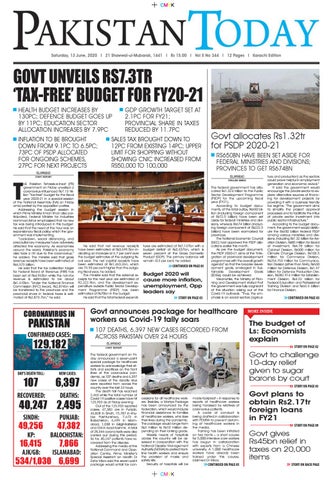
Govt unveils Rs7.3tR ‘tax-fRee’ budGet foR fY20-21 g
g
HEAlTH BuDGET INCREASES BY 130PC; DEFENCE BuDGET GOES uP BY 11PC; EDuCATION SECTOR AllOCATION INCREASES BY 7.9PC INFlATION TO BE BROuGHT DOWN FROM 9.1PC TO 6.5PC; 73PC OF PSDP AllOCATED FOR ONGOING SCHEMES, 27PC FOR NExT PROjECTS
g
g
GDP GROWTH TARGET SET AT 2.1PC FOR FY21; PROvINCIAl SHARE IN TAxES REDuCED BY 11.7PC
SAlES TAx BROuGHT DOWN TO 12PC FROM ExISTING 14PC; uPPER lIMIT FOR SHOPPING WITHOuT SHOWING CNIC INCREASED FROM RS50,000 TO 100,000
ISLAMABAD
Govt allocates Rs1.32tr for PSDP 2020-21 g
RS650BN HAvE BEEN SET ASIDE FOR FEDERAl MINISTRIES AND DIvISIONS; PROvINCES TO GET RS674BN ISLAMABAD
STAFF REPORT
t
GhulAm AbbAS
HE Pakistan Tehreek-e-Insaf (PTI) government on Friday unveiled a coronavirus-influenced Rs7.13 trillion “tax-free” budget for the fiscal year 2020-21 in a special session of the National Assembly (NA) on Friday amid protest by the opposition parties. Addressing the budget session in which Prime Minister Imran Khan also participated, Federal Minister for Industries Hammad Azhar emphasised that no new tax was being introduced in this budget. He said that the need of the hour was an expansionary fiscal policy which the government was implementing. “lockdown, social distancing, and precautionary measures have adversely affected the economy. As economies around the world, Pakistan’s economy also took a hit due to the coronavirus,” he added. The minister said that gross revenue receipts have been estimated at Rs6,573 billion. He said that the tax collection target for Federal Board of Revenue (FBR) has been set at Rs4,963bn while the non-tax revenue is estimated to be about Rs1,610bn. “under the National Finance Commission (NFC) Award, Rs2,874bn will be transferred to the provinces and the provincial share in federal taxes is estimated at Rs2,873.7bn,” he said.
He said that net revenue receipts have been estimated at Rs3,699.5bn indicating an increase of 6.7 per cent over the budget estimates of the outgoing fiscal year. The net capital receipts have been estimated at Rs1,463.2bn, which are 75.93 per cent higher than the outgoing fiscal year, he added. The minister said that the external receipts for the next year are estimated at R2,222.9bn, and the development expenditure outside Public Sector Development Programme (PSDP) has been estimated at Rs70bn in the budget. He said that the total federal expendi-
CoRonaviRus in
Pakistan
CONFIRMED CASES:
129,182
DAY'S DEATH TOLL:
NEW CASES:
107
6,397
RECOVERED:
DEATHS:
SINDH:
PUNJAB:
40,247 2,495
49,256
47,382
KP:
BALOCHISTAN:
AJK/GB:
ISLAMABAD:
16,415
7,866
534/1,030 6,699
tures are estimated at Rs7,137bn with a budget deficit of Rs3,437bn, which is seven percent of the Gross Domestic Product (GDP). The primary balance will remain -0.5 per cent, he added.
CONTINUED ON PAGE 05
Budget 2020 will cause more inflation, unemployment, Opp leaders say STORY ON PAGE 03
The federal government has allocated Rs1.324 trillion to the Public Sector Development Programme (PSDP) for the upcoming fiscal year (FY21). According to budget documents, of the total outlay, Rs650 billion (including foreign component of Rs72.5 billion) have been set aside for federal ministries and divisions, whereas Rs674 billion (including foreign component of Rs222.5 billion) have been earmarked for provinces. The National Economic Council (NEC) had approved the PSDP allocations earlier this month. As per the budget document, the PSDP 2020-21 aims at the “integration of provincial development programmes with the overall growth agenda” so that the broader development goals, envisaged in Sustainable Development Goals (SDGs), could be achieved. Meanwhile, the Ministry of Planning and Development stated that the government was fully cognizant of the situation arising out of the Covid-19 outbreak. “Thus, the emphasis is on social sectors [agricul-
Govt announces package for healthcare workers as Covid-19 tally soars g
107 DEATHS, 6,397 NEW CASES RECORDED FROM ACROSS PAKISTAN OvER 24 HOuRS ISLAMABAD
CONTINUED ON PAGE 05
more inside
The budget of Ls: Economists explain STORY ON PAGE 02
STAFF REPORT
The federal government on Friday announced a seven-point special package for healthcare workers to acknowledge their efforts and sacrifices on the front lines of the coronavirus pandemic, as 107 deaths and 6,397 new cases of the deadly virus were reported from across the country over the last 24 hours. The death toll has reached 2,463 while the total number of Covid-19 positive cases have hit 125,933 as of Friday evening. Out of the 125,933 reported cases, 47,382 are in Punjab, 46,828 in Sindh, 15,787 in Khyber Pakhtunkhwa, 7,673 in Balochistan, 6,699 in Islamabad, 1,038 in Gilgit-Baltistan and 534 in Azad Kashmir. A total of 28,344 corona tests were also carried out during this period. So far, 40,247 patients have recovered from the disease. Addressing the media at the National Command and Operation Centre, Prime Minister’s Special Assistant on Health Dr Zafar Mirza said the seven-point package would entail tax con-
ture and production] as the sectors could prove helpful in employment generation and economic revival.” It said the government would encourage the private sector to explore alternative sources of financing for development projects by providing it with a business friendly tax regime. “The government aims to simplify the project approval processes and to facilitate the influx of private sector investment into public sector infrastructure.” According to the budget document, the government would distribute the Rs650 billion federal PSDP among various ministries and divisions, including Rs1.32 billion for Aviation Division, Rs80 million for Board of Investment, Rs4.78 billion for Cabinet Division, Rs500 million for Climate Change Division, Rs103.5 million for Commerce Division, Rs254.753 million for Communication Division (other than NHA), Rs660 million for Defence Division, Rs1.57 billion for Defence Production Division, Rs282.914 million for Establishment Division, Rs4.52 billion for Federal Education and Professional Training Division and Rs66.6 billion for Finance Division.
Govt to challenge 10-day relief given to sugar barons by court STORY ON PAGE 03 cessions for all healthcare workers. Besides, a Martyrs Package has been announced by the federation, which would include financial assistance to families of healthcare workers, who lose their lives during the pandemic. The package would range from Rs3 million to Rs10 million depending on their ranking grade. Weekly needs of hospitals across the country will be assessed in cooperation with the National Disaster Management Authority (NDMA) to protect frontline health workers and ensure the provision of masks and safety kits. Security of hospitals will be
CMYK
made foolproof – in response to reports of healthcare workers being harassed by relatives of coronavirus patients. A code of conduct is being drafted in collaboration with PEMRA to prevent defaming of healthcare workers in the media. Training has been initiated on two fronts – a short course for 5,000 intensive care workers has begun in collaboration with experts from a Chinese university. A 1,000 healthcare workers have already been trained under this course, claimed Dr Mirza.
CONTINUED ON PAGE 05
Govt plans to obtain Rs2.17tr foreign loans in FY21 STORY ON PAGE 09
Govt gives Rs45bn relief in taxes on 20,000 items STORY ON BACK PAGE
02
Saturday, 13 June, 2020
NEWS
the budget of Ls: economists explain EXPERTS REVEAL HOW ‘CORONA BUDGET’ FOCUSES MORE ON ‘LIVES, LIVELIHOODS, LOCUSTS AND LOCKDOWN’ KARACHI
i
ARIBA SHAHID
T'S that time of the year when nearly everyone you know has something to say about the economic and financial position of Pakistan's economy. Keeping that in mind, Profit decided to talk to some economic experts to see what they have to say about this year's budget. "The art of preparing a federal budget in Pakistan is taking care of four "D's": debt servicing, defence, day-to-day administration and development. This is taken care of through federal revenue which is topped up through domestic and external borrowing," notes Abid Suleri, Executive Director at SDPI. "However, this year the budget, which is also being termed as the corona budget, has more dimensions to it. I'm talking about the four Ls: lives, livelihoods, locusts, and lockdown. The one-word summary of these Ls provided by the economic survey of Pak-
istan's "Covid-19 Advent and Impact Assessment" section is "losses". This is the loss of jobs, loss of revenue, loss of GDP growth, and unfortunately loss of precious lives. Suleri says the government will be highly dependent on external financing. A problem of unprecedented nature requires an out of the box approach. "Amidst all this, the growth mantra should be abandoned, at least for the next 6 months, and a clear stance should have been taken that budget is presented to support lives and businesses." He feels that the budget document will be revised in the coming months -- Covid19 and locust impacts have to unfold. The targets would change as the pandemic and locust change. While budgets are a highly politicized affair, there is always something that is worth the appreciation. Adil Nakhoda, Economist & Research Fellow at IBA CBER comments, "Razzaq Dawood’s push for lower dependence on custom duties is a positive shift. This now
govt allocates rs12 billion for agri sector uplift
needs to be realized by ensuring across the board lowering of tariffs." He adds, "While the current account deficit may not be seen as a hot topic the way it was in prior budgets most likely due to the fall in imports, we cannot forget that dollar inflows are still much needed." Commenting on the importance of international trade, he stated, "Focus must shift towards propping up the export sector as we recover from the corona shock. Restoration of the zero-rated facility is debatable as it was removed with a purpose to diversify exports as well as to ensure genuine export sales were reported." Sajid Amin Javed, a Research Fellow & Head of Policy Solutions Lab at the SDPI, however, was critical of the budget. He says, "The government seems to have confused protecting the economy and businesses in this budget, as they did protect people from the Covid-19. The budget2021 is as efficient for economic recovery as was the confused lockdown we did to control the spread of the virus." While a number of individuals view the budget to be strongly impacted by corona, Uzair Younus, a non Resident Senior Fellow at the Atlantic Council in Washington D.C. opined, "Covid-19 does not seem to have
Stock market players view federal budget as ‘underwhelming, unexciting’
ISLAMABAD
KARACHI
STAFF REPORT
ARIBA SHAHID
The government has allocated an amount of Rs12,000 million in its Public Sector Development Program (PSDP) 2020-21 for the uplift of agriculture and development of livestock sectors in the country. According to the budget document, the government has earmarked Rs1.25 billion for 12 new schemes, whereas an amount of Rs10.75 billion has been allocated for the completion of 24 ongoing schemes. An amount of Rs5.25 billion has been allocated for national programme for improvement of watercourses (phase-II) and Rs1 billion for national programme to enhance the command area in barani areas of the country. In order to reduce local reliance on imported edible oil, Rs350 million have been allocated for national oilseed enhancement program and Rs 500 million for promotion of olive cultivation on commercial scale. The government has allocated Rs 200 million for promotion of trout farming in northern areas of the country, Khyber Pakhtunkhwa and AJK to promote aquaculture and fish farming. In its public sector program, the government has earmarked Rs 150 million for cage culture cluster development and Rs 130 million for calf feedlot fattening across the country and AJK. For new schemes, an amount of Rs 250 million has been allocated for cotton productivity enhancement through eco-friendly pink bollworm management and capacity building. An amount of Rs 250 million set aside for up-gradation of central cotton research institute Skrand and cotton productivity enhancement through capacity building and management. In PSDP 2020-21, the government has also earmarked Rs 100 million for risk based control of foot and mouth disease all across the country and Rs150 million for Sino-Pak agriculture breeding innovation project for rapid yield enhancement.
Considering how the budget is an important day for the Pakistan Stock Exchange (PSX) due to the impact announcements have on the market, Profit spoke to the market experts to see what they have to say and how they view the budget. Naushad Chamdia, Chief Executive Officer (CEO) of Standard Capital, called the Finance Bill 2021 a non-event for the stock market. He added, "The small allocation against big dams is a worry." While speaking about the positives of the budget, Chamdia said, "The positive aspect is the deletion of Withholding Tax (WHT) for various sectors which will be good for businesses." He continued, "Slashing sales tax is also a good step. The sales tax registration condition increasing to Rs100,000 from Rs50,000 is a good omen for ease of doing business for many shopkeepers as well as suppliers from Fast Moving Consumer Goods (FMCG) companies. "Most of the expectations of the business community are being met thank to the work of the commerce adviser. The only worry is that the government will resort to deficit financing to carry out certain megaprojects." Saad Rafi, Head of Equity Sales at Al Habib Capital Markets, feels that there is no relief for the capital markets in the budget. "Corporate tax was expected to fall by 1pc. It has been left untouched. There is no relaxation given in capital gains tax for the stock market. The only benefit given is on capital gains tax on property which exempts capital gains made on property held for 4 years as opposed to
rs6.67bn allocated for it, telecom division ISLAMABAD STAFF REPORT
The federal government has allocated Rs6672.984 million for ongoing and new schemes of the Information Technology and Telecom Division under the Public Sector Development Programme (PSDP) for the financial year 2020-21. Rs4780.984 million was allocated for ongoing schemes and Rs1892 million was earmarked for the new schemes of the Information Technology and Telecom Division. Among the ongoing schemes, Rs275 million was allocated for certification of IT professionals, Rs230 million for e-office replication at all divisions of the federal government, Rs709 million for expansion and upgradation of 3G/4G services and seamless coverage along Karakoram Highway in Gilgit Baltistan, Rs535 million for expansion of broadband services in Azad Jammu and Kashmir and Gilgit Baltistan, Rs750 million for expansion of cellular services in Azad Jammu and Kashmir and Gilgit Baltistan and Rs1747.48 million for the phase one of the Technology Parks Development Project (TDP) in Islamabad. Under the new schemes, Rs300 million was allocated for blended virtual education, Rs100 million for the establishment of Sino-Pak Center for Artificial Intelligence, Rs200 million for expansion of broadband services in cities and towns of Azad Jammu and Kashmir and Gilgit Baltistan and Rs250 million for protection and upgradation of Pak-China CFC project.
had an impact on this budget because they have basically ignored the fact that at this time, the economy needs stimulus." One of the demerits of the budget for him is the lack of stimulus for the economy. "This budget is more of the same and is devoid of any significant measures to boost aggregate demand. The fact is that Pakistan is facing perhaps the most serious economic crisis since independence and one expected bolder measures to kickstart the economy. The tax target is ambitious and unachievable and as the revenue slips, disbursements to PSDP will be slowed." However, Younus also views that doing away with tariffs was much needed to reduce distortions in the market as one of the positives to come out of the budget. Naveed Iftikhar, Economist & Academic who has worked as Governance Specialist at the Ministry of Finance, called the budget a "traditional budget". He adds, "We have been formulating such budgets for many decades. The revenue and development expenditures targets are not going to meet." He was also critical of the housing subsidy worth Rs31 billion. “I think we should not build housing through subsidies. There is a need to introduce regulatory and financing reforms to increase the supply of hous-
Budget targets depend on resumption of Businesses: shaikh Prime Minister’s Adviser on Finance Dr Abdul Hafeez Shaikh the federal budget tabled by the government would be reconsidered in case the coronavirus crisis continued to plague Pakistan. Speaking to a local media outlet, Shaikh said 27 per cent increase in revenue and 6.5 per cent inflation “does seem ambitious at the moment”. “You’re right, it seems ambitious right now. There’s so much uncertainty about the future so we cannot say much. If corona [virus crisis] continues and its severity increases and the lockdown in some way or the other goes on, then this will need to be adjusted,” the adviser noted. “However, if, in a good scenario, there’s improvement over the next two or three months and our economic activity kick starts, then I think it’s attainable,” he added. “If our economy picks up after three months, then there can be improvement,” he said, adding that the 2.1% growth rate of GDP was already calculated with a smaller base, which had fallen considerably due to the negative growth. “Another factor that cannot fully forecast is by how much will the demand for our exports grow,” Shaikh said. Responding to a question about borrowing from commercial banks and how it could hurt investments and lead to crowding-out effect, he said Prime Minister Imran Khan-led government was trying not to borrow a lot and to lower its expenditures. NEWS DESK
the earlier timeframe of 8 years." Adding to the disappointment of the PSX, Arsalan Soomro, Managing Director at KASB Securities noted, "Barring the construction sector, which has good medium-term prospects, PSX may overall be disappointed. From asset valuation, liquidity, and asset-allocation point of view, equities aren't crashing.” However, Soomro said that the silver lining is the inflation rate at 6.5pc, signalling that low-interest rates are here to stay. He further added, "I think the budget is merely an aspiration. We are hoping tax revenues will increase if Covid-19 subsides. That does not seem to be a near possibility as of yet. And secondly, the message is to continue the International Monetary Fund (IMF) programme."
Overall, the market viewed the budget as underwhelming and unexciting. "There is nothing exciting in the budget. The government has set optimistic revenue targets in order to revive growth," says Tahir Abbas Head of Research at Arif Habib. "But it intends to achieve these targets through enforcement of administrative measures, which seems highly unlikely.” Adding to the underwhelming nature of the budget, Muhammad Sohail, CEO of Topline Securities said, “The budget presented by the government was a routine budget that did not realise that extraordinary conditions need creative ideas. They should have taxed the rich to support the poor people suffering from Covid-19. There is nothing good specific to the stock market in the budget."
ing. The portion of grants and subsidies is around 1 trillion. I think this is time to bring more transparency and effectiveness in this part of the budget.” The consensus, however, remains on the unrealistic nature of the budget. “The revenue target of FBR set in the budget is unrealistic keeping in view the collection of outgoing FY (Rs3.9 trillion) and impacts of Covid-19 pandemic, notes Dr Viqar Ahmed, Deputy Executive Director of SDPI. While this is what the economists think, in terms of the impact on business, Nauman Lakhani, Country Manager of Dun & Bradstreet, feels that there is a good chance of recovery. "Given the pandemic, Pakistan would in the same boat as similar economies. If businesses go back to normal in the coming quarter there are good chances of recovery and higher growth in the last two quarters of the fiscal year." However, he says the tax targets will be a challenge due to “the economic challenges of Covid-19 and the fact that the government has not gone for more additional tax collection measures.” He adds, “Revenue from nontax avenues would be a wait and see. It seems clear the direction that the government has set on which it aimed to do in 2018. There seems a high chance of fiscal deficit based on the current targets set both for income vs expenditure.”
govt allocates rs74.5bn for power sector projects ISLAMABAD STAFF REPORT
The government has earmarked Rs74.49 billion for ongoing and new schemes of power sector under Public Sector Development Programme (PSDP) for the fiscal year 2020-21. Of the total, a sum of Rs72.48 billion has been specified for various ongoing projects while Rs2.01 billion for new schemes. An amount of Rs20.09 billion has been allocated for the installation of 600MW coal-fired power project in Jamshoro, Rs3,000 million for 220-KV Dera Ismail Khan-Zhob Transmission Line, Rs2,675 million for the construction of new 220 kV Guddu Sibbi Single Circuit Transmission Line, Rs3,200 million for 500kV Faisalabad New Transmission Line, Rs3,000 million each for 500-kV Lahore North (NTDC) and 500kV HVDC Transmission System between Tajikisan and Pakistan for CASA-1000. Similarly, a sum of Rs4,000 million has been specified for the evacuation of power from 1,224MW wind power plants at Jhimpir Clusters, Rs6 billion for interconnection of Isolated Makran Network, Rs2.5 billion each for the evacuation of power from Suki Kinari Kohala power project and power distribution enhancement investment programme-II (Advanced Metering Infrastructure Project for IESCO), Rs2.13 billion for enhancement of transmission capacity of NTDC system, Rs2 billion for power distribution enhancement project programme-2 (AMI Project for LESCO) and Rs1.5 billion for the upgradation of NTDC’s telecommunication. Under new schemes, an amount of Rs1 billion has been allocated for the provision of electricity at Dhabeji SEZ project, Rs350 million for ABC cable for Peshawar and Bannu Circle (PESCO), Rs300 million for the establishment of 132KV Grid station Matta (Swat) and Rs300 million for the establishment of a 132KV grid station at Bin Qasim.
Aviation sector to receive Rs1.32bn under PSDP 2020-21 ISLAMABAD STAFF REPORT
The government on Friday earmarked Rs1.32 billion to execute 15 aviation sector projects under the Public Sector Development Programme (PSDP) 2020-21. According to the programme, an amount of Rs61.923 million would be utilised for the construction of a doublestorey ladies hostel/barrack (with the provision of a third storey), along with mess, recreation hall and allied facilities, at the Allama Iqbal International Airport, Lahore.
Similarly, Rs90 million would be spent on the construction of a doublestorey barrack (with the provision of a third storey), along with separate mess, and allied facilities recreation hall, for officials at the Quetta airport. Funds amounting to Rs50 million and Rs69.75 million have been reserved for the construction of Airport Security Force (ASF) Camp, as well as the building of barrack accommodation for ASF personnel, at Islamabad International Airport. Meanwhile, Rs20 million have been
CMYK
kept for the construction of barrack accommodation for ASF personnel at Chitral airport, Rs65 million for the construction of double-storey barracks for ASF personnel at Faisalabad airport, Rs21.280 million for the construction of double-storey Secretariat adjacent to ASF Headquarters in Karachi, Rs100 million for the construction of Kasana Dam, Rs63.553 million to construct a triple-storey accommodation for ASF personnel at Lahore airport, and Rs99.367 million for the construction of a triple-storey living barrack for ASF per-
sonnel at Multan airport. An amount of Rs55 million has been allocated for installation of Weather Surveillance Radar in Karachi, whereas another Rs55 million would be utilised for the installation of the same in Multan. Moreover, the government has earmarked Rs519 million for New Gwadar International Airport (NGIA) project, Rs41 million for Reverse Linkage Project between Pakistan Meteorological Department and Turkey's Marmara Research Centre, and Rs10 million for up-gradation of ASF Academy, Karachi.
Saturday, 13 June, 2020
NEWS
Budget 2020 wiLL Cause more infLation, unempLoyment, opp Leaders say NA OPP LEADER SHEHBAZ SHARIF SAYS BUDGET TARGETS ARE ‘UNREALISTIC’, COUNTRY’S GDP CONTRACTED FOR THE FIRST TIME IN 68 YEARS LAHORE
t
STAFF REPORT
HE opposition parties on Friday criticised the Pakistan Tehreek-eInsaf (PTI) government for what they called was an ‘anti-people’ budget for the 2020-21 fiscal year. In a statement, Pakistan Muslim LeagueNawaz (PML-N) president and Leader of the Opposition in the National Assembly Shehbaz Sharif termed the budget “anti-people”,
saying that it would lead to increased inflation and unemployment. “This is not a budget but a prescription for destruction,” he stated. “Whatever signs of economic progress are left in the country, will be ended because of the current government’s budget. The PTI government first tried to hide its inefficiency first behind PML-N and then behind the coronavirus pandemic.” He questioned the government’s performance, noting that it was the first time the country’s gross domestic product (GDP) had
PPP’S SHERRY REHMAN SAYS SHE SUSPECTS GOVT WILL ANNOUNCE A ‘ROLLING BUDGET EVERY THREE MONTHS BASED ON IMF’S PUSH’ contracted in 68 years. “The fiscal deficit has never been in two digits in the country’s history,” he added. He said that the budget’s targets were “unrealistic” and there was concern that it would increase the difficulties of the people. He added that the incumbent government was the first one which was “unable to achieve its own targets for revenue, fiscal deficit and GDP growth”. Shehbaz said the government could not “hide behind the corona pandemic”, saying
Budget speech marred by Opp’s ruckus ISLAMABAD STAFF REPORT
The members of opposition protested during Federal Minister for Industries Hammad Azhar’s budget speech in the National Assembly and chanted slogans against the Pakistan Tehreek-e-Insaf (PTI) government throughout the duration of the session. The lawmakers displayed placards in the House, chanted slogans and thumped desks to register their protest against the ‘anti-people’ budget. The placards were inscribed with slogans including ‘Where are the 10 million jobs and 5 million houses?’ and ‘why agriculture and farmers are in a poor condition’. One placard read ‘Aata Chor, Cheeni Chor [flour and sugar thieves]’ while another was inscribed with the slogan ‘Corona is not an ordinary flu’, reminding the premier about the severity of the disease as opposed to his earlier speeches where in which he had downplayed its threat. The speaker repeatedly urged members to refrain from disrupting the proceedings of the session, but the pleas fell
on deaf ears. They later staged a walkout. Senator Sherry Rehman said the MNAs protested because they weren’t provided with a copy of the budget in a floppy disk as promised by the government. She said that this was a good initiative but the files were provided to the MNAs during the session, which prompted them to hoot and protest.
Terming budget 2020-21 “non-transparent”, she said that the opposition’s input should have been sought on the document. “I am sure they will take out a rolling budget in the next three months.” National Assembly Opposition Leader and Pakistan Muslim LeagueNawaz (PML-N) President Shehbaz
Govt to challenge 10-day relief given to sugar barons by court ISLAMABAD STAFF REPORT
Prime Minister’s Special Assistant on Accountability Shahzad Akbar on Friday said that the federal government will challenge the Islamabad High Court’s (IHC) 10-day stay order on action against the sugar mill owners responsible for the countrywide price hike of the sweetener through market manipulation and other illegal tactics. On Thursday, IHC Chief Justice Athar Minallah had stopped the government from acting on the recommendations of the sugar inquiry commission for 10 days – until the next date of hearing — after the stakeholders of the industry assured the court that sugar would be sold for Rs70 per kg. “How will the public get sugar at Rs70 per kg when the government is not able to take action against hoarders?” Akbar told a private TV news channel, adding that the government would challenge the IHC’s stay order. The court issued the order while
hearing a petition filed by the owners of 17 sugar mills, including Pakistan Tehreek-e-Insaf (PTI) senior leader Jahangir Khan Tareen and the Pakistan Sugar Mills Association (PSMA) against the commission’s report. The court also issued notices to Shahzad Akbar, members of the commission, including its head Federal Investigation Agency (FIA) Director General Wajid Zia and other officials seeking their response to the sugar industry’s plea. The petitioners adopted the stance that the inquiry commission had exceeded its constitutional authority in the preparation of the report by trespassing into the domain of the provinces. They also maintained that the recommendations forwarded to the government by the commission did not fall within the ambit of the law. During the proceedings, PSMA’s counsel Ali Khan said the constitution had separately mentioned the powers of the federation and the provinces. “An ad hoc committee was formed in February to take action,” he said. “The
committee wrote to the federal government that it should be transformed into a commission to provide it with legal cover,” he added. “The committee was turned into a commission as soon as the suggestion was given.” The lawyer said the commission wrote a 324-page report citing various reasons to the federal government asking for a forensic audit of the sugar mills. He contended that the commission went beyond its terms of references and a “media trial” of the owners of sugar mills was underway by the SAPM on accountability and ministers. Justice Minallah remarked that sugar was a basic necessity for the common man and the federal government should take steps to ensure its availability. A lawyer representing a sugar mill told the court that the commission had not distinguished between the use of sugar for public and commercial purposes in its report. The judge observed that 30 per cent of sugar should be sold to the public and the purpose for which the commission
that its performance was “dismal” even before the pandemic’s outbreak. “This budget has only been created to benefit the finances of PTI members and its allies,” he claimed. “The revenue tax collection of Rs3,800 billion against the target of Rs5,555bn is far less than the tax collection by the PML-N government two years ago. Why did the production of cotton decrease by 6,9 per cent when it was not affected by corona?” he questioned. “This government has increased the
Sharif, PML-N Senior Vice President Shahid Khaqan Abbasi and General Secretary Ahsan Iqbal did not attend the session after they contracted Covid-19. Pakistan People’s Party (PPP) Chairman Bilawal Bhutto-Zardari was also absent. Only 86 members (one-fourth of the total 342-member house), 46 from the treasury and 40 from the opposition, were allowed to participate in the session, leaving the spacious hall of the lower house of parliament with lots of empty seats. With continuous noise during Azhar’s speech, NA Speaker Asad Qaiser had to intervene several times. On one occasion, he specifically asked the opposition benches to maintain decorum and “do not shout inappropriate slogans”. He closely monitored the opposition members’ movement and restricted them from coming towards the treasury benches. Extraordinary precautionary steps were taken because of the coronavirus pandemic and the doors of parliament were closed for all unrelated people. PM Imran came to the House after a long time but unlike previous occasions when the treasury members would come up to him and whisper into his ear, it did not happen this time. In fact, there was no such interaction during the session. The premier silently left the premises when Azhar ended his budget speech. was formed had not been addressed. “If the commission has not said anything on the availability of sugar for the public, then what did it say?” he added. He noted that the commission in its findings had offered no solution for the convenience of the common man. “The government is also selling subsidised sugar at Rs80 per kg at Utility Stores,” Justice Minallah remarked. On the IHC chief justice’s inquiry, Advocate Khan told the court that the price of the sugar was Rs53 per kg in November 2018. Justice Minallah asked the reason for the price increasing from Rs53 per kg to Rs85 per kg in two years. He reiterated that the commission should have addressed the issue. “This court does not usually interfere with matters pertaining to the executive,” he told the PSMA counsel, adding that the court would summon the federal government to respond to the matter. The judge said the court would issue a stay order if the sugar mill owners agreed to sell the sweetener for Rs70 per kg. The PSMA lawyer agreed to the condition and Additional Attorney General Tariq Khokhar also said the federal government did not oppose the court’s option. The IHC directed the registrar’s office to fix the case for hearing after 10 days.
03
country’s debt by 30pc in two years and it plans to incur more debt so that the future of this country’s next generation will be kept mortgage in foreign banks,” he said. PML-N senior leader Ahsan Iqbal also said that the PTI government even after two years was “unable to collect tax equal to that collected in the PML-N government’s last year”. ‘JUST AN ACCOUNTING EXERCISE’: Pakistan People’s Party Senator Sherry Rehman said that the government “squandered a huge opportunity to change priorities” through the recent budget and termed it “just an accounting exercise led by the International Monetary Fund (IMF)”. In a tweet, she said that it was “not a national budget for a country facing a crisis”. Speaking to a private news channel, Sherry Rehman said: “My real issue is that neither the opposition nor the finance commission was taken on board before announcing the budget. My suspicion is that they will announce a rolling budget every three months based on IMF’s push and the amount of loans they’ve taken means that we won’t be able to see much relief for the common man.” She claimed that the PTI government had only “moved the numbers backwards and forwards”, adding that it was an “antiPakistan” budget.
no increase in salaries, pensions in federal budget ISLAMABAD: The federal cabinet on Friday, while approving the budget for the upcoming fiscal year, decided not to increase salaries and pension for government employees. The move means that salaries and pensions for the federal governments employees will remain at the same level for the upcoming fiscal year. The decision comes at a time when the country’s economy faces the negative effects of the spread of Covid-19 and next year’s tax collection targets for the Federal Board of Revenue (FBR) have been slashed. Earlier on June 9, the Pakistan government and the International Monetary Fund (IMF) had reached a consensus on not putting a freeze on the increase in salaries and pensions of government employees in a bid to protect government employees from the effects of inflation. STAFF REPORT
Cement price likely to reduce by rs14.5 per bag LAHORE: The price of a 50-kilogramme (kg) cement bag is expected to fall by Rs14.5, as the government has slashed Federal Excise Duty (FED) on cement from Rs2 per kg to Rs1.75 per kg. According to reports, the 0.25 per kg reduction will amount to Rs12.5 for a 50kg cement bag, which will decrease the price by another Rs2 due to savings on General Sales Tax (GST), bringing the total savings to Rs14.5. Previously, Rs100 FED was being charged on a 50kg cement bag. "We are happy that the government has reduced the excise duty. But we are disappointed that it did not remove it altogether. There is no justification for excise duty on cement. We hope the government will remove it as soon as possible," Azam Faruque, Chairman of the All Pakistan Cement Manufacturers Association (APCMA), remarked. STAFF REPORT
rs23.2bn earmarked for paeC under psdp 2020-21 ISLAMABAD: The government has earmarked Rs23.29 billion for 18 ongoing and one new scheme of Pakistan Atomic Energy Commission (PAEC) under the Public Sector Development Programme (PSDP) 202021. As per the details, the government has allocated Rs23 billion for the ongoing schemes and Rs200 million for one new scheme. Among major ongoing schemes, Rs18 billion has been earmarked for Karachi Coastal Power Project (Unit 1 and 2), Rs1.5 billion for Pakistan Research Reactor-III (10MW upgradable to 20MW) and Rs1.23 billion for 'Upgradation of Atomic Energy Cancer Hospital-NORI' (AECH-NORI). Similarly, an amount of Rs600 million has been allocated for the National Electronics Complex of Pakistan, Rs500 million for Gujranwala Institute of Nuclear Medicine and Radiotherapy (Phase-II), Rs280 million for Gilgit Institute of Nuclear Medicine, Oncology and Radiotherapy and Rs140 million each for Reconnaissance Survey of Mineral Resources and Detailed Exploration of Uranium (Phase IX) Dera Ghazi Khan. Furthermore, one new project titled 'Detailed Exploration of Uranium Resources in Bannu Basin and Kohat Plateau (Phase-IV)' received an allocation of Rs200 million. STAFF REPORT
04 karachi
Saturday, 13 June, 2020
PRAyER TImIngS
WEATHER UPDATES SATURDAY
360C
280C
SUNDAY
370C
290C
MONDAY
370C
290C
FAJR SUNRISE
ZUHR
ASR MAGHRIB ISHA
3:13
12:32
3:54
4:41
7:22
8:51
Karachi hosPitals to get 500 oxygenated beds amid rise in covid-19 cases KARACHI
a
STAFF REPORT
S the coronavirus tally inched closer to 50,000 and the contagion claimed 17 more lives on Friday in the province, Sindh Chief Minister Syed Murad Ali Shah announced the disbursement of 500 oxygenated beds to six hospitals in Karachi. The beds are being provided by the National Disaster Management Authority. Presiding over a meeting with health department officials and others, the CM said that 72 intensive care unit (ICU) beds and 428 high dependency unit (HDU) beds
would be provided to six of the government hospitals in the metropolis, so that every public hospital could have ICU and HDU beds. He approved the provision of 16 ICU beds and 64 HDU beds to Sindh Government Hospital in Korangi, 20 ICU beds and 55 HDU beds to Sindh Government Qatar Hospital in Orangi Town, 18 ICU and 57 HDU beds to Sindh Government Hospital in Liaquatabad, 10 ICU and 65 HDU beds to Sindh Government Hospital in New Karachi, eight ICU and 34 HDU beds to Metroville Hospital and 100 HDU beds to Abbasi Shaheed Hospital. The remaining 53 HDU beds will be
held in reserve. Besides, the CM directed relevant officials to ensure the provision of necessary equipment to the isolation facility at the Expo Centre in Karachi. Separately, in a statement issued on the day, the CM said that following the emergence of 2,428 more cases in Sindh, the province’s coronavirus count had risen to 49,256, while the death toll climbed to 793 with 17 more deaths. As per the data provided by the CM, 1,641 of the newly reported cases belonged to Karachi. Of those, 571 had emerged in East district, 351 in South district, 265 in Central district, 2017 in West district, 176 in
Malir and 125 in Korangi. Giving this information, he said that the provincial capital was the city worst hit by the virus and it citizens in particular needed to practice precaution. He added that Ghotki, Hyderabad, Sukkur, Khairpur and Larkana were also badly affected. He made this observation in the light of the surfacing of 66 more cases in Ghotki, 64 in Hyderabad, 47 in Sukkur, 38 in Khairpur, 31 in Larkana, 26 in Jacobabad, 20 in Dadu, 17 each in Nawabshah and Sanghar, 14 in Jamshoro, nine in Qambar-Shahdadkot, seven each in Kashmore-Kandhkot, Mirpurkhas and Thatta, three in Tando Muhammad Khan
and two in Umerkot. Most of these cases had been contracted through local transmission, which could only be controlled if people practiced caution and cooperated with the administration, he noted. He further stated that 1,066 more patients had recovered from Covid-19, following which the total number of recovered patients in Sindh had risen to 23,113. “This leaves 25,350 patients under treatment, of whom 23,615 are isolated at their homes, 79 are in isolation centres and 1,656 in hospitals,” the CM elaborated. “Of those in hospitals, 530 are in critical condition, with 83 on ventilators,” he added.
death toll reaches 22 in lyari building collapse KARACHI STAFF REPORT
The death toll from Lyari’s Khadda Market apartment building collapse reached 22 on Friday whereas six injured had been recovered. According to Sindh Ranges, all debris has been cleared from the location. “All the items found in the rubble of the building were handed over to the civil administration on the spot,” Sindh Rangers said. The items recovered from the site included cash, cell phones, electronic items, gold and artificial jewellery and other valuables. The total worth of the goods recovered from the site is reported to be more than Rs0.2 million. Earlier, the bodies were shifted to Dr Ruth Pfau Civil Hospital for medico-legal formalities. The deceased were identified as 50-year-old Shehnaz, 20-year-old Shehzad, 23-year-old Saeed, 32-year-old Memoona, 52-yearold Tofeeq and 30-year-old Faisal, 25-year-old Bihar, 60-year-old Kaleem, 30-year-old Saleem and 28-yearold Shaukat. The body of one woman could not be identified until the filing of this report. The building had reportedly been declared dangerous by the SBCA’s technical team after an inspection survey on March 16. The SBCA had also issued a notice to the residents on March 18, directing them to vacate the building within 15 days. The authority has declared at least 250 structures in the city ‘dangerous,’ with most of them located in the South district. According to sources, the SBCA had also issued letters to the relevant agencies to cut off the utility connections when it wasn’t vacated, but in vain.
Patients suffer as health workers continue protest KARACHI STAFF REPORT
Score of patients seeking consultation had to return home disappointed as doctors, paramedical staff and nurses continued boycott of outpatient departments (OPDs) and general wards on the fifth consecutive day on Friday in Sindh from Karachi to Kashmore. The health professional of Sindh under the banner of Grand Health Alliance (GHA) boycotted OPDs and general wards throughout Sindh province to raising their demands including risk allowance, provision of personal protective equipment (PPE) and other facilities. The healthcare workers held protests at Dr Ruth Pfau Civil Hospital Karachi, Jinnah Postgraduate Medical Centre, National Institute of Child Health, Sindh Government Lyari General Hospital, Sindh Government Hospital Liaquatabad, Sindh Government Hospital Qatar Hospital and others districts hospital’s the city Doctors, nurses and paramedics of Hyderabad, Mirpurkhas, Nawabshah, Jacobabad, Sukkur, Larkana, Kashmore, Dadu and Badin also held protests. Central leader of Young Nurses Association Aijaz Ahmed Kaleri said that doctors, nurses and paramedics of Sindh have been protesting for five days in Sindh but the authorities concerned have failed to respond to the genuine issues of healthcare workers. He said that GHA will announce its future of line of action on June 15 if the provincial government failed to meet the genuine demands of health professionals.
KARACHI: People watch the Budget 2020-21 proceedings on Friday. PPI
Over 1,000 inmates across Pakistan diagnosed with Covid-19: report NEWS DESK A total of 1,009 prisoners in jails across the country have tested positive for the novel coronavirus, according to recent statistics by the Justice Pakistan Project. Of these, the highest number of cases have been reported in Sindh with a total of 901 cases. The highest num-
ber of positive inmates have been reported at the Karachi Central Jail. Punjab reported a total of 102 cases, followed by a case each in Balochistan and Khyber Pakhtunkhwa. Along with the prisoners, jail staff and other officers at prisons have also tested positive. All these people have been quarantined both inside prisons
and at hospitals as well. So far, three prisoners have died from the deadly virus. The total number of COVID-19 cases in Pakistan have crossed 125,000. Fatalities from the virus have totaled 2,463. According to Prime Minister Imran Khan, the virus is going to experience its peak in the country in the months of June, July and August.
Sindh spent over Rs6bn on Covid-19 in three months NEWS DESK The fight against Covid-19 in Sindh has consumed more than Rs6.1 billion of the provincial government’s funds in around three months. The government had released Rs4.99 billion as special grants and another Rs1.12 billion for the Coronavirus Emergency Fund till the first week of June to battle the virus. Almost one-third of these funds were spent on the establishment of a 200-bed infectious diseases hospital near NIPA in Karachi. The hospital, for which Rs1.99 billion were released on May 20, is being set up by the DOW University of Health Sciences (DUHS). EMERGENCY FUND: From funds released on account of the emergency fund, slightly above Rs600 million have been spent on the procurement of coronavirus testing and viral transport medium kits. The government spent Rs425 million from April 22 to May 19 on the purchase of testing kits and Rs177.224 million on VTM kits. Covid-19 rapid testing de-
vices, along with required software, were bought for Rs31.73 million. On the other hand, despite the repeated demands of health workers, especially those working in the public sector health facilities, the government’s procurement of personal protective equipment (PPE) has remained modestly low. The details of the expenditures do not show any purchase of PPE after April 20, when the sum spent on safety kits added to at Rs32.34 million. The provincial government also released Rs133.94 million for setting up a field isolation centre at the Expo Centre in Karachi and Rs30 million for the isolation centre at PAF Museum. It also procured miscellaneous equipment. SPECIAL GRANTS: From special grants, the government allocated Rs99.55 million for the establishment of two isolation centres, including a 40-bed facility at DUHS’ Ojha campus and a 50bed facility in Gulistan-e-Johar, and Rs1.99 billion for an infectious diseases hospital near NIPA. These projects are to be managed by the DUHS.
Besides, the government released Rs500 million for Dr Ruth Pfau Civil Hospital, Lyari General Hospital, KMC Hospital, Liaquat University of Medical and Health Sciences, Peoples Medical University, Nawabshah, Chandka Medical College and Ghulam Muhammad Mahar Medical College. Moreover, South City Hospital, Liaquat National Hospital, Dr Ziauddin Hospital, Altamash General Hospital and Patel Hospital received Rs100 million on May 18, while the government paid Rs20 million to Aga Khan University Hospital for the treatment of Covid-19 patients. Two NGOs have been provided Rs131.7 million to establish hospitals in Larkana and Thatta districts as well, while the HIS has been tasked with establishing two 60-bed hospitals in Rato Dero and Dokri talukas of Larkana at a cost of Rs67.7 million. Similarly, the Medical Emergency Resilience Foundation has received Rs64 million for establishing a 100-bed critical care unit in Thatta district. The Syed Abdullah Shah Institute Of Med-
ical Sciences also received Rs125 million on May 11. Dr Panjwani Centre for Molecular Medicine and Drug Research at the University of Karachi was provided Rs58.28 million for conducting free virus tests. The university’s International Centre for Chemical and Biological Sciences was also given Rs25.5 million. Apart from this, the Hyderabad health services director was given Rs100 million, Karachi health services director Rs94.25 million, health department secretariat Rs50 million and district health officers in all of Sindh’s districts Rs69 million. A sum of Rs1.08 billion was provided to the deputy commissioners (DC) of all the districts in the province for ration distribution among the needy. The Indus Hospital in Karachi received a cash grant of Rs300 million and the DCs of Malir, Sukkur, Hyderabad, Shikarpur, Larkana and Jamshoro received Rs50 million, Rs90 million, Rs30 million, R11.7 million and Rs5 million, respectively.
sindh governor orders to purchase 50 fire tenders for Karachi industrial areas KARACHI STAFF REPORT
Sindh Governor Imran Ismail on Friday ordered to purchase 50 fire tenders and two water bowsers for industrial areas of Karachi, ARY News reported. Presiding over a meeting of Sindh Industrial Liaison Committee (ILC) in Karachi, Imran Ismail directed to buy of Rs2 billion fire tenders and water bowsers to facilitate the industrialists and the business community. He maintained that the vehicles will be imported by December this year and added that these fire tenders will be handed over to the associations of the industrial areas. Earlier on June 11, a fire had broken out in a factory located in Karachi’s Site Area. Getting the information a number of fire tenders had reached the spot to control over the fire. The firefighters were facing difficulties due to huge clouds of smoke.
Saturday, 13 June, 2020
Petrol crisis is artificial, senate Panel told
CORPORATE CORNER
ISLAMABAD
ISLAMABAD: As the Covid-19 pandemic continues to have widespread impact on the world with an alarming increase in infections, L’Oréal Pakistan has launched a solidarity programme, in support of the fight against the virus, with the local production of hand sanitizers and handwashes, under its natural beauty brand Garnier.
LAHORE: Zong 4G has partnered with one of the fastest-growing companies in the pharmaceutical industry, GENIX PHARMA, to provide customized corporate voice and data services.
Bank alfalah, nBP and Mastercard unite to facilitate covid-19 donations KARACHI: Strengthening its commitment to supporting the Pakistani government during the COVID-19 crisis, Bank Alfalah has joined forces with Mastercard and National Bank of Pakistan (NBP) to provide a safe online donation portal to support those in need during the pandemic. Through the platform, people can now securely donate to Prime Minister Imran Khan’s Covid-19 Pandemic Relief Fund 2020 from anywhere in the world by using their debit or credit cards. The initiative is in line with the State Bank of Pakistan’s (SBP) guidelines for banks to take necessary steps to facilitate donations to the Prime Minister’s COVID-19 Pandemic Relief Fund 2020. With Bank Alfalah as the Mastercard Payment Gateway Services (MPGS) provider, Mastercard as the payments technology partner and NBP as the facilitator with the payment link, the new partnership ensures donors’ convenience, making contributions from across the globe easy and effortless.
t
STAFF REPORT
he Senate Standing Committee on Petroleum was informed on Friday that the prices of petroleum products were reduced in the country to provide relief to the people but the oil marketing companies (OMCs) reduced the supply from their stocks to avoid losses. A meeting of committee was held at the Parliament house with its chairman, Senator Mohsin Aziz in the chair. The meeting discussed the recent crisis in petroleum products and the problems faced by consumers, especially in the months of April, May and June. The committee also took stock
of the storage of petroleum products with domestic and foreign companies and reviewed the reasons for not reducing high octane prices and reduction in hi-octane blending component (hOBC) prices on June 4, 2020. Petroleum division officials informed a senate standing committee that country faced a petrol crisis and not the diesel crisis. The secretary and the director general of the petroleum division also informed the panel that the demand for petrol in the country had increased. For domestic consumption, they said, petroleum products were imported while the products had also been procured from domestic refineries. They added that due to the coronavirus pandemic, supply
of 1.2 million metric tons of Iranian oil, coming through Balochistan, had severed. The committee was informed that 70% of petrol is imported and 30% came from domestic sources. however, for diesel, 70% of supply was procured domestically, while 30% was imported. The committee was informed that as the prices of petroleum products rose internationally, the rates were reduced in the country to provide relief to the people. however, the OMCs reduced their supplies from their stocks to avoid losses, which led to the crisis. They added that the government halted the import of petroleum products for a few days due to the lockdown but then allowed it.
Govt announces package for healthcare workers as Covid-19 tally soars CONTUNIED FROM PAGE 01 Besides, under the name of ‘We Care’ training programme healthcare workers are being trained online on safety measures, said Dr Mirza, adding that a 100,000 healthcare workers will be trained under the programme, and 20,000 have been trained already. Besides, emotional support is being provided under ‘Psycho Social Support’ which will provide support and training on psychological issues. A helpline in this regard on 1166 is being expanded. experts will be available to provide guidance and support for healthcare workers. The State Bank of Pakistan has introduced a
scheme called ‘Refinance Facility for Covid-19’ under which loans are being provided to private hospitals on ‘easy’ terms so that the healthcare facilities may enhance their capacity. Imports of hospitals would be taxdeductible and efforts would be made to ensure tax concessions. Dr Mirza added that three per cent of healthcare workers in Pakistan are fighting the pandemic, which is a lower figure than in other countries. however, if a healthcare worker contracts the disease, or if their family does, they will be provided tests and medications on a priority basis, he said. he further added that programmes are being organised to ensure that the nation always remembers the ‘sacrifices of these great martyrs’.
NEWS
05
Govt allocates rs1.32tr for PsdP 2020-21 CONTUNIED FROM PAGE 01 Similarly, Rs10.343 million have been earmarked for Foreign Affairs Division, besides Rs29.47 billion for higher education Commission, Rs8.73 billion for housing and Works Division, Rs256 million for human Rights Division, Rs800 million for Industries and Production Division, Rs360.918 million for Information and Broadcasting Division, Rs6.67 billion for Information Technology and Telecom Division, Rs929.492 million for Inter-Provincial Coordination Division, Rs14.75 billion for Interior Division, Rs52.42 billion for Kashmir Affairs and GilgitBaltistan Division, Rs991.424 million for Law and Justice Division, Rs2.68 billion for Maritime Affairs Division, Rs53.897 million for Narcotics Control Division, Rs12 billion for National Food Security & Research Division and Rs14.5 billion for National health Services, Regulation and Coordination Division. Among other allocations, Rs194.740 million have been set aside for National history and Literary heritage Division, Rs23.29 billion for Pakistan Atomic energy Commission, Rs350 million for Pakistan Nuclear Regulatory Authority, Rs1.78 billion for Petroleum Division, Rs3.54 billion for Planning, Development and Reform Division, Rs135 million for Poverty Alleviation and Social Safety Division, Rs24 billion for Railways Division, Rs53.950 million for Religious Affairs and Interfaith harmony Division, Rs1.69 billion for Revenue Division, Rs4.45 billion for Science and Technological Research Division, Rs4.97 billion for SUPARCO, Rs81.25 billion for Water Resources Division, Rs118.67 billion for National highway Authority, Rs346.94 billion for NTDC/PePCO, Rs3 billion for earthquake Reconstruction and Rehabilitation Authority and Rs70 billion for Covid-19 responsive and other natural calamities.
Govt unveils Rs7.3tr ‘tax-free’ budget for FY20-21 CONTUNIED FROM PAGE 01 “The size of PSDP for 2020-21 is Rs1,324bn. Out of this, Rs676bn have been allocated to provinces. Federal PSDP has been estimated at Rs650bn, out of which Rs418.7bn for federal ministries and divisions, Rs100.4bn for corporations, Rs3bn for earthquake Reconstruction and Rehabilitation Authority and Rs7bn for Covid-19 response and other natural calamities programme,” he said. DEFENCE ALLOCATION: The minister said the allocation for defence affairs and services is Rs1,289bn, an increase of 11.9 per cent despite the earlier announcement that military spending would remain unchanged in view of the grave economic situation compounded by the Covid-19 pandemic. The increase, however, is 5 per cent if compared with the revised spending of Rs1,227 billion in 2019-20. Part of the excess defence spending in the ongoing fiscal year has been attributed to the continued tensions between Pakistan and India. Azhar said that the government is thankful to the Pakistan Armed Forces for extending cooperation in the government’s austerity drive. The minister said the new budget aims at striking a balance between coronavirus expenditures and fiscal deficit, and it also aims to achieve primary balance. he said that it seeks to continue social expenditures for the assistance of vulnerable and weaker segments of society under ehsaas Programme, besides continuing assistance of people during the next financial year to cope with the coronavirus outbreak. he also said that the budget document also attempts to keep development budget on appropriate level so that objectives of economic growth are achieved as well as jobs are created. he added that significant attention has been given on defence and external security of the country. The budget aims to achieve improvement in revenues without unnecessary changes in taxes, he further said. Giving the targets set for next fiscal year, the minister said that GDP growth target has been set at 2.1 per cent, which remained negative four per cent in the outgoing fiscal year, adding that the current account deficit will be confined to 4.4 per cent. “Inflation will be brought down from 9.1 per cent to 6.5 per cent. Foreign Direct Investment (FDI) will be enhanced by 25 per cent. 73 percent of the PSDP has been allocated for the ongoing schemes and 27 per cent for the next projects. Special emphasis has been given to the social sector,” he said. “For this, allocations have been en-
hanced to Rs249bn from Rs206bn. The government has formulated a special development programme worth Rs70bn to offset the negative impact of the coronavirus pandemic and other calamities and improve the living standard of the people,” he added. Azhar said the government is focused on improving the power transmission system and reducing the circular debt. he said that sufficient resources have been allocated for the provision of electricity to the special economic zones and the projects to be executed with foreign funding. “For this purpose, the government has earmarked Rs80bn, and these funds will especially be used to reduce the gap between electricity demand and supply,” he added. The minister pointed out that Pakistan is facing severe water shortage. he said that the government will give special emphasis to the water-related projects this year and in this connection, Rs69bn have allocated. Ample resources have been allocated for big projects such as Diamer-Bhasha Dam, Mohmand and Dasu Dams, he added. “In particular, sufficient resources have been earmarked for the projects related to China-Pakistan economic Corridor (CPeC), including its western route. For this purpose, Rs118bn have been allocated. Similarly, Rs24bn have been earmarked for ML-1 and other projects of Pakistan Railways and additional funds of Rs37bn for other projects of communication sector,” he added. HEALTH AND EDUCATION: Referring to the challenge posed by Covid-19 for the health sector, the minister said that Rs20bn have been allocated to improve the capacity of health institutions and production of health equipment with the aim to provide better health services and check diseases in the country. he also said that health allocation for the next year has more than doubled (130 per cent rise) to Rs25.5bn from last year’s Rs11bn. he added that the funds would be used to improve health services and digitise the framework. Turning to the education sector, the minister said that Rs83.3bn have been allocated for education, 7.9 per cent up from last year’s Rs77.2bn. he said that Rs5bn have been allocated for reforms in this sector. he also said that steps will be taken to introduce a uniform curriculum and quality examination system as well as establish smart schools and bring the seminaries into the national mainstream. he added that Rs30bn have been allocated to bring innovation in higher education sector with the aim of improving research and development in subjects such as artificial intelligence, automation and space technology. he further
said that the government has increased budgetary allocations for higher education Commission (heC) from existing Rs59bn to Rs64bn. Azhar said that assistance to poor and vulnerable segments of society is top priority of the government and for this purpose an integrated system has been devised under which all relevant institutions have been merged into newly-constituted Poverty Alleviation and Social Security Division. he said that the budget for ehsaas Programme has been increased to Rs208bn from the existing Rs187bn, and the amount will be spent on vulnerable segments of society in a transparent way. he added that a sum of Rs179bn has been allocated to provide different subsidies in energy, food and other sectors. The minister said that the government has provided Naya Pakistan housing Authority a sum of R30bn to provide low cost housing to the people. In addition to this, through Qarz-e-hasna Scheme Rs1.5bn will be dispersed through Akhuwat Foundation for low cost housing, he added. he said that Rs55bn have been allocated for Azad Jammu and Kashmir (AJK) and Rs32bn for Gilgit-Baltistan (GB). A sum of Rs56bn has been allocated for merged districts of Khyber Pakhtunkhwa (KP) and Sindh has been provided a special grant of Rs9bn and Balochistan Rs10bn, which is in addition to their share in NFC, he added. The minister said that under the steps to improve remittances, a sum of Rs25bn has been set aside for receipts through banks. he said that in order to provide affordable transportation services to the people of Pakistan, a sum of Rs40bn has been specified for Pakistan Railways. Regarding empowering youth, Azhar said that Rs2bn have been allocated for Kamyab Jawan Programme for capacity building of the youth. he said that a sum of Rs13bn has been reserved for federally administered hospitals in Lahore and Karachi. he added that over Rs1bn have been earmarked for e-governance to improve public service delivery. The minister said that on the suggestion of President Dr Arif Alvi, the sum for Artists Welfare Fund has been increased from existing Rs250m to Rs1bn. he said that initiating e-governance, IT-based services and 5-G services will remain the focus of the government. An amount of Rs20bn has been allocated for projects in these sectors and Rs6bn have been allocated to deal with the impacts of climate change, he added. he said that the government has earmarked Rs40bn for the execution of different
projects in AJK and GB, and Rs20bn have been set aside for the TDPs. Rs2bn have been allocated to support the Afghanistan’s rehabilitation, he added. “To achieve sustainable development goals, an amount of Rs24bn has been set aside, while Rs12bn will be spent for the development projects in agriculture sector to ensure food security,” the minister said. TAX PROPOSALS: Submitting tax proposals, Azhar said that it has been suggested to reduce the sales tax ratio from existing 14 per cent to 12 per cent on point of sale to provide relief to common people and shopkeepers in wake of Covid-19. he said that minimum tax on hotel industry has been reduced from 1.5 per cent to 0.5 per cent for six months with effect from April 2020. he added that a mobile application had been introduced to facilitate salaried class to submit their tax returns, which resulted in an increase of 37 per cent. Azhar said that an automatic system has been introduced for filing of tax returns. he said that seizures, as a result of anti-smuggling campaign, witnessed a rise of Rs19 to Rs30bn. elaborating relief measures, the minister said that the upper limit for shopping without showing identity card has been increased from Rs50,000 to 100,000. he said that import of dietetic food for medical purposes will be exempted from sales tax, while exemption on import of medical equipment has been increased for further three months. he added that Federal excise Duty (FeD) on imported cigarettes and tobacco is being increased from 65 per cent to 100 per cent, while e-cigarettes and other substitutes of tobacco have also been included in this list. “To discourage consumption of caffeinebased energy drinks, FeD is being increased from 13 per cent to 25 per cent. It has also been proposed to impose tax on double cabin pick-up vehicles as per other cars as wealthy people use these pick-ups as status symbol,” he further said. The minister said that it has been proposed that all persons and association of persons are allowed to deduct expenses from property income to provide a level playing field and to remove discrepancies. he said that it has been proposed not to levy tax on cashing foreign remittances or transferring it to other banks. Azhar said that under Sections 231P and 234, advance tax will not be collected on auto rickshaw, motorcycle rickshaw and motorcycle up to 200cc. he said that in order to become withholding agents for individuals and partnership business, the existing limit of sales is being increased from Rs50m to
Rs100m to facilitate small and medium enterprises (SMes). he also said that it has been proposed that 100 per cent additional tax is collected on school fees exceeding Rs200,000 per year from persons who are not in Active Taxpayer List. he further said that as all banks do not have required system to deduct taxes on profits received by different persons, it has been proposed to collect withholding tax of 15 per cent across the board on proceeds. Azhar said that it has been proposed to provide exemption to donations given to specific institutions with certain terms and conditions to ensure their monitoring. he added that the budget also includes a proposal to reduce duration for withholding tax on sale of immovable property to four years from existing five years. Later, the house was adjourned to meet again on Monday. KEY POINTS: The total outlay of budget 2020-21 is Rs7,294.9bn. This size is 11 per cent lower than the size of budget estimates 2019-20. The resource availability during 2020-21 has been estimated at Rs6,314.9bn against Rs4,917.2bn in the budget estimates of 2019-20. The net revenue receipts for 2020-21 have been estimated at Rs3,699.5bn indicating an increase of 6.7 per cent over the budget estimates of 2019-20. The provincial share in federal taxes is estimated at Rs2,873.7bn during 2020-21, which is 11.7 per cent lower than the budget estimates for 2019-20. The net capital receipts for 2020-21 have been estimated at Rs1,463.2bn against the budget estimates of Rs831.7bn in 2019-20 reflecting an increase of 75.93 per cent. The external receipts in 2020-21 are estimated at Rs2,222.9bn. This shows a decrease of 26.7 per cent over the budget estimates for 2019-20. The overall expenditure during 2020-21 has been estimated at Rs7,294.9bn, out of which the current expenditure is Rs6,345bn. The development expenditure outside Public Sector Development Programme (PSDP) has been estimated at Rs70bn in the budget 2020-21. The size of PSDP for 2020-21 is Rs1,324bn. Out of this, Rs676bn have been allocated to provinces. Federal PSDP has been estimated at Rs650bn, out of which Rs418.7bn for Federal Ministries/Divisions, Rs100.4bn for Corporations, Rs3bn for earthquake Reconstruction and Rehabilitation Authority (eRRA), and Rs7bn for Covid-19 response and Other Natural Calamities Programme.
Saturday, 13 June, 2020
06 COMMENT
The Corona Why the environmental impact on Thar cluster in CREA report is exaggerated budget The study seems ill informed
Tight budget might take the country down
Farhad Shahid
A
T
tax-free budget for the next fiscal year with a total outlay of 7.3 trillion rupees was presented in the national Assembly by Minister for Industries and Production Hammad Azhar on Friday. The present budget comes at a time when the economy is highly under stress due to covid-19 spreading like wildfire. The way the government failed to achieve some of its major targets in the last budget despite there being no pandemic in the country for the first nine months, does not inspire confidence in its ability to achieve the targets defined for FY 2020-2021. The budget fails to come up to the expectation of the common man. After the concern shown by the Prime Minister about the livelihood of the people, one had expected that the government would spell out credible measures to save as many jobs as possible. There is no provision for those losing jobs on account of the economic slowdown and closure of so many businesses. The amount of Rs 20 billion allocated to improve the capacity of health institutions, production of health equipment and provision of better health services is inadequate at a time when the number of confirmed pandemic cases has already crossed 130,000 while the virus is supposed to attain its peak in late July or early August. The damage done to the life and livelihood of the people had provided the government an opportunity to revise its priorities. The virus has proved that the country’s health system is ill-equipped, understaffed and underfunded, and therefore unable to deal with major emergencies. Much more funds should have been diverted in the budget to upgrade the health system. This has failed to happen. The last budget had depended on the rich too much for bringing about the economic recovery, giving Rs1.15 trillion to them in tax breaks. The attempt failed to produce the desired results. One had expected that this time the government would put the money directly in the hands of the common man, thus enhancing his purchasing power which in turn would give a boost to the national economy. This too has failed to happen due to the tight fisted policy of the government. The freeze in the military budget was inevitable on account of the steep fall in revenues. There is a need to redefine national security not only in purely military terms but also in terms of the security, health and education of the people of Pakistan as envisioned by the Quaid-e-Azam. The government deserves praise for not allowing an increase in government employees’ pays and pensions. Any increase would have looked odd at a time when millions of people were facing economic deprivation Many had hoped that the budget would introduce measures to bring down inflation which had risen to 14.1 percent in January 2020, coming down to 9.1 percent at present. The government has failed to control the rise in prices of most of the commodities of everyday use including sugar and wheat flour. The budget has vaguely fixed the inflation rate at 6.5 percent, purely depending on hopes but without spelling out a clear policy that can ensure a reduction to the desired level. The FBR’s tax collection target has been set at Rs 4.95 trillion after an understanding with the IMF which had earlier suggested Rs 5.1 trillion. Even this figure is difficult to achieve at a time when the largescale industry is in bad shape and the non-tax revenue is estimated to be about Rs 1.6 trillion. This negates the finance minister’s ‘no new tax’ declaration, and implies a higher tax burden on businesses than warranted under the circumstances. There is a view that with economic growth in FY21 expected at around two percent, inflation is likely to come in at seven to eight percent, and tax elasticity of less than 1. For the budget to be tax-neutral it should have therefore ideally aimed for tax collection of no greater than Rs 4.3 trillion.
HE first of the Thar coal power projects and associated mines were commissioned in July 2019 as priority national projects, and since then have been fulfilling the requirement of base load power generation– which is the minimum level of demand on an electrical grid over a span of time. The supply of electricity to th national grid from Thar is a significant achievement given that it provides an indigenous fuel resource and curtails our reliance on foreign fuel. Thar Coal, discovered in 1992 and the worlds seventhth largest coal reserves, can generate up to 100,000MW of electricity for many decades. Pakistan remained indebted to imported energy fuel sources whereas the Thar coal project remained dormant for almost two decades, resulting in chronic power shortage, expensive electricity, substantial forex outflow for imported fuels and loss of GDP. In this backdrop and carrying the burden of hope of 220 million Pakistanis, the project developers took a leap of faith and laid the foundation for indigenous, affordable and economical power, providing much needed energy security to the country. The cluster of power projects and mines in Tharparkar are not only a pioneering project for Pakistan but also present a model for a successful public-private partnership where the role of the federal and Sindh governments cannot be understated in providing the ancillary services needed to complete the projects on time as earlyharvest projects of the CPEC initiative. The report, titled ‘Air quality, health and toxic impacts of the proposed coal mining and power cluster in Thar, Pakistan’ issued by Centre for Research on Energy and Clean Air, however, does not take into account the complete environmental, economic and social aspects of the projects. It is important to highlight that the mine and coal-fired power projects have been designed, developed and are being executed and operated under all applicable regulatory environmental guidelines. Based on the studies conducted by reputable international consultants, these projects were designed to comply not only with the Sindh Environmental Quality Standards (SEQS) as a mandatory requirement but also voluntarily are compliant with IFC emission and air quality standards. Moreover, monitoring of air quality from nearby villages and areas (conducted by independent monitoring consultants) also show minimal incremental impact of emissions which are within allowable limits. Despite this, continued studies are being undertaken by the project developers to understand the long-term impact on the air quality in and around the projects while ensuring use of best available control
Waleed BaBar
I
n a recent incident, the Deputy Commissioner Bagh, a District of Pakistani Administered Jammu Kashmir, was found misbehaving and torturing an innocent cab driver on charges of overtaking him during travel. Charges don’t constitute an offence. Even if they did, the DC lacks the authority to punish someone on spot. A different hierarchy of courts has been established for the purpose of assessing guilt or innocence of the accused. This incident purportedly was a violation of a traffic laws, which carries a maximum imposition of a limited fine. Despite the fact we’re not living in the 17th century, where lords and their servants could still treat people like beasts, the deputy commissioner acted in the same way as trained by his predecessor colonial rulers, to make people subservient. He didn’t restrain himself and went further to satisfy his ego. The victim was beaten up terribly by police with the personal direction and presence of the DC at the spot. A false FIR was than lodged against him and he was forcibly thrown into jail, and released a day later by paying an amount. Local activists who raised this issue utilizing social media, particularly Facebook, were also ensnared in trumped-up and frivolous charges. Another report received from Thorar, a Tehsil of District Rawalakot, indicates a political activist was also caught via cooked up charges because he dared to protest against an SHO of the police, who had been found abusing his power. It is very unfortunate that the bureaucracy and civil servants, whose prime duty is to maintain law
Editor Umar Aziz
Asher John
Executive Editor
Deputy Editor
Lahore – Ph: 042-36300938, 042-36375965
Farhad Shahid is a freelance columnist
Whenever such incidents happen, they generate some outrage but eventually the public moves on to the next issue. Our history is full of bureaucratic misbehaviour, abuse of power or process and arbitrary actions, yet no substantive changes have been introduced when it comes to amending the old fashioned Civil Servant Act. Although I am not, in general, a supporter of suo motu actions, I still believe that judicial intervention in a matter relating to gross violation of rudimentary and order, and keep peace and tranquility in a society, rights is justified. The courts shouldn’t let such inciare engaged in such heinous violations of fundamen- dents go unaddressed, which are prejudicial and detrital rights. The bureaucracy and civil administration, mental to the public’s rights. In fact, the courts should who draw their salaries from the money of taxpayers, be more curious regarding the ambiguities, loopholes act like masters. Their trainand flaws that provide a safe ing, standards, education avenue from liabilities under and even governing laws are the pretext of immunity. still most outdated. It would The government should be appropriate to see them formulate a “national Law The government should as instruments of the coloReforms Commission”, so formulate a “National Law nial era. That was a time as to identify the harsh conwhen the colonial authoribetween our present Reforms Commission”, so as to tinuities ties found it necessary to oplegal system and colonial press a conquered laws – and then relinquish identify the harsh continuities population with ultimate all those laws which are not rudeness, arbitrary powers between our present legal in conformity with or are reand iron hands. to international system and colonial laws – and pugnant Ominously, after the norms of human rights and passing of 73 years after sodignity. This would include then relinquish all those laws called Independence, succesa general policy that any sive governments had which are not in conformity with civil servant found behaving miserably failed to initiate any in a particularly idiosynor are repugnant to substantive changes in laws cratic, rude, arbitrary, subgoverning the bureaucracy. versive or abusive manner international norms of human Even the uniform, monotowards the public will have grams, slogans, training and to lose his or her job. rights and dignity. investigation methods and so The general public will on, remain the same as those also have to be more proacintroduced by the British. tive: maintaining a social, Readers might be astonpolitical and moral pressure over governmental, elecished to know that the Punjab Police (others as well), toral, judicial, administrative and local authorities to still maintains a scurrilous chapter in its course, dur- redress injustices and abandon the old colonizers’ ing higher rank training, which prepares them on how policies. It would be unrealistic to expect massive to deal with the general public disrespectfully. It is a changes until we begin to achieve small victories. common experience that the bureaucracy prefers to maintain a state of seclusion from the public. Waleed Babar is a freelance columnist
The government must watch civil servants carefully
Arif Nizami
Joint Editor
into account would show the emissions data to be in compliance with environmental regulations. The report makes assumption for operations of the power stations contrary to their technology; for instance for the mercury absorption in the boilers an assumption is made pertinent to Pulverized Coal boilers for all clusters which is not the case for projects planned in Thar. Unlike PC boilers, the CFB boilers are expected a to have higher rate of absorption for mercury emissions as part of the ash rather than predominantly being released into the air in gaseous form. Fourthly, the report adopts the position that coal is not ‘economically sustainable’ for Pakistan with renewables being the country’s cheapest energy source. While the cost of renewable electricity has come down in recent years, intermittency means they can only be substituted up to a point, given the country’s continuous requirement of power. Given that baseload cannot be entirely replaced by renewables at this stage and hydel is seasonal, one has to carefully consider the thermal options available to Pakistan and look at the country’s energy mix. Pakistan is a net energy importer with about 30 percent of its import bill, fuel. This is why while making its economic case, the report fails to distinguish between Thar coal and imported coal, masking one of the key advantages of Thar coal, that it is an indigenous resource. Experts estimate that at full capacity the Thar power cluster will save $1 billion annually in foreign exchange. Versus imported coal, this saving will be $700 million. CREA’s biased approach shows in its claim that ‘coal is fast becoming the fuel of the past globally’, which is incorrect. The new Energy Outlook 2019 released by Bloomberg reports that planned additions of coal-fired power plant include over 200,000MW in China; over 51,000 MW in India; almost 11,000 MW in Japan and approximately 27,000MW elsewhere, utoto 2025. Lastly, a crucial element largely ignored by the study is the positive externalities created. Significant socio-economic benefits have been created in the local communities in the form of provision of local employment; skills-based training programmes; improved public infrastructure; availability of clean drinking water; and civic services (including hospitals, clinics & school network). It is primarily due to these socio-economic benefits that the Thar coal projects have been appreciated across the board both nationally and internationally. Is this report another targeted attempt to malign and hijack the country’s attempt to secure its energy mix by utilizing its indigenous energy sources and make it remain subservient to the international fuel lobby? The current covid-19 pandemic has already exposed vulnerability of countries depending on imported energy sources and the need for developing indigenous energy resources in countries like Pakistan cannot be overlooked.
Colonial administrative attitudes and laws must be purged
Dedicated to the legacy of the late Hameed Nizami
Aziz-ud-Din Ahmad
technologies and operational excellence so that all such emissions remain well within the provincial, national and IFC limits. Moving on to the research conducted by the authors the report claims that the cluster of Thar coalfired power plants could expose around 100,000 people to harmful emissions exceeding safe limits and 29,000 people could allegedly die from air-pollution-related causes over the 30-year operating life of the plants. These claims and analyses are based on just one desktop study, using predictive numbers and data models not been tested or validated by actual Thar data. The first of the power plants was commissioned just 10 months ago and hence a proper health impact assessment needs to be done to determine the on-ground effects of emissions. The study does not present any definitive data on what health assessments have been undertaken specifically in Thar on existing causes of death; and while the report focuses on the cluster of power parks in Thar, it mistakenly uses data from the rest of Pakistan to extrapolate its effects in Thar, which is both misleading and an incorrect approach. Secondly, the claims and value judgements in the report seem to have been made without taking into account the ground reality. Thar is a semi-arid desert region which historically has had a relatively poor air quality index due to sparse vegetation and arid topography further deteriorated due to sand-storms and dry weather. Resultantly, Thar has traditionally shown high baseline numbers for PM2.5 concentrations, and this is not just true for Thar but also for other key cities in Pakistan. Take the example of Jamshoro, where naturally occurring particulate matter concentration in the air has generally been high– does this make the case that there should be no industrialization in such cities, or the government needs to relocate entire populations? no, the answer lies in the fact that, for such regions, a baseline is first established and then projects are evaluated on their incremental impact on air quality. Hence, it is very important to look at the incremental impacts these projects pose on the air quality of the surrounding region, and for that a detailed EIA and ESIA has to be conducted prior to project execution which adequately covers the baseline air quality parameters as well as incremental PM2.5 and PM10 emissions. All projects in Thar Coal fields have conducted ESIA studies followed by public hearings and approved by SEPA expert committees, prior to starting construction. Thirdly, the report alleges that “the proposed plants would constitute one of the largest air pollutant, mercury and carbon dioxide (CO2) emission hotspots in South Asia”; whch again is an exaggeration not reflecting reality. The data used for the environmental modelling is not in line with the power plant’s actual design data and hence the results do not reflect the true picture. Additionally, the report ignores the special type of Thar Coal– lignite– as well as utilization of CFB technology which when taken
I
Karachi – Ph: 021-35381208-9
I
Islamabad – Ph: 051-2204545
I
Web: www.pakistantoday.com.pk
I
Email: editorial@pakistantoday.com.pk
Saturday, 13 June, 2020
COMMENT 07 Editor’s mail Send your letters to: Letters to Editor, Pakistan Today, 4-Shaarey Fatima Jinnah, Lahore, Pakistan. E-mail: letters@pakistantoday.com.pk Letters should be addressed to Pakistan Today exclusively
FBR loses in the billions
Corona explosion: learn to live and die with it! When livelihoods take precedence over lives
QUdSSia aKhlaQUe
I
T’S official now. Pakistan is in the midst of a coronavirus explosion. Hospitals in all urban centres have run out of capacity and major hospitals are unable to admit even critical Coronavirus patients. Covid19 cases are rapidly spiking just as are deaths caused by it. The situation is now out of control but the federal government is basking in denial. Prime Minister Imran Khan has ruled out all calls for another lockdown by senior doctors and the World Health Organization experts while his Special Assistant on Health, Dr. Zafar Mirza, insists the situation is “under control”. So the PM is not willing to go beyond ‘smart’ lockdown. As always, the media is being blamed for creating panic and unnecessary hype. Clearly the Imran Khan-led PTI government values livelihood more than human lives. Since last week Pakistan is setting daily records of Covid-19 infections and deaths. During the past 24 hours Pakistan recorded 6,321 new cases and nearly 100 deaths taking the total confirmed cases to 123,493 and fatalities to 2,409. Medical practitioners and experts had repeatedly forewarned of this eventuality in April when the government decided to give the green light for congregational prayers during Ramazan. The government chose to pay no heed and we are now paying the price. The decision was followed by other wrong populist decisions and then the apex court’s May 18 order, lambasting essentially the Sindh government’s insistence on maintaining limiting commercial activity, made matters worse. The first case of coronavirus was reported in Pakistan on February 26 and to this day there has been political bickering over the issue. Federal and provincial governments have failed to formulate a unified response to contain this deadly virus. From the very outset the threat of this disease has been downplayed by a person no less than the Prime Minister who likened it to a passing flu. “Aap nay ghabrana nahin,” had been his overriding message to the nation after the coro-
navirus surfaced in Pakistan or rather was officially acknowledged in late February. Subsequently it was his then information SAPM Dr Firdous Ashiq Awan who came up with the officially certified key message: “Corona say darna nahi, larna hai.” The phrase caught on but with it the much-needed caution went flying out the window. And this put the majority of people off guard. They took it literally and were out on streets and public places as if to take on the virus! All fear was abandoned and hardly any precautions taken. The message was catchy but not thought through. It could have been better phrased to underline more emphatically the need for precaution which was critical at that time when the coronavirus was beginning to spread its wings in Pakistan. As worried and desperate frontline doctors cry out for additional essential protective gear, and medical equipment including ventilators, oxygen and testing kits, government officials mechanically churn out figures at daily news briefings to brag about their performance. Time will tell how much of it was fact and how much fiction. The gravity of the situation is being drowned in the daily feeds of cold statistics and data released by the national Command and Operations Centre (nCOC) to the media. Data on the number of tests being conducted, ICU beds and oxygen facility in hospitals countrywide. Figures regarding non-compliance with SOPs for Covid-19 containment, violations observed, shops sealed, industries closed, vehicles impounded and fines imposed for violators of the SOPs etc. etc. Bravo! But the question here is has all this really helped contain the spread of this disease. While there is much talk about provision of additional ventilators to the hospitals, the fact is that there are not enough qualified technicians to operate these complex life-support machines. Probably this could be one reason why still 50 percent of ventilators in hospitals remain unused. This figure was given by the SAPM on Health this week. Senior doctors including Professor Dr Javed Akram, vice chancellor of the University of Medical Sciences, have been flagging the point that operating ventilators is a highly complex task and if the oxygen and other vitals are not maintained at the right level, these can be fatal. That it could result in 100 per cent fatalities in patients on ventilators. Perhaps that explains why the recovery rate of patients on ventilators is dismal. Official data suggests 80 to 90 percent of corona patients on ventilators do not survive. The actual super spreaders in Pakistan seem to be those advising and blowing the government’s trumpet, and above all the pied pipers who gave the go-ahead to relax restrictions. The lockdown virtually ended in May to open the floodgates to the unpredictable and lethal virus that has already gobbled up more than 423,000 human lives globally. And then not to forget the hyper judicial activism with the Supreme Court of Pakistan stepping in to order opening of all shops and malls even on
weekends just prior to Eidul Fitr. The argument advanced by the honorable Chief Justice was that all days are the same! Instructions for strict enforcement of the Standard Operating Procedures (SOPs) regarding precautionary measures were also given. However, this ruling coming on the heels of Eid and after an extended lockdown was like telling the public to dive into a huge swimming pool but not to swim! So what happened next is no secret. People declared war on markets and malls as if corona was an illusion and SOPs just a formality. Public transport is back on roads and the government has now also opened the doors for tourism. Another matter that petrol has become a rare commodity. This week the World Health Organization (WHO) also issued a stern warning to Pakistan that it is now well into the danger zone of corona infections spiraling by the minute. WHO has advised immediate intermittent two-week lockdown. On Wednesday Dr. Javed Akram went a step further and appealed to the federal government to impose a curfew in the wake of alarmingly fast spread of the coronavirus that has over-burdened entire healthcare system with crippling effect. Pakistan eased restrictions even before waiting for the international prerequisite of flattening of the curve, sufficient testing capacity and developing proper surveillance systems. Relaxation in the lockdown was announced even before the beastly virus had peaked. Initially we were told the virus would peak in June but now the PM says it is expected in July or August. That we better learn to live (and die) with it, as all calls for a re-imposition of a lockdown have fallen on deaf ears. The message from our top leadership (for now) is that it will only ensure stricter enforcement of SOPs and has urged people to be more responsible. Dr Mirza believes this will come through a behavioral change in the masses, as if in this health emergency we have the luxury of time to wait for the miracle to happen! So the PM has announced to launch his Corona Tigers– the untrained and inexperienced youth force- to aid the local administration. Going by the PTI government’s grand plans and misadventures, this force is more likely to become part of the problem. We are living in strange, surreal times. Many are beginning to despair as the coronavirus pandemic refuses to go away. Mankind can never decode the Divine design. It is beyond human perception. But there is always hope in the Divine Writ. Solace and strength can be drawn from the recurring message of patience, prayer and perseverance in the Holy Quran. “O you who have attained to faith! Seek aid in steadfast patience and prayer: for behold, God is with those who are patient in adversity...” (Surah Baqarah) Qudssia Akhlaque is a senior journalist and Islamabad-based columnist. She can be reached at qudssia@hotmail.com twitter@qudssiaakhlaque
LOCKDOWn-LED subdued consumption has been estimated to wipe away Rs30 billion worth of sales tax on petroleum products for the Federal Board of Revenue (FBR) in the past four months, sources said on Wednesday.The sources said the FBR estimated the losses mainly due to lower consumption and massive reduction in oil prices.The FBR sources said sales tax collection from petroleum products fell 23 percent to Rs98 billion from March to June. That compared with Rs128 billion collected during the corresponding four months a year earlier.The sources said the lockdown following the coronavirus outbreak in March brought economic activities to a grinding halt, while consumption of petroleum products also waned during the period.According to Oil Companies Advisory Committee, the sales of petroleum products fell 12 percent to 1.48 million tons in May. That compared with 1.67 million tons in the same month of the last year.The sources said sales tax collection from petroleum, lubricant and oil products has been consistently declining since the lockdown imposed in late March. Although the lockdown has been partially lifted, oil shortage surfaced due to declining reserves in the country.The revenue collection shortfall, under the sales tax on POL products head, was recorded at 13.59 percent in March, compared with the same month of the last year. It continued with decline of 35.8 percent and 35 percent in April and May this year.Shortfall in sales tax collection from POL products has been estimated at around Rs7 billion in June.The sources said significant reduction in fuel prices also adversely affected the revenue collection from sales of POL products. In line with the massive decline in international oil prices, the government also notified significant cut on domestic sales of POL products.The FBR collects tax from sales of four major petroleum products, including petrol, high speed diesel, furnace oil and liquefied natural gas.The sources said in the past when prices were down the government used to adjust the sales tax rates. Since the sales tax has been fixed at a flat rate of 17 percent, it is not possible now.They said the FBR recorded up to 73 percent growth in sales tax collection from POL products in november last year. However, the collection under the head registered contraction in growth during January-February and later on registered negative growth in subsequent months.The FBR estimated that total sales tax collection for the fiscal year 2019/20 at Rs374 billion, a five percent growth when compared with Rs356.19 billion in the last fiscal year. BILAL ShABIr Islamabad
Self medication In our country, everyone becomes a doctor for himself/herself by themselves. The practice of self-medication has now socially been adopted which seems to be indelible. Many great experts have warned about this peril on national and international basis but we are here to listen none. Likely, in my home, my mother is our doctor with no doctorate degree. My sister is having a normal cough from couple of days. Meanwhile, my mom handed her some medicines and forced her to take to. I was quite amazed seeing the scenario. It is often observed that people take medicines for flu, fever, headache and other minor disturbing health factors; knowing the fact that these are timely problems for which we should not take medicine at all. We just encourage our hearts and maintain a fake balance by containing cough-syrup, pain-killer, ointments, tonics, vitamins and such similar equipments but we have never pondered over the side effects of these silenced killers. There are more than 50,000 unnecessarily registered medicines in Pakistan. According to the official reports, 500,000 people die annually in Pakistan due to medication errors, wrong prescription, overdose of drugs, self-medication and adverse effects of medicines. This is an unfortunate grave system that no one is here to ask and enquire about the medical companies because they have their businesses behind the whole story and the government health sector is also compelled to stay silent, veiling it up, for certain reasons. We cannot throw every burden of our problems on government. This is our ethical responsibility too to prevent such abominable activities, welcoming severe catastrophe. For how long will we just sleep over our negligence! ASIF MurAd uMrAnI Karachi
Online classes in Turbat AFTER Covid-19, all of the students have returned to their hometown due to closure of institutions, including Turbat students who were in other cities for higher education. Despite being Balochistan’s second largest city, Turbat has no internet. For which, the University students are facing problem in Turbat due to online classes. There’s no data service in Turbat for years and not everyone can afford the PTCL due to which students are missing the class. It is a humble request to government that 4G data service must be restore in Turbat or stop the online classes. MAhInA SAGhEEr Turbat
Corona and exams THE national Coordination Committee (nCC) on Wednesday directed provincial governments to postpone and reschedule examinations across the country, as a protest raged outside the Karachi Press Club demanding the reopening of educational institutes. The education secretary penned down a letter to the four provinces, Gilgit-Baltistan, and Azad Kashmir, underscoring that this is not a suitable time to conduct examinations as the country struggles to stem the spread of coronavirus. “Some educational institutions and madrassas had previously requested to conduct exams in the months of June and July. However, keeping in view the pandemic , provincial governments should ensure that there are no examinations conducted in their respective regions,” he said. Meanwhile, Fazlur Rehman, in a press conference, demanded that educational institutes and madrassas be allowed to reopen. We should understand that the education sector is facing a huge loss for which the government has not planned anything, he said. Speaking of madrasa students, he warned that if they are not occupied in classroom learning, they will take up activities not approved of by the state. ASFAndyAAr KhAn Islamabad
Saturday, 13 June, 2020
08 WORLD VIEW
AnnexAtion will be A serious setbAck for better relAtions with the ArAb world A UNILATERAL AND ILLEGAL SEIZURE OF PALESTINIAN LAND DEFIES THE INTERNATIONAL CONSENSUS ON THE PALESTINIAN RIGHT TO SELF-DETERMINATION, WILL IGNITE VIOLENCE AND SEND SHOCK WAVES AROUND THE REGION, ESPECIALLY IN JORDAN
YneTnewS.com
r
Yousef al oTaiBa
ECENTLY, Israeli leaders have promoted excited talk about normalization of relations with the United Arab Emirates and other Arab states. But Israeli plans for annexation and talk of normalization are a contradiction. A unilateral and deliberate act, annexation is the illegal seizure of Palestinian land. It defies the Arab – and indeed the international - consensus on the Palestinian
right to self-determination. It will ignite violence and rouse extremists. It will send shock waves around the region, especially in Jordan whose stability - often taken for granted — benefits the entire region, particularly Israel. For years, the UAE has been an unfailing supporter of Middle East peace. We have promoted engagement and conflict reduction, helped to create incentives-carrots rather than sticks - and focused attention on the collective benefits for all parties. We have consistently and actively opposed violence on all sides: we designated Hezbollah a terrorist organization, condemned Hamas incitement and denounced Israeli provocations. All the time, we remain an ardent advocate for the Palestinian people and a long-time champion of the Arab Peace Initiative. We have conducted quiet diplomacy and sent very public signals to help shift the dynamics and promote the possible. I was one
of three Arab Ambassadors in the East Room of the White House when President Trump unveiled his Middle East peace proposal in January. I worked closely with the Obama Administration too, including on a plan for confidence building measures that would provide substantial benefits to Israel – improved links with the Arab states – in return for greater autonomy for and investment in Palestine. Annexation will certainly and immediately upend Israeli aspirations for improved security, economic and cultural ties with the Arab world and with UAE. With the region’s two most capable militaries, common concerns about terrorism and aggression, and a deep and long relationship with the United States, the UAE and Israel could form closer and more effective security cooperation. As the two most advanced and diversified economies in the region, expanded business and financial ties
Why is America still in Iraq? AMERICAN POLICYMAKERS AND MILITARY LEADERS OFTEN PERCEIVE THEMSELVES AS TORN BETWEEN FULL-TIME IRREGULAR WARFARE IN THE MIDDLE EAST AND GREAT POWER COMPETITION IN ASIA AND EUROPE Rand Ben ConnaBle and James doBBins
Tensions between the United States and Iran reached a boiling point in January 2020 when Iranian-backed forces attacked American military and diplomatic facilities on Iraqi soil, and the United States retaliated. As it appeared that the United States and Iran were teetering towards all-out war, policymakers and experts again asked a recurring series of questions: Why are we in Iraq? Why can't we just leave? What would happen if we left, and why would it matter? To a great extent, Iraqis' collective futures—including Arabs, Kurds, and all of Iraq's minority populations—hinge on the way these questions are answered. The American military has four possible options for withdrawing its approximately 5,000 advisers, trainers, and logistics personnel currently in Iraq: No withdrawal; a limited withdrawal of forward-positioned combat advisers only, leaving U.S. trainers; full withdrawal of all advisers and trainers; and lastly, full economic as well as military disengagement from Iraq. Our analysis showed high risk to the ongoing counter-Islamic State fight even with a limited withdrawal, and very high risk of failure if the United States fully withdraws. Any withdrawal would undermine U.S. efforts to counterbalance Iranian influence in Iraq. We also describe lesser risks to the ability to compete with China and Russia; to American and Iraqi economic prosperity; and to the broader region-wide military force posture of the United States. We recommended option 1, no immediate military withdrawal, but with a gradual move toward a smaller residual training presence as Iraq forces become fully able to deal with the residual Islamic State threat. The United States should continue to support Iraqi democracy; help Iraq develop its security forces, governance, and economy; and work towards integrating Iraq into regional alliances and counterterror coalitions. While these policies of direct support to Iraq have been largely consistent across five presidential terms, they must now compete with other priorities. Competition with China and Russia have come to dominate policy discussions, investments, and actions in Washington. Frustration with the slow progress in Iraq and continued conflict in Syria have generally soured American policymakers and military leaders on the Middle East. Public perceptions are more mercurial: One recent poll shows surprising public support for an enduring military presence in the Middle East. Despite mixed views from the public, when the Department of Defense issued the 2018 National Defense Strategy, the gradual shift towards great power competition with China and Russia accelerated into a full pivot. American policymakers and military leaders often perceive themselves as torn between full-time irregular warfare in the Middle East and great power competition in Asia and Europe. American policymakers and military leaders often
perceive themselves as torn between full-time irregular warfare—including counterterrorism, counterinsurgency, and assisting partner security forces—in the Middle East and great power competition in Asia and Europe. Two false dichotomies are revealed in this perception. First, great power competition is not divided along regional lines. Great power adversaries have long competed in the Middle East, Africa, and South Asia, not just in East Asia and Europe. China and Russia have accelerated their investments across the Middle East and specifically in Iraq. Russia seeks to dominate Iraqi arms purchases in order to increase its revenues and its national influence in Iraq. China depends on a steady supply of Iraqi Basra Light Crude oil, and Chinese leaders view Iraq as part of the Belt and Road Initiative. The Belt and Road Initiative is China's key foreign policy initiative to secure its economic growth and improve its global presence, though some experts view it as a strategy for competitive global economic rebalancing at the expense of South Asian and Western states, or even a plan for economic domination. American withdrawal from Iraq leaves open opportunities for China and Russia and could place at risk other U.S. interests in the Middle East and around the world. Secondly, great power competition is not entirely divorced from irregular warfare. Activities in Iraq like counterterrorism, counterinsurgency, and advising are essential to both defeating the Islamic State and for competing regionally with China and Russia by helping to keep Iraq's democracy on track. As much as members of the policy collective in Washington might wish to escape the Middle East, and particularly Iraq, it has so far proven difficult. President Trump has actually been forced by circumstance to increase military presence in the Middle East rather than draw down. While competition with China and Russia are the greater challenges the United States faces, Iran remains the more immediate threat. As the United States ponders its future in Iraq, and as Russia and China compete for regional influence, Iran presses forward with its efforts to control Iraq's government and security services, to pervert its democracy, and to spread its own radical agenda through Iraq into the greater Middle East. For these many reasons—the risks to the counterIslamic State fight; the potential gains for Iran and its designated terrorist group proxies; the great power competition for regional influence and the present danger to Iraq's fledgling democracy—maintaining a small but capable force focused on training and material support is in the best interests of the United States and Iraq, and may be critical to the pursuit of a safer and more just world. Ben Connable is a senior political scientist and James Dobbins is a senior fellow at the RAND Corporation.
could accelerate growth and stability across the Middle East. Our shared interests around climate change, water and food security, technology and advanced science could spur greater innovation and collaboration. As a global airline, logistics, educational, media and cultural hub, the UAE could be an open gateway connecting Israelis to the region and the world. Annexation will also harden Arab views of Israel just when Emirati initiatives have been opening the space for cultural exchange and broader understanding of Israel and Judaism. The UAE has encouraged Israelis to think about the upside of more open and normal links. And we have done the same among Emiratis and with Arabs more broadly. For example, Israel has been invited to participate in Dubai’s World Expo now planned for next year. Israeli diplomats have an ongoing presence in Abu Dhabi at the
headquarters of the United Nations International Renewable Energy Agency. The Louvre Abu Dhabi prominently displays side-by-side a seventh-century Quran, a Gothic Bible, and a 15th-century Yemeni Torah in a permanent exhibit about universal religions and civilization. After Pope Francis’ historic visit last year to the UAE and his meeting with the Grand Imam of Al-Azhar, we announced the establishment of an Abrahamic Family House in Abu Dhabi where a Mosque, Church and Synagogue will be co-located in the same complex. Just last month, a new kosher caterer launched in Dubai to serve the growing Jewish community, the first new community in the Arab world in more than a century. These are the carrots – the incentives, the upsides – for Israel. Greater security. Direct links. Expanded markets. Growing acceptance. This is what normal could be. Normal is not annexation. Instead, annexation is a misguided provocation of another order. And continued talk of normalization would be just mistaken hope for better relations with the Arab states. In the UAE and across much of the Arab world, we would like to believe Israel is an opportunity, not an enemy. We face too many common dangers and see the great potential of warmer ties. Israel’s decision on annexation will be an unmistakable signal of whether it sees it the same way. Yousef Al Otaiba is a Minister of State of the United Arab Emirates and the UAE Ambassador to the United States.
The cost of keeping schools closed will be dreadful
financial TimeS Tim Harford
British parents received mixed messages this week. On one hand, most children would not be going back to school until September at the earliest. On the other, zoos would be reopening. It’s a shame about the decay in maths and reading skills, but look on the bright side: penguins! The closure of schools in many countries around the world puts the dilemmas of the pandemic in particularly sharp relief. There are no easy answers, but I worry that the question is not being given enough priority. We are at risk of making a mistake now with consequences that will last. Children are not at much risk from the virus. As a parent I understand the impulse to protect your own children at any cost, but in England and Wales, just two children from the age of five to 14 have been recorded as having died with Covid19 between March 28 and May 29. To put those two tragedies into context, over the same time period we would typically expect eight children to be killed in road accidents. Our children are very safe, by historical standards. If they return to the classroom, Covid-19 will not be the biggest risk they face. When a society closes its schools, then, it is doing so not for the sake of the children. What about the teachers, who must stand in front of 30 little viral vectors while some of us write newspaper
columns from our homes? I would certainly not want to demand that my children’s teachers go to work while I stay home — doubly so for those in higher risk groups. But the evidence suggests that most teachers who decide to return to school would not be at grave risk. Data from England and Wales studying deaths registered before April 21 — many of whom would have been infected before lockdown — found that construction workers, cleaners, care workers, nursing assistants, taxi drivers, chefs and retail assistants were among those at higher risk. Teachers were not. Nobody should feel compelled to enter a workplace where they feel unsafe and we must find ways to make schools safer. But there is no sign that teachers should feel at greater risk than many others. The final argument to keep the schools closed is that closures might be an essential component of a general effort to contain the virus over the medium term. But are they? That is unclear. Children will find it even harder than the rest of us to wash hands, avoid touching their faces and maintain distance from one another. Classrooms put them in close proximity, indoors, for an extended period of time. That must risk spreading the virus. That said, the evidence suggests schools are just one of many places where the virus can spread — and that workplaces are just as risky, while restaurants and public transport are riskier still. In late May, researchers at the Center for Global Development looked at 20 countries that had reopened schools, usually as coronavirus infections were on the wane. In three of them, there was some evidence — albeit weak — that the epidemic had worsened after the reopening. In most, if I showed you a graph of new cases you’d find it impossible to guess the point at which schools returned. This doesn’t prove that schools
pose no risk. In particular, societies may often open them only when they are sure that other measures are keeping the virus under control. Such measures, for example contact tracing, should not be overlooked. Yet the broad fact that so many reopenings have succeeded does suggest that the risk is manageable when done right. Meanwhile, what of the risk of keeping classrooms closed? That is higher than many seem to realise. It is damaging for the careers of many parents — mothers especially, I suspect. It is hard to see an economy bounce back when so many people’s jobs depend on their children being safely supervised at school. As for the pupils themselves, we have evidence from numerous school strikes around the world that children’s education suffers when their schooling is interrupted. There is an active debate in academia over whether long summer breaks set back the learning of all students, or only that of those who were already disadvantaged. Either way, a break in schooling of six months or more seems likely to put a serious dent in the skills of many, permanently damaging their chances of flourishing. Schools are trying to provide resources to help children maintain their momentum, but it is self-evident that some of these distance-learning offerings are much weaker than others. None of them can entirely deliver what young children need. Reversing lockdown is a perilous moment. If it is bungled, and the virus springs back, we risk combining the health costs of openness with the social costs of lockdown. But we cannot sacrifice our children’s education indefinitely, purely to benefit their elders. The problem of reopening schools has become central to the pandemic response. It requires wisdom, diplomacy and close attention. So far, the British government has displayed none of those qualities.
Trump finally has his wall—around the White House Spoof K C Bell
Oh boy! The guy is freaking out. Not only did his bone spurs sprout again when he sought refuge in the bunker Friday night, for an inspection, but now he has erected a wall around the White House. And guess what? Mexico didn’t pay for it! It’s a sort of nasty-looking metal cyclone fence kind of fence/wall that would look better around a huge freerange chicken yard than around the White House. However tacky as it may
appear, it is clearly an example of Mr. Trump’s promise to Make America Great Again. So Donald sleeps better now with the wall around La Casa Blanca, and he won’t have to scurry down three flights of steps in night clothes to take refuge in the basement bunker. President Barack Obama never had to spend the night in the bunker. Obama wasn’t a chicken. Someone heard Hillary Clinton say, “There’s a bunker in the White House?” And she lived in the White House for eight years. How did Trump find it after only three and a half years? Or did he find it even sooner?
Like last year while he was being impeached? It is rumored Mexico is sending a mariachi band to serenade Trump to sleep at night as well as to take their sombreros off in salute to Trump’s new wall. Like his presidency, Trump’s White House wall is an eyesore, however, Joe Biden will tear down that wall when he moves into the White House. Asta la vista! Any resemblance to persons, living or dead, is entirely coincidental or is intended purely as a satire, parody or spoof.
Saturday, 13 June, 2020
BUSINESS 09
Govt plans to obtain Rs2.17tR foReiGn loans in fY21
market daily
ISLAMABAD
t
stocks plunge 517.35 points in pre-budget session KARACHI ARIBA sHAHID
Bears took control of the Pakistan Stock Exchange (PSX) on Friday, as the investors adopted a cautious approach ahead of the budget announcement. "Investors' sentiment remained dampened throughout the pre-budget session, mainly on the back of the global rout in capital and commodity markets; US and regional markets tumbling by up to 7pc while similar attrition was observed in international crude oil prices," said a report issued by Arif Habib Ltd. In addition, yesterday's release of the government's Economic Survey 2019-20 was also not received well by the investors. According to the latest figures, Pakistan's GDP growth rate has declined to 0.40pc in FY20, as against the target of +4.4pc. The KSE-100 Index started the proceedings on a negative note, registering its intraday low at 34,503.94 after losing 624.64 points. It settled lower by 517.35 points at 34,611.23. Among other indices, the KMI-30 Index plunged 890.68 points or -1.59pc to end at 55,130.43, while the KSE All Share Index dropped 307.24 points, closing at 24,703.29. Of the total traded scrips, 77 advanced and 202 declined. The overall market volumes contracted from 269.30 million shares in the previous session to 177.76 million shares (-34pc). Average traded value also declined by 27pc, from $52.6 million to reach $38.4 million. Azgard Nine Limited (ANL +7.09pc), Maple Leaf Cement Factory Limited (MLCF -0.79pc) and Unity Foods Limited (UNITY -2.46pc) led the volume chart, exchanging 12.69 million, 11.35 million and 10.80 million shares, respectively. Sectors that drove the KSE-100 Index south included banking (-180.24 points), oil & gas exploration (-122.28 points) and power generation & distribution (-35.31 points). Among the companies, Oil and Gas Development Company Limited (OGDC -49.82 points), Habib Bank Limited (HBL -47.01 points) and MCB Bank Limited (MCB -44.68 points) dented the index the most. The refinery sector lost 4.09pc in its total market capitalization, with Byco Petroleum Pakistan Limited (BYCO -4.72pc), Attock Refinery Limited (ATRL -3.49pc), National Refinery Limited (NRL -2.85pc) and Pakistan Refinery Limited (PRL -2.59pc) closing in the red. Meanwhile, PSX has revised the designated time schedule of the exchange. Timings from Monday will be from 9:45 am to 3:30 pm (till Thursday) and 9:45 am to 1:00 pm (on Friday).
GHULAM ABBAs
HE government has planned to obtain foreign loans worth Rs2.17 trillion in the next fiscal year (FY21), as compared to Rs2.188 trillion received in foreign loans during the outgoing financial year (FY20). The original estimate of foreign loan for the outgoing financial year was Rs3 trillion. As per the budget papers, the incumbent government would be seeking Rs2.17 trillion in loans mainly to pay interests on loans already taken (debt servicing), other than various development programmes/projects. However, foreign grants have been estimated to decline to Rs20.667 billion in both federal Public Sector Development Programme (PSDP) as well as projects outside the PSDP, compared to the Rs32.4 billion received by the country in FY20. According to budget documents, the government would procure Rs165 billion from the Islamic Devel-
RS1.22TR TO BE SPENT ON REPAYMENT OF LOANS ALREADY TAKEN opment Bank in FY21, which would be in addition to Rs127.117 billion received from the bank in FY20. Meanwhile, under the deferred payment arrangement of oil with Saudi Arabia, the government is estimated to get a further relief of Rs165 billion in the next fiscal year. Of the Rs480 billion oil facility, the government only availed Rs138.840 billion in the outgoing financial year. Through Euro Bond/International Sukuk, the government would obtain Rs247.5 billion in FY21. Besides, it would also receive a loan of Rs647.213 billion from commercial banks. Moreover, the government would get Rs211.014 billion from the International Monetary Fund (IMF) under the already approved loan programme. In the outgoing year, it received Rs456.6 billion from the in-
ternational lender. Of the Rs2.17 trillion external loans, Rs218 billion were project loans, with the federal government, ministries/divisions and provinces having a share of Rs66.822 billion, Rs13.274 billion and Rs53.54 billion, respectively. As per the documents, the government has estimated an arrangement of at least Rs44.750 billion project loans outside the PSDP, including Rs2.34 in grants. If project loans outside the PSDP are included, the total external resources are estimated to be Rs2.22 trillion in FY21. Out of the Rs2.22 trillion foreign loan arrangement, the government would be spending Rs1.22 trillion for repayment of loans, while Rs183.691 billion would be used for the repayment of short-term credit. This would leave net external resources at mere Rs810.347 billion in the next fiscal year. The budget document has acknowledged that foreign financial support is useful if utilised productively and efficiently.
Business community divided over federal budget LCCI PRESIDENT LAUDS GOVT FOR EXTENDING TAX EXEMPTIONS; ICCI TERMS FY21 BUDGET AS 'BALANCED' LAHORE/PESHAWAR stAff REpoRt
Heads of various chambers of commerce in the country have expressed mixed reactions on the federal budget 2020-21, urging the government to take extraordinary steps to overcome challenges faced due to the spread of Covid-19. Addressing a press conference on Friday, Lahore Chamber of Commerce and Industry (LCCI) President Irfan Iqbal Sheikh appreciated that the government had presented a tax-free budget but raised reservations regarding the budget not meeting some demands of the chamber. The LCCI president also welcomed the allocation of funds for the agriculture sector and power and water projects. He said that the exemption of customs' duties on the import of raw materials of Butyl Acetate, syringes and
saline infusion sets; reduction of customs' duty on the import of wire rod; and exemption of customs' duties on import of machinery are laudable measures taken by the government. Meanwhile, Islamabad Chamber of Commerce and Industry (ICCI) President Muhammad Ahmed Waheed termed the government's budget as "balanced", given the economic difficulties created by the spread of Covid-19. The ICCI president also lauded the government for reduced the customs duty on 40 raw materials of various industries, besides lowering customs duty on 90 tariff lines from 11pc to 3pc. He noted that the government has also reduced federal excise duty on cement from Rs2 per kg to Rs1.75 per kg, which will reduce the price of cement and boost construction activities. He also appreciated the government decision to not impose any additional taxes in the budget. On the other hand, Rawalpindi
KP BUSINESSMEN DEMAND REDUCTION IN MARK-UP RATE, GENERAL SALES TAX Chamber of Commerce and Industry (RCCI) President Saboor Malik stated that the budget "fell below the business community's expectations". "We welcome that no new tax has been imposed, but the revenue target in the budget has been set at Rs4,963 billion. This is impractical and does not reflect the ground realities. We demand that the government must review its revenue targets," he maintained. He said that the chamber had proposed to reduce the sales tax from 17pc to 5pc, which was not reflected in the budget. Similarly, the business community of Khyber Pakhtunkhwa (KP) has also expressed disappointment on the federal budget. The KP business community expressed concerns that the government had not incorporated their proposals in the budget, urging the government to revisit its proposals. Sarhad Chamber of Commerce and Industry (SCCI) President Engineer
Maqsood Anwar Pervaiz said that the reduction in Gross Domestic Product (GDP) growth "is not good for the country’s economy". He said that despite an improvement in Pakistan’s global ranking of ease of doing business from 136 to 108, no substantial increase in foreign investment had taken place. He urged the government to further work on ease of doing business. The chamber president also urged the government to extend relief to the business community without giving preferential treatment to any specific industry or sector. Maqsood Pervaiz opined that the prevailing 17pc sale tax rate discourages people from coming under the tax net. He demanded the government to further bring down markup rate from 8pc to 6pc so as to revive businesses and stabilise the country's economy suffering the negative effects of the spread of coronavirus.
telenor microfinance Bank says sacked employees were involved in fraud KARACHI MEIRYUM ALI
Telenor Microfinance Bank has strongly disassociated itself from the allegations made by former employees that the bank wrongly terminated their employment. The bank claims the former employees are misleading the public through false statements. In a statement issued by the bank on June 9 titled, “Telenor Microfinance Bank Responds Strongly to Employee Collusion”, the banks stated that the management of Telenor Microfinance Bank ‘detected cases of collusion’ to commit fraud between employees and people outside the bank ‘in a few branches’. The statement did not go into detail about the nature of the collusion, or quantifiable details about how many employees were terminated, or which branches were affected. Instead, it said “credit irregularities with policy violations were found among a large number of employees across various branches.” After this detection, the bank said it notified both the State Bank of Pakistan, and law enforcement agencies, and then launched an investigation across all branches nationwide. An independent committee was formed to investigate employee cases, and measures ranged form written warnings to terminations. “The process is ongoing”, according to the statement. The banks then said: “Some affected employees are spreading false information and rumours through different mediums. The terminations from the bank stem solely from the above mentioned process and are related to those who have seriously violated company policies”. As a reassurance, the banks said it remains well capitalized, and that the incident has not affected the deposit customers of the bank and all their funds are safe.
BANK CLAIMS FORMER EMPLOYEES ARE MISLEADING THE PUBLIC THROUGH FALSE STATEMENTS The first reports of this suspected fraud appeared in Norwegian newspapers in December 2019. At the time, the Norwegian article said that the alleged fraud was restricted to one branch in Lahore, and involved 14 people, 12 of whom are local bank employees. The fraud amount was close to Rs514 million, and was conducted through fake loan applications. According to sources, the State Bank of Pakistan had earlier sent a team to help investigate the fraud. Former employees say bank has no proof of corruption The bank’s statement came on the heels of a somewhat organized online social media effort against the bank, on the platforms Twitter and Facebook. A Facebook account by the name of ‘Faraz Hussain’, has consistently posted public posts about the bank since May 30, saying that Telenor Microfinance Bank has no proof of corruption against the employees it recently terminated. On Twitter, an account by the same name of ‘Faraz Hussain’, which joined the site in June 2020, has posted 28 tweets exclusively about Telenor Microfinance Bank, since June 3. Another Twitter account which also joined in June 2020, ‘Nida Zeeshan@twitt.com’ has posted 16 tweets exclusively on the bank since June 4. A third account, ‘Muhammad Zeeshan Ullah’ has posted 55 tweets exclusively about the bank, also since June 4. The account ‘Faraz Hussain’ issued a press release in a public post posted to Facebook on Wednesday. In it, the account
dubbed the terminations as ‘forcible and illegal’. The press release claimed that 1200 workers had been terminated. “The Telenor management has badly failed to prove corruption against employee and started terminating its staff with notice or without notice all over the Pakistan,” the post said. The post claimed that the investigation lasted seven months, and that the “team just forced employees to accept their crime but the result was zero, they found nothing suspicious.” The post said that management had accused employees of financial loss, wrong credit guide line to customers, negligence of code of conduct and disciplinary negligence, “all without any proof.” The press release also said that instead, the bank was attempting to downsize as they were closing branches, and moving towards digital banking, thereby terminating employees on false accusations. Various posts on the three different accounts from June 10 show pictures of protests against Telenor Microfinance Bank. The protestors numbered roughly between 15 and 20, and were present outside of Karachi Press Club. Protestors were carrying banners that call for an “End to Economical Massacres”, and “Down with Muddasir Aqil Corrupt Team”. According to the post, employees had rejected the termination, and taken the matter up in labor courts. Profit contacted the Facebook account ‘Faraz Hussain’, which shared additional court documents. A survey of the court documents show that in some cases the Telenor
Microfinance Bank had issued show cause notices to employees, accusing them of embezzlement. Several former employees had filed grievance petitions against Telenor Microfinance Bank to challenge the bank’s version of events in court. Telenor Microfinance Bank response: When contacted for comment by Profit, the bank’s spokesperson maintained that the matter was still under investigation, and therefore exact figures could not be given about how many employees were terminated, or how many branches were affected, or the size of the suspected fraud. The spokesperson said that the investigation is expected to close soon. Telenor Microfinance Bank also sent an updated press statement on June 12 in response to a list of Profit queries, in which it said any further updates on the matter will be shared once the investigation concludes. The press statement included similar language to the original statement issued on June 9, but had some additional information. For instance, the bank reiterated that it had taken measures ranging from written warnings to terminations. But the bank also said that in the most severe cases of fraud, the matter has been reported to the police. “The process is now ongoing. To ensure transparency and confidentiality, all suspected employees have been given a full opportunity and a fair chance to defend themselves. For those who appeal, they are allowed for a second hearing.” the bank said. “We reserve the right to take legal action against the elements spreading fake news and allegations against the Bank,” the statement read. In terms of preventing incidents like this again, the bank said it initiated organizationwide exercise to improve internal controls, reinforce risk management mechanisms and
revamp compliance policies, including trainings and awareness sessions. Employees are also being retrained to follow procedures. HisTory of fraud aT THe Bank: The first reports of this suspected fraud appeared in Norwegian newspapers in December 2019. In an article published on 7 December, Dagens Næringsliv (DN), a Norwegian business newspaper, reported that the Telenor Microfinance Bank says it has been scammed for around NOK 30 million, or around PKR 514 million. The bank had identified 14 people, 12 of whom were local bank employees, and two of whom were external loan agents. The DN managed to obtain access to a police report in Lahore, which said that the loan agents were recruited by the branch’s staff, who created 1638 false loan applications. Telenor Microfinance Bank’s lawyer, Waheed Riaz said the accused constructed ‘ghost clients’ to create fake loan applications. The bank employees then approved the loans and transferred money. The accused denied the allegations. The fraud has been alleged to have been ongoing since February 2017. The figure only referred to one branch, out of the bank’s 171 branches in Pakistan. As per the article, after issues with the branch’s loan portfolio arose, the bank set up an investigation team in August 2019 to investigate. The team concluded there had been a number of false loan applications, and that bank employees had granted loans to people without sufficient documentation. According to the article, the bank’s management in Pakistan notified Telenor in Norway in September 2019 of the possible scam. Telenor’s board was also informed. Telenor ASA then decided to start an investigation in October 2019.
Saturday, 13 June, 2020
10 FOREIGN NEWS
US SAyS wIll REdUcE TRoopS In IRAq ovER comIng monThS BAGHDAD
T
AGENCIES
HE United States on Thursday affirmed that it would reduce the number of troops in Iraq in the coming months as the two countries continue to ease tensions between them. The United States also promised support to prop up the struggling Iraqi economy as the two nations held their first strategic dialogue in more than a decade. Tensions skyrocketed following a US strike on Baghdad in January that killed Iranian general Qasem Soleimani and Iraqi commander Abu Mahdi al-Muhandis, with lawmakers in Baghdad demanding the ex-
pulsion of the roughly 5,200 US troops in the country. President Donald Trump responded by threatening crippling sanctions and, according to US military sources, Washington began planning a vast bombing spree against groups blamed for the rockets. In a joint statement, the United States said that the reason for its military’s return to Iraq in 2014 — defeating extremists from Daesh — had made major headway. “The two countries recognized that in light of significant progress towards eliminating the Daesh threat, over the coming months the US would continue reducing forces from Iraq,” a joint statement said. “The United States reiterated that it does not seek nor request permanent bases or a
Trump to accept Republican nomination in Florida WASHINGTON DC: President Donald Trump will accept the Republican presidential nomination in Jacksonville, Florida, this summer after balking at having the event in Charlotte, North Carolina, due to the state’s coronavirus social-distancing rules. Republican National Committee Chairperson Ronna McDaniel said in a statement on Thursday the official business of the party’s convention would still be held in Charlotte but the celebration of Trump’s nomination would be moved to Jacksonville. The announcement, which was expected, caps an ugly dispute that had been brewing between Trump, his Republican Party and Democratic Governor Roy Cooper of North Carolina, who refused to alter public health protocols to suit Trump in a state where the number of Covid-19 cases is still growing. Instead, Trump will give his acceptance speech on August 27 in a 15,000-seat arena in his recently adopted home state of Florida, where a top ally, Ron DeSantis, is governor. Florida is a crucial battleground in Trump’s November election matchup against Democrat Joe Biden. “Not only does Florida hold a special place in President Trump’s heart as his home state, but it is crucial in the path to victory in 2020,” McDaniel said. Trump and the committee have insisted that the president speak to a packed house, forcing the flight from Charlotte. North Carolina looks to be another closely contested state, and Republicans had hoped that the economic benefits of the convention would boost Trump’s chances there. In her statement, McDaniel pledged the event in Jacksonville would be “safe and exciting” but offered no details of any virus-related measures the committee will take. Democrats are scheduled to hold their convention in Milwaukee, Wisconsin, in August, but have not yet worked out their own safety precautions for the event. AGENCIES
After rebuke, top US general says joining Trump church walk during protests was 'mistake' WASHINGTON: The top U.S. military officer on Thursday said he should not have joined President Donald Trump as he walked from the White House to a nearby church for a photo opportunity after authorities cleared the way of protesters using tear gas and rubber bullets. “I should not have been there,” Joint Chiefs of Staff Chairman General Mark Milley said of his appearance at the politically charged event on June 1. “My presence in that moment and in that environment created a perception of the military involved in domestic politics,” he said in a prerecorded video commencement address to the National Defense University. Milley’s remarks followed a rare outpouring of condemnation from retired U.S. generals and even former defense secretary Jim Mattis for taking part in the event, given that the U.S. military is meant to be apolitical and is sworn to defend the U.S. Constitution, which protects the right to peaceful protest. Milley and Defense Secretary Mark Esper had joined Trump to pay a surprise visit to the historic Saint John’s Church, during which the president held up a Bible for photographers. Minutes before the visit, law enforcement used tear gas and rubber bullets to disperse mostly peaceful protesters occupying the square between the White House and the church in a demonstration against the police killing of George Floyd, drawing condemnation from Democrats and some Republicans. The National Guard supported law enforcement at the site. “As a commissioned uniformed officer, it was a mistake that I have learned from, and I sincerely hope we all can learn from it,” Milley said. He stopped short of apologizing outright. Esper on Thursday ordered a review of the National Guard’s response to the unrest, the Pentagon said. “The report will address a range of issues, including training, equipping, organizing, manning, deployment, and employment of National Guard forces,” it said in a statement. Army Secretary Ryan McCarthy will conduct the review, it said. AGENCIES
permanent military presence in Iraq.” The coalition has already consolidated to just three bases in recent months, down from a dozen. The joint statement, hashed out ahead of time, did not give figures and Thursday´s dialogue was brief, with David Schenker, the top US diplomat for the Middle East, telling reporters the delegations did not discuss a timeline for reducing troops. Due to coronavirus travel restrictions, top-level talks expected to take place in Baghdad were demoted to a brief online kick-off session. New PM changes tone: Tensions have calmed substantially since Mustafa Kadhemi — an ex-spy chief with close ties to the US and its allies in the region — took the reins as Iraq’s premier in May.
Two Iraqi officials said Kadhemi has been invited to the White House this year, a diplomatic olive branch his predecessor Adel Abdel Mahdi had never received. “There was a lack of confidence in the relationship with the previous government,” one of the officials said. Iraq in the joint statement promised to protect US bases that have seen a barrage of rocket fire blamed on paramilitary groups tied to Iran, a top adversary for the Trump administration. The United States said it would look to encourage investment and promote economic reform in Iraq, which was rocked last year by major protests against unemployment and corruption. “We will support the new government through the international financial institutions to help it meet the challenge of Covid19 and declining oil revenues,” Schenker said. Iraq’s economy relies almost exclusively on oil exports, with faltering prices and low demand drastically shrinking the government’s ability to pay wages, pensions and welfare to eight million Iraqis. After Kadhemi took charge, the United States extended a waiver from American sanctions to let Iraq keep importing needed
gas from Iran, although the exemption runs out in September. “The entire US-Iraq bilateral relationship will not be fixed in a single day,” said Robert Ford, an analyst at the Middle East Institute and a US diplomat in Baghdad during the last round of strategic talks in 2008, which ironed out the US drawdown from the occupation that began after the 2003 invasion to topple Saddam Hussein. “But for once, we seem to have the right people in the right place at the right time,” he said. Eyes on troop future: A dramatic or sudden drop could hamper the coalition’s efforts to back an Iraqi fightback against Daesh sleeper cells, which have escalated attacks in recent weeks. “Whatever comes out of the dialogue is going to set the future of our strategic relationship,” a top American official from the coalition told AFP. “Am I still going to fly surveillance drones or not? Do you still want our intelligence?” he added. Other coalition countries are watching closely. “The ability of non-US members of the coalition to be in Iraq depends on whether the US can stay. We’re tied down by this dialogue, too,” a Western diplomat told AFP.
EU states back spending up to $2.7 billion upfront on Covid-19 vaccines BRUSSELS AGENCIES
The European Commission received a mandate from EU governments on Friday to negotiate advance purchases of promising coronavirus vaccines, the EU’s top health official said, but it is unclear whether there is enough money available. The bloc is scrambling to sign advance deals with pharmaceutical companies to secure coronavirus vaccines under development, fearing a successful shot might not be available for Europeans soon enough. EU health ministers gave “overwhelming” backing for a Commission plan to use an emergency fund of currently 2.4 billion euros ($2.7 billion) to buy coronavirus vaccines upfront, Health Commissioner Stella Kyriakides told journalists after a videoconference with representatives of the 27 EU governments. Under the plan, the EU would use most of the money available in that fund to buy in advance up to six vaccines for its 450 million people, EU officials said. Such a multiple vaccine strategy could cost much more than the $1.2 billion deal signed by the United Stated in May to secure 300 million doses of a single coronavirus vaccine being developed by British drugmaker AstraZeneca. Asked whether EU states should provide extra funds, Kyriakides said there
was no need for further financial commitments at the moment. An EU official said member states’ financial support was welcome. The EU is planning a vaccination strategy that would target the most vulnerable, which would reduce the number of doses immediately needed, and the upfront payments. But it is unclear whether governments support the plan. Under the advance purchasing plans, the EU would buy or commit to buying promising vaccines before they are
ready, taking the risk of potential clinical failures. In exchange, it would get priority access to the shots. The bloc has accepted extra risks so as not to lag behind China and the United States in the race to a vaccine, which currently does not exist. The commissioner said the EU executive had already discussed its plans with pharmaceutical companies, but declined to name them. She also did not answer questions about the timing of the possible
Churchill statue and war memorial boarded up before London protests LONDON AGENCIES
A statue of former British Prime Minister Winston Churchill opposite parliament and the Cenotaph war memorial in central London were boarded up on Friday for protection before three days of demonstrations planned in the capital. The World War Two leader’s statue on Parliament Square was sprayed with graffiti declaring Churchill a racist during a fractious end to a mostly peaceful demonstration on Sunday over the death of African American George Floyd in Minneapolis. Boarding has also been placed around the foot of the Cenotaph on Whitehall, where the government and royal family attend Remembrance Sunday events each year commemorating those killed in World War One and conflicts since then. Floyd’s death, after a Minneapolis police officer knelt on his neck for nearly nine minutes while detaining him on May 25, has sparked protests across the United States and Europe and
reignited a debate in Britain about monuments to those involved in the country’s imperialist past. Sculptures of slave traders have been taken down and local authorities have said they may remove a statue of the founder of the worldwide scouting movement, Robert Baden-Powell, to protect it.
CMYK
Black Lives Matter protesters are due to gather again on Friday in central London. A loose grouping of soccer fans who describe themselves as patriots but are criticised by opponents as hooligans, and supporters of a right-wing leader, Tommy Robinson, have said they will gather in London on Saturday to protect statues.
advance purchasing deals. AstraZeneca, France’s Sanofi, and U.S. players Pfizer, Novavax, Johnson & Johnson and Moderna are among companies trialling vaccines. EU officials said the bloc would not buy vaccines produced exclusively in the United States, fearing that would delay supplies to Europe. With backing secured for the Commission, it remains unclear whether the wealthiest EU states will continue to pursue parallel talks with drugmakers.
In rare appeal to Israeli public, UAE warns against annexation JERUSALEM: Israel cannot expect to normalise relations with the Arab world if it annexes land in the occupied West Bank, a United Arab Emirates envoy wrote in Israel’s top newspaper on Friday. Some Israeli officials have dismissed the notion that applying sovereignty to Jewish settlements and the Jordan Valley in the West Bank would slow a discreet opening between Israel and Arab countries – particularly with Gulf states who share Israeli concerns over Iran. But, in a rare appeal to the Israeli public by an Arab official, the UAE’s ambassador to Washington, Youssef Al Otaiba, said the move would be what he called an “illegal takeover” of land Palestinians seek for a state. “Annexation would – certainly and immediately – upend all Israeli aspirations for improved security, economic and cultural ties with the Arab world and the UAE,” he wrote in an op-ed in Israel’s bestselling daily, Yedioth Ahronoth, published in Hebrew. Israel has no diplomatic relations with Gulf Arab countries, but common concerns over Iran’s regional influence have led to a limited thaw in ties. In May, Abu Dhabi-based Etihad made the first known flight by a UAE carrier to Israel, carrying coronavirus aid for the Palestinians. “All the progress that you’ve seen and the attitudes that have been changing towards Israel, people becoming more accepting of Israel and less hostile to Israel, all of that could be undermined by a decision to annex,” Al Otaiba said in a separate interview with The National, an Abu Dhabi-based newspaper. Egypt and Jordan are the only two Arab countries with which Israel has formal relations. The Israeli government intends to begin debating annexation on July 1. While the move won support in U.S. President Donald Trump’s Middle East plan, an Israeli minister on Thursday said there were gaps with Washington on the issue and that the two allies had yet to agree on a map of territorial lines. AGENCIES
Saturday, 13 June, 2020
Centre slashes tribal distriCts’ uplift budget PESHAWAR
t
AZIZ BUNERI
HE federal government has reduced the development budget of the tribal districts by Rs35 billion despite its backwardness and decades of deprivation. For the current financial year, the federal government has allocated a total of Rs163 billion for non-development and development projects in the tribal districts. Of which Rs83bn is allocated for development works: Rs72bn to be provided by the federal government and Rs11bn by the provincial government.
The KP government has released Rs11bn for the tribal districts in the current financial year’s development program while the federal has released Rs33bn out of its Rs83 billion in the current financial year. Only Rs13bn has been spent so far. According to KP Finance Department sources, the provincial government is facing a deficit of Rs39bn in the development budget for the tribal districts. Now, the federal government has cut the budget of tribal districts and the Rs1,244 billion uplift program seems to be in jeopardy. Mohsin Dawar, member of the National Assembly from North Waziristan tribal district, told Pakistan Today that after
establishment division to get rs283m under psdp 2020-21 ISLAMABAD: The federal government has earmarked a total of Rs282.914 million for ongoing and new development schemes of the Establishment Division under the Public Sector Development Programme (PSDP) 2020-21. According to the latest data of PSDP 2020-21 released by Ministry of Planning, Development and Reform on Friday, the government has released Rs134.952 million for ongoing schemes, including Rs13.476 million for construction of compound wall, watchtowers, electric floodlights, power supply and electric wiring at NIM Karachi, Rs25 million for construction of the first floor of the academic block at Civil Services Academy (CSA) Walton Lahore and Rs34.239 million for construction of the second floor of Bolan Hostel at CSA Walton Lahore. Additionally, Rs24.5 million has been allocated for the establishment of IT wing and online training facility at NSPP Lahore, Rs13.126 million for provision of security measures at CSA Walton Lahore and Rs24.611 million for the up-gradation of NCRD hostel in Islamabad. Similarly, Rs147.962 million has been allocated for the four new schemes of the Establishment Division, which includes Rs50 million for Computer-Based Testing (CBT) for various test and exams conducted by the Federal Public Service Commission (FPSC), Rs25.909 million for construction of classrooms and other training facilities at NIM Training Complex Peshawar and Rs50 million for construction of a road of PARD Campus Peshawar. STAFF REPORT
ihC reserves decision on private medical colleges registration case ISLAMABAD: The Islamabad High Court (IHC) Friday reserved its judgement on a petition seeking registration of private medical colleges with the Pakistan Medical and Dental Council (PMDC). Justice Miangul Hassan Aurangzeb reserved the decision after the two sides concluded their arguments in the case. During the course of the hearing, the bench noted that the PM&DC had withdrawn all decisions of the Pakistan Medical Commission (PMC). The PMDC lawyer said the colleges recently registered by the PMC did not meet the standard and procedure of the PMDC. He said that there was permission of 100 students in private college and 300 in government college. To this, the bench said the PMDC being a regulator was entitled to take decision in that regard. The bench expressed concern over the future of students admitted in those colleges and directed the council to view the matter on merit.The PMDC lawyer said the council did not accept the temporary regulation, adding that a number of students were studying in those colleges while the council had not conducted its inspection so far. STAFF REPORT
gas leak kills six labourers in Jamrud PESHAWAR: Six labourers died while two others injured due to suffocation after gas leakage in Jamrud area of District Khyber on Friday. According to reports, two others were injured. The injured have been shifted to hospital and rescue operation is in progress on the site. STAFF REPORT
the merger, both the federal and provincial provinces are exploiting the tribal areas. on one side, the federal government failed to release the funds, while on the other hand, the KP government has failed to spend the allocation on uplift projects. MNA Dawar said that out of Rs32 billion allocated for IDPs in tribal districts, Rs15.15 billion was returned by the federation to the defence, while Ra5bn out of Rs10b earmarked for tribal youth has been returned on the pretext of insecurity. “We demand the federal government for constitutional protection for the funds allocated for tribal districts,” Dawar said. He added that the NFC share of the tribal
NEWS area should also be provided constitutional protection. KP government will present its second budget after the merger tribal districts on June 19. But due to cuts in the federal government’s uplift fund and the lack of consensus on 3 per cent NFC for the exFATA regions, new and ongoing projects included in the development program of the year will not be completed in time. The Awami National Party (ANP) central president Asfandyar Wali Khan has rejected the budget, saying that due to the weak economic situation of the federal government, KP did not get a net profit of electricity that’s why KP is facing billions of rupees deficits. To reduce this deficit, Khan said either loan would be taken from foreign institutions or development projects will have to be scrapped, which in both cases will put more problems on the poor people of the tribal districts. Asfandyar said Rs48b has been set aside for the tribal districts this year even though the fund announced in the previous budget has not been paid yet. He demanded the immediate release of the NFC award so that the provinces could get their share and start uplift work.
Remittances fall 18.6pc to $1.87bn in May KARACHI MEIRYUM ALI
Overseas Pakistani workers remitted $1.87 billion in May 2020, a rise of $82.8 million or 4.6pc, when compared with $1.79 billion worth of remittances received in April 2020, according to data released by the State Bank of Pakistan (SBP) on Monday. However, on a year-on-year basis, the remittances received in May 2020 fell 18.6pc or $429.2 million when compared with the $2.3 billion recorded in May 2019. The remittances recorded in May 2019 were the highest recorded monthly figure of that year, which explains the drastic year-on-year percentage drop. In explaining the figures, the central bank said that job losses of overseas workers and closure of international borders because of the pandemic were the main factors affecting remittances flow. The SBP also noted that last year, the whole month of Ramzan fell in May 2019. This suggests that remit-
tances were higher during the month of Ramadan. Workers’ remittances received during the first 11 months of the current fiscal year stood at $20.65 billion, an increase of 2.7pc or $551.5 million when compared with the $20.1 billion received during the same period of last year. When comparing remittances received during May 2020 and that received in April 2020, some countries experienced an increase, while others experienced a decrease.
Remittances received from Saudi Arabia and UAE stood at $436.2 million and $323.4 million respectively, or a decrease of 3.4pc and 8.6pc.However, remittances from the USA and the UK stood at $428.3 million and $284.8 million respectively, or an increase of 6.6pc and 25.7pc. Monthly figures for remittances have generally fluctuated between $1.9 billion and $1.8 billion since the start of 2020. The year 2019 saw much more variation in terms of remittances, with a low of $1.6 billion to a high of $2.3 billion. This trend of stable remittances in 2020 is subject to change, however, as the Covid-19 pandemic affects the employment of Pakistanis working abroad. A fall in remittances, along with a fall in exports, may exert some pressure on net SBP reserves. Reserves have dropped to $10.096 billion during the week ending June 5, 2020, according to the latest SBP data, and there is concern reeves may fall to below single digits later this year.
Police refuse to register case against Cynthia Ritchie ISLAMABAD STAFF REPORT
The Islamabad Police on Friday refused to register a case against US blogger Cynthia D Ritchie, saying the matter related to cybercrime and therefore fell under the Federal Investigation Agency (FIA). Petitioner Waqas Ahmad Abbasi submitted a written application on June 1,” the Islamabad Police said, adding that after evaluation it was found that the case needed to be investigated by FIA cybercrime. The petitioner was directed to approach the FIA Cyber Crime wing by the police. The report was submitted to the district court of Islamabad by Bani Gala police station. Earlier on Jun 9, FIA asked an Islamabad sessions court to dismiss a plea against US blogger Cynthia Ritchie for her
p
BY DR MOHAMMAD JAHANZEB
ROFESSOR Ijaz Ahsan was not only my teacher and mentor during my medical education and my brief House Job in the West Surgical Ward in 1986, but I had been calling him Mamoon (maternal uncle) Ijaz since my early childhood as his parents and my maternal grandparents were very close friends. He was defined by his brilliance, industry, passion and humility, a rare combination of traits that made him the special human being that he was. That is how he managed to be a great surgeon, educator, author, leader, administrator, clear thinker and a consummate family man. In his personal life, he enjoyed photography, music and tennis and had a great sense of humor. I will recount just three anecdotes to give you a glimpse of who he was. He really cared about his junior physicians’ career development and was the only professor who had a policy to give time off to anyone preparing for a post-graduate examination. I was a beneficiary and took the first three weeks (out of a total commitment of 4 months) of my House Job off, to prepare for my exams to come to the United States. I would not have managed to pass without his policy. He was known for his fairness and his ability to resist any external pressures to be influenced to alter the admissions process to King Edward. A prominent politician in power once called asking him to admit his niece and said
slanderous tweets about former prime minister Benazir Bhutto contending that the petitioner, PPP Islamabad President Shakeel Abbasi, was not an affected party. However, Additional Sessions Judge Atta Rabbani issued a notice to Cynthia seeking her response by June 13. The FIA, in its written response to the court, argued that according to its rules, only the aggrieved party — the targeted victim or their guardian — could lodge such a complaint with the agency. A day earlier, Ritchie served a legal notice on former prime minister Yousaf Raza Gilani, demanding Rs120 million in damages for tarnishing her reputation at both national and international levels. On June 10, the former prime minister sent a legal notice to Cynthia, seeking Rs100 million in damages, an apology and denying that he met her when he was the premier.
11
us warns against spoilers as afghan talks draw closer ISLAMABAD: The US on Friday welcomed the “positive developments” leading to the imminent start of intra-Afghan talks, after the Taliban indicated that negotiations could commence within a week. In a series of tweets, Zalmay Khalilzad, Washington’s special envoy for Afghanistan, urged all sides to start the talks “immediately” and “prevent spoilers from undermining the process.” “We welcome the Taliban statement specifying they will participate in IAN [intra-Afghan negotiations] within one week of the prisoner release commitment outlined in our agreement. Although many practical details need to be worked out, these developments are all very positive,” he said. He said the intraAfghan talks were a “key objective” of the US’ diplomacy and hailed the ongoing prisoner exchanges that were a prerequisite for the negotiations. “Prisoner releases have reached a new milestone. We welcome the government now having exceeded 3000 Talib prisoners released and the Taliban 500+. It is important that the process continues and the prisoners release roadblock resolved,” Khalilzad said. Earlier, the spokesperson for the Taliban’s Qatar office said the group was committed to the prisoner exchange process and “has preparedness to start intra-Afghan negotiations within [a] week.” AGENCIES
rs24bn earmarked for 41 railway projects ISLAMABAD: The government on Friday allocated funds amounting to Rs24 billion for the execution of 41 ongoing and new projects of the Railways Division under the Public Sector Development Programme (PSDP) 2020-21. As per the programme, Rs12.83 billion have been earmarked for 23 ongoing projects, of which Rs3.2 billion would be spent on the procurement and manufacturing of 820 high capacity freight wagons and 230 passenger coaches. Meanwhile, the government has allocated Rs2.7 billion for the special repair of 100 diesel-electric locomotives in order to improve their reliability and availability. Similarly, an amount of Rs2.5 billion has been earmarked to acquire the land for Railway Corridor, as well as operation land, in Gwadar. The government has kept an amount of Rs11.16 billion for 18 new schemes, of which Rs6 billion would be utilized for the up-gradation of existing projects, including Main Line-I and establishment of Dry Port near Havelian (2018-22) Phase-1 under China-Pak Economic Corridor (CPEC). Moreover, an amount of Rs1.5 billion has been earmarked for the operationalization of trains on the existing Karachi Circular Railway (KCR) alignment, while Rs450 million have been allocated for the rehabilitation of a track between Sama Satta-Bahawalnagar on Sama Satta-Amruka section. STAFF REPORT
One killed, 10 injured in rawalpindi blast RAWALPINDI: At least one person was killed and 10 injured when a blast took place near the city’s Koyla Center, Saddar on Friday night. According to sources, the explosive material was installed in a motorcycle. The police cordoned off the area and initiated a probe into the incident. STAFF REPORT
Mamoon ijaz I know you have done such favors for others. When he declined, the nonplussed politician tried another tactic, pleading that the applicant’s parents were his father’s old time friends and hold him in very high esteem. He gave his reply slowly and deliberately, and said ‘I am sorry they lied to you; if that were really true, they would have called me directly and referred to that friendship and not bothered you with this request, because they would know that my reverence for you and your high office cannot exceed my love and regard for my father! He not only loved telling jokes and having a good laugh, but was excellent at recalling a relevant joke to make a point. I was still in my Fellowship training when a senior Pakistani American physician invited me to give a lecture at Armed Forces Institute of Pathology in Rawalpindi during King Edward Alumni Association of North America’s annual joint Symposium in 1992. I called Mamoon and told him I was nervous about it. He laughed and opined “you should relax, you have no reason to be nervous; it’s the guy who invited you who should be really nervous as he will face the music if you do a terrible job.” Then he went on to narrate a joke about a Punjabi singer who was invited to sing at a wedding in KPK but stopped singing when he saw an angry man
with a rifle pacing the back of the tent, at which point the angry man begged him to continue, and said ‘please continue to sing as you are our guest; I am looking for the guy who brought you from Punjab”! That was Mamoon Ijaz. Rest In Peace! Dr Mohammad Jahanzeb is a renowned oncologist based in the US who specializes is breast and lung cancers. Currently he is the chief Medical Oncology Scientific and Strategic Advisor at 21st Century Oncology.
Saturday, 13 June, 2020
NEWS
Govt Gives Rs45bn Relief in taxes on 20,000 items FBR CHAIRPERSON SAYS TAX DEPARTMENT HAS PROPOSED MEASURES TO FACILITATE PEOPLE, INCREASE REVENUE ISLAMABAD
t
SHAHZAD PARACHA
HE Pakistan Tehreek-e-Insaf (PTI) government has given relief of Rs45 billion in taxes by decreasing regulatory as well as customs and additional customs duties on 1,632 tariff lines (20,000 items), Federal Board of Revenue (FBR) Chairperson Nausheen Javed Amjad said on Friday. The FBR chief said that the government did not impose any new taxes, but rather it has given relief on thousands of items, including cement, mobile phones and cooking oil. She said that they had proposed increasing regulatory duty on smuggling prone items such as stationary, yarn, fabric, LEDs, etc. to protect local industries. She added that the FBR would collect sales tax from point of sales (POS), which would be integrated with their systems. She estimated that around 15,000 new POS would be integrated with their system and decreasing sales tax from 14 per cent to 12 per cent would increase tax revenue. The FBR chairperson said that they would bring major changes in sales tax registration. She said that they have also proposed reducing Federal Excise Duty (FED) on cement from Rs2 per kg to Rs1.75 per kg due to the ongoing situation because they believe that it would help bring down cement prices. Regarding the proposed increase in GST
and PDL taxes, Nausheen said that the government is not increasing GST on petroleum products while PDL comes under the Finance Ministry’s domain, therefore, she could not comment on that matter. Member Inland Revenue Policy Dr Hamid Attique said that the government has deleted some withholding tax provisions pertaining to collection of advance tax on education related expenses remitted abroad. He explained that FBR was charging 5 per cent tax on education-related expenses. “Now we have proposed to end this tax for those who are on the Active Taxpayer List (ATL) and submitted fees to schools, while those who are not ATL will pay 5 per cent tax to the tax department,” he added. He said that the government has also abolished advance tax on functions and gatherings and the tax department would not be collecting tax from cable operators as well as electronic media. He also said that the government has given tax exemptions to commission agents, dealers and market brokers. The decision was taken because farmers' sales were affected due to this tax and the incumbent government wants to facilitate farmers so this tax has also been abolished, he added. He further said that they have also proposed abolishing advance tax on insurance premium. Government wants to expand the insurance business in the country so that is why the tax has also been abolished, he added. Dr Hamid said that on the request of the Pakistan Tobacco Board, the government has abolished the 2 per cent tax on tobacco. He said that the above-stated measures would reduce the cost of the compliance, enhance the control of FBR over the withholding tax regime and would be pivotal in promoting ease of doing business in the country. He also said that they have also enhanced the amount for becoming a prescribed person for withholding tax on
supplies, services, etc. and a similar threshold is also being prescribed for a person registered to collect sales tax to become a withholding agent. He added that withholding agents were not submitting taxes to the government despite the fact they collected them from the consumers. He further said that FBR has also forwarded a proposal to stimulate economic activity in the real estate sector as per the wishes of the incumbent government. Dr Hamid said that overseas Pakistan were sending over $20 billion in remittances and they asked the State Bank of Pakistan (SBP) to ensure that people withdrew cash from the same accounts in which the amount was deposited. “If the money is withdrawn from the same account then we have proposed exempting withholding tax on cash withdrawal for foreign remittances,” he said. He said that the government is offering incentives to non-resident Pakistanis. If they make investments in government debt instruments through foreign bank accounts then they are exempted from filing returns as well as exempted from 10 per cent tax, he added. He also said that the FBR chairperson was keen on making a centralised tax refunds system. The business community would benefit from this system, he added. Dr Hamid said that they have proposed exempting Hajj operators from withholding tax on payment to non-residents. They are of the view that they barely earn Rs30,000 to Rs40,000 from one person and these taxes are paid to hotels as well as travel agents. Regarding taxes on vehicles, he explained that they have imposed tax on vehicles up to 200cc in the outgoing year and rickshaws and motorcycles were also included in this, however, they have now decided to exclude both vehicles from this category. Dr Hamid said that they have proposed good specific tax in the upcoming budget.
“Large scale importers took advantage of this facility as they imported items at zero rate whereas local businessmen paid tax on this so we have proposed good specific rates according to the type of goods with tax at 1 per cent for capital goods, 2 per cent for new materials and 5.5 per cent for finished goods irrespective of status of the importers,” he said. He said that they have also proposed a taxpayer profile from the upcoming year. “Through this, we will give six-months’ time to the taxpayers to update their gas, electricity and other bills on the website and 90 days for those who want to register themselves as taxpayers. The government will impose the penalty and detect new taxpayers from this system,” he added. FEDERAL EXCISE DUTY: Dr Hamid said that FBR has proposed to increase the retail price of cigars whereas the rate of Federal Excise Duty (FED) on filter rods would be increased from Rs0.75 to Rs1 per filter rod. The purpose of increasing this to document this sector, he added.Similarly, he said, the FBR has also proposed a levy of FED on e-liquids of electronic cigarettes at Rs10 per ml and 25 per cent on caffeinated energy drinks. Caffeinated energy drinks include the Red Bull, Sting, Monster and common people never drink these, while only the affluent class can pay a high price for them, he added. He also said that the FBR has also proposed reducing FED on cement from Rs2 per kg to Rs1.75 per kg due to the worsening effect of Covid-19 and reduction in production of cement. He further said that they have also extended the scope of seizure of non-duty paid goods to all products’ subject FED, other than cigarettes and beverages, and have directed the National Database Registration Authority (NADRA), Federal Investigation Agency (FIA), provincial excise and taxation departments to provide real time data in
this regard. SALES TAX: Dr Hamid said that they had made CNIC mandatory for customers who purchase items over Rs50,000, however, this requirement would now apply to purchase of items over Rs100,000, in line with the wishes of the business community. In addition to this, he said, they have also extended the period for exemption on healthrelated items and equipment till September. Dr Hamid said that they have also proposed giving relief to the retail sector by reducing sales tax from 14 per cent to 12 per cent to document the sector. Responding to a question, he said that they have plans to integrate some 15,000 POS in the upcoming months and they would also get more sales tax from this exercise. He also said that FBR has proposed to amend rules in line with mobile manufacturing policy approved by the Economic Coordination Committee (ECC) of the federal cabinet. “Presently, we have 160 million mobile phone users and the government wants to promote the local industry. For this we have proposed to end the taxes on phones worth $350 and we have also proposed increasing tax on phones over $350 to Rs10,000. The purpose of increasing tax on mobile phones is to save the local industry,” he added. Member Customs Policy Javed Ghani said that they have proposed reducing regulatory duty on hot rolled coils (HRC) of iron and steel from 12.5 per cent to 6 per cent and 17.5 per cent to 11 per cent, respectively. “Pakistan is importing Rs3 billion worth of these items on a yearly basis just because our steel mill is closed. The business community will benefit from this,” he said. He further said that FBR has also proposed exemption of customs duty of raw material of butyl acetate, syringes and saline infusion sets, buttons, interlining, wire rod and internet cable landing stations.
SC directs Railways to overhaul, sack ‘incompetent’ employees ISLAMABAD STAFF REPORT
Dependent or not, Justice isa bound to declare wife’s assets, says govt ISLAMABAD STAFF REPORT
Former law minister Farogh Naseem, who is representing the government in a case against Supreme Court Justice Qazi Faez Isa, on Friday said that the SC judge was bound to declare his spouse’s assets, implying that independence or codependence doesn’t matter in the case. Naseem told the SC bench that the rule of proximity was a fundamental one and that it was misconduct if a judge failed to give details of the assets of his wife, his dependent or not. The counsel gave this argument after the bench asked which law was violated by Justice Isa that the government had to file a misconduct reference against him. However, Justice Sajjad Ali Shah told him that he referred to the Islamic law out of context. He also asked whether same Islamic principles will be applicable on non-Muslim judges. Justice Syed Mansoor Ali Shah wondered if the government’s counsel is asking if women have any legal rights in Pakistan. Justice Maqbool Baqar said that Naseem was trying to create a brand new case. He said that a judge should be held accountable, he was not above the law. “But the impression was being given that judges were above accountability and not accountable to anyone,” he added. He said that judges wanted to be accountable within the law. Naseem said that he respected the judges and their integrity. He said if anyone was making such a vicious attempt, he condemns it. Justice Baqar wondered as to who stopped the government from initiating tax proceedings against the petitioner judge’s spouse. “Why is the government shying away from proceeding in accordance with tax laws,” he questioned. “Questioning the judge to give a money trail is premature. You have to establish that the judge’s source of funds was used to purchase UK properties.” He also said that the Supreme Judicial Council is the only forum which can proceed against the judges. The hearing of the case has been adjourned until June 15.
The Supreme Court on Friday expressed dissatisfaction over the statement of the Secretary Railways and ordered a complete overhaul of the Pakistan Railways and the sacking of employees. A two-member bench of the apex court comprising Chief Justice Gulzar Ahmed and Justice Ijaz Ul Ahsan heard the case pertaining to the permanent status of the railways employees. The court sought a detailed report on the operations of Pakistan Railways and its employees within a month. During the course of proceedings, the court stated that the railways should sort out unnecessary and incompetent employees. The chief justice said that the court was not at all satisfied with the statement of the secretary railways. The Railways Department was full of incom-
petent employees who were not loyal to their departments, he added. He said that the railways suffer from frequent accidents which resulted in heavy loss of life and property. He asked the secretary about the number of accidents during your tenure. The railways official should go into the field and see how the employees were performing, rather than doing the office work. The chief justice inquired about the number of employees working in the railways, to which the secretary replied that there were 76,000 employees, 142 passenger trains, and 120 freight carriages. Due to the coronavirus, only 43 passenger trains are operational these days, informed the Railway official. The chief justice said that the Railways hired 76,000 people but to run the system of railways only 10,000 employees were enough. The secretary said that
computerized data of all the employees was not available, adding that the prime minister was working to bring reforms
based on a six-point agenda. Later hearing of the case was adjourned for one month.
Pakistan regrets India’s snub to PM Imran’s ‘goodwill’ gesture ISLAMABAD STAFF REPORT
The Foreign Office (FO) on Friday expressed regret at the Indian Ministry of External Affairs’ (MEA) response to Prime Minister Imran Khan’s offer to share Pakistan’s experience on mitigating the economic impact of the coronavirus on low-income groups. Citing a report that found nearly a third of all Indian households would not be able to sustain themselves beyond a week without assistance, PM Imran offered on Thursday to share the workings of the Ehsaas programme to help the neighbouring country disburse cash to those affected. Later the same day, however, in a statement issued by India’s MEA, India snubbed PM Imran’s offer. “Pakistan would do well to recall that they have a debt problem which covers 90% of their GDP. As far as India goes, our stimulus package is as large as the GDP of Pakistan,” said MEA spokesperson Anurag Srivastava, rejecting the offer. The FO regretted “negative remarks by the MEA spokesperson regarding a goodwill suggestion by the prime minister to share Pakistan’s successful experience in ameliorating the impact of
Covid-19 on the poorest sections of the society,” in a statement. “Remarks by the MEA spokesperson reflect an unprofessional attempt at pointscoring over a serious issue that involves the lives of millions of poor people in the subcontinent, worst affected by the Covid-19 pandemic,” it stated. The FO reminded that PM Imran’s suggestion was in light of a study carried out by experts of the University of Pennsylvania, the University of Chicago and the Mumbai-based Centre for Monitoring the Indian Economy, which highlighted the impact of the coronavirus-prompted
lockdown in India. The study’s findings showed that 84 per cent of Indian households reported a drop in income since a lockdown was imposed in India in March. A third of those surveyed said they would run out of financial resources after one week. Islamabad emphasised the effectiveness of direct cash transfers to impacted families and reminded that international agencies had lauded Pakistan’s Ehsaas programme – through which Rs120 billion are being disbursed among beneficiaries, with millions of families receiving Rs12,000 each.
“The prime minister’s offer at this challenging time was in consonance with the initiative for sharing national experiences among South Asian Association for Regional Cooperation (SAARC) member countries in dealing with the impact of Covid-19. If that intent was serious, then the MEA’s response to Prime Minister Imran Khan’s suggestion is inconsistent with the stated position of their own leadership,” stated the FO. India on its part, has announced three rounds of stimulus programmes amounting to nearly Rs21 trillion ($266 billion), to assist businesses and individuals impacted in its country. Islamabad stressed that the global pandemic was a challenge being faced across the globe. It demands collaboration among countries and calls for “rising above petty-point scoring”. Even amid the pandemic, relations have been hostile between the two countries, and their respective troops regularly exchange fire across the disputed boundary of Kashmir. At the same time, both the countries have also engaged in coordinated efforts to facilitate their respective citizens stranded on either side during the lockdown, with the Wagah Border opening especially to facilitate repatriation.
Published by Arif Nizami at Plot No 66-C, 1st Floor, 21st Commercial Street, Phase-II (Extension), DHA Karachi and printed at Ibn-e-Hassan Printing Press, Hockey Stadium, Karachi. Ph: 021-35381208-9. Email: newsroom@pakistantoday.com.pk