thursday, 7 april, 2022 i 5 ramzan, 1443 i rs 15.00 i Vol Xii no 279 i 12 Pages i islamabad edition
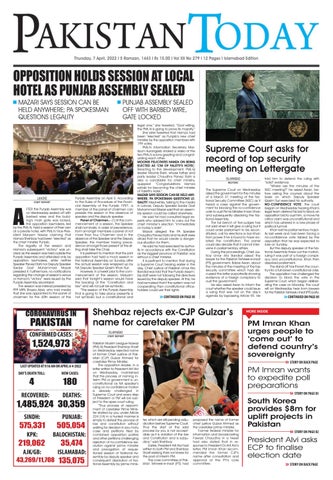
OppOsitiOn hOlds sessiOn at lOcal hOtel as punjab assembly sealed g
mazari says session can be held anywhere; Pa sPokesman questions legality
LAHORE
a
staff report
fter the Punjab assembly was on wednesday sealed off with barbed wires and the building’s main gate was locked, the opposition lawmakers, led by the Pml-n, held a session of their own at a private hotel, with Pml-n Vice-President maryam nawaz claiming that hamza shehbaz had been “elected” as the chief minister Punjab. the legality of the session and hamza’s subsequent “victory” was unclear as the session was held outside the Punjab assembly and attended only by opposition lawmakers, while neither speaker Parvez elahi nor deputy speaker sardar dost muhammad mazari presided it. furthermore, no notifications regarding the change of session’s venue or hamza’s “victory” were issued by the Punjab assembly secretariat. the session was instead presided by PPP mPa shazia abid, who told media that she was appointed to the panel of chairmen for the 40th session of the
pakistan
CONFIRMED CASES:
1,524,973
LAST UPDATED AT 9:16 AM ON APRIL 6-4-2022
DAY'S DEATH TOLL:
NEW CASES:
4
180 DEATHS:
1,485,924 30,359 SINDH:
PUNJAB:
575,331
505,054
KPK:
BALOCHISTAN:
219,062
35,474
AJK/GB:
ISLAMABAD:
43,269/11,708
Punjab assembly sealed off with barbed wire, gate locked
Punjab assembly on april 3. according to the rules of Procedure of the Provincial assembly of the Punjab 1997, a member of the panel of chairmen can preside the session in the absence of speaker and the deputy speaker. Panel of Chairmen.– (1) at the commencement of a session, the speaker shall nominate, in order of precedence, from amongst members a panel of not more than four chairmen and in the absence of the speaker and the deputy speaker, the member having precedence amongst those present at the sitting shall take the chair. it is pertinent to mention that the joint opposition had held a mock session in the national assembly on sunday after the actual session was wrapped up by na depute speaker qasim khan suri. however, in a tweet prior to the commencement of the session, maryam said that tonight’s session would have the backing of the “constitution and law” and will not just be symbolic. “the session of the Punjab assembly that is going to take place presently is not symbolic but a constitutional and
cOrOnavirus in
RECOVERED:
g
135,075
legal one,” she tweeted. “god willing, the Pml-n is going to prove its majority.” she later tweeted that hamza had been “elected” as Punjab’s new chief minister by the opposition members with 199 votes. Pml-n information secretary marriyum aurangzeb shared a video of the two Pml-n scions greeting and congratulating each other. Moonis feliCitates HaMza on being eleCted as ‘CM of faletti’s Hotel’: reacting to the development, Pml-q leader moonis elahi, whose father and party leader chaudhry Parvez elahi is also a candidate for chief ministry, quipped: “congratulations hamza sahab for becoming the chief minister of faletti’s hotel.” Mazari says session Can be Held anywHere; Pa sPokesMan questions legality: meanwhile, talking to the media in lahore, deputy speaker sardar dost muhammad mazari said that an assembly session could be called anywhere. he said he had consulted legal experts who advised him to carry out the chief minister’s election “immediately on today’s date”. mazari alleged the Pa speaker chaudhry Parvez elahi and his staff were afraid that he would create a dangerous situation for them. he said he had exercised his authority in accordance with the constitution as the biggest province of Pakistan was without a chief minister. it is pertinent to mention that during a supreme court hearing earlier in the day, chief justice of Pakistan umar ata bandial was told that the Punjab assembly staff were not following the directives issued by the deputy speaker. at this, he had remarked that if the system was not cooperating then constitutional officeholders could use their rights.
CONTINUED ON PAGE 05
supreme Court asks for record of top security meeting on lettergate ISLAMABAD reuters
the supreme court on wednesday asked the government for the minutes of a march 31 meeting of the national security committee (nsc) as it heard a case against the government for blocking the no-confidence vote to oust Prime minister imran khan and subsequently dissolving the national assembly. the full bench of five judges has not said when it will give a ruling but it could order parliament to be reconstituted, call for elections or bar khan from power if he is found to have violated the constitution. the panel could also decide that it cannot intervene in parliamentary affairs. during the proceedings, chief justice umar ata bandial asked the lawyer for the Pakistan tehreek-e-insaf (Pti) government, babar awan, about the minutes of the meeting of the top security committee which had discussed the letter purportedly showing evidence of a foreign conspiracy to oust the government. he also asked awan to inform the court whether the speaker could issue a ruling that was not on the day’s agenda by bypassing article 95. he
shehbaz rejects ex-CJP gulzar’s name for caretaker PM ISLAMABAD staff report
Pakistan muslim league-nawaz (Pml-n) President shehbaz sharif on wednesday rejected name of former chief justice of Pakistan (cjP) gulzar ahmed for caretaker Prime minister. the opposition leader, in a letter written to President arif alvi on wednesday, maintained that the process of naming interim Pm or government is unconstitutional as na speaker’s ruling on no-confidence motion is already challenged in supreme court and every step of President or Pm will be subject to the apex court ruling. “thus process of appointment of caretaker Prime minister started by you under article 224 (1a) in a hurried manner is simply to defeat the process of law and constitution without waiting for decision in sou motu case and petitions filed by combined opposition parties and other petitions challenging rejection of no-confidence resolution against prime minister and prorogation of requisitioned session of national assembly by deputy speaker and consequent dissolution of national assembly by prime minis-
told him to defend the ruling with “solid” evidence. “where are the minutes of the nsc meeting?” he asked awan, before asking the counsel about the basis on which deputy speaker qasim suri exercised his authority. no-ConfidenCe Vote: the court began on wednesday hearing khan’s legal team defend his bid to block an opposition bid to oust him, a move his critics claim was unconstitutional and which has ushered in a new phase of political turmoil. khan lost his parliamentary majority last week and had been facing a no-confidence vote tabled by the opposition that he was expected to lose on sunday. but the deputy speaker of the national assembly threw out the motion, ruling it was part of a foreign conspiracy and unconstitutional. khan then dissolved parliament. the stand-off has thrown the country into a full-blown constitutional crisis. the opposition has challenged the decision to block the vote in the supreme court, which began deliberating the case on monday. the court will on wednesday hear from lawyers for the Pakistan tehreek-i-insaf (Pti) party.
CONTINUED ON PAGE 05
more inside
PM imran khan urges people to ‘come out’ to defend country’s sovereignty STORY ON BACK PAGE
Pm imran wants to expedite poll preparations STORY ON PAGE 03
ter, which are still pending adjudication before supreme court. thus the start of the said process by you is not acceptable as it is violation of the law and constitution and is subjudice,” said shehbaz. earlier, President arif alvi had written to both Pm and shehbaz sharif seeking their nominees for the post of interim Pm. the core committee of Pakistan tehreek-e-insaf (Pti) had
proposed the name of former chief justice gulzar ahmed as the caretaker prime minister. former federal minister for information and broadcasting fawad chaudhry in a tweet had also stated that in response to President dr arif alvi’s letter, Pm imran khan recommended the former cjP’s name after consultation and approval of the Pti’s core committee.
south korea provides $8m for uplift projects in Pakistan STORY ON PAGE 02
President alvi asks ecP to finalise election date STORY ON BACK PAGE
02
Thursday, 7 April, 2022 | ISLAMABAD
NEWS
SoutH KoRea PRoviDeS $8m foR uPLift PRoJeCtS in PaKiStan iSLAMABAD
K
miaN abrar
OREA International Cooperation Agency (KOICA) has granted around $8 million to the government of Pakistan for executing various development projects with the collaboration of the Korean government. The KOICA is currently executing four projects that are in different stages of implementation, the spokesperson of the Embassy of the Republic of Korea said in a statement on Wednesday. She said there were multiple projects between Pakistan and Korea as in the business
sector, both the countries were partnering in the automobile, transportation, hydropower, smartphones, and confectionery production sectors. She said that the Korea Programme on International Agriculture (KOPIA) Pakistan Centre was inaugurated by the administrator of the Rural Development Administration (RDA) of the Republic of Korea, Taewoong Hur during his visit with the delegation in August 2021. He also chaired the Joint Symposium for Agricultural Technical Cooperation between both the countries, she added She further said that the technical Cooperation projects included self-sufficiency of virus free potato seed multiplication by aero-
Consumers to submit CniC copies for purchasing subsidized items: uSC GhuLAM ABBAS In a move to ensure that the Ramazan subsidy package is not misused, the management of the utility stores corporation has decided that consumers will have to deposit the copy of their CNICs for purchasing goods and items at the utility stores. According to officials, like the previous years the federal government has successfully launched the Ramazan Relief package through Utility Stores Corporation (USC) this year. The package provide subsidy on 19 basic items, while discounts of up to 15 per cent is being offered on over 1,500 items available at utility stores. However, to avoid misuse of the subsidy the USC has subjected the purchases with the submission of the copies of the CNICs. “This move will not only discourage traders and small shopkeepers who purchase items from the USC retail outlets, besides this will also keep a check at the USC staff who could sell the subsidised items mainly sugar, ghee and oil to certain shopkeepers,” said a senior official of the Utility Stores. The USC has said that almost all the USC retail outlets across the country have witnessed heavy rush of the buyers and more than 1.6 million families have benefited from this package since April 1.The USC has also asked the consumers to visit the stores as early as possibly in the day to avoid rush at more than 4,000 stores spread across the country. The USC has also implemented the computerised system at the retail and wholesale outlets of the USC from the start of Ramazan, which will help the regions identify the demand and supply situation at a faster pace.
SBP receives 20 applications for digital bank licences TLTP The State Bank of Pakistan (SBP) received an overwhelming response for digital bank licences, as 20 applications were received from a diverse range of applicants including domestic commercial banks, microfinance banks, electronic money institutions and FinTech players. The central bank in a statement on Wednesday said that it has concluded the process of receiving applications for digital banks licences as per its announced deadline of March 31, 2022. The SBP said that foreign players already operating in the digital banking space overseas have also expressed their interest to venture into the Pakistani market. The strong interest shown by both local and international players in SBP’s digital banks’ initiative reflects their confidence in the financial sector of Pakistan and the potential of the investment opportunities available in the country, said the statement. Earlier this year on January 03, 2022, the SBP launched its “Licensing and Regulatory Framework for Digital Banks”. While setting the foundation for the customers’ convenience, providing cost-effective digital financial services and promoting innovation for achieving SBP’s overall goal of digitisation in the banking business, the framework is primarily aimed at providing financial services to unserved and underserved segments of society. To achieve the intended objectives under this regulatory initiative, the applications were solicited from interested applicants who can demonstrate a strong value proposition, the robustness of technological infrastructure, the sufficiency of financial strength, a high level of technical expertise and the effectiveness of their risk management culture in the Digital Banks’ space, said the statement. The SBP developed and finalised this framework after an extensive consultative process. Initially, the SBP released an exposure draft of this Framework and a targeted survey was launched to invite feedback from a wide range of local as well as international stakeholders.
ponic technique, chilli production and postharvest management technology development in Pakistan, and establishment of production technology of major fodder crops in Pakistan. She said that in education sector cooperation, she highlighted that around 1,500 Pakistani students were studying in Korea in undergraduate and graduate programs. Global Korea Scholarship (GKS), she said, provides international students with opportunities to conduct advanced studies in undergraduate and graduate programs at higher educational institutions in the Republic of Korea in order to promote international exchanges in education and mutual friendship
between countries. “The Embassy of the Republic of Korea and the University of Peshawar jointly organized a seminar on the Current Situation in Afghanistan and the Regional Plans for Peace-building on the 8th of December at the University of Peshawar Campus. More than 200 Masters and PhD students attended the seminar and held interactive discussions over lunch with the Ambassador of the Republic of Korea Suh Sangpyo and the panelists,” she said. At the university level cooperation, PMAS-Arid Agriculture University Rawalpindi and the Chungbuk National University signed a memorandum of under-
Reappointment of Karakoram University’s VC challenged in GB Chief Court iSLAMABAD Ghulam abbas
The Chief Court of Gilgit Baltistan has sought comments from President of Pakistan (as Chancellor), Ministry of Kashmir Affairs & Gilgit Baltistan, Chairman HEC, Karakoram International University vice-chancellor and nine other respondents about a petition challenging the VC’s appointment. After holding a preliminary hearing, on Wednesday a bench consisting of Chief Justice Ali Baig and Justice Johar Ali Khan ordered the respondents to file comments about the petition. The schedule of the next hearing will be announced later. The petition is filed by Abid Hussain Advocate, who insisted that the respondent, Dr Ataullah Shah, was appointed the VC of the public sector University of Gilgit Baltistan in 2018 in violation of merit. The other respondents in the petition are Chairperson, KIU Senate, Dr. Muhammad Raza Chohan Member KIU senate as Representative HEC, Ejaz Ahmed Quarishi Senior Advisor Wafaqi Mohtasib Secretariat Islamabad (Convener Search Committee), and other members of the search committee including Prof. Dr. Muhammad Qasim Jan, Advisor COMSTECH, Islamabad, Prof. Dr. Sadruddin Pardhan, Aga Khan University Karachi, Prof. Dr. Muhammad Aslam Baig National Centre for Physics Quaid-i-Azam University Islamabad, Prof. Dr. Tassawar Hayat Quaid-i-Azam University Islamabad, Prof. Dr. Moazam Nizami
KIU and Assistant Professor Dr Abdul Razzak KIU. Ghulam Muhammad Advocate, lawyer for the petitioner, contended that Dr. Attauallah Shah neither has adequate leadership experience nor possess the required qualification and relevant sufficient length of academic management experience. During the appointment of the VC in 2018, the Search Committee (constituted to appoint the VC) had devised and published a faulty advertisement relaxing or not specifying the strict criteria for appointment of the VC by making substantial changes in the prescribed qualification and experience which was done arbitrarily and malafidely in order to accommodate the existing VC of KIU. He said the appointment of incompetent and inexperienced person on such high post is not only illegal and against the law but also against the fundamental rights of People of Gilgit Baltistan. The lawyer, who is also Chairman Global Village Forum International GB, said that the Advertisement dated 27-02-2018 was based on favoritism, pick and choose, arbitrary and unilateral, in order to accommodate, out of the way, Dr Ataullah Shah as vice chancellor and the impugned notifications dated 31-05- 2018 and 09-03-2022, about appointing Attauallah shah, were discriminatory, illegal and void ab initio. The counsel added that based on illegalities mentioned the illegal appointment of Ar. Attauallah Shah as VC KIU may be declared illegal void
ab initio and his furthermore the extension of second tenure from 01- 062022 to 31-05-2026 may also be declared canceled to meet the ends of justice law and equity. The lawyer said during selection of the VC in 2018, Dr. Muhammad Raza Chohan Director General (Academics) representative of HEC had showed his severe reservations on shortlisting of Dr. Attaullah Shah as candidate for VC because Dr. Shah neither has adequate leadership level experience which can be given any weightage for consideration against VC position nor possess relevant sufficient length of academic management experience. The counsel said as Engr. Dr. Attaullah Shah was not eligible to be appointed as VC of KIU due to not possessing of academic management abilities, attainments and portfolio as he has never performed the services of any university as professor, associate professor, assistant professor and even lecturer in his entire career, whereas to become vice chancellor in a public sector university a candidate must fulfill the minimum qualification/expertise of a professor i.e. 15 years teaching and research in HEC recognized university. He said Dr Attaullah Shah who started his job at Allama Iqbal Open University as Civil Engineer (BS-17) in 1999 and prematurely retired in 2016 as Project Director in BS-19 (Got LPR in2014) which also proves that Dr. Shah never worked as Academic Leader which is mandatory as per advertisement of KIU.
Victim of dogmatic triumphalism iffAT fArOOq The Marian Persecution has been replayed on the lands of Dera Ismail Khan on a spring morning, when the ghost of death, uncannily familiar to bloody Mary (Mary I of England) appeared, in front of a lady teacher, and mumbled “Something is rotten in the state of Denmark.” This rottenness has come in to inject not just the political bed but the whole array of society. Rotting, decay, corruption and festering has fogged the entire social topography and terrain. A female teacher at a girl’s seminary was killed by her three students. The deceased and the accused had apparently developed some differences over religious issues. The assailants blamed her of blasphemy. The accused students claimed that the slain teacher appeared in the dream of one of their relatives and said that the teacher had committed blasphemy. What era are we living in? At what speed are we accelerating towards a highly intolerant culture? The victim and the victorious both are women. How can such a brutal act be committed by the folk that has more compassionate instincts? Since sympathy and kindness is seen as a more feminine trait. Dogma, whatever form it takes, is the ultimate enemy of human freedom. Dogmas are collective conceptual prisons. And the strange thing is that people love their prison cells that give them a false sense of ‘I Know’. This was existent then, in the Church of England by Mary I in the 16th century, and is now being manifested here in this form, even in the 21st century. Stories, desires, imaginations and narratives of faith are closely interlinked with the humankind’s search for identity. Both are awe inspiring. Both beggar the imagination and both have competed for authority. The three students are conditioned girls in the remote area of KPK are a product of triumphalism.
There is no attempt to identify the truest of religion and stories disavow dogmatic religious triumphalism. This singular narrative of religious dogmatism has been born, nurtured and ranged through systematic social religious and culture narratives over the entire landscape of our society. It’s not just about the transformation of faith but it is also about how deeply untrue tales are sneaked into ignorant minds beyond every rural urban divide, form of gender discrimination, and the ignorant educated segment of the society. Everything is considered a risk in Pakistan. If someone protects a woman, it is a risk. If someone shields non-Muslims, it’s a risk and if someone discusses religion, it’s a great risk. For decades, clergy and clerics have been mustering and employing the masses’ sensitivities and sensibilities to capture the power and polity. A mentally unstable man was stoned to death in Khanewal district by more than three hundred villagers. A street vendor in Pattoki was brutally beaten and killed on minor charges at a wedding but festivities continued uninterrupted. A Sri Lankan, Priantha Kumara, living in Sialkot was burnt alive on blasphemy accusations. His lynching was recorded and shared widely over the media. Blasphemy laws have devastated the score of lives each year. Even the devoted Muslims are vulnerable. More than two hundred cases are hanging in courts on this very charge; according to the Human Rights Observers Report of 2022 by the Center of Social Justice. The startling fact of the report is that the largest chunk of accused people belong to the most vulnerable communities and are comprised of oppressed ethnic, religious minorities and women. Many have been hanged to death on mere accusations and false charges. Countless victims are languishing in jails for years with no hope for justice and judicial process that neither robustly facilitates and nor concludes the cases.
standing (MoU) where the institutions agreed to cooperate over a full spectrum of mutual interest with specific agreements on January 26th, 2022. It includes academic and technical staff exchange for joint research, and joint publication of research papers etc. Among the Korean government sponsored scholarships, 70 percent of students were studying mostly in engineering disciplines and 25 percent of the students were acquiring education in Natural Sciences, she added. She informed that the Korean embassy was also cooperating with the Pakistani government in addressing the climate change crisis.
British-Pakistani lawyer gets case reported in High Court of Justice London LONDON News Desk
A landmark decision from the High Court of Justice London reported on 16 March 2022 whereby an Afghan national claimant represented by famous Human Rights lawyer/Solicitor Mr Amer Manzoor, from Pakistani origin practicing in London and Counsel Mr Mansoor Fazli from 12-Old Square. This case of AHN, R (On the Application Of) v Secretary of State for the Home Department [2022] EWHC 582 is of important nature because according to the Hugh mercer QC sitting as a deputy Judge of the High Court London’s view- impact other similar cases. The Defendant in this case was Secretary of the State for the Home Department UK. The SSHD refused to grant the Claimant British Citizenship on good character grounds. The Claimant, a doctor’s naturalization application was refused because he was a member of the Hizb-e-Islami (HEI) in Afghanistan. The organisation was proscribed under the Terrorism Act 2000. This is also an interested case because newspapers articles whereby Margaret Thatcher meeting Pakistan’s military ruler President Zia-ul-Haq in 1980 were provided in support of the claim. This was also discussed in the judgement that those circumstances are material in consideration of assessing the character when the claimant joined the HEI during the time when the western allies were encouraging volunteers to join HEI in 1989 by providing weapons, financial and military support and that support continued for a period is to be relevant to the reasons for joining HEI. The Secretary of the state is to pay the £30,000 cost in this case. This landmark case is a good hope for those people their naturalization applications were refused on character base.
PDWP approves 17 projects worth Rs20bn Aziz BuNeri The Provincial Development Working Party (PDWP) has approved 17 projects worth Rs20 billion. However, most of the PDWP approved projects are in the home district of Chief Minister Mahmood Khan. The projects include the construction of Saidu Sharif college of dentistry, the reconstruction of Civil hospital in Mangalore, Swat. It also includes the upgradation of Basic Health Units in Guli Bagh, Fatehpur, Shamozai, Malam Jabba and Charbagh in Swat district. The projects also include projects related to agriculture, rural development, Board of Revenue, food and irrigation. The projects include the construction of roads in Chitral district. The PWDP also approved roads construction in Bannu and rehabilitation of roads in Haripur, Shabqadar, Charsadda. The construction of tehsil buildings, improvement of drainage and sewerage system of Haripur city along GT road was also among the approved projects. The body also approved the feasibility study of the establishment of center for homeless people. The PWDP also approved the construction of food warehouses in Bajaur District, Matni, Badhaber and Shah Alam in Peshawar and new tehsil complexes in lower Tanawal Abbottabad.
Thursday, 7 April, 2022 | ISLAMABAD
Pm imRan WantS to exPeDite PoLL ePaRationS NewS DeSk Keen on holding the elections in 90 days amid looming legal uncertainty over the dissolution of the National Assembly, Prime Minister Imran Khan on Tuesday chaired PTI’s Central Executive Committee (CEC) meeting and directed the party members to expedite the preparations for the snap polls. In this regard, the meeting approved the formation of a parliamentary board assigned with formulating the party’s policy on distribution of tickets to candidates, sources said. The current volatile political situation in Punjab also came under discussion during the committee’s meeting. “The opposition is looking for excuses to escape the field,” the prime minister was quoted as saying during the meeting.Healing rifts? Interestingly, the prime minister, who has remained defiant in the face of
internal revolt and mounting pressures, seemed to be trying to strike a conciliatory tone with estranged factions and heal the festering grievances, particularly in Punjab. “We will give priority to giving tickets to old party workers,” the prime minister announced during the meeting as he lamented that the coalition government was more susceptible to blackmailing. He asserted that there was no place in the part for “traitors” who harboured vested interests, adding that sincere and loyal workers would be brought forward. “We will form a government with a majority of our people,” PM Imran said, adding that he himself would monitor the process of awarding tickets. Earlier, sources told The Express Tribune that the premier was likely to meet with the disgruntled lawmakers of the party in Punjab as part of its attempts to calm the volatile situation in the province.
Services’ exports surge 18pc to $4.5bn in 8 months
from the opposition parties against Prime Minister Imran Khan over having links with the “foreign conspiracy”, the prime minister announced the dissolution of assemblies in an address to the nation.
Pakistan’s economic growth moderate, 4pc in FY22: ADB APP
TLTP Pakistan’s exports of services surged 18.17 per cent during the first eight months (JulyFebruary) of the current financial year 2021-22 as compared to the corresponding period of the last fiscal year. According to the data released by Pakistan Bureau of Statistics (PBS), the exports of services during July-February 2021-22 were recorded at $4,492.02 million against the exports of $3,801.18 million during July-February (2020-21), showing growth of 18.17 per cent. The services’ imports also rose by 39.20 per cent by growing from $5,089.31 million last year to $7,084.40 million during the period under review. Based on the figures, the services trade deficit was recorded at $2,592.38 billion this year against the deficit of $1,288.13 billion during the last fiscal year, showing an increase of 101.25 per cent.
It is pertinent to mention here that President of Pakistan Arif Alvi on April 3 dissolved the National Assembly on the advice of PM Imran. Immediately after Deputy Speaker Qasim Khan Suri ruled to reject the no-trust motion
After a strong economic rebound in fiscal year (FY) 2021, Pakistan’s economic growth is expected to moderate to 4% in FY2022 due to tighter fiscal and monetary policies before picking up again in FY2023, the Asian Development Bank (ADB) said in a report on Wednesday. According to the Asian Development Outlook (ADO) 2022, ADB’s annual flagship economic publication, Pakistan’s gross domestic product (GDP) growth is projected to slow to 4% in FY2022 from 5.6% in FY2021 as the government applies measures to reduce the current account deficit, raise international reserves, and cut inflation. Growth is expected to accelerate to 4.5% in FY2023 due to stronger private consumption and investment. “Pakistan’s economy is recovering steadily thanks to well-coordinated fiscal
and monetary responses to the pandemic,” said ADB Country Director for Pakistan Yong Ye. “These led to a remarkable expansion in the industry and services sectors. It is key to continue structural reforms along with appropriate fiscal and monetary policies to contain rising inflation and external imbalances. Comprehensive reforms in tax policy and administration are also critical to boosting revenues in order to fund essential public services. ADB is fully committed to supporting Pakistan’s sustainable development.” In FY2022, industrial growth is forecast to decelerate, reflecting fiscal and monetary tightening together with a significant depreciation of the local currency, and upward adjustments to domestic oil and electricity prices. Agriculture is expected to continue lending impetus to GDP growth supported by the government’s package of subsidized inputs and increased sup-
Hamza Shehbaz warns Pervaiz Elahi over his ‘anti-constitutional’ moves NewS DeSk Pakistan Muslim League-Nawaz (PML-N) leader Hamza Shehbaz on Wednesday warned Pakistan Muslim League-Quaid (PML-Q) leader and Punjab Assembly Speaker Pervaiz Elahi of dire consequences if he continues his “anti-constitutional” moves. Addressing a press conference, Hamza said that the opposition has more than 200 numbers and if Pervaiz Elahi has the required numbers, then why is he postpon-
ing the Punjab Assembly session over and over again. He said that PM Imran Khan and his allies are violating the Constitution openly. “Their workers and leaders broke into a hotel and tried to attack our members. The Supreme Court has taken notice of the matter,” he added. He said Pervaiz is an old player of violating the Constitution. “The country will be ruled by the Constitution and we will be able to live with dignity,” he maintained.
Qureshi refutes Maryam’s claim, says ‘threat letter’ was not ‘fake’ iSLAMABAD staff report
PTI leader and former foreign minister Shah Mahmood Qureshi on Wednesday denied the allegations levelled against him a day ago by PML-N Vice President Maryam Nawaz, who had said the Foreign Ministry was involved in a fake letter controversy. Maryam was referring to the “threat” letter Prime Minister Imran Khan claimed was sent to him by a foreign diplomat. The premier, while waving the letter during a jalsa in Islamabad, had maintained that the United States was trying to remove him from power and had conspired with the Opposition. The no-confidence motion against him was part of the same controversy, the PM had maintained. Addressing a press conference alongside former planning and development minister Asad Umar, Qureshi said that he categorically denies the allegations that the letter was manufactured in the Foreign Office. “This is the version of the Opposition, but I refute it,” he told journalists. “This letter is very real, therefore, do not create ambiguity around this matter.” Maryam had also said that soon after showing off
the “fake letter,” the PTI government transferred the ambassador, who had received the letter, to Belgium. “We posted the ambassador in Brussels because he was well-versed,” Qureshi said. “I have no idea who tells these things to Maryam.” Qureshi maintained that all those who had been working for the foreign ministry were “highly professional”. ‘NSC iNStruCted uS to Call SeSSioN’: Responding to Maryam’s allegations that PM Imran Khan used the platform of the National Security Committee (NSC) for his personal interests, Qureshi clarified that the NSC itself had instructed the government to call the members of the National Assembly for a meeting to discuss the “threat” memo. He said that the speaker invited the MNAs but the Opposition refused to attend the meeting. “Now all those people, who had been invited to the meeting but did not show up, are asking questions [related to the authenticity of the threat memo].” Qureshi continued: “This is a very serious matter and cannot be ignored.” ‘No-confidence motion right of Opposition’. The ex-foreign minister said that bringing about the no-confidence motion was the right of the Opposition, therefore, the matter — in light of the ongoing situation — is being heard at the Supreme Court.
port prices of wheat and sugarcane. Inflation declined to 8.9% in FY2021 but is expected to pick up in FY2022 to around 11% due to higher international energy prices, significant currency depreciation, and elevated global food prices from supply disruptions. As a net importer of oil and gas, Pakistan will continue experiencing strong inflationary pressures for the remainder of FY2022 from the jump in global fuel prices resulting from the Russian invasion of Ukraine. Inflationary pressures are likely to be less pronounced in FY2023, with inflation forecast to drop to 8.5% as fiscal consolidation progresses and oil and commodity prices stabilize. The ADB said it was committed to achieving a prosperous, inclusive, resilient, and sustainable Asia and the Pacific, while sustaining its efforts to eradicate extreme poverty.
NEWS
03
Cement despatches declined 6.25pc in march 2022 GhuLAM ABBAS Following the unprecedented increase in the cost of construction materials especially steel and cement, the cement despatches in the country continued declining. Cement despatches declined by 6.25 per cent in March 2022 as the total despatches during March 2022 were 5.04 million tons against 5.37 million tons despatched during the same month of last fiscal year. According to the data released by All Pakistan Cement Manufacturers Association (APCMA), local cement shipments by the industry during the month of March 2022 were 4.74 million tons compared to 4.56 million tons in March 2021, showing an increase of 4.02 per cent. Exports despatches suffered a massive decline by 63.77 per cent as the volumes reduced from 815,120 tons in March 2021 to 295,321 tons in March 2022. In March 2022, north based cement mills despatched 3.85 million tons cement in domestic markets showing an increase of 1.07 per cent against 3.8 million tons despatches in March 2021. South based mills despatched 897,697 tons cement in local markets during March 2022 that was 18.94 per cent higher compared to the despatches of 754,741 tons during March 2021. Exports from north based mills massively declined by 71.26 per cent as the quantities reduced from 280,411 tons in March 2021 to 80,584 tons in March 2022. Exports from south also reduced by 59.84 per cent to 214,737 tons in March 2022 from 534,709 tons during the same month last year. During the first nine months of the current fiscal year, total cement despatches (domestic and exports) were 40.81 million tons, which calculates to 5.81 per cent lower than 43.33 million tons despatched during the corresponding period of last fiscal year. Further analysis indicate that domestic uptake of the commodity reduced by 0.03 per cent to 36.17 million tons from 36.18 million tons during July-March 2021 whereas exports during the same period declined by a massive 35.04 per cent to 4.64 million tons from 7.14 million tons during JulyMarch 2021. In a statement All Pakistan Cement Manufacturers Association said that steep decline in cement exports is hurting not only the cement manufacturers but the government’s revenue collection and foreign exchange as well. There is an immense need to formulate industry friendly policies to catch-up our cement sales in international markets as well as to increase indigenous consumption of the commodity.
Thursday, 7 April, 2022 | ISLAMABAD
04
NEWS
Resolution condemning ‘foReign inteRfeRence’ in countRy’s inteRnal affaiRs submitted in sindh assembly KARACHI
P
staff report
AKISTAN Tehreek-i-Insaf (PTI) Sindh Parliamentarians submitted a resolution condemning foreign interference in internal issues of Pakistan in Sindh Assembly secretariat on Wednesday. Leader of the Opposition in Sindh Assembly Haleem Adil Sheikh, PTI parliamentary leader in the assembly Khurram Sher Zaman, President PTI Karachi Bilal Abdul Gaffar and others submitted the resolution. They also staged a unique protest in Sindh Assembly by hanging effigy of friends of USA on main entrance of the assembly building. PTI Sindh Assembly members also chanted slogans ‘friends of USA are traitors of Pakistan’ at the occasion. The resolution termed the efforts of opposition parties aimed at overthrowing government with foreign intervention as serious violation of democratic
norms and a very sensitive issue against integrity of the country. The PTI parliamentarians demanded that the august house should take action against the members who are part of the foreign guided conspiracy. PTI legislators speaking to media persons said that nation will not forgive the enemies of the homeland who were exposed before the nation. Haleem Adil Sheikh said that we are not against USA or any other country but conspiracies by foreign powers against the homeland are totally unacceptable to us and Pakistani nation will not remain silent against such conspiracies. Haleem Adi Sheikh alleged leadership of 3 major opposition parties of acting against the national interests and said that those three have gathered under the flag of USA and accepted White House as their centre of guidance. Today we have symbolically hanged effigy of the traitors of the home land, he added.
“Today, the proud nation has got a brave leader Imran Khan who says Our Ka’bah is one and we bow our heads only before Almighty Allah,” Haleem Adil Sheikh said adding that on the other side Shahbaz Sharif called the Pakistanis as nation of beggars. He said that he wanted to correct Shahbaz that Pakistani nation is not beggar but a selfesteemed and proud nation. PTI’s war against traitors is in its final stages and truth will prevail, he maintained. Haleem Adil Sheikh said that the ugly faces of the MQM have been exposed and they will not get a single seat from Karachi or Hyderabad in upcoming elections. Khurram Sher Zaman said that Prime Minister Imran Khan has exposed all the traitors of Pakistan and the entire nation stand united against them who acted on foreign directives and bargained their conscience and national interests. Chief Justice of Pakistan should take sou motu notice against acts of
treason and its perpetrators, he appealed adding that people of Pakistan awaiting judgement of the Supreme Court and Justice. He hoped that PTI in upcoming general elections will form government in Sindh like other provinces of Pakistan. Firdous Shamim Naqvi said that people who are defying speaker’s ruling with reference to article 5 of the constitution deserve action under article 6 against them. Treason cases should be instituted against them, he noted. Naqvi also lamented Muttahida Qaumi Movement Pakistan for its role in current political situation and said that Urdu speaking community has been aware that MQM-P is working for self-interests and not for nation. PTI in leadership of Imran Khan is striving for dignity, honour and progress of Pakistan and masses in upcoming elections will reject all those political parties who betrayed Pakistan and the nation, he maintained.
Twitter to test longed-for edit button SAN FRANSISCO afp
Twitter announced Tuesday it will soon start testing an edit button at its monthly subscription service. The ability to tweak tweets after firing them off has been a feature users have long yearned for at the one-tomany messaging platform. Word that testing of an edit feature will start in the coming months at Twitter Blue came after newly named board member Elon Musk conducted an online poll. In a tweet, Musk asked if people wanted an edit button at Twitter. Nearly 4.4 million votes were cast, some 73 percent of them saying “yes.”
“Now that everyone is asking… yes, we’ve been working on an edit feature since last year,” Twitter posted on its communications account. “No, we didn’t get the idea from a poll,” it added, poking fun at the Tesla boss. The San Francisco-based internet firm said it will kick off testing in the coming months to figure out what works when it comes to letting users tinker with posts after they have gone live. Twitter Blue lets people pay a monthly subscription fee of $3 to access special content or features. Blue is available on the Twitter application for Apple or Android smartphones in Australia, Canada, New Zealand and the United States, according to the com-
pany. Twitter announced Tuesday that Musk will join its board, boosting hopes the eccentric entrepreneur will lift the social media company’s prospects — although some observers expressed wariness of the billionaire’s influence. Twitter CEO Parag Agrawal called Musk “a passionate believer and intense critic of the service which is exactly what we need,” while Musk said he looked forward to soon making “significant improvements to Twitter.” Musk, who also leads the SpaceX venture and is the world’s richest man, on Monday had announced his purchase of 73.5 million Twitter shares, or 9.2 percent of the company’s common stock.
Body of medical student found from Hyderabad hostel KARACHI staff report
The body of a final year medical student was found in the hostel of a private university in Hyderabad and police said they were probing the matter from all angles. According to the administration of the university, the student has been identified as one Pehlaj. “The body was found from the hostel despite vacations of the final year students,” the administration added. The police while commenting on the situation said they have received a report of the incident and are probing the incident. Similar incidents have occurred in universities across Sindh in the past as
well. In an incident in November, the body of a fourth-year medical student, Nosheen Kazmi, was found in a girls’ hostel room. Before Kazmi, another girls’ hostel in 2019 witnessed the death under mysterious circumstances of a final year medical student, Nimrita Kumari.
Political crisis: What happens next? ISLAMABAD afp
The Supreme Court met for the third time Wednesday to rule on the legality of political manoeuvres that led Prime Minister Imran Khan to dissolve the National Assembly over the weekend and call for fresh elections. The court says it will only rule on whether the deputy speaker acted against the Constitution in refusing to allow a vote on a no-confidence motion against Khan — although that would affect the dissolution of the assembly. It also won’t consider the alleged “foreign conspiracy” that Khan says the opposition joined to unseat him. So what are the possible court rulings, and what would be the consequences? Here follows tHe likely scenarios: ‘It’s not our business’ The court could decide that the National Assembly is responsible for its own rules and regulations, and the refusal of the deputy speaker to hold a vote is a matter for lawmakers to settle. However, some legal analysts argue it is an issue for the court — according to the Constitution, the prime minister cannot ask the president to dissolve the assembly if a no-confidence vote is pending. Still, the court could decide the decision to refuse the vote effectively meant the matter was no longer pending, sending the issue back to the assembly — which would mean the dissolution likely stands. ‘tHe deputy speaker acted illegally’ In this case, the ruling would effectively nullify the subsequent decision to dissolve parliament, so lawmakers could be ordered to reconvene and Khan would almost certainly be booted out of office. There is precedent, however. In 1988, Muhammad Khan Junejo appealed to the court after the assembly was dissolved by thenpresident General Zia-ul-Haq, who had taken power in a military coup years earlier. It agreed his government had been dissolved unconstitutionally, but ruled that since elections had been announced anyway it was best to move on. No date has been set for elections in the current crisis, but a similar ruling could emerge. Also, in 1993, the court ruled president Ghulam Ishaq Khan had illegally dissolved the assembly — then with Nawaz Sharif as prime minister. Although the government resumed business, it lasted less than two months before being dissolved again. ‘tHe deputy speaker acted legally’ If the court rules nothing untoward happened, it seems likely all subsequent actions would also stand and Pakistan would go to the polls within 90 days. The rancour and bitterness the issue has unearthed means, however, that the country faces more political uncertainty. Past elections have been violent, messy affairs, and a campaign season beginning during the fasting month of Ramadan and continuing through the hottest period of the year will fray nerves and raise tensions. The stakes have also been raised by Khan’s anti-US rhetoric — a potential flashpoint during political rallies. ‘no appeals against our decision’ The Supreme Court has received a slew of petitions and countersuits on the saga. But it said it was taking the case “suo motu”, meaning on its own account. The Supreme Court is ostensibly independent, but rights activists say previous benches have been used by civilian and military administrations to do their bidding throughout Pakistan’s history. No ruling will please all parties, but as the highest court in the land, it would also be responsible for hearing any possible appeals against its own ruling. That seems unlikely, however, and a definitive decision will likely see a return to the status quo and another round of political squabbling. By law, an election must be held before October 2023.
China urges parties in Pakistan to uphold uplift, stability BEIJING staff report
China has said that all parties in Pakistan can stay united and uphold national development and stability. This was stated by Chinese Foreign Ministry spokesperson, Zhao Lijian while responding to a question during a briefing in Beijing about the current political situation in Pakistan. Zhao Lijian said China always follows the principle of non-interference in other countries’ domestic affairs. Terming China and Pakistan as all-weather strategic cooperative partners, Lijian said China and Pakistan relations will always stand unbreakable and rock firm.
CMYK
“History has proven once again that no matter how the international landscape may evolve, how our respective domestic situations may change, China and Pakistan relations will always stand unbreakable and rock firm,” he added. He expressed hope that China-Pakistan overall cooperation and China Pakistan Economic Corridor construction will not be affected by political situation in Pakistan. China calls for facts of Bucha incident to be verified, ascertained Responding to a question about reports showed that many civilians have been killed in the Ukrainian town of Bucha, Zhao Lijian said China attaches great importance to the humanitarian situation in Ukraine and is highly concerned with the harm to civilians.
“We have put forward a six-point initiative on alleviating the humanitarian situation and taken concrete steps to provide emergency humanitarian assistance to Ukraine. The reports and images of civilian deaths in Bucha are deeply disturbing,” he said. He added that the relevant circumstances and specific causes of the incident must be verified and ascertained. “Humanitarian issues shouldn’t be politicized. Any accusations should be based on facts. Before the full picture is clear, all sides should exercise restraint and avoid unfounded accusations. China supports all initiatives and measures conducive to alleviating the humanitarian crisis in Ukraine and stands ready to continue working with the international community to prevent harm to civilians,” he concluded.
Thursday, 7 April, 2022 | ISLAMABAD
NEWS Opposition holds session at local hotel as Punjab Assembly sealed continued from page 01 “The depuTy speaker can call The session in Bagh-i-Jinnah if he wanTs,” he said: However, a Punjab Assembly spokesperson said in a statement that the deputy speaker could not preside over a session of the assembly after the submission of a noconfidence motion against him. “Constitutionally, the deputy speaker does not have the authority to preside over any session,” the spokesperson said, adding that Mazari chairing any assembly session would be in violation of the Constitution. Punjab Assembly sealed off with barbed wire, gate locked Earlier, a large contingent of police carrying batons and equipped with shields was deployed outside the actual building of the assembly. Water cannons and Rescue 1122 vehicles were also present outside the assembly’s building. The development coincided with the submission of a noconfidence motion against Deputy Speaker Sardar Dost Muhammad Mazari, after he said the session for the chief minister’s election would take place tonight at 7:30 pm, but a spokesperson for the provincial assembly and Pakistan Muslim League-Quaid (PML-Q) denied the development. Bilawal decries sealing of punJaB assemBly: Reacting to the sealing of the provincial assembly, PPP Chairperson Bilawal Bhutto-Zardari decried that the deputy speaker had been “locked out” of the assembly on the day of voting for the chief minister’s election. The PPP chief said in a tweet: “If it takes 30 seconds to pull off a coup, it should take 30 seconds to undo a coup. Justice delayed is justice denied. After last week’s constitutional breakdown in Islamabad, today Punjab deputy speaker was locked out of [the] assembly on [the] day of voting for CM. Barbered [sic] wire around people’s house.” Earlier, Maryam announced that she would be reaching the Punjab Assembly at 7pm tonight to support Hamza. “To stand with Hamza who clearly has the majority, I will be going to [the] Punjab Assembly ijlaas (session) at 7[pm] Insha’Allah,” she tweeted.
JOurnALiStS, FAwAd ChAudhry get invOLved in heAted Argument OutSide SC
P
AKISTAN Tehreek-e-Insaf (PTI) leader Fawad Chaudhry lashed out at a journalist after he was asked to comment on corruption allegations against Farah Khan, a close friend of former first lady Bushra Bibi. During a press conference with PTI members Asad Umar, Shahbaz Gill and Ali Muhammad Khan, the former information minister was asked to comment on reports alleging that Farah Khan was involved in corrupt activities and had recently left the country with her husband. Fawad, vexed at the question, claimed that the journalist was a “hired phoney” and that he knew where the reporter acquired his ‘bribe’ from. He also began hurling abuses at the reporter. All the journalists present at the press conference
were enraged at Fawad’s actions and demanded an apology from him, only for him to question why he should apologise and to whom. Soon after, Fawad started his statement but was cut off by chants from the journalists who refused to listen to him. Observing the severity of the situation, the other PTI leaders tried to convince the journalists to listen to Asad Umar instead, as they were boycotting Fawad Chaudhry and not the other PTI members. Simultaneously, however, Fawad questioned why his colleague should speak instead of him and maintained that he had not told any lies. He demanded that he speak and everyone must listen. The journalists, in protest, dropped their microphones on the dais and said that they would not allow Fawad to speak unless he apologised to the re-
ported who he abused. The PTI leaders soon ended the press conference and left. Earlier this week, Farah Khan left for Dubai following the dissolution of the National Assembly in the wake of the no-trust move against Prime Minister Imran Khan. In addition to Farah, other leaders of PTI have also started to leave for abroad, Express News reported. According to sources in the PTI, Farah left for Dubai on Sunday, adding that her husband also resides in the Emirati state. It is pertinent to mention here that Pakistan Peoples Party chairman Bilawal Bhutto-Zardari as well as Pakistan Muslim League-Nawaz Vice-President Maryam Nawaz mentioned Farah Khan several times recently and accused her of being involved in corruption. staff report
US eases Covid-19 travel advisory for Pakistan WaSHington staff report
The US Centers for Disease Control and Prevention (CDC) and State Department eased government Covid-19 travel ratings for Pakistan. The CDC changed its Covid-19 travel recommendation for Pakistan to “Level 1: Low” which urges unvaccinated Americans to avoid travel to those locations. The government had on March 16 lifted most restrictions — in-
cluding mandatory self-isolation for people with the disease — aimed at stopping the spread of Covid-19. Pakistan has faced four infections waves in the last two years, which were effectively managed by the National Command and Operations Center (NCOC). On March 31, Pakistan has disbanded the National Command and Operations Center (NCOC), which was overseeing the Covid-19 response in the country, as the infection numbers were at the lowest
since the start of the outbreak early in 2020. “Today, as (NCOC) closes down, I want to congratulate the NCOC team and its leadership for a professional, nationally coordinated response to the pandemic,” Prime Minister Imran Khan said in a post on Twitter. “Our Covid response was recognised by international agencies and people in the field as one of the most successful globally,” Khan added.
Usman Buzdar denies allegations levelled against Bushra Bibi, Farah Khan
Pakistan has zero coronavirus deaths for third consecutive day iSLamaBad staff report
The nation registered its third consecutive coronavirus death-free day with all other indicators also nosediving indicating that the health crisis was taking its last breaths in the country. Pakistan on Tuesday reported 148 new Covid-19 cases, the ministry of health said on Wednesday. According to the data released by the ministry, the overall tally of Covid-19 cases has risen to 1,525,923, including 1,486,464 recoveries. There are 9,098 active cases in the country, including 310 patients in critical condition. Sindh is the most affected province in terms of the number of cases, with 575,949 infections, followed by Punjab which has reported 505,224 cases so far.
05
Former Punjab chief minister Usman Buzdar on Wednesday denied allegations levelled by the Opposition and estranged PTI leaders against PM Imran Khan’s wife Bushra Bibi and her close friend Farah Khan. “I vehemently deny the fabricated allegations levelled by Aleem Khan, Chaudhry Sarwar and other members of the Opposition and condemn them because there is no proof,” tweeted Buzdar. The former chief minister maintained that political transfers in Punjab during his time were solely carried out on the basis of “merit and rules and regulations”. “The uncrowned kings of money laundering and corruption have always had a habit of levelling baseless allegations against their rivals and institutions so that they could blackmail them when they are defeated in the political arena,” claimed Buzdar. The former chief minister said that those who have faced political defeat cannot hide their humiliation by “levelling baseless and fabricated allegations [on opponents].” “The PML-N and its followers have not been able to bring to light a single corruption scandal against me or my cabinet in three and a half years,” claimed Buzdar, adding that no irregular contracts, letters written in the Calibri font, fake trust deeds, Maqsood chaprasi, or any of his Mayfair flats have been discovered. “If you have proof, then show it. I worked with honesty in Punjab throughout the three and a half years,” said Buzdar. The former chief minister said that the Opposition cannot level accusations against housewives — be it the first lady or Farah Khan — without substantial evidence. “The only purpose is to criticise Imran Khan in any way — you will fail because no one can point a finger
at Imran Khan’s honesty!” said Buzdar. Buzdar’s response to the allegations has come a day after PML-N leader and former finance minister Miftah Ismail alleged that the handbag carried by Farah Khan costs $90,000. The former minister’s comment came after a picture of Farah went viral on social media. Ismail, while addressing a press conference alongside former prime minister Shahid Khaqan Abbasi, said that PML-N has been saying the same things that the estranged PTI leader Aleem Khan had previously said about Farah. The PML-N leader alleged that the first lady’s close aide “took the money” for the transfer of civil servants in Punjab. “Who did that money go to?” asked Ismail, adding that the PTI was claiming that Farah Khan cannot be a corrupt person as she was a “private person”. “She can engage in corrupt activities because she is friends with the wives of public officeholders. She was someone’s frontwoman,” alleged Ismail. Including Usman Buzdar into his broadside, Ismail said the former Punjab chief minister was “also someone’s frontman”. “When Aleem Khan claimed to inform Imran Khan about Usman Buzdar’s corruption but Imran Khan kept him, who was Buzdar paying?” wondered Ismail. He also asked who was Farah Khan paying the bribes. The former finance minister said that a picture was circulating yesterday showing her with a high-value bag. “Farah Gujjar, while using a Punjab government’s plane, carried a bag that was worth $90,000,” claimed Ismail. He added that in local currency, the bag was worth “Rs16.2 million”. staff report
Supreme Court asks for record of top security meeting on Lettergate continued from page 01 1The Supreme Court panel of five judges has not said when it will give a ruling. It could order parliament be reconstituted, call for fresh elections or bar Khan from power if he is found to have violated the constitution. It could also decide that it cannot intervene in parliamentary affairs. early polls: President Arif Alvi upped the ante Tuesday by issuing a letter to the opposition saying if they did not nominate a candidate for interim prime minister, the process would continue without them. Pakistan Muslim League-Nawaz (PMLN) president Shehbaz Sharif, who would have replaced Khan had Sunday’s vote taken place, said he would not participate. “The main issue is that the constitution has been abrogated,” he told reporters outside the court. “If we don’t get a remedy then Pakistan will, God forbid, become a banana republic.” Khan has already nominated former chief justice Gulzar Ahmad for the role. The military is facing growing opposition calls to weigh in on the legitimacy of Khan’s complaints about a foreign plot against him, which he said was being orchestrated by the United States. The United States dismissed the accusation. PML-N vice president Maryam Nawaz said the military should clarify if it had told a top-level security meeting that the United States had conspired with the opposition to topple his government, as Khan has said it did. “Imran Khan has used the National Security Committee for his political gains,” she declared late on Tuesday. The military insists it is not involved in politics.
Saudi Ambassador distributes gifts from King Salman to deserving iSLamaBad staff report
The Saudi Ministry of Islamic Affairs, Dawah and Guidance represented by the Religious Attaché in the capital of Pakistan, Islamabad, on Wednesday inaugurated the programs of the Custodian of the Two Holy Mosques, King Salman bin Abdul-Aziz Al Saud, at an Iftar for the faithful and distributed the gifts from the King Fahd Complex for Printing the Noble Quran in the city of Medina and translated meanings of the Noble Quran. The Ministry of Saudi Arabia is implementing three programs through the Religious Attaché in Pakistan during the blessed month of Ramadan for the current year in cooperation with the Islamic societies in vari-
ous cities and regions of the Islamic Republic of Pakistan. The Inauguration ceremony was held at the headquarter of the Religious Attaché in Islamabad, in the presence of Ambassador of the Custodian of the Two Holy Mosques to the Islamic Republic of Pakistan, Mr. Nawaf bin Saeed Al-Malki, and the Religious Attaché in charge of Pakistan, Mr. Mutaib bin Muhammad Al-Jedaei, and a number of Employees of the Kingdom’s Embassy in Islamabad. The Saudi Ambassador to Pakistan stated on this occasion that these blessed programs are among those programs that the Custodian of the Two Holy Mosques King Salman bin Abdul-Aziz, Directed to Establish in the Holy month of Ramadan, in a number of countries, including the Islamic
Republic of Pakistan, the ambassador added that he had received from Pakistani brothers all thanks and appreciation for the Custodian of the Two Holy Mosques and for the Crown Prince, asking the Almighty Allah to guide them for doing good. On the other hand, the religious attaché in charge, Mr. Mutaib bin Muhammad AlJadaei, had explained that the three programs included 1,750 integrated Ramadan baskets, benefiting 14,000, in addition to distributing 12 tons of luxury dates, 24,000 copies of the Noble Quran and translation of the meanings of the Noble Quran in Urdu and Sindhi and Pashto language, and will be implemented and distributed in coordination with the official Islamic societies. Moreover, it will be implemented and distributed with the coordination of official Islamic associations.
cmYK
06-07 Comments - 7th April 2022_Layout 1 4/6/2022 11:29 PM Page 1
Thursday, 7 April, 2022
06 COMMENT
Maqsood is a Robin Hood?
The crisis persists SC takes time to pronounce judgment
o
N March 24, violating constitutional provisions and parliamentary procedures the Deputy Speaker of the National Assembly disallowed members from presenting the no-confidence motion against Prime Minister Imran Khan when it was found that the majority of them were supportive of the no-trust move. Deputy Speaker Qasim Suri arbitrarily decided that the entire opposition comprising over 197 elected members of Parliament, was involved in a foreign plot to overthrow the government. It was claimed that this was also endorsed by the National Security Committee. This was sheer nonsense as the government failed to make public the NSC’s proceedings supporting the view. A day before the fateful National Assembly session, the PM had claimed that he still had a “trump card” or two up his sleeve that he would play a day before the opposition’s no-confidence motion. To avert attention from the constitutional violation, which has thrown the country into the dark abyss of a constitutional crisis, the PM has called on his party to prepare for elections. Keeping aside the issue of the alleged foreign conspiracy, the Supreme Court wants to determine the legality of the Deputy Speaker’s action. In view of the situation on ground this requires urgency. The government has taken the position that the Curt is not entitled to overturn the Deputy Speaker’s ruling. What the government wants is a prolongation of the court proceedings. Finding that it is likely to lose its government in Punjab, the PTI has urgently started preparations for elections. Its priority is to jail the main opposition leaders. This done, the PM will hold countrywide meetings where he will deliver high octane speeches to raise an anti-US wave, promise new pies in the sky and play the religious card. The delay in the Supreme Court’s verdict helps Mr Khan. He has already started issuing party tickets, with 135 party loyalists being the first recipients. He has directed party members to take out processions on daily basis. President Arif Alvi has permitted Mr Khan to continue to hold office till the appointment of a caretaker prime minister. Delay in the court’s decision would make it difficult to reverse the steps being taken by the PM.
How the no-confidence motion was funded?
Dr FariD a Malik
A
CCorDINg to Shahid Khaqan Abbassi, former Prime Minister and PML(N) Senior Vice-Presidentm, Maqsood is his relative who receives stolen money from Dubai. Though he is employed by ramzan Sugar Mills as a chaprhasi (peon) at a salary of rs 20,000 per month, his remittances in billions cannot be questioned by state authorities. Perhaps he is a 21st century robin Hood who robs from the rich to distribute amongst the poor while he himself survives on his basic income. According to the former PM the entire mechanism is kosher, but the FATF (Financial Action Task Force) thinks otherwise. Transfers of this magnitude have to be justified with money trails otherwise it falls into the category of laundering which the Western world is unwilling to digest as it is alleged that it has the potential of being used by terrorists to buy weapons. Today un-accounted finances are linked with terrorism. Such clandestine, questionable transactions cannot be justified. Maqsood and his employers have to be taken to task to satisfy FATF. Today financial corruption and money laundering are the biggest menaces faced by the country. The common law-based legal system is unable to contain this serious crime against the people of Pakistan. If the former PM admits on air that stolen money coming into the accounts of smallholders should not be a cause of concern for the state, then it clearly indicates a free-for-all scenario. The same person has also admitted to stealing elections in the past but then demands a
Cat out of the bag? PTI insiders’ allegations reach the PM
C
oULD anyone be more of a PTI insider than ousted Punjab governor Muhammad Sarwar? Not unless it was former Punjab Senior Minister Aleem Khan, who was once thought to be Prime Minister Imran Khan’s ATM. Both men have a grouse with Mr Khan, but especially over former Punjab CM Usman Buzdar. When both separately said that there was massive corruption in Punjab, through the shadowy figure of one Ms Farah Khan, the tale, even though apparently fantastic, deserves some credence. This is especially so because the story both men tell is not just the same, but also confirms rumours that had been swirling around Mr Buzdar, that everything in the provincial government, whether postings or executive decisions, was for sale, and that the sale price had to be paid to Ms Farah. She has now fled the country, but many question marks still remain. Quite apart from the optics of a party which had been elected for accountability and which alleged corruption by its predecessors, that both Mr Buzdar and Ms Farah Khan were linked to the Prime Minister’s wife, leads to the implication that Mr Khan benefited personally from what was a very basic level of corruption. It also explains Mr Khan’s clear reluctance to give up office, and especially to not allow the opposition to take control of the Punjab government. Whatever Mr Khan’s personal role in the matter, it is likely that an opposition administration would investigate the whole matter, and would do to Mr Khan things he had done to opponents. While posing as a knight in shining armour, clad with claims of honesty, he had not only labelled them unfit to talk to, but had also made sure that not just them but their daughters, sons and wives were dragged through the investigative process. Mr Khan would only be human if reluctant to face being at the receiving end of such treatment. Whatever Mr Khan’s reservations, the allegations by these insiders must be thoroughly investigated. According to the rumour mill, investigations have already been made, and the results placed before Mr Khan, only for nothing to be done. If that is the case, it will have to be determined how such investigations are to be protected, so that any corruption is stopped during the commission of the offence, rather than merely punished afterwards.
In the end, it is civil society which gives people a voice
MuhaMMaD anwar Farooq
A
perceptible and deep layer of groups and communities that exists between the individuals and the modern state is called civil society. In Pakistan, it is an emerging arena for social and political change. It includes various organizations and associations that represent the interests of the majority population. These organizations and associations include trade unions, bar associations, teacher’s associations, peasant organizations, student groups and charity organizations, etc. In the contemporary world, each society is continuously changing due to various social & political events, technological & economic advancements. Commonly, civil society provides ways for individuals to contribute to the overall process of social development for the common good. The outcome of such social development process is social accountability which involves corporations, faith-based and other organizations being accountable for their actions. Social accountability is necessary for the transparency of each process. It must be similar for all members of society. Commonly, civil society provides a platform for the disorganized to be organized. It provides ways for the empowerment of voiceless segments of society for spreading awareness on various social issues prevailing in society. Civil society also contributes to the governance process which includes policymaking and implementation. Simply, it pro-
Arif Nizami (Late) Founding Editor
Yousaf Nizami M. A. Niazi
Umar Aziz
Joint Editor
Joint Editor
Executive Editor
Lahore – Ph: 042-36300938, 042-36375965
The legacy of our brand of ‘Robin Hood’ continues. Jinnah’s political party is now being run by the Sharifs of Gawalmandi while Bhutto’s is firmly in control of the Zardaris of Nawabshah.
The writer is ex-Chairman, Pakistan Science Foundation. He can be contacted at: fmaliks@hotmail.com.
Civil Society and Social Change in Pakistan
Dedicated to the legacy of late Hameed Nizami
Editor Aziz-ud-Din Ahmad
free and fair contest now that he is out of the corridors of power. Nawaz Sharif the three-times PM faked his platelets results to avoid a prison term and proceed abroad for treatment. He resides in the expensive London homes of his sons whose source and money trail he has not been able to provide. According to the family, the money was gifted by the grandfather to his teenage grandsons to buy property. How it was transferred remains a mystery. It is alleged that it was kickbacks received from the construction of the 375-km M-2 Motorway that connects Lahore with Islamabad. According to the House of Sharifs It was purely a family transaction from the old man to his second-generation teens who decided to reside abroad; the PM had no say in it, he only awarded the Motorway contract to a Korean company in the best national interest. In the 1960s the Sharifs got a big break when they managed to get two industrial plots in the Kot Lakhpat area. Mian Sharif together with his six brothers formed the Ittefaq group. on one of the plots Ittefaq Foundry was built while on the other seven mansions were constructed after getting an NoC (No objection Certificate) from Dulux Paints factory next door. In 1985 when Nawaz Sharif managed to enter the corridors of power, the Sharif group emerged, leaving the brothers behind. Sharif Medical City and the palatial Jatti Umra Estate were built during the period in power. The Habib Bank Limited branch of New York was fined $250 Million for money laundering. It was alleged that huge amounts were transferred from the Jatti Umra branch to New York which was intercepted by the international regulators. Despite several warnings the activity continued, until a heavy fine was imposed together with shutting down of the overseas branch. The President of the bank also had to retire as part of the operation clean-up. The area around Jatti Umra was then developed and secured at state expense. With the change of government, the security staff was withdrawn but the development could not be. robin Hood was a legendary heroic outlaw who
operated in the Sherwood forest around the 14th century. He robbed the rich and defied the corrupt officials to serve the poor citizens. His defiance was symbolic, he remained outside the reach of law. I am not sure who is being served in the land of the pure with this stolen money as the overall state of the land is deplorable. Even basic amenities of life are out of reach of the common man. It seems our robin Hood is feeding the rich not the poor as they are getting poorer while the rich are getting richer. In reality Maqsood Chaprhasi’ is a conduit to skim the resources of the nation. He is not alone, there is a Papparwala in Karachi whose account has also swelled without his knowledge. To be fair to the legacy of the folk hero robin Hood, we should adopt new titles for our outlaws like ‘Sharif good’ and ‘Zardari Stood’. The Sharifs of gowalmandi are unique in many ways. They were the first to intermingle business and politics. They started the ‘monkey business’ in the state set-up. There is a famous Punjabi saying; “ anna wanday reorhian murh murh apnay ghar” (The blind man kept distributing sweets to his own household). Benazir Bhutto resisted this onslaught till the noconfidence motion against her elected government in 1989. Her street-smart husband Asif Zardari came to the rescue. He countered the glitter of gold with his own wealth. While Nawaz moved his voters to Changa Manga, Zardari flew them to Swat. In the end it was Changa Manga versus Swat, Benazir survived but politics did not. The control of Bhutto’s party remained with his daughter but after her assassination in 2007, Zardari took over. Now like PML (Nawaz) PPP (Zardari) is in the arena with No-confidence Motion 2022 being tabled in the National Assembly against another elected PM. Perhaps the funds are coming from the accounts of the Chaprhasis and Paparwalas who will be deprived of their wealth for no fault of theirs The legacy of our brand of ‘robin Hood’ continues. Jinnah’s political party is now being run by the Sharifs of gawalmandi while Bhutto’s is firmly in control of the Zardaris of Nawabshah. It reminds me of another famous Punjabi saying “Khoti Rahe Borh Thaley” (The She-Ass remained under the tree).
I
Karachi – Ph: 021-35381208-9
I
vides ways for all participants to build relationships and make connections based on their values, behaviours and beliefs to contribute to the common good. In developing countries, civil society is actively participating in the process of social change. Society is organized into different segments and each segment is working for its rights. For example,the women’s movement, lawyers’ movement, anti-government movements like PDM, religious movements and the struggle of teachers’ and doctors’ unions for their rights is gradually changing the face of society. Such movements put pressure on the government to deliver. The role of the media is always supportive of the struggling groups. In the significant presence of social media, it is not possible to strictly suppress such movements. Instead of such suppression or use of force, the government commonly prefers to sort out the issue with dialogue. Due to the pressure of civil society and the availability of communication resources, the governance style of the government is gradually changing. Civil society has also a deep impact on culture. Culture is a complex whole which includes knowledge, belief, art, morals, law, custom, and other capabilities acquired by people as members of society. The important force that can cause a culture to change is the evolutionary processes in the civil society as well as exposure to other cultures, political and economic philosophies, social structures, religions, languages, and styles of education. Western influences are gradually affecting the Pakistani culture. The situation of implementation of human rights in Pakistan is a complicated issue. Western ideas have changed the educational paradigm in the country. In Pakistan, the women’s march is another powerful factor of social change which is also based on some inspirations from the West. It is gradually enabling women to play their effective role in different sectors like politics, high profile jobs and international
Islamabad – Ph: 051-2204545
sports. It is a movement against gender inequality. The conversion of the joint family system into the nuclear family system is changing the social interface. Now the Pakistani youth believe in independence and individuality. These have become causes of evolution in civil society and appeared as a candid cultural and social change. Now the media has become an important contributor to social change due to its power to rapidly disseminate information to the masses. In Pakistan, the media is playing a positive role in spreading awareness on gender bias, poverty elimination, harmony and peace. The coverage of foreign content by the media is gradually reshaping the cultural, social and religious values. But on the other hand, thr media is also working positively to educate the masses about prevailing social and political issues and religious harmony. It is also highlighting the movements and struggle for change. Pakistani society is continuously changing due to all the above-described factors. It is swinging between two poles; one is tradition and the other is modernism. People want to adopt a modern lifestyle and benefit from modern urban facilities. Due to technology, media and modern education, exposure to western ideas is unavoidable. Interestingly, it is a priority of the middle class to evolve a way to carry tradition and modern lifestyle in parallel. A candid conflict is observable between the advocates of tradition and modernism. Currently, Pakistani society is partially traditional as well as partially modern. It is in a transition phase. Now, civil society must play its role to identify the change, to develop acceptability of change and to maintain a suitable pace of change because it will help to promote stability and peace. Indeed, such a balanced and peaceful society is necessary for the prosperity of our nation.
Interestingly, it is a priority of the middle class to evolve a way to carry tradition and modern lifestyle in parallel. A candid conflict is observable between the advocates of tradition and modernism.
I
Web: www.pakistantoday.com.pk
I
The writer is working as a lecturer in the department of humanities and social sciences, Khwaja Fareed University of Engineering and Information Technology, Rahim Yar Khan, Pakistan.
Email: editorial@pakistantoday.com.pk
06-07 Comments - 7th April 2022_Layout 1 4/6/2022 11:29 PM Page 2
Thursday, 7 April, 2022
COMMENT 07 Editor’s mail
Send your letters to: Letters to Editor, Pakistan Today, 4-Shaarey Fatima Jinnah, Lahore, Pakistan. E-mail: letters@pakistantoday.com.pk Letters should be addressed to Pakistan Today exclusively
Afforestation
Gender bonds: Unlocking the full potential of women empowerment Empowering women can also help greening economies
SyeD aSiM ali Bukhari, aSSociate ProFeSSor Dr. Fathyah haShiM anD ProF. Dr. azlan aMran
W
oMEN’S empowerment can only be achieved by facilitating the female population in attaining control over various areas of their lives. The attainment of gender equality is a human right, not a female fight, which can be made possible by providing women with strength, self-confidence and power by ensuring effective financial inclusion for women. The vision of women’s empowerment cannot be fulfilled without the development of women’s economic empowerment through financial inclusion. The lack of financial inclusion proves to be a major obstacle in the path of women’s empowerment. This problem is faced by a majority of developing countries like Pakistan. Based upon the Financial Inclusion Insights (FII) Survey 2020, the financial inclusion in Pakistan was approximately 21 percent. According to the available data, 36 percent of Pakistan’s adult male population is considered financially included whereas the ratio for adult women is still in the single digits, that is 7 percent. Pakistan ranked at 151st out of the total 153 countries in the global gender gap report 2020, having only Iraq and Yemen ranked lower. In comparison, Malaysia ranked 104th in the global gender gap report 2020. In this regard, on 17 September 2021, the State Bank of Pakistan (SBP) launched the “Banking on Equality Policy: reducing the gender gap in Financial Inclusion” to enhance women’s financial inclusion in Pakistan. The policy will prove to be a major milestone in shaping the landscape for women’s economic empowerment in Pakistan. This policy aims to achieve 20 million active women-owned accounts by the year 2030 and introduce women-centric financial products and services. Progress toward gender equality is not solely a question of greater investment, but also of having a wider variety of gender investments available to investors can accelerate this progress toward a more equal future. gender Bonds can play an important role in this regard by financing various projects related
to the socio-economic advancement and the empowerment of women. globally gender Bonds are still at a nascent stage of development.on 19 May 2021, the Securities and Exchange Commission of Pakistan (SECP) issued the gender Bonds guidelines for financing projects related to women’s economic empowerment. gender Bonds are a type of social or sustainability bond that can prove to be a game-changer for a country’s green economic transformation. As investors have become more sensitive to issues of women’s empowerment, the greater acknowledgment by investors will induce demand for more gender Bonds and induce more capital from a more diverse set of investors. A key catalyst to this acknowledgment will be a deeper understanding of the impact that gender Bonds can deliver alongside the financial returns they can generate. A key potential of gender bonds is the creation of bonds that are gender equality-focused but have the use of funds policies that address multiple issues. By diversifying the use of the proceeds framework for gender bonds, issuers may attract a wider base of investors who may not have considered gender Bonds beforehand,thus broadening the investor base .For example, gender Bonds can also play a vital role in the attainment of UN-SDgs 2030. gender Bonds, by investing in the full and effective participation of women in economic life, also have the potential to support efforts on poverty eradication (UN-SDg # 1), full and productive employment, promotion of sustainable industrial development and decent work (UN-SDg # 8 and 9), peaceful and inclusive societies (UN-SDg # 16). Pakistan can move forward in the journey of women’s empowerment through the issuance of gender bonds for financing to women-centric projects such as the provision of essential services including education and vocational training projects especially in rural areas; healthcare facilities; financing and financial services for women; housing and car financing schemes with low-interest rates; safe and dignified transportation service for females; development of daycare projects. on a global level the sustainable bond issuance has been growing rapidly, both in terms of volume and types of instruments. In 2020, sustainable bonds of approximately $732.1 billion were issued. Between the years 2017 to 2021, the International Finance Corporation
raised $3.8 billion through issuing 63 social bonds in 11 different currencies. gender-smart financing can be significantly increased through mainstreaming gender considerations and promoting gender equality in sustainable bond issues, including green, social, sustainability, and sustainability-linked bonds. To increase women’s empowerment via gender bonds is by issuing gender bonds that have green and social mandates as well.This will not only widen the gender bond market by adding different mandates and key performance indicators,but the market may also shift toward different understandings of gender impact. The issuance of gender bonds will encourage gender Lens Investments which is based on the premise that investing in companies that promote gender equality through their internal policies or through their business activities, is not only morally responsible, but can lead to higher financial returns. To accelerate Pakistan’s sustainable economic growth, it needs to be ensured that the female population is economically active. Banks can also provide low-interest-rate financing schemes to women entrepreneurs for green or ecofriendly businesses. The proceeds from the issuance of gender bonds may also be invested in organizations providing equal employment opportunities to females or breaking the glass ceiling with female leadership. The provision of suitable, affordable and quality financial services to all segments of society contributes to balanced as well as sustainable economic growth and development.gender inequality poses a significant threat to alleviating poverty and boosting shared prosperity. gender bonds can prove to be an indispensable tool to enhance women’s empowerment, especially in developing countries. Women’s economic empowerment is central to realizing women’s rights and gender equality. Advancing equality and diversity in the banking sector is a compelling proposition rather than a zero-sum game. Establishing gender as a pillar of strategies will produce a swifter and more-inclusive transition to sustainable energy.
Women’s economic empowerment is central to realizing women’s rights and gender equality. Advancing equality and diversity in the banking sector is a compelling proposition rather than a zero-sum game. Establishing gender as a pillar of strategies will produce a swifter and more-inclusive transition to sustainable energy
All the authors, Syed Asim Ali Bukhari, Associate Professor Dr. Fathyah Hashim and Prof. Dr. Azlan Amran, are associated with the Graduate School of Business, Universiti Sains Malaysia, Penang, Malays
IN recent years, Karachi has lost much of its greenery owing to the growing urban developments. The absence of urban planning and the disinterest of the authorities are pushing the city towards destruction. Trees have been cut down for real estate developments, something which has drastically reduced the green belts and will contribute to environmental damage. green belts help combat climate change as greater tree cover provides shelter belts for crops; improves soil and water quality; and supports wildlife, etc. Even the mangrove forests in Karachi are faced with an existential threat because of industrial pollution, untreated municipal waste, local communities cutting down trees for firewood, and coastal development projects. Mangroves support marine life and act as a barrier against flooding and coastal erosion. Thus, they need to be protected. We are already witnessing the impact of climate change with heatwaves becoming more regular, which is a cause for alarm and requires immediate action. Whilst the Prime Minister’s ten billion tree programme is well-timed, it does not educate the common man on climate change and the importance of afforestation. Many people are still unaware of the risks of climate change. Therefore, people should be informed of climate change and ways to combat it through a widespread campaign. In the past, many projects have been undertaken in the city with little regard for the environment. The government must formulate policies barring real estate developers from cutting down trees. Before developing projects, the environmental costs must be considered, and the environmental damage should be compensated for by building new roads in residential and industrial areas. Kinza Fatima Karachi
Fatal highway THE National Highway in Balochistan previously known as the regional Cooperation for Development Highway (rCD Highway) has become a death trap because of the high number of accidents that occur every day. The highway provides a direct link from Quetta to Karachi and is also the only highway that links Balochistan to Afghanistan and Iran. Many locals suspect that the number of deaths on the highway could be as high as 6,000 per year. The single carriageway and high flow of traffic coupled with reckless driving is the main reason for fatalities. The single track also links the districts of Lasbela, Khuzdar, Surab, Kalat, and Mastung to Quetta, which is why it is severely congested during rush hours. Across Balochistan, poor roads and single-lane highways have been the major cause of daily casualties. The condition of the highway reflects poorly on the country as it is the main link to different industrial areas and is the second-largest highway in Pakistan. The relevant authorities must reconstruct it and convert it into a multi-lane highway to ease the flow of traffic and ensure the safety of all passengers. Also, motorway police must be always present to regulate traffic on busy routes. CCTV cameras should be installed to keep a check on the traffic and act against those found violating traffic rules. Lastly, the commissioner of the Kalat division must draw schedules for buses and other heavy vehicles to avoid traffic congestion on the routes as this will help curb accidents and reduce traffic. JavEd ahmEd Khuzdar
GM crops AroUND the world, genetically modified (gM) crops are used to improve agricultural activities and combat climate change. gM crops first emerged from the use of contemporary techniques of biotechnology/genetic engineering. The specific genetic material derived from plant, animal, microorganism, or synthetic material is introduced into different species of plants. These crops possess many novel properties including herbicide and virus tolerance, resistance to drought and salinity, and useful excretion during growth. Although the use of gM crops remains a contentious issue, it is considered as the solution to several food and agricultural problems. It can speed up food production for the fast-growing population, reduce the use of pesticides and fertilizers, and help combat global warming. However, it threatens biodiversity because of the adverse effects of the crops, and the long-term impact it has on humans remains unknown. Nonetheless, many countries such as the US, Argentina, Brazil, China, etc have been leaders in gM crops. Considering that Pakistan is heavily reliant upon agriculture, many farmers have favoured the use of gM crops i.e., cotton and maize, which have been our major exports. However, Pakistan’s research focus shifted because of the development of insectresistant and herbicide-tolerant crops. To fight the impact of climate and environmental change on crops, Pakistan must refocus on the research of a variety of crops. The government must support the agricultural sector by allocating funds and resources to explore gM crops and genotypes of other crops that can lead to a greener and prosperous Pakistan. intiKhab ulFat Karachi
Resolving issues THE socio-political situation in the country is extremely tense as the masses struggle with rising inflation, unemployment, and other issues while the government and opposition are involved in a futile war ahead of the vote on the no-confidence motion against the prime minister. The incumbent government has accused the opposition of buying their loyalists hailing from the ruling party. While the opposition claims that the prime minister has lost a majority in National Assembly and should resign from his premiership. This is not the first time that the country is witnessing a game of musical chairs among political figures. Since the inception of the country, democracy has been weak because of dishonest politicians who have been focused on their gains. Mutual toleration and cooperation are absent amongst the government and opposition. None of the political parties seem to be interested in the development and betterment of the country. Instead of seeking power for themselves, both the government and the opposition should work on improving the lives of the masses and reforming state institutions. The need of the hour is to address the issues faced by the masses and steer the sinking economy towards recovery. The country requires a mature political leadership that can resolve domestic issues and engages diplomatically with regional and international players. muhammad SuFyan bhimbEr
08 WORLD VIEW 7th April 22_Layout 1 4/6/2022 10:17 PM Page 1
Thursday, 7 April, 2022
08 WORLD VIEW
NATO iS A dANgeR TO WORld peAce. iT muST gO THE CURRENT CONFLICT BETWEEN RUSSIA AND UKRAINE IS ROOTED IN THE EXPANSIONARY LOGIC OF THE MILITARY ALLIANCE
IndIan ExprEss D. Raja
T
he war in Ukraine has brought the spotlight on the North Atlantic Treaty Organisation (NATO). NATO was formed in the aftermath of the Second World War by the Western powers in response to the rise of the USSR. The rapid allround progress made by the USSR, a planned socialist economy, made the capitalist economies uneasy and insecure. Thus, the capitalist West evolved a strategy to contain the spread of socialist ideology and NATO became its military instrument. NATO began as a military partnership between the leading capitalist nations of the world, led by the United States of America, ostensibly for “collective security”. But its real motive was to encircle the USSR and other socialist states in eastern and Central europe. The West made a narrative that Western europe is facing a military threat from the Soviet Union. The USSR-led Warsaw Pact came into existence only after NATO integrated West Germany into the alliance and started weaponising the region. The USSR at that time was supporting national liberation movements in the Third World. With the disintegration of the USSR in the early 1990s and the collapse of other socialist regimes in eastern and Central europe, NATO should have been dissolved. Instead, it was refashioned and expanded to realise the hegemonic ambitions of the US, which sought to build a unipolar world order. Ironically, NATO did not militarily intervene formally even once in the Cold War era; it started after the disintegration of the USSR! The leaders of Western powers had assured Soviet leader Mikhail Gorbachev in the 1980s that NATO would not expand into the east. But it kept expanding,
and now has 30 member states in the place of the original 12 — all the Warsaw Pact allies except Russia are now NATO members. Destruction and instability have marked NATO’s footprints. NATO’s involvement in Kosovo is well known. Over 500 civilians lost their lives due to NATO’s indiscriminate bombing in that campaign. During the 11-week long bombing, the Chinese embassy was destroyed causing an international furore. The Afghan war, according to the Costs of War Project led by Brown University, saw 1,76,000 deaths between 2001 and 2019. Over 46,000 of the dead were civilians. Similarly, the US-led intervention in Iraq resulted in over 1.5 lakh deaths from March 2003 to 2010 — 80 per cent of them civilians. NATO’s intervention in Libya to enforce a no-fly zone is estimated to have killed more than 400 civilians. Close to a million people have died in wars in Afghanistan, Iraq, Syria, Yemen etc. These numbers do not include indirect deaths nor do they reveal the havoc wreaked by forced migration, loss of property, psychological damage or geopolitical instability. NATO has a state-of-the-art arsenal and a combined defence expenditure of $1.036 trillion (2019) compared to Russia’s $60 billion defence budget. Moscow’s apprehensions of NATO reaching its borders need to be considered in this backdrop. After the deterrence offered by the USSR ended, NATO has become an instrument to achieve the US’ foreign and defence policy objectives in europe and Asia. A body of the size and influence of NATO, with its 30 members accounting for close to 60 per cent of the global defence expenditure, enjoys a disproportionate advantage and mastery over the international scene by its mere existence. The fact is that NATO’s continuous expansion and involvement in world affairs is a threat to global peace and a just world order. Peace-loving people and states of the Global South should be opposed to the very idea of such a military alliance for it thoroughly distorts the level-playing field at the international level where every nation state is supposed to be equal. As NATO’s track record suggests, instead of the “collective security” it promised, it has only offered grave insecurity to nations opposed to US interests. Its needs have filled the coffers of the military-industrial complexes and monopolies, effectively diverting funds from vital programmes that could otherwise be deployed to improve the lives and livelihood of the people. The current conflict between Russia and Ukraine is rooted in the expansionary logic of the military alliance. We oppose the ongoing war in no uncertain terms. It should be stopped immediately and the parties should engage in a dialogue. At the same time, questions must be asked about the cost of NATO to humanity. If peace is to prevail in the world, NATO should be disbanded.
Strongmen and straw men: South Asian crises over Russia’s war MR MODI IS QUIET ABOUT HIS TRUE INTENTIONS. THIS RAISES HOPES IN MOSCOW OF INDIAN SUPPORT, HOPES IN BEIJING THAT DELHI MIGHT FORSAKE WASHINGTON, AND CONCERNS IN THE WEST THAT INDIA’S PRIME MINISTER PUTS A PREMIUM ON HIS NATION’S IMMEDIATE INTERESTS RATHER THAN ASPIRATIONS TO BE A NATURAL ALLY GuardIan EDitoRial
F
LYING from Islamabad to Colombo gives a bird’s-eye view of the fallout from war over the subcontinent. The three nations under the route are all governed by nationalists who won office by trading in populism. having gained power, such politicians tend to have a messianic faith in their capacity to effect sweeping change. This belief is being tested, perhaps to destruction, in south Asian democracies with a combined population of 1.6 billion people. Pakistan’s prime minister, Imran Khan – who was in Moscow as the tanks rolled into Ukraine – claimed last week that the US had “threatened” him and tried to instigate regime change. Mr Khan has been at loggerheads with the west since Pakistan abstained in the UN resolution condemning Moscow’s attack. Mr Khan has refused to leave quietly. Instead of facing a no-confidence vote that he would have almost certainly lost, he precipitated a political crisis by dissolving parliament. Pakistan’s judges now have the casting vote on the prime minister’s fate. At the other end of the flightpath is Sri Lanka’s hardline president, Gotabaya Rajapaksa. he imposed a state of emergency to forestall a popular revolt. With four brothers in the cabinet, the Rajapaksas dominate Sri Lankan politics. Their supremacy is largely down to the damaging polarisation of the country along religious and ethnic lines after a bloody civil war. Mr Rajapaksa’s quixotic economic policies came unstuck when the
war in Ukraine sent energy and commodity prices soaring. There is little sign of rational measures to halt the downward spiral. South Asia’s biggest strongman is India’s prime minister, Narendra Modi. Like Jair Bolsonaro in Brazil and Mohammed bin Salman in Saudi Arabia, Mr Modi has remained neutral on the war – refusing to condemn Vladimir Putin and sidestepping US-led sanctions. Delhi is caught in a bind. Despite clashes along their shared border, India’s trade with China has set new records. While the past decade has seen India deepen security ties with the US to balance Beijing, Russia still provides about half of India’s arms imports. This dependence might explain why, when Indian students in Ukraine were being killed by Russian bombs, Mr Modi’s ministers blamed them for being in harm’s way. Mr Modi is quiet about his true intentions. This raises hopes in Moscow of Indian support, hopes in Beijing that Delhi might forsake Washington, and concerns in the west that India’s prime minister puts a premium on his nation’s immediate interests rather than aspirations to be a natural ally. This may heighten Mr Modi’s sense of India’s difference, and see him embrace greater self-reliance. This would be welcome if his nation’s economic performance had been helped by his policymaking. But his penchant for dramatic gestures has stymied India’s rise. Russia’s invasion of Ukraine could shape the contours of a coming wider global struggle between autocracy and democracy. history might side with that perspective – but it seems a straw man argument in a region where the slide into rightwing, nationalist populism should be, right now, a bigger concern.
Why liberalism has few friends in Asia IN THE ASIAN REGION, THE LIBERAL WORLD ORDER BACKED BY THE UNITED STATES APPEARS TO BE FALLING APART. THE CREDIBILITY OF THE AMERICAN BELIEF THAT “LIBERAL PEOPLES” ARE ENTITLED TO DEAL WITH “OUTLAW” STATES THROUGH “FORCEFUL SANCTIONS AND EVEN … INTERVENTION” IS CRUMBLING. IN MANY PARTS OF ASIA, AMERICA IS NO LONGER COOL Lowy InstItutE john KEanE
A
nxieties about the fate of liberalism are everywhere rising, as Francis Fukuyama makes clear in his latest defence of ideals he once described as “the endpoint of mankind’s ideological evolution”. Discontent with liberalism’s double standards and political resistance to the wealth inequalities generated by liberal, pro-market governments are flourishing. A new form of strong-state despotism is spreading globally. And, contrary to Fukuyama’s claim that liberalism was until recently “the dominant organising principle of much of world politics”, careful examination shows that his “end of history” fable was never applicable to the Asian region, where for several reasons liberalism failed to prevail. Considered as an early 19th-century european word for describing and recommending a way of seeing the world and acting politically to decide who owns what and how rights-bearing people should be governed, liberalism was from the outset an expansionist imperial project that impacted heavily on the Asian region. Analysts of the liberal script have sometimes overlooked this. For instance, Karl Polanyi’s classic account of the 19thand early 20th-century rise and fall of liberalism, The Great Transformation (1944) contains only fleeting, one clause references to “the British and the Russians … competing with one another in Asia” and to the way “China was forced by invading armies to open her door to the foreigner”. The silence is odd, for truth is that european liberals vigorously promoted the acquisition and government of colonies. James Mill’s ruminations on India and his son J.S. Mill’s defence of imperialism as the bringer of progress and civilisation to historically backward peoples (“barbarians”) are just two of many recorded examples.
even though the region today is home to plenty of avowed liberals, liberal networks and foundations, the reputation of liberalism in Asia was permanently damaged by the violent predation unleashed by liberal imperialism. In Indonesia, for instance, Dutch liberals cheered on imperial rule against the “lower races”, with new taxes and laws imposed, battles fought, cruelties dispensed and local rebellions crushed underfoot. european liberalism’s old love of Leviathan stretching back all the way to Thomas hobbes proved infectious. After independence, the instruments of military rule it helped to build were bequeathed to post-colonial rulers, as in Burma and Pakistan. historically speaking, liberalism gave liberalism a bad name, for which eventually public apologies would be made for the hypocrisies, degradation, and violence it left behind. The damage inflicted on the peoples of Asia by liberal imperialism was not easily forgotten, and it produced backlashes and left behind a motley assortment of polities, none of them “liberal”, if by that is meant commitment to the first principle set out by John Rawls in A Theory of Justice that “each person is to have an equal right to the most extensive system of equal basic liberty compatible with a similar system for all”. The list is familiar: imperial “fascism from above” or “cool fascism” (the phrase coined by hasegawa Nyozekan) in Japan; murderous totalitarianism in Cambodia; a large crop of cruel secular or communist military dictatorships (South Korea, Thailand, Laos, Indonesia); corrupted monarchies (Thailand); a non-liberal, secular, democratic republic in India; and (as James Scott pointed out in The Art of Not Being Governed) communities in upland Southeast Asia who consciously opted out of state rule. New Zealand and Australia, both former white-dominated colonies, are said to be regional exceptions, but they are better described as settler social democracies founded on the large-scale murder and marginalisation of indigenous peoples. No model “liberal” political order
appeared out of the ashes of liberal imperialism. except the United States, a global empire that seized the moment, claiming to be “liberal” and the military and economic guarantor of what came to be called the “free world” and the “liberal order”. The past half century of neo-liberalism, as it is widely called in the Asian region, hasn’t helped the reputation and appeal of liberalism, though the story of liberalism’s historic deep attachment to possessive individualism (C.B. Macpherson) is complicated. The Malaysian anthropologist Aihwa Ong long ago pointed out that neo-liberalism has only been selectively and partially adopted, for instance in the form of state-regulated free trade zones, industrial parks, tourism enclaves and special economic zones geared to global markets. In Japan, Liberal Democratic Party Prime Minister Fumio Kishida’s talk of a “new capitalism” geared not just to growth but to tempering markets and the redistribution of wealth conforms to this tradition. Nevertheless, wherever neo-liberal adventures happened, most notably in India, environmental despoliation and social inequality have resulted. The resulting pathologies have given life to the oppositional language and politics of democracy, usually at the expense of liberalism. Throughout the region democracy means clean running water, decent roads, electricity, and education. It means free and fair elections and the refusal of arbitrary power, wherever it is exercised. Many sentiments and forces feed the trend. Muslims of faith appalled by discrimination and genocide. Garment industry workers struggling to form trade unions. Believers in dharma tired of military rule. Citizens angered by the destruction of local habitats by corporate vandals. Young people yearning for digital freedoms. Small entrepreneurs, as in South Korea, shaving their heads in protest at the damage done by Covid-19 lockdowns. Liberalism has no special claim on any of this resistance. To call it “liberal” or to emphasise its affinities with “liberalism” is a misdescription of things.
There is more bad news for liberals. In geopolitical terms, in the Asian region, the liberal world order backed by the United States appears to be falling apart. The credibility of the American belief that “liberal peoples” are entitled to deal with “outlaw” states through “forceful sanctions and even … intervention” (as Rawls put it in Law of Peoples) is crumbling. In many parts of Asia, America is no longer cool. By contrast, 50 years ago, amid a senseless war that it lost, the United States, said to be the guardian of the international liberal order, struck an historic deal with China. The diplomatic reversal triggered expectations of “free market liberalism” and “liberal democracy” and (with the collapse of the Soviet empire) even “the end of history”. These conceited liberal expectations have been proven wrong. The whole region is now facing a resurgent new Chinese empire, an expansionist form of state capitalism whose one-party rulers self-confidently dismiss liberalism (zì yóu zhŭ yì) as a synonym for unbridled capitalism, destructive competition, decadent social morals and the erosion of family life. In its place, the rulers of China embrace a mixture of governing values, ranging from “Marxism, economic pragmatism, and Chinese traditional values” (Yan Xuetong) through to welfare reforms, expanded rights of education and talk of “ecological civilisation”. With a strong measure of humility, liberals everywhere must pay attention to this trend, not only because it serves as a reminder of the need to give account of their earlier wrongdoings, but also because this watershed, epochal development is powerfully going to decide the future of liberalism. John Keane is Professor of Politics at the University of Sydney and the WZB (Berlin). He was nominated for the 2021 Balzan and Holberg prizes, for outstanding global contributions to the human sciences. His latest book is The Shortest History of Democracy (Black Inc, 2022).
Thursday, 7 April, 2022 | ISLAMABAD
NEWS
corporate corner Power suspension schedules for today
PResident Alvi desiRes enhAncement oF iiUi’s online, PhysicAl inFRAstRUctURe to incReAse stUdents Islamabad pr
P ISLAMABAD: According to Islamabad Electric Supply Company (IESCO)’s spokesman, System Maintenance/Development Work is in process. Therefore power supply of below mentioned feeders/areas will be temporary suspended as per given schedule:On 07th April, From 06:00 AM to 10:00 AM, New Kalyam, Old Kalyam, HPT-III, Industrial, Basali, Pind Jatla Feeders, From 06:00 AM to 11:00 AM, Gulshanabad, Major Masood, BB Shahaeed, Ratta, Mangtal, DM Textile, Industrial, Railway colony, Gulzar Shaheed, Muslamabad, Ahsanabad, Dhoke Hasu, A-Block, Sadiqabad, Afandi Colony, National Market, 4th Road, Abu bakar, Asghar Mall, Bahra Koh, Golf City, Treat, NIH, Pir Sohawa Feeders and Surroundings will remain off. IESCO management apologizes to its esteemed customers for the power outage. If the work is completed ahead of time, the power supply can be restored even before the scheduled time. pr
motorway Police set a great tradition by distributing prizes to the best drivers
ISLAMABAD: Inspector General National Highways and Motorways Police Inam Ghani visited the Public Service Vehicles Management Center at Motorway (M-2) North Toll Plaza. DIG Motorway (M-2) North, DIG Operations, Sector Commander and other senior officers also accompanied Inspector General Inam Ghani. On the occasion, IG Inam Ghani distributed prizes to the secure and best drivers on motorways who did not violate any traffic rules while driving 30,000 to 40,000 kms and made full observance of traffic rules their motto. On this occasion, IG Inam Ghani said that information technology has a profound role to play in modernizing the Motorway Police. He said through this system we will further improve our performance by connecting with NADRA for arrest of notorious criminals and driving license, vehicle registration, vehicle fitness, and taking advantage of modern technology. The scope of information technology is being expanded to make highways safer and for the convenience of the people. Public Service Vehicles Information Management Systems will be set up soon on all the highways under the management of Motorway Police, especially at Big toll plazas of Peshawar and Lahore Motorways. So far, 6,000 vehicles and 3,500 drivers have been registered through this state-of-the-art system. This has led to a marked reduction in crime prevention. Details about the owners and staff of the public service vehicles operating on the Motorway are attached to the system so that any complaints and suggestions can be acted upon in a timely manner. He further stressed that ensuring safe driving environment on national highways and motorways is our top priority. pr
09
ROF. Dr. Masoom Yasinzai, Rector, International Islamic University Islamabad (IIUI) called on H.E. Dr. Arif Alvi, the President of Islamic Republic of Pakistan and Chancellor, IIUI at Aiwan e Sadr on Wednesday for a follow up briefing on the International Islamic University, Islamabad. The meeting was also attended by Prof. Dr. N. B. Jumani, Vice-President (A&F); Prof. Dr. Ahmed Shuja Syed, Vice-President (R&E); Dr. Ali Metab Alahmari, Director (President Office), IIUI. Director (President Office); Mr. Muhammad Farooq, Joint Secretary, Ministry of Federal Education and Professional Training, Islamabad; Mr. Waqar Ahmad, Additional Secretary (Admin), President’s Secretariat (Public), Islamabad; Mr. Nazeer Hussain, Director General, Higher Education Commission, Islamabad; Mr. Sohail Akhtar Malik, Director General , Administration, President’s Secretariat (Public) , Mr. Saqib Rashid, Deputy Director, IIU and Mr. Al-Hassan, Assistant Director, IIU. Addressing the meeting, President Dr Arif Alvi desired that the International Islamic University Islamabad (IIUI) should further enhance its online and physical educational infrastructure to increase the number of quality students. He also advised to double the educational shifts in the University and come up with a proposal within three months in this regard. The president of Pakistan said that the university needed to equip its students with soft skills, such as critical thinking, effective communication and teamwork, besides providing technical/hard skills. The president appreciated the performance and role of the university in promoting quality edu-
cation in the country and assured the management of his support in this regard. He urged the university to include experts from the market in its statutory bodies (Board of Trustees, Board of Governors) besides developing collaborations with the industry to equip its students with marketable skills. President Alvi also emphasised the need to launch two-year Associate Degree Programs in order to fulfill the market’s growing demand for skilled graduates. The President of Pakistan asked to develop and strengthen online mode of learning by opting online learning resources with the help of HEC to provide updated learning facilities to the faculty and students. Underscoring the increasing importance of online education, the President said that online contents of the knowledge needed to be enhanced as distance learning is cost-effective and easily accessible and duly recognized worldwide. President of Pakistan/Chancellor, IIU hoped that university will further progress to materialize the IIU’s Strategic Plan (2022-26) as per Target Priority Areas set therein through a variety of sub-goals, strategies and key performance indicators to meet the challenges and to make the difference. It
was underlined that the new Strategic Plan would contribute to the socio-economic and technological environment of the country, besides bringing good governance to the institution. On the occasion, the President of Pakistan/Chancellor, IIUI was apprised about IIUI’s academic activities, strategic plan and development projects and future goals. The President of Pakistan/Chancellor, IIUI was briefed on the efforts of the University towards depoliticization of the students’ wings on the university campus, university’s structural and scientific reforms that led to improvement in the rankings of the university. The President of Pakistan was also briefed about the administrative reforms initiated at the university such as provision of the peaceful milieu for students and surety of accountability, while he was also apprised on enhanced resource optimization and efforts of digitization. The IIUI Chancellor also desired that follow-up meetings on the discussed aforesaid initiatives must be held in future for the effective impact on the performance of the university. The Chancellor, IIUI also noted the initiatives of the University on “Online Education System/projects for Open
and Distance Learning (ODL)” to improve the possibility of online education to existing students and to future students of the degrees of BS, MS, and PhD and short courses with larger access. He opined that the idea for online distance learning (ODL) needs to be enhanced by creating desirable infrastructure to take best advantage of the technology-enabled education to meaningfully contribute to the national economy and creating the societal impact, while keeping the market drive and input and need in view. The President of Pakistan/Chancellor IIUI was also briefed about initiatives taken by the University to strategically “redo/restructure/revamp” almost all academic programs in accordance with the market drive, need assessment and market input whereby he advised to keep an active liaison with the corporate advisory groups to produce quality human resource to meet the market demand and urged that HEC and Universities should come up with a proposal to develop and strengthen linkages between industry and academia in this regard. The matters regarding preparation and approval of Strategic Plan 2022-2026, phenomenal improvement in IIUI’s international ranking and efforts to depoliticize the campus also came under discussion, which were appreciated with the advice that a peaceful academic environment be maintained through regular and associate degree programs offered by the university. He also urged the HEC to communicate with universities for launching associate degree programs. The meeting was also briefed about the new initiatives such as Directorate of Graduates Studies, Directorate of University Advancement and Promotion, Directorate of Research and Enterprises, and the Office of Linkages those were duly appreciated by the chair.
Naval chief presides over command & staff conference at naval headquarters
Islamabad pr
Command and Staff Conference of Pakistan Navy concluded at Naval Headquarters, Islamabad. The Conference was chaired by Chief of the Naval Staff, Admiral Muhammad Amjad Khan Niazi. During the conference, matters related to geo strategic milieu, national security, operational preparedness, training and welfare of troops were reviewed.
Comprehensive briefings on important on-going and future developmental projects of Pakistan Navy were also given to Chief of the Naval Staff. The Naval Chief expressed confidence over combat readiness and significant contributions of the Navy in maritime domain. He emphasized over strengthening maritime security and to effectively respond to any aggression against Pakistan. The Naval Chief lauded the
initiatives undertaken towards capability development through acquisition of emerging technologies. He also appreciated the Field Commanders for the successful conduct of Exercise Seaspark 22. Command & Staff Conference is the apex decision making body of Pakistan Navy in which Chief of the Naval Staff along with all Principal Staff Officers and Field Commanders undertake review of Pakistan Navy’s Policies and Plans.
Turkish envoy distributes gifts among deserving Islamabad pr
Turkish Envoy in Pakistan, Ihsan Mustafa Yurdakul along with his spouse, distributed Ration Bags among the deserving persons. President Turkish Cooperation and Coordination Agency (TIKA), Muhsin Balci and Director Administration PBM, Dr. Zafar Khan Safdar also attended the ceremony, held here in Head Office of PBM. Addressing the ceremony, Ambassador of Turkey, high-
lighted the cordial relations between the two countries and vowed for the continued humanitarian support to the vulnerable populace. President TIKA, in his address, highlighted the importance of Ration Bags for the poor persons during the holy month and appreciated the PBM’s proactive role to access the marginalized segments of the country. He also assured to distribute as much as 1000 Ration Bags among the deserving persons during Holy Month. Earlier, Director Admin-
istration PBM, Dr. Zafar Khan Safdar welcomed the upright guests and expressed his gratitude for their generous support during the Holy Month. Terming the initiative an echo of their kindness and affection for the people of Pakistan, he also underlined the various PBM-TIKA collaborative efforts to comfort the lives of poor populace of the country. On the occasion, Turkish Ambassador along with his spouse also distributed the Ration Bags among the deserving persons present there.
Federal government's Ramazan relief package successfully launched ISLAMABAD: The management of the corporation strives to provide better services to the customers during the holy month of Ramadan So far, more than 1.6 million families have benefited from the Ramadan relief package. The Federal government has successfully launched the Ramadan Relief Package through Utility Stores Corporation to provide special subsidy on 19 basic items for the convenience of the people. Special discounts of up to 15% are also being offered on over 1500 items available at utility stores. The Utility Stores Corporation of Pakistan has ensured uninterrupted supply of all items through more than 4,000 stores spread across the country. All the stores across the country are crowded with people. Utility Stores Corporation is providing a large quantities of subsidized items. Consumers are requested to visit the stores early in the day to avoid rush and bring a copy of their ID card with them so that you can easily avail the Ramadan package. More than 1.6 million families have benefited from this package since April 1.This year's Ramadan package of utility stores is also significant because the corporation has adapted its store system to the modern lines of the ERP system in a very short period of time. Which is the largest system of digitization in any government institution, due to which the operational affairs of utility stores have been made fully automated and transparent and during the month of Ramadan, better services are being provided to the customers than before. In order to discourage black marketing and sale of subsidized food items in bulk. pr
Thursday, 7 April, 2022 | ISLAMABAD
10 FORIGEN NEWS
ChInA ACCuses us, uK, AustrAlIA oF CreAtIng ‘AsIA-PACIFIC nAto’
t
aGeNcies
HE ultimate goal of the Unites States, Britain and Australia in advancing AUKUS cooperation is to create an “Asia-Pacific NATO,” Chinese Foreign Ministry spokesperson Zhao Lijian said on Wednesday. Zhao made the remarks at a daily press briefing in response to a decision by the U.S., the UK and Australia to jointly develop nuclear-capable hypersonic missiles. He said the move will not only increase the risk of nuclear proliferation and destabilize the global nonproliferation regime, but
also intensify the arms race in the Asia-Pacific region and undermine regional peace and stability. Asia-Pacific countries need to be highly vigilant to the move, he added. U.S. President Joe Biden (C), British Prime Minister Boris Johnson (R) and Australian Prime Minister Scott Morrison announce the establishment of AUKUS, September 15, 2021. /CFP In September 2021, the U.S., the UK and Australia announced the establishment of AUKUS, under which the U.S. and the UK will assist Australia in its acquisition of nuclear-powered submarines. The three countries announce Tuesday
that they will work together through AUKUS to develop hypersonic missiles. U.S. President Joe Biden, British Prime Minister Boris Johnson and Australian Prime Minister Scott Morrison said in a joint statement that they are “committed today to commence new trilateral cooperation on hypersonics and counter-hypersonics, and electronic warfare capabilities, as well as to expand information sharing and to deepen cooperation on defense innovation.” Zhao described the trilateral security partership as an “Anglo-Saxon clique,” which he said is a continuation of the ColdWar mentality and bloc politics. He criti-
Former Amnesty India chief stopped from leaving country
cized the AUKUS partnership for sticking to the old practice of provoking military confrontation and adding fuel to the fire. The ultimate goal of the partnership is to form an “Asia-Pacific NATO” and serve the interests of U.S. hegemony, he said. It is natural for Asia-Pacific countries to firmly oppose the attempt, he added. The spokesperson urged the U.S., Britain and Australia to take seriously Asia-Pacific countries’ desire for peace, development, cooperation and win-win situations, discard the Cold-War mentality and zero-sum game mindset, and make more efforts that are conducive to peace and stability in the region.
UK’s hijab-wearing Queen’s Counsel eyes setting an example for women on achieving goals aNaDOLu aGeNcy Sultana Tafadar, the UK’s first hijab-wearing criminal barrister, who also became the first hijab-wearer from the Criminal Bar to be appointed Queen’s Counsel, aims to set an example for women on pursuing their dreams and reaching goals. Tafadar, who reached the highest mark of excellence a lawyer can hold in the UK, shared her success story with Anadolu Agency. As a human rights, international law and criminal justice barrister specializing in counterterrorism and national security cases, Tafadar is the middle daughter of immigrants who moved to the UK from Bangladesh. There are currently just two hijab-wearing Queen’s Counsels in Britain: Shaheed Fatima, a public law barrister, who was appointed in 2016, and criminal barrister Tafadar, who was appointed on March 21 this year. Undoubtedly, most of us face challenges at work. Women tend to face certain challenges, women from minority backgrounds face challenges, and women who are visibly Muslim or wearing a hijab tend to face certain challenges,” Tafadar said. Tafadar, who was called to the Criminal Bar in 2005, was born and raised in Bed-
fordshire, where she attended a local state school. Less than 2% of lawyers in Britain become Queen’s Counsel, most practicing as barristers or advocates in Scotland. Meanwhile, becoming a Queen’s Counsel is a tough process in the UK since the lawyers usually need to have at least 15 years of experience for the application. They make an application to be considered, supplying 12 key cases in the last three years, with 12 judges, 12 barristers and 12 solicitors as referees. There are 1,928 Queen’s Counsels in Britain – less than 2% of the entire legal profession. “It wasn’t an easy journey. And that’s why I’m absolutely delighted to be in this position. It’s a very long process. It’s a difficult journey,” said Tafadar, referring to her success path. She underlined that if looking at the number of women who have ever been appointed Queen’s Counsel, the numbers “aren’t that large.” “So only about 575 women have ever been appointed Queen’s Counsel. If you look at people from minority Black or ethnic minority backgrounds, at the moment, there’s about 34 women that have been appointed. And in terms of women that wear the hijab, there’s just two of us. And I’m the first one at the criminal bar,” she said.
China-Canada ties suffer ‘serious setback’ due to Meng Wanzhou case: Wang Yi
Tafadar recalled that by being appointed Queen’s Counsel, “which is effectively saying I’m in the top 2% of the legal profession,” she has done a “very good job” throughout her career. “I wore my hijab at my appointment to this position. Other lawyers wear wigs, but I am exempt from wearing them. And it’s sad because just across the (English) Channel, you have a whole different scenario where lawyers aren’t allowed to go to court wearing the hijab, women aren’t allowed to realize their capacity and their full potential,” she said. “They aren’t allowed to. And it’s not just in court, but in all spheres of life. They’re not allowed to engage in sports, they’re not allowed to engage in public life in professions. And this really amounts to discriminatory practices. This discrimination on the basis of gender is discrimination on the basis of race is discrimination on the basis of religion. And this is also a denial of the freedom of expression,” she noted. She highlighted that there are multiple rights that are being violated in this case. “It’s a bit sad for me to be here, I guess, celebrating and enjoying my achievement but knowing that people across the Channel can’t enjoy the same types of opportunities that I’ve enjoyed.”
Amnesty International’s former India chief said Wednesday he was stopped from flying to the United States because of government legal action against the human rights watchdog. Prime Minister Narendra Modi’s administration has long been accused of trying to silence critics, and activists say they have been targeted for harassment since he took office in 2014. Aakar Patel said he was stopped from boarding his flight to the United States at the airport in the southern city of Bangalore because he was on an “exit control list”. He wrote on Twitter that he was then contacted by the country’s Central Bureau of Investigation (CBI) and told he was prevented from leaving “because of the case Modi govt has filed against Amnesty International India”. Amnesty has been a vocal critic of the Modi government’s treatment of minorities and alleged abuses by Indian security forces in the disputed territory of Kashmir. It halted its India operations in 2020 after the government froze its bank accounts in what the group said was part of an official “witch hunt”. Amnesty’s Bangalore offices had been raided two years earlier by the Enforcement Directorate, which investigates financial crimes in India. The group had also faced sedition charges, later dropped, over a 2016 event to discuss human rights violations in Kashmir. Amnesty on Wednesday called on Indian authorities to allow Patel to fly. “For Aakar, who dares to raise his voice peacefully and consistently against injustice, a travel ban is nothing but retaliation from the Indian government against his activism,” said the watchdog’s deputy secretary general Kyle Ward. Last week, prominent Indian activist and writer Rana Ayyub was prevented from flying to London to speak about the intimidation of journalists in India. Ayyub, a fierce government critic, tweeted that she was stopped at Mumbai airport because of a probe into an alleged money laundering case against her. Delhi’s high court on Monday gave the 37-year-old permission to fly.
‘So many bodies piled up’: Hong Kong funeral services overwhelmed by COVID HONG KONG
MiaN abrar Chinese Foreign Minister Wang Yi told his Canadian counterpart Melanie Joly in a phone conversation on Tuesday that the relations between the two countries have suffered a “serious setback” due to the Meng Wanzhou case. The essence of this case lies in the U.S. suppression of Chinese high-tech enterprises, Wang said, adding that no country should act as a facilitator of such unilateral bullying and all countries have the right to make necessary responses. Wang also retraced long-term friendly exchanges the peoples of China and Canada enjoyed, noting that Canada is one of the first Western countries to establish diplomatic ties with the People’s Republic of China (PRC). Noting that China always views and handles its relations with Canada from a strategic and long-term perspective, Wang said the current state of bilateral relations is not in the interests of both countries. He called on Canada to face up to the problems and cooperate with China. In this regard, he proposed three points. Firstly, Canada should view China positively and objectively with a steady and pragmatic China policy. China’s political system and development path are the Chinese people’s own choices, which have inevitable historical logic and are in line with China’s national conditions and its people’s needs, said Wang. China’s development and progress are not only the legitimate right of its 1.4 billion people, but also an important part of the modernization of all mankind, he said. China and Canada have no historical disputes or real conflict of interest. China hopes that Canada, in line with the goal of mutual benefit and win-win results, will do more to enhance mutual trust and promote bilateral relations, Wang said. Secondly, the two countries should respect each other’s core interests and not create new obstacles to the development of bilateral relations.
Noting that achieving the high mark of excellence was quite a “long and difficult process,” she stressed that “the odds aren’t always in our favor.” “And it’s every lawyer’s dream to become Queen’s Counsel,” she added. Tafadar said when she just started off, she was the only person at the criminal bar wearing the hijab. “I used to go to court. And a lot of the time, the courts would go very silent, and they weren’t quite sure who I was and what I was doing there. They’d ask if I was the defendant. Most of the time, they’d ask if I was the interpreter,” she said. “And so you have those hurdles to overcome, where people make assumptions about who you are. They make assumptions about your ability, and so it does take time to break those assumptions down. So those are the types of challenges I’ve faced throughout my career, Tafadar added. France’s ban on advocates wearing hijab Speaking on France’s ban last month on advocates wearing the hijab, Tafadar said “the irony is just quite sad.” On March 2, France’s highest court upheld ban on advocates wearing the hijab and other religious symbols in courtrooms in Lille, northern France. The landmark ruling sets a precedent for the rest of the country.
aFP
ReuteRs
Traditional wooden coffins are running short in Hong Kong as authorities scramble to add mortuary space in the global financial hub’s battle on COVID-19, which is swamping funeral parlours. “I have never seen so many bodies piled up together,” said funeral director Lok Chung, 37, who has been working round the clock, with about 40 funerals organised in March, up from roughly 15 in an average month. “I have never seen family members so upset, so disappointed, so helpless,” Chung, wearing a sober grey suit with a black polo T-shirt, told Reuters. Since the fifth wave of coronavirus hit the former British colony this year, it has reported more than a million infections and more than 8,000 deaths. Scenes of bodies stacked in emergency rooms next to patients have shocked many as places in mortuaries
have filled up. A long wait for death documents to be processed has hindered work, added Chung, who rushed from a mortuary last week to make final arrangements for his latest COVID-19 patient. And the family of a woman who died on March 1 were still waiting for papers to let them claim her body, he added. Also running short are the traditional paper replicas of items, from cars to homes and other personal effects, that are burnt as offerings at Chinese funerals for the dead to use in the afterlife. Much of the delay is blamed on a logjam in transport from the neighbouring southern Chinese city of Shenzhen, which supplies many items, but is now fighting its own COVID-19 outbreak. The border with Hong Kong is largely closed due to the disease. Infections among staff at funeral parlours also pose a significant challenge, said another funeral director,
Hades Chan, 31. “Nearly a quarter of people aren’t able to work. So some parlours have to pool staff among themselves to keep running.” Housewife Kate, 36, said the March death of her father-in-law from COVID-19 took a huge emotional toll on the family, and added that her biggest regret was being unable to visit him in hospital. “When they thought he wasn’t going to make it, we rushed there, but it was too late,” the woman, who gave only one name, told Reuters as she choked back tears at the funeral ceremony. “It’s only now that we’re able to see him one last time.” China supplies more than 95% of the 250 to 300 coffins Hong Kong needs each day, said city food and hygiene official Irene Young. It received more than 3,570 coffins during the period from March 14 to 26, after the government of the Chinese-ruled city coordinated with mainland authorities. The six crematoriums now run almost round the clock by Young’s department perform nearly 300 cremations a day, or double the usual figure.
US, UK, Australia to cooperate on hypersonic weapons LONDON AFP
The United States, Britain and Australia said Tuesday they will begin jointly collaborating on hypersonic weapons and “electronic warfare capabilities”, as part of their new AUKUS alliance aimed at countering China. The three countries said the joint initiatives will bolster ex-
isting efforts to deepen cooperation in numerous areas that they already agreed when forming the new defensive pact last September. “We… committed today to commence new trilateral cooperation on hypersonics and counter-hypersonics, and electronic warfare capabilities, as well as to expand information sharing and to deepen cooperation on defence innovation,” they said in a joint statement.
“These initiatives will add to our existing efforts to deepen cooperation on cyber capabilities, artificial intelligence, quantum technologies, and additional undersea capabilities. “As our work progresses on these and other critical defense and security capabilities, we will seek opportunities to engage allies and close partners.” Russia, China, the United States and North Korea have all
test-launched hypersonic missiles, with Tuesday’s announcement coming just weeks after Moscow said it had launched them for the first time in its war in Ukraine. Hypersonic missiles, like traditional ballistic missiles which can deliver nuclear weapons, can fly at more than five times the speed of sound. While ballistic missiles fly high into space in an arc to reach their target, a hypersonic weapon
flies on a trajectory low in the atmosphere, potentially reaching a target more quickly. Crucially, a hypersonic missile is manoeuvrable — like the much slower, often subsonic cruise missile — making it much harder to track and defend against. Russia is seen as the most advanced nation in this field, while China is also aggressively developing the technology, according to the US Congressional Research Service (CRS).
Thursday, 7 April, 2022 | ISLAMABAD
PCB to enD CoviD ProtoCoLs for West inDies series
t
NewS DeSK
HE Pakistan Cricket Board (PCB) has decided to adopt a corona-free policy for future matches after successful experiment at a domestic tournament, a news outlet reported on Wednesday. According to the report, the cricketing board will start adopting a coronafree policy from the series against West Indies. Players and coaching staff won’t have to live in the bio-bubble environment. They will also be free to interact with each other, and cricket will be played in a normal environment as before. The PCB will also send the proposal to Cricket West Indies (CWI) to play the series in a corona-free environment. The proposed planning will not include corona testing on the arrival of the West Indies team and every other day during the series. Testing will only be done in case of any symptoms are shown by a player. In the case of a positive Covid result, the individual will be isolated for five days. The same policy will be adopted in all Pakistan’s international series and do-
mestic tournaments. PCB did not create a bio-bubble in the recently concluded Pakistan One-Day Cup as the players were personally advised to
take precautionary measures. Not a single Covid case was reported during the 33 matches played in the tournament. It is pertinent to mention that the
National Command and Operation Center (NCOC) has also been abolished after which all government restrictions have been lifted.
Imam-ul-Haq moves to No.3 in ICC ODI Rankings NewS DeSK After dominating in the ODI series against Australia, Babar Azam has retained his top spot, while Imam-ul-Haq has gained several positions to reach No.3 in the latest ICC Men’s ODI Player Rankings for batting. South African captain Dean Elgar after smashing two half-centuries in the first Test against Bangladesh is one of the players to gain a few spots in the latest ICC Men’s Test Player Rankings. Elgar’s scores of 67 and 64 in the opening Test have seen him moving up three spots, up to No.13. Another star performer from the match was Mahmudul Hasan Joy, who became the first Bangladesh batter to score a Test century against South Africa. His maiden century in just his third Test helped him jump thirty-seven spots to No.66. Meanwhile, there aren’t any changes in the list of the top 10 batters, with Australian Marnus Labuschagne still sitting at
the top, followed by his fellow countryman Steve Smith and New Zealand captain Kane Williamson in the third position. In the bowling charts, Australia captain Pat Cummins still tops the list followed by India duo Ravichandran Ashwin in the second spot and Jasprit Bumrah in the third. Kagiso Rabada, who is unavailable for their home Test series against Bangladesh, slipped one spot down and now stands at No.4, along with Shaheen Afridi who made a one-spot jump. South Africa spinner Keshav Maharaj after his heroics in the first Test match against Bangladesh has moved up two spots to No.28, after registering figures of 7/32 in the second innings. Bangladeshi spinner Mehidy Hasan also gained four spots to join Chris Woakes at No.31 after figures of 3/94 and 3/85 in the Durban Test. The all-rounders’ chart remained unchanged with no significant gains. India all-rounder Ravindra Jadeja maintains his top spot, followed by Ashwin at No.2 and
Liverpool in sight of semis after beating Benfica LISBON
Jason Holder at No.3. In the ODI rankings, Pakistani skipper Babar Azam further consolidated his No.1 ODI batter status. Babar smashed back-to-back centuries against Australia and made 276 runs during the three-match series at an average of 138. Pakistani left-hander batter Imam-ulHaq is the biggest mover in the ODI rankings. His top form against Australia in the recently concluded ODI series has helped him move up seven spots to No.3. Imam remained the highest run-getter of the series, scoring 298 runs in three matches at a stellar average of 149. Meanwhile, Australia skipper Aaron Finch who has recently struggled to find his rhythm has slipped three spots to No.10. Travis Head who made full use of the opportunity to open innings for Australia, managed to gain five spots to No.34. New Zealand batter Tom Latham moved up three spots to No.25 after an unbeaten 140-run knock against the Netherlands in the second ODI. His teammate,
Ross Taylor, who played his final international match against Netherlands on Monday, slipped three spots to No.6. In the bowling charts, Shaheen Afridi after his recent performance against Pakistan has made huge gains to make it into the top 10. Shaheen gained eight spots and now stands at No.7 on the list topped by Trent Boult. Australia leg-spinner Adam Zampa after the ODI series against Pakistan has slipped five spots and now stands outside the top 10 at No.14. Netherlands’ left-arm pacer Fred Klaassen picked some crucial wickets during their series against New Zealand helping him gain 23 spots to No.55. Meanwhile, New Zealand spinner Ish Sodhi also climbed five spots to No.37. There are no significant movements in the all-rounders’ chart, with only Colin de Grandhomme and Mitchell Santner swapping positions within the top 10. Grandhomme moved up one rank to No.6 in the list topped by Shakib Al Hasan.
Root still the right man to lead England, says Gough
AFP
New DeLHI
Liverpool took charge of their Champions League quarter-final against Benfica on Tuesday as Sadio Mane, Ibrahima Konate and Luis Diaz gave them a 3-1 lead after the first leg in Lisbon. Konate nodded in his first Liverpool goal from a corner before Mane tapped home to put the visitors in command at the Estadio da Luz. Benfica made a game of it early in the second half when a Konate error allowed the lively Darwin Nunez to pull one back, but Diaz, who was superb all night, added a third to put Liverpool in sight of the semis. “They fought for their lives. We opened the door a little bit for them,” said Jurgen Klopp. “We scored a third one and I think everyone agrees we could and should have scored more.” Liverpool will be confident of finishing the job at Anfield next week, with Klopp comfortable enough to take off Mohamed Salah, Mane and Thiago Alcantara after an hour. Salah, in particular, was surely being preserved for Sunday, when Liverpool face Manchester City in what could prove to be the decisive match in the Premier League’s neck-and-neck title race. The only disappointment was that Salah was unable to get on the scoresheet, with the Egyptian missing a handful of chances. “Every player in that situation wants to score and it’s clear Mo wants to score as well,” said Klopp. “It’s a tough period, the boys came back from Africa and that’s really not easy.
ReuteRs
England’s record of one win in their last 17 Tests is clearly not good enough but Joe Root is still the right man to skipper the side, former bowler Darren Gough told Reuters. Root has come under pressure after England slumped to a 4-0 defeat in the last Ashes series and lost 1-0 in West Indies, with former captains Michael Atherton and Nasser Hussain among those saying it was time for a leadership change. Since taking charge in 2017, Root has led the side in a record 64 Tests. His 27 wins and 26 defeats as captain are also records. Gough, who had a stint as England’s fast bowling consultant in 2019, said Root enjoyed the utmost respect of players in the dressing room and that there was no clear “natural successor”. “If you’re looking at results alone, one win in 17 is not good enough, of course,” Gough said. “But having been in the England dressing room, I can assure you that he’s so well respected by every single player in that team. He’s the natural captain.” Gough considers Ben Stokes the best all-rounder in contemporary cricket and a possible future skipper
but said it was not the right time for Root to leave the role. “If we had someone that was really putting their hands up and saying, ‘I’m your natural successor’, you could make an argument for a change,” Gough said. “But I honestly believe Joe Root is still the right man for the job at this moment in time. I don’t think it’s time for Ben Stokes to take over. “Other than that, there’s no one else who you can turn to who could do a dif-
CMYK
ferent job to Joe Root.” England’s struggles in the Test arena have prompted calls for a red-ball reset but Gough said they should first start getting their team selections right. The 51-year-old was surprised England did not take veteran seamers James Anderson and Stuart Broad to West Indies. England next host New Zealand in June before India and South Africa come calling. Gough called for Anderson and Broad, “arguably the greatest two England bowlers”, to be alternated on away tours. “That would have been my plan, I’d have always one of them there all the time,” said Gough, who played 58 Tests for England during his 12 years in international cricket. “I believe one of them will come back in, I don’t think both will come back. I’ve no idea which one, that’s a very hard pick because both are still unbelievable cricketers.” England have a big summer of cricket ahead and they are capable of turning things around under Root, especially if fast bowlers Jofra Archer and Mark Wood return from injuries, Gough said. “We need to get Jofra Archer and Mark Wood back. If we can get everybody back on the field, we can scare anyone,” he added.
SPORTS 11
De Bruyne gives Man City slender lead over Atletico AgeNCIeS
Pep Guardiola praised Manchester City’s patience after Kevin De Bruyne broke Atletico Madrid’s stubborn resistence to clinch a 1-0 win in Tuesday’s Champions League quarter-final first leg. Guardiola’s side spent much of the night banging their heads against the red and white wall of Atletico’s massed defence at the Etihad Stadium. But Guardiola sent on Phil Foden midway through the second half and his sublime pass teed up De Bruyne to finally reward City for their territorial dominance. “I didn’t expect to win three or four-nil. I knew who we were facing. They have been together for many years,” Guardiola said. “They defend so well, so compact and so deep. We were patient. You have to be against these teams. They want you to be anxious. “It’s a good result. Unfortunately, we had a couple more chances with Kevin to score again.” While Guardiola launched a water bottle in a frenzied celebration that underlined what a testing night it had been for his team, the Man City boss knows the tie is far from over. “Even a 1-0 lead going to Madrid is tough,” Guardiola said. “We have to control our emotions. It will be a good test for us, our maturity. We will try to score and win the game.” At the start of a season-defining 11 days for treble-chasing City, this was a qualified success that justified their patient performance. But Atletico have already knocked out Manchester United in the last 16 this season, while Liverpool fell victim to Diego Simeone’s side when the Reds were the holders in 2019-20. The Spanish champions will believe they can cause another surprise in the second leg in Madrid on April 13. “It’s clear we were playing against an extraordinary opponent. We have to use a great way of defending and without being embarrassed,” Simeone said. “We need to be better, see if we can have the ball a bit more in the second leg. Perhaps we can create more difficulties. We are still in the tie.” City have no margin for error over the next two weeks as the Premier League leaders host Liverpool, just a point behind them in the title race, on Sunday. They head to Madrid next week before facing Liverpool again in the FA Cup semi-finals at Wembley three days later.
Despite waning popularity, field hockey still has place in Pakistan: Bloecher KARACHI AnAdolu Agency
Field hockey fans all across the globe still recall Germany’s legendary forward Stefan Bloecher, who mesmerised generations with his dribble and feint, moves otherwise considered a forte of Asian players. Unlike other European players, who relied on long passes, the tall, broad-shouldered Bloecher would pick the ball from the middle of the ground and dribble through the D with ease and perfection, leaving the opposing defense helpless. Bloecher, who represented the country from 1978 to 1992, first for erstwhile West Germany and then Germany after the fall of the Berlin Wall and reunification of the East in November 1989, spoke exclusively to the Anadolu Agency about the factors that contributed to the decline of field hockey in South Asia, particularly in Pakistan. Field hockey is the national sport of an otherwise cricket-obsessed Pakistan, which has dominated the game for decades, most notably from 1948 to 1994. Bloecher believes that a lack of government patronage and modern infrastructure, dwindling sponsorships, a decaying domestic structure, and “too much popularity and glamour” of cricket have all contributed to the gradual decline of field hockey in the country, pushing the former sport giant to 18th place in the world ranking. Another factor, he added, is Pakistan’s “huge size and population,” which makes it difficult to find and gather quality hockey players. “In countries like Germany, (the) Netherlands, or Belgium, which are way smaller (than Pakistan), it’s quite easy to gather hundreds of top-class players in one place. But, it’s too difficult for Pakistan, which, in addition to its huge size and population, lacks resources and finance,” he observed. Whereas, Australia, which is even bigger than Pakistan in terms of land, has three to four top-class hockey centres where 200300 quality players are gathered, and education and other facilities are provided. “This is not the case in Pakistan,” he added. “Pakistan needs more Astroturf (artificial grass surface) and more (hockey) sticks to distribute among youths, especially at the school and university levels, and then pick a couple of good players from each institution and give them a chance to play at club level.
Thursday, 7 April, 2022
prayer tiMings
News
PM IMrAn KhAn urges PeOPle tO ‘cOMe Out’ tO defend cOuntry’s sOvereIgnty ISLAMABAD
I
staff report
NTERIM prime minister Imran Khan urged people on Wednesday to come out and defend Pakistan against the ‘latest & biggest assault’ on the country’s sovereignty and democracy by a “foreign power” through “local collaborators – our Mir Jafars and Mir Sadiqs”. “The people are always the strongest defenders of a country’s sov-
ereignty and democracy,” Imran said in a tweet. Earlier it was reported that PM Imran Khan had requested the Supreme Court to set up a Memogatestyle commission to probe into the alleged foreign conspiracy to topple his government. “It is the genuine aspiration/desire of the answering Respondent [Imran Khan] that this honourable court which has taken cognisance of this matter should hold inquisitorial pro-
ceedings as done in the “Memogate case”, constitute a high-powered commission of judges of the Superior Court as done in the mentioned case. “The said commission must analyse the incriminating evidence, take notice of the blatant horse-trading conducted by these corrupt politicians, some of whose family members are absconders of law and have taken refuge in safe heavens in the west,” reads a statement of facts submitted by Khan through his
counsels Imtiaz Rasheed Siddiqui and Chaudhry Faisal Hussain in the suo motu case regarding the ruling of the National Assembly’s deputy speaker which rejected the no-confidence motion against the prime minister. Well-placed officials of foreign governments commonly known as the “west” expressed their displeasure with the independent approach adopted by Khan and his cabinet, reads the statement.
President Alvi asks eCP to finalise election date ISLAMABAD afp
Asad Qaiser writes to PM, Oppostion leader to constitute committee for caretaker PM’s appointment National Assembly Speaker Asad Qaiser on Wednesday sought four names each from Prime Minister Imran Khan and Leader of the Opposition Shehbaz Sharif to constitute a parliamentary committee that would be tasked to appoint a caretaker prime minister. The speaker wrote the letter under the powers conferred to him under Article 224 (A) 1 of the Constitution. Meanwhile, Shehbaz said the process initiated by the speaker of appointing the caretaker PM was to defeat the process of law and Constitution without waiting for decision in suo moto case and petitions filed by combined opposition parties. He said that the start of the process to appoint caretaker PM was not acceptable as it violated the law and Constitution. “In these circumstances, the name of Justice (retd) Gulzar Ahmed proposed to be appointed as caretaker Prime Minister by Mr Imran Khan Niazi is a blatant attempt to subvert the provisions of the Constitution of Pakistan and to pre-empt the decision of the Supreme Court in the above-mentioned proceedings in which all issues including the violation of Article 244 and 224A at this stage are subjudice and as such name of Justice (retd) Gulzar Ahmed as caretaker Prime Minister is not agreed upon,” he added. As per the procedure, the prime minister and leader of the opposition pick the caretaker premier. However, if the two sides cannot agree on a name, the matter goes to a parliamentary committee, which comprises of treasury and opposition lawmakers, and remains functional despite the assembly’s dissolution. If the parliamentary committee also cannot reach a consensus, the Election Commission of Pakistan will do the job. If all fail, then the country’s Supreme Court will eventually appoint the caretaker prime minister. Until the appointment of the caretaker premier, the incumbent prime minister will continue to serve. staff report
President Arif Alvi Wednesday asked the Election Commission of Pakistan (ECP) to finalise a date for a new national ballot, as the Supreme Court adjourned a hearing into the legality of political manoeuvres that led to the dissolution of the Parliament. The court — which will sit for a fourth day Thursday — must rule if the deputy speaker of the national assembly violated the Constitution by refusing to allow a no-confidence vote against Prime Minister Imran Khan last weekend. Had the vote taken place, Khan was certain to have been booted from office, but the move allowed him to get the loyalist president to dissolve the Parliament and order an early election. The Opposition has cried foul and is refusing to cooperate in forming an interim government to oversee any ballot, but on Wednesday, Alvi upped the ante. A statement from his office said the election commission had been told to propose a date “in order to carry out the mandate of the Constitution”. On the campaign trail: While the Opposition applied its resources to the court, Khan effectively hit the campaign trail — telling party workers in Lahore late Tuesday that he would be more careful in picking candidates to stand for his PTI party. Khan’s woes started weeks ago when a group of rebel PTI lawmakers threatened to vote against him, but his fragile ruling coalition was beginning to unravel anyway. There had been high hopes for Khan when he was elected in 2018 on a promise of sweeping away decades of entrenched corruption and cronyism, but he struggled to maintain support with soaring inflation, a feeble rupee, and crippling debt. Nuclear-armed Pakistan has been wracked by political crises for much of its 75-year existence, and no prime minister has ever seen out a full term. Whether the election commission has the ca-
pacity to organise a ballot within 90 days remains to be seen, with a watchdog group warning this week of “grave concerns” for potential violence. “The Free and Fair Election Network (FAFEN) has identified multiple constitutional, legal and operational challenges to the conduct of an early election,” said the group. “Public confusion and political divisions that have already arisen as a result can potentially translate into violent expression.” Khan has already blown anti-US sentiment into the political atmosphere by saying the opposition had colluded with Washington for “regime change”. The cricketer-turned-politician says Western powers want him removed because he will not stand with them against Russia and China, and the issue is sure to ignite any forthcoming election. cOurt precedent: It is unclear when or how the court will rule on the issue — or if Khan would even accept its decision — but there is precedent. In 1988, Muhammad Khan Junejo appealed to the court after the assembly was dissolved by then-president General Zia-ul-Haq, who had taken power in a military coup years earlier. It agreed his government had been dissolved unconstitutionally but ruled that since elections had been announced anyway it was best to move on. In 1993, the court ruled president Ghulam Ishaq Khan had also illegally dissolved the assembly — then with Nawaz Sharif as prime minister. The supreme court is ostensibly independent, but rights activists say previous benches have been used by civilian and military administrations to do their bidding throughout Pakistan’s history. “I don’t think the court is going to deliver any noticeable decision, it will be a sort of doctrine of necessities,” said Ayesha Siddiqa, an independent analyst. “On one side judges will declare the ruling of the deputy speaker as unconstitutional, but at the same time will justify the fresh elections…as every political party wants to go for a fresh election.”
FAJR SUNRISE
ZUHR
ASR MAGHRIB ISHA
4:27
12:07
3:39
5:49
6:23
7:46
fiqah-e-hanfia lahore sehr: 4:23 am iftar: 6:26 Pm
islamabad sehr: 4:24 am iftar: 6:32 Pm
karachi sehr: 5:01 am iftar: 6:51 Pm
fiqah-e-jafaria lahore sehr: 3:33 am iftar: 6:36 Pm
islamabad sehr: 4:34 am iftar: 6:42 Pm
karachi sehr: 5:11 am iftar: 7:01 Pm
Bilawal says ‘coups done in 30 seconds should be undone in just as much time’ Pakistan Peoples Party (PPP) chairperson Bilawal Bhutto Zardari said on Wednesday that if a “coup” can be pulled off in 30 seconds, it should also be undone in about the same time. “Justice delayed is justice denied,” tweeted Bilawal as the hearing on the April 3 National Assembly fiasco continued for a third consecutive day in the Supreme Court. Lamenting the no-confidence motion filed by the Pakistan Tehreek-e-Insaf’s against its own deputy speaker in the Punjab Assembly, Bilawal said that Deputy Speaker Sardar Dost Muhammad Mazari was locked out of the assembly on the day of voting for the slot of the provincial chief minister. The PPP leader stated that none of interim prime minister Imran Khan’s “desperate measures” could now save him as his government was gone. “Selected raj is over. The people are watching, history will record, how he was brought in undemocratically and on his way out he set the constitution on fire,” Bilawal stated. Earlier in the day it was reported that a history of sorts was made in the Punjab Assembly today after it received two no-trust motions in a single day, one submitted by the joint opposition against Speaker Chaudhry Pervez Elahi and the other by the Pakistan Tehreek-e-Insaaf (PTI) against its own Deputy Speaker Sardar Dost Muhammad Mazari. However, the government refused to accept the noconfidence resolution against the speaker. During today’s proceedings, Chief Justice Umar Ata Bandial observed that the apex court wanted to know more about the alleged conspiracy against Prime Minister Imran Khan before issuing its decision in the sou motu case against the ruling issued by the deputy speaker that dismissed the no-confidence motion against Imran on the pretext of a foreign conspiracy. During the hearing of the case today, Justice Bandial said, “We want to see what the conspiracy was that was used to dismiss the motion.” He added that the court would also examine whether the speaker had the authority to deviate from the agenda of the house and rely on some other “facts”. Whether there was such material present…when did the meeting of the National Security Committee take place,” Justice Bandial went on to ask and said the PTI lawyer, Babar Awan, also needed to tell the court if a constitutional process could be sidelined. An allegation was made in the case, he said, adding that the court wanted to focus on “facts” in the case as the ruling was an action by the speaker. Awan said a message regarding a meeting, which was attended by the deputy head of the mission, defence attache and three other diplomats, arrived in Pakistan on March 7. “Was this information coded as you used the term ‘decipher’,” the SC asked. Awan explained that the Foreign Office examined the memo and then a meeting was called that was not attended by the foreign secretary due to unavailability. staff report
Imran requests SC to form commission to probe Lettergate ISLAMABAD Monitoring report
Prime Minister Imran Khan wrote a letter to the Supreme Court requesting it to constitute a high-powered judicial commission to investigate the so-called Lettergate. Reports citing people familiar with the development said Khan, in his response to the Supreme Court, expected to be submitted by his counsel later today, also sought a probe into horse-trading and defections by the members of his party to the opposition ahead of voting on the no-confidence motion in the National Assembly. The apex court is currently hearing a suo motu no-
tice regarding the National Assembly deputy speaker’s blocking of the motion. In this connection, the prime minister held consultations with his legal team on Tuesday. In his response, Khan made it clear to the court that the National Security Committee (NSC) had acknowledged the existence of a foreign conspiracy to overthrow his government. The prime minister further claimed the opposition parties, in a bid to overthrow his government, had pursued the foreign agenda. It merits a mention here that a barrister, Naeem ulHassan, has also filed an application to the court, in
which he has demanded an investigation into the letter. Khan accuses the United States of helping his political opponents in their plans to oust him, saying Washington wants him “personally gone” because of his foreign policy stands that favour Russia and China. Khan was criticised when Pakistan abstained from last month’s UN Security Council resolution to condemn Russia’s war on Ukraine — as well as for his visit to Moscow on February 24, hours after Russian tanks rolled into Ukraine. Last week, he told a group of foreign journalists that, “the move to oust me is (a) blatant interference in domestic politics by the United States”.
No-confidence motion moved against PA deputy speaker LAHORE staff report
In a surprising turn of events, the Pakistan Tehreek-i-Insaf (PTI) moved a motion of noconfidence against its own lawmaker, the deputy speaker, on Wednesday, ostensibly to keep him from convening a session of Punjab Assembly to elect the chief minister. Confusion continued to engulf the vote in the Punjab Assembly to elect the next chief executive of the province as, hours after moving the election from April 6 (today) to April 16, Dost Muhammad Mazari summoned a session for 7:30 pm tonight.
A document bearing the signatures of Mazari and announcing the summoning of the session is making rounds on social media but has not been notified by the Assembly Secretariat in order to come into effect. The farce coincides with an oral assurance given to the Supreme Court by the Punjab advocate-general that the provincial government will hold the much-hyped election in time. But even after the passage of over a week to the resignation of former chief minister Usman Buzdar, the matter continues to be in a state of limbo, and lawmakers from both sides of the aisle accused Mazari of trying to create confusion to benefit the other side.
When asked to comment, Mazari told Pakistan Today that he has not spoken to Pervaiz Elahi, the speaker and a candidate for the top provincial post, about the postponing of the election. He was of the view that if the election is further postponed, the assembly bureaucracy would have to provide a sound justification to the Supreme Court. Speaking to Pakistan Today, Syed Usman Mehmood, a Pakistan Peoples Party (PPP) lawmaker, said the opposition has the required numbers to elect Hamza Shehbaz, Pakistan Muslim League-Nawaz (PML-N) vice president and a second candidate, to the office.
Mehmood said Elahi was delaying the session because he, despite support from the Pakistan Tehreek-i-Insaf (PTI), did not have a simple majority to form a government. With 183 members, the PTI holds a majority in the 371-seat assembly. Any party needs the support of 186 members to form a government. Mehmood said since Elahi is also a candidate, his powers as speaker rest with the deputy speaker. He further said the united opposition will approach the Supreme Court if the election wasn’t held tonight. Meanwhile, it has also emerged that Mazari did not attend a meeting of PTI law-
Published by Arif Nizami at Plot # 7, Al-Baber Centre, F/8 Markaz, Islamabad, for PT Print (Pvt) Limited. Ph: 051-2204545. Email: newsroom@pakistantoday.com.pk
makers from Punjab chaired by Prime Minister Imran Khan at Governor’s House late Tuesday. Several other ruling lawmakers were absent from the gathering as well. Chief Minister Buzdar, from the ruling PTI, stepped down late last month as Khan, nominated Elahi, the head of coalition partner PML-Q, as the new chief executive of the province. In return, the PML-Q, which has five seats in the National Assembly pledged support for Khan against the no-trust motion. Elahi, who served as the Punjab chief minister from 2002 to 2007, is currently the provincial assembly speaker.