Monday, 7 March, 2022 I 3 Shaʽban, 1443 I Rs 40.00 I Vol XII No 248 I 52 Pages I Islamabad Edition
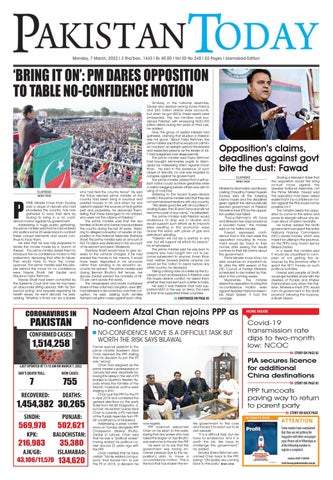
‘Bring it on’: PM dares oPPosition to taBle no-ConfidenCe Motion
ISLAMABAD news desk
P
rime minister imran khan sunday said a clique of dacoits who had plundered the country, has now gathered to save their skins by touting to bring in a no confidence motion against his government. addressing a huge public gathering, the prime minister said that he had entered into politics some 25 years back to confront these corrupt elements and would continue to face them. he said that he was fully prepared to tackle the moves made by a ‘bunch of thieves’. the prime minister dared them to introduce the no confidence motion in the parliament, declaring that after its failure, they would have to face the consequences. the prime minister said the people behind the move for no confidence were Nawaz sharif, asif Zardari and maulana fazlur rehman. Nawaz sharif had been convicted by the supreme court and now he has been an absconder sitting abroad. with his ‘bollywood acting’ and requests regarding his health issues, he went abroad, he said, adding “whether a timid can be a leader
who had fled the country twice!” he said the thrice elected prime minister of the country had been living in luxurious and palatial houses in uk and when he was asked to explain the sources of his ill-gotten pelf and properties, he disowned them, telling that these belonged to his children who were not the citizens of Pakistan.” the prime minister said that the two families of sharif and Zardari had plundered the country during the last 30 years. referring to alleged corruption of leader of opposition in the National assembly shehbaz sharif, the prime minister said an amount of rs3.75 billion was detected in the account of his servant and peon maqsood. shehbaz sharif would have to give answers to the criminal charges, if he had earned the money in fair means, it would have been deposited in his accounts rather than landing in his servant’s accounts, he opined. the prime minister said during benazir bhutto’s first tenure, her spouse Zardari earned the notoriety of mr. 10 per cent across the world. the newspapers and books contained stories of their untamed corruption, even bbc had released a documentary over their corruption, he said, adding both families framed corruption cases against each other.
Coronavirus in
Pakistan
CONFIRMED CASES:
1,514,258
LAST UPDATED AT 11:15 AM ON MARCH 7, 2022
DAY'S DEATH TOLL:
NEW CASES:
7
755
RECOVERED:
DEATHS:
1,454,382 30,265 SINDH:
PUNJAB:
569,978
502,621
KPK:
BALOCHISTAN:
216,983
35,380
AJK/GB:
ISLAMABAD:
43,106/11,570
134,620
similarly, in the national assembly, Zardari also denied owning surrey Palace and $60 million dollars swiss accounts, but when he got Nros, these assets were embezzled. the two families had burdened Pakistan with whopping rs30,000 billion debts during ten years of their rule, he added. Now, this group of vested interests had gathered, claiming that situation in Pakistan was not good. about fazlur rehman, the prime minister said that he would not call him as ‘maulana’ an epitaph used for the learned and respected persons, as the leader of Juif had bargained over diesel permits. the prime minister said fazlur rehman had brought seminaries pupils to islamabad by misleading them against imran khan. he said in the presence of such clique of dacoits, no one was required to conspire against his government. the prime minister added that a self-reliant nation could achieve greatness while a nation begging before others was akin to using of crutches. referring to the recent russia-ukraine conflict, the prime minister said that they did not want strained relations with any country. “we desire good ties with all countries including russia, the us and china and will not become a part of any camp,” he reiterated. the prime minister said Pakistan would endeavour to stop war in ukraine and would support such efforts as its impacts were resulting in the economic woes across the world, with prices of gas and petroleum spiraling. “Pakistan will not be a partner in any war, but will support all efforts for peace,” he emphasized. the prime minister said he was born to parents who had taught him not to become subservient to anyone. imran khan had neither bowed before anyone nor would let the nation to bend before any other country, he declared. taking a strong note of a letter by the european union ambassadors in Pakistan over the russia-ukraine conflict, he asked them whether they had sent such a letter to india. he said it was Pakistan that had supported Nato in the war on terror. the rulers at that time supported these countries.
CONTINUED ON PAGE 05
Opposition’s claims, deadlines against govt bite the dust: Fawad ISLAMABAD news desk
minister for information and broadcasting chaudhry fawad hussain sunday said all the towering claims made and the deadlines given against the democratically elected government of Pakistan tehreek-e-insaf (Pti) by the opposition parties had failed. “fazl-ur-rehman’s 48 hours and bilawal’s five days proved as a wooden horse,” the minister said on his twitter handle. fawad expressed confidence that in the next week the opposition including its movement would be ‘back to their homes after seeing the results contrary to their tall claims about the government. Prime minister imran khan, he said, would be on’ important visits’ after the 48th session of the oic council of foreign ministers, scheduled to be hosted by Pakistan in the coming weeks. meanwhile, the minister dared the opposition to bring the no-confidence motion even against speaker National assembly asad Qaiser, if had the courage.
Nadeem Afzal Chan rejoins PPP as no-confidence move nears g
No-coNfideNce move is a difficult task but worth the risk says bilawal
former special assistant to the prime minister Nadeem afzal chan rejoined the PPP, stating that his decision to join the Pti was “wrong”. chan had resigned as the prime minister’s spokesperson in January last year, reportedly following the delay in the visit of Pti leaders to Quetta’s western bypass where the families of the machh massacre victims were staging a sit-in. chan quit the PPP for the Pti in april 2018 and contested the general elections on the party ticket from Na-88 (sargodha -i), but lost. his brother Gulraiz afzal chan is currently a Pti member of the Punjab assembly from PP68 constituency of malakwal. addressing a press conference on sunday alongside PPP chairperson bilawal bhuttoZardari in lahore, chan said that he was a “political worker” having started his political career around 22 years ago with the PPP. chan clarified that he face certain “family-related compulsions” that forced him to join the Pti in 2018, a decision he
sharing a television ticker that the opposition would first bring no-trust move against the speaker National assembly, not the Prime minister, fawad said the opposition had been asked earlier that it (no-confidence motion against the Pm) would not be possible for it. the minister asked the opposition to come to the arena and prove its strength without any excuse about umpire’s neutrality. he further added the sindh government had spent the entire National finance commission (Nfc) award money, which was meant for utilizing in the province, on the PPP’s long march led by bilawal Zardari. in a tweet, the minister said it would be unjustified to complain of not getting the resources by the province after it spent the Nfc money on such political activities. fawad said people of sindh would get facilities at par with the dwellers of Punjab and khyber Pakhtunkhwa only when the Pakistan tehreek-e-insaf (Pti) would form its government in the sindh province following the huqooqe-sindh march.
more inside
covid-19 transmission rate dips to two-month low: Ncoc STORY ON PAGE 02
PIA secures licence for additional China destinations STORY ON PAGE 03
PPP turncoats paving way to return to parent party STORY ON BACK PAGE in today’s issue
now regrets. PPP chairman welcomed chan on his return to the party, saying that any worker who had raised the slogan of “Jiye bhutto” was welcome to the join the PPP. he went on to say that the government was facing immense pressure due to the opposition’s plan to move a no-confidence motion. “this is the tool that has shaken the en-
tire government to the core and forced it to reach out to its own people.” “it is a difficult task, but we have to endeavour and it is worth the risk. we have to challenge this government,” he added. senator sherry rehman welcomed chan back to the PPP, saying “old jiyalas are coming back to the party.” news desk
attention Some readers have complained that they are not getting the magazine with their newspaper copy. Please call or WhatsApp us at the following number to register a complaint. Contact: 0307-7338168 irfan.farooq@pakistantoday.com.pk
02
Monday, 7 March, 2022 | IsLAMABAD
news
Covid-19 transmission rate diPs to two-month low: nCoC LAHoRe
P
stAff RepoRt
AKISTAN reported seven deaths by the coronavirus in the last 24 hours as the number of new infections dropped to the lowest in more than two months, the National Command and Operation Centre (NCOC) said. The nation on Saturday confirmed 755 new Covid-19 cases, the NCOC said, adding the total caseload has risen to 1,514,258, including 1,454,382 recoveries. Following the emergence of the latest infections, the contagion rate was recorded at 2.0 percent, the lowest since January 5. The number of active cases has dropped to 29,611 in the country, including 821 patients in critical condition. According to the NCOC, the latest deaths from the pandemic brought the toll to 30,265. Sindh is the most affected province in
terms of the number of cases, with 569,978 infections, followed by Punjab which has reported 502,621 cases so far. Meanwhile, the government has tested 26,646,219 samples for coronavirus, with 37,661 in the last 24 hours. So far, 127 million people have received their first dose of a coronavirus vaccine, including 166,131 in the last 24 hours. 99 million people have been fully vaccinated while 242,151 received their second dose Saturday. The number of total administered doses has reached 215 million, with 422,935 injected in the last 24 hours. saUdi lifts social cUrBs: Meanwhile, Saudi Arabia has lifted precautionary and preventive measures related to combating the health crisis. Quoting an official source in the Ministry of Interior, Arab News reported measures including social distancing and wearing masks outdoors are no longer
mandatory in the Kingdom. The ministry, quoted by the Saudi Press Agency, also said that social distancing in the two Holy Mosques and all other mosques in the Kingdom would end, but worshipers still have to wear masks. Saudi Arabia will no longer require travelers, including those from Pakistan, to undergo mandatory Covid-19 quarantine upon arrival in the Kingdom. Passengers will also no longer need to provide a PCR test on arrival. All arrivals in the Kingdom on visit visas of any kind are required to get the insurance that covers the costs of treatment from any coronavirus infection. The ministry stressed the importance of continuing to stick to the guidelines of the national plan for immunisation, which includes getting a booster dose and applying procedures to verify health status on the “Tawakkalna” app to enter facilities, activities, events, planes and public
transportation. It explained that the measures taken above were subject to continuous evaluation
by the competent health authorities in the Kingdom, according to the developments in the epidemiological situation.
Haqooq-e-Sindh March: PTI entered into Sindh with message of change, says FM Qureshi KARACHI news desk
Pakistan hits mark of 100mn people fully vaccinated against Covid ISLAMABAD AnAdolu Agency
The government on Sunday announced it hit the landmark of fully immunising 100 million people against coronavirus. “Major milestone reached in national vaccination drive. 100 million Pakistanis are now fully vaccinated,” Minister for Planning Asad Umar, who heads the anti-virus strategy, said on Twitter. Out of a total 210 million population, he said, more than 127 million people have received at least one dose of the Covid-19 vaccine. “We are very close to achieving vaccination of all (the) eligible citizens,” he added. The nation, which has been dealing with a fifth wave of the pandemic since it began in March 2020, has recorded fewer than 1,000 new infections for the 10th day in a row, according to the Health Ministry. With 775 new patients, the caseload to date reached 1.51 million, with 1.45 million recoveries. With seven deaths due to coronavirus over the past 24 hours, the overall toll reached 30,265. Currently, the total number of active cases is 29,611. Pakistan last week lifted nearly all coronavirusrelated restrictions across the country, allowing schools, offices, restaurants, gyms, movie theatres, and wedding halls to reopen.
Foreign Minister Makhdoom Shah Mehmood Qureshi has said that Pakistan Tehreek-e-Insaf (PTI) has entered into Sindh with message of change through Haqooq-e-Sindh March that is the real march of people. He was addressing a press conference in Tando Jam on Saturday as PTI’s Haqooq-e- Sindh March on its 8th day started amid massive participation of people. PTI Sindh President Ali Hyder Zaidi, Leader of the Opposition Haleem Adil Sheikh, Mubeen Jatoi, Khawand Bux Jahijo, and others were present on the occasion. Shah Mehmood Qureshi said that people of Sindh has vigorously responded to Haqooq-e-Sindh March and now Karachi once again will come up to the expectations of Imran Khan as the March is entering into its final stages and will conclude in Karachi on March 06. He said that Bilawal should think over cold response to his officially sponsored march by masses in Punjab that had already rejected PPP in general elections of 2013 and 2018 as PPP could not win even a single constituency of national and provincial assembly from Multan from where Zulfikar Ali Bhutto elected as MNA. Politically aware people of Punjab had comprehended that it was not PPP of Bhutto but party of Zardari and ideological workers could not get along with Zardari’s approach, he asserted
FM QURESHI ABSENCE AT HYDERABAD RALLY IRKS SENIOR PTI SINDH MEMBERS adding that Bilawal was in hurry to conclude their march and already changed schedule of PPP’s march seeing lack of public support in Central Punjab. Extending his support to Bilawal Zardari’s demand of creation of South Punjab Province, Shah Mehmood Qureshi said that it is one of the important points of PTI’s manifesto. PPP made big promises in past as well but they did not take any practical measures in the regard while Imran Khan not only included South Punjab in PTI manifesto but also taken concrete steps for facilitation of people of southern Punjab including setting up secretariats it Multan and Bahawalpur, appointing additional secretaries and additional Inspector General of police, amending rules of business and presence of secretaries of 16 departments. PTI intended to ensure recruitment opportunities to youth of Southern Punjab in proportion to population of the area and considering fixing 33 percent quota in government jobs for the youth and proportional share in development schemes, he said. Shah Mehmood said that he was ready to lay a bill in National Assembly about creation of South Punjab province and if Bilawal Zardari was sincere to
people of the area the PPP legislators cast their vote in favour of that bill. “I know they will not do that as Bilawal Zardari earlier did not respond to my letter in the regard,” he added. The Foreign Minister said that they were not anxious of a no-confidence motion as they were political people and understand politics because they have risen from the grassroots level and has not been imposed from anywhere while Bilawal got everything in a plate. Referring to the Peshawar blast, Makhdoom Shah Mehmood Qureshi said that some elements wanted to destabilize Pakistan so they support the terrorists by providing arms and capital so that those elements keep our western borders warm. He said that the Pakistan’s eastern neighbor who is also facing economic turmoil due to mismanagement of Covid19 situation wanted to divert the world’s attention from the situation in illegally occupied Jammu and Kashmir. Due to Pakistan government’s proper measures, the economy is stabilizing, industries have been revived and exports have increased while recently, the Prime Minister has also announced a special package for industries and it is not being digested by our enemies so they were hatching conspiracies, FM Qureshi
maintained adding that Pakistan has already over powered those anti-state elements and would defeat them again. The National Action Plan had two aspects and our military leadership and law enforcement agencies played their full role by sacrificing their lives and fulfilled their part while Prime Minister Imran Khan has played his role in the political arena but the opposition is showing lack of seriousness by making a fuss in the assembly and when it comes to legislation and debate these people walk out which is against the spirit of public service, he said. Makhdoom Shah Mehmood Qureshi said that as Foreign Minister he presented detailed statistics regarding the involvement of neighboring country in terrorist activities in Pakistan and also presented a facts and evidence based dossier to United Nations. Replying to a question, he said that Karachi was suffering from deprivation and Zardari regime was responsible for it as PPP has been in government in Sindh for 15 years and they got Rs. 9000 billion from the federation. The responsibility of water shortage in Karachi, issue of garbage collection, noncleaning of drains, dilapidated schools and bad hospitals in Karachi lies on Sindh government not the federal government, he said adding that Imran Khan issued extra funds for resolving issues of Karachi but provincial government also obstructed those initiatives.
ContInueD fRoM pAge 05
40pc of children in Pakistan suffer from obesity KARACHI AnAdolu Agency
A colossal 40 percent of children in Pakistan are either overweight or obese, mainly due to a sedentary lifestyle, excessive screen time, and an unhealthy diet, the latest studies and health experts say. According to the most recent study by the state-run Pakistan Health Commission (PHC) in 2018, over 11 percent of children in the country were overweight and more than 5 percent were obese. However, several hospital-based studies and surveys paint a grimmer picture, with findings that 40-50 percent of children in the country are either overweight or obese. Speaking to Anadolu Agency in connection with the World Obesity Day, Dr. Musarrat Riaz of the Institute of Diabetes and Endocrinology, Baqai Medical University Karachi, cast doubt on the PHC statistics, calling them “underestimated.” Riaz, who has been part of such hospitalbased and clinical studies on obesity, said the actual figures range between 40 percent and
50 percent. “These studies have shown really alarming numbers,” she said, warning that the number of children who are obese or overweight is rapidly increasing. Rising childhood obesity is causing a slew of diseases and health complications, she said, fearing the number of children with obesity issues was likely to rise in the coming years if current lifestyle trends continue. “A good number of young people aged 20 to 25 years are developing early age diabetes, apart from hypertension, metabolic syndrome, and many harmonic issues because of obesity,” she added. Bleak forecast: According to the International Diabetes Federation (IDF), Pakistanis suffer from the world’s thirdhighest prevalence of diabetes, with one of every four adults living with the condition. Abdul Basit, a member of the IDF Atlas Committee in Pakistan, warned that if Pakistanis continue to live their current lifestyle, “things may get worse” over the next five years.
Citing a recent study by the Pakistan Health Research Council (PHRC), an official research body, he said that nearly 60 percent of the people are obese. Two cutoffs were used in the countrywide study — Global and Asian. The World Health Organisation figures show that 58.1 percent of Pakistanis are
overweight, with 43.9 percent obese. However, according to the Asian cutoffs that are not yet globally recognised, 72.3 percent of Pakistanis are overweight, with obesity affecting 58.1 percent of the population. The idea behind the Asian cutoffs, supported by various health organisations including the IDF, is that Asians, despite having a lower body mass index (BMI), are at higher risk of stroke or cardiac arrest than Europeans and Americans, owing to differences in lifestyle. According to the global cutoffs, a person with a BMI of 25 kilograms per square meter is deemed overweight, whereas a BMI of under 27 kg/sq. meter is considered obese. However, the Asian cutoffs recognise 23 kg/sq. meter as the standard overweight BMI and 25 kg/sq. meter for obesity. covid-19 and oBesity: Basit cited genetic issues, birth weight, early years’ nutrition, catch-up growth, post-natal nutrition, and high calorie condensed food among other factors behind rising obesity in Pakistan.
Riaz observed that the Covid-19 pandemic has “significantly” contributed to the rise of obesity-related issues in the country over the past two years. “The pandemic is a key reason behind rising obesity cases across the country over the past two years,” she said. “Lockdown restrictions, schools and gyms closures, and limited sports activities have further reduced the physical activities in general, especially in the urban areas where an unhealthy lifestyle has already resulted in the rise in obesity,” she explained. Increased screen time due to the online classes, as well as food delivery chains, have also contributed to the spike, she added. The two health experts recommended daily exercise, a healthy diet, and avoidance of sugary drinks and dining out as a means to reduce and ultimately eliminate the risk of obesity. “We have to bind our schools and colleges to increase sports time and make it mandatory for children to take part in sports activities if we want to save them from being obese,” Riaz said.
Monday, 7 March, 2022 | IsLAMABAD
Pia secures licence for additional China destinations ISLAMABAD
C
App
HINA has granted Pakistan International Airlines (PIA) licence to launch services to two more destinations — the northwestern port city of Guangzhou and the ancient imperial capital of Xi’an — in addition to Beijing. Previously, the airline had the operating licence only for Beijing, but the provision of the licences by the Civil Aviation Administration of China (CAAC) enabled it to conduct operations between Pakistan and the two cities, Qadir Bux Sangi, the airline’s PIA country manager in China, said. He said that as per the current standard operating procedure of CAAC, international carriers can operate one weekly flight for China. “PIA is operating PK854-855 ISB-XIY-PEKISB by using Xi’an’s first entry point for
Beijing as per CDC approval of the Xian government,” he said. “After the change in the current standard operating procedure of CAAC, we have an option to start our scheduled flights for Guangzhou and Xi’an also,”
Sangi added. Responding to a question, he said the national flag carrier has also applied for the acquisition of an operating licence for Chengdu, one of the most important economic and cultural centres
in China, which is under consideration and PIA will get the approval in April. Regarding cargo flights, Sangi said PIA has got approval from the Chinese authorities to operate chartered cargo flights for Kunming and Shenzhen while approval for Xinjiang is under process. He expressed the confidence that the chartered cargo flights to different Chinese cities would help further enhance trade and economic activities between Pakistan and China. About the resumption of PIA’s weekly Islamabad-Xian-BeijingIslamabad passenger flights which are currently suspended due to the Covid-19 crisis, Sangi said the local authorities in Xi’an have been requested permission to resume the flights as per the previous schedule. “We are waiting for the formal approval for resumption of flights so that we can facilitate the travellers from both countries,” he added.
NUMS’ scientist makes breakthrough by developing much cheaper source of Omega-3 using biotechnology RAWALpInDI news desk
National University of Medical Sciences (NUMS) scientist Dr Waseem Safdar has made a breakthrough by developing a cheaper alternative of Omeg-3 fatty acids in “microalgae” which being a vital health supplement, will become affordable for the masses following its commercial production in near future. In context of the present COVID-19 Pandemic, omega-3 supplements from microalgae may be used as supplement due to its anti-inflammatory and immune modulatory properties, said Dr. Safdar, who is working on a three-year project funded by the Higher Education Commission and holds a PhD in Food Biotechnology, Chinese Jiangnan University, Wuxi, Jiangsu. His methodology for the production of Omega-3 fatty acids has no post-harvest treatment, sea
aJK Pm announces to hold lB polls in July this year MUZaffaraBad: Prime Minister Azad Jammu and Kashmir (AJK) Sardar Abdul Qayyum Niazi while urging party workers to gear up for the upcoming local body elections said that it has been agreed in principle to hold elections in July this year. Prime Minister Niazi said this while addressing a reception hosted in his honour by Raja Qayyum at Kotli on Sunday. Presided over by Minister of State for Parliamentary Affairs Ali Muhammad Khan, the function was attended and addressed by Zafar Iqbal Malik Minister for Higher Education, Chaudhry Muhammad Akhlaq Minister for Finance and Custodian, Dr. Nisar Ansar Abdali Minister for Public Health, Raja Mansoor Khan Secretary General Pakistan Tehreek-e-Insaf Azad Kashmir and Raja Qayyum and others. Speaking on the occasion, he said that a new era of progress and prosperity has begun in the liberated territory (AJK). “Mega development projects in different sectors have been initiated across the region”, he said adding that tunnels, highways, health care facilities were being constructed to improve the life standard of common man. He said that special focus was being given to promote tourism in AJK. He said that the dream of making AJK a prosperous and self-sufficient state would be achieved soon. The development of the state, he said, was the responsibility of the PTI government. “We are trying our best to fulfill our responsibilities”, he added. The Prime Minister also announced the reconditioning of Manil Fagosh Road and giving middle status to Primary Manil School. Voicing his concern over the opposition parties, prime minister Niazi said that opposition parties must refrain from creating political instability in the country. Commenting on the worsening situation in the Indian held territory of Jammu and Kashmir, he said it was responsibility of the international community to play its role in resolving the lingering dispute peacefully. The PM asked if the international court of justice (ICJ) can hear the case of Indian spy Kulbhushan Yadav why it cannot hear the Kashmir case”. “I repeat the slogan of Syed Ali Gilani. We are Pakistanis. Pakistan is ours”, he added. Agencies
contamination or unpleasant flavor and has high oxidative stability. According to Dr. Safdar, microalgae can be used for producing two types of oil ; one can be used for producing medicines by the pharmaceutical industry while the other (saturated fatty acids) for bio fuel production. Dr. Safdar said that in view of depleting water resources across the globe, scientists around the world have turned their attention to microalgae as this is a useful resource to decontaminate waste-water into fresh water. Besides this, there are 25 to 30 per cent omega 3 fatty acids in 100 grams of microalgae which can be grown in fresh as well as sea water. The NUMS scientist is specifically working to enhance production of omega-3 Polyunsaturated Fatty Acids (PUFA) and develop omega-3 supplementsrich in Eicosapentaenoic Aacid (EPA) and Docosahexaenoic Acid (DHA) at low cost as these are among the most nutritionally important food
constituents. Omega-3 PUFA are considered important for good health and are known as essential fatty acids as human body does not have enzymes to synthesize them. Commercially available fish oil supplements provide significant health benefits for treating arrhythmia, high blood pressure, stroke and other cardiac diseases. Since supplements high cost, typical undesirable fish smell and flavor, susceptibility to oxidative degradation and sea contamination reduces its acceptability, other alternative sources like plants, fungi and microalgae, can be highly popular. This NUMS research project also falls in priority areas of national interest for “Nutrition and Human Capital” as in Pakistan health has a vital role in socioeconomic progress as food and its supplements need to be given special attention to combat diet related chronic diseases such as diabetes, cardiovascular disease, obesity and inflammatory disorders, he added.
news
03
no-trust move: shehbaz sharif bars Pml-n mnas from traveling abroad LAHoRe Agencies
Pakistan Muslim League-Nawaz (PML-N) President Shehbaz Sharif has directed members of National Assembly (MNAs) belonging to his party to avoid travelling abroad ahead of the no-trust move against the incumbent government. According to sources privy to the development, the PML-N president has asked MNAs to remain in the country as the no-trust move is about to be tabled before the National Assembly. The sources quoted Shehbaz Sharif as saying that a conspiracy has been hatched to send MNAs out of the country on official visits. “All party MNAs should ensure their presence in the country,” they said.
Pml-n parliamentary party to meet today ISLAMABAD stAff RepoRt
Pakistan Muslim League-Nawaz (PML-N) president and National Assembly Opposition Leader Shehbaz Sharif has summoned a meeting of the parliamentary party in Islamabad on Monday to discuss the no-trust motion proposed against the prime minister. The session will be held at PML-N Secretariat in Chak Shahzad neighbourhood of Islamabad at 6:00 pm. The huddle would be chaired by Shehbaz Sharif. All the MPs of the party have been directed to reach Islamabad by tonight for the meeting. It merits a mention here the opposition parties have agreed to submit a requisition on Monday for summoning a National Assembly session for tabling no-trust motion against the government, sources within PML-N confirmed. The long march of the Pakistan Peoples Party (PPP) will reach Islamabad and its chairman Bilawal BhuttoZardari will announce the date for submission of the no-trust motion in the gathering. “The opposition has the numbers needed for the success of no-confidence motion,” they said and added: “We are confident that our no-trust move will succeed.” PPP Senator Sherry Rehman on Friday claimed the opposition has the support of enough MPs for the success of the vote.
Pakistan to continue work with China to expand climate project: envoy BeIJIng
Pakistan strongly condemns arrest of APHC leader in IIOJK ISLAMABAD Agencies
Pakistan has strongly condemned the cowardly arrest of Hurriyat Conference Vice Chairman Ghulam Ahmad Gulzar by Indian occupation forces in Indian illegally occupied Jammu and Kashmir (IIOJK) under the draconian Public Safety Act (PSA). Foreign Office spokesperson in a press release, Pakistan said arbitrary arrests of Hurriyat leaders, political activists, human rights defenders, and civil society members on orchestrated charges manifestly reflected India’s frustration at the freedom struggle by the Kashmiri people that continued unfazed despite increasing intimidation, harassment and reprisal attacks by the occupation forces. Almost the entire Kashmiri leadership including
Masarrat Alam Butt, Shabbir Ahmed Shah, Muhammad Yasin Malik and Aasiya Andrabi were either detained in crowded jails in India or under house arrest on made-up charges. He said the relentless witchhunt of Hurriyat leaders and political activists by the Hindutva driven RSS-BJP dispensation on motivated allegations and their persecution on fictitious charges under draconian laws was in clear violation of the UN Charter, UN Security Council and UN General Assembly resolutions, and international human rights and humanitarian law. Regrettably, the Indian occupation forces were yet to be held accountable for the death of senior APHC leader and Tehreek-eHurriyat Jammu and Kashmir Chairman, Muhammad Ashraf Sehrai, who was arrested last year
on trumped up charges under the oppressive Public Safety Act in IIOJK and remained under illegal Indian custody till the time of his death despite his worsening health condition, he added. The spokesperson maintained that India must remember that no amount of systematic brutality, unbridled use of force and atrocious clamp-downs against Kashmiri leadership will suppress the Kashmir freedom movement nor would it delude the world into accepting India’s false claims of ‘normalcy’ in the IIOJK and portraying itself as a victim of terrorism. He said, “Pakistan calls upon the international community to compel India to abjure its policy of state-terrorism in IIOJK and immediately release all arbitrarily arrested Kashmiri political leaders and activists including Ghulam Ahmad Gulzar.”
stAff RepoRt
Pakistan’s ambassador to China Moin ul-Haque said Islamabad will continue to work with Beijing to improve the environment, promote low-carbon initiatives, and expand its Billion Tree Tsunami project. Haque told China Economic Net in an interview that climate governance, low-carbon environmental protection, and animal protection areas are very close to the heart of Prime Minister Imran Khan. “We are working with the Chinese government to help us expand the Billion Tree Tsunami project,” he mentioned. He said the prime minister is one of those few leaders who have advocated global action and cooperation against climate change, adding that Pakistan is among the handful of nations that hardly contribute to these carbon emissions. “We are one of the most affected countries by climate change. So, this is also an important area of cooperation with China because China is a big country but it has very ambitious targets of capping its commissions of carbon and zero carbon neutrality by 2060,” he added. It is worth noting that China’s Government Work Report delivered at the opening of the 2022 session of the 13th National People’s Congress in Beijing on March 5 also highlighted that China will take well-ordered steps to achieve peak carbon emissions and carbon neutrality.
road accident leaves 6 killed, 15 injured in Punjab ISLAMABAD MonitoRing RepoRt
Six people were killed and 15 others injured in a road accident in Punjab on Sunday, media reported. The accident happened when a passenger van crashed into a car in Layyah, the reports said. Six people in the car including three kids and two women were killed in the accident. 15 people including the driver in the van sustained injuries and have been shifted to a nearby hospital. The death toll is feared to rise as several of the injured are said to be in critical condition. Road accidents frequently happen in Pakistan due to poorly maintained roads, violation of road safety rules, and reckless driving.
Monday, 7 March, 2022 | ISLAMABAD
04
NEWS
How Reliance stunned amazon in tHe battle foR india’s futuRe Retail MUMBAI
a
Agencies
T a large Future Retail supermarket in Mumbai last week, workers were unloading hundreds of bright blue grocery crates belonging to India’s biggest retailer Reliance. Prospective customers were turned back by security, disappointed at the closed state of the store that still carries the signage of Future’s biggest brand, Big Bazaar, but which will likely soon be rebranded as a Reliance outlet. Across India, similar scenes are being played out as Reliance Industries India’s biggest conglomerate run by Mukesh Ambani, the country’s richest man, presses ahead with a shock de facto takeover of prized retail real estate that Amazon.com Inc has been keen to take part-ownership of. The high-profile bitter dispute between corporate titans in which Amazon has sought to block Reliance’s planned $3.4 billion purchase of Future Group’s retail assets is currently before India’s Supreme Court. Reliance’s takeover began with utmost stealth on the night of Feb. 25 when its staff began arriving at Future stores. Many in Future’s management were in the dark about the plans as store employees from all over the country frantically began to call, according to people with direct knowledge of the matter. “It was tense, everybody was panicking. We didn’t know who they were. They wanted access and seniors didn’t know about it,” a New Delhi Big Bazaar store employee said, describing what happened around 8 p.m. that day. At a Future store in Sonipat town in northern Haryana state, announcements were made asking customers to leave as Reliance seized control, one source said. In Vadodara in western Gujarat, Future employees arriving for work the next morning were asked to
RELIANCE TO REBRAND STORES, KEEP FUTURE EMPLOYEES ON -SOURCES
go back home with no explanation, said another source. Citing unpaid payments by Future, Reliance has taken control of operations of some 200 Big Bazaar stores and has plans to seize another 250 of Future’s retail outlets. Combined, they represent the crown jewels of Future’s retail network and around a third of all Future outlets. Although Reliance had not played a large public role in the legal dispute, it had,
according to sources, for some months assumed many of the leases held by cashstrapped Future, India’s No. 2 retailer and Amazon’s estranged business partner. Reliance’s sudden possession of the stores appears to have landed what some analysts are calling a coup de grace that spoils Amazon’s chances of untangling the transfer of Future’s assets to Reliance. That’s despite a series of legal battles won by the U.S. ecommerce giant to date blocking the 2020
deal announced between the two Indian companies. “What will Amazon fight for now?” said a source close to the U.S. company with knowledge of the legal dispute. “The shops are gone.” Representatives for Reliance, Amazon and Future did not respond to Reuters queries for this article. Sources asked not to be identified due to the sensitive nature of the dispute.
AFTER THE TAKEOVER, TALKS: Future Retail said on Feb. 26 it was “scaling down its operations” to cut losses although it made no mention of Reliance in its statement. Future Group as a whole has more than $4 billion in debt. Reliance plans to retain Future’s employees at the stores it takes over, sources have said. Amazon, which has a stake in a separate Future Group unit that it argues prevents Future from selling retail assets without its permission, has called the supermarkets and other stores an “irreplaceable” network in a sector worth $900 billion in revenues annually. The legal wrangles had over time become increasingly high-stakes and marked by ugly rhetoric. At one point, Amazon sought for Future Chief Executive Kishore Biyani to be detained in prison for disobeying a legal order. And Future once likened Amazon to Alexander the Great and his “ruthless ambition to scorch the earth”. But on Thursday, six days after Reliance’s move, Amazon at a Supreme Court hearing unexpectedly called for cordial talks to end the dispute – a proposal Future agreed to. “People have taken over shops … let’s at least have a conversation,” Amazon’s lawyer Gopal Subramanium said. Discussions are expected to begin soon. Whatever the outcome of the talks, analysts say Amazon had gravely underestimated Reliance. “If anybody should have seen this coming, it should have been Amazon and they should have prepared against it,” said Devangshu Dutta of retail consultancy Third Eyesight. “Clearly, they didn’t.” Reporting by Aditya Kalra in New Delhi and Abhirup Roy in Mumbai; Additional reporting by Francis Mascarenhas in Mumbai and Amit Dave in Ahemedabad; Editing by Edwina Gibbs
Russian banks look to China’s UnionPay as Visa, Mastercard cut links LONDON Agencies
Credit cards issued by Russian banks using the Visa and Mastercard payment systems will stop functioning overseas after March 9, Russia’s central bank said on Sunday, adding that some local lenders would look to use China’s UnionPay system instead. Russian-issued Mastercard and Visa cards would be accepted within Russia until their expiry, the bank said, The overseas ban also applies to cards issued by local subsidiaries of foreign banks, the bank said. Its announcement came after U.S. payments firms Visa Inc and Mastercard Inc said they were suspending operations in Russia, joining the list of companies that are severing business links with Russia.
The central bank added that many Russian banks plan to issue cards using UnionPay, a system it said was enabled in 180 countries. While several Russian banks already use UnionPay, others including Sberbank and Tinkoff could start issuing cards co-badging Russia’s domestic Mir payments system with UnionPay, it added. The corporation was founded in 2002. The State Council of the People’s Republic of China initiated the foundation of a national payment system, and the People’s Bank of China backed it. Its announcement came after U.S. payments firms Visa Inc and Mastercard Inc said they were suspending operations in Russia, joining the list of companies that are severing business links with Russia.
The central bank added that many Russian banks plan to issue cards using UnionPay, a system it said was enabled in 180 countries and has a network of more than 1 million ATMs. While several Russian banks already use UnionPay, others including Sberbank and Tinkoff could start issuing cards co-badging Russia’s domestic Mir payments system with UnionPay, it added. Thousands of Russians, including holidaymakers, are stranded abroad after many countries closed off their airspace to Russian aircraft while Russia has retaliated with flight bans for many foreign airlines. The central bank advised citizens currently overseas, to withdraw cash before the ban came into force.
Oil price set to surge further following delay in Iranian talks LONDON: Oil prices are set to surge further this week due to delays to the conclusion of Iranian nuclear talks and the potential return of Iranian crude to global markets, which are already suffering from Russian supply disruptions, analysts said. Russia has raised fresh demand for written U.S. guarantees that sanctions on Moscow over its invasion of Ukraine would not harm Russian cooperation with Iran. China has also raised new demands, according to sources. Last week, the Brent benchmark rose 21% to close at $118.11 a barrel and U.S. crude gained 26% to close at $115.68, levels not seen 2013 and 2008, respectively, as Russia struggled to sell oil amid fresh sanctions. “Iran was the only real bearish factor hanging over the market but if now the Iranian deal gets delayed, we could get to tank bottoms a lot quicker especially if Russian barrels remain off the market for long,” said
CMYK
Amrita Sen, co-founder of Energy Aspects think-tank. Sen said Brent could rise to $125 per barrel on Monday, quickly approaching an all-time high of $147, last seen in 2008. Analysts from JP Morgan said this week oil could soar to $185 per barrel this year. Russia exports around 7 million bpd of oil and refined products or 7% of global supply. Some volumes of Kazakhstan’s oil exports from Russian ports have also faced complications. Iran will take several months to restore oil flows even if it reaches a nuclear deal, analysts said. Eurasia Group said fresh Russian demands could disrupt nuclear talks although it still kept the odds of a deal at 70%. “Russia may intend to use Iran as a route to bypass Western sanctions. A written guarantee allowing Russia to do so is probably well beyond the realm of what Washington can offer in the midst of a full-scale war in Ukraine,” said Eurasia’s Henry Rome. Agencies
Monday, 7 March, 2022 | ISLAMABAD
NEWS
‘Bring it on’: PM dares opposition to table noconfidence motion cOntinuEd fROm pAgE 01 What was the outcome of that war, Pakistan lost 80,000 precious lives, 3.5 million people in the tribal areas were displaced while the country had suffered an economic loss of $100 billion dollars, he added. the prime minister said that instead of acknowledging such huge sacrifices, certain countries in Europe blamed Pakistan for their failures in afghanistan. “in kashmir, india had brazenly violated UnsC resolutions. Whether they have criticized or severed ties with india or stopped trade?” the prime minister posed a question. He said that they had not been slaves to anyone to follow their dictates. about 400 drone attacks were recorded during 2008 to 2018. in history, it never happened that a country fighting for another’s war had been targeted. the two former ruling families never muster the courage to question these gross violations of the international laws, he said, adding they never felt ashamed over such drone attacks targeting innocent families in the tribal areas. the prime minister, on the other hand, taking a firm stance, said he would direct air force to shoot down any drone violating Pakistan’s space. about his government’s efforts for the revival of the economy, he said it gave him immense pleasure that the farmers’ community had earned huge profits due to the agriculture-friendly steps. He linked farmers’ prosperity with the country’s progress. sharing details, he said a farmer earned Rs40,000 to Rs50,000 profit on per acre yield of maize, on wheat the profit soared to Rs25,000-30,000 per acre, the price of cotton had been doubled, bringing a profit of Rs 70,000-80,000 to the farmers on per acre crop. the prime minister said that about 100,000 tons urea imported from China would reach the country within a week. the government provided Rs 132 billion subsidy over the provision of urea when compared with the rest of the world. the prime minister said his government faced huge challenges including the financial constraints inherited from the past groups of thieves and the Covid pandemic. But the world acknowledged that Pakistan had been among the three countries of the world that steered through the global pandemic by saving its economy and the people. the prime minister also mentioned the global surging price hike of commodities, saying the inflation had been at the historic peak in the Us, Uk, turkey and Germany. During PPP tenure from 2008-13 the price hike was higher when compared with the present situation, he said, assuring that the government was taking all measures to avoid burdening the masses. the prime minister said they had generated historic revenues collection which enabled them to reduce prices of petroleum products by Rs 10 per liter and Rs5 per power unit. in a veiled reference to nawaz sharif, the prime minister said that if he was able to retrieve the looted money from the absconder sitting in Uk, he would reduce the prices of these items by halve. the prime minister announced that they would bring a bill in the national assembly regarding south Punjab province which would be a test for both PPP and PML-n whether they would support it or not, as their moves would further expose them before masses, he observed. the prime minister further announced that the federal government had decided to spend Rs500 billion more on south Punjab. On the occasion, Chief Minister Punjab sardar Usman Buzdar, Minister for industries Makhdoom khusro Bakhtiar and aurangzeb khichi, Pti legislator from the area also addressed the gathering.
05
PPP turncoats Paving way to return to Parent Party LAHORE
P
inp
akistan Peoples Party (PPP) leaders who had joined the Pakistan tehreek-e-insaf (Pti) just before the general elections in 2018 but lost their seats have gone incommunicado and sources within both the parties say that most of them are looking to join back PPP in the coming days. Former Punjab chief minister Manzoor Wattoo and nadeem afzal Chan, a former spokesperson for the prime minister, have decided to part ways with the ruling party and rejoin the PPP. Chan had joined the Pti in april 2018 and contested the general elections on the party ticket from na-88 (sargodha-i), but lost the contest. His brother, Gulraiz afzal Chan, is cur-
rently a Pti lawmaker in the Punjab assembly from PP-68 constituency of
Malakwal. sardar Ghulam abbas, a local in-
fluential from Chakwal who had quit Pakistan Muslim League-nawaz (PML-n) in May 2018 but embraced the narrative of the Pakistan Democratic Movement (PDM) in 2020, is also expected to join the party. in this context, the aforementioned politicians have started establishing contacts with the PPP leadership. Entrenched local powerbrokers, who include feudal lords, tribal chiefs, clan elders and spiritual leaders and are known as “electables”, hold about a quarter of Punjab’s 141 national assembly seats. Punjab, in turn, accounts for more than half the 272 elected seats in the Lower House, making it the key election battleground. in 2018, at least 21 Punjab MPs from PML-n had defected to Pti before the elections.
Haqooq-e-Sindh March: PTI entered into Sindh with message of change, says FM Qureshi cOntinuEd fROm pAgE 02 When imran khan presented a plan to develop the islands to create employment opportunities, to develop the industry and enhance investment, the provincial government first issued nOC and then withdrew it, he said adding that the federation does not want to occupy those islands and it was ready to extend guarantee in writing that these islands will remain property of sindh but they are pursuing the policy of ‘we will not play nor let others to play’. Responding to a question on kashmir, FM Qureshi said that with presence of 0.9 million indian troops illegally Occupied Jammu and kashmir is the most militarized Zone in the world and youth is being abducted and martyred to supress the people of the valley. “i have written 23 letters to the secretary-General of the United nations and the President of the security Council regarding the situation in Occupied Jammu and kashmir, while the issue came under discussion thrice at the United nations,” he said adding that no previous government has made such efforts while difference between speeches of PM imran khan and asif Zardari in Un was visible. He also offered indian PM narender Modi to visit Muzafarabad to present his case and let the PM imran khan to visit srinagar to present Pakistan’s perspective and then assess who gets the most public acceptance. addressing the public meeting, Makhdoom
shah Mehmood Qureshi further said that sindh had broken the arrow in 2013 but Zardari kept it jointed with adhesive of rigging but present scenario in sindh is indicating change in 2023. Youth of sindh will change fate of the province with their determination and resolve, he anticipated adding that people of sindh were listening to false pledge of progress and prosperity since 15 years but that growth was limited to only a few associates of Zardari while laborer, peasant, youth and intellectual of sindh is still looking for the real change. He said that people of sindh have tried PPP for 15 years now they should give a chance to Pti and see the real change taking place. imran khan wanted to provide Health Card to people of Hyderabad and other districts of sindh but PPP government is obstructing the move as 18th amendment has tied the hands of the federation, he said adding that if PPP do not create hurdles federal government is ready to announce issuance of Health Cards in sindh like other provinces. Pti government has already presented gift of a university to residents of Hyderabad through legislation in national assembly, he said and added that PM imran khan will visit Hyderabad soon and present gift of Hyderabad-sukkur Motorway to the people of sindh. Pti sindh president syed ali Hyder Zaidi addressing the public gathering said that scenario of change is developing in sindh and people come out
to break the arrow. He said that sindh government is closing 5 thousand schools in sindh as they think people in sindh do not need education while federal government wanted to open a university in Hyderabad but they are not issuing nOC for that. it means PPP wanted to keep people of sindh ignorant, he commented. PPP is denying sindh card because they wanted to keep people sick they are not improving infrastructure as they wanted trouble for masses, he said adding that several development projects were awaiting completion for many years and even big cities look like ruins of Moen jo Daro. Later, the caravan of Haqooq-e- sindh March started from tando Jam to Hyderabad, administration installed barbed wire and barriers in the way of the rally in Hyderabad. it is pertinent to mention here that upon reaching Hyderabad Foreign Minister shah Mehmood Qureshi did not attend the rally, much to the displeasure of special assistant to the Prime Minister on sindh affairs arbab Ghulam Rahim and other senior Pti sindh members. Opposition Leader sindh assembly Haleem adil sheikh condemned the move and said that they cannot stop the tsunami of change by closing the roads. He said that blocking the way of march shows the ill motivation of Bilawal Zardari and his Government he said that the journey of change has already started in sindh and no one could hinder it. news Desk
Biography and Literary Criticism 1. TiTle: ‘Rashk-e-hayaT’ auThoR: DR. haRoon RashiD Tabassum publisheR: misaal publisheRs, aminpuR bazaaR, FaisalabaD pages: 224 – pRice: Rs.800/2. TiTle: ‘yahi akhiR ko ThahRa Fun hamaRa’ auThoR: (DR.) TauseeF Tabassum publisheR: makTaba JaDeeD, 114-empRess RoaD, lahoRe pages: 272 – pRice: Rs.850/-
Dr. Haroon Rashid tabassum is a reputed academic, a historiographer of Urdu literature, a social worker, and an author of 162 literary (135) and academic (27) books. in ‘Rashke-Hayat’, one of his latest creative ventures, he has highlighted the biographies of some 38 celebrities from different walks of life including religion, literature, art, culture, journalism, politics, academia, social work et al. (Dr.) tauseef tabassum is a distinguished veteran Urdu poet and critic. He has recently released his latest publication ‘Yahi akhir ko thahra Fun Hamara’ for the reading public. the writer discusses the structural and practical aspects of Urdu poetry with emphasis on the genre of ghazal, in this book. ‘Rashk-e-Hayat’ Dr. Haroon Rashid tabassum is a prolific writer. His socio-cultural connectivity and literary interactivity has motivated him to compile the instant book which comprises short biographies of men of eminence like Majeed nizami, arif nizami, abdul sattar khan niazi, abdul sattar Edhi, sahibzada abdur Rasool, tariq aziz, shamsur Rahman Fa-
rooqi, M. M. alam, and Dr. safdar Mehmood. Eminent journalist Majeed nizami (1928-2014) adopted journalism as a career in the line of his distinguished elder brother Hameed nizami (1915-1962) who founded the Urdu daily nawa-i-Waqt in 1940. the former became the editor of the aforesaid newspaper after the demise of the latter in 1962. Firmly committed to the ideology of Pakistan, the two brothers made an invaluable contribution to the growth and promotion of Urdu journalism in Pakistan.
arif nizami (1948-2021) a second generation doyen of the nizami family and a journalism prodigy, was the son of Hameed nizami. as a bilingual journalist he took the bold initiative of launching the English daily ‘the nation’ in 1986 under the banner of nawa-i-Waqt Publications to be followed by another English daily ‘Pakistan today’ in the year 2010 after his disconnect from that newspaper. ‘Pakistan today’ is now being proficiently edited and managed by his illustrious son Yousaf nizami. as a journalist, and later a tV anchor, arif nizami earned distinction for himself amongst his peers, by virtue of his vast knowledge, experience and wisdom couched in modesty. some others whose biographies adore the book for their respective attainments are abdul sattar khan niazi (religion/politics), M. M. alam (soldiery), Dr. anwar sadeed (literature), Dr. saleem agha (literature), Prof. sahibzada abdur Rasool (historian/academic), Prof. azad Bin Haider (law/writer/socialite), tariq aziz (anchor/actor/compere), syed nasir Zaidi (poet/columnist), shamsur Rahman Farooqi (criticism/fiction), Dr. safdar Mehmood (researcher/historian/academic), tariq ismail sagar (novelist/columnist), and Umar sharif (actor/comedian/anchor) besides many more celebrated personages who had excelled themselves in their professional and humanitarian pursuits. ‘Yahi Akhir ko Thahra Fun Hamara’
cmYK
tauseef tabassum is a veteran Urdu poet and critic. His distinction as a literary craftsman lies in his unique style, wide knowledge and perfect grasp of syntax. He seeks to revaluate the mechanics of poetry in this book with pertinent illustrations from a host of classical and modern Urdu poets including his own. in the preamble to the book, the writer spells out the raison d’etre of his thesis and ascertains the ‘genes’ of a good piece of verse in ghazal which would please or move the reader. the writer initiates the discussion in the backdrop of his dialogue on the subject with late Mohib aarfi (1919-2011), a noted philosophical poet of Urdu. Rhyme, rhythm, harmony, thought, theme, imagery, melody, tone and tenor are some vital ingredients of poetry. the concluding part of the book comprises selected verse couplets from Urdu ghazal composed by an array of classical as well as modern poets. the basic premise of the book is connected to the question: What is good poetry? Popularity alone is not a touchstone of such poetry. in the opinion of the author, ‘versifiability’ of a given content accompanied by a latent rhythmicity tends to create good poetry. Dilating on the mechanics of poetry, the writer holds that feeling, imagination and vision or thought laced with rhythm are, without any doubt, quintessential to poetry the end of which is delight and sublimation. the second chapter of the book contains an extensive analytical study of the structure, syntax and stylistics of Urdu verse relating
to the genre of ghazal, with relevant quotes and examples from the work of numerous poets of the past and present eras of Urdu poetry. in the third chapter he explains the technics of Urdu prosody. and in the last chapter he proceeds to addend a whole catalogue as it were, of couplets selected from the collections of ghazal of a cross-section of classical as well as modern poets of Urdu. the book thus turns out to be a commendable attempt to initiate the reader, both common and discreet, into the niceties, as also intricacies, of Urdu ghazal.
06-07 Comments - 7th March 2022_Layout 1 3/6/2022 11:36 PM Page 1
Monday, 7 March, 2022
06 COMMENT
Closing the loop for a clean and Green Pakistan
No-trust motion The opposition is running into difficulties
t
He opposition parties have far from given up their efforts to bring a no-confidence motion against the government, what with the two largest parties’ leaders, asif ali Zardari and Mian Nawaz Sharif, getting in touch with one another on the phone. However, neither party had been able to get any joy from any of the current supporters of the government, without whose support the no-confidence motion cannot succeed. there were high hopes attached to the PMl-Q and the MQM-P, but it seems that neither is willing to withdraw its support from the government. there is a universal assumption that these parties will not make the switch until they are told to do so by the establishment, which had delivered their support to the government in the first place. this has resulted in a paradoxical situation for the opposition parties. their main objection to the present government is that it has been imposed on the country by the establishment. Yet it seems that these parties are relying on that same establishment to pry away those smaller parties from the government and deliver them to the opposition. also, if indeed the opposition does succeed in ousting the present government and going for fresh elections, where will its narrative stand if it relies on that very same establishment to bring one party or another to office with the support of those same pro-establishment parties? the problem is that the reason for having a ‘hybrid government’ is to ensure that the government is carried on in such a manner that the establishment’s institutional goals are achieved, even while the impression is created that the government is an elected one. a hybrid government cannot deliver on such goals, mainly because it is rendered ineffective if it has to keep looking over its shoulder for approval of its actions. a government, if it comes to office through the will of the people, can only bring about meaningful change if it takes the leading lights of the very establishment which is giving it support. the establishment would like to escape the pain that would accompany a true reform. that is perhaps its only hope of survival. the opposition’s own actions over the noconfidence motion have made it appear that its real grievance was not that the establishment was playing an extraconstitutional role, but that its selection had not been of them.
Fighting climate change through supply chains Syed ASim Ali BukhAri, ASSoc Prof dr fAthyAh hAShim And Prof dr AzlAn AmrAn
N
ature has taught mankind the circular model of sustainability. In the natural ecosystem, everything is reused or repurposed, supporting the zero-waste concept. the natural environment is the perfect example of a circular economic model, where everything, even after its lifetime, becomes a source for something else. However, human beings have not been able to successfully replicate this model resulting in global climate change, environmental degradation and resource shortages. according to a report by the united Nations environmental Programme (uNeP) by the year 2060, global material use could reach 190 billion tonnes. the problem stems, in part, from designing the business model and products for obsolescence and waste generation. Globally, less than nine percent of the items produced are recycled, which means that worldwide 91 percent of all goods are discarded when they are perceived not to be of meaningful use. at the heart of these environmental crises lies the unsustainable supply chain model being implemented across industries through which we are not just wasting away resources, but also throwing away the chance for a sustainable future. Only a root-and-branch transformation of the traditional supply chain model will enable sustainable corporate development. a green and sustainable pandemic recovery can be achieved through the implementation of a closed-loop supply chain model across various industries. In every economic sector, the circularity of inputs and outputs can achieve environmental, economic and social benefits. a closed-loop supply chain is an approach of connecting the endpoint of a forward supply chain to its starting point through a reverse process in order to create an environmentally and socially sustainable economic system. Once a product has been manufactured, shipped, and distributed through a reseller, the manufacturer works to encourage the product’s return once it’s no longer functional or needed by the customer. reverse logistics are implemented so that the product is returned so it can either be repaired, resold or broken down for reuse in future products. Developing economies like Pakistan are severely lagging behind in the adoption of the closed-loop supply chain model which results in the failure to develop a circular economic model in the country. a major impediment to the adoption of a closed-loop supply chain system is the high cost of capital required for designing and producing sustainable prod-
Vaccine milestone A commendable achievement
a
t a time when the country is facing multiple challenges, including but not restricted to an economy in precarious health, security challenges and political uncertainty, it is a welcome relief that the covid-19 pandemic is well under control. the positivity rate is at 2%, which means the omicron variant is not spreading with the same intensity as it was a month ago. although this variant has proven to be more infectious than previous ones, there has not been as much of an effect on the health system. this may reflect the fact that it simply does not lead to the development of as severe symptoms in those infected as previous variants, but more likely is that it has been driven off by the spread of vaccination. With over 100 million Pakistanis now fully vaccinated, the country is on track to make the muchdesired conversion from pandemic to endemic, putting covid-19 into the category of the common cold. Covid-19 vaccination drives around the world were understandably huge undertakings, especially for third World countries like Pakistan where procurement of the vaccines and their successful delivery were made more difficult owing to inherent financial and logistical deficiencies. that the NCOC under Planning Minister asad umar has been able to overcome those hurdles and achieve such a milestone is commendable. that the SaPM on health happens to be one of the best infectious disease specialists in the country and was brought on-board at a timely point in the pandemic also goes to the credit of the PtI government. While vaccination is not a guarantee against infection, it does seem to act as a defence against developing the illness, and certainly against being killed by it. It is significant that only the unvaccinated are now passing away. there is no room for complacency at this point and what is important from this point onwards is vigilance, because the virus has a very potent propensity to mutate into something more dangerous than its previous iteration. One hopes that this pace and momentum of the vaccination effort continues undeterred in tandem with ensuring that the public takes necessary, scientifically mandated precautions.
Pakistan is already in bad economic shape
dr muhAmmAd ABdul kAmAl
A
ltHOuGH the escalating geopolitical tension between russia and ukraine is thousands of miles away from Pakistan, its economic fallout has started spilling over into the geographical boundaries of Pakistan as well. Pakistan has already been buffeted by the risk of war, as local prices for gasoline, food, commodities, steel, and semiconductor chips are witnessing a sharp increase. While Pakistan is on the path of recovery from the covid-19 pandemic, the ongoing geopolitical tensions are likely to result in a general price increase, deteriorating current account and fiscal balances, and the stifling of economic growth. Historically, Pakistan has had modest bilateral economic ties with both russia and ukraine in the past. In 2021, the value of trade with russia was $711
Arif Nizami (Late) Founding Editor
Yousaf Nizami M. A. Niazi
Umar Aziz
Joint Editor
Joint Editor
Executive Editor
Lahore – Ph: 042-36300938, 042-36375965
The Pakistan banking industry can play an important role in the development of closed-loop supply chain systems by providing green financing under the umbrella of Green Banking. It is important for developing countries like Pakistan to recover from the covid-19 pandemic in a way that does not stack up more on the country’s existing environmental problems
All writers are associated with the Graduate School of Business, Universiti Sains Malaysia, Penang, Malaysia.
Impending economic repercussions of Russia-Ukraine conflict on Pakistan
Dedicated to the legacy of late Hameed Nizami
Editor Aziz-ud-Din Ahmad
ucts, services and supply chain processes. In Pakistan, around 99 percent of businesses are SMes that collectively contribute 40 percent to GDP and 26 percent to the exports from the manufacturing sector. the SMes are the main drivers of job creation and the engines of a country’s economy. But the closed-loop supply chain system may be too capital intensive for the SMes to adopt causing an integral part of the country’s economy to lag behind in the integration of this sustainable business ideology. Inadequate government support, low level of technical skills, lack of stakeholder interest and absence of successful case studies are other obstacles being faced in the adoption of closed-loop supply chain systems by organizations operating in Pakistan. the Government of Pakistan needs to ensure that taxes and financial incentives drive all industries to adopt circular solutions such as closed-loop supply chain systems. Organizations can endure harm to the profitability stream if the costeffectiveness of the supply chain partners is impacted due to environmental or socioeconomic issues the green transformation of Pakistan’s supply chain industry can start with putting a price on carbon emissions to phase out environmentally hazardous supply chain practices and redirecting the supply chain industry towards a circular and regenerative model. Increased taxation can be used as a disincentive, for example by adding a tax to products that do not include recycled content. Green Banking can play a critical role in the development of the closed-loop supply chain industry in Pakistan. the SBP can launch green financing schemes at low-interest rates to various eco-friendly supplychain firms for developing closed-loop supply chain systems including green warehouses, green/electric vehicles, green logistics solutions, eco-friendly packaging, electronic Warehouse receipts, and so on. a more efficient and eco-friendly package design could make
it possible to ship more units in the same cargo space, lowering transport costs and reducing the greenhouse gas emissions of the supply chain. Supply chain companies can also implement load-planning software to not only make logistics planning easier but utilize cargo space more efficiently and reduce the number of trips required to transport the goods. the effective development of Pakistan’s closed-loop supply chain industry can also substantially contribute to the green transformation of the various CPeC projects. Shifting to circularity is a complicated task for an economy, requiring a wholeof-society approach. the role of governments, the private sector and financial institutions is of utmost importance if an effective and efficient closed-loop supply chain industry is to be developed in Pakistan. But we cannot forget the importance of labour organizations, scientific and educational bodies, media, households and civil society groups which can act as influencers in initiating the green transformation towards a closed-loop supply chain industry a carefully managed transition to sustainable consumption and production, through a closed-loop supply chain system, will be critical in attaining the united Nations - Sustainable Development Goals (uN-SDGs), and achieving goals set in the Paris agreement, and the various biodiversity and pollution agendas. the Pakistan banking industry can play an important role in the development of closed-loop supply chain systems by providing green financing under the umbrella of Green Banking. It is important for developing countries like Pakistan to recover from the covid-19 pandemic in a way that does not stack up more on the country’s existing environmental problems, but rather it guides the economy towards a path of sustainable transformation through Green Supply Chain Management.
I
Karachi – Ph: 021-35381208-9
I
million including $537 million in imports from russia. Similarly, bilateral trade between Pakistan and ukraine was valued at $800 million in 2021, with Pakistan receiving $739 million in imports. Consequently, Pakistan’s wheat import will be directly affected by the crisis since it arrives from ukraine and accounted for 39 percent of the country’s total imported wheat in the previous fiscal year. However, the indirect cost of the crisis in terms of global energy and commodity supply chains is expected to outweigh Pakistan’s direct trade losses with russia and ukraine. On the face of it, the conflict has already shaken economies across the world in numerous ways. For instance, sanctions imposed by the united States and europe on russia are likely to disrupt energy supplies from the world’s largest supplier. as a result of which, the energy prices have already soared to over sevenyear highs. after spiraling as high as $101.95, the Brent crude futures contract lost $1.15, or 1.2 percent, to close at $97.93 a barrel. this is a major setback for an oil-importing country like Pakistan, as the commodity accounts for a sizable share of its imports. according to analysts, a $10-20 per barrel increase in oil prices over a few quarters is projected to deplete our national reserves by $1-2 billion, thus further shrinking the country’s purchasing power. the impact of the crisis on the prices of oil, gas, and other supplies is a grave concern. Inflation in Pakistan has already surpassed a two-year high of around 10 percent, placing strain on the government combating on multiple economic and social fronts. this will further aggravate the inflationary pressure and hit the consumers badly, resulting in the rise of poverty and discontinuity in economic policies. In case europe opts to replace natural gas from russia, the world’s largest gas supplier, with its lNG to meet its energy requirements then lNG prices will shoot
Islamabad – Ph: 051-2204545
I
Web: www.pakistantoday.com.pk
I
up. this might affect Pakistan, as the economy relies on lNG to generate electricity, and the foreseen upsurge would result in an increase in local electricity costs, placing the country further under inflationary compression. Inflationary pressure can lead to a “wage-price spiral,” in which individuals demand greater wages to meet rising living costs, inducing businesses to raise prices across the board to cover extra costs. From a macroeconomic perspective, the central bank is under pressure to raise interest rates even higher. this will exacerbate economic instability, particularly if inflation continues to rise and the central bank responds by drastically raising interest rates. Government expenditures may reduce in real terms as a result of the price hike and disruption in the food value chain, decreasing the number of government services and development spending. Furthermore, if businesses are apprehensive that they will not be able to raise prices enough to compensate for higher wages, they may be compelled to lay off their workforce, resulting in increased unemployment. a prolonged crisis poses a greater danger of pushing the economy into stagflation, which is characterized as high inflation combined with slow economic growth. the government must take appropriate measures to protect the economy from the potential effects of the current russia-ukraine conflict. the economy is already under strain as a result of the government’s recent agreement with the IMF to impose harsh conditions such as the elimination of tax exemptions, an increase in the petroleum levy on fuel and electricity prices, and the removal of fiscal and monetary stimulus for the industry. a discourse with stakeholders and opinion leaders in Pakistan is required to devise a comprehensive policy to avert the likely consequences of the looming crisis. The writer is an Assistant Professor at Abdul Wali Khan University Mardan. He can be reached at kamal@awkum.edu.pk
Email: editorial@pakistantoday.com.pk
06-07 Comments - 7th March 2022_Layout 1 3/6/2022 11:36 PM Page 2
Monday, 7 March, 2022
COMMENT 07 Editor’s mail Send your letters to: Letters to Editor, Pakistan today, 4-Shaarey Fatima Jinnah, Lahore, Pakistan. E-mail: letters@pakistantoday.com.pk Letters should be addressed to Pakistan today exclusively
Third gender
Pak-China agricultural cooperation CPEC will now focus on this important aspect of Pakistan’s economy SumeerA ASGhAr roy & enGr rehAn SAeed
T
He focus of both countries involved in the CPeC remained on the energy sector and infrastructure development during its first phase. But in its second phase, a shift can be seen towards the agriculture sector, which was put on the backburner during its introductory stage. this is why the second phase of the corridor is being named “Green Corridor” because several Mous have been signed regarding the development of the agriculture sector. the main areas included plant diseases and pest control. the agriculture sector is considered to be the backbone of Pakistan’s economy. undoubtedly, it is. It contributes 19 percentto GDP. But this percentage could have been taken to beyond 19 percent, if we had relied on advanced machinery and changed our farming techniques with changing time, growing population, and climate change impact. the friendship between Pakistan and China has always been exemplary. the latter has always assisted Pakistan in armaments and infrastructure development. there has always been a strong collaboration between Pakistan and China in these sectors. China is using the most advanced farming tools and techniques that are time saving and are also more productive. enough work has been done on infrastructure, energy, and road development. Focus on the agriculture sector is the need of the hour. Pakistan is already producing top quality fruits and rice. With the establishment of the Belt and road Initiative, Pakistan will be able to export its products to the entire asia, europe, and africa. But the production of fruits and crops is very low, which can be increased by introducing the latest agricultural methods, advanced farm machinery, and developing hybrid seeds. the establishment of fertilizer plants of NPK will also be part of the plan of action. the production capacity of those plants will be 800,000 tons, initially. Farmers will be given interest-free loans to purchase necessary agricultural machinery and tools to enhance their agricultural production. as climate destruction has become a challenge in contemporary times, Pakistan cannot rely on industrial development anymore. Progress in the agriculture sector may help Pakistan fulfill the dream of “Green Pakistan”, which is the vision of Prime Minister Imran Khan. Pakistan may learn from China which has managed to transform deserts into lush green pieces of land. It has also turned barren mountains into green hills by using modern machinery and terracing approaches. Most of the Pakistani land is barren. this barren land can be used as a strength in the cvountry’s economy. It is part of the plan that these lands will be given to China on lease, which will be utilized to produce new types of seeds by keeping environmental factors in mind. Why is Pakistan’s development in the agriculture sector necessary for china? as China owns the biggest population and is an industrial country that imports most agricultural products from the uSa, australia, russia, and Brazil, which is
costly owing to transport expenses. But such expense can be diminished by importing its agricultural products from Pakistan. the second phase of CPeC is also going to work on the storage of seeds and post-harvest losses. Godowns and warehouses will be established in Islamabad, Karachi, Peshawar and Gawadar. Processing plants of vegetables will also be established in the aforementioned cities. Besides this, establishment of a cotton processing plant is also part of the plan. recently, some terrorist attacks in KPK halted the progress of CPeC but the development of the corridor has again gained momentum, which is pleasant to see. a healthy agriculture sector will eventually lead to a healthy and prosperous Pakistan. China has always been a key factor in the development of every sector of Pakistan. In return, a strong Pakistan may help China to curtail India. Why is CPeC and China so valuable for Pakistan? the simplest answer can be freedom of foreign policy. So far Pakistan has been an element of western bloc and there have always been clashes of ideologies and interests between western countries and Pakistan. Once Pakistan manages to come out of the clutches of the IMF, it will achieve the real essence of freedom. China and Pakistan have always been on the same fronts, be it any field. and besides that, there is always an easy adjustment possibility between these two neighboring countries in case of any clash. the simplest example is the way they reached an arbitration of border confusion in 1963. Pakistan is in a venture to bring versatility to the contributors of its GDP, which is not bad in itself. But besides versatility, it should be aware of its potentiality too. More than 60 percent of its population resides in villages. as there is a universal law that first thing first, likewise, this 60 percent of the population may play a massive role to take GDP to skyrocket if they are given priority. Furthermore, Pakistani land is suitable for agriculture and this country has the potential to enjoy all the four seasons at once in different corners of the country. Food shortage has become a universal issue. according to an estimate, almost 40 percent of food gets wasted because it is not processed
well. For this sake, processing plants are going to be established in different areas of Pakistan for different purposes, such as date and onion processing plants in Balochistan, a mango processing plant in Multan, and a meat processing plant in lahore. these processing plants will not be part of the public sector. In phase 2 of CPeC development, eight research centres are also going to be established. the biggest research centre is going to be established in Karachi regarding pest control. as the locust has always been a nightmare for the farmers, this institute may assist in dealing with this mighty challenge. resistant seeds and plants will be introduced in the market. Seed plays 60 percent of the role in the production of quality crops. Quality seeds lead to quality crops, but in Pakistan seed is never much valued. efforts of our honest and poor farmers can’t be doubted. But the problem lies in the quality of seed. In 2019, an important initiative was taken by the Pak-China agri. Cooperation exchange Centre (PCaCeC) was established. under this first move, an agricultural counsellor has also been appointed in the Chinese embassy in Islamabad. Chinese agricultural research will be introduced in Pakistan after further refining with the help of this resourcefulness. luckily, proper legislation has been made regarding halal food. the global halal food market is worth more than $1 trillion. What if Pakistan contributes only two percent in this market? It will bring $20 billion to Pakistan. the Punjab and KPK and Islamabad are improving the production of halal food. But the exports of Pakistan hardly cross $20 billion. Ironically, no Muslim country is among the top three contributors in halal food production. Brazil, India, and australia are respectively the first, second, and third-largest halal food producers.
Quality seeds lead to quality crops, but in Pakistan seed is never much valued. Efforts of our honest and poor farmers can’t be doubted. But the problem lies in the quality of seed. In 2019, an important initiative was taken by the Pak-China Agri. Cooperation Exchange Centre (PCACEC) was established. Under this first move, an agricultural counsellor has also been appointed in the Chinese embassy in Islamabad. Chinese agricultural research will be introduced in Pakistan after further refining with the help of this resourcefulness
The writer is a doctoral researcher at the National Key laboratory of genetic improvements of fruits, China Agricultural University, Beijing, China. The writer is a postgraduate researcher at the College of Agricultural Engineering, China Agricultural University, Beijing, China
tHIrD gender is a concept in which individuals are categorized, either by themselves or by society, as neither man nor woman. It is also a social category present in societies that recognize three or more genders. the term third is usually understood to mean “other”, though some anthropologists and sociologists have described fourth and fifth genders. the state of personally identifying as, or being identified by society as, a man, a woman, or other, is usually also defined by the individual’s gender identity and gender role in the particular culture in which they live. Most cultures use a gender binary, having two genders (boys/men and girls/women). In cultures with a third or fourth gender, these genders may represent very different things. to Native Hawaiians and tahitians, Māhū is an intermediate state between man and woman, or a “person of indeterminate gender”. Some traditional Diné Native americans of the Southwestern uS acknowledge a spectrum of four genders: feminine woman, masculine woman, feminine man, and masculine man. the term “third gender” has also been used to describe the hijras of India who have gained legal identity, fa’afafine of Polynesia, and sworn virgins. a culture recognizing a third gender does not in itself mean that they were valued by that culture, and often is the result of explicit devaluation of women in that culture. While found in a number of non-Western cultures, concepts of “third”, “fourth”, and “some” gender roles are still somewhat new to mainstream western culture and conceptual thought. the concept is most likely to be embraced in the modern lGBt or queer subcultures. While mainstream western scholars—notably anthropologists who have tried to write about the South asian hijras or the Native american “gender variant” and twospirit people—have often sought to understand the term “third gender” solely in the language of the modern lGBt community, other scholars— especially Indigenous scholars—stress that mainstream scholars’ lack of cultural understanding and context has led to widespread misrepresentation of third gender people, as well as misrepresentations of the cultures in question, including whether or not this concept actually applies to these cultures at all. allah almighty has created three types of genders: male, female and transgender, but people believe in two and ignore the third. We have feelings and emotions for each other but not with the transgender community. We ignore them all the time. Not only that, but people always humiliate them whenever we see them. this is stereotyping that has been created in our minds. We disrespect them, demoralize them, and insult them. More than 21,774 transgender people are living in Pakistan, but due to having few rights and little respect, most are reduced to illiteracy and begging on the streets. Being an Islamic country we should not ignore their social right to education. every time a government department announce different jobs in different sectors, you will find that no job will be reserved for this ignored section of society. SIRAJ AHMED ABBASI ISlAMABAD
Attestation woes MaNY documents require attestation before one can applying for a CNIC, passport, or college/university admissions. this is a tedious task because documents must be attested by a government gazetted officer that holds the rank of Grade-16 or above. However, attestation was not always difficult because there were several public sector organisations whose officers had the authority to attest the required documents. even for the registration of birth and death certificates or to attest Nadra documents, people could approach the relevant officers quite easily. However, in the last 15 years, many public sector institutions have been either denationalised or acquired by private entities. Consequently, the officers of these institutions no longer have the authority to attest documents as per the law. Now, people are required to first locate the different government officers and reach them in time because most usually need the attested documents on an urgent basis. the rapid privatisation of institutions has further complicated this time-consuming process. It is especially difficult for people living in rural areas because they do not have access to the means to trace gazetted officers. a democratically elected government is responsible to facilitate and accommodate the public by creating appropriate policies, laws, and by modifying present legal remedies. therefore, I request the federal government and all other relevant authorities to implement policies that are in the best interest of the public. authority for attestation should be restored to officers of all banks and financial institutions as it would be more feasible. NISAR AHMED KARACHI
Inflation-an unending disease It has become a common trait in both our private and public lives that we tend to blame the incumbent government for the inflation which has formed in Pakistan. Inflation has been a gradual building up phenomenon not in Pakistan but through out the world. It has brought misery conditions to every individual’s life. It has become the worst of all the problems of a community because it directly hits the poor class. In addition, the increasing prices of every commodity of life have arrived behind the reach of middle-class families in the entire world neither in asian countries nor in Pakistan where the incumbent government is being blamed for the responsible of these messes. For instance, as kind and sense able human beings we should understand and do serious soul searching that inflation has spread all over the world even though the most developed countries have experienced a lack of relief to provide their people. Moreover, a pandemic from the Chinese city of Wuhan has wreaked all over the world. Due to the reduced economic activity, the globe has declined to 4.6% and borne a loss of 6.7 trillion dollars. around 94 million people worldwide have experienced poverty. a country like Pakistan has the best average from the developed countries in fighting against Covid19. thus, Pakistan a developing country of nearly 220 million inhabitants has fared well in its fight against Covid-19. this success is embedded in multiple factors which have contributed towards effectively managing the pandemic since its onset in Pakistan. the government, under the umbrella of ehsaas emergency cash program, disbursed over 200 billion to nearly 1.7 million families across Pakistan. this valuable assistance benefitted all of the country’s population. SHAFQAT HASSNI QuETTA
08 WORLD VIEW 7th March 22_Layout 1 3/6/2022 9:09 PM Page 1
Monday, 7 March, 2022
08 WORLD VIEW
inTercepT DANIeL BOgUSLAw AND AUSTIN AHLmAN
M
ORE than 20 years after September 11, family members of those killed in the 2001 attacks have a message for the U.S. government: Release Afghanistan’s central bank assets before millions of civilians die of starvation. “There is not only a moral imperative in doing this, there is also a national security interest in doing this and preventing Afghanistan from sliding into total collapse,” said Terry Rockefeller, whose sister died at the World Trade Center on 9/11. Rockefeller is a member of September 11th Families for Peaceful Tomorrows, an organization formed by family members of those killed on 9/11 to oppose the war in Afghanistan. In February, the Biden administration announced that it would split over $7 billion in Afghan assets held in the New York Federal Reserve Bank between a pool for potential settlements for families of 9/11 victims and an ambiguously defined trust fund “for the benefit of the Afghan people.” The White House has yet to clarify when and how it will release the money, wary of the perceived legal and political repercussions that accompany transferring cash to the Afghan central bank, lest it be seen as giving money to the Taliban. White House press secretary Jen Psaki told reporters on February 15 that the administration was incapable of releasing any of the frozen funds until pending litigation has ended, but legal experts have dismissed that claim. On Friday, the Treasury Department issued a new general license to allow economic transactions with a suite of Afghan entities, including the country’s central bank, Da Afghanistan Bank, signaling a potential first step toward unfreezing the funds. The White House did not respond to a request from The Intercept to clarify whether it stood by Psaki’s comments. The State Department reiterated the administration’s intentions to divert $3.5 billion into a trust fund but would not specify whether it believed that the administration had the power to immediately release those funds. The administration’s slow-walking has led to a catastrophic crisis that now threatens to destroy more lives than two decades of fighting in Afghanistan, leaving the country’s populace facing desperation of nightmarish proportions. The United Nations has estimated that 1 million children are at risk of starving to death by winter’s end. In December, NPR reported that families were selling their children into marriage to pay for basic necessities like food and fuel. The compounding crises enveloping Afghanistan have drawn backlash from the public — including the family members of 9/11 victims. “I think the Biden administration should have been more courageous and said that it was their position that
FAMILY MEMBERS OF 9/11 VICTIMS CALL ON BIDEN TO UNFREEZE AFGHAN FUNDS THE FAMILIES ASKED THE WHITE HOUSE TO HELP END THE MASS STARVATION CRISIS IN AFGHANISTAN BY RELEASING THE COUNTRY’S U.S.-HELD FOREIGN RESERVES. NEW GUIDANCE FROM THE TREASURY DEPARTMENT PROVIDES A PATHWAY “YOU CAN’T END TERRORISM BY PRODUCING MORE CIVILIAN VICTIMS, AND THIS IS JUST WHAT IS HAPPENING NOW”
this was not Taliban money and they would get it to the Afghan people,” Rockefeller said. Reporting by The Intercept detailed former White House Afghanistan counsel Lee Wolosky’s work representing dozens of 9/11 victim families in a class-action settlement against the Taliban. The lawyers pursuing the settlements — which seek to stake claim to Afghan funds despite the fact that they are not and never were Taliban assets — stand to collectively earn over half a billion dollars in legal fees drawn from the frozen funds. Less than a year since the war’s end, a new refugee crisis is emerging as Afghan civilians — some of whom were employed and then abandoned by the U.S. government — flee the combined threats of economic oblivion, widespread food insecurity, and retribution from the Taliban government. Tens of thousands of refugees have been pouring into Pakistan and Iran every week. What the Afghan economy needs, according to experts from the International Crisis Group and International Rescue Committee who testified on the subject in February, is an injection of liquidity — provided by its own central bank funds currently frozen and held in the U.S. The new Treasury guidance released Friday appears to be a step in that direction, though the U.S. government’s slow movement ensures that the crisis will continue to worsen at a rapid pace. The fine print of the guidance admits that working with the central bank is functionally different from working with the Taliban, and this precedent could serve as the groundwork for a shift in policy toward the central bank. One of the “frequently asked questions” accompanying the guidance asks: “Does Afghanistan-related General License (GL) 20 authorize financial transfers to governing institutions in Afghanistan, including the Central Bank of Afghanistan (Da Afghanistan Bank, or DAB), or state-owned or -controlled companies and enterprises in Afghanistan?” “Yes,” reads the answer. “GL 20 authorizes financial transfers to or involving all governing institutions in Afghanistan — including but not limited to the DAB, Ministry of Education, Ministry of Energy and Water. OFAC does not view financial transfers to governing institutions in Afghanistan or state-owned or -controlled companies and enterprises in Afghanistan as financial transfers to the Taliban, the Haqqani Network … or any blocked individual who is in a leadership role of a governing institution in Afghanistan.” The Treasury Depart-
ment did not respond to a request from The Intercept to clarify its intention behind the move. Rockefeller sees the Biden administration’s equivocation on recapitalizing the central bank as the final act of the United States’s failed war on terror in Afghanistan. Peaceful Tomorrows “had a long campaign for years that led to some payments for civilian casualties and payments for hospital care for innocent civilians who had been injured in America’s bombing attacks to bring down the Taliban,” she told The Intercept. “It was our position then that there is no way that you can have a war against terrorism. You can’t end terrorism by producing more civilian victims, and this is just what is happening now, more Afghan civilian deaths even after 20 years of war.” On February 17, Rockefeller said, Peaceful Tomorrows met with senior Biden administration officials who claimed that a large percentage of the frozen assets consist of money that was first transferred to Afghanistan as humanitarian aid from Western governments and foundations. “They told us that their research confirmed that the sources of the Afghan bank funds were international assistance,” Rockefeller said. “I thought the Biden administration could have made that its first argument and been much more assertive in saying that it was crucial that a large portion of the funds get to the Afghan people immediately.” The National Security Council did not respond to a request for comment on this argument. Shah Mehrabi, an economics professor at Montgomery College who serves on the Afghan central bank’s supreme council, noted that the local currency that backs the reserves was created by the Afghan central bank. “Any foreign reserves will have to be converted to local currency,” he told The Intercept. “Who provided local currency? It was DAB,” he said, referencing the initials for the central bank. “It’s clear that in some sense the 9/11 family members who are furious about their loss and who want the Taliban to suffer may be under a grave misunderstanding that this is Taliban money, when it is in fact far from it,” said Rockefeller. She said there was also “a grave misunderstanding that Biden took Afghan money and gave it to 9/11 family members, which has not happened,” since the proceedings are still held up in litigation. “It’s my fervent hope that the court decisions will back up what the Biden admin is saying, which is that this was never Taliban money.”
Rockefeller also said that Biden officials informed the group that there is another $2 to $2.5 billion in Afghan bank reserves in Europe — making up the country’s more than $9 billion in total foreign reserves — and that this too is likely made up of aid rather than Talibangenerated assets. Leila Murphy, a Peaceful Tomorrows member who lost her father on September 11, told The Intercept that she thinks releasing billions of dollars in frozen funds to recapitalize the Afghan central bank is within the Biden administration’s powers but that the White House fears the political blowback this action might cause. She characterized the perspective as “rooted in fear and a particular idea of 9/11 victims and the place that 9/11 occupies in the American imagination.” Over 60 attempts to contact members of the classaction suit pursuing claims against the Taliban were unsuccessful — except for one. “Aren’t we not supposed to talk to you?” asked one claimant, Joslin Zeplin-Paradise, when reached by The Intercept. “Our lawyer said not to talk to you.” Lawyers and lobbyists have stepped up their efforts to secure their cut of the $3.5 billion in funds set aside by the Biden administration. Andrew Maloney, one of the attorneys leading the effort to cash in on the frozen Afghan assets, justified his position by telling the BBC, “The reality is, the Afghan people didn’t stand up to the Taliban. … They bear responsibility for the condition they’re in.” Phyllis Rodriguez, a founding member of Peaceful Tomorrows, disagrees. Rodriguez told The Intercept that the crisis unfolding in Afghanistan is counter to both her own values and those once held by her son Greg, who was killed on 9/11. “He had wonderful values. We didn’t always agree on everything, but one thing we always agreed on was that war is evil and killing is evil and victimizing is evil. He was an empathetic person who would have certainly thought that millions starving to death is evil,” Rodriguez said. “The identity of being a 9/11 victim is something I’ve tried to avoid because people assume victims want all these harsh outcomes,” Murphy told The Intercept. “I was at Guantánamo viewing pretrial hearings of those accused of planning the attacks, and I traveled with the victims assistance group, and it was like we were seen as victims that the prosecution wanted us on their side, and they wanted the death penalty.” “Our principles and our beliefs haven’t changed since September 10, 2001,” said Rodriguez. “We were supposed to be vengeful. I want people to understand that we are not, and that we don’t have to be. This money belongs to regular people in Afghanistan. It’s their money, and it should go to them.”
How Asia is responding to Russia’s invasion of Ukraine GIVEN THE LUKEWARM RESPONSES ON THE CRISIS SO FAR, DON’T EXPECT TOO MUCH FROM THE REGION’S DEMOCRACIES Japan Times JOSHUA KURLANTZICK
R
ussia’s attack on Ukraine seems to have united Europe and many other democracies in the West, which were until fairly recently squabbling over trade, defense agreements, COVID-19 policies and other issues. European countries and the United States have consulted closely over their response to Russia’s incursion, putting together a range of tough measures against Moscow that includes cutting Russian businesses off from much of the global financial system, banning Russian planes from much of the airspace over Europe and North America, and introducing heavy sanctions. What’s more, the member states of the North Atlantic Treaty Organization are sending weapons into Ukraine, including rocket launchers and surface-to-air missiles. In many ways, the Ukraine conflict seems like a defining moment in which democracies could band together against an authoritarian power. But while the hostilities have sparked greater unity in the West, the reactions in Asia, even among Asian democracies, have been mixed, suggesting that Washington, Paris and Berlin cannot take for granted that democratic countries around the world will necessarily unite because of the Ukraine invasion.
To be sure, Russia still retains close links to a few countries in Asia, but these are mostly authoritarian states. It has equipped the Myanmar junta, which has subsequently praised Russia’s actions in Ukraine. Myanmar has cultivated its closest relationship with China since the early days of the Cold War. Moscow also retains ties to Vietnam, which has drawn closer to the United States strategically but still is reliant on Russian arms for much of its weaponry. In contrast, some democracies in Asia — specifically Japan, Singapore, Taiwan and Australia — have responded in a similar fashion to their European peers, introducing international sanctions on Moscow and rhetorically slamming Russia. Singapore’s government released a statement saying it “strongly condemns any unprovoked invasion of a sovereign country under any pretext.” Taiwan, of course, fearful that it could wind up one day facing the same fate as Ukraine, has strongly backed Kyiv. The two do not have formal diplomatic ties, but Taiwanese leaders have praised Ukraine and Taiwan President Tsai Ing-wen has donated a month of her salary to relief efforts in Ukraine. Yet some Asian countries have neither praised the Russian war effort nor joined tough measures against it. Alienated by the United States’ own democratic problems and protective of their own strategic interests, these states have been cautious about condemning Russia — and, by extension, China — and have waffled in their responses. Democratic India, for instance, abstained from a U.N. resolution that condemned Russia’s aggression against
Ukraine — despite having a sour relationship with China. India may have abstained because it also relies on Russian military hardware. However, the administration of Prime Minister Narendra Modi also might have abstained because it feels that, with U.S. power on the decline, India and other developing world powers — democracies and autocracies alike — should work together and not automatically follow resolutions proposed by Western states. Other large Asian democracies — Indonesia, Thailand, Pakistan and the Philippines — have been circumspect at best about openly criticizing Moscow. They may fear that condemning Russia might cost them weapons and possibly gas in the future, or see little upside to joining any coordinated effort on sanctions. Indeed, some may even see a double standard in effect, remembering that the United States fought a war of choice in Iraq. These Asian nations may also view the Ukraine conflict as somewhat irrelevant to their region. And, some Asian leaders, including Philippines President Rodrigo Duterte, apparently see Russian President Vladimir Putin as a model of a kind of strongman they desire to be. Pakistani Prime Minister Imran Khan, for instance, visited Putin in Moscow shortly after the Ukraine invasion began, and reportedly exclaimed, “What a time to come, so much excitement” upon arriving. Pakistan, which played a central role in the Cold War, does not want to become caught up in a new conflict between Russia and the West, and probably fears the economic downturn of any conflict for developing countries. Indonesia, meanwhile, which has had a longstanding tradition of trying to preserve its neutrality in major
world affairs, has just issued tepid calls for peace. Thailand, a U.S. treaty ally but a country that has become much closer strategically and economically to China in recent years and rarely wants to take a firm stance on any issue, has issued similarly bland statements about hostilities in the Ukraine. Meanwhile, the Association of Southeast Asian Nations, has issued a moderate statement for “all parties concerned to exercise maximum restraint (and) to pursue dialogue through all channels.” ASEAN, which is guided by principles of consensus and noninterference, has shown its reluctance to do much even to halt violence in one of its own member-states, Myanmar. For the bloc to suddenly take a tough line on the Ukraine crisis would be completely out of ASEAN’s character. U.S. and European officials continue to push countries such as Pakistan and Southeast Asian states to condemn Moscow’s actions and possibly even join international sanctions. However, given the lukewarm responses on the crisis in Europe so far from most South and Southeast Asian democracies, Western leaders are unlikely to make much headway. Democratic principles may unite these states, but hard strategic interests and a history of noninterference in other nations’ affairs divide them as well. Joshua Kurlantzick is a senior fellow for Southeast Asia at the Council on Foreign Relations.
Monday, 7 March, 2022 | ISLAMABAD
NEWS
09
The economics of digiTal banks
b Russian war in world’s ‘breadbasket’ threatens food supply BARCELONA Agencies
The Russian tanks and missiles besieging Ukraine also are threatening the food supply and livelihoods of people in Europe, Africa and Asia who rely on the vast, fertile farmlands of the Black Sea region — known as the “breadbasket of the world.” Ukrainian farmers have been forced to neglect their fields as millions flee, fight or try to stay alive. Ports are shut down that send wheat and other food staples worldwide to be made into bread, noodles and animal feed. And there are worries Russia, another agricultural powerhouse, could have its grain exports upended by Western sanctions. While there have not yet been global disruptions to wheat supplies, prices have surged 55% since a week before the invasion amid concerns about what could happen next. If the war is prolonged, countries that rely on affordable wheat exports from Ukraine could face shortages starting in July, International Grains Council director Arnaud Petit told The Associated Press. That could create food insecurity and throw more people into poverty in places like Egypt and Lebanon, where diets are dominated by government-subsidized bread. In Europe, officials are preparing for potential shortages of products from Ukraine and increased prices for livestock feed that could mean more expensive meat and dairy if farmers are forced to pass along costs to customers. Russia and Ukraine combine for nearly a third of the world’s wheat and barley exports. Ukraine also is a major supplier of corn and the global leader in sunflower oil, used in food processing. The war could reduce food supplies just when prices are at their highest levels since 2011. A prolonged conflict would have a big impact some 1,500 miles (2,400 kilometers) away in Egypt, the world’s largest wheat importer. Millions rely on subsidized bread made from Ukrainian grains to survive, with about a third of people living in poverty. “Wars mean shortages, and shortages mean (price) hikes,” Ahmed Salah, a 47-year-old father of seven, said in Cairo. “Any hikes will be catastrophic not only for me, but for the majority of the people.” Anna Nagurney, a professor of supply chains, logistics and economics at the University of Massachusetts Amherst, said, “Wheat, corn, oils, barley, flour are extremely important to food security … especially in the poorer parts of the globe.” With Ukrainian men being called on to fight, she said, “Who’s going to be doing the harvesting? Who’d be doing the transportation?” Egypt’s state procurer of wheat, which normally buys heavily from Russia and Ukraine, had to cancel two orders in less than a week: one for overpricing, the other because a lack of companies offered to sell their supplies. Sharp spikes in the cost of wheat globally could severely affect Egypt’s ability to keep bread prices at their current subsidized level. “Bread is extremely heavily subsidized in Egypt, and successive governments have found that cuts to those subsidies are the one straw that should be kept off the camel’s back at all costs,” Mirette Mabrouk, a senior fellow at the Middle East Institute, wrote in a recent analysis. Warravaged Syria recently announced it would cut spending and ration staples. In nearby Lebanon, where a massive explosion at the Beirut port in 2020 destroyed the country’s main grain silos, authorities are scrambling to make up for a predicted wheat shortage, with Ukraine providing 60% of its supply. They are in talks with the U.S., India and Canada to find other sources for a country already in financial meltdown. Even before the war threatened to affect wheat supplies in subSaharan Africa, people in Kenya were demanding #lowerfoodprices on social media as inflation eroded their spending power. Now, they’re bracing for worse. African countries imported agricultural products worth $4 billion from Russia in 2020, and about 90% was wheat, said Wandile Sihlobo, chief economist for the Agricultural Business Chamber of South Africa. In Nigeria, flour millers believe a shortage of wheat supplies from Russia would affect the price of products like bread, a common food in Africa’s most populous country. “All of us need to look elsewhere” in the future, said Tope Ogun with Honeywell Flour Mills Plc, one of Nigeria’s biggest flour milling companies. “We might not get what we need to, and there is likely going to be an increase in the price.” Nigeria has taken pains to reduce its reliance on Russian grains, with farmers moving to plant more wheat fields to try to meet 70% of the country’s demand in five years, said Gambo Sale, national secretary of the Wheat Farmers Association of Nigeria. “We have the land, we have the people, we have the money, we have whatever we can need in Nigeria” to grow wheat, he said. “All we need now is time.” The disruption can be felt as far away as Indonesia, where wheat is used to make instant noodles, bread, fried foods and snacks. Ukraine was Indonesia’s second-largest wheat supplier last year, providing 26% of wheat consumed. Rising prices for noodles, in turn, would hurt lower-income people, said Kasan Muhri, who heads the trade ministry’s research division. Ukraine and Russia also combine for 75% of global sunflower oil exports, accounting for 10% of all cooking oils, IHS Markit said. Raad Hebsi, a wholesale retailer in Baghdad, said he and other Iraqis are bracing to pay more for their cooking oil.
OzAiR ALi
EFORE the super-apps of today, there were banks. They provided a number of services under one roof, including payment, clearing, verification of third-parties, stores of value, and credit. To borrow a phrase from the product world, banks handled a number of “jobs to be done”. But these were all jobs that the banking industry grew to take on. At their core, banks were, have always been, and still are, trusted brokers of data and information. Over centuries in that role, banks created a number of products and services, and the resulting economies of scale, as well as ensuing regulation, emerged as competitive moats. But the rise of computational power and interconnectivity allows for close-tozero marginal cost of processing information and distribution, and cheap capital finances such experiments at scale. The result is that banks can now be “unbundled”. This is the first in a series of two articles on the potential for new digital players to disrupt Pakistan’s banking and broader financial system. Today’s piece focuses on credit and deposit products. Deposits are the ultimate moat: Credit products are commodities. For most businesses, what matters most is the price and speed at which they can access credit. As costs of distribution (defined by the cost of getting a financial product into the hands of a customer) trend to zero with digital financial infrastructure, and costs of processing decline sharply given the volume of data that can now be routed through algorithms to provide credit decisions, marginal costs are expected to decline rapidly. Since products are relatively undifferentiated, the only differentiation will remain in the cost of capital, which will become the ultimate moat. Most digital financial companies start in high-yielding asset classes, such as buy-now-pay-later and salaryadvances, but yields for those assets fall as the market matures and competition increases. These companies finance much of their lending by taking on debt. This might be sufficient to build a billion-dollar business if Pakistan had a large enough market for high-yield products and if companies could access large domestic debt markets. Neither is true. Cheap deposits are the key for fintechs, with credit products to ensure long-term competitiveness. Without access to deposit products, fintechs risk becoming small specialty lenders that may eventually get out-competed and out-priced by companies that can finance such products from a lower cost
of capital. Bank economics, anD how Digital Banks will compete: The average amount in Pakistani deposit accounts at the end of 2020 was roughly Rs 280,000. That number had been growing at 5 percent CAGR over the ten years prior, so let’s assume that the average amount in a deposit account is roughly Rs 300,000 right now, or $1700. The weighted average rate on deposits was around 3.4 percent, and the weighted average lending rate was 8 percent. Let’s be generous to the bank and assume the deposit rate hasn’t changed much, but the lending rate has increased to 10 percent. Let’s also assume the bank keeps 15 percent as cash reserves (this number is likely closer to 35 percent). The bank can then expect to make USD 85 per “average” deposit account. Incidentally, the average amount in a current account, which makes up two-thirds of all accounts, is only around Rs 150,000 or roughly $850. Using our earlier assumptions, this is around USD 43 of margin. To be profitable on unit basis, the aggregate cost for the bank to acquire both the depositor and the borrower must be lower than that amount (i.e., $85 or $43). I doubt that’s the case for a traditional Pakistani bank, which is why — and anyone who’s tried to open a retail deposit account can attest to this — most banks couldn’t care less about deposit accounts. Because they’re simply unprofitable. Below a certain balance in a deposit account, it probably doesn’t make business sense for banks to service the customer without charging all manner of fees. None of this should surprise anyone who has tried to access financial products in Pakistan and run into the frustrating tangle of paperwork, wet signatures and indifference. The existing physical infrastructure of banks and its associated manpower is simply too costly to provide financial services profitably to the majority of the population. But that’s why digital financial companies have a real opportunity in Pakistan. They can acquire customers and sell products without a tremendous investment in fixed brick-and-mortar costs and at substantially lower marginal costs, allowing them to access a greater segment of the population, both as depositors and borrowers, and build a valuable business. However, digital financial services companies also risk either irrelevance or aggressive foreign expansion if they’re unable to roll out deposit products in Pakistan. the mystery of the falling money multiplie: Let’s talk a bit about an interesting macroeconomy metric. The money multiplier is a measure
of how much money is created in response to each additional rupee created in bank reserves through central bank liquidity injections or foreign inflows. The multiplier effect happens because banks lend out a fraction of their deposits, and the money lent often ends up in another deposit account, a portion of which is lent out, and so forth. Traditionally, the multiplier is a function of reserve requirements, i.e., the amount that the State Bank instructs the banks to keep on hand and not lend. Now, the money multiplier has fallen since its peak of around 3.7 at the end of 2014 to 2.8 in the last monetary policy report. That’s a 24 percent reduction in the amount of deposits created from each rupee in reserve. This is counter-intuitive. I would have expected the multiplier to stay stable or increase slightly, since theoretically digitization makes it easier to open a new account or access bank credit. There are two possible explanations: banks could be creating less in
loans/advances, and/or fewer deposits are being created. But the ratios of net advances to assets and deposits to liabilities have not changed substantially. The only explanation that remains is that the growth of banks’ balance sheets, and the financial sector broadly, has slowed down. While this is consistent with the broader lack of financial penetration in Pakistan, I have not found an explanation for why the money multiplier has decreased. Some incomplete explanations could include the increasing allure of real estate and other assets as a substitute for deposits, the increase in antimoney laundering and know-your-customer regulations related to opening deposit accounts, or illegal capital flight. Or perhaps the decrease in the multiplier reflects a broader secular trend that we have yet to understand. But it may be substantial for a digital bank, especially if this has to do with consumer behavior and preferences for other assets over any bank deposit.
HBL Islamic Banking continues to expand its footprint in Pakistan HBL inaugurated three Islamic Banking branches in the last week as it ramped up efforts to expand its branch network to better serve Shariah-compliant products and services to its clients. The first branch located in Jodia Bazar was inaugurated on 3 March 2022. This was followed by the inauguration of the Naya Nazimabad Branch and the Burki Trade Centre Branch, located on Superhighway, on 4 March 2022. The Bank is engaged in offering services to clients in 300 cities across the country, through a network of 274 dedicated branches and 572 windows, with plans to expand its reach in the 2nd and 3rd tier cities across the country by adding 35 more branches by December 2022 to reach 309 branches. HBL Islamic Banking also offers a complete product suite for its SME and Commercial Banking clients, ranging from short-term working capital financing to long-term project financing. It has also established 8 trade centers in key markets across the country to provide shariah-compliant solutions for the domestic and international trade finance requirements of clients. Commenting on the occasion, Muhammad Aurangzeb, President & CEO – HBL said, “HBL Islamic Banking continues to expand its footprint across the country to better serve the Islamic Banking needs of our clients. The demand for Shariah-compliant banking solutions and services has seen a sharp increase, and this expansion highlights HBL Islamic Bank’s commitment to support our clients’ strategic needs. With tailor made financial solutions, we will continue to maintain our lead as the eminent Islamic Banking player in the industry.”
Dr Mufti Muhammad Zubair Usmani, Chairman Sharia Board – HBL, commenting at the Jodia Bazar Branch inauguration said, “I would like to congratulate the entire HBL Islamic Banking team on the inauguration of the new branches, marking another accomplishment in the Bank’s fast-paced plan to expand its Islamic Banking network. May the traders in the markets avail the sharing compliant opportunities that Islamic banking has to offer. HBL began its Islamic Banking journey many years
ago and is working to scale on this front. I request people to adopt Islamic Banking which is the right choice.” Commenting at the Naya Nazimabad inauguration, Arif Habib, Chairman – Javedan Corporation/Arif Habib Group, said, “Naya Nazimabad is an evolving community and its residents have growing financial needs. We are delighted that one of Pakistan’s biggest and fastest-growing digital banks, HBL, too has begun its operation in Naya Nazimabad.” pr
Monday, 7 March, 2022 | ISLAMABAD
10 FOREIGN NEWS
North Korea claims it coNducted test of spy satellite SEOUL AFP
North Korea carried out “another important test” towards the development of a reconnaissance satellite, state media said Sunday, but analysts warned it was a thinly-veiled ballistic missile launch, just days before South Korea elects a new president. From hypersonic to mediumrange ballistic missiles, Pyongyang test-fired a string of banned weaponry in January and last week launched what it claimed was a component of a “reconnaissance satellite” — although Seoul described it as another ballistic missile. North Korea is under biting international sanctions for its nuclear weapons programs, but peaceful satellite launches are not subject to
the same level of restrictions — although they use much of the same technology. The development of a military reconnaissance satellite — along with the hypersonic weapons tested in January — is officially one of Pyongyang’s key defence projects, as outlined by leader Kim Jong Un last year. “The DPRK National Aerospace Development Administration (NADA) and the Academy of Defence Science conducted another important test on Saturday under the plan of developing a reconnaissance satellite,” KCNA news agency said, using the acronyms of the North’s official name. “Through the test, the NADA confirmed the reliability of data transmission and reception system of the
ukraine dominates social media info war with russia KYIV AFP
Ukraine has succeeded in dominating social media in the first days since the Russian invasion, in an intensifying information war with Moscow that Kyiv so far appears to be winning, analysts say. Even as President Volodymyr Zelensky remains bunkered down in Kyiv amid heavy bombardment and the fear of assassination, his government has forced an all-out assault on social media to win supporters for their cause. Zelensky’s daily video addresses, usually published with English subtitles, have become viral sensations, while the defence and foreign ministries tout the military resistance of Ukraine in snazzy graphics. Meanwhile, Ukrainians have posted videos showing the success of their forces that have become viral trends, including a Ukrainian missile shooting down a Russian helicopter and a Ukrainian farmer towing away captured Russian military hardware on his tractor. Self-shot videos of Ukrainians sobbing amid the ruins of their towns after Russia stepped up bombardments have also gripped people around the world. More unverifiable viral claims have included the so-called “ghost of Kyiv”, a flying ace said to have downed a dozen Russian warplanes, or the Kyiv woman who purportedly knocked out a Russian drone with a jar of pickled cucumbers. “In the first phase of the conflict, in terms of international opinion, the Ukrainians are clearly ahead in information,” said Baptiste Robert, founder of Predicta Lab, a French company fighting disinformation. “The most impressive thing is that it is organic,” he said. “There is a real desire of the Ukrainians to document this war. When something happens, they pull out their phones.” ‘Readjusting and tRying again’: Robert said the majority of pro-Ukraine videos doing the rounds on Twitter are genuine, but there have been claims which subsequent fact-checking proved to be exaggerated. In the early stages of the war, Kyiv hailed as heroes 13 border guards who it said lost their lives defending a tiny Black Sea island after swearing at the Russian forces over the radio. They had in fact all survived, as the Ukrainian authorities later acknowledged. Ukraine’s embassy in Paris denies any deliberate attempt to mislead, saying “we don’t do fake news”. Russia, accused of spreading disinformation in the 2016 US election to weigh the balance in favour of Donald Trump, is seen as a past master of such tactics. But here, the balance is weighed against Moscow. In addition to being deeply unpopular in the West, the initial phase of the war has been far from successful for the Kremlin, according to independent observers. “I can see them (the Russians) readjusting, refitting, and trying again” on the information front, said Emily Harding, deputy director and senior fellow in the international security programme at the Center for Strategic and International Studies. “But it will still take a little while to get things running.” She said she expected Russia to “push a lot of disinformation into the ecosystem about how the war is going, showing Ukrainian troops supposedly surrendering”. ‘Many Russians buy the naRRative’: However, Russia does not seem hugely concerned about public opinion outside the country, with efforts focused on keeping domestic support behind President Vladimir Putin. To this end, Russia in the last days shut down the final bastions of free speech media in the country, blocked Facebook and restricted access to Twitter. “It is true that they (the Ukrainians) are winning, but at the end of the day, the audience Putin cares most about is what his own people think about him,” said Darren Linvill, lead researcher at the Media forensic lab of Clemson University in the United States. “I think many, many Russians buy the narrative.” He added: “For every narrative which is pro-Ukrainian, such as stories about Russian soldiers surrendering without fighting and Ukrainian heroes being lauded for their bravery, you see the same thing in Russia, in the conversation among nationalists, for their own side.” With Ukrainian resistance forcing Moscow into a much longer war than the Kremlin wanted, a new phase in the information war is likely to open up. If more Ukrainian cities fall to Russian forces, “there will be a new information war between those areas still resisting and the counter-information that the Russians are imposing,” said Robert.
satellite, its control command system and various ground-based control systems,” it added. South Korea said Saturday that it believed the test — which came just days before the country votes to elect a new president on Wednesday — was a ballistic missile launch. Pyongyang has doubled down on leader Kim’s drive to modernise its military as it ignores US offers of talks and threatens to abandon a self-imposed moratorium on testing longrange missiles and nuclear weapons. “Since satellites and ICBMs are the same inside and out, a satellite launch will take the Korean peninsula back to the peak of tensions it saw in 2017,” Yang Moo-jin, a professor at the University of North Korean Studies in Seoul, said. ‘Red line’: But Yang added the
two tests this month may also be a message to Washington — a way for Pyongyang to implicitly seek concessions so that North Korea does not have to cross the “red line” of an ICBM launch. Pyongyang has been abiding by a self-imposed moratorium on testing ICBMs and nuclear weapons since leader Kim Jong Un embarked on a flurry of high-profile diplomatic engagement with then US president Donald Trump in 2017. Talks later collapsed and diplomacy has languished ever since, despite efforts by the administration of US President Joe Biden to offer talks. “There is uncertainty for North Korea if it crosses the red line as it has no idea how the Biden administration will respond,” said Park Won-gon, professor at Ewha Womans Univer-
sity in Seoul. Moreover, with the war in Ukraine dominating global headlines, North Korea doesn’t want to be overshadowed. “Pyongyang would want to carry out a launch at a time and environment when it can grab the most attention,” Park added. Lim Eul-chul, a professor of North Korean studies at Kyungnam University in Seoul, said South Korea’s upcoming presidential election appeared to be stirring up Pyongyang’s “anxiety over its security”. Tensions with North Korea are no longer a major issue in South Korean elections, analysts say, with topics including domestic income inequality and youth unemployment top of voters’ lists of concerns. But one of the two frontrunners, dour former prosecutor Yoon Suk-
yeol of the opposition People Power Party, has threatened a pre-emptive strike on South Korea’s nucleararmed neighbour if needed. “It looks like Pyongyang views it’s difficult to expect progress in inter-Korean relations regardless of who becomes president and firmly believes that strengthening self-defense is the best,” Lim added. Domestically, North Korea is preparing to celebrate the 110th anniversary of the birth of late founder Kim Il Sung in April, which experts say Pyongyang could use as an opportunity to carry out a major weapons test or satellite launch. Recent satellite images analysed by specialist website 38 North suggest that the country may be preparing a military parade to showcase its weapons to mark the key anniversary.
Israel PM meets Putin in Moscow for Ukraine talks MOSCOW AFP
Israel’s premier stepped into the role of mediator Saturday as Russia’s invasion of Ukraine intensified, holding a threehour meeting at the Kremlin with Vladimir Putin before calling Ukraine’s president and flying to Berlin. Prime Minister Naftali Bennett’s sitdown with Putin was the first by a foreign leader since the day Russian forces invaded Ukraine last week, and came after Kyiv had asked Israel to launch a dialogue with Moscow. Bennett has so far walked a very cautious line on the Ukraine crisis, seeking to preserve delicate security cooperation with Russia, which has a large military presence in Israel’s northern neighbour, Syria. Bennett has not joined Western leaders — notably key ally the United States — in forcefully condemning the invasion, instead stressing Israel’s strong relations with both Russia and Ukraine. Ahead of his Moscow trip, Bennett had spoken by telephone repeatedly with both Putin and Ukrainian President Volodymyr Zelensky. Bennett’s office said he left Israel for Moscow early Saturday, itself an extraordinary move for a religious Jew who does not conduct state business on the Jewish Shabbath, except in extraordinary circumstances. Bennett and Putin met for three
hours, in a visit that was coordinated with the US, Germany and France, an Israeli official said. Bennett’s delegation included his housing minister, fluent Russian speaker Zeev Elkin, who was born in Ukraine when it was part of the Soviet Union. The Kremlin said “different aspects of the situation in Ukraine” were discussed during “the short working visit”. After the Putin meeting, Bennett called Zelensky — who is Jewish, has family in Israel and has visited the country many times. Bennett then headed to Germany for talks with Chancellor Olaf Scholz scheduled for late Saturday. A statement from the French presi-
dency said Emmanuel Macron also spoke to Bennett before he left for Moscow on Saturday, as part of joint efforts to “obtain a ceasefire in Ukraine”. iRan: While the Bennett-Putin talks were primarily focused on the fighting in Ukraine, the meeting also “touched upon the progress of the (Iran) nuclear talks in Vienna,” the Israeli official said. Iran and the International Atomic Energy Agency (IAEA) said earlier Saturday after talks in Tehran that they agreed on an approach to resolve issues crucial in efforts to revive the country’s 2015 nuclear deal. Bennett is a staunch opponent of global efforts to revive the agreement which gave Iran relief from sanctions in
exchange for curbs on its nuclear programme. The premier has argued that Tehran will use the revenue boost from the lifting of sanctions to buy weapons that can harm Israel, while still pursuing a nuclear weapons capability, an ambition Iran denies. Russia, which has itself been slapped with Western sanctions over its invasion of Ukraine, said Saturday that it would seek guarantees from Washington before backing any revived agreement, complicating efforts for a rapid deal. Foreign Minister Sergei Lavrov said Russia had requested that the US give it written guarantees that Ukraine-related sanctions “will not in any way harm our rights to free, fully-fledged trade and economic and investment cooperation, military-technical cooperation with Iran”. There was no immediate comment on any link between the new Russian position and Bennett’s visit. The meeting with Bennett was the first the Russian leader had scheduled since he ordered the invasion of Ukraine. Putin received Prime Minister Imran Khan at the Kremlin on the day the invasion began, in a visit that was long scheduled but widely considered illtimed. On Monday, Khan defended the trip — the first by a Pakistan leader to Russia in more than two decades — saying it would prove beneficial in the future.
Limited Russian cease-fire revived in Ukraine; talks planned LVIV The AssociATed Press
Russian forces will observe a temporary cease-fire Sunday in two Ukrainian cities, an official in one of the country’s pro-Russia separatist regions said after an agreement to allow civilians to evacuate collapsed a day earlier amid continued shelling and the flight of refugees to neighbouring nations. Eduard Basurin, the head of the military in separatist-held Donetsk, said safe passage corridors for residents of the besieged port city of Mariupol and the city of Volnovakha would reopen Sunday. He did not say for how long nor whether a cease-fire would accompany the evacuation. Ukrainian officials confirmed that evacuations from Mariupol would take place starting from 12:00 pm local time. Pavlo Kyrylenko, head of the Donetsk regional military administration, said a ceasefire would be in effect between 10:00 am and 9:00 pm. More than 1.5 million refugees have crossed from Ukraine into neighbouring countries since Russia invaded, the head of the United Nations’ refugee agency reported Sunday. Filippo Grandi, the UN high commissioner for refugees, wrote on Twitter that the rapid exodus represented “the fastest-growing refugee crisis in Europe since World War II.” A promised cease-fire in Mariupol failed amid scenes of terror Saturday. Ukrainian officials said the evacuation was aborted because the city of 430,000 remained under attack. President Vladimir Putin blamed Ukraine for the failure and warned that the country’s ongoing resistance since Russia invaded its ex-Soviet neighbour on February 24 is putting the country’s future as a nation in jeopardy. “If they continue to do what they are doing, they are calling into question the future of Ukrainian statehood,” the Russian leader said Saturday. “And if this happens, it will be entirely on their conscience.” Putin also hit out at Western sanctions that have crippled Russia’s economy and sent the value of its currency tumbling. likening to “declaring war.” With the Kremlin’s rhetoric growing fiercer and a re-
prieve from fighting dissolving, Russian troops continued to shell encircled cities. By nighttime Saturday, Russian forces had intensified their shelling of Mariupol, while dropping powerful bombs on residential areas of Chernihiv, a city north of Kyiv, Ukrainian officials said. Sunday’s evacuations were announced along with a third round of talks between Russia and Ukraine. Davyd Arakhamia, a member of the Ukrainian delegation, said the meeting would take place Monday. He gave no additional details, including the location of the talks. Previous meetings held in Belarus had led to a ceasefire agreement to create humanitarian corridors for the evacuation of children, women and older people from Ukrainian cities, where pharmacies have run bare, hundreds of thousands face food and water shortages, and the injured have been succumbing to their wounds. Mariupol Mayor Vadym Boychenko said thousands of residents had gathered for safe passage out of the city on Saturday when the shelling began and the evacuation was stopped. Later in the day, he said the attack had escalated. “The city is in a very, very difficult state of siege,” Boychenko told Ukrainian TV. “Relentless shelling of residential blocks is ongoing, airplanes have been dropping bombs on residential areas. The Russian occupants are using heavy artillery, including Grad multiple rocket launchers.” Plans for Sunday’s evacuation called for the route from Mariupol to extend to Zaporizhzhia, a city 227 kilometres (141 miles) away. Russia has made significant advances in southern Ukraine as it seeks to block access to the Sea of Avrov. Capturing Mariupol could allow Moscow to establish a land corridor to Crimea, which Russia annexed from Ukraine in 2014 in a move that most other countries considered illegal. President Volodymyr Zelenskyy urged Ukrainians in cities taken over by the Russians to resist. “It is a special kind of heroism — to protest when your city is occupied,” Zelenskyy said Saturday night in his latest video address to the nation. “Ukrainians in all of our cities that the enemy has entered, go on the offen-
sive! You should take to the streets! You should fight!” Thousands of Ukrainians accepted the president’s request and demonstrated on Saturday. Some climbed Russia’s military vehicles and waved Ukraine’s yellow and blue flag. In the southern port city of Kherson, a city of 300,000 where Russian troops took control this week, the soldiers were reported to have fired warning shots to disperse the crowd, but the protesters were unfazed. Russian forces also had encircled Kharkiv, Mykolaiv, Chernihiv and Sumy, as of Saturday, while Ukrainian forces had managed to keep control of key cities in central and southeastern Ukraine, Zelenskyy said. The head of the Chernihiv region said Russia dropped powerful bombs on residential areas of the city, which has a population of 290,000. Vyacheslav Chaus posted a photo online of what he said was an undetonated FAB-500, a 1,100-pound (500-kilogram) bomb. “Usually this weapon is used against military-industrial facilities and fortified structures,” Chaus said. The West has broadly backed Ukraine, offering aid and weapons and slapping Russia with vast sanctions. But the fight itself has been left to Ukrainians, who have expressed a mixture of courageous resolve and despondency. “Ukraine is bleeding,” Foreign Minister Dmytro Kuleba said in a video released Saturday, “but Ukraine has not fallen.” Zelenskyy pleaded with US lawmakers Saturday for additional help, specifically fighter planes to help secure the skies over Ukraine, even as he insisted Russia was being defeated. “We’re inflicting losses on the occupants they could not see in their worst nightmare,” Zelenskyy said. Russian troops advanced on a third nuclear power plant, having already taken control of one of the four operating in the country and the closed plant in Chernobyl, Zelenskyy told the American lawmakers Saturday. The US Congress is considering a request for $10 billion in emergency funding for humanitarian aid and security needs. The UN said it would increase its humanitarian operations both inside and outside Ukraine, and the Security Council scheduled a meeting for Monday on the worsening situation.
Monday, 7 March, 2022 | ISLAMABAD
SPORTS 11
KhaWaja mISSeS ton aS auStraLIa cutS PaKIStan Lead to 205 before raIn InterruPtS PLay RAWALPINDI
u
Agencies
SMAN Khawaja narrowly missed out on a century in the country of his birth as Australia’s top batters made full use of a placid
wicket to reach 271-2 on the third day of the first test against Pakistan on Sunday. Khawaja, whose family migrated to Australia when he was four, capitalized on two dropped catches to score 97 while his opening partner David Warner (68) and Marnus
Warne’s family ‘shattered’ by his death: manager MELBOURNE reuTers
Shane Warne’s family has been “shattered” by the sudden death of the Australian cricket great, and his children are in “complete shock,” his long-time manager, James Erskine, said on Sunday. One of the finest bowlers of all time whose talent and personality transcended cricket, Warne died of a suspected heart attack at the age of 52 on Friday, a day after arriving on Thailand’s island of Koh Samui for a vacation. “The three children are in a complete shock,” Erskine told the Nine Network‘s Today morning show on Sunday. “I spoke to them yesterday and … Jackson just said, ‘We expect him to walk in the door. This is like a bad dream’.” Warne had Jackson, Summer and Brooke with Simone Callahan, to whom he was married for 10 years until they divorced in 2005. Credited with reviving the art of leg spin, Warne made his test debut in 1992 against India, kicking off a 15-year international career. Warne was rated as one of the five greatest players of the 20th century by Wisden Cricketers’ Almanack, but the wily spinner’s hard living often made tabloid headlines as well. Thai police said Warne experienced chest pains before his death and had asthma and some heart issues. They were not treating his death as suspicious. “Keith, Shane’s father, is a pretty strong individual, but like everybody, he’s just shattered, they can’t believe what’s happened,” Erskine said. “RIDICULOUS” DIETING: On Sunday, Warne’s body was driven onto a ferry on Koh Samui, heading to the mainland to be taken to Surat Thani for autopsy. “He did go on these ridiculous sort of diets, and he was just finished with one,” Erskine said. “It was a bit all or nothing. It was either white buns with butter and lasagne stuffed in the middle or he would be having black and green juices.” He said that “obviously” Warne smoked most of his life. In Melbourne, some of the tributes laid at the statue of Warne in front of the Melbourne Cricket Ground were cigarettes. “I think it was just a massive heart attack,” Erskine said. Thai police interviewed Warne’s travel companions for information. Warne was discovered unconscious in his room in a villa he shared with three associates in the Bo Phut area of the popular holiday island. “We really just want to get Shane home,” said Andrew Neophitou, one of the friends, the Sydney Morning Herald reported. “That’s all we want to do.”
India beats Sri Lanka by innings and 222 runs in first test MOHALI Agencies
Ravichandran Ashwin and Ravindra Jadeja shared eight wickets as India beat Sri Lanka by an innings and 222 runs in the first test on Sunday. Ashwin took 4-21, while Jadeja had 4-46 as Sri Lanka collapsed to 178 all out (60 overs) after India had enforced the follow-on on day three. Jadeja picked up 5-41 in the first innings, to go with his impressive 175 not out in India’s innings of 574-8 declared, as the visitors conceded a 400-run first-innings lead. He became only the third Indian cricketer to score 150 runs and take a five-wicket haul in the same game and was named man of the match for his exploits across the three days. He finished with a match haul of 9-87. “This feels like my lucky ground. Every time I come here, I get positive vibes. I don’t know about any statistics, honestly. I am just feeling good about scoring runs and picking wickets for my team. Obviously your confidence does get a boost with such a performance,” he said. Resuming after lunch, Sri Lanka lost Pathum Nissanka (6) early and was reduced to 19-2. The tourists then put on a semblance of resistance with Dimuth Karunaratne (27) and Angelo Mathews (28) adding 26 runs for the third wicket.
Labuschagne (69 not out) also scored aggressive half centuries. “It’s a bit disappointing, I would have loved the 100 out here in Rawalpindi-Islamabad where I grew up and have heard about it a lot from my family,” said Khawaja. “I was having a lot of fun. I was
enjoying playing and when you put it in perspective, I wasn’t even in the Australian team a few months ago, so I’m very grateful to be here and happy that I contributed to the team in the end.” Bad light and heavy clouds brought an early closure to the third day’s play, 21 overs ahead
of schedule as Australia batters prospered on a grassless wicket. Australia still trails by 205 runs
in its first test in Pakistan in 24 years after the home team had declared at 476-4 late on the second day.
China dominate day two of Winter Paralympics BEIJING AFP
Chinese athletes asserted home turf dominance on day two of the Winter Paralympics in Beijing, netting four gold medals in alpine and cross country skiing events. The host nation now tops the medal tally with a haul of 16, taking the mantle from Ukraine, whose athletes netted seven medals, including three gold in Saturday’s biathlon events. Local crowds roared with excitement as Zhang Mengqiu, 19, won China’s first-ever gold medal in para-alpine skiing in the Super G standing event Sunday — day earlier she was on the podium with a silver in the women’s downhill event. Liang Jingyi, also 19, zipped down the Yanqing mountain to claim the men’s standing Super G event. While over at Zhangjiakou Zheng Peng 29, and Yang Hongqiong, 32, cleaned up in the men’s and women’s long-distance cross country sitting categories. “I actually felt worn out in the second half of the race, but then I heard them cheering for me. With that in the background, the more I skied, the more powerful I felt,” Yang said. “We’ve proved that Team China has unlimited potential for winter sports.” At the para-snowboarding qualifiers, Chinese athletes claimed the top four
times in the men’s SB-UL category for competitors with upper limb impairments. Crowd favourite Wang Pengyao, 21, goes into Monday’s final ranked third. “Today, I challenged myself and made breakthroughs,” he said. Winter sports are still in their infancy in China but are growing in popularity after the country built 650 skating rinks and 800 ski resorts in recent years.
China made their Winter Paralympic debut at the Salt Lake City 2002 Games but only won their first medal in 2018 in PyeongChang — claiming gold in wheelchair curling. Being on home ground is however not helping China’s wheelchair curling team defend their title. On Sunday they lost their second successive match — going down 5-1 to Sweden after a 7-3 defeat to Canada the
previous day. Coach Yue Qingshuang said they were feeling the burden of high expectations on home ice. “It’s probably got to do with the fact that we’re on home ground,” she said. “There’s more pressure and everyone wants to do well too much.” The team are hoping for better fortunes in their Sunday evening match against Estonia.
India beat Pakistan by 107 runs at Women’s World Cup MOUNT MAUNGANUI The AssociATed Press
Pooja Rastraka made a career-best 69 in a 112-run seventh-wicket partnership with Sneh Rana which lifted India to a 107-run win over Pakistan in its opening match Sunday at the Women’s Cricket World Cup. India was the first team in four matches at the tournament to bat first on winning the toss. The other three teams, New Zealand against the West Indies, Bangladesh against South Africa and England against Australia, all bowled first and failed in run chases. In Sunday’s match, India made a commanding 2447, then defended its total superbly through the spin bowling of Rajeshwari Gayakwad, Deepti Sharma and Rana as Pakistan struggled to generate momentum and was out for 137 in 43 overs. Left-armer Gayakwad and off-spinners Sharma and Rana bowled with relentless accuracy to a suffocating off-side field and the Pakistan batters couldn’t find profitable scoring areas. Gayakwad took 4-31 from her 10 overs. Wicketkeeper Richa Ghosh claimed five dismissals. There wasn’t much turn from the pitch at the Bay Oval but the India spinners used flight and drop to restrict Pakistan. After five overs Pakistan was 6-0, after 15 overs 43-1, after 20 overs 65-3. Pakistan also bowled well early in the India innings, checking the scoring through the use of spin. India lost opener Shafali Verma in only the third over but a halfcentury from Smitri Mandhana allowed it to recover to 96-1 in the 22nd over when Mandhana fell for 52. India then lost five wickets for 18 runs between the 23rd and 34th overs, slumping to 114-6 as Pakistan appeared to grab the upper hand. The wickets that fell included India captain Mithali Raj for 9. In taking the field Sunday, Mithali became the first woman and third player after Javed Miandad and Sachin Tendulkar to play at six World Cups after her first in 2000.
Mithali has played in all 11 of India’s matches against Pakistan and India is unbeaten in those matches. Her goal on Sunday was for India to score 250 or more and they fell just short. Vastrakar was the reason they even came close, coming to the crease No. 7 and reaching her one-day international half-century from 48 balls. Her entire innings of 69 came from 57 deliveries and swung the match heavily towards India. “I’m very happy to win my first Player of the Match trophy and in a World Cup game,” Vastrakar said. “The focus was to get the team towards 200 and I planned my batting with that in mind.
“I love batting in pressure situations. In domestic cricket, coaches always send me out to bat when the team is under pressure.” Vastrakar found the perfect partner in Rana who also scored at a high rate, reaching her maiden ODI halfcentury from 45 balls with four boundaries. India was 160-6 in the 40th over and added 84 runs in the last 10 overs to put a score on the board which required Pakistan to reach its highest World Cup total to win. India’s win took it to the top of the points table on run-rate after the first full matches. South Africa, Australia and the West Indies also have two points.
Monday, 7 March, 2022
PrAyer tIMINgs
NEWS
FAJR SUNRISE
ZUHR
ASR MAGHRIB ISHA
5:14
12:21
3:36
6:37
6:04
7:27
PAkistAn Will exit FAtF greY list this YeAr: tArin FINANCE MINISTER ALSO CASTS DOUBTS ON INDEPENDENCE OF FATF ABU DHABI
F
MoNItorINg rePort
inance Minister Shaukat Tarin said the country will exit grey list of Financial action Task Force (FaTF) this year as it has already achieved almost all targets set by the task force. The minister, while talking to Khaleej Times on Saturday, also expressed serious doubts over the independence of the FaTF after the global financial crime watchdog announced to retain Pakistan on a list of jurisdictions subject to increased monitoring, known as its “grey list”. “The FaTF decision is politically motivated and it was taken under the influence of some powerful nations to pressurise Pakistan over its strategic policy decisions,” said Tarin, who is in Dubai
on a tour. “We have completed 26 conditions out of 27 of the action plan […],” he said, insisting the agency has no merit to retain islamabad’s status as it has made significant progress to meet its “tough conditions”. On Friday, the FaTF announced that it is retaining Pakistan on the grey list while noting that “significant progress” has been made in completing the required action items for removal from the list. in a statement, the FaTF said that Pakistan has completed 26 of the 27 action items in its 2018 action plan. it encourages Pakistan to continue to make progress to address the one remaining item as soon as possible. it further added since June 2021, Pakistan has taken swift steps towards improving its aML/cFT regime and completed six of the seven action items ahead of any relevant deadlines expiring. “Pakistan should continue to work to address the one remaining item in its 2021 action plan by demonstrating a positive and sustained trend of pursu-
Won’t tolerate use of Afghan soil against Pakistan, warns Yusuf LONDON: National Security Advisor (NSA) Moeed Yusuf said Islamabad won’t tolerate the use of Afghan soil against Pakistan. The official was addressing a function in London. He held that peace in the region was linked to the peace in Afghanistan. But in a stern tone added that Pakistan would never tolerate if Afghanistan’s soil would be used against it. While talking about Prime Minister Imran Khan’s recent visit to Russia, Yusuf reiterated that Pakistan’s foreign policy is independent. “One should not assume that Pakistan stands alone (in the comity of nations) on the basis of (PM’s) Russian tour,” he explained. He said during the UN resolution, Pakistan acted in accordance with its policies. He said that Pakistan’s security policy was transparent and independent and boasted that both houses of Parliament endorsed it. On relations with the United Kingdom, Yusuf said Pakistan enjoyed a good relationship with the UK and there was no problem with it. The NSA said it would be wrong to assume that everything would become okay soon after the ascendance of the Taliban to the throne. INP
ing complex money laundering investigations and prosecutions,” the statement said. This decision was made after the conclusion of the four-day plenary meeting from March 1-4. in 2018, FaTF returned Pakistan to the grey list of nations with a high risk of money laundering and terrorism financing but which have formally committed to working with the task force to make changes. in addition to further FaTF scrutiny, countries on that list risk reputational damage, ratings adjustments, trouble obtaining global finance and higher transaction costs, experts say. currently, only iran and north Korea are blacklisted, a designation that severely restricts a nation’s international borrowing capabilities. Pakistan is trying to avoid that designation but also get off the grey list. The country’s leadership and independent observers have come to believe Pakistan’s retention in the grey list is a political decision. in June last year, Foreign Minister
Shah Mahmood Qureshi said it needed to be looked into whether FaTF was “being used for political purposes”, adding “some powers desire to keep the sword of FaTF hanging over Pakistan.” according to a Foreign Office spokesperson, who spoke at his weekly media briefing on February 25, Pakistan has “completed all technical requirements of the FaTF, and it is only because of certain members of the group that the watchdog has refused to remove it from the grey list”. in October, an islamabad-based independent think tank, Tabadlab, estimated it has cost the economy $38 billion since islamabad was put on the grey list. The latest meeting took place in a hybrid format with a significant number of participants attending in person due to the gradual easing of covid-19 restrictions in several countries. in a statement, finance ministry said Pakistan presented its case in an effective manner and also reaffirmed its political commitment to continue with the
PM’s aides responsible for driving wedges between government, press: Elahi LAHORE: Punjab Assembly Speaker Pervaiz Elahi accused certain advisers of the prime minister of causing a rift between the government and the press, advising Imran Khan to “beware” of these elements. In a statement issued to the press, Elahi — who also heads the Pakistan Muslim LeagueQuaid (PML-Q), an ally of the government at the centre and in Punjab, said he had been tasked by Khan to resolve issues between media houses and the government related to the promulgation of Prevention of Electronic Crimes (Amendment) Ordinance, 2022. Among effecting other changes that have rendered the stringent law originally introduced in 2016 by the government of Pakistan Muslim League-Nawaz (PML-N) even more so, the ordinance makes online defamation a non-bailable, cognisable offence and increases the prison term to a maximum of five years. In a letter to the prime minister, Minister for Information Technology and Telecommunica-
tion Syed Amin ul-Haque, had suggested that the government withdraw or review the ordinance. “It is through the media that the government is able to project its image to the public. By pushing forward with these amendments without consulting the relevant stakeholders, in this case, media practitioners, the government will stoke anger and resentment within the journalistic community,” Haque, a member of the Muttahida Qaumi Movement-Pakistan (MQMP), said. In his statement, Elahi said freedom of expression was the “beauty of democracy”. He also expressed concerns over the reported withholding of advertisements for some newspapers and television channels by the government, saying he was clueless as to why the government was “targeting” those media houses. He said it seemed as if the bar on advertisements was imposed in the context of the ordinance, adding that government advertisements were public money and should not be used to target the press. News Desk
efforts to complete the action plans. “The FaTF reviewed Pakistan’s progress on both action plans in its plenary meeting. The FaTF members, while participating in the discussion on Pakistan’s progress, recognised Pakistan’s continuing commitment towards sustainable, robust aML/cFT frameworks,” the statement said. “The country is making endeavours to complete the last two remaining items of both the action plans, as early as possible,” the statement said. according to the Khaleej Times report,Samiullah Tariq, head of research at Pakistan Kuwait investment company, said Pakistan is already in the grey list since 2018, so there is no major impact expected on business and markets in near term. “in my view Pakistan’s performance has been impressive while complying with FaTF parameters and it is also acknowledged by the FaTF. Pakistan should have been excluded from the grey list amid considering its significant progress on improving its financial system and check terror financing,” Tariq said.
Bilawal unsure of no-confidence vote’s success LAHORE AgeNcIes
Pakistan Peoples Party (PPP) Chairman Bilawal Bhutto Zardari has conceded that the opposition’s no-trust move against the prime minister is an uphill task and he cannot guarantee its success. Addressing a press conference at the residence of Nadeem Afzal Chan on Sunday, Bilawal added that even if the no-confidence vote in the National Assembly fails, he will continue his struggle against “this puppet regime”. Bilawal said that no confidence motion is not an easy task; however, it is a risk worth taking. He said that waiting for guarantees means leaving people at mercy of “this tyrant and unjust regime”. In a veiled criticism of Pakistan Democratic Movement’s decision of long march on Islamabad and present en masse resignations, he said that noconfidence motion is the only move to bring this government under an immense pressure, even forcing them to reach out to their coalition partners. He said that they have from the day one proposed a two-pronged strategy of not only fighting it out in parliament but also taking it to the streets to allow people to express their sentiments against the government. The PPP chief said that they can bring a no-confidence motion in aid of those from treasury benches, who have assured their support to all the three political parties in opposition camp but even that he cannot guarantee any success. However, he added, if they have the support of the coalition partners, their chances of success in that case were “near certainty”. He said in politics, every vote was important, and politicians try to secure as many votes prior to election as possible. He said Maulana Fazlur Rehman, Asif Ali Zardari and Shehbaz Sharif will soon hold a meeting to decide on the timeline of no-confidence vote. When asked about neutrality of establishment, he said that establishment has historically never been neutral; however, in coming few days, they will get to know it for a fact if the establishment has actually become neutral or not, which in a way meant that if opposition manages to succeed in noconfidence motion, opposition will term establishment as neutral, however if the opposition fails then establishment will be blamed for its continued support for the PTI regime. To a question about history of no-confidence motion’s failures including the one moved against his late mother Benazir Bhutto, the then prime minister of Pakistan, he interestingly said that the no-confidence motion moved against his mother was undemocratic while this time around their move is very much democratic. Bilawal welcomed Chan back to PPP family, saying Chan in his heart has never forsaken his party. Chan, thanked Bilawal and PPP leadership for having him back in the PPP family. He termed joining PTI as a mistake, stating that there were pressures upon him and his family owing to which he had to make that choice. On the other hand, Waseem Chan, brother of Nadeem Afzal Chan, in a video clip stated that it is Nadeem’s personal decision and that his brothers and his father are not on board. He said his family is not with him on this decision. He said that they have PTI’s mandate that they will stand by PTI and Prime Minister Imran Khan.
Published by Arif Nizami at Plot # 7, Al-Baber Centre, F/8 Markaz, Islamabad, for PT Print (Pvt) Limited. Ph: 051-2204545. Email: newsroom@pakistantoday.com.pk