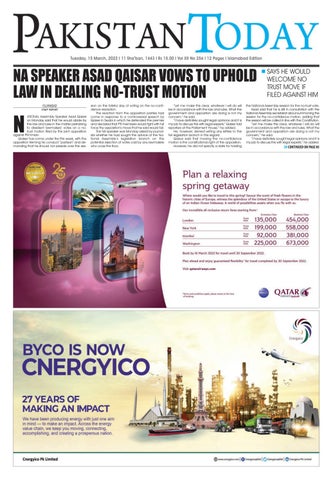
Tuesday, 15 March, 2022 I 11 Shaʽban, 1443 I Rs 15.00 I Vol XII No 256 I 12 Pages I Islamabad Edition
NA SpeAker ASAd QAiSAr vowS to uphold lAw iN deAliNg No-truSt motioN islamabad
N
staff report
ational assembly Speaker asad Qaiser on monday said that he would abide by the law and rules in the matter pertaining to dissident lawmakers’ votes on a notrust motion filed by the joint opposition against Pm imran. Qaiser has come under fire this week, with the opposition terming his conduct “partisan” and demanding that he should not preside over the ses-
sion on the fateful day of voting on the no-confidence resolution. the reaction from the opposition parties had come in response to a controversial speech by Qaiser in Swabi in which he defended the premier and declared that Pti members would fight with full force the opposition’s move that he said would fail. the na speaker was monday asked by journalists whether he had sought the advice of the national assembly’s legislation branch on the potential rejection of votes cast by any lawmakers who cross the floor.
“let me make this clear, whatever i will do will be in accordance with the law and rules. what the government and opposition are doing is not my concern,” he said. “i have definitely sought legal opinions and it is my job to discuss this with legal experts,” Qaiser told reporters at the Parliament house,” he added. he, however, denied writing any letters to the na legislation branch in this regard. Qaisar said that moving the no-confidence motion is the constitutional right of the opposition. however, he did not specify a date for holding
g
SayS he would welcome no truSt move if filed againSt him
the national assembly session for the no-trust vote. asad said that he is still in consultation with the national assembly secretariat about summoning the session for the no-confidence motion, adding that the session will be called in line with the constitution. “let me make this clear, whatever i will do will be in accordance with the law and rules. what the government and opposition are doing is not my concern,” he said. “i have definitely sought legal opinions and it is my job to discuss this with legal experts,” he added.
CONTINUED ON PAGE 05
02
Tuesday, 15 March, 2022 | ISLAMABAD
NEWS
PM KhAn AssuRes Allies oF Resolving PRoBleMs oF sindh, BAloChisTAn ISLAMABAD
P
stAFF RePoRt
RIME Minister Imran Khan on Monday separately met with delegations from allied parties – Balochistan Awami Party (BAP) and Grand Democratic Alliance (GDA) – and assured them to alleviate their grievances. A delegation of Grand Democratic Alliance (GDA) led by Minister for InterProvincial Coordination Dr Fehmida Mirza Monday called upon Prime Minister Imran Khan to express their confidence in his leadership and the government’s public welfare policies.
Ghous Bux Mahar, a member of the National Assembly and Dr Zulfiqar Mirza were included in the delegation. According to the sources, PTI’s ally BAP has complained to Prime Minister Imran Khan for not resolving Balochistan’s problems since he came to power three years back, as the political temperature in the country rises after the Opposition filed a no-trust motion against the premier. The reservations were expressed during a meeting held at the Parliament Lodges between a BAP and a government delegation headed by PM Imran Khan as the premier seeks the support of allies amid the no-confidence motion.
Afghan diplomats under pressure from Taliban government KABUL AFP
Afghanistan embassies around the world that have refused to recognise the new Taliban government are struggling to stay afloat and facing increasing pressure from Kabul to accept loyalist replacements. None of the country’s 60 or so ambassadors, consuls or heads of diplomatic missions who were appointed by Westernbacked former president Ashraf Ghani have agreed to serve the hardline group since it assumed power in August last year. The Taliban government has yet to be formally recognised by any nation, and the international community is grappling with how to deal with the country’s new rulers while also helping Afghans face an economic and humanitarian crisis. “We are in a very unfortunate … situation, but we still have to continue to operate in these difficult circumstances,” said Youssef Ghafoorzai, the ambassador to Norway. “The embassies still have a very important role to play in terms of trying to increase whatever humanitarian support is possible. But also (to help) discussions on the political track… to stabilise the situation.” Aid and cash reserves, frozen by the United States and the international community after the Taliban seized control, are trickling back into the country, which has long depended almost entirely on donors. But Ghafoorzai and his colleagues have had no contact with the new regime, and staff have not been paid for months. The Afghan embassy and its consulates in the United States are being shut in the coming week. “The Afghan Embassy and consulates are under severe financial pressure. Their bank accounts are not available to them,” a US State Department official told AFP. The embassy and Washington have made arrangements for an “orderly shutdown of operations in a way that would protect and preserve all diplomatic mission property in the United States until operations are able to resume,” the official said. Across the world, Afghan ambassadors have been forced to dramatically scale down their activities, reduce energy bills and food costs, and even move into smaller premises. They have also increased consular fees to generate revenue. “The embassy is not receiving any funding or financial assistance from Kabul,” Farid Mamundzay, the ambassador in New Delhi, told AFP. “In the absence of the required financial support and depletion of resources, we have not been able to pay the staff salaries for months and had to downsize the strength and reduce the expenditure of the mission to the lowest.” It is not clear how long visas, certificates and other documents issued by the holdout embassies will be recognised — either by the Taliban or the international community. New passports issued in Kabul now refer to the country by the Taliban’s name, the Islamic Emirate of Afghanistan, while officials have warned foreign journalists arriving with visas issued independently by the Dubai embassy that they may not be honoured in future. Squeezed out: In a handful of countries near Afghanistan, some ambassadors have left their posts or been pushed out by the Taliban, who have inserted their own representatives — but even the replacements face hardship. In Pakistan, salaries have not been paid since September. Employees live on income from visa and passport renewal fees and marriage certificates, said a source at the consulate in Peshawar, near the Afghan border.
The BAP delegation was led by the party’s parliamentary leader, Khalid Magsi, a statement from the PM Office said, with Minister for Defence Production Zubaida Jalal, Robina Irfan, Sardar Israr Tareen and Mir Ahsan Reki also attending the meeting. During the meeting, according to sources, Magsi told the prime minister that the no-confidence motion was a democratic move, which should be dealt with in a similar manner. “Our party’s consultations are underway, we will decide soon,” Magsi informed the prime minister about BAP’s decision on the no-confidence motion. Speaking to journalists last week, Interior Minister Sheikh Rasheed had
claimed that BAP was “fully” behind PM Imran Khan. In response to the interior minister’s
comments, BAP President Jam Kamal Khan said: “Balochistan Awami Party takes its own decision, not Sheikh Rashid.”
Haier, DEL penalised for anti-competitive conduct ISLAMABAD tLtP
The Competition Commission of Pakistan (CCP) has imposed a penalty of Rs1 billion on Haier and Rs100 million on DEL/Dawlance for anti-competitive conduct in the form of resale price maintenance (RPM) practices. The CCP passed an order against Haier and DEL/Dawlance for violation of the Section 4 of the Competition Act, 2010 for entering into RPM arrangements with its dealers, which is a form of price-fixing under Section 4(2)(a) of the Act and by object an anti-competitive practice. The bench consisted of CCP Chairperson Rahat Kaunain Hassan and Member Mujtaba Ahmad Lodhi. The Commission imposed the penalties for DEL/Dawlance, considering its change in management, which discontinued the RPM agreement and practice, the fact that it voluntarily committed to refund the penalties to its dealers and had a cooperative and compliance-oriented approach throughout the proceedings, CCP restricted the penalty amount to Rs100 million, not exceeding 1 per cent of its annual turnover in FY 2020-21.
The CCP, therefore, held that the conduct, circumstances, approach and the duration of the contravention did not justify the same treatment for both parties. Whereas, Haier was ‘blowing hot and cold’ throughout the proceedings. Nevertheless, although its conduct called for a much higher and stricter penalty, considering the violation is a case of first instance for Haier and in order to promote a compliance-oriented approach, with good faith, CCP restricted the penalty amount to Rs1 billion, not exceeding 3 percent of its annual turnover in FY 2020-21. The Commission had initiated an enquiry under Section 37(1) of the Act into the alleged contravention of Section 4 of the Act by “electronic appliance manufacturers, distributors and dealers and their respective trade associations”. To gather evidence, search and inspections were also carried out at both Haier’s and DEL/Dawlance’s premises under Section 34 of the Act. The CCP found evidence of price circulars sanctioning dealers and price control policies in place through which both Haier and DEL/Dawlance had restricted its dealers from selling below a certain price, provided any discounts or package deals and
imposed penalties and sanctions on their dealers to monitor and implement their respective pricing policies. The parties had also not obtained any exemption from the CCP for its RPM agreements under Section 5 of the Act on account of any efficiency grounds specified under Section 9 of the Act, i.e., that the agreements substantially contribute to improving production or distribution, promoting technical or economic progress, while allowing consumers fair share of the resulting benefit, or the benefits of the agreements clearly outweigh the adverse effects of absence or lessening of competition. The CCP observed that RPM agreements in any form including restricting discounts and imposing minimum and maximum pricing levels are by object anti-competitive and void under Section 4 of the Act. In this connection, it was observed that the choice to offer forms of discount or package deals is an important part of the negotiating process. Restricting the same along with fixing prices lessens consumer bargaining power. RPM may also lead to price hikes for consumers. Also, the argued pro-competitive effects could by no means be upheld and justified where the parties imposed penalties and sanctions on its dealers.
ADB appreciates govt efforts for improving economy APP Asian Development Bank (ADB), Vice President Shixin Chen here on Monday appreciated and supported the efforts made by the incumbent government in social and economic sectors for bringing improvement in country’s economy. During a meeting with Federal Minister for Finance and Revenue, Shaukat Tarin, the ADB Vice President re-affirmed bank’s commitment to continue support for strengthening reform programs and implementation of country’s development agenda including fiscal management, building resilience and boosting competitiveness and development of private sector. Country Director ADB, Yong Ye, Secretary Finance and senior officers also participated in the meeting, according to press statement issued by the finance ministry. Welcoming Shixin Chen, Finance Minister, Shaukat Tarin said that the ADB had always been a source of support in pursuing reform agenda and implementing various development projects for the country. He acknowledged the longstanding partnership and firm
commitment of Asian Development Bank as a major partner for bringing essential reforms in priority areas including energy, fiscal and debt management as well as socioeconomic development. Tarin gave an overview of the country’s economic situation and emphasized that the government was committed to introduce reforms in various sectors, in the face of various challenges, to address the long outstanding structural issues and to attain sustainable and inclusive growth. The Finance Minister informed
that the government had taken steps to improve the revenue collection through broadening of tax base, capturing retail sales, single window operations as well as track and trace system. The Minister also shared steps taken to help the underprivileged segment of the society through Kamyab Pakistan program, which he said would help them to achieve selfsufficiency. He thanked Shixin Chen and his team for their continuous support and facilitation, the statement added.
Compliance with FATF regulations being ensured: FBR ISLAMABAD News Desk
Federal board of Revenue (FBR) has clarified that it is making all-out efforts in ensuring compliance with the Financial Action Task Force (FATF) regulations in cases of DNFBPs (Designated Non-Financial Business or Professions), in letter and spirit, and is also fighting the menace of money laundering, by all means possible. In a statement issued on Monday, the FBR while clarifying a news item published in a section of press, stated that the comments made by chairman FBR about talks with FATF have been misconstrued and not properly comprehended in their true spirit. The FBR also cleared its position about a news item captioned “Fake CNICs sore point in FATF talks” appearing in a section of press on March 14, 2022 saying it was quoted out of context. “While addressing the business community at Lahore Chamber of Commerce and Industry (LCCI) on March 13 (Sunday), Chairman FBR expressed his concerns about non-compliance by majority of businesses with regard to furnishing CNICs of individuals making purchases worth Rs. 100,000 or above, as required by law,” the statement added. The issue highlighted in the said meeting with business community at Lahore Chambers actually referred to factitious identity and fake entries being recorded by businesses. These remarks, by no means, related to issuance of CNICs by NADRA, it added.
Tareen groups joins hands with PML-N to oust Buzdar LAHORE stAFF RePoRt
Jahangir Khan Tareen group, the disgruntled faction of the ruling PTI, met with the PMLN leadership on Monday and agreed to joined hands to oust Punjab Chief Minister Usman Buzdar. The development comes days after Tareen’s group announced that they would
only support the government in the noconfidence move if it accepted their condition to remove Usman Buzdar from the post of CM Punjab. According to a joint statement issued after the meeting following the meeting, the PML-N delegation led by Punjab Assembly opposition leader Hamza Shehbaz visited the residence of Tareen, who is currently in London reportedly for medical treatment. Sardar Owais Leghari, Ataullah Tarar,
Khawaja Salman Rafique and Zeeshan Rafique were part of the PML-N delegation. The lawmakers of the disgruntled group “expressed disappointment” over the state of affairs in Punjab and consensus was reached with the PML-N to remove Usman Buzdar from the post of chief minister, the statement added. The provincial assembly lawmakers also criticised the performance of CM Buzdarled government, saying corruption and
inflation had been on rise. A rare huddle between the rival parties’ members also discussed in detail the political situation of the country and agreed to remain in contact. Hamza, who is a son of PML-N President Shehbaz Sharif, also expressed “best wishes for the health of Jahangir Tareen” during the meeting. Tareen group leader Punjab Minister Malik Nauman Ahmad Langrial told the
media that all members of the group had given full authority to Tareen to make any decision on their behalf. “I want to highlight here that all members of the group are united on the strategy to move forward [to vote against the no-trust motion] if the government accepts the minus Buzdar formula,” Langrial added. “All like-minded members of the group are willing to accept the decision made by Tareen.” He said Tareen had indicated that they were in contact with different political parties as the group had a majority after two big political parties in the House.
Tuesday, 15 March, 2022 | ISLAMABAD
NEWS
03
sTill undeCided on no-ConFidenCe MoTion, sAys MQM-P AFTeR MeeTing wiTh PPP
A
nEwS DESK
DELEGATION of Muttahida Qaumi Movement-Pakistan (MQM-P) on Monday met with the leadership of Pakistan People’s Party (PPP) at Zardari House in Islamabad. Federal Minister for Information Technology and Telecommunication Aminul-Haque, convener Khalid Maqbool Siddiqui, senior deputy convener Amir Khan, Wasim Akhtar, Khawaja Izhar-ulHasan and Javed Hanif were part of the MQM-P delegation. After the meeting, a PPP spokesperson
claimed that both parties have “reached an understanding” and decided to work together in the “greater interest of the country”. The spokesperson did not say if their understanding also includes any support in the joint opposition’s no-trust motion against Prime Minister Imran Khan. The two parties discussed the current political situation in the country and PPP agreed to all of MQM-P’s points of concern, the spokesperson said. On the other hand, the MQM-P, in a statement, acknowledged that the meeting with the PPP was in continuation of the series of political meetings it has held over the past few days but also said that it is still in the process of consultation on the no-trust
move. “A decision on the political situation, including the no-trust move, will be taken after considering the interests of our people. The party is still in the process of consultation on the issue,” an MQM-P spokesperson said. The spokesperson, however, confirmed that the MQM-P and PPP have agreed to have a better relationship to resolve the problems of urban Sindh. “An agreement was reached to resolve administrative and legal challenges through legislation.” Allied PARtieS to RemAiN PARt of Pti’S AlliANce: Earlier in the day, Federal Minister for Information
and Broadcasting Chaudhry Fawad Hussain said that the imminent failure of no-trust motion would definitely give a fatal blow to the opposition. He said: “All the cards are with us and we will decide what might be the next move and whatever the next move should be, I assure you that it will be the last game of these ‘three jokers’ [three major oppositions leaders], who will simply vanish from political scene after failure of the notrust motion.” Flanked by PTI’s Additional Secretary General Aamer Mehmood Kiani, he said the opposition would feel remorse at its no-trust move as Prime Minister Imran Khan has devised a comprehensive strategy to foil it. He said the entire ruling party stand by
Qureshi urges German FM to take note of India’s ‘accidental’ missile launch StAff REPORt Foreign Minister Shah Mahmood Qureshi on Monday held a telephone call with his German counterpart Annalena Baerbock and conveyed to her that Islamabad had urged the international community to take serious notice of the “accidental” firing of a missile by India inside Pakistan last week and play its due role in upholding strategic stability in the region. According to a statement issued by the Foreign Office (FO), Qureshi informed Baerbock the Indian missile had violated Pakistan’s airspace on March 9. The missile, which was initially identified by Pakistan as an unarmed “high-speed flying object”, had travelled 124 kilometres inside Pakistani territory in three minutes and 44 seconds, according to the details shared during a press briefing by Inter-Services
Public Relations Director (ISPR) General Maj Gen Babar Iftikhar a day after the incident. The DG ISPR had told the media on the occasion that the missile was picked up by the Air Defence Operations Centre of the Pakistan Air Force while it was inside the Indian territory. “From its initial course, the object suddenly manoeuvred towards Pakistani territory and violated Pakistan’s air space, ultimately falling near Mian Channu at 6:50pm” on March, he had said, and called for an explanation from India. A day later, India had confirmed that a missile was launched inside Pakistan, albeit “accidentally”. It had attributed the incident to a “technical malfunction” — an explanation that Islamabad finds too “simplistic” and resultantly, urging for a joint probe of the matter. In the phone call with Baerbock
Pso communicates inability to import petroleum products for oMCs AHMAD AHMADAnI Pakistan State Oil (PSO) has expressed its inability to ensure the import of petroleum products for other Oil Marketing Companies (OMCs) in the country. PSO General Manager (Supply), Asad Faiz, in a letter to the Ministry of Energy (Petroleum Division), has raised voice against OGRA for suggesting it (PSO) to import petroleum products for other Oil Marketing Companies (OMCs). He said that PSO currently has only one fuel supply contract under a government-to-government (G2G) arrangement with Kuwait Petroleum Corporation (KPC) for supplies of HSD and the contractual volumes with KPC are already fully utilized to cater to PSO’s requirement. In addition the suggestions put forth by OGRA are not only anti-competitive but they also appear to be contrary to the public interest as it would most likely create supply chain related issues due to which the general public would suffer. Moreover, the suggestions by OGRA would create legal implications, said the PSO letter. According to the letter from PSO, the market situation is highly volatile with regards to product availability and like other OMCs, PSO is also going through the same situation. However, PSO, being a responsible organisation, is still meeting its obligations and arranging products irrespective of commercial considerations and bearing the huge circular debt. “Considering the situation, PSO is neither in a position to take responsibility for imports of other OMCs as this may also become a single point of failure for the country’s supply chain nor does PSO have the mandate or financial capacity,” said the PSO letter. “Moreover, due to increasing oil prices and huge PSO’s receivables under circular debt (currently at Rs464 billion), PSO is struggling in opening LCs for its own imports and there is no cushion at all to open LCs for other imports,” added the letter. PSO has consistently highlighted this non-compliance in Product Review (PR) meetings and has also cautioned regarding the risk to the country’s supply chain in several PR and other meetings with OGRA. However, no positive action on part of OMCs has been witnessed till date which is exposing the country to the risk of dry out.
today, Qureshi reiterated this stance of Pakistan, saying that such a serious matter could not be addressed with the simplistic explanation proffered by the Indian authorities. He said Pakistan had called for a joint probe of the incident, as well as urged the international community to take note of this incident of “grave nature in a nuclearised environment”. FM Qureshi further stressed the need for the international community to “play its due role in upholding and promoting strategic stability in the region”, the FO statement said. With regards to the ongoing situation in Ukraine, Qureshi told Baerbock “it was a grave moment in Europe’s history”. He also informed Baerbock of Prime Minister Imran Khan’s conversation with European Council chief Charles Michel, and his own phone calls with
foreign ministers of Ukraine, Poland, Romania, Hungary and Russia, as well as with European Union High Representative Josep Borrell. He said that Pakistan had stressed the importance of cessation of hostilities, establishment and maintenance of humanitarian corridors, provision of humanitarian assistance and continuous efforts for a solution through dialogue and diplomacy. bilAteRAl tieS: The two foreign ministers also exchanged views on bilateral ties between Germany and Pakistan, with FM Qureshi underscoring the “high value” Islamabad attached to its ties with Berlin. He said Pakistan was determined to further deepen its collaboration with Germany across all areas of mutual benefit, and that he looked forward to receiving Baerbock in Islamabad in April to continue their discussions.
PTCL requests NEPRA for revision in power tariff AHtASAM AHMAD & ASAD ULLAH KAMRAn Pakistan Telecommunication Company Limited (PTCL) filed a petition with National Electric Power Regulatory Authority (NEPRA) on Friday, for the revision of its power tariff. PTCL, in the petition, has requested the Power regulator to revise the basis of charging for the company from commercial charges to industrial charges. A move that would lead to an expected 15% to 20% of electricity cost savings for PTCL. NePRA’S cAtegoRizAtioN foR tARiff: NEPRA segregates consumers based on usage of electricity. The categories include residential, commercial, general services, industrial, single point suppliers and agriculture. The charges for each segment vary according to the time of usage and the DISCO (Distribution Company) supplying the electricity. RAtioNAle behiNd the PetitioN: The telecom sector has been categorized by NEPRA under the commercial segment for more than 20 years. This, according to PTCL, is not an appropriate classification. As the petition states, the Telecom sector was granted the status of an Industry as notified by the Ministry of Industry and Productions (MoIP) back in 2004. Further, the Income Tax Ordinance also defines the sector as an industry. Power cost issue for the Telco. Under the current structure, PTCL is being charged a “Two Part” tariff. Through this mechanism the total charges are computed by combining fixed charges on the basis of capacity and
variable charges based on actual consumption. This has led to an increase of 40% in the energy costs of PTCL’s exchanges. This incremental cost has undermined the revenues generated by telephonic exchanges with the company closing approximately 10 exchanges every month. These exchanges are essential for smaller rural districts where this infrastructure allows subscribers to call each other by switching (interconnecting) their lines. coSt SAviNgS: PTCL currently has 7823 connections across 19 regions that consumes around 1617.0 Million Kwh of electricity per month which costs them approximately Rs340 million. The average costs per unit consumed is around Rs20 while under the industrial tariff it would be around Rs16 to Rs17. This will result in 15%-20% cost savings. WhAt doeS it meAN foR the telco iNduStRy? As per Reon Energy, “Energy costs for telecom tower operators account for 75-80% of operational expenditures and that could rise to 85-90% in case of low grid coverage.” Therefore, revision in rates, if approved, might be a significant step towards reducing operational costs for the telcos that are already suffering from low return on investments from their conventional operations. Hearing for the petition is scheduled on 30th March where NEPRA will decide the reasonableness of PTCL’s demands. Profit has also reached out to PTCL regarding the development. However, the company refused to comment on the matter citing that the petition was still under review.
IMF seventh review expected to be prolonged SHAHzAD PARAcHA The ongoing seventh review of the $6 billion Extended Fund Facility program is likely to be prolonged due to the announced Prime Minister relief measures as well as political situation. Sources said that Pakistan and the IMF representative are discussing matters related to the economy in ongoing talks. The Resident Representative of the International Monetary Fund (IMF) for Pakistan Esther Perez Ruiz on a query replied that “the authorities and the IMF will continue to discuss recent developments and other measures to promote macroeconomic stability.” It is pertinent to note that Prime Minister Imran Khan on February 28, 2022, announced a reduction of prices of petroleum products by Rs10 per litre, cut in electricity price by Rs5 per unit, and a targeted tax
amnesty scheme for the industrial sector. Sources said that the Prime Minister’s relief package would have neither any impact on fiscal deficit nor increased borrowing. Funding would be made available through dividends of oil companies, the Public Sector Development Program and the Covid-19 fund, sources added. These relief measures were the most pressing need and there was no impact on budgetary numbers. Sources also said that both sides are also discussing the proposals with regard to next year’s budget keeping in view the macro-economic framework. Pakistan and the IMF started negotiations on the ongoing seventh review of the $6 billion Extended Fund Facility program on March 4, 2022. Sources said that there is no cut off date of ongoing talks as Pakistan and IMF negotiations continued for seven weeks in September last year.
the prime minister and expressed optimism that all the allied parties, including Muttahida Qaumi Movement-Pakistan (MQM), Balochistan Awami Party (BAP), Grand Democratic Alliance (GDA) and Pakistan Muslim League-Quaid would remain part of the PTI’s alliance. oPtioNS ARe oPeN: Last week, Prime Minister Imran Khan had held a meeting with the leadership of MQM-P in Karachi. After the meeting, MQM-P leader Amir Khan had told media that no discussion took place on the no-confidence motion with the prime minister. “It was a good gesture from the prime minister, who came to our office after a gap of three and a half years,” he had told journalists.
Muslim world to observe int’l day against islamophobia today ISLAMABAD APP
The Muslim world would observe the International Day to Combat Islamophobia on Tuesday to denounce rise in intolerance and discrimination against Muslims and other minorities in the West, India and other parts of the world. Pakistan would also join the Muslim world to observe the Day as the country had emerged as one of the leading actors to raise its voices against Islamophobia. The credit for introducing the anti-Islamophobia Day on March 15 also goes to Pakistan’s leadership as country had presented a resolution at the 47th session of the Organization of Islamic Cooperation (OIC) Council of Foreign Ministers in Niamey, Niger in November 2020. Since then, the 57-member OIC has been working with the international community to commemorate this Day at the global level. At the world platforms including the UN General Assembly, Prime Minister Imran Khan had been calling the world to act against Islamophobia asking the world leaders “to act collectively to counter growing phenomenon in non-Muslim states. In the recent past, the prime minister welcomed Trudeau’s plan to appoint a special representative to combat Islamophobia, which he termed a “contemporary scourge”. Imran Khan also recently appreciated Russian President Vladimir’s “emphatic statement” that freedom of speech could not be a pretext to abuse the Prophet. Prime Minister Imran Khan has regularly highlighted the appalling rise in Islamophobia and associated hatred in his addresses to the UN General Assembly, pointing towards its serious ramifications. By Observing the Day, Pakistan intends to highlight the challenges that Islamophobia is posing to Muslims all over the world. The scourge of Islamophobia led to negative profiling, mob lynching by cow vigilantes, discriminatory laws, attacks on women wearing hijabs, ban on minarets and attempts to link and equate Islam with terrorism. The 48th session of foreign ministers of the OIC countries, to be held in Islamabad March 22-23, 2022, will present opportunities to discuss issues and extend cooperation. For decades, Muslim communities – India’s largest minority group – have faced discrimination and are being victims of communal violence which worsened under the Hindu nationalist BJP’s government particularly through the Citizenship Amendment Act (CAA). In a house of 543, there are 27 Muslim MPs in the Indian parliament. But none of them are from BJP, which does have a handful of MPs in the upper house. Similarly, the Muslims have been the target of increasing Islamophobic attacks since the 9/11 terror attacks in the US and 7/7 terror attacks in the UK. OIC countries must call upon all states to prevent any advocacy of religious discrimination, hostility or violence and defamation of Islam by incorporating legal and administrative measures and credibly investigate attacks and hate crimes against Muslims and their places of worships.
Tuesday, 15 March, 2022 | ISLAMABAD
04 NEWS
Imran KHan Is not goIng to allow PaKIstan to be anyone’s slave
a
SAHIBzADA A. JAHAngIR
RE we the slaves of the West? If not, why the hue and cry when the truth is told that we are not your slaves? Are we the slaves of the West? If not, then why do they lament that we should not utter our souls and minds are free? For indeed we are free, and should be free from our colonial past, those dark days of bowing down subordinate to our masters. We live in a free world we are told. We are not your slaves. We have the right to think independently. We are not your slaves. We have the right to run our own country and our own foreign policy. We are not your slaves. We have the right to make our economy prosper and make trade deals. We are not your slaves. We have the right to defend our land against aggressors, who throw bombs our way and then claim it was a technical malfunction. We are not your slaves and we are no fools. We have the right not to be dragged into wars where there can be no resolution, just turn and look at Afghanistan. We are no longer your slaves. Pakistan is a sovereign country with independent foreign policy, which as Ayub Khan put it once about the super powers, they are our “Friends not Masters”. We endured slavery for 300 years under the British and today when a leader has come
along and raised his voice, all the opposition parties cowardly sang from the same hymn sheet, pleading with the international forces that they are innocent. Please don’t punish us. Please don’t sanction our foreign properties, they cry in mitigation. Please don’t freeze our foreign accounts. We will do whatever you desire .. just get Imran khan out of the way. History reminds us when Oliver Cromwell took up and disbanded the British Parliament, the same noises were made in the UK too by the blood sucking corrupt politicians. But then again it doesn’t take a group of politicians but one man to lead his country towards triumph and sovereignty. When PTI formed the government, records came to light which revealed that the previous rulers had literally left the country on the verge of bankruptcy. The PTI government had to borrow firstly to service the previous loans and at the same time keep the economy afloat. In the circumstances which he inherited, Imran Khan managed an incredible turnaround of the economy. Three years is not sufficient time for the economy to prosper fully. Yet, during PTI governance our foreign exchange reserves have increased substantially . The Ehsas program is operating very successfully and helping the most needy. Kamyab Programme is lifting the youth and at the same time helping the unemployed graduates. Sehat programme, even in developed countries hard to find, is providing up
Hearing in Paragon society case adjourned
to Rs1 million towards medical treatment costs. Foreign remittances are record high. Exports are a record high. The construction industry is booming. Overseas Pakistanis are being given 100% tax exemption on their investment. 100% tax exemption is being given to IT companies. Small Dams are being built all over the country which would benefit generations to come. What PM Khan had achieved through his courageous policies, no other person could have matched him in the same period. There is a Lion in Pakistan and he roars fiercely and proudly, wrapped in our green flag with the stars and moon shining upon him. Let him wrap you Pakistanis, in this flag of hope, pride and victory, to never again be subordinate, never again be weak, never again be beggars, to rise and be bold. You see, we are not your slaves. Why the disquiet? Why the fear? Why are the cowardly shrinking back into the colonial mindset of thinking they must acquiesce and appease their old rulers? The same rulers who tore up and divided and mismanaged a shoddy break up of lands, where Kashmir still bleeds from their unequitable meddling. Why be afraid when Imran Khan, alone amongst all the recent leaders of this great Country, the only one brave enough to tell the truth and stand tall when he proclaims Pakistan will not be anyone’s slave? He tells a truth and tells it boldly and fiercely, those steely eyes as determined as when he led
Pakistan to its cricketing victory in 1992. The world order is changing. Alliances are changing. There may be difficult times ahead, but who else will be able to meet these challenges with the noble dignity of our leader? The previous looters, who hide away in foreign lands, shielding their ill-gotten gains? Or perhaps their prodigy, fuelled by nothing other than revenge and greed in their broken Urdu or Hermes bags and Gucci shoes? Is a diesel mullah who would call on his followers to wreak havoc and disturb this land, the man to lead Pakistan? Or those in opposition showing up at the police stations when no one had even bothered to arrest them? Are these the jokers you think will lead Pakistan to its great height? There is something rotten in the state of Denmark said Hamlet, yet he could have been referring to the rotten core of the opposition establishment. Those who are scared of progress. Those who fear to uplift the poor and needy. Those who shy away from our great religion. Those who are apologists and lack the vision to make Pakistan a great country. We need to lead, not follow. The biggest disservice PML(N) & PPP bestowed upon Pakistan was to keep the masses uneducated so that the common man who never have the knowledge nor courage to oppose the looting of the National wealth for over three decades. Despite the time when they were in power, they were incompetent to provide education to all young children, yet, out of power living in exile they were strong enough to send their own children to top schools and universities. Shame on such ruthless rulers who left the nation crippled, hands and legs chopped and their mindset hijacked. I met Imran Khan in 1971 at Lords Cricket ground nets. That we had dinner together. I had an MG sports car and we drove around london. He was a young handsome
man. From that day onwards, Alhamdullah, I have had the great privilege and honour to have always walked side by side with him under his shadows, for the last 50 years. There is so much that I have learned in life from him. His influence on me has been significant. He guided me towards Islam, charity & humanity. I have travelled the world with him in connection with his charitable causes and witnessed first hand that no human I have seen that is so massively respected and loved worldwide. The only man who has remained the ‘national hero’ of Pakistan for over 45 years. He is caring & compassionate. He could not see the suffering of his people at the hands of rulers who were corrupt. Therefore 25 years ago he started to wage a war of freedom to untie his people from the shackles of the bondage of slavery. When Imran khan used the sentence ‘Absolutely Not’ every single Pakistani politicians went into hiding. Fearing the worst. Wondering if their looted foreign accounts will be frozen. ‘We are not your slaves’. Pakistan is a sovereign country which has an independent foreign policy and the government will make decisions which are beneficial to us and safeguard our interests. Imran khan is a courageous leader. He did not mince his words. He simply stated the truth. There is only one statesman. There is only one leader. There is only one Lion. Allah has bestowed a favour on Pakistan, so let the people open their eyes and lend their full support, for victory is achieved together. Let there be unity and peace in our blessed land and let the soil of Pakistan shoot its green foliage, so that we stand tall and proud as a nation, for we are not your slaves. Imran Khan spoke the truth and he spoke it courageously. This country needs him for he is irreplaceable. The writer is Advisor to PM Imran Khan on Trade & Investment in the UK & Europe
Fire breaks out at Lahore shopping mall
LAHORE
LAHORE
Monitoring report
Staff report
An accountability court in Lahore on Monday adjourned the hearing in a National Accountability Bureau (NAB) reference against former minister Khawaja Saad Rafique and his brother Khawaja Salman Rafique until March 30. The brothers appeared before the court and marked their attendance. Two witnesses arranged by NAB, including one Dr Fareeha, recorded their statements in court. Accountability Judge Naseem Ahmad Virk heard the case. The NAB accused the Khawaja brothers of wrongfully gaining Rs18.2 million approximately from M/s Paragon City (Pvt.) Ltd. in their bank accounts and they failed to account for the illegal gains. It said Saad, in order to achieve his nefarious designs and to disguise the origin of his illegitimate pecuniary benefits, established a proprietorship concern namely M/s Saadan Associates whereby he wrongfully gained an amount of Rs58 million from M/s Executive Builders, a proxy of Paragon City, in the last few years under the garb of services of consultancy.
A night-time fire at a posh shopping centre in a central Lahore neighbourhood was contained six hours after it broke out and the cooling process was underway, police and civil administration said Monday morning. The city fire brigade sent 25 firefighters and at least 60 rescue workers to the Pace shopping centre in Gulberg neighbourhood shortly after 2:00 am, as images online showed flames peeling from the top of the block and a dark plume of smoke drifting into the sky. A spokesperson for the Rescue 1122 service said snorkel and aerial platform special fire vehicles are also present on the scene while teams have also been called in from nearby districts. No casualties were reported in the incident. The fire caused extensive material damage, ripping through hundreds of stores that sold clothes, leather goods and cosmetics — many of which were highly flammable. The cause is not known at this stage.
“Investigations are underway to determine the cause of the blaze,” the ministry statement read. Lahore Deputy Commissioner Umer Sher Chatha said it was a Class A fire — a fire that involves solid combustibles such as wood, coal, paper, plastic, straw, cloth, rubber or any other solid material. “The building will be closed until it is safe,” a member of the fire brigade told reporters at the scene of the fire. “We have to see the impact on the structure and the police will need to go in to investigate.” The fire came in an area popular with shoppers, just weeks before the beginning of the holy month of Ramadan. Meanwhile, traders exploded at the Pace management, claiming the building was deliberately lit. Police say the security in-charge and a member of the staff have been arrested for obstructing the rescue operations. Incidents of fire are reported frequently in the provincial capital of Punjab — some caused by electrical short-circuits, others by unsafe heating methods. In October 2020, a massive fire in Hafeez Centre, Lahore’s major multi-storey market housing mobile
phones, laptops and computers business, gutted more than 400 shops, godowns and repair facilities, inflicting heavy losses on traders. It was the fifth major fire reported in the Gulberg neighbourhood over the last four years.
Factbox: Pakistan and India’s nuclear arsenals ISLAMABAD reuterS
India’s defence ministry on Friday said a missile had been “accidentally” fired into Pakistan after a “technical malfunction”, putting the spotlight once again on the nuclear arsenals of the South Asian arch-rivals. Both countries have pledged no first use of a nuclear weapon, but the accident immediately raised questions about the safety mechanisms in their systems. Below is a look at their nuclear capabilities: ARSENAL SIZE: Both countries possess nuclear arsenals of comparable size. Pakistan holds about 100–120 nuclear weapons, which can be delivered by aircraft and land-based missiles, while India’s nuclear arsenal is around 90-110 nuclear weapons, according to estimates by the Stockholm International Peace Research Institute. Of the world’s nine nuclear-armed countries, India and Pakistan are also among the handful that have been increasing their nuclear warhead stockpiles, according to the Federation of American Scientists (FAS). DELIVERY SYSTEMS: Pakistan’s nuclear delivery systems include at least four short-range and two medium-range ballistic missiles, according to the U.S.based Arms Control Association (ACA). Several more missiles, including an intercontinental ballistic missile (ICBM) with a range of 7,000 kilometres, are under development. India, which is also developing two intercontinental ballistic missiles, already has an intermediate-range ballistic missile that can deliver a single warhead over 3,000 km, according to the ACA. India’s other delivery systems include multiple nuclear-capable short and medium ballistic missiles, which are under the control of its Strategic Forces Command.
CMYK
Indian nuclear delivery systems also feature a land-attack cruise missile called BrahMos, which was jointly developed with Russia and has an estimated range of 300-500 km. Unlike Pakistan, however, India has a nuclearpowered ballistic missile submarine that completes its “nuclear triad” — the ability to launch nuclear strikes by land, air and sea. Both countries have a range of aircraft available for potential nuclear payload delivery. WEAPONS DEVELOPMENT: India tested a nuclear explosive device for the first time in 1974, which then pushed Pakistan to speed up work on its own secret programme. Both countries, which publicly demonstrated their nuclear weapon capabilities in titfor-tat tests in May 1998, haven’t signed on to the
Non-Proliferation Treaty (NPT). The NPT, which took effect in 1970, is aimed at halting the spread of nuclear weapons-making capability and is signed by around 190 countries. “Pakistan is expanding its nuclear arsenal faster than any other country and developing new delivery systems,” ACA said in a March 2022 briefing on Pakistan’s nuclear weapons. DOCTRINE: India is committed to a nuclear doctrine of “no first use”, meaning it has pledged not to strike first, but will maintain what it describes as a “credible minimum deterrence”, allowing the country to retaliate and cause massive damage. India has also said it won’t use a nuclear weapon against a non-nuclear weapons state, according to diplomatic statements.
Tuesday, 15 March, 2022 | islaMabad
news
NA Speaker Asad Qaisar vows to uphold law in dealing no-trust motion continued from page 01 Replying a question about the opposition’s announcement of submitting a no-confidence motion against him as well, Qaisar said that it is the opposition’s constitutional and legal right to file the motion. “I welcome it (the decision),” he said.
NCOC daily update: 462 new cases, two deaths from Covid-19 iSLamaBad Staff RepoRt
Pakistan has recorded 462 new Covid-19 cases over the last 24 hours, the National Command and Operation Center (NCOC) said on Monday. With the new infections, the overall number of confirmed cases of COVID-19 has risen to 1,519,154 in the country, said the NCOC, a department leading the campaign against the pandemic. A total of 398 people were reported to have recovered from the pandemic over the last 24 hours, bringing the total number of recoveries to 1,470,822, showed data from the NCOC. According to the official data, two deaths from Covid-19 were registered on Sunday, raising the death toll to 30,309. Sindh is the worst-hit province with 572,042 infections recorded, followed by Punjab, which has reported 503,844 cases so far.
Holiday in Islamabad on March 22, 24 for OIC meeting iSLamaBad MonitoRing RepoRt
The capital administration has declared a local holiday in Islamabad on March 22 and 24 as part of security for the Organisation of Islamic Cooperation (OIC) meeting, a notification issued Monday said. However, the administration also decided against suspending mobile phone services. Furthermore, all ministries and divisions within the city will remain closed on the days. TIMINGS REVISED: Meanwhile, the National Assembly reverted to regular working hours starting at 9:00 am and 5:00 pm, a notification announced. The notification directed the staff to resume duties accordingly.
UK graft watchdog secures access to frozen funds of Shehbaz London/LaHore inp
New revelations have emerged in investigations of the National Crime Agency (NCA) into charges of money laundering against Shehbaz Sharif as the British dirty money watchdog secured production orders from a court to access the accounts of the Pakistan Muslim League-Nawaz (PML-N) president in Barclays. A report in a television channel said the agency secured the production orders from Southwark Crown Court in relation to his mortgage dealings with British property magnate Aneel Mussarat. The court allowed the NCA to probe into the 15-year-old matter relating to the laundering of huge sums, permitting it access to the bank statements, details of the mortgage agreement and financial transactions related to the purchase of two luxury residences in central London neighbourhoods and loans Sharif secured in May 2005 with help from Mussarat. The NCA request to the court said its request for production orders was in relation to funds that were subjected to 12-month Account Freezing Orders given in December 2019 by the Westminster Magistrates’ Court. According to the NCA request, these funds totalling £677,307.14 are held across four bank accounts in HSBC, Royal Bank of Scotland (RBS) and Barclays. It claimed Sharif’s son Suleman Sharif is the joint owner of HSBC and Barclays accounts along with his father. The application further said it suspects the remaining balance of the frozen funds is to be a recoverable property or intended by any person for use in unlawful conduct, since it is derived from the alleged criminal conduct and money laundering activity. “So, the agency wants to determine if the funds consist, in part or full, of recoverable property. This application relates to a precise portion of the frozen funds worth GBP 315,000 derived from the sale proceeds of the Berkeley Street flat.”
NO-trUSt MOtION tO gIve fAtAl blOw tO OppOSItION: fAwAd iSLamaBad newS deSk
f
eDeRAL Minister for Information and Broadcasting Chaudhry Fawad Hussain on Monday said that the imminent failure of no-trust motion would definitely give a fatal blow to the opposition. Addressing a press conference after the meeting of Pakistan Tehreek-i-Insaf’s (PTI) core committee, he said: “All the cards are with us and we will decide what might be the next move and whatever the next move should be, I assure you that it will be the last game of these ‘three jokers’ [three major oppositions leaders], who will simply vanish from political scene after failure of the notrust motion.” Flanked by PTI’s Additional Secretary General Aamer Mehmood Kiani, he said the opposition would feel remorse at its no-trust move as Prime Minister Imran Khan has devised a comprehensive strategy to foil it. He said the entire ruling party stand by the prime minister and expressed optimism that all the allied parties, including Muttahida Qaumi Movement-Pakistan (MQM), Balochistan Awami Party (BAP), Grand Democratic Alliance (GDA) and Pakistan Muslim League-Quaid would re-
LaHore PML-Q leader and Minister for Water Resources Moonis elahi held a telephonic conversation with Ali Tareen, son of disgruntled PTI leader Jahangir Tareen. The contact was made through Awn Chaudhry, a confidante of senior Tareen.
main part of the PTI’s alliance. Sharing details of the core committee meeting with media, he said the entire party, including its leadership and parliamentarians, has reposed full confidence in the prime minister and resolved that only he can lead the country in these critical time. He said the core committee had not only rejected the opposition’s bid to revive the horse trading culture, but also condemned its tactics of offering millions of rupee to the PTI’s legislators for shifting their loyalties in case of the no-trust motion. Fawad said those, who offered bribe to the PTI legislators, must not dare to repeat the practice as it has been brought into the knowledge of ruling party’s leadership. He said most of the core committee members called for an early session of National Assembly, and added that the NA speaker has power to convene it. Dates of March 21, 22 and 23 are of sheer importance due to the schedule of Organisation of Islamic Cooperation (OIC) meeting in Pakistan, he said, adding that it was suggested that the session should not coincide with the event. He said the huge crowd at recent public meetings of the prime minister has once again proved that not only the PTI is a federal party, but PM Imran is the national leader.
By seeing such a huge crowd in the public meetings of the prime minister, the opposition parties’ leaders are trembling, he added. He ruled out any concession like NRO to the opposition leaders, saying the prime minister would not bow to their tactics. SHUJAAT IS LIKE A BROTHER TO PM: To a query, he said PML-Q chief and former premier Chaudhry Shujaat Hussain is like a brother to the prime minister, adding that, the party supported the PTI from the beginning and their support in future would be crucial. “We discussed in detail reservations of [allies]… they remained part of the coalition government for the last three and a half years and we hope that they would continue to do so; politics, government and future is in our hands,” he said. PTI APPROACHES PML-Q ONCE AGAIN: Meanwhile, according to a news outlet, the federal government once again approached its ally PML-Q to discuss the matter of no-confidence motion and overall political situation of the country. Federal Minister Ijaz Shah visited the residence of Chaudhry brothers in Lahore, where he met Chaudhry Pervaiz elahi and Monis elahi. Chaudhry Salik Hussain and Chaudhry Hussain elahi were also present on the occasion.
Lady health workers provide at-home care to rural families in KP iSLamaBad
Minister offers opposition olive branch
Xinhua
In a mountainous village in Khyber Pakhtunkhwa, Almeena Iftikhar has been providing door-to-door primary health care to women and children for 26 years. “I have had to remain strong on every step of my journey,” she told Xinhua. “There have been threats from detractors, terrible weather conditions and natural disasters. It is a constant diet of social and environmental pressure.” According to the Ministry of National Health Services, a large number of women health workers work in family planning and primary health care. Since 1994, these women have spearheaded a widespread community program that provides essential care. Their main task is minimising infant and maternal mortality rates and to ensure expectant mothers have regular antenatal checkups. They administer antipolio drops to kids and drive immunisation programs for infants and toddlers. They talk to women about personal care and general health matters, including Covid-19. “Anti-polio drive is a big one for us. At the peak of militancy between 2005 and 2016, our work was difficult indeed. When the drive began, we were scared to leave home in the morning. Many health workers become
iSLamaBad Staff RepoRt
the target of a terrorist bullet,” Iftikhar said. Over 120 workers have been killed during anti-polio campaigns, mainly in KP. Though the law-and-order situation has significantly improved since the defeat of the militants, sporadic attacks continue. “I knew Shakeela Naz personally. Her eyes used to light up with the dreams she had for her son. She wanted to be a doctor. Her dreams were mercilessly shattered by six bullets to the head. We remember Naz with a heavy heart, and are often afraid that we will meet the same fate.” Pakistan and Afghanistan are the only two countries where polio retains its grip on infant health. Both border China, which was declared polio-free in 2000. It is a testament to the bravery of thousands of rural women that Pakistan reported only one case of the virus last year. Muhammad Haroon runs most of the polio campaign in KP. He lays credit for Pakistan’s transformation firmly
Moonis, Tareen discuss no-confidence vote Staff RepoRt
05
The two discussed the political situation in the country. elahi also inquired after the health of Tareen who is undergoing medical treatment in england. Chaudhry also informed about his meeting with the PML-Q. Awn Chaudhary will take members of the Tareen group into confidence on his meeting with the PML-Q.
cmYK
at the door of these women. “They have had so many troubles to overcome,” said Haroon. “even their own communities were very hostile towards them at the beginning. People were scared of what they were doing to their kids, but the women kept on doing their job, despite all resistance.” “They never lost hope, never gave up, and kept on visiting people in their homes and explaining what they were trying to do. eventually, people opened their doors and welcomed them in,” he said. And it is not just polio. The number of stillbirths and the mortality rate of pregnant women have drastically decreased, Haroon added. On International Women’s Day, Pakistan remembered the contribution of women working at the grassroots of rural health care, who remain determined to help their communities however they can, with no thought for their own safety or situation.
Striking a conciliatory tone, Minister for Information Fawad Chaudhry Monday said if the opposition alliance withdrew its no-confidence motion against the prime minister in view of the international economic situation, the government “will see what it can offer to them in return”. The motion seeking the ouster of Imran Khan was submitted to the office of National Assembly Speaker Asad Qaiser on Tuesday. It accused him of mismanaging the economy and poor governance in the toughest challenge he has faced since taking power in 2018. Should Khan fail to win the approval of the legislature, the parliament will have to choose a new prime minister. The prime minister has vowed to fight any move to unseat him. “Whatever they do, I’m ready for that,” he told a gathering in Islamabad last week. Today, Chaudhry, speaking on a political chatshow, said the government was ready to sit with the opposition on matters including electoral reforms, changes to laws governing the National Accountability Bureau (NAB) and dates and processes of the 2023 general elections. “Whatever their [opposition’s] concerns are, discussions can be held with open hearts,” he said while cautioning “serious people” in the opposition that amid the vote on the motion, “we will keep doing politics for 2-3 weeks and when we look back, we will see that our economy has been damaged so much that it will be a problem to make it recover.” He said the upcoming power show of the ruling party at the D-Chowk in Islamabad was a “mini referendum” ahead of, and over, the no-trust vote, adding the MPs will cast their votes in the National Assembly after passing through the “sea of people”. He expressed hope that over one million people will attend the public meeting on the call of the prime minister. “The opposition will see for itself if the people are with us or not,” he asserted. PML-Q PARTY OF FEW DISTS: Meanwhile, Minister for Planning and Development Asad Umar said the Pakistan Muslim League-Quaid (PML-Q) was a party of a few districts. Addressing a convention for Pakistan nationals living abroad, the minister said the Pakistan Peoples Party (PPP) was a party of interior Sindh and the Pakistan Muslim League-Nawaz (PML-N) of G.T. Road. “The Pakistan Tehreek-e-Insaf (PTI), on the other hand, is the party of all Pakistanis from Khyber to Karachi,” he declared, and added that Pakistan was faced with internal challenges. “Allah’s help is with Imran Khan. The people of Pakistan love him. The country came into being after sacrifices. We are ready to give more sacrifices,” he vowed. “The opposition’s no-confidence motion will meet failure,” he stated.
06-07 Comments - 15th March 2022_Layout 1 3/14/2022 10:52 PM Page 1
Tuesday, 15 March, 2022
06 COMMENT
Misrepresenting the Quran
Moving goal posts Government must avoid countrywide confrontation
How Muslims inadvertently distort its message
W
hILe addressing a rally at hafizabad the PM said he had joined politics not to check the prices of potatoes and tomatoes, but to make Pakistanis a great nation. Interestingly the plank on which Imran Khan fought the election did not mention rehmat-ul-lil-Aalamin Authority, a single national curriculum, opening shelter homes and making Pakistanis one nation. While outlining the plan for first 100 days in office, if elected to power, he talked about “making education, employment and other basic rights accessible to the common man”. he envisioned a Pakistan in which a leader is accountable even for the death of an animal. he said “these 100 days reflect the path for which the country was made.” Due to economic mismanagement, the PTI govt has pushed millions down the poverty while there is a failure on its part to tell how many of the promised 5 million houses and 10 million jobs have been provided over the last more than three years. Meanwhile, the government continues to make more promises like constructing “three of the 10 dams being planned” if provided another tenure. Instead of uniting the nation, the PTI government has contributed to dividing it. Under no previous government was the independent media so harshly treated. PTIs social media trolls have conducted abusive campaigns against independent media anchors, including women. Opposition leaders have been put in jails after media trial. Leaders of mainstream parties have been called thieves, dacoits, shoe shines, and rodents. threatened to be grabbed them by the neck. No-confidence motion is a normal tactic in democracies. Some of the PTI leaders have suggested to direct PTI workers to surround their houses to stop them from proceeding to Parliament house and to display the pictures of the “traitors” in their cities. Others have suggested to physically stop the dissenters from entering the house. Similarly, the Speaker has been asked to disqualify them before they cast the vote. This shows a defiance of the constitutional procedure which limits the scope of the Speaker to sending a complaint against a dissident to eCP which alone can unseat a legislator. The unconstitutional measures being suggested can lead to country-wide confrontation including rioting. rationality must prevail with everyone acting in accordance with the constitution including holding the voting on prescribed time.
haSaN aFTaB SaEED
T
here is a long history of missionaries and Orientalists distorting the message of the Quran by design or by accident (more design than accident). As a result, over the years they have misled themselves and countless others. That said, the misrepresentation of the Quran at the hands of the Muslims, motivated no doubt by the best of intentions, has had much more devastating effects than any outside propaganda. Yet another instance of good intentions alone not being good enough! Misrepresentation from within is much more damaging than any misrepresentation that has its origin outside the system. That is so because it originates with those who claim to love the Quran, most of whom sincerely believe they are doing a service to the cause of Islam. Their children, grandchildren, students, siblings, and friends seldom subject their views to the kind of objective scrutiny they should. This is not to say that the average Muslim is very particular about verifying external propaganda; but when the information (or misinformation, to be more precise) comes from loved ones, the verification is even more lax than usual. recipients of such impres-
Lahore building fire
A
NOTher major fire broke out at a shopping centre situated in the heart of Lahore, which was extinguished in a timely manner by first responders, thankfully resulting in no casualties. This particular building is a stone’s throw from hafeez Center, a multiple story tech shopping expanse that similarly caught fire less than two years ago, consuming four floors stocked with expensive merchandise, not to mention the extensive damage to hundreds of shops. While such installations are fully insured by private and public insurance companies, it is often not the case that individual shops that occupy them and their stock enjoy the same coverage. The monetary damage that such an incident entails is therefore a major blow to those affected, essentially small business owners whose livelihood depends on the active running of their shops. With inflation already eating into disposable incomes and bottom lines of businesses, losing a source of income to a fire, through no fault of their own is tragic and unfortunate. Going by the frequency with which buildings in Lahore catch fire, it is likely that there are severe structural flaws in constructions that are situated in key city centers. Additionally, there seems to be no major focus on part of the authorities to establish effective fire safety protocols followed by effectively ensuring their implementation by building owners and occupants. It is a sad irony that the Lahore Development Authority (LDA), the institution responsible for manging residential and commercial properties in the city was itself a victim of a major fire at its headquarters in 2013. horrific scenes were witnessed that day when eight people plunged to their death from the higher floors as no fire escape was installed in the building. LDA would later equip its building with an elaborate fire escape staircase, but it seems the same attention has not been paid to various other similar fire hazards in the city, as evidenced by the two recent major fires. A concentrated and extensive exercise to survey buildings of a certain age in the city to ascertain their structural integrity and fire safety protocols is required. All such buildings that lack basic fire safety features should be provided a deadline to make the necessary changes, failing which they should be fined and eventually sealed. New construction projects should not get necessary approvals to build until their construction plans and quality of materials being used are scrutinized thoroughly by relevant experts. Short of this, major fires will continue to breakout across the city.
Farrukh amil
A
FTer a gap of 15 years since it last met in Pakistan, the OIC Council of Foreign Ministers (CFM) will hold its 48th Session on 22-23 March 2022 in Islamabad. This is an important meeting for many reasons. The theme ‘Partnering for Unity, Justice and Development’ is a pertinent one since it can be arguedthat this is precisely where the Islamic world needs to improve. The CFM, coming quickly on the heels of the recent extraordinary OIC meeting on Afghanistan in Islamabad, is an important affirmation of Pakistan’s centrality in the Islamic world. The coming year affords Pakistan the opportunity to address, as a founding member of the OIC, the importance of this body as a global voice in a vastly changedworld where in some places just to acknowledge being Muslim is to invite vilification and discrimination. The Session is also being held at a time of unprecedented globaltensions with renewed pressures to take sides. Taking sides has rarelyserved anyone barring the self-righteous, whereas meeting in themiddle ground requires patience and sacrifice to achieve durablesolutions. At the OIC, Pakistan has always sought consensus andagreement, where compromise does not imply dilution of purpose but means unity and peaceful resolution of disputes. Pakistan has a principled traditionof not taking sides which is sometimes overlooked - from playing abridging, mediatory role in the painfully long IraqIran War in the1980s to the current tragic conflict in Yemen. Pakistan even helpedheal the deep divisions in the Arab world following the Camp DavidAccords and secured the ostracized egypt’s return to the OIC in 1984.
Arif Nizami (Late) Founding Editor
Yousaf Nizami Umar Aziz
Joint Editor
Joint Editor
Executive Editor
Lahore – Ph: 042-36300938, 042-36375965
The author is a connoisseur of music, literature, and food (but not drinks). He can be reached at www.facebook.com/hasanaftabsaeed
The OIC has to formulate tangible and implementable strategies
Dedicated to the legacy of late Hameed Nizami
M. A. Niazi
The spirit of leaving one’s prejudices and preconceived notions at the door and learning from the Quran what it has to offer as opposed to what one wants it to say is totally alien to them.
Realizing OIC’s potential
Frequency of incidents is alarming
Editor Aziz-ud-Din Ahmad
sions today become their sources tomorrow; and the unfortunate cycle continues unabated, generation after generation. Most Muslims do not bother to consult the Quran to check whether what they have just heard about its contents is true. What makes this astounding is the fact that it would be a rare Muslim house where multiple copies of the Quran (with translations) cannot be found. This failure to check on things causes them to accept ideas that cannot be found anywhere in the Quran. In fact, it is often the case that the Quran could be saying one thing and they would be insisting on something diametrically opposite. A couple of examples would suffice to make the point. The Quran explicitly says that the Prophet (peace be upon him) was never affected by magic. In fact, this is one of the recurring themes of the Quran as a response to the allegations of his opponents who attributed the Quran to the hallucinations of somebody bewitched (May God preserve us!). Yet, many Muslims insist that it is an established fact that the Prophet was bewitched for a while. They would cite elaborate stories about certain Quranic verses that were revealed for the very purpose of eliminating the evil effects of that magic spell – stories that have no foundation in the Quran, of course. Then, the Quran exhorts all men to use their brains and ponder on its verses. Yet, many Muslims insist that it cannot be understood, and that any effort to try and understand it independently of this or that school’s interpretation would cause a man to go astray! Failing the check on received information frequently manifests itself in another, apparently distinct, form. On the opposite extreme of the spectrum to those who cannot be bothered to look up the Quran, there are those who enthusiastically employ proof-
texting to find support for their conclusions in the Quran. But instead of reading what the Quran has to say, they read into it what they were told in infancy at their mother’s knee. The spirit of leaving one’s prejudices and preconceived notions at the door and learning from the Quran what it has to offer as opposed to what one wants it to say is totally alien to them. To make Quranic verses say what he wants them to say, this type of person is apt to quote verses (that have nothing whatsoever to do with his conclusions) after tearing them completely loose from their contexts. If the exercise necessitates performing convoluted feats of logic, and playing havoc with grammar, vocabulary, diction, and rhetoric, so be it. Often the point of the verse is exactly opposite to the conclusion drawn. For instance, a Quranic verse explicitly says that the Prophet (peace be upon him) demands no recompense for conveying God’s message. But the Muslim of this type would cite this very verse and conclude that the Prophet urged his audience to be nice to his family in return for his efforts! Their superficial difference notwithstanding, this type of person is scarcely different from the one who cannot be bothered to consult the Quran. At any rate, he is no less ignorant about the contents of the Quran. Because while he may appear to enthusiastically quote chapter and verse of the Quran, he does it without giving any amount of thought to the matter. The verse in question is one that was probably quoted a long time ago by somebody he loved and trusted, and he has been mindlessly parroting it ever since. This is how such arguments, despite being horribly sub-standard, perpetually keep doing the rounds.
I
Karachi – Ph: 021-35381208-9
I
In the spirit of compromise and securing tangible solutions, Pakistan led the negotiations for the first ever OIC-eU Joint resolution in 2018 in Geneva. Pakistan has a respectable history of leadership credentials at the OIC. In addition to exerting diplomatic efforts to galvanize resolve in many areas (Bosniaherzegovina, Libya, Myanmar, Azerbaijan, Afghanistan), it has had a vital role in establishing the Islamic Development Bank (IsDB), the Independent Permanent human rights Commission (IPhrC) and the Observatory on Islamophobia, institutions and mechanisms that are now taken for granted. But these did not appear out of thin air. It took vision and determination to set them up. The IsDB is now the key partner in the Afghanistan humanitarian Trust Fund to assist the beleaguered Afghan population. had the IsDB not been established, where would the Islamic world have gone for such expert help and resources? The usual donors and their strings? It has become all too often that the OIC is casually dismissed as a body that only talks and delivers little. That myopic view discounts the possibility where the Ummah would otherwise lie today: disunited, with individual countries fending for themselves in far more precarious positions. If there were no OIC, then what do these critics propose in its place? The same argument applies to the critics who continually harp on about their belief in the ineffectiveness of the UN. And if the OIC is so irrelevant then why has India been trying over the years to sneak into the organization? New Delhi has been constantly complaining, claiming and campaigning for a place in the OIC community given that it insists that its Muslim population is larger than that of most Member States. This disingenuous claim now lies bare, contradicted by the horrific treatment of Indian Muslims. The challenges facing the OIC are many: the plight of the Kashmiris, the Palestinians and the rohingyas. Add to this the drastic effects of Climate Change underway, with African members likely to be the hardest hit; the slow burn ‘small’ wars such as in Yemen; the challenges of human Development given the shrinking fiscal space and population growth;
Islamabad – Ph: 051-2204545
emerging from the COVID pandemic in an environment of vaccine apartheid and Big Pharma’s greed not to share knowledge and patents; the consequent likelihood of many of the SDGs remaining only on paper; and the degradation of the very core concepts of human Dignity as freedoms are eroded by these multiple factors. As identitarian politics have gained currency in the 21st Century, Muslims living in apparently secular societies have suddenly been forced to assert their identity. With Islamophobia and racism mainstreamed, these communities need a global platform to voice their problems. Institutionalized discrimination such as direct assaults on what one can legally wear in public and the misguided interpretation that freedom of speech means the freedom to insult another religion at will, have added fuel to an unnecessary fire. In countries like India and Myanmar, Muslims are killed for simply being Muslim. The upcoming Session will spotlight this and add pressure on those countries who have a penchant for preaching to others. The OIC is an important platform to give the Kashmir dispute a global voice and visibility. Pakistan should ably utilize the CFM for this on-going crisis. It is also an opportunity for the Kashmiris themselves to highlight their suffering. The respected and impartial voice of the IPhrC would add verifiable, independent substance. Without the OIC, vital information and briefing for fellow Muslim countries would just not be possible in this focused way and the ground would be ceded to the Indian propaganda armada. eyes will now be on what emerges from the Session. The OIC has to formulate tangible and implementable strategies. It has to prove that its critics are ultimately wrong. Therefore, it must be beyond the routine, beyond easily forgotten declarations. It must reignite the spirit of the original purpose. Pakistan cannot achieve this alone. It can only be done in partnership.
In countries like India and Myanmar, Muslims are killed for simply being Muslim. The upcoming Session will spotlight this and add pressure on those countries who have a penchant for preaching to others.
I
Web: www.pakistantoday.com.pk
I
The writer is Former Permanent Representative of Pakistan to the UN, Geneva and Ambassador to Japan.
Email: editorial@pakistantoday.com.pk
06-07 Comments - 15th March 2022_Layout 1 3/14/2022 10:52 PM Page 2
Tuesday, 15 March, 2022
COMMENT 07 Editor’s mail Send your letters to: Letters to Editor, Pakistan Today, 4-Shaarey Fatima Jinnah, Lahore, Pakistan. E-mail: letters@pakistantoday.com.pk Letters should be addressed to Pakistan Today exclusively
Ordinance to regulate social media The basic objective of any constitution is to guarantee the fundamental rights and welfare of citizens. A state and all its institutions funded by the taxpayers exist to serve and protect the people and all state resources must be invested in the development of human resources and providing them welfare. Priority for welfare must be citizens, whose taxes fund the state, and not the welfare of its paid or elected elite. All state institutions are answerable and accountable to the citizens of a country. Any individual or group involved directly or indirectly in politics, or providing paid services, manufacture of consumer items or in land development and sale of housing colonies to the public must be open to public scrutiny and criticism for any irregularities. Sovereignty lies solely in Almighty Allah SWT and after him, it is vested in the collective wisdom of citizens, expressed through their elected representatives in free and fair elections. MALIK TARIQ ALI LAHORE
A sensible approach
Putting Israel to shame will be Bennett’s legacy Bennett’s journey to Moscow was bound to fail from the onset
Dr aloN BEN mEir
I
T has now become clear that Prime Minister Bennett’s trip to Moscow failed to produce a negotiated settlement to end the horrifying war against the Ukraine. The question is why Bennett continues to refuse to condemn the russian invasion and provide, at a minimum, defensive weapons to the Ukrainian military to defend itself. The answer is extremely disturbing and warrants an outright condemnation. What is sad is Bennett’s complete lack of understanding and awareness of what Israel’s role should always be—a beacon of what’s right and moral. Bennett has woefully forgotten that Israel’s creation was largely due to the moral obligations of the West for the Jews to have a home of their own following the holocaust, during which six million Jews perished. It is that moral foundation that held Israel together, it is the basis and reason for Israel’s being – the flames of what is right and just and the banner of morals that every Jew should be holding high. It appears though that Bennett bit off more than he can chew, but then that was not surprising. After all Bennett has been in office as prime minister less than a year, he lacks experience in international diplomacy and conflict resolution, and he obviously grossly underestimated Putin’s decades of diplomatic experience and notoriety as an unrivaled nefarious schemer that can run circles around a novice like him, which Putin did. Putin agreed to meet with Bennett because he could use him to demonstrate that he is not unreasonable and is open to listen and negotiate, even though controlling all of Ukraine and installing a puppet government remains most likely his immovable goal. For starters, the trip to Moscow was a journey into the lion’s den with a vicious but clever beast that knows he can toy with this inexperienced, self-conceited opportunist who landed in the prime minister’s office not because of merit, but through political maneuvering and masterfully exploiting Israel’s political division and personal rivalries. But instead, Bennett used this as an ego trip. he wanted to be seen on the global stage as a peacemaker, regardless of the fact that he was meeting the worst of all evils,
and the prospect of achieving anything that could save the life even of one Ukrainian child was nil, which still puzzles Zelensky, albeit he extended his appreciation for Bennett’s efforts. The second sinister reason that prompted him to fly to Moscow—on the Sabbath, no less—was to further impede the prospect of reaching a new nuclear deal with Iran, which he opposes. Due to the invasion of Ukraine and the crippling sanctions that followed, Putin made it clear that he would not support any new nuclear deal unless all sanctions are lifted. For Bennett, this was a golden opportunity he could not miss. In defiance of the US, which is bar-none the most supportive country of Israel and guarantor of its security, Bennett elected to side with Putin to scuttle the Iran deal. Bennett’s position on this particular issue enraged the Biden administration, which has already been extremely disappointed with Israel for refusing to openly condemn the russian invasion of an independent, democratic, and peaceful country. The third reason behind Bennett’s ill-fated journey was to placate Putin so that he will continue to allow Israel’s air force to bombard Iranian military installations in Syria and attack Tehran’s shipments of weapons to hezbollah in Lebanon. What Bennett failed to grasp is that Putin does not want Iran to be fully entrenched in Syria, and if Israel does not bombard Iranian targets, the russians will have to take whatever measures necessary to reduce Iran’s influence in the country. Thus, as long as Israel and russia have a mutual interest in limiting Tehran’s sway in Syria, Putin is perfectly happy to allow Israel to do his dirty work. This would spare him the money and effort, while he can deny any involvement with Israel’s military campaign against Iran in Syria while maintaining cordial relations with Tehran. The futility of Bennett’s journey became amply clear within hours after his departure from Moscow. Putin instructed his military commanders to shell civilian communities, killing hundreds and inflicting massive structural destruction akin to the brutality and ruthlessness of hitler’s unprecedented and conscionable war crimes committed against millions of innocent people. Indeed, Putin continues to commit unconscionable war crimes by indiscriminately and even purposely target civilians, such the bombing of a children’s and maternity hospital in the southern city of Mariupol which killed three people, including a child, and injured 17. Sadly, Bennett and his government remain
unfazed. Bennett still maintains that preserving a neutral position can serve the cause of peace, which is nothing but a bunch of rubbish because what mattered to him is what ‘presumably’ serves Israel’s interests. This is where Bennett is tragically wrong. What serves Israel’s best national interest is to live up the promise that gave it rise as an independent Jewish democratic state—a state that was built on the ashes of Zelensky’s great-grandfather and three great uncles who perished in the holocaust. On their ashes and the ashes of millions other Jews, Israel was established. Bennett has betrayed their sacrifice, their valor, their heroism, and their memory. All Israelis with conscience should pour into the streets and demand that the government immediately follow the europeans’ and the US’ lead by providing, other than basic humanitarian assistance, both defensive and offensive weapons. This should especially include UAVs and the Iron Dome air defense system to the Ukrainian army and light weapons to the citizens who are fighting with bare hands and dying as proud people. They stood tall and undeterred in the face of overwhelming odds, knowing that they would rather die than live under shackles of tyranny. Finally, I want to remind you Mr. Bennett directly—leaders, events, victories, losses, and even wars, though they leave traces behind, good and bad, are all transient. What is not transient and remains etched in memories are selfless acts that put moral obligations above anything and everything else. You might think that you are protecting Israel’s national security by opposing the Iran deal and by placating Putin in Syria. But what serves Israel best is a moral triumph—a triumph over the worst of evils. remember, the moment Israel fails to raise that moral rod and come to the rescue of those who are in dire need and crying for help, who are being slaughtered, displaced, and shattered, Israel forfeits its moral foundation, which is fundamental to its very existence. You put Israel to shame—something that will be engraved in the minds of millions and what history will recall. That will be your lasting legacy, Mr. Bennett.
Putin agreed to meet with Bennett because he could use him to demonstrate that he is not unreasonable and is open to listen and negotiate, even though controlling all of Ukraine and installing a puppet government remains most likely his immovable goal.
Dr Alon Ben-Meir is a professor of international relations at the Centre for Global Affairs at NYU. He teaches courses on international negotiation and Middle Eastern studies. alon@alonben-meir.com
There is a ray of hope for the overall national economy to build up after listening to the holistic correct approach of the finance minister to solve the teething national problems piled up owing to bad governance over the years . The minister appears to be clear headed and in a very short time of assuming the office , has correctly identified the grave problems facing the country . he has very capably outlined a workable road map to steer the country out of the woods and from its present state of quagmire and despondency. No doubt , the power sector is in a great mess and its problems are many and have been made highly complicated with each passing day . Some of its problems are solvable if there is administrative & a political will . These include massive power thefts , corruption and inefficiency . The government needs to root these out with a stern hand . Then there are technical and policy problems . Surplus or excess power is one of these . You have to pay capacity and fixed charges even if you are not utilising it . The government has not taken any measures or announced any policy for the fruitful utilisation of this surplus energy to eliminate the financial continuous burden on the exchequer. All the above items are contributing to the building up of the notorious Circular Debt . One of the ways to maximise the use of surplus power is to give special incentives and tariffs to export oriented industries to boost exports which is the ultimate awnser to lift the national economy . At the same time , foreign investors should be encouraged to put up their industries by offering them subsidised power tariffs , besides other attractive favourable terms and conditions. Another step could be to offer special reduced power tariffs for certain group of cosumers so that idol excess energy is profitably made use of . even export of surplus power to the neighbouring countries should be explored , especially in view of launching of many new power generating projects and import of envisaged hydel power from Central Asia , which will further increase surplus power . ENGR RIAz BHUTTA LAHORE
Servants of the nation DUrING my service as an upper-division clerk in the commissioner office of rawalpindi, I saw that an honest and hardworking officer who cares for people would always focus on discharging his/her duties at the best rather than appeasing higher-ups. One such officer that I had the honour to work with was Mr Wajihuddin who was appointed commissioner rawalpindi at a time when the movement against the martial law of General Ayub Khan was at its peak. The public was protesting, taking out rallies, and staging sit-ins in rawalpindi and other parts of the country on a daily basis. The commissioner was appointed after two of his predecessors failed to control mobs and reinstate law and order. When he took charge, I was working in the control room responsible for collecting the information from various sources and presenting it to the commissioner. he changed the process and kept close contact with the DIG and deputy commissioners asking for daily progress. he frequently went on visits to various parts of the city to make sure everything was under control. he did not let the police use a heavy-handed approach and advised the administration to refrain from violating the rights of people and would only allow the use of force if the red line was being crossed. The commissioner discharged his duties with full honesty and served the public in a true sense unlike the civil servants of today who are more interested in keeping the higher-ups and politicians happy instead of performing their job. My purpose in recalling his service is meant to inspire today’s civil servants to adopt a similar demeanour and be honest and upright in their service. RAJA SHAFAATULLAH ISLAMABAD
Pakistan’s loans investigation The honourable Prime Minister of Pakistan, Mr Imran Khan during his live question/answer session dated 23rd January 2022 with the public on national television mentioned and complained that half of the tax revenue collected by his government has to be spent on interest and repayments of loans taken by the last two governments Pakistan Muslim League-Nawaz (PML-N) (years 2013 to 2018) and Pakistan Peoples Party (years 2008 to 2013). That is why, he explained, not much money is left with the government to spend on education, health etc. This reminded me of Prime Minister’s address to the nation dated 12th June 2019 when he vowed to nab the “thieves who plunged the country in debt badly.” he further said: “I am constituting a high-powered enquiry commission with a one-point agenda: how they accumulated so much debt in 10 years”. The enquiry commission, the Prime Minister said will have representatives from the Investigation Bureau, Federal Investigation Agency, Federal Board of revenue, Security and exchange Commission and Inter-Services Agency. I would like to request the Prime Minister to share with the nation the findings of the above mentioned high-level commission and actions taken in this matter so far. EJAz AHMAD MAGOON LONDON
08 WORLD VIEW 15th March 22_Layout 1 3/14/2022 8:08 PM Page 1
Tuesday, 15 March, 2022
08 WORLD VIEW
HOW CHIna Can end THe War In UkraIne RUSSIA’S INVASION OF UKRAINE IS IN CLEAR VIOLATION OF PRINCIPLES THAT CHINA HAS HELD SACROSANCT FOR ALMOST 60 YEARS ProJect syNdicate STEPhEn S. ROaCh
M
Y recent commentary, “Only China Can Stop Russia,” stirred up strong arguments on both sides of the increasingly contentious debate over the horrific war in Ukraine. While most in the West recognize the need for extraordinary actions in extraordinary times and agree that China has an important role to play in resolving the conflict, those sympathetic to Russia’s concerns over border security and nATO enlargement argue that China has no reason to weigh in. But both posed the obvious and important follow-up question: What exactly can China do to restore peace and stability to Ukraine? China can take the initiative in three key areas. For starters, Chinese President Xi Jinping should call for an emergency summit of G20 leaders, focused on achieving an immediate and unconditional ceasefire in this conflict and developing an agenda for a negotiated peace. The G20 is now the recognized forum for global action in the midst of crisis, having galvanized support
among the world’s leading economies in late 2008 for a coordinated response to the global financial crisis. Both China and Russia are members, so the G20 can play a similar role today. Second, China can contribute substantially to humanitarian assistance. With children comprising at least half of the more than two million refugees from Ukraine (a number projected to rise quickly to at least four million), the need for humanitarian support directed at neighboring host countries is unquestionably acute. China should make a no-strings-attached donation of $50 billion to UnICeF – the United nations Children’s Fund – the world’s largest relief agency for children in distress. Third, China can support Ukrainian reconstruction. Russia’s brutal bombing campaign has been aimed at pulverizing Ukrainian urban infrastructure. Ukraine’s government currently puts war-related infrastructure loss in the $10 billion range, a figure that could rise sharply in the days and weeks ahead. Rebuilding will be an urgent yet very burdensome task for a country that in 2020 ranked 120th in the world in terms of per capita GDP (on a purchasing power parity basis). China should use its peerless focus on modern infrastructure to provide dedicated post-conflict support to Ukraine totaling $3.5 billion – including but not limited to infrastructure-related activities of its Belt and Road Initiative (of which Ukraine has been a member since 2017) and the Chinaled Asian Infrastructure Investment Bank. This is China’s Marshall Plan moment.
The plan I propose is far from perfect. But as Ukraine burns and its people, especially its children, suffer unfathomable hardship, it certainly beats the alternative of prolonging this tragic war. Yes, it may put China in an uncomfortable position. But leadership never comes easy. With europe arguably on the brink of a war the likes of which it has not seen in 75 years, this is China’s moment to rise to the occasion. And make no mistake: this war is not just about europe. Unlike World War II, this conflict has put two nuclear superpowers on a path of dangerous confrontation, with – as Putin himself put it – “consequences…such as you have never seen in your entire history.” Only China can bring Putin to his senses. He has been unflinching in the face of brutal sanctions from the West. As a result, the Russian economy is on the brink of imploding. Without the support of Russia’s barely month-old “unlimited” partnership with China, that will happen sooner rather than later. China matters far more to Putin than any pain inflicted by Western sanctions. Moreover, the potential collateral damage China faces from continuing to prioritize its partnership with Russia over its broader responsibilities for world peace is becoming increasingly apparent. As the West continues to up the ante on draconian sanctions against Russia, senior US officials are now openly discussing China’s guilt by association, just as I had warned. China needs to act quickly in order to forestall this possibility – before it finds itself in the crosshairs of rapidly spreading sanc-
tions. For a deeply principled nation, the choice is actually quite obvious. Since the days of Zhou enlai in the mid1950s, China has been steadfast in its commitment to the Five Principles of Peaceful Coexistence, including respect for national sovereignty and territorial integrity, mutual non-aggression, and non-interference in other countries’ domestic affairs. Russia’s invasion of Ukraine is in clear violation of these sacrosanct principles. There is no room for China to finesse that conclusion while remaining true to its core values. To be sure, as underscored in its recent partnership accord with Russia, China has expressed concerns over nATO expansion and Russia’s border security. Again, this is where China can take the lead in arguing these concerns in an emergency G20 forum. In assuming a leadership position, China will have ample opportunity to play the role of honest broker in weighing the risks and resolving this debate. But the war must end first. Xi has been determined and methodical in charting a new path for China over the past ten years. At times his rhetoric has soared, steeped in aspirations of rejuvenation after a century of humiliation, great-power status for a “modern socialist nation” by 2049, and, more recently, “common prosperity” for the world’s largest population. Yet at some point, rhetoric starts to ring hollow. This crisis calls for more than slogans and promises: It is China’s opportunity to demonstrate that it is willing to step up and act on its long-sought goal of a responsible global leadership. That may well raise tough questions for the rest of the world. But that’s our problem. After all, we in the West have not done a particularly good job in preventing this tragedy. The message bears repeating: Only China can stop Russia. Stephen S. Roach, a faculty member at Yale University and former chairman of Morgan Stanley Asia, is the author of Unbalanced: The Codependency of America and China (Yale University Press, 2014).
What Putin needs to negotiate The digital dinar, and the one million question a deal on Ukraine JordaN times adli Kandah
I
believe that central banks have been very late in issuing their official digital currencies CBDC and have given a huge opportunity for cryptocurrencies to nibble larger shares of digital transactions, whether in the form of payments or transfers, globally. The world is still in the stage of a great debate about the feasibility of issuing digital currencies, especially encrypted virtual ones, which only a certain group of people can access, own and use as a means of payment or investment, with special abilities to decipher codes and solve algorithms. Once again, I say: Central banks are very late in issuing their official digital currencies. The first encrypted virtual digital currency was issued in 2008, which is Bitcoin, to be followed by hundreds, if not thousands, of encrypted virtual currencies. Central banks waited 12 years to issue the first official digital currency, which is the “sand dollar”. And it was by the Central Bank of the Bahamas in October 2020. It was followed by a few central banks in other countries whose number does not exceed the number of fingers of one hand, such as nigeria in October 2021 and China in January 2022. Then came the first appearance of the Chinese digital yuan, eCnY, for global users, during the Winter Olympics that began in January 2022 after more than a year of trial runs in about a dozen regions across China. The whole matter is all about who has the power to issue money in its various forms in global markets, and who has the power to control their quantities and forms, and most importantly who has the power to control the entire money supply, i.e. liquidity, in global markets? The definitive answer is the central banks, if we want to control the financial and monetary stability in the economy. The inevitable introduction of central bank digital currencies may be the historic and most fundamental change in the global financial system since the Bretton Woods Agreement. In any case, central bank digital currencies can completely renew the global financial system as we know it. It has the power to change the face of finance and ultimately the nature of money itself. With digital central bank currencies, fiat money will simply and truly become digital. The delay in issuing official digital currencies means that encrypted virtual currencies are widely accepted as an alternative to official central bank paper money and electronic bank accounts, thus reducing the need for official cash needed to conduct transactions resulting from the real economy. This is dangerous be-
cause it will reduce the size of central bank balance sheets and their ability to influence shortterm interest rates and their ability to influence the business cycle in the real economy. There is also an urgent need to accelerate the issuance of official digital currencies to enhance the trend towards the digital economy, as the continued absence of these currencies gives scope for the control of encrypted virtual currencies over the largest volume of transactions in the markets, especially in the absence of supervision by any official bodies, in addition to the possibility of using them for other illegal purposes, such as money laundering and terrorist financing. And the one million-dollar question is: Should central banks continue to issue currency? If the answer is yes, then it is because it is part of the symbol of the state and its independence, and because central banks are the lenders of last resorts; who else’s? So, as a first step, let us issue part of the currency issued by the Central Bank in a digital currency, meaning to speed up the issuance of the “Digital Dinar”, so that those dealing with the economy should see “official digital currencies”, as this step will enhance people’s confidence in the digital economy. Let us resolve the answers to the questions posed: will the official digital current be at the level of individual use (retail) or wholesale, or both, and whether it will be closer to a digital currency or an e-currency, and whether it will be presented through the current banking infrastructure or through distributed ledger technology and blockchain. But if the central banks will stop issuing currency, then let us leave the market to the private sector to issue official and encrypted digital currencies and create liquidity, but on one condition. The condition is that the central bank should know instantly the volume of currency issued in the market and its issuer, in order to be able to manage liquidity in the economy and to give orders to the size of the appropriate monetary mass in the economy to be able to achieve monetary and financial stability, i.e., price stability in all its forms. Let us imagine the time after 10 to 20 years, all transactions will be digital and all payments will be electronic in digital currencies and through electronic accounts and encrypted virtual currencies. I believe that encrypted virtual currencies will remain and those willing to deal with them are increasing as long as the official digital currencies are still not widely available. Those who wish to see official digital currencies issued by central banks are waiting anxiously, so let us speed up the issuance of these currencies, and let us speed up the issuance of our “digital dinar”. The author is economic, banking and financial expert based in Amman.
FOR ANY OUTCOME TO BE ACCEPTABLE, PUTIN HAS TO BE ABLE TO PORTRAY HIMSELF, WITH THE AID OF HIS PROPAGANDA APPARATUS, AS A WINNER
NatioNal iNterest Paul R. PillaR
O
ne of the biggest questions about the war in Ukraine at this point is what Russian president Vladimir Putin’s exit ramp would look like. He has too much of his standing and prestige invested in this expedition for the United States and its allies to expect him to execute a U-turn and a tail-between-the-legs withdrawal, even if Ukrainian resistance were to continue being as stubborn and effective as it has been so far. For any outcome to be acceptable, Putin has to be able to portray himself, with the aid of his propaganda apparatus, as a winner. The terms of any negotiated settlement of the war are obviously a major part of this. As many commentators have suggested, some formula that involves Ukrainian neutrality and recognition that Ukrainian entry into nATO is not in the cards is essential if such a settlement is to be achieved. But the course of the war itself matters too, and not only in the sense that if the war turns too sharply in Russia’s favor, Putin is likely to think more about what he would have the power to impose unilaterally and less about what compromises he might have to accept. Alternatively, if the war goes too poorly for Russia, Putin might have less interest in negotiating. Putin has to be able to portray himself— again, with a propaganda boost—as the diplomatic and military victor. Much attention has been directed at Putin’s idiosyncrasies as a decisionmaker, namely, his apparent isolation, reliance on
a small circle of advisers, and fixation on the loss of the Soviet empire. But some suggestions of how the war’s future military course may affect diplomacy can be gleaned from other wars involving different belligerents. In general, the condition necessary for both belligerents in any war to be interested in negotiating a peace deal at the same time is usually described as a mutually hurting stalemate. This concept requires some more explanation in the present context, however, because if a stalemate were simply an extension in time of where the front lines are right now, this probably would be generally regarded as a loss for Russian forces. Often what is needed for a mutual interest in negotiations is not just a stalemate but a testing and exhaustion of military possibilities that both sides hoped would break them out of a stalemate. If the military tide turns markedly in one side’s favor, it would likely view negotiations as unnecessary to achieve its objectives. Conversely, the losing side with an unfavorable military advantage could also be uninterested in negotiations because it would be bargaining from a position of weakness. The losing side would want to expend more military effort to strengthen its negotiating position first. The back and forth of the military tide in the first year of the Korean War is illustrative of this dynamic. During the first year, the war was either going too well or too poorly for either side to make negotiating an armistice possible. In the initial phase of north Korean forces sweeping through the South, it was going well for the Communists and poorly for the United nations (Un) forces. After Gen. Douglas MacArthur’s Inchon landing reversed that tide, there was a brief period when the Communists were interested in peace talks, but by then the war was going too well for the Un side, as the liberation of north Korea seemed within reach. The Chinese intervention reversed the tide again. It wasn’t until Un forces stopped the Chinese advance and pushed the front line back to near where it was at the start of the war that both sides concluded they had exhausted the possibilities for a military victory and they sat down to negotiate.
The dynamic that the Korean War exhibited involves the perceived bargaining strength each side will have when they negotiate. Another factor that is often in play concerns the pride and reputation of a military force and the nation that wields it. egyptian president Anwar Sadat initiated the 1973 Arab-Israeli War mainly to restore the prestige of egypt and its military after suffering a humiliating defeat against Israel in 1967. At the time an armistice ended the fighting in the 1973 war, Israel was winning, but egyptian forces had made a respectable enough showing earlier in the war to redeem their reputation and permit Sadat to hold his head high when he later traveled to Israel to begin negotiating a peace treaty. Similar factors are apt to apply to Putin and the Russian military. To accept any negotiated end to the war, the Russian president probably needs his forces to withdraw from Ukraine with their reputation intact. This will not only affect any negotiations over the status of Ukraine but also for other conflicts and issues in which Russia may become involved. even if Putin already has done some recalculation after his military expedition in Ukraine encountered more difficulty than he may have anticipated, and even if he is thinking seriously about compromising with the Ukrainians, he probably sees a need to inflict more punishment and take more territory before sitting down to negotiate. The bad news is that this would mean more war, more destruction, and more suffering for Ukrainians (and for Russian soldiers). Obviously, it would be better for all concerned if this did not prove to be the case. The good news is that such additional Russian offensive actions would not necessarily imply increasingly expansive Russian objectives. But Western governments and the Ukrainians will have to recognize that possibility and not mistakenly assume the worst about Putin’s intentions. Paul Pillar retired in 2005 from a twenty-eight-year career in the U.S. intelligence community, in which his last position was National Intelligence Officer for the Near East and South Asia.
Tuesday, 15 March, 2022 | ISLAMABAD
NEWS
corporate corner Jazz appoints atyab tahir as Ceo JazzCash
PakiStan, Uk finaliSe retUrnS, readmiSSion agreementS ISLAMABAD
a ISLAMABAD: Jazz, Pakistan’s leading digital operator (part of VEON Group NASDAQ: VEON, Euronext Amsterdam: VEON), announces the appointment of Atyab Tahir as the CEO of JazzCash effective May 1 2022. Atyab, currently serving as Country Manager MasterCard Pakistan & Afghanistan, has over two decades of international experience in banking and consulting. Atyab has also held senior positions at Fidelity Investments, HBL, Telenor Bank and easypaisa. He holds a BA from Dartmouth College and an MBA from Babson College. pr
School education deptt Punjab, lifebuoy Shampoo join hands to support girl child education LAHORE: Lifebuoy Shampoo and the Ministry of School Education Punjab announced a partnership to promote girl-child education. This collaboration builds on the shared ambition of the partners to raise stronger daughters through education and help girls fulfill their potential through inclusive school experiences. As part of its social mission, Lifebuoy Shampoo has built a longstanding commitment to the cause of girl child education to address the challenges of girls’ dropout and barriers to entry. Motivated by the immense potential which can be unlocked by addressing this challenge, the partnership aims to secure a better future for girls in Punjab through positive public-private engagement. pr
three-day training workshop on “remote sensing and field – based glacier and snow monitoring”
ISLAMABAD: Glaciers are direct indicator of the climate change which have become a serious concern for world life. Unfortunately we are facing some serious collapse in climate change throughout the country and Pakistan is amongst top 10 natures in the world affected with climate change & temperature. This was said by Dr. Ghulam Muhammad Ali Chairman PARC on the occasion of threeday training workshop on “remote sensing and field – based glacier and snow monitoring” being organized by PARC in collaboration with International Centre for Integrated Mountain Development (ICIMOD). The Chairman more added to the participants that being a agriculture country we depend on our rivers and about 80% river water we use in agriculture for crop production, livelihood of animals. With increase in global temperature, mountains are more effects of warming as compare to the plain. Warming is causing the nature to melt quickly which may cause flood and other disasters. I would like to appreciate ICMOD aiming to build the capacity of students and professionals, especially in those parts of the region where glacier and snow monitoring is limited. The information obtained will be shared with decision-making bodies, and other stakeholders. pr
09
app
special committee of the federal cabinet has finalised returns, readmission and extradition agreements between Pakistan and Untied
Kingdom. Federal Minister for Interior Sheikh Rasheed Ahmed chaired the meeting of the committee here on Monday to discuss the agreements between the two countries. Foreign Minister Shah Mehmood Qureshi, Minister for Human Rights Dr
Shireen Mazari, Adviser to Prime Minister on Accountability and Interior Brig (r) Musaddiq Abbasi, Interior Secretary Yousuf Naeem Khokhar and other senior officials also attended the meeting. The agreements would be signed formally after final consultation with the UK authorities.
Punjab utilizes 66 percent of development funds LAHORE shahab omer
During the eight months of the current fiscal year (2021-22), all government departments of Punjab have utilized their 66 percent of development funds, Profit learnt here on Monday. Sehar Iqbal, the spokesperson of the Punjab Planning and Development (P&D) Department informed Profit that during the current fiscal year (2021-2022), development funds of RS 458 billion were released for the departments of Punjab out of which RS 300 billion has been utilized so far whereas the utilization of funds by departments has reached 66 percent this time. She further informed that in fact the Chairman P&D Board Abdullah Khan Sumbal had directed that meetings be held with all the concerned stakeholders and all obstacles in the use of funds be removed. “This is the reason that on the one hand the approval of development schemes remain uninterrupted and on the other hand all the obstacles in the use of funds were removed and Punjab got a historic victory in this regard,” spokesperson added. Iqbal further added that 66
meetings of the Provincial Development Working Party (PDWP) were held during the last eight months of the current fiscal year and about RS 90 billion was released for road projects in Punjab out of which funds of RS 57 billion (68 percent) have been utilized. “Similarly, a total of RS 19.5 billion was released for government buildings out of which RS 11.1 billion has been utilized whereas a total of RS 89.3 billion has been released to the Department of Specialized Healthcare and Medical Education and 68 percent of the funds have been utilized by these departments,” she said. She added that a total of RS 26.416 billion was allocated for urban development out of which 49 percent has been utilized while RS 34.6 billion was allocated for water supply and sanitation of which 63 percent has been utilized. “The School Education Department used 79 percent of its total RS 31.7 billion, a total of RS 30.7 billion were released for the Local Government and Community Development Department and the department utilized its 65 percent funds. Similarly, agriculture sector utilized 58 percent of the total RS
29.9 billion, Planning and Development utilized total RS 26.1 billion which was 84 percent of the total funds and the Irrigation Department utilized 50 percent of the funds. However, other sectors including primary and secondary healthcare, transport, higher education, industries, sports and youth affairs, environment and energy utilized their funds from 34 percent to 87 percent. Meanwhile speaking to Profit, the chairman P&D Board informed that this was the historic utilization and he was expecting that masses would be benefited from the huge development budget. “From this kind of utilization, the investment and job opportunities will be created for the citizens and it will lead to the welfare of the people and progress towards betterment. Similarly, with the speedy utilization of the budget the service delivery will be increased. In the wake of Covid-19 pandemic, the realization about the importance of improving has led the Punjab government to use 20 percent of the budget on the health sector. It will not only improve the health services but the construction of more hospitals are underway,” he concluded.
Under the agreements, only those citizens will be repatriated who have been sentenced by relevant courts. The committee, in its meeting, also decided to conclude the Pak-UK Extradition Treaty at the earliest, which will enable extradition of convicted persons between the two countries.
Seven projects approved to provide internet services to 2.5m people ISLAMABAD staff report
The Ministry of Information Technology and Telecommunication (MOITT) has launched seven more projects, worth over Rs8 billion, to provide broadband services to over 2.5 million people in the un-served and under-served areas of the four provinces, including Rs3.5 billion projects for Balochistan. The projects were approved at the 81st meeting of the board of directors of the Universal Service Fund (USF) on Monday. Secretary IT & Telecom and Chairman USF Board, Dr Muhammad Sohail Rajput chaired the meeting while Chairman PTA Major General (retd) Amir Azeem Bajwa, Member Telecom Muhammad Umar Malik, CEO Telenor Irfan Wahab Khan, Imran Akhtar Shah, Kokab Iqbal, Sibte Hassan Gardezi and other officials were present. Chief Executive Officer USF Haaris Mahmood Chaudhry gave a detailed briefing to the board about the projects. The meeting was told that the number of projects for providing optical fibre cable and broadband services since 2018 has reached a record number of 56 and the total cost (subsidy) has exceeded Rs52 billion. Federal Minister for Information Technology and Telecommunication Syed Amin-Ul-Haque, while congratulating the USF Board on the launch of the projects, said whatever the political situation, the MOITT and its subsidiaries, especially the USF, continue to perform. He said that the Ministry of IT through USF is committed to connecting the people in remote areas with the digital world. He said projects started during the tenure of the present government are being ensured to complete in stipulated time.
Air Chief Presides 9th Convocation Ceremony held at Air University ISLAMABAD pr
9th Convocation ceremony was held at the Air University main campus, Islamabad today. The ceremony spanned over two days and five sessions where 1700 shining & bright graduates from undergrad as well as the MS and PhD programs received their medals and degrees in Mechanical, Mechatronics, Electrical, Aerospace and Aeronautical Engineering disciplines along with the Business Administration, Accounting & Finance, Literature & Linguistics and Computer Science programs. Air Chief Marshal Zaheer Ahmed
Baber Sidhu, Chief of Air Staff Pakistan Air Force, who is also the Chairman Board of Governors, was the Chief Guest at the ceremony. While addressing the convocation ceremony, the Air Chief congratulated young graduates on their big day and wished them a bright future ahead. The Air Chief also emphasized on the valuable contributions and accomplishments of Pakistan Air Force in quality education, skill training, innovation and creative technologies over the years. Among other endeavors of strategic importance, he also mentioned the initiative of National Aerospace Technology Park (NASTP), attributing the aerospace industry as the mother of all industries.
Experts differ whether party head can bar MPs from casting votes under Article 63-A ISLAMABAD staff report
Legal experts have divergent views over the question whether or not the party head can bar any MP from casting vote in no trust motion under Article 63-A of the Constitution. Pakistan Tehreek-e-Insaf ’s (PTI) lawyer Chaudhry Faisal Hussain said that the purpose of inserting Article 63 A in the constitution is to stop floor crossing and horse-trading. He said that the speaker could restrain MNAs to vote in case they are violating party head guidelines. Surprisingly, incumbent AGP Khalid Jawed Khan is silent over the debate re-
garding the applicability of Article 63 A of the constitution. However, a member of the federal cabinet says that Prime Minister Imran Khan may give surprise to opposition parties on their motion of no-confidence against him “Game is not over yet as life is full of surprises,” he added. PML-N lawyer and former attorney general for Pakistan (AGP) Ashtar Ausaf has said that there is no provision in law, rules, or the Constitution of Pakistan that empowers a party head to stop members of his party from participating in the proceedings of the legislative assembly. “They can walk out but cannot be stopped from exercising their right to vote in a no-confidence process, nor can
the speaker stop a member from voting or discard his vote on the pretext that the party head has declared that the members cannot participate in the voting process, the former AGP said in his statement. He said that even if the members of a political party defy the directive, they do not get to lose their seat automatically. There is a step-by-step procedure prescribed by the constitution, he added. The ex-AGP said that there has to be, firstly, a clear direction issued by a parliamentary party to its members as to how each one of them has to cast their vote in a no-confidence motion, but they cannot tell them not to participate and threaten them with disqualification.
“It is only after the vote has taken place that it can be ascertained whether there has been a violation of the party direction. After establishing the violation of direction, the party head has to give a show-cause notice to the member concerned,” he said. “It is only after hearing the member concerned that a party head can then make a declaration that the member concerned has defected.” Ausaf said that a copy of the declaration has to be sent to the speaker who acts as a conduit to forward the same to the Election Commission of Pakistan (ECP), after which the commission has 30 days to decide whether the declaration is to be confirmed or not. “Then, there is the process of appeal
to the Supreme Court (SC), which is to be decided in 90 days. It is a long drawn process and can be triggered only after the vote has taken place and not before,” he said. “Having said that, there will be many challenges.” He further said that the speaker and deputy speaker can create obstacles. To stop them from doing so, a no-confidence move will disqualify them from presiding over the session until such a resolution is voted upon, he added. “To address concern, over detentions, and stopping the opposition from reaching the parliament, a petition in the court will effectively stop the administration from taking coercive measures,” he further said.
Tuesday, 15 March, 2022 | ISLAMABAD
10 FOREIGN NEWS
IndIa unsure of russIan arms to meet PakIstan, ChIna threats nEW DELHi
I
The AssociATed Press
NDIA is exploring ways to avoid a major disruption in its supply of Russian-made weaponry amid US sanctions following Moscow’s invasion of Ukraine, and Prime Minister Narendra Modi’s tightrope walk could become more difficult due to a continuing border standoff with China. Experts say up to 60 percent of Indian defense equipment comes from Russia, and New Delhi finds itself in a bind at a time when it is facing a two-year-old standoff with China in eastern Ladakh over a territorial dispute, with tens of thousands of soldiers within shooting distance. 20 Indian soldiers and four Chinese soldiers died in a clash in 2020. “The nightmare scenario for India would be if the US comes to the conclusion that it confronts a greater threat from Russia and that this justifies a strategic accommodation with China. In blunt terms, concede Chinese dominance in Asia while safeguarding its European flank,” Shyam Saran, India’s former foreign secretary, wrote in a recent blog post. Would China, drawing lessons from Ukraine, be an aggressor in disputed eastern Ladakh or in Taiwan? “It is very possible they might do it,” said Jitendra Nath Misra, a retired diplomat and distinguished fellow in the Jindal School of International Affairs.
President Joe Biden has spoken about unresolved differences with India after the country abstained from voting on United Nations resolutions against Russian aggression in Ukraine. Modi has so far avoided voting against Russia or criticizing Putin for invading Ukraine. In the early 1990s, about 70 percent of Indian army weapons, 80 percent of its air force systems and 85 percent of its navy platforms were of Soviet origin. India is now reducing its dependency on Russian arms and diversifying its defense procurements, buying more from countries like the United States, Israel, France and Italy. From 2016-20, Russia accounted for nearly 49 percent of India’s defense imports while French and Israeli shares were 18 percent and 13 percent, respectively, according to the Stockholm International Peace Research Institute. India not only depends on Russian weaponry, but it also relies hugely on Moscow for military upgrades and modernization as it moves toward self-reliance in its defense sector, said Lt. Gen. D.S. Hooda, a former Indian military commander. “Russia is the only country that leased a nuclear submarine to India. Will any other country lease India a nuclear submarine?” Hooda asked. Sushant Singh, a senior fellow at the Center for Policy Research, said: “India’s navy has one aircraft carrier. It’s Russian. India’s bulk of fighter jets and about 90 percent of its battle tanks are Russian.” In 1987, the Indian navy leased a Chakra-1, a Char-
lie-class nuclear cruise missile submarine, from the former Soviet Union for training. It later got another Soviet submarine, Chakra-2, in its place. In 2019, India signed a $3 billion contract to lease an Akula-1-class nuclear-powered attack submarine from Russia for 10 years. It is expected to be delivered by 2025. India bought its only aircraft carrier, INS Vikramaditya, from Russia in 2004. The carrier had served during the former Soviet Union and later for the Russian navy. India’s first indigenous 40,000-tonne aircraft carrier is undergoing sea trials ahead of its planned induction by next year. India also has four nuclear-powered ballistic missile submarines on the way. India’s air force presently operates more than 410 Soviet and Russian fighters, comprising a mix of imported and license-built platforms. India’s inventory of Russian-made military equipment also includes submarines, tanks, helicopters, submarines, frigates and missiles. Misra said the US hasn’t shown any willingness to provide technology transfers to India. “I would like to ask our American friends: What kinds of defense technology have you given us? What the US is offering is the F-16 fighter aircraft rebranded as the F-21. The F-16 is obsolete from the Indian point of view. We went for the Mig-21 in the 1960s because the F-104 was denied to India. We are seeing the same kind of thing,″ he said. “Under the AUKUS agreement, the US is willing to
share the nuclear propulsion technology for submarines with Australia but is not willing to share it with India,” he added, referring to the trilateral security pact between the US, UK and Australia. Australia in September decided to cancel a multibillion-dollar contract to buy diesel-electric French submarines and said it would instead acquire US nuclear-powered vessels in a new Indo-Pacific defense deal under AUKUS. During the Donald Trump presidency, the US and India concluded defense deals worth over $3 billion. Bilateral defense trade increased from near zero in 2008 to $15 billion in 2019. Major Indian purchases from the United States included long-range maritime patrol aircraft, C-130 transport aircraft, missiles and drones. As the Ukraine crisis deepens, the challenge for India is how to navigate international sanctions against Russia. The Russian S-400 missile system deal with Moscow has put India at risk of US sanctions after Washington asked its partners to avoid purchasing Russian military equipment. The S-400 is a sophisticated surfaceto-air defense system and is expected to give India strategic deterrence against rivals China and Pakistan.
Christchurch attack survivor walking the shooter’s path for peace cHrisTcHUrcH AnAdolu Agency
kremlin says doesn’t rule out taking ‘full control’ of major ukraine cities agEnciEs The Kremlin said Monday that it may still opt to take control of large cities in Ukraine, as Moscow’s military advances steadily towards several major urban hubs in its pro-Western neighbour. “Putin gave orders to hold back on any immediate assault on large cities because the civilians losses would be large,” Kremlin spokesperson Dmitry Peskov told reporters, adding however that, “the defence ministry does not rule out the possibility of putting large cities under its full control”. A day earlier, Russian and Ukrainian officials gave their most upbeat assessments yet of progress in their talks on the war in Ukraine, suggesting there could be positive results within days. On the same day, US Deputy Secretary of State Wendy Sherman said Russia was showing signs of willingness to engage in substantive negotiations about ending a conflict in which thousands have died. More than 2.5 million people have fled. Ukrainian negotiator and presidential adviser Mykhailo Podolyak was quoted as saying, “I think that we will achieve some results literally in a matter of days,” he said. Moreover, RIA news agency quoted a Russian delegate, Leonid Slutsky, as saying the talks had made substantial progress.
turkey says talks with taliban on operating kabul airport still underway isLaMabaD reuTers
Turkish Foreign Minister Mevlut Cavusoglu said on Sunday that talks with the Taliban on operating the Kabul airport were still underway, a day after he met acting Afghan Foreign Minister Amir Khan Muttaqi in southern Turkey. Turkey has said it would be open to operating Kabul’s Hamid Karzai international airport along with Qatar, following the takeover of Afghanistan by the Taliban in August, but only if its security demands are met. Asked about inviting Taliban officials to a diplomacy forum in southern Turkey at the weekend, Cavusoglu told reporters this did not mean Ankara recognised the Taliban leadership but added the interim government in Afghanistan must be heard.
On the eve of the third anniversary of the deadly mosque attacks in Christchurch, New Zealand, many will not mark the day due to Covid-19 restrictions and the spread of Omicron. Both targets that came under attack – the Al Noor Mosque and Linwood Islamic Centre – sit largely empty as the virus spreads in the community. But one survivor is on a journey for peace, walking the literal path of the killer, for closure. Temel Atacocugu, a Turkish man living in New Zealand for the past 13 years, was shot nine times at the Al Noor Mosque. He’s had so many surgeries he has lost count, with more to come, and is still often in pain due to his wounds. “Not only physically, but I’m in pain mentally and emotionally too,” Atacocugu told Anadolu Agency. “I’m very sad this terror attack happened in New Zealand, and 51 lives were lost.” On March 15, 2019, the terrorist,
Brenton Tarrant, who carried out the attacks, left his Dunedin home and drove to Christchurch to attack worshippers during Friday prayers. The Australian national pleaded guilty to the murder of 51 worshippers, attempted murder of 40 others and one charge of terrorism. He was given the strongest penalty in New Zealand’s modern history – life in prison, with no chance of parole. Tarrant is being held in a high-security unit at the Auckland Prison. Atacocugu, 47, has now been retracing his steps, walking the path the killer took – to reclaim peace. He left Dunedin a few weeks ago on a journey more than 350 kilometres to Christchurch’s Al Noor Mosque and Linwood Islamic Centre. “I was worried the first few days and had fear, thinking I would have abuse from people or verbal attack, racist attacks or physical harm,” he said. “But that didn’t happen. People were friendly and very supportive and very positive. It made me feel safe again in New
Zealand.” He will finish his journey at the Al Noor Mosque at the exact time the killer walked in the door and opened fire. “It is a big distance physically, especially when you have been shot nine times, five times in your legs,” Atacocugu said. “Emotion-
ally it’s a mission impossible, and then finally, this hatred will be clean from this land tomorrow. It’s a symbolic time.” He has been raising money for charity along the way and has almost reached $50,000 NZD ($34,000). “Emotionally, I was thinking I had to do something against the hatred and clear the hatred from this land,” Atacocugu said. “I have started a spark that is growing and I am able to support charities while I am walking – Gumboot Friday, Save the Children and Child Cancer Foundation.” Many New Zealanders believe the horror of that day has helped reduce Islamophobia, but say there are still pockets of anger and extremism in society. Atacocugu agrees. “We have broken that Islamophobia in the last three years with people realising Muslims are not what they thought. Extremism is not acceptable and we won’t tolerate that,” he said. But the pain from that day three years ago is deep and will take some time to heal. “We are heartbroken, but we are not broken.”
China for immediate probe into violation of Pakistani airspace by intruding Indian supersonic missile Mian abrar China Monday called on Pakistan and India to launch a thorough investigation into the violation into Pakistani airspace by an intruding Indian supersonic missile. Addressing a weekly news briefing on Monday in Beijing, Chinese Foreign Ministry Spokesperson Zhao Lijian urged to establish a notification mechanism in time to prevent the recurrence of such incidents and miscalculation. “We call on relevant countries to have dialogue and communication as soon as possible and launch a thorough investigation into this incident, strengthen information sharing and establish a notification mechanism in time to prevent the recurrence of such incidents and miscalculations,” he added. He said that Pakistan and India are two important countries in South Asia and they share responsibility to uphold regional security and stability. Lijian also said that the Chinese side has noted the information regarding the airspace violation incident. Earlier, a Chinese former defence attache in South Asian countries asked the world community to probe Indian so-called clarification on supersonic projectile crash into Pakistani territory. He pointed out what excuse India may find, this was the unprovoked violation of Pakistani airspace, which should be strongly condemned. Pakistan strongly protested and condemned last week’s violation of its airspace by a supersonic flying object of Indian origin. Pakistan has also called for a thorough and transparent investigation of the incident which reflected India’s disregard for air safety and re-
gional peace and security. The Foreign Office said in a statement on Saturday that this serious matter cannot be addressed with the simplistic explanation proffered by the Indian authorities, and Pakistan demands a joint probe to accurately establish the facts surrounding the incident. The Pakistani demand comes after India said on Friday it had accidentally fired the missile into Pakistan on Wednesday because of a “technical malfunction” during routine maintenance, and it would hold an internal inquiry. The Foreign Office also listed a set of questions and issues, asking the Indian authorities to explain the measures and procedures in place to prevent accidental missile launches, and if the missile was indeed handled by its armed forces or some rogue elements are given the profound level of incompetence. “The grave nature of the incident raises several fundamental questions regarding security protocols and technical safeguards against the accidental or unautho-
rised launch of missiles in a nuclearised environment,” the Foreign Office added. China blasts Us for spreading fake news amid Ukraine ConfliCt: The Chinese Foreign Ministry slammed the United States on Monday for spreading disinformation against China on the conflict in Ukraine. Spokesperson Zhao Lijian offered the response while refuting the claim of some U.S. officials that Russia asked China for military equipment. Kremlin spokesperson Dmitry Peskov on Monday also rejected the claim. “The U.S. has been spreading false information against China on the Ukraine issue with sinister motives,” Zhao told a regular press briefing in Beijing. He added that any attempts to distort China’s intentions and spread rumors to smear China are “irresponsible and immoral” since they aim to provoke confrontation and take advantage of the conflict for profits. Noting that sanctions are never an effective resolution, Zhao said China opposes any form of unilateral sanctions and long-arm jurisdiction by the U.S. side and will resolutely safeguard the legitimate rights and interests of Chinese enterprises and individuals. Zhao also urged the U.S. to release more details about its biological laboratories in Ukraine and open them for an independent investigation of international experts. Russia has said that recently it found that the U.S. uses those facilities for military biological programs. “Faced with the documents, pictures, physical items and other evidence found by Russia in Ukraine, the U.S. side only dismisses them as ‘disinformation,’ which is hardly convincing,” Zhao said.
Tuesday, 15 March, 2022 | ISLAMABAD
SPORTS 11
AuStrAliA in box SeAt After PAKiStAn wilt in KArAchi KARAcHI
A
news desk
USTRALIA declared their first innings on 556 for nine and then skittled out Pakistan for 148 to seize control of the second test in Karachi on Monday. After more than two days of
leather-hunt under a harsh sun at the National Stadium, Pakistan’s abject batting capitulation handed Australia a mammoth first innings lead of 408. The hosts were spared the ignominy of a follow-on but Australia’s overall lead bulged to 489 as the touring side finished day three on 81-1.
Their Islamabad-born opener Usman Khawaja was batting on 35 with Marnus Labuschagne on 37. “We knew the pitch would deteriorate to some degree, not sure we thought that would happen so quickly,” Australia fast bowler Mitchell Starc said. “Both teams have been able to achieve that reverse swing and I think the way our batters played themselves first two days, full credit to them for setting up a massive total.” Earlier, Australia milked 51 runs in nine overs before declaring their innings immediately after crossing the 550-mark. Skipper Pat Cummins smashed
three sixes in his unbeaten 34 off 36 balls against a jaded Pakistan attack on a slow track. Pakistan were let down by their openers who showed poor judgment to depart either side of the lunch break. Abdullah Shafique made 13 before running himself out and opening partner Imam-ul-Haq, who smashed twin hundreds in the drawn series opener in Rawalpindi, fell to Nathan Lyon in a sudden rush of needless aggression. Starc then claimed two in two to rock Pakistan. The left-arm quick lured Azhar Ali (14) into driving a full and wide delivery and Cameron Green grabbed the edge at second
slip. Starc followed that with a searing yorker to trap Fawad Alam lbw for a duck. Mohammad Rizwan somehow denied Starc a hat-trick but looked pretty much a sitting duck during his 13-ball stay. Dropped in the slip by Steve Smith off Cummins, Rizwan got another life in the very next ball when an lbw decision against him was overturned. It did not really matter though as Cummins returned to dismiss Rizwan caught behind in his next over. Starc owed his third wicket to Alex Carey who was convinced he had taken a catch from Sajid Khan even though the bowler himself was not sure and the umpire did not
think so either. Carey convinced Cummins to review the original not-out decision and Sajid had to go after replays confirmed an edge. Babar topscored for Pakistan with 36 before becoming debutant leg-spinner Mitchell Swepson’s (2-32) first test victim. “Our batting was not what it should have been on such a flat track,” lamented Pakistan fast bowler Hasan Ali. “They have to take more responsibility in our second innings. “The ball is reversing but if we can negotiate those phases, there are plenty of runs to be scored on this pitch.”
Havertz gives Chelsea moment of joy after turbulent week
LONDON Agencies
A week of unprecedented turmoil for Chelsea ended with a moment of joy. In a game that came to symbolise the Premier League’s connections to so-called sportswashing by unsavoury owners, Kai Havertz netted an
89th-minute winner to give Chelsea a 1-0 victory over Newcastle United in the Premier League on Sunday. As the match was seemingly heading for a draw, Jorginho launched a long pass over the Newcastle defence to Havertz and the German controlled the ball with his left foot before firing past Martin Dubravka for his fourth goal in three league games to set off wild celebrations among the capacity crowd at Stamford Bridge. The German midfielder almost had a second in added time but goalkeeper Dubravka got a hand to his shot and the ball dropped onto the bar. “It was necessary to stay patient and don’t lose the passion and don’t lose the spirit from the game,” Chelsea’s coach Thomas Tuchel told BBC radio. “We kept on believing that we could have this one pass, this one run, this one finish that we finally had.” Havertz may have been fortunate to escape with just a yellow card for elbowing Dan Burn in the head in an aerial duel in the first half. In the end, his goal
meant Chelsea escaped with a win that may quell talk of a full-blown crisis for now. It may be some time before Chelsea plays in front of a sold-out home stadium again after the UK government imposed sanctions on Russian owner Roman Abramovich, but the uncertainty surrounding the clubs future has so far not had an effect on the pitch. The win followed a 3-1 victory over Norwich on Thursday and maintained Chelsea’s solid grip on third place in the standings. For Newcastle, it was the club’s first league loss of the year, ending a ninegame unbeaten run. In other games, Watford boosted its hopes of avoiding relegation with a 2-1 win at Southampton and Leeds United ended a six-game losing streak by beating lastplace Norwich City 2-1 thanks to an injury-time winner. West Ham United also earned a 2-1 win over Aston Villa after Ukrainian forward Andriy Yarmolenko scored the opening goal and Wolverhampton Wanderers beat Everton 1-0.
India dominate to beat Sri Lanka by 238 runs in second Test AGENcIEs India beat Sri Lanka by 238 runs in the second Test to wrap up the day-night match in Bengaluru on day three and win the two-Test series 2-0 on Monday. Chasing a daunting target of 447 for victory after India declared on 303-9, Sri Lankan skipper Dimuth Karunaratne battled hard to bring up his 14th Test ton (107) but wickets fell regularly at the other end. Karunaratne and Kusal Mendis had chipped away in the first session and together the pair survived a couple of edges to bring up Sri Lanka’s highest partnership of the series (97) while Mendis also brought up his halfcentury. However, Sri Lanka then lost three wickets for eight runs as India took charge. India made the breakthrough when spinner Ravichandran Ashwin enticed Mendis (54) to dance down the track, with the batsman misjudging the line as Pant collected the ball and quickly whipped off the bails. Angelo Mathews, Sri Lanka’s top scorer in the
first innings, lasted only five balls as Ravindra Jadeja broke through his defence to knock over his leg stump while Ashwin struck again to have Dhananjaya de Silva caught at forward short leg. Karunaratne played patiently and stitched together another 50-run stand with Niroshan Dickwella before India’s Axar Patel got in on the act in the second session
and opened the gates to the lower order with two wickets. He first had Dickwella stumped in identical fashion to the Mendis dismissal before Charith Asalanka gave Rohit Sharma an easy catch at backward short leg to leave Sri Lanka at 180-6. Despite the circumstances, Karunaratne afforded himself a smile when he brought up a well-crafted century, with the crowd at the M Chinnaswamy Stadium giving him a standing ovation. But his stay at the crease was cut short soon after when Bumrah uprooted his middle stump with a delivery that sneaked through the gap between bat and pad. Suranga Lakmal, playing in his final Test, was sent back when Jasprit Bumrah bowled him out and the whole India team went up to shake the 35-year-old veteran’s hand as he walked off. Ashwin picked up the final wicket of Vishwa Fernando and his figures of 4-55 moved him up to eighth on the all-time list of most wickets (442 wickets). India won the first test in Mohali by an innings and 222 runs.
Qalandars to build a house for Zaman Khan on Shaheen Afridi’s request AGENcIEs Lahore Qalandars Chief Operating Officier (COO) Sameen Rana has announced to build a house for emerging star Zaman Khan on request of Qalandars skipper Shaheen Shah Afridi. The 20-year old Zaman Khan’s performances in the winning campaign of Lahore Qalandars in HBL Pakistan Super League (PSL) 7 were instrumental. The right-arm pacer was the third-highest wicket-taker of the tournament as he bagged 13 wickets at an average of 21.50. Zaman Khan is also the first emerging player to win two man-of-the-match awards in the history of HBL PSL. The pacer hails from the Chakwari area of Azad Kashmir. Zaman was first noticed in the Kashmir Premier League and made his debut for Northerns against Balochistan in September 2021. The young pacer belongs to a humble background and lives in an underdeveloped area that lacks adequate infrastructure. Keeping this in mind, the COO of Qalandars Sameen Rana announced to build a house for Zaman Khan for his outstanding commitment to the franchise during his visit to the pacer’s hometown in Mirpur. While Rana was traveling to Zaman’s village, he received a phone call from Qalanadars skipper, who requested Rana to take the kind-hearted initiative for the youngster. “Zaman Khan has outperformed many big names, including foreign star players. He is the only emerging player in the history of HBL PSL to win two man-of-the-match awards,” Rana added. “It is because of him that we have won the HBL PSL title after seven years-long wait,” Rana Stated. “Building a house for Zaman is not only my wish. In fact, the management of Lahore Qalandars and Shaheen Shah Afridi is also behind this initiative,” Rana concluded.
Bangladesh beats Pakistan for first win in Women’s World Cup WELLINGTON The AssociATed Press
Bangladesh pulled off its first win at a Women’s Cricket World Cup with the help of a batting collapse by Pakistan, which lost five wickets for five runs to fall nine runs short in a thrilling run chase on Monday. Among those dismissed in the spectacular late collapse of the Pakistan innings was Sidra Ameen, who was run out for 104 after posting the first century by a Pakistan batter at a Women’s World Cup. Pakistan was 183-2 after 42 overs at Hamilton, seemingly well placed to surpass Bangladesh’s total of 234-7 with Ameen in command. But leg-spinner Fahima Khatun, playing her first match at the tournament, sparked the Pakistan collapse with three wickets. Two run-outs added to the chaotic ending. Pakistan was 183-2 when
Khatun claimed the wicket of Omaima Sohail for 10. She also removed Aliya Riaz and Fatima Sana lbw, both for first-ball ducks. In total, three Pakistan batters were out first ball as the innings dissolved. Pakistan lost those five wickets in the space of two overs and endured its most bitter blow when Ameen was run out after doing so much to steer her team toward its first win of the tournament. Khatun finished with figures of 3-38 from eight overs and was voted player of the match. “I wasn’t nervous because I’m always ready to play for my team,” she said. “I just bowled in the right areas, according to my plan and knew success would come. “It was a very sporty wicket and if bowlers bowled in the right area then they would be successful.” Pakistan made a surprising decision to bowl on winning the toss but followed the overwhelming trend of
the tournament in which most teams have chosen to chase. A 96-run partnership for the third wicket between Fargana Hoque and Nigar Sultana set up Bangladesh’s innings. Hoque made 71 from 115 balls in a cautious innings of steady accumulation. Sultana made 46 from 64. Sharmin Akhter made 44 from 55. Bangladesh needed a stronger finish. It was 175-3 in the 40th over but added only 59 runs in the last 10, partly because of tight bowling by Nashra Sandhu, who took 3-41. Pakistan’s reply was also carefully-paced and it was 98-1 at the midpoint of its innings. Ameen held the innings together and enjoyed a 91-run opening partnership with Nahida Khan (43). Captain Bismah Maroof joined her and made 31 from 48 balls, but after her dismissal, the Pakistan innings began to unravel because of
poor shot selection against accurate spin bowling. “It’s a hard loss to digest,” Maroof said. “Sidra (Ameen) will be disappointed. She was playing really well and will be disappointed she didn’t finish the game. “We were in the game, we should have chased it down but the poor shot selection cost us.” Pakistan has slipped to last place in the eight-team group stage with no wins from four matches. Bangladesh now has one win from three starts in New Zealand. When the last ball was bowled, the Bangladesh players joyously celebrated their historic first win. “I can’t describe this in words because this is our first-ever win in a World Cup and this is a history we’ve made today,” Bangladesh captain Sultana said. “Now we’re looking to carry this win through the tournament.”
Tuesday, 15 March, 2022
prayer timiNgs
NEWS
FAJR SUNRISE
ZUHR
ASR MAGHRIB ISHA
5:01
12:18
3:41
6:23
6:13
7:36
‘NOt wOrried’ aBOUt OPPOsitiON’s NO-trUst MOtiON: PM iMraN khaN
P
RIME Minister Imran Khan has said that he is not worried about the opposition’s no-confidence motion against him, a news outlet reported on Monday. According to the report, during the meeting of Pakistan Tehreek-i-Insaf’s core committee, which was summoned to devise a strategy in light of the uncertain political situation prevailing in the country, the premier said that the government is prepared to defeat the no-confidence motion and every decision will be taken with due consultation. “The opposition is in haste because
the [corruption] cases against them are about to conclude,” he added. The meeting was told that the government is in no hurry to summon the National Assembly session. However, according to rules, the speaker needs to convene the session within 14 days of submission of the motion. Planning Minister Asad Umar briefed about contacts with allied parties while Babar Awan briefed the party leadership on legal aspects. The provincial presidents of PTI briefed the core committee over organisational matters. NO-TRuST MOTION TO gIvE
FATAL bLOW TO OPPOSITION: In a post-meeting briefing to media, Federal Minister for Information and Broadcasting Chaudhry Fawad Hussain said that the imminent failure of no-trust motion would definitely give a fatal blow to the opposition. He said: “All the cards are with us and we will decide what might be the next move and whatever the next move should be, I assure you that it will be the last game of these ‘three jokers’ [three major oppositions leaders], who will simply vanish from political scene after failure of the no-trust motion.”
Flanked by PTI’s Additional Secretary General Aamer Mehmood Kiani, he said the opposition would feel remorse at its no-trust move as Prime Minister Imran Khan has devised a comprehensive strategy to foil it. He said the entire ruling party stand by the prime minister and expressed optimism that all the allied parties, including Muttahida Qaumi Movement-Pakistan (MQM), Balochistan Awami Party (BAP), Grand Democratic Alliance (GDA) and Pakistan Muslim League-Quaid would remain part of the PTI’s alliance. News Desk
Vote on no-trust motion against Imran on March 28 ISLAMABAD staff report
Under pressure of viral memes, Bilawal shares PM’s Urdu fumbling video ISLAMABAD staff report
Under immense pressure from netizens over his gaffe made during the last leg of PPP’s long march, Pakistan Peoples Party (PPP) Chairman Bilawal Bhutto-Zardari on Monday shared a short video clip of Prime Minister Imran Khan’s slip of tongue on social media blogging site, Twitter. The video, which included many mistakes in the Urdu language of the premier in the recent past, was shared on Bilawal’s official Twitter handle with the caption “PM teaching me Urdu”. Last week, PM Imran, while addressing party workers and supporters at the Governor’s House during his daylong visit to Karachi, mocked Bilawal’s Urdu language skills. Moreover, netizens have also been sharing memes over Bilawal’s gaffe with title, “Kaanpein Taang Rahi Hain”. The prime minister had said that former president Asif Ali Zardari should teach his son, at least, how to speak correct Urdu. “Even an Englishman learns to speak Urdu in two years,” he added. Sindh Information and Labour Minister Saeed Ghani, while responding to the prime minister’s criticism, said that PM Imran himself had little knowledge of the national language and makes foot-in-mouth statements about misplaced geography. This is not the first time PM Imran has mocked Bilawal over his language skills. In 2019, at the inaugural ceremony of the Havelian-Mansehra section of the Hazara motorway at Havelian, the premier mocked Bilawal’s statement on rains and flooding, mimicking the PPP chairman to say “when it rains, water pours down. When it rains more, more water pours down.” “Bilawal claims to be a liberal; in fact, he is nothing but liberally corrupt,” he had said. In response, the PPP chairman tweeted: “I am neither liberal nor corrupt or a hypocrite. I am progressive and I have an ideology. I’ve been in politics for one year; you are 70 years old who has been doing ‘selected’ politics for 20 years. If you have any identity, it is of taking U-turns, of being a hypocrite and a puppet.”
The vote on the no-trust motion moved against the prime minister by the multi-party Pakistan Democratic Movement (PDM) alliance of opposition groups will be held on March 28, Senator Faisal Javed Khan confirmed Monday. The motion seeking the ouster of Imran Khan was submitted to the office of National Assembly Speaker Asad Qaiser on Tuesday. It accused him of mismanaging the economy and poor governance in the toughest challenge he has faced since taking power in 2018. With the help of several smaller parties, the ruling Pakistan Tehreeke-Insaf (PTI) party holds a narrow majority in the National Assembly. It has 179 seats in the 342-member House, only seven more than required for a simple majority. If none of the MPs from the ranks of the prime minister’s allies or the PTI vote against him, he will likely succeed. However, the PTI is currently facing a split because of an
internal revolt by some members. The opposition, on the other hand, has 162 members and needs a simple majority of 172 to topple the government. Should Khan fail to win approval, the parliament will have to choose a new prime minister. Khan has vowed to fight any move to unseat him. “Whatever they do, I’m ready for that,” he told a gathering in Islamabad last week. Meanwhile, the PTI will hold a power show at the D-Chowk neighbourhood of Islamabad on March 27, the senator further confirmed. The party in the twin cities of Rawalpindi and Islamabad has started preparations to hold the public gathering. MPs from the cities called on the prime minister on Saturday and he constituted a four-member committee led by Minister for Planning and Development Asad Umar to arrange the public meeting. Separately, a statement issued by the media cell of PTI quoted Umar as saying the party was anticipating a “sea of people” at the rally.
“We will welcome a sea of people at Islamabad’s D-Chowk on March 27. We will write down history,” he said, calling on his party’s members and supporters to prepare for the “largest rally in Pakistan’s history”. On the other hand, the opposition PPP and Pakistan Muslim League-Nawaz (PML-N) have also asked their workers in the twin cities to be ready for coming to the capital. LAWMAKERS OF PTI, ALLIES TO SKIP SESSION: Meanwhile, the MPs of the PTI and members of the ruling coalition it leads will not be present in the House on the day the resolution will be taken up for voting, Adviser to the Prime Minister on Parliamentary Affairs Babar Awan said last Wednesday. Awan said that only Speaker Qaiser will be present at the session before adding that “I do not have a vote so I, too, will go”. The PM’s adviser said that the session for voting on the no-confidence motion was likely to be called at a place other than the usual as “the floor of the House where sessions take place is being renovated.”
No Trust Motion: Govt to deploy 1,000 FC personnel in Capital city ISLAMABAD staff report
With the increase in political temperature in the federal capital, the government has tightened the security to maintain the law and order situation. After the announcement of PTI’s public gathering in Islamabad on March 27, the Ministry of Interior has decided to deploy Frontier Corps personnel. The sources further said that the Interior Ministry has sent a summary to the cabinet regarding the deployment of at least a 1,000 FC personnel in the federal capital. Rangers have already been stationed in the capital and the FC personnel will work along with the paramilitary force in Islamabad. After the recent fiasco at the Parliament Lodges, the federal government had decided to deploy Rangers and FC personnel in the Parliament House, MNA hostels and lodges, Interior Minister Sheikh Rasheed Ahmad had
announced on March 11. “[We] will not spare anyone who comes in the guise of militia [in the Parliament]. First, they took over the Parliament Lodges gates and then set foot in there,” he said while addressing a press conference. The minister said that the Parliament House, Lodges and old MNA Hostels are being handed over to Rangers and FC to avoid any untoward incident which earned a bad name to the country. The deployment orders came after Islamabad Police conducted an operation inside the Parliament Lodges las week. During the operation, the police arrested more than a dozen Ansar-ul-Islam workers — a uniformed volunteer force of the JUI-F. The DIG instructed the officials to evacuate media personnel from the building as they made their way towards the lodge of Ansar-ul-Islam MNA — Salahuddin Ayubi — which was situated on the fourth floor of the building.
Opposition devises likely ‘power-sharing formula’ to accommodate Govt allies LAHORE News Desk
The anti-government alliance, PDM, along with major opposition party PPP has devised a possible power-sharing formula if no-confidence motion succeeds against the PTI-led government both at Centre and in Punjab. Under the formula, PML-Q senior leader Pervaiz Elahi will likely to be given the portfolio of Punjab chief minister while the size of provincial cabinet will be downsized, according to the insiders. As of now, the Punjab cabinet consists of 38 ministers, four advisers and four special assistants. The PML-N lawmaker will be elected as Punjab Assembly Speaker and PPP’s Qamar Zaman Kaira name has been proposed for the slot of province’s governor. Most of the ministries in the Punjab cabinet will be given to the PML-N lawmakers while PPP and PMLQ will also get share under the proposed power-sharing deal. Meanwhile, the sources said that the ticket of PML-N has become a “hot cake” amid fluid political situation. Last night four MPAs of Punjab Assembly met with the PML-N leadership and assured them of their support and more than 18 MPAs belonging to the three divisions of South Punjab have also agreed to support the party, they added. A day earlier, the incumbent Speaker Punjab Assembly Chaudhry Pervaiz Elahi announced that a consensus has been reached with the government that the present assemblies will complete their terms, saying Prime Minister Imran Khan should continue his efforts. The PML-Q, a party that is being speculated to be an ‘at-risk’ ally of the ruling party, announced the decision after a two-day consultative meeting on the ongoing political situation developed following the opposition parties submitted a no-confidence motion against PM Imran, who is relying on allies to survive the no-trust move. The party leadership announced that the party has made its decision and final consultation was underway with other coalition partners of the government as they were working together. “It was agreed that the present assemblies will complete their term,” Speaker Punjab Assembly was quoted as saying in the official statement released after the meeting. “We have made our decision, final consultation is underway with our colleagues,” Elahi said. In his interaction with the media after the meeting, Elahi, without revealing what decision has been taken, said that the allies of the PTI-government — PML-Q, MQM-P and the BAP — are working together. “If we join hands with the Opposition, we will resign from the ministries,” said Elahi. However, the statement regarding the completion of the assemblies does not go along with what PML-N and PPP have been saying. Both the major opposition parties have already thrown their weight behind fresh elections. However, Elahi’s statement suggests that the change might only be witnessed in the Centre, in case the no-trust motion is successfully executed and provincial assemblies might continue functioning as they are for the remaining tenure.
‘Father-son duo’ out to buy MPs’ conscience, claims Qureshi ISLAMABAD staff report
Foreign Minister Shah Mehmood Qureshi Monday criticised the opposition Pakistan Peoples Party (PPP) leadership and questioned whether they were giving respect to the Constitution by “bribing and offering” the MPs to support the no-confidence motion against the prime minister. Imran Khan Addressing a press conference in Islamabad, he blamed party co-chairperson Asif Ali Zardari and chairperson Bilawal BhuttoZardari for knocking at the doors of MPs and
offering “bags filled with cash” in return for their vote. “You are trying to buy the consciousness of the people. Beware of that. It is an unconstitutional act. A few of those people [who have been offered bribe money] have told us about the offers you made [to them],” said Qureshi. “I, being a political worker, believe that all our allies including Balochistan Awami Party (BAP), Pakistan Muslim LeagueQuaid (PML-Q), Muttahida Qaumi Movement-Pakistan (MQM-P) and Grand Democratic Alliance (GDA) had all the con-
fidence in them. They are honourable people and stood by the government through thick and thin,” the foreign minister added. “Our allies are experienced people and will not fall prey to the opposition’s gimmicks. The intellectual public of this country knows fully well the trio [of opposition parties] is a marriage of inconvenience and an unholy alliance, and they will fade away soon.” Qureshi counted a number of reasons for the breakup of the alliance and said the opposition parties have no ideology, united leadership and a shared manifesto.
He asked Bilawal if he really thought Pakistan Muslim League-Nawaz (PML-N) vice president Maryam Nawaz Sharif considered him a future leader of Pakistan. He alleged that PPP gave Rs30,000 a person to workers to participate in the antigovernment march. The trader community has also been evaluating the opposition gimmick whether it really favours the country or not. The foreign minister also blamed the opposition for diverting Pakistan’s continuous efforts for peace in Afghanistan. “What signals are given to the eastern
Published by Arif Nizami at Plot # 7, Al-Baber Centre, F/8 Markaz, Islamabad, for PT Print (Pvt) Limited. Ph: 051-2204545. Email: newsroom@pakistantoday.com.pk
country […] that recently conducted an accidental and technological failure (missile flying into Pakistan) […] by creating uncertainty in the country,” he added. Qureshi declared the opposition will meet a failure in near future. “People are watching the change in priorities of the opposition instead of preparing for the next general elections […] they are bringing the no-confidence motion,” he added. The foreign minister expressed his resolve to conduct the foreign ministers of the Organisation of Islamic Countries (OIC) on March 22 and 23 in Islamabad.