Saturday, 8 January, 2022 I 4 Jamadi-al-Sani, 1443 I Rs 15.00 I Vol XII No 191 I 12 Pages I Islamabad Edition
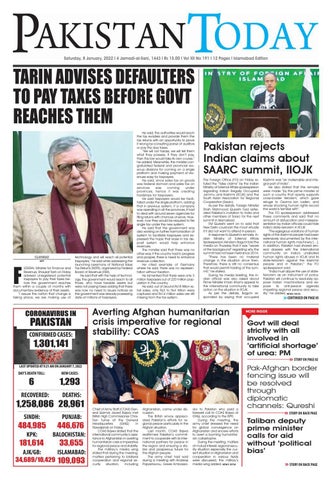
Tarin advises defaulTers To pay Taxes before govT reaches Them
ISLAMABAD app
f
ederal Minister for Finance and revenue, Shaukat Tarin on Friday advised unregistered potential taxpayers to pay their taxes before the government reaches them within a couple of months with documentary evidence of their assets. “I assure the nation that change is taking place, we are making use of
technology and will reach all potential taxpayers,” he said while addressing the launching ceremony of National Sales Tax returns (NSTr), organized by Federal Board of revenue (FBr). He said that with the help of technology, the government would reach to all those, who have taxable assets but were not paying taxes adding that there was now no need to issues notices as the government was already possessing date of millions of taxpayers.
coronavirus in
pakisTan
CONFIRMED CASES:
He said, the authorities would reach the tax evaders and provide them the tax returns with an opportunity to prove it wrong by consulting panel of auditors or pay the due taxes. “We will not harass, we will tell them what they possess. If they don’t pay, then the law would take its own course,” he added. Meanwhile, the minister congratulated federal and provincial revenue divisions for coming on a single platform and making payment of revenues easy for taxpayers. He said, since sales tax on goods was federal domain and sales tax on services was coming under provinces, hence it was creating hardships for taxpayers. He said taxpayers would be facilitated under the single platform, adding that in previous system, if a company was operating in all the provinces, it had to deal with around seven agencies for filing returns with chances of errors. However, now they would be required to file single tax under the new system. He said that the government was also working on further harmonization of system to facilitate taxpayers and expressed the hope that ease in tax deposit system would help enhance revenues. The minister said that three was no other way, if the country had to progress and prosper, there is need to enhance revenue collection. He cited example of Germany where he said, there was no representation without taxation. He lamented that there were only 3 million taxpayers out of 220 million population in the country. He said, out of around rs18 trillion retail sales, only rs3 to rs4 trillion were captured and rs14 million sales are still missing from the tax system.
Pakistan rejects Indian claims about SAARC summit, IIOJK The Foreign Office (FO) on Friday refuted the “false claims” by the Indian Ministry of external affairs spokesperson regarding Indian Illegally Occupied Jammu and Kashmir (IIOJK) and the South asian association for regional Cooperation (Saarc) as per the details, Foreign Minister Shah Mahmood Qureshi had reiterated Pakistan’s invitation to India and other members of Saarc for the next summit in Islamabad. FM Qureshi went on to add that New delhi could join the moot virtually if it did not want to attend in-person. In response to Qureshi’s remarks, Indian Ministry of external affairs Spokesperson arindam Bagchi told the media on Thursday that it was “aware of the background” regarding why the summit had not been held since 2014. “There has been no material change in the situation since then. Therefore, there is still no consensus that would permit holding of the summit,” he stated. during his media briefing, the Indian official was also asked about Prime Minister Imran Khan’s appeal to the international community to take action on the situation in IIOJK. as per the details, Bagchi responded by saying that occupied
Averting Afghan humanitarian crisis imperative for regional stability: COAS
1,301,141
Kashmir was “an inalienable and integral part of India”. He also stated that the remarks were made “by the prime minister of such a country that openly supports cross-border terrorism, which gave refuge to Osama bin laden, and whose shocking human rights record the world is familiar with”. The FO spokesperson addressed these comments and said that no amount of obfuscation and misrepresentation by Indian officials could hide India’s state-terrorism in IIOJK. “The egregious violations of human rights of the Kashmiri people had been extensively documented by the international human rights machinery […]. In addition, Pakistan had shared several dossiers with the international community on India’s unabated human rights abuses in IIOJK and its state-terrorism against the Kashmiri people and in Pakistan,” the FO spokesperson said. “India must abjure the use of stateterrorism as an instrument of policy. Pakistan will continue to resolutely oppose Indian machinations and expose its anti-peace agenda imperiling regional peace and security,” he added. news desk
CONTINUED ON PAGE 05
more inside
Govt will deal strictly with all involved in ‘artificial shortage’ of urea: PM STORY ON PAGE 02
LAST UPDATED AT 9:21 AM ON JANUARY 7, 2022
DAY'S DEATH TOLL:
NEW CASES:
6
1,293
RECOVERED:
DEATHS:
1,258,086 28,961 SINDH:
PUNJAB:
484,985
446,676
KPK:
BALOCHISTAN:
181,614
33,655
AJK/GB:
ISLAMABAD:
34,689/10,429
109,093
Chief of army Staff (COaS) General Qamar Javed Bajwa met British High Commissioner Christian Turner at the General Headquarters (GHQ) in rawalpindi on Friday. COaS Bajwa stated that the international community’s assistance to afghanistan in averting humanitarian crisis is imperative for regional peace and stability. The military’s media wing stated that during the meeting, matters pertaining to bilateral cooperation and regional security situation, including
afghanistan, came under discussion. The British envoy appreciated Pakistan’s efforts for regional peace particularly in the afghan situation. last month, COaS Bajwa reaffirmed Pakistan’s commitment to cooperate with its international partners for peace in the region and ensuring a stable and prosperous future for the afghan people. The army chief had said during a meeting with andreas Papastavrou, Greek ambassa-
dor to Pakistan who paid a farewell call to COaS Bajwa at GHQ, according to the ISPr. during the meeting, the army chief stressed the need for global convergence on afghanistan and sincere efforts to avert a looming humanitarian catastrophe. during the meeting, matters of mutual interest, regional security situation especially the current situation in afghanistan and cooperation in various fields were discussed, the military’s media wing added. news desk
Pak-afghan border fencing issue will be resolved through diplomatic channels: Qureshi STORY ON BACK PAGE
Taliban deputy prime minister calls for aid without ‘political bias’ STORY ON BACK PAGE
02
saturday, 8 January, 2022 | IsLAMABAD
news
GovT wILL deaL STrICTLy wITH aLL INvoLved IN ‘arTIfICIaL SHorTaGe’ of urea: PM IsLAMABAD
P
APP
RIME Minister Imran Khan has said that there is no shortage of urea and the country has 25,000 tonnes daily production of urea whereas those involved in creating artificial shortage of urea and other commodities will be dealt with an iron hand. Chairing a meeting on Friday, the prime minister said that the country had record bumper crops of wheat, sugarcane, cotton and maize during last year and the farmers earned Rs822 billion additional income during fiscal year 2020-21 due to agriculture-friendly policies of the present government. The farmers purchase more urea by additional income, he added. The meeting was attended by Energy Minister Muhammad Hammad Azhar, Finance Ministe Shaukat Fayyaz Tarin, Industries Minister Makhdoom Khusro Bakhtiar, information Minister Ch Fawad Hussain, Minister for National Food Security Syed Fakhar Imam, MOS on
Information & Broadcasting Farrukh Habib, SAPM on Political Communication Dr Shehbaz Gill and senior officers concerned. The prime minister said, “The government is focused on providing adequate quantities of fertilizer for maximum wheat production to ensure food security”. “The availability of fertilizer to farmers, especially in the next three weeks, is very crucial to have a bumper wheat crop,” he added. He directed the provincial chief
secretaries to overcome hoarding, smuggling and buying of urea by middlemen outside the fertilizer supply chain through district administration authorities. He also directed all the authorities concerned to work with all stakeholders to ensure adequate supply of urea to the farmers to achieve record wheat production this year. Separately, while addressing a press conference along with the owners of fertilizer industries, Federal Minister for Industries and Production Khusro Bakhtyar Friday said the government had provided Rs400 billion subsidy for the development of agriculture sector and ensured uninterrupted gas supply to the fertilizer industry to help promote agriculture production in the country. The federal minister said the government had also launched a web portal to monitor urea production and supply. He said dealers’ names, locations and truck numbers had entered in the ‘tracing system’ by the manufacturers in real time to help monitor the fertilizer transport. The government was taking all these steps to
control smuggling of urea bags, he added. “All Deputy Commissioners have access to data of their districts and ground staff approaches the dealers and verifies the amount on arrival. Once Urea arrives, it is sold at controlled rate by the dealers under supervision of district/Agri administration,” he added. He said in the international market, urea was being sold at the rate of Rs11,000 per bag whereas in Pakistan, the price per bag was only Rs1,800. The minister said two million bags of urea fertilizer had already arrived at port and if needed, more fertilizer would be imported. He said tender in compliance to the import decision by the government was issued by the Trading Corporation of Pakistan on October 22, 2021 and opened on November 22, 2021. He said the government of China had offered supply of 100,000 tons of urea on government to government basis. “The Economic Coordination Committee of the Cabinet has approved import which would arrive from 10th to 25th of February 2022 and resultantly, there will
be an ample inventory in February-March 2022.” Khusro said due to effective actions and prompt management there was no stress on prices of urea as it would remain stable, adding sowing of wheat had been completed in irrigated areas of Punjab and Sindh. The minister said due to the prevailing rain spell, demand was expected to be on the lower side till January 9, 2022 and during rain period from January 6 to 9, daily dispatch of the fertilizer remained at 19,000 tons. He said the supply would be increased from 10th to 31st January up to 22,000 tons on daily bais. He said the current demand was mostly panic driven and fueled by middle man which was not historically a part of supply chain of Urea. He said the farmers should make sure that they would get adequate urea at controlled price in January, February and March. “Farmers are requested not to engage in panic buying and avoid purchasing of urea to be used in February and March as this would save the country from price hike and unnecessary struggle to get urea in long queue,” he added.
Jahangir Tareen says long-standing ties with PML-N will continue News Desk Jahangir Khan Tareen, once considered one of the closest confidantes of Prime Minister Imran Khan stated about the possibility of joining the PML-N that his long-standing ties with Nawaz Sharif’s party will continue like before, while adding that his ‘plane’ could take off in any direction even towards the PML-N. Tareen, along with other political leaders attended a ceremony related to PML-N leader Khwaja Saad Rafique’s daughter’s wedding in Lahore. At the occasion, Tareen stated that “Khawaja Saad is a brother to me and we have remained together like close relatives”. In this regard, PML-N leader Ayaz Sadiq, who was also attending the gathering, asked the reporters that they should ask Tareen why he kept smiling to the question of joining the PML-N, while adding that “whether it’s Jahangir Tareen or any other leader of the PTI, everyone except [Prime Minister] Imran Khan, is smiling”. “Jahangir Tareen is himself looking like a groom in this wedding ceremony,” another journalist quipped. At this, Tareen group’s leader Raja Riaz remarked, “I congratulate Jahangir Tareen for looking like a groom”. It is pertinent to note that last month, the disgruntled PTI leader had said that he had never paid for the “household expenses of Bani Gala” in response to the claim of former party leader Justice (retd) Wajihuddin Ahmed. Wajihuddin had accused Prime Minister Imran of taking money from Tareen in tunes of Rs3 million per month to run his Bani Gala household.
IHC gives directive to demolish ‘illegal’ Navy Sailing Club within three weeks News Desk The Islamabad High Court (IHC) on Friday gave directive to raze the “illegal” Navy Sailing Club established at the bank of Rawal Lake within three weeks, while order to take action against a former naval chief. In a short judgment issued today, the IHC CJ Athar Minallah announced the verdict, which was reserved on Thursday. He went on to add that Pakistan’s military has an important status that is mentioned in the constitution. The IHC said the Capital Development Authority (CDA) was not empowered to issue a no-objection certificate (NOC) to the Pakistan Navy, as the institution had encroached on National Park’s land. The top judge ruled that the navy does not have the authority to undertake a real estate venture and the name of the institution could not be used for such activities. “The sailing club is illegal, and therefore, it should be demolished in three weeks,” the IHC judge said. The court ordered to initiate “criminal” and “misconduct” proceedings against the former navy chief and others responsible for the construction of the “illegal” sailing club as the inauguration of the club by the former naval chief, Admiral (retd) Zafar Mahmood Abbasi has been declared unconstitutional by the court.
QUETTA: A view of dark clouds hovering on the sky. INP
Rana Shamim affidavit case: IHC postpones indictment of ex-GB judge, others till Jan 20 News Desk The Islamabad High Court (IHC) has deferred the indictment in contempt of court case against ex-chief judge of Gilgit-Baltistan (GB) Rana Shamim, Jang Group owner Mir Shakeelur Rehman and other senior journalists Ansar Abbasi and Aamir Ghauri till January 20 on Friday in connection with an affidavit that accused former chief justice of Pakistan Saqib Nisar of trying to delay the release from prison of top PML-N leadership. As per the details, IHC Chief Justice Athar Minallah gave Shamim and the others time until the next hearing to “reflect” on the matter, saying “acceptance of mistake in front of the court increases honour.” He further turned down Attorney General Khalid Jawed Khan’s request to allow Rehman who tested positive for COVID-19, to attend court proceedings virtually and said he would need to be present in court for the indictment. In the last hearing, Shamim had opened his original affidavit, submitted earlier in December, on the court’s instructions. IHC Chief Justice Athar Minallah had asked Shamim if the document was the former judge’s affidavit and whether he had sealed it himself to which Shamim replied in the affirmative. Subsequently, the IHC had decided to indict all the alleged contemnors on January 7 (today). It is pertinent to note that in a written order issued last month, the IHC chief justice had appointed Attorney General Khalid Jawed Khan as prosecutor in the contempt of court case. Shamim, his counsel Lateef Afridi, AG Khan, Ghauri
and Abbasi were present during today’s hearing. Advocate General of Islamabad Niazullah Niazi and Additional Attorney General Qasim Wadood were also present. During the hearing, Justice Minallah observed that the court believed in the freedom of expression. He noted that a “narrative” was being built regarding a bench of the high court comprising him, Justice Mohsin Akhtar Kayani and Justice Mian Gul Hassan Aurangzeb — which is hearing a petition seeking the formation of an independent commission to ascertain the authenticity of an alleged audio of Nisar and probe certain events before and after Nawaz Sharif’s conviction that judges “made decisions under pressure”. The people’s trust was being eroded because of such news items, he added. Addressing Abbasi, Justice Minallah noted that Abbasi had said the newspaper would have published the affidavit even if it “may be wrong”. He asked if the newspaper did not know what case the story about the affidavit would influence, in an apparent reference to Maryam Nawaz’s ongoing appeal against her conviction in the Avenfield reference. He further stated that the court was not questioning the journalist’s integrity but trying to make him realise the effect of the news story. “Either you (Abbasi) say you did not know [about the influence the story would have] … let us frame charges, then you can present your stance,” the judge said in response to Abbasi’s request to not indict him. Justice Minallah further observed that Justice Kayani and Justice Aurangzeb were part of the bench and the appeals were later heard by my bench, Justice Minallah
noted. “This narrative can affect all three of us. The cases being heard by the [judges] mentioned in the story were fixed for two days later (from the date in the report). He went on to add that the public’s rights were most important to the court. Recalling the details of the case, Justice Minallah said that a judge had allegedly spoken to CJP Nisar but he was not part of the bench hearing the case against Nawaz and his daughter. “The court has tried to make you understand what mistake you made during the entire hearing,” the IHC judge said. On the contrary, amicus curiae Nasir Zaidi, a representative of the Pakistan Federal Union of Journalists (PFUJ), appealed to the court to not frame charges and find a “middle ground”. Addressing Abbasi again, IHC Chief Justice Minallah noted that the journalist had said the newspaper would publish an affidavit “even if it is false”. “If we know it is false, we will report it as false,” Abbasi responded. At this, Justice Minallah pointed out that there was a contradiction between Abbasi’s previous statement and the latest one. Journalist Amir Ghauri said the newspaper also published statements made by the prime minister and ministers every day. The judge noted that the affidavit should not have been published if the journalists did not know whether it was accurate. “All affidavits in the Justice Iftikhar Chaudhry case were published. I did not mention the name of the high court in the story about the affidavit. I was careful but the court believed that all judges were made to look suspicious. “Zaffar Abbas said that he would have done the same as Ansar Abbasi if he had gotten the affidavit,” the journalist contended. Justice Minallah responded that it was just as well that Abbas did not publish the affidavit otherwise there would also be a contempt of court case against him, adding that Abbasi should have asked a lawyer about the effect of the affidavit.
saturday, 8 January, 2022 | IsLAMABAD
PakISTaN To aCHIeve over 4PC eCoNoMIC GrowTH deSPITe CHaLLeNGeS: PM IsLAMABAD
P
APP
RIME Minister Imran Khan on Friday said that despite the worst balance of payment crisis in 2018, economic problems due to COVID-19, high commodity prices in international market, and direct and indirect impact of humanitarian crisis in Afghanistan, Pakistan was expected to achieve economic growth of over 4 per cent in the current fiscal year – which is a major success. “Since we inherited a huge circular debt, bad exports policies, unstable financial conditions, less-competitive business environment and the policies of lower
incentives for private sector, the present government’s three years are an economic success story,” he added. The prime minister expressed these views while presiding over a meeting of the Macroeconomic Advisory Group here. The meeting was attended by Federal Ministers Shaukat Tarin, Hammad Azhar, Chaudhry Fawad Hussain, Asad Umar, Makhdoom Khusro Bakhtiar, Syed Fakhar Imam, Minister of State Farrukh Habib, Advisor to PM Abdul Razzak Dawood, Special Assistants to PM Dr Sania Nishtar, Dr Shehbaz Gill, SBP Governor Reza Baqir and senior officials concerned. He said the government’s policy of smart lockdowns, incentives for construction industry, social protection
program and subsidy for Small and Medium Enterprises (SMEs) helped move the economy forward on sustainable pace – a fact also appreciated by analysts at global level. During the meeting, a comprehensive review of the country’s overall economy situation, government’s steps to minimise the impact of increase in the price of essential items and the government’s economic achievements over the last three years was presented. The meeting was told owing to the strong measures taken for economic stabilization after successfully coming out of the fiscal crisis inherited from the previous government, Pakistan compared to other regional countries realized more economic progress even during
news
03
the COVID-19 situation. It was told that with 25 per cent growth in exports and the highest ever 38pc increase in tax revenue, the country also recorded an increase of 27pc in remittances. Moreover, the meeting was told that with record incomes in agriculture sector – transfer of an additional income of Rs1100 billion to farmers, record Rs900 billions of profit in industrial sector, development of Information Technology (IT) sector due to government’s policy and after the successful tariff negotiations with Independent Power Producers (IPPs), a downslide has also been witnessed in the monthly [power] circular debt. In addition to the above, the government fulfilled its promise of a welfare state by launching the biggest social safety program under Ehsaas, brought institutional reforms and successfully complied with Financial Action Task Force (FATF’s) conditions which saved the country from going into the blacklist. The meeting was also presented with proposals to mitigate the transfer of the effects of high global commodity prices to common people. The proposals included an increase in incomes, purchasing power of the people, subsidies focused on middle and lower income classes and expansion of social safety net.
Shahbaz calls for legal action against PM Imran News Desk Leader of the Opposition in the National Assembly Shahbaz Sharif on Friday called for legal action against PM Imran Khan after an election commission’s report surfaced claiming that PTI hid millions of rupees worth of funds. The PML-N president said in a statement shared by PML-N on Twitter that “a person who hides facts, steals, and lies, cannot hold constitutional, governmental or political office,” After the report surfaced on Tuesday, the PTI claimed it is in the clear and has not hidden anything from the Election Commission of Pakistan (ECP). Shahbaz further asked “if the law can apply to a popular leader like Nawaz Sharif, why not Imran Niazi?” “If a Panama Papers JIT can be formed against Nawaz Sharif, and can be overseen by the honourable judges of the Supreme Court, then why can this not be done for Imran Niazi?” he further inquired. The Opposition leader said that under the Constitution of Pakistan and its laws, “no thief can be a prime minister”.
“Imran Niazi, who has been proven a thief and a liar under the law, must resign,” he added. Shahbaz further stated that the Constitution, law and political code of conduct dictates that PM Imran Khan step down from office. “The ECP’s scrutiny committee has said that Imran Niazi is neither honest nor trustworthy,” he added. He said equal treatment under the Constitution and law is a fundamental tenet of Pakistan’s laws and one that must be fulfilled. He said the country is operating “without a (real) prime minister”, and is being governed under a “constitutional and legal vaccuum”. “[Pakistan has] no leader of the parliament,” he said, adding: “Under the law and Constitution, Imran Niazi cannot decide on the country’s affairs.” “After the ECP scrutiny report, any decision that is made cannot be considered constitutional or legal,” Shahbaz said. He further demanded that a probe be initiated against PM Imran Khan and his case be heard on a daily basis — like against former prime minister Nawaz Sharif. “The ECP’s scrutiny committee has charged Imran Niazi and his party under the law,” he
said. He also called for all those named in ECP’s report to resign, and for legal action “without delay” against four PTI employees, as well all others involved in accepting foreign funding for the party. The Opposition leader also demanded a review of the deal with the International Monetary Fund and the supplementary finance bill, termed by the Opposition as a “mini-budget”. Shahbaz said he will “speak to the Opposition” regarding the “grave constitutional vaccuum” that the ECP’s findings have led to. “All parties and workers that have faith in the Constitution and the law will have to play their part in bringing Pakistan out of this constitutional vaccum,” he said. Shahbaz said that further investigations are needed into which other foreign entities donated to the party and that details of PTI’s international accounts must be brought to the fore. “The people who accepted illegal funds from non-state actors and companies are a threat to the nuclear power that Pakistan is,” he said. The Opposition leader said that had such revelations come to light in a western country, the prime minister there would have already resigned.
Military continues relief operation in flood-hit Gwadar
News Desk Pakistan Army, Pakistan Navy and Frontier Corps (FC) troops continued their relief and rescue operation in Balochistan’s Gwadar district on Friday. It is pertinent to note that the operation
began after the coastal belt of the province was hit by heavy rainfall and floods, the military said, while adding that the rescue and relief operation has been carried out for the last 96 hours. “Special relief efforts being undertaken in isolated villages of Kulanch, Sardasht and
Sunstar valleys,” the Inter-Services Public Relations (ISPR) said in a statement, adding that Gwadar Old Town also remained focus of dewatering operation. The recent downpour and subsequent floods have wreaked havoc in the low-lying areas of the coastal city, causing severe damage to houses and infrastructure alike. The ISPR further stated that the Army, FC and Pakistan Coast Guards have established medical camps and distributed rations to flood victims. “PDMA has provided tents, blankets and rations through Army aviation helicopters in remote areas,” the statement added. “PAF C-130 sorties loaded with rations and clothing have also been flown to assist the population of Pasni.” It said that the damage assessment is also underway, adding that efforts were being made to reach out to stranded families to render relief to far-flung areas. It merits mention that on Thursday, Deputy Commissioner Gwadar during a meeting informed that PDMA has launched a rescue effort on an emergency basis. Around 2,478 families have been affected while 22 villages have been cut off due to floods. The administration has launched an operation to reach the 22 cut-off villages and help the villagers. Relief items were delivered to different areas of Kupar and Pasni. The meeting was also informed that due to heavy downpour many small dams collapsed across Gwadar, affecting 41 villages and 1,786 households and more than 10,000 people in Klanch.
Gas explosion occurs in Karachi nullah News Desk A powerful gas explosion occurred in a nullah near Paracha Chowk in Karachi’s Shershah area on Friday. The police officials stated that no casualties have so far been reported. Police further stated that encroachments on the nullah were already removed while further investigation regarding the blast is underway. It is pertinent to mention that last
month, a blast near the same location had claimed the lives of at least 16 people, while more than a dozen people were left injured. PTI MNA Alamgir Khan’s father was among those who passed away in the explosion last month. Police while revealing the details of the blast stated that the blast took place in a gas pipeline running through a nullah located in the area, causing immense damage to the
building of a private bank that was constructed atop it. However, there was no lead suggesting that the blast might be linked to terrorism. In this regard, the Sui Southern Gas Company (SSGC), in a statement, stated that its team had confirmed that there was “no SSGC gas pipeline” in the area. “The gas pipelines installed in the area are safe and they have not incurred any damage.”
Shahbaz said on page 92 of the report, “it is mentioned that from 2009-13, PTI hid 53 bank accounts”, while disclosing “only 12 bank accounts to the ECP”. He said that the State Bank of Pakistan’s information to the ECP revealed that PTI had a total of 65 accounts. A day earlier, PML-N Vice-President Maryam Nawaz lambasted the PTI-led government for receiving foreign funding and said PM Imran Khan will have to be answerable to the people for his “wrongdoing”. Speaking during a press conference after a meeting of the PML-N in Lahore, Maryam said that PTI resorted to “misdeclaration” of funds “upon the directives of PM Imran Khan”. Making a similar demand, Maryam said: “Just like a JIT (joint investigation team) was formed against former prime minister Nawaz Sharif, a similar JIT must be formed to probe PTI.” “All accounts owned by the PTI must be publically declared,” she said. However, on Wednesday, the day after the report came to the fore, PM Imran Khan welcomed it, and said that the process should not stop here, and the accounts of more parties must be scrutinised.
Saturday, 8 January, 2022 | iSlAmAbAD
04
neWS
Karachi’s covid-19 positivity rate tops 10pc
a
S the fifth wave of the coronavirus gains pace in Pakistan, the positivity rate in Karachi has multiplied in one week to cross 10 per cent on Friday. Data from the Sindh health department showed that the positivity rate in Karachi was 4.74pc on December 31, 2021, when 160 people in the metropolis tested positive for the virus. In contrast, 650 people tested positive in the provincial capital on January 6, while the positivity rate was recorded at 10.25pc. The positivity rate in Hyderabad stood at 1.24pc in the last 24 hours while it was 0.94pc for the rest of the province. It is pertinent to note that Pakistan detected 1,293 new infections in the last 24 hours, highest in over three months, marking the second day of more than 1,000 daily cases. The highest number of cases was reported in Sindh at 759 followed by Punjab at 376. Karachi Administrator Murtaza Wahab urged citizens to wear masks and get vaccinated. “Otherwise, very soon, the situation may go out of hand,” he said on Twitter.
Spokesperson for the Sindh chief minister Abdul Rasheed Channa stated that the total number of cases of the new variant had risen to 307 in the province. He further added that under a separate initiative by the provincial government to gauge the prevalence of the Omicron variant, 37 samples were tested between January 3 and 5, out of which 30 came back positive for Omicron. “Eighty-one per cent of samples tested in the last two days were positive for Omicron,” he said. Sindh Health Minister Dr Azra Fazal Pechuho on Thursday stated a lockdown can be imposed after assessing the surge in cases of Omicron, which is showing a continuous rise. She said a lockdown was not being imposed immediately, but could be enforced after assessing the situation in hospitals and cities, and called for implementing standard operating procedures (SOPs) for Covid-19 as defined earlier. Pechuho said people with a history of foreign travel were being screened and advised all those who had been vaccinated six months ago to go for booster
shots. “Covid-19 is here to stay, it has become part of life and it might become endemic in nature sometimes,” she said. The minister said the vaccination ratio among students of private schools was 80 to 90pc but figures for public sector schools were not encouraging. Parents were advised to get their children above 12 years of age vaccinated, she said. She feared the pace at which the Omicron cases were rising showed they would further increase in the next couple of months. Amidst the surging cases of Covid-19 in Sindh, the Sindh government has further decided to launch a door-to-door coronavirus vaccination campaign for women amid rising cases of the Omicron variant in Karachi and other major cities as the fifth wave spreads across the country. The development came after it emerged that most of the non-working women are still unvaccinated in the metropolis and a decision was taken to deploy lady health workers (LHWs) and female vaccinators for the purpose. “We have decided to send LHWs and female vaccinators to each and every house in Sindh to vaccinate people, espe-
cially women, against COVID-19 because most of the non-working women in Karachi as well as other major cities and rural areas of Sindh have been found to be unvaccinated,” MPA Qasim Soomro, parliamentary health secretary in the provincial assembly stated. Meanwhile, the Sindh Education Department has asked schools to ensure all students aged 12 to 18 years are vaccinated as the Omicron variant of the coronavirus continues to spread across the country. “As per the decision of the National Command and Operation Centre (NCOC), the vaccination of COVID-19 of students’ of the age from 12 to 18 years and staff (teaching and non-teaching) is obligatory,” the statement read. “Therefore, the administration of all privately managed educational institutions is hereby directed through this circular to ensure 100% vaccination of the students and staff of their schools,” it said, adding that the administration of schools is further directed to collect copies of vaccination cards from staff members to ensure the implementation of the orders. news desk
aioU, iLKe join hands for joint research
sania leads registration drive for ehsaas rashan programme in Multan
Islamabad: Allama Iqbal Open University (AIOU) and a Turkish organisation ILKE, signed a Letter of Intent to establish a formal mechanism for joint research, faculty and students exchange programs, exposure study tours and to conduct academic, economic and policy research on academic and development issues. Registrar, AIOU, Raja Umer Younis and General Secretary, ILKE Foundation, Mr. Abdullah Serenli signed the document. On this occasion VC, AIOU, Prof. Dr. Zia Ul-Qayyum said that collaboration between the institutions would go a long way in promotion of education in both Pakistan and Turkey. He viewed that the panacea for social and economic development of majority of the Islamic countries lies in bringing the quality of education at par with the developed world. He added that both the institutions should work jointly to portray the positive image of Islam around the globe. He also suggested introducing degrees or diploma courses in Entrepreneurship and business, Islamic banking and finance, public policy and governance, corporate governance and professional development. All the deans and principal officers were present at the ceremony. Pr
multan: On the fifth leg of Ehsaas Rashan Tour to 30 cities, Senator Dr. Sania Nishtar, SAPM arrived in Multan today. During the visit, Dr. Sania was joined by Foreign Minister Shah Mehmood Qureshi and Commissioner Multan. She was also accompanied by senior officials of National Bank of Pakistan (NBP) and Ehsaas. The visit meant to mobilize local trader associations and Kiryana alliances across Multan for raising awareness on the Ehsaas Rashan Registration drive across Multan. Families earning below Rs. 50,000 a month can enroll through 8171. The registration of Kiryana owners is ongoing through https://ehsaasrashan.pass.gov.pk/. At Multan Chamber of Commerce and Industry, Dr. Sania chaired a meeting with local Kiryana retailers, NBP team and local press and electronic media. She highlighted that the government would give 8% commission to Kiryana retailers on subsidy amount and there will be quarterly lucky draws to award cars, motorcycles, mobile phones etcto best performing retailers. All over the country, Kiryana stores of any scale can be enrolled in the Rashan programme. It is essential for Kiryana retailers to have a bank account and an android mobile phone. NBP is facilitating the Kiryana owners countrywide to open their bank accounts.NBP enabled Kiryana retailers having bank accounts will install ‘mobile Point of Sale’ (mPOS) App in their cell phones for Ehsaas Rashan Riayat delivery. Later, Dr. Sania went to the Old Shujabad Road in Multan to speak to Kiryana retailers in the market about the Ehsaas Rashan programme. Kiryana owners showed a very positive response and enthusiasm for the Ehsaas Rashan Riayat programme. Earlier, Dr. Sania was joined by Foreign Minister Shah Mehmood Qureshi at Commissioner’s Office Multan. During the meeting, Parliamentarians, district administration and District Coordination Committee of Multan was briefed on the ongoing programmes of Ehsaas in the district including Ehsaas Kafaalat, Ehsaas School Stipends, Ehsaas Undergraduate Scholarships, Ehsaas Interest Free Loans and Ehsaas Rashan Riayat. The meeting concluded at a joint press conference. Ehsaas Rashan subsidy of Rs. 1,000 a month will be given to 20 million families on the purchase of flour, pulses, cooking oil and ghee. Per unit purchase, a 30% subsidy will be given on these three commodities. In this fiscal year, the overall budget of the programme Rs. 120 billion under the federal-provincial cost sharing arrangement. The federal government and all participating federating units including Punjab are contributing fiscal resources in the ratio of 35:65. Last month, Dr. Sania visited 26 small cities and towns in Punjab and KP to create awareness under the Rashan Registration drive. Pr
corporate corner silkbank expands partnership with silverlake axis
Silkbank Limited, one of the leading Credit Card issuers in Pakistan, in continuation of its efforts to stay ahead of the market by offering innovative solutions and best-in-class services, has expanded its partnership with Silverlake Axis Ltd., the ASEAN market leader in core banking systems. Through the latest agreement, Silkbank will upgrade its card management suite to use Silverlake Axis’s latest platform, Silverlake Symmetri OmniCard V6. With this latest OmniCard V6 upgrade at Silkbank, the card management system will be further enhanced enabling bank to stay abreast with latest technological innovations. The bank will be better positioned to integrate and collaborate with third parties to provide enhanced value to its everexpanding customer base. The upgrade will also help reduce costs with increased automations. Nabeel Malik, Executive Director - Strategy Implementation & Ops/Admin/IT/CSQ at Silkbank, commented: “Silkbank always aims to stay ahead of the market by introducing unique products supported by latest technological tools. Silverlake has been a trusted partner to Silkbank for 9 years. As we continue to transform and advance the banking landscape in Pakistan with our innovative product offerings and best-in-class services, the indepth experience, system understanding, and professionalism of Silverlake team will be a key factor for us to grow with confidence. We hope that we will be continuing this beneficial partnership in years to come.” Gyorgy Ladics, CEO Silverlake Symmetri, was also present at the occasion. He said, “We are immensely proud of the deep and long-standing partnership we have forged with Silkbank. Moreover, Pakistan continues to establish itself as a fast-growing market with huge potential for building its credit card market and we are very optimistic about its growth. To that extent, the trust Silkbank has placed in us is a true honor, and as we continue this exciting journey together, we are confident that this trust will see strong returns.” Pr
islamabad iGp directs policemen to resolve public complaints on priority
Plan for DRAP’s integration with PSW finalised ISLAMABAD Pr
The roadmap for Drug Regulatory Authority of Pakistan’s integration with Pakistan Single Window was discussed and agreed between the two entities in a meeting held between Mr. Aftab Haider, CEO Pakistan Single Window (PSW) and Mr. Asim Rauf, CEO Drug Regulatory Authority of Pakistan (DRAP). The meeting was also attended by PSW and DRAP officials collaborating on the program. DRAP’s integration with PSW will enable the electronic submission, processing and issuance of licenses, No Objection Certificates (NOCs), and other certificates, as prescribed for import, export or international transit of specified products falling under DRAP’s regulatory jurisdiction. PSW will also extend the facility of electronic registration of importers, imported products (drugs, medical devices, health and over-thecounter products), and premises to provide end-to-end integration of all DRAP related services on cross border trade to users. Under the initiative, extensive Business Process Reengineering of DRAP’s cross border trade related
processes was carried out resulting in completing BPR of 31 processes, and digitization of 56 paper-based documents with the facility to scan and upload additional documents as required on case-tocase basis. During the meeting, the two sides discussed the ongoing initiatives for DRAP’s automation and agreed on the roadmap for DRAP’s integration based on the Business Requirement Specification (BRS) document jointly developed by DRAP and PSW teams duly approved by the Ministry of National Health Services, Regulation and Coordination Islamabad last year.
Commenting on the development, CEO PSW Mr. Aftab Haider stated “DRAP is a high priority trade regulator for PSW and we appreciate the leadership role and ownership that DRAP has demonstrated in spearheading this critical initiative.” Under the PSW Initiative, DRAP will be get better visibility of all imports and exports through exchange of information and data through the PSW platform. DRAP’s control measures will be further strengthened by implementation of the Integrated Risk Management System running on the basis of risk rules defined by the department. CEO DRAP Mr. Asim Rauf appreci-
CMYK
ated PSW’s efforts and shared his vision to automate DRAP’s business processes. CEO, DRAP briefed that DRAP has took number of initiatives to Automate its processes such as Medical devices online system for establishment license and product registration, online software for clinical trials, online fee challan system and online software of import and export application submission and issuance etc. He emphasized the need for developing joint strategy for digitization of the public sector. “For us the most important feature of DRAP’s integration with the PSW is facilitation to DRAP’s stakeholders in the import and export of pharmaceutical raw materials, products, and devices. We are happy to see a system that will be operated and maintained professionally on a sustainable basis”. DRAP was established in 2012 enacted under the DRAP Act, 2012 and comes under the jurisdiction of the Ministry of National Health Service, Regulation & Coordination Islamabad. The Authority is mandated for effective coordination and enforcement of the Drugs Act, 1976 to regulate the manufacture, import, export, storage, distribution and sale of therapeutic goods in the country.
Islamabad: Inspector General of Police (IGP) Islamabad Muhammad Ahsan Younas while listening public complaints during khuli kacheri directed all police officials to resolve the public complaints on priority. The IGP said that the purpose of holding these khuli kacheries is to solve public issues immediately and purely on merit. The IGP while listening public complaints strictly directed all zonal officers to take immediate and strict action against land grabbers. “No one would be allowed to grab property of any citizen” he added. Islamabad police chief said that it is our prime responsibility to provide protection to the lives and property of the citizens and resolve their problems on priority. He said that citizens at `Open Court’ should be behaved in a respectful manner and their trust on police department to be won through resolving their issues. He said that interaction with people also ensures accountability of the policemen and they should address public complaints on merit by considering them their own issues. He said that positive image of policemen should be ensured before them through unbiased approach towards anyone. The IGP hoped that interaction during `open kutcheries’ would help to promote friendly policing. Such interaction with citizens are aimed to promote community policing, resolve the issues of people at their door steps through merit and curb activities of anti-social elements, he added. Pr
Saturday, 8 January, 2022 | ISLAMABAD
PakIstan rEjECts IndIan ClaIms aBout saarC summIt, IIojk continued from page 01
H
E called on Indian to recognise the reality of the just, legitimate and indigenous Kashmiri struggle , respect the wishes of the Kashmiri people, and grant them their inalienable right to self-determination in accordance with the UN Charter and the relevant UN Security Council resolutions.
It is pertinent to note that no Saarc summit has taken place since 2014. The 19th summit, scheduled to be held in 2016 in Islamabad, could not go ahead after India pulled out, blaming Pakistan for an attack on its army brigade in Uri – a town in occupied Kashmir. Under the Saarc charter, a meeting of the heads of government cannot be held if any one of the member states does not join. FO spokesperson Asim Iftikhar
Ahmad as a response stated that “India’s obstruction of the Saarc process was an established fact”. “Motivated by its partisan reasons, and acting in violation of charter provisions requiring exclusion of bilateral issues, India was responsible for stymieing the 19th Saarc summit scheduled to take place in Pakistan in 2016,” he stated. He further added that India’s “myopic attitude” was rendering a valuable
platform for regional cooperation increasingly dysfunctional. “Pakistan hoped that India would review its self-serving approach and enable the Saarc process to move forward for the progress and prosperity of the peoples of South Asia. For its part, Pakistan remained ready to host the next Saarc summit as soon as the artificial obstacles created in its way were removed,” the statement said.
6.3-magnitude earthquake strikes northern Qinghai in China
NEWS
05
corporate corner PBm distributes warm clothes
Islamabad: Implementing the special directives of the Prime Minister, Pakistan Bait-ul-Mal (PBM) distributes the winter clothes, shawls, caps and socks among the visitors of Panahgahs for night stays in Islamabad. Managing Director PBM, Malik Zaheer Abbas Khokhar himself monitored the distribution process so as to accommodate every deserving person in Panahgahs. The Managing Director termed the Prime Minister’s initiative a caring and sympathetic approach towards the down trodden segments of the country. “Protecting the daily wagers, labourers, passengers and other needy persons from the extremely cold weather conditions, such a kind gesture really describes the love and affection of Prime Minister for the vulnerable populace of the country”, he added. On the occasion more than 500 poor persons were provided the winter clothes, shawls, caps and socks in the five Panahgahs, established at various points in Islamabad. pR
Poland admits use of Israeli spyware but only for fighting crime and corruption
Bilawal asks CEC members to start preparations for elections Pakistan People’s Party (PPP) Chairman Bilawal Bhutto Zardari has asked the party’s Central Executive Committee (CEC) to finalise the names of candidates for national and provincial assemblies’ seats, claiming that PTIled government is going to end soon, Express Tribune reported on Friday. According to the news outlet, Bilawal looked optimistic during the meeting and said that the party will come into power and it will send the incumbent government packing. A day earlier, while addressing a press conference, the PPP chairman had announced that the party would march towards Islamabad on February 27 against the PTI government. He had said that the long march would start from the Mazar of Quaid-i-Azam in Karachi. He had also hinted at staging a sit-in in the federal capital, saying that the party would present its demands after reaching Islamabad. NEWS DESK
An earthquake of magnitude 6.3 struck northern Qinghai in China on Saturday, the European Mediterranean Seismological Centre (EMSC) said. The quake was at a depth of 10 km, EMSC said. Earlier in the day, a 5.6-magnitude earthquake rattled Peru's capital of Lima and surrounding areas, leaving at least one person injured and some homes damaged, authorities said. The quake was registered at 5:27 am (1027 GMT), with its epicentre 19 kilometres (12 miles) northeast of Lima at a depth of 116 kilometres, according to the Geophysical Institute of Peru (IGP). Authorities reported one person injured and three homes damaged around Lima, while a major highway linking the capital to central Peru
was blocked by fallen rocks. Some people in the capital fled their shaking homes in panic in the highly seismic country. Jeison Arapa, 28, was injured when he fell from the third floor of his home while trying to evacuate, civil defence authorities said. IGP director Hernando Tavera said the shaking was intense due to the depth of the quake. "It is possible that this moderatemagnitude event has generated, in high areas, rockfalls and landslides on roads and in valleys, and even possible damage to precarious homes," he said in a statement on the institute´s website. The quake was felt in the provinces of Canete and Chincha to the south of Lima, and in the port city of Chimbote nearly 400 kilometres to the capital's north.
Navy hydrography experts ruled out a tsunami. "People of Peru, let us remain calm but let us be prepared for any aftershock," President Pedro Castillo said on Twitter. A 7.5-magnitude quake shook the Amazon region in northern Peru in November, destroying 117 homes, injuring 12 people and leaving more than 2,000 without a roof over their heads. Peru experiences at least 400 perceptible earthquakes every year. It is located in the so-called Pacific Ring of Fire — an area of seismic activity that extends along the west coast of the American continent. A powerful 7.9-magnitude quake struck Peru's central coast on August 15, 2007, causing more than 500 deaths. REUTERS
Poland's powerful ruling party leader admitted that the country bought Israeli spyware but dismissed claims it was used against the opposition in extracts from an interview published on Friday. Recent allegations about the use of Pegasus software have rocked Poland, drawing comparisons to the Watergate investigation that led to US president Richard Nixon's resignation in 1974. Pegasus can turn smartphones into pocket spying devices, allowing the user to read the target's messages, track their location, and even turn on their camera and microphone without their knowledge. “It would be bad if Polish services did not have this type of tool,” Jaroslaw Kaczynski, who heads up the Law and Justice (PiS) party and is also a deputy prime minister, told the Sieci weekly. Asked about claims that Poland had used the Pegasus eavesdropping software on government opponents, Kaczynski said the programme was “used by services fighting crime and corruption in many countries”. In the interview, which is due to be published in full on Monday, Kaczynski emphasised that any use of such methods was “always under the control of the court and the prosecutor's office”. “In Poland, the surveillance system for such activities is one of the strictest in Europe,” he said, without elaborating. He dismissed opposition accusations as “much ado about nothing”. afp
Omicron pushes US Covid hospitalisations toward record high Covid-19 hospitalisations in the US are poised to hit a new high, according to a Reuters tally, surpassing the record set in January of last year as the highly contagious Omicron variant fuels a surge in infections. Hospitalisations have increased steadily since late December as Omicron quickly overtook Delta as the dominant coronavirus variant in the US, although experts say Omicron will likely prove less deadly than prior iterations. While potentially less severe, health officials have warned that the sheer number of infections caused by Omicron could strain hospital systems, some of which have already shown signs of distress, partly due to staffing shortages. “I don't believe we've seen the peak yet here in the US,” Centres for Disease Control and Prevention (CDC) Director Rochelle Walensky told NBC News' 'Today' programme on Friday, as schools and businesses also struggle with rising caseloads. The US reported 662,000 new Covid-19 cases on Thursday, the fourth highest daily US total coming just three days after a record of nearly one million cases was reported, according to the Reuters tally. The seven-day average for new cases set a record for a 10th consecutive day at
597,000, while Covid-19 hospitalisations reached nearly 123,000 and appeared poised to top the record of over 132,000 set last year. Deaths, an indicator that lags hospitalisations, remain fairly steady at a still high 1,400 a day, according to the tally, well below last year's record numbers. New York Governor Kathy Hochul and the head of one of the largest US hospitals both said they were cautiously optimistic that cases and hospitalisations would soon plateau in the state. “We think with our modelling that the peak will happen next week,” said Steven Corwin, chief executive of New York-Presbyterian Hospital, during Hochul's daily briefing. Delaware, Illinois, Maryland, Pennsylvania, Ohio, Vermont and Washington, DC, all reported record levels of hospitalised Covid-19 patients in recent days, according to the Reuters analysis. Hospitalisation data, however, does not differentiate between people admitted for Covid-19 and so-called incidental positives. Those are patients who were admitted and treated for issues other than Covid-19 and contracted the virus while in the hospital and are counted in coronavirus hospitalisation numbers.
Incidental infections have occurred throughout the pandemic but might be significantly higher now due to the staggering pace of Omicron's spread — a phenomenon that has prompted state health departments to consider altering their disclosures. Starting next week, Massachusetts hospitals will report whether admissions are primary or incidental to Covid-19, said
cmYK
Kathleen Conti, a spokesperson for the state's department of health. Rising cases have forced hospital systems in nearly half of US states to postpone elective surgeries. While many school systems have vowed to continue in-person instruction, some have faced ad hoc closures as cases rise. Chicago Public Schools, the third largest
US school system, were closed for a third day on Friday amid a teacher walkout over Covid-19 protections. US and other officials have said schools can be safely opened, especially with widely available vaccines and boosters, and the CDC on Thursday issued new isolation policy guidelines for schools. Officials continue to press vaccinations as the best protection against serious illness, although federal mandates requiring them have become politically contentious. US Supreme Court justices on Friday grilled Republican state officials and business groups seeking to block President Joe Biden's vaccine-or-testing mandate for large businesses and pressed the administration to justify the policy at a time of surging Covid19 cases nationwide. The US Food and Drug Administration on Friday shortened the interval between the primary series of the Moderna Covid-19 vaccine and a booster dose from six months to five for people aged 18 or older. The regulatory decision comes days after the agency made a similar move for getting a booster shot of the Pfizer and BioNTech Covid-19 vaccine. The Pfizer booster has also been authorised for use in children aged 12 to 15. REUTERS
06-07 Comments - 8 January 2022_Layout 1 1/8/2022 12:23 AM Page 1
Saturday, 8 January, 2022
06 COMMENT
Pakistan's key achievements in 2021
Defying parliamentary authority
A year in which Adfganistan dominated
To protect NAB chief from questioning
T
WO reports appearing in media on Friday create a perception of collusion between the PTI government and NAB which is damaging for both. A report tells of chairman NAB Justice (rtd) Javed Iqbal having skipped a Public Accounts Committee meeting on Prime Minister Imran Khan’s approval. The other report tells of the PM admitting his failure in accountability and expressing extreme dissatisfaction over major opposition figures accused of corruption still roaming free. After naming Shahbaz Sharif as one of them, Mr Khan expressed confidence that the Leader of the Opposition would not escape accountability this time for there was solid evidence against him. Putting a rhetorical question a complacent PM asked, “Can anyone say that Shahbaz did not commit corruption?” The Public Accounts Committee (PAC) is a statutory body with powers to examine the accounts showing the appropriation of sums granted by the Assembly for the expenditure of the Government. The PAC was therefore within its rights to review the performance of the NAB over the year. The NAB Chairman agreed to attend the Thursday meeting after a lot of dilly dallying provided the proceedings were kept in-camera. The PAC accepted the condition. Justice (retd) Iqbal however failed to turn up as he had been specially exempted by Mr Khan from appearance before any parliamentary committee and statutory or constitutional body. The PM instead nominated the Director General NAB headquarters to represent the bureau chairman before the PAC. Was the exemption given by the PM meant to shield the NAB Chairman from questioning by the National Assembly’s most important Committee? There have been allegations by the opposition that the PTI government was using NAB through its Chairman as an instrument to target political opponents. With the passage of time people outside the opposition have also come out in support of the allegation. The PM’s intervention has helped the NAB chairman defy parliamentary authority with impunity. The exemption would create a perception that NAB chairman was reluctant to face questioning as he probably had skeletons in his cupboard. The exemption provided by a PM who was frustrated over his opponents still moving free would lead to disturbing questions about the nexus between the PM and Chairman NAB.
MohaMMad ali alvi
T
he year 2021 ended with a fair share of bittersweet moments for Pakistan. Many important bills were passed and policy initiatives were taken by the incumbent government. Some important bills include the use of eVMs in the upcoming general elections, and the granting of voting rights to the Overseas Pakistanis, allowing of chemical castration of repeat offenders and the establishment of special courts nationwide to expedite rape trials and many more. The government launched a Single National Curriculum with the broader objectives of ensuring " all children have a fair and equal opportunity to receive a high quality education", "equal opportunities for upward social mobility", and "the alleviation of disparities in education content across the multiple streams." Pakistan also adopted its first National Security Policy in 2021. Albeit, the policy is yet to be made public but it is promised to be "citizen-centric with economic security at the core". The usual disagreement between the government and the opposition continued resulting in political turmoil throughout the year. Though analysts are predicting economic recovery, inflation kept on surging throughout the year hence creating problems for the people. The mob lynching of a Sri Lankan national remains the saddest moment of 2021 for the country as it resulted in a bad image of the country and was a moment of shame for the whole nation. The response of the government and the people should be appreciated. That the incident can neither be forgotten nor justified, one can hope that the response to the incident will bring positive change in the attitudes and conducts of the people. And no one will think of per-
Appointing a judge There more than meets the eye in the elevation of Justice Ayesha Malik
T
heRe are a number of problems with the elevation of Justice Malik of the Lahore high Court to the Supreme Court, not the least of what criteria were followed, apart from the sheer desire of the Chief Justice of Pakistan. The demand by some members of the Judicial Commission of Pakistan for objective criteria to go by was not met. It transpires that, for want of such criteria, all the JCP has is seniority, and on that count, Justice Malik does not qualify, as she is only fourth on the seniority list of the Lahore high Court. even if it is argued that she is the most senior woman judge of a high court, such entitlementbased allocations tend to dilute the quality of the Bench. It is almost as if the criteria actually being used cannot be reduced to writing, or cannot be disclosed. Justice Malik’s appointment is crucial, for she would have a legitimate expectancy of becoming Chief Justice. Now the position of CJP or chief justice of a high court is clear: there seniority is the criterion. however, there is no criterion or criteria for judges of either the high courts or the Supreme Court. There are only unspoken traditions. Because of that lack of criterion, it is not known why the affected judges of the Lahore high Court have been superseded, or the basis on which Justice Malik is being elevated, what exceptional qualities as a jurist she enjoys, which make her presence on the Supreme Court so necessary. As it is, she did not need to be elevated at this point, and could have waited her turn according to seniority, which would still have led to her elevation later. The reason for this haste is not to be understood, and even the suggestion that this appointment not be made in the tenure of the present CJP, who is to retire next month, but by his successor, was not accepted. While the JCP has made its recommendation, it has been made on a divided vote. It is now for the Bar to act so as to make this division in the Bench go away.
A mix of factors
MuhaMMad Ragheeb
E
VeR since the incumbent government came to power, inflation has been on the rise at a historic rate and as such has been talk of the town especially in the media and political landscape of the country. The increase in prices of all items has been phenomenal, leading to an inflation rate that has been the highest in Asia on average for the past couple of years as well as amongst the highest in the world. The reasons for this rapid increase, one of the highest and worst in the country’s history, have been discussed by all actors involved. Government officials, as has been their standard response to all challenges facing the country, have blamed it on the policies of the previous government and on the coronavirus pandemic that swept the world last year, beside a global increase in the prices of commodities we import. The opposition on the other hand has placed the responsibility on the government. Independent economists and neutral observers however believe that it is indeed a mix of both these factors that has led us to this point where there are genuine fears of an economic collapse on the scale of Lebanon and Greece if nothing is done to arrest this decline. It is indeed true that frequent lockdowns across
Arif Nizami (Late) Founding Editor
Yousaf Nizami M. A. Niazi
Umar Aziz
Joint Editor
Joint Editor
Executive Editor
Lahore – Ph: 042-36300938, 042-36375965
The recent pledges in the OIC moot, like the agreement to establish a humanitarian trust fund, the launch of the Afghan Food Security Program and the aid of 1 billion Riyals, are all supportive of Pakistan's stance on Afghanistan
Road to Beirut!
Dedicated to the legacy of late Hameed Nizami
Editor Aziz-ud-Din Ahmad
petrating violence in the name of the holy Prophet (PBUh) who taught everyone to be peaceful, kind, compassionate and respectful to others, and is a blessing of Allah for humankind. having said that, there were some moments, decisions, events, and actions that stood out from Pakistan in the year 2021 and the whole nation can cherish and be proud of those decisions and moments. The first important moment in this regard is Pakistan's decision to not allow the USA to use its territory for military actions in Afghanistan. The USA had asked for air bases in Pakistan. But, Pakistan, instead of succumbing to the demands and pressures of a superpower, made the decision based on its internal dynamics and needs. It was indeed one of the best moments for Pakistan in 2021. Although Pakistan's relations with the USA further deteriorated after Pakistan's "absolute not", it was the decision of a sovereign state that saved its future generations from indulging in further conflicts. Secondly, after the fall of Kabul, the one state that was at a total loss was India. India invested billions of dollars in Afghanistan, not for development purpose but to destabilize Pakistan, especially Balochistan. It showed its frustration by not inviting Pakistan to address the UNSC meetings on Afghanistan. India denied Pakistan the opportunity to address the UNSC meetings on Afghanistan held under its Presidency in August despite knowing the fact that Pakistan was the second most affected state after Afghanistan as a result of the decades-long tumultuous conflicts. It was unvisionary, authoritarian and intentional on the part of India to make an attempt to isolate Pakistan. But the OIC moot on Afghanistan hosted enthusiastically by Pakistan ensured that Pakistan is not diplomatically isolated at all. The pledges made during the OIC moot and the resolution 2615 adopted in UNSC to facilitate aid to Afghanistan meant that the word is buying Pakistan's humanitarian stance on Afghanistan. The US Secretary of State Antony Blinken thanked Pakistan for hosting a session of the OIC on Afghanistan. "We thank Pakistan for hosting this vital meeting and inviting the global community to continue cooperating to support the Afghan people '', he
I
Karachi – Ph: 021-35381208-9
I
said. The OIC session was attended by the Foreign Ministers, Deputy Foreign Ministers, and envoys of the OIC member states. The session was also attended by the UN, US, eU and UK special envoys. It was the biggest international gathering on Afghanistan since the Taliban takeover. It was a great diplomatic success for Pakistan and a standout moment for Pakistan in 2021. Thirdly, after the Taliban's takeover of Kabul, it was speculated that Pakistan will recognise the Taliban government instantly as they did in the past. It was a complicated situation for Pakistan. Some analysts were predicting that Pakistan would even think of revisiting its old strategy of strategic depth in Afghanistan. But despite the whatsoever advantage Pakistan is said to have on the Taliban, Pakistan's stance has been a calculated one and is based on humanitarian grounds. It pointed out the humanitarian crisis in Afghanistan and the need for help. According to the Integrated Food Security Phase Classification report, around 23 million people were at the risk of acute food insecurity and 9 million were at the risk of famine in Afghanistan this winter. Similarly, the WhO warned that 3.2 million children under the age of 5 were expected to suffer from acute malnutrition while 1 million among them were at the risk of dying due to malnutrition at the end of 2021. Moreover, 97 percent of the population in Afghanistan is at the risk of falling below the poverty line by mid-2022, according to the UNDP. Pakistan has been pointing out the humanitarian crisis in Afghanistan from the very beginning. It pledged $28 million humanitarian aid to Afghanistan and had been providing relief assistance to the people of Afghanistan. The recent pledges in the OIC moot, like the agreement to establish a humanitarian trust fund, the launch of the Afghan Food Security Program and the aid of 1 billion Riyals, are all supportive of Pakistan's stance on Afghanistan. All this effort for the sake of the people of Afghanistan is among the key achievements of Pakistan in the year 2021.
the globe caused by covid-19 have widely disrupted economic activities, disrupted supply chains and decreased outputs with a serious impact on commodity prices. Closure of ports for most of the previous year followed by their simultaneous opening this year have led to issues of huge backlog of containers at the ports as well as available shipping capacity, resulting in a manifold increase in freight charges. For a country like Pakistan whose imports are much higher than its exports, this has had a serious impact on the price of imported items as it is dependent on sea lines for most of its major imports like oil and scrap. Furthermore the lack of demand for almost two years due to lockdowns led to many manufacturers cutting down capacity and shutting plants, leading to supply side constraints as well as a decline in supply of commodities like oil and gas due to decreased industrial activity. With the reopening of the world economy the demand suddenly shot up again but the supply situation remained the same or took time to ramp up to previous levels, leading to a surge in prices. Pakistan being an import-reliant nation for many raw materials and finished products especially those related to machine and energy, imports ended up suffering more due to these factors in terms of inflation. The depreciation of the rupee due to an increased current account deficit as well as the government’s desire to negotiate a deal with the International Monetary Fund (IMF), has also led to a surge in prices of imported products which have to be bought in dollars. The situation on food inflation however vindicates the opposition stance that the government and its mismanagement also has a major part to play in the surge of prices of daily use items such as sugar, wheat and cooking oil. here increased taxation on imports of items such as palm oil, which is a major food import for Pakistan, has been a double-edged sword which along with increased international prices has really impacted ordinary people. The World Bank (WB) has also stated in its recent report that increased taxation has little to no effect on Pakistan’s imports since the majority are essential items whose price is inelastic. hence these measures only increase the burden on the general population without reducing our import bill as the
Islamabad – Ph: 051-2204545
I
Web: www.pakistantoday.com.pk
I
The writer is a freelance journalist and can be reached at qaisarrashid@yahoo.com
government claims. There is an over-reliance on indirect taxes for running state affairs in Pakistan with almost 70 percent of our revenue coming from indirect taxes such as custom duties and sales tax which affect all income segments equally rather than distributing the burden in an equitable fashion. These taxes at import stage have been one of the major reasons for the surge in prices of imported food items. Furthermore, measures such as exporting wheat and sugar without adequately assessing local demand and later importing same wheat and sugar at exorbitant prices has also left a serious question mark on the administration of both the Punjab as well as federal governments. The inability of the Food and Finance Ministries as well as the local administration to realize that wheat and sugar stocks were necessary to fulfill local demand, and hence they should not be exported unless surplus stock was available led to the prices of these items surging as later on the government had to import same items through expensive tenders which increased food prices in Pakistan. A similar situation was witnessed when highly favorable LNG contracts negotiated by the previous government were scrapped solely on political considerations and now the country is importing the costliest LNG in its history from the international market. The previous contracts were long term in nature with fixed prices whereas now LNG is being imported on a container-to-container basis, which is costly as LNG prices have surged in the market. A mix of these factors will lead to increased inflation in the coming years. It is quite likely that Pakistan might find itself in a similar situation as that of Lebanon, Zimbabwe or Argentina, leading to social unrest, increased crime as well as a general deformation in the country’s political and social landscape. even though there are several measures that can be used to arrest this decline, implementing them requires political will which seems to be in short supply in the current hybrid regime. hence there is a strong likelihood unfortunately that Pakistan may continue on its journey to eventually becoming a failed state, if it isn’t a one already by the strictest definition, joining the ranks of the above mentioned countries. One can only hope that a miracle occurs at some point reversing this downward trend. The writer can ragheeb40@gmail.com
Email: editorial@pakistantoday.com.pk
be
reached
at
06-07 Comments - 8 January 2022_Layout 1 1/8/2022 12:23 AM Page 2
Saturday, 8 January, 2022
COMMENT 07 Editor’s mail Send your letters to: Letters to Editor, Pakistan Today, 4-Shaarey Fatima Jinnah, Lahore, Pakistan. E-mail: letters@pakistantoday.com.pk Letters should be addressed to Pakistan Today exclusively
Social contract The role of the government in the provision of free and quality education — even in countries having the strongest traditions of free-market economies — remains paramount. This is simply because education serves as the bedrock for the citizens in any society to achieve equality and justice. And so, without education at its foundation, the whole philosophy of the social contract would lose its legitimacy. The State of Pakistan promises this right to its children through Article 25-A of the Constitution and has been a signatory to several international treaties aimed at protecting the rights of the child, including education. A few among these include the Millennium Development Goals (MDGs), and their recent upgrade, the Sustainable Development Goals (SDGs). however, despite signing these treaties, and the decision-makers having an in-depth understanding of the supreme importance of education in the national development agenda, Pakistan continues to stumble and struggle in pursuit of realising its education development aspirations. A manifestation of this is the fact that after failing to achieve the target of universal primary education outlined in the MDGs, Pakistan, is once again on the road to repeating history by failing to achieve SDG-4 i.e. inclusive, equitable and quality education. The provinces have failed to conclude work on their respective SDG frameworks. There are also several glaring discrepancies across provinces in terms of reporting and evaluating their respective performances against SDG-4. These persistent issues have contributed to the overall lag in devising a nationally representative strategy on education. To undo this wrong, as a first step, there needs to be more active coordination between the Centre and provincial governments. Continued cooperation between the federating units on education is likely to result in quicker progress to finalise the documentation and blueprints necessary to facilitate nationwide, simultaneous implementation of educational reforms. It will also provide an important opportunity for cross-learning and knowledge-sharing that will allow uniformity in documenting and reporting progress so that real-time and countrywide evaluation of SDG-4 can finally be made possible. Moiz HuSSain iSlaMabad
Kashmiris self determination day Another year passes without the Kashmiris getting self-determination MohMMad Saad Malik
K
AShMIRIS across the Line of Control as well as people from all walks of life, all over the world, observed the Self-determination Day on January 5. The day marks the 73rd anniversary of the United Nation’ Security Council’s resolution which calls upon India and Pakistan to let Kashmiris determine their fate through a plebiscite. Instead of taking steps conducive to holding a plebiscite, India has been carrying a reign of terror in Kashmir. Prominent Kashmiri leaders have all along been highlighting the plight of the Kashmiris under the Indian yoke (extrajudicial killings, arbitrary arrests, torture, ill-treatment of women, ban on political activities and violation of basic human rights). even Mehbooba Mufti, a former BJP ally, was compelled to say, “Kashmiris feel that they are literally imprisoned in a cage from which almost all exit routes are barred save one, to India, which is also not without peril.” A.G. Noorani, in a similar vein, said, `Kashmiris are distrusted and treated poorly in many parts of India, whether as students or as traders.’ earlier, the United Nations General Assembly (UNGA) unanimously adopted a Pakistansponsored resolution, titled “Universal Realisation of the Right of the Peoples to SelfDetermination”. It unequivocally supports the right to self-determination for all peoples under subjugation, alien domination and foreign occupation”. With close to 900,000 troops, police constabulary and security sleuths deployed, the Indian-held Kashmir is practically an Indian colony. While lauding the UNGA resolution, Pakistan’s foreign minister drew attention to the extra-judicial killings, arbitrary arrests, including that of human rights activist Khurram Parvez,and illegal detentions in the Indian-held Kashmir (‘hope for Kashmiris’: UNGA adopts Pakistan-sponsored resolution on right to selfdetermination , December 17, 2021). A similar Pakistan-sponsored resolution was adopted last year with little tangible follow-up The resolution affirmed the right to self-determination for peoples subjected to colonial, foreign and alien occupation. The resolution called on “those States responsible to cease immediately their military intervention in and occupation of foreign countries and territories”. Wolfgang Danspeckgruber (editor), in the book The Self-Determination of Peoples: Community, Nation, and State in an Interdependent World, deals with the subject from all angles. he covers issues of sovereignty and self-determination in contemporary world affairs. The book covers the conceptual, political, legal, cultural,
economic, and strategic aspects of self-determination. Danspeckgruber says: “No other concept is as powerful, visceral, emotional, unruly, and steep in creating aspirations and hopes as selfdetermination”. Self determination is recognised as a right in several international law instruments. These include the International Covenant on Civil and Political Rights, the International Covenant on economic, Social and Cultural Rights, the Declaration of Principles of International Law Concerning Friendly Relations and Cooperation among States, the helsinki Final Act, and the Vienna Declaration and Programme of Action. The International Court of Justice (ICJ) affirmed the right in several cases including the Namibia, Israeli wall, and Chagos Archipelago advisory opinions. In the east Timor case the court confirmed its universal jus cogens and erga omnes character. Sumantra Bose argues, `The Security Council’s resolutions - notably those of March 1951 and January 1957- is unequivocal that such participation and representation could not be regarded as a substitute for an internationally supervised plebiscite (Sumantra Bose, the Challenge in Kashmir: Democracy, Self-Determination and Just Peace, p.166). Bose had referred to the UN Security Council’s two resolutions that rejected so-called accession by the constituent assembly. These resolutions, No 91(1951), Document No, S/2017, Rev.1, Dt 30 March 1951 and Resolution No. 122 (1957), duly rejected the ratification of the accession by the constituent assembly in Srinagar. Resolution No. 122 (1957) was adopted by UN Security Council at its 765th meeting on 24 January 1957. In international law, a territory is considered “occupied” when it is actually placed under the authority of the hostile army. The definition of occupation and the obligations of the occupying power were initially codified at the end of the 19th century. The definition still in force and commonly used nowadays is the one contained in the Regulations Concerning the Laws and Customs of War on Land annexed to the Fourth hague Convention of 18 August 1907 (h.IV). Section III of the regulations details the rights and obligations of the military authority over enemy territory (Articles 42–56). The ICJ regards these regulations as equivalent to international customary law (infra Jurisprudence). This definition takes into account the effective control of the territory by a hostile
authority and seeks to regulate the responsibility of such an authority (h.IV Art. 42). Contemporary international humanitarian law has clarified and added to the rights and duties of occupying forces, the rights of the populations of occupied territory, and the rules for administering such territory (GIV Arts. 47–78; API Arts. 63, 69, 72–79) According to humanitarian law, occupation falls in the definition of international armed conflict and is regulated as such by the four Geneva Conventions and Additional Protocol I. The occupying power faces specific obligations where it has an effective control over the territories occupied. These include obligations related to respect human rights, law, and order, in addition to respect for relevant provisions of humanitarian law related to occupation. The basic obligations of the occupying power under humanitarian law are to maintain law and order and public life in the occupied territory (h.IV Art. 43). India is bound to let Kashmiris exercise self-determination right. If India disobeys UN resolutions it is a rogue state, pacta sunt servanda, treaties are binding on the parties. Self-determination is a legal right of people whether the decolonization process is perfect or imperfect, as in case of occupied Kashmir, in which the UN became involved. Karen Parker points out, `The disposition of [illegally occupied] Kashmir has not been legally decided. It is not part of any country and yet we have the failure today of the realization of the expression of the self-determination of the Kashmir people (Karen Parker, Understanding Self-Determination, the Basics, Collected papers and proceedings of the First International Conference on the Right to Self-Determination). Malcolm N. Shaw says, `Self-determination became the legal principle that fuelled the decolonization process, both obliging the colonial powers to grant independence (or another acceptable political status) and endowing their territory in question with a special status and thus, international legitimation (Shaw, Peoples, Territorialism and Boundaries, european Journal of aInternational Law 8, no, 3, pp 478-507). India’s view of usurped Kashmir is untenable. The UN should declare it a rogue state, and impose sanctions on it.
India’s view of usurped Kashmir is untenable. The UN should declare it a rogue state, and impose sanctions on it
The writer is a free-lance contributor. He hails from Srinagar. He is currently a student of PMAS-Arid University Rawalpind Cantt.
Investment in skills PAKISTAN faces many financial issues which makes its power weaker on international levels. It has a number of opportunities. The only thing to overcome this crisis is the need for true leadership and dedication. Pakistan is the fifth largest country in the world in terms of population and 34th in terms of area. Unfortunately, resources are scarce and problems are many. It is natural for people to have problems wherever they live. But the rate of problems in Pakistan is increasing day by day. There are many reasons behind this. The economy is at the forefront of all the difficulties that Pakistan is going through today. Weak economies have a direct impact on the people and the common man. After 2020, we have seen how the world has gone through a transition in all aspects of life in terms of health, education, financing or in short in everything. We have noticed how our daily operations have changed. Likewise, financial opportunities are present particularly in online mediums. Now banks, other financial institutes have changed their functions into apps. Similarly, anyone can earn something if he or she has any skill. This phenomenon is called investment in skills. We bet you didn’t hear your skills as an investment opportunity. If you have any skill, make use of it. Polish your skill sets and earn decent returns in no time. Nowadays we hear a lot about freelancing, online job opportunities, online training, online learning and many more all these are the best sources to earn and to growth financially. The options are unlimited, all you need to do is identify your skillset and the things you love doing and earn through them. Investment in skill is the best option for our youth to become financially independent and stable. It provides the best medium to showcase their talent and skill in a certain field. here we take an example of freelancing, in freelancing people or more specifically freelancers are self-employed people who provide services to multiple clients and earn money. They can set their own schedules, run their businesses and most importantly they have flexible lifestyles. So, to earn and sustain life investment in skills is very important and it is the best platform for our youth. In the context of the Pakistani market, we see numerous individuals especially youth who are unemployed. Therefore, concept of investment in skills is the easiest and fair medium to earn. This method is more efficient and effective, it also gives us a sense of fairness in terms of work. One feature of this method is that anyone can invest in skills; it has no age limitations, no certification restriction. If you have any talent you can easily get an opportunity. azraH bano and SHaMEEn baig iSlaMabad
Thou shall not kill MAN’S capacity for barbarism and senseless slaughter as displayed in Gaza, would surprise even the wolves in the jungle. While it is the belief of all three monotheistic religions, including the Jews, in the commandment Thou Shall Not Kill, yet hatred and greed blinds the Zionists and their supporters in the West, who never tire of talking about human rights. hypocrisy at its worst, is what we witness, when the so-called leaders of the free world justify the barbaric bombardment of Palestinians by one of the most powerful armies in the Mid-east, as Israel’s right of defence in response to crude rockets fired by the victims. The Iron Dome neutralizes the rockets fired by helpless Palestinians, while the Arab countries seem unmoved by the enormity of the tragedy that afflicts over 2 million Palestinians living in the most densely populated area in the world. What could be more comical than the argument of using human shields to justify the bombing and collateral damage inflicted, resulting in the death of almost 50 children? The Zionists are the biggest threat to the safety of the world’s Jews. extremist Zionists rejoicing the slaughter and suffering of Palestinians would invite only the wrath of Almighty Allah SWT. If the Nazi’s ruthless schemes of extermination and ethnic cleansing did not succeed and the Jews survived, so will the Palestinians emerge as a more united and stronger people. One only hopes that, unlike the Jews who were persecuted by Nazis, yet many within them, rejoice in assuming the role of persecutors, this cycle of violence will cease and peace prevail in the Kingdom of heavens, where holy sites of all three monotheistic faiths exist. MaliK TariQ ali laHorE
Saturday, 8 January, 2022
08 WORLD VIEW
Russia takes a gamble in kazakhstan IF RUSSIA SUCCEEDS IN PROPPING UP THE REGIME IN KAZAKHSTAN AND MAKING IT MORE PRO-RUSSIAN, THEN THE CENTRAL ASIAN NATION COULD, LIKE BELARUS, BECOME A MORE RELIABLE ALLY AND PARTNER FOR RUSSIA
carnegie MoScow cenTre
t
DmItRy tRenIn
HE Kremlin was caught off guard by the sudden crisis in Kazakhstan, which, having started as a protest against fuel price hikes, spread across the vast country at lightning speed this week and descended into violence in the former capital city, Almaty. Just a couple of days before New year, Russian President Vladimir Putin hosted both the current Kazakh president Kassym-Jomart tokayev and his hugely influential predecessor and patron Nursultan Nazarbayev in st. Petersburg at an informal summit of several post-soviet leaders. None of what has happened was anticipated back then. No sooner had the two leaders returned home than the protests broke out. triggered by the removal of a price cap on vehicle fuel, the protests themselves were fueled by widespread feelings of inequality, poverty, and corruption. Within three days, government buildings and police vehicles had been set alight, banks and stores looted, and Almaty international airport occupied by protesters. As police attempted to regain control of Almaty, dozens of protesters and eighteen security officers are reported to have been killed. the rapid spread of protests across a vast country, the initial weakness of the authorities’ response, and the increasingly violent nature of the protests have raised the specter of chaos in a country that is Russia’s ally in the Collective security treaty Organization, its partner in the Eurasian Economic union, and its neighbor across the world’s longest land border (7,500 kilometers), which is essentially unprotected. Of Kazakhstan’s population of 19 million, 3.5 million are ethnic Russians. there were never any illusions in Moscow about the regime in Kazakhstan. some of its features, such as authoritarianism, were seen as a primarily stabilizing characteristic, while others, such as corruption, were viewed as inevitable in an oil-rich country. still others, like the Central Asian nation’s multi-vector foreign policy — a balancing act among Russia, China, the West, and turkey, while nominally being a Moscow ally — were plain irritating. In Kazakhstan, Russia had the same problem as in Belarus: the ruling regime has managed to monopolize Moscow’s political contacts in the country. In the political elite, anyone suspected of having overly close
links to Russia was replaced and isolated. Moreover, in order to preserve stable relations with an important ally, partner, and neighbor, official Russia has often turned a blind eye to the rise of ethnic Kazakh nationalism and reports of de facto discrimination against ethnic Russians in the country. tokayev is by no means Moscow’s client, yet allowing him (and Nazarbayev too, at long last) to be toppled would, in Moscow’s thinking, allow the forces of ultra-nationalism to come to the fore, likely followed at some point by Islamist radicals. so tokayev must be saved, just like Belarus’s longtime leader Alexander Lukashenko back in the summer of 2020, when protests erupted there. unlike Lukashenko, however, tokayev is no absolute ruler. He does not have full power and authority, nor are his police and military forces as motivated as their Belarusian colleagues to deal with the protests on their own. With the unrest showing no sign of abating, despite the resignation of the government and tokayev’s firing of Nazarbayev as chairman of the country’s security Council, the Kazakh president was forced to call for outside intervention. On January 5, he appealed to the Russia-led Collective security treaty Organization (CstO) for assistance in combating what he described as a “terrorist threat” from foreign-trained gangs. this aspect is important: the CstO is a defense alliance whose remit does not cover domestic unrest. Russia responded to the appeal swiftly and organized a CstO peacekeeping force, sending 3,000 paratroopers to Kazakhstan on January 6. the CstO’s other members — Armenia, Belarus, Kyrgyzstan, and tajikistan — are also sending token contingents of between seventy and 500 troops. this is the bloc’s first real engagement since its founding in 1999. sensitive to popular sentiment in Kazakhstan, Moscow has been careful from the outset to limit the mandate of the force to securing strategic installations and other important assets, leaving the task of dealing with protesters to Kazakhstan’s police and army. Military intervention in Kazakhstan is a significant move by Russia, and is fraught with risk. If the Russian forces’ mission were to expand, that would lead to the mass alienation of the Kazakh people from Russia, or even their outright hostility and resistance. this, in turn, would reverberate in Russia itself, where the first polls suggest that twice as many people oppose the despatching of troops to Kazakhstan as support the move. Alternatively, if Russia succeeds in propping up the regime and making it more pro-Russian — not just in words, but also in deeds — then Kazakhstan, like Belarus, could become a more reliable ally and partner for Russia. Nur-sultan’s multi-vector foreign policy would then be streamlined, as has happened recently in Minsk and yerevan. At this point, the odds appear to favor the latter scenario, which explains the Kremlin’s decision to go ahead with the intervention. Dmitry Trenin is the director of the Carnegie Moscow Centre.
A world of mounting disarray FROM CLIMATE CHANGE TO PUBLIC HEALTH TO GEOPOLITICAL RIVALRY AND THE SECURITY OF CYBERSPACE, THE GAP BETWEEN GLOBAL CHALLENGES AND RESPONSES IS LARGE AND GROWING. AND THE RESOURCES NEEDED TO TURN THINGS AROUND – ESPECIALLY COLLECTIVE WILL AND SKILLFUL DIPLOMACY – ARE IN SHORT SUPPLY ProjecT SyndicaTe
m
RICHARD HAASS
y book, A World in disarray, was published five years ago this month. the book’s thesis was that the Cold War’s end did not usher in an era of greater stability, security, and peace, as many expected. Instead, what emerged was a world in which conflict was much more prevalent than cooperation. some criticized the book at the time as being unduly negative and pessimistic. In retrospect, the book could have been criticized for its relative optimism. the world is a messier place than it was five years ago – and most trends are heading in the wrong direction. At the global level, the gap between challenges and responses is large and growing. the COVId-19 pandemic exposed the inadequacies of international health machinery. We are entering the third year of the pandemic, but still do not know its origins, thanks to Chinese stonewalling. What we do know is that more than five million people, and more likely 15 million, have died. We also know that some three billion people (many in Africa) have yet to receive a single dose of a COVId-19 vaccine. And we know that the ongoing pandemic has reduced global economic output by trillions of dollars. Climate change has advanced. the world is already more than 1° Celsius warmer than it was at the start of the industrial revolution and is on course to get warmer. Extreme weather events are more frequent. Fossil fuel use is up. Governments have pledged to do better. their performance remains to be seen; in some cases, including China and India, the world’s two most populous countries, the pledges are noteworthy for their lack of ambition and urgency. Cyberspace remains akin to the Wild West, with no sheriff willing or able to set boundaries on acceptable behavior. there is not even the pretense of global cooperation. Rather, we see technology outpacing diplomacy, with authoritarian governments going to considerable lengths to wall off their societies while violating the cyberspace of others to sow political discord or steal technology. Nuclear proliferation continues. North Korea has increased the quantity and quality of its nuclear arsenal and the range and accuracy of its missiles. And, in the aftermath of the unilateral us decision in 2018 to exit the accord that placed temporary ceilings on Iran’s nuclear capabilities, the Islamic Republic has gone from being a year away from possessing a nuclear weapon to just a few months or even weeks. Great power rivalry is more pronounced than at any time since the Cold War. usChina relations have deteriorated rapidly, mostly owing to increased Chinese repression at home, trade and economic frictions, and China’s growing military strength and increasingly assertive foreign policy. Against a backdrop of growing economic competition and possible conflict over taiwan, it is unclear whether the two countries will be able to cooperate on global challenges like public health and climate change. Russia is arguably even more disaffected with the world order. three decades after the end of the Cold War,
BJP supporters have their own app to hijack Twitter trends and manipulate WhatsApp A PROBE BY ‘THE WIRE’ REVEALS THAT AN APP CALLED TEK FOG LETS USERS SPREAD PROPAGANDA BY AUTOMATING PUSHING HASHTAGS, CONTENT AND RETWEETS QuarTz
s
SAmAntH SubRAmAnIAn
OCIAL media operatives apparently affiliated with the Bharatiya Janata Party use a specialised app to hijack twitter trends, harass critics and spread propaganda through defunct WhatsApp accounts, according to a new investigation by the Wire. the app, called tek Fog, allows users to bypass controls like email and text-message verification that companies like twitter and Facebook build into their products. It can also act as a master control for a number of twitter accounts, fake or otherwise, pushing hashtags, content and retweets through a single interface. On WhatsApp, tek Fog takes over people’s inactive accounts to then message their contacts. “App operators also use this feature to phish the personal information of targeted users to add to a… political database,” the Wire wrote. “the addition of private citizens into this database makes them available as potential targets in future harassment and trolling campaigns.” ONLINE PROPAGANDA: the Wire’s main source, a disgruntled social media worker, was employed by a private tech company, Persistent systems, and assigned to work with another client company, Mohalla tech. Mohalla tech owns shareChat, a social media platform that operates in Indian languages and is funded in part by twitter. the source also said that they were supervised directly by devang
dave, the former social media head of the Bharatiya Janata yuva Morcha, the BJP’s youth wing. Although the Wire could not confirm this link or prove that the BJP directed the use of the app, its reporters conducted a forensic technical analysis and found that users from a Bharatiya Janata yuva Morcha domain accessed tek Fog. dave denied that his organisation or its members used tek Fog. the investigation is among the clearest pieces of evidence yet of the BJP’s orchestration of online propaganda and hate speech. the party’s “It cell” – shorthand for hired social media flunkies –includes a vast number of real people manually pushing out content and hate speech. But as tek Fog shows, the BJP also benefits from more sophisticated techniques. And the fact that Persistent systems has won at least one government contract raises the question of whether the Indian taxpayer is indirectly footing the bill for the BJP’s web campaigns. tek Fog’s manipulation of twitter includes, at the most basic level, the amplification of pro-BJP hashtags through artificially generated mentions and retweets. It also includes an “auto-reply” function that can target users by religion, age, gender or profession. Between January 2021 and April 2021, when the Wire tracked 46 lakh replies received by 280 prominent women journalists, it found that 18% of these replies came from accounts managed by the tek Fog app. two separate language analysis tools, from IBM and Amazon, found that a majority of posts posted via tek Fog to shareChat could be classified as “hate speech”.
President Vladimir Putin, seemingly ensconced in power for the foreseeable future, is set on stopping or, if possible, reversing NAtO’s reach. Putin has shown himself to be comfortable using military force, energy supplies, and cyberattacks to destabilize countries and governments he views as adversarial. the immediate target is ukraine, but the strategic challenge posed by Putin’s Russia is much broader. Other developments also offer reason for concern. More than 80 million – one in every hundred people – are displaced. Many times that number are enduring what can only be described as a humanitarian crisis. the Middle East is home to several ongoing wars that are simultaneously civil and regional. democracy is in retreat in much of the world, not just in dramatic cases such as Myanmar and sudan, but also in parts of Latin America and even Europe. Haiti and Venezuela are essentially failed states, as are Libya, syria, and yemen. Afghanistan appears on its way to again becoming a world leader in terrorism, opium production, and misery. there is one other critical factor: the united states is in greater disarray internally than it was five years ago. Political polarization is at an all-time high, and political violence has emerged as a serious threat. the peaceful transfer of political power following elections can no longer be taken for granted. this internal reality has in turn accelerated America’s pullback from global leadership after three-quarters of a century. No other country is able and willing to assume this role. to be sure, some positive developments deserve mention: the rapid creation of vaccines that dramatically reduce vulnerability to COVId-19; new green technologies that reduce reliance on fossil fuels; growing cooperation between the us and several of its partners to push back against a more forceful China; and the simple fact that, so far, great power rivalry has not descended into war. What would it take to avoid a future defined by disarray? A short list would include widespread vaccination against COVId-19 and new vaccines effective against future variants; a technological or diplomatic breakthrough that would dramatically reduce the use of fossil fuels and slow climate change; a political settlement in ukraine that promotes European security and an outcome with Iran that prevents its becoming a nuclear or even near-nuclear power; a us-China relationship able to put in place guardrails to manage competition and avoid conflict; and a us that managed to repair its democracy sufficiently so that it had the capacity to focus on world events. As always, little is inevitable, for better or for worse. What is clear, though, is that trends will not improve by themselves. Innovation, diplomacy, and collective will are needed to turn things around. unfortunately, the last two are in short supply. Richard Haass, President of the Council on Foreign Relations, previously served as Director of Policy Planning for the US State Department (2001-2003), and was President George W. Bush's special envoy to Northern Ireland and Coordinator for the Future of Afghanistan. He is the author, most recently, of The World: A Brief Introduction (Penguin Press, 2020).
Fixed driving hours PRAGMATIC INTERFACE WITH STAKEHOLDERS THE KEY
a
Tribune, india
study conducted two years ago highlighted driver fatigue, drowsiness and lack of sleep as the biggest causes of accidents and fatalities in India, which has one of the worst road safety records. Efforts are now afoot to frame a policy to fix the driving hours of commercial vehicle drivers, much like for airline pilots. Road transport and Highways Minister Nitin Gadkari is, in fact, keen on the introduction of onboard sleep detection sensors in commercial vehicles, on a par with the West, where some countries even require electronic logging to monitor work hours. the plan needs all-round support, but it would take more than a notification or an advisory for the transport sector, prone to cutting corners as a standard practice and reeling under the pandemic and the fuel price surge at present, to course-correct. Change has to be driven by a more honest and pragmatic assessment and government-industry interface. the issue of fixed driving hours and mandatory rest is covered under
the Motor transport Workers Act enacted way back in 1961. Private truck, bus or taxi operators pay scant regard, but even the government staff have aired grievances. this has prompted the Punjab and Haryana High Court to make it clear that bus drivers, employed by Haryana’s transport department in this case, would not be made to drive on a day-to-day basis beyond 10 hours, and 48 hours staggered over a week. they would also be entitled to take extra rest on long stretches, the judge stressed. strict application of the same norms for private entities would be a leap forward for road safety and employee welfare. the amendments to the Motor Vehicles Act were expected to bring about a dramatic change in the way Indians behave on the road, infusing more discipline by tightening rules and increasing penalties. It’s been a slow start. Other than traffic rule infringement, potholes are the main source of mishaps. On endless lanes, traffic signals are either not present, do not stand out, or are hidden behind trees. Fixing these localised issues should be as important as the mega plans.
Saturday, 8 January, 2022 | ISLAMABAD
NEWS
09
ScOreS OF PakiStaniS deFrauded OF rS17.5bn On aPPS linked tO binance LahOrE TAimooR HAssAn
S PSX gains 263 points in low-volume session Karachi TLTP
The Pakistan Stock Exchange (PSX) turned positive on Friday, eroding most of the losses of the previous day, with the benchmark KSE-100 Index gaining 263.35 points (+0.58 percent) to close at 45,345.65 points. The market opened on a negative note and remained bearish for the first 15 minutes of the session; however, the market later followed the trend of global markets and remained positive throughout the session. However, volumes remained low during the session. The KSE-100 Index moved in a range of 395.29 points, showing an intraday low of 44,968.90 points and a high of 45,364.19 points. Among other indices, the KSE All Share Index gained 175.06 points (+0.57 percent) to close at 31,051 points, while KMI All Share Islamic Index gained 161.43 points (+0.73 percent) to close at 22,369.59 points. A total of 359 companies traded shares in the stock exchange, out of them shares of 213 closed up, shares of 124 closed down while shares of 22 companies remained unchanged. Out of 93 traded companies in the KSE-100 Index, 64 closed up, 25 closed down and 4 remained unchanged. The overall market volumes decreased by 103.04 million to 242.26 million shares. Total volumes traded for the KSE-100 Index decreased by 48.60 million to 84.44 million shares. The number of total trades decreased by 28,423 to 97,403, while the value traded decreased by Rs5.31 billion to Rs7.93 billion. Among scrips, TELE topped the volumes with 26.15 million shares, followed by WTL (21.66 million) and TRG (18.99 million). Stocks that contributed significantly to the volumes included TELE, WTL, TRG, UNITYR3, and SILK, which formed around 40 percent of total volumes. 242.26 In terms of rupee, RMPL witnessed a maximum increase of Rs599 per share, closing at Rs9,900 whereas the runner-up was BATA, the share prices of which climbed up by Rs153.70 to Rs2203.70. COLG witnessed a maximum decrease of Rs158 per share closing at Rs2,282, followed by ISIL, the share price of which declined by Rs33.70 to close at Rs416.30 per share. The news of over Rs60 billion payment from the power division to 12 independent power producers, 40 percent of total agreed amount as first instalment, improved the sentiment at the market and oil and gas exploration and power sectors remained positive. The IPPs which were paid included: Atlas Power; Attock Gen; Engro Energy; Saif Power; Halmore Power; Hub Power; Liberty Power; Nishat Power; Orient Power; Foundation Power; Nishat Chunian; and Saphire Electric. They received one-third of the amount each in cash, Sukuk and PIB bonds on Thursday last, according to a media report. The major sectors taking the index towards north were power generation and distribution, fertilizer, engineering and food. The major sectors taking the index toward south were chemical, pharmaceutical and technology and communication.
INDH Federal Investigation Agency (FIA) Cyber Crime unit Thursday summoned a representative of global cryptocurrency exchange Binance in a scam estimated to have defrauded Pakistanis of $100 million (approximately Rs17.5 billion). A press statement from FIA said that on December 20, people from all over the country started contacting FIA Cyber Crime Sindh through social media and disclosed about at least 11 mobile applications namely MCX, HFC, HTFOX, FXCOPY, OKIMINI, BB001, AVG86C, BX66, UG, TASKTOK, 91fp that had stopped working. All these applications were connected with Binance wallets. The halting of these applications has resulted in scores of people in Pakistan losing billions of rupees. “The modus operandi of these applications was to ask people for registration at Binance Crypto Exchange (Binance Holdings Limited) meant for trading in virtual currencies like Bitcoin, Ethereum, DogeCoin etc,” the FIA said. “The next step was to transfer money from Binance Wallet to the account of that particular application.” The FIA explained that the victims were simultaneously added in groups on messaging service Telegram where so called expert betting signals, on the rise and fall of Bitcoin, were given by the anonymous owner of the application and admins of the Telegram groups. “Once a considerable capital base was established, these apps crashed thus robbing people of millions of dollars through Referral Bonus Process,” the FIA said. According to initial findings of the enquiry, each such application had on average 5,000 customers with HFC app reportedly having a maximum of 30,000 customers. According to the FIA, the reported range of investment per person was from $100 to $80,000 with an estimated average of $2,000 per person, thus making the estimated scam stand at nearly $100 million. The FIA has written to Binance Headquarters Cayman Islands and Binance US to explain their position on the matter.
“We do not comment on specific matters with regulatory and law enforcement authorities. However, as a matter of policy our general approach is to cooperate with investigations wherever possible. Specifically, Binance works closely with the law enforcement and regulatory community in an effort to develop best practices, mitigate and thwart new methods of criminality and prevent illicit proceeds from entering our exchange,” the Binance representative summoned by FIA told Profit. In wake of the scam, Sindh FIA Cyber Crime wing has debit blocked Pakistani Bank accounts linked to such apps, contacted Telegram to provide the whereabouts of admins of fraudulent apps, social media influencers promoting these apps have been served with legal notices to explain their point of contact with apps among other measures. “At least 26 suspect blockchain wallet addresses (Binance wallet address) have been identified where fraudulent amounts may have been transferred,” the FIA said. In addition, a letter has been written to Binance Holdings Limited to give details of these block
chain wallet accounts as well as debit block them. Binance has also been asked to provide conditions, official supporting documents, integration mechanism of these API’s (Applications) with Binance. It is pertinent to note that the State Bank of Pakistan (SBP) has not authorised or licensed any individual or entity for the issuance, sale, purchase, exchange or investment in any such virtual currencies, coins or tokens in Pakistan. Despite the order, Binance is the largest unregulated virtual currency exchange where Pakistanis have invested millions of dollars. The FIA has said that it has started keeping a close eye on peer to peer transactions done by Pakistanis on Binance to curb terror financing and money laundering as Binance is the largest easy-to-go platform facilitating such activities. FIA Cyber Crime expects that Binance will adopt a liberal and swift approach in helping Pakistan track all these financial crimes. “In case of non- compliance, FIA Cyber Crime will be justified to recommend financial penalties on Binance through State Bank of Pakistan,” the FIA said.
Jazz collaborates with USF to provide 4G services in rural Sindh Karachi PR
Jazz is collaborating with the Universal Service Fund (USF) to provide 4G services in Kambar Shahdadkot, Larkana, Naushahro Feroze and Shaheed Benazirabad districts of Sindh. Jazz will install a total of 90 cell sites, including technology upgrades, sector addition and power upgrades to provide data and voice services to 719 mauzas that fall under the four districts. An MoU to this effect was signed by Haaris Mahmood Chaudhary, CEO, USF, and Mudassar Hussain, VP Public Policy and Regulatory Affairs, Jazz. Federal Minister for IT and Telecom Syed Aminul Haque, Asif Aziz, CCO, Jazz and Federal Minister for Planning, Development and Special Initiatives
Onyx exports witness 45.3pc increase in 5MFY22 Asad Umar witnessed the contract signing ceremony. Talking at the event, Asif Aziz, Chief Commercial Officer, Jazz, said, “Providing reliable mobile broadband to all our fellow citizens remains a key priority at Jazz. Through this collaboration with USF, 719 unserved mauzas of rural Sindh will be able to access high speed
mobile broadband which will unlock unlimited socio-economic opportunities for the residents.” He also warned that the country is in a state of digital emergency and the proposed move to increase WHT on telecom users and a 17 percent sales tax on smartphones and laptops will further push the country behind its global peers.
ISLAMABAD: Onyx manufactured exports during the first five months of the current fiscal year 202122 (5MFY22) grew by 45.26 per cent to $2,834 as compared to the $1,951 worth of exports of the corresponding period of last year, according to data released by the Pakistan Bureau of Statistics (PBS). Meanwhile, during the period from July-Nov 2021, the exports of chemicals and pharma products increased by 23.06pc to $567,521 exported as compared to exports worth $461,177 during the same period of last year. During the period under review, other chemicals exports increased by 49.24pc to $299,613 as compared to the exports valuing $200,758 of the same period of last fiscal year. APP
Oil heads for best week since mid-Dec, Kazakhstan unrest stokes supply worries MELBOUrNE/BEiJiNG ReuTeRs
Oil prices edged up on Friday, heading for their biggest weekly gains since mid-December, fuelled by supply worries amid escalating unrest in Kazakhstan and outages in Libya. Brent crude futures climbed 57 cents, or 0.7%, to $82.56 a barrel at 0403 GMT, after a 1.5% jump in the previous session. US West Texas Intermediate (WTI) crude futures rose 67 cents, or 0.84%, to $80.13 a barrel, extending a 2.1% gain in the previous session. Brent and WTI were on track for a more than 6% gain in the first week of the year, with prices at their highest since late November, as supply concerns overtook worries that the rapid spread of the Omicron coronavirus variant might hurt demand. “The upward jump in oil prices mostly
reflects the market jitters as unrest escalates in Kazakhstan and the political situation in Libya continues to deteriorate and sideline oil output,” Rystad Energy analyst Louise Dickson said in emailed comments. After days of unrest in Kazakhstan, during which the government declared a state of emergency, Russia on Thursday sent in paratroopers to quash the uprising. The protests began in Kazakhstan’s oilrich western regions after state price caps on butane and propane were removed on New Year’s Day. Meanwhile, supply additions from the Organization of the Petroleum Exporting Countries, Russia and allies, together called OPEC+, are not keeping up with demand growth. OPEC’s output in December rose by 70,000 barrels per day from the previous month, versus the 253,000 bpd increase al-
lowed under the OPEC+ supply deal, which restored output that was slashed in 2020 when demand collapsed under COVID-19 lockdowns. Production in Libya has dropped to 729,000 barrels per day, down from a high of 1.3 million bpd last year, partly due to pipeline maintenance work. While the Omicron variant is rapidly taking hold, demand-side concerns are easing amid rising evidence that it is less severe than previous variants and as governments employ generally less rigid containment measures in response to it, analysts from Fitch Solutions said in a note. Wang Xiao, lead researcher from Guotai Junan Futures, said that low oil inventory in Europe and America was also supporting market sentiment. “But overall, the price rally stokes inflation concerns, which could weigh on any further oil price gains.”
Saturday, 8 January, 2022 | ISLAMABAD
10 FOREIGN NEWS
KazaKh president gives shoot-to-Kill order to put down uprising
K
Agencies
AzAKHSTAN’S president said on Friday he had ordered his forces to shootto-kill to deal with disturbances from those he called bandits and terrorists, a day after Russia sent troops to put down a countrywide uprising. Security forces appeared to be in control of the streets of the main city Almaty on Friday morning but gunfire could still be heard after days of unrest in which dozens of people have been killed and public buildings ransacked and torched. “The militants have not laid down their arms, they continue to commit crimes or are preparing for them. The fight against them must be pursued to the end. Whoever does not surrender will be destroyed,” President Kassym-Jomart Tokayev said in a televised address. “I have given the order to law enforcement agencies and the army to shoot to kill without warning.”
Tokayev has blamed foreigntrained terrorists for the worst violence in the Central Asian state’s 30 years of independence. Russia’s defence ministry, cited by Interfax, said more than 70 planes were flying round the clock to bring Russian troops into Kazakhstan, and they were now helping control Almaty’s main airport, recaptured on Thursday from protesters. Demonstrations that began as a response to a fuel price hike have swelled into a broad movement against the government and exleader Nursultan Nazarbayev, 81, the longest-serving ruler of any former Soviet state. He turned over the presidency to Tokayev three years ago but his family is widely believed to have retained power in Nur-Sultan, the purpose-built capital that bears his name. Troops in AlmATy: The interior ministry said 26 “armed criminals” had been “liquidated”, while 18 police and national guard service-
members had been killed since the start of the protests, figures that appeared not to have been updated since Thursday. State television reported more than 3,700 arrests. On Friday morning, fresh gunfire could be heard near the main square in Almaty, where troops had fought with protesters throughout the previous day. Reuters correspondents saw armoured personal carriers and troops occupying the square. A few hundred metres away, a dead body lay in a heavily damaged civilian car. In another part of the city, an ammunition shop had been ransacked. Widespread unrest has been reported in a number of other cities across the vast country of 19 million people. The internet has been shut off since Wednesday, making it difficult to determine the full extent of the violence. Moscow’s swift deployment demonstrated the Kremlin’s readiness to use force to maintain its influence in the former Soviet Union.
The troops were sent under the umbrella of the Collective Security Treaty Organization comprising Russia and five ex-Soviet allies. It said its force would number about 2,500 and would stay in Kazakhstan for a few days or weeks. Moscow was “standing up for Kazakhstan and doing as allies should”, said Deputy Foreign Minister Alexander Grushko. White House spokeswoman Jen Psaki said Washington was keeping a close eye on the Russian-led deployment. It would be watching for any violations of human rights and “any actions that may lay the predicate for the seizure of Kazakh institutions”. Tokayev’s administration said the Russians had not been engaged in combat or the “elimination of militants”. The violence has been unprecedented in a country ruled firmly for decades by Nazarbayev, who was the last Soviet-era Communist Party boss still in powerin an ex-Soviet state when he passed the presidency
on to Tokayev in 2019. Nazarbayev has not been seen or heard from since the protests began. Tokayev has sought to distance himself from his predecessor, removing Nazarbayev and his nephew from security posts since the protests began. Kazakhstan is a major oil producer and the world’s top producer of uranium. Oil output at its top field, Tengiz, was reduced on Thursday, the field’s operator Chevron said, as some con-
tractors disrupted train lines in support of the protests. Global oil prices have risen and the price of uranium has jumped sharply since the clashes began. read more The country also accounts for close to a fifth of global bitcoin “mining”, the electricity-intensive process of recording cryptocurrency transactions, and Kazakhstan’s internet shutdown has curtailed the computing power of bitcoin’s global network.
What day is it? UAE works on Friday for first time DUBAi AFP
China warns hospitals against rejecting patients over Covid curbs as cases decline Agencies China reported fewer Covid cases on Friday as several cities have curbed movements, while a top official warned hospitals not to turn away patients after a woman’s miscarriage during a lockdown in the city of Xian sparked outrage. China reported 116 domestically transmitted infections with confirmed clinical symptoms for Thursday, mostly in Xian and the province of Henan, down from 132 a day earlier, official data showed on Friday. Xian, a city of 13 million in northwest China, entered its 16th day of lockdown, although officials said the outbreak there had been brought under control. Xian is in the Shaanxi province that borders Henan. “The risk of a large-scale rebound of the (Xian) outbreak has been largely contained,” the official Xinhua news service quoted Li Qun, a disease control and prevention official, as saying in a story published late on Thursday. During Xian’s lockdown, residents have complained about curtailed access to food and medical care, and the story of a pregnant woman who lost her unborn baby after waiting outside a local hospital for two hours provoked anger on Chinese social media and led to punishment of city officials. Chinese Vice Premier Sun Chunlan said she was “pained and deeply ashamed” about people’s difficulties in securing hospital services in Xian, Xinhua news agency said. “Medical institutions … must not simply turn away patients on any excuse during Covid control,” Sun was quoted as saying. On Friday, the city government said that people without proof of a negative test result within 48 hours should not be blocked from leaving their residential compounds to go to hospital, overturning a previous requirement. The outbreaks in China remain tiny compared with many overseas, and the highly transmissible Omicron variant has yet to be announced among local infections in Henan or Xian, but local governments have maintained high vigilance. China’s policy of blocking any cluster from spreading further has taken on extra urgency in the run-up to the Winter Olympics, to be staged in Beijing and neighbouring Hebei province starting Feb. 4, and with the Lunar New Year holiday travel season beginning in less than two weeks. There were no new fatalities on Thursday, leaving the death toll unchanged at 4,636. Mainland China had 103,295 confirmed symptomatic cases as of Jan 6, including both local and imported ones.
Employees and schoolchildren juggled work and studies with weekly Muslim prayers on the first ever working Friday in the United Arab Emirates as the Gulf country formally switched to a Saturday-Sunday weekend. Some grumbled at the change and businesses were split, with many moving to the Western-style weekend but other private firms sticking with Fridays and Saturdays, as in other Gulf states. The weekly day of prayer has always been a free day in the UAE, which had previously observed a Thursday-Friday weekend until 2006. However, mosques appeared busy as worshippers carrying prayer mats arrived as usual, before many of them later headed back to the office. “I’d rather take (Friday) off,” said 22-year-old Briton Rachel King, who works in the hospitality industry and has been living in Dubai for six months. “That is what we all know and love, having a Friday off and going to certain places that are open and we could do things. But now it is going to be Saturday.” The UAE made the surprise announcement of the weekend switch for the public sector in December as it grapples with rising competition in international business
from other Gulf countries, particularly Saudi Arabia. Government bodies and schools will operate four-and-ahalf-days per week, closing at 12pm on Fridays for a fixed prayer time of 1:15pm, whereas the Muslim prayer schedule usually depends on the position of the sun. Out of 195 businesses polled by human resources consultancy Mercer, only 23% were preparing to follow the four-and-a-half-day week, but more than half would switch to Saturday-Sunday weekends. “Luckily I have the same days off as my kids, but that’s not the case for my husband,” said Fati, who works in an international distribution company, asking
not to give her full name. “He works for a multinational that hasn´t changed its schedule for the moment. I hope they will do it quickly, otherwise our family life will be ruined.” ‘Feels A biT weird’: Nearly a third of companies are worried about the impact of being out of sync with other countries in the region, the Mercer poll found. “We work a lot with Egypt and Saudi Arabia,” said Rana, an employee of an events company who said some of her teams would have to work on Sundays. Dubai’s financial district was unusually quiet on Friday with large numbers working remotely, especially at a time of rising COVID levels when many children are also doing online schooling. “Today is the first working Friday, it feels a bit weird,” said Ahmad Bilbisi, 34, a banking employee. “It makes sense to me, at least for the banking industry. We are now working on the same day as everyone else in the world.” The new arrangement was a major talking point on social media, with one Twitter user complaining “it just feels so wrong”. “My body and mind have fully acclimatised to having Fridays off. I think today is going to a long hard struggle,” the tweet reads. Sharjah, an emirate neighbouring Dubai, has found a simple solution: mandating Friday, Saturday and Sunday as a three-day weekend.
Dozens of Hong Kong politicians sent to quarantine after birthday party AFP Dozens of senior Hong Kong officials and lawmakers were ordered into quarantine on Friday after a coronavirus cluster widened at a birthday party attended by many of the city's political elite. The high-profile entries into Hong Kong's 21-day quarantine facilities have left city authorities red-faced as they prepare to install a new "patriots only" legislature, which is scheduled to hold its first meeting next week. Senior cabinet members, including the city's police and immigration chiefs as well as 19 legislators, were among 170 people who attended a Monday night birthday bash for Witman Hung, a member of China's top lawmaking body. A single preliminary coronavirus case was detected at the party sparking an initial run of quarantine orders on Thursday for a handful of people deemed to be close contacts. But health inspectors widened the quarantine order on Friday to all who attended after a second person at the event tested preliminarily positive for the virus. "All the people present at the party need to be quarantined," Chuang Shuk-kwan from Hong Kong's Centre for Health Protection told reporters. The health department did not give a breakdown of the attendees headed to Hong Kong's quarantine camp. But the government had previously confirmed 13 senior officials and 19 lawmakers made an appearance at the tapas bar where the birthday bash was held. "We have more than 60 people at the quarantine centre now and the process is still ongoing," health official Edwin Tsui said. One of the lawmakers, firebrand nationalist Junius Ho, met China's top official for Hong Kong policy across the border in Shenzhen two days after the party. Patriots only' legislature: While the party was legal under rules at the time, health officials had advised people three days earlier to avoid big gatherings. Hong Kong leader Carrie Lam had previously said
she was "very disappointed" that so many officials and cabinet members had joined a large gathering. Among those in attendance were Raymond Siu, the city´s top cop, immigration chief Au Ka-wang, Home Affairs Secretary Caspar Tsui and the head of the city´s anti-corruption watchdog. "I offer my sincere apology to all people of Hong Kong. I have reflected on this incident and shall be more vigilant in future," Au said in a statement Friday. Lawmakers sent to the quarantine facility will now miss the legislature´s first sitting next Wednesday. "I feel I acted carelessly and I rather regret it," lawmaker Duncan Chiu told local radio Friday morning. "This has set a bad example." Multiple local outlets ran a photo showing birthday celebrant Hung singing into a microphone with his arm around the shoulder of a smiling woman, both unmasked. Hung issued an apology late Thursday and will be among those quarantined. President of the Legislative Council Andrew Leung said he hoped next week´s meeting would continue as
planned. A new group of 90 city lawmakers were selected last month under new "patriots-only" rules imposed by Beijing, which vetted all candidates for their political loyalty. Only 20 were directly elected amid record low turnout, with the rest selected by reliably pro-Beijing committees. The government upped COVID-19 restrictions this week, after a small outbreak of the Omicron variant was traced to a flight crew member from Cathay Pacific. Earlier this week, Lam said the airline must take responsibility for aircrew breaching isolation rules even if "they may not know their employees´ every act". Asked by reporters on Thursday whether she should do the same, Lam said it would be "bad for governance" if she took responsibility for the behaviour of her ministers who were expected to lead by example. It is not the first time officials have found themselves in hot water over health rules. Last year, three immigration officials, including Au, were fined after they broke social distancing rules to eat hotpot at a luxury clubhouse with a mainland property developer.
Saturday, 8 January, 2022 | ISLAMABAD
SPORTS 11
BairstOW Hits tOn, stOkes defies pain as england figHt Back SYDNEY
J
AFP
ONNy Bairstow broke through for his first Test hundred in Australia and wincing Ben Stokes reeled off a counter-punching half-century to help England recover from another collapse in the fourth Ashes Test in Sydney on Friday. At the close England were 258 for seven, with Bairstow unbeaten on 103 with eight fours and three sixes, and Jack Leach not-out four to trail Australia by 158 runs. yorkshireman Bairstow screamed with delight after he cut Pat Cummins to the ropes to raise his third Ashes Test century, but first Down Under. “I was relieved and overjoyed,” said Bairstow, who received a painful blow on his thumb by a lifter from Australia skipper Cummins. “My thumb is sore but you’re playing in the Ashes and you’re going to take blows. It’s going to take a lot to remove me from things. “I might get an X-ray on it tomorrow but I reckon I’ll still be there in the morning.” Bairstow reached his ton on the third-last ball of the third day for England’s first century in this series. He and Stokes led a recovery after England were in dire straits at 36 for four. England have already lost the Ashes but they at last showed some fight. Stokes, grimacing in pain from a side strain picked up while bowling on Thursday, posted his highest score of the series with 66
to share in the rearguard. Stokes dug deep to club nine fours and a massive six off Nathan Lyon over extra cover but the off-spinner had the last word, trapping Stokes plumb lbw with a skidding delivery to end his brave 91-ball knock. The all-rounder had a massive slice of luck on 16 when he was given out, only to win a review when replays showed a Cameron Green delivery actually hit the off-stump but the bail somehow was not dislodged. Stokes shared in a restorative 128-run stand for the fifth wicket with Bairstow to pull England out of the mire. “We’re still in a good position even though there is some uncertainty around the weather. I thought it was a good counter-attack from Stokes and Bairstow,” Australia vice-captain Steve Smith said. Lusty hitting from Mark Wood gave England further momentum before he was caught by Lyon at backward point off a Cummins lifter for 39 off 41 balls. Wood pointed to the ball coming off his helmet but in the review ‘Snicko’ detected a faint top-edge that then deflected off his helmet. Boland gets root: The fightback came after Scott Boland continued his wicket-taking exploits for Australia with more scalps including England skipper Joe Root for a duck as England’s batting collapsed again in the morning session. Boland, who took a stunning 6-7 on his Test debut as man-of-the-match in the third Test in Melbourne, knocked over Zak Crawley’s off-stump and then had Root caught in
the slips for a seven-ball duck to have the tourists in yet more strife. It got worse for England when Dawid Malan was caught by Usman Khawaja at leg slip for three off Green in a trap set up for the catch. Boland claimed two wickets in his first 19 balls, highlighted by the dismissal of Root, who yet again dabbled outside offstump and speared a high two-handed catch
to Steve Smith at second slip. Boland has now taken nine wickets in the series at just 8.88. He later went for scans after a fall while bowling just before tea, but was later cleared of a rib injury. Mitchell Starc took his series tally to 15 wickets when he took out Haseeb Hameed’s middle-stump for six with a beautiful delivery. It continued a depressing run of outs by
the England openers with stands of 0, 23, 7, 4, 4, 7 and 22. Crawley, dropped on seven, was enjoying a charmed life after a massive reprieve before he had scored late on day two when he was caught by David Warner at slip, only for Starc to be no-balled for over-stepping. But he finally fell for 18 in Boland’s second over.
Djokovic’s parents accuse Australian authorities of holding tennis star as ‘prisoner’ in visa row AFP
WHO optimistic Beijing Winter Olympics can take place safely AFP Beijing’s plans to ensure next month’s 2022 Winter Olympics go ahead safely during the Covid-19 pandemic look strong, the World Health Organization said Thursday. WHO emergencies director Michael Ryan said the UN health agency had worked with the International Olympic Committee to provide technical advice on the safe hosting of the Games. “The Chinese authorities have very strict measures in place, and they’ve released a series of different playbooks. We continue to review those playbooks with the IOC,” he told a news conference. “I’m confident that given the information we have, that the measures that are in place for the Games are very strict and very strong and we don’t, at this point, see any increased risk of disease transmission in that context.” However, he said China had witnessed some large Covid-19 outbreaks in recent weeks and Beijing would take a “very strong approach” to dealing with them. “We will continue to monitor the situation,” Ryan said. “But certainly at this stage, given the arrangements that have been put in place for the athletes by the organisers, we don’t perceive that there’s any particular extra-risk in hosting or running the Games. “But obviously we will keep all of the measures that are being put in place are under constant review.” Olympic chiefs on Wednesday urged all participants at the Games to be “extra vigilant” as Covid-19 infections hit unprecedented case levels in several countries. At a closed-door meeting with national Olympic committees, Beijing 2022 organisers, international federations and the IOC dismissed any idea of a postponement of the February 4-20 Games due to the pandemic. Beijing sealed up its Winter Olympic “bubble” on Tuesday, preparing the Games venues, transport and staff for the world’s strictest mass sporting event during the global pandemic. China, where the virus emerged toward the end of 2019, has pursued a zero-tolerance strategy on Covid-19 and is taking the same approach to limit the pandemic’s potential impact on the Winter Olympics and subsequent Paralympics. WHO chief Tedros Adhanom Ghebreyesus was asked if he would be attending the Beijing Games, as he did with the Tokyo 2020 Summer Olympics, which were postponed until last year due to the Covid crisis. However, a spokeswoman said the WHO does not discuss the travel plans of its staff.
Novak Djokovic’s family and fans have railed against the tennis star’s shock detention in Australia, which left the world No 1 spending Orthodox Christmas Day on Friday in a Melbourne immigration detention facility. In a series of fiery remarks, his father Srdjan Djokovic told a crowd in Belgrade that his son was the victim of a “political witch hunt” and “corona fascism” and should be freed. Fans chanted “free Novak” outside Melbourne’s Park Hotel which now serves as a detention centre. Draped in flags and defying the rain, protesters played nationalistic Serbian songs. Some held anti-vaccine placards, while others rallied in support of refugees. The vaccine-sceptic tennis ace was detained on arrival in Australia earlier this week – his visa was revoked for failing to meet Australia’s tough pandemic entry restrictions. Foreigners are still mostly banned from travelling to Australia and those granted permission to enter must prove they are fully vaccinated or have a doctor’s medical exemption. Australian authorities said the controversial Serbian star – who has declared himself against vaccines and claimed to have an exemption – provided evidence of neither and was detained, pending deportation. Djokovic “met all the required conditions for the entry and participation at the tournament that he would have cer-
tainly won,” his father insisted. “Jesus was crucified and endured many things but is still alive among us,” he said on Orthodox Christmas Eve. “Novak is also crucified… the best sportsman and man in the world. He will endure.” His mother Djina Djokovic told television reporters at the rally: “They are keeping him as a prisoner. It is just not fair. It is not human. So I just hope that he will be strong as we are trying also to be very strong.” Wrong court: Djokovic landed at Melbourne’s Tullamarine Airport on Wednesday hoping to defend his Australian Open crown and seal an unprecedented 21st Grand Slam title. Although Djokovic won a legal reprieve from deportation until at least Monday, when his case will be heard in court, it is far from clear that he will play in the January 17-30 tournament. Judge Anthony Kelly warned the star’s lawyers in a hearing Thursday that justice would move at its own pace through all necessary appeals. “The tail won’t be wagging the dog here,” he said. Two other players or staff attending the Australian Open are also now being investigated, Home Affairs Minister Karen Andrews confirmed Friday. She also denied allegations that Djokovic was being held against his will. “Mr Djokovic is not being held captive in Australia. He is free to leave at any time that he chooses to do so and Border Force will actually facilitate that,” she said. Australian authorities have repeat-
edly refused to confirm where they are holding the Serbian star, but he is believed to have spent the night at what is officially known as the Melbourne “Alternative Place of Detention”. The facility, once a hotel, is home to around 32 refugees and asylum seekers who have been trapped for years in Australia’s hardline immigration system. Detainees cannot leave the hotel and nobody is allowed in or out except staff. ‘Maggot hotel’: The facility gained notoriety last year when a fire in the building forced refugees and asylum seekers to be evacuated, and maggots were allegedly found in the food. As word of Djokovic’s arrival spread, Serbian flag-festooned supporters, antivaccine campaigners, refugee advocates and police descended on the already controversial facility. Detainee Mehdi Ali told AFP that Djokovic is his favourite tennis player, and that he was saddened by the prospect of the star being held there. “The media will talk about us more, the whole world probably, which is so sad, just because Djokovic would be here for a few days,” he said. Djokovic’s detention has sparked international scrutiny and a serious diplomatic incident, with the Serbian government demanding explanations. “Djokovic is not a criminal, terrorist or illegal migrant, but was treated that way by the Australian authorities which causes an understandable indignation of his fans and citizens of Serbia,” a foreign ministry statement said. The country’s president,
prime minister and foreign minister have all issued a series of nationalist-tinged remarks brimming with anger at the treatment of a national hero. ‘rules are rules’: In Australia, the country’s conservative prime minister is facing questions about how the incident was handled ahead of a looming election. Scott Morrison – under pressure from soaring Covid case numbers and the collapse of the once-excellent testing system – has defended revoking Djokovic’s visa at the last minute. “Rules are rules and there are no special cases,” he said. But many Australians, angry at seeing 70,000-plus new Covid cases a day after two mostly Covid-free years, see the Djokovic case as a diversion. “This is happening while we’ve got a major crisis going on in terms of Omicron, and it’s been convenient from the government’s point of view” Australian Medical Association vice president Chris Moy told AFP Friday. John Findley, an Australian immigration lawyer, said both the state and Djokovic would have to answer some tough questions in court. “If they see (Djokovic) has provided false information, he must have a chance to answer that,” Findley said. That charge, if proven, could bring a three-year ban from applying for another Australian visa. But Findley also said the visa revocation seemed to have come from “a pile-on from social media” and the government would need to explain the legal bar that Djokovic failed to meet.
Saturday, 8 January, 2022
prayer Timings
NEWS
FAJR SUNRISE
ZUHR
ASR MAGHRIB ISHA
5:44
12:11
2:52
7:12
5:10
6:39
Pak-afghan border fencing issue will be resolved through diPlomatic channels: Qureshi MULTAN
f
app
oreign Minister Shah Mahmood Qureshi on Friday said that the government has received positive response from Afghan authorities to resolve PakAfghan border fencing issue through diplomatic channels. The foreign minister expressed these views while addressing a press conference along with Special Assistant to Prime Minister on Poverty Alleviation and Social Safety Senator Dr Sania nishtar and PTi’s chief whip in national Assembly Malik Muhammad Amir Dogar in Multan. Fencing of Pak-Afghan border is in the interest of both the countries to regulate and facilitate trade and movement through the border so that unscrupulous elements do not get any opportunity to misuse Afghanistan or Pakistan’s land for their nefarious designs. “it was meant to regulate movement across the border through visa and we are moving forward to that end,” he added. Qureshi said almost 95 percent of fencing work has been completed, adding that the country suffered difficulties, hur-
dles and martyrdoms during the work. The foreign minister said that he is hopeful that the issue would be resolved through diplomatic channels and talks. “There were some incidents that we have taken up with the Afghan authorities. our talks are ongoing and they have given us a positive response,” the FM said. “We must not forget that there are spoilers who do not wish to see the exemplary friendly relations between Pak-
istan and Afghanistan moving forward. They do create hurdles and would continue with it but we will thwart their nefarious plans.” He said that while on way to muster up support from international community to help Afghan people, Pakistan has recently contacted neighbours of Afghanistan and established a new platform titled “The immediate neighbours of Afghanistan”, adding that its first meet-
ing has taken place in islamabad, another in Tehran and the third meeting is scheduled to take place in China in February. Qureshi said Pakistan has been making strenuous efforts in raising the serious issue of humanitarian crisis and economic collapse in Afghanistan at different forums, adding that Prime Minister imran Khan has advocated the case of Afghan people at the United nations while he has himself talked to foreign ministers of different countries to initiate a global effort to save Afghan people from troubles. He said that the efforts resulted into an extraordinary meeting of around 30 oiC countries’ foreign ministers and deputy foreign ministers on December 19 last year. Special representatives from european Union, Canada, germany, Australia and other important countries also attended the meeting that was organised with the sole objective of saving Afghan population, including children and women, from the food crisis and extreme cold, he added. Humanitarian assistance would soon start reaching Afghanistan and the first consignment of aid announced by Pakistan has reached the neighbouring country, Qureshi further said.
Pakistan denies reports of cancellation of helicopter deal with Turkey ISLAMABAD
anadoLu agency
Pakistan’s Army on Friday rejected some digital media reports that Pakistan has cancelled a T-129 ATAK helicopter deal with Turkey. in a statement, the inter-Services Public relations (iSPr), the military’s media wing, clarified that speculations over the cancelation of Pakistan’s deal for acquiring T-129 ATAK helicopters from Turkey are baseless. Addressing a news conference on Jan 5, the Dg iSPr Maj gen Babar iftikhar, explaining Pakistan’s defence procurement needs, said Pakistan’s armed forces are continuously enhancing their capacity and upgrading technology while remaining cognisant of the threat and operational requirements. “While answering a question related to Pakistan’s deal with Turkey for acquiring T-129 ATAK helicopters, the statement made by the Dg iSPr was misconstrued on some digital media platforms. “it is clarified that Pakistan has never ruled out an acquisition of military helicopters from Turkey. All speculations in this regard are baseless,” said iSPr. Talking about the situation along the country’s eastern border, Maj gen Babar said: “our adversary is continuously procuring the latest equipment. Any conventional imbalance in the region is very dangerous and can lead to an arms race.”
on border fencing with Afghanistan, the iSPr chief said the situation on the western border remained challenging in 2021, mainly due to evolving situation in Afghanistan.
He explained that under a comprehensive border management regime, 94% of fence work on the PakAfghan border and 71% of fence work on the Pak-iran border has been completed.
bad weather forces Pia to divert lahorebound flights to islamabad ISLAMABAD TLTp
inclement weather in Lahore forced Pakistan international Airlines (PiA)’s domestic and international flights, scheduled to land at the Lahore airport, to divert to islamabad international Airport, PiA spokesman Abdullah Hafeez Khan said on Friday. The spokesman, in a statement, said: “PK-302 Karachi-Lahore, PK-264 Abu Dhabi-Lahore and PK9760 Jeddah-Lahore flights have landed at islamabad and passengers of these flights will be taken to Lahore by special buses.” Meanwhile, the PiA cancelled three flights – LahoreKarachi (PK303), Lahore-Jeddah (PK-9759) and Lahore-Bahrain (PK-189) – due to the prevailing bad weather conditions. The spokesman requested the passengers to get their flights confirmed from the PiA call centre before leaving home for airports.
exports of chemicals, pharma products surge 23pc ISLAMABAD TLTp
The exports of chemicals and pharmaceutical products increased by 23.06 percent to $567,521 during the first five months (July-november) of the current fiscal year 2021-22. According to the data released by the Pakistan Bureau of Statistics (PBS), the exports of chemicals and pharmaceutical products remained US $461,177 during the same period of last fiscal year 2020-21. Similarly, the onyx manufactured exports witnessed 45.26 percent increase during the first five months (July-november) of the current fiscal year 2021-22 as compared to the exports of the same period of the last year. onyx manufactured worth US$ 2,834 was exported during the period from July-nov 2021, as compared to the exports of US$1,951 of the same period of last year. Similarly, other chemicals exports increased by 49.24 per cent, worth US$ 299,613 were exported in the current fiscal year as compared to the exports of valuing US$ 200,758 of the of the corresponding period of the last year.
Taliban deputy prime minister calls for aid without ‘political bias’ The Taliban appealed on Friday for emergency humanitarian aid without “political bias”, saying recent snow and flooding had worsened the plight of the Afghan people. Since the Taliban seized control of Afghanistan in mid-August, the country has plunged into financial chaos, with inflation and unemployment surging. Billions of dollars of the country’s assets have been frozen by the United States, while aid supplies have been heavily disrupted. global aid agencies have warned that more than half of Afghanistan’s 38 million people are expected to face hunger this winter. in a video appeal, deputy prime minister Abdul ghani Baradar said the world had an obligation to help. “in various places right now, people do not have food, accommodation, warm clothes or money,” Baradar said. “The world has to support Afghan people without any political bias and carry out their humanitarian obligations.”
Snow has blanketed most of central and northern Afghanistan in recent days while flooding has affected parts of the south. Many Afghans are struggling to afford heating, with the country facing regular electricity blackouts. Baradar said the weather had worsened the already “sensitive situation” of the Afghan people, adding that the Taliban were prepared to help with the distribution of international aid across the country. “We call for the international community, ngos and all the countries not to forget our poor people,” Baradar said in what was the first direct appeal made by a senior Taliban leader to tackle the deteriorating humanitarian crisis. Kabul, which has not seen regular snowfall for years, was covered on Friday in a thick blanket of snow, affecting air and road traffic and forcing businesses to shutter. no country has yet formally recognised the Taliban government and diplomats face
the delicate task of channelling aid to the stricken economy without propping up the hardline group. in December, Muslim nations however resolved to work with the United nations to try to unlock the frozen assets, mainly held in the United States. The special meeting of the 57-member organisation of islamic Cooperation (oiC) was the biggest conference on Afghanistan since the previous US-backed government fell in August and the Taliban returned to power. Also in December, the Un Security Council unanimously adopted a US-proposed resolution to help humanitarian aid reach desperate Afghans, while seeking to keep funds out of Taliban hands. That resolution was welcomed by the Taliban authorities as a “good step”. The Security Council resolution allows aid to reach the country for one year without violating international sanctions aimed at isolating the Taliban.
Published by Arif Nizami at Plot # 7, Al-Baber Centre, F/8 Markaz, Islamabad, for PT Print (Pvt) Limited. Ph: 051-2204545. Email: newsroom@pakistantoday.com.pk