Saturday, 22 January, 2022 i 18 Jamadi-al-Sani, 1443 i rs 15.00 i vol xii No 205 i 12 Pages i islamabad edition
Pakistan rePorts highest daily Covid Cases sinCe start of PandemiC g
Positivity rate toPs 12Pc
P
akistan on Friday reported 7,678 fresh covid-19 cases during the last 24 hours, the highest number of cases since the pandemic began in February, 2020. it is pertinent to note that Pakistan had last seen the highest number of covid-19 cases on June 13, 2020, with the country reporting 6,825 infections. Moreover, 23 fatalities were also reported during this period while the national positivity rate rose to 12.93 per cent. as per the national command and operation centre (ncoc), the number of active cases rose to over 57,000 while 961 patients were in critical care. The TOP Six CiTieS wiTh The higheST POSiTiviTy rATiO Are AS fOllOwS: n karachi: 45.43pc n Muzaffarabad: 23.94pc n islamabad: 18.91pc n Lahore: 17.89pc n rawalpindi: 17.47pc nPeshawar: 15.59pc the data also showed that karachi had the highest positivity rate in the country at 45.43pc, followed by 23.94pc in Muzaffarabad and 18.91pc in islamabad. the fresh surge in cases is being driven
by the omicron variant of the coronavirus which has triggered a fifth wave of the disease in the country. the Ministry of national Health services urged citizens to get vaccinated and to wear face masks. “as the omicron variant surges, we are seeing a drastic increase in the number of covid-19 cases this month,” it said. Meanwhile, the ncoc issued fresh standard operating procedures (soPs) for mosques and worship places across the country. Under the soPs, only vaccinated individuals are allowed to offer prayer in mosques or worship places while wearing face masks has been declared mandatory. the worshippers will be required to maintain a social distancing of at least six feet and mosques have been asked to remove mats and carpets from their premises. the ncoc also advised elderly and comorbid persons to prefer offering prayer at home and maintain minimal attendance for the prayer. the soPs also recommended use of hand sanitiser frequently and organising prayer in open spaces or ensure proper ventilation to contain the spread of the conta-
Coronavirus in
Pakistan
CONFIRMED CASES:
1,353,479
LAST UPDATED AT 8:43 AM ON JANUARY 21, 2022
DAY'S DEATH TOLL:
NEW CASES:
23
7,678
RECOVERED:
DEATHS:
1,266,479 29,065 SINDH:
PUNJAB:
516,874
458,879
KPK:
BALOCHISTAN:
183,403
33,812
AJK/GB:
ISLAMABAD:
34,997/10,467
115,047
gious disease. the forum further announced that all schools situated in areas with a high covid19 positivity ratio will remain closed for one week across the country. according to a notification issued in this regard, the ncoc said that provincial administration, in consultation with district health and education authorities, and school administrations, are to set a threshold of cases for deciding such closures. Pakistan has also started administering booster doses to the population. earlier, people who were 30 years or older and immunocompromised individuals above 12 years of age could receive a booster dose. However, the ncoc later reduced the age limit, allowing citizens over 18 to receive booster jabs. earlier this week, the ncoc banned indoor gatherings, weddings and dining in districts and cities with covid-19 positivity rate exceeding 10pc as part of new curbs meant to tackle the fifth wave. Health services academy vice chancellor Dr shahzad ali khan the reason behind the rapid rise in the number of cases was the highly transmissible omicron variant. “it seems that omicron has adapted and has become highly infective as it can stay in the environment or air for a longer period. However, there are both positive and negative aspects of the new variant. the negative side is that whatever precautions we take, we will be infected. But those who are vaccinated will have mild symptoms and there less possibility of them spreading the virus,” he said. “those who are not vaccinated may develop severe complications and they could become a factory or producer of the next variant, which can be very virulent,” Dr khan warned. He also pointed out that omicron had severely infected healthcare workers and suggested that they should be made to wear n-95 masks and asked to avoid socialising. He further warned that due to its highly transmissive nature, omicron would definitely tax all available health resources, adding that it would be essential to ensure human resource was available in hospitals and medical facilities to treat the caseload. news desk
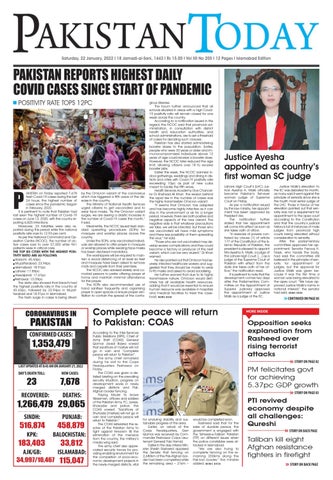
Justice Ayesha appointed as country’s first woman SC judge Lahore High court’s (LHc) Justice ayesha a. Malik officially became Pakistan’s first-ever woman judge of supreme court on Friday. as per a notification issued by the law ministry, her appointment has been approved by President alvi. the notification further stated that her appointment will come into effect as soon as she takes oath of office. “in exercise of powers conferred by clause (1) of article 177 of the constitution of the islamic republic of Pakistan, the president is pleased to appoint Mrs ayesha a. Malik, a judge of the Lahore High court, […] as a judge of the supreme court of Pakistan with effect from the date she takes oath of her office,” the notification read. it is pertinent to note that the development comes two days after the Parliamentary committee on the appointment of superior Judiciary approved the appointment of Justice Malik as a judge of the sc.
Complete peace will return to Pakistan: COAS according to the inter-services Public relations (isPr), chief of army staff (coas) General Qamar Javed Bajwa vowed that sacrifices of martyrs will not go in vain and “complete peace will return to Pakistan”. the army chief remarked during his visit to the corps Headquarters Peshawar on Friday. the coas was given a detailed briefing on the prevailing security situation, progress on development works in newly merged districts and Pakafghan border fencing. Paying tribute to brave tribesmen, officers and soldiers of the Pakistan army, Fc, Levies, khasadar and police, the coas vowed: “sacrifices of shuhada [martyrs] will not go in vain and complete peace will return to Pakistan.” the coas reiterated the resolve of the Pakistan army to fight against terrorism till the elimination of the menace from the country, the military’s media wing said. the army chief also appreciated security forces for providing enabling environment for the completion of socio-economic development projects in the newly-merged districts, vital
Justice Malik’s elevation to the sc was debated for month, as many said it went against the principle of seniority since she is the fourth most senior judge of the LHc. those in favour of her elevation pointed out that seniority was not a requirement for appointment to the apex court according to the constitution and that the country’s judicial history is full of instances of male judges from provincial high courts being elevated without consideration to seniority. after the parliamentary committee approved her appointment, senator Farooq H. naek, who heads the body, had said the committee still believed in the principle of seniority for appointment of judges, but the approval for Justice Malik was given because it was the first time a woman was being elevated to the apex court. “We have approved Justice Malik’s name in national interest,” the senator had said. news desk
CONTINUED ON PAGE 05
more inside
Opposition seeks explanation from rasheed over rising terrorist attacks STORY ON PAGE 02
PM felicitates govt for achieving 5.37pc GDP growth STORY ON PAGE 03
for enduring stability and sustainable progress of the area. earlier, on arrival at the corps Headquarters, Gen Qamar was received by commander Peshawar corps Lieutenant General Faiz Hamid. earlier in the day, interior Minister sheikh rasheed apprised the senate that fencing on 2,680km of the Pak-afghan border had been completed while the remaining area – 21km –
would be completed soon. rasheed said that for the sake of durable peace, the government is engaged with the tehreek-e-taliban Pakistan (ttP) on different issues when the police constables were attacked in islamabad. “We are also trying to complete fencing on the remaining 200kms along the Pak-iran border,” the minister added. n e w s d e s k
PTi revived economy despite all challenges: Qureshi STORY ON BACK PAGE
taliban kill eight afghan resistance fighters in firefight STORY ON BACK PAGE
02
i
Saturday, 22 January, 2022 | ISLAMABAD
NEWS
News Desk
NTERIOR Minister Sheikh Rasheed Ahmed has been asked by the opposition senators on Friday to give explanation over the fresh acts of terrorism across the country, specifically the blast in Lahore on Thursday which claimed the lives of three people. The opposition, during today’s session urged the Senate Chairman Sadiq Sanjrani to debate the country’s law and order situation in the wake of the Lahore blast and the killing of a policeman in Islamabad during a shootout, by suspending routine proceedings.
atc convicts sialkot citizen for justifying lynching of priyantha kumara News Desk An Anti-Terrorism Court (ATC) on Friday sentences a Sialkot citizen, identified as Muhammad Adnan, for justifying the brutal lynching of Sri Lankan citizen Diyawadanage Don Nandasri Priyantha, soon after the incident. It is pertinent to note that the foreign worker, commonly known as Priyantha Kumara, was brutally lynched in Sialkot over spurious blasphemy allegations late last year. According to case details, police had filed a report against Adnan on the complaint of Sub Inspector Mubarak Ali two days after the brutal murder of Priyantha Kumara. The First Information Report (FIR) said that Adnan had uploaded a video on YouTube in which he supported the actons of those involved in the lynching of the Sri Lankan citizen. Police had subsequently arrested Adnan and produced him in ATC Gujranwala. During the hearing of the case, the accused had admitted to the charges framed against him, on which the court sentenced him to one-year imprisonment and a penalty of Rs10,000. It is pertinent to note that Priyantha Kumara, a 49-year-old Sri Lankan national, was lynched by a mob of workers at a factory on December 3, where he was working as manager. A first information report (FIR) was registered against hundreds of unidentified men, including workers of the factory.
pakistan, iraq sign pact for promotion of tourism IsLAMABAD TLTP
Pakistan and Iraq have signed a memorandum of understanding (MoU) to promote tourism. The MoU was signed in Baghdad by Iraq’s Minister for Culture, Tourism and Antiquities and the ambassador of Pakistan to Iraq. In a statement, Foreign Office Spokesperson Asim Iftikhar Ahmad said the MoU will promote cooperation and collaboration in tourism, and reinforce people-to-people linkages between the two countries. He said that Pakistan is also engaging actively with the Iraqi side for facilitation of Pakistani pilgrims to Iraq. The spokesperson said signing of the MoU is another manifestation of the efforts of both countries to strengthen and diversify bilateral collaboration across diverse fields. Asim Iftikhar said Pakistan remains committed to deepening and broadening its fraternal ties with Iraq. Meanwhile, Foreign Minister Shah Mahmood Qureshi has said that the foreign tourists are attracted towards Pakistan after some improvement in the Covid-19 situation. The foreign minister, in a meeting with Special Assistant to PM on Tourism Azam Jamil, on Friday said that the government was extending maximum facilities to foreign tourists, including the visa-on-arrival. He said Prime Minister Imran Khan and Pakistan Tehreek-eInsaf wanted promotion of tourism, adding the country witnessed unprecedented growth in tourism in 2019. However, like other sectors, the Covid-19 pandemic also adversely impacted tourism, he added. The foreign minister, referring to his recent visit to Spain, said he had a fruitful meeting with the secretary general of the World Tourism Organization. Jamil thanked the foreign minister and hinted at formulating a comprehensive national tourism policy in collaboration with the foreign ministry.
OppOsitiOn seeks explanatiOn frOm rasheed Over rising terrOrist attacks Senator Raza Rabbani, while addressing the upper house, stated that the Balochistan Liberation Army had claimed responsibility for one of the attacks “while the interior minister said the Tehreek-i-Taliban Pakistan (TTP) was behind it”. The senator demanded that the minister be summoned to clear the confusion in this regard, while lamenting that terror incidents were surging across the country. “Do the recent incidents not prove that the approach adopted in dealing with the TTP was wrong?” he questioned. Senator Sadia Abbasi said she had submitted a calling attention notice at the Senate secretariat to discuss the law and order situation. “However, it was not incorporated in the agenda,” she said. Senator Yousuf Raza Gillani said terror incidents were increasing and the interior minister should brief parliament in this regard, adding that media reports were not sufficient to ascertain the details. Irfan Siddiqui of the PML-N said the incidents of
robberies were on the rise in the capital, while “the interior ministry was busy indulging in rhetoric”. The senator said he had not seen the interior minister in the House for any briefing during the last nine months. On the demand of the opposition, the interior minister made a brief appearance during today’s session. He said that there were “special motives” behind the killing of the cop in Islamabad, adding that the government was investigating the incident. The minister further condemned the Lahore blast and said that an investigation into the incident was underway. He said that no one would be allowed to spoil the country’s peaceful environment. The minister also informed the House about fencing work at the Pak-Afghan border, stating that only 20 kilometres remained to be fenced while 2,800-km had been completed. He said that 200km also remained to be fenced at the Pak-Iran border. The minister went on to add that two terrorists were
killed in the Islamabad shootout, adding that six mobile phones belonging to the attackers were also recovered. “I do not want to mention the details about their movement and accommodation,” Rashid said. Subsequently, the opposition parties submitted an adjournment motion seeking an explanation from the minister over terror incidents in the country. Following this, the Senate chairman told the minister to brief the upper house in this regard and the steps taken by the government on Monday (Jan 24). It is pertinent to note that earlier this week, the interior minister had termed the attack in Islamabad an act of terrorism and warned that it was a signal that terrorism had come to the capital. “This is not a matter of petty theft or dacoity, this purely is an act of terrorism,” he said. The minister also said this was the first such incident of the New Year and said that all law enforcement agencies needed to raise their guard.
At least 5 dead, several injured as gusty winds batter Karachi News Desk At least five people, including two children, lost their lives and several others sustained wounds due to roof and wall collapse incidents after gusty winds battered different parts of Karachi on Friday. The winds uprooted trees and electricity polls, besides causing road accidents, house collapses, and power outages in the city. A boy named Farman got critically wounded in a wall collapse incident in the Orangi Town area of the metropolis. He was shifted to Abbasi Shaheed Hospital before being moved to Jinnah Hospital. However, he succumbed to his serious injuries later. Taimuria Station House Officer (SHO) Abdul Rasheed said a man was killed in a wall collapse near Five Star Chowrangi in North Nazimabad. The SHO said the deceased man, 60-year-old Ratan Bagh, used to sell flowers in the area.
“He was sitting against the wall when it collapsed as strong winds blew,” he said, adding that the deceased person’s brother, who was at a distance from him at the time of the incident, remained safe. It is pertinent to note that strong winds were blowing in the city from the west at 25-30 knots (1kn equals 1.852kilometres per hour) as the result of a “steep pressure gradient”, stated the Met Office. Sardar Sarfaraz, chief meteorologist at the Met department, further explained in a video clip that the pressure gradient was high in western Balochistan and Iran due to the presence of a westerly low-pressure weather system in the eastern parts of Balochistan adjoining south Punjab and upper Sindh. This, he said, had triggered gusty winds in Karachi. Sarfaraz said the windy and dusty weather in the city was likely to continue till midnight. He said strong winds could cause trees to fall and
damage “loose structures” such as tents. He further added that the speed of winds was increasing to 35kn in some areas. Separately, the Met Office issued a weather advisory, which said Sindh, including Karachi, was likely to experience a “mild cold wave” between January 22 and January 27. During this period, the advisory said, night temperatures in most cities of Sindh were expected to drop to four degrees Celsius to six degrees Celsius and in Karachi to eight degrees Celsius to nine degrees Celsius. It added that weather was likely to remain cloudy and there were chances of light rain in Sukkur, Ghotki, Khairpur, Larkana, Jacobabad, Kashmore, Shikarpur and Qambar-Shahdadkot. The advisory further revealed that dry weather, cold nights and foggy mornings would be experienced in plain areas elsewhere in the province.
'Minus Niazi' formula in the works, says Hamza News Desk Leader of the Opposition in the Punjab Assembly and PML-N leader Hamza Shehbaz on Friday ruled out the possibility of any “minus four formula” revealed by the PTI ministers for his party earlier this week by stating that it was in fact ‘minus Niazi’ formula that was in the works. Hamza’s statement came after minister for Interior Sheikh Rasheed Ahmad stated that all the four Sharifs – Nawaz, Shehbaz, Maryam and Hamza – were now ‘minus’ and had no further role in the country’s politics. Rasheed while talking to media on Friday, stated that no drastic change was happening in the country’s politics without former PM Nawaz Sharif, who has been living in London since 2019, adding that the “hand on Prime Minister Imran Khan’s head would not be placed on Sharifs’ head, rather it could be their throat”. In this regard, Hamza hit back at the government by stating that “I’m tired of listening about minus four [formula], [on the contrary] minus Niazi is going to happen… people could only live in peace if this happens… after minus Niazi, we will make this country Quaid-e-Azam’s prosperous Pakistan again”. He went on to lambast the government by stating that the ruling Pakistan Tehreek-e-Insaf is unable to handle multiple issues the country faced during the past few years, the Punjab opposition leader hinted at an “inhouse change” in the National Assembly as well as the provincial legislature. “Whether it is National Assembly or Punjab Assembly, we will take all legal and constitutional steps against the government… you (the government) will be held accountable for your actions and people will be liberated from them soon,” he added. Hamza said that the opposition will talk to different political forces before taking any step against the government. “We will talk to all political parties, even the government allies and we will invite them to address the hardships the people of the country are facing due to policies of this government,” he said. To a question about bringing the presidential form of government in the country, he said that whenever the government is asked about its performance, they start churning out things that have no value. Criticising the government over its alleged negligence during the Murree tragedy, he termed the report of the five-member committee a “joke”. “PML-N will not relax until the real culprits of the tragedy are not taken to task… the people are freezing to death but the administration kept sleeping… We will not let the Buzdar administration get off so easily,” he
further said. Talking about the report of the scrutiny committee formed by the Election Commission of Pakistan (ECP) on foreign funding case, the opposition leader said that Prime Minister Imran had failed to give an explanation about his Canada and New Zealand accounts. “When Nawaz Sharif was named in Panama Papers, Imran Khan had asked him to resign. Now scrutiny committee has named you… and you should resign and give an explanation about the questions being asked regarding your foreign accounts.” Meanwhile, the opposition members expressed dissatisfaction over officials’ suspension on Murree tragedy during the Punjab Assembly session earlier in the day, claiming the victim’s families will never forgive the government whose incompetence caused deaths of their beloved ones. During his speech on “General discussion on Murree incident”, Hamza Shehbaz asked the assembly members “where were the helicopters of Prime Minister Imran and Chief Minister Usman Buzdar when innocent children were dying in Murree”. PML-N spent billions on machinery to deal with heavy snowfall but that machinery was not used properly, nothing was done to protect the families trapped in Murree, he claimed. Hamza also demanded a parliamentary committee to minutely probe the gory incident. “Hamza Shehbaz will not sit till all responsible of
the Murree incident are brought to book”, he vowed. Suspending some people will not heal the wounds of victim’s families, he made clear. There was a shortage of wheat, sugar, fertilizer and other routine items but the Prime Minister Imran Khan just seems updating the nation that “mafia is working” but does not seem to making any concrete effort to eliminate or even to bring them to book. The PML-N lawmakers left the assembly chambers as Hamza’s speech ended up. Responding to Hamza’s speech, provincial law minister Raja Basharat said the opposition leader was so sorrowful on Murree incident but where he was when people were being gunned down at Model Town. “They are the killers of those who lost their lives in Model Town incident,” the law minister said. During his response, the law minister also revealed that two accused of the Anarkali blast had been arrested, adding that investigation was being carried out from all aspects and soon people will be made aware about it. He also condemned the opposition’s conduct of leaving the assembly chambers after delivering speeches. Punjab Assembly Speaker Chaudhry Pervez Elahi also seconded the law minister, adding, “It is true and regrettable that opposition leaves the assembly chambers after conveying its voice, they should keep patience to listen to treasury benches too with same desire they required delivering their speeches”.
Saturday, 22 January, 2022 | ISLAMABAD
pm felicitates gOvt fOr achieving 5.37pc gdp grOwth
p
News Desk
RIME Minister Imran Khan has applauded and greeted members of his government on achieving the gross domestic product (GDP) growth of 5.37 percent during 2020-21, resulting in a rise in per capita income. Taking to Twitter, the prime minister said that his government has achieved a GDP growth of 5.37 percent in three years, leading to substantial jobs creation. He said the success of his government’s economic reforms has been recognised at world level and Bloomberg has predicted that Pakistan will sustain a high growth trajectory and employment levels. He said since the outbreak of Covid pandemic,
Pakistan has been ranked amongst top three countries on a normalcy index, indicating saving jobs and saving lives, and added that The Economist recognised this in its latest normalcy index. Federal Minister for Planning and Development Asad Umar, while addressing a news conference in Faisalabad on Thursday last, had said that the last year had witnessed the second-fastest growth in the country and had led to an increase in the per capita income of Pakistanis by US $200 to $1,666. “The growth in 2020-21 was 5.37 percent,” Umar had said in a tweet, adding that the National Accounts Committee (NAC), a government body that reviews the economic indicators, had approved the revised estimate of GDP growth.
Solar association protests 17pc tax on solar panels LAHORe Shahab Omer
Representatives of the Pakistan Solar Association (PSA) held a press conference here at the Lahore Chambers of Commerce and Industry (LCCI) on Friday, against a 17 per cent sales tax levied on the import of solar panels and demanded immediate withdrawal. Representatives of PSA informed the media that the government had earlier announced that the proposal for tax on solar devices has been scrapped. However, on January 17,2022, importers while submitting the import Goods Declarations (GDs) on the Federal Board of Revenue (FBR) learnt that the sales tax exemption on solar devices has been abolished. LCCI President Mian Noman Kabir while speaking on the occasion said that imposition of 17 per cent tax on solar energy devices would harm efforts to promote
alternative energy sources in the country. However, speaking on the condition of anonymity an official of the Federal Board of Revenue (FBR) revealed that apart from the 17 per cent general sales tax importers will also have to pay other taxes on the import of solar panels. “In the case of solar panels only, the importer will now have to pay 16 per cent customs duty, 17 per cent sales tax, 3 per cent additional sales tax, 11 per cent income tax and 4 per cent additional customs duty at the landing port. Moreover, if the import is taking place at the Karachi port then 1.5 per cent Sindh excise duty will also apply. Earlier, the solar industry did not pay any such taxes,” he said. On the other hand, Pakistan Solar Association’s (PSA) former chairman Nouman Khan, while talking to Profit said that earlier no GST was implemented on import of solar panels and hence the invoices issued to customers were also zero-rated. According to Nouman Khan, the 17 per cent sale
tax on solar panels will now be passed on to the consumers while other taxes and custom duties will increase the cost of solar panels hence making them more expensive. “Similarly, we used to pay income tax a year later but now we have to pay income tax in advance. Obviously, the rate of tax on solar imports will now be around 51 per cent [if you include all taxes] and the prices of solar panels will increase by more than 51 per cent,” he said. However, as of yet the price of solar panels in the market has not increased as various chambers and associations intend to hold protests in this regard and are also trying to negotiate with the government,” said. According to Khans calculations, if an importer imports Rs1 million worth of solar products, a 51 per cent tax rate would take the cost to more than Rs1.5 million before the importer has even factored in his own profit margin.
US playing ‘Xinjiang Card’ against China, silent on Kashmir: Mazari News Desk Pakistan-China Institute (PCI) organized a first-of-itskind webinar on the “New Cold War about playing the Xinjiang card against China” under its flagship event series, “Friends of Silk Road (FOSR)”. The Webinar was attended by over 35 participants online, and featured six speeches, including Dr. Ejaz Akram, Chairman of the Rehmat ul Lil Alameen Authority, Dr. Shireen Mazari, Federal Minister for Human Rights, Professor Li Xiguang, Director of the Center for Pakistan Cultural and Communication at Tsinghua University, Allama Tahir Ashrafi, Special Assistant to the Prime Minister on Religious Affairs, Sabah Aslam, Founder and Executive Director of the Islamabad Institute of Conflict Resolution, and Senator Mushahid Hussain Sayed, Chairman of the Senate Defence Committee and the Pakistan-China Institute. The dialogue was moderated by Mustafa Hyder Sayed, Executive Director of the Pakistan-China Institute. Mr. Mustafa Hyder Sayed highlighted that the US has weaponized human rights and is engaged in the selective application of human rights principles. He emphasized that Pakistan should continue to support China on Xinjiang since China has always supported Pakistan on its core interests. The panelists discussed how the ‘Xinjiang card’ is used by the Western world, particularly the United States, to achieve their foreign policy objectives of pressuring China. The speakers stressed that laws such as the ‘Uyghur forced labor bill’, and other legislation and policies concerning Hong Kong, Taiwan, and Tibet, are part of a larger ‘China containment’ policy. Dr. Ejaz Akram stated that issue of Xinjiang is a flashpoint, which is used by Western groups to rally certain parts of the Muslim world against China. He mentioned that the CIA has a history of blackmailing countries into submission via color revolutions, similar to what they did in countries like Syria, Libya. He emphasized that Pakistan is in a twilight zone between US and China. He advised the Government to support China in its quest for truth, in its quest of protecting its interests and in protecting the region. A brief video was played which discussed how the US took a politically-motivated decision to remove the East Turkestan Islamic Movement (ETIM), which is recognized as a terror outfit by the United Nations, from its’ list of terror groups. It discussed the doublestandards on the part of the US to demonize China, despite being at war in the Muslim world for a couple of decades. Dr. Shireen Mazari, the Federal Minister for Human Rights, stated that the United States is involved in starting a New Cold War with China, in the midst of the COVID-19 pandemic, which requires greater international cooperation. She asserted that the United States has created laws, such as the Uyghur Forced Labor Prevention Act, to sanction China using
the ‘Xinjiang card’. She questioned why the United States failed to take action against the genocide of innocent Kashmiris by the Indian occupation forces. She asked why the US failed to speak out against the elimination of Palestinians from their homeland by the Israeli regime. She emphasized that the US is losing power internationally due to its imperialist approach. It also created the military alliance, AUKUS, centered on countering China in the AsiaPacific region. Efforts to combat China in South Asia include massive military hardware influx and military cooperation. She pointed out that the US is seeking a New Cold War and trying to militarize global politics as well as economics, whereas China strives to share economic prosperity and open up the world through trade routes and infrastructure in Pakistan and African countries, so that all countries can prosper via international trade. Pakistan faces a challenge of whether it will move towards economic prosperity, which is now a central norm of Pakistan’s National Security policy, or whether it will be sucked into the militarization being pushed by the United States. The rational route is to support the opening up of the world through international trade via the Silk Route, BRI and CPEC project. Dr. Shireen concluded that Muslims have suffered the consequences of the US War on Terror and of militarization and they cannot afford to go down this route. Professor Li Xinguang discussed that the West fears the unity between the Confucian and Islamic Civilisations. He highlighted that the West’s purpose to play the ‘Xinjiang card’ is to divide and undermine China and create misunderstandings between China and neighboring Muslim countries, as well as those along the Belt and Road. The West wants to turn Xinjiang into another Afghanistan. He stressed that, unlike the United States, who despite failing in the battlefield does not want to see unity among Afghans, China respects the culture and religion of the Afghan people. Allama Tahir Ashrafi, Special Assistant to the Prime Minister on Religious Affairs stated that bills or statements made by the United States regarding lack of religious freedom in Pakistan, China, and Saudi Arabia are baseless. He suggested that these statements are politically motivated, rather than fact based. He stressed that the United States should avoid interfering in the internal affairs of other countries and avoid needlessly criticising China on Xinjiang. He emphasized that the United States should focus on human rights violations in its own country, then preach to other countries. He highlighted that interference by the United States in internal matters of countries has led to disaster. He advised the US should rely on facts and engage in dialogue instead of using a narrative of a lack of religious freedom as a political weapon. He emphasized that the stance of the Pakistani people, government, and religious parties regarding China is that it is Pakistan’s best friend and neighbor,
irrespective of American propaganda. Ms. Saba Aslam discussed that in international politics, the Western world, which has a colonial mindset, uses narratives and sanctions to demonize others. She stressed that the US always imposes unilateral sanctions, which is seen as more effective tool. She predicted that the China and US won’t engage in military conflict since they will fight on an economic level. She added that China isn’t a weak state, they are immune to US sanctions as the US will fail to achieve its objectives by applying sanctions and pressure. Ms. Aslam suggested that China should come up with proactive measures to combat these myths and disinformation through research gaps. Senator Mushahid Hussain Sayed stated that political and economic power in the world is shifting from the West to the East. He agreed with Professor Jeffery Sachs who believes that the US has not been able to compete with China economically. He cited a study by Professor Graham Allison of Harvard University that China has displaced the US as the world’s biggest hitech manufacturer. He linked this with a recent report that China registered a growth of 8 percent in 2021, despite the COVID-19 pandemic. He highlighted that despite their opposition to the Belt and Road Initiative, the US launched its own copycat project, Built Back Better World. He cited an article by Leslie H. Gelb in The New York Times titled ‘Breaking China Apart’, which stated that the US will ‘kindle separatism in China’ if it doesn’t fall in line and discussed the approach of Demonizing, Damaging and Destabilizing countries. He highlighted a July 2020 survey by the Ash Center of Harvard University which found that over 90 percent Chinese support the Communist Party of China, since it has provided the Chinnese people with stability, continuity, peace, and stability. Senator Mushahid Hussain concluded that while the US is engaged in creating cleavages, conflict and encouraging confrontation, Pakistan will continue to support China on its core national interests such as Xinjiang, Taiwan, Tibet, Hong Kong, South China Sea, and BRI. This webinar lasted for 90 minutes. The speeches were followed by comments from two participants. Ambassador Masood Khalid commented that the West aims to release domino effect in those regions of China, such as Xinjiang, which it perceives as vulnerable. He noted that if Xinjiang is destabilized it will threaten CPEC and the BRI. He cited an article by Tom Freedman in the New York Times, who had predicted the collapse of China 20 years back, only to publicly acknowledge his mistake later. Moreover, Gerald Mbanda from Rwanda presented the African perspective and the experience of Africa with colonialism. He contrasted this with China’s friendship with and investment in African countries to enable their development. A diverse audience of students, scholars, and the media took an active part in this webinar.
NEWS
03
food ministry constitutes biased committee to investigate monopoly at dpp IsLAMABAD GhuLam abbaS
The Ministry of Food Security and Research (MoFS&R), which was asked to break the monopoly of a private firm at the Department of Plant Protection (DPP) by Prime Minister Imran Khan has instead constituted a biased committee in its bid to protect the one company rule at DPP. The prime minister, after noticing the monopoly of National Chemical Limited for the import of methyl bromide at DPP, had directed MoFS&R to take action against those responsible in maintaining monopoly of the private firm for years despite reservations and complaints of exporters, importers and trade bodies. DPP has not granted import registration for methyl bromide to any other company except National Chemical Limited since 2012 . However, the ministry, instead of resolving the issue, has constituted a committee of those officials, who have allegedly been beneficiary of the one company rule at DPP. The committee is mandated to inquire and give its recommendations on the controversy over import of methyl bromide and the monopoly that exists in this sphere for immediate redressal of the situation and follow up to fix responsibility for any wrongdoing that may have occurred in the past. Rashid Mehmood, who is the head of the committee claimed that the committee is inquiring the matter in detail and it would submit its findings to the MoFS&R secretary. Apart from the inquiry committee, MoFS&R interestingly in another apparent move to deceive the prime minister, has advertised registration of new companies for import of methyl bromide despite the fact that the influential group at DPP is not allowing some 50 existing companies to import methyl bromide. According to sources, National Chemical Limited possesses exclusive dealerships of two major global suppliers of the chemical. There are four major suppliers of methyl bromide in the world out of which Pakistan can import from only two, which gives the company a complete monopoly. Since the DPP and MoFS&R have not changed the rule related to suppliers’ mandatory dealership, the registration of new firms/companies would not break the existing monopoly of National Chemical Limited.
Saturday, 22 January, 2022 | ISLAMABAD
04
NEWS
SBP to announCe monetarY PoliCY on mondaY KARACHI
t
TLTP
He Monetary Policy Committee (MPC) of the State Bank of Pakistan (SBP) will meet on Monday to decide about monetary policy. In a statement issued on Friday, the central bank said that its Governor Dr Reza Baqir will hold a virtual press conference on the same day after the MPC meeting. In its last meeting in December, the MPC raised the policy rate by 100 basis
points (bps), taking it to 9.75%. The SBP, in its bid to tackle the current account deficit pressure and spike in inflation rate, has raised the interest rate by 275 bps since September last year. However, many believe the central bank to hold off on a hike this time around. “We expect the SBP to keep policy rate unchanged at 9.75% in the upcoming monetary policy statement,” said Arif Habib Limited (AHL) in a note. “To recall, the MPC convened its last meeting in December 21 and reiterated its stance to ensure the longevity of growth and countering inflation while
gradually targeting mildly positive interest rates over time.” As per the survey poll conducted by AHL regarding market expectations in the upcoming monetary policy, 71% of the total respondents, which include representatives from financial services and manufacturing, are of the view that there will be no change in the policy rate for upcoming MPS. Meanwhile, 29% of respondents expect a rate hike. Another poll conducted by Topline Securities also conveyed that a majority expects status quo in the upcoming monetary policy announcement.
Cement exports inch up in 1HFY22 ISLAMABAD TLTP
LAHORE: A view of a road amid heavy fog in the provincial capital. ONLiNE
Gold slips to Rs104,300 per 10gm The gold prices recovered after taking a dip on Friday, as decreasing US Treasury bond yield ended gold's correction. As of 1340 hours GMT, gold in the international market was available at $1,841.70 per ounce, gaining $2.30. The price of 10 grams of yellow metal in Pakistan, meanwhile, decreased to Rs104,300 after shedding Rs100. Gold in the local market was available at Rs104,400 on Thursday. A decrease in the local gold prices was due to 0.14 percent appreciation of Pakistani rupee against the US dollar during the day. During the earlier trading in the international market,
gold extended its downward correction towards $1,828 on Friday after advancing to $1,848, a two-month high, on Thursday. The benchmark 10-year US Treasury bond yield remained in the negative territory, which helped gold to recover losses. The downfall lacked any obvious catalyst and could be solely attributed to some profit-taking amid expectations that the Fed will tighten its monetary policy at a faster pace than anticipated. From a technical perspective, bulls need to retest the two-month highs - $1848 - before it prepares to take on the November 22 high of $1,849. Daily closing above that level
Martin Dow Marker Limited signs MoU with DVAGO for patient awareness. Pr
could initiate a fresh uptrend in gold price. The next resistance level lies around $1,860 and some follow-through buying will be seen as a fresh trigger for bullish traders and pave the way for an extension of the recent move up. On the flip side, the $1,840 level seems to act as an immediate support. Any pullback towards the $1,832 might now be seen as a buying opportunity. A convincing break below might prompt some technical selling and accelerate the fall towards the $1,812. The next relevant support is pegged near the very important 200-day SMA, currently at $1,804, ahead of the $1,800 round figure. NEWS DESK
The cement exports witnessed an increase of 0.59 percent during the first half of financial year 2021-22 on a year-on-year basis; however, higher coal prices expose manufacturers to witness squeezed margins and negative volumetric growth in coming months. According to the data released by Pakistan Bureau of Statistics (PBS), the cement exports remained $143.768 million during JulyDecember (2021-22) against the exports of $142.924 million during July- December 2020-21. In terms of quantity, the exports of cement, however, dipped by 9.33 percent by going down from 4,325,060 metric tonnes to 3,921,554 metric tonnes, according to the data. Meanwhile, on a year-to-year basis, the exports of cement increased by 44.28 percent during the month of December 2021 as compared to the same month of last year. The exports of cement from the country during December 2021 were recorded at US $ 27.776 million against the exports of US $ 19.251 million in December 2020. On a month-on-month basis, exports of cement declined by 45.04 percent during December 2021 when compared to the exports of US $ 50.542 million in November 2021, the PBS data revealed. The coal prices are moving on an unstable ground which will expose cement manufacturers to witness squeezed margins and negative volumetric growth in months to come, a report said. The sudden spike in demand for coal as a result of the rebound in economic activities after a terrible slowdown due to Covid-19 lockdowns across the globe disrupted the supply chain that ultimately pushed local manufacturers into the troubled zone. However, the buoyant cement demand can come to a rescue on the back of housing schemes, dams construction, and road infrastructure especially during the phase of the upcoming election campaign. It is expected that domestic demand may reach 52 million tonnes by next fiscal year, translating into 8.4% percent growth from 2020-21, while local dispatches are likely to grow by 5 percent by fiscal year 2022-23. During the last 20 years, Pakistan’s local cement dispatches have grown at a CAGR of 8.2 percent, while dispatch growth during the years of higher GDP growth is above 12 percent.
A signing ceremony regarding digital streaming rights for HBL PSL was held at Daraz’s office. Pr
CMYK
Saturday, 22 January, 2022 | ISLAMABAD
NEWS
05
JuStiCe aYeSHa aPPointed aS CountrY’S FirSt woman SC Judge Pakistan navy ship alamgir visits Kenya ISLAMABAD Pr
Pakistan Navy Ship ALAMGIR visited Mombasa, Kenya as part of overseas deployment in African region. Upon arrival at port, PNS ALAMGIR was received by High Commissioner of Pakistan at Kenya, Defence Attaché of Pakistan and senior officials from Kenyan Navy. During the port visit, Mission Commander along with Commanding Officer of PNS ALAMGIR called-on Cabinet Secretary of Defence of Kenya and Deputy Commander of Kenyan Navy. During the interactions, matters of mutual interests were discussed and enhancement of bilateral ties in all spheres was re-affirmed. Mission Commander conveyed good wishes of Chief of the Naval Staff Admiral Muhammad Amjad Khan Niazi for the people of Kenya. As a goodwill gesture and to extend humanitarian assistance, a free Medical Camp was established by Pakistan Navy at Mombasa, Kenya. A specialized team of Pakistan Navy doctors and paramedics provided medical treatment and medicines to over 5400 patients. The implementation of COVID-19 SOPs was ensured during the Medical Camp. establishment of free Medical Camp by Pakistan Navy was widely appreciated by the local populace. During PNS ALAMGIR deployment to African continent since November 2021, over 15000 patients were provided treatment and medicine in five countries. It is a true manifestation of Government of Pakistan engage Africa policy that seeks to explore new avenues of cooperation, strengthening bilateral ties and developing interoperability with African countries.
nePra holds meeting with licensees ISLAMABAD Pr
National electric Power Regulatory Authority (NePRA) Friday held a meeting with all respective licensees who did not have acceptable Health, Safety and environment (HSe) performance as identified in HSe performance evaluation conducted in 2021, as well as two of the top HSe performers so that they may learn from their experiences. A large number of HSe professionals from Generation, Transmission and Distribution companies including from Azad Jammu and Kashmir attended this meeting to understand the legal requirements of the Power Safety Code and to discuss the identified gaps/ shortfalls in HSe performance and recommend appropriate solutions/ remedies to improve HSe performance to achieve a zero incident goal. Chairman NePRA, Mr. Tauseef H. Farooqi told the participants in his keynote address that the Authority is actively pursuing NePRA vision of “Power with Safety”, and that NePRA will initiate legal proceeding against those companies which will show poor performance in the area of HSe in the second round.
islamabad police arrest car lifter ISLAMABAD Pr
Anti-Vehicle Lifting Cell (AVLC) of Islamabad police has nabbed a car lifter after shootout in the precinct of Sabzi Mandi Police. On a tip off the AVLC teams along with the personnel of local police station raided a shrine in sector I11/1 on Thursday midnight. During the raid the accused opened fire to the police party. After exchange of fire between the police and the car lifters an accused Yousaf son of Hassan was arrested after receiving bullet injuries while his accomplice managed to escape the scene. The police recovered a 30 bore pistol along with ammunition from the nabbed person and started investigation after registering a case in Sabzi Mandi police station. The arrested accused was involved in lifting numerous vehicles from twin cities of Rawalpindi and Islamabad and Lahore region. He also wanted by the federal capital police in 12 cases of car-lifting. The police was conducting raids to arrest the other suspect.
t
ContInueD fRoM pAge 01
He Judicial Commission of Pakistan (JCP) had earlier this month approved Justice Malik for elevation to the apex court by a majority of five to four during a heated session that had lasted nearly threeand-a-half hours. This was the second time that the JCP held a meeting to decide on Justice Malik’s appointment. A lack of consensus during an extended meeting of the JCP on Sept 9 last year had forced the commission to defer a decision on her appointment. earlier, during the JCP’s Sep 9 meeting, four members of the commission had opposed the proposal to elevate her, while an equal number supported it. Justice Maqbool Baqar, Justice Sardar Tariq Masood, former judge Dost Mohammad Khan and a representative of the Pakistan Bar Council (PBC), Akhtar Hussain, had opposed the idea whereas Chief Justice CJP Gulzar Ahmed, Justice Umar Ata Bandial, Federal Law Minister Barrister Dr Farogh Naseem and Attorney General (AGP) Khalid Jawed Khan had favoured Justice Malik. The Supreme Court Bar Association President Abdul Latif Afridi had called a countrywide protest to express anger over disregard to the seniority principle in the appointment of judges to the apex court.
While the JCP was holding its session, lawyers had arranged a protest and convention in a nearby office of the Supreme Court Bar Association (SCBA). They accused the judiciary of favouritism in the appointment of superior court judges and thus harming its image. Through a resolution, the convention had asked the JCP to adhere to the seniority principle in appointments to the apex court from the provincial high courts until such time as fair, transparent and objective criteria for appointment of judges at all levels were framed in consultation with all stakeholders and appropriate amendments to the Judicial Commission Rules were made. It merits mention that the same criticism was levelled this time as well, with the legal fraternity calling on the chief justice to postpone the JCP meeting. In case the meeting was not called off, the Pakistan Bar Council (PBC) and all bar associations said they would boycott all court proceedings, from the superior judiciary to the lower courts. In a related development, LHC Bar Association President Maqsood Buttar had moved a petition before the Supreme Court earlier this month seeking directions that the JCP invite all relevant stakeholders; judges, senior lawyers and bar representatives, members of the parliamentary committee, the federal and provincial governments and civil society and structure the process of judicial appointments to the superior
Shell Pakistan sponsors Multan Sultans
tainment. Pakistan is a nation that thoroughly enjoys and loves cricket, and the world-class sportsmen playing for Multan Sultans making it a formidable competitor in the HBL PSL-7”. On this successful collaboration between Multan Sultans and Shell Pakistan – the Captain of the franchise, Mohammad Rizwan, stated, “We are excited with this partnership which will fuel us even more in our
preparations as we aim to become the first team in the HBL PSL to win back to back titles. This sponsorship will add value to the Multan Sultans brand, as we engage millions of cricket enthusiasts”. Syed Haider Azhar, the COO of Multan Sultans reiterated the captain’s views. “We are delighted to once again partner with Shell, the leading brand in its industry. We look forward to building on this energy and excitement with the aim of securing another title for Multan Sultans.” Over the years, PSL has emerged as the most successful brand of cricket in Pakistan, while Multan Sultans are one the biggest franchise teams today, attracting the most successful corporate partners. This sponsorship will also provide customers the opportunity to avail exciting offers on the purchase of Shell V-Power. Shell V-Power is a premium, hi-octane fuel that provides ‘Unbeatable Keep-Clean Performance and Protection’ to car and bike engines.
Diploma in Associate engineering (DAe). Moreover, to create a pipeline of skilled workers in an agro-pastoral community like Thar, ePTL has taken affirmative action to train over 1600 locals on various industrial and technical skills. Chief executive Officer ePTL, Syed Manzoor Hussain Zaidi said: “The real stakeholders of the develop-
ment of our project are the people of Thar who must achieve the economic gains of the development taking place in the area. We are very grateful to the Authority for recognizing our efforts and championing the CSR agenda under the “Power with Prosperity” banner by partnering with credible organizations to create a widespread impact for all."
KARACHI Pr
Shell Pakistan is one of the leading sponsors of 'Multan Sultans' – the defending Champions and best performing team in HBL - Pakistan Super League (HBL PSL) over the last couple of seasons. Season 7 of the HBL PSL shall commence on the 27th of January with the final scheduled to be held on 27th February, 2022. Multan Sultans won the PSL Championship in 2021, under the excellent captaincy of Mohammad Rizwan – an iconic wicketkeeper and batter, who has also been nominated as ‘Cricketer of the Year’ by the International Cricket Council (ICC). Rizwan has been in great form recently, as he played some exceptional, high-score innings during the ICC T20 World Cup 2021, held in the United Arab emirates. The Country Chair of Shell Pakistan, Waqar Siddiqui, expressed his excitement to be a part of Pakistan’s
biggest cricketing extravaganza, in collaboration with the defending Champions of the tournament. He stated that, "We have great confidence in the competitiveness and passion of the Multan Sultans, to continue their winning streak in many more tournaments. Shell Pakistan encourages healthy social activities. Sponsorship of this contest is aimed at engaging consumers in some exhilarating enter-
EPTL wins award KARACHI Pr
engro Powergen Thar Limited (ePTL) has been awarded by National electric Power Regulatory Authority (NePRA) in its first CSR Awards to recognize their work towards improving the lives of the people of Thar through the adoption of the UN Sustainable Development Goals (SDG) framework. NePRA held its very first ‘NePRA CSR Awards’ under its ‘Power with Prosperity’ initiative to honor the tremendous achievements of its top-performing partners for their community development. Sharing his thoughts on this win, CeO engro energy Limited (eeL), Ahsan Zafar Syed said: “We strongly believe that our growth model is inherently linked with the well-being and development of the communities
around our plants and projects. engro has always believed in the inclusive business model and extending our footprint to key beneficiaries of our project. It is an honor to be recognized for our efforts today which would not have been possible without the support of our implementation partners.” To forward the CSR agenda, engro Powergen Thar Limited (ePTL) works closely with Thar Foundation to promote education, better health care facilities, creation of better opportunities for livelihoods and provision of vocational trainings for the people of Thar. Thar Foundation, ePTL and various partners have worked together to establish 27 school units educating over 4000 students; provided international scholarships to 22 engineers to be trained in China and then be employed within the company and also provided 75 students with full scholarships for completion of their
ANF arrests 42 drug peddlers Anti Narcotics Force Pakistan seized 823.074 Kg Drugs valuing US$ 70.284 Million internationally, arrested 42 culprits including 1 woman 16 vehicles while conducting 35 counter-narcotics operations throughout the country. The seized drugs comprised 94.494 Kg Heroin, 603.363 Kg
courts to make them more objective and transparent. The petition had asked that until the criteria was developed, the JCP should stick to the seniority principle in the elevation of high court judges to the Supreme Court. The petition also sought directions for the JCP to frame comprehensive and detailed rules/guidelines to structure both the process of and parameters for appointment. It merits mention that Justice Malik completed her early education from schools in Paris and New York and then completed her senior Cambridge from the Karachi Grammar School. She studied law at the Pakistan College of Law in Lahore and went on to do her LLM from the Harvard Law School Cambridge, Massachusetts, USA, where she was named a London H Gammon fellow 1998-1999. From 2001 to the date of her elevation as a high court judge, she worked with the law firm of Rizvi, Isa, Afridi and Angell, first as a senior associate and then a partner in charge of the firm’s Lahore office. She is an author of a number of publications and has taught banking law at University of the Punjab and mercantile law at the College of Accounting and Management Sciences Karachi. Justice Malik has also appeared as a pro-bono counsel for several NGOs working on poverty alleviation, microfinance and skills-training programmes.
Hashish, 114.95 Kg Opium, 0.267 Amphetamine, 5.650 Kg Methamphetamine (Ice),180x ecstasy Tabs (0.084 Kg), 8330x Xanax Tabs (1 Kg ),Cannabis 0.650 Kg, 745x Roche-2 Tabs (0.216) and 4700 x Tramadol Tabs (2.400 Kg). ANF Balochistan recovered 378.15 Kg
drugs in 4 operations while arrested 3 accused and seized 3x vehicles. The seized drugs comprised 27.700 Kg Heroin, 297.550 Kg Hashish, 47.250 Kg Opium, 5 Kg Methamphetamine (Ice) and 0.650 Kg Cannabis. ANF Punjab recovered 22.816 Kg drugs in 4 operations while arrested 5 ac-
cused. The seized drugs comprised 22.6 Kg Heroin and 745x Roche-2 Tabs (0.216 Kg). ANF KPK recovered 248.261 Kg drugs in 8 operations while arrested 10 accused and seized 3 x vehicles. The seized drugs comprised 4.466 Kg Heroin, 218.445 Kg Hashish, 24.700 Kg Opium and 0.650 Kg Methamphetamine (Ice). ANF North recovered 171.697 Kg drugs in 18 operations and arrested 23 accused including 1 woman and seized 9 x vehicles.
The seized drugs comprised 37.578 Kg Heroin, 87.368 Kg Hashish, 43 Kg Opium, 0.267 Kg Amphetamine, 180 x ecstasy Tabs (0.084 Kg), 8330 x Xanax Tabs (1 Kg) and 4700 x Tramadol Tabs (2.400 Kg). ANF Sindh recovered 2.150 Kg Heroin and arrested an accused and seized 1 x vehicle. All cases have been registered at respective ANF Police Stations under CNS Act 1997 and further investigations are under process. Pr
06-07 Comments - 22nd January 2022_Layout 1 1/21/2022 11:58 PM Page 1
Saturday, 22 January, 2022
06 COMMENT
India’s violating the status quo in Kashmir
Much ado about nothing No economic miracle this
T
HE government’s exercise of rebas5ng the national accounts shows across-the-board economic growth. The FY21 growth rate has risen from the earlier estimated 3.94 percent to 5.4 percent while GDP has gone up to $346.76 billion from the provisional estimate of $296 billion. The size of the economy and per capita income have also registered increases while circular debt has come down. The government claims that besides rebasing, the upward revision in figures was due to growth in industrial, agricultural and services sectors. Energy Minister Hammad Azhar and Minister for Planning Asad Umar have tried to make political capital out of the revaluation. The former told a news conference that despite various challenges, including the pandemic, all economic indicators have remained positive. Making a dig at the previous administration, Azhar claimed his government had achieved impressive growth at a lesser cost than the PML(n) government. Umar called it the second highest growth in the last 14 years. The timing of the report is significant. The national Accounts Committee (nAC) meetings are usually held in May every year. This time it was held four months earlier at a time when the government’s economic policies are under attack and the opposition has announced two marches to Islamabad, rising prices being one of the major grievances. While the government wants to use the growth figures for political grandstanding, it is mainly a changed methodology to measure growth that has jacked up the growth rate to 5.6 percent with industrial, agricultural and service sectors playing only a secondary role. Interestingly, the rebasing exercise has reduced the public debt-to-GDP ratio from 83.5 percent to 71.8 percent for fiscal year 2020-21 while there is no reduction in the public debt per se, which remains at Rs39.9 trillion by June 2021. At $346.76 billion, Pakistan’s ranking among world economies has however improved to 35th, just a notch below Denmark. The growth figures provide room to the government to issue new sovereign guarantees that are also pegged with the size of the economy. For the man in the street the growth figures have little relevance as these bring no improvement in his livelihood like an increase in real wages, a significant reduction in unemployment or increase in purchasing power. The figures will not bring down foreign debt, reduce the current account deficit or bring down prices.
India wants to ‘internalize’ the issue dr Qaisar rashid
O
n 18 January 2022, invoking the principle of Universal Jurisdiction, a London-based law firm Stoke White submitted extensive evidence to the British Metropolitan Police’s War Crimes Unit on the ways Indian Army Chief General Manoj Mukund naravane and Home Minister Amit Shah were responsible for committing war crimes by torturing, kidnapping and killing of activists, journalists and civilians in Indianheld Kashmir. The firm demanded the arrest of both the culprits over their roles. The story dates back to 5 August 2019, when Indian President Ram nath Kovind issued a decree revoking the special status granted to the State of Jammu and Kashmir under Article 370 of the Indian Constitution, besides annulling its Article 35-A. Along with that, the State was bifurcated into two Union Territories: Ladakh division as a Union Territory without a legislature, and Jammu and Kashmir as a Union Territory with a legislature. India annexed the part of Kashmir that it had been controlling through Article 370 as a special territory having its own flag, constitution and Assembly. India suddenly discovered that it was loath to the formula of one country, two constitutions and two flags. In an attempt to tilt the status quo in India’s favour, the Indian government scrapped Article 370, which was a symbol of the conjunction of the princely state with the Union of Federal India since the incorporation of the article into the Indian Constitution in 1949, effective 26 January 1950. Scrapping Article 370 was part of the 2019 electoral manifesto of the ruling BharatiyaJanata Party (BJP) represented by Indian Prime Minister narendraModi, but no one had thought that the Article would be done away with by violating the terms of inclusion of the special status of Kashmir as a sovereign State enjoying internal autonomy. Representing the Instrument of Accession of 1947, the special status had pledged that the Centre would govern only defence, foreign affairs and communication whereas the rest of powers to run the State affairs would lie with Kashmir’s legislature. From 2016 onward, Pakistan started losing its political connection with India’s PM Modi, who was disparaged in Pakistan so much so that Pakistan’s former
Lahore blast
Prime Minister nawaz Sharif, who had fostered a personal rapport with Indian PM Modi, was demonized and derided publicly. Politicians who favoured friendship with India were accused openly of being antistate elements. now, Pakistan is in trouble about how to negotiate and persuade India to reverse the steps it has taken regarding its part of Kashmir. nevertheless, there are three aspectsto understand the issue. First, in the India-Kashmiris context, a school of thought says that India’s PM Modi has outclassed the Kashmiris by reducing the issue to the internal affair of India. Further, Pakistan and China can follow suit by annexing their parts of Kashmir and make the prevalent disputed lines as permanent international borders. This school of thought relies on the assumption that after some time both the Kashmiris (residing on either part of the LoC) and, perhaps, Pakistan would accept the annexation as a fait accompli. This school of thought, however, overlooks the fact that in the Security Council of the United nations, there are still pending certain resolutions on the Kashmir issue since 1948. China also disagrees with India’s action. Second, in the IndiaPakistan context, a school of thought says that since the 1970s, whereas India has been projecting the Kashmir issue as a bilateral one to be solved through peaceful means in light of the Simla Agreement of 1972, Pakistan has been resorting to certain proactive mischiefs to internationlise the issue. This school of thought leans on the assumption that the latest move of the Indian government has created a third option of internalising the issue. This school of thought, however, overlooks the fact that in an effort to internalise the issue, India has served Pakistan’s purpose of internationalising the issue, though the Kashmiris inhabiting the Valley have been paying the
cost of such a paradigm shift. Third, in the India-USA context, a school of thought says that the timing to undertake such a step was propitious because Pakistan was tangled in a three-pronged challenge. That is, to deliver on Afghanistan which is to Pakistan’s north-western border; to satisfy the Financial Action Task Force (FATF), the global watchdog on anti-money laundering and combating financing terror, on cracking down on Islamic militant organisations; and to deal with the Kashmir disturbance created by the Modi government on Pakistan’s north-eastern border. Interestingly, this school of thought predicates itself on the assumption that Pakistan is too fragile to prefer to be engaged in the Kashmir imbroglio. Hitherto, one thing is clear. The Kashmir issue existed as a bilateral one between India and Pakistan awaiting its final resolution. Even the critics who are averse to the bilateral character of the Kashmir issue do acknowledge unequivocally that all the three bilateral agreements viz., the Simla agreement of 1972, the Lahore declaration of 1999, and the Islamabad declaration of 2004, have depicted the Kashmir issue as an unresolved issue of Partition since 1947. Apparently, under the spell of neo-realism, it is the astuteness of the Modi government to tilt the status quo in India’s favour, but it is quite early to say it has succeeded. Any military might can resort to any adventure and achieve an immediate victory, but to sustain the same is an altogether different thing. This is why, in international relations, the sagacious view immediate gains as different from lasting ones. Despite its military might, India is still reeling under the fear that any popular insurrection especially in the Kashmir valley would turn the tide. India is pinning much hope on the FATF to engage Pakistan under the assumption that the Kashmiris cannot fight back without any external help. Above all, despite a forceful change in the status quo, the internal dimension of the problem remains unchanged, as the Kashmiris are now more vociferous in their demand of the right to self-determination than ever before.
Apparently, under the spell of neo-realism, it is the astuteness of the Modi government to tilt the status quo in India’s favour, but it is quite early to say it has succeeded. Any military might can resort to any adventure and achieve an immediate victory, but to sustain the same is an altogether different thing. This is why, in international relations, the sagacious view immediate gains as different from lasting ones.
The writer can qaisarrashid@yahoo.com
be
reached
at
Is a new kind of monster stirring?
T
HE blast in Lahore was perhaps made more frightening by the fact that it had taken place after some time, and the impression had been created that such horrific events had receded into the past. Three people were killed and 20 injured in the blast in Anarkali, this was not the worst blast in Lahore, it created an atmosphere of insecurity. There had also been the expectation that the Taliban takeover in Kabul would lead to a cessation of terrorist attacks in such large urban centres as Lahore. Clearly that was not justified. A new dimension has been the claim of responsibility by the Baloch Liberation Army. Lahore is a new place for it to operate from. Evidently, claims that it had been crushed were a little premature. At the same time, there are reports of the Tehrik-i-Taliban Pakistan being involved in this incident. That would represent an alliance between organizations so ideologically opposed to one another, that they are mostly opposed to each other in Balochistan. If the two organizations are going to cooperate this way in the entire country, that would extend their range to virtually every city in the country, and they could inflict horrible casualties. This can be prevented, if intelligece agencies were to divert both attention and resources away from domestic politics, and focused on gathering the kind of intelligence needed to stop such incidents. The task of doing so in a way that would not gum up ordinary life too much, is not easy, but beats the dabbling in domestic politics that has earned not just the agencies, but the entire establishment, a bad name. Tracing the criminal through the Safe City CCTV footage is almost a matter of routine, and while detection is an important part of deterrence, the most important part is ensuring that there is no incident at all. For that, there is no shortcut but to focus on the target, and making sure that the agency regards this as its main function.
A National Security Policy at last An umbrella policy, but will it survive? Nazim UddiN
N
ATIon-STATES follow some policy initiatives which define their functioning. While there are many policies, the umbrella term for all policies is covered in national security. national security identifies and defines a state including its people, economy, and other institutions. In other words, national security coherently presents and secures all the interests of a people. From a superpower like the USA to a small country like the Maldives, almost all countries have coherent national security. As for Pakistan, the office of national Security Policy (nSP) has been there since the late 1960s, but without grace, relevance, or fanfare. For the most part, the Army ruled the country disregarding any security except the traditional one. The civilian regimes didn’t bode well either. As a result, Pakistan has become unstable, dependent, confused, and increasingly ungovernable. When Sartaj Aziz laid the foundation of the recent nSP back in 2014, due to the civilian-military conflict the matter was put on the back burner. It took almost seven to eight years to make a policy for four years, which in itself is quite laughable, to begin with. Anyhow, with the effort of many stakeholders, the document at hand highlights many areas from traditional security to human security. All in all, the 50to-60-page document seems a serious attempt to put Pakistan on the trajectory of growth, prosperity, and a citizen-centric policy. As a whole, the document is not only brief but also highly readable. Divided into eight parts, the very first section undertakes the whole idea of policy formulation and its necessity as clearly as possible. It somehow aims at presenting the need of the hour in terms of a holistic national security policy to give a roadmap to the direction of the state. The next section presents a detailed realization of “national security’s conceptual elements”—which are six to be precise. In this part, a philosophical approach has been taken followed by some bold claims like “economic security is at the core of the nSP”. Each subpart has
Dedicated to the legacy of late Hameed Nizami
Arif Nizami (Late) Founding Editor
Yousaf Nizami M. A. Niazi
Editor Aziz-ud-Din Ahmad
Umar Aziz
Joint Editor
Joint Editor
Executive Editor
Lahore – Ph: 042-36300938, 042-36375965
I
Karachi – Ph: 021-35381208-9
I
been further explained, concluding in the “Comprehensive Security Policy” that encompasses almost all types of securities—be it internal, external, traditional, or non-traditional. Section three takes into account the significance of “national cohesion”. of course, ideology, cultural cohesion, unity, and stability are the mainstays of overall national unity. Section four aims to give the prospect of economic imperativeness. Trade, education, energy, and technology have been festooned in this part to be the only components to make a difference— rightly so. Section five focuses on “Defense and Territorial Integrity”. The much-needed bilateral nexus between Pakistan and its neighbours seems very crucial although that is not overly presented. Section six and Section eight are about “Internal Security” and “Human Security” respectively. Understandably the former explains internal threats like terrorism, extremism, or sub-nationalism. A number of ways to cope with these potential threats have been given. As regards the latter, although it deserves many underpinnings, it has come at the end with the theme of population, migration, climate change, and health of individual Pakistanis. Section Seven underlines the need for robust foreign policy in the backdrop of a changing world. Indeed some key issues have been shown with suggestions. All in all, the nSP is a welcome development despite its inherent contradictions and deliberate complacency. There is no question when a country has a coherent document to carry out policies that too with the blessings of the establishment, there are all reasons to celebrate. That said, many elephants in the room need to be brought out. First is the Kashmir issue. Even the nSP agrees with the commonsense fact that geo-economics can’t be set apart from geopolitics. needless to say that India makes it very clear, “terror and trade can’t go together”. In other words, to normalize relations, Pakistan either has to forget Kashmir or let things go on this way while India unleashes an ocean of brutalities in Indian occupied Kashmir. Second, there is nothing concrete about dealing with terror groups like the TTP or the TLP. The uptick in the lynch mob owes much to the appeasement by the state of groups like the TLP. A serious look at the history of Pakistan makes certain things vividly clear. on the one hand, dictators
Islamabad – Ph: 051-2204545
I
Web: www.pakistantoday.com.pk
I
rubbished the constitution altogether. Starting with Ayub Khan to Musharraf, there had been no dearth of evidence in which Pakistan was run at the whims of a particular personality. on the other hand, the civilians gave us the Constitution, but they used this holy text for their own aggrandizement and power. Successive governments have turned deaf ear to the significance of the Constitution, rule of law, human rights, and minority rights. Even today, religious groups don’t mince words in displaying their aversion to the Constitution. The Lal Masjid cleric openly mocked the Constitution without being caught, let alone punished or tried. Worse so, no religious party genuinely believes in democracy—they desire Khilafat to their own chagrin. Excruciatingly, the PTI regime has pandered to the desires of clerics by putting religious content profusely in the controversial Single national Curriculum (SnC). If SnC is the PTI’s legacy then the country has no future, to say the least. While the nSP seems an earnest attempt to effect change, it may not be successful at the end of the day. In a country like Pakistan, for the success of any big initiative such as the 18th Amendment, all stakeholders have to be on board; otherwise, no sooner the opposition comes in power than the whole policy is thrown into the dustbin. Although Dr. Moed Yusuf claims that the nSP is apolitical, the fact that the opposition had been sidelined seems enough reason to axe this policy. Furthermore, political instability coupled with Khan’s populism makes the polarization even worse. Democracy is deemed to be an obstacle rather than an opportunity to improve the country. From economy to sovereignty, all indicators show a daunting prospect. In this backdrop, bringing a beautiful theory like the nSP comes as pouring honey in our ears, but nevertheless, its success impinges upon the political environment of the country, which is anything but viable. In spite of many issues, the nSP comes at a time in which Pakistan needs to present its coherent narrative to the world and its own public. Putting economics and human welfare at the core of the policy makes many Pakistanis elated, time will tell whether it bears fruits—and to what extent—or not. The writer is a freelance columnist
Email: editorial@pakistantoday.com.pk
06-07 Comments - 22nd January 2022_Layout 1 1/21/2022 11:58 PM Page 2
Saturday, 22 January, 2022
COMMENT 07 Editor’s mail Send your letters to: Letters to Editor, Pakistan Today, 4-Shaarey Fatima Jinnah, Lahore, Pakistan. E-mail: letters@pakistantoday.com.pk Letters should be addressed to Pakistan Today exclusively
Reasons for rejected votes THE recent LG Polls in KP had one thing in common. In all districts, where the election was held, there were a very high number of rejected votes. The reason for these rejected votes was the way the voting was conducted. First the voter was asked to mark the files with their left thumb impressions. After the voters’ thumb is made dirty with ink, they are handed over the votes, which are then to be marked by a special stamp. As most voters would tell you, including Pervaiz Khattak who had to vote three times, it was very difficult to handle the votes with dirty hands and in most cases, some ink marks from the thumb would end up on the votes. Similarly for the uneducated people who were told to mark with thumb impressions before the vote, continued using their thumb impressions to even mark the votes, which turned their vote into a rejected vote. Therefore I request ECP to improve this voting process. Clean tissue paper should be provided to each voter at the time of vote to clean their thumb from excess ink and keep it covered during the vote. Thumb impression or stamp or both should be allowed as correct vote if they are marked in one box. Such measures will reduce the rejected votes in future elections. SHAHRYAR KHAN BASEER P.ENGR PESHAWAR
Leadership matters
Education in South Asia in the Covid-19 pandemic All across the region, education was badly hit
dr rajkUmar siNgh
R
EPoRT of several institutions and research institutes which came out during and after the covid-19 pandemic revealed the damage done to educational institutions and the learners as well at various levels, while some of them viewed this problem not a challenge but an opportunity to reschedule the traditional educational system which requires a much-needed revision from decades. For many of us, it was a time to change our traditional tools and contents of the subject matter to make the field more knowledgeable and open-ended which will open new avenues of employment and livelihood at the global level, ultimately compelling the whole educational set-up to be more pragmatic and auto-renewable. Applying the vast knowledge of the internet and several means and tools of learning spreading across the world was overdue. Schools and colleges all over the world remained closed, paralysing the educational institutions offering regular courses from nursery to post-graduate and lots of others who taught technical and vocational teaching and helped the nation to develop on the models adopted by the country itself. A report published by the World Bank on South Asian Region emphasized the fact that only on account of closure of schools during and after the covid-19 pandemic, the region had to bear a loss of $622 to $880 billion, while a single country, India, had to lose about $400 billion in the country’s future earning, apart from significant learning damages done to the current generation. Especially, developing and underdeveloped countries with meagre and insufficient resources have been exposed to this pandemic due to the poor availability of computer, internet and technical skills to their learners at various levels. They suffered most due to the long closure of schools and colleges, stopping of offline teaching, mainly because of months-long lockdowns and multiplication of mutations or infections everywhere. Perhaps, for the first time the issues of education caught a national heading and its multi-layered problems were highlighted in public and leadership circles.
The region ‘South Asia’ comprises several countries of the region, such as, India, Pakistan, nepal, Bangladesh, Sri Lanka, Maldives, Afghanistan, Bhutan and almost all nations’ educational system in this area remained closed and disturbed during and after the covid-19 pandemic . As perhaps it was the largest pandemic the world has ever seen, it badly affected all areas and aspects of human life, including education, which hit learners of all countries. It started at the end of December 2019 from Wuhan, China, but soon spread across the world within months and fiercely continued in 2020, 2021 and is likely to continue with light effects in 2022. The first case in the region of South Asia was detected in February 2020, but did not affect all countries equally due to varied demographic reasons. In the region the three most populous countries, India, Pakistan and Bagladesh are densely populated while others are not, and this also affected the rate of infection as well as the number of casualties in comparison with other nations of the area. The number of infected people and loss of life also remained untouched with the health wellness of the nation, for example, while India is the second most impacted country in the world after the USA but with much fewer recorded deaths. Simultaneously, other countries of the region having lower population density and natural geographical barriers, like Afghanistan and Bhutan, managed to keep the infection and number of deaths under control. Apart from loss of lives, the education sector, in particular, in respect of enrolment and teaching, presented a deadly picture of South Asia and as estimated by the UnICEF report a large number of students from primary to secondary remained out of schools. Keeping in view the huge loss of teaching and learning of more than 400 million children, the agency itself directed India and its neighbours to reopen the closed educational institutional institutions whose classrooms were shut down by the coronavirus pandemic. For reasons best known to all, the region South Asia’s education system became worst affected as there were no alternative or advanced ways of remote learning or online teaching to compensate for the damage caused by the long pandemic. Particularly in countries like
Bangladesh, schools remained closed for almost 18 months while in other South Asian countries educational institutions remained closed for an average 31.5 weeks between March 2020 and August 2021. They suffered most because there was no access to the internet and technological devices which helped only the wealthy and those who already possessed technological skill to operate the devices. According to a study conducted in India the proportion of grade 3 children was just 24 percent in 2020 while there was no exposure for girls and others who experienced psychological distress, poor mental health and enhanced risk of violence. In the context, the UnICEF report called on governments of the region to safely resume inperson learning and ensure student’s well being in general. In the phase of pandemic while schools in India, Bangladesh, nepal and Afghanistan remained partially open, those in Pakistan and Sri Lanka were fully open. An added risk was also apprehended due to nonavailability of child vaccines in most of the countries and efforts are still on to make it easy access to all nations of South Asia. The long closure of schools and colleges in countries of South Asia cast a dark shadow on the overall educational system of the region as a whole and posed a challenge of four types for learners and their families; a. reopening schools safely, b. delivering equitable and inclusive distance, c. supporting health well-being and protection, and d. mitigating against learning loss and reducing the learning divide. These apart, other risks include harm to vulnerable children, children dropping out and not enrolling, increased mental health and wellbeing issues. Even for a school to open today, it requires adequate hand wash facilities, sufficient space for physical distancing, community support for reopening and safe hygiene practices. The current pandemic Covid-19 highlighted the weaknesses of the school system in South Asia where sanitation facilities are insufficient, classrooms are often overcrowded, and there are inequalities in access to drinking water within countries and across the region of South Asia.
The long closure of schools and colleges in countries of South Asia cast a dark shadow on the overall educational system of the region as a whole and posed a challenge of four types for learners and their families; a. reopening schools safely, b. delivering equitable and inclusive distance, c. supporting health well-being and protection, and d. mitigating against learning loss and reducing the learning divide.
The writer is head of the political science department and dean of the Social Sciences faculty of the B.N.Mandal University, Madhepura, Bihar, India. He can be reached at rajkumarsinghpg@gmail.com
THERE is no denying the fact that Pakistan is facing a host of challenges that continue to impede national progress and prosperity. The path towards progress and sustainability has unfortunately been mired in confrontational politics and petty political blame games. There remains little to no realisation of the gravity of the situation amongst the political leadership of the country. Having a robust leadership is one of the key factors that can help steer the nation out of crisis. Indeed, history is replete with glaring examples of visionary leaders who helped their nations become powerful and self-resilient. For instance, leaders such as Mao Zedong and Deng Xiaoping in China shaped the entire destiny of the nation through their progressive policies. Their unflinching resolve transformed China into one of the most powerful economic forces in the world. Similarly, the miracle of Bangladesh and its economic transformation must be enough to stir the conscience of our leaders who know nothing else but to enrich themselves while battling their political opponents. The current political landscape of Pakistan is deplorable and a cause for concern. We must introspect on why Pakistan continues to suffer despite being rich in natural resources. It is time that the incumbent leadership came out of propagating its lofty ideals and focused on delivering the promises they so eagerly made to the public. The people of Pakistan deserve no less. AmmAR ASlAm muHAmmAdi SuKKuR
Problems faced by farmers AGRICULTURE is the backbone of Pakistan but the farmers in Pakistan face a lot of problems. The prices of fertilizers are increasing day by day; the price of one DAP sack is 3600 last year but now it is increased up to 10400. All the countries are giving modern agricultural facilities to their farmers but still the government of Pakistan did not take any initiative for the development of their farmers. The majority of farmers do not have enough resources to sow their crops so they take money from the middle man (commission taker) on the behalf of interests and the farmers are bound to give 6 percent commission on their harvesting when they went for selling they did not get enough rates. So, their income did not meet with their expenditures. Farmers have gone under debt settlement. Therefore, the government of Pakistan should give interest-free loans to their farmers. They could live a prosperous life and avail all the comforts of life. SHAHZAiB ul HASSAN HAfiZABAd
Supporting sports AS Pakistanis we all love sports. Take a step outside of your house and you will find passionate children playing on the streets who might be future olympians, athletes or cricketers. Unfortunately, they lack a proper platform where they can showcase their talent and hone their skills. Almost 29% of the population consists of the youth between ages 15-30. Majority of them aspire to become sportsmen because they grow up idolising their favourite players. There is a need to harness the potential and energy of these vibrant young children and provide them with opportunities to succeed in their choice of sport. They must be supported. While it is the responsibility of the state to provide resources, which will help these youngsters thrive in a competitive environment, it is the job of the parents and coaches to encourage these young adults to follow their dreams. However, it is important for sports officials to understand that dreams need to be backed by proper systems. And because of the lack of a proper athletic system in Pakistan, many dreams are crushed and talented players wasted. Sports associations are in dismal conditions with shortage of facilities, inadequate infrastructure and inexperienced coaches. Moreover, politics and corruption have completely destroyed the sports landscape in Pakistan, especially at the grass-root level. The ‘Kamyab Jawan Sports Drive’ announced by the PTI government in Dec 2021 inspires some hope as it plans to develop the sports infrastructure of the country. But the allocation of an insufficient amount of the budget to the sports sector is rather worrisome. The government needs to start with a reformative policy to promote sports, dedicate the expenditure required to a reliable framework, and set clear objectives to support individuals and teams. To construct a unified system, a collaborative network for sports is required along with consultation and help from different stakeholders including experienced players, associations, clubs, sponsors, coaches, experts, etc. Sports can help bring many changes in society and help channel the energy of youngsters in a positive manner. mARYAm NAWAZ KAYANi iSlAmABAd
08 WORLD VIEW 22 January 2022_Layout 1 21/01/2022 9:46 pm Page 1
Saturday, 22 January, 2022
08
WORLD VIEW
Hate is normal in india today, tHanks to social media I FEAR AN ATTEMPT TO UNLEASH GENOCIDE MAY TAKE PLACE ANY TIME BEFORE THE GENERAL ELECTIONS IN 2022 THE BJP IT ARMY IS SO POWERFUL THAT THE INDIAN HOME MINISTER AMIT SHAH SAID HE COULD GET ANY INFORMATION ACROSS TO 300 MILLION INDIANS INSTANTLY THE BJP KEEPS A LARGE IT ARMY OF AROUND 5000 FULL-TIMERS IN ADDITION TO HUNDREDS OF THOUSANDS OF PART-TIMERS AND SYMPATHISERS WHO DAY IN AND NIGHT OUT SEND OUT HUNDREDS OF THOUSANDS OF FAKE HATE MESSAGES TO MILLIONS CounterCurrents
t
Dr Zafarul Islam Khan
he Indian ruling party, BJP, believes in using unscrupulous means to achieve and retain power. This includes instigating riots and achieving polarization by dividing people on religious and social lines. It also believes in the use of new technology to disseminate hate. Way back in 2005, it used short messages (SMS’s) in Assam to evict so-called “Bangladeshis” from Dibrugarh in Assam. At the time it was reported that 10,000 such persons had fled their homes fearing violence. BJP’S IT ARMY Today, the BJP IT army is so powerful that the Indian home Minister Amit Shah said he could get any information across to 300 million Indians instantly. For the forthcoming elections in Uttar Pradesh, BJP has appointed 163,000 IT coordinators and members for its social media units. At present it has 1918 IT cell heads and 1.7 lakh WhatsApp groups in U.P. alone (The Print, 20 Oct. 2021). In 2018, UP BJP IT cell set up “Cyber Sena” recruiting 200,000 social media experts (Wire, c. 13 June 2018). The BJP IT army has created a network of fake accounts in the names of Sikhs and Muslims and uses them to spread hate. A study in early 2020 said that 18,000 twitter accounts spread fake news for BJP in India. It is widely believed in India that BJP keeps a large IT army, said to consist of around 5000 fulltimers in addition to hundreds of thousands of parttimers and sympathisers who day in and night out send out hundreds of thousands of fake hate messages to millions as well as sending crude hate messages targeting people it considers as “enemies.” I am one of them. BJP has never denied the existence of such an IT army. The BJP is helped in this by recourse to huge funds at its disposal as a result of the opaque “electoral Bonds” which allows donors to donate funds to the party anonymously. This is a huge fraud on democracy, but since other political parties also benefit from this system, not much objection is raised against it. BJP has acquired an industrial-scale propaganda app called Tek Fog. It is a secret app used by the BJP’s IT cell to send millions of messages every day containing party propaganda. This app steals identities, sends out anonymous hate messages and manipulates trends and artificially inflates the party’s popularity. A disgruntled former employee of BJP IT cell exposed its use of Tek Fog in April 2020. According to a series of investigative reports in The Wire (https://thewire.in/tekfog/en/1.html), Tek Fog was used to disseminate hate during the Delhi riots. It was also used to troll and send offensive posts against hundreds of journalists including 280 female journalists. According to The Wire report, Rana Ayub, one of these women journalists, was subject of 22,505 such messages during 1st January 2120 to 31st May 2021. Posts against women journalists included their doctored porn photographs. In a way, Tek Fog is similar to the Pegasus software used to snoop on mobile phones. It is believed that the Indian government acquired Pegasus to snoop on phones of politicians and journalists. The Indian government did not deny this in the Supreme Court. The BJP is not alone in India in this murky business but it is the biggest player and enjoys the support of the current government at the Centre. Therefore, no action has been taken against its IT army. earlier, in June 2018, Shivam Shankar Singh, a BJP data analyst, resigned from the party (Caravan, 29 June 2019) over disillusionment with party propaganda. BJP IT cell founder, Prodyut Bora, quit the party in May 2019 and spilled the beans. existence and tolerance of such an army which can dominate and distort social media is a grave threat to democracy as it drowns real voices of people. Not only the BJP as a party, even the BJP-ruled governments at the Centre and in states have set up IT cells to monitor post opposed to it. In Feb. 2021, it came to light that the Indian Cyber Crime Coordination Centre of the Indian Ministry of home Affairs was recruiting volunteers to report “anti-India” posts. Indian Ministry of electronics and Information Technology blocked over 9000 anti-BJP, antigovernment and anti-Modi accounts and websites in 2020, as against 3603 in 2019 and 1385 in 2017. COVID PANDEMIC USED TO SPREAD HATE During the early months of the Covid pandemic, the BJP IT army and its foot soldiers went to town
to claim that Muslims were waging a “Corona Jihad” in India as part of a grand conspiracy to harm the country. For months, Muslims all over the country were maltreated, beaten and arrested, some were even lynched. During those early months, both Delhi and Central governments were publishing daily data of Corona victims with a separate mention of “Tablighi Jamaat.” This was supporting the anti-Muslim narrative. My strong intervention with Delhi government in April 2020 led it to drop it; two days later the Central government too followed suit. IT RULES TO PROTECT GOVERNMENT AND RULING PARTY The Indian government is trying to fully control electronic and social media. It has introduced IT rules early last year to bring the industry under official control, with a view to control what is published online. Three UN special rapporteurs said that the Indian IT rules do not conform with the international human rights norms. 13 key media firms moved Madras high Court challenging the constitutional validity of these rules. They contended that these rules violate rights to equality, freedom of speech and expression and the right to profession (Indian express, 24 June 2021). FACEBOOK’S ROLE India is Facebook’s largest market. It is one of the biggest beneficiaries as well as offenders in this murky game. It has never shown any remorse and has not used technology to stop hate messaging. Facebook’s Indian head until recently, Ankhi Das, was a known supporter of the BJP who condoned these exercises. With its huge presence in the field and preference for making money over principles and morality, Facebook has shown that it does not care for democracy and people. It cares only for money. For this, Facebook has chosen to empower autocrats. Last year Twitter removed many tweets which were critical of Modi government’s handling of the Corona pandemic. In India, Facebook has more than 300 million users and more than 400 million people use its Whatsapp messaging service. As thus, Facebook has a huge stake in India and its products can have serious impact on Indian lives and opinions. In 2020-21 Facebook’s estimated revenue in India stood at more than Rs 9,000 crores (around US$ 1.2 billion). It is an unholy alliance between Mammon and hate. Business will do anything to earn an extra buck, while hate will go to any length to spread its evil message to divide and polarise society on religious lines. Facebook and other social media platforms consistently failed to remove objectionable contents like calling Muslims “locusts” and “termites” and inciting hindus to violence against Muslims. “Sulli Deals” in July 2021 and “Bulli Bai” last month to “auction” well-known female Muslim journalists and activists are part of the same game to debase and marginalise Indian Muslims and force them to shut up. Mumbai Police said those behind “Bulli Bai” used multiple handles to divide Sikhs and Muslims. A similar network of fake accounts was used to defame and demoralise the farmers who protested in their hundreds of thousands outside Delhi last year. Facebook was aware of the murky game it played in India. Wall Street Journal reported last October that Facebook’s researchers found that its products in India are awash with inflammatory content. One of their reports linked material on Facebook to the deadly Delhi riots. WSJ had reported in August 2020 that Facebook’s top executive in India had opposed applying Facebook’s hate speech rules to a hindu nationalist politician and others. Face-
book still has a video, seen by an estimated 40 million people, which calls for the extermination of Islam and Muslims from the face of the earth. Facebook has failed to designate RSS and its youth militia, Bajrang Dal, as “dangerous organisations.” Raising this issue, Congress Party said 1ast October that Facebook was in fact “Fakebook.” A study, “Facebook in India – towards the tipping point of violence, caste and religious hate speech” was published in the US in 2019. In March 2020, the US think tank Freedom house advised Whatsapp and social media companies to oppose Modi “repression” in India. A research-based report published in Feb 2021 said that Whatsapp is being actively used to spread hate against Indian Muslims (study by IIT Kharagpur and MIT professors, “Short is the road that leads from fear to hate: free speech in Indian Whatsapp groups”). Facebook top executive in India, Ankhi Das, supported Modi and disparaged opposition in internal messages (WSJ, 30 Aug 2020). She later resigned after these secrets came out. USE OF HATE TO IGNITE DELHI RIOTS The horrific anti-Muslim riots of February 2020 in Delhi’s North-east district did not start out of a blue. It all started on 15 December 2019 when students of two so-called “Muslim” universities in Delhi and Aligarh were brutally attacked, police barged into both university campuses and, acting like an enemy force, attacked students, hitting them brutally, breaking their bones and damaging university properties. hundreds of students were arrested at both places. The students were protesting against a questionable new nationality law, passed a week earlier, which discriminated against Muslims and threatened to unleash a process that would snatch away the Indian nationality of millions of Muslims on the lines of that process in Assam. At Delhi, as the head of a statutory body responsible for protecting minorities, I intervened forcefully with the police, visited police stations at midnight to get students freed. This brutality led to what is known as “Shaheen Bagh” in Delhi which soon spread to all parts of India and continued unabated for the next three months when people, especially Muslim women, in their hundreds of thousands protested round the clock at hundreds of places against this questionable nationality “law”. In Delhi, several brutal attempts were made to disperse the demonstrations, social media became overactive to attack the protesters, so much so as claiming that the protesters were preparing to attack hindu homes and rape hindu women. Safoora Zargar, a student leader and one of the main speakers at the protest sites in Delhi, was subjected to criminal character assassination. Delhi Police did not respond to my notice in this respect. These round-the-clock protests all over the country highly embarrassed the Central government. In states where BJP ruled, especially Uttar Pradesh, protesters were brutally assaulted, their homes demolished and they had to pay huge illegal fines imposed by police without any due legal process. At many places people paid huge fines to the police to avoid seizure and/or demolition of their properties. Aa a last resort, BJP leaders thought to teach a lesson to the protesters in Delhi. For this they planned and unleashed terror against the protesters at a site in North-east Delhi. This developed into a big riot which continued for days during which at least 55 persons were killed, mostly Muslims, and properties worth billions were looted and gutted. I
Ministry of Electronics and Information Technology blocked over 9000 anti-BJP, anti-government and anti-Modi accounts and websites in 2020, as against 3603 in 2019 and 1385 in 2017
Facebook and other social media platforms consistently failed to remove objectionable contents like calling Muslims “locusts” and “termites” and inciting Hindus to violence against Muslims
intervened on a daily basis with police but with little respite. I also visited the area soon after the riots were over and when government did not concede to my request to form an enquiry commission, I constituted a fact-finding committee of the DMC which I headed at the time. Soon thereafter Covid lockdown was announced but the DMC fact-finding committee somehow managed to complete its work and the report was published and presented to the Delhi government and later to media (https://archive.org/details/DMC-delhi-riots-factfinding-2020). This remains the only official report about these riots and has to some extent succeeded in thwarting the one-sided approach of the Delhi Police which tried to place the blame of the riots on the victims. As a result of this initiative, my persecution at the hands of police and other agencies started right away and still continues. It included a high-profile attempt to arrest me on 2 May 2020 and later a raid was conducted on my house and office on 28 October 2020. At present I am free thanks to an anticipatory bail granted by Delhi high Court. Interventions against hate meant nothing for police, others: My interventions at the time with police and other departments included two remarkable ones. One was my letter on 14 January 2020 to the Chief Justice of India enclosing details of 87 hate posts, many on Facebook (see https://archive.org/details/dmc-annual-report-201920 , pp. 105-9). The other was a notice on 5 May 2020 to DCP, Cyber Cell, New Delhi about the character assassination of Safoora Zargar, a student leader and an active participant in the anti-CAA protests (see https://archive.org/details/dmc-annualreport-2019-20 , pp.138-40). No action was taken on both these as well as on other similar interventions which is a normal practice in present-day India, while hate posts by pro-BJP elements are ignored by police and authorities. The only option open is to go to courts which is a costly and timeconsuming affair and therefore avoided by almost all victims. The post-riot situation has not changed. Delhi Police implicated hundreds of riot victims or innocent persons. A few are out on bail while a majority is still in jails. Delhi Police also did not fully cooperate in securing compensations which Delhi government announced for the victims. In the aftermath of the riots, Muslim boys fled from the affected areas because police were routinely arresting and implicating them in riot cases. Some managed to save themselves by paying huge bribes to police officers. The condition continues to be tense to this day in the affected areas where the two communities still are not on cordial terms, some Muslims have left the areas to live elsewhere. Courts have time and again reprimanded police for implicating innocents. In some case, such judges were abruptly shunted out to other areas. hate is a handy tool: hate has now been institutionalised by the current rulers who have found social media as a handy tool as it allows faceless criminals to attack real people to tarnish their reputations and disseminate fake news, fake videos, forged tweets and statements. Nothing happens to these criminals who are protected by the current rulers. GODI MEDIA hate has so percolated to the ground that we see a press photographer stomping on the body of a hapless farmer just killed by security forces in an illegal eviction drive. hate effortlessly leads to such shameless episodes as Sulli Deal and Bulli Bai where a young woman and a young man are organising a fake auction of well-known Muslim women only to satisfy their hate and humiliate their victims. An Amnesty International report on online harassment in India last year said the more vocal a woman was the more she was targeted (BBC – 10 July 2021). INDIAN MUSLIMS DEHUMANISED As a result of this consistent and continuous barrage of hate on social media, particularly on Facebook, Indian Muslims have been practically dehumanised, marginalized and rendered voiceless. Sporadic lynchings have been going on these past seven years with videos posted triumphantly on social media. Now there is talk in the air to exterminate Muslims. It’s a call for genocide. Social media platforms, particularly Facebook, share a lot of responsibility in making hate as normal, popular and accessible everywhere in the country. I fear an attempt to unleash genocide may take place any time before the general elections in 2022. And social media platforms will be heavily used for this crime. Therefore, it is incumbent on social media companies to realise their legal and moral obligations and stop hate posts in their entirety. Dr Zafarul Islam Khan is a Delhi-based author and journalist, is former Chairman, Delhi Minorities Commission.
Saturday, 22 January, 2022 | ISLAMABAD
NEWS
09
Digital BankS imPoRtant foR imPRoving financial incluSion, SayS SBP goveRnoR
S SBP reserves fall by more than $0.5bn in a week KaRaCHI Monitoring rePort
The central bank’s foreign exchange reserves fell by $562 million, within a week, due to external debt financing and other payments, as per data released by the State Bank of Pakistan (SBP). After the fall, as of January 14, 2022, SBP’s foreign exchange reserves stood at $17.03 billion. The fall in the foreign reserves is primarily due to an increase in international debt servicing during the last three years. According to the data released by SBP, the central bank’s foreign reserves stood at $20.07 billion in August 2021, which was the highest level of foreign reserves held by SBP since 2016. Similarly, Pakistan’s total foreign exchange reserves also stood at a record high of $27.08 billion in August, 2021, and have since fallen by $3.74 billion. Pakistan requires over $20 billion in the current fiscal year to finance its external debt, which currently stands at over $127 billion. However, the country is currently in the international market to launch a $1bn-1.5bn Islamic bond which is expected to improve its foreign reserves position in the near future.
TATE Bank of Pakistan (SBP) Governor Reza Baqir on Friday, emphasized the importance of the role of digital banks in promoting financial inclusion by providing affordable financial services to unserved and underserved segments of the society. The SBP governor was attending an online event, “Digital Banks – A New Era in Banking” organized by the central bank. The objective of the webinar was primarily to create awareness about digital banks and the potential they offer for financial inclusion in the country. SBP Governor Dr. Reza Baqir, in his keynote address highlighted the potential of digital financial services to become ubiquitous in the banking industry and its significance in terms of inclusion and innovation. Discussing the prospects of digital
banks in Pakistan, he emphasized that one of the key goals of SBP was to promote inclusion, innovation, and modern-
ization of the financial sector of Pakistan. He emphasized SBP’s expectations from digital banks in promoting financial inclusion by providing affordable financial services to unserved and underserved segments of society, alongside fostering a new set of customer experience. Dr Baqir highlighted how digitization of financial services is picking up pace and is transforming the way banking is done for both individuals and businesses. He mentioned that Pakistan’s journey for digital financial services started in early 2000s, and since then, a number of enabling regulatory initiatives were launched, notably, Branchless Banking Regulatory Framework, Electronic Money Institutions Regulations, Roshan Digital Account, RAAST, Customers’ Digital Onboarding Framework, and Asaan Mobile Accounts. He added that Licensing and Reg-
ulatory Framework for Digital Banks is another milestone towards digital transformation and a major step towards revolutionizing our banking services industry. The event was attended by prominent members of the banking community, fintechs, business fraternity and government agencies. While giving his welcome address, SBP Executive Director Banking Policy and Regulation Group Arshad Mehmood Bhatti, informed the audience that SBP will grant up to five licenses for digital banks, as SBP intends to bring digital banks with strong value proposition, robust technological infrastructure, sufficient financial strength, technical expertise and effective risk management culture. He assured the market participants and potential investors that his team will remain available to provide necessary guidance in this regard. PreSS releaSe
ECC approves export of selected commodities to Afghanistan
Rupee up by 0.11pc in interbank market
KaRaCHI Monitoring rePort
The Pakistani rupee ended the week on Friday rising 0.11 per cent settling at around Rs176.34 in the interbank market as investors foresee higher interest rates. According to data revealed by SBP, since the start of the current fiscal year on July 1, 2021, the rupee has depreciated by 11.87 per cent or Rs18.7. Since the last eight months, the rupee has lost 15.74 per cent or Rs23.97 in value compared to a 22 month high of Rs152.27 recorded in May last year. Meanwhile, the central bank’s foreign exchange reserves fell by $562 million, within a week, due to external debt financing and other payments. After the fall, as of January 14, 2022, State Bank of Pakistan’s (SBP) foreign exchange reserves stood at $17.03 billion. The fall in the foreign reserves is primarily due to an increase in international debt servicing during the last three years. According to the data released by SBP, the central bank’s foreign reserves stood at $20.07 billion in August 2021, which was the highest level of foreign reserves held by SBP since 2016. Similarly, Pakistan’s total foreign exchange reserves also stood at a record high of $27.08 billion in August, 2021, and have since fallen by $3.74 billion.
Islamabad Shahzad Paracha
The Economic Coordination Committee (ECC) of the Cabinet on Friday allowed the export of selected commodities to Afghanistan against Pakistani currency. The meeting of the ECC was presided over by Federal Minister for Finance and Revenue
Shaukat Tarin. ECC allowed the export of selected commodities to Afghanistan against Pakistani currency by adding them in the list of items in Para-7(1) of Export Policy Order, 2020. The items include goats, pellets, animal & vegetable fats and oil, malt extracts, food preparation, organic chemicals, essential oils, perfumes, soaps, plastic and rubber, iron and steel, aluminum and
products, wooden/fiberboard and plywood, paper and paperboard, machinery/electronics and tanning, dyeing extracts and pigments. The ECC also approved a summary presented by the Ministry of Commerce (MoC) and allowed removal of 45 per cent regulatory duty on the import of pine nuts from Afghanistan to encourage legal import of unprocessed pine nuts, which will be processed in the country and exported abroad.
Razak Dawood lauds startups for raising record investment Islamabad aPP
Adviser to Prime Minister for Commerce and Investment, Abdul Razak Dawood on Thursday informed that start-ups have shown stellar performance during 2021 by raising investments worth $366 million. “I accompanied a group of young startups for a meeting with the Prime Minister Imran Khan today, where they had a very fruitful interactive session with the Prime Minister”, the adviser said this on his official twitter account. The adviser said that issues relating to creation of an environment to accelerate
their growth were discussed in the meeting. “We will soon organize a meeting of another group of start-ups in this regard,” he said. The Ministry of Commerce conducts periodic analysis of degree of diversification by comparing exports during the current Financial Year (FY) with exports during preceding years, he informed. According to the analysis for July-December 2021, the MoC would like to share that in terms of product diversification, Pakistan’s exports of “non-traditional products” increased by 81 per cent ($1.4 billion) in our traditional markets and by 100 per cent ($491 million) in the non-traditional market as compared to same period in FY 2017-18.
The adviser said that in terms of market diversification, the exports of traditional products” increased by 4 per cent ($79 million) for the same comparison. He said that of the total increase of $4.2 billion, the share of product and market diversification in the increase accounted for 40 per cent ($2 billion). Razak Dawood said that product and market diversification are the key pillars of MOC’s Strategic Trade Policy Framework (STPF). “I urge our exporters to concentrate on product development and penetration of new markets in order to fetch better prices and overall increase in our exports.”
Saturday, 22 January, 2022 | ISLAMABAD
10 FOREIGN NEWS
DaeSh killS 11 iraqi SolDierS in overnight attack: authoritieS
e
AFP
LEVEN soldiers were killed in an overnight attack by the Daesh against a base in eastern Iraq, authorities said Friday, in the group’s deadliest operation in the country this year. The extremist group took over large swathes of Iraq and neighbouring Syria in 2014, declaring itself a new “caliphate” for Muslims, before Baghdad declared victory in late 2017 after a grinding national campaign. But a low-level insurgency by the group has persisted, flaring up at various points, especially in rural areas north of Baghdad around the city of Kirkuk, and in the eastern provinces of Diyala and Salaheddin. In a further sign of its resilience, Daesh also on Friday attacked a prison in Syria, killing at least 18 Kurdish security forces and prison guards, while losing at least 16 of it own fighters, according to the Syrian Observatory for Human Rights monitor. A senior military official based in Iraq’s
Diyala province said “eleven soldiers…have been killed during an attack carried out by the Daesh” against a military base. The attack took place around 2:30am on
Yemen loses internet connection after Saudi-led airstrike AP Yemen lost its connection to the internet nationwide early on Friday after Saudi-led airstrikes targeted a site in the contested city of Hodeida, an advocacy group said, plunging the war-torn nation offline. NetBlocks said the disruption began around 1am local time and affected TeleYemen, the state-owned monopoly that controls internet access in the country. TeleYemen is now run by the Houthi rebels who have held Yemen’s capital, Sanaa, since late 2014. Yemen was “in the midst of a nation-scale internet blackout following airstrike on (a) telecom building,” NetBlocks said, without immediately elaborating. The San Diego-based Centre for Applied Internet Data Analysis and San Franciscobased internet firm CloudFlare also noted a nationwide outage affecting Yemen beginning around the same time. The Houthi’s Al-Masirah satellite news channel said the strike on the telecommunications building had killed and wounded people. It released chaotic footage of people digging through rubble for a body as gunshots could be heard. Aid workers assisted bloodied survivors. The Saudi-led coalition battling the Houthis acknowledged carrying out “accurate airstrikes to destroy the capabilities of the militia” around Hodeida’s port. It did not immediately acknowledge striking a telecommunication target as NetBlocks described, but instead called Hodeida a hub for piracy and Iranian arms smuggling to back the Houthis. The undersea Falcon cable carries internet into Yemen through the Hodeida port along the Red Sea for TeleYemen. The Falcon cable has another landing in Yemen’s far eastern port of Ghaydah as well, but the majority of Yemen’s population lives in its west along the Red Sea. A cut to the Falcon cable in 2020 caused by a ship’s anchor also caused widespread internet outages in Yemen. Land cables to Saudi Arabia have been cut since the start of Yemen’s civil war, while connections to two other undersea cables have yet to be made amid the conflict, TeleYemen previously said. A Saudi-led coalition entered Yemen’s war in 2015 to back its ousted government. The war has turned into the world’s worst humanitarian crisis, with international criticism of Saudi airstrikes killing civilians and targeting the country’s infrastructure.
Friday in the Hawi al-Azim area, the source added, on condition of anonymity. Diyala province governor Muthanna alTamimi confirmed the death toll, according
to the Iraqi News Agency. But he also hit out at the Iraqi army, alleging they were caught unprepared. “The base is fortified. There is a thermal camera, night-vision goggles and a concrete watch-tower,” he said. “The terrorists exploited the cold and the negligence of the soldiers,” he alleged, adding that the attackers then escaped to the neighbouring province of Salaheddin. ‘Poor training’: Since the Iraqi government declared victory over Daesh in December 2017, the group have waged a campaign that has seen them hit both military and civilian targets. According to Iraqi analyst Imad Allou, Daesh “is trying to reorganise its fighters and activities in Iraq”. He pointed to “poor training” on the part of the Iraqi security forces, lack of follow-up by officials, as well as disregard of instructions and low temperatures as some of the reasons that the group were able to stage the attack. A UN report last year estimated that around 10,000 Daesh fighters remained ac-
tive across Iraq and Syria, many of them in Kurdish-controlled areas. The ongoing Daesh presence in Syria is largely in desert hideouts in the east of the country, where the Kurds maintain a semi-autonomous administration that borders Iraq. On December 3, at least nine Iraqi Kurdish peshmerga fighters and three brothers were killed in attacks claimed by Daesh in the northern Iraqi village of Khidir Jija, just south of the Iraqi Kurdish capital Arbil. Nine more peshmerga fighters were killed in two other Daesh attacks in Iraq in late November and early December. The group also claimed a bombing against a market in Sadr city, a Shiite suburb of the capital Baghdad, that killed dozens of people in July last year. Having relied on backing by a US-led military coalition to defeat Daesh in 2017, Iraq must largely depend on its own forces to fight the group after the coalition ended its combat mission last year. Coalition troops remain in the country, but their capacity is restricted to a training and advisory role.
Russia says dialogue will continue with US as Geneva talks end GENEVA ReuteRs
Russian Foreign Minister Sergei Lavrov said after talks with the United States in Geneva on Friday that dialogue would continue over Moscow’s security demands and that it expected written responses from Washington next week. Speaking at a news conference after meeting U.S. Secretary of State Antony Blinken, Lavrov said he hoped that emotions would cool down over Ukraine and repeated Russian assertions that it poses no threat to its former Soviet neighbour. Russia, which has tens of thousands of troops near Ukraine’s border and has sent troops to Belarus for joint military drills, wants NATO to promise not to admit Ukraine as a member and has urged the Western military alliance to halt eastward expansion. NATO has rejected the demands. Describing Friday’s talks as open and useful, Lavrov said Russian had no plans to attack Ukraine and that President Vladimir Putin was always ready for contacts with U.S. President Joe Biden, but that any contact should be well prepared. Blinken was scheduled to hold his own news briefing. Ahead of Friday’s talks, Blinken and Lavrov shook hands in the Hotel President Wilson in the Swiss city of Geneva and agreed they expected no breakthrough. “But I do hope and expect that we can test whether the path of diplomacy, of dialogue remains open. We’re
committed to walking that path, to resolving our differences peacefully and I hope to test that proposition today,” Blinken said. Washington’s hopes of building a united front of opposition to Moscow were complicated by U.S. President Joe Biden’s comments at a news conference on Wednesday in which he predicted Russia would “move
in” on Ukraine and said Moscow would pay dearly. Western states fear Moscow is planning a new assault on Ukraine after sending in forces into the former Soviet republic 2014 to annex the Crimea peninsula. Russia denies planning an attack but says it could take unspecified military action if its security demands are not met.
Norway says Taliban team expected in Oslo for aid talks AFP A Taliban delegation is expected to hold talks with Norwegian officials and Afghan civil society representatives in Oslo
next week, the Norwegian foreign ministry said on Friday. The visit is scheduled from Sunday to Tuesday, and “the Taliban will meet representatives of the Norwegian authorities and officials from a number of allied countries” for talks on the humanitarian situation in Afghanistan and human rights, the ministry said. The ministry did not specify which allies would attend, but Norwegian newspaper VG said they would include Britain, the European Union, France, Germany, Italy and the US. “We are extremely concerned about the grave situation in Afghanistan, where millions of people are facing a full-blown humanitarian disaster,” said Norwegian Foreign Minister Anniken Huitfeldt. “In order to be able to help the civilian popula-
tion in Afghanistan, it is essential that both, the international community and Afghans from various parts of society, engage in dialogue with the Taliban,” Huitfeldt added. Stressing that Norway would be “clear about our expectations,” particularly on “girls’ education and human rights”, Huitfeldt said the meetings would “not represent a legitimisation or recognition of the Taliban.” “But we must talk to the de facto authorities in the country. We cannot allow the political situation to lead to an even worse humanitarian disaster,” Huitfeldt said. The Taliban swept back to power in Afghanistan last summer as international troops withdrew after a twodecade presence. A US-led invasion in late 2001 toppled the Taliban in the wake of the September 11,
2001 attacks on the US. The humanitarian situation in Afghanistan has deteriorated drastically since August. International aid came to a sudden halt and
the US has frozen $9.5 billion in assets in the Afghan central bank. Famine now threatens 23 million Afghans, or 55 per cent of the population,
according to the UN, which says it needs $5bn from donor countries this year to address the humanitarian crisis in the country.
Saturday, 22 January, 2022 | ISLAMABAD
SPORTS 11
MaGnIfICenT Malan leads sOuTh afrICa TO OdI serIes WIn Over IndIa CAPe TOwN
O
REUTERS
PENER Janneman Malan scored 91 as South Africa chased down a victory target of 288 for a comfortable seven-wicket win over India and an unassailable 2-0 lead in the
three-match series after the second One-Day International at Boland Park on Friday. India chose to bat in sweltering conditions, with the mercury rising above 40 degrees Celsius for much of the day. The visitors posted 287 for six in their 50 overs, which looked a good total on a slow wicket that should have favoured them.
T20 World Cup: Pakistan to face arch-rivals India on Oct 23 at Melbourne Cricket Ground AFP India and Pakistan will lock horns in a blockbuster T20 World Cup group clash for the second year running after the fixtures for the October-November 2022 tournament in Australia were announced on Friday. The arch-rivals will lock horns at the Melbourne Cricket Ground (MCG) on October 23, a day after Australia begin their title defence against New Zealand in Sydney — a repeat of the 2021 final in Dubai where Aaron Finch’s team won their maiden crown. The 16-nation tournament will begin on October 16 with Sri Lanka facing Namibia in Geelong — one of seven venues as Australia hosts for the first time. “Our planning was ultra-detailed last time and knowing what the groups look like nine months out is really helpful because it can help your level of detail in that planning phase more and more,” Finch said. “It’s a tough group though, and when you throw in qualifiers like the West Indies and Sri Lanka, you’ve got to play really well to get out of that group stage.” The top two teams from both Group A and Group B in the preliminary first round will join the automatically qualified nations in the Super 12 stage. England, New Zealand, Australia and Afghanistan have been drawn together in Group 1. India, Pakistan, South Africa and Bangladesh are clubbed in Group 2. The spotlight will be on the Group 2 India-Pakistan contest at the MCG, with the two in recent years only meeting in multi-nation events due to tensions over occupied Kashmir. Pakistan recorded their first win over India in World Cups last year in Dubai when they hammered Virat Kohli’s team. The Sydney Cricket Ground will host the first semi-final on November 9 while the second last-four clash will be held at the Adelaide Oval. The final will be played at the MCG on November 13 under lights. The tournament will begin with a six-day preliminary stage of two fourteam groups. Sri Lanka and Namibia in Group A, and West Indies and Scotland in Group B will be joined by four qualifiers yet to be determined. Australia had been due to host the T20 World Cup in 2020 but it was delayed two years because of the coronavirus pandemic with India retaining the 2021 edition — though that edition had to be shifted to Dubai because of Covid.
But South Africa paced their reply superbly, with Malan and fellow opener Quinton de Kock (78 from 66 balls) putting on 132 for the first wicket. Malan, who now has three hundreds and three fifties in his 12 ODI innings, put on another 80 with captain Temba Bavuma (35) before he was bowled by Jasprit Bumrah, the ball deflecting onto the stumps off his elbow. The home side, who won the first ODI
by 31 runs, reached their target with 11 balls to spare. Rishabh Pant led the Indian charge in their innings with an excellent 85 from 71 balls in which he played some sparkling shots all around the wicket before picking out long-on Aiden Markram off the bowling of wrist-spinner Tabraiz Shamsi (2-57). He put on 115 for the third wicket with captain KL Rahul (55), which followed a duck by former skipper Virat Kohli, who
could not follow up his half-century in the last game with another big score. South Africa were sloppy in the field, with a number of dropped catches and missed run-out chances, and might feel they gave India 20-30 runs too many. The third and final match of the series will be played at Newlands in Cape Town on Sunday. The results do not count towards the Cricket World Cup Super League.
Nadal, Barty power through as Anisimova stuns Osaka AFP Defending champion Naomi Osaka was dumped out of the Australian Open in the third round on Friday by unseeded American Amanda Anisimova to open up the draw for title favourite Ashleigh Barty. Anisimova, ranked 60th in the world, saved two match points to stun the former world number one 4-6, 6-3, 7-6 (10/5) and will now face Barty in the last 16. It was a hugely disappointing end for Osaka in Melbourne, having also gone out at the same stage at the US Open in September, after which she took a break from tennis. In the men’s draw, Rafael Nadal underlined his status as one of the favourites with a four-set victory over Russian 28th seed Karen Khachanov. But day five at Melbourne Park was all about the 20-year-old Anisimova. “I’m speechless, I can’t stop smiling,” she said after sending four-time Grand Slam winner Osaka home. Osaka attempted to find a positive, saying she can’t always win. “You know, I’m not God,” said the dethroned Japanese champion. Anisimova will be eyeing another scalp in the form of Australia’s Barty, who was a comfortable 6-2, 6-3 winner over Italian 30th seed Camila Giorgi, inching closer to a maiden Grand Slam crown on home soil. “It was a pretty good performance,” said Barty, 25, who is now 7-0 for the season and yet to drop a set in Melbourne. Also into round four is two-time champion Victoria Azarenka. The 24th seed crushed 15th seed Elina Svitolina as she tries to climb back to the top of women’s tennis. The 32-year-old Belarusian turned back the clock with a 6-0, 6-2 dismissal of her Ukrainian opponent and will now play French Open champion Barbora
Krejcikova for a place in the quarter-finals. “I think that’s really what I’m trying to say is that ladder I want to climb step by step,” said Azarenka, who won backto-back Australian Opens in 2012 and 2013, of her efforts to get back among the elite. “I think the danger for me is to try to skip a few steps.” Krejcikova overcame a big fright against 2017 Roland Garros winner Jelena Ostapenko. The Czech dropped the first set and was a break down in the second before coming through 2-6, 6-4, 6-4 and declaring her never-say-die attitude meant her rivals should be afraid of her. “I hope they are scared of me,” said the 26-year-old, who was one of the standout players of 2021, winning three titles as she soared more than 50 places up the rankings.
Fifth seed Maria Sakkari and eighth seed Paula Badosa also went through. Nadal eNjoys himself: In the absence of the deported defending champion Novak Djokovic and injured Roger Federer, Spanish legend Nadal is attempting to become the first man to win 21 majors. He dropped a set for the first time at this tournament but called his 6-3, 62, 3-6, 6-1 win over Khachanov under the lights his best performance since he returned this year following a foot injury that ended his 2021 season early. “I went through some very tough times in the last year and a half, but nights like this mean everything to me,” said the 35-year-old, who could face Olympic champion Alexander Zverev in the quarter-finals.
World number three Zverev powered his way into the last 16 with a superb serving display against Moldova’s Radu Albot. The powerful Tokyo Olympic gold medallist thundered down 16 aces to put away the 124th-ranked Albot, 6-3, 6-4, 6-4. Zverev will next take on Canada’s 14th seed Denis Shapovalov. Also through is Italian seventh seed Matteo Berrettini, who came through a five-set epic against talented Spanish 18-year-old Carlos Alcaraz 6-2, 7-6 (7/3), 4-6, 2-6, 7-6 (10/5). Flamboyant French 17th seed Gael Monfils, who won the Adelaide warmup event, continued his great early-season form with a 7-6 (7/4), 6-1, 6-3 romp against 16th-seeded Christian Garin of Chile.
Jota double fires Liverpool into League Cup final LONDON AFP
Jurgen Klopp saluted “world-class” Diogo Jota after Portugal forward fired Liverpool into the League Cup final against Chelsea with a double in Thursday’s 2-0 win at Arsenal. Jota put Liverpool on course for Wembley with a first-half strike and he clinched their berth with a late second goal in the semi-final second leg. Klopp’s side will face Chelsea in the final on February 27. Jota’s 13th and 14th club goals this season underlined his value at a time when Liverpool are without Mohamed Salah and Sadio Mane due to the African Cup of Nations. “We scored two wonderful goals, Diogo Jota is on fire. We were completely convinced when he arrived at the club he would help us massively,” Klopp said of the former Wolves player. “Since he is here he has made another step, he has turned into a really world class striker.” The Reds, who last lifted the League Cup in 2012, are back in the final for the first
time since 2016 as they aim to win the competition for a record ninth time. It will be Klopp’s fifth cup final with Liverpool since he took charge in 2015. In the week that Liverpool’s former chief executive Peter Robinson died aged 86, it was fitting the club returned to the final of a tournament they won four years in a row under his stewardship in the 1980s.
“The mood in the dressing room is over the moon. The boys were exceptional,” Klopp said. “First half, Arsenal started lively, then we calmed it down and played good football.” For Arsenal, it was a frustrating loss after they managed to grind out a 0-0 draw in last week’s first leg at Anfield despite Granit
Xhaka’s red card. Mikel Arteta’s youthful side were exposed by battle-hardened opponents, emphasising the improvements still needed to revive the Gunners. Thomas Partey’s stoppage-time dismissal for two bookings in quick succession rubbed salt into their wounds. “We are really disappointed but we played against a top side. We had big moments in both halves and we have to score,” Arteta said. “We had chances and were pushing for the game but we have to convert if we were to beat a team like Liverpool.” Arsenal were unable to field a team when they successfully asked for last weekend’s north London derby against Tottenham to be postponed. But Arteta sent out close to a full strength side just days later as fit-again trio Takehiro Tomiyasu, Emile Smith Rowe and Martin Odegaard all returned. Caoimhin Kelleher replaced Alisson Becker in goal for Liverpool and quickly repaid Klopp’s faith with a superb save in the fifth minute. Alexandre Lacazette’s free-kick was headed for the top corner until Kelleher
scrambled across to tip it onto the crossbar. But Klopp’s men cut through the Arsenal defence to take the lead in the 19th minute. Roberto Firmino’s deft backheel found Trent Alexander-Arnold in midfield and his raking pass reached Jota on the left flank. Cutting inside to the edge of the Arsenal area, Jota’s impudent nutmeg took him past Tomiyasu and, with three defenders arriving in a vain attempt to block, the Portugal forward scuffed a low shot that trickled past slow to react keeper Aaron Ramsdale. Arsenal had a golden opportunity to equalise immediately after the interval when Albert Sambi Lokonga’s lofted pass sent Lacazette clear on goal, only for the French striker to balloon his shot over the bar. In a wide-open finale, Liverpool substitute Takumi Minamino saw his shot blocked on the line by Ben White before Gabriel Martinelli’s rising drive forced a good stop from Kelleher at the other end. Jota settled it when he ran onto Alexander-Arnold’s pass and chipped Ramsdale in the 77th minute. The goal was subject to a lengthy VAR check for offside, but Jota and Liverpool were eventually able to celebrate their place at Wembley.
saturday, 22 January, 2022
prayEr TimiNgS
news
PTI revIved ecOnOMy desPITe all challenges: QureshI
F
oreIGn Minister Shah Mehmood Qureshi on Friday stated that despite challenges faced by the Pakistan due to Covid-19, the PTI-led government managed to revive the economy with a growth rate expected to touch 5.37 per cent. Qureshi, while speaking during a session of the national Assembly stated that the government took “painful decisions” to revive the economy, and after two years the economy is in the “recovery phase”.
He clarified that he was citing this from the “unbiased” reports of the World Bank, Bloomberg and The economist. Comparing the economic development to that achieved during the Pakistan Muslim League-nawaz (PML-n) government, he said the PML-n’s economic growth at its zenith was 5 per cent, whereas the PTI, despite all the obstructions, managed to surpass that. According to Qureshi, the agri sector that was
stagnant during the previous governments recorded a 3.3 per cent growth due to the measures taken by the government. He added that the large-scale manufacturing (LSM) sector also witnessed growth during the PTI’s rule. Speaking about the presidential system, he said he never understood who always stirred the debate in Pakistan. “If we are not sure about the governance system to run this country despite a passage of 75 years, then we don’t need an enemy to hurt us,” he lamented. According to Iqbal, the 1956 constitution introduced the federal system. He said the presidential system broke up Pakistan, adding that Pakistan fared worst under the presidential system. Qureshi also talked about the alleged audio clip of ex-chief justice Saqib nisar and an affidavit of the former top judge of Gilgit, terming them an attempt to influence the judiciary for favourable decisions. “This trend is dangerous, we should all take notice of it and put an end to it,” the minister added. The remarks made by the foreign minister irked the opposition members. Pakistan Peoples Party’s (PPP) Agha rafiullah was also admonished for speaking out of turn by the nA speaker. He was told to behave himself. responding to FM Qureshi, PML-n leader Ahsan Iqbal said the foreign minister’s remarks were not taken into consideration by the PML-n as they were “non-serious utterances”. “When the foreign minister was with us [PML-n], he would sing our praises,” he said, adding that the minister also used to praise former president Asif Ali Zardari as well. The PML-n leader said the remarks made by the foreign minister seemed like an “interview” being given to someone. “The federal minister through his speech has tried to present himself as an alternative leader,” he added. NEWS DESK
FAJR SUNRISE
ZUHR
ASR MAGHRIB ISHA
5:45
12:16
3:00
7:13
5:19
6:47
Polio eradication govt’s top priority: PM Prime Minister Imran Khan has appreciated the work of the Bill and Melinda Gates Foundation in Pakistan. Imran held a telephonic conversation with Bill Gates, Co-Chairman of Bill & Melinda Gates Foundation, on Friday and discussed matters of shared concern, including polio eradication in Pakistan and the ongoing Covid-19 pandemic. Khan reaffirmed that eradication of polio from Pakistan remains a key priority of the government and efforts are underway to intensify the anti-Polio campaign across the country despite challenges related to the ongoing Covid-19 pandemic. He also underscored that Pakistan witnessed a continued positive progress with sharp reduction in polio cases in 2021 and recorded only one polio case in the whole year. Commending the Gates Foundation’s strong advocacy to promote equitable access to Covid-19 vaccines, the Prime Minister underscored the importance of equitable, timely, and scaled delivery of Covid-19 vaccines to help lowincome countries alleviate the social and economic effects of the pandemic. Bill Gates appreciated the recent efforts made by Pakistan to eradicate Polio, reinforced his commitment to Polio eradication; acknowledged Pakistan’s successful Covid-19 vaccination campaign; and assured of Gates Foundation’s continued support. The Prime Minister and Gates agreed to continue working together on the shared objectives. NEWS DESK
‘Only united nations bring down invaders’, Taliban hit back at Biden
Inflation, price hikes hit people across the world Inflation and price hikes have become a global phenomenon in recent months, hitting the lower and middle income classes harder across the world. A new poll found that nearly 60 percent of Canadians are having a hard time providing enough food for their families. The results of poll, released by the Angus reid Institute on Friday, showed that 57 percent of Canadians reported having a difficult time feeding their family recently, an increase from 36 percent when the question was last asked in 2019. Inflation played a role in this figure, the report indicated, as Canadians were dealing with the highest level of inflation in 30 years. Data released on Wednesday from Statistics Canada found that items such as cooking oil (41.4 per cent) and white sugar (21.6 per cent) have already seen significant price spikes between December 2020 and December 2021. The Angus reid Institute also calculated the “economic Stress Index (eSI),” which combines concern over debt, housing costs, household food costs, a participant’s financial situation compared to the past year and expected financial situation next year, and divided respondents into four categories – thriving, comfortable, uncomfortable and struggling. Using the eSI, the Angus reid Institute found that a whooping 98 percent of those struggling found it difficult to feed their families.
“For those who are thriving, food costs are manageable, or an afterthought,” the poll states. “For those who are uncomfortable or struggling, putting food on the table can be a substantial challenge.” Those in the struggling category were not very optimistic about their future wealth either, as just 8 percent indicated that they expect to be in better
financial standing this time next year. overall, 27 percent of respondents fell into the struggling category, compared to 24 percent in each of the thriving and comfortable categories, and 25 percent in the uncomfortable category. The poll also found that 39 percent of Canadians believe their financial standing worsened in the past year, which marks the highest number of Canadians
reporting a worse-off financial situation in the 13 years of tracking from the Angus reid Institute. According to BBC, prices have also gone up at their fastest rate in nearly 30 years in the United Kingdom. But there is worse to come, experts have warned. Soaring food costs and the energy bill crisis drove inflation to 5.4 percent in 12 months to December, up from 5.1 percent the month before, in another blow to struggling families. Last time, the inflation was higher in March, 1992, when it was 7.1 percent. And with gas and electricity costs set to rise further in the spring, analysts predict it will reach that level again. Inflation in the United States rose 7 percent in 2021, an increase not seen since June 1982, the US Department of Labor said this week. With energy and food prices removed from the equation, the “core” inflation rate in the US was 5.5 percent in 2021, the greatest rate increase since 1991. High fuel costs and inflationary trends have also worsened the economic situation in countries in european Union and Asia, including India, South Korea, Pakistan and Kazakhstan among others. The upsurge in fuel prices precipitated a political crisis in Kazakhstan, where people took to the roads to protest against rising inflation. app
only ‘united nations’ can expel invaders and bring down powerful empires, the interim Taliban government said on Friday, rebuffing US President Joe Biden’s assertions about divisions among Afghans. “Discord is an external phenomenon instigated by foreign invaders for their survival, however, Afghans defeated them with their shared Islamic beliefs, homeland and celebrated history, and are now taking strong leaps towards becoming an equal nation,” Abdul Qahar Balkhi, spokesperson for the interim Afghan Foreign Ministry, wrote on Twitter. The statement came hours after Biden’s White House news conference, where he said the US exited Afghanistan because it was not possible to “unify Afghanistan under one single government”. “It’s been the graveyard of empires for a solid reason: It is not susceptible to unity,” Biden said. Balkhi contended that the US president’s comment on Afghanistan being the “graveyard of empires” was “itself an admission of Afghan unity”. He said Afghans may not have been completely united when under foreign occupation, but a majority “firmly stayed united in their lawful struggle against invaders”. “not divided, but only ‘united’ nations cause the fall of invaders and great empires,” said Balkhi. After the withdrawal of foreign forces, the Taliban “with limited resources and in a short period, ensured overall security, established a central government, and united the Afghan nation,” he added. aNaDolu agENcy
Taliban kill eight Afghan resistance fighters in firefight The Taliban killed eight resistance fighters from a national opposition group in a firefight in the north of Afghanistan, police said on Friday. Since storming back to power in August the Taliban have flatly denied facing organised resistance, but the gun battle on Thursday night may demonstrate that armed opposition is building against their hardline rule. Fighters from the national resistance Front (nrF), a group led by the son of legendary late anti-Taliban commander Ahmad Shah Massoud, fought Taliban forces in Balkh province. eight nrF fighters were killed in a “direct clash” with the Taliban, provincial police spokesman Asif Waziri told reporters in an audio message.
Waziri said Taliban forces also seized ammunition and machine guns from the nrF fighters. An nrF spokesman was yet to respond to a request for comment from AFP. The fighting comes less than two weeks after Taliban foreign minister Amir Khan Muttaqi held talks with Ahmad Massoud, the son of Ahmad Shah Massoud, in Tehran. After that summit an official for the resistance faction said the nrF and Taliban remained on “separate pages” with no prospect of reconciliation. Massoud’s nrF forces were the last to hold out against the Taliban takeover last year, retreating to the Panjshir Valley which fell in September, weeks after government troops capitulated.
The Panjshir Valley is famed as the site of resistance to Soviet forces in the 1980s and the Taliban in the late 1990s, during their first stint in power. Its most revered figure is Ahmad Shah Massoud, known as the “Lion of Panjshir”, who was assassinated by Al Qaeda in 2001, two days before the 9/11 attacks. His son has since picked up the mantle and there have been reports of his efforts to organise a resistance with other exiled Afghan leaders, which Taliban authorities had so far denied. The Taliban have also faced resistance from the regional chapter of the militant Islamic State group, IS-Khorasan, an extremist group which aims to create a global caliphate. afp
Published by Arif Nizami at Plot # 7, Al-Baber Centre, F/8 Markaz, Islamabad, for PT Print (Pvt) Limited. Ph: 051-2204545. Email: newsroom@pakistantoday.com.pk