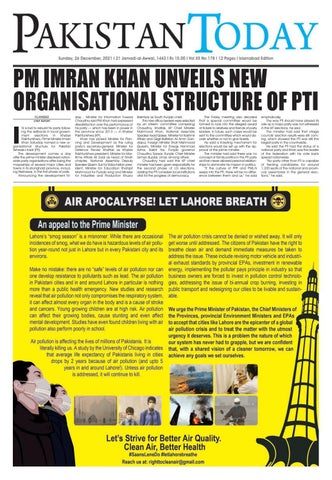
Sunday, 26 December, 2021 I 21 Jamadi-al-Awwal, 1443 I Rs 15.00 I Vol XII No 178 I 12 Pages I Islamabad Edition
PM IMran Khan unveIls new organIsatIonal structure of PtI ISLAMABAD
I
staff report
n a bid to rebuild his party following the setbacks in local government elections in Khyber Pakhtunkhwa, Prime Minister Imran Khan Saturday named a new organisational structure for Pakistan Tehreek-i-Insaf (PTI). The development comes a day after the prime minister dissolved nationwide party organisations after losing the mayorships of several major cities and towns in its stronghold province, including Peshawar, in the first phase of polls. Announcing the development Fri-
day, , Minister for Information Fawad Chaudhry said PM Khan had expressed dissatisfaction over the performance of his party — which has been in power in the province since 2013 — in Khyber Pakhtunkhwa (KP). Khan has picked Minister for Planning and Development as the ruling party’s secretary-general, Minister for Defence Pervez Khattak as Khyber Pakhtunkhwa president, Minister for Maritime Affairs Ali Zaidi as head of Sindh chapter, national Assembly Deputy Speaker Qasim Suri for Balochistan president, Minister for Education Shafqat Mahmood for Punjab wing and Minister for Industries and Production Khusro
Bakhtyar as South Punjab chief. The new office bearers were selected by an interim committee comprising Chaudhry, Khattak, KP Chief Minister Mahmood Khan, national Assembly Speaker Asad Qaiser, Minister for Kashmir Affairs and Gilgit-Baltistan Ali Amin Gandapur, Foreign Minister Shah Mehmood Qureshi, Minister for Energy Hammad Azhar, Bakht Yar, Punjab governor Chaudhry Sarwar, Punjab Chief Minister Usman Buzdar, Umar, among others. Chaudhry had said the KP chief minister has been given responsibility for the second phase of LG elections, adding the PTI considers local institutions vital for the progress of democracy.
The Friday meeting also decided that a special committee would be formed to look into the alleged award of tickets to relatives and friends of party leaders. In future, such cases would be sent to the committee which would decide whether or not to give tickets. He said a ticketing mechanism for elections would be set up with the approval of the prime minister. The minister had said there was no concept of family politics in the PTI party as Khan never allowed personal relationships to dominate his mission in politics. “If the culture of PPP and PML-n seeps into the PTI, there will be no difference between them and us,” he said
emphatically. The way PTI should have played its role as a major party was not witnessed in the KP elections, he said. The minister had said that village councils’ election results were still coming, which showed the PTI was still the largest party in the countryside. He said the PTI had the status of a national party and Khan was the leader of the federation with his vote bank spread nationwide. “no party other than PTI is capable of fielding candidates for around 1,200 seats of the national and provincial assemblies in the general elections,” he said.
02
Sunday, 26 December, 2021 | ISLAMABAD
NEWS
MuhAMMAd AlI JInnAh: A SyMBol of nAtIonAl unIty KARACHI
P
AnAdolu Agency
AKISTAN celebrated the 145th birth anniversary of the nation’s founder Muhammad Ali Jinnah on Saturday. Born on December 25, 1876, to a wealthy merchant family in Karachi, Jinnah — who is commonly known as Quaid-i-Azam, or The Greatest Leader — has remained the only symbol of unity as an undisputed leader for a nation of 220 million people during Pakistan’s 74 years of independence. One can find Jinnah’s name and pictures everywhere in Pakistan — from currency notes to streets, from universities to military bases. He led the nation, carved out of the subcontinent as a homeland for Muslims in 1947, at a time when it was facing a number of serious challenges, including tensions with India over the issue of Jammu and Kashmir, fears for survival due to economic hardships, an influx of refugees and raging communal riots. In one of the world’s largest displacements so far according to historians, over 6.5 million Muslims from different parts of India migrated to Pakistan following the end of British colonial rule in the subcontinent in 1947. “From the point of view of social science, no one can be completely undisputed. But in the case of Jinnah, we can say he is undisputed among an overwhelming majority of Pakistanis,” said Farooq Ahmad Dar, an associate professor of history at Quaid-i-Azam International University in Islamabad. “In a way, we can say he is the only symbol of unity and the undisputed leader in Pakistan. The rest are [all] disputed in one way or the other,” he said while speaking to Anadolu Agency. Citing key reasons behind Jinnah’s overwhelming acceptance among Pakistanis, Dar said: “He emerged as a leader who led the nation in its hour of need. His determination, devotion, and commitment to a cause [independence of Pakistan] raised him to a level where no one could match him [at the time].” Equally accEptablE to right and lEft wing: Jinnah’s concept of a modern Islamic state, according to Dar, has made him acceptable to both Islamists and secularists in Pakistan who otherwise
hardly agree on other points. “His concept of a modern Islamic state based on the principles of equality, justice, the protection of minorities, etcetera, which are basic teachings of Islam, gives space to both Islamists and secularists to quote him in favour of their respective political ideologies,” he said. Endorsing Dar’s views, Raza Kazimi, a Karachibased historian, said: “Jinnah is the only undisputed leader in the country’s history. So much so that he is the symbol of unity for otherwise political rivals like left and right-wing parties who derive and push their political manifestos through his ideology.” This is because of his “moderate approach” with regard to religion and politics, Kazimi said. “He is acceptable to even those religious parties that had opposed the creation of the State of Pakistan,” he noted. pErsonal lifE: Salima Hashmi, a Lahore-based educationist and writer, holds a different view of Jinnah’s personality. “Jinnah was a complex personality [who is] yet to be entirely understood because of the need to place him on a pedestal where many of his life’s choices are never discussed,” Hashmi said. Those, she argued, who opposed him “tooth and nail” like the religious lobby use him as a shield and attribute ideas to him which he never expressed.
“Much more debate is required on his ideas of a democratic dispensation, which never saw the light of day,” she added. Jinnah received his early education from the Sindh Madrassah tul-Islam school and the Christian Missionary Society School in Karachi. He was later offered an apprenticeship by a family friend in London in 1892, but before leaving, Jinnah’s mother arranged his marriage with his cousin, Emibai. Jinnah’s mother and Emibai died within a year after his departure to London, where he soon quit the apprenticeship and joined the famous Lincoln’s Inn as an aspiring barrister. Upon earning his degree, Jinnah started practising law as the first Muslim barrister in Bombay and served as an interim magistrate for a brief six-month period. In 1918, Jinnah married Rattanbai — famously known as Ruttie — from an elite Parsi family. Ruttie embraced Islam before tying the knot with Jinnah. The marriage, however, lasted for only a few years as the couple separated before Ruttie died in 1929. Jinnah only had one daughter, Dina, who was later raised by his younger sister, Fatima Jinnah. Dina married a wealthy Parsi businessman against her father’s will and did not choose to move to Pakistan after the creation of the then-largest Muslim state in 1947. Jinnah was the second child among seven siblings. But except for Fatima Jinnah, his political aide, little is known about his other three brothers and two sisters. Fatima Jinnah was later declared Madar-i-Millat (Mother of the Nation) by the Pakistani government. A southern slum locality in Karachi is named after Shireen Jinnah, who is believed to have been one of Jinnah’s sisters. Suffering from tuberculosis, Muhammad Ali died on September 11, 1948, in Karachi and was laid to rest in the same city. A magnificent mausoleum, Mazar-i-Quaid, was built on his grave in 1970, where thousands throng every day to pay their respects to the great leader who envisioned a separate state for the Muslims of the sub-continent. political lifE: According to Stanley Wolpert, a Jinnah biographer, Quaid-i-Azam was influenced by 19thcentury British liberalism based on democratic nations and progressive politics during his stay in London. In 1906, he joined the Indian National Congress — a
party founded in 1885 in the aftermath of the 1857 revolt against the British Raj to demand a greater selfgovernance for the sub-continent. Initially, Jinnah was a great advocate of HinduMuslim unity and refused to join the All India Muslim League established by some Muslim leaders to protect their community’s interests in Hindu-majority United India. In 1913, he joined the Muslim League but remained associated with the Congress until 1920, when he completely disassociated himself with his first political party. He was part of the 1916 Lucknow Pact, which set quotas for the representation of Muslims and Hindus in different provinces. However, the pact was never fully implemented. In 1928, the then British government offered Indians to come up with their sets of constitutional changes to govern the sub-continent. Motilal Nehru, the founder of the Nehru political dynasty in India, came up with the Nehru Report that demanded the formation of constituencies based on geography. Jinnah, for his part, presented his famous 14 points demanding a mandatory representation of the Muslim minority in the legislative assemblies. Jinnah remained in Britain from 1930 to 1934 practicing as a barrister. His biographers quarrel over why he had lived for such a long period away from the political struggle in India. Following the persistence of several Muslim leaders, including poet Mohammad Iqbal and Liaqat Ali Khan, he returned from London. Khan later became premier from 1947 to 51. Jinnah returned to India in 1934 to lead the All India Muslim League amid growing Muslim nationalism in the region. On March 23, 1940, the famous Lahore Resolution — later converted into the Pakistan Resolution — was adopted at a massive gathering at the then Minto Park in Lahore under Jinnah’s leadership, demanding a separate Muslim state comprising five Muslim majority provinces. The adoption of the Pakistan Resolution is considered the most decisive point in Jinnah’s political struggle when he came up with a clear-cut idea about his future plans. The next seven years turned out to be turbulent following campaigns and counter-campaigns, one after the other.
CNG Association announces nation-wide protest against gas suspension PESHAWAR Aziz Buneri
Santa Claus appears on PIA flight to distribute Christmas gifts ISLAMABAD App
Passengers, aboard a Pakistan International Airlines (PIA) flight travelling to Islamabad from Karachi, were treated to a surprise when they found Santa Claus distributing Christmas presents as Jingle Bells played in the background. A senior Christian Purser, attired in the Santa Claus dress, presented gifts and chocolates to the passengers. “This activity has become a tradition of the national flag carrier for the past several years,” a PIA spokesperson said in a press release issued Saturday. Minister for Information Technology and Telecommunication Syed Amin ul-Haque and MPs Abdul Qadir Patel and Nafisa Shah, who were aboard the plane, appreciated the airline and wished it success in future strides. With this activity, the agency proved that it is truly a national airline that welcomes people of all faiths and public representatives in a highly professional way. “PIA is flying according to the needs of all schools of thought,” PIA Chief Executive Officer (CEO) Arshad Malik said, adding it was everyone’s airline and the national asset.
11 injured in Balochistan road accident QUETTA StAff report
At least 11 people suffered injuries in a road accident in Uthal city of Balochistan on Saturday morning. The accident occurred due to a collision between a passenger bus and a truck full of stones. All the victims were shifted to the District Headquarters Hospital (DHQ) in Uthal, rescue workers told media. The illfated bus was heading from Quetta to Karachi, according to the reports. Recently, a large part of mainland Pakistan, especially the open town, are having dense fog, causing an increase in road accidents.
The CNG station Association announces nationwide protest on December 27 against the suspension of gas to fuel stations. Addressing a protest rally in Peshawar, the CNG [Compressed Natural Gas] Association President Fazal Muqeem said that due to the “incompetence” of the federal government, the CNG sector is on the verge of collapse and they are facing of rupees loss. He said that earlier, it was decided to suspend supply for 17 hours to facilitate domestic consumers but now, the
government has decided 24 hours suspension which will bring the CNG sector to complete halt. Muqeem said that they reject the decision as not only the fuel station owners but motorists are also facing very difficult situation. The association’s president told the media that long queues of vehicles become a routine after the government halted supply for 17 hours. “The CNG sector is already in ruins, now they are being threatened by the district administration and closing their gas stations,” Muqeem said. The demonstrators declared that Federal Minister Hamad Azhar “incompetent” over his failure get LNG
and now the fuel stations have been made scapegoat. Participants said that even after keeping CNG stations closed for hours, the government could not ensure supply of gas to domestic consumers. The protesters said that the government is earning billions of rupee revenue from the CNG sector in terms of taxes but they have not been provided any facilities. However, whenever there is crisis, the first target of the government is always CNG stations. All Pakistan CNG Association Khyber Pakhtunkhwa has clarified that it supported the government in its decision to keep CNG stations open from 9:00 am to 4:00 pm but warned that
they will strongly resists the closures of stations for 24 hours. According to Ijaz Khan, Vice Chairman, Operative CNG Association, Sui Gas Department officials are forcibly closing the station without any notification, which is a clear violation of Section-158 and the orders of the High Court. He said that CNG stations were ready for 17 hours on a voluntary basis as per the government decision, though it is causing inconvenience to the people. “Now, without any notification, an order has been issued to close CNG stations for 24 hours till 28 February which is nation acceptable to the association,” Khan said.
Second phase of CPEC to expedite socio-economic development: official ISLAMABAD Monitoring report
The second phase of the China-Pakistan Economic Corridor (CPEC) will accelerate the socio-economic development in Pakistan, Khalid Mansoor, special assistant to the Prime Minister on CPEC affairs, said. With a special focus on industrial cooperation among others, the second phase of CPEC is crucial for the economic revival of Pakistan, Mansoor said while addressing a conference on CPEC in Lahore, expressing the commitment to making Pakistan a manufacturing hub through the industrial revolution. The government has been taking effective steps for the industrial revolution in the country, thus CPEC is one of the most important projects in this regard, the official said. He added that prudent policies are also being formulated to provide maximum facilities to local and foreign investors to create an enabling environment of investment and business. “CPEC will prove to be a milestone in promoting regional economic integration,” he said. He said that the government is committed to the timely completion of CPEC projects to bolster the national economy as well as reduce poverty.
Sunday, 26 December, 2021 | ISLAMABAD
Punjab govt, EPD faiL to imPLEmEnt smog PoLiCy 2017 LAHORE
t
Shahab omeR
He Punjab Government and environmental Protection Department (ePD) have failed to implement Punjab Smog Policy 2017 due to poor strategy, sluggishness and departmental politics. However, the intensity of smog in Punjab could not be reduced and increasing air pollution started increasing the diseases of ear, nose, throat and lungs. It is pertinent to mention here that when smog first appeared in Lahore on November 2, 2016, environmentalists and various sections of civil society had expressed concern over the increase in air pollution and the matter was taken to the Lahore High Court (LHC). However, in 2017, the LHC, while hearing a case on climate change, had sought a smog policy from the Punjab government and a draft of smog policy was submitted by the Punjab government to the Court. Later, the Smog Commission was formed in 2018 to investigate the causes of smog and to suggest appropriate ways to deal with it and the commission had also submitted a report in this regard and various suggestions were made to overcome this problem and the authorities were urged to take immediate action on this issue. Well-established sources in ePD informed this scribe that one of the major reasons for non-implementation of the policy was shortage of air quality monitoring stations in the province and
delay in procurement. It is also pertinent to mention here that under the policy, ePD was responsible to use satellite data obtained from various sources including space and upper atmosphere and to closely monitor stubble burning activities in Punjab as well as in the region and inform the concerned agencies. The data was to be obtained by the ePD through air quality monitoring stations (AQMS) and the commission in its recommendations had asked the department to survey different parts of Punjab and set up 30 monitoring stations in Punjab. “environment Protection Department shall issue advisory to all concerned departments based on the Air Quality Index (AQI) for PM2.5 and other parameters. Primary and Secondary Health Care Departments shall issue health advisory and ensure its maximum dissemination including through such means as paper, electronic, and social media. Additional Inspector General of Traffic shall issue advisory on use of roads, especially highlighting the forecasted or prevailing visibility levels and their likely impact of safe use of roads”. “If the situation so demands, masks shall be distributed at schools and selected public places in the most effected districts by respective Deputy Commissioners. Similarly, steel furnaces and other industrial units which are working without emission control equipment or are using substandard fuels shall be shut down by the environmental Protection Agency with the support of respective Deputy Commissioner and District Police
Officer,” policy stated. According to sources, the commission recommended that the department had to install eight AQMS in Lahore, one in Sheikhupura, three in Faisalabad, three in Rawalpindi, two in Multan, two in Gujranwala, one in Sialkot, two in Bahawalpur and one in DG Khan, two in Sargodha and had to install five mobile AQMS. “If we talk about Lahore only, four AQMSs have been installed so far, the procurement of which has been very controversial and cases against the corrupt officers involved in this procurement had been continued in the National Accountability Bureau (NAB) and now that this policy has been implemented under the Punjab Green Development Project (PGDP), the procurement of more stations is again delayed. The data of the stations installed in Lahore is also not reliable so unless the department has accurate and correct data, it will be very difficult to implement the policy. That’s why the environment minister is blaming activities like barbecues for the increase in smog because when the data is not available, every action will be taken on
speculation,” they said. However, according to the policy the government had to introduce low-sulfur fuels, euro-II standards for vehicular emission, installation of vehicular pollution control devices, better traffic management, controlling burning of municipal waste and crop residue, creation of woodlands, greening of industrial processes and regional environmental agreements. For all these activities, ePD had to coordinate with the concerned departments and take steps to reduce the intensity of smog including air pollution. Sources revealed that all activities would have been possible if the policy had been notified. “The draft of policy is available on the ePD’s website, but the policy has not yet been notified or gazette,” they said. However, under the anti-smog campaign, the Punjab Disaster Management Authority (PDMA) had issued a notification under which from December 23, 2021, any public transport which does not obtain fitness certificate from VICS will not be able to enter Lahore and for the next three months from 22nd December 2021 to 22nd March 2022 manual inspection of vehicles will be closed all over Punjab.
Pakistan celebrates birth anniversary of Jinnah KARACHI/LAHORE/ISLAMABAD Staff RepoRt
The 145th birth anniversary of Pakistan’s founder Quaid-i-Azam Muhammad Ali Jinnah is being celebrated today with national zeal throughout the country. Saturday is a public holiday nationwide. The flag will be hoisted atop public and private buildings. The day dawned with a Quran recital at Jinnah’s mausoleum in Karachi. A change-of-guards ceremony is being held at the building. A large number of people from all walks of life are expected to visit the mausoleum to pay tribute to Jinnah for the services he rendered for creating a separate homeland for the Muslims of the subcontinent. The celebrations aimed at educating youth about Jinnah’s vision and Pakistan’s ideology. As part of these celebrations, various events, including seminars, debates, exhibitions and shows of performing arts have been held across the country. Several special seminars and ceremonies have been arranged across the city to pay tribute to the great leader. Live television and radio programmes will be conducted and documentaries related to his life and work will be telecast. IMRAN EMPHASIZES HARD WORK, PERSEVERANCE: In his message, Prime Minister
Leaders send Christmas greetings ISLAMABAD
Imran Khan emphasized on youth to adopt Jinnah’s attributes of honesty, hard work, perseverance and dedication, Radio Pakistan reported. We, as a nation, need to adopt these attributes to realise his vision of a developed, progressive and tolerant Pakistan, said the prime minister. Khan said Jinnah realised the importance of a separate homeland for Muslims of the subcontinent where the people — irrespective of their faith and caste — could enjoy the freedom of belief and the right to equal opportunities. He said: “Today we celebrate the birthday of our great leader Quaid-e-Azam Muhammad Ali Jinnah.” It was a matter of privilege for our generation and our children to be born in an independent Pakistan — something that wouldn’t have been our destiny without the struggle of Jinnah, he added. “His determination to unify a nation despite huge challenges and opposition was only possible due to his perseverance. He had a firm faith in Almighty Allah and followed the principles of Prophet Muhammad (P.B.U.H.) that guided him through difficulties and challenges.” “As per Jinnah’s vision, our government is striving for a society free of corruption and a system that helps the poor and underprivileged citizens,” Khan said. Pakistan is facing both internal and external challenges and the only solution to overcome these is
to live by the Quaid’s ideals of unity, faith and discipline, he added. He said it was a day to join together in the same spirit as our forefathers did during the independence movement. “Let us shun our differences based on caste, creed and faith and work in unison.” He said: “I pray Almighty Allah to grant us strength and unity to realize our destiny of becoming the strongest nation on earth as envisioned by our Quaide-Azam Muhammad Ali Jinnah.” ABIDE BY RULES FOR PROGRESS, says ALVI In a statement issued by his office, President Dr Arif Alvi urged the nation to follow the “great guiding principles” of Jinnah to make Pakistan a great country. The whole nation paid tribute to the father of the nation who made the utmost struggle for the independence of the Muslims of the subcontinent — a separate and independent state for them, the president said. He said due to Jinnah’s tireless efforts, capabilities, determination, and extraordinary character that he materialised his dream of the creation of Pakistan. The president said that in order to cope with the prevailing challenges, the nation should follow the founder’s golden principles of faith unity and discipline. He also called for working through discipline, brotherhood, and dedication for the nation’s prosperity which also required the contribution of all segments, ethnicities including minorities.
Analysis: New cold war, Taliban takeover among key 2021 geostrategic developments ANKARA
Staff RepoRt
anadolu agency
Politicians from across the political aisle including rime Minister Imran Khan and National Assembly Opposition Leader Shehbaz Sharif Saturday extended Christmas greetings to members of the Christian community and promised to safeguard the rights and privileges promised to them in the Constitution. “Wishing all our Christian citizens a very Happy Christmas,” the prime minister tweeted. In a separate statement on the eve of Christmas, Khan said: “On the auspicious occasion of Christmas, I on my behalf of the government and people of Pakistan extend heartfelt congratulations to the Christian community around the world and especially in Pakistan for celebrating the festival of Christmas with devotion and respect.” “The festivities of Christmas teach us universal love, brotherhood, tolerance and self-sacrifice which plays a pivotal role in moving any society on the path of development.” “The birth of Prophet Jesus is considered a symbol of peace, brotherhood, tolerance and respect for the entire humanity throughout the world. “He not only healed the ailing humanity but preached the divine values of tolerance, love and compassion.
The Taliban takeover of Afghanistan, the military coup in Myanmar, and a new cold war, with the countries once again withdrawing into blocks, were among the major developments witnessed in 2021. As curtains are about to fall in 2021, experts feel that the Russian military buildup near the borders of Ukraine, Chinese assertions on Taiwan and the South China Sea, coupled with its border standoff with India, and deepening military and diplomatic cooperation between Moscow and Beijing have thrown significant challenges to geopolitics. The developments also posed significant challenges to the US plans to reassert its leadership, which under new President Joe Biden revived the “Pivot to Asia” strategy by putting more military assets in the Western Pacific. In August, the White House approved the sale of $750 million in arms to Taiwan. Responding to these maneuvers, China dispatched a record number of bombers and fighters into Taiwan’s air defense zone in a display of
dominance. According to a report released by the Center for a New American Security, Russia and China have entered into a symbiotic relationship causing further worries to the US and its allies. While Russia is procuring Chinese electronic components and navel diesel engines to circumvent US sanctions, its missiles and fighter technology are giving Beijing an edge in the Pacific against the US. The possibility and probability of a two-war front are not only worrying India, which has tense borders with Pakistan on its western side, but the teaming up of Russia and China is causing nightmares to the US as well. “The greatest risk facing the twenty-firstcentury US, short of an outright nuclear attack, is a two-front war involving its strongest military rivals, China and Russia,” a former senior American diplomat A. Wess Mitchell wrote in the US journal National Interest in August. Further, China’s firing a hypersonic missile that moved five times the speed of sound in July not only surprised the Pentagon but also underscored the speed with which Beijing has mounted a strategic challenge to the US military.
NEWS
03
ground being made for sharif’s return amid expected uK deporting: official ISLAMABAD: Adviser to the Prime Minister on Political Communication Dr Shahbaz Gill Saturday claimed deposed prime minister Nawaz Sharif’s appeal against his visa rejection is likely to be turned down by the United Kingdom and, therefore, the PML-N is making ground for his return. In a message on his Twitter, Gill said an application for a visa extension of Sharif has already been rejected and they know that an appeal against it will also be rejected and the PML-N chief would be expelled. “expulsion of Nawaz Sharif from London is being made up as a decision from him to return to Pakistan,” he said, adding cowards could never be courageous. He further said that initially some people were prepared to launch a narrative regarding a revolutionary Nawaz Sharif and now the same people are being hired to build a narrative regarding deal with establishment and culmination of the revolutionary path. “A push from Britain is likely and therefore a ground is being made via rented people in this regard,” he said. Staff RepoRt
Earthquake jolts several balochistan cities QUETTA: A powerful earthquake jolted several cities of Balochistan, including Quetta and its surrounding town, on Saturday. The tremors were also felt in Ziarat, Pishin, Khanozai and Bostan towns. The intensity of the earthquake was recorded at 4.8 on the Richter scale. There were no further readings of the earthquake available immediately but it followed a series of quakes rattling cities in Sindh and Khyber Pakhtunkhwa. Only last week, an earthquake jolted a host of Khyber Pakhtunkhwa cites. This was the second earthquake in as many days to have jolted the province. On Thursday, earthquake tremors had been felt in different parts of Khyber Pakhtunkhwa. Friday’s earthquake was measured at 4.2 on the Richter scale with its epicentre in Hindukush mountainous region in Afghanistan. Its underground depth was recorded at 226 kilometres. Thursday’s tremors were felt in and around several areas of the Khyber District. According to the US Geological Survey, the intensity of the earthquake was 4.5 magnitude on the Richter scale, earlier on December 7, tremors were felt in and around Swat. Staff RepoRt
Sunday, 26 December, 2021 | ISLAMABAD
04
NEWS
SAAd RAFIque uRGeS PML-N to eNd oNGoING ‘PoLItIcAL wItcH-HuNt’ LAHORE
P
staff CorrespoNDeNt
AKISTAN Muslim League Nawaz (PML-N) leader Khwaja Saad Rafique Saturday urged his party to take the first step towards national reconciliation and give an end the ongoing ‘political witch-hunt’ for the sake of country’s stability and prosperity if and when the PML-N comes into power. Addressing a party gathering here, Saad Rafique said that if the PML-N wanted to protect the country of Quaidi-Azam to stabilise the country of 220 million people, it has to end the practice of settling scores. “You will come into power… PML-N will form the government but then don’t take revenge and rule the country according to the Constitution,” Rafique said in a message to the party leadership. Citing an example, Rafique said PML-N supremo Nawaz Sharif during his last tenure as prime minister of the country refused to take any action against his political opponents over corruption complaints from PML-N members. “Nawaz Sharif told the party workers
that it was not his job to hold people accountable… institutions are there to punish them,” he added. While extending an olive branch to the ruling Pakistan Tehreek-e-Insaf (PTI), the PML-N leader said he was not in favour of “eliminating” any political party including the ruling PTI. He urged the incumbent government
to maintain a working relationship with all political parties to run the affairs of state smoothly and bring stability to the country’s economy. The opposition party leader admitted the fact that the PML-N also made many mistakes during its stints in power but added that it had learned from the past and would never repeat them.
A day earlier, Prime Minister Imran Khan said that it was regrettable that the bar association of the top court was willing to help end the disqualification of exPM Nawaz Sharif, regretting that the acceptability of corruption was increasing in the society. Chairing a spokespersons meeting, the premier said political circles were abuzz with speculations about ending PML-N supremo Nawaz Sharif’s sentence. “How can the sentence of a convicted person be overturned,” the participant of the meeting quoted him as saying. Sources said the premier has tasked the party spokespersons to highlight the corruption and incompetence of the previous periods. PM Imran’s comments came to fore the same day PML-N leader Ayaz Sadiq said that “something major” is about to happen after announcing that Nawaz Sharif was returning to Pakistan. “I don’t know what it would be, but I assure you that something big, like a bang is going to happen soon,” Ayaz Sadiq said while speaking to a private TV channel on Friday, adding that, “It would happen all of a sudden as you won’t see it happening slowly and gradually”.
Brush your teeth if you want to ride Green Line buses: Sindh Governor
KP LG polls defeat: ANP dissolves local organizational setup PESHAWAR staff report
Awami National Party (ANP) on Saturday dissolved its local organizational structure in Khyber Pakhtunkhwa (KP) province after a dismal performance during the recent local bodies elections. According to sources privy to the development, the ANP leadership was annoyed over low voter turnout in favour of the party and therefore decided to dissolve all tehsil level organizational setup. The party, according to sources, further decided to take action against ANP leaders who refrained from supporting the party candidate in the local bodies elections. Strict action is especially being planned in districts where the party showed a dismal performance with ANP spokesman saying that any action would be taken after receiving a report from the concerned tehsil.
If Nawaz Sharif returns, he must go to jail: Farrukh Habib ISLAMABAD app
Inquiry ordered into fire at Lahore Airport’s cargo terminal LAHORE staff report
Lahore Airport Manager has ordered an inquiry into a fire incident that broke out at the facility’s cargo terminal early Saturday. The blaze suddenly started and gutted the stashed pricy goods and records in the cargo terminal. The airport manager directed for a complete review of sheds at the cargo complex. The airport administration said that the fire broke out at the TCS cargo godown due to short-circuit at 4:30 am while Rescue 1122 extinguished the blaze at 5:15 am. The administration vowed to penalize those whose negligence was found behind the incident.
KARACHI News Desk
In a surprise announcement, Sindh Governor Imran Ismael on Saturday while unveiling some Dos and Don’ts for travelling on the newlylaunched Green Line Bus Service in Karachi declared that people would make the vehicles ‘dirty’ will not be
allowed to board them. The governor laid his particular focus on pan (beetle leaves) and gutka (smokeless tobacco) chewers, a common sight in Karachi, saying such people will not be allowed to ride the buses. Imran Ismael further said that passengers must brush their teeth before travelling on the newly inaugu-
rated bus service. He was talking to media persons along with the Sindh chief minister after the change of guards ceremony at the founder of Pakistan Quaid-iAzam’s mausoleum in Karachi. The governor said that the PTI government wanted to bring more projects like the Green Line one to benefit the people.
Minister of State for Information and Broadcasting Farrukh Habib on Saturday said former prime minister Nawaz Sharif was declared guilty and disqualified for life time from the Supreme Court, so if he returns, he must face law of the land. Talking to a private news channel, he said Nawaz Sharif went abroad for medical treatment but he did not get admission in any hospital of London for the purpose till date. The minister said Nawaz Sharif was not returning after doing any milestone, adding if Nawaz Sharif wants to return in the country he should do hurry because the Adiala Jail was waiting for him and his all punishments would remain intact. Farrukh Habib said, criminals places always in jails not in the power corridors, adding the Pakistan Muslim LeagueNawaz leadership raising slogan to give respect to the vote, but they always promoted their hidden agenda to give respect the Note (currency) in the country. Replying to a question, he said the government would table the money bill in current session of the Parliament for debating, adding the incumbent government was not approaching the International Monetary Fund (IMF) for first time but in the past almost every government had also approached it. He said, Pakistan Tehreek-e-Insaf (PTI) government had increased exports, remittances and record increase in tax collection. He said, the party structuring after loosing in Khyber Pakhtunkhawa local government election was the part of the party's new strategy which would be helpful for contesting the next elections.
Police recovers body of missing Pakistani-American woman RAWALPINDI News Desk
The body of Wajiha Swati, a US citizen of Pakistani origin who went missing from Rawalpindi in October, has been found, police said on Saturday. City Police Officer Rawalpindi Sajid Kiani, addressing a press conference, said that the case is under investigation and the police will not divulge too many details at this point. Kiyani did reveal some aspects that came to light during investigations, such as Swati arriving in Pakistan on October 16 and being received by her former husband, Rizwan Habib. He went on to say that three people — Habib, his father and one other suspect — have been arrested in connection with the case. The CPO said that Wajiha’s body was found from Lakki Marwat’s Pizu area and that it is being brought to Islamabad. He said that further investigations are underway and further arrests are expected.
The police officer said that the probe team gathered sufficient evidence after which the arrests were made. He added that the US embassy sought details from the police owing to Swati being a US citizen. “How the murder was carried out, what weapon was used, is something it would be too premature to comment on,” the CPO said. He vowed that the police will ensure the culprits get their just desserts. Ex-husband has confEssEd to killing swati, claim policE: Earlier in the day, police sources claimed that her ex-husband, Rizwan Habib, has confessed to killing her. Habib “confessed to his crime” during police interrogation, the sources said. The sources said that Swati came to Pakistan from England on October 16 to resolve property issues with her ex-husband. The US woman was murdered the same day she arrived in Rawalpindi, they added. A case relating to her abduction was registered at Morgah Police Station in Rawalpindi on the complaint of her son.
According to the sources, Habib said that he had killed Swati on October 16 and buried her body in Hangu. On the directions of RPO Rawalpindi, a police team was sent to Hangu to recover the body. DPO Ikramullah Khan said that the police arrested Habib’s father last night from Hangu on charges of aiding and abetting the murder. The DPO said that Swati’s body has yet to be exhumed. lhc ordErs authoritiEs to rEcovEr kidnappEd pakamErican woman: On December 23, the Lahore High Court Rawalpindi Bench’s Justice Raja Shahid Mehmood Abbasi ordered the city police officer (CPO) to recover Swati soon otherwise the court will summon the Inspector General of Police. The court had ordered the police to present her in court after recovering her. Rawalpindi police arrested Habib and produced him before the judicial magistrate Zaheer Safdar. The court handed over the accused to the police on a four-day physical remand.
CMYK
Sunday, 26 December, 2021 | ISLAMABAD
NEWS
The Promises and Perils of Digitalization in Pakistan Ali AshAr JAffri
(IN THE LOVING MEMORY OF MY LATE FATHER JUSTICE (R) SYED ALI ASLAM JAFRI, WHOSE TEACHING AND GUIDANCE MADE ME WHO I AM TODAY. EVEN THOUGH HE MAY NO LONGER BE AMONG US, HIS PRAYERS AND BEST WISHES WILL CONTINUE TO SHINE UPON ME.) Just as there are two sides to a coin, there are promises and perils of every invention or revolution. In the past, humanity had witnessed the benefits and dark sides of the three Industrial Revolutions and is currently undergoing the digital transformation brought forward by the fourth Industrial Revolution i.e. Industry 4.0. However, unlike the earlier Industrial Revolutions Industry 4.0 is shaping out to have unprecedented and far-reaching implications on all aspects of human life. We are witnessing the digitalization of all economic sectors such as digital agriculture, digital banking, digital healthcare, etailing, etc. led by the e- governance ideology. During the times of COVID-19 pandemic, the various technological advancements of Industry 4.0 proved to be a lifeline for not only the global economy but also the social survival of mankind. But like the saying goes about ‘too much of a good thing’ the perils of this mass economic and social digitalization are surfacing with time. People have actually started undergoing ‘digital detox’ to cleanse their mind and bodies from the after effects of too much digital exposure. The dark side of Industry 4.0 does exist but these elements emerge in various contexts with various implications for various stakeholders. The promises and perils of the digital revolution vary for the developed and developing countries. Circular economy, SMART governance, Green Banking, Artificial Intelligence, Cloud Computing, and Big Data are a few of the revolutionary and dynamic ideologies developed under the reign of Industry 4.0. The current stage of digital transformation in the economy widely involves new business models and implements modern information technologies (chatbots, predictive analytics, machine learning, block chain, the industrial internet of things, etc.). According to the World Economic Forum report, the global market for industrial robotics accounts for US$ 16 billion, with five countries, i.e., China, Japan, South Korea, the United States and Germany, accounting for 74% of sales of such robots. As a result, 30% of jobs in the developed and successful developing countries would be automated by the mid- 2030s. However, such statistics make the realities of the Global Digital Divide even more daunting. The global digital divide describes global disparities, primarily between developed and developing countries, regarding access to computing and information technology resources as basic as access to the internet and the opportunities derived from such access. According to an International Telecommunication Union report, the internet penetration rate is 87% in the developed world but just 47% in developing countries and 19% in the least developed countries. How can we expect a country to embrace the fourth industrial revolution without internet access? In this era of digitalization, the digital divide may become the new face of economic and social inequality. Pakistan is a developing country that got a significant push towards digitalization during the COVID-19 pandemic but is unable to reap the promises of digitalization due to the various unsolved or unresolved perils. According to the ‘Inclusive Internet Index of the Economist Intelligence Unit (EIU),’ Pakistan ranks at 90th place, i.e., in the bottom quartile of the index and second to last in the Asia region-depicting the country’s deplorable technological competencies and infrastructure. The mass usage of various social media applications does not make a country digitally literate or able to adopt the off-shoots of Industry 4.0. Digitalization is centered on the synergistic blend of public-private capabilities, which is seriously lacking in Pakistan. Industry 4.0 offers connectivity between a country’s economic sectors based on the availability of real-time and accurate data. At this point, such a transformation is not possible in Pakistan due to the digital literacy and willingness to learn within the country’s public sector.
05
IHC orDers reCovery of rs197 mIllIoN from TWo former mINIsTers, ex-PTv CHAIrmAN
T
HE Islamabad High Court (IHC) has directed the revenue department to recover Rs197 million from former chairperson of Pakistan Television (PTV) Attaul Haq Qasmi, former ministers Pervaiz Rashid and Ishaq Dar, and ex-principal secretary to the prime minister Fawad Hassan Fawad in connection with the “illegal” appointment of Qasmi as the PTV head, according to Express Tribune. Earlier in November 2018, the Supreme Court of Pakistan had declared Qasmi’s appointment illegal, held the appointing authorities – Pervaiz Rashid, Ishaq
Dar and Fawad Hassan Fawad – guilty of making the appointment, and directed the authorities concerned to recover the said amount from them. According to the verdict of the apex court, at least 50 per cent of the total amount would be recovered from Qasmi, 20 per cent each from the former ministers and 10 per cent from the exsecretary to the prime minister. Hearing the execution pleas filed by the PTV management, IHC Justice Mohsin Akhtar Kayani said that the petitions be transmitted to the district collector, ICT, who shall proceed with the recovery of the amount as per the directions of the SC, while the bench also
said a report should be submitted to the court within the next three months. Qasmi, who was appointed as chairperson for PTV on December 23, 2015, had appointed himself to the position of managing director at the state-run facility in April, 2017. During the same week, a meeting of the Senate Standing Committee on Information and Broadcasting had termed the move as an ‘illegal appointment’. IHC Issues notICe to CDA In Contempt CAse: Separately, the IHC, while hearing a contempt petition filed by a citizen against the construction of Margalla Avenue in the area of Mar-
galla Hills National Park, issued a notice to the Capital Development Authority (CDA), seeking a reply by January 11. The petitioner’s lawyer said that the court had stopped construction in the Margalla Hills National Park area but Margalla Highway is being constructed in violation of the court order. To this, Chief Justice Athar Minallah said that Margalla Highway is in accordance with the master plan and “the court cannot stop every development project.” However, the court issued a notice to the CDA and directed the registrar’s office to fix the petition along with the main case for hearing on January 11. NewS DeSk
US donates 5m more Pfizer vaccines to Pakistan islAMABAD Staff RepoRt
The United States Saturday announced to ship additional 5 million doses of Pfizer’s coronavirus vaccine to Pakistan to combat the pandemic. “The United States asked Santa to bring an additional 5 million doses of the life-saving Pfizer Covid-19 vaccines through the COVAX facility to Pakistan, just in time for the holidays,” the US Embassy said in a statement. It added that the donation would arrive on December 25 on Christmas Day or shortly thereafter, bringing the total number of the vaccines donated by the US government to the Pakistani people to more than 37 million. “Getting vaccinated is the best gift you can give your loved ones this holiday season. Celebrate the com-
ing new year by getting your jab,” US Embassy Islamabad’s Chargé d’Affaires, Angela P Aggeler said. The statement said that the Pfizer vaccines are part of the 500 million Pfizer doses the United States purchased this summer to deliver to 92 countries worldwide, including Pakistan, to fulfill US President Joe Biden’s commitment to provide safe and effective vaccines around the world and supercharge the global fight against the pandemic. “The United States has already delivered more that 300 million doses of the Covid-19 vaccine worldwide.” It also said that the US has also provided $69.4 million in Covid-19 assistance through partnership with the government of Pakistan. “Since the start of the pandemic, the United States and Pakistan have worked together to improve infection prevention and control, enhance patient care, expand labora-
tory testing, disease monitoring, and case tracking in all districts, and support frontline healthcare workers,” it said. Earlier this week, the us announced a contribution of $580 million to seven multilateral partners to support critical work to help end the pandemic, strengthen public health systems, and provide urgent relief. In line with the priorities and objectives identified by the United Nations Global Humanitarian Response Plan for Covid– 19, the United States will contribute $280 million to the World Health Organisation (WHO); $170 million to the United Nations Children’s Fund (UNICEF); $75 million to the Pan American Health Organisation (PAHO); $20 million to the United Nations Development Programme (UNDP); $20 million for the United Nations Population Fund (UNFPA); $10 million to the Food and Agriculture Organisation (FAO); and $5 million for UN Women.
Pakistan will continue to counter disinformation through int’l cooperation: FO islAMABAD app
Pakistan on Friday reiterated its commitment to counter disinformation, saying that as a “victim of falsehood and propaganda”, it will continue to do this through international cooperation. The Pakistan-sponsored resolution
Pakistan Army soldier martyred in terrorist attack on North Waziristan checkpost A soldier was martyred in North Waziristan’s Shewa area after terrorists targeted a checkpost, a statement from the Inter-Services Public Relations (ISPR) said Saturday. The military’s media wing, in a statement, said terrorists fired at a military post. According to the ISPR, the troops responded promptly and “effectively engaged the terrorists’ location”. During an exchange of fire, Naik Noor Merjan, who was 32 years old, embraced shahadat (martyrdom). “Clearance of the area is being carried out to eliminate any terrorists found in the area,” the statement read. Staff RepoRt
CMYK
entitled “Countering Disinformation for the Promotion and Protection of Human Rights and Fundamental Freedoms” was adopted by the United Nations General Assembly (UNGA) in New York by consensus, Foreign Office (FO) said in a statement on Friday. Pakistan took the initiative against the backdrop of exponential proliferation of disinformation around the world.
“The phenomenon is exacerbating social discord and fanning discrimination, hate speech, stigmatisation, racism, xenophobia, Islamophobia and related intolerances,” it added. The resolution was the outcome of broad-based and extensive consultations with all member states, and was cosponsored by a large number of states.
06-07 Comment 26th December 2021_Layout 1 12/26/2021 12:14 AM Page 1
Sunday, 26 December, 2021
06 COMMENT
Attributes of Librarianship as Academic Discipline
It requires courage to own mistakes Imran Khan shifts responsibility to party structure
B
RITISh Prime Minister anthony eden resigned in the aftermath of the Suez crisis in 1956. So did French President Charles de Gaulle after defeat in the constitutional referendum of 1969 while Pierre Trudeau, Prime Minister of Canada, retired from politics in 1984 due to the unpopularity of the Liberal Party. They were courageous leaders who took responsibility for the shortcomings of the teams working under them. There are examples of outstanding cricket captains also resigning when their team lost a series or faced defeat in a one-day tournament. Instead of owning the defeat in his home ground, an angry Kaptaan has dissolved the PTI’s entire organizational structure, thus holding every party office bearer except himself responsible for the KP discomfiture. Party workers want an explanation. how come the party built by Imran Khan avowedly over 22 years failed miserably in the first election it contested without the support of those who matter? If there was nepotism in the distribution of party tickets, why has no action been taken against those responsible? as action against PTI bigwigs could jeopardise the PTI government, Mr Khan decided to shift the responsibility to the party structure. a committee was formed to prepare a new constitution with recommendations for a better party organization. The way the decision was taken underlines the authoritarian streak in the PTI chief. No formal party committee having the authority to dismantle the entire party structure issued the directive. The directive came from “senior PTI leadership” which was in fact an informal gathering of handpicked government leaders. Interestingly a number of ‘senior’ leaders were turncoats recruited from other parties who had nothing to do with the PTI before 2018. how many dejected PTI enthusiasts will accept the explanation remains to be seen. The PM has meanwhile tried to divert their attentions from the fiasco in KP by recounting what he considers to be an achievement worth mentioning. his latest Tweet recounts the restoration of “the historic Monroe hiking trail” in KP “under our vision of promoting eco Tourism… traversing 50 km of pristine natural forest with two overnight glamp sites.” at a time when the people are complaining about unbearably high prices of essential food items and unemployment, Khan seems to be cut off from social reality as he talks about scenic spots and lush green forests.
Lirarianshop has the traits of other disciplines
Abid HussAin
T
he phrase ‘academic discipline’ certainly incorporates many elements, such as school discipline, college discipline, and so on. In the institutional scenario, a discipline means a teacher, professor, or a proctor who controls the organization with stipulated rules and regulations. The terms for academic disciplines like Science, humanities, arts, and so on are technical terms for the organization of learning and the systematic production of new knowledge. every discipline follows a few traits and attributes such as engineering, Law, Medical Sciences, applied Sciences, and others. This discipline becomes authoritative when it follows the identified traits devised by experts in their concerned field. Librarianship as a discipline can be categorized by following the parameters formulated by subject experts. Many people believe that librarianship is neither a profession nor a discipline. Librarianship as a profession has already been defined in my recent column written in another newspaper; but, the discipline as a subject can be over-viewed in the article which you
Putin and Islamophobia Remarks first sign of changing attitude
Fearful Christmas in India
R
USSIaN President Vladimir Putin has said that freedom of expression does not justify such blasphemy against the holy Prophet (PBUh) as was committed by the Charlie hebdo newsmagazine in France. he was addressing his annual press conference in Moscow on Friday. as he pointed out, Russia is a multi-ethnic and multi-confessional state, with a large Muslim population, mostly ethnic Turkic and Caucasian minorities. Of course, the writ of the state must be maintained as he did in two Chechen Wars earlier this century. however, his recognition that the freedom of expression does not justify blasphemy, is a salutary recognition that an act of blasphemy can set off a chain reaction that might not have an end. as Mr Putin said, the ordinal blasphemous cartoons by a danish newspaper led to riots, then Charlie hebdo decided to reprint the cartoons, with a resulting attack on its offices, killing 12. a teacher showed the cartoons to his class, was beheaded, and then the French President expressed his sympathy with the teacher. This led to calls in Pakistan against theFrench embassy, which led to the deaths of protesters and policemen in the riots. The tearing down of Tehrik Labbaik Pakistan posters led to the killing of a man by a mob. The account stops here, but only for now. Mr Putin may well have geopolitical aims in his statement. Indeed, it would be uncharacteristic if he did not, for he is dedicated to making Russia a superpower again. his statement won praise from both Prime Minister Imran Khan and Foreign Minister Shah Mehmood Qureshi. Mr Khan in particular has been trying to convince the West that Islamophobia, which is reflected in such support for blasphemy in the name of freedom of expression, is counter-productive. Freedom of expression is not a sacred principle, and european states themselves are clamping down on holocaust denial, no matter how much it is defended as academic discussion. It seems odd that the feelings of 15 million people must be considered, which is not even 0.2 percent of the world’s population, while of 1.9 billion people, or just under a quarter of the world’s population, are not. Mr Putin's remarks may be the first sign of an overdue change.
Christians are also persecuted by the BJP Amjed jAAved
A
head of Christmas, Indian police raided a shishu bhavan (infant house or orphanage) in Kolkata (West Bengal) and another at Vdodra (Gujarat), Indian prime minister’s home state. The Kolkata orphanage was established by Mother Teresa herself, and was being run by the Missionaries of Charity in Kolkata since 11 February 2014. The raiding police claimed that the orphanages were forcibly converting hindu children to Christianity. They were forced to wear crosses, recite the holy Bible, and eat pork. The orphanage administrations deny the charges and call them “trumped up. a nun at the orphanage pointed out that the police acted upon the complaint of the estranged father of an infant whose mother worked in the kitchen. The orphanage served only vegetarian food and chicken once a week. The persecution of Christians rose by leaps and bounds after the BJP victory and. Narendra Modi’s becoming PM. The raids were not isolated. during 2021, there were over 300 attacks on Christians. On 23 december 23, a Pakistani newspaper noted, “Many human rights groups in India have documented over 300 incidents of Christian persecution in the first nine months of the current year, warning that the Christmas this year might be the worst. The US Commission on Religious Freedom has requested the State department to label India as a “country of particular concern. The persecution against Christians and other religious minorities have increased since 2014 when the hindu nationalist Bharatiya Janata Party (BJP) took power, and Narendra Modi became the prime minister. Christians in India brace for persecution as Christmas approaches. however, there are serious concerns over hate against Christians’ places of worship in India. In recent months, there has been a surge of violence against Christians who make only 2.3 per cent of India’s population. India has been ranked the 10th worst country globally by the Open doors USa 2021 World Watch List when it comes to Christian persecution.” as incriminating evidence, the raiding Molkata police mention “13 Bibles were found in the library of the institute and girls staying there were forced to read the religious text”. The Missionaries of Charity, founded in 1950 by the late Mother Teresa, denied the allegations.
Dedicated to the legacy of late Hameed Nizami
Arif Nizami (Late) Founding Editor
Yousaf Nizami M. A. Niazi
Editor Aziz-ud-Din Ahmad
Umar Aziz
Joint Editor
Joint Editor
Executive Editor
Lahore – Ph: 042-36300938, 042-36375965
are reading. The question arises whether Librarianship is considered to be disciplined or not. The answer is yes. a discipline has a particular research object, such as law, politics, society, and others. Research in one field may sometimes be correlated with other disciplines, such as the role of libraries in Information Communication Technology (ICT). Information technology is a broad topic of computer science, but it has a high impact on library services. Similarly, Medical Sciences use the term technologies in their research. So it combines two subjects for research in a specific discipline. a discipline's second trait is the accumulation of specialist knowledge. It means theorists produce theories in their discipline, and this knowledge is accumulated to make a discipline. These are guiding principles for any discipline taught at school, college and university level or other similar institutions. an example of accumulative knowledge in Librarianship is the dewey decimal Classification Scheme (ddC). the Library of Congress Subject headings (LCSh), etc. The third trait defines the subject as discipline is the existence of theories and concepts that help accumulate specialist knowledge. Philosophers produce these theories in concerned disciplines and they discuss the subject of the discipline with logic and practical knowledge. Some popular theorists in librarianship are Gabriel Naudé, Martin Schrettinger, S.R. Ranganathan, etc. These theorists accumulate knowledge with logic which defines the subject as a discipline. The fourth trait of a discipline is the use of specific terminologies in their relevant field. all disciplines have specific technical languages adjusted to their research objects; the accounting terms are different from medical terms, applied sciences terms are different from natural sciences. Library science as a discipline uses different terms such as catalogue, bibliography, indexing, etc., which is difficult for another discipline to understand. The fifth attribute for specifying a discipline is the institutional manifestations of the subject taught at college and university levels. all disciplines have
I
Karachi – Ph: 021-35381208-9
I
In Madhya Pradesh, authorities also an orphanage, The St Francis Sevadham (charity home) orphanage in Shyampura area (Sagar district) on suspicion that children were fed beef and made to read the Bible. Father Shinto Varghese, director of St. Francis Sevadham orphanage said beef is not even available in the state and only chicken is served once a week and “other nutritious substitutes for vegetarians.” The priest also clarified that denied that scriptures of all faiths were placed in the prayer room, not Bibles only, and that no one was forced to read the Bible. Father Varghese said the real issue is the 277acre land leased to the orphanage in 1875 for 99 years. he alleged that upon pressure of hindu hardliners the state government now wants to take the land. earlier there were attacks on churches in New delhi on 5 February 2015. Following the attack, Christians demonstrated outside the Sacred heart Cathedral. Christians and said they felt very insecure since Modi came in. In 2020, the US Commission on International Religious Freedom listed India as a “country of particular concern” for the first time since 2004. attacks on Christian-managed schools are seldom reported. But the recent attack by a hindu mob of 200 to 300 in Madhya Pradesh came into limelight. according to Brother anthony Tynumkal, principal of St Joseph School, the mob pelted stones at it. They later barged into the school while students were taking their exam. Sister Clarissa, speaking from the house in Vadodara, said: “We are in shock, what they say is not true at all and the investigations are ongoing.” although nearly 80 percent of the country’s one billion people are hindu, there are also 28 million Christians, 2.3 percent of its population. Some Christian communities in India were established by St Thomas the apostle, in the first century. hindu nationalist politicians often stoke hatred against Christians and other minorities (dalit, Muslims, others), castigating them as outsiders who cannot be trusted. The Rashtriya Swayamsevak Sangh, Sangh Parivar, BJP and other hindu outfits’ slogan is “hindustan for the hindus”. They want Christians and Muslims to leave India as they look towards Vatican City or Mecca. The country in 2020 was ranked the 10th worst in the world for the persecution of Christians by Open doors, the human rights group. Six women at Kilipala village in Jagatsinghpur district (Orissa) had their heads tonsured by influential hindus. Their offence was abandoning hindu faith of their own free will. Christian missionaries are harassed,
Islamabad – Ph: 051-2204545
I
Web: www.pakistantoday.com.pk
I
their professional associations for recognition. all have a recognized growing body of scholarship. all disciplines train their workers with continuing education. In librarianship, some broad associations are american Library associations, Pakistan Library associations, among others. These organizations uplift their members and guide them to grow in their profession up to a higher level. The sixth trait of a discipline is learning through scholarly investigation that provides a structure for the students at graduate and postgraduate levels. These scholarly contents make the discipline distinct from other disciplines. In librarianship, scholarly research is increasing day by day, which is a good omen for this subject. The seventh trait for an academic discipline is affiliation with the department at the university level. These departments provide advanced research scholarships for their graduates to promote the discipline. across the globe, different universities offer librarianship at the graduate and postgraduate levels. In Pakistan, different schools are working to promote librarianship as a discipline. The eighth attribute of a discipline as a subject is professional training in the concerned discipline. These pieces of training make the discipline distinguished from other disciplines. Knowledge experts carry the training in the concerned field. Training might be at the administrative level, such as leadership programmes, or it might be the advancement of IT skills of their professionals. The ninth attribute of any discipline is the subject at higher education level such as archaeology, anthropology, Space Science and Library and Information Sciences, etc. These subjects are taught to produce experts in the field as a discipline. In short, all individuals associated with academic disciplines are commonly referred to as experts or specialists in the field to train them and educate them to follow the ethical code of that discipline. It also deals with the field of study, inquiry, branch of knowledge, and so on. The author is a library officer at the Institute of Strategic Studies Islamabad (ISSI). He can be reached at abidhussain@issi.org.pk.
deported and even killed. The Indian government ordered ‘deportation of three american preachers from Church of Christ in North Carolina on the first available flight to the US.’. Courts rarely punish people who manhandle or even murder Christian preachers. a few years back, hindus attacked Christians as tit-for-tat for a book which allegedly insulted hindu deities. Investigations revealed that the book was not written by any Christian, but happened to be displayed in one of the emmanuel Mission’s bookshops for sale. In a resolution, the RSS has called upon hindus, particularly Swayamsevaks, to be vigilant about `antinational and terrorist’ Christian groups, posing a threat to the country’s internal security. It urged the Government to take strong measures against said groups. They condemned Pope John Paul II’s statement criticising Indian states’ legislations banning conversions of hindus by missionaries. The executive declared that such conversions were a direct challenge to the sovereignty of the country. It is significant to mention that the Pope had just said that ‘‘free exercise of the natural right to religious freedom was prohibited in India”. The RSS urged the Centre to lodge a protest with the Pope for exhorting the Christian missionaries to carry on their campaign of conversions defying the law of the land. The persecution continued for five more years. On 12 October 2008, he Pope Benedict XVI was compelled to draw the Indian government’s attention to the continuing anti-Christian violence in India. On 28 October, the Vatican called upon the memory of Mahatma Gandhi for an end to the religious violence in Orissa. In a written appeal addressed to hindus, the Vatican said Christian and hindu leaders needed to foster a belief in non-violence among followers. In a press interview, RSS leader K. S. Sudersan says, ‘Naxals have a safe base in andhra Pradesh because Christian missionaries are with them. They attack mandir (temples) and other hindu institutions but never attack a Church. Because the Chief Minister is a Christian, he has given them freedom from fear.’ a sizeable number of Christians (Catholics) also live in Pondicherry and Goa. a much smaller number live scattered amongst the majority hindu population in the rest of India. hindus are an ungrateful nation. They ignore the fact that Christian missionaries started coming to India, particularly the North-east, in the late 19th century. They promoted education and socio-economic developmental work in the region. In Rajasthan, the emmanuel Mission alone runs over 50 schools. India should have had the decency to let Christians celebrate Christmas freely. The writer is a freelance journalist, has served in the Pakistan government for 39 years and holds degrees in economics, business administration, and law. He can be reached at amjedjaaved@gmail.com
Email: editorial@pakistantoday.com.pk
06-07 Comment 26th December 2021_Layout 1 12/26/2021 12:14 AM Page 2
Sunday, 26 December, 2021
COMMENT 07 Editor’s mail send your letters to: Letters to Editor, Pakistan Today, 4-Shaarey Fatima Jinnah, Lahore, Pakistan. e-mail: letters@pakistantoday.com.pk Letters should be addressed to Pakistan Today exclusively
Breast cancer awareness in Pakistan
The wicked chain of corruption Political elite operating in cahoots with bureaucracy, media and judiciary
Candid Corner RAoof HAsAn “Without strong watchdog institutions, impunity becomes the very foundation upon which systems of corruption are built. And if impunity is not demolished, all efforts to bring an end to corruption are in vain.” –Rigoberta Menchú, Nobel Prize Laureate
S
WITChING on the television or picking up a newspaper to read, one is instantly shocked by the realisation that a concerted effort is afoot to convince people that corruption is no demon after all. as a matter of fact, crooked arguments are advanced to justify it in its multiple hues, shapes and volumes. at first glance, it would come across as a purely fictional enactment. But it is not. It is real and it is happening, here and now. This effort is not confined to any one organ of the state. It is clear that this wicked assault has the support of a number of these organs which are not used to working in an accountable and equitable environment. They have tailored varying kinds of responses which have coalesced into a combined effort to sabotage the working of the government. First is the political opposition. as a matter of strategy, they did not accept the results of the last elections, but kept taking full benefit of the system whenever and wherever they could do it. They showered the government with a variety of grotesque invective, but never gathered the conviction and character to resign from the assemblies they did not accept as the product of transparent elections. The reasons are evident. during their stints in power, the parties of the opposition had collectively cultivated a culture of corruption and dereliction of responsibility. In the process, they were able to fatten their personal coffers with billions of the illicit earnings, but deprived the poor segments of the society of benefitting from the development that could have been initiated if these funds had been duly invested in projects to bring relief to them. So the ruling hierarchies kept becoming richer and the impoverished communities were reduced to teetering on the brink of collapse. When confronted with the prospect of accountability, which was part of the PTI manifesto, they malevolently declared the elections fraudulent and refused to accept the legitimacy of the government, thus trying to generate an environment of anarchy. The effort was further complemented with the injection of millions for all those who would extend a helping hand, most notably from the media industry. They were able to gather
ample support from those merchants whose job it hudaibiya Paper Mills case would not serve the is to trade in their spoken and written word. By cause of justice. What was generally referred to and large, the media became complicit with this as an open and shut case together with voluntary nefarious effort of the few who were palpably confession from the principal accused, the guilty guilty of having indulged in corrupt practices as party was given reprieve in a manner which was demonstrated by a plethora of evidence pre- could not be justified by any stretch of the law. This happened because the liaison between sented before various courts of law. Media, both the electronic and the print ver- the corrupt political elite and the judiciary had a sions, started a vicious effort to distort facts and long history. Who can forget the partnership befigures and project an impression that the oppo- tween the Sharifs and Justice Qayyum where sition was being unduly subjected to accounta- judgements were dictated over telephone? Or, bility. They drummed in stories of their who can forget that evil figure walking up the innocence, completely eclipsing the stories of stairs to fly off to Quetta to buy justice against success and genuine change which had been set the sitting chief justice of the Supreme Court, in motion by the incumbent government. This Mr Justice Sajjad ali Shah, who had shown the was further compounded on the social media courage to refuse the Sharifs? The apex court through fake posts which worked without con- was later attacked by the Sharif goons and the CJP was forced to flee under the threat of death. straints and checks. In the current times also, the relief granted to after getting the media on their side, they set about doing some more to ensure that the the Sharif and Bhutto/Zardari clans through inorgovernment would not be able to function. Bu- dinate stays and extensions in hearings of their reaucracy was this other organ of the state which cases is unprecedented. Consequently, a case that had been hand in glove in the perpetration of should ordinarily finish in weeks takes years and corruption during the tenures of the years, and may not come to fruition ever through Bhutto/Zardari and Sharif dynasties. In the the entire tenure of the elected government. This is contrary to the stipuprocess, they had not lations and demands of only augmented the justice which, inter alia, scale and magnitude of encourage other crimicorruption in the counA change can come only with nal-minded people to try, they also had their hands dipped deep in numbers which, unfortunately, indulge their penchant heartily. So, judiciary pools of corruption. the incumbent government which should be a The beneficiary source of discourageelite had designed a does not have. So, it is hoped ment for such criminal systematic way to enthat, fully abreast of the need, practices actually besure that the bureaucomes a partner in cracy would forever the people of the country are crime. This is the most remain immersed in the disheartening aspect of putrid juices of the ilable to provide the levers of justice system that is licit, this by offering change in the next elections to the practised in the country. them specially conIt is all optics with a lot trived positions with those who want to alter the said in the courtrooms, unbelievably lucrative destiny of the country but no judgements debenefits where they livered which would would be drawing 10 to serve the cause of jus20 times more than tice. their normal salaries. This chain of corruption is a lethal combiMany an innocent face was deeply involved in this widespread racket of corruption and law- nation: the corrupt political elite operating in calessness to elongate the hold on power by the no- hoots with the bureaucracy, media and judiciary. They operate as a cohesive group with the extorious family hierarchies of the country. In sympathy with their former masters and press intention that the cause of corruption conto extend help to facilitate their return to power, tinues to be served. The situation is the bureaucracy virtually stopped working for disheartening as well as untenable. Something, one crooked reason or the other, but mostly be- somewhere must give in to reverse the tide. The principal issue is the way this system has cause they said they could not operate in an environment of (fear of) accountability. In the past, been tailored to serve the cause of crime and corthey were not used to being asked to explain ruption. It is well nigh impossible to introduce their sources of income because they were in and practice accountability within its broad papartnership with the political elite. They did not rameters. The extent to which the system has want to do so even now when the environment been distorted, it is unlikely to improve with just had changed. So, they did two things: one, they a nudge. It needs an extensive overhaul, both in slowed, even stopped working and, two, they substance and practice. Nothing less than that is sabotaged the operation of the government from likely to change the flow of things. Such a within to ensure that the desired results would change can come only with numbers which, unnot be achieved, or at least delayed inordinately. fortunately, the incumbent government does not This created countless problems for the govern- have. So, it is hoped that, fully abreast of the need, the people of the country are able to proment which continue to-date. With the political opposition operating in vide the levers of change in the next elections to close partnership with bureaucracy and the those who want to alter the destiny of the counmedia, the system was virtually rendered dys- try. Yes, one does hope! functional. But the evil did not stop here. There The writer is a political and security stratewas also the judiciary which played the most telling role – that of delaying justice under one gist, and heads the Regional Peace Institute – pretext or the other, and at times, even denying an Islamabad-based think tank. Email: Twitter: it. So many examples can be cited which may raoofhasan@hotmail.com. not be appropriate, but failing to mention the @RaoofHasan
PaKISTaN has the highest rate of breast cancer in asia and latest demographic trends suggest that this rate is likely to further increase in the coming years. diagnosis of breast cancer at an early stage has a significant impact on reducing both morbidity and mortality. Mammographic screening is also linked with a variety of socio-cultural and economic factors. however, women in Pakistan tend to approach health facilities at the last stage of cancer due to plethora of socio-economic and cultural factors such as: age, employment status, lack of awareness, fear of surgery, and belief in traditional treatments, and spiritual healing. In Pakistan, 89% of breast cancer patients are diagnosed at later stage and 59% at an advanced stage due to lack of awareness. The fear of stigmatization and feminine sensitivity limits the choice of treatment and early detection of breast cancer in low and middle income countries. In addition, physical barriers also become a source of psychosocial stress, as patients show hesitancy to undergo the exhausting screening and treatment process. In the context of Pakistan, only a handful studies have explored the reasons behind delay in cancer screening and treatment such as lack of awareness [18], poor socioeconomic status , availability and affordability of cancer medicine [19], and risk factors (exposure to hazardous industrial substances) There is a dearth of studies on the impact of socio-cultural beliefs and their impact on delayed breast cancer screening and treatment in Pakistan. a few studies have investigated the patient’s knowledge about breast cancer in Punjab, effects of social support in adjustments with breast cancer, handling and managing of breast cancer and delayed presentation of breast cancer. In Contrast, present study has used qualitative method to explore the fears and barriers of diagnosis and treatment of breast cancer. a unique feature of this study is to simultaneously unearth individual, sociocultural and structural barriers that prevent women to seek timely diagnosis and treatment of breast cancer in Punjab. It has explored the dimensions of breast cancer experience that are scant in existing literature. Recently, the Supreme Court of Pakistan expressed grave concern about the high prevalence rate of breast cancer in Pakistan. according to the World health Organization (WhO), Pakistan is facing the lowest life expectancy rate in asia, which is 67.48 years. On the other hand, our mortality rate is skyrocketing and the main cause for this is breast cancer among women. It accounts for 40,000 deaths along with a diagnosis of 90,000 new cases per year. Breast cancer is curable if diagnosed at an early stage and can be easily detected by routine examinations. Yet one out of nine women in Pakistan is suffering from this disease. This is because of a lack of awareness and stigma related to diseases associated with women. Women are often unaware of the need for regular examinations and hesitant to get themselves examined. Given the high prevalence of the disease, it is imperative that women are informed of breast cancer and prevention methods. hospitals should collect data on the disease and the successes of treatments, which should be utilised in campaigns to raise awareness. Women should be encouraged to examine themselves whenever they detect any changes in their bodies. There is an urgent need to destigmatise breast cancer because it has already risked the lives of many women. all relevant authorities and medical practitioners must come together to limit the spread and prevalence of breast cancer. an early diagnosis and effective treatment will also lift the burden of the medical system that is already under considerable strain due to several diseases. NeeLaM YasiR KaRachi
Water scarcity in Pakistan ReSIdeNTS in North Karachi are faced with an acute water shortage because of which residents are required to purchase water through tankers. The tankers are costly and do not fulfil the water requirements of the residents. One of the reasons for poor water supply is broken supply lines, which have reduced the flow of water to different parts of the city. The long transmission routes also cause disruptions in the supply as there are leakages and thefts, which account for a loss of almost 30% of the city’s water supply. The situation is further exacerbated by the poor performance of outdated and inefficient pumping stations. The water board should address this by refurbishing the pumping stations and installing new supply lines to ensure a smooth supply of water. according to a recent report by the International Monetary Fund (IMF), Pakistan ranks third in the world among countries facing acute water shortage. Reports by the United Nations development Programme (UNdP) and the Pakistan Council of Research in Water Resources (PCRWR) also warn the authorities that the South asian country will reach absolute water scarcity by 2025. “No person in Pakistan, whether from the north with its more than 5,000 glaciers, or from the south with its ‘hyper deserts,’ will be immune to this [scarcity],” said Neil Buhne, UN humanitarian coordinator for Pakistan. Researchers predict that Pakistan is on its way to becoming the most water-stressed country in the region by the year 2040. It is not the first time that development and research organizations have alerted Pakistani authorities about an impending crisis, which some analysts say poses a bigger threat to the country than terrorism. In 2016, PCRWR reported that Pakistan touched the “water stress line” in 1990 and crossed the “water scarcity line” in 2005. If this situation persists, Pakistan is likely to face an acute water shortage or a drought-like situation in the near future, according to PCRWR, which is affiliated with the South asian country’s Ministry of Science and Technology. In the past, there was a crackdown on illegal hydrants to ensure an uninterrupted water supply. however, little has changed since. Some residents suspect that the water shortage is artificially created by tanker services for financial gains. If this is the case, then the relevant authorities should crack down on tanker mafias to make sure that water is easily available and accessible. Those involved in such malpractices must receive strict punishments and their services should be suspended. despite several complaints against the inadequate water supply, the authorities have done little to address the concerns of the people. I want to urge all the relevant bodies to pay attention to this issue and resolve the water crisis at their earliest. NisaR ahMed KaRachi
08 WORLD VIEW 26th December 21_Layout 1 12/25/2021 10:55 PM Page 1
Sunday, 26 December, 2021
08 WORLD VIEW
HOw AfrIcA MAde tHe MOdern wOrld HOWARD FRENCH’S BORN IN BLACKNESS MAKES THE CASE THAT THE CONTINENT WAS CENTRAL TO THE EMERGENCE OF THE AGE OF DISCOVERY
Financial Times
O
Dele OlOjeDe
n July 18 1324, Mansa Musa, ruler of the west African empire of Mali, arrived on horseback in Cairo, trailing gold dust. For more than 3,000 miles his enormous entourage had trudged across the Sahel. The ruler, on pilgrimage in Mecca, had made this important stop to build alliances with the region’s ruling Mameluke sultans, the best to break the chokehold on Malian trade by the Muslim overlords of the Maghreb. Musa clearly aimed to impress. He was accompanied by an entourage 60,000-strong. Camels and horses reportedly carried up to 18 tonnes of pure gold, all of which the benevolent ruler dispensed along his route to all and sundry. One may safely assume the sovereign was not a man accustomed to checking his bank balances — some accounts still mark him as the wealthiest man that ever lived. On account of this singular voyage, the price of gold reportedly plummeted throughout the region by up to 25 per cent over the following decade. The goal of Musa’s trip east was principally to secure new diplomatic alliances. He could not have envisioned the ripple effect his unparalleled extravagance would have on the course of human history over the next six centuries. As we learn early in Howard French’s Born in Blackness — a monumental argument for the centrality of Africa to the emergence of our modern world — this trip across the Sahel would help set in motion a series of events that ultimately stitched together the entire globe. In the years following Musa’s travels, news of this African ruler of unimaginable wealth reverberated around Europe, ultimately prompting several voyages that led first to trade, then to slavery, then the scramble for Africans and Africa, and the most extraordinary forcible transfer of wealth ever recorded. As French painstakingly and persuasively argues, Musa’s arrival in Cairo, “remembered by virtually no one save the historians of medieval Africa, merits consideration as one of the most important moments in the making of the Atlantic world”. It is a bold claim — that Africa was not at all peripheral to, but played a central role in, the emergence of the Age of Discovery, the rise of plantation slavery and the staggering wealth generated from sugar, cotton and other cash crops, which fed the Industrial Revolution. The power of this book, and the near-impossibility of its ambition, rests on a slow accumulation and connection of facts mostly known but often deliberately unseen. With it, French, who has written about the African world for most of his life as a journalist and
author, seeks to achieve nothing less than a reversal of “diminishment, trivialisation and erasure” of Africans from history. In doing so, he shifts the focus of the Age of Discovery — the passage to India but especially the landing in the Americas — to Portuguese engagement with west Africa and not the exertions of Spain, as is traditionally understood. Portugal, he shows us, began seeking African gold in the century following Musa, and had to perfect navigational techniques that were later to open the way for other Europeans. Portugal modelled plantation farming built on African slave labour on the Canary Islands. It pressed into the Gulf of Guinea and built trading relationships with local chiefs for the gruesome human harvest that was to follow for centuries, and alter the course of civilisation. All these were enthusiastically copied, and refined, by the English, the Spanish, the Dutch and, later, the French. This book is filled with countless eyeopeners. I had no idea that Haiti alone generated so much wealth for France that it accounted for fully one-third of France’s external trade, as much trade as the entire US. I also did not register that Britain’s American colonies, economically speaking, were a backwater, with plantation owners in Jamaica, Barbados and Haiti making as much as 20 times the annual incomes of their counterparts to the north. nor that Columbus, long before he landed in America, was provisioning the Portuguese fort at Elmina, in present-day Ghana. The gold secured at Elmina funded Vasco da Gama’s passage to India. The Portuguese and others were not in any particular hurry to get to Calcutta at all, preoccupied as they were with extracting west African gold and human bodies. That would take almost three decades. All history is, by definition, revisionist. In connecting the various dots, French is inviting us to reconsider what we understand about how we got here. The history of the modern world has been overwhelmingly about the ingenuity of white people, the unique goodness of “western civilisation” and the clever glossing over of the stories of the people who paid the highest price for the pleasantness of their ways, the broadness of their avenues, the magnificence of their cathedrals, the richness of their robes, and the fullness of their granaries. Everyone knew this. French mentions a quote from the trader, pamphleteer and spy Daniel Defoe, which just about sums it up: “no African trade, no negroes; no negroes, no sugars, gingers, indicoes etc; no sugars, etc, no islands; no islands, no continent; no continent, no trade.” It’s inevitable, in reading a book such as this, that one understands it in the context of
the times. It is no secret that the world is agitated now by a dogged challenge to nearly all received wisdom. The rise of China, the tottering of America, the pervasiveness of communications technologies that have wiped out the constraining power of the middlemen — all these have created a wonderful and unsettling cacophony, and no one can be certain what lies at the other end. Into this drops the quietly smouldering voice of French, who spent a decade reading 200 books on his subject, and whose nearly 40 years as a writer, much of it on the African world (his earlier works include A Continent for the Taking and China’s Second Continent), are distilled into this one. His repeatedly stated objective — repetition is noticed throughout this book, as if French suspects he is speaking to deaf ears — is to end what he calls the “symphony of erasure” and “the most important site of erasure, by far, has been the minds of people in the rich world”. While this can rightly be read as a tilting against the accumulated prejudices of many
generations raised on “heart of darkness”, “the hopeless continent”, “the white man’s burden” and “from savage to slave”, one suspects that white people are not the only, or even the primary, audience to which this book is directed. By connecting disparate dots, and taking us on a painful and exhilarating journey across Africa, on to the slave ships and into South and Central America and the American empire and, finally, through the blues, back in Africa again, French appears to be reaching for language to bridge the great rupture — the severance of the African diaspora from its mainland. The powerful hold of first slavery then, more radically, colonialism, on the imagination of black people is present on both sides of the Atlantic. It has perpetuated a distancing that is now only being significantly bridged by today’s generation. When I was a schoolboy in 1960s independent nigeria, a history of slavery was very much perfunctory, when taught at all. Even the physical environment bore no serious markers of the
great human extraction that had occurred on this soil. Every now and then, but rarely, one encountered some purported memorialisation of the taking of the slaves, inevitably an afterthought in its shoddy execution. To most black Americans — as I have come to understand in the more than three decades after their country became my adopted home — Africa is but a fantastical imagining. French, in this effort, is trying to make whole that which has been sundered by creating a commonly shared story. In reading this book, twice, one can sense the strain that goes into forcing the emotions to stand secondary to a work of immense scholarship. But now and then pain breaks through, because for the French family the historical is also all too personal. His ancestor is the slave woman Priscilla, who was purchased in 1812 by James Barbour, who would later serve as a US senator and John Quincy Adams’ secretary of war. The French family remains in possession of a copy of the bill of sale. And the family has held on to a piece of land in Virginia that successors to Priscilla obtained in the brief period of freedom following emancipation. I am sceptical that “the minds of the people in the rich world” will magically open on reading this book. To paraphrase a betterknown aphorism, there’s no making a man see the light when his status and identity are bound up in his not seeing it. But I am more hopeful of the second objective of rebuilding a common story of the African world, on both sides of the great ocean, as I read French’s exploration of the blues towards the end of this infuriating and hugely enlightening book, as what came out of Africa was made into something more in the Americas — the tracing of the arc from Ali Farka Touré to Blind Lemon Jefferson, from the niger Delta to the Mississippi Delta. French made no mention of this, but it was Louis Armstrong’s used trumpet, donated by Satchmo himself, that ended up in the hands of the teenage Hugh Masekela in a Johannesburg township in 1956. The circle is, perhaps, unbroken after all. At the start of this painful and necessary book, French quotes from Zora neale Hurston’s book Barracoon: “All these words from the seller, but not one word from the sold. The Kings and Captains whose words moved ships. But not one word from the cargo.” With Born in Blackness, French makes us listen to those long unheard. Born in Blackness: Africa, Africans, and the Making of the Modern World, 1471 to the Second World War by Howard French, Liveright $35/£25, 464 pages Dele Olojede is a founder of the Africa in the World festival and a winner of the Pulitzer Prize.
Missiles trained on Iran won’t revive foundering Iran nuclear deal WITH TALKS AT AN IMPASSE, IT MIGHT BE TIME FOR SOME MORE CREATIVE MANOEUVRING
Responsible sTaTecRaFT
A
GreGOry Brew
S negotiations to renew the nuclear deal between Iran and the United States in Vienna grind on, commentators have begun to seriously float the idea of a military strike on Iran to prevent it from going nuclear. Leon Panetta, Michele Flournoy, Dennis Ross and others wrote that the threat of a strike would be necessary to convince Iran “it will suffer severe consequences if it stays on its current path.” Regional experts Eric Brewer and Henry Rome reached the same conclusion: the threat of a strike should be kept in reserve to convince Iran to rein in its activity. These arguments are not compelling. The Quincy Institute’s Annelle Sheline and Brookings’ Bruce Riedel
pointed out the destruction Iran could wreak across the Middle East if provoked. Israeli security officials admitted it would take years for Israel to mount an attack on its own. Only the United States could launch such a strike and there is no guarantee it would substantively damage Iran’s enrichment capacity. Hawkish columnist Max Boot concluded that it was now preferable to “live with a nuclear Iran” than allow matters to escalate to the point of a military attack and potential all-out war. This rhetoric acknowledges a basic truth: with the JCPOA on the brink of collapse, nothing substantive now stands between Iran and a nuclear weapon, should its leaders decide to go down that road. While this would constitute a colossal failure for the United States — one that should be placed mostly at Donald Trump’s feet — there is little the Biden administration could do to stop Iran from going nuclear. Threats of a military strike aren’t going to coerce Iran, as they might have done in the past. The only practical course to deter Iran is through diplomatic engagement, both at the regional level and through the Vienna discussions including the P5+1. First, it should be noted that nuclear break-out and “going nuclear” are too very different things. The first refers to the ability to build a nuclear weapon very quickly. nuclear threshold states possess nuclear programs with civilian purposes that could, in theory, be turned toward weapon development. Despite escalating its enrichment of nuclear materi-
als, Iran still might not want to build a nuclear weapon. The government has repeatedly denied its interest in possessing a nuclear weapon, with Supreme Leader Ali Khamenei issuing fatwas declaring nuclear weapons anti-Islamic. To reverse this policy would constitute a dramatic shift, though it is not outside the realm of possibility. If Iran were to build a nuclear weapon, there are few reasons to think that it won’t be deterred from using that weapon, especially against Israel, a state that possesses its own nuclear deterrent. Though it has proceeded with enriching uranium past 60 percent and has activated a number of advanced centrifuges, Iran has not yet taken steps to build a weapon, and may never do so. A military strike would be of limited use and could be counter-productive. An assault on Iran’s hardened nuclear facilities would have to be repeated — something proponents have termed “mowing the grass” — in order to keep Iran from building a bomb. Iran is in a stronger position now than in 2015. It proved its ability to retaliate against U.S. partners in September 2019 when it struck the Saudi oil processing facility at Abqaiq, a blow that convinced Riyadh to de-escalate tensions. Even a minor strike against Iran would likely trigger a retaliatory move, threatening an escalation to all-out war. Simulations in 2002 and 2012 indicate the United States would either lose a war with Iran or win while suffering heavy losses. After years of punishing economic sanctions, the regime in Iran remains resilient. Presidential elections
earlier this year were carefully orchestrated to ensure a favorable outcome, while dissent has been brutally and efficiently subdued. Far from a regional pariah, Iran is pursuing tentative diplomacy with its rivals Saudi Arabia and the UAE. The regime is not close to collapse. The situation does not warrant U.S. or Israeli military strikes, which would be large, costly, and ultimately self-defeating. What course should the United States take? As Esfandyar Batmanghelidj pointed out, “when trying to end a war, negotiations follow a ceasefire. There has been no ceasefire in the economic war on Iran.” Assurances from the United States that sanctions relief will remain in place for a determined length of time — perhaps to the end of Biden’s first term in January 2025 — could provide Iran the incentive needed to wind down enrichment. Success requires buy-in from the Raisi government, which has thus far pushed demands in Vienna that are far-fetched and unrealistic. If Iran is sincere in its desire for a return to the JCPOA — and, moreover, if it truly does not intend to construct a nuclear weapon — it should be willing to reduce its enrichment activities, should Washington prove forthcoming on the issue of sanctions. A military strike would do nothing to rescue the deal or deter Iran from building a bomb, if that is in fact its intent. The only way forward is through constructive dialogue.
Sunday, 26 December, 2021 | ISLAMABAD
NEWS
corporate corner NUST researchers ranked among top 2% in the world ISLAMABAD: As many as nine researchers from the National University of Sciences & Technology (NUST) have risen to prominence by standing among world’s Top 2% research luminaries from among 100,000 top-of-theline researchers in 2021. The data for ranking is compiled by Stanford University’s Prof John PA Loannidis and his team, and published by Elsevier. The researchers are ranked based on a composite index factoring in several bibliometrics, including citations, hirsch-index, citations to papers in different authorship positions, etc. The nine researchers are from six different institutions of NUST and seven different disciplines, including Telecommunications, Signal Processing, Materials, Chemical, Bio-medical, Computer Science and Mathematical Methods in Fluid Mechanics. The researchers are Dr Noreen Sher Akbar, Dr Meraj Mustafa Hashmi, Dr Salman Raza Naqvi, Dr Muhammad Usman Akram, Dr Adeeb Shehzad, Dr Muhammad Ishaq, Dr Iftikhar Hussain Gul, Dr Abdul Ghafoor, and Dr Farooq Ahmed Tahir. The number of researchers from NUST featuring among the Top 2% of the world’s top-ranked researchers has steadily increased over the past three years, with eight and three faculty members making to the list published in 2020 and 2019, respectively. This speaks volumes of the conducive environment NUST affords in order for knowledge seekers and creators to make a difference in these epoch-making times. Since its inception in general and last few years in particular, NUST has consistently made headway in its R&D pursuits, bolstering its way to the top in Pakistan, and building the nation through transformative higher education. NUST is currently ranked #358 in the world, #74 in Asia and #1 in Pakistan, as per QS University Rankings 2022. pr
Pakistan Customs (FBR) seizes huge cache of contraband Items at Torkham Building further on its countrywide anti-smuggling operations, Pakistan Customs (FBR) has seized narcotics worth Rs.115 Million at Torkham, Pak-Afghanistan Border. The contraband items included Heroin Powder, Hashish, Opium and Methamphetamine. The huge cache of Narcotics was concealed in a specially designed cavity in a Bedford Truck entering Pakistan from Afghanistan via Customs Station Torkham. When the cavity was opened with the help of welding machine, it led to the recovery of foreign origin Narcotics having an estimated value of Rs.115 Million. In an another operation, due to enhanced enforcement mechanism placed at border stations, a vehicle carrying foreign origin fire crackers, artfully concealed under the consignment of onions were seized. The estimated weight of fire crackers has been determined to be 5413 KGs having an estimated value of Rs. 10 Million. In both the cases the culprits have been arrested and FIRs have been lodged under Customs Act, 1969. Further investigations in the cases are underway. Federal Board of Revenue is following a policy of zero tolerance against smuggling and thereby has increased vigilance and surveillance of cargo movement across the border. Accordingly, years old SOPs have also been revised and additional staff is deployed to border stations including posting of staff at zero point to thwart any external threats to the country. Pakistan Customs (FBR) will continue its counter smuggling drive to support local industry and to safeguard the society from all external threats including narcotics. Advisor to PM on Finance and Revenue, Shaukat Tarin, has commended FBR for its successful anti-smuggling drive across Pakistan. Likewise, Chairman FBR/Secretary Revenue Division, Dr.Muhammad Ashfaq Ahmed has appreciated Member Customs (Ops) FBR, Syed Muhammad Tariq Huda, in ensuring zero tolerance against smuggling of all shades and grades. He further reiterated his unflinching resolve to fight the menace of smuggling across the country in order to maximize tax compliance. p r
PRESIdENT AlvI ASkS ChIldREN To AdoPT vAlUES oF FAITh, UNITy & dISCIPlINE ISLAMABAD App
P
RESIDENT Dr Arif Alvi Saturday called upon school children to adopt the values of discipline, unity and faith espoused by Quaid-e-Azam Muhammad Ali Jinnah to achieve success in life. He was speaking at an event “Quaid aur Bachay” organized at the President House in connection with the birthday of Quaid-e-Azam Muhammad Ali Jinnah. Samina Alvi, wife of President Dr Alvi, ministers, members of Parliament and people from different walks of life attended the event.
The president congratulated children for their impressive performance at the event that had become an annual feature at the President House. The president praised the performances of children who paid tribute to founder of Pakistan, Quaid-e -Azam and in their speeches highlighted different aspects and achievements of his life. The president said freedom was a blessing and many nations struggled for hundreds of years to get freedom which was the most precious quality. He expressed his optimism that country’s vibrant youth would take the leadership roles in future and play a pivotal role in the affairs of the country. He advised the children not to waste their
time and focus on their studies. While sharing his experiences of youth’s days, the president said sports were good for body and mind but youth should follow advice of their parents and keep balance in the studies and sports. The president noted that mother of Quaid-e-Azam, who was also fond of sports, advised him to pursue his studies. He further informed that children used to write letters to Quaid-e-Azam Muhammad Ali Jinnah who also replied to those letters. Quaid-e-Azam kept his sister Fatima Jinnah alongside him, he said adding family values were important to keep the society move ahead. Goals could be achieved with unity, he said
Jinnah ‘comes to life’ for a peaceful Pakistan ISLAMABAD pr
On 25th December, as Pakistan celebrates the birthday of its founder, the federal capital of the country witnessed the holographic projections of Quaid e Azam Muhammad Ali Jinnah in a public event. A life size hologram of Jinnah was displayed at Fatima Jinnah Park in the evening where Quaid addressed the citizens of his country. The event was organized in collaboration with Hive Pakistan and Mobilink Microfinance Bank Limited. In 2018, Pakistan witnessed its first hologram screening of the most celebrated figure of the nation, Muhammad Ali Jinnah and since then it has reached out to thousands of people in Kasur, Swat, Karachi, Lahore and Faisalabad. This year, the hologram tour is taking place in the twin cities. The campaign titled “AIK – Better Together” intends to promote and instill Quaid’s message of peace, tolerance, interfaith harmony and unity among the people of Pakistan. It is to remind the nation of the principles over which he fought for us; empowering the women of Pakistan, making this country a place where every faith could have a respectable place, and to work hard to prosper Pakistan. Peace Rickshaws are also a part of the campaign; two peace rickshaws bearing the messages of Quaid e Azam have been launched to engage with public to promote positive messages
around the city as well as for the people to recall the messages put forward by Muhammad Ali Jinnah. The hologram content of the projections has been collected by various speeches of Jinnah where he spoke about interfaith harmony, women empowerment, and social cohesion. Since Pakistanis have an immense emotional affiliation with the leader of the nation, our purpose is to engage with different strata of the society that include youth ranging from 16-25 years of age. Mobilink Microfinance Bank Limited (MMBL), the largest digital bank of Pakistan, was a supporting partner with Hive Pakistan for the said event. “We congratulate Hive Pakistan for successfully executing this innovative project,” Syed Aizaz Zaidi, Chief Risk Officer at MMBL said on the occasion. “The father of our nation had a clear vision of what he fought for most of his life to achieve –
a unified, safe, empathetic, and inclusive Pakistan”, he said. “These ideals are deeply entrenched in our organization’s core philosophy - fueling our struggle to promote inclusivity, as well as equitable growth and development for every Pakistani citizen through access to finance and groundbreaking digital financial solutions”, he added. “AIK – Better Together” is an initiative by HIVE Pakistan which is a social-impact organization working to address issues of extremism and marginalization through community-led research, facilitative grant-making, upstream mobilization, innovative campaigning, needs-based mentorship and participatory collaborations. HIVE strives to work for an inclusive, equal and peaceful Pakistan. “With faith, discipline and selfless devotion to the duty, there is nothing worthwhile that you cannot achieve.” ― Quaid-e-Azam Mohammad Ali Jinnah
and urged the students to always speak truth and stay away from evil. He called upon the children to respect their parents and teachers and take care of elders as pronounced by the Islamic teachings in the Holy Quran. Youth should also exhibit good behaviour towards children from other religions and differently-abled children, he stressed. The president prayed for freedom of Pakistan till eternity. At the end of the event, the president along with children cut cake to celebrate birth anniversary of Quaid-e-Azam. He also posed for a group photo with the school children who performed at the event.
CAS pays tribute to QuaidE-Azam Muhammad Ali Jinnah And felicitates Christian community on Christmas Air Chief Marshal Zaheer Ahmed Baber Sidhu, Chief of the Air Staff, Pakistan Air Force has paid tribute to the founder of Pakistan Quaide-Azam Muhammad Ali Jinnah on the eve of his Birthday anniversary . In his message, he said, “25th December marks the birthday of Quaid-i-Azam Muhammad Ali Jinnah. Indeed, the Father of our Nation was a great leader gifted with precision of intellect, fairness of outlook, strong character and charming personality. Above all, he was a visionary who could see far ahead of times and whatever he prescribed proved to be correct and true. On the strength of his golden principles of Unity, Faith, and Discipline, he united and led the Muslims of the SubContinent and eventually succeeded in carving a separate homeland for them. No doubt, he achieved a task the like of which few men in history have had to their credit. Certainly, he will ever remain an eternal source of inspiration and guidance for us all”. In his message to PAF Personnel he said, “In line with Quaid’s vision for PAF being “Second to None”, let me remind you that in the uncertainties of the present world, we must enhance our capabilities. As such, I urge you to redouble your efforts to vigorously pursue PAF’s future-focused goal of becoming a “NextGeneration Air Force”. I am sure with dedicated hard work, resilience and determination; you will be able to take PAF to new heights of glory in the times ahead. I am proud that Pakistan Air Force has a glorious history and has always lived up to the Nation’s expectations”. On the happy occasion of Christmas which also falls on 25th December, Air Chief extended his warm greetings to Christian personnel serving in PAF and said that their services to Pakistan, as indeed Pakistan Air Force, are commendable and held in high esteem". pr
116TH midshipmen and 24th short service commissioning parade held at Pakistan Naval Academy KARACHI pr
Imtaiz Rafi Butt, Shahid Hamid, Hassan Askari, Shmshad Ahmad Khan and Rais Abbas Zaidi cutting a cake to observe the birthday of Quaid-e-Azam Mohammad Ali Jinnah at Jinnah Rafi Foundation. pr
09
Course Commissioning Parade of 116th Midshipmen and 24th Short Service Commission (SSC) was held at Pakistan Naval Academy (PNA), Karachi. Commander Royal Bahrain Naval Force Rear Admiral Mohammad Yousif Al-Asam, graced the ceremony as Chief Guest. Chief of the Naval Staff Admiral Muhammad Amjad Khan Niazi was also present at the passing out parade. The commissioning contingent comprised of 103 Pakistani midshipmen, 02 from Bahrain Defence Forces, 01 from State of Palestine along with 28 officers from SSC Course. While addressing the ceremony, Commander Royal Bahrain Naval Force congratulated the commissioning term for successful completion of the
training and highlighted the modern warfare dynamics, while underlining challenges of responsibility for newly commissioned officers. The Admiral also appreciated friendly countries Midshipmen on being commissioned in forces of their respective nations. Cherishing his time spent as the Alma Mater, Chief Guest emphasized upon the importance of remaining resolute while taking up the sacred task of defending their countries. He urged the newly
commissioned officers to put up their best to live up the glorious tradition of their services and become a pride of their nation. Later, Chief Guest gave away awards to the distinction holders. The prestigious Quaid-i-Azam Gold Medal was awarded to Lt Moiz Ahmed PN for his overall best performance. Midshipman Muhammad Usama Hussain Baig claimed the coveted Sword of Honour, whereas Midshipman Huzaifa Javed
Niazi clinched the Academy's Dirk. Officer Cadet Abdallah H M Maqdasawi from State of Palestine was awarded Chief of the Naval Staff Gold Medal, while Commandant Gold Medal was awarded to Officer Cadet Salar Muhammad from Short Service Commission Course while Proficiency Banner was claimed by Fox’l Squadron. Earlier, in welcome address, Commandant Pakistan Naval Academy Commodore Sohail Ahmad Azmie, highlighted the quality education afforded to Pakistani as well as friendly countries' Cadets at Naval Academy. While addressing the commissioning term, he urged them to hold fast the ideals of loyalty, honour and courage, in order to become Officers with firm character. The Parade was attended by senior civil, military officials and parents of cadets.
Sunday, 26 December, 2021 | ISLAMABAD
10 FOREIGN NEWS
Taliban GovT dismissEs HundREds of mEmbERs ovER abusivE PRaCTiCEs KABUL
T
AnAdolu Agency
HE Taliban administration of Afghanistan has relieved hundreds of its members of their duties for abusive practices, the spokesperson of the interim government said on Friday. Inamullah Samangani said on his social media account that 1,895 Taliban members were so far suspended, including administrators in some provinces that he did not name. According to Samangani, some of the suspended Taliban members were taken under
custody, while others were interrogated. Following the establishment of an interim Taliban government on Sept 7, the Taliban founded a commission to “clean the ranks” and announced that it had begun to operate. The commission was tasked with punishing those abusing the name of the Taliban by removing them from the organisation. Taliban leader Haibatullah Akhundzada issued a statement on Nov 4 warning commanders against the danger of infiltration. In an audio recording last month, Taliban deputy chief and Afghan interior minister Sirajuddin Haqqani said: “We are learning
Hindutvavadis spread hatred; says Rahul Gandhi NEW DELHI Agencies
that people of bad character had entered (Taliban) ranks and had been causing a bad name to the Islamic Emirate (Afghanistan) and serving their vested interests.” “It is our humble wish that there should be a small number of people but they should be pure and sincere so that this movement should not get damaged,” he said in the audio, whose authenticity was confirmed to Reuters by Taliban officials. Reports on social media have alleged that people identifying themselves as Taliban members have carried out a number of attacks on civilians and former members of the security forces of the ousted govern-
ment since August, despite the Taliban leadership announcing a general amnesty.
APHC terms Indian Occupied Kashmir as biggest human prison SRINAGAR news desk
Congress leader Rahul Gandhi has said that all the religions pay a price for the violence propagated by hatemongers. In a tweet after the Haridwar incident came to light, Rahul said, “Hindutvadis always spread hatred and violence and Hindus, Muslims, Sikhs and Christians pay the price but not anymore.” The incident was reported to have taken place in Haridwar during an event held from December 17 to 20. The video clips circulated on social media say that “Hindus should arm themselves like those seen in Myanmar, every Hindu must pick up weapons and conduct a Safayi Abhiyan.” Congress General Secretary Priyanka Gandhi Vadra had sought action against those people who incited hatred and called for ‘unleashing violence against followers of a particular religion’. Priyanka said, “Strictest action should be taken against those who incite hatred and violence of this kind. It is despicable that they should get away with making an open call to murder our respected ex-PM and unleash violence against people of different communities.” “Such acts violate our constitution and the law of our land,” she added. Congress leader Jairam Ramesh said, “Sabka Saath, Sabka Vikas, Sabka Vishwas is total Bakwaas as far as the Prime Minister and his drumbeaters are concerned. It’s only an empty slogan! Why the thundering silence on the atrocious hate speech made in Haridwar? Why the paralysis from the Home Minister & Uttarakhand CM?” The three-day event was organised by Yati Narasimhanand, a controversial religious leader who has been accused in the past of inciting violence. The Uttarakhand police have lodged an FIR in the case against Jitendra Narayan Tyagi, who was former Shia Waqf board chairman and recently converted to Hinduism.
In Indian illegally occupied Jammu and Kashmir, the All Parties Hurriyat Conference (APHC) has strongly condemned the upsurge in cordon and search operations during the cold nights and days to suppress the freedom sentiments of the people of the territory. According to KMS, the APHC spokesman in a statement issued in Srinagar lashing out at the Indian occupation forces for their inhuman behaviour towards the besieged people during the military operations described the occupied territory as a big jail where its inmates are forced to live a life worse than the life of convicted criminals. He said that even the prisoners of war avail the facilities in accordance with the International law but the people of Kashmir besieged by more than one million occupation forces of India are forced to live a hellish life under the shadow of an undeclared war against them by New Delhi. The spokesman denounced the suppressive and oppressive measures by India to impose its Hindutua agenda, change the demography of the Muslim majority territory and do away with the ongoing resistance movement. He said that these farcical and theoretical gimmicks tried by India have miserably failed in Kashmir. “The invincible and unwavering valour and pledge of the freedom loving people of Kashmir have time
Taliban officials have repeatedly denied sanctioning these acts.
Pope calls for humility in Christmas Eve mass VATICAN CITY AFP
and again defeated the Indian military arrogance,” maintained the spokesman. Killing the people with impunity, arresting, torturing, maiming and humiliating them for their inalienable and legitimate right to self-determination have proved an exercise in futility for India, he added. The spokesman urged India to shun its stubbornness and accept the ground realities pertaining to the Kashmir dispute. He condemned the authorities for not allowing the Muslims to offer Friday prayers at Jamia Masjid Srinagar
Saudi-led coalition launches ‘large-scale’ Yemen operation after deadly strike RIYADH AFP
The Saudi-led coalition on Saturday launched a “largescale” assault on Yemen after a projectile killed two people in the kingdom, in the first such deaths in three years blamed on Iran-backed Houthi rebels. A retaliatory coalition airstrike on Yemen killed three people and wounded six others in Ajama, a town northwest of the Houthi-held capital Sana’a, Yemeni medics said. Yemen has been wracked by civil war since 2014 pitting the internationally recognised government supported by the Saudi-led military coalition against the Houthis who control much of the north. Tens of thousands of people have since been killed, in what the UN has described as the world’s worst humanitarian crisis. Saudi’s civil defence said that two people, one Saudi and the other Yemeni, were killed and seven others wounded in the projectile attack on Jazan, a southern region of the kingdom bordering Yemen. “A military projectile fell on a commercial store on the main street, resulting in two deaths,” it said in a statement, adding six Saudis and a Bangladeshi national were wounded. The Saudi-led military coalition said shortly afterwards that it was “preparing for a large-scale military operation”.
since 5th of August 2019 and termed it a brazen violation of religious rights of the Muslims. The spokesman strongly condemned the continued house arrest of Mirwaiz Umar Farooq and termed it as a sheer interference and violation of religious matters and rights. The APHC spokesman urged the United Nations Secretary General to impress upon India to stop genocide in Kashmir and allow a free and fair plebiscite in the territory in accordance with the United Nations Security Council resolutions.
Pope Francis Friday called on the faithful to value the “little things in life” and show solidarity with the poor in his Christmas Eve mass in St. Peter’s Basilica. Some 2,000 members of the public and 200 religious figures attended, wearing face masks and respecting social distancing as part of measures against the coronavirus, the Vatican’s press office said. Those who had not managed to grab a ticket watched on huge screens outside St Peter’s Basilica. The 85-year-old Argentinian pontiff recalled the shepherds in the tale of the nativity, who lived modestly and were witness to the birth of Jesus. “That is where Jesus is born: close to them, close to the forgotten ones of the peripheries. He comes where human dignity is put to the test.” He called for people to seek out “littleness” — in “our daily lives, the things we do each day at home, in our families, at school and in the workplace”. “Jesus asks us to rediscover and value the little things in life,” he said. Francis, formerly the Archbishop of Buenos Aires Jorge Mario Bergoglio, called for more solidarity with those living in poverty. “On this night of love, may we have only one fear: that of offending God’s love, hurting him by despising the poor with our indifference,” he said. It was the second such Christmas Eve mass during the coronavirus pandemic. Last year, barely some 200 people — mostly Vatican employees — attended.
Sunday, 26 December, 2021 | ISLAMABAD
SPORTS 11
U-19 ASiA CUP: ShehzAD, zAMeer’S heroiCS leAD PAkiSTAN To viCTory AGAiNST iNDiA DUBaI
P
Web Desk
AKISTAN’S young stars Muhammad Shehzad and Zeeshan Zameer’s heroics led their team to a twowicket victory against India in the group stage of the Asian Cricket Council’s (ACC) Under-19s Asia Cup. Skipper Qasim Akram put India to bat after winning the toss and restricted the Men In Blue to 237 in the 50-over match at the ICC Academy Ground on Saturday. Batting first, India gave Pakistan a 238-run target. Aaradhya Yadav smashed 50 runs off 83 balls and Harnoor Singh hit 46 runs,
while Rajvardhan Hangargekar added 33 runs to the scoreboard. Pakistani bowlers rose to the occasion, as Zameer took an amazing five-wicket haul in 10 overs, followed by Awais Ali, who picked up two scalps, while Maaz Sadaqat and Akram were able to take a wicket each. When put to bat, Pakistan’s Shehzad performed exceptionally well with bat, hitting 82 runs off 105 balls, including four fours and five sixes. Irfan Khan hit 33 runs off 50 balls before he was sent back to the pavilion. Though the Indian bowlers kept the Pakistani batters under pressure, but it was not enough, as the Men In Green reached the target in 50 overs.
For India, Raj Bawa took four wickets, while Rajvardhan Hangargekar, Ravi Kumar, and Nishant Sindhu picked up a scalp each. Playing Xi india Angkrish Raghuvanshi, Harnoor Singh, Shaik Rasheed, Yash Dhull (c), Nishant Sindhu, Raj Bawa, Aaradhya Yadav (wk), Kaushal Tambe, Rajvardhan Hangargekar, Vicky Ostwal, Ravi Kumar Pakistan Abdul Wahid, Maaz Sadaqat, Muhammad Shehzad, Haseebullah (wk), Qasim Akram (c), Irfan Khan, Rizwan Mehmood, Ahmad Khan, Ali Asfand, Zeeshan Zameer, Awais Ali.
Canadian Raonic withdraws from Australian Open with heel injury MeLBoURNe ReuteRs
Canadian Milos Raonic has pulled out of next month’s Australian Open as the former world number three continues his recovery from a heel injury, the organisers said on Saturday. Raonic suffered a thigh injury in March and returned to the tour after a three-month gap. But his 2021 season was cut short due to another heel issue following his first-round loss at the Atlanta Open in July. “Milos Raonic has withdrawn from the #AusOpen
Final of Christmas Polo Cup today LaHoRe APP
The main final of the Christmas Polo Cup 2021 will be played between Remington Pharma and Sherwood Farm today (Sunday) here at the historic Lahore Polo Club ground. While the subsidiary final will be contested between Guard Group and Polo Lounge. According to Lahore Polo Club General Secretary Agha Murtaza Ali Khan, total teams vied against each other in the last tournament of this year, 2021, and after challenging and enthralling encounters, top teams which qualified for the main final were Remington Pharma and Sherwood Farm. One of the finalist teams, Remington Pharma, consists of Basel Faisal Khokhar, Agha Adam Ali Khan, Agha Hashim Ali Khan and Agha Musa Ali Khan while the other finalist team, Sherwood Farm, comprises Mustafa Aziz, Nazar Dean Ali Khan, Ibrahim Naveed Sheikh and Omar Asjad Malhi.
DG SBP inaugurates 57th National Table Tennis championship LaHoRe APP
Director General Sports Punjab Javed Chohan inaugurated 57th National Table Tennis Championship at a grand colourful opening ceremony here at Nishtar Park Sports Complex Gymnasium Hall on Saturday. Secretary Pakistan Table Tennis Federation Ahmer Malik, Secretary Punjab Olympic Association Idris Haider Khwaja, President Punjab Table Tennis Association Irfan Ullah Khan, Chief Sports Consultant SBP Hafeez Bhatti were also present on this occasion. A large number of young male and female table tennis players and sports enthusiasts also attended the colourful opening ceremony. Male and female artistes presented attractive cultural and regional dances and performances to entertain the large crowd. Speaking on the occasion, DG, SBP said Sports and Youth Affairs Department Punjab is fully supporting this national championship.
as he continues his recovery from an Achilles injury,” the organisers of the Grand Slam said on Twitter. Raonic, who turns 31 on Monday, reached a careerhigh world ranking of third in 2016 — the year he reached the finals at Wimbledon and made a run to the semi-finals at Melbourne Park. The Canadian, who has currently slipped to 70th, is the latest to be ruled out of the Australian Open, with Roger Federer, Stan Wawrinka, Jennifer Brady, Karolina Pliskova, Karolina Muchova, Serena Williams and Bianca Andreescu also ruled out with injuries.
England ring changes as Australia hand Boland a debut MeLBoURNe AFP
Embattled England made four changes Saturday for the crunch Boxing Day Test in a bid to keep the Ashes alive, while Australia handed fast-bowler Scott Boland a debut. Joe Root’s team must win at the Melbourne Cricket Ground cauldron to stay in the hunt after heavy defeats in the first two Tests at Brisbane and Adelaide and with three still to play. Those losses were characterised by batting collapses compounded by poor bowling and fielding with the visitors looking to stop the rot by shaking up the team. Zak Crawley was recalled for struggling opener Rory Burns while veteran Jonny Bairstow takes over at number six from youngster Ollie Pope, who has failed to fire. They have also mixed up the bowling unit again with speedster Mark Wood returning after being rested for their 275run defeat in Adelaide. Off-spinner Jack Leach is also back, with Chris Woakes and Stuart Broad overlooked in an attack that will be led by veteran quick Jimmy Anderson and Ollie Robinson. Australia are bolstered by the return of captain Pat Cummins, who missed the second Test after being a close contact of a Covid-19 case. He replaces Michael Neser. But, as expected, fellow pace spearhead Josh Hazlewood will again
miss out as he continues to recover from a side strain. Jhye Richardson, who took five wickets in England’s second innings at Adelaide, pulled up sore after sending down 38 overs with Boland replacing him to make a debut and on his home ground. The experienced right-armer will become the first Indigenous man to play Test cricket for Australia since Jason Gillespie in 2006. England: Haseeb Hameed, Zak Crawley, Dawid Malan, Joe Root (capt), Ben Stokes, Jonny Bairstow, Jos Buttler, Mark Wood, Ollie Robinson, Jack Leach, Jimmy Anderson australia: David Warner, Marcus Harris, Marnus Labuschagne, Steve Smith, Travis Head, Cameron Green, Alex Carey, Pat Cummins (capt), Mitchell Starc, Nathan Lyon, Scott Boland
Sania Mirza entertains fans with hilarious new video Staff RepoRt Indian tennis star Sania Mirza, who is married to Pakistani cricketer Shoaib Malik, has once again shared a hilarious reel on her official Instagram. The couple is famous for sharing entertaining videos and their fans can’t get enough of them. In the recent Instagram reel, Shoaib could be seen saying, “main teray naal pyar nahi karda” (I don’t love you). Sania responded to him with a Bollywood song “Tera Ghata” by Gajendra Verma and captioned the video with “your loss buddy” along with a laughing emoji. Besides her popularity as a tennis star, Sania is wellknown for her funny reels. The power duo keeps their followers hooked with their cute, yet hilarious videos. The video gained thousands of views and comments in just a few hours.
Sunday, 26 December, 2021
prayer timings
NEWS
FAJR SUNRISE
ZUHR
ASR MAGHRIB ISHA
5:40
12:07
2:46
7:08
5:04
6:33
KArAchi, QUettA set to witNess heAvy rAiNfAll, cold wAve KARACHI
A
news desk
strong westerly weather system is expected to enter in the country this evening or night and under its influence rainfall is expected in most parts of the country including Karachi. Rain with isolated heavy falls is expected in Karachi, Hyderabad, Jamshoro, Mirpurkhas, Dadu, Sukkur, Larkana,
Shaheed Benazirabad and Khairpur on Saturday and Sunday. According to DG MET Sarfraz, Karachi will experience a cold wave with temperatures below nine and 10 degrees from December 28. Moreover, rain with isolated heavy falls is also expected in Quetta, Ziarat, Pishin, Zhob, Qila Abdullah, Nokkundi, Dalbandin, Noshki, Turbat, Panjgur, Gwadar, Pasni, Jiwani, Lasbella, Kalat, Khuzdar, Mastung, Naseerabad, Jaf-
farabad, Jhal Magsi, Bolan, Sibbi, Kohlu, Barkhan, Dera Ghazi Khan, Layyah, Rajanpur, Multan, Khanewal, Sahiwal, Okara, Bahawalnagar and Bahawalpur. The Provincial Disaster Management Authority (PDMA) Sindh on Thursday issued an alert after the Met department forecast rainfall in several parts of the province. In a letter addressed to the deputy commissioners, the authority said that Pakistan Meteorological Department had
predicted rainfall in Karachi and other districts of the province from December 25. The alert issued by the PDMA Sindh said that rains are likely to occur in Hyderabad, Sukkur, Mirpur Khas, Dadu, Jamshoro, Larkana and Shaheed Benazirabad. In this regard, the PDMA has asked the district administrations across the province to take precautionary measures to avoid loss of lives and damage to property during rainfall season.
First domestic case of Omicron variant detected in Islamabad
NAB seizes property of UK mortgage fraud suspect
Prime Minister Imran Khan on Saturday shared a video of a rare snow leopard from Gilgit-Baltistan (GB) — a species that has been declared vulnerable by the World Wide Fund (WWF). In the 45-second video, the leopard could be seen roaring loudly and shortly after, it disappeared. “Rare footage of the shy snow leopard in Khaplu, GB,” the prime minister wrote. Media reported in October that studies estimate the snow leopard habitat in Pakistan to be around 80,000 sq km, which forms 4.5% of the global snow leopard range. Their population ranges from around 200-420, according to the Snow Leopard Trust. To mark the International Snow Leopard Day, WWFPakistan in October released footage of two snow leopard cubs found thriving in Dhee Nala, the buffer zone of Khunjerab National Park, where community members reported an increase in the number of snow leopards in the Karakoram range. The remarkable footage, captured by a local wildlife photographer Imtiaz Ahmad, highlights how the snow leopard is important in keeping the ecosystem in balance, with their presence indicating the good health of their highaltitude habitat. news desk
NAsA telescope set for launch on million-mile voyage
ISLAMABAD staff report
The National Accountability Bureau (NAB) on Saturday seized possession of land measuring 1,125 acres of an accused who allegedly committed a £60 million mortgage fraud in the United Kingdom. Accountability Court Judge Muhammad Bashir ordered the seizure of the property. The anti-graft watchdog confiscated the land of Nisar Afzal, his family and other benamidars. A NAB prosecutor, Sohail Arif, and investigation officer Aziz Rehan appeared before the court. According to the agency, Afzal, who came back to Pakistan after committing fraud in the UK, acquired properties here worth billions. It said the property was seized in Rawalpindi, Gojar Khan and Taxila. The watchdog said the accused could not offer any evidence of the accumulation of their assets worth billions of rupees. The NAB said that action was being taken against the accused under Anti-Corruption Ordinance and Anti-Money Laundering Act. The anti-graft body has already seized the properties of Afzal and Saghir Afzal worth Rs50 billion. It has confiscated 11 residential units owned by the accused in an upscale Islamabad sector. A piece of mearuing 81.25 acres in Islamabad’s Tarnol, Bhidana and Tamir towns was also seized. Besides this, the NAB has seized another piece of land measuring 1,250 acres in Fateh Jhang and Attock.
PM imran Khan shares video of rare snow leopard in Gilgit Baltistan
ISLAMABAD staff report
Islamabad has confirmed its first case of the Omicron variant of coronavirus in a person without links to risk countries, District Health Officer (DHO) Dr Zaeem Zia said Saturday. The case — Pakistan’s second confirmed infection of the latest variant — was confirmed two weeks after a similar infection was suspected, and later confirmed, in an unvaccinated woman in Karachi. The latest patient — a 47-yearold man — unlike his predecessor, has no international travel history, it emerged. But Islamabad Deputy Commissioner Hamza Shafqaat said he had recently travelled to Karachi. The official said the case was confirmed as Omicron following its gene-sequencing, adding that 10 contacts of the patient were traced and subsequently put under quarantine. “Amid the looming threats of Omicron variant, our health teams are prepared to respond as they did in previous waves/variants diligently,” he said. First detected in November, the Omicron variant has now been reported in 57 countries and continues to spread rapidly in South Africa, the World
Health Organisation (WHO) said. But the latest epidemiological report from WHO said given the Delta variant remains dominant, particularly in Europe and the United States, it is still too early to draw any conclusions about the global impact of Omicron. Data is still too limited to know with certainty whether Omicron changes the severity of the illness. As of December 6, all 212 confirmed Omicron cases across 18 European Union nations were classed as asymptomatic or mild. But WHO said: “Even if the severity is equal or potentially even lower than for Delta variant, it is expected that hospitalisations will increase if more people become infected”. “Further information is needed to fully understand the clinical picture of those infected with the Omicron variant,” the report said. Pakistan earlier this month placed travel restrictions on several countries in southern Africa in the wake of the discovery of the variant. OMICRON ‘INEVITABLE’ IN PAKISTAN: In November, Minister for Planning and Development Asad Umar, who also heads the National Command and Operation Center
(NCOC), warned the Omicron variant will “inevitably” find its way to Pakistan, adding the nation had “only a few weeks” to contain the latest threat. “The emergence of new variant makes it even more urgent to vaccinate all eligible citizens 12 years and older,” he said. “It is my appeal to people, particularly those who’ve gotten one dose to get the second dose because this is one effective thing we have to protect ourselves from the danger of this variant,” the minister added. The alert followed a WHO communiqué warning its 194 member states the variant is likely to spread internationally, posing a “very high” global risk where Covid-19 surges could have “severe consequences” in some areas. The UN agency urged them to accelerate vaccination of high-priority groups and to “ensure mitigation plans are in place” to maintain essential health services. “Omicron has an unprecedented number of spike mutations, some of which are concerning for their potential impact on the trajectory of the pandemic,” the WHO said. “The overall global risk related to the new variant of concern Omicron is assessed as very high.”
KOUROU afp
The world’s most powerful space telescope is set to blast off on Saturday to its outpost 1.5 million kilometres (930,000 miles) from Earth, after several delays caused by technical hitches. The James Webb Space Telescope, some three decades and billions of dollars in the making, will leave Earth enclosed in its Ariane 5 rocket from Kourou Space Centre in French Guiana. The launch, scheduled in a brief window after 9:20 am (1220 GMT), will send the telescope on a month-long journey to its remote orbit. It is expected to beam back new clues that will help scientists understand more about the origins of the Universe and Earth-like planets beyond our solar system. Named after a former NASA director, Webb follows in the footsteps of the legendary Hubble — but intends to show humans what the Universe looked like even closer to its birth nearly 14 billion years ago. Speaking on social media, Webb project co-founder John Mather described the telescope’s unprecedented sensitivity. “#JWST can see the heat signature of a bumblebee at the distance of the Moon,” he said. All that power is needed to detect the weak glow emitted billions of years ago by the very first galaxies to exist and the first stars being formed. ‘Exceptional measures’ The telescope is unequalled in size and complexity. Its mirror measures 6.5 metres (21 feet) in diameter — three times the size of the Hubble’s mirror — and is made of 18 hexagonal sections. It is so large that it had to be folded to fit into the rocket. That manoeuvre was laser-guided with NASA imposing strict isolation measures to limit any contact with the telescope’s mirrors from particles or even human breath.
China terms US law on Xinjiang as manifestation of ‘bullying mindset’ BEIJING agencies
The United States’ signing of the so-called “Uyghur Forced Labor Prevention Act” into law is a manifestation of its bullying mindset, an extension of gangster logic, and a revival of the Cold War mentality, said a spokesperson with the people’s government of China’s Xinjiang Uygur Autonomous Region on Saturday. Such a move blatantly interferes in China’s internal affairs, and is totally wrong, unpopular and dangerous, said Xu Guixiang
at a press conference in Beijing held by the Xinjiang regional government. The so-called “Uyghur Forced Labor Prevention Act” seriously distorts the actual labor situation in Xinjiang, violates international law and basic norms governing international relations, and tramples on the common values of human society, said Xu. Legitimate rights and interests of people of all ethnic groups in Xinjiang are fully protected, and the region’s employment policies and practices are in line with international labor and human rights standards, Xu noted. “The so-called ‘Uyghur Forced Labor Pre-
vention Act’ will in no way affect Xinjiang’s development and progress,” said Xu. “On the contrary, it has exposed the United States’ fake human rights, real hegemony, and the intention to sabotage in the name of concern.” The United States itself has, in fact, faced a series of domestic labor issues such as forced labor in private prisons, child labor abuse, and gender discrimination in employment, said Xu. “It is the United States that should actually look into its own forced labor issues and sign into law a ‘Native Americans Forced Labor Prevention Act’,” the spokesperson added.
Published by Arif Nizami at Plot # 7, Al-Baber Centre, F/8 Markaz, Islamabad, for PT Print (Pvt) Limited. Ph: 051-2204545. Email: newsroom@pakistantoday.com.pk