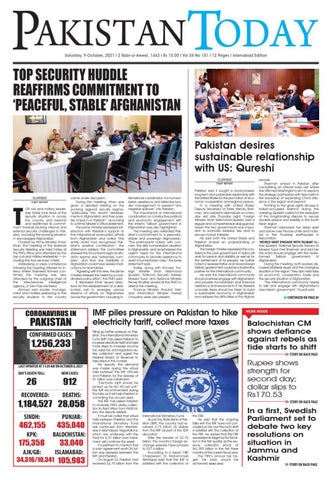
Saturday, 9 October, 2021 I 2 Rabi-ul-Awwal, 1443 I Rs 15.00 I Vol XII No 101 I 12 Pages I Islamabad Edition
Top securiTy huddle reaffirms commiTmenT To ‘peaceful, sTable’ afghanisTan Pakistan desires sustainable relationship with US: Qureshi ISLAMABAD Staff RepoRt
ISLAMABAD
T
Staff RepoRt
op civil and military leadership Friday took stock of the security situation in across the country and beyond and reaffirmed its commitment towards tackling internal and external security challenges to pakistan, including the evolving situation in war-ravaged Afghanistan. Chaired by prime Minister Imran Khan, the meeting of the National Security Meeting was held Friday at the pM’s office and attended by the top civil and military leadership — including the four services’ chiefs. Addressing a press conference following the meeting, Minister for Interior Sheikh Rasheed Ahmed confirmed the meeting was also attended by the outgoing chief of the Inter-Services Intelligence agency, Lt Gen Faiz Hameed. Ahmed said border management and matters pertaining to the security situation in the country
came under discussion. During the meeting, Khan was given a detailed briefing on the evolving regional security regime, “particularly the recent developments in Afghanistan and their possible impact on pakistan”, according to a prime Minister’s office statement. The prime minister expressed satisfaction with pakistan’s support to the international evacuation efforts from Afghanistan and noted “the entire world had recognised pakistan’s positive contribution,” the statement added. The committee stressed the incumbent regional situation regime was “extremely complex”, and that any instability in Afghanistan could have severe implications for Islamabad. “Agreeing with this view, the prime minister stressed the need for a coordinated policy effort,” the pMo said. It disclosed Khan issued directions for the establishment of a dedicated cell to synergise various streams of efforts on Afghanistan across the government, including in-
coronavirus in
pakisTan
CONFIRMED CASES:
1,256,233
LAST UPDATED AT 11:39 AM ON OCTOBER 8, 2021
DAY'S DEATH TOLL:
NEW CASES:
26
912
RECOVERED:
DEATHS:
1,184,527 28,058 SINDH:
PUNJAB:
462,155
435,040
KPK:
BALOCHISTAN:
175,358 AJK/GB: 34,316/10,341
33,040 ISLAMABAD:
105,983
ternational coordination for humanitarian assistance and effective border management to prevent “any negative spillover” into pakistan. The importance of international coordination on constructive political and economic engagement with the interim Taliban government in Afghanistan was also highlighted. The meeting also reiterated pakistan’s commitment to a peaceful, stable and sovereign Afghanistan. “The participants noted, with concern, the dire humanitarian situation in Afghanistan and emphasised the urgent need for the international community to provide assistance to avert a humanitarian crisis,” the press statement said. Earlier, along with Ahmed, Foreign Minister Shah Mahmood Qureshi, National Security Adviser Moeed Yusuf, and Defence Minister pervez Khattak arrived at the pMo to attend the meeting. Finance Minister Shaukat Tarin and Information Minister Fawad Chaudhry were also present.
pakistan said it sought a broad-based, long term and sustainable relationship with the United States for the promotion of economic cooperation and regional peace. In a meeting with United States’ Deputy Secretary of State Wendy Sherman, who arrived in Islamabad on a twoday visit late Thursday night, Foreign Minister Shah Mahmood Qureshi said a regular and comprehensive dialogue between the two governments was important to promote bilateral ties and to secure mutual interests. He said both the United States and pakistan shared an understanding of Afghanistan. The foreign minister expressed the confidence the new government in Kabul will work for peace and stability as well as for the betterment of its people. He further noted a representative and broad-based Taliban government could be a trustworthy partner for the international community. He said the international community should positively engage with Afghanistan and provide humanitarian and financial assistance and resources to it. He stressed concrete steps should be taken to build a sustainable economy in Afghanistan and address the difficulties of the Afghan
IMF piles pressure on Pakistan to hike electricity tariff, collect more taxes piling up further pressure on pakistan, the International Monetary Fund (IMF) has asked pakistan to increase electricity tariff and take more steps to increase income tax, sales tax, and regulatory duties collection and urged the Federal Board of Revenue to take steps in this context. per reports, the demand was made during the virtual talks between the IMF officials and pakistan for the release of $1 billion loan instalment. “Electricity tariff should be jacked up by Rs1.40 per unit,” the IMF recommended during the talks as it will help pakistan in controlling the circular debt. The IMF has asked pakistan to increase FBR’s yearly collection to Rs63 trillion from Rs58 trillion, the reports added. It must be noted that virtual talks between pakistan and the International Monetary Fund are continued from Wednesday in Islamabad. Negotiations, which are underway with the fund for a $1 billion loan instalment, will continue this week. It is pertinent to mention that a loan agreement worth $6 billion was delayed between the IMF and pakistan. on August 24, pakistan had received $2.75 billion from the
people. Sherman arrived in pakistan after completing an official India visit where she affirmed Washington’s aim to expand the strategic partnership with New Delhi in the backdrop of expanding China influence in the region and beyond. pointing to the gross rights abuses in Indian-occupied Kashmir during the meeting, Qureshi called for the resolution of the longstanding dispute to secure durable peace and stability in the South Asian region. Sherman expressed her deep grief and sorrow over the loss of life and material in the Thursday earthquake in Balochistan. ‘WORLD MUST ENGAGE WITH TALIBAN’ Before Qureshi, National Security Advisor Dr Moeed Yusuf met Sherman and told her the world should engage with the newlyformed Taliban government of Afghanistan. During the meeting, both leaders discussed bilateral issues and the changing situation in the region. They also held talks on economic cooperation, trade and the security situation in Afghanistan. “The international community needs to talk and engage with Afghanistan’s new interim government,” Yousaf said.
CONTINUED ON PAGE 05
more inside
Balochistan CM shows defiance against rebels as tide starts to shift STORY ON BACK PAGE
Rupee shows strength for second day; dollar slips to Rs170.53 STORY ON BACK PAGE International Monetary Fund. As per the State Bank of pakistan (SBp), the country had received 2.75 billion US dollars from the IMF as part of the SDR allocation. After the transfer of $2.75 billion, the country’s foreign exchange reserves have jumped to $27.4 billion. According to a report, FBR Chairperson Dr Mohammad Ashfaque said that the IMF is satisfied with the collection of
the FBR. He said that the ongoing talks with the IMF have not concluded so far, but the fund staff is satisfied with the collection of the FBR. He added that the FBR exceeded its target by Rs186 billion in the first quarter as the revenue collection stood at Rs1,395 billion in the first three months of the current fiscal year. The FBR’s annual tax target, he said, would be achieved. NewS DeSk
In a first, Swedish Parliament set to debate two key resolutions on situation in Jammu and Kashmir STORY ON BACK PAGE
02
Saturday, 9 October, 2021 | ISLAMABAD
NEWS
Azam Khan replaced by Sarfaraz as PCB announces revised T20 World Cup squad NewS DeSk The Pakistan Cricket Board (PCB) has announced on Friday a changed squad for the Men’s T20 World Cup 2021, with Azam Khan being replaced by former captain Sarfaraz Ahmed. The national selectors made three changes to the team “after taking into consideration player performances and form”, the PCB said in a statement. In the other two changes, Haider Ali has replaced Mohammad Hasnain, while Fakhar Zaman, who was originally named as a travel reserve, has replaced with Khushdil Shah. Meanwhile, the decision on Sohaib Maqsood’s inclusion in the squad will be made following medical advice, the PCB added. The top-order batter underwent MRI scans for his lower back after the October 6 National T20 match against Northern and missed Thursday’s Punjab derby against Central Punjab. At least five among the 15-men national side were trying to justify their selection during the 18-match first leg of the National T20 Cup. Out of which, only Sohaib Maqsood overcame a poor start with two halfcenturies for the winless Southern Punjab. But his teammates Azam Khan and Khushdil Shah, Northern’s Asif Ali and Sindh speedster Mohammad Hasnain all failed to make any impact at the Pindi Cricket Stadium, barring a few exceptions. “After reviewing player performances in the highly competitive National T20 and in consultation with the team management, we have decided to include Haider Ali, Fakhar Zaman and Sarfaraz Ahmed in the squad for the … World Cup,” Wasim was quoted as saying by the PCB on Friday. “It must be tough for Azam, Khushdil and Hasnain for missing out but they still have a lot to offer in their careers,” Wasim said, adding that trio was in the PCB’s future plans for postWorld Cup cricket. “I am pleased with the intensity and high quality of cricket that we have witnessed in the National T20. It has not only provided the players excellent match practice in the lead-up to the UAE competition, [but] it has also given us the opportunity to closely monitor the player progress and then make decisions that are in the best interest of the side for what will be a cut-throat tournament.” The T20 World Cup will be held in the United Arab Emirates from October 17 to November 14. Pakistan is in Group 2 and will open its campaign against India on October 24 at the Dubai International Cricket Stadium.
Mushahid urges West, US to play role for stability, peace in Afghanistan ISLAMABAD app
Chairman Standing Committee for Defence, Mushahid Hussain Syed on Friday urged the western countries and United States to play their role for stability and peace in Afghanistan. Talking to a private television channel, he said the America and allied countries had withdrawn the forces from Afghanistan, and now, there was need to work for development in the Afghan territory. It was the responsibility of western nations and the US to help address Afghan issues, he stated. Unrest in Afghanistan could be harmful for the region and the West, he warned.
ShehryAr Afridi BriefS iCG direCTor on hUMAn riGhTS violATionS in JAMMU & KAShMir ISLAMABAD
C
Mian abrar
HAIRMAN of the Parliamentary Committee on Kashmir Shehryar Khan Afridi Friday called on Ms Laurel Miller, Director of the International Crisis Group’s Asia Program in in Washington DC, USA. Ms
Laurel leads the organisation’s research, analysis, and policy advocacy about and in the region. She joined Crisis Group in January 2019 and also had issued a report on the growing human rights violation in Indian Illegally Occupied Jammu and Kashmir (IIOJK) last year. During the meeting, Shehryar Afridi briefed Mr Laurel Miller on the
war crimes and crimes against humanity by the illegal occupational forces of Indian in Jammu and Kashmir. He also presented a copy of the detailed dossier on human rights violations in IIOJK and briefed her on the matter. Later, Mr Afridi also invited Ms Laurel to visit Pakistan & Azad Jammu and Kashmir (AJK).
Dengue cases increase in Lahore, Islamabad
NewS DeSk Pakistan on Friday witnessed an
alarming increase in dengue cases as hospitals in the big cities filled up with patients.
In the last 24 hours, 188 people were diagnosed with the dengue virus in Lahore, taking the total number of cases to 2,586. more than 40 in Rawalpindi, 62 in Sindh, and 117 in Islamabad. In Khyber Pakhtunkhwa, four people have succumbed to the dengue virus this year. The province has recorded a total of 2,152 cases this year. According to the Islamabad district health officer (DHO), presently, there are 932 patients of dengue in the federal capital while five people have lost their lives to the contagious disease so far. Out of 117 fresh cases, 80 were reported from the rural areas of the federal capital, bringing the total number of people infected with the virus in these areas to 625, while 37 cases were detected in urban areas during the period
under review, bringing the total number of patients in the city to 307. Meanwhile, the Capital Development Authority (CDA) went ahead with its anti-dengue drive as special teams constituted by the Health Services Directorate sprayed antimosquito pesticides. These teams are particularly active in the congested areas of Islamabad city, where people are more prone to get infected, and in the rural areas. According to the CDA administration, these teams are working under a strategy to eliminate the larvae so that the virus could be stopped from spreading. Earlier, the Pakistan Meteorological Department had warned of a dengue outbreak post monsoon rains.
Wendy Shermans calls on COAS, discusses regional security ISLAMABAD staff report
Ms Wendy R. Sherman, United States (US) Deputy Secretary of State Friday called on General Qamar Javed Bajwa, Chief of Army Staff (COAS). During the meeting, matters of mutual interest, regional security situation and collaboration in Humanitarian measures in Afghanistan were discussed. COAS said that Pakistan is committed to making all-out efforts for peace and stability in Afghanistan and supports an all-inclusive Afghan Government. COAS emphasized to maintain meaningful bilateral engagement for an enduring multi domain relationship between the two countries. The visiting dignitary appreciated Pakistan's role in Afghan situation, specially the assistance in successful evacuation operations and pledged to continue working with Pakistan for regional peace.
Young women display outstanding action during Gilgit-Baltistan cricket, football tournaments NewS DeSk The beautiful valley of Gilgit-Baltistan is becoming a talent hotspot for women’s sports. The region has already produced several talented sportswomen who have made the country proud and to see them shining as super stars in Pakistan has motivated other girls residing on the mountains of Gilgit to take interest in sports as well. Around 10 teams participated in the tournament, which allowed over 150 girls to showcase their talent at the very grassroots level. Hundreds of girls from various villages of Gilgit participated in two sports events held last week. The Gilgit Baltistan Girls Football League and Gilgit Girls Cricket Tournament. While the eight-team football event was organized by the Inayat Sisters – Karishma and Sumera – of Al-Shams Football Club, the cricket event was organized by athlete Misbah Hina, in collaboration with Right To Play, Pakistan. Misbah Hina, the organizer and a volleyball athlete, told Geo.tv that she felt encouraged to see girls participating in the tournament with full energy. “The aim to organize this event for girls was to provide them more opportunities in cricket. There were 10 teams, all Gojal villages, that participated in the event,” Misbah said.
“It was a very good event, the energy displayed by the girls was really amazing. It has motivated me to organize more events in future for them. It was good to see parents and locals coming to the ground and cheer for these girls. I hope they’ll continue supporting girls in sports,” she added. Misbah confirmed that teams from the villages of Gilmit, Passu, Shisket,
Ghalapan, Sarteez, Gircha, Jamalabad and Khudabad participated in the tournament. The players were aged 1329. The tournament was the first-ever sports activity for many who struggled in the competition but learnt the most valuable lesson of all, to never give up. Participants of the tournament were of the view that they need more of such activities so that sports can become a
source of empowerment for the girls of the valley. “Overall, it was a very good experience. And, not only for sports, it was actually a good thing for the empowerment of women through sports,” said Hadiya, who represented Passu’s team in the tournament. Hadiya’s opinions were backed by Shumaila, the captain of Gulmit and Mahajabeen of Ghalapan. They both said that the girls of the valley need more activities to participate in sports. “We couldn’t go beyond the semifinals this time, but we are now very motivated to do better and win the title next time. I hope they come back again and organize the tournament for us,” said Hadiya. “I am very happy to see girls from my village do well. They’ve played the final and it is so motivating for all of us. Our girls have the talent and dedication – all they need are opportunities. This is one of such, and I hope there’ll be more to come for them,” said Fauzia, who was cheering for Ghalapan’s team. The girls, at the end of the tournament while holding the trophy, celebrated their achievement of being victorious in acquiring their right to play. The girls did a a victory parade on the streets of their village telling the world that sports can change their lives for the better.
Saturday, 9 October, 2021 | ISLAMABAD
ISI ChIef Lt Gen fAIz hAMeed MeetS PM IMrAn KhAn
d
NewS DeSk IRECTOR General of the Inter-Services Intelligence (ISI) Lieutenant General Faiz Hameed called on Prime Minister Imran Khan on
Friday. During the meeting, national security as well as the evolving situation in Afghanistan came under discussion. Prime Minister Khan lauded Gen Faiz Hameed’s services. The meeting
followed on the heels of a session of the National Security Committee (NSC) that discussed matters of national security, the situation in Afghanistan and other important issues. The PM chaired the NSC session held at PM House. It was attended by ministers, the national security adviser and the services and intelligence It was convened to discuss the emerging situation in Afghanistan, according to a statement issued by the Prime Minister’s Office (PMO).
Crackdown against Covid SOPs violators, unvaccinated people in full swing PeSHAwAR StAff RePoRt
The Khyber Pakhtunkhwa government has initiated a crackdown against the violators of coronavirus guidelines and unvaccinated people. Peshawar district administration said teams consisting of assistant commissioners were inspecting various parts of the provincial capital including Lahore Adda, General Bus Stand, Kohat Adda, Charsadda Adda and other bus terminals.
Finance ministry rejects World Bank's projection for Pakistan's GDP growth ISLAMABAD APP
The government on Friday rejected the World Bank’s projection about Pakistan’s Gross Domestic Product (GDP) growth rate for current and upcoming fiscal year saying it was based on unrealistic assessment and that the GDP growth rate for fiscal year 2021-22 would go up close to 5% against the WB’s forecast of 3.4%. Referring to a recent report published by the World Bank, the ministry of finance and revenue said that the World Bank’s growth estimates of 3.5 % in FY2021 against National Accounts (NAC) Committee estimates of 3.94 %, released by the PBS were also based on unrealistic assessment. The provisional estimate of GDP growth for FY 2021 was 3.94% based on 2.8 % growth in Agriculture, 3.6% growth in Industry and 4.4% growth in services.
However, LSM growth was provisionally taken as 9.3 % in NA for estimating GDP growth 3.94%. LSM data is available with two months lag and the recent data released by PBS on LSM recorded growth of 15.2 % for FY 2021, a statement issued by the finance ministry said. Further, recent data on crops mentioned by Federal Committee on Agriculture (FCA) suggest that production of important crops is higher than taken in NA, 2021. Wheat production is recorded at 27.5 million tons as compared to 27.3 million tons, while production of Maize is 8.9 million against 8.5 million tons released by PBS for estimating GDP growth 3.94%. “After incorporating latest available information, the GDP growth in FY2021 will improve further above 3.94% as compared to 3.5% estimates by the World Bank,” the statement said. For FY2022, WB projection of 3.4 % for GDP growth is again underestimated. It is pertinent to mention that economy of Pakistan has shown
They also checked vaccination certificates and vaccinated the people on the spot. In the Charsadda district, 11 traders were arrested for refusing vaccination and eight shops were sealed on the occasion for flouting guidelines. In Nowshera and Abbottabad districts, seven shops were sealed for doing the same. The provincial government has also advised the people to vaccinate them to control the spread of Covid-19.
V shaped recovery in FY2021 without creating any external and internal imbalances. The government is committed to ensure that the growth momentum remains intact with macroeconomic stability. Thus, it is expected that GDP growth for FY 2022 will remain close to 5 %. In this context it is worth mentioning that Global GDP growth rate in 2020 was recorded at -3.2% and is projected to grow by 6.0% and 4.9% in 2021 and 2022 respectively. On the basis of fast recovery expected globally, especially Pakistan’s main trading partners, we expect it will be translated to domestic economy as well. Domestically, production of important crops are encouraging like sugarcane 87.7 million tons (81.0 million tons last year), Rice 8.8 million tons (8.4 million tons last year), Maize 9.0 million tons (8.9 million tons last year) and Cotton 8.5 million tons (7.1 million tons last year). While target for wheat is set at 28.9 million tons (27.5 million tons last year). Further, government is taking measures to enhance agriculture performance such as Agriculture Emergency Program, Agriculture Transformation Plan, Prime Minister Kharif Package, incentives to Livestock sector and increase in Wheat Support price. Better crop production together with government’s measures, it is expected that the agriculture sector will perform better.
US official appreciates Pakistan for helping Afghan refugees over last 42 years NewS DeSk US Deputy Secretary of State Wendy Sherman has expressed appreciation for Pakistan’s efforts to provide humanitarian assistance to Afghanistan on Friday. Sherman stated that it should be “very proud of 42 years of helping Afghan refugees” and the US, as well as the world, was grateful for that. Sherman, who is leading a US delegation on a visit to Pakistan, appreciated Pakistan’s role in this regard during an exclusive interview. Sherman stated that she had visited a United Nations High Commissioner for Refugees Documentation Renewal and Information Verification Exercise center in Pakistan, earlier in the day, where registration cards were being issued for Afghan refugees so that they could have access to facilities such as healthcare in Pakistan. “It is an extraordinary system,” she said, while lauding Pakistan for consistently helping Afghan refugees over a long period of time. Talking about relations between the US and Pakistan during her visit to India, she stated that “It’s for a very specific and narrow purpose, we don’t see ourselves building a broad relationship with Pakistan.”
“The US and Pakistan have had longstanding relations for decades,” she said. She went on to say that “this is a time of great change in [this] region because of the events in Afghanistan”, and the US
and the world were reassessing what the future would look like and how to ensure a better future for Afghans and ensure that no country remained a safe haven for terrorists. Sherman also assured that the US
was willing to engage with Pakistan on “the wide-ranging agenda we have” and and the aftermath of recent events in Afghanistan. “We also agree that humanitarian assistance [to Afghanistan] should continue,” Sherman concluded by sharing details of measures taken by the US for this purpose. When asked about the Quad, a recently formed group that includes India, the US, Japan and Australia as members and perceived to be an alliance against China in the region, Sherman described it as a “cooperative effort” on matters such as energy and people-topeople exchange. She further clarified that the US didn’t ask countries to choose between itself and China. Acknowledging that China was a large economy and growing world power, she added, “What we do ask is that China plays by rules” in the international order. When she was asked about America’s stance on the Kashmir dispute, Sherman said “it is between India and Pakistan”. Sherman concluded by appreciating the initiatives taken by PM Imran Khan and his government to cater to the climate change.
NEWS
03
China to attend talks on Afghanistan in Moscow ISLAMABAD MiAn AbRAR
Chinese Foreign Ministry’s Spokesperson Zhao Lijian has said that the Chinese side has received an invitation from Russia to attend international talks on Afghanistan to be held in Moscow on October 20. “The Chinese side has received Russia’s invitation. We stand ready to maintain communication and coordination with relevant sides including Russia,” he said during his regular briefing held in Beijing on Friday. He said that Beijing supported all international efforts that are conducive to promoting peace and stability and gathering consensus in Afghanistan. President Vladimir Putin’s special representative on Afghanistan Zamir Kabulov had said that Russia would invite representatives of the Taliban to international talks on Afghanistan that it planned to host in Moscow on October 20. The representative did not provide further details on the planned talks in comments carried by Russian news agencies. Moscow hosted an international conference on Afghanistan in March at which Russia, the United States, China and Pakistan released a joint statement calling on the then-warring Afghan sides to reach a peace deal and curb violence. It also called on the Taliban not to launch any offensives in the spring and summer. Since then, the United States and its allies withdrew their troops after 20 years on the ground, the Taliban seized power in a lightning advance and the previous government collapsed. Russia is worried about the potential for fallout in the wider region and the possibility of militants infiltrating the former Soviet republics of Central Asia, which Moscow views as its southern defensive buffer.
Iraqis head to early vote with little hope for change BAgHDAD AgencieS
Iraqis elect a new parliament Sunday two years after a wave of anti-government protests swept the war-scarred country, but analysts say the vote is unlikely to deliver major change. Prime Minister Mustafa al-Kadhemi's political future hangs in the balance, with few observers willing to predict who will come out on top after the lengthy backroom haggling that usually follows Iraqi elections. A new single-member constituency system for electing Iraq's 329 lawmakers is supposed to boost independents versus the traditional blocs largely centred on religious, ethnic and clan affiliations. The election is being held a year early in a rare concession to the youthled protest movement that broke out in 2019 against a political class widely blamed for graft, unemployment and crumbling public services. Hundreds died during the protests, and dozens more anti-government activists have been killed, kidnapped or intimidated in recent months, with accusations pro-Iran armed groups have been behind the violence. Many activists have urged a boycott of the polls, and record low turnout is predicted among Iraq's 25 million eligible voters, while experts predict the main parties are likely to maintain their grip on power. The vote is "unlikely to serve as an agent of change", said Ramzy Mardini of the University of Chicago's Pearson Institute. "The election is meant to be a signal of reform, but ironically those advocating for reform are choosing to not participate... as a protest against the status quo."
Saturday, 9 October, 2021 | ISLAMABAD
04 NEWS
CPEC PROVIDEs hugE OPPORtunItIEs fOR PakIstanI InsuRanCE InDustRy BeIJING
t
aPP
HE China-Pakistan Economic Corridor (CPEC) provides huge opportunities to the Pakistani insurance industry to grow, said a top Pakistan-China trade body on Friday. In a virtual meeting of Pakistan-China Joint Chamber of Commerce and Industry (PCJCCI)’s Executive Committee, PCJCCI President Wang Zihai emphasized that Pak-
istan’s Insurance Industry has great potential in the wake of forthcoming CPEC labor projects, CEN reported. Wang Zihai said that the Chinese companies are interested in investing in this sector too. He said that Chinese investment in Pakistan’s insurance industry would bring China-styled reforms in the sector, which would prove to be a vigorous tool in the economic mobility of Pakistan. He indicated that there was a great po-
tential in Pakistan in the insurance sector, which had magnified further in the scenario of CPEC and would be a new sector of collaboration between China and Pakistan. PCJCCI’s Senior Vice President Ehsan Choudhry Ehsan Choudhry noted that according to financial statistics, the phenomenal growth of Pakistani life insurance companies had been maintained at 55 percent and 70 percent in terms of net premium and assets. He agreed that there was ample growth
of development in life insurance business provided it meets true needs of the people and offers them protection from economic downturns. He assured of the fullest support to the Chinese companies in introducing the Pakistan insurance policies for managing and indemnifying financial risks. PCJCCI’s Vice President Sarfraz Butt said that Chinese companies would find the conducive policy environment for insurance business in Pakistan. Due to the investment of Chinese insur-
President Alvi to leave for UAE to attend Dubai Expo 2020 ISLAMABAD
Cotton mound prices witness historic increase, reaches at Rs15,000 NewS DeSk
MiaN abrar
President Dr. Arif Alvi will be undertaking a visit to the United Arab Emirates on 9-10 October 2021 to attend the Dubai Expo 2020. During the visit, the President will meet the UAE dignitaries and formally inaugurate the Pakistan Pavilion in Dubai Expo 2020. Dubai Expo 2020 is the largest and most diverse exhibition in the region with participation from 192 countries, multilateral organizations and businesses. The Expo commenced on 1 October and will last till 31 March 2022. Pakistan Pavilion in the Expo 2020 is located at one of the prime areas of the Expo site, and is considered the largest Pavilion of Pakistan outside the country. The Pavilion, with the theme “Hidden Treasure”, showcases the unexplored and undiscovered riches of Pakistan. During his stay, the President will also meet leading businessmen, investors, entrepreneurs, senior representatives of IT companies and media, and also interact with members of the Pakistani community in the UAE. The
ance companies, Pakistan will get a dependable source in insurance sector. PCJCCI’s Secretary General Salahuddin Hanif also highlighted that Pakistan had great potential in this sector as it had been showing good growth trend during last few years. He claimed that the biggest challenge to be faced by the private insurance companies was always to develop a trained field force that can reach people and make them understand the importance of savings and investment through insurance.
visit coincides with the 50 years of establishment of diplomatic relations between Pakistan and the UAE. Pakistan and the United Arab Emirates have enjoyed close fraternal relations, rooted deep in common faith, shared history and cultural affinities. The UAE is Pakistan’s largest trading partner in the Middle East and a major source of investments. The UAE is also among
Pakistan’s prime development partners in education, health and energy sectors. Around 1.6 million Pakistani expatriates in the UAE contributed remittances of more than US$ 6 billion in the last financial year. Frequent exchange of high-level visits between Pakistan and the United Arab Emirates play a pivotal role in enhancing bilateral ties and close cooperation.
October 8 declared National Resilience Day: Alvi ISLAMABAD aPP
President Dr Arif Alvi announced October 8 would be observed as the National Resilience Day nationwide to express solidarity with the people of Azad Jammu and Kashmir, Khyber Pakhtunkhwa and Islamabad who lost their loved ones in the deadly 2005 earthquake. These areas suffered the most severe damage in the October 8, 2005, earthquake that killed 73,000 people. In a message on the occasion of remembrance of the earthquake, the president remembered the catastrophic quake resulted in the loss of thousands of human lives, besides affecting the livelihoods of the people and damaging the health, education and road infrastructure. “The day is also a reminder
that we live in a region marked as highly vulnerable to natural disasters, and there is a strong need to strengthen and equip our departments and create awareness among the people about disaster prevention and preparedness. “Over the years, Pakistan has witnessed multiple natural disasters in the form of earthquakes, landslides, and recent urban flooding which caused the loss of millions of dollars, not to mention the irreparable loss of lives,” he added. Alvi noted the people of Pakistan had faced disasters with courage and resilience, however, there was a strong need for unrelenting efforts to boost our capabilities, understand the role of climate change and global warming in causing fires, heatwaves, floods and cyclones. During the Covid-19 pandemic, the government devised a wise strategy to effectively respond to the pandemic and contain it by enforcing the policy of smart-lockdowns and creating awareness among the people, he added. He said: “It is heartening to state that the international community widely acknowledged Pakistan’s strategy to overcome the pandemic.”
The cotton prices have gone past the historic mark and have reached Rs15,000 per mound on Friday which the ginners association attribute to hiked demand and falling production. According to the Chairman of Pakistan cotton ginners association said the price surge is due to the international trend and is amplified by the drop in the local production. The increased price is due to little crop compared to the demands, association chairman Ihsan ul Haq said. However, he added that the country is expected to produce 10 million bales of cotton in the next harvest which shall bring down the prices. He said the growth in production will contribute to gdp growth as well. Pakistan registers increase in cotton Prices: The global trends of price surge were instigated by the U.S. purchase of cotton in sizeable volumes and the decrease in the Indian crop this year. Late last month, it was reported that the cotton prices increased by Rs700 per maund in Pakistan. According to the Chairman Pakistan cotton ginners association, the prices of cotton are increasing in the international market. In the last two days, the cotton prices have increased by six cents per pound in the United States.
Pakistan’s daily COVID-19 case count under 1,000 for first time in three months ISLAMABAD News Desk
Pakistan reported less than 1,000 daily COVID19 cases in the last 24 hours for the first time in over three months, official stats showed Friday morning, as the country continues its battle against the pandemic. Data from the National Command and Operation Center (NCOC) showed that Pakistan reported 912 cases after 45,619 tests were taken. The country last recorded a daily case count below 1,000 on July 6 at 830 cases. Another 26 people, meanwhile, lost their lives to the virus in the last 24 hours, pushing the death toll to 28,058. According to the NCOC stats, the total number of cases has reached 1,256,233. In addition to this, 1,633 patients have recovered from COVID-19 in the last 24 hours across the country, bringing the total number of recoveries to 1,184,527, while the number of active cases has fallen to 43,648. Pakistan has administered at least 87,741,079 doses of COVID vaccines so far.
Lahore goes global as 150 London’s Iconic Red Buses showcase city’s rich heritage ISLAMABAD News Desk
Lahore city has been projected globally as Pakistan’s private real estate company has launched its campaign in London to showcase the rich heritage of Lahore on 150 of London’s iconic red buses to promote ‘LAHORE The Heart of Pakistan’. Diyar Homes, the developers of the $30 Million luxury real estate development One Canal Road, Lahore, who recently announced their collaboration with leading Italian fashion house VERSACE Ceramics
CMYK
launched a mega campaign on 150 of London’s iconic red buses to promote ‘LAHORE The Heart of Pakistan’. Director of Diyar Homes UK Shaan Abbas speaking to the media saidon the occasion that Lahore has undergone a $10 Billion urban transformation in recent years cementing its place as the cultural and economic heart of Pakistan. “It’s the preferred investment destination of Pakistan and this is the message we wanted to give to the world from London, the global capital,” he concluded.
Saturday, 9 October, 2021 | ISLAMABAD
Bajwa DireCtS BalOChiStan trOOpS tO aSSiSt Civil aDmin in reSCue effOrtS iSLamaBad app
C
HIEF of Army Staff General Qamar Javed Bajwa on Friday directed troops stationed at Balochistan to provide all-out assistance to civil administration in rescue, relief and rehabilitation efforts being carried out in the earthquake-hit towns of the province. The army chief directed the officials to help mitigate difficulties faced by the affected population, said an Inter-Services Public Relations (ISPR) media statement. The military was deployed to the earthquake area to airlift dozens of injured from mountain peaks. At least nine critically injured people were taken to the provincial hospital in Quetta. Search and rescue teams had also ar-
Daily Covid-19 cases drop below 1,000 after three months iSLamaBad staff report
Daily COVID-19 cases dropped below the 1,000-mark on Thursday after a period of more than three months, the National Command and Operation Center (NCOC) said on Friday. The NCOC, a department leading campaign against the pandemic, said that 912 new COVID-19 cases were confirmed on Thursday. Earlier on July 5, Pakistan reported 830 confirmed cases after which the number of new cases started increasing, forcing the government to impose strict measures against the pandemic. The country has confirmed overall 1,256,233 cases, including 1,184,527 recoveries. The number of active cases has dropped to 43,648 who are under treatment across the country, while 2,761 are in critical condition. According to the NCOC, the pandemic killed 26 people on Thursday, increasing the overall death toll to 28,058. Sindh is the most affected province of the country with 462,155 infections followed by Punjab which has reported 435,040 infections.
rived in the mountains, an ISPR statement said. Lieutenant General Sarfraz Ali Commander Balochistan Corps visited earthquake hit areas of Balochistan to oversee troops taking part in Rescue and relief operations in affected areas of Harnai . Pakistan army urban search and rescue team busy in speedy rescue and relief efforts at Harnai. Necessary medical care being provided by Army and FC doctors & paramedics. All critical injured including evacuated to CMH Quetta through Pakistan army aviation helicopters. A large number of injured were also evacuated by road. 300 Special food and administrative package including tents/ blankets and meals provided to affected population.
Pakistan desires sustainable relationship with US: Qureshi continued from page 01 According to a Radio Pakistan report, the visiting delegation appreciated Pakistan’s efforts to evacuate foreigners from Afghanistan and the help it extended to refugees from that country. Since the Taliban’s take over Afghanistan, Islamabad has been urging to recognise the interim government in the troubled country. Yusuf also said that blatant human rights violations in Indian-occupied Kashmir also posed a threat to regional peace. FIRST VISIT SINCE TALIBAN TAKEOVER: Sherman, after Central Intelligence Agency chief William J. Burns, is one of the first high-level officials under President Joe Biden to visit Pakistan — and after the Taliban takeover of Afghanistan in August. She is expected to call on senior civilian and military officials in Islamabad. The trip comes as India, one of the top allies
of the Western-backed Ashraf Ghani government of Afghanistan that collapsed in the face of Taliban offences, as well as the US, ramps up a propaganda campaign to scapegoat Pakistan for the collapse of the Ghani regime. Pakistan was one of the backers of the 19962001 Taliban regime and has been accused by US officials of keeping the insurgents alive through covert support. Prime Minister Imran Khan, in an opinion piece published last month in The Washington Post, called his country a “convenient scapegoat.” “In Afghanistan, the lack of legitimacy for an outsider’s protracted war was compounded by a corrupt and inept Afghan government, seen as a puppet regime without credibility, especially by rural Afghans,” he wrote, elaborating on themes in his address to the UN General Assembly. He urged the world to engage the Taliban government “to ensure peace and stability.”
NEWS
05
Students won’t be allowed to attend classes without partial vaccination after October 31 iSLamaBad staff report
A day after the government decided to resume regular classes in educational institutions from next week, a minister said students won’t be allowed to attend inperson classes from October 31 unless they have received at least one dose of a Covid-19 vaccine. The educational institutions were earlier operating on 50 percent capacity after they reopened following intermittent closures due to the prevalence of the health crisis. The decision to resume classes at full capacity was based on the reduced level of coronavirus spread and the launch of the school vaccination programme, said Minister for Planning and Development Asad Umar, who is also chief of the National Command and Operations Centre. Today, Minister of State for National Health Services Dr Faisal Sultan said students who have received the first jab would be required to receive the second dose by November 30 in order to continue attending their classes. He said this condition also applied to seminaries who were required to get their students vaccinated before the deadline. Mobile teams will visit schools to administer the jabs as the government did not want students to lag behind in their studies due to the frequent closures of educational institutions, he added. Emphasising the need to vaccinate children, the minister said the government had observed the disease was also spread by young people, especially during the fourth wave. Sultan also allayed the concerns of parents regarding vaccines, reassuring them they were safe and approved by the World Health Organisation for injecting into young people. He said some children might get a slight fever after getting vaccinated, advising parents to not worry as it was an effect of the drug. “Parents should not hesitate from getting their children vaccinated.” Sultan maintained the vaccination was important not only to ensure uninterrupted studies but also to take the country towards normalcy.
Situationer: Balochistan earthquake survivors recall scary moments iSLamaBad Xinhua
Shahzaib Ahmed, a 14-year-old boy from Balochistan, was not sure whether he was dreaming or it was for real when a powerful earthquake rattled his house in the wee hours of Thursday. “I was in my deep sleep when I felt that my bed was shaking intensely. I thought I am having a bad dream. While I was still in the process of figuring out the situation, the walls around my room collapsed suddenly, injuring me and my two younger siblings sleeping next to me,” Ahmed told Xinhua while lying in bed
at a hospital in Harnai district of the province. “There was a chaotic situation […] My neighbourhood was in an uproar. Before I lost my consciousness due to overwhelming fear, I could hear people crying out for help as they got trapped under the rubble of their collapsed houses. Women and children were screaming from pain,” he said. “When I regained my consciousness, I was in a hospital full of injured people, including my sister and a brother.” Ahmed is one of the victims of a 5.9-magnitude quake that struck parts of Balochistan at 3:01 am on Thursday, killing at least 23 people and injuring over 300 others, Muhammad
Zaman, an official from the Provincial Disaster Management Authority (PDMA) told Xinhua, adding the remote mountainous Harnai district was the most affected area of the province where most of the casualties and damages have been reported. Earlier in the day, the provincial home minister, Mir Ziaullah Langove, told the media that at least 23 people were killed and over 300 others were injured in the earthquake. The earthquake was centred near Harnai district, with a focal depth of 15 km, according to the National Seismic Monitoring Centre of Pakistan. Muhammad Naseer, a 38-year-old factory worker, was on his way back home after a night shift when the quake jolted buildings and houses in his locality. “I was entering my street when I saw the roofs and walls of several houses coming down with a loud bang. Afterwards, there was a dense layer of dust that I could hardly see anything for some time […] Without thinking even for a minute, I just rushed towards the place where I had heard screams of people,” Naseer told Xinhua. He said he along with other volunteers in the area managed to pull out several victims trapped beneath the debris and shifted them to nearby hospitals, adding that his house was also damaged in the earthquake, but luckily the tragedy did not cause any serious injuries or death to his family. “I am lucky that no member of my family was hurt.” Zaman said the exact damage caused by the deadly earthquake has not been ascertained yet as rescue and relief activities are underway in the affected areas.
cmYK
Saturday, 9 October, 2021
06 COMMENT
Nothing will come out of Pandora
No peace in Afghanistan Riding to victory easier than running the county
The Panama Papers provides a precedentt
P
OliCYMaKeRs in Pakistan with a myopic focus were gleeful when the afghan taliban entered Kabul. the Pti government now faces a situation it hadn’t visualized. a humanitarian crisis faces the 28-million afghan population. the taliban government is required to deal with a serious liquidity crunch. even if Kabul gets back the $10 billion in reserves currently frozen by the Usa, the government will still need much more to continue to import oil, pay monthly dues to civil servants and security personnel, keep hospitals and educational institutions running and maintain civic amenities. With winter about to set in, the government does not know how to feed millions who face hunger. in case of a famine-like situation exacerbated by drought, millions of people are likely to turn into refugees. in Riasate Madina, 1400 years back, the local population shared whatever it had with the Migrants coming from Makkah. the Pti government is however unlikely to follow that example. Nsa Moeed Yusuf has called for holding a donor conference to formulate immediate humanitarian and economic relief plans for averting the risks of instability and threat of terrorism faced by the entire world. this would have been easier had the afghan taliban fulfilled the promises made to international community that included formation of an inclusive government, respect for human rights like the right of afghan girls to seek education and of afghan women to get jobs. the afghan government was also expected to abstain from awarding the harsh punishments of the Mullah Omar era. the afghan taliban’s failure to fulfill the promises has led the UN Human Rights Council to appoint a special rapporteur for monitoring the rights situation in afghanistan, setting aside objections from five countries including Pakistan. the world, particularly the neighbouring countries, would no doubt offer humanitarian assistance. there are in fact suggestions of limited cash airlifts to Kabul planned to directly help afghans while bypassing the taliban. there is however little possibility of the country receiving grants that financed 75 percent of public spending under the former government. thus everything might not be okay when the economic crunch forces people to initiate protests and the government takes recourse to repression.
AttiyA MunAwer
D
etails of another global scandal, the Pandora Papers, have been released in the style of the Panama Papers, which has caused a stir in the world. More than 700 Pakistanis have also been exposed in it. the big Pandora's Box has opened in the wake of international research called Pandora Papers and revealed secrets that could lead to many celebrities and bigwigs from all over the world getting into trouble. Just as the revelations were made one by one in the Panama Papers, the same thing will happen in the Pandora Papers, once again there will be political turmoil, action will be demanded against government figures and the whole process will be repeated as it was during the Panama Papers, but it
remains to be seen what will be the benefit to the people as a result? it is clear that the revelation of the Panama Papers did not change the lives of the people, nor are the revelations of the Pandora Papers going to change the lives of the people. But such revelations do unveil the faces of many so-called nobles. the Panama Papers included the names of more than 400 Pakistanis, while the number of Pakistanis appearing in the Pandora Papers is said to be more than 700 according to details released at the time, including those belonging to the current ruling party as well as several leaders of the PMl(N), the PMl(Q) and many leaders of the PPP, including some federal and provincial ministers. the emergence of the Pandora Papers has sparked a new debate on the financial affairs of eminent figures from around the world, including Pakistan, which could lead to many big people having similar problems as the sharif family did encounter under the influence of the Panama Papers. the most important revelation about the names of the people named by the Panama Papers and Pandora Papers is that they have set up offshore companies. an offshore company is an organization whose owners form a company in a country other than their own; the purpose of setting up such companies is usually to do business free from the laws and regulations of their country and fear of the government. the owner of the company may have problems with business matters because of political animosity in their country or some other reason. another purpose of setting up offshore companies is to take advantage of another country’s tax breaks or soft laws or to avoid their country’s strict tax laws. setting up offshore companies is not a crime under the law, but the people who set them up have to regularly state in their tax returns and asset details where such a company is located in their name.
Many people from countries like Pakistan form offshore companies for many reasons, but they all have the same goal and not all keep the details of their companies’ secret, so to assume that someone’s offshore company has come out means that the owner of the company or the family is guilty of something, is not the case at all. However, as for those who have stolen money from the country and set up offshore companies and kept them hidden, so that their theft and looting did not come to light, strict action should be taken against such persons. the Prime Minister also welcomed the Pandora Papers and announced an investigation, but for this, the path of investigation should be taken without any discrimination. No person or institution should use their personal or institutional status, the opposition has objected that only they have been vindicated in the Panama Papers; and this time the government in the Pandora Papers have to improve its image by making sure to provide justice through indiscriminate investigation. the government had tried to ensure justice on the Panama papers without any discrimination, but nothing could have happened except a change of government. this time too, the same thing seems to be happening. in the light of the previous melodrama, the courts should understand what kind of cases they had to hear and decide. No matter how many crimes Nawaz sharif’s government committed and how much it benefited the sharif family, he could not be convicted on the Panama Papers. He was convicted in another case. Other Panama Papers criminals are roaming free, but that doesn’t mean that those involved in the Pandora Papers should be pardoned if there is a solid case; it should be brought to light, but it seems that this Pandora will be used only for creating chaos and the Pakistani nation will be fooled once again. The writer tweets @AttiyaMunawer
The Plight of Women in Afghanistan
The burden on the economy
at all in this current situation of war-torn afghanistan. With the recent development of the taliban capturing Kabul and the rest of afghanistan, the hopes similarly, the impacts of 9/11 on afghan women for women empowerment have likely diminished did not prove different. the Us and NatO forces with the Us troops’ withdrawal and the extinction of the afghan national govbrought afghanistan into a ernment from afghanistan. disastrous war. Wars never afghan women will suffer bring peace. afghan peoagain from not recognizple displaced inside or ing women rights by the even migrated out of the Policy recommendations must probable taliban implecountry, leaving their mentation of “islamic homes, properties, busiinclude women empowerment rule” in afghanistan. the nesses, and relatives, again regulations as an integral part of evidences of hunger, fear, affecting women to a disrespect, non-permission higher extent. the honTaliban “Islamic rule” in to work, ban on women in ourable families of afghan Afghanistan. UN Women, as per public places, education people were disrespected ban and dismantling coand humiliated in various its charter, must work for education system in edulocations and their destinaadvancing women’s cational institutes, no tions both inside and outselection of a woman side afghanistan. empowerment and rights, member in the interim talafghan women started addressing discrimination and iban cabinet, and many beggary and other humiliatmore human rights violaing professions so as to earn violence, and promoting tions are some of the exa livelihood for themselves sustainable socio-economic amples that will make and their kids and weak women more suffamilies across Pakistan, development towards achieving afghan fer in afghanistan. iran, and neighbouring women’s rights in Afghanistan. Policy recommendacountries. No country had tions must include women designed humanitarian proUN Women must initiate empowerment regulations grammes for uplifting the collaborative efforts for Afghan as an integral part of talsocio-economic status of “islamic rule” in refugees, set aside for women inclusion in the national iban afghanistan. UN Women, afghan refugee women. political model and must be as per its charter, must Women again lagged behind work for advancing in education, health, sanitaendorsed by the Taliban. The women’s empowerment tion, social status, dignity, rights of education, decent and rights, addressing dispride, respect and their role crimination and violence, in daily lives both inside and work, extension of health and promoting sustainable outside of afghanistan. facilities, recognition of their socio-economic developeven theUN High towards achieving Commission for Refugees due social status and above all ment women’s rights in (UNHCR) and humanitarafghanistan. UN Women the preservation of women ian organizations did not must initiate collaborative work for the socioecorights as per true spirit of the efforts for afghan women nomic development of inclusion in the national Islamic rules must be afghan women. it’s the political model and must afghan women who were constitutionally protected for be endorsed by the talleft in the lurch without iban. the rights of educaAfghan women in any sort of assistance. the plight of decent work, afghan women has not political regime in Afghanistan tion, extension of health facilistopped there. it is continties, recognition of their uing to decline and the due social status and voices of the weak afghan above all the preservation women are never noticed of women rights as per by great powers that labelled themselves the best democracies and cham- true spirit of the islamic rules must be constitutionally pions of human and women rights in the global protected for afghan women in any sort of political press. the miserable statuses of hunger, fear, lawless- regime in afghanistan. ness, no shelter, social displacement and economically The witer is Research Officer, Baluchistan Think backwardness are the current state of the lives of afghan women. life is not easy for afghan women Tank Network (BTTN)
War has created multiple problems for women
Investment comes in as IMF demands grow heavier
Mujeeb-ur-rehMAn
P
M’s Commerce adviser Razak Dawood has welcomed the $5 billion investment in the textile sector, which was announced by an industry source recently, saying that the 100 new units expected to be established would generate 500,000 jobs. this is certainly good news for the government, with Mr Dawood in a statement on thursday ascribing it to the success of the government’s ‘Make in Pakistan’ policy. However, while this will enhance textile exports, which have already increased 29 percent year-on-year in the first two two months of the year, and while the mills would represent a major increase in the sector, which has about 400 mills at present, the government would welcome the expansion in employment, which has not been happening so far, even though it was an important part of the Pti platform in the last election. However, that was the good news. the bad news is that the iMf has demanded an end of income tax and sales tax exemptions, demanding an additional Rs 225 billion in taxes, not to mention the demand for an increase in the electricity tariff to address the circular debt issue. it made these demands in the technical talks on the resumption of the extended fund facility. With a final decision in the policy talks in Washington in mid-month.. the iMf wants a reversal of income tax exemptions, presumably including those granted in the last Budget. the iMf has got such a narrow vision that it wants a reversal of the measures taken to reduce imports, because they cause a decline in tax revenue,especially from sales tax. this is despite the government imposing restrictions on imports because of a dire current account situation. the problem the government faces is that these steps are inflationary, and the brunt will fall on the common man, already hard pressed by rising prices of not just food and other items of daily use, but also fuel and utilities. With the government preparing to head into an election in less than two years, it cannot really afford to take the battering of its image that the iMf seems likely to deal it. However, does it really have any choice except perhaps for some minor adjustments?
A
fgHaNistaN has remained in the dark shadows of war since 1979. the UssR ended the Cold War in 1989 after the withdrawal of its troops from afghanistan. the imposed war on afghanistan has caused the entire country to suffer multidimensional crises and millions of people fled to neighboring countries like Pakistan, iran, and the Central asian states. specifically, women's rights are extremely violated. Historically, after the soviet withdrawal, the afghan people were drowned into another misfortune when civil war took place between warlords and mujahideen, which resulted in the appearance of the taliban to take control over afghanistan. it is reported that many civilians had lost their lives at the hands of the taliban, sharia law was imposed and basic human rights were violated. those who suffered the most in afghanistan were the female gender, and that increased the population of widows, orphan daughters, and sisters that had lost their relatives in the war against the UssR and the aftermath by the taliban. Women education was affected most, during the taliban regime of the 1990s, reducing girls’ enrollment in and graduation from schools, colleges, and universities in afghanistan. even modern education for women was banned due to strictly implementing the so-called islamic laws in some areas in afghanistan. and schools had a record reduced number of students at that time. in that war-torn country, women were mostly deprived of basic health facilities, equal status in society and politics, women were prosecuted in public places, they faced family members disappearing and faced social and psychological unrest in afghanistan. the socio-emotional costs inflicted on women include their disrespect, tagging their character, othering them in social norms, marginalizing them in social, economic and political spheres of life. By nature, and biological compositions, females are more sensitive than males, are peace-loving, caring for their families and rearing sibling gs of their families, and binding sources of familial structures in human societies. Yet, their associations and sentimental beings face much suffering during or after the wars. in afghanistan, women have been suffering for decades. the examples of afghan women migrants choosito cross borders and miserably live in Pakistan and iran in refugee camps without basic amenities of life, are glaring evidences of the plight suffered by afghan women in wars.
Dedicated to the legacy of late Hameed Nizami
Arif Nizami (Late) Founding Editor
Yousaf Nizami M. A. Niazi
Editor Aziz-ud-Din Ahmad
Umar Aziz
Joint Editor
Joint Editor
Executive Editor
Lahore – Ph: 042-36300938, 042-36375965
I
Karachi – Ph: 021-35381208-9
I
Islamabad – Ph: 051-2204545
I
Web: www.pakistantoday.com.pk
I
Email: editorial@pakistantoday.com.pk
Saturday, 9 October, 2021
COMMENT 07 Editor’s mail Send your letters to: Letters to Editor, Pakistan today, 4-Shaarey Fatima Jinnah, Lahore, Pakistan. E-mail: letters@pakistantoday.com.pk Letters should be addressed to Pakistan today exclusively
Freshwater scarcity DeaR siR, freshwater scarcity is a reality which is threatening the sustainable development of human society. earth’s hydrological (water) cycle has been interrupted by the climate change that makes water-scarce regions of the world drier, and makes the other alreadywet regions wetter. Recent reports show that two-thirds of the global population is already experiencing water scarcity for at least one month of the year. However, i believe that it is never too late to take small steps and make a huge difference. every drop will count when you try! the good news is that these alarming facts are being considered, and stakeholders and the general public around the world are all agreeing to take action. Various agencies are putting together policies relevant to sustainable development. equally important, the international scientific community is working to bring more solutions. finally, and most importantly, increased public awareness and pressure means that there is still hope for a sustainable future. AzmEEnA SirAj KArAchi
Inflation is being exploited
Social Justice in India All systems and ideologies demand social jusice
Dr rAjkuMAr Singh
I
N this context, ‘social Justice’ is a term placed between comparative and contractarian approaches contextualized in society where justice is conceptualised in abstract principles of jurisprudence and in the sense social justice is an ideal construct which creates a society which ensures rights and opportunities for all people, irrespective of whether the state steps in to provide these rights and opportunities. the cognition of this reality goes back a very long time, it however, began to jump into reality as a result of the industrial Revolution and subsequent democratic movements in europe and elsewhere. the concept of social justice emerged in the 19th century with the aim of establishing more egalitarian communities and eradicating capitalist exploitation of human labour and mainly concentrated on money, land, and wealth distribution. soon thereafter, in the 20th century the scope of social justice widened to include the environment, race, gender, and other causes and manifestations of injustice, and going a step forward, it adopted other aspects of social life apart from mere economy. gradually, it also crossed the national boundaries to include the universal human element as the United Nations declared that slaves, exploited workers, and marginalised women are above all abused human beings whose position is of less significance than their circumstances. in this sphere justice itself has acquired three components— legal, commutative, and distributive. legal justice is about what people owe society, commutative justice addresses what people owe each other while distributive justice is about what the society owes the individual. Now, it is neither approaches nor social choices regarding distribution of goods and resources, but consideration of structuring of societal institutions to guarantee human rights and dignity and ensure opportunities for free and meaningful social participation. in this wider framework of social justice discrimination in society is an obvious form of social injustice. Discrimination is essentially a phenomenon that gathered momentum in the second half of the 20th century when the reality of society was observed and clearly found that
society did not provide rights and opportunities for a significant proportion of people who are subjected to discrimination in one form or another. the makers of the indian constitution being strongly affected and acting upon holy notion of social equality and social justice at the time of independence the terms, like socialist, secular, Democratic, and Republic, were inserted in the preamble of the Constitution. it, however, still a long journey for india to have a satisfactory level of social justice because a lot has to be done apart from law-making and providing for affirmative action. in delivering social justice, working institutions of the country, political democracy, ideology of the state and ruling mode of a country play a very decisive role which we cannot deny easily. While the nation state focuses on the emergence of nationalism which led to a slow but steady erosion of multiple identities that developed into a national identity and put less emphasis on reducing social discrimination or injustices prevailing in the society, in political democracy. that idea of egalitarianism is promoted which tries to minimise inequality and believes in provisions begun from above with a push from below, but which taken together both play a positive role in the search for social justice. like these, the current ideologies of capitalism and communism, address the issue. Capitalism works in a different way and does not seek to reduce or eliminate pre-capitalist forms of discrimination inherent in feudalism, serfdom or bonded labour, and rather creates a new form of exploitation mixed with progress and dilution. for instance, in a developing world imperialism led to exploitation and nationalism is followed by some kind of progress, while globalisaton is meant for dilution. then there is political democracy which enhances the role of the state, regulates and controls the market and paves the universal way for social justice. in today’s circumstances, globalisation is acting as a negative force for social justice by limiting the activities of state as well as integrating the world market which largely depend on factors beyond state’s control. in comparison to other systems, institutions and ideologies, socialism or communism tries at
its level best to reduce, if not eliminate, the prevailing forms of discrimination that easily persist in capitalism and over the years when capitalism transits to socialism, signifying from everybody according to their ability, to everybody according to their work, but transition from socialism to communism which signifies from everybody according to their ability, to everybody according to their need. in fact, the socialist system appears to reduce some old forms of discrimination but on the other it also creates some other kinds of privilege and exclusion as found in the erstwhile UssR and the hopes too belied in case of present-day China, where the rule of Communist Party still persists. the current system of China is described as market socialism which commands less control on capitalism in due course and in the context, Cuba is the first socialist country with a communist government which has, to a large extent, eliminated discrimination based on gender and race and provided equality of opportunity but it too has failed on several other important counts. at this juncture, the quest for social justice requires affirmative action or some kind of reservation when exclusion takes the form of discrimination against an identifiable group or groups on the basis of caste, race, religion, gender and ethnicity and social legislation is necessary but not sufficient, especially in a country where it is embedded in history. in a country like india where exclusion and discrimination had a long history, affirmative action or positive discrimination in favour of the underprivileged or excluded is necessary as a corrective measure to compensate past discrimination. in general, it is a set of policies and practices that are used to create equal and new opportunity, primarily at workplaces and educational institutions with an object to redress the perceived disadvantages prevailing in institutions in the form of any kind of discrimination. However, in most cases when the exclusion or discrimination is historical and embedded in beliefs or ideologies, it fails to combat these beliefs or discrimination, but it can change the initial conditions that created discrimination in the past, and it is the point where economic, social, and political empowerment for the excluded is essential and for getting that situation political democracy is preferred as a partial/initial remedy of the problem.
In a country like India where exclusion and discrimination had a long history, affirmative action or positive discrimination in favour of the underprivileged or excluded is necessary as a corrective measure to compensate past discrimination. In general, it is a set of policies and practices that are used to create equal and new opportunity, primarily at workplaces and educational institutions with an object to redress the perceived disadvantages prevailing in institutions in the form of any kind of discrimination
The writer is head of the political science department and dean of the Social Sciences faculty of the B.N.Mandal University, Madhepura, Bihar, India. He can be reached at rajkumarsinghpg@gmail.com
iNflatiON, another benefit of the incumbent government, has made wretched every individual. Understandably, government had to impose such taxes and was left with no other option. However, this has increased the prices of basic commodities and has been worst borne by the poor. furthermore, i feel that the business community including shopkeepers and retailers are availing undue advantage of this by charging more than the actual price in the name of inflation. therefore, it’s difficult for a common man to meet his needs. the state and concerned authorities should take immediate action against these overcharging shopkeepers and ensure that no one misuses tax policies to their own profit. AwAiS AhmEd ShiKArpur
Incorporating Technology in Education as the saying goes, “ in the midst of every crisis, lies great opportunities.” as the covid-19 has taken its toll on education sector, it has also open new avenue of incorporating technology in our education system. Coronavirus has compelled authorities to digitalize education delivery system in order to provide distant learning during the closure of educational institutes. However, owing to capacity issues, digital divide and digital illiteracy, government is unable to provide dividends of technology to everyone, particularly in the remote areas of Pakistan. a recent decision by the Universal service fund (Usf) to provide high-speed mobile broadband services to the remote areas of Pakistan is a welcome news in this regard. this will enable residents of these remote areas to access modern education on internet. this will not only revolutionize education delivery but also help in education management in far flung areas. the need of hour, therefore, is to digitalize educational system so that students in distant area can get education in this time of crisis. FAiSAl hAyAt OKArA
Health problems in Pakistan UNDOUBteDlY, with better health alone, one can perform, contribute, and play their part in the socio-economic progress and advancement of the country. On the contrary, in a condition of poor health one cannot contribute well to the country’s development. it is disheartening that quality healthcare in Pakistan is a distant dream. almost all public hospitals lack the very basic facilities. every health center is facing an acute shortage of beds, experienced doctors, quality medicines, and kind support Pakistan, being a developing country, is facing a number of flaws in the health sector.although the medical field has been targeted as a means of quick earning from the sick blood of poor patients. through all the channels of social life, from government to the private hospitals ,we find health being sold on amount of money. the government is spending billions of rupees yearly on the health sector yet we only get poor infrastructure in hospitals led by poor management. One may occasionally and fortunately find cleanliness, punctuality, and a proper use of equipment in the so-called government hospitals. all these flaws are caused because of private clinics which provide a better environment and healthy medication only to those who can afford it. in first world countries the first step that a doctor takes in treatment is getting to know first hand the patient’s family background as well as their medical history. Moreover, they bring patients in a psychologically strong situation that he/she may fight the disease boldly. in Pakistan there is no rule of law for so-called better health. Doctors do not even comprehend the nature of patient and advise overdose to a psychologically weak patient that makes them more sick. Moreover, doctors are highly paid to provide selected expensive medicine on which they are paid heavy amount of percentage and various so-called gifts. at a larger scale the doctors keep an inexperienced nursing staff which takes charge in their absence.similarly, unspecialised doctors who do not possess a valid medical degree, operate illegal clinics that lead to an unhealthy life. Due to all these flaws including poverty and high fees of private clinics the patient indulges in self-medication which results in a harmful situation later. it also may be because of common selling of medicine without the approval of a doctor. Concluding the message, the medical authorities and the health sector should ensure fair accountability through proper selection of an experienced staff, well-formed structure of hospitals, breakdown of private clinics, and proper selling of legal medicines. uzAir Bin jAlil ShiKArpur
Saturday, 9 October, 2021
08 WORLD VIEW
Facebook Is a harmFul presence In our lIves UNDAUNTED BY SCANDALS, THE SOCIAL MEDIA GIANT PLANS TO TIGHTEN ITS GRIP ON OUR EVERYDAY ACTIVITIES. WE DON’T HAVE TO JUST SUBMIT Guardian
F
JAthAN SADOwSki
ACeBOOk is in perpetual crisis mode. For years now, the company has confronted waves of critical scrutiny on issues caused or exacerbated by the platform. Recent revelations have lengthened the charge sheet. That list includes the mass data collection and privacy invasion by Cambridge Analytica; the accusations of Russian interference during the 2016 presidential election; unrestrained hate speech, inciting, among other things, genocide in Myanmar; the viral spread of disinformation about the coronavirus and vaccines, with Joe Biden proclaiming about Facebook and other social media platforms: “They’re killing people”. Add to that Facebook Marketplace: with a billion users buying and selling goods, ProPublica found a growing pool of scammers and fraudsters exploiting the site, with Facebook failing “to safeguard users”. The latest wave of investigative reporting focused on the company, meanwhile, comes from the Wall Street Journal’s Facebook Files series. After pouring over a cache of the company’s internal documents, the WSJ reported that “Facebook’s researchers have identified the platform’s ill effects”. For instance, the company downplayed findings that using Instagram can have significant impacts on the mental health of teenage girls. Meanwhile, it has been implementing strategies to attract more preteen users to Instagram. The platform’s algorithm is designed to foster more user engagement in any way possible, including by sowing discord and rewarding outrage. This issue was raised by Facebook’s integrity team, which also proposed changes to the algorithm that would suppress, rather than accelerate, such animus between users. These solutions were struck down by Facebook’s chief executive, Mark Zuckerberg, because he prioritised growing engagement above other objectives. What’s more, the WSJ reported, Facebook employees “raised alarms” about drug cartels and human traffickers in developing countries using the platform, but the company’s response has been anaemic. Perhaps because executives are, yet again, hesitant to impede growth in these rapidly expanding markets. This is consistent with claims by Facebook whistleblower Frances Haugen, who said at the weekend, in an interview with 60 Minutes, “Facebook, over and over
again, has shown it chooses profit over safety.” It also emerged that Haugen has filed at least eight complaints with the US financial watchdog over Facebook’s approach to safety. Haugen testified before the US Senate on Tuesday, backing up her revelations. “I’m here today because I believe Facebook’s products harm children, stoke division and weaken our democracy,” she said. “The company’s leadership knows how to make Facebook and Instagram safer, but won’t make the necessary changes because they have put their astronomical profits before people.” We shouldn’t be surprised that making money hand over fist is any company’s primary motivation. But here we have further evidence that Facebook is a uniquely socially toxic platform. Despite the executive team’s awareness of these serious problems, despite congressional hearings and scripted pledges to do better, despite Zuckerberg’s grandiose mission statements that change with the tides of public pressure, Facebook continues to shrug off the great responsibility that comes with the great power and wealth it has accumulated. each surging wave builds on the last, hitting Facebook even harder, enveloping it in scandal after scandal. In response, the company has decided to go on the offensive – rather than truly address any of its problems. In August, Zuckerberg signed off on an initiative called Project Amplify, which aims to use Facebook’s news feed “to show people positive stories about the social network”, according to the new York Times. By pushing pro-Facebook stories, including some “written by the company”, it hopes to influence how users perceive the platform. Facebook is no longer happy to just let others use the news feed to propagate misinformation and exert influence – it wants to wield this tool for its own interests, too. With Project Amplify under way, Facebook is mounting a serious defence against the WSJ Facebook Files. In an article posted on Facebook newsroom by nick Clegg, Facebook’s vice-president of global affairs, accusations of “deliberate mischaracterisations” by the WSJ reporters are lobbed in without supplying any specific details or corrections. Similarly, in an internal memo sent by Clegg to pre-empt Haugen’s interview, Clegg rejected any responsibility for Facebook being “the primary cause of polarisation”, blamed the prevalence of extreme views on individual bad actors like “a rogue uncle” and provided talking points for employees who might “get questions from friends and fam-
Facebook's empire is beginning to crumble
Spectator
W
ROSS CLARk
Hen empires crumble they slide slowly at first, then the temple walls come crashing down. Facebook is not quite at the latter stage yet, but you can hear the creaking in the pillars and lintels. This week, the social media giant suffered two blows: an outage which took down its platform, along with Instagram and WhatsApp, and an expose by a disillusioned ex-employee who accuses the company of saying one thing about social responsibility in public – while behaving quite differently in private. Many of us might not notice if Facebook suddenly wasn’t there. But it is a different story for the many businesses which have built their model on the back of selling via Facebook or Instagram. For them, Facebook is as important a part of their infrastructure as the postal service or telephone network was for previous generations. They rely on Facebook’s platforms being constantly available. Yet in the past the post sometimes failed and the telephone lines came down, and so too Monday’s few hours without Facebook – which the world endured, or enjoyed, according to your personal view – weren’t necessarily an existential threat to Facebook. The emergence of Frances Haugen, a data scientist
who resigned from Facebook earlier this year, taking thousands of pages of internal documents with her, might turn out to be the bigger crisis. Haugen, who worked in the Orwellian-sounding Civic Integrity department, has made eight complaints to the Securities and exchange Commission which polices the matter of what information corporations put to the market. She alleges that the pronouncements made by Facebook on social responsibility – such as CeO Mark Zuckerberg’s promises to remove harmful content from the platform – are at odds with what is revealed in the Facebook documents. The latter, she says, reveal that the company has only succeeded in taking action in 3 to 5 per cent of posts containing hateful content and 0.6 per cent of posts containing violence and incitement. An internal Facebook study suggests that 13.5 per cent of teenage girls said that Instagram had made their thoughts of suicide worse; while 17 per cent said the same of eating disorders. For years, social media companies didn’t seem to worry much about this sort of thing. They acted as if they were above being regulated, and indeed that they were a force for good – they were part of a supra-national democratic infrastructure which would keep governments in their place. At the same time, as revealed by the Cambridge Analytica controversy, many users of social media were ignorant of how their data was being harvested and exploited. But the atmosphere is changing. The pandemic has unleashed a new fashion for government intervention in western democracies. The public image of social media companies suddenly matters a lot more than it has ever done. Facebook hired nick Clegg in the hope of dealing with such issues. So far, he is not proving a great success. It has been interesting how many technologybased investment funds in recent years, while happy to invest in the other ‘FAAnGs’, seemed to have small or non-existent stakes in Facebook. Perhaps they could see what was coming, and that of all technology companies, Facebook has the dimmest future. Ross Clark is a leader writer and columnist who, besides three decades with The Spectator, has written for the Daily Telegraph, Daily Mail and several other newspapers. His satirical climate change novel, The Denial, is published by Lume Books.
ilies about these things”. It’s all spin, with no substance. A trained politician deflecting accusations while planting seeds of doubt in the public’s mind without acknowledging or addressing the problems at hand. In another response to the WSJ, Facebook’s head of Instagram, Adam Mosseri, made a strange analogy between social media and cars: “We know that more people die than would otherwise because of car accidents, but by and large, cars create way more value in the world than they destroy,” Mosseri said. “And I think social media is similar.” Mosseri can no longer deny that platforms like his are forces for destruction. His tactic is to convince us that a simple cost-benefit analysis comes out in his favour. He happens to elide the fact that cars cause more than crashes; they are also responsible for systemic social and environmental consequences at every level. Of course, this is exactly the kind of self-interested myopia we should expect from a tech executive under fire. Beyond pushing back against critical reporting, however, an initiative like Project Amplify should be understood as Facebook attempting to pave the way for its deeper penetration into every facet of our reality. After all, when asked last year by Congress why Facebook is not a monopoly, Zuckerberg said it’s because he views all possible modes of “people connecting with other people” as a form of competition for his business. And if we know anything about Facebook, they are very good at capturing market share and crushing competitors – no matter what it takes. Facebook needs users to form an intimate relationship with the platform. In quick succession this summer, it announced two new products that represent the company’s next planned phase of existence – both its own and ours. First is the “metaverse”. named after an explicitly dystopian sci-fi idea, the metaverse is, for now, pitched as essentially a virtual reality office – accessed through VR goggles like Facebook Oculus – where you go to see colleagues, attend meetings, and give presentations without having to leave home. Zuckerberg proclaimed that over the next five years, Facebook “will effectively transition from people seeing us as primarily being a social media company to being a metaverse company.” Second is Ray-Ban Stories, Facebook’s attempt to succeed where Google Glass failed. Ray-Ban Stories are pitched as a frictionless way to stay constantly connected to Facebook and Instagram without that pesky smartphone getting in the way. now you can achieve the dream of sharing every moment of your day with Facebook – and the valuable data produced from it – without ever needing to think about it. Importantly, access to both kinds of reality – virtual and augmented – are mediated by Facebook. The executives at Facebook would like you to believe that the company is now a permanent fixture in society. That a platform primarily designed to supercharge targeted ad-
vertisements has earned the right to mediate not just our access to information or connection but our perception of reality. And Facebook’s aggressive attempts to combat any scepticism, combined with its reality-shaping ambitions, shows how desperate it is to convince us to accept the social poison it peddles and ask for more. Days before Facebook’s latest congressional hearing – this time on the mental impacts of Instagram on teenagers – Mosseri announced his team was pausing Instagram kids, a service aimed at people under 13 years old, and developing “parental supervision tools”. It seems yet again that they will do the bare minimum only when forced to do so. Speaking about this change of direction in her Senate hearing, Haugen was sceptical: “I would be sincerely surprised if they do not continue working on Instagram kids, and I would be amazed if a year from now we don’t have this conversation again.” For Facebook, all this negative attention amounts to an image problem: bad publicity that can be counteracted by good propaganda. For the rest of us, this is indicative that Facebook doesn’t just have a problem; Facebook is the problem. Ultimately, an overwhelming case is growing against Facebook’s right to even exist, let alone continue enjoying unrestricted operation and expansion. We must not forget that Facebook is still young. It was founded in 2004, but didn’t really come into itself, becoming the behemoth we know today, until going public in 2012, buying Instagram for $1bn (£760m) that same year and then acquiring WhatsApp for $19bn two years later. True to its original informal motto – “Move fast and break things” – Facebook has wasted no time wreaking a well-documented path of destruction. When Facebook, Instagram and WhatsApp temporarily went offline this week due to a technical problem, we saw just how dependent we have already become on these services for so many everyday activities. It was a shock to suddenly be without them. The company would probably see this as evidence that our lives are too intertwined with its services for them to ever go away. But, as the company has proven time and time again, our interests and its interests are rarely aligned. We should instead recognise that allowing a rapacious company to design and own critical infrastructure with zero accountability is the worst of all possible options. If its executives want to compare social media to cars, then at the very least this dangerous technology must be subjected to the same level of heavy regulation and independent oversight as the automotive industry. Otherwise, Facebook must be reminded that it’s not too late for the public to pull the plug on this social experiment gone wrong. Right now, almost any alternative would be better. Jathan Sadowski is a research fellow in the emerging technologies research lab at Monash University, Melbourne, Australia.
Why Israel should reject US military aid
Week
I
SAMUEL GOLDMAN
n a 420-9 vote, the House on Thursday approved $1 in billion in funding for Israel's missile defense system. The "Iron Dome" appropriation represents about a quarter of the $3.8 billion in military aid the United States provides to Israel annually — in recent years, exceeded only by aid to Afghanistan, and far more than any other nation receives. This was a victory for pro-Israel lawmakers, but a superficial one. The vote was briefly delayed by resistance from progressive Democrats, reflecting a shift in the balance of power within the Democratic Party. Their influence boosted by slim congressional majorities, the left wing has challenged their party's traditional support for the Jewish state. Israel shouldn't wait for that balance to shift further. If military aid is to be a football in partisan squabbles, the Jewish state can refuse to play. This time, Israeli officials were quick to paper over any conflict. Israeli foreign minister Yair Lapid blamed the previous government, which cultivated close ties to the Republican Party and, in his phrase, "abandoned Congress and the Democratic Party and caused significant damage to Israel-U.S. relations." Lapid expressed confidence that the bilateral relationship would improve moving forward. That confidence may be misplaced. Backed by changing opinion among younger voters, liberals, and women, future Democratic administrations are likely to be less friendly than Biden's. This aid measure passed. The next one — or the one after that — might not. Israel needn't depend on that uncertain future. At one
time, Israel was reliant on foreign allies. now, as a highincome country with a growing economy and thriving technology sector, it's rich enough to pay for its own defense. In 2022, American aid will make up about 20 percent of Israel's $17.8 billion defense budget. That's a lot of money, but not an impossible loss for a country with about $400 billion GDP. Moreover, the aid isn't really aid. Because almost all of it is reserved for purchases from U.S. suppliers, it's effectively a subsidy to the American arms industry. That bargain makes sense for members of Congress who want to benefit local industries or their own donors. It's not clear that it makes sense for Israel, which has domestic producers to support and an interest in getting the best price and products. Beyond the money, however, the main reason to reconsider American aid is that it implies the U.S. possesses a special authority over Israel, and the value of strategic independence is inestimable. Our military aid is a symbol of American largesse that comes with an expectation of Israeli deference. That's a bad position for a state rightly proud of its independence. Israel should not need Washington's permission to act in its own interest. Critics of the Jewish state might see a reduction of U.S. aid as a success for their cause, but they should be careful what they wish for. In its present form, military assistance is a source of leverage those same critics hope to use to influence Israel's conduct. If it disappeared, they'd have less influence rather than more. American friends of Israel, on the other hand, have mobilized in support of the aid. In the short term, they're right: Restocking the Iron Dome is essential. In the longer term, however, it's worth considering whether tying Israel's security to American party politics is counterproductive. Although a squeeze play would likely to fail, it would be an embarrassment for Israel if a future Congress or president tried to condition aid on policy concessions. It would be an act of statesmanship to close the books before that can happen. There are hints that the idea of pivoting away from American aid is getting more consideration in Israel. Of course, revising this aspect of a "special relationship" isn't so simple as tearing up a check, but weaning off American funding would be good for Israel. And by forcing us to confront Israel as sovereign and equal rather than a needy dependent, it would also be good for the United States.
Saturday, 9 October, 2021 | ISLAMABAD
NEWS
corporate corner
09
SECP WITNESSES 20% GROWTH IN NEW INCORPORaTIONS IN SEPTEMBER 2021 ISLAMABAD APP
T Rafi Group & IGI Insurance Co signed an agreement for Green Palms housing project,on this eve Chairman Imtiaz Rafi Butt,Tahir Masood,Shazil Rafi Butt,Shehryar Rafi Butt & Abdul Sami Shaikh seen in the group photo. PR
Group Photoon the occasion of AGM and announcement of election results of Pakistan Sugar Mills Association, Ch. Muhammad Zaka Ashraf, Central Chairman, Mr. Iskander M. Khan, Vice Chairman, PSMA, Ch. Muhammad Aslam, Chairman, PSMA Punjab Zone, Mr. Faisal Mukhtar, Executive Member, Mr. Muhammad Rafique, Executive Member, Ch. Khan Muhammad Ashraf of Ashraf Sugar Mills, Mian Rasheed of Medina Sugar Mills, Mr. Javed Kayani of Chanar Sugar Mills, Ch. Waheed of Hunza Sugar Mills, Mr. Waqar Ahmed of Shahtaj Sugar Mills, Mr. Ali Ahmed Tariq of Husein Sugar Mills, Mr. Masood of Matiari Sugar Mills, Mr. Ali Altaf Saleem of Shakarganj Sugar Mills, Mr. Hassan Iqbal, Secretary General, PSMA Punjab, Mr. Arif, Secretary, PSMA Punjab. PR
POWER SUSPENSION SCHEDULES FOR 09th , 10th & 11th OCTOBER 2021 According to Islamabad Electric Supply Company (IESCO)’s spokesman, System Maintenance/Development Work is in process. Therefore power supply of below mentioned feeders/areas will be temporary suspended as per given schedule: On 09th October, From 08:00 AM to 01:00 PM, Puran, Fatehpur, Kohar, Bakrala Feeders, On 10th October, From 08:00 AM to 01:00 PM, Mandi Bhalwal Feeder, From 09:00 AM to 03:00 PM, Line Park, Bhikri, Millat Chowk Feeders, On 11th October, From 10:00 AM to 03:00 PM, Gharial Feeder, From 09:00 AM to 02:00 PM, Koral, Tarlai, Khanna East, Scheme, Kohala, Azizabad Feeders, From 08:00 AM to 01:00 PM, Chakri, Arsalan Poultry Farm, SPD , Paryal, Gagan, Chahan, Mahouta feeders and surroundings will remain closed. IESCO management apologizes to its esteemed customers for the power outage. If the work is completed ahead of time, the power supply can be restored even before the scheduled time. PRess ReleAse
FFC Extraordinary General Meeting Fauji Fertilizer Company (FFC) held Extraordinary General Meeting on October 8th 2021 at its Head Office, Rawalpindi thus establishing a quorum of 59 percent with representation from all major equity holders which included Fauji Foundation, State Life Insurance Corporation, Deutsche Bank, Allied Bank, Citi Bank and representatives from various other Corporate bodies and institutions. Brig Asrat Mahmood, SI(M) (Retd), Company Secretary FFC, opened the house. He apprised the shareholders of the special business to elect Directors of the Company for a period of three years commencing from 09 October 2021 to 08 October 2024 in terms of Section 159 of the Companies Act, 2017. The directors elected for the duration are: 1. Mr. Waqar Ahmed Malik 2. Dr. Nadeem Inayat 3. Maj Gen Naseer Ali Khan (Retd) 4. Maj Gen Ahmad Mahmood Hayat (Retd) 5. Syed Bakhtiyar Kazmi 6. Mr. Peter Bruun Jensen 7. Mr. Shoaib Javed Hussain 8. Dr. Hamid Ateeq Sarwar 9. Mr. Saad Amanullah Khan 10. Ms. Maryam Aziz 11. Dr. Ayesha Khan 12. Mr. Jehangir Shah Chairman, Mr. Waqar Ahmed Malik and Chief Executive and Managing Director FFC, Lt Gen Tariq Khan, HI(M) (Retd) graced the occasion, welcomed the New Board and lauded the services of the outgoing Board Members. They also responded to shareholders’ queries and assured FFC’s commitment to achieve higher standards of performance and to provide sustained earnings to the valued shareholders despite the challenging circumstances. PRess ReleAse
HE Securities and Exchange Commission of Pakistan (SECP) registered 2,223 new companies in September 2021, up by 20% over the same period in the preceding year. Total capitalization (paid-up capital) of the new companies stood at Rs. 2.8 billion and the total number of registered companies has risen to 1,52,089, said a press release issued here. Private Limited companies accounted for 65% of the new incorporation, whereas 32% were registered as single-member. Remaining 3% were registered as public unlisted companies, not for profit associations, trade organizations and limited liability partnership (LLP). Approximately 99% companies were registered online and 210 foreign users were registered from overseas. Sector-wise, construction & real estate sector took the lead with the incorporation of (377) companies, followed by information technology (316), trading (310), services (209), food & beverages sector (85), textile (74), ecommerce (74), education (66), market & development (54), corporate agricultural farming (53), pharmaceutical (52), engineering (46), healthcare (45), tourism (43), auto & allied (38), chemical (38), transport (37), mining & quarrying (3) and power generation (30), paper & board (27), logging (26), cosmetics & toi-
letries (23), fuel & energy (19), cables & electric goods (18), communications (17), steel & allied (16), and wood products (16) and broadcasting & telecasting (15) and 69 companies were registered in other sectors. Foreign investment has been reported in 61 new
POA President calls on Chinese Ambassador ISLAMABAD APP
President Pakistan Olympic Association (POA) Friday called on Ambassador of People’s Republic of China to Pakistan Nong Rong at the Embassy of China in Islamabad. The meeting was held in context of the XXIV Olympic Winter Games Beijing 2022. The Ambassador informed President POA that all preparations were on track and completed as per schedule and that China was looking forward to welcoming all its guests in a befitting manner. President POA assured complete cooperation and support with the organizing committee and NOC China for Beijing 2022. President POA thanked the Ambassador Nong for sharing the programmes of the Games and measures in place for successful
companies, reporting foreign investors from Australia, Canada, China, Dominican Republic, Germany, Hong Kong, Iraq, Jordan, Korea South, Paraguay, Qatar, Russia, Saudi Arabia, Spain, Switzerland, Taiwan, Turkey, UAE, UK, the USA and Zambia.
Nearly 55,000 people evacuated as heavy rain lashes China's Shanxi TAIYUAN XinhuA/APP
conduct. He commended Beijing for being the first city to be hosting both the Summer as well as the Winter Olympics.
He was confident that these Games would also be as magnificent as the Summer Games and that the Pakistan contingent was excited and looking forward to it.
Nearly 55,000 people have been evacuated and 60 coal mines have suspended operations after heavy rain lashed China's coal-rich Shanxi Province, local authorities said Friday. Recent rain in large parts of the province has led to rising water levels and flooding in multiple local rivers, according to the provincial emergency management department. Local authorities have suspended operations in 372 non-coal mines, 14 hazardous-chemical enterprises, over 1,000 construction projects, and 166 scenic spots. The province has also issued a Level III emergency response for natural disasters and allocated 20 million yuan (3.09 million U.S. dollars) to support disaster relief efforts in severely impacted areas.
Workers' remittances increase 16.9% to $2.7 bln in Sept. 2021 ISLAMABAD APP
The overseas Pakistani workers’ remittances continued strong trend and remained above $ 2 billion mark for 16th consecutive month as the remittances recorded $2.7 billion in September 2021.
In terms of growth, the remittances increased by 0.5% over previous month and soared by 16.9% over the same month last year, according to data released by State Bank of Pakistan (SBP) on Friday. Cumulatively, remittances reached to $8.0 billion in first quarter of Fiscal Year 2021-22, a significant growth of 12.5% over the same period last year.
The historic increase in the inflows has helped improving the country’s external sector position despite the challenging global economic conditions in the past year. Remittance inflows during September 2021 were mainly sourced from Saudi Arabia ($691million), United Arab Emirates ($502 million), United Kingdom ($370 million) and the United States ($245 million). During the corresponding month, the overseas Pakistanis living in Bahrain sent $42.9 million, from Kuwait $79.8 million, from Qatar $79.7 million whereas $95.2 million were dispatched from Oman. Similarly the inflows from Germany, France, The Netherlands, Spain, Italy, Greece, Sweden, Denmark, and Ireland were recorded at $45.1 million, $44.5 million, $4.5 million, $45 million, $77.4 million, $32.1 million, $6.4 million, $6.1 million and $13.2 million respectively. Likewise, from Malaysia, Norway, Switzerland, Australia, Canada, and Japan, the workers dispatched $11.6 million, $13.2 million, $3.3 million, $71.8 million, $53.7 million, and $6.6 million respectively. "Proactive policy measures by the Government and SBP to incentivize the use of formal channels, curtailed cross-border travel in the face of COVID19, altruistic transfers to Pakistan amid the pandemic, and orderly foreign exchange market conditions have positively contributed towards the sustained improvement in remittance inflows since last year", the statement added.
Saturday, 9 October, 2021 | ISLAMABAD
10 fOreIgn newS
BlasT hiTTiNg mosqUe iN NorTheasTerN afghaNisTaN kills aT leasT 100 KABUL afp
a
T least 100 people died in a blast at a mosque in Afghanistan’s Kunduz city on Friday, according to hospital sources. A doctor at Kunduz Central Hospital, who did not want to be named, said: “So far we have received 35 dead bodies and over 50 wounded people in our hospital.” Another hospital run by Doctors Without Borders (MSF) received the bodies of at least 15 people, a source said. Taliban spokesman Zabihullah
UN boss ‘deeply saddened’ by deaths in Balochistan earthquake NEW YORK staff RepoRt
United Nations Security General Antonio Guterres on Friday said he was deeply saddened by the loss of life and destruction caused by an earthquake in Balochistan. Taking to Twitter, Guterres said his thoughts were “with all who have been affected”. “I’m deeply saddened by the loss of life and destruction caused by Thursday’s earthquake in Pakistan. My thoughts are with all who have been affected,” he tweeted. His tweet came hours after a powerful earthquake collapsed at least one coal mine and dozens of mud houses in Harnai district early Thursday, killing at least 23 people as the death toll continued to creep higher. At least another 200 people were injured, an official said. The death tally was expected to rise even further as crews searched in the remote mountainous area, said Suhail Anwar Shaheen, the deputy commissioner of Harnai. At least four people were killed when the coal mine in which they were working collapsed, said Shaheen, citing coal miners in the area. As many as 100 homes also collapsed, burying sleeping residents inside.
Taiwan does not seek military confrontation, says president TAIPEI ReuteRs
Taiwan does not seek military confrontation, but will do whatever it takes to defend its freedom, President Tsai Ing-wen said on Friday, amid a rise in tensions with China that has sparked alarm around the world. Taiwan, claimed by China as its own territory, reported close to 150 Chinese air force aircraft flew into its air defence zone over a four-day period beginning last Friday, though those missions have since ended. Taiwan has complained for more than a year of such activities, which it views as “grey zone warfare”, designed to wear out Taiwan’s armed forces and test their ability to respond. “Taiwan does not seek military confrontation,” Tsai told a security forum in Taipei. “It hopes for a peaceful, stable, predictable and mutually-beneficial coexistence with its neighbours. But Taiwan will also do whatever it takes to defend its freedom and democratic way of life.” China says it is acting to protect its security and sovereignty, and has blamed the United States, Taiwan’s most important international backer and arms supplier, for the current tensions. Tsai said that prosperity in the Indo-Pacific needs a peaceful, stable and transparent environment and there are many opportunities in the region. “But this also brings new tensions and systemic contradictions that could have a devastating effect on international security and the global economy if they are not handled carefully.” Taiwan will work together with other regional countries to ensure stability, she added. “Taiwan is fully committed to collaborating with regional players to prevent armed conflict in the East China, South China Seas and in the Taiwan Strait.” Taiwan has been seeking the support of other democracies as the stand-off with China worsens, and is this week playing host to four French senators and former Australian prime minister Tony Abbott, though he is visiting in a personal capacity. Abbott, speaking at the same forum, condemned China for its aggressive actions, aimed not only as his country but also Taiwan. “Its relative power might have peaked with its population aging, its economy slowing and its finances creaking. It is quite possible that Beijing could lash out disastrously quite soon,” he said. Abbott added that he did not believe the United States could sit by and watch China “swallow up” Taiwan. “I don’t believe Australia should be indifferent to the fate of a fellow democracy of almost 25 million people.”
Mujahid had earlier said an unknown number of people had been killed and injured when “an explosion took place in a mosque of our Shiite compatriots” in Kunduz. There was no immediate claim of responsibility for the attack, but the Islamic State group, bitter rivals of the Taliban, has claimed similar recent atrocities. Residents of Kunduz, the capital of a province of the same name, told AFP the blast hit a Shiite mosque during Friday prayers, the most important of the week for Muslims. Zalmai Alokzai, a local businessman who rushed to Kunduz
Provincial Hospital to check whether doctors needed blood donations, described horrific scenes. “I saw more than 40 dead bodies,” he told AFP. “Ambulances were going back to the incident scene to carry the dead.” An international aid worker at the MSF hospital in the city told AFP there were fears the death count could rise. “Hundreds of people are gathered at the main gate of the hospital and crying for their relatives but armed Taliban guys are trying to prevent gatherings in case another explosion is planned,” he said.
frigHteneD crowDs: Graphic images shared on social media, which could not immediately be verified, showed several bloodied bodies lying on the floor. Another video showed men shepherding people, including women and children, away from the scene. Frightened crowds thronged the streets. Kunduz’s location makes it a key transit point for economic and trade exchanges with Tajikistan. It was the scene of fierce battles as the Taliban fought their way back into power this year. Often targeted by Sunni extremists, Shiite Muslims have suffered some of Afghanistan’s most violent assaults, with rallies bombed, hospitals targeted and commuters ambushed. Shi’ites make up roughly 20 percent of the Afghan population. Many of them are Hazara, an ethnic group that has been heavily persecuted in Afghanistan for decades.
A list of Nobel Peace Prize-winning journalists AGENcIES While journalists and media organisations are currently being recognised through nominations for this year’s Nobel Peace Prize, let’s have a look at the list of journalists who won the top honour in the Nobel Prize’s 120-years of history, published by the Philippine online news website. The prize, named after Sir Alfred Nobel, is awarded to ”those who, during the preceding year, have conferred the greatest benefit to humankind”, according to his will of 1895. Multiple journalists have received the award, signifying their contribution to the peace movement. Élie Ducommun: The Swiss peace advocate Elie Ducommun was awarded the Nobel Peace Prize in 1902 “for his untiring and [skillful] directorship of the Bern Peace Bureau.” He also did journalistic work for a big part of his life and his major contributions to the journalism were editing the political journal Revue de Genève, Helvétie, and the news sheet Les États-Unis d’Europe, and the periodical of the Ligue internationale de la paix et de la liberté (International League for Peace and Freedom), and founding the radical journal Der Fortschritt (Progress). Even after becoming the honorary general secretary of the International Peace Bureau in 1891, he continued to prepare or edit various articles of writing for peace societies and international peace congresses. ernesto teoDoro moneta: Italian journalist Ernesto Teodoro Moneta – described as a “militant pacifist” – was awarded the Nobel Peace Prize in 1907 “for his work in the press and in peace meetings, both public and private, for an understanding between France and Italy.” Though having a military background, the journalist started a normal life later on, assuming the role of an editor for the daily newspaper Il Secolo in Milan from 1867 to 1895. According to the Nobel Lectures, “he forged Il Secolo into a powerful instrument for shaping public opinion without compromising its editorial balance.” For instance, he allowed Il Secolo to take an anticlerical stance, believing that certain abuses among the clergy impeded Italian unification and social progress and he also campaigned for reforms in the Italian army in the paper’s columns. Apart from his various major journalistic works, Moneta participated in peace congresses and also represented Italy in the Commission of the International Peace Bureau in 1895. alfreD Hermann frieD: The Austrian journalist, Alfred Hermann Fried, received the top honour in 1911 “for his effort to expose and fight what he considers to be the main cause of war, namely, the anarchy
in international relations.” He took part in the peace movement by founding, editing, and/or writing for publications and journals such as the Monatliche Friedenskorrespondenz (Monthly Peace Correspondence) and Die Waffen Nieder! (Lay Down Your Arms) which was replaced by Die Friedenswarte (The Peace Watch), among others After the World War I erupted in 1914, Fried shifted his work to Switzerland from Germany and continued to publish Die Friedenswarte to cater to international peace efforts. He published Mein Kriegstagebuch (My War Journal), a record of his and his colleagues’ sentiments and activities during the war and led a journalistic campaign against the Versailles Treaty to push his propaganda for peace that “the war was proof of the validity of the pacifistic analysis of world politics.” norman angell: British journalist, author, and economist Norman Angell was awarded the prize “for having exposed by his pen the illusion of war and presented a convincing plea for international cooperation and peace” in 1933. After migrating to America, Angell became a reporter for the St. Louis Globe-Democrat and then the San Francisco Chronicle. He later went to Paris and worked as a sub-editor of the Daily Messenger, staff contributor to Éclair, a correspondent for American papers and eventually became the editor of the Paris edition of Lord Northcliffe’s Daily Mail in 1905. In 1912, Angell resigned from his post and devoted himself to writing and lecturing. The Great Illusion, Angell’s most major work, brought upon a theory widely known as Norman Angellism, which posits that “military and political power give a nation no commercial advantage, that it is an economic impossibility for one nation to seize or destroy the wealth of another, or for one nation to enrich itself by subjugating another.” He published dozens books on various topics such
as currency problems, patriotism, collective security, and national sovereignty in an organized society, and wrote for newspapers and journals regularly, and even edited Foreign Affairs from 1928 to 1931. carl von ossietzky: Ossietzky’s recognition was one of the notable controversies in the history of the Nobel Prize. The German journalist was awarded “for his burning love for freedom of thought and expression and his valuable contribution to the cause of peace.” After working for multiple publications since the start of his career in 1926, Ossietzky assumed the role of editor-in-chief of Die Weltbühne (The World Stage) following the death of its founder and editor Siegfried Jacobsohn. As the editor, Ossietzky was tried and convicted for libel and sentenced to one month in prison over the publication of an article in March 1927 by Berthold Jacob, “which criticized the Reichswehr for condoning paramilitary organizations.” Later in March 1929, Ossietzky was charged with betrayal of military secrets and was convicted, sentenced to 18 months in prison for publishing an article by Walter Kreiser that essentially opposed secret German rearmament which violated the Treaty of Versailles. However, the journalist was released in only 7 months after having been granted amnesty in 1932. Ossietzky was again arrested in February 1933, and later kept in a concentration camp due to being considered a traitor to many Germans as an international campaign for Ossietzky saw him as a “symbol of democratic resistance against Hitler.” Germans-in-exile and anti-fascists in democratic countries campaigned to secure the Nobel Peace Prize for Ossietzky. The Nobel Peace Prize in 1935 was awarded to Ossietzky, but the government didn’t allow his release from the concentration camp and told him to decline the prize. To this, Ossietzky refused so the German press was prohibited from commenting on this awarding, and Hitler forbade Germans from accepting any Nobel Prize in the future. Ossietzky was kept under constant surveillance till he reached his deathbed in a hospital. tawakkol karman: The Yemeni journalist, activist, and politician, Tawakkol Karman was awarded the Nobel Peace Prize in 2011. She shared the award with two other laureates “for their non-violent struggle for the safety of women and for women’s rights to full participation in peace-building work.” Karman is the co-founder of Women Journalists Without Chains, which produces reports on human rights abuses and attacks against the press in Yemen.
US forces secretly training Taiwan’s military, says Pentagon official WASHINGTON afp
US special operations forces have been quietly training Taiwanese troops for months, risking the ire of China, a Pentagon official said Thursday. A contingent of around 20 special operations and conventional forces has been conducting the training for less than a year, the official, who declined to be identified, told AFP, adding that some of the trainers rotate in and out. The official largely confirmed a Wall Street Journal report which said the training has been going on for at least a year, amid China’s rising verbal threats against the island ally of the United States. Taiwan’s Defence Ministry declined to comment on the report, but Pentagon spokesman John Supple said that generally speaking, US support for Taiwan’s military is gauged on its defence needs. “Our support for and defence relationship with Taiwan remains aligned against the current threat posed by the People’s Republic of China,” Supple said in a statement. “We urge Beijing to honour its commitment to the peaceful resolution of cross-Strait differences.”
Taiwan media reported last November, citing Taiwan’s Naval Command, that US troops had arrived there to train Taiwan marines and special forces in small-boat and amphibious operations. But those reports were subsequently denied by US and Taiwanese officials, who emphasised the two sides are only involved in bilateral military exchanges and cooperation. The United States supplies weapons to Taiwan, including missiles for defence and fighter jets, amid Beijing’s threat to forcibly retake control of the island and reintegrate it with China. The US also maintains an ambiguous commitment to defend Taiwan, which Beijing considers a renegade province. A video released last year and featured in Taiwan media showed US troops taking part in an exercise on the island dubbed “Balance Tamper.” Chinese forces have stepped up their activities toward Taiwan in the past year, conducting sea assault exercises and flying large sorties of bombers and fighters close to Taiwan airspace. On Monday, Taiwan scrambled its own air force after a record 56 Chinese warplanes crossed into its air defense zone. US State Department Spokesman Ned Price called the Chinese activity “destabilizing” and “provocative.”
UN ends Yemen war crimes probe in defeat for Western states GENEVA ReuteRs
Bahrain, Russia and other members of the UN Human Rights Council pushed through a vote on Thursday to shut down the body’s war crimes investigations in Yemen, in a stinging defeat for Western states who sought to keep the mission going. Members narrowly voted to reject a resolution led by the Netherlands to give the independent investigators another two years to monitor atrocities in Yemen’s conflict. It marked the first time in the council’s 15-year history that a resolution was defeated. The independent investigators have said in the past that potential war crimes have been committed by all sides in the seven-year conflict that has pitted a Saudi-led coalition against Iran-allied Houthi rebels. More than 100,000 people have been killed and 4 million have been displaced, activist groups say.
Saturday, 9 October, 2021 | ISLAMABAD
SPORTS 11
New ZeaLaNd CoNfirmS diSCuSSioN wiTh PCB for reSCheduLiNg PakiSTaN Tour KARACHI
T
stAff RepoRt
HE New Zealand Cricket (NZC) has confirmed that they are having a discussion with the Pakistan Cricket Board (PCB) to reschedule the ODI, T20 series. “New Zealand Cricket is back in discussions about reigniting their postponed tour to Pakistan,” says a report in NZ Herald. The NZC has confirmed that talks are under way between chief executive David White and his counterpart at the PCB. However the report said that both sides are open to the possibility of the Black Caps returning before the end of the current fu-
ture tours programme cycle in 2023. It is pertinent to note that a day earlier, PCB Chairman, Ramiz Raja had revealed that the NZC has contacted them regarding the rescheduling of the home series against Pakistan and “good news will be announced within a week”. Speaking before the Senate Standing Committee on Interprovincial Coordination on different aspects and future goals set up for Pakistan cricket, Raja had said: “The PCB may put forward its terms before the NZC by choosing the month of November in 2022 for the rescheduling of the recently postponed series.” It merits mention that last month, the New Zealand cricket team backed out of the much-awaited Pakistan tour, citing a
Peshawar Zalmi to add Chinese, Turkish cricketers in squad ISLAMABAD
“security alert” from their government. PM Imran Khan himself intervened and spoke to the PM of New Zealand to inform her that we Pakistan has one of the best intelligence systems in the world and that no security threat of any kind exists for the visiting team,” the PCB had said. The PCB had said the security officials with the New Zealand team have been satisfied with security arrangements made by the Pakistan government throughout their stay here. NZC Chief Executive David White on the matter said that “I understand this will be a blow for the PCB, who have been wonderful hosts, but player safety is paramount and we believe this is the only responsible option.”
It’s going to be ‘pretty tough’ against Pakistan in T20 World Cup: Guptill
stAff RepoRt
Peshawar Zalmi Chief Executive Officer (CEO) Javed Afridi on Friday announced that one Chinese and one Turkish cricketer would be joining the franchise’s squad in the seventh season of the Pakistan Super League (PSL). Javed Afridi, in a media statement, said that Peshawar Zalmi has always tried to bring friendly countries closer through cricket. Now this step would help promote cricket in China and Turkey, he said. Peshawar Zalmai has already provided training and learning opportunities to two Chinese and many Turkish cricketers in the previous seasons of the PSL with the squad. The Chinese and Turkish cricketers would also get a chance to learn with Pakistan and international cricketers in the PSL 7, Afridi added. Back in July, the Pakistan Cricket Board (PCB) and PSL franchises had agreed to hold the 7th edition of the league in January and February next year. According to a statement issued by the PCB, the decision was made during a virtual meeting of PCB officials and all the six franchises’ owners.
Premier League club Newcastle bought by Saudi sovereign fund LONDON the AssociAted pRess
Saudi Arabia’s sovereign wealth fund completed a buyout of Premier League club Newcastle late on Thursday, giving hope to fans dreaming of a first title in almost a century but concerning human rights activists that the kingdom had gained a foothold in the world’s richest soccer league. Supporters descended on the club’s St. James’ Park stadium, some chanting “we are Saudis, we do what we want” and others singing “we’ve got our club back” amid the promise of long-desired investment. The 300-million-pound ($409 million) takeover had been pursued since 2017 but stalled and then collapsed last year over concerns about how much control the Saudi state would have in the running of Newcastle amid scrutiny over piracy of sports broadcasts and human rights violations in the kingdom. It led to a protracted legal fight that only ended this week when the Public Investment Fund offered assurances to the Premier League that Saudi Crown Prince Mohammed bin Salman, and in turn the state, would not have any say in the team. PIF has bought 80% of the club — which is in the relegation zone after seven matches — with the wealthy British-based Reuben brothers and financier Amanda Staveley’s PCP Capital Partners owning the rest. “The big change was the control issue,” Staveley told The Associated Press. ”We needed to demonstrate there was sufficient separation between PIF and the Saudi state, and that has been determined that there is.” But while the crown prince will not have a place on Newcastle’s board of directors, he remains chairman of the PIF. The fund’s governor Yasir Al-Rumayyan will be on the board at the northeast English club as non-executive chairman. “The crown prince is chairman of a lot of entities in Saudi,” said Staveley, who will also be on the club’s board. “PIF is very much an autonomous, commercially driven investment fund, and it does not operate as part of the wider state. So there is that separation.”
WELLINGTON Agencies
New Zealand batsman Martin Guptill said his team was looking forward to some game time before the T20 World
Cup but the cancellation of the Pakistan series left everyone “disappointed.” The black caps abandoned their tour of Pakistan following a New Zealand government security alert last month minutes before the start of the opening game.
“I guess it was disappointing for everyone involved. We were all looking forward to playing some cricket and getting a bit of game-time before the World Cup and that wasn’t to be,” ESPNcricinfo quoted Guptill as saying. “I know Pakistan are really looking forward to having some cricket back in their home country. We’re all hoping that there’s going to be cricket there again soon,” he added. New Zealand was slated to play their first match on Pakistan soil since 2003. They will now open their T20 World Cup campaign against the green shirts in Sharjah on October 26. Guptill is aware of Pakistan’s bowling strength on sluggish UAE wickets but has backed the Kiwis to do well. “I think [it’s] like any game against Pakistan, they’re a tough opponent and in these conditions, it’s going to be pretty tough again,” Guptill said. “We’re going to have to be on our A-game and bring it to them and not take a backward step, just like every other game that we play. It’s going to be a tough game, I’m not going to lie, but we’re going to prepare well and look forward to that game,” he added. The ICC Men’s T20 World Cup in UAE and Oman will get underway from October 17, with the final to be played in Dubai on November 14.
Hamilton to take grid drop in Turkey after engine change ISTANBUL ReuteRs
Seven-times Formula One world champion Lewis Hamilton will take a 10-place grid penalty for the Turkish Grand Prix after Mercedes changed the engine on his car on Friday amid reliability concerns. The new internal combustion engine (ICE) exceeds the Briton’s allocation of three for the season, triggering the penalty. Hamilton is two points clear of Red Bull’s Max Verstappen with seven races to go, including Sunday’s at the Istanbul Park circuit, and any mechanical failure in a race would be a big blow. Verstappen took a penalty at the previous rain-hit race in Russia, starting last but still finishing second to limit
the damage. Hamilton won in Turkey last year, clinching his record-equalling seventh championship. He had played down the need for an engine change on Thursday. Ferrari’s Carlos Sainz has taken an entirely new power unit as part of a planned upgrade and will start from the back of the grid. Mercedes’ head of trackside engineering Andrew Shovlin told Sky Sports television that the team had simulated all the races to the end of the year before deciding Turkey was the best option. Hamilton famously went from 19th to second at the Istanbul circuit in a GP2 race in 2006, the year before his Formula One debut with McLaren. “This is a circuit, you remember Lewis and that GP2 race, where he felt there’s a lot of opportunity and it should
make for an exciting Sunday,” said Shovlin. Hamilton would have gone to the back of the grid had Mercedes changed all the elements in the power unit but Shovlin said changing the engine covered most of the risk and anything more was “a lot of fairly intrusive work”. “Obviously the thing that you definitely don’t want to do is fail during a race and then have to take a penalty anyway,” he said. “And then there’s also a performance element, because the power units do lose a bit of horsepower over their life. “The bit that most contributes to that reliability element and the performance is the ICE itself and it’s better to take 10 places than start from the back.” Hamilton lapped fastest in first practice, four-tenths of a second quicker than Verstappen.
Clijsters comes up short at Indian Wells but aims to battle on WASHINGTON ReuteRs
Former world number one Kim Clijsters said she knew her return to tennis was never going to be a smooth ride after the Belgian’s opening round defeat to Katarina Siniakova at Indian Wells dropped her to 0-5 since coming back to the tour. The 38-year-old, who retired for a second time in 2012 but returned to action in February last year, went down 6-1 2-6 6-2 to the Czech. Clijsters had knee surgery in October last year and returned to the court at last week’s Chicago Fall Tennis Classic, where she lost in the first round to Taiwan’s Hsieh Su-wei. “Last week in Chicago I started off well but had a few games where I really wasn’t into the match,” Clijsters told reporters. “Here too, looking for my rhythm,
my anticipation again, reading my opponents, getting used to playing on a bigger court again. “I fought my way into the match well in that second set, and I kind of put her
under pressure a little bit better. Overall, there’s definitely moments where I’m feeling really good out there, and there’s moments where I feel too inconsistent. “That’s part of this process in general,
it’s not going to be a smooth ride and that’s what I’m going to try to improve every time I’m out there.” Clijsters fell behind 3-0 in the first set as she struggled to find rhythm with her serve. But the four-time major champion turned the tables in the second, pounding winners to the delight of the supportive crowd on an overcast day in the Southern California desert. Momentum shifted back in the Czech’s favour in the fifth game of the decider when Clijsters missed an open forehand on game point that would have put the players back on serve. From there, Siniakova was able to coast to the finish. Siniakova, a former world number one doubles player who took home gold at the Tokyo Games playing with Barbora Krejcikova, will next face 10th seeded Angelique Kerber.
Saturday, 9 October, 2021
prAyer timings
NEWS
FaJr SunrISe
Zuhr
aSr MaghrIb ISha
4:43
11:57
3:17
6:04
5:49
7:11
BAlochistAN cM shows dEfiANcE AgAiNst REBEls As tidE stARts to shift QUETTA
c
stAff report
HIEF Minister Balochistan Jam Kamal Khan Friday stood defiant against the rebel lawmakers of the ruling party, Balochistan Awami Party (BAP), as the tide started to shift in his favour. In a major development, Balochistan Governor Syed Zahoor Agha accepted
the resignations of three disgruntled ministers of the provincial cabinet. As per the report, the resignations of Sardar Abdul Rehman Khetran, Mir Asad Baloch, and Zahoor Ahmed Buledi have been accepted. Earlier on Wednesday, a group of ministers, including Buledi, Khetran, and Asad Baloch, and MPAs Haji Muhammad Khan Lehri, Akbar Askani, Sikandar Umrani, Bushra Rind, Mahjabeen Sheeran, and Lala Rasheed Baloch had
tendered their resignations. BALOCHISTAN CM REFUSES TO STEP DOWN: Meanwhile, Balochistan Chief Minister Jam Kamal Khan refused to step down from his post despite pressure from some Balochistan Awami Party (BAP) members. “I will continue my struggle and will not resign on the call of 12 people,” he said. The CM said that all the members of BAP and its allied parties are supporting
him except for a few BAP members who tendered their resignations to the Balochistan governor. He said that some of his “companions” have tried to remove him from the post of the chief minister before too, adding that he would not let this “void” persist within the party. “We are trying that the ministers take their resignations back. If they don’t take their resignations back, we will have to appoint new ministers,” said CM Kamal.
Petroleum division convenes key huddle to discuss oil refining policy ISLAMABAD
Rupee shows strength for second day; dollar slips to Rs170.53 NEPRA raises power tariff by Rs1.95 per unit ISLAMABAD AhmAd AhmAdAni
The National Electric Power Regulatory Authority (NEPRA) has increased power tariff by Rs1.95 per unit on account of fuel cost adjustment (FCA) for the month of August 2021. According to a notification issued by NEPRA on Friday, the Central Power Purchasing Agency-Guarantee (CPPA-G) had requested for FCA of Rs2.7 per unit. The FCA for August 2021 will be charged with the bill of October 2021, which will be paid by all consumer categories of distribution companies, except for lifeline and K-Electric consumers. The increase will put a burden of Rs30.4 billion on consumers The prices were last raised in September this year, when Nepra notified a Rs1.38 per unit rise in the power tariff. It is relevant to mention that NEPRA Vice Chairman Rafique Ahmed Shaikh, in his note of dissent, had said that the NPCC (National Power Control Center) has once again failed to comply with the directions of the NEPRA to report the dispatch of generation plants and out of merit order on daily basis. He had said that consistent failure warrants legal proceedings against the NPCC. He had said that CPPA reported 166 instances of plant operation in violation of merit order due to system constraints that resulted in financial impact of Rs1.872 billion during the month of August 2021. Such constraints in the transmission system are a failure of relevant entities like NTDC and the financial impact due to such constraints cannot be passed on the consumers, he had said in his dissent note.
AhmAd AhmAdAni
The Petroleum Division has asked the managing directors of all the country’s five refineries to attend an important meeting, scheduled to be held on Monday, October 11, to discuss Pakistan Oil Refining Policy 2021. The division’s directorate general of oil, in a letter issued on Friday, requested the heads of Pak Arab Refinery Limited, Pakistan Refinery Limited, Byco Petroleum Pakistan Limited, Attock Refinery Limited and National Refinery Limited to attend the meeting, which would be held on October 11. The meeting would discuss the draft of Pakistan Oil Refining Policy 2021. According to sources, the Cabinet Committee on Energy (CCoE) had approved the Pakistan Oil Refinery Policy 2021 in principle during the last month and directed the Petroleum Division to revisit the upfront incentive package offered to the existing refineries in the country. The sources said that the division has now called a meeting with heads of refineries for brainstorming and to review the proposed incentives for the existing refineries of the country. They said the petroleum division, after consulting the relevant stakeholders, is likely to submit a draft Pakistan Oil Refining Policy 2021 during the next CCoE meeting for necessary approval. It is hoped that next CCoE meeting will grant approval regarding the proposed incentives for the existing five oil refineries of the country, the sources added.
dg Zahir shah likely to be appointed NAB deputy chairman The Pakistani rupee showed strength against the US dollar for the second day in a row on Friday and recovered another 34 paisas (0.20 percent). According to the State Bank of Pakistan, the US dollar opened at Rs170.87 and closed at Rs170.53. Within the open market, the rupee was traded at Rs170/171.20 per dollar, showing a little improvement as it hit Rs171.50 a day earlier. The currency experts said that the rupee made some gains as the State Bank of Pakistan (SBP) introduced more restrictions to curb outflows of foreign currency during the last couple of weeks. The experts said the measures taken by the central bank, inflows of home remittances and export receipts helped the rupee make
recovery during the session. In its latest measures, the central bank allowed the people travelling to Afghanistan to carry just $1,000 per person per visit with the maximum annual limit of $6,000. The SBP also made it mandatory for the exchange companies to undertake biometric verification for foreign currency sale or purchase transactions above $500. However, despite these measures, the local currency has been under pressure for the last two months. The rupee made an all-time historic low of 170.96 on Wednesday last against the US dollar. The Pakistani rupee shed Rs0.05 during the last five days against the US dollar, while depreciation during the fiscal year 2021-22 has been Rs13.11. The
local unit has shed Rs10.26 against the US dollar in the current year 2021. The local currency has maintained a downtrend after it touched 22-month high of Rs152.27 in May 2021, losing a cumulative Rs18.22 in the past five months to date. The fresh all-time low of the local currency can be attributed to the latest reports of massive rise in import bill during the first quarter of the current fiscal year. The higher import bill also widened the trade deficit significantly. The trade deficit ballooned by almost 100 percent to $11.66 billion during the quarter under review, compared with the deficit of $5.81 billion in the same period of the last year. news desk
National Accountability Bureau (NAB) Director General Operations Zahir Shah is likely to be appointed as deputy chairman of the bureau, a news outlet reported on Friday. According to the report, a summary seeking the appointment has been sent to the Law and Justice Division, from where it will be forwarded to the Prime Minister’s Office for approval. After the consent of Prime Minister Imran Khan, the final approval will be given by President Dr Arif Alvi. Zahir Shah is currently posted as director general operations at the NAB headquarters. The position of NAB deputy chairman fell vacant on October 4 after Hussain Asghar tendered his resignation. The resignation was approved by President Alvi. According to the report, the NAB’s Lahore office had sought permission from its chairman Justice (R) Javed Iqbal in August this year to proceed against Hussain Asghar under embezzlement charges. A letter was written to the NAB chairman from the Lahore office, seeking approval for an investigation regarding the corruption of Rs300 million allegedly committed by Hussain Asghar. news desk
In a first, Swedish Parliament set to debate two key resolutions on situation in Jammu and Kashmir ISLAMABAD miAn AbrAr
In a major breakthrough, the Swedish Parliament is all set to debate two key resolutions tabled by senior Swedish Parliamentarian on the Indian atrocities and war crimes in the Indian Illegally Occupied Jammu & Kashmir (IIOJK). The parliament will debate these Motions, later in the month. Both the Motions have been filed by members of the ruling Social Democrat Party. One of the Motions has been presented by Serkan Kose, who is a Swedish MP of Turkish origin, and has been regularly raising the Kashmir issue in the Swedish Parliament in the past as well. The other has been presented by Johan Buser, another Social Democrat MP. The Motion by Serkan Kose refers to the decades long ‘conflict in the Kashmir region,’ and highlights the illegal actions of 5 August 2019 saying, “Since the change in the constitution, life has been disastrous for 8 million people”.
The motion also talks about the high number of Indian troops in Kashmir, “which is now the most militarised region in the world”. It also underscored the restrictions of communications, mobile networks and the Internet and public gatherings. The Motion also states that “Depriving an entire population of their right to freedom of expression, opinion and movement for an indefinite period is contrary to international human rights conventions”. It calls on the Indian Government to end the blockade of Kashmir and the crackdown on human rights. It also urges the Indian government to stop its collective punishment of the people of Kashmir. The motions terms the situation as grave and critical and calls upon all parties do their part for a peaceful solution and allowing the people of Kashmir to decide their future’. The other Motion by Johan Buser MP refers to that fact that, “The protracted conflict between the two nuclear powers, India and Pakistan, makes Kashmir a dangerous conflict both from a human rights perspective, but also from a security policy
perspective”. It also refers to restrictions on Human rights organisations and the international media to enter Indian-controlled Kashmir. The Motion refers to the ‘Swedish foreign policy’s support for peace, reconciliation, human rights and the fundamental right to freedom of expression’. It calls upon both the Indian and Pakistani governments to engage in dialogue to create a sustainable peace solution and reconciliation process… .’In conclusion it urges ‘The Swedish government, in cooperation with the UN, the EU and the rest of the international community, to give its full support to a resolution of the conflict, which is of utmost importance to enable a peace process.’ Both resolutions highlight the human rights violations in IIOJK and highlight Indian atrocities. They see the issue as an international problem to be addressed by EU and UN. They call upon Swedish government to play its role for highlighting human right violations and resolution of the dispute. Both motions have been published on Rikstag website in anticipation of the discussions.
Published by Arif Nizami at Plot # 7, Al-Baber Centre, F/8 Markaz, Islamabad, for PT Print (Pvt) Limited. Ph: 051-2204545. Email: newsroom@pakistantoday.com.pk