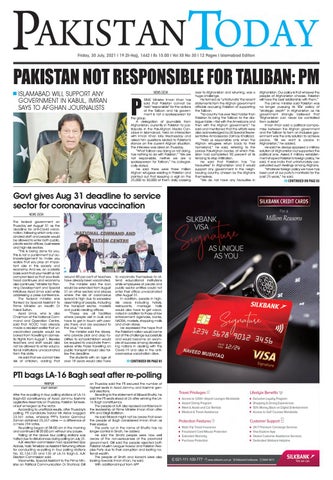
Friday, 30 July, 2021 I 19 Zil-Hajj, 1442 I Rs 15.00 I Vol XII No 30 I 12 Pages I Islamabad Edition
Pakistan not resPonsible for taliban: PM g
Islamabad wIll support any government In Kabul, Imran says to afghan journalIsts
P
news desk
rIme minister Imran Khan has said that pakistan cannot be held “responsible” for the actions of the taliban and his government is not a spokesperson for the group. a delegation of journalists from afghanistan, currently in pakistan to participate in the pak-afghan media Conclave in Islamabad, held an interaction with Imran Khan late wednesday and asked him questions related to pakistan’s stance on the current afghan situation. the interview was aired on thursday. “what taliban are doing or not doing, has nothing to do with pakistan.” “we are not responsible, neither we are a spokesperson for taliban,” he categorically stated. he said there were three million afghan refugees residing in pakistan and pointed out that keeping a vigil on the 25,000 to 30,000 of them daily crossing
Govt gives Aug 31 deadline to service sector for coronavirus vaccination news desk the federal government on thursday set august 31 as the deadline for anti-Covid vaccination, following which only vaccinated staff and people would be allowed to enter both public, private sector offices, businesses and high-risk sectors. “this is being done for you. this is not a punishment but acknowledgement to make you realize that you play an important role in this society and economy. and we, on a priority basis want that your health is not compromised so that your livelihood continues and economy also continues,” minister for planning development and special Initiatives asad umar said while addressing a press conference. the federal minister was flanked by special assistant to prime minister on health dr faisal sultan. asad umar, who is also Chairman of the national Command and operation Centre, said that nCoC had already made a decision earlier that unvaccinated people would be barred from travelling in domestic flights from august 1, likewise teachers and staff would also not be allowed to enter educational institutions unvaccinated from this date. he said that we cannot take risk of children, adding that
around 80 per cent of teachers have already been vaccinated. the minister said the ban would be extended from august 31 on other sectors and places where the risk of coronavirus spread is high due to excessive assembling of people, including the transport sector, markets and public-dealing offices. “these are all facilities where people visit in bulk and have to get in touch with people there and are exposed to the virus,” he said. the minister said the drivers, who provide pick and drop facilities to schoolchildren would be required to vaccinate themselves while those travelling on public transport should also follow the deadline. the students with an age of over 18 years would also have
to vaccinate themselves to attend educational institutions while employees of private and public sector entities could not enter their office unvaccinated after august 31. In addition, people in highrisk areas including hotels, restaurants, marriage halls would also have to get vaccinated in addition to those of law enforcement agencies, banks, nadra, markets, shopping malls and chain stores. he expressed the hope that the pakistani nation would come out of this challenge successfully and would become an example of success among developing nations in dealing with the Covid-19 and also in the anticoronavirus vaccination drive.
CONTINUED ON PAGE 05
PTI bags LA-16 Bagh seat after re-polling MIRPUR staff report
after the re-polling in four polling stations of la-16 bagh-03 constituency of azad jammu Kashmir legislative assembly on thursday, pakistan tehreeki-Insaf emerged as the victor. according to unofficial results, after thursday's polling, ptI candidate sardar mir akbar bagged 23,561 votes, whereas ppp’s sardar Qamaruz Zaman obtained 23,267 votes — a difference of a mere 294 votes. re-polling began at 08:00 am in the morning and continued till 05:00 pm without any pause. polling at the above four polling stations was halted due to disturbances during polling on july 25. ajK election commission had appointed ejaz abbasi, naib tehsildar as assistant returning officer for conducting re-polling in four polling stations no. 42,134,135 and 136 of la-16 bagh-3, ajK election Commission said. meanwhile, special assistant to the prime minister on political Communication dr shahbaz gill
on thursday said the ptI secured the number of highest seats in azad jammu and Kashmir general elections. reacting to the statement of bilawal bhutto, he said the ptI seats stood at 26 after winning the la16 bagh constituency. the people of ajK also reposed confidence in the leadership of prime minister Imran Khan after KpK and gilgit-baltistan. he said bilawal might not be aware that even the people of bagh considered Imran Khan as their saviour. the party run in the name of bhutto has no longer control in sindh, he added. he said the sindhi people were now well aware of the non-seriousness of the provincial government. gill said the people rejected both pakistan muslim league nawaz and pakistan peoples party due to their corruption and looting national wealth. the people of sindh and Karachi were also looking towards Imran Khan, he said. with additional input from app
over to afghanistan and returning, was a huge challenge. he termed as “unfortunate’ the recent statements from the afghan government officials accusing pakistan of supporting the taliban. “no country has ever tried harder than pakistan to bring the taliban to the dialogue table – first with the americans and then with the afghan government,” he said and mentioned that the efforts were also acknowledged by us special representative ambassador Zalmay Khalilzad. “hold us responsible only when the afghan refugees return back to their homeland,” he said, referring to the porous pak-afghan border, of which pakistan had completed 90 percent of its fencing to stop infiltration. he said that pakistan has “no favourites” in afghanistan and it would support any government in the neighbouring country, chosen by the afghans themselves. “we do not have any favourites in
afghanistan. our policy is that whoever the people of afghanistan choose, pakistan will have the best relationship with them.” the prime minister said pakistan was no longer pursuing its 90s’ policy of “strategic depth” in afghanistan as his government strongly believed that “afghanistan can never be controlled from outside”. Imran Khan said a political compromise between the afghan government and the taliban to form an inclusive government was the only solution to achieve peace. “all we want is peace in afghanistan,” he added. he said he always opposed a military solution of afghanistan but supported the political one. asked if military establishment shaped pakistan’s foreign policy, he said, it was India that unfortunately perpetuated such feelings among afghans. “whatever foreign policy we have has been part of our party’s manifesto for the past 25 years,” he said.
CONTINUED ON PAGE 05
02
Friday, 30 July, 2021
islamabad
nEws
BIlAwAl sAys PPP PrePArIng For Any FAllout From AFghAn sItuAtIon KARACHI
P
Staff RePoRt
AKISTAN People’s Party Chairman Bilawal Bhutto-Zardari said on Thursday that asserted that his party was devising policies and contingencies for any fallout from the Afghan situation. Bilawal said while addressing a press conference after a meeting at the Chief Minister House in Karachi that Pakistan would have to face tests in the coming days and the PPP was the only political party that could handle them. “Pakistan will face a loss from the situation developing in Afghanistan and there will be a severe blowback. If anywhere the blowback and reaction will be felt and seen, it will be in Karachi which is home to one of the largest populations of Pakhtuns in the world. “If the situation in Afghanistan worsens then there will be effects on our environment. We are doing our preparation
SINDH CM ORDERS TO KEEP CHECK ON PROSCRIBED ORGANISATIONS and making our policies on how to do the kind of development and ready the kind of system in Sindh and our capital Karachi to deal with the coming influx and blowback,” said the PPP chairman, according to a report by Dawn. Bilawal stressed that there was a heavy responsibility to not only find solutions for the basic problems of the people but to deal with the “difficulties we are seeing in the coming tomorrow”. “God forbid we will have to see the time of extremism and terrorism again which we had gotten out of. So we will only be able to confront it when the PPP has a stake, has a government and representation.” Bilawal’s comments came the same day as Sindh Chief Minister Murad Ali Shah chaired the 26th meeting of the apex committee where the Afghan situation and its potential fallout were discussed.
Owing to the prevailing situation in Afghanistan, Sindh Chief Minister Syed Murad Ali Shah earlier on Thursday ordered concerned authorities to keep a close check on the proscribed organizations across the province. Chairing the meeting of the Sindh Apex Committee, the Sindh CM said the situation in Afghanistan is changing dramatically and in this context, strict security arrangements should be put in place in the province. He asked the law enforcement agencies to keep a close check on the proscribed organizations and the hate content from social media. Additionally, the chief minister ordered for hateful content and suspicious activities on social media to be monitored. “Some elements will try to incite sectarian hatred, which should not be tolerated under any circumstances,” CM Shah said. Commenting on the private armed guards
roaming on the unregistered vehicles in the province, he said there is a ban on displaying arms in Sindh and such vehicles having private security guards should be impounded. The work on the registration of the security guards is underway, he maintained. The chief minister also ordered to launch a crackdown against the unregistered and AFR vehicles running in the province. Additional Inspector General-Special Branch Ghulam Nabi Memon too informed the meeting that clashes between the Afghan government and Taliban could bring illegal immigrants to Sindh, particularly Karachi. During the presser, Bilawal noted that there had been an improvement in administrative and development works but more political ownership and checks and balances were needed. “I have given a special task to the chief minister to find a solution for all of Karachi
where we can solve problems of people with all checks and balances,” Bilawal said. He added that a political representative should be selected in every city district who was familiar with the people’s problems, could monitor the local administration and serve as an access point for the public. Bilawal said the issues of water supply, transport and trash collection were the “most important targets” for Karachi’s administration. He mentioned the various developments taking place to resolve the aforementioned issues. “You and the Sindh government have to deliver on these three issues.” Predicting that the PPP would form the next government, Bilawal said Karachi’s seats and its ownership were necessary for that to become reality. “This is a prime opportunity for the PPP,” Bilawal stressed. “It is very necessary for the country that a PPP [majority] government is made but also for Karachi that the PPP comes in front from this city so we can defend it and deliver its rights to its citizens.” Bilawal said injustices had been meted out against the city in the past and were still continuing, with the PPP the only political party to talk about them. The PPP chairman called upon members of his party to stop their squabbling on a “war footing” for six to eight months. He said the general elections could happen at any time and the PPP had to start its preparations for them from today.
ECP issues notice to premier for failing to hold intra-party elections NEws DEsK
Chohan handed over to FIA on remand LAHORE Staff RePoRt
A district and sessions court in Lahore on Thursday handed over a Pakistan Tehreek-e-Insaf legislator from Punjab to Federal Investigation Agency on twoday physical remand. Nazir Chohan, an active member of Jahangir Tareen posse, was booked in May on the complaint of Minister of State for Accountability Mirza Shahzad Akbar who accused the former of levelling allegations concerning his faith during a television programme. Subsequently, the police arrested him Tuesday but released him the following day after he secured bail, only to arrest him again moments after under cyber laws. The agency produced Chohan before the court of Judicial Magistrate Yousuf Abdul Rehman. The court, on the agency’s request, approved the remand, directing it to produce the legislator again on July 31. The cybercrime wing of the agency had booked Chohan on Akbar’s complaint under sections 11 and 20 of Prevention of Electronic Crimes Act, 2016, and read with 298, 500, 505(C), 506 of the Pakistan Penal Code and 29 of the Telegraph Act, 1885.
The Election Commission of Pakistan has issued a show-cause notice to Prime Minister Imran Khan for not holding intra-party elections within the stipulated timeframe. ECP, in its notice to the PM, who is also the acting chairman of the ruling Pakistan Tehreek-e-Insaf, has said that his party has failed to provide a certificate with regard to the conduct of intra-party elections. The ECP notice sought reasons from the PTI chief for not holding intra-party polls due on June 13, 2021. ECP further asks that why PTI may not be declared ineligible to obtain an election symbol for upcoming elections. “… in terms of Section 215 (4) of the Elections Act, 2017, you are required to show cause as to why your party may not be declared ineligible to obtain an
election symbol for upcoming Election (s),” the ECP notice to the premier reads. The ECP also sought a
response from the prime minister within 14 days, warning that the election commission “shall take further action under the law” if the notice was not responded to. The election commission said a political party was required to submit a certificate signed by an officebearer of the party, assuring that the polls were held in accordance with the constitution of the political party and the Elections Act. However, the [PTI] failed to provide the certificate with regard to the conduct of intra-party elections due on June 13, 2021 as required under legal requirements, said the ECP. It also highlighted that a political party enlisted under the Elections Act shall be eligible to obtain an election symbol for contesting elections for parliament, provincial assemblies or local government after the submission of the certificate of intra-party elections.
Pagara, Tareen complain of unfair treatment KARACHI INP
Pakistan Muslim League-Functional chief Pir Pagara and estranged Pakistan Tehreek-i-Insaf leader Jahangir Tareen on Thursday expressed reservations over the treatment meted out to them by the federal government. In a meeting held at the residence of the PML-F chief in Karachi, Pagara complained about the government’s efforts to woo members of his party to join the ruling party. Whereas Tareen was of the view that the authorities
were bent upon making PTI MPA from Punjab Nazir Chohan a “rebel”. He made it clear that he had no separate group of parliamentarians and that whatever accusations had been levelled against him were mere “propaganda”. Tareen said the Chohan’s arrest had left members of his posse feeling concerned. “I have remained loyal to the party all these years. But sadly, I was targeted still,” he regretted. Pagara regretted that despite the fact that PML-F was supporting the government unconditionally, the latter was trying to trigger defections in his party. “Around 300 of my devotees were booked in
different cases when Special Assistant to Prime Minister on Sindh Affairs Arbab Ghulam Rahim was running his election campaign. And they are still facing these cases,” he said. PML-F chief said that if PTI was dying to create dents in its allied parties, it should have better waited for the next general elections. He said he had conveyed to the government his party’s concerns. “I have told Foreign Minister Shah Mehmood Qureshi how we are feeling after the recent steps taken by the PTI,” Pagara said. Both leaders agreed on meeting each other in future as well.
Ex-army officer among three remanded to police in illegal vaccination case NEws DEsK Three suspects, including a former army officer, have been detained and remanded by a Karachi court for illegally administering Covid-19 vaccines to the general public in return for a payment in the port city’s Saddar area. The suspects involved in the case are Major (r) Amanullah Sultan, owner of M/s Sultan Madad Private Limited; his employee Mohammed Ali; and government vaccinator Muhammad Zeeshan. They were arrested for purportedly stealing the vaccine from government stocks and illegally administering it to people at their homes for money in the jurisdiction of Preedy police station, reported Dawn. On Thursday, the investigation officer produced them before the judicial magistrate (South) to seek their physical remand for interrogation and investigation. The IO informed the court that the suspects used to administer the stolen
vaccine (Pfizer) to people for Rs15,000 per dose, adding that they had vaccinated around 60 people in the Saddar area. He said that 14-day custody of the suspects was required to interrogate them in order to arrest their other alleged accomplices — who are on the run — and complete investigation and other legal formalities. However, the judge remanded them in police custody for one day, directing the IO to produce them on the next hearing tomorrow along with an investigation report. According to the first information report, the complainant, provincial drug inspector for South district Ghulam Ali, said he had received information from “reliable sources” that certain persons had stolen Covid-19 vaccines from a vaccination centre established by the Sindh government and were allegedly administering the jabs to residents at their homes for cash. The drug inspector said he subsequently approached a man,
Mohammed Ali, whose name was conveyed to him as being involved in the activity, on the pretext of getting vaccinated. The suspect agreed to administer the jab at his home and told him that he would meet him at a restaurant in Saddar at 10:30 pm on July 25. The complainant further said that he, along with Covid-19 focal person Dr Sohail Raza Sher, Dr Dilawar Jiskani and a police party, reached the agreed spot where suspect Mohammed Ali was taken into custody. He alleged that the suspect possessed a box of syringes and also had two empty vaccination cards with
inscriptions of the Sindh health department, adding that the box also contained three used vials and 14 specimen collection swabs. According to the FIR, suspect Mohammed Ali revealed during the initial probe that he was an employee of Sultan Madad Private Limited, whose owner was a former army officer, retired Maj Amanullah Sultan. The suspect told police that he worked as the company’s field officer, while the owner provided him and others with the vaccines which they used to administer to citizens at their homes in return for monetary compensation.
Friday, 30 July, 2021
ISLAMABAD
NEWS
STZS To hElP TEch bUSinESSES ThrivE in coUnTry: PM P
NEWS DESK
RIME Minister Imran Khan has said that enhanced number of special technology zones (STZs) with all the needed ecosystem will go a long way in facilitating tech businesses to thrive in the country. The prime minister said this while chairing a meeting on Thursday to review the progress made towards streamlining business processes especially in priority sectors including small and medium enterprises (SMEs) and the establishment of special technology zones (STZs) in the country. The prime minister emphasised that equal attention should be paid towards setting up STZ in Balochistan
US hands over 3m more Moderna jabs to Pakistan ISLAMABAD TLTP
and AJK, besides major cities which are already ahead of the curve in establishing such STZs. During review, the prime minister appreciated the progress made so far by different departments of federal and provincial governments towards improving ease of doing business. These steps include easy and fast registration of companies and online approvals through a fast track system. The prime minister directed relevant authorities to expedite work on remaining identified steps in this regard. He expressed satisfaction towards efforts being made to reform the tax system and directed that maximum facilitation of the business community be ensured. He said that the proposal of levying a fixed tax on goods at an affordable rate may also be considered in
government is committed to providing every possible assistance and resources to the judiciary to remove obstacles in the way of access to justice and make the judicial system more effective. The attorney general apprised the prime minister of different judicial matters, ongoing reforms in the justice system and Water Commission Report. The prime minister lauded the efforts of Justice Shahid Karim regarding the Water Commission report. He said that the water issue is of prime importance. Justice Shahid Karim's special interest and efforts for this important national issue are commendable. The prime minister also appreciated the efforts of the team headed by Justice (retd) Ali Akbar Qureshi in compiling the report of the Water Commission.
Construction sector attracted Rs1tr investment: Farrukh ISLAMABAD APP
The United States has officially handed over the second batch of three million Moderna Covid-19 doses to Pakistan to help in its fight against the pandemic. “Today, the United States was pleased to donate three million doses of the life-saving Moderna Covid-19 vaccine to the Government of Pakistan for distribution to the Pakistani people. These vaccines were delivered in partnership with the COVAX facility and UNICEF,” read an official statement issued on Thursday. The USdonated jabs reached Islamabad on Monday through the COVAX facility with the Unicef support. The official statement said the donation is part of the 80 million doses the US is sharing with the world, “delivering on our pledge to facilitate equitable global access to safe and effective vaccines, which are essential to ending the Covid-19 pandemic”. “As President Biden has said the United States is committed to bringing the same urgency to international vaccination efforts that we have demonstrated at home,” the statement added. “We are here today because we share a common goal – supporting access to Covid-19 vaccines for the populations that need them the most,” US Embassy Chargé d’Affaires Angela P Aggeler at a handover ceremony with Prime Minister Special Assistant on Health Dr Faisal Sultan. “The arrival of these three million doses is in addition to the 2.5 million doses the United States donated earlier this month to the people of Pakistan. These vaccines, which come from our own domestic vaccine supply, are a clear demonstration of President Biden’s promise – and our promises kept – to stand with the people of Pakistan in the fight against the Covid-19 pandemic.”
consultation with all stakeholders, besides introduction of an international standards rating regime to ensure quality control. He also commended the efforts of Special Technology Zones Authority (STZA) in attracting big tech companies like Huawei and Samsung along with top boot camps to start operations in Pakistan. It would not only offer a lot of training opportunities to talented Pakistani IT professionals but would also lend them rewarding employment opportunities, he further said. Separately, Prime Minister Imran Khan has said that ensuring provision of speedy and easy justice to the common man is the foremost priority of the government. Talking to Attorney General of Pakistan Khalid Javed Khan on Thursday, the prime minister said the
03
Minister of State for Information and Broadcasting Farrukh Habib on Thursday said there had been a massive increase in economic activity in the country due to the revival of the construction sector, which had so far fetched investment of Rs one trillion. Prime Minister Imran Khan had introduced a special package for the construction sector, including the Federal Board of Revenue exemption regime and reduction in fixed taxes, to offset the negative impacts of the lockdown imposed to curb the coronavirus pandemic in April last year, he told media persons. The package, he said, received an overwhelming response from across the country with scores of projects of Rs1,000 billion in the construction sector that were given approval by both the federal and provincial governments. The projects of Rs491 billion registered with the FBR under its exemption scheme were also among them, the minister added. Farrukh said the construction sector’s boom would have a multiplier effect on more than 120 allied industries, which would eventually generate Rs100 billion economic activity and 700,000 jobs across the country. Giving a general breakup, he said some 24,404 investment projects worth Rs 373 billion were approved in Punjab, which would not only ensure Rs 1,900 billion economic activity but also create 325,000 employments in the province. Similarly, multiple projects worth Rs 74 billion were approved in Khyber Pakhtunkhwa, which would also generate economic activity of Rs 371 billion along with 64,000 jobs, he added. Likewise, he said, projects worth Rs 175 billion had been approved for the Federal Capital, which would likely create 104,000 employment opportunities. The minister said the approved projects of Rs 267 billion would be generating economic activity of Rs 1,300 billion and 200,000 jobs in Sindh. He, however, regretted that the builders and investors in Sindh were complaining about a delay in the approval of their projects. The Sindh government, he said, received 400 applications for various projects in the last several
months, but approval was given to only 90, while billions of rupees projects were still pending. The Sindh Building Department, he alleged, was deliberately delaying the approval out of its obsession with corruption and called upon the provincial government to pay special focus to the construction sector and facilitate the investors. Farrukh said the Federal Government had held 94 meetings on the construction sector. Some 48 meetings of the National Coordination Committee on Housing, Construction, and development were convened by the prime minister, he added. He said Prime Minister Imran Khan, soon after coming into power in 2018, took historic steps to boost the construction sector that was neglected by the previous governments. “The construction industry plays an important role in the economic uplift and development of any country,” he remarked. Farrukh said Prime Minister Imran Khan was committed to providing affordable houses to the poor instead of purchasing flats in London or opening accounts in Swiss banks. He had bound all the banks to spend five percent of their total lending for financing, i.e., Rs375 billion, on low-cost housing, he added. He said the banks had so far approved loan applications for Rs45 billion under the low-cost housing scheme, out of total requests for Rs145 billion. The government, he said, would provide a subsidy of Rs0.3 million on the construction of the first 100,000 houses, while the applicant would have to return the loan amount in 10 to 15 years at a low interest rate. The people, who were living in rental houses, would become the owner of the homes by paying monthly loan instalments of Rs10,000 to Rs15,000. He said that around 20,000 low-cost units had been built by the Naya Pakistan Housing and Development Authority while the construction of another 45,000 was underway in collaboration with the provincial authorities. He also said that PM Imran Khan participated in balloting for the allotment of 2,000 residential apartments under the Lahore Development Authority City. Similarly, low-cost housing units were being built in Frash Town, Islamabad, and Jalozai, Khyber
Road to ruin: Double tax and bandits on Pak-Afghan trade route ISLAMABAD AFP
The Taliban’s capture of a key Afghan-Pakistan border post has sent trucking costs soaring, with insurgents and government officials separately taxing traders, and bandits demanding bribes to allow safe passage of goods. Thousands of vehicles cross daily from Chaman in Balochistan to Spin Boldak on the other side, carrying goods destined for Kandahar, Afghanistan’s second-biggest city. On the way back they usually ferry agricultural produce bound for Pakistan’s markets or ports. The bilateral trade — worth hundreds of millions of dollars a year if not more — ground to a halt earlier this month after the Taliban seized the dusty border town, but resumed this week with the insurgents seemingly firmly in charge. They have captured a vast swath of the country since early May after launching a series of offensives to capitalise on the final stages of the withdrawal of foreign troops. While they have not yet taken any provincial capitals, they have captured a string of key
border posts — with Iran, Tajikistan, Turkmenistan and Pakistan — which provide vital revenue from customs duties on goods arriving in the landlocked country. “We loaded grapes in Kandahar and on the way we have been extorted at least three times,” trucker Hidayatullah Khan told AFP at Chaman. “Sometimes they charge Rs3,000 ($20), somewhere else Rs2,000, and in some other place Rs1,000,” he said. That was on top of the taxes he had to pay Taliban officials in Spin Boldak and Afghan government customs officials who have opened shop in Kandahar. CHAOS AND CONFUSION: Truckers interviewed in Chaman this week told of chaos and confusion on the Afghanistan side of the border. Imran Kakar, vice president of the PakistanAfghanistan Joint Chamber of Commerce, gave one example of a truck carrying fabric from Karachi destined for Kandahar. The Taliban charged the driver Rs150,000 (about $1,000) as duty in Spin Boldak, but when the vehicle reached Kandahar government officials were also waiting. “We had to pay even higher customs duties as they don’t acknowledge the payments made to Taliban,” said Kakar.
Pakhtunkhwa. Similarly, he continued, thousands of low-cost houses were being built in 40 Tehsils across Punjab. A project was underway in the Sargodha district under the Punjab Government’s Peri-Urban Scheme. Farrukh elaborated the federal government had submitted around 230 projects to NAPHDA for the construction of some 300,000 units, and 48 of them were shortlisted for building 70,000 units. Negotiations with the banks to get financial support in that regard were in the final stage, he added. He maintained the prime minister had instructed the Survey of Pakistan for digitization of land records in the country that would not only help the authorities to upgrade the land management system but also facilitate it in land acquisition in a transparent manner. During the first phase, he explained that three major cities – namely Karachi, Lahore and Islamabad – were focused upon. About 50 percent land record of the total 2500 square kilometres area of Karachi had been computerized, he added. He regretted that the Sindh authorities were not cooperating with the Survey of Pakistan due to their alleged involvement in corrupt land practices. It was revealed during the survey that 25 forests on state land in Karachi had vanished due to grabbing by the mafia, but the provincial authorities were reluctant to provide any record in that regard. He said that 60 percent digitization of land records in Lahore, which had an area of 900 square kilometres, had been completed and 95 percent in Islamabad. He added that the government had retrieved hundreds of thousands of acres of state land across the country. Most of the land was grabbed by politicians and influential people, particularly those belonging to the Pakistan Muslim League-Nawaz and the Pakistan People’s Party, he added. He said the prime minister had given a clear-cut direction to the Survey of Pakistan to complete the land record digitization by October 30, and about 80 percent of work had already been done across the country, except Sindh. He urged the Sindh government to cooperate with the Survey of Pakistan in the larger interest of the people of the province.
UAE’s national carrier suspends Pakistan flights till further notice DUBAI TLTP
The United Arab Emirates’ national carrier Etihad Airways has said that flights from Pakistan and India have been suspended until “further notice”. Asked if flights would resume from August 3, Etihad Help told a netizen: “Following the recent update our flights from India and Pakistan have been suspended until further notice. As soon as we receive an official communication of changes to this regulation, our website will be updated. Do stay tuned for the latest travel information.” Earlier, Emirates airline has announced that passenger flights from Pakistan, India, Bangladesh and Sri Lanka will remain suspended until at least August 7. The Dubai-based carrier said in its fresh travel update on the website the suspension on the incoming scheduled passenger flights from these countries to the UAE has been extended until at least August 7. The passengers who have connected through these countries in the last 14 days will also not be accepted for travel from any other point to the UAE, the airline added.
Friday, 30 July, 2021
04 NEWS
ISLAMABAD
PunjAb To hold lb elecTions in MArch 2022 LAHORE
T
INP
HE Punjab government on Thursday decided to hold the local bodies elections in March next year. Reports citing sources suggested the Pakistan Tehreek-i-Insaf government in the province has completed its homework regarding the conduct of the polls. The Metropolitan Corporation Lahore has already chalked out the rules for the delimitation of constituencies. The total cost to be incurred on the elections is estimated to be around Rs4 billion. The province and the Election Commission of Pakistan have also agreed to hold the polls. The ECP will announce a final date for the elections. The tenure of the incumbent LB bodies is expiring
in December. The Supreme Court on March 25 restored the local government system in
Punjab, by terming the Local Bodies Act, 2019 in contradiction with the Constitution.
The Punjab Local Government Act, 2019 was passed by the legislative assembly in May 2019. A bench of the Supreme Court headed by Chief Justice Gulzar Ahmed, terming section 3 of the Local Bodies Act in contradiction of the Constitution, ordered to restore the local government system. The government had dissolved the bodies in May 2019 under Section 3 of the Punjab Local Government Act, 2019, though the polls were conducted under the act in phases in 2015 and 2016. The tenure of the elected bodies is five years. But the tenure of local bodies came to an abrupt end on July 2 last year after the provincial government amended Section 3(2) by inserting the words “21 months” to replace “five years”.
Punjab directs public offices to turn away unvaccinated people American basketball player’s charity helps build solar water centre in Thar NEWS DESK American professional basketball player Kyrie Irving’s charity foundation has collaborated with Paani, a nonprofit organisation, to build a solar water centre in Sindh’s Thar region, a news outlet reported. According to the report, the water centre is providing clean water and facilitating farming in a remote area of Thar. Paani, in a series of tweet on Wednesday, had lauded the player for taking the initiative through his KAI Family Foundation. “NBA superstar and humanitarian Kyrie Irving built a Paani solar water centre in Sindh with his K.A.I. Family Foundation,” one of the tweets said, adding that the centre had made clean water accessible for over 1,000 village folks in the area. Paani further said that the initiative has facilitated farming for families and is “providing light to women and children”.
LAHORE INP
The Punjab government on Thursday decided to restrict the entry of non-vaccinated people in government offices. It raises questions over whether the government might use immunity passports as a way to get people back into public venues. They are already used by some countries to see whether people have protection against yellow fever or polio.
Earlier this month, the National Database and Registration Authority directed field offices to turn away people who have refused a Covid-19 vaccine. Some 200,000 people visit NADRA centres across the country on a daily basis for identity-related services. While having the vaccine is not compulsory, the branches might require proof that people have been vaccinated before allowing them in. Many feared that if the agency stops entertaining the non-vaccinated, a large number of people won’t be able to get a vaccination certificate.
Korangi child murder case registered under terror charges NEWS DESK The case concerning the kidnapping, rape and murder of a six-year-old girl in Karachi’s Korangi area has been registered under terrorism and other charges, while the police have launched a multi-prong investigation into the matter as well, Dawn reported on Thursday. They also prepared a sketch of the possible suspect and sent the child’s DNA samples to a laboratory at the University of Karachi, according to officials. The minor girl had gone missing from her house in Ghous Pak area of Korangi on Tuesday night. Her body was found the next day from a garbage dump in Zaman Town near her residence after a search of nearly eight hours. “Her autopsy showed that she had been raped, sodomised and then murdered,” said the additional police surgeon at the Jinnah Postgraduate Medical Centre, Dr Summaiya Syed. There were “multiple injuries to the head and body and private parts”, Dr Syed added. Landhi SP Shahnawaz Chachar said Zaman Town police had registered the case’s first information report under Section 7 (punishment for acts of terrorism) of the Anti-Terrorism Act, and sections dealing with kidnapping, rape and murder against unknown suspects. A DSP-rank officer has been assigned the investigation of the case, the officer added. East Zone DIG Saqib Ismail Memon said a “multi-directional probe is underway based on the statements of witnesses, family and area residents.” He added that several suspects had been taken into custody and were being interrogated. “Technical data is also being analysed, while a dedicated team has been constituted” to probe the case, DIG Memon said. The senior officer told Dawn.com that DNA samples collected from the girl’s body had been sent to a lab at Karachi University. He said a sketch of the suspect had been prepared with the help of witnesses. According to the contents of the FIR reviewed by Dawn.com on Thursday, the victim’s father said that he worked at a private firm and had been living in Korangi’s G-Area for the last 11 years in a rented house and had four children. The complainant said he along with his three daughters, aged between two to nine years, was sitting outside on a street near his home as electricity had gone out in the locality at around 10:15 pm on July 27. Some time later, he returned home along with two of his daughters, while his third daughter aged six remained outside to play with other children. At around 10:45 pm, his elder daughter informed him that the six-year-old girl had not come back home. The complainant said he immediately went outside and looked around for his daughter, but in vain. The neighbours were unable to help as well. The next day (July 28) at around 5:45 am, he came to know that the body of a minor girl was lying in a garbage dump near the wall of a school in the G-Area market. He went to the spot along with his neighbours and discovered that it was his daughter’s body.
Chinese support helps children embrace better education ISLAMABAD XINhua
Sharafat Afridi, the father of three daughters in the Khyber district of Khyber Pakhtunkhwa, eagerly awaits the completion of 50 schools being gifted by the Chinese government to the children in his district to restart their education by getting back to school. Khyber district is part of the erstwhile tribal region that had suffered the menace of terrorism for over a decade until the situation improved in recent years. The poor security in the province has taken a toll on the educational system, and many children in the area either do not get a quality education or are out of school due to a lack of educational institutes. “Terrorism hit us really hard, we lost our business and peace, but it was my daughters’ education which suffered the most. My eldest two daughters were in their early primary years in 2015, and one morning when they went to attend their school, the building was no longer there because it was blasted by militants,” Afridi told Xinhua. However, he said his daughters, who did not lose hope by continuing their learning at home temporarily, later attended a school far away from their house regardless of trouble and harsh weather conditions during winter. “My youngest daughter is of school-age now and she will start her early years at school soon. We are so happy that she will be able to study in a new school constructed near my home.” According to data compiled by the provincial government, over 1,000 girls’ schools were attacked in the previous tribal agencies till 2015, out of which 555 were completely destroyed. Talking to Xinhua, Muhammad Humayun, subdivisional officer of the building division in Khyber district, said the government has rehabilitated 895
CMYK
damaged schools and some of the schools being built with the Chinese donation also include those earlier destroyed. “There are no good schools in the area. The available schools are very small with two classrooms for the primary section and no more than four for the middle section. They are far away from each other and are overcrowded with students,” he said. The schools being built with Chinese donations are bigger and better, Humayun said. “Most of the new schools have six rooms for primary and 10 for
the middle section, giving a pleasant environment for kids who have seen unrest in the region since their birth to breathe in a peaceful environment and get quality education.” Muhammad Rafique Tahir, a joint educational advisor at the Ministry of Education and Professional Training, said: “The number of out-of-school children is increasing in tribal areas due to unavailability of schools”, noting that the Chinese government donation “is a big help for the government and a great gift to the people of the tribal district.”
Friday, 30 July, 2021
ISLAMABAD Govt gives Aug 31 deadline to service sector for coronavirus vaccination continued from page 01 Talking about the ongoing vaccination drive, the minister said that the government intended to mount the vaccination target to one million people in one day adding that the highest number of 849,692 people were vaccinated on July 28, following the vaccination of 778,000 on July 27 and 680,000 on July 26. He said that the single dose vaccination also touched the highest number of 637,000 in one day, adding that in provinces one day record of 500,000 vaccinations was made in Punjab, 169,000 in Sindh, 111,000 in Khyber Pakhtunkhwa and 18,500 in Balochistan. The minister maintained that people should realize that whatever they did, have an effect; if they follow standard operating procedures, the coronavirus would definitely come down and if they ignore it, the pandemic would spread. He stated when SOPs were followed in Ramadan and Eid, positive results were witnessed as the pandemic had gone down, but people take it easy when it recedes and consequently, it climbs up accordingly. Asad Umar, however, added that implementation of SOPs was not the only solution, the people needed to be vaccinated as early as possible. He said that the government had adopted a prudent strategy by striking a balance between controlling coronavirus and allowing economic activity across the country. He stressed that complete lockdowns did not work in India and Bangladesh and had a very negative effect. The minister said the government had the comprehensive framework and was taking data-based decisions. However, he said there were problems in compliance of coronavirus SoPs all across the country. Giving data about the enforcement of Coronavirus SoPs, the minister said that 56.4 percent followed SoPs in Federal Capital, while the percentage was 46.6 in Khyber Pakhtunkhwa followed by Azad Jammu and Kashmir with 42.7 per cent, Gilgit Baltistan with 37.4 per cent, Punjab with 38 and Sindh and Balochistan 33 per cent. LOCKDOWN EXPECTED IN KARACHI: The Sindh government, on the other hand, is mulling a complete lockdown in Karachi as the city’s hospitals are “nearing saturation point”, members from the provincial task force on coronavirus told Geo News on Thursday. The task force’s members said the final decision to impose a lockdown in the port city would be taken in a meeting tomorrow at 11 am, with Chief CM Murad Ali Shah in the chair. Provincial government officials told Geo News that medical experts within the task force have asked for a complete 14-day lockdown in the city. “Hospitals are nearing a saturation point with cases in Karachi rising rapidly,” the task force members said, adding that the Sindh government was consulting stakeholders on the imposition of a lockdown. Representatives of the Pakistan Medical Association have already demanded a complete lockdown across Sindh, the members said. The task force members said more than 370 patients had been admitted to hospitals across Karachi in just the last two days. “The pressure on oxygen supply is increasing with the influx of patients.” Businesses will be shut and a complete ban on public movement will be imposed during the lockdown, the task force members said. On a positive note, the Sindh government’s suggestion to block SIM cards of people who have not been vaccinated seems to be working, with hundreds of people lined up outside Karachi’s vaccination centres, Geo News reported. A long queue of people could be seen outside Expo Centre, the biggest vaccination centre in the city. with additional input from APP
FBR launches single identifier number for all domestic taxes LaHore staff report
FBR has launched single identifier number for all domestic taxes under which a taxpayer can use all applications under the income tax, sales tax and federal excise duty by mere use of CNIC if a taxpayer is an individual. In case of partnership firms and companies, National Tax Number (NTN) shall be the common tax identifier number. In this manner the sales tax, income tax and federal excise law have been harmonised. This is an important step toward ease of doing business and will substantially improve Pakistan’s rating on this count. FBR has also launched a facility whereby taxpayers can now make payments without visiting the bank. This facility is widely known as Alternate Delivery Channel (ADC) payment mode. ADC allows taxpayer to pay all federal taxes and duties from any commercial bank account through internet banking, ATM, mobile banking and contact centers. However in the case of individual taxpayer, the alternate facility of making the payment over the counter (OTC) has still been allowed simultaneously along with ADC channel till September 30, so that no inconvenience is caused to the individual taxpayer for seamless filing of returns. Meanwhile, local media reports state that the federal government may promulgate a presidential ordinance to hand over record of existing three million taxpayers to the National Database and Registration Authority (NADRA) in a bid to increase tax collection.
NEWS
05
PAkiStAn SeekS Un helP FoR incReASinG AGRicUltURAl PRoDUctivity iSLamaBad
i
staff report
N an attempt to increase agricultural productivity, the government has asked Food and Agriculture Organisation (FAO) of the United Nations to evaluate the current capacity of Pakistan Agricultural Research Council, the country’s main research and development agency for agriculture, and suggest the direction of a strategic planning. The request to FAO was formally made by Minister for National Food Security and Research, Syed Fakhr Imam, during a meeting with the acting FAO Representative in Pakistan, Rebekah Bell, on Tuesday. The government also requested FAO to carry out an assessment of the Pakistan Central Cotton Committee (PCCC) and suggest a restructured business plan so as to overcome the difficulties the country is facing in cotton production. Fakhr Imam told the FAO representative that the assessment of the roles of PARC and PCCC were vital to develop an integrated strategic plan for next five years to enhance institutional relevance
and effectiveness as FAO is a trusted strategic partner of the ministry of national food security. It is crucial that the agricultural productivity in Pakistan is increased substantially in order to feed the growing population and address pressing challenges such as the adaptation to climate change and rising and volatile food prices. Despite various policy reforms instituted over the past decade, Pakistan remains vulnerable to food insecurity, and agricultural R&D investment remains too low to address this challenge. Recent data reveals that public agricultural research and development spending in Pakistan has been far from stable and insufficient to keep pace with agricultural growth. Available data indicates that for every $100 of agricultural output, Pakistan invest just $0.21 in agricultural research and development. This is one of the lowest levels in the developing world, and a considerable decline from the levels recorded in the 1990s. In comparison, India’s agricultural research and development investments as a share of agricultural output were almost twice those of Pakistan.
The last assessment of PARC was carried out more than five years ago by the Washington-based International Food Policy Research Institute (IFPRI) had observed that since there is a significant time lag between investing in research and reaping its rewards, agricultural research and development requires longterm commitments in sufficient and sustained funding and well-staffed research agencies. Pakistan is not only facing financial challenges when it comes to agricultural research and development. In terms of human capacity, it also fares significantly worse than other countries in the region. The country’s share of agricultural researchers with PhD degrees remains very low, at only 18 per cent. More worryingly, most of these PhD-qualified scientists are in their fifties, making the training and mentoring of newly recruited scientists will be a major priority in the coming years, the assessment observed. To address the country’s agricultural productivity challenges, Pakistan needs to increase its investments in strategic agricultural research areas. The government needs to clearly define its long-term R&D
priorities and secure sustained funding, not only in support of salary-related expenditures, but also to cover the day-today costs of operating research programs. More creative mechanisms also need to be explored to stimulate private funding for agricultural research and development, according to IDPRI assessment. The assessment observed that Pakistan’s capacity to deliver effective agricultural research outputs is hindered by critical human resource challenges. Long-term recruitment restrictions have left many federal and provincial research agencies with aging pools of researchers. Given the official retirement age of 60 years, large-scale capacity losses are imminent in the coming years. Moreover, limited opportunities for promotion and training, as well as a lack of performance-based merit systems, constitute key impediments to staff motivation. The country’s total number of agricultural researchers grew slightly in recent years, mostly due to increased involvement in agricultural R&D by universities; however, relative to its South Asian neighbors, Pakistan has a low share of PhD-qualified agricultural researchers.
Pakistan not responsible for Taliban: PM continued from page 01 On India, he said the Pakistan army fully backed the government’s initiatives of maintaining peace with the neighbouring country. “It is India that refused to have peace as it is controlled by the RSS ideology, which is anti-Pakistan and anti-Muslim,” he said. To a question on whether Pakistan, Afghanistan and India could hold a trilateral meeting to resolve their “longstanding issues”, he said Pakistan would not be ready for such an arrangement until India reverts its illegal act of August 5, 2019, where it had changed the special status of Jammu and Kashmir. The prime minister said Pakistan was concerned for peace in Afghanistan because the country’s economic strategies greatly depended on it. A peaceful Afghanistan, he said could act as a corridor for Pakistan’s trade route to Central Asian states and could also benefit from Pakistan’s Gwadar seaport. He feared that a continued civil war between Taliban and the Afghan government would certainly spill over to Pakistan’s tribal areas leading to an influx of refugees. “Pakistan cannot afford such a situation and for this reason is trying its best for a political solution in Afghanistan,” he added. On investigation of the “alleged abduction” of the daughter of Afghan ambassador in Islamabad, he said, “Her account about taxi drivers does not tally with what the [CCTV] cameras showed”. The prime minister said the CCTV footage of the time of the incident showed Silsila Alikhil, the daughter of the Afghan envoy, was travelling in a taxi without any fear but she claimed that unidentified abductors tortured her before bundling her into a taxi. He maintained that they had traced and interrogated
the taxi driver and obtained the videos from the Safe City cameras, adding that there were discrepancies in her statement and the probe report. The prime minister said, unfortunately, the ambassador’s daughter had left the country and there was no way to confirm what had happened. A team would be arriving from Afghanistan and the government would share all information with it, he said. He maintained that the Afghanistan team could question the ambassador’s daughter on the basis of the videos and the investigation done by the Pakistani police. On promoting cricket collaboration between Pakistan and Afghanistan, he said the Afghan team improved in such a short span of time. “They learnt it [cricket] in the refugee camps here, so it is remarkable,” he said. On the future of Pak-Afghan relationship, he said it would “get stronger with every passing year”. “Once the situation in Afghanistan calms down, which we pray for, we would have our best ties,” he said. Prime Minister Imran Khan maintained that Pakistan sought, more than any country in the world, lasting peace in war-battered Afghanistan as it will afford Islamabad unimpeded access to central Asian countries. The five Central Asian countries — Kazakhstan, Kyrgyzstan, Tajikistan, Turkmenistan, and Uzbekistan — have been isolated to the south by Afghanistan, to the east by rough terrain with nearly impassable mountains, and to the west by Iran, making engagement with their South Asian counterparts both implausible and difficult. From their standpoint, the corridor will open a completely new and shortest path to the emerging markets in South Asia, including Pakistan. While responding to a question posed to him, Imran said the future economic plan and policies of Pakistan depended on peace and political stability in Afghanistan.
Pakistan posts record trade surplus in Italian market iSLamaBad staff report
Pakistan’s Ambassador to Italy, Jauhar Saleem has said that Pakistan has posted a trade surplus of $300 million, 49 per cent higher than the previous year, in the Covid hit Italian market. While talking to the media through Zoom on Thursday, the ambassador said that Italy has been among the first countries in Europe that were severely hit by the pandemic.Italian GDP fell as low as 9.6pc in 2020 which is the highest fall since World War-II. Moreover, Italian imports from non EU countries declined 14pc. However, despite these difficult conditions, Pakistan has not only recovered from the pandemic led export challenges but it has registered impressive growth of 9.1pc in FY21.
The ambassador informed that Pakistan’s exports to Italy have reached an all time high such as $786 million in FY21. “Value added sectors were the main drivers of this growth,” he said, adding that trade surplus has been created by export enhancement and import contraction. While responding to a question, the ambassador stated that despite the Indian false claim over Basmati’s exclusive Geographical Indication (GI) rights in the EU and Italian market, Pakistan maintained its position as market leader in rice with 37.4pc share whereas India supplied only 12pc of the total imported rice in Italy. The media was informed that Italy hosts the largest Pakistani diaspora in the EU as workers remittances from Italy reached $601 million in FY21 which is an alltime high figure.
cmYK
It is 66pc higher if compared with the annual figure of FY20 that was $369 million. It has made Italy, Pakistan`s 7th largest destination for workers remittance globally and No.1 from the EU. He expected this growth streak to be continued in the FY22. He added that Italy and Pakistan have agreed in principle to negotiate a labour agreement that will give Pakistan comprehensive market access to Italian labour market. He informed that Pakistan has been included in Italian Seasonal Work Visa for 2022 which would offer an immense opportunity for our labour force working in the agriculture and services sector to come and work in Italy with legal entry mode. It was also informed that Italian firms are investing in energy, food processing, leather, textile, construction and furnishing.
Imran recalled that he had always advocated a political solution to the conflict in Afghanistan. The choice, he observed, now rested with the Afghan people: either they can pursue a military-backed solution or seek a political settlement consisting of a government that includes Taliban representation. He recalled Islamabad had in February inked an agreement with Uzbekistan for a 600-kilometre-long railway track from Mazar-i-Sharif city of Afghanistan to Peshawar via Kabul to enhance regional connectivity. At the outset of the interview, the prime minister said India through a unilateral move on August 5, 2019, while violating multiple United Nations resolutions, changed the semi-autonomous status of occupied Jammu and Kashmir, opening a new chapter of atrocities and rights violations against the Muslim population of the region.He said Pakistan has been raising its voice for the protection of the rights of the people of Kashmir at the international level since 1948. Imran recalled he recently visited Afghanistan and enjoyed amicable terms with its President Ashraf Ghani. To a question about the promotion of sports, especially cricket, in Afghanistan, the prime minister said no country in the history of cricket had achieved great progress in a short span of time as Afghanistan. The position of cricket in Afghanistan had been realised by other countries, he said, observing the main reason behind this success was learning of the craft by Afghanistan refugees residing in Pakistan. He said that his foreign policy was based on his party’s 25 years of the manifesto. He said being the head of his Pakistan Tehreek-iInsaf for the last 25 years as well as being the head of government since 2018, he held the same positing on Afghanistan. The military was fully supportive of his government’s position.
Samsung is coming to Pakistan, Dawood clarifies LAHORE:Advisor on Commerce Razak Dawood on Thursday clarified that Korean mobile manufacturing giant, Samsung, will soon be establish a manufacturing and assembly plant in the country. “A statement has appeared in a section of media, wherein I have been misquoted regarding setting up of mobile phone manufacturing unit by Samsung in Pakistan. I wish to clarify that I had stated that Samsung has changed its earlier decision & now has agreed to come to Pakistan as a joint venture with their local partner Lucky Motor Corporation for producing Samsung mobile devices in Pakistan soon,” he said taking to Twitter. Earlier on Tuesday, this publication had mistakenly misquoted the advisor stating that Samsung had rejected both offers to come to the country. staff report
Friday, 30 July, 2021
06 COMMENT
The sanctity of the pen
A breach in the PML(N) bastion
The roots of press freedom run deep
Need to discover how it happened
T
At Penpoint
HE PmL(N) suffered a serious setback after its candidate in PP-38 lost elections to PTi with a big margin. sialkot is the PmL(N)’s stronghold where the party had won all the five national seats and nine out of 10 provincial seats in the 2018 elections. The victory has boosted PTi’s morale after it had been losing one byelection after another. Coming as it does on the back of the party’s victory in aJK it has even aroused hopes in the PTi of winning the 2023 elections. The plans to challenge the PPP in rural sindh are also being finalized and the Pm has appointed former sindh Chief minster arbab Ghulam rahim as saPm on sindh affairs few would buy PmL(N) leader maryam Nawaz’s claim that it was not an election but a “selection”. How come that Daska was an election while PP-38 was a selection? There were no complaints about manipulation or rigging by the PmL(N) throughout the campaign but they cried foul as results started to appear on the TV. several explanations are being offered for the PmL(N)’s defeat. Was it due to conflicting lines of action in the party and a leadership mess? Was it due to the all out support and expertise provided to the candidate by the PmL(Q) as he is the son of a local PmL(Q) leader? There is another explanation which if found true would have serious ramifications for future elections. it is maintained that while the urban population is turning against the PTi for rising prices, the growers in the rural areas have benefited from higher support price for wheat and sugarcane, boosting of agricultural credit by 80 pc to rs 2.7 trillion and issuance of Kisan Card which helps the famers get fertilizer and seed on concessional price. it is maintained that the measures have created a soft corner for the PTi in a section of the farming community and as PP-38 comprises mostly rural area, the PmLN owes its victory to the PTi’s pro-grower policy. There is a need on the part of the PmLN to be objective while finding the reasons behind its defeat for otherwise it could face more setbacks.
M A NIAZI
A
rif Nizami is being rightly mourned as an upholder of press freedom, among the many other qualities he had. However, i remember vividly a Hamid Nizami Day function, held soon after the founding of The Nation, of which he was the founding Editor. One of the speakers quoted Hamid Nizami as saying, “Merey qalam ki asmat meri maa behan ki izzat sey ziada aziz hai. (The sanctity of my pen is dearer to me than the honour of my mother or sister.)” That was the principle by which Hameed Nizami practiced journalism, and that was the standard that his son upheld. it is an exacting standard. it may seem idealistic, but it is actually practical, as it is the standard to which all readers hold a newspaper. Though arif Nizami had built a reputation in his own right, it is useful to think of him as Hamid Nizami’s son. it places him in the context of a tradition, and makes him a successor to the first generation of Pakistani journalists, who had emerged from the Pakistan movement. This is neither the time nor place to discuss how far that movement was part of the larger indian independence movement, but it should suffice to say that that first generation had to deal with building a nation, even though the government of that nation was growing more and more authoritarian. it was at that function that i first heard the theory that Hamid Nizami’s fatal heart attack was caused by the pressure of dealing with the ayub martial Law. is arif Nizami’s death to be ascribed a similar cause? it is perhaps a coincidence that Hamid Nizami died when ayub Khan had been in power for three years four months, while imran Khan had been in office for three years 11months. However, it does not prove anything, because arif Nizami had seen off direct military rule under zia ul Haq and Pervez musharraf. However, it should be noted that both father and son died after trying to wrap their heads around new phenomena. Looking back, the ayub takeover is seen as hackneyed almost, given a patina of respectability by time. Not only ayub, but his sons have ended their political careers, and his grandson is a federal minister. However when it occurred, it was a tremendous shock, and for all sections of society. it created a template by which future coupmakers bound themselves, and as a result, has always bedeviled civil-military relations. in the same way, imran Khan is a new phenomenon. He and his PTi are on the same page with the military, it might be taking things too far to say that the PTi years caused arif Nizami to pass away, but he did feel pressure, and while some wax nostalgic about the good old ayub days, he looked back at the zia and musharraf martial Laws with a certain regret.
Islamabad floods Neglect allowing deaths to happen?
i
T seems that the real estate mafia can literally get away with murder. The flash flood in islamabad on Wednesday followed Tuesday’s rain, and apart from getting into the basement of houses and seeping away a number of vehicles, managed to kill a mother and a son, who were trapped in the flooded basement of the house in which they lived. The two dead do not compare with the 221 killed this year in Europe, but the cause indicates that the tragedy was avoidable. Local residents have said that there had been encroachment on a nullah, thereby preventing the draining of floodwater, and letting it get into residential basements. The E-11 sector was developed by private housing developers, not the Capital Development authority, but the CDa was still responsible to ensure that planning requirements were met, that standards were obeyed. However, real estate developers are good at putting heads together with planning authorities, to the mutual profit of both. The islamabad tragedy is eerily similar to the reason given last year for Karachi’s flooding, of encroachment on drainage channels. That was followed by an antiencroachment drive, with the apparent result being this year’s absence of such egregious tragedies. it should be remembered that the monsoons come every year, so this is not a tragedy that can be dismissed as a freak event that will not happen again. That was the attitude in Karachi for too long, and that unfortunate city got a battering year after year, until the task became bigger, and more and more people got involved as potential affectees, but became all the more necessary. The government had claimed that its advent would prevent the kind of corruption that allowed such tragedies. Yet it is presently puffing up real estate developers as the salt of the earth who have kept the economy going during the covid-19 pandemic. instead of haring off after politicians and bureaucrats, the government should identify and punish those responsible for causing this tragedy. if it does not, there will only be a repetition.
The last chance to reverse climate change is upon us KAlIMullAh Khoso
T
His year Earth Day was celebrated with a focus on mitigating emissions of hydrocarbon gases and making climate change a global priority. On april 22, world leaders from 40 countries gathered together and held a virtual summit convened by Us President Joe Biden. interestingly, 17 of them are responsible for around 80 percent of global greenhouse gas emissions. The ultimate goal of the summit was to make the world carbon-neutral by 2050 and to limit global warming to 1.5°C. On June 5, Pakistan hosted, for the very first time in its history, the World Environment Day with the collaboration of the UN Environment Programme (UNEP), on the theme of ‘Ecosystem restoration’ and focused on resetting our relationship with nature. The day also marked the formal launch of the UN Decade on Ecosystem restoration 2021-2030. additionally, the UN Decade runs from 2021 through 2030, which is also the deadline for the sustainable Development Goals and for the timeline scientists have identified as the last chance to prevent catastrophic climate change. On the World Environment Day, under the Paris climate agreement, almost every country was supposed to drastically reduce their carbon emissions, and was expected submit renewed plans to do so by the end of 2020. The first raft of ‘nationally determined contributions’ (NDCs) submitted in 2015 to put the world on course to be at least 3°C hotter than pre-industrial times, a far cry from the Paris temperature cap goal of keeping warming ‘well below’ 2°C. Barely half of countries met the 2020 deadline to do so, and many big emitters– including the top two, China and the Usa– have yet to do so. in its first NDC, China - by far the largest emitter, responsible for roughly a quarter of all carbon pollution– promised to reduce the intensity of emissions
Arif Nizami (Late) Founding Editor
Yousaf Nizami M. A. Niazi
Umar Aziz
Joint Editor
Joint Editor
Executive Editor
Lahore – Ph: 042-36300938, 042-36375965
I
Karachi – Ph: 021-35381208-9
I
state-controlled system. in the competitive capitalist economy, the only way is by establishing credibility, by convincing the reader that he needs to spend money on the newspaper. That it will give him value for money. One consequence of press freedom, though by no means intentional, is that it causes embarrassment. in some cases, the embarrassment is misplaced. But in many, it is justified. and it is the press through which this embarrassment is most widely circulated. in our culture, it is this reluctance to cause this embarrassment which causes them to go easy on a story. arif Nizami was an exemplar in this, for he never left a story because it could cause embarrassment to a friend. it should be said that he was a man with many friends, among the high and mighty. a problem with military regimes is that they have compulsions of their own, and they overreach themselves. They understand that newspapers are a mirror of society, and they demand that the newspapers reflect society not as it is, but as they would like it to be. Now newspapers are ordinary mirrors, and are not meant to fulfill attempts to make trick mirrors of them. Newspapers do not make facts up, though that is what they are too often accused of, by those who would prefer the reality was different. arif Nizami was not one of a kind, but part of a tradition. When he was born, his father had already founded Nawa-i-Waqt, and already worked towards the creation of Pakistan, and perhaps most importantly, practicing the kind of bold journalism that would mark arif Nizami’s career. He himself played a key role in building Pakistan, in shaping not just the journalism that reflected it, but the society it had become. and perhaps most important in someone who carries forward an already founded tradition, has ensured that it will be carried forward, in the shape of his newspaper.
Arif Nizami was not one of a kind, but part of a tradition. When he was born, his father had already founded Nawa-i-Waqt, and already worked towards the creation of Pakistan, and perhaps most importantly, practising the kind of bold journalism that would mark Arif Nizami’s career. He himself played a key role in building Pakistan, in shaping not just the journalism that reflected it, but the society it had become. And perhaps most important in someone who carries forward an already founded tradition, has ensured that it will be carried forward, in the shape of his newspaper
Climate change promises
Dedicated to the legacy of late Hameed Nizami
Editor Aziz-ud-Din Ahmad
What he most missed was the certitude. in those days, one could be sure about what would be slid over, and what would provoke displeasure. Now, one does not know. Journalists are expected to practice self-censorship, to know the sensibilities that must not be offended. arif Nizami did not like that kind of journalism, for solid commercial reasons. a newspaper that does not establish its credibility among people will not be bought. advertisers will not advertise in them. much the same will happen to them as electronic media has already done worldwide: newspapers have been shutting down at an amazing rate, even though cost-cutting measures have been implemented across the board. True, the government remains the single largest advertiser, but only where the government conflates itself with the state, can it use advertising as a weapon. However, the old methods of advertising skewing are no longer favoured. Now there are more direct methods applied, as journalists have been picked up and roughed up, roughed up at home, and publications have been stopped from entering certain neighbourhoods. Perhaps it is not understood that press freedom isa wider issue that just the press itself. a functioning democracy needs a free press, because if the electorate is to make a free choice, it must be informed. it is perhaps interesting that this informative function is postulated for the press both in one-party systems and in islam. Both require a free press to report abuses freely, so the government may redress those abuses. How a free press can be maintained in a system where all institutions are on the same page, is not known. However, military rule is against press freedom, with that hoary old chestnut frequently brought up, the national interest. However, one result of interfering with press freedom is that the commercial viability of newspapers goes down. in one-party states, newspapers were only kepalive by state control in a
by as much as 65 percent by 2030. according to official reports, China plans to achieve net-zero emissions by 2060. By far, the Usa is reportedly the second largest polluter and emitter of carbon and other hydrocarbon gases. President-elect Joe Biden wasted no time in office in rejoining the Paris accord from which it was withdrawn earlier by the then President Donald Trump. He has set a net-zero date for 2050 and has officially unveiled a $2 trillion infrastructure spending plan to help achieve it. The 27-nation European Union bloc, in 2015, committed to reduce its CO2 emissions by 40 percent, but partially failed to uphold the commitment. member states renewed this goal in December, aiming to reduce emissions by at least 55 percent by the end of this decade. after exiting EU and drafting and documenting a 2050 net-zero target built into law, the UK announced to reduce emissions by 68 percent at the end of this decade. Like other emitters, india has pledged to reduce its carbon emissions by up to 35% this decade compared to 2005 levels. The world’s third largest polluter has yet to submit a renewed NDC. Unlike other countries, russia formally rejoined
Islamabad – Ph: 051-2204545
The writer is a member of staff.
the Paris deal in 2019. it plans to achieve pollution levels in 2030 that are 70 percent of 1990 levels. Japan: in 2016, Japan committed to a 26% reduction in emissions by 2030. it has also issued its renewed NDC in march 2020. However, Yoshihide suga, the Prime minister, in October last year said that the country would be carbon neutral by 2050. Unlike its neighbor india, Pakistan made climate resiliency part of its 2025 Vision of Pakistan, which includes, besides National Climate Change Policy, policies on agriculture production, power sector, energy efficiency, water and other sectors. Conclusively, it is widely believed across the globe that if WWiii occurs, it will occur along the issues related to water. it is very important for World Leaders to shun out their warmongering thoughts and focus on a common threat that is deadly and destructive by its very nature. malik ameen aslam, sPam to the Prime minister on Climate Change, put it well while speaking on the Leaders summit on Climate on april 22: ‘the world needs to get off the warpath with nature, which would only exacerbate disasters.’ He called upon the global community to do more on the global climate action to protect the world community from unfolding deleterious impacts of climate change.
Conclusively, it is widely believed across the globe that if WWIII occurs, it will occur along the issues related to water. It is very important for World Leaders to shun out their warmongering thoughts and focus on a common threat that is deadly and destructive by its very nature. Malik Ameen Aslam, SPAM to the Prime Minister on Climate Change, put it well while speaking on the Leaders Summit on Climate on April 22: ‘the world needs to get off the warpath with nature
I
Web: www.pakistantoday.com.pk
I
The writer is a freelance columnist
Email: editorial@pakistantoday.com.pk
Friday, 30 July, 2021
COMMENT 07 Editor’s mail Send your letters to: Letters to Editor, Pakistan Today, 4-Shaarey Fatima Jinnah, Lahore, Pakistan. E-mail: letters@pakistantoday.com.pk Letters should be addressed to Pakistan Today exclusively
Karachi rain: blessing or flooding? KaraCHi, the largest city of Pakistan which gives 70% of the revenue to the country. it is the most linguistic, ethnic and diverse city. since past few times Karachi has not been stable. recent example includes the monsoon spell of July 2020. This rain caused complete breakdown to urban life. issues can be counted as mismanagement of roads, poor drainage systems, underground sewers and sidewalks. This overspill of drains caused flow of rain water, streets and lanes rendered unusable. 27 people died and many more injured. snapping of wires and poles caused separate deaths too. People were stuck in their cars under the drained water for several hours. While, half a dozen cars were damaged and destroyed badly. Power was not even supplied in many areas due to electricity supply networks breakdown. However, Karachi needs a little care and attention from the government who should provide valid funds, infrastructure plans and manpower. it builds itself, and it has the ability to build whole Pakistan if government provides a complete package. Government needs to take all necessary actions to save the city from the pollution and rain floods. People of Karachi have faced enough of dilemmas. and now this needs to sTOP. NOW. YUSRA FATEH KARACHI
Cleaning Karachi
Understanding child abuse A multi-pronged strategy is needed to handle the issue WAlI EjAZ NEKoKArA
T
HErE will be hardly any bigger threat than the insecurity of future generations. The menace of child abuse has engulfed the country and has left the parents severely distraught. Child abuse is still a less understood but deeply permeated issue in our country. Understanding child abuse will be essential to chalk out a strategy to cope with the scourge. The World Health Organization defines child abuse as ‘under the age of 18, all kinds of emotional and physical maltreatment, neglect, sexual abuse, and exploitation that damage the Child’s health, development and dignity.’ There are various types of child abuse as mentioned in the definition. first is physical abuse, which includes corporal punishment, smashing, throwing, hitting, and so on. sometimes for maintaining discipline parents and teachers adopt the path of physical harm. Physical abuse is a way to vent anger on children and instill fear in their hearts. This is common in Pakistan, whether the place is a madrassah, the school, or the home. The victim of physical abuse cannot enjoy a natural growth as he exerts more of his energy to dodge the anger of parents or teachers. a study “Prevalence of Child abuse among the University students: a retrospective Cross-sectional study in University of the Punjab” was conducted by syed saleem abbas and Tahira Jabeen. standardized tool iCasT-r of isPCaN (international society for the Prevention of Child abuse and neglect) was applied to know about the prevalence of child abuse. There were 274 students in the fouryear Bs programme who took part in this research. The study shows that ‘Physical abuse stands at the top with 57 percent of prevalence, in which male victims (68 percent) were higher than female victims (46 percent). The second is emotional abuse, which indicates the psychological manhandling that hinders the proper mental and social development of children. There are different ways of emotional abuse such as continuously humiliating a child, browbeating or intimidating him, stark criticism and less sympathy, distorting his name or use of derogatory words, and keeping the child away from other children. according to the above-mentioned research, emotional abuse is the second most prevalent form of abuse. its prevalence is 53 percent in which female victims (54 percent) are more than male victims (53 percent). The third is sexual abuse; it is about compelling a child into sexual intercourse, showing pornographic content to children, and exposing a child to the sexual parts of the body. sexual abuse is getting momentum day by day in our country. Pakistani people have been more used to other forms of abuse than sexual abuse. Neglect, emotional and physical abuse has become rife. sexual abuse is the tormenting form of abuse in which a child faces a physical, psychological, and social predicament. an organization,
sahil, portrays a very grim picture of children’s security. according to the data collected from the “annual Cruel Numbers” of the sahil organization, incidents akin to child sexual abuse have risen since 2010. furthermore, the pertinent organization shows that the number of cases of child sexual abuse was 2,252 in 2010, and in 2016 the cases rose to 4,139. similarly, a leading newspaper mentions another report of sahil, according to which 2,960 children went through sexual abuse in 2020. fourth is neglect; it includes the failure of guardians, parents, or caretakers to fulfill the physical and psychological needs of children. Neglect has a far-reaching impact on children’s mental development. There are several forms of neglect such as physical, medical, emotional, and educational neglect. The above-mentioned study in the University of Punjab shows that neglect enjoys 40 percent prevalence. The question arises, what are the causes of Child abuse? some of the lessexplored causes are mentioned in a research paper “an in-depth insight into child abuse and its impact on the personality of victims” written by shamim soomro, zareen abbas, and farah Lalani. according to them, the first reason is ‘intergenerational transmission of aggression and violent behaviour’. They maintain that often children inherit violent and aggressive tendencies from their parents. research shows that ‘30 percent of the children who witnessed abuse in childhood were more likely to become abusive parents’. Hence, the abusive environment in which a child grows up shapes his abusive behaviour. The second reason is ‘social and Communal stress’. social stress can be a leading cause behind child abuse cases. Various issues like unemployment, poverty, the demise of family members, and the presence of a crippled person in a family may play a role in child abuse. Usually, the use of alcohol by the father creates an emotional, psychological, and mental imbalance in children. The third reason is ‘social isolation. in many cases, abusers appear to be socially secluded. Little contact with the outside world accelerates aggressive behavior and triggers social pressure. furthermore, the dearth of social understanding makes abusers unable to align with societal norms and ethics. social contacts are a natural source of transformation and learning. Those who lack social networks remain stagnant and strict towards family members. The fourth reason is ‘family structure’.
family structure is an important factor in facilitating child abuse. Two kinds of families are more likely to see child abuse. first is a one-parent family, in which one parent takes responsibility for a children’s upbringing and for managing bread and butter. The second is a family in which the relationship between the husband and wife remains poor. misunderstanding and misperceptions between the both marred the spousal life and it directly affects children. The fifth reason is ‘unintended pregnancies’. Those children who are born as a result of rape or forced sexual intercourse tend to go through perpetual mistreatment. in most cases, such children are not accepted by their parents wholeheartedly. The sixth reason is the ‘Cinderella Effect’. a study was conducted in the Usa to learn about the murders of children. The result of this study showed that ‘children are 100 times more likely to be murdered by their stepparents than biological parents. The observation that stepchildren are more vulnerable to be abused and murdered is called the ‘Cinderella effect’. This term got this name from the character Cinderella of a fairy tale story. While explaining this term evolutionary psychologists maintain that parents show discriminatory behavior by loving or caring for their offspring against stepchildren. We have to take several important steps to curb all forms of child abuse. People of Pakistan hardly take help from a psychologist in child abuse cases due to the stigma attached. Cognitive Behaviour Therapy can be useful to recover a victim’s dignity. secondly, parent-child therapies are also effective to cope with neglect and emotional abuse. Thirdly, we need extensive public awareness about the gravity of the issue. media campaigns are direly needed to sensitize parents about the emotional, psychological, and mental health of the child. fourthly, the school administrations must educate children about their security. There should be a parents-teachers meeting at the end of every month. in which, they will be guided about establishing friendly relations with children. similarly, parents’ counseling centres can play a significant role to make them cognizant of the child’s mental health. sixthly, in many cases, the rampancy of a crime indicates a poor system of accountability. from capturing culprits to ensuring punishments, a scrupulous implementation of rule of law is required.
We have to take several important steps to curb all forms of child abuse. People of Pakistan hardly take help from a psychologist in child abuse cases due to the stigma attached. Cognitive Behaviour Therapy can be useful to recover a victim’s dignity
The writer can waliejaz04@gmail.com
be
reached
at
as the National Disaster management authority steps in to clean Karachi’s storm drains, the humiliating picture of the metropolis’s collapsing and depleted infrastructure is unsurfaced. There is no secret in the fact years of misrule, corruption and neglect has left Karachi in ruins and tatters and the condition in which the megacity now lies is synonymous to a state of man-made disaster. as the NDma personnel in collaboration with fWO embarked towards cleaning Gujjar Nullah, one of leading storm drains in the city, the sight of tonnes of sludge blocking the free flow of water was despicable. such blockage has attributed to horrendous urban flooding and standing water stagnation that invites mosquitoes, filth and obstruction in movement. Even though the federal government has stepped in to clean the drains in Karachi in the face of forecasted heavy rainfall, such an urgency to provide relief to inhabitants of Karachi from another rainrelated misery is worth applauding. as the country’s largest metropolitan city is in doldrums due to a barely functioning local government, welcoming this ad hoc move is a viable way forward. it is because players have used Karachi has a political playground to checkmate one another. as a result, the water, sewage and solid waste management departments have malfunctioned to such as extent that they largely remain inactive in using whatever powers remain with them. moreover, coming with swashbuckling solutions once the rainrelated misery has inflicted the people of Karachi and has paralyzed them with every possible impediments are not tenable approaches. Therefore at the end of the day, whether it is the federal decision or the sindh government stepping in to unveil grandiose foreign-funded civic projects to mend the depleting physical infrastructure of Karachi, all these attempts will fail unless the local government is empowered and fulfils its constitutional duty to clean and maintain the city of Karachi. HAdIA MUKHTAR KARACHI
Unpaid teachers THE schools in the sindh have been closed since after the first case reported in the country of coronavirus. But there are many teachers like me who are working in private schools, and are still waiting for their salaries. The school’s management has declined to pay the salaries for the month of march and giving the excuses like- the students didn’t pay them the fees of the month of march and will release the salaries the moment they think they are in a position to do so. Through the column of your esteemed newspaper, i want the education department authorities to look into the issue and all the private schools teachers should be paid on time. RAbIA KHAn KARACHI
Child marriages CHiLD marriages have been one of the serious issues, especially in developing countries. Pakistan also facing this problem, children under eighteen are forcefully contract into marriage by their family elders in rural areas. specially girls are going through this issue. The girls of the extremely poverty-ridden families in the slums of the towns and cities of villages are found to be married before 15. according to research every year at least 12 million girls marry before the age of 18. it's due to poverty and illiteracy. The parents of their families can't afford to send their girls to high schools and can't provide them with job. This later causes different types of health issues such as obstetric fistula, cervical cancer and many other sexually transmitted infectious diseases like HiV. There is a high chance of death during childbirth. Human rights and many other organizations are working against child marriages by doing awareness programs, sessions etc, But still there are no such fruitful results. Child marriage is still in practice and situation is becoming worst day by day. Government should make strong law against child marriages, and also develop educational institutes in backward areas because illiteracy and poverty is the main reason of child marriage. JAvERIYA KHAn KARACHI
Friday, 30 July, 2021
08 WORLD VIEW
Why the US War In afghanIStan WaS a reSoUndIng SUcceSS THE POINT OF THIS INVASION AND OCCUPATION WAS NEVER TO BRING PEACE AND PROSPERITY TO AFGHANISTAN. IT WAS TO BOLSTER THE US MILITARY MACHINE
Middle east eye
U
HamID DabaSHI
S President Joe Biden’s announcement of a military withdrawal from Afghanistan after two decades of invasion and occupation has generated predictable reactions. The cliched succession of articles by both liberal and reactionary commentators declaring that the US miserably failed in Afghanistan totally misses the point. They presume, historical facts be damned, that the point of this invasion and occupation was to bring peace and prosperity to Afghanistan, to defeat the Taliban, to destroy al-Qaeda, and to ensure democratic rule in a Muslim country. These are all delusional assumptions. Successive US administrations, from Bush, through Obama and Trump, down to Biden, never had any such objectives. The US has spectacularly succeeded in doing precisely what it intended: to flex its military muscles, test its newest weaponry and warfare tactics, assert its global hegemony, and manoeuvre its regional strategic position against Russia and China. The gaudy and gauche notion that the US went to Afghanistan in order to defeat the Taliban, eradicate alQaeda, and secure peace and prosperity for the Afghan people is just too puerile to entertain. Why would the US do anything like that? Over the last four years, under the Trump administration, the US has been exposed for the corrupt and dysfunctional racist oligarchy that it has always been. In a country where the very foundations of public education are crumbling for both boys and girls, why would the state care about the education of Afghan girls - a cliched card still flashed by the (neo)con artists? We must un-
derstand why the US invaded Afghanistan in the first place, before we judge it a success or failure. ASYMMETRICAL WARFARE: For decades Central Asia has been the prize of US imperial strategists. The events of 9/11 were an excuse and a subterfuge for the US to flex its military prowess and reconfigure its strategic options of asymmetrical warfare in post-Soviet Central Asia. neither Afghanistan, nor indeed the Taliban, were ever the primary issues; they were the smokescreen. What happened to Afghanistan during the US occupation, or what will happen to Afghans now that the US has left and the Taliban are on the move to recapture the territories they lost, is not of the slightest concern to American strategists or their imperial priorities. China is rising as a major economic and military threat; Russia is always a menace; north Korea is a pain in the neck; and Iran is misbehaving around the US’s favourite settler-colony. These are the main and overriding issues for the US. As for Afghanistan, why should they care? The fate of 40 million human beings left at the non-existent mercy of the malignant fanaticism of the Taliban is entirely irrelevant in such calculations. Both Biden and former US President Donald Trump have had other domestic and regional priorities, perhaps at odds with each other’s politics, but identical when it comes to the calamitous consequences for Afghanistan. The same is true about former presidents Barack Obama and George W Bush, now close family friends: Obama continued the strategic expansions and drone-driven enhancements of the Bush administration. The primary target of the criminal atrocities of both al-Qaeda and the Taliban were always Muslims in general, and Afghans in particular. The spectacular lunacy of 9/11
was a sideshow - a deadly visual performance to project power they never had. Spectacular acts of suicidal violence are terrorising signs of desperation and weakness. STRATEGIC SUCCESS: Twenty years after the events of 9/11 and the US invasion of Afghanistan, the US is in a much stronger military position globally than it has ever been. That this military power lacks moral authority is entirely irrelevant; it is mirrored by Israel’s land theft in Palestine, the Saudi-Emirati invasion of Yemen, the Turkish military incursions into Syria, and Russia’s ever-bolder presence in Eastern Europe, Central Asia and the Arab world. Over the last 20 years, the Afghanistan war has been a key strategic success for the US in this larger theatre of operations. They now know the terrain far better than they ever did, and are poised to counter the Russian and Chinese spheres of influence. There is nothing sillier than the cliched assumption of Afghanistan as the “graveyard of empires”. The US empire did not die in Afghanistan, nor did Russian imperial designs before it. Quite the contrary: both the US and Russia are robust military and imperial machines at work from Central Asia to the Indian Ocean and beyond. Their only real rival is China. After 20 long years, $2 trillion in military spending, and thousands of American and Afghan lives, the US saw its arms industry enriched, its newest weaponry tested, and its military officers rising through the ranks. They learned from the Taliban the means and ways of fighting guerrilla warfare. Russia recently offered the US the use of Russian military bases in Central Asia for “information gathering” from Afghanistan. What sort of a “graveyard” of empires is this? ‘MISSION ACCOMPLISHED’: As for general public
Australia’s eroding liberties WITHOUT A BILL OF RIGHTS, THE LAND DOWN UNDER QUICKLY GOES WHERE AMERICA MAY EVENTUALLY FOLLOW
reason
o
J D TuCCILLE
vER the weekend, Australians protested against a new round of lockdowns imposed to curtail the spread of the latest COvID-19 variant. Police arrested dozens of participants, vowed to hunt down more, and threatened mass arrests in the event of future acts of dissent. It was a chilling reminder of how far a nominally free country can fall when the public panics and officials see opportunity to expand power. “Anger is growing in Australia as 13 million people – about half the population – endure fresh lockdowns to quash Covid outbreaks,” the BBC reported last week. “A third state went into lockdown on Tuesday. Stay-at-home orders are now in place in South Australia, victoria and parts of new South Wales.” “You must stay home,” the government of new South Wales, where Sydney is located, starkly commands residents of the city. “Only leave your home if you have a reasonable excuse.” Unsurprisingly, those exhausted by a year-and-a half of restrictions on travel, commerce, and other forms of human activity took to the streets. Thousands of protesters flooded into Sydney to express their dissatisfaction with restrictive government policies. They were met with a heavy police presence and dozens of arrests—and threats to round up anybody who returns. “There is some information on the internet at the moment about a potential protest this Saturday,” huffed Michael Fuller, the Police Commissioner of new South Wales. “You will be arrested and prosecuted. The community has spoken about that behavior. The Premier has spoken about that behavior and it won’t be tolerated again.” While the protest featured some violence (as did similar demonstrations elsewhere in the world) officials made clear that the behavior they won’t tolerate is public dissent. Civil liberties may have a place, the powers-that-be suggest, but they must give way to more im-
portant concerns. “Covid-19 has given rise to extraordinary emergency powers that would previously have been unacceptable to Australians,” Lydia Shelley and John Coyne of the Australian Strategic Policy Institute warned earlier this month about the need to better balance civil liberties with security priorities. “Australia is already conducting secret trials behind closed doors and allowing law enforcement raids on journalists’ homes and on our national broadcaster,” they added about developments predating COvID. “A good 18 months into the pandemic, the nation is still trapped in April 2020,” agrees James Morrow, federal political editor for Sydney’s Daily Telegraph. “Australians need permission from the federal government to leave the country—applications succeed about half the time—and Australia’s states throw up their borders against one another at the slightest hint of trouble.” What’s remarkable is how quickly Australia has fallen. Just months ago, as reports from The Economist, Freedom House, and the University of Gothenburg’s v-Dem Institute tracked the eroding health of liberal democracies in recent years, accelerated by authoritarian pandemic policies, Australia seemed to be holding on more effectively than countries including France and the United States. Admittedly, it wasn’t so much swimming upstream as losing ground more slowly, but that was something. Recently, though, Australia’s decline has accelerated with remarkably little opposition. The Sydney Morning Herald even ran a piece headlined: “‘Missing in action’: What happened to the civil liberties movement?” about the tepid pushback against pandemic restrictions. “We don’t have much of a human rights culture, unlike, for example, Canada and America and Europe,” Sarah Joseph, a professor of human rights law at Griffith University, told the newspaper in explanation. “Australia also has no tradition of liberty in a sense Americans might understand, and appeals to freedom are looked at suspiciously,” confirms Morrow. One problem is that Australia has no Bill of Rights to which a liberty-concerned minority can turn when politicians push restrictions on freedom that enjoy at least temporary popular support, as they have in the United States as well as Australia. Some Australians even boast about that absence. “The essence of my objection to a Bill of Rights is that, contrary to its very description, it reduces the rights of citizens to determine matters over which they
should continue to exercise control,” former Prime Minister John Howard told an audience in 2009. “I also reject a Bill of Rights framework because it elevates rights to the detriment of responsibilities.” True, constitutional protections for rights shield individuals from majority preferences—which is their whole purpose. In the U.S. during the pandemic, that has meant courts invalidate lockdowns, eviction moratoriums, and restrictions on private schools, even when a panicked public latches on to promises of safety. That’s important partially because authoritarian dictates make trade-offs that many people wouldn’t choose for themselves, and also because such impositions often prove to be ineffective. nor is this the first time protections for liberty have taken a turn for the worse in the land down under. As mentioned by Shelly and Coyne, Australian Federal Police raided media offices in 2019 after a series of embarrassing stories about military misconduct and domestic surveillance. The government also holds some trials in secret under the cloak of national security. In 2018, the country’s government gained the power to force access to encrypted communications and even to compel private companies to build in back doors. Anybody planning a new anti-lockdown protest via email or text messages should keep in mind that Big Brother might be watching. “The truth is that, without constitutional guarantees, the measure of our freedom of expression has become that which remains after all the laws that restrict the right have been taken into account,” Gillian Triggs, president of the Australian Human Rights Commission, noted during a 2014 Free Speech Symposium. none of this should be taken as grounds for complacency on the part of Americans who want to pretend that liberty is more secure here. The United States might have stronger constitutional protections for liberty, but that only slows the decline if the culture embraces authoritarianism—it’s not an absolute barrier. Pandemic restrictions are popular with much of the public here, too. The surveillance state is alive and well in America. And the health of liberal democracy in our country has eroded in recent years as Americans turn against each other. Australia is suffering a surge of authoritarianism, in part because of its lack of constitutional protections for liberty. But developments down under may be showing where America is going.
opinion, Americans grew weary of the Afghanistan war long ago. The 9/11 anniversary itself has become a series of boring and banal events, the attacks having served their purpose of drumming up justification for the US “war on terror”. Bush was absolutely right when, aboard the USS Abraham Lincoln aircraft carrier in May 2003, he triumphantly declared: “Mission accomplished!” He was referring to the Iraq war, but he might as well have been talking about Afghanistan. Today, Biden has huge domestic responsibilities on his hands, and he does not want to be bothered with Afghanistan anymore. What the US has gained from its massive expenditure in the region is invisible to the naked eye - a matter of “national security,” and most certainly not an attempt to bring peace and prosperity and (God forbid) “democracy” to Afghans. The US today is perfectly willing and able to dismantle democracy at home. It is not in any moral or political position to take democracy anywhere else. The US adventure in Afghanistan turned the most educated and capable Afghans into collaborators with conquering military forces, and they are now running for their lives - and the US could not care less. Empires are a lucrative business for imperialists, while bringing only indignity and misery to those they conquer. Afghanistan is the graveyard of tens of thousands of innocent Afghans who perished over the last two decades - and a resounding success for American militarism in the region and beyond. Hamid Dabashi is Hagop Kevorkian Professor of Iranian Studies and Comparative Literature at Columbia University in the City of New York.
The road to 2040 THE DOMINANT THEME WE SEE PLAYING OUT OVER THE COURSE OF THE NEXT 19 YEARS IS INCREASING DISARRAY IN EUROPE AND ASIA Geopolitical Futures
I
Summary
n this glimpse into the next 19 years, we forecast several significant changes and disruptions in the global structure, which will be summarized here. However, one fact that will not change is the United States’ position as the sole global power. Over the next 19 years, it will adopt a new strategy to maintain power at the lowest possible cost. This strategy will resemble isolationism, in that the U.S. will not be drawn into regional military conflicts in any significant capacity. The U.S. will support its allies with supplies, training and some air power, however, it will contain regional problems in Europe, the Middle East and Asia, rather than directly and forcibly engaging. This will prove to be a prudent strategy and help the U.S. sustain its global dominance. In Europe, the European Union as an institution will collapse or redefine itself as a more modest trade zone encompassing a smaller part of the continent. The current free trade structure is unsustainable because its members, particularly Germany, have grown overly dependent on exports. This dependency makes these economies extremely vulnerable to fluctuations in demand outside of their own borders. Germany is the most vulnerable country and will experience economic decline due to inevitable fluctuations in the export market. Consequently, by 2040, Germany will be a second-tier power in Europe. Other countries in Western Europe will be affected by its decline, leading Central Europe, and Poland in particular, to emerge as a major, active power. Russia will continue to suffer from the effects of comparatively weak oil prices. The revenue from this commodity had been used to sustain internal cohesion. With this revenue now severely drained, Russia will devolve into a confederation or even fragment into secessionist parts by 2040. The future of Russian nuclear weapons will become a crucial strategic issue as this devolution takes place.
In Asia, as the decline of China’s competitiveness in the export market continues, high unemployment will become a significant challenge to the Chinese president. The regime will attempt to survive the economy’s downward spiral by tightening its grip on power and sliding back into dictatorship. However, the regional divergences in China are too widespread and not easily suppressed by dictatorship. Therefore, by 2040, China will see a return to regionalism, accompanied by turmoil. As China weakens, a power vacuum will emerge in East Asia, which will be filled by Japan. By 2040, Japan, with its enormous economy and substantial military capabilities, will become the leading East Asian power. In the Middle East, we do not foresee a definitive end or containment of Islamic extremism. On the contrary, it is likely to re-emerge and expand its territory. Turkey and Iran are the only regional actors with the capability to challenge Islamic extremist groups, and Iran is unlikely to do so in any substantial way. Given these groups’ s territorial aspirations to re-establish a caliphate, Turkey will have to engage militarily to defend its borders. As Turkey asserts its military and economic strength, these developments will effectively bring a return of the Ottoman Empire, thrusting Turkey back into the position as the dominant regional power by 2040. To summarize, the dominant theme we see playing out over the course of the next 19 years is increasing disarray in Europe and Asia. We expect prolonged stability in north American with U.S. rivals working to increase their footholds in Latin America. Despite the growing unsteadiness in Eurasia, we also expect to see three regional powers emerge: Japan, Turkey and Poland. These countries will be outliers in an otherwise fragmented Eastern Hemisphere. Geopolitical Futures (GPF) was founded in 2015 by George Friedman, international strategist and author of The Storm Before the Calm and The Next 100 Years.
Friday, 30 July, 2021
busiNEss 09
islAmAbAd corporate corner ACCA confers K-Electric highest status for approved employer programme
LOCAL AssEmbLiNg Of EVs TO sTART This yEAR: hAmmAd AzhAR ISLAMABAD
m
KARACHI: K-Electric has recently been awarded with the highest status (Platinum) for trainee development stream by ACCA (the Association of Chartered Certified Accountants) for its globally recognized “Approved Employer Programme”. This recognition by the global body for professional accountants is an acknowledgement that K-Electric maintains high standards of their staff’s training and development. It also reflects KE’s commitment towards nurturing new talent and creating enormous growth opportunities for the country’s youth. The platinum status also allows employers access to ACCA’s world-class thought leadership, global network of top professionals and future-focused talent development and retention resources. The announcement was made at a highlevel award ceremony attended by the senior leadership of both the organisations at KE’s head office in Karachi. PRESS RElEASE
Nestlé Pakistan’s revenue records boost of almost 13pc LAHORE: Nestlé Pakistan’s revenue for the first half of the year was recorded at Rs. 65.8 billion, 12.7% higher compared to the same period last year. The revenue growth was broad based supported by investments behind the brands, new product launches and pricing management. Further the growth also benefitted from the depressed base of last year which was impacted by strict lockdowns. Volume growth, overheads control and value chain cost optimization initiatives led to a 24.3% increase in the Company’s operating profit compared to same period last year. The reduction in the financing costs contributed towards improvement in the net profit. PRESS RElEASE
Panther Tyres Ltd. launches biggest, heaviest tyre for earth moving equipment, OTR and excavators KARACHI: Panther Tyres is a leading tyre manufacturing Company of Pakistan known by its Innovative product range in different tyre categories. It is the only company in Pakistan which is producing tyres for Excavators and other Earth Moving Equipment’s/OTR. The Company continued its spree of diversifying its product portfolio. It has successfully manufactured Pakistan’s first Largest & Heaviest Earth Moving / OTR Tyre L5 with a brand name of “SIKANDAR”. The Company recently got listed on Pakistan Stock Exchange and has raised a capital of Rs2 billion to support its expansion and BMR drive. In this expansion, we have already successfully launched tyres for Excavators and TBB (Truck Bus Bias) used for digging of roads and other related infra-structure. With the help of Government of Pakistan, the smuggling of tyres from different illegal channels have been substantially reduced which has given the opportunity to produce tyres for local manufacturing and establish their products which will serve the country in saving valuable foreign exchange. Furthermore, Panther Tyres is exporting all range of tyres to countries from Europe to Africa and Asia. PRESS RElEASE
Gerry’s dnata, Pakistan’s largest ground services provider, has won a prestigious award for achieving the highest safety standards. The company has been recognized for its industry-leading health & safety risk assessment and control procedures at the 7th international environment, Health & Safety Awards. PR
APP
INISTER for Energy Hammad Azhar on Thursday expressed hope that local assembling of electric vehicles (EVs) would start in the country by this year under the prime minister’s clean and green initiative. Addressing a consultative workshop ‘Scaling up electric Mobility in Pakistan’ organised jointly by National Energy Efficiency and Conservation Authority (NEECA) and UNDP, the minister said the government has introduced its first national EV policy last year and announced new incentives to promote EV adoption. “The government reduced the custom duties and sales tax on EV which would help accelerate this transition towards cleaner and efficient mobility,” he added. The minister said role of EV charging infrastructure was critical. Hence, the widespread, accessible public charging infrastructure network was needed to support a robust EV market. He said there are some unique challenge that we had to address towards achieving our electric mobility goals. “First, we had to provide reliable supply of power to charge these EVs and this would require to upgrade the grid and distribution network.” He said the assembling of electric motorbike has already started; however, as it was a new technology and it required charging infrastructure. He said the private sector has also started devel-
PAKISTAN HAS REQUESTED IRAN TO NORMALISE POWER SUPPLY TO BALOCHISTAN, FEDERAL MINISTER SAYS oping charging infrastructure in the country and that the government would fully support the private sector in this regard. Azhar said there was a need for establishing the regulatory framework to streamline the development of EV charging stations across the country. He urged the NEECA and other relevant entities to expedite work on regulation, standardization and licensing policy for development of charging infrastructure. He said it would not only reduce billion of dollars oil import bill but also help control pollution in cities and absorb the surplus electricity capacity in the country. The minister congratulated NEECA and the UNDP for their partnership on this aspect of electrification of road transport sector in Pakistan. Earlier, speaking on the occasion, NEECA MD Dr Sardar Mohazzam said that the authority was authorised to define standard of charging station for EV while charging station were being set up in various parts of the country.
However, he said price and standard of voltage for charging EVs has yet to be decided. On the occasion, UNDP Deputy Resident Representative, Aliona Niculita, said that transport and energy were priority sectors for UNDP and they would provide full cooperation to the government in this regard. Separately, in a series of tweets on Thursday, the federal minister informed that Pakistani authorities have requested the Iranian government to normalise its power supply situation, amid load shedding in Balochistan’s coastal region. “These areas are not connected to the national grid and dependent on Iranian power supply,” said Azhar. The federal minister added that they have taken up the issue with its neighbour and requested them to normalise the power supply. He further added that work is also in progress on connecting these areas with the national grid. “This involves laying transmission lines for hundreds of kilometers. This project will be completed within two years,” said Azhar. In a meeting with the Iranian ambassador, he informed that the power outage in some areas of Balochistan is due to power shortfall in Iran. He urged to restore power supply to Balochistan as soon as possible. The Iranian envoy assured the minister of speedy restoration of power. Earlier on Wednesday, the secretary Power and CEO QESCO informed the Senate Standing Committee on Power committee that Iran is not supplying 100MW electricity as per the agreement as it is also facing load shedding these days.
NEPRA slashes power tariff by Rs0.21 ISLAMABAD STAFF REPORT
Power consumers will find relief in next month’s electricity bills as National Electric Power Regulatory Authority (NEPRA) has reduced power price by 21 paisa per unit on account of fuel cost adjustment (FCA) for the month of June 2021. The Central Power Purchasing Agency (CPPA), on behalf of Ex-WAPDA distribution companies (DISCOs), had requested
the regulator to allow about 80 paisa per unit additional charges to consumers for electricity consumption in June 2021 under the FCA mechanism because of about Rs7.6 billion adverse fuel price variations when compared with pre-determined reference costs. However, this reduction in electricity price will not be applicable on lifeline domestic consumers, agri consumers and the consumers of KElectric while a detailed decision in this regard will be issued later. The im-
pact of reduction in tariff will reflect in electricity bills of August. The regulator will issue its detailed decision regarding reduction in tariff later. The CPPA said the Discos had charged consumers a reference fuel tariff of Rs5.93 per unit in June while the actual fuel cost turned out to be Rs6.74 per unit and hence 80 paisas per unit should be allowed to be recovered from consumers’. The Nepra, however, noted that actual fuel cost was Rs5.72 per unit, hence a 21 paisa per unit refund to con-
sumers through next bill adjustment. As per details, power production in the month of June with hydel source was 29.40 per cent, coal 18.03pc, 8.18pc with Residual Fuel Oil (RFO), 9.08pc with gas, 18.81pc with re-gasified liquefied natural gas (RLNG), Nuclear 11.27pc, import Iran 0.35pc, wind 3.56pc, bagasse 0.39pc, solar 0.44pc and 0.07pc with mixed sources of power production. Total energy generated was 14,361.17 GWh and net delivered to DISCOs was 13,971.36 GWh.
HBL delivers strong performance for H1FY21, profit up by 21pc to Rs31.2bn as bank accelerates digitalisation KARACHI PR
HBL on Thursday declared its H1FY21 results, continuing its momentum from the previous quarter and growing its consolidated profit before tax (PBT) for Q2’21 by 15pc over Q1 2021. Total PBT for H1 2021 increased by 21% to Rs 31.2 billion. HBL’s profit after tax crossed Rs18.0 billion, with earnings per share growing from Rs 10.32 in H1 2020 to Rs 12.04 in H1 2021. Along with the results, the Bank declared a dividend of Rs 1.75 per share (17.5pc). The bank’s fortress balance sheet grew by nearly Rs600 billion during the quarter, crossing the Rs4 trillion mark, a growth of 7pc over Dec 2020. This was driven by strong deposit growth as HBL became the first bank in Pakistan to mobilize a deposit base of over Rs3 trillion, while achieving another industry first – current accounts exceeding Rs1 trillion. Domestic advances achieved a landmark of Rs1 trillion. The bank’s consumer business delivered a strong performance, with its industry-leading loan book growing by 14pc over Dec 2020 to Rs90 billion. HBL grew its average balance sheet by more than Rs400 billion, achieving a growth of 3pc in net interest income to Rs64.9 billion. Excluding capital gains, the bank’s non-fund income has risen by an impressive 62pc over H1FY20. Fees and commissions increased by 32pc YoY to nearly Rs12 billion with standout contributions from cards and consumer finance and a solid growth in trade, where volumes increased by over 85pc. Total expenses remained under check, declining by 2pc over the same period of last year. HBL successfully continued the reduction in its cost to income ratio which fell from 59.8pc in H1FY20 to 56.8pc in H1FY21. Total NPLs of the bank declined by Rs5.5 billion over Dec 2020 and the infection ratio fell to an all-time low of 5.5pc. During the quarter, the bank’s credit ratings were re-affirmed by VIS Credit Rating Company Ltd at AAA/A-1+ for long term and short term respectively. The rating of its TFCs issued as Additional Tier 1 Capital have been reaffirmed as AA+. The outlook on all ratings is stable.
Commenting on the Bank’s performance, HBL President & CEO Muhammad Aurangzeb said, “HBL continued its strong business momentum from the previous quarter ending H1 2021 on a solid footing. This performance is impressive as it comes against a backdrop of significant spread compression across the banking sector. HBL has achieved several significant milestones during this period, notable being strengthening of the Bank’s balance sheet and an excellent performance in fees and commissions.” HBL’s consumer financing grew 14pc closing at Rs90 billion. The bank remains a market leader in personal loans, merchant acquiring, credit cards and debit cards. Its auto financing business is number two in the country with the highest number of cars financed. The usage of both debit and credit cards was over Rs80 billion, up by 65pc over the same period last year. The bank’s merchant acquiring business has the largest Point of Sale (POS) network of 33,000 terminals in the country and recorded a growth of 44pc with a volume of Rs78 billion which is the highest in the country. The bank is committed to growing both its SME and Rural banking being priority sectors. These businesses closed with Rs59 billion and Rs35 billion, respectively. Under SME banking, various initiatives were taken to grow this segment with the overall strategic intent which included overachieving the target under the Prime Minister’s Kamyab Jawan Scheme and grew its POS Financing, a product targeted towards the needs of merchants and retailers. SME trade volume recorded a growth of nearly 30pc. The bank’s leading rural banking business launched new initiatives including dairy financing and lending under Rural Value Chain (RVC) to ensure financial inclusion of small agricultural entrepreneurs. HBL mobile and internet banking volumes more than doubled from Rs215 billion in H1FY20 to Rs466 billion in H1FY21. The bank achieved a landmark milestone of crossing 2 million users on its mobile and internet banking apps. Konnect by HBL, the Bank’s branchless banking platform, continued its growth with transactions nearly doubling and volumes reaching Rs210 billion. An aggressive acquisition strategy led to a 61pc increase in app registrations and 34pc increase in over-
all account portfolio. Konnect entered an exclusive partnership with Punjab Agriculture division to provide an instant agriculture subsidy directly to registered farmers. Rs9.5 billion in subsidies have been disbursed to more than 800,000 eligible farmers under the scheme. Konnect continued to work with the government of Pakistan to deliver the Ehsaas Kafalat and Emergency Cash Program. The Roshan Digital Account (RDA) portfolio maintained its growth momentum and stood at Number 1 both in accounts opened and activated. The bank has brought in over $219 million since the inception of the proposition in September 2020. The bank launched HBL Prestige, a priority banking proposition for high net worth individuals, providing exclusive bespoke banking services to cater to these clients. HBL Islamic Banking is on track to convert 200 Islamic windows to dedicated branches expanding its reach to over 300 cities. The bank drives the government’s low-cost housing initiatives through various channels, including 916 dedicated Islamic branches and Islamic windows and its branchless banking proposition, Konnect by HBL, and has added another trade hub in the heart of the trade center of Karachi. HBL’s financial inclusion thrust is being led through the Development Finance initiative. The Bank scaled up its 2020 proof-of- concept interventions by over 30 times through mid-scale pilots led by a team of field-based, full-time agronomists who used handheld tablets to digitally on-board farmers onto HBL Pay. With tailored crop plans linked to loan applications, small scale farmers were advised on how to significantly increase crop yields. Pilot projects of 3,200 acres of maize crop and 7,000 acres of rice crop are underway in this initiative. In H1 2021 the bank successfully concluded several transactions across various sectors including oil & gas, telecom, cement, renewable energy and real estate. Notable transactions include Pakistan’s first Green Eurobond Issuance of $500 million, without a government of Pakistan guarantee. HBL played an instrumental role as a co-Manager of the transaction. Similarly, HBL was the joint mandated lead advisor and arranger, as well as the agent bank in the largest telecom sector financing of Rs billion.
Friday, 30 July, 2021
10 FOREIGN NEWS
ISLAMABAD
Iran’s KhameneI blames ‘cowardly’ Us for paUse In nUclear talKs DUBAI
I
ReuteRs
RAN’S supreme leader on Wednesday declared Tehran would not accept Washington’s “stubborn” demands in talks to revive a 2015 nuclear deal and said the United States had failed to guarantee that it would never abandon the pact again. “The Americans acted completely cowardly and maliciously,” state TV quoted Ayatollah Ali Khamenei as saying. “They once violated the nuclear deal at no cost by exiting it. Now they explicitly say
that they cannot give guarantees that it would not happen again.” A US State Department spokesperson said in a statement that President Joe Biden’s administration “has been sincere and steadfast in pursuing a path of meaningful diplomacy to achieve a mutual return to compliance” with the agreement. Since April 9, Tehran and six world powers have been in talks to revive the nuclear pact ditched three years ago by then US President Donald Trump, who argued it favoured Iran. The sixth round of indirect talks between Tehran and Washington adjourned on June
20, two days after hardline cleric Ebrahim Raisi was elected president of the Islamic Republic. Parties involved in the negotiations have yet to announce when the next round of negotiations will resume. The State Department spokesperson said the United States has made clear it is prepared to return to Vienna to resume negotiations. “We urge Iran to return to the negotiations soon so that we can seek to conclude this deal,” the spokesperson said. Like Khamenei, Raisi has backed the revival of the nuclear pact but officials have said that his government might adopt “a
hardline” approach. Khamenei, not the president, has the last say on Iran’s state matters, including the nuclear policy. Iranian and Western officials have said significant gaps remained to reinstate the deal, under which Iran agreed to curb its nuclear program to make it harder to obtain fissile material for a weapon in return for relief from tough sanctions. Iran says it has never sought nuclear weapons and never would. HARSH SANCTIONS: Harsh sanctions reimposed by Trump since 2018 have prompted Tehran to violate the deal’s limits. However, Tehran says its nuclear
steps are reversible if Washington lifts all sanctions. Biden seeks to reinstate and eventually broaden the pact to put more limits on Iran’s nuclear work and its missile development and constrain its regional activities. Khamenei again flatly rejected adding any other issues to the deal. “In the recent nuclear talks, the Americans staunchly insisted on their obstinate stance. When making promises and on paper, they say they will remove sanctions, but in practice, they have not and they will not,” Khamenei said. Khamenei said Washington is “stubborn” and insists on adding a sentence to the existing nuclear deal. “By adding this sentence, they want to provide an excuse for their further interventions on the nuclear deal and (Iran’s) missile work and regional issues,” Khamenei said. “Then if we refuse to discuss those issues, Americans will accuse Iran of violating the nuclear deal and they will say the agreement is over.”
China’s new ambassador arrives in US with words of optimism WASHINGTON ReuteRs
China’s new ambassador to Washington, Qin Gang, on Wednesday wished the United States victory against Covid-19 and said great potential awaited bilateral relations, striking an optimistic tone as he arrived at his new post amid deeply strained ties. Qin’s arrival comes days after high-level talks in the northern Chinese city of Tianjin
between US Deputy Secretary of State Wendy Sherman and senior Chinese diplomats ended with both sides signaling that the other must make concessions for ties to improve. Qin, 55, a vice foreign minister whose recent past portfolios have included European affairs and protocol, is replacing China’s longest-serving ambassador to the United States, Cui Tiankai, 68, who last month announced his departure after eight
years in Washington. “I firmly believe that the door of ChinaUS relations, which is already open, cannot and should not be closed,” Qin told reporters at his residence in the US capital after arriving from the airport. “The China-US relationship has come to a new critical juncture, facing not only many difficulties and challenges, but also great opportunities and potential,” Qin said. He said relations kept moving forward
“despite twists and turns,” and added that the US economy was improving under President Joe Biden’s leadership. “I wish the country an early victory against the pandemic,” he added. Qin, who did two stints as a Chinese Foreign Ministry spokesman between 2006 and 2014, has earned a reputation for often pointed public defenses of his country’s positions. Relations between Beijing and Washington deteriorated sharply under former
President Donald Trump, and Biden has maintained pressure on China, stepping up sanctions on Chinese officials and vowing that the country won’t replace the United States as the world’s global leader on his watch. China’s Foreign Ministry has recently signaled there could be preconditions for the United States on which any kind of cooperation would be contingent, a stance some analysts say leaves dim prospects for improved ties.
Analysis: Notorious Pegasus spyware continues to be debated ISLAMABAD AnAdolu Agency
The cyberespionage software Pegasus, which dominates the international cyberweapons market, has once again topped the international agenda with shocking claims. The allegations brought to the agenda by 16 different media outlets, including The Guardian, the Washington Post, AFP, CNN, and Reuters, sparked debate about why and by whom the Israel-made Pegasus is being used on a global scale. Most of the allegations about the spyware have been floating around for years. Pegasus, which was first detected in technical research reports in 2016, was found in over 50 countries, including Saudi Arabia, the United Arab Emirates, Morocco, Pakistan, India, Sudan, Mexico, Spain, France, and Hungary, and it was claimed that high-level politicians, journalists, activists, lawyers, and non-governmental organisation representatives were being followed in these countries. At the time, NSO Group, the Herzliya-based manufacturer of the Pegasus, denied all allegations. It was also claimed that Pegasus had been discovered in Turkey and that certain figures had been targeted. However, the issue gained prominence when it was revealed that slain Post columnist Jamal Khashoggi had been tracked with Pegasus prior to his brutal murder in October 2018. Omar Abdulaziz, Khashoggi’s close friend, stated several times in 2019 that the Saudi Crown Prince Mohammed bin Salman’s administration had targeted both him and Khashoggi. NSO, on the other hand, stated that the allegations were false and that their products had played no role in Khashoggi’s death. The company, which has denied numerous international press reports on the misuse of Pegasus software, continues to deny all allegations. The claims that “50,000 phones worldwide were infected with Pegasus,” compiled by the International Consortium of Investigative Journalists, Forbidden Stories, and Amnesty International and shared with 80 journalists from 16 media outlets, have been refuted by the company in multiple statements. It is also being debated in the international arena whether or not the responses to these allegations are convincing. So, do these claims hold any water? Before we answer that question, we need to discuss the NSO Group and the Pegasus spyware. BAD REPUTATION: NSO Group, Israel’s best-known cyber espionage and technology company, was founded in 2010 by three citizens in the city of Herzliya. The eleven-year-old company has made a name for itself around the globe thanks to its flagship product, the Pegasus spyware. Pegasus, on the other hand, has brought notoriety to NSO by causing it to be associated with lawsuits involving various scandals and human rights violations. NSO was founded by three (former) members of Unit 8200, a unit that plays a key role in the technical intelligence activities of Israel’s Military Intelligence Directorate, or AMAN. The company was founded by Niv Carmi, Shalev Hulio, and Omri Lavie, and its name is an acronym for the founders’ initials. Niv Carmi later left the team, and NSO was acquired in 2019 by the UK-based investment firm Novalpina Capital, which effectively replaced Niv Carmi. Hulio and Lavie are still serving as senior exec-
utives for the company. NSO, which has received increasing attention since 2016, could be described as Israel’s largest cyber technology company in terms of current value. Although it is best known for its cyberespionage products, such as Pegasus, NSO is also working on a “counter-drone” system called Eclipse. In early 2020, the company paid $60 million for Convexum, another Israeli company that develops anti-drone technologies. After this acquisition, NSO created its own product, Eclipse, in just six months. In addition to Pegasus and Eclipse, the company offers two other products: Pixcell, a wiretapping and technical tracking device, and Landmark, a strategic tool that also serves as a model for military technologies used in Geospatial Intelligence. It is not possible to access any information on these two products (Pixcell and Landmark) except during “private” meetings. According to the official document exposed, Pegasus, NSO’s most famous and (probably) most expensive product, is known to be the company’s most strategic product. Pegasus, which is available in 45 countries, was mostly purchased by countries’ intelligence services, according to 2021 data. Although the exact value of Pegasus is unknown, figures ranging from $30 to $50 million have been reported in various sources. Since 2016, when NSO first gained public attention, a number of criminal complaints have been filed against the company on a global scale. The most well-known of these was WhatsApp’s lawsuit in 2019. To this day, the company is dealing with dozens of lawsuits filed by various states and companies. WHAT SETS PEGASUS APART FROM THE OTHERS? The spyware, which could be categorised as a strategic cyber weapon, is only sold to national intelligence services and law enforcement agencies of states, not to individuals or businesses. All sales and other negotiations are conducted directly with NSO experts. These sales must also be approved by Israel’s Ministry of Defense. In other words, Pegasus can only be sold to states that Tel Aviv approves of. Pegasus, which is said to be in use in 45 countries today, is not being sold to five countries at the request of the Tel Aviv administration: Russia, China, Iran, and the United States. In fact, Pegasus is said to self-destruct as soon as it enters the borders of these five countries, which is one of its most notable characteristics. This is a strategic feature for a technological product used for intelligence purposes. In addition, NSO has so far rejected requests from a total of 90 countries to buy Pegasus. The interests of the Tel Aviv administration appear to be taken into consideration at this point. Pegasus infects the target in two ways. While the first requires user interaction (clicking, etc.), the second is organised around applications such as WhatsApp, also known as a “zero-click” exploit. In these two ways, the Pegasus spyware can infiltrate and completely control all known mobile devices in the world (including the most secure). It can not only read messages and access the camera, microphone, and applications, but it can also take complete control of the target device. According to information from the NSO document exposed years ago, the information obtained by Pegasus from a targeted device could be listed as follows: • Phone calls (listens to and records phone calls in real-time)
• Camera and microphone (collects visual and auditory data from the surroundings in real-time) • Text messages (can access and read all messages) • Chatting apps (reads conversations in applications like WhatsApp) • Emails (reads incoming and outgoing emails and attachments) • Location information (tracks location in realtime and records location data) • Device properties, settings, and network information • Contacts • Web browser records (views all web browsers in real-time) • Calendar activities • File transfers (reads the files that are sent and received). This indicates that Pegasus is more than just spyware; a strategically produced cyberweapon. We should also emphasise that Pegasus has been described by Israeli experts as “military-grade spyware”. In conclusion, the following quote about Pegasus sums it all up: “If your device becomes infected with Pegasus, it no longer belongs to you.” MALWARE TRACKING 50,000 PEOPLE? After discussing NSO and Pegasus, we have arrived at the crux of this analysis. The claim that Pegasus infected 50,000 devices worldwide and was potentially monitoring all of them in real-time was the most shocking issue in the news in recent days, which was simultaneously pushed to the agenda by several media outlets under the title “The Pegasus Project”. These allegations are known to have come from Forbidden Stories and Amnesty International. When the allegations made by Forbidden Stories and Amnesty International based on their technical analyses were later reported by other international media outlets, the international public’s attention was suddenly drawn to this issue. The aforementioned organisations did not reveal how or where the 50,000-phone-number list was obtained. They also did not provide specifics on the type of evidence they had on which they based these claims. The 50,000-person list, which is said to include dozens of high-ranking state officials such as French President Emmanuel Macron and Prime Minister Imran Khan, as well as business people, journalists, activists, and academics, is actually considered as a list of potential targets. Although there was some limited information on the contents of this list, the technical report and documents presented are far from convincing in their current forms. Shalev Hulio, the CEO and co-founder of NSO, also made a statement denying the allegations. Hulio stated that they received word from a reliable source that a list of 50,000 people had been circulated. He emphasised that they found out that the NSO servers in Cyprus had been hacked and that the list in question was subsequently obtained, but that there was no findings/evidence after the investigations that such a list existed in the first place. We need to expand on something here: NSO is said to have offices in Cyprus and Bulgaria, in addition to Israel. Another Israeli firm, Circles, was a cyber-intelligence company operating in Cyprus. Tal Dilian, the company’s founder, left Unit 8200 after serving as a sen-
ior executive and founded Circles. Dilian, who was the subject of news reports titled “Spy Van” in 2019, was arrested along with three other people after it was discovered that he had been conducting technical intelligence activities in Cyprus through his company. When the company joined NSO, all of its activities were taken over by NSO experts. However, due to the problems the company was facing, NSO laid off all Circles employees last year and shut down the Cyprus office. NSO’s CEO, Hulio, has repeatedly denied all allegations about the 50,000-person list. “Even if you took NSO’s entire history, you couldn’t reach a target list of 50,000 people at Pegasus since the company was founded,” said Hulio. He went on to say that Pegasus has 45 customers and about 100 targets per customer per year. According to Hulio, NSO does not have a list of all Pegasus targets, because the company cannot know in real-time how its customers are using the system. In addition to these statements, Hulio also stated: “The people that are not criminals, not the Bin Ladens of the world—there’s nothing to be afraid of.” However, there is also a contradictory sentence in Hulio’s statements: “We have no way to monitor what those governments do […] But if those governments misuse the system, we have a way to investigate. We will shut them down […].” From these statements, we can understand that NSO ultimately knows who the Pegasus operators (states) are targeting, and could intervene and shut the system down whenever it wants to. Moreover, Amnesty International (one of the sources that put forward the list of 50,000 people allegedly targeted by Pegasus) also made contradictory statements. Amnesty International’s representative in Israel announced in an official document that they did not associate the list in question with the NSO in any way. According to the representative, they simply retweeted the claim, which was first published on an Israeli news site, and that it sparked an extraordinary reaction around the world as a result. The international office of Amnesty International, on the other hand, continues to blame the NSO, while the Israeli office disagrees. Therefore, the question of whether or not NSO really targeted a total of 50,000 people remains a controversial issue due to these confusing statements. WHERE ARE MALWARE HEADED? The point reached by the global cyberweapons market is quite alarming. There are significant risks not only to individuals and states but also to businesses and international organizations. States are especially vulnerable because it is unclear for what purpose and by whom these cyber-espionage tools, such as Pegasus, are used. Such cyberweapons, which could be seen as a matter of national security, could be used by two hostile states against each other. Because of their practicality and speed, states may turn to such “digital spies” for intelligence gathering even during times of peace. What we have discussed so far may be applicable not only to Pegasus but also to other spyware. This demonstrates the frightening trajectory of the cyberweapons industry. The only actors who could put an end to this frightening trend, on the other hand, are the states themselves.
Friday, 30 July, 2021
SPORTS 11
ISLAMABAD
KendrIcKs out for covId-19 As pAndemIc cAsts pAll on toKyo olympIcs PAKISTAN'S SHAH HUSSAIN ELIMINATED FROM GAMES TOKYO
A
ReuteRs
MERICAN double world champion pole vaulter Sam Kendricks and rival German Chiaraviglio of Argentina were ruled out of the Olympics on Thursday after testing positive for Covid-19, sending a chill through the Games as infections spiked again in the host city. US officials confirmed that Kendricks was ruled out of the Games due to a positive test, prompting members of the Australian athletics team to briefly isolate in their rooms. Swedish world record holder Armand Duplantis told reporters he had not been in contact with his American rival. “I have been super lucky just not to have come into contact with him,” he said. “All the pole vaulters are pretty spooked out right now.” Argentina’s Chiaraviglio confirmed on social media that he was out of the Games as well, and was isolating in a hotel. In Tokyo, where pandemic restrictions are mostly voluntary outside the “Olympic bubble”, daily infections hit a record 3,865. Daily cases nationwide topped 10,000 for the first time, domestic media said. The government was set to declare a state of emergency in four prefectures outside of Tokyo and extend current ones in Tokyo and Okinawa until the end of August, broadcaster NHK said. Still, organisers have reported 193 Covid-19 cases related to the Games, a miniscule number given the tens of thousands of people involved in the event. “The Olympic population is the best tested population, it’s living separate from the Japanese people, it’s tested every day, it’s highly vaccinated—high vaccination rate,” International Olympic Committee President Thomas Bach told Reuters on the sidelines of a fencing event. “It’s a bubble, and the bubble holds very well.” BIG RIVALRY: Japan’s Aaron Wolf and Shori Hamada grabbed gold medals in judo
finals, bringing the host nation’s haul to 15, and boosting them past China, at 14, and the United States with 13. Wolf, whose father is American and mother Japanese, threw South Korean Cho Gu-Ham to secure a dramatic ippon victory that ended more than five minutes of gruelling sudden-death overtime in the men’s 100kg final. Japan’s place in the top spot is likely to be momentary, as China have steadily racked up gold. China gained their first swimming gold in Tokyo with Zhang Yufei winning the women’s 200 metres butterfly. She returned to the pool shortly afterwards to help her team beat the fancied Americans and Australians to win the 4×200 freestyle relay, setting a world record along the way. The swimming capped a morning of thrilling athleticism in the pool on the sixth day of the Games, which have been rocked by Simone Biles pulling out of gymnastic events and the early tennis exit of Naomi Osaka – moments that put the focus on athletes’ mental health – and dogged by the worsening infection figures in Tokyo itself. Like the Chinese women, there was double gold for US swimmers, with Caeleb Dressel winning the 100 freestyle and Bobby Finke the 800 freestyle. “I wasn’t worried about anything at all,” Dressel said after pipping defending champion Kyle Chalmers of Australia by six hundredths of a second. “It means a lot, I knew the weight was on my shoulders.” ‘CLEARER, STRONGER MESSAGE’: Members of the Australian athletics team briefly isolated as a precaution after Kendricks’ infection was announced. They were later cleared to return to their regular routines. Games procedures state that athletes who are contact-traced and have not yet competed are isolated from the rest of their squad. They then have to be tested six hours prior to their competition and return a negative result in order to compete.
Japan’s top medical adviser urged the government to send a stronger message about the growing risks from the pandemic, including to the medical system. “The biggest crisis is that society does not share a sense of risk,” top medical adviser Shigeru Omi told a parliamentary panel. “I want the government to send a stronger, clearer message.” The hospitalisations and infection spike add to worries about the Games, which are taking place under unprecedented conditions including a ban on spectators in most venues. Only 26.5 percent of residents of Japan are fully vaccinated, and the rollout has hit supply snags recently. More than 60 percent of Tokyo hospital beds available for serious
Covid-19 cases were already filled as of Tuesday, city data showed. Many Japanese are worried that the influx of athletes and officials for the Games will add to the surge, while experts have warned that holding the high profile sports event sends a confusing message about the need to stay home. In tennis, Belinda Bencic booked a place in the Olympic final with a hard-won 7-6(2) 4-6 6-3 victory over Kazakhstan’s Elena Rybakina. Standing in front of her in Saturday’s title match will be Czech Marketa Vondrousova, who sent out Ukrainian Elina Svitolina 6-3 6-1 in an one-sided contest. On the men’s side, 20-times major champion Novak Djokovic eased into the last four with a com-
manding performance over Japan’s Kei Nishikori but world number two Daniil Medvedev bowed out with a 6-2 7-6(5) loss to Spain’s Pablo Carreno Busta. PAKISTAN’S SHAH HUSSAIN ELIMINATED: Pakistani judoka Shah Hussain Shah lost his fight against Egypt’s Darwish Ramadan in the -100 kilogramme judo competition. Ramadan beat Shah in the match and qualified for the next round. The Pakistani judoka’s Olympics journey ended after he lost the fight. This was the second time that Shah was featuring in the Olympics. He had made a poor debut in 2016 in the Rio Games when he was undone by Ukraine’s Artem Bloshenko in the second round.
Bangladesh unhappy as Australia's Covid-19 demands force Rahim to miss home T20Is NEWS DESK Bangladesh are unhappy with Mushfiqur Rahim's enforced absence from the Bangladesh squad for the upcoming T20Is at home against Australia, a direct result of the Covid-19 protocols demanded by Cricket Australia, ESPNcricinfo reported. The word "unfair" is floating around in some private conversations among players and BCB officials, and the general feeling is that CA has asked for too much, and the BCB has gone a bit too far in accepting the demands. The two boards had agreed to include their respective bio-bubbles in Zimbabwe and the West Indies as part of the mandatory pre-series ten-day quarantine in Dhaka. But Rahim had to leave Harare for home after both his parents contracted Covid-19. As a result, he can't be in the Dhaka bio-bubble now. What has upset the Bangladesh team even more is that while Rahim has not been allowed to re-enter the bubble, the players who have returned from Zimbabwe have had to do so after going through four airports - Harare, Johannesburg, Doha and Dhaka - with potentially greater exposure to the virus, but there have been no objections there. "It is unfair what happened with Mushfiq," a member of Bangladesh's tour party to Zimbabwe, told ESPNcricinfo. "We came in a commercial flight passing through three airports so I don't know if it makes much sense to keep Mushfiq out of the series. He went back home from the middle of a tour for a family problem. So to not allow him to enter the quarantine after just two or three days, is not right." Rahim had himself planned to be available for the Australia T20Is. He had initially taken leave from the
Zimbabwe T20Is with an eye on being available for the Australia series. The leave was granted, but once the BCB-CA agreement on the bio-secure bubbles came in, he was asked to stay with the squad in Zimbabwe, even for the T20Is. His parents' ill-health forced a change in plans. And when the home series quarantine was brought forward from July 22 to July 20, Rahim had to miss out. The BCB says it did ask CA to reconsider the stance on Rahim, but to no avail. "The agreement between CA and BCB says that there is no chance for allowing anyone from outside into the bio-bubble," a BCB official said. "We have to hold the series with only those inside the bio-bubble. There will be challenges but this is the new normal. I think the selectors have picked the players who are best available during this scenario. There are no alternatives but to take our best available options." To add to Bangladesh's troubles, Tamim Iqbal is out because of a knee injury, and earlier this week, Liton Das, too, was ruled out following a family emergency. Currently, Bangladesh's first-choice 20-member squad has been reduced to 17 players, and there are injury worries there too, including with Shakib Al Hasan. The quarantine rules could also have an impact on the use of DRS during the series. DRS technicians sit in the same room generally with match officials but the latter have been in a ten-day quarantine period and anyone coming in from the outside - such as a DRS technician - will not be able to sit in the same room according to protocols. "We have fulfilled the requirements for the production team. We are ready," a BCB official said. "If the technician can work from a remote location, we will have DRS. There still remain some challenges but the technical person still
has time (to be involved in the series). "He has to comply with a three-day quarantine (according to local health directorate), but CA has a condition that whoever isn't part of the ten-day quarantine, they can't get into close contact with anyone who was in the quarantine. If this person can manage to do the work remotely, then we can have DRS in the playing conditions." The issues highlight the challenges the BCB faced for this series, in setting up two separate quarantines for match officials, hotel staff, and logistics, liaison and ground staff; the BCB has also made sure that the Australians can go to the team hotel from the airport tarmac directly. Their immigration will be processed separately, and their passports returned only after being sanitised for three days. The hotel will also be off-limits to anyone but the touring party till August 10. The BCB had earlier agreed to hold all the five matches at the Shere Bangla National Stadium instead of at two venues. "It is not just about CA giving us conditions and us accepting those conditions," a board official said. "The Australia team is traveling here on a chartered flight from West Indies. It shows how serious they are about the health and welfare of players. We are only fulfilling some of their additional requirements." Despite all that, concern will remain. Bangladesh is currently experiencing a fresh Covid-19 wave, and the country has been in a strict lockdown. There were 258 deaths and 14,925 new cases the day before Australia's arrival in Dhaka on Thursday. Pulling off the series without incident will be important for the BCB's home season ahead, given New Zealand are expected to arrive in early September to play five T20Is before England travel for three T20Is and the same number of ODIs.
Imran Khan praises Afghan cricket team NEWS DESK Prime Minister Imran Khan on Wednesday lauded the Afghan cricket team for their progress despite all challenges, Geo News reported. Talking to a delegation of Pak-Afghan Youth Forum (PAYF) at Prime Minister’s Office, Imran said that Afghanistan team have achieved so much progress in a short period of time. “The position at which Afghanistan team stand at the moment in cricket was realised by other countries in 70 years,” he was quoted as saying by Geo News. He said that the main reason behind this success is that the Afghan refugees in Pakistan had learnt the game, which is appreciable. He was also presented a signed bat by the Afghan cricketers. During his maiden Kabul visit in November 2020, the prime minister had invited the Afghan cricket team to visit Pakistan.
Friday, 30 July, 2021
PRayeR Timings
newS
PM directs for uninterruPted Progress on ravi city, LcBd Projects ISLAMABAD
P
news desk
RIME Minister Imran Khan has directed to evolve a coordinated strategy to ensure uninterrupted progress on Ravi City and Lahore Central Business District projects as both the schemes will play a pivotal role in addressing problems of Lahore and promoting economic activities. The prime minister said this while chairing a review meeting regarding the progress on Ravi City and Lahore Central Business District projects on Thursday. The Prime Minister termed both the projects as of national importance and also expressed satisfaction on the pace of work on the Sapphire Bay project. He directed that an integrated strategy be formulated to ensure uninterrupted progress on the projects. The meeting was informed that due to special emphasis on environment protection in the mega project, 24,000-kanal Jhok Forest is being set up in Ravi City, which would be the first forest of its kind in Pakistan to be monitored by smart sensors.
The project has been partnered with Huawei for technical support. The Knowledge Park to be set up on 150 acres in the project is an important part of it. The meeting was informed that a comprehensive urban forest strategy has been formulated in Ravi City under which the project includes not only protection of existing forests and establishment of knowledge park, but also establishment of public parks, botanical
gardens, bird sanctuaries, butterfly parks and gardens whereby the butterfly parks are being built in consultation with international experts. The meeting was further informed that about 1,000 industries would be set up in Ravi City's Renewable Industrial Estate (first of its kind in Pakistan) covering an area of 2000 acres. The said Industrial Estate includes IT park, cold storage, landfill sites, green industry,
green reserves and water treatment plant. In addition, a waste-to-energy plant will also be installed in the project. The meeting was also briefed in detail on the progress on Sapphire Bay. With reference to the Central Business District, the meeting was informed that on August 4, 2021, in the first phase, 5 plots will be auctioned in which a large number of investors are participating and it is expected to generate a revenue of Rs13 billion. The second phase will be launched immediately after the first phase auction is complete. The meeting was attended by Minister of State for Information Farrukh Habib, Special Assistant Dr Shahbaz Gill, Chairman Naya Pakistan Housing Authority Lt Gen (R) Anwar Ali Haider, and Vice Chairman LDA Sheikh Muhammad Imran. Finance Minister Shaukat Tarin, Punjab Minister for Housing Mian Mahmood ur Rasheed, Advisor to Chief Minister Punjab Dr Salman Shah, CEO Ravi Urban Development Authority Imran Amin and concerned senior officials participated through video link.
Pak-China partnership important for regional peace: COAS
ISLAMABAD TLTP
Chief of Army Staff (COAS) General Qamar Javed Bajwa has said that in the evolving security milieu, Pakistan-China partnership is becoming increasingly important for regional peace and stability. The army chief said this while addressing a ceremony organised at the General Headquarters (GHQ) on the occasion of the 94th anniversary of the founding of Chinese Peoples’ Liberation Army (PLA), said the InterServices Public Relations (ISPR) on Thursday. General Bajwa was the chief guest of the ceremony, which was attended by Ambassador of China Nong Rang, Defence Attache Major General Chen Wenrong, officials from Chinese embassy and officers from triservices of Pakistan. The COAS felicitated PLA’s leadership and lauded
PLA’s role in China’s defence, security and nation building. Highlighting various facets of the deep rooted ties between the two states, militaries and the people, the COAS said, “Pakistan-China relationship is unique and robust that has proven its resilience in the face of challenges,” the ISPR quoted the army chief as saying this. Gen Bajwa said, “Our past and present testifies that we have never given into challenges. PLA and Pakistan Army are brothers in arms and our relationship will continue to contribute towards safeguarding our collective interests.” Speaking on the occasion, China’s Defence Attaché Major General Chen Wenrong thanked General Bajwa for hosting a reception on the eve of the PLA’s 94th Anniversary. Recalling Chinese President Xi Jinping’s view that Pakistan armed forces are the mainstay of PakistanChina strategic relations, the defence attaché said that China and Pakistan are iron brothers, all-weather friends
and strategic partners. “No matter how the world situation changes, we will always stand together in safeguarding our national sovereignty, territorial integrity and maintaining regional peace and stability,” he vowed. To mark the day, the military band welcomed the guests playing Chinese tunes. The venue was specially decorated with Chinese colours theme. A Chinese flag made of red roses was presented on the occasion. The venue was lit up with Chinese lanterns and special Chinese and Pakistani flags were among the highlights of the event. To pay tribute to the Pakistan-China relations, a special documentary prepared by the ISPR was aired and a special song was sung by famous singer Ali Zafar and a Chinese singer. The Chinese envoy and the defence attaché specially thanked the army chief for not only gracing the occasion but for also giving a warm welcome.
KABUL Afghan villagers searched desperately for survivors after a flash flood swept down a narrow valley in a Taliban-controlled area, killing at least 40 people and destroying dozens of houses in the early hours of Thursday morning, officials said. Getting reliable information was difficult, according to Afghan officials, as the Kamdesh district in the mountainous eastern province of Nuristan had fallen under the control of the Taliban and had poor telecom-
munications. "According to the initial information 60 houses are destroyed and around 100 people are missing," said Samiullah Zarbi, spokesman for the State Ministry of Disaster Management. Villagers had recovered some forty bodies, either from the water or buried beneath the rubble of their homes, Saadullah Payenda Zoy, head of the provincial council, told Reuters. The Taliban said they would allow humanitarian agencies safe access to the area. "Unfortunately half of a village, which had more than 100 houses, was washed
ZUHR
ASR MAGHRIB ISHA
12:15
3:59
5:17
7:12
8:48
Pakistan, Bahrain agree to invest jointly in industrial sector MANAMA TLTP
Pakistan and Bahrain have agreed to invest jointly in the industrial sector and hold expert-level meetings of the joint working groups in agriculture, trade and investment, labour and manpower, oil and gas and IT sectors. A statement issued after the conclusion of the second meeting of the Bahrain-Pakistan Joint Ministerial Commission (JMC) on Thursday said that both countries held fruitful discussions and agreed to work together for B2B interaction between their businessmen. It said that the Trade Development Authority of Pakistan and the Bahrain Tourism and Exhibition Authority finalised a memorandum of understanding (MoU). The Bahraini side was chaired by Minister of Foreign Affairs Dr Abdullatif Bin Rashid Al Zayani, while the Pakistani side was chaired by Federal Minister for Foreign Affairs Shah Mahmood Qureshi. Dr Al Zayani underlined the importance of establishing an open and enabling environment for business and economic cooperation, so that the potential for development between the two countries could be fully harnessed. He also highlighted the two countries’ efforts in combating the Covid, from its very outset, as an outstanding example of their close and effective cooperation, noting the efficient work to repatriate citizens back in 2020, the free access to vaccination for the Pakistani expatriate community, and the ongoing care and assistance provided to the Pakistanis in Bahrain. Qureshi thanked the Bahraini side for the warm welcome and hospitality extended to him and his delegation and highlighted the long standing relations between Bahrain and Pakistan, characterised by a spirit of friendship and solidarity. “The experience and expertise acquired by both countries in many spheres over time can be shared for mutual benefit,” he said, stressing the need to expand economic ties between the two countries. The two sides highlighted the importance of the regular meetings of established bilateral mechanisms and high-level bilateral visits, recalling the successful visit to Bahrain by Prime Minister Imran Khan in 2019 and the landmark state visit of King Hamad bin Isa al Khalifa to Pakistan in February 2014, which laid a strong foundation to build a close partnership between the two countries. The meeting focused on bilateral cooperation in various sectors, including political, economic, commerce, finance and banking, industry, public health, overseas employment, higher education, science and technology, information, culture and arts, agriculture and livestock and technical cooperation. On the sidelines of the JMC, a MoU between Bahrain Economic Development Board (EDB) and the Board of Investment of Pakistan was also signed to promote bilateral investment between the two countries. Both sides agreed, in principle, to hold the third meeting of the Pakistan-Bahrain Joint Ministerial Commission in Islamabad in 2022. Earlier, Qureshi called on Bahrain’s Crown Prince, Deputy Supreme Commander and Prime Minister Salman bin Hamad Al Khalifa on Thursday and told him that Pakistan has been following the agenda of economic development under the vision of Prime Minister Imran Khan. The foreign minister said that Pakistan wants to enhance economic linkages with the Kingdom of Bahrain. Prince Salman bin Hamad Al Khalifa appreciated Pakistani community’s positive role in the progress of Bahrain. He also commended Pakistan’s cooperation in enhancing Bahrain’s defence capability. He conveyed his good wishes for Prime Minister Imran Khan and the people of Pakistan. The two sides also discussed affairs pertaining to the welfare of the Pakistani community in Bahrain. Earlier, Qureshi and Bahraini Interior Minister Shaikh Rashid Bin Abdullah Al Khalif discussed bilateral cooperation in the areas of security and defence. The foreign minister said Pakistan is keen to strengthen ties with Bahrain in diverse sectors for their mutual benefit. Qureshi also lauded the steps taken by the Bahraini government during the coronavirus pandemic to facilitate the Pakistani diaspora in Bahrain.
Afghan villagers search for survivors as flash flood kills at least 40 ReuTeRs
FAJR SUNRISE 3:42
away by a violent flood last night, and sadly more than 100 people are dead or missing," Taliban spokesperson Zaibullah Mujahid told Reuters. He said Taliban fighters were helping villagers look for missing people. Afghanistan has always struggled to provide emergency services in distant, isolated regions like Nuristan. But, the challenges have become even more acute due to the coronavirus pandemic and mounting violence as Taliban insurgents attack government troops left fighting alone, with the last U.S.-led foreign forces preparing to leave next month
Published by Arif Nizami at Plot # 7, Al-Baber Centre, F/8 Markaz, Islamabad, for PT Print (Pvt) Limited. Ph: 051-2204545. Email: newsroom@pakistantoday.com.pk