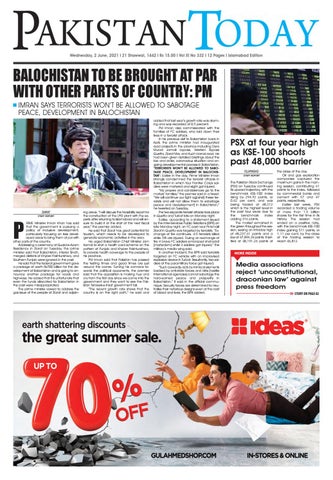
Wednesday, 2 June, 2021 I 21 Shawwal, 1442 I Rs 15.00 I Vol XI No 332 I 12 Pages I Islamabad Edition
Balochistan to Be Brought at par with other parts of country: pM g
Imran says terrorIsts won’t be allowed to sabotage peace, development In balochIstan
ZIARAT
p
staff report
rIme minister Imran Khan has said that the government is pursuing a policy of inclusive development, particularly focusing on less developed areas to bring them at par with other parts of the country. addressing a ceremony at Quaid-e-azam residency in Ziarat on tuesday, the prime minister said that balochistan, interior sindh, merged districts of Khyber pakhtunkhwa, and southern punjab were ignored in the past. he said that the federal government gave a package of worth rs700 billion for the development of balochistan and is going to announce another package for roads and highways. he added that it is unfortunate that even the funds allocated for balochistan in the past were misappropriated. the prime minister vowed to address the gas issue of the people of Ziarat and adjoin-
ing areas. “I will discuss the feasibility report for the construction of the lpg plant with the experts after returning to Islamabad and will ensure to build it at the start of the next fiscal year,” the premier added. he said that Ziarat has great potential for tourism, which needs to be developed to generate economic activities in the area. he urged balochistan chief minister Jam Kamal to start a health card scheme on the pattern of punjab and Khyber pakhtunkhwa, to provide health coverage to the people of his province. pm Imran said that pakistan has passed the testing times and good times are just around the corner. turning his cannons towards the political opponents, the premier said that the opposition is making hue and cry from the first day since we came into the government and they want to see the pakistan tehreek-e-Insaf government fail. “the recent growth rate shows that the country is on the right path,” he said and
added that last year’s growth rate was alarming and was recorded at 0.5 percent. pm Imran also commiserated with the families of Fc soldiers, who laid down their lives in a terrorist attack. In his previous visit to balochistan back in april, the prime minister had inaugurated road projects in the province including dera murad Jamali bypass, western bypass Quetta, Ziarat mor, and Kuch harnai road. he had been given detailed briefings about the law and order, coronavirus situation and ongoing developmental process in balochistan. ‘TERRORISTS WON’T BE ALLOWED TO SABOTAGE PEACE, DEVELOPMENT IN BALOCHISTAN’: earlier in the day, prime minister Imran strongly condemned the terrorist attacks in balochistan in which four Frontier corps soldiers were martyred and eight got injured. “my prayers and condolences go to the martyrs’ families,” the premier said in a tweet. “we will continue our fight ag[ainst] these terrorists and will not allow them to sabotage peace and dev[elopment] in balochistan,” he tweeted on tuesday. the two separate terrorist attacks took place in Quetta and turbat late on monday night. earlier, according to a statement issued by the Inter-services public relations (Ispr) on late monday night, an Fc post near pir Ismalil Ziarat in Quetta was targeted by terrorists. “exchange of fire continues. 4-5 terrorists killed while 7/8 are injured. during an exchange of fire 4 brave Fc soldiers embraced shahadat [martyrdom] while 6 soldiers got injured,” the military’s media wing said. In another incident, the Ispr said terrorists targeted an Fc vehicle with an improvised explosive device in turbat. resultantly, two soldiers of the paramilitary force got injured. “such cowardly acts by inimical elements backed by anti-state forces and hIas [hostile international agencies] cannot sabotage the hard-earned peace and prosperity in balochistan,” it said in the official communique. security forces are determined to neutralise their nefarious designs even at the cost of blood and lives, the Ispr added.
PSX at four year high as KSE-100 shoots past 48,000 barrier IslAmAbAd staff report
the pakistan stock exchange (psX) on tuesday continued its upward trajectory, with the benchmark Kse-100 index rising by 294.92 points, or 0.62 per cent, and was being traded at 48,212 which is the highest level in the past four years due to the benchmark index adding 316 points. the market remained in the green throughout the session, seeing an intraday high of 48,237.61 points and a low of 47,896.34 points. It settled at 48,191.26 points at
the close of the day. oil and gas exploration companies captured the maximum gains in the morning session, contributing 61 points to the index, followed by commercial banks and cement with 57 and 47 points, respectively. earlier last week, psX recorded a trading volume of more than 1.5 billion shares for the first time in its history. the session had ended on a positive note, with the benchmark Kse-100 index gaining 511 points, or 1.11 per cent, by the close of the trading session to reach 46,812.
more inside
Media associations reject ‘unconstitutional, draconian law’ against press freedom STORY ON PAGE 02
02
Wednesday, 2 June, 2021
ISLAMABAD
NEWS
MeDIA ASSoCIATIonS rejeCT ‘unConSTITuTIonAl, DrAConIAn lAw’ AgAInST PreSS freeDoM
A
NewS DeSK
JOINT meeting of the representative media organizations including All Pakistan Newspapers Society (APNS), Pakistan Broadcasters Association (PBA), Council of Pakistan Newspaper Editors (CPNE), Pakistan Federal Union of Journalists (PFUJ, Barna Group), PFUJ (Dastoor Group) and Association of Electronic Media Editors and News Directors (AEMEND) have totally rejected
the proposed Pakistan Media Development Authority Ordinance and termed the concept as an unconstitutional and draconian law aimed against Freedom of Press and Expression and step towards imposing the state control to regulate the establishment as well as operation of all segments of media. The joint meeting was of the unanimous opinion that the proposed PMDA is intended to hinder media freedoms and take control over the media by the top information bureaucracy. The concept is an attempt to tighten Federal Government hold over the
media through one draconian authority ignoring the fact that print, digital and electronic media are separate entities each with their own defined features and respective regulatory laws. The move appears as an extension of now-defunct Press and Publications Ordinance 1963 (PPO) of Ayub Khan era to all media platforms with regimental provisions to take over the independent and free media. This has no place in a democratically elected dispensation, stated the joint declaration. The joint meeting decided to resist the establishment of PMDA at all levels including
legal recourse, protest measures and advertising campaigns to educate the public against this blatant attempt to subjugate and control the media and curtail peoples’ right to know. The meeting decided to form a Joint Action Committee of APNS, PBA, CPNE, PFUJ & AEMEND to decide further actions and seek support from political parties, bar associations, human right organizations and other segments of the civil society to oppose the proposed attack on media and urge upon the Federal Government to immediately withdraw the proposal.
AC indicts suspects in STDC graft case
Mir to remain off-air until probe into contentious speech completed: Geo
KARACHI INP
An accountability court in Karachi on Tuesday indicted former Sindh Tourism Development Corporation managing director Roshan Ali Kanasro in a corruption case. Kanasro along with other suspects appeared before the court. During the proceedings, the accused were indicted two years after the case was filed. Refusing to accept the charge sheet, the accused pleaded innocence. Later, the court ordered the National Accountability Bureau to produce the witnesses and adjourned the hearing. During the course of the investigation, it transpired that the STDC had invited tenders for the award of contracts worth Rs175 million to private contractors for purchase of furniture, repair of vehicles, event management and printing/publication, etc. The tenders were published in dummy newspapers on July 31, 2017, and most of the participating companies were fake and had been formed only to get these tenders, the prosecution added. The prosecution said that the record showed that an advertisement appeared on Aug 31, 2017, in less-known daily newspapers regarding the award of contracts/tenders to five firms — M/s Sameer Enterprises, M/s Fahad Enterprises, M/s RMA Sahita Brothers, M/s Burraq Business and M/s Total Computing Technology. However, NAB claimed that the amount awarded for tenders was largely embezzled, adding that apparently the jobs/work had been distributed among the bidding companies through a ring by the chairman of the tender committee. It added that the rates quoted by firms concerned also appeared to be exorbitant while most of the work had only been done on paper and no inventory details had been prepared by responsible officials.
KARACHI
SHC refuses bail to PTM MP in hate speech case KARACHI Staff RePoRt
The Sindh High Court on Tuesday denied bail to Pashtun Tahaffuz Movement MP Ali Wazir in a hate speech case. Wazir was arrested in Peshawar in December at the request of Sindh police. A case registered at Sohrab Goth police station in Karachi accused the MP of hatching a criminal conspiracy and passing derogatory statements against the state and its institutions. After hearing arguments from both sides, a division bench of the high court, headed by Chief Justice Ahmed Ali M. Shaikh, dismissed the bail request. The case was registered under sections 120-B (criminal conspiracy), 153-A (promoting enmity between different groups), 505-B (statements for inducing a person to commit offence against the state), 506 (criminal intimidation) and 188 (disobeying order of public servant) of the Pakistan Penal Code. Others nominated in the FIR include PTM chief Manzoor Pashteen, MP Mohsin Dawar, Sana Ijaz, Muhammadullah Mehsud, Noorullah Tareen, Saleh Jan, Mullah Behram, Abdullah Nangyal, Sher Khan Mehsud, Qazi Tahir, Gilaman Pashteen, Dr Said Alam, Hidayatullah Pashteen and Javed Raheen.
Imran habitual of making tall claims: Bilawal KARACHI
Staff RePoRt
A day after Geo News took journalist Hamid Mir off-air, removing him as host of Capital Talk programme, the media house on Tuesday said it removed the anchor for potential “violation of policy and law” during a speech he delivered last week. Mir on Friday made a fiery speech at a rally in support of a vlogger, Asad Ali Toor, who was beaten up by three unidentified men outside his apartment in Islamabad the previous day. In his speech, Mir had “threatened” to “identify those responsible” for what he claimed was a spate of recent attacks on journalists in Pakistan. He also implied the involvement of the security agencies but did not provide any evidence to back up his claims. “The Editorial Committee [of Jang Group] and lawyers will check for violation of policy and law” during the speech which received “backlash from different segments of society”, the group said in a statement issued Tuesday. “It becomes difficult for the Group and its editors to take ownership of the content that is
delivered outside the purview, input and guidance of its editors, and which are not fact checked and approved by the editorial teams,” it said. “The anger, disappointment and frustration that Hamid Mir and other journalists feel on fellow colleagues being attacked is a shared and grave concern,” it said. “But better ways and means exist on how to channel that energy for productive gains for the safety of journalism and journalists.” The group, which in the past has been accused of tax evasion to the tune of $13 million, said its reporters were “financially strangulated more than any other media organisation”, adding it “has lost more than Rs10 billion to keep
viewers and readers informed”. Geo News’ move drew swift condemnation by journalists, politicians, and members of civil society groups. The Pakistan Federal Union of Journalists asked the group to explain whether the step was taken under government pressure. “The PFUJ, Human Rights Commission, Pakistan Bar associations, PBA, APNS, AEMEND, CPNE as well as international human and media rights organisations all have advocated on many occasions that the government must proactively protect journalists and act against the perpetrators but no respite has been given till now,” the statement said.
SHC orders varsity to hold delayed tests
INP
SUKKUR
Pakistan People’s Party chief Bilawal Bhutto-Zardari on Tuesday claimed making tall claims is the habit of Prime Minister Imran Khan. In a statement, he said that the poverty ratio is proving wrong the claims of the government regarding economic growth. The nation has already rejected the “photoshopped” economic development, he added. Earlier, Bilawal said that he will not let the “PTIMF” budget approve by the parliament as an anti-public government cannot make a people-friendly budget. The PPP chairman said that the passing of the budget made by the “International Monetary Fund employees” will be an attack against the country’s sovereignty. He said that Prime Minister Imran announces before every budget that this will be the year of progress. Bilawal also bashed the government for taking loans over tough conditions and imposing unbearable taxes. He said that the only parameter of progress in civilised societies is the prosperity of the poor.
INP
The Sukkur bench of Sindh High Court on Tuesday ordered the Shah Abdul Latif University to take the law college tests in a phased manner. The bench issued orders on a petition filed by law students requesting that the university didn’t take the tests in the last three years. The registrar of the university appeared in the court today. “Why the exams not held for last three years,”
Justice Aftab Ahmed Gorar asked him. “The papers were delayed due to the coronavirus pandemic,” the official responded. “The pandemic situation existed only for one year, but the papers have not been taken for the last three years,” the judge observed. “You have put the future of hundreds of students at stake,” he said. “The university should arrange exams twice or three times in a year to complete the degree programme within five years,” the bench ruled. The court also demanded the preparation of the test
schedule to be submitted to the court within two hours. In the last hearing, the court had issued warrants for the arrest of the registrar and ordered his production in court for ignoring the court directives. The counsel for the students in the previous hearing said that despite orders, the registrar did not appear. All the law colleges affiliated with the university had been closed for the past three years and the university had failed to implement the court’s orders, putting at risk the future of hundreds of students.
PML-N rejects NCOC letter suggesting delay in AJK elections ISLAMABAD INP
The Pakistan Muslim League-Nawaz has rejected a letter by the National Command and Operation Centre suggesting postponing the Azad Jammu and Kashmir elections for two months because of the coronavirus pandemic. PML-N leader and former prime minister Shahid Khaqan Abbasi spoke to the media in Islamabad about PML-N’s stance over NCOC’s letter on Tuesday. “What has NCOC got to do with [the] elections?” Abbasi asked, saying that this is a conspiracy for rigging. “The same thing that happened in GilgitBaltistan is being repeated in Azad Kashmir,” he said. He said a rigging attempt was being made. Abbasi questioned whether NCOC talking about a delay in elections is constitutional. “Haven’t elections
been held in other parts of the country?” he asked. He insisted that this is an attempt to “steal” the elections in AJK and made references to previous elections in Pakistan. Let the elections be held according to the will of the people, Abbasi said, adding that the PML-N wants the elections in AJK to be on time. “We reject the NCOC letter. It should be withdrawn,” he said. “Consider it resistance or reconciliation, but the politics of PML-N is based on the constitution and principles,” he said. Refuting media reports of the PML-N making an effort to bring the PPP back into the PDM alliance, Abbasi said they have made “zero efforts”. “Whoever broke the trust should restore it, otherwise the paths will stay separated. The PPP and ANP are not part of PDM at present,” he said. A day earlier, NCOC had suggested postponing the
AJK elections for two months, saying the process will lead to an increase in the number of coronavirus cases. The NCOC wrote a letter to the chief election commissioner of AJK, stating that due to the rise in the number of coronavirus cases in the country, the polls should be delayed. Read more: Bilawal announces PPP candidates for AJK elections The letter said that large political gatherings due to elections will lead to the further spread of the potentially deadly virus in the state, adding that the number of coronavirus positive cases are already high therein. The NCOC said one million residents of AJK could be vaccinated by September 2021. The AJK Assembly’s terms will end on July 29, but so far, the schedule for the new election has not been issued.
Wednesday, 2 June, 2021
ISLAMABAD
AgenCIeS ClOSe TO TRACIng SuSPeCT In vlOggeR ThRAShIng InCIdenT: mInISTeR ISLAMABAD
m
STaff rePorT
INISTER for Interior Sheikh Rasheed Ahmed on Tuesday said security agencies were close to tracing one of the suspects responsible for beating up a vlogger outside his apartment in Islamabad, Radio Pakistan reported. Three unidentified men thrashed Asad Ali Toor following a scuffle late on Tuesday night. He claimed the attackers tied him, gagged him, punched and hit him before fleeing the scene. Addressing a press conference in Islamabad, Rasheed said that the National Database and Registration Authority, Federal Investigation Agency and police were conducting an inquiry into the episode. “The fingerprints will be identified
in a day or two,” he said. Advertisements would be published in the newspapers if authorities were unsuccessful in tracing the suspects, he announced. Responding to a question from a reporter, the minister reiterated that NADRA was conducting a fingerprint analysis the results of which would be out soon. “Otherwise we will give ads in the newspapers with the photos of the three suspects because some people are accusing our agencies according to a specific agenda.” The minister said the receptionist, who had recorded his statement, said he did not stop the suspects because they were frequent visitors. Rasheed said that it was necessary to bring the case to its logical conclusion as some people “unnecessarily” target the security agencies to please their “foreign masters”. When asked, Rasheed pointed that
there needed to be a policy with regard to such incidents as it raise question marks about the government’s performance and also become a human rights issue. “I think that if we are successful in reaching these culprits, all those who blame our agencies will be silenced,” he said, adding that such individuals were unaware of the damage they cause to the country’s image in the eyes of the world. Asked about veteran journalist Hamid Mir, who was taken off air after making a fiery speech at a protest calling for accountability for repeated assaults on journalists in the country, the minister said: “I didn’t close it down. I haven’t interacted with him in the past few years, nor have I ever been on his programme.” The minister began his press conference by talking about his recent visit to Kuwait which has decided to resume granting visas to Pakistani
families and businessmen. “It was a highly successful tour,” he said that 425 doctors would leave for Kuwait this week. He added that the Kuwaiti prime minister had also expressed willingness to issue visas for the construction sector. “Similarly, 30 percent of the three million visas Saudi Arabia will give out will go to Pakistanis,” he said, adding that foreign remittances were a large part of the economy. Commenting on the Pakistan Democratic Movement, the minister said that only Maulana Fazlur Rehman and Pakistan Muslim League-Nawaz remained in the alliance. “I don’t know about the others. It is done,” he said, calling on journalists to name the parties in the alliance. “Two have left and two remain. It is completely defunct but everyone is playing it up on the media,” he said.
1,771 new infections take total Covid-19 caseload to 922,824 ISLAMABAD STaff rePorT
Pakistan recorded 1,771 new confirmed cases of Covid19 on Monday with a test positivity rate of 3.72 percent, marking a substantial drop in its daily cases, the National Command and Operation Center said on Tuesday. According to the NCOC, the total number of confirmed cases in the country rose to 922,824 Tuesday, including 844,638 recoveries. There are currently 57,336 active cases being treated in hospitals across the country, with 3,842 of them being in critical condition. According to the NCOC, 71 more deaths from the coronavirus epidemic were recorded in the last 24 hours nationwide, raising the Covid-19 related death toll to 20,850. Punjab has reported the highest number of both confirmed cases and deaths, at 340,110 and 10,039 in total respectively, followed by Sindh with 318,579 confirmed cases and 5,039 deaths. The NCOC said on its website that Pakistan has administered a total of 7,337,187 Covid-19 vaccine doses across the country, with 1,985,005 people fully vaccinated so far. Strict restrictive measures backed by vaccination have enabled a declining trend of the Covid-19
positivity ratio as the country reported a rate below 5 percent for the eighth consecutive day on Monday. According to data released by the NCOC, the health department conducted 47,633 tests on Monday, detecting a positivity rate of 3.71 percent. Earlier in March and April, the nation saw a positivity ratio of over 11 percent several times, leading the government to impose strict measures, including the closure of educational institutions, markets, public parks, wedding halls, restaurants, public transport and all other venues of mass gatherings, especially during the Eidul Fitr holidays. In May, the positivity rate dropped to over 9 percent and went down further to below 5 percent, the official data showed. However, Minister of State for National Health Services Dr Faisal Sultan warned the country was “not out of the woods yet”. “It seems at this point that I don’t foresee an Indialike situation [in Pakistan],” Sultan told Voice of America in an interview. He was of the view that an “effective” screening system for international travellers and other measures to deal with the outbreak have so far enabled the country to keep the situation under control. He noted that while his team has also detected a few cases of the variants prevalent in South African and
Terrorists won’t be allowed to destabilise peace efforts: COAS NEWS DESK Chief of Army Staff General Qamar Javed Bajwa visited Corps HQ Quetta on Tuesday. On his arrival, the army chief was received by Corps Commander Lieutenant General Sarfraz Ali. He was given a detailed briefing on security situation, operational preparedness, and border management including fencing along Pak-Afghan and Pak-Iran borders. He was also briefed on the socio-economic initiatives undertaken by Army in support of Govt of Balochistan and efforts underway for capacity enhancement of law enforcement agencies to ensure peace and stability. The army chief said that Pakistan army will make all possible efforts towards achievement of an enduring peace for sustainable socio-economic development of the province. He said that terrorists will not be allowed to destabilise peace efforts. He emphasised that all-out efforts be made to assist provincial government in ensuring law and order. The COAS lauded officers and men for their dedicated efforts, continued vigilance and high morale. Separately, Prime Minister Imran Khan said that the Pakistan Army has produced unmatched results when pitched against its adversaries and successfully deterred the nefarious designs of Pakistan's enemies. Addressing the participants of staff course at Command and Staff College, Quetta, he said that country's defence is impregnable due to professionalism and battlehardened armed forces of Pakistan. The prime minister said that establishment of a prosperous state in line with Islamic principles and ideology of our great leaders like Allama Iqbal and Quaid-e-Azam can be achieved only if we work hard consistently as a nation. He said that the government has made all out efforts for progress in various sectors like agriculture, industry, technology and automation. He advised the participant officers to pursue their dreams without fear of failure to achieve their objectives. The premier deliberated at length upon his vision of future of Pakistan where rule of law, across the board accountability and justice are order of the day.
Brazil, Pakistan is one of nearly 100 countries where a variant first detected in the United Kingdom, known as B.1.1.7, is currently predominant. “A large part of this wave that they [India] are going through, at least as best as I am aware, it was B117, and it was not necessarily the Indian variant that was doing it,” he said. MORE DOSES ARRIVE: The government will start vaccination of 18-year-olds from June 3 (Thursday) across the country. In a tweet, Minister for Planning and Development National Command and Operation Centre chief Asad Umar announced the vaccination of all the eligible age groups would be carried out in line with the body’s decision. Half a million doses of Sinopharm vaccine arrived in Islamabad from Beijing via a special Pakistan International Airlines flight, Associated Press of Pakistan reported. While another 500,000 doses of the drug will be airlifted from Beijing Wednesday (tomorrow) via the national flag-carrier, Qadir Bux Sangi, PIA country manager in China, told APP. The government has decided to run a massive vaccination drive across the country and inoculate 70 million doses to fight the pandemic. So far, nearly 5.3 million people have been vaccinated.
Pakistan hosts parliament heads of ECO countries ISLAMABAD anadoLu agency
Pakistan is hosting the second general conference of the Parliamentary Assembly of the Economic Cooperation Organisation. The two-day conference that started today is being attended by the parliamentary heads from Turkey, Iran, Afghanistan, Azerbaijan, Kazakhstan, Kyrgyzstan, Tajikistan, Turkmenistan, and Uzbekistan. The agenda items of the conference include discussions on the impact of Covid19 on the implementation of Sustainable Development Goals, the role of parliaments in enhancing trade and connectivity, and advancing tourism for development and poverty alleviation. In an interview with Anadolu Agency, National Assembly Speaker Asad Qaiser, who is hosting the conference, said: “The aim of this conference is to help and push our governments to further strengthen economic and trade relations, and boost people-topeople contacts between our member states.” PAECO was founded in 2013 and its first Inaugural meeting was held in Islamabad in February 2013, with aimed to support the member states in enhancing the socioeconomic development of the region Turkish parliament speaker Mustafa Şentop along with his delegation arrived in Islamabad early Tuesday morning to participate in the conference. Speaking about historical relations between Pakistan and Turkey, Qaiser said
both brotherly countries enjoy a “unique” relationship. “Our relationship is unique and enviable, based on strong historical linkages and the roots of today’s ties between the two nations can be traced back to 19th century,” he said. He added that Pakistan and Turkey support each other at every international forum and also raise voice for oppressed Muslims around the world. “Now we want to further strengthen our economic relations, bilateral trade between Islamabad and Ankara and also with our brotherly ECO countries,” he said. The Muslim world is facing many issues but Palestine and Kashmir are the two issues that have been on the UN agenda for the last seven decades, Qaiser said and urged the world body to play its role to resolve these issues. “During the bilateral meeting with my counterparts in Islamabad, we will also discuss these issues,” he said. “We [Muslim countries] need unity and we should work to strengthen the OIC [Organisation of Islamic Cooperation] to truly represent the Muslim world,” he said. Qaiser said that he also wrote letters to parliamentary heads across the world and urged them to play their role and raise their voice over the killing of the Palestinian people by Israeli forces. He criticised the international community’s “silence” over what he called war crimes and genocide committed by Israel and India, and said: “The world needs to stand by justice.”
NEWS
03
10 kIlled, 3 InjuRed In RAIn-RelATed InCIdenTS In PunjAb ISLAMABAD: At least 10 people were killed and three others injured in different rain-related incidents in Punjab on Monday evening, media reported. According to the reports, a roof collapsed in the Tariqabad area of Okara during a thunderstorm, leaving eight people dead and three injured. Local people and rescue teams rushed to the site and shifted the bodies and the injured to a hospital. The deceased included three women, four children and a man, while the identity of the injured is not known yet. In another incident, a person died after a wall fell on him when he was walking beside it in the Hujra Shah Muqeem city of the Okara district. Another man lost his life after he was hit by lightning in the Toba Tek Singh district. The Pakistan Meteorological Department Monday predicted thunderstorms along with strong winds in different parts of the country. STaff rePorT
Pakistan, Tajikistan ties to cement further as President Rahmon arrives today ISLAMABAD: Tajikistan’s President Emomali Rahmon would arrive in the federal capital on a twoday visit on Wednesday. He is coming to Pakistan at the invitation of Prime Minister Imran Khan and would be accompanied by a high-level delegation. Pakistan and Tajikistan enjoy close brotherly relations underpinned by commonalty of faith, shared history and cultural affinities. These ties are characterised by mutual respect, shared perceptions and a common desire to promote peace, stability and development in the region. Tajikistan is important within the context of Pakistan’s vision for closer ties and enhanced cooperation with Central Asia. The vision emphasises forging deeper trade, investment, energy, security, and people-to-people links. During the visit, Prime Minister Imran and President Rahmon will lead their respective sides in the delegation-level talks. The two sides will exchange views on deepening bilateral cooperation in diverse areas – including political, economic, trade, investment, energy, security and defence, culture, education and regional connectivity. A number of agreements/MoUs are expected to be signed during the visit. The visiting dignitary will separately meet with President Dr Arif Alvi. The two countries share common views on major regional and international issues and cooperate closely at various multilateral fora. Tajikistan is the current chair of the Shanghai Cooperation Organisation. Foreign Minister Shah Mahmood Qureshi visited Dushanbe in March 2021 to attend the Ministerial meeting of the Heart of Asia-Istanbul Process, followed by his bilateral visit to Tajikistan. Mian abrar
FO takes exception to ex-Israeli minister’s misusing of Pakistani hospital’s image ISLAMABAD: The Foreign Office has said that Pakistan has taken serious exception to a former Israeli minister posting a video on social media showing the image of Shifa International Hospital in Islamabad while claiming it as Hamas headquarters and the largest medical complex in Gaza. Foreign Office Spokesperson Zahid Hafeez Chaudhari said, “We have seen the statement by Israel’s former war minister and we believe that it is casual misjudgement at best, and deliberate misrepresentation at worst. We also take serious exception to the fact that a Pakistani building was misquoted in the statement.” Israeli farright politician and former war minister Naftali Bennett posted a video on May 20 showing an image of a hospital that he said was the “largest medical complex in Gaza” and a Hamas headquarters from where the group was “conducting terror actions against Israel.” Social media users were quick to point out that the photo was of Shifa International Hospital in Islamabad. Meanwhile, SAPM on the Middle East Tahir Mahmood Ashrafi called Bennett’s video a deliberate attempt to mislead the world. He said that Israel is frustrated due to Pakistan’s active role in highlighting the Palestinian issue and Israeli atrocities infant of the whole world. “It is a deliberate attempt to mislead and deceive the world as Israel has destroyed actual health facilities in Gaza. We condemn this attempt to malign Pakistan,” Ashrafi told a foreign news agency. TLTP
04
Wednesday, 2 June, 2021
ISLAMABAD
NEWS
PAkiSTAn SHowCASeS effoRTS MAde foR gReen gRowTH AT P4g SuMMiT ISLAMABAD
M
MIAN ABRAR
INISTER for Climate Change Malik Amin Aslam has said that Pakistan, while focusing on the green growth, has set up the Ecosystem Restoration Fund (ERF), launched its first green Eurobond and
consulted with other countries on debt-fornature swap programmes. Addressing the participants in the Second P4G Summit in Seoul, South Korea, Amin showcased Pakistan’s Green Stimulus Package, Ten Billion Trees Plantation Initiative and Recharge Pakistan project, which will provide up to 185,000 jobs for the Pakistani youth.
MAn kiLLed, fouR injuRed in fiRing in kARACHi KARACHI INP
One person died and four others injured in an armed clash between two groups over a property dispute in the metropolis on Tuesday. The local police said that the armed men of the two groups, who were involved in a dispute over ownership of a plot, traded fire in Gulshan-eKarim, Karachi. In cross firing, one person, identified as Aziz Isphani, was killed while four others were injured. The police shifted the body and injured to a nearby hospital, registered a case into the incident and started investigation.
SRB collects Rs108.68bn in 11 months with 19.2pc growth NEWS DESK The Sindh Revenue Board (SRB) collected a revenue of Rs108.686 billion during the first 11 months of the current fiscal year as compared to Rs91.198 billion in the corresponding period of the last financial year, showing a growth of 19.18 percent. According to a statement issued on Tuesday, the SRB collected Rs10.26 billion revenue during May 2021 as compared to Rs6.734 billion in May 2020, showing a growth of 52 percent. The SRB attributed the significant growth of 52 percent in May 2021 to the continued trust and cooperation of the taxpayers, the support of the Sindh government and the relentless efforts of the SRB officials. The provincial revenue authority said that it would continue to work hard to maximise the revenue collection during June, the last month of the current fiscal year, despite all adverse factors due to resurgence of Covid-19, impacting the services sector.
LHC judge recuses himself from hearing of Asif’s bail plea LAHORE TLTP
A judge of the Lahore High Court Tuesday recused himself from the bench, hearing a post-arrest bail application of Pakistan Muslim League–Nawaz (PML-N) leader Khawaja Asif. According to details, Justice Asjad Javed Ghural, a member of the division bench that was to take up the petition, recused himself from the case, after which the matter was referred to the LHC chief justice to fix it before another bench for hearing. The reason for his recusal from the bench is said to be a statement of Khawaja Asif’s counsel against him. Khawaja Asif, through his counsel Barrister Haider Rasul Mirza, had filed the post-arrest bail application, saying the National Accountability Bureau (NAB) had arrested him from Islamabad on December 29 last year. He had further submitted that the top anti-graft body nabbed him despite the fact that he had provided all the relevant records regarding his assets, which are also available with the Election Commission of Pakistan (ECP) and Federal Board of Revenue (FBR). In its reply, NAB had opposed the bail application on the grounds that Khawaja’s assets do not match with his income. NAB had further said that he had failed to give satisfactory replies, when questioned by it. The bureau had pleaded to the court to reject the plea of the PML-N leader as an investigation against him is still underway.
The Second P4G Summit was hosted by the Republic of Korea. Several government leaders and top officials from 46 countries, including Pakistan, and heads of 21 international organisations, along with representatives from business sector and civil society, took part in the summit. The P4G is a global initiative aimed at facilitating public-private partnership to
tackle climate change and achieve the Sustainable Development Goals (SDGs). This year due to the prevailing Covid-19 pandemic, the summit was held virtually, gathering international solidarity required to build back better and greener from the Covid19 crisis. The two-day summit engaged world leaders in dialogues on inclusive green recovery from Covid-19, efforts to achieve
Budget to ensure big relief for salaried class: fawad
ETPB recovers Rs2bn in terms of arrears of properties LAHORE SHAHAB OMER
The Evacuee Trust Property Board (ETPB) has recovered more than Rs2 billion in terms of arrears of various properties in May, 2021 while the volume of investment in the board has reached to the level of five billion rupees, Pakistan Today learnt on Tuesday. ETPB spokesman Amir Hashmi informed that a number of reforms and steps have been taken in the recent past to increase the revenue of the board. “Due to the successful strategies of ETPB Chairman Dr Aamer Ahmad, a record recovery has been made this year while the investment in the department is estimated
to be close to Rs5 billion, largest in the history. This huge volume of investment was never seen before,” he said. Hashmi further informed that ETPB has seven zonal offices across Pakistan, who have recovered Rs2.24 billion by May 2021. The chairman, while talking about the board's revenue and increase in financial investment, informed that all these achievements are the result of teamwork and hard work of the field staff of all the district offices. “If all the employees of the board strive for better income and development of the institution, then the day is not far when the board will reach the highest level of financial history and it will take care of the worship places of the minorities living in Pakistan better than ever,” he said.
IHC urged for registration of murder case against Bhoja Airlines’ owner ISLAMABAD TLTP
While representing a number of victims of Bhoja Airlines crash of 2012 in Islamabad, Advocate Omer Adam on Tuesday sought the Islamabad High Court’s directives for registration of a criminal case against the owner of the airline under section 302 of the Pakistan Penal Code. However, the court expressed that it will decide the matter on next date of hearing as to whether there are sufficient grounds to implicate the owner of Bhoja Airlines in murder charges. The section 302 of the PPC is about punishment for murder. According to the section, “Whoever commits murder shall be punished with death, or imprisonment for life, and shall also be liable to fine.” Assailing the verdict of additional district and session judge in the matter, the counsel urged the IHC to declare the decision that resulted in deletion of section 302 of the
PPC against the owner of the airline as illegal. Nine years ago on April 12, Bhoja Airlines’ Boeing 737-236A flew from the Jinnah International Airport Karachi for Benazir Bhutto International Airport Islamabad with 127 persons on board, including six flight crew members. The ill-fated aircraft crashed about 4.2 miles short of runway while landing. All those on board lost their lives and the aircraft was also destroyed. Appearing before Justice Aamer Farooq on Tuesday, the counsel for the family members of the victims contended that Bhoja Airlines’ flight carrying 127 passengers, including men, women and children, crashed in Hussain Abad, Islamabad. He informed the judge that complainant police inspector Khan Mehmbood Ahmad registered a criminal case in the matter. He said the FIR was registered under sections 120-B, 286, 281, 302, 427/109 of the PPC. The court was apprised that in pursuant to the findings a judicial commission of the IHC, another FIR was regis-
Govt to vaccinate all CNIC holders by year end: official ISLAMABAD INP
National Health Services Regulations Parliamentary Secretary Dr Nausheen Hamid on Tuesday said that the health department was on track to administer Covid-19 vaccination to almost 70 percent of the targeted population by December 2021. “Over 20 million Pfizer vaccine doses will reach the country soon,” she said while talking to a news channel. “Government’s strategy is to maintain a balance between the safety of our population and their social wellbeing and economic sustainability,” she added. The Pfizer vaccine will only be utilised in limited areas
carbon neutrality by 2050 and strengthen climate action, and public-private partnerships through inclusive green recovery. At the end of the summit, the leaders adopted the Seoul Declaration, calling for the engagement of governments, businesses and civil societies as part of “collective solutions” to global climate change and green recovery for current and future generations.
of the country where the ultracold chain would be available for its storage during the ongoing vaccination campaign, she said. A special refrigerator would be used to store the Pfizer BioNtech and other vaccines in future, she added. “Pfizer vaccine has to be kept at minus 70 degrees Celsius, which is a challenge for developing countries where we will have difficulties in maintaining a cold chain,” Nausheen said. She said that registration was open for the entire national population who are above 18 years of age, which is approved by health experts for Covid-19 vaccination. The government is administering the Sinopharm, CanSino, SinoVac and AstraZeneca vaccines free of cost, she added.
NEWS DESK Minister for Information and Broadcasting Fawad Chaudhary has said that the government will provide a big relief to the salaried class in the upcoming budget. In a tweet on Tuesday, the information minister said that though inflation has increased, the purchasing power has also gone up with the same ratio, which is welcoming. He expressed the confidence that the country will get closer to its destination in the next two years under the leadership of Prime Minister Imran Khan. He said positive news are coming regarding the country. Sharing some good pieces of news, the information minister said that Kuwait has resumed issuance of work visas for Pakistanis after ten years. He said that Pakistan's recovery from the Covid-19 has surprised the world. He maintained that regional countries, including India, have been facing critical situations in respect of the pandemic. However, in all areas of Pakistan, except Karachi, the Covid-19 positivity rate is less than four percent, he added.
Turkish citizen approaches Hyderabad court for son's custody HYDERABAD TLTP
While adjudicating over the plea of a Turkish father, who had claimed that his Pakistani wife holding Japanese citizenship had detained their infant baby in connivance with her relatives, an additional district and sessions judge on Tuesday ensured presence of the child in the court. Turk national Deniz Kizmaz, who is running a business in Japan, had married a Pakistani lady holding Japanese citizenship in Japan a few years ago. As a result of the wedlock, two daughters and a baby boy were born. The baby boy was born on March 22, 2021 at Hyderabad. It is pertinent to mention that both the husband and wife had signed a separation deed in Japan before birth of the baby boy under free consent, but under the Pakistani law, they are still wife and husband. Appearing before the court on Saturday last, the petitioner’s counsels Sharafat Ali Chaudhry and Umer Sajjad Chaven had apprised the judge that two minor daughters, who were born at Istanbul, are now residing under the guardianship and custody of the petitioner (father) whereas the minor son, who was born at Hyderabad, is in illegal custody of the relatives of petitioner’s wife.
Modi govt will have to restore special status of IOK: FM ISLAMABAD STAff REPORT
Foreign Minister Shah Mahmood Qureshi has said Pakistan is now recognised by the world as a part of solution and not a part of problem due its successful foreign policy. In a statement on Tuesday, he said Modi government will have to restore the special status of the Indian Occupied Kashmir. He said that India is faced with immense pressure due to its internal deteriorating situation. About his recent visit to Iraq, Qureshi said that he briefed his Iraqi counterpart about the situation in the Indian illegally occupied Jammu and Kashmir. He said Pakistan desires peace in the region. The foreign minister termed the adoption of resolution on Palestine by the UN Human Rights Commission as a major success. He said that Pakistan enjoys cordial relations with the United Arab Emirates and it desires to further strengthen this relationship in future. Moreover, Foreign Minister Qureshi and United Na-
tions General Assembly President Volkan Bozkir on Thursday last held a meeting and discussed matters of international and regional importance, including the Palestine and Jammu and Kashmir. The FM welcomed the UNGA president at the ministry of foreign affairs, who had arrived in the capital on Wednesday on a threeday visit. Qureshi appreciated the efforts of the UNGA president to convene an emergency session of the UNGA on Palestine. He said that ceasefire was the first step towards stopping the Israeli atrocities, however, added the only just solution to resolve the issues of Palestinian and Kashmir was implementation of the UN Security Council resolutions. Qureshi said that establishing peace in the Middle East without resolving the Palestinian issue on a permanent basis was not possible. Similarly, he said, without resolving the Kashmir issue, there can be no peace in South Asia. He said that Pakistan wanted peace in Afghanistan and intended to continue playing a conciliatory role in the Afghan peace process. The FM appreciated the initiative of the UNGA
president, ‘Vaccine for All’, to overcome coronavirus pandemic challenge and said for its complete eradication, it was necessary to make everyone safe. According to FO spokesperson Zahid Hafeez Chaudhri, Bozkir reiterated the “UN position on the Jammu and Kashmir dispute is governed by the UN Charter and relevant UNSC resolutions, calling for a ‘free and impartial’ plebiscite under the UN auspices.” The UNGA president also visited the National Defence University and gave a speech on the importance of multilateralism during a joint press conference with FM Qureshi. Speaking at the university in Islamabad, the FM said, “There are similarities between the Palestinian situation and that of Jammu and Kashmir”. “The oppressed people in both the territories, being faced with the worst form of human rights violations, are demanding their right to self-determination,” he added The FM categorically stated that the occupied Kashmir dispute is a reality and nobody can remove it from the agenda of the UNSC.
Wednesday, 2 June, 2021
ISLAMABAD
NEWS
AnnuAl inflAtion eAses to 10.9pc YoY in MAY ISLAMABAD
t
CHICKEN LEADS CHART WITH 60PC HIKE FOLLOWED BY EGG: ONION PRICE DIPS OVER 31PC FOLLOWED PULSE MOONG
TLTP
he annual inflation rate slightly eased to 10.9 percent on a yearon-year (YoY) basis in May 2021 as compared to an increase of 11.1 percent in April. The Consumer price Index (CPI) based monthly inflation remained at 8.2 percent in May 2020, according to the data released by Pakistan Bureau of Statistics (PBS) on Tuesday. According to the BPS, on a monthon-month basis, it increased by 0.1 percent in May 2021 as compared to an increase of 1.0 percent in April 2021 and an increase of 0.3 percent in May 2020. The CPI inflation Urban increased by 10.8 percent on a year-on-year basis in May 2021 as compared to an increase of 11.0 percent in the previous month and 7.3 percent in May 2020. On a month-onmonth basis, it increased by 0.2 percent in May 2021 as compared to an increase of 1.3 percent in the previous month and an increase of 0.3 percent in May 2020. Likewise, the CPI inflation Rural increased by 10.9 percent on a year-on-year basis in May 2021 as compared to an increase of 11.3 percent in the previous month and 9.7 percent in May 2020. On a month-on-month basis, it decreased by 0.03 percent in May 2021 as compared to an increase of 0.6 percent in April 2021 and an increase of 0.3 percent in May 2020. The Sensitive Price Indicator (SPI) inflation on YoY increased by 19.7 percent in May 2021 as compared to an increase of 21.3 percent a month earlier and an increase of 11.0 percent in May 2020. On a month-on-month (MoM) basis, it increased by 0.8 percent in May 2021 as compared to an increase of 0.4 percent a month earlier and an increase of 2.2 percent in May 2020.
Likewise, the Wholesale Price Index (WPI) inflation on YoY basis increased by 19.4 percent in May 2021 as compared to an increase of 16.6 percent a month earlier and an increase of 1.5 percent in May 2020. The WPI inflation on MoM basis increased by 0.3 percent in May 2021 as compared to a decrease of 0.4 percent a month earlier and a decrease of 2.1 percent in May 2020, according to the PBS. Measured by non-food non-energy Urban increased by 6.8 percent on YoY basis in May 2021 as compared to an increase of 7.0 percent in the previous month and 6.3 percent in May 2020. On the MoM basis, it increased by 0.2 percent in May 2021 as compared to an increase of 0.9 percent in the previous month, and an increase of 0.4 percent in May 2020.
tarin for completing nppMcl privatisation at earliest Finance Minister Shaukat Tarin has expressed resolve to complete the privatisation of National Power Parks Management Company Limited (NPPMCL) at the earliest. Chairing a meeting to review the progress on the NPPMCL privatisation on Tuesday, the finance minister assured the Privatisation Commission and other stakeholders of his full support in resolving technical issues related to the transaction. All the participants of the meeting shared their input on various issues related to the transaction and briefed the finance minister on the progress achieved since the last meeting on the subject. The meeting was attended by Minister for Privatisation Muhammad Mian Soomro, energy Minister hammad Azhar, Adviser to the PM on Institutional Reforms and Austerity Dr Ishrat hussain, SAPM on Power Tabish Gauhar, SAPM on Finance and Revenue Dr Waqar Masood, and secretaries of finance, power, petroleum and privatisation. NEWS DESK
Measured by non-food non-energy Rural increased by 7.6 percent on YoY basis in May 2021 as compared to an increase of 7.7 percent in the previous month and 8.4 percent in May 2020. On the MoM basis, it increased by 0.3 percent in May 2021 as compared to an increase of 0.7 percent in previous month, and an increase of 0.4 percent in May 2020. Measured by 20 percent weighted trimmed mean Urban increased by 10.0 percent on YoY basis in May 2021 as compared to 9.8 percent in the previous month and 6.7 percent in May 2020. On the MoM basis, it increased by 0.2 percent in May 2021 as compared to an increase of 0.6 percent in the previous month and a decrease of 0.4 percent in May 2020. Measured by 20 percent weighted trimmed mean Rural increased by 10.3
percent on YoY basis in May 2021 as compared to 10.6 percent in the previous month and by 8.9 percent in May 2020. On the MoM basis, it increased by 0.4 percent in May 2021 as compared to an increase of 0.2 percent in the previous month and an increase of 0.5 percent in May 2020. The items whose prices increased on MoM basis included chicken (16.87%), fruits (10.54%), wheat flour (9.75%), mustard oil (5.15%), meat (4.68%), sugar (2.57%), gur (1.99%), rice (1.42%), personal effects (1.80%), motor vehicle accessories (1.08%), washing soap (0.91%) and drugs & medicines (0.81%). The items whose prices decreased on MoM basis included tomatoes (46.64%), vegetables (18.84%), onions (13.15%), eggs (11.58%), pulse Mash (1.37%), pulse gram (1.33%), pulse Moong (1.27%), wheat (1.16%), pulse Masoor (1.12%), liquefied hydrocarbons (10.72%) and electricity charges (5.61%). The items whose prices increased on YoY basis included chicken (59.57%), eggs (54.96%), mustard oil (30.75%), wheat (29.90%), wheat flour (28.54%), condiments and spices (26.71%), vegetable ghee (22.1%), sugar (21.62%), cooking oil (20.62%), bakery and confectionary (16.81%), milk (15.41%), meat (14.15%), vegetables (12.53%), motor fuel (25.43%), electricity charges (21.83%), footware (16.27%), cleaning and laundering (13.45%), hosiery (12.55%), clinic fee (12.45%), woollen garments (12.08%), cotton cloth (12.07%) and drugs & medicines (10.76%). The items whose prices decreased on YoY basis included onions (31.52%), pulse Moong (17.22%), potatoes (15.59%), pulse Masoor (7.09%), Besan (1.92%), and liquefied hydrocarbons (1.97%).
Dawood for brand development as Kroger Co embraces Pakistani food items Adviser to Prime Minister on Commerce and Investment Abdul Razak Dawood has said that his vision is to promote ‘’Made in Pakistan’’ around the world. The advisor said this on Tuesday while sharing that Kroger Co - the third largest retail store chain of the USA has added Pakistani food products to their outlets in the United States. “In order to further enhance our exports, we have to pay attention to our own brand development. Our local brands still need to do a lot for recognition in the international market hence more effort is required from our exporters,” said Dawood. he said that although potential is there, yet there is need to focus more on the branding side in order to get the desired results and make a place in the competitive market. he said that the presence of Pakistani food brands in the retail store giant is an encouraging step that would encourage exporters to pay attention to develop brands. he added that an alternative strategy is to acquire a foreign brand and further develop that brand.
05
cryptos continue gaining with bitcoin nears $37,000 Crypto market continued recovery on Tuesday with bitcoin up more than 8 percent since Monday, with ethereum and Cardano seeing even bigger price gains. The combined value of all cryptocurrencies rose 2.6 percent to $1.699 trillion. As of 1405 GMT, bitcoin, the world's biggest cryptocurrency, gained 0.51 percent to reach $36,997. With this increase in price, the market capitalisation of the BTC has reached $692 billion. Likewise, ethereum (eTh) gained 3.56 percent to reach $2,627. With this increase in price, the market capitalisation of eTh has reached $305 billion. Similarly, XRP gained 2.36 percent to reach $1.03. The market capitalisation of XRP stands at $102 billion after this increase. Furthermore, Cardano (ADA) price reached $1.73 with a 4.28 percent increase in its price. Its market capitalisation has reached $55.4 billion with this increase. Similarly, dogecoin (Doge) gained 4.52 percent to reach $0.323. With this increase in price, the market capitalisation of Doge reached $41.8 billion. every one of the top 10 most valuable cryptocurrencies rose significantly, marking a positive start to a new month for the crypto market. The relative recovery appears to back up the prediction of several prominent analysts that bitcoin and its rivals continue to have a bullish outlook for 2021 despite May’s price crash. While ethereum, cardano and dogecoin all saw brief price spikes on Monday and Tuesday, it has been a relatively quiet start to the week for bitcoin. Currently trading above $36,000, the world’s most valuable cryptocurrency is yet to fall below $34,000 or rise above $37,000 since the weekend. This continues an even more prolonged period of stability for bitcoin, which began in mid May following a series of major price crashes that saw it tumble from its all-time high above $64,000. For some analysts, this calm could be taken as a sign of price consolidation ahead of a recovery. Price swings are currently at their lowest since the beginning of the year, which preceded a major bull run in the first four months of 2021. NEWS DESK
Gold price slips to Rs94,800 per 10gm
“Both systems have their merits, so our exporters are urged to pay attention to the process which is more long-term and ultimately more rewarding,” he said. he thanked the president of Kroger Co and Category Manager Stephanie Turner and appreciated the efforts of Business International Group US and Consulate General of Pakistan New York in getting Pakistani products on shelves in a giant retail store. he also appreciated Shan Foods for making major headways in the international market. he also acknowledged the efforts made by the Trade
Development Authority Pakistan (TDAP) and urged them to provide maximum facilitation to Pakistani exporters and investors. The Kroger is the third largest retail store chain in the USA having over 2,700 stores and annual turnover of over $122 billion. This addition of Pakistani items will provide the ‘Made in Pakistan’ branding a boost and confidence to compete at the international level. Recently, the US e-commerce giant Amazon decided to add Pakistan to its approved Seller’ List, which is a great opportunity for Pakistani youth, SMes and women entrepreneurs. NEWS DESK
The price of gold came down a bit on Tuesday, still maintaining a level of $1,900+ an ounce amid inflationary pressure, weaker US dollar and lower bond yields. At 1355 GMT, gold in the international market was trading at $1,905.20 an ounce after shedding $2.90 an ounce in its value as compared to its closing value on Monday last. Meanwhile, the price of 10 grams of yellow metal in Pakistan has reached Rs94,800 after shedding Rs200. The closing price of 10 grams gold was recorded at Rs95,000 on Monday last. The analysts said that gold is pretty much drawing its strength from inflation fears and some inclination of the yields. They said that the dollar is staying weaker and gold bulls now have their eyes set at $2,000 an ounce. Gold, which is often used as a hedge against inflation, has benefited from a recent rise in prices in the United States and Britain. US Federal Reserve officials said last week they would not be surprised if supply shortages push prices up in the coming months as the world recovers from the pandemic and pent-up demand is unleashed. NEWS DESK
World stocks hit another record, crude up in big data week ONTARIO AGENCIES
Global stocks again hit record highs and oil rose on Tuesday, before european and U.S. data that should this week offer major clues on the health of the world economy. Risk markets have eked out gains in recent weeks as traders balance optimism that the United States and other key markets are reopening after pandemic-induced lockdowns with concern that rising inflation could prompt central banks to rein in stimulus programmes. The recovery from
COVID-19 also remains patchy in many parts of the world, with exports reviving but broader economic activity still dampened by measures to contain fresh outbreaks. Against that backdrop, euro zone inflation numbers on Tuesday will give an indication of rising pressures in the bloc, while Friday’s U.S. jobs data should give a firmer steer on near-term Fed policy action. In advance of that, MSCI’s broadest gauge of global stock markets rose 0.3% to a record high, led by broad gains across europe’s leading indexes, with the STOXX europe 600 up 0.7%.
Overnight, MSCI’s broadest index of Asia-Pacific shares outside Japan rose 0.6%, hitting the highest in a month and taking total gains so far this year past 7%. South Korean stocks rose 0.6% after a jump in May exports, and Chinese stocks climbed 0.2% after data showing factory activity expanded at the fastest pace this year in May. This week’s main event is Friday’s U.S. payrolls data, with markets looking for a signal from the Federal Reserve on when it will start tapering its bond-buying programme. Median forecasts are that 650,000 jobs were added in May, but the outcome is uncertain
CMYK
following April’s unexpectedly weak 266,000 gain. Though U.S. inflation data last week was above estimates, another big miss on the jobs front would delay prospects for any wind-down of stimulus, analysts say. Societe Generale strategist Sebastien Galy said he expected the jobs data to come in below or in line with consensus, but, given low levels of equity volatility, markets were primed for a jump on higher-than-expected numbers. “We remain constructive on risk as we expect a disappointment on NFP (non-farm payrolls) but the equity volatility market is likely to reprice higher from its rather ex-
treme lows,” he said in a note to clients. As traders awaited clues on Fed direction, the dollar edged down 0.1% against a basket of its major peers and the yield on U.S. 10-year government debt was up 2 basis points. Concerns about global inflation have driven gold up 8% this month to comfortably above $1,900 . Oil prices rose ahead of an OPeC+ meeting and on optimism that fuel demand will grow in coming months as the U.S. summer driving season gets under way. Brent crude futures for August added 1.4% to $70.32 a barrel, while U.S. crude rose 2.3% to $67.81.
Wednesday, 2 June, 2021
06 COMMENT
Budget recommendations for education
Government trying to buy time to improve chances of winning
G
EnERaL elections for azad Jammu and Kashmir, that were supposed to be held a month back, are finally scheduled to be held in the coming days but the Pti government wants to delay them for an additional two months. a letter from the ncoc has been issued in this regard citing ‘rising number of covid-19 cases in the country’ as the reason. Going by this rationale, all the by-elections that have been held in the past few months in various constituencies should not have taken place; especially considering how at that point the deadly third covid-19 wave was gathering steam. the real motivation behind the postponement therefore seems to be something purely political in nature. the Pti’s leadership has reportedly been informed that with its current level of preparedness and organization in aJK, the party is unlikely to perform well in the elections and needs more time. in order to improve its chances of winning, the Pti has resorted to approaching more electable candidates to award party tickets, even if that means ‘persuading’ members of other parties to join its ranks. this practice was extensively and successfully employed in the 2018 general elections and it delivered Punjab to the Pti. Prime Minister azad Kashmir Raja Farooq Haider Khan has rightly hit out at Prime Minister imran Khan for being part of this effort, stating that it would be fine if he were just his party’s chairman, but openly poaching candidates of other parties as PM of the country is not a done thing. as elections approach, the narrative on india has also switched back to ‘no talks without a resolution on india occupied Kashmir’. Just a few months back, the Pti government had announced opening trade with india and it was only after severe criticism over this policy shift started emanating from within the federal cabinet in addition to opposition parties and public in general through the media, that the decision was taken back. it is unfortunate that the Kashmir cause is being played around with through petty politics. the upcoming elections should go ahead as per schedule and all parties should contest them in a fair and transparent manner.
The coming budget is an opportunity not to be missed
Kashif Mirza
E
ducation is the basic fundamental and constitutional right of every child of age 516 year according to article 25-a of the constitution. the long-term success of any education reform in Pakistan depends on strengthening the capacity of provincial governments’ education departments according to the 18th amendment and thereby ensuring the implementation of article 25a. Pakistan has some of the world’s worst education indicators. unfortunately, Pakistan has the world’s second-highest number of out-of-school children (ooSc) with an estimated 23 million children. the closure of schools in Pakistan disrupted the learning pursuit of over 50 million students of schools and colleges. Pakistan’s education system comprises 317,323 public & private institutions, accommodating 50,292,570 students and 25,36,584 teachers. there is expected financial damage of Rs 800 billion to the educational economy of private education and allied professions due to the coronavirus emergency. More than 10,000 schools across the country have been shut down and around 700,000 teachers have become unemployed, and due to the continuous closure of private schools across the country. it is predicted that a further 20,000 low-cost schools will be shut down, if the government’s assistance will not be provided to them. despite these challenges, Pakistan’s total public spending on education is only at about two percent of gross domestic product (GdP), which is much lower than for comparable countries. Federal and provincial governments must allocate and spend a minimum five percent of GdP on education and research for schools and higher education sector in the new budget keeping in view the effects of the covid19 pandemic and high inflation rate. twenty-five percent of the budget should go to higher education and the remaining 75 percent be spent on schools, colleges and technical education. Government should also announce a tax amnesty and exemption of tax for five years for investing in the education sector, so
The rulers versus the rest Repressing all is antagonizing all
W
HiLE the debate within the PML(n) on reconciliation versus confrontation continues, those supporting confrontation have a case that cannot be lightly rejected. they maintain that those who rule are bent upon retaining their grip on politics while not allowing anyone to question their policies. there is therefore no other way but to confront them. despite having PEMRa at their beck and call, those in power have decided to get a firmer grip on the media through the Pakistan Media development authority (PMda). not satisfied with advice through SMS or phone calls before or during talk shows, media channel owners are told to sack those considered troublesome. Social media critics on the other hand have been handed over to trolls paid to undermine their integrity through malicious propaganda. if these critics still remain undeterred they are made to disappear till courts intervene and order their recovery. Some have also been subjected to physical torture. those in power do not tolerate independent judges who dare to cross redlines arbitrarily set up by the rulers. character assassination campaigns are conducted against them while efforts are also made to seek their removal. the opposition remains the major target of those in power opposition leaders are arrested on made up charges by naB or Fia and kept in custody for months, even when nothing can be proved against them. the idea is to break their will to criticize government policies. the biggest weakness of the opposition leaders is to go after small gains at the expense of their rivals even if this breaks the opposition’s unity. despite claims that they have learnt from their past mistakes opposition leaders have proved again and again that they are slow on the uptake. a long as they continue to fight over petty gains, forgetting that national interest requires unity, they will fail to rectify the system. What those in power need to realise is that muzzling all the critics will force them sooner or later to join hands and go after the ruler’s scalp.
Washington Watch Dr JaMes J zogby
A
t a recent conference in israel, Ron dermer, former israeli ambassador to the uSa, was asked to respond to the criticism that during his tenure in Washington he focused more on courting conservatives than on liberal americans. in response, dermer noted that he had, indeed, devoted attention to conservatives‒ in particular, the "religious right"‒ because, he said that at the present time, "the backbone of support for israel in the uS are evangelical christians." He went on to make a few additional observations to develop this point. Firstly, he noted that liberals, including the majority of the Jewish community, had many competing concerns, and that israel wasn't at the top of their list of priorities. For evangelical christians, on the other hand, israel was central to their faith. additionally, he pointed out that the gap between Republican and democratic support for israel wasn't a new phenomenon, it was a four decades old‒ going back to when
Arif Nizami Editor Managing Editor
Joint Editor
Umar Aziz Executive Editor
Lahore – Ph: 042-36300938, 042-36375965
force projects in emerging areas of industrial and agricultural importance, promotion of high tech manufacturing, value added exports through appropriate policies and incentives. Properly focused reforms could reduce inequalities in education outcomes across gender, socioeconomic strata, geography, and districts. investing in and reforming the secondary education sector and improving the quality of education and governance at all levels in Pakistan are essential to improving education outcomes. Further reforms to increase tax collections and prioritize public spending for education will be necessary as the structural adjustment programme goes forward. these include reforms to improve post-primary access, teacher quality and management, assessment and curriculum, and governance and financing of the sector. Public–private partnerships (PPPs) can play a key role, as can strengthened mainstream government systems. increased budgets for innovative initiatives and programmes need to be introduced by the federal and provincial governments by considering the deteriorating situation in education sector, to fulfill the missing facilities and to take special measures on an urgent basis to overcome the increasing challenge of gender disparity, access and quality of education, and worsening situation of gender equity. Greater budgets should be fixed and the governments must have more focus on enrolment drives due to which the challenge of retaining the existing enrolments and retention in schools until their education is completed. Education is one of the most significant social sectors as it draws the interest of all policymakers and practitioners alike. increased and effective government spending on the education sector improves social cohesion, which indirectly affects the health sector through improved nutrition, preventive care & sanitation. these are priorities for the country to ensure inclusive growth so that current geographic, socioeconomic, and gender disparities are not perpetuated. Some of those gaps are very wide now. the government needs to focus on evolving a comprehensive long-term strategy that based on real-time data, risk assessment indicators and the trend of transmission in Pakistan, we will have to make decisions that are in the best interest of education and our children. The writer is an economist, anchor, analyst and the President of All Pakistan Private Schools Federation. President@pakistanprivateschools.com
Israel and the Religious Right: A Bad Bet
Dedicated to the legacy of the late Hameed Nizami
Yousaf Nizami Aziz-ud-Din Ahmad
that new schools, colleges, universities, technical and vocational institutes can be established. the education sector cannot sustain due to the covid-19 pandemic without a significant increase in funding, therefore, an announcement of a special relief package in the upcoming budget should be made. there is also need to allocate a special budget to vaccinate all the children and teachers on a priority basis, to eliminate the menace of child labour, and also to provide interestfree loans for teachers and low-cost private schools, with free laptops, net facilities along with devices to the students, to avoid any further educational loss. a sizeable budget should be fixed for the establishment of nationwide literacy centres and for the education of almost 23 million out-of-school-children. there is an urgent need of a special fund for education for the establishment of at least 200,000 new schools with 2,500,000 new teachers along with further new colleges and universities, including promoting the culture of intelligent classrooms, sufficient funding for continuous faculty development programmes and paying special attention towards social sciences and skill-based learning. in the last five years, the recurring budget remained stagnant and faced block allocations, so the recurring budget should be raised for the education sector and be saved from the block allocations. Special funds must also be focused on the expansion of matric-tech programs in schools across Pakistan to provide technical training at matric level. at least 25 percent of all schools and colleges should be converted to high level technical schools and colleges with foreign collaboration to ensure high quality skilled workers, and 25,000 students should be sent on scholarships for Phd to top 500 universities abroad annually to pursue emerging technologies. after the 18th amendment, education became primarily a provincial responsibility in 2010, and that increased responsibility was accompanied by more funding. But capacity at the provincial and district levels needs to be improved to ensure value for money in public expenditure. there is much to be done to expand and deepen reforms to reach the millions of out-of-school children and improve participation rates in school education at all levels, particularly in the post-primary grades in middle and high or higher secondary schools. targeted investments and programs will be needed to improve completion rates and learning levels. Major national programmes must be linkages for technology parks, promotion of innovation & entrepreneurship, funding for knowledge economy task
I
Karachi – Ph: 021-35381208-9
I
televangelists like James Hagee, Pat Robertson, and Jerry Falwell led their followers to embrace the GoP. in the intervening years, this movement increasingly gained ascendence and is today the leading force pushing the Republican Party to be more pro-israel. i've never before agreed with dermer, but his observations are, as the Brits would say, "Spot on." a poll we released just this week demonstrates the partisan divide on issues related to the israeliPalestinian conflict and the role played by the christian right-wing in generating this gap between Republican and democratic views. as dermer noted in his remarks to the israeli conference, evangelicals make up 25 percent of the uS electorate. they are also over 40 percent of all Republican voters. So when our poll showed a split between the attitudes of democrats and Republicans, most often this divide can be attributed to the views of conservative evangelicals. Looking at the data, we find noteworthy differences between the attitudes of democrats and rightwing evangelicals on: views of israelis versus Palestinians (democrats favoring Palestinians over israelis by a 51 to 46 percent margin, and evangelicals favoring israelis over Palestinians by 72 to 42 percent margin); attitudes toward Prime Minister Benjamin netanyahu, with democrats having a two to one unfavorable view of netanyahu and evangelicals a greater than four to one favorable view of the israeli leader; and israel's efforts to forcibly evict Palestinians from their homes in East Jerusalem, with democrats opposed by a 51 to 25 percent margin and evangelicals supporting israel's right to evict Palestinians 45 to 29 percent. the two groups also have divergent views (though slightly less dramatic) on two other issues: whether opponents of israel's occupation policies have a legitimate right to call for boycotts and sanctions and whether uS policy toward the conflict should favor israel or be balanced‒ with democrats strongly supporting the right to boycott and the need for the uSa to pursue a balanced policy toward the conflict. there are only two areas where the attitudes of democrats and right-wing evangelicals converge. Both strongly
Islamabad – Ph: 051-2204545
I
Web: www.pakistantoday.com.pk
I
support the proposition that israelis and Palestinians are equal and deserve equal rights. they are also in agreement in supporting an independent Palestinian state as part of a two-state solution to the conflict. While dermer notes the dominance of the christian right-wing in the Republican Party and celebrates their strong support for israel, he either conveniently ignores or is unaware of two pertinent issues. the peculiar theology that has taken hold among the christian right supports israel because it sees the "in-gathering of the Jews" as a necessary first step leading to their conversion to christianity and the return of christ to rule for 1000 years before the Final Judgment. in other words, these right-wing evangelicals may love israel for their own reasons, but they don't necessarily love Judaism. it's also important to note that while the influence of right-wing evangelicals is strong in Republican circles, they are losing support among their young‒ whose attitudes on a range of issues, including israel, are moving in the direction of their age cohort on the liberal side of the political spectrum. as Shibley telhami of the Brookings institution noted, a recent poll by the university of north carolina found that "younger evangelicals are much less supportive of israel than older evangelicals"‒ by a substantial margin. o while dermer and his Likud Party have played for short-term gain, investing in their courtship of conservative christians, it comes at a cost. they are putting their eggs in the right-wing evangelical's basket, missing the point that this basket is unraveling and that the evangelicals view the Jewish people as the eggs that must be cracked to fulfill their "end of days" theology. at the same time, they have alienated not only democrats, who increasingly find israeli policies to be deplorable, they are also creating discomfort with younger american Jews who want nothing to do with the broader conservative agenda espoused by the likes of Robertson, Hagee, and their acolytes in the Republican leadership. The writer is President of the Arab American Institute
Email: editorial@pakistantoday.com.pk
Wednesday, 2 June, 2021
COMMENT 07 Editor’s mail Send your letters to: Letters to Editor, Pakistan today, 4-Shaarey Fatima Jinnah, Lahore, Pakistan. E-mail: letters@pakistantoday.com.pk Letters should be addressed to Pakistan today exclusively
Over population WHEn the facilities and food of a country are not enough for its people are called overpopulation. overpopulation leads to food insecurity and also environmental problems. in Pakistan 60 percent of Pakistanis already live with food insecurity. the main causes of overpopulation are, the decline in the death rate, agricultural advancement, better medical facilities, more hands to overcome poverty etc. However, Pakistan is among the most overpopulated countries in the world, and it remains the fifth most populous country in the world. the population of Pakistan is 224,770,387 according to the census of May 2021. and we can overcome population by these solutions, promote family planning, one-child legislation, government incentives etc. i request to the government of Pakistan to promote rules that overcome population. ASif RAShEEd TuRbAT
Internet scarcity tuRBat is the second major city after Quetta in Balochistan, but still, people are in hot water as the scarcity of 4G network persists in turbat .Moreover the internet is indispensable which has progressed our lives and made it easier in every sphere ,each works are being done by internet .Furthermore ,it bestow us lots of advantages .it allows the people to learn new things and explore new ideas .However concerned authorities did not find any solution in years to attain it .in this bad situation people are remediless to make connections with PtcL because its network is limited and it needs money . now in corona period all eduacational institutions were closed ,Shafqat Mehmood announced that at any how exam will be taken of the intermediate , this time no promotion ,if today 4G would be they read and clear their all subjects. in today‘s global for human the biggest thing is internet without it life is nothing. ATiqA KARim TuRbAT
PTI’s begging and borrowing
Dealing with climate change challenge All nations must do their bit
MaliK MuhaMMaD ashraf
C
LiMatE change triggered by the increased emissions of greenhouse gases is undoubtedly the biggest challenge facing humanity in the 21st century. admittedly the failure of the international community to check the continued rise in temperature caused by the emission of greenhouse gases, can lead to catastrophic consequences. therefore as reiterated by the un Secretary General repeatedly it was absolutely essential to make peace with nature, meaning thereby that there was no escape from keeping the temperatures rising less than 1.5°c, as emphasized by the scientists and environmental experts. the climate change phenomenon has already started having a devastating impact globally, and Pakistan is among the top 10 countries which have been bearing the brunt during the last 20 years. While the world is still indecisive and some countries are even showing reluctance to cut down on the greenhouse emissions, preferring industrial growth over it– notwithstanding two major protocols, namely the Kyoto and Paris agreements in which commitments were made to fulfill the targets given to the industrial nations– the developing countries including Pakistan perforce have to devise their own strategies to minimize the impact of climate change till such time a collective will and commitment of the global community crystallizes to deal with the challenge. Pakistan, particularly the Pti government, has rightly given top priority to putting in place steps and measures that can be helpful in lessening the debilitating impact of climate change. the government’s landmark initiatives like the Billion tree tsunami have won international acclaim, including from the World Economic Forum. Pakistan also co-chaired the multibillion-dollar Green climate Fund, established to support climate actions in developing countries,
last year. it has also taken myriads of other initiatives including green economic stimulus, ecosystem Protection, wildlife management, the Protected areas initiative and the Pakistan clean air Programme. Prime Minister imran Khan has been a vociferous advocate of collective action on climate change. in recognition of his discourses at the convention of Biodiversity and in the un General assembly, and the nature-based solutions devised by the government as mentioned above, the unEP has approached Pakistan for hosting the un Environment day 2021. it is indeed a great honour for Pakistan and an irrefutable acknowledgment of the positive steps that the country has taken to mitigate the impact of global change. Hosting this event will surely bring positive projections for the country as it would afford it an opportunity to highlight its commitment and achievements at the global level, which can help other nations like Pakistan to deal with the phenomenon. this will be the first time in history that the country will be officially hosting the day. only four global personalities, including Prime Minister imran Khan, the un Secretary General, Pope Francis and German chancellor angela Merkel, have been selected to participate in the World Environment conference this year. Pakistan rightly felt incensed when uS President Joe Biden, who had announced the uSa’s return to the Paris Protocol and convened the Leaders Summit on climate change, failed to extend an invitation to Pakistan for participation in the moot. Prime Minister imran Khan, reacting to this questionable omission, said that he was puzzled at the cacophony over Pakistan not being invited to a conference on climate change. citing the examples of the clean and Green Pakistan campaign and the 10 billion-tree tsunami initiative he reiterated "My government's environment policies are driven solely by our commitment to our future generations of a clean and green Pakistan to mitigate the impact of climate change.” the foreign office emphasized, “climate change is one of the defining challenges of our times that can only be countered through inclusive, cooperative and forward-looking policies. “
However, after realizing the mistake to omit Pakistan, the uSa did extend an invitation to the SaPM to the Prime Minister to attend the conference, which he did and gave an exhaustive expose of the measures that Pakistan had taken in regards to fighting the effects of climate change and its future vision. the leaders’ summit on climate change underscored the urgency and the economic benefits of strong climate action. it was termed as a key milestone on the road to the united nations climate change conference (coP26), to be held in Glasgow in november. the uSa also committed to announce its own ambitious 2030 emissions target as its new nationally determined contribution under the Paris agreement. the major contributors to the green-house gas emissions are china 30 percent, uSa 15 percent, the Eu nine percent, india seven percent, the Russian Federation five percent, Japan four percent while 30 percent is the share of the rest of the world. as is evident, the major responsibility lies on these countries to take effective measures to keep the temperature rise below 1.5°c while the rest of the countries also need to abide by the commitments made under the global agreements. the uS return to the international protocols on climate change and renewed commitment in this regard is a significant development in regards to dealing with the impact of climate change. it is hoped that the other countries would also exhibit the same spirit and commitment to this collective challenge and would come up with the adoption of measures which not only help the industrialized nations, but also enable the badly affected countries to fight the challenge and make their own contribution to the world effort. the challenge needs to be tackled with impregnable solidarity among all the nations by keeping at bay the political and strategic considerations. it relates to the future of the entire humanity and the time is running out to stem the rot. a balance needs to be struck between development and environmental compulsions.
The challenge needs to be tackled with impregnable solidarity among all the nations by keeping at bay the political and strategic considerations. It relates to the future of the entire humanity and the time is running out to stem the rot. A balance needs to be struck between development and environmental compulsions
Malik Muhammad Ashraf is an academic. He can be contacted at: ashpak10@gmail.com.
EvERy government elected or otherwise, in Pakistan borrowed for the lending agencies to run the country. Borrowing in essence is not wrong or bad if the country has the capacity and growth to pay off the debts. However, unfortunately, we have been deficit funding our economy where our capacity to retire the debts was never at par with our borrowing. Resultantly, every government had to borrow to retire past debts and to run the country. Every few years or so, the nation gets to hear that we are on the brink of default or complete economic meltdown. the worst part is that our leaders, instead of fixing the problem have always indulged in the blame game. Mostly, it was between the PMLn and the PPP with long intervals of dictators. the plot was always the same that the party or person assuming would blame the predecessors for the economic misery of the country but keep doing the same to further bury the economy in debt, which it could not repay. in 2018, Pti entered the scene with a very optimistic and challenging goal to end the vicious economic quagmire country was in. unfortunately, it did not realize the magnitude of the problem while making claims and got stuck in a severe economic jam with loan repayments due and kitty empty. they had no option but to reach out to the iMF for loans to keep things going. However, they promised to follow caution and change things in due course. as luck would have it, in 2019 corona pandemic struck the world leading to a global economic downturn. this put the Pti government in a very tough spot, which they seem to be emerging out of. What surprised and perplexed the nation over the past three years is the attitude of the PPP and the PMLn. Both parties being responsible for the problem to a large extent kept taunting the Pti government for borrowing and begging. one wonders if they really thought that there was another way out. if they really were serious, they should join hands with the government to suggest policies that put the country on the path of economic prosperity. However, if they knew any different, Pakistan would not be in this mess in the first place. as for begging, i would like to draw their attention to the verses of allama iqbal “Maangney wala gada hai sadka maangey ya khiraaj; koi maney y ana maney, peer or sultan sab gadaa.” RAjA ShAfAATullAh iSlAmAbAd
Beautiful Balochistan BaLocHiStan is a land like a paradise, but unluckily, nation is unaware for some needful circumstances as about basic privileges. Balochistan is infixed by universal minerals; however, citizens are only engaged with working. We are not getting any profit from these minerals. People only concentrate on money, and it looks as they are unaware but everyone has mind, and right to know wrong or right. there are numerous expensive minerals like gold, silver, coal etc. they take out these minerals for money; however, they can get lots of work by these minerals. they work and earn money to finish the problems of their homes. i suggest people in Balochistan that they should get works instead of earning money. they should produce plenty of new and helpful objects from these minerals. name . NAvEEd AhmEd hub
A new world
tHE pandemic has reshaped the core faith, politics and economic structure of world societies. it is re-writing international relations, as the nations kept attention inward and saved their economies as well as people. one thing can be said with certainty that despite advances in science and technology we are not ahead of such disasters. Pandemic has accelerated the probability of shifting global dominance from west to east, indications are also being generated towards china that it has won the ground, yet it is not about government but about efficiency of governance, quality of leadership and public trust. at last, brand democracies failed and suffered a grave blow to this crisis. Moreover, the selfish attitude was inimical of self-serving political leaders towards nature, alarming threats were ignored and collected responsibility was in dire need to be taken. if we don’t change our way of life we will continue to face a similar crisis. our future depends on decisions we make today, global politics requires responsible leadership which makes sensible decisions, something needs to change before another future outbreak occurs, but it seems as though our world health leaders are not eager to take serious actions to improve the relationship between nature and humankind. ShAfi AhmEd KhowAjA hydERAbAd
Wednesday, 2 June, 2021
08 WORLD VIEW
ImprobabLe coaLItIon readIes to toppLe netanyahu IT ISN’T OVER UNTIL IT’S OVER
al-moniTor
r
BEN CAspIt
ePORts say that Knesset member Yair Lapid, chair of the centrist Yesh atid party, will be making an inconceivable statement. For the first time in 12 years, a mortal whose name is not Benjamin Netanyahu will inform the president that he has the votes to install Israel’s next government. almost as strange and unprecedented is the fact that Lapid himself will not head the government that he toiled to compose, handing the job instead to the leader of a different party, Yamina Chair Naftali Bennett. Lapid has been working diligently for the past month to put together one of the most complex coalition governments in Israeli history, knowing that the only way to make it work is to let Bennett serve as prime minister for the first two years of the government’s term. Israelis are deeply divided over this impending change, which comes with an important caveat given the vagaries of recent Israeli history: It isn’t over until it’s over. the Netanyahu era, which seemed eternal, will only end when the last minister of the Bennett-Lapid government is sworn in by the Knesset, probably on June 8. Only then will Lapid and his coalition partners sigh in
relief, along with at least half of Israel’s voting public. the other half will scream, demonstrate, curse, threaten and who knows, perhaps recreate the Jan. 6 invasion of the Capitol, Israel-style. What brought down King Bibi? a critical mass of arrogance accumulated over the years, especially since his sweeping 2015 election victory, which loosened all his checks and balances. His hubris would have done the ancient Greeks proud. His attempted takeover of leading media outlets led to a criminal indictment on corruption charges, followed by events that spiraled out of control and sent him on a nosedive into the ground. a more detailed analysis points to three people who were instrumental in his final downfall: Bennett, New Hope party leader Gideon saar and Yisrael Beitenu leader avigdor Liberman. all three worked closely with Netanyahu until he kicked them out — and have come back to haunt him. the additional nail in his coffin was Blue and White party head Benny Gantz. Having convinced a somewhat naive Gantz to join his government last May in a power-sharing deal that violated his pledge to voters to unseat Netanyahu, the prime minister proceeded to knife him in the back. He made it clear that he would never make good on his agreement
to hand over the premiership to Gantz in November 2021, humiliated him, excluded and trampled him. Netanyahu won the battle, but lost the war. after he reneged on his deal with Gantz, no one is willing to trust the offers he is now making left and right promising his rivals first shot at the premiership in a new power-sharing government. a desperate Netanyahu has tried to tempt saar, Gantz and Bennett with such a deal in recent days, promising they would be first in line and he would make do with the title of “alternate prime minister.” they all turned him down flat. Netanyahu has been proven a liar, a scorpion who would even bite himself if it helped him violate a pledge or promise and maintain a hold on power. to recap, Liberman was the first to pull out of Netanyahu’s house of cards after serving as a close aide and defense and foreign minister in his governments. In the april 2019 elections, Netanyahu and his right-wing and ultra-Orthodox allies garnered a majority of 65 Knesset seats, ostensibly handing Netanyahu a comfortable victory. In a stunning move, Liberman disrupted Netanyahu’s leisurely walk in the park by refusing to join a Netanyahu-led government and thus depriving him of the majority he needed to rule. the bomb Liberman dropped sent shockwaves through the political arena. Netanyahu was quick to accuse Liberman of jumping ship and joining the “traitorous” political left. Lacking a majority, Netanyahu dismantled the Knesset ahead of new elections. and here is
The Tokyo Olympics must go ahead COVID HAS RAISED THE STAKES OF HOSTING THE GAMES TO UNPRECEDENTED LEVELS BUT WE NEED THE OLYMPICS MORE THAN EVER BEFORE
al Jazeera
a
JohNNY LUK
LtHOuGH they are one year later, the “2020” tokyo Olympics are finally around the corner, with less than two months to go before the opening ceremony. the Olympics have never been so uncertain or locally unpopular, driven by large parts of Japan, including the capital, tokyo, being in a state of emergency due to COVID-19, with polls showing that 80 percent of tokyo’s population are against the games. the Japanese government under new Prime Minister Yoshihide suga has so far resisted the pressure to cancel. But is suga right to gamble Japan’s health for a sporting event? the Olympics are the most prominent global event a country can hope to host. Prospective nations would roll out the red carpet to woo the International Olympic Committee (IOC) in a bid to become the host city. the winner is “awarded” the obligation to spend billions of their citizens’ taxpayers’ cash to build the necessary infrastructure to host 339 events in 33 sports, with brand new stadiums, new roads and thousands of apartments to house the athletes Village. Ministers usually justify this huge cost by extolling the virtues of raising their country’s profile, with billions of people watching the events on tV and millions of tourists flooding into the host city to boost the economy. Further prestige comes from bringing world leaders together to build strategic relationships and strike deals. the Olympics can also be a catalyst for new infrastructure, which will bring in jobs and investment. If done right, the Olympics can leave better services for local citizens to enjoy for decades to come. However, COVID has raised the stakes of hosting the Olympics to unprecedented levels. Japan is already paying dearly for the event, with costs ballooning from the initial $7.3bn budget to potentially more than $26bn, the most expensive summer Olympics on record. the one-year delay to this Olympics alone has cost $2.8bn, and billions more are being spent on new safety protocols, maintaining the payroll of thousands of staff for another year and not being able to sell apartments at the athletes Village, which comprises 5,632
luxury homes, to the private sector. Flight restrictions also mean the expected tourism income has plummeted. the Japanese people will be expecting a return on all of that investment. the largest gamble, of course, is on the nation’s health. Japan is battling a surge in COVID-19 cases, with residents questioning the wisdom of letting 15,000 athletes and their entourage from 200 countries into the country during a time of increasingly contagious variants. Japan has the most elderly population in the world, with one-third of Japan’s people aged over 65, making COVID-19 a particular threat given its deadliness to the elderly. there may also be a further economic cost if the Olympics leads to more lockdowns. If Japan had the level of vaccination intake of, say, Israel or the uK, perhaps tokyo residents would feel more comfortable, but less than 5 percent of the Japanese population has had a single jab so far. the constant media speculation about whether the Olympics will go ahead must be corrosive for the event organisers, not helped by tokyo’s Olympic Chief Mori Yoshiro’s resignation over his offensive remarks about women. as the costs and COVID-19 cases have mounted, the thought of pulling the plug has likely flashed across the mind of Prime Minister suga. surely any spike in the virus post-Olympics would be fatal for his government? Yet, the Japanese government is right to resist cancelling the event. the tide against the pandemic is turning, and vaccine rollouts continue at pace across the world. as a technologically advanced nation, Japan is well placed to showcase its innovation and imagination to manage protocols through rapid tests, vaccines, tracking apps and, if necessary, virtual audiences. there is also no Plan B. the government has ruled out any further delays and cancellation would mean further costs through the breaking of contracts with broadcasters. after 18 months of relentless battles against a common enemy, we need the Olympics more than ever before. the athletes who have trained for years, often against extreme adversity, echo the billions of individual stories across the world of people who similarly have faced life-changing challenges. Forfeiting the Olympics would be a painful symbol of defeat. the upside will come for Japan. the sceptical British public was downcast when the London Olympics started in 2012, with complaints about costs during a time of a recession and low attendance at events, but that was soon replaced with abiding memories of national pride as they hosted the greatest show on earth. Japan will soon feel this too, injecting a new sense of optimism and national honour that will leave a positive legacy, including inspiring their younger generations to take up a sport. Johnny Luk is a strategic advisor, a university governor and ran for parliament in the UK as a Conservative candidate in 2019.
an ironic bit of trivia. the New Right party formed at the time by Bennett and his political partner ayelet shaked failed to garner sufficient votes in the april 2019 elections to make it into the Knesset because Netanyahu had eroded its support in a greedy bid to tempt the small party’s voters. Had he restrained himself and allowed the New Right to be elected, Netanyahu would have had the majority he needed to form a government in the summer of 2019. Instead, he chose to humiliate Bennett, reaping the fruit of the poison seed he sowed two years later. skipping forward, the results of the March 2020 elections enabled Netanyahu to finally form a government, albeit in partnership with Gantz. However, as mentioned, he immediately set out to undermine the deal, plotting a fourth election in hopes it would rid him of his commitment to Gantz and finally grant him the 61-seat Knesset majority he needed to rule on his own. this scenario would have provided him with a radical right-wing government to facilitate the dropping of the corruption charges against him or at least the suspension of his trial. the scenario did not pan out, quite the opposite, because a new, wily and determined actor who had been waiting in the wings moved center stage. Gideon saar, who served as Netanyahu’s Cabinet secretary in 1999 and stood by his side at critical political junctures over the years, took time out from politics after Netanyahu repeatedly humiliated and marginalized him fearing his popu-
larity. When he returned in 2019, Netanyahu refused to bring saar into his government (despite a specific promise to do so). saar had had enough. He quit the Likud, formed the New Hope party and was joined by another veteran party fox, former Minister Ze’ev elkin, yet another scarred and battered victim of the Netanyahu circle. saar’s new party garnered only six seats in the March 2021 elections, but two or three of them were provided by disillusioned Likud voters, depriving Netanyahu of his salvation and adding another nail to the political coffin of the man who believed he was omnipotent and immortal. even the brilliant coronavirus vaccination campaign he orchestrated failed to hand Netanyahu his coveted victory in the March 2021 elections, the fourth in two years. What's more, as a special service to his opponents, Netanyahu has broken with historic precedent and given a seal of approval to political partnership with an arab party — and not just any arab party, the Islamist Ra’am party led by Knesset member Mahmoud abbas. Netanyahu planted the seed, and Bennett and Lapid will reap the fruit. Ra’am is now likely to support from the outside the new government of change, thus offering it the required 61-majority. It would be premature for Netanyahu’s opponents to gloat. “We can still expect days of brimstone and blood,” one of them told al-Monitor on condition of anonymity. “Netanyahu has no checks or balances, no inhibitions. He will not hesitate to set Jerusalem on fire in order to remain in power.” Meanwhile, security has been beefed up around Bennett, Lapid, ayelet shaked and other politicians as well as journalists critical of Netanyahu, following death threats. tense days are ahead for Israeli society and its political system. No one can guarantee they will be uneventful.
What is really behind the calls to cancel the Olympics? IF THE ASAHI GENUINELY BELIEVES THAT THE OLYMPIC GAMES SHOULD BE CANCELLED, WHY DOES THE PAPER NOT WITHDRAW ITS SPONSORSHIP FROM THE GAMES? Japan Times
L
KUNI MIYAKE
ast week I received my first COVID-19 vaccination at the mass inoculation center in tokyo’s financial district, Otemachi. It also gave me a new perspective on the pandemic. If you have enough vaccines in your country, you can start controlling the situation. and despite continued minor setbacks, I am convinced that if we have the right organization with the right chain of command in place, we can not only address the spread of COVID-19 but also host the Olympic and Paralympic Games. the asahi shimbun, a major sponsor of the 2020 tokyo Games, called in an editorial last week for the Olympic and Paralympic Games to be canceled. the asahi is the only national paper calling for the games to be scrapped, which Bloomberg News noted was “the latest blow for an event already postponed by a year because of the pandemic.” the asahi editorial certainly made waves and raised several questions, including is it part of a political game aimed at weakening Prime Minister Yoshihide suga? Of course, some previous opinion polls have shown that three out of five Japanese believe the event should be canceled. those were, however, polls that had been conducted before the recent mass vaccinations began. although I was skeptical in the past, now that I have received the first of what should eventually be two vaccination shots, I am more supportive of the event. While some in the Western media have criticized the plan to go through with the games because of the growing opposition in Japan itself, an op-ed written by columnist Henry Olsen in the Washington Post on thursday reinforced my proposition, saying the games are very much needed and they can go forward safely. “the games should continue because the world needs an example that life can be normal again.” Olsen wrote. “the summer Olympics are virtually the only event that truly unites the globe in friendship.” He went on to say, “If the world wants the burst of psychic energy the games could provide, it should step up now to ensure that happens” and “this means dramatically increasing the rate of vaccination among the Japanese.” this is happening right now in Japan. as for the asahi editorial, what’s particularly concerning here is the self-contradiction between its words and actions. the asahi reportedly said it will, however, continue as a sponsor, drawing a line between its activities as an official partner and as a journalistic institution. If the asahi genuinely believes that the Olympic Games should be canceled, why does the paper not
withdraw its sponsorship from the games? as a media company, the asahi argues that it is drawing a line between its journalism and business interests. But given that sponsorships are something more than just mere business ties, in this case the asahi appears to be trying to have it both ways. that said, there may be other reasons behind its editorial. In the past few weeks, some local newspapers in Japan have also written similar editorials calling for the cancellation of the games. One possibility is that the asahi’s editorial, which was published on Wednesday, could have been the product of a long and fierce battle among the members of its editorial board. In fact, the asahi’s editorial urged suga to make a decision on the cancellation of the tokyo Olympics, although the paper is aware that the authority to cancel the games belongs to the International Olympic Committee. this raises the question as to whether its position is motivated by politics rather than journalism. the current term for members of the House of Representatives expires on Oct. 21, and a general election must be called by this fall. Was the asahi’s editorial part of a subtle attempt by the left-leaning paper to damage the LDP-led coalition and to help opposition parties? the following are arguments being made by the asahi: “We can’t see how it makes sense to hold the Olympics and Paralympics in tokyo this summer. What is most important is the lives of the citizens.” “Come to think of it, what are the Olympic Games, after all? If the highly divisive tokyo Olympics are staged without the public’s blessing, what will have been gained and lost?” Many ordinary Japanese are tired and stressed, having had to wear face masks as part of their daily lives since March 2020 and maintain proper social distances. they have been so frustrated that they are psychologically not prepared to hold the Olympics and Paralympics in tokyo this summer. But this does not necessarily mean that all Japanese have lost confidence in the games. Given the growing capability of the government to start controlling, if not containing, the COVID-19 pandemic, tokyo should be able to handle the Olympics without exacerbating the spread of the virus in Japan. a narrative could even be framed that it is proof that the world is overcoming the disease. Kuni Miyake is president of the Foreign Policy Institute and research director at Canon Institute for Global Studies. A former career diplomat, Miyake also serves as a special adviser to Prime Minister Yoshihide Suga’s Cabinet. The views expressed here do not necessarily reflect the positions of the Japanese government.
Wednesday, 2 June, 2021
business 09
islamabad
rEEr hits three year high in april Pakistan’s real effective exchange rate (REER) hit 32month high at 103.3 in April, posting a change of 2.8 per cent from the previous month’s level of 100.5, according to the State Bank of Pakistan (SBP). According to a local media report, the REER index has been increasing since January, when it dropped to 95.2 from 96.3 in December 2020, on the back of an appreciation of 3.4pc in the value of the rupee against the dollar during the present calendar year. The index returned to over 100 in March after more than two years. REER increased after the rupee-dollar exchange rate hit Rs153.45 to the greenback on April 30 after which the rupee lost over 0.6pc against the dollar, falling to Rs154.4 on May 31. The exchange rate had appreciated to Rs152.27 on May 7 before the rupee started to lose ground against the dollar again. MONITORING REPORT
fBr exceeds may collection target by 8pc
TIP calls for acTIon agaInsT nBP claImIng admIssIon of corruPTIon ISLAMABAD
T
SHAHZAD PARACHA
HE Transparency International Pakistan (TIP) has asked Finance Minister Shaukat Tarin to take action against the National Bank of Pakistan (NBP) for the violation of PPRA rules in awarding a Rs26 billion contract of scanning and indexing documents to a single bidder. According to details, the anti-corruption watchdog has written another letter to the finance minister informing him of proof of misconduct on the bank’s part in light of a clarification letter sent to it by the bank. The bank’s letter states that the bid opening date was July 2, 2019, whereas it was posted on November 27, 2018, at 11.39 am on PPRA’s website. TIP remarked that NBP tried to shift the tender opening date by seven months to justify the delay of 19 months. It said that according to PEC standard bidding documents, which are mandatory, the 120 or 180 days period of bid security by banks starts from the date of opening. The anti-corruption watchdog said that the bank
processed an invalid bid after the extended bid’s validity expired on November 22, 2019. Similarly, NBP in its reply stated that four bids were declared non-responsive, in the light of failing to fulfill a common condition whereas three other bidders did not submit their tenders. TIP observed that the said condition was tailormade for someone as it appears that only one party was capable of fulfilling it, adding that it was against PPRA’s rule concerning discriminatory and difficult conditions. The TIP also observed that the bidder only quoted rates in the tender and that NBP did not ask for the contract’s total quantum and period, which is another violation of rules. According to PPRA’s procurement planning rule, NBP was bound to indicate the cost of procurement and time of completion of the contract on both its own website and PPRA’s website. The watchdog said that the bank’s president had sent it a clarification stating that they had not asked for the total cost, which they have now, after receiving the TIP’s letter May 17.
However, the letter stated that NBP has still not clarified the contract’s completion date, whether it is one year, or ten years. “Thus, NBP has admitted violation of PPRA Rule 8.” Furthermore, TIP has claimed that it is likely that NBP has not even signed the integrity pact nor asked for a performance security from the contractor both of which are mandatory under PPRA rules. “Given the above, the application of PPRA Rule No 2 (f) “corrupt and fraudulent practices” quoted above cannot be ruled out in the award of the contract. Prima facie NBP has committed mis-procurement under PPRA Rule No 50 by admitting to violating PPRA Rule Nos. 7, 8, 26, 35, 47, and NAO 1999 Section 33B, and awarded a contract to a single biddee, alleged to be of approximately Rs26 billion,” the anticorruption watchdog’s letter states. The federal minister is requested to take action to cancel the contract and make all officers and contractors accountable for committing the act of corruption besides, issuing orders to recover ten times the loss incurred from the contractor under the integrity pact,” it concluded.
NA body takes notice of delivery delay by MG motors COMMITTEE URGES FRESH LAND VALUATION AT MARKET PRICES
GOVT TO LEASE 1,228 ACRES OF LAND TO NEW SUBSIDIARY
ISLAMABAD GHULAM ABBAS
The Federal Board of Revenue (FBR) surpassed its collection target by 7.82 per cent to hit Rs386 billion in May, the third highest collection in the second half of the current fiscal year (FY21). The net collection for May was Rs386bn against a target of Rs358bn, an increase of Rs28bn. Compared to the collection of Rs229bn in May 2020, revenue collection posted growth of 69pc. The FBR has collected net revenue of Rs4.167 trillion during July 2020-May 2021 period (11MFY21), which has exceeded the target of Rs3.994tr by more than Rs173bn or 4.33pc. This represents growth of about 17pc over the collection of Rs3.549tr during the same period last year. This is the third consecutive month in which FBR’s revenue collection surpassed the projected monthly target despite the ongoing Covid-19 pandemic On May 29, Prime Minister Imran Khan had commended the tax regulator’s efforts for crossing tax collection of Rs4,000 billion in a fiscal year for the first time ever in Pakistan’s history. Taking to Twitter, the prime minister said that the tax collections reached Rs4,143 billion during 11MFY21. “During [July]-May our collections reached Rs.4143 [billion] & still counting – 18% higher than the same period last year,” he said, adding that it reflects broad-based economic revival spurred by government policies. It is pertinent to mention here that FBR has so far collected Rs4.17 trillion in taxes, and will have to collect Rs790 billion at a growth rate of 71 per cent in the last month of current fiscal year to achieve the annual target. Anticipating the shortfall, the International Monetary Fund (IMF) has downward revised its projections for the FBR collection to nearly Rs4.7 trillion for the current fiscal year. NEWS DESK
The National Assembly Standing Committee on Industries and Production expressed concern over the extra money being charged by the dealers and the issues being faced by the general public due to late delivery of cars by Morris & Garage (MG) company. During a meeting of the committee held under the chairmanship of MNA Sajid Hussain Turi on Monday, it was informed that MG was misleading customers by saying that it has a plant in Pakistan. “The company is wrongfully advertising about assembling vehicles in the country.” The committee was informed that the company importing MG vehicles was different from the one registered with the government. The committee, while showing serious reservation over the auto firm’s actions, has asked the Competition Commission of Pakistan (CCP) and Federal Board of Revenue (FBR) to attend the next meeting to discuss the matter in detail. It was further informed that a premium of over Rs0.9 million was currently being charged on an MG vehicle in the market. The officials of Engineering Development Board (EDB) said that MG company had received green field license on January 1, 2021 whereas it will be al-
lowed to import Completely Knocked Down (CKD) kits once the company has installed its plant in Pakistan. Members of committee, Riazul Haq said that the company should be investigated for alleged under invoicing and other violations. However, EDB officials stated that it was clearly mentioned in the new auto policy, which is being finalised, that the company would return money to customers with 3 per cent kibor plus interest in case it fails to deliver vehicles within 60 days of booking. The officials claimed that online booking is also being made part of the new auto policy to discourage illegal businesses in the auto industry. Meanwhile, the Privatisation Com-
mission director general also briefed the committee about salient features of the privatisation of Pakistan Steel Mills (PSM) and its retrenchment plan including, the remuneration package policy. He informed the committee regarding the procedure adopted for the evaluation of assets of PSM but did not clarify the factors causing losses. The Ministry of Industries and Production joint secretary said that pensions of retired employees of the steel mill had already been disbursed by the department. The director general also told the National Assembly panel that the Cabinet Committee on Privatisation (CCOP), in its meeting held on June 17, 2019, had directed the Privatisation Commission to immediately advertise
for the hiring of a transaction adviser for PSM committee (PSMC), i. e. to bring in a party for the revival of PSM without transferring full ownership. The commission’s board approved the initiation of process for the hiring of PSMC’s financial adviser. Committee members expressed grave concern over the delay in hiring the financial adviser and hurdles in the way of privatising PSM from 2006-2021. The commission’s director general pointed out that 1,228 acres of land would be allocated on lease to a new subsidiary, but did not give details of the remaining land and settlement of liabilities. The committee chairman showed his apprehension over the valuation of the said land, saying that fresh land valuation should be made by the government at market prices. The committee also discussed that the government of Sindh may be taken on board before finalising the bid process to avoid any further delay in the revival of PSM. After detailed discussions, the committee decided that all stakeholders would be invited to the next meeting. The committee directed the industries ministry secretary to address the problems being faced in relation to security issues at PSM. The secretary immediately directed the chief security officer of PSM to send a letter to the Sindh home secretary and Sindh Inspector General of Police (IGP).
india suffers worst recession since 1947 MUMBAI AGENCIES
India’s economy contracted 7.3 per cent in 2020-21, official data showed on Monday, its worst recession since independence as coronavirus lockdowns put millions out of work. Asia’s third-largest economy grew by 1.6pc between January and March — the fourth fiscal quarter — after exiting its first “technical recession” since 1947 following two successive quarters of contraction. About 230 million Indians fell into poverty due to the pandemic last year, according to a study by Bangalore’s Azim Premji University, which defined the poor as those living on less than 375 Indian rupees ($5) a day. An easing of restrictions towards the end of 2020 helped propel a tentative recovery in activity, but this may prove short-lived following an explosion in Covid-19 cases in April and May. India’s vicious second wave, which has
killed 160,000 people in eight weeks, prompted further lockdowns and saw 7.3m people lose their jobs in April alone, according to the Centre for Monitoring the Indian Economy. That means more pain in a country where 90pc of the workforce is in the informal sector with no social safety net, and where millions do not qualify for emergency government rations. Prime Minister Narendra Modi’s government has so far refrained from announcing any fresh major stimulus measures in response. The government has faced growing criticism — including from Nobel prize-winning economists Esther Duflo and Abhijit Banerjee — for focusing on loans to hardhit businesses rather than direct cash handouts to vulnerable households. In a recent report, British financial services firm Barclays pegged the economic cost of India’s second wave at $74 billion, or 2.4pc of GDP. But helped by output having slumped so
much last year, the headline figures for the current fiscal year will still appear strong. India’s central bank is projecting annual growth of 10.5pc and the International Monetary Fund 12.5pc, the fastest among major economies. “We expect 10 per cent GDP growth in
CMYK
FY22, with a slight downside bias,” Upasna Bhardwaj, Senior Economist at Kotak Mahindra Bank, told AFP. But she warned that analysts would “have to revisit this expectation much more often, given it depends on the pace of vaccinations and the pace of restrictions”.
“While the situation this year is not as bad as the national lockdown last year, the economy is coming under a lot of stress due to localised restrictions, which we expect to continue into the rest of the year.” India’s economy was in the throes of a prolonged slowdown even before Covid19 struck, but the pandemic affected years of gains. An estimated 50m Indians were expected to climb out of poverty last year. But instead the poorest 20pc of households lost their entire income in April and May as business ground to a halt. The stringent months-long nationwide lockdown put around 100 million people out of work, according to a report by Azim Premji University, with around 15pc unable to find jobs even by the end of the year. Experts say the second wave, which has burrowed into India’s ill-equipped villages, could spark a fresh crisis among an impoverished population already reeling from last year’s shutdown.
Wednesday, 2 June, 2021
10 FOREIGN NEWS
ISLAMABAD
DeCaDe Of Syria War HaS killeD nearly 500,000 peOple: War mOnitOr LONDON
a
AGENCIES
decade of war in Syria has left nearly half a million people dead, a war monitor said on Tuesday, in a new toll that includes 100,000 recently confirmed deaths. The Britain-based Syrian Observatory for Human Rights said the conflict has claimed 494,438 lives since it erupted in 2011 with the brutal repression of anti-government protests. The previous tally, issued by the Observatory in March this year, stood at more than 388,000 dead. The war monitor has since confirmed an additional 105,015 deaths following months of documentation efforts supported by its network of sources on the ground. “The overwhelming majority of these deaths occurred between the end of 2012 and November 2015,” Observatory head Rami Abdel Rahman told AFP, referring to the latest additions. Of the recently confirmed fatalities, more than 42,000 are civilians, most of them killed under torture in Syrian regime prisons, according to the monitor. Abdel Rahman said that a lull in the fighting allowed his organisation to investigate reports of deaths that had not been included in the overall tally for lack of documentation.
“It provided us with a window to document tens of thousands of cases for which we lacked evidence,” he said. With government forces having reconquered large swathes of Syria and a ceasefire still holding along the main front line in Idlib region in the northwest, violence levels are at their lowest since the start of the conflict. PRISON DEATHS: The new figures published by the Observatory bring the total civilian death toll to 159,774, with attacks by Syrian government forces and allied militia accounting for the majority of deaths. The Observatory also documented a total of at least 57,567 deaths in government prisons and detention centres since 2011, up from the 16,000 confirmed deaths it reported in March. It also reported 168,326 deaths among Syrian soldiers and allied militia, with troops accounting for more than half of the tally. A deal brokered by Turkey and Russia in March 2020 froze a government offensive on the rebel-controlled Idlib enclave which many feared would have caused human suffering on a scale yet unseen in the conflict. The attention on both sides has since turned to battling the Covid-19 pandemic and 2020 saw the lowest number of conflictrelated deaths since the start of the war at 10,000, according to the Observatory.
WHO approves China's Sinovac coronavirus vaccine GENEVA AGENCIES
The World Health Organisation on Tuesday approved the Sinovac Covid-19 vaccine for emergency use — the second Chinese jab to receive the WHO's green light. The UN health agency signed off on the two-dose vaccine, which is already being deployed in several countries around the world, including Pakistan. “WHO today validated the Sinovac-CoronaVac Covid-19 vaccine for emergency use,” it said in a statement. The move gives countries, funders, procuring agencies and communities “assurance that it meets international standards for safety, efficacy and manufacturing”. Last month, Sinopharm became the first Chinese vaccine to be approved by the WHO. The organisation has also given emergency use listing to vaccines being made by Pfizer/BioNTech, Moderna, Johnson & Johnson, and the AstraZeneca jab being produced in India, South Korea and the EU, which it counts separately. WHO's listing paves the way for countries worldwide to quickly approve and import a vaccine for distribution, especially those states without an international-standard regulator of their own. It also opens the door for the jabs to enter the Covax global vaccine-sharing scheme, which aims to provide equitable access to doses around the world, particularly in poorer countries. Currently only AstraZeneca and some Pfizer jabs are flowing through the scheme. “The world desperately needs multiple Covid19 vaccines to address the huge access inequity across the globe,” said Mariangela Simao, the WHO's assistant director general for access to health products. “We urge manufacturers to participate in the Covax facility, share their know-how and data and contribute to bringing the pandemic under control.” The Sinovac jab is already in use in 22 territories around the world, according to an AFP count. Apart from China, the countries using Sinovac include Chile, Brazil, Indonesia, Mexico, Thailand and Turkey. The WHO's Strategic Advisory Group of Experts on Immunisation have reviewed the jab and published their advice on its usage. “WHO recommends the vaccine for use in adults 18 years and older, in a two-dose schedule with a spacing of two to four weeks,” the agency said. “Vaccine efficacy results showed that the vaccine prevented symptomatic disease in 51 per cent of those vaccinated and prevented severe Covid-19 and hospitalisation in 100pc of the studied population.” Sinovac is one of three Chinese vaccines approved by Pakistan and is currently being administered across the country. On May 23, a special Pakistan International Airlines (PIA) flight brought two million Sinovac doses purchased by Pakistan from China to the country. A week before that, a special flight PK-6852 had transported a consignment of one million doses of Sinovac vaccine from Beijing.
Today, the Damascus government controls more than two-thirds of the country after a string of Russia-backed victories
since 2015. President Bashar al-Assad, in power since 2000, was re-elected in May for a
fourth seven-year term. The war has forced more than half the country's pre-war population to flee their homes.
Pope revises Church law, updates rules on sexual abuse VATICAN CITY AGENCIES
Pope Francis on Tuesday issued the most extensive revision to Catholic Church law in four decades, insisting that bishops take action against clerics who abuse minors and vulnerable adults, commit fraud or attempt to ordain women. The revision, which has been in the works since 2009, involves all of section six of the Church's Code of Canon Law, a seven-book code of about 1,750 articles. It replaced the code approved by Pope John Paul II in 1983 and will take effect on December 8. The revised section, involving about 90 articles concerning crime and punishment, incorporates many existing changes made to Church law by Francis and his predecessor Benedict XVI. It introduces new categories and
clearer, more specific language in an attempt to give bishops less wiggle room. In a separate accompanying document, the pope reminded bishops that they were responsible for following the letter of the law. One aim of the revisions, Francis said, was to "reduce the number of cases in which the imposition of a penalty was left to the discretion of authorities". Archbishop Filippo Iannone, head of the Vatican department that oversaw the project, said there had been "a climate of excessive slack in the interpretation of penal law," where some bishops sometimes put mercy before justice. Sexual abuse of minors was put under a new section titled "Offences Against Human Life, Dignity and Liberty," compared to the previously vague "Crimes Against Special Obligations". The new section was expanded to in-
clude crimes such as "grooming" of minors or vulnerable adults for sexual abuse and possessing child pornography. It includes the possible defrocking of clerics who use "threats or abuse of his authority," to force someone to have sexual relations. Last year, an internal report found that former Cardinal Theodore McCarrick had abused his authority to force seminarians to sleep with him. He was defrocked in 2019 on charges of the sexual abuse of minors and adults. According to the new code, lay persons in positions of responsibility in the Church and found guilty of sexual abuse of minors or vulnerable adults can be punished by the Church as well as by civil authorities. While the Church has historically prohibited the ordination of women and the ban has been re-affirmed by popes, the 1983 code says only in another sec-
tion that priestly ordination was reserved for "a baptised male". The revised code specifically warns that both the person who attempts to confer ordination on a woman and the woman herself incur automatic excommunication and that the cleric risks being defrocked. Kate McElwee, executive director of the Women's Ordination Conference, said in a statement that while the position was not surprising, spelling it out in the new code was "a painful reminder of the Vatican's patriarchal machinery and its farreaching attempts to subordinate women". Reflecting the series of financial scandals that have hit the Church in recent decades, other new entries in the code include several on economic crimes, such as embezzlement of Church funds or property or grave negligence in their administration.
Is it all Greek to you? Coronavirus variants get new names GENEVA AGENCIES
Coronavirus variants with clunky, alphanumeric names have now been assigned the letters of the Greek alphabet to simplify discussion and pronunciation while avoiding stigma. The World Health Organisation revealed the new names on Monday amid criticism that those given by scientists to strains such as the South African variant - which goes by multiple names including B.1.351, 501Y.V2 and 20H/501Y.V2 - were too complicated. Since the pandemic began, the names people have used to describe the virus have provoked controversy. Former US President Donald Trump called the new coronavirus "the China virus" and other monikers, raising concern he was using the names as a political weapon to shift blame to a rival nation. The WHO, which has urged people not to use language to advance Covid-19 profiling of people or nationalities, has also said people should avoid using country names in association with emerging variants. The four coronavirus variants considered of concern by the UN agency and known generally by the public as the UK, South Africa, Brazil and India variants have now been assigned the Greek
letters Alpha, Beta, Gamma and Delta, respectively, according to the order of their detection. Other variants of interest continue down the alphabet. "While they have their advantages, these scientific names can be difficult to say and recall, and are prone to misreporting," said the WHO, explaining the decision. The choice of the Greek alphabet came after months of deliberations in
which other possibilities such as Greek gods and invented, pseudo-classical names were considered, according to bacteriologist Mark Pallen, who was involved in the talks. Many, though, were already brands, companies or alien names. Another idea, to refer to variants of concern as VOC1, VOC2 and so on, was scrapped after Pallen pointed out pronunciation of the acronym could sound like an English swear word.
Lost religions and the names of plants and fruits were also considered, the WHO said. Historically, viruses have often been associated with the locations from which they are thought to have emerged, such as the Ebola virus, which is named after a Congolese river. But this can be damaging and inaccurate such as with the "Spanish flu" pandemic of 1918 whose origins are unknown, although the earliest cases are now believed to have emerged in the US state of Kansas. "No country should be stigmatized for detecting and reporting variants," said WHO epidemiologist Maria Van Kerkhove. In the United States, Asians have been harassed and attacked during the pandemic, with activists and police saying anti-Asian sentiment was fuelled by Trump's comments blaming the pandemic on China. President Joe Biden this month signed a law against Covid-19 hate crimes. Before the new WHO scheme, some scientists had adopted their own simplified nomenclature for variants such as in a February paper using bird names. However, this was criticised on the grounds that this could imperil birds and by the mother of a girl named Robin.
Wednesday, 2 June, 2021
ISLAMABAD
Nadal Notches 101st FreNch opeN wiN as tourNameNt reels From osaKa shocKwave PARIS
r
AGENCIES
AFAEL Nadal began his bid for a record-setting 21st Grand Slam title with a straight sets win at the French Open on Tuesday as the fallout from Naomi Osaka's revelations over depression and anxiety sent shockwaves through Roland Garros. Nadal, the 13-time champion in Paris, defeated 63rd-ranked Alexei Popyrin of Australia 6-3, 6-2, 7-6 (7/3) to take his record at the tournament to 101 wins against just two losses. "I was lucky to win that third set, I don't know how (I did). The beginning of the match had been very tough too," said Nadal, who had been 2-5 down in the third set, saving two set points. "In these warm and fast conditions it's always very difficult. He's young and the speed of his ball is very strong." Up next is fellow 34-year-old Richard Gasquet. The pair first played one another when they were children. As professionals, Nadal leads 16-0. The Spaniard's opening win shifted the emphasis onto world number one, and potential semi-final opponent, Novak Djokovic who is chasing a second French Open title and 19th Grand Slam. Djokovic was taking on 66th-ranked Tennys Sandgren of the United States in an evening session match-up. World number one Ashleigh Barty
marked her return to Paris for the first time since her 2019 title triumph by beating American left-hander Bernarda Pera 6-4, 3-6, 6-2 but admitted she was fighting a hip problem. Barty, 25, skipped the defence of her title in 2020 due to the pandemic but this year has won trophies at the Yarra Valley Classic, Miami and on clay in Stuttgart in the run-up to Roland Garros. After easing through the first set on Court Philippe Chatrier, Barty went off the boil in the second and called for the trainer at the changeover. "I'm not going to hide behind the fact I'm not quite 100%," said Barty whose left thigh was heavily strapped. "But I can guarantee that I will go out there with the right attitude every day and be really accepting of that and give
it a crack no matter what." Meanwhile, the fallout from Osaka's withdrawal continued to be felt. The 23-year-old world number two, and four-time major winner, pulled out on Monday after she was fined $15,000 and threatened with disqualification for refusing to attend press conferences. Osaka claims traditional post-match media conferences are akin to "kicking people when they're down" and were having a detrimental effect on her mental health. She revealed she had been suffering bouts of depression since her 2018 US Open title breakthrough as well as anxiety attacks. Her decision attracted widespread sympathy and accusations over the role of the media in the affair.
"There's a sense of voyeurism around how it presently works," wrote Peter Terry, a professor of psychology at the University of Southern Queensland in Australia on theconversation.com. "Perhaps some want to see athletes crumble and break down into tears, having put them on a pedestal. KVITOVA SUFFERS 'PRESS' INJURY: "Osaka is a young, introverted, anxious person. We should by now understand that sports stars are not super human, that they have the same doubts and mental health issues as everyone else." Ironically, another Roland Garros press conference led Tuesday to the injuryenforced withdrawal of two-time Wimbledon champion Petra Kvitova. The Czech 11th seed, a Roland Garros semi-finalist in 2012 and 2020, had saved a match point in her first-round win over Belgian qualifier Greet Minnen on Sunday. "During my post-match press requirements on Sunday I fell and hurt my ankle. Unfortunately, after an MRI and much discussion with my team, I have made the tough decision that it would be unwise to play on it," said the 31-year-old. Fifth seed Elina Svitolina, a three-time quarter-finalist, recovered from a 2-5 second set deficit to beat French teenager Oceane Babel 6-2, 7-5. Italian 37-year-old Andreas Seppi, playing in his 63rd successive Grand Slam, stunned 20th seeded Felix Auger-Aliassime 6-3, 7-6 (10/8), 4-6, 6-4.
Taylor hoping to make the most of county experience with Broad LONDON AGENCIES
New Zealand batsman Ross Taylor hopes the experience of playing county cricket alongside Stuart Broad will work to his advantage during the Blackcaps’ two-Test series against England, starting Wednesday (today). Nottinghamshire paceman Broad’s 10 dismissals of Taylor in 16 matches are the most by any bowler against the veteran right-hander. England’s rotation policy means there are no guarantees that either Broad or longstanding new-ball partner James Anderson, the hosts’ two most successful Test bowlers, will feature in the series opener at Lord’s starting on Wednesday (today). But the 37year-old Taylor is looking to make the most
of a 2018 English season spent playing alongside Broad for Nottinghamshire. “I had the fortune to play with him at Notts and saw the way he went about things, I heard him talking to bowlers and I asked him a few questions,” Taylor told reporters ahead of what is set to be his 106th Test. “I wish I had that knowledge up my sleeve before a few more of those series. “He has obviously got me out a few times, as most bowlers have, but he’s a very good bowler along with Jimmy Anderson and the rest of them, with the Duke (ball) in hand they’re world-class bowlers in any conditions.” Taylor, confident a calf injury he suffered last month won’t prove to be a lingering problem, added: “There’s been a bit of talk about rest and rotation. We’ll see who’s playing on Wednesday (today) morning.”
Broad named England's vice-captain in Stokes' absence LONDON AGENCIES
Stuart Broad has been named England's vice-captain for the Test series against New Zealand, which starts at Lord's on Wednesday (today). Ben Stokes is Joe Root's usual deputy, and stood in for him in the first Test against West Indies last summer, but will miss the New Zealand series through injury, while Jos Buttler Stokes' predecessor, and Eoin Morgan's
deputy in limited-overs cricket - has been rested following the IPL. James Anderson also has experience as vice-captain, having filled the role during the 2017-18 tours to Australia and New Zealand, but England have instead opted to give Broad the role for this series. Broad has some experience of captaining England, leading them in 27 T20Is and three ODIs between 2011 and 2014, but this is his first official leadership role in the Test side.
As Japan loses training camps, Olympics buzz fades TOKYO AGENCIES
Ahead of the Tokyo 2020 Olympics, the Japanese city of Kamo spent 70 million yen ($640,000) on horizontal bars, gymnastic mats and other upgrades to training facilities for 42 Russian gymnasts and coaches who now will not be coming. The team scrapped plans for preOlympics training in Japan because of the resurgent Covid-19 pandemic, local officials said. Officials in the northwestern city of 25,000 say they regret the lost opportunity to host the team, even more than the money spent. The Games, now less than eight weeks away after being delayed by a year, have been upended by Covid-19. Foreign spectators will not be allowed, and more than 100 municipalities have cancelled plans to host overseas teams. "Local kids who could be future star gymnasts were disappointed to miss the opportunity to meet the Russian gymnasts," Kamo official Hirokazu Suzuki told Reuters. Although there is little Olympic buzz
in host city Tokyo, which is under a state of emergency because of the pandemic, in smaller places like Kamo, which had been planning the camp since 2019, the disappointment is perhaps more palpable. Most of the cancellations so far have been in the 500 or so municipalities involved in the Olympics "host town" programme, in which foreign teams base their pre-Games training in Japanese facilities. In some cases, such as Australia's judo team, the teams pulled out over safety concerns. In others, such as a delegation from Cuba set to stay in Higashimatsuyama city north of Tokyo, the municipalities decided not to host. Organisers say the Games will be held safely. Several opinion polls have shown most Japanese people want the event to be cancelled or postponed again. The national government earmarked 13 billion yen for municipalities to host training camps while imposing coronavirus measures, officials said. Municipalities apart from Tokyo were expected to see a boost of about $110 billion through 2030 from the Games, the Tokyo Metropolitan Government said in a
March 2017 estimate. "Training camps will give a huge impulse to the economies of towns and cities where they are held, but that is being lost," said Katsuhiro Miyamoto, an emeritus professor of economics at Kansai University who studies the economic impact of the Olympics. SPORTS EXCHANGE: Officials in Narita, east of Tokyo, were caught by surprise when the United States' track and field team informed them it had decided to pull out of planned a training camp. About 120 athletes and staff, including star sprinter Justin Gatlin, were set to come for the camp, said Kentaro Abe, a municipal official in charge of host town projects. Narita's sports relationship with the United States started in 2015, when it hosted the US training camp before the world athletics championships in Beijing. "It doesn't mean that our efforts to promote sport exchange between Japan and the United States came to nothing," Abe told Reuters, adding that city would look to continue the relationship. In the central city of Toyota, home to
CMYK
the carmaker and Olympic sponsor Toyota Motor Corp, Canadian swimmers and coaches pulled out of pre-Olympics training scheduled to be held over about three weeks in July. Such cancellations could add to the pain for towns and regions that are already smarting from a drop-off in tourism. At her hotel in western Izumisano city, Eriko Tsujino worries she could lose about 60 bookings from Mongolian and Ugandan national teams if the athletes ditch plans to train in Japan. "If they were to cancel at the last minute, it would cause a huge loss," she told Reuters, saying the bookings had still not been confirmed because of the state of emergency. After the Russians cancelled their camp in Kamo, officials there decided at the last minute to host a much smaller Portuguese delegation of one female artistic gymnast and two accompanying staff, Suzuki said. But the city also sought to keep friendly relations with the Russian gymnasts, asking kids and other locals to show them support with making video messages and letters.
SPORTS 11 psl 2021: sarfaraz finally leaves for abu dhabi NEWS DESK Quetta Gladiators captain Sarfaraz Ahmed on Tuesday flew to Abu Dhabi for the remaining matches of the Pakistan Super League’s (PSL) sixth edition. Sarfaraz was scheduled to fly to Abu Dhabi on Sunday but he was turned away by the immigration officers at Karachi airport over clearance issues. He could not flew even on Monday due to unavailability of flights. However, six people, including Sarfaraz Ahmed, left for Abu Dhabi via Bahrain on Tuesday. Among them, four players were from Lahore and two were from Karachi. According to a report, Sarfaraz was previously travelling on his residence visa, which was not valid. Therefore, the player had to wait for two more days.
tendulkar recalls he fielded for pakistan before his india debut ISLAMABAD APP
Indian batting legend Sachin Tendulkar has revealed that before making his international debut for his country he took the field for Pakistan in a fixture between the teams of the two neighbouring countries. The batting maestro, in his autobiography, ‘Playing It My Way’, recollected taking the field for Pakistan in 1987, two years before his India debut in 1989. It is a well-documented fact that Tendulkar made his official international debut against arch-rivals Pakistan in 1989 in Karachi, but very few people are aware of the fact that the batting maestro got his first taste of international cricket when he fielded for Pakistan cricket team in a match against India at Brabourne Stadium, Mumbai. The India legend, in his book, also wondered whether former Pakistan captain Imran Khan remembers employing him in the field. “I do not know whether Imran Khan remembers this or has any idea that I once fielded for his Pakistan team,” writes Tendulkar as quoted by zeenews.india.com. He further recalled that Pakistan cricketers Javed Miandad and Abdul Qadir had left the field during the lunch break. As the standby fielder, he was asked to field for the visiting team.
Florida teen Knighton tops Bolt's age group mark TALLAHASSEE AGENCIES
Florida teenager Erriyon Knighton toppled Usain Bolt's 200m mark for athletes under 18 at an American Track League meeting on Monday, while world champion Grant Holloway dominated a quality 110m hurdles field. Knighton, 17, ran down Olympic 100m favourite Trayvon Bromell to win the 200m in 20.11, shaving 0.02 seconds off Bolt's 2003 time. Knighton chose to turn professional after competing in high school. Bromell, the year's fastest at 9.88 in the 100m, finished second in 20.20, his best since 2015. Holloway clocked 13.10 seconds ahead of Olympian Devon Allen (13.22) and fellow American Daniel Roberts (13.23) as they tuned up for next month's US Olympic trials. Jamaica's reigning Olympic champion Omar McLeod did not start the final after winning his heat in 13.16, with Holloway a hundredth of a second faster in the second heat. American Ronnie Baker won the men's 100m in 9.99 seconds and sixtime Olympic gold medallist Allyson Felix ran her fastest 400m since 2018, clocking 50.66.
Wednesday, 2 June, 2021
PRAyER TimiNgS
NEWS
PakIstaN LauNChes fIrst LOCaLLy PrOduCed COrONavIrus vaCCINe IsLAmAbAD
P
STAFF REPORT
AkISTAN on Tuesday launched its homemade Covid19 vaccine ‘PakVac’, a week after it announced successfully developing it with the help of China’s CanSino Bio. Addressing the ceremony, Special Assistant to Prime Minister on National Health Services Dr Faisal Sultan said that there is always an opportunity to overcome even the most difficult challenges. “We found our friend China closest to
us in overcoming the Covid-19 challenge,” he added. He said developing a vaccine through raw materials is not an easy task as a lot of hard work goes into maintaining the required standards. Dr Faisal added that the country must respect the efforts of the staff at the National Institute of Health Sciences, adding that local production of the vaccine will begin in Pakistan in the coming days. National Command and Operations Centre chief Asad Umar termed the day an important one for Pakistan. “Only nations that focus on increasing their knowledge and have the capacity to
Pakistan sets up three markets near Iran border Three markets are being established at the Pak-Iran border in Balochistan after the two countries signed a memorandum of understanding (MoU) in April this year, the PM’s adviser on commerce and trade said. In a tweet on Tuesday, Adviser to Prime Minister on Commerce and Investment Abdul Razzak Dawood said “Three Border Markets are now being established at Gabd, Mund & Chedgi in Balochistan, near our [Pakistan] border with Iran.” According to the MoU signed, both sides agreed to establish ‘Border Markets’ along the border signed between Pakistan and Iran in April 2021. These will not only enhance bilateral trade but it would also provide economic opportunities and sustenance to people residing in the border areas, the adviser said in a follow-up tweet. NEWS DESK
No change in prices of POL products ISLAMABAD: The government has decided to keep the prices of petroleum products unchanged for next 15 days. “The prime minister has decided to maintain the prices of petroleum products as they were on May 17th, 2021,” the petroleum ministry announced. The ex-depot price of petrol and HSD would remain unchanged at Rs108.56 and Rs110.76 per litre, respectively. Likewise, the exdepot price of kerosene oil and LDO would stay unchanged at Rs80 and Rs77.65 per litre, respectively. The government has not increased the prices of the petroleum products since April 16, 2021 by adjusting general sales tax (GST) and petroleum levy (PL), so that there is no corresponding increase in the prices of essential items and maximum relief is provided to the common man. Earlier in a notification issued on the same day, OGRA jacked up LPG price by Rs8 per kg and set the final consumer price at Rs141,295 per MT whereas the price of a domestic cylinder was notified at Rs1, 667 besides commercial cylinder at Rs6, 415. STAFF REPORT
COrONavIrus IN
PakIstaN
CONFIRMED CASES:
922,824
translate that knowledge equation into technological progress,” he said, adding that today’s achievement was part of the same link. Asad said that the entire nation was proud of the team that developed the vaccine. He said that the pandemic was not just a challenge for Pakistan but for the whole world. However, he added, thankfully the situation in Pakistan did not turn as grim as in many parts of the world. Asad said that the NCOC played an important role in managing the pandemic in Pakistan. He said efforts were taken to bring about some immediate changes in
the country’s existing hospitals. According to the minister, health and education were the government’s main focus besides the pandemic. “The budget for higher education was doubled in just two years, whereas the budget for health was tripled,” he said. Asad said, “We have witnessed a huge ‘revolution’ take place in this country right in front of our eyes in just a matter of months.” Referring to poet Allama Iqbal, the NCOC chief said that Iqbal had known that Pakistan was on its way to becoming a great country.
Tarin expresses resolve to take GDP growth rate to 6-7pc in 2 years IsLAmAbAD STAFF REPORT
Finance Minister Shaukat Tarin has expressed the resolve to take the gross domestic product growth rate to 6-7 percent in a couple of years to make the country a regionally competitive economy. The finance minister said this while chairing the second meeting of the Economic Advisor Council on Tuesday. He welcomed the participants and highlighted the objective of the formation of EAC, which is the promotion of evidence-based policy formation and reforms with the effective consultation and feedback from all important stakeholders. He said that the ultimate goal of these consultative meetings is to spur growth and take it to around 6-7 percent in two years to make Pakistan a regionally competitive economy. Adviser to PM on Institutional
Reforms and Austerity, Dr Ishrat Hussain introduced the sub-groups and briefly highlighted the most important challenges in respective sectors. He said that increasing the share of direct taxes, energy cost rationalisation, focusing on education & health, increasing investment to GDP ratio and reducing the cost of doing business are the top priorities of the government. After the brief introduction, the EAC groups gave presentations on the topics namely inclusive and sustainable growth, housing and construction sector, industry and exports, agriculture, revenue and expenditure, financial sector and debt management, energy, social protection and domestic commerce. The finance minister appreciated the hard work done by the subgroups in formulating their proposals and directed to form liaison with key stakeholders for obtaining valuable feedback and crystallising input. He
underscored that the detailed interaction which is taking place at this forum will prove an effective tool for policy making. He also affirmed his support and facilitation for all subgroups on the occasion. The finance minister especially acknowledged the contribution and ownership provided by the private sector for coming up with innovative ideas that can yield valuable results. The meeting was participated by energy minister, minister for industries and production, adviser to PM on commerce, SAPM on finance and revenue, SAPM on poverty alleviation and social initiatives, SAPM on national food security, Board of Investment chairman, Naya Pakistan Housing & Development Authority chairman, Securities and Exchange Commission of Pakistan chairman, State Bank of Pakistan governor and leading representatives of the private sector which are the notified members of EAC.
Stimulus for market to continue amid Covid uncertainties: SBP chief KARACHI TLTP
The State Bank of Pakistan Governor Reza Baqir has said that the Monetary Policy Committee kept the interest rates unchanged to continue the stimulus for the market amid uncertainties due to Covid-19. In an interview to a foreign newspaper on Tuesday, the central bank chief said the committee, which kept benchmark interest rate unchanged for a fifth straight meeting, noted the real interest rates that range from zero to negative four percent and that the factors that have hiked the headline inflation are food and fuel products alone and thus only one-off. “It is more dangerous to withdraw stimulus too soon than too late,” Baqir said of the mutating virus situation that he says ravaged emerging markets. When asked if the government needs to do more for the central bank in terms of fiscal side help and how that would be assisted ideally by, he said Pakistan’s Ehsas Emergency Cash Transfer Programme has been recog-
nized globally and it ranked amongst the top world programmes in terms of number of people and share of populations both. He also said the cash transfer program was one of the three strategies by the government, adding that one of the three was also to keep infection spread under control with only 12 new people Covid-hit for every million of the population in just yesterday’s data. It is much lower than “the global average of 62 per million”. He said the third step to counteract the pandemic rage was the economic stimulus program extended by the central bank that equaled about 5 pc of the country’s GDP. On the inflation for the fourth fiscal quarter or the year-end, he said the idea is that it will end about 9 percent which is the higher end of the range (7-9) earlier predicted. “It is just a handful of commodities or CPI [consumer price index] groups pertaining to food and energy.” “While it's a one-off, we are prepared to take any action if there are signs of demand pressure,” the SBP head said of the measures for the outlook, adding that at present, however, there is no pressure.
FAJR SUNRISE
ZUHR
ASR MAGHRIB ISHA
3:54
12:00
4:44
5:21
6:39
8:07
China confirms first human case of bird flu strain, says risk of spreading is low China reported the world’s first human infection of the H10N3 bird flu strain on Tuesday but said the risk of it spreading widely among people was low. A 41-year-old man was admitted to hospital with fever symptoms in the eastern city of Zhenjiang on April 28 and was diagnosed with H10N3 a month later, China’s National Health Commission said in an online statement. “The risk of large-scale spread is extremely low,” the NHC said, adding that the man was in a stable condition and his close contacts had reported no “abnormalities”. It described H10N3 as low pathogenic — less likely to cause death or severe illness — in birds. The NHC said there had been no human cases of H10N3 previously reported in the world. Several strains of bird flu have been found among animals in China but mass outbreaks in humans are rare. The last human epidemic of bird flu in China occurred in late 2016 to 2017, with the H7N9 virus. The H7N9 has infected 1,668 people and claimed 616 lives since 2013, according to the United Nations’ Food and Agriculture Organisation. Following recent avian flu outbreaks in Africa and Eurasia, the head of China’s Centre for Disease Control and Prevention last week urged stricter surveillance in poultry farms, markets and wild birds. Covid-19 was first detected at a food and animal market in the central Chinese city of Wuhan in late 2019. AgENciES
sinovac gets WhO’s approval NEW YORK AgENciES
The World Health Organisation said on Tuesday that it has approved a Covid-19 vaccine made by drugmaker Sinovac Biotech for emergency use listing, paving the way for a second Chinese shot to be used in poor countries. A WHO emergency listing is a signal to national regulators on a product’s safety and efficacy. It will also allow the shot to be included in COVAX, the global programme to provide vaccines mainly for poor countries, which faces major supply problems due to an Indian export suspension. The independent panel of experts said in a statement it recommended Sinovac’s vaccine for adults over 18, with a second dose 2-4 weeks later. There was no upper age limit as data suggested it is likely to have a protective effect in older people. The WHO’s technical advisory group, which began meeting on May 5, took the decision after reviewing the latest clinical data on the Sinovac vaccine’s safety and efficacy as well as the company’s manufacturing practices. Branded CoronaVac in some regions, it is the second Chinese developed vaccine to win such a WHO listing to combat Covid-19, after the May 7 approval of a shot developed by state-backed Sinopharm. A third Chinese vaccine, produced by CanSino Biologics, has submitted clinical trial data, but no WHO review has been scheduled.
LAST UPDATED AT 8:08 AM ON JUNE 1, 2021
DAY'S DEATH TOLL:
NEW CASES:
71
1,771
OPEC and allies set for another crude output increase LONDON AgENciES
RECOVERED:
DEATHS:
844,638 20,850 SINDH:
PUNJAB:
318,579
340,110
KP:
BALOCHISTAN:
132,822 AJK/GB: 19,250/5,588
25,218 ISLAMABAD:
81,257
The OPEC group of oil-producing countries and its allies look set to boost production further when they meet Tuesday, as pandemic-hit demand for crude recovers. The OPEC+ alliance, consisting of 23 countries, implemented sharp output cuts to support prices after the coronavirus pandemic crushed the global economy last year. But since early May the cartel has started implementing more generous production increases as oil prices have recovered and the health situation improves in developed economies. Currently the production roadmap for OPEC+ members consists of a series of increases between May and July adding up to some 1.2 million barrels
per day (bpd). On the agenda at Tuesday’s meeting, expected to start at 1100 GMT, will be whether this can be extended into August. “OPEC+ currently finds itself in a very favourable situation,” said Eugen Weinberg of Commerzbank. Among OPEC’s allies, Russia has been pushing for faster rises in output but traditional OPEC kingpin Saudi Arabia supports a much more cautious note, pointing to the surge of coronavirus infections in parts of Asia. “As always, the key flashpoint is likely to be tensions between Russia and Saudi Arabia,” said Matthew Weller, global head of market research at FOREX.com. VICIOUS INDIAN THIRD WAVE: “Russia will undoubtedly push for a more rapid increase in production to
support its economy, whereas Saudi Arabia is expected to favour the more conservative path agreed upon last month,” Weller said. Riyadh could point to how markets have been shaken by a vicious third wave of the virus that has swept through India, the world’s third-biggest consumer of crude after the US and China. Several other Asian countries have also had to adopt virus-related restrictions, representing a brake on demand. OPEC has remained optimistic in its predictions for 2021, expecting demand to reach 96.5 million bpd, an increase of six million on 2020 levels. This, combined with OPEC’s previous policy of production restraints, means analysts expect the market to tighten sufficiently by August for demand to start outstripping supply.
Published by Arif Nizami at Plot # 7, Al-Baber Centre, F/8 Markaz, Islamabad, for PT Print (Pvt) Limited. Ph: 051-2204545. Email: newsroom@pakistantoday.com.pk
This has been reflected in recent movements in crude prices, which have climbed back to pre-pandemic levels. IRANIAN ENIGMA: Aside from demand, the other factor OPEC and its allies must take into account are the actions of other oil-rich states such as the world’s number one producer, the United States. Changes among the alliance’s members themselves will no doubt also be on the agenda. After facilities in wartorn Libya began producing again from the end of 2020, eventually adding a million bpd to the market, all eyes will be on Iran. If Iran were able to get back to its level of exports three years ago — when then US president Donald Trump withdrew from the nuclear deal and reimposed sanctions — it could mean an extra 1.5 million bpd coming to the market.