Thursday, 13 May, 2021 I 1 Shawwal, 1442 I Rs 15.00 I Vol XI No 314 I 12 Pages I Islamabad Edition
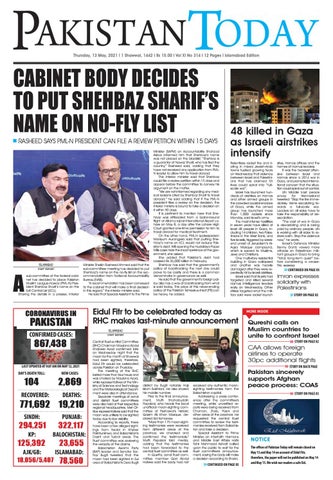
Cabinet body deCides to put shehbaz sharif’s name on no-fly list g
Rasheed says PML-N PResideNt caN fiLe a Review PetitioN withiN 15 days
islamabad staff report
a
sub-committee of the federal cabinet has decided to place Pakistan Muslim League-Nawaz (PML-N) President shehbaz sharif’s name on the exit control List (ecL). sharing the details in a presser, interior
Minister sheikh Rasheed ahmed said that the sub-committee meeting has decided to put shehbaz’s name on the no-fly list on the recommendation from National accountability Bureau (NaB). “a recommendation has been conveyed to the cabinet that will make a final decision in this regard,” the interior minister said. he said that special assistant to the Prime
Coronavirus in
pakistan
ConFirMEd CasEs:
867,438
lasT uPdaTEd aT 9:07 aM on May 12, 2021
day's dEaTh Toll:
nEW CasEs:
104
2,869
rECovErEd:
dEaThs:
771,692 19,210 sindh:
Punjab:
294,251
322,117
kP:
baloChisTan:
125,392 ajk/gb: 18,056/5,407
23,655 islaMabad:
78,560
Minister (saPM) on accountability shahzad akbar informed him that shehbaz’s name was not placed on the blacklist. “shehbaz is a guarantor of Nawaz sharif, who has fled the country,” Rasheed said, adding that they have not received any application from PMLN leader to allow him to travel abroad. the interior minister said that shehbaz could file a review petition within 15 days and appear before the committee to convey his argument on the matter. “we are not informed regarding any medical reasons cited by shehbaz sharif to travel abroad,” he said adding that if the PML-N president files a review on the decision, the interior ministry is bound to take a decision on it within 90 days. it is pertinent to mention here that shehbaz was offloaded from a Qatar-bound flight at allama iqbal international airport Lahore on May 8, a day after the Lahore high court granted one-time permission to him to travel abroad for medical treatment. on the other hand, PML-N spokesperson Marriyum aurangzeb said that putting shehbaz’s name on ecL would not reduce Pakistan’s debt. will opening the hudaibiya Paper Mills case hide the incompetence of the government, she asked. she added that Pakistan’s debt had crossed Rs 36,000 billion in february. shehbaz has said that the government’s policy of backtracking the next day could prove to be costly and there is a common denominator in governance as well. he said that the government’s foreign policy also has a way of backtracking from what is said today. the price of this never-ending policy of the Pakistan tehreek-e-insaf (Pti) can be heavy, he added.
48 killed in Gaza as Israeli airstrikes intensify Relentless rocket fire and rioting in mixed Jewish-arab towns fuelled growing fears on wednesday that violence between israel and Palestinians that has claimed 55 lives could spiral into “fullscale war”. israel has launched hundreds of airstrikes on hamas and other armed groups in the crowded coastal enclave of Gaza, while the armed group has launched more than 1,000 rockets since Monday, said israel’s army. the most intense hostilities in seven years have killed at least 48 people in Gaza, including 14 children, two Palestinians in the west Bank, and five israelis, triggered by weekend unrest at Jerusalem’s alaqsa Mosque compound, which is sacred to Muslims, Jews and christians. one multi-story residential building in Gaza collapsed and another was heavily damaged after they were repeatedly hit by israeli airstrikes. israel said that its jets had targeted and killed several hamas intelligence leaders early on wednesday. other strikes targeted what the military said were rocket launch
Eidul Fitr to be celebrated today as RHC makes last-minute announcement islamabad staff report
central Ruet-e-hilal committee (Rhc) chairman Maulana abdul Khabeer azad confirmed late on wednesday night that the moon for the month of shawwal had been sighted, therefore, eidul fitr would be celebrated across Pakistan on thursday. the meeting of the Rhc lasted more than four hours and was chaired by Maulana azad, while representatives of the Ministry of science and technology and the Meteorological department were also in attendance. separate meetings of zonal and district Ruet committees were also held at their respective regional headquarters. Met office representatives said that the moon was unlikely to be sighted today due to low visibility. according to reports, there have been a few alleged sightings from swabi in Khyber Pakhtunkhwa and Balochistan's dasht and turbat areas. the Ruet committee was reviewing the veracity of the claims. Balochistan awami Party (BaP) leader and senator sarfraz Bugti tweeted that the moon had been sighted in sui area of Balochistan's dera Bugti
sites, hamas offices and the homes of hamas leaders. it was the heaviest offensive between israel and hamas since a 2014 war in Gaza, and prompted international concern that the situation could spiral out of control. UN Middle east peace envoy tor wennesland tweeted: “stop the fire immediately. we’re escalating towards a full-scale war. Leaders on all sides have to take the responsibility of deescalation. “the cost of war in Gaza is devastating and is being paid by ordinary people. UN is working with all sides to restore calm. stop the violence now,” he wrote. israel’s defence Minister Benny Gantz vowed more attacks on Palestinian militant groups in Gaza to bring “total, long-term quiet” before considering a ceasefire. agencies
ConTinuEd on PagE 05
imran expresses solidarity with Palestinians sTory on PagE 02
more inside
Qureshi calls on Muslim countries to unite to confront Israel sTory on PagE 02
caa allows foreign airlines to operate 30pc additional flights sTory on baCk PagE
district by Bugti notable haji islam Bakhlani. he also shared his mobile number. Prior to the final announcement, Mufti shahabuddin Popalzai, who heads the local unofficial moon-sighting committee at Peshawar's historic Qasim ali Khan Mosque, declared eid tomorrow. "More than 175 moon-sighting testimonies were received from different areas of the province; we checked and confirmed the testimonials," Mufti Popalzai told media, adding that the testimonies had been forwarded to the central Ruet committee as well. in Quetta, zonal Ruet committee member Qari abdul hafeez said the body had not
received any authentic moonsighting testimonies from the Balochistan capital. addressing a press conference after the committee's meeting, while unverified reports were being received from chaman, Zhob, Pasni and other areas of the province. he requested the central Ruet committee to review the testimonies received from Balochistan and take a decision. special assistant to Prime Minister on interfaith harmony and Middle east affairs hafiz tahir Mehmood ashrafi called upon the public to wait for the Ruet committee's announcement, saying the body will make a decision according to sharia.
ConTinuEd on PagE 05
Pakistan sincerely supports Afghan peace process: COAS sTory on PagE 03
notice The offices of Pakistan Today will remain closed on May 13 and May 14 on account of Eidul Fitr, therefore, the paper will not be published on May 14 and May 15. We wish our readers a safe Eid.
02
Thursday, 13 May, 2021
ISLAMABAD
NEWS
IMrAN exPresses soLIdArIty wItH PALestINIANs IsLAMABAD
P
Staff RePoRt
RIME Minister Imran Khan Wednesday expressed his solidarity with Palestinian victims of Israeli violence. “I am PM [prime minister] of Pakistan and #WeStandWithGaza #WeStandWithPalestine,” he tweeted, joining the millions of Twitterverse who sent out similar messages of support to the people of Palestine. The prime minister also shared an excerpt of an article of American historian Noam Chomsky in which he mentions an old man in Gaza holding a placard that
88pc work on Karot Hydro Power Project completed: Asim Bajwa LAHORe INP
China-Pakistan Economic Corridor (CPEC) Authority Chairman, Asim Saleem Bajwa, has said that 88 per cent work of 720MW Karot Hydro Power Project has been completed. “The hydropower project — the first of its kind under the CPEC — is expected to be completed in April 2022 and is being built on the River Jhelum,’ he said. Sharing the details of the Karot Hydropower Project in a tweet, Bajwa said the investment in it amounted to $1,780 million while 5,000 local people were directly employed for its construction. Article continues after this advertisement The 720-megawatt Karot Hydropower Project was initially due to be completed in 2020. It has the capability to generate 3.249 billion units of clean electricity per year for the national grid. Around 72 homes and 58 businesses were expected to be relocated due to project construction while 2.8-km of the Karot-Kotli road and 8.9-km of the Azad PattanKahuta road were expected to need relocation.
Court extends PML-N MP’s detention for two weeks IsLAMABAD Staff RePoRt
A sessions court in Lahore on Monday extended the physical remand of Pakistan Muslim LeagueNawaz (PML-N) MP Mian Javed Latif for two weeks in connection with “maligning” state institutions during a political talk show. In March, Latif, while talking to a news channel, said “if anything [bad] happens to Maryam Nawaz, the party will not chant ‘Pakistan khappay [Long live Pakistan]’” — a veiled reference to Pakistan People’s Party (PPP) co-chairperson Asif Ali Zardari who raised the slogan after former prime minister Benazir Bhutto’s assassination in 2007, a time when it was feared that separatists in Sindh could capture the anger at the incident. Subsequently, a case was registered against Latif under sections 120, 120(B), 153, 153(A), 500, and 500(1)(B) at the Township police station on the complaint of a Lahore resident, Jameel Saleem. Police produced him before the court on completion of his previous remand, seeking an extension in the period for further investigation. Police produced the MP before the court on Wednesday amid tight security on completion of his previous two-day remand. After hearing arguments from both sides, the courannounced to extend the remand. In the FIR, the complainant had claimed that the politician, by making the statements, “threatened” the country’s security, government, and state institutions. The lawmaker, Saleem further said, sowed “seeds of hate” between the PPP and PML-N workers. The complainant said the MP hurt the public sentiment to spread chaos in the country, thereby, violated the laws.
reads: “You take my water, burn my olive trees, destroy my house, take my job, steal my land, imprison my father, kill my mother, bombard my country, starve us all, humiliate us all but I am to blame: I shot a rocket back.” The violence escalated after Israeli forces stormed the Al-Aqsa Mosque — Islam’s third holiest site — attacking Palestinian worshippers using rubber-coated steel bullets, stun grenades and tear gas over the weekend. At least 43 people have been killed in Gaza since violence escalated on Monday, according to the enclave’s health ministry. Six people have been killed in
Israel, medical officials said. Israel carried out hundreds of airstrikes in Gaza on Wednesday and Palestinian fighters fired multiple rocket barrages at Tel Aviv and the southern city of Beersheba in the region’s most intense hostilities in years. The heaviest offensive between Israel and Hamas since a 2014 war in the Hamas-ruled enclave has increased international concern that the situation could spiral out of control. Pakistan condemned Israel’s actions and called for Muslim nations to stand by the Palestinians. The Organisation of Islamic Cooperation (OIC) also condemned the airstrikes. It said that it
“condemns in the strongest terms the repeated attacks by the Israeli occupation authorities against the Palestinian people.” The body also condemned “the Israeli occupation forces’ continuation of their colonial programs — building settlements, attempting to confiscate Palestinian properties, forceful eviction of Palestinians from their land”. The OIC also demanded that “relevant international actors”, including the United Nations General Assembly (UNGA), should implement resolutions and recommendations and “activate the necessary mechanisms to stop these violations”.
Qureshi calls on Muslim countries to unite to confront Israel IsLAMABAD Staff RePoRt
Foreign Minister Shah Mahmood Qureshi on Wednesday urged Muslim nations to unite over Israel’s airstrikes on Palestinian civilian neighbourhoods to confront the Jewish state and solve the decades-old Middle East crisis with justice and a humanitarian approach. Speaking to reporters in Multan, Qureshi said that Prime Minister Imran Khan, during his recent visit to Saudi Arabia, met with the secretary general of the Organisation of Islamic Cooperation (OIC) and stressed the need to unite the Muslim nations on the issue using the platform. “We [Muslim countries] can raise our voices individually [but] the issue will be noted [forcefully] when all 57 member states of the organisation voice their support. A lone Pakistan, Saudi Arabia, Turkey, Malaysia and Indonesia cannot do anything,” he maintained. Israel continued its bombardment of the besieged Gaza Strip early on Wednesday, targeting several neighbourhoods after lone rockets were fired from the enclave. It is the most intense airstrikes in Gaza since the bombardment in 2014. Health authorities in Gaza said at least 35 Palestinians — including 10 children — were killed in airstrikes on the Strip since late on Monday. At least 233 others were injured. The violence escalated after Israeli forces stormed the Al-Aqsa Mosque —
Islam’s third holiest site — attacking Palestinian worshippers using rubbercoated steel bullets, stun grenades and tear gas over the weekend. Pakistan condemned the violence the called on “the international community to put an end to the blatant use of force and flagrant violation of human rights of the Palestinian people,” a Foreign Office statement said. The OIC, after convening a virtual emergency session on Tuesday to discuss the “aggression by Israel”, said that it “condemns in the strongest terms the repeated attacks”. The body also demanded that “relevant international actors,” including the United Nations General Assembly, should implement resolutions and recommendations and “activate the necessary mechanisms to stop these violations.” Today, Qureshi said he had also received a call from his Turkish counterpart, Mevlut Cavusoglu, who explained to him the proposals that would be discussed and presented in his meeting with the top Saudi diplomat. The proposals included calling an emergency ministerial session of the OIC on the situation in Palestine and calling an emergency session of the United Nations General Assembly (UNGA), he said. Cavusoglu had asked for his opinion to which Qureshi had voiced his support after consulting with Prime Minister Imran Khan. “This is a matter of our belief, human
rights, international law and challenging an apartheid regime and we are ready to do that,” said Qureshi. During his visit to the kingdom along with the prime minister, Qureshi said thaat he had a meeting with Saudi Foreign Minister Prince Faisal bin Farhan Al-Saud. Giving details of the meeting, he said a delegation of senior Saudi officials would visit Pakistan after Eidul Fitr and have a meeting with senior officials at the Foreign Office. “Their [Saudi] foreign minister will visit Pakistan keeping those talks as the basis,” said the foreign minister, adding he had requested Al-Saud to visit for at least two days and the latter had agreed. Qureshi also added that on the basis of the institutional arrangement, Saudi Crown Prince Mohammed bin Salman would also visit Pakistan soon. “It was decided that we have to give our relationship a new direction towards economic cooperation,” he further disclosed. Qureshi further said Riyadh decided to inject $500 million in Pakistan’s energy sector to further strengthen it. The Saudi assistance would help ovecome the imbalance in the energy sector, he said, adding the investment is meant for alternate and renewable energy including solar, wind and hydel power. The money would improve the country’s energy mix — a group of different primary energy sources — balance, he said. It would also help lower the tariff gradually and would impact the economy positively.
He said that Saudi funding would also focus on infrastructure development and investment in water resource projects. Qureshi said that the three-day Saudi visit was made on the invitation of the crown prince and it helped defuse the nefarious designs of detractors. He said that Pakistan enjoys brotherly relations with Saudi Arabia, however, the recent initiative of a supreme council brought it from an adhoc basis to institutional arrangement. He further said there would be regular engagement under the council and that it would have three pillars: a security and political pillar to be led by Pakistan’s foreign minister; economic outreach to be led by Pakistan’s finance minister; cultural, information and communication cooperation to be led by Pakistan’s minister for information and culture. The foreign minister further said that Saudi allocated a special labour quota for Pakistan-national workers under its 2030 Vision that involved massive investments. He said that the new jobs opportunities would benefit hundreds of thousands of people. Qureshi said that the issue of visas with Kuwait and the problems faced by Pakistani families living in the sheikhdom have also been resolved. He said that there was a ban on the export of Pakistani oranges to Iran for the past 12 years which has now been lifted and it would benefit our farmers, exporters and the national economy.
KSA vaccine conditions limit Pakistani population from travelling News Desk The Kingdom of Saudi Arabia (KSA) has issued a list of vaccines that travellers must have taken before entering the region; however, it has discluded all Chinese vaccines, leading to trouble for many Pakistani travellers who are now unable to go to Saudi Arabia. Pfizer, Oxford, Moderna, and Johnson and Johnson’s coronavirus vaccines have been recommended by the kingdom. Saudi Arabia’s new conditions related to the coronavirus vaccine have made life difficult for a lot of Pakistanis aspiring to travel to the kingdom as the kingdom has not included in its list of recommended vaccines, any of the ones that have been manufactured in China.
Most people in Pakistan are being vaccinated with the coronavirus vaccines manufactured by China, due to which a lot of Pakistanis are figuring out how to travel to the kingdom. According to foreign media, passengers who do not receive the shots from the recommended vaccines will have to undergo a mandatory quarantine period in Saudi Arabia, wherein the cost would be borne by the travellers themselves. The proposed conditions will be implemented from May 20. It is pertinent here to mention that Saudi Arabian Deputy Minister of Hajj and Umrah Dr Abdul Fattah Mashat has said the kingdom does not intend to call off this year’s Hajj pilgrimage. This he said in a meeting with Maulana Tahir Ashrafi, Special Assistant to the PM on Religious
Harmony, in Makkah. The minister said the kingdom has started making arrangements to hold this year’s Hajj pilgrimage with Covid safety protocols. All possible steps are being taken to facilitate pilgrims, he said. He maintained that the Covid-19 vaccination is mandatory for people intending to perform the annual Hajj pilgrimage this year. Maulana Ashrafi said the people and leadership of Pakistan and Saudi Arabia are close to each other. The Saudi government’s measures for pilgrims are laudable, he added. Separately, Foreign Minister Shah Mahmood Qureshi on Wednesday said that the visit of Saudi Arabia has dashed the hopes of the opponents as some elements want to spoil the relations with Saudi Arabia.
Pakistan risks FATF blacklisting because of ‘accountability drama’: Bilawal kARACHI INP
Lashing out at the Centre for its economic policies, People’s Party (PPP) chief Bilawal Bhutto-Zardari on Wednesday accused the federal government of levelling “baseless claims” of money laundering and corruption against its opponents which he said possessed the potential to push the country into the Financial Action Task Force (FATF) blacklist. “This is not tabdeeli (change) but tabahi
(destruction),” Bilawal said. In a statement, he wondered how foreigners could be persuaded to invest their capital in Pakistan when “selected” Prime Minister Imran Khan was himself projecting the country as a safe haven of corrupt elements. “It is a matter of shame that just like Cambodia, Ghana, and Zimbabwe, Pakistan, too, could not manage to get its name removed from the FATF grey list,” he commented. He claimed that only if the prime minister had executed the effective policy devised by PPP, Pakistan
could have easily managed to get its name off the grey list. “PPP government had won GSP+ status for the country from the European Union,” he said and regretted Pakistan risked losing that status too under the present government. Bilawal was of the view that Imran’s “crusade” against corruption was in fact a joke with the nation so much so that now there were question marks even over the country’s future. Declaring Prime Minister Imran a “patron of mafias”, he said his false claims of accountability now
lay exposed, and people would now no more be duped by him. “Those who used to claim that there was corruption of Rs12 billion every day in the country need to answer the question of how much “looted” money they have deposited in the coffers ever since they came to power in 2018,” Bilawal asked. He further said that PPP had all along been demanding the implementation on the National Action Plan (NAP), but the PTI government did not pay heed to this, and now the country’s economy had been hit badly because of that.
Thursday, 13 May, 2021
ISLAMABAD
NEWS
03
LAHORE: Members of the civil society protest Israeli atrocities against the Palestinians. ZUBAIR MEHFOOZ
Covid-19 daily cases fall below 3,000 mark after 2 months ISLAMABAD
P
COVID-19 LEAVES 202 DOCTORS, 30 PARAMEDICS DEAD SO FAR: PMA
tLtP
AKISTAN reported less than 3,000 coronavirus cases in a day after almost two months, as 2,869 new infections were reported during the last twenty-four hours, said the National Command and Operation Centre (NCOC) on Wednesday. Pakistan had reported 2,351 coronavirus cases on March 16, 2021. The country reported 2, 869 new infections on Tuesday, taking the total caseload to 867,426. 104 corona patients have died during the past 24 hours, 89 of whom were under treatment in hospital and 15 out of the hospital in their respective quarantines or homes, according to the latest update issued by the NCOC. During the past 24 hours, most of the deaths have occurred in Punjab followed by Khyber Pakhtunkhwa. Out of the total 104 deaths that occurred in the last 24 hours 49 of them had died who were under treatment on ventilators. According to figures provided by the NCOC, Pakistan carried out 38,616 coronavirus tests on Tuesday out of which 2,869 returned positive. The positivity ratio in Pakistan stands at 7.42 per cent. The current active cases of the country stand at 76,536 and 771,692 recoveries have so far been reported country-wide. Punjab currently leads the provinces and federating units in most cases with 322,117, Sindh comes in second with 294,251 cases, KP has reported 125,392 cases, Islamabad 78,560 cases, Balochistan 23,655 cases, Azad Jammu and Kashmir 18,056 cases, and Gilgit-Baltistan 5,407 cases.
The maximum ventilators were occupied in four major areas including Lahore 63 per cent, Multan 73 per cent, Gujranwala 52 per cent and Peshawar 41 per cent. The maximum Oxygen beds (alternate oxygen providing facility other than ventilator administered as per the medical requirement of Covid patient) was also occupied in four major areas of Gujranwala 64 per cent, Swabi 60 per cent, Peshawar 51 per cent and Multan 54 per cent. Around 623 ventilators were occupied elsewhere in the country while no coronavirus patient was on a ventilator in AJK, GB and Balochistan. At least 1,266 new coronavirus cases were recorded in Punjab during the past 24 hours, taking the provincial tally to 322,117. According to the Punjab Primary and Secondary Health Care Department, at least 63 more patients succumbed to the pandemic as the total death count reached 9,188. The department added that at least 276,800 patients had recovered from the deadly virus as of yet, with 2,669 people recovered in the past 24 hours. Meanwhile, the number of new Covid-19 cases and deaths globally slightly decreased this week, with over 5.5 million cases and over 90 000 deaths. Case and death incidences, however, remain at the highest levels since the beginning of the pandemic. New weekly cases decreased in the regions of Europe and Eastern Mediterranean, while the South-East Asia Region continued an upward trajectory for nine weeks and reported a further 6 per cent increase last week. Moreover, Pakistan Medical Association (PMA) has
urged the government to provide the Shuhuda compensation package announced earlier to the families of healthcare workers, as the death toll of doctors who succumbed to the virus exceeded 200. In a press statement on Wednesday, the PMA said that as of now, 202 doctors and 30 paramedics have passed away from the virus. Out of these, 74 doctors hailed from Punjab while 64 belonged to Sindh. Among the doctors who passed away due to the coronavirus, 53 belonged to KP while 6 hailed from Balochistan, 3 from AJK and one doctor from GB. Providing a further breakdown of the deceased healthcare workers’ professions, the PMA said among the frontline healthcare givers who had fallen to the infection, 24 were medical officers, 19 were general physicians and 13 were paediatricians. Among them were nine who were professors of medicine while an equal number of ENT specialists also succumbed to the virus. As per the PMA statement, the total number of healthcare workers who have passed away in Pakistan from the virus include seven gynaecologists, six pathologists and three postgraduate trainees as well. The PMA said that among the deceased included 3 radiologists, two surgeons and an equal number of cardiologists. The association called upon the government to provide the compensation which was included in the Shuhuda package for healthcare workers to the families of the deceased, adding that they were frontline warriors in the battle against the pandemic.
Covid-19 vaccine registration for ages 30 and above from Sunday: minister ISLAMABAD StAFF REPORt
The National Command & Operation Centre (NCOC) has decided to open registration for people aged 30 and above from May 16 (Sunday) to receive the Covid-19 vaccine, Minister for Planning and Development Asad Umar announced on Wednesday. “As vaccine supply continues to improve and vaccination capacity gets enhanced in all federating units, we continue to expand the categories of those who are eligible to get vaccinated,” he said in a tweet. His tweet comes as the coronavirus portal registered 2,869 new infections after conducting 38,616 tests in the last 24 hours, receiving back a positivity ratio of 7.42 percent. This is the first time
since March 16 the portal has reported less than 3,000 infections. Meanwhile, deaths increased by 104 to 19,210. The Ministry of National Health Services on Wednesday opened a walk-in coronavirus disease vaccination scheme for people aged 40 to 49. The NCOC had opened registration of around 12 million people in the said age group late on April 27. The same day, it also approved walkin vaccination facility for people over 50. The government launched a nationwide Covid-19 vaccination drive for the general public, starting with older people, in March. The drive began with a focus on the oldest people in the community, generally over the age of 80. Battling a third peak of the virus, the authorities began the vaccination with Chinese Sinopharm and CanSino jabs. Private hospitals in major cities are
also using the Russian Sputnik-V vaccine that has been imported by a local pharmaceutical company. Islamabad has also approved the emergency use of Oxford-AstraZeneca and China’s CoronaVac vaccines, but both are yet to be used in the country. The government received its first shipment of AstraZeneca doses through the Covid-19 Vaccines Global Access (Covax) facility over the weekend. The government is aiming to ramp up the immunisation campaign in the summer and expects to receive 13.2 million doses of Covid-19 vaccines by the end of June. According to Minister of State for Health Dr Faisal Sultan, the government has so far placed orders for 30 million doses with different companies. He had last month announced that by the end of
June, the government would have a stock of 17 million vaccine jabs but stopped short of identifying the developer. PROVINCE-WISE BREAKDOWN OF COVID-19 CASES: Punjab remains the worst-hit province in terms of deaths from coronavirus-related complications and cases followed by Sindh and Khyber Pakhtunkhwa (KP). Since the outbreak in February last year, 322,117 infections have been confirmed in Punjab, 294,251 in Sindh, 125,392 in KP, 78,560 in Islamabad, 23,655 in Balochistan, 18,056 in Azad Jammu and Kashmir and 5,407 in Gilgit-Baltistan. The MoNHS has so far tested 12,310,875 samples for the contagion disease. So far, 771,692 patients have completely recovered nationwide whereas 4,707 are in critical condition.
KP suspends recreational activities to curb virus spread ISLAMABAD INP
Khyber Pakhtunkhwa Minister for Labor and Culture Shaukat Yousafzai Wednesday appealed to the people not to pay visits to tourist spots during Eidul Fitr holidays as there was a complete ban on tourism till May 16. Talking to a news channel, he said the initiative had been taken in a bid to curb the spread of the
Covid-19 pandemic. He said inter-provincial and inter-city transport was suspended during Eid holidays, except for those returning to their hometowns. The minister said police checkpoints were established in Abbottabad, Mansehra, Swat, Haripur, Chitral, and Peshawar to restrict the local tourists from unnecessary visits to these scenic areas. He said so far 246 tourist vehicles were returned from Abbottabad after the closure of all recreational
points. Yousafzai appealed to the tourists to fully cooperate with the government and follow the precautionary measures and celebrate the festival with simplicity and at home. He said all authorities concerned had been asked to take strict action against the violators under the laws. He further said KP administration had also established emergency control rooms with maximum facilities in all districts where it was facing vaccination data entry issues.
KP doctor dies of coronavirus PESHAWAR APP
Yet another doctor lost his life to coronavirus in Peshawar on Wednesday as the number of medics who passed away of the contagion disease increased to 67. According to a Provincial Doctors Association (PDA) official, Fazal Rahim — who was working as a senior pathologist in District Headquarters (DHQ) Hospital of Lower Dir — was hospitalised after contracting the diease late last month. The official further said the number of doctors succumbing to coronavirus in Khyber Pakhtunkhwa has risen to 67. Rahim’s funeral was offered at Temergarh following which, he was buried at his native village. The funeral was attended by the officials of the PDA, KP Health Department, Lower Dir deputy commissioner, and other officials of the district administration. Doctors and other health workers in KP who fell victim to the disease are still deprived of the martyrs’ package approved in April last year, the official said.
Pakistan sincerely supports Afghan peace process: COAS RAWALPINDI StAFF REPORt
Chief of Army Staff (COAS) General Qamar Javed Bajwa on Wednesday said that Pakistan has sincerely supported the Afghan peace process as a prosperous, stable and peaceful Afghanistan was in the best interest of the region in general and Pakistan in particular. The army chief was speaking to United States Charge d’ Affairs Angela Aggeler, who called on him, an Inter-Services Public Relations (ISPR) press release said. During the meeting, matters of mutual interest, overall regional security situation, bilateral cooperation in various fields, fight against Covid-19 and recent developments in the Afghan peace process were discussed. The COAS hoped for greater Pak-US bilateral cooperation in all domains in the future. The US envoy acknowledged and appreciated Pakistan’s continuous efforts and support for peace and stability in the region and pledged to further enhance bilateral relations between both countries.
Sindh allows restaurant takeaway during Eid holidays KARACHI INP
The Sindh government has offered a major relaxation to restaurant owners by allowing takeaway service during the upcoming Eidul Fitr holidays. This was decided in a meeting of the Provincial Task Force on Coronavirus at the Chief Minister House which was chaired by Chief Minister Murad Ali Shah. Participants were briefed on the latest pandemic situation across the province and the vaccination process. Sindh Minister for Information Syed Nasir Hussain Shah on Wednesday said that the Eid prayers should be held at open places and with complete adherence to SOPs to avoid Covid spread on the festive occasion. “Eid prayers should be held at open places and more and more open places should be utilized for the purpose,” he said while briefing media on decisions taken during a meeting of the Covid task force.
04
Thursday, 13 May, 2021
ISLAMABAD
NEWS
VaccInatIon cEntrEs bEIng IncrEasEd In Punjab: buzdar CM CONDEMNS ISRAEL’S ATTACKS ON GAZA AND EXPRESSES SOLIDARITY WITH PALESTINIANS LAHORE
P
TLTP
UNJAB Chief Minister Sardar Usman Buzdar has said that the number of coronavirus vaccination centres is being increased in Lahore and other parts of the province to accommodate more and more citizens every day. In a statement on Wednesday, the chief minister said that as compared with other
provinces, more people are being vaccinated every day in Punjab and the target will be timely achieved due to the increased number of vaccination centres. He appealed to the citizens to wear face masks and follow corona standard operating procedures (SOPs) during Eid-ul-Fitr prayers. The citizens should also remain confined to their homes to avoid the virus, he said. The health department is playing a commendable job and the Punjab government is also striving to save the lives of the
citizens, he added. Separately, Sardar Usman Buzdar strongly condemned Israel's bombardment and missile attack on Gaza, saying that Israel is committing the worst cruelty by targeting women and children. The chief minister regretted that Israel has violated all international laws to play with fire and blood in Palestine. Regrettably, Israel has violated all human rights by targeting innocent children and women and the international community should take immediate action to stop the Israeli aggression, he stressed. The chief minister stressed upon the global community to proactively react to save the unarmed Palestinians from the savagery of their archenemy. Practical steps are needed in this regard and the continued silence of the in-
ternational community over Israeli aggression is criminal negligence, he regretted. “We express complete solidarity with the
defenceless Palestinians and I pray for the health and early recovery of the injured Palestinians,” the chief minister further said.
Fawad greets Punjab over record wheat production ISLAMABAD TLTP
HYDERABAD: Passengers board a train to their hometowns ahead of Eid-ul-Fitr. INP
Govt to impose health tax on cigarettes in upcoming budget
Federal Minister for Information and Broadcasting Fawad Chaudhry has congratulated the farmers and government of Punjab on the record production of 20 million metric tonnes of wheat. In a tweet on Wednesday, the information minister said that the agricultural economy has grown by Rs1,100 billion and this historic development was made possible despite the outbreak of coronavirus pandemic. “This development gives an idea of the potential of Pakistan’s agricultural sector,” Fawad remarked. Separately, Fawad Chaudhary in a video message on Wednesday urged the masses to strictly comply with Covid-19 standard operating procedures (SOPs) during the upcoming Eid-ul-Fitr to avoid the spread of the pandemic like in India. The minister warned, “If we did not comply with the Covid-19 protocols, Pakistan could also face a situation similar to its neighbour (India). Stay home and stay safe would be the fundamental moto during these Eid-ul-Fitr holidays." He said that instead of visiting relatives on the occasion, citizens should use the internet and phone for communication with their loved ones. "This is important for our own safety and our dear ones," the information minister stressed. Earlier on May 11, it was reported that in an effort to curb the transmission of the novel coronavirus, the country’s apex body leading the fight against the deadly pandemic approved guidelines for the upcoming festival of Eid-ul-Fitr. The National Command and Operation Centre (NCOC) recommended congregations at open spaces, brief sermons by Ulema and Khateebs, mandatory wearing of masks and maintaining social distancing rules. It already announced a weeklong Eid holiday, closure of shopping malls and tourist spots, and a ban on intercity and intracity public transport.
Islamabad, Lahore to receive rain on Eid ISLAMABAD INP
The Pakistan Meteorological Department (PMD) has predicted rain in Islamabad, Lahore, and Peshawar on Eid this year. Gujranwala and Rawalpindi will receive rain with lightning and thunderstorms as well. In Khyber Pakhtunkhwa, the downpour is forecast on Thursday. The Pakistan Disaster Management Authority has, on the other hand, predicted rain on the upcoming five days in Peshawar and neighbouring areas. The authority has issued an alert directing farmers and residents to take precautionary measures beforehand. In case of an emergency, they can reach out to help at 1177. A similar warning has been issued for Chitral, Dir, Swat, Shangla, Buner, Kohistan, Mansehra, Haripur, Kohat, Mardan, Bannu, Kohistan, and Abbottabad as well. The Met department has also forecast wind and dust thunderstorms in Sukkur, Shaheed Benazirabad, Dadu, Larkana, Hyderabad and Jacobabad.
ISLAMABAD STAFF REPORT
The government is all set to implement health levy on cigarettes from the upcoming fiscal year to discourage smoking, boost revenues and reduce number of patients with diseases like cancer and diabetes. Special Assistant to Prime Minister on Public Health Dr Faisal Sultan said that his ministry is working to incorporate a bill regarding health levy on cigarettes into the upcoming finance bill to implement it across the country. He said the health levy on cigarettes should have been implemented from the previous fiscal year, but it could not happen due to certain reasons. The federal cabinet had approved the health levy in June 2019, but it is yet to be implemented. The delay in the implementation of the health levy is causing a loss of around Rs38 billion annually to the national exchequer in terms of low tax collection. The special assistant has vowed not to accept pressure from any influential industry to further delay the imposition of the levy, adding that the levy would help collect additional billions of rupees in taxes that would be sufficient to improve health infrastructure in the country. Earlier, in a letter to the ministry of finance, Dr Faisal Sultan had emphasised upon the need to charge Rs10 per pack of cigarettes and Rs1 per 250 millilitre of carbonated drinks as approved by the federal cabinet on June 18, 2019. Sultan said the diseases like heart stroke, cancer, diabetes and chronic lung problem are collectively responsible for almost 68 per cent of all deaths in Pakistan. Pakistan is aimed at reducing one-third of pre-
KP stops vehicles from entering tourist destinations mature deaths, caused by the said diseases and tobacco, by 2030 as a part of its targets set in Sustainable Development Goals [SDGs], he said. He said the government can achieve the goal by decreasing the tobacco consumption among the youth through imposition of the health tax. Some officials in the ministry of national health services said that they have yet to hear back from the finance ministry on the health levy bill. The imposition of health tax on tobacco and sugary drinks as per decision of the federal cabinet will prove as a catalyst to reduce the said diseases in the country, Sultan said in the letter, adding that this would also help
boost the tobacco revenues. In Pakistan, the use of tobacco is a cause of deaths of around 160,100 persons every year while almost 23.9 million adults currently use tobacco in any form in the country, according to the ministry of national health services. It is pertinent to mention that the cigarette manufacturers in Pakistan are highly influential. The three largest manufacturers have shown increases in their profitability as per their public documents. Despite pocketing millions, the companies always exert pressure on government to reduce taxes and avoid slapping the health levy on their products.
PESHAWAR: On the recommendation of the National Command and Operation Centre (NCOC) to contain the spread of coronavirus, the Khyber Pakhtunkhwa (KP) government has announced complete closure of tourist spots, hotels, and restaurants across the province. The provincial government has set up 105 check posts to prevent tourists from visiting tourist spots amid the coronavirus pandemic. According to a report prepared by the tourism department of Provincial Performance Management and Reforms Unit, around 11,174 vehicles were stopped at the check posts on Tuesday and 4,260 vehicles were returned. AZIZ BUNERI
Thursday, 13 May, 2021
ISLAMABAD
NEWS
ImRan, ERdOGan vOw tO mObIlIzE Int’l COmmunIty tO hElP stOP IsRaElI attaCks iSLamaBad
t
APP
HE leadership of Pakistan and Turkey on Wednesday vowed to work together especially at the United Nations to jointly mobilise the international community to help stop Israeli attacks on Al-Aqsa Mosque and Gaza.
Prime Minister Imran Khan received a telephone call from Turkish President Recep Tayyip Erdogan wherein they exchanged views on Israel’s heinous attacks during the holy month of Ramazan on the Al-Aqsa Mosque and the worshippers inside as well as on Gaza violating all norms of humanity and international law. The leaders also agreed that the for-
eign ministers of two countries would be working closely together to raise the Palestinian issue at international level. They also discussed the regional security situation, a PM Office press release said. Appreciating Turkey’s role, the prime minister stressed the importance of a responsible withdrawal of foreign troops. He said Pakistan would continue
to extend all possible support to the efforts for a political solution for durable peace and stability in Afghanistan. Both leaders discussed further strengthening of bilateral relations and agreed that the momentum of high-level exchanges between Pakistan and Turkey would continue. The two leaders also exchanged greetings on Eidul Fitr.
Eidul Fitr to be celebrated today as RHC makes last-minute announcement continued from page 01 Meanwhile, Minister for Information Fawad Chaudhry, who previously served as the science and technology minister, said that the age of the new moon was only 13 hours and 42 minutes in Pakistan due to which it was "impossible" to sight the crescent today. "The people who want to celebrate Eid with Saudi Arabia, it is their option but what logic would it be to conclude the holy month with a lie?" he tweeted, adding that the people supporting this view "should say plainly 'we want to celebrate Eid with Afghanistan or Saudia.'" Earlier, in an attempt to ensure that Eidul Fitr is celebrated the same day across the country this year, RHC members had approached and tried to persuade the clerics who have publicly opposed the announcement related to Shawwal moon-sighting by the national body in the past.
“We are engaged with clerics of all schools of thought and various groups, involving them in the process,” Maulana Azad had told a local news outlet, recalling that the management of Peshawar's Qasim Ali Khan mosque, where Mufti Popalzai heads the local unofficial moonsighting committee, had also observed Ramazan with the rest of the nation. “I am sure they will respect the decision of the Ruet-e-Hilal Committee over Shawwal moon too,” he added. However, some committee members had expressed concerns over what they called the premature statements by Information Minister Fawad regarding the expected date of Eid. In a tweet on Sunday, Fawad had said: "Although the final Eid announcement will be made by the Ruet-i-Hilal Committee, according to the calendar and Ruet App developed by the [science ministry] the moon will be able to be sighted on May 13 and Eid will be on
May 14 (Friday)." Several committee members had registered concerns to the RHC chairman that such statements by the minister would only encourage clerics such as Mufti Popalzai of Peshawar to continue to undermine the authority of the committee this year too. This year's Eid comes as Pakistan struggles to contain a third wave of coronavirus infections, with more than 850,000 cases and 19,000 deaths declared and only a fraction of the population having been vaccinated. The country is currently under a partial lockdown after the National Command and Operation Centre (NCOC) last month announced a 'Stay Home, Stay Safe' strategy from May 8 to May 16 aimed at controlling the movement of people during the Eidul Fitr holidays. Under the guidelines, all markets, businesses and shops will remain closed, except essential services such as grocery
stores, medical stores, hospitals, vaccination centres, vegetable, fruit and meat shops, bakeries, petrol pumps, food takeaways and media houses. There will be a ban on Chand Raat bazaars, including mehndi, jewellery/ornaments and clothing stalls. There will be a complete ban on tourism for both locals and outsiders. All tourist resorts, formal and informal picnic spots, public parks, shopping malls, hotels and restaurants at picnic places will remain closed during Eid holidays. Interprovincial, intercity and intracity public transport will also remain suspended, while private vehicles, taxies/cabs and rickshaws will operate at 50 per cent occupancy. The electronic media has been advised to run movies, dramas and shows to keep people entertained at home. Moreover, an uninterrupted supply of electricity will be ensured during the Eid holidays.
48 killed in Gaza as Israeli airstrikes intensify continued from page 01 “The army will continue to attack to bring a total, longterm quiet. Only when we reach that goal will we be able to speak about a truce,” Gantz said in the southern city of Ashkelon which has been hit by Palestinian rocket fire. Gazans homes shook and the sky lit up from Israeli attacks, outgoing rockets and Israeli air defence missiles intercepting them. At least 30 explosions were heard within a matter of minutes just after dawn on Wednesday. Israelis ran for shelters or flattened themselves on pavements in communities more than 70 kilometres up the coast and into southern Israel amid sounds of explosions as interceptor missiles streaked into the sky. In the mixed Arab-Jewish town of Lod, near Tel Aviv, two people were killed after a rocket hit a vehicle in the area. Lod and other mixed towns have been gripped by angry demonstrations over the Gaza violence and tensions in Jerusalem. Hamas’s armed wing said that it fired 210 rockets towards Beersheba and Tel Aviv in response to the bombing of the tower buildings in Gaza City. Israel’s military says that around a third of the rockets have fallen short, landing within Gaza. For Israel, the armed group’s targeting of Tel Aviv, its commercial capital, posed a new challenge in the confrontation with Hamas, regarded as a terrorist organisation by Israel and the United States. The violence followed weeks of tension in Jerusalem during the month of Ramazan, with attacks by Israeli police on Palestinian protesters in and around the Al-Aqsa Mosque. These attacks escalated in recent days ahead of a — now postponed — court hearing in a case that could end with Palestinian families evicted from East Jerusalem homes claimed by Jewish settlers. Violence also flared in the occupied West Bank, where Israeli troops shot dead two Palestinians in separate clashes, near Nablus and near Hebron, the Palestinian health ministry said.
‘A VERY HEAVy PRICE’: There appeared no imminent end to the violence. Israeli Prime Minister Benjamin Netanyahu warned that militants would pay a “very heavy” price for the rockets, which reached the outskirts of Jerusalem on Monday during a holiday in Israel commemorating its capture of East Jerusalem in a 1967 war. The outbreak of hostilities led Netanyahu’s political opponents to suspend negotiations on forming a coalition of right-wing, leftist and centre-left parties to unseat him after an inconclusive March 23 election. Opposition leader Yair Lapid has three weeks left to establish a government, with a new election — and another chance for Netanyahu to retain power — likely if he fails. The Arab League, some of whose members have warmed ties with Israel over the last year, accused it of “indiscriminate and irresponsible” attacks in Gaza and said it was responsible for “dangerous escalation” in Jerusalem. Hamas named its rocket assault “Sword of Jerusalem”, seeking to marginalise Palestinian President Mahmoud Abbas and to present itself as the guardians of Palestinians in Jerusalem. The militant group’s leader, Ismail Haniyeh, said that Israel had “ignited fire in Jerusalem and Al-Aqsa Mosque and the flames extended to Gaza, therefore, it is responsible for the consequences”. Haniyeh said that Qatar, Egypt and the United Nations had been in contact urging calm but that Hamas’s message to Israel was: “If they want to escalate, the resistance is ready, if they want to stop, the resistance is ready.” The White House said on Tuesday that Israel had a legitimate right to defend itself from rocket attacks but applied pressure on Israel over the treatment of Palestinians, saying Jerusalem must be a place of coexistence. The United States was delaying UN Security Council efforts to issue a public statement on escalating tensions because it could be harmful to behind-the-scenes efforts to end the violence, according to diplomats and a source familiar with the US strategy. State Department spokesman Ned Price urged calm
and “restraint on both sides”, saying: “The loss of life, the loss of Israeli life, the loss of Palestinian life, It’s something that we deeply regret.” He added: “We are urging this message of de-escalation to see this loss of life come to an end.” PLUMES OF BLACK SMOKE: Israel said that it had sent 80 jets to bomb Gaza, and dispatched infantry and armour to reinforce the tanks already gathered on the border, evoking memories of the last Israeli ground incursion into Gaza in 2014. More than 2,100 Gazans were killed in the sevenweek war that followed, according to the Gaza health ministry, along with 73 Israelis, and thousands of homes in Gaza were razed by Israeli forces. Video footage on Tuesday showed three plumes of thick, black smoke rising from a 13-story Gaza residential and office block as it toppled over after being demolished by Israeli airstrikes. The Israeli military said that the building, in Gaza City’s Rimal neighbourhood, housed “multiple” Hamas offices, including ones for military research and development and military intelligence. The existence of one Hamas office, used by political leaders and officials dealing with the news media, was widely known locally. Residents in the block and the surrounding area had been warned to evacuate the area before the airstrike, according to witnesses and the Israeli military. A second residential and office building in the same neighbourhood was heavily damaged in Israeli attacks shortly before 2 am on Wednesday. Residents and journalists working in the building had already left. Israeli political leaders and the military said they had killed “dozens” of “militants”, and hit buildings used by Hamas. Defence Minister Gantz said that Israel had carried out “hundreds” of strikes, and that “buildings will continue to crumble.” Israel’s Magen David Adom ambulance service said a 50-year-old woman was killed when a rocket hit a building in the Tel Aviv suburb of Rishon Lezion, and that two women had been killed in rocket strikes on Ashkelon.
05
OPEC expects global economic growth to sustain oil demand iSLamaBad TLTP
OPEC left its global oil demand forecast for 2021 unchanged in its monthly outlook report, due to an economic rebound in the second half of the year but the bloc sees energy consumption in India, the world's third-biggest consumer of oil, collapsing because of the surge in Covid-19 infections. The group maintained its global demand forecast for 2021, which sees an increase of 6 million barrels per day to average 96.5 million bpd for the year, according to its monthly market report. The rising number of infections in top energy-consuming countries such as India and Brazil will weigh on demand in the first half of the year. Slower-than-anticipated consumption in the Americas region of Organisation for Economic Cooperation and Development countries in the first quarter also impacted OPEC's earlier forecast. However, these developments are likely to be offset by "positive weekly transportation fuels data from the US and the acceleration in vaccination programmes" in the second half of the year, OPEC said. "The assumed return to normality and improved mobility will also positively influence regions such as the Middle East and Other Asia," the group said. However India, one of the fastest growing demand centres for crude, is expected to curtail its demand over the coming months. The South Asian nation has emerged as a Covid-19 hotspot, with local, highly infectious strains of the virus spreading rapidly across the country. India has registered nearly 23 million cases so far, according to Worldometer, which tracks the pandemic. The government has been reluctant to impose a nationwide lockdown similar to the curbs implemented last year, which severely crimped its overall demand for crude and led its economy to shrink 8 per cent in 2020. India's economy was forecast to expand 12.5 per cent this year, according to the latest outlook from the International Monetary Fund, but that was before the resurgence of Covid-19. The country has grounded flights and several state governments have imposed at least two weeks of lockdown. India’s refined products demand is expected to drop to 2.8 million bpd in May 2021, a 160,000 bpd downward revision due to the debilitating second wave in the country, Rystad Energy said in a note on Tuesday. The mobility restrictions will limit demand from the end of April, well into May and possibly June, impacting the whole of second quarter oil demand for the country, according to OPEC. "Some support might emerge from increased usage of private vehicles over public transportation which could cap declines in transportation fuels demand," the report added. The Vienna-based bloc expects to see higher growth from India's industrial sector towards the second half of the year. "A positive baseline impact of 2020, stimulus measures taken by the government to encourage private consumption and investment, and a pick-up in vaccination rollouts towards the second half" will encourage growth, it said.
Gold price reaches Rs89, 700 per 10gm ISLAMABAD: Gold price in the international market went down for second straight day on Wednesday, after touching its highest since February 11 at $1,845.06 on Monday last. At 1338 hours GMT, gold in the international market was trading at $1,834.70 an ounce after shedding $4.20 an ounce in its value as compared to its closing value on Tuesday last. Though markets in Pakistan are closed due to a lockdown, the price of 10 grams of yellow metal in the country has reached Rs89,700 after shedding Rs200. The closing price of 10 grams gold was recorded at Rs89, 900 on Tuesday last. According to the experts, gold futures edged lower pressured by firmer Treasury yields and US dollar ahead of US consumer price data. The much-anticipated US consumer inflation report is forecast to show a 3.6% rise in year-on-year prices. Higher inflation will likely add pressure on the Fed to bring forward rate rises, and weigh on gold, which bears no interest. TLTP
Vaccine inequity threatens global economic recovery: Report iSLamaBad TLTP
Although the outlook for global growth has improved, the ongoing impacts of the Covid19 pandemic, as well as inadequate progress on vaccination in poorer countries, are putting recovery at risk, according to the latest UN economic forecast. The World Economic Situation and Prospects (WESP) mid-year report warned widening inequality is threatening global growth, projected at 5.4 percent this year. “Vaccine inequity between countries and regions is posing a significant risk to an already uneven and fragile global recovery”,
said UN Chief Economist Elliott Harris. “Timely and universal access to COVID-19 vaccinations will mean the difference between ending the pandemic promptly and placing the world economy on the trajectory of a resilient recovery, or losing many more years of growth, development and opportunities.” The mid-year forecast updates the WESP report published in January by the UN Department of Economic and Social Affairs (DESA). It examines the performance of the world economy since the pandemic began, as well as the impact of global policy responses and post-crisis recovery scenarios. The 5.4 percent in projected global
growth this year follows a sharp contraction of 3.6 percent in 2020, and reflects an upward revision from the original forecast. While the world’s two largest economies - China and the United States - are on the road to recovery, growth remains fragile and uncertain in several countries in South Asia, sub-Saharan Africa, and Latin America and the Caribbean. Many countries will not see economic output return to pre-pandemic levels until 2022 or 2023. “For a vast majority of developing countries, economic output will remain below 2019 levels for most of 2021”, the authors said. “Amid insufficient fiscal space to stimulate demand, many of these countries will
cmYK
face low and stagnant growth and the prospect of a lost decade.” The report also details strong but uneven recovery in global trade, which has already surpassed pre-pandemic levels due to demand for electrical and electronic equipment, personal protective equipment, and other manufactured goods. Economies which depend on manufacturing have fared better, however countries which rely on tourism, or commodities, are unlikely to see a quick rebound. Tourism services in particular, will remain depressed due to slow lifting of restrictions on international travel, coupled with fears of new waves of Covid-19 infection.
The pandemic has pushed an estimated 114.4 million people into extreme poverty, with women accounting for around 58 million of that total. The report found that while women have been at the forefront of the crisis — representing most health workers, caregivers and essential service providers — they have also been the hardest hit in several ways. During the pandemic, labour force participation shrunk by two per cent worldwide, compared to only 0.2 per cent during the global financial crisis in 2007-8, but more women than men were forced to leave their jobs to meet family demands. Womenowned businesses have also fared disproportionately worse, according to the report.
Thursday, 13 May, 2021
06 COMMENT
Redressal of public grievances: where to start
Lack of clarity on policies Reacting to developments from case to case
W
hILE visionary leaders happen to be rare among politicians, the least one expects from a PM is an ability to craft well thought out policies combined with competence to implement them. One also expects him to be sufficiently discreet so that he does not create embarrassing situations for himself. Answers given to members of the public during the PM’s telephonic interaction raises questions about his ability to lead the country. Earlier PM Imran Khan had publicly rebuked his own embassies for actions that did not fall under their purview, showing that the PM has a woefully inadequate understanding of embassies’ consular work. Instead of holding an enquiry first, the PM went on air to lambast the country’s diplomats. While appearing to retract the accusations, the PM blamed those who telecast his interaction live instead of showing its excerpts only. In other words the PM still believes that the allegations leveled by him were correct while those who publicised them were wrong. While answering a question about future relations with India, Mr Khan categorically stated that there were going to be no talks with India until the Modi government reverts to Indian-held Kashmir’s pre-August 2019 status. India however had started demographic engineering soon after, accepting 25,000 residency applications from outsiders soon after. After artificially turning the Muslim majority into minority, India can give back statehood to Kashmir. What would be the use of talks then? Will Pakistan meanwhile have no trade talks with India and will there be no return of the two high Commissioners to their chanceries? Will this state of inaction reduce tension between Pakistan and India as desired by China, the USA, Saudi Arabia and the UAE? Responding to a question regarding the continuous rise in prices of essential goods the PM accused the media of unnecessarily making it an issue. Aren’t the prices rising all over the world? he asked. he said he had given the task of bringing down the prices to the new Finance Minister. If the issue didn’t exist then why ask the Finance Minister to deal with it? And if it exists why weren’t former Finance Ministers told to resolve it? There is a lack of clarity on the policies and a dependance on kneejerk reactions on the part of the PTI administration.
The people must be served not ruled
Dr FariD a Malik
I
MRAn KhAn has finally decided to redress the grievances of the expatriate community. he termed them as an asset of the country whose wellbeing cannot be compromised any longer. While addressing the heads of the Foreign Office and missions abroad he made it clear that slackness would not be tolerated any further,and they must serve or face consequences.. he acted as a truly elected leader of the country which reminded me of the days of Zulfiqar Ali Bhutto. The Pakistan People’s Party (PPP) should stop calling him a selected PM as he has openly decided to side with the aggrieved masses just like their founder Chairman. Between now and mid-2023 when the next national elections will be held, the PM has the time to serve the people by resolving their genuine complaints against the non-functioning colonial bureaucracy of the Islamic Republic of Pakistan. In Punjab where the problem is most acute it is called ‘Gatkha Time’ (The Punjabi version of stickfighting). Perhaps the Foreign Office is a good place to start but our missions abroad are an extension of the government offices in the country where no one even shows up for work on time. The attitude is non-serious and casual. no gain, no pain is the rule being followed at all levels including the highest offices of the land, the most important PM and CM Secretariats included, which have the prime responsibility to ensure merit. The Chief Secretaries always side with their fellow bureaucrats while ignoring public complaints.
Raas’s tweet The PTI must make its policy clear
P
UnJAB higher Education Minister Murad Raas is not known to shoot off his mouth regardless, anxious to get in his two cents’ worth on the topic of the day. For example, during the recent Tehriik Labbaik agitation, he was not heard. Thus his tweet on the recent outrage at Al-Aqsa Mosque, where Israeli police fired rubber bullets at Palestinian worshippers, was a bit of something out of the ordinary. But considering what he had to say, he would have been better advised to keep quiet. Critics have claimed that there is a fascination within the PTI with foreign affairs. Mr Raas seems to show that this is true, but that fascination is not very wise. his Tweet asked disingenuously why the Palestinians were fighting with stones, and what had they done with all of the aid money they had received. not only did he manage to go against his own party’s and leader’s line and fly in the face of the condemnation of Israel by the whole world, including many of its allies, but he managed to exhibit for the world to see his monumental ignorance. he seemed to be ignorant that the aid given the Palestinian Authority contained no money for any arms. he also showed his ignorance that the Palestine cause did not depend on foreign donations. he also does not seem to have noticed that the Palestinians are not fighting with stones, but with rockets. he also did not seem to take into account how Israel and its friends would give play to his Tweet, peddling the narrative that even Pakistan, a country that does not even recognize Israel as a country, is blaming the Palestinians for their current predicament. While there is nothing for Mr Raas to do but retract his statement as quickly as possible, and try to beg forgiveness from his party leadership, and it is for that leadership to make it clear that there is no ambiguity about Pakistan’’s position. Mr Raas should be an exception, not the rule.
Everyone must be ready aqsa Batool
I
n the truest sense, the constant repetition of phrase ‘fifth generation warfare’ by our military leaders in every media conference has been true in the light of the exposition of the Indian sinister campaign against Pakistan in the ‘Indian Chronicles’. Those who were mocking the idea of fifth generation warfare in the context of Pakistan need to revisit their opinions, suggestions and warfare analysis. needless to say, Pakistan is facing enormous threats across its borders. The temperature has been red hot in the eastern and western borders of the country. Since India’s Modi government, in its absolute fascistic endeavours, took over the Valley of Kashmir, the idea of fifth generation warfare has become incredibly important to understand the volatile and emerging situations. While India is accusing Pakistan regardless of its pathetic human rights violations in Kashmir, it seems that the war of demonization continues between these two arch-rivals. Technically speaking, the dossier that Pakistan has recently published of its intelligence reports which clearly indicate the network of India that has been put in place to malign Pakistan and to achieve its ominous ambitions. In the light of the possible threats, Pakistan has to protect the CPEC projects from India and all the workings going on along the One Belt One Road projects as we have undeniable evidence of the threats to the projects. Amid the rivalry of India and Pakistan, there is a play of world superpowers as well, as both America and China want to expand their influence in Asia, and the Middle East. If One Belt and Road initiatives stand tall in the face of the foreign-funded attacks they would become the strength of the country in the near future. Along
Arif Nizami Editor Managing Editor
Joint Editor
Umar Aziz Executive Editor
Lahore – Ph: 042-36300938, 042-36375965
house asking for resignation of Special Assistant to the CM while there was no demand of charge sheeting the non-performing Assistant Commissioner. Such is the dismal state of governance and legislation in the largest province of the country where citizens do not matter, even their elected representatives cannot voice their concerns for them on the floor of the house. The credentials of a Grade 17 officer are highlighted while her lack of service to the people is not even discussed. Pakistan needs Accountability, or ’Mazalim Courts’, as they were called in Riasat-e-Madina. napoleon carried the concept to Europe and formed similar courts there, which were then followed by other Welfare States. In the 1972 interim constitution, under Article 216 it was legislated that such courts would be established in the country. In the 1973 permanent document a toned-down version was included in Article 212. which was then removed arbitrarily by the dictator in June 1979. I have provided details of this bill to the legislators for re-enactment in the Constitution. Their follow-up is anxiously awaited. It was the truly elected government of ZAB that introduced several people-friendly reforms, two most important ones being the national Identity Cards which have now been computerized under nADRA, and the Passport Reforms that enabled Pakistanis to travel abroad, whom the PM has called a vital national asset that he desires to protect and serve. The Foreign Office is a good place to start but it should not stop there, the next should be the PM and CM Secretariats with clear directives to the Chief Secretaries to redress grievances without taking sides. The bureaucracy within the legislature has to be made accountable to the elected representatives of the people, not the other way around, and their veto power over bills has to be taken away. The issues of the common man, not the bureaucrats, should be brought to the floor. There are separate Service Tribunals for the bureaucracy, the Assembly floor is for the people which has been badly encroached. The PM enjoys complete support of the public in removing these encroachments that have been erected to deny the masses their constitutional rights. Over the years most senior officers have established offices within their official residences which have to be shut down with immediate effect. All civil servants must report for duty at the Secretariat on the specified time and remain there to address public grievances. All letters must be received on the spot and acknowledged within 24 hours so that follow up action could be monitored. With drawn swords, the PM has blown the whistle for the ‘gathka’ or duel to start. The writer is ex-Chairman, Pakistan Science Foundation. He can be contacted at: fmaliks@hotmail.com.
Fifth generation warfare: reality or false alarm?
Dedicated to the legacy of the late Hameed Nizami
Yousaf Nizami Aziz-ud-Din Ahmad
Letters are either not accepted or remain unanswered nor acknowledged. Just read the news that Foreign Ministry officials feel let down due to the PM’s criticism. According to the report, ’Pak diplomats say they need encouragement not reprimands’. This statement has some merit as they report to the Minister and the Secretary. who should have been first taken to task by the PM, thereby sending a clear message to their subordinates. The Foreign Office needs a major overhaul at the top level, the PM should himself take charge by replacing the ineffective top tier which has not performed well. With the changing global scenario, this Ministry needs full time focused and committed leadership which is not running after greener pastures as has been the case. I started writing in the newspaper to highlight the mismanagement in the country that I encountered upon my return in 1992. Between the 9th and 22nd PMs a lot of riffraff has been at the helm, resulting in the total collapse of institutions between July 1977 and August 2018. Thank God, we are now on a correction course but the rate of change is painfully slow mainly because the ’Accountability Mechanisms’ are not in place. Merit is being blatantly compromised to suit the favourites. I have personal complaints with complete record against the Foreign Office, PM and CM Secretariats, Chief Secretaries, Senior Members Board of Revenue (SMBR), Members BOR, Secretaries, Deputy Secretaries, who refuse to correct the infringements. Letters remain unreplied, information is not provided, clearly indicating foul play and cover-up. I had to approach the Pakistan Information Commission in Islamabad and Punjab Information Commission in Lahore who tried to get the relevant documents but with limited success. Such blatant misuse of authority and power against relatively educated and influential individuals clearly indicates the depth of malice in the administrative set-up and the agony the common man has to endure to survive in the land of the pure. With my documentation and organized paperwork when I am able to uncover the wrongdoings, I am asked to let them go to protect the high-up which can result in embarrassment to the department. Then I tried the legislative channel to present a private members bill in the Punjab Assembly. The law department sent the bill to the BOR which decided to sit on it. With great difficulty I was able to meet the SMBR with a request to forward the bill but he remained unmoved. Then I approached the legislators who were initially reluctant but then agreed to present the prepared bill ready for presentation. The bureaucracy within the legislative branch is equally lethal, despite assurances the bill has not been presented on the floor of the house. Though I was amazed at the speed at which PML(n) MPA Ms hina Butt’s bill made it to the
I
Karachi – Ph: 021-35381208-9
I
with protection of the OBOR projects Pakistan needs to understand the fact that it needs regional players to take part in OBOR extension to raise the stakes in it so that other regional actors will help in making OBOR a successful economic venture. Since South Asia has been at the centre of war for the last three decades only economic success is deemed to cut this root out. It will hopefully find avenues got people who have been radicalized because of the prolonged War on Terror and the subsequent longest war of America in Afghanistan. The root cause of the Pakistani society of becoming violently rogue has been due to the pathetically designed strategic policies.now, every effort on the part of the state must ensure economic progress. Wading into foreign wars, in the name of saving Islam, has proved detrimental and counterproductive. The recent dossier that Pakistan has published largely identified this fact that the fallout of extremism and the wide network of India has exploited the regional issues, especially secessionist movements, in the country. It is time for our state to take responsible actions against these terror hideouts. naming them or just publishing a dossier would not make a difference until the whole infrastructure of the terror sites is razed down to the earth. The intelligence report that Pakistan has published certainly brought some results to the fore. One, India has been demonized subsequently more prominently in the Arnab Goswami case where it has been openly told to the world that India had fake surgical strikes inside Pakistan. This whole drama was just a political tactic by the BJP to win in the general elections. This proved to the world that India has been maligning Pakistan and its interests in the world. But things are unsettling now. The time has come for India to take upon itself the weight of its sinister plans against a neighboring country. It is also theoretically important for the state of Pakistan to really see the emerging trends through the lens of fifth generation warfare, as the military cadre
Islamabad – Ph: 051-2204545
I
Web: www.pakistantoday.com.pk
I
has been pointing repeatedly in every media conference. If one sees the attacks on the infrastructure of the OBOR, insurgent activities along the Durand line, and through the case of Aranab Goswami case, it is vividly clear that the nefarious activities in the guise of fifth generation warfare are true. There are many political commentators who have downplayed the visible threats of fifth generation warfare, calling it a facade because of their abnormal understanding of the emerging situation in south Asia. That is why to understand a situation like surgical strikes, that too fake ones, one is left with no choice but to look up to the themes like fifth generation warfare. Until we expose India and our many other enemies through precise and strategic actions with the help of our strategic thinktanks, Pakistan will not grow economically because for economic ease peace is the necessary condition. The core strategy of India so far has been to deploy maximum pressure upon Pakistan. It is true that India has been successful in some way to malign Pakistan. Visibly, Pakistan has made a lot of investment in the building up of the infrastructure for OBOR projects but apparently our intra-regional trade has dipped to 7.4 percent, down from 12.2 percent in 2011. It means we have been massively slowed down by India with the help of the raising of the temperature at the borders and by planning attacks inside the country. All in all, fifth generation warfare has been true in the context of Pakistan. To understand this, we need to connect the dots. The connection of Pakistani intelligence dossier, to attacks inside the country, to the Arab Goswami case and to the Indian disinformation lab proves that fifth generation warfare is being carried out against us. It is time to rethink on these lines as we will have a tough time in balancing our economy through OBOR, and opening intra-regional trade, if political instability continues in the country. The writer is a freelance columnist
Email: editorial@pakistantoday.com.pk
Thursday, 13 May, 2021
COMMENT 07 Editor’s mail Send your letters to: Letters to Editor, Pakistan Today, 4-Shaarey Fatima Jinnah, Lahore, Pakistan. E-mail: letters@pakistantoday.com.pk Letters should be addressed to Pakistan Today exclusively
Doing the same and expecting different things
Nuclear material for sale! Online and open-market in India
aMjeD jaaveD
A
MID the raging pandemic in the southern Indian state of Maharashtra, the anti-terrorism squad arrested on May 6, two persons (Jagar Jayesh Pandya and Abu Tahir Afzal hussain Choudhry) for attempting to sell seven kilograms of highly radioactive uranium for a price of about Rs 210 million. The “gentlemen” had advertised the proposed sale online. As such, the authorities initially dismissed the advertisement as just another hoax. They routinely detained the “sellers-to-be” and forwarded a sample of their goods to the Bhabha Atomic Research Centre. They were shocked when the Centre reported that “the material was natural uranium”. As such the squad was compelled to book the duo under India’s Atomic Energy Act, 1962, at nagpur police station. The event, though shocking, is not one of its kind. Earlier, in 2016 also, two persons were arrested by the Thane (Maharashtra) police while they were trying to sell eight to nine kilograms of depleted uranium for Rs 240 million. It is surmised that sale of uranium by scrap dealers in India is common. But, such events rarely come in limelight. According to Anil Kakodar, former chairman of the Atomic Energy Commission, `Factories using uranium as a counterweight in their machines are mandated to contact the Atomic Energy agencies and return uranium to them. They however resort to short cuts and sell the entire machine with uranium in scrap’. The Indian media scarcely reports such incidents. however, the Indian government sometimes reports such incidents to the International Atomic Energy Agency (IAEA) to meet disclosure requirements. According to international media reports on 25 February 2004, India reported 25 cases of “missing” or “stolen” radioactive material from its labs to the IAEA. Fifty-two percent of the cases were attributed to “theft” and 48 percent to the “missing mystery”. India claimed to have recovered lost material in 12 of 25 cases. It however admitted that 13 remaining cases remained mysterious. India reports such incidents to the IAEA to portray itself as a “responsible state”. It is hard to believe that radioactive material could be stolen from nuclear labs without operators’ connivance. nine computers, belonging to India’s Defence Research and Development Organisation establishment at Metcalfe house, new Delhi,
were stolen. India communicated 25 cases of ‘stolen or missing’ uranium to the IAEA. In different incidents, uranium in varying forms and quantities continue to be recovered from scrap dealers and others by Indian authorities. The recoveries include 57 pounds of uranium in rod form, eight kilograms in granular form, two hundred grams in semi-processed form, besides 25 kilograms in radioactive form, stolen from the Bibi Cancer hospital. The ‘thieves’ also stole three cobalt switches, worth Rs. 1.5 million, from the Tata Steel Company laboratory at Jamshedpur (Jharkhand). A shipment of beryllium (worth $24 million), was caught in Vilnius, on its way to north Korea. Taiwanese authorities had intercepted a ship carrying dual-use aluminum oxide from India to north Korea. new Jersey-based Indian engineer Sitaram Ravi Mahidevan was indicted for having bypassed US export procedures to send blueprints of solenoid-operated valves to north Korea. The Taiwanese authorities had intercepted a ship, carrying dual-use aluminum oxide from India to north Korea. It is an essential ingredient of rocket casings and is, as such, prohibited for export to “rogue” countries. Despite recurrent incidents of theft of uranium or other sensitive material from Indian nuclear labs, the IAEA never initiated a thorough probe into the lax security environment in government and private nuclear labs in india. however, the international media has a penchant for creating furore over uncorroborated nuclear lapses in Pakistan. A US magazine had reported that some uranium hexafluoride cylinders were missing from the Kahuta Research Laboratories. Pakistan’ then information minister and foreignoffice spokesman had both refuted the allegation.. Similarly, Professor Shaun Gregory in his report The Security of Nuclear Weapons contends that those guarding about 120 nuclear-weapon sites, mostly in northern and western parts of Pakistan, have fragmented loyalties. As such, they are an easy prey to religious extremists. Frederick W. Kagan and Michael O’hanlon, also draw a gloomy portrait of the situation in Pakistan. In their article in The New York Times in november 2007, and predicted that extremists would take over, if rule of law collapses in Pakistan. Those sympathetic with the Taliban and al-Qaeda may convert Pakistan into a state sponsor of terrorism. They pointed to Osama bin Laden’s meeting with Sultan Bashiruddin Mahmood and Chaudhry Abdul Majeed, former engineers of Pakistan’s Atomic Energy Commission (having no bomb-making acumen). They claimed that US military experts and intelligence officials had explored strategies for securing Pakistan’s nuclear assets. One option was to isolate the country’s nuclear bunkers. Doing so would require saturating the area, surrounding the bunkers, with tens of thousands of high-powered mines, dropped from air, packed with anti-tank and anti-personnel munitions. The panacea, suggested by them, was that Pakistan’s nuclear material should be seized and stashed in some “safe” place like new Mexico. The pilloried Pakistani engineers had no knowledge of weaponisation. The critics mysteriously failed to mention that Pakistan is a party to the Un Convention on the Physical Protection of nuclear Materials. The steps taken by Pakistan to protect its nuclear materials and installations conform to international standards. The national Com-
mand Authority, created on 2 February 2000, has made failsafe arrangements to control development and deployment of strategic nuclear forces. Pakistan’s nuclear regulatory authority had taken necessary steps for safety, security, and accountability of Pakistan’s nuclear weapons, facilities, and materials even before the 9/11 incident. These controls include a functional equivalent of the two-man rule and permissive action links (PALs). The indigenously-developed PALs are bulwarks against inadvertent loss of control, or accidental use of weapons. So far, there has been no security lapse in any of Pakistan’s nuclear establishments. Abdul Mannan, in his paper titled “Preventing nuclear Terrorism in Pakistan: Sabotage of a Spent Fuel Cask or a Commercial Irradiation Source in Transport”, has analysed various ways in which acts of nuclear terrorism could occur in Pakistan (quoted in Pakistan’s Nuclear Future: Worries beyond War). he has fairly reviewed Pakistan’s vulnerability to nuclear terrorism through hypothetical case studies. he concludes that the threat of nuclear terrorism in Pakistan is a figment of imagination, rather than a real possibility. There are millions of radioactive sources used worldwide in various applications. Only a few thousand sources, including Co-60, Cs-137, Ir-192, Sr-90, Am-241, Cf-252, Pu-238, and RA226, are considered a security risk. The Pakistan nuclear Regulatory Authority (PnRA) has enforced a mechanism of strict measures for administrative and engineering control over radioactive sources from cradle to grave. It conducts periodic inspections and physical verifications to ensure security of the sources. The Authority has initiated a Five-Year national nuclear-Safety-andSecurity-Action Plan to establish a more robust nuclear-security regime. It has established a training centre and an emergency-coordination centre, besides deploying radiation-detectionequipment at each point of nuclear-material entry in Pakistan, supplemented by vehicle/pedestrian portal monitoring equipment where needed. Fixed detectors have been installed at airports, besides carrying out random inspection of personnel’s luggage. All nuclear materials are under strict regulatory control right from import until their disposal. ConCluding remarks: nuclear controls in India and the USA are not more stringent than Pakistan’s. It is not understood why the media does not deflect their attention to the fragile nuclear-security environment in India. It is unfortunate that the purblind critics fail to see the gnawing voids in India’s nuclear security. The ‘research work’ by well-known scholars reflects visceral hatred against Pakistan. The findings in fresh ‘magnum opuses’ are a re-hash or amalgam of the presumptions and pretensions in earlier-published ‘studies’. It is time that the West deflected its attention to India where movements of nuclear materials, under the 123 expansion plan, are taking place between nuclear-power plants sprawling across different states. Above all, will the international media and the IAEA look into open market uranium sales in India? The writer is a freelance journalist, has served in the Pakistan government for 39 years and holds degrees in economics, business administration, and law. He can be reached at amjedjaaved@gmail.com
OnE wonders, why our political parties do not accept results of general election or by-elections when they lose. Devoid of the public pulse, they make tall claims to move Pakistan from third World Country to a developed one but strenuous efforts in the right direction is always missing. Their main purpose is always to gain power. not a single election was ever accepted without crying foul, rigging, stealing, or tampering allegations. They do not initiate strategic projects for future benefits, but short-cut schemes for their own publicity. The British during their rule established missionary schools, hospitals, canals, railways, and many other institutions for benefit of future generations. Our politicians on the contrary failed to establish projects with a vision. They were rather busy leg-pulling and conspiring to topple the sitting governments to lay their hand on power. They have drivenPakistan’s economy into a debt trap that is difficult to come out of. They must realize that no single person or party is responsible, but everyone has contributed to bringing the country to this misery. Instead of hoodwinking people, they should all confess their own mistakes and vow to work together for the betterment of the country. If they keep doing what they have been doing for the last seven decades, they should not expect any different results. In that case, God forbid, our country is bound to disappear in the pages of history. Raja Shafaatullah ISlamabad
Why no let up in CoronaVirus? ThE federal and provincial governments are doing their maximum possible including complete lockdown to check and control spreading of epidemic of Corona Virus and save as much precious lives as possible from becoming its unfortunate victims. But the indifferent and irresponsible attitudes of the people by a large here, there and every where is causing more and more Covid-19 casualties in cities and towns. The other night I drove with my family members from Jauhar Town to Bahria Town in Lahore to pay the usual pre-Eid greeting visit to my elder sister. I ensured that only limited number of us are seated in my son’s car. But on the way to Bahria Town and return to my residence in Jauhar Town, I regretfully and painfully noticed that though people were wearing face masks but still sizeable number of them were not wearing masks and seemed least bothered in this regard in a very irresponsible manner . Further, there was no checking of any sort, there were no street lights and shutter down stealthy business was also going on at some places. The only relief was no unusual rush and traffic jam on the roads. I want to avail the opportunity to appeal to the religious scholars, ulema and mashaikh as well as politicians irrespective of their political affiliations to persistently keep appealing to the people to strictly follow SOPs , wear face masks and maintain social distances to save their as well as others lives . Their silence by and large in this respect cannot be appreciated at all. Opposition parties leaders should pause in lashing out at the government for the time being and keep exhorting people under their influence to observe SOPs strictly, regularly and punctually. m Z RIfat lahORE
Drug addiction IT is a bitter fact that a huge number of our young generation use narcotics. We can see a large number of heroin-addicts in markets, graveyards and public parks. Men, women and even children beg money from people and go straight to the drug-seller and buy the dose of heroin. There are numerous reasons for widespread social evil. The most horrible is unemployment. Lack of employment throws the young generation into the void. A young mind is too tender to bear any act of injustice. When the young men see the open violation justice, they get frustrated. This type of disappointment is very dangerous. Most of the time it forces the young men to commit suicide. This disillusion people can do anything. Some of them turn towards unlawful activities and become bank dacoits or terrorist. But most of them become drug addicts. The effects of drug addiction are multi layered. Complex and integrated in a way that one links to the other. One man addiction turns into family destruction. As an individual he loses his identity and integrity in the society while his family loses their social position. The family members of an addict pay the cost of his addiction throughout their lives in different ways. mEhlub muhammad aKRam KaRaChI
Setting our house in order SIR, A state exists to serve citizens, protect their lives and invest in upgrading infrastructure, while keeping pace with technological advances. A state levies taxes on income to provide these services to citizens through institutions, funded by the taxpayers. A country cannot survive if its economics is lopsided. Our salary/ pension budget for essential state institutions consumes almost 80% of its total revenues, after paying outstanding loan liabilities. The mandatory constitutional and moral obligations of a state, as elaborated by Quaid-e-Azam on 11 August 1947, was that Pakistan will be a modern democratic welfare state. In 2008-2009 the total salary and pension bill consumed almost 24% of total revenues, when former PM Shaukat Aziz made phenomenal increases in salaries and pensions of all state employees and shifted Defense Services Pension from Defense Budget to Civil Budget. This increase consumed almost 43% of total collected revenues, which have not increased proportionally, with successive amnesty schemes, making it more critical. If this anomaly is not rationalized, then the Salary and Pension Bill will exceed total revenues over next 5 to 7 years according to independent economists and actuaries. There is absolutely no justification for taking loans to pay fabulous salaries to state employees, with post retirement pensions and perks that this country cannot afford. Pension is paid as sustenance allowance. As if this was not enough, post retirement re-employment in SOEs, deprives more qualified youth of job opportunities. malIK taRIq alI lahORE
Thursday, 13 May, 2021
08 WORLD VIEW
The israeli narraTive is CruMblinG THE DOMINANT NARRATIVE IS NO LONGER SOLELY IN THE HANDS OF PROPAGANDA OUTLETS LIKE THE NEW YORK TIMES WHICH CAN SPIN EVERYTHING THAT HAPPENS WITH A PRO-ISRAEL SLANT, IT’S BEING SPREAD ALL OVER THE INTERNET IN A MEDIUM THAT IS FAR MORE OBJECTIVE THAN PRINT
CaiTlinJohnsTone.Com CAitlin Johnstone
“T
WENTY-FoUR people, including nine children, were killed in Gaza overnight, most of them in Israeli strikes,” AP reported Tuesday. Nine children, killed with the help of United States funding to the tune of $3.8 billion a year. Remember kids, the U.S. loves Muslims and just wants to protect their human rights. The Monday night airstrikes were in response to rocket attacks by Gaza resistance groups which had reportedly injured six Israelis, and those rocket attacks were in turn were a response to a deluge of Israeli police brutality footage in Jerusalem in preceding days. Electronic Intifada reports: “This came at the end of a day of violence that began in occupied East Jerusalem, where Israeli forces assaulted worshippers at the al-Aqsa mosque compound, injuring hundreds. Scenes of brutality in Jerusalem generated outrage and solidarity among Palestinians and around the world. The military wing of the Palestinian resistance organization Hamas issued an ultimatum giving Israel an hour – until 6 pm local time – to withdraw its forces from alAqsa and the occupied East Jerusalem neighborhood of Sheikh Jarrah, and free detainees. When the deadline passed, resistance groups in Gaza fired volleys of rockets to-
wards Jerusalem for the first time since the summer 2014 war, prompting celebrations from some Palestinians.” The mass media are working furiously to spin this in a way that rivals my satire piece from the other day. The New York Times has been cartoonishly re-writing its own reporting in a desperate attempt to make Israel look like an innocent victim of unprovoked attacks instead of the obvious aggressor against people protesting a brutal apartheid regime backed by an entire empire. The New York Post falsely reported that the deaths on Monday were caused by “Airstrikes from Hamas militants” (when did Hamas get an air force?) when sharing an article which falsely implied that those fatalities were inflicted by both sides. DW News framed its headline in a way that suggested the nine children killed had been involved in “fighting” against Israeli forces, and the word “clashes” is being thrown about willy nilly to describe a very one-sided assault. But it isn’t working. Social media is teeming with viral video footage of police assaulting peaceful worshippers in the Al-Aqsa Mosque compound, of Israelis cheering and chanting “Yimach shemam (may their names be erased)” at the sight of a fire near the mosque, of Israeli soldiers arresting Palestinian protesters using the signature knee-on-neck maneuver made famous by the murder of George Floyd, many of which have millions of views. Mainstream politicians on both sides of the Atlantic are putting out statements explicitly condemning Israel as the aggressor in these attacks, and the White House is facing some actual adversarial journalism for once regarding its refusal to denounce the
killing of Palestinian children and its absurd position that Palestinians have no right to defend themselves. This is the most mainstream that criticism of Israeli apartheid oppression has ever been in my lifetime, and as more and more mainstream human rights groups begin acknowledging the reality of that oppression it’s only getting more so. Whenever I say something critical of Israel I always get readers saying “oh man, you’re going to get attacked so bad for this, dissent on Israel is not tolerated,” but quite honestly that hasn’t been my experience at all and I think it’s an outdated perception. In the few years I’ve been at this commentary gig I’ve found I get far more aggressive pushback when I criticize establishment narratives regarding Russia or China, or even Syria and Venezuela, than I do when I criticize Israel. The pushback is there of course, but it’s not nearly as virulent as what I’m used to. There are a lot of factors contributing to the growing awareness of Israel’s brutality, but I think the main reason is very simple: there are only so many viral videos of unconscionable acts that can be dismissed with “Actually this is way more complicated than it looks.” It is not more complicated than it looks. Clearly. It looks bad because it is bad. At a recent video appearance for the International Festival of Whistleblowing, Dissent and Accountability, Israel-based journalist Jonathan Cook described the changes he’s seen as smartphones and internet access made Palestinians less dependent on the work of sympathetic activists and gave them the ability to directly share footage of their own abuse. Cook says the following: “Sadly most corporate journalists paid little
attention to the work of these activists. In any case, their role was quickly snuffed out. That was partly because Israel learnt that shooting a few of them served as a very effective deterrent, warning others to keep away. But it was also because as technology became cheaper and more accessible – eventually ending up in mobile phones that everyone was expected to have – Palestinians could record their own suffering more immediately and without mediation. Israel’s dismissal of the early, grainy images of the abuse of Palestinians by soldiers and settlers – as “Pallywood” (Palestinian Hollywood) – became ever less plausible, even to its own supporters. Soon Palestinians were recording their mistreatment in high definition and posting it directly to YouTube.” Seeing is believing, and a video is difficult to narrative manage. The dominant narrative is no longer solely in the hands of propaganda outlets like The New York Times which can spin everything that happens with a pro-Israel slant, it’s being spread all over the internet in a medium that is far more objective than print. This is so effective because, unlike so many other ugly aspects of the U.S.-centralized power alliance, Israeli apartheid is not some covert government operation being run by highly trained agents and manipulators. Those responsible for carrying out its day-to-day abuses are just ordinary civilians, police and soldiers who have not been trained in the sinister craft of perception management. Who aren’t acutely aware that it’s bad optics to tell a Palestinian family on camera that if you don’t steal their house then someone else will. Who don’t have bad PR at the forefront of their attention when
India’s Covid crisis delivers a blow to brand Modi
bbC ApArnA Alluri
“M
oDI leads India out of a lockdown and into a Covid apocalypse,” declared a recent headline in the UK Sunday Times. The Australian newspaper re-published the story with a scathing summary: “Arrogance, hyper-nationalism and bureaucratic incompetence have combined to create a crisis of epic proportions, critics say, as India’s crowdloving PM basks while citizens literally suffocate.” It earned a rebuke from India, but there’s no denying the fact that Prime Minister Narendra Modi’s cherished image has taken a bad hit. Stories from India’s punishing second wave have dominated global news and social media feeds - people gasping to stay alive as they wait for critical care beds and treatment; desperate families scrambling for everything, from oxygen cylinders to a doctor’s appointment; mass funeral pyres and parking lots turning into crematoriums to accommodate the rising number of dead. Coverage the world over has pinned the blame on Mr Modi - a man who has often presented himself as an able administrator with an eye for detail, who is now floundering as India’s daily cases break records. “If competence was his calling card, many people are calling that into question,” political scientist Milan Vaishnav says. “It’s not just that the government seems to be fumbling or absent, it’s that they actively contributed to exacerbating the situation.” Mr Modi is far from being the only leader to have bungled his Covid response.
But his fall from grace is so pronounced, Mr Vaishnav says, because, unlike former US President Donald Trump and Brazilian President Jair Bolsonaro, he was not a “Covid denier”. And yet he failed to prevent what happened, despite the warning signs. Mr Modi allowed a Hindu festival where millions gathered on the banks of the Ganges river over several weeks for a holy dip. He insisted on a month-long election in West Bengal state and campaigned unmasked at massive rallies, marvelling at the size the crowds. “These displays of negligence or defiance were shocking to see from parts of the world which had seen lockdowns recently,” says Alex Travelli, The Economist’s India correspondent. They were also a vivid reminder of Mr Modi’s brand - a strong, popular leader of an overwhelmingly Hindu country - and the Indian exceptionalism that he touted to the world in January. “For foreign observers, his nationalist impulses were always paired with a sense of technocratic competence. But technocratic competence has been entirely missing from the [Covid] response,” says Christopher Clary, assistant professor of political science at the State University of New York. Mr Modi’s reputation as a both a populist leader and a vigilant administrator started to fray in 2016 when a disastrous currency ban knocked down millions of Indians who largely relied on cash. Then, last year, he shut down the country overnight to stop the spread of Covid - but again, millions lost jobs and many lost their lives. India’s economy is still reeling from all of this. Mr Modi’s defence was that there was a greater good at stake, be it flushing out illegal cash or beating Covid. But this latest misstep cannot be explained away easily, says Ravi Agrawal, editor-in-chief of Foreign Policy. “You can explain away numbers like GDP, but you can’t explain away a brother’s death,” he says. “Indians have always believed that although Modi makes mistakes, he still fights for them, he believes in them.” But this time, he says, they are questioning his intent. “There is a crack, a very visible crack in the edifice, the facade that is Modi.” THE MAKING - AND UNMAKING OF A BRAND: Back in 2002, more than
1,000 people, mostly Muslims, died in riots that erupted in Gujarat state after 60 Hindus were killed in a train fire. Mr Modi, who was then the chief minister of the state, was accused of allowing the riots. He denied any wrongdoing and came out unscathed. By 2012, the Gujarat chief minister was “a paragon of good governance and effective administration” for his supporters. other coverage dubbed him an “autocratic loner” and “a poor delegator”, but a “refreshing” change under whom “Gujarat bloomed” and “business flourished”. His bid for PM, after a 13-year stint heading Gujarat, was seen as an opportunity to “revitalise” India’s economy. The BJP was taking a risk on the “polarising” Mr Modi, but his reputation as a “no-nonsense administrator” was part of his appeal. “We got taken in by the relatively easy way it was to govern Gujarat,” says Nilanjan Mukopadhyay, a journalist and Mr Modi’s biographer. Brand new roads, power lines, lesser red tape and increased private investment in Gujarat impressed middle-class and wealthy voters. But Mr Mukhopadhyay says it wasn’t a great feat to achieve in a prosperous state with a small population. And Gujarat’s social indicators didn’t improve much. “We were all taken by this great aura of Modi. I made this error too. He once said we have a red carpet, not red tape. Where is the red carpet for the aid that is coming?” (The aid has been stuck in customs, according to a series of damaging news reports.) The current crisis, observers say, has exposed the chinks in Mr Modi’s armour. They say his centralised style of leadership seemed reassuring last year but proved hollow this time as he passed the buck to states. A generous vaccine strategy, which saw him donate doses to countries, now appears like careless grandstanding since India has forced its largest vaccine maker to renege on international commitments, which brought it funding. His strident majoritarianism, which so many voters admired, stops him from reaching out across the aisle for bipartisan solutions, experts say. “He put his name and his stamp on everything. So when something goes wrong he has to take the fall. You can’t have it both ways,” Mr Agrawal says. Mr Modi built an impressive brand
abroad too - “He is at his best outside India,” wrote one newspaper. He drew a “roaring crowd” at the iconic Madison Square Gardens and overshadowed former US President Donald Trump at the Howdy, Modi! gathering in Texas. “He deployed this imagery of himself so aggressively,” Mr Agrawal says. He was even called the “most physically demonstrative Indian leader in years.” His muscular nationalism was a balm for Indians at home and overseas, and promised the emergence of a superpower. Now, Mr Agrawal says, it is “galling” for Indians everywhere to see how their economic peers - Thailand, Vietnam, Bangladesh have fared better against Covid. “There’s embarrassment among the diaspora that the country which they have got used to describing to their friends as a rising power is now being shown the way it is.” CAN MODI’S IMAGE RECOVER? “He has proven to be an exceptionally resilient politician and political leader,” Mr Vaishnav says. “The man has recovered from some incredible nadirs already, I wouldn’t count him out,” Mr Travelli adds. The government is already in damage-control mode. It has taken offence to the bad press, sparred with opposition leaders and fumed at tweeters critical of its response. It has suggested a “foreign conspiracy” is afoot to discredit India, asked Twitter to take down posts it didn’t like and then took to Twitter to thank and defend Mr Modi’s leadership. But Mr Modi himself has been conspicuously absent, barring a tame address on 20 April. “At the start of the pandemic, Modi knew how he wanted to look to India and the world,” Mr Travelli says. “He was styling himself as a general leading his people. But no equivalent posture is available to him at the moment. He doesn’t have any interest in apologising or asking for help.” Mr Modi has only been interviewed a handful of times since he became PM. He has never addressed a press conference, even during Covid. “He doesn’t want to be questioned,” Mr Mukhopadhyay says. But questions are all anyone has - the poor, a traumatised middle class and the rich Indians who couldn’t escape the huge gaps in healthcare, and even loyal party workers who can’t quite grasp how the prime minister let this happen.
they’re cheering as they shoot Palestinian protesters. Who just react to the racist nationalist propaganda they’ve been ingesting all their lives instead of considering how difficult it will be to narrative manage a video of them cheering and chanting “may their names be erased” at the sight of flames. Awareness is spreading of Israeli apartheid brutality for the same reason awareness is spreading of U.S. police brutality: the internet combined with smartphone cameras. Seeing is believing. Seeing brings change. This is why the powerful are working so hard to censor the internet. If they can’t control what our dominant narratives are going to be, they will not be able to rule us. Will they succeed? Jonathan Cook’s aforementioned speech concludes with some words of hope and encouragement: The establishments are being forced into a game of whack-a-mole with us. Each time they bully or dismantle a platform we use, another one – like Substack – springs up to replace it. That is because there will always be journalists determined to find a way to peek behind the curtain to tell us what they found there. And there will always be audiences who want to learn what is behind the curtain. Supply and demand are on our side. The constant acts of intimidation and violence by political and media elites to crush media pluralism in the name of “democratic values” will serve only to further expose the hypocrisy and bad faith of the corporate media and its hired hands. We must keep struggling because the struggle itself is a form of victory. Caitlin Johnstone is a journalist, poet, and utopia prepper who publishes regularly at Medium.
Covid Corpses on GanGa VISUALS OF BUXAR AND GHAZIPUR EXPOSE BOGEY OF A NEW INDIA Tribune, india Covid seems to have taken us back to the colonial times of pestilence and famines, when the poor just floated their dead down the nearest river. All the tall claims of a new India have washed up on the banks of the holy Ganga in Buxar in Bihar. Some say 48, others claim to have counted 150 bodies of suspected Covid victims on the Ganga at Chausa block in Buxar bordering Uttar Pradesh. The gruesome visuals leave us in no doubt, unless UP Chief Minister Yogi Adityanath disputes it to lock up those who have caught the corpses on camera. The officials on either side of the river are only trying to disown the corpses. Bihar’s officials believe that these bodies must have drifted downstream from neighbouring Ghazipur or further up, Varanasi. Tuesday’s sighting of bodies at Ghazipur in UP leaves no doubt that villagers upstream are throwing their dead in the river, unable to afford their last rites. This is the story of Covid hitting the Hindi heartland, particularly UP, which has lost four ruling party MLAs to the pandemic. Union Minister Santosh Gangwar had last week written an angry letter to Adityanath pointing out the glaring lapses, apathy of medical officers and hoarding of oxygen cylinders. UP Minister and Lucknow MLA Brajesh Pathak, Bareilly MLA Kesar Singh (who later died), Mohanlalganj MP Kaushal Kishore, Basti MP Harish Dwivedi, Bhadohi MLA Dinanath Bhaskar, Kanpur MP Satyadev Pachauri and others have written similar letters expressing their inability to help their constituents. Jasrana MLA Pappu Lodhi released a video on social media of his wife lying on the floor of a Covid ward. There are BJP MLAs who have no qualms about blaming UP’s aggravated second surge on the state’s panchayat polls and the Kumbh Mela. While they claim that things are getting better, there is no denying that the situation is dismal in UP. This is the real India of mindless politico-religious priorities with no health infrastructure, no advance planning for a known disease, no treatment and finally, no dignity for its dead.
Thursday, 13 May, 2021
BUSINESS 09
ISLAMABAD
PakiSTan-UzbEk TranSiT TradE MarkS hiSToric laUnch ISLAMABAD
Fawad lauds farmers as Punjab produces 20MT wheat Federal Minister for Information Fawad Chaudhry on Wednesday congratulated farmers of Punjab as well as the province for achieving the production target of 20 million metric tonnes (MT) of wheat. “Congratulations to Punjab farmers and the government on the production of 20 million metric tonnes of wheat the highest in history,” said Fawad in a post on Twitter. The information minister informed that the country’s agricultural economy has increased by Rs1,100 billion. “This historic development was possible despite the outbreak of coronavirus,” he said. “This gives an idea of the potential of Pakistan’s agricultural sector,” added Fawad. NEWS DESK
Exports to US jump 29pc to $4bn during 10MFY21 Pakistan’s exports to the United States jumped 29 per cent to $4 billion during July-April 2020-21, announced Adviser to Prime Minister on Commerce Abdul Razak Dawood. In a series of tweets on Tuesday, he said that Pakistan had managed to ship merchandise worth $3.2 billion in the same period of previous fiscal year. “US continues to remain an important market for Pakistan,” he said. “A substantial increase of $918 million was witnessed and credit goes to our exporters for making it possible under difficult global conditions,” Dawood cherished. He urged government officials to provide maximum facilitation for the exporters and investors. Exports to the advanced economies including the US, the UK and 27 countries of the European Union picked up in the first quarter of fiscal year 2020-21 mainly on the back of a surge in textile exports, revealed data from the State Bank of Pakistan (SBP). MONITORING REPORT
Pakistan exports to EU increase by $1.1bn in 10MFY21 ISLAMABAD: Adviser to Prime Minister on Commerce and Investment, Abdul Razak Dawood, on Wednesday said that Pakistan exports to European Union (EU) countries increased by $ 1.1 billion during last 10 months of current fiscal Year 2020-21 (10MFY21). “The exports increased by 17.4 per cent to $7.474 billion as compared to $6.367 billion during July to April FY20,” the adviser said this on his Twitter account. The adviser said that some of the major markets showing this increase are Poland 23 per cent, Sweden 21 per cent, Netherlands 21 per cent, Germany 19 per cent, France 14 per cent, Belgium 12 per cent, Italy 4 per cent and Spain 2 per cent. He said EU is a very important market for us and we greatly appreciate the tireless efforts of our exporters for making this possible under very difficult conditions. “We also commend the efforts of Minister of Commerce, Trade and Investment Officers in EU major market destinations including Warsaw, Stockholm, The Hague, Paris, Rome and Madrid and urge them to provide even greater facilitation to our exporters and Investors,” he said. APP
APP
T
HE Pakistan and Uzbekistan transit trade and export of goods to Pakistan through Afghanistan was launched here on Tuesday. In this regard, an Uzbek cargo truck crossed the Afghan transit route in two days and reached the Torkham checkpoint in Peshawar on May 11. After the completion of customs clearance, the truck will reach the importer in Faisalabad. According to a press release from Ministry of Commerce, the Embassy of Uzbekistan in Pakistan together with Pakistani transport company, Best Trans Pvt. Ltd., and Uzbek freight forwarding company, Asad Trans, for the first time implemented pilot trans-Afghan logistics project for the direct delivery of Uzbek export goods to Pakistan through the territory of Afghanistan. The project launched as a joint began working on a project for direct delivery through Afghanistan of Uzbek goods to Pakistani cities according to the supplier’s warehouse – importer’s warehouse scheme. The implementation of the specified transit transportation of Uzbek goods is the implementation of trans-Afghan transport and logistics projects initiated by the president of Uzbekistan. The project will significantly reduce of the cost of transportation of Uzbek goods, including shipping at Uzbek-Afghan border, and subsequently at AfghanPakistani border in accordance with TIR CARNET Convention, members of which are Uzbekistan, Afghanistan and Pakistan. Exports from Uzbekistan will include processed leather products for Pakistani leather factories while later shipments will include planned regular direct delivery of Uzbek export goods like coal, mineral fertilisers and textiles to the Pakistani cities Lahore, Karachi, Taxila and Faisalabad. The number of freight vehicles will be increased up to 50 units by the end of the year to ensure the
smooth circulation of goods by Uzbek trucks. According to Best Trans Pvt. Ltd. Chairman, Ramiz Rabbani, the expected signing of intergovernmental agreements between Uzbekistan and Pakistan on preferential and transit trade will be an impetus for the development of inter-regional freight circulation through the trans-Afghan route. Meanwhile, Adviser to Prime Minister on Commerce and Industry Abdul Razak Dawood said that a
Saudi Arabia to invest $500m to strengthen Pakistan’s energy sector MULTAN APP
Foreign Minister Makhdoom Shah Mahmood Qureshi on Wednesday announced that Kingdom of Saudi Arabia (KSA) has decided to invest another $500 million to strengthen the energy sector in Pakistan. “The Saudi Arabian assistance would help overcome the imbalance in energy mix,” he said adding that it was meant for alternate and renewable energy including solar, wind and hydel power. He was talking to media after offering Fathea on the death of international fame scholar Qari Muhammad Abdul Ghaffar Naqshbandi during visit to his residence. He said the fund would improve Pakistan’s energy mix balance, help make the tariff become cheaper gradually, and focus on infrastructure development and investment for water resources projects. Qureshi said that the three-day KSA visit was made on the invitation of crown
prince Mohammad Bin Salman and it helped defuse the designs of detractors. He said that Pakistan had enjoys good relation with Saudi Arabia, however, the recent initiative of Saudia-Pak Strategic Supreme Council (SSC) brought it from Adhoc to institutional arrangements.
He informed that this institutional mechanism stood on three pillars including security and political pillar to be headed by the foreign minister, economic outreach led by interior minister and cultural and communication pillar would be led by the minister for information and broadcasting.
Google enters global remittance market ISLAMABAD TLTP
Google Pay tied up with Western Union and Wise to allow its US-based users to remit money to India and Singapore, marking the tech company's first foray in the multibillion-dollar global remittance market. The new service integrates the platforms of London-based Wise (formerly known as TransferWise) and Western Union, the world's largest money transfer service, into the Google Play app. Users can choose between the two platforms to send money to Google's e-wallet users in India and Singapore, Google Pay said in a blog post. “For some, sending money back to their home countries is a regular activity and we are making it more accessible by adding it to the app that you use for your everyday money tasks,” the blog's author, Viola Gauci, product manager at Google Pay, said. “We’re now able
new milestone has been achieved with the first-ever truck from Uzbekistan reaching Pakistan under the TIR Convention. “This was the result of collaboration between the transport companies of the two sides, he said on his twitter account,” he said. The adviser said that this is the beginning of a new era where trucks from both sides will take trade cargo to and from Karachi and Gwadar ports.
to give those with family abroad a simple, safe and reliable way to send money abroad.” In October, the World Bank said remittances would fall 14 per cent by the end of 2021 compared with pre-Covid-19 levels in 2019. The Washington-based lender projected global remittances would decline 7 per cent to $508 billion in 2020 and 7.5 per cent to $470bn in 2021. The mobile wallet industry is set to become a $2.4 trillion industry this year, growing 24 per cent year-on-year, according to a report by finance and investment company Finaria. This trend is forecast to continue, with the market estimated to reach $3.5tn by 2023, the report added. By the end of the year, US Google Pay users will be able to send money to people in more than 200 countries and territories through Western Union and to more than 80 countries through Wise, according to the blog post.
Western Union will also offer unlimited free transfers when sending money with Google Pay until June 16, while Wise will make the first transfer free for new customers on transfers up to $500, the blog post added. “We’re not planning to become a bank or a remittance provider,” Josh Woodward, Google Pay’s director of product management, said in a recent interview. “We work with the ecosystem that already exists to build these products.” Instead of viewing technology companies such as Google, Microsoft and Facebook as a threat, an increasing number of financial institutions are partnering with them. About 26 percent of financial institutions are already partnering with one or more technology companies, and an additional 27 percent say they are planning to forge such partnerships within the next 12 months, according to a report.
CMYK
Furthermore, Qureshi informed that Crown Prince Mohammad Bin Salman would pay his second visit to Pakistan soon whereas a delegation of Saudi officials would visit Pakistan to meet officials after Eid, which will be followed by a two-day visit by the kingdom’s foreign minister to finalise arrangements for the Crown Prince’s visit. The foreign minister disclosed that Saudi Arabia has allocated special manpower quota for Pakistani workers under its 2030 development vision that involved huge investment for Saudi Arabia development. He said, the new jobs opportunity would benefit hundreds of thousands of Pakistanis. Moreover, he said that the issues of visas with Kuwait have also be set and the issues faced by Pakistani families living in Kuwait have been resolved. He said that there was ban on export of Pakistani kino to Iran for last 12 years which has now been lifted adding that it would benefit the Pakistani farmers, exporters and the overall national economy.
Thursday, 13 May, 2021
10 FOREIGN NEWS
ISLAMABAD
MyanMar protesters decry arrests, beatings as junta fights for control YANGON
M
AGENCIES
yANMAR security forces fired shots and arrested about 30 people at an anti-coup rally in the country’s second-biggest city on Wednesday, witnesses said, as protesters defy a months-long crackdown by a junta struggling to impose order. Chaos erupted in Mandalay, a hotbed of anti-military sentiment, when plainclothes police emerged from vehicles minutes into a protest, firing guns and beating demonstrators who fell as hundreds fled, according to four witnesses, who said they saw about 30 people arrested. “There are no words to describe their cruelty,” Aung Pyae Sone Phyo, 21, a protest leader, told Reuters. “They used enormous force to crack down on us. More than 10 military vehicles filled the little ward, they blocked every road in the area,” he said. “We will keep doing what we are doing until our revolution prevails.” Myanmar has been gripped by protests and deadly violence since the military seized power from an elected government on February 1, unleashing an outpouring of public anger and international condemnation of the junta’s use of lethal force. Many demonstrators back a National Unity Government (NUG), an anti-junta coalition that has declared itself Myanmar’s legitimate authority and pushed hard for international recognition and support. Hnin, a frontline protester in Mandalay, said security forces held protesters to the ground, beating some and confiscating many motorcycles. “They pushed their faces to the wall. Some were
beaten by the soldiers and plainclothes security members,” she said. A junta spokesman did not answer calls seeking comment. GROWING UNREST: Myanmar has seen a succession of small blasts in recent weeks, some at government offices and military facilities, while several junta-appointed administrators have been fatally stabbed. A group calling itself the People’s Defence Force in Tamu in central Sagaing region said it had killed 15 members of the security forces in separate clashes on Tuesday night and early on Wednesday. State MRTV in
Iran’s former hardline president Ahmadinejad to run again TEHRAN AGENCIES
Iran’s hardline former president Mahmoud Ahmadinejad on Wednesday registered to run again in an election in June. Vilified in the West for his questioning of the Holocaust, Ahmadinejad had to step down in 2013 because of term limit rules, when incumbent President Hassan Rouhani, who negotiated Iran’s 2015 nuclear deal with world powers, won in a landslide. “People should be involved in Iran’s decision-making process […] We must all prepare ourselves for fundamental reform,” state TV quoted Ahmadinejad as saying after submitting his registration. Candidates began signing up for the polls on Tuesday with the clerical rulers hoping for a high turnout which may be hit by rising discontent over an economy crippled by US sanctions reimposed after Washington exited the nuclear deal three years ago. Registration will end on Saturday, after which entrants will be screened for their political and Islamic qualifications by a 12-member vetting body, the Guardian Council. Six members of the hardline body are appointed by Supreme Leader Ayatollah Ali Khamenei. Ayatollah Khamenei backed Ahmadinejad after his 2009 re-election triggered protests in which dozens of people were killed and hundreds arrested, rattling the government, before security forces led by
its nightly news said one member of the security forces was wounded in an attack by “terrorists”. It followed an ambush that killed three troops on Monday, claimed by another militia in the same region, just days after the NUG announced the formation of a People’s Defence Force to fight the military. Military-controlled media said 39 people had been arrested across the country, suspected of orchestrating explosions and arson attacks, as well as seeking military training with an ethnic minority rebel group. It said 48 “handmade mines”, 20 sticks of TNT, gun-
powder, detonators, fuses and other material had been seized in a raid. With 783 people killed in the suppression of protests, according to an advocacy group, some supporters of the ousted government have sought military training with insurgents that have battled the military for decades in remote border regions. The United Nations cites the same death toll. Reuters is unable to independently verify casualties and the military has imposed broad restrictions on the media, internet services and satellite broadcasts. The military ruled Myanmar from 1962 to 2011, before starting a phased transition to democracy that led to unprecedented economic and political reforms and modernisation under a quasi-civilian government. But its intervention after only a decade has rekindled memories of oppressive military rule and economic mismanagement that pro-democracy groups say people will not tolerate again. Rallies and candlelit vigils were held overnight to mark 100 days since the coup, according to media reports and social media posts. The military said it had to seize power because its complaints of fraud in a November election won in a landslide by Aung San Suu Kyi’s party were not addressed by an election commission that deemed the vote fair. Most Western countries have imposed targeted sanctions on the generals and the military’s businesses, while civil society groups around the world have urged the United Nations Security Council to impose an arms embargo on Myanmar. Analysts say that is unlikely due to Russia’s recent embrace of the junta and China’s reluctance to criticise its coup.
Indian Covid-19 variant found in 44 countries around world, says WHO
the elite Revolutionary Guards Corps (IRGC) stamped out the unrest. But a rift developed between the two after then-president Ahmadinejad explicitly advocated checks on Ayatollah Khamenei’s ultimate authority. Ahmadinejad was disqualified by the Guardian Council in the 2017 presidential election. In an open letter to Ayatollah Khamenei in 2018, Ahmadinejad called for “fundamental reforms” in the three branches of government — executive, parliament, and judiciary — as well as the office of the supreme leader. A former officer of the Guards, who has tried to re-brand himself as a moderate politician by criticising the establishment, Ahmadinejad relies on Iran’s devout poor and working-class who have grown impatient with the mounting economic pressure. However, his popularity remains in question and hardline political groups are expected to back prominent cleric and judiciary chief Ebrahim Raisi if he decides to run. Rouhani cannot seek re-election under Iran’s constitution. Several hardline candidates, including some IRGC commanders, have said they would withdraw if Raisi enters the race to avoid splitting the vote. Appointed by the supreme leader as head of the judiciary, Raisi has emerged as one of Iran’s most powerful figures and a contender to succeed Ayatollah Khamenei.
GENEVA AGENCIES
The World Health Organization said Wednesday that a variant of Covid-19 behind the acceleration of India's explosive outbreak has been found in dozens of countries all over the world. The UN health agency said the B.1.617 variant of Covid19, first found in India in October, had been detected in more than 4,500 samples uploaded to an open-access database "from 44 countries in all six WHO regions". "And WHO has received reports of detections from five additional countries," it said in its weekly epidemiological update on the pandemic. Outside of India, it said that Britain had reported the largest number of Covid cases caused by the variant. Earlier this week, the WHO declared B.1.617 -- which counts three so-called sub-lineages with slightly different mutations and characteristics -- as a "variant of concern". It was therefore added to the list containing three other variants of Covid-19 -- those first detected in Britain, Brazil and South Africa. The variants are seen as more dangerous than the original version of the virus because they are either being more transmissible, deadly or able to get past some vaccine protections. 'RAPID INCREASE': The WHO explained Wednesday that B.1.617 was added to the list because it appears to be transmitting more easily than the original virus, pointing to the "rapid increases in prevalence in multiple countries". WHO also pointed to "preliminary evidence" that the variant was more resistant to treatment with the monoclonal antibody Bamlanivimab, and also highlighted early lab studies indicating "limited reduction in neutralisation by antibodies".
It stressed, though, that "real-world impacts" on the effectiveness of vaccines against the variant for instance "may be limited". WHO said the spread of B.1.617, alongside other more transmittable variants, appeared to be one of several factors fuelling India's dramatic surge in new cases and deaths. India -- a country of 1.3 billion people -- is the world's second-most infected after the United States with nearly 23 million Covid-19 cases, and is currently recording more than 300,000 new cases and close to 4,000 deaths each day. The new surge in cases has ravaged major cities, including the capital New Delhi and financial hub Mumbai, pushing hospitals to breaking point and leading to severe shortages in oxygen and beds. "WHO found that resurgence and acceleration of Covid19 transmission in India had several potential contributing factors, including increase in the proportion of cases of SARS-CoV-2 variants with potentially increased transmissibility," it said. It also pointed to "several religious and political mass gathering events which increased social mixing; and, underuse of and reduced adherence to public health and social measures". "The exact contributions of each of these factors on increased transmission in India are not well understood." WHO stressed that so far, only 0.1 per cent of positive Covid tests in India had been genetically sequenced and uploaded to the GISAID database to identify the variant in question. By the end of April, B.1.617.1 and B.1.617.2 accounted for 21 and seven per cent respectively of all sequenced samples from India, it said. In addition, other more contagious variants are also spreading in the country, including B.1.1.7, which was first detected in Britain.
Millions at risk as many cities fail to adapt to climate change: report PARIS AGENCIES
Around 400 million people are at risk across the world as hundreds of cities have no climate adaptation plans in place despite rising threats like floods, heatwaves, and pollution, according to a report released Wednesday. Fast-expanding urban areas are home to more than half the population of the planet and are increasingly exposed to climate-fuelled disasters, economic shocks, and health crises as the world warm, with fears that vulnerable communities will be hardest hit. CDP, a global non-profit that collects data disclosed by companies, cities, states, and regions on environmental impact, analysed over 800 global cities and found that 43 per cent do not yet have a plan to
adapt to the challenges of climate change. With more and more people drawn to live in urban areas, CDP estimated that by 2030 around 400 million people will be living in poorly prepared cities. "The urgent need to act and have adaptation measures in place to keep the citizens safe, is increasing together with (the growing urban population)," said Mirjam Wolfrum, CDP´s Policy Director for Europe. She said that 93 per cent of the cities included in the report were facing "significant threats", while 60 per cent highlighted "substantive" water security issues. The top five hazards are flash and surface flooding, including rising sea levels, heatwaves, rainstorms, extremely hot days, and droughts, she said, adding that air pollution is also a major health concern.
Ongoing adaptation strategies in the municipalities that reported to CDP include tree planting (20 per cent), flood mapping (18 per cent), and developing crisis management plans like evacuation systems (14 per cent). With cities responsible for some 70 per cent of global emissions, the report said urban centres are also looking at schemes like increasing the use of renewable energy and improving green spaces, transport infrastructure, and recycling. INVESTMENT IN THE FUTURE: Under the 2015 Paris climate deal, countries agreed to limit global heating to 2 degrees Celsius, with a less damaging target of 1.5 degrees Celsius. The years since have been among the hottest on record, while severe storms, floods, and wildfires have affected communities across the planet.
But in some cases, cities are also moving faster and setting more ambitious climate targets than national governments, according to CDP. The report highlighted Santa Fe County in the United States, Greater Manchester in the United Kingdom, and Penampang in Malaysia, the first city in Southeast Asia to report a net-zero ambition. There has also been a marked increase in cities taking part in the CDP´s annual report, with 812 cities disclosing in 2020, compared to just 48 in the first study in 2011. Wolfrum said this could be down to the fact that the changes to the climate are increasingly visible. "People in the city council, they can now feel this and see this," she said. "They are already paying billions in climate hazards, and they see this as increasing." But even those with climate plans are
struggling to finance them, CDP found, with a quarter of all cities citing budget shortfalls as a barrier to action. Globally, cities said they needed at least $72 billion (59 billion euros) to finance planned environmental projects, with around three-quarters looking to the private sector for funding and innovation to help plug the gaps. "As an investment in the future, the costs of action greatly outweigh the cost of inaction," said Wolfrum. The World Bank says that the more people and assets are concentrated in urban centres the greater the exposure to climate and disaster risk. Global average annual losses from weather-related and other disasters in cities were estimated at about $314 billion in 2015 and the Bank says they are expected to increase to $415 billion by 2030.
Thursday, 13 May, 2021
ISLAMABAD
ManCheSter CIty CrOwneD PreMIer League ChaMPIOnS agaIn MANCHESTER
M
AGENCIES
ANCHESTER City were confirmed as Premier League champions for the third time in four seasons after secondplaced rivals Manchester United lost 2-1 at home to Leicester City on Tuesday. United’s defeat means City are 10 points clear with both sides having three games left to play. City’s coronation had been delayed after Pep Guardiola’s side suffered a 2-1 home defeat by Chelsea on Saturday, although in truth they have looked uncatchable for several months. It is Guardiola’s third Premier League title for City in his five seasons in charge and eighth domestic honour for the club. “This has been a season and a Premier League title like no other,” said Guardiola, referring to the impact of the Covid-19 pandemic that has seen matches played in empty stadiums. "This was the hardest one. We will always remember this season for the way we won. I am so proud to be the manager here and of this group of players," he added on the club website here. “To come through this season, with all the restrictions and difficulties we’ve faced -- and show the consistency we have is remarkable. It is relentless.” United manager Ole Gunnar Solskjaer praised his side for “pushing” City into the final fortnight of the season, even though they were never serious challengers. “We have pushed Manchester City all the way, until 10-12 days left in the season and it is a very good achievement because
they are a very good team,” Solskjaer said. “They are very worthy champions. I have to say congratulations because they have played some fantastic stuff this season.” TOUGH START: Despite City’s romp to the title they endured a tough start to the season after picking up 12 points from their first eight games -- their worst start since 2008-09. Since then they have been head and shoulders above their rivals and after hitting the top have looked unstoppable. After losing at Tottenham Hotspur in November, slipping to 11th in the table, they have won 22 of their next 27 matches,
including a 15-game winning run and a record-equalling 11 successive away league wins. Guardiola’s side, second-best to Liverpool last season, also won a fourth successive League Cup and can claim a treble by beating Chelsea in this month’s Champions League final. Leicester manager Brendan Rodgers said City were deserved champions. “They are the benchmark. They have been outstanding. Brilliant players. Incredible manager and they thoroughly deserve the title. Congratulations to Pep and his team.” Manchester United had further delayed
City’s title celebrations by beating Aston Villa away on Sunday but Leicester gave Guardiola’s side a helping hand on Tuesday. Even if United beaten Leicester, and then Liverpool on Thursday, City could have wrapped up the club’s seventh English title by beating Newcastle United on Friday. A huge “Champions” banner was draped outside City’s Etihad Stadium while a smattering of fans arrived to mark the occasion. It will be considerably noisier on May 23 when City host Everton on the final day of the Premier League season with 10,000 fans permitted to attend.
Sri Lanka makes Perera ODI captain, drops Karunaratne, Mathews COLOMBO AGENCIES
Kusal Perera has been named new ODI captain and Kusal Mendis has been recalled and made vice-captain, while Dimuth Karunaratne, Angelo Mathews and Dinesh Chandimal have been dropped in a major shake-up of Sri Lanka's ODI team. In naming a young squad, Sri Lanka's new selection committee - headed by Pramodya Wickramasinghe - and coach Mickey Arthur have signalled they are seeking to aggressively develop a fresh set of limited-overs players with a view to the 2023 World Cup. Across the 18 players named, only 33-year-old Isuru Udana is older than 31, and just three players are above 30. While the ousting of Karunaratne is something of a surprise - the team had performed better under him than they had in the 18 months leading up to his captaincy - it is the dropping of Mathews that will be most controversial. Mathews' most recent ODI outings have largely been good. He was the Player of the Match in the secondto-last match he had played - against West Indies in March last year - for his four wickets. Before that, he had also been one of Sri Lanka's best batters at the 2019 World Cup, and had averaged 52.50 with
the bat in 2018, and 63.66 in 2017. Mathews' fielding and fitness standards had appeared to have improved substantially by the start of 2020 as well. Karunaratne, meanwhile, had not been quite as good with the bat - averaging 36.06 since he took over, and striking at just 76.52. But under his captaincy, Sri Lanka had won ten and lost seven matches. Perera has never led Sri Lanka in any format, but his ODI batting had achieved some level of consistency in 2019, when
he averaged 43.06 with a strike rate of almost 100. He is set to become Sri Lanka's ninth ODI captain in the last five years Chandimal, Mathews, Lasith Malinga, Thisara Perera, Upul Tharanga, Lahiru Thirimanne, and Chamara Kapugedara having held the post, in addition to Karunaratne. The return of Mendis, particularly to a position of leadership, is also significant. He has been out of all of Sri Lanka's squads since completing a sequence of
four consecutive ducks through the course of Test series against South Africa and England. But he had been good in the only ODIs he had played in 2020, hitting 20, 119 and 55 at home against West Indies. From among the younger players in Sri Lanka's talent pool, the selectors had wanted Avishka Fernando in the squad, but he failed a fitness test which, according to the strict selection policy put in place by Arthur, ruled him out of contention. Fernando had also missed the tour of West Indies in February for the same reason. Pathum Nissanka and Ashen Bandara both 22 - are in the squad, following decent maiden series in the Caribbean in February. But it is the batting line-up missing the big names that will draw most attention during the three ODIs. All three matches will be played in Dhaka, on May 23, 25 and 28. SQUAD: Kusal Perera (captain), Kusal Mendis (vice-captain), Danushka Gunathilaka, Dhananjaya de Silva, Pathum Nissanka, Dasun Shanaka, Ashen Bandara, Wanindu Hasaranga, Isuru Udana, Akila Dananjaya, Niroshan Dickwella, Dushmantha Chameera, Ramesh Mendis, Asitha Fernando, Lakshan Sandakan, Chamika Karunaratne, Binura Fernando, Shiran Fernando.
SPORTS 11 Italian Open: Djokovic overcomes ‘strange’ three-hour rain delay, Podoroska sets up Serena clash ROME: World No 1 Novak Djokovic overcame a “strange” lengthy rain delay to beat American Taylor Fritz 6-3, 7-6 (7/5) to reach the third round of the Italian Open on Tuesday. Title holder Djokovic waited three hours to finish off the match despite Fritz’s efforts in the second set. “It was a really strange match, to play in the rain, it was difficult,” the Serb said. “It possibly helped me because the play was slower, and he has a good serve. He played really well. In these circumstances, you don’t know how much time it will go on for. If you have to eat, rest, or not. You have to do what feels best for you,” he added. Djokovic, 33, playing his third tournament since winning his ninth Australian Open in February, will play Cameron Norrie or Alejandro Davidovich for a place in the quarter-finals. Elsewhere, Canadian Felix Auger-Aliassime beat last year’s runner up Diego Schwartzman 6-1, 6-3 and will face either Federico Delbonis or David Goffin, who meet early on Wednesday. Earlier, sixteenth seed Grigor Dimitrov crashed out in the first round when he was beaten in straight sets by Spanish qualifier Alejandro Davidovich Fokina. The world No 48 saved two set points in the second set as he dismissed the 2014 semi-finalist Dimitrov 6-4, 7-6 (7/2) to win in one hour and 43 minutes. Tenth seed Roberto Bautista Agut booked his place in the second round with a comfortable 6-3, 6-4 win over American Tommy Paul. On the women’s side, Argentinian Nadia Podoroska, ranked 44 in the world, assured herself of a second round meeting with Serena Williams, playing her first event since the Australian Open, when she came from a set down to beat German Laura Siegemund 2-6, 7-6 (7/3), 6-1. Madison Keys won the battle of the Americans when she overcame Sloane Stephens 4-6, 6-2, 7-5. AGENCIES
Pakistani players move up in ICC rankings after Zimbabwe series NEWS DESK Pakistan bowlers Hasan Ali, Shaheen Shah Afridi and Nauman Ali have achieved their career-best rankings in the ICC men's Test bowling rankings after their match-winning performances in the second Test against Zimbabwe, when they became the first trio from the country to take five-fors in the same match. Right-arm quick Hasan advanced six places up to 14th position after picking up 5 for 27 in the first innings, while left-arm pacer Afridi's 5 for 52 helped him jump nine places up to 22nd and left-arm spinner Nauman getting 5 for 86 - both of them in the second innings - pushed him up to 46th position from 54th, as Pakistan completed a 2-0 sweep in Harare. It was the first time three players registered five-wicket hauls for Pakistan in a Test and also just the sixth instance of three players from the same team picking up five-fors in a Test. Among batters, Pakistan opener Abid Ali's 215 not out in the first innings helped him move 38 spots to 40th, while Azhar Ali vaulted to 16th position after his 126. Nauman, who hit 104-ball 97, also gained in this list, moving 35 places to 116th spot. Regis Chakabva, Zimbabwe's best batter in the match, moved 16 places up to 81 after scores of 33 and 80, while his team-mate Blessing Muzarabani's 3 for 82 helped him advance to 51st position in the bowlers' list.
England cricket board reports loss of £16.1m, warns of further pandemic after-effects LONDON AGENCIES
The England and Wales Cricket Board chief reported an annual loss of £16.1 million ($22.8 million) on Tuesday, with chief executive Tom Harrison warning the ongoing effects of the coronavirus pandemic meant “we’re not out of the woods yet”. English cricket’s governing body said the pandemic had whittled down cash reserves to just £2.2 million. And while spectators are set to return later this season after a 2020 campaign of matches behind closed doors because of virus restrictions, Harrison wrote in the ECB’s annual review that there could still be more financial pain to come. “Over the past 12 months we have had to confront the biggest financial crisis the game has ever experienced,” he said.
“And despite the optimism around at the time of writing, it is clear we’re not out of the woods yet. Very significant challenges lie ahead. While we are hopeful and optimistic about the 2021 summer, we don’t yet know what the implications are for the return of crowds or indeed on ‘bubbles’ for this season. “Our ambition for the 2021 season sets a very high bar – we cannot lose another year of progress.” In 2016, the ECB announced it had reserves of more than £70 million. But the start-up costs associated with the Hundred, the ECB’s new 100 balls-per-side competition, helped reduce that figure to about £11 million by 2019 – before the pandemic took hold. The Hundred is due to make its debut in 2021 after a year’s delay because of Covid-19. The ECB said revenue losses across English cricket as a whole, after a year of
playing matches behind closed doors, amounted to more than £100 million. But that is some way short of the worstcase scenario. The ECB feared it could lose £380 million had the entire 2020 season been wiped out. But a full international programme went ahead in a bio-secure bubble, with West Indies the first team to tour England during the pandemic. “This has been a challenging year,” said Scott Smith, chief financial officer at the ECB. “But by being able to stage international cricket and by taking decisive action early in the pandemic, we have been able to support the network and avoid a far worse financial scenario.” ECB revenue fell by £21 million to £207 million. The financial statement said the delay to the Hundred and costs of staging bio-secure cricket had contributed to the decline.
CMYK
Thursday, 13 May, 2021
prayer Timings
NEWS
CAA AllowS forEign AirlinES to oPErAtE 30PC AdditionAl flightS ISLAMABAD
t
inp
HE Civil Aviation Authority (CAA) in a revised policy for global air traffic allowed the foreign airlines to operate an additional 30 per cent of passenger flights to Pakistan. The CAA Air Transport Department issued a notification in this regard on Wednesday. The decision was made due to the shortage of flights and the rush of passengers. The additional flights also include cargo flights of the respective airlines, the notification reads. The national aviation regulator said that there will be a possibility for passengers to depart abroad on additional flights in case of empty planes. Earlier, the number of foreign flights approved under the summer schedule was limited to 20 per cent as per the in-
structions of the NCOC. The airlines’ operation has been limited to 20 per cent of flights from May 5 to 20.
Now, the CAA sought additional flight schedules from all airlines till May 18, the notification reads. On Monday last, after reports that
some people are travelling to Pakistan on fake medical reports showing them coronavirus negative, the Civil Aviation Authority (CAA) had issued new guidelines for all airlines operating in Pakistan. Some passengers travelled to Pakistan on PCR (a polymerase chain reaction) test reports with a fake negative result. The authority declared that such passengers endangered fellow travellers in airplanes and also undermined national efforts to control Corona in the country. As per new guidelines introduced by the CAA, only the certified laboratories PCR test reports would be accepted for travellers coming to Pakistan from abroad. The passengers without the correct QR Code (Quick Response Code) could also not be eligible to travel to Pakistan, the authority said, adding that any copy of the PCR test report would also not be acceptable at Pakistani airports. The CAA also restricted passengers who are not registered in the Pass Track App to travel to Pakistan.
FAJR SUNRISE
ZUHR
ASR MAGHRIB ISHA
3:54
12:00
4:44
5:21
6:39
8:07
Pakistani climber Sirbaz Khan summits Mount Everest ISLAMABAD: Pakistani mountaineer Sirbaz Khan achieved yet another milestone when he scaled the tallest peak in the world Mount Everest on Wednesday. Earlier, on Tuesday Shehroze Kashif (19) became the youngest Pakistani to summit 8,848metres-tall Everest and hoist the country’s flag there. “Today at 6:05 am, Sirbaz Khan successfully climbed Mount Everest,” Secretary Alpine Club of Pakistan, Karrar Haidri told APP while sharing a photo of Sirbaz standing atop the Everest with Pakistan flag in his hands. “This is his seventh feat to climb above 8,000m mountains. In the last 26 days, he has summited two 8,000m peaks,” he added. According to ACP secretary, Sirbaz is on the mission to become the first Pakistani to climb world’s all 14 above 8,000m peaks. “It is wonderful that our mountaineers are making history, exhibiting great strength and courage,” he reckoned. Last month, Sirbaz along with Muhammad Abdul Joshi, another Pakistan mountaineer climbed the 8,091-metre Annapurna peak in Nepal, becoming the first Pakistan duo to achieve the feat. “He [Sirbaz] has achieved half of his target now. Hopefully, we will soon see him climbing the rest of the highest peaks too,” Haidri added. The 32-year-old Sirbaz, who hails from Aliabad, Hunza, began his climbing career in 2016. Prior to Mount Everest and Annapurna, he has ascended K2, Nanga Parbat, Broad Peak, Lhotse, and Manaslu. app
India struggles to keep pace with coronavirus variants NEW DELHI agencies
India’s laboratories are struggling to keep up with a punishing Covid-19 surge, as its scientists try to track and understand new coronavirus mutations. On Monday, the World Health Organization classified a variant first identified in India, known as B.1.617, as a “variant of concern,” saying preliminary studies suggested it may be more contagious than other variants. The WHO’s scientists didn’t report any evidence that vaccines aren’t effective against the new variant. India is in the process of ramping up its capacity to do genomic sequencing to track changes in the virus’s genetic makeup by examining positive test samples. Yet the effort in India, which is dealing with the world’s worst current Covid-19 outbreak, is a frac-
tion of the scale of the genomic sequencing being done in the UK. On Tuesday, the Indian government reported 3,876 more deaths over the past 24 hours, taking the toll to nearly 250,000 deaths, with nearly 330,000 new cases added daily. The case count had climbed as high as 400,000 in recent days. Ten laboratories in India are working on the sequencing, with a combined capacity of processing 1,000 samples a day. “The labs have done a fantastic job to rise to the challenge,” said Shahid Jameel, a virologist who is head of the scientific advisory committee for India’s national sequencing effort. But the surge has made it harder for the labs to do the sequencing work. Many of the staff are sick, caring for sick family members or quarantining because of possible exposure. Lockdowns are making it harder for staff to get to laboratories. Supplies such as reagents needed for sequencing work are in short sup-
ply, while getting the samples from India’s states is a logistical challenge, scientists said. Ravi Vasanthapuram, a virologist at the National Institute of Mental Health and Neuro-Sciences, at Bangalore, which is part of the sequencing network, said only 40% of the personnel at his laboratory are able to work on the sequencing now. The rest are down with Covid-19 or quarantined after exposure. “India is new to sequencing. Only in the last month is the capacity reaching its full level. There are a lot of constraints in terms of manpower and reagents, which is getting sorted out now,” said Dr. Vasanthapuram. India is sequencing far less than 1% of daily positive samples. An early goal was to aim for 5% of cases, but that became unrealistic once cases ballooned. The world leader, the UK, has been sequencing up to 10% of samples at points in the pandemic. Saumitra Das, director of the National
Institute of Biomedical Genomics, based near Kolkata in eastern India, who is managing the sequencing work nationally, said that he is in talks to add more laboratories to scale up the work. He said that the B.1.617 variant is outpacing other variants, including the variant first identified in the UK. In recent months in India, the changes in the virus added to a volatile mix of risky human behavior, as the country let its guard down, public-health experts say. As the virus numbers dropped, some people stopped wearing masks and social distancing, and large events such as religious festivals and election rallies went ahead. “Super-spreading events lit up like sparks, leading to a big fire. That could be crowding indoors with no Covid-appropriate behavior, rallies, all these things added up,” said Dr. Vasanthapuram. “On to that cauldron you drop a mutant. Naturally it is going
Afghan forces fight to recapture Taliban-held district outside Kabul KABUL agencies
Afghan security forces mounted an operation to recapture a Taliban-held district outside the capital Kabul on Wednesday just before the start of a three-day ceasefire at midnight, a local official said. Taliban insurgents had killed or captured some government soldiers and forced others to retreat after storming the district centre, which lies in Wardak province less than an hour’s drive from Kabul. Government forces have been struggling against stepped-up attacks by the insurgents as US troops withdraw after two decades of fighting in the country. Wardak mayor Zarifa Ghafari said that if the district was not taken soon, fighting would reach the gates of Kabul in a few days. The defence ministry said on Wednesday special forces have been deployed in the area to retake the district after troops made a “tactical retreat” on Tuesday. A senior government official said they aimed to regain control before a three-day ceasefire announced by the Taliban for the Muslim religious holiday of Eid, which starts on Thursday. “We will have to do it today because after the ceasefire, it will give the Taliban enough time to dig in and will complicate the operations and increase our casualties,” the official said, speaking on condition of anonymity. The government carried out air strikes at the start of the operation, the defence ministry said. The insurgents have maintained a strong presence in Wardak and nearby Logar province to the south over the years. Afghan officials say the Taliban have used the provinces as launchpads for hit-and-run attacks and suicide bombings on Kabul. The Taliban has staged a months-long campaign to expand its influence across the country as the United States has begun withdrawing troops from May 1 and closed some bases in keeping with a peace deal it signed with the Taliban last year. Afghan officials say since Washington announced plans last month to pull out all US troops by September 11, the Taliban have stepped up attacks. Published by Arif Nizami at Plot # 7, Al-Baber Centre, F/8 Markaz, Islamabad, for PT Print (Pvt) Limited. Ph: 051-2204545. Email: newsroom@pakistantoday.com.pk
to increase transmission in the community.” The same super-spreader events that contributed to the surge also helped more infectious variants evolve and disseminate in the population, said Dr. Jameel. The B.1.617 variant was first detected in the western Indian state of Maharashtra in October. The government announced its presence in late March, but said at the time that there wasn’t sufficient data to show it was behind the surge in cases. At the time, the government said there were some 771 variants circulating, including the B.1.1.7 variant identified in the UK. Unlike the first wave, the government was reluctant to impose lockdown measures that restricted economic activity nationally. The B.1.617 variant has now been found in more than 30 countries, according to the WHO, including the US, the UK, France and Japan.