Thursday, 1 October, 2020 I 12 Safar, 1442 I Rs 15.00 I Vol XI No 92 I 12 Pages I Islamabad Edition
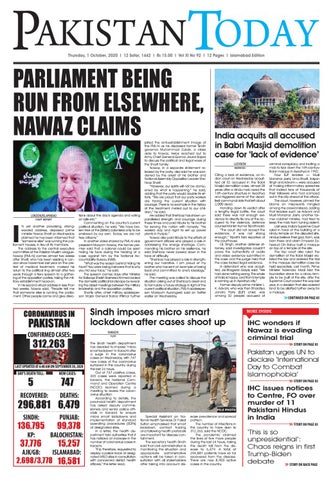
Parliament being run from elsewhere, nawaz claims
LONDON/ISLAMABAD sTaFF RePORT
i
N yet another provoking, strongworded address, deposed prime minister Nawaz Sharif on Wednesday claimed he has been informed that “someone else” was running the parliament houses, in lieu of its members. The address to the central executive committee of the Pakistan Muslim LeagueNawaz (PML-N) comes almost two weeks after Sharif, who has been residing in London since November last year on the pretext of medical treatment, marked his return to the political ring almost after two years through a fiery speech to a gathering of the opposition parties, taking the military establishment head-on. In his second virtual address in less than two weeks, Nawaz said, “People tell me that someone else is running the parliament. Other people come and give direc-
tions about the day’s agenda and voting on bills etc.” Commenting on the country’s current political situation, he said, “We have broken free of the [British] colonisers only to be enslaved by our own. Today, we are not free citizens.” In another video shared by PML-N vice president Maryam Nawaz, the former premier said that a colonel could be seen hiding his face during the hearing of a case against him by the National Accountability Bureau (NAB). “What was the reason behind hiding his face? You were being insincere that is why you hid your face,” he said. The speech comes days after Minister for Railways Sheikh Rasheed Ahmed rocked the domestic political landscape by revealing the closet meetings between the military leadership and the opposition parties. Shortly after, chief military spokesperson Major General Babar Iftikhar further
coronavirus in
Pakistan
CONFIRMED CASES:
312,263
LAST UPDATED AT 6:48 AM ON SEPTEMBER 30, 2020
DAY'S DEATH TOLL:
5
RECOVERED:
NEW CASES:
747
DEATHS:
296,881 6,479 SINDH:
136,795
PUNJAB:
99,378
KP:
BALOCHISTAN:
AJK/GB:
ISLAMABAD:
37,776
15,257
2,698/3,778 16,581
jolted the anti-establishment image of the PML-N as he disclosed former Sindh governor Muhammad Zubair, a close aide to Nawaz, twice reached out to Army Chief General Qamar Javed Bajwa to discuss the political and legal woes of the Sharif family. Nawaz, in a separate statement released by the party, also said he was saddened by the arrest of his brother and National Assembly Opposition Leader Shehbaz Sharif. “However, our spirits will not be dampened by what is happening,” he said, adding that the party would double its efforts. “We are proud that our party workers are facing the current situation with courage. There is no example in the history of the treatment meted out to our children,” he said. He added that Shehbaz has shown unparalleled strength and courage during these times and paid tribute to his brother for serving the nation with honesty. “He worked day and night to set up power plants in Punjab.” Nawaz also paid tribute to the efforts of government officers who played a role in addressing the energy shortage. Commending his brother on his resilience, he said Shehbaz never bowed down in the face of difficulty. “Shehbaz has played a role in strengthening our narrative. I am proud of my brother who has sent an example of being loyal and committed to one’s ideology,” he said. The meeting was called to discuss the situation arising out of Shehbaz’s arrest and to formulate a future strategy in light of the current political situation, PML-N spokesperson Marriyum Aurangzeb said on Twitter earlier on Wednesday.
India acquits all accused in Babri Masjid demolition case for ‘lack of evidence’ LUCKNOW agencies
Citing a lack of evidence, an Indian court on Wednesday acquitted all 32 accused in the Babri Masjid demolition case, almost 28 years after a Hindu mob razed the 16th-century structure in Ayodhya and triggered some of the deadliest communal riots that left about 2,000 dead. Handing down its verdict after a lengthy legal battle, the court said there was not enough evidence to directly tie any of the accused to the violence, defence counsel Manish Kumar Tripathi said. “The court did not accept the evidence, it was not strong enough,” Tripathi told reporters at the courthouse. I.B. Singh, another defense attorney, said investigators couldn’t prove the authenticity of audio and video evidence submitted in the case and the judge held that the case lacked legal evidence. A defendant who was acquitted, Jai Bhagwan Goyal, said: “We had done nothing wrong. The whole of India is happy. Lord Ram’s temple is coming up in Ayodhya city.” Former deputy prime minister L. K. Advani, who was then Bharatiya Janata Party (BJP) chief, was among 32 people accused of
Sindh imposes micro smart lockdown after cases shoot up KARACHI TLTP
The Sindh health department has decided to impose ‘micro smart lockdown’ in Karachi after a surge in the coronavirus cases on Wednesday, with 747 new cases of the coronavirus surfaced in the country during the last 24 hours. Out of 747 positive cases, 365 cases were reported in Karachi, the National Command and Operation Centre (NCOC) learned during a meeting to review the coronavirus situation. According to details, the provincial health department has asked deputy commissioners and senior police officials in Karachi to ensure micro smart lockdowns and implementation of standard operating procedures (SOPs) at designated sites. In a letter, the health department told authorities that it has noticed an increase in the number of coronavirus cases in Karachi. “It is, therefore, requested to deploy a police force at designated MSLD sites in consultation with concerned district health officers,” the letter read.
criminal conspiracy and inciting a mob to tear down the 16th-century Babri mosque in Ayodhya in 1992. Four BJP leaders — Murli Manohar Joshi, Uma Bharti, Kalyan Singh and Advani — were accused of making inflammatory speeches that incited tens of thousands of their followers who had camped out in the city ahead of the attack. The court, however, pinned the blame on miscreants mingled among the crowd instead, adding that leaders such as Advani and Murli Manohar Joshi, another former cabinet minister, had tried to keep the mob from turning violent. Last year, India’s Supreme Court ruled in favor of the building of a Hindu temple on the disputed site. Hindus believe their god, Ram, was born there and claim Emperor Zaheerud Din Babur built a mosque on top of a temple at the site. The top court also ruled the demolition of the Babri Masjid violated the law and ordered the trial in the mosque demolition case be held separately. Last month, Prime Minister Narendra Modi laid the foundation stone for a Hindu temple to be built at the site, after the Supreme Court paved the way last year, in a decision that also ordered land to be allotted further away for a mosque.
CONTINUED ON PAGE 05
more inside
IHC wonders if Nawaz is evading criminal trial STORY ON PAGE 03
Pakistan urges UN to declare ‘International Day to Combat Islamophobia’ STORY ON PAGE 02
file photo
Special Assistant on National Health Services Dr Faisal Sultan emphasised that smart lockdown, contact tracing and following health protocols are important for disease containment. The secretary health Sindh said that civil administration is monitoring the situation and appropriate administrative actions will be taken in consultation with all stakeholders after taking into account dis-
ease prevalence and spread pattern. The number of infections in the country to have risen to 312,263, said the NCOC. The pandemic claimed the lives of five more people during the last 24 hours, taking the death toll from the disease to 6,479. A total of 296,881 patients have so far recovered from the disease. There are now 8,903 active cases in the country.
IHC issues notices to Centre, FO over murder of 11 Pakistani Hindus in India STORY ON PAGE 03
‘This is so unpresidential’: Chaos reigns in first Trump-Biden debate STORY ON BACK PAGE
02
Thursday, 1 October, 2020
NEWS
Pakistan urges un to declare 'international day to combat islamoPhobia’ ISLAMABAD
d
STAFF REPORT
AyS after Prime Minister Imran Khan called on the United Nations to declare an international day to combat Islamophobia in his General Assembly address, Foreign Minister Shah Mahmood Qureshi on Wednesday reiterated the demand urged the UN General Assembly (UNGA) to declare an “International Day to Combat Islamophobia”. In his address to the 75th session of the UNGA last week, Imran — while denouncing the recent publication of blasphemous caricatures by Charlie Hebdo, a
French satirical weekly best known for vulgar irreverence — had urged the global body to universally outlaw the rising Islamophobia in many countries including India. Addressing a virtual meeting of the United Nations Alliance of Civilisations, Qureshi noted willful provocations and incitement to hate and violence had been classified by the UN as “universally outlawed”. The forum is an initiative to build respect among people from different cultures and faiths, as well as to provide a platform for bridging divisions and overcoming prejudices. Qureshi warned of a “global resurgence” of intolerance, discrimination,
national emergency helpline to be set up after motorway gang-rape NEWS DESK Prime Minister Imran Khan on Wednesday told the PM Delivery Unit (PMDU) to establish a national emergency helpline within two months, said the Ministry of Information in a tweet. “Motorway incident: Big decision by Prime Minister Imran Khan. The government decides to establish a national emergency helpline. Prime Minister Imran Khan has made the PM Delivery Unit responsible for this important task,” the tweet read. These orders come in the wake of the motorway gang-rape which occurred earlier this month when a woman was sexually abused when her car stopped while travelling on the Lahore-Sialkot highway. There have been implications of a blame game wherein the woman was unable to receive assistance as the area where her car halted was not in the jurisdiction of the Pakistan National Highway and Motorway Police (PNH&MP), according to a spokesperson. The information ministry, in a series of tweets on Wednesday, said that a separate system would be constituted for the national emergency helpline. “There will be one helpline number for any emergency nationwide,” it added.
amjad khan niazi to replace naval chief on oct 6 ISLAMABAD: President Dr Arif Alvi has appointed Vice Admiral Muhammad Amjad Khan Niazi as the new Chief of the Naval Staff. He will replace Admiral Zaffar Abbasi who retires on October 6. Zafar has been serving as Naval Chief since October 2017. Prime Minister Imran Khan recommended his appointment which has been approved by President Arif Alvi. Vice Admiral Amjad Khan will take charge as a new Naval chief on October 6. He joined the Pakistan Navy in 1983. Also a recipient of Sword of Honour, the admiral has an illustrious career with wide-ranging experience of various Command and Staff appointments. His major command appointments include Commanding Officer PNS Badr, Commanding Officer PNS Tariq, Commander 18th Destroyer squadron, Commandant PNS Bahadur and Commandant Pakistan Navy War College, Lahore. STAFF REPORT
racism, hate speech and violence based on religious beliefs. The alliance is a political initiative cosponsored by Turkey and Spain after being founded in 2005 by then-UN Secretary General Kofi Annan. Praising Turkey and Spain for co-sponsoring the Alliance of Civilisations initiative and organising the meeting, Qureshi said fears of the global novel coronavirus pandemic that served to stoke racism and stigmatisation demonstrated how deeprooted the problem of Islamophobia is. “In many places, including in our own region, the pandemic has aggravated the suffering of people due to negative religious stereotyping,” he said.
“We Muslims live our religion. Understanding must be shown for the pain and anguish caused to Muslims when Islam and its prophet are insulted,” the top diplomat said. Urging member countries of the initiative to outlaw willful provocations and incitement to hate and violence, he requested that the UNGA build a “resilient coalition to end the scourge,” Qureshi demanded. “Respecting each other’s religions and beliefs, not ridiculing them; constructive engagement and not estrangement. Let us work together for building a peaceful world where different civilisations and cultures co-exist in harmony and on the basis of mutual respect,” he added.
PTI govt failed to tackle Pakistan’s rising debt, claims Sherry ISLAMABAD STAFF REPORT
Pakistan People’s Party (PPP) Parliamentary Leader in the Senate, Senator Sherry Rehman slammed the federal government for failing to tackle Pakistan’s rising debt. “It is alarming that Pakistan’s debt and liabilities have surged by Rs14.4 trillion in the last two years, up from Rs29.9 trillion in June 2018 to a whopping Rs44.3 trillion. Over the last two years, the PTI government has been taking on an average of Rs20 billion worth of additional debt a day. No government in the past 73 years has taken on additional debt of Rs20 billion a day,” she said. Commenting on the galloping circular debt, which remains one of the biggest challenges in our power sector, the senator said that Pakistan’s circular debt in the power sector, currently standing at Rs2,219 billion, is expected to swell up to Rs4,000 billion by 2025. “Public debt is breaking all previous records, inflation is highest in the region, and circular debt remains one of the biggest challenges in the power sector. Where is our economy heading?” questioned the senator. The Pakistan Tehreek-e-Insaf (PTI) government had previously vowed to reduce circular debt, however, they have instead added an additional Rs1.72 trillion debt in two years, the senator stated. “The country is already facing se-
vere gas shortages. This is expected to worsen in the coming months, especially during the winter season. Is there anything, any sector that this government can manage properly,” she added. Questioning the federal government’s celebrations of a decline in the Current Account Deficit (CAD), she remarked, “CAD improved mainly due to a historical dip in international oil prices amidst the Covid-19 crisis. During PPP’s time in power, crude oil price was $147/barrel, yet the situation was nowhere close to what it is now.” Furthermore, the senator commented on how the incumbent government was “bowing down to the sugar, wheat, and business tycoons” and advised them to work towards providing economic relief to the poor and vulnerable people of Pakistan. “It is getting very difficult for the common man to survive during these testing times,” she added. Highlighting the lack of parliamentary supervision in economic policies, the senator questioned, “Why is the PTI government not keeping the parliament in confidence when it comes to our economic policies? In any democratic system, the parliament and the opposition have the right to scrutinise and question the government’s performance.” Regarding the importance of revenue collection, the senator said, “Pakistan is one of the countries in the world with the lowest tax-to-GDP ratio. The federal government must take lessons from Sindh.
ADB sells $4bn global benchmark bonds ISLAMABAD TLTP
The Asian Development Bank (ADB) returned to the US dollar bond market with the pricing of a 3-year global benchmark bond worth $3 billion and a 10-year global benchmark bond worth $1 billion, proceeds of which will be part of ADB’s ordinary capital resources. “We are pleased with the consistently reliable and strong support of our investors as we launched our last US dollar benchmark outing for 2020 with a dual tranche 3and 10-year transaction,” said ADB Treasurer Pierre Van Peteghem in a statement on Wednesday. “This has been a record-breaking year for us with over
$24 billion raised in the global benchmark market through six outings. This strong support gives us the resources to provide much-needed assistance to Asia and the Pacific, especially during these challenging times.” The 3-year bond, with a coupon rate of 0.25% per annum payable semi-annually and a maturity date of 6 October 2023, was priced at 99.893% to yield 14 basis points over the 0.125% US Treasury notes due September 2023. The 10-year bond, with a coupon rate of 0.75% per annum payable semi-annually and a maturity date of 8 October 2030, was priced at 98.852% to yield 22.66 basis points over the 0.625% US Treasury notes due August 2030. ADB plans to raise around $30 billion to $35 billion from the capital markets in 2020.
CAA issues SOPs against Covid-19 for int’l passengers VERIFIES LICENCES OF 58 PIA PILOTS ISLAMABAD STAFF REPORT
The Civil Aviation Authority (CAA) on Wednesday issued a fresh travel advisory for the international passengers to minimise the risk of spreading the novel coronavirus and to keep the passengers and the crew safe from the pathogen.
A spokesperson of CAA said that the new standard operating procedures (SOPs) will come into effect from October 5 and will remain in force till December 31. According to the SOPs, it is mandatory for all the international passengers to install ‘Pass Track App’ downloadable from the Google play store and the
Apple store. For passengers who do not possess smartphones shall be required to enter their data on the website ahead of journey. The spokesperson said that international passengers travelling from category B countries require a negative Covid-19 RT-PCR test not older than 96 hours prior to commencement of travel to Pakistan. Passengers travelling from category A country does not require to get themselves
tested prior to commencement of travel, he added. Earlier on September 18, the CAA had warned the airlines of strict action over reports of continuous violation of the standard operating procedures (SOPs) and issued a fresh travel advisory. The aviation authority’s transport wing had cited violation of the coronavirus SOPs by airlines despite strict implementation orders from the National Command and Operations Centre
(NCOC) forum and issued a fresh travel advisory. Meanwhile, the CAA on Wednesday verified and cleared licences of 58 pilots serving in Pakistan Internal Airlines (PIA). The licences were declared clear after forensic audit of the licences by the Civil Aviation Authority DG. Two sisters, Maryam Masood and Erum Massod are also among the list of pilots, whose licences have been cleared by the CAA.
elderly woman injured in indian firing across loc RAWALPINDI STAFF REPORT
The Indian Army once again violated the ceasefire agreement with Pakistan, as a 65year-old woman was injured due to unprovoked shelling along the Line of Control (LoC) on Wednesday. According to the InterServices Public Relations (ISPR), the civilian population was targeted with "automatics and heavy mortars" along the Jandrot Sector at the LoC. "A 65 years old woman in Kathar Village got injured," read a statement by the mili-
Fm urges unhrc to take notice of ai office closure in india ISLAMABAD STAFF REPORT
Foreign Minister Shah Mahmood Qureshi has urged the UN Human Rights Council (UNHCR) to take notice of the closure of Amnesty International (AI) office in India. In a statement on Wednesday, the foreign minister said the Amnesty international was compelled to shut its office in India when it started to expose blatant human rights violations in Indian Occupied Kashmir (IOK) and unmasked police's complicity in anti-Muslim riots in Delhi. The foreign minister said that human rights organisations, including those in India should raise their voice against the Indian acts. He said that the true face of India stands exposed. The foreign minister expressed concerns over the attitude being meted out to minorities especially Muslims in India.
President reaffirms Pakistan’s support to afghan-led peace process ISLAMABAD STAFF REPORT
President Arif Alvi has reaffirmed Pakistan's support to Afghan-led and Afghan-owned peace process. Talking to High Council for National Reconciliation of Afghanistan Chairman Dr Abdullah Abdullah on Wednesday, the President emphasised that there is no military solution to the conflict in Afghanistan and a politically negotiated settlement is the only way forward. President Alvi noted that Pakistan’s contribution to the peace process has been appreciated by the international community. He said that commencement of intraAfghan negotiations in Doha is a watershed. He stressed that the Afghan leadership must seize this historic opportunity to work together constructively and secure an inclusive, broadbased and comprehensive political settlement. President Alvi reaffirmed that Pakistan will stand by the decisions made by the Afghan nation with regard to the future of Afghanistan.
coas lauds role, sacrifices of 1st Pma long course veterans RAWALPINDI STAFF REPORT
Chief of Army Staff (COAS) General Qamar Javed Bajwa Wednesday acknowledged and appreciated the role and sacrifices of the senior officers-veterans of 1st PMA long course as leaders. The COAS met with the veterans of 1st PMA long course at General Headquarters (GHQ), said an Inter-Services Public Relations (ISPR) in a press statement. The visiting officers shared their thoughts about the prevailing security environment and challenges confronting Pakistan in general and Pakistan Armed Forces in particular.
Thursday, 1 October, 2020
NEWS
03
ihc wonders iF nawaz is evading criminal trial ISLAMABAD STAFF REPORT
While former prime minister Nawaz Sharif refused to receive his non-bailable arrest warrants in the Al-Azizia Steel Mills case at his residence in London, the Islamabad High Court (IHC) on Wednesday wondered if the deposed premier was evading court proceedings on purpose. Sharif, who was disqualified by the Supreme Court (SC) in July 2017 for concealing his assets and subsequently awarded seven-year prison time in the Al-Azizia graft case in December 2018, left for London in November last year on the pretext of medical treatment after he was released on bail by the IHC. He has been staying there ever since.
The court had issued the arrest warrants on September 15 after which the assistant registrar had directed Foreign Secretary Sohail Mahmood to ensure Sharif’s production before the court on September 22. Responding to the court order, the PML-N said the former premier “would return once his health permitted him”. During the proceedings, the government informed the two-member bench, comprising Justice Aamir Farooq and Justice Mohsin Akhtar Kiyani, that the arrest warrants were not received at his residence in Mayfair, an upscale neighbourhood in the British capital. Additional Attorney General (AAG) Tariq Khokhar said that the warrants were sent to Avenfield House through a special
delivery of Royal Mail but a person named Waqar Ahmed refused to receive the delivery. The AAG represented the federal government while the National Accountability Bureau (NAB) prosecutor Jahanzaib Bharwana appeared on behalf of the anti-graft body. No one appeared on Nawaz’s behalf as his lead counsel Khawaja Haris last week gave up representing his client after IHC rejected his application for deferring the issuance of the former prime minister’s proclamation. “Nawaz Sharif’s lawyer has given a statement saying that he knows about the arrest warrants,” noted Justice Farooq. “[We] need to see if [the suspect] is evading court proceedings deliberately,” he said. The AAG told the bench that the Pak-
istan High Commission in the United Kingdom had contacted the Commonwealth office but the latter said that it “does not have the authority” to ensure that IHC’s order is obeyed. “This means that the Commonwealth Office is not ready to facilitate us,” observed Justice Farooq. He said that the government should continue to take the measures it can, adding that the proceedings will “move forward according to procedure”. The bench said that it had to “convince itself with evidence that the government tried its best to [ensure] the compliance of the warrants”. Justice Farooq said that all official documents will be made part of the case’s record before declaring Nawaz an absconder.
“[We] have to take this step-by-step. The purpose behind following the procedure is that no suspect can take any support in the future,” he said. Justice Kiyani also stressed on following the procedure, adding that the court had granted Nawaz a “complete chance” and will decide upon his appeals after hearing them. “The suspect must be sitting in London and laughing at the government and the public. It is a matter of extreme humiliation,” remarked Justice Kiyani and noted that Nawaz, while being abroad, was delivering addresses to the entire nation. The court said that the statement of consular attache Rao Abdul Hannan will be recorded via video link in the next hearing and adjourned proceedings until October 7.
PM Imran stresses use of IT services IHC issues notices to Centre, FO over murder of 11 Pakistani Hindus in India to uplift less-developed areas ISLAMABAD STAFF REPORT
The Islamabad High Court (IHC) on Wednesday issued notices to the federal government and the Foreign Office on the murder of 11 members of a migrant Hindu family in the Indian city of Jodhpur in the state of Rajasthan. The Sindh-based family had migrated to India last month and only one member of the family now remains. The bodies were found in “mysterious” circumstances in a village field. The notices were issued on a petition moved by the IHC Bar Association Tuesday, seeking a court order directing the government to approach the International Court of Justice (ICJ) over the incident. “The constitution gives equal rights to minorities. 11 Hindu citizens of Pakistan were murdered in India over refusing to spy on the country,” the petition had observed. “The Indian High Commission in Islamabad had issued visas to the victims. Indian diplomatic mission working against diplomatic norms.” Following a brief hearing, the bench issued notices to the respondents and adjourned the hearing for two weeks. For the first time in the history of Pakistan, the members of the minority Hindu community took the Is-
lamabad late Thursday night, demanding that a probe be opened on the incident. “We want justice for these eleven Pakistani Hindus who were killed in Jodhpur,” Ramesh Kumar, Pakistan Tehreek-e-Insaf (PTI) MP and patron-inchief of Pakistan Hindu Council (PHC), had told reporters. The Foreign Office (FO) had on Sept 14 summoned an Indian diplomat and conveyed its “serious concern” over the matter. The diplomat was told that the daughter of the deceased head of the family, Shrimati Mukhi, had made “highly concerning statements, implicating the Research and Analysis Wing (RAW) in the murder of her father, mother and other family members, allegedly after the agency failed to convince them to spy on Pakistan and issue anti-Pakistan statements”. However, a subsequent Foreign Office statement regretted that despite Islamabad’s repeated calls, the Indian government has still not released the necessary information on the incident. “I wish to reiterate that the Jodhpur incident is a matter of grave concern for the government and the people of Pakistan, particularly the Pakistani Hindu community,” Foreign Office spokesman Zahid Hafeez Chaudhri had said last week.
Pakistan stuck in development trap: WB report ISLAMABAD STAFF REPORT
The progress of the key markets that regulate the allocation of productive factors like markets for land, capital and labour in the country has been stunted by an insider-outsider model of development, according to the first Systematic Country Diagnostic (SCD) to be conducted in Pakistan by the World Bank. Due to precedent and legacy, insiders that controlled higher amounts of original land endowments, physical and human capital, did not have the incentives to support policies that could have addressed existing factor market imperfections. Rather, this could po-
tentially dilute their economic, social and political power, and their grip over state resources. Furthermore, the citizens who would have benefited from such reforms (outsiders) lacked the resources and political representation to bring about change. In this framework, constraints to Pakistan’s growth and prospects of poverty reduction – including low investment, weak fiscal management, and slow and unequal progress on human capital accumulation and growthenhancing structural transformation – can be ascribed to the lack of support for reforms that could address the inefficiencies. “Levelling the Playing Field”, the Systematic Country diagnostic report released on Wednesday, was aimed at detailing the
country’s ongoing structural reform process and providing an analytical base for the World Bank’s engagement moving forward. This report went on to say that change is necessary to bring Pakistan out of this trap. Consumption-led growth, with limited capital accumulation, declining productivity growth, and limited labour reallocation towards more productive sectors, will be insufficient to move Pakistan out of its structural boom-bust cycles. Without addressing the existing inequality of opportunities and systematic socioeconomic discrimination affecting women in Pakistan, the prospects for sustaining poverty reduction and increasing shared prosperity moving forward are limited. These challenges are further exacerbated as the country grapples with the socio-economic consequences of the COVID-19 pandemic.
interim bails of Pml-n leaders extended in nab office clash case LAHORE: An anti-terrorism court in Lahore on Wednesday extended interim bail of Pakistan Muslim League Nawaz leaders Rana Sanaullah Khan and Captain (r) Muhammad Safdar in a case related to a violent clash between authorities and party’s supporters outside the National Accountability Bureau office last month. Many people, including some officials, were injured on August 12 when heavy police contingents and workers of the opposition party confronted each other during the appearance of PML-N vice president Maryam Nawaz there in a graft investigation. At the outset of the hearing, the investigation officer from Chuhang police station presented the report in the case. INP
ISLAMABAD STAFF REPORT
Prime Minister Imran Khan has said that information technology plays a fundamental role in uplifting less-developed areas. The PM said this while address-
ing the signing ceremony for award of Rs1.28 billion contracts by Universal Service Fund (USF) to cellular companies for provision of voice and high-speed mobile broadband data services in areas of Balochistan and Sindh. PM Imran said, “Digital Pakistan
is our future and by concentrating on the IT sector, we can enhance our exports. Modern technology is of paramount importance in the fifth industrial revolution. We can introduce a virtual education system in remote areas to equip our youth with knowledge and skill.”
04
Thursday, 1 October, 2020
NEWS
MASood urgeS world to deClAre BJP, rSS terroriSt outfitS MUZAFFARABAD
A
TLTP
zAD Jammu and Kashmir (AJK) President Sardar Masood Khan has stressed that Bharatiya Janata Party (BJP) and Rashtriya Swayamsevak Sangh (RSS) should be declared international terrorist outfits for promoting fascist thoughts based on hatred and aggression. Speaking as the chief guest at a webinar organised by the Center for Global and Strategic Studies here on Wednesday, he warned if both the outfits are not stopped from playing the dangerous game, the peace, security and develop-
ment of the world would be disrupted. The AJK president said that introduction of the new domicile certificate in occupied Kashmir was a sheer violation of the UN resolution 122, and the United Nations Security Council (UNSC) should refer this law to the International Court of Justice (ICJ) for advice. "The Muslims and Hindus have been living in South Asia together for centuries, but the BJPRSS provocative and hate policies have made it almost impossible for them to continue to live together," he added. The AJK president asserted that the Foreign Office (FO) should step forward to muster diplomatic support while the political parties should approach parliaments and civil societies across the globe
Allied Schools conducts webinar on ‘single national curriculum’ LAHORE ؛Allied Schools organised a webinar titled “SNCSingle National Curriculum: A WAY FORWARD” on Tuesday, September 29, 2020, to talk about the vital role of Single National Curriculum in the education system. The curriculum experts, who were invited in the webinar as speakers, were: Allied Schools Project Director Dr Shahid Mahmood, Head Academics Misbah Rahman, Head Primary Umbreen Niaz, Sajida Touseef, the principal of Pak Campus of Allied School and Iqra Rasheed, a textbook author. The speakers of the webinar discussed the refinements in educational outcomes and assessment patterns which have been brought through the development of SNC in order to create cohesion and progression in different educational tiers. The discussion was moderated by Maryam Chaudhary, a skilled communicator. 700 principals of allied schools also attended the webinar via video-link. PRESS RELEASE
to gain political support for the Kashmiri people. "Although international media, civil society, world parliaments and human rights organisations had raised their voice against the Indian actions since August 5 last year, and informal UN Security Council sessions were also held, but these sessions did not prove to be result-oriented, and the world powers have trade interests in India, remained unmoved," he lamented. Khan said that the international community will have to impose economic sanctions against India to enhance pressure on it to prevent the carnage of Kashmiri people. He regretted that India had spurned the proposals of the UN Human Rights Commission in 2016 and the subsequent
reports to form an inquiry commission to examine the human rights situation in occupied Kashmir. India did not care about even the reservations expressed by the US Congress about the ill-treatment being meted out to minorities in India. He underlined that the issue of inhuman torturous being perpetrated in occupied Kashmir should be raised in the International Criminal Court and lauded the role of migrants in projecting the Kashmir issue in its true perspective on the international level. The webinar was addressed among others by the Federal Minister for Human Rights Shireen Mazari, Lord Nazir Ahmed, Ahmer Bilal Soofi, Major General Syed Khalid Amir Jaffery and Martia Tarana.
Buzdar felicitates China on national day LAHORE TLTP
Chief Minister Punjab Sardar Usman Buzdar has felicitated the People’s Republic of China on its national day. In his message, the chief minister stated that Pakistan-China friendship is exemplary in the whole world while China is the most trusted friend of Pakistan. It is sanguine that China has stood firmly with Pakistan in every hour of trial. “It is commendable that the Chinese nation has waged a successful struggle against corruption, unemployment, and poverty under its great leadership and the speedy development of the People’s Republic of China is a role model for all of us,” he added. The CM added that Pakistan-China relations have been further strengthened through the multi-billion-dollar China Pakistan Economic Corridor (CPEC) project and both the countries have a unanimous point of view on international issues, peace, and mutual respect. During the tenure of the incumbent government, the Pakistan-China relations have been further strengthened, concluded the CM.
Dr Yasmin reveals two-year performance in health sector LAHORE STAFF REPORT
Punjab Health Minister Dr Yasmin presented the two years performance of the Primary and Secondary Healthcare Department and the Specialised Healthcare & Medical Education Department at a press conference at 90 Shahrah-e-Quaid-e-Azam on Wednesday. The minister was flanked by Secretary Primary and Secondary Healthcare Department Captain (r) Usman Younis and Special Secretary Specialized Healthcare and Medical Education Department Silwat Saeed. The minister said that it was very important to present the two years performance of the health department. The minister said that the coronavirus pandemic has brought the economies of developed countries to its knees. She said that the United States, Mexico, Brazil Western Europe and India are still struggling to face the pandemic. Over one million people have lost their lives to the Pandemic worldwide. In the last 24 hours, 86 people were diagnosed with Covid-19 in Punjab and by the grace of Allah Almighty, no lives were lost in Punjab. The minister said, “In the last 24 hours, more than 12,500 tests were performed in Punjab. The testing capacity has been increased manifold since the Pandemic began. The government has enhanced focus on implementation of SOPs as we have opened the educational institutions. If teachers or students test positive, contact tracing is immediately started. In areas with high number of cases, smart lockdown is enforced. By the blessings of Allah, the entire world is appreciating the performance of Pakistan. The World Health Organisation has specifically praised Pakistan for its efforts in controlling the coronavirus pandemic. In the last eight months, steps were taken on war footings. By the start of the pandemic, we had capacity of 300 to 400 tests in Punjab. As per guidelines by the WHO, 18 new BSL-3 Labs were developed in the province out of whom 9 were developed in Lahore alone. During the Pandemic, arrangements for 20,000 patients were made. The number of ventilators was enhanced. As compared to other provinces, the mortality rate in Punjab has remained very low. When Pakistan Tehreek-e-Insaf (PTI) government took over, 50 per cent seats were lying vacant in Punjab. For the first time in history 32,000 healthcare professionals were recruited through transparent process. On every level, merit was observed and their details issued online.” Dr Yasmin further said, “When we started, around 50,000 beds were available in public sector hospitals. Now we have increased the capacity of hospitals to a great extent. The two departments were operating with a liabilities of Rs32 billion. We have developed the department on directions and vision of Prime Minister Imran Khan and Chief Minister Usman Buzdar. We are working to achieve the targets set by the Sustainable Development Goals (SDGs). In different districts of Punjab, seven Mother and Child hospitals are being developed. The largest of these hospitals is 600 bedded Mother and Child Hospital at Ganga Ram which will be fully functional by the end of 2021. In Public Sector, no hospital of this class has been built. In the past, no such hospital was ever made having Gynacology, Uro Gynacology and Natal medicines facili-
BRITISH GOVERNMENT MAY BE CONTACTED TO BRING BACK NAWAZ, SAYS HEALTH MINISTER
ties. In this hospital, neo natal nursery facility will be available. Mother and Child Hospitals with 200 beds are being developed in Mianwali, Sialkot, Rajanpur, Attock Layyah and Bahawalnagar. In the past nursing capacity and performance was never a priority. In the five Mother and Child Hospitals, Nursing Colleges are being built. In Sialkot and Lahore, Nursing Colleges are already being set up. In Multan, Nishter 2, a large 500 bedded hospital is being developed which will be complete by 2022.” Elaborating further, Dr Yasmin said, “The Ganga Ram Mother and Child Hospital will cost around Rs7 billion. A lot of funds have been released to improve mother and child health. In Gujrat, state-of-the-art Mother and Child Hospital is also in the pipeline. In Dera Ghazi Khan, a new cardiology hospital is being developed. So far, we have Cardiology institutions in Lahore, Multan, Faisalabad and Rawalpindi. The Sehat Insaf Cards have been distributed in all 36 districts of Punjab. So far, we have distributed cards to 5.2 million families. Over 2 lakh people have availed the facility. The facilitate the holders of the Sehat Insaf Cards, 273 private hospitals have been empanelled. For Card holders, 20,000 beds have been added so that deserving people can avail the facility of free treatment. Patients have utilized the cards to get treatment of cardiac, dialysis and other diseases. Prime Minister Imran Khan has directed to provide universal health coverage in Khyber Pakhtunkhwa, due to which we have also been directed to scope of Sehat Insaf Cards. In the next phase, the middle class will be included in the programme and work is underway already on that.” The minister divulged that the prime minister has emphasised Mother and Child Health in his first speech. She said, “In eight districts, the BHUs have been upgrade to 24/7 models. More BHUS have been set up after which the BHUs have increased to 1280. In the next ADP, all 2500 BHUs will be made 24/7. We are trying that all citizens must get health facilities on their doorstep. Pregnant women are transferred to public sector hospitals through free ambulance service in case of emergency. The Health Department is providing free services to hundreds of thousands of patients through vertical programs. In the budget, Rs11 bil-
lion have been reserved for vertical programs. The Rawalpindi Institute of Urology, that has been under construction since 2012, will be made functional in the next 45 days. The Wazirabad Institute of Cardiology has been made fully functional. The scope of this institution is being enhanced. The department has developed a system for hospital waste. In 26 districts, incinerators have been set up. The district hospitals are working in coordination with Teaching Hospitals. In the Specialized Healthcare department, the hospital waste will be disposed of through micro wave technology and its PC-1 is being developed.” Secretary Primary and Secondary Healthcare Captain (r) Usman Younis said that the Rs6.26 billion have been allocated for the Expanded Programme on Immunisation. He said that this program had problem of access of vaccinators in certain areas due to which we have hired more vaccinators in Punjab, During the lockdown, this programme continued to operate. “Under this programme, more than one lakh health professionals were trained. Over 614 EPI Centers have been rehabilitated. Under the IRMNCH Programme, 1,280 THQ have been made 24/7. So far 175,000 pregnant women have been shifted to hospitals through emergency ambulance services. For children facing malnutrition, 58 stabilisation centers have been set up. From October 1, the pilot project of Well Women clinic is being started in Lahore and Nankana where screening services for women will be provided. He said that the project will be scaled up to entire Punjab. From July 1, 2018, to June 30, 2020, screening of 2 million people was undertaken. Under the Hepatitis Control Program, between 2018-19 as many as 8,429 and 5,742 people were provided free treatment respectively. From 2019 to 2020, five lakh people were vaccinated for Hep B. In the next five years, Rs58 billion have been allocated for flagship projects for the next five years. The Punjab AIDS Control Programme also performed during the coronavirus pandemic under which over 600 people were registered. The Punjab TB Control Programme is also continuing the screening or TB patients across the province,” he said.
Thursday, 1 October, 2020
‘NeeLuM-JheLuM PROJecT FAcING PROBLeMs IN seTTLING DeBT LIABILITIes’ ISLAMABAD
T
STAFF REPORT
HE Senate Standing Committee on Planning, Development and Special Initiatives was informed on Wednesday that Neelum-Jhehlum Hydropower Project (NJHP) was facing financial issues due to non-payment of receivables from the Central Power Purchasing Agency (CPPA). The committee, which met chaired by Senator Agha Shahzaib Durrani, was told that the total annual debt servicing liabilities of the project were over Rs55 billion. However, due to non-payment of dues by the CPPA, the project could not pay its debt liabilities to the
nanced under cash development loan by government of Pakistan, Rs150.47 billion ($1.432 billion) under foreign loans and Rs100 billion under Sukuk Commercial Finance. He said the Finance Division had also been requested to reduce the mark-up rate on loan repayment from existing around 15pc to 8-9pc and to extend the repayment period from already agreed 10 years to 30 years. The meeting was told that the repayment period for foreign loans was 20 years but due to delay in payment, the cost of debt servicing was increasing. With regard to tariff of the electricity produced from the project, the committee was informed that in March 2019, first interim tariff was agreed at Rs 5.9
foreign investors since start of the commercial operations in April 2018. NJHP Chief Executive Officer Muhammad Zareen said Rs11.66 billion had so far been disbursed by the CPPA while the remaining over Rs90 billion were yet to be received. With respect to the project financing, the meeting was informed that an amount of Rs506 billion was approved for the project out of which Rs415.7 billion had been spent up to June 2020. Besides, the CEO said 99.7pc physical work had been completed while the complete cost of the project was expected to be around Rs423 billion. He said under Neelum-Jhelum Surcharge, the project received Rs72 billion while Rs20.7 billion were fi-
Diesel price cut by Rs2.4 per litre; petrol rate remains unchanged The government has decided that there will be no increase in the price of petrol for next 15 days. According to a notification issued by the Prime Minister Office, the price of high speed diesel (HSD) has been reduced by Rs2.40 per litre. On Tuesday, the Oil and Gas Regulatory Authority (OGRA) had recommended reducing the petrol prices in the country from October 1-15. OGRA, in its summary to the Petroleum Division, had suggested a reduction of Rs1.15 per litre in the petrol price for the first 15 days of October. Meanwhile, the authority had suggested that the prices of light diesel and kerosene oil should be maintained at the same rate and the price of diesel should be slashed by Rs2. The current price of petrol stands at Rs103.97 per litre, whereas the per litre prices of diesel, kerosene oil, and light diesel are Rs104.06, Rs65.29, and Rs62.86, respectively. NEWS DESK
FBR revises duty drawback rates for leather sector
per unit of electricity whereas second interim tariff was set at Rs 9.11 per unit in August 2019 which was going to expire on October 15, and the final interim tariff was due on October 16. Senator Kauda Babar pointed out that despite completion of the project, the ministry of Power was still charging Neelum Jhulum Surcharge from the public through electricity bills. Muhammad Zareen said that, since the commercial operation of the project, the total surcharge amount stood at around Rs 8 billion which they were ready to repay. But our liabilities are huge so we want our receivables so that debt servicing liabilities could be paid on time, he added.
Committee formed to expedite development work in tribal districts peSHAWAR AZIZ BUNERI
The Khyber Pakhtunkhwa (KP) government has constituted a special committee, to be headed by the additional chief secretary, to look into reasons behind slow progress in the execution of development projects in seven tribal districts. "The committee will be responsible for ensuring the timely implementation of the annual development programme in tribal districts," said a statement issued by the KP Planning and
Development Department. "The committee comprises of P&DD secretary, chief economist, Sustainable Development Unit director general, Monitoring and Evaluation director general, UNDP representatives and deputy commissioners of all seven districts." The committee members will identify projects where the pace of work has been slow, while it will also provide suggestions to address the impediments hampering the progress. In addition, the committee will review the monthly performance
of priority development projects, besides fixing a timeframe for early completion of projects. According to the statement, the committee has been entrusted with the responsibility of efficient and effective utilization of resources; funds usage will be monitored in accordance with the procedures laid down by the P&D. Apart from monitoring the implementation of its decisions, the committee will also present a review report on the annual development programme of tribal districts.
FBR surpasses target, collects over Rs1tr in July-Sept quarter
ISLAMABAD: Pakistan Customs (FBR) has revised upwards the rates of duty drawback for the leather sector, Adviser to Prime Minister on Commerce and Investment Abdul Razak Dawood said on Wednesday. Taking to Twitter, Razak Dawood sating, "Pursuant to the Prime Minister's vision of 'Make in Pakistan', Pakistan Customs (FBR) has revised upwards rates of duty drawback for the leather sector. The rates have been revised in accordance with the factual determination by IOCO after revision in valuations of input items." He continued, "This will increase the global competitiveness of our leather products and contribute towards export-led growth. The determination of revised rates of other sectors will follow, including furniture, footwear and pharmaceuticals etc." Earlier on August 26, Prime Minister Imran Khan had said that the government was committed to providing all-out facilities to exporters. STAFF REPORT
ISLAMABAD SHAHZAD PARACHA
The Federal Board of Revenue (FBR) has collected more than Rs1,000 billion revenue during the first quarter (July-Sept) of the current fiscal year (FY2020-21). According to sources, the tax department collected Rs1,002 billion during the period under review as against the target of Rs970 billion. The tax department had collected Rs593bn during the first two month of FY21, while collection in September stood at Rs408bn, as against target of Rs418 billion. This is the second month when the tax department could not meet the monthly target. Sources said that revenue collection has increased due to resumption of economic activities post Covid lockdowns.
Meanwhile, the department is also intensifying its crackdown on defaulters and tax evaders. On Wednesday, the FBR’s Directorate of Intelligence and Investigation-Inland Revenue (Lahore) raided the business premises of a shoe manufacturing unit under Section 38 and 40 of the Sales Tax Act, 1990. The unit was engaged in manufacturing, making taxable supplies of footwear etc while consuming huge amounts of raw materials and electricity. However, the unit had been deliberately filed "nil" sales tax returns since July 2015 to avoid payment of due sales tax. During the search, important record was impounded which is under scrutiny while further investigation in this regard is underway. The directorate intends to intensify such operations in order to detect tax fraud and stop huge revenue leakage being caused to the national exchequer.
NEWS
05
India acquits all accused in Babri Masjid demolition case for ‘lack of evidence’ contInueD on pAge 01 The court had ignored all the evidence in Wednesday’s case, said Zafaryab Jilani, a counsel for the All India Muslim Personal Law Board, adding that it planned to appeal to the high court against the decision. “We will seek remedy,” he added. PAKISTAN CONDEMNS PERPETRATORS’ ACQUITTAL: Pakistan on Wednesday strongly condemned shameful acquittal of those responsible for demolishing the historic Babri Masjid in Ayodhya. Reacting strongly on the Indian court judgement, Foreign Office (FO) Spokesperson Zahid Hafeez, in a statement on Wednesday, said the Hindutva-inspired Indian judiciary miserably failed to deliver the justice again. He said that if there was a semblance of justice in the so-called largest democracy, the individuals, who had boasted of the criminal act publicly, could not have been set free. The spokesperson said that this is yet another manifestation of the pliant judiciary under the extremist BJP-RSS regime in which extremist Hindutva’ ideology takes precedence over all principles of justice and international norms. Zahid said that a wrong direction was earlier set by the Indian Supreme Court’s partisan verdict last year by handing over the Babri Masjid premises for building of Ram Mandir to the very Hindu parties which had demolished the historic mosque. The spokesperson said that these reprehensible developments with state complicity, coupled with RSS-BJP’s deep-rooted hatred against minorities, particularly Muslims, point to India’s fast descent into a Hindu Rashtra, where minorities have been relegated as second-class citizens. He said that wilful targeting of Muslims is rampant in today’s India. He also said that the BJP-RSS anti-Muslim agenda is most visible in Indian Occupied Kashmir (IOK) which remains under continued military siege and the BJP continues to implement its sinister policies to change the demographic structure of the occupied territory. Zahid said that the RSSBJP regime and the Sangh Parivar are responsible for the continued desecration and demolition of mosques in India in an organised manner as they did during the Gujarat massacre of 2002 and Delhi programme in 2020. He lamented the attacks by Hindu zealots on places of worship of Muslims have continued even during the Covid-19 pandemic. Emboldened by the flawed Ayodhya verdict, Hindu zealots supported by their RSS-patrons in power, are now seeking removal of the Shahi Idgah Masjid located next to Krishna Temple in Mathura as well as to give ownership of the entire 13.37 acres of land to the Krishna Temple complex, he added. The spokesperson said that Pakistan urges the Indian government to ensure safety, security and protection of minorities, particularly Muslims and their places of worship and other Islamic sites on which the Hindu extremists and zealots have laid claims. He said that the world community, the United Nations (UN) and relevant international organizations are expected to play their role in safeguarding the Islamic heritage sites in India from the extremist Hindutva regime and ensure protection of religious rights of minorities in India.
OGRA increases LPG prices for October ISLAMABAD APP
The Oil and Gas Regulatory Authority (OGRA) on Wednesday increased the price of liquefied petroleum gas (LPG) by Rs3 per kilogramme to Rs113 for the month of October. According to a notification issued by OGRA, the price of an 11.8kg domestic cylinder has been increased by Rs34 while the rate of commercial cylinder has been hiked by Rs130. The new prices will come into effect from 1st of October. In October, LPG will be available at Rs113 per kg as against Rs110 per kg in September.
With pandemic abating, Naspers backs Bykea in $13mn Series-B round ISLAMABAD TAIMOOR HASSAN
What do you do when you are a startup and you have survived a ruthless pandemic? If you are Bykea, you raise $10 million from one of the world’s largest technology investors: Naspers. For the stature of Naspers, it does not come in early as an investor. It also does not come in with small investments and it certainly does not come in unless the startup is making multi-million dollars in Gross Merchandise Value (GMV). Had it been a few years ago, Naspers wouldn’t have invested in Pakistan’s startups, for there were none that could meet its high standards. But today, Bykea met those standards as the transport and logistics platform announced raising $13 million in its Series-B round, out of which $10 million has been put in by South Africa-based Naspers through its Netherlands-based spinoff venture arm Prosus Ventures. (For some context about Naspers’ standards, high-flying logistics startup Airlift also courted Naspers for their Series A1 round, but were unsuccessful).
Bykea’s recent round, which brought the total funds raised by the startup to $22 million, saw participation from existing investors Middle East Venture Partners and Sarmayacar. The funds put in by existing investors as well as the valuation of the company after the round remain undisclosed. This is the first time Naspers has decided to invest in Pakistan directly and in one of its favourite verticals globally: transportation. Naspers has been sceptical of investing in Pakistan stating that it is a risky business environment, however, with the effects of pandemic wearing off, Naspers has finally decided to set foot in Pakistan for the first time. This is not to be confused with Naspers’ investment in OLX or the recent merger with the Emerging Markets Property Group (EMPG). OLX is not an investment in Pakistan specifically, it was an investment in their global business, whereas EMPG is considered to be a transaction in the Middle-East with Pakistan being a part of it. Bykea founder and CEO Muneeb Maayr told Profit, that despite this being a meagre amount in comparison to global investment and seed funding, the amount raised will
have a substantial impact on Bykea considering how the business believes in austerity and is cost-efficient. Keeping in mind that all the money raised will be deployed and will be able to last three years. As the pioneer and leader in motorbike taxi and on-demand delivery in Pakistan, Bykea plans to invest significantly in its platform strategy, leveraging its peak active driver fleet of over 30,000 riders in 2020 for cross-utilisation in e-commerce logistics, food and payment services in 2021. The fresh capital will also be used to expand Bykea’s market reach in smaller cities where international players have struggled to grow their English-language platforms in a country where no more than 10% comprehend English. “Bykea is one of the few internet businesses offering an interface in the Urdu language and we drive our competitive advantage from being highly localised. This approach has helped us become the preferred partner for part-time motorbike gig workers. Our brand is now widely used as a verb for bike taxi and 30-minute deliveries, and the fresh capital allows us to expand our net-
CMYK
work to solidify our leading position” said Muneeb Maayr. The three cities Bykea operates in, Karachi, Rawalpindi and Lahore, have a combined population of 30 million people. Public transportation is underserved in all three cities, but these urban centres drive the economy of the fifth most populous country in the world. Motorbikes are the rails for distributors, couriers, e-commerce retailers and restaurants to move goods and collect receivables, almost entirely in cash in one of the least banked countries in the world. With 17 million twowheelers in Pakistan; four times the number of cars; Bykea offers millions of people the chance to earn an income by tapping into the tremendous opportunity in the country for both transport and hyper-local commerce. Muneeb told Profit that Bykea is on its way to becoming the super-app that it intends to be, but reiterated that bike-taxi service will always remain the core of the company. “Pakistan is primed to experience extremely strong growth in internet services over the next decade, with a rapidly increasing middle class. This growth provides immense opportunity for companies like Bykea
that are transforming big societal needs like transportation, logistics and payments through a technology-enabled platform. Bykea has already seen impressive traction in the country and with our investment will be able to execute further on their vision to become Pakistan’s ‘Super-App’,” said Prosus Chief Investment Officer (CIO) Fahad Beg. Commenting on the investment, Federal Minister for Planning and Development Asad Umar said that the investment is an important development for tech businesses in Pakistan and wished Bykea a successful future, with hopes that more such investments will also follow. The Bykea deal is momentous for Pakistan’s startup ecosystem. Naspers’ experiment in Pakistan with Bykea would lure in other global technology investors of the same size and stature for instance SoftBank and Sequoia, to come and lead hefty rounds by Pakistani startups. It is also a test for the Bykea team to continue its growth trajectory and maintain the confidence of big investors in the world to invest further in Pakistan, a challenge that Muneeb says he understands and is ready to take on.
Thursday, 1 October, 2020
06 COMMENT
Either boycott or submit don’t delay
Finally a paradigm shift? After Dr Abdullah’s threeday-long mission
Mob attacks must be punished
W
hILe the Doha dialogue between Afghan and Taliban negotiators remains bogged down on principles and procedures, the three day long parleys between senior Afghan peace official Abdullah Abdullah and Pakistan’s leadership create a perception of both sides turning a new leaf in their relations. Afghanistan and its international allies have for years accused Pakistan of backing Taliban insurgents as a way to limit Indian influence in Afghanistan. Last week PM Khan in an opinion piece in The Washington Post expressed concerns that Afghanistan could again be used as a haven for international militant groups. Dr Abdullah has however reiterated that the time has come to go beyond slogans and old statements and theories and turn a new page. Prime Minister Imran Khan has hoped that Dr Abdullah’s visit will help open a new chapter in the Pak-Afghan relationship. Further, that Pakistan would support whatever Afghans agree upon about the future of their country. PM Khan also reaffirmed full support for the post-conflict Afghanistan on its path to reconstruction and economic development. Any positive change in the rocky relations between the neighboring countries would be widely welcomed. Mr Abdullah struck a markedly conciliatory tone, emphasising his country’s appreciation of Pakistan’s help in the peace process and the need for a new era of bilateral relations, which have often gone through periods of deep mistrust. “We then need to draw the necessary lessons about our gains and losses, threats and opportunities, especially where we could have been today if we had aimed for stronger win-win solutions, reduced tensions, promoted moderation, increased regional connectivity, trade, transit, economic integration, Business-to-Business and importantly people-to-people interactions.” What creates doubts is that similar sentiments couched in almost similar language were expressed when President Ashraf Ghani visited Pakistan in June last year. Mr Khan and President Ghani had “agreed to open a new chapter of friendship and cooperation between Pakistan and Afghanistan,” according to a statement issued soon after by the Prime Minister’s office. Despite the declaration, serious border tensions causing casualties continued. So did terrorist attacks from the Afghan side targeting security personnel in Pakistan’s tribal districts. One can only hope that the three days of talks with Dr Abdullah in Islamabad would produce tangible positive results.
dr Farid a Malik
T
he accountability process is not moving mainly because of the planned delays by the accused. The PML(N) and PPP (Zardari) policy of stalling the process is working for them. It is a stalemate, neither conviction nor exoneration. Common law is too weak to combat white-collar crime. There are serious procedural flaws in the legal framework. Those who do not seek justice can easily delay proceedings and then complain of selective accountability of the opposition. Naturally the system has capacity limitations, and everyone cannot be tried at the same time. Political parties that have been in power in the last three to four decades have to be tried first. Once the convictions start, the clean-up operation will commence, that is why the entire process is being stalled. The Chief Justice of Pakistan has called for setting up 120 additional Accountability Courts to speed up the process. The message should be loud and clear, in order to stay in the political arena all accused of corruption have to come clean. They have only two choices; either boycott or submit, delay will go against them. Coming from a socially conscientious family of litigants, I inherited about 20 court cases after my father had moved to his heavenly abode. As a soldier of the Quaid-e- Azam he remained a fighter till the end. every file that I opened had several requests for early hearing of the case. Those who seek justice push for expeditious disposal of their litigation. Mostly the guilty seek delays. In all the cases in the Accountability Courts there is not a single request for early hearing. Mian Nawaz Sharif played a smart one. There were two judges in the Islamabad circuit (Muhammad
US Presidential debate Symbolic of perhaps the nastiest election ever
U
Today is the National Day of China Sajjad Shaukat
C
hINeSe National Day is celebrated on October 1st every year to commemorate the founding of People’s Republic of China. On this very day, lots of large-scale activities are held nationwide. The seven-day holiday from October 1st to 7th is called ‘Golden Week’. Last year, standing in Beijing’s Tiananmen Square, where Chairman Mao Zedong announced the formation of the People’s Republic of China (PRC) on 1st October 1949 after the communist forces won a bloody civil war by defeating the ruling Kuomintang National Party, supported by the imperialist powers, President Xi Jinping said in his address: “There is no force that can shake the foundation of this great nation”. During the National Day, the military parade in the Tiananmen Square in Beijing is followed by about 100,000 civilian performers. The nation’s newest military technology is on full display, which includes military tanks, helicopters, fighting aircraft and the DF-41─ China’s new intercontinental ballistic missiles. Regarding the National Day, BBC said on 25 August 2019: “For a long time experts have been speaking about China’s rapid military modernisation referring to it as a rising power… Modern China has developed at an extraordinary pace…stood up, grown rich and become stronger over the past decades… America no longer enjoys military primacy in the Indo-Pacific… its capacity to uphold a favourable balance of power is increasingly uncertain”. however, China’s One Belt, One Road (OBOR) or China’s Belt and Road Initiative (BRI), a hugely trade and infrastructure mega-project linking China to markets across central Asia, europe and Africa, show China’s economic power. In this respect, the european Union’s foreign affairs Chief Josep Borrell admitted on May 25, that in Asia, China is “replacing the United States as the center of global power”. Nevertheless, a new cold war has started between China and the USA, as in the recent past, the rift which apparently began from banning applications, escalated when both Beijing and Washington closed each other’s consulates, resulting in deportation and imposing of sanctions over various lawmakers and
Dedicated to the legacy of the late Hameed Nizami
Arif Nizami Editor Umar Aziz
Asher John
Joint Editor
Executive Editor
Deputy Editor
Lahore – Ph: 042-36300938, 042-36375965
in a Police jeep form his cell in Kot Lakhpat to the court. There were no mobs or workers who accompanied him, yet the prosecution wanted an in-camera trial in the prison which was turned down by Mr Justice Samdani. Though Bhutto had no faith in the trial court, he went ahead and submitted himself to the judicial process, hoping to get relief from the Supreme Court. Unfortunately the process was manipulated and in a close split decision (4 to 3) his appeal was denied. There were some demonstrations but the courts were not attacked. Only the PML(N) has the unique distinction of attacking the highest court of the land. On 28 November 1997 the goons of PML(N) attacked the Supreme Court. Comrade Tariq Aziz, who was a sitting MNA from Lahore, never recovered from this dark episode. According to him, he was made to believe that there would be a demonstration in support of the PM, but it turned out be a full-fledged attack. The judges had to run to save their lives, court rooms were taken over. I twas the same court that had earlier restored the dismissed government of Mian Sahib, the only time in the history of Pakistan. Again when Sharif’s dummy Chief Minister Punjab was removed through a no-confidence motion, the Assembly Chambers were vandalized by the party members. Finally the recent attack on the NAB Lahore office is an unpardonable offence which should not go unpunished. The PML(N), despite being a creation of the establishment, has been pushing the limits of decent politics with physical assault on state authority which has to be checked before it is too late. The Mukti Bahini in east Pakistan as a militant wing of Awami League gradually encroached on state authority till the situation spiraled out of control and military action was initiated, but by then it was too late. In order to survive the state must assert itself. Weaknesses in the maintenance of order can have dreadful consequences. Considering the extra ordinary circumstances, the judiciary must rise to the occasion and deliver expeditious accountability. Arrests by NAB are not enough unless backed up by wellprepared prosecution that leads to conviction or exoneration on merit, not through delays or cover up. Submission to law is the only civilized way to seek justice. everything else is a short-term fix that eventually falls short. This game of hide-and-seek and hit-and-run should come to an end, enabling the legal process to reach its logical conclusion the sooner the better. Pakistan has to be cleansed to move forward. Dr Farid A Malik is ex-Chairman, Pakistan Science Foundation. He can be contacted at: fmaliks@hotmail.com.
The emerging superpower
S Presidential debates have now been held (and televised) for 60 years now, with the candidates of major parties facing off to show voters what they are made of. The first of the two debates between incumbent President Donald Trump, the Republican standard-bearer, and his Democrat nominee, Joe Biden, who had been Vice-President under Barack Obama in 2008-2016, was in keeping with that tradition. however, what was not traditional was the rancorous tone of the debate. And it could be seen that this rancor had been introduced by President Trump, whose interruptions of Vice-President Biden, and ill-natured sniping with the moderator, did nothing to add lustre to his office. The substance of what President Trump also raised something of a spectre that no one had ever thought possible. his refusal to condemn white supremacists merely added to the conviction of many that he is a racist, but it also threw the spotlight on a group that will probably play a key role if he does what is being predicted of him, and which he has consistently avoided saying he will do: accept the results. With the election likely to go to the Supreme Court for decision, the President’s attempt to have his nominee seated in place of the late Justice Ruth Bader Ginsburg indicates that he has no intention of accepting the initial results. he again refused to endorse the postal ballots, which he claims will be the means to commit election fraud. Politics is a tough, even cut-throat, business. however, democracy is supposed to introduce an element of civility in it, of creating a set of rules to prevent a no-holds-barred power struggle and creating a certain means of succession. American democracy has long been held up as an example of how democracy is supposed to function. The first presidential debate showed an unattractive side of that democracy. Proponents of democracy would hope that the second debate, and more importantly the election itself, will be a better exemplar of how democracy is supposed to function. The debate itself shows that the two candidates are not inclined to follow the rules, which is unfortunate, because that is what democracy is all about: following rules.
Aziz-ud-Din Ahmad
Bashir, Arshad Malik). Bashir the upright judge was hearing the cases. The PML(N) first softened the second judge and then moved an application for transfer of their case. Judge Arshad Malik could not exonerate Mian Sahib but provided as much relief as he could manage. he was disgraced and blackmailed and then finally removed from service. The bureaucracy, including the police, in Punjab is heavily influenced by the PML(N). In a short span of a few months there were two blatant attacks in the city. The lawyers marched from the District Courts to ransack the Punjab Institute of Cardiology on Jail Road. All the TV channels showed their live march with threats against the doctors, yet no one stopped them. They carried out their mission, a few were arrested and then bailed out after a couple of days. Despite this serious lapse, the CCPO ( Capital City Police Officer )was not removed. Why? emboldened by this soft response by the Police, the NAB office came under attack when Mariam Safdar was summoned for investigation. The PML(N) mob gathered at Jatti Umra, they were armed with stones. Led by the convicted on-bail daughter of Mian Sahib, the office came under attack. It was another blatant failure of the law enforcement agencies. A few were arrested and then bailed out. The CCPO survived again. Why? The judiciary is less influenced by the extended rule of the two mainstream parties, but it has not been able to blunt the evasive and delaying tactics of the accused. While the people expect expeditious accountability the system has failed them. eventually a feeling is become prevalent, ‘If you can’t beat them, join them’. A counter-mechanism has to be developed, but in the meantime the public should know the impediments being created in connivance with, or due to lack of performance of, the prosecuting agencies. In the classic case of drug trafficking against Rana Sanaullah, he has taken three adjournments and one noshow. As a lawyer he knows all the tricks to delay the case, which has not even started yet. On the floor of the house Khawaja Asif calls it illegal detention, while he is stalling the case, and he has neither been convicted nor exonerated but remains an accused for a very serious crime that can result in capital punishment. If one does not have faith in the judicial system or the court, boycott is an option but then the trial can be held in absentia and there is a risk of conviction. Bhutto tried that when his application for a change of judge was rejected. Maulvi Mushtaq Ahmed, as Chief Justice of the Lahore high Court, bore him a grudge for not promoting him on his turn. Some of his remarks against the ex-PM were later expunged by the Supreme Court. On several occasions I saw Bhutto being taken to the LhC for trial. he was transported
I
Karachi – Ph: 021-35381208-9
I
personalities. And to aggravate all concerns regarding China’s activities in the South China Sea, a maritime military exercise led by the US military, comprising 10 countries, was underway near hawaii. These exercises were a signal to China from the USA that it is forming its alliance against China. Meanwhile, tensions arose between India and China, including Pakistan when on 5 August 2019, the Indian extremist government revoked Articles 35A and 370 of the Indian Constitution, which gave a special status to the disputed territory of the Indian Illegally Occupied Jammu and Kashmir (IIOJK). The act split Indian-Occupied Kashmir, which includes the Kashmir Valley and the Ladakh area, into two federal territories: Jammu and Kashmir and Ladakh, which will be ruled directly from New Delhi. India also issued an infamous map on 31 October, which displayed these divisions. Besides Pakistan, China also rejected the Indian malicious acts as “unlawful and void”, saying that India’s decision to “include” some of China’s territory into its administrative jurisdiction “challenged” Beijing’s sovereignty. The border dispute between New Delhi and Beijing, which remains unsettled, has increased tension between the two countries. US-led, some major countries are siding with India as part of an anti-China approach. It is notable China-Pakistan economic Corridor China-Pakistan economic Corridor (CPeC), which is part of China’s OBOR or BRI, is rapidly developing. CPeC will prove to be a gateway to prosperity for both countries, including the region. Under the project, China is investing as much as $62 billion in various sectors in Pakistan. India was openly opposing the CPeC; and the USA also joined New Delhi. In this respect, the Chinese Consul General in Karachi, Li Bijian, stated on September 8: “China-Pakistan economic Corridor will continue to grow and expand despite the negative propaganda by certain countries”. Chief of Army Staff Gen Qamar Javed Bajwa met the Chinese Ambassador on September 12, and assured him that the CPeC is Pakistan’s economic future and its security will not be compromised. In the meantime, the Trump administration said on September 18 that it would bar the Chinese-owned mobile apps WeChat and TikTok from the USA─ a significant escalation in the USA’s tech fight with China. It is mentionable that owing to lack of respect for the neighbouring countries shown by Indian Prime
Islamabad – Ph: 051-2204545
I
Web: www.pakistantoday.com.pk
I
Minister Minister Narendra Modi, the leader of the extremist ruling party BJP, Bangladesh, Sri Lanka and Nepal are tilting toward China. even Indian analysts said that Bangladesh’s proIndian Prime Minister “Sheikh hasina has not met India’s high commissioner despite repeated requests. With each of our South Asian neighbours—our relations with them are predominantly discordant...Despite India’s concern, Bangladesh has given the contract of building an airport terminal in Sylhet to a Chinese company”. The Hindu wrote: “A similar move was recorded in Iran, which has decided to go ahead without India in a Chabahar Port railway project”. Notably, India on September 6, this year walked out of the meeting of the Shanghai Cooperation Organization (SCO), after member states rejected New Delhi’s objection to Pakistan’s new map regarding the IIOJK, taking it as a threat to regional peace and prosperity. Instead, the SCO countries supported Pakistan’s map which showed the entire disputed region of Jammu and Kashmir as part of its territory. They also appreciated Pak’s deep commitment to peace in Afghanistan through an Afghan-led and -owned peace process. While, President Xi has decided not just to stand up to US President Trump in the ongoing trade war, but to take a much more assertive position, whether it be towards the pro-democracy demonstrations in hong Kong or to China’s long-standing claims over Taiwan. Besides, rejecting Trump’s false allegations against Beijing about COVID-19, Lijian Zhao, an official spokesperson for the Chinese Ministry of Foreign Affairs, stated on March 12 that the US athletes participated in the Military World Games, held from October 18–27, 2019 in Wuhan might have brought the Coronavirus epidemic to Wuhan from where it originated. The USA had about 7.4 million confirmed cases of Covid-19 with the death toll of more than 210,797 people, by Wednesday. Now, the USAhas become coronavirus-epicenter. At present, China has controlled the coronavirus. The economy of the USA and europe has been paralyzed. Sometimes, the hunter becomes the hunt and the gunner himself becomes a target. It has so happened with the USA. Sajjad Shaukat can sajjad_logic@yahoo.com
Email: editorial@pakistantoday.com.pk
be
reached
at
Thursday, 1 October, 2020
COMMENT 07 Editor’s mail Send your letters to: Letters to Editor, Pakistan Today, 4-Shaarey Fatima Jinnah, Lahore, Pakistan. E-mail: letters@pakistantoday.com.pk Letters should be addressed to Pakistan Today exclusively
Domestic violence AN endemic social and public health problem. According to a study carried out in 2009 by human Rights Watch, it is estimated that between 10 and 20 percent of women in Pakistan have suffered some form of abuse. An estimated 50000 women are killed per year from domestic violence, with thousands of others maimed or disabled. Women have reported attacks ranging from physical to psychological and sexual abuse from intimate partners. Pakistan as the third most dangerous country in the world for women, after Afghanistan and the Democratic Republic of Congo. The majority of victims of violence have no legal recourse. MuhaMMad NaEEM Karachi
Prevalence of mouth cancer
Initiation of a nuclearised South Asia India went for a test after the Chinese test made it panic dr rajkuMar Singh
S
INCe the early 1960s the environment stands nuclearised. Both China and Pakistan possess nuclear weapons and delivery systems to pose a nuclear threat across the length and breadth of India. A substantive amount of nuclear technology moved from US to Pakistan. Such a In situation the basic controversy of nuclear asymmetry was not likely to be resolved through disarmament in the predictable future and the only option left for India was to “exercise” the option of a nuclear deterrent. In addition, the humiliating defeat at the hands of China in 1962 awakened India to the new realities of military power as a major factor in international politics and inter-state relations. even at that moment Nehru, who inherited the traditions of Gandhian non-violence, relied on the principle of a minimum of military power to maintain internal law and order and safeguard the country’s security against any external threat. however, the developments in the nuclear sphere necessitated the shift in India’s defence policy. especially, in context of the India-China war Nehru admitted it had stalled the pace of development. In fact, he felt that the Chinese attack was primarily meant to derail India in its journey towards economic growth. The setback had opened the eyes of the powers that be, leading to modernisation of the armed forces and induction of advanced weaponry in all three. But as earlier Nehru, despite pressures, was firm about peaceful uses of atomic energy and in the event of Chinese nuclear threat or blackmail, he hoped the USA would provide India a “nuclear umbrella”. After Nehru died in May 1963, Lal Bahadur Shastri succeeded him. As a result of IndiaChina war of 1962 but particularly after 16 October 1964 when China exploded its first nuclear device, the people of India began to agitate over the likely nuclear threat of China could. The Chinese tests showed considerable sophistication but the more worrying fact was that they have all the basic facilitie,s like manpower requirements and raw-material requirements for a sustained weapons programme. The Chinese explosion provided the greatest incentive for selfreliance in defence production and hardly a week after, Mrs Indira Gandhi, then Information Minister, said in an interview with French Television in Paris on 22 October 1964, ‘‘India is in a position to produce the bomb within 18 months. But we should not deviate from our stand and should use atomic energy for peaceful purposes only.’’ Further, during the Lok Sabha debate on foreign affairs, in November 1964, members of different parties demanded a change in the Government’s “no-bomb policy”. The indication was given on 27 November 1964 by
Shashtri. Sharing the concern of members over ience of the major military powers.” In its cathe Chinese blast, he said the government’s pres- pacity as a responsible member of the world ent stand should not be regarded as permanent. body, India’s representative while participating he said, ‘‘I cannot say that the present policy is in the initial debates in the UN General Assemdeep-rooted, that it cannot be set aside, that it bly on the Nuclear Non-Proliferation Treaty in can never be changed…….and an individual November 1965, stressed the need to establish may have certain static policy…. But in the po- ‘‘an acceptable balance of mutual responsibililitical field we cannot do so. here situations ties and obligations of the nuclear and non-nualter, changes take place and I have to move our clear powers. earlier India had hoped that the policy accordingly. If there is need to amend 1963 Test Ban Treaty would encourage steps towhat we have said even we will say all right, let wards a complete and comprehensive disarmament. us go ahead and do so.” Thus, the regional and global environment It was in that kind of situation that India, under Shastri’s premiership, initiated the nuclear prevailing in 1960s compelled India to be ready explosion programme in 1965 later carried out for nuclearisation. In addition, China’s first by Mrs. Gandhi’s Government. But unfortu- atomic test had indeed unleashed a national upnately, given the strength of India’s general anti- roar which was to kickstart India’s first serious bomb orientation, the untimely deaths of both debate in favour of building nuclear weapons. Lal Bahadur Shashtri and Bhabha during 1966, The 69th annual session of the Indian National followed by the economic difficulties and Congress, which followed the Chinese test in Vikram Sarabhai’s January 1965, witopposition to pursue nessed a heated dethis scheme; India’s bate on the issue. nuclear programme Again, on 1st S e p t got delayed by e m be r 1965, over At last Homi Bhabha, the founder many more years. 100 MPs from variOn the other ous parties submitarchitect of India’s nuclear hand, earlier, by the ted to the end of the 1950s establishment, had to reassure the government a joint when the prospects memorandum denation, that, given the political of successful negomanding a prompt tiations on disarmaand immediate decigreen signal, India’s scientific ment were once sion to develop nuagain getting dark, clear weapons. The community could explode a many non-aligned annual session of nations like India, the Indian Science nuclear bomb in 18 months Yugoslavia, egypt, Congress in 1966 Ghana and Indonepassed a resolution sia mounted the making the same pressure of their dedemand. mand to activating the UN General Assembly in At last homi Bhabha, the founder architect respect of disarmament. Also, in the wake of the of India’s nuclear establishment, had to reassure Chinese explosion the world powers became the nation, that, given the political green signal, aware of the implications of nuclear device. A India’s scientific community could explode a nutreaty banning all nuclear tests except those held clear bomb in 18 months. And it is in this conunderground was signed in Moscow on 5 August text that Shastri was to sanction the proposal put 1963, by the USA, the USSR and Great Britain. forward by Bhabha on investigating a SubterIndia also signed the treaty on 5 August 1963. ranean Nuclear explosion Project. This can be But this treaty did not bring about a break- seen as the earliest signal of a pro-bomb tilt in through in relations to the problem of disarma- India’s nuclear policy. By the end of 1966, there ment. It had only a limited value for it failed to was unanimous support for a nuclear weapons secure a ban on all nuclear tests by not covering programme. Further developments on the disthe underground tests and limiting itself only to criminatory aspects of the No n- Proliferation tests on the ground, in water and in atmosphere. Treaty of 1968 which India rejected, New Delhi There was certainly a lot of use despite the ban had decided to sustain its independence in interon these. India too, despite signing it, had op- national security by allowing it for the developposed it as an unequal and discriminatory instru- ment of the peaceful nuclear explosion ment conferring unequal privileges on the technology. powers then possessing equal weapons, and imposing one-sided restrictions on the non-nuclear Dr Rajkumar Singh is head of the political weapon powers. In this regard, India favoured science department of the B.N.Mandal Univer“genuine disarmament… ‘and not just those sity, Madhepura, Bihar, India and can be arms control measures which suit the conven- reached at rajkumarsinghpg@gmail.com
MOUTh cancer is one of the very biggest diseases in Pakistan. Oral cancer is a pernicious disease which occures on the lips, gums, tongue and moth cancer mostly affects those people who are drugs users. excessively use of tobacco including cigarettes, cigars, pipes and snuff among others. Mouth cancer affected many people in Pakistan and among them also can cause death sometimes. Most cases of mouth cancer occurs in able adult12,5090 cases affect people younger then 50 overal can around 60% of people with mouth cancer will live at least five years affect their diagnosis and many will live much longer without the cancer returning. Mouth cancer is very dangerous cancer, it is affecting to inside. Lip and oral cancer is the second most proralent. diagnosed and leading cases of cancer death in Pakistan with an estimated 5 year prevalence of 30,6417 cases 12761 newly diagnosed cases and 7266 deaths in 2012. The one case came in Pakistan now 2020, he was an affected and died due to mouth cancer at age of 56 year. It is my humble request to the government, she should take out the treatment of mouth cancer. Saba baraN KarKi
Common evils AS we all a aware that rape cases are increasing like the population of the world. Acorrding to the research millions of rape cases are happening in this world per year. Pakistan is among those countries where rape has become a big issue. For some years even the small kids are being targeted to rape. The rapists have become so cruel that they not only sexually abuse the girls or women but also kill them. In most of the cases the subjected girl or women is found dead. Recently in the motorway case the women was in search of help and the men who had to help her, sexually assaulted her and killed her. Such cases are not taken seriously by the government. The silence of government is a proof that not only our society but the parliament and assemblies are also Male-dominant. I don’t understand why do we call ourselves muslims? Why do we call ourselves the most powerful Islamic nation? We have never done anything a muslim has to do. We should not claim to be muslims but we should prove that. JaMShEr KhurShid TurbaT
Covid precautions IT is true that of the past weeks there has been an uptick in Covid-19 case’s in the country. According to news reports 74 new cases surfaced only in Islamabad. This is the highest increase in the number of cases for this manth and is more than twice the total number of cases reported in KP for the some day. A few days after the reopening of central Punjab also tested positive for Covid-19 .It is the rising incidence In the past two weeks alone the ratio of corona virus positive patients had risen from 1 PC to 2.6 PC and iamenyed that the public had mostly stopped taking all precautions. Baluchistan has also seen a sharp increase with Covid-19 case’s tripling between August and September. People are under the impression that the impressive that the pandomic is now a thing of the past, when in fact the global death toll from Covid-19 has crossed the million mark..Same government official believe that the increase in the number of cases is a reflection of ramped up testing. MahiKaN Sarwar KEch
We are not ATMs AS schools have started reopening categorically, they are demanding all six months of pandemic period fees at once.At the time when inflation is on its peak from 3.8 to 7.2 in the term of ongoing government, giving as much money at one time looks a milestone for a poor.We send our children to private schools to ensure that they get better education, but educational institutions do not even take pity on us.Moreover, the school bus runs on its will.It takes the same amount for the ones who are nearby to schools and as well to the ones who are far in distance.We are being looted but the authorities are in deep slumber.We do not know how to survive in this country.I have found your newspaper a source to highlight the issues of ours. haMMal NaEEM bugh
Bollywood in Peshawar PAKISTAN is going to save the ruined Bollywood in Peshawar. The houses belong to the famous actors of India Raj Kapoor and Dilip Kumar Who migrated Pakistan to India in the year before Pakistan was created from British India in 1947. According to officials in Peshawar the dilapidated homes are to be bought, restored and turned into museums. Raj Kapoor and Dilip Kumar were born and raised in Peshawar’s oldest and most famous road, Qissa Khwani - or Street of Storytellers later they moved to Mumbai where they became leading actors of their generation. Kapoor died in 1988. Kumar, who is 97, lives in Mumbai with his wife, Bollywood actress Saira Banu. JaNShair aMEEr PEShawar
Thursday, 1 October, 2020
08 WORLD VIEW
Why foreign countries Are scrAmbling to set up bAses in AfricA INDIA HAS ONGOING DEPLOYMENTS THAT MONITOR DEVELOPMENTS IN THE HORN OF AFRICA AND MADAGASCAR. THE COUNTRY ALSO PLANS TO ESTABLISH 32 COASTAL RADAR SURVEILLANCE STATIONS WITH SITES IN THE SEYCHELLES, MAURITIUS, AND OTHER LOCATIONS OUTSIDE AFRICA
Conversation
r
theo neethling
EcENT media reports claim that a covert Kenyan paramilitary team is responsible for the unconstitutional killing of terror suspects in night-time raids. The reports are based on interviews with U.S. and Kenyan diplomatic and intelligence officials. The team was trained, armed, and supported by U.S. and British intelligence officers. It has been reported that since 2004, a central Intelligence Agency programme has been operational in Kenya without public scrutiny. For its part, the British Secret Intelligence Service (MI6) has played a key role in identifying, tracking, and fixing the location of targets. This has drawn renewed attention to the reality of widespread foreign security operations in Africa. Several African governments are hosting foreign military bases. This is despite the African Union’s Peace and Security council’s ongoing concerns about the proliferation of foreign military bases on the continent. The African Union is also concerned about its inability to monitor the movement of weapons to and from these military bases. Regardless, a host of bilateral agreements be-
tween African Union member states and foreign powers underlie the spread of foreign military forces across the continent. At least 13 foreign powers have a substantial military presence on the continent. The U.S. and France are at the forefront of conducting operations on African soil. Moreover, private military groups are active in several conflict zones on African soil. Northern Mozambique is the most recent case. These dynamics coincide with claims that Russian MiG-29 and Su-24 warplanes have now conducted missions in Libya in support of Kremlin-backed private military forces to extend Moscow’s influence in Africa. MILITARY BASE MAPPING: currently, the U.S. has 7,000 military personnel on a rotational deployment in Africa. These troops carry out joint operations with African forces against extremists or jihadists. They are hosted in military outposts across the continent, including Uganda, South Sudan, Senegal, Niger, Gabon, cameroon, Burkina Faso, and the Democratic Republic of congo. In addition, 2,000 American soldiers are involved in training missions in 40 African countries. American special forces operate across east Africa in so-called forward operation locations in Kenya and Somalia. Like the U.S., France has either deployed military forces or established bases in a number of African countries. The country has more than 7,500 military personnel currently serving on the continent. Its largest presence is in the Sahel, especially in the border zone linking Mali, Burkina Faso, and Niger. The presence of foreign military forces in Africa is not limited to Western powers. china has been particularly active with its military presence in the Horn of Africa. It
has become more engaged since 2008 when it participated in the multinational antipiracy mission in the Gulf of Aden. Since then china has maintained an anti-piracy naval presence in the Horn of Africa and Gulf of Aden. Between 2008 and 2018, the chinese Navy deployed 26,000 military personnel in a variety of maritime security operations. In 2017, china inaugurated its first overseas military base in Djibouti. This came after the U.S. established camp Lemonnier in Djibouti in 2003. Lemonnier was established alongside French, Italian, Spanish, German, and Japanese bases. china has developed a 36-hectare military facility to host several thousand chinese troops and provide facilities for ships, helicopters, and fixed-wing aircraft. china’s military base in Djibouti was set up to support five mission areas. These are counter-piracy in the Gulf of Aden; intelligence collection on other countries; noncombat evacuation of chinese citizens in East Africa; international peacekeeping operations where chinese soldiers are deployed; and counter-terrorism operations. India is another Asian nation that has increased its naval presence throughout Africa. The country has established a network of military facilities across the Indian Ocean to counter china’s rising military footprint in the region. It also wants to protect its commercial sea lanes from piracy. India has ongoing deployments that monitor developments in the Horn of Africa and Madagascar. The country also plans to establish 32 coastal radar surveillance stations with sites in the Seychelles, Mauritius, and other locations outside Africa. When it comes to the Middle East, Turkey and the United Arab Emirates (UAE)
are the two countries with a notable military presence in Africa. Turkey joined the international counter-piracy task force off the Somali coast in 2009. In 2017, it opened a military base in Mogadishu, Somalia. The purpose is to train recruits for the Somali National Army. Turkey will also support the Somali navy and coastguard. The UAE has had a military base in Eritrea since 2015. It comprises a military airfield with aircraft shelters and a deep-water naval port. The base has been used in operations against opposition forces in Yemen. FOREIGN MILITARY MOTIVATIONS: It is clear that the Horn is the epicentre of foreign military activity in Africa. Foreign troops have been deployed there to counter threats to international peace, subdue terror groups and pirates, and support foreign security initiatives. But there are other motivations to establish military bases in Africa. These include protection of commercial interests, aligning with friendly regimes, and expressing dominance on a continent that is the focus of rising global competition. Of course, Africa is not an exception. The U.S., for example, also maintains a substantial military and security presence in the Gulf region. It has bases in countries such as Bahrain, Kuwait, Qatar, and the UAE. For some observers it might seem like foreign governments are imposing their militaries on Africa, but, in fact, many African governments are keen to host them. Bilateral agreements with major powers generate income for African states. The opening of china’s military base in Djibouti is a case in point. Most of Djibouti’s economy relies on chinese credit. The presence of foreign military forces has also played a significant role
Why Modi’s government is not up to the task Globetrotter
A
Prabhat Patnaik
striking aspect of the 24 percent decline in India’s GDP in the first quarter of 2020-21 compared to the previous year’s first quarter is the decline by 10.3 percent in public administration, defense, and other public services. This is a sector where the GDP is estimated not by the “output” of the sector but by the government expenditure incurred under these heads. The decline in the GDP originating in this sector therefore means a decline in public expenditure. This is surprising for two reasons: first, it shows that government expenditure, instead of being “counter-contractionary” has been “pro-contractionary”; second, during the lockdown caused by the pandemic, one would expect government spending on health care to go up, and thereby raise the overall government expenditure, instead of the fall we are actually observing. When there is a lockdown, and output contracts, it is incumbent on the government to increase its expenditure. The rise in expenditure reduces the degree of contraction; and it puts purchasing power in the hands of the people so that many of them can maintain their consumption without getting into debt. Even if the government is timid enough not to increase its expenditure, at least it must maintain its expenditure to limit the contraction in GDP; but a fall in government expenditure during the period of a lockdown, which accentuates the overall contraction, is just the opposite of what the government should have done. True, in such a period, there is a fall in government revenue; but to reduce government spending because of this, so that the fiscal deficit does not increase, is the height of folly. It worsens the contraction of the economy and greatly increases the sufferings
of the people. This, however, is exactly what the Indian Prime Minister Narendra Modi’s government has done. What is more, the Modi government is persisting with this folly. Some may find this accusation strange since on the very first day of parliament the government has come with a supplementary demand of around $32 billion, which, it may be thought, represents substantial additional expenditure. But this impression is wrong. These supplementary demands are meant to cover the expenditure that the government had already announced earlier to cope with the pandemic, which was over and above the budgetary provisions. This already announced expenditure, we know, was quite trivial, amounting altogether to no more than about 1 percent of GDP. True, these supplementary demands will revive India’s flagship program for rural employment scheme under the Mahatma Gandhi National Rural Employment Guarantee Act 2005. This program had come to a virtual standstill because of lack of funds, but such revival will only entail what has already been promised, not any further expansion. This 1 percent of GDP being earmarked for relief during the pandemic is about the lowest among all the major economies of the world. In the U.S. even Donald Trump had announced a relief package amounting to 12 percent of GDP; in Germany, it was 5 percent, and in Japan even more. The Modi government’s stinginess is astounding, and that too at a time when hunger deaths are being reported from various parts of the country, despite ample food stocks. This stinginess goes against the almost universal agreement among economists in the country, cutting across ideological lines, on the need for larger government spending. In fact, there has rarely been as much agreement among economists as on this issue.
True, there was equally broad agreement among them against demonetization, but that was a specific measure, no doubt of amazing thoughtlessness; it did not, however, represent a policy direction. The ideological differences among economists on the current issue relate to two points: what should be the areas where additional expenditure should be undertaken; and how this additional government expenditure
should be financed. On the first point, while the left position would be that such expenditure must entail a universal cash transfer to every non-income-tax-paying household, apart from covering investment on infrastructure, including social infrastructure like health care, the orthodox economists would only emphasize investment on physical infrastructure. With regard to the second point, immediately, of course, the additional expenditure has to be financed by a fiscal deficit, in which borrowings from the Reserve Bank of India (RBI) will have to be the main source. Indeed, many economists believe that the central government can and should
spend approximately an additional $136 billion over and above what was budgeted earlier this year, and finance it immediately by enlarging the fiscal deficit to about 9 percent of the GDP compared to the 3.5 percent that was targeted in the budget. But, as the economy recovers, measures of additional resource mobilization will have to be undertaken to bring down the fiscal deficit. Here the left position emphasizes wealth taxation, which is virtually nonexistent in India, as the means of doing so, while orthodox economists talk of the need to sell public sector assets including land that is in the possession of public enterprises. The difference between these two positions is quite basic and needs to be understood clearly. A fiscal deficit entails borrowing by the government that puts claims upon the government in the hands of the private sector (we are assuming that foreign borrowings do not increase), and since these claims accrue to that segment of society that undertakes savings, a fiscal deficit increases the magnitude of wealth in the hands of the rich. If the fiscal deficit is eliminated by additional resources mobilized through the imposition of a wealth tax, then private wealth remains where it was before the deficit-financed spending occurred. Wealth taxation, in short, does not bring down existing wealth inequalities; it only prevents a further accentuation of such inequalities through a larger fiscal deficit. The left proposal, therefore, amounts to increasing government expenditure without increasing wealth inequalities. By contrast, the orthodox proposal, such as the one put forward by Dr. Raghuram Rajan, the former governor of the RBI, does not eliminate the increase in wealth inequalities caused by a larger fiscal deficit; by transferring physical assets—land or equity—it only substitutes in the hands of the
in fighting terror groups. These include groups like al-Shabaab in East Africa and jihadists in Mali. This explains why several African countries are willing to turn to foreign governments for advice, intelligence, and support. But there is a downside to the presence of foreign forces on the continent. For instance, the African security landscape has become overcrowded by a multiplicity of foreign security and military activities. These activities often function at cross purposes. The competition among some of the world’s powers has been heightened by the increasing presence of Asian powers. china’s expanding presence in Djibouti has caused concern. Its influence in Africa and the Indian Ocean has ruffled feathers within Japanese and Indian political and security circles. A chinese monopoly could impede its engagement with the continent. Finally, African countries are not agreed on how to regulate foreign security and military activities. The approach so far has been disjointed. Though Africa’s peacekeeping capacity has increased significantly, the African Union is still highly dependent on external funding and resources for its peacekeeping operations. It does not have the freedom to take independent strategic, operational, and even tactical decisions in its operations. As long as these shortcomings exist in Africa’s response to armed conflict, foreign militaries and intelligence services will continue to operate on the continent. These are matters that have to be addressed before African states can heed the African Union’s Peace and Security council’s concerns about extensive foreign military involvement on the continent.
rich physical assets (land) or ownership (equity) of public sector banks or of public sector enterprises, instead of claims upon the government. It basically changes the composition of the wealth in the hands of the rich, but does not negate its enhanced magnitude. Notwithstanding these basic differences, however, there would be broad agreement among economists of different hues on the need for larger government expenditure to prevent the economy from getting into a deep and prolonged recession. But the government remains unmoved for reasons that are not obvious. Raghuram Rajan appealed to the bureaucrats in the government to wake up to the seriousness of the situation. But bureaucrats hardly determine policy within the Modi regime; it is the PM and his coterie who determine every policy, including economic policy. If the government’s utter indifference to the disaster that awaits the economy is to be explained, if its unconcern about the massive unemployment that faces the people (which some have estimated to entail the loss of an additional 122 million jobs by April-end) is to be understood, then it is to the Modi mindset that we must turn. And here we find a combination of supreme naivete with supreme confidence. The naivete consists of imbibing some absurd propositions from a particularly outdated version of bourgeois economics. His repeatedly calling big capitalists the “wealth creators” is an example of this. He has been told, and he believes, that these “wealth creators” will sooner or later undertake adequate investment to get the economy out of the problem it is facing. On this thinking there are no crises except occasional blips; the “wealth creators” are always there to usher in a new boom if for some reason the economy loses steam. The fact that the Great Depression of the inter-war years lasted almost a decade and might have continued but for the intervention of World War II does not figure in this thinking, which misses completely the dependence of investment on the state of demand. The confidence consists in the belief that no matter how impoverished the people are, no matter how extreme the hardships they face, their electoral support can always be won by promoting Hindutva and effecting a communal polarization. It is an utterly cynical view, but then, the present dispensation represents the acme of cynicism. Prabhat Patnaik is an Indian political economist and political commentator. His books include Accumulation and Stability Under Capitalism (1997), The Value of Money (2009), and Re-envisioning Socialism (2011).
Thursday, 1 October, 2020
BUSINESS 09
corporate corner PepsiCo, collaborates FACE-FFC WWF join hands withtoPunjab replenish govt’s forest groundwater departmentresources KARACHI: ISLAMABAD: PepsiCo, Food Security in partnership & Agriculture with Center WWF, of has launched Excellencethe ‘Community (FACE), in line Water with its vision Stewardship: of exploring Replenishing new avenues Groundwater for the social and Resources economic in Lahore’ uplifting project. of the farmer Some of the key community, focus areas has of developed the project a partnership include recharge with the wells, Forest rainwater Department, harvesting Government systems of the andPunjab. floatingAstreatment part of the wetlands. consortium, These an awareness interventions session are being was held installed in Ahmedpur in the PepsiCo’s Lamma, Rahim Snacks Yar Plant Khan watershed on 25th September in the Sundar 2020 Industrial Estate, highlighting with the a focus benefits on both of planting urban housing trees onschemes the and rural agricultural settings. land PepsiCo and also Pakistan linkingand theAfghanistan local farmersCEO with the Green Tsunami Project initiated under Prime Minister’s Green Pakistan Vision. The event was attended by more than 100 farmers. Shahryar Javed, Malik Rizwan Farooq, Zahoor Sultan (Additional Director Agriculture Department), Azeem Zafar (DFO) Syed Kashif Sherazi (SDFO Abbasia Liaquatpur), Saeed Tabassum (Conservator Forest), Shahid Hameed (DFO Extension, Lahore) participated in the event. Delegation of the Forest Department was led by the Head of Chief Conservator Forest Extension Wing Faisal Haroon. PRESS RELEASE
KARACHI: First Women Bank Limited (FWBL) signed a menorendum of understanding with Sehat Kahani to launch an E-Health Financing Loan to female health workers to allow them to set up their clinics, where patients can get connected to a doctor through the Sehat Kahani application. PRESS RELEASE
ECC APPROvES UP tO 14PC HIkE In gAS PRICE FOR COMMERCIAL COnSUMERS ISLAMABAD
t
SHAHZAD PARACHA
HE Economic Coordination Committee (ECC) of the Cabinet on Wednesday approved up to 14pc increase in the sale price of natural gas for commercial consumers. Adviser to Prime Minister on Finance and Revenue Dr Abdul Hafeez Shaikh chaired the ECC meeting at the Cabinet Division. The Ministry of Petroleum had proposed a 3.9pc increase in sale price for commercial, 14.8pc for fertiliser feed, 4.4pc fertilizer fuel and 3.9pc for cement. On the other hand, it had recommended a 5.4pc slash in sale prices for power, 5.8pc for CNG, 4.5pc for general industry, 12.3pc for captive, 5.6pc for process-textile (exports) and -15.2 for captive power- textile (export). After detailed deliberations on the subject, the ECC approved an increase in natural gas sale price for commercial consumers, excluding tandoors. The committee decided that the increase should not be more than one-third of the GIDC that was imposed till August 2020. The committee also approved a Rs20 per-month increase in the meter rent for domestic consumers of both gas companies. Sources said that the government will earn a revenue of around Rs42 billion from the increase in gas sale prices and meter rent. Meanwhile, the ECC approved the
COMMITTEE ALSO OKAYS RS20 INCREASE IN METER RENT FOR DOMESTIC CONSUMERS Ministry of Industries and Production’s request for the Pakistan Steel Mills' retrenchment plan, which is aligned with the legal framework of relevant labour laws. The retrenchment plan has been prepared to reduce the financial burden on the government and a report on the same has been presented in the Supreme Court of Pakistan. As the process is long one, the ECC was requested to start the implementation of retrenchment plan on immediate basis by allocating Rs19.65 billion to initiate the process in the light of the report submitted by PSM in the SC. Another summary about PSM was brought to the ECC in which the forum was informed that the Supreme Court has directed that an amount of Rs11.680 billion may be deposited with the SC to pay off the liabilities of the non-litigants who have retired from PSM till 18th May 2020. The ECC, in an earlier meeting, had asked the Ministry of Industries and Production to submit the list of non-litigants and their dues. It was briefed to the ECC that there were 3,978 retired employees who are non-litigant. Moreover, the ECC approved the Ministry of Commerce's request to reduce the commission margin of the Trade Corporation of Pakistan on the
import of wheat and sugar from the existing 2pc to 0.75pc. Earlier in the meeting, the ECC chairman had stressed the need to ensure the availability of wheat and directed the officials concerned to update on the issue as the starter in every ECC meeting. He also expressed concern over the different numbers that “keep on coming up from different quarters regarding availability gap of the commodity”. The adviser directed that the Ministry of Food Security after consultation with all the relevant stakeholders should inform the public on the matter with figures on the stock available and being brought into the country from different government and private sector channels to meet any future demand supply gap. For the management and maintenance of Gurdwara Darbar Sahib in Kartarpur, the ECC allowed the establishment of a Project Management Unit (PMU), with the creation of 126 posts, to make the unit a self-financing body under the administrative control of the Evacuee Trust Property Board (ETPB). It also allowed (in principle) the conversion of National Highway Authority loans into government grants on the presentation of an operational and corporatization plan for NHA. Planning Minister Asad Umar has been tasked to oversee the preparation of this plan.
On the request of the Ministry of Energy, the committee okayed the allowance of gas/RLNG supply to the industrial sector (exporters of five zero-rated sectors namely textile, carpets, leather, sports and surgical goods). In order to avoid curtailment of gas to these industries, which are heavily reliant on gas, supply of LNG will be made available to the industrial sector to ease up pressure on the SSGC system. Starting from October 2020, gas supplies would be reduced to 50pc for both Saturdays and Sundays to the export sector for two consecutive weekends and possibly the third weekend, in order to build sustainable gas pressures in SSGC’s system. Once this is done, there will be no curtailment on Sundays. The weighted average tariff will be charged at Rs930/MMBTU till February 2021. From March 2021, onwards notified domestic tariff would be charged unless an alternate mechanism is devised and approved by that time. Lastly, the ECC decided to rationalize the tariff of the power sector-FCA and quarterly adjustments which were due for the period from November 2019 to June 2020. According to the decision, there would have been a price increase in tariff to the tune of Rs1.62/kWh but the forum decided to add subsidy to the price for the end consumers that comes to about Rs1.30/kWh. So the net increase that will be passed on to the consumers of electricity up to 200 units will only be 32 paisas.
MARKET DAILY
Stocks plunge 632 points on selling pressure KARACHI STAFF REPORT
ISLAMABAD: Under the Sindh Water Sector Improvement Project designed by Mott MacDonald, Descon Engineering Ltd constructed the Ghotki Canal Project, which has been awarded Merit Winner in the Water/Wastewater category of the Engineering NewsRecord Global Best Project Awards 2020. PRESS RELEASE
The Pakistan Stock Exchange (PSX) succumbed to selling pressure on Wednesday, as the indices failed to hold on to gains and closed in the negative zone. Equity markets around the globe also showed a negative trend, whereas crude oil prices declined further from the previous close; WTI crude price falling 0.66pc to $39.03 while Brent crude price dropping 0.89pc to $41.19. The benchmark KSE-100 Index swayed between the day's high of 41,438.33 (+233.97 points) and low of 40,494.90 (-709.46 points). It closed lower by 632.88 points at 40,571.48. Among other indices, the KMI-30 Index plunged
1,145.94 points to end at 64,738.07, while the KSE All Share Index dropped 325.26 points, settling at 28,969.98. The overall market volumes increased from 353.65 million shares in the previous session to 473.73 million shares. Hascol Petroleum Ltd (HASCOL -7.00pc), Unity Foods Ltd (UNITY -4.69pc) and K-Electric Ltd (KEL -0.47pc) led the volume chart, exchanging 86.63 million, 66.24 million and 24.76 million shares, respectively. Sectors that drove the benchmark index south included banking (-89.71 points), cement sector (-82.77 points) and fertilizer (-71.12 points). Among the companies, United Bank Ltd (UBL -53.28 points), Hub Power Company Ltd (HUBC -42.39 points) and Engro Corporation Ltd (ENGRO -39.63 points) dented the index the most.
Shedding 2.49pc from its cumulative market capitalization, the oil and gas marketing sector ended as the session's top loser, with Pakistan State Oil Company Ltd (PSO -2.50pc), Shell Pakistan Ltd (SHEL 2.22pc) and Attock Petroleum Ltd (APL -2.28pc) posting significant losses. On the financial side, Pioneer Cement Ltd (PIOC -2.00pc) announced a loss per share of -Rs0.92 (Rs3.48 in FY20), Thatta Cement Company Ltd (THCCL 2.93pc) posted an LPS of -Rs1.58 (Rs2.14 in FY19), while Kohat Cement Company Ltd (KOHC -6.54pc) recorded an LPS of -Rs2.21 (Rs12.29 in FY19). Meanwhile, Ghandhara twins -- Ghandhara Industries Ltd (GHNI -7.12pc) and Ghandhara Nissan Ltd (GHNL -6.53pc) -- announced LPS of Rs30.11 and Rs3.62 for FY20 (Rs1.41 and -Rs0.51 in FY19).
IMC CEO Ali Asghar Jamali elected as PAMA chairman
ISLAMABAD: National Clearing Company of Pakistan Limited (NCCPL) and NED – National Center for Cyber Security (NCCS) have partnered on the development of a comprehensive AI-based cyber security solution that will enable smart and efficient security management. PRESS RELEASE
US Federal Reserve Board terminates enforcement actions with HBL The US Federal Reserve Board in a press release announced the termination of enforcement actions with Habib Bank Limited Pakistan and Habib Bank Limited New York Branch, dating from 2015. HBL wishes to thank the Federal Reserve Board, the New York State Department of Financial Services (NYDFS) and the State Bank of Pakistan, for their support in bringing this matter to a close. HBL has worked diligently to improve its control and compliance processes and systems as part of its business transformation program, that began in early 2018. The Bank is committed to ongoing focus on compliance protocols to ensure adherence to international standards, including the Wolfsberg principles. Compliance with these standards and protocols is not just a one-off project but a sustained effort that governs the way we do business. The Bank continues to service its clients’ US Dollar banking requirements, in Pakistan and other countries where it operates, through its network of correspondent banks. PRESS RELEASE
ISLAMABAD: Adviser to Prime Minister on Commerce and Investment Abdul Razak Dawood receiving a shield at the annual dinner of PSMA. PRESS RELEASE
The Pakistan Automotive Manufacturers Association (PAMA) has announced the results of its elections for the term of 2020-21 under the terms of Trade Organization Rules 2013. The newly elected office bearers and executive committee members of the association will take charge effective 1st October. Ali Asghar Jamali has been elected as the association’s new Chairman whilst Saquib H. Shirazi and Muhammad Kuli Khan Khattak as senior vice chairman and vice chairman, respectively. All the office bearers have a long association with the local auto industry and are well-known and highly respected in the auto and business sectors. Ali Asghar Jamali has an extensive relationship with the automobile industry and has been associated with Indus Motor Company for the last 20 years and currently serves as its Chief Executive since 2017. He is a Fellow of the Institute of Chartered Accountants of Pakistan and has attended the Advance Management Program at the Harvard University, USA. PRESS RELEASE
APTMA seeks timely implementation of long-term textile policy LAHORE STAFF REPORT
All Pakistan Textile Mills Association (APTMA) group leader Gohar Ejaz has said that timely implementation of the long-term textile policy would not only bring new investments in the country but would also enable the industry achieve the target of $30 billion exports in the next five years. He was addressing the 64th Annual General Meeting of APTMA-Northern Zone (Punjab) on Wednesday. Ejaz said ad-hoc policies would not prove beneficial for the country's exports and that "time has come to implement the long-term textile policy in letter and spirit". According to him, Pakistan has an export potential of $50 billion provided the local industry is facilitated with regionally competitive energy tariffs and busi-
CMYK
ness-friendly environment. The group leader congratulated the new leadership of [central] APTMA, including Adil Bashir (chairman), Zahid Mazhar (senior vice chairman) and Hamid Zaman (vice chairman). He also appreciated the outgoing management, both in centre and zones, for their dedication and hard work in resolving textilerelated problems. He said the textile industry has pinned high hopes on new APTMA central chairman Adil Bashir, who was for the last two years serving the industry as APTMA-Punjab chairman. In his keynote address, Adil Bashir urged the new leadership of APTMA-Punjab to focus on the removal of upfront incidentals on the import of raw materials. He also pushed the Punjab leadership to work on longterm specialized energy tariffs for industry. He further asked the new team to the ensure al-
lowance of long-term financing facility for indirect exports and building of infrastructure for garment plants; extension of duty drawback scheme for 5 years to exports using indigenously produced materials; and restoration of previous duty drawbacks scheme for gradual increase in drawbacks for garments and made ups. According to Bashir, there is also a need to establish integrated textile & apparel parks equipped with all facilities for local and foreign investors and maintaining a market-driven exchange rate policy. He said he had successfully managed to resolve the issues like continuation of special gas tariff package at $6.5/mmBTU for industry till June 2021 during his tenure as APTMA-Punjab chairman, adding that his team also ensured continuation of the electricity package at US cents 7.5/kWh for five export-oriented sectors till June 2020.
Thursday, 1 October, 2020
10 FOREIGN NEWS india test-fires ‘extended range’ version of BrahMos missile NEW DELHI: India has tested an upgraded BrahMos cruise missile that can strike targets over 400km away. Local media reported that jets fitted with BrahMos had been recently deployed near the contentious border with China. The missile was fired from a land-based mobile launcher at a military facility in India’s eastern Odisha state. Its extendedrange version can hit targets over 400km (248.5 miles) away, as opposed to the original model, which could travel 290km (180 miles). The head of the Defense Research and Development Organisation, Dr G. Satheesh Reddy claimed the successful test will lead to “more indigenous content” being added to the missile. The test took place two days after Indian media reported that Su-30MKI jets equipped with BrahMos missiles were deployed “in sufficient numbers” to the Ladakh region in the Himalayas to counter China. The 800km-range (497 miles) Nirbhay cruise missiles, along with Akash air defense missiles, were moved to the area as well, sources told the media. This was done after Beijing had reportedly deployed its own 2,000km-range (1,242 miles) missiles to the western Xinjiang region and Tibet. Chinese and Indian troops fought a bloody melee along the longdisputed border in the Himalayas in June. A total of 20 Indian soldiers were killed in the skirmish. Beijing acknowledged that there were casualties on both sides, but stopped short of releasing its own numbers. The neighbors accused each other of provocations. They eventually agreed to mutually move their troops away from the de facto border, but the atmosphere on the ground has remained tense. Developed jointly by India and Russia, the BrahMos missile was designed as New Delhi’s main high-precision weapon. It can be launched from the ground, as well as fitted on ships and aircraft. AGENCIES
india looks to store oil in Us to mitigate supply risks NEW DELHI: The world’s third-biggest oil importer, India, is considering using storage facilities in the United States and other commercially viable locations to reduce its supply risks, India’s Oil Minister Dharmendra Pradhan said. “We are also exploring overseas crude storage facilities in the US and other commercially viable locations,” the minister said while talking to the media. According to oilprice.com, India has been looking for years to diversify its crude oil supply beyond its traditional top supplier, the Middle East, which accounts for around 80 percent of India’s oil imports. India has recently struck deals for longterm oil supply with the United States, Russia, and Angola, in order to diversify its supply sources, Pradhan said at the virtual conference Energy Security Conference 2020. “Energy diplomacy and its alignment with our foreign policy & robust energy policies in the last 6 years has delivered tangible and substantive results in enhancing India’s energy security. Diversifying our sourcing of hydrocarbons, we are now sourcing crude from over 30 countries,” the minister said. India and the United States signed a preliminary agreement in July to explore options for India to store oil at U.S. storage sites. This year, India has filled its strategic petroleum reserves, taking advantage of the low oil prices in April and May. India used the ultralow crude oil prices earlier this year to top its strategic petroleum reserves with oil at $19 a barrel, saving nearly US$700 million in the process, India’s Ministry of Petroleum and Natural Gas said last week. “Taking advantage of the low crude oil prices in international market, India purchased 16.71 million barrels (mbbl) of crude in April – May, 2020 and filled all the three Strategic Petroleum Reserves created at Visakhapatnam, Mangalore and Padur,” the ministry said in a statement. The average cost at which India bought the crude oil in April and May was $19 per barrel, compared to $60 a barrel oil price in January 2020. Thanks to the cheapest oil in years at the start of the second quarter, India saved US$685.11 million on its crude oil import bill, the ministry said. AGENCIES
Dalit girl Dies weeks after gangrape in inDia, triggering protest
NEW DELHI
a
AGENCIES
low-caste teenage girl died in hospital in the Indian capital, New Delhi, on Tuesday, weeks after she was raped by a group of men, triggering protests and opposition criticism over what it said was a failure to protect women. Her case was the latest in a string of gruesome
crimes against women in India that have given it the dismal reputation of being one of the worst places in the world to be female. One woman reported a rape every 15 minutes on average in India in 2018, according to the latest government data released in January. “There is next to no protection for women. Criminals are openly committing crimes,” Priyanka Gandhi Vadra, a leader of the opposition Congress party, said on Twitter.
The 19-year-old victim, belonging to the Dalit community – popularly known as “untouchables” – was attacked and raped on Sept 14 at a field near her home in Hathras district, 100km (62-mile) from New Delhi, authorities said. Police have arrested four men in connection with the crime. India’s 200 million low-caste Dalits have long faced discrimination and abuse, and campaigners say attacks have increased during the coronavirus pandemic. The victim’s brother told BBC Hindi that no arrests had been made in the first 10 days after the incident took place. “She was left for dead. She fought for her life for 14 days,” he said. The family told the Indian Express that the main accused in the crime had always harassed Dalits in their area. On Monday, the girl was brought from a hospital in Uttar Pradesh state to New Delhi’s Safdarjung Hospital, where she died while undergoing treatment, authorities said. About 300 protesters from the Bhim Army, a party championing the rights of Dalits, entered the hospital building and shouted slogans near the mortuary where the girl’s body was kept. “We will take the matter to fast-track court for the faster investigation and collection of evidence,” district authorities in Hathras said in a statement. The girl’s home state of Uttar Pradesh, which is governed by Prime Minister Narendra Modi’s hardline Bharatiya Janata Party (BJP), ranks as the most unsafe state for women in the country.
UAE announces bid for UN Security Council seat DUBAI AGENCIES
The UAE announced its candidacy for a non-permanent seat in the Security Council for the 2022-2023 term, Sheikh Abdullah bin Zayed, Minister of Foreign Affairs and International Cooperation, said. The minister confirmed the UAE’s bid for one of the two-year rotating positions during an online address to the UN General Assembly. He affirmed the UAE's commitment to following the UN’s mandate to maintain international peace and security in co-operation with members of the Security Council. Council seats from the Arab world are usually allotted from the regional group uncontested, meaning the UAE may have a clear path to the chamber. It has served on the council once before, from 1986 to 1987. “Our track record speaks for itself,” Minister of State for Foreign Affairs Dr Anwar Gargash told an online meeting of the Council on Foreign Relations, a New York-based think tank. “We want to bring new thinking from the region to build on two things,” he said. “To try in a very difficult international system to ensure it is more rule based and on the other hand to bring optimism from a region that people don’t expect optimism from … This is something we will bring to our UNSC seat.” In his address, Sheikh Abdullah repeated the UAE’s rejection of the annexation of Palestinian territory by Israel and pointed to the UAE’s historic peace accord with Israel as a route to comprehensive peace in the region. “With the signing of a historic peace accord with Israel supported by American efforts, my country was able to freeze the annexation decision and open
broad prospects to achieve a comprehensive peace,” he said. The minister also affirmed his belief that peace in Yemen can be restored but said that a political decision to resolve the crisis there “must be taken by Yemenis”. On Libya, he highlighted the UAE’s deep concern about Turkey’s military interference, which he said has “undermined efforts to reach a peaceful solution and destabilised the entire region" and called for an immediate ceasefire. The minister also raised concerns regarding the security threat in the region, calling for UN-led political solutions to confront the risk posed by terrorist
groups such as the Houthis, ISIS, Al Qaeda and the Muslim Brotherhood. "Today, some conflicts are becoming dangerously regionalised. There is also the growing influence of extremist groups. Threats of cyberwar are rising and the use of sophisticated weapons to attack strategic areas is increasing," he said, adding: "Despite these mounting global threats, the UAE believes that we can transform unprecedented challenges into great opportunities by uniting our efforts and building international institutions capable of coping with current and emerging challenges."
Chaotic US election debate fuel investors' fears of contested result LONDON/SAN FRANCISCO/TOKYO AGENCIES
US equity futures fell and volatility indicators turned jumpy as a chaotic presidential debate between incumbent Donald Trump and Democratic challenger Joe Biden heightened fears that a disputed ballot could lead to a messy transfer of power. Nagging doubts over whether Republican President Trump would agree to hand over the keys to the White House if he loses have grown in recent weeks. And during the first debate on Tuesday, Trump declined to commit to accepting the results, repeating his unfounded complaint that mail-in ballots would lead to election fraud. Trump repeatedly interrupted Democratic rival, Joe Biden, in the Cleveland debate, the first ahead of the November 3 vote, as the rival candidates traded barbs over Trump’s taxes, the economy, the coronavirus pandemic and the integrity of the election. “The debate drew further attention to the potential for a contested election,” said Hani Redha, global multi-asset portfolio manager, at Pinebridge. “It is likely market partici-
pants will continue to price in this issue, heightening volatility all the way to election day and its immediate aftermath.” US stock futures EScv1 reacted to the debate by giving up earlier gains. By 1000 GMT, they were down 1 per cent. Options on the S&P 500 index show investors bracing for volatility in November
and December — likely because the use of mail-in ballots by voters concerned about the coronavirus could mean delays of weeks or even months in announcing the winner. “You can see the concern especially if you look at the shift in US index futures predebate to post-debate… certainly the concern was centred on the scope for
post-election disputes,” said Chris Bailey, European strategist at Raymond James. Trump declined last week to commit to a peaceful transfer of power if he loses, and said he expected the election battle to end up before the Supreme Court. “Trump is very clearly laying the groundwork to dispute the election,” said John Woolfitt, director of trading at Atlantic Capital Markets, a brokerage. “Many Americans do not understand their own electoral process, it is not officially called on the night, it is usually unofficially called by the press and it requires the president (or challenger) to concede.” BIDEN AHEAD: Meanwhile, election betting odds on Betfair Exchange, the operator of the world’s largest online betting bourse, showed Biden’s probability of winning at 60 per cent, up from 56 per cent before the debate. Trump has a 40 per cent probability of victory. Biden, 77, has held a consistent lead over Trump, 74, in opinion polls, although surveys in the battleground states that will decide the election show a closer contest. More than a million Americans are already casting early ballots and time is run-
ning out to change minds or influence the small sliver of undecided voters. The first of three scheduled debates came at a fraught moment on Wall Street. The S&P 500.SPX tumbled around 10 per cent from record highs this month before paring some of those losses as investors fretted about the coronavirus impact and election uncertainty. Some investors view Biden as more likely to raise taxes and see a second term for Trump, who favours tax cuts and deregulation, as better for the stock market. However, a Trump win could spell more tensions between Washington and Beijing. Before the 2016 election, investors widely predicted that a Trump victory would hurt stocks due to his unpredictability and trade war threats against China and Mexico. However, the S&P 500 surged 5 per cent in the month following his unexpected election win. “The markets almost always think they favour a Republican but did just fine under Clinton and Obama. There is comfort in that hindsight perspective regardless of what happens,” said Jake Dollarhide, chief executive officer of Longbow Asset Management in Tulsa, Oklahoma.
Thursday, 1 October, 2020
SPORTS 11
InjuRed SeRena WIthdRaWS fRoM fRenCh oPen aS nadaL CRuISeS PARIS
S
AGENCIES
ERENA Williams suffered another blow in her bid for a 24th Grand Slam title as the American withdrew from the French Open on Wednesday with an Achilles injury, while 12-time champion Rafael Nadal raced into the third round. The 39-year-old Williams, a three-time winner at Roland Garros, pulled out ahead of her second round match against Tsvetana Pironkova citing the injury that prompted her to skip the Rome tune-up event. "The Achilles didn't have enough time to heal after the US Open," said Williams, who admitted last week she was not fully fit after her run to the semi-finals in New York. "I'm struggling to walk, so that's kind of
a telltale sign that I should try to recover." The injury likely means she will miss the rest of 2020, leaving the Australian Open in 2021 as her next chance to equal Margaret Court's all-time majors record. "I need four to six weeks of sitting and doing nothing," she said. "It's more than likely that I won't play another tournament this year." Her decision to pull out handed Pironkova a walkover and left Williams searching for a first major since the last of her 23 titles at Melbourne in 2017. "I always give 100 percent, everyone knows that. Maybe even more than 100 if that's possible. I take solace in that," she told reporters. "I think the Achilles is a real injury that you don't want to play with because that is not good if it gets worse." Nadal looked in ominous form as he stepped up his pursuit of Roger Federer's 20
PCB trying to convince PSL owners to withdraw petition over league’s financial model: report The Pakistan Cricket Board is trying to pacify the six franchise owners of the Pakistan Super League who have taken the board to the Lahore High Court over the financial model of the T20 event. The owners of Lahore Qalandars, Quetta Gladiators, Multan Sultans, Karachi Kings, Peshawar Zalmi and Islamabad United have, in a joint petition filed in the court, made it clear they had lost billions of rupees since the inception of the tournament in the absence of a viable financial model. According to the franchisees, the financial model was tilted in favour of the PCB which had earned billions from the PSL in the last five years, even as the team owners suffered losses. At a preliminary hearing held last week, the PCB’s legal team took a strong stance on the petition filed by the owners, but sources, aware of the developments, said behind the scenes efforts are being made to settle the matter out of court. “The PCB realises the gravity of the situation as the PSL is one of its most successful brands and due to the existing economic conditions in Pakistan and globally, it would not be easy for sale of the franchises if the situation got out of control,” the source said. The main objection of the franchisees is that the PCB, despite repeated assurances, had failed to modify the financial model of the league. The judge, who will hear the matter again on Wednesday, had asked the PCB to submit a detailed reply to the petition filed by the franchise owners. “Outside channels are being used to convince the franchise owners to withdraw their petition and assurances have also been given to them that the board is willing to sit down with them and address their grievances,” the source added. AGENCIES
Marquez ‘expected more’ from Catalan MotoGP Honda's Alex Marquez "expected a bit more" from the MotoGP Catalan Grand Prix finishing 13th and 17 seconds off the lead owing to a mistake over his front tyre choice. Marquez made a step forward in adapting to the RC213V in his rookie season in the Emilia Romagna GP at Misano, where he finished a career-best seventh though admitted it wasn't a "real" result due to the high attrition rate. Once again struggling in qualifying down in 18th, Marquez opted for the medium front tyre but feels this was the "wrong" choice for him and "suffered a lot" in the race as a result. However, he believes this will allow him to learn and make him "stronger" for future races. "After Misano, here I expected a bit more," Marquez said. "It's a track that I love and I had good results in the past. "So, I expected more. But I was wrong with the front tyre choice. I was suffering a lot all the race, but races like this where you suffer a lot you also learn a lot for the future. "I think it will make me stronger for the moments that we will struggle more like today's race. "So, I will learn from this decision before the race, and then for Le Mans we will have a more clear idea. "I expected to be a little bit closer to the front and not 17 seconds [back]." Crutchlow "pleased" with top 10 on return LCR Honda's Cal Crutchlow ended his first race since August's Styrian Grand Prix inside the top 10 after a race-long battle with Yamaha's Maverick Vinales. Crutchlow admitted after qualifying he was worried about how his still-recovering right arm would cope across the 24-lap race, and says it wasn't perfect on Sunday. Though pleased with the result, he says he was unable to try the set-up he really wanted during practice and this meant the bike he had for the race quickly wore out the rear tyre. "I wish I would have been able to be a bit faster," he said. "My arm in the race was not fantastic, but it's still recovering. But pleased to be back, pleased to finish. "I didn't have a bad pace, but I didn't have a great pace. Seems that we went, with the bike setting we had, through the rear tyre a bit too much. "But over the weekend we were dealing with other things, so I never got to try the setting that I really wanted to try. AGENCIES
major titles with a crushing win over 236thranked American Mackenzie McDonald. The Spaniard batted aside McDonald 61, 6-0, 6-3 in exactly 100 minutes and will meet Japan's Kei Nishikori or Stefano Travaglia of Italy for a spot in the last 16. "The aim was to play as well as possible. I'm very happy. I have another difficult match next," said Nadal. The 34-year-old needs one more major to pull level with long-time rival Federer and owns an astonishing 95-2 record in Paris going back to his triumph on debut in 2005. Top seed and women's favourite Simona Halep goes up against compatriot IrinaCamelia Begu as she targets a second French Open crown in three years. BERTEnS WInS SToRMY ERRAnI TUSSLE: US Open champion Dominic Thiem swept into the third round with a 6-1,
6-3, 7-6 (8/6) victory over American qualifier Jack Sock, saving three set points to close out the match. The Austrian third seed will play Norway's Casper Ruud, seeded 28th, or American Tommy Paul for a place in the last 16. "I'm very happy with my game in the first two rounds. It was not an easy draw at all and I'm very happy not to drop a set," said Thiem, who defeated 2014 US Open winner Marin Cilic in round one. Dutch fifth seed Kiki Bertens had to be taken off court in a wheelchair after a fiery win over former finalist Sara Errani. Bertens triumphed 7-6 (7/5), 3-6, 9-7 in a three-hour 11-minute clash which left her in cramps and Italian Errani screaming an obscenity as she left the court. "After one hour, she's injured but then she's running around like never before," said
Errani. "She leaves the court in a chair and now she's in the locker room and eating in the restaurant, perfect. She exaggerated." "It made me very angry, so well done to her but she can win without doing that." Bertens is due to meet Katerina Siniakova next while Elina Svitolina overcame Mexican qualifier Renata Zarazua 6-3, 0-6, 6-2. The Ukrainian third seed is coming off a title at Strasbourg last week and will next play Russian 27th seed Ekaterina Alexandrova, but was briefly taken aback by a sonic boom. The thunderous noise that panicked residents of Paris was caused by a French fighter jet that broke the sound barrier. "I was a bit worried because I thought something bad happened," said Svitolina. The military said the plane had been scrambled to go to the aid of another aircraft that had lost radio contact, and was authorised to travel at supersonic speed. Stan Wawrinka, the 2015 French Open winner, followed up his demolition of Andy Murray with a 6-3, 6-2, 3-6, 6-1 defeat of Germany's Dominik Koepfer. Sebastian Korda, the son of 1992 Roland Garros runner-up and 1998 Australian Open champion Petr Korda, also progressed after a four-sets victory over fellow American John Isner.
Pecco Bagnaia confirmed as Ducati Corse rider for 2021 MotoGP season AGENCIES Ducati Corse has confirmed it will promote Pecco Bagnaia alongside Jack Miller for the 2021 MotoGP World Championship as the Italian manufacturer becomes the final factory squad to seal its rider line-up. The Italian racer - Moto2 champion in 2018 and a protege of Valentino Rossi’s VR46 Academy - is in the midst of his second season in MotoGP with the Pramac Ducati squad, though unlike 2019 when he competed with year-old machinery, he is running a current spec Ducati GP20 this time. Though his cam-
PECCO BAGNAIA WILL JOIN JACK MILLER IN STEPPING UP TO THE FACTORY DUCATI CORSE TEAM FOR THE 2021 MOTOGP WORLD CHAMPIONSHIP SEASON paign was interrupted by a leg injury sustained in Brno that ruled him out for three races, Bagnaia has emerged as one of the standouts from this unpredictable season, scoring his maiden podium in Misano before very nearly following it up with a victory the following weekend, only to crash out of the lead in the closing stages.
Nonetheless, they are performances enough to have convinced Ducati to take a chance on him for a perhaps earlier-than-expected promotion, where he will swap to the full factory ‘scarlet’ bikes along with current Pramac teammate Miller. The fresh line-up represents a change of philosophy for Ducati,
Amelia Kerr stars as New Zealand beat Australia in third Women's T20 AGENCIES Amelia Kerr displayed an all-round performance as New Zealand defeated Australia by five wickets in the third T20I of the three-match series at the Allan Border Field on Wednesday. Kerr took two wickets and then she scored unbeaten 18 runs to take the side over the line. Australia had earlier sealed the three-match T20I series after winning the first two games. With this win, New Zealand was able to gain a consolation win and end the series 2-1 in favour of Australia. Both sides will now lock horns in the three-match ODI series. The first match will be played on Saturday, October 3. Chasing 124, New Zealand openers Maddy Green and Sophie Devine put on 27 runs for the first wicket, but their vigil at the crease was cut short by Delissa Kimmince as she dismissed Green (10) in the fifth over. Soon after, Devine (25) was sent back to the pavilion by Georgia Wareham in the eighth over. Devine was stumped by Alyssa Healy on the bowling of Wareham. Two balls later, Suzie Bates (3) was run-out by Rachael Haynes, reducing New Zealand to 44/3 after eight overs. Amy Satterthwaite and Katey Martin then retrieved the innings for the White Ferns as the duo put on 52 runs for the fourth wicket, but with 28 runs away from the target, New Zealand lost the wicket of Martin (23) in the 16th over as she was clean bowled by Wareham. New Zealand was
given another big blow in the 17th over as Satterthwaite (30) was clean bowled by Jess Jonassen, reducing the side to 98/5. In the end, Hayley Jensen and Amelia Kerr took New Zealand over the line by five wickets with three balls to spare. Kerr and Jensen remained unbeaten on 18 and 10 respectively. Earlier, a spirited bowling performance helped New Zealand restrict Australia to 123/7 in the allotted twenty overs. Put in to bat first, Australia got off to a bad start as the side was restricted to 57/4 after the conclusion of ten overs. Beth Mooney (11), Alyssa Healy (8), Rachael Haynes (3), and Meg Lanning (21) lost their wickets cheaply on put New Zealand ahead in the match. Ashleigh Gardner and Sophie Molineux then put on a brief stand of 27 runs, but their partnership was broken in the 14th over as Gardner (29) was sent back to the pavilion by Hayley Jensen. Soon after, Molineux (18) was dismissed by Maddy Green, reducing Australia to 100/6 in the 17th over. New Zealand was able to restrict the flow of runs in the death overs and as a result, Australia was unable to go past the 125-run mark. For New Zealand, Amelia Kerr and Lea Tahuhu scalped two wickets each. Brief Scores: New Zealand 125/5 (Amy Satterthwaite 30, Sophie Devine 25, Georgia Wareham 2-19) defeat Australia 123/7 (Ashleigh Gardner 29, Meg Lanning 21, Amelia Kerr 2-18) by five wickets.
Injured Bale left out of Wales squad London: Gareth Bale has been left out of the Wales squad for their forthcoming matches as the on-loan Tottenham forward recovers from a knee injury, the Football Association of Wales (FAW) announced on Wednesday. Bale is still waiting to make his first appearance for Spurs since rejoining the Premier League club on a season-long loan from Real Madrid earlier this month. The 31-year-old suffered a knee problem while playing for Wales in their Nations League matches last month. Bale will miss the friendly against England at Wembley on October 8 and their Nations League games against the Republic of Ireland and Bulgaria on October 11 and October 14 respectively. "We've had conversations with both Gareth and the medical team and he's not quite right for this camp," Wales coach Ryan Giggs said. "It's nothing serious but it's just one to keep an eye on. It has just taken a bit of time to settle down and he's not quite right. "Of course Gareth always keeps himself fit so he's able to come back as soon as the injury is right. He will be back pretty soon I would imagine. "He was close but I think with the circumstances, with him going to a new club, we had to think seriously about not only the short term but the long term. "We want to have Gareth back fit, get him playing at a club he knows well. He will be playing regularly and I look forward to seeing him in the Premier League." Bale has played just 235 minutes for club and country since February. AGENCIES
CMYK
which has relied on experienced poaches - such as Jorge Lorenzo, Nicky Hayden and Valentino Rossi - to lead its challenge in the past. However, having entrusted its championship bid to Andrea Dovizioso for the last eight years, a breakdown in relations between the two parties led to a well publicised split that narrowed Ducati’s options in a slim rider market. Indeed, Bagnaia was understood to be in direct competition with Johann Zarco for the available seat after the Frenchman stepped up his performances on the Avintia Ducati in Bagnaia’s absence, only for the Italian to prove himself formidably on his return to action. With Ducati Corse’s line-up now firmed up, all that remains is for Pramac Racing to reveal its riders for 2021 - almost certain to be Zarco and Jorge Martin - while Avintia Racing will welcome Enea Bastianini alongside the already contracted Tito Rabat.
Spin hero Rashid Khan pays tribute to late mother, his 'biggest fan' An emotional Rashid Khan dedicated his man-of-thematch performance to his mother, who died earlier this year, after he bowled Sunrisers Hyderabad to their first win of the Indian Premier League (IPL). The Afghan leg-spinner took 3-14 from his four overs to restrict Delhi Capitals to 147 for seven in their chase of 163, handing Hyderabad a win by 15 runs in Abu Dhabi on Tuesday. Khan, who tops the world Twenty20 bowling rankings, said his mother was his “biggest fan”. “Tough one-and-a-half years for me, first my dad expired and then my mom three-four months ago,” said the 22-yearold. “And it took a bit of time for me to come back. My mom was my biggest fan, especially in the IPL and when I was the man of the match, she would always talk to me through the night.” Khan, one of 12 siblings, made his debut for Afghanistan in 2015 and has emerged as a key figure in the war-torn nation's rise as a cricketing force. The in-demand bowler has travelled the world to take part in leagues including Australia's Big Bash, the Caribbean Premier League and the Pakistan Super League. Hyderabad skipper David Warner was all praise for the “outstanding” spinner who stood out with an economy rate of 3.50. “Rash is Rash, he knows what he has to do and the way he came out and delivered tonight was exceptionally great,” said Warner. AGENCIES
Quarantine rules delay Lanka Premier League Sri Lanka's cricket Premier League tournament has been put off a second time due to strict quarantine rules for foreign players, the game's national governing body said on Wednesday. The 23-match Lanka Premier League (LPL), originally due to start in August, was rescheduled for November 14, but has now been delayed by one more week, Sri Lanka Cricket (SLC) said. It said the shift was to "ensure that participating players have adequate time to meet quarantine requirements as per the government's health regulations". Sri Lanka's insistence on two weeks' quarantine for any visitor to the country forced the Bangladesh national team to call off its three-Test tour of the island due to start next month. The Tests in October-November were meant to mark the two nations' return to international cricket after a months-long lockdown halted professional sports worldwide. SLC said the auction of players for the LPL, which was due on Thursday, had also been postponed, to October 9. Five teams -- named after the Sri Lankan cities of Colombo, Kandy, Galle, Dambulla and Jaffna -- are due to take part in the tournament. AGENCIES
Thursday, 1 October, 2020
PrAyEr TImINGS
NEWS
FAJR SUNRISE
ZUHR
ASR MAGHRIB ISHA
4:39
11:58
4:11
6:02
5:53
7:16
'this is so unpresidentiAl': chAos reigns in first trump-Biden deBAte WASHINGTON
r
AGENCIES
EPUBLICAN US President Donald Trump and Democratic rival Joe Biden battled fiercely over Trump’s leadership on the coronavirus pandemic, the economy and the integrity of November’s election in a chaotic first debate on Tuesday marked by personal insults, name calling and Trump’s repeated interruptions. Moderator Chris Wallace never established control of the debate. The two White House contenders talked over each other and lobbed insults in a breathtaking political brawl that made it hard for either to make a point. “Will you shut up, man? This is so unpresidential,” said an exasperated Biden after Trump’s repeated interruptions during the first segment of the debate on the Supreme Court. Biden later called Trump a “clown,” a “racist,” and “Putin’s puppy” in reference to Russian President Vladimir Putin and told Trump: “You’re the worst president America has ever had.” Trump for his part said: “There’s nothing smart about you, Joe.”
Late in the debate, Wallace himself urged the president to stop his interruptions. Wallace said: “I think that the country would be better served if we allowed both people to speak with fewer interruptions. I’m appealing to you sir to do that.” Trump replied: “Well, and him too.” Wallace: “Well, frankly, you’ve been doing more interrupting.” Trump: “But he does plenty.” Biden, 77, has held a consistent lead over Trump, 74, in national opinion polls, although surveys in the battleground states that will decide the election show a closer contest. It was hard to determine whether the debate would move the needle. Biden questioned Trump’s leadership on the coronavirus pandemic, which has killed more than 200,000 Americans, saying Trump had panicked and failed to protect Americans because he was more concerned about the economy. “He panicked or he looked at the stock market,” Biden said of Trump, who has pushed for states to reopen their economies and played down the threat of the pandemic. “A lot of people died and a lot more are going to die unless he gets a lot smarter, a lot quicker,” Biden said.
indiA's coronAvirus infections surge to 6.23 million BENGALURU: India’s coronavirus case tally surged to 6.23 million after it reported 80,472 new infections in the last 24 hours, data from the health ministry showed on Wednesday. Deaths from coronavirus infections rose by 1,179 in the last 24 hours to 97,497, the ministry said. The south Asian nation, which is second only to the United States in terms of total cases, has scope for higher infections with a large chunk of the population still unexposed to the virus, a survey showed on Tuesday. AGENCIES
china again opposes ladakh as india's 'union territory' China on Tuesday once again criticised India’s unilateral move of Aug. 5, 2019, which downgraded and divided the Indian Illegaly Occupied Jammu and Kashmir (IIOJK) region. “China does not recognise the so-called Union Territory of Ladakh illegally established by India,” the state-run Global Times newspaper quoted China’s Foreign Ministry spokesperson Wang Wenbin as saying. Beijing, he said, “opposes infrastructure construction in disputed border areas for military control purposes.” Last year, the Indian government revoked various provisions under Article 370 and 35A from its Constitution, scrapping the Muslim-majority region’s minimal autonomy. It was also split into two federally administered territories. India and China share 4,056 kilometres (2,520 miles) of the border, known as Line of Actual Control (LAC), which traverses through Ladakh. The latest dispute began on May 5, and since then armies of both the countries are in direct confrontation. Despite several rounds of talks, as well as casualties, the stand-off continues. Responding to reports that India is building roads along the LAC, the spokesperson said: “According to the recent consensus reached between China and India, neither side should take any actions in border areas that would complicate the situation.” Meanwhile, Wang slammed the US secretary of state for calling for the formation of a “global anti-China alliance.” “Secretary [Mike] Pompeo can’t wait for that day, and neither can his successor because that day won’t come,” he said. USChina tensions have spread to multiple fronts including mutual sanctions against officials, and a broadening trade war. Earlier in September, upping the ante amid military stand-off in the Himalayan Ladakh region, China asserted it “never recognised” the “socalled Arunachal Pradesh” as a province of India. “China has never recognised so-called ‘Arunachal Pradesh’, which is China’s south Tibet region.” The two countries have been in conflict over the region as China claims sovereignty over Arunachal Pradesh which is under illegal control of India. AGENCIES
Trump objected to Biden using the word “smart.” “You graduated either the lowest or almost the lowest in your class. Don’t ever use the word smart with me. Don’t ever use that word,” Trump said. He defended his approach on the pandemic and said “we have done great job.” “But I tell you, Joe, you could never have done the job we’ve done. You don’t have it in your blood,” he said. With more than a million Americans already casting early ballots and time running out to change minds or influence the small sliver of undecided voters, the stakes were enormous as the two White House candidates took the stage five weeks before the Nov. 3 Election Day. The two contenders did not shake hands as they entered the debate, adhering to protocols on social distancing because of the coronavirus. Trump, who has refused to commit to a peaceful transfer of power if he loses the election, repeated his unfounded allegations that mail-in voting would lead to fraud. Experts say fraud is extremely rare. Trump said he expected the Supreme Court might have to decide the election and “look at the ballots.” He urged his supporters to go and watch the balloting.
Azerbaijan 'determined' to fight until Armenian troops leave Karabakh AGENCIES Azerbaijan on Wednesday vowed to pursue military action against Armenian separatists in the breakaway Nagorny Karabakh region until a full Armenian withdrawal from the disputed territory. Armenian and Azerbaijani forces are engaged in the heaviest fighting in years over Karabakh, an ethnic Armenian province that broke away from Azerbaijan in the 1990s during the collapse of the Soviet Union. The longsimmering conflict erupted on Sunday with both sides blaming each other for the outbreak of violence. “We only have one condition: Armenian armed forces must unconditionally, fully, and immediately leave our lands,” Azerbaijani President Ilham Aliyev said in televised remarks. If “the Armenian government fulfils the demand, fighting and bloodshed will end, and peace will be established in the region,” he added. Earlier today, Azerbaijan’s foreign ministry said in a statement that Baku was “resolutely determined to continue the counter-offensive operation until its sovereignty and territorial integrity is fully restored […] (and) we clearly see the Armenian troops leaving the territory of Azerbaijan”. On Wednesday, Armenia and Azerbaijan rejected international calls for a halt to fighting and negotiations. Nearly 100 people are confirmed to have died in the flare-up and both sides are claiming to have inflicted heavy losses on opposing forces. Meanwhile, France’s president voiced solidarity with Armenia amid its
2,300 ArmeniAn soldiers killed or injured in clAshes, clAims BAku BAKU: Azerbaijan has claimed to have killed or wounded more than 2,000 Armenian troops during fierce fighting in the contested Nagorno-Karabakh region. Armenia had disputed such high numbers. Around 2,300 "enemy personnel" have been killed or wounded since fighting broke out on Sunday, Azerbaijan's Defence Ministry reported. Officials added that an Armenian S-300 air defence missile system was destroyed at the frontline in Karabakh, along with around 130 tanks and more than 200 artillery pieces. Yerevan had previously denied Baku's claims of killing hundreds of its soldiers. Armenia's Defense Ministry spokesperson Shushan Stepanyan said that 16 servicemen were killed. AGENCIES
conflict with Azerbaijan over Armenian-occupied Upper Karabakh. Claiming that it was Azerbaijan last weekend that started the conflict, Emmanuel Macron called on Azerbaijan and Armenia to end the conflict unconditionally, adding that he had discussed this issue with Armenian Prime Minister Nikol Pashinyan and Azerbaijani President Ilham Aliyev. “I wanted these attacks to end. I explicitly condemned these disproportionate attacks,” he said in a news conference during a visit to Latvia. “Something has been happening since July,” he added, evidently referring to the killing of three Azerbaijani soldiers and the wounding of four others when Armenia launched a border attack on July 12. “It was determined that the attacks on Sunday came from Azerbaijan,” claimed Macron, adding: “Both sides must comply with the cease-fire.” Border clashes broke out early on Sunday when Armenian forces in Upper Karabakh, or Nagorno-Karabakh re-
would be. “We should wait, we should wait and see what the outcome of this election is,” Biden said, adding a more conservative Supreme Court would endanger the Affordable Care Act known as Obamacare. Trump is moving quickly to fill Ginsburg’s seat in hopes of cementing a 6-3 conservative majority on the court, a key priority for social conservatives. Democrats have argued Republicans are being hypocritical for moving quickly to fill the seat given they had blocked then-President Barack Obama’s nomination to the Supreme Court in 2016, arguing it should wait until after that November election. Hours before the debate, Biden released his 2019 tax returns and his campaign called on Trump, who has come under fire for not releasing his returns, to do the same. Biden took the step two days after The New York Times reported Trump paid just $750 in federal income taxes in 2016 and 2017 – and none in 10 of the previous 15 years – following years of reporting steep losses from business enterprises. Trump had long sought to keep his personal financial records secret.
“If I see tens of thousands of ballots being manipulated, I can’t go along with that,” he said, adding “They cheat.” Biden urged Americans to make a plan to vote and assured voters that Trump would be gone if Biden wins. He said he would not declare victory until the outcome was validated. “If we get the votes, it’s going to be all over. He’s going to go,” he said, adding Trump’s complaints about mail-in ballots was that Trump was “afraid” to count the votes. “I’m concerned that any court would have to settle this,” he said TRUMP DEFENDS COURT PUSH: Trump defended his effort to swiftly fill a US Supreme Court seat, saying “elections have consequences” and he had the right despite Democratic objections. “I will tell you very simply we won the election, elections have consequences. We have the Senate and we have the White House and we have a phenomenal nominee respected by all,” Trump said in defence of his nominee, conservative Judge Amy Coney Barrett. Biden said the seat of the late Ruth Bader Ginsburg should be filled after the election, when it was clear who the president
portedly targeted Azerbaijani civilian settlements and military positions, leading to multiple casualties. He said he would also discuss the issue with United States President Donald Trump and Russian President Vladimir Putin. “I have noticed the political statements made by Turkey [in favour of Azerbaijan], which I find to be inconsiderate and risky,” said Macron, a frequent critic of Turkey. “France is concerned by the warlike messages from Turkey which is in favour of Azerbaijan’s reconquering Nagorno-Karabakh. And that we won’t accept it,” he added, not mentioning that the region is internationally recognised as belonging to Azerbaijan. Macron said that Armenia’s sovereignty and people should be respected, urging against any statements that would raise tensions. International pressure for a ceasefire has mounted as fears grow that the conflict could escalate into all-out war.
us presidential debate: Biden's usage of 'insha'Allah' raises eyebrows WASHINGTON AGENCIES
Democratic presidential nominee Joe Biden cast doubt during Tuesday night’s debate on whether US President Donald Trump would ever release his tax returns. “You’ll get to see it,” Trump said repeatedly as moderator Chris Wallace pressed him to commit to a firm timeline. Biden retorted, “When? Insha’Allah?” While the Arabic language phrase translates to “God willing,” it also has colloquial connotations of ambiguous commitment, particularly in the subcontinent context. Suddenly, many Arab American viewers and plenty of others were collectively doing a double-take on the internet. Hours later, his campaign confirmed to National Public Radio that it was true: Biden had in fact used the phrase. Biden earlier released his personal income taxes, which show the former vice president and his wife Jill Biden paid about 30 per cent of their $985,000 gross personal income. Trump, on the other hand, has refused to voluntarily release his income tax returns – a presidential custom stretching back decades. On Monday, the New York Times reported that Trump did not pay any federal income taxes in 10 of the last 15 years. It said the former businessman paid just $750 in 2016 and another $750 in 2017, the year he assumed office.
Kuwait's new emir takes oath, calls for unity at tense time for region KUWAIT AGENCIES
Kuwait’s new emir was sworn in at parliament on Wednesday as the country prepared to lay to rest late ruler Sheikh Sabah al-Ahmad al-Sabah, who helped steer the US-allied Gulf state through some of the Middle East’s most turbulent decades. The cabinet swiftly named designated successor Crown Prince Sheikh Nawaf alAhmad al-Sabah as ruler on Tuesday following the death of Sheikh Sabah, 91, whose body is due to arrive in Kuwait on Wednesday from the United States were he had been hospitalised since July. Nawaf, 83, pledged to work for the OPEC member country’s prosperity, stability and security after taking the oath of
office, raising both hands to his head as lawmakers applauded. “Our dear nation today faces difficult situations and dangerous challenges that can only be overcome … by unifying ranks and working hard together,” he told the National Assembly. The funeral has been restricted to ruling family members due to concerns about coronavirus, which along with low oil prices has strained the wealthy petroleum producer’s finances. When the previous emir, Sheikh Jaber al-Ahmad al-Sabah, died in 2006, thousands of Kuwaitis attended the funeral and many, along with expatriates, lined the streets. “We honestly feel like we’re going to be lost without his guidance,” said Fajer, a Kuwaiti woman. Dignitaries from around the world
paid respects to the seasoned diplomat and savvy politician, widely respected as a humanitarian who strove to heal rifts in the Middle East, mending ties with former occupier Iraq and trying until his death to resolve a bitter Gulf dispute. Analysts saw his death following that earlier this year of Oman’s Sultan Qaboos, who also played a moderating and balancing role in the region, as the end of an era in the Gulf where an aggressive younger generation has risen to power, particularly in Saudi Arabia and the United Arab Emirates which have taken hawkish stands against rival Iran. “Though the incoming power brokers in neighbouring Gulf countries did not always heed his advice, the Emir was a reminder of an order hard-fought to achieve that was the basis for the goodwill interna-
Published by Arif Nizami at Plot # 7, Al-Baber Centre, F/8 Markaz, Islamabad, for PT Print (Pvt) Limited. Ph: 051-2204545. Email: newsroom@pakistantoday.com.pk
tional partners bear the region,” wrote Kirsten Fontenrose, director of the Atlantic Council’s Scowcroft Middle East. Sheikh Nawaf takes the reins of the small nation, which holds the world’s seventh-largest oil reserves, at a time when the government is trying to boost the finances of a country whose citizens enjoy a cradle-to-grave welfare system. Kuwait’s oil, investment and foreign policy are not expected to change. Nawaf lacks his brother’s experience as a conciliator and is likely to focus on domestic matters such as choosing a crown prince who can build consensus in the ruling family and work with a parliament that has often clashed with the government and hindered economic reform efforts, diplomats and analysts say.