Thursday, 24 September, 2020 I 5 Safar, 1442 I Rs 15.00 I Vol XI No 85 I 12 Pages I Islamabad Edition
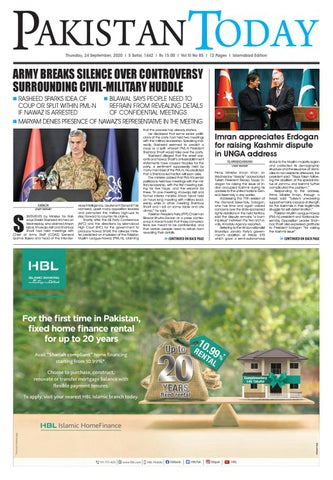
Army breAks silence over controversy surrounding civil-militAry huddle g
g
g Bilawal says people need to rasheed sparks idea of coup or split within pMl-n refrain froM revealing details if nawaz is arrested of confidential Meetings MaryaM denies presence of nawaz’s representative in the Meeting
KARACHI
s
staff report
tateMents by Minister for railways sheikh rasheed ahmed on wednesday, who claimed ahsan iqbal, khawaja asif and shahbaz sharif had held meetings with chief of army staff (coas) general Qamar Bajwa and head of the inter-ser-
vices intelligence, lieutenant general faiz hameed, upset many opposition leaders and prompted the military high-ups to step forward to counter his claims. shortly after the all party conference (apc) and the directions by islamabad high court (ihc) for the government to produce nawaz sharif, the railways minister predicted an implosion of the pakistan Muslim league-nawaz (pMl-n), claiming
that the process has already started. he disclosed that some senior politicians of the party had held two meetings with the military leadership. speaking indirectly, rasheed seemed to predict a coup or a split. wherein pMl-n president shehbaz sharif would take over the party. rasheed alleged that the arrest warrants and nawaz sharif’s anti-establishment statements have caused troubles for the party, a sentiment supposedly held by many members of the pMl-n. he predicted that a shehbaz-led faction will soon arise. the minister added that pMl-n’s senior politicians held two meetings with the military leadership, with the first meeting lasting for five hours. and the second for three. “in one meeting, khawaja asif and former interior minister ahsan iqbal held an hours long meeting with military leadership while in other meeting shehbaz sharif and i sat on same table and ate dinner,” he said. pakistan people’s party (ppp) chairman Bilawal Bhutto-zardari at a press conference in karachi said that those conversations are meant to be confidential, and that certain people need to refrain from revealing their details.
CONTINUED ON BACK PAGE
Imran appreciates Erdogan for raising Kashmir dispute in UNGA address ISLAMABAD/ANKARA staff report
prime Minister imran khan on wednesday “deeply” appreciated turkish president recep tayyip erdogan for raising the issue of indian occupied kashmir during his address to the united nations general assembly a day earlier. addressing the 75th session of the general assembly, erdogan, who has time and again voiced concerns over the state-sponsored rights violations in the held territory, said the dispute remains “a burning issue” between the two arch-rivals, anadolu agency reported. referring to the hindu-nationalist Bharatiya Janata party’s government’s abolition of article 370 which gave a semi-autonomous
status to the Muslim-majority region and protected its demographic structure and the issuance of domiciles to non-residents afterward, the president said: “steps taken following the abolition of the special status of Jammu and kashmir further complicated the problem.” responding to the address, prime Minister imran, through a tweet, said: “turkey’s unwavering support remains a source of strength for the kashmiris in their legitimate struggle for self-determination.” pakistan Muslim league-nawaz (pMl-n) president and national assembly opposition leader shahbaz sharif also expressed gratitude to president erdogan “for raising the kashmir issue”.
CONTINUED ON BACK PAGE
02
Thursday, 24 September, 2020
NEWS
ECC APPRovES RS3.85BN To CLEAR PSM EMPLoyEES’ duES ISLAMABAD
T
STAFF REPORT
HE Economic Coordination Committee (ECC) of the Cabinet on Wednesday approved an amount of Rs3.85 billion to clear dues of Pakistan Steel Mills (PSM) employees for the financial year 2020-21, to be disbursed every month. This approval was accorded during the ECC meeting, which was held with Adviser to the Prime Minister on Finance and Revenue Dr Abdul Hafeez Shaikh in the chair. The meeting decided to seek a detailed report from the Ministry of Industries and Production on the nature of liabilities due on PSM on account of retirement dues, liabilities that will accrue as a result of the retrenchment plan and expenditures on account of utilities or
COMMITTEE ALLOWS KHARLACHI BORDER CROSSING AS REBATABLE POINT TO INCREASE EXPORTS TO AFGHANISTAN any other charges. The forum was briefed that the retired employees of the PSM had already been paid Rs12.741 billion earlier this month but the Sindh High Court has asked to pay the non-litigant retired employees as well, which "will further add Rs11.68 billion to the expenditure of the federal government". Meanwhile, the meeting considered and approved two technical supplementary grants (TSGs), amounting to Rs111 million, for the Ministry of Interior to clear various liabilities of the ICT administration. The meeting also approved TSGs
GB to hold general election on November 15 ISLAMABAD STAFF REPORT
amounting Rs102 million for Islamabad High Court and Rs8.5 million for National Heritage and Culture Division for various expenditures. Moreover, the committee allowed notifying the Kharlachi border crossing between Pakistan and Afghanistan as a rebatable border point for export of goods to Afghanistan. Earlier, the opening of this border point helped in the release of congested transit trucks at the Afghan border due to Covid-19 restrictions. The ECC also okayed the shifting of the 'Federal Expanded Programme on Immunization EPI' from development to revenue expenditure with an allocation of
Rs9.9 billion through a TSG for vaccine procurement in the current financial year to avoid interruption in the immunization programme. Now the vaccine shall be procured by the federal EPI on behalf of the provincial governments and later reimbursement shall be made by Punjab and Sindh government, and deduction at source from the shares of KP and Balochistan for their respective vaccine shares will be made. Lastly, the committee allowed the exemption from re-lending of the funds for Pakistan National Emergency Preparedness and Response Plan for Covid-19 to cover the country's requirements for 12 months through emergency operations. In order to administer the programme, Asian Development Bank will provide a loan of $100 million while an additional $5 million will be from the Norwegian government as a grant administered by ADB.
PM constitutes 'outreach committee' to promote economic diplomacy
RAWALPINDI STAFF REPORT
Two soldiers embraced martyrdom in unprovoked Indian firing along the Line of Control (LoC), the de facto border stretched along Kashmir, the Inter-Services Public Relations (ISPR) said Wednesday. In a statement, the ISPR said the Indian army troops resorted to unprovoked firing in the Dewa sector in Neelum valley with heavy weapons. “Pakistan army responded and [targetted] those posts which initiated fire” and inflicted substantial damage on the enemy in terms of men and material, the statement said. During intense exchange of fire, Sepoy Noorul Hassan, 29, and Sepoy Waseem Ali, 25, embraced martyrdom. The heavily militarised LoC splitting the disputed Himalayan region has been witnessing ceasefire violations quite frequently in a serious breach of a truce agreement signed by both sides in November 2003. In 2020 so far, India has committed 2,333 violations of the agreement, according to an ISPR count.
Govt seeks time to execute warrants against Nawaz through London court ISLAMABAD STAFF REPORT
ISLAMABAD APP
The meeting was attended by Industries Minister Muhammad Hammad Azhar, Information and Broadcasting Minister Senator Shibli Faraz, National Food Security Minister Syed Fakhar Imam, Science and Technology Minister Chaudhry Fawad Hussain, PM advisers Abdul Hafeez Shaikh, Abdul Razak Dawood, special assistants to PM Dr Moeed Yousaf, Dr Faisal Sultan, Syed Zulfiqar Abbas Bukhari, Board of Investment chairman, foreign secretary and other senior officials. During the meeting, a roadmap detailing local potential with respect to the promotion of economic diplomacy, it’s existing challenges and the steps to overcome those challenges
was also submitted before the prime minister. The prime minister stressed on promoting economic diplomacy, labelling it as the need of the hour as it could enable Pakistan to not only further strengthen the bilateral ties with different foreign countries but also fully explore the untapped potential within the field of economics that lies within. He directed that Pakistani embassies and missions abroad should fully focus on the promotion of this initiative. The prime minister also directed the board of investment chairman to ensure all possible facilities to foreign investors who were keen to invest in different sectors of the country.
President Dr Arif Alvi on Wednesday gave a go-ahead to holding of general elections for the Gilgit-Baltistan (GB) assembly on November 15. He approved a summary regarding the polls sent to him by Prime Minister Imran Khan. The Legislative Assembly of GB was dissolved after it completed its five-year tenure on 24 June. Previously, the GB Election Commission had postponed the elections of the legislative assembly and suspended the election schedule issued on July 2. The election schedule had been suspended in the wake of the decision of the GB Chief Court, a notification issued by the commission said. According to the election schedule issued on July 2, polling was supposed to be held on August 18.
Prime Minister (PM) Imran Khan, during a meeting on Wednesday, decided to constitute an ‘Economic Outreach Apex Committee’, to be headed by his special assistant Dr Moeed Yousaf as the focal person, to further promote economic diplomacy. In a press release, PM Office's media wing said the meeting also decided to constitute an ‘Economic Outreach Coordination Group’ for coordination among various relevant federal ministries, provincial departments and others and for timely achievement of targets set by the federal government.
790km Karachi-QuettaChaman road upgradation approved: Asim
SECP senior officers served notices over data leak
ISLAMABAD
ISLAMABAD
STAFF REPORT
China-Pakistan Economic Corridor (CPEC) Chairman Authority Lt Gen (r) Asim Saleem Bajwa has said the prime minister has approved in principle the upgradation of Karachi-Quetta-Chaman Road to expressway. In a tweet on Wednesday, the CPEC Authority chairman said that the 790-kilometre-long expressway will be constructed on build-operatetransfer (BOT) basis. He said the process has been started to hire a consultant for feasibility study of the project. Bajwa also shared the ad for hiring the consultant for preparing its feasibility report. He said that the upgradation plan of the 790-kilometre road is crucial to avoid accidents due to its dilapidated condition and meet the requirements of travellers. Moreover, it will also improve the connectivity of the earlier neglected areas, he added. A day earlier on Tuesday, Asim Saleem Bajwa had said that PM Imran called for the government’s focus on the uplift of areas that were previously neglected. In a Twitter post, Bajwa said out of the 18 approved border markets, three, including Mand and Gabd to be set up in Balochistan and ShaheedanoDan in Khyber Pakhtunkhwa (KP), were approved as a pilot project. These markets will transform local economies, check smuggling and formalise trade with neighbouring countries, he had maintained.
Two soldiers martyred in Indian LoC fire: ISPR
TLTP
The Securities and Exchange Commission of Pakistan (SECP) on Wednesday issued show-cause notices to its senior officers, including additional and joint directors, in connection with an investigation into data leak. It emerged that the show-cause notices were served to Additional Director Market Surveillance Arsalan Zafar, Joint Director Information Technology (IT) Muhammad Sohail, Deputy Director IT Hammad Ahmed, Assistant Joint Director Companies Registration Sadiq Shah and Assistant Joint Director Companies Registration Adil Ali. Earlier on Tuesday, it emerged that a total of 10 SECP officers had been served show-cause notices in order to probe the sensitive data leak.
After the news of the data leak circulated, the security arbiter had taken notice of the development and issued show-cause notices to its 10 officers directing them to revert to the committee with their written response by Sept 29. On Tuesday, the federal cabinet had held discussions over the SECP data leaks, wherein the premier was recommended to make the inquiry report public. Faisal Vawda had said that facts should be unveiled before the nation, as important revelations were made in the inquiry report regarding the son of Zafar Hijazi. He claimed many people belonging to Jang Group were also involved in the leaks. The minister had further claimed that some government lawmakers were having sympathies for the persons involved in the data leaks. PM Imran Khan had also hinted to publicise the inquiry report of SECP data leak in order to uncover the facts.
Covid-19: Saudi Arabia lifts ban on flights from Pakistan KARACHI STAFF REPORT
The Saudi Arabia On Wednesday lifted a ban on international flights coming from Pakistan after the latter's success in controlling the coronavirus outbreak. In a NOTAM (Notice to Airmen), the Saudi Arabia government has banned all flights coming from
India, Brazil and Argentina over their failure to control Covid-19 outbreak. “We cannot risk the lives of our citizens by allowing flights from India, Brazil and Argentine”, the NOTAM read. Meanwhile, the Kingdom has lifted travel restrictions from Pakistan after it managed to contain the spread of coronavirus in the country. On September 13, the kingdom decided to lift travel
restrictions in the kingdom from 1 January 2021, imposed earlier owing to Covid-19 pandemic. According to local media reports, the kingdom’s interior ministry had announced that airports, ports, and border routes would be made operational from January 1. Saudi citizens would be able to freely move in and out of the kingdom while citizens of the Gulf Cooperation Council states.
An Islamabad High Court (IHC) bench on Wednesday adjourned the hearing of appeals of former prime minister Nawaz Sharif, his daughter Maryam Nawaz, and son-in-law Captain (r) Muhammad Safdar until December 9. Justice Farooq remarked if the court was told for sure as to how many days this process can take, it would have fixed the date for the next hearing accordingly. The counsel suggested adjourning the hearing for an indefinite period, saying as soon as the government receives any response, it will inform the court about it. During the hearing, Additional Attorney General Tariq Khokhar requested the bench to grant some time to submit a compliance report about the execution of arrest warrants against Nawaz through London’s county court. To a question, he replied that this process can take at least 15 days. He said that the Pakistan High Commission in London dispatched the warrants to the Avenfield residence of the former premier by courier, where a person received the warrants and signed the receipt.
Army joins anti-polio & tree plantation campaigns RAWALPINDI STAFF REPORT
Chief of Army Staff (COAS) General Qamar Javed Bajwa planted a sapling as part of Sarsabz-o-Shadab Pakistan campaign and also attended a ceremony of polio free Pakistan. According to Inter-Services Public Relations (ISPR), 29 million trees planted from 2018 onwards and 5 million trees are being planted in this monsoon by Pakistan Army formation as part of Sarsabz-o-Shadab Pakistan. The Frontier Works Organisation (FWO) as part of "Green Motorways Initiative" is planting around one million saplings astride its motorways in the next two and half years.
Thursday, 24 September, 2020
NEWS
sHEHBAZ ACCusEs IMrAN ANd BuZdAr of BEING CulprIts IN suGAr sCANdAl LAHORE
l
SHAHAB OMER
EADER of the Opposition in the National Assembly Shahbaz Sharif has said that Prime Minister Imran Khan and Punjab Chief Minister Usman Bazdar were the real culprits of the sugar scandal while the government should tell what has been done so far on the medicines and sugar scandals. Addressing a press conference in Lahore on Wednesday, Shahbaz said that more than two years have passed since the government came to power while the “selected” prime minister had been busy hiding scandals day and night. “The failure of the Results Transmission System (RTS) led to the formation of the present government. The bond between the National Accountability Bureau (NAB) and Imran Niazi has created a record of making false and baseless cases on which
we are raising our voice and will continue to raise,” he said. “The PTI [Pakistan Tehreek-e-Insaf] government had sold dreams to the people, and claims were made that if Imran Khan came to power, milk and honey would flow. While the Pakistani economy is attacked like a municipal factory, Aleema Khan took advantage of the amnesty scheme and is not willing to talk about her overseas property. The ECP has not yet decided on the foreign funding case,” he added. “What happened to the Malam Jabba case and the helicopter case against Imran Khan? Four buses have been burnt in the BRT at a cost of Rs100 billion, which is a project of only 26km,” Shahbaz said. The opposition leader said, “Imran Khan wants me to go to jail, it does not matter if I or all of us have to go to jail, if I go to jail my colleagues will carry my mission. We saved money on projects
Journalist arrested from outside IHC for ‘carrying weapons’ NEWS DESK The police on Wednesday arrested a reporter who had arrived at Islamabad High Court to cover a hearing of an appeal filed by Pakistan Muslim League-Nawaz (PML-N) Vice President Maryam Nawaz against her conviction in the Avenfield House reference. Ehtisham Kiyani, a reporter for Channel 24, was arrested by police officials deployed for security and was shifted to Ramna police station. According to reports, he was stopped at a police checkpoint outside the court where he introduced himself but was detained by officials. After arresting him, police claimed that Kiyani was carrying weapons. IHC Chief Justice Athar Minallah took notice of the incident and summoned high-ranking officials of the capital police and ordered Kiyani’s immediate release. The reporter was released soon after and Superintendent of Police Sarfaraz Virk said that no weapons had been recovered from Kiyani, adding that a private TV channel had reported “fake news”. Speaking to reporters after his release, Kiyani said that he was falsely accused of bearing weapons. He added that he was detained by police for over an hour, during which he was “tortured” and “harassed”.
during our five-year rule under the leadership of Nawaz Sharif. In the time of Nawaz Sharif, sugar which was Rs50 now costs Rs100 per kg. Corruption has not been proven in any of numerous projects. None of the 56 companies' cases could be proved in two years. I will not be forgiven if any evidence of corruption is brought against me till the Day of Judgment. The people of Pakistan are disappointed. Pakistan's name was tarnished by false accusations against us. However, the Chinese and British governments did not hesitate to deny the allegations against me.” ASSET DETAILS: On the other hand, NAB also revealed the value of Shahbaz’s alleged anonymous assets valuing at Rs7.57 billion. The documents which were released by the NAB office stated that Shahbaz’s declared assets were worth Rs269.31 million while his alleged anonymous assets are worth more than Rs7 billion.
NAB documents further stated that Shahbaz’s unnamed entities include family members, three companies, secret bank accounts and shares. The assets of the anonymous company Unitas and Good Nature are worth Rs1.88 billion while the assets of the anonymous company Nisar Trading are worth more than Rs500 million, the anti-graft body added. The documents also revealed that Shahbaz’s shares were worth Rs1.22 billion and the assets of the anonymous members of the Sharif family were worth Rs3.18 billion. According to the documents, Sharif family’s unnamed members include Nusrat Shahbaz, Suleman Shahbaz, Hamza Shahbaz, Rabia Imran and Jaweria Ali. It is pertinent to mention here that NAB Lahore has prepared the longest historical reference based on evidence in the money laundering case against Shehbaz and the said reference consists of 58 volumes while the number of pages provided to all the accused is more than 500,000. The reference claims to expose the complete method of money laundering by Shahbaz and his family, while the full details of Suleman and his alleged network for money laundering are revealed in the form of volumes.
Dr Abdullah Abdullah likely to visit Pakistan next week ISLAMABAD MIAN ABRAR
Dr Abdullah Abdullah, chairman of the Supreme National Reconciliation Council, is likely to visit Pakistan next week to discuss the ongoing intra-Afghan dialogue with Prime Minister Imran Khan and others. Official sources informed Pakistan Today that Dr Abdullah is likely to arrive here on a three-day visit starting from September 28. According to the sources, Dr Abdullah is visiting Pakistan on special invitation of Prime Minister Imran Khan. He is likely to also meet political leaders and Chief of Army Staff (COAS) General Qamar Javed Bajwa. The visit comes at a time when efforts are being made to evolve consensus among various Afghan groups, including
the Afghan Taliban, for the future political dispensation. Recently, the Afghan Taliban and the Afghan government along with parties of Northern Alliance had attended the inaugural ceremony of intra-Afghan dialogue in Doha. However, the formal talks between the Afghan government and Taliban are yet to start. The latest phase of the Afghan peace process is crucial since it would focus on determining the future political dispensation in Afghanistan. The Taliban have sought to adopt conservative system in situation following the withdrawal of US troops while other political groups want a democratic set up where rights of women and others are guaranteed. Taliban, however, have shown willingness to accommodate the concerns of other groups as some of their leaders claim that the insurgent group learnt lessons from their past mistakes.
03
CPEC Authority Chairman Lt Gen (R) Asim Saleem Bajwa on Wednesday called on Punjab Chief Minister Usman Buzdar and discussed CPEC projects progress in the province.
Court orders to indict Zardari in three graft references ISLAMABAD STAFF REPORT
An accountability court in Islamabad on Wednesday ordered to indict former president and Pakistan Peoples Party co-chairperson Asif Ali Zardari in three corruption references against him, dismissing his petitions against the cases. The court had reserved its decision on September 17. The verdict, announced by Judge Azam Khan, says Zardari cannot be acquitted in references pertaining to fake bank accounts. The court also summoned all the suspects, including Zardari, next on September 28. The former president through his petitions had urged the court to dismiss corruption references pertaining to money laundering, Park Lane estate and Thatta water supply. Zardari is facing multiple corruption cases that have stemmed from a mega money-laundering scandal, which came into the limelight in 2018. The former president, his sister Faryal Talpur and several of their business associates are being probed as part of a 2015 case regarding fake accounts and fictitious transactions — which were initially found to have totalled Rs35 billion — conducted through 29 benami accounts in Summit Bank, Sindh Bank and United Bank Limited. Zardari is accused of being involved “in extending a loan and its misappropriation by M/s Parthenon Private Limited, M/s Park Lane Estate Private Limited and others”. His counsel, however, has argued that the PPP co-chairperson had been a director of M/s Park Lane, but he resigned from the company in 2008 before assuming the office of the president of Pakistan.
04
Thursday, 24 september, 2020
neWs
Govt Abolishes cUstoms, ReGUlAtoRy dUties on 163 tARiFF lines ISLAMABAD
W
GHULAM ABBAS
ITH an aim to increase exports while decreasing cost of doing business, the government has withdrawn customs’ duties, regulatory duties and additional customs’ duties on at least 163 tariff lines. The Economic Coordination Committee (ECC) of the Cabinet formally approved this proposal on Wednesday, directing the Federal Board of Revenue to implement it at the earliest. The decision was made in line with the
recommendations of the National Tariff Commission, as the National Tariff Policy Board had advised the government in this regard on August 24, 2020. The total revenue impact of the exemptions will be Rs532.875 million per annum. According to officials of the Ministry of Commerce, the government has withdrawn cumulative 22.5pc duties — customs duty (CD), regulatory duty (RD) and additional customs duty (ACD) — on 37 tariff lines; 24pc duties on 14 tariff lines; 20pc duties on 25 tariff lines; 15pc on 16 tariff lines; 27pc on three tariff lines; 13pc on 29 tariff lines; and 5pc on 38 tariff lines.
The officials said duties were withdrawn on selected HS codes of the textile sector, including fibers, yarns and fabrics of nylon, viscose, acrylic, rayon, silk, wool and vegetable-based fibers like hemp etc. The rationalization has been done with the objective of increasing the share of man-made fibre (MMF) for better per unit prices in the international markets, product diversification and, most importantly, value addition in the textile sector, they added. Meanwhile, in a series of tweets, Adviser to PM on Commerce Abdul Razak Dawood said that “this is in pursuance of the policy of Ministry of Commerce for
cost reduction by reducing the duties, including ACDs and RDs, on raw materials as well as intermediaries”. “This is also an essential part of promoting industrialization under ‘Make in Pakistan’, and ensuring ‘export led growth’ in the country,” he added. The adviser said a notification will be issued after ratification by the cabinet. “This decision will enable our exporters to widen their product range, capture more of the synthetic market and improve our competitiveness.” He said MOC will now do the same in other sectors like leather, engineering, chemicals, pharma and food etc.
PM Imran picks finance secretary for World Bank post ISLAMABAD SHAHZAD PARACHA
Prime Minister Imran Khan on Wednesday approved the posting of Finance Secretary Naveed Kamran Baloch for the position of executive director (ED) in World Bank (WB), negating the common perception that Azam Khan would assume this crucial role. An official confirmed that the PM has granted approval of Baloch’s appointment for the ED WB position for a period of four years and he would be leaving the country for Washington on October 31, 2020, replacing Shahid Ashraf Tarar. The Economic Affairs Division had proposed four names for this position which included Secretary to Prime Minister Azam Khan, Finance Secretary Naveed Kamran Baloch, Establishment Division Secretary Dr Ijaz Munir and former finance secretary Tariq Bajwa. Sources close to the development said that three can-
didates – Special Secretary Finance Mohsin Chandna, Cabinet Division Secretary Ahmed Nawaz Sukehara and Secretary EAD Noor Ahmed – are now being considered for the vacant post of finance secretary, as Baloch would leave for Washington. Mohsin Chandna not only served as the ED International Monetary Fund (IMF) but Hafeez Sheikh also appointed him for the SFS position due to which he is being considered as the favourite to fill the vacancy. Meanwhile, Ahmed Nawaz Sukehra is presently serving as cabinet secretary and he is also very close to decision makers of the incumbent regime. It is pertinent to mention that IMF team is scheduled to visit Pakistan later this month and sources have mentioned that Pakistan will update the team about the targets pertaining to State Bank of Pakistan’s autonomy, power sector, loss-making entities and reforms in the Federal Board of Revenue.
ISLAMABAD Prime Minister Imran Khan has approved the establishment of One Window Complaint System under which all the complaint cells of federal departments will be linked with Pakistan Citizens Portal. Prime Minister's Performance Delivery Unit has been directed to determine modalities in consultation with all concerned organisations, chalk out integration plans and get it completed within 60 days. According to the PM office, 33 complaint cells of the federal departments will initially be linked to Pakistan Citizens Portal. The centralised mechanism will help the federal government achieve a number of
NEWS DESK Planning, Development & Special Initiatives Minister Asad Umar has formed a committee under the supervision of National Assembly Member Najeeb Haroon to coordinate with all the ministries involved in the Karachi Transformation Plan (KTP) project. While chairing a meeting held in Islamabad on Wednesday to discuss the progress of federal component of KTP, Asad Umar directed the formulation of a committee headed by Najeeb specially designated to oversee the progress made my ministries tasked to undertake the development projects in the metropolitan. The meeting discussed matters related to projects such as Karachi Greater Water Supply (K-IV), Karachi Circular Railway (KCR), Greenline BRT, Railway Freight Corridor and Rehabilitation of stormwater drains. Asad Umar further instructed the minister of water resources to provide the action plan in relation to the K-IV project. Secretary planning was apprised in the meeting that KCR project and Railway Freight Corridor are on track as per directions. Secretaries and senior officers of the ministry of planning, railways, water resources and National Disaster Management Authority (NDMA) participated in the meeting.
Restaurants’ boycott against Foodpanda expands to major cities KARACHI TLTP
PM approves establishment of one window complaint system STAFF REPOT
Asad Umar forms committee to oversee development progress in Karachi
goals pertaining to an effective grievance redressal regime. The connectivity of PCP with existing cells of different federal organisations will end confusion on part of citizens due to multiple complaint cells, said the statement. It will also ensure processing of all complaints in real-time and in a uniform manner. It will also avoid wastage of time and resources besides providing centralised analytics from one source for policy interventions on different public issues. According to the letter, Prime Minister’s Performance Delivery Unit including PCP, operations and management shall be managed by PMO and all complaints are backed by well-chalked out user guidelines for complaints and suggestions’ handling.
PM seeks action plan to boost agriculture productivity ISLAMABAD STAFF REPORT
Prime Minister Imran Khan has directed to prepare a timeframe-based action plan for the medium and long-term projects to enhance agriculture produce in the country. Presiding over a meeting to review progress on agriculture reforms and food security initiatives on Wednesday, the prime minister said that ensuring food security is top priority of his government. He directed the restructuring of agro-ecological zones in Pakistan in order to compile data pertaining to the country’s potential for enhanced crop productivity and diversification. He also ordered the compilation of accurate data based on the production of different food commodities. He issued directives to concerned ministries for paying special attention to special economic zones dedicated to the processing of food commodities. Farmers should be attracted and provided required assistance to produce vital crops for exports, said the PM. The PM directed to operationalise the Food Security Dash Board at the Ministry of Food Security in collaboration with all provinces and relevant departments.
Restaurant owners of major cities of the country have joined a boycott against Foodpanda as the food delivery company has allegedly failed to negotiate. According to a statement issued here on Wednesday, All Pakistan Restaurant Association (APRA), after a successful boycott in Karachi of Foodpanda, has now started protest in Punjab province and restaurants owners of Lahore, Islamabad and other cities, have joined the protest. APRA Chairman Muhammad Naeem Siddiqui pointed out that Foodpanda has started putting more pressure on restaurants after boycotting its services and threatened that it would not deliver the food if 30 per cent commission is not paid. “APRA has strongly protested the imposition of a 30 per cent self-imposed commission on restaurants, calling it against the rules of the Competition Commission of Pakistan and the CCP is asked to play its role in ending the Foodpanda’s monopoly and malpractices so that all food delivery companies have equal business opportunities”, he said. The APRA chairman, after consultation with Islamabad Restaurant Association (IRA), Lahore Restaurant Association (LRA) and Lahore Restaurant Unity Association, was subjected to certain conditions for the restoration of Foodpanda’s services.
Thursday, 24 September, 2020
NEWS
05
MADE UP VICTORIES AND INDIAN PROPAGANDA Journalist looted at Jawad Falak Paul Joseph Goebbels, perhaps the most renowned propagandist in contemporary history said, “If you tell a lie big enough and keep repeating it, people will eventually come to believe it.” Today in the era of narratives vs counter narratives, propaganda is the ultimate perception management tool used to blind fold and sway public opinion towards a desired direction. Fake news and information disorder is the primary offensive tool to wage fifth generation warfare used by both state as well as non-state actors. A most relatable example which fits in the propagandist shoes would be our next door neighbor, India. Despite the vociferous celebrations of electoral victory a year earlier, 2020 did not start well for India and its fascist ruling party. Reverberations from the previous year’s embarrassment due to a failed military adventure against Pakistan, faltering economy, separatist movements all across the country and ravaging state sponsored communal divide continued to haunt BJP government. The icing on top of prevalent miseries is the clutch of Covid 19 over India that has led Indian GDP contracting by 23.9% in last fiscal quarter and worst economic recession amongst G8 countries. On the external front Indian foreign policy failure owing to its illegal annexation of disputed Kashmir, isolation due to its anti-minority policies as well as belligerent attitudes against all of its neighbors has compounded BHARAT MATA’s nightmares. Within these is the self inflicting challenge which BJP Government has carved out for itself over LAC in Ladakh which simply adds to its list of failures. Having lost territory to China without a single shot being fired, Modi and his cronies are desperate to divert public attention from their epitomic failures. Like a skillful Bollywood director, BJP has embarked on a make believe script with fictitious victories and fake bravado on its engagements with the Chinese military. A most recent scripted number, Post-Galwan clash is the Indian claims of quietly
deploying Indian Navy warship in South China Sea. The sheer motive behind such propaganda of India audaciously challenging China in its own backyard i.e. South China Sea, is nothing but to divert the attention of Covid struck Indian masses from the humiliation India continues to face in Ladakh. Like most low budgeted Bollywood movies, here too the script remains marred with glaring fallacies. One of the concocted delusions is that Indian Navy quietly dispatched warship to South China Sea which is devoid of the basic facts of today’s digitally driven world and its application in military functions. China, an economic as well as a military power, has numerous military satellites well capable to monitor every movement within its area of interest. The claim that Chinese remained unaware of Indian warship deployment is inane. Just to compare and give a reality check to Indian claim, during the post Balakot standoff in 2019, Pakistan Navy which has far fewer resources at its disposal, compared to its Iron brother China, not only managed to track the entire Indian fleet, including its ridiculously vaunted aircraft carrier while one of its warship remained bottled up in Oman fearing reprisals by Pakistan Navy, but also successfully detected and deterred an Indian submarine from infiltrating territorial waters on 04 March 2019. Another flop scene in the story is that the “frontline’ warship remains unnamed. Furthermore, the objection by Chinese authorities seems to be overblown, even if indeed it did happen. The South China Sea is an area claimed by China which takes a dim view of the presence of any foreign military vessel in the area and has enormous military capability to assert its control in the area. The Indian implied propaganda information that presence of a single warship in SCS was a major irritant to the Chinese is nothing but a useless exercise in doctoring public sentiment. Warships are actually instrument of coercion and power projection. They are
overtly deployed in adversary areas in order to display the resolve by openly announcing one’s presence in hostile waters. This type of silent deployment as claimed by the Indians actually beats the entire purpose of sending the message of “defiance” due to its secretive nature and point towards an Indian High Command that appears more fearful than being defiant. India is well known for fabricating fake and symbolic victories in order to cover up its shortcomings. After Pulwama scenario, it has made up the stories of 350 to 400 dead militants in Balakot as well as the downing of a F16 at the hands of a MiG 21 in order to cover losses of two jet fighters shot down by Pakistan as well as the deaths of several Indian personnel due to fratricide, another exhibition of military incompetence. It boasted of attaining naval superiority in the Arabian Sea though failed to detect even one of the Pakistani submarines. Yet, the Indian government through the pliant media often quoted as “Godi Media”, has been unable to sell this narrative to its own people let alone the world. This tradition of fictitious victories trails from the creation of modern day India which has used its larger media industry to bolster claims like the fabled Battle of Longelwala in 1971 which has been denied by Indian veterans of ever having taken place. In 2004, the confession of Major Surinder Singh of the 5 Gurkha Rifles Regiment of making fake videos blew the lid on “tadka”, an internal Indian military practice of falsifying enemy casualties for promotions and medals. The truth of the matter is that the recent claim is a mere addition in the history of Indian real politik that emphasizes more on glorification rather than building capability. This tradition stems more from Indian social culture rather than domestic politics, which has made it a common feature of Indian diplomacy. Jawad Falak is an MPhil student at National Defence University, Islamabad and is a resident research associate at Maritime Study Forum.
gunpoint in broad daylight outside his flat ISlaMaBad
t
ShAhzAd PARAchA
WO armed robbers took Rs8,00,000 in cash from a senior journalist of the Associated Press of Pakistan (APP) on Wednesday in sector I-8/1 of Islamabad when he reached the parking lot of his residential flat after withdrawing money from a nearby bank. Ishtiaq Rao, who has been working with APP since 2007, visited Standard Chartered bank in I-8 Markaz to withdraw money. He was issued a bank draft, withdrew the amount of Rs800,000 and left the bank around 11:30 am. When he reached the parking lot of his residential flat in street number 4, sector I-8/1, two armed persons riding on a motorbike intercepted him and asked to hand over the money. They snatched the amount from the journalist and fled. Immediately after the incident, he informed a nearby police station. A police team visited the scene and later asked him to come to the police station for registration of the First Information Report (FIR). With the help of
witnesses and police, CCTV footage has been obtained from the vicinity of the bank and other shops while further investigation is underway into the matter. Meanwhile, a delegation of journalists including Ishtiaq Rao also met with the Adviser to Prime Minister on Interior and Accountability Mirza Shahzad Akbar and informed him about the incident. The adviser assured the journalists full cooperation and committed to direct the police for the immediate arrest of culprits. The journalist community in Islamabad have also expressed reservations on this incident. National Press Club President Shakeel Anjum and General Secretary Anwer Raza demanded of the police to ensure the arrest of perpetrators of this crime and provide justice to the journalist deprived of his hard-earned money. The incident has spread fear among the residents of the area who also complained about non-effective policing measures in sector I-8. The law and order situation in the I-8 area continues to worsen and the police have no role to play, said a resident of the I-8 sector. He also demanded the police to arrest the culprits and recover the looted amount.
Intermediate results 2020: Punjab Group of Colleges leads with 153 top positions LAHORE: All boards of Punjab have recently announced intermediate results for the year 2020 under Covid-19/Promotion Policy, 2020. The boards across the province declared results on the basis of students’ performance in the previous academic results. According to the results compiled, Punjab Group of Colleges retained its top position bagging maximum number of positions across boards. PGC took 153 (first, second and third) positions in total with 18 overall positions. Board wise position attained by Punjab College students were; Lahore Board 23 positions, Faisalabad Board 18 Positions, Gujranwala Board 23 Positions, Multan Board 7 Positions, Rawalpindi Boards 18 Positions, Sargodha Board 17 Positions, Bahawalpur Board 22 Positions, Sahiwal Board 13 Positions and Federal Board 2 Positions. Board wise pass percentage was as follow: Lahore Board 99.43 per cent, Faisalabad Board 87.70 per cent, Gujranwala Board 99 per cent, Multan Board 86.21 per cent, Sargodha Board 89.52 per cent, Bahawalpur Board 86.24 per cent and DG Khan Board 88.89 per cent. PRESS RELASE
Some Takeaways of China’s Poverty Alleviation By lI BIJIan, ConSul General oF ChIna In karaChI
By the end of this year, China will officially eradicate absolute poverty. In the past more than 40 years since China has begun to implement the policy of reform and opening-up and started the journey of poverty alleviation, more than 850 million people have been alleviated from poverty, accounting 70% of the world total and China alone has made unprecedented efforts and contributions to fulfill the dream of “No Poverty” of the UN Sustainable Development Goals. Being the largest developing country, China has constantly put the poverty alleviation the top priority by mobilizing all social forces and implementing a comprehensive strategy. Especially since the 18th National Congress of Communist Party of China in 2012, CPC has been making unremitting efforts and taking poverty alleviation as the bottom line mission and landmark indicator of building a moderately prosperous society in all aspects. From 2012 to 2019, the poverty stricken population has been reduced from 98.99 million to 5.51 million, and the poverty incidence has declined from 10.2% to 0.6%, over 10 million people alleviated from poverty per year for the past seven consecutive years and making it to be the largest poverty alleviation population in the world, creating a “China Miracle” in the history of poverty alleviation.
China has successfully embarked on an exploring path of poverty alleviation with Chinese characteristics, formed the poverty alleviation system with Chinese characteristics, and written a new chapter in the human history of anti-poverty. China’s achievements on poverty alleviation have been widely recognized by the international community. Some of the following Chinese experience of poverty alleviation may be shared and learned so as to enrich the global theory and practice of poverty governance. I. LEd by tHE gOvERnmEnt: Since the late 1970s, China has started to carry out organized rural poverty alleviation exploration in large-scale by integrating it into the overall national development strategy. China formulated and implemented the Seven-year Priority Poverty Alleviation Program (19942000), the Outline for Poverty Alleviation and Development of China's Rural Areas (2001-2010), the Outline for Development-oriented Poverty Alleviation for China's Rural Areas (2011-2020), together with a few other poverty alleviation plans, making poverty alleviation a common target and action of the whole society. In 2014, governments at all levels established steering groups of poverty alleviation work, clarifying the principal responsibilities, and setting up the responsibility system of poverty alleviation led by the head of the Party and the government at different level. In 2016, the phased goal of achieving the “two worries-free” (do not worry about eating, do not worry about wearing) and “three guarantees” (to ensure compulsory education, basic medical care and housing security)was laid out to ensure that the rural population living below the current poverty threshold and the impoverished counties shall all be lifted out of poverty by 2020. China draws up long-term poverty alleviation plans while sets annual targets, timely releases relevant policy documents according to the characters and tasks at
different stages and periods, to take large-scale special anti-poverty actions, formulate and implement the developmental plans for women, children, the disabled as well as the ethnic minorities. II. gEttIng tHE wHOLE sOcIEty InvOLvEd: China is the world’s largest developing country with mass of impoverished population, complex reasons and national conditions, the poverty alleviation task is closely related to political, economic, educational, medical, cultural, and ecological factors. China’s poverty alleviation plan has been fully exploiting the socialist system’s advantages to concentrate resources and accomplish large undertakings, established the great pattern of poverty alleviation led by CPC, dominated by the governments, participated by the whole society and implemented in concert. A trans-regional, inter-departmental, and society-wide system of poverty alleviation has bee set up. These including: the Central Government strengthens the measures to expand the fiscal transfer payment to the poor provinces; providing special funds to support the implementation of various poverty alleviation projects; the higher education institutions across the country enroll more students from the poor areas; promoting educational poverty alleviation program through sending teachers from the cities to the schools in the rural areas; narrows down the gaps of development between the developed east regions and the under-developed central and western regions through the counterpart assistance program; providing assistance to the relevant poor areas by the major State owned enterprises and the various Departments of the Central Government through the counterpart mechanism. In addition, various social forces have been mobilized to participate through the "Hope Project" and "Glorious Cause" project etc. III. bAsEd On REfORm,
CMYK
OpEnIng up And sustAInAbLE dEvELOpmEnt: Reform and opening up is not only the vital approach to build up the country but an effective way to eradicate poverty also. China's reform and opening up has achieved huge dividends including maintaining rapid economic growth, the steady annual increase of national fiscal revenues, which have set a sound financial foundation for poverty alleviation. On one hand, the government has expanded investment and greatly improved the infrastructure in the poor areas and created the condition for the people to fight against poverty. On the other hand, the Government has plenty financial resources, expanded transfer payment to those poor areas and increased the supply of public goods and services, which guarantee the implementation of poverty reduction actions. Along with the economic growth and the consolidation of the comprehensive national strength, the people’s wellbeing has greatly improved and the basic public service system has been making constant improvement. Tremendous progress has been made in ensuring that all the people enjoy their rights to education, employment, medical and old-age care, and housing. The implementation of the inclusive programs that help improve livelihood and provide social welfare assistance for the poor areas has been achieved. The multi-level and diverse needs of the people has been guaranteed. The results of poverty alleviation have been consolidated. Iv. AdHERIng tO A pREcIsE stRAtEgy: The key to poverty alleviation is the povertystricken people. The relevant work may become effective when efforts must be focused on arousing the enthusiasm of the poor people to fight against poverty. Therefore, precise strategy shall be applied accordingly. Prospering and growing together becomes the national plan and main task of poverty alleviation. The key
measures are: focusing on enthusiasm arousing, providing know-how and skills; combining one’s own efforts with assistance from outside; integrating the self-developmental program with social security; putting the efforts of implementation of special projects and projects in different sectors and the whole society together; and combining the national and special preferential policies. Through constant efforts and hard working, China has finally achieved the expected results of precise target, precise measures to households, precise utilization of funds and precise effect of poverty alleviation. v.cARRyIng Out ActIvE IntERnAtIOnAL cOOpERAtIOn: Since the early 1990s, China has been successively carrying out poverty alleviation cooperation with various international organizations such as the World Bank, Asian Development Bank and other financial organizations, United Nations, and relevant NGOs while promoting bilateral cooperation at this regard with many developed countries including Japan, Germany, USA, UK etc. The main areas of cooperation including: implementing comprehensive development projects and providing technical assistance in poverty stricken areas; carrying out researches on significant issues; strengthening the capacity building; setting up exchange platforms; holding training courses; and carrying out assistance programs for developing countries. The assistance provided by the international community has greatly relieved China’s pressure of insufficient investment and lacking of experience and expertise, leading to positive impacts on the effects, policies, and mechanisms of China’s poverty alleviation, and effectively pushing the process of China’s poverty alleviation forward. vI. mAkIng cOntRIbutIOn tO tHE wORLd cAusE Of pOvERty ALLEvIAtIOn: China's commitment to
lift the entire impoverished population out of poverty by 2020 is not only a prerequisite for building a moderately prosperous society, but also a crucial step in implementing the UN 2030 Agenda for Sustainable Development which shows its sense of responsibility to the world as a major country. As of now, China has provided nearly RMB400 billion foreign aid and sent over 600,000 aid workers to 160 countries and international organizations. China has unconditionally waived the interestfree loans to heavily indebted countries and the least developed countries. China has also provided medical assistance to more than 70 countries in Asia, Africa, Latin America, the Caribbean and Oceania, and China has helped more than 120 developing countries in realizing their Millennium Goals. As the most populous developing country in the world, China's endeavor to eliminate absolute poverty is of great significance far beyond China itself and contributes enormously to the development and progress of human civilization. Even though the national conditions vary from country to country and the ways and means to tackle the poverty issue differ greatly, elimination of poverty forms the common aspiration and major task of the whole world. China's successful practice, the road map and blue print in poverty alleviation presents a great case and example to developing countries around the world. It is sincerely hoped that the vast majority of developing countries, including Pakistan, may learn experience and inspiration, gain confidence, and demonstrate ambition and wisdom from China’s exploration of poverty alleviation, and find the right path of fighting against poverty and cherishing the dream of development suitable to their own national conditions, which will not only benefit their own people but build a community of shared future for mankind also.
Thursday, 24 September, 2020
06 COMMENT
Socio-political bases of the Two-Nation Theory
Remembering the Karachi Baldia factory tragedy Ensure security of life and health in factories
A
S many as 264 workers were burnt alive in the Karachi Baldia factory fire in 2012. According to the owners, the factory had been set on fire as they had refused to pay Rs 250 million extortion or include Hammad Siddiqui, the then MQM’s chief of the Karachi Tanzeemi Committee, as partner in business. Siddiqui subsequently assigned the horrendous task to MQM sector in-charge Abdur Rehman Bhola and the then head of the ill-fated factory’s finishing department, Mohammad Zubair alias Chariya. The factory owners had provided no fire exits and had fixed iron bars on the windows. Only one door of the factory was kept open. With the connivance of the four gate keepers, the planners got this gate locked with the result that all those inside were burnt alive. On Tuesday an antiterrorism court sentenced two of the perpetrators to death and awarded life imprisonment to the four gatekeepers. Hammad Siddiqui, the mastermind, however managed to abscond soon after the Baldia factory incident and has remained untraceable since. Such was the fear of MQM’s terror squads that during the eight years a number of officers investigating the case were changed, several Session Court judges recused themselves from hearing the case and a number of state prosecutors withdrew after receiving threats. The factory owners, who had not cared to provide any emergency exit and had taken no measures for the security of the labour after threats from the extortionists, were allowed to go scot-free. The Baldia factory fire was the deadliest industrial incident in the country’s history. It underlined the need to legislate to ensure the occupational safety and health at the workplace in compliance with International Labour Standards (ILS) and corporate social responsibility. Sindh in 2016 and Punjab in 2019 passed Occupational Safety and Health Acts. However governments in both the provinces failed to go further and create mechanisms to ensure that the laws are implemented efficiently. Meanwhile Khyber Pakhtunkhwa and Balochistan have yet to pass provincial health and safety laws, which explains the plight of the labour working in coal and marble mines of the two provinces. Ensuring the life and safety at workplaces is a requirement of the Founding Father’s concept of a welfare state. This requires comprehensive legislation and an effective implementation mechanism.
The British and the Congress helped the Two-Nation Theory get traction Dr rAjkUMAr SiNgh
I
n fact Quadi-i-Azam Muhammad Ali Jinnah wanted to make his Two-nation Theory recognised by the Congress, which would pave the way for the creation of Pakistan by the splitting of India. He was of the view that India consisted of two nations, Hindu and Muslim. He Said, “The Hindus and Muslims have two different religious philosophies, social customs, literatures. They neither intermarry, nor intertie together and, indeed, they belong to two different civilizations which are based mainly on conflicting ideas and conceptions. Their aspects on life and of life are different.” On the other hand the Congress made many mistakes, but these were in relatively minor questions of approach or tactics. For purely political reasons the Congress was eager and anxious to bring about a communal solution and thus remove a barrier to progress. About the failure of finding a solution for the communal problem agreeable to all parties concerned, let it be said that there are always feudal and reactionary elements which are opposed to all change, and there are those who want political, economic and social change, and in between these are varying groups. And when it is the policy of the ruling power to set up such groups and encourage them then change can only come through successful revolution. Mahatma Gandhi, in the course of an interview to a well-known American Journalist, blamed the British government for the state of affairs and remarked, “As long as the third power, England, is here, our communal differences will continue to plague us. Far back, Lord Minto, then Viceroy, declared that the British had to keep Muslims and Hindus apart in order to facilitate the domination of India.” Further he wrote in his periodical Harijan: “If we accept the arguments of Shri Jinnah, the Muslims of Bengal and the Muslims of Punjab would become two separate and distinct nations.” Jinnah’s Two-nation Theory, in fact, was a byproduct of the thinking of the educated and propertyowning classes who had the vote in those days. Besides Jinnah and his-co-workers, the idea of Pakistan was not supported by some pro-Congress Muslim intellec-
Bad report
How is Nationalism Fatal for World Peace?
PTI falls down on tax reform
T
HE recent report by the Pakistan Research Institute of the Market Economy (PRIME) does not gush at the PTI government’s economic management, and has pinpointed its failure to reform the tax machinery as the biggest problem that went towards showing that it had not put sufficient preparation into the task of governing. The report further narrows down the government’s attempt to reform the tax collection machinery its appointment of Shabbar Zaidi as Federal Board of Revenue (FBR) Chairman, who was brought into the organization from the private sector. The appointment did not really work, and Mr Zaidi left his job for health reasons, with the FBR’s methods and management unreformed, but with the hefty revenue target he had accepted still unachieved. The report noted that the FBR is still collecting less than it had done under the PML(n). It could be argued that the covid-19 pandemic has caused revenues to contract, but the rupee devaluation should have led to some increase in revenues. Whatever the pluses and minuses of Mr Zaidi’s tenure, PRIME’s view that the PTI had not prepared on the economic front is borne out by the timing of his arrival at FBR. It was only when the PTI’s financial wizard, Asad Umar, was sacked as Finance Minister and replaced by Dr Hafeez Sheikh that Mr Zaidi was brought in. Before that, bureaucrats had continued to rule the roost at FBR, as they have done after Mr Zaidi’s departure. The impression created by the report is of a government that has thrown its best ideas at the economy, and failed badly, which is now merely marking time till the next election. The problem is that elections are nearly three years away, barring an early dissolution. Meanwhile, the economy awaits lifting out of the turmoil it was thrown in by the pandemic, as well as the IMF programme which the government applied for after campaigning that it would not. It seems there is more to managing an economy than yelling out that the rulers are corrupt. That the PTI has learned this means that the real tragedy has been that it was at the cost of the entire nation.
Global problems need global cooperation ABDUL MANAN
T
HE world has been facing innumerable challenges like the rampage of covid-19, economic recession, climate change and US-China friction, but the most serious one in the current era is the emergence of ultranationalism: A parochial and narcissist mindset, which promotes racism, religious extremism, and fanaticism. nationalism: A source of amalgamation and unity, emerged after society came into existence. People shared their common issues like mutual defense from external threats and got relief through nationalism. Later on, it became the symbol of national integration, prosperity, and discipline. After that, many new states formed to solve common problems. Many writers, like Aristotle, endorsed the concept of nationalism and declared it as the basis of a society. On the other hand, Muslim writers, especially Ibne Khaldun, gave his famous “Theory of Assabiya” in his Muqaddima, and he wrote that nationalism is just like a soul of society, and social decay starts in the absence of nationalism. nationalism provides basic social security, economic opportunity and religious freedom. It has also blessed many states like Switzerland, the netherlands and Denmark, where people consolidate, and these states are considered prosperous in the whole world. But, the picture of disarray is displayed in some state like Afghanistan, Palestine and Syria where we find absence of nationalism. In those states, we see chaos, anarchy and lawlessness because there is sheer political, economic and social destruction. The prospects of nationalism are undeniable and its absence proves a threat for existence. nationalism becomes a lethal weapon when it turns into ultra-nationalism. In this scenario, people think that they are superior to others, unique and stronger than them. Politicians capture general public sentiments for their political motives. A few slogans of ultra-nationalism are Trump’s” America First”, Modi’s “Hindutva” and Erdogan’s “rigid Islamic ideology”. These are the popular slogans which are being used to earn a licence for violation of rights.
Dedicated to the legacy of the late Hameed Nizami
Arif Nizami Editor Aziz-ud-Din Ahmad
Umar Aziz
Asher John
Joint Editor
Executive Editor
Deputy Editor
Lahore – Ph: 042-36300938, 042-36375965
tuals and its masses who belonged to at the grassroot level. Perhaps the minority problem was never considered because the Indians, not having ruled the country for the previous two centuries, had not deemed it worthwhile to look into what was essentially an administrative matter, but the decision of the League to divide the country, of course, did not solve the problem, for they were all over the place. If the nationality of Jinnah was based on religion, then there were many nations in India. Even these two nations existed in varying proportions in most of the villages of India. They were nations which had no boundaries; they overlapped. All this was very difficult to grasp. Gandhi called the two-nation theory an untruth and had a firm belief that those whom God had made one, man could never be able to divide. There is no doubt about Jinnah’s ability as politician, but somehow his ability is tied up with the peculiar conditions of British rule in India. He shone as a lawyer-politician, as a tactician, as one who thought he held the balance between nationalist India and British power. But his efficiency as a troubleshooter was doubtful as Mountbatten said, “Until I met him I would not have thought it possible that a man with such a complete lack of administrative knowledge or a sense of responsibility could achieve or hold down so powerful a position.” Thus, Jinnah, while proposing the partition of the Subcontinent, ignored the real economic, social and educational problems of the Muslim masses and for the time being united the community in the name of religion and Muslim nationalism. It was extremely unlikely that the country would have divided if there was any chance to vote at the lowest level of society. And so an organisation, Jamiat-Ulema-e-Hind, which had that grassroot connection, was against dividing the country. Its leader, Husayn Ahmad Madani, held the view that the “inhabitants of India, regardless of their religion, are one Indian nation”. Another Jamiat leader, Zia-ul-Hasan Faruqi, said that the ulema feared that the atmosphere of hate as a result of partition would endanger the Muslim minority in India. The main reason for the Jamiat’s better insight was that its members did not belong to the ‘educated’ and property-owning classes. Ayub Khan, the sponsor of ‘basic’ democracy in Pakistan had also noted in his book, Friends Not Masters, that the history of the ulema has been one of perpetual conflict with the ed-
I
Karachi – Ph: 021-35381208-9
I
Minorities are being targeted socially, politically and economically. In the Ultra-nationalist mindset, religion, creed and ethnicity are the basic tools to enforce superiority. The recent wave of racism in the USA and how President Donald Trump has cashed this opportunity, is a case in point. The white supremacist President flared up the situation and earned maximum support for the coming elections. Different communities protested against systemic racism but the authorities didn’t pay any heed. Trump has also decreased US involvement in the world, like the withdrawal from the Paris climate agreement and the withdrawal of US forces from Iraq. He is generally reluctant to cooperate with the international community. The USA didn’t play its world leader role to curb the menace of covid19, due to this isolationist outlook. Trump’s “America-first” slogan and strict policies on migrants depict his ultra-nationalist mindset. In South America, Brazilian president Jair Bolsonaro, is a right wing ultra-nationalist leader and his rigid immigrant polices towards his neighbors, like Venezuela and Colombia, can destroy the whole region. During his election campaign, he promoted the slogan of nationalism and promised to fight against globalism. Thw Amazon fire tragedy and his anti-climate policies are true pictures of his policies. He calls himself macho, xenophobic, isolationist and a major denier of international cooperation. He claims that national economic policies and anti-globalization are his priorities. Brazil is the world’s second worst affected country by the coronavirus, while he continuously denied global cooperation. His anti-globalization stance is proving harmful for his own country. nationalism has always been a special feature of Europe’s political spectrum, but a recent boom in voter support for right-wing and populist parties is emerging there. The emergence of nationalism is clearly visible in the politics of Germany, Spain, Greece and Hungary. In the UK, Brexit is a shining of example of rising nationalism which has separated England from the European Union. According to The Guardian, “European Union’s decline has started, and it should be avoided”. Europe has already faced consequences of ultra-nationalism in the
Islamabad – Ph: 051-2204545
I
Web: www.pakistantoday.com.pk
I
ucated classes. This conflict ‘came to a head during the struggle for Pakistan. It is well-known that a number of the Muslim ulemas openly opposed both, Jinnah and his concept of Pakistan.’ Despite the fact that the slogan of Pakistan was increasing in popularity in Punjjab it was restricted to elite politics, and neither Jinnah nor Pakistan had any significance in the region except for their communal association. Still the Unionist Party kept a tight grip over the reigns of power. The continued dominance of the Unionists strangled the League and prevented it from becoming a mass party. Punjabi ethnicity was strong. All attempts to undermine regional solidarity by involving communalism had only a marginal effect. Jinnah had little influence in the running of the provincial parties, and his role was mainly negative in that he was only able to break, expel or threaten to expel provincial leaders. The regional parties were strong. Reinforced by the constitutional structure, they were able to resist the advance of the Muslim League. They were equally fearful of the Congress and the League due to their centralised organization, which would be roped into a unitary state. However, the Pakistan slogan, in its different manifestations, was capturing the imagination of intellectuals and polarising communal relations. Combined with Jinnah’s rising all-India status, the Pakistan slogan was able to make Muslim nationalism more influential in the provinces. What helped Jinnah ultimately to get Pakistan was the turn of events, particularly in the early and mid-1940s. From 1938 onwards the Congress Party and the British became two major influences in Muslim politics. The Raj encouraged the emergence of Jinnah as an all-India leader, and the Congress contributed by its willingness to go to jail, thus creating the space for the Muslim League to expand into. Under these twin influences, the two mutually opposed tendencies in Muslim politics– the centripetal and centrifugal forces– converged, at least temporarily, and provided the basis for a short-lived unity. Throughout the early 1940s, Jinnah tried to mobilise Muslim opinion around a central focus– the League. Centrifugal forces proved to be powerful and made inroads into the rural areas for the League, despite the latter’s increasing authority at the centre. By 1944, the Muslim League was influential among large strata of the urban population throughout India, particularly in the Muslim minority provinces. The League used community consciousness as a battering-ram to break down the resistance of the regional parties. The economic resources of the elites of the Muslim minority provinces funded the pro-Pakistan publicity, which was generated by intellectuals. The hegemony of the Pakistan idea, despite its ambiguities, was thus established. Dr Rajkumar Singh is head of the political science department of the B.N.Mandal University, Madhepura, Bihar, India and can be reached at rajkumarsinghpg@gmail.com
shape of WW1 and WW2, where national loyalties and political motives had engulfed the peace of the whole of Europe. In the covid-19 period, Europe showed a dismal picture of unity and cooperation and faced the brutal rampage of the virus. Italy and Spain had faced the highest rate of fatalities in the whole region. On the other hand, France is also showing reservations on European Union’s working structure. According to analysts, “France will be the next member after Britain to leave Europe, and we will witness the decay of European Union in the name of nationalism”. Turkish president Tayip Erdogan’s Islamic expansionism and rigid ideology is another example of an extreme nationalist agenda. He is using his rigid Islamic ideology for his political motives. The recent conversion of Hagia Sofia and other ancient museums into mosques are the glimpses of Erdogan’s expansionism. Minorities are being tortured and threatened in Erdogan’s Turkey, and he is successful in converting the secular and democratic Turkey into a nationalist rigid Islamic Turkey. now moving towards our region, South Asia, we see it is also in immense danger due to extreme nationalism. Indian M narendra Modi’s extremist Hindutva polices has flared up the whole region. The revocation of Kashmir’s special status, the Citizenship Amendment Bill, standoff with China, border clashes with Pakistan and open violations of human rights of minority communities are a few examples of Hindutva ideology. Humanity is suffering in the world’s largest democracy, particularly the Christian and Muslim communities are being targeted by Hindu nationalists. “nehru’s secular India is dying and Modi’s extremist Hindutva is emerging”. The Bharatya Janata Party, a right wing nationalist party ,earned two consecutive election victories on the basis of religious extremist and nationalist ideologies. now his expansionist ideology is igniting the whole region and its consequences will be harmful. We are still in the middle of a pandemic. Therefore, we need cooperation not segregation. This world needs global solutions instead of national supremacy. When a person is loyal with his family, caste, creed and nation, then why he cannot stay loyal to humanity? The Ultra-nationalist approach has raised innumerable questions. We will have to eradicate obsolete nationalist ideology. We have a global economy and science after the emergence of globalization. But, we are still stuck in national politics which is a discordant state. This world deserves mature and sincere leadership for the survival of humanity because, it cannot endure more wars and bloodshed as we have seen in the previous two world wars. Abdul Manan is a freelance columnist
Email: editorial@pakistantoday.com.pk
Thursday, 24 September, 2020
COMMENT 07 Editor’s mail Send your letters to: Letters to Editor, Pakistan Today, 4-Shaarey Fatima Jinnah, Lahore, Pakistan. E-mail: letters@pakistantoday.com.pk Letters should be addressed to Pakistan Today exclusively
Arousing world’s conscience towards Kashmir cause
What a great speech? How can the past be erased?
Dr FAriD A MALik
M
IAn Muhammad nawaz Sharif through a video link roared like a lion from the safety of his London residence in his speech to the APC of September 20 in Islamabad. It was a great speech, he raised pertinent issues. Democracy in Pakistan has been repeatedly undermined by the establishment but with the connivance of civilians like the Sharifs of Lahore, the Chaudhries of Gujrat, the Wattoos of Okara, the Dastagirs of Gujranwala, the Khawajas of Sialkot ─ the list goes on. Currently the scientists of the world are focused on producing vaccine for prevention of the Coronavirus. Once that task has been accomplished they can start work on developing a Memory Fade Injection (FI) for Mian Sahib to be taken seriously. In Punjabi it will be called “bhul da teeka “. The PML(n) should fund this effort to erase their past stampede on democratic institutions. nawaz Sharif, the eldest son of Mian Sharif of Gowalmandi, was inducted into the Punjab Government on the recommendation of the late Lt Gen Ghulam Jilani Khan, the governor of the province. Zia wanted to counter the popularity of Bhutto’s party in Punjab by manipulating the democratic order through misuse of the state apparatus. In the 1988 elections when Benazir led her party to victory in Sindh and the centre, nawaz was installed as CM of the largest province to contain and undermine the Prime Minister. It was because of unscrupulous politicians like nawaz that the ‘Daughter of the East’ had to compromise to come into power with irritants like nawaz, the then COAS Gen Aslam Beg and Ishaq Khanas President. Together they ensured the supremacy of the establishment. After failing to out vote Benazir through a noconfidence vote, her government was dismissed by the President under the draconian 8th Amendment, introduced by nawaz’s mentor Gen Zia-ul-Haq who was then COAS and President, and had stepped down as CMLA. Lt Gen Hamid Gul then formed the Islami Jamhoori Ittehad to ensure that nawaz landed in the PM Secretariat. Earlier the elected government of Muhammad Khan Junejo was dismissed by Zia when it decided to investigate the Ojri Camp dis-
aster. nawaz sided with his mentor, the tormentor of democracy. nawaz was elected PM in 1990, 1997 and 2013 through unfair means. In 1990 he was given a simple majority through the IJI, in 1997 he managed to get absolute majority with the help of the establishment and in 2013 through the nRO when the two major parties decided to take turns after the assassination of Benazir. In 1992 his government was dismissed by his mentor Ishaq Khan. By that time nawaz had penetrated into the judiciary and the administrative set-up. In the history of the country his was the only government that was restored by the Supreme Court. After his restoration he drove straight to the tomb of his “Political Abbaji” to offer fateha. He went to thank the usurper who had deshaped the Constitution by forcing the 8th Amendment on the basis of which his government had beensent packing. In 1977 Bhutto was accused of rigging the election to get an absolute majority although his popularity was never in question. nS managed to achieve this feat twice (1999 and 2013). In parliamentary democracy such performance smells of foul play. On both occasions it was his arrogance at being able to manipulate the system that got him into trouble. Mian Sharif or Abba Ji understood all the shortcuts to glory and empire building. His approach to life was simple, ‘Every person has a price, pay it and get the job done ‘. He always traveled with a trunk full of cash to be used as and when needed. The payforservice system that is prevalent today in most government offices is a result of this approach, ‘no upfront money no service ‘. Before the advent of this pseudo-democracy, the p0olice was only corrupt; now they have criminals within their fold. Most civilian institutions have been rendered non-functional by these corrupt-to-thecore politicians. I remember the trial of Zulfiqar Ali Bhutto (ZAB) in the Lahore High Court. Though there was clear bias of the court headed by Mr Justice Maulvi Mushtaq Ahmed, the party workers were not asked to mob the court. The sanctity of the institution was respected. ZAB was brought in a Police jeep from Kot Lakhpat Jail. He sat in the front passenger seat while there were a few police guards in the back. In the corruption trials of both the Sharifs and Zardari there is a mob that tries to intimidate justice, and rose petals are sprinkled as if they are heroes. Being a lawyer himself ZAB did not delay his trial, there were a few boycotts when Justice Mushtaq refused to recuse himself from the bench despite the fact that written objections were raised against him. ZAB was expecting to be exonerated from the Supreme Court. Even in his last address to the court in his defense which was later published as Witness to Splendor, he never criticized the judiciary. By contrast the Supreme Court was attacked by PML(n) goons in 1997 when a case was being heard against the PM. Recently the attack on nAB Lahore office is unprecedented in the country’s history. The doors for repentance and apology are always open, and in that context it was indeed a great speech. In the USA Robert Mcnamara, as John F.Kennedys Defense Secretary decided
to go to war in Vietnam. More than 50,000 Americans died in this aimless adventurism. He then became President of the World Bank, and when he decided to write his autobiography it was titled: My Apology. He openly admitted his faults and apologized to the nation seeking forgiveness. The rest of his life was spent in repentance, and after that he did not seek any public office. Through the newly formed Pakistan Democratic Movement (PDM) nawaz can follow the same course. He has a chance of retribution and correction. Instead of using the age-old techniques of delay, he can come and fight his cases till he is exonerated of all the charges, or can enter into a plea bargain and return some of the looted money to clear his name and conscience. He can then lead a movement for strengthening the democratic institutions he destroyed in connivance with the Zia/Gul/Ishaq/Beg-led establishment. In the checkered political history of Pakistan, only two genuine political parties were launched without establishment support. Bhutto revolted against Ayub Khan and launched his Peoples Party in november 1967. Under his leadership the party struggled for three years and won 81 seats in the 1970 elections. Imran Khan launched his Tehreek-e-Insaf in April 1996 but his struggle was much longer mainly because Bhutto’s party fell under the leadership of Asif Zardari who decided to join hands with the PM(n). Together they took turns in plundering the nation. The two parties, due to their long stints in power, have made deep inroads of influence in the civil administration, and as such they have become states within the state. Bilawal may have a future if he follows the politics of Bhuttos instead of the Zardaris. To give credit to nawaz, he has raised some pertinent issues which have to be addressed but not by the people who created them in the first place. In my analysis, the establishment today is willing to march out, but the receiving side is not up to the mark. It is correct that their past conduct has been unbecoming but now the keys cannot be handed over to thugs with vested personal interests. The sooner the operation clean-up is accomplished, the better it will be for the country and its cornered democracy. Gradually the accountability should net all the corrupt in every party, including the ruling government, but there are serious capacity issues. The bureaucracy and the law enforcement agencies also need to be cleared of political influences so that they can work independently according to law and laid down procedures. Though nawaz’s words are strong, his past credibility does not support his current stance. To fight the status quo has always been an uphill task; for which the warriors have to be clean and untainted, otherwise they continue to surrender, run away or perish. While the list of fugitives is long the heroes are few and mostly unlisted, called the unknown soldiers of change fighting for ‘naya Pakistan’, their struggle is ongoing and unending. Dr Farid A Malik is ex-Chairman, Pakistan Science Foundation. He can be contacted at: fmaliks@hotmail.com.
AS India under the leadership of Modi follows an unfettered course of despotism and tyranny, the whole region, according to the reports by the United nations, comprising of 5 billion is under the threat of war. But more than that, India’s hegemonic design particularly with emphasis on bringing demographic changes at the backdrop of rabid nationalism reflects the demise of secular politics which was the forefront of the Congress Party and a setback to its image as an ideal democracy. As India continues to spread its expansionist moves in the region along with getting into skirmishes with China over the Galwan valley issue, the greatest paradox lies in the fact that its moves go unbridled and unencumbered. But what is more ironic that no Muslim state other than Turkey and Malaysia has openly condemned India’s actions or have given statements that highlight an iota of support or sympathy for the people of Kashmir and Muslims residing in India. In doing so, the international community appears to be repeating the grave mistakes they have made in the past particularly in the context of policy of appeasement that paved way for the beginning of horrendous Second World War which could only be stopped with the use of nuclear bomb on the civilians. Such an approach is conclusive of the fact that self-interest remains the key determinant in states’ foreign policy dynamics. The affluent Muslim states signing trade deals with India should not come to us as surprise because we see the struggle of Palestinians abandoned at the backdrop of UAE and Bahrain signing Abraham Accords with Israel. Also, with the insensitivity witnessed at the sight of Rohingya Muslims in Burma and Uighur Muslims in China leave us to question whether there is anything left such as collective conscience or the brotherhood inspired by the unity of the Muslim Ummah. A year has passed since the last address given by PM Imran Khan at the UnGA session with profound emphasis on the woes of Kashmir and “blood bath” that may be the dire repercussion of the international community’s inaction. Hadia MukHtar karacHi
Revamping agriculture sector SInCE independence, the agriculture sector of Pakistan has been a major contributor towards the country’s economy. It used to be one of the dominant sectors in the early days, however, with the shifts in environmental and climate conditions, and lack of interest from the development and social sector, its production yield has gone down gradually. However, currently we have been witnessing some initiatives by the Government as well as Corporates to revamp the industry. Recently, the Minister for Science and Technology, Fawad Chaudhry, told the Senate that 500 technology-based farms of different sizes would be established to strengthen the agriculture sector on modern lines. As per reports, technology-based practices at these farms will help optimize per acre yield. This initiative will ultimately bring a revolution in the lives of small farmers and help them generate high quality produce and increase their overall yield. Moreover, the farms would be facilitated with technology packages including drone, water censors, pesticides censors, packaging facility, seed selection etc. It is indeed a very good sign that the government is concerned about this issue and has taken significant steps for the advancement of this sector. Let us hope that this initiative turns out to be a stepping stone in introducing more global best practices and technology into Pakistan’s agriculture sector. –Ends MuHaMMad roHail HaSSan karacHi
A pipe dream DISPEnSATIOn of justice to the populace is a fundamental and mandatory duty of the important pillar of the state, Judiciary. An egalitarian society can neither thrive nor live peacefully if the common people are not given justice. Injustice brings restlessness, chaos and disparity in society. Heinous crimes like:looting,killing, kidnapping and raping of innocent people become rife in society. The affluent and powerful people escape punishment, while the poor and the down trodden are punished even if they are innocent,and this is virtually happening in our Land of the Pure, Pakistan. The whole society has become victim of crimes. People are committing different nefarious crimes fearlessly. People are not safe from the wrongdoers. The writ of the state is nowhere to be seen. The exaggerated promises of the politicians to bring justice to the people’s door steps seems to be a pipe dream at least at present, as nothing can be said about future.Besides that the role of some unscrupulous judges is deplorable. Their dishonesty, lust of money,dereliction and partiality bring huge and indelible pain and sufferings for those who are denied justice. Gone are the days when diligent, hardworking and conscientious judges, like Justice Cornelius,justice Zafar Samdani,justice Shabir Ahmad and many others used to do justice without any pressure and allurement. Their sincerity integrity and selflessness were above board. MoHaMMad aHMEd iSlaMabad
Does Corona want to read? SOME decisions whirl the mind. Operating the hotels, markets, businesses, travel, tour, restaurants etcetera without SOPs doesn’t bats an eye. Even, rallies, protest and event like ‘Ashura’, 14th Aug and other programs don’t count in number of increased cases. But, as the schools open with following up the SOPs Corona abruptly jumps on the peak. That’s undoubtedly stunning to listen. To be logical, probably, there is risk of increment in number of cases to open the schools but the same fits for the other sectors and departments. The strict behavior of government just for the educational institutions doesn’t let the mind be solace and tickles it to raise other many questions. Closure of all universities of Balochistan in the very second direct day after finding 2 cases in University of Balochistan is in no way interpretable. Why doesn’t the government find better ways than direct closure of all province’ institutions as it finds an ounce of doubt in increment? There are surely, certain other ways to tackle the issue as it has implemented in other sectors. JaHangir JaMEEl turbat
Thursday, 24 September, 2020
08 WORLD VIEW
The World Is losIng The money launderIng fIghT AS THE SPEED OF PAYMENTS ACCELERATES AND VIRTUAL CURRENCIES PROLIFERATE, CRIMINALS WILL FIND NEW WAYS TO MOVE MONEY. BANKS AND THEIR SUPERVISORS COLLECTIVELY NEED TO DO MUCH, MUCH BETTER
BloomBeRg
W
eLIsa MartINuzzI
e'Ve just had the closest look yet at the global battle against money laundering, and it's deeply troubling: Banks and their regulators are nowhere near restraining the flow of trillions of dollars of illicit funds. Both the finance industry and the authorities are to blame. Without an urgent, concerted political effort, criminals - from drug dealers and terrorists to human traffickers will keep the upper hand. In a year-long investigation by BuzzFeed and the International Consortium of Investigative Journalists, reporters pored over about 2100 suspicious activity reports, or SARs, which lenders file to the US Treasury's Financial Crimes enforce-
ment Network (FinCeN) when they spot potential money laundering and other bad behaviour. While the number of SARs reviewed by the journalists dwarfs any previous access to these confidential documents, they're still just a tiny fraction - 0.02 per cent - of the 12 million or so SARs that were probably filed during the period in question, mostly 2011 through 2017. Also, the sample isn't representative of overall banking activity. Some records stem from the US congressional investigation into interference with the 2016 presidential election. Almost half of the SARs came from Deutsche Bank. Still, the sums and the patterns of failings are staggering. This small number of reports alone flagged up $US2 trillion ($2.8 trillion) of fund flows, $US1.3 trillion from Deutsche Bank, that may have stemmed from criminal activity. And the FinCeN Files are just the tip of the iceberg, as Transparency International put it. The UK, home to more than 600 companies flagged in the reports, appears to be the biggest hub for dodgy money flows, with the
US second. Britain clearly hasn't done enough to tighten laws against money launderers. A huge web of enablers, from lawyers to accountants and bankers, helps oil the wheels of illicit finance through london. Banks, for their part, are too slow if not outright negligent in submitting SARs. More than a fifth of the documents included in the submissions related to subjects whose addresses weren't known to the banks, including companies with whom the lenders were already banking. SARs, which should be filed within 60 days of detecting potential criminal activity, were sometimes submitted years later. According to the BuzzFeed/ICIJ report, that was allegedly the case with JPMorgan Chase & Co., which processed payments for Paul Manafort, President Donald Trump's former campaign manager, after he resigned from the 2016 campaign amid money-laundering allegations. HSBC kept moving money for an investment fund that was already under investigation over allegations it was a Ponzi scheme, the report says. Alarmingly, banks often just rely on internet searches to find out who their clients
are and only file suspicious reports after news breaks or formal investigations are launched. In the bundle of SARs reviewed by the reporters, the median filing time since the suspicious activity began was 166 days. Imagine how far those funds would have gone in half a year. The reviewed SARs pertain to a period when many banks were already being investigated and punished for failing to adhere to money-laundering regulation. But the billions of dollars in fines levied against them haven't changed behaviour much. Having a bigger legal stick with which to whack errant bankers and other enablers would help. So too would a rethink of how money laundering is tackled by policy makers. Police forces and national regulators don't only struggle to cooperate across borders; even within some crime agencies, various units don't always share information. Tom Kirchmaier, a policing and crime researcher at the london School of economics, suggests a three-step solution. For starters, the SARs filings must be standardised. Far too much information is submitted in narratives that are impossible to scrutinise.
Afghan-Taliban peace talks: What's next? HISTORY TOOK A FRONT SEAT AT THE TABLE THIS MONTH WHEN AFGHAN ENEMIES FORMALLY SAT FACE TO FACE FOR THE FIRST TIME TO EMBARK ON NEGOTIATIONS TO END WHAT IS NOW REGARDED AS THE WORLD'S DEADLIEST CONFLICT
BBC
"W
Lyse Doucet
e'll start introductions on the left," suggested Masoom Stanikzai, the grey-bearded chief negotiator of the Afghan government's chosen delegation who only just survived a suicide attack nine years ago by bombers posing as messengers of peace. From the other long table, on the other side of the glittering Qatari ballroom, another Stanikzai of no relation loudly interjected with a grin. "You always do things from the left," chimed in the white-bearded deputy head of the Taliban team, Abbas Stanikzai. "We mujahideen start from the right always." In an instant, in these very first moments, wouldbe peacemakers were pulled back to days gone by when they brandished banners for communism or Islam - a violent war of words which sparked the Soviet invasion of 1979 and a fire which kills and maims across Afghanistan to this day. History has left its calling card in these talks which are as emotional as they are historic. Forty-two negotiators, one for every painful year of war, are now charged with the Herculean task of turning this page. Formal interviews and informal conversations over the first 10 days of talks in the Qatari capital, Doha, signalled both early signs of hopeful progress as well as significant and stubborn disagreements over visions of a post-war future which imperil this push towards peace. All the while, reports keep reaching negotiators from the Afghan battlefield thousands of miles away. But they're as close as ever-present phones with encrypted messaging services and social media posts seething with an anger and anguish, on both sides, and intensifying the pressure. The UN reports that civilian casualties are now at a lower level than in recent years. But on one day alone, four separate incidents killed 20 women, boys and girls and injured 39. The first task on the table has been formulating a "code of conduct", the rules and regulations to shepherd these talks. Some of an initial 23 points were swiftly settled such as starting each session with a recitation of the holy Koran, ending with prayers, and treating each other with respect. But the Taliban immediately put bigger issues on the table - unsettling for the other side - including insistence that disputes be resolved within the Hanafi school of Islamic jurisprudence, one of four major schools of Sunni legal reasoning, without provisions for the Shia community as codified in the Afghan constitution. They also called for this set of talks to be subsumed within the US-Taliban deal signed in February. But, after a few days of stalemate and silence, progress was re-
ported when "contact groups" from the two sides sat down again. And they wrestled with the significant semantics of what this is all about. The government team spoke of ending the "war". The Taliban wanted to see it as "problems". They inched towards a compromise with "conflict". Negotiators from Kabul, the capital, noticed that Taliban who sat at the table during the US-Taliban process - tough talks which took place over more than a year - learned skills which are helping break logjams now. "The fact that we continue discussing these issues for hours is a step forward," said Nader Nadery, spokesman for the government delegation. "We are focused on the task at hand: to end this war." "It's hoped that consensus will be reached on the remaining points," his Taliban counterpart, Dr Mohammad Naim, posted on his Twitter account, in english, Persian, and Pashto. "Patience" is the byword, always uttered with a knowing smile, by both Stanikzais whenever I ran into them, as they hurried to and fro in the sprawling beachside resort of white crenellated Arabian villas transformed, in part, into a negotiating hub. But for all the small encouraging steps forward, the process is still firmly rooted in deep mistrust, and mutual recrimination. While the government side prides itself on a team reflecting the diversity and strength of the Islamic Republic of Afghanistan, the Taliban hail their largely homogenous group as the stronger side at the table, and on the battlefield - a pole position they see embodied in their deal signed with the US which committed Washington to a phased withdrawal of its forces in exchange for Taliban security guarantees and a commitment to negotiate a roadmap for peace. Taliban officials accuse President Ashraf Ghani's supporters of trying to drag out this process on in the hope of changing the goal posts with the next US administration. On the other side, Afghans worry the Taliban haven't moved significantly on fundamental issues since their harsh rule of the 1990s, and are just biding their time until US forces pull out to try to steal a march on Kabul. "We are testing the waters now, and the waters are deep," reflected Habiba Sarabi, one of four women negotiators on the government side, who is part of the minority Shia Hazara community. In public statements and private remarks, the Taliban speak of an Islamic system which is "more Islamic" than the current Islamic Republic of Afghanistan. "It's too early to talk about this," a Taliban official replied when I asked about elections, but he hastened to dismiss all previous Afghan polls as riddled with fraud. When I asked about democracy, he burst out laughing. Women's rights is another hot button issue. The Taliban have been repeatedly asked about this and have repeatedly insisted that women and girls will be given all rights provided "within Islam". They're also being repeatedly asked to include women on their own team. "There's a war going on, so we need to respect and protect women," a Talib explained when I asked about female Taliban negotiators. "When there is peace, they will have all their rights within Islam including education and work." Once rules and regulations governing the talks are agreed, the focus will shift to issues.
A ceasefire is at the top of the government's list, as it is for an exhausted people pleading for an end to the everyday violence. For the Taliban, that can only come once progress is made on the shape of a new order. There will be another semantic search for a "pause", a "reduction", and the like. For the moment, both sides insist they're committed to this process, and determined to stay the course. "It's not easy to sit with your enemy, especially when we are still fighting on the ground," remarked Matin Bek. His father, a mujahideen commander and member of parliament, was assassinated by a suicide bomber in 2011. "In the peace process, you meet your enemy, then you meet your friend." In the relaxed atmosphere of a hotel lobby where sides are more spontaneously blurred, 33-year-old Bek was spotted sitting cross-legged on the floor while negotiators from both sides perched on adjoining sofas. Many have been in this place before, or their fathers were, when the Soviet troop withdrawal of 1989 led to vicious infighting among mujahideen groups which paved the way to Taliban rule. "We all say we want peace, but it will take time," commented 26-year-old Anas Haqqani, the youngest member of the Taliban negotiating team and youngest son of the late Jalaluddin Haqqani, whose so-called "Haqqani network" was put on the US's terrorism list in 2012 - although they deny it now exists. His older brother, Sirajuddin, is now the Taliban's deputy leader. From the get-go, there was consensus on a crucial point. This was, to use the mantra, to be an "Afghan-led and Afghan-owned process". From the seats at the top table, to the secretariat working at all hours to keep all the paper moving, to the arrangement of media interviews and interactions, Afghans are sorting it. On the sidelines, at times in a cosy lobby of cushy leather chairs discreetly sheltered by miniature palms and marble pillars, diplomats from key countries engaged in this process and committed Afghan watchers are at the ready, if and when they're needed. Ideas which worked in mediation efforts in other conflicts have already been seeded, successfully, into this one. The six-member contact group from each side grapples for long hours with the gaps. There's a joint messaging system rarely adopted elsewhere. "I've just sent a 'so far, so good' message back to the capital," commented one Western diplomat. Noone can say for certain how long this round will last, how far it will go. There's even a tussle over the venue of the next round. Some argue the process will benefit from just keeping it going in Qatar where extensive arrangements are already in place. But Doha is also the site of a Taliban political office, and where many of their negotiators can go home at night to their families. Four other countries in a contact group - Germany, Uzbekistan, Indonesia and Norway - are also lined up as possible venues, and countries keen to get in on this act keep offering their services. For now, the focus is squarely on what's on the table in Doha. But everyone is mindful too of events beyond this bubble, and the risk that a spectacular attack on the ground, or even an unpredictable tweet from the White House, could cause it to unravel. When I ask about what worries the most, there's often one refrain: we must avoid the mistakes of the past, so history is not repeated.
FinCeN employs about 270 employees, receiving up to 2 million SARs every year. "We're still stuck in the 19th century," Switzerland's former top money-laundering cop Daniel Thelesklaf says of his nation's paper-based efforts. Second, Kirchmaier calls for far more sharing of data between regulators and enforcers. In europe, more than 50 authorities supervise money laundering and terror financing. The european Commission will propose an eU-level supervisor next year. That's long overdue. lastly, Kirchmaier says humans need to be removed from the process as far as possible. Crime agencies should be able to automate the screening of SARs and report back to banks, providing them with an assessment of the risk associated with a particular client, for example. And lenders ought to be able to stop transactions to flagged entities without so much human intervention. A radical improvement in the fight against money laundering may not be possible overnight, but - as I've written before the system isn't working. As the speed of payments accelerates and virtual currencies proliferate, criminals will find new ways to move money. Banks and their supervisors collectively need to do much, much better. Elisa Martinuzzi is a Bloomberg Opinion columnist covering finance. She is a former managing editor for European finance at Bloomberg News.
The Iranian coup that led to 67 years of reckless intervention THE DOCUMENTARY COUP 53 EXPLORES HOW A SEEMINGLY EASY REGIME CHANGE WRECKED US FOREIGN POLICY FOR DECADES
Reason
I
NIcK GILLesPIe
F you want to understand the past 70 years of US foreign policy, look to the 1953 CIA- and MI6-backed coup in Iran that removed Prime Minister Mohammad Mossadegh and brought back to power the Shah, an authoritarian dictator friendly to American and British interests. In the new documentary Coup 53, director Taghi Amirani argues that this covert operation became the template for subsequent American interventionism all over the world, from Guatemala to Vietnam to Iraq. American diplomats and intelligence officers saw the coup as a fast, effective, and low-cost way to effect regime change. They didn't anticipate that their interference would ultimately set the stage for an Islamic revolution and a repressive theocracy that rules Iran to this day. In a wide-ranging conversation about filmmaking, foreign policy, and immigration, Amirani tells Nick Gillespie that he doesn't think relations between the United States and Iran will get better any time soon, regardless of who wins the presidential election in November. Policy, he says, is "the product of the military-industrial complex and that, ultimately, matters more" than whatever a particular president thinks as he enters office.
Thursday, 24 September, 2020
BUSINESS 09
ISlamabad'S 'SuPerfIcIal' lIfeStyle dId not SuIt me, SayS ex-fbr chIef
corporate corner
LAHORE
f
LAHORE: BankIslami has inaugurated a new branch in Quetta Cantt. Commander Southern Command Lt Gen Muhammad Waseem Ashraff graced the ceremony with his valuable presence. He was accompanied by BankIslami President & CEO Syed Amir Ali and South-West General Manager Burhan Hafeez f Khan along with other representatives off the bank. press release
sTaFF repOrT
ORMER Federal Board of Revenue (FBR) chairman Shabbar Zaidi has cited Islamabad’s ‘superficial lifestyle’ as one the reasons behind his resignation. “The bureaucratic atmosphere of Islamabad does not suit me. You either mix in that society or become extremely lonely,” he added. In an interview with a local media channel, Zaidi, however, rubbished rumours of being on bad terms with any other government officials during his six-month stint.
“I am also on very good terms with Hafeez Sheikh. I could not have gotten a better team than this. The decision to quit was a personal one due to my health. Maybe I wouldn’t have done so but my family put their foot down and said that I could not take up a post in the government,” he added. “It’s not that the bureaucracy did not support me. I am sure that if asked, they would say that I did a better job than them,” the ex-FBR chairman said. “But In Islamabad, society is status-based. Is your grade 21, 22, 19, or 18? What size is your house? This kind of thing becomes torturous for a man like me.” Zaidi also spoke of his long-standing regret regarding the general public
and especially the youth’s poor knowledge of how financial systems work. “I was a little disheartened by their (youth) answers. They said to us that they don’t have any interest in remuneration, they are not interested in IT facilities; they just need the security of being in government service,” he said. Apologizing to the nation, he added that he was especially guilty for disappointing the premier who “had hired him with much hope”. Asked about his performance as the FBR chairman, he said that he would rate his performance in office 5 out of 10. Earlier, in another interview with another channel, Zaidi had said, “Although I had the support of the prime
Pakistan registers trade surplus for 2nd month in a row NEWS DESK
Power tariff likely to be increased by 98 paisa per unit ISLAMABAD aHMaD aHMaDaNI
The electricity tariff for consumers of ex-WAPDA power distribution companies (DISCOs) is likely to go up by about 98 paisa per unit on account of the fuel cost adjustment for August 2020. In this regard, the National Electric Power Regulatory Authority (NEPRA) will conduct a public hearing on September 30 wherein a petition for an increase in consumer tariff for 10 DISCOs on account of fuel cost adjustment of electricity consumed in August 2020 would be heard. The higher electricity rates, on approval by the regulator, would be recovered from consumers in the upcoming billing month. However, the said tariff hike will not be charged to lifeline consumers using up to 50 units per month. All other consumers of all categories, including the industrial sector and agriculture tube wells, would have to bear the additional burden. The revised rates would also not apply to K-Electric consumers. The petition for tariff increase has been filed by Central Power Purchasing Agency (CPPA) on behalf of DISCOs to generate approximately Rs5bn to 7bn in additional revenue. CPPA in its plea has requested an increase of Rs0.9846per Kilowatt-hour (kWh) over the reference fuel charges i.e. Rs3.2045/kWh for the month of August 2020. A total of 14,199.19 GWh units were delivered to DISCOs in August 2020. The total cost of energy generated amounted to Rs59,482 million, having an average per unit fuel cost of Rs4.1891 per unit. The hydropower generation contributed the highest share of 37.39pc to the overall power production in August. This was followed by about 20.90pc contribution from RLNG based power plants, 17.30pc by coal-based power plants. Similarly, electricity generated from gas source was 9.59pc, power generated by nuclear power plants was 5.42pc, while the share of imported Irani electricity was 0.36pc. NEPRA has invited all the affected/interested parties to raise written/oral objections as permissible under the law at the public hearing. Pursuant to Section 31 (7) of the NEPRA Act (XL of 1997) and the mechanism for monthly fuel price adjustment prescribed by the Authority in the tariff determinations of ExWAPDA distributing companies, the authority may on monthly basis make adjustments in the approved tariff on account of any variations in the fuel charges and policy guidelines as the federal government may issue and notify the tariff so adjusted in the official gazette.
The State Bank of Pakistan (SBP) said on Wednesday that the country recorded a current account surplus in July and August, the first two months of the current fiscal year (FY) ending June 30, 2021, owing to a fall in imports and surge in remittances. SBP’s statement highlighted that the current account surplus was valued at $508 million for July and $297 million for August. As a consequence, the cumulative current account surplus amounted to $0.805 billion during the tenure. In comparison to the corresponding period in the previous year, the positive difference was approximately $2.005 billion as a deficit worth $1.2 billion was recorded in July-August of the FY20, SBP mentioned on Twitter. "Efforts to attract workers’ re-
mittances, flexible exchange rate and relatively benign import prices explain the improving current account balance," it added. Earlier this month, Prime Minister Imran Khan said that the remittances sent to the country by the expatriates continued on an increasing trend on a year-on-year basis during July and August, as $2.77 billion and $2.10 billion worth of remittances were recorded during the months. The increase in remittances translated into a 24.4 per cent rise as compared to same time frame in the previous year. This was “in addition to the record $2,768 million in July 2020", PM Imran said on Twitter, adding that, "for the first two months of this fiscal year our remittances are up 31pc over the same period last year.” SBP attributed the fulfillment of its projections to the efforts
made under the Pakistan Remittances Initiatives (PRI) and the resumption of business activities in the host countries of most expatriates such as the United States, Middle East, and Europe. However, "reflecting the usual seasonal decline in the post Eid-alAdha period", on a month-onmonth basis, the remittances decreased by 24.3 per cent from July to August. Special Assistant to the Prime Minister on Overseas Pakistanis Sayed Zulfiqar Bukhari in August had announced the provision of a digital banking facility to the overseas Pakistanis by the government. The initiative would be a great investment opportunity for the Pakistani community living abroad, the premier's aide had said, noting that digital banking had been a longstanding demand of the Pakistani diaspora.
Sherbaz Bilour elected SCCI president unopposed PESHAWAR aZIZ BUNerI
Sherbaz Bilour has been elected as the president of the Sarhad Chamber of Commerce and Industry (SCCI) for the 2020-21 term. Similarly, Engineer Manzoor Elahi and Junaid Altaf were elected for the posts of senior vice-president and vice-president of the chamber, respectively. The announcement was made by the chamber's election commission during its meeting held at the chamber house on Wednesday. The meeting was attended by election commission members Malik Niaz Ahmad, Faiz Rasool and Zia-ul-Haq Sarhadi. “No candidate had submitted nomination papers against Sherbaz Bilour, Engineer Manzoor Elahi and Junaid Altaf, after which all the top three office-bearers of the SCCI have assumed the uncontested positions for the next term 2020-21,” the election commission stated. The newly-elected office-bearers will take charge of their offices on Oct 1, 2020. The annual general body meeting of SCCI will be held on September 30, 2020.
Earlier, eleven members affiliated with the Businessman Forum of the executive committee of the SCCI were elected unopposed. According to the press statement of the election commission, the nominees for the five vacant seats of the corporate group of the committee, five vacant seats of the associate group members and one vacant seat reserved for women were already declared victorious unopposed. For five vacant seats of corporate group, Malik Mohsin Sajjad, Zarak Khan, Engineer Manzoor Elahi, Fazal Muqeem and Ahmed Mustafa were elected without any opposition as executive members of the SCCI for the next term after withdrawal of nomination papers by 13 candidates against them, according to the election commission. Similarly, the election commission further announced that five vacant seats of associate group were filled by Waqar Ahmed, Muhammad Tariq, Muhammad Farooq, Zahoor Khan and Aurangzaib who were unopposed in the elections as executive members of the chamber for the next term after 20 candidates who were against them withdrew their nomination papers.
minister, the finance minister, and the bureaucracy, the task was huge, and my mental attitude and health were not ready to cope with the government system.” Zaidi also spoke of that the attitude and mindset of the 23,000 FBR employees was a cause of concern for him. He explained that reforming this mindset and restructuring the FBR required a lot of ground-work. Moreover, he believed that the achievement of revenue collection targets should not be the only measure of performance for an FBR chairperson as it adds extra pressure on him, preventing him from bringing in the much needed structural reform.
MARKET DAILY Stocks end flat after range-bound session KARACHI sTaFF repOrT
The Pakistan Stock Exchange (PSX) moved in narrow range on Wednesday, with the benchmark KSE-100 Index managing to close in green despite losing its way in the middle hours. Equity markets around the world showed a positive trend, whereas crude oil prices headed north from the previous close; WTI crude price appreciating 0.43pc to $39.97 while Brent crude price increasing 0.53pc to $41.94. "While exploration & production sector saw a retreat in OGDC and PPL, which has been the case for several sessions on the back of weak crude oil prices, the banking sector saw renewed buying activity, especially in HBL and BOP," said a report issued by AHL Ltd. "Among oil marketing companies, PSO and HASCOL performed well. Besides, cement also showed positive activity in anticipation of healthy dispatches in the ongoing month." MARKET DAILY: The KSE-100 Index swayed in both directions on Wednesday, registering its intraday high at 42,023.06 (+194.15 points) and intraday low at 41,755.69 (-73.22 points). It ended higher by 47.35 points at 41,876.26. Among other indices, the KMI-30 Index dropped 146.06 points to close at 67,040.38, while the KSE All Share Index gained 20.36 points, settling at 29,754.55. The overall market volumes surged from 441.28 million shares in the last session to 582.79 million shares (+32pc). Average traded value, however, dropped by 1pc, from $77.9 million to $77.5 million. Silk Bank Limited (SILK +6.00pc), Unity Foods Limited (UNITY +0.33pc) and Jahanghir Siddiqui & Company Limited (JSCL +7.47pc) led the volume chart, exchanging 167.49 million, 51.81 million and 36.25 million shares, respectively. Sectors that helped the benchmark index close in green included textile composite (29.77 points), investment banking (19.05 points) and oil & gas marketing (17.39 points). Among the companies, Dawood Hercules Corporation Limited (DAWH 23.29 points), Colgate Palmolive (Pakistan) Limited (COLG +15.75 points) and Interloop Limited (ILP 13.19 points) remained the top contributors. Adding 0.84pc to its total market capitalization, the oil & gas marketing sector emerged as the session’s top gainer, with Sui Northern Gas Pipeline Ltd (SNGP 1.63pc), Shell Pakistan Ltd (SHEL 2.09pc) and Attock Petroleum Ltd (APL 1.20pc) posting decent gains.
Weak law enforcement encouraging sale of tobacco to minors ISLAMABAD GHUlaM aBBas
According to an estimate by the Ministry of National Health Services (NHS) Regulations and Coordination, 1,200 children between the ages of 5 to 15 start to smoke every day in Pakistan. This amounts to 20 million under-aged or minor smokers in the country, where the legal age of smoking is 18 years. NHS Parliamentary Secretary Dr Nausheen Hamid said that according to a 2017 World Health Organisation report, more than 163,000 people die from tobacco use in Pakistan. “This health burden is particularly af-
fecting the youth population. Around 1,200 children between the ages of six and 15 start smoking in Pakistan every day,” she said. Despite a stringent tobacco control framework, Pakistan has made very little progress against smoking due to little or no enforcement on these policies on ground. A number of unregistered or unregulated cigarette brands can be seen carrying out their promotional activities, branding and merchandising openly at shops and other points of sale. These unregulated or illicit cigarettes are sold at Rs25 – Rs30, making them affordable for both youth and low-income segments of the population. Tactics such as discounts, prizes and
lucky draws are very much being used to inadvertently attract a young clientele. In addition, unregulated tobacco manufacturers are distributing free cigarette packets near locations highly frequented by youngsters, including educational institutes, parks, sports facilities etc. All this is being done in violation to Statutory Regulatory Orders laid out in the legislation that clearly prohibit cash rewards on smoking (SRO 53(KE)/2009) and put constraints on using people including celebrities, animals and sports elements on cigarette packs and restrict advertising of tobacco products (SRO 1086(I)2013). Moreover, the government and FBR have
CMYK
mandated that a pack price of cigarettes may contain no less than 20 cigarettes and must not sell at a price lower than Rs62.76. Due to the influential ties of these unregulated cigarette manufacturers have – a number of them hold key positions in political parties, these regulations are not enforced. In fact, even in terms of tax revenue, 98pc is contributed by only two international tobacco firms operating in the country having 60pc of the tobacco market share while the remaining 2pc is paid by the rest of the cigarette manufacturers who hold 40pc of the tobacco market share in Pakistan. These illicit cigarette producers, even if registered, majorly underreport production and hence
pay little to no taxes. According to a study published by Social Policy and Development Centre (SPDC), around 25.3pc of households in the lowest income groups smoke cigarettes, which substantiates that the government pack price law to prohibit or reduce cigarette smoking is not being enforced, as illicit cigarette packs are available for RS 25 - 30 and hence the intended results are not being achieved. Policy measures alone cannot help create a smoke free country. Legislation and regulatory measures are required to be enforced effectively to curb the unimpeded promotion and sale of illicit cigarettes and allow young nonsmokers to stay nonsmokers.
Thursday, 24 September, 2020
10 FOREIGN NEWS
Malaysia's opposition leader says seeking to forM new governMent KUALA LUMPUR
M
AGENCIES
ALAySIA’s opposition leader Anwar Ibrahim said on Wednesday he has secured a strong majority from lawmakers in order to form a new government and was seeking an audience with the king to formalise his appointment as prime minister. Anwar, who will need the king’s assent to replace current premier Muhyiddin yassin, told a news conference his support from lawmakers means
“Muhyiddin has fallen as PM.” “We have a strong, formidable majority. I’m not talking about four, five, six (seats), I’m talking about much more than that,” said Anwar, who did not give any numbers but said it was close to twothirds of the 222 lawmakers. “We need a strong stable government to run the country and save the country,” he added. The opposition leader’s claim comes less than seven months after Muhyiddin clinched the premiership following political turmoil that saw the collapse of the previous administration under Mahathir
Mohamad. The prime minister’s office did not immediately respond to a request for comment. Should Muhyiddin get an audience with the king first, he could advise him to dissolve parliament and trigger snap national polls. Muhyiddin came to power in March after securing a parliamentary majority with the support of the United Malays National Organisation (UMNO), which was defeated in the 2018 election. His opponents have accused him of grabbing power by shifting alliances instead of earning it at the ballot box.
US sanctions hurting suppliers globally: Huawei chairman SHENZHEN AGENCIES
Chinese telecommunications giant Huawei Technologies says its supply chain is under attack from the United States and called on Washington to reconsider its trade restrictions which are hurting suppliers globally. The world’s biggest maker of mobile telecommunications equipment and smartphones is under pressure from US trade curbs designed to choke off Huawei’s access to commercially available chips. “The US has modified their sanctions for the third time and that has indeed brought great challenges to our production and operations,” Huawei Chairman Guo Ping told reporters in Shanghai. Washington says Huawei is a vehicle for Chinese state espionage and from September 15 imposed new curbs barring US companies from supplying or servicing the firm. Huawei has repeatedly denied being a national security risk. Guo said that although Huawei had sufficient chips for its businessto-business operations, including its 5G network enterprise, it was feeling the pinch of the US restrictions on its inventory of smartphone chips. The company understood that suppliers such as Qualcomm were applying for US licences which would allow them to continue serving Huawei, Guo added. Intel has already received licences to supply certain products to Huawei, while China’s Semiconductor Manufacturing International Corporation, which uses US-origin
machinery to produce chips for Huawei, has applied for a licence. Huawei was willing to use Qualcomm chips in its smartphones should Qualcomm get a licence to sidestep the restrictions, Guo added. “We hope the US government can reconsider its policy and if the US government allows it we are still willing to buy products from US companies,” Guo said on the sidelines of the company’s annual Huawei Connect conference. Huawei has said that from September 15 it would stop manufacturing its most advanced chips under its Kirin line which power its high-end phones. Analysts expect its existing supply of Kirin chips will run out next year. Consumers have rushed to buy Huawei phones amid concerns its mobile division is about to fold. Vendors say that prices have spiked by as much as 500 yuan ($74) for some devices. Washington has shown little sign that it is willing to back down from its fight with Huawei, which comes at a time when relations between the US and China are at their worst in decades. The US said last month it would expand a programme it called “Clean Network” to prevent various Chinese apps and telecoms companies from accessing sensitive information on American citizens and businesses. David Wang, a Huawei executive director, said the company hoped that countries would introduce “rational standards” for 5G. Huawei had yet to see any adverse impact on its global 5G business from the US programme, he added.
Possible missile carrier spotted at N Korea parade practice, US think-tank says SEOUL AGENCIES
A vehicle that may be carrying a ballistic missile has been spotted at a parade training ground in North Korea amid signs it is preparing a big military display for an Oct 10 holiday, a US thinktank said. Commercial satellite imagery taken on Tuesday showed a “probable missile-related vehicle” at the Mirim Parade Training Ground outside the capital, Pyongyang, according to a report by the group 38 North, which monitors North Korea. “While imagery resolution is insufficient to determine exactly what the vehicle is, relative size and shape suggests that it may be a transporter-erectorlauncher (TEL) for a large missile,” the group said. The vehicle appeared to be large enough to carry one of North Korea’s intercontinental ballistic missiles (ICBM), which are believed to be capable of delivering a nuclear warhead to targets as far as anywhere in the United States. The authors acknowledged there was a chance the vehicle could be
something else but said that seemed “unlikely in this particular location and circumstance”. Satellite imagery had also shown large formations of troops and vehicles practicing at the parade training ground, 38 North reported. “The recent training strongly suggests a large military parade is planned for the 75th anniversary of the Workers’ Party of Korea on October 10,” the think-tank said. North Korea has not shown its largest ballistic missiles at military parades since early 2018 when leader Kim Jong Un began a flurry of diplomatic engagement that included three meetings with US President Donald Trump. But talks aimed at getting North Korea to give up its nuclear programme have since stalled and earlier this year Kim vowed to unveil a new, unspecified “strategic weapon”. Analysts have said North Korea could use the holiday to showcase new weapons, either at a parade or in a test. US officials said this week that nuclear-armed North Korea had resumed long-range missile cooperation with Iran but did not provide detailed evidence.
But the premier has a razor-thin majority and there has been speculation he could seek an election to win a stronger mandate. Anwar, 73, has had a tumultuous political career over the past two decades. At first a rising star of Malaysian politics, he was jailed for sodomy and corruption after a feud with the government, spending nearly 10 years behind bars on charges that he and his supporters have described as a plot to destroy his political career. But he was granted a royal pardon in 2018, as part of the deal with Mahathir for him to succeed the premiership.
Thursday, 24 September, 2020
SPORTS 11
ZimBABwe To Tour PAKisTAN NexT moNTh for oDi, T20 series
Z
AGENCIES
IMBABWE Cricket have received government permission for a sixmatch limited overs tour of Pakistan in October-November, officials confirmed on Wednesday. The teams will play three One-Day Internationals between October 30 and November 3, and another three Twenty20 International fixtures that have been pencilled in for Nov 7-10. The ODI series will be part of the inaugural ICC Cricket World Cup Super League. It is also a further boost for Pakistan cricket, who recently welcomed back visitors after Sri Lanka and Bangladesh toured the country last December and January.
Tokyo 2020 organisers look to test all athletes for Covid-19 TOKYO: Tokyo 2020 organizers are planning to test all foreign athletes for Covid-19 when they arrive in Japan for the delayed Olympic Games, it was announced in draft measures on Wednesday. Non-Japanese athletes should have tests within 72 hours before departure for Japan in their own country or region and will be tested again upon their arrival in Japan, according to the measures released after a joint meeting by Tokyo 2020, the Japanese government and the Tokyo metropolitan government. From early July 2021, all athletes, including Japanese participants living in Japan, will be tested before entering the pre-Games training camp, the Olympic Village and competition venues. Those expected to have physical contact with athletes will also have tests during the athletes' stay, the draft measures said. The planned measures revealed that athletes will be advised not to take public transportation and to avoid contact with local citizens. AGENCIES
Afridi, Naseem too young to play as pair in Tests: Ajmal Former cricketer Sajeed Ajmal believes that the national team’s young paces Shaheen Afridi and Naseem Shah should not play Test cricket together, owing to their lack of experience in the longest format. Ajmal, while speaking to Cricket Pakistan, said that Afridi and Shah were still in the initial stages of their careers and believes that the two need more domestic experience before they can play red-ball cricket. "They are young and are still trying to prove their mettle. You need to go through the tough phase in domestic cricket to be able to perform in Test cricket. They have hardly played a single domestic season," he said. He said that having more youngsters was best suited for limited-overs cricket rather than Test cricket. "In limited-overs cricket, you can play young cricketers, but you need experienced players to win you Test matches. You can have one young bowler rather than having a completely inexperienced attack. England team also played only one young pacer along with their experienced bowlers." AGENCIES
According to a statement issued by the Pakistan Cricket Board (PCB), the 50-over matches will be played in Multan, while Rawalpindi will host the three T20Is. The matches will be played behind closed doors due to the coronavirus pandemic. The International Cricket Council (ICC) has introduced the Super League to "provide context to ODI cricket" and will serve as a qualification for the ICC Men’s Cricket World Cup 2023 with the top seven sides automatically booking their berth in the India event. Featuring 13 teams, the 12 Test playing countries and the Netherlands, the Super League will see each side play four home and four away three-match series, the PCB said. PCB's Director (International Cricket) Zakir Khan said the confirmation of the series
schedule against Zimbabwe "after having successfully hosted Sri Lanka and Bangladesh, as well as Marylebone Cricket Club and HBL Pakistan Super League V, in the 2019-20 season not only strengthens Pakistan’s reputation as a safe and secure country but also a healthy one after having successfully overcome the Covid-19 pandemic". “This series is critical to Pakistan as it aspires to qualify directly for the ICC Men’s Cricket World Cup 2023 and, as such, every point in the Super League will count," he was quoted as saying. Khan said the Zimbabwe matches had been strategically scheduled in Multan and Rawalpindi, the venues that will host the National T20 Cup from September 30 to October 18. "By the time Zimbabwe arrives, we
PCB likely to continue with Younis Khan as batting coach
League Cup: Manchester United register 1st win of season, Tottenham Hotspur game called off AGENCIES The coronavirus dominated the English League Cup schedule Tuesday as West Ham played despite its coach and two players having tested positive, while Tottenham's game was called off. West Ham said manager David Moyes and players Issa Diop and Josh Cullen only found out their test results after they had arrived at the London Stadium to play against Hull. Diop and Cullen had been named in the starting lineup. “The manager and both players immediately left the stadium and have returned home,” West Ham said. “All three, who are asymptomatic, will now follow Public Health England and Premier League guidelines and protocols.” Assistant coach Alan Irvine took charge of West Ham in Moyes’ absence. West Ham won the game 5-1 as Robert Snodgrass scored the opening goal before Sébastien Haller and Andriy Yarmolenko scored two each. West Ham did not say when its players and coaches gave their samples to be
tested or how much contact Moyes and the two players had with the rest of the team since then. West Ham's last game was a 2-1 loss to Arsenal on Saturday. The Premier League coronavirus protocols state Moyes, Diop and Cullen will have to isolate for 10 days. That would mean they miss the Premier League game against Wolverhampton on Sunday. Earlier, the match between Tottenham and Leyton Orient was called off two hours before kickoff because Orient players contracted the coronavirus. “Discussions are ongoing between the relevant stakeholders in regards to the implications of the fixture not taking place,” the English Football League, which organizes the competition, said in a statement. Orient, a London-based team in the fourth division, may have to forfeit the game if the club is deemed to be unable to fulfil the fixture. MANCHESTER UNITED RETURN TO WINNING WAYS: Manchester United got its first win of the season by beating second-division Luton 3-0, but it was a far from dominant showing
soon as they land in Islamabad. Players and support staff testing negative in Islamabad will be eligible to resume training at a venue, which the PCB said it will confirm "in due course". According to the handout, players and support personnel testing positive for the virus during the tour will have to observe a five-day self-isolation and will only be allowed to re-integrate with the side after two negative tests.
would have gained enough experience on bio-securing hotels, player transportation, the venues and the players’ dressing rooms," he said, adding that the series will be held under "strict Covid-19 protocols" to ensure the health and safety of all participants. Zimbabwe's 32-member squad will undergo two Covid-19 tests within a space of 48 hours prior to their departure in Harare, while the second tests will be conducted as
after losing 3-1 to Crystal Palace in the league on Saturday. Juan Mata gave United the lead from the penalty spot after Brandon Williams was tripped in the 44th minute. However, United struggled to break down Luton's otherwise disciplined defense and only a good save from goalkeeper Dean Henderson in his first competitive game for United stopped Luton leveling the score with a header in the 81st. Marcus Rashford made sure of the win with a goal on the counterattack seven minutes later and Mason Greenwood scored another in added time. United faces either Brighton or second-tier Preston in the next round. Newly promoted Premier League club West Bromwich Albion lost 5-4 on penalties against second-tier Brentford after the game ended 2-2, with goalkeeper David Raya making the deciding save in the shootout. Defender Branislav Ivanovic made his West Brom debut in the game. Newport produced another surprise result to beat Watford 3-1.
The Pakistan Cricket Board (PCB) is likely to continue with Younis Khan as the national team’s batting coach, reports emerged on Wednesday. Reportedly, the board has reportedly agreed to the suggestion made by head coach and chief selector Misbahul Haq to give Younis more time to work with the batsmen of the team. The PCB’s chief executive Wasim Khan is likely to meet Younis next week to discuss his future with the team. Former captain Younis was appointed the national team’s batting coach for the recently-concluded England tour. In addition to Younis, the PCB also appointed wrist spinner and veteran of 52 Tests, Mushtaq Ahmed, as the team’s spin bowling coach and mentor for the three-Test and three-T20Is series, which will be played in August-September. The appointments have been made to provide head coach Misbah-ul-Haq and fast bowling coach Waqar Younis the necessary and essential resources that can help them further uplift the performance of the side. Speaking to a private media house earlier this month, Khan had said that he is in talks with the Pakistan Cricket Board (PCB) over being appointed batting coach in the future, adding that he is willing to render his services for the team at any time. “I have to see how much work I can do and [also] if the team needs me,” he had added. AGENCIES
Alvaro Morata returns to Juventus on loan from Atletico Madrid AGENCIES Spanish striker Alvaro Morata on Tuesday returned to Juventus on loan from Atletico Madrid, the Turin club announced. The much-travelled Morata, who is 27, played for Juventus from 2014-2016, scoring 27 goals in 93 appearances. He graduated through the youth system at Real Madrid and had two stints at the club either side of his first spell at Juventus. He also had a spell at Chelsea before joining Atletico, initially on loan. He has
joined Juventus on a season-long loan, which will cost 10 million euros (11.7 million dollars), the club said. "He will be part of this year's team, with an option for a one-year extension to the loan, plus an option to buy," said Juventus on their web site, adding that the transfer fee would be 45 million euros, in three annual payments of 15 million euros, while a loan extension would cost 10 million euros at the end of which Juventus would have another option to buy, for 35 million euros.
"There's nothing more exciting than a homecoming and the return of Alvaro Morata to Turin is a beautiful one at that!" said Juventus. After Gonzalo Higuain left for Miami last week, Juve's new coach, Andrea Pirlo, needed a solid centre-forward. The club was linked to Barcelona's Luis Suarez and Roma's Edin Dzeko but Morata, who played with Pirlo in his first spell at club, has arrived instead. Spanish media immediately speculated that Morata's departure could clear the way
for Atletico to recruit Suarez. Morata scored in both legs in the 2015 Champions League semi-finals as Juventus beat one of his former clubs, Real Madrid, 3-2 on aggregate. He then scored a second-half equaliser in the final before goals by Suarez and Neymar gave Barcelona a 3-1 victory. His last goal for Juventus was the winner in the 2016 Copa Italia final against AC Milan, when he came off the bench 18 minutes into extra time and scored two minutes later.
At least start leading from the front: Gambhir slams Dhoni AGENCIES Mahendra Singh Dhoni did not lead from the front by dropping himself down the batting order during a mammoth chase, opined former India batsman Gautam Gambhir, tearing into IPL franchise CSK captain's decision to bat at number seven against Rajasthan Royals. The former India opener reckons that if any other captain had done this, he would have drawn a lot of flak but since it is Dhoni, people are not even talking about it. With Chennai Super Kings chasing a massive 217run target in Sharjah, Dhoni came to bat when they needed 103 runs from 38 balls. Dhoni sent the likes of Sam Curran, Ruturaj Gaikwad and Kedar Jadhav ahead of him. CSK lost the match by 16 runs. "I was a bit surprised to be honest. MS Dhoni batting at No. 7? And sending (Ruturaj) Gaikwad, Sam Curran before him. Makes no sense to me. In fact you should be leading from the front," Gambhir told ESPNcricinfo's T20 Time Out. "This is not what you call leading from the front. Batting at No. 7 when you're chasing 217. The game
CMYK
was over. Faf was probably the lone warrior," he said. "See, if someone else would have done this, some other (batsman) captain had batted at No. 7, he would have got a lot of flak. It is MS Dhoni - probably that's why people don't talk about it." Dhoni has argued that he did not get enough time to prepare due to an extended quarantine period, so he did not come to out bat early. "I haven't batted for a long time. 14-day quarantine doesn't help," he said after the match. IPL 2020: It's Rajasthan Royals again and Dhoni gets upset with umpire reversing his dismissal decision Dhoni's reference was to CSK's extra one-week quarantine after 13 people in their contingent tested positive for Covid-19, resulting in missing out on important training sessions. The 38-year-old Gambhir, who played 58 Tests and 147 ODIs between 2003 and 2016, also questioned CSK's intent to win the game. "There is nothing wrong if you end up getting out early, at least start leading from the front, trying to inspire the team as well. What you did in the last over (hitting 3 sixes in last over), probably if you'd done that coming in at No. 4 or 5, alongside Faf, you could have
made a game out of it," said Gambhir. "Probably there was no such intent to make a game out of it. I thought after the (first) six overs, they had literally given up on the game. And probably MS was trying to get back into that match rhythm of batting till the end and get some runs under his belt so he can actually play these kind of innings in the coming games. "You've got to be in the present, try and win each game possible. I thought there was no intent to win the game and they were never there in the chase." On Dhoni hitting three sixes in the final over, Gambhir said, "Yes, you can talk about MS Dhoni's last over but it was of no use to be honest. It was just all personal runs." Gambhir, also a BJP Member of Parliament, said it was "absolute miscalculation" on the part of CSK to delay Dhoni's arrival at the crease. "When you don't have Suresh Raina, you're making people believe that Sam Curran is better than you. You're making people believe that Ruturaj Gaikwad, Curran, Kedar Jadhav, Faf du Plessis, M Vijay, all these guys, are better than you. "Probably not the right captaincy as well. This is not how you ask someone like MS to lead the side."
Thursday, 24 September, 2020
PrAyEr TImINGS
NEWS
G20 reaffirms CooPeration to aCCelerate eConomiC reCovery RIYAdH AGENCIES
t
RADe and investment ministers from the world’s 20 largest economies have reaffirmed their commitment to increase co-operation and strengthen international frameworks to help global trade and investment recover from the Covid-19 pandemic. “We will continue to do whatever it takes and to use all available policy tools to minimise the economic and social damage of the pandemic, restore global growth, maintain market stability and strengthen resilience,” G20 ministers said in a joint communique following their virtual meeting. The ministers, who have held two extraordinary meetings this year to coordinate a joint economic response to the pandemic, underlined the risks posed by the coronavirus outbreak to all countries, particularly developing and least-developed nations. Trade and investment, they said, should act as engines of “growth, productivity, innovation, job creation, development and poverty reduction”, laying the foundation for a sustainable and inclusive global economic recovery “We will continue to take joint actions to strengthen international cooperation and frameworks,” the communique said. Saudi Arabia’s Minister of Commerce Majid Al Qasabi led the discussions at the
meeting. The kingdom holds the rotating presidency of the G20 this year. The Covid-19 pandemic led to widespread movement restrictions and border closures, bringing the global trade, travel and tourism sectors to a grinding halt in the first half of the year. Global trade is expected to decline 27 per cent in the second quarter of this year, compared to the previous three months, according to data by the UN Conference on Trade and Development. Global production and manufacturing output are set to decline by 9 per cent compared with a year ago, UNCTAD said in May. G20 ministers also reviewed the progress achieved so far on an action plan to improve the international competitiveness of micro, small and mediumsized enterprises (MSMes), increase
RIYADH: Saudi Arabia has informally asked Italy to delay the Group of 20 leaders’ summit until December, according to two senior officials with knowledge of the discussions with Riyadh. The meeting is currently scheduled to take place in the Saudi capital on Nov. 21 and 22, before the G-20 mantle passes to Italy on Dec. 1. The request would mean delaying the start of Italy’s presidency, the officials said, asking not to be identified discussing private conversations. One of the officials said that the Italian government is flexible and could agree to have the summit in December but not further into its presidency. Discussions between the Italian and Saudi governments are ongoing and a final decision has yet to be taken, said one of the officials. A diplomat from one other G-20 country also said that they had heard about the request. A spokesman for the Saudis’ G-20 secretariat said by email that Italy will be taking over the presidency as planned at the start of December and the summit will take place in November in line with the original schedule. Saudi officials have been trying to salvage the set piece event which would allow its rulers to host the world’s most important political leaders and offers a chance to rehabilitate the kingdom’s reputation after the murder of government critic Jamal Khashoggi two years ago. But the annual schedule of multilateral meetings has been wrecked by the coronavirus pandemic - President Donald Trump has also delayed his plans to host a meeting of G-7 leaders this year and in August said he aims to bring the group together after the U.S. AGENCIES
NEW DELHI: India reported more than 83,000 new coronavirus cases on Wednesday, showing some decline after reaching a record a week earlier. The country has now confirmed more than 5.6 million cases. The health ministry also reported 1,085 new fatalities, raising the death toll to 90,020. India is expected to become the world’s worst-hit country within weeks, surpassing the United States, where nearly 6.9 million people have been infected by the virus. But the past week has seen some improvement in India, with the numbers dropping after a record 97,894 new cases were reported on September 16. Balram Bhargava, director-general of the Indian Council for Medical Research, said Tuesday that vaccines with at least 50 percent efficacy will be approved for use against the coronavirus. That’s the benchmark set by the World Health Organization, as no vaccine for respiratory diseases is 100 percent effective, Bhargava told reporters. AGENCIES
Pakistan
LAST UPDATED AT 7:27 AM ON SEPTEMBER 23, 2020
NEW CASES:
532
DEATHS:
293,916 6,432 134,437
PUNJAB:
98,602
KP:
BALOCHISTAN:
AJK/GB:
ISLAMABAD:
37,418
“Kashmiris will remember him as their great friend who advocated their right to self-determination at every forum of the world,” he said. ‘GROSS INTERFERENCE IN INTERNAL AFFAIRS’: In her response, India said the address was “gross interference in India’s internal affairs”. In a tweet, the country’s permanent representative to the United Nations, said: “We have seen remarks by President of Turkey on Indian UT of Jammu & Kashmir. They constitute gross interference in India’s internal affairs and are completely unacceptable.”
LONdON
307,418
SINDH:
cONTINued ON pAGe 01
AGENCIES
CONFIRMED CASES:
RECOVERED:
Imran appreciates Erdogan for raising Kashmir dispute in UNGA address “Turkey should learn to respect [the] sovereignty of other nations and reflect on its own policies more deeply,” the tweet added. Since August 5 last year, Pakistan has raised the Kashmir issue three times inside the council with China’s support. The Indian government, however, argues that the merger — although illegal — has ended the disputed nature of occupied Kashmir and, therefore, it should be removed from the council’s agenda. Turkey has repeatedly backed Pakistan’s stance on the issue as Prime Minister Imran called attention to state-sponsored rights violations in occupied territory on international platforms.
Economic recovery slows in UK, Europe as pandemic rebounds
Coronavirus in
8
mentation of trade facilitation measures,” the ministers said. Any emergency trade measures to tackle Covid-19, should be “targeted, proportionate, transparent, temporary [and should] reflect our interest in protecting the most vulnerable”, they said. Such measures, if necessary, should not create barriers to trade or disrupt global supply chains but should be consistent with the WTO rules, they added. The G20 also reaffirmed its commitment to work “constructively” with other WTO members for necessary reform of the world trade body. “We recognise that this reform should improve the functions of the WTO and we encourage a constructive discussion,” the communique said.
SAUDI ARABIA FLOATS PLAN TO DELAY G-20 SUMMIT UNTIL DECEMBER
india sees 83,000 new cases, but numbers falling
DAY'S DEATH TOLL:
economic diversification and strengthen international investment. In May, the G20 laid out short and long-term responses to minimise the impact of the pandemic on the global economy. Long-term measures included supporting the necessary reform of the World Trade Organisation and the multilateral trading system and building resilience in global supply chains. Short-term collective actions recommended by the G20 Trade and Investment Working Group include removing trade barriers, facilitating trade, improving transparency, enhancing the operation of logistics networks and supporting MSMes. “We welcome the progress achieved, in particular, the termination of many trade restrictive measures and the imple-
14,607
2,566/3,542 16,246
The recovery from the economic slump caused by Covid-19 weakened in the UK and the eurozone this month, with data indicating that although many parts of the economy continued to reopen, consumer confidence remains low. The Flash UK Composite PMI data, a one-stop measure of private sector activity, dropped to 55.7 for September, still comfortably above the 50.0 reading that separates expansion from contraction, but a decline to a three-month low from 59.1 in August. In the eurozone, the 50.1 reading was only marginally above neutral threshold and also at a three-month
low from 51.9 in August. “The eurozone’s economic recovery stalled in September, as rising Covid-19 infections led to a renewed downturn of service sector activity across the region," Chris Williamson, chief business economist at data compiler IHS Markit, said. A "two-speed economy" is in place across the region, Williamson said, with factories reporting stronger production growth on the back of higher demand, but workers in the service sector were facing more layoffs as companies struggling with lower revenues look to keep costs in check. Manufacturers in the UK also reported their strongest level of new export orders in 18 months. However, services sector busi-
nesses "remained gloomy about future plans and turned instead towards shedding jobs at a distressing rate, especially among those reliant on consumer footfall", Duncan Brock, group director at the Chartered Institute of Purchasing and Supply, said. A slump in demand is the main factor weighing on UK employment numbers, but anecdotal evidence suggested the closure of the government's furlough scheme at the end of this month is accelerating moves to reduce headcount. Companies in the eurozone and the UK remain confident on the outlook for the next 12 months, but in the UK that optimism is more muted as fears grow over the resurgence of new Covid-19 infections.
FAJR SUNRISE
ZUHR
ASR MAGHRIB ISHA
4:30
11:55
4:16
5:51
5:59
7:20
army breaks silence over controversy surrounding civil-military huddle cONTINued ON pAGe 01 “Whenever there s a national security issue, whether it concerns India, AJK [Azad Jammu and Kashmir], GB [Gilgit-Baltistan], FATA [Federally Administered Tribal Areas], extremism and terrorism, we were, are today and will be together on these in the future,” he said, adding that the PPP and other political parties were approached on September 18 or 19 and invited to a national security briefing on GB. Bilawal commented that these meeting are officially ‘off-therecord’, and said that he had no choice but to talk about the it “out of helplessness”. “Some irresponsible persons [Rasheed] who have nothing to do with national security, GB, AJK or foreign policy, and who did not say a word in this meeting, are giving statements on every TV channel these days,” he said. “I think such actions make national security and foreign policy issues controversial. And whoever’s spokesperson this [person] is, they should immediately ask them to shut up and not say anything irresponsible,” Bilawal said. “You can never be able to create consensus on any issue if such things happen,” he added. PML-N Ahsan Iqbal denied reports of any one-on-one meeting with army leadership and said that Rasheed was lying about the meeting. On the other hand, Pakistan Muslim LeagueNawaz (PML-N) Vice President Maryam Nawaz denied reports of a meeting between Chief of Army Staff (COAS) General Qamar Javed Bajwa and representative of former premier Nawaz. She was at the Islamabad High Court (IHC) for a hearing of an appeal against her conviction in the Avenfield House reference. When asked about the meeting, she said, “I do not know about dinner, maybe it was not a dinner [but] I heard about the meeting.” She further said political decisions should be made in the parliament and not at the General Headquarters (GHQ). “From what I understand it was called to discuss GilgitBaltistan which is a political issue, an issue of the people’s representatives, for them to solve and deliberate upon,” she said. Maryam said that political issues should be discussed in the parliament and political leadership should be allowed to resolve problems of political nature. Later, replying to Maryam’s statement, the railways minister remarked, “The day Maryam Safdar starts speaking the truth will be the end of her political career”. ARMY BREAKS SILENCE: The Pakistan Army finally broke its silence over the controversial statements made about the alleged meetings of political leadership with the military leadership, confirming that the opposition leaders had met with the military top brass twice in past few months. InterServices Public Relations (ISPR) Director-General Major-General Babar Iftikhar told a private television channel that former Sindh governor and Pakistan Muslim League-Nawaz (PML-N) leader Mohammad Zubair had met with the army chief not once but twice in past some weeks. “One meeting was held in the last week of August and the second meeting was held on September 7. ISI DG was also present in both meetings. Both the meetings were held on request made by Mohammad Zubair and in both the meetings, Zubair raised issues regarding Mian Nawaz Sharif sahib and Maryam Nawaz sahiba,” the military’s spokesperson said. “In these meetings, the army chief made it clear to him that the legal issues of both of them would be resolved in Pakistani courts and political issues would be resolved in Pakistani parliament. Army should be kept away from these issues,” the ISPR DG said, adding that he would make no more comments over the issue. Following ISPR DG’s comments, PML-N leader Muhammad Zubair also confirmed his meetings with the COAS Bajwa. “Army chief termed matters against the PMLN leaders as legal affairs and said that courts should decide on them,” he said while quoting General Bajwa, and further added that such meetings are held in secret. The second meeting was held in the presence of ISI DG, the PML-N leader said. He denied seeking any relief for Nawaz and Maryam during the meetings and said that they discussed political matters. Zubair claimed that Maryam was unaware of the meetings initially but he later apprised her regarding the contacts made by him. “If I had been seeking relief for Nawaz Sharif and Maryam Nawaz then they would have known prior to the meeting,” Zubair said. He further expressed his ignorance as to why details regarding the meetings are being conveyed to the media.
Shell, Microsoft expand partnership to lower carbon emissions WASHINGTON AGENCIES
Oil major Shell and the US-based tech giant Microsoft are expanding their partnership to lower carbon emissions as they look to achieve their sustainability targets. As part of the tie-up, Shell will supply Microsoft with renewable energy to help the tech giant meet its commitment to fully power its operations using renewable energy by 2025. The two companies will also work towards the use of sustainable aviation fuel. “We are proud of the work we have already done to-
gether. Our strategic alliance will enable us to push the boundaries … we believe we can unlock tremendous progress for Shell, Microsoft, our customers and beyond,” Huibert Vigeveno, downstream director of Shell, said in a statement. This alliance will support Shell’s ambition to be a netzero emissions energy business by 2050 or sooner, it said in a statement. Supplying renewable energy will help Microsoft deliver on its renewable energy supply goals and its broader ambition to be carbon negative by 2050. “We are building on our work with Shell by establishing a deeper alliance to further accelerate innovation
in support of decarbonisation and energy industry transition,” said Judson Althoff, executive vice president of Microsoft’s worldwide commercial business. Cross-industry collaboration is fundamental to help society reach net-zero emissions by 2050, he added. Both Microsoft and Shell have been working together on deploying artificial intelligence for three years. This year, 47 AI-powered proprietary applications have been deployed across Shell’s businesses. They have shown potential to reduce carbon dioxide emissions in Shell’s operations, the firms said in a joint statement.
Published by Arif Nizami at Plot # 7, Al-Baber Centre, F/8 Markaz, Islamabad, for PT Print (Pvt) Limited. Ph: 051-2204545. Email: newsroom@pakistantoday.com.pk