Thursday, 6 August, 2020 I 15 Dhul-Hijjah, 1441 I Rs 15.00 I Vol XI No 37 I 12 Pages I Islamabad Edition
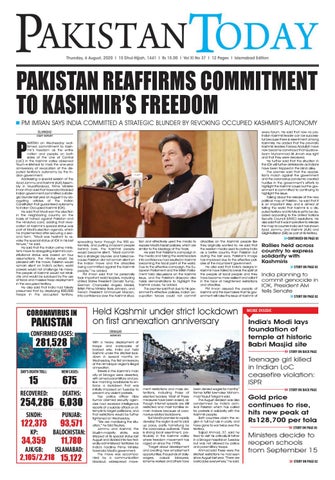
Pakistan reaffirms Commitment to kashmir’s freedom g
PM IMrAn SAyS IndIA cOMMItted A StrAtegIc blunder by revOKIng OccuPIed KASHMIr’S AutOnOMy every forum. He said that now no proIndian Kashmiri leader can be successful because there is resentment among Kashmiris. He added that the pro-India Kashmiri leaders Farooq Abdullah have now become convinced that Quaid-eAzam Muhammad Ali Jinnah was right and that they were deceived. He further said that the situation in the IOK will further deteriorate as Indians have been trapped in the blind alley. the premier said that the opposition’s march against the government and the coronavirus pandemic created hurdles in the government’s efforts to highlight the Kashmir cause but the government is committed to continuing to highlight the issue. talking about the release of the new political map of Pakistan, he said that it is an important step and is aimed at telling the world that Kashmir is a disputed territory and its fate is yet to be decided according to the united nations Security council (unSc) resolutions. He also said that it was imperative to release the map to counter India as it has shown Azad Jammu and Kashmir (AJK) and gilgit-baltistan (gb) as part of its territory.
ISLAMABAD
P
staff report
AKIStAn on Wednesday reaffirmed commitment to Kashmir’s freedom as the entire nation and people on both sides of the line of control (loc) in the Kashmir valley observed youm-e-Istehsal to mark the one-year anniversary of revocation of the disputed territory’s autonomy by the Indian government. Addressing a special session of the Azad Jammu and Kashmir (AJK) Assembly in Muzaffarabad, Prime Minister Imran Khan said that narendra Modi-led Indian government committed a strategic blunder last year on August 5 by abrogating articles of the Indian constitution that guaranteed autonomy to Indian Occupied Kashmir (IOK). He said that Modi won the election in the neighboring country on the basis of hatred against Pakistan and the Hindutva card, adding that revocation of Kashmir’s special status was part of Modi’s election agenda, which he implemented after securing a second term. “Modi was hesitant to revoke the special status of IOK in his last tenure,” he said. He said that the Indian prime minister’s move to abrogating Kashmir’s constitutional status was based on four assumptions: the Hindus would be pleased with this move; Pakistan would remain silent on India’s action; world powers would not challenge his move; the people of Kashmir would not retaliate and would be subdued by the use of force and massive troop deployment in the occupied territory. He also said that India had falsely presumed that by deploying 800,000 troops in the occupied territory,
spreading terror through the rSS extremists, and putting innocent people behind bars, the Kashmiri people would become silent. “Modi committed a strategic blunder and failed because Pakistan did not remain silent on the Indian move and the atrocities being committed against the Kashmiri people,” he added. PM Imran said that he personally took important world leaders, including united States President donald trump, german chancellor Angela Merkel, british Prime Minister boris Johnson, and French President emmanuel Macron, into confidence over the Kashmir situa-
Coronavirus in
Pakistan
CONFIRMED CASES:
281,528
DAY'S DEATH TOLL:
NEW CASES:
RECOVERED:
DEATHS:
SINDH:
PUNJAB:
15
675
254,286 6,030 122,373
93,571
KP:
BALOCHISTAN:
AJK/GB:
ISLAMABAD:
34,359
11,780
2,105/2,218 15,122
tion and effectively used the media to expose Modi’s fascist policies, which are similar to the ideology of the nazis. He said that Pakistan’s campaign in the media and taking the world leaders into confidence had resulted in Kashmir becoming the focal point of the world. due to the effective campaign, the european Parliament and the british Parliament hold discussions on the Kashmir issue, and the Pakistani diaspora also holds demonstrations to highlight the Kashmir cause, he added. the premier said that due to his government’s effective policies, Indian occupation forces could not commit
atrocities on the Kashmiri people like they originally wanted to. He said that the western media used to portray India as a better country than Pakistan but during the last year, Pakistan’s image has improved due to the effective policies of the incumbent government. He also said that India’s designs in Kashmir have failed to break the spirit of the people of local people and they have become more resilient and valiant in the face of heightened restrictions and atrocities. PM Imran assured the people of Kashmir and the lawmakers that his government will raise the issue of Kashmir at
Held Kashmir under strict lockdown on first annexation anniversary SRINAGAR agencies
With a heavy deployment of troops and barricades of barbed wire, India put held Kashmir under the strictest lockdown in several months on Wednesday, the first anniversary of the Himalayan region’s illegal annexation. Streets in the Kashmir’s main city of Srinagar were deserted, with armed paramilitary and police manning roadblocks to enforce a lockdown that was initially imposed on tuesday to prevent any violent protests. top police officer vijay Kumar claimed security agencies had received intelligence reports of a suicide attack or attempts to target politicians, and that restrictions would be further tightened on Wednesday. “We are monitoring the situation,” he told reuters. Jammu and Kashmir, the Muslim-majority state, was stripped of its special status last August and divided into two federally-administered territories by India’s hardline Prime Minister narendra Modi’s government. the move was accompanied by a communication blackout, widespread move-
CONTINUED ON PAGE 05
Rallies held across country to express solidarity with Kashmiris STORY ON PAGE 03
India planning to commit genocide in IOK, President Alvi tells Senate STORY ON PAGE 02
more inside
India's Modi lays foundation of temple at historic Babri Masjid site STORY ON BACK PAGE
teenage girl killed in Indian loc ceasefire violation: ISPr ment restrictions and mass detentions, including those of elected leaders. Most of these measures have been eased, although internet speeds are still restricted and most families remain indoors because of coronavirus-related lockdowns. but Modi’s promise to rapidly develop the region is yet to pick up pace, partly hamstrung by the coronavirus outbreak. there is strong local resentment, particularly in the Kashmir valley where freedom movement has raged on since the 1990s. “Forget about development and creating new employment opportunities, thousands of dailywagers, casual labourers, scheme workers and others have
been denied wages for months,” former leftist lawmaker Mohammad yousuf tarigami said. the August decision was also condemned by India’s archrival Pakistan which has called for protests in solidarity with the Kashmiri people. both countries claim the region in full but rule in parts, and have gone to war twice over the territory. Sajjad Ahmad, 37, said he tried to visit his critically-ill father in a Srinagar hospital on tuesday but was not allowed by police and paramilitary troops. Ahmad said these were the strictest restrictions he had seen since August last year. “there are barricades everywhere,” he said.
STORY ON BACK PAGE
Gold price continues to rise, hits new peak at Rs128,700 per tola STORY ON PAGE 05
Ministers decide to reopen schools from September 15 STORY ON PAGE 02
02
Thursday, 6 August, 2020
NEWS
NAB chAirmAN’S powerS to iNduct officiAlS uNcoNStitutioNAl: Sc ISLAMABAD
t
INP
HE Supreme Court (SC) on Wednesday took notice of the National Accountability Bureau (NAB) chairman’s powers to induct officials in the anti-graft body and observed that the Section 28 of the NAB Ordinance was against Article 240 of the Constitution. In light of this observation, the apex court issued notice to the attorney general and sought the details of all the appointments made by the NAB chief. Commenting on a case concerning a person, Nadeem, who called different important
personalities while impersonating NAB director general and others, Justice Faez Isa stated that the anti-graft body was interfering in every matter. “A reference should be filed against the NAB for not formulating rules and regulations since its formation in 1999”, he remarked. During the hearing, Rawalpindi NAB DG Irfan Naeem Mangi revealed that he did not have any expertise in dealing with criminal cases and was an engineer by profession. His monthly salary was Rs420,000, he informed the court. This admission came forward as Justice Isa questioned him about his qualification and experience. “How can you occupy such
Soldier martyred, 2 injured in heavy firing from across Afghan border
an important post in NAB,” the senior SC judge asked. Justice ISA inquired, “Under which law does the NAB chairman make appointments in the organisation,” and added that everyone was pursuing their own agenda. He said that it was shocking that the appointments were made while going against the constitution. “It would be better to hand over the government back to the British than imposing martial law”, said Justice Isa as he stressed the need for following the Constitution. Justice Mushir Alam, the other member of the bench, asked the NAB prosecutor whether a forensic audit of the accused’s mobile phone was conducted. To which the NAB representative replied that they had not
India planning to commit genocide in IOK, President Alvi tells Senate ISLAMABAD
A soldier of the Frontier Corps was martyred and two got injured, after heavy mortar and weapons firing, from across the border with Afghanistan, the military's media wing said on Wednesday. According to the Inter-Services Public Relations (ISPR) statement, the incident occurred at the border in the Bin Shahi area of Khyber Pakhtunkhwa's Lower Dir district. In May, six security personnel were martyred when an FC reconnaissance vehicle was hit by an improvised explosive device (IED) during a routine patrol in Buleda district of Balochistan near the Pakistan-Iran border. An officer was among the martyrs.
pakistan urges world to do more than paying lip service to Kashmir ISLAMABAD STAFF REPORT
Pakistan has called on the international community to “do more” than paying lip service to resolve the longstanding dispute of Indian occupied Kashmir according to the relevant United Nations Security Council (UNSC) resolutions. Through a statement issued here on Wednesday, the Foreign Office (FO) called global attention “to arbitrary arrests, detentions, torture, corporal punishment, extra-judicial killings, digital lockdown, and a military siege in occupied Kashmir for a whole year now”. “For a large part of the global population, to continue to have faith in international justice, it is imperative that India is held accountable for its unconscionable actions since 5 August 2019,” the statement quoted Foreign Minister Shah Mehmood Qureshi as saying. The country is celebrating Aug 5 (today) as Youm-e-Istehsal (Day of Exploitation) to express solidarity with the people of Kashmir. According to the statement, the foreign minister said that the Indian actions were aimed at changing the demography of held Kashmir to fulfill the “RSS-BJP [Rashtriya Swayamsevak Sangh and Bharatiya Janata Party] Hindutva agenda” in violation of the UNSC Resolutions and international law, particularly the 4th Geneva Convention.
TLTP
President Arif Alvi on Wednesday said that Pakistan would stand alongside the people of the Indian Occupied Kashmir (IOK) despite Indian efforts to change the demography of the territory and its involvement in the genocide of the Kashmiris. “I have a firm believe that Kashmir will be liberated,” he said while addressing the Senate session and expressed his gratitude towards Turkey, Malaysia, and other countries who have raised their voice in support of the Kashmiris. He also thanked those who released reports on violence in Kashmir and said that such reports have highlighted the plights of the Kashmiris.
The president also appealed to the government and the Parliament to continue their joint efforts on the Kashmir issue. “Parliament has always shown its unity on the issue,” he said and demanded of India to immediately end a curfew in the occupied territory and withdraw its 900,000 troops. President Alvi asked India as to why it has imposed a curfew in occupied Kashmir if everything is fine in the area and compared it with the free movement allowed in Azad Jammu and Kashmir (AJK). “Come and see everything is going as usual in Azad Kashmir,” he offered and demanded the Indian authorities to lift the ban on social media in the area. He said that they have imposed
TLTP
United States Democratic Congressman and member of the House Foreign Affairs Committee, David Trone, called on India to guarantee the human rights of oppressed Kashmiris in the occupied valley, a year after New Delhi abrogated its separate status and intensified a crackdown in Indian occupied Kashmir (IOK).
such restrictions to hide their injustices against Kashmiris and demanded the Indian authorities to release Hurriyat Conference leadership. The president said that Prime Minister Imran Khan and he raised voice for Kashmiris at international forums and expressed the country’s willingness towards peace in the region. “We have always expressed our desire for peace and even released the Indian pilot captured on Pakistani soil,” he said adding that on the contrary India always talked about war and revenge. He said that Pakistan has responded to the Indian aggression and vowed to continue moral, political and diplomatic support for the Kashmiris.
ISLAMABAD TLTP
The participants of the meeting decided to summon records from all provinces regarding the sugar subsidy, besides acquiring legal, financial, and audit reports from the Securities and Exchange Commission of Pakistan (SECP) and other concerned compa-
US lawmaker asks India to guarantee human rights to Kashmiris “On August 5, 2019, the government of India announced it would change Jammu and Kashmir’s special status within the constitution and consider it as a union territory of India. At that time, the Indian military moved 45,000 additional troops into the region, suspended internet and telephone service, and arrested thousands without full disclosure of charges,” said Trone in a statement.
The US congressman said that the Jammu Kashmir Coalition of Civil Society and the Association of Parents of Disappeared Persons report stated that 32 civilians have been killed in 2020 so far. Trone said that Doctors Without Borders have reported that “45 per cent of the population in Jammu and Kashmir have experienced mental distress and many more have witnessed violence firsthand”. Calling India a key democratic partner
CMYK
ministers decide to reopen schools from September 15 STAFF REPORT
NAB chief vows fair probe into sugar subsidy case National Accountability Bureau (NAB) Chairman Justice (r) Javed Iqbal vowed on Wednesday that an impartial and transparent investigation will be conducted into the sugar subsidy case. Justice (r) Iqbal expressed these views while chairing a high-level meeting to review the sugar commission’s report that was attended by NAB deputy chairman, director-general (operations), and NAB Rawalpindi DG. The meeting decided to constitute a joint investigation team (JIT) for initiating a thorough probe into sugar subsidy. The team will consist of two investigation officers, economic and legal officials, as well as forensic experts. The case officer, additional director, and concerned directors will also be part of the investigation team. Moreover, the NAB chairman will review the progress of the investigation process every month.
only eighth grade and living in Bahawalpur was able to obtain the numbers of so many important personalities.
ISLAMABAD
URGES UN TO FULFIL PROMISES ON KASHMIR ISSUE
NEWS DESK
WASHINGTON
received the forensic report yet. On the other hand, Justice Isa opined that how the accused, with schooling till
nies. A declaration stated that the anticorruption watchdog will take action against those illegally awarded subsidies on sugar worth billions of rupees. Meanwhile, the accused persons and departments will be given a full opportunity to clear their position.
of the US, the congressman urged the country to ensure that the IOK citizens are given the same rights and privileges as other citizens and equal treatment under the law. “This respect for dignity must be paramount,” it stated. “In January, the Indian government started lifting some communications restrictions, permitting 2G internet access in approved sites. Since the Covid-19 pandemic began, the region has experienced another lockdown with more restrictions on movement. “The healthcare system is overworked in Jammu and Kashmir like it is in so many other regions. There are limited personal protective equipment and a shortage of medical personnel.
Educational institutions across the country will reopen from September 15. This was decided in a meeting of all education ministers, chaired by Federal Minister for Education Shafqat Mahmood here on Wednesday. The meeting decided that schools and universities will resume classes from next month and action will be taken against those who violate the decision. The government of Khyber Pakhtunkhwa (KP) had proposed to reopen the educational institutions from September 1, which was opposed by all the participants, a spokesperson of Sindh education minister said. The government had announced in July to resume educational activities in the country from September after reviewing the coronavirus situation. Shafqat had then said that the decision has been taken to allow schools to call its administration staff before September 15 and announced that training will be conducted to ensure that safety standard operating procedures (SOPs) are implemented. He said that provinces will be responsible for ensuring SOPs that are followed, cautioning schools to follow the procedures laid out by the government. “It is my request to private schools, especially, that the SOPs that you will have to follow will be the ones made by the government,” he said. Earlier on Wednesday, Punjab Education Minister Dr Murad Raas rejected reports of the government reopening schools in the province from August 15, saying that it will happen only if the coronavirus conditions are “manageable”. “FAKE NEWS. No date has been announced for opening of schools in Punjab. What I have said is that if the conditions of COVID 19 are manageable, only then we will try to open by August 15, 20 under very strict SOPs. I will not endanger the lives of our children or our teachers,” Raas had said in a post on Twitter. Raas had said the School Education Department (SED) Punjab had prepared detailed SOPs so that once schools reopened, the same could be followed to protect the children. The minister had said if they were opened, schools would function in different shifts to ensure physical distancing among the students in classrooms.
Zahid hafeez replaces Aisha farooqui as fo spokesperson ISLAMABAD: The federal government on Wednesday appointed Zahid Hafeez as the new spokesman for Foreign Office (FO). He will replace Aisha Farooqui and a notification for his appointment has been issued. Hafeez has served in the FO for 26 years and remained at the post of director general South Asia and SAARC before being handed over the new responsibility. He also served as Afghanistan, Iran, Turkey DG, and joint secretary national security. Moreover, he served at the Pakistani Embassy in Washington and the High Commission in London. It is pertinent to mention here that the Ministry of Foreign Affairs on 19 December 2019 announced the appointment of Aisha as the new spokesperson of FO. She had replaced Dr Mohammad Faisal, who got nominated as Pakistan’s ambassador to Germany. TLTP
Thursday, 6 August, 2020
NEWS
rAllieS held AcroSS couNtry to expreSS SolidArity with KAShmiriS ISLAMABAD/LAHORE/KARACHI
r
STAFF REPORT
ALLIES were held across the country on Wednesday on account of Youm-e-Istehsal to condemn the Indian government’s illegal action of abrogating the constitutional rights of Kashmiris and keeping them under a military siege for the past one year. Political leaders presented a united front to express support for Kashmiris who have been suffering at the hands of occupation forces but have refused to give up their right to self-determination. One-minute silence was observed at 10:00 am across the country. Television channels and radio stations played national anthems of Pakistan and Azad Jammu and Kashmir. Traffic also came to a halt for one minute. The main rally in Islamabad was led by President Dr. Arif Alvi, Foreign Minister Shah Mahmood Qureshi and Minister for Information and Broadcasting Shibli Faraz also led rallies in the federal capital. The participants of the walk wore black bands around their arms and carried flags of Pakistan and Azad Kashmir. They chanted slogans against the Indian brutalities in Indian Occupied Kashmir (IOK). Meanwhile, posters and billboards were displayed at the main roads of Islamabad and all provincial capitals to highlight the plight of Kashmiri people and expose the atrocities being committed by the occupation forces in IOK. AZAD JAMMU AND KASHMIR: Declaring August 5 as the darkest day in the history of Kashmir, Azad Jammu and Kashmir President Sardar Masood Khan said that this day may also prove to be the beginning of the fall of India and its expansionism. “The organised campaign launched by 56 groups of Kashmiri expatriates in five continents of the world against India’s action of August 5 in IOK will certainly frustrate India’s heinous and sordid designs,” he said. He said this while addressing two
PROVINCES, AUTONOMOUS REGIONS PRESENT A UNITED FRONT TO CONDEMN INDIAN ATROCITIES IN OCCUPIED KASHMIR
ZUBAIR MAHFOOZ
separate international webinars through video-link from Muzaffarabad on the occasion of Yaum-e-Istehsal. These webinars were organised by World Kashmir Awareness Forum Ghulam Nabi Fai Secretary-General and Kashmir Solidarity Forum Chairman Javed Rathore. The president stressed on the Kashmiri expatriates and their Kashmir lobbying groups to mount pressure on India to end the lockdown of occupied Kashmir, lift uncalled for restrictions on media, and release all political detainees along with the juvenile Kashmiri prisoners languishing in the Indian prisons since August 5 last year. GILGIT-BALTISTAN: Solidarity rallies were brought out in all three divisions, wherein speakers condemned the Indian government’s actions. The main rally was led by Governor Raja Jalal Hussain, who stated that the people of GB stand with the Kashmiris and would continue to support them until the dispute is resolved in accordance with the United Nations (UN) resolutions. KHYBER PAKHTUNKHWA: Chief Minister Mahmood Khan, while leading a rally in Peshawar, urged the international community and the UN to take no-
imran offers condolences to lebanon after devastating blasts ISLAMABAD: Prime Minister Imran Khan Wednesday offered condolences to the people of Beirut after two massive explosions rocked the Lebanese capital a day earlier, killing at least 100 people and wounding more than 4,000. Media reports suggest the shockwaves were so powerful that it flattened much of the city’s port, damaging buildings across the capital besides sending a giant mushroom cloud into the sky. “We stand in solidarity with our Lebanese brethren in their difficult hour, sharing their sorrow [and] grief,” the prime minister tweeted. He also wished a speedy recovery to the injured. The message comes after Lebanon’s Prime Minister Hassan Diab called on “friendly countries” to support a country already reeling from its worst economic crisis in decades and the coronavirus pandemic. Foreign Minister Shah Mahmood Qureshi also expressed grief over the loss of precious lives in the incident and said “Pakistan’s prayers and thoughts were with the government and people of Lebanon in that difficult time”. Earlier in the day, the Foreign Office shared the contact details of Pakistan’s embassy in Beirut for nationals in need. According to the Ministry of Overseas Pakistanis, preliminary information showed all Pakistan embassy personnel, their families and Pakistan nationals in Beirut were safe. “Ministry has setup emergency helpline to assist OPs [overseas Pakistanis] in need of help.” the ministry tweeted, adding that there were around 1,000 Pakistan nationals based in Lebanon. STAFF REPORT
tice of the atrocities being committed by the Indian forces in the Muslim-majority disputed region. Speaking to the media, he said that the people of occupied Kashmir were facing the worst state terrorism for the last seven decades and the fascist Indian government had broken all records of atrocities to deprive them of their longstanding right to self-determination. He said that the revocation of the semi-autonomous status of the region last year had started a new chapter of cruelty and oppression against the people of Kashmir. He highlighted that the valley had been under a complete lockdown for a year. The chief executive said it was a matter of great concern that state-sponsored human rights abuses against innocent Kashmiris continue under the nose of the United Nations Security Council (UNSC) and human rights organisations. He demanded the UN and the international community to come forward to end the year-long military siege and lockdown in Kashmir. PUNJAB: Governor Chaudhry Muhammad Sarwar, Chief Minister Usman Buzdar led a rally in Lahore to mark the completion of one year of military siege
in Kashmir. Addressing the participants of the rally, the governor said that Pakistan will continue to support the Kashmiris in their struggle for their right to self-determination. He said that Indian Prime Minister Narendra Modi is a fascist leader who is trying to change the demography of IOK. Speaking on the occasion, the chief minister said that Pakistanis stand with their oppressed brothers and sisters in occupied Kashmir and will not leave them alone in their struggle for freedom. BALOCHISTAN: Programmes, seminars, and rallies were held to mark Youm-e-Istehsal across Balochistan, including the provincial capital. The biggest rally was taken out from Quetta Metropolitan Office under the supervision of Senator Manzoor Kakar along with Balochistan Minister for Revenue Mir Saleem Khan Khosa and ended at Balochistan Assembly after marching through different routes. The participants of the rally carried banners and placards inscribed with slogans in support of innocent Kashmiris facing cruelties by the Indian Army in the valley. Separately, in their messages on Youm-e-Istehsal, Governor Amanullah Khan Yasinzai and Chief Minister Jam Kamal Khan urged the world community to raise their voice for human and political rights of oppressed Kashmiris. They said that the fascist policies of Narendra Modi could not deter Kashmiris from their struggle for freedom. SINDH: In Sindh, a solidarity rally led by Chief Minister Murad Ali Shah was taken out at sea view in Karachi on Wednesday. In his address, CM Murad said that a year ago on this day the identity of occupied Kashmir was attacked and India snatched the identity of the people of Kashmir and put down its flag.
Abbasi pleads not guilty after indictment for misusing authority KARACHI INP
An accountability court in Karachi on Wednesday indicted former prime minister Shahid Khaqan Abbasi in a reference concerning illegal appointments to which he, along with the other accused, pleaded not guilty. The move came as the reference holds Abbasi and former petroleum secretary Arshad Mirza responsible for allegedly appointing Sheikh Imranul Haq as managing director and Yaqoob Sattar as deputy managing director (finance) of the PSO by misusing their authority. Talking to media persons outside the accountability court, the Pakistan Muslim League-Nawaz (PML-N) senior vice-president remarked that he was thankful to the NAB for not accusing him of corruption involving billions of rupees as the only charge against him was of misusing his powers. “At least tell us what our powers are,” he said and added that the Supreme Court (SC) had observed that the National Accountability Bureau (NAB) was doing political engineering only. “It is being used politically for harassing the people.” “Our narrative is that the country should be run based on the Constitution and law,” Abbasi said about the PML-N’s party policy. “Today is the day of expressing solidarity with the Kashmiris, and entire Pakistan should be united [on this occasion]. The people are united, but unfortunately, the government did not extend the hand of solidarity
towards the opposition,” said Abbasi. The senior PML-N leader said that Kashmir would remain in the hearts of the people of Pakistan. “There are no two opinions on that. The tragedy is we are busy in tweeting instead of solving the problems,” he noted. About the continuing issue of power outages in Karachi, Abbasi said that there was no excuse for loadshedding in the port city. The power supply was available in entire Pakistan except Karachi, he added. “After all what is the reason that the people of Karachi are not getting electricity,” he asked and then cited the “government’s corruption” as the cause. The former prime minister also talked about the flour and sugar shortage in the country. “How those who cannot manage the federal government would run Sindh? How those who cannot manage their ministry will manage the Sindh government?” he posed the questions.
03
pakistan's coronavirus death toll crosses 6,000 mark LAHORE: The number of deaths because of Covid19 in Pakistan surpassed 6,000 on Wednesday as the country reported 15 deaths in the last 24 hours. The nationwide tally of fatalities has gone up to 6,014. National Command and Operation Centre (NCOC) reported 675 new Covid-19 cases in the past 24 hours, raising the number of positive cases to 281,136. Sindh remains the worst-hit province by the pandemic in terms of number of cases followed by Punjab, Khyber Pakhtunkhwa (KP), and Islamabad. Till now 122,016 coronavirus cases have been confirmed in Sindh, 93,571 in Punjab, 34,324 in KP, 15,122 in Islamabad, 11,780 in Balochistan, 2,105 in Azad Jammu and Kashmir (AJK), and 2,218 in Gilgit-Baltistan (GB). Furthermore, 2,231 individuals have lost their lives to the virus in Sindh, 2,157 in Punjab, 1,213 in KP, 136 in Balochistan, 167 in Islamabad, 55 in GB, and 55 in AJK. Pakistan has conducted 2,043,870 coronavirus tests so far; 11,915 in the last 24 hours. 254,286 Covid-19 patients have recovered in the country so far whereas 872 patients are in critical condition. INP
Shehbaz, Bilawal concerned over silence of international community on Kashmir issue KARACHI: Pakistan Muslim League-Nawaz (PMLN) President and Opposition Leader in National Assembly (NA) Shehbaz Sharif and Pakistan People’s Party (PPP) Chairman Bilawal Bhutto Zardari on Wednesday expressed their reservations against the silence of the international community towards the situation in Kashmir. In a message on Youm-e-Istehsal, Shehbaz demanded the United Nations (UN) to take action for self-determination of people living in Indian occupied Kashmir. The PML-N leader said that depriving Kashmiris of their democratic and legal rights is against the Charter of UN. Indian atrocities cannot hold back Kashmiris from the freedom movement, he added. Meanwhile, in his message in connection with the Youm-e-Istehsal, Bilawal said that the military siege of Indian Occupied Kashmir (IOK) would not conquer the aspirations of people of the bleeding valley. He said that the world community should use its leverage on the apartheid state of India to end the yearlong siege and give access to the international human rights monitors in the occupied territory. INP
philippines may replicate pakistan’s policies against covid-19 NEWS DESK: PSA Philippines Consultancy, a business risk consultancy firm, on Wednesday, said that the Philippines may peruse the steps made by Pakistan to tackle the coronavirus as it was successful in improving the pandemic situation. The consultancy’s Inc. Director for Business Intelligence Greg Wyatt mentioned the commonality between Pakistan and the Philippines in terms of the people at risk, inequality in growth, constrained healthcare, etc. Despite all these challenges, he added, Pakistan has managed to control the number of daily Covid-19 cases that have been on a decline. “If you are looking for a country as an example, it may be possible that we can learn something from Pakistan. The situations are sort of analogous,” he said in a webinar of Nordic Chamber of Commerce of the Philippines (NordCham). He said that the Pakistan has kept the situation under control through targeted testing and localised lockdowns.
modi govt has turned ioK into a prison: faraz ISLAMABAD: Federal Minister for Information and Broadcasting Senator Shibli Faraz on Wednesday said that the Modi government has turned Indian Occupied Kashmir (IOK) into a prison. The minister led a rally here in solidarity with the people of IOK on Youm-eIstehsal after which he addressed the gathering in which people from different schools of thought participated. “Entire Pakistan is standing with Kashmiris who shall get freedom. The purpose of this day is to draw the attention of the international community, which is silent, towards the held valley. Hypocrisy over the matter may cause damage to global peace,” Shibli said. INP
04
Thursday, 6 August, 2020
NEWS
Blast in Ji rally inJures 39 in Karachi KARACHI
a
TLTP
T least 39 people were injured in an explosion near Bait-ulMukarrum Masjid here in Gulshan-e-Iqbal area when the Jamaat-e-Islami (JI) activists gathered for a Kashmir rally on Wednesday. Police and rescue teams rushed at the scene and shifted the injured persons to the hospital. At least 39 people were injured in a
cracker attack on the JI rally, a spokesperson for the health department said. "One of the injured is in a critical situation," the spokesperson said and added, "Majority of patients have very minor injuries". According to police officials, an unidentified motorcyclist hurled a cracker towards the participants of the rally held to observe Kashmir's Youm-e-Istehsal. The incident took place near Baitul Mukarram Masjid on main University Road. This is the second such incident in Karachi on Wednesday, police say. Earlier,
some unknown men targeted a state agency in Korangi's Nasir Jump area. Senior Superintendent of Police (SSP) East Sajid Amir Saduzai said a bomb disposal squad has been called on the site to determine the nature of the blast and sweep the area clear of any possible explosives. He believed that the incident was "not caused by a pre-planted explosive device". In a statement, Jamaat-e-Islami Karachi Amir Hafiz Naeemur Rehman strongly condemned the blast and said that the party will announce an "action plan" at
a press conference. Rehman, while addressing the participants of the rally said that it is a failure of the government that such an incident took place. "We do not want strife, we believe in peace. These are Indian agents who carried out the blast," he said. The JI leader added that the injured were taken to hospital for treatment. Sindh government spokesperson Murtaza Wahab condemned the incident and said it was an attempt to disturb the law and order in the metropolis.
KP govt incurring Rs5bn annual losses from Ranial Power Project PESHAWAR AZIZ BUNERI
Due to the unavailability of transmission lines, the Ranial Power Project is causing an annual loss of Rs5 billion to Khyber Pakhtunkhwa (KP) government, sources disclosed to Profit. According to sources Pakhtunkhwa Energy Development Organisation (PEDO) awarded the contract for the power project in Ranial on December 22, 2014, without preparing the pre-project assessment report. As a result, despite the completion of the project, the KP government has not been able to reap its benefits. Under the project, the KP government was to sell 1.5 billion kilowatts (kWh) of electricity per year at a price of
Punjab to continue ban on purchase of vehicles, luxury items by govt dept LAHORE: The government of Punjab on Wednesday decided to continue ban on unnecessary hiring, purchase of vehicles, air-conditioners and other luxury items by the provincial departments in the new fiscal year, while permission of medical treatment abroad on government expenses would be made on case to case basis with strict conditions. The decision was made in the 38th meeting of the Standing Committee of Cabinet on Finance and Development chaired by Punjab Minister for Finance Hashim Jawan Bakhat along with Industries and Trade Minister Mian Aslam Iqbal. TLTP
Rs5 per unit. However, due to a lack of transmission lines, the project is incurring a loss of Rs5 billion per year. Sources further added the project has been operating for four years, and the KP government has suffered an accumulated loss of more than Rs20.1 billion on the project till now. According to KP Power and Energy Department sources, despite the completion of several such critical projects, the provincial government is incurring billions of rupees in losses annually since WAPDA has failed to construct a transmission line to supply electricity to the national grid. “KP has spent billions of rupees on these projects, but due to WAPDA's lack of seriousness, the province is facing billions of rupees in losses,” the sources said. According to the auditor general, loss on the project
could have been avoided if the review report of the project had been prepared. The auditor general added that the Department of Energy was requested several times to convene a meeting of the Departmental Audit Committee in order to resolve objections pertaining to the project. However, not a single meeting was convened by the department until the report was prepared, he said. The auditor general has recommended an inquiry into the matter to determine all those responsible for poor planning, loss to the national exchequer, and delay in the completion of the project. Profit reached out to PEDO Chief Engineer Qazi Muhammad Naeem and Advisor to the KP Chief Minister on Energy Hamitaullah Khan regarding this story but received no response.
Private sector starts urea production to fulfil demand ISLAMABAD SHAHZAD PARACHA
The private sector on Wednesday started urea production at a concessional rate to fulfil this year’s demand. According to sources, Agritech Limited has commenced urea production after starting its plant on Monday to heat it up to the required level. The process usually takes up to
three days after the resumption of gas supply from SNGPL, they added. As per the documents available with this scribe, the SNGPL on August 3 had informed Agritech Limited that RNLG supply to its fertilizer plant has been initiated for start-up purposes, asking the company to make necessary arrangements in this regard. SNGPL on Monday started sup-
plying regasified liquefied natural gas to the plant at concessional tariff to meet the urea demand of the country. Sources said that Agritech’s gas requirement stood around 28.5mmcfd and the plant can produce up to 1,300 tonnes of urea per day. The gas is being supplied to the plant at a highly subsidized rate of Rs756/mmbtu.
Rs200bn to be spent on Balochistan uplift this year: Asad ISLAMABAD: Federal Minister for Planning and Development Asad Umar on Wednesday said that Rs200 billion would be spent on development projects in Balochistan province in the ongoing fiscal year. Chairing a meeting to review development projects in one of the least developed provinces in the country, the minister directed the authorities to prepare a fast-track programme for development in South Balochistan areas. The Ministry of Planning and Development will timely release funds for the projects, announced Asad as he stressed upon finalising uplift projects in Balochistan after a consultation process. He said that Prime Minister Imran Khan has the vision to provide better IT and energy facilities in Balochistan province. “We have taken special measures for development in South Balochistan on the directives of the prime minister,” he said and announced to spend Rs200 billion for uplift projects in the province this year. The federal minister also formed two committees with one headed by Planning Commission Deputy Chairman Muhammad Jahanzeb Khan and the other led jointly by Federal Minister for Ports Ali Zaidi and Adviser to PM for Commerce Abdul Razak Dawood. TLTP
Police register case against father-daughter duo for throwing newborn from building KARACHI INP
Police in Karachi have registered a case against an unmarried woman and her father for allegedly throwing the woman’s newborn baby girl in the street from the second floor of a building in a bid to kill her soon after her birth. The incident took place in Karachi’s Manzoor Colony. Baloch Colony police have taken the accused mother and her father into custody. The newborn, however, survived the attempt on her life by her mother and grandfather and is said to be in a stable condition despite an injury near her right eye. According to the police, the woman had an affair with her cousin and the baby was born out of wedlock. After throwing the newborn from the building, the woman tried to flee the scene along with her father. Social worker Ramzan Chhipa, who runs an orphanage and ambulance service in Karachi, said his NGO received a call at about 8 am on Tuesday regarding the incident. He said the newborn was thrown from a double-storey building and was in a critical condition when the ambulance service reached there to pick her. He said the newborn was taken to Jinnah Postgraduate Medical Centre for treatment where doctors were able to save her. Later, the police arrested the mother and grandfather. The woman told the police about her relationship and admitted that she threw the girl in the street and tried to flee the scene along with her father who was aware of his nephew being the one responsible for impregnating her. Further investigation is underway.
Buzdar forms body to improve shelter homes' condition LAHORE: On the instruction of Punjab Chief Minister Sardar Usman Buzdar, a threemember committee has been constituted to improve the existing system of shelter homes. ACS (U&I) will be the convenor while secretary social welfare and chairman PITB are nominated as members. This committee will submit recommendations about financial and administrative autonomy of shelter homes to the CM within seven days to improve the overall arrangements along with formulation of a new IT-based system for the monitoring of the shelter homes and provision of best
Thursday, 6 August, 2020
NEWS
Pakistan reaffirms commitment to Kashmir’s freedom contInuED on PAgE 01 He added that the new political map will educate the youngsters about the true status of Kashmir. PM Imran announced that a renowned Kashmiri leader will be honored and decorated with Nishan-ePakistan. He said that those nations which never accept defeat cannot be defeated. During his visit to Muzaffarabad, the premier also inaugurated the ‘Resistance Wall’ in memory of the oppressed Kashmiris. He also participated in a solidarity walk along with the AJK president and prime minister and others to commemorate one year of the military siege of IOK. Earlier in the day, in his message on Youm-eIstehsal, PM Imran said that Pakistan will always stand with its brothers and sisters in the IOK until they get the right to self-determination through a free and impartial plebiscite under the United Nations (UN) as per the relevant UNSC resolutions. INDIA FOLLOWING ISRAEL’S MODEL: Meanwhile, President Dr Arif Alvi lashed out at New Delhi for stripping the disputed Muslim-majority region of its semi-autonomous status, declaring that “India has learned how to change the demography from Israel”. Addressing a rally taken out in Islamabad to demonstrate Pakistan’s resolve in the face of state aggression in the region which Pakistan claims in full, President Alvi said, “India’s high-ups made many promises to Kashmiris and Pakistan but none of those promises were fulfilled.” “They signed the Simla Agreement [1972] with us in which it was decided that [both countries] will hold bilateral dialogue, but to date, India has refused to hold talks. Whenever the issue was raised on multilateral forums, India made excuses saying that it was a bilateral issue but they are not ready to talk,” he said. He also said that Pakistan did not accept Article 370 — which provided special status to the occupied region — originally as well because “we want the independence of Kashmir since it is not part of India”. Modi’s government, he lamented, repealed the law and changed Article 35(a) last year. “If, over the past year, Kashmiris had appreciated the move [of repealing the region’s special status], India would not have to impose a lockdown in [occupied Kashmir],” President Alvi declared. He stressed that the Pakistan government had always striven for peace. Even after India violated Pakistani airspace on the “false reaction on Pulwama” blast, Pakistan returned the captured Indian Air Force pilot Abhinandan “to show to the world and India that we want peace, not war”. The president demanded the UNSC, where resolutions have been passed regarding the Kashmir issue, to fulfill its promises. He further said that the press should be given free access to Indian occupied Kashmir. “If the situation is peaceful then press should have complete freedom to report from the occupied region,” he added. He also demanded that the changes introduced by the Indian government against the Geneva Convention and UN rules should be withdrawn. He also appealed to the international community and world bodies, including the Organisation of Islamic Cooperation (OIC), to take note of the barbaric actions of the Indian forces in occupied Kashmir. He assured that Pakistan will continue peaceful efforts for the Kashmir cause. The demonstration was attended by Senate Chairman Sadiq Sanjrani and Foreign Minister Shah Mahmood Qureshi among other senators and officials.
Punjab allows all industries, establishments to operate 24/7 with Covid-19 SOPs NEWS DESK: The government of Punjab has permitted industries, establishments, and factories to operate 24 hours a day, every day of the week, on the condition of practising coronavirus-related standard operating procedures (SOPs), according to a notification issued Tuesday. In its notification, the Punjab government's Primary and Secondary Healthcare Department said the move came on the back of "decisions of Cabinet Committee to combat Coronavirus threat taken in its meeting dated 4th August 2020".
05
GOld PRiCe COntinueS tO RiSe, hitS new PeaK at RS128,700 PeR tOla KARAcHI
G
ARIBA SHAHID
OLD prices continue to surge in the local market based on the demand backed rally in international markets. The per-tola price of 24-karat gold in Pakistan on Wednesday increased by a massive Rs4,800 to reach Rs128,700, as against its previous close at Rs123,900. Likewise, the price of 10-gram increased by Rs4,116 to Rs110,340 in the local market. Silver also witnessed an uptick as per tola price of the commodity went up by Rs130 to reach Rs1,630. Gold prices in Pakistan continue to breach all peaks as international investors pump money into buying gold due to the Covid-induced uncertainty. With coronavirus acting as the largest threat to the global economy, investors seek refuge in
the safe-haven asset in order to diversify their portfolio and prevent loss of value. While there is an increase in demand for gold in the international market, there has been little to no buying in the local market. Imran Khan, of Stylish Jewelers, a
jewellery shop in Karachi, said, "People are only coming to sell their gold and not buy. Most of our customers are coming back to sell gold they bought at cheaper rates, especially due to the economic distress Covid has brought. Demand for gold in the local markets has dropped tremen-
Pak-China trade resumes temporarily through Khunjerab Pass ISLAMABAD GHULAM ABBAS
After remaining closed for a period of eight months for all kinds of trade activities, the Pakistan China border has been opened for bilateral trade. The border was closed from December 2019 to March 2019 due to seasonal closure. As per a protocol signed by the two countries, the border was supposed to open on April 1, 2020. However, bilateral trade activities through the border could not be resumed due to the outbreak of the coronavirus in March 2019. Traders from both sides of the border had since then been waiting for the opening of the only land route for bilateral trade between China and Pakistan. According to officials, the border has been temporarily opened till August 10, 2020. However, importers and exporters claim that the border is likely to remain open for the remaining months of the season. On Tuesday four containers of imported goods crossed the Pakistan China border to reach Pakistan. “I am pleased to see that trade with China through Khunjerab Pass has resumed temporarily. The opening of border was a longstanding demand of the businessmen, particularly from Gilgit Baltistan, which remained closed due to COVID-19,” Adviser to Prime Minister on Commerce Abdul
Razaq Dawood said in a tweet on Wednesday while appreciating the officials of Ministry of Commerce (MoC) for their work in resolving the issue in consultation with Chinese authorities and other stakeholders. According to the district administration of Hunza in Gilgit Baltistan, implementation of Standard Operating Procedures (SoPs) for the clearance of containers for bilateral trade between the two countries is strictly being followed. According to officials, limited containers are being allowed to cross the border to ensure implementation of the SoPs. Pakistan and China had earlier considered a proposal to resume cross border trade with stakeholders advising restriction on the number of cargoes to avoid crowding at the dry port. The proposal came under discussion during a meeting between Razaq Dawood and the Chinese ambassador where it was proposed that the border be temporarily opened so that appropriate arrangements can be made. Representatives from Pakistan Customs, Federal Investigation Agency and National Logistics Cell advised that not more than 10 cargo trucks should be allowed to enter Pakistan from the Chinese side each day in order to avoid crowding at the Sost border. The meeting particularly discussed issues related to opening of borders and the release of 186 containers.
Chinese ambassador said that the border can be opened on a temporary basis for the release of 186 containers as a special arrangement until the spread of Covid-19 is contained. The Chinese ambassador further said that China and Pakistan’s Ministry of Foreign Affairs should be in direct coordination to address issues pertaining to the opening of the border. Sost dry port, or Khunjerab Pass, is the only land route located in Pakistan’s Gilgit region and Chinese underdeveloped Xinjiang region. According to the non-government Pakistan-China Institute, border trade between China and Pakistan increased 47 per cent to $856.3 million last year. The cargo shipment between the two countries reached approximately 66,600 tonnes between January and November 2019. According to official sources in the Gilgit Baltistan government, the border which remained closed for almost eight months, was opened for a few hours in March 2020 to facilitate the transportation of donated medical material by the Governor of Xinjiang Uyghur Autonomous Region of China to the Government of Gilgit Baltistan. The governor had donated 200,000 ordinary face masks, 2,000 N-95 face masks, five ventilators, 2,000 testing kits and 2,000 medical protective clothes mainly used by doctors and paramedics.
dously due to weak purchasing power, loss of livelihoods, and the wedding season being observed with simplicity." However, the trend is different in the international market, where the surge in gold prices is not due to a supply shock of the metal, but due to a demand rally. In the international market, gold surged to a record high on Wednesday owing to a weakening dollar and falling returns on US bonds. Owing to the low interest rate environment to push the economy, gold managed to breach its historic resistance of $2,000 an ounce. Breaking above $2,000 for the first time on Tuesday and hitting a new high of $2,044.34 an ounce earlier on Wednesday, spot gold was up 1.1pc at $2,041.09 by 1337 GMT. Gold has gained nearly 35pc in value this year owing to Covid-induced uncertainty, making it one of 2020s best performing assets.
FFC’s half-year profitability reaches Rs9.14bn Fauji Fertilizer Company Limited (FFC) recently announced its half yearly financial results for the period ending 30 June, 2020. The company on July 27 had announced a profitability of Rs9.14 billion translating into earnings of Rs7.18 per share. The same was published in various newspapers of the country. “On the contrary, it was observed that certain newspapers reported somewhat different results/conclusions, causing doubts in the minds of shareholders,” said a statement issued by the company. An appraisal divulged that findings of misquoting were based on consolidated financial statements of the complete FFC group (comprising several subsidiary/associated entities) instead of separate financial statements of FFC itself. They also focused their analysis to the 2nd quarter (March– June) of 2020 in most parts of the report. One newspaper stated that the profitability for the half year has decreased by 14pc whereas in actual it has been increased by 14pc. The newspaper did not state that this profitability related to the consolidated and not the separate financial statements of the company. Another newspaper reported that this profitability has increased by 11pc instead of the actual increase of 14pc. The confusion was further escalated by reporting on a mix of figures as per consolidated as well as separate financial statements. FFC has a legacy of being a quality conscious and transparent company while ensuring good returns to the stakeholders as substantiated by its position among top 25 companies of PSX and maintaining 1st position among them for the last consecutive 9 years. Therefore, it is hereby clarified that FFC has performed exceptionally well even under the prevailing pandemic conditions by earning profit of Rs. 9.14 billion on a standalone basis with a 3pc increase over the last year. PRESS RELEASE
FPCCI protests over cancellation of its General Body meeting ISLAMABAD: The FPCCI has lodged an official complaint to the Directorate General of Trade Organisations (DGTO) against the Lahore administration for cancellation of FPCCI Executive Committee and General Body Meeting that was scheduled to be held on Wednesday. In his protest letter, FPCCI President Mian Anjum Nisar stated, “It is very strange that the government has allowed
legions to record protest all over the country on the first anniversary the annexation day of occupied Kashmir without following the prescribed SOP while the FPCCI has been ordered to cancel the above meetings where less than 50 persons were to attend.” The Deputy Commissioner of Lahore had cancelled the FPCCI Executive Committee and General Body Meeting through an order issued late Tuesday
evening that more than 50 persons were scheduled to assemble in the FPCCI office auditorium for the online meeting. The FPCCI president recorded protest on behalf of the business community of Pakistan against the orders to cancel the meetings. He said that the order was issued at the closing of office hours on Tuesday despite the fact that “FPCCI made arrangements under the prescribed gov-
ernment SOPs related to Covid-19, wherein we have enough space in our Lahore Office for holding such meetings keeping within social distance”. “We regret that the office of the Deputy Commission is unaware about the importance of these meetings wherein a road map was to be developed for revival of our economy and smooth business and trade activities all over the country,” Anjum Nisar said. STAFF REPORT
KP PDD initiates institutional optimisation study to improve administration PESHAWAR AZIZ BUNERI
The Planning and Development Department (PDD) of Khyber Pakhtunkhwa (KP) has initiated an institutional optimisation study to analyse the existing systems and processes to improve district administration in the merged areas. A group of experts, consisting of deputy commissioners of Kurram and Khyber districts, has been created under the leadership of the chief economist Nauman Afridi with the task to conduct the study covering all the newly merged districts. The study will be conducted by PDD with the technical assistance of the UNDP Merged Areas Governance
CMYK
Project. During the first meeting of the group of experts chaired by Nauman Afridi, it was agreed that a set of context-specific questionnaires will be prepared so that officials at multiple hierarchies can be covered including Deputy Commissioners, Assistant Commissioners and Heads of Line Departments of Health, Education and Communication & Works. The law enforcement sector will also be covered with specific reference to the integration of levies force in the police service. It was also agreed during the meeting to include the political leadership and local elders as part of the optimisation study to analyse their perceptions and experiences following the merger of the former tribal areas in KP. The mode of the study includes in-person meetings, telephone interviews, online surveys as well as desk
study of available information. Literature review of the existing resources on district governance and service delivery will also be conducted before the commencement of field activities for the institutional optimisation study. Once the fieldwork is completed by August 2020, the follow-up steps will be data analysis and compilation of findings, which will be concluded by the end of September 2020. The key findings of the institutional optimisation study after the endorsement of the chief secretary and the additional chief secretary will be presented to the chief minister so that the findings can be taken up for implementation with the objective to bring improvements in the district governance of the merged areas, including all the tribal subdivisions.
Thursday, 6 August, 2020
06 COMMENT
Surrender at Srinagar’s Bakshi Stadium is inevitable
Modi has lost Kashmir But has Pakistan a strategy to win it?
O
Ne year after stripping the occupied Kashmir of its autonomy and turning the whole region into a virtual jail, Indian Prime Minister Narendra Modi has failed to pacify Indian-Occupied Kashmir. fearing widespread anti-India protests on the anniversary of the black day, curfew was imposed in the occupied Valley ahead of August 5. the PtI government has no Kashmir strategy beyond renaming an Islamabad road as Srinagar Highway and the Prime Minister and President leading walks on the black day. One expects from the foreign Minister a realistic line of action instead of relying solely on hopes of offering prayers in Srinagar one day. Achievement of national goals is possible only if the leadership has prepared sound road maps. Instead of relying on vacuous ideas the government should have taken the opposition on board to prepare a well-thought-out national narrative and effective strategy to give it material shape. Before issuing a new map of the country displaying IOK, Siachen, and certain areas of India’s Gujrat State as parts of Pakistan’s territory, the matter should have been discussed in Parliament as it involves sensitive issues and requires answers to important questions. for the last seven decades both India and Pakistan has consistently maintained that the entire Kashmir is a disputed territory and the issue can only be resolved through a referendum conducted under the UN supervision. this is why AJK and Gilgit-Baltistan were given no representation in Pakistan’s parliament. the meeting in the foreign Office where opposition leaders were also invited was meant to provide a briefing. foreign Minister Shah Mehmood Qureshi however called it an APC and maintained that the opposition also endorsed the government’s Kashmir policy. Mr Qureshi’s remarks were bound to give birth to controversy, which is least desired at the moment. While the President and Prime Minister have led protest walks, it would have been appreciated by the Kashmiris if the opposition had also put up a show of force to condemn the barbarities in Indian-Occupied Kashmir and to support the Kashmiri people. there is a need now to take the Kashmir issue to international forums. Besides the standard playbook, there would be need for thinking outside the box. Will the PtI shape up or come a cropper?
The clock has started ticking
Dr FariD a Malik
A
fter a long time Prime Minister Imran Khan has finally reached out to Bangladesh which was once a part of Pakistan. India now stands totally isolated in the region. Peace in Afghanistan and solid advancement of the CPeC project has the potential to transform the region. With lack of international and regional support the Indian hegemony is no longer sustainable. By its illegal revocation of the Kashmir Act on 5 August 2019, the conflict has been internationalised. It is not only Pakistan, but China and Nepal have territorial interests in Ladakh which India has unilaterally annexed against international law. Surrender of the occupying Indian Army is inevitable as the entire region including the local Kashmiri population is against this illegal act of a Hindu fundamentalist regime. for the first time in 72 years the entire Kashmiri leadership wants India out, which is why all the former Chief Ministers are under house arrest, rahul Gandhi the leader of the opposition has demanded their release. No army of the world can effectively confront the enemy if it loses public support. It is the inevitable lesson of history which is mostly ignored by the powerful. Power corrupts and absolute power corrupts absolutely. On 16 December 1971, Lt Gen A. A. K. Niazi, Commander-in-Chief of the eastern Command, together with 93,000 soldiers, surrendered to Lt Gen Jagjit Singh Aurora at ramna race Course Garden in Dhaka. With a hostile Bengali population the army had to fight on multiple fronts. Some important leaders of the Awami League escaped to India, to form a government-in-exile. together with their militant wing called ‘Mukti Bahini’ and active support of the Indian Army, east Pakistan became the republic of Bangladesh.
Civil Service Reform Ignoring the youth bulge
O
Ne of the election campaign promises made by the PtI was to find jobs for the youth bulge. that promise did not seem to have worked out before the covid-19 pandemic, as the economy was growing at nowhere near the rate needed to keep up with the fresh entrants into the job market. After the epidemic, the economy tanked, and not only does the youth not get jobs, but their parents have been losing theirs. Now Dr Ishrat Hussain, the PM’s Adviser on Structural reforms, has chosen this particular juncture to reveal his plans, the centerpiece of which is the abolition of 71,000 posts. there is no harm in having a leaner government, but the posts are not being abolished after examining whether the posts are needed, but on the intellectually rather lazy criterion of their not having been filled for two years. true, the fact that departments continued to function without the posts being filled might incline one to believe that they could be easily abolished, but it is possible that the abolished posts include those which needed for the efficient functioning of a department. Dr Ishrat has also presented a Voluntary Separation Scheme for PIA employees, which, when combined with the Balance sheet restructuring Plan to be prepared by a committee headed by the finance Secretary, seems an effort to prepare the national carrier for privatization. this is part of a pattern, which started when the government decided to pay off all the employees of Pakistan Steel Mills, a move which has landed in court, and which was avowedly meant to prepare it for privatization. the government should remember that one of its main economic functions is to provide employment. the pandemic, the youth bulge, and the government’s own mandate make it imperative that it should not abolish jobs; rather, it should find ways of creating them. Its hope that its ambitious housing schemes would be a shot in the arm for the construction industry, leading to job creation in the private sector, has not panned out, a victim not just of the pandemic, but its own oversimplifications. the soft spot the Prime Minister has for the construction industry seem to have more to do with its effective lobbying than the hopes it gives him.
The lockdown has been horrendous MuhaMMaD ZahiD riFat
M
Ore than eight million people of Indian occupied Kashmir have completed one year of their forcible living under one of the most brutal, draconian and inhuman complete lockdown the modern world has ever witnessed. Under the very eyes of a so-called civilized world, more than a million-strong occupying Indian security forces are continuing killing, injuring, raping and destruction of a defenseless Kashmiris men, women , young girls, youth and children in an unabated, condemnable and most deplorable manner. the world at large is turning a blind eye to the tragic and brutal happenings in the disputed territory for ensuring their meagre economic interests with the big country of India. the international community is ignoring and looking the other way as if those being martyred and killed brutally in Occupied Jammu and Kashmir are children of a lesser God. It was on 5 August 2019 that in a surprise and cunning move the fascist regime of India, headed by Prime Minister Narenda Modi, resorted to revocation of Articles 370 and 35A of the Indian Constitution, ripping apart its continuously ignored international obligations under the UN Security Council resolutions, the Geneva Convention and violating its own Constitution, and thus deprived the occupied disputed territory of Jammu and Kashmir of its special status under its own constitution and merged the territory into the Indian Union as an integral part. these illegal measures were followed by imposition of a complete lockdown over the entire population of Indian-Occupied Kashmir, and it is continuing in an endless manner so far.
Arif Nizami Editor Umar Aziz
Asher John
Joint Editor
Executive Editor
Deputy Editor
Lahore – Ph: 042-36300938, 042-36375965
critical. As long as the Kashmiri population is in majority, India does not have a chance. their surrender at Bakshi Stadium will be unavoidable. Like “Jihad-e-Afghanistan’, “Jihad-e-Kashmir’ has the potential to liberate the Valley. Kashmir cannot be turned into Palestine. the players in the equation are totally different. Arab states have been neutralized, leaving Palestinians to fight their own battles. Kashmiris are not alone in this struggle. Independent or part of Pakistan, it is a win-win situation for both. In 1962 during the Indo-China war, the leadership in Pakistan shied away from liberating the Valley, in 2020 under an elected government there will be no sell-out. the combined thrust of Mujahideen, Pakistan, China, Iran, Afghanistan will crush Indian expansionist designs. Israel is too far away to come to the rescue of the rSS-controlled Hindu fascist state. the mighty USSr installed Dr Najibullah Ahmadzai as President of Afghanistan and then started to withdraw. After their complete withdrawal in 1992 Najibullah could not hold on and tendered his resignation. He tried to flee to India but landed up taking refuge in the UN Headquarters. finally he was captured by the taliban and assassinated on September 27, 1996. Like the Soviet invading army, the Indians will have only two options; retreat back or surrender at the Bakshi Stadium in Srinagar. there will be no third option, as an invading army cannot survive against the will of the local population. forces of liberation have always prevailed over troops of occupation. Nations must learn from history to correct their course of action. failed war in Afghanistan caused the collapse of the mighty USSr. Hitler’s invasion of russia proved disastrous for Germany. In 1971, 93,000 Pakistanis had to surrender in Dhaka. Better sense should prevail in India, that a Hindu state cannot be created by eliminating the Muslim population. this revenge game will be destructive and destabilizing for the entire region with heavy human toll which can be avoided through a negotiated settlement of this long-standing dispute. India has little to gain and much to lose from this misconceived adventurism. Like Hitler’s Germany, Modi’s India will break-up into several fragments as it has always been, only real democracy can hold it together. the writing is on the wall, ‘retreAt NOW Or SUrreNDer LAter At BAKSHI StADIUM IN SrINAGAr’. I promise my Kashmiri brethren to be there to witness the largest laying of arms in human history. the clock started to tick on 5 August 2019. Dr Farid A Malik is ex-Chairman, Pakistan Science Foundation. He can be contacted at: fmaliks@hotmail.com.
Indian-Occupied Kashmir completes one year under siege
Dedicated to the legacy of the late Hameed Nizami
Aziz-ud-Din Ahmad
When asked by a reporter why did the command decide to surrender when they could have held on, the senior officer promptly replied in consideration of loss of human life. Some officers fought on till they achieved martyrdom. My own cousin, Major Arjumand Khand (Shaheed), refused to surrender and opted to fight till the end. the prisoners of war (PoWs) were then transported to camps in India under the protective custody of the Indian Army. A war crimes tribunal was set up in Bangladesh to try the former rulers and senior officers. I see another surrender in the making at Srinagar’s Bakshi Stadium sometime next year. It is India’s turn this time around. With about 1 million soldiers and rSS goons in the Valley this will be the largest laying of arms ever. the traitor of the Kashmiri cause, Ghulam Muhammad Bakshi, the last Prime Minister of the state, replaced Sheikh Abdullah who was imprisoned for his defiance. After him the post of Chief executive was watered down to Chief Minister (CM). Perhaps history is on its course correction, moving towards a surrender in the largest stadium of the Valley built by an Indian tout. In private Sheikh Abdullah admitted that accession to India was the biggest blunder of his life, but he insisted that it was a mistake, not a sellout. Unfortunately, Pakistan has not been able to develop an effective strategy for the liberation of Kashmir. Most attempts have been half cooked and ill-planned. the Kashmiri leadership of the Muslim Conference that was opposed to Abdullah’s accession wanted to lead the crusade for liberation. first it was President Sardar Ibrahim Khan and then K.H. Khurshid who launched his Liberation League. Both were outstanding leaders, able and honest, totally committed to the Kashmir cause. Somehow Islamabad remained uncomfortable with them and created third-rate leadership in Azad Jammu and Kashmir (AJK) as was done in Pakistan. Both nations continue to suffer till today at the hands of this corrupt, inept leadership. the elected government of Zulfikar Ali Bhutto revived the Kashmir cause. In AJK an elected leadership emerged which launched major development projects. the opposition today who played a pivotal role in hijacking democracy, in bringing the elected government down, now praise his vision. In one of his last speeches in Parliament Bhutto proposed the idea of autonomy with porous borders as a first step in resolving the long standing dispute with India; Musharraf’s confidence building measures also relied on the concept of demilitarization, common supervision, autonomy with porous borders. In the words of Prime Minister Imran Khan, “India has played its last card”, now it calls for a befitting response. Both from Kashmir and Pakistan. timing plays a crucial role. Indian designs have to effectively countered. Demography is very
I
Karachi – Ph: 021-35381208-9
I
the international community by and large, the United Nations, the Organization of Islamic Countries (OIC), various human rights organizations, parliaments and congresses raised their protest voices, though none of these were followed by some desirable meaningful tangible measures against the perpetrating state, India. Hence all their protests fell on deaf ears. the Indian Government ignored the threats and the large number of deaths due to the persisting coronavirus pandemic and instead persisted with the tightening of its grip over occupied territory by undertaking controversial legislation and repression of an already marooned community. Pakistan’s Prime Minister’s maiden but still quite historical address to the UN General Assembly in September last year apparently shook the sleeping conscience of the international community, and proved a catalyst for the world bodies and global civil rights society, which not only condemned India but also asked it to revert to its pre-5 August 2019 status, and release 8 million Kashmiris imprisoned by its more than a million-strong security personnel . But India quite regretfully and callously ignored these calls from the international community. While the world at large has not moved beyond its verbal rhetoric, India through its massive occupying security forces continues to martyr innocent Kashmiris in the occupied territory in fake encounters and on other pretexts. Simultaneously, it is also taking well-planned steps for changing demographic structure of occupied Jammu and Kashmir by settling thousands of Hindu non-nationals in the disputed territory, with a sinister design of disempowering and disenfranchising the Kashmiris in their own land and turning their absolute majority into a minority. All these draconian and repressive measures in the occupied territory and also those against other ethnic communities in India itself continue, while the
Islamabad – Ph: 051-2204545
I
Web: www.pakistantoday.com.pk
I
world at large only just watches. the Pakistani people and the civil and military leadership have all along been extending full moral, diplomatic and political support to Kashmiris, reiterating on every occasion that they will be standing with the struggling and suffering Kashmiris till they achieve the cherished objective of freedom through exercising right of self-determination in accordance with the UN Security Council resolutions. every Pakistani is well aware of the fact that the Kashmiris are suffering because of their love of Pakistan and their aspiration to merge their territory into Pakistan. How can Pakistan remain indifferent to these aspirations of the Kashmiri people? It is a national pledge that Pakistan will leave no stone unturned to help the Kashmiris in securing their persistently denied birthright of selfdetermination. Pakistan, both people and government, have observed Youm-e-Istehsal on 5 August 2020 as a reiteration of solidarity with the Kashmiri people as they complete one year under the longest lockdown so far. this is yet another attempt to shake the conscience of the international community and to urge its members to play their roles more effectively and humanly in support of the struggling and suffering Kashmiris by exerting pressure on India to honour and implement its obligations under the UN Security Council resolutions, as time is running out and India continues to listen to the voices of conflict. But with every passing day, the Kashmiris’ determination and courage is getting stronger and the observation of Youm-e-Istehsal not only in IOK, and Pakistan, but also the world over, will bring their victory nearer to them. the billboards in time Square in New York and elsewhere read “Kashmiri lives matter”. these words mean a lot, indeed. Muhammad Zahid Rifat is a freelance columnist
Email: editorial@pakistantoday.com.pk
Thursday, 6 August, 2020
COMMENT 07 Editor’s mail Send your letters to: Letters to Editor, Pakistan today, 4-Shaarey Fatima Jinnah, Lahore, Pakistan. E-mail: letters@pakistantoday.com.pk Letters should be addressed to Pakistan today exclusively
Change of status of Jammu and Kashmir ON 5 August 2019, the indian Home minister Amit Shah introduced the Jammu and Kashmir reorganization Bill, 2019 (C.O.272) under Article 370, superseding the Constitution Order, 1954, in the parliament of India to convert Jammu and Kashmir’s status of a state to two separate union territories, namely Union territory of Jammu and Kashmir. the union territory of Jammu and Kashmir is proposed to have a legislature under the bill. At the same day the bill was passed by Indian Parliament and the bill became an Act of Indian Constitution after it was signed by the president Narendar Modi. Kanawal ali Karachi
Youm-e-Istehsal
Will China collapse under authoritarianism? Or is wishful thinking at work? aMjeD jaaveD
I
N The Age of the Economist, Daniel r. fusfeld tells how economics governs our life today. In today’s market or quasi-market economies, no country can live in economic isolation. India, the USA and their `satellites’ are trying to isolate China economically. Already, they have hung the isolationist financial-Action-task-force Sword of Damocles over the head of China’s all-weather ally Pakistan. through its economic relations and defence purchases, India scuttled Pakistan’s effort to draw world attention to Kashmiris in prison. India’s Defence Ministry approved purchase proposals of rs 38,900 crore. In Sri Lanka, India, by underhand machinations, managed to remove Mahinda rajapaksa from office in 2015. rajapakse had leased out strategic Hambantota port to China and allowed Chinese submarines to dock in Sri Lanka. Now Sri Lanka has handed over control of Humbantota to India. India gave Sri Lanka $45.27 million aid to develop KKS harbour. India extended Nr 2.1 billion aid to Nepal as the first tranche of housing support to 42,086 governments of India- supported beneficiaries in Nuwakot and Gorkha districts. It pledged Nepal $1 billion aid and soft loan (25%) for Nepal’s post-earthquake reconstruction. India bears pension liability of Gorkhas equivalent to Nepal’s annual budget. But, offended at occupation of the Kala Pani territory by India, Nepal enacted a law to affirm its territorial sovereignty. Nepalese prime minister Oli is tottering because of India’s underhand effort to topple him. India has no border at Doklam with China, yet like a super power it jumped in `at Bhutan’s request’ to stop China constructing a road there. It pledged rs 4,500 crore to Bhutan’s 12th fiveyear plan (2018 to 2023). It completed the Mangdhechu Hydroelectric project and Ground earth Station for South Asia Satellite, and launched the ruPay card. Besides, it committed rs 4,500 crore for implementation of development projects and rs 400 crore for transitional trade Support facility during the Plan. Under it, 51 large and intermediate projects and 359 Small Development Projects (SDPs)/High Impact Community Development Projects (HICPDs) are being carried out. India’s commitment to it constitutes about 14.5 percent of Plan outlay, which is around 38.75 percent of the capital outlay and 71 percent of total external assistance. to Bangladesh, India extended three $8 billion loans. A total of 1.16 Gigawatts of power is now being supplied by India to Bangladesh. the increase signifies a “quantum jump from megawatts to Gigawatts and is symbolic of a golden era” in bilateral ties. Markedly, West Bengal CM Mamata Banerjee has pledged to raise the power supply to Bangladesh to 1000 MW. though electricity will not be a substitute for teesta water, the plan to boost power supply is on anvil. Bangladesh is however annoyed at dillydallying at teesta Accord, and India’s inability to brief her about the Galwan situation. .India provided Lines of Credit worth $
96.54 million to Niger for projects in transport, electrification, solar energy and potable drinking water. It granted $15 million to Niger for organising the African Union Summit. India and Japan have launched their own joint initiative in the shape of Asia-Africa Growth Corridor to rival China’s Belt-road Initiative, for undertaking development and cooperation projects in Africa. India punished turkey by not allowing it to bid for construction contracts. Import of palm oil from Malaysia was truncated. Malaysian prime minister Mahathir Mohammad had said last September that India had “invaded and occupied” Kashmir. He was joined by turkey’s President recep tayyip erdogan, who said that India had virtually imposed “a blockade” on Kashmiris. their views on Kashmir and the Citizenship (Amendment) Act (CAA) irked India. the spectacular economic growth in China in the past four decades has inspired a large strand of research to understand China’s unconventional growth path. China is expected to suffer a sudden economic collapse because of lack of inclusive institutions, debt policies, and authoritarianism. Daron Acemoglu and James A. robinson in their book Why Nations Fai argue that without economic institutions, particularly private property, and competition, nations fail to promote economic growth and alleviate poverty. Powerful people should not seek to grab complete control over government, undermining broader social progress. It is freedom that makes people rich. Without political change, even sensible economic ideas and policies will fail. to strengthen his rule, CXhinese President Xi Jinping has allegedly assumed an absolute control over all the institutions of country in guise of national rejuvenation and reforms. Norwegian political scientist stein ringen in his book “The perfect dictatorship: China in the 21st Century calls XI’s rule “Controlocracy”. Xi chairs, roughly, eight of the leading small groups including the national security commission. He also handles internal security directly, thereby reducing any possible chance of mutiny. tai Ming Cheung, a professor at the school of global policy and strategy at UC San Diego, alleges, “No other Chinese Communist Party leader, not even Mao Zedong, has controlled the military to the same extent as Xi does today. Mao had to share power with powerful revolutionary-era marshals.” to show how “hands-on” he is, Xi has taken the new post of commander-in-chief of the PLA Joint Battle Command. this view is debatable. Discussion papers are included in in Allen, franklin & Qian, Jun & Qian, Meijun, 2018. “A Review of China’s Institutions,” CePr Discussion Papers 13269. their paper focuses on the recent development of China’s institutions, financial markets, innovations and government-business relations in the context of their roles in supporting China’s growth. Alternative financing channels and governance mechanisms, rather than the markets and banks, continue to promote growth in the most dynamic sectors of the Chinesed economy. tom Orlik, chief economist - Bloomberg economics and David Dollar, senior fellow, foreign Policy, Global economy and Development, John L. thornton China Center, do not agree. they trust China would tide over eco-
nomic crises through out-of-box thinking and ingenuity of mind. Klaus Muhlhahn in Making China Modern: From the Great Qing to Xi Jinping highlights the role of institutions in China’s rise. During the 19ty century, China suffered the humiliation of defeats in the Opium Wars at the hands of Western imperialists. Like a sphinx, China rose from ashes to baffle the world we live in, through its flabbergasting if not unprecedented economic growth and participation on the geopolitical stage as a powerful player. Charismatic leaders (Sun Yat Sen, Mao Ze Dong to Xi Jinping) did contribute their effort in transforming China. the official line says China’s rise began with Deng Xiaoping’s rule in 1978. But history reveals China’s recovery was in the making for about a century. Historical legacy, cumulative experience a desire to see a better tomorrow and resilience in overcoming adversity contributed to China’s emergence. China’s rise is not an overnight exploit or legerdemain of some leaders. Its present status is cumulative product of its institutions in early modernity or the late imperial period (mid-17th through 18th century). Beginning in 1644 during the Qing dynasty, many core institutions were developed and the empire achieved its zenith. the social and cultural institutions of this period account for China’s brilliant trajectory into the 19th and 20th centuries. the institutions of yesteryear relate to key areas of government economy sovereignty, border security and exploitation of natural resources. In cahoots with the USA, India wants to get China declared a pariah state. the aim is to impose economic sanctions, or an aid or trade embargo on China. the USA uses a flexible format to dub or delete a country as axis of evil, moneylaundering conduit, sponsor of terrorism or pariah, or rogue (Iran, Sudan, North Korea, Cuba, Venezuela). the Ottoman empire was persecuted as an outcast by european States since the treaty of Westphalia in 1648 until the 19th century on a religious basis. Deon Geldenhuys. points out multifaceted criteria for declaring a state pariah: having ‘artificial borders’ (Iraq), siege mentality, anti-West sentiments and a desire to subvert the international status quo, or not being a considerable `world power’(“Pariah States in the Post-Cold War World: A Conceptual Exploration”). So far, China has eluded the pariah label, proving it to be a ‘world power’. Why India is hostile to China? Modi himself told an all-party conference, “Neither have they [Chinese] intruded into our border, nor has any post been taken over by them (China)”. even former Defence Minister AK Antony and former foreign secretary Shyam Saran denied China had taken over 640 sq km of Ladakh territory. even, “the Indian army denied that Ladakh had shrunk. Change in the river course was cited as a reason for the loss of 500-1,500 meters of land annually”. then, why is the storm in a teacup? talk of Chinese bubble bursting appears to be a propaganda tip. Amjed Jaaved is a freelance journalist, has served in the Pakistan government for 39 years and holds degrees in economics, business administration, and law. He can be reached at amjedjaaved@gmail.com.
ON Monday 3rd August, federal Minister for information and broadcasting senator Shibli faraz stated that Youm-e-Istehsal will be observed on 5th August to expose the real face of India. On that day a year would be marked for occupied Jammu and Kashmir under the military siege of Indian Army. Mr. Shibli has asked masses to hoist the flags of both Pakistan and Azad Jammu and Kashmir to tell the world that Kashmir is not alone to struggle. this campaign will be highlighting the Kashmir issue in an effective manner. Minister for Communication stated that, “all forms including diplomatic and political ones were being used to expose the evil face of India before the world”. He said “Pakistan would continue its moral, political and diplomatic support for the Kashmir cause till realization of the goal of freedom”. to conclude, in my opinion, our government is fully committed to make all efforts for the resolution of the Kashmir dispute. this campaign can convey the message to the entire world that Pakistan is always by Kashmiris side in regard of their struggle for right to self determination. Pakistan’s political leadership is united on Kashmir issue. And we as a nation should support our country in this matter and help them as much as we can in any other way. YUSra FaTEh Karachi
Abrogation of Article 370 At the time of Jammu and Kashmir’s accession to the Indian Union, Article 370 was the foundation of accession. However, When the other states who are under the prince rule had the choice of whether they join Pakistan and India after Independence of 1947. In 1949, the article came into repercussion and free Jammu and Kashmir state from the Indian constitution. Article 370 gave relief to the Indian-Administrated region jurisdiction to make and implement their laws to expect the defense policies, foreign affairs, economics, and communication. Under the umbrella of Article 370, It has the right to established a separate constitution, a separate flag, and denied property rights to any outsider in their region. It means the people of the state live their life under different laws and constitutions from the rest of the country. the state of Jammu and Kashmir under article 370 was allowed to have its own flag and constitution. the people were disallowing to purchase the property in the state from belongs to another part of India. the special status of Kashmir could only be amended through the advocacy of the state assembly. the BJP provoke the article 370 and 35 A at the beginning of August 2019 by making use of the political vacuum in the country. In the event, the BJP prepare the ground for this revocation by dismissing the state assembly and put the governor’s rule. the Indian Government was expected that the population of Jammu and Kashmir can be aggressive and violated by his action. And the Modi government moved the army personnel and paramilitary forces to Kashmir which already has a heavily militarized area that is already half a million army troops stationed there. the blanket curfew was exposed by the announcement of the change in the special status of the Jammu and Kashmir was a semi-autonomous region to a union territory and block the communication links, which include the internet, telephone line, mobile signals and imposed a hard lockdown on Kashmir. even the situation can be judged by in an unprecedented move, Hindu pilgrims attending their religious tour which were asked to leave the territory urgently, and all tourists and visitors were also ordered to leave the territory. the people of Jammu and Kashmir have been limited to their homes and being locked down and didn’t move outside. the soldiers are stationed in front of every house door, every street. Peoples have no food to eat and no medical assistance, no supplies. A huge amount of people have been detained. the Indian Army has applied the aggressive and violent action on the Muslim women in Kashmir. the United Nations Security Council resolutions declare this territory is disputed, to which Pakistan is a legal party to authorize the Kashmiri peoples to decide their future through a free and fair referendum under U.N patronage. the issue of Kashmir unresolved, Kashmir people are suffered from years and don’t have any self-determination due to the two country conflict on the land of Kashmir. the Kashmir issue between the two countries has remained an issue that has no peaceful resolution or any solution that is acceptable by two countries since their independence. Indian genocide and brutality have faced by innocent Kashmiris. the Indian Atrocities day by day increased in Kashmir. the Old ages, Women, and Children’s are suffered from Indian Army brutalities, and Using ballot guns which are psychologically affected the children’s minds and Kashmiri genocide will be caused a long-lasting effects on the Kashmiri’s identity which is not acceptable by Kashmiri peoples. the Kashmiri’s are native on their land they have their traditions, cultural values, history, and Identity but the Hindutva mindset and the policies of the so-called secular Indian government in Kashmir doesn’t allow him to their freedom of speech, freedom of religion in their land which belongs to their Heirs. the protracted conflict between the two states only will be addressed by the dispensation of justice. the issue of Kashmir has been since independence but remained today have no policy and recommendation, U.N resolution to resolve this conflict. the peaceful resolution of Kashmir will be in the interest of the two states and would work as a catalyst for strategic stability in South Asia. MUhaMMad UMaiS rizwan iSlaMabad
Thursday, 6 August, 2020
08 WORLD VIEW
modi’s brutAl treAtment of KAshmir exposes his tActics – And their flAws A YEAR AFTER A FEROCIOUS CRACKDOWN, I SEE THE FORMER INDIAN STATE FACING NOTHING LESS THAN CULTURAL ERASURE
GuArdIAN
A
arundhati roy
T midnight on 4 August 2019, phones in Indian held Kashmir went dead and internet connections were cut. On 5 August 2019, a year ago today, 7 million people were locked into their homes under a strict military curfew. Up to 10 thousand people, from young children and teenage stone pelters to former chief ministers and major pro-India politicians, were arrested and put into preventive detention, where many of them still remain. On 6 August, a bill was passed in parliament stripping the state of Jammu and Kashmir of its autonomy and special status enshrined in the Indian constitution. It was stripped of statehood, downgraded into two union territories, Ladakh, and Jammu and Kashmir. Ladakh would have no legislature and would be governed directly by New Delhi. The problem of Indian held Kashmir, we were told, had been finally solved once and for all. In other words, Indian held Kashmir’s decades-long struggle for self-determination, which has cost tens of thousands of lives of soldiers, militants and civilians, thousands of enforced “disappearances” and cruelly tortured bodies – was over. In India’s parliament, home minister Amit Shah went further. He said he was prepared to lay down his life to take over the territories of what India calls Pakistan Occupied Kashmir (POK) and what Kashmiris call Azad Kashmir, as well as the frontier provinces of GilgitBaltistan. He also threw in Aksai Chin, once part of the erstwhile kingdom of Jammu and Kashmir, now a part of China. He was wading into dangerous territory, literally as well as figuratively. The borders he was talking about lie between three nuclear powers. Amid the unseemly celebrations on India’s streets, the extra wattage generated by Kashmir’s humiliation intensified the glow of prime minister Narendra Modi’s already god-like halo. Provocatively, the Indian meteorological depart-
ment began to include Gilgit-Baltistan in its weather reports. Few of us in India paid attention to the Chinese government when it urged India to “be cautious in its words and deeds on the border issue”. In the year that has gone by, the struggle in Indian held Kashmir has by no means ended. In just the past few months, media reports say that 34 soldiers, 154 militants and 17 civilians have been killed. A world traumatised by coronavirus has understandably paid no attention to what the Indian government has done to the people of Indian held Kashmir. The curfew and communication siege, and everything else that such a siege entails (no access to doctors, hospitals, work, no business, no school, no contact with loved ones), lasted for months. Even the US didn’t do this during its war against Iraq. Just a few months of Covid lockdown, without a military curfew or communications siege, has brought the world to its knees and hundreds of millions to the limits of their endurance and sanity. Think of Indian held Kashmir under the densest military deployment in the world. On top of the suffering coronavirus has laid on you, add a maze of barbed wire on your streets, soldiers breaking into your homes, beating the men and abusing the women, destroying your food stocks, amplifying the cries of humans being tortured on public address systems. Add to this a judicial system – including the supreme court of India – that has for a whole year allowed the internet siege to continue and ignored the 600 habeas corpus petitions by distraught people seeking the whereabouts of their family members. Add further a new domicile law that opens the floodgates by allowing Indians a right of residence in Indian held Kashmir. The precious state subject certificates of Kashmiris are now legally void except as backup evidence to bolster their applications to the Indian government for domicile status in their own homeland. Those whose applications are rejected can be denied residency and shipped out. What Indian held Kashmir faces
A yeAr since AbrogAtion, repression, mistrust rule the vAlley ASIAN AGE It is exactly one year that the Centre ended the special constitutional status of Indian held Kashmir (IHK), and created two Union Territories in place of the former state. This meant that New Delhi thought that the people of the state could not be trusted, and that their dignified existence within a democratic India spelt danger to India. The corollary of this perverse understanding was that people had to be brought to heel. In no other state of the Union have citizens been quelled before and subjected to an existence that rivals the worst practices of single-party or military dictatorships. To suppress the living norms of the people, in IHK, around 40,000 additional soldiers were brought in to supplement the half a million already present; nearly 7,000 people, including nine-year old children, were placed in detention; even second and third-tier politicians were thrown into jail (other than those of BJP); representative government ended; all phones and the Internet were shut; Section 144 CrPC was imposed across Kashmir valley for months together; even doctors reporting to hospitals for duty were thrashed at barriers by police and security; educational institutions shut shop; newspapers were forced to carry only government briefings (propaganda), the writing of editorial opinion ceased and was replaced by tracts on gardening, philosophy and morality; journalists had to report to police stations and a coordination mechanism established between the information department and security department; industry and business collapsed; unemployment soared. All this went on for eight months before the corona virus-related lockdown. Thus, Indian held Kashmir has been locked down for one whole year now. IHK has been through a secessionist movement, it has seen terrorist violence. Still, in the past 70 years, no government at the Centre has taken the step that the Modi government has. This is fundamentally because they had no doubt that, at its core, the Muslim-majority Kashmir valley was dominated by a firm middle ground. It is this which led Atal Behari Vajpayee, a former PM from the BJP party, to declare that he would interact with the people of the Valley on the basis of “insaniyat, jambhuriyat, and Kashmiriyat” (humanity, democracy, and the Kashmiri ethos). In contrast, the present regime appears to believe that in the country’s only Muslim-majority state, although at the time of Partition it had refused to join Pakistan, the entire populace is untrustworthy. The terms on which Kashmir’s Hindu Maharaja had acceded to India were enshrined as Article 370 of the Constitution by the Constituent Assembly itself. It was akin to a treaty that formed part of the building block of the Union of India, but the Modi government dismantled it in legally questionable ways. Today the middle ground in Kashmir is gone. None of the reasons for ending IHK’s constitutional status has proved valid. Terrorism is on the rise, the economy is devastated. We are in a dangerously uncertain situation with China now openly colluding with Pakistan on Kashmir, border trouble erupting in Ladakh, and the people of the valley being in a disturbed state.
is nothing less than cultural erasure. Indian held Kashmir’s new domicile law is a relative of India’s new blatantly anti-Muslim Citizenship Amendment Act (CAA) passed in December 2019 and the National Register of Citizens (NRC) that is supposed to detect “Bangladeshi infiltrators” (Muslim of course) whom the home minister has called “termites”. In the state of Assam, the NRC has already wreaked havoc. Millions have been struck off the citizens register. While many countries are dealing with a refugee crisis, the Indian government is turning citizens into refugees, fuelling a crisis of statelessness on an unimaginable scale. The CAA, NRC and Kashmir’s new domicile law require even bona fide citizens to produce a set of documents approved by the state in order to be granted citizenship. (The Nuremberg laws passed by the Nazi party in 1935 decreed that only those citizens who could provide legacy papers approved by the Third Reich were eligible for German citizenship.) What should all this be called? A war crime? Or a crime against humanity? And what should the collusion of institutions and the celebrations on the streets of India be called? Democracy? A year down the line, these celebrations over Indian held Kashmir are distinctly muted. For good reason. We have a dragon on our doorstep and it isn’t happy. On 17 June 2020, we awoke to the horrifying news that 20 Indian soldiers including a colonel had been brutally killed by the Chinese People’s Liberation Army (PLA) in the icy reaches of the remote Galwan Valley on the Ladakh border. Over the next few days, reports in sections of the Indian press suggested that there had been several points of ingress. Army veterans and respected defence correspondents have said that the PLA has occupied hundreds of square kilometres of what India considers to be its territory. Was it just naked aggression as portrayed by the Indian media? Or have the Chinese moved to protect what they see as their
vital interests – a road through the high mountains of Aksai Chin and a trade route through Azad Kashmir? Both are under threat, if the belligerent statements made by India’s home minister were to be taken seriously, and how can they not be? For a ferociously nationalist government such as ours to concede what it thinks of as sovereign territory has to be its worst nightmare. It cannot be countenanced. But what can be done? A simple solution was found. Just days after the Galwan Valley tragedy, Modi addressed the nation. “Not an inch of land has been occupied by anyone,” he said, “no one has entered our borders” and “none of our posts have been occupied by anyone”. Modi’s critics fell about laughing. The Chinese government was quick to welcome his statement, because that’s what they were saying, too. But Modi’s statement isn’t as stupid as it sounds. While army commanders of both countries are discussing withdrawal and the “disengagement” of troops and the social media is full of jokes about the art of exiting without entering, and while the Chinese continue to hold territory they claim to be their own, to the vast, uniformed majority of India’s population, Modi has won. It was on TV. And who’s to say which is more important? TV or territory? Whichever way you slice it, in the long-term, India now requires a battle-ready army on two fronts – the western frontier with Pakistan and the eastern frontier with China. In addition, the government’s hubris has alienated its neighbours Nepal and Bangladesh. We have been reduced to boasting that in the event of war, the US – reeling from its own crises – will come to India’s rescue. Really? Like it rescued the Kurds in Syria and Iraq? Like it rescued the Afghans from the Soviets? Or the South Vietnamese from the North Vietnamese? Last night a Kashmiri friend messaged me: “Will India, Pakistan and China fight over our skies without seeing us?” It’s not an unlikely scenario. None of these countries is morally superior or more humane than the other. None of them is in this for the greater good of humanity. Arundhati Roy is a novelist, writer and political activist. Her latest novel is The Ministry of Utmost Happiness.
Ayodhya’s Ram temple is first real colonisation of Hinduism by political power ‘RAM, I WILL NOT FIND YOU THERE’
INdIAN ExprESS
R
PrataP Bhanu Mehta
AM. You can be properly addressed just with that name. Any proclamation announcing your triumph, like Jai Shree Ram, diminishes you. The necessity of proclaiming your victory implies you could have been defeated. I must also make a confession. You were the radiant and intimate presence in my life: The ground of our Being. You were the Mind and the Senses. You were the Virtues. You were Compassion and Divination. Your name was uttered in the anguish of suffering and the ecstasy of liberation. You were the householder, the son, the brother, the disciple, the friend. You were the king, but also the renouncer. You were Dharma. You were occasionally cruel and unjust. But your anguish seems to recognise your own cruelty. You were divine. But your equivocations were human. You were the last Refuge I woke to, and slept to, the reassurance Tulsi gave us: “Raghuvar tumko meri laaj, sada sada main sharan tehari, tum ho garib nawaz (I seek protection in you, protector of destitute souls)”. Today, those who waged war in your name will consecrate your temple at Ayodhya. They are describing this as the ultimate act of devotion to you, the ultimate obeisance to your sovereignty. They are, they say, reclaiming hallowed ground, desecrated by barbarous invaders. They are describing this as a cathartic overcoming of Hindu humiliation. They are describing this as a new renaissance for Ram Rajya. You will now be the symbol of a community united in strength, full of a new found pride. It will be said, secretly, this is
restoring wholeness to a broken culture. But I know I will not find you there. This is because what is being consecrated is a monument to a violent, collective narcissism. You know a temple to you is dangerous or superfluous. Superfluous if we understand your true meaning; dangerous if we arrogantly emulate you. Valmiki described you in human form as “nara chandrama” (moon amongst men). Your greatest chronicler could see right through you. He had the moon’s blemishes in mind. You are admittedly an epitome of sacrifice. You gave up a kingdom, to honour an unjust promise of your father. It is puzzling that our itihasa is about children fulfilling the unjust promises of their father and setting off a chain of destructive events in its wake. In the Ramayana and Mahabharata, there is not a single father, from Shantanu to Dhritarashtra to Arjuna, where the children don’t have to pay for the unjust choices of the father. Yours did too. Then there is Vali who you slayed like a coward, Shambuka whose penance challenging the caste order you unjustly punished, and Sita whose truth had to be sacrificed to opinion. You could reconcile these blemishes because you were divine. You could sin and still redeem them. “Svargata shambuka samstuta Ram,” as it goes in the beautiful Nama Ramayana (you sent Shambuka to heaven who was apparently grateful to you). But we mortals cannot worship your morals. We humans have to have a lesser morality, since we cannot redeem those we slay or banish. Vali, and Shambuka and Sita will require justice here, not eternal redemption. So we cannot emulate your maryada (integrity). It was appropriate to you. No wonder your greatest devotees, Madhusudhan Saraswati, Tulsi, Gandhi, never felt they needed a temple to discover their morality. Perhaps we are consecrating a higher principle. “Shuddha Brahma Paratpara Ram” as the first line of Nama Ramayana goes — the purest Brahmana. But that never needs a temple. The beautiful Shiva-Uma-Rama of the Ramrahasya Upanishad cannot take the form of a singular representation. In consecrating you at Ayodhya, they want to dislodge the different forms in which you reside in our inner citadel, one no invader has been able to breach, and replace it with a new Teflon diety, manufactured by a political machine. So the temple is dangerous or unnecessary. You know this temple is founded on something
akin to an act of terrorism, the razing down of a mosque. You know this temple is not a product of piety, but retaliation and revenge for an event centuries ago. Kings and invaders of years past must have razed many temples to the ground and they likely destroyed a temple at Ayodhya too. But that is neither here nor there. History is a slaughter house that no divinity of any stripe has been able to redeem. All we can do is snatch snippets of a fragile justice here and there. It is the ultimate hubris to think that we need to protect you rather than you to protect us. Revenge does not help. Past conflicts are being used as pretexts to reconfigure contemporary power. The forces that will consecrate this temple converted your name into the very opposite of what it signifies. They made Ram synonymous with revenge, with an insecure pride, with a blood curdling aggression, violence towards others, a coarsening of culture, and the erasure of every last shred of genuine piety in public devotion and public life. They will say Ram is a national symbol, a symbol of Hindu pride. But did you consent to being converted to something as banal and nasty as the symbol of an ethnic nationalism? You redeemed your devotees, those you wronged, but your opponents as well. But this temple is a monument to exclusion, a brute majoritarianism subordinating others. Look at the men, both political and spiritual, who speak in your name, and the blood, power and intimidation they have on their hands. Your name will be used to shore up the coarsest forms of personalised power; the entire liturgy is a display of the most corrupt of monarchical power, in a democratic garb. I understand that so many of my fellow Hindus will experience this as a great catharsis, as the weight of history being lifted. But deep down we need to ask: How did we become so insecure that we need a cowardly victory of razing down a monument to satiate out collective narcissism? And is this a kind of insecurity that is never satiated, it expands its circle until it colonises all sentiment? This temple is the first real colonisation of Hinduism by political power. I feel chained like never before. You came to earth to lighten its load; this temple burdens us with evil. Like the last genuine devotee of Ram in modern India, Gandhi, we can only mourn in silence, as our garib nawaz forsakes us. Your radiant presence is gone. Only the oppressive yoke of zealotry remains. The writer is contributing editor, The Indian Express.
Thursday, 6 August, 2020
BUSINESS 09
CORPORATE CORNER Bank Alfalah, TerraPay to launch remittance service in Pakistan KARACHI: TerraPay and Bank AlFalah have announced a partnership for offering remittance payment services in Pakistan. Through this partnership, overseas Pakistanis will be able to use TerraPay’s partners’ network to instantly deposit money to any bank account in Pakistan. With this service, Bank Alfalah is reinforcing its commitment to facilitating overseas partners including renowned Fintechs, Money Transfer Operators, and Money Service Businesses engaged in cross-border remittances. Speaking on the launch of the partnership, Bilal Asghar, Bank Alfalah’s Group Head for Corporate, Investment Banking & International Business Group, stated, “It gives us immense pleasure to partner with TerraPay, another institution co-sponsored by IFC, to enhance our global coverage and make international remittances more convenient for [all] bank account holders and unbanked customers in Pakistan”. PRESS RElEASE
Rehan Shaikh joins Standard Chartered Bank as chief executive KARACHI: Standard Chartered Bank (Pakistan) Limited has confirmed that Rehan Shaikh has joined the bank in Pakistan as the new chief executive officer. His appointment is being announced post receiving all regulatory approvals. Rehan has over 35 years of banking experience, whereby most recently he was the CEO Islamic Banking, based in Dubai, UAE. Rehan has a consistent track record of identifying opportunities, building optimal businesses and developing high performance teams. Commenting on the appointment, Sunil Kaushal, Regional CEO AME, Standard Chartered Bank, said, “With Standard Chartered’s rich and longstanding history in Pakistan, we are well positioned to provide our clients with superior financial services, products and solutions.” PRESS RElEASE
Jazz, Omnicomm bring globally acclaimed fuel management solution to Pakistan KARACHI: Jazz, Pakistan’s leading digital service provider, has partnered with Omnicomm, a global telemetry and fleet management solutions provider, to introduce ‘Jazz Biz Fuelmatic’, an Internet of Things (IoT) based fuel management solution allowing businesses to minimize their environmental impact by achieving energy efficiency. According to Jazz Chief Business Officer Syed Ali Naseer, “We realize that power generation is a high-end operating cost for most businesses, and with our partnership with Omnicomm, the aim is to empower businesses to better monitor and analyze fuel efficiencies in their fleet or machinery to better control costs.” PRESS RElEASE
ISLAMABAD: FWO and Hashoo Group signed an MoU to promote education projects and skill development programmes, especially in the hospitality sector, for Pakistani youth. The MoU was signed by FWO Director (Operations) Brig Ghazi Shameel Haider and Hashoo Group Chief Operating Officer Haseeb Gardezi. PRESS RElEASE
ECNEC APPROvES $6.8BN fOR PAkISTAN RAIlwAyS' Ml-1 PROJECT ISLAMABAD
T
STAFF REPORT
HE Executive Committee of the National Economic Council (ECNEC) on Wednesday approved the project of Pakistan Railways for the up-gradation of existing Mainline-1 (ML-1) and the establishment of a dry port near Havelian. The project was approved at the rationalised cost of $6,806.783 million, on a cost-sharing basis between the governments of China and Pakistan, according to a press statement issued by the Ministry of Finance (MoF). The ECNEC meeting was chaired by the Adviser to the Prime Minister on Finance and Revenue Dr Abdul Hafeez Shaikh at the Cabinet Division. The execution of the project would be completed in three packages in order to avoid commitment charges. The loan amount for each package will be separately contracted. Under the project, the existing 2,655-kilometre (km) track would be upgraded while the speed of passenger trains would increase from 110kms per
hour to 165kms per hour while line capacity would increase from 34 to 171 trains each way per day. The Ministry of Railways would constitute a project steering committee for the effective supervision and implementation of the project, the statement added. The committee also approved the Pakistan Single Window (PSW) project with the Federal Board of Revenue (FBR) being the sponsoring agency for the project. The total cost of the project has been estimated at Rs11,074.16 million including Rs9,020 million Foreign Exchange Component (FEC). The project would be completed by June 2023 and is expected to enhance Pakistan's global ranking in cross border trade-related indicators. It would also serve as the integration point bridging cargo and logistics systems and other trade-related processes. The project would provide an automated single-entry centralised hub for submission and processing of 90 per cent of the licenses, permits, certificates and other documents needed for external trade. ECNEC also approved a change in cost-sharing ratios of Asian Develop-
ment Bank (ADB) and its co-financing Partners for the construction of BRT Red Line Project in Karachi at the total cost of Rs78,384.33 million including an FEC of Rs66,378.33 million. The project was approved by ECNEC on August 29, 2019, and would use cattle based biomethane as fuel technology. ECNEC also approved a PhD Scholarship Programme under the US-Pakistan Knowledge Corridor (phase-1) at a revised cost of Rs25,226.274 million including an FEC of Rs24,303.543 million. In the revised PC-1 the scope of the project has been curtailed to 1,000 scholarships, which previously stood at 1,500 scholarships. The scope has been narrowed mainly due to the appreciation of the US dollar against the Pakistani rupee and the inclusion of tuition fee and research grants. Earlier on June 12, the federal government has allocated funds amounting to Rs24 billion for the execution of 41 ongoing and new projects of the Railways Division under the Public Sector Development Programme (PSDP) 2020-21. As per the programme, Rs12.83 bil-
mArKEt dAIly
Stocks bounce back to recover overnight losses KARACHI STAFF REPORT
Bulls of the Pakistan Stock Exchange (PSX) managed to chase away the bears on Wednesday, with the indices ending with decent gains despite midday tremors. Global equity markets also showed a positive trend, while crude oil prices moved north after reports of a drop in US crude inventories; WTI crude price surged 2.64pc to $42.80 while Brent crude price increased 2.39pc to $45.48. "The stock market opened on a positive but selling activity made the index lose all gains posted in early trade. However, the market bounced back on reports of an increase in cement price, causing several cement stocks to hit the upper circuit," said a report by AHL Ltd. "The exploration & production stocks also took a cue from international crude oil prices and closed the session in green. The banking sector, on the other hand, faced resistance, which kept the pressure on
stock prices." MARKET SUMMARY: The KSE-100 Index witnessed volatility on Wednesday, marking its intraday low at 39,425.57 (-152.05 points) and intraday high at 39,940.22 (+362.60 points). It settled higher by 305.16 points at 39,882.78. Among other indices, the KMI30 Index gathered 995.07 points to end at 63,833.02, while the KSE All Share Index added 157.70 points, closing at 27,813.51. The overall market volume contracted from 593.97 million in the previous session to 501.93 million (-15pc). Average traded value also declined by 16pc, from $157.8 million to $132.5 million. Maple Leaf Cement Factory Ltd (MLCF +7.48pc) Power Cement Ltd (POWER +11.45pc) and TRG Pakistan Ltd (TRG +7.35pc) led the volume chart, exchanging 38.48 million, 37.48 million and 34.58 million shares, respectively. Sectors that drove the benchmark index north included cement (158.64 points), oil & gas explo-
ration (55.22 points) and technology (35.75 points). Among the companies, Lucky Cement Ltd (LUCK 46.18 points), TRG Pakistan Ltd (TRG 35.54 points) and DG Khan Cement Company (DGKC 30.49 points) remained the top contributors to the index. Adding 4.84pc to its total market capitalisation, the cement sector closed the session as its top gainer; Bestway Cement (BWCL 6.26pc), DG Khan Cement (DGKC 5.56pc) and Fauji Cement (FCCL 3.24pc) closed with reasonable gains. Meanwhile, in a notification to the exchange, the Bank AlFalah Ltd (BAFL -0.19pc) stated it planned to issue Medium Term Note (MTN) programme in the form of rated, secured, listed, redeemable, fixed-rate Term Finance Certificates (TFCs) of up to Rs50 billion in multiple tranches with a maturity of 3 years or more by way of a combination of Pre-IPO Public Placement & Initial Public Offering through PSX. The instrument will be secured against government securities.
PIA to restart UK flights using European charter aircraft
ISLAMABAD: As part of its efforts to combat Covid-19, Ferozsons Laboratories Limited, Pakistan’s leading pharmaceutical company, has announced a partnership with HospitALL (a NETSOL Technologies incubated startup) to develop a cutting-edge “Physician-Patient Virtual Counseling Platform”. PRESS RElEASE
KARACHI: Pakistan International Airline (PIA) has signed a contract with Portuguese charter airline, HiFly, to resume its flight operation to the United Kingdom. PIA will charter an aircraft from the international company and utilise it for its flights to Europe. According to the airline's spokesperson, aircraft Airbus A-330 will be used for the flights. It will use PIA’s call sign and slot during the flight, he said, adding that the operation of the flights will begin from August 14. HiFly is a Portuguese charter airline headquartered in Lisbon. It has four wide-body aircraft – two new Airbus A330-900s, one Airbus A330-200 and one A340-300. PIA’s competitor on the route, British Airways, has also announced that it will resume flight operations to Pakistan from London Heathrow Airport from August 14. The airline said it will start direct flights three times between London and Islamabad and will be taking extra precautionary measures for the safety of its crew and passengers. Last week, PIA had announced that it will be operating France-Pakistan flights from August 15 to facilitate its passengers and bring them to the country. INP
lion were earmarked for 23 ongoing projects, of which Rs3.2 billion would be spent on the procurement and manufacturing of 820 high capacity freight wagons and 230 passenger coaches. Meanwhile, the government also allocated Rs2.7 billion for the special repair of 100 diesel-electric locomotives in order to improve their reliability and availability. Similarly, an amount of Rs2.5 billion was earmarked to acquire the land for the Railway Corridor, as well as operation land, in Gwadar. The government also kept an amount of Rs11.16 billion for 18 new schemes, of which Rs6 billion were to be utilised for the up-gradation of existing projects, including Main Line-I and establishment of Dry Port near Havelian (2018-22) Phase-1 under China-Pak Economic Corridor (CPEC). Moreover, an amount of Rs1.5 billion was also earmarked for the operationalisation of trains on the existing Karachi Circular Railway (KCR) alignment, while Rs450 million have been allocated for the rehabilitation of a track between Sama Satta-Bahawalnagar on Sama Satta-Amruka section.
NIC begins first hybrid incubation programme with 24 startups ISLAMABAD STAFF REPORT
A new batch of 24 startups has joined the National Incubation Center’s (NIC) first ever hybrid incubation programme, a press release issued by NIC said on Wednesday. NIC received 1,500 applications for its hybrid incubation programme out of which 52 startups were shortlisted for interviews and 24 were selected to join the cohort. NIC’s hybrid incubation programme attracted applicants from Canada, Germany, Saudi Arabia, United Kingdom (UK) and Switzerland focusing on areas including healthcare, education, fintech, agriculture, food and e-commerce aimed at responding to changing dynamics of the post Covid-19 world. The selected startups have undergone a week long virtual orientation after which they are set to formally begin the incubation programme. As the world is currently transitioning to a new normal, countries like Pakistan have been forced to adopt digital technologies at a faster pace than they would have otherwise. The shift towards digital technologies has created opportunities for small businesses and young enthusiasts to step up and fill the void in the digital space, across different industries and verticals, said a statement issued by NIC. The 24 startups that have joined the programme include, Detect Now, LAAF.Inc, Retail Trends, Adify, Umang Pakistan, SLOSH, Bayfikr, Trainers Tribe, Grocerli, Digi Khata, The Gulabi Code, QareebiDukan.com, Apex Logics, Print Asaan, Instawards, Inclusive, Learning Pitch, Tacton Biotic, Last Shot, IKS Guide, Store in Home, Kiraye Per, Smart Farm, CropDrop. The National Incubation Center is a technology incubation center brought about by a public-private partnership between the Ministry of Information Technology & Telecommunication, Ignite, Jazz and Teamup.
Cultivation of outdated wheat varieties causing 50pc yield gap, minister told ISLAMABAD STAFF REPORT
National Food Security & Research Minister Syed Fakhar Imam was informed on Wednesday that Pakistani farmers were growing 8-10 years old wheat varieties, causing 50pc less production besides reduced crop output. The minister was briefed on the country's wheat scenario by International Maize and Wheat Improvement Centre (CIMMYT) Country Representative Dr Muhammad Imtiaz. Dr Imtiaz gave a presentation on the
Wheat Productivity Enhancement Programme (WPEP) and Agricultural Innovation Programme for Pakistan (AIP) and how these interventions had a positive impact on the country’s productivity. The meeting also discussed the potential strategy to increase wheat productivity for food safety and security. The strategy involved three factors; increasing the number of new seed varieties, closing the yield gap and ensuring minimum grain price. It was informed that CIMMYT had trained 10,000 farmers on quality wheat seed production and marketing for a sustainable
local seed system. The CIMMYT had initiated seedbanks with NRSP, seven of which are active in Bhakkar, PD Khan, Gujjar Khan, Chakwal, Attock, Mirpur Khas and Swabi. "The seed banks support them [farmers] with newly released varieties, seed graders and training on seed production. From these banks, local farmers are getting quality seeds at 11pc lower prices than the market, thus contributing to an increase in wheat productivity," Dr Imtiaz said. He pointed out that less than 60pc wheat was grown in cotton-wheat and rice-wheat
CMYK
systems, both of which delay sowing and expose wheat to terminal heat stress and rust attack, resulting in low yield. "There is a need to discourage or ban wheat sowing after mid-December, replacing wheat with other short-duration crops," he recommended. Dr Imtiaz further briefed the minister about the impact of Wheat Productivity Enhancement Programme on Pakistan's wheat improvement and research. He said WPEP was involved in technical backstopping activities, up-gradation of research facilities (mechanization and IT
equipment) and human resources and their capacity building. Speaking on the occasion, Fakhar Imam stressed the need to promote high yield varieties of wheat to replace old and diseasesusceptible varieties. He called for a breakthrough in Pakistan's wheat production activities and urged the scientists to work hard and introduce the latest varieties so as to increase output. The minister said there was a need to strengthen the seed system value chain as well to ensure availability of certified seed for growers.
Thursday, 6 August, 2020
10 FOREIGN NEWS
Global coroNavIrUS deaThS exceed 700,000, oNe perSoN dIeS every 15 SecoNdS oN averaGe TORONTO
Six killed as Tropical Storm Isaias pounds US Northeast NEW YORK AGENCIES
Tropical Storm Isaias killed at least six people on Tuesday as it made its way up the US Atlantic Coast, including two deaths at a North Carolina trailer park that was struck by a tornado spun off by hurricane-force winds. The storm knocked out power to more than 2.8 million homes and businesses from New York to North Carolina, according to electric companies. Isaias, which was briefly a Category 1 hurricane when it made landfall in North Carolina late on Monday, reduced the mobile home park in the north of the state to rubble hours later, leaving two people dead. “It doesn’t look real. It looks like something on TV. There’s nothing there,” Bertie County Sheriff John Holley told local reporters. “Vehicles are turned over. Vehicles are piled on top of each other. It’s just very sad.” A mother and her two children who were missing for hours after the storm ripped through the area were found safe later on Tuesday. In Mechanicsville, North Carolina, a large tree fell on a car, killing the driver, the St. Mary’s County Sheriff’s Office said. The sheriff’s department did not immediately identify the motorist. North Carolina Governor Roy Cooper said on Twitter that as of 2:30 pm ET on Tuesday more than 172,000 homes remained without power, even as Isaias moved northward and skies cleared. As of 2:30 pm, there are a little over 172,000 homes without power. Line workers have been out since early this morning working to get the lights back on, and we appreciate their efforts. — Governor Roy Cooper (@NC_Governor) August 4, 2020 Cooper said he had spoken with US President Donald Trump, who had pledged aid. A man in the New York City borough of Queens became the fourth fatality when a tree crushed a car he was inside, local authorities said.
T
AGENCIES
HE global death toll from the coronavirus surpassed 700,000 on Wednesday, according to a Reuters tally, with the United States, Brazil, India and Mexico leading the rise in fatalities. Nearly 5,900 people are dying every 24 hours from Covid-19 on average, according to Reuters calculations based on data from the past two weeks. That equates to 247 people per hour, or one person every 15 seconds. President Donald Trump said the coronavirus outbreak is as under control as it can get in the United States, where more than 155,000 people have died amid a patchy response to the public health crisis that has failed to stem a rise in cases. “They are dying, that’s true,” Trump said in an interview with the Axios news website. “It is what it is. But that doesn’t mean we aren’t doing everything we can. It’s under control as much as you can control it. This is a horrible plague.” In Brazil, President Jair Bolsonaro has minimized the gravity of the pandemic and opposed lockdown measures, even as he and several of his cabinet tested positive for the virus.
The pandemic was initially slower to reach Latin America, which is home to about 640 million people, than much of the world. But officials have since struggled to control its spread because of the region’s poverty and densely packed cities. More than 100 million people across Latin America and the Caribbean live in slums, according to the United Nations Human Settlements Programme. Many have jobs in the informal sector with little in the way of a social safety net and have continued
to work throughout the pandemic. Even in parts of the world that had appeared to have curbed the spread of the virus, countries have recently seen single-day records in new cases, signalling the battle is far from over. Australia, Japan, Hong Kong, Bolivia, Sudan, Ethiopia, Bulgaria, Belgium, Uzbekistan and Israel all recently had record increases in cases. Australia also reported a record number of new deaths on Wednesday, taking the country’s total to 247.
Vietnam says contagion 'under control' in virus epicentre but spread elsewhere HANOI AGENCIES
A new coronavirus outbreak in Vietnam spread to two more provinces on Wednesday, the country’s health minister said, as the Covid-19 task force declared the contagion “under control” in the central city where the outbreak began. Aggressive contact-tracing, targeted testing and strict quarantining had helped Vietnam contain earlier outbreaks, but it is now battling infections in at least 10 cities and provinces, after going more than three months without domestic transmission. The health ministry confirmed 43 new cases on Wednesday, bringing Vietnam’s total infections to 713, with 8 deaths. The new outbreak was first reported on July 25 in the tourist resort city of Danang and has spread to major urban centres like
Hanoi and Ho Chi Minh City, which have since closed entertainment venues, restricted gatherings and tested tens of thousands of people. Health Minister Nguyen Thanh Long told state media on Wednesday the outbreak had ex-
Girls more studious, boys on screens during pandemic: German survey BERLIN AGENCIES
Girls have studied harder and spent longer on creative projects than boys during Germany’s coronavirus pandemic, but both have frayed their parents’ nerves more than they did before schools closed in March, a survey found. Average time that children have spent on schoolwork has fallen to 3.6 hours a day since then, from 7.4 hours normally, according to the Ifo institute survey of 1,099 parents conducted in June and published on Wednesday. With schools due to start reopening again fully in the coming weeks, the survey found 64pc of parents believed their children had learnt a lot less during the pandemic. Meanwhile, the time they spend watching television, playing computer games or using phones has risen to 5.2 hours a day from four. Girls have used consoles and phones an hour less a day than boys, but spent half an hour more on their studies, 20 minutes more on reading and creative pastimes and 15 minutes more on social media.
panded to the provinces of Bac Giang near Hanoi and Lang Son, bordering China, both linked to the Danang infections. State media and government officials have made strong statements against illegal immigration
since the new outbreak, but no official links have been made. The outbreak in Danang, currently under lockdown alongside Quang Nam province, was “under control”, the government’s Covid-19 steering committee said late Tuesday. The source of the Danang outbreak remains unclear. All but six of its cases have been traced to three of the city’s hospitals, the committee said, and the six had not infected anyone else. “The second wave of the pandemic may be happening elsewhere in the world, but we are determined to not let that happen in Vietnam,” committee head Vu Duc Dam said in the statement, which predicted more cases and deaths ahead. “We do not intend to repeat the story of a widespread, national lockdown either. If everything is done well, we are confident we can fight the disease”.
Thursday, 6 August, 2020
BABAR AzAm, ShAN mASood LifT PAkiSTAN oN SToP-START dAy
SPORTS 11
MANcheSter
B
AGENCIES
ABAR Azam and Shan Masood lifted Pakistan on a day punctuated by shifting fortunes on the field and above it as the first match in the three-Test series against England
began. A moment of silence to remember those who have lost their lives in the Covid-19 pandemic before play began under heavy skies put the match in perspective and emphasised the efforts of both countries to stage this contest behind closed doors at Emirates Old Trafford. Having been in England for a month, preparing in the relative anonymity provided by England's series against West Indies, Pakistan arrived to their first Test since February as questions swirled over their readiness to face an opposition which has three matches' worth of competition fitness in them. By the time rain brought about an early tea and delayed the evening session by nearly three hours, it was batsmen Azam and Masood who looked to be in a groove against a bowling attack that seemed to have turned rusty at lunch. After his captain, Azhar Ali, won the toss and elected to bat first - opposite number Joe Root said he would have done the same - Pakistan opener Masood withstood a tricky period against Stuart Broad and James Anderson first up, accompanied by Abid Ali in a partnership that was approaching fifty when Jofra Archer entered the attack. Having rounded off his first over with a couple of steepling bouncers which were evaded well by Abid, Archer struck with the first ball of his second over when he bowled Abid with a beauty through the gate and into off stump, thus ending a patient start by Abid and the partnership on 46. After a brief rain interruption, Masood settled, guiding Archer through the bare gully region with smart, soft hands for four. But then Chris Woakes, who had relieved Anderson after five overs, struck with a full delivery that thwacked Azhar Ali on the pad in line and sent him on his way for a six-ball duck, despite his swift call for a review, which only confirmed the lbw decision. That brought Azam to the crease and he
Babar’s performance in Tests will be of great importance: Nasser ISLAMABAD APP
Pakistan 139 for 2 (azam 69*, masood 46*) v England
showed his class, somehow escaping a testing first delivery from Woakes that narrowly missed the outside edge and off stump and negotiating the ever-challenging Archer. But it was against Anderson after lunch that Azam settled into his stride, finding the boundary three times in as many overs to bring his spell to a swift end. Anderson even became the first bowler to be called for a front-foot no-ball - a rarity for him - by the third umpire in Tests under the new system being trialled during this series when he over-stepped bowling to Azam in the 31st over. Meanwhile, Masood was enjoying almost as good a time against Broad and, by the time Root turned to Archer and the offspin of Dom Bess, the batsmen were in a decent flow. They put on 78 runs together and, as Azam brought up his half-century off just 70 balls with a punch into the covers off Bess and then passed it with two runs behind square off Archer, the rain hit. By that stage, Masood had moved to 45 not out, Pakistan had recovered from 43 for 2 to 121 for 2 and the players faced a long stay in
the dressing rooms. Manchester was eventually bathed in bright sunshine but, by the end of mopping-up operations, play resumed under lights with the dim skies back overhead. Archer, who had bowled one ball before the lengthy stoppage, finished his over with plenty of short stuff, which meant Root was forced to turn back to spin, bringing himself on with Bess. Masood added just one run, having faced 152 balls - more than any other visiting opener in England since 2016 - for his 46 not out before bad light forced play to be abandoned for the day. In the course of his innings, Masood had two lives, both from Jos Buttler off the bowling of Bess. On 45, he survived an edge through to the keeper, and he hadn't added to his score when, after the rain break, he charged at Bess, attempted to hit the ball to the leg side but missed, only to be saved when the ball bounced out of Jos Buttler's gloves. At the other end, Azam had moved to an unbeaten 69 off 100 balls in a third-wicket stand of 96.
Former England Skipper Nasser Hussain believes Pakistan’s prolific batsman Babar Azam’s performance in the Test matches would be of great importance, if Pakistan were to win the series against England. Nasser Hussain has heaped praise on Babar Azam, while talking about the way the latter carries himself on the field. “The outstanding member of that line-up is Babar Azam, who has the best average in the world over the past two years,” Hussain wrote in his column for The Daily Mail as quoted by cricketpakistan.com.pk. “Babar has taken on the responsibility of being Pakistan’s leading batsman now and it is not only his stats that are impressive but the way he bats, because he is very pleasing on the eye. He will need to have a good series for Pakistan to win it,” he said. He also spoke about Pakistan’s impressive bowling attack and their impact in English conditions. “There’s the 17-year-old Naseem Shah, who will push 90 miles per hour, and the tall left-armer Shaheen Afridi, who will get it through. Add the wrist-spin of Yasir Shah and the accuracy of Mohammad Abbas, who has a phenomenal record in England, and that’s a useful line-up.” “Like West Indies they will need to give their bowlers runs to play with, but where they are different is that they have a stronger batting order,” he said. He also warned England skipper, Joe Root, against taking the Men in Green lightly ahead of the series. “I know it’s a cliche but Pakistan really are mercurial. One day they will be a shambles and the next they will play brilliant, exhilarating cricket,” he said. “Joe Root takes them lightly at his peril because England have not beaten Pakistan since 2010 and the last two series in this country have been drawn.” The first Test between the two sides kicked off in Manchester on Wednesday.
Liverpool target Norwich leftback as Andy Robertson back-up
afP keen to train aspiring long jumper asif magsi ISLAMABAD APP
Asif Magsi, an aspiring long jumper from Thatta has caught the attention of the Athletics Federation of Pakistan (AFP) after his recent videos went viral on social media. The 21-year-old can be seen jumping over 11 bikes in a video, while in another video, he is jumping over a lake covering a handsome distance with a Pakistani flag in his hand. Both the videos got immense attention as a lot of fans posted about the overnight sensation. President of AFP Major General (retd) Muhammad Akram Sahi said he had also seen Magsi’s
videos and was keen to meet him. “I’ve personally contacted him. I’ve invited him to Lahore where we will polish his skills and make him capable of representing
Pakistan at the international level,” Sahi told a news channel. He said Asif would be facilitated with all available resources. “I’ve asked our coaches to observe
him as soon as he reaches Lahore. I hope he’ll grow up in a sold prospect for Pakistan,” he added. Magsi said that he had been doing jumping since his childhood. “I’ve been practicing consistently to make the jump [in the viral video]. I started from five bikes, then took it to seven and then to 11 bikes,” he said. “I’ve had a few injuries but none of them were ever serious.” Magsi has also got the attention of legendary American Olympian Carl Lewis who’s a former track and field athlete. On his twitter handle, Lewis commended Magi’s fearless attitude while jumping over bikes. “Actually with his lack of fear, he has the perfect mindset,” he said.
LONDON AGENCIES
Liverpool are interested in signing Norwich City left-back Jamal Lewis for £10m as cover for Andy Robertson. Northern Ireland defender Lewis, 22, made 28 Premier League appearances in 2019-20, scoring once, as the Canaries were relegated. Norwich are thought to be keen on Reds left-back Yasser Larouci, which could help a deal be reached. Algeria-born Larouci, 19, has one year left on his contract and is keen to get more playing time. His only two first-team appearances for the Premier League champions came in the FA Cup, with 34-year-old midfielder James Milner usually covering for Scotland captain Robertson, 26, when needed. Liverpool sold Croatia centre-back Dejan Lovren to Zenit St Petersburg for £10.9m in July.
Hockey legend nasir ali reflects on Pakistan’s triumph at los angeles ISLAMABAD APP
Nasir Ali, a key player with the Pakistan hockey team that emerged victorious at the Los Angeles 1984 Olympic Games on Wednesday recalled the memories of that competition, revealing the impact that winning Olympic gold in the world’s prestigious event has had on his life. “The most exciting thing for any player who plays internationally is to be a part of the Olympics. Being able to represent my country at the Olympics was a big deal for me. The sense of pride and honour you feel is inexplicable,” he said in an interview with the International Hockey Federation (FIH). “We were all so overwhelmed. We were a team of 16, 14 of which were participating in the Olympics for the very first time. The captain and vice-captain had played in the 1976 Olympics. I still remember that before leaving for the US, during all our training
sessions, our coaches would motivate us, and every day we would stare at the posters plastered on the walls of our rooms that said: “WE ARE GONNA BRING THE GOLD MEDAL HOME.” We had little experience, but we were fighters who had strong determination and perseverance.” He said in their pool, Pakistan did not lose a single match as it was either a win or a draw. “The first match, against New Zealand, was a draw, second against Canada was a win, third was a draw with Holland, fourth against Kenya was a win before a draw against Great Britain in the fifth match.” According to Nasir after the match with Great Britain Pakistan players were very sad and demotivated as they felt they had lost their chance because it left Holland needing a 5-0 win against Kenya to qualify for the semi-final, which they thought the Dutch would do. “We were there in the stadium to buck
up the Kenya’s team. We were yelling and praying for their win. When the game ended 3-0 to Holland, we qualified for the semifinals [ahead of the Dutch] on the basis of goal average. At this point, our morale became really high and we felt hopeful that we could actually win this. But, our [semifinal] match was against Australia, the strongest team in the competition. When we won 1-0, at that point we just knew it and nothing could stand in our way. We were mentally at peace and confident that the gold medal was going to be ours. We were very motivated and positive. “The final was against Germany, and we won 2-1. When our team was called to the victory stand and our National Anthem was playing, with my country’s flag being raised, it was the proudest moment. We were all crying tears of joy and running in the ground and thanking the crowd who were cheering for us. It is my sweetest and fondest memory from the 1984 Olympics.”
CMYK
Thursday, 6 August, 2020
PRAyER TImINGS
NEWS
BeiruT reels froM Huge BlasT as deaTH Toll CliMBs To aT leasT 135 BEIrut
l
AGENCIES
eBANeSe rescue teams pulled out bodies and hunted for missing in the wreckage of buildings on Wednesday as investigations blamed negligence for a massive warehouse explosion that sent a devastating blast wave across Beirut, killing at least 135. More than 5,000 people were injured in Tuesday’s explosion at Beirut port, Health Minister Hamad Hassan said, and up to 250,000 were left without homes fit to live in after shockwaves smashed building facades, sucked furniture out into streets and shattered windows miles inland. Hassan said tens of people remained missing. Prime Minister Hassan Diab de-
clared three days of mourning from Thursday. The death toll was expected to rise from the blast, which officials blamed on a huge stockpile of highly explosive material stored for years in unsafe conditions at the port. The explosion was the most powerful ever to rip through Beirut, a city still scarred by civil war that ended three decades ago and reeling from an economic meltdown and a surge in coronavirus infections. The blast rattled buildings on the Mediterranean island of Cyprus, about 100 miles (160 km) away. President Michel Aoun said 2,750 tonnes of ammonium nitrate, used in fertilisers and bombs, had been stored for six years at the port without safety measures, after it was seized. In an address to the nation during an emergency cabinet session, Aoun said: “No words can describe the horror that has hit
Teenage girl killed in indian loC Ceasefire violaTion: isPr RAWALPINDI: A teenage girl was killed while six others were injured in Indian firing along the Line of Control (LoC), the Inter-Services Public Relations (ISPR) said on Wednesday. According to the ISPR, Indian troops targeted the civil population in the Hot Spring sector along the de facto border. “An 18 years old girl, a resident of Fatehpur village, embraced shahadat (martyrdom) while six innocent people including two women and two girls got injured in Fatehpur and Tahi villages,” the military’s media wing said. However, “Pakistan Army troops responded effectively and targeted those posts which initiated fire,” the statement added. According to ISPR, India has committed 1,877 violations of the 2003 ceasefire agreement this year in which 15 civilians, including six women and five children, lost their lives and 144 injured. STAFF REPORT
oiC for probe into Hr abuses, extrajudicial killings in iok JEDDAH: The Organisation of Islamic Cooperation’s (OIC) Human Rights Commission has strongly supported the United Nations’ (UN) experts’ call for urgent action to remedy the alarming human rights situation in Indian Occupied Kashmir (IOK). In a series of tweets on Wednesday, the OIC Independent Permanent Human Rights Commission endorsed the demands of the UN experts to investigate all cases of human rights violations, including extrajudicial killings, enforced disappearances, torture and arbitrary detentions in Indian Occupied Kashmir. The OIC General Secretariat also reiterated its call for the settlement of the conflict in line with relevant United Nations Security Council (UNSC) resolutions. Youm-e-Istehsal was observed on Wednesday to express solidarity with the oppressed Kashmiri people on completion of the one-year military siege of IOK. TLTP
Beirut last night, turning it into a disasterstricken city”. He said the government was “determined to investigate and expose what happened as soon as possible, to hold the responsible and the negligent accountable.” An official source familiar with preliminary investigations blamed the incident on “inaction and negligence”, saying “nothing was done” by committees and judges involved in the matter to order the removal of hazardous material. The cabinet ordered port officials involved in storing or guarding the material since 2014 to be put under house arrest, ministerial sources told Reuters. The cabinet also announced a two-week state of emergency in Beirut. ‘COLLAPSE Of LEBANON’ Ordinary Lebanese, who have lost jobs and watched
savings evaporate in Lebanon’s financial crisis, blamed politicians who have overseen decades of state corruption and bad governance. “This explosion seals the collapse of Lebanon. I really blame the ruling class,” said Hassan Zaiter, 32, a manager at the heavily damaged Le Gray Hotel in downtown Beirut. The health minister said the death toll had climbed to 135, as the search for victims continued after shockwaves from the blast hurled some of the victims into the sea. Relatives gathered at the cordon to Beirut port seeking information on those still missing. Many of those killed were port and custom employees, people working in the area or those driving nearby during the Tuesday evening rush hour.
Pakistan condemns construction of temple on Babri Masjid's site
ISLAMABAD APP
Pakistan on Wednesday reiterated its strong condemnation of the construction of ‘Ram Mandir’ on the site where historic Babri Masjid stood for around five centuries. “The flawed judgment of the Indian Supreme Court paving the way for construction of the temple not only reflected the preponderance of faith over justice but also the growing majoritarianism in today’s India, where minorities, particularly Muslims and their places of worship, are increasingly under attack,” Foreign Office (FO) Spokesperson Aisha Farooqui said in a statement. The spokesperson said that a temple built on the site of a historic mosque would remain a blot on the face of the so-called Indian democracy for the times to come. “The painful scenes of the demolition of Babri Masjid by the BJP (Bharatiya Janata Party) and its extremist Hindu affiliates in 1992 remain fresh in the minds of Muslims across the globe. Since then, the OIC (Organization of Islamic Cooperation) has passed numerous resolutions condemning the heinous act of demolishing the cen-
turies-old mosque,” she added. She said that future generations of Muslims would continue to be cognizant of the new illegitimate structure which the Hindutva-driven BJP had campaigned for and was bent upon constructing as part of its agenda of converting India into a ‘Hindu Rashtra.’ “Today’s event in Ayodhya reflected an unrelenting drive in this direction,” the spokesperson maintained The extreme haste in starting the construction of a temple at the Babri Masjid site amidst the ravaging Covid19 pandemic, anti-Muslim Citizenship Amendment Act (CAA), the looming National Register of Citizens (NRC) to disenfranchise Muslims, the targeted killings of Muslims in Delhi with state complicity early this year, and other antiMuslim measures point to the fact how Muslims in India were being demonized, dispossessed, marginalised and subjected to targeted violence, she added. The FO spokesperson said that India’s gross and systematic human rights violations in the Indian Occupied Kashmir (IOK), and BJP’s sinister design to change the demography of the occupied territory, all reflected the rising tide of the divisive and extremist ideology in India, which posed threat to
religious harmony in India and to regional peace. “The RSS-BJP combine is responsible for continued targeting and destruction of places of worship of Muslims in India in an organized manner, whether it was during the Gujarat pogrom 2002 or Delhi pogrom 2020,” she added. “The attacks by Hindu extremists on mosques have continued even during the on-going pandemic. Muslims have not only been blamed for spreading Covid-19 but their religious freedom has also come under attack by the BJP-RSS (Rashtriya Swayamsevak Sangh) zealots, who treat minorities as second-class citizens” she said. She further stressed, “Pakistan urges the Indian government to ensure safety, security and protection of minorities, particularly Muslims and their places of worship and other Islamic sites on which the Hindu extremists and zealots have laid claims.” “The international community, the United Nations and relevant international organisations should play their part in saving the Islamic heritage sites in India from the ‘Hindutva’ regime and ensure protection and religious rights of minorities in India,” the spokesperson emphasised.
UN experts slam 'alarming' rights free-fall in Kashmir GENEVA INP
A group of United Nations (UN) rights experts on Wednesday urged India to address the “alarming human rights situation” in Kashmir since it was stripped of its autonomy a year ago. The independent experts, who do not speak for the UN but report their findings to it, called on other nations to pile the pressure on India if it does not do so. “Urgent action is needed,” the 18 special rapporteurs and other experts said Tuesday in a joint statement. “If India will not take any genuine and immediate steps to resolve the situation, meet their obligations to investigate historic and recent cases of human rights violations and prevent future violations, then the international community should step up.” Wednesday marks the one-year anniversary of the
restive region being stripped of its autonomy. Indian Prime Minister Narendra Modi had imposed direct rule last August 5, promising peace and prosperity after three decades of violence that have seen tens of thousands of people killed in an anti-India uprising. Since then, “the human rights situation in Jammu and Kashmir has been in free-fall”, the UN experts said. “We are particularly concerned that during the Covid19 pandemic, many protesters are still in detention and internet restrictions remain in place.” They said three of their four letters of concern to the Indian government had gone unanswered, while the closure of the restive region s human rights commission was “particularly concerning”. The experts said there was no public information on what would happen with the cases the commission had been investigating, including hundreds of “suspected enforced disappearances” dating back to 1989.
They urged New Delhi to schedule urgently visits by UN experts, particularly by those investigating torture and disappearances.
Published by Arif Nizami at Plot # 7, Al-Baber Centre, F/8 Markaz, Islamabad. Ph: 051-2204545. Email: newsroom@pakistantoday.com.pk
FAJR SUNRISE
ZUHR
ASR MAGHRIB ISHA
3:50
12:14
5:04
5:24
7:03
8:37
one PakisTani dead, four injured in BeiruT BlasTs ISLAMABAD: Pakistan’s Ambassador to Lebanon Najeeb Durrani has said the explosions that rocked Lebanon’s capital Beirut on Tuesday also killed a Pakistani teenager and injured four other nationals. Durrani in a statement on Wednesday said that the teenage boy’s father, identified as Sajid, and his sister are currently at an ICU and receiving treatment for their injuries. He said that the 14-year-old boy’s mother and grandmother were also wounded in the explosion. The Pakistani family was residing near the port in an apartment whereas the Pakistani embassy is trying its best to facilitate the affected family. According to a statement by the Lebanese Red Cross on Wednesday, the twin explosions claimed more than 100 lives and wounded over 4,000 people. TLTP
india's Modi lays foundation of temple at historic Babri Masjid site AYODHYA: Despite the coronavirus restricting a large crowd, Hindus rejoiced on Wednesday as Indian Prime Minister Narendra Modi broke ground on a long-awaited temple of their most revered God, Ram, at the site of the demolished 16th-century Babri Masjid. Modi offered prayers to nine stone blocks with Ram inscribed on them and kept in a small pit amid chanting of Hindu religious hymns to symbolise the start of construction of the temple, which is expected to take three and a half years to complete. The blocks will serve as the monument’s foundation stones. Modi wore a traditional outfit of a gold Kurta, a long shirt and a white Dhoti — a loose cloth wrapped around his waist — along with a face mask. Before the start of the ceremony, he prostrated before a small idol of the God Ram that was kept in a makeshift temple set up by Hindu nationalists at the site where the mosque was demolished by a Hindu mob in 1992. “It’s an emotional and historic moment. [The] wait has been worthwhile,” said Lal Krishna Advani, a 92-year-old leader of the governing Bharatiya Janata Party (BJP) who was at the forefront of the party’s temple campaign in the 1990s. Organisers said the ceremony was set on an astrologically auspicious date for Hindus, but Wednesday also marked a year since the Indian Parliament revoked the semi-autonomous status of occupied Jammu and Kashmir. The symbolism was impossible to miss since Modi’s Hindu nationalist BJP had long pledged in its manifesto to strip Kashmir’s autonomy and to build a temple to Ram where the Mughal-era mosque once stood. Modi said in a speech that the ceremony was a “historic occasion” for which Hindus waited for centuries. AGENCIES
unsC meets on worsening human rights situation in iok ISLAMABAD: The United Nations Security Council (UNSC) has convened a special meeting in New York to discuss the worsening human rights situation in Indian Occupied Kashmir (UNSC). No official details have been released of the meeting which is being held behind closed doors with an Indonesian representative in chair, according to a media report. China, which is among the five permanent Security Council members, pushed for the meeting owing to reports of widespread human rights violations and a crippling curfew in the Indian occupied part of the disputed territory. The situation has worsened in India Occupied Kashmir since the Modi government unilaterally annexed the Himalayan territory last year on August 5 and placed an extensive security clampdown in the Muslim majority areas to quell any popular backlash. New Delhi also dismissed the state legislative assembly and arrested the entire political leadership of the occupied territory. The move was vehemently condemned by Pakistan which pushed for the issue to be raised in the UNSC since the territory had been declared a disputed one through various resolutions in 1948 and later years. The Wednesday meeting is the fourth such meeting on Jammu and Kashmir since August 16 last year. Two other closed-door meetings were held in December 2019 and January this year. The Himalayan state is divided between the two nuclear-armed South Asian rivals and claimed by both in totality. TLTP